

Submitted:
08 July 2026
Posted:
10 July 2026
You are already at the latest version
Abstract
Backround:Hepatocellular carcinoma (HCC) is the most common neoplasm to cause death. First line treatment options are still challenging for HCC. STRIDE regimen (durvalumab/tremelimumab) showed improved median overall survival (OS) rates however did not make differ significantly in median progression-free survival (PFS) rate. Method:We reviewed outcomes of patients with HCC who initiated durval-umab/tremelimumab between 2020 and 2024, across 18 institutions. OS and PFS were analyzed using the Kaplan–Meier and Cox models, adjusting for baseline characteris-tics. Results: A total of 32 patients were included in the study. Median PFS was was 7,25 months (%95 confidence interval (CI) 3,68-22,29) and the median OS was 11,43 months (%95 CI 4,5-NA). Non-viral, HBV and HCV constituted to etiology was re-spectively %53,1, %40,6 and %6,3 of patients. Grade ≥ 3 advers events were found less than %10 of populations. Conclusions: This real world retrospective study showed that STRIDE regimen was effective and safety for HCC in first line.
Keywords:
tremelimumab
; durvalumab
; hepatocellular carcinoma
; immunotherapy
; real- world
; safety
1. Introduction
Hepatocellular carcinoma (HCC) is primary liver cancer that is the most common cause of cancer-related deaths [1]. HCC constitutes approximately 90% of all liver cancers and its overall 5 years survival rate is below 30% [2,3.] Most patients with HCC is advanced or metastatic stage at diagnosis. To understand prognosis of HCC, The Barcelona Clinic Liver Cancer (BCLC) staging classification was developed [4]. BCLC 0 is treated with resection and locoregional therapies, whereas BCLC A can be treated with liver transplantation in addition to resection and locoregional therapies. BCLC B offers multiple treatment options, including liver transplantation, locoregional therapies, and systemic therapy for patients with unresectable disease, whereas systemic therapy is the mainstay of treatment for BCLC C. Best supportive and pallative care apply to BCLC D [5,6,7].
Multikinase inhibitors like sorafenib, lenvatinib; combinations of anti-programmed cell death ligand-1(PD-L1) with anti-cytotoxic T-lymphocyte associated protein 4 (CTLA-4) or anti vascular endothelial growth factor (VEGF) or different multikinase inhibitor have been evaluated at unresectable stage of HCC (uHCC) like BCLC B and C [6,7,8,9].
Patients with unresectable hepatocellular carcinoma (uHCC) should be assessed for eligibility for immune checkpoint inhibitor (ICI)-based therapy. For patients who are not suitable candidates for ICIs, sorafenib and lenvatinib remain the preferred first-line treatment options [10,11]. For patients who are eligible for immune checkpoint inhibitor (ICI)-based therapy, the combinations of atezolizumab plus bevacizumab, nivolumab plus ipilimumab, and tremelimumab plus durvalumab are recommended first-line treatment options [12,13,14]. The expanding number of effective first-line treatment options has increased the complexity of therapeutic decision-making in advanced hepatocellular carcinoma. Among these, the STRIDE regimen has emerged as a promising first-line immunotherapy strategy by providing durable clinical benefit with a favorable safety profile.
HIMALAYA trial was designed to evaluate STRIDE (Single Tremelimumab Regular Interval Durvalumab) and durvalumab monotherapy versus sorafenib in patients with unresectable hepatocellular carcinoma who had not been previously treated with systemic therapy. Median progression-free survival (PFS) was not statistically significant. In this trial, STRIDE regimen showed longer median overall survival (OS) than sorafenib [5]. STRIDE demonstrated a nearly two-fold improvement in five-year overall survival over sorafenib in the HIMALAYA trial [6].
Clinical studies do not always reflect real-world data. Real-life experiences from the United States, Italy, China, and Japan have reported varied median PFS and median OS, as well as different safety outcomes in patients receiving durvalumab in combination with tremelimumab [7,8,9,10,11,12].
We evaluated 32 patients with uHCC that were treated with STRIDE regimen in first line. Our study aims to assess outcomes of STRIDE with a focus on treatment efficacy and safety in Turkish population.
2. Materials and Methods
2.1. Study Design and Patient Population
This was a retrospective, multicenter cohort study conducted across 18 oncology centers in Turkey. The study included patients diagnosed with metastatic or unresectable hepatocellular carcinoma who were treated with tremelimumab and durvalumab between January 1, 2020, and December 31, 2024, through an early access program. The inclusion criteria were as follows; ability to provide informed consent; diagnosed by dynamic computed tomography (CT), magnetic resonance imaging (MRI) or biopsy; age> 18 years and undergoing upper gastrointestinal endoscopy for the evaluation of gastroesophageal varices before treatment. The exclusion criteria were cases in which data were not collected accurately, pregnancy, cases that were followed for less than a month, and having an autoimmune disease or interstitial pneumonia.
STRIDE regimen is termed as 300mg of tremelimumab for one dose plus 1500mg of durvalumab every 4 weeks until progression or intolerable adverse events.
Locoregional therapies, such as trans arterial chemoembolization (TACE) and trans arterial radioembolization (TARE), were administered prior to the STRIDE regimen.
Radiological assessments were performed approximately every 8–12 weeks.
The study protocol was approved by the institutional ethics committee on October 30, 2025 (approval number: 25-10.2T/56), and the study was conducted in accordance with the Declaration of Helsinki.
2.2. Statistical Analysis
Baseline features extracted from the shared database included demographic characteristics, liver disease etiology, cirrhosis status, ECOG-PS, alpha-foetoprotein (dichotomized at 400 ng/mL), and tumors burden features (size of HCC lesions, macrovascular invasion, extrahepatic spread and Barcelona Clinic Liver Cancer [BCLC] stage). Treatment-related variables included the dates of drug administration, treatment interruptions or discontinuation.
Categorical variables are reported as counts and percentages, and continuous variables as medians with ranges. Associations between categorical variables were assessed with the Chi-square test, whereas comparisons of continuous variables were performed using the student’s t test or Mann–Whitney U test, as appropriate. The PFS was defined as the interval from tremelimumab and durvalumab initiation to either disease progression or death, and overall survival (OS) as the time from treatment start to death from any cause. Tumor response was evaluated according to RECIST v1.1 criteria. Objective response rate (ORR) was defined as the proportion of patients achieving complete response (CR) or partial response (PR), while disease control rate (DCR) included CR, PR, or stable disease (SD). Survival probabilities were estimated by the Kaplan–Meier method. Prognostic factors influencing OS were examined through univariable and multivariable Cox proportional hazards models; variables with p < 0.20 in univariable testing or considered clinically relevant were included in multivariable analysis. Hazard ratios (HRs) and 95% confidence intervals (CIs) are reported. All analyses were performed using SPSS Statistics version 26 (IBM Corp., Armonk, NY, USA), and statistical significance was set at a two-sided p < 0.05.
Adverse events (AE) were graded according to the CTCAE v5.0. Time-to-toxicity was defined as the interval between treatment initiation and the first occurrence of each AE. Temporal toxicity patterns were analyzed using kernel density estimation to derive smoothed hazard functions expressed as events per patient-month. Hazard functions were visualized as individual curves and heatmaps (0–15 months) separately for all-grade and grade ≥ 3 AEs, with normalized intensities to facilitate comparison.
3. Results
3.1. Patient Characteristics
The study included 32 patients with a median age of 64 years (range, 23–85 years), and the majority were male (68.8%). Most patients had a good performance status, with 87.5% having an ECOG performance status of 0–1. Liver function was generally well preserved, as 93.8% of patients were classified as Child–Pugh class A, while only one patient each had Child–Pugh B7 or another liver function classification.
Regarding disease stage, 65.6% of patients had BCLC stage C, whereas 34.4% had BCLC stage B. Non-viral etiologies represented the largest subgroup (53.1%), followed by hepatitis B virus infection (40.6%) and hepatitis C virus infection (6.3%). Cirrhosis was present in 71.9% of patients.
Advanced disease characteristics were common. Macrovascular invasion was observed in 25.0% of patients, while 50.0% had extrahepatic metastases. The lung (21.9%) and bone (18.8%) were the most frequent metastatic sites. Most patients (75.0%) had tumors larger than 5 cm, and 34.4% had an AFP level ≥400 ng/mL. Nearly half of the cohort (46.9%) had received previous locoregional therapy (Table 1)
3.2. Safety
Treatment demonstrated a favorable safety profile. Adverse events of any grade occurred in 34.4% of patients, whereas grade 3 or higher toxicities were uncommon, occurring in only 9.4%. Treatment discontinuation due to toxicity was rare (6.3%), indicating that the regimen was generally well tolerated (Table 2).
Among treatment-related adverse events, pruritus or rash was the most frequently observed toxicity, affecting 21.9% of patients. Immune-related endocrine adverse events included hypothyroidism (9.4%) and adrenal insufficiency (3.1%). Gastrointestinal toxicity, including diarrhea or colitis, occurred in 9.4%, while pneumonitis and elevated AST/ALT levels were each reported in 3.1% of patients. Overall, adverse events were predominantly manageable, with serious toxicities occurring infrequently (Table 3).
3.3. Effectiveness
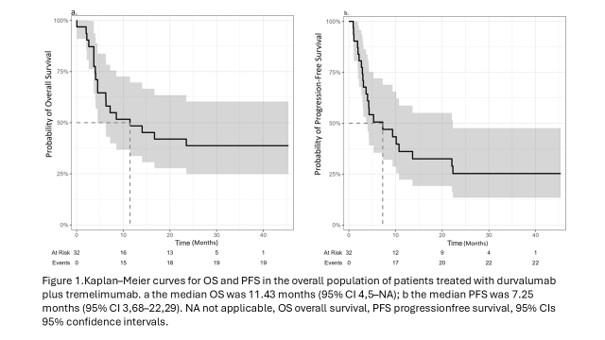
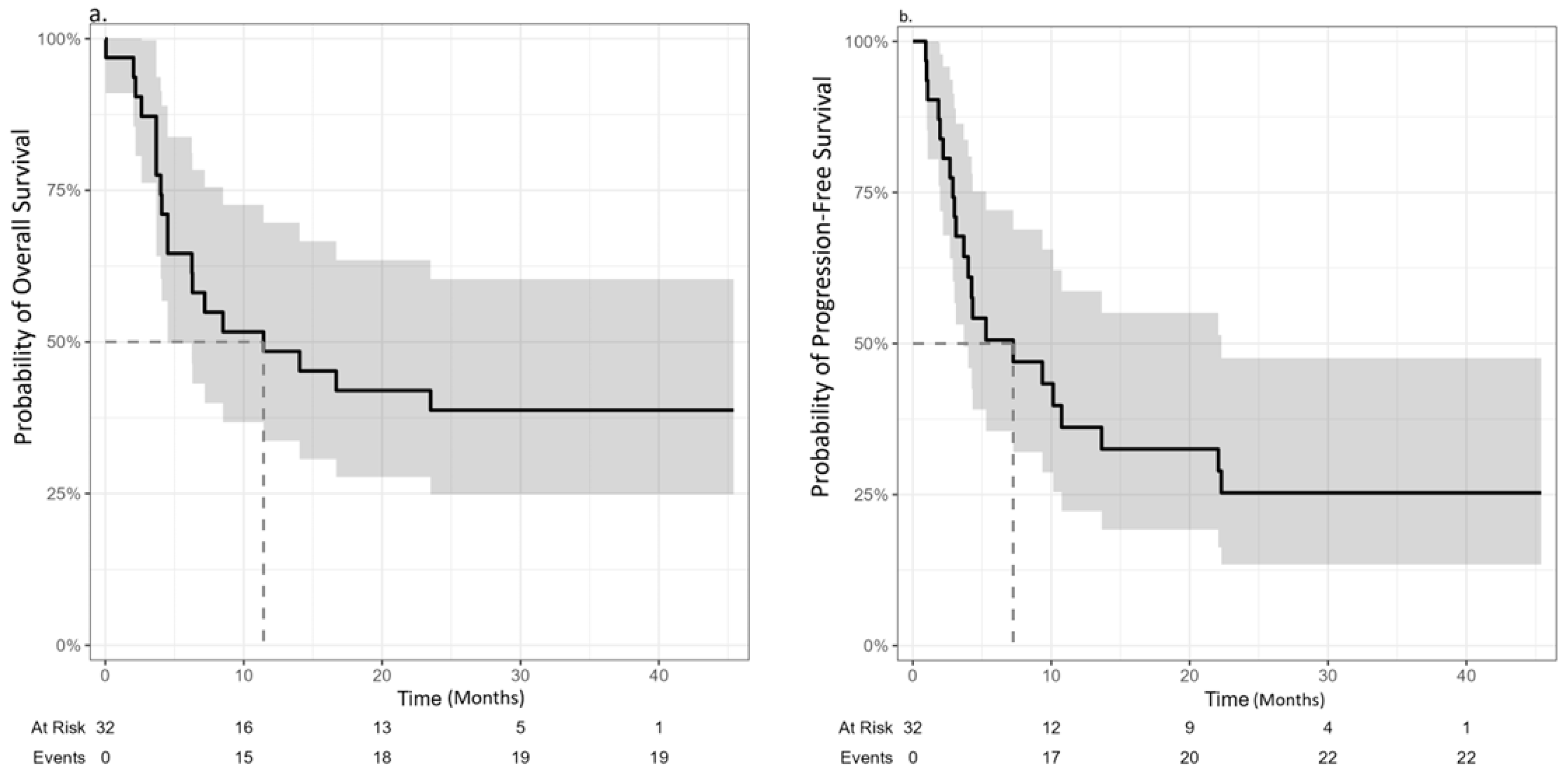
The median PFS was 7,25 months (%95 confidence interval (CI) 3,68-22,29) and the median OS was 11,43 months (%95 CI 4,5-NA) in study population (Figure 1).
Univariable Cox regression analysis did not identify any baseline clinical or disease-related factor that was significantly associated with progression-free survival (PFS) or overall survival (OS). Variables including sex, BCLC stage, disease etiology, macrovascular invasion, extrahepatic spread, lung or bone metastases, tumor size greater than 5 cm, AFP level ≥400 ng/mL, cirrhosis, prior locoregional therapy, and treatment-related adverse events were not significantly associated with survival outcomes (all p > 0.05). Although bone metastasis showed a trend toward poorer PFS (HR 2.55), this association did not reach statistical significance. These findings suggest that none of the evaluated baseline variables independently predicted survival in this cohort. (Table 4).
Among the 32 patients included in the study, the objective response rate (ORR) was 34.3%, with one patient (3.1%) achieving a complete response (CR) and 10 patients (31.3%) achieving a partial response (PR). Stable disease (SD) was observed in 5 patients (15.6%), resulting in an overall disease control rate (DCR) of 50.0%. In contrast, progressive disease (PD) was documented in 10 patients (31.3%) as the best overall response. At the time of data cutoff, 19 patients (59.4%) had died.
Overall, these findings indicate that first-line durvalumab plus tremelimumab achieved meaningful antitumor activity in this real-world cohort, with approximately one-third of patients experiencing an objective response and one-half achieving disease control. The observed response rates are consistent with the durable clinical benefit demonstrated in the survival analyses, despite the advanced disease stage of the study population. (Table 5).
4. Discussion
When the treatment of metastatic/ unresectable HCC in history was researched, the first systemic effective drug was sorafenib that was an oral multikinase inhibitor of the vascular endothelial growth factor receptor, the platelet-derived growth factor receptor, and Raf [13]. Then IMbrave150 trial showed that combinations of durvalumab plus bevacizumab were more effective on PFS and OS against sorafenib [14]. After immune-check points inhibitor showed efficiency on HCC, STRIDE and CheckMate 9DW trials investigated. STRIDE and Checkmate 9DW trials showed longer mOS (16.43 months vs 23·7months) and median durations of treatment (22.34 months vs 30·4 months) than Imbrave150 (mOS 19.2 months and median duration of treatment 18.1months). However, STRIDE and Checkmate 9DW trials didn’t show statistical significance PFS. Safety datas from trails showed that Imbrave150 had more grade 3-4 treatment-related serious adverse event than STRIDE and Checkmate9WD5 [14,15,16].
We reported the STRIDE regimen for uHCC at first line in Turkey as multicenter study. We evaluated safety and efficacy of STRIDE regimen of 32 patients. Our study showed longer median PFS (7,25 mo ve 3,78 mo) than HIMALAYA trial 5. Some real world datas of STRIDE regimen from Japan and Italy reported that mPFS was 3, 3,9 and 5,7 months [8,9,11]. Therefore, Fujii et all reported mPFS 6,8 mo which was closer to our study [7]. It probably resulted from being small population and locoregional therapies that was applied to %46,9 of patients.
ORR and DCR were reported similar to HIMALAYA trials and relevant real world datas. Median OS resulted 11,43 months (%95 CI 4,5-NA) and it was shorter than other studies. Prinzi et al and Kournoutas et all found that mOS was 15,5 and 14,6 months [10,17]. Some real datas reported that mOS was not reached [7,8,11]. Relatively preserved PFS despite short OS may suggest limited access to effective post-progression systemic therapies and possible influence of underlying liver dysfunction in this real-world cohort.
Akarca et al showed that respectively HBV infection, HCV infection and non-viral composed %68,2 %17,2 and %14,6 of etiology of hepatocellular carcinoma in population of Turkey. This study also reported BCLC B-C stage was half of population. Therefore, our populations showed inconsistency of Turkish populations [18]. Our study populations don’t represent HCC with HCV infection due to low rate.
Our study showed similar demographic features, macrovascular invasion and extrahepatic spread rates in literature [7,8,9,10,11,17].
Sorafenib, lenvatinib, ramucirumab, cabozantinib and regorafenib are suggested after progressions of after first-line immune checkpoint inhibitor therapy or tyrosine kinase inhibitors [19,20,21,22,23,24,25]. In Turkey, sorafenib is almost only second line agents, due to regorafenib and cabozantinib are not tolerable and lenvatinib is not feasible. Probably, the reason for shorter mOS is lacking second line agents except for sorafenib.
As reported in the other real world datas, we showed that prognostic factors such as male gender, etiology of HCC, BCLC staging, and locoregional therapies were not associated with statistically significant differences in PFS or OS in study [7,8,9,10,11,17].
Due to the lack of reimbursement for trelimumab/durvalumab therapy in our country and its reliance on early access data, the treatment is strictly monitored. Furthermore, given the well-defined adverse effect profile, the patient inclusion criteria remain highly objective. Our study demonstrated that the tremelimumab/durvalumab combination is highly safe; the incidence of side effects and treatment discontinuation due to side effects was found to be remarkably low, as reported in the literature [5,12].
Due to less side effects of STRIDE protocol, new treatment strategies are required to provide longer mPFS, mOS and high rate of ORR. The last studies focus on targeting LAG3 (Lymphocyte-activation gene 3) and TIGIT (Cell Immunoreceptor with Ig and ITIM Domains) in hepatocelluler carcinoma treatment. Relativity-106 and Relavity-073 that are phase 1b/2 and phase 2 studies to use relatlimab (anti-LAG3 agent) have been completed but the results have not announced yet [32,33]. Tiragolumab is an anti TIGIT agent showed 43% of ORR with combinations with atezolizumab plus bevacizumab in phase 1b/2 trials but it didn’t show statiscally signifinat benefit to mPFS Mbrave152/SKYSCRAPER-14 trial [34,35].
We reported first results of Tremelimumab/durvalumab treatment in Turkey as strong side. This study has some limitations; it was retrospective, short-term and small study, there were only two people with HCV that did not represent all populations.
5. Conclusions
We showed the safety and efficiency of Tremelimumab/durvalumab treatment in first line of uHCC in Turkish real-world data. We presume that STRIDE regimen is candidate options to uHCC in first line. Further larger trials with long-term observation need to be validated.
Author Contributions
For research articles with several authors, a short paragraph specifying their individual contributions must be provided. The following statements should be used “Conceptualization, M.M.M. and F.K.; methodology, G.Ş and B.M.D; software, K.H.G. and C.M.; validation, C.K., E.H. and T.Ş.; formal analysis, M.A.; investigation, B.K.,N.S, B.E.K. and T.K.; re-sources, M.M.M.and C.Ş and. A.P.E; data curation, H.AY., H.K, O.Y and B.Y..; writing—original draft preparation, M.M.M.and H.Ç.Y.; writing—review and editing, B.Y,M.A., B.Ç. and N.T. visualization, M.K.E. , İ.T.Üand M.A.; supervision, F.S.B, M.A.Ş and Ş.Y.; project administration, H.Ç.Y and Ş.Y.All authors have read and agreed to the published version of the manuscript.” Please turn to the CRediT taxonomy for the term explanation. Authorship must be limited to those who have contributed substantially to the work reported.
Funding
This research received no external funding.
Institutional Review Board Statement
The retrospective study was approved by the Ege University Ethics Committee (No: 25-10.2T/56, approval date: 30 October 2025) and complied with the principles of the Declaration of Helsinki.
Informed Consent Statement
Written informed consent was obtained from all patients prior to blood sampling.
Data Availability Statement
The data that supports the findings of this study are available from the corresponding author upon request.
Conflicts of Interest
The authors declare no competing financial interests.
References
- Bray, F.; Ferlay, J.; Soerjomataram, I.; Siegel, R.L.; Torre, L.A.; Jemal, A. Global cancer statistics 2018: GLOBOCAN estimates of incidence and mortality worldwide for 36 cancers in 185 countries. CA Cancer J. Clin. 2018, 68(6), 394–424. [Google Scholar] [CrossRef] [PubMed]
- Singal, A.G.; Kanwal, F.; Llovet, J.M. Global trends in hepatocellular carcinoma epidemiology: implications for screening, prevention and therapy. Nat. Rev. Clin. Oncol. 2023, 20(12), 864–884. [Google Scholar] [CrossRef] [PubMed]
- Llovet, J.M.; Kelley, R.K.; Villanueva, A.; et al. Hepatocellular carcinoma. Nat. Rev. Dis. Prim. 2021, 7(1). [Google Scholar] [CrossRef] [PubMed]
- Llovet, J.M.; Brú, C.; Bruix, J. Prognosis of hepatocellular carcinoma: The BCLC staging classification. Semin Liver Dis. 1999, 19(3), 329–337. [Google Scholar] [CrossRef]
- Vogel, A.; Chan, S.L.; Dawson, L.A.; et al. Hepatocellular carcinoma: ESMO Clinical Practice Guideline for diagnosis, treatment and follow-up. Ann. Oncol. 2025, 36(5), 491–506. [Google Scholar] [CrossRef] [PubMed]
- Edwards, J.T.; Macdonald, G.A. Hepatocellular carcinoma. Curr. Opin. Gastroenterol. 2000, 16(3), 275–281. [Google Scholar] [CrossRef] [PubMed]
- Mauro, E.; de Castro, T.; Zeitlhoefler, M.; et al. Hepatocellular carcinoma: Epidemiology, diagnosis and treatment. JHEP Rep. 2025, 7(12), 101571. [Google Scholar] [CrossRef] [PubMed]
- Galle, P.R.; Forner, A.; Llovet, J.M.; et al. EASL Clinical Practice Guidelines: Management of hepatocellular carcinoma. J. Hepatol. 2018, 69(1), 182–236. [Google Scholar] [CrossRef] [PubMed]
- Park, J.W.; Chen, M.; Colombo, M.; et al. Global patterns of hepatocellular carcinoma management from diagnosis to death: The BRIDGE Study. Liver Int. 2015, 35(9), 2155–2166. [Google Scholar] [CrossRef] [PubMed]
- Llovet, J.M.; Ricci, S.; Mazzaferro, V.; et al. Sorafenib in Advanced Hepatocellular Carcinoma. N Engl. J. Med. 2008, 359(4), 378–390. [Google Scholar] [CrossRef] [PubMed]
- Kudo, M.; Finn, R.S.; Qin, S.; et al. Lenvatinib versus sorafenib in first-line treatment of patients with unresectable hepatocellular carcinoma: a randomised phase 3 non-inferiority trial. Lancet 2018, 391(10126), 1163–1173. [Google Scholar] [CrossRef] [PubMed]
- Finn, R.S.; Qin, S.; Ikeda, M.; et al. Atezolizumab plus Bevacizumab in Unresectable Hepatocellular Carcinoma. N Engl. J. Med. 2020, 382(20), 1894–1905. [Google Scholar] [CrossRef] [PubMed]
- Yau, T.; Galle, P.R.; Decaens, T.; et al. Nivolumab plus ipilimumab versus lenvatinib or sorafenib as first-line treatment for unresectable hepatocellular carcinoma (CheckMate 9DW): an open-label, randomised, phase 3 trial. Lancet 2025, 405(10492), 1851–1864. [Google Scholar] [CrossRef] [PubMed]
- Abou-Alfa, G.K.; Lau, G.; Kudo, M.; et al. Tremelimumab plus Durvalumab in Unresectable Hepatocellular Carcinoma. NEJM Evid. 2022, 1(8), 1–12. [Google Scholar] [CrossRef] [PubMed]
- Rimassa, L.; Chan, S.L.; Sangro, B.; et al. Five-year overall survival update from the HIMALAYA study of tremelimumab plus durvalumab in unresectable HCC. J. Hepatol. 2025, 83(4), 899–908. [Google Scholar] [CrossRef] [PubMed]
- Fujii, Y.; Kawaoka, T.; Shirane, Y.; et al. First-Line Durvalumab plus Tremelimumab Treatment for Unresectable Hepatocellular Carcinoma in Real-World Clinical Practice. Oncol. 2025, 103(8), 742–747. [Google Scholar] [CrossRef] [PubMed]
- Casadei-Gardini, A.; Canova, L.; Tosi, F.; et al. Durvalumab-Tremelimumab in Advanced Hepatocellular Carcinoma: Real-World Data From the LOR-HCC (Lombardy Real-World HCC Group). Liver Int. 2026, 46(5), e70640. [Google Scholar] [CrossRef] [PubMed]
- Shimose, S.; Saeki, I.; Tomonari, T.; et al. Initial clinical experience with durvalumab plus tremelimumab in patients with unresectable hepatocellular carcinoma in real-world practice. Oncol. Lett. 2024, 28(2), 1–9. [Google Scholar] [CrossRef] [PubMed]
- Kournoutas, I.; Marell, P.; Gile, J.; et al. First-line atezolizumab/bevacizumab or durvalumab/tremelimumab in advanced hepatocellular carcinoma: a real world, multicenter retrospective study. Oncologist 2025, 30(11). [Google Scholar] [CrossRef] [PubMed]
- Fujiwara, Y.; Kuroda, H.; Abe, T.; et al. Early Clinical Outcomes of Durvalumab Plus Tremelimumab in Unresectable Hepatocellular Carcinoma: A Real-World Comparison with First-Line or Later-Line Treatment. Drugs-Real. World Outcomes 2024, 11(4), 701–710. [Google Scholar] [CrossRef] [PubMed]
- Cheng, Y.; Zhang, M.; Yao, Y.; et al. A real-world drug safety surveillance study from the FAERS database of hepatocellular carcinoma patients receiving durvalumab in combination with tremelimumab. Front Immunol. 2025, 16(October), 1–12. [Google Scholar] [CrossRef] [PubMed]
- Cheng, A.L.; Qin, S.; Ikeda, M.; et al. Updated efficacy and safety data from IMbrave150: Atezolizumab plus bevacizumab vs. sorafenib for unresectable hepatocellular carcinoma. J. Hepatol. 2022, 76(4), 862–873. [Google Scholar] [CrossRef] [PubMed]
- Lo Prinzi, F.; Rossari, F.; Silletta, M.; et al. Comparative Effectiveness of Atezolizumab Plus Bevacizumab Versus Tremelimumab Plus Durvalumab in Patients with Hepatocellular Carcinoma (HCC) in a Real-World Setting. Target Oncol. 2025, 20(4), 707–713. [Google Scholar] [CrossRef] [PubMed]
- Akarca, U.S.; Unsal, B.; Sezgin, O.; et al. Characteristics of Newly Diagnosed Hepatocellular Carcinoma Patients across Turkey: Prospective Multicenter Observational 3K Registry Study. Turk. J. Gastroenterol. 2021, 32(12), 1019–1028. [Google Scholar] [CrossRef] [PubMed]
- Möhring, C.; Berger, M.; Sadeghlar, F.; et al. Evaluating Sorafenib (SORA-2) as Second-Line Treatment for Unresectable Hepatocellular Carcinoma: A European Retrospective Multicenter Study †. Cancers 2025, 17(6). [Google Scholar] [CrossRef] [PubMed]
- Lombardi, P.; Kim, J.S.; Manfredi, G.F.; et al. Lenvatinib vs. sorafenib as second-line treatment post atezolizumab plus bevacizumab for hepatocellular carcinoma: The LEVIATHAN study. JHEP Rep. 2025, 7(12), 101595. [Google Scholar] [CrossRef] [PubMed]
- Zhu, A.X.; Nipp, R.D.; Finn, R.S.; et al. Ramucirumab in the second-line for patients with hepatocellular carcinoma and elevated alpha-fetoprotein: Patient-reported outcomes across two randomised clinical trials. ESMO Open. 2020, 5(4), e000797. [Google Scholar] [CrossRef] [PubMed]
- Zhu, A.X.; Kang, Y.K.; Yen, C.J.; et al. Ramucirumab after sorafenib in patients with advanced hepatocellular carcinoma and increased α-fetoprotein concentrations (REACH-2): a randomised, double-blind, placebo-controlled, phase 3 trial. Lancet Oncol. 2019, 20(2), 282–296. [Google Scholar] [CrossRef] [PubMed]
- Kelley, R.K.; Ryoo, B.Y.; Merle, P.; et al. Second-line cabozantinib after sorafenib treatment for advanced hepatocellular carcinoma: a subgroup analysis of the phase 3 CELESTIAL trial. ESMO Open. 2020, 5(4), 1–9. [Google Scholar] [CrossRef] [PubMed]
- Bruix, J.; Qin, S.; Merle, P.; et al. Regorafenib for patients with hepatocellular carcinoma who progressed on sorafenib treatment (RESORCE): a randomised, double-blind, placebo-controlled, phase 3 trial. Lancet 2017, 389(10064), 56–66. [Google Scholar] [CrossRef] [PubMed]
- Finn, R.S.; Merle, P.; Granito, A.; et al. Outcomes of sequential treatment with sorafenib followed by regorafenib for HCC: Additional analyses from the phase III RESORCE trial. J. Hepatol. 2018, 69(2), 353–358. [Google Scholar] [CrossRef] [PubMed]
- Sangro, B.; Yau, T.; Harding, J.J.; et al. RELATIVITY-106: A phase 1/2 trial of nivolumab (NIVO) + relatlimab (RELA) in combination with bevacizumab (BEV) in first-line (1L) hepatocellular carcinoma (HCC). J. Clin. Oncol. 2023, 41((4_) suppl, TPS636–TPS636. [Google Scholar] [CrossRef]
- Sangro, B.; Numata, K.; Huang, Y.; et al. P-61 Relatlimab + nivolumab in patients with advanced hepatocellular carcinoma who are naive to immuno-oncology therapy but progressed on tyrosine kinase inhibitors, a phase 2, randomized, open-label study: RELATIVITY-073. Ann. Oncol. 2021, 32, S117. [Google Scholar] [CrossRef]
- Finn, R.S.; Ryoo, B.Y.; Hsu, C.H.; et al. Tiragolumab in combination with atezolizumab and bevacizumab in patients with unresectable, locally advanced or metastatic hepatocellular carcinoma (MORPHEUS-Liver): a randomised, open-label, phase 1b–2, study. Lancet Oncol. 2025, 26(2), 214–226. [Google Scholar] [CrossRef] [PubMed]
- Badhrinarayanan, S.; Cotter, C.; Zhu, H.; Lin, Y.C.; Kudo, M.; Li, D. IMbrave152/SKYSCRAPER-14: a Phase III study of atezolizumab, bevacizumab and tiragolumab in advanced hepatocellular carcinoma. Futur Oncol. 2024, 20(28), 2049–2057. [Google Scholar] [CrossRef] [PubMed]

Table 1.
Clinical and Demographic Features of Patients (n=32).
| Parameter | |
|---|---|
| Median Age (Range) - yr | 64 (23-85) |
| Male Sex-no (%) | 22 (%68,8) |
| ECOG Performance Status Score | |
| 0 | 13(%40,6) |
| 1 | 15(%46,9) |
| 2 | 4(%12,5) |
| Child-Pugh Class/ Score | |
| A/5 | 20 (%62,5) |
| A/6 | 10 (%31,3) |
| B/7 | 1 (%3,1) |
| Other | 1 (%3,1) |
| BCLC Stage | |
| B | 11 (%34,4) |
| C | 21 (%65,6) |
| Etiology | |
| HBV | 13 (%40,6) |
| HCV | 2 (%6,3) |
| Non-viral | 17 (%53,1) |
| Macrovascular invasion | 8 (%25) |
| Extrahepatic Spread | 16 (%50) |
| Lung metastasis | 7 (%21,9) |
| Bone metastasis | 6 (%18,8) |
| Lesion size> 5 cm | 24 (%75) |
| AFP ≥400 ng/ml | 11 (%34,4) |
| Cirrhosis | 23 (%71,9) |
| Locoregional therapies | 15 (%46,9) |
Table 2.
Safety profile of patients.
| no, (%) | |
|---|---|
| Any Adverse Events | 11(%34,4) |
| Grade ≥ 3 Adverse Events | 3(%9,4) |
| Discontinuation of treatment | 2(%6,3) |
Table 3.
Adverse Events no=11.
| no, (%) | |
|---|---|
| Pruritus/rash | 7 (%21,9) |
| AST, ALT increased | 1 (%3,1) |
| Adrenal insufficiency | 1 (%3,1) |
| Hypothyroidism | 3 (%9,4) |
| Diarrhea/colitis | 3 (%9,4) |
| Pneumonitis | 1 (%3,1) |
Table 4.
Univariable analysis of PFS and OS.
| PFS | OS | ||||||
|---|---|---|---|---|---|---|---|
| Hazard ratio | (95% CI) | p-value | Hazard ratio | (95% CI) | p-value | ||
| Male | 0,662 | 0,275-1,597 | 0,359 | 0,664 | 0,261-1,690 | 0,39 | |
| BCLC Stage (B versus C) | 1,328 | 0,539-3,273 | 0,537 | 1,198 | 0,454-3,163 | 0,716 | |
| Etiology (non-viral vs viral hepatitis) | 0,804 | 0,346-1,868 | 0,612 | 0,677 | 0,274-1,67 | 0,397 | |
| Macrovascular invasion | 1,141 | 0,419-3,107 | 0,796 | 1,262 | 0,454-3,507 | 0,656 | |
| Extrahepatic Spread | 1,525 | 0,656-3,546 | 0,327 | 1,333 | 0,539-3,299 | 0,534 | |
| Lung metastasis | 0,912 | 0,336-2,475 | 0,856 | 0,596 | 0,173-2,048 | 0,411 | |
| Bone metastasis | 2,552 | 0,933-6,985 | 0,68 | 1,877 | 0,663-5,313 | 0,235 | |
| Lesion size> 5 cm | 1,798 | 0,66-4,894 | 0,251 | 1,596 | 0,529-4,812 | 0,407 | |
| AFP ≥400 ng/ml | 1,004 | 0,382-2,638 | 0,993 | 0,634 | 0,198-2,027 | 0,442 | |
| Cirrhosis | 1,827 | 0,671-4,973 | 0,238 | 2,441 | 0,710-8,389 | 0,157 | |
| Locoregional therapies | 0,888 | 0,383-2,058 | 0,782 | 0,606 | 0,243-1,511 | 0,282 | |
| Adverse Events | 1,044 | 0,438-2,491 | 0,922 | 0,485 | 0,172-1,363 | 0,17 | |
Table 5.
Best Responses- no (%).
| Objective | 11 (%34,3) |
| Complete | 1 (%3,1) |
| Partial | 10 (%31,3) |
| Progressive Disease | 10 (%31,3) |
| Stable Disease- no (%) | 5 (%15,6) |
| Disease Control Rate- % | 16 (%50) |
| Exitus | 19 (%59,4) |
Disclaimer/Publisher’s Note: The statements, opinions and data contained in all publications are solely those of the individual author(s) and contributor(s) and not of MDPI and/or the editor(s). MDPI and/or the editor(s) disclaim responsibility for any injury to people or property resulting from any ideas, methods, instructions or products referred to in the content. |
© 2026 by the authors. Licensee MDPI, Basel, Switzerland. This article is an open access article distributed under the terms and conditions of the Creative Commons Attribution (CC BY) license.
Copyright: This open access article is published under a Creative Commons CC BY 4.0 license, which permit the free download, distribution, and reuse, provided that the author and preprint are cited in any reuse.