

Submitted:
08 July 2026
Posted:
09 July 2026
You are already at the latest version
Abstract
Susceptibility to misinformation threatens democratic processes, yet the differential predictive role of authoritarianism subdimensions remains understudied. This study integrates data from two independent Romanian samples collected during the 2024–2025 electoral cycle (N = 597), examining how aggression, conventionalism/traditionalism, and submission/conservatism predict two distinct outcomes: accuracy in identifying false news (Study 1, N = 427, RWA-15) and belief in conspiracy statements drawn from the annulled Romanian presidential election (Study 2, N = 170, VSA-6). Hierarchical regressions revealed a striking dissociation: authoritarian submission was the dominant predictor of fake news detection deficits (β = −0.41, p < .001), while traditionalism was the dominant predictor of conspiracy belief (β = +0.39, p < .001). Aggression failed to predict either outcome after controls. Fisher's z tests confirmed systematic cross-study differences (both p < .001), consistent with distinct cognitive and ideological routes to misinformation susceptibility. Person-centered analyses replicated the variable-centered findings. Cross-instrumental convergence was partial: the traditionalism/conventionalism equivalence replicated consistently, while submission/conservatism showed less stability. These findings suggest that prebunking interventions should be tailored to authoritarian profiles: cognitively oriented training for submission-dominant individuals, and value-based argumentation for traditionalism-dominant ones.
Keywords:
right-wing authoritarianism
; conspiracy theories
; fake news
; submission
; traditionalism
; misinformation
; media literacy
; presidential elections
; Romania
1. Introduction
The year 2024 was described as the „super-cycle [electoral] year” in modern history, with more than 60 national elections engaging approximately two billion voters worldwide (Asplund et al., 2025). Concurrently, The World Economic Forum’s Global Risks Report (2024) identifies misinformation and disinformation as one of the leading short-term global risks facing the world (WEF, 2024). The rise of misinformation has transformed susceptibility to false information from a narrow concern in social psychology into a systemic vulnerability of liberal democracies (Lewandowsky et al., 2017; Bennett & Livingston, 2018; Pennycook & Rand, 2021; Mutu, 2024).
In the past decade, scholars identified that among the demographic and ideological variables thought to drive this susceptibility, authoritarianism occupies a privileged but contested position. A growing body of work links right-wing authoritarianism (RWA) to greater acceptance of fake news (Sindermann et al., 2020; Sinclair et al., 2020), belief in conspiracy theories (Douglas et al., 2017; Frenken et al., 2023), and rejection of scientific evidence (Lewandowsky et al., 2013). At the same time, recent investigations in Central and Eastern Europe (Faragó et al., 2020; Szebeni et al., 2021) suggest that the direct effects of total RWA scores are often small or inconsistent, particularly when controlling for variables such as political orientation or general conspiracy mentality. This inconsistency raises a question that has been systematically underexplored in prior research: do the subdimensions of authoritarianism - aggression, conventionalism, and submission (Altemeyer, 1996) - exert differential predictive influence on distinct forms of misinformation susceptibility?
Romania offers a particularly informative case for the study of authoritarianism and misinformation. In December 2024, the Constitutional Court annulled the first round of the presidential election after a previously little-known candidate, Călin Georgescu, secured a leading position on the basis of a campaign conducted almost entirely on TikTok and saturated with conspiratorial and authoritarian content. Declassified intelligence documents and subsequent reporting suggested that Georgescu’s campaign benefited from coordinated online amplification, including thousands of fake accounts and extensive artificial boosting on TikTok (Kirby & Thorpe, 2024; Mutu, 2025). This event—unprecedented in the European Union—offers a quasi-experimental natural context for studying the relationship between authoritarian attitudes and acceptance of misinformation. Conspiracy statements made by candidates during the campaign remained highly salient in public memory, yet they were subsequently delegitimized at the institutional level when the Constitutional Court annulled the first round of the presidential election on the grounds of foreign interference and large-scale online manipulation (VIGINUM, 2025).
1.1. Authoritarianism: From Composite Score to Subdimensions
The concept of right-wing authoritarianism (RWA), developed by Altemeyer (1981, 1996) on the foundations of authoritarian personality by Adorno et al. (1950), describes an attitudinal syndrome with three components: authoritarian aggression (sanctioning of norm violators), conventionalism (adherence to traditional norms), and authoritarian submission (deference to legitimate authority). Duckitt, Bizumic, Krauss, and Heled (2010) subsequently reconceptualized these dimensions as social attitudes rather than personality traits, renaming them authoritarianism, traditionalism, and conservatism, and operationalizing them in the Authoritarianism-Conservatism-Traditionalism (ACT) scale. Bizumic and Duckitt (2018) later developed an ultra-short six-item version of this instrument, the Very Short Authoritarianism (VSA-6) scale.
The bulk of empirical work, however, has continued to treat authoritarianism as a unitary construct, using either total RWA scores or short-form aggregates without disaggregating by subdimension (e.g., Sindermann et al., 2020; Frenken et al., 2023). This practice obscures potentially important differences. Sinclair et al. (2020), for example, demonstrated that authoritarianism is negatively associated with the updating of beliefs after prediction errors—an effect more plausibly attributable to cognitive rigidity (linked to submission and traditionalism) than to behavioral intolerance (linked to aggression). Likewise, Duckitt and Sibley's (2010) dual-process model identifies separate motivational substrates for the agonistic and traditionalist components of authoritarianism, implying that they should also have different cognitive consequences.
We are not aware of a study that has directly examined whether the three Right-Wing Authoritarianism (RWA) subdimensions differentially predict distinct forms of misinformation susceptibility within the same population. The present study seeks to address this significant gap in the literature.
1.2. Two Forms of Misinformation Susceptibility
Contemporary research often treats fake news and conspiracy theories as twin manifestations of a generic "misinformation" phenomenon (Pennycook & Rand, 2021). We argue that this approach obscures fundamental psychological differences between the two processes. Fake news detection can be understood primarily as a judgment task, a cognitive discrimination operation. The respondent evaluates the veracity of a news item based on formal cues (source, tone, factual plausibility) and comparison with prior knowledge (Pennycook & Rand, 2019). This process is well captured by signal detection theory (Wickens, 2002) and we used it in our methodology in order to measure the accuracy of discriminating between true and fake news. Crucially, it is not inherently ideologically charged: even highly committed partisans can correctly classify implausible news, provided that they pause to evaluate it analytically (Pennycook & Rand, 2019, p. 49).
Conspiracy belief, in contrast, can be considered as an ideologically motivated process in which a narrative is accepted not for its evidentiary value but for its congruence with an already existing worldview (Douglas et al., 2017; Uscinski et al., 2022). Conspiracies offer simple causal explanations for complex social events and restore a sense of order — characteristics that make them particularly attractive to individuals with cognitive preferences for closure and stability (Jost & Hunyady, 2005; Jost et al., 2003). The acceptance of a conspiracy claim is therefore less about discriminating signal from noise and more about ideological identification with the worldview that the narrative implies.
This conceptual distinction yields a set of differentiated predictions. Submission and traditionalism, while both falling under the broader RWA umbrella, operate through psychologically distinct mechanisms that map onto different forms of misinformation susceptibility. Submission reflects a procedural deference to perceived authority — a tendency to accept information uncritically when it bears the markers of legitimate or authoritative sources, regardless of ideological content (Frischlich et al., 2021; Metzger et al., 2010; Traberg & van der Linden, 2022). This mechanism is directly implicated in fake news detection deficits: individuals high in submission may fail to scrutinize news items not because they are ideologically motivated to accept them, but because they habitually defer to source cues — a process well captured by heuristic models of credibility evaluation (Metzger et al., 2010). Traditionalism, by contrast, reflects an ideological commitment to established social values and resistance to change (Duckitt et al., 2010), which provides a motivational substrate for accepting conspiracy narratives that frame social disruption as the work of hidden enemies (Douglas et al., 2017; Miller et al., 2016; Uscinski et al., 2022). Unlike submission, whose influence is procedural and content-independent, traditionalism operates through motivated reasoning: the conspiracy claim is accepted not on evidentiary grounds but because it is congruent with a pre-existing worldview (Jost et al., 2003; Marchlewska et al., 2018). These two mechanisms yield asymmetric predictions: submission should primarily impair the cognitive discrimination task (fake news detection), while traditionalism should primarily inflate endorsement of ideologically congenial narratives (conspiracy belief). Aggression, being a behavioral disposition with distinct motivational antecedents and without direct epistemic implications (Duckitt & Sibley, 2010; Passini, 2017; Smith et al., 2023), should predict neither outcome strongly once the other subdimensions are controlled.
1.3. Romania as an Empirical Setting
Romania is an under-represented context in the international literature on misinformation and conspiracy belief, despite features that make it especially relevant: a relatively young democracy, sharp electoral polarization (Botan et al., 2025), and a high prevalence of nationalist and pro-Kremlin discourse on social media (Cucu, 2023; Bârgăoanu et al., 2023). The electoral crisis of December 2024 added a unique natural setting for testing the predictions outlined above: a sample collected shortly after the Constitutional Court's annulment of the elections reflects a moment when conspiracy claims made by candidates were both cognitively fresh/novel and institutionally invalidated.
Furthermore, the use of two complementary instruments (RWA-15 in Study 1, VSA-6 in Study 2) allows a cross-instrumental robustness test. If submission/conservatism and conventionalism/traditionalism produce parallel patterns across the two scales—which were developed independently and validated on different populations—this convergent evidence strengthens the case that the differential subdimensional pattern reflects a genuine psychological phenomenon rather than an instrument artifact.
1.4. The Present Study
We pursue three research questions and six hypotheses, derived from the theoretical considerations above.
RQ1. Which subdimension of authoritarianism—aggression, conventionalism/ traditionalism, or submission/ conservatism—is the strongest predictor of susceptibility to misinformation in the Romanian population?
H1a. Authoritarian submission negatively predicts accuracy in identifying false news, beyond the global RWA score.
H1b. Conventionalism/ traditionalism positively predicts conspiracy belief, emerging as the strongest predictor among the authoritarianism subdimensions.
H1c. Authoritarian aggression does not significantly predict either form of susceptibility after controlling for the other subdimensions.
RQ2. Does the predictive pattern differ between the two outcomes (fake news detection vs. conspiracy belief)?
H2. The predictive patterns of authoritarianism subdimensions differ systematically across the two outcomes: traditionalism will show a significantly larger effect on conspiracy belief than on fake news detection, reflecting its ideological-motivational function; submission will show a significantly larger effect on fake news detection than on conspiracy belief, reflecting its procedural-cognitive function; aggression will show no significant differential pattern across either outcome.
RQ3. Is there convergence between predictions derived from the two instruments (RWA-15 and VSA-6)?
H3. The conceptually equivalent subdimensions across the two instruments—submission (RWA-15) ↔ conservatism (VSA-6), conventionalism (RWA-15) ↔ traditionalism (VSA-6)—produce convergent predictive patterns, supporting the construct validity of authoritarianism as a multi-component attitudinal syndrome.
The article is structured as follows. Section 2 describes the methodology we employed and the integrated analytical strategy. Section 3 presents our results organized by hypotheses, including a cross-study comparison and confirmatory factor analyses. Section 4 discusses theoretical and applied implications. Section 5 addresses limitations and future avenues for research.
2. Materials and Methods
2.1. Overview and Design
We employed a two-study design with independent samples to examine how subdimensions of right-wing authoritarianism (RWA) predict two distinct forms of susceptibility to misinformation. Study 1 (N = 427) tested predictions of fake news detection accuracy, using the Right-Wing Authoritarianism scale (RWA-15; Zakrisson, 2005) and a custom-developed news evaluation task. Study 2 (N = 170) tested predictions of conspiracy belief endorsement, using the Very Short Authoritarianism scale (VSA-6; Bizumic & Duckitt, 2018) and a set of conspiracy statements drawn from public discourse surrounding the December 2024 Romanian presidential election. Both studies were conducted in Romania between 2024 and 2025.
The two studies use different instruments by design. This allows a cross-instrumental test of whether the differential predictive pattern of authoritarianism subdimensions replicates across measurement approaches. While RWA has been consistently linked to susceptibility to misinformation and distorted news as a composite score (Frischlich et al., 2021; Sinclair et al., 2020), research on the differential predictive validity of its subdimensions — authoritarian submission, authoritarian aggression, and conventionalism — has developed largely in the context of prejudice and intergroup attitudes (Duckitt & Bizumic, 2013; Dunwoody & Funke, 2016), leaving their distinct contributions to misinformation susceptibility underexplored. We acknowledge that this design does not allow tests of measurement invariance in the strict sense; instead, we report structural equivalence and convergent predictive validity. Both studies were conducted with informed consent and approved by the Doctoral Council of the A.I.Cuza University of Iași (Romania), Faculty of Psychology and Educational Sciences. All data and analysis code are available upon reasonable request from the corresponding author.
2.2. Study 1: Fake News Detection
2.2.1. Participants
Study 1 enrolled 427 Romanian adult participants (64.2% women, 35.6% men, 0.2% other; mean education level corresponding to undergraduate degree, M = 5.31, SD = 1.06 on a 1–7 scale ranging from primary school to doctoral degree; mean income corresponding to 4,000–6,000 RON per month (approx. 800 - 1 200 €), M = 4.73, SD = 1.79 on a 1–7 scale). Age was assessed in six brackets: 18–25 (25.5%), 26–35 (16.6%), 36–45 (29.7%), 46–55 (17.1%), 56–65 (5.6%), and 65+ (5.4%). Participants were recruited online via social media advertising and snowball sampling between March and June 2024. No financial compensation was offered.
2.2.2. Materials
Right-Wing Authoritarianism Scale (RWA-15). We administered the 15-item Right-Wing Authoritarianism scale developed by Zakrisson (2005), a shortened balanced version of Altemeyer's (1996) original instrument. Items were translated into Romanian using forward-backward translation by two bilingual psychologists. Responses used a 9-point Likert scale ranging from 1 (completely disagree) to 9 (completely agree). Although Zakrisson (2005) validated the RWA-15 as a unidimensional total score, the items map onto three theoretically derived subscales — authoritarian aggression, conventionalism, and authoritarian submission — whose factor structure was established by Funke (2005) and subsequently applied to short-form RWA measures. Subscale scores were computed accordingly. Cronbach's α for the total scale was .738, comparable to the values reported by Zakrisson (2005) and within the acceptable range for short measures of broad ideological constructs (Cortina, 1993).
News Evaluation Task. Participants evaluated 12 short news items selected via an original algorithm — the News Weight Coefficient (NeWC) — developed by the first author and subsequently described in full in Răileanu-Olariu and Oprea (2025). The algorithm balances news items along three dimensions: ideological valence (favorable vs. unfavorable to four major political parties), source type (mainstream media vs. fringe sources), and AI vs. human authorship (an exploratory dimension not central to the present analyses). For each item, participants indicated whether they believed the news was true or false (binary response). The dependent measures derived from this task were: (a) accuracy in identifying false news, ACC_F (proportion of false items correctly identified as false); (b) accuracy in identifying true news, ACC_A; and (c) signal detection indices d' (sensitivity) and c (response bias) computed using the Snodgrass–Corwin (1988) correction for extreme proportions.
Demographic variables. Participants reported gender (binary), age (6 ordinal brackets), highest level of education completed (1–7 scale), monthly personal income (1–7 scale), residential setting (urban/peri-urban/rural), and political preference at the most recent election.
2.2.3. Procedure
Data were collected via online session lasting approximately 25 minutes. The order of presentation was: demographic block, RWA-15 (items presented in fixed order), and news evaluation task (items presented in randomized order across participants). Attention checks embedded in the RWA-15 block led to the exclusion of 6 participants from the analysis (final analytic sample N = 421 for the main regression models, though descriptive statistics are reported for the full N = 427).
2.3. Study 2: Conspiracy Belief
2.3.1. Participants
Study 2 enrolled 170 Romanian adult participants (62.4% women, 37.6% men; mean education M = 4.28, SD = 1.34; mean income M = 3.57, SD = 1.89). The age distribution skewed younger than in Study 1: 18–25 (50.6%), 26–35 (10.0%), 36–45 (8.8%), 46–55 (20.0%), 56–65 (8.8%), and 65+ (1.8%). Recruitment took place between January and March 2025—the two months immediately following the Constitutional Court's annulment of the first round of the Romanian presidential election (December 6, 2024). The over-representation of younger participants reflects the demographic profile of social media users in the immediate aftermath of that politically salient event.
2.3.2. Materials
Very Short Authoritarianism Scale (VSA-6). We used the 6-item VSA developed by Bizumic and Duckitt (2018), which conceptualizes authoritarianism as a multidimensional social attitude with three components: authoritarianism (the agonistic/aggressive component, comparable to Altemeyer's aggression), traditionalism (comparable to conventionalism), and conservatism (comparable to authoritarian submission). The Romanian translation was developed using forward-backward translation by the first author and an independent psychologist. Items were rated on a 9-point Likert scale centered at zero, ranging from −4 (very strongly disagree) to +4 (very strongly agree), with the value 0 representing neither agree nor disagree (some earlier versions of VSA-6 had scales ranging 1 to 9). This scoring convention follows Bizumic and Duckitt's (2018) recommendation to minimize acquiescence bias. Three items are reverse-keyed (items 1, 4, and 5) and were recoded prior to scoring.
Conspiracy Statements (CS). We compiled 16 conspiracy statements drawn from public statements made by candidates active in the annulled Romanian presidential election, correspondent to classical international conspiracy themes for content relevance. Statements were thematically coded as: electoral conspiracy (4 items, e.g., "International forces interfered to annul the elections"), historical conspiracy (4 items, e.g., "Mihai Eminescu was assassinated"), religious/spiritual conspiracy (3 items), health-related conspiracy (3 items, e.g., COVID-19 vaccine conspiracies), and technology-related conspiracy (2 items). Each statement was rated on a 5-point Likert scale from 1 (completely disagree) to 5 (completely agree). The dependent variable, ScorTC_Mediu, was the mean across all 16 items (Cronbach's α = .943). Following Brotherton et al. (2013), we classified participants into three groups based on empirically derived thresholds of the mean conspiracy score: Skeptics (n = 31, M ≤ 1.06), Neutrals (n = 98, 1.06 < M ≤ 2.75), and Believers (n = 41, M > 2.75). These thresholds were determined by the natural distribution of responses rather than strict tercile splits, reflecting the markedly skewed distribution of conspiracy endorsement in this sample (the majority of participants clustered in the neutral-to-low range).
Pennycook Epistemically Unwarranted Beliefs Inventory (PUEBI). As a convergent validity measure, we administered a Romanian translation of the 17-item Pennycook et al. (2015) inventory, which separately measures belief in conspiracy theories (PUEBI-CT, 8 items) and belief in occult/pseudo-scientific phenomena (PUEBI-OP, 9 items). Items were rated on a 5-point Likert scale. Cronbach's α was .719 for the full inventory; the subscale structure was validated through inspection of inter-item correlations. PUEBI-OP serves as a discriminant-validity benchmark: authoritarianism should predict conspiracy belief (PUEBI-CT) more strongly than belief in occult/pseudo-scientific content (PUEBI-OP).
Auxiliary measures (Status Anxiety, Anomia). To assess potential mediating or competing predictors, we administered the Social Status Anxiety Scale (SAS, 5 items, α = .880; Day & Fiske, 2016; Melita et al., 2020), which operationalizes status anxiety as conceptualized by Wilkinson and Pickett (2010) and the Middleton (1963) Anomia Scale (MAS, 6 items, α = .564). These auxiliary measures were used in exploratory robustness checks, not as primary predictors in the present analyses.
2.3.3. Procedure
Data were collected via online session lasting approximately 30 minutes. The order of presentation was: demographic block, conspiracy statements (randomized order), VSA-6, PUEBI, SAS, MAS, and a final demographic block including political preference and information consumption habits. No financial compensation was offered. Two cases were dropped due to incomplete demographic information; the final analytic sample was N = 169 for regression models and N = 170 for descriptive statistics.
2.4. Analytic Strategy
All analyses were conducted in Python 3.12 using the libraries pandas, statsmodels, scipy, and semopy. Parallel analyses were performed using IBM SPSS Statistics v26.
The analytic plan proceeded in four steps. First, we standardized all continuous predictors and outcomes within each study (z-scores) to facilitate cross-study comparison of standardized coefficients. Gender was dummy-coded (1 = woman, 0 = man) and aligned across the two datasets.
Second, we ran hierarchical multiple regression models in each study with three blocks: (1) demographic controls (gender, age, education, income); (2) the global authoritarianism score (RWA total in Study 1, VSA total in Study 2); and (3) the three subdimensions entered simultaneously, replacing the global score. ΔR² values and F-change tests were computed for each block transition. Variance inflation factors (VIF) were inspected for multicollinearity (threshold VIF < 5; Hair et al., 2014).
Third, we tested whether the predictive coefficients of each subdimension differed systematically between the two studies. Because the dependent variables in the two studies have opposite signs of association (lower accuracy = greater susceptibility; higher conspiracy belief = greater susceptibility), we sign-flipped Study 1 coefficients to obtain a common "susceptibility" metric. We then applied Fisher's r-to-z transformation to standardized β coefficients (treated as approximations of partial correlations, following Aloe and Becker, 2012) and computed z-tests for the equality of two independent correlations (Cohen et al., 2003).
Fourth, we conducted confirmatory factor analyses (CFA) on the RWA-15 and VSA-6 instruments separately, using maximum-likelihood estimation. Model fit was evaluated using χ², CFI, TLI, RMSEA, and SRMR, with conventional cutoffs (CFI/TLI > .90 acceptable, > .95 good; RMSEA < .08 acceptable, < .06 good; Hu & Bentler, 1999). Because the two instruments contain different items, we report structural equivalence rather than strict measurement invariance.
Finally, as a complementary person-centered analysis, we conducted one-way ANOVAs in Study 2 comparing the three conspiracy belief profiles (Skeptics, Neutrals, Believers) on each authoritarianism subdimension, with Tukey HSD post-hoc tests and η² effect size estimates.
2.5. Use of Generative AI
A generative AI tool (Claude, version Sonnet 4.6) was used during manuscript preparation to assist with translating and refining the academic English phrasing of author-written text, as English is not the authors' native language. The tool was not used to generate research ideas, data, analyses, or citations. All AI-assisted text was reviewed, edited, and verified by the authors, who take full responsibility for the accuracy and integrity of the final content
3. Results
3.1. Descriptive Statistics and Reliability
Table 1 reports descriptive statistics for the main predictor and outcome variables in both studies. The two samples differed demographically (Study 2 over-represented participants aged 18–25), justifying the inclusion of age and education as control variables in all regression models.
Internal consistency was acceptable for the RWA-15 (α = .738) and excellent for the conspiracy statements scale in Study 2 (α = .943). Cronbach's α for the VSA-6 was low (α = .447), which is expected for a six-item measure designed to capture three distinct subdimensions; Bizumic and Duckitt (2018) recommend evaluating the VSA-6 by its predictive validity rather than by α. Subscale predictive validity is examined in the regression results that follow.
3.2. Bivariate Relationships
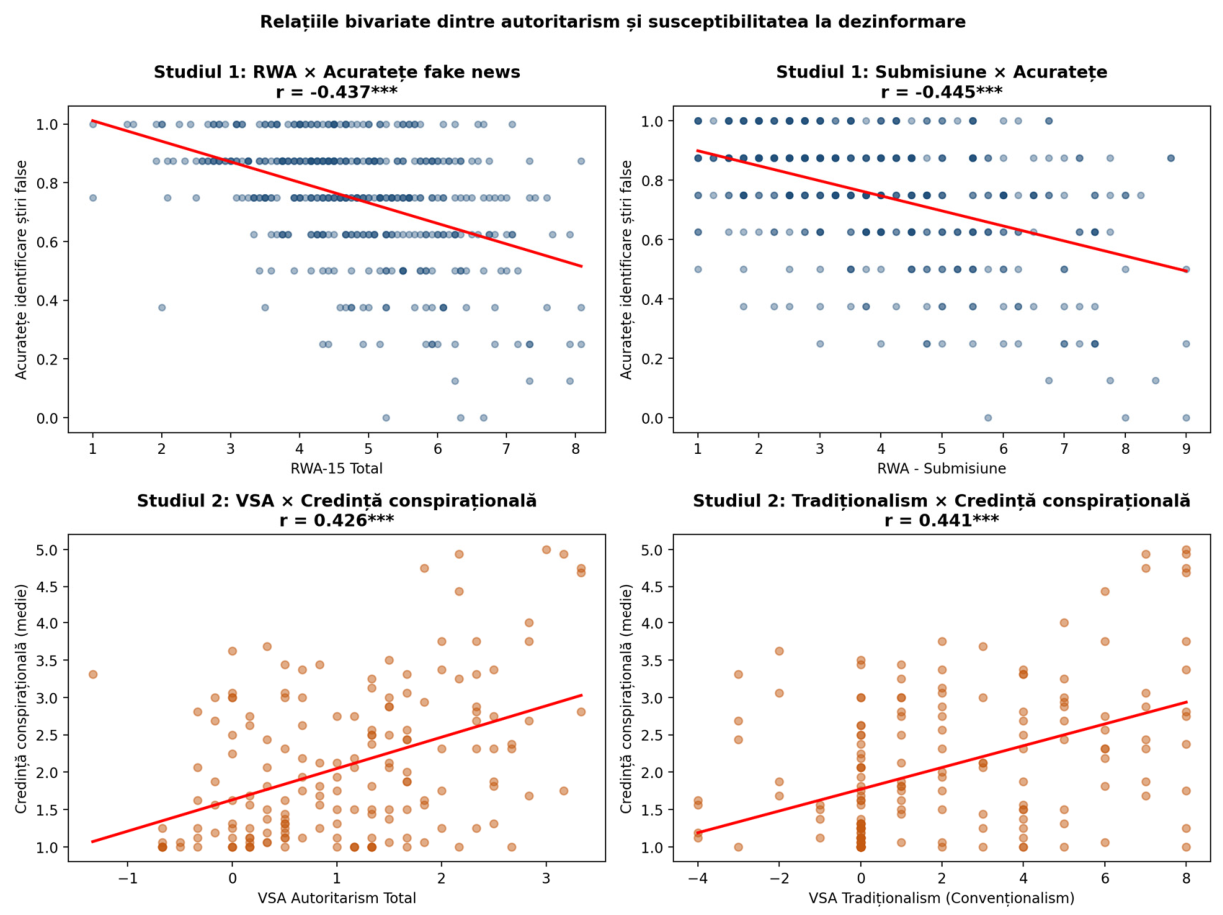
Table 2 reports Pearson correlations between authoritarianism scores and the primary outcomes in each study. In Study 1, authoritarian submission emerged as the strongest correlate of false news accuracy (r = −.45, p < .001) and signal detection sensitivity (r = −.43, p < .001), exceeding the global RWA total (r = −.44 with ACC_F). Conventionalism showed a moderate negative correlation with true news accuracy (r = −.24, p < .001) but a smaller correlation with false news accuracy. Authoritarian aggression was unrelated to true news accuracy (r = −.02, ns) and only moderately related to false news accuracy (r = −.29).
In Study 2, the pattern partially mirrored Study 1 but shifted in emphasis. Traditionalism emerged as the strongest correlate of conspiracy belief (r = .44, p < .001), exceeding the global VSA total (r = .43). Conservatism (submission) showed a weaker but significant association (r = .29, p < .001), and aggression was the weakest predictor (r = .19, p = .011). The PUEBI conspiracy subscale (PUEBI-CT) replicated the same pattern, providing convergent validity. Critically, the PUEBI occult/pseudoscience subscale (PUEBI-OP) was largely uncorrelated with authoritarianism, supporting discriminant validity: authoritarianism is specifically tied to politically-loaded conspiracy belief rather than to general epistemically unwarranted beliefs.
Figure 1.
Bivariate relationships between authoritarianism scores and misinformation susceptibility outcomes in Study 1 (top panels) and Study 2 (bottom panels). All correlations significant at p < .001.
Figure 1.
Bivariate relationships between authoritarianism scores and misinformation susceptibility outcomes in Study 1 (top panels) and Study 2 (bottom panels). All correlations significant at p < .001.
3.3. Hierarchical Regression Models
3.3.1. Study 1: Predicting Fake News Accuracy
Table 2 reports the hierarchical regression model for Study 1, with z-standardized false news accuracy (ACC_F) as the outcome. Block 1 (demographic controls only) explained 4.2% of variance, F(4, 416) = 4.57, p = .001. Block 2 added the global RWA total score, which increased explained variance by 18.4% (R² = .226, ΔR² = .184, ΔF(1, 415) = 98.49, p < .001), confirming that authoritarianism predicts fake news susceptibility above and beyond demographics. Block 3 replaced the global score with the three subdimensions entered simultaneously, raising explained variance to 25.9% (ΔR² vs. Block 1 = .217, ΔF(3, 413) = 40.35, p < .001), with Cohen's f² = 0.293 (medium-to-large effect).
In the final model, only authoritarian submission emerged as a significant predictor of false news accuracy (β = −0.41, p < .001, 95% CI [−.52, −.31]). Aggression and conventionalism did not reach significance when entered simultaneously (β = −0.07, p = .165 and β = −0.07, p = .115, respectively). This pattern indicates that the bivariate associations of aggression and conventionalism with accuracy were primarily driven by their shared variance with submission. Multicollinearity was not problematic (all VIFs < 1.55).
3.3.2. Study 2: Predicting Conspiracy Belief
Table 3 reports the parallel hierarchical regression for Study 2, with z-standardized mean conspiracy belief (CS mean) as the outcome. Block 1 (demographics) explained 11.6% of variance, F(4, 164) = 5.37, p < .001—notably more than in Study 1, primarily due to a negative association of education with conspiracy belief. Block 2 (adding VSA total) raised the explained variance to 27.5% (ΔR² = .159, p < .001). Block 3 (3 subscales) yielded R² = .313 (Cohen's f² = .287, medium-to-large).
In the final model, traditionalism emerged as by far the strongest predictor of conspiracy belief (β = +0.39, p < .001, 95% CI [.25, .54]), followed by submission (β = +0.13, p = .078, marginally significant). Aggression was completely non-predictive (β = +0.002, p = .973), confirming the dissociation between authoritarian behavior (aggression) and authoritarian cognition (traditionalism/submission) in predicting conspiracy belief. Multicollinearity was again not problematic (all VIFs < 1.66).
3.4. Cross-Study Comparison of Effect Sizes
Figure 2 displays the standardized β coefficients from the two final regression models in a forest plot. For comparability, Study 1 coefficients have been sign-reversed so that positive values denote greater susceptibility (lower accuracy) in both studies. Visual inspection reveals a striking dissociation: submission dominates in Study 1, while traditionalism dominates in Study 2, with aggression non-significant in both.
Table 4 reports formal tests of the cross-study differences using Fisher's r-to-z transformation. Two differences were statistically significant: submission predicted fake news susceptibility (Study 1) substantially more strongly than it predicted conspiracy belief (Study 2), z = 3.38, p < .001. Conversely, traditionalism predicted conspiracy belief substantially more strongly than it predicted fake news susceptibility, z = −3.73, p < .001. The difference for aggression was not significant, z = 0.72, p = .469, consistent with the finding that aggression is a weak predictor in both contexts.
3.5. Person-Centered Analysis: Conspiracy Belief Profiles
To complement the variable-centered analyses, we examined whether authoritarianism subdimensions differ among the three conspiracy belief profiles in Study 2 (Skeptics, Neutrals, Believers) (classified using empirically derived thresholds as described in Section 2.3.2). Figure 3 displays the group means, and Table 5 reports the one-way ANOVA results with η² effect sizes.
ANOVA confirmed substantial differences among groups for the global VSA total (F(2, 167) = 8.99, p < .001, η² = .097), traditionalism (F(2, 167) = 9.31, p < .001, η² = .100), and submission (F(2, 167) = 3.07, p = .049, η² = .035). Aggression did not differ significantly across groups (F(2, 167) = 1.53, p = .220, η² = .018). Tukey HSD post-hoc tests revealed that Believers scored significantly higher on traditionalism than both Neutrals (mean difference = 2.00, p < .001) and Skeptics (mean difference = 2.65, p < .001), while Neutrals and Skeptics did not differ from each other (mean difference = 0.65, p = .517). This pattern replicates the regression finding that traditionalism—not aggression—is the primary differentiator of conspiracy belief.
3.6. Confirmatory Factor Analysis
CFA models with three correlated factors (aggression, conventionalism/ traditionalism, submission/ conservatism) were estimated separately for the RWA-15 in Study 1 and the VSA-6 in Study 2 to evaluate the internal structural equivalence of the two instruments.
For the RWA-15, fit indices were marginal: χ²(87) = 321.32, p < .001; CFI = .83; TLI = .80; RMSEA = .080; SRMR not estimated. All factor loadings were significant, supporting the three-factor structure, although one item (item 8 in Submission) showed an inverted loading suggesting potential measurement issues. Inter-factor correlations were moderate to strong, ranging from .50 (Aggression–Conventionalism) to .85 (Aggression–Submission).
For the VSA-6, fit indices were poor: χ²(6) = 39.16, p < .001; CFI = .54; RMSEA = .181. This is partly attributable to the model's near-just-identification (only 6 items distributed across 3 factors leaves few degrees of freedom for adjustment). Item VSA_04 loaded weakly and negatively on the traditionalism factor, a pattern reflected in the negative inter-item correlation between the two traditionalism items (r = −.22) and a negative subscale α (α = −.44). This indicates that the two items comprising the traditionalism subscale are not measuring the same underlying construct in a consistent direction within this sample — a structural anomaly that is particularly noteworthy given that traditionalism emerged as the dominant predictor of conspiracy belief in Study 2. This concern applies specifically to the traditionalism subscale; the aggression and conservatism subscales showed low but positive inter-item correlations (r = .07 and r = .05, respectively), consistent with the VSA-6's known psychometric limitations for 2-item subscales. Caution is therefore warranted in attributing the observed traditionalism effect specifically to the construct as theorized by Bizumic and Duckitt (2018). As these authors acknowledge, the VSA-6 is designed for situations where instrument brevity is essential and should be evaluated primarily through criterion validity rather than internal structure. Accordingly, we treat the criterion-validity evidence reported above — traditionalism emerging as the strongest bivariate correlate of conspiracy belief (r = .44, p < .001), the strongest regression predictor (β = +0.39, p < .001), and the primary differentiator across conspiracy belief profiles (F(2,167) = 9.31, p < .001) — as the principal psychometric justification for retaining this subscale in the analyses, while explicitly acknowledging that its structural validity in this population remains limited and that replication with longer instruments is needed.
Although the two instruments cannot be tested for strict measurement invariance (they share no items), the patterns of factor loadings and inter-factor correlations are consistent with structural equivalence across instruments: in both studies, the three subdimensions emerge as conceptually distinct but moderately correlated facets of a broader authoritarian attitudinal syndrome.
3.7. Robustness Checks
Three robustness checks were performed. First, we replicated the Study 1 regression using signal detection sensitivity (d') as the outcome. The pattern was nearly identical to that for ACC_F (submission β = −0.37, p < .001; conventionalism β = −0.20, p < .001; aggression β = −0.01, ns), indicating that the predictive role of submission is not an artifact of differential response bias but reflects genuine discrimination ability.
Second, we replicated the Study 2 regression using PUEBI-CT (the convergent measure of conspiracy belief) instead of the custom CS scale. Traditionalism remained the strongest predictor (β = +0.24, p = .002). Aggression reached significance in this model (β = +0.17, p = .025), while submission was marginally non-significant (β = +0.13, p = .097). The partial divergence from the CS-based model — where aggression was non-predictive and submission was marginal — may reflect the broader, less politically specific content of the PUEBI-CT items, which include international conspiracy themes less directly tied to electoral context. Traditionalism's dominance across both outcome measures nonetheless strengthens confidence in the substantive findings.
Third, in Study 2, the discriminant validity outcome PUEBI-OP (occult/pseudoscience belief) was not significantly predicted by any authoritarianism subdimension in the full regression model, consistent with our theoretical claim that authoritarianism specifically predicts politically and ideologically loaded conspiracy belief rather than general epistemically unwarranted beliefs.
3.7.1. Summary of Findings
To summarize, our analyses yielded four convergent findings:
- (1)
- Submission is the dominant predictor of fake news detection deficits (Study 1, β = −0.41), while traditionalism is the dominant predictor of conspiracy belief endorsement (Study 2, β = +0.39) (though the structural validity of this subscale is limited by a negative inter-item correlation, as discussed in Section 5.3). Both effects survive controls for demographic covariates and the remaining authoritarianism subdimensions.
- (2)
- Authoritarian aggression does not significantly predict either form of misinformation susceptibility once the other subdimensions are controlled. This dissociation supports the view that the cognitive consequences of authoritarianism are not driven by aggressive or punitive dispositions but by submission and traditionalism—dimensions linked to need for cognitive closure and ideological orthodoxy (Jost et al., 2003).
- (3)
- The differential predictive patterns of submission and traditionalism between the two studies are statistically significant (Fisher's z, both p < .001), providing empirical support for the conceptual distinction between cognitive (accuracy-based) and ideological (motivated) routes to misinformation susceptibility.
- (4)
- Person-centered analyses replicate the variable-centered findings: profiles of conspiracy belief differ substantially on traditionalism and submission but not on aggression, with the strongest differentiation occurring between Believers and the other two groups on traditionalism.
- (5)
- Cross-instrumental convergence (H3) received partial support. The traditionalism–conventionalism equivalence produced consistent predictive patterns across instruments, with both dimensions emerging as dominant predictors of conspiracy-type outcomes in their respective studies. The submission–conservatism equivalence was less consistent: submission was the dominant predictor in Study 1 (β = −0.41, p < .001), whereas conservatism in Study 2 reached only marginal significance (β = +0.13, p = .078). This asymmetry may reflect differences in how the two instruments operationalize deference to authority, or it may reflect the different outcome measures and sample compositions across studies.
Implications of these findings—particularly for the design of targeted prebunking interventions—are discussed in the following section.
4. Discussion
Across two independent Romanian samples and two complementary authoritarianism instruments, we observed a clear and theoretically consistent dissociation: submission emerged as the dominant predictor of fake news detection deficits, while traditionalism emerged as the dominant predictor of conspiracy belief endorsement. Authoritarian aggression failed to significantly predict either outcome after partial-out of the remaining subdimensions. The differences between these patterns were statistically significant (Fisher's z, both p < .001), and they were replicated by person-centered analyses comparing belief profiles in Study 2. These results refine current understanding of how authoritarianism shapes vulnerability to misinformation in at least four ways.
4.1. The Composite Score Conceals Real Differences
The first contribution concerns measurement practice. Across the literature on authoritarianism and misinformation, most studies have reported only the total RWA score, occasionally derived from short-form measures, without disaggregating by subdimension (Sindermann et al., 2020; Frischlich et al., 2021; Szebeni et al., 2021). Our results suggest that this practice conceals real differences between subdimensions. In Study 1, the global RWA score yielded an apparently robust effect on false news accuracy (β = −0.43), but this effect was almost entirely carried by submission (β = −0.41 in the final model). Aggression and conventionalism added essentially nothing once submission was accounted for. The opposite pattern was observed in Study 2, where the global VSA effect (β = +0.43 in bivariate analysis) was carried primarily by traditionalism (β = +0.39 in the final model). The implication is methodological as much as substantive: future investigations of authoritarianism and misinformation should report subdimensional analyses by default, particularly when conclusions are drawn about underlying psychological mechanisms.
4.2. Two Routes to Misinformation Susceptibility
Our second contribution concerns the conceptual distinction between cognitive and ideological routes to misinformation susceptibility. Prior scientific evidence has shown that fake news susceptibility is primarily a function of analytical thinking deficits rather than ideological motivation (Pennycook & Rand, 2019, 2021). Our Study 1 results are broadly consistent with this view: submission—a dimension capturing deference to authorities and rule-following—predicts accuracy deficits independently of political content. This is the cognitive route. Individuals who unreflectively defer to authorities (legitimate or perceived) may also unreflectively accept news items that bear the markers of authoritative discourse, regardless of their actual veracity. The link is not ideological but procedural.
Study 2 reveals a complementary mechanism. Conspiracy belief, in contrast to fake news detection, is heavily ideological. The conspiracy statements presented in our materials were drawn from public discourse around the annulled Romanian elections, making them implicitly value-laden: accepting them entailed accepting a worldview in which Western liberal institutions, electoral integrity, and mainstream media are systematically corrupt. Traditionalism, a dimension capturing endorsement of traditional values and resistance to social change, provides a natural ideological substrate for such beliefs. Our finding that traditionalism is the strongest predictor of conspiracy belief (β = +0.39) supports a substantial body of work linking conspiracy mentality to ideological motivation rather than analytical deficiency (Douglas et al., 2017; Uscinski et al., 2022).
The dissociation is further supported by Fisher z tests: the predictive role of submission is significantly larger in Study 1 than in Study 2 (z = 3.38, p < .001), and the predictive role of traditionalism is significantly larger in Study 2 than in Study 1 (z = −3.73, p < .001). These cross-study differences are consistent with the conceptual distinction proposed in the introduction. However, because the two studies differ not only in outcome measure but also in authoritarianism instrument (RWA-15 vs. VSA-6), sample composition, and data collection period, the observed pattern should be interpreted as convergent evidence rather than direct proof of a single underlying psychological dissociation. Replication with identical instruments and matched samples would be required to rule out instrument- or context-specific explanations. Within these constraints, the present results suggest that misinformation susceptibility is not a unitary phenomenon, and that authoritarianism does not exert a unitary influence on it. Different subdimensions affect different routes.
4.3. The Surprising Irrelevance of Aggression
A third contribution concerns the predictive irrelevance of authoritarian aggression. In both studies and across multiple outcome measures, aggression failed to add meaningful predictive value after the other subdimensions were controlled. This is theoretically significant for two reasons. First, it indicates that the cognitive consequences of authoritarianism are not driven by punitive or aggressive dispositions per se. The behavioral readiness to sanction norm violators—classically the most salient feature of the authoritarian syndrome (Adorno et al., 1950)—is psychologically dissociable from the cognitive readiness to accept false or ideologically congenial information.
Second, the dissociation aligns with the dual-process motivational model of Duckitt and Sibley (2010), in which authoritarianism (here, aggression) and social dominance orientation operate as distinct motivational systems, each linked to different cognitive consequences. Our results extend this framework by showing that, even within RWA-type measures, the agonistic component (aggression) is functionally separable from the orthodoxy components (submission and traditionalism) in predicting misinformation susceptibility.
4.4. Implications for Prebunking and Media Literacy
The differential subdimensional pattern carries direct applied implications for the design of interventions against misinformation. The dominant paradigm in current intervention research is prebunking, defined as the proactive inoculation of audiences against expected manipulation techniques (Roozenbeek & van der Linden, 2019). Most prebunking interventions assume a uniform target audience and deliver content-neutral, technique-focused training (e.g., recognition of emotional manipulation, source attribution, scarcity claims). Our results suggest that this one-size-fits-all approach may be suboptimal.
For individuals high in submission—who are particularly vulnerable to fake news through procedural deference to authority cues—prebunking should emphasize source evaluation, lateral reading, and the recognition that authority signals can be manufactured. This is consistent with the SIFT (Stop, Investigate, Find better coverage, Trace) protocol developed by Caulfield (2017). For individuals high in traditionalism — who are particularly vulnerable to conspiracy beliefs through ideological motivation — prebunking should engage worldview congruence directly, perhaps through narratives that demonstrate how conspiracy thinking undermines rather than supports traditional values. Generic technique-focused prebunking, which targets manipulation tactics without addressing the underlying motivational substrate, may be insufficient or even counterproductive for ideologically motivated audiences: when corrections challenge a recipient's core worldview, resistance to belief revision is heightened, and standard factual rebuttal tends to activate identity-protective processing rather than genuine reconsideration (Lewandowsky & van der Linden, 2021; Ecker et al., 2022). More promising for this profile are interventions that either affirm the recipient's core identity alongside the corrective message — thereby reducing the perceived threat associated with belief change — or that reframe the conspiratorial narrative as incongruent with the very values it purports to defend (Ecker et al., 2022). Systematic review evidence confirms that interventions targeting the reasoning process rather than specific factual claims show the strongest and most generalizable effects on conspiracy belief reduction, with purely informational counterarguments demonstrating only small effects (O'Mahony et al., 2023). Generic prebunking that does not differentiate between these two profiles may be inefficient or even counterproductive for ideologically motivated audiences (Lewandowsky & van der Linden, 2021).
4.5. The Romanian Context and Generalizability
The Romanian sample examined in Study 2 offers a particularly stark test case because of the December 2024 electoral crisis. Conspiracy statements made by candidates during the campaign retained unusual salience: they were institutionally invalidated yet retained considerable public support. In this context, the dominance of traditionalism as a predictor of conspiracy belief is consistent with the broader observation that the December 2024 election mobilized voters along an axis of traditional values—national sovereignty, religious identity, and anti-globalist rhetoric—rather than along economic or programmatic axes (Botan et al., 2025; Soare et al., 2025; Cistelecan et al., 2025). Our results suggest that this ideological mobilization had measurable cognitive consequences at the individual level.
A secondary but theoretically noteworthy finding from Study 2 concerns the significant positive effect of age on conspiracy belief (β = .209, p = .007), indicating that older participants endorsed conspiracy statements more strongly than younger ones. This pattern runs counter to the common assumption that younger, digitally engaged individuals are more vulnerable to online misinformation (Pennycook & Rand, 2021). One plausible interpretation specific to the Romanian context is generational: older participants may have stronger pre-existing schemas of institutional distrust rooted in communist-era experience (Bârgăoanu et al., 2023), making them more receptive to narratives that frame Western institutions and electoral processes as systematically corrupt — precisely the ideological content of the conspiracy statements used in Study 2. Alternatively, the over-representation of participants aged 18–25 in Study 2 (50.6%) may have compressed variance in the younger age brackets, artificially amplifying the apparent age effect. Given that age was included as a control variable rather than a primary predictor, this finding should be treated as exploratory and interpreted with caution; nonetheless, it warrants dedicated investigation in future research on authoritarianism and misinformation susceptibility in post-communist contexts.
The generalization of these findings beyond Romania remains an open question. The dissociation between cognitive and ideological routes to misinformation susceptibility is plausibly universal, but the relative weight of the two routes may vary across political contexts. In societies with weaker traditionalist mobilization, submission may dominate predictions of both fake news and conspiracy belief. In societies with stronger traditionalist mobilization, traditionalism may dominate both. Cross-national replication, ideally including identical instruments and outcome measures, is needed to clarify this question.
5. Limitations and Future Directions
Several limitations of the present study should be acknowledged, each of which suggests directions for future research.
5.1. Cross-Sectional Design
Both studies employ cross-sectional designs that do not permit causal inference. The predictive associations reported above are consistent with our theoretical framework, but they cannot rule out reverse causation (e.g., regularly accepting conspiracy claims may itself strengthen traditionalist self-identification) or shared antecedent causes (e.g., early socialization, personality traits such as openness to experience). Longitudinal designs measuring authoritarianism and misinformation susceptibility at multiple time points would clarify the directionality of these associations. Even more informative would be intervention studies that experimentally manipulate the salience of submission or traditionalism (e.g., through priming) and measure downstream effects on misinformation judgments.
5.2. Sample Limitations
Both samples were recruited via online platforms and social media advertising. This recruitment strategy systematically over-represents urban, educated, and digitally engaged Romanians and under-represents rural, older, and less digitally engaged citizens. Given that the latter groups are precisely those most often portrayed in public discourse as vulnerable to misinformation, our findings may underestimate the true magnitude of subdimensional effects in the broader Romanian population. We further note that Study 2 disproportionately included participants aged 18–25 (50.6%), partly reflecting the demographic profile of social media users in the immediate aftermath of the December 2024 election. While we controlled for age in all regression models, future studies should aim for more demographically balanced samples, ideally through stratified online panels or telephone-based recruitment.
5.3. Measurement Considerations for the VSA-6
The VSA-6 used in Study 2 yielded acceptable predictive validity but low internal consistency (α = .447) and poor confirmatory factor analysis fit indices (CFI = .54, RMSEA = .181). These results are consistent with Bizumic and Duckitt's (2018) own characterization of the VSA-6 as a research instrument designed for situations where brevity is essential, and where construct validation should rest primarily on criterion evidence rather than internal structure. However, one measurement concern warrants explicit acknowledgment. The traditionalism subscale — which emerged as the dominant predictor of conspiracy belief in Study 2 — showed a negative inter-item correlation (r = −.22) between its two constituent items, with item VSA_04 loading weakly and negatively on the traditionalism factor in the CFA. This pattern indicates that the construct validity of the traditionalism subscale is suboptimal in this population, and that the effect of traditionalism on conspiracy belief, while robust in terms of criterion validity, should be interpreted with additional caution pending replication with longer, psychometrically stronger instruments. It is worth noting that the criterion-validity evidence remains internally consistent — traditionalism predicted conspiracy belief both in the regression model and in the person-centered analysis — but the weak structural basis of the subscale limits the confidence with which this effect can be attributed specifically to the traditionalism construct as theorized by Bizumic and Duckitt (2018). Nevertheless, future replications would benefit from using the full 36-item ACT scale (Bizumic & Duckitt, 2018) or other established multidimensional authoritarianism measures (e.g., Funke, 2005). The use of identical instruments across both studies would also permit formal tests of measurement invariance, which our design did not allow.
5.4. Domain Specificity of Outcomes
The fake news items used in Study 1 and the conspiracy statements used in Study 2 covered diverse content domains but were not exhaustive. In particular, the conspiracy statements in Study 2 were heavily weighted toward electoral and political content, reflecting the post-election context of data collection. Belief in conspiracies with different content domains (e.g., health, environmental, technological) may follow somewhat different patterns. The convergent finding from the PUEBI conspiracy subscale (which uses standardized international conspiracy items) provides some reassurance, but a domain-stratified investigation would be informative. Similarly, the predictive role of submission on fake news detection may vary depending on whether the news items use source cues that are conventionally trusted (mainstream media) versus contested (fringe outlets). Future work could systematically vary source cues to test this moderation.
5.5. Limited Mechanism Tests
We have proposed cognitive and ideological mechanisms underlying the dissociation between submission and traditionalism effects, but our design tested predictive patterns rather than mechanisms directly. Mediation analyses with explicit cognitive measures (need for cognitive closure, analytical thinking via the Cognitive Reflection Test) and explicit ideological measures (system justification, identification with national tradition) would clarify whether the proposed mechanisms account for the observed effects. The robustness checks reported in Section 3.7 are consistent with our framework, but they do not constitute formal mechanism tests.
5.6. Directions for Future Research
Three directions for future research follow from the above limitations. First, longitudinal designs measuring submission, traditionalism, and misinformation susceptibility at multiple time points would clarify the temporal dynamics and directionality of the associations identified here. Second, cross-national replication with identical instruments would test whether the cognitive/ideological dissociation generalizes beyond the Romanian context. Third, applied research should test whether prebunking interventions tailored to authoritarian profiles (cognitive emphasis for high-submission audiences, value-engagement emphasis for high-traditionalism audiences) outperform generic prebunking. The conceptual distinction we have proposed is amenable to direct experimental testing through randomized controlled trials of differentiated interventions. Fourth, replication using longer, psychometrically stronger instruments — such as the full 36-item ACT scale (Bizumic & Duckitt, 2018) or Funke's (2005) multidimensional RWA measure — administered across both outcome domains within the same sample would allow the observed subdimensional patterns to be disentangled from instrument-specific or context-specific explanations, strengthening the case that the dissociation between submission and traditionalism reflects a genuine psychological phenomenon rather than a measurement artifact.
5.7. Conclusion
Susceptibility to misinformation is not a unitary phenomenon, and authoritarianism does not exert a unitary influence on it. By disaggregating authoritarianism into its subdimensions and comparing predictions across two distinct outcomes—fake news detection and conspiracy belief—we have shown that submission and traditionalism shape susceptibility through complementary but distinct routes. Aggression, classically central to authoritarianism research, plays a surprisingly minor role in this particular cognitive domain. These results refine the theoretical understanding of authoritarianism's cognitive consequences and point toward differentiated strategies for democratic resilience in an age of pervasive misinformation.
Administrative
Author Contributions
Conceptualization, T.R.-O. and A.M.; Methodology, T.R.-O.; Software, T.R.-O.; Formal Analysis, T.R.-O.; Investigation, T.R.-O.; Data Curation, T.R.-O.; Writing – Original Draft Preparation, T.R.-O. and A.M.; Writing – Review & Editing, A.M.; Visualization, T.R.-O.; Supervision, A.M. Project Administration, T.R.-O. All authors have read and agreed to the published version of the manuscript.
Funding
This research received no external funding.
Institutional Review Board Statement
The study was conducted in accordance with the Declaration of Helsinki, and approved by the Doctoral Council of the Faculty of Psychology and Educational Sciences, Alexandru Ioan Cuza University of Iași, Romania (Study 1: protocol code 577, approved on 10 May 2023; Study 2: protocol code 405, approved on 13 February 2025).
Informed Consent Statement
Informed consent was obtained from all subjects involved in the study.
Data Availability Statement
The data presented in this study are available on request from the corresponding author due to privacy restrictions related to participant confidentiality.
Acknowledgments
During the preparation of this manuscript, the authors used Claude, version 4.6, for language editing and translation assistance, as English is not the authors' native language. The authors have reviewed and edited the output and take full responsibility for the content of this publication.
Conflicts of Interest
The authors declare no conflicts of interest.
References
- Adorno, T. W., Frenkel-Brunswik, E., Levinson, D. J., & Sanford, R. N. (1950). The authoritarian personality. Harper.
- Altemeyer, B. (1981). Right-wing authoritarianism. University of Manitoba Press.
- Altemeyer, B. (1996). The authoritarian specter. Harvard University Press.
- Asplund, E., Baker, A., & International Institute for Democracy and Electoral Assistance. (2025). Review of the 2024 super-cycle year of elections: Trends, challenges and opportunities. International IDEA. [CrossRef]
- Bârgăoanu, A., Durach, F., & Ștefăniță, O. (2023). Predictors of illiberalism in Romania: A case study during the Russian invasion in Ukraine. Journalism & Mass Communication Quarterly, 100(4). [CrossRef]
- Bennett, W. L., & Livingston, S. (2018). The disinformation order: Disruptive communication and the decline of democratic institutions. European Journal of Communication, 33(2), 122–139. [CrossRef]
- Bizumic, B., & Duckitt, J. (2018). Investigating right-wing authoritarianism with a very short authoritarianism scale. Journal of Social and Political Psychology, 6(1), 129–150. [CrossRef]
- Botan, M., Stefureac, R., & Stancea, A. (2025). Electoral dynamics in the age of disinformation: Understanding Romanian voter support for nationalist populist parties in the 2024 elections. Journalism & Mass Communication Quarterly. [CrossRef]
- Brotherton, R., French, C. C., & Pickering, A. D. (2013). Measuring belief in conspiracy theories: The Generic Conspiracist Beliefs scale. Frontiers in Psychology, 4, 279. [CrossRef]
- Caulfield, M. (2017). Web literacy for student fact-checkers. Pressbooks. https://openlibrary-repo.ecampusontario.ca/jspui/handle/123456789/358.
- Cistelecan, A., Rogozanu, C., Marincea, A., Grama, A., Trifan, E., Baghiu, S., Mercescu, A., & Cercel, C. (2025). The global polycrisis and the Romanian elections of 2024. Journal of Contemporary Central and Eastern Europe, 33(1), 167–179. [CrossRef]
- Cohen, J., Cohen, P., West, S. G., & Aiken, L. S. (2003). Applied multiple regression/correlation analysis for the behavioral sciences (3rd ed.). Lawrence Erlbaum.
- Cortina, J. M. (1993). What is coefficient alpha? An examination of theory and applications. Journal of Applied Psychology, 78(1), 98–104. [CrossRef]
- Cucu, C. (2023). Disinformation landscape in Romania. EU DisinfoLab. https://www.disinfo.eu/wp-content/uploads/2023/09/20230919_RO_DisinfoFS.pdf.
- Day, M. V., & Fiske, S. T. (2017). Movin' on up? How perceptions of social mobility affect our willingness to defend the system. Social Psychological and Personality Science, 8(3), 267–274. [CrossRef]
- Douglas, K. M., Sutton, R. M., & Cichocka, A. (2017). The psychology of conspiracy theories. Current Directions in Psychological Science, 26(6), 538–542. [CrossRef]
- Duckitt, J., Bizumic, B., Krauss, S. W., & Heled, E. (2010). A tripartite approach to right-wing authoritarianism: The authoritarianism-conservatism-traditionalism model. Political Psychology, 31(5), 685–715. [CrossRef]
- Duckitt, J., & Sibley, C. G. (2010). Personality, ideology, prejudice, and politics: A dual-process motivational model. Journal of Personality, 78(6), 1861–1894. [CrossRef]
- Duckitt, J., & Bizumic, B. (2013). Multidimensionality of right-wing authoritarian attitudes: Authoritarianism, social conventionalism, and traditionalism. Political Psychology, 34(6), 841–862. [CrossRef]
- Dunwoody, P. T., & Funke, F. (2016). The Aggression-Submission-Conventionalism Scale: Testing a new three-factor measure of authoritarianism. Journal of Social and Political Psychology, 4(2), 571–600. [CrossRef]
- Ecker, U. K. H., Lewandowsky, S., Cook, J., Schmid, P., Fazio, L. K., Brashier, N., Kendeou, P., Vraga, E. K., & Amazeen, M. A. (2022). The psychological drivers of misinformation belief and its resistance to correction. Nature Reviews Psychology, 1(1), 13–29. [CrossRef]
- Faragó, L., Kende, A., & Krekó, P. (2020). We only believe in news that we doctored ourselves: The connection between partisanship and political fake news. Social Psychology, 51(2), 77–90. [CrossRef]
- Frenken, M., Bilewicz, M., & Imhoff, R. (2023). On the relation between religiosity and the endorsement of conspiracy theories: The role of political orientation. Political Psychology, 44(1), 139–156. [CrossRef]
- Frischlich, L., Hellmann, J. H., Brinkschulte, F., Becker, M., & Back, M. D. (2021). Right-wing authoritarianism, conspiracy mentality, and susceptibility to distorted alternative news. Social Influence, 16(1), 24–64. [CrossRef]
- Funke, F. (2005). The dimensionality of right-wing authoritarianism: Lessons from the dilemma between theory and measurement. Political Psychology, 26(2), 195–218. [CrossRef]
- Hair, J. F., Black, W. C., Babin, B. J., & Anderson, R. E. (2014). Multivariate data analysis (7th ed.). Pearson.
- Hu, L., & Bentler, P. M. (1999). Cutoff criteria for fit indexes in covariance structure analysis. Structural Equation Modeling, 6(1), 1–55. [CrossRef]
- Jost, J. T., Glaser, J., Kruglanski, A. W., & Sulloway, F. J. (2003). Political conservatism as motivated social cognition. Psychological Bulletin, 129(3), 339–375. [CrossRef]
- Jost, J. T., & Hunyady, O. (2005). Antecedents and consequences of system-justifying ideologies. Current Directions in Psychological Science, 14(5), 260–265.
- Kirby, P., & Thorpe, N. (2024, December 7). Romania annuls election won by far-right TikTok candidate. BBC News. https://www.bbc.com/news/articles/c8rx0xdp62xo (accessed on 15 April 2025).
- Lewandowsky, S., Ecker, U. K. H., & Cook, J. (2017). Beyond misinformation: Understanding and coping with the "post-truth" era. Journal of Applied Research in Memory and Cognition, 6(4), 353–369. [CrossRef]
- Lewandowsky, S., Gignac, G. E., & Oberauer, K. (2013). The role of conspiracist ideation and worldviews in predicting rejection of science. PLoS ONE, 8(10), e75637. [CrossRef]
- Lewandowsky, S., & van der Linden, S. (2021). Countering misinformation and fake news through inoculation and prebunking. European Review of Social Psychology, 32(2), 348–384. [CrossRef]
- Marchlewska, M., Cichocka, A., & Kossowska, M. (2018). Addicted to answers: Need for cognitive closure and the endorsement of conspiracy beliefs. European Journal of Social Psychology, 48(2), 109–117. [CrossRef]
- Melita, D., Velandia-Morales, A., Iruela-Toros, D., Willis, G. B., & Rodríguez-Bailón, R. (2020). Spanish version of the Status Anxiety Scale. Revista Latinoamericana de Psicología, 52, 119–128. [CrossRef]
- Metzger, M. J., Flanagin, A. J., & Medders, R. B. (2010). Social and heuristic approaches to credibility evaluation online. Journal of Communication, 60(3), 413–439. [CrossRef]
- Middleton, R. (1963). Alienation, race, and education. American Sociological Review, 28(6), 973–977. [CrossRef]
- Miller, J. M., Saunders, K. L., & Farhart, C. E. (2016). Conspiracy endorsement as motivated reasoning: The moderating roles of political knowledge and trust. American Journal of Political Science, 60(4), 824–844. [CrossRef]
- Mutu, A. (2025). From fragmentation to coordination: Regulating social media to protect electoral integrity in the European Union. Athens Journal of Mass Media and Communications, 11, 1–16. https://www.athensjournals.gr/media/2026-12-1-1-Mutu.pdf.
- Mutu, A. (2024). Regulation of social media and elections in Europe. Media and Journalism Research Center (MJRC). https://journalismresearch.org/wp-content/uploads/2023/06/Regulation-of-Social-Media-and-Elections-FINAL.pdf.
- O'Mahony, C., Brassil, M., Murphy, G., & Linehan, C. (2023). The efficacy of interventions in reducing belief in conspiracy theories: A systematic review. PLOS ONE, 18(4), e0280902. [CrossRef]
- Passini, S. (2017). Different ways of being authoritarian: The distinct effects of authoritarian dimensions on values and prejudice. Political Psychology, 38(1), 73–86. [CrossRef]
- Pennycook, G., Cheyne, J. A., Barr, N., Koehler, D. J., & Fugelsang, J. A. (2015). On the reception and detection of pseudo-profound bullshit. Judgment and Decision Making, 10(6), 549–563. doi:10.1017/S1930297500006999.
- Pennycook, G., & Rand, D. G. (2019). Lazy, not biased: Susceptibility to partisan fake news is better explained by lack of reasoning than by motivated reasoning. Cognition, 188, 39–50. [CrossRef]
- Pennycook, G., & Rand, D. G. (2021). The psychology of fake news. Trends in Cognitive Sciences, 25(5), 388–402. [CrossRef]
- Răileanu-Olariu, T., & Oprea, B. (2025). The News Weight Coefficient (NeWC) for measuring the accuracy of discrimination between false and true news with human and non-human authorship (pp. 97–107). In conference proceedings Revisiting disinformation: Critical media literacy approaches. University of Crete, Department of Philosophy & Social Studies. https://www.phl.uoc.gr/ekdoseis/Revisiting_Disinformation.pdf.
- Roozenbeek, J., & van der Linden, S. (2019). Fake news game confers psychological resistance against online misinformation. Palgrave Communications, 5, 65. [CrossRef]
- Sinclair, A. H., Stanley, M. L., & Seli, P. (2020). Closed-minded cognition: Right-wing authoritarianism is negatively related to belief updating following prediction error. Psychonomic Bulletin & Review, 27(6), 1348–1361. [CrossRef]
- Sindermann, C., Cooper, A., & Montag, C. (2020). A short review on susceptibility to falling for fake political news. Current Opinion in Psychology, 36, 44–48. 10.1016/j.copsyc.2020.03.014.
- Smith, J. M., Sherman, D. K., & Cohen, G. L. (2023). Experimentally induced changes in authoritarian submission as a response to threat. Scientific Reports, 13, 18820. [CrossRef]
- Snodgrass, J. G., & Corwin, J. (1988). Pragmatics of measuring recognition memory. Journal of Experimental Psychology: General, 117(1), 34–50. DOI: 10.1037//0096-3445.117.1.34.
- Soare, S., Spirova, M., & Tufiș, C. (2025). Entangled trajectories: The 2024 electoral year in Bulgaria and Romania. JCMS: Journal of Common Market Studies, 63(S1). [CrossRef]
- Szebeni, Z., Lönnqvist, J. E., & Jasinskaja-Lahti, I. (2021). Social psychological predictors of belief in fake news in the run-up to the 2019 Hungarian elections. Frontiers in Psychology, 12, 790848. [CrossRef]
- Traberg, C. S., & van der Linden, S. (2022). Birds of a feather are persuaded together: Perceived source credibility mediates the effect of political bias on misinformation susceptibility. Personality and Individual Differences, 185, 111269. [CrossRef]
- Uscinski, J. E., Enders, A. M., Klofstad, C. A., Seelig, M., Funchion, J. R., Everett, C., Wuchty, S., Premaratne, K., & Murthi, M. N. (2022). American politics in two dimensions: Partisan and ideological identities versus anti-establishment orientations. American Journal of Political Science, 66(1), 92–109. [CrossRef]
- VIGINUM (2025). Manipulation d’algorithmes et instrumentalisation d’influenceurs. Enseignements de l’élection présidentielle en Roumanie & risques pour la France. https://www.sgdsn.gouv.fr/files/files/Publications/20250204_NP_SGDSN_VIGINUM_Rapport_public_Elections_roumanie_risques_france_VFF.pdf.
- Wickens, T. D. (2002). Elementary signal detection theory. Oxford University Press.
- Wilkinson, R., & Pickett, K. (2010). The spirit level: Why equality is better for everyone. Penguin.
- World Economic Forum. (2024). The global risks report 2024 (19th ed.). World Economic Forum. https://www.weforum.org/publications/global-risks-report-2024/.
- Zakrisson, I. (2005). Construction of a short version of the Right-Wing Authoritarianism (RWA) scale. Personality and Individual Differences, 39(5), 863–872. [CrossRef]
Figure 2.
Forest plot of standardized regression coefficients (β) for authoritarianism subdimensions predicting misinformation susceptibility. Study 1 coefficients have been sign-reversed for comparability. Bars represent 95% confidence intervals. *** p < .001.
Figure 2.
Forest plot of standardized regression coefficients (β) for authoritarianism subdimensions predicting misinformation susceptibility. Study 1 coefficients have been sign-reversed for comparability. Bars represent 95% confidence intervals. *** p < .001.
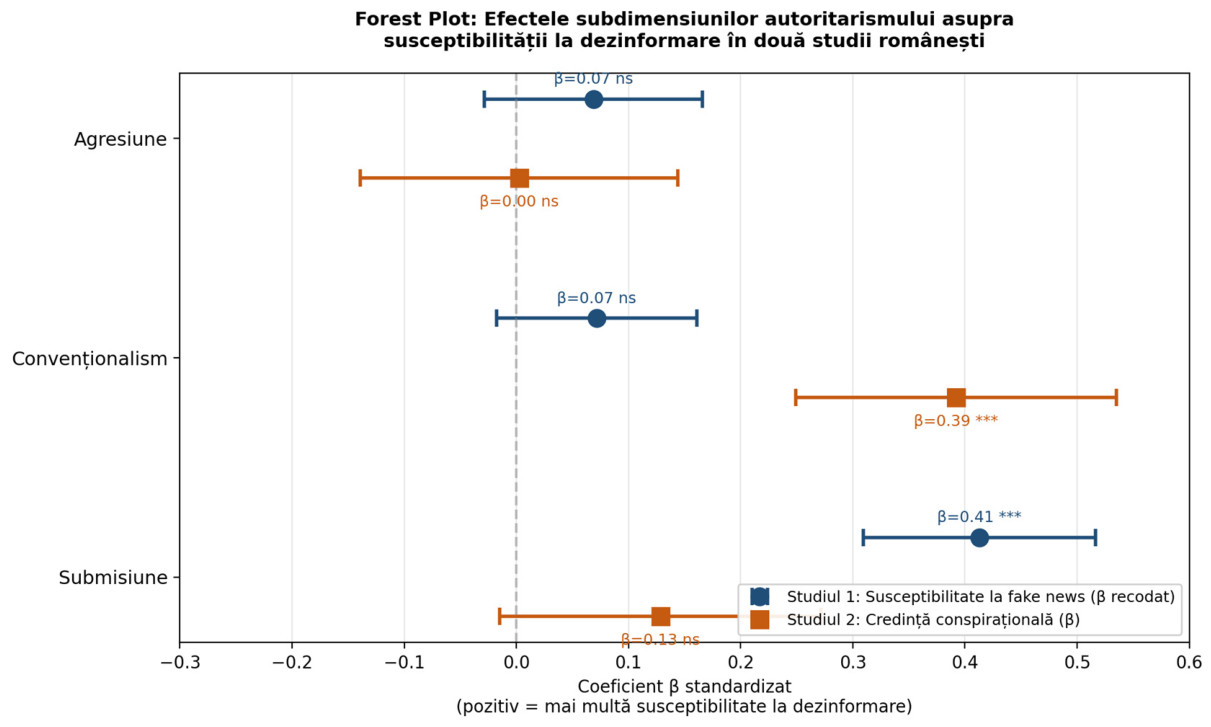
Figure 3.
Authoritarianism subdimensions across conspiracy belief profiles in Study 2 (Skeptics, n = 31; Neutrals, n = 98; Believers, n = 41). Error bars represent ±1 SE. Note the contrasting patterns: VSA Total and Traditionalism increase monotonically with belief, while Aggression shows no meaningful differentiation.
Figure 3.
Authoritarianism subdimensions across conspiracy belief profiles in Study 2 (Skeptics, n = 31; Neutrals, n = 98; Believers, n = 41). Error bars represent ±1 SE. Note the contrasting patterns: VSA Total and Traditionalism increase monotonically with belief, while Aggression shows no meaningful differentiation.
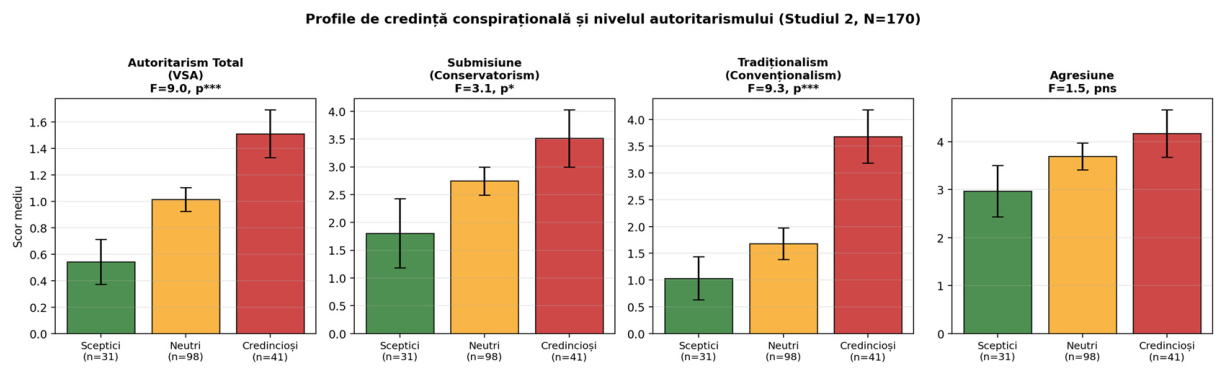

Table 1.
Descriptive statistics for key variables in Study 1 and Study 2.
| Variable | M | SD | Min | Max | α | k items |
| Study 1 (N = 427) | ||||||
| RWA-15 Total | 4.79 | 1.31 | 1.00 | 8.08 | .738 | 15 |
| Aggression (F1) | 6.36 | 1.71 | 1.00 | 9.00 | — | 4 |
| Conventionalism (F2) | 3.99 | 1.69 | 1.00 | 9.00 | — | 6 |
| Submission (F3) | 4.01 | 1.84 | 1.00 | 9.00 | — | 5 |
| Accuracy false news (ACC_F) | 0.75 | 0.21 | 0.00 | 1.00 | — | 12 |
| Accuracy true news (ACC_A) | 0.62 | 0.20 | 0.00 | 1.00 | — | 12 |
| d' (sensitivity) | 0.98 | 0.79 | — | — | — | — |
| Study 2 (N = 170) | ||||||
| VSA-6 Total | 1.05 | 1.01 | −1.33 | 3.33 | .447 | 6 |
| Authoritarianism (Aggression) | 3.68 | 2.91 | −3.00 | 8.00 | — | 2 |
| Traditionalism (Conventionalism) | 2.05 | 3.02 | −4.00 | 8.00 | — | 2 |
| Conservatism (Submission) | 2.76 | 2.93 | −4.00 | 8.00 | — | 2 |
| Conspiracy belief (CS mean) | 2.07 | 1.00 | 1.00 | 5.00 | .943 | 16 |
| PUEBI-Conspiracy Theories | 2.89 | 1.04 | 1.00 | 5.00 | — | 8 |
| PUEBI-Occult/Pseudoscience | 2.77 | 0.59 | 1.64 | 4.27 | — | 9 |
Note. RWA-15 was scored on a 9-point scale (1–9); VSA-6 was scored on a centered 9-point scale (−4 to +4). VSA subscale scores are sums of two items each, ranging from −8 to +8. CS = Conspiracy Statements; PUEBI = Pennycook Epistemically Unwarranted Beliefs Inventory. Dashes indicate that α is not reported at subscale level for VSA-6 two-item subscales; inter-item correlations are: Aggression r = .07, Traditionalism r = −.22, Conservatism r = .05. The negative inter-item correlation for Traditionalism is discussed inSection 3.6. d' was computed using the Snodgrass–Corwin correction.
Table 2.
Hierarchical regression predicting false news accuracy (ACC_F, z-standardized) in Study 1..
Table 2.
Hierarchical regression predicting false news accuracy (ACC_F, z-standardized) in Study 1..
| Predictor | β | SE | t | p | 95% CI |
| Block 1: Demographics R² = .042, F(4, 416) = 4.57, p = .001 | |||||
| Block 2: + RWA Total R² = .226, ΔR² = .184, ΔF(1, 415) = 98.49, p < .001 | |||||
| Block 3 (final): + 3 subscales R² = .259, Cohen's f² = .293 | |||||
| Gender (woman = 1) | 0.003 | 0.091 | 0.03 | .978 | [−.18, .18] |
| Age (z) | 0.149 | 0.047 | 3.17 | .002 | [.06, .24] |
| Education (z) | 0.027 | 0.047 | 0.58 | .564 | [−.07, .12] |
| Income (z) | 0.074 | 0.050 | 1.47 | .141 | [−.03, .17] |
| RWA Aggression (z) | −0.069 | 0.049 | −1.39 | .165 | [−.17, .03] |
| RWA Conventionalism (z) | −0.072 | 0.045 | −1.58 | .115 | [−.16, .02] |
| RWA Submission (z) | −0.413 | 0.053 | −7.83 | < .001 | [−.52, −.31] |
Note. β = standardized regression coefficient. N = 421 cases with complete data on all predictors. VIF range: 1.01–1.54. All continuous predictors and the outcome were z-standardized.
Table 3.
Hierarchical regression predicting conspiracy belief (CS mean, z-standardized) in Study 2.
| Predictor | β | SE | t | p | 95% CI |
| Block 1: Demographics R² = .116, F(4, 164) = 5.37, p < .001 | |||||
| Block 2: + VSA Total R² = .275, ΔR² = .159, ΔF(1, 163) = 35.65, p < .001 | |||||
| Block 3 (final): + 3 subscales R² = .313, Cohen's f² = .287 | |||||
| Gender (woman = 1) | 0.151 | 0.145 | 1.04 | .299 | [−.14, .44] |
| Age (z) | 0.209 | 0.076 | 2.74 | .007 | [.06, .36] |
| Education (z) | −0.228 | 0.076 | −3.02 | .003 | [−.38, −.08] |
| Income (z) | −0.088 | 0.087 | −1.01 | .315 | [−.26, .08] |
| VSA Conservatism (Submission, z) | 0.128 | 0.072 | 1.77 | .078 | [−.02, .27] |
| VSA Traditionalism (z) | 0.392 | 0.072 | 5.41 | < .001 | [.25, .54] |
| VSA Authoritarianism (Aggression, z) | 0.002 | 0.072 | 0.03 | .973 | [−.14, .14] |
Note. β = standardized regression coefficient. N = 169 (one case excluded due to missing education data). VIF range: 1.05–1.66. The label "Authoritarianism" used by Bizumic and Duckitt (2018) for the aggressive component is retained here in parentheses to avoid confusion with the global construct.
Table 4.
Cross-study comparison of authoritarianism subdimension effects using Fisher's r-to-z transformation.
Table 4.
Cross-study comparison of authoritarianism subdimension effects using Fisher's r-to-z transformation.
| Subdimension | β Study 1 (flipped) | β Study 2 | Fisher z | p |
| Aggression | 0.069 | 0.002 | 0.72 | .469 |
| Conventionalism / Traditionalism | 0.072 | 0.392 | −3.73 | < .001 |
| Submission / Conservatism | 0.413 | 0.128 | 3.38 | < .001 |
Note. β coefficients are taken from the final Block 3 of each hierarchical regression (Table 2 and Table 3). Study 1 coefficients have been sign-reversed (column "β Study 1 (flipped)") to express susceptibility in a directionally consistent way across both studies. Fisher's z statistic was computed using the formula for the difference between two independent correlations (Cohen et al., 2003).
Disclaimer/Publisher’s Note: The statements, opinions and data contained in all publications are solely those of the individual author(s) and contributor(s) and not of MDPI and/or the editor(s). MDPI and/or the editor(s) disclaim responsibility for any injury to people or property resulting from any ideas, methods, instructions or products referred to in the content. |
© 2026 by the authors. Licensee MDPI, Basel, Switzerland. This article is an open access article distributed under the terms and conditions of the Creative Commons Attribution (CC BY) license (http://creativecommons.org/licenses/by/4.0/).
Copyright: This open access article is published under a Creative Commons CC BY 4.0 license, which permit the free download, distribution, and reuse, provided that the author and preprint are cited in any reuse.