

Submitted:
08 July 2026
Posted:
09 July 2026
You are already at the latest version
Abstract
Existing reviews on MNP removal from water rarely link adsorbent structural features to the molecular interactions governing removal performance. This review addresses this gap by examining MNP adsorption from a mechanism-oriented perspective, mapping six canonical interaction pathways across five adsorbent classes. Adsorption emerges as a system-dependent process governed by the interplay between polymer properties and surface chemistry rather than by the material alone. Interactions such as π–π stacking and hydrophobic affinity dominate for non-functionalised polymers on carbon-rich surfaces, while electrostatic forces and hydrogen bonding become more relevant for oxidised particles. Pore structure becomes significant when particle size and porosity match, whereas chemisorption provides a stronger and faster pathway in systems containing reactive metal sites.
Across material classes, differences relate more closely to scalability and sustainability than to intrinsic adsorption capacity. Bio-based materials offer a favourable balance between performance and practical implementation, while more advanced systems provide greater control but remain limited by synthesis complexity. Importantly, laboratory capacities often overestimate real performance, and removal efficiency in complex matrices is a more reliable metric. Future progress will depend on improved standardisation, better integration with modelling, and validation under realistic conditions to support the transition from laboratory studies to practical applications.
Keywords:
microplastics
; nanoplastics
; adsorption mechanisms
; adsorbent materials
; water remediation
; wastewater treatment
1. Introduction
Plastic pollution is now recognized as a major global environmental challenge due to its pervasive distribution across ecosystems. According to previous research, global plastic production currently exceeds 400 million tonnes per year, while an estimated 4.8–12.7 million tonnes of plastic waste enter the oceans annually from land-based sources [1]. If present trends persist, nearly 12,000 million tonnes of plastic waste can eventually accumulate in landfills or in the natural environments by 2050 [2]. After being introduced into the environment, plastic waste gradually breaks down into smaller parts due to mechanical, physical, and biological degradation, resulting in the generation of microplastics (MPs) and nanoplastics (NPs) [3,4,5]. These particles have been detected in a wide range of environmental compartments, including marine and freshwater systems, soils, polar regions, and the atmosphere, as well as increasingly in food and drinking water systems [6,7,8]. This widespread and cross-compartment distribution ultimately leads to human exposure and accumulation, as evidenced by a growing number of studies reporting the presence of plastic particles in human tissues such as blood, lungs, placenta, and the cardiovascular system, among others [9,10,11]. Their persistence, small size, and role as carriers of contaminants make them complex pollutants that combine conventional micropollutant behavior with emerging and still poorly understood toxic effects [12,13,14].
Conventional wastewater treatment plants (WWTPs) are not specifically designed to remove plastic particles, yet they can eliminate up to 90% of MPs through primary, secondary, and tertiary processes such as coagulation, sedimentation, biological filtration, and physical filtration; however, this efficiency mainly applies to larger particles, while removal decreases markedly for particles below 10 µm and NPs, which largely bypass conventional treatment. In turn, the remaining quantity may remain unfiltered and enter water supply system as a part of the effluent or settle as a result of biological accumulation in sewage sludge [3,15]. Among others, membrane filtration and advanced oxidation processes (AOPs) have been explored as polishing steps following tertiary treatment; however, each presents intrinsic limitations. Membrane technologies, although effective, are constrained by membrane fouling and high operational and energy costs [16,17]; conversely, AOPs have been known to be energy-intensive and can lead to the creation of secondary products [18,19].
In this context, adsorption has proven to be a promising approach due to its inexpensive operation, versatility for application within current systems, and flexibility in enabling rational material design aimed at particular populations of MPs and NPs [4,20]. Recent research has shown that combining adsorption and pre-filtration can enable process trains that efficiently remove MPs in laboratory settings [21]. Furthermore, engineered sorbents have been operated for one year in a semi-operational unit at a real WWTP, achieving removal efficiencies above 90%, demonstrating the feasibility of scaling sorption-based MP removal beyond laboratory testing [22].
There has been an exponential rise in literature regarding adsorbents that can selectively remove micro- and nanoplastics (MNPs) from water systems in recent years. A bibliometric analysis of 771 documents (2017-2024) [3] illustrates how rapidly research activity is growing and how diverse the materials being explored have become, including carbon-based, biopolymer-based, and metal-based adsorbents. Examples include activated carbon, graphene oxide materials, biopolymeric sponges, layered double hydroxides, and metal-organic frameworks [3,23,24]. In parallel, the study of the interaction mechanisms between MNPs and adsorbents has also seen great advancements, transitioning from being primarily qualitative in nature to being more mechanically understood, thanks largely to the growing availability of experimental data and theories, including density functional theory (DFT) [25,26]. As a result, the field has reached a level of maturity where a purely material-based or catalogue-style overview is no longer sufficient to capture the key drivers of adsorption performance.
Unlike existing reviews that catalogue adsorbent classes and summarise removal efficiencies without mechanistic differentiation across polymer types [3,4], or that treat chemisorption and physisorption as binary categories without linking them to specific polymer–surface interactions, this review adopts a mechanism-first perspective, examining the adsorption of MNPs through the lens of hydrophobic interaction, van der Waals forces, π–π stacking, electrostatics, hydrogen bonding, and chemisorption, rather than treating adsorbents merely as material categories to be defined and compared. This approach is applied across five categories of novel adsorbents, namely carbon-based, bio-based, engineered porous, MOF-based, and metal-based materials, to explain both their efficiency and their practical challenges. Therefore, this study aims to outline a concise, mechanism-based roadmap linking polymer properties, adsorbent surfaces, and removal efficiency, supported where possible by molecular-scale computational evidence, with the goal of rationalising diverse literature findings, identifying key gaps for scale-up toward industrial applications, and situating these mechanistic insights within a broader discussion of cost, scalability, and life-cycle considerations that existing reviews seldom address alongside mechanistic analysis.
2. MNPs in Water: Properties Relevant to Adsorption
MPs are commonly defined as plastic particles with diameters between 5 mm and 1 µm, whereas NPs are usually described as particles with diameters smaller than 1000 nm [27,28]. The polymer composition of environmental MNP populations largely mirrors global production trends, with PE, PP, PS, PET, and PVC dominating and often accounting for the majority (typically 70–90%) of the total plastic mass observed in surface waters, sediments, and wastewater effluents, while other polymers, additives, and engineered fibers contribute to the remaining fraction [8,29]. Morphology of particles includes spheres, fragments, films, and fibers, while the particle size distribution favors smaller sizes, where particles less than 1 mm make up the majority of the population, although their share of the total mass is low.
Three primary parameters govern the adsorption behavior of plastics in remediation contexts. First, MNPs are intrinsically hydrophobic (water contact angle ~90–110°), promoting interactions driven by hydrophobic and van der Waals forces [4,29]. Second, surface charge plays a critical role, since pristine MNPs carry a slightly negative ζ-potential due to ion sorption, which becomes more negative in aged particles as oxidation and biofouling introduce oxygen-containing functional groups (carboxyl, hydroxyl, and carbonyl) [8]. Third, secondary MNPs bearing additional functional groups, such as amino- or carboxyl-functionalized polystyrene, PMMA, or PVC, show enhanced affinity for charged and polar adsorbents [3,4].
A further aspect concerns the role of MNPs as carriers of co-pollutants. Due to their high surface-to-volume ratio, MPs and NPs can adsorb significant amounts of hydrophobic organic contaminants, pharmaceuticals, and heavy metals [30,31]. From an adsorbent-design perspective, this dual role represents both an opportunity and a challenge, since capturing MNPs also removes the pollutants they carry, while in real water matrices the adsorbent must compete with MNPs for the same dissolved species. The effectiveness of an MNP-targeted adsorbent therefore depends critically on its selectivity in complex mixtures, a parameter that remains relatively underexplored in the literature.
3. Molecular Mechanisms
Understanding the molecular interactions between MNPs and adsorbents is essential for moving from empirical approaches to rational design, which also requires accounting for mass transfer and diffusion processes occurring within porous adsorbents [32]. Recent studies converge on six main interaction mechanisms: hydrophobic and van der Waals forces, π–π stacking, electrostatic interactions, hydrogen bonding, pore filling, and chemisorption. These mechanisms often act in combination and are influenced by environmental conditions and material properties. Their assignment is increasingly supported by molecular-scale computational evidence. Density functional theory (DFT) is a quantum-mechanical method that calculates the electronic structure of molecular systems, enabling the quantification of adsorption energies, bond formation, and charge transfer at the adsorbent surface with atomic-level precision. Molecular dynamics (MD) simulations, by contrast, describe the time evolution of atomic systems using classical force fields, allowing the decomposition of total interaction energies into their van der Waals and electrostatic components and the visualisation of adsorption trajectories at the polymer–surface interface. In the context of MNP adsorption, both approaches have proven valuable: MD captures the ensemble behaviour of polymer chains on heterogeneous surfaces, while DFT resolves the nature of specific bonds and the electronic origin of surface affinity [25,33]. For metal–organic framework Cu-BTC/graphene oxide (Cu-BTC/GO) composite systems, MD simulations in water reveal that van der Waals forces dominate the binding energy of both Polyamide 66 and PU, while the incorporation of GO layers increases removal from 25% to 100% by introducing additional π–π stacking, C–H…π, and hydrogen-bonding pathways unavailable to the pristine MOF alone [34]. (For nonpolar polyolefins such as PP on hydrophobic polydimethylsiloxane (PDMS) surfaces, 40-ns simulations demonstrate that adsorption is spontaneous and driven exclusively by van der Waals forces mediated through the methyl groups of PDMS, with the surface hydration layer offering minimal resistance, providing a finding that macroscopic batch experiments alone could not have resolved [35].
Recent experimental studies have increasingly paired DFT with laboratory data to resolve mechanistic ambiguities that spectroscopy alone cannot address. On iron-doped magnetic biochar, DFT calculations confirmed that the adsorption energy ranking CPS (carboxyl) > APS (amine) > UPS (plain) directly reflects the strength of Fe–O–polymer complexation and Fe–C bond formation, with Mayer bond orders quantifying how carboxyl and amine groups on functionalised PS enhance electron transfer to the iron-doped surface [36]. On Ni-MOF composite sponges, HOMO–LUMO energy gap analysis showed that the small ΔEgap between Ni-MOF and PS facilitates electron exchange between the aromatic rings of PS and the metal framework, predicting higher removal efficiency for PS over PE and PP in precise agreement with experimental results [37]. Besides, on PET-derived activated carbon, frontier orbital calculations revealed that surface functional groups modulate adsorption energy in the order –COOH > –OH > –C=C–, and that π–π stacking between delocalized PS electrons and the sp² carbon matrix dominates over electrostatic interactions when oxygenated groups are limited [38].
Taken together, these molecular-scale computational results go beyond confirming experimental trends, explaining why certain polymer–surface combinations exhibit selective adsorption, quantifying the contribution of each interaction, and offering a predictive framework that cannot be derived from macroscopic data alone. This level of mechanistic insight underpins the mechanism-by-mechanism analysis presented herein.
3.1. Hydrophobic and Van Der Waals Interactions
Hydrophobic effects constitute a major force of attraction towards MNP adsorption, especially polyolefin polymers like PE and PP as well as aliphatic portions of most commodity polymers. This effect is related to the disruption of the structured state of water at hydrophobic surfaces, which leads to an entropy-driven force of attraction that does not depend on pH [3,4]. The hydrophobic attraction force is generally supplemented by van der Waals interactions that act at molecular-level proximity between particles and adsorbents. In particular, for nonpolar polymers such as PE, which lack specific functional groups, van der Waals forces often represent a dominant interaction mechanism, as neither electrostatic nor hydrogen-bonding contributions are significant under typical environmental conditions [39,40]. Materials with intrinsically hydrophobic surfaces, such as low-oxygen activated carbon, bio-derived porous sponges, and PDMS-based coatings, exhibit high adsorption capacities toward PE and PP, as their interaction is primarily governed by rapid physisorption and hydrophobic affinity. This behavior is further enhanced by the porous structure of the adsorbents, which promotes particle retention through non-covalent interactions and physical confinement within the pore network [3,40]. Hydrophobic interactions are generally weaker than covalent or electrostatic contributions and tend to diminish as MPs undergo environmental aging, which introduces hydrophilic oxygen-containing functional groups on their surface [8].
3.2. π–π Stacking
Aromatic polymers such as PS and, to a lesser extent, PET, can interact with carbon-based adsorbents via π–π stacking interactions. These interactions arise from the overlap between π-electron systems of aromatic rings and the conjugated sp² domains typically found in materials such as graphene, graphene oxide, carbon nanotubes (CNTs), and high-temperature biochars [3,20,29]. These interactions represent one of the key non-covalent forces governing adsorption on carbon nanostructures and strongly influence the affinity toward aromatic compounds and polymer particles.
The interaction is relatively short-range and depends on the mutual orientation of the aromatic rings. Binding energies are typically on the order of a few kJ mol⁻¹ per aromatic ring pair in model systems such as the benzene dimer, while weaker intrachain π–π interactions have been reported for aromatic polymers such as PS [41,42]. DFT studies on graphene indicate that, at larger separations, the interaction is mainly governed by dispersion forces, while closer to the equilibrium distance electrostatic contributions become more relevant. [43,44]. Overall, this combination of moderate interaction strength and geometrical specificity makes π–π stacking a consistent a relevant adsorption mechanism in aqueous systems.
Three-dimensional reduced graphene oxide aerogels exhibit high adsorption capacities toward PS microplastics in water, reaching values up to 617.28 mg g⁻¹ under optimized conditions (pH = 6, C0 = 600 mg/L, t = 120 min, and T = 26 °C), due to π–π interactions between the aromatic rings of PS and the sp² carbon framework, coupled with pore-filling effects enabled by the highly porous three-dimensional structure [45,46]. biochar, the aromaticity of the condensed sp² domains, and consequently the π-stacking tendency, generally increases with pyrolysis temperature, providing a tunable synthetic lever to enhance PS uptake [29,47]. Because π–π interactions are generally less sensitive to changes in ionic strength and pH compared to electrostatic interactions, they often represent a relatively stable contribution in complex aqueous matrices.
3.3. Electrostatic Interactions
Electrostatic forces emerge as a complementary and often controlling mechanism when charged surfaces are involved. Under environmentally relevant conditions (pH 4–8), MNPs typically exhibit a slightly negative ζ-potential, particularly after environmental aging, due to ion adsorption and surface oxidation processes. As a result, adsorbents bearing positively charged functionalities, such as protonated amines, brucite-layer metal hydroxides, and cationic metal–organic frameworks, experience Coulombic attraction toward these particles [3,4,26].
The ability to tune surface charge is equally important from a materials-design perspective. Bio-based substrates such as chitin and cellulose can be chemically modified to introduce pH-responsive or permanently charged functional groups, enabling selective adsorption of specific MPs depending on their surface chemistry and environmental conditions [48].
Electrostatic attraction plays a major role in several high-performing adsorbents. For instance, Zn/Al layered double hydroxides (LDHs), characterized by intrinsically positively charged brucite-like layers, exhibit adsorption capacities of 162.62 and 53.0 mg g⁻¹ toward PS nanoplastics in synthetic freshwater and hard water, respectively, primarily driven by Coulombic interactions [49]. Similarly, the cobalt-based framework ZIF-67 achieves removal efficiencies of 92.1% for PS MPs, where electrostatic attraction operates in conjunction with π–π stacking and hydrogen bonding [50]. In this system, adsorption efficiency is maintained across a broad pH range (3–10), but decreases markedly at higher pH, where surface charge neutralization and increasing electrostatic repulsion reduce affinity.
Compared to other interaction modes, electrostatic forces are highly sensitive to solution chemistry. Variations in pH directly affect the surface charge of both MPs and adsorbents, while ionic strength can influence the thickness of the electrical double layer and the effective interaction distance. In particular, divalent cations such as Ca²⁺ and Mg²⁺ can mediate cation-bridging interactions between similarly charged surfaces, effectively overcoming electrostatic repulsion and promoting aggregation or adsorption. This effect helps explain the unexpectedly high performance of some adsorbents in contaminated-water systems [51].
Overall, electrostatic interactions represent one of the most tunable mechanisms in MP adsorption systems, enabling selectivity through both material design and environmental control. However, their dependence on pH and ionic composition also makes them less robust than π–π or hydrophobic interactions under complex real-water conditions.
3.4. Hydrogen Bonding
Building on the interaction mechanisms discussed above, hydrogen bonding represents a complementary adsorption pathway that becomes increasingly relevant as the surface chemistry of MNPs evolves under environmental conditions. Hydrophobic interactions predominantly govern the adsorption of nonpolar polymers, whereas electrostatic forces control charge-driven processes. In contrast, hydrogen bonding generally provides a secondary but non-negligible contribution, becoming significant when polar functional groups are present on either the polymer surface or the adsorbent, particularly in aged or functionalised plastics [52,53,54].
This interaction becomes particularly relevant for environmentally aged MPs and NPs, whose surfaces are progressively enriched in oxygen containing functional groups such as hydroxyl, carbonyl, and carboxyl groups as a result of oxidative weathering and biofouling, leading to increased surface polarity [55,56]. These groups act as hydrogen bond donors or acceptors, resulting in interactions with adsorbents bearing complementary functionalities [8,57]. On the adsorbent side, materials rich in oxygen and nitrogen functionalities, such as oxidized biochars, cellulose based substrates, chitin, chitosan, and amine functionalized polymers, provide abundant OH, NH2, and COOH groups that can readily form hydrogen bonds with oxidized polymer surfaces [58,59,60].
Compared to electrostatic interactions, hydrogen bonding is generally less sensitive to ionic strength, as it does not rely on long range Coulombic forces. However, its strength and contribution can still be influenced by pH, which governs protonation and deprotonation equilibria and thereby affects the availability of donor and acceptor sites on both MPs and adsorbent surfaces. As a result, hydrogen bonding is typically favoured under near neutral conditions, whereas strongly acidic or alkaline environments may reduce its contribution by altering surface speciation. [61]. Experimental evidence for hydrogen bonding in MP adsorption systems is often obtained through spectroscopic analysis. In particular, FTIR measurements may show shifts and broadening of O–H stretching bands after adsorption, which can be indicative of intermolecular hydrogen bonding between the adsorbent and the plastic surface. Such features have been reported, for instance, in cellulose based adsorbents interacting with functionalized nanoplastics, where hydrogen bonding is considered to contribute to enhanced affinity toward more polar particles [48,62].
In practical systems, hydrogen bonding rarely acts alone and typically occurs alongside other interaction mechanisms. For example, composite materials such as chitin based or amine functionalized aerogels combine hydrogen bonding with electrostatic interactions and π–π stacking, enabling efficient removal across different polymer types [20,60].
Overall, hydrogen bonding provides a moderate but selective contribution, which may become more relevant under environmentally realistic conditions where plastic surfaces are increasingly oxidized and heterogeneous.
3.5. Pore Filling
Whereas the mechanisms discussed above are largely governed by surface chemistry, pore filling can be described as a complementary process primarily controlled by the structural correspondence between the pore architecture of the adsorbent and the size of the target particles. In highly porous materials such as aerogels, hierarchical carbons, MOFs, and covalent organic frameworks (COFs), physical confinement of plastic particles within the pore network can contribute to adsorption and is often associated with intraparticle diffusion processes [4,20,63]. Diffusion within the pore network may also influence the overall uptake rate, particularly at higher concentrations [3,52].
Adsorption kinetics in porous materials are often governed by intraparticle diffusion and mass transfer, and can be reasonably described by simplified models that link equilibrium behaviour with uptake rate [32,64]. Effective pore filling requires pore dimensions that allow plastic particle access, although the optimal pore to particle size ratio also depends on factors such as pore connectivity and tortuosity [20]. Once encapsulated, particles can interact with the internal surface via additional mechanism, such as van der Waals forces, electrostatic attraction, and hydrophobic interactions, over an increased contact area, thereby enhancing overall adsorption capacity. Yuan et al. [46] successfully employed graphene based aerogels, showing that appropriately designed pore structures can enable efficient capture of MPs. Conversely, the contribution of pore filling tends to decrease when there is a mismatch between pore size and particle size. Large pores provide limited confinement, while particles larger than the pore openings may be excluded. This size dependence has been reported in porous systems, where retention mechanisms can shift from pore related adsorption to straining, surface interactions, or aggregation as particle size increases [65,66,67].
Overall, pore filling can be considered as a size dependent and complementary mechanism, whose contribution increases when the pore size distribution is well matched to the particle size. In this context, materials with hierarchical porosity are often more effective, as they can accommodate a broader range of particle sizes and adsorption pathways.
3.6. Chemisorption and Surface Complexation
Chemisorption involves the formation of chemical bonds between the adsorbate and the adsorbent surface, governed by surface chemistry and, in particular, by the presence of reactive functional groups on the adsorbent [3]. Within this framework, surface complexation can be regarded as a specific manifestation of chemisorption, whereby coordination bonds form between surface hydroxyl or metal–oxygen sites and oxidised moieties present on MNPs.
Although distinguishing chemisorption from strong physisorption through macroscopic isotherms has long been challenging, molecular-level evidence has now clarified its role. Density functional theory (DFT) calculations by Li et al. [26] show that Fe-doped magnetic sponge carbon forms Fe–O–polymer bonds with PS, increasing adsorption energies beyond the physisorption regime and enabling rapid uptake (369.07 mg g⁻¹ within 10 min). Consistent evidence is provided by XPS measurements, which reveal C 1s binding-energy shifts and changes in oxygen-containing functional groups after NP adsorption, indicative of ionic and covalent bonding FTIR analysis further suggests that hydrogen bonding may coexist with these interactions, indicating that surface complexation typically operates alongside weaker mechanisms rather than in isolation [3].
Together, these findings establish a consistent framework in which bond formation governs adsorption in metal-functionalised and oxygen-rich materials. This behaviour becomes more pronounced at smaller particle sizes. Due to their higher specific surface area, NPs expose a greater density of reactive sites and are therefore more prone to chemisorption. Accordingly, adsorption kinetics for NPs across a wide range of materials, including MXenes and metal-modified carbons, generally follow pseudo-second-order models, indicating chemisorption as the rate-controlling step [68,69].
Within this chemisorption regime, surface complexation is an important pathway in high-performance adsorbents. Wu et al. [69] employed magnetic biochar (MRB), prepared from agricultural waste rice husks, to efficiently adsorb MPs in aquatic systems (99.96% of MPs removal). The results indicated that surface complexation contributes to adsorption by forming direct interactions between MPs and oxygen- and iron-containing functional groups on the biochar surface, as confirmed by FTIR and XPS shifts indicating changes in chemical bonding. Similar results were observed for co-pyrolysed biochars removing PS sulfonate, where exothermic and spontaneous adsorption occurs and surface complexation contributes by enabling interactions between MPs and functional groups on Fe-modified biochar surfaces [68]. Comparable mechanisms occur in inorganic adsorbents such as Zn/Al layered double hydroxides, where charged layers and hydroxyl groups favour coordination with oxidised polymers, especially when pore access is limited [4,49].
Across these materials, kinetics usually follow pseudo second order behaviour, indicating electron sharing or transfer as the rate limiting step [68,69,70].
Overall, adsorption arises from the combined action of multiple mechanisms, influenced by particle size, surface chemistry and structure. Chemisorption becomes more dominant at the nanoscale, guiding the design of adsorbents with abundant reactive groups.
4. Novel Adsorbents for MNPs Removal
The mechanistic framework outlined in the previous section suggests that adsorption performance is not governed by a single factor, but rather emerges from the combined action of multiple interaction modes. The relative importance of these interactions varies depending on both the structure of the adsorbent and the surface chemistry of the plastic. Building on this perspective, the following paragraphs examines five material classes frequently discussed in recent studies, including carbon-based adsorbents, bio-based and waste-derived materials, porous engineered scaffolds, MOFs and COFs, and metal (hydr)oxides with magnetic composites. The goal is to highlight the key structural and chemical features each class leverages, while also considering their implications for scalability and sustainability.
4.1. Carbon-Based Adsorbents
Carbon-based materials, such as graphene, carbon nanotubes, biochar, and activated carbon, constitute a broad and highly promising class of adsorbents for MNP removal, owing to their structural tunability and consistently high adsorption performance [3,29,60,71,72]. Their effectiveness derives from key physicochemical properties, including high specific surface area, hierarchical porosity, and chemically versatile surfaces, combined with the possibility of synthesis from both fossil precursors and renewable biomass, which supports scalability [73]. By modulating surface chemistry and pore structure, the same carbon material scaffold can promote multiple interaction pathways, including hydrophobic interactions, π–π stacking, hydrogen bonding, and electrostatic attraction, which are widely recognised as the dominant mechanisms governing MNP adsorption [29,74]. This versatility establishes carbon adsorbents as benchmark materials for comparison with emerging technologies
Biochar represents the most accessible and cost-effective entry within this family, as it can be readily produced from agro-forestry residues such as rice husk, corncob, coconut husk, and other lignocellulosic feedstocks [75,76,77]. Although biochar derives from biomass, it is here classified as a carbon-based adsorbent because pyrolysis converts the precursor into a carbonaceous structure whose adsorption is governed by aromatic domains, microporosity, and tunable surface chemistry, with properties largely controlled by the pyrolysis temperature. High-temperature biochars are enriched in condensed sp² structures that favour π–π interactions with aromatic polymers such as PS, whereas lower-temperature materials retain hydroxyl and carboxyl groups that enhance hydrogen bonding with oxidised plastics [4,29]. This tunability can be further improved by post-treatment, for example through oxidation, which increases surface polarity and enhances adsorption of PS nanoplastics [78]. Application studies confirm this behaviour. Siipola et al. [75] showed that pine and spruce bark biochar effectively retains large particles, while removal of micrometre-scale MPs is less efficient, indicating size-dependent retention. Similarly, Wang et al. [79] reported over 95% removal of 10 µm PS microspheres using corn straw and hardwood biochars, outperforming sand filtration. Microscopy revealed retention through interparticle spaces, pore trapping, and entanglement by detached biochar fragments, highlighting the combined role of structural confinement and weak hydrophobic and van der Waals interactions in MP removal.
Activated carbon (AC), in both granular and powdered forms, represents a higher-performance counterpart to biochar, owing to its more extensively developed microporous network. Arenas et al. [71] investigated the removal of positively charged PS nanoplastics (~100 nm) using granular activated carbon in drinking-water matrices. In natural surface water from Lake Geneva, used as a realistic drinking water matrix, the capture mechanism was strongly influenced by water chemistry. Adsorption was promoted by aggregation processes and interactions with dissolved organic matter, while electrostatic interactions remained important. Divalent cations such as Ca²⁺ and Mg²⁺ further enhanced removal by acting as bridges between negatively charged species and the carbon surface. Under these conditions, removal efficiencies reached up to about 90%, with adsorption capacities up to 6.33 mg g⁻¹. More recently, Laca et al. [80] evaluated the removal of PP microplastics (20–500 μm) by granular activated carbon in wastewater-related matrices. When treating synthetic suspensions and real wastewater samples, removal efficiencies ranged from about 30–43% under typical conditions (0.5 g L-1 GAC, 7 h), increasing up to ~90% at higher adsorbent dosages (1.5 g L-1). Hybrid surface engineering can lift this baseline further: the KOH-activated, chitosan-coated anthracite developed by Lv et al. [21] achieves substantially improved removal of PVC microplastics through a synergy of physical interception, electrostatic attraction, and polymer-mediated bridging — effectively stacking multiple interaction modes within a single material architecture.
Across carbon-based adsorbents, a general trend can be observed, with hydrophobic interactions and π–π stacking providing the basic adsorption mechanism. This behaviour can be gradually enhanced through surface modifications such as oxidation, heteroatom doping, and iron incorporation, which introduce additional interactions including hydrogen bonding, electrostatic effects, and chemisorption. Overall, carbon materials can be designed by tuning their surface properties to favour the interaction pathway most relevant to the target polymer and application context [3,4,29].
4.2. Bio-Based and Biowaste Adsorbents
Bio-based and biowaste-derived adsorbents represent a class of sustainable materials that extend the logic of biomass valorisation by exploiting natural polymers and minimally processed residues rather than fully carbonised structures. These systems retain a substantial fraction of their original chemistry, including celluloses, lignins, chitins, and related polysaccharides, and can often be obtained through low-temperature or mechanical processing routes. Their growing relevance stems from the fact that natural polymers and their composites are renewable, frequently biodegradable, and structurally tunable, which allows their surface functionality and morphology to be tailored to specific adsorption targets [81,82,83].
From a mechanistic perspective, the abundance of polar functional groups such as hydroxyl, carboxyl, and amino moieties provides intrinsic adsorption sites, enabling interactions such as hydrogen bonding, electrostatic attraction, and physical entrapment alongside hydrophobic effects. This built-in chemical versatility reduces the need for aggressive activation steps while supporting multiple interaction pathways with microplastics and other contaminants [84]. These materials combine low cost, abundant renewable feedstocks, and low environmental impact, but show more variable performance and limited regeneration compared to engineered carbons, often leading to single-use applications [8]. Typical examples include cellulose- and chitosan-based materials, lignin adsorbents, alginate or pectin gels, agricultural residues, and hybrid biopolymer composites, spanning architectures from raw biomass to structurally tuned materials [85,86].
A direct and practical implementation of this concept is represented by the use of minimally processed agro-industrial residues as low-cost bio-based adsorbents. Alnasrawy [87] showed that mechanically processed banana peels, dried at 60 °C, capture more than 99% of MPs from synthetic solutions and 97.5% from real WWTP effluent under optimal conditions (pH 4, 300 mg L⁻¹ dose, 25-minute contact time). The lignocellulosic matrix provides hydroxyl, carboxyl, and phenolic groups that drive electrostatic attraction and hydrogen bonding toward oxidised MP surfaces. Comparable performance has been reported for sugarcane bagasse, coconut bagasse, and coffee grounds, all of which exploit the hydroxyl-rich chemistry of their cellulose backbone [8].
Surface modification can enhance the performance of low-cost adsorbents without requiring thermal activation. Oliveira et al. [88] employed Tween-80-based microemulsions to functionalise materials such as sugarcane and coconut bagasse, banana-peel residue, bentonite, and diatomite, improving their affinity toward microplastics. The modified systems achieved removal efficiencies of up to ~80% for mixed microplastic suspensions, likely due to enhanced hydrophobic interactions at the adsorbent–particle interface. This approach demonstrates how introducing amphiphilic character can compensate for the limited intrinsic non-polarity of biowaste substrates, although the use of surfactants also raises considerations regarding their environmental fate.
Moving from raw agro-industrial residues to more refined biopolymeric substrates, cellulose-based adsorbents offer a complementary route in which surface charge can be introduced with greater precision through chemical functionalisation. Batool and Valiyaveettil [48] showed that polyethyleneimine-modified cellulose fibres can achieve very high removal efficiencies for functionalised PMMA, PVAc, and PVC nanoplastics, largely due to the presence of protonated amine groups that impart a positive surface charge and promote electrostatic attraction toward negatively charged particles.
Collectively, hydrogen bonding and electrostatic interactions appear to be the main and most readily adjustable mechanisms, arising from the native surface chemistry of these materials. Additional modifications, such as surfactant or amine functionalisation, can further support hydrophobic and Coulombic contributions, leading to improved performance. Overall, this approach allows for enhanced adsorption while still maintaining the advantages of renewable feedstocks and relatively low-energy processing.
4.3. Porous Engineered Materials: Sponges, Aerogels, Hydrogels
Owing to their high porosity and large accessible surface area, sponge-, aerogel-, and hydrogel-based materials enable efficient removal of MNPs through a combination of physical confinement and surface-mediated interactions. The adsorption process generally involves three sequential stages, namely transport from the bulk solution to the external surface, diffusion within the porous network, and the establishment of equilibrium between retained and suspended particles [89,90,91]. Unlike carbon- and bio-based adsorbents, where surface chemistry plays a dominant role, these systems also strongly rely on pore filling and intraparticle diffusion as key capture mechanisms [20].
Their main advantages include very high porosity, often exceeding ninety percent by volume, low density, and highly tunable surface chemistry. However, they often suffer from limited mechanical stability under repeated use and generally lack established routes for scale-up beyond laboratory batch systems.
Within this framework, biopolymer-based sponges represent a particularly sustainable class of materials. A chitin–graphene oxide (ChGO) sponge demonstrated removal efficiencies up to 89.8% for PS, 72.4% for carboxylated PS, and 88.9% for aminated PS in synthetic wastewater. These performances arise from the combined effect of electrostatic interactions, hydrogen bonding, and π–π interactions, which act synergistically with pore confinement and diffusion processes. Variations in removal efficiency reflect differences in MP surface functionalization, which directly influence electrostatic interactions and adsorption affinity toward the ChGO matrix [60]. Similarly, plant protein-based sponges provide a cost-effective and sustainable alternative. An oat protein sponge achieved removal efficiencies up to ~81% for PS microparticles (1 μm), benefiting from a highly porous interconnected structure (~83%) and rapid adsorption kinetics. In this case, adsorption is mainly governed by hydrophobic interactions between protein side chains and the aromatic structure of polystyrene, combined with intraparticle diffusion within the sponge network. These mechanisms enable fast uptake while maintaining reusability and biodegradability [92].
More recently, aerogels have emerged as highly promising platforms for MNP removal due to their low density, high specific surface area, and interconnected three-dimensional porous structure [93]. Their performance stems from the combination of hierarchical porosity and tunable surface chemistry, enabling multiple adsorption mechanisms such as pore filling, electrostatic interactions, hydrogen bonding, hydrophobic interactions, and π–π stacking. Cellulose- and polysaccharide-based aerogels typically achieve removal efficiencies above 90% and adsorption capacities ranging from ~100 to over 500 mg g⁻¹, depending on pore structure and functionalization [20]. For instance, D-DPGG aerogels reach ~241 mg g⁻¹ with ~96% PS removal [94], while superhydrophobic composites can exceed 550 mg g⁻¹ and 95% efficiency for PS nanoplastics (50 nm) [95]. Biomass-derived systems such as gelatin–sodium alginate aerogels offer a particularly sustainable alternative, maintaining removal efficiencies above 90% across a wide pH range and in different water matrices. In these materials, adsorption arises from a synergistic combination of physical entrapment and surface interactions, particularly hydrogen bonding and ionic interactions [20]. Polydopamine-modified magnetic chitosan aerogels (PDA-MCS) further highlight the practical applicability of this class. Zheng et al. reported a 91.6% removal of PET MPs at pH 6–9 together with magnetic recoverability, resulting from the combined effects of electrostatic and hydrogen-bonding interactions provided by chitosan, the hydrophobic affinity introduced by the polydopamine coating, and the ease of separation under an external magnetic field [63]. These materials also showed stable performance under simulated environmental conditions, achieving removal efficiencies of 94.6% for PE and 92.3% for PS microplastics.
Hydrogels complement this class by introducing structural flexibility and tunable surface properties. For example, a polydopamine-modified sodium alginate hydrogel [63] achieved ~99.6% microplastic removal, where polydopamine enhances hydrophobicity and overall surface affinity. Similarly, fully bio-based chitin–lignin hydrogels [96] reached very high adsorption capacities (up to 1790.8 mg g⁻¹ for PS nanoplastics), mainly driven by synergistic electrostatic attraction and π–π interactions. These systems also exhibit good regeneration potential and scalable synthesis routes.
Overall, a clear relationship between structure and performance emerges across these materials. While pore filling represents the primary mechanism, it is typically enhanced by surface interactions such as π–π stacking, electrostatic attraction, and hydrogen bonding. At the same time, adsorption efficiency depends on an appropriate match between pore size and particle dimensions, as excessively large pores can reduce retention. As a result, current research is increasingly focused on improving mechanical stability and achieving precise control over pore architecture to support practical applications.
4.4. Metal-Organic and Covalent-Organic Frameworks (MOFs/COFs)
Metal–organic frameworks (MOFs) and covalent organic frameworks (COFs) introduce highly ordered, crystalline porosity at the atomic scale into the field of MNP adsorption, representing one of the most structurally and chemically sophisticated classes of materials among those considered. Their tunability, achieved through the choice of metal nodes, organic linkers, pore size, and post-synthetic modification, allows precise control over surface charge, hydrophobicity, and chemical reactivity, enabling mechanism-selective design that is difficult to achieve in amorphous adsorbents [97,98,99].
Reported removal efficiencies generally range from 70 to 99.9%, depending on particle size, water chemistry, and framework structure, with smaller nanoplastics typically showing better performance than larger microplastics due to their higher surface-to-volume ratio and stronger interfacial interactions.The main limitations of this material family include complex synthesis routes, variable stability in aqueous environments, and the largely unresolved environmental implications of potential metal leaching during regeneration [4,20].
Among MOFs, ZIF-67 has become a widely studied system for polystyrene microplastic capture. Wan et al. [50] reported a removal efficiency of 92.1% for PS MPs smaller than 10 μm at a dosage of 5 mg mL⁻¹ over a pH range from 3 to 10. The process was mainly driven by electrostatic attraction between the positively charged framework and the negatively charged PS surface, supported by π–π interactions between the aromatic linker and polymer chains and by hydrogen bonding mediated by coordinated water molecules. At pH values above 10, both surfaces become negatively charged, leading to a sharp decline in performance and highlighting the dependence of charge-driven adsorption on solution conditions. A broader survey of MOF performance across polymer types confirms the generality of this mechanistic picture [99]. Modak et al. [100] showed that Cr-MOF/MIL-101 reaches 96% removal of PS nanoplastics at pH 5, with an adsorption capacity of 800 mg g⁻¹, governed by electrostatic attraction, π–π interactions, and acid–base interactions, and following pseudo-first-order kinetics together with a Freundlich isotherm consistent with multilayer adsorption on a heterogeneous surface. Liu et al. [101] reported that Fe₃O₄@SiO₂@MIL-53(Al) achieves removal efficiencies of 93.17% for PVC, 85.16% for PP, and 88.28% for PES from mixed-polymer suspensions, with pseudo-second-order kinetics and Langmuir isotherms indicating chemisorption as the rate-controlling step and confirming that magnetic functionalisation does not compromise polymer-type selectivity. Yet, Gnanasekaran et al. [102] demonstrated that a PSF/MIL-100(Fe) membrane achieves removal efficiencies above 99% for PS nanoplastics from textile wastewater, maintaining its performance over six regeneration cycles due to the stable electrostatic and π–π interaction sites provided by the organic ligands within the framework, representing one of the few examples of multi-cycle stability under realistic effluent conditions.
Magnetic functionalisation offers a practical solution to material recovery without compromising performance. Feng et al. [103] synthesised a series of Fe₃O₄@carboxymethylcellulose(CMC)-MOF composites and identified Fe₃O₄@CMC-MIL-101-NH₂ as the optimal system, achieving 98.0% removal and an adsorption capacity of 245.1 mg g⁻¹ for PS MPs (3 µm) within 240 minutes, with a theoretical Langmuir maximum of 1923 mg g⁻¹ and retention of above 89% efficiency after five regeneration cycles. DFT calculations and XPS analysis attributed the adsorption to van der Waals interactions between PS hydrocarbon chains and the Fe clusters and carboxylate groups of MIL-101-NH₂, complemented by π–π stacking between the PS aromatic rings and the amino-functionalised linker. Broad-spectrum validation showed capacities exceeding 250 mg g⁻¹ across PP, PE, PMMA, PVC, and PET particles of varying size, shape, and surface charge, while removal efficiencies above 81% were maintained in complex beverage matrices including carbonated drinks and sports beverages.
Beyond pure adsorption, MOF-based composites are beginning to demonstrate integrated capture-and-degrade functionality. Zanaty et al. [104] synthesised an HTNT@ZIF-67 nanocomposite by in-situ growth of ZIF-67 crystals onto hydrogen titanate nanotubes at room temperature, and applied it to MPs extracted from commercial toothpaste, representing a realistic, polymer-heterogeneous target comprising PE, PP, PET, and PMMA fragments. The composite achieved 97% removal efficiency through a sequential adsorption–catalytic oxidation pathway in which the porous ZIF-67 framework first concentrates MPs particles via electrostatic attraction and π–π interactions, after which H₂O₂ activation by the cobalt nodes drives Fenton-like oxidative chain scission, confirmed by FTIR disappearance of aromatic C=C stretching at 1630 cm⁻¹ and a marked reduction in particle dimensions by optical microscopy, with the catalyst retaining 78% efficiency after six cycles and showing negligible cobalt leaching.
COFs represent a structurally distinct class compared to MOFs. Built entirely from covalent organic linkages, they form highly stable, π-conjugated networks without metal centers, which favour the adsorption of aromatic MPs such as polystyrene through strong π–π interactions. In contrast, aliphatic polymers such as PE and PP interact mainly via hydrophobic forces, leading to a degree of selectivity that is difficult to achieve with conventional MOFs [4]. AlNeyadi et al. [105] developed Fe₃O₄@MP-COF/PVDF composite membranes combining adsorption and visible-light photocatalysis. The system achieved adsorption capacities up to 520 mg g⁻¹ for PS, 380 mg g⁻¹ for PP, and 280 mg g⁻¹ PE, demonstrating faster uptake and higher selectivity compared to non-aromatic polymers. Under visible light, the Fe₃O₄–COF interface promotes reactive oxygen species formation, enabling up to 98% degradation of PS and significant TOC reduction, while maintaining good stability over repeated cycles. This dual functionality offers a promising strategy to couple microplastic capture with in situ degradation, reducing the risk of secondary release. Li et al. [106] synthesized a cationic HTA-EB iCOF and integrated it with chitosan and tannic acid to produce a lightweight macroporous aerogel with a density of 33 mg cm⁻³. This system combines electrostatic, π–π, and hydrogen bonding interactions with a three-dimensional elastic structure, achieving adsorption capacities of 550.73 mg g⁻¹ for PET, 341.74 mg g⁻¹ for PS, and 209.32 mg g⁻¹ for PC, with removal efficiencies above 70% in real water matrices. The aerogel architecture also addresses key limitations of powder COFs such as aggregation, difficult recovery, and potential secondary release, while introducing antibacterial and antifouling properties that support long-term operation.
Aluminosilicates such as zeolites, molecular sieves, and bentonite-based composites provide an earth-abundant and scalable alternative to crystalline frameworks at significantly lower cost [107]. Shen et al. [108] showed that granular zeolite and molecular sieve materials modified with a cationic surfactant (1-hexadecylpyridinium bromide - HDPB) removed more than 96% of PE and PA MPs from synthetic wastewater, outperforming conventional rapid sand filtration. Microscopic analysis revealed that adsorption occurs through particle capture, trapping, and entanglement within the porous structure, consistent with pore-filling and confinement mechanisms. This approach has also been validated at pilot scale. Spacilova et al. [22] reported that a modified zeolite and bentonite system operating in a developed pilot plant sorption maintained removal MPs efficiencies above 90% over one year, representing one of the few long-term field demonstrations available.
Overall, the high degree of structural control offered by crystalline frameworks makes them particularly suitable for rational adsorbent design, whereas aluminosilicates represent the most cost-effective and viable option for large-scale implementation, bridging the gap between laboratory performance and real wastewater treatment applications.
4.5. Metal (Hydr)oxides and Magnetic Composites
Metal (hydr)oxides and magnetic composites are distinguished by their ability to couple chemisorption, arising from coordination or covalent interactions at metal oxygen surface sites with oxidised MNP functional groups, with magnetic separability, thereby enabling the recovery and reuse of fine particulate adsorbents in continuous treatment systems [26,109]. This dual functionality distinguishes them from purely physisorptive adsorbents, where pseudo second order kinetics often reflect diffusion limited uptake rather than true surface bonding.
Layered double hydroxides represent the most widely studied subfamily. Tiwari et al. [49] synthesized a Zn-Al layered double hydroxide adsorbent to remove hydrophilic PS nanoparticles coated with an anionic surfactant from synthetic freshwater. The results demonstrated adsorption capacities up to 162.62 mg g⁻¹ for PS nanoplastics, driven by electrostatic attraction between positively charged layers and negatively charged particles, reinforced by surface complexation via hydroxyl groups. Yang et al. [110] developed a superparamagnetic Mg–Al layered double oxide loaded with Fe₃O₄ (M-MgAl-LDO) for PS microplastic removal, achieving capacities up to 203.12 mg g⁻¹ at 25 °C, outperforming most of the existing adsorbents. Adsorption followed pseudo-second-order kinetics and a Langmuir isotherm, indicating monolayer chemisorption with additional diffusion limitations at higher concentrations. Mechanistically, uptake involved pore filling, π–π interactions, electrostatic attraction, hydrogen bonding, and metal-oxide complexation, while magnetic recovery highlights its practical applicability.
Within this framework, iron-based materials emerge as a particularly prominent subclass, where the chemisorptive character of metal (hydr)oxides is further enhanced by the redox activity and strong surface reactivity of Fe species. Singh et al. [109] prepared Fe₃O₄-modified biochars pyrolyzed at two different temperatures, i.e 550 °C (FB-550) and 850 °C (FB-850), from Prosopis juliflora. The adsorption performance was evaluated using PS nanoplastics with varying sizes (30–1000 nm) and surface functionalities. Both materials exhibited rapid removal (<10 min), high adsorption capacities (up to 290.20 mg g⁻¹), and good reusability without significant iron leaching. Kinetic analysis indicated fast, reaction-controlled uptake, while spectroscopic evidence confirmed inner-sphere complexation between NP functional groups and iron hydroxyl sites. Electrostatic interactions and biochar surface properties further modulated adsorption selectivity Similar behaviour was observed by Li et al. [26], who developed a Fe-doped magnetic sponge carbon (FeMSC) with a high surface area and strong magnetic properties via one-step pyrolysis. The material showed rapid adsorption of PS microplastics (saturation <10 min) with a high capacity (369.07 mg g⁻¹) and stable performance across varying pH and real water matrices. Kinetics and DFT analysis confirmed chemisorption, with Fe sites promoting strong Fe–C coordination alongside enhanced π–π interactions. Extending this approach, magnetic biochar derived from rice straw achieves up to 99.96% removal and retains about 90% capacity after four regeneration cycles [69]. Zhao et al. [111] employed Fe-modified fly ash for PS NP removal, achieving adsorption capacities of 82.8–89.9 mg g⁻¹ with good reusability. Mechanistic analysis indicated that electrostatic attraction, surface complexation, and π–π interactions jointly governed the adsorption process.
Recent developments expand both structural design and feedstock diversity. Kim et al. [68] produced a magnetic biochar via co-pyrolysis of walnut shells and Fe-rich mine tailings, achieving PS-sulfonate capacities of 0.77–6.75 mg g⁻¹ across a molecular mass range of 32,000–210 Da. Interestingly, the pronounced size-dependent trend reflected a mechanistic shift from hydrophobic and π–π interactions) at larger sizes toward Fe-mediated surface complexation and electrostatic attraction as particle dimensions decrease toward the nanoscale. Li and co-workers [112] pursued a structural innovation by grafting N-octadecylphosphonic acid onto amino functionalised Fe₃O₄@SiO₂ cores, producing amphiphilic Janus microparticles. The hydrophobic domain captures PE through van der Waals interactions, while the positively charged domain removes PS via electrostatic attraction and cation–π interactions, achieving 92% PS and 61% PE removal within 20 minutes with full magnetic recoverability. To our knowledge, this represents the only adsorbent design explicitly tailored to target both polar and non polar polymers within a single particle.
Across this adsorbent class, magnetic recoverability represents both a defining advantage and a practical limitation, as repeated cycling can induce oxidation, partial loss of crystallinity, and metal leaching into treated water. Overall, metal hydroxides and magnetic composites can promote the full spectrum of interaction mechanisms described above, from electrostatic attraction and hydrogen bonding to chemisorption at metal oxygen sites. The increasing use of low cost waste derived supports such as biochar, fly ash, and mining residues further links adsorption performance to circular feedstocks, positioning this family as a bridge between high efficiency capture and scalable sustainable remediation.
The interaction pathways discussed across these five adsorbent classes are summarised graphically in Figure 1, which maps the dominant and secondary molecular mechanisms identified for each material family.
5. Comparative Benchmark and Sustainability Considerations
Direct comparison of MNP adsorption performance across studies remains inherently challenging due to pronounced heterogeneity in experimental protocols. Key variables such as particle type, size, surface chemistry, initial concentration, adsorbent dose, contact time, pH, ionic strength, and water matrix vary widely, and are often only partially reported [3,29,100]. Despite this heterogeneity, Table 1 presents representative studies, selected to illustrate structurally distinct material subtypes within each and, where available in the literature, to span a range of adsorption capacities and both synthetic and real-water testing conditions; the selection does not imply uniform completeness of parameter reporting across studies, nor systematic coverage of different target polymers, since PS remains the dominant model compound investigated across most classes. The table thus functions as a guiding framework linking adsorption performance to the underlying interaction mechanisms and operating conditions, and the observations drawn from it should accordingly be read as indicative of recurring patterns rather than as statistically representative of each material class as a whole.
Collectively, four consistent trends emerge. First, the highest adsorption capacities are mainly reported for carbon-based and engineered porous materials tested under optimised laboratory conditions. Examples include 3D reduced graphene oxide aerogels with 617 mg g⁻¹ for PS, chitin–lignin hydrogels reaching 1790.8 mg g⁻¹, Fe-doped magnetic sponge carbon with 369.07 mg g⁻¹ in ten minutes, and magnetic carbon nanotubes (M-CNTs) showing 1100–1650 mg g⁻¹ across polymers [26,46,96,114]. However, these values are typically obtained in simplified systems based on monodisperse PS in deionised water, which favour π–π interactions and exclude competition from dissolved species, thus overestimating real-world performance [20,29]. Second, the findings suggests a systematic decrease in performance when moving from synthetic to real water matrices. A representative example is the 3D reduced graphene oxide aerogel, whose capacity drops from 617 to 431 mg g⁻¹ in micro-polluted lake water [46]. This reduction may be associated with charge screening by ions and competition from dissolved organic matter, which mainly affect electrostatic interactions and pore accessibility, while π–π stacking remains comparatively stable. Similar trends were observed across all material classes. For instance, banana peel adsorbent achieved only 0.085 mg g⁻¹ in real effluent despite 97.5% removal [87], highlighting the need to report both capacity and efficiency. Multi-mechanism systems such as D-DPGG aerogels maintain >90% efficiency across different waters [94], and process-level studies already show stable performance above 90% in real WWTP conditions [21,22], indicating growing practical relevance. Third, adsorption kinetics vary widely and reflect the dominant mechanism. Chemisorption-based systems, especially metal-doped or magnetic materials, reach equilibrium within minutes, while physisorption-based materials could require hours due to potential diffusion limitations [26,109,113]. This difference can directly affect process design, with fast systems suited to continuous treatment and slower ones to batch operation [20]. Fourth, the evaluated studies highlight the limited representation of mixed-polymer systems, which are more environmentally relevant. Most studies focus on single polymers, typically PS, while only a limited number consider mixed systems. This bias also affects mechanistic interpretation, often amplifying the perceived importance of π–π interactions compared to aliphatic polymers.
A further layer of complexity, which compounds the experimental heterogeneity discussed above, concerns the analytical techniques employed to quantify MNPs in adsorption studies. The measurement platforms reported across the literature include gravimetric weighing, particle-resolved spectroscopic methods such as µ-FTIR, µ-Raman, and LDIR, and mass-based thermal approaches such as Py–GC/MS, each operating with different detection limits, measurable size ranges, and output metrics. Particle-resolved techniques provide particle counts, size distributions, and polymer identity but become less reliable below 10 µm and do not readily yield mass concentrations, while pyrolysis-based approaches deliver polymer-specific burden data but lose morphological and particle-number information [5,115]. Removal efficiencies expressed as particle number, mass concentration, or gravimetric loss are therefore not directly interchangeable, and comparisons between studies using different instruments should be interpreted with caution. Analytical variability is acknowledged as a key factor constraining cross-study comparability in MNP research [3,28]; this should be taken into account when evaluating the adsorption data presented below. Improving consistency in reporting experimental conditions would further enhance comparability across studies.
5.1. Cost, Scalability, and Feedstock
Building on the performance trends discussed above, practical implementation requires moving from adsorption efficiency to considerations of cost, scalability, and material sourcing. Some differences should be encountered across the five adsorbent classes, reflecting not only performance but also production pathways and technological maturity.
Among these, bio based and biowaste adsorbents offer the most evident cost advantage. Agro industrial residues such as banana peels, sugarcane bagasse, coconut bagasse, and bark derived biochars, among other biomasses, are already available within existing supply chains, and their use as adsorbents adds value without requiring dedicated production. Slow pyrolysis biochar from forestry sidestreams is typically estimated at 200 to 500 US dollars per tonne [75], compared with 1500 to 4000 US dollars per tonne for commercial activated carbon and significantly higher costs for MOFs and COFs. This gap reflects a deeper distinction, since scaling biochar is primarily an engineering task, whereas scaling advanced materials often remains limited by complex multi step synthesis at the reactor level.
Carbon based adsorbents occupy an intermediate position. GAC is already widely used in drinking water treatment [71], making its extension to MNP removal relatively straightforward. In contrast, high performance variants such as graphene based aerogels and functionalised carbon nanotubes remain largely confined to laboratory scale due to higher production costs and environmental burden. Metal hydroxides and magnetic composites show similar variability. Systems based on Fe3O4 decorated biochar largely retain the cost profile of the underlying biochar [109], while materials such as LDHs require metal precursors that introduce additional cost and supply considerations.
Porous engineered materials including aerogels, sponges, and hydrogels deliver excellent adsorption performance but still lack clear scale up strategies beyond batch synthesis. At the high performance end, MOFs and COFs are constrained by synthesis routes that rely on high purity precursors, solvothermal conditions, and long reaction times, which are difficult to reconcile with large scale water treatment. In this context, aluminosilicate materials provide a more accessible alternative, combining structural functionality with industrial scalability, as shown by the one year pilot operation of modified zeolite bentonite systems in real treatment conditions [22].
5.2. Regeneration and End-of-Life
Extending the discussion from cost and scalability, regeneration and end of life behaviour provide an additional layer for evaluating the practical viability of these materials.
Carbon based and magnetic composite adsorbents show the most consistent regeneration performance. Capacity retention between about 60% and over 90% after several cycles has been reported for Fe3O4 modified biochars, Fe doped magnetic sponge carbon, and magnetic CNT composites [26,109,114], typically using solvent washing or mild thermal treatment. Their behaviour reflects the combined role of chemisorption and magnetic recoverability, which allows rapid separation, reuse of solvents, and, when needed, thermal treatment of the captured polymer at high temperature as part of a capture and degradation strategy [116]. MOF based materials also show promising multi cycle performance, with efficiencies remaining above 89% after repeated use and stable operation under realistic conditions [102,103]. However, their long term environmental compatibility is still uncertain, particularly due to the limited assessment of metal leaching during regeneration [20]. In contrast, bio based and biowaste adsorbents follow a different approach, with regeneration less explored and most studies effectively assuming single use followed by thermal disposal or energy recovery, a strategy that aligns with their low cost but ultimately limits the overall removal efficiency per unit mass. Porous engineered systems occupy an intermediate position, with some aerogels such as D-DPGG maintaining relatively stable performance over repeated cycles, while hydrogels and sponges can generally be reused only a limited number of times with moderate losses in capacity [94], and their longer term application remains constrained by mechanical stability, which is often not systematically assessed.End of life management remains one of the least explored aspects, particularly for MOF and COF systems. The lack of systematic data on material stability and potential release of metal species during regeneration represents a significant knowledge gap that must be addressed before large scale application becomes feasible.
5.3. Life-Cycle Considerations
From a qualitative life cycle perspective, biochar and biowaste based adsorbents emerge as the most favourable option. This advantage reflects the use of renewable and locally available feedstocks, relatively low energy requirements during synthesis compared with thermochemical or solvothermal routes, and compatibility with end of life strategies that close the carbon loop, such as energy recovery or soil amendment, provided that the residual MNP content is properly assessed before disposal [8,75].
One of the most promising near term opportunities lies in integrating MNP targeted biochar production into existing pyrolysis infrastructure, where the same processes already used for biomass valorisation can be adapted to produce adsorbents with limited additional investment, effectively shifting their role from specialised materials to co products of established biorefineries.
At the opposite end, graphene based aerogels and MOFs or COFs remain associated with the highest energy and solvent demand, although recent advances suggest that their environmental footprint could be reduced through greener synthesis strategies, including solvent free mechanochemistry, biomass derived precursors, and electrochemical routes. Metal hydroxides and magnetic composites show a more balanced profile, combining good scalability with moderate constraints related to the energy cost of metal precursors and, in some cases, the demands of magnetic separation, while their sustainability improves significantly when waste derived supports such as biochar, fly ash, or mining residues are used, linking adsorption performance to circular resource streams and reducing the material cost per unit of MNP removed.
Across all material classes, the most critical life cycle uncertainty concerns the fate of the captured polymers. If MNPs are not degraded or securely contained, disposal of the spent adsorbent risks simply transferring contamination from water to soil or landfill. In this context, integrated capture and degradation approaches offer a particularly promising direction. Examples include thermal treatment of modified biochars, Fenton like oxidation in hybrid composites, and photocatalytic degradation in functional membranes, all of which aim to eliminate the polymer rather than redistribute it [104,105,116]. However, their broader application is still limited by uncertainties related to catalyst stability over repeated cycles and to the incomplete characterisation of degradation by products, both of which remain key priorities for future research [20].
6. Conclusions
This review has examined the adsorption of MNPs in water from a mechanism oriented perspective, linking molecular interactions to the structural features of the main classes of adsorbents.
Overall, adsorption emerges as a system-dependent process governed by the interplay between polymer properties and surface chemistry rather than by the material alone. Interactions such as π–π stacking and hydrophobic affinity dominate for non functionalised polymers on carbon rich surfaces, while electrostatic forces and hydrogen bonding become more relevant for oxidised particles. Structural factors such as pore architecture further modulate uptake when matched to particle size, whereas chemisorption provides a stronger and faster pathway in metal containing systems.
Across material classes, differences are more closely related to scalability, tunability, and sustainability than to intrinsic adsorption capacity. Biochar and bio based materials offer a favourable balance between performance and practical implementation, particularly due to their compatibility with existing production systems. More advanced materials such as MOFs, COFs, and graphene based structures enable greater mechanistic control but remain constrained by synthesis complexity and cost.
Importantly, the comparison section highlights that adsorption capacities measured under simplified laboratory conditions could overestimate performance in real systems. Removal efficiency under realistic, multi component conditions therefore represents a more meaningful metric for comparison across studies.
Despite recent progress, key challenges remain. The behaviour of NPs under environmentally relevant conditions is still poorly resolved, and most studies continue to focus on PS as a model system due to its ease of detection and its strong affinity for common adsorbents, which limits representativeness. Experimental protocols are not yet standardised, and regeneration as well as end of life pathways require further validation, particularly for materials involving metal components. Moreover, a transition toward studies in real water matrices and at larger scale, including column and pilot systems, is still needed to better capture competitive effects, transport limitations, and long term performance.
Future advances will likely depend on closer integration between modelling and experimental approaches, the development of multifunctional systems that combine capture with degradation, and, most critically, the incorporation of adsorption processes into existing water treatment infrastructures. Continued validation under realistic conditions will be essential to translate laboratory scale advances into reliable field applications.
Author Contributions
Conceptualization, A.F. and P.I.; methodology, A.F.; investigation, A.F. and P.I.; resources, P.I.; writing—original draft preparation, A.F. and P.I; supervision, P.I. All authors have read and agreed to the published version of the manuscript.
Conflicts of Interest
The authors declare that they are Guest Editors of the Special Issue “Advanced Adsorbent Materials for Environmental Applications” of Molecules. This role did not influence the design of the study; the collection, analysis, or interpretation of data; the writing of the manuscript; or the decision to publish the results.
References
- Jambeck, J.R.; Geyer, R.; Wilcox, C.; Siegler, T.R.; Perryman, M.; Andrady, A.; Narayan, R.; Law, K.L. Plastic Waste Inputs from Land into the Ocean. Science (80-. ) . 2015, 347, 768–771. [Google Scholar] [CrossRef] [PubMed]
- Geyer, R.; Jambeck, J.R.; Law, K.L. Production, Use, and Fate of All Plastics Ever Made. Sci. Adv. 2017, 3. [Google Scholar] [CrossRef] [PubMed]
- Ho, K.L.; Yeap, S.P.; Lee, K.M. A Critical Review of Microplastics and Nanoplastics in Wastewater: Insights into Adsorbent-Based Remediation Strategies. Environ. Pollut. 2025, 382, 126658. [Google Scholar] [CrossRef] [PubMed]
- Chen, Z.; Fang, J.; Wei, W.; Ngo, H.H.; Guo, W.; Ni, B.-J. Emerging Adsorbents for Micro/Nanoplastics Removal from Contaminated Water: Advances and Perspectives. J. Clean. Prod. 2022, 371, 133676. [Google Scholar] [CrossRef]
- Iovino, P.; Fenti, A.; Belmonte, M.; Marfella, L.V.; Tortorella, G.; Paolisso, G. Analytical Techniques for Detecting Micro- and Nanoplastics in Blood and Vascular Tissues: Strengths and Limitations. Pol. Hear. J. 2026, 84, 324–335. [Google Scholar] [CrossRef] [PubMed]
- Tariq, A.; Okoffo, E.D.; Fenti, A.; Fu, H.; Thomas, K. V. Unscrambling Why Plastics Aren’t Detectable in Chicken Eggs. Chemosphere 2024, 367, 143584. [Google Scholar] [CrossRef] [PubMed]
- Vitali, C.; Peters, R.J.B.; Janssen, H.-G.; Nielen, M.W.F. Microplastics and Nanoplastics in Food, Water, and Beverages; Part I. Occurrence. TrAC Trends Anal. Chem. 2023, 159, 116670. [Google Scholar] [CrossRef]
- Mulindwa, P.; Kasule, J.S.; Nantaba, F.; Wasswa, J.; Expósito, A.J. Bioadsorbents for Removal of Microplastics from Water Ecosystems: A Review. Int. J. Sustain. Eng. 2024, 17, 582–599. [Google Scholar] [CrossRef]
- Marfella, R.; Prattichizzo, F.; Barbieri, M.; Paolisso, P.; Scisciola, L.; Basilicata, M.G.; Marfella, L.V.; Pesapane, A.; Fenti, A.; La Grotta, R.; et al. Microplastics and Atherosclerosis: Mechanisms. Annu. Rev. Pharmacol. Toxicol. 2026, 66, 369–390. [Google Scholar] [CrossRef] [PubMed]
- Zhu, L.; Kang, Y.; Ma, M.; Wu, Z.; Zhang, L.; Hu, R.; Xu, Q.; Zhu, J.; Gu, X.; An, L. Tissue Accumulation of Microplastics and Potential Health Risks in Human. Sci. Total Environ. 2024, 915, 170004. [Google Scholar] [CrossRef] [PubMed]
- Zielli, S.O.; Pascali, J.P.; Mazzotti, A.; Fais, P.; Fini, M.; Faldini, C.; Pelotti, S. Microplastics and Nanoplastics in Human Tissues: Systematic Review of Evidence, Analytical Protocols, and Methodological Challenges. Talanta Open 2026, 13, 100615. [Google Scholar] [CrossRef]
- An, Q.; Zhou, T.; Wen, C.; Yan, C. The Effects of Microplastics on Heavy Metals Bioavailability in Soils: A Meta-Analysis. J. Hazard. Mater. 2023, 460, 132369. [Google Scholar] [CrossRef] [PubMed]
- Ali, I.; Tan, X.; Peng, C.; Naz, I.; Zhang, Y.; Hernández, A.; Marcos, R.; Pervez, R.; Duan, Z.; Ruan, Y. Eco- and Bio-Corona-Based Microplastics and Nanoplastics Complexes in the Environment: Modulations in the Toxicological Behavior of Plastic Particles and Factors Affecting. Process Saf. Environ. Prot. 2024, 187, 356–375. [Google Scholar] [CrossRef]
- Selim, M.M.; Tounsi, A.; Gomaa, H.; Shenashen, M.A. Recent Advancement in Removal of Microplastics as Emerging Pollutants from Aquatic Ecosystems: Adsorption and Separation. Environ. Geochem. Health 2025, 47, 503. [Google Scholar] [CrossRef] [PubMed]
- Cavazzoli, S.; Scopetani, C.; Chelazzi, D.; Martellini, T.; Cincinelli, A.; Carretti, E.; Ascolese, M.; Gori, R.; Mair, K.; Tirler, W.; et al. Effectiveness of Conventional Municipal Wastewater Treatment Plants in Microplastics Removal: Insights from Multiple Analytical Techniques. J. Environ. Sci. 2026, 160, 424–438. [Google Scholar] [CrossRef] [PubMed]
- Yang, J.; Monnot, M.; Sun, Y.; Asia, L.; Wong-Wah-Chung, P.; Doumenq, P.; Moulin, P. Microplastics in Different Water Samples (Seawater, Freshwater, and Wastewater): Removal Efficiency of Membrane Treatment Processes. Water Res. 2023, 232, 119673. [Google Scholar] [CrossRef] [PubMed]
- Iyare, P.U.; Ouki, S.K.; Bond, T. Microplastics Removal in Wastewater Treatment Plants: A Critical Review. Environ. Sci. Water Res. Technol. 2020, 6, 2664–2675. [Google Scholar] [CrossRef]
- Rizwan, K.; Bilal, M. Developments in Advanced Oxidation Processes for Removal of Microplastics from Aqueous Matrices. Environ. Sci. Pollut. Res. 2022, 29, 86933–86953. [Google Scholar] [CrossRef] [PubMed]
- Kim, S.; Sin, A.; Nam, H.; Park, Y.; Lee, H.; Han, C. Advanced Oxidation Processes for Microplastics Degradation: A Recent Trend. Chem. Eng. J. Adv. 2022, 9, 100213. [Google Scholar] [CrossRef]
- He, L.; Chen, Z. Emerging Porous Materials for Adsorptive Removal of Microplastics and Nanoplastics from Aquatic Environments: A Review. ACS Appl. Mater. Interfaces 2025, 17, 67457–67488. [Google Scholar] [CrossRef] [PubMed]
- Lv, B.; Fan, W.; Li, L.; Jiao, Y.; Wang, M.; Xing, B. Efficient Removal of Microplastics through a Combined Treatment Process: Pre-Filtration and Adsorption. J. Environ. Manag. 2025, 396, 128132. [Google Scholar] [CrossRef] [PubMed]
- Spacilova, M.; Dytrych, P.; Lexa, M.; Wimmerova, L.; Masin, P.; Kvacek, R.; Solcova, O. An Innovative Sorption Technology for Removing Microplastics from Wastewater. Water 2023, 15, 892. [Google Scholar] [CrossRef]
- Marinho, T.C.; Gomez-Aviles, A.; Herrasti, P. Metal–Organic Frameworks (MOFs) for Adsorption and Degradation of Microplastics. Microplastics 2025, 4, 11. [Google Scholar] [CrossRef]
- Sumaryada, T.; Nabilah, F.; Handayasari, F.; Kartono, A.; Hardhienata, H. Microplastic Contaminant Adsorption by Graphene Oxide Layer. J. Biol. Phys. 2025, 51, 12. [Google Scholar] [CrossRef] [PubMed]
- Aslam, H.M.U.; Bezbaruah, A.; Kilin, D. Mechanistic Insights into PVC Microplastic Adsorption on Montmorillonite: A First-Principles Approach toward Pollution Control. Environ. Sci. Pollut. Res. 2026, 33, 2936–2948. [Google Scholar] [CrossRef] [PubMed]
- Li, H.; Tang, M.; Wang, J.; Dong, L.; Wang, L.; Liu, Q.; Huang, Q.; Lu, S. Theoretical and Experimental Investigation on Rapid and Efficient Adsorption Characteristics of Microplastics by Magnetic Sponge Carbon. Sci. Total Environ. 2023, 897, 165404. [Google Scholar] [CrossRef] [PubMed]
- Tariq, A.; Fenti, A.; Iovino, P.; Sajjad, A.; Aziz, A. Harnessing Basil Seeds Potential (Ocimum Basilicum) for Effective Microplastic Removal from Wastewater. J. Hazard. Mater. Adv. 2025, 19, 100779. [Google Scholar] [CrossRef]
- Jing, S.; Wang, Y.; Chen, Y.; Chen, Y.; Gong, X.; Wanger, T.C. Standardizing Pyrolysis Gas Chromatography Mass Spectrometry for Nanoplastics and Microplastics Detection to Advance Environmental Research. npj Emerg. Contam. 2025, 1, 2. [Google Scholar] [CrossRef]
- Anuwa-Amarh, N.A.; Dizbay-Onat, M.; Venkiteshwaran, K.; Wu, S. Carbon-Based Adsorbents for Microplastic Removal from Wastewater. Materials . 2024, 17, 5428. [Google Scholar] [CrossRef] [PubMed]
- García-Rollán, M.; Sanz-Santos, E.; Belver, C.; Bedia, J. Key Adsorbents and Influencing Factors in the Adsorption of Micro- and Nanoplastics: A Review. J. Environ. Manag. 2025, 383, 125394. [Google Scholar] [CrossRef] [PubMed]
- Henkel, C.; Hüffer, T.; Maletić, S.; Hofmann, T. Micro- and Nanoplastics as Transport Vectors for Organic Contaminants in the Environment: A Critical Review. Curr. Opin. Colloid Interface Sci. 2025, 78, 101934. [Google Scholar] [CrossRef]
- Fenti, A.; Salvestrini, S. Analytical Solution of the Langmuir-Based Linear Driving Force Model and Its Application to the Adsorption Kinetics of Boscalid onto Granular Activated Carbon. React. Kinet. Mech. Catal. 2018, 125, 1–13. [Google Scholar] [CrossRef]
- Townsend, P.A. Adsorption in Action: Molecular Dynamics as a Tool to Study Adsorption at the Surface of Fine Plastic Particles in Aquatic Environments. ACS Omega 2024, 9, 5142–5156. [Google Scholar] [CrossRef] [PubMed]
- Shahabi, M.; Ahmadpour, A.; Raissi, H. In Silico Design and Simulation of Graphene Oxide-Based Metal–Organic Framework Nanomaterial for Water Purification. Appl. Water Sci. 2025, 15, 200. [Google Scholar] [CrossRef]
- Liu, G.; Zhao, J.; Zhao, Y.; Mi, H.; Zhu, L.; Wang, C.; Guan, D. Molecular Dynamics Insights into Polypropylene Microplastics Adsorption onto PDMS Coated Sponge. Environ. Pollut. 2025, 382, 126733. [Google Scholar] [CrossRef] [PubMed]
- Duan, X.; Chen, X.; Shi, L.; Cao, Y.; Liang, Y.; wang, T.; Huang, C.; Cao, Y. Functionality-Dependent Removal Efficiency and Mechanisms of Polystyrene Microplastics by a Robust Magnetic Biochar. J. Environ. Chem. Eng. 2025, 13, 115509. [Google Scholar] [CrossRef]
- He, J.; Cao, M.; Li, J.; He, D.; Gao, Y.; Zhu, M.; Zhang, J.; Zhu, L.; Qu, M. A Ni-MOF-Integrated Magnetic-Responsive Superhydrophobic Sponge for Simultaneous Capture of Microplastics and Oils: From Experimental Validation to DFT-Based Interaction Mechanisms. J. Environ. Chem. Eng. 2026, 14, 120938. [Google Scholar] [CrossRef]
- Bai, G.; Wang, C.; Wang, B.; Promcharoen, P.; Chumkaeo, P.; Somsook, E. Sustainable Adsorption of Polystyrene Microplastics in Aqueous Media Using PET-C Synthesized from Plastic Waste: DFT and Experimental Studies. ACS Sustain. Chem. Eng. 2025, 13, 15792–15804. [Google Scholar] [CrossRef]
- Guo, X.; Wang, X.; Zhou, X.; Kong, X.; Tao, S.; Xing, B. Sorption of Four Hydrophobic Organic Compounds by Three Chemically Distinct Polymers: Role of Chemical and Physical Composition. Environ. Sci. Technol. 2012, 46, 7252–7259. [Google Scholar] [CrossRef] [PubMed]
- Wang, F.; Zhang, M.; Sha, W.; Wang, Y.; Hao, H.; Dou, Y.; Li, Y. Sorption Behavior and Mechanisms of Organic Contaminants to Nano and Microplastics. Molecules 2020, 25, 1827. [Google Scholar] [CrossRef] [PubMed]
- Pérez, E.M.; Martín, N. π–π Interactions in Carbon Nanostructures. Chem. Soc. Rev. 2015, 44, 6425–6433. [Google Scholar] [CrossRef] [PubMed]
- Thakuria, R.; Nath, N.K.; Saha, B.K. The Nature and Applications of π–π Interactions: A Perspective. Cryst. Growth Des. 2019, 19, 523–528. [Google Scholar] [CrossRef]
- Björk, J.; Hanke, F.; Palma, C.-A.; Samori, P.; Cecchini, M.; Persson, M. Adsorption of Aromatic and Anti-Aromatic Systems on Graphene through Π−π Stacking. J. Phys. Chem. Lett. 2010, 1, 3407–3412. [Google Scholar] [CrossRef]
- Cai, W.; Xu, D.; Qian, L.; Wei, J.; Xiao, C.; Qian, L.; Lu, Z.; Cui, S. Force-Induced Transition of π–π Stacking in a Single Polystyrene Chain. J. Am. Chem. Soc. 2019, 141, 9500–9503. [Google Scholar] [CrossRef] [PubMed]
- Gao, Y.; Wang, Y.; Liao, Y.; Chang, D.; Peng, L.; Li, R.; Zhao, X.; Li, K.; Li, H.; Cao, M.; et al. π-π Stacking Origin of Irreversible Dispersibility of Graphene Oxide. Nat. Commun. 2026, 17, 4529. [Google Scholar] [CrossRef] [PubMed]
- Yuan, F.; Yue, L.; Zhao, H.; Wu, H. Study on the Adsorption of Polystyrene Microplastics by Three-Dimensional Reduced Graphene Oxide. Water Sci. Technol. 2020, 81, 2163–2175. [Google Scholar] [CrossRef] [PubMed]
- Keiluweit, M.; Nico, P.S.; Johnson, M.G.; Kleber, M. Dynamic Molecular Structure of Plant Biomass-Derived Black Carbon (Biochar). Environ. Sci. Technol. 2010, 44, 1247–1253. [Google Scholar] [CrossRef] [PubMed]
- Batool, A.; Valiyaveettil, S. Surface Functionalized Cellulose Fibers – A Renewable Adsorbent for Removal of Plastic Nanoparticles from Water. J. Hazard. Mater. 2021, 413, 125301. [Google Scholar] [CrossRef] [PubMed]
- Tiwari, E.; Singh, N.; Khandelwal, N.; Monikh, F.A.; Darbha, G.K. Application of Zn/Al Layered Double Hydroxides for the Removal of Nano-Scale Plastic Debris from Aqueous Systems. J. Hazard. Mater. 2020, 397, 122769. [Google Scholar] [CrossRef] [PubMed]
- Wan, H.; Wang, J.; Sheng, X.; Yan, J.; Zhang, W.; Xu, Y. Removal of Polystyrene Microplastics from Aqueous Solution Using the Metal–Organic Framework Material of ZIF-67. Toxics 2022, 10, 70. [Google Scholar] [CrossRef] [PubMed]
- Hu, K.; Tian, W.; Yang, Y.; Nie, G.; Zhou, P.; Wang, Y.; Duan, X.; Wang, S. Microplastics Remediation in Aqueous Systems: Strategies and Technologies. Water Res. 2021, 198, 117144. [Google Scholar] [CrossRef] [PubMed]
- Javed, M.; Lujanienė, G. Nanoplastics in Aquatic Systems: Challenges and Advances in Adsorptive Removal Technologies. Front. Water 2025, 7. [Google Scholar] [CrossRef]
- Vujić, M.; Vasiljević, S.; Nikić, J.; Kordić, B.; Agbaba, J.; Tubić, A. Sorption Behavior of Organic Pollutants on Biodegradable and Nondegradable Microplastics: PH Effects. Appl. Sci. 2023, 13, 12835. [Google Scholar] [CrossRef]
- Zhao, M.; Huang, L.; Arulmani, S.R.B.; Yan, J.; Wu, L.; Wu, T.; Zhang, H.; Xiao, T. Adsorption of Different Pollutants by Using Microplastic with Different Influencing Factors and Mechanisms in Wastewater: A Review. Nanomaterials 2022, 12, 2256. [Google Scholar] [CrossRef] [PubMed]
- Hu, M.; Ma, H.; Xing, B. Identification of the Degree of Aging and Adsorption Behaviors of the Naturally Aged Microplastics. Chemosphere 2024, 367, 143585. [Google Scholar] [CrossRef] [PubMed]
- Zhang, H.; Wang, J.; Zhou, B.; Zhou, Y.; Dai, Z.; Zhou, Q.; Chriestie, P.; Luo, Y. Enhanced Adsorption of Oxytetracycline to Weathered Microplastic Polystyrene: Kinetics, Isotherms and Influencing Factors. Environ. Pollut. 2018, 243, 1550–1557. [Google Scholar] [CrossRef] [PubMed]
- Sayadi, M.H.; Nowrouzi, M. Biodegradable Sponges Made from Chitin-Cellulose Nanofibers for Sustainable Removal of Microplastics from Aquatic Environment. J. Hazard. Mater. Adv. 2025, 17, 100564. [Google Scholar] [CrossRef]
- Jiang, H.; Hu, H. Sustainable Synergistic Adsorption of Tetracycline in Water by Biochar and Microplastics: Exploration of the Mechanism of DFT. J. Water Process Eng. 2024, 66, 105998. [Google Scholar] [CrossRef]
- Zhao, S.; Zhang, C.; Zhang, Q.; Huang, Q. Small Microplastic Particles Promote Tetracycline and Aureomycin Adsorption by Biochar in an Aqueous Solution. J. Environ. Manag. 2024, 349, 119332. [Google Scholar] [CrossRef] [PubMed]
- Sun, C.; Wang, Z.; Chen, L.; Li, F. Fabrication of Robust and Compressive Chitin and Graphene Oxide Sponges for Removal of Microplastics with Different Functional Groups. Chem. Eng. J. 2020, 393, 124796. [Google Scholar] [CrossRef]
- Verma, A.; Sharma, G.; Kumar, A.; Dhiman, P.; Mola, G.T.; Shan, A.; Si, C. Microplastic Pollutants in Water: A Comprehensive Review on Their Remediation by Adsorption Using Various Adsorbents. Chemosphere 2024, 352, 141365. [Google Scholar] [CrossRef] [PubMed]
- Wu, Y.; Ye, C.; Liu, F.; Gu, X.; Yu, L.; Shi, X.; Du, Y.; Ding, M.; Chen, C.; Deng, H. Highly Efficient, Recyclable Microplastic Adsorption Enabled by Chitin Hydrogen Bond Network Rearrangement. Adv. Funct. Mater. 2024, 34. [Google Scholar] [CrossRef]
- Zheng, B.; Li, B.; Wan, H.; Lin, X.; Cai, Y. Coral-Inspired Environmental Durability Aerogels for Micron-Size Plastic Particles Removal in the Aquatic Environment. J. Hazard. Mater. 2022, 431, 128611. [Google Scholar] [CrossRef] [PubMed]
- Iovino, P.; Canzano, S.; Capasso, S.; Di Natale, M.; Erto, A.; Lama, A.; Musmarra, D. Single and Competitive Adsorption of Toluene and Naphthalene onto Activated Carbon. Chem. Eng. Trans. 2013, 32. [Google Scholar]
- Gao, W.; Ling, Q.; Zhu, D.; Cheng, X. Biomass-Derived Carbon–Silica Hybrid Biochar for Nano- and Microplastic Adsorption. Sustainability 2026, 18, 3721. [Google Scholar] [CrossRef]
- Essien, A.E.; Dickson-Anderson, S.E.; Guo, Y. Microplastics and Nanoplastics in Stormwater Management Engineered Porous Media Systems: A Systematic Review of Their Sources, Transport, Retention, and Removal Characteristics. Environ. Sci. Adv. 2025, 4, 1998–2026. [Google Scholar] [CrossRef]
- Hul, G.; Okutan, H.; Le Coustumer, P.; Ramseier Gentile, S.; Zimmermann, S.; Ramaciotti, P.; Perdaems, P.; Stoll, S. Influence of Concentration, Surface Charge, and Natural Water Components on the Transport and Adsorption of Polystyrene Nanoplastics in Sand Columns. Nanomaterials 2024, 14, 529. [Google Scholar] [CrossRef] [PubMed]
- Kim, J.; Lee, Y.-G.; Kim, H.; Chon, K.; Phae, C. One-Step Synthesis of Magnetic Biochar via Co-Pyrolysis of Walnut Shells and Fe-Rich Mine Tails for Adsorption Capacity Improvement of Polystyrene Sulfonate Microplastics: Role of Microplastic Size. Environ. Technol. Innov. 2024, 34, 103624. [Google Scholar] [CrossRef]
- Wu, J.; Yang, C.; Zhao, H.; Shi, J.; Liu, Z.; Li, C.; Song, F. Efficient Removal of Microplastics from Aqueous Solution by a Novel Magnetic Biochar: Performance, Mechanism, and Reusability. Environ. Sci. Pollut. Res. 2022, 30, 26914–26928. [Google Scholar] [CrossRef] [PubMed]
- Fenti, A.; Iovino, P.; Salvestrini, S. Some Remarks on “A Critical Review of the Estimation of the Thermodynamic Parameters on Adsorption Equilibria. Wrong Use of Equilibrium Constant in the Van’t Hoof Equation for Calculation of Thermodynamic Parameters of Adsorption” - Journal of Molecular Liquids 273 (2019) 425–434. J. Mol. Liq. 2019, 276, 529–530. [Google Scholar] [CrossRef]
- Ramirez Arenas, L.; Ramseier Gentile, S.; Zimmermann, S.; Stoll, S. Nanoplastics Adsorption and Removal Efficiency by Granular Activated Carbon Used in Drinking Water Treatment Process. Sci. Total Environ. 2021, 791, 148175. [Google Scholar] [CrossRef] [PubMed]
- Zheng, H.; Chen, Q.; Chen, Z. Carbon-Based Adsorbents for Micro/Nano-Plastics Removal: Current Advances and Perspectives. Water Emerg. Contam. Nanoplastics 2024, 3. [Google Scholar] [CrossRef]
- Sabzehmeidani, M.M.; Mahnaee, S.; Ghaedi, M.; Heidari, H.; Roy, V.A.L. Carbon Based Materials: A Review of Adsorbents for Inorganic and Organic Compounds. Mater. Adv. 2021, 2, 598–627. [Google Scholar] [CrossRef]
- Mohsenzadeh, A.; Persson, M.; Pettersson, A.; Frandsen, F.J. Biochar for the Removal of Microplastics from Water: A Comprehensive Scoping Review. Microplastics 2025, 4, 99. [Google Scholar] [CrossRef]
- Siipola, V.; Pflugmacher, S.; Romar, H.; Wendling, L.; Koukkari, P. Low-Cost Biochar Adsorbents for Water Purification Including Microplastics Removal. Appl. Sci. 2020, 10, 788. [Google Scholar] [CrossRef]
- Abdul Rahim, A.R.; Jaffar, Z.; Khaleed, S.K.; Johari, K.; Abdul Hisham, A.A.H.; Ulhasanah, N.; Sarwono, A. Magnetic Biochar Adsorbent for Adsorptive Removal of Microplastics. CLEAN. – Soil Air Water 2026, 54. [Google Scholar] [CrossRef]
- Chaudhary, R.; Sangwan, G.; Kumar, S.; Sharma, V. Turning Trash into Tools: Agricultural Waste-Derived Biochars and Composites for Microplastic Removal from Wastewater. RSC Sustain. 2026, 4, 650–676. [Google Scholar] [CrossRef]
- Abdoul Magid, A.S.I.; Islam, M.S.; Chen, Y.; Weng, L.; Li, J.; Ma, J.; Li, Y. Enhanced Adsorption of Polystyrene Nanoplastics (PSNPs) onto Oxidized Corncob Biochar with High Pyrolysis Temperature. Sci. Total Environ. 2021, 784, 147115. [Google Scholar] [CrossRef] [PubMed]
- Wang, Z.; Sedighi, M.; Lea-Langton, A. Filtration of Microplastic Spheres by Biochar: Removal Efficiency and Immobilisation Mechanisms. Water Res. 2020, 184, 116165. [Google Scholar] [CrossRef] [PubMed]
- Laca, A.; Patiño, Y.; Sánchez-Condado, A.; Sol, D.; Laca, A.; Díaz, M. Performance of Activated Carbon for Polypropylene Microplastic Removal in Wastewater. Sustain. Chem. Environ. 2025, 9, 100211. [Google Scholar] [CrossRef]
- Vasić, V.; Kukić, D.; Šćiban, M.; Đurišić-Mladenović, N.; Velić, N.; Pajin, B.; Crespo, J.; Farre, M.; Šereš, Z. Lignocellulose-Based Biosorbents for the Removal of Contaminants of Emerging Concern (CECs) from Water: A Review. Water 2023, 15, 1853. [Google Scholar] [CrossRef]
- Tang, X.; Li, Y.; He, X.; Zhang, S. A Comprehensive Review of Natural Polymer-Based Adsorbents for Microplastic Removal. J. Polym. Sci. 2026, 64, 1444–1464. [Google Scholar] [CrossRef]
- Meraj, A.; Jawaid, M. Lignin as Adsorbents. In Handbook of Lignin; Springer Nature Singapore: Singapore, 2025; pp. 1–10. [Google Scholar]
- Mohanrasu, K.; Manivannan, A.C.; Rengarajan, H.J.R.; Kandaiah, R.; Ravindran, A.; Panneerselvan, L.; Palanisami, T.; Sathish, C.I. Eco-Friendly Biopolymers and Composites: A Sustainable Development of Adsorbents for the Removal of Pollutants from Wastewater. npj Mater. Sustain. 2025, 3, 13. [Google Scholar] [CrossRef]
- Das, K.P.; Chauhan, P.; Staudinger, U.; Satapathy, B.K. Exploring Sustainable Adsorbents to Mitigate Micro-/Nano-Plastic Contamination: Perspectives on Electrospun Fibrous Constructs, Biochar, and Aerogels. Environ. Sci. Adv. 2024, 3, 1217–1243. [Google Scholar] [CrossRef]
- Satyam, S.; Patra, S. Innovations and Challenges in Adsorption-Based Wastewater Remediation: A Comprehensive Review. Heliyon 2024, 10, e29573. [Google Scholar] [CrossRef] [PubMed]
- Alnasrawy, S.T. Microplastic Removal from Treated Wastewater Utilizing Ecofriendly Biowaste Adsorbent. Environ. Prog. Sustain. Energy 2026. [Google Scholar] [CrossRef]
- Oliveira, A.C.; Dantas Neto, A.A.; Moura, M.C.P.A.; Castro Dantas, T.N. Use of Surfactant-Modified Adsorbents in the Removal of Microplastics from Wastewater. J. Environ. Chem. Eng. 2023, 11, 110827. [Google Scholar] [CrossRef]
- Zhu, Z.; Wu, X.; Wang, C.; Meng, Z.; Sun, C.; Wang, Z. Effect of Carbon Black Particle Size in Chitin Sponges on Microplastics Adsorption. Sep. Purif. Technol. 2023, 322, 124321. [Google Scholar] [CrossRef]
- Sun, C.; Wang, Z.; Zheng, H.; Chen, L.; Li, F. Biodegradable and Re-Usable Sponge Materials Made from Chitin for Efficient Removal of Microplastics. J. Hazard. Mater. 2021, 420, 126599. [Google Scholar] [CrossRef] [PubMed]
- Gong, W.; Li, H.; Chen, J.; Wang, B.; Zhang, Y.; Zhang, S.; Wang, F. The Role of Sponge Materials in Addressing Microplastic Pollution: Advances and Perspectives in Detection, Adsorption, and Removal. Anal. Chem. 2025, 97, 26996–27011. [Google Scholar] [CrossRef] [PubMed]
- Wang, Z.; Sun, C.; Li, F.; Chen, L. Fatigue Resistance, Re-Usable and Biodegradable Sponge Materials from Plant Protein with Rapid Water Adsorption Capacity for Microplastics Removal. Chem. Eng. J. 2021, 415, 129006. [Google Scholar] [CrossRef]
- Ahmad, S.; Tanweer, M.S.; Mir, T.A.; Alam, M.; Ikram, S.; Sheikh, J.N. Antimicrobial Gum Based Hydrogels as Adsorbents for the Removal of Organic and Inorganic Pollutants. J. Water Process Eng. 2023, 51, 103377. [Google Scholar] [CrossRef]
- Liu, F.; Lu, J.; Li, J.; Feng, Q.; Tan, S.; Wang, J.; Bao, Z.; Xu, Z. Efficient Microplastics Adsorption in Aqueous Environments via Bidirectional Ordered Graphene Oxide/Nanocellulose Aerogels. Int. J. Biol. Macromol. 2024, 282, 137021. [Google Scholar] [CrossRef] [PubMed]
- Zhao, Q.; Jiang, X.; Bao, E.; Hou, H.-M.; Zhang, G.-L.; Bi, J. A Layer-by-Layer Assembled Superhydrophobic Composite Aerogel for Rapid and High-Capacity Removal of Microplastics from Beverages. Mater. Horiz. 2025, 12, 7545–7557. [Google Scholar] [CrossRef] [PubMed]
- Jung, S.; Kim, J.; Park, S.; Bang, J.; Yun, H.; Won, S.; Kim, S.; Lim, H.; Kim, S.-G.; Kim, J.-C.; et al. Nature-Derived Hydrogel for Microplastic Removal. Adv. Compos. Hybrid. Mater. 2025, 8, 346. [Google Scholar] [CrossRef]
- Liu, X.; Li, Y.; Chen, Z.; Yang, H.; Cai, Y.; Wang, S.; Chen, J.; Hu, B.; Huang, Q.; Shen, C.; et al. Advanced Porous Nanomaterials as Superior Adsorbents for Environmental Pollutants Removal from Aqueous Solutions. Crit. Rev. Environ. Sci. Technol. 2023, 53, 1289–1309. [Google Scholar] [CrossRef]
- Song, Y.; Phipps, J.; Zhu, C.; Ma, S. Porous Materials for Water Purification. Angew. Chem. 2023, 135. [Google Scholar] [CrossRef]
- Barari, F.; Eydi Gabrabad, M.; Bonyadi, Z.; Ramavandi, B. Advances in Metal-Organic Frameworks for Microplastic Removal from Aquatic Environments: Mechanisms and Performance Insights. Results Chem. 2025, 14, 102132. [Google Scholar] [CrossRef]
- Modak, S.; Kasula, M.; Esfahani, M.R. Nanoplastics Removal from Water Using Metal–Organic Framework: Investigation of Adsorption Mechanisms, Kinetics, and Effective Environmental Parameters. ACS Appl. Eng. Mater. 2023, 1, 744–755. [Google Scholar] [CrossRef]
- Liu, Q.; Chen, Y.; Chen, Z.; Xie, Y.; Yu, H.; Yuan, S.; Guo, Y.; Cheng, Y.; Qian, H.; Yao, W. Rapid Magnetization and Removal of Microplastics from Environment and Food Based on Magnetic Metal-Organic Framework Fe3O4@SiO2@MIL-53(Al). Environ. Sci. Pollut. Res. 2023, 30, 117373–117389. [Google Scholar] [CrossRef] [PubMed]
- Gnanasekaran, G.; G, A.; Mok, Y.S. A High-Flux Metal-Organic Framework Membrane (PSF/MIL-100 (Fe)) for the Removal of Microplastics Adsorbing Dye Contaminants from Textile Wastewater. Sep. Purif. Technol. 2021, 277, 119655. [Google Scholar] [CrossRef]
- Feng, J.; Dong, Y.; Li, H.; Tu, J.; Chen, Y. Engineered Magnetic Metal-Organic Frameworks for Efficient and Broad-Spectrum Adsorption of Micro/Nanoplastics in Beverages. J. Hazard. Mater. 2025, 495, 139040. [Google Scholar] [CrossRef] [PubMed]
- Zanaty, M.; Zaki, A.H.; El-Dek, S.I.; Abdelhamid, H.N. Zeolitic Imidazolate Framework@hydrogen Titanate Nanotubes for Efficient Adsorption and Catalytic Oxidation of Organic Dyes and Microplastics. J. Environ. Chem. Eng. 2024, 12, 112547. [Google Scholar] [CrossRef]
- AlNeyadi, S.S.; Almarar, H.A.; Dhaheri, A.S.; Marar, F.A.; AlTeneiji, A.B.; Almahri, N.E. Magnetic COF-Based PVDF Membranes for Structure-Dependent Microplastic Removal via Integrated Adsorption and Photocatalysis. J. Hazard. Mater. Adv. 2026, 22, 101253. [Google Scholar] [CrossRef]
- Li, W.; Liu, J.; Xu, J.; Wang, X.; Tang, A.; Zhang, Y.; Kong, D. Synergistic Microplastics Capture and Bacterial Inhibition by a Cationic COF-Reinforced Chitosan/Tannic Acid Aerogel. Adv. Funct. Mater. 2026, 36. [Google Scholar] [CrossRef]
- Leone, V.; Canzano, S.; Iovino, P.; Salvestrini, S.; Capasso, S. A Novel Organo-Zeolite Adduct for Environmental Applications: Sorption of Phenol. Chemosphere 2013, 91, 415–420. [Google Scholar] [CrossRef] [PubMed]
- Shen, M.; Hu, T.; Huang, W.; Song, B.; Zeng, G.; Zhang, Y. Removal of Microplastics from Wastewater with Aluminosilicate Filter Media and Their Surfactant-Modified Products: Performance, Mechanism and Utilization. Chem. Eng. J. 2021, 421, 129918. [Google Scholar] [CrossRef]
- Singh, N.; Khandelwal, N.; Ganie, Z.A.; Tiwari, E.; Darbha, G.K. Eco-Friendly Magnetic Biochar: An Effective Trap for Nanoplastics of Varying Surface Functionality and Size in the Aqueous Environment. Chem. Eng. J. 2021, 418, 129405. [Google Scholar] [CrossRef]
- Yang, C.; Xiong, R.; Zeng, B.; Wang, T.; Zhang, P.; Zhang, W.; You, L.; Zeng, B.; Song, Z. Three-Dimensional Superparamagnetic Layered Double Metal Oxides for Efficient Adsorption of Polystyrene Microplastics. Sep. Purif. Technol. 2025, 371, 133357. [Google Scholar] [CrossRef]
- Zhao, H.; Huang, X.; Wang, L.; Zhao, X.; Yan, F.; Yang, Y.; Li, G.; Gao, P.; Ji, P. Removal of Polystyrene Nanoplastics from Aqueous Solutions Using a Novel Magnetic Material: Adsorbability, Mechanism, and Reusability. Chem. Eng. J. 2022, 430, 133122. [Google Scholar] [CrossRef]
- Li, W.; Liu, S.; Huang, K.; Qin, S.; Liang, B.; Wang, J. Preparation of Magnetic Janus Microparticles for the Rapid Removal of Microplastics from Water. Sci. Total Environ. 2023, 903, 166627. [Google Scholar] [CrossRef] [PubMed]
- Fu, J.; Liu, N.; Peng, Y.; Wang, G.; Wang, X.; Wang, Q.; Lv, M.; Chen, L. An Ultra-Light Sustainable Sponge for Elimination of Microplastics and Nanoplastics. J. Hazard. Mater. 2023, 456, 131685. [Google Scholar] [CrossRef] [PubMed]
- Tang, Y.; Zhang, S.; Su, Y.; Wu, D.; Zhao, Y.; Xie, B. Removal of Microplastics from Aqueous Solutions by Magnetic Carbon Nanotubes. Chem. Eng. J. 2021, 406, 126804. [Google Scholar] [CrossRef]
- Ivleva, N.P.; Primpke, S.; Lynch, J.M. Advances in Chemical Analysis of Micro- and Nanoplastics. Anal. Bioanal. Chem. 2023, 415, 2869–2871. [Google Scholar] [CrossRef] [PubMed]
- Wang, J.; Sun, C.; Huang, Q.-X.; Chi, Y.; Yan, J.-H. Adsorption and Thermal Degradation of Microplastics from Aqueous Solutions by Mg/Zn Modified Magnetic Biochars. J. Hazard. Mater. 2021, 419, 126486. [Google Scholar] [CrossRef] [PubMed]
Figure 1.
Dominant and secondary molecular interaction mechanisms mapped across the five adsorbent classes discussed in this review.
Figure 1.
Dominant and secondary molecular interaction mechanisms mapped across the five adsorbent classes discussed in this review.
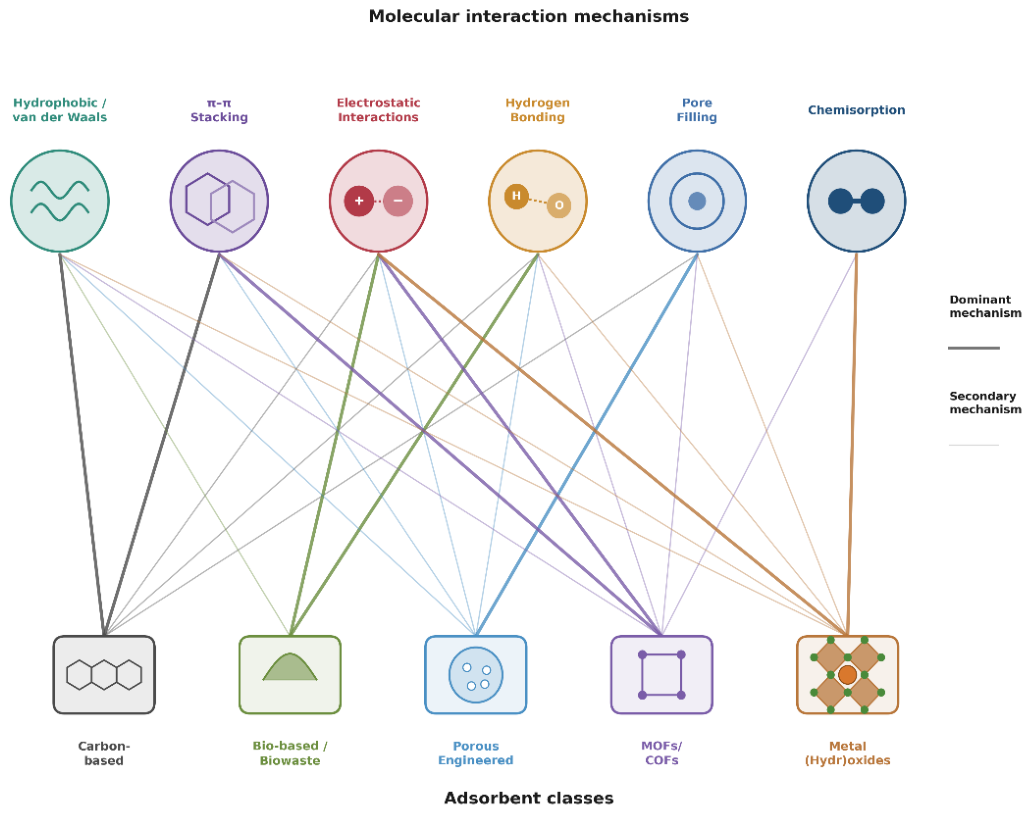

Table 1.
Representative adsorption performance data for the five adsorbent classes (N.R. = data not reported).
Table 1.
Representative adsorption performance data for the five adsorbent classes (N.R. = data not reported).
| Material class | Adsorbent | Target polymer |
MPN size |
Capacity (mg g-1) |
C0 (mg L-1) |
Removal efficiency (%) |
t_eq (min) |
Matrix | Dominant mechanisms | Ref. |
| Carbon-based | Coconut shell-based GAC | PS | 90 nm | 6.33 | 40 | ~90 | 240 | Natural surface water (Geneva lake) | Electrostatic interactions, chemisorption, pore filling | Arenas et al. [71] |
| Carbon-based | 3D reduced graphene oxide | PS | 5 µm | 617.28, 430.78 | 600 | >53 (real matrix) |
120 | Distillated water, micro-polluted lake water | π–π stacking, pore filling, electrostatic interactions, chemisorption | Yuan et al. [46] |
| Carbon-based | Oxidized corncob biochar | PS | 50 nm | 23.98 | 400 | >90% | 1440 | Synthetic | Pore filling, hydrophobic interactions, H-bonding, electrostatic repulsion (low pH) | Magid et al. [78] |
| Bio-based | Banana peel biowaste | PE, PP, PET, PS (mixed) | 1.5–135 µm | 0.085, 0.078 | N.R. | 99, 97.5 | 25 | Synthetic, real WWTP effluent | Electrostatic interactions, H-bonding, chemisorption, hydrophobic interactions/van der Waals (PE, PP), π–π stacking | Alnasrawy [87] |
| Bio-based | Tween-80-modified sugarcane bagasse | PVC, PET, PS, PP, HDPE (mixed) | <600 µm | N.R. | 1200 | 80 | 2880 | Synthetic | Hydrophobic interactions, H-bonding | Oliveira et al. [88] |
| Bio-based | Surface modified cellulose fibers | PVC, PMMA, Polyvinyl acetate (PVCa) | ~ 100 nm | N.R. | 2000 | > 98 | 30 | Synthetic | Electrostatic interactions, H-bonding | Batool et al. [48] |
| Porous Engineered Materials | Chitin–lignin hydrogel | PS | <1 µm | 1790.8 | 1000 | N.R. | 240 | Synthetic | Electrostatic interactions, π–π stacking | Jung et al. [96] |
| Porous Engineered Materials | Graphene oxide /nanocellulose aerogels (D-DPGG) | PS | 1 µm | 241.56 | 100 | 96.75 | 20 | Synthetic; river, lake, reservoir, marine water | Electrostatic interactions, π–π stacking, pore filling, H-bonding | Liu et al. [94] |
| Porous Engineered Materials | Starch-gelatin sponge | PMMA, PS | 100 nm, 5 µm |
20.43, 21.79 | 25 | N.R. | 1440 | Synthetic; tap water, seawater, soil supernatant, take-out dish soup | Pore filling, H-bonding, hydrophobic interactions | Fu et al. [113] |
| MOFs/COFs | Fe₃O₄@MP-COF/PVDF | PE, PP, PS | 75–150 µm | 280, 380, 520 | 50 | N.R. | ∼40–60 | Synthetic | π–π stacking, electrostatic interactions | AlNeyadi et al. [105] |
| MOFs/COFs | ZIF-67 | PS | 1 µm | 11.6 | 5 | 92.1 | 20 | Synthetic | Electrostatic interactions, π–π stacking, H-bonding | Wan et al. [50] |
| MOFs/COFs | Chromium-based metal–organic framework (Cr-MOF/MIL-101) | PS | 50–70 nm | 800 | 5–70 | 96 | 1440 | Synthetic | Electrostatic interactions | Modak et al. [100] |
| Metal (hydr)oxides and magnetic composites | M-MgAl-LDO | PS | 80 nm | 203.12 | 200 | 97 | 360 | Synthetic | Chemisorption/surface complexation, pore filling, π–π interactions, electrostatic interactions, hydrogen bonding | Yang et al. [110] |
| Metal (hydr)oxides and magnetic composites | Fe3O4-modified biochar | PS | 1 µm | 290.20 | 10 | N.R. | 30 | Synthetic | Chemisorption/inner-sphere complexation, electrostatic interactions | Singh et al. [109] |
| Metal (hydr)oxides and magnetic composites | Fe-doped magnetic sponge carbon (FeMSC) | PS | > 1 µm | 369.07 | 50 | >90 | 10 | Synthetic | Chemisorption, π–π stacking, magnetic separation | Li et al. [26] |
Disclaimer/Publisher’s Note: The statements, opinions and data contained in all publications are solely those of the individual author(s) and contributor(s) and not of MDPI and/or the editor(s). MDPI and/or the editor(s) disclaim responsibility for any injury to people or property resulting from any ideas, methods, instructions or products referred to in the content. |
© 2026 by the authors. Licensee MDPI, Basel, Switzerland. This article is an open access article distributed under the terms and conditions of the Creative Commons Attribution (CC BY) license (http://creativecommons.org/licenses/by/4.0/).
Copyright: This open access article is published under a Creative Commons CC BY 4.0 license, which permit the free download, distribution, and reuse, provided that the author and preprint are cited in any reuse.