

Submitted:
08 July 2026
Posted:
09 July 2026
You are already at the latest version
Abstract
Background: Aging in place (AiP) and healthy cognitive aging (HCA) are closely interrelated concepts but seldom examined together within real-world care systems. Integrated care (IC) offers a framework to understand how community settings can support both. Methods: This qualitative case study examined a 25-year-old community-based integrated health and social care program in a rural Czech microregion. Utilizing a realist-informed context–mechanism–outcome framework, the study integrated data from documentary analysis, semistructured interviews, and participant observation. Results: The findings suggest that IC may support AiP and HCA through interrelated, context-dependent, cumulatively operated mechanisms, including environmental predictability, continuity of care, coordination across services, social embeddedness, supported autonomy, and reductions in cognitive and organizational burden and stress. IC is not a direct intervention, but acts as a context-dependent mediator that shapes the conditions for AiP and HCA. Behaviorally, these mechanisms minimize decision-making complexity and establish predictable interaction patterns that support everyday functioning. Conclusions: AiP and HCA are co-produced through shared underlying mechanisms embedded in care systems and community contexts. IC may facilitate this by fostering stable, person-centered environments that may reduce cognitive demands and support relational continuity. The study contributes to behavioral science by demonstrating how IC can shape conditions relevant to cognitive and functional outcomes in later life and provides actionable insights for the design of IC systems.
Keywords:
aging in place
; healthy cognitive aging
; integrated care
; cognitive load
; context–mechanism–outcome configurations
; social embeddedness
; case study
1. Introduction
Population aging is one of the most significant demographic transformations of the twenty-first century, reshaping health systems, social structures, and community life across the globe (United Nations, 2020). As longevity increases, a growing proportion of older adults live with chronic conditions, functional limitations, and varying degrees of cognitive change (Prince et al., 2015; World Health Organization, 2021). A substantial body of evidence indicates that most older adults prefer to age in place, seeking to maintain autonomy, activity, and independence for as long as possible while remaining embedded in familiar home and social environments (AARP, 2011; Rantz et al., 2005). This preference is not merely attitudinal but is reflected in actual living arrangements, as the majority of older people continue to reside within their communities rather than in institutional settings. Consequently, the extent to which this preference can be realised depends critically on the quality, stability, and accessibility of community-based support systems, which play a central role in shaping well-being and functional outcomes in later life (Wiles et al., 2012; Sixsmith & Sixsmith, 2008).
Cognitive health, in particular, plays a decisive role in determining whether older adults can maintain autonomy, meaningful social participation, and psychological well-being as they age (Depp & Jeste, 2006; World Health Organization, 2015; Beard J, Officer A, de Carvalho I et al., 2015). Understanding how community environments and care systems can support healthy cognitive aging has therefore become a priority for research, policy, and practice (Livingston et al., 2020).
Aging in place (AiP) has emerged as a key concept in this context. In gerontological research, it is commonly understood as the ability of older adults to live safely and independently in their own homes and communities while maintaining meaningful social roles and connections, regardless of age or functional ability (Wiles et al., 2012; Pani-Harreman et al., 2021), AiP reflects more than a preference for remaining at home. It encompasses a multidimensional set of conditions that enable older adults to sustain their identity, have access to the resources required to remain in their familiar environments, thereby supporting their independence, autonomy, and social connections. (Wiles et al., 2012).
Research consistently shows that AiP is associated with higher life satisfaction, better psychological well-being, and stronger social integration (Vasunilashorn et al., 2012). From a psychological perspective, AiP supports continuity of self, familiar routines, and a sense of control—factors that shape conditions relevant to cognitive functioning and mental health (Rowles & Bernard, 2013). However, AiP is not guaranteed by physical residence alone. It depends on the interaction between individual capacities, environmental characteristics, social relationships, and the availability of supportive services (Lawton & Nahemow, 1973; Pani-Harreman et al., 2021). When these elements are misaligned, older adults may experience stress, disorientation, or social isolation, all of which can negatively affect cognitive health (Cacioppo & Hawkley, 2009).
Healthy cognitive aging (HCA) is a concept that focuses on the maintenance of cognitive functions—such as memory, attention, executive functioning, and orientation—that are essential for daily life and independent living (World Health Organization, 2015). Contemporary cognitive aging research emphasizes the heterogeneity of cognitive trajectories in later life (Cabeza et al., 2018; Nyberg et al., 2012). While some individuals experience marked decline, others maintain high levels of cognitive functioning well into advanced age. Theories such as cognitive reserve, brain maintenance, and the scaffolding theory of aging and cognition highlight the role of lifelong learning, physical activity, social engagement, and adaptive neural processes in shaping cognitive outcomes (Stern et al., 2018; Park & Reuter-Lorenz, 2009; Nyberg et al., 2012). Importantly, these theories also underscore the influence of environmental and social contexts (Livingston et al., 2020). Stable, predictable, and supportive environments can reduce cognitive and organisational burden, facilitate orientation, and promote engagement in cognitively stimulating activities (Evans, 2003; Fratiglioni et al., 2004). Conversely, fragmented care, unpredictable service environments, and social isolation can increase stress and reduce coping capacity—conditions associated in the literature with worse mental health and, in population studies, higher dementia risk (Cacioppo & Hawkley, 2009; Livingston et al., 2020).
Despite the conceptual overlap between AiP and HCA, research rarely examines them together. AiP studies often focus on housing, environmental adaptations, or social support, while HCA research tends to emphasize neurobiological and psychological determinants (Wiles et al., 2012; Stern et al., 2018). Yet the ability to age in place is deeply intertwined with cognitive functioning: cognitive health is associated with the ability of older adults to manage daily tasks, navigate their environment, and make decisions, while supportive environments and stable care systems help maintain conditions relevant to cognitive functioning by reducing stress and providing opportunities for engagement (Lawton & Nahemow, 1973; Livingston et al., 2020). The relationship between AiP and HCA is therefore reciprocal and dynamic, shaped by the broader sociotechnical systems in which older adults live (Sixsmith & Sixsmith, 2008).
Integrated care (IC) offers a promising framework for understanding how community settings can support both AiP and HCA. Integrated care refers to the coordinated, person-centered, and continuous provision of health and social services across providers, sectors, and settings (Kodner & Spreeuwenberg, 2002; Valentijn et al., 2013). It seeks to overcome the fragmentation that often characterizes care systems, where older adults must navigate complex and disconnected services (Goodwin et al., 2014). Fragmentation can create uncertainty and increase system complexity and user burden, potentially disrupting continuity and undermining psychological well-being—particularly for those navigating multiple providers and eligibility rules (Greer et al., 2019; Sørensen et al., 2012). In contrast, integrated care aims to create predictable, comprehensible, and stable care trajectories that align with individuals’ needs and preferences (Valentijn et al., 2013). From a psychological perspective, integrated care can reduce stress, enhance orientation, and support coping by providing consistent relationships with providers, clear communication, and coordinated transitions between services (Kodner & Spreeuwenberg, 2002).
However, the potential of integrated care to support AiP and HCA remains insufficiently explored. Research on integrated care focuses on clinical outcomes, service efficiency, or organizational processes rather than on cognitive health or the lived experience of older adults in community settings (Goodwin et al., 2014). Even fewer studies examine long-term, real-world integrated care systems that have evolved over decades. Such systems offer unique opportunities to analyse how stable governance structures, interorganizational relationships, and community-based service networks shape the conditions for aging in place and cognitive well-being in community (Valentijn et al., 2013). Understanding these mechanisms is particularly important in rural regions, where demographic aging, limited service availability, and geographic dispersion pose additional challenges.
This study addresses these gaps by examining a 25-year integrated health and social care program operated by a voluntary association of municipalities in a rural microregion of the Czech Republic. The program represents a rare example of a long-standing, community-based integrated care system that has maintained its core principles for more than two decades. Its stability, sociotechnical infrastructure, and community governance provide a rich context for analysing how integrated care can support aging in place and healthy cognitive aging. Unlike short-term projects or pilot interventions, this program allows for the examination of structural, organizational, and behavioral mechanisms that unfold over time.
Although our research does not directly investigate cognitive processes or psychological interventions, it provides an in-depth sociotechnical analysis of an integrated health and social care system in a specific rural microregion. Aging in place is inherently dependent on sociotechnical infrastructure and on the availability, coordination, and accessibility of services needed to support ageing populations (Sixsmith & Sixsmith, 2008). Our case study documents how organisational structures, inter-service relationships, and system-level interactions create or constrain the conditions necessary for AiP and HCA. This systems perspective contributes to understanding the structural and organisational prerequisites for effective community support of older adults’ healthy cognitive ageing in place.
To guide the analysis, we use a realist-informed logic of context–mechanism–outcome (CMO) patterns (Pawson & Tilley, 1997). This approach does not constitute a full realist evaluation; rather, it provides a structured way to identify how specific contexts trigger mechanisms that produce outcomes relevant to AiP and HCA.
The study addresses two study aims:
(1) Identify the interrelationships between the concepts of aging in place and healthy cognitive ageing in forms applicable to real-world health and social care delivery.
(2) Analyse how integrated care can realise both concepts and potentially mediate their interconnection.
From a behavioral perspective, these system-level characteristics can be understood as shaping how individuals perceive, interpret, and respond to their care environment, particularly by influencing decision-making demands, perceived predictability, and coping processes in everyday life.
Our research question is as follows:
To what extent, in what way, and within what limits can the concepts of aging in place and healthy cognitive aging be implemented in a given region through integrated health and social care?
This article presents findings from a part of a case study conducted by the Centre of Expertise in Longevity and Long-term Care at the Faculty of Humanities, Charles University, Prague. This case study is part of a broader research project exploring the integration of health and social care in long-term care for older adults in the Czech Republic. The project is being carried out as part of the principal author’s PhD dissertation, and this article serves as a contribution to it.
2. Theoretical Background
Aging is increasingly conceptualized as a dynamic, multidimensional process shaped by the interplay of biological, psychological, social, and environmental factors (Rowe & Kahn, 1997; World Health Organization, 2015). Within this landscape, three concepts—Aging in Place (AiP), Healthy Cognitive Aging (HCA), and Integrated Care (IC)—have become important reference points in contemporary gerontology, health psychology, and long-term care policy (Sixsmith & Sixsmith, 2008; Valentijn et al., 2013). Although these concepts are often examined separately, they are deeply interconnected. AiP provides the environmental and social context in which cognitive aging unfolds (Wiles et al., 2012); HCA captures the neurocognitive and psychological processes that enable autonomy and participation (Cabeza et al., 2018; Stern et al., 2018); and IC represents the organizational and systemic structures that can support both through coordinated service delivery and continuity of care (Kodner & Spreeuwenberg, 2002; Valentijn et al., 2013).
This section synthesizes the theoretical foundations of these concepts and outlines the analytical lens used in this study.
2.1. Aging in Place (AiP)
Aging in place is commonly conceptualised as the ability to live safely and independently in one’s own home and community while sustaining identity, autonomy, and social connectedness, even as functional capacity changes (Wiles et al., 2012; Pani-Harreman et al., 2021). While early formulations emphasized remaining in one’s dwelling, contemporary research highlights AiP as a multidimensional and relational process (Wiles et al., 2012). Wiles et al. (2012) argue that AiP encompasses emotional attachment, identity, autonomy, and social connectedness, reflecting the complex ways in which older adults experience “place.”
AiP as a dynamic process
AiP is not a static condition but a process shaped by the interaction between individual capacities, environmental characteristics, and available support systems (Lawton & Nahemow, 1973; Pani-Harreman et al., 2021). Older adults value the continuity of familiar routines, the symbolic meaning of home, and the social ties embedded in their neighborhoods. These elements contribute to psychological well-being and shape conditions relevant to cognitive functioning by providing stability, predictability, and a sense of control (Rowles & Bernard, 2013; Wiles et al., 2012).
Environmental gerontology and person–environment fit
The ecological model of aging (Lawton & Nahemow, 1973) posits that well-being in later life depends on the balance between individual competence and environmental press. When environments compensate for declining competence—through accessibility, supportive services, or social resources—older adults can maintain autonomy and functional independence. Conversely, environments that are overly demanding or insufficiently supportive can increase stress, reduce coping capacity, and undermine cognitive functioning (Pani-Harreman et al., 2021).
In behavioural terms, such stability may allow individuals to rely on established routines and reduce the need for ongoing adaptation and problem-solving in daily life.
A complementary way to conceptualise AiP is through the capability approach, which emphasises that well-being depends on real opportunities to achieve valued ways of living rather than on preferences alone. From this perspective, ageing in place is not simply a choice to remain at home but a capability that is expanded or constrained by housing quality, service availability, transport, social relations, and local governance. This lens is particularly relevant in rural settings, where structural constraints can limit the practical feasibility of AiP even when the preference is strong (Sen, 1999; Nussbaum, 2000).
Social embeddedness and community resources
AiP is also shaped by social capital and community embeddedness. Neighborhood ties, informal support networks, and opportunities for social participation play significant roles in maintaining psychological well-being and cognitive engagement (Sixsmith & Sixsmith, 2008). Social isolation, by contrast, is associated with cognitive decline, depression, and reduced quality of life (Cacioppo & Hawkley, 2009; Livingston et al., 2020). Older adults who remain socially connected and engaged in meaningful activities are more likely to maintain cognitive functioning and emotional resilience (Livingston et al., 2020).
Cultural and contextual variations
AiP is not experienced uniformly across contexts and cultures. Research shows that cultural norms, family structures, and welfare systems influence how older adults conceptualize “place” and independence (Sixsmith & Sixsmith, 2008; Wiles et al., 2012). These variations underscore the need for flexible, context-sensitive approaches to supporting AiP.
AiP as a determinant of cognitive health
From a psychological perspective, AiP may create conditions consistent with supporting cognitive functioning by providing environmental stability, familiar routines, and opportunities for engagement (Rowles & Bernard, 2013). Stable environments reduce cognitive and organisational burden by minimizing uncertainty and limiting the need for continuous reorientation, while predictable routines support orientation and memory (Evans, 2003; Fratiglioni et al., 2004). Conversely, disruptions in living arrangements, service fragmentation, or environmental stressors can negatively affect conditions relevant to cognitive health (Evans, 2003; Cacioppo & Hawkley, 2009). AiP can provide a crucial foundation by shaping conditions relevant to healthy cognitive aging.
2.2. Healthy Cognitive Aging (HCA)
Healthy cognitive aging refers to the maintenance of cognitive functions—such as memory, attention, executive functioning, and processing speed—that enable older adults to navigate daily life, make decisions, and participate in social and community activities (World Health Organization, 2015). HCA is not defined by the absence of cognitive change but by the preservation of functional abilities that support autonomy and well-being (Depp & Jeste, 2006).
From the range of models and theories related to cognitive aging, we focus on three key frameworks relevant to this study: cognitive reserve, brain maintenance, and the scaffolding theory of aging and cognition.
Heterogeneity of cognitive trajectories
Cognitive aging is characterized by substantial individual variability. Some older adults experience minimal decline, while others show accelerated deterioration (Cabeza et al., 2018; Nyberg et al., 2012). This variability reflects the interaction of neurobiological processes, lifestyle factors, social environments, and structural conditions (Prince et al., 2015; Livingston et al., 2020).
Time and variability
Cognitive aging is a dynamic process characterized by both short-term fluctuations and long-term trajectories that are sensitive to changes in environment, social interactions, and daily routines (Evans, 2003; Fratiglioni et al., 2004). This perspective aligns closely with AiP, which emphasizes continuity and stability.
Cognitive reserve
Cognitive reserve explains why individuals with similar levels of neuropathology may exhibit different cognitive outcomes (Stern et al., 2018). Built through lifelong cognitive stimulation, social engagement, and education, cognitive reserve enables more efficient or flexible cognitive processing.
Brain maintenance
Brain maintenance emphasizes the preservation of neural integrity through healthy lifestyle behaviors, including physical activity, sleep, and vascular health (Nyberg et al., 2012). Individuals with better brain maintenance tend to experience slower cognitive decline.
Scaffolding theory of aging and cognition (STAC)
The scaffolding theory (STAC) (Park & Reuter-Lorenz, 2009) proposes that the aging brain adapts to structural decline by recruiting alternative neural networks. These compensatory processes help maintain cognitive performance and are influenced by environmental and behavioural factors.
Environmental and social determinants of HCA
Environmental stability, social relationships, and structural conditions play a crucial role in shaping cognitive trajectories (Livingston et al., 2020). Stress, uncertainty, and fragmented care can increase cognitive load and reduce coping capacity, potentially accelerating decline (Cacioppo & Hawkley, 2009). Conversely, predictable environments and supportive relationships can promote cognitive engagement.
Operationalizing HCA
In this study, Healthy Cognitive Aging is conceptualized as the sustained capacity to maintain cognitive functions and psychological processes supporting autonomy, orientation, decision making, emotional regulation, and social engagement. These determinants span biological, psychological, and social domains (World Health Organization, 2015; Cabeza et al., 2018).
These environmental influences can also be understood behaviourally, as they shape the demands placed on attention, decision-making, and adaptive responses in everyday situations and responses to changing care situations.
2.3. Integrated Care (IC)
Integrated care has become an increasingly important concept in health and social care policy, reflecting the recognition that older adults’ needs span multiple sectors (Kodner & Spreeuwenberg, 2002; Valentijn et al., 2013). Integrated care refers to the coordinated, person-centered, and continuous provision of services across providers, sectors, and settings.
Fragmentation as a structural problem
Health and social care systems have historically developed in parallel, resulting in fragmentation and coordination challenges (Goodwin et al., 2014). This fragmentation produces gaps in continuity, duplication of services, and unpredictable care transitions. For older adults, navigating such systems can be cognitively demanding and stressful, particularly when cognitive capacity is reduced (Greer et al., 2019).
From a behavioral standpoint, fragmentation can be interpreted as increasing the number of required decisions, interactions, and adjustments, thereby raising cognitive and emotional demands on users.
Levels of integration
Valentijn et al. (2013) distinguish three levels of integration: micro (individual care), meso (organizational), and macro (policy). Functional and normative integration—shared values, trust, and communication—are essential for sustaining these structures.
Continuity of care as psychological stability
Continuity, together with coordination and person-centered care, is a core component of integrated care (Kodner & Spreeuwenberg, 2002). It reduces uncertainty, supports orientation, and enhances coping by providing a stable and comprehensible care environment (Greer et al., 2019).
Conversely, continuity may enable individuals to anticipate interactions and rely on familiar patterns of behaviour, reducing the need for continuous reorientation.
Integrated care as a community-level intervention
Integrated care can be understood not only as an organizational model but also as a community-level intervention shaping the environments in which older adults live (Goodwin et al., 2014). By creating stable and accessible service ecosystems, integrated care supports both AiP and HCA by reducing cognitive and emotional burden.
2.4. Interdisciplinary Analytical Framework: Realist-Informed CMO Configurations
This study uses a realist-informed logic of context–mechanism–outcome (CMO) configurations as an analytical framework for understanding how integrated care supports AiP and HCA (Pawson & Tilley, 1997). Rather than conducting a full realist evaluation, the CMO framework is used to structure explanations of how contexts activate mechanisms leading to specific outcomes.
Contexts include environmental stability, governance structures, service availability, and community characteristics. Mechanisms refer to psychological processes such as predictability, reduced cognitive load, orientation, coping, and social anchoring. Outcomes include the ability to age in place, maintain cognitive functioning, and sustain autonomy.
In line with realist-informed reasoning, we treat mechanisms not as internal cognitive events that can be directly observed, but as socially and organisationally mediated processes that explain how participants respond to particular system conditions. In this study, for example, continuity is operationalised as sustained relational contact with familiar providers over time; coordination as the practical alignment of tasks, information, and responsibilities across organisations; and social embeddedness as stable, repeated interactions within local networks that provide both practical assistance and emotional anchoring. These operationalisations support transparent interpretation of how contexts trigger mechanisms relevant to AiP and HCA outcomes.
In this perspective, mechanisms can be interpreted behaviourally as patterns in how individuals respond to system conditions, including how they make decisions, manage uncertainty, and maintain routines.
This interdisciplinary approach integrates insights from environmental gerontology, cognitive aging research, and health psychology, clarifying how system-level arrangements shape individual cognitive and functional outcomes.
3. Materials and Methods
3.1. Study Design
This study adopts a retrospective longitudinal qualitative case study design to examine how a long-term, community-based integrated health and social care program can support Aging in Place (AiP) and Healthy Cognitive Aging (HCA) in a rural microregion of the Czech Republic, specifically over a period of twenty-five years, from 2000 to 2024. A case study approach was chosen because the program represents a complex sociotechnical system whose functioning is deeply embedded in historical development, institutional arrangements, and everyday practices. Case studies are particularly well suited for analysing such context-dependent phenomena, enabling the tracing of causal pathways, the identification of patterns, and the examination of how specific contextual conditions shape outcomes over time (Yin, 2018; Stake, 1995).
The program under study (the Programme) has been implemented continuously for more than 25 years and comprises 43 sequentially developed projects. Crucially, the Programme was not designed to promote AiP or HCA. Its purpose was to provide integrated health and social care in a geographically defined region. AiP and HCA therefore constitute a parallel analytical perspective applied to an existing system, rather than the Programme’s original design logic. This required an analytical strategy capable of orienting the research within a complex empirical landscape and of identifying how integrated care arrangements may create or inhibit conditions relevant to AiP and HCA.
To structure this explanatory work, we employed context–mechanism–outcome (CMO) configurations. While CMO configurations are typically used within realist evaluation to develop middle-range theory (Pawson & Tilley, 1997), in this study they are applied as a heuristic analytical tool to support systematic interpretation of qualitative data and enhance the communicability and transferability of findings.
3.2. Setting
The research was conducted in a rural microregion composed of 27 municipalities that voluntarily formed an association to coordinate long-term care services. The region is characterised by demographic ageing, limited public transportation, uneven access to specialised health services, and the outmigration of younger residents—conditions typical of rural Central Europe. Over the past quarter century, the municipalities jointly developed a coordinated system of residential long-term care, home care, social services, volunteer programs, community nursing, and municipal support structures. This system evolved incrementally, guided by shared governance, stable leadership, and long-term collaboration among local actors.
The demographic profile of the region—marked by high proportions of older adults and increasing prevalence of chronic conditions—creates strong pressures on local care systems. These characteristics make the microregion an informative setting for examining how integrated care can support AiP and HCA under resource-constrained conditions and how community-based systems adapt to demographic and institutional change.
3.3. Analytical Workflow
The study followed a six-step analytical workflow, each step building on the previous one to progressively refine the understanding of how integrated care shapes conditions relevant to AiP and HCA. The workflow is summarised in Figure 1.
Step 1: Theoretical framing and domain specification
We conducted a theoretical examination of the interrelationships among AiP, HCA, and IC, drawing on interdisciplinary literature in gerontology, cognitive aging, and health systems research (Valentijn et al., 2013; Stern et al., 2018). This analysis produced five analytic domains that capture the key conditions relevant to both AiP and HCA.
Step 2: Project screening and categorization
All 43 projects implemented within the Programme between 2000 and 2024 were assessed for their relevance to AiP and HCA within these analytic domains (step 1). Each project was rated, and only those with the highest relevance (category D) were selected for in-depth analysis, consistent with purposive qualitative sampling strategies (Patton, 2015). Programme projects and their relevance categorisation (A–D), including the Category D subset selected for in-depth analysis, are summarised in Result section (see below), the criteria for categorizing projects (A–D) are listed there too
Step 3: Thematic document analysis and creation of theme–CMO pairs
For selected projects (Category D), we conducted a thematic analysis of documentation materials, including project documentation, internal correspondence, evaluation reports, and other supporting documents. The analysis was conducted using an inductive approach (Braun & Clarke, 2006), whereby we identified recurring themes within individual areas and linked them to corresponding CMO configurations. This resulted in theme–CMO pairs, which were used in subsequent steps of the workflow.
Step 4: Semi-structured interviews refining theme–CMO pairs
The theme–CMO pairs were used as prompts in semi-structured interviews with key stakeholders. This approach enabled the exploration of participant perspectives and the refinement of emerging explanations, consistent with established qualitative interviewing practices (Kvale & Brinkmann, 2009).
Step 5: Participant observation enriching theme–CMO pairs
Targeted participant observations were conducted to examine how configurations were enacted in practice. Observational methods allowed for the analysis of situated interactions and organisational routines, providing contextual depth (Spradley, 1980).
Step 6: From theme–CMO pairs to final CMO configurations
After repeated refinement across data sources, the theme–CMO pairs yielded the final CMO configurations. These configurations represent transferable explanatory patterns rather than context-specific descriptions, which is consistent with analytical approaches grounded in realism (Pawson & Tilley, 1997). The final CMO configurations for each domain identified in step 1 of the workflow are detailed in the Results section (see below).
To translate the rich empirical observations from the field into a cohesive framework, the final CMO configurations (n=24, see Results) were interpreted through a narrative, four-dimensional qualitative lens. This process allowed us to distinguish between core systemic mediators—elements that structurally reshape the senior’s daily living conditions—and operational enablers, which represent necessary but localized technical and administrative routines.
Rather than applying rigid formal criteria and metrics, this final synthesis and interpretation focused on four descriptive characteristics of the care environment:
- Structural Scope: This perspective explores whether a pattern operates as a broader modifier of the social and physical environment, or functions as a localized, standalone service.
- Behavioral Scaffolding: Here, the focus is on how the care ecosystem actively eases executive cognitive load and stabilizes daily routines, as opposed to offering transactional support.
- Temporal Continuity: This dimension highlights patterns that rely on long-term environmental stability and accumulated systemic trust, rather than brief, episodic responses.
- Functional Synergy: This lens observes whether an interaction pattern simultaneously supports both independent living (Aging in Place) and conditions relevant to cognitive well-being (Healthy Cognitive Aging) through shared pathways.
Through this thematic integration, patterns embedded within the structure of daily life were synthesized into core support pillars (n=7, see Results). The remaining operational patterns, while essential for daily care delivery (such e.g., technical case management or equipment lending), were conceptually integrated within these broader pillars rather than presented as standalone conclusions.
3.4. Case and Project Selection
3.4.1. Case Selection
The case was selected using criteria typical for theoretically informed qualitative inquiry, including long-term existence, organisational stability, provision of integrated services, and embeddedness in community networks (Yin, 2018; Stake, 1995).
3.4.2. Project Selection
The study examines a purposive sample of integrated care projects implemented between 2000 and 2024. All projects were screened for relevance using the five analytic domains. Only those assigned to category D were selected for in-depth analysis, ensuring focus on information-rich cases (Patton, 2015).
3.5. Data Sources
An overview of the study data sources and their role in the CMO heuristic is provided in Table 1.
3.5.1. Documentary Materials
Documentary analysis followed established qualitative approaches to analysing organisational records and institutional documents (Bowen, 2009). Sources included project proposals, project documentation, internal communications, evaluation reports operational guidelines, meeting minutes and others. These materials supported both thematic analysis and the construction of initial CMO configurations.
3.5.2. Semi-Structured Interviews
Semi-structured interviews were conducted using flexible protocols designed to elicit rich, contextualised accounts (Kvale & Brinkmann, 2009). Interviews were audio-recorded and transcribed verbatim.
To empirically refine and validate the initial CMO configurations derived from the documentary analysis, a structurally stratified sample of qualitative interviews was executed. The sample consisted of 14 participants representing key stakeholder groups. The sample of stakeholders was proportionally distributed across four stakeholder tiers to balance structural, operational, and experiential knowledge: macro-context architects (n = 2; executive and municipal leaders), meso-integration coordinators (n = 4; case managers, senior social workers, and head nurses), micro-mechanism activators (n = 4; field-based professional caregivers and home-care nurses), and outcome beneficiaries (n = 4; informal family caregivers and older adults with mild cognitive decline). This proportional distribution shifts the analytical weight toward front-line care delivery and lived experience, capturing the latent behavioral mechanisms that documents may omit. Data saturation was approached through iterative data collection and analysis, with thematic repetition observed across interviews (Guest et al., 2006). Interviews were conducted between February and June 2025 and lasted approximately 90 minutes.
3.5.3. Participant Observation
Participant observation was conducted to capture situated interactions, implicit behavioral routines, and the real-time activation of CMO mechanisms within their natural al context (Spradley, 1980). The observations were executed throughout 2025 (lasted approximately 60 minutes each) and systematically stratified across three distinct operational settings to mirror the program’s multi-level architecture. Specifically, the sample was proportionally allocated among care visits (n = 6), divided between direct home-care deliveries and decentralized Local Care Cottages to observe client–caregiver micro-interactions and the scaffolding of procedural memory, multidisciplinary team meetings (n = 3), encompassing cross-sectoral case management conferences to evaluate health-social integration protocols, and localized community events (n = 2), including village social gatherings to assess informal neighborly support networks. Field notes were systematically recorded in situ, focusing on tacit professional practices and behavioural adjustments that stakeholders often omit in verbal interviews, with all data fully anonymised and securely stored in compliance with data protection standards.
3.6. Analytical Approach
3.6.1. Thematic Analysis
We conducted an inductive thematic analysis following the six-phase approach outlined by Braun and Clarke (2006). Data coding was performed using ATLAS.ti (version 24) and refined iteratively.
3.6.2. Construction of Theme–CMO Configuration Pairs
Themes were systematically linked to CMO configurations to articulate how contextual conditions activate mechanisms leading to outcomes. This approach integrates thematic and realist-informed analysis (Pawson & Tilley, 1997).
To enhance the clarity of the interpretation, the mechanisms were also considered from a behavioral perspective, with particular attention focused on how the observed characteristics of the system might influence the decision-making demands on older adults, perceived predictability, and everyday coping processes.
3.6.3. Triangulation
Data triangulation across documents, interviews, and observations was used to enhance the credibility and robustness of findings (Flick, 2018; Denzin, 1978).
3.6.4. Reflexivity
A reflexive approach was maintained throughout the entire research process to account for potential researcher bias and positionality (Finlay, 2002).
3.7. Ethical Considerations
Ethical approval was obtained from the institutional review board (Reference Code: UKFHS/622586/2024; No. 042024/Ren). All participants provided informed consent. Data were anonymised and stored securely in accordance with GDPR. Given the small size of the microregion, particular attention was paid to preventing deductive disclosure (Kaiser, 2009).
4. Results
4.1. Theoretical Analysis and Domains Linking AiP, HCA, and Integrated Care
The first subsection of the Results section, structured in accordance with the analytical workflow of the study (see Figure 1), corresponds to Step 1 (“Theoretical Framing and Domain Specification”). It reports the results of a theoretical examination of the interrelationships among Aging in Place (AiP), Healthy Cognitive Aging (HCA), and Integrated Care (IC), and identifies the domains linking these concepts. Each domain captures a key area through which integrated care is expected to support ageing in place and cognitive health, drawing on the theoretical foundations outlined in Section 2 (Valentijn et al., 2013; Stern et al., 2018).
4.1.1. Theoretical Interrelations Among AiP, HCA, and IC
The theoretical analysis resulted in the identification of distinct analytical roles of the three concepts. Aging in place was conceptualised as a normative and relational outcome, healthy cognitive aging as a dynamic and context-sensitive process, and integrated care as a mediating mechanism linking the two.
The analysis indicates that AiP and HCA are mutually reinforcing but not automatically aligned. Cognitive health functions as a prerequisite for ageing in place, while environmental and service-related conditions characteristic of AiP shape cognitive trajectories (Lawton & Nahemow, 1973; Livingston et al., 2020). Integrated care emerges as a mediating concept that may align these processes by enabling mechanisms such as reduced cognitive load, strengthened social embeddedness, enhanced orientation and predictability, and supported autonomy. These mechanisms correspond to those identified in cognitive and environmental gerontology (Stern et al., 2018; Rowles & Bernard, 2013).
Conversely, when contextual conditions are unfavourable, integrated care may fail to activate these mechanisms, limiting its capacity to support either AiP or HCA. This conditionality reflects a realist understanding of causation, where outcomes depend on context–mechanism interactions (Pawson & Tilley, 1997).
4.1.2. Analytical Domains Derived from the Theoretical Examination
Based on this analysis, five analytically defined domains were identified. Definitions and operationalisation of these analytic domains are summarised in Table 2.
These domains reflect key mechanisms identified in the literature on integrated care and cognitive aging (Valentijn et al., 2013; Livingston et al., 2020) and provided a structured framework for subsequent empirical analysis (see Figure 1).
4.2. Categorisation of Programme Projects According to Their Relevance to Domains
Project categorisation was guided by the five analytical domains derived from the theoretical examination. These domains operationalise the expected pathways through which integrated care mediates the relationship between AiP and HCA.
Projects assigned to Category D demonstrated the highest relevance to these domains. They explicitly addressed continuity of care, multi-level integration, social support, and mechanisms supporting autonomy and shaping conditions relevant to cognitive functioning. This is consistent with theoretical expectations regarding the role of coordinated and person-centered care in reducing system complexity and cognitive burden (Valentijn et al., 2013; Greer et al., 2019).
The screening process indicates that macro infrastructure and institutional inpatient healthcare units focus primarily on macro-systemic stabilization or clinical crises (Category A, 1 project; Category B, 9 projects). However, by removing older adults from their familiar environments, these interventions may, in certain instances, induce spatial disorientation. Similarly, localized medical outpatient clinics enhance regional healthcare access but do not typically intervene directly in the immediate architecture of the home environment. Consequently, their capacity to modulate the daily behavioral routines that couple AiP and HCA appears relatively limited (Category C, 8 projects).
Projects Category D (25 projects), field-based, domestic, or decentralized community services, are interpreted as modalities that may function as an active environmental support. They demonstrate the potential to reduce executive demands, reinforce environmental predictability, and contribute to the stabilization of behavioral routines within the individual’s micro-environment. This specific subset constitutes the empirical and analytical core of the realist evaluation.
The classification of Programme projects into categories (A–D) is shown in Table 3. This comprehensive catalogue contains all 43 projects implemented within the program framework. Each project is categorized (A–D) based on its alignment with the analytical domains, supplemented by formal academic justifications. The Category D subset selected for deep qualitative analysis. The criteria for classifying projects(A–D) can be found in Table 4.
4.3. Thematic Patterns Identified in Project Documentation and Theme–CMO Pairs
Documentary materials from Category D projects were analysed using inductive thematic analysis (Braun & Clarke, 2006). The analysis identified recurring patterns illustrating how integrated care arrangements may support ageing in place and healthy cognitive aging.
Across the analysed projects, themes were examined across five interrelated domains identified in Step 1 of the workflow. These domains correspond to mechanisms identified in prior research on aging environments and cognitive functioning (Livingston et al., 2020; Cacioppo & Hawkley, 2009).
The findings indicate that integrated care contributes not through isolated interventions, but by shaping the broader conditions of everyday life—particularly by stabilising care trajectories, reducing cognitive burden, and supporting relational continuity. Recurring outcomes included sustained ability to remain at home, preserved autonomy, reduced crisis-driven transitions, and improved cognitive and emotional stability. These findings were synthesised into context–mechanism–outcome (CMO) configurations (Pawson & Tilley, 1997), which specify how outcomes emerge under particular contextual conditions. Together with their corresponding themes, they formed theme-CMO pairs.
The final CMO configurations are listed in the Table 5.
4.4. Refinement of Theme–CMO Pairs via Stakeholder Interviews
To validate, challenge, and refine the preliminary theme–CMO pairs derived from the initial documentary analysis (Step 3), we integrated primary qualitative data from key actors. This step (Step 4) focused on the insights gathered from 14 semi-structured interviews conducted between February and June 2025 (see Table 1).
The stakeholders’ narratives provided necessary empirical depth, transforming abstract document data into lived realities. Specifically, the interviews allowed us to verify whether the hypothesised ‘Mechanisms’ were actively triggered by the ‘Context’ of IC, and whether they yielded the expected ‘Outcomes’ for AiP and HCA. The stakeholder reflections on operational barriers and successes directly shaped the refinement of the initial thematic pairs.
Interview findings confirmed and enriched mechanisms identified in documentary analysis by incorporating actor perspectives and experiential dimensions (Kvale & Brinkmann, 2009). Mechanisms such as continuity, autonomy, and coordination were shown to depend on how actors interpret and engage with care arrangements, highlighting their context-dependent nature.
Participants’ accounts suggest that these arrangements altered how they interacted with the system, particularly by making decisions more straightforward and interactions more predictable. For instance, one participant noted: “Once all became more coordinated and more connected, I didn’t have to keep checking who to call or what to arrange next. Things became more predictable.”
Participants also described earlier arrangements as involving uncertainty about responsibilities, repeated contacts with multiple providers, and delays in coordinating services.
In behavioral terms, this stabilisation may reduce the need for active system navigation, repeated decision-making, and ongoing adaptation to changing conditions.
This is consistent with participant reflections on earlier arrangements without case manager, where one respondent noted: “Before, each service had to be contacted separately, and it was often unclear who would take responsibility. It required a lot of coordination on our side.”
In contrast, the integrated system with case manager was described as “more straightforward, with fewer steps and clearer responsibilities,” suggesting a reduction in the effort required to manage everyday care arrangements; “..everything was already organised—we knew who would come and when. Before, we had to start calling around and figure it out ourselves”. Participants also recalled situations where fragmented arrangements uncertainty, such as unclear responsibilities or delayed service provision, requiring created additional effort and repeated coordination.
These examples illustrate how coordination at the systemic level is perceived as reducing complexity and increasing predictability at the individual level; how coordinated measures reduce the effort required to navigate the system and support more stable daily routines; and how changes in the organization of the system have made decision-making less demanding.
4.5. Empirical Enrichment via Participant Observations
To complement the interview data and mitigate potential self-reporting biases, Step 5 utilised participant observations (N = 11). These observations served to stakeholders’ accounts with real-time operational practices and environmental contexts.
By observing multidisciplinary team meetings, municipal planning sessions, and social activation activities for older adults, we captured subtle, unarticulated dynamics that official documents and formal interviews could not fully register. This observational data enriched our understanding of the contextual preconditions (e.g., rural infrastructure limitations, face-to-face communication habits) and micro-mechanisms (e.g., informal trust-building among staff).
Observational data provided an additional layer of validation by examining how these mechanisms operate in practice (Spradley, 1980). Observations revealed that mechanisms such as continuity and coordination are contingent upon organisational stability, time availability, and professional discretion.
These findings reinforce a realist perspective interpretation: mechanisms are not inherent properties of interventions but are activated only under specific contextual conditions (Pawson & Tilley, 1997).
These patterns are reflected across both documentary materials and interview data, which consistently describe how the stabilisation of care arrangements reduces the effort required to navigate services and maintain everyday routines.
4.6. Final Context–Mechanism–Outcome Configurations and Support Pillars
The systematic synthesis of data from the preceding five analytical steps culminated in the formulation of the final Context–Mechanism–Outcome (CMO) configurations. This step represents the ultimate integration of the theoretical frameworks (STAC, cognitive reserve, and brain maintenance) with the empirical realities of the 25-year-old integrated care program.
As shown in Table 5, a total of 24 distinct CMO configurations were finalised. These configurations do not operate in isolation; rather, they are clustered across 7 core support pillars that collectively mediate and facilitate healthy cognitive ageing in place (HCA and AiP) within the microregion as synthesised in Table 6.
The following sections illustrate how specific contextual backdrops trigger mechanisms that systematically lead to positive cognitive and residential outcomes.
4.6.1. Final CMO Configurations
The qualitative analysis of the 25 Category D projects—drawing upon retrospective documents, 14 stakeholder interviews, and 11 participant observations—indicates 24 specific interaction patterns. These patterns illustrate how distinct environmental contexts may interact with the psychological and cognitive dynamics of older adults.
Domain 1: Environmental stability and continuity of care
- CMO 1 (Staff Familiarity): In the context of a rural microregion, long-term personnel stability among formal home care providers appears to offer a stable relational framework. This continuity may support the activation of procedural memory and interpersonal familiarity, which seems to contribute to maintaining daily domestic routines and potentially mitigating behavioral symptoms associated with cognitive decline.
- CMO 2 (Temporal Predictability): Establishing fixed, relatively predictable schedules for home care visits reinforces external temporal structuring. This environmental predictability appears to compensate for impaired time orientation, potentially enhancing a sense of ontological security and contributing to the stabilization of independent domestic tenure.
- CMO 3 (Geographic Anchoring): Providing small-scale, decentralized community housing within close proximity to the original place of residence helps preserve local spatial anchoring. This proximity seems to support social orientation, thereby potentially reducing the risk of relocation trauma or confusion associated with moving.
- CMO 4 (Clinical Reassurance): The continuous presence of professional nursing staff within localized residential social facilities helps create a stable clinical infrastructure. This proximity may foster a sense of reassurance and relational trust, which is often linked to proactive health stabilization and a potential reduction in disruptive emergency hospitalizations.
- CMO 5 (Institutional Permanence): The 25-year history of the voluntary association of municipalities offers a long-term framework of structural support. This continuity appears to cultivate systemic trust and existential security among families, which may facilitate proactive decision-making regarding long-term aging-in-place strategies.
- CMO 6 (Care Convergence): The concurrent delivery of standard home care and specialized domestic hospice services creates an integrated support environment. This arrangement seems to alleviate caregiver burden and emotional distress, potentially facilitating a more seamless and dignified end-of-life transition within the home.
Domain 2: Coordination and integration across health and social care
- CMO 7 (Transition Management): Formalized multidisciplinary case conferences and cross-sectoral transition protocols serve as an administrative safety net. This coordination attempts to shift a substantial portion of the informational burden away from the family, which may help maintain continuity of care during potentially high-risk hospital discharges.
- CMO 8 (Inpatient Integration): Embedding specialized social work directly within acute hospital wards facilitates early planning for home environmental modifications. This proactive approach appears to encourage predictable discharge pathways, which may contribute to lowering the risk of readmission.
- CMO 9 (Information Sharing): The structural linkage between specialist outpatient clinics and home healthcare services, supported by shared documentation, aligns clinical insights. This transparency may limit diagnostic latency and redundant examinations, which appears beneficial for clinical safety and the potential reduction of executive stress.
- CMO 10 (Unified Navigation): A centralized referral system and shared intake pathways managed by the municipal association facilitate access to services. This alignment aims to mitigate system fragmentation, attempting to create a clearer entry point into the local care ecosystem.
Domain 3: Social embeddedness and relational support
- CMO 11 (Field Mobilization): Regular home visits combined with the mobilization of local volunteers help establish proactive social contact. This presence may assist in activating latent community solidarity and affective ties, which is often observed to alleviate feelings of loneliness and isolation.
- CMO 12 (Civic Activation): Accessible community gardens and social activation centers within the microregion provide opportunities for engagement. These spaces may stimulate valued social roles and mutual support, which appears to be a factor in decelerating cognitive withdrawal and potentially enhancing subjective well-being.
- CMO 13 (Natural Surveillance): The context of small, cohesive village communities allows for the utilization of informal neighborhood networks. This proximity facilitates discrete situational monitoring and may function as an informal early warning network for subtle cognitive or physical changes.
Domain 4: User autonomy and participation
- CMO 14 (Resource-Oriented Planning): Co-creating individualized care plans focused on preserved functional capabilities supports user competence. This approach accounts for the subjective autonomy of the older adult, which seems to help prevent the development of learned helplessness and passivity.
- CMO 15 (Validating Communication): Training staff in flexible techniques of validating communication supports respect for individual daily routines. This approach appears to reinforce relational autonomy and dignity, which typically correlates with a greater willingness to accept services.
- CMO 16 (Environmental Mastery): A regional assistive technology rental service paired with in-home training adapts the immediate physical surroundings. This supportive framework appears to enhance functional self-efficacy, potentially supporting prolonged independent living.
- CMO 17 (Participatory Inclusion): Structurally involving older adults and their representatives in program feedback mechanisms respects the user’s voice. This participation seems to promote a sense of belonging and empowerment, which may enhance the long-term legitimacy of the program.
Domain 5: Cognitive load, stress, and orientation
- CMO 18 (Single Point of Entry): A single, clearly identifiable coordination center simplifies system navigation. This structural anchor attempts to absorb a significant portion of the complex logistical burden, which may mitigate the risk of executive overload or administrative distress.
- CMO 19 (Practical Proxy Support): Direct, practical assistance with household management and administrative tasks helps compensate for declining cognitive capacities. This intervention aims to reduce demands on working memory, serving as a factor that may prevent financial vulnerability and support independent tenure.
- CMO 20 (Spatial Simplification): Implementing intuitive visual cues and architectural simplification in local facilities helps reduce environmental stress. These modifications focus on minimizing spatial ambiguity, which seems to favorably influence independent mobility and may assist in reducing fall risks.
- CMO 21 (Cognitive Exercises): Structured memory training integrated into daily life via familiar micro-tasks embeds cognitive stimulation within standard routines. This practice is oriented toward stimulating cognitive reserve, which, in certain cases, may help slow the rate of functional decline in the early stages of cognitive impairment.
- CMO 22 (Crisis De-escalation): The availability of a 24/7 crisis hotline supported by rapid mobile teams offers an immediate emotional safety net. This accessibility may significantly contribute to mitigating acute panic, appearing as an important element in preventing severe behavioral decompensation.
- CMO 23 (Caregiver Protection): Accessible in-home respite services and targeted counseling for informal caregivers help protect the family environment. This support aims to reduce caregiver burnout, which appears to stabilize the informal caregiving structure and may help delay permanent institutionalization.
- CMO 24 (Tactile Activation): Targeted volunteer initiatives, including canine-assisted interventions, offer non-pharmacological support. These sessions activate non-verbal communication channels and tactile emotional responses, which are frequently linked in the data to a temporary reduction in manifestations of agitation or apathy.
All CMO final configurations can be found in the Table 5.
4.6.2. From CMO Final Configurations to Core Support Pillars
The final phase of the synthesis involves a systematic transition from localized field data to higher-level theoretical abstraction. Instead of presenting the 24 context-mechanism-outcome (CMO) configurations as isolated operational patterns, they were thematically grouped and synthesized into seven fundamental pillars based on the functional and generative characteristics of their underlying mechanisms. This conceptual consolidation captures how micro-level operational routines are absorbed into macro-level systemic and organizational structures. These seven pillars provide an integrated, behaviorally grounded explanatory framework that illustrates how the long-established community care ecosystem functions as a conditional mediator—by structuring external contexts to activate latent capacities relevant both to aging in place (AiP) as well as for healthy cognitive aging (HCA), which corresponds to the explicit formulations expressed in the study’s conclusion.
This conceptual consolidation was carried out in such a way that individual CMO configurations were either chosen as representative for a given core pillar (based on their logical primacy, systemic scale, or thematic breadth within the data) or were absorbed into a given pillar.
This transition from field data to theoretical abstraction reflects the cumulative epistemological trajectory of the study. While the initial five analytical domains were derived strictly from a theoretical examination of the interrelationships between AiP, HCA, and IC, they were subsequently operationalized into preliminary theme–CMO pairs. Through empirical confrontation with retrospective documents, stakeholder interviews, and participant observations, these pairs were refined, and the contextual boundaries were deepened. By systematically discarding the operational narrative themes to extract the underlying causal mechanisms, the finalized 24 CMO configurations were established. Consequently, the resulting seven pillars do not merely replicate the baseline theory; rather, they represent a richer, empirically validated framework where abstract concepts have been refined through real-world practice, rendering the final synthesis potentially transferable to analogous regional settings
A structural symmetry exists between the initial theoretical domains and this finalized synthesis of pillars. The operational dynamics of Domain 1 (Environmental stability and continuity of care) naturally branched and matured into Pillars 1, 2, and 3, whereas Domains 2 through 5 correspond directly to Pillars 4 through 7, respectively.
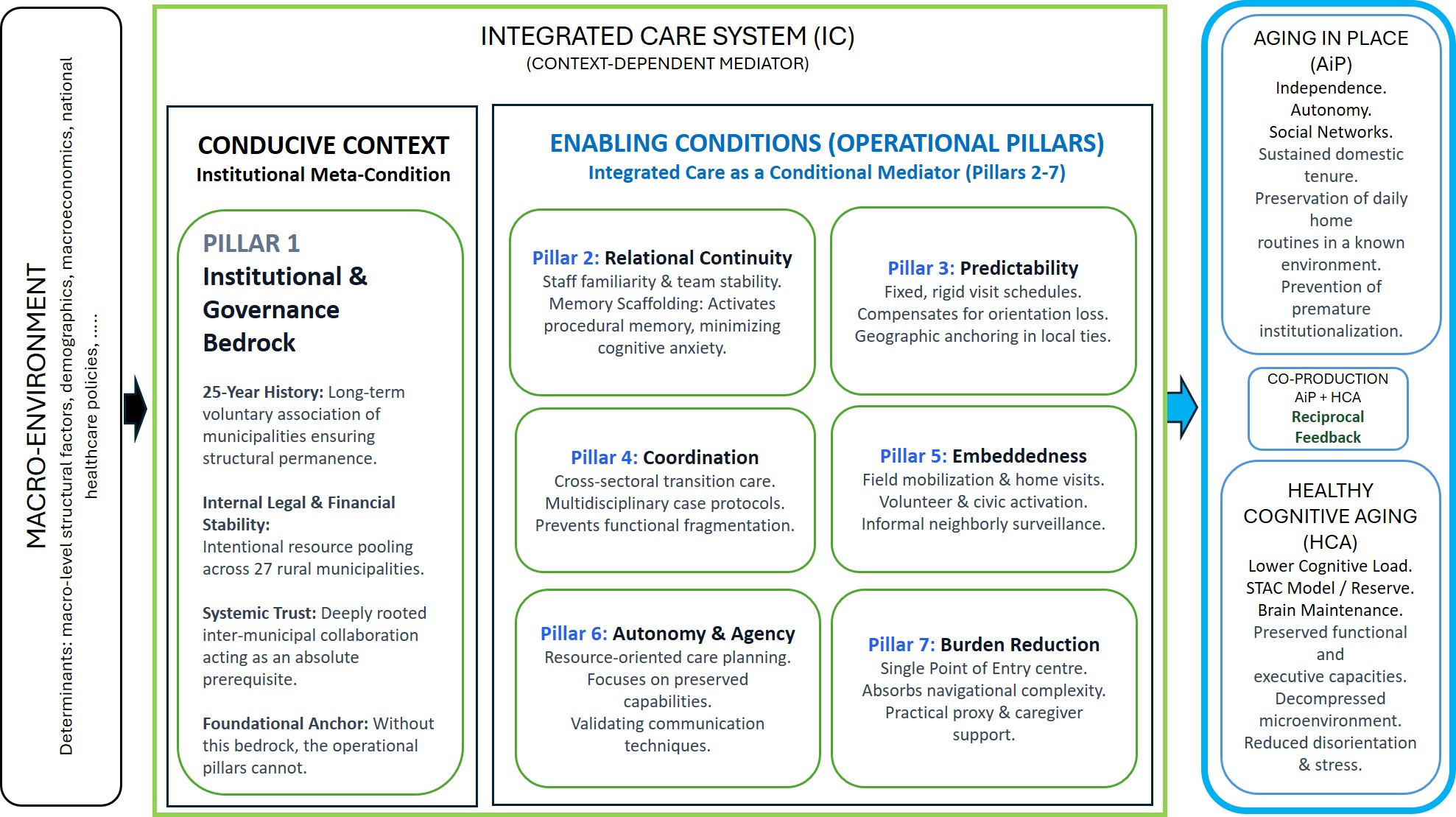
Within this consolidated architecture, Pillar 1 occupies a unique epistemological position: unlike the subsequent pillars, Pillar 1 represents the overarching institutional meta-condition of the entire ecosystem. The 25-year history of the voluntary association of municipalities provides the structural permanence, legal stability, and cross-municipal trust that constitute a prerequisite; without this foundational bedrock, the specific context-mechanism dynamics within the remaining six pillars could not be triggered or sustained.
The pillars that emerged from this conceptual consolidation are as follows:
Pillar 1: Institutional and Governance Bedrock
- Core Representative CMO: CMO 5 (Institutional Permanence / 25-year history of the voluntary association of municipalities).
- Supporting / Absorbed CMO: None (stands as the baseline structural context).
Pillar 2: Relational Continuity and Memory Scaffolding
- Core Representative CMO: CMO 1 (Staff Familiarity / long-term personnel stability reducing anxiety).
- Supporting / Absorbed CMOs: CMO 4 (Clinical Reassurance / embedded nursing staff), CMO 6 (Care Convergence / integrated standard and domestic hospice care).
Pillar 3: Environmental and Temporal Predictability
- Core Representative CMO: CMO 2 (Temporal Predictability / fixed visit schedules compensating for time disorientation).
- Supporting / Absorbed CMOs: CMO 3 (Geographic Anchoring / small-scale decentralized housing safeguarding local spatial ties).
Pillar 4: Cross-Sectoral Coordination
- Core Representative CMO: CMO 7 (Transition Management / multidisciplinary case conferences and transition protocols).
- Supporting / Absorbed CMOs: CMO 8 (Inpatient Integration / specialized hospital social work), CMO 9 (Information Sharing / shared clinical and social documentation), CMO 10 (Unified Navigation / centralized intake pathways).
Pillar 5: Socio-Relational Embeddedness
- Core Representative CMO: CMO 11 (Field Mobilization / regular home visits and volunteer activation).
- Supporting / Absorbed CMOs: CMO 12 (Civic Activation / community gardens and social centres), CMO 13 (Natural Surveillance / informal neighborhood monitoring networks).
Pillar 6: Supported Autonomy and Agency
- Core Representative CMO: CMO 14 (Resource-Oriented Planning / individual plans centered on preserved capabilities).
- Supporting / Absorbed CMOs: CMO 15 (Validating Communication / flexible validating techniques), CMO 16 (Environmental Mastery / assistive technology rentals and in-home training), CMO 17 (Participatory Inclusion / structural user feedback mechanisms).
Pillar 7: Reduction of Cognitive and Navigational Burden
- Core Representative CMO: CMO 18 (Single Point of Entry / centralized coordination center absorbing system complexity).
- Supporting / Absorbed CMOs: CMO 19 (Practical Proxy Support / household and administrative assistance), CMO 20 (Spatial Simplification / intuitive architectural and visual cues), CMO 21 (Cognitive Exercises / memory training embedded in familiar micro-tasks), CMO 22 (Crisis De-escalation / 24/7 hotline and rapid mobile teams), CMO 23 (Caregiver Protection / in-home respite care and counseling), CMO 24 (Tactile Activation / volunteer-led canine-assisted activities).
A synthesis of the finalized CMO configurations into key supporting pillars is contained in Table 6.
4.7. Conceptual Synthesis: Integrated Care as a Conditional Mediator
The empirical findings of this study are synthesized into an overarching conceptual model. This framework positions the municipal integrated care program as a context-dependent, conditional mediator that reconfigures the relationship between a vulnerable individual and their domestic environment. This system configuration is visualized in Figure 2.
As conceptualized in Figure 2, the empirical reality of the study may be effectively captured through an ecological framework of shared environments rather than a linear causal chain. Aging in Place (AiP) and Healthy Cognitive Aging (HCA) possess their own ontologically independent dynamics and can inherently exist outside formal support systems. Both these concepts, alongside the integrated care (IC) program (here operationalized as the municipal program Programme), operate within the same overarching macro-environment characterized by regional socioeconomic conditions, biological health trajectories, and municipal policies.
Within this shared space, the integrated care program functions uniquely as a conditional mediator. It does not directly produce AiP or HCA; instead, it acts as an adaptive filter or buffer that intercepts the raw complexities of the external environment. When properly activated under conducive contextual conditions—such as the region’s historical institutional trust—the IC system translates macro-resources into a stabilized micro-environment for the individual. By generating specific, shared mechanisms (environmental stability, relational continuity, and reduced cognitive load), the program shields the older adult from systemic complexity. Crucially, this mediation does not merely support AiP and HCA as isolated parallel targets; rather, it actively safeguards and amplifies the reciprocal, synergistic feedback loop between them, preventing the care system from missing its core socio-ecological purpose.
Figure 2 conceptualises integrated care as a context-dependent mediator: a municipal program can contribute to ageing in place and to conditions that support healthy cognitive ageing by activating enabling conditions in conducive contexts, together with determinants that lie beyond integrated care.
The conceptual architecture illustrated in Figure 2 operates across three interrelated dimensions:
- The Conducive Context: The long-term sustainability of the system is conditioned by a specific macro-context characterized by more than two decades of stable municipal leadership, the voluntary pooling of local resources, and an established institutional trust. This historical and political background forms the necessary baseline that allows the micro-level care arrangements to function continuously.
- The Activation of Enabling Conditions: Rather than acting as a direct intervention, the integrated care program functions as a filtering layer It helps buffer external complexities and contributes to translating into specific, tangible enabling conditions within the older adult’s immediate surroundings. By stabilizing care environments, securing relational continuity, and reducing everyday decision-making demands, the program actively decompresses the environment. It creates an external compensatory framework that shields the older adult from functional failure.
- The Co-production of Home and Cognition: The model demonstrates that Aging in Place (AiP) and Healthy Cognitive Aging (HCA) are not isolated parallel outcomes, but are mutually reinforcing. They culminate in what is conceptualized as the co-production of home and cognition—a safe, predictable transactional space where everyday behavioral and cognitive processes can unfold without triggering anxiety or premature institutionalization.
The framework acknowledges the open nature of community care by explicitly accounting for external determinants. Factors such as primary biological disease progression, family dynamics, or macroeconomic policy shifts continue to interact with the system from the outside, highlighting that integrated care acts as a conditional moderator rather than a closed, absolute determinant.
5. Discussion
5.1. Epistemological Reflection and Theoretical Integration of Neurocognitive Frameworks
Before deconstructing the systemic implications of our findings, a crucial epistemological and methodological clarification must be articulated regarding the operationalization of the cognitive aging frameworks introduced in the literature review. Throughout the multi-method data collection phase, all members of the research team possessed deep, granular knowledge of Nyberg’s Brain Maintenance theory (Nyberg et al., 2012) and the Scaffolding Theory of Aging and Cognition (STAC) (Park & Reuter-Lorenz, 2009). Given that this study is a qualitative, realist-informed case study grounded in document analysis, stakeholder interviews, and participant observations, direct empirical verification or refutation of neurobiological parameters (such as neural integrity or compensatory neural recruitment) lay strictly beyond our empirical scope. Consequently, explicit mentions of these neurobiological terms were naturally absent from the raw documentary records and field notes.
However, these frameworks functioned fundamentally as sensitizing concepts during fieldwork, enhancing the researchers’ theoretical sensitivity. While direct evidence was inaccessible without neuroimaging or biomarkers, the latent mechanisms and behavioral manifestations of these theories were inherently embedded within the captured community realities. The empirical validity of Brain Maintenance and STAC manifested indirectly through subtle yet consistent clues reflected in the attributes of specific Context–Mechanism–Outcome (CMO) configurations. For instance, when contextual stability and environmental predictability triggered mechanisms of reduced cognitive load and preserved executive capacity, these observed phenomena effectively served as observable, real-world proxies for successful cognitive scaffolding and the behavioral preservation of brain maintenance pathways. Thus, the qualitative data do not operate in isolation; rather, they capture the socio-ecological reflections of the underlying neurocognitive resilience pathways facilitated by the integrated care system.
5.2. Integrated Care as an Externalized Compensatory Framework
The main theoretical contribution of this our study is that we conceptualize integrated care as an active, external compensatory framework that conditions both aging in place (AiP) and healthy cognitive aging (HCA). Traditional frameworks often view independent home-keeping and cognitive preservation as distinct biobehavioral or clinical outcomes that need to be addressed through individualized pharmacological or lifestyle interventions. Our empirical findings extend Lawton and Nahemow’s classic environmental pressure theory (1973) by demonstrating that a 25-year localized ecosystem of integrated care structurally recalibrates the microenvironment and systematically absorbs the executive and navigational burdens that typically trigger home-keeping failure in cognitively vulnerable older adults. Lawton’s model posits that an individual’s behavioral and psychological adaptation is a function of the balance between their intrinsic competence and the demands (press) of their environment. As cognitive competence progressively declines due to neurodegenerative processes, an unmitigated environmental press inevitably triggers behavioral decompensation, functional failure, and premature institutionalization. Our empirical analysis indicates that a long-term, localized community care ecosystem can structurally reconfigure and decompress this micro-environment.
Specific environmental arrangements, such as fixed, predictable visitation trajectories or spatial home simplifications, effectively function as external nodes that compensate for resident’s internal executive function deficits. These findings extend purely biomedical narratives, such as those presented by Prince et al. (2015), that link autonomous living almost exclusively to an internal neurological state. In alignment with critical gerontological discourses on the fluid and relational meaning of home (Sixsmith & Sixsmith, 2008; Wiles et al., 2012), our study indicates that the domestic sphere can be transformed into a dynamic sanctuary capable of offsetting working memory deficits and executive dysfunction through structured external scaffolding.
Our findings contribute to bridging the gap between abstract coping processes and empirical reality: in a fragmented system, coping requires high executive function, while the IC system can externalize this burden and translate complex psychological coping into stable daily routines.
5.3. Relational Continuity and Psychosocial Dynamics
The identified Pillar 1 (Relational continuity and stabilization of everyday routines) and Pillar 4 (Social embeddedness) resonate strongly with Tom Kitwood’s Person-Centered Approach to Dementia Kitwood, 1997. Kitwood argued that a substantial proportion of functional and cognitive deterioration in individuals with cognitive impairment is accelerated not by neuropathology alone, but by a malignant social psychology embedded within the care environment (e.g., social isolation, depersonalization, disruptions of familiarity).
Our empirical findings—such as the emphasis on minimizing field staff turnover and the linking of formal care with natural, informal neighborhood supervision—provide empirical validation for this framework. By ensuring interpersonal predictability, the program appears to prevent the activation of anxiety and neophobia, which often exacerbate behavioral and psychological symptoms of dementia (BPSD) (Murman et al., 2002). In contrast to fragmented care environments where older adults face a constantly changing mix of unfamiliar care professionals, relational stability functions as a nonlinear protective mediator, stimulating preserved procedural memory traces and preserving a sense of individual personhood.
5.4. Cross-Sectoral Synergies and Mitigating Transitional Trauma
The cumulative and synergistic nature of the identified pillars corroborates Leutz’s Laws of Care Integration Leutz, 1999, specifically the axiom that integration must address the entire continuum of human vulnerability rather than isolated medical crises. Current transitional care literature Naylor et al., 2011; Coleman, 2003 extensively documents the phenomenon of transitional trauma—the profound cognitive shock, disorientation, and subsequent functional decline experienced by vulnerable older adults during uncoordinated handoffs between acute hospital wards and their homes.
As summarized in Table 5, embedding a dedicated program social worker directly into inpatient units alongside formal cross-sectoral transit protocols provides a highly effective bridge. This interface mitigates institutional bifurcation (the systemic split between health and social care sectors) which remains a paramount barrier to sustainable community-based care globally Goodwin, 2013; World Health Organization, 2021. By absorbing the informational and logistical friction of transitions, the program shields both the senior and informal caregivers from acute stress, aligning with systemic goals highlighted by the Lancet Commission on dementia prevention and care Livingston et al., 2020.
5.5. Policy and Practical Implications for Community Care
For policymakers, health system architects, and community gerontologists, this study provides a transferable basis for discussing how to approach demographic aging and dementia prevalence within rural environments.
First, the data suggest that a voluntary association of municipalities can provide a functional institutional foundation. Centralizing administration and funding at the microregional level appears to be one option for bridging the traditional sectoral divide between municipal social services and regional (or state) healthcare systems. This structural alignment facilitates a more cohesive distribution of resources based on local needs.
Second, the study tentatively indicates that public investments might benefit from supplementing large-scale inpatient infrastructure (Category B projects) with increased support for decentralized, field-based community solutions (Category D projects). Strengthening personnel stability, introducing predictable schedules, and building environmental compensatory frameworks appear, based on our findings, to be potentially effective pathways toward sustaining long-term independent living within the community, offering a strategic alternative to premature institutional expansion.
5.6. Study Limitations
Interpreting the findings of this retrospective longitudinal realist case study requires a rigorous acknowledgement of several methodological and contextual limitations:
- Single-Case and Microregional Specificity: The empirical data originate exclusively from a single rural microregion in the Czech Republic governed by a unique voluntary association of municipalities. This specific institutional architecture features an exceptionally high degree of long-term political alignment and financial pooling (resource pooling) over more than two decades. Consequently, the transferability of these findings to highly urbanised settings, metropolitan areas, or regions characterised by extreme political fragmentation or heavily privatised, market-driven social care sectors may be structurally constrained.
- Retrospectivity and Data Survival Bias: Documentary analysis spanning a 25-year period (2000–2024/2025) is inherently susceptible to variations in data quality and completeness. Records from the program’s early phases (the early 2000s) were not originally compiled for scientific evaluation. This introduces a risk of data survival bias, where successful initiatives or well-documented outcomes are more likely to have been preserved, while records detailing operational dead-ends, structural failures, or discontinued projects may have been lost or discarded over time.
- Stakeholder Recall Bias: Qualitative insights derived from semi-structured interviews with long-serving key stakeholders and pioneers are bound by the limitations of human memory and retrospective rationalization. Respondents may inadvertently idealize early program milestones, smooth over historical conflicts, or retroactively project contemporary professional standards, guidelines, and expert knowledge onto strategic decisions made two decades prior.
- Absence of Direct Psychometric and Quantitative Proxies: While rich in qualitative and behavioral depth, this evaluation does not correlate the identified Context-Mechanism-Outcome (CMO) configurations with direct, individual clinical data, such as longitudinal Mini-Mental State Examination (MMSE) or Montreal Cognitive Assessment (MoCA) trends. Furthermore, research lacks a quantitative control group of seniors living in identical socio-demographic conditions without program support. It is therefore impossible to exactly isolate the net effect of the program, calculate precise hazards, or quantify the exact number of months institutionalization was delayed.
- Confounding Macro-Systemic and Policy Shifts: Over the 25-year observation window, the broader Czech health and social care systems underwent substantial structural transformations (e.g., the introduction of the landmark Act on Social Services in 2006, shifting regional subsidy frameworks, and evolving healthcare reimbursement models). These macro-contextual variables could not be fully isolated or controlled within a realist micro-level case design, meaning that the activation of certain local mechanisms may have been co-triggered or moderated by external macro-policy shifts.
6. Conclusions
This study examined how ageing in place can be supported through integrated health and social care, with particular attention to healthy cognitive aging. By integrating documentary analysis, interviews, and observations, it developed a set of empirically grounded CMO configurations explaining how integrated care operates in practice.
The findings demonstrate that AiP and HCA are co-produced through shared mechanisms, including environmental stability, continuity, social embeddedness, supported autonomy, and reduced cognitive load. Integrated care functions as a conditional mediator: it supports these outcomes only when it activates relevant mechanisms under conducive contextual conditions.
Overall, the study shows that implementing ageing in place through integrated care is neither automatic nor purely technical. It depends on sustaining stable, predictable, and relationally supportive environments that reduce cognitive burden and support agency by shaping stable and predictable conditions relevant to everyday cognitive functioning. These findings provide a theoretically grounded basis for the design, evaluation, and governance of integrated care systems in ageing societies.
These findings can also be interpreted as indicating changes in behavioural conditions, where general coping processes are successfully operationalized into reduced decision-making demands, enhanced predictability, and more stable everyday routines.
This study contributes by (1) empirically linking AiP and HCA through shared mechanisms, (2) conceptualising integrated care as a context-dependent mediator, and (3) providing a rare 25-year retrospective longitudinal perspective.
Integrated care does not directly influence cognitive outcomes; rather, it shapes the conditions under which cognitive functioning can be maintained and structurally reconfigures the micro-environment, thereby buffering environmental press and reducing executive load. However, the limits of such implementation are heavily conditional upon systemic prerequisites.
Author Contributions
Conceptualization, L.S., I.H. and M.D.; methodology, L.S., I.H. and M.D.; validation, L.S., I.H., M.D. and A.B.; formal analysis, L.S., I.H. and M.D.; investigation, L.S., I.H. and A.B.; writing—original draft preparation, L.S. and A.B.; writing—review and editing, L.S., I.H. and M.D.; supervision, I.H. and M.D.; project administration, L.S., I.H. and M.D. All authors have read and agreed to the published version of the manuscript.
Funding
This research received no external funding.
Institutional Review Board Statement
The study was conducted in accordance with the Declaration of Helsinki and approved by the Institutional Review Board of the Committee for Ethical Research of the Faculty of Humanities, Charles University (Reference Code: UKFHS/622586/2024; No. 042024/Ren; date of approval: 2024-11-25).
Informed Consent Statement
Informed consent was obtained from all subjects involved in the study.
Data Availability Statement
The data presented in this study are available on request from the corresponding author due to privacy and ethical restrictions, as they contain sensitive qualitative information that could compromise participant anonymity.
Conflicts of Interest
The authors declare no conflicts of interest.
Abbreviations
The following abbreviations are used in this manuscript:
| AiP | Aging in Place |
| HCA | Healthy Cognitive Aging |
| IC | Integrated care |
| CMO | Context-Mechanism-Outcome |
| ADL | Activities of Daily Living |
| STAC | Scaffolding theory of aging and cognition |
| MMSE | Mini-Mental State Examination |
| MoCA | Montreal Cognitive Assessment |
References
- AARP. Aging in place: A state survey of livability policies and practices. AARP Public Policy Institute. 2011. Available online: https://assets.aarp.org/rgcenter/ppi/liv-com/aging-in-place-2011-full.pdf.
- Beard, J. R.; Officer, A.; de Carvalho, I. A.; et al. The World report on ageing and health: A policy framework for healthy ageing. The Lancet 2015, 387(10033), 2145–2154. [Google Scholar] [CrossRef] [PubMed]
- Bowen, G.A. “Document Analysis as a Qualitative Research Method”. Qual. Res. J. 2009, Vol. 9(No. 2), 27–40. [Google Scholar] [CrossRef]
- Braun, V.; Clarke, V. Using thematic analysis in psychology. Qual. Res. Psychol. 2006, 3(2), 77–101. [Google Scholar] [CrossRef]
- Cabeza, R.; Nyberg, L.; Park, D. C. (Eds.) Cognitive neuroscience of aging: Linking cognitive and cerebral aging, 2nd ed.; Oxford University Press, 2018; ISBN 9780199372935. [Google Scholar]
- Cacioppo, J. T.; Hawkley, L. C. Perceived social isolation and cognition. Trends Cogn. Sci. 2009, 13(10), 447–454. [Google Scholar] [CrossRef] [PubMed]
- Depp, C. A.; Jeste, D. V. Definitions and predictors of successful aging: A comprehensive review. Am. J. Geriatr. Psychiatry 2006, 14(1), 6–20. [Google Scholar] [CrossRef] [PubMed]
- Denzin, N. K. The research act: A theoretical introduction to sociological methods, 2nd ed.; McGraw-Hill. eBook, 1978; ISBN 9781315134543. [Google Scholar]
- Evans, G. W. The built environment and mental health. J. Urban Health 2003, 80(4), 536–555. [Google Scholar] [CrossRef] [PubMed]
- Finlay, L. Negotiating the swamp: The opportunity and challenge of reflexivity in research practice. Qual. Res. 2002, 2(2), 209–230. [Google Scholar] [CrossRef]
- Flick, U. An introduction to qualitative research, 7th ed.; Sage, 2023; ISBN 9781529781335. [Google Scholar]
- Fratiglioni, L.; Paillard-Borg, S.; Winblad, B. An active and socially integrated lifestyle in late life might protect against dementia. Lancet Neurol. 2004, 3(6), 343–353. [Google Scholar] [CrossRef] [PubMed]
- Goodwin, N.; Dixon, A.; Anderson, G.; Wodchis, W. Providing integrated care for older people with complex needs: Lessons from seven international case studies; The King’s Fund, 2014. [Google Scholar]
- Greer, S. L.; Wismar, M.; Figueras, J. Strengthening health system governance: Better policies, stronger performance; McGraw-Hill Education, 2019; ISBN 9780335261352 (ebook). [Google Scholar]
- Guest, G.; Bunce, A.; Johnson, L. How many interviews are enough? An experiment with data saturation and variability. Field Methods 2006, 18(1), 59–82. [Google Scholar] [CrossRef]
- Kaiser, K. Protecting Respondent Confidentiality in Qualitative Research. Qual. Health Res. 2009, 19(11), 1632–1641. [Google Scholar] [CrossRef]
- Kodner, D. L.; Spreeuwenberg, C. Integrated care: Meaning, logic, applications, and implications—A discussion paper. Int. J. Integr. Care 2 2002, e12. [Google Scholar] [CrossRef] [PubMed]
- Kvale, S.; Brinkmann, S. InterViews: Learning the craft of qualitative research interviewing, 2nd ed.; Sage, 2009; ISBN -13 978-0761925422. [Google Scholar]
- Lawton, M. P.; Nahemow, L. Ecology and the aging process. In The psychology of adult development and aging; Eisdorfer, C., Lawton, M. P., Eds.; American Psychological Association, 1973; pp. 619–674. [Google Scholar] [CrossRef]
- Leutz, W.N. Five Laws for Integrating Medical and Social Services: Lessons from the United States and the United Kingdom. Milbank Q. 1999, 77, 77–110. [Google Scholar] [CrossRef] [PubMed]
- Livingston, G.; Huntley, J.; Sommerlad, A.; et al. Dementia prevention, intervention, and care: 2020 report of the Lancet Commission. The Lancet 2020, 396(10248), 413–446. [Google Scholar] [CrossRef] [PubMed]
- Naylor, M.; Aiken, L.; Kurtzman, E.; Olds, D.; Hirschman, K. The care span: The importance of transitional care in achieving health reform. Health Aff. 2011, 30(4). Available online: https://hsrc.himmelfarb.gwu.edu/son_nurs_facpubs/453. [CrossRef]
- Nussbaum, M. C. Women and human development: The capabilities approach; Cambridge University Press, 2000; ISBN 9780521660860. [Google Scholar] [CrossRef]
- Nyberg, L.; Lövdén, M.; Riklund, K.; Lindenberger, U.; Bäckman, L. Memory aging and brain maintenance. Trends Cogn. Sci. 2012, 16(5), 292–305. [Google Scholar] [CrossRef] [PubMed]
- Pani-Harreman, K. E.; Bours, G. J. J. W.; Zander, I.; Kempen, G. I. J. M.; van Duren, J. M. A. Definitions, key themes and aspects of ‘ageing in place’: A scoping review. Ageing Soc. 2021, 41(9), 2026–2059. [Google Scholar] [CrossRef]
- Park, D. C.; Reuter-Lorenz, P. The adaptive brain: Aging and neurocognitive scaffolding. Annu. Rev. Psychol. 60 2009, 173–196. [Google Scholar] [CrossRef] [PubMed]
- Patton, M. Q. Qualitative research & evaluation methods, 4th ed.; Sage, 2015; ISBN-13: 978-1412972123. [Google Scholar]
- Pawson, R.; Tilley, N. Realistic evaluation; Sage, 1997; ISBN 9780761950080. [Google Scholar]
- Prince, M.; Wimo, A.; Guerchet, M.; Ali, G.-C.; Wu, Y.-T.; Prina, M. World Alzheimer Report 2015: The global impact of dementia. Alzheimer’s Disease International. 2015. Available online: https://www.alzint.org/u/WorldAlzheimerReport2015.pdf.
- Rantz, M. J.; Marek, K. D.; Aud, M. A.; Johnson, R. A.; Otto, D.; Porter, R. TigerPlace: A new future for older adults. J. Nurs. Care Qual. 2005, 20(1), 1–4. Available online: https://journals.lww.com/jncqjournal/Citation/2005/01000/TigerPlace__A_New_Future_for_Older_Adults.1.aspx. [CrossRef] [PubMed]
- Rowe, J. W.; Kahn, R. L. Successful aging. The Gerontologist 1997, 37(4), 433–440. [Google Scholar] [CrossRef] [PubMed]
- Rowles, G. D.; Bernard, M. Environmental gerontology: Making meaningful places in old age; Springer Publishing Company, 2013; p. 32. ISBN 9780826108135. [Google Scholar]
- Sen, A. Development as freedom; Oxford University Press, 1999; ISBN 9780192893307. [Google Scholar]
- Sixsmith, J.; Sixsmith, A. Ageing in place in the United Kingdom. Ageing Int. 2008, 32(3), 219–235. [Google Scholar] [CrossRef]
- Spradley, J. P. Participant observation; Holt, Rinehart and Winston, 1980; ISBN 10 0030445019. [Google Scholar]
- Stake, R. E. The art of case study research; Sage, 1995; ISBN 9780803957671. [Google Scholar]
- Stern, Y.; Barulli, D.; Habeck, C. Cognitive reserve, compensation, and maintenance: Operationalization, validity, and mechanisms. Neuropsychol. Rev. 2018, 28(3), 269–283. [Google Scholar] [CrossRef]
- United Nations; Department of Economic and Social Affairs; Population Division. World population ageing 2020 highlights: Living arrangements of older persons. 2020. Available online: https://digitallibrary.un.org/record/3898412.
- Valentijn, P. P.; Schepman, S. M.; Opheij, W.; Bruinzeels, M. A. Understanding integrated care: A comprehensive conceptual framework based on the integrative functions of primary care. Int. J. Integr. Care 13 2013, e010. [Google Scholar] [CrossRef] [PubMed]
- Vasunilashorn, S.; Steinman, B. A.; Liebig, P. S.; Pynoos, J. Aging in place: Evolution of a research topic whose time has come. J. Aging Res. 2012 2012, Article ID 120952. [Google Scholar] [CrossRef] [PubMed]
- Wiles, J. L.; Leibing, A.; Guberman, N.; Reeve, J.; Allen, R. E. S. The meaning of ‘aging in place’ to older people. The Gerontologist 2012, 52(3), 357–366. [Google Scholar] [CrossRef] [PubMed]
- World Health Organization. World report on ageing and health. 2015. Available online: https://www.who.int/publications/i/item/9789241565042.
- World Health Organization. Decade of healthy ageing: Baseline report. 2021. Available online: https://iris.who.int/bitstream/handle/10665/338677/9789240017900-eng.pdf.
- Yin, R. K. Case study research and applications: Design and methods, 6th ed.; Sage, 2018; ISBN -13: 978-1506336169. [Google Scholar]
Figure 1.
The Six-Step Analytical Workflow of the Study. This schema delineates the iterative research process moving from initial theoretical framing and domain specification, through project screening and taxonomic classification, to qualitative stakeholder triangulation via documents, semi-structured interviews, and participant observations, culminating in the formulation of transferable Context–Mechanism–Outcome (CMO) configurations.
Figure 1.
The Six-Step Analytical Workflow of the Study. This schema delineates the iterative research process moving from initial theoretical framing and domain specification, through project screening and taxonomic classification, to qualitative stakeholder triangulation via documents, semi-structured interviews, and participant observations, culminating in the formulation of transferable Context–Mechanism–Outcome (CMO) configurations.
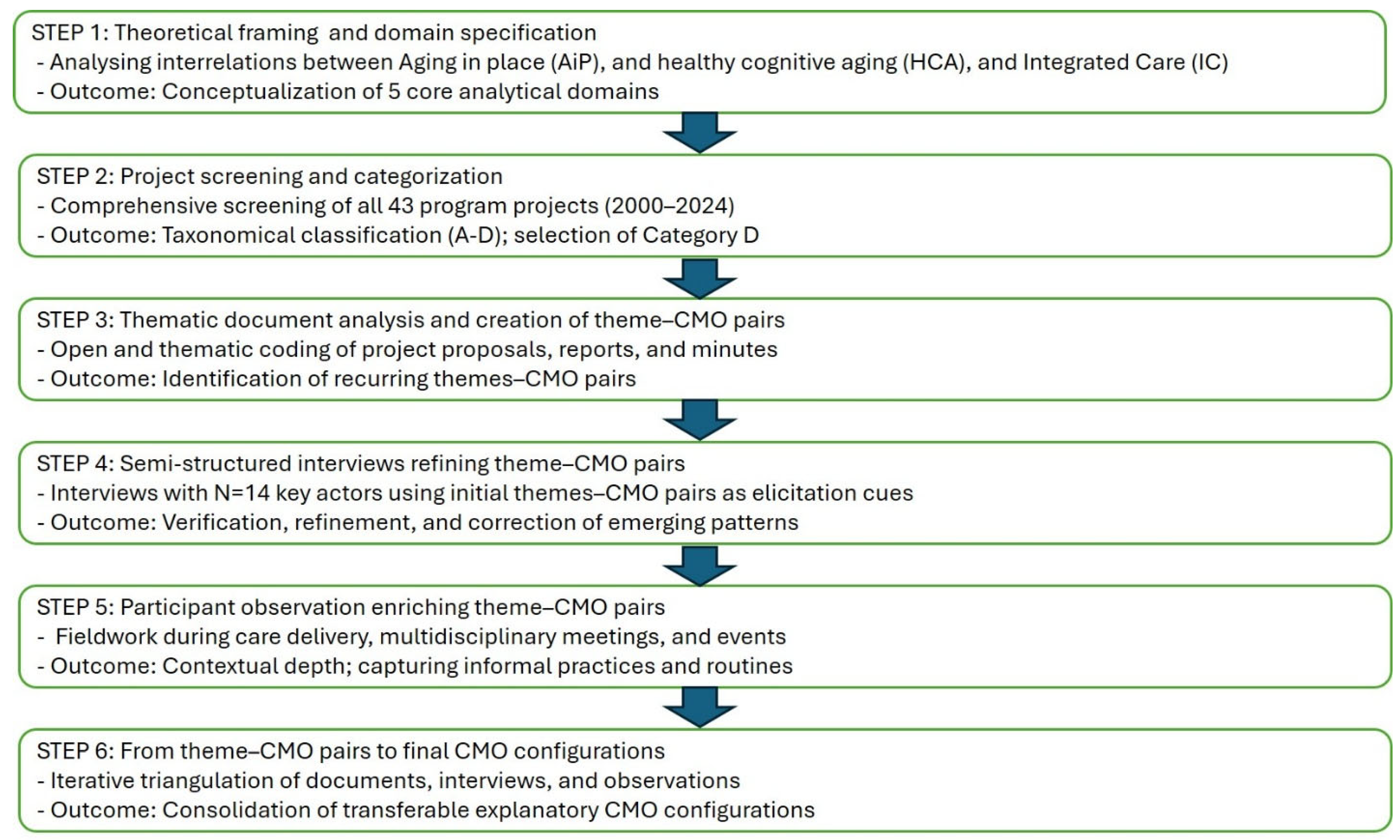
Figure 2.
Conceptual and Ecological Framework of the Study. The diagram illustrates Aging in Place (AiP) and Healthy Cognitive Aging (HCA) as ontologically independent, potentially mutually reinforcing dynamics operating within a shared macro-environment. Integrated care (IC) is conceptualized as an adaptive, conditional context-dependent mediator that can mitigate external environmental complexities and systemic demands enabling conditions and governance structures with the dual, co-produced outcomes of Healthy Cognitive Ageing (HCA) and Aging in Place (AiP).
Figure 2.
Conceptual and Ecological Framework of the Study. The diagram illustrates Aging in Place (AiP) and Healthy Cognitive Aging (HCA) as ontologically independent, potentially mutually reinforcing dynamics operating within a shared macro-environment. Integrated care (IC) is conceptualized as an adaptive, conditional context-dependent mediator that can mitigate external environmental complexities and systemic demands enabling conditions and governance structures with the dual, co-produced outcomes of Healthy Cognitive Ageing (HCA) and Aging in Place (AiP).
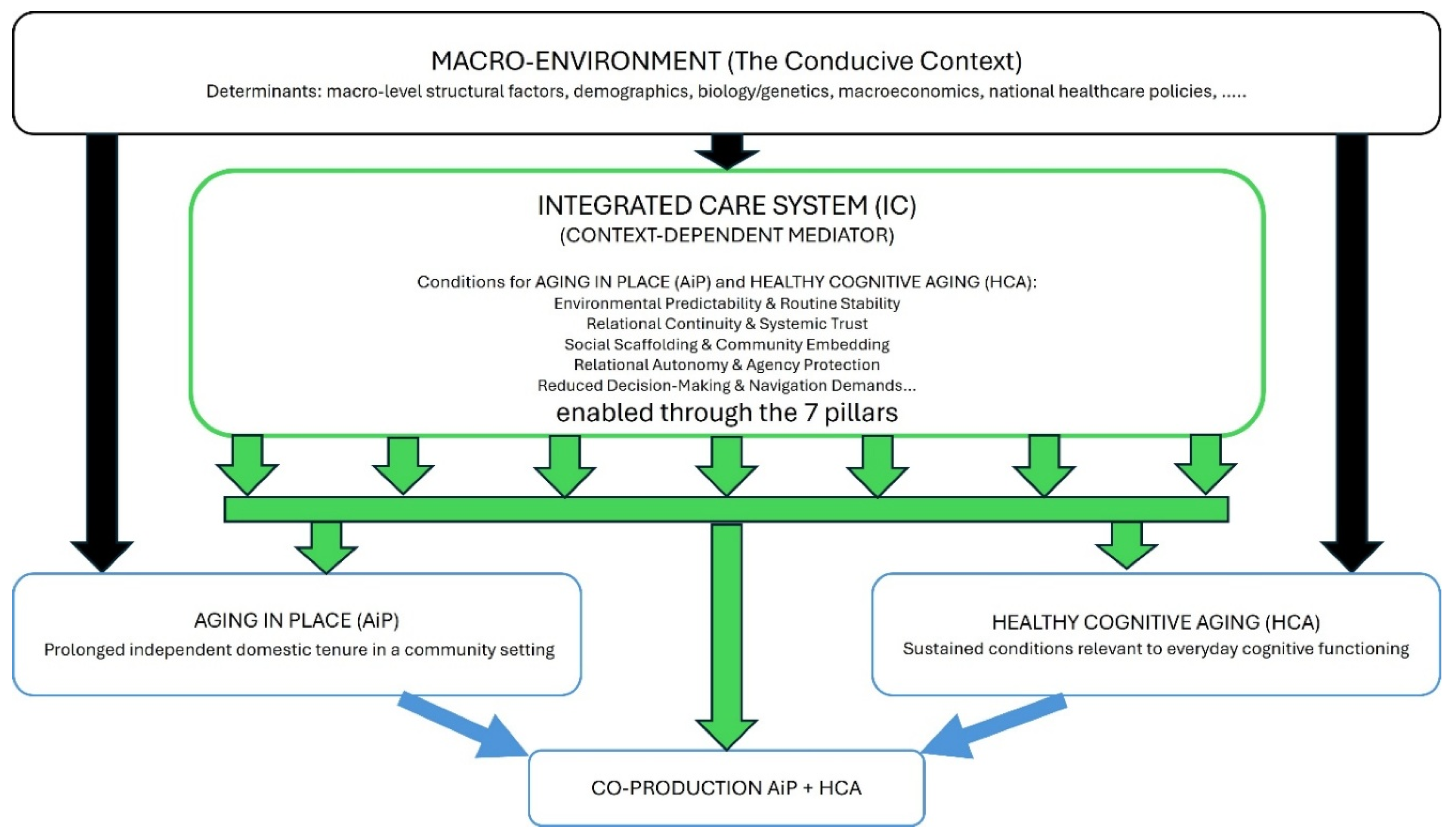

Table 1.
Overview and Structural Characterisation of Empirical Data Sources. Summary of qualitative and documentary data streams utilized within the retrospective longitudinal case study, including sample volume, key characteristics of stakeholders, specific retrospective documentary collection timeframes (2000–2024), and their respective analytic roles within the Context–Mechanism–Outcome (CMO) heuristic.
Table 1.
Overview and Structural Characterisation of Empirical Data Sources. Summary of qualitative and documentary data streams utilized within the retrospective longitudinal case study, including sample volume, key characteristics of stakeholders, specific retrospective documentary collection timeframes (2000–2024), and their respective analytic roles within the Context–Mechanism–Outcome (CMO) heuristic.
| Data Source Type | Sample Characteristics & Volume | Data Collection Timeframe | Specific Role within the CMO Heuristic |
| Documentary Materials | Strategic plans, project proposals, operational guidelines, minutes from multidisciplinary boards, annual reports, external evaluation files. | Retrospective coverage spanning 2000 – 2024. | Structural mapping of the program’s evolution; institutional timeline reconstruction; formulation of initial Theme–CMO pairs |
| Semistructured Interviews | N = 14 key stakeholders; executive and municipal leaders, case managers, senior social workers, and head nurses, field-based professional caregivers and home-care nurses, informal family caregivers and older adults with mild cognitive decline. |
Conducted February – June 2025; mean duration: 90 minutes. | In-depth exploration of stakeholder reasoning; testing, refining, and validating initial Theme–CMO pairs; uncovering latent motivational mechanisms. |
| Participant Observation | N = 11 observations; direct participant observations of care visits, multidisciplinary team meetings, community events. | Ongoing throughout 2025; captured via structured field notes.; mean duration: 60 minutes. | Capturing situated interactions, implicit behavioral patterns, informal institutional routines, and the lived reality of mechanism activation. |
Table 2.
The Five Analytical Domains Interlinking Aging in Place (AiP), Healthy Cognitive Aging (HCA), and Integrated Care (IC). Comprehensive matrix presenting the theoretical definitions of each domain, their specific pathways of interaction regarding cognitive reserve and residential stability, and the operational criteria used for project screening and qualitative analysis.
Table 2.
The Five Analytical Domains Interlinking Aging in Place (AiP), Healthy Cognitive Aging (HCA), and Integrated Care (IC). Comprehensive matrix presenting the theoretical definitions of each domain, their specific pathways of interaction regarding cognitive reserve and residential stability, and the operational criteria used for project screening and qualitative analysis.
| Analytical Domain | Theoretical Definition (Relation to AiP and HCA) | Operationalization for Screening and Analysis |
| 1. Environmental Stability and Continuity of Care | Predictable and stable micro-environments reduce adaptive stress, reinforcing spatial orientation, memory routines, and psychological safety in cognitively vulnerable seniors. | Tracking the presence of stable personnel assigned to clients, fixed visitation schedules, and long-term organizational durability without disruptive operational modifications. |
| 2. Coordination and integration across health and social care | Fragmented care delivery systems shift the organizational burden onto the older adult or informal caregivers, escalating stress and inducing cognitive overload. | Assessing formal and informal linkages between healthcare and social services, common intake/referral mechanisms, and multidisciplinary communication channels. |
| 3. Social embeddedness and relational support | Regular, meaningful social interactions within a familiar community function as emotional and cognitive anchors, mitigating isolation and slowing cognitive decline. | Examining the structural involvement of informal caregivers, neighbourly support networks, community volunteers, and user participation in local village activities. |
| 4. User autonomy and participation | Autonomy is conceptualized not as a purely atomistic trait, but as a relational achievement that can be scaffolded and preserved even amid cognitive impairment. | Measuring user involvement in individual care planning, respect for subjective pacing/choices in daily routines, and adaptive communication techniques utilized by staff. |
| 5. Cognitive load, stress, and orientation | Complex system navigation drains exigent cognitive reserves and executive capacity; simplifying these pathways optimizes functional independence. | Identifying structural interventions that streamline processes (e.g., single point of entry), provide administrative proxy support, and deliver clear information formats. |
Table 3.
Taxonomic Classification and Relevance Categorisation of Regional Program Projects (2000–2024). Systematic screening matrix of all 43 community-based initiatives developed within the microregion, evaluated for their thematic relevance to the Aging in Place (AiP) and Healthy Cognitive Aging (HCA) (Categories A through D) with accompanying institutional justifications for the purposeful selection of the Category D subset.
Table 3.
Taxonomic Classification and Relevance Categorisation of Regional Program Projects (2000–2024). Systematic screening matrix of all 43 community-based initiatives developed within the microregion, evaluated for their thematic relevance to the Aging in Place (AiP) and Healthy Cognitive Aging (HCA) (Categories A through D) with accompanying institutional justifications for the purposeful selection of the Category D subset.
| No. | Title | Relevance Category | Justification for Categorization |
| 1 | Establishment of Post-Acute and Long-Term Inpatient Care Services | B | Focuses on institutional, hospital-based bed capacity. While crucial for medical stabilization, it does not directly support aging in place. |
| 2 | Development of In-House Specialist Outpatient Clinics | C | Enhances regional healthcare access and reduces long-distance travel, but lacks direct cross-sectoral integration or home-based targeting. |
| 3 | Development of Leased Specialist Outpatient Clinics | C | Similar to owned clinics; improves local medical infrastructure for outpatients but operates in isolation from social care domains. |
| 4 | On-Site Diagnostic and Clinical Support Services (LAB, X-ray, Ultrasound) | B | Highly technical and diagnostic hospital infrastructure with low direct relevance to behavioral or cognitive aging mechanisms in the community. |
| 5 | Provision of Regional Primary Emergency Medical Services | B | Secures acute after-hours medical coverage; provides regional systemic reassurance but does not constitute a continuous care plan for AiP. |
| 6 | Provision of Regional Ambulance and Emergency Response Services | B | Urgent care system; essential for physical safety during crises but does not shape daily psychosocial structures or cognitive preservation routines. |
| 7 | Facility Renovation A (Inpatient Healthcare Unit) | B | Structural/capital expenditure aimed strictly at institutional inpatient environments within a hospital setting. |
| 8 | Facility Renovation B (Inpatient Healthcare Unit) | B | Capital renovation of long-term medical wards; improves institutional quality of care but does not prevent institutionalization. |
| 9 | Facility Renovation C (Specialist Clinics, Pharmacy, Accessible Housing) | C | Bridges medical access with physical accessibility features, representing moderate environmental adaptation but segmented service delivery. |
| 10 | Facility Renovation D (Long-Term Residential Social Care / Nursing Home in Town Z) | D | Direct infrastructural modification of a community-based residential hub specifically tailored for adults experiencing cognitive decline. |
| 11 | Social Work Services Integrated into Post-Acute/Long-Term Inpatient Care | D | Integrates social care practitioners into medical wards, directly reducing organizational workload during complex discharge transitions. |
| 12 | Supported Social Housing Linked to Post-Acute/Long-Term Care | D | Pairs secure, accessible housing with ongoing clinical oversight, directly enabling vulnerable individuals to maintain community tenure. |
| 13 | Spiritual Care Services (Chapel, Clergy, Chaplaincy) | B | Addresses psycho-spiritual well-being, but operates almost exclusively within the boundaries of the inpatient medical facility. |
| 14 | Palliative Care within Post-Acute/Long-Term Inpatient Services | B | Specialized clinical end-of-life care on dedicated hospital beds; although exhibiting high relational continuity, it inherently operates within an institutional environment. |
| 15 | Targeted Care Interventions (Goal-Oriented Care Framework) | C | System-wide introduction of goal-oriented care pathways; enhances user participation but was primarily piloted within institutional segments. |
| 16 | Clinical Care Provision in Long-Term Residential Social Care (Nursing Home D) | D | Embeds skilled nursing care directly into a social facility, preventing disruptive hospitalizations and consequent acute disorientation. |
| 17 | Regional Social Rehabilitation and Assistive Device Loan Service | D | Provides an immediate, cost-free transitional safety net by supplying physical compensatory devices during the critical shift from hospital to home. It absorbs systemic friction, eliminates procurement stress, and prevents care environment collapse prior to official health insurance approvals. |
| 18 | Transition of Social Services to the Regulatory Framework under Act No. 108/2006 | A | Purely administrative, structural, and regulatory adjustment to national legislation with no direct behavioral impact on clients. |
| 19 | Home Care and Personal Assistance Services | D | A core pillar of AiP. Implements regular home care visits to stabilize daily domestic routines and preserve familiar environments. |
| 20 | Social Activation and Community Engagement Services | D | Directly targets healthy cognitive aging through structured memory exercises, cognitive stimulation, and continuous social integration. |
| 21 | Personal Assistance (Individual Support Services) | D | Provides high-intensity individual support tailored to the client’s home life, maximizing user autonomy and active participation. |
| 22 | Home-Based Hospice Care | D | Facilitates end-of-life care within the domestic setting, minimizing acute care transfers and protecting relational stability. |
| 23 | Assistive Technology Showroom and Advisory Centre | C | Operates as a discrete informational and consultative infrastructure allowing clients and caregivers to test adaptive technologies. While it effectively reduces knowledge barriers and systemic friction, it does not directly deliver home-based care or operationally modify the domestic setting. |
| 24 | Volunteer Programs and Community Volunteering | D | Mobilizes informal community networks, providing emotional anchoring and preventing isolation among solitary older adults. |
| 25 | Animal-Assisted Therapy and Pet Programs in Healthcare Settings | C | Goal-directed animal therapy; increases positive emotional/cognitive responses but is deployed predominantly in a hospital setting. |
| 26 | Home Health Care Services | D | Deploys skilled community nurses to execute clinical tasks at home, removing the stress of outpatient travel and stabilizing routines. |
| 27 | Long-Term Residential Social Care (Nursing Home in Town Y) | C | Residential social care facility located outside the primary microregion; provides safety but separates the individual from local roots. |
| 28 | Respite Care Services | D | Mitigates burnout among informal family caregivers, preserving the informal support structure essential for long-term domestic AiP. |
| 29 | Specialized Residential Care Facility I (Dementia-Specific Care) | D | A residential service custom-designed for adults with advanced dementia, focusing extensively on environmental orientation cues. |
| 30 | Supported Apartments within Facility C | D | Implements sheltered community living where clients reside in individual apartments but have immediate access to integrated care teams. |
| 31 | Staff Accommodation within Facility C | C | Promotes organizational stability by providing staff housing, which indirectly supports continuity of care but lacks direct client impact. |
| 32 | Community Garden in Town Z | D | An adapted outdoor environment supporting safe physical activity, peer-to-peer socialization, and informal cognitive stimulation. |
| 33 | Local Care Cottage A (Small-Scale Community Care Dwelling) | D | Decentralised, low-capacity housing units enabling ageing in place with mobile care, preserving local identity and neighbourly ties in village A. |
| 34 | Local Care Cottage B (Small-Scale Community Care Dwelling) | D | Decentralised, low-capacity housing units enabling ageing in place with mobile care, preserving local identity and neighbourly ties in village B. |
| 35 | Local Care Cottage C (Small-Scale Community Care Dwelling) | D | Decentralised, low-capacity housing units enabling ageing in place with mobile care, preserving local identity and neighbourly ties in village C. |
| 36 | Local Care Cottage D (Small-Scale Community Care Dwelling) | D | Decentralised, low-capacity housing units enabling ageing in place with mobile care, preserving local identity and neighbourly ties in village D. |
| 37 | Local Care Cottage E (Small-Scale Community Care Dwelling) | D | Decentralised, low-capacity housing units enabling ageing in place with mobile care, preserving local identity and neighbourly ties in village E. |
| 38 | Local Care Cottage in Town Z | D | Small-capacity urban sheltered housing unit promoting localized community integration and flexible personal pacing. |
| 39 | Operational Base for Home Care Services in Village G | D | A localized operational base that minimizes travel times for field nurses, ensuring responsive and highly reliable home care. |
| 40 | Specialized Residential Care Facility II (Alternative Site) | D | A satellite facility specialized in advanced dementia care, featuring customized sensory and architectural orientation elements. |
| 41 | Comprehensive Reconstruction of Facility B (Inpatient Healthcare Unit) | B | Large-scale structural modernizing of long-term medical hospital wards; improves institutional parameters but remains institutional. |
| 42 | Provision of Nursing Staff in Residential Social Care Facilities | D | Personnel integration deploying professional nurses into social care homes, mitigating the stress of frequent diagnostic transfers. |
| 43 | Provision of Medical Staff (Physicians) in Residential Social Care Facilities | D | Guarantees regular, on-site medical rounds within residential care homes, fostering strong relational continuity and an enhanced sense of safety. |
Table 4.
Methodological Exclusion and Inclusion Criteria for Project Categorisation. Operational matrix defining the structural, administrative, and behavioral boundaries used to classify the 43 regional projects into Relevance Categories A, B, C, and D based on their proximal capacity to modify environmental cues or activate individual pathways to Aging in Place (AiP) and Healthy Cognitive Aging (HCA).
Table 4.
Methodological Exclusion and Inclusion Criteria for Project Categorisation. Operational matrix defining the structural, administrative, and behavioral boundaries used to classify the 43 regional projects into Relevance Categories A, B, C, and D based on their proximal capacity to modify environmental cues or activate individual pathways to Aging in Place (AiP) and Healthy Cognitive Aging (HCA).
|
|
|
|
|
|
|
|
Table 5.
Heuristic Matrix of Developed Context–Mechanism–Outcome (CMO) Configurations. Detailed systematic register of the 24 qualitative configurations derived from the iterative triangulation of documentary records, semi-structured stakeholder interviews (N=14), and participant field observations (N=11), structured across the core analytical domains.
Table 5.
Heuristic Matrix of Developed Context–Mechanism–Outcome (CMO) Configurations. Detailed systematic register of the 24 qualitative configurations derived from the iterative triangulation of documentary records, semi-structured stakeholder interviews (N=14), and participant field observations (N=11), structured across the core analytical domains.
| No. | Analytical Domain | Context (C) | Mechanism (M) | Outcome (O) | Theme (guiding interview prompts) |
| 1 | 1. Environmental Stability and Continuity of Care | Rural microregion (27 municipalities) characterized by long-term personnel stability in domiciliary care services (consistent, familiar formal caregivers). | Relational continuity and repeated interaction activate the older adult’s procedural memory, minimizing anxiety triggered by unfamiliar persons. | Maintenance of daily routines within the domestic environment and reported behavioral stabilization and perceived mitigation of distress associated with cognitive decline (AiP/HCA). | Staff continuity and familiar caregivers — “How stable are care teams and do clients recognise regular caregivers?” |
| 2 | 1. Environmental Stability and Continuity of Care | Fixed, predictable time schedules for home care visits embedded within a long-established Municipal Program. | Reinforcement of external environmental predictability and temporal structuring, compensating for the older adult’s impaired orientation in time. | Heightened sense of security, elimination of anticipatory stress, and stabilization of independent domestic tenure (AiP). | Predictable visit schedules and temporal structuring — “How are visit times organised and how do they affect clients’ daily routines?” |
| 3 | 1. Environmental Stability and Continuity of Care | Availability of decentralized, community-based care homes (Local Care Cottage A to E, Z) directly within smaller affiliated municipalities. | Preservation of geographical, spatial, and social proximity to the original home, eliminating the need for comprehensive spatial reorientation. | Prevention of severe disorientation (transitional trauma) and prolongation of independent living within the familiar community (AiP/HCA). | Local sheltered housing and community proximity — “What is the significance for clients of remaining local versus relocating to distant facilities?” |
| 4 | 1. Environmental Stability and Continuity of Care | Provision of continuous, on-site nursing care directly within a localized social facility (nursing unit in Facility D). | Staff continuity enables formal caregivers familiar with the resident to detect and manage health fluctuations proactively without abrupt relocations. | Reducing unnecessary emergency hospitalizations and easing environmental factors that trigger unwanted health episodes (AiP/HCA). | On-site clinical continuity and proactive monitoring — “How are health changes managed locally to avoid hospital transfers?” |
| 5 | 1. Environmental Stability and Continuity of Care | Long-term (25-year) institutional stability of the voluntary municipal association, guaranteeing sustainable funding and service development. | Cultivation of deep institutional certainty and systemic trust among older adults and informal caregivers that established support structures are permanent. | Facilitation of proactive long-term life planning within the community and reduction of existential stress that impairs executive cognitive functions (AiP/HCA). | Institutional stability and systemic trust — “How has Programme stability influenced families’ and clients’ long-term planning?” |
| 6 | 1. Environmental Stability and Continuity of Care | Concurrent co-provision of domiciliary social care and specialized home hospice care for clients in terminal life stages. | Joint intervention planning, coordinated visitation tracking, and clear delineation of clinical/social competencies prevent service overlap and domestic chaos. | Preservation of maximum environmental stability, tranquility, and preservation of spatial and routine orientation for the older adult within their familiar environment (AiP/HCA). | Coordination of home care and hospice services — “How do home care and palliative teams coordinate in the domestic setting?” |
| 7 | 2. Coordination and integration across health and social care | Integrated transition pathways and formalized multidisciplinary case conferences (physicians, nurses, social workers) within the microregion. | Timely cross-sectoral referral and seamless information sharing eliminate communication gaps and delays in responding to client status changes. | Rapid, flexible adaptation of individual care plans to progressive cognitive or functional decline without disrupting support continuity (AiP). | Multidisciplinary transition pathways — “How are transitions between services planned and who is responsible?” |
| 8 | 2. Coordination and integration across health and social care | Discharge of a functionally vulnerable older adult from post-acute inpatient healthcare back into the domestic environment. | Early engagement with social work (within the inpatient ward - project 11) reduces the family’s anticipatory anxiety and logistical stress, enabling timely cognitive and environmental preparation of the home before discharge. | A seamless transition to the home setting, minimizing the risk of immediate care arrangement failure and premature rehospitalization (AiP). | Discharge planning with embedded social work — “How is return-home planning organised after hospitalisation?” |
| 9 | 2. Coordination and integration across health and social care | Structural convergence of specialized outpatient clinics and home healthcare services under a single overarching program administration. | Shared electronic health records and direct physician-to-nurse communication relieve the family from the burden of acting as an information intermediary. | Reduction of psycho-social burden on in-formal caregivers and enhanced medication safety and adherence directly within the home, minimizing medication-related cognitive fluctuations (AiP/HCA). | Shared records and clinician-to-clinician communication — “Who communicates about treatment and how is information shared?” |
| 10 | 2. Coordination and integration across health and social care | Centralized referral system and shared indication pathways governed directly by the voluntary municipal association. | The removal of provider competition and administrative fragmentation increases the user’s and family’s sense of systemic predictability, safety, and trust in continuous support. | Comprehensive, seamless coverage of client needs without systemic fragmentation, fundamentally stabilizing long-term community tenure (AiP). | Centralised referral and governance — “How do clients enter the system and who guides them?” |
| 11 | 3. Social embeddedness and relational support | Geographically dispersed, isolated rural households within a microregion exhibiting a high demographic aging index. | Regular face-to-face visits by field workers, coupled with the mobilization of neighborhood mutual aid and localized volunteer networks, act as social anchors. | Mitigation of social isolation and loneliness, which are empirically proven risk factors for accelerated cognitive decline and depression (HCA). | Field outreach and volunteer mobilisation — “What forms of neighbourly help and volunteering operate locally?” |
| 12 | 3. Social embeddedness and relational support | Availability of an accessible community garden and social activation services located in the microregion’s urban hub (Town Z). | Active engagement of older adults in shared, meaningful occupations (reminiscence groups, therapeutic gardening) stimulates neuroplasticity and peer bonding. | Enhanced opportunities for socially and cognitively engaging activities that support cognitive reserve (AiP/HCA). | Community activation and therapeutic group activities — “Which activities attract older people and what benefits do they report?” |
| 13 | 3. Social embeddedness and relational support | Small, tight-knit affiliated village context where residents share lifelong personal acquaintances and a mutual history. | Natural social surveillance by the immediate neighborhood and informal solidarity networks organically integrated into the daily life of the village. | Early detection of emergent cognitive changes (e.g., spatial disorientation, wandering) and rapid mobilization of coordinated professional responses (AiP/HCA). | Neighbourhood vigilance and informal support — “How do neighbours notice and respond to changes in older residents?” |
| 14 | 4. User autonomy and participation | Collaborative formulation of individualized care plans and deployment of goal-oriented care methodologies (Project 21). | Rigorous operationalization of relational autonomy, supported decision-making, and collaborative definition of micro-level, highly idiosyncratic goals. | Retention of a perceived locus of control, reduction of reported learned helplessness and practical behavioral support for everyday executive planning (AiP/HCA). | Individualised goal-oriented care planning — “How are clients involved in setting and reviewing their care goals?” |
| 15 | 4. User autonomy and participation | Older adult presenting with mild cognitive impairment who strictly insists on maintaining unconventional personal habits or daily routines. | Flexibility and adaptive, non-confrontational communication by home care staff who respect client individuality and tailor visit timings accordingly. | Mitigation of resistance to care, reduction of interpersonal conflict, and strengthening of the therapeutic partnership (AiP). | Respect for routines and flexible communication — “How do staff adapt to clients’ idiosyncratic habits?” |
| 16 | 4. User autonomy and participation | Progressive decline in physical functional capacity compounded by cognitive frailty in an older adult living alone. | Immediate access to assistive technologies (Project No. 17) and guided access to adaptive equipment enhance older adult’s self-efficacy and reduce their fears of falling or making mistakes while performing daily activities. | Prolongation of independence in basic activities of daily living (ADLs), directly safeguarding user autonomy and reducing care dependency (AiP). | Assistive technology loan and user training — “How is equipment loaned and how are clients trained to use it?” |
| 17 | 4. User autonomy and participation | Strategic planning, co-design, and evaluation of community-based activation programs within the microregion. | The active validation of lived experience of older adults through inclusion in governance enhances their sense of social utility and agency. | Reinforcement of narrative identity, role enhancement (awareness of continued social utility), and increased psychological resilience against aging (HCA). | Participatory governance and co-design — “How are older residents engaged in Programme design and evaluation?” |
| 18 | 5. Cognitive load, stress, and orientation | Highly complex, fragmented, and administratively onerous system of health/social benefits and eligibility criteria in the Czech Republic. | Establishment of a single point of entry within the municipal association’s coordination framework functionally absorbs the systemic organizational burden. | Elimination of navigational stress and prevention of cognitive overload in older adults who would otherwise withdraw from or reject necessary care (HCA/AiP). | Single point of entry and navigation support — “Who assists clients to navigate benefits and services?” |
| 19 | 5. Cognitive load, stress, and orientation | Daily executive management of household operations (financial bills, grocery logistics, official mail) under early-stage dementia. | Targeted administrative and practical scaffolding provided through social rehabilitation and personal assistance (structured filing, automated bill payments). | Minimization of chronic distress, buffering the client against catastrophic executive failures in managing daily life routines (AiP/HCA). | Administrative and practical in-home supports — “How do you assist with bills, mail and everyday tasks?” |
| 20 | 5. Cognitive load, stress, and orientation | Physical mobility and navigation of an older adult within barrier-free housing or a localized community hub. | Architectural simplification of space, deployment of intuitive visual wayfinding cues, and rigorous elimination of sensory smog (noise, visual chaos). | Facilitation of spatial orientation, minimization of transient confusion episodes, and enhancement of perceived safety in unassisted neighborhood mobility (AiP/HCA). | Accessible design and intuitive wayfinding — “How are spaces adapted to support easy orientation?” |
| 21 | 5. Cognitive load, stress, and orientation | Regular delivery of structured memory training and cognitive stimulation therapies within social activation services. | Application of external “cognitive scaffolding” techniques through micro-tasks precisely calibrated to the individual’s current executive capacity. | Enhanced mastery of everyday tasks via compensatory cognitive strategies and mitigation of frustration stemming from memory lapses (HCA). | Structured cognitive training and scaffolding — “What memory and training activities are offered and to whom?” |
| 22 | 5. Cognitive load, stress, and orientation | Acute domestic crises (e.g., sudden clinical deterioration, unexpected temporary absence of the primary informal caregiver) in a remote village. | The immediate accessibility of 24/7 support and rapid mobilization of a coordinated mobile intervention team within the Programme. | Reassures the client and family, alleviates acute situational panic, and prevents cognitive disorientation during a crisis; enables the stabilization of home care and prevents unnecessary emergency placement in an institution (AiP/HCA). | 24/7 crisis hotline and mobile response — “What happens in an acute crisis and how quickly do you respond?” |
| 23 | 5. Cognitive load, stress, and orientation | High psychosocial and emotional burden on co-residing family members caring for relatives with advanced dementia. | Ready access to in-home respite services, coupled with targeted educational and psychological counselling, alleviates caregiver burnout syndrome. | Stabilization and preservation of the informal caregiving environment, directly facilitating longer domestic tenure and delaying institutionalization through prolonged community and cognitive stabilization (AiP/HCA). | Respite services and caregiver psychosocial support — “How do carers obtain respite and emotional support?” |
| 24 | 5. Cognitive load, stress, and orientation | Implementation of targeted volunteer initiatives, including animal-assisted interventions within community care. | Activation of non-verbal communication channels, tactile stimulation, and elicitation of positive emotional responses in individuals with advanced deficits. | Reduction in manifestations of agitation, apathy, and anxiety, thereby improving behavioral adaptability in daily cohabitation (HCA). | Volunteer programs and animal-assisted therapy — “Which volunteer activities, including animal therapy, support clients with advanced needs?” |
Table 6.
Conceptual Consolidation of Empirical CMO Configurations into Core Support Pillars. This integrative matrix synthesises how specific operational context-mechanism dynamics from the longitudinal case study cluster into seven primary pillars of support, demonstrating the systemic framework required to facilitate ageing in place (AiP) and healthy cognitive ageing (HCA).
Table 6.
Conceptual Consolidation of Empirical CMO Configurations into Core Support Pillars. This integrative matrix synthesises how specific operational context-mechanism dynamics from the longitudinal case study cluster into seven primary pillars of support, demonstrating the systemic framework required to facilitate ageing in place (AiP) and healthy cognitive ageing (HCA).
| Theoretical Pillar in Conclusion | Core Representative CMO | Supporting / Absorbed CMOs (Table CMOs) | Synthesized Generative Mechanism (How Integrated Care Mediates Outcomes) |
| Governance and Institutional Bedrock (Foundational Macro-Context and Institutional Bedrock) | CMO 5 | None (Acts as macro baseline) | Long-term institutional stability and voluntary pooling of municipal resources over a quarter-century generate systemic trust and predictability. This baseline absorbs existential anxiety and financial stress from families, thereby releasing their executive capacity to manage everyday tasks in the community. |
| Relational Continuity and Memory Scaffolding(Relational Continuity and Systemic Trust) | CMO 1 | CMO 3, CMO 4, CMO 6 | High formal staff stability and fixed, familiar personnel trajectories trigger and leverage the older adult’s retained procedural memory. This continuous relational anchoring actively minimizes the acute anxiety and agitation typically triggered by unfamiliar faces, effectively stabilizing daily domestic routines. |
| Environmental and Temporal Predictability (Environmental Predictability and Routine Stability) | CMO 2 | CMO 20 | Strict temporal structuring through fixed, rigid visit schedules compensates for the individual’s progressive disorientation in time. By transforming an unpredictable environment into a reliable and stable micro-world, the program eliminates anticipatory stress and reinforces a deep sense of ontological security. |
| Cross-Sectoral Coordination (Cross-Sectoral Alignment and Transition Management) | CMO 10 | CMO 7, CMO 8, CMO 9 | The elimination of institutional barriers, administrative silos, and inter-sectoral competition creates a seamless web of care. This multi-professional alignment prevents service fragmentation during critical transitions (e.g., hospital-to-home), establishing the necessary conducive conditions for safe community tenure. |
| Socio-Relational Embeddedness (Social Embeddedness and Community Support) | CMO 11 | CMO 12, CMO 13 | Regular, structured interactions with formal care professionals, local volunteers, and neighbors weave a dense social safety net in rural settings. This community embedding functions as an external relational buffer that actively mitigates chronic loneliness, which is a major risk factor for accelerated cognitive decline. |
| Supported Autonomy and Agency (Relational Autonomy and Agency Protection) | CMO 14 | CMO 15, CMO 16, CMO 17 | Shifting from rigid paternalistic care to goal-directed, individual care planning and supported decision-making actively protects the user’s sense of agency. This relational support architecture reinforces the older adult’s internal locus of control and directly motivates them to deploy and maintain their residual executive capacities. |
| Reduction of Cognitive and Navigational Burden(Reduced Cognitive and Navigational Burden) | CMO 18 | CMO 19, CMO 21, CMO 22, CMO 23, CMO 24 | A centralized single point of entry acts as a system-wide sponge that fully absorbs logistical, financial, and bureaucratic complexity. By shielding both the cognitively vulnerable senior and their informal family caregivers from systemic friction and cognitive overload, it prevents premature burnout and sudden care environment collapse. |
Disclaimer/Publisher’s Note: The statements, opinions and data contained in all publications are solely those of the individual author(s) and contributor(s) and not of MDPI and/or the editor(s). MDPI and/or the editor(s) disclaim responsibility for any injury to people or property resulting from any ideas, methods, instructions or products referred to in the content. |
© 2026 by the authors. Licensee MDPI, Basel, Switzerland. This article is an open access article distributed under the terms and conditions of the Creative Commons Attribution (CC BY) license (http://creativecommons.org/licenses/by/4.0/).
Copyright: This open access article is published under a Creative Commons CC BY 4.0 license, which permit the free download, distribution, and reuse, provided that the author and preprint are cited in any reuse.


