

Submitted:
08 July 2026
Posted:
09 July 2026
You are already at the latest version
Abstract
Population genetics and genealogical studies have shown that a well-mixed, closed, diploid population has a common genealogical ancestor in either the recent or distant past. By considering the number of generations back to the most recent common ancestor (MRCA) of a particular population or ethnic group, we can estimate the expected genetic diversity in that population using appropriate DNA markers. Also, using statistical genetic tools, scientists have been able to determine the number of generations back to the MRCA of the human population. Over the last few decades, different methods of pedigree analysis have begun to draw on contributions from computer-aided genealogy and molecular genealogy. There are many traditional societies and religious groups around the world claiming descent from a common ancestor, and genetic analyses have been used as a reliable tool to test such claims. Human Y chromosome variation has proved highly valuable in testing claims of common patrilineal ancestry. For instance, Y-chromosome data have enabled the assessment of the genetic relationships among individuals belonging to paternally inherited ethnic groups. Today, Islam is the religion of 98% of Iranians, of whom approximately 89% are Shia (most Persian- and Azeri-speaking Iranians) and 9% are Sunni (mostly Turkmen, with a minority of Arabs, Pashtuns, Baluchis, and Kurds). Many of the Shia Muslims in Iran claim descent from the Prophet Mohammed and the 12 Shia Imams through the male lineage, which is known as Sayyeds. Here, we explore the proportion and distribution of the Sayyeds in Iran and across different Iranian ethnic groups, as no such information is currently available. Using the maternally inherited mitochondrial DNA (mtDNA) and paternally inherited (Y chromosome) genetic data from Iranian Sayyeds, we have compared their genetic makeup with that of the other contemporary Iranian ethnic groups, and we have emphasised that only a maximum of 19% of so-called Iranian Sayyeds could have a MRCA living ~1400 years ago in the Arabian Peninsula.
Keywords:
Prophet Mohammed
; STRs
; Y chromosome
; mitochondrial DNA
; patrilineality
; Shia Islam
; Sayyeds
; ancestry
; population genetics
1. Introduction
1.1. Historic Background
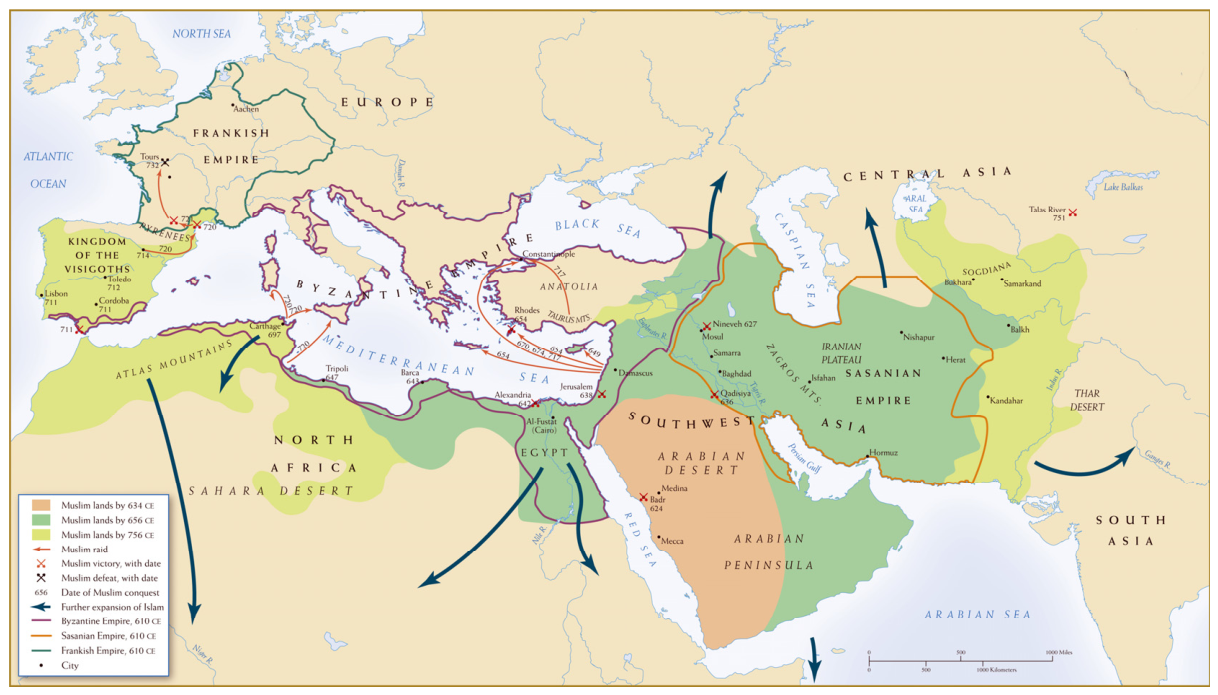
The Islamic Prophet Mohammed (570-632 AD) was born in the Arabian city of Mecca in the heart of the Arabian Peninsula. He was a member of the Hashemite clan of the powerful Quraysh tribe. He proclaimed his prophetic mission in Arabia in 612 AD and eventually won over Mecca to the new faith [1]. By the time of Muhammad’s death in 632 AD, most of the Arabian Peninsula was united under the new religion of Islam [2]. During the next few decades, the new Islamic power under the prophet’s rule was secure enough to allow his successor, Abu Bakr, the first caliph, to begin campaigns against the Byzantine and Sassanid Persian Empires. The Arabian army defeated the Byzantine army at Damascus in 635 AD and then began its conquest of the Persians (modern-day Iran). In 637 AD, the Arab army occupied the Sassanid capital of Ctesiphon (Madain), and in 641-642 AD, they defeated the Sassanid army at Nahavand (Figure 1).
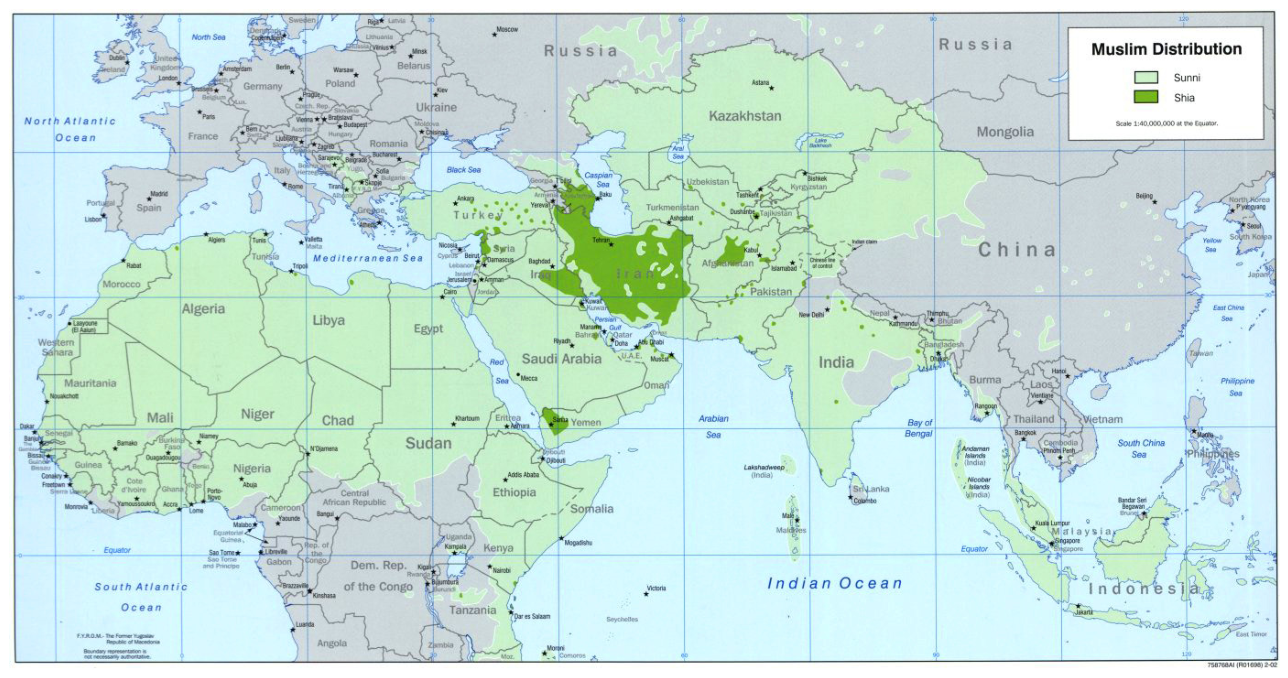
Following the death of the Prophet Mohammed on the 8th of June 632 AD, two major groups emerged over the criteria for his legitimate succession; later known as the Sunni Muslims and Shia Muslims [3]. According to Sunni scholars, prior to his death, Prophet Muhammad did not state with absolute clarity who should lead the rising Islamic world. As he had no surviving sons to replace him, they chose Abu Bakr, who had been the Prophet’s first adult male convert and was the father of his wife Aisha, as the first Khalifah (Arabic term meaning successor or steward). Those who supported Abu Bakr had the most followers and later formed the community known as the “people of the Sunna and the Assembly,” or Sunni Muslims [4]. Another group of the Prophet’s followers maintained that he had designated his cousin and son-in-law, Ali, to be his successor before he died. The group that supported Ali was called the Shia (meaning “party” or “supporters of the house of Ali”), later popularly known as Shiite (Shia) Muslims (Figure 2).
Figure 1.
The expansion of the Islamic world through the Prophet Muhammad (622-632 AD), the patriarchal Caliphate (632-661) and the Umayyad Caliphate (661-750) [5].
Figure 1.
The expansion of the Islamic world through the Prophet Muhammad (622-632 AD), the patriarchal Caliphate (632-661) and the Umayyad Caliphate (661-750) [5].
Abu Bakr, who ruled for only two years, was followed by the caliphs Umar and Uthman, upon whose death the caliphate finally passed to Ali. According to the Shia Muslims, the first three caliphs, lasting twenty-four years, are considered usurpers for having deprived Ali of his right to rule. After Imam Ali (Imam refers to an Islamic leadership position) became Caliph in 656 AD, he was unable to overcome the opposition of his rivals and was assassinated in 661 AD. Ali’s Shia supporters maintained that his elder son, Hasan, should become the next caliph, but Muawiya (a cousin of the earlier Caliph Uthman) prevented him from doing so and usurped the caliphate. Ali’s second son, Husain, under great pressure from Muawiya, agreed to postpone his own claim for the caliphate until the death of Muawiya, but was prevented from achieving this aim by the further treachery of Muawiya, who designated his own son, Yazid, as caliph [4].
Imam Husain and his followers refused to accept Yazid as caliph, revolted and were killed in the battle of Karbala on 10th October 680 AD. The majority of Shia Muslims, known as Twelvers, believe in 12 successors after the Prophet Mohamad, and consider Imam Muhammad al-Mahdi to be the final Imam who is currently alive but hidden in Occultation by divine will, destined to return to establish global justice, with the Aid of Jesus Christ [6]. None of the Twelve Shia Imams, except for Ali, ever ruled an Islamic state; their followers always hoped they would assume rulership of the Islamic community. Because the Sunni Umayyads (662-750 AD) and Abbasids (750-945 AD) caliphs were aware of this hope, the Shia Imams and their descendants (known as Sayyeds) generally were persecuted throughout this era. The persecution of Shia Muslims, beginning with Ali and his sons and continuing with the succeeding nine Imams and their Sayyed descendants, forced them to move to remote geographical areas such as Egypt, Iraq and Iran for their safety for centuries [7].
After the Arab invasion, there was a slow but steady movement of the Iranian population towards Islam. The nobility and city-dwellers were the first to convert, most likely to preserve their economic and social status and advantages, such as avoiding additional taxes imposed by the Muslim Caliph (known as the Jeziah). Islam spread more slowly among the peasantry and farmers, as well as among the landed gentry. By the late 10th century, most Iranians had converted to Islam, at least nominally, and most were Sunni Muslims. Shia Islam was not initially an Iranian religious movement. The largest concentration of Shias in the first to fourth centuries of Islam was in Egypt and southern Iraq. It was not until the sixteenth century, under the Safavid dynasty (1501 to 1722 AD; Safavid Kings themselves claimed to be Sayyeds), that most Iranians became Shias. Shia Islam became, then, as it is now, the state religion [8].
Figure 2.
The distribution of Shia and Sunni Muslims in the world [9].
Figure 2.
The distribution of Shia and Sunni Muslims in the world [9].
1.2. Sayyeds in Modern Iran
In Shia Islam, those progeny of the family of the Prophet Muhammad who are his indirect descendants through the line of the Shia imams are referred to as Sayyeds. Before Islam, Sayyed was used in Arabia to denote a tribal chief. After the advent of Islam and the partial intrusion of Arabic into Old Farsi, it assumed a particular meaning: that of descendants and certain relatives of the Prophet Muhammad. The term Sayyed or its alternative Mir, thereafter, came to denote the direct male descendants of the Prophet through his two grandsons, Imam Hasan and Imam Husain, the sons of the union of the Prophet’s daughter, “Fatima”, and his son-in-law and cousin, Imam Ali. As a traditional practice, only children of a male Sayyed (either boys or girls) will be given and inherit the title (Sayyed or Mir for a male child and Sayyedah or Alawiyah for a female child) and thus, children of a female Sayyedah/Alawiyah who marries a non-Sayyed male will not be considered as Sayyeds. Sayyeds have been recognised only through male lineage, without any female links [10,11].
Iranian Sayyeds divided themselves genealogically into many subgroups, the most numerous of which claimed descent from the Prophet through his daughter, Fatima, and her husband, Imam Ali (the Alavi group). Iranian Sayyeds normally have a family name that refers to one of the Shia imams, such as Hasani (descendants of Imam Hasan, the 2nd Imam), Husaini (descendants of Imam Husain, the 3rd Imam), Razavi (descendants of Imam Reza, the 8th Imam), and so on [12]. Throughout the history of Shia Islam in Iran, many of the Sayyeds have been chosen as religious and spiritual leaders and have been known as the extended progeny of the Shia Imams. They have been known as Imamzadehs (direct descendants of one of the Twelve Shia Imams), and after their deaths, they have been buried in shrines or mausoleums built to honour their status as holy figures [13].
According to available data, in 1979, following the overthrow of the Pahlavi dynasty under King Mohammad Reza Pahlavi and the establishment of the Islamic Republic of Iran (under the rule of Ayatollah Ruhollah Khomeni, a Sayyed Shia religious leader), there were about 1,500 known Imamzadeh shrines or tombs of the descendants of Shia Imams across the country. Over the last 47 years (since the Islamic revolution in Iran), the number of Imamzadehs has increased to over 10,000 (about seven times as many), further demonstrating the political and cultural importance and influence of Sayyeds in Iran (Figure 3) [14].
Throughout Shia history, Sayyeds have been viewed with great reverence and considered a high-class group, receiving greater respect and benefits. They have been supported by the Khoums (خمس; an obligatory 20% Islamic tax also called the Prophet’s Share in Shia Islam), as it was thought unseemly that a descendant of the Prophet Mohammad should not work hard for a living. Many Sayyeds in Iran are found among religious schools, the religious government, and the clergy, although in modern Iran, they may practice virtually any occupation [11].
1.3. Questions to Be Addressed
A previous study on the Sayyeds from the Indian subcontinent, on 56 Sayyeds, 16 Quraysh, 1 Hashemite and 5 Ansari men of Pakistani or Indian origin (from London and Manchester), shows that they have a greater affinity for Arab populations than for their geographic neighbours, but provides no evidence of a recent common patrilineal ancestry [15,16]. Another study of the male-specific region of the Y chromosome in 597 unrelated males from five different areas of Saudi Arabia, using a set of 17 Y-STRs, suggests strong geographical differences and social structure among Arab males, based on the patrilineal descent structure of tribal systems [17]. They showed low diversity and similar haplotype spectra in the Central and Northern regions, and high diversity and similar haplotype spectra in the East and West parts of the country and suggested that this pattern is due to the geographical isolation of the desert heartland of the Arabian Peninsula, and the proximity to the sea of the Eastern and Western areas, and consequent historical immigration. They identified a predominance of haplogroup J1 (71%), which was significantly more common among Central, Northern, and Southern Arab males than among East and West males, with a star-like expansion cluster in a median-joining network estimated at ∼2800 years [17,18].
As most Sayyed families in Iran do not have a reliable, recorded family tree, historians, sociologists, and some religious scholars note that, because of this and the advantages of being known as a Sayyed, there have been non-genuine Sayyeds or Sayyed families in Iran. This has happened especially during the last four centuries after the establishment of the Shia Safavid dynasty. In this study, we investigate the proportion and distribution of the Sayyed population in Iran, as no such information is currently available, and examine patterns among Iranian male Sayyeds in relation to previous studies on Indian Sayyeds and male Arabs [15,17]. Also, to explore both paternal (Y chromosome) and maternal (mtDNA) histories of the Iranian Sayyeds, their genetic data will be compared with those of other contemporary Iranian ethnic groups. This study will allow us to assess the extent to which their mtDNA and Y chromosome data can reveal their relationships with other Iranians, as well as their ethnic background and origins [19,20,21,22].
If patrilineal descent has indeed been followed since the time of the Prophet Muhammad, we would expect the Y-chromosome haplotypes of living Sayyeds to be considerably less diverse than those found among non-Sayyed Iranians and to be derived from an ancestral haplotype about 1,400 years ago from the Arabian Peninsula. Also, we would expect to find a higher proportion of Arab-specific Y chromosome haplogroups/haplotypes among the Iranian Sayyeds, as scholars argue that the Arab conquest and expansion led to admixture of Arab Y chromosome lineages with other populations and ethnic groups in the Middle East and Iran [23,24,25,26]. The fact that during the history of Islam it has been a normal practice for Muslim men to have several legal wives, as well as an unlimited number of not legally married female partners, the comparison of the mtDNA of claimed Sayyeds will allow us to compare the maternal lineage of them with other Iranian ethnic groups and investigate the influence of their marital practice among this group [27,28,29].
2. Materials and Methods
During three sampling campaigns in Iran (between 2003 and 2007), 123 Sayyed samples (hereafter, the “SAY” population) were randomly collected alongside 2,514 male Iranian samples from 24 different Iranian ethnic groups [30,31]. Male samples were randomly collected from consenting volunteers at the Iranian transfusion centres to ensure an unbiased sampling strategy. This sampling strategy allows us to study Y-chromosome and mtDNA genetic markers and investigate both paternal and maternal genealogies, as well as the population history of any population or ethnic group, using male DNA samples. To ensure completely random sampling across the two previous generations, we have carefully avoided collecting DNA samples from siblings and cousins. Information was obtained on the place of birth of all individuals (current generation- generation t) and on the place of birth of their parents (generation t-1) and grandparents (generation t-2). mtDNA does not recombine and is passed down exclusively from mother to all her children, so we could simply assign mtDNA sequences to populations in each generation using the place of birth of the sampled individual, or that of their mother or grandmother [31].
DNA was extracted using the PAXgene blood DNA kit (Preanalytix) [32]. A total of 26 Y-chromosomal short tandem repeat (STR) loci were also amplified in all samples using two PCR multiplexes, including Butler’s Y-STR 20Plex (including DYS19, DYS385a/b, DYS388, DYS389I, DYS389II, DYS390, DYS391, DYS392, DYS393, DYS426, DYS437, DYS438, DYS439, DYS447, DYS448, DYS460, YCAIIa/b and Y-GATA-H4) and Parkin’s Y-STR 14Plex (targeting six additional Y-STRs markers and amelogenin locus (including DYS425, DYS434, DYS435, DYS436, DYS461, DYS462) [33,34]. To investigate the maternal history of the individuals, genetic variations and mtDNA diversity were assessed by direct sequencing of the D-loop and single-nucleotide polymorphism analysis of the coding region using Restriction fragment length polymorphism (RFLP) screening [35,36]. Different measures of DNA sequence variation were computed for all Iranian ethnic groups and SAY samples using DnaSP version 6 and Arlequin version 3.5 [37,38]. Following a comprehensive analysis, mtDNA, biallelic, and Y chromosome microsatellite profiles were obtained for all Iranian samples, and Sayyed’s data were compared with those of the other 24 Iranian ethnic groups using various statistical tools [31].
3. Results
3.1. Proportion and Geographical Distribution
According to the World Health Organisation, Iran’s current population is 93,200,157 [39]. In this study, 4.55% of male Iranian individuals reported being SAYs (ranging from 0% in the Turkmen group to 10.8% in the FA9 Population from Yazd province). Extrapolating this figure to the entire Iranian population yields a total of ~4,240,607 male SAYs who are currently living in Iran. As the proportion of Iranian males and females is reported to be approximately 50.78% males and 49.22% females, we can conclude that the total number of claimed male Sayyeds and female Sayyedahs is about 8,417,605 (9.3% of all Iranians). Table 1 shows the total number of samples collected from different Iranian ethnic groups, their geographical location and the number and proportion of Sayyed males in each population.
Figure 4 shows the distribution of Sayyeds among different Iranian populations. Of the 123 male Sayyeds in this study, only 3 reported being Sunni Muslim, and the other 120 were Shia Muslim. During sampling of Iranian populations, all individuals were asked whether they were Sayyeds and whether they personally or someone in their family held a well-documented and reliable family tree or any other proof of their ancestry. Over 93.1% of Iranian Sayyeds did not have, or could not provide, any proof of their heritage, and only seven individuals claimed to have a reliable family tree that had been kept safe in their families for centuries.
Among seven Sayyeds individuals with available family trees, two could present very well-documented and reliable family trees, certified by the “Research Centre for Sayyeds Ancestry” in Qom, Iran. The first individual was a 32-year-old male from a well-known “Taba-Taba” family (descendants of Imam Hasan, the second Shia Imam) and from the city of Yazd. His family tree was very well documented (written by hand during the last 11 centuries on the back cover of a handwritten Holy Quran). This family tree is already published online for public access (www.tabataba.ir). The second sample belongs to a 54-year-old male from the “Sadr” family; descendants of Imam Mosa Kazem (the seventh Shia Imam). Members of this large family are primarily found in Lebanon, but over the last three centuries, many prominent members have migrated to Iran, especially to Isfahan and Qom [40].
3.2. Genetic Data
After direct sequencing of the non-coding region and characterisation of genetic variations in the mtDNA coding region by diagnostic RFLP marker analysis, mtDNA haplogroups and haplotypes were determined [41,42,43,44]. Twenty-six Y-chromosomal STR loci were also amplified in all Sayyed samples using two PCR multiplexes, and to get reliable results, Y-STR data were filtered, and a set of 118 STR profiles for which amplification was successful at 21 STR markers was used for further analyses. All SAY samples were also typed for Y chromosome biallelic markers. The mtDNA and Y chromosome data for the SAY population were compared with those of other Iranian ethnic groups and analysed using various statistical methods. Of the 123 mtDNA SAY haplotypes observed in this analysis, 118 (~96%) were unique (observed in only one individual), whereas two haplotypes were shared by five individuals. The nucleotide diversity (π) for Sayyeds was 0.01601, and the average number of nucleotide differences was 9.683, which are both very similar to the figures seen for other Iranian populations. The demographic history of Sayyeds in Iran was also investigated by analysing mismatch distributions of pairwise differences among all individuals in the population, using DnaSP version 6 [37]. As with other Iranian populations, the mismatch distribution for Sayyeds was bell-shaped, which is indicative of population expansion (Figure 5).
Sayyeds mtDNA were also characterised by a significantly negative value for Tajima’s D-test (-2.20; P<0.01), which tests the difference between two measures of genetic diversity: the mean number of pairwise differences and the number of segregating sites, which are expected to be the same in a neutrally evolving population with a constant size [45,46]. This is most likely due to rapid population expansion. This value is similar to those of other Iranian populations in this study. Matrices of pairwise FST values for the Sayyeds mtDNA and Y-STRs data (Appendix 1 and Appendix 2) were calculated in Arlequin version 3.5 and were used to perform multi-dimensional scaling (MDS) analysis using SPSS (version 14.0) [47].
Figure 6 shows the results from the MDS analysis of mtDNA data (top panel) and Y chromosome STRs (bottom panel). The major mtDNA division is between a main cluster that includes most Iranian populations and the SAY mtDNA, which is an out-group. This is surprising, given that Sayyed’s status is inherited only through the male line. It is also interesting to consider the differences between the Sayyed mtDNA pool and the Arab ethnic group (ARB), which mainly lives in the South-West of Iran (Khuzestan Province) and in neighbouring Arab countries, Iraq and Kuwait. The ARB mtDNA clusters with other Iranian ethnic groups, whereas the SAY clearly falls outside this cluster. This indicates a very minor contribution of ARB mtDNA to the SAY mtDNA pool.
In contrast to mtDNA data, Y-STR data indicate that the SAY falls within the main Iranian cluster in the Y-STR MDS analysis, and the only outlier is the TOR population. Phylogeographic analysis of SAY’s mtDNA and Y chromosome STR data points to an interesting pattern. Table 2 summarises the presence of different mtDNA and Y-chromosome haplogroups in the SAY group, based on diagnostic RFLPs in mtDNA coding regions and STRs analysed using haplogroup-prediction programs [48,49,50,51]. As shown in Table 2, the mtDNA haplogroup H is at a frequency of about 30% across all Iranian populations, and other Western Eurasian types are the most dominant haplogroups among them. In the SAY group, mtDNA haplogroup H remains the most common (16.6%), and the other common haplotypes show distributions very similar to those observed in all other Iranian populations.
The Y-chromosome haplogroups in SAY also display a pattern similar to that of other Iranian populations, with two exceptions. Haplogroup J1, which accounts for 2.3% of FA1 (Persian-speaking group from Tehran) and 10.5% of the ARB population’s Y chromosome lineages, is at a considerably higher frequency among Sayyeds (18.6%). In contrast, haplogroup R1a, which constitutes 21.4% of FA1 and 3.6% of the ARB population, was observed at about 8% of the SAY population. Also, the two Sayyed samples from the “Taba-Taba” and “Sadr” families show the M267 single-nucleotide polymorphism and belong to the Y-chromosome haplogroup J1 and the mitochondrial DNA haplogroup H (Table 2).
Reduced median networks (RMNs) were used to investigate the phylogenetic relationships among mtDNA and Y-STR haplotypes in the SAY group [52,53]. The mtDNA network for the SAY population was highly complex, with numerous reticulations and a central star-like pattern centred on six samples from Lorestan, Takestan, Gilan, Sistan, and Tehran, all belonging to haplogroup H. The rest of the network showed no specific pattern, and because the samples from the SAY population belonged to distinct haplogroups and lineages, it was impossible to draw any meaningful conclusions from the mtDNA network (Figure 7).
The Y-STR network shows an interesting pattern: 34 of the 118 SAY haplotypes used to construct the phylogenetic network belong to haplogroup J1 (~29%) and are organised in a star-like pattern (Figure 8). Haplogroup J1 is believed to have arisen ~31,700 years ago in the Near East and is the most common lineage among Arab populations (between 40% and 80% of the population in countries like Yemen, Qatar, and Sudan) [54,55]. It is particularly associated with the P58 sub-clade (J1a1a1), which expanded throughout the Middle East and North Africa alongside the spread of Semitic languages and pastoral nomadism [56]. Y chromosome Haplogroup J1 (particularly J-M267) does not exceed 10% in most Iranian ethnic groups, with higher values only in the Fars ethnic group from Shiraz province (2.3%) and the Iranian Arabs (10.5%).
4. Discussion
There are many traditional societies and religious groups around the world claiming descent from a common ancestor, and genetic analyses have been used as a reliable tool to test such claims. Human Y chromosome variation has proved highly valuable in testing claims of common patrilineal ancestry [57,58,59,60]. For instance, Y-chromosome data have enabled the assessment of the genetic relationships among individuals belonging to paternally inherited Jewish castes [60]. The Y chromosome generation time in humans has historically been estimated at about 25 years, but evolutionary geneticists accept a male generation length of 31 to 32 years, and in developed and modern societies, this average has even shifted closer to 33 to 35 years [61].
The average mutation rate for most Y-STR markers is between 2×10⁻³ and 5×10⁻³ per marker per generation. This means about 1 mutation every 200 to 500 generations (6400 to 16,000 years) for an average marker [62]. These slowly mutating STR markers, such as single-nucleotide polymorphisms, insertions, and deletions (also called unique-event polymorphisms, UEPs), enable us to classify Y-chromosome variations into major haplogroups. On the other hand, rapidly evolving Y-chromosome microsatellites, which mutate at rates greater than 1×10⁻², have allowed us to classify Y chromosomes’ major haplogroups into smaller haplotypes. Furthermore, using mutation rates of Y-chromosome microsatellites will allow us to estimate the time to a common recent ancestor for any specific group of males [63,64].
Given the higher mutation rate of Y-STRs, we would expect to find different Y-STR haplotypes among individual Iranian Sayyeds (assuming a common male ancestor for all Sayyed individuals lived ~1400 years ago). On the other hand, the unique mutation events at the binary loci are much older and rarer; it is expected that all Sayyed samples belong to a single major Y chromosome haplogroup [65]. As the two well-known “Taba-Taba” and “Sadr” individuals belong to haplogroup J1, which is also common among Iranian Arabs (ARB), it is the most likely ancestral type for all Iranian Sayyeds. This is presented in the Y-STR phylogenetic network (Figure 8). The J1 Sayyed cluster includes 5 individuals from FA1, 3 from FA2, 3 from GIL, 3 from MAZ, 2 from FA7, and 1 from each of ARB, FA6, JON, FA8, KER, and KOR. This again shows a different distribution of Sayyeds in Iran than that shown in Figure 4. The J1 SAY haplotypes are mainly concentrated in northern, southern, and south-western Iran.
Another way to shed light on the ancestor of the SAY Y-STR haplotypes is to consider the number of mutational events that have led to the current SAY Y-STR haplotypes [66]. Although there are variations in mutation rates across different Y-STR markers, the average Y-STR haplotype mutation rate depends on the number and composition of markers in the Y-STR haplotype. To investigate this, we used an average mutation rate of 3.2×10⁻⁸ per locus per generation and a generation time of 34 years [67,68]. With these in hand, we can compute the distribution for the expected number of mutations that hit the 21 STRs over the last 1,400 years using a binomial distribution. This approach provides a satisfactory approximation of the number of loci that have mutated. It is not strictly exact, as it assumes independent mutation events (i.e., it neglects the probability that different mutations can affect the same locus). Figure 9 displays the distribution of individuals for the number of expected mutations accumulated over the last 1,400 years at the 21 STRs. The parameter values given above yield an average of 2.8 mutations, with a 95% confidence interval of 0 to 5.7.
5. Conclusions
The 118 SAY haplotypes used in this study showed an average of 8.2 mutations (compared to the expected average of 2.8 mutations, with 95% confidence intervals between 0 and 5.7) in the set of 21 Y-STR markers. This is far more than the 2.8 mutations expected under the binomial distribution. Two Sayyed samples from the well-known Taba-Taba and Sadr families (with reliable family trees) belong to haplogroup J1. As SNPs on the Y chromosome are very rare and may have happened only once during the evolutionary history of humans, the expectation is that all Sayyed samples should belong to only one Y chromosome haplogroup. The most common haplotype among all collected Sayyed samples in this study belongs to haplogroup J1 (21.9%; 22 samples) with an average of 3.3 mutations, which is closer to the expected average. Taken together, the results of this study suggest that haplogroup J1 and a specific haplotype in this haplogroup (M267) could be considered as the ancestral type for the real Iranian Sayyeds. Therefore, excluding the two well-known SAY individuals, we can conclude that less than ~19% of Iranian male Sayyeds (the two samples from Taba-Taba and Sadr families are excluded) who claim descent from the Prophet Mohammed could belong to this specific haplogroup and may share a common Y-chromosome ancestor ~1400 years ago in the Arabian Peninsula. Further research examining additional DNA markers in more SAY individuals could increase the statistical significance and reliability of this study.
Supplementary Materials
The following supporting information can be downloaded at the website of this paper posted on Preprints.org.
Author Contributions
Conceptualization, M.A.B.; R.F.; B.K.A.; B.B.; methodology, M.A.B.; B.B.; software, M.A.B.; B.K.A.; B.B.; validation, M.A.B.; R.F.; B.K.A.; B.B.; formal analysis, M.A.B.; B.B.; investigation, M.A.B.; resources, M.A.B.; data curation, M.A.B.; R.F.; B.K.A.; B.B.; writing—original draft preparation, M.A.B.; B.B.; writing—review and editing, M.A.B.; R.F.; B.K.A.; B.B.; visualization, M.A.B.; R.F.; B.K.A.; B.B.; supervision, M.A.B.; project administration, M.A.B.; B.B.; funding acquisition, M.A.B. All authors have read and agreed to the published version of the manuscript.
Funding
This research was funded by BBSRC grant number: 2004-1J-CX-K010 and the APC was funded by DNA (MDPI).
Institutional Review Board Statement
The study was conducted in accordance with the Declaration of Helsinki and approved by the Ethics Committee of the Department of Genetics, University of Cambridge (2004-1J-CX-K010).
Informed Consent Statement
Informed consent was obtained from all subjects involved in the study.
Data Availability Statement
The research data produced in this study will be provided by the corresponding author after a formal request and permission by the Iranian Cultural Heritage and Tourism Organisation (ICHTC).
Acknowledgments
The authors would like to acknowledge support and advice provided by Professor Francois Balloux (UCL), Dr Peter Forster (University of Cambridge), and Dr Lori Lawson Handley (UKCEH). The authors have reviewed and edited the output and take full responsibility for the content of this publication.
Conflicts of Interest
The authors declare no conflicts of interest and that the funders had no role in the design of the study; in the collection, analyses, or interpretation of data; in the writing of the manuscript; or in the decision to publish the results.
Appendix A
Appendix A.1. FST Values Calculated Using Iranian mtDNA Data, Including the Iranian SAYs
Appendix A.2. FST Values Calculated Using Iranian Y-Chromosome Data, Including the Iranian SAYs
Appendix B
Examples of the consent form from voluntary participants in this study (in Farsi).
References
- McDougall, J. Worlds of Islam: A Global History; Allen Lane: UK, 2026; p. 608. [Google Scholar]
- Mahdi, M.S. Islam. Available online: https://www.britannica.com/topic/Islam (accessed on 10/03/2026).
- Armstrong, K. Islam (UNIVERSAL HISTORY), New Ed ed.; Phoenix, 2001; p. 210. [Google Scholar]
- River, C. The History of the Sunni and Shia Split: Understanding the Divisions within Islam; CreateSpace Independent Publishing Platform, 2014; p. 44. [Google Scholar]
- Wwnorton. The Origins and Spread of Islam. Available online: https://nerd.wwnorton.com/ebooks/epub/worldstogetherap2/EPUB/content/2.1-chapter02.xhtml (accessed on 18/02/2026).
- Nicolini, M. The Sunni–Shia divide: Evidence from international trade. Econ. Lett. 2023, 232, 111337. [Google Scholar] [CrossRef]
- De Mamani, A.W.; McLaughlin, M.M.; Ahmad, S.S.; Saenz-Escalante, G.M. Chapter 2 - Islam and Muslim culture. In Culturally Informed Therapy for Muslims; Academic Press, 2026; pp. 31–51. [Google Scholar]
- Teimourian, H. A History of Philosophy in Mesopotamia, Classical Iran and Early Islam; Kindle, 2025; p. 205. [Google Scholar]
- EmersonKent. Muslim Distribution. Available online: https://www.emersonkent.com/map_archive/islamic_countries.htm (accessed on 21/02/2026).
- Bloom, J. Islam: A Thousand Years of Faith and Power; Yale University Press, 2002. [Google Scholar]
- Al-Qazwini, S.M. Shia Islam; Islamic Educational Center of Orange County, 2022; p. 238. [Google Scholar]
- Maghrebi, M. A Historical Research on the Lives of the 12 Shia Imams; Independently published, 2020; p. 351. [Google Scholar]
- Newman, A. THE ROLE OF THE SĀDĀT IN SAFAVID IRAN: CONFRONTATION OR ACCOMMODATION? Oriente Mod. 1999, 18(79), 577–596. [Google Scholar] [CrossRef]
- Fararu. How many Imamzadeh shrines are in every Iranian province? Available online: https://fararu.com/fa/news/631503/ (accessed on 27/02/2026).
- Belle, E.M.S.; Shah, S.; Parfitt, T.; Thomas, M.G. Y chromosomes of self-identified Syeds from the Indian subcontinent show evidence of elevated Arab ancestry but not of a recent common patrilineal origin. Archaeol. Anthropol. Sci. 2010, 2, 217–224. [Google Scholar] [CrossRef]
- Aarzoo, S.S.; Afzal, M. Gene diversity in some Muslim populations of North India. Hum. Biol. 2005, 77, 343–353. [Google Scholar] [CrossRef] [PubMed]
- Khubrani, Y.M.; Wetton, J.H.; Jobling, M.A. Extensive geographical and social structure in the paternal lineages of Saudi Arabia revealed by analysis of 27 Y-STRs. Forensic Sci. Int. Genet 2018, 33, 98–105. [Google Scholar] [CrossRef] [PubMed]
- Abu-Amero, K.K.; Hellani, A.; González, A.M.; Larruga, J.M.; Cabrera, V.M.; Underhill, P.A. Saudi Arabian Y-Chromosome diversity and its relationship with nearby regions. BMC Genet 2009, 10, 59. [Google Scholar] [CrossRef] [PubMed]
- Matsen, F.A.; Evans, S.N. To what extent does genealogical ancestry imply genetic ancestry? Theor. Popul Biol. 2008, 74, 182–190. [Google Scholar] [CrossRef] [PubMed]
- Ritter, P. The Y-Chromosome and Genetic Genealogy. Available online: https://web.stanford.edu/~philr/Bachman/DNABachman3.html (accessed on 04/03/2026).
- Árnadóttir, E.R.; Moore, K.H.S.; Guðmundsdóttir, V.B.; Ebenesersdóttir, S.S.; Guity, K.; Jónsson, H.; Stefánsson, K.; Helgason, A. The rate and nature of mitochondrial DNA mutations in human pedigrees. Cell 2024, 187, 3904–3918.e3908. [Google Scholar] [CrossRef] [PubMed]
- Altena, E.; Smeding, R.; van der Gaag, K.J.; Larmuseau, M.H.D.; Decorte, R.; Lao, O.; Kayser, M.; Kraaijenbrink, T.; de Knijff, P. The Dutch Y-chromosomal landscape. Eur. J. Hum. Genet 2020, 28, 287–299. [Google Scholar] [CrossRef] [PubMed]
- Navarro-López, B.; Granizo-Rodríguez, E.; Palencia-Madrid, L.; Raffone, C.; Baeta, M.; de Pancorbo, M.M. Phylogeographic review of Y chromosome haplogroups in Europe. Int. J. Leg. Med. 2021, 135, 1675–1684. [Google Scholar] [CrossRef] [PubMed]
- Hernández, C.L.; Dugoujon, J.M.; Sánchez-Martínez, L.J.; Cuesta, P.; Novelletto, A.; Calderón, R. Paternal lineages in southern Iberia provide time frames for gene flow from mainland Europe and the Mediterranean world. Ann. Hum. Biol. 2019, 46, 63–76. [Google Scholar] [CrossRef] [PubMed]
- El-Sibai, M.; Platt, D.E.; Haber, M.; Xue, Y.; Youhanna, S.C.; Wells, R.S.; Izaabel, H.; Sanyoura, M.F.; Harmanani, H.; Bonab, M.A.; et al. Geographical Structure of the Y-chromosomal Genetic Landscape of the Levant: A coastal-inland contrast. Ann. Hum. Genet. 2009, 73, 568–581. [Google Scholar] [CrossRef] [PubMed]
- Haber, M.; Platt, D.E.; Badro, D.A.; Xue, Y.; El-Sibai, M.; Bonab, M.A.; Youhanna, S.C.; Saade, S.; Soria-Hernanz, D.F.; Royyuru, A.; et al. Influences of history, geography, and religion on genetic structure: the Maronites in Lebanon. Eur. J. Hum. Genet 2011, 19, 334–340. [Google Scholar] [CrossRef] [PubMed]
- DiMarco, M. (re)Producing mtEve. Stud. Hist. Philos. Biol. BioMed Sci. 2020, 83, 101290. [Google Scholar] [CrossRef] [PubMed]
- Heinz, T.; Pala, M.; Gómez-Carballa, A.; Richards, M.B.; Salas, A. Updating the African human mitochondrial DNA tree: Relevance to forensic and population genetics. Forensic Sci. Int. Genet. 2017, 27, 156–159. [Google Scholar] [CrossRef] [PubMed]
- Gaens, N.; Souche, E.; Kivisild, T.; Geypen, J.; Seneca, S.; Calafell, F.; Larmuseau, M.H.D. The first population scale compendium of complete mitochondrial genomes from Flanders, Belgium. Forensic Sci. Int. Genet. 2026, 81, 103382. [Google Scholar] [CrossRef] [PubMed]
- Hiby, S.E.; Ashrafian-Bonab, M.; Farrell, L.; Single, R.M.; Balloux, F.; Carrington, M.; Moffett, A.; Ebrahimi, Z. Distribution of killer cell immunoglobulin-like receptors (KIR) and their HLA-C ligands in two Iranian populations. Immunogenetics 2010, 62, 65–73. [Google Scholar] [CrossRef] [PubMed]
- Ashrafian-Bonab, M.; Lawson Handley, L.J.; Balloux, F. Is urbanization scrambling the genetic structure of human populations? A case study. Heredity 2007, 98, 151–156. [Google Scholar] [CrossRef] [PubMed]
- Qiagen.com. DNA Purification. Available online: https://www.qiagen.com/gb/product-categories/discovery-and-translational-research/dna-rna-purification/dna-purification?cmpid=PC_QF_NON_dna-purification-sales_0321_SEA_GA&gad_source=1&gad_campaignid=12498785447&gbraid=0AAAAAD-RrCy6MDryyVBU_plJ-aLVW-efI&gclid=CjwKCAjwuO_QBhAWEiwAIkVhU9wREjgh0qBr70yNjsh5Hbb6PowiwQ4QuWCaYEkcizD2RXSjTETD0RoCRHYQAvD_BwE (accessed on 02/02/2026).
- Butler, J.M. Recent Developments in Y-Short Tandem Repeat and Y-Single Nucleotide Polymorphism Analysis. Forensic Sci. Rev. 2003, 15, 91–111. [Google Scholar] [PubMed]
- Butler, J.M.; Schoske, R.; Vallone, P.M.; Kline, M.C.; Redd, A.J.; Hammer, M.F. A novel multiplex for simultaneous amplification of 20 Y chromosome STR markers. Forensic Sci. Int. 2002, 129, 10–24. [Google Scholar] [CrossRef] [PubMed]
- Narayanan, S. Applications of restriction fragment length polymorphism. Ann. Clin. Lab Sci. 1991, 21, 291–296. [Google Scholar] [PubMed]
- Jarcho, J. Restriction fragment length polymorphism analysis Chapter 2, Unit 2.7. In Curr Protoc Hum Genet; 2001. [Google Scholar] [CrossRef] [PubMed]
- Rozas, J. Available online: https://www.ub.edu/dnasp/index.html (accessed on 09/03/2026).
- Excoffier, L.; Lischer, H.E. Arlequin suite ver 3.5: a new series of programs to perform population genetics analyses under Linux and Windows. Mol. Ecol. Resour. 2010, 10, 564–567. [Google Scholar] [CrossRef] [PubMed]
- Worldometer. Iran Population. Available online: https://www.worldometers.info/world-population/iran-population/ (accessed on 17/002/20266).
- Kılınç, T. Al-Sadr’s family tree and their influence in the Levant and Iraq. Available online: https://en.yenisafak.com/columns/taha-kilinc/al-sadrs-family-tree-and-their-influence-in-the-levant-and-iraq-3650054 (accessed on 05/04/2026).
- Røyrvik, E.C.; Burgstaller, J.P.; Johnston, I.G. mtDNA diversity in human populations highlights the merit of haplotype matching in gene therapies. Mol. Hum. Reprod. 2016, 22, 809–817. [Google Scholar] [CrossRef] [PubMed]
- Haarkötter, C.; Medina-Lozano, M.I.; Santisteban-Álvarez, F.; Gálvez, X.; Vinueza-Espinosa, D.C.; Saiz, M.; Díaz-Ruiz, D.; Álvarez, J.C.; Lorente, J.A. Chapter 4 - Analysis of mitochondrial DNA and its aid in forensic investigation. In Investigative and Predictive DNA Testing; Dash, H.R., Ed.; Academic Press, 2026; pp. 49–71. [Google Scholar]
- Metspalu, M.; Kivisild, T.; Metspalu, E.; Parik, J.; Hudjashov, G.; Kaldma, K.; Serk, P.; Karmin, M.; Behar, D.M.; Gilbert, M.T.; et al. Most of the extant mtDNA boundaries in south and southwest Asia were likely shaped during the initial settlement of Eurasia by anatomically modern humans. BMC Genet 2004, 5, 26. [Google Scholar] [CrossRef] [PubMed]
- Rosa, A.; Brehem, A. African human mtDNA phylogeography at-a-glance. J. Anthropol. Sci. 2011, 89, 25–58. [Google Scholar] [CrossRef] [PubMed]
- Kim, K.; Omori, R.; Ito, K. Inferring epidemiological dynamics of infectious diseases using Tajima’s D statistic on nucleotide sequences of pathogens. Epidemics 2017, 21, 21–29. [Google Scholar] [CrossRef] [PubMed]
- Zeng, K.; Fu, Y.X.; Shi, S.; Wu, C.I. Statistical tests for detecting positive selection by utilizing high-frequency variants. Genetics 2006, 174, 1431–1439. [Google Scholar] [CrossRef] [PubMed]
- IBM. SPSS Text Analytics 14.0 Fix Pack 2. Available online: https://www.ibm.com/support/pages/spss-text-analytics-140-fix-pack-2 (accessed on 17/03/2026).
- Dumache, R.; Ciocan, V.; Muresan, C.; Enache, A. Molecular DNA Analysis in Forensic Identification. Clin. Lab 2016, 62, 245–248. [Google Scholar] [CrossRef] [PubMed]
- Tang, X.; Tian, J.Z.; Zhang, Y.W.; Yin, C.Y.; Tang, Z.; Li, S.; Yao, J.; Huang, J.W.; Li, S.L. Genetic Structure Analysis of Y Chromosome STR and SNP in Population of Changshu. Fa Yi Xue Za Zhi 2020, 36, 538–544. [Google Scholar] [CrossRef] [PubMed]
- Wang, C.-C.; Wang, L.-X.; Shrestha, R.; Wen, S.; Zhang, M.; Tong, X.; Jin, L.; Li, H. Convergence of Y Chromosome STR Haplotypes from Different SNP Haplogroups Compromises Accuracy of Haplogroup Prediction. J. Genet. Genom. 2015, 42, 403–407. [Google Scholar] [CrossRef] [PubMed]
- Athey, T.W. Haplogroup Prediction from Y-STR Values Using an Allele-Frequency Approach; 2005. [Google Scholar]
- Bandelt, H.J.; Macaulay, V.; Richards, M. Median networks: speedy construction and greedy reduction, one simulation, and two case studies from human mtDNA. Mol. Phylogenet Evol. 2000, 16, 8–28. [Google Scholar] [CrossRef] [PubMed]
- Herrnstadt, C.; Elson, J.L.; Fahy, E.; Preston, G.; Turnbull, D.M.; Anderson, C.; Ghosh, S.S.; Olefsky, J.M.; Beal, M.F.; Davis, R.E.; Howell, N. Reduced-median-network analysis of complete mitochondrial DNA coding-region sequences for the major African, Asian, and European haplogroups. Am. J. Hum. Genet 2002, 70, 1152–1171. [Google Scholar] [CrossRef] [PubMed]
- Seielstad, M.T.; Hebert, J.M.; Lin, A.A.; Underhill, P.A.; Ibrahim, M.; Vollrath, D.; Cavalli-Sforza, L.L. Construction of human Y-chromosomal haplotypes using a new polymorphic A to G transition. Hum. Mol. Genet 1994, 3, 2159–2161. [Google Scholar] [CrossRef] [PubMed]
- Semino, O.; Magri, C.; Benuzzi, G.; Lin, A.A.; Al-Zahery, N.; Battaglia, V.; Maccioni, L.; Triantaphyllidis, C.; Shen, P.; Oefner, P.J.; et al. Origin, diffusion, and differentiation of Y-chromosome haplogroups E and J: inferences on the neolithization of Europe and later migratory events in the Mediterranean area. Am. J. Hum. Genet 2004, 74, 1023–1034. [Google Scholar] [CrossRef] [PubMed]
- Sahakyan, H.; Margaryan, A.; Saag, L.; Karmin, M.; Flores, R.; Haber, M.; Kushniarevich, A.; Khachatryan, Z.; Bahmanimehr, A.; Parik, J.; et al. Origin and diffusion of human Y chromosome haplogroup J1-M267. Sci. Rep. 2021, 11, 6659. [Google Scholar] [CrossRef] [PubMed]
- Wang, F.; Song, F.; Song, M.; Luo, H.; Hou, Y. Genetic structure and paternal admixture of the modern Chinese Zhuang population based on 37 Y-STRs and 233 Y-SNPs. Forensic Sci. Int. Genet 2022, 58, 102681. [Google Scholar] [CrossRef] [PubMed]
- Behar, D.M.; Thomas, M.G.; Skorecki, K.; Hammer, M.F.; Bulygina, E.; Rosengarten, D.; Jones, A.L.; Held, K.; Moses, V.; Goldstein, D.; et al. Multiple origins of Ashkenazi Levites: Y chromosome evidence for both Near Eastern and European ancestries. Am. J. Hum. Genet 2003, 73, 768–779. [Google Scholar] [CrossRef] [PubMed]
- Soares, P.; Achilli, A.; Semino, O.; Davies, W.; Macaulay, V.; Bandelt, H.J.; Torroni, A.; Richards, M.B. The archaeogenetics of Europe. Curr. Biol. 2010, 20, R174–183. [Google Scholar] [CrossRef] [PubMed]
- Costa, M.D.; Pereira, J.B.; Pala, M.; Fernandes, V.; Olivieri, A.; Achilli, A.; Perego, U.A.; Rychkov, S.; Naumova, O.; Hatina, J.; et al. A substantial prehistoric European ancestry amongst Ashkenazi maternal lineages. Nat. Commun. 2013, 4, 2543. [Google Scholar] [CrossRef] [PubMed]
- Wang, C.C.; Gilbert, M.T.; Jin, L.; Li, H. Evaluating the Y chromosomal timescale in human demographic and lineage dating. Investig. Genet 2014, 5, 12. [Google Scholar] [CrossRef] [PubMed]
- Zhivotovsky, L.A.; Underhill, P.A.; Cinnioğlu, C.; Kayser, M.; Morar, B.; Kivisild, T.; Scozzari, R.; Cruciani, F.; Destro-Bisol, G.; Spedini, G.; et al. The effective mutation rate at Y chromosome short tandem repeats, with application to human population-divergence time. Am. J. Hum. Genet 2004, 74, 50–61. [Google Scholar] [CrossRef] [PubMed]
- Helgason, A.; Einarsson, A.W.; Guðmundsdóttir, V.B.; Sigurðsson, Á.; Gunnarsdóttir, E.D.; Jagadeesan, A.; Ebenesersdóttir, S.S.; Kong, A.; Stefánsson, K. The Y-chromosome point mutation rate in humans. Nat. Genet. 2015, 47, 453–457. [Google Scholar] [CrossRef] [PubMed]
- Ding, Q.; Hu, Y.; Koren, A.; Clark, A.G. Mutation Rate Variability across Human Y-Chromosome Haplogroups. Mol. Biol. Evol. 2021, 38, 1000–1005. [Google Scholar] [CrossRef] [PubMed]
- Underhill, P.A.; Poznik, G.D.; Rootsi, S.; Järve, M.; Lin, A.A.; Wang, J.; Passarelli, B.; Kanbar, J.; Myres, N.M.; King, R.J.; et al. The phylogenetic and geographic structure of Y-chromosome haplogroup R1a. Eur. J. Hum. Genet 2015, 23, 124–131. [Google Scholar] [CrossRef] [PubMed]
- Griffiths, R.C.; Tavaré, S. Ancestral inference from haplotypes and mutations. Theor. Popul. Biol. 2018, 122, 12–21. [Google Scholar] [CrossRef] [PubMed]
- Kayser, M.; Brauer, S.; Weiss, G.; Underhill, P.A.; Roewer, L.; Schiefenhövel, W.; Stoneking, M. Melanesian origin of Polynesian Y chromosomes. Curr. Biol. 2000, 10, 1237–1246. [Google Scholar] [CrossRef] [PubMed]
- Tremblay, M.; Vézina, H. New estimates of intergenerational time intervals for the calculation of age and origins of mutations. Am. J. Hum. Genet 2000, 66, 651–658. [Google Scholar] [CrossRef] [PubMed]
Figure 3.
Left: Imamzadeh Shenat (Zanjan), middle: Imamzadeh Hosain (Kerman) and right: Imamzadeh Sayyed Muhammad Zarin-Nava (Qaem-Shahr) (Figures from: Iran Cultural Heritage, Handicrafts and Tourism Organisation).
Figure 3.
Left: Imamzadeh Shenat (Zanjan), middle: Imamzadeh Hosain (Kerman) and right: Imamzadeh Sayyed Muhammad Zarin-Nava (Qaem-Shahr) (Figures from: Iran Cultural Heritage, Handicrafts and Tourism Organisation).
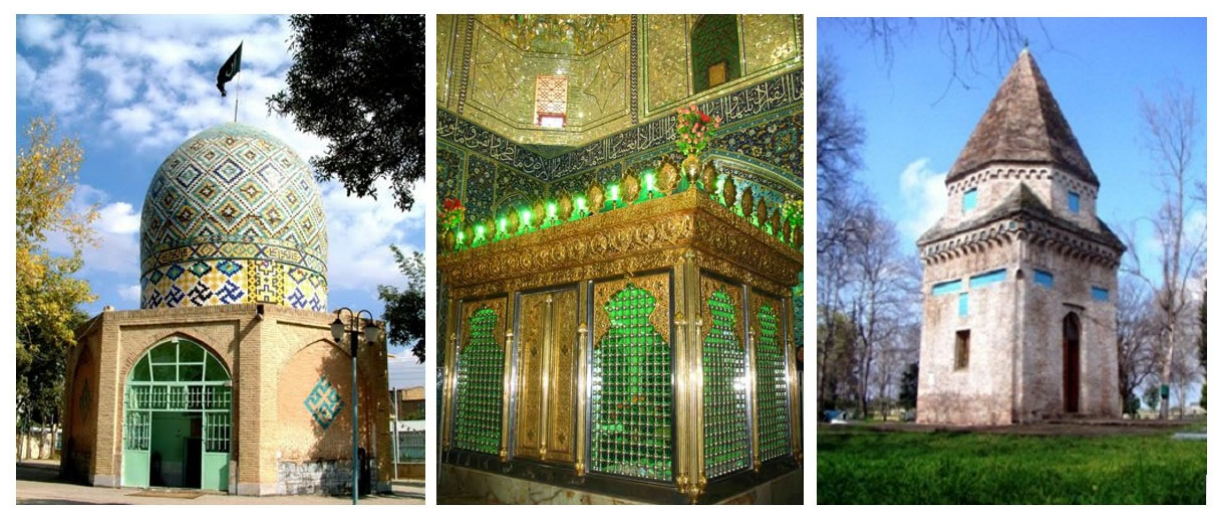
Figure 4.
The distribution of Sayyeds among different Iranian populations based on the percentage of occurrence separated by a 2% difference.
Figure 4.
The distribution of Sayyeds among different Iranian populations based on the percentage of occurrence separated by a 2% difference.
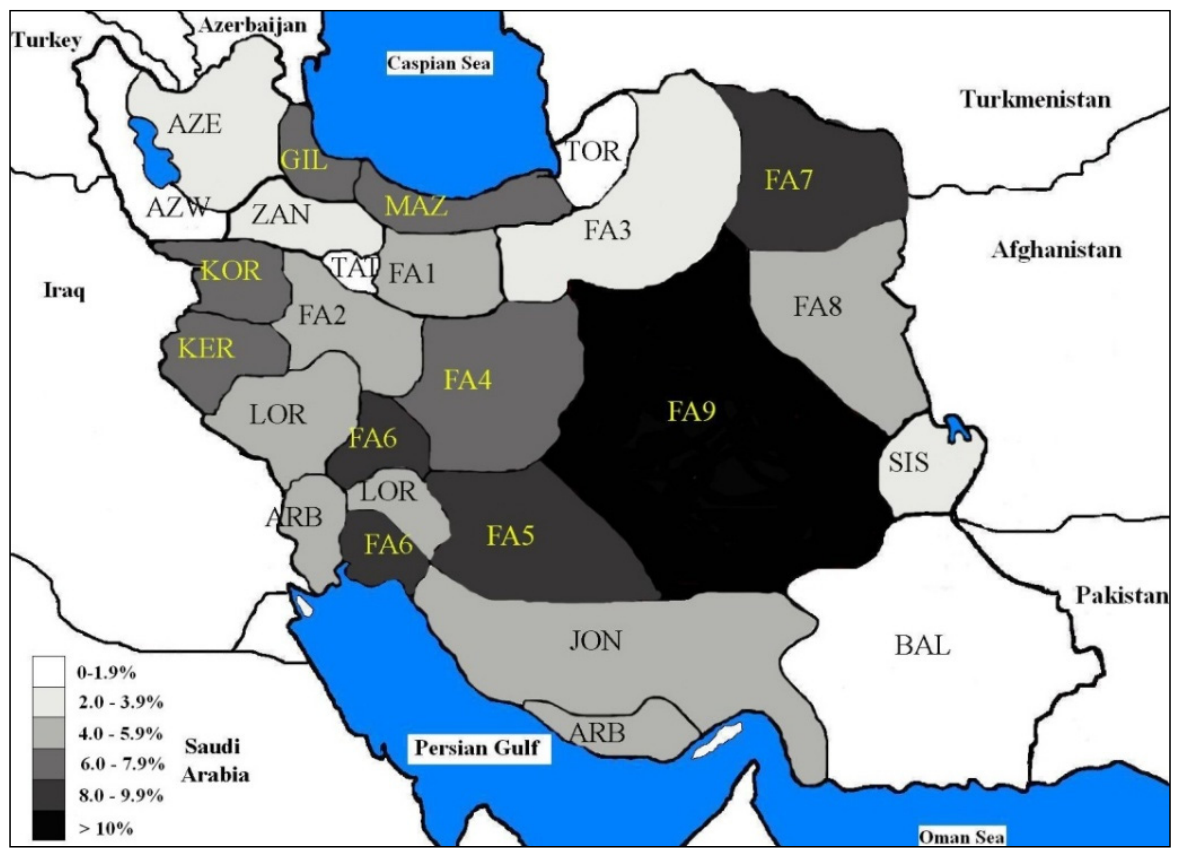
Figure 5.
Mismatch distribution for Sayyed samples (X axis: number of nucleotide differences, Y axis: Number of mtDNA sequence pairs in the non-coding region of the mtDNA).
Figure 5.
Mismatch distribution for Sayyed samples (X axis: number of nucleotide differences, Y axis: Number of mtDNA sequence pairs in the non-coding region of the mtDNA).
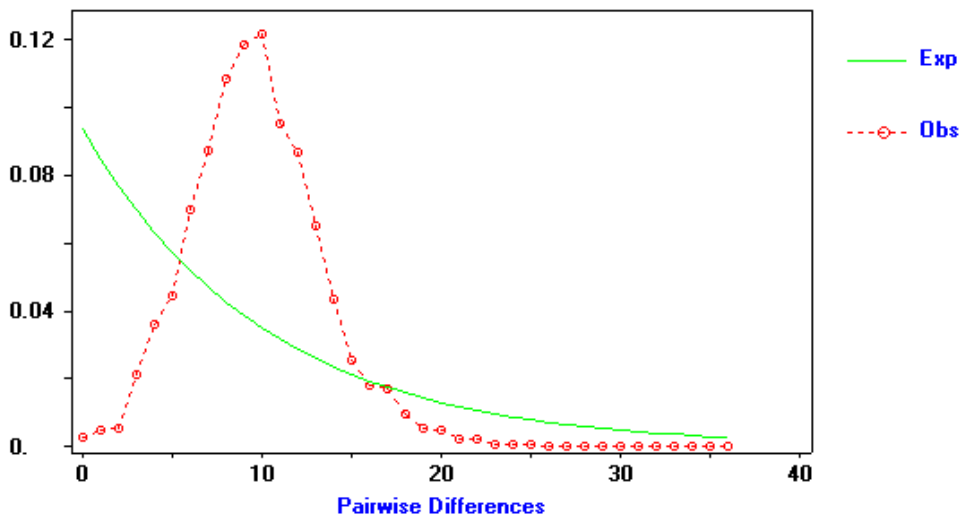
Figure 6.
MDS analysis of population pairwise FST values based on mtDNA (top) and Y chromosome microsatellite haplotypes (bottom) of Sayyed samples. Sayyeds are highlighted in Green and Arabs in Red.
Figure 6.
MDS analysis of population pairwise FST values based on mtDNA (top) and Y chromosome microsatellite haplotypes (bottom) of Sayyed samples. Sayyeds are highlighted in Green and Arabs in Red.
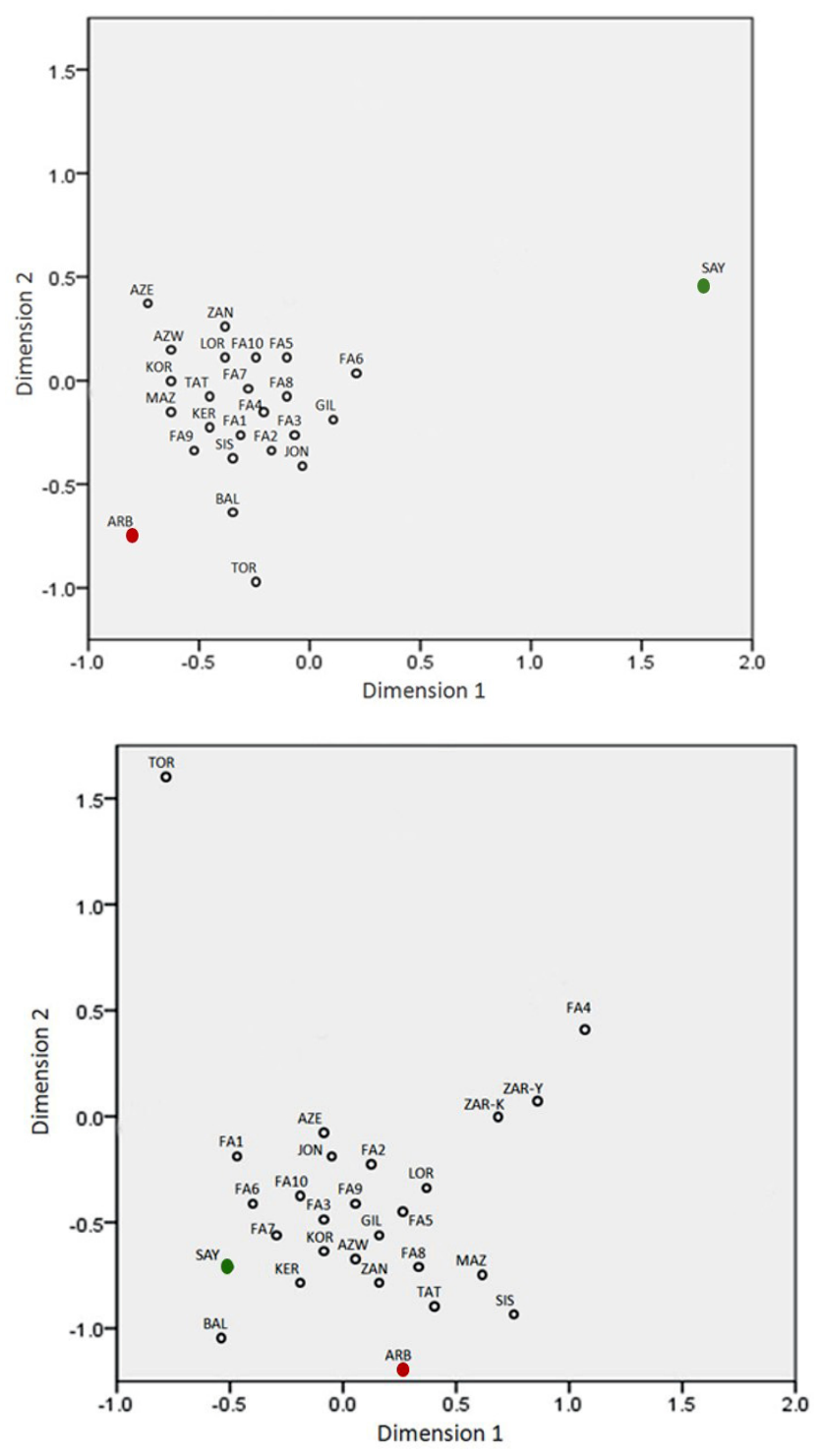
Figure 7.
The phylogenetic network of SAY mtDNA haplotypes.
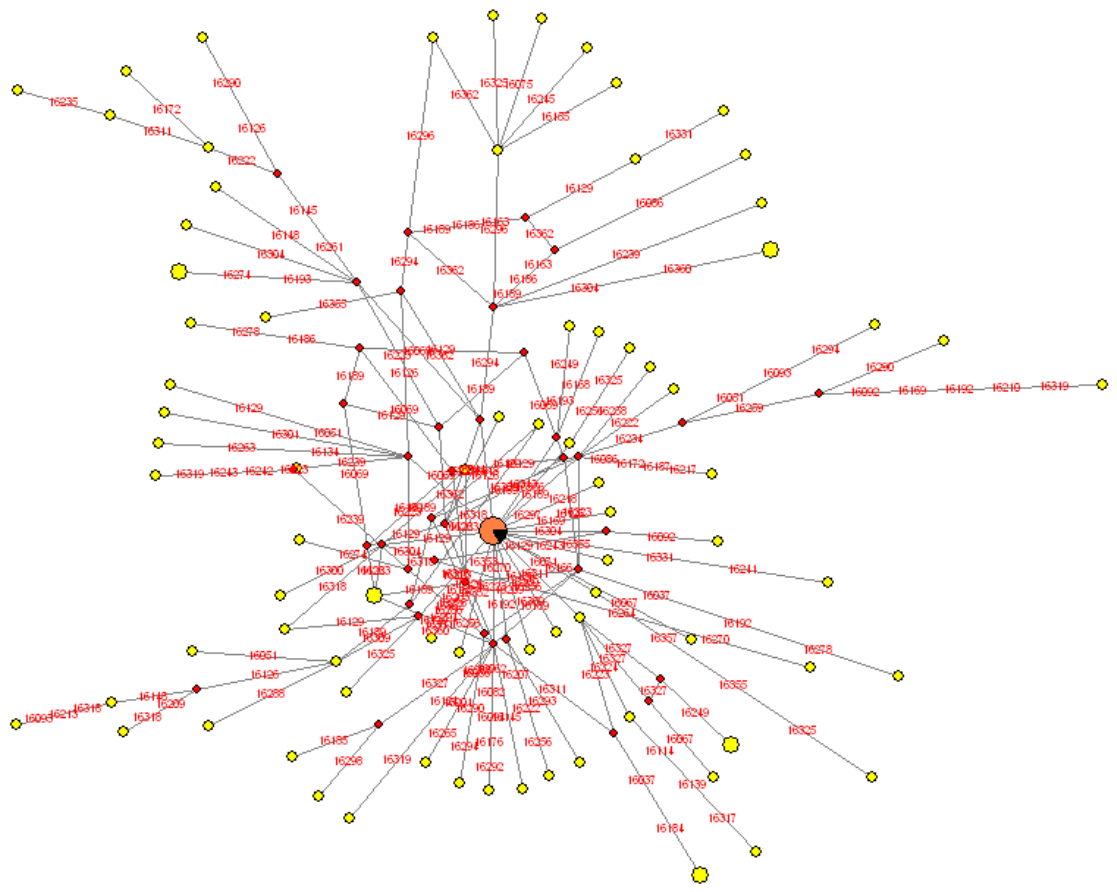
Figure 8.
The phylogenetic network of SAY Y-STR haplotypes.
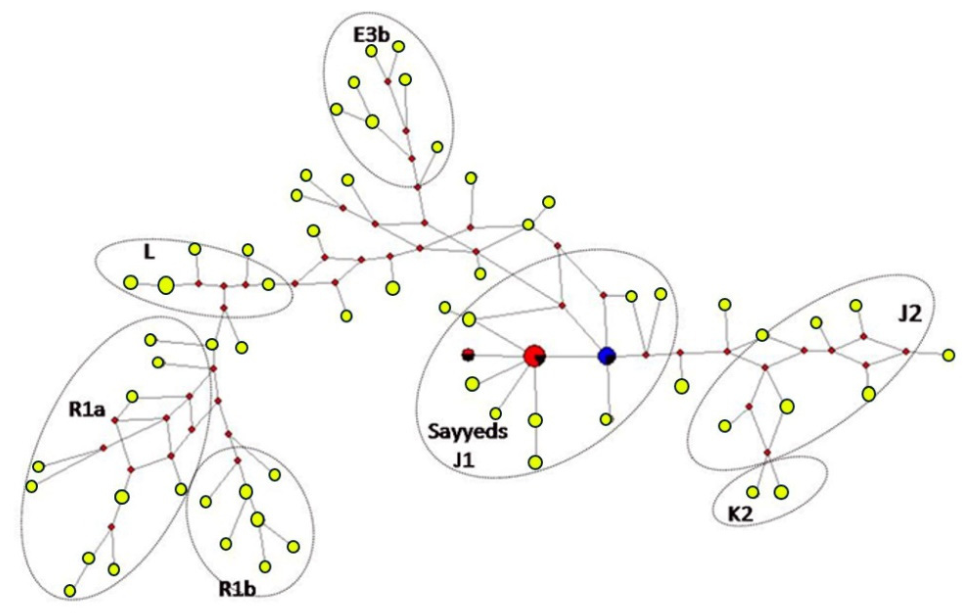
Figure 9.
Distribution of the expected number of mutations accumulated over the last 1,400 years at the 21 Y-STRs.
Figure 9.
Distribution of the expected number of mutations accumulated over the last 1,400 years at the 21 Y-STRs.
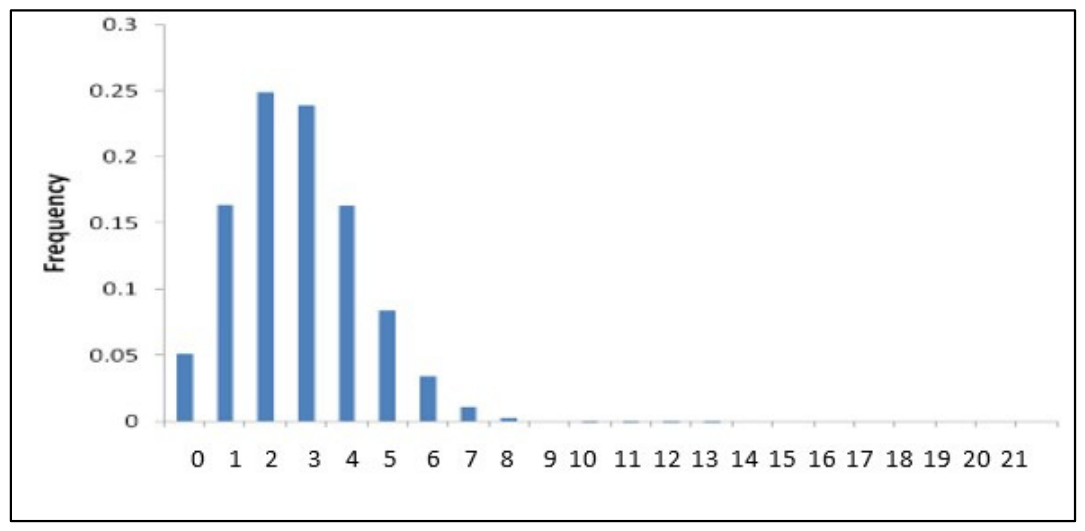

Table 1.
Total number of samples collected from Iranian populations and the number and percentage of Sayyed men in each population and in total.
Table 1.
Total number of samples collected from Iranian populations and the number and percentage of Sayyed men in each population and in total.
| Populations and Abbreviations | Main Provinces samples collected from | Total number of samples collected in the area | Number of Sayyed samples collected in the area | Percentage of Sayyed samples collected in the area |
|---|---|---|---|---|
| Fars (FA1) | Tehran, Qazvin | 390 | 17 | 4.35% |
| Fars (FA2) | Markazi | 75 | 3 | 4.0% |
| Fars (FA3) | Semnan, Damqan, Shahrod | 55 | 2 | 3.63% |
| Fars (FA4) | Esfehan | 105 | 7 | 6.66% |
| Fars (FA5) | Fars | 45 | 4 | 8.88% |
| Fars (FA6) | Khozestan | 70 | 6 | 8.57% |
| Fars (FA7) | North Khorasan | 50 | 4 | 8.0% |
| Fars (FA8) | South Khorasan | 52 | 3 | 5.76% |
| Fars (FA9) | Yazd | 74 | 8 | 10.81% |
| Fars (FA10) | Kerman | 60 | 6 | 10% |
| Arab (ARB) | Khozestan, Boshehr | 96 | 4 | 4.16% |
| Azari (AZE) | East Azerbaijan | 110 | 4 | 3.63% |
| Azari (AZW) | West Azerbaijan | 102 | 1 | 0.98% |
| Azari (ZAN) | Zanjan | 80 | 2 | 2.5% |
| Baloch (BAL) | Sistan & Balochestan | 135 | 1 | 0.74% |
| Gilak (GIL) | Gilan | 125 | 9 | 7.2% |
| Fars (JON) | Hormozgan, Fars | 100 | 4 | 4.0% |
| Kord (KER) | Kermanshah | 120 | 8 | 6.66% |
| Kord (KOR) | Kordestan | 135 | 9 | 6.66% |
| Lor (LOR) | Lorestan, Chahar Mahal va Bakhtiari | 125 | 7 | 5.6% |
| Mazandarani (MAZ) | Mazandaran | 120 | 9 | 7.5% |
| Sistani (SIS) | Sistan & Balochestan | 130 | 4 | 3.07% |
| Tats (TAT) | Qazvin | 70 | 1 | 1.42% |
| Turkmen (TOR) | Gholestan | 90 | 0 | 0% |
| TOTAL | 2514 | 123 | 4.89% | |
Table 2.
The mtDNA and Y chromosome haplogroup frequencies (%) in the SAY population; data for the FA1 and ARB populations are included for comparison.
Table 2.
The mtDNA and Y chromosome haplogroup frequencies (%) in the SAY population; data for the FA1 and ARB populations are included for comparison.
| mtDNA Haplogroups | FA1 | ARB | SAY | Y chromosome Haplogroups |
FA1 | ARB | SAY |
|---|---|---|---|---|---|---|---|
| Sample size | 390 | 96 | 90 | Sample size | 84 | 76 | 75 |
| L1c | - | - | 1.1 | E3a | 1.1 | 2.6 | 1.1 |
| L3d | - | - | 1.1 | E3b | 8.3 | 1.3 | 4.4 |
| L3a | - | 3 | - | G2 | 2.3 | 9.2 | 6.6 |
| M | - | - | - | G5 | - | - | - |
| C | - | - | 1.1 | H | 2.3 | - | 2.2 |
| D | 1 | - | 2.2 | I1a | 1.1 | - | - |
| G | 1 | - | - | I1b1 | 5.9 | 1.3 | 2.2 |
| N | 4 | 5 | 3.3 | I1b1b | - | - | - |
| N1a | - | 3 | - | I1b2 | - | - | 1.1 |
| N1b | 4 | 3 | 2.2 | I1b2a | 1.1 | - | 1.1 |
| N1c | 1 | 3 | 1.1 | J1 | 2.3 | 10.5 | 18.6 |
| I | 2 | - | 4.4 | J2a1b | - | 3.9 | 5.3 |
| A | - | - | - | J2a1k | - | - | - |
| W | 2 | 1 | 1.1 | J2a | 14.2 | - | 12 |
| X | 1 | 1 | 2.2 | J2 | 3.1 | 1.3 | 1.3 |
| R | - | - | 1.1 | K2 | 3.5 | - | 5.3 |
| R1 | - | - | - | L | 1.1 | 1.3 | 9.3 |
| R2 | 2 | 1 | 2.2 | N | - | 1.3 | 1.3 |
| B | 4 | 7 | 7.7 | Q | 2.3 | 6.5 | 1.3 |
| F | - | - | 2.2 | R1a | 21.4 | 3.9 | 8 |
| pre-HV | 2 | 9 | 3.3 | R1b | 5.9 | - | 6.6 |
| HV | - | 1 | - | ||||
| HV1 | 1 | - | 2.2 | ||||
| HV2 | 1 | - | - | ||||
| H | 24 | 12 | 16.6 | ||||
| V | 1 | 1 | - | ||||
| U | 3 | 1 | 2.2 | ||||
| U1 | 1 | - | - | ||||
| U1a | 1 | 5 | - | ||||
| U1b | 1 | - | 5.5 | ||||
| U2 | - | - | 1.1 | ||||
| U3 | 5 | 3 | 2.2 | ||||
| U4 | 4 | - | 3.3 | ||||
| U5 | 1 | - | 2.2 | ||||
| U7 | 4 | 1 | 3.3 | ||||
| K | 7 | 5 | 2.2 | ||||
| JT | 1 | 4 | 2.2 | ||||
| J | 2 | 3 | 3.3 | ||||
| J1 | 3 | 9 | 1.1 | ||||
| J2 | 3 | - | 2.2 | ||||
| T | 7 | 5 | 5.5 | ||||
| T1 | 1 | 3 | 3.3 |
Disclaimer/Publisher’s Note: The statements, opinions and data contained in all publications are solely those of the individual author(s) and contributor(s) and not of MDPI and/or the editor(s). MDPI and/or the editor(s) disclaim responsibility for any injury to people or property resulting from any ideas, methods, instructions or products referred to in the content. |
© 2026 by the authors. Licensee MDPI, Basel, Switzerland. This article is an open access article distributed under the terms and conditions of the Creative Commons Attribution (CC BY) license (http://creativecommons.org/licenses/by/4.0/).
Copyright: This open access article is published under a Creative Commons CC BY 4.0 license, which permit the free download, distribution, and reuse, provided that the author and preprint are cited in any reuse.


