
Submitted:
07 July 2026
Posted:
09 July 2026
You are already at the latest version
Abstract
Extreme operational environments can affect cognitive regulation, control of emotions and decision-making processes. Although stress-related impairments have been extensively studied, adaptive mechanisms supporting functional action under acute threat have also received increasing attention across several research traditions, including resilience research, stress inoculation, and studies conducted in ecologically valid operational settings. However, these findings remain dispersed across disciplines, and an integrative conceptual framework specifically addressing the adaptive mechanisms that allow certain professionals to maintain functional action under acute threat is still lacking. This concept paper proposes a theoretical framework for understanding adaptive reconfiguration in high-risk professional contexts. Drawing on literature from cognitive psychology, stress physiology, military and emergency response research, and behavioural regulation models, the article examines how individuals may preserve operational coherence despite intense physiological and emotional overload. The framework distinguishes disorganization/collapse from two other trajectories: threat-neutralization, characterized by action capacity preserved at the expense of normative control, and operational-protective, characterized by regulated action sustained by explicit normative frameworks. The paper introduces the notion of an “operational-protective trajectory” to describe forms of regulated action that remain functionally organized under extreme stress exposure. It also discusses the potential operational benefits and psychological costs associated with these adaptive configurations. By integrating findings from multiple disciplinary fields, the article contributes to a better conceptual understanding of decision-making and behavioural adaptation in high-risk environments and highlights implications for training, operational preparation, and resilience-oriented approaches.
Keywords:
adaptive reconfiguration
; cognitive regulation
; decision-making
; extreme stress
; operational performance
1. Introduction
Decision-making under extreme stress represents a central issue in applied psychology, particularly in professions exposed to urgency, uncertainty, and danger, such as law enforcement, military operations, private security, and emergency response. These environments are characterized by intense time pressure, high emotional activation, and rapid degradation of cognitive resources, all of which may impair judgment, behavioural regulation, and action control. Research in neuroscience and cognitive psychology consistently shows that acute stress weakens executive functions supported by the prefrontal cortex, notably through catecholaminergic dysregulation of PFC circuits [1,2], reduces cognitive flexibility, and promotes a shift toward more automatic and habitual responses [3,4,5,6].
However, observations from operational contexts suggest substantial interindividual variability in decision-making capacities under stress, even among professionals benefiting from similar training and institutional environments. Under comparable constraints, some individuals maintain relatively stable and goal-directed functioning, whereas others exhibit disorganization, rigidification, or functional collapse. Although classical stress models provide important explanatory insights [1,2], they still only partially account for the diversity of adaptive trajectories observed in high-risk professional settings. Despite extensive research on stress-related performance degradation, several complementary research traditions have examined mechanisms supporting adaptive functioning under stress, including resilience research, stress inoculation, and ecologically oriented investigations. Nevertheless, these contributions remain largely fragmented, and few integrative conceptual models specifically address the mechanisms that may temporarily sustain organized action and decision-making under extreme constraint.
In this context, literature on early adversity and developmental trauma offers complementary perspectives. Epidemiological and clinical studies show that exposure to adverse childhood experiences constitutes a major risk factor for numerous psychological and somatic difficulties in adulthood [7,8,9]. At the same time, these studies also emphasize the heterogeneity of developmental trajectories: similar early experiences may lead to markedly different outcomes, ranging from persistent vulnerability to forms of functional adaptation [10,11,12,13]. Whereas dominant trauma models primarily emphasize dysfunction, vulnerability, and long-term impairment, other perspectives in developmental psychopathology and resilience research suggest that certain adaptive configurations may emerge in highly adverse environments and remain functionally operative in specific contexts.
Based on these observations and on our professional experiences, the present article proposes an applied conceptual framework integrating contributions from stress psychology, decision neuroscience, and developmental psychopathology in order to better understand certain forms of decision-making stability observed under extreme constraint. We hypothesize that, in highly structured institutional environments, adaptive responses initially developed in early insecure contexts may undergo a form of functional reconfiguration that temporarily supports operational action under stress. This hypothesis does not imply any intrinsic beneficial effect of early adversity. Rather, it seeks to describe how certain mechanisms of vigilance, emotional modulation, and attentional focusing may, under specific institutional and operational conditions, contribute to maintaining action despite high emotional activation, while also involving potential psychological costs in terms of exhaustion, allostatic load, and rigidification [1,14].
The proposed model is grounded in an integrative synthesis of the scientific literature, informed heuristically by observations drawn from professional practice. Its objective is to clarify the mechanisms likely to support or impair decision-making under extreme constraint, as well as their implications for training, prevention, and support for professionals exposed to high-risk environments. Rather than suggesting that adaptive functioning under stress has been neglected, the present article aims to integrate findings that remain distributed across different theoretical traditions into a coherent conceptual framework for high-risk professional contexts.
Within this perspective, the article is structured as follows. Section 2 presents the methodological and conceptual foundations of the paper. Section 3 examines the effects of acute stress on decision-making, executive functioning, and emotional regulation. Section 4 explores contributions from research on early adversity, resilience, and heterogeneous developmental trajectories. Section 5 introduces the proposed conceptual framework of adaptive reconfiguration under constraint and presents its central mechanisms and operational hypotheses. Section 6 describes the principal functional trajectories that may emerge under extreme stress, namely disorganization/collapse, threat-neutralization trajectories, and operational-protective trajectories. Section 7 analyses the costs, limitations, and risks of drift associated with these configurations. Section 8 discusses the implications of the model for applied psychology, particularly regarding training, assessment, prevention, and sustainability in high-risk professional contexts. Finally, Section 9 and Section 10 discuss the theoretical contributions, limitations, and ethical implications of the framework before outlining conclusions and future empirical perspectives.
Overall, we argue that adaptive responses initially shaped by adverse developmental environments may, under specific operational and institutional conditions, contribute to maintaining functional decision-making under extreme stress, although at potentially significant psychological cost.
The originality of this conceptual framework lies in its integrative articulation between developmental psychopathology, stress neuroscience, and decision psychology applied to high-risk professional contexts. Unlike approaches focused exclusively on vulnerability or operational performance, the proposed model seeks to describe dynamic and contextual functional trajectories of regulation under extreme constraint, without pathologizing or idealizing the adaptive responses observed.
This work is part of the CP2DIMG research program [15], whose experimental phase will explore some of the hypotheses proposed here through immersive audiovisual devices and psychophysiological measurements [16]. The present article therefore constitutes a conceptual contribution intended to structure future empirical developments.
2. Materials and Methods
This conceptual paper is based on an integrative and interdisciplinary review of the literature in applied psychology, stress neuroscience, developmental psychopathology, and decision-making research in high-risk operational contexts. The proposed framework was developed through a comparative analysis of theoretical models and empirical findings related to stress regulation, emotional processing, executive functioning, resilience, and adaptive behavioural responses under extreme constraint. References were selected according to their theoretical relevance and empirical contribution to the understanding of adaptive functioning under stress. Reference management and numbering were performed using the software Mendeley.
The conceptual synthesis was complemented by heuristic observations derived from professional field experience in operational environments involving exposure to uncertainty, urgency, and high emotional activation. These observations were not collected through a formal experimental protocol and were used exclusively to support conceptual reflection and theoretical articulation. Professional field observations are used here as hypothesis-generating material and do not constitute empirical validation of the proposed framework.
Because the present article is theoretical and conceptual in nature, no human participants or experimental procedures were involved.
The empirical investigation of some hypotheses derived from the proposed framework will be conducted in subsequent phases of the CP2DIMG research program using immersive simulation and psychophysiological assessment methodologies.
Generative artificial intelligence (GenAI) tools were used solely for English language revision and grammatical checking. No AI system was used for conceptual development, data analysis, interpretation, or scientific content generation.
3. Stress, Decision-Making, and Emotional Regulation
3.1. Acute Stress and Executive Functions
A cascade of neurobiological responses is triggered by acute stress, including activation of the sympathetic nervous system and the release of catecholamines and glucocorticoids, which can alter cognitive functioning rapidly.
Numerous studies converge in showing that, beyond an optimal level of activation, stress impairs executive functions supported by the prefrontal cortex, particularly inhibition, cognitive flexibility, and planning [2,4,6]. This degradation promotes a shift toward more automatic, rapid, and habitual responses, which may be effective in the very short term but less suited to the complexity and ambiguity of critical situations [17] (Schwabe & Wolf, 2011).
Contemporary research in cognitive psychology and neuroscience has clearly established that human decision-making does not rely on purely rational processing independent of emotion. On the contrary, emotional and bodily processes play a central role in guiding choices, particularly in uncertain and constrained environments. Models derived from the somatic marker hypothesis suggest that emotional signals contribute to the rapid evaluation of options and the prioritization of action, often outside conscious awareness [5,18,19] (Damasio, 1994; Bechara, 2000; Starcke & Brand, 2012). From this perspective, the issue is not to suppress emotion, but to preserve its orienting function without allowing it to overwhelm decision control.
3.2. Attentional Narrowing Under Stress
Stress and emotional activation are associated with a well-documented narrowing of attention. Easterbrook’s “cue utilization” hypothesis describes how increased emotional arousal leads individuals to focus on a restricted number of salient cues at the expense of peripheral but potentially relevant information [3]. More recent studies suggest that heightened arousal biases attentional selection by reinforcing the processing of salient signals while reducing the integration of secondary information [20,21]. Similar mechanisms have also been described within attentional control theories emphasizing the disruptive effects of anxiety and stress on executive attentional regulation [22]. In operational contexts, this phenomenon may support action by simplifying the perceptual field; however, it also increases the risk of judgment errors when critical elements remain outside the attentional focus.
These combined effects, namely the weakening of prefrontal control and attentional narrowing, highlight a structural limitation of decision-making under stress. As emotional and temporal demands increase, the capacity to exhaustively analyse a situation rapidly deteriorates. From the perspective of applied psychology, the objective is therefore not to preserve an optimal decision in a normative sense, but rather to maintain a sufficiently reliable decision capable of supporting action, limiting critical errors, and remaining compatible with the operational rules and goals of the situation. This distinction is essential in high-risk professional contexts, where urgency and uncertainty make complete rationality unrealistic.
3.3. Emotional Regulation and Functional Decision-Making
Transactional models of stress and coping offer a complementary perspective by emphasising that the effects of stress on decision-making depend on how the situation is appraised, including perceived controllability, available resources, and perceived stakes, as well as on the regulatory capacities the individual can mobilise [23]. In other words, decisional degradation is not determined solely by the intensity of stress itself, but also by the individual’s ability, or inability, to regulate emotional activation and organise relevant information under constraint. What the literature converges on, for applied psychology, is straightforward: decision robustness under stress is not about removing emotion. It is about containing it. Regulation mechanisms allow the individual to prioritise what matters, hold a minimum of inhibitory control, and act despite the erosion of cognitive resources. The operational challenge in high-risk professions is therefore not to suppress stress, but to remain decision-capable while activated [5].
4. Early Adversity and Developmental Trajectories
4.1. Early Adversity as a Developmental Risk Factor
Beyond the immediate effects of acute stress on decision-making described previously, repeated exposure to insecure environments during childhood is part of a cumulative stress process likely to durably influence regulatory mechanisms. Literature in developmental psychology, epidemiology, and clinical psychopathology converges on a central conclusion: exposure to adverse childhood experiences constitutes a major risk factor for the later development of psychological and somatic difficulties. Foundational research on adverse childhood experiences demonstrated robust associations between the accumulation of early adversity and increased risks of anxiety, depressive, and addictive disorders, as well as somatic pathologies in adulthood, following a dose–response relationship [7,8]. These findings have been widely replicated and extended, confirming the generally deleterious effects of early exposure to abusive, neglectful, or chronically insecure environments [9,24].
4.2. Resilience and Heterogeneous Trajectories
At the same time, contemporary developmental approaches emphasize the heterogeneity of trajectories following severe and/or chronic early adversity. Under comparable initial conditions, developmental outcomes may diverge considerably, ranging from persistent vulnerability to relatively functional forms of adaptation. Developmental psychopathology has formalized this idea through the principles of equifinality, multifinality and heterogeneous developmental trajectories, highlighting that similar experiences may lead to different outcomes, and that distinct trajectories may converge toward similar clinical manifestations [10]. These observations invite researchers to move beyond deterministic interpretations of early adversity.
Research on resilience has further clarified this variability without invalidating the overall risk perspective. Resilience is not conceptualized as exceptional invulnerability or as a stable trait, but rather as a set of dynamic processes emerging from interactions between individuals and their environments over time [11,12,13]. In our view, the absence of later difficulties in some individuals exposed to adversity should not be interpreted as evidence of beneficial effects of suffering itself, but rather as the contingent result of protective factors, such as supportive relationships, later access to structured environments, or the development of emotional and behavioural regulatory capacities.
4.3. Survivor Bias and Interpretative Risks
However, a methodological issue must be emphasized in order to avoid biased interpretations. Adaptive trajectories observed among functional adults exposed to high-constraint environments are necessarily identified retrospectively. As such, they are particularly vulnerable to survivor bias, which tends to overestimate the frequency and adaptive value of certain configurations while neglecting trajectories of collapse, chronic psychological difficulties, or withdrawal, which remain statistically more common [12,25].
This bias contributes to implicit narratives suggesting that adversity itself “builds” specific competencies, despite substantial evidence showing that most individuals exposed to early adversity do not develop enhanced stress tolerance, but rather enduring vulnerabilities. This distinction is particularly important in applied psychology, where operational efficiency under stress can sometimes lead to retrospective overvaluation of atypical adaptive profiles.
4.4. Functional Adaptations and Contextual Conditions
Some adaptations observed in a minority of individuals may nevertheless be described as contextual functional configurations. Several studies suggest that early exposure to insecurity may, in certain later contexts, contribute to a recalibrated stress reactivity associated with heightened vigilance, sustained behavioural activation under arousal, and a strong need for structure and control that gives coherence to action. These responses should be understood as adaptive strategies initially oriented toward survival in unpredictable environments rather than as competencies in themselves. Their potentially functional character depends closely on the conditions in which they are later embedded, particularly the presence of explicit rules, internalized limits, and stabilizing institutional frameworks [26,27].
Finally, models of cumulative stress and allostatic load, understood as the cumulative cost of repeated activation of stress-response systems, remind us that any adaptation to a constraining environment carries a cost when prolonged over time. Responses that may initially be effective can become deleterious if physiological and psychological activation remains chronic in the absence of sufficient recovery and regulation [1,14]. This perspective is particularly important for applied psychology because it helps explain how certain trajectories may sustain operational functioning in the short or medium term while simultaneously exposing individuals to delayed risks of exhaustion, rigidification, or psychological decompensation.
Thus, early adversity should primarily be understood as a major developmental risk factor associated with considerable variability in later trajectories. Although certain adaptive configurations may emerge in a minority of individuals under specific contextual conditions, they constitute neither a reproducible model nor a justification for exposure to suffering. This distinction is essential before turning to the applied framework developed in the next section.
5. An Applied Conceptual Framework of Adaptive Reconfiguration Under Constraint
5.1. General Principle
The previous sections highlighted two complementary observations. First, decision-making under extreme constraint relies on regulatory mechanisms that allow individuals to maintain sufficiently reliable action despite the rapid degradation of cognitive resources induced by stress. Second, early adversity constitutes a major developmental risk factor associated with highly heterogeneous trajectories, only some of which appear compatible with professional environments characterized by high operational demands. The proposed conceptual framework aims to articulate these two levels of analysis in order to understand how certain functional configurations may emerge and support decision-making under constraint, without assuming any intrinsically beneficial effect of adversity.
The concept of adaptive reconfiguration is introduced here from a strictly descriptive and functional perspective to describe the process through which adaptive responses initially developed in early environments marked by insecurity may, under specific later conditions, be mobilized and reorganized in a functional manner. This reconfiguration does not correspond either to developmental repair or to a positive transformation of trauma. Rather, it refers to a pragmatic reorganization of pre-existing regulatory mechanisms aimed at reducing uncertainty, preserving action control, and limiting disorganization under high activation.
From this perspective, adaptive reconfiguration must be understood as a contextual and dynamic process. High-risk professional environments may, in some cases, provide sufficiently structured frameworks to temporarily sustain such configurations, particularly through the presence of explicit rules, clearly defined roles, and shared operational goals. The decision-making stability observed in these contexts should therefore not be interpreted as a stable individual trait or as generalized resilience, but rather as a transient functional organization that can persist only as long as the regulatory conditions remain sufficiently stable.
Vulnerability and adaptation are usually treated as opposites. The general principle proposed here suggests they can coexist: the same configuration that sustains operational functioning under constraint may, in the medium term, expose the individual to psychological and somatic costs that only become visible once the constraint relaxes. Adaptive reconfiguration should therefore not be regarded as a desirable model or normative trajectory, but rather as an analytical framework for understanding certain forms of decision-making stability observed in extreme contexts.
Figure 1 illustrates the proposed sequential model linking early adversity, initial adaptive responses, structured operational environments, adaptive reconfiguration processes, central regulatory mechanisms, functional trajectories under extreme stress, and their associated psychological and physiological costs.
5.2. Central Mechanisms
From a functional perspective, adaptive reconfiguration under constraint relies on the interaction of several central and interdependent mechanisms that contribute to maintaining sufficiently reliable decision-making despite high emotional activation and limited cognitive resources.
A first mechanism concerns emotional and behavioural regulation. The ability to contain physiological and emotional activation within a range compatible with action appears essential for preserving a minimal level of executive control under stress. Such regulation does not imply the absence of emotion, but rather the capacity to prevent activation from escalating into decision disorganization. Research in stress neuroscience has shown that when this regulation fails, impairment of prefrontal cortical functioning rapidly compromises inhibition, cognitive flexibility, and planning capacities, thereby favouring poorly adjusted automatic responses [1,2,14]. Experimental work has similarly demonstrated that stress-related catecholaminergic activation may directly impair prefrontal cortical cognitive function in ways consistent with these observations [28].
A second central mechanism involves the functional simplification of information processing. Under extreme constraint, the reduction of the decisional field and the strict prioritization of relevant information help limit cognitive overload. This simplification relies on attentional narrowing mechanisms associated with high activation, which facilitate the processing of signals perceived as central while reducing attention allocated to secondary information. Although such narrowing reduces contextual nuance, it may nevertheless sustain action when exhaustive analysis becomes unrealistic [3,20]. On this account, reliable decision-making under stress depends on the operator’s ability to identify, quickly, what matters for the next action.
A third mechanism concerns the structuring of meaning and action boundaries. Adaptive reconfiguration appears closely dependent on the integration of decision-making within an explicit normative framework supported by rules, roles, and clearly defined objectives. These frameworks contribute to containing action, limiting impulsive drift, and transforming high activation into operational conduct rather than disorganization or unregulated violence. In transactional stress terms, such frameworks may shape both primary appraisal, by influencing how the situation is interpreted, and secondary appraisal, by affecting perceived controllability and available coping resources, two major determinants of stress-response modulation [23].
Finally, these mechanisms must be understood in light of their associated costs. Repeated mobilization of stress-regulation systems is accompanied by increasing allostatic load, defined as the cumulative cost associated with repeated activation of stress-response systems. Although such mobilization may sustain action in the short term, it also exposes individuals to progressive physiological and psychological wear when recovery phases remain insufficient [14]. Consequently, a decision-making configuration that appears functional under constraint may coexist with increased medium- and long-term vulnerability, notably through cognitive rigidification, reduced recovery capacities, or somatic alterations.
These three mechanisms together help explain how certain configurations may support decision-making under extreme constraint without amounting to a stable or durable form of adaptation. They provide the conceptual foundation for describing different functional trajectories, understood not as clinical categories or stable individual profiles, but rather as functional patterns characterizing possible modes of response to high levels of constraint. This distinction prepares the analysis of trajectories under extreme stress developed in the following section.
Figure 2 summarizes the dynamic relationships between emotional regulation, institutional structuring, adaptive reconfiguration processes, functional trajectories under extreme stress, and the cumulative costs associated with repeated exposure to operational constraint.
The model presented in Figure 2 integrates three temporal phases: developmental antecedents, acute operational encounter, and longitudinal dynamics, within a single dynamic framework. Depending on contextual conditions and available regulatory resources, different functional trajectories may emerge, including collapse, threat-neutralization, and operational-protective trajectories. Repeated exposure and sustained activation do not, in themselves, determine a single longitudinal outcome. Their cumulative effects are modulated by recovery, supervision, and institutional regulation, including debrief practices, mission variability, rest cycles, peer support, and ongoing training. When these resources remain sufficient over time, the same trajectories can support sustainable operational functioning while preserving adaptive capacity. When they are insufficient, the system progresses toward allostatic load, behavioural rigidification, and reduced adaptive flexibility.
5.3. Operational Hypotheses and Empirical Perspectives
The proposed conceptual framework leads to several empirically testable hypotheses regarding the relationships between early adversity, emotional regulation, contextual structuring, and decision-making under extreme constraint.
- First, the model suggests that the maintenance of sufficiently reliable decision-making under stress depends less on the absolute intensity of emotional activation than on the capacity to contain such activation within an explicit and operational normative framework.
- Second, it is expected that highly structured institutional environments are more likely to support operational-protective trajectories, whereas contexts characterized by normative ambiguity or instability may increase the risk of disorganization or instrumental drift.
- Third, the model assumes that repeated mobilization of regulatory mechanisms under high constraint is associated with a progressive increase in allostatic load, potentially altering cognitive flexibility, recovery capacities, and decision-making stability over the medium and long term.
- Finally, the proposed framework suggests that some interindividual variations observed under stress may be associated with measurable differences in emotional regulation, attentional allocation, and inhibitory control mechanisms.
6. Adaptive Reconfiguration Under Extreme Stress
Building on the conceptual framework summarized in Figure 1, several functional trajectories may be described when individuals are exposed to extreme constraints. These trajectories should not be understood as clinical categories or fixed individual profiles, but rather as heuristic functional configurations describing relatively stable modes of decision-making and behavioural organization under high emotional activation. They emerge from the interaction between emotional activation, regulatory capacities, contextual structuring, and the resources available at the time of engagement. For conceptual clarification purposes, three main trajectories may be distinguished. The proposed trajectories do not describe stable individual profiles or all individuals exposed to early adversity, but possible functional configurations emerging under extreme operational stress. Table 1 summarizes the principal functional characteristics associated with these trajectories under extreme stress.
The three trajectories are conceptualised as contextual functional attractors rather than stable individual traits. Dimensions are described in mechanical and functional terms; no moral or psychopathological qualification is implied. Permeability across trajectories (last row) is conditional on the modulators identified in Figure 2: recovery, supervision and institutional regulation.
6.1. Disorganization / Collapse Trajectory
The disorganization trajectory corresponds to situations in which emotional activation exceeds available regulatory capacities, resulting in marked impairment of decision-making processes. Under extreme stress, the weakening of prefrontal control and the narrowing of attentional resources may lead to a loss of behavioural coherence, characterized by difficulties in prioritizing information, inhibiting maladaptive responses, and maintaining decision continuity [2,4].
In this configuration, emotional and cognitive overload prevents the maintenance of sufficiently reliable decision-making. Responses may become erratic, slowed, impulsive, or poorly coordinated with situational demands. Individuals may experience overwhelming distress, loss of controllability, or freezing reactions associated with altered temporal perception and reduced anticipatory capacities. These phenomena are well documented in the literature on acute stress and operational performance [5] and may also involve dissociative reactions under conditions of extreme uncontrollable stress [29].
From a functional perspective, this trajectory is associated with a loss of perceived controllability and insufficient contextual structuring capable of containing emotional activation and guiding action. It likely represents the most frequent trajectory when environmental demands exceed available individual and institutional resources. Over time, repeated exposure without adequate recovery may contribute to withdrawal, disengagement, or chronic psychological difficulties [1,25].
6.2. Threat-Neutralization Trajectory
The threat-neutralization trajectory is characterized by the maintenance of action capacity under high emotional activation, but with reduced emotional regulation and weakened normative constraints. The term threat-neutralization is used here to describe a mode of action strongly oriented toward the rapid reduction of perceived threats, without implying any specific moral or psychopathological qualification.
In this configuration, emotional activation is channelled into rapid and highly focused action, often accompanied by extreme attentional narrowing and reduced integration of contextual, interpersonal, or ethical information. Decision-making may appear highly efficient in the short term, as the individual acts with speed, determination, and limited hesitation. However, this apparent robustness remains functionally unstable because it relies on diminished inhibitory control and reduced consideration of secondary consequences or relational impacts.
Research on stress, aggression, and inhibitory regulation suggests that such configurations may emerge when prefrontal regulatory capacities are weakened under high threat exposure, favouring reactive and overlearned response patterns [30,31]. The use of this literature is not intended to draw an analogy with antisocial or psychopathic profiles, but rather to support the role of inhibitory control in regulating action under threat.
Institutionally and ethically, this trajectory raises concerns. In environments lacking sufficiently explicit normative boundaries, these forms of action may become reinforced despite their destabilizing consequences for both individuals and organizations. Prolonged exposure may also contribute to elevated allostatic load, behavioural rigidification, and increased risk of psychological or social maladaptation [14].
6.3. Operational-Protective Trajectory
The operational-protective trajectory corresponds to a configuration in which emotional activation remains sufficiently regulated to support reliable decision-making under stress while remaining structured by explicit normative frameworks. In this trajectory, attentional prioritization and decision simplification are mobilized in the service of operational goals constrained by rules, professional roles, and clearly identified protective objectives.
Functionally, this configuration relies on a relatively stable articulation between emotional regulation, behavioural inhibition, prioritization of relevant information, and institutional structuring. Individuals remain capable of acting rapidly and effectively without shifting toward disorganization or uncontrolled aggressive responses. Decision-making remains sufficiently flexible to preserve minimal inhibitory control and maintain action oriented toward the protection of others or collective objectives.
This trajectory appears particularly compatible with many high-risk professional environments, including emergency response, security operations, and law enforcement contexts, when these activities are supported by clear organizational structures and shared operational norms [23].
Nevertheless, the apparent stability associated with this trajectory should not be interpreted as invulnerability. Its maintenance depends on the continued availability of regulatory resources, institutional containment, and sufficient recovery periods. When exposure to operational stress becomes chronic, this configuration may progressively evolve toward cognitive rigidification, emotional exhaustion, or somatic alterations associated with increasing allostatic load [1,14].
7. Costs, Limits, and Risks of Drift
While the proposed conceptual framework helps clarify certain forms of decisional stability under extreme constraint, it is essential to examine carefully its costs, limitations, and potential risks of drift. This analysis is central to applied psychology, as it conditions the possible uses of the model and helps prevent any abusive normative or instrumental interpretation.
A first major cost concerns the cumulative burden associated with the repeated mobilization of regulatory mechanisms under high activation. As demonstrated by models of allostatic load, adaptive responses to stress, even when they support action in the short term, generate a cumulative cost when activation remains frequent or prolonged in the absence of sufficient recovery phases [1,14]. In high-risk professional contexts, this wear may result in reduced recovery capacities, cognitive and decisional rigidification, as well as somatic and emotional alterations.
Consequently, a decisional configuration that remains functional under constraint cannot be considered inherently sustainable.
A second set of limitations relates to the highly contextual nature of the trajectories described. Adaptive reconfiguration and the operational-protective trajectory depend closely on the presence of clear normative frameworks, explicit rules, and shared purposes. When these conditions are absent or become unstable, the capacity to contain activation and maintain sufficiently reliable decision-making becomes fragile. In such contexts, trajectories may shift toward disorganization or maladaptive threat-neutralization dynamics, thereby highlighting the intrinsic vulnerability of these configurations. Prolonged exposure to morally conflicting or highly coercive operational situations may also contribute to forms of moral injury and psychological distress associated with perceived violations of deeply held moral or ethical expectations [32]. This dependence on context limits any generalization of the model to less structured environments or to situations in which normative references are ambiguous.
A further risk of drift lies in the naturalization of trajectories, that is, the temptation to interpret them as stable individual characteristics or as direct consequences of early adversity. Such an interpretation would contradict both developmental findings and the proposed conceptual framework, which emphasizes the dynamic, conditional, and non-deterministic nature of functional configurations. It could also reinforce stigmatizing or fatalistic representations, both toward individuals exposed to adversity and toward professionals operating in high-risk environments.
Finally, these limitations underscore the need for constant ethical vigilance in the use of this conceptual framework. Understanding the mechanisms that support decision-making under constraint cannot justify voluntary exposure to high levels of stress, nor the minimization of the harmful effects of early adversity. The proposed model aims to clarify observed phenomena, not to legitimize them. On the contrary, it calls for a deeper reflection on conditions of prevention, institutional regulation, and professional protection, in order to limit the individual and collective costs associated with repeated exposure to extreme constraints.
8. Implications for Applied Psychology
The proposed conceptual framework gives rise to several implications for applied psychology, particularly in the areas of training, selection, and prevention within high-risk professional contexts. These implications are not intended to prescribe normative practices, but rather to clarify the conditions likely to support sufficiently reliable decision-making under constraint while limiting the individual and institutional costs associated with repeated exposure to stress.
8.1. Training
From a training perspective, findings from the literature and the conceptual framework proposed here suggest that the primary issue does not lie in eliminating stress, but rather in learning emotional and behavioural regulation mechanisms compatible with action under constraint. Training programs therefore benefit from incorporating realistic situations involving controlled emotional activation, enabling individuals to experience and develop adaptive regulatory strategies, rather than relying solely on decontextualized technical learning [33,34].
Research on stress training shows that gradual exposure to emotional constraints, when supervised and followed by structured debriefing phases, can facilitate the transfer of decisional skills to real-life situations [33,34].
Similar findings have been reported in police operational contexts, where anxiety exposure training appears capable of improving behavioural regulation and shooting performance under pressure [35]. Training should aim to strengthen the capacity to maintain sufficiently reliable decision-making under activation by explicitly working on prioritization, the identification of essential information, and the management of the limits of action.
It is important, however, to emphasize that these approaches involve limitations and risks. Excessive or insufficiently regulated exposure may increase allostatic load and promote forms of rigidification or disorganization. Training programs must therefore be designed according to principles of gradual progression, recovery, and support, while taking into account interindividual variability in regulatory capacities [1,14].
8.2. Selection and Assessment
The implications of the model for selection and assessment must be approached with particular caution. The proposed conceptual framework does not support the idea of stable individual profiles or simple predictive traits of performance under constraint. On the contrary, it invites us to consider decision-making under stress as the product of a dynamic interaction between regulatory capacities, contextual resources, and the structuring of the action framework.
Assessment procedures benefit from relying on simulated or semi-ecological situations that allow observation of how individuals mobilize their regulatory mechanisms in response to emotional activation, rather than seeking isolated indicators of stress resistance [36,37]. In practice, the use of multimodal measures could allow for a more refined assessment of the mechanisms involved in decision-making under constraint. Indicators such as heart rate variability, cortisol levels, decisional latency times, performance on inhibition tasks, attentional measures, and certain data derived from immersive and psychophysiological devices could help objectify variations in regulation observed under stress. The objective is not to identify supposedly invulnerable individuals, but rather to identify the conditions under which sufficiently reliable decision-making can be maintained, as well as the early signs of disorganization or drift.
The model also warns against any simplistic interpretation of early adversity within selection processes. One may neither consider adversity as a competence factor nor justify its use as a reliable predictive criterion. Such use would expose practitioners to major ethical and methodological biases and could reinforce discriminatory or stigmatizing practices.
8.3. Prevention and Sustainability
Finally, the implications of the conceptual framework for prevention and sustainability are particularly central. Recognizing the costs associated with adaptive reconfiguration and with the operational-protective trajectory implies designing institutional systems aimed at limiting the wear associated with repeated exposure to extreme constraints. Research on allostatic load emphasizes the importance of preserving recovery phases and limiting prolonged or repeated activation of stress-response systems in order to maintain regulatory capacities over time [1,14].
Prevention cannot be limited to individual interventions alone. It also requires reflection on work organization, clarity of rules, coherence of purposes, and quality of supervision. High-risk professional environments that provide stable and explicit normative frameworks help contain emotional activation and limit the risks of shifting toward disorganization or threat-neutralization dynamics [23].
Operational psychology programs developed in military contexts also suggest that structured preparation, collective regulation, and post-exposure interventions may contribute to limiting the long-term psychological consequences associated with repeated operational stress exposure [38].
Finally, the model invites us to consider the sustainability of decisional functioning as a central criterion of applied performance. Maintaining short-term decision-capability cannot justify medium- and long-term human costs. Applied psychology in this field must therefore weigh performance, individual protection, and ethical constraints together rather than separately [39].
9. Discussion
The present article aims to propose an applied conceptual framework intended to improve understanding of the variability of decision-making under extreme constraint by integrating contributions from stress psychology, decision neuroscience, and developmental psychopathology. Starting from an empirical observation widely shared in high-risk professional contexts, namely the marked heterogeneity of decisional capacities under stress, it seeks to move beyond strictly situational or dispositional explanations in order to analyse the functional conditions likely to support sufficiently reliable decision-making under high activation.
This work is part of a programmatic research approach (CP2DIMG), preceding an experimental phase explicitly designed on the basis of the proposed conceptual framework. This articulation aims to ensure coherence between theoretical conceptualization and methodological operationalization while limiting interpretative or normative drift.
9.1. Distinction from Existing Frameworks
Existing models addressing stress, adaptation, and performance under constraint have provided important contributions to the understanding of emotional regulation and decision-making in demanding environments. However, these approaches generally focus on partially distinct explanatory levels. The authors acknowledge that adaptive functioning under stress has been investigated through several complementary research traditions, including resilience research, stress inoculation paradigms, ecological momentary assessment (EMA), naturalistic operational studies, and occupational performance research. Rather than suggesting that these mechanisms have been overlooked, our objective is to integrate these complementary contributions into a unified conceptual framework specifically focused on adaptive reconfiguration under extreme operational stress.
Classical stress-performance and stress-decision models primarily examine the acute cognitive and neurophysiological effects of stress exposure on executive functioning, attentional processes, and behavioural control. These approaches have substantially contributed to understanding mechanisms of decisional degradation under stress, including reduced attentional control, impaired inhibitory control, and the shift toward more automatic forms of responding [2,4,5,6]. However, they provide more limited insight into the substantial interindividual variability observed among professionals exposed to comparable operational constraints.
Resilience-oriented approaches, by contrast, mainly emphasize protective factors and adaptive developmental processes associated with relatively positive functioning despite adversity [11,12,13]. Although these perspectives highlight the dynamic and contextual nature of adaptation, they examine less directly how certain regulatory configurations may become temporarily functional within highly structured institutional environments characterized by extreme operational demands.
Unlike resilience-oriented approaches, adaptive reconfiguration does not refer primarily to positive adjustment or recovery after adversity, but to the temporary functional mobilization of pre-existing regulatory patterns under highly structured operational constraints.
Similarly, developmental and trauma-related models have extensively documented the long-term vulnerabilities associated with adverse childhood experiences and chronic exposure to insecurity [7,8,9,10]. Nevertheless, these approaches less frequently examine the possibility that some adaptive responses initially developed under insecure conditions may later be mobilized in a contextually functional manner without constituting resilience, recovery, or beneficial consequences of adversity itself.
The present framework seeks to complement these approaches by conceptualizing adaptive reconfiguration as a contextual and dynamic functional process: emotional and attentional regulation interact with inhibitory control, and the whole is shaped by institutional structuring. Unlike trait-oriented or categorical approaches, the proposed model conceptualizes functional trajectories as temporary and context-dependent attractors rather than stable individual characteristics or psychopathological categories.
In this perspective, the originality of the framework lies less in the identification of entirely novel mechanisms than in the integrative articulation of developmental, neurocognitive, emotional, and operational dimensions within a single applied model of decision-making under extreme constraint. The model therefore aims to clarify how certain configurations may simultaneously sustain operational functioning in the short term while increasing long-term vulnerability, allostatic costs, and risks of rigidification.
As summarized in Table 2, the proposed framework differs from existing approaches by integrating developmental, neurocognitive, emotional, and institutional dimensions within a contextual model of decision-making under extreme operational constraint.
9.2. Main Contributions of the Proposed Framework
Following earlier studies on stress psychology, decision neuroscience, and developmental psychopathology, the proposed model supports the hypothesis that decisional stability under extreme constraint depends less on the suppression of emotional activation than on the regulation and structuring of adaptive responses within a coherent operational framework.
A first contribution of the framework concerns the central role attributed to emotional and behavioural regulation mechanisms in maintaining a functional decisional loop under constraint. In line with previous literature, the model suggests that decisional robustness relies neither on the absence of emotion nor on an abstract resistance to stress, but rather on the capacity to contain activation, prioritize relevant information, and maintain action within explicit normative frameworks. This perspective reinforces the relevance of contextual and functional approaches to decision-making in applied psychology.
A second contribution lies in the articulation proposed between developmental trajectories and operational functioning under stress. The framework does not postulate any intrinsically beneficial effect of adversity. Rather, it suggests that some adaptive responses initially developed in insecure environments may, under specific institutional and operational conditions, undergo a temporary functional reorganization compatible with action under extreme constraint. This reorganization remains conditional, context-dependent, and potentially costly over time.
A third contribution concerns the distinction proposed between several functional trajectories under stress, namely disorganization/collapse, threat-neutralization, and operational-protective trajectories. These configurations are not conceptualized as clinical categories or stable profiles, but rather as heuristic functional attractors emerging from the interaction between emotional activation, contextual structuring, regulatory capacities, and operational demands. This perspective helps clarify the dynamic shifts that may occur between functional stability, disorganization, and maladaptive drift under varying levels of constraint.
More generally, the framework contributes to ongoing discussions in applied psychology concerning the relationship between stress, adaptation, institutional structuring, and sustainability of operational functioning in professions exposed to chronic uncertainty, urgency, and threat.
9.3. Limitations and Future Research Perspectives
Several important limitations must nevertheless be emphasized. The proposed framework is based on an integrative theoretical synthesis informed heuristically by observations derived from professional practice. It does not constitute a formally validated empirical model and therefore requires further investigation aimed at testing several of its central hypotheses.
Future research should examine the stability and variability of the proposed trajectories across different professional populations and operational contexts using longitudinal, experimental, and semi-ecological methodologies. Additional work may also help clarify the respective roles of contextual structuring, emotional regulation, collective support, and developmental history in the emergence and maintenance of sufficiently reliable decision-making under constraint.
In particular, the relationships between early adversity, regulatory mechanisms, attentional functioning, and decisional trajectories deserve further investigation using multimodal methodologies combining immersive simulations, psychophysiological measurements, behavioural indicators, and cognitive assessment tools. Variables such as heart rate variability, cortisol reactivity, inhibitory control performance, attentional allocation, decisional latency, and recovery dynamics may contribute to operationalizing several dimensions of the proposed framework.
The model also presents important epistemological and ethical limitations. It is not suitable for individual predictive use and cannot serve as a basis for normative practices of selection or exposure to stress. The identified risks of drift, particularly the naturalization of functional trajectories or the implicit valorization of costly adaptive configurations, require constant ethical vigilance. Understanding the mechanisms involved in decision-making under constraint must therefore remain inseparable from broader reflections on prevention, institutional regulation, sustainability, and professional protection.
We do not present this framework as a finished model. Its purpose is to structure further research at the crossroads of applied psychology, stress neuroscience, occupational health, and operational training — and, more modestly, to help practitioners in the field name what they already observe.
10. Conclusions
This article proposes an applied conceptual framework intended to improve understanding of decision-making under extreme stress in high-risk professional contexts. By integrating contributions from stress psychology, decision neuroscience, and developmental psychopathology, the model seeks to clarify the mechanisms that may support or impair sufficiently reliable decision-making under conditions of high emotional activation and operational constraint.
Rather than replacing existing approaches to adaptive functioning under stress, this framework should be viewed as an integrative synthesis of complementary research traditions. Its principal contribution is to articulate findings that have largely evolved in parallel across different disciplines into a coherent model of adaptive reconfiguration under extreme operational conditions.
The model emphasizes that decisional robustness under stress does not rely on the absence of emotion or on abstract resistance to stress, but rather on the capacity to regulate activation, prioritize relevant information, and maintain action within explicit normative and organizational structures. In this perspective, adaptive reconfiguration is understood as a contextual and dynamic process through which certain regulatory responses may temporarily sustain operational functioning under extreme constraint, while simultaneously exposing individuals to significant psychological and physiological costs.
The distinction proposed between disorganization, threat-neutralization dynamics, and operational-protective trajectories contributes to a functional understanding of the variability observed in operational environments exposed to urgency, uncertainty, and threat. Rather than reducing these trajectories to stable traits or clinical categories, the model conceptualizes them as dynamic functional configurations emerging from the interaction between emotional regulation, contextual structuring, and available cognitive and institutional resources.
Finally, this work provides a theoretical foundation for future empirical research using immersive simulation, psychophysiological assessment, and multimodal methodologies. Such studies will help examine how emotional activation, regulatory mechanisms, and contextual factors interact to shape decision-making under extreme stress, while identifying the conditions that promote adaptive functioning or, conversely, increase vulnerability to functional deterioration.
Overall, the proposed model contributes to ongoing discussions in applied psychology by offering an integrative perspective on adaptation, operational performance, and the long-term sustainability of professional functioning in high-risk environments. It also provides a conceptual basis for interdisciplinary research at the intersection of psychology, neuroscience, occupational health, and operational training.
Author Contributions
Conceptualization, S.C., J.-C.P. and J.-P.J.; methodology, S.C., J.-P.J. and J.-L.R.; software, J.-L.R.; writing—original draft preparation, S.C. and J.-L.R.; writing—review and editing, S.C., J.-P.J., J.-C.P. and J.-L.R.; project administration, J.-L.R. All authors have read and agreed to the published version of the manuscript.
Acknowledgments
The authors would like to extend their special thanks to Full Professor Don Mathieu Santini, Director of the Research Federation for Environment and Society (FRES), for his constant support of the CP2DIMG project and for his commitment to promoting the development of applied research on this topic at the Université de Corse Pasquale Paoli. The authors also wish to warmly thank Dominique Kruslin-Grandjean for her availability, organizational support, and valuable involvement in the preparation and coordination of the various conferences, colloquia, and scientific events organized within the FRES around these research themes. During the preparation of this manuscript, the authors used generative artificial intelligence tools for English language revision and grammatical checking purposes only. The authors reviewed and edited the output and take full responsibility for the content of this publication.
Conflicts of Interest
The authors declare no conflicts of interest.
Abbreviations
The following abbreviations are used in this manuscript:
| CP2DIMG | Capacité de Prise de Décision dans l’Incertitude ou Mal Géré (French); Decision-Making Capacity in High-Uncertainty Contexts (English) |
| FRES | Fédération de Recherche Environnement et Société (French); Research Federation for Environment and Society (English) |
References
- McEwen, B.S. Stress, Adaptation, and Disease: Allostasis and Allostatic Load. Ann. N. Y. Acad. Sci. 1998, 840, 33–44. [Google Scholar] [CrossRef] [PubMed]
- Arnsten, A.F.T. Stress Signalling Pathways That Impair Prefrontal Cortex Structure and Function. Nat. Rev. Neurosci. 2009, 10, 410–422. [Google Scholar] [CrossRef] [PubMed]
- Easterbrook, J.A. The Effect of Emotion on Cue Utilization and the Organization of Behavior. Psychol. Rev. 1959, 66, 183–201. [Google Scholar] [CrossRef] [PubMed]
- Liston, C.; McEwen, B.S.; Casey, B.J. Psychosocial Stress Reversibly Disrupts Prefrontal Processing and Attentional Control. Proc. Natl. Acad. Sci. 2009, 106, 912–917. [Google Scholar] [CrossRef] [PubMed]
- Starcke, K.; Brand, M. Decision Making under Stress: A Selective Review. Neurosci. Biobehav. Rev. 2012, 36, 1228–1248. [Google Scholar] [CrossRef] [PubMed]
- Shields, G.S.; Sazma, M.A.; Yonelinas, A.P. The Effects of Acute Stress on Core Executive Functions: A Meta-Analysis and Comparison with Cortisol. Neurosci. Biobehav. Rev. 2016, 68, 651–668. [Google Scholar] [CrossRef] [PubMed]
- Felitti, V.J.; Anda, R.F.; Nordenberg, D.; Williamson, D.F.; Spitz, A.M.; Edwards, V.; Koss, M.P.; Marks, J.S. Relationship of Childhood Abuse and Household Dysfunction to Many of the Leading Causes of Death in Adults. Am. J. Prev. Med. 1998, 14, 245–258. [Google Scholar] [CrossRef] [PubMed]
- Hughes, K.; Bellis, M.A.; Hardcastle, K.A.; Sethi, D.; Butchart, A.; Mikton, C.; Jones, L.; Dunne, M.P. The Effect of Multiple Adverse Childhood Experiences on Health: A Systematic Review and Meta-Analysis. Lancet Public Health 2017, 2, e356–e366. [Google Scholar] [CrossRef] [PubMed]
- Danese, A.; McEwen, B.S. Adverse Childhood Experiences, Allostasis, Allostatic Load, and Age-Related Disease. Physiol. Behav. 2012, 106, 29–39. [Google Scholar] [CrossRef] [PubMed]
- Cicchetti, D.; Rogosch, F.A. Equifinality and Multifinality in Developmental Psychopathology. Dev. Psychopathol. 1996, 8, 597–600. [Google Scholar] [CrossRef]
- Masten, A.S. Ordinary Magic: Resilience Processes in Development. Am. Psychol. 2001, 56, 227–238. [Google Scholar] [CrossRef] [PubMed]
- Bonanno, G.A. Loss, Trauma, and Human Resilience: Have We Underestimated the Human Capacity to Thrive after Extremely Aversive Events? Am. Psychol. 2004, 59, 20–28. [Google Scholar] [CrossRef] [PubMed]
- Rutter, M. Resilience as a Dynamic Concept. Dev. Psychopathol. 2012, 24, 335–344. [Google Scholar] [CrossRef] [PubMed]
- McEwen, B.S.; Gianaros, P.J. Central Role of the Brain in Stress and Adaptation: Links to Socioeconomic Status, Health, and Disease. Ann. N. Y. Acad. Sci. 2010, 1186, 190–222. [Google Scholar] [CrossRef] [PubMed]
- Antoine-Santoni, F.; Rossi, J.-L.; Devichi, C.; Syssau, A.; Ortoli, P.-M.; Yakhloufi, A.; Meradji, S.; Mannes, Y.; Marcelli, T.; Chatelon, F.-J.; et al. CP2DIMG: An Innovative Research Program Aimed at Preparing Firefighters and Police Officers to Manage Emotions and Stress in Operational Contexts. Fire 2024, 7, 188. [Google Scholar] [CrossRef]
- Antoine-Santoni, F.; Syssau, A.; Devichi, C.; Rossi, J.L.; Marcelli, T.; Chatelon, F.J.; Yakhloufi, A.; Ortoli, P.M.; Meradji, S.; Rossi, L.; et al. Emotional Induction Among Firefighters Using Audiovisual Stimuli: An Experimental Study. Fire 2025, 8, 111. [Google Scholar] [CrossRef]
- Schwabe, L.; Wolf, O.T. Stress-Induced Modulation of Instrumental Behavior: From Goal-Directed to Habitual Control of Action. Behav. Brain Res. 2011, 219, 321–328. [Google Scholar] [CrossRef] [PubMed]
- Bechara, A. Emotion, Decision Making and the Orbitofrontal Cortex. Cereb. Cortex 2000, 10, 295–307. [Google Scholar] [CrossRef] [PubMed]
- Damasio, A.R. Descartes’ Error: Emotion, Reason, and the Human Brain; Putnam Berkley Group: New York; Avon Books, 1994; ISBN 0-380-72647-5. [Google Scholar]
- Mather, M.; Sutherland, M.R. Arousal-Biased Competition in Perception and Memory. Perspect. Psychol. Sci. 2011, 6, 114–133. [Google Scholar] [CrossRef] [PubMed]
- Christianson, S.-Å. Emotional Stress and Eyewitness Memory: A Critical Review. Psychol. Bull. 1992, 112, 284–309. [Google Scholar] [CrossRef] [PubMed]
- Eysenck, M.W.; Derakshan, N.; Santos, R.; Calvo, M.G. Anxiety and Cognitive Performance: Attentional Control Theory. Emotion 2007, 7, 336–353. [Google Scholar] [CrossRef] [PubMed]
- Lazarus, R.S.; Folkman, S. Stress, Appraisal, and Coping; Library of Congress Cataloging in Publication, Ed.; Springer Publishing Company: New York, 1984. [Google Scholar]
- Norman, R.E.; Byambaa, M.; De, R.; Butchart, A.; Scott, J.; Vos, T. The Long-Term Health Consequences of Child Physical Abuse, Emotional Abuse, and Neglect: A Systematic Review and Meta-Analysis. PLoS Med. 2012, 9, e1001349. [Google Scholar] [CrossRef] [PubMed]
- Bonanno, G.A.; Westphal, M.; Mancini, A.D. Resilience to Loss and Potential Trauma. Annu. Rev. Clin. Psychol. 2011, 7, 511–535. [Google Scholar] [CrossRef] [PubMed]
- Ellis, B.J.; Del Giudice, M.; Dishion, T.J.; Figueredo, A.J.; Gray, P.; Griskevicius, V.; Hawley, P.H.; Jacobs, W.J.; James, J.; Volk, A.A.; et al. The Evolutionary Basis of Risky Adolescent Behavior: Implications for Science, Policy, and Practice. Dev. Psychol. 2012, 48, 598–623. [Google Scholar] [CrossRef] [PubMed]
- Del Giudice, M.; Ellis, B.J.; Shirtcliff, E.A. The Adaptive Calibration Model of Stress Responsivity. Neurosci. Biobehav. Rev. 2011, 35, 1562–1592. [Google Scholar] [CrossRef] [PubMed]
- Arnsten, A.F.T.; Goldman-Rakic, P.S. Noise Stress Impairs Prefrontal Cortical Cognitive Function in Monkeys. Arch. Gen. Psychiatry 1998, 55, 362–368. [Google Scholar] [CrossRef] [PubMed]
- Morgan, C.A.; Hazlett, G.; Wang, S.; Richardson, E.G.; Schnurr, P.; Southwick, S.M. Symptoms of Dissociation in Humans Experiencing Acute, Uncontrollable Stress: A Prospective Investigation. Am. J. Psychiatry 2001, 158, 1239–1247. [Google Scholar] [CrossRef] [PubMed]
- Anderson, C.A.; Bushman, B.J. Human Aggression. Annu. Rev. Psychol. 2002, 53, 27–51. [Google Scholar] [CrossRef] [PubMed]
- Blair, R.J.R. Neuroimaging of Psychopathy and Antisocial Behavior: A Targeted Review. Curr. Psychiatry Rep. 2010, 12, 76–82. [Google Scholar] [CrossRef] [PubMed]
- Litz, B.T.; Stein, N.; Delaney, E.; Lebowitz, L.; Nash, W.P.; Silva, C.; Maguen, S. Moral Injury and Moral Repair in War Veterans: A Preliminary Model and Intervention Strategy. Clin. Psychol. Rev. 2009, 29, 695–706. [Google Scholar] [CrossRef] [PubMed]
- Driskell, J.E.; Salas, E. Stress and Human Performance; Lawrence Erlbaum Associates, 1996; ISSN ISBN 0805811826. [Google Scholar]
- LeBlanc, V.R. The Effects of Acute Stress on Performance: Implications for Health Professions Education. Acad. Med. 2009, 84, S25–S33. [Google Scholar] [CrossRef] [PubMed]
- Nieuwenhuys, A.; Oudejans, R.R.D. Effects of Anxiety on Handgun Shooting Behavior of Police Officers: A Pilot Study. Anxiety Stress Coping 2010, 23, 225–233. [Google Scholar] [CrossRef] [PubMed]
- Kleinsmith, L.J.; Kaplan, S. Paired-Associate Learning as a Function of Arousal and Interpolated Interval. J. Exp. Psychol. 1963, 65, 190–193. [Google Scholar] [CrossRef] [PubMed]
- Hancock, P.A. A Dynamic Model of Stress and Sustained Attention. Hum. Factors J. Hum. Factors Ergon. Soc. 1989, 31, 519–537. [Google Scholar] [CrossRef] [PubMed]
- Adler, A.B.; Bliese, P.D.; McGurk, D.; Hoge, C.W.; Castro, C.A. Battlemind Debriefing and Battlemind Training as Early Interventions with Soldiers Returning from Iraq: Randomization by Platoon. J. Consult. Clin. Psychol. 2009, 77, 928–940. [Google Scholar] [CrossRef] [PubMed]
- Britt, T.W.; Shen, W.; Sinclair, R.R.; Grossman, M.R.; Klieger, D.M. How Much Do We Really Know About Employee Resilience? Ind. Organ. Psychol. 2016, 9, 378–404. [Google Scholar] [CrossRef]
Figure 1.
Conceptual framework of adaptive reconfiguration under extreme stress.
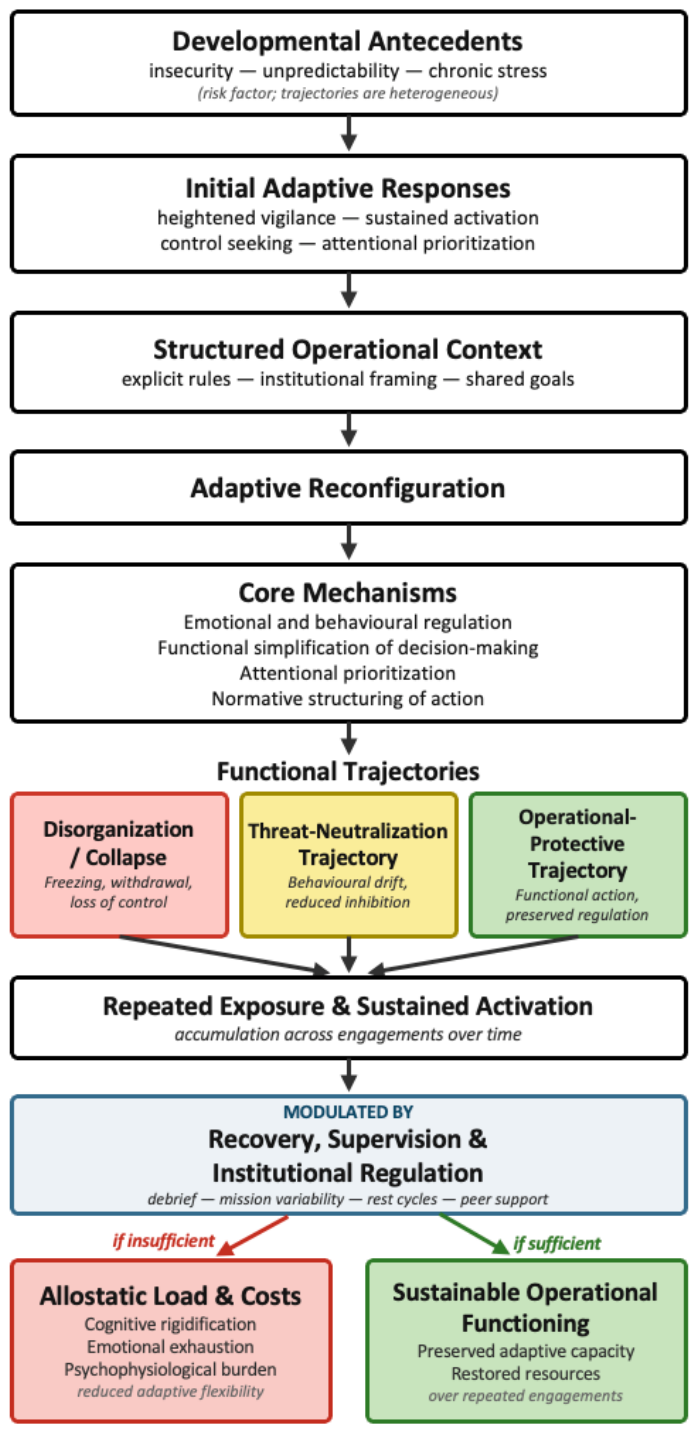
Figure 2.
Dynamic conceptual model of adaptive reconfiguration under extreme operational stress.
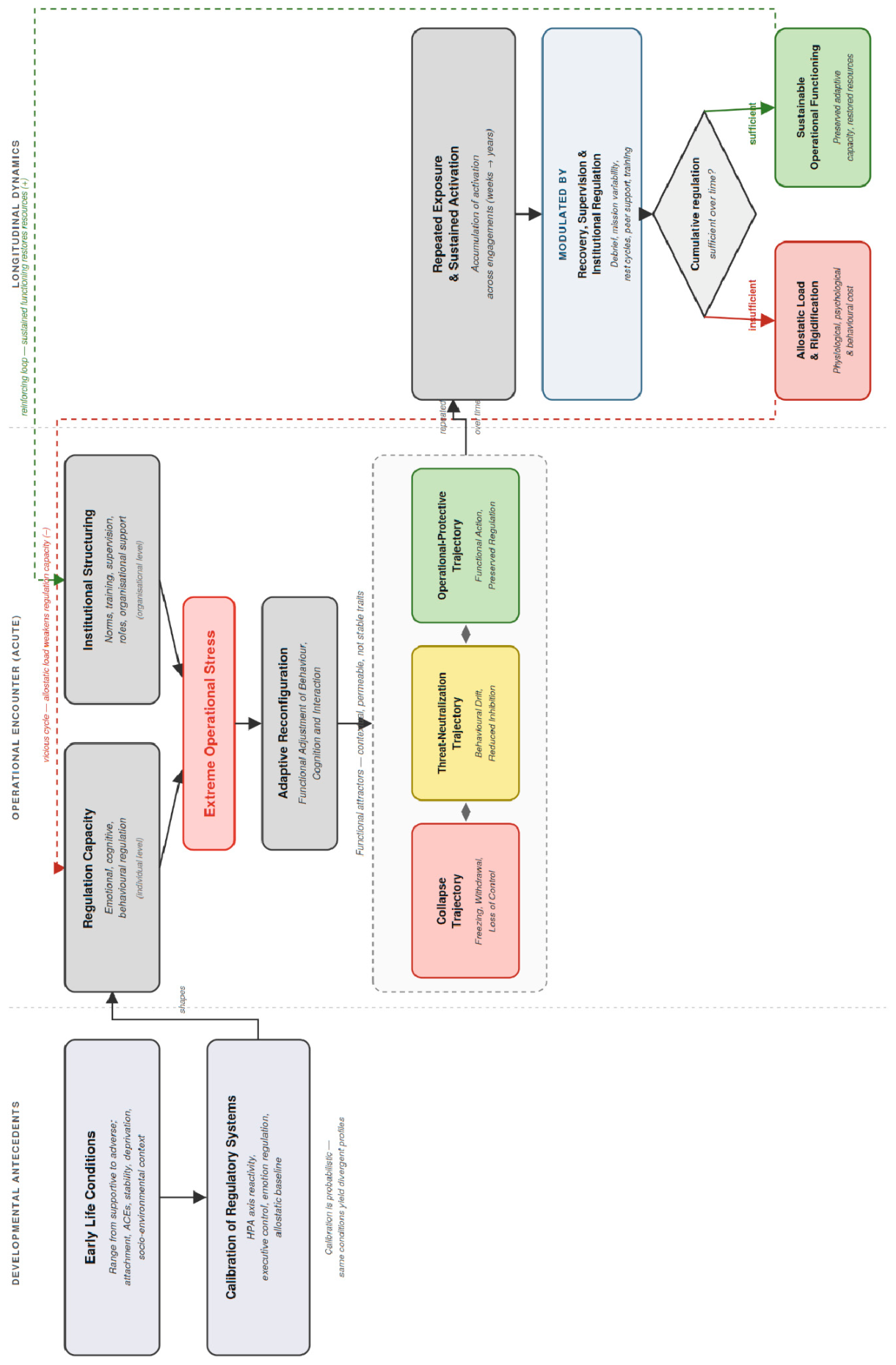

Table 1.
Functional trajectories under extreme operational stress.
| Dimension | Disorganization / Collapse | Threat-Neutralization Trajectory | Operational-Protective Trajectory |
| Emotional regulation | overwhelmed | partial / disinhibited | contained |
| Attention | fragmented | hyperfocused, rigid | prioritized, flexible |
| Inhibitory control | impaired | reduced | relatively preserved |
| Relationship to rules | normative breakdown | weak / instrumental | explicit / internalised |
| Dominant objective | immediate survival | rapid threat reduction | protected functional action |
| Integration of interpersonal and contextual information | relational disorganization | reduced integration | functional maintenance |
| Dependency on institutional structuring | low (overwhelmed regardless of framing) | moderate (drift increases under normative ambiguity) | high (sustained by clear normative framing) |
| Institutional compatibility | low | unstable; risk of normative drift | high |
| Main risks | withdrawal, disengagement | behavioural and ethical drift | chronic activation, rigidification |
| Transition risk (permeability) | prolonged withdrawal; possible shift to chronic dissociation | drift toward collapse if resources fail; stabilisation if framing tightens | drift toward neutralization under ambiguity; collapse under chronic load |
Table 2.
Comparison between existing approaches and the proposed framework.
| Framework | Primary focus | Main limitation addressed by the present model |
| Stress-performance models | Acute cognitive and neurophysiological effects of stress | Limited integration of developmental trajectories and contextual variability |
| Resilience models | Protective adaptive processes and positive adjustment | Limited focus on operational decision-making under extreme constraint |
| Trauma and adversity models | Long-term vulnerability associated with early adversity | Limited analysis of contextual functional reorganization |
| Adaptive Calibration Model | Developmental calibration of stress responsivity systems | Limited integration of institutional and operational structuring |
| Present framework | Functional trajectories under extreme operational stress | Integrative articulation of developmental, cognitive, emotional, and institutional dimensions |
Disclaimer/Publisher’s Note: The statements, opinions and data contained in all publications are solely those of the individual author(s) and contributor(s) and not of MDPI and/or the editor(s). MDPI and/or the editor(s) disclaim responsibility for any injury to people or property resulting from any ideas, methods, instructions or products referred to in the content. |
© 2026 by the authors. Licensee MDPI, Basel, Switzerland. This article is an open access article distributed under the terms and conditions of the Creative Commons Attribution (CC BY) license (http://creativecommons.org/licenses/by/4.0/).
Copyright: This open access article is published under a Creative Commons CC BY 4.0 license, which permit the free download, distribution, and reuse, provided that the author and preprint are cited in any reuse.


