
Submitted:
08 July 2026
Posted:
09 July 2026
You are already at the latest version
Abstract
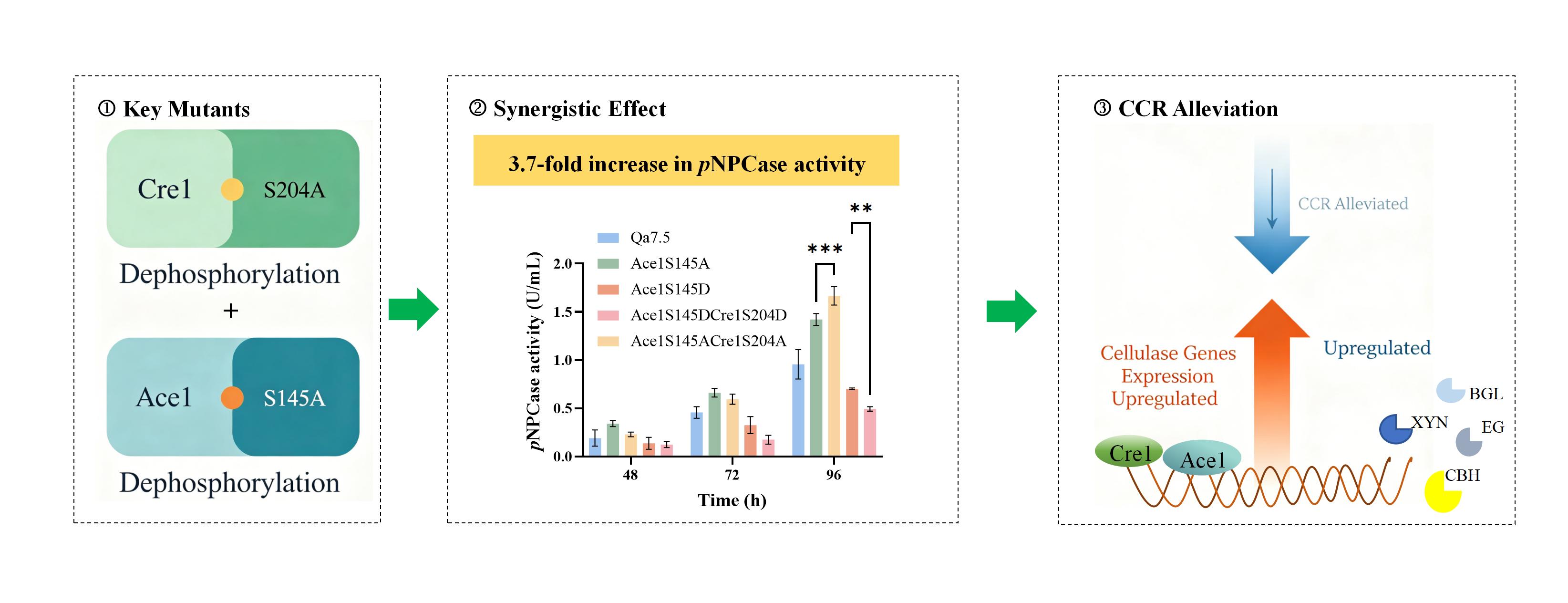
In the filamentous fungus Trichoderma reesei, cellulase production is strongly inhibited by carbon catabolite repression (CCR) mediated by Cre1 and Ace1, and phosphorylation is a crucial post-translational modification that regulates the activity of these two repressors. With the aim of finding approaches to reduce CCR, we used phosphoproteomics to identify two evolutionarily conserved phosphorylation sites, S204 and S145, in Cre1 and Ace1, respectively, and functionally validated their regulatory roles via site-directed mutagenesis. Functional assays revealed that phosphomimetic mutations, Cre1S204D and Ace1S145D, enhanced the repressive functions of Cre1 and Ace1, significantly reducing cellulase activity and down-regulating cellulase/hemicellulase gene transcription. In contrast, dephosphorylation-mimicking mutations, Cre1S204A and Ace1S145A, relieved carbon catabolite repression and promoted cellulase biosynthesis. Notably, the Cre1S204A/Ace1S145A double mutant exhibited synergistically enhanced cellulase activity (3.7-fold higher pNPCase activity than the parental strain), with significantly upregulated cellulase gene expression and increased extracellular cellobiohydrolase 1 accumulation. Mechanistically, Cre1 and Ace1 may regulate the cellulase gene expression in a phosphorylation-dependent manner. Overall, our findings identify Cre1 S204 and Ace1 S145 as functional phosphorylation sites that negatively regulate cellulase transcription, expand the post-translational regulatory network of fungal cellulase expression, and provide precise genetic targets for the rational design of high-efficiency fungi for lignocellulose bioconversion.
Keywords:
Trichoderma reesei
; cellulase
; carbon catabolite repression
; phosphorylation
; Cre1
; Ace1
; synergistic regulation
Copyright: This open access article is published under a Creative Commons CC BY 4.0 license, which permit the free download, distribution, and reuse, provided that the author and preprint are cited in any reuse.


