
Submitted:
07 July 2026
Posted:
09 July 2026
You are already at the latest version
Abstract
Despite growing adoption of home gardening and demonstrated economic and environmental advantages of distributed manufacturing, no previous study has systematically evaluated their combination. To address this gap, this study evaluates technical and economic feasibility of manufacturing essential gardening products using open-source distributed 3D printing. Twenty-five common open-source printable gardening designs were selected from Thingiverse, and organized into categories: hand tools, planting and seeding, water management, planters and vertical gardening, and storage and post-harvest products. For each product, the material and energy costs of manufacturing using a RepRap-class 3D printer were compared against the retail cost of commercially available equivalents in the Canadian market. The results found that open-source distributed manufacturing with 3D printing can provide substantial eco-nomic benefits for home gardening applications. All gardening products were less ex-pensive to print than to purchase as commercial equivalents. Average savings were 78.2%, which is sufficient to recover the cost of an entry-level 3D printer for single gardening kit. The repository-level analysis showed 3D printing gardeners had already saved >$2.5 million. Beyond direct cost reduction, 3D printing offers additional ad-vantages for gardeners, including local production, repairability, and customization for specific garden layouts or user needs all of which reduce waste and bolster sustainability.
Keywords:
distributed manufacturing
; additive manufacturing
; 3-D printing
; gardening
; open-source
; open hardware
1. Introduction
The open-source self-replicating rapid prototyper (RepRap) project [1], introduced by Bowyer and documented by Jones et al. [2] and Sells et al. [3], created an open-source self-replicating rapid prototyper, known as a fused filament fabrication (FFF) 3D printer, which was designed to produce a significant fraction of its own parts. Since then, open hardware innovation [4] led to advances in hardware reliability, software usability, print quality, and material availability, and have transformed additive manufacturing (AM) from an industrial prototyping technology into a practical consumer manufacturing platform [5,6]. Low-cost RepRap-class FFF printers are now widely accessible and capable of fabricating functional polymer products for household applications at relatively low cost [7]. This transition led to the emergence of distributed additive manufacturing [8,9], in which products are fabricated locally at or near the point of use rather than through centralized mass production and global value chains [10]. This new model became widespread during the COVID-19 pandemic [11].
Distributed manufacturing offers both environmental and economic advantages. A life cycle analysis study, which compared distributed manufacturing with open-source FFF 3D printers with conventional large-scale manufacturing in low-labor-cost countries followed by international shipping, showed that distributed manufacturing using polylactic acid (PLA) filament reduced total energy demand by 41–64% (55–74% with PV) for a range of polymer products, and at the same time lower associated emissions [12]. By reducing transportation requirements, packaging, warehousing, and supply-chain complexity, distributed additive manufacturing has the potential to substantially decrease the environmental impacts associated with consumer product manufacturing [12]. This early study has been supported by recent studies and reviews [13,14].
In parallel, previous economic analyses have demonstrated that household-scale distributed manufacturing can provide significant financial savings. Wittbrodt et al. [6] conducted a life cycle economic analysis of RepRap technology for a typical U.S. household and showed that annual savings from printing selected items ranged from approximately $300 to $2,000, with a simple payback period of four months to two years and a return on investment between 40% and 200%. Another research found that manufacturing common household items with open-source 3D printers returned investment more than 100% within five years relative to buying commercial equivalents [5]. Subsequent studies further demonstrated substantial savings for toys and games [15], adaptive aids for arthritis patients [16], scientific equipment, and medical devices during the COVID-19 pandemic [11,17]. All in all, these studies indicate that distributed manufacturing can provide economically viable alternatives to conventional consumer product supply chains.
Recent global economic conditions have further strengthened the potential interest in distributed manufacturing. The Russia–Ukraine conflict disrupted global grain, fertilizer, and energy markets, which contribute to increases in agricultural commodity prices and transportation costs [18,19]. Tariffs and trade barriers have also been shown to increase domestic prices by raising import costs and reducing supply-chain efficiency [20,21]. These pressures are reflected in global food prices [22].
These economic pressures have increased people's interest in household food production. In Canada, Mullins et al. found that 51% of survey respondents grew at least one fruit or vegetable at home, 17.4% of those gardeners began in 2020, and 66% of new gardeners reported that the COVID-19 pandemic influenced their decision to start producing food at home [23]. Demand for community gardening has also increased internationally. Bieri et al. reported rising interest in community gardens from 2018 to 2022 across cities in Switzerland, Germany, the United Kingdom, the United States, Canada, and New Zealand, including a 25% increase from 2020 to 2021 [24]. Together, these trends indicate a growing population of home and community gardeners who may benefit from low-cost, customizable, locally manufactured gardening tools.
FFF-based distributed manufacturing is especially suitable for gardening applications because of both the material properties and design flexibility of open-source 3D printing. PLA, the most commonly used FFF filament, is attractive for agricultural and gardening applications because it is derived from renewable plant-based feedstocks and is biodegradable and recyclable [25]. Compared with many petroleum-derived thermoplastics, PLA is easy to print and offers relatively low warping [26]. PLA has some practical limitations for permanent outdoor use, however. Under solar irradiation at wavelengths above 300 nm, PLA undergoes photooxidation through ester bond cleavage, which results in hydrolysis and degradation of the polymer [27]. Also, exposure to solar UV radiation leads to bond breakage and measurable loss of mechanical properties in PLA under controlled climatic conditions that simulate long-term outdoor exposure [28]. For garden tools that are meant to be used permanently outdoors, UV-stable materials such as acrylonitrile styrene acrylate (ASA) are therefore more appropriate. PLA is still suitable for tools that are stored indoors between uses, used seasonally, or kept in shaded positions.
Another important advantage of 3D-printed designs over commercial products is customizability. Unlike gardening products which are mass-manufactured and designed for generalized users, digital designs can be modified for ergonomic requirements, accessibility needs, specific planting geometries, or unique garden configurations without increasing manufacturing cost [16].
Studies demonstrated that open-source 3D printing can reduce costs in small-scale organic farming applications and showed the technical feasibility of manufacturing different types of agricultural tools using low-cost FFF printers [25]. The study also showed that the capital cost of a printer could be recovered either through fabrication of a single high-value scientific instrument or through replacing numerous lower-cost farm products over time [25]. Despite the growing adoption of home gardening and the advantages of distributed manufacturing, however, no previous study has evaluated the technical and economic viability of distributed additive manufacturing specifically for home gardening tools and accessories.
To address this gap, this work studies the technical and economic feasibility of manufacturing essential gardening products by open-source distributed 3D printing. Twenty-five commonly used gardening items were selected from Thingiverse, the largest repository of open-source printable designs, and organized into five categories: hand tools, planting and seeding, water management, planters and vertical gardening, and storage and post-harvest products. For each product, the material and energy costs of manufacturing with a RepRap-class FFF printer were calculated and compared against the retail cost of commercially available equivalents in the Canadian market. The results are presented and discussed in the context for the techno-economic potential of distributed manufacturing of small-scale agriculture.
2. Materials and Methods
2.1. Study design
This study used a comparative assessment to evaluate the feasibility of distributed manufacturing for common gardening products using FFF 3D printing. The method followed previous economic analyses that compared freely available open-source 3D printable designs with commercially available products with the same function [5,15]. The unit of analysis was defined as one printed product, or product set, that provided equivalent functionality to the corresponding commercial item. For each case, the filament, print time, electricity consumption, operating cost, cost savings, percentage savings, and economic impact from the number of downloads were calculated.
The analysis was performed from the perspective of a Canadian home gardener with access to a RepRap-class desktop FFF 3D printer. All costs are reported in Canadian dollars (CAD). Because all of the analyzed products were based on previously developed open-source designs, no design labor costs were included. User labor was also excluded (other than the trivial time to send the printjob to the printer after downloading). Since no commercial transaction occurred, sales tax was not included. Each product was assumed to be produced on site by the prosumer, so shipping costs were also excluded. Finally, failed prints were assumed to be zero because the products selected were mature designs and a reasonably tuned machine was assumed. Accordingly, the study focused on the manufacturing cost of each product and did not include user labor, taxes, shipping, or failed prints. These assumptions were used to provide a realistic comparison for garden consumers between the retail cost of proprietary mass-manufactured products and the distributed manufacturing cost of open-source 3D-printed alternatives.
2.2. Selection of Products
A list of gardening tools was prepared to identify products that could be manufactured using desktop FFF 3D printing. To define the product set, Thingiverse was searched using gardening-related keywords, including garden, gardening tool, planter, seed, seed spacer, watering, irrigation, hose, harvest, trowel, rake, and storage. Designs were included if they were freely available, printable on a desktop FFF printer, relevant to home or community gardening, primarily polymer-based, and functionally comparable to a commercially available product in the North American market. Designs were excluded if they required specialized non-printable components beyond simple hardware, lacked downloadable design files, were primarily decorative rather than functional, or did not have a clear commercial equivalent. The final sample included 25 products from five functional categories with five products in each category: hand tools, planting and seeding, water management, planters and vertical gardening, and storage and post-harvest products. The selected products (5 in each category) and their Thingiverse identification numbers are listed in Table 1. Also, representative rendered views of the designs are shown in Figure 1, Figure 2, Figure 3, Figure 4 and Figure 5.
2.3. Slicing and Manufacturing
The downloaded design files were imported into the open-source PrusaSlicer [55], to estimate the material requirement, which was reported as filament mass (m,) and print time (t) for each object. To have comparability across designs, a consistent slicing workflow was used for all products. The infill settings used for slicing are summarized in Table 2. When the original designer provided a numeric infill recommendation, that value was used in the slicing analysis. When no numeric infill recommendation was provided, a baseline infill of 15% was used.
When a functional product required multiple printed components or multiple units to match the commercial comparison, the total print mass and total print time were calculated by summing the values for all required printed parts.
PLA was used as reference material because it is widely available, low cost, and commonly used in consumer FFF 3D printing. The filament cost is represented in the equation as CF, and alternative filaments can be assessed by changing the filament price. As mentioned before, material selection is important for gardening applications. PLA is suitable for many indoor, seasonal, or shaded-use products, whereas more UV-stable materials, such as ASA, may be more appropriate for components intended for permanent outdoor exposure.
The electricity consumption for each print was estimated from the print time and the printer power consumption:
where E is the electricity consumed to print the product in kWh, P is the printer power consumption in kW, and t is the print time in hours. A printer power of 0.08 kW was used for the Prusa-class FFF printer model in the cost analysis [56]. Also, the electricity price was set to CAD$0.12/kWh, corresponding to the Ontario residential Tier 1 electricity rate [57].
E= Pt, [kWh]
2.4. Print Operating Cost
The operating cost of printing each item, O was calculated from the cost of filament and electricity:
where O is the operating cost of printing product in CAD$, m is the filament mass in grams, CF is the filament cost in CAD$/kg, E is the electricity consumption in kWh, and CE is the electricity cost in CAD$/kWh. The base-case filament cost was set to CAD$23.99/kg for PLA filament [58] (CAD$25.99/kg for ASA [59]). This value was selected to represent a current medium-cost Canadian PLA filament price.
2.5. Commercial Product Comparison
For each product, a commercially available equivalent was identified from Canadian retail websites. The commercial comparison was selected to match the function, approximate product type, and, where applicable, the number of units provided by the printable design. When an identical commercial product was not available, the closest functional equivalent was used. The commercial links and access dates are listed in the reference list. Shipping costs and taxes were excluded from the base comparison, to maintain a conservative estimate (e.g., free shipping for Amazon Prime customers).
2.6. Savings and Percentage Savings
The savings for each printed item were calculated as the difference between the commercial product cost and the 3D printing operating cost:
where S$ is the savings for product CAD$, Cc is the cost of the comparable commercial product in CAD$, and O is the 3D printing operating cost in CAD$.
The percentage savings were calculated as:
2.7. Repository Impact
To estimate the broader economic impact, the downloaded value was calculated for each design using number of repository download. The value generated by each design at time t, Vt, was calculated as:
Where Vt is value generated by the design at time, Nd is number of downloads, and p is fraction of downloads that result in an actual print. Considering previous studies [15,25], the base case assumed p=1, meaning that each download corresponded to one printed product. This assumption introduces uncertainty because not every download necessarily results in a print, while some downloaded designs may be printed multiple times or shared outside the repository. Therefore, the repository-level impact should be interpreted as an estimate of potential avoided purchase value rather than a directly measured economic transaction. The total repository impact for gardening applications across the 25 products was calculated by summing the values for all selected designs.
2.8. Gardening Kit and Sensitivity Analysis
The products were analyzed both individually and by functional category. For each category, the mean savings, standard deviation of savings, mean percentage savings, standard deviation of percentage savings, mean downloads, standard deviation of downloads, mean impact, and standard deviation of impact were calculated.
In addition to the item analysis, a gardening kit scenario was evaluated by summing the savings from printing one of each of the 25 selected products. This cumulative savings value was compared with the purchase price of an entry-level consumer FFF printer available in Canada.
Because electricity prices and filament prices vary by region, supplier, material, and time, sensitivity analysis was performed to evaluate the effect of filament price and electricity price. Two filament costs were considered: low-cost filament at CAD$ 14.7/kg and high filament at CAD$ 32.99/kg. Three electricity-costs were also considered: low electricity cost at CAD$ 0.08/kWh, average electricity cost at CAD$ 0.12/kWh, and high electricity cost at CAD$ 0.20/kWh. For each scenario, the total kit savings and mean savings per item were recalculated.
3. Results
The results for the 25 products are summarized in Table 2. As shown in Table 2, the total filament mass required to print one of each of the 25 selected products was 7577.06 g. The total material cost was CAD$181.77, and the total electricity cost was CAD$2.88, which resulted in a total print cost of CAD$184.65. In comparison, the total cost of the commercial equivalents was CAD$700.56. This leads to the printed products cost 26.4% of the commercial equivalents, which is equal to an overall cost reduction of 73.6%.
The average print cost was CAD$7.39 per product, compared with an average commercial cost of CAD$28.02 per product. The electricity cost was small compared with the material cost and was equal to only CAD$2.88 of the CAD$184.65 total printing cost. Therefore, the direct cost of printing was dominated by filament use rather than electricity consumption.
The lowest print cost was obtained for the garden sprinkler dripping nozzle at CAD$0.05. Other low-cost printed items included the small watering can at CAD$0.31, the garden seed sower at CAD$0.54, the garden tool holder at CAD$0.56, and the dandelion puller at CAD$0.61. The highest print cost was obtained for the modular hydroponics tower at CAD$100.54. Despite having the highest print cost, this item was still less expensive than its commercial equivalent.
Table 3 shows that all 25 products had savings compared with their commercial equivalents. The total saving from printing one of each product was CAD$515.91. The average saving was CAD$20.64 per product, with a sample standard deviation of CAD$13.98. The average percentage saving was 78.2% with a sample standard deviation of 20.54%.
The highest absolute saving was obtained for the stackable planter, which saved CAD$84.06. The next highest savings were obtained for the drying rack at CAD$47.45, Wallony Vertical Planters at CAD$41.84, the modular hydroponics tower at CAD$42.18, and the collapsible harvest basket at CAD$34.52. These products provided the largest direct economic benefit in the selected products.
The lowest absolute saving was obtained for the hand seed/bulb planter, which saved CAD$1.20. The Drip-irrigation fittings also had a relatively low saving of CAD$3.06. These items still showed positive savings, although their commercial equivalents were already relatively inexpensive. Because drip-irrigation fittings are generally purchased in multiple quantities, the total savings would increase proportionally with garden size.
The highest percentage saving was from the garden sprinkler dripping nozzle, at 99.5%. Other products with percentage savings above 95% included the garden tool holder, drying rack, small watering can, garden seed sower, and dandelion puller. The lowest percentage savings were obtained for the modular hydroponics tower at 28.1%, which was also the largest product to print, followed by drip-irrigation fittings at 34.1%, and the hand seed/bulb planter at 34.4%.
Table 3 also shows the estimated repository-level impact based on product savings and download counts. The 25 selected designs had a combined total of 147,649 downloads. The total estimated impact to date was CAD$2,589,779.84, with a mean estimated impact of CAD$103,591.19 per open-source design.
The highest estimated impact was obtained for Wallony Vertical Planters at CAD$464,019.36. Other high-impact products included the self-watering planter at CAD$383,332.46, the modular hydroponics tower at CAD$427,022.30, the small watering can at CAD$298,813.68, and the Triclaw Apple Picker at CAD$278,221.04.
The lowest estimated impacts were obtained for the hand seed/bulb planter at CAD$526.99 and the collapsible harvest basket at CAD$966.54. Although the collapsible harvest basket had a relatively high per-item saving, its estimated impact was limited by its low number of downloads.
As shown in Table 4, all five product categories had positive average savings. The planters and vertical gardening category had the highest average saving at CAD$39.65 per product. This was followed by storage and post-harvest products at CAD$26.03 per product. The planting and seeding category had an average saving of CAD$13.72, the hand-tools category had an average saving of CAD$12.62, and the water-management category had an average of CAD$11.16.
The storage and post-harvest category had the highest mean percentage saving at 83.75%, followed closely by hand tools at 83.47%. Water-management products had a mean percentage saving of 79.98%, planters and vertical-gardening products had a mean percentage saving of 74.71%, and planting and seeding products had a mean percentage saving of 69.01%.
These results from the categories show that the largest absolute savings were obtained from planters and vertical-gardening products, while the highest percentage savings were obtained from storage and post-harvest products and hand tools. This is most likely due to the nature of the tools. The more expensive tools represent a more specialized market that has not obtained mass-market scaled cost savings, while the latter is far more used and thus has reached mass manufacturing.
Table 4 also shows that planters and vertical-gardening products had the highest mean estimated impact at CAD$311,717.98. Water-management products had the second-highest mean impact at CAD$98,269.84. The remaining categories had lower mean impacts: CAD$68,200.43 for hand tools, CAD$20,664.91 for storage and post-harvest products, and CAD$19,102.80 for planting and seeding products.
Printing one of each of the 25 items results in a total saving of CAD$515.91. This amount can be directly compared to the cost of desktop fused filament fabrication (FFF) printers available in Canada. For example, a Creality Ender-3 V3 SE costs approximately $269 CAD ($303.97 CAD after 13% HST) [85]. After printing all 25 items, this leads to a net saving of $201.25 CAD. Therefore, a typical home gardener could easily recover the cost of a desktop 3D printer by fabricating only these 25 garden products. It should be pointed out that Thingiverse contains millions of designs, and numerous other open-source repositories are also available. Therefore, greater savings would be possible if other types of products are printed, which indicates that distributed manufacturing using open-source designs and desktop 3D printing has reached a highly favorable and valuable economic threshold.
To investigate this claim, Table 5 shows the sensitivity analysis for total garden kit savings under different electricity and filament cost scenarios. This analysis compares two filament-cost scenarios, CAD$14.7/kg [86] and CAD$32.99/kg [87], and three electricity-cost scenarios, CAD$0.08/kWh, CAD$0.12/kWh, and CAD$0.20/kWh.
At a low electricity cost of CAD$0.08/kWh, total kit savings reached CAD$587.26 when filament cost was CAD$14.7/kg and CAD$448.67 when filament cost was CAD$32.99/kg. These values translate to average savings of CAD$23.49 and CAD$17.95 per item, respectively.
With an average electricity cost of CAD$0.12/kWh, the total kit savings decreased to CAD$586.3 for CAD$14.7/kg filament and CAD$447.71 for CAD$32.99/kg filament. The corresponding average savings were CAD$23.45 and CAD$17.91 per item.
In the high electricity-cost scenario of CAD$0.20/kWh, the total kit savings decreased further to CAD$584.38 for CAD$14.7/kg filament and CAD$445.80 for CAD$32.99/kg filament. These values correspond to mean savings of CAD$23.38 and CAD$17.83 per item.
Across all scenarios, total kit savings remained positive and ranged from CAD$445.80 to CAD$587.26. The highest savings were obtained when low-cost filament was used, and electricity cost was low, although electricity had a very small impact. Even under the least favorable scenario, printing the complete gardening kit still saved more than CAD$400 compared with purchasing the commercial equivalents.

Table 6.
Results of manufacturing input cost sensitivity analysis.
| Electricity Cost Scenario | Filament: Low ($14.7/kg) | Filament: Average ($32.99/kg) | ||
| Total Kit Savings | Mean/Item | Total Kit Savings | Mean/Item | |
| Low ($0.08/kWh) | $587.26 | $23.49 | $448.67 | $17.95 |
| Average ($0.12/kWh) | $586.3 | $ 23.45 | $447.71 | $17.91 |
| High ($0.20/kWh) | $ 584.38 | $ 23.38 | $445.80 | $17.83 |
4. Discussion
The findings of this study show that open-source FFF 3D printing can be economically viable for home gardening applications. Previous studies have already shown that distributed manufacturing can reduce the cost of common household products, toys, games, adaptive aids, scientific tools, and small-farm equipment [5,6,15,16,25]. The present work studies gardening tools and accessories, which represent a practical product group because many of the items are polymer-based, relatively simple in geometry, and suitable for fabrication with low-cost desktop printers. This aligns with previous findings that AM offers economic advantages for low-volume production by eliminating tooling and inventory expenses [88].
4.1. Economic Value for Home Gardeners
From the perspective of an individual gardener, the most direct advantage is the reduction in the cost of purchasing the product. The results show that printing the complete set of selected gardening products can recover the cost of an entry-level FFF printer and still provide net savings. This aligns with prior research on home-manufacturing, which demonstrated that the economic benefit of a desktop 3D printer becomes stronger when the user prints multiple functional items rather than using the printer for a single product type [5,6,15]. This economic advantage is important for consumer products produced in small batches, because AM avoids the tooling requirements in conventional manufacturing [88].
This is important because a 3D printer is usually purchased as a capital item, while the savings are obtained gradually through avoided purchases. In the present case, however, the number of products required to recover the printer cost is relatively modest. A gardener does not need to print the entire product set to justify the printer cost, and the highest-saving items are sufficient to recover the after-tax cost of the printer. Therefore, for users who already garden regularly, an entry-level FFF printer can be considered a practical and valuable tool to reduce repeated purchases of gardening accessories.
The results also show that the products with the highest economic value are not always the smallest or fastest items to print. The highest absolute savings were generally obtained for products where the commercial alternative was relatively expensive compared with the amount of polymer required for printing. This aligns with the basic economic logic of AM, where product value is not determined only by material use but also by avoided tools, inventory, distribution, and retail costs [88]. This explains why planter systems, vertical-gardening products, drying racks, baskets, and tool holders were among the products that demonstrated significant cost-saving potential. In contrast, very small items often had lower dollar savings but very high percentage savings because their print costs were extremely low. For a single prosumer gardener, the number of products required in one category may be much greater than one. This is especially important to consider for products such as vertical planters, irrigation fittings, seed spacers, labels, or storage components, which may be used repeatedly across a larger garden or small farm. For example, a 100 × 100 ft area using repeated vertical-planter modules could require many copies of the same printed design, depending on crop spacing, layout, access paths, and planting density. Therefore, the savings from a single product category can scale substantially beyond the one-of-each-product kit which was analyzed initially. As shown in Figure 6, repeated printing of a single category can produce savings substantially larger than the one-of-each-product kit scenario. Printing 25 Wallony vertical planter sets would provide CAD$1054.50 in savings and require approximately 819 h of print time, while printing 50 sets would provide CAD$2109.00 in savings and require approximately 1638 h. This is illustrated in Figure 6. A 90-day winter printing period could produce approximately 66 sets on one continuously operating printer, which corresponds to CAD$2783.88 in savings. So, the long print times required for repeated gardening components do not cause any problem when production is planned during the off-season, when gardeners can prepare planters, irrigation components, and other accessories before the active growing season.
The sensitivity analysis further supports the economic impact of the approach. Savings remained positive under all tested filament and electricity cost scenarios. The stronger effect of filament cost compared with electricity cost aligns with the typical cost structure of FFF printing, where material consumption usually represents the dominant direct operating cost. This suggests that the economics can be improved by reducing unnecessary material use through appropriate slicing, lower infill where mechanically acceptable, efficient part orientation, and selection of lower-cost or recycled filament. Previous work on distributed recycling for AM has shown that recycled polymer feedstock can reduce material cost, and at the same time supports more circular material flows [89]. The potential for reduced material cost through locally produced or recycled filament is consistent with previous work on small-farm 3D printing and recyclebot-based filament production [25]. A recycled-filament operating-cost scenario further improves the economic case. Creality Filament Maker M1 and Shredder R1 system is a desktop filament-recycling workflow in which 3D-printing scrap is shredded, dried, extruded, cooled, and turned into new filament [90]. Creality reports an estimated recycled-filament production cost of approximately US$5 per roll [91]. Using an exchange rate of 1 US$ = 1.40 CAD$ [92], this corresponds to approximately CAD$7.00/kg. For the 25-product gardening kit analyzed here, which requires 7.577 kg of filament, the recycled-filament material cost would be CAD$53.04. Including the CAD$2.88 electricity cost for printing, the total print cost would decrease to approximately CAD$55.92 when compared with the CAD$700.56 cost of the commercial equivalents, which gives a total potential saving of CAD$644.64.
4.2. Open-source Design and Distributed Value Creation
The repository-impact analysis indicates that the value of open-source gardening designs is not limited to a single user. Once a digital design is made freely available, it can be reused, modified, and redistributed by many users with little additional cost. Kyriakou et al. have shown that open design communities support knowledge reuse, including reuse for customization and further design development [93]. This distributed value model follows the same general logic used in previous open-source manufacturing studies, where design downloads were used to estimate potential avoided purchase value [5,15,25].
Repository-impact values should be interpreted with caution, however. A download does not necessarily mean that a part was successfully printed. At the same time, a single download may lead to several prints, sharing the file outside the original repository, or modified versions of the design. For this reason, the calculated repository-level value should be viewed as a simple potential economic impact rather than a direct measurement of completed prints [5,15].
4.3. Sustainability and Local Production Implications
Distributed manufacturing of gardening products also has broader sustainability perspectives. A global sustainability analysis of 3D printing showed that its environmental and economic impacts depend on changes in material use, energy consumption, transportation, and production structure [94]. Previous study showed that DM can reduce energy demand and emissions for some polymer products by reducing transportation and other centralized supply-chain requirements [12]. Using gardening products is a relevant application area for this approach because many tools and accessories are small plastic items that can be produced locally and on demand.
Local production may also reduce unnecessary consumption. Instead of purchasing a full commercial kit, a multi-piece retail package, such as different types and sizes of drip-irrigation connectors, hose fittings, or planter accessories, when only one part is needed, a gardener can print the specific component required. AM has been identified as a useful approach for spare-part supply chains because of its ability to provide on-demand production [95]. For example, if a hose hanger cracks, a drip-irrigation fitting breaks, or a seed spacer is lost, the user can print only the damaged or missing component instead of purchasing a complete replacement product or kit. A case study on additively manufactured spare parts has also shown that appropriately designed AM spare-part strategies can align economic and environmental benefits [96]. These advantages are directly connected to the sustainability benefits of reduced transport, less packaging, repairability, and localized production [12].
The results also align with the increasing interest in food production at homes. Recent studies have shown that home and community gardening increased during and after the COVID-19 pandemic, including in Canada and other countries [23,24]. This trend increases interest in low-cost, locally produced gardening tools. If more households are growing food at home or participating in community gardening, then open-source gardening designs may provide a way to lower the entry cost for tools, planters, irrigation accessories, and storage items.
Customization is another sustainability-related advantage that cannot be fully captured by economic calculations. Commercial gardening products are usually designed for standard users and standard garden configurations. In contrast, open-source digital designs can be modified for different hand sizes, accessibility needs, seed spacing, raised beds, balcony gardens, hydroponic systems, or vertical gardens. AM has been identified as a useful and practical tool for circular and sustainable development because it can support customization, repair, upgrading, and design adaptation [97]. Previous work on adaptive aids has shown the importance of customization in distributed manufacturing, especially when commercial products do not meet individual needs [16]. For gardening, this flexibility may improve usability and reduce waste by allowing users to make products that match their specific applications.
4.4. Materials and Durability Limitations
Although the economic results are favorable, material selection remains a practical limitation. PLA is widely used in consumer FFF printing because it is accessible, printable, and available at relatively low cost [26]. It is also attractive in agricultural and gardening applications because it is bio-based and has been considered in previous small-farm 3D printing work [25]. PLA, however, is not suitable for every gardening application. Previous works have shown that PLA can degrade under UV exposure and controlled climatic aging, which results in reducing its mechanical performance over time [27,28]. This limitation is important because gardening tools may be exposed to sunlight, water, soil, temperature changes, and repeated mechanical loading. PLA may be suitable for indoor planters, seed organizers, temporary tools, shaded applications, or products stored indoors between uses. For products left outdoors permanently alternative materials such as ASA may be more appropriate [98]. To see whether this substitution changes the results, the calculation was repeated using ASA filament at CAD$25.99/kg. The product masses, print times, printer power, electricity price, and commercial comparison prices considered the same. For the 25 products, the total filament requirement was 7,577 g, which gives an ASA material cost of CAD$196.93. Including CAD$2.88 for printing electricity, the total ASA print cost would be CAD$199.81. Compared with the CAD$700.56 cost of the commercial equivalents, the total savings would remain positive at CAD$500.75.
Product lifetime was not measured in this study. Because of that, the economic results should be interpreted as a direct manufacturing-cost comparison rather than a complete life-cycle cost comparison. Real savings in the 3D printed product will be achieved only if it lasts long enough to replace the commercial alternative. For this reason, future work should evaluate durability under real gardening conditions, including outdoor exposure, repeated loading, contact with water and soil, and seasonal temperature changes.
4.5. Future Work
In future work, the most promising products from this study require experimental validation. The products with the highest savings and highest repository impact should be printed and tested under realistic gardening conditions. Hand tools and holders should be tested for mechanical strength. Also, planters and irrigation components should be tested for outdoor durability, water exposure, and functional performance. Irrigation parts should also be tested for leakage and pressure resistance.
Future work should also compare materials. PLA, PETG, ASA, recycled PLA, and other bio-based or recycled materials should be evaluated for cost, printability, strength, and outdoor durability. This is particularly important because gardening applications are closely connected to sustainability, but a material that is more sustainable may not be preferable if it fails quickly in outdoor applications. Previous work on plastic recycling in AM showed that recycled thermoplastics can support distributed recycling, but material quality and processing consistency remain important technical issues [99]. Recycled filament is especially important because it may reduce material cost and waste, but it must be tested for diameter consistency, print reliability, and mechanical performance. Open-source recyclebot work has also demonstrated the feasibility of turning waste plastic into 3D-printing filaments by using distributed recycling equipment [100].
5. Conclusions
This study demonstrates that open-source distributed manufacturing with FFF 3D printing can provide substantial economic benefits for home gardening applications. The 25 selected gardening products were all less expensive to print than to purchase as commercial equivalents. It leads to a total kit saving of CAD$515.91 and an average saving of 78.2%. These savings were sufficient to recover the cost of an entry-level FFF printer. The repository-level analysis also showed that based on current download data, open-source gardening designs can generate significant distributed value, with an estimated impact of more than CAD$2.5 million. Beyond direct cost reduction, 3D printing offers additional advantages for gardeners, including local production, repairability, and customization for specific garden layouts or user needs. All of these benefits directly improve sustainability of the food system by encouraging distributed production.
Author Contributions
Conceptualization, J.M.P.; methodology, M.M. and J.M.P. ; validation, M.M.; formal analysis, M.M. and J.M.P. ; investigation, M.M. and J.M.P.; resources, M.M. and J.M.P. ; data curation, M.M. and J.M.P. ; writing—original draft preparation, M.M. and J.M.P. ; writing—review and editing, M.M. and J.M.P. ; visualization, M.M.; funding acquisition, M.M. and J.M.P. All authors have read and agreed to the published version of the manuscript.
Funding
This research was funded by The Natural Sciences and Engineering Research Council of Canada and the Thompson Endowment.
Institutional Review Board Statement
Not applicable.
Data Availability Statement
Data is available upon request.
Acknowledgments
None.
Conflicts of Interest
The authors declare no conflicts of interest.
References
- Bowyer, A. 3D Printing and Humanity’s First Imperfect Replicator. 3D Print. Addit. Manuf. 2014, 1, 4–5. [Google Scholar] [CrossRef]
- Jones, R.; Haufe, P.; Sells, E.; Iravani, P.; Olliver, V.; Palmer, C.; Bowyer, A. RepRap – the Replicating Rapid Prototyper. Robotica 2011, 29, 177–191. [Google Scholar] [CrossRef]
- Sells, E.; Bailard, S.; Smith, Z.; Bowyer, A.; Olliver, V. RepRap: The Replicating Rapid Prototyper: Maximizing Customizability by Breeding the Means of Production. In Handbook of Research in Mass Customization and Personalization; World Scientific Publishing Company, 2009; pp. 568–580. ISBN 978-981-4280-25-9. [Google Scholar]
- Gibb, A. Building Open Source Hardware: DIY Manufacturing for Hackers and Makers; Addison-Wesley Professional, 2014; ISBN 978-0-13-337390-5. [Google Scholar]
- Petersen, E.E.; Pearce, J. Emergence of Home Manufacturing in the Developed World: Return on Investment for Open-Source 3-D Printers. Technologies 2017, 5, 7. [Google Scholar] [CrossRef]
- Wittbrodt, B.T.; Glover, A.G.; Laureto, J.; Anzalone, G.C.; Oppliger, D.; Irwin, J.L.; Pearce, J.M. Life-Cycle Economic Analysis of Distributed Manufacturing with Open-Source 3-D Printers. Mechatronics 2013, 23, 713–726. [Google Scholar] [CrossRef]
- Pearce, J.; Qian, J.-Y. Economic Impact of DIY Home Manufacturing of Consumer Products with Low-Cost 3D Printing from Free and Open Source Designs. Eur. J. Soc. Impact Circ. Econ. 2022, 3, 1–24. [Google Scholar] [CrossRef] [PubMed]
- Huang, R.; Riddle, M.E.; Graziano, D.; Das, S.; Nimbalkar, S.; Cresko, J.; Masanet, E. Environmental and Economic Implications of Distributed Additive Manufacturing: The Case of Injection Mold Tooling. J. Ind. Ecol. 2017, 21, S130–S143. [Google Scholar] [CrossRef]
- Katsigiannis, M.; Evans, M.; Osho, J.; Pantelidakis, M.; Bitencourt, J.; Mykoniatis, K. Empowering Decentralized Production: A Distributed Manufacturing System for Additive Manufacturing Processes. Manuf. Lett. 2024, 41, 1507–1514. [Google Scholar] [CrossRef]
- Laplume, A.O.; Petersen, B.; Pearce, J.M. Global Value Chains from a 3D Printing Perspective. J. Int. Bus. Stud. 2016, 47, 595–609. [Google Scholar] [CrossRef]
- Larrañeta, E.; Dominguez-Robles, J.; Lamprou, D.A. Additive Manufacturing Can Assist in the Fight Against COVID-19 and Other Pandemics and Impact on the Global Supply Chain. 3D Print. Addit. Manuf. 2020, 7, 100–103. [Google Scholar] [CrossRef] [PubMed]
- Kreiger, M.; Pearce, J.M. Environmental Life Cycle Analysis of Distributed Three-Dimensional Printing and Conventional Manufacturing of Polymer Products. ACS Sustain. Chem. Eng. 2013, 1, 1511–1519. [Google Scholar] [CrossRef]
- Saade, M.R.M.; Yahia, A.; Amor, B. How Has LCA Been Applied to 3D Printing? A Systematic Literature Review and Recommendations for Future Studies. J. Clean. Prod. 2020, 244, 118803. [Google Scholar] [CrossRef]
- Cerdas, F.; Juraschek, M.; Thiede, S.; Herrmann, C. Life Cycle Assessment of 3D Printed Products in a Distributed Manufacturing System. J. Ind. Ecol. 2017, 21, S80–S93. [Google Scholar] [CrossRef]
- Petersen, E.E.; Kidd, R.W.; Pearce, J.M. Impact of DIY Home Manufacturing with 3D Printing on the Toy and Game Market. Technologies 2017, 5, 45. [Google Scholar] [CrossRef]
- Gallup, N.; Bow, J.K.; Pearce, J.M. Economic Potential for Distributed Manufacturing of Adaptive Aids for Arthritis Patients in the U.S. Geriatrics 2018, 3, 89. [Google Scholar] [CrossRef] [PubMed]
- Tino, R.; Moore, R.; Antoline, S.; Ravi, P.; Wake, N.; Ionita, C.N.; Morris, J.M.; Decker, S.J.; Sheikh, A.; Rybicki, F.J.; et al. COVID-19 and the Role of 3D Printing in Medicine. 3D Print. Med. 2020, 6, 11. [Google Scholar] [CrossRef] [PubMed]
- OECD Impacts of the Russian Invasion of Ukraine on Financial Market Conditions and Resilience: Assessment of Global Financial Markets; OECD Publishing, 2022.
- Economic Shocks Triggered by the War: Assessing the Impact of Russia’s War against Ukraine on Eastern Partner Countries. Available online: https://www.oecd.org/en/publications/assessing-the-impact-of-russia-s-war-against-ukraine-on-eastern-partner-countries_946a936c-en/full-report/component-6.html (accessed on 19 May 2026).
- Economist, R.O. Chief WTO Blog | In a World of Trade Tensions, What Do Tariffs Really Do? Available online: https://www.wto.org/english/blogs_e/ce_ralph_ossa_e/blog_ro_11apr25_e.htm (accessed on 19 May 2026).
- Cuba-Borda, P.; Queralto, A.; Reyes-Heroles, R.; Scaramucci, M. How Do Trade Disruptions Affect Inflation? 2025. [Google Scholar] [CrossRef]
- FAO Food Price Index | Food and Agriculture Organization of the United Nations. Available online: https://www.fao.org/worldfoodsituation/foodpricesindex/en (accessed on 17 June 2026).
- Mullins, L.; Charlebois, S.; Finch, E.; Music, J. Home Food Gardening in Canada in Response to the COVID-19 Pandemic. Sustainability 2021, 13, 3056. [Google Scholar] [CrossRef]
- Bieri, D.; Joshi, N.; Wende, W.; Kleinschroth, F. Increasing Demand for Urban Community Gardening before, during and after the COVID-19 Pandemic. Urban For. Urban Green. 2024, 92, 128206. [Google Scholar] [CrossRef]
- Pearce, J.M. Applications of Open Source 3-D Printing on Small Farms. 2015. [Google Scholar] [CrossRef]
- Tümer, E.H.; Erbil, H.Y. Extrusion-Based 3D Printing Applications of PLA Composites: A Review. Coatings 2021, 11, 390. [Google Scholar] [CrossRef]
- Bocchini, S.; Fukushima, K.; Blasio, A.D.; Fina, A.; Frache, A.; Geobaldo, F. Polylactic Acid and Polylactic Acid-Based Nanocomposite Photooxidation. Biomacromolecules 2010, 11, 2919–2926. [Google Scholar] [CrossRef] [PubMed]
- Vašíček, A.; Lenfeld, P.; Běhálek, L. Degradation of Polylactic Acid Polymer and Biocomposites Exposed to Controlled Climatic Ageing: Mechanical and Thermal Properties and Structure. Polymers 2023, 15, 2977. [Google Scholar] [CrossRef] [PubMed]
- Thingiverse.com Customizable Garden Hand Shovel Trowel by Nother_Ngineer. Available online: https://www.thingiverse.com/thing:4778883 (accessed on 7 May 2026).
- Thingiverse.com Hand Rake by Jsc. Available online: https://www.thingiverse.com/thing:344273 (accessed on 7 May 2026).
- Thingiverse.com Soil Scoop with Sifter by Miles3D. Available online: https://www.thingiverse.com/thing:2985668 (accessed on 7 May 2026).
- Thingiverse.com Triclaw Apple Picker by YoungBuck. Available online: https://www.thingiverse.com/thing:146634 (accessed on 7 May 2026).
- Thingiverse.com Dandelion Puller by STIG_. Available online: https://www.thingiverse.com/thing:2862621 (accessed on 7 May 2026).
- Thingiverse.com Seed Spacer by Steve12487. Available online: https://www.thingiverse.com/thing:5391033 (accessed on 7 May 2026).
- Thingiverse.com Gardening Tool - Dibble/Dibber (Outil de Jardin - Plantoir) by Falchi. Available online: https://www.thingiverse.com/thing:4303457 (accessed on 7 May 2026).
- Thingiverse.com Garden Seed Sower by Hipejoe. Available online: https://www.thingiverse.com/thing:1363060 (accessed on 7 May 2026).
- Thingiverse.com Hand Seed/Bulb Planter by Zodvorak. Available online: https://www.thingiverse.com/thing:577433 (accessed on 7 May 2026).
- Thingiverse.com Newspaper Pot Maker by Jridley. Available online: https://www.thingiverse.com/thing:18240 (accessed on 8 May 2026).
- Thingiverse.com Small Watering Can by Shmeeed. Available online: https://www.thingiverse.com/thing:1931480 (accessed on 7 May 2026).
- Thingiverse.com 16mm Pipe Elbow 90 by Azzw. Available online: https://www.thingiverse.com/thing:6639697 (accessed on 7 May 2026).
- Thingiverse.com Drip Irrigation System - Rain Bird (R) / Gardena Microdrip (R) Compatible by Guppyk. Available online: https://www.thingiverse.com/thing:6625825 (accessed on 7 May 2026).
- Thingiverse.com Garden Sprinkler Dripping Nozzle by Azambori. Available online: https://www.thingiverse.com/thing:4348902 (accessed on 7 May 2026).
- Thingiverse.com Garden Hose Spray Nozzle with Trigger (Print-in-Place) by Jbramel. Available online: https://www.thingiverse.com/thing:2518714 (accessed on 7 May 2026).
- Thingiverse.com Automatic Plant Water-Er - Self Watering Plant Bulb by JohnnyVF. Available online: https://www.thingiverse.com/thing:1258490 (accessed on 7 May 2026).
- Thingiverse.com Modular Hydroponics Tower: Ebb & Flow by Beadsworth. Available online: https://www.thingiverse.com/thing:3863771 (accessed on 7 May 2026).
- Thingiverse.com Self-Watering Planter 3 by O3D. Available online: https://www.thingiverse.com/thing:2377227 (accessed on 7 May 2026).
- Thingiverse.com Stackable Planter by Cleven. Available online: https://www.thingiverse.com/thing:314609 (accessed on 7 May 2026).
- Thingiverse.com Wallony Vertical Planters by UptonAK. Available online: https://www.thingiverse.com/thing:1716323 (accessed on 7 May 2026).
- Thingiverse.com Moss Pole by Wivry. Available online: https://www.thingiverse.com/thing:4825472 (accessed on 7 May 2026).
- Thingiverse.com Plant Seed Storage Box (Loose Seeds) / Aufbewahrungsbox Für Pflanzensamen (Lose Samen) by Oftech. Available online: https://www.thingiverse.com/thing:4887471 (accessed on 7 May 2026).
- Thingiverse.com Garden Hose Hanger by Mishkin2. Available online: https://www.thingiverse.com/thing:5136438 (accessed on 7 May 2026).
- Thingiverse.com Collapsible Basket by NTwoO. Available online: https://www.thingiverse.com/thing:6742580 (accessed on 7 May 2026).
- Thingiverse.com (Garden) Tool Holder by Luzi. Available online: https://www.thingiverse.com/thing:2191196 (accessed on 7 May 2026).
- Thingiverse.com Drying Rack by Autointoxication. Available online: https://www.thingiverse.com/thing:2977445 (accessed on 7 May 2026).
- PrusaSlicer. Available online: https://www.prusa3d.com/p/prusaslicer/ (accessed on 21 May 2026).
- FAQ - Frequently Asked Questions | Prusa Knowledge Base. Available online: https://help.prusa3d.com/article/faq-frequently-asked-questions_1932 (accessed on 26 March 2026).
- Ontario Energy Board Announces Changes to Electricity Prices for Households, Small Businesses and Farms | Ontario Energy Board. Available online: https://www.oeb.ca/newsroom/2025/ontario-energy-board-announces-changes-electricity-prices-households-small-businesses (accessed on 26 March 2026).
- ELEGOO PLA+ Filament - High-Strength, Odorless 3D Printing. Available online: https://www.amazon.ca/ELEGOO-Filament-Dimensional-Accuracy-Compatible/dp/B0BM979TLQ/ref=sr_1_28 (accessed on 16 June 2026).
- OVERTURE ASA Filament 1.75mm, 1kg Spool (2.2lbs) 3D Printer Filament, Premium Anti-UV, Filament Perfect for Printing Outdoor Functional Parts, Dimensional Accuracy +/- 0.02 Mm (ASA Black) : Amazon.ca: Industrial & Scientific. Available online: https://www.amazon.ca/OVERTURE-Filament-Printing-Functional-Dimensional/dp/B0CPXJ5RT5/ref=sr_1_2_sspa (accessed on 17 June 2026).
- Anvil Trowel. Available online: https://www.homedepot.ca/product/anvil-trowel/1001183910 (accessed on 7 May 2026).
- WORKPRO 11.5" Handle Weeder Puller Tool – Durable Stainless Steel Weeder Puller Tool, Garden Weed Remover & Weed Puller, Lightweight & Ergonomic Garden Tool for Lawn, Transplant & Weeding : Amazon.ca: Patio, Lawn & Garden. Available online: https://www.amazon.ca/dp/B0CNJPQTZ6 (accessed on 7 May 2026).
- Gardening Hand Rake, Small Garden Stainless Steel Hand Tiller, Ergonomic Handle Rake Garden Tools for Dead Leaf, Cultivating, Loosening, Perfect for Maintaining a Raised Garden (Black) : Amazon.ca: Patio, Lawn & Garden. Available online: https://www.amazon.ca/Gardening-Hand-Rake-Cultivating-Maintaining/dp/B0F219HSKY/ref=asc_df_B0F219HSKY (accessed on 7 May 2026).
- Fruit Picker - Lee Valley Tools. Available online: https://www.leevalley.com/en-ca/shop/garden/garden-care/harvesting-tools/10165-fruit-picker (accessed on 7 May 2026).
- Bestevery Multifunctional Garden Scoop Soil Plastic Hand Shovel Spoons Digging Tool Cultivation Planting Scoop Gardening Tool for Compost Moving, Planting, Potting, Scooping Pet Bird Food : Amazon.ca: Patio, Lawn & Garden. Available online: https://www.amazon.ca/Bestevery-Multifunctional-Cultivation-Planting-Gardening/dp/B088NQDGYX/ref=asc_df_B088NQDGYX (accessed on 7 May 2026).
- Seeding Square Seed & Seedling Spacer Tool. Available online: https://www.amazon.ca/Seeding-Square-Color-coded-Optimizing-Organizing/dp/B00US8ESWK/ref=asc_df_B00US8ESWK (accessed on 7 May 2026).
- Milifox Seed Planter Tool, 6.9" Bulb Planter Tool, Plastic Dibber Garden Tools for Planting, Seed Dibber, Sow Dibbler with Handle for Sowing Seeds, Planting, Bulbs, Digging (Green) : Amazon.ca: Patio, Lawn & Garden. Available online: https://www.amazon.ca/Milifox-inch-Bulb-Planter-Tool/dp/B0CQF84QMQ/ref=asc_df_B0CQF84QMQ (accessed on 7 May 2026).
- Mini Seed Dispenser Pen, Seeding Aid for Gardening, 2 Pieces, for Bowls and Flower Pots : Amazon.ca: Patio, Lawn & Garden. Available online: https://www.amazon.ca/Dispenser-Dosing-Seeding-Control-Gardening/dp/B0CP18RZB9/ref=sr_1_4_sspa (accessed on 7 May 2026).
- Potmaker - Lee Valley Tools. Available online: https://www.leevalley.com/en-ca/shop/garden/planting/seed-starting/10566-potmaker (accessed on 8 May 2026).
- Hand Bulb Planter | Canadian Tire. Available online: https://www.canadiantire.ca/en/pdp/hand-bulb-planter-0598201p.html (accessed on 7 May 2026).
- Small Watering Can for Indoor Plants, 12oz/350ml Rustproof 304 Stainless Steel Plant Watering Can with Long Mouth and Handle for House Plants, Mini Watering Pot (Black) : Amazon.ca: Patio, Lawn & Garden. Available online: https://www.amazon.ca/Watering-Indoor-Plants-Rustproof-Stainless/dp/B0F2FM4TLX/ref=asc_df_B0F2FM4TLX (accessed on 7 May 2026).
- Gardrip Drip Irrigation Fittings Kit:125 Pieces Drip Irrigation Parts for 1/4" Drip Irrigation Tubing 1/4 Inch Barbed Connectors for Garden Drip System 70 Couplings 30 Tees 15 Elbows 10 End Cap : Amazon.ca: Patio, Lawn & Garden. Available online: https://www.amazon.ca/Drippro-Pack-Drip-Irrigation-Fittings/dp/B09PRDDSM3/ref=sr_1_18 (accessed on 7 May 2026).
- Plastic Mist Nozzle Sprinkler Tee Joints Spray Heads for Misting Watering Plant Flower Cooling System Home Garden Irrigation, 20pcs (Black) : Amazon.ca: Patio, Lawn & Garden. Available online: https://www.amazon.ca/Plastic-Sprinkler-Misting-Watering-Irrigation/dp/B07HCGP13M/ref=sr_1_4 (accessed on 7 May 2026).
- Garden Club Metal Adjustable Rear-Trigger Garden Water Hose Pistol Nozzle | Canadian Tire. Available online: https://www.canadiantire.ca/en/pdp/garden-club-metal-adjustable-rear-trigger-garden-water-hose-pistol-nozzle-0594342p.html (accessed on 7 May 2026).
- Plant Watering Globes Set of 2 - Large Multicolored Automatic Plant Watering Devices Glass Bulbs - Plant Waterer for Daily Use, Indoor & Outdoor : Amazon.ca: Patio, Lawn & Garden. Available online: https://www.amazon.ca/Miles-Kimball-Multicolored-Watering-Globes-Each/dp/B0D3QH4M2C/ref=sxin_15_sbv_search_btf (accessed on 7 May 2026).
- MYG Plant Pot Self Watering Garden Planter Small Flowerpot African Violet Pots. Available online: https://www.walmart.ca/en/ip/MYG-Plant-Pot-Self-Watering-Garden-Planter-Small-Flowerpot-African-Violet-Pots/69A0S8AP6C0L (accessed on 7 May 2026).
- 30 Pods Hydroponics Tower Garden Hydroponic Growing System Aeroponics Growing Kit for Herbs, Fruits and Vegetables with Hydrating Pump, Adapter, Net Pots, Timer for Herbs, Fruits and Vegetables : Amazon.ca: Patio, Lawn & Garden. Available online: https://www.amazon.ca/dp/B0F388YZHF/ref=sspa_dk_detail_1 (accessed on 7 May 2026).
- Vertical Planter 4 Tier Stackable Planters Garden Planters,Vertical Gardening Planter Garden Planter,Strawberry Flower and Vegetable Planter Indoor Outdoor Gardening Pots : Amazon.ca: Patio, Lawn & Garden. Available online: https://www.amazon.ca/Vertical-Stackable-Gardening-Strawberry-Vegetable/dp/B0CZ4FKNNR/ref=asc_df_B0CZ4FKNNR (accessed on 7 May 2026).
- Bamworld 2 Pack Moss Pole 16.5 Inch Monstera Plant Support Coir Totem Stakes for Indoor Plant Support to Grow Upwards : Amazon.ca: Patio, Lawn & Garden. Available online: https://www.amazon.ca/Bamworld-Monstera-Support-Stakes-Upwards/dp/B0FNVTYF33/ref=sr_1_4_sspa (accessed on 7 May 2026).
- Mr. Stacky 5-Tier Stackable Vertical Gardening Planter. Available online: https://www.amazon.ca/Stackable-Strawberry-Flower-Vegetable-Planter/dp/B007TFTWKS/ref=asc_df_B007TFTW3U (accessed on 7 May 2026).
- Seed Storage Organizer Box, 16 Slots Seed Saving Box Seed Organizer with Foam Insert Wood Storage Container Case for Flower Plants Garden : Amazon.ca: Home. Available online: https://www.amazon.ca/Storage-Organizer-Saving-Insert-Container/dp/B0FMK8PKG6/ref=asc_df_B0FMK8PKG6 (accessed on 7 May 2026).
- Herb. Cedilis Set of 2 Stackable Wood Pasta Herb Drying Rack, Food Dryer Stand with Net for Drying Seeds. Amazon.ca: Home: Bud; Available online: https://www.amazon.ca/Cedilis-Stackable-Pasta-Drying-Dryer/dp/B0BB7ZDJ28/ref=sr_1 (accessed on 7 May 2026).
- Garden Club Steel Garden Hose Holder/Hanger, 125-Ft | Canadian Tire. Available online: https://www.canadiantire.ca/en/pdp/garden-club-steel-garden-hose-holder-hanger-125-ft-0593441p.html (accessed on 7 May 2026).
- Fiskars Fiskars Garden Harvest Basket. Available online: https://www.homedepot.ca/product/fiskars-fiskars-garden-harvest-basket/1001602547 (accessed on 7 May 2026).
- Yardworks 4-in-1 Storage Hose Hanger | Canadian Tire. Available online: https://www.canadiantire.ca/en/pdp/yardworks-4-in-1-storage-hose-hanger-0590824p.html (accessed on 7 May 2026).
- Ender-3 V3 SE 3D Printer. Available online: https://store.creality.com/ca/products/ender-3-v3-se-3d-printer (accessed on 12 May 2026).
- OVERTURE PLA Filament - Smooth, Consistent 3D Printing. Available online: https://www.amazon.ca/OVERTURE-Filament-Consumables-Dimensional-Accuracy/dp/B07PFSFFZZ/ref=sr_1_52_sspa (accessed on 16 June 2026).
- OVERTURE PLA Plus (PLA+) Filament 1.75mm, Stronger & More Durable, Professional Toughness 3D Printer Filament 1kg (2.2lbs), High Precision +/- 0.02mm; Amazon.ca: Industrial & Scientific: Tangle-Free (Green); Available online: https://www.amazon.ca/gp/aw/d/B07VJ13R5R (accessed on 16 June 2026).
- Weller, C.; Kleer, R.; Piller, F.T. Economic Implications of 3D Printing: Market Structure Models in Light of Additive Manufacturing Revisited. Int. J. Prod. Econ. 2015, 164, 43–56. [Google Scholar] [CrossRef]
- Zhong, S.; Pearce, J.M. Tightening the Loop on the Circular Economy: Coupled Distributed Recycling and Manufacturing with Recyclebot and RepRap 3-D Printing. Resour. Conserv. Recycl. 2018, 128, 48–58. [Google Scholar] [CrossRef]
- Creality Filament Maker M1 & Shredder R1. Available online: https://crowdfunding.creality.com/ (accessed on 17 June 2026).
- Shaikhnag, A. From Scrap to Spool: Creality’s M1 and R1 Bring Filament Recycling to the Desktop. In 3D Print. Ind.; 2026. [Google Scholar]
- Currency Converter. Available online: https://www.bankofcanada.ca/rates/exchange/currency-converter/ (accessed on 17 June 2026).
- Kyriakou, H.; Nickerson, J.V.; Sabnis, G. Knowledge Reuse for Customization: Metamodels in an Open Design Community for 3d Printing1. [CrossRef] [PubMed]
- Gebler, M.; Schoot Uiterkamp, A.J.M.; Visser, C. A Global Sustainability Perspective on 3D Printing Technologies. Energy Policy 2014, 74, 158–167. [Google Scholar] [CrossRef]
- Khajavi, S.H.; Partanen, J.; Holmström, J. Additive Manufacturing in the Spare Parts Supply Chain. Comput. Ind. 2014, 65, 50–63. [Google Scholar] [CrossRef]
- Isasi-Sanchez, L.; Morcillo-Bellido, J.; Ortiz-Gonzalez, J.I.; Duran-Heras, A. Synergic Sustainability Implications of Additive Manufacturing in Automotive Spare Parts: A Case Analysis. Sustainability 2020, 12, 8461. [Google Scholar] [CrossRef]
- Sauerwein, M.; Doubrovski, E.; Balkenende, R.; Bakker, C. Exploring the Potential of Additive Manufacturing for Product Design in a Circular Economy. J. Clean. Prod. 2019, 226, 1138–1149. [Google Scholar] [CrossRef]
- Gawali, S.K.; Jain, P.K. Effect of Natural Weathering Conditioning on the Mechanical and Surface Performance of Additively Manufactured Acrylonitrile Styrene Acrylate (ASA) Components. Arab. J. Sci. Eng. 2026. [Google Scholar] [CrossRef]
- Cruz Sanchez, F.A.; Boudaoud, H.; Camargo, M.; Pearce, J.M. Plastic Recycling in Additive Manufacturing: A Systematic Literature Review and Opportunities for the Circular Economy. J. Clean. Prod. 2020, 264, 121602. [Google Scholar] [CrossRef]
- Woern, A.L.; McCaslin, J.R.; Pringle, A.M.; Pearce, J.M. RepRapable Recyclebot: Open Source 3-D Printable Extruder for Converting Plastic to 3-D Printing Filament. HardwareX 2018, 4. [Google Scholar] [CrossRef]
Figure 1.
a) Customizable Garden Hand Shovel Trowel [29], b) Hand rake [30], c) Garden soil scoop [31], d) Triclaw Apple Picker [32], and e) Dandelion Puller/ Hand Weeder [33].
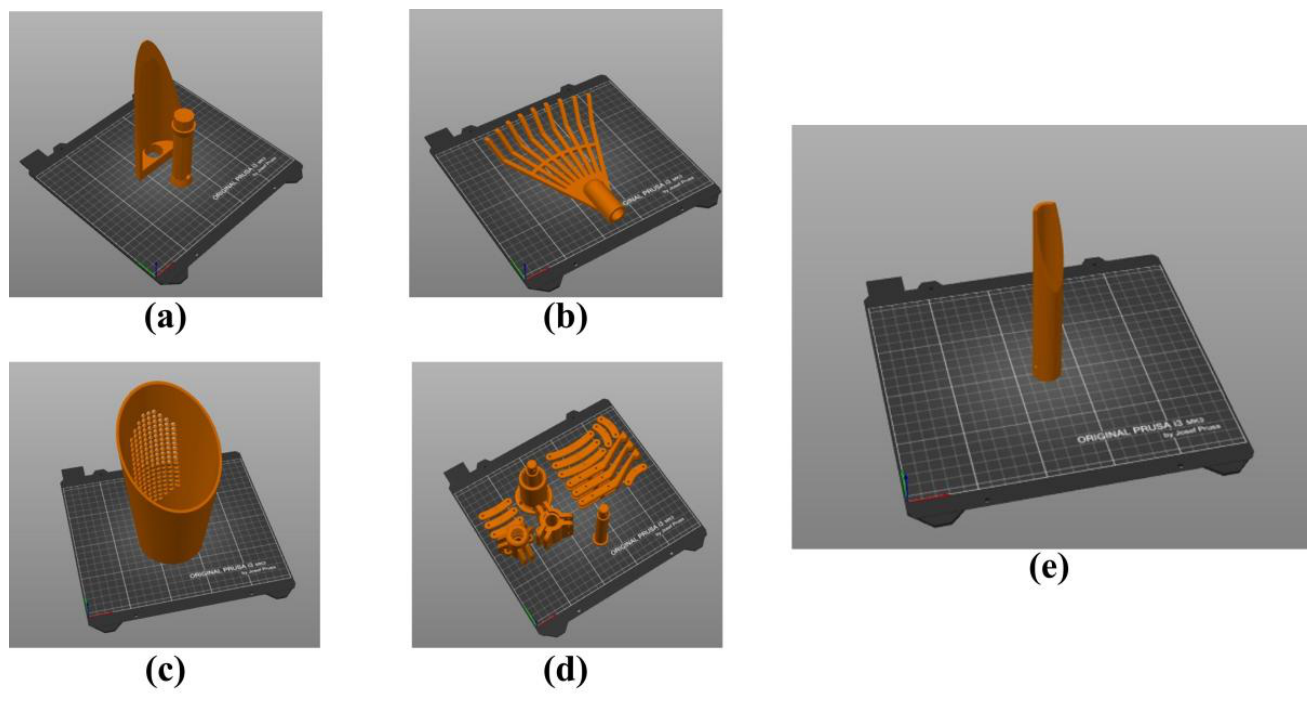
Figure 2.
a) Seed spacer [34], b) Dibber planting tool [35], c) Garden Seed Sower [36], d) Hand Seed/ Bulb Planter [37], and e) Newspaper Pot Maker [38].
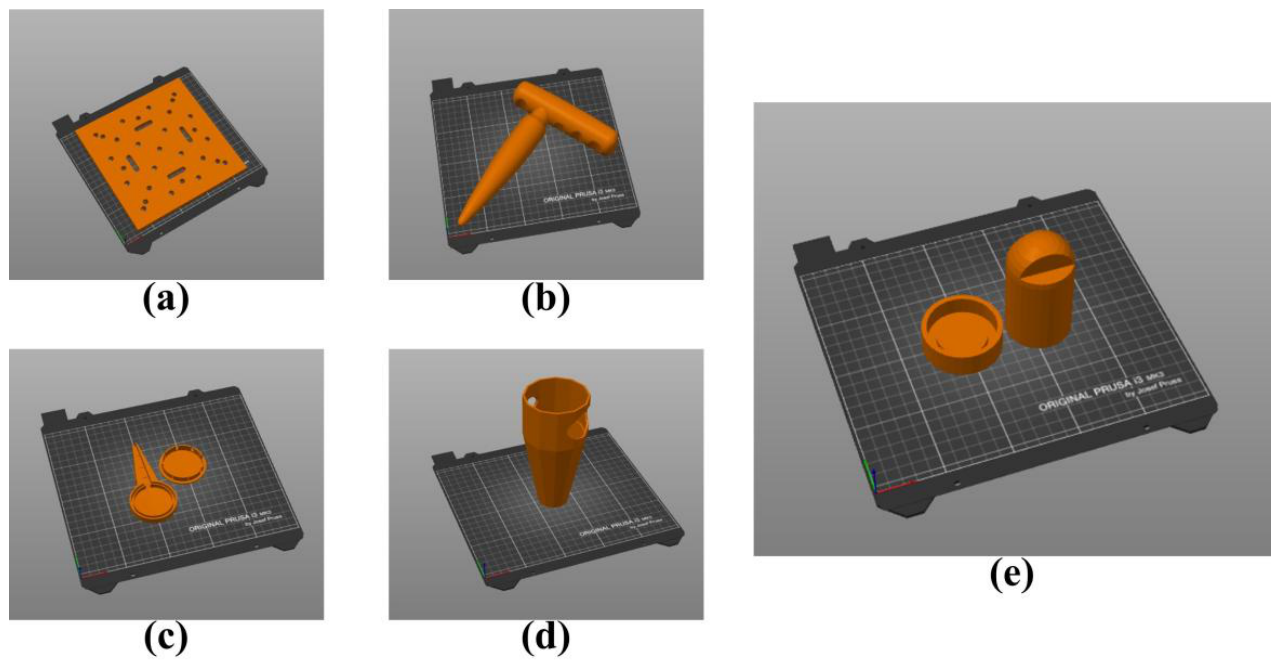
Figure 3.
a) Watering Can [39], b) and c) Drip irrigation fittings [40,41], d) Garden sprinkler dripping nozzle [42], e) Garden Hose Spray Nozzle [43], and f) Automatic Plant Water-er [44].
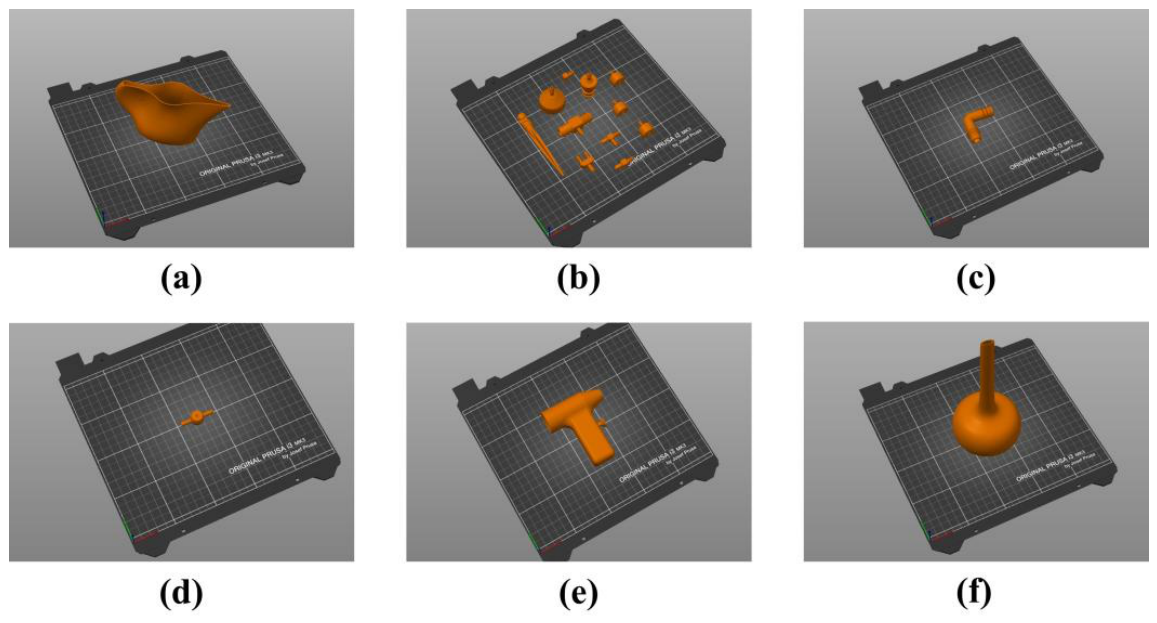
Figure 4.
a) Modular Hydroponics Tower [45], b) Self-watering Planter [46], c) Stackable planter [47], d) Wallony Vertical Planters [48], and e) Moss pole [49].
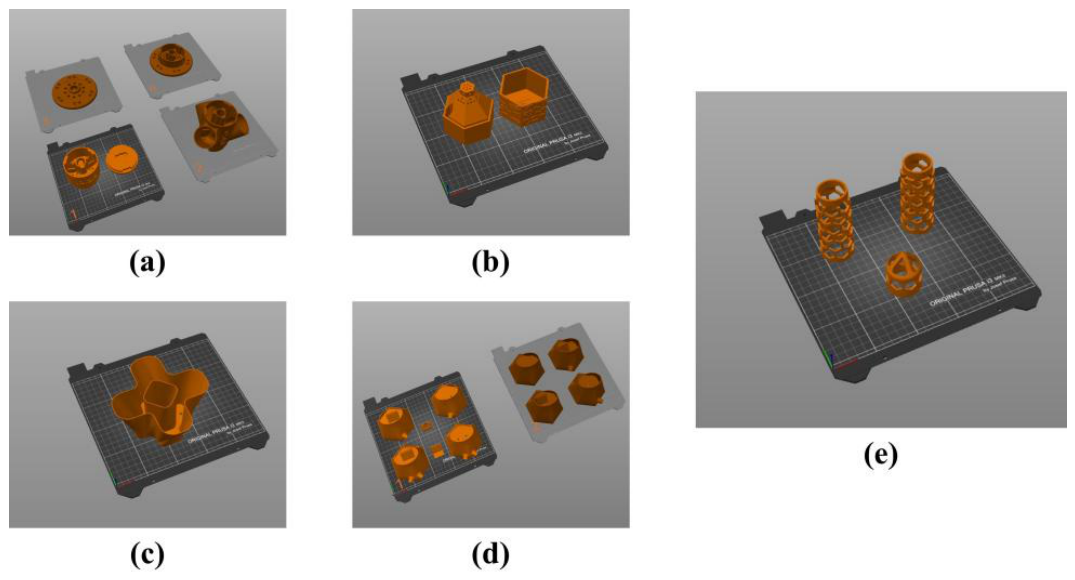
Figure 5.
a) Plant seed storage box [50], b) Garden Hose Hanger [51], c) Collapsible basket [52], d) Garden Tool Holder [53], and e) Drying rack [54].
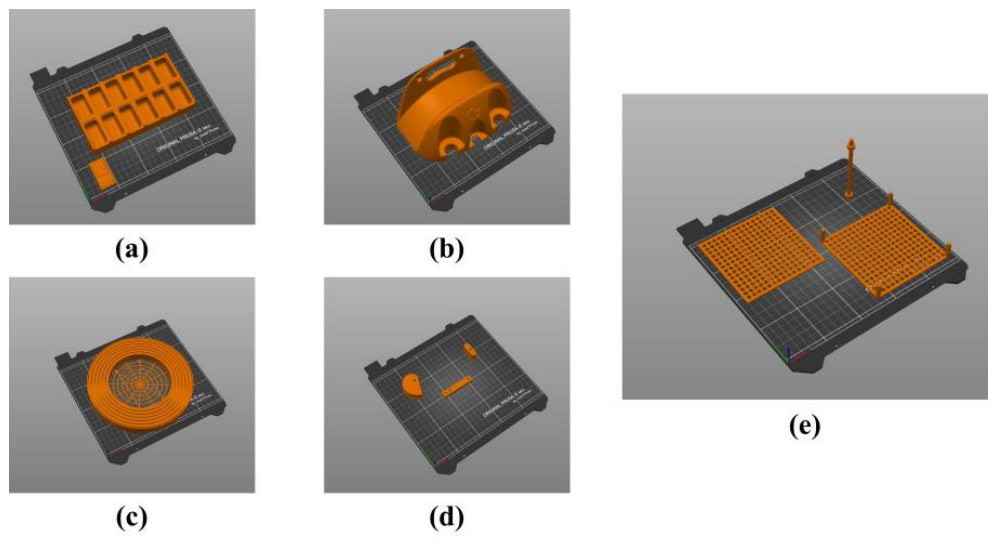
Figure 6.
Vertical planter scaling scenario.
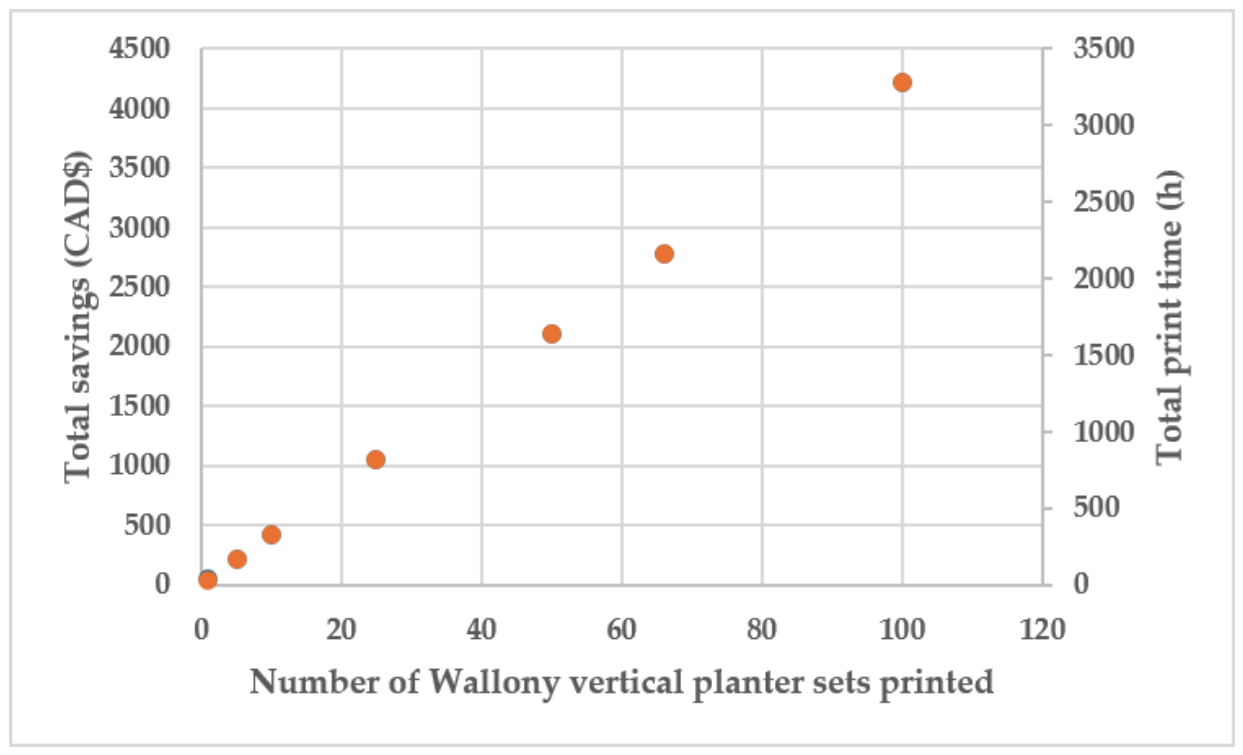
Table 1.
Selected and categorized 3-D printable objects with design number for Thingiverse.
| Hand tools | Planting & Seeding | Water Management | Planters & Vertical Gardening | Storage & Post-Harvest |
| Customizable Garden Hand Shovel Trowel (Thing: 4778883) |
Seed spacer (Thing: 5391033) |
Watering Can (Thing: 1931480) |
Self-watering Planter (Thing: 2377227) |
Plant seed storage box (Thing: 4887471) |
| Hand rake (Thing: 344273) |
Dibber planting tool (Thing: 4303457) |
Drip irrigation fittings (Things: 6639697, 6625825) |
Stackable planter (Thing: 314609) |
Drying rack (Thing: 2977445) |
| Garden soil scoop (Thing: 2985668) |
Garden Seed Sower (Thing: 1363060) |
Garden sprinkler dripping nozzle (Thing: 4348902) |
Modular Hydroponics Tower (Thing: 3863771) |
Garden Hose Hanger (Thing: 5136438) |
| Dandelion Puller / Hand Weeder (Thing: 2862621) | Newspaper Pot Maker (Thing: 18240) | Garden Hose Spray Nozzle (Thing: 2518714) |
Wallony Vertical Planters (Thing: 1716323) |
Collapsible basket (Thing: 6742580) |
| Triclaw Apple Picker (Thing: 146634) |
Hand Seed/Bulb Planter (Thing: 577433) |
Automatic Plant Water-er (Thing: 1258490) |
Moss pole (Thing: 4825472) |
Garden Tool Holder (Thing: 2191196) |
Table 2.
Infill settings used for slicing the open-source gardening products.
| Item | Infill | Item | Infill | Item | Infill | Item | Infill | Item | Infill |
| Customizable Garden Hand Shovel Trowel | 25 | Seed spacer | 15 | Watering Can | 15%* | Self-watering Planter | 50% (100% reservoir) | Plant seed storage box | 30 |
| Hand rake | 50 | Dibber planting tool | 15%* | Drip irrigation fittings | 100 | Stackable planter | 15%* | Drying rack | 50 |
| Garden soil scoop | 15%* | Garden Seed Sower | 70 | Garden sprinkler dripping nozzle | 25 | Modular Hydroponics Tower | 25 | Garden Hose Hanger | |
| Dandelion Puller / Hand Weeder | 15%* | Newspaper Pot Maker | 30 | Garden Hose Spray Nozzle | 15%* | Wallony Vertical Planters | 15%* | Collapsible basket | 20 |
| Triclaw Apple Picker | 15%* | Hand Seed/Bulb Planter | 15%* | Automatic Plant Water-er | 15 | Moss pole | 20 | Garden Tool Holder | 10 |
Table 3.
Results of distributed manufacturing cost calculations.
| Product | Mass (g) | Print time | Material cost (CAD$) | Electricity cost (CAD$) | Print cost (CAD$) | Commercial cost (CAD$) |
| Customizable Garden Hand Shovel Trowel [29] | 85.54 | 4h 25m | 2.052 | 0.042 | 2.095 | 6.98 [60] |
| Dandelion Puller [33] | 25.49 | 1h 51m | 0.612 | 0.018 | 0.629 | 13.99 [61] |
| Hand rake [30] | 45.64 | 3h 20m | 1.095 | 0.032 | 1.127 | 9.99 [62] |
| Triclaw Apple Picker [32] | 135.85 | 5h 49m | 3.259 | 0.056 | 3.315 | 26.5 [63] |
| Soil scoop with sifter [31] | 168 | 9h 56m | 4.030 | 0.095 | 4.126 | 16.94 [64] |
| Seed spacer [34] | 617.15 | 25h 18m | 14.805 | 0.243 | 15.048 | 34.99 [65] |
| Gardening tool - Dibble/Dibber [35] | 166.35 | 6h 51m | 3.991 | 0.066 | 4.056 | 10.99 [66] |
| Garden Seed Sower [36] | 22.52 | 1h 21m | 0.540 | 0.013 | 0.553 | 16.18 [67] |
| Newspaper Pot Maker [38] | 65.45 | 2h 3m | 1.570 | 0.020 | 1.590 | 26.5 [68] |
| Hand Seed/Bulb Planter [37] | 94.31 | 2h 49m | 2.262 | 0.027 | 2.290 | 3.49 [69] |
| Small Watering Can [39] | 12.8 | 50 m | 0.307 | 0.008 | 0.315 | 9.37 [70] |
| Drip irrigation fittings [40,41] | 236.46 | 25h 34m | 5.673 | 0.245 | 5.918 | 8.98 [71] |
| Garden sprinkler dripping nozzle [42] | 2 | 12m | 0.048 | 0.002 | 0.050 | 10.34 [72] |
| Garden Hose Spray Nozzle [43] | 34.1 | 1h 21m | 0.818 | 0.013 | 0.831 | 8.99 [73] |
| Automatic Plant Water-er [44] | 279.28 | 5h 10m (10h 20m for 2) | 6.700 | 0.050 | 6.750 | 31.99 [74] |
| Self-watering Planter [46] | 101.11 | 5h 49m | 2.426 | 0.056 | 2.482 | 11 [75] |
| Modular Hydroponics Tower [45] | 4145.01 | 115h 2m | 99.439 | 1.104 | 100.543 | 147.99 [76] |
| Wallony Vertical Planters [48] | 241.01 | 32h 46m | 5.782 | 0.315 | 6.096 | 48.28 [77] |
| Moss pole [49] | 121.76 | 5h 1m (20 h 4m for 4#) | 2.921 | 0.048 | 2.969 | 18.99 [78] |
| Stackable planter (5 tier) [47] | 284.1 | 17h 20m | 6.816 | 0.166 | 6.982 | 91.04 [79] |
| Plant seed storage box [50] | 193.7 | 9h 42m | 4.647 | 0.093 | 4.740 | 13.52 [80] |
| Drying Rack (set of 2) [54] | 57.77 | 5h 45m | 1.386 | 0.055 | 1.441 | 46.56 [81] |
| Garden Hose Hanger [51] | 192.89 | 5h 46m | 4.627 | 0.055 | 4.683 | 16.99 [82] |
| Collapsible Harvest Basket [52] | 225.61 | 5h 1m | 5.412 | 0.048 | 5.461 | 39.98 [83] |
| Garden Tool Holder [53] | 23.16 | 47m | 0.556 | 0.007 | 0.563 | 29.99 [84] |
| Average | 303.08 | 9.37 (hours) | 7.270 | 0.120 | 7.390 | 28.02 |
| Total | 7577.06 | 181.774 | 2.878 | 184.652 | 700.56 |
Table 4.
Detailed list of savings and percentage for twenty-five open-source garden products.
| Product | Savings (CAD$) | Savings (%) | Downloads | Impact to date (CAD$) |
| Customizable Garden Hand Shovel Trowel | 4.89 | 70.0 | 3,000 | 14656.39 |
| Dandelion Puller | 13.36 | 95.5 | 357 | 4769.78 |
| Hand rake | 8.86 | 88.7 | 2,000 | 17726.26 |
| Triclaw Apple Picker | 23.19 | 87.5 | 12,000 | 278221.04 |
| Soil scoop with sifter | 12.81 | 75.6 | 2,000 | 25628.70 |
| Seed spacer | 19.94 | 57.0 | 350 | 6979.59 |
| Gardening tool - Dibble/Dibber | 6.93 | 63.1 | 1,000 | 6933.50 |
| Garden Seed Sower | 15.63 | 96.6 | 2,000 | 31253.57 |
| Newspaper Pot Maker | 24.91 | 94.0 | 2,000 | 49820.35 |
| Hand Seed/Bulb Planter | 1.20 | 34.4 | 439 | 526.99 |
| Small Watering Can | 9.05 | 96.6 | 33,000 | 298813.68 |
| Drip irrigation fittings | 3.06 | 34.1 | 6,643 | 20339.89 |
| Garden sprinkler dripping nozzle | 10.29 | 99.5 | 431 | 4435.03 |
| Garden Hose Spray Nozzle | 8.16 | 90.8 | 2,000 | 16317.96 |
| Automatic Plant Water-er | 25.24 | 78.9 | 6,000 | 151442.64 |
| Self-watering Planter | 8.52 | 77.4 | 45,000 | 383332.46 |
| Modular Hydroponics Tower | 47.45 | 32.1 | 9,000 | 427022.30 |
| Wallony Vertical Planters | 42.18 | 87.4 | 11,000 | 464019.36 |
| Moss pole | 16.02 | 84.4 | 2,000 | 32041.57 |
| Stackable planter (5 tier) | 84.06 | 92.3 | 3,000 | 252174.22 |
| Plant seed storage box | 8.78 | 64.9 | 881 | 7735.19 |
| Drying Rack (set of 2) | 45.12 | 96.9 | 520 | 23461.83 |
| Garden Hose Hanger | 12.31 | 72.4 | 1,000 | 12307.18 |
| Collapsible Harvest Basket | 34.52 | 86.3 | 28 | 966.54 |
| Garden Tool Holder | 29.43 | 98.1 | 2,000 | 58853.81 |
| Average | 20.64 | 78.2 | 5905.96 | 103591.19 |
| Total | 515.91 | 147649.00 | 2589779.84 |
Table 5.
Category savings for the open-source gardening designs.
| Category | Mean Savings ($) | SD ($) | Mean Savings (%) | SD (%) | Mean Downloads | SD Downloads | Mean Impact (CAD$) | SD Impact (CAD$) |
| Hand Tools | 12.62 | 6.82 | 83.47 | 10.38 | 3,871.40 | 4,641.90 | 68,200.43 | 117,642.53 |
| Planting & Seeding | 13.72 | 9.62 | 69.01 | 26.28 | 1,157.80 | 808.20 | 19,102.80 | 20,804.65 |
| Water Management | 11.16 | 8.34 | 79.98 | 26.84 | 9,614.80 | 13,333.17 | 98,269.84 | 127,121.34 |
| Planters & Vertical | 39.65 | 29.86 | 74.71 | 24.45 | 14,000.00 | 17,748.24 | 311,717.98 | 175,630.14 |
| Storage & Post-Harvest | 26.03 | 15.28 | 83.75 | 14.73 | 885.80 | 728.72 | 20,664.91 | 22,865.20 |
| Overall | 20.64 | 13.98 | 78.19 | 20.54 | 5905.96 | 7452.04 | 103591.19 |
Disclaimer/Publisher’s Note: The statements, opinions and data contained in all publications are solely those of the individual author(s) and contributor(s) and not of MDPI and/or the editor(s). MDPI and/or the editor(s) disclaim responsibility for any injury to people or property resulting from any ideas, methods, instructions or products referred to in the content. |
© 2026 by the author. Licensee MDPI, Basel, Switzerland. This article is an open access article distributed under the terms and conditions of the Creative Commons Attribution (CC BY) license.
Copyright: This open access article is published under a Creative Commons CC BY 4.0 license, which permit the free download, distribution, and reuse, provided that the author and preprint are cited in any reuse.


