

Submitted:
07 July 2026
Posted:
09 July 2026
You are already at the latest version
Abstract
Efficient separation of cocoa shell and kernel is a critical operation in semi-finished cocoa processing, where conventional mechanical methods such as grinding, cutting, and rub-bing often generate excessive heat, leading to cocoa butter melting and degradation of kernel quality due to its high fat content. To overcome these limitations, this study pro-poses a dynamic impact-based framework for a small-scale centrifugal cracking system, in which fracture is induced by controlled kinetic impact rather than compressive loading. A combined theoretical and experimental investigation was conducted on roasted cocoa beans at a small industrial scale. Mechanical characterization showed that the mean and maximum shell fracture forces were 23.515 N and 54.382 N, respectively, while kernel fracture forces were significantly higher at 91.896 N and 195.327 N. A dynamic analysis of the centrifugal cracker identified a critical rotational speed range of 812–975 rpm, corre-sponding to impact velocities of 17.14–20.57 m/s and kinetic energies of 0.17–0.25 J per bean. Experimental validation indicated an optimal operating range of 860–900 rpm, achieving less than 1.1% uncracked beans and less than 2% fine nibs (<3 mm). Below 800 rpm, incomplete cracking was observed, whereas speeds above 950 rpm increased kernel fragmentation. These results demonstrate that precise control of impact energy is the key factor governing efficient centrifugal cracking performance in cocoa processing.
Keywords:
cocoa bean
; centrifugal cracker
; shell-nib separation
; impact energy
; rotor speed
; fracture force
1. Introduction
Chocolate and other confectionery products worldwide are produced from cocoa beans, the main raw material, and more than 90% of the cocoa beans produced worldwide are used for chocolate production. According to the International Cocoa Organization (ICCO), Cocoa is produced mainly on small-scale farms in developing countries across Africa, Asia, and Latin America, with 71% coming from Africa, 6% from Asia and Oceania, and 23% from the Americas [1]. ICCO also estimates the global annual market value of the cocoa crop reached an amazing $16 billion in 2023, with projections indicating a rise to $22 billion by 2028, with a total crop of over 5 million tons per year [1]. Cocoa demand is increasing at an average rate of 3% per year and remains significantly high in many countries [1,2]. Cocoa production by country and by continent is shown in Figure 1.
In cocoa processing technology, the roasting and shell-separation stage plays an important role, directly affecting the quality of semi-finished products and the efficiency of subsequent processing stages. The mechanical structure of cocoa beans changes significantly after they are roasted [3] – [6]. The shell becomes more brittle, more easily cracked and detached from the kernel, while the kernel remains a high-value component that needs to be preserved as much as possible [8,9]. In addition, cocoa shells contain many compounds that can be used in the food industry, but during chocolate processing, excessive mixing of shells with the kernel remains a factor that reduces the quality of the finished product [7] – [9].
In actual production, many cocoa bean crushing and shelling equipment currently still rely on mechanical principles such as grinding, cutting, rubbing, or combined with pneumatic separation. Nguyen et al. [10] studied small-scale industrial cocoa bean crushing and shelling separation machines in Vietnam, in which they indicate that some issues such as productivity, crushing efficiency, and shell-bean separation ability are considered important parameters to evaluate the equipment. However, traditional mechanical mechanisms often struggle to precisely control the energy level applied to each cocoa bean. In the cocoa processing industry, a centrifugal cracker is widely regarded as the most efficient tool for the crushing and winnowing stages [8] – [11]. The centrifugal force is used to fling whole roasted cocoa beans against a solid wall [11,12], causing them to impact and break the brittle outer shell (called the husk) and split the inner bean into clean chunks called cocoa nibs [8,9,11].
Compared with traditional mechanical crushing methods, the centrifugal impact principle allows particles to reach an appropriate velocity before colliding with the barrier surface, thereby facilitating selective breakdown between the shell and the kernel [11,12]. Mechanically, the rotational speed and the end velocity of the rotating part significantly affect the impact energy on the material [12]–[14]. Centrifugal crackers are operated by relying on kinetic impact rather than crushing pressure [11,12]. Braun et al. [13] showed that hammer head velocity, air support, and sieve hole size significantly affect the characteristics of the product after crushing in a hammer mill. Although this study was conducted on corn, the results are still relevant to rotary-mechanical agricultural material-processing equipment, where controlling the impact velocity is a key parameter that affects the degree of material breakdown. Moreover, in centrifugal crushing mechanisms, impact energy can be adjusted through rotational speed, radius or diameter of the centrifugate rotor, particle supply angle, and particle residence time in the crushing zone [12]–[14]. If these parameters are appropriately selected, the shell can be effectively cracked and detached, while the degree of kernel fragmentation is limited [11,14]. Additionally, the efficiency of shell separation of the centrifugal cracker is also improving because the immediate impact shatters the outer husk away from the nib even in the deep crevices of the bean, resulting in extremely low shell contamination in the final product that is often well below the FDA limit of 1.75% shell content [8,9,11]. It is noted that this strongly depends on dynamic parameters such as impact velocity, impact energy, number of impacts, and particle residence time in the crushing zone [11,12,14]. Besides these advantages, cocoa beans contain over 50% fat, called cocoa butter, so any friction that generates heat will cause the butter to melt [8,9]. Traditional breakers often get clogged with cocoa paste, while centrifugal crackers generate almost no friction-induced heat, allowing for continuous operation without sticky residue buildup [8,9,11].
A recent review of existing studies on cocoa shelling equipment shows that they mainly focus on evaluating technological indicators such as productivity, shelling efficiency, whole kernel ratio, shell ratio mixed in kernel, and energy consumption [10,15]. This indicates that cocoa bean shelling technology still faces many challenges, especially in controlling the degree of breakage, limiting kernel loss, improving shelling efficiency, and enhancing post-processing product quality [15]. This indicates that more research is needed in the areas of dynamic analysis and kinetic braking energy, rather than just evaluating post-processing equipment performance [11,12,14,15]. Studies clarifying the dynamic mechanism of roasted cocoa bean centrifugal crackers remain limited. Fundamental parameters such as critical impact velocity, shell breaking energy, kernel breaking work, and the influence of the bean supply angle on residence time in the crushing zone have not been fully studied [11,12,14].
Depending on production scale, the cocoa processing market is divided into two main segments. First is the industrial production scale with high capacity, capable of processing tons of beans per hour and utilizing variable-speed rotors to handle different bean origins and moisture levels effectively [8,9]. Second is craft/small-scale Bean-to-Bar, which is smaller and uses the compact centrifugal crackers integrated into all-in-one winnowing units. They are highly praised by craft chocolate makers for their small footprint and easy cleaning [8,9,11]. The second scale is most similar to cocoa processing plants in Vietnam due to the small yearly cocoa yield [10]. This leads to the cocoa processing factories in Vietnam might not be equipped with the modern machines like the first scale. Recently, most cocoa plants in Vietnam use the grinding method for the separation of the nibs and shell, which has some disadvantages that contribute to reducing the separation efficiency and quality of the cocoa bean [10,15]. Therefore, a study for developing the centrifugal cracker used in cocoa processing, both theoretical analysis and experimental investigation at a small industrial scale in Vietnam, is very necessary and realistic [10,11,15].
This study is conducted to contribute to filling these gaps through theoretical dynamic analysis and experimental investigation of a roasted cocoa bean cracker for cocoa processing, to increase cleanliness and reduce nib loss. The breaking characteristics of the roasted cocoa beans, the dynamic parameters such as breaking energy, critical impact velocity, and corresponding rotation speed might be explored and presented. The research results provide a scientific basis for cocoa bean processing, including optimizing the shell-bean separation process, improving shell-separation efficiency, reducing the percentage of broken beans, and improving recovery efficiency.
2. Materials and Methods
Recently, there were two methods for the breaking and winnowing step to produce the nibs in the cocoa processing. The first one is that the cocoa beans are roasted, then they go to the breaker and winnower to produce the nibs. The second is that the nibs are roasted after the breaking and winnowing step. This process is shown in Figure 2. This study selects the first method for investigation [10].
2.1. Cocoa Beans Collection and Preparation
The cocoa beans used for the study have been fermented and dried in the sun and were collected from Dak Lak province of Vietnam. Before conducting the experiment, cracked, shriveled, deformed, or clearly defective cocoa beans are manually removed to reduce errors in measuring physical and mechanical properties [16]. A fixed roasting regime is set for all samples to minimize the influence of roasting conditions on the mechanical properties of the cocoa beans samples because roasting conditions strongly influence cocoa bean moisture content, shell brittleness, shell–nib adhesion, and fracture behavior [3] – [6]. The samples are roasted for 28 minutes at a temperature of 137 °C. There are a total of 27 batches, with 10 kg of beans in each batch, for experimental roasting. After roasting, the beans are cooled by exhaust fans until the bean temperature equals the ambient temperature of the roasting room (28-29°C). The cooling time is around 25 minutes. One random sample of approximately 300g is taken from each batch. These samples are used in experiments to determine the moisture content, bean size and weight, the percentage of shell and kernel in the beans, and bean compression testing. In addition, the roasted beans are also used for experimental investigation to check the combined crushing and shelling depending on the rotor speeds RPM.
The experimental workflow and impact-dynamics analysis are presented in Figure 3. The workflow begins with controlled selection of raw materials, followed by roasting and cooling to standardize moisture content, bean geometry, and shell–nib structural condition.
Physical measurements were used to quantify roasting-induced changes, while compression testing provided the shell-fracture and kernel-fracture thresholds required to define the mechanical selectivity window. These material parameters were then integrated with impact-dynamics calculations to estimate the critical velocity, kinetic energy, and rotor-speed range needed for selective shell cracking. Finally, rotor-speed validation experiments were performed to refine the theoretical prediction into a practical operating window that minimizes uncracked beans while limiting fine-nib formation. This framework provides a direct quantitative link between cocoa bean properties, fracture mechanics, impact dynamics, and machine operating conditions, which is essential for rational design and optimization of centrifugal cocoa cracking systems.
2.2. Determination of Moisture Content
Moisture content is a critical quality parameter in cocoa bean cracking because it directly influences shell brittleness, shell-nib adhesion, and the efficiency of shell separation during mechanical impact. The moisture content of cocoa beans before and after roasting was determined by oven drying at 105 °C until a constant mass was reached. This approach is consistent with standard practice for determining moisture in agricultural and food materials [14,16,17]. The moisture content on a wet basis is calculated as:
Mw =
(1)
where Mw is the moisture content of the cocoa beans, on a wet basis (w) [%]; G1 is the weight of the sample before drying (g); G2 is the weight of the sample after drying to constant weight (g).
2.3. Measurement of Physical Properties
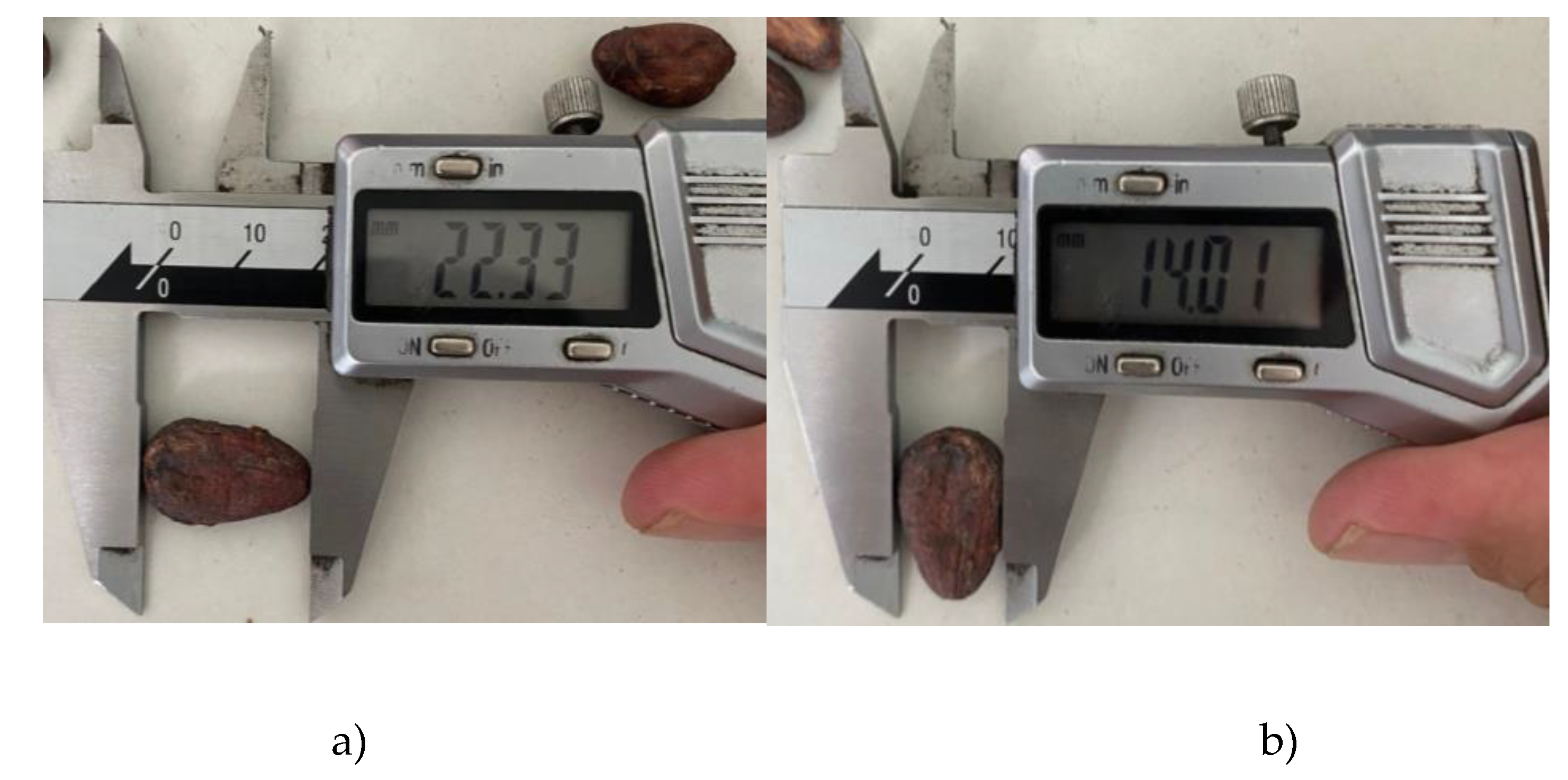
The geometric characteristics of cocoa beans were measured to evaluate dimensional changes induced by roasting and to provide a basis for selecting the compression probe for mechanical testing. Since cocoa beans have an irregular ellipsoidal shape, three principal dimensions were measured: length L (mm), width W (mm), and thickness T (mm). Measurements were conducted using an In size 150 mm electronic caliper with an accuracy of ±0.02 mm. A total of 100 beans, both before and after roasting, were randomly selected for dimensional measurement. The characterization of equivalent diameter and sphericity is widely used to describe the physical properties of irregularly shaped agricultural materials [14].
The equivalent diameter is calculated as:
where De is the equivalent diameter of the cocoa bean (mm), L is the bean length (mm), W is the bean width (mm), and T is the bean thickness (mm).
The sphericity is calculated as:
,
(3)
where: φ is the sphericity of the cocoa bean. A value of φ close to 1 indicates a nearly spherical shape, whereas a lower value indicates a more elongated or flattened geometry. Changes in these geometrical parameters after roasting are relevant because roasting can induce moisture loss, internal expansion, and structural modifications in cocoa beans [3,4,5,6].
2.4. Determination of Shell and Kernel proportions
The shell and kernel proportions were determined to evaluate the theoretical recovery limit of cocoa nibs after cracking and winnowing. For each roasting batch, a representative sample of roasted cocoa beans with mass M was collected and manually separated into shell and kernel fractions. Each fraction was weighed separately, and the mass percentages of shell and kernel were calculated as follows:
where: Ps is the shell proportion (%), Pk is the kernel proportion (%); Ms is the mass of shell (g), Mk is the mass of kernel (g), and M is the total mass of the roasted cocoa bean sample (g). The determination of shell and kernel fractions is important because shell contamination in cocoa nibs affects product quality, while cocoa shell itself contains compounds with potential food-industry applications [7] – [11].
2.5. Compression Test and Fracture Characterization
The mechanical fracture behavior of roasted cocoa beans is evaluated using a Zwick/Roell Z1.0 universal testing machine. The compression test is conducted to determine the shell-breaking force, the complete kernel-fracture force, the deformation behavior, and the fracture work. Compression testing of convex biological materials provides a quantitative basis for evaluating fracture resistance and mechanical response under loading [14,16].
Figure 4.
Zwick/Roell Z1.0 universal testing machine used for compression testing of roasted cocoa beans.
Figure 4.
Zwick/Roell Z1.0 universal testing machine used for compression testing of roasted cocoa beans.
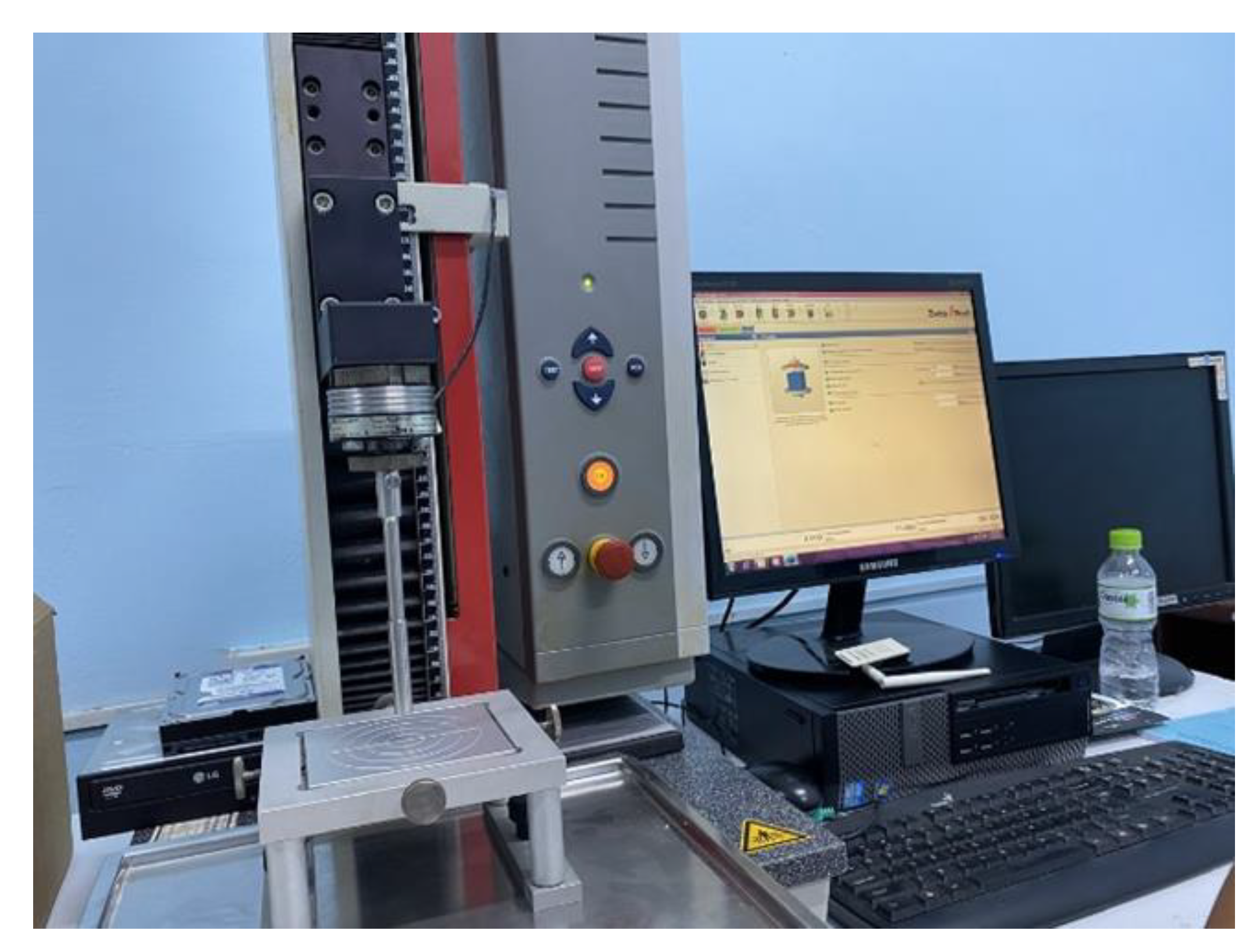
During the test, each roasted cocoa bean is placed naturally on a fixed flat compression plate. The compression probe moved vertically downward and applied force to the bean until complete fracture occurred. Based on the measured bean dimensions, a flat cylindrical compression probe with a diameter of 10 mm was selected to ensure stable contact with the bean surface while avoiding an excessive contact area relative to the bean geometry. The crosshead speed is set at 50 mm/min, and the force-deformation response is continuously recorded using the load cell and data acquisition system of the testing machine. The maximum load capacity of the system is 750 N.
Figure 5.
Compression test configuration for roasted cocoa beans: (a) placement of a bean on the fixed compression plate; (b) loading with a flat cylindrical probe during force-deformation measurement.
Figure 5.
Compression test configuration for roasted cocoa beans: (a) placement of a bean on the fixed compression plate; (b) loading with a flat cylindrical probe during force-deformation measurement.
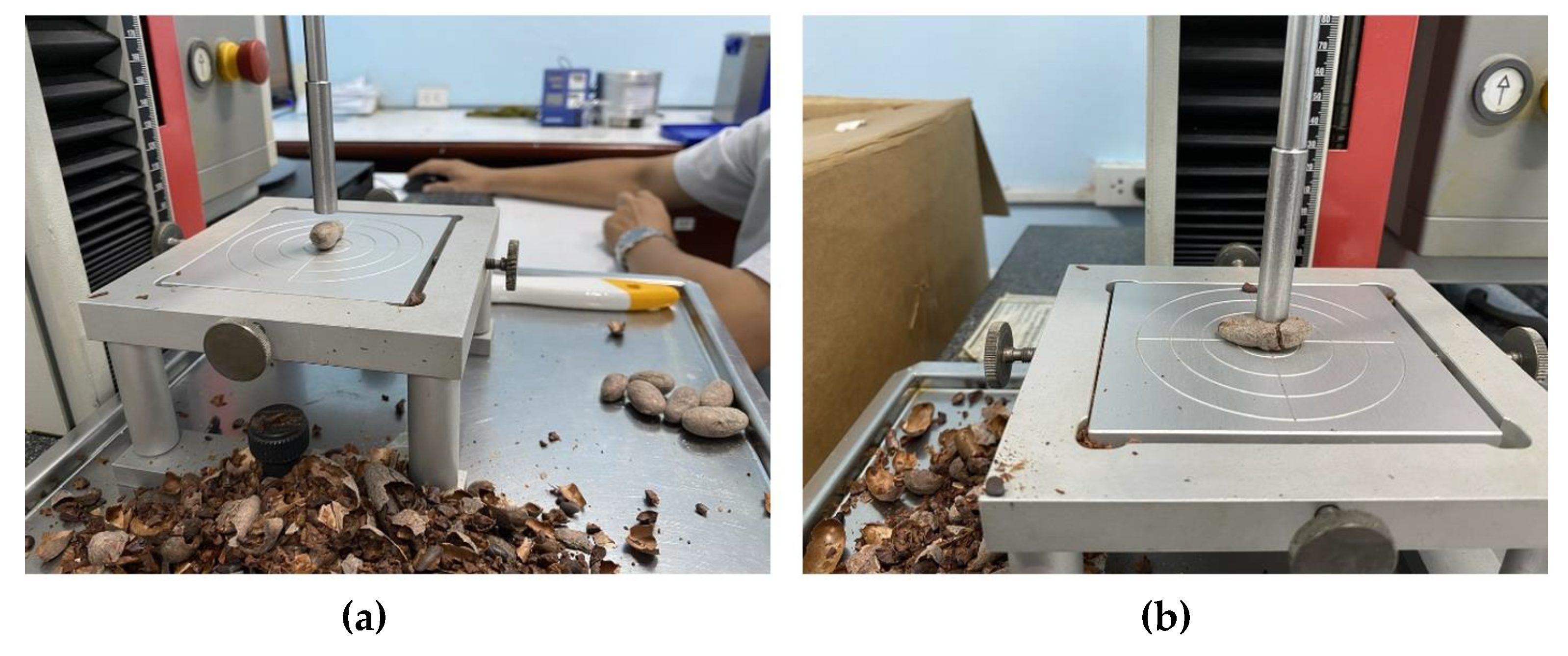
The main mechanical parameters obtained from the compression test included:
- shell-breaking force, Fshell (N), defined as the force corresponding to the first peak on the force-deformation curve;
- maximum breaking force, Fmax (N), defined as the force corresponding to complete kernel fracture;
- deformation at maximum force, ΔL (mm);
- initial bean height at the moment of contact, h0 (mm);
- breaking work, Wb (N.mm), calculated from the area under the force-deformation curve.
The breaking work is determined as:
- Wb = ∫ F dL (6)
where: Wb is the breaking work (N.mm), F is the compressive force (N), and dL is the incremental deformation of the cocoa bean (mm). The fracture stress was calculated from the fracture force and the contact area of the compression probe:
where: σ is the fracture stress (N/mm²), F is the fracture force (N), and A is the contact area of the compression probe (mm²). For the flat cylindrical compression probe with a diameter of 10 mm, the contact area is calculated as:
The fracture stress is used to compare the load-bearing capacity of the roasted cocoa bean shell and kernel. This parameter provides a mechanical basis for determining the appropriate impact energy required to crack the shell while limiting excessive nib fragmentation. Such information is particularly important for centrifugal cracking, where particle breakage is governed by impact velocity and kinetic energy rather than by continuous grinding or rubbing [11] – [14].
2.6. Response Variables and Calculation Methods
The cracking performance of the centrifugal cocoa cracker is evaluated using two main response variables: uncracked bean fraction and fine-nib fraction smaller than 3 mm. These indicators represent the completeness of cracking and the preservation of the kernel, respectively. After each experimental run, the processed material was collected and classified into uncracked beans, cracked nibs, fine nibs smaller than 3 mm, and shell-containing fractions.
The uncracked bean fraction is calculated as:
where is the uncracked bean fraction (%), Mu is the mass of uncracked beans after cracking (g), and is the mass of roasted beans used in the experimental run (g).
The fine-nib fraction smaller than 3 mm is calculated as:
where: is the fine-nib fraction (%), is the mass of nib particles smaller than 3mm (g), and is the mass of roasted beans used in the corresponding run (g).
2.7. Experimental Design for Centrifugal Cracking
Based on the currently available experimental data, the centrifugal cracking experiment was treated as a single-factor design, with rotor speed as the controlled operating variable. This approach is scientifically appropriate because the recorded data set contains replicated measurements at different rotor speeds, whereas a complete matrix for feed angle was not available. Rotor speed is selected as the primary factor because it directly determines the peripheral velocity and impact energy of cocoa beans before they collide with the stationary impact surface [12,13].
The experimental factor is defined as follows:
- Factor A: rotor speed of the cracking rotor, n (rpm).
For each treatment, the mass of cocoa beans before roasting is held constant at 10 kg to ensure consistency across trials. All samples are roasted under the same conditions at 137 °C for 28 min, then cooled for 25 min before being fed into the centrifugal cracking and shell-nib separation system. A constant roasting condition is used to reduce the influence of roasting-induced variations in moisture content and texture on cracking behavior [3] – [6,12].
After each experimental run, the cracked product is separated into fractions: large nibs (>5 mm), medium nibs (3-5 mm), small nibs (<3 mm), uncracked beans, and shell fraction. The main evaluation criteria included uncracked bean proportion, fine-nib generation, nib recovery rate, and shell contamination in the nib fraction. These indicators were used to evaluate cracking efficiency and the degree of kernel damage under different rotor speeds. The experiment was replicated three times for each rotor speed level to reduce random error and improve the reliability of the experimental results. The mean values of the replicates were used for statistical analysis.
The experimental data are analyzed using one-way analysis of variance (ANOVA) to determine whether rotor speed had a statistically significant effect on cracking and separation performance. The statistical model is expressed as:
where Yij is the observed response value at the i-th level of rotor speed and the j-th replicate, μ is the overall mean, Ai is the effect of rotor speed, and εij is the random experimental error. The significance of rotor speed was evaluated at the 95% confidence level (p < 0.05). This statistical approach is consistent with standard experimental design and analysis methods used for engineering and food-processing experiments [18,19].
If additional experimental data on feed angles are collected in future work, the design can be extended to a two-factor model including rotor speed, feed angle, and their interaction. In that case, the general model can be expressed as:
where Bj represents the effect of feed angle and (AB)ij represents the interaction between rotor speed and feed angle. However, for the present data set, the single-factor rotor-speed model was used to avoid unsupported statistical interpretation and to ensure consistency between the experimental design, available data, and reported results.
3. Results and Discussion
3.1. Overview of Cracking Responses
The cracking response of roasted cocoa beans is evaluated using two main indicators: the uncracked bean fraction and the fine-nib fraction smaller than 3 mm. These responses represent cracking completeness and kernel preservation, respectively. The following sections analyze how roasting-induced physical changes, compression-based fracture behavior, and rotor-speed-dependent impact energy jointly determine the selective cracking performance of the centrifugal cracker.
3.2. Physical Properties of Cocoa Beans After Roasting
The main physical properties of cocoa beans before and after roasting are summarized in Table 1. Roasting did not markedly alter the length and width of the beans. The mean length increased slightly from 22.89 to 23.09 mm, and the mean width increased from 13.00 to 13.14 mm. In contrast, thickness increased markedly from 8.23 to 11.09 mm. This anisotropic expansion is consistent with moisture evaporation, internal vapor pressure generation, and structural relaxation of the cotyledon-shell system during roasting [3] – [6].
Figure 6.
Measurement of cocoa bean dimensions using an electronic caliper (a) representative measurement of bean length; (b) representative measurement of another principal dimension after roasting.
Figure 6.
Measurement of cocoa bean dimensions using an electronic caliper (a) representative measurement of bean length; (b) representative measurement of another principal dimension after roasting.
The moisture content decreased from 7.17% before roasting to 2.49% after roasting. This value is within the range favorable for brittle shell fracture. It is consistent with the requirement that roasted cocoa beans should have sufficiently low moisture to avoid elastic or leathery shell behavior during impact cracking [17]. At higher moisture levels, the shell can absorb part of the kinetic energy and rebound from the impact surface, thereby increasing the proportion of uncracked beans.
The sphericity increased from 0.59 to 0.65, indicating that roasting shifted the bean shape toward a more rounded geometry. For irregular agricultural particles, sphericity is an important descriptor because it affects particle orientation, contact stability, and repeatability of impact events [14]. In a centrifugal cracker, a more rounded particle is expected to experience less orientation-dependent variation during collision with the impact surface. Therefore, the combination of lower moisture, increased shell brittleness, increased thickness, and higher sphericity supports the formation of a selective impact-energy window for shell-nib separation.
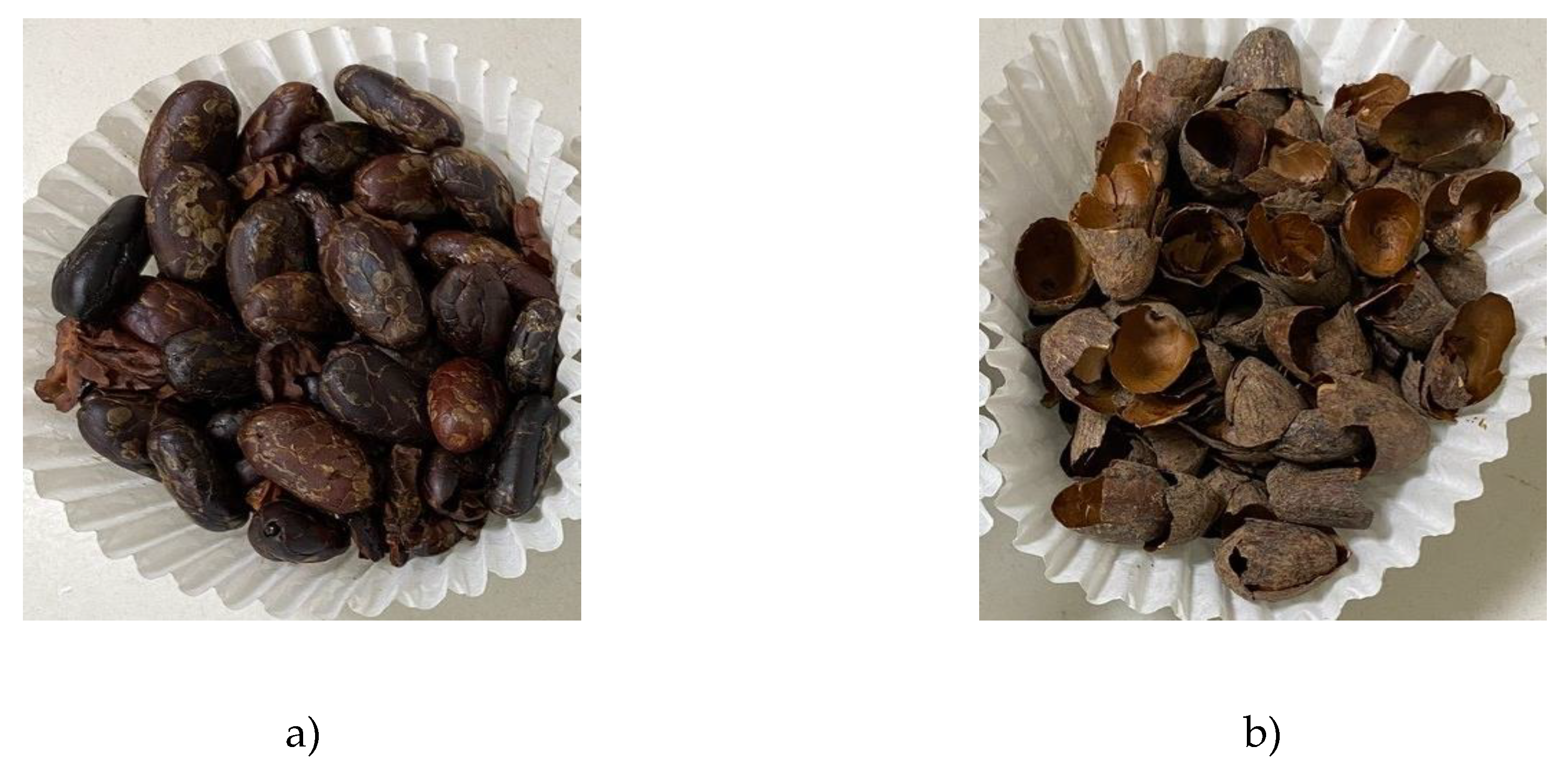
The average kernel content of the roasted beans is approximately 79.5%, with a relatively narrow range of 77.6-80.6%. This fraction represents the theoretical upper limit of recoverable nibs during cracking and winnowing. The difference between this intrinsic kernel fraction and the measured recovery after processing can be interpreted as processing loss caused by incomplete cracking, excessive fragmentation, or separation inefficiency.
Figure 7.
Roasted cocoa bean fractions used for interpreting shell-nib separation. a) whole roasted beans and b) detached shells.
Figure 7.
Roasted cocoa bean fractions used for interpreting shell-nib separation. a) whole roasted beans and b) detached shells.
3.3. Mechanical Fracture Behavior of Roasted Cocoa Beans
Compression testing showed that roasted cocoa beans exhibit a staged fracture response rather than a single catastrophic failure. This behavior is typical of biological materials with heterogeneous structure, where shell rupture, void collapse, and kernel fracture occur sequentially under loading. The first local force peak corresponds to shell rupture, whereas the subsequent increase in force reflects compression and fracture of the inner kernel. The statistical summary of the compression tests is presented in Table 2.
Figure 8.
Representative force-deformation curve of a roasted cocoa bean under compression. Region A indicates shell rupture, Region B corresponds to the force drop associated with shell-nib gap collapse, and Region C represents complete kernel fracture.
Figure 8.
Representative force-deformation curve of a roasted cocoa bean under compression. Region A indicates shell rupture, Region B corresponds to the force drop associated with shell-nib gap collapse, and Region C represents complete kernel fracture.
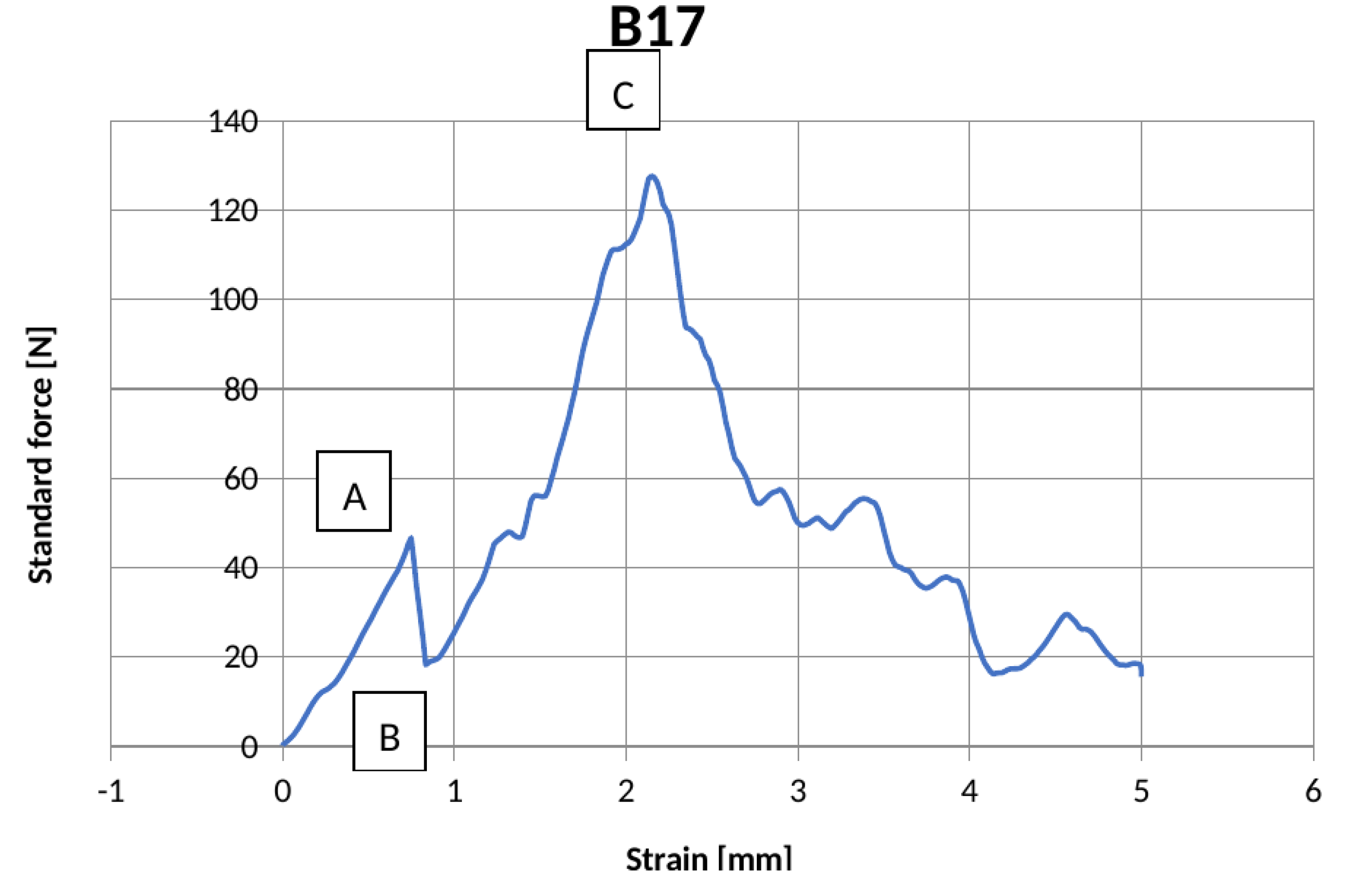
Figure 9.
Relationship between cumulative fracture ratio and fracture force for roasted cocoa beans. The lower-force region corresponds mainly to shell rupture, whereas the high-force region represents progressive kernel fracture.
Figure 9.
Relationship between cumulative fracture ratio and fracture force for roasted cocoa beans. The lower-force region corresponds mainly to shell rupture, whereas the high-force region represents progressive kernel fracture.
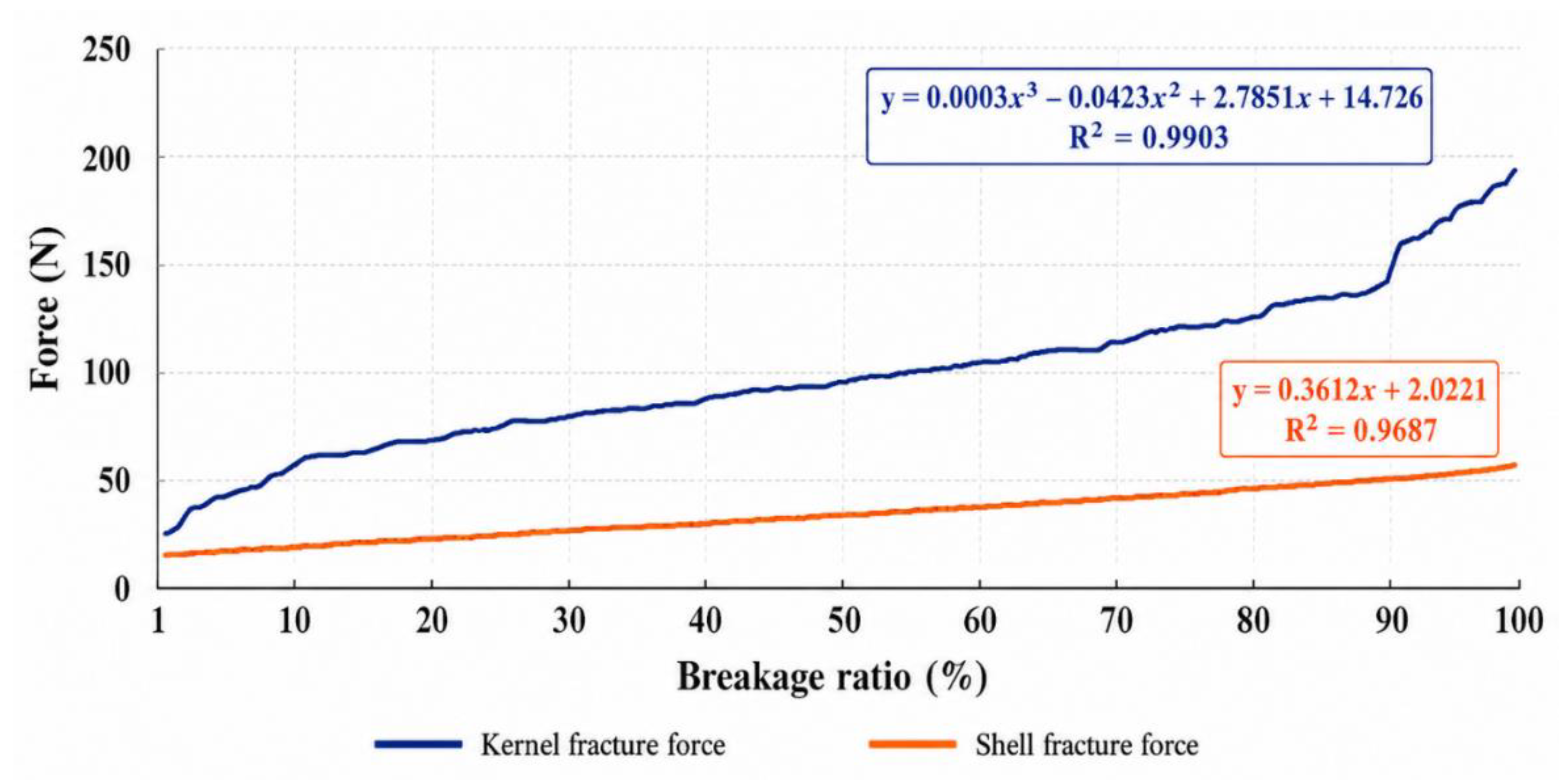
The mean shell-fracture force is 23.515 N, whereas the mean force associated with complete kernel fracture is 91.896 N. The maximum shell-fracture force is 54.382 N, and the maximum kernel-fracture force reached 195.327 N. The separation between these two mechanical thresholds is a key point in the design of a centrifugal cracker, as it requires the applied impact force to be high enough to fracture and detach the shell, but it is not so high, leading to the kernel being pulverized into fine particles.
The force-deformation curve can be interpreted in three regions. Region A represents the first local maximum associated with shell fracture. Region B represents the force reduction after shell rupture, when the probe has passed through the shell-nib gap and begins to interact with the kernel. Region C corresponds to the maximum force required for complete kernel fracture. The distance from initial contact to Region B is related to the internal void between shell and nib. At the same time, the deformation from Region B to Region C represents kernel compression and fracture. This staged response confirms that roasting creates structural conditions that favor selective shell failure under impact [3] – [6,14,16].
For practical centrifugal cracking, the design impact force should be higher than the maximum force required for complete shell fracture but lower than the force range associated with rapid kernel fragmentation. Based on the compression data, a target design force of approximately 80 N was selected. This value is above the maximum observed shell-fracture force and remains below the mean force required for complete kernel fracture; it was therefore used as a mechanical basis for estimating the suitable rotor-speed range of the centrifugal cracker
3.4. Dynamic Analysis of the Centrifugal Cracking Process
The centrifugal cracking process converts rotational mechanical energy into translational kinetic energy, followed by rapid momentum transfer upon impact with the stationary surface. When a cocoa bean enters the rotating channel, it is subjected mainly to centrifugal and Coriolis forces. The centrifugal force accelerates the bean radially outward, while the Coriolis component affects its contact with the vane wall and its trajectory before impact. These relationships follow classical rigid-body dynamics and are relevant to impact-based agricultural material processing [12] – [14].
Figure 10.
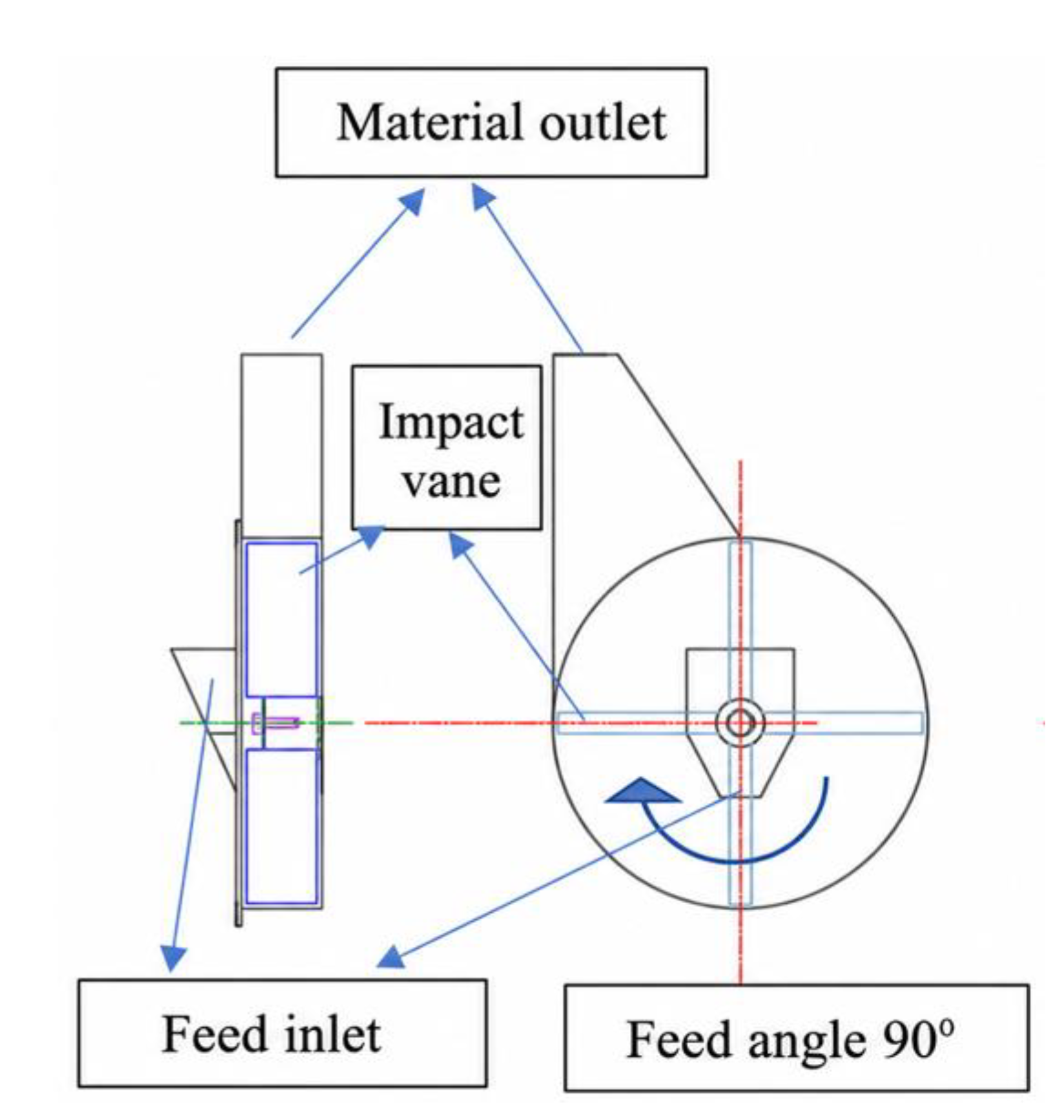
Schematic of the centrifugal cracking principle and feed-angle arrangement used to guide cocoa beans toward the impact zone.
Figure 10.
Schematic of the centrifugal cracking principle and feed-angle arrangement used to guide cocoa beans toward the impact zone.
- Forces
As the cocoa bean drops into the center of the cracker rotor, it enters a rotating reference frame and moves outward along a straight radial vane. This would create two primary forces, centrifugal force and Coriolis force:
The centrifugal force is:
Fcen = mω2r (13)
The Coriolis force pushes the bean against the vane wall as:
Fcor = 2mωvr sin (14)
where: m = 1.16 g = 0.00116 kg is the mass of one roasted cocoa bean, r is distance from the cocoa bean to the rotation axis along the vane. It is selected as r = 0.17m; = is the rotational speed of the rotor, this value is controlled by n is the rotation per minute of rotor; and vr is the radial velocity; is the cocoa bean flying angle.
Based on the rotational speed of the cracker rotor, the balance of two forces is different. When cocoa beans are stationary, the Coriolis force is zero, and the centrifugal force dominates. When the cocoa bean moves slowly, the centrifugal force is stronger than the Coriolis force; if it moves quickly, the Coriolis force is stronger than the centrifugal force.
- Impact velocity
As the bean reaches the outer radius of the rotor, it loses contact with the vane and enters free flight across the air gap toward the impact ring. The bean takes a combination velocity vector such as:
Radial velocity vr that is the speed at which the bean is sliding outward off the tip of the vane. When the cracker runs, the beans move from the center to the outer edge of the rotor, a radial distance equal to the rotor's radius, 0.17 m, and around the rotor's circumference by an angle of 900 before going out.
Therefore, the time of beans inside the cracker is t = or t = = and vr = = = 0.0113 n (m/s) (15)
Tangential velocity vt that is governed entirely by the speed of the rotor
vt = ωr = 0.17 = 0.0178 n (m/s) (16)
The magnitude of the total velocity and the cocoa bean flying angle are
vtotal = = = = 1.187 (m/s)
(m/s) (17)
(18)
Under total speed, the cocoa bean moves across the gap to hit the stationary anvil ring. As a result, the bean flying at an angle of [57.59〗^0 will strike it at a tilted angle. The normal component of the total speed shatters the bean, and the tangential component causes it to slide across the ring, creating frictional heat and grinding it into dust. Therefore, the angle between the normal and tangential components of the velocity is very important for crackers. The normal velocity breaks the cocoa bean, while the tangential velocity breaks the bean into pieces.
- The kinetic energy and critical kinetic energy
The key point in engineering a cocoa bean centrifugal cracker is to calculate the kinetic energy to a suitable value so that it generates enough energy to snap the brittle, roasted outer husk, but not enough to reduce the cocoa nib to fine dust. The kinetic energy of a single cocoa bean as it exits the spinning rotor and flies toward the impact wall is defined by:
where m is the average mass of one roasted cocoa bean (kg), v is the total impact velocity (m/s).
Therefore, the kinetic energy relative to bean mass would be
If Ed is smaller than the critical threshold, the bean bounces and remains whole. In contrast, when Ed is above the damage threshold, the Nibs break into useless fine powder. Thus, controlling the total impact velocity via the rotor radial r and the rotor rotational speed to adjust the speed will make a perfect cracker. Based on this idea, the rotor speed is a parameter that needs to be investigated theoretically and experimentally for perfect-cracking-regime operation.
The impulse (J) and the average impact of force exerted on the cocoa bean are:
and (22)
Our experimental testing showed that the cocoa bean remains inside the cracker for 0.0005 seconds. Thus, based on the equation (22), the Impact is about 44.1 n (N) that is mainly the centrifugal force. Moreover, the total forces exerted on cocoa beans include two forces: the centrifugal force and the Coriolis force, which can be counted by equations (13) and (14). The ratio between these two forces is 0.66, so that the centrifugal force takes the value of 0.398 of the total force. Designing the critical rotational rotor of the cracker should focus on the centrifugal force, based on the pressing-broken force recorded in experimental testing. Our experimental investigation indicated that the total forces to crack the cocoa beans might range from 54N to 195N by breaking the shell and the Nibs, respectively. It is reasonable to select the total force range from 100 to 120 N, which corresponds to a centrifugal force of 39.8-47.71N and is also the impact force.
From eq. (22) the vtotal can be counted as:
= 17.14 m/s to 20.57 m/s
Thus, based on the equation (17), the critical rotational speed of rotor (RPM) might range from 812 rpm to 975 rpm. The other reference [11] also pointed out the critical energy threshold might range from 0.15 to 0.25 J for the cracking of cocoa beans have moisture content below 3%. Using equation (19) to calculate the kinetic energy, the results show that it ranges from 0.17 J to 0.245 J as a function of vtotal. This is a very good result and is similar to some previous references [11,12,14].
3.5. Experimental Validation of Rotor Speed
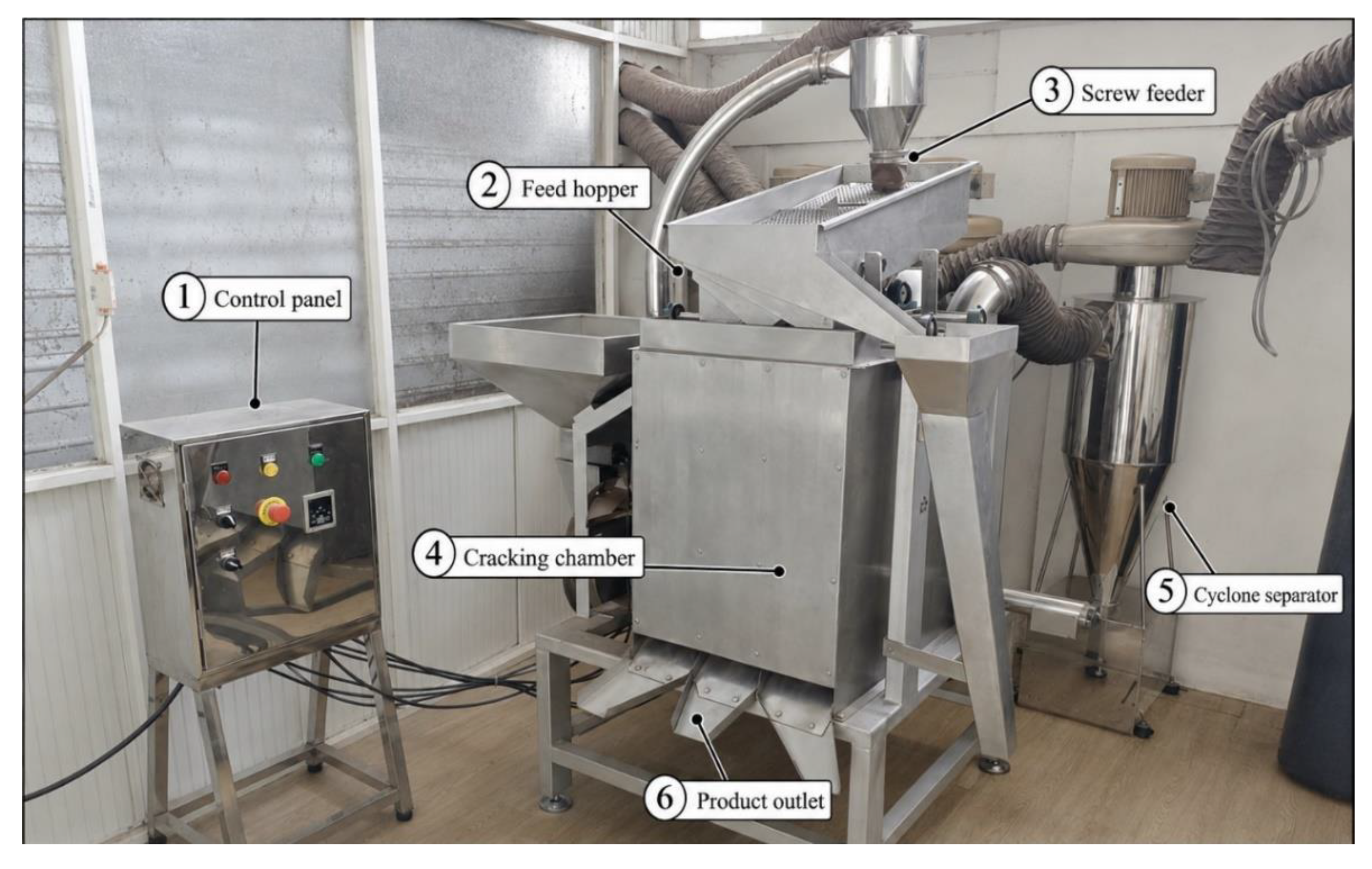
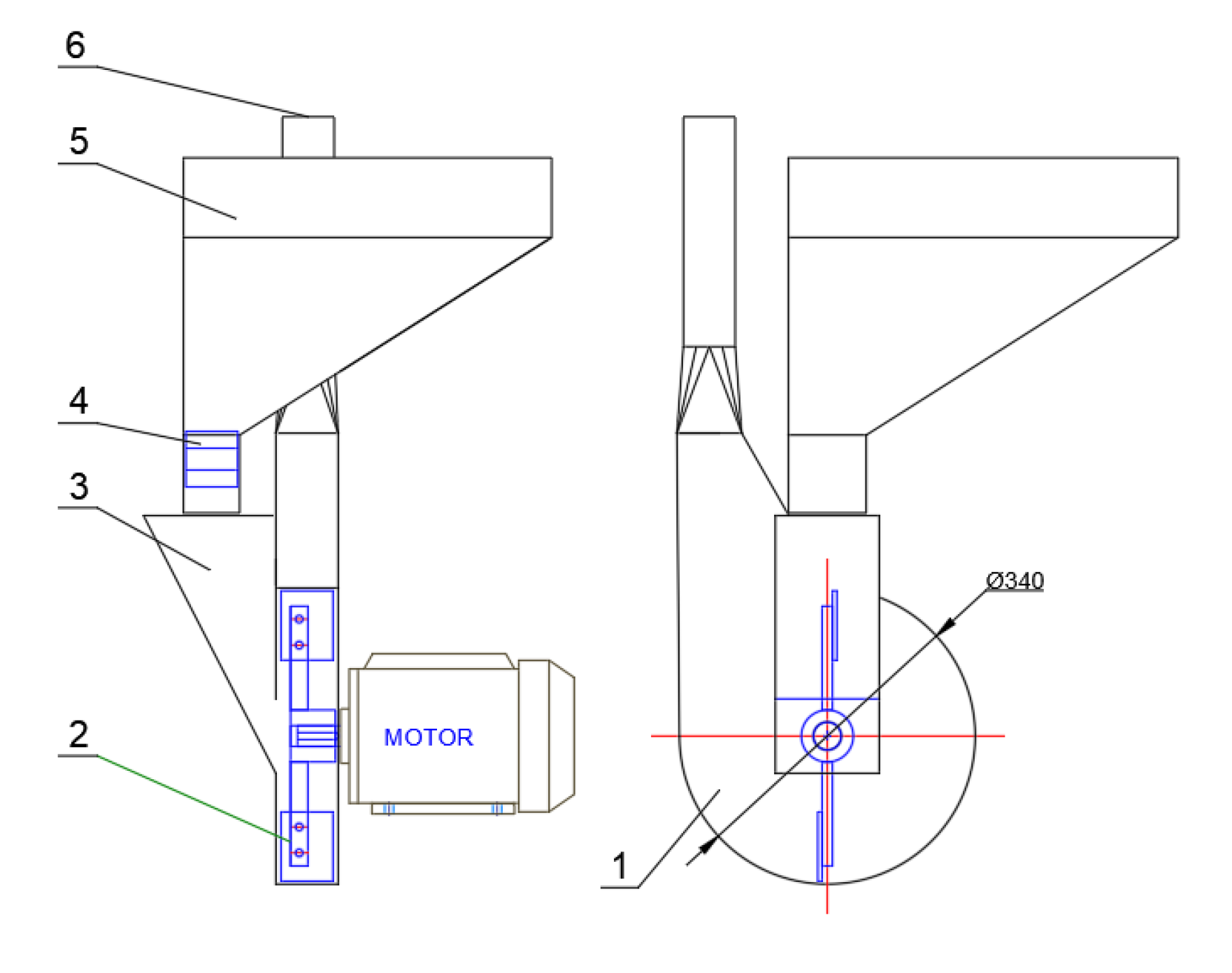
The prototype centrifugal cracker and its technical configuration are shown in Figs. 11 and 12. The device consists of a cracking chamber, impact vanes, feed inlet, feeding unit, bean hopper, material outlet, and downstream separation components. The effective rotation radius is 170 mm, and the rotor speed is adjusted by changing the inverter frequency. Each treatment used 10 kg of cocoa beans before roasting, and three replicate runs are conducted for each rotor speed.
Figure 11.
Prototype centrifugal cocoa cracking and shell-separation system showing the main functional components: (1) control panel, (2) feed hopper, (3) screw feeder, (4) cracking chamber, (5) cyclone separator, and (6) product outlet
Figure 11.
Prototype centrifugal cocoa cracking and shell-separation system showing the main functional components: (1) control panel, (2) feed hopper, (3) screw feeder, (4) cracking chamber, (5) cyclone separator, and (6) product outlet
The experimental results are summarized in Table 3. At low rotor speeds of 700 and 750 rpm, the uncracked bean fraction is very high, reaching 46.03% and 38.80%, respectively. This indicates that the impact energy was insufficient to overcome the shell-fracture threshold for a large fraction of beans. Increasing the speed to 800 rpm reduced the uncracked fraction to 19.55%, but this level remained unsuitable for practical shell-nib separation.
Figure 12.
Technical schematic of the centrifugal cracker used in the rotor-speed experiments: 1, cracking chamber; 2, impact vane; 3, feed inlet; 4, feeding unit; 5, bean hopper; 6, material outlet.
Figure 12.
Technical schematic of the centrifugal cracker used in the rotor-speed experiments: 1, cracking chamber; 2, impact vane; 3, feed inlet; 4, feeding unit; 5, bean hopper; 6, material outlet.
At 830 rpm, the uncracked bean fraction decreased sharply to 7.39%, while fine-nib generation remained low at 0.57%. This indicates that the process began to enter the selective cracking region. At 860 and 900 rpm, the uncracked fractions decreased further to 1.06% and 0.41%, respectively, while fine-nib generation remained limited at 1.59% and 1.81%.
These two speeds therefore provided the best compromise between shell breakage and preservation of nib integrity. However, increasing speed beyond this region caused excessive kernel fragmentation. At 950 rpm, the uncracked fraction was only 0.14%, but the fine-nib fraction increased sharply to 8.54%. At 1000 rpm, no uncracked beans remained, but the fine-nib fraction increased dramatically to 34.62%. This confirms that excessive impact energy changes the dominant mechanism from selective shell cracking to destructive kernel fragmentation.
3.6. Statistical Evaluation of Rotor-Speed Effect
The one-way ANOVA results for the effect of rotor speed on cracking performance are presented in Table 4. The results showed that rotor speed had a highly significant effect on both uncracked bean fraction and fine-nib fraction smaller than 3 mm. For the uncracked bean fraction, the effect of rotor speed was significant, with F = 1990.924 and p < 0.0001. The uncracked fraction decreased sharply from 46.03 ± 1.15% at 700 rpm to 0.41 ± 0.09% at 900 rpm, indicating that increasing rotor speed enhanced impact velocity and kinetic energy for shell fracture.
Rotor speed also significantly affected the fine-nib fraction smaller than 3 mm, with F = 973.518 and p < 0.0001. Unlike the uncracked fraction, fine-nib generation remained low in the intermediate-speed range but increased sharply at higher speeds. The fine-nib fraction was only 1.59 ± 0.10% at 860 rpm and 1.81 ± 0.07% at 900 rpm but increased to 8.54 ± 1.10% at 950 rpm and 34.62 ± 1.52% at 1000 rpm. This indicates that excessive rotor speed shifted the dominant mechanism from selective shell cracking to destructive kernel fragmentation. Tukey’s post-hoc comparison further confirmed this trend. The low-speed treatments from 700 to 830 rpm were associated with incomplete cracking, whereas 860–900 rpm achieved a very low uncracked fraction without excessive fine-nib formation. Although 950 and 1000 rpm further reduced uncracked beans, they produced significantly higher fine-nib fractions and are therefore unsuitable for efficient shell–nib separation.
These statistical results support the selection of 860–900 rpm as the practical operating window of the centrifugal cocoa cracker again. This range provided the best compromise between cracking completeness and nib preservation, reducing uncracked beans to below 1.1% while maintaining fine nibs below 2%. The rotor-speed response and the corresponding kinetic-energy range are illustrated in Figure 13 and Figure 14.
3.7. Consistency Between Theoretical Prediction and Experimental Validation
A central contribution of this study is the integration of compression-based fracture characterization, dynamic analysis, and rotor-speed experiments into a single interpretation framework. The compression data identified the mechanical selectivity interval between shell rupture and complete kernel fracture, while the dynamic analysis model transformed this fracture requirement into a rotor-speed and impact energy. The experimental data then validated this theoretical prediction by showing a clear transition from insufficient cracking to selective cracking and finally to over-fragmentation.
The theoretical calculation predicted a useful cracking region of approximately 812-975 rpm, corresponding to an impact velocity of 17.14-20.57 m/s and kinetic energy of 0.17-0.25 J per bean. This calculation prediction is similar with the experimental investigation. At 800 rpm, which is close to the lower theoretical boundary, the uncracked fraction remained high at 19.55%, indicating that the delivered energy was still insufficient for reliable shell rupture. At 830 rpm, the uncracked fraction dropped sharply to 7.39%, showing that the system began entering the selective cracking region. The best performance occurred at 860-900 rpm, where the uncracked fraction is reduced to 1.06-0.41% and fine-nib generation remained only 1.59-1.81%. Above this range, particularly at 950 and 1000 rpm, the experimental response diverged from useful cracking because the fine-nib fraction increased to 8.54% and 34.62%, respectively. This demonstrates that the upper part of the theoretical critical kinetic energy must be narrowed for practical operation in order to protect nib integrity.
The experimental results are generally consistent with the theoretical analysis prediction, but they refined the theoretical range into a narrower practical operating window. The agreement between theoretical and experimental results is summarized in Table 5. The most important finding is that the theoretical window is not itself the final operating recommendation; rather, it defines the physically possible cracking zone. The experimental results refine this zone into a practical operating window of 860-900 rpm for the present rotor diameter and roasting condition. This distinction is important for equipment design because a machine may be capable of cracking all beans at higher speeds, but such operation is not economically optimal if it produces excessive fine nibs and reduces recoverable nib yield.
Therefore, the scientific novelty of the present results lies in establishing a quantitative bridge from material fracture behavior to machine operating conditions. The proposed approach does not rely only on empirical observation of cracking efficiency; instead, it links shell-fracture force, kernel-damage force, impact velocity, kinetic energy, and rotor-speed response. This provides a design-oriented framework for small-scale centrifugal cocoa crackers, especially where compact equipment must be optimized for high nib recovery and low shell contamination under locally available roasting and processing conditions [18,19].
3.8. Engineering Implication and Recommended Operating Window
The integrated results demonstrate that the operating condition of a centrifugal cocoa cracker should be selected by balancing two competing responses as complete shell cracking and preservation of nib integrity. A rotor speed that is too low does not provide sufficient impact energy for shell rupture, whereas an excessive speed transfers too much energy to the kernel and increases fine-nib formation. Therefore, the optimum condition should not be defined only by the minimum uncracked bean fraction, but by the simultaneous control of uncracked beans and fine particles.
For the present rotor diameter of 340 mm and roasting condition, the practical operating window is determined as 860–900 rpm. This range corresponded to an estimated kinetic energy of 0.191–0.209 J per bean, reduced the uncracked bean fraction to below 1.1%, and maintained the fine-nib fraction below 2%. These results indicate that 860–900 rpm provides the best compromise between shell-fracture efficiency and recoverable nib preservation.
From an engineering-design perspective, the proposed framework provides a practical basis for optimizing compact centrifugal cocoa cracking and winnowing systems. Future studies should further evaluate the combined effects of rotor speed, feed angle, feed rate, bean-size distribution, moisture content, bean origin, and roasting degree using factorial or response-surface designs to improve shell separation efficiency and nib recovery
4. Conclusions
This study established a dynamic analysis and experimental investigation for determining the suitable operating parameters of a small-scale centrifugal cocoa bean cracker. The cocoa beans are roasted in 28min at 137°C reducing their moisture content from 7.17% to 2.49% and promoted structural conditions favorable for brittle shell fracture and shell–nib detachment. Compression testing confirmed a clear mechanical selectivity between shell rupture and kernel fracture, with a mean shell-fracture force of 23.515 N and a mean kernel-fracture force of 91.896 N. Based on the measured fracture behavior, the dynamic analysis explores that a theoretical useful rotor-speed of the cracker might in a range of 812–975 rpm with rotor diameter is 340 mm. This corresponds to an impact velocity of 17.14–20.57 m/s and a kinetic energy of 0.17–0.25 J per bean. Experimental testing shows that the best performance is obtained with the cracker rotor speed at 860–900 rpm where the uncracked bean fraction decreased to 1.06–0.41% and the fine-nib fraction smaller than 3 mm remained low at 1.59–1.81%. In contrast, the cracker rotor speeds of 950 rpm and above will lead to excessive kernel fragmentation, with fine-nib generation increasing to 8.54% at 950 rpm and 34.62% at 1000 rpm. Therefore, the suitable rotor speed of the cocoa cracker under the present rotor diameter and roasting condition is in a range of 860 – 900 rpm. This range provides the best compromise between complete shell cracking and preservation of recoverable cocoa nibs. The main contribution of this work is the quantitative linkage between compression-based fracture properties, impact dynamics, kinetic energy, and rotor-speed response. The proposed framework can support the rational design and optimization of compact cocoa cracking and winnowing systems.
Author Contributions
Conceptualization, D.L.P., H.I.B.; methodology, D.L.P.; validation, H.B.N. and H.I.B.; formal analysis, D.L.P., H.I.B.; resources D.L.P.; data curation, H.I.B.; writing—original draft preparation, D.L.P.; writing—review and editing, H.I.B.; visualization, H.B.N..; supervision, H.I.B. and D.L.P.; project administration, D.L.P., H.I.B.; All authors have read and agreed to the published version of the manuscript.
Funding
This research received no external funding.
Data Availability Statement
All data can be used on request.
Acknowledgments
The authors gratefully acknowledge to the project # BG-RRP-2.013-0001-C01.
Conflicts of Interest
The authors declare no conflicts of interest.
Abbreviations
The following abbreviations are used in this manuscript:
| ANOVA | Analysis of Variance |
| CC | Cocoa Cake |
| CCBY | Creative Commons Attribution |
| ICCO | International Cocoa Organization |
| FDA | Food and Drug Administration |
References
- International Cocoa Organization, Global strategy: Where we are today. Available online: https://www.cacaonet.org/global-strategy/where-we-are-today (accessed on Jun. 17 2026).
- World Atlas, Top 10 cocoa producing countries in the world. Available online: https://www.worldatlas.com/industries/top-10-cocoa-producing-countries-in-the-world.html (accessed on Jun. 17 2026).
- Domínguez-Pérez, L. A.; Concepción-Brindis, I.; Lagunes-Gálvez, L. M.; Barajas-Fernández, J.; Márquez-Rocha, F. J.; García-Alamilla, P. Kinetic Studies and Moisture Diffusivity During Cocoa Bean Roasting. Processes 2019, 7, 770. [Google Scholar] [CrossRef]
- Krysiak, W. Influence of roasting conditions on coloration of roasted cocoa beans. J. Food Eng. 2006, 77(3), 449–453. [Google Scholar] [CrossRef]
- Zaman, W.; Yang, T. A. Moisture, color and texture changes in cocoa beans during superheated steam roasting. J. Food Process. Preserv. 2014, 38(3), 1364–1370. [Google Scholar]
- Djikeng, F. T.; et al. Effect of traditional and oven roasting on the physicochemical properties of fermented cocoa beans . Heliyon 2018, 4(2), Art. no. e00533. [Google Scholar] [CrossRef]
- Okiyama, D. C. G.; Navarro, S. L. B.; Rodrigues, C. E. C. Cocoa shell and its compounds, Applications in the food industry. Trends Food Sci. Technol. 2017, 63, 103–112. [Google Scholar] [CrossRef]
- Beckett, S. T.; Fowler, M. S.; Ziegler, G. R. Beckett’s Industrial Chocolate Manufacture and Use, 5th ed.; Wiley-Blackwell: Hoboken, NJ, USA, 2017. [Google Scholar]
- Afoakwa, E. O. Chocolate Science and Technology, 2nd ed.; Wiley-Blackwell: Hoboken, NJ, USA, 2016. [Google Scholar]
- Nguyen, H.-B.; Pham, D.-L.; Nguyen, V.-L. A study on the breaking and winnowing machine for cocoa beans at small industrial scale in Vietnam. Int. J. Adv. Sci. Eng. Inf. Technol. 2019, 9(1), 329–335. [Google Scholar] [CrossRef]
- Lörcher, M.; Steinke, P.; Grimm, P.; Spiller, B.; Kwade, A. Experimental study on breaking and separating cocoa beans. Chem. Eng. Technol. 2025, 48, Art. no. e70011. [Google Scholar] [CrossRef]
- Meriam, J. L.; Kraige, L. G. Engineering Mechanics: Dynamics, 8th ed.; Wiley: Hoboken, NJ, USA, 2016. [Google Scholar]
- Braun, M.; Wecker, H.; Dunmire, K.; Evans, C.; Sodak, M.W.; Kapetanovich, M.; Shepherd, J.; Fisher, R.; Coble, K.; Stark, C.; et al. Evaluation of Hammermill Tip Speed, Air Assist, and Screen Hole Diameter on Ground Corn Characteristics. Processes 2021, 9, 1768. [Google Scholar] [CrossRef]
- Mohsenin, A. M. Physical Properties of Plant and Animal Materials; Gordon and Breach: New York, NY, USA, 1986. [Google Scholar]
- Bautista, R. S.; Amongoi, P. P. A. Challenges and future directions in cacao bean hulling and grinding process technology: A review. Proc. Int. Exch. Innov. Conf. Eng. Sci. (IEICES) 2024, 10, 164–170. [Google Scholar] [CrossRef]
- ASABE, ASAE S368.4: Compression Test of Food Materials of Convex Shape; American Society of Agricultural and Biological Engineers: St. Joseph, MI, USA, 2017.
- ISO 2451:2017; Cocoa Beans—Specification and Quality Requirements. International Organization for Standardization: Geneva, Switzerland, 2017.
- Derringer, G.; Suich, R. Simultaneous optimization of several response variables. J. Qual. Technol. 1980, 12(4), 214–219. [Google Scholar] [CrossRef]
- Myers, R. H.; Montgomery, D. C.; Anderson-Cook, C. M. Response Surface Methodology: Process and Product Optimization Using Designed Experiments, 4th ed.; Wiley: Hoboken, NJ, USA, 2016. [Google Scholar]
Figure 1.
Production of cocoa beans by countries and by continents.
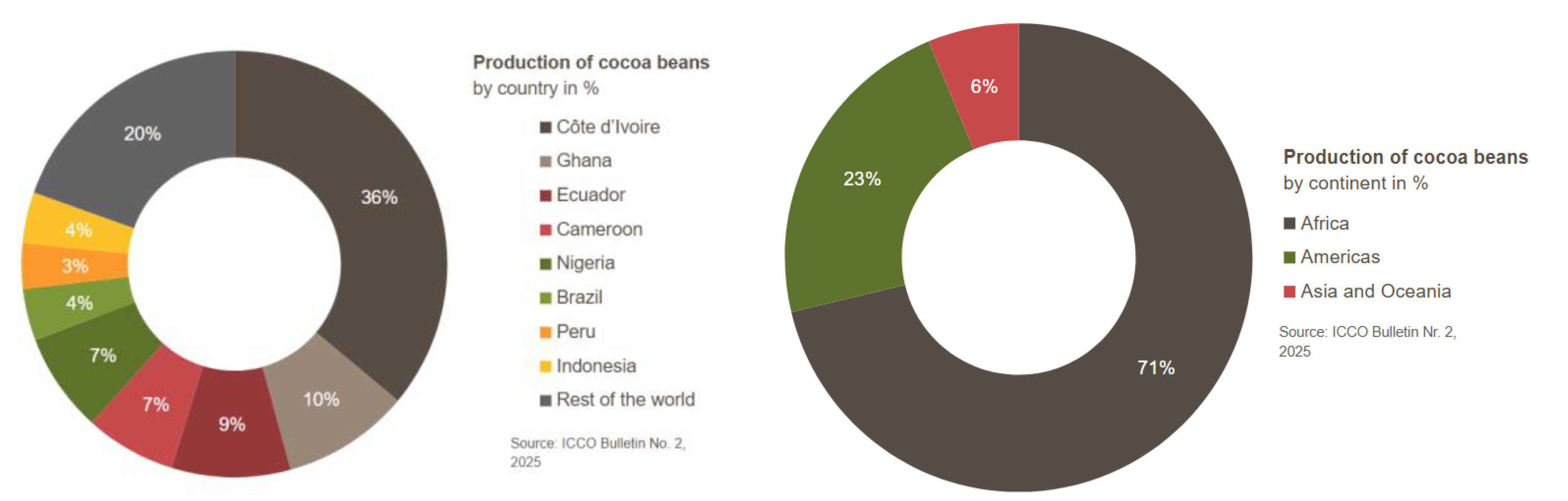
Figure 2.
The process of producing nibs from cocoa beans.
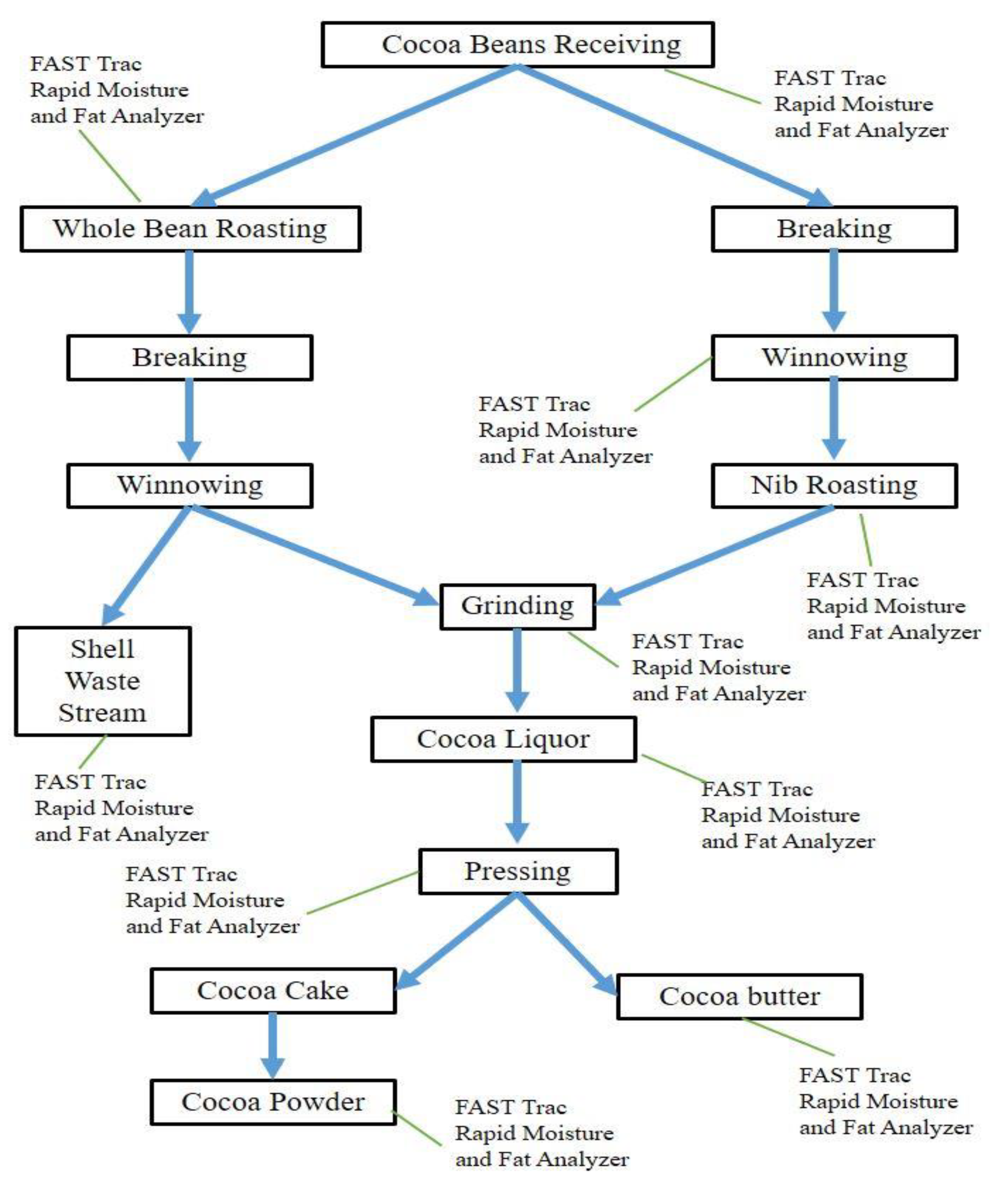
Figure 3.
Experimental workflow and impact-dynamics analysis of roasted cocoa beans
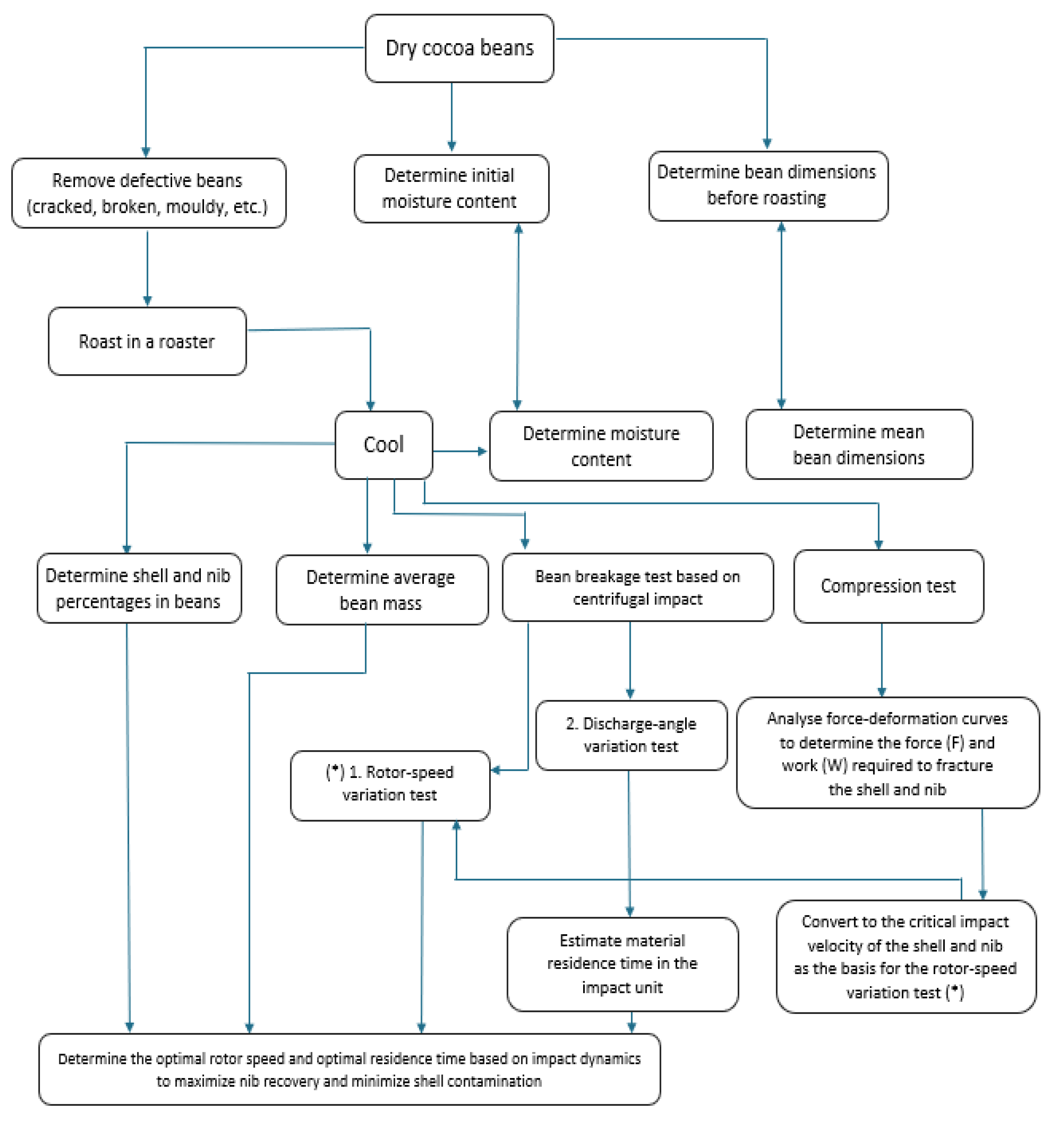
Figure 13.
Effect of rotor speed on the proportions of uncracked beans and fine nibs smaller than 3 mm. The shaded region indicates the recommended operating window.
Figure 13.
Effect of rotor speed on the proportions of uncracked beans and fine nibs smaller than 3 mm. The shaded region indicates the recommended operating window.
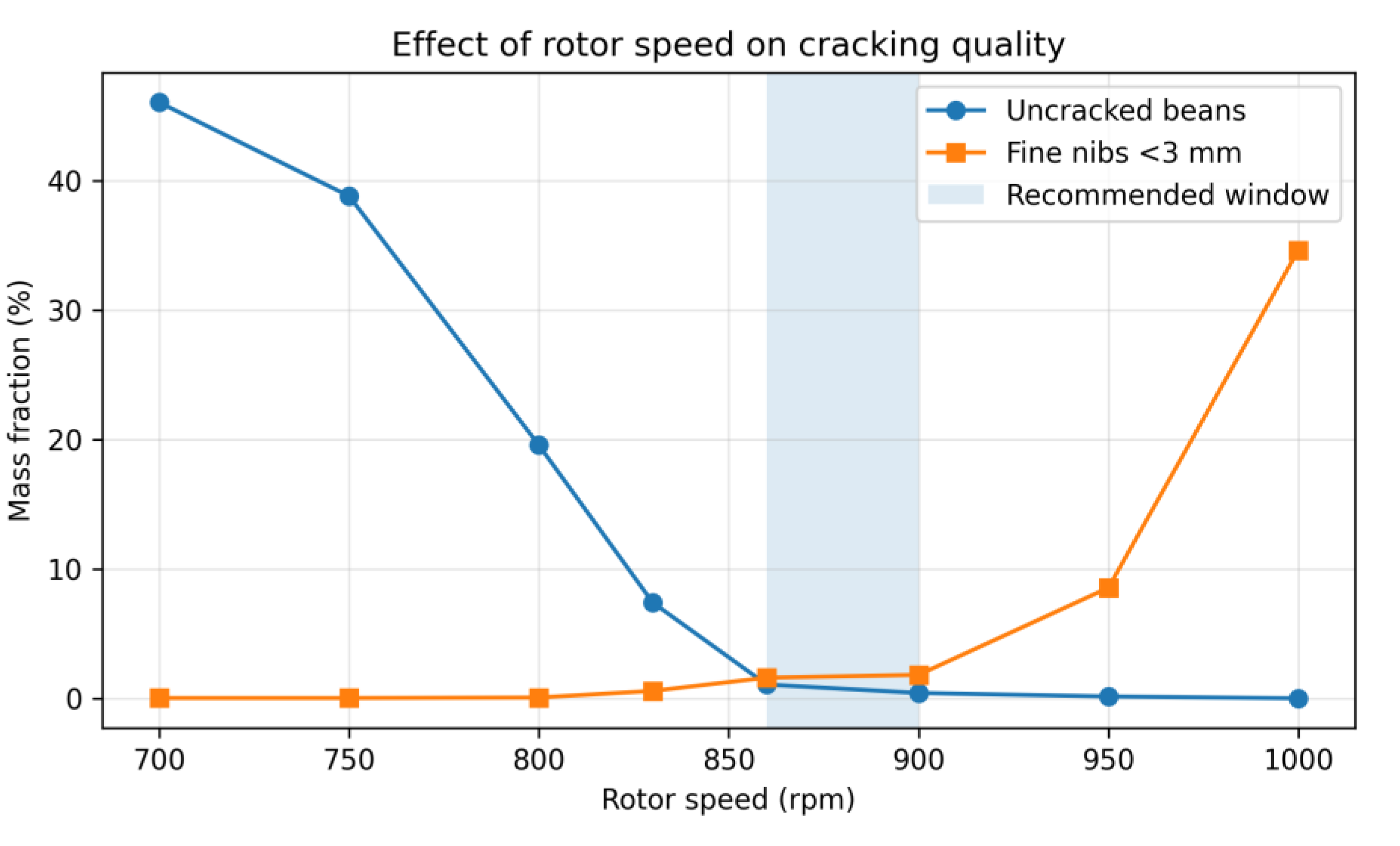
Figure 14.
Estimated kinetic energy per cocoa bean as a function of rotor speed. The shaded bands indicate the theoretical selective impact-energy range and the recommended rotor-speed window.
Figure 14.
Estimated kinetic energy per cocoa bean as a function of rotor speed. The shaded bands indicate the theoretical selective impact-energy range and the recommended rotor-speed window.
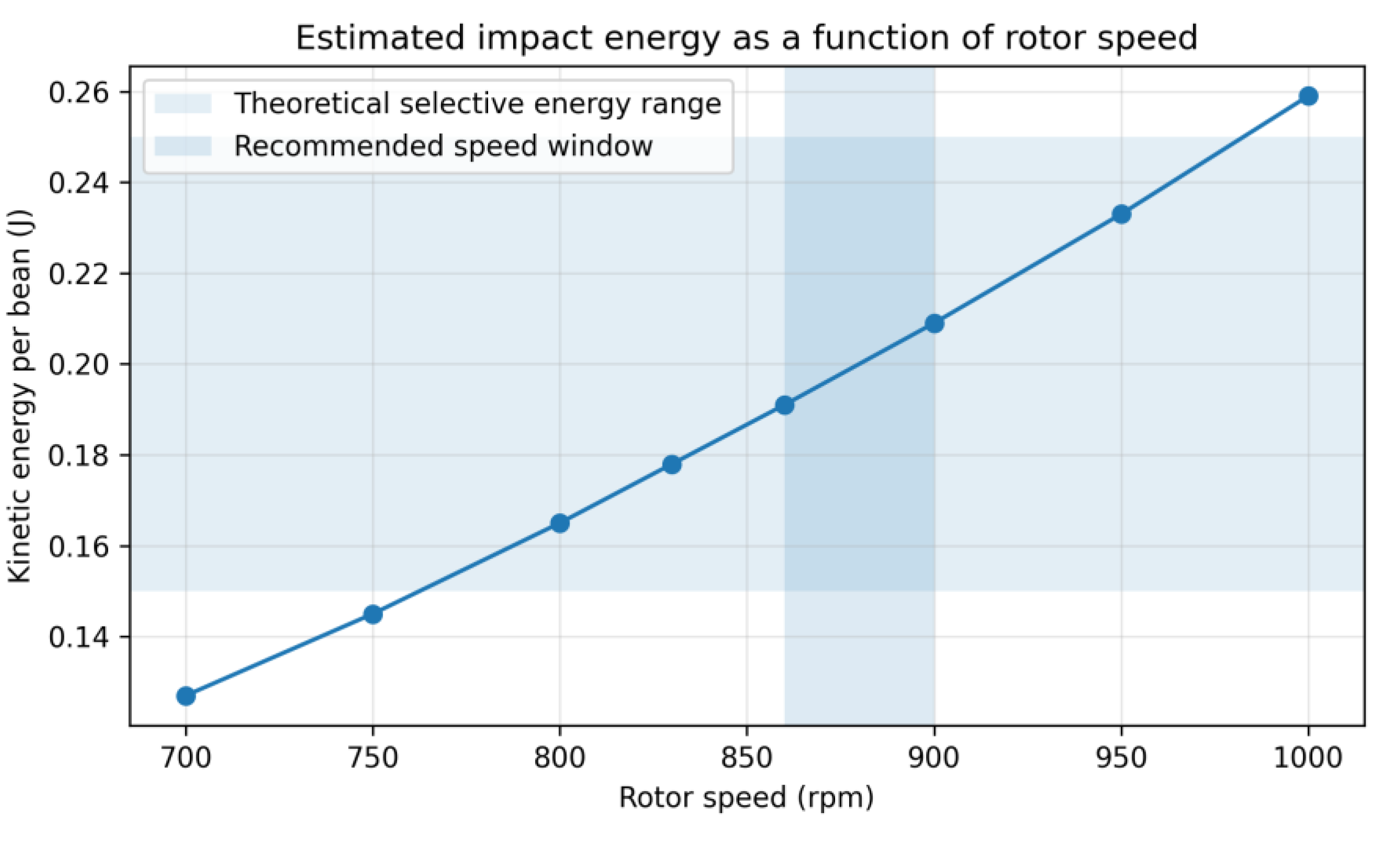

Table 1.
Physical properties of cocoa beans before and after roasting.
| Parameter | Before roasting | After roasting | Main observation |
|---|---|---|---|
| Length (mm) | 22.89 | 23.09 | Almost unchanged |
| Width (mm) | 13.00 | 13.14 | Slight increase |
| Thickness (mm) | 8.23 | 11.09 | Strong increase |
| Sphericity | 0.59 | 0.65 | More spherical after roasting |
| Moisture content (%) | 7.17 | 2.49 | Suitable for brittle shell fracture |
| Average mass of 100 beans (g) | 134.36 | 116.20 | Mass reduction after roasting |
| Kernel content (%) | - | 79.50 | Range: 77.6-80.6% |
| Length (mm) | 22.89 | 23.09 | Almost unchanged |
Table 2.
Statistical summary of selected mechanical properties of roasted cocoa beans.
| Statistic | Thickness after roasting (mm) | Shell-fracture work (N mm) | Kernel-fracture force (N) | Shell-fracture force (N) |
|---|---|---|---|---|
| Mean | 10.98 | 0.697 | 91.896 | 23.515 |
| Standard error | 0.127 | 0.024 | 3.612 | 1.156 |
| Median | 11.002 | 0.633 | 87.753 | 22.272 |
| Standard deviation | 1.379 | 0.264 | 39.245 | 12.555 |
| Minimum | 7.159 | 0.262 | 13.374 | 4.499 |
| Maximum | 14.607 | 1.598 | 195.327 | 54.382 |
| Number of samples | 118 | 118 | 118 | 118 |
Table 3.
Effect of rotor speed on uncracked beans, fine-nib generation, impact velocity, and kinetic energy.
Table 3.
Effect of rotor speed on uncracked beans, fine-nib generation, impact velocity, and kinetic energy.
| Rotor speed (rpm) | Mean mass after roasting (kg) | Uncracked beans (g) | Uncracked beans (%) | Fine nibs <3 mm (g) | Fine nibs <3 mm (%) | Estimated impact velocity (m/s) | Estimated kinetic energy (J/bean) |
|---|---|---|---|---|---|---|---|
| 700 | 9.357 | 4306.4 | 46.03 | 1.5 | 0.02 | 14.770 | 0.127 |
| 750 | 9.400 | 3646.9 | 38.80 | 1.5 | 0.02 | 15.820 | 0.145 |
| 800 | 9.410 | 1839.6 | 19.55 | 5.5 | 0.06 | 16.880 | 0.165 |
| 830 | 9.410 | 695.8 | 7.39 | 53.9 | 0.57 | 17.510 | 0.178 |
| 860 | 9.420 | 99.5 | 1.06 | 149.8 | 1.59 | 18.140 | 0.191 |
| 900 | 9.440 | 38.5 | 0.41 | 171.3 | 1.81 | 18.990 | 0.209 |
| 950 | 9.420 | 12.9 | 0.14 | 804.6 | 8.54 | 20.040 | 0.233 |
| 1000 | 9.390 | 0.0 | 0.00 | 3251.1 | 34.62 | 21.100 | 0.259 |
Table 4.
One-way ANOVA results for the effect of rotor speed on cracking performance.
| Response variable | Source | df | Sum of squares | Mean square | F-value | p-value |
|---|---|---|---|---|---|---|
| Uncracked beans (%) | Rotor speed | 7 | 7365.793 | 1052.256 | 1990.924 | <0.0001 |
| Uncracked beans (%) | Error | 16 | 8.456 | 0.529 | ||
| Uncracked beans (%) | Total | 23 | 7374.249 | |||
| Fine nibs <3 mm (%) | Rotor speed | 7 | 2996.949 | 428.135 | 973.518 | <0.0001 |
| Fine nibs <3 mm (%) | Error | 16 | 7.037 | 0.440 | ||
| Fine nibs <3 mm (%) | Total | 23 | 3003.985 |
Table 5.
Consistency between theoretical prediction and experimental observations.
| Rotor-speed region |
Theoretical interpretation |
Experimental observation |
Scientific implication |
|---|---|---|---|
| 700-800 rpm | Impact energy below or near the lower cracking threshold | High uncracked fraction: 46.03-19.55% | Insufficient impact energy; shell rupture incomplete |
| 830 rpm | Transition into the predicted selective region | Uncracked fraction reduced to 7.39%; fines 0.57% | Beginning of useful shell-nib detachment |
| 860-900 rpm | Inside the practical selective energy window | Uncracked fraction 1.06-0.41%; fines 1.59-1.81% | Recommended operating window |
| 950-1000 rpm | Upper energy region approaching damage threshold | Fines increased from 8.54% to 34.62% | Over-fragmentation dominates; kernel protection is lost |
Disclaimer/Publisher’s Note: The statements, opinions and data contained in all publications are solely those of the individual author(s) and contributor(s) and not of MDPI and/or the editor(s). MDPI and/or the editor(s) disclaim responsibility for any injury to people or property resulting from any ideas, methods, instructions or products referred to in the content. |
© 2026 by the authors. Licensee MDPI, Basel, Switzerland. This article is an open access article distributed under the terms and conditions of the Creative Commons Attribution (CC BY) license (http://creativecommons.org/licenses/by/4.0/).
Copyright: This open access article is published under a Creative Commons CC BY 4.0 license, which permit the free download, distribution, and reuse, provided that the author and preprint are cited in any reuse.


