

Submitted:
07 July 2026
Posted:
09 July 2026
You are already at the latest version
Abstract
Laos is one of the 32 landlocked developing countries (LLDCs) of the world, where the isolation from the sea and the lack of a large-scale fishing industry have a direct effect on fish supply and fish consumption. Per capita fish consumption in LLDCs amounted to 4.6 kg/year in 2017, which is much lower than the world average (20.3 kg) as well as the Developing Regions average (19.4 kg). However, per capita fish consumption in Laos has reached 25.57 kg/year in 2021 representing the highest among the 32 LLDCs. Relying on the results and experiences of several decades of work in aquaculture development in Laos and taking into account the observations of local and international publications, documents and statistics included, the authors have investigated the reasons for the elevated fish consumption in Laos from different perspectives including that of aquaculture, and Lao language, culture, and religion. In this review, the authors analyzed the availability of aquatic resources, the role of fishing and aquaculture in the Lao economy and social life, market realities, as well as the importance of fish in the Lao culture.
Keywords:
Central and Eastern Europe
; Europe–Asia collaboration
; aquaculture
; fish consumption
; Lao language and culture
; landlocked developing countries
; Laos
1. Introduction
There are 44 landlocked countries in the world [1] with 32 of them recognized by the United Nations as landlocked developing countries (LLDCs). Seventeen of the LLDCs – including the Lao PDR – are classified as least developed and face high transportation costs for goods to be shipped to and from international markets. This discourages investment, reduces competitiveness, and isolates these countries from global trade. Isolation from the sea – besides the lack of seaports as coastal trading points – also results in the lack of a significant fishing industry, which directly impacts the availability and consumption of fish.
The average per capita GDP in LLDCs amounted to only 14% of the world average in 2018 [2]. Average per capita animal protein intake (17.2 g/day) in this country group in 2017 was much lower than the Developing Regions average (26.9 g/day), and the fish share in their animal protein intake (7.9 percent) was less than half of the Developing Regions average of 19.8 percent [3]. Per capita fish consumption in LLDCs increased from 2.6 kg/year in 1997 to 4.6 kg/year in 2017, which nevertheless still remained much lower than the world average (20.3 kg/year) and the Developing Regions average (19.4 kg/year) [2]. In 2017, approximately 75% of the total fish consumption of LLDCs was provided from domestic sources. Capture fishery production in LLDCs nearly doubled between 2000 and 2018. Capture fisheries in 2018 primarily comprised miscellaneous freshwater fishes (52.7 percent), carps (31.2 percent) and tilapias (14.8 percent) [2]. The annual growth of aquaculture production in LLDCs was 10.27 percent between 2000 and 2018 and the total aquaculture production reached 446 thousand tons by 2018 [2]. The annual growth rate nearly doubled in Developing Regions (5.91 percent) and the world (5.59 percent). The total aquaculture production is mainly composed of carps and tilapias (45.24 percent and 36.39 percent, respectively).
Laos has the highest per capita fish consumption among the 32 LLDCs with 25.57 kg/year in 2021 that is much higher than the average of the LLDCs (5.54 kg/year). Laos is followed by the Republic of Moldova (17.51 kg/year), Uganda (14.21 kg/year) and Zambia (12.33 kg/year) [3]. Although Laos is a country with a small population where water resources are relatively abundant, it is worth taking into account the circumstances that contribute to the fact that Laos has by far the highest fish consumption among landlocked countries.
2. Overview of Aquatic Resources in Aquaculture and Fisheries in Laos
Among various factors, the availability of water resources is a crucial factor that affects a country’s aquaculture production. Even if Laos is a landlocked country, abundant freshwater resources are available, especially along the Mekong River. Laos lies almost entirely within the lower Mekong basin and has the largest Basin Area (202,000 km2) and a flow of 35% shared by six countries (China, Myanmar, Laos, Thailand, Cambodia and Vietnam). The Mekong River and its 14 tributaries, large reservoirs, shallow irrigation and weirs, wetlands and swamps, and rain-fed rice fields are available for fisheries and aquaculture. The Lao PDR has twelve reservoirs which could possibly be used for culture-based fisheries. There are substantial opportunities and resources available to enhance and augment aquaculture development in Lao PDR [4,5]. According to recent estimations, the total water area used for capture fisheries exceeds 1.2 million ha, while 42,000 ha of water area is utilized by aquaculture [6].
In landlocked countries, the availability of renewable freshwater resources (km3/year) is a key figure when the relation between aquaculture and water resources is investigated. The definition of the Annual Internal Renewable Water Resources (AIRWR) is: long-term average annual flow of rivers and recharge of aquifers generated from endogenous precipitation. The freshwater aquaculture production/renewable freshwater resources ratio (AFR ton/km3) displays a great variety between regions: Oceania, 1.56; Latin America and the Caribbean, 31.1; North America, 50.0; Europe, 68.7; Africa, 84.1, and Asia, 2,409 [7]. Based on recent statistical data on aquaculture production in developing landlocked countries [3] and AIRWR [3], the AFR ratio for Laos was 709.1 t/m3 in 2022 (Table 1).
The lowest AFR value was 1.5 t/m3 in the Central African Republic, while the highest one was 7,966 t/m3 in the Republic of Moldova. Recent data on AIRWR and freshwater aquaculture production confirmed the findings of the Boyd et al. study [7] that freshwater aquaculture production and fish consumption are not highly correlated with the availability of renewable freshwater resources. However, the proximity of rural settlements and homesteads to water areas affects knowledge of fish and its consumption. While AFR is a useful indicator of responsible water management in aquaculture, it is important to consider water use efficiency and environmental sustainability. Overall availability of freshwater resources in Laos is not a constraint to meet the demand for high-quality and healthy fish by the population, however, the application of water-efficient and sustainable aquaculture systems and technology remains a key issue in future aquaculture development [8].
Although water resources are abundant in the Lao PDR, the growing and urbanizing population in conjunction with government strategies for economic development rooted in hydropower, agricultural commercialization and mining, highlight the complex and dynamic interrelationship between water, food, and energy. In such a situation, despite the lack of physical water scarcity, improving water management is crucial to sustaining national economic growth and advancing human development [9].
Integration of fisheries and aquaculture into irrigation schemes is not yet common practice but is a way the performance of irrigation schemes could be enhanced, with both livelihood-related and broader economic benefits [10]. Rice-fish farming was introduced to Laos in 1937, and the 0.82 million ha rice production area offers a great potential for aquaculture through integrated rice-fish farming, however this technology is applied in the case of less than 1 percent of the area [11,12]. In recent decades, several promotion and extension projects have been carried out by governmental, intergovernmental and non-governmental organizations, however further efforts are needed to use the benefit of rice-fish farming in the efficient and sustainable application of water resources [8,13,14].
One of the priority sectors of the national blue economy framework [15] in the Lao PDR is fisheries and aquaculture that has already demonstrated its positive contribution to the efficient use of water resources and environment protection through the application of advanced systems and technologies and through responsible management [15].
3. Socio-Economic Importance of Aquaculture and Fisheries in the Lao PDR
In the Lao PDR, the agricultural sector (crop production, aquaculture and fisheries, animal husbandry, and forestry) is one of the main pillars of the national economy. About 71% of the employed population work in the agricultural sector, mainly on small family farms. As high as 48% of GDP (the second fastest growing GDP in the region after China) comes from agriculture (including fisheries and aquaculture) and the exploitation of natural resources. The contribution of aquaculture and fisheries has been estimated at 7-13% of GDP [13,16]. The sustainable use of natural resources is therefore of strategic importance to the socio-economic development of the Lao PDR that has abundant aquatic resources for fisheries and aquaculture [17]. Aquaculture and fisheries play an important role in providing employment as well as protein to the Lao population. The fish comes mainly from the Mekong River and its tributaries. There are about 590 fish species in Lao waters, 94% of which are native, but 17 species of economic importance play a central role in aquaculture, especially in small-scale farming and fish supply [18]. Aquaculture production is of increasing importance, having reached 113,000 tons in 2019 [3,19]. The development of aquaculture production between 2010 and 2019 is shown in Figure 1.
Although the accuracy of the data provided is questionable, the increase in aquacultural production is clear. The composition of species in aquaculture is shown in Figure 2. according to which the dominant species in production (36,000 tons, 32% of total production) in 2019 was tilapia, which is intensively farmed in cages located in larger rivers. The three Chinese herbivorous species together account for 22% and the three Indian carp species for 17% of total aquaculture production. Carp accounted for 6.2% of total production in 2019 [3].
Pond fish production is a traditional but still significant sector of aquaculture in the Lao PDR, which is the basis of livelihood for many people living in rural areas. The main fish species cultured in ponds are Chinese herbivores, Indian carps and common carp. Cage fish culture has developed dynamically over the last 20 years and has become the most important sector of Lao aquaculture mainly aiming at producing tilapia. Similarly to other Asian countries, fish culture has been integrated with other food production systems, mainly with livestock and rice farming. The opportunities offered by various integrated systems and technologies in the development of a circular economy have not been explored yet [21].
Capture fisheries and culture-based fisheries are important activities in Laos in providing animal protein for rural communities by using various water resources such as the Mekong River and its tributaries; large hydropower reservoirs; natural pools, lakes and small wetlands; irrigation reservoirs, weirs and the large areas of wet-season rice-fields and seasonal Mekong flood plains. The fisheries sector is still at the “subsistence and semi-subsistence” level, however, there are examples of organised fisheries in large reservoirs and systematic stocking in small reservoirs under community management [22,23,24].
In Lao PDR, fisheries and aquaculture activities are governed by the Ministry of Agriculture and Environment (MAE) (previously: Ministry of Agriculture and Forestry, MAF) through its Department of Livestock and Fisheries (DLF). Following the Agreement with the Mekong River Commission (MRC) in 1995, the Lao Government is laying more emphasis on water resources and environmental management in which fisheries would be one of seven key sub-sectors. From that date, regional integration of the sector and its international collaborations have been improved [22,24,25].
Since the 1990s, various laws (Agricultural Law, Penal Law, Forestry Law, Water Resources Law, and the Aquatic and Wild Animals Law) have been the basis for guidelines and instructions issued by local authorities to local communities for the management of aquatic resources. A Fisheries Law was enacted in 2009 that has been replaced by a new “Law on Aquatic Animals, Fisheries and Aquaculture” [26]. The special role of fish in the Lao socio-economy is well indicated by the definition of the Law that recognises four major uses of aquatic animals: (1) utilization for public benefits (e.g., scientific research, tourism, sports, shows); (2) utilization for family benefits (e.g., consumption, medicines, decoration); (3) costumery utilization (e.g., release of fishes during traditional ceremonies) and (4) utilization for business purposes (e.g., farming, exporting and importing).
Even if the utilization of fish and aquatic animals for public and family benefits and for traditional ceremonies remains important in the socio-economy of the country, the opportunities in business utilization are increasingly recognised. A key issue in aquaculture development is commercialization, through the transition from subsistence farming to market production. This is a great challenge for farmers, when their priority from diversity and risk minimization moves towards product quality and safety to meet market demand [27]. An increased supply of high-quality and safe local products to local markets can contribute to increase fish consumption and reach the projected 35 kg/capita by 2030, furthermore, may also decrease the import of fish products.
The planning of appropriate programs and actions in line with the policy of transition from subsistence farming to market production requires the application of a holistic value chain concept. Major findings of a preliminary fish value chain analysis (VCA) are summarized in the following [28]:
- -
- The quality of inputs (seed and feed) should be further improved, however, strengthening farm management (including financial and business management) is a key issue in aquaculture development.
- -
- Processing of aquatic products and meeting safety and quality standards should be strongly encouraged and supported, while there is also a need for product promotion based on consumer’s demand.
- -
- The role of fish farmers and their associations should be strengthened along the value chain, especially in trading activities, but also in planning and governance.
- -
- Appropriate policies, laws and regulations are available, but their enforcement should be supported through strengthening relevant governmental and provincial resources.
- -
- In order to meet the challenges aquaculture and fisheries face, the institutional system in research, innovation and human resources development should be strengthened both on the government and the provincial level.
Regarding the findings of the VCA, as the results of previous government-funded and donor projects, basic conditions are available to elaborate specific action plans and to implement them efficiently both in the public and private sectors. The policy framework for the commercialization of agriculture is in place, in which the aquaculture and fisheries sector is one of the priority areas [25,29]. The economy of the Lao People’s Democratic Republic has been growing gradually over the years, with an average growth rate of about 6.5% between 2010 and 2019. However, in recent years Lao PDR’s economy is experiencing a range of challenges, including a sharp depreciation of the national currency, high inflation, and persistent macroeconomic instability. This is due to ineffective domestic economic reforms and an overall decline in the global economy [12,15]. However, a well-managed aquaculture sector has a great potential to contribute to the improvement of the economic situation, being a vital element of the National Green Growth Strategy of the Lao PDR and even of the Sustainable Blue Economy in the ASEAN Region [30,31].
4. Cultural, Linguistic, and Religious Significance of Fish in Laos
The fact that 80% of the Lao population lives in rural areas, heavily relying on the consumption of fish and other aquatic animals with a remarkable level of 25.3 kg/capita/year [22,32] and a proportion of fisheries in the national GDP of 6.8% [33] makes it clear that fish is a fundamental component of Laotians’ daily life and Lao livelihood and culture [34]. In this chapter cultural, linguistic and religious factors of this phenomenon are being discussed.
The word fish is translated as ປາ /bpaa/ to the Lao language and appears in several expressions denoting species of fish and other aquatic animals, as well as Lao national dishes, and types of fish of different processing methods in Laos (Table 2.).
The Lao word ປາ (fish) is the 129th most frequently used noun of the Lao language [35]. The most typical co-occurrences (words appearing in its vicinity) of the Lao word ປາ (fish) refer to activities connected to fish including ກິນ (eat), ຮັບປະທານ (eat/consume), ໄປຫາປາ (go to fish), and ຂາຍ (sell). More specific activities appear in the vicinity of the word ປາ (fish) such as ປ່ອຍປາ (release fish) that is without doubt in connection with the Buddhist religious habit of releasing fish fingerlings to the rivers and lakes during more important religious festivities as well as on 13 July of each year on the occasion of the National Fish Release Day. The verb ເພິ່ງ (depend on/rely on) also highlights the utmost importance of fish as a staple food in the Lao PDR. Besides activities, highly relevant nouns co-occurring with ປາ (fish) include those connected to fish dishes: ຕັບປາ (fish liver) and ສົ້ມປາ (sour fish). The importance of raising fish as an agricultural activity is reflected in such collocations as ໜອງປາ (fish pond) and ຕູ້ປາ (fish tank).

Table 3.
Most frequent collocations of the word ປາ (fish) in the Lao language. The analysis was performed with the online corpus linguistic tool Sketch Engine [35].
Table 3.
Most frequent collocations of the word ປາ (fish) in the Lao language. The analysis was performed with the online corpus linguistic tool Sketch Engine [35].
| Lao word | English translation | Word class | |
|---|---|---|---|
| 1. | ກິນ | eat |
verbs |
| 2. | ຮັບປະທານ | eat/consume | |
| 3. | ໄປຫາປາ | go to fish | |
| 4. | ຂາຍ | sell | |
| 5. | ປ່ອຍປາ | release | |
| 6. | ເພິ່ງ | depend on/rely on | |
| 7. | ຕັບປາ | fish liver |
nouns |
| 8. | ສົ້ມປາ | sour fish | |
| 9. | ໜອງປາ | fish pond | |
| 10. | ຕູ້ປາ | fish tank |
Lao proverbs, sayings, and idiomatic expressions are also primordial sources of wisdom and knowledge accumulated by the Lao people that reflect cultural values, norms, and beliefs [36,37]. Table 2. summarizes some essential Lao proverbs and sayings connected to fish.
Fish as a staple food, a main protein source and a foundational element of the Lao diet appears in such proverbs as Ten dishes of meat cannot be compared to a fish meal (ສິບຊີ້ນບໍ່ປານປາ) or In the rivers there is fish, in the fields there is rice (ຢູ່ນ້ຳມີປາ ຢູ່ນາມີເຂົ້າ). Further essential Lao values can be grasped including the value of persistence and thrift: When the water rises, the fish eat the ants; when the water falls, the ants eat the fish (ເມື່ອນ້ຳ ຂຶ້ນ, ປາກິນ ມົດ; ເມື່ອນ້ຳ ຕົກ, ມົດ ຈະກິນ ປາ), or Small fish, but hard to catch (ປານ້ອຍ ແຕ່ເປັນ ປາ ຫາຍາກ), or When you eat fish, don’t forget to dry some on the sun (ຄົນໃດກິນປາແລ້ວ ຢ່າລືມເອົາຕົກແດດ). The strong communitarian trait and the utmost importance of interdependence and solidarity can be observed in proverbs including Do good and you’ll have food; do evil and you’ll have fish scales (ເຮັດດີ ມີກິນ ເຮັດ ຊົ່ວ ມີ ເປືອກປາ), and A single rotten fish makes a basketful turn bad (ປາທີ່ ເນົ່າເປື່ອຍ ໂຕດຽວ ເຮັດໃຫ້ກະຕ່າ ເປື່ອຍ ບໍ່ດີ) (Table 4).
Besides language, fish appears to be very deeply embedded in Lao culture, customs, and habits. In many Lao households, fish is the traditional dish of the family gatherings and celebrations. There is also a common belief that eating fish makes children not only healthier but smarter too. Parents usually prioritize serving fish over processed foods, aligning with a broader goal of instilling healthy eating habits in their children from a young age. These preferences reflect the combination of nutritional knowledge, cultural traditions, and beliefs that influence food choices in Lao households, especially concerning the well-being and future success of Lao children.
Cultural and religious rituals and beliefs connected to rivers and lakes are also visible in the various legends and imaginary figures connected to waters [38]. Many of the Lao elderly do not allow their children to be or to play near the rivers because they believe that a soul or water spirit – the Ngeuak (ເງືອກ) and the Naga (ພະຍານາກ) – may prey on them [39]. These mythical creatures are believed to dwell in rivers, lakes, and other waters and are considered to be dangerous for all especially for children. Lao beliefs connected to the Naga and the Ngeuak as well as Lao rituals during the Rocket Festival, the Fish Release Day and during various family festivities confirm the strong embeddedness and impact of the culture of rivers, waters, and fish to Lao culture and everyday life.
5. Fish Trade, Markets, Processing and Consumption
5.1. Fish Trade
Since most of the fish and other aquatic animals in Laos are produced by small farms or caught by artisanal fisheries which do not possess storage and transport facilities and lack appropriate market information, middlemen provide the link between the producers and the market. Few studies have been carried out regarding fish trade, and no official statistical information is available on this subject, however, it is assumed that less than 25% of the total household fish catch and production was traded locally, and this ratio is even lower in remote rural areas [33].
Significant regional differences can be observed in fish trading including the growing presence of Chinese fish farmers on the Nam Ngum River that has led many Lao fish breeders to give up the business, as the Chinese traders have more favorable financial resources to finance their operation. Some larger farms operated by advanced farmers run storage facilities, local fish shops, and even transport trucks to supply fish to consumers [40].
Further to the above, there are also rural communities close to larger water bodies that process fish products and operate fish restaurants purchasing the fish directly from the fisherman without the assistance of middlemen [41]. In some rare examples, export activities can also be observed, in case the relevant documents submitted to the Department of Livestock and Fisheries at the District or Provincial Agriculture and Forestry Office are approved at the National office. Subsequently, the fish and fishery products are quarantined at laboratories and cleared at border checkpoints before reaching the international markets [42].
The commercialization of fish farming is still a great challenge in fish trading. One of the priorities of current national agricultural and fisheries development policies is to ensure the provision of fishery products as commercial commodities for local markets and for future export [33]. Through DLF, the country aims to enhance fisheries trade by improving fisheries management and production, international border checkpoints, fisheries quarantine, and fisheries marketing strategies in collaboration with neighboring countries along the Mekong River [43]. However, significant further efforts are needed to achieve the above goals.
5.2. Fish Markets
Fish markets in Laos exhibit a very diverse and colorful picture. Traditional, rural markets and street vendors are still common in many regions, and equally exist in larger towns including Vientiane, the capital city. The growing number of small, modern shops (e.g., Little Big C, Seven Eleven) sell processed fish products, mainly imported canned fish. Food delivery services (e.g., Foodpanda) are becoming increasingly popular in larger cities, often delivering fish dishes to customers. Modern supermarkets are also appearing in increasing numbers in larger cities. Those typically sell high-quality imported fish products (e.g., salmon, oysters) and delicate fish products that are also commonly available on the menu of high-class restaurants and hotels.
Despite the above, most of the fish and fishery products are sold at local markets situated near the landing sites along the Mekong River and its tributaries, including the Ou, Xieung, and Khan Rivers. In many rural markets, the sellers communicate with the consumers by phone commonly and payment with a mobile phone application is also a common procedure. The market operations at certain landing sites are seasonal, and as a result, fish and fishery products are often sold directly to restaurants [41,44]. Market hygiene conditions vary greatly, generally displaying an improving trend, but in remote areas, they do not meet international food safety standards. As far as the general market situation of fish supply is concerned, it can be concluded that market traditions, market culture, the large number of markets and the high variety of products accessible at markets contribute to the population having access to fish and fish products even in remote regions.
5.3. Fish Processing
Artisanal fish processing has a long tradition in Laos. Apart from the consumption of fresh fish, almost 50 percent of fish and other aquatic animals are transformed into preserved fish products such as salted and dried fish, smoked fish, fish paste and other kinds of fermented fish and fish sauce [45]. Fish processing communities can also be found close to landing sites at large water reservoirs (e.g., Nam Xouang) where mainly women produce various local products namely fermented sour fish wrapped in banana leaves, fermented fish dip, dried fish, and fermented salted fish [23,46]. The first modern fish processing plant of the Lao PDR has recently been built in the frame of a Hungarian development project in Tha Ngon village 25 km from Vientiane on the side of Nam Ngum River. The plant is operated by the Vernkham Agricultural Cooperative that also produces fish and high-value aquatic animals including softshell turtles and frogs. Relying on a modern production line, the plant produces fish fillets, fish balls, and smoked fish with a total capacity of 20 tons per month [41].
5.4. Fish Consumption and Consumer Preferences
Because of limited production levels and a low level of purchasing power, the daily diets of a large segment of the rural population depend mainly on foraged foods including mushrooms, bamboo shoots, wild plants, insects, wild meat, and wild fish. Wild fish is a key source of protein, accounting for over half of the total fish consumption in Laos in 2019 [47,48]. However, volume, structure and trends of fish consumption show a different picture in larger settlements and urban areas. While fish consumption remains high in rural communities, there are emerging trends that reflect changes in the diet of urban populations. With increased access to processed foods and greater availability of imported meat products, fish in urban centers remains a staple food. Additionally, the expansion of the aquaculture industry is contributing to a steady supply of farmed fish, which has impacted both the affordability and availability of fish. The fish caught in reservoirs and natural waters has secondary importance since 1997 when supply from aquaculture exceeded the production of capture fisheries [3]. The share of imported aquatic products is only about 5 percent of the total consumption of aquatic animals [49].
In Laos, there is a growing number of consumers who are ready to buy more modern, processed, packed, high-quality fish products from fish processing plants. It is important to examine which values are important to Lao consumers, especially for the young generation (18-25) and which final products of the value chain they are interested in the most. Understanding the values and preferences of this societal group is crucial for the successful introduction of new fish products in Laos. These consumers are not only concerned with product quality but also show a strong inclination towards the convenience of modern, processed goods. This transition reflects broader global trends where young consumers are more likely to prioritize product quality, packaging, and the overall purchasing experience [50].
Considering the socio-economic changes in Laos, a study (online questionnaire survey) was carried out recently to evaluate the motivation and preferences of young consumers when buying fish and fish products [41]. The results of a local survey on processed fish product preferences were taken into account when the possible selection of fish products was listed in the questionnaire [41]. It should be noted that besides fish fillet, traditional fish products were dominant in the list of preferred processed fish products such as fish ball, dried and fermented fish, fish sausage and fish sauce. The responses of the young customers confirmed the positive consumer attitude towards traditional products since 61% and 50% of the respondents would willingly buy fillet and fish ball respectively. The preference for local products was also clearly indicated by the results since 68.5% of the respondents would like to buy mainly Lao fish and fish products, while 21.8% would buy from other Asian countries, and 9.7% would also buy from European countries and the United States.
The findings reveal a significant openness among the young generation towards new fish products, especially processed and packaged fish items that meet both their quality expectations and lifestyle needs. Food safety concerns are increasing not only among younger consumer groups but in the case of all fish consumers even in rural areas. It is a great challenge for the whole Lao aquaculture sector to improve product quality as well as food safety. The first modern fish processing plant can be a good reference for the application of appropriate processing technology and a reliable certification system. However, there is a need for the development of relevant regulations, the training of the actors along the whole fish value chain, and improved communication with the consumers.
5.5. Export and Import of Fish and Fishery Products
The import of fish and fish products including aquatic animals in Laos has been less than 5% of the total fish supply in the past decade. Local aquaculture production and fisheries catches are the major source of fish supply. The volume of the import of fish and fishery products reached 14,887 tons in 2021, about 4.6% of the total fish supply. Even if the volume of imports is increasing and it was 2.5 times higher than three years ago, the major source of fish supply will remain local production. Imported products predominantly originate from neighboring countries, including Thailand, Vietnam, Cambodia, Myanmar, and China [4,43]. In 2021, 61% of the imports originated from Thailand and included mainly high-value fish (e.g., salmon and tuna), and processed products [3]. In some landlocked developing countries where fish consumption is relatively high, such as Mali and Zambia, the share of the import was 43% and 56% respectively in 2021.
Some landlocked developing countries import fish and fishery products not only from neighboring but also from distant developed countries. In the past decade, Laos has exported approximately 10 to 50 tons of fish and crustaceans annually in both fresh and processed forms [3,39]. There is no clear tendency of exports, and it includes mainly occasional supplies of some special products like fish head to China or freshwater algae to Thailand. Exports of aquatic products do not have any noteworthy effect on local fish supply. The fact that fish consumption in Laos is based on local supply has significant advantages. The fish consumption has not been significantly affected by the recent economic difficulties and the devaluation of the local currency, the kip. The restriction of the imports of fish and fishery products during the COVID-19 epidemic and the recent economic recession indicated that even the most demanding local consumers are interested in domestic premium fish products. The processing of domestic fish can therefore play a major role in maintaining the level of fish consumption.
Conclusions
As demonstrated in this paper, the factors influencing fish consumption are very complex which is also typical of the development of fish consumption in Laos that, despite being a landlocked country, stands out among LLDCs with its high fish consumption. The availability of abundant freshwater resources is a basic factor that affects aquaculture production and fish consumption, however, improved management and integration of aquaculture with irrigation systems are vital for the continued growth of fish production. Enhanced water efficiency and the expansion of rice-fish farming could further contribute to improved fish supply and high fish consumption.
Aquaculture and fisheries are crucial to the Lao economy and culture, with a significant portion of the population dependent on these sectors for livelihood and food security. Fish is deeply embedded in the Lao diet-related and religious habits and customs, and its high relevance can also be clearly grasped in language. The fishery and aquaculture sector provides employment and protein, and contributes to GDP. Transitioning from subsistence farming to market production in Laos causes various challenges but with improved governance, sustainable practices, and commercialization, it can support economic growth and can improve habits and traditions connected to food safety. The deep cultural and religious ties to fish further emphasize its role in Lao society. Strengthening the aquaculture sector offers significant potential for socio-economic development and alignment with national and regional sustainability goals.
The fish trade in Laos faces significant challenges due to limited infrastructure, market information, and the dominance of middlemen. While the aquaculture sector is growing, improving fisheries management and marketing strategies are crucial for enhancing local and export markets. Traditional fish markets thrive but modern processing and consumer preferences for high-quality, convenient fish products are rising, especially among the younger population. Efforts to improve food safety, processing technology, and regulations are necessary for the sector’s development.
References
- Encyclopaedia Britannica (2024) Laos. Available online: https://www.britannica.com/place/Laos (accessed on 21 December 2024).
- Food and Agriculture Organisation of the United Nations. Aquaculture growth potential in Landlocked Developing Countries: WAPI factsheet to facilitate evidence-based policy making and sector management in aquaculture. 2021a. Available online: https://openknowledge.fao.org/server/api/core/bitstreams/e6a6f758-66e8-43b1-b33d-2d45f00d58ce/content (accessed on 19 December 2024).
- Food and Agriculture Organization of the United Nations. Fisheries and Aquaculture – Global Statistical Collections. In FishStatJ: Software for fishery and aquaculture statistical time series (Computer software); FAO: Rome, 2021; Available online: https://www.fao.org/fishery/en/statistics/software/fishstatj (accessed on 26 December 2024).
- Thongsamouth, K. Sustainable Aquaculture and Resource Enhancement in Lao PDR. In Proceedings of the International Workshop on Fish Health and Sustainable Aquaculture: Promotion of sustainable aquaculture, aquatic animal health, and resource enhancement in Southeast Asia, 25–27 June 2019; 2019. [Google Scholar]
- Friend, R. Aquatic Resources in the Lao PDR: A Review of Current Knowledge. MRC Tech. Rev. 2001. [Google Scholar] [CrossRef]
- Open Development Laos Fisheries and aquaculture production in reservoirs in Lao PDR. 2014. Available online: https://laos.opendevelopmentmekong.net.
- Boyd, C.E.; Li, L.; Brummett, R. Relationship of Freshwater Aquaculture Production to Renewable Freshwater Resources. J. Appl. Aquac. 2012, 24, 99–106. [Google Scholar] [CrossRef]
- Inphonephong, S.; Mam, K.; Phounvisouk, L.; Dubois, M. Introducing Integrated Rice–Fish Farming in Lao PDR: Policy Engagements. CGIAR Technical Report, 2024. [Google Scholar]
- McCartney, M.; Brunner, J. Improved water management is central to solving the water-energy-food trilemma in Lao PDR. Int. J. Water Resour. Dev. 2020, 37, 619–639. [Google Scholar] [CrossRef]
- McCartney, M.P.; Whiting, L.; Makin, I.; Lankford, B.A.; Ringler, C. Rethinking irrigation modernisation: realising multiple objectives through the integration of fisheries. Mar. Freshw. Res. 2019, 70, 1201–1210. [Google Scholar] [CrossRef]
- Li, Y.; Phonexay, M.; Zhang, Z.; Li, C.; Li, J.; Zhang, W. Status of rice-fish farming and rice field fisheries in Northern Laos. Front. Sustain. Food Syst. 2023, 7. [Google Scholar] [CrossRef]
- World Bank (2022) Lao People’s Democratic Republic Economic Monitor: October 2022; International Bank for Reconstruction and Development / The World Bank: Washington, DC.
- Thongsamouth, K. Sustainable aquaculture and resource enhancement in Lao PDR. In Proceedings of the International Workshop on the Promotion of Sustainable Aquaculture, Aquatic Animal Health, and Resource Enhancement in Southeast Asia; SEAFDEC, Tigbauan, Iloilo, Philippines, Aya, F.A., de la Peña, L.D., Salayo, N.D., Tendencia, E.A., Eds.; 2021; pp. 25–30. Available online: https://repository.seafdec.org.ph/bitstream/handle/10862/6252/ThongsamouthK2021.pdf (accessed on 11 December 2024).
- Samaddar, A. Integrated rice–fish farming gives farmers in Laos’ Sanamxay region a new lease on life. In WorldFish Brief; Penang, Malaysia, 2024. [Google Scholar]
- Phonvisay, A. Developing a National Blue Economy Framework for Lao PDR. In Policy Brief No; Economic Research Institute for ASEAN and East Asia, 2023; pp. 2023–08. [Google Scholar]
- Baran, E.; Jantunen, T.; Chong, C.K. Values of Inland Fisheries in the Mekong River Basin. In WorldFish Research Report; 2007. [Google Scholar] [CrossRef]
- Author1, Author2 and Author3 (2022) Value Chain Analysis of the Fisheries and Aquaculture Sector in Laos to Contribute to the Improvement of Food Security and Food Safety. In Proceedings of the 1st International Conference on Agricultural and Food Chain Safety Development, 24 February 2022.
- Hortle, K.G. Fisheries of the Mekong river basin. In The Mekong; Elsevier: Amsterdam, The Netherlands, 2009; pp. 197–249. [Google Scholar] [CrossRef]
- Bush, S.R.; Hall, D.; et al. Emerging Aquaculture in the Mekong Region. J. Southeast Asian Stud. 2010. [Google Scholar] [CrossRef]
- Baran, E.; Myschowoda, C. Have Fish Catches Been Declining in the Mekong Basin? MRC Technical Paper. 2009. [Google Scholar] [CrossRef]
- Phommavong, T. Country Report Of Aquaculture Production In Lao PDR. ASEAN Training Course on Aquaculture Production. 2010. Available online: http://www.slideshare.net/ridzaludin/country-report-of-aquaculture-production-inlao-pdr.
- Phonvisay, S. An introduction to the Fisheries of Lao PDR. In Mekong Development Series No. 6.; Mekong River Commission: Phnom Penh, Cambodia, 2013. [Google Scholar]
- Rattana, T.; Thanyalak, S.; Jariya, S. Promoting CBRM and co-management: empowering women in fish processing group in the Nam Xouang Reservoir, Lao PDR. Fish. People 2023, 21(2). [Google Scholar]
- Phouthavong, K.; et al. Sustainable Capture Fisheries and Aquaculture for Food and Nutrition Security in Lao PDR; FAO Regional Office and LARReC, 2014. [Google Scholar]
- Government of Lao PDR. 9th Five-Year National Socio-Economic Development Plan (2021–2025); Vientiane, 2021. [Google Scholar]
- National Assembly of Lao PDR (2023) Law on Aquatic Animals, Fisheries and Aquaculture (Amended), No. 41/NA; Vientiane Capital, 17 July 2023. [Google Scholar]
- Sapakhdy, M.B.; Funge-Smith, S. (1997) Provincial Aquaculture Development Project, Lao. 1997. [Google Scholar]
- Sibounnavong, P.; Máthé, L. (Eds.) Author1, Author2 and Author3 (2022) Value chain analysis of the fisheries and aquaculture sector in Laos to contribute to the improvement of food security and food safety. In Proceedings of the 1st International Conference on Agricultural and Food Chain Safety Development; Embassy of Hungary in Bangkok, Ministry of Agriculture and Forestry, NUOL, 24 February 2022; pp. 13–16. [Google Scholar]
- Dubois, M.; Inphonephong, S. Food, Land, and Water (FLW) Policies and Institutions in Lao PDR; International Water Management Institute (IWMI): CGIAR, 2023. [Google Scholar]
- Government of Lao PDR. National Green Growth Strategy of the Lao PDR till 2030; Vientiane, 2019. [Google Scholar]
- UNEP (2022) Advancing the Sustainable Blue Economy in ASEAN Region. Webinar. 30 June 2022. Available online: https://www.unep.org/events/webinar/advancing-sustainableblue-economy-asean-region.
- Hortle, K.G. Consumption and the Yield of Fish and Other Aquatic Animals from the Lower Mekong Basin. MRC Tech. Pap. 2007, 16. [Google Scholar] [CrossRef]
- Souliphone, K. Country Fisheries Trade: Lao PDR. Regional Fisheries Policy Network (RFPN). 2019. Available online: http://www.seafdec.org/country-fisheries-trade-lao-pdr/.
- La, A. Simple dishes. In Lao Uniprint – Dokked Publishing, APPAL; 2023; ISBN 9789932070336. [Google Scholar]
- Kilgarriff, A.; Baisa, V.; Bušta, J.; Jakubíček, M.; Kovář, K.; Michelfeit, J.; Rychlý, R.; Suchomel, V. The Sketch Engine: ten years on. Lexicography 2014, 1, 7–36. [Google Scholar] [CrossRef]
- Mipun, J. 10+ Amazing Lao Proverbs To Know. 2022. Available online: https://ling-app.com/lo/lao-proverbs-to-know/ (accessed on 16 February 2025).
- Proverbicals.com Laotian proverbs. 2025. Available online: https://proverbicals.com/laotian/ (accessed on 16 February 2025).
- Cranmer, J.; Martin, S.; Coxon, K. The Rough Guide to Laos; Rough Guides: United Kingdom, 2002. [Google Scholar]
- Baird, I.G. Local Ecological Knowledge and Fisheries Management in the Mekong River in Laos. Asian Fish. Sci. 1998. [Google Scholar] [CrossRef]
- Author1. Market Infrastructure development. Consultancy Work in the Frame of Lao Hungarian 3rd Agricultural Tied Aid Loan Program. vitafortasia.com in Bing, 2021. Available online: https://vitafortasia.com/wp-content/uploads/2025/02/Author1-Consultancy-Report-30-July-13-September-2021.pdf.
- Author1. Survey existing artisanal fish processing activities in Vang Vien. Consultancy Work in the Frame of Lao Hungarian 3rd Agricultural Tied Aid Loan Program. vitafortasia.com in Bing, 2022. Available online: https://vitafortasia.com/wp-content/uploads/2025/02/Author1.-Consultancy-Report-01-November-10-December-2022.pdf.
- Khambor, S. Country Fisheries Trade: Lao PDR. Reg. Fish. Policy Netw. (RFPN) 2019, 7. Available online: http://www.seafdec.org/category/country-fisheries-trade/.
- Department of Livestock and Fisheries. Statistics of Fisheries in Lao PDR. Department of Livestock and Fisheries, Lao PDR, 2019. [Google Scholar]
- LARReC. The Study of Fish Market Channels in Luang Prabang and Oudomxay. 2019. [Google Scholar]
- SEAFDEC. Fishery Statistical Bulletin of South Asia 2021. SEC/ST/57. 2024. Available online: http://repository.seafdec.org.
- Sultana, P.; Thompson, P. Gender and Local Fisheries Management in the Mekong Basin. Dev. Change 2008, 39(5), 949–970. [Google Scholar] [CrossRef]
- Food Systems Profile - The Lao People's Democratic Republic; Food and Agriculture Organization of the United Nations (FAO): Rome, Italy; ISBN, 2022.
- Vanham, D.; Mekonnen, M.M.; Hoekstra, A.Y. Treenuts and groundnuts in the EAT-Lancet reference diet: Concerns regarding sustainable water use. Glob. Food Secur. 2020, 24. [Google Scholar] [CrossRef] [PubMed]
- FAOSTAT Food Balance Sheets. 2020. Available online: http://www.fao.org/faostat/en/#data/FBS (accessed on 24 April 2020).
- Krešić, G.; Dujmić, E.; Lončarić, D.; Buneta, A.; Liović, N.; Zrnčić, S.; Pleadin, J. Factors affecting consumers´ preferences for products from aquaculture. Croat. J. Food Sci. Technol. 2020, 12, 287–295. [Google Scholar] [CrossRef]
Figure 1.
Aquaculture production shows a growing tendency, while capture fisheries are levelling in the Lao PDR (FAO FishstatJ, 2024, [3,20]).
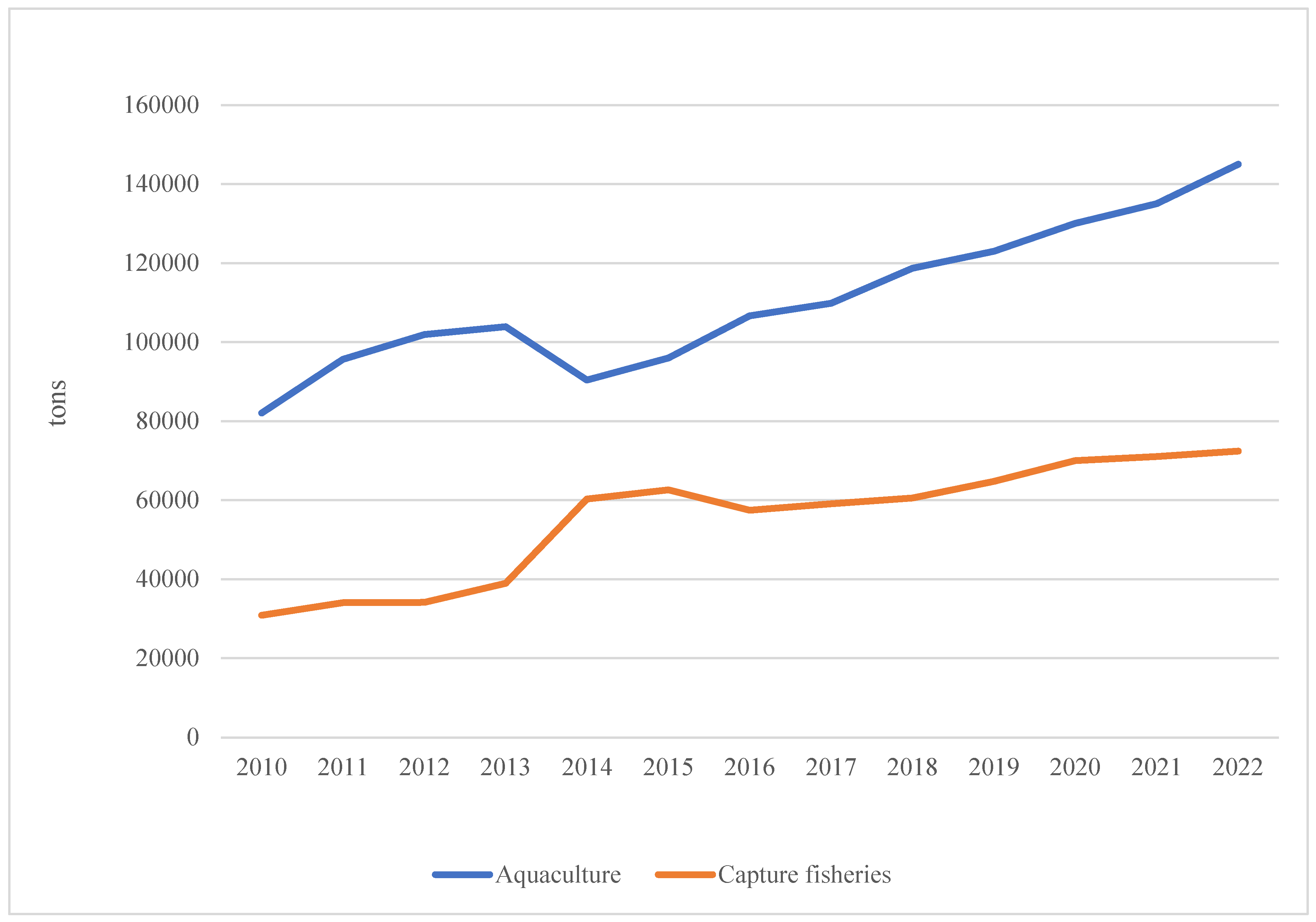
Figure 2.
Species distribution in aquaculture production in the Lao PDR in 2022 (FAO FishstatJ, 2024, [3]).
Figure 2.
Species distribution in aquaculture production in the Lao PDR in 2022 (FAO FishstatJ, 2024, [3]).
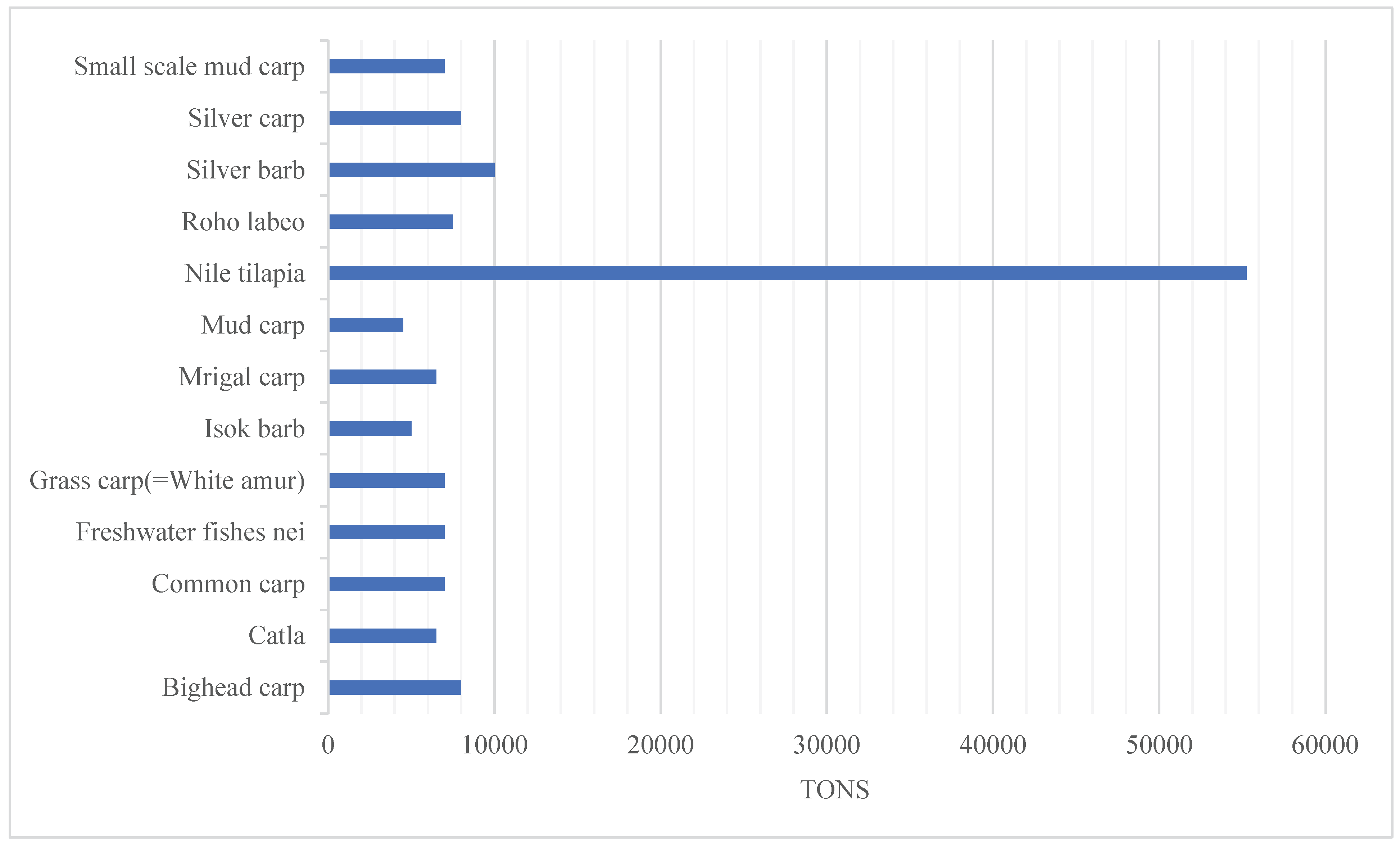
Table 1.
The freshwater aquaculture production/renewable freshwater resources ratio (AFR ton/km3) in landlocked developing countries, where fish production exceeded 100 t in 2021.
Table 1.
The freshwater aquaculture production/renewable freshwater resources ratio (AFR ton/km3) in landlocked developing countries, where fish production exceeded 100 t in 2021.
| Country | AIRWR (km3/year) | Aquaculture production (t) | AFR (t/km3) |
|---|---|---|---|
| Armenia | 6.9 | 18,930 | 2,759.9 |
| Bhutan | 78 | 193 | 2.5 |
| Burkina Faso | 12.5 | 878 | 70.2 |
| Central African Republic | 141 | 210 | 1.5 |
| Chad | 15 | 110 | 7.3 |
| Eswatini | 2.6 | 100 | 37.9 |
| Lao People’s Democratic Republic | 190.4 | 135,008 | 709.1 |
| Malawi | 16.1 | 9,948 | 616.4 |
| Mali | 60 | 8,484 | 141.4 |
| North Macedonia | 5.4 | 1,660 | 307.4 |
| Paraguay | 117 | 14,150 | 120.9 |
| Republic of Moldova | 1.6 | 12,905 | 7,966.0 |
| Rwanda | 9.5 | 10,313 | 1,085.6 |
| Uganda | 39 | 138,558 | 3,552.8 |
| Zambia | 80.2 | 63,355 | 790.0 |
Table 2.
Lao words originating from the word ປາ (fish) denoting species of fish and other aquatic animals, Lao national dishes, and types of fish of different processing methods in Laos.
Table 2.
Lao words originating from the word ປາ (fish) denoting species of fish and other aquatic animals, Lao national dishes, and types of fish of different processing methods in Laos.
| Lao word | Pronunciation of Lao word | English translation | Category | |
|---|---|---|---|---|
| 1. | ປາ | /bpaa/ | fish |
species of fish and other aquatic animals |
| 2. | ປານິນ | /bpaa nin/ | tilapia | |
| 3. | ປາໄນ | /bpaa nai/ | carp | |
| 4. | ປາກົດ | /bpaa got/ | catfish | |
| 5. | ປາທູ | /bpaa tu/ | mackerel | |
| 6. | ປາໄຫລ | /bpaa lai/ | eel | |
| 7. | ປາມຶກ | /bpaa muek/ | squid | |
| 8. | ປາມຶກຍັກ | /bpaa meauk nyok/ | octopus | |
| 9. | ລາບປາ | /laap bpaa/ | spicy fish salad |
Lao national dishes |
| 10. | ກ້ອຍປາ | /ghoi bpaa/ | raw fish salad | |
| 11. | ແກງປາ | /keng bpaa/ | fish soup | |
| 12. | ໝົກປາ | /mok bpaa/ | steamed fish in banana leaves | |
| 13. | ປາແຫ້ງ | /bpaa haaeng/ | fish dried on the sun | Types of fish of different processing methods in Laos. |
| 14. | ປາແດກ | /bpaa daek/ | fermented fish sauce |
Table 4.
Lao Proverbs about fish, their meaning and their underlying societal values.
| Lao proverbs/sayings connected to fish | Literal meaning | Abstract meaning | Underlying value | |
|---|---|---|---|---|
| 1. | ເມື່ອນ້ຳຂຶ້ນ,ປາກິນມົດ;ເມື່ອນ້ຳຕົກ,ມົດຈະກິນປາ | When the water rises, the fish eat the ants; when the water falls, the ants eat the fish. | Luck is fickle. You need to be patient and persistent in life. | Patience, persistence. |
| 2. | ປາທີ່ ເນົ່າເປື່ອຍ ໂຕດຽວ ເຮັດໃຫ້ກະຕ່າ ເປື່ອຍ ບໍ່ດີ | A single rotten fish makes a basketful turn bad. | One single person’s mistake can harm the whole group’s well-being. | Solidarity, importance of the community. |
| 3. | ຢູ່ນ້ຳມີປາ ຢູ່ນາມີເຂົ້າ | In the rivers there is fish, in the fields there is rice. | You can earn your living and maintain a happy life even in simple conditions. | Dependence on and respect of nature. |
| 4. | ປາໃຫຍ່ກິນປານ້ອຍ | Big fish eat little fish. | The more powerful dominates the less powerful in society. | Inequity of society. |
| 5. | ປານ້ອຍ ແຕ່ເປັນ ປາ ຫາຍາກ | Small fish, but hard to catch. | Sometimes seemingly insignificant things can be difficult to obtain. | Persistence and effort. |
| 6. | ກິນປາ ກຳ ແລ້ວ ແຕ່ ດອກໄມ້ ສູງ | Eating fish, but the trees are tall. | Even if you are lucky at the moment, you might face challenges in the future. | Modesty, avoidance of being over-confident. |
| 7. | ປາ ທີ່ບໍ່ມີ ນໍ້າ ກໍເຮັດ ຫຍັງບໍ່ ໄດ້ | A fish without water cannot do anything. | Being prepared for changing or unfavorable conditions in life. | Adaptation to the environment. |
| 8. | ເຮັດດີ ມີກິນ ເຮັດ ຊົ່ວ ມີ ເປືອກປາ | Do good and you’ll have food; do evil and you’ll have fish scales. | For good deeds you will be rewarded, for wrongdoing your karma will bring undesirable results. | Solidarity, helping one another. |
| 9. | ເປັນ ເປັນ ປາ ກໍໄປ ຄົນຈັບ | Even a live fish can be caught. | Even smart and strong individuals can face problems and challenges. | Modesty, being humble. |
| 10. | ຄົນໃດກິນປາແລ້ວ ຢ່າລືມເອົາຕົກແດດ | When you eat fish, don’t forget to dry some in the sun. | Think of tomorrow rather than just enjoying the present day. | Thrift, frugality. |
| 11. | ສິບຊີ້ນບໍ່ປານປາ | Ten dishes of meat cannot be compared to a fish meal. | Fish consumption is favorable for health. | High nutritional value of fish. |
Disclaimer/Publisher’s Note: The statements, opinions and data contained in all publications are solely those of the individual author(s) and contributor(s) and not of MDPI and/or the editor(s). MDPI and/or the editor(s) disclaim responsibility for any injury to people or property resulting from any ideas, methods, instructions or products referred to in the content. |
© 2026 by the authors. Licensee MDPI, Basel, Switzerland. This article is an open access article distributed under the terms and conditions of the Creative Commons Attribution (CC BY) license (http://creativecommons.org/licenses/by/4.0/).
Copyright: This open access article is published under a Creative Commons CC BY 4.0 license, which permit the free download, distribution, and reuse, provided that the author and preprint are cited in any reuse.


