

Submitted:
07 July 2026
Posted:
08 July 2026
You are already at the latest version
Abstract
This study examines urban green infrastructure (UGI) branding as a governance practice shaped by institutional homogenization and strategic responses within China’s multi-level policy framework. Against the backdrop of global sustainability agendas, UGI branding is conceptualized as a policy-oriented, symbolically embedded instrument for communicating cities’ commitments to green development and climate resilience. Using an institutional "identity-label-image" framework, integrated with policy diffusion theory and multi-center regional development models, we systematically analyze historical brand-label data from 27 core cities in the Yangtze River Delta. Our findings reveal three key patterns: (1) brand diffusion follows dual pathways of mandatory and imitative homogenization, with evolutionary rhythms tied to five-year planning cycles, generating discernible "policy waves"; (2) within polycentric regional structures, core cities act as institutional "interpreters" and benchmarks, while peripheral cities pursue imitation-driven differentiation, reflecting complex dynamics of collaboration and competition; and (3) urban identities expressed through brand labels progressively align with substantive sustainability transitions, aiming to enhance regional competitiveness and upward recognition. We conclude that UGI branding constitutes a deep-seated mechanism of sustainable urban governance, offering a novel theoretical lens on China’s institutional logic of city branding and providing actionable insights for optimizing collaborative brand governance and integrated green infrastructure planning in urban agglomerations.
Keywords:
urban green infrastructure
; urban branding
; sustainable development
; institutional isomorphism
; Yangtze River Delta integration
1. Introduction
Rapid urbanization and climate change pose significant challenges to urban sustainability, making the planning and governance of Green Infrastructure (GI) a critical policy priority. GI—encompassing parks, green roofs, rain gardens, and permeable pavements—is widely recognized for its capacity to enhance urban resilience, improve environmental quality, and elevate the quality of life for residents.
Despite its proven benefits, the widespread implementation of GI is not merely a technical challenge but a profound governance issue. It requires political commitment, institutional coordination, and strategic resource allocation. Urban branding has become a core strategic tool for cities to participate in global competition and attract capital and talent [1]. Under China’s unique political and economic system, urban branding exhibits distinct policy-driven characteristics. In national-level urban agglomerations such as the Yangtze River Delta (YRD) and the Pearl River Delta (PRD), cities have widely adopted policy-oriented branding labels like “smart cities” “eco cities” and “innovation cities” [2]. To explain these practices, existing research has drawn from marketing theories [3] and ecological modernization theories [4]. Meanwhile, from a governance perspective [5], policies are largely treated as external contexts, failing to thoroughly analyze urban branding practices themselves as institutionalized policy responses, along with the underlying pursuit of legitimacy and regional competition logic. Current research on GI has predominantly focused on its ecological performance and design, with limited systematic analysis of its governance through policy discourse and institutional dynamics.
Hence, the core issue discussed in this paper is: How the National Sustainable Agenda triggers a “policy wave” of urban label adoption, including GI-related brand labels through mandatory isomorphic pressure; Within multi-center regions, how imitative isomorphism is differentiated and translated to form stratified strategies; How cities actively manage their institutional identities oriented toward sustainable futures through label iteration.
To address these questions, this study innovatively integrates institutional theory from organizational sociology with multi-center development theory in regional studies and policy diffusion theory in public policy. We propose that the evolution of urban brand labels represents strategic responses by city governments embedded in a multi-level, multi-center institutional environment of “state-regional-local” hierarchy, designed to counter homogeneous pressures from diverse directions. Brand labels serve not merely as promotional slogans, but as symbolic governance tools through which cities assert their institutional identity, seek political legitimacy, and secure regional competitive advantages.
This paper takes the “Five-Year Plans”, urban master plans, and territorial spatial planning documents of 27 core cities in the Yangtze River Delta region from 2005 to 2020 as the analysis objects, systematically tracing the diachronic changes in their brand labels. The study, grounded in the aforementioned theoretical framework, provides strong support for it by revealing how urban branding is deeply embedded in the bureaucratic system and regional competition networks under the China context. This research not only expands the theoretical boundaries of urban branding studies but also offers a new perspective for understanding the micro-level implementation mechanisms of China’s regional integration policies and the strategic behaviors of city governments.
2. Literature Review and Theoretical Framework
2.1. Urban Branding
Urban branding, as a key practice area in contemporary urban governance, has undergone a profound theoretical evolution from static symbol construction to dynamic governance processes [6]. Early research, represented by Trueman and other scholars’ commodity theory, viewed urban brands as marketable geographical commodities, emphasizing the design and dissemination of instrumental elements such as visual identifiers and promotional slogans [7]. With the rise of neo-regionalism theory, Kavaratzis and other scholars proposed the governance process theory, arguing that urban branding is essentially a continuous governance process involving multiple stakeholders, with its core lying in coordinating the dynamic balance between local identity and external perceptions. This theory exhibits distinct policy-driven characteristics in China’s cities [8].
Within this governance-oriented perspective, urban branding is acted as a dynamic process of continuous negotiation rather than static policy transmission. The branding should align with the city’s image [9]. The core objective of the ATLAS framework, proposed by Kavaratzis and colleagues, is to achieve “identity-image alignment” ensuring consistency between brand communication content and local essence. Pasquinelli demonstrated through the Italian Eataly case that localized expressions of regional culinary culture can effectively enhance brand authenticity perception. This authenticity transcends mere cultural symbolism to become an immersive lifestyle experience. Additionally, Pasquinelli proposed the “Brand Values-Brand Attributes Matrix” in COVID-19 crisis research, categorizing urban brands’ responses into four types: functional adaptation, emotional adaptation, transformation, and non-response [10]. Urban image, as a collective manifestation of external perception, represents the dynamic projection of identity and labels through communication interactions. Its formation process is influenced by complex factors including media frameworks, public experiences, and sudden events. Effective urban branding hinges on the dynamic balance between identity stability and adaptive responsiveness. Urban branding reflects a brand’s differentiated competitive strategy.
Existing academic research on urban branding has established a three-dimensional analytical framework encompassing identity, labels, and image through examining the intrinsic logic, expression vehicles, and external perceptions of city brands. These three components form a comprehensive theoretical system characterized by core drivers, mediating mechanisms, external projections, and dynamic feedback loops. Urban identity serves as the foundational core of branding, deeply rooted in local cultural genes, historical memories and institutional positioning, which determines brand authenticity and stability while directly impacting the sustainability of the brand [11]. Urban labels function as strategic expression vehicles, materializing identity through policy implementation and competitive dynamics while serving dual roles in legitimacy acquisition and differentiation competition, acting as critical bridges connecting identity and image. Urban image represents external cognitive outcomes—a synthesized impression formed through the dissemination practices of identity and labels, which in turn reinforces identity consolidation and optimizes label refinement. Finally, this framework transcends traditional marketing limitations by defining urban branding as a dynamic, end-to-end governance process with strong local adaptability. It serves as a core theoretical tool for analyzing the evolution of urban brand labels in the Yangtze River Delta region under institutional isomorphism.
2.2. Sustainable Urban Branding and Green Infrastructure
With the accelerated global transition toward sustainability, sustainable urban branding has emerged as a dominant focus in research, emphasizing the integration of environmental, social, and economic sustainability throughout brand positioning, communication, and governance processes. In the field of sustainable urban branding development, scholars have studied the construction of integrated frameworks, linking urban brands with transportation planning, digital governance and the United Nations Sustainable Development Goal, pointing out that sustainable urban branding is not only a marketing tool but also a governance mechanism driving long-term urban transformation [12]. The quality, accessibility, and multifunctionality of a city’s green infrastructure network, including parks, greenways, forests, and wetlands, form the tangible foundation for external perceptions of its sustainability attributes, such as “green” “ecological” “livable” and “healthy” [13]. Urban green infrastructure serves as a provider of diverse ecosystem services [14]. It is a resilience carrier for socio-ecological systems, and a key focus for multidimensional [15] and multiscale urban planning and governance [16]. Consequently, urban green infrastructure functions as the physical spatial vehicle for a city’s brand identity, and the brand image, which a city aims to project directly, influences its planning priorities and resource allocation in this area. Another systematic review indicates that policy-driven approaches, institutional embedding, regional coordination, and local responsiveness are key mechanisms for the formation of sustainable local branding, which align closely with the practices of China’s urban branding [17]. Furthermore, resilience has gradually become a core brand dimension in urban branding, used to address external shocks, such as climate disasters, public health crises, and geopolitical conflicts. Existing research views resilience branding as a synergistic pathway for urban risk governance and image enhancement, emphasizing the supporting role of multi-center collaboration, regional division of labor, and differentiated positioning in implementing resilience labels [18]. In crisis situations, resilient-oriented urban brands can restore trust more quickly, stabilize expectations, and form a “safety premium” and sustainable competitiveness [19].
In conclusion, existing research has analyzed the role of urban brand labels in promoting sustainable urban development, as well as the expansive concepts and practical cases of urban green infrastructure. However, no clear urban green infrastructure framework has been established, and most studies use Western cities as samples, providing insufficient explanations for localized characteristics, such as China’s multi-tiered institutional environment, five-year planning cycles, and regional multi-center competition and collaboration. This paper defines urban green infrastructure labels as symbolic governance tools with policy-oriented characteristics and rooted in institutional frameworks, reflecting cities’ commitments to green development, climate resilience, ecological protection, and sustainable urbanization. Furthermore, the article employs the institutional isomorphism theory as the core analytical framework and examines cases of multi-center regional governance to effectively elucidate the evolutionary mechanisms and differentiated strategies of urban branding in response to the sustainable agenda within the China context.
2.3. Process of Urban Branding Building
Urban branding building is a complex process in which political and economic factors intertwine and influence each other. Scholars approached the topic from the perspective of public management and governance, exploring urban branding as a governance strategy and political process [20]. The uniqueness of China’s urban branding building lies in its deep embedding within multi-layered governance frameworks [21]. Research on Pearl River Delta cities indicates that China’s urban branding selection is influenced not only by local economic development and geographical factors but also significantly constrained by top-down administrative directives. Zhang et al. proposed the theoretical concept of “state-driven urban branding” in their case study of Ningbo, revealing how local governments utilize national strategic frameworks such as the Belt and Road Initiative to conduct branding practices and actively position themselves within central policies to secure political and economic resources [22]. Whether establishing urban branding within national policy frameworks or pursuing unique or composite urban branding based on local realities, these strategies serve as means for regions to achieve sustainable development.
DiMaggio and Powell proposed the Institutional Isomorphism Theory to explain organizational convergence in similar institutional environments. The selection of brand labels emerges as a response to institutional pressures [23]. Urban branding can be viewed as a concrete manifestation of brand identity across stakeholder dimensions, serving as a critical medium that transforms abstract identity positioning into actionable development goals. Building on policy diffusion theory, Shipan and Volden analyzed the mechanisms of policy diffusion, which include learning, competition, imitation, and coercion [24]. In urban branding research, policy diffusion theory provides insights into the regional dissemination patterns of urban branding. The central structure of polycentric urban development refers to a hierarchical urban system where multiple centers coexist at different spatial scales, including inter-city and inter-regional levels, with functional integration and institutional coordination serving as key drivers [25]. The Yangtze River Delta urban agglomeration exemplifies a typical multi-center region, with Shanghai, Hangzhou, Nanjing, and Hefei forming the primary hubs, supported by secondary centers such as Suzhou, Ningbo, and Wuxi [26]. This multi-center framework implies that institutional pressures and models of emulation are not singular [27]. While mandatory pressures at the national level are pervasive, cities at different administrative tiers occupy distinct positions within regional networks, facing varying competitive dynamics, access to information and resources, and consequently divergent response strategies. Core cities may not only respond to policies but also serve as “interpreters” of regional institutional logic and “benchmark models” for emulation. In contrast, peripheral cities might seek differentiation from peer cities while emulating core models, or strategically adopt more self-serving identifiers [28].
Scholars point out that China’s urban branding is deeply embedded in multi-level governance structures, with label selection influenced by both top-down policy constraints and inter-regional competitive imitation, resulting in behavioral differences between core cities and ordinary cities. However, existing research remains confined to single theoretical explanations, failing to systematically reveal how multi-level institutional pressures at the national, regional, and local levels translate into convergence and divergence of urban brand labels. Therefore, this paper takes this as the theoretical starting point, using institutional isomorphism to explain the institutional roots of label convergence, policy diffusion to reveal the cycles and mechanisms of label dissemination, and multi-center regional theory to interpret differentiated urban response strategies. These three dimensions progressively build upon each other, collectively constructing the analytical path of “institutional pressure—diffusion mechanisms—strategic responses”. This approach not only addresses the limitations of existing research but also provides a comprehensive theoretical foundation for the empirical analysis of urban brand label evolution mechanisms in the Yangtze River Delta region.
2.4. Theoretical Framework
The above studies show that urban branding research has experienced significant theoretical evolution and methodological expansion in recent years. With the emergence of new regionalism theory, scholars have gradually realized that urban branding is essentially a continuous governance process with the participation of multiple actors, and its core lies in the dynamic balance between place identity and external perception [28]. Furthermore, the polycentric theory of regional development provides an important framework for understanding urban interactions within city clusters. Polycentric city theory emphasizes the existence of multiple competing and cooperating urban centers, which achieve sustainable regional development through complementary functions and division of labor within a region. However, there is still a lack of a unified theoretical framework to explain the institutional isomorphism mechanism of urban branding in China. This paper attempts to construct a framework for analyzing the institutional mechanism of urban branding in China by taking institutional isomorphism theory as the core framework and innovatively transferring the theory of business organization to the field of urban governance under the background of institutional embeddedness in the choice of regional urban brand labels. The overall evolutionary path of urban brand labels is shown in Figure 1.
According to the Outline of the Yangtze River Delta Regional Integration Development Plan issued by the State Council of the CPC Central Committee in 2019 [29], the entire area of Shanghai, Jiangsu, Zhejiang and Anhui provinces are included in the scope of the Yangtze River Delta integration plan, with a total of 41 prefectural-level cities and above. Based on the strength of economic ties, geographic proximity and national strategic positioning, the plan defines the 27 developed city clusters adjacent to Shanghai and along the rivers, bays and coasts as the central zone, including Shanghai, Nanjing, Wuxi, Changzhou, Suzhou, Nantong, Yangzhou, Zhenjiang, Yancheng, Taizhou (Jiangsu Province), Hangzhou, Ningbo, Wenzhou, Huzhou, Jiaxing, Shaoxing, Jinhua, Zhoushan, Taizhou (Zhejiang Province), Hefei, Wuhu, Ma’anshan, Tongling, Anqing, Chuzhou, Chizhou, Xuancheng. Through empirical analysis of the evolution of city labels in 27 core cities in the Yangtze River Delta since the 11th Five-Year Plan, this paper reveals the role of institutional isomorphism in shaping urban branding choices. Moreover, the paper will compare it with that of the Pearl River Delta, another mega-city region characterized by dense urban networks, rapid economic integration, and coordinated regional governance, to provide new theoretical explanations for the institutional logic of urban branding in China. Figure 2 shows the study area map of this paper.
This paper explains the proposition of regional urban label selection, arguing that urban government behavior is deeply embedded in an environment composed of three institutional logics.
Proposition 1: The selection of urban labels is influenced by coercive isomorphism. National institutions constitute the primary institutional pressure source for local governments in choosing urban labels; urban label diffusion serves as a policy impulse from the national sustainable development agenda. The central government communicates clear development orientations and evaluation signals to local governments through instruments such as the “Five-Year Plan for National Economic and Social Development” and pilot policies implemented by various ministries. Since adopting these policy labels provides cities with direct access to fiscal resources, policy incentives, and political recognition, national institutions generate the strongest coercive isomorphism pressure [30]. This pressure exhibits cyclical pulse characteristics and is highly correlated with policy release windows.
Proposition 2: The selection of urban labels results from mimetic isomorphism. Within the multi-center Yangtze River Delta region, cities engage in complex dynamics of competition and collaboration. The diffusion of urban labels represents the dissemination and adoption of regional sustainable best practices, where pressures from national-level policies are differentiated and amplified. Core cities, leveraging their political influence, economic strength, and innovation capabilities, often pioneer and successfully implement national-level labels, transforming them into distinctive regional brand advantages. This makes them primary targets for mimetic isomorphism by other cities. Concurrently, intense competitive homogenization emerges as cities vie for investments, talent, and policy attention, accelerating label dissemination and iteration, driving sustainable urban development across the region.
Proposition 3: Urban branding reflects proactive strategic responses from local governments. Cities are not passive recipients of external pressures. Leveraging their resource endowments, cities critically assess and strategically respond to pressures from higher authorities and peer cities, transitioning toward development paths conducive to sustainable growth. Within the framework of national institutional frameworks and regional influences, cities may adopt branding strategies through three approaches: complete compliance by rapidly adopting mainstream labels; selective adaptation by incorporating distinctive local characteristics; or differentiated innovation by creating unique identities in marginal or emerging sectors. These approaches demonstrate the limited agency of local governments constrained by institutional frameworks.
Thefunctioning of a city’s brand identity can be conceptualized as alogical institutional chain:
First and foremost, cities adhere to their institutional identity. Institutional identity refers to the strategic role and positioning assigned to a city through superior planning, regional division of labor, and historical development. This identity is institutionalized and exhibits considerable stability.
Secondly, cities also establish strategic positioning based on their own developmental needs. This refers to policy-oriented discursive symbols that cities actively select and promote externally to demonstrate, consolidate, and even elevate their “institutional identity.” Strategic labels serve as institutionalized expressions of identity, and their selection is directly influenced by the aforementioned three-layered isomorphic pressures.
Cities ultimately shape their target image through strategic identity selection and branding. By consistently disseminating and implementing “strategic branding”, cities expect to establish a clear, positive, and competitive cognitive image in the minds of key audiences. Successful image building, in turn, reinforces the city’s institutional identity, enhancing its legitimacy, resources, and discourse power.
This institutional chain reveals the underlying logic of urban branding as a continual process of institutional legitimacy and regional positioning. Labels serve as strategic instruments, shaping the city’s target image and driving sustainable development, yet their movement remains governed by embedded institutional logic.
3. Materials and Methods
To map the distribution of applied urban branding across the 27 core cities in the Yangtze River Delta region, we first collected the urban branding names adopted by these cities based on their five-year plans, comprehensive urban plans, and territorial spatial planning texts (Figure 3). We selected the urban comprehensive plans for the period 2005-2021, the territorial spatial plans for 2021-2025, and the 11th (2006-2010), 12th (2011-2015), 13th (2016-2020) and 14th (2021-2025) five-year plan texts as our sample.
Before the formal analysis, we performed comprehensive data cleaning and preprocessing on the collected texts. We first unified the formatting of all texts, removed duplicate, vague statements, and administrative provisions unrelated to urban development positioning, retaining only valid sentences that reflect urban development goals, strategic visions, and brand positioning. On this basis, we conducted a quantitative analysis of the 11th (2006-2010), 12th (2011-2015), 13th (2016-2020) and 14th (2021-2025) five-year plans of the 27 cities in the Yangtze River Delta region, and merged synonymous labels. For example, expressions such as “Smart Shanghai” “Digital City” and “Information City” were uniformly classified as “Smart City”. Then, to ensure methodological robustness, we performed textual analysis on document titles, headings, and content, categorizing by label keywords, such as ecology, finance and innovation, and counted whether these keywords were used as city labels. If a city label was followed by words such as “city” “pilot” “demonstration zone” “base” “center” or a city name, that label was counted. Ultimately, we identified fourteen major city label categories: manufacturing city, eco city, low-carbon city, modern agricultural city, resilient city, service city, smart city, tourism city, financial center, economic center, zero-waste city, sci-tech innovation center, hub city, and cultural city. Environmental protection, ecological sustainability, resource recycling and climate resilience form the core components of the discourse on green infrastructure governance. Concepts such as eco cities, low-carbon cities, resilient cities, and zero-waste cities directly address ecological conservation, green spaces, environmental quality, and livability, representing the primary objectives of green infrastructure development. This paper categorizes these as key indicators of urban green infrastructure. Furthermore, modern agricultural cities emphasize ecological, organic, and circular agriculture; smart cities serve as vital tools for enhancing green infrastructure management efficiency and achieving low-carbon operations, sharing significant common ground with green sustainable development. Consequently, this paper also includes modern agricultural cities and smart cities within the scope of urban green infrastructure indicators.
Next, we carried out the core analysis using quantitative text coding and frequency statistics. By identifying sentence-by-sentence the occurrence of the fourteen major city labels within each planning period, we performed frequency counts. We counted, respectively, the frequency of label usage for a single city within a single five-year planning period, and the average frequency of usage for each type of label across the 27 cities.
To further analyze the match between city labels and the cities’ own development foundations, we conducted an urban development path analysis which initially conceptualized by de Jong [31] (See Table A1). Table 1 shows this framework classifies cities into five distinct pathways by cross-referencing two core dimensions: (1) their dominant economic-industrial profile—whether the primary, secondary, or tertiary sector exerts the greatest influence; (2) their position within the regional, national, or international urban hierarchy. Specifically, cities with regional influence refers to cities that radiate influence over their surrounding areas; national influence refers to cities that exert a radiating effect nationwide; international influence refer to those listed in the global city roster by the Globalization and World Cities Research Network [32]. To track evolutionary trends from 2005 to 2020, we collected all relevant data for the first year of each five-year plan. Each pathway implies a set of theoretically “expected” or “congruent” urban branding strategies and label categories. By applying this framework to our sample of 27 cities in the Yangtze River Delta, we are able to establish a baseline for what each city “ought” to brand itself as, given its structural conditions. Comparing this baseline with the actual brand labels extracted from policy documents allows us to identify instances of institutional isomorphism as well as strategic differentiation. Table 2 summarizes the five pathways and their corresponding anticipated branding strategies.
In the following sections, we first examine the influence of the evolution of Chinese national policies over time on city label choices. Since 2005, the state has begun implementing five-year plans, formulating core urban policies at the national level. To implement national policies, various ministries and commissions have promoted national urban development programs at the municipal level, establishing standards and guidelines for cities to refer to. Cities meeting the requirements would be awarded national titles such as National Eco City or Smart City, and undergo performance evaluations every five years. Therefore, we first systematically collate and interpret the core policies formulated at the national level since the implementation of the national five-year plans in 2005. Then, we compare and analyze the use of municipal titles for the 27 cities in each five-year cycle after 2005 against their pilot designations.
Second, we investigate the influence of inter-regional imitation and competition on brand label choices. We first collate the city labels of each city, distinguishing the types of labels used by core cities versus follower cities and the order in which they appeared, and then compare and analyze the radiating and leading role of core cities as well as the functional differentiation among cities based on resource endowments.
In addition, we examine the influence of urban economies on brand label choices. For instance, the economic development stage of each city is determined by its GDP contribution and labor force size in the three broad economic sectors. If a city’s economy is dominated by agriculture, forestry, and mining, it is considered to be in the primary development stage. Figure 3 illustrates the data collection and analysis process.
4. Results
4.1. Frequency of City Labels
Figure 4 presents the average frequency of city labels adopted by 27 cities in the Yangtze River Delta (YRD) from 2005 to 2020, offering a holistic picture of label evolution. The data reveal that the three most frequently used labels across YRD cities between 2005 and 2015 were service city, sci-tech innovation center, and manufacturing city. Entering the 14th Five-Year Plan (FYP) period, economic center replaced manufacturing city among the top three. Meanwhile, labels including sci-tech innovation center, service city, transport hub city, resilient city, and zero-waste city recorded steady growth, whereas the average frequency of low-carbon city and smart city declined markedly.
The curves in Figure 4 show an upward trend for most cities from the 12th to 14th FYPs, indicating an expanding scope of urban branding. The dominant trend across all periods is a large-scale shift toward service city positioning (Figure 5). This expansion primarily absorbed cities transitioning from economic center and manufacturing city. Sci-tech innovation center emerged as a secondary growth category. Together, these transitions reflect a structural reorientation from production- and finance-oriented functions toward service- and innovation-driven development.
Note: The numbers indicate the frequency of each label within each planning period.
Meanwhile, pronounced divergences appear in cities’ emphasis on specific labels, as Figure 6 displays the frequency of each label from 2005 to 2020 for all 27 cities, reflecting distinct development paths and factor endowments. For instance, economically strong cities such as Suzhou and Wuxi adopted manufacturing city and sci-tech innovation center earlier and more intensively, in line with their industrial upgrading trajectories. By contrast, cities such as Chizhou and Tongling prioritized tourism city and zero-waste city to highlight their resource advantages. The adoption of policy-oriented labels across cities follows a typical S-shaped curve over time: slow initial uptake, rapid diffusion in the middle stage, and gradual saturation in later periods.
4.2. Consistency Between Labels and Brand Identity
To assess whether city brand label choices align with long-term brand identities, it is essential to first recognize a significant institutional shift in China’s spatial planning system. The territorial spatial plan, which has gradually replaced the traditional urban master plan since the late 2010s, is rooted in the broader context of China’s Ecological Civilization strategy [33]. Unlike the urban master plan, which primarily focused on urban development and spatial expansion, the territorial spatial plan is a “multi-plan integration” instrument that consolidates urban planning, land use planning, and environmental protection planning into a single, legally binding blueprint [34]. This paradigm shift suggests that brand identities embedded in territorial spatial plans may differ systematically from those in earlier urban master plans, reflecting a heightened sensitivity to ecological constraints and sustainable development imperatives. Table A2 illustrates how urban master planning and territorial spatial planning shape cities’ brand identity.
This study follows the method of Lu & de Jong [2] and matches the development pathways implied by specific labels in FYPs against brand identities derived from urban master plans and territorial spatial plans. Based on two core dimensions, which are leading industrial type and regional influence level, the 27 YRD cities are classified into five development pathways, with distinct label orientations corresponding to each pathway. Table 3 illustrates the trajectories of developmental paths based on city labels and development in the Yangtze River Delta (2005–2025).We capture each city’s economic and regional status through its development path and compare this with its label selection. Specifically, if a city selects labels according to its development path, it can be expected that its use of labels will align with that path. Conversely, if the label selection deviates from the above prediction, this suggests that the label selection is more or less random or is influenced by regional institutional embeddedness.
The results show that during the 11th and 12th FYPs, labels of most YRD cities concentrated on Pathway 4, clearly ahead of their actual economic and regional status. This reflects a phenomenon of over branding in urban branding, whereby cities use labels to express developmental aspirations rather than merely describe current conditions [35]. Since the 13th FYP, the consistency between labels and development pathways has improved significantly. Shanghai has consistently anchored itself in Pathway 5, with labels centered on economic center, sci-tech innovation center, and service city. Manufacturing-intensive cities such as Suzhou, Wuxi, and Changzhou have gradually shifted from single Pathway 2 to the hybrid Pathway 2/4 (advanced manufacturing plus service and innovation), with label choices closely matching industrial transformation and regional division of labor. Eco-oriented cities such as Huzhou and Chizhou have continuously focused on Pathway 1/4, keeping labels consistent with positioning as eco-tourism and livable cities.
Moreover, a systematic comparison of brand identities in urban master plans and territorial spatial plans reveals notable patterns of both continuity and adaptation, which can be further assessed against cities’ own development foundations. As shown in Table A2, core cities such as Shanghai maintain high brand continuity across both plan types, consistently emphasizing its identity as a global city with five national centers. This stability reflects a strong alignment between its long-term strategic positioning and its actual economic-geographic reality, confirming that cities with robust, diversified development foundations are less affected by institutional shifts.
However, for many other cities, the introduction of territorial spatial plans appears to have prompted a recalibration of brand identities towards greater realism or stronger ecological orientation. For instance, Ningbo’s brand identity in the territorial spatial plan explicitly incorporates “national advanced manufacturing base” and “national shipping and logistics center”, which more accurately reflect its industrial and geographical strengths compared to the broader “key coastal port city” and “economic center” labels in the previous urban master plan. This change suggests that the territorial spatial plan, rooted in the Ecological Civilization paradigm, encourages a more grounded and resource-based positioning, possibly reducing the gap between aspirational branding and actual development foundations.
Overall, YRD city brand labels have shifted from premature and homogeneous positioning to pragmatic and differentiated strategies, matching the continuity and adaptation of brand identities in urban master plans and territorial spatial plans, and aligning better with actual urban development.
4.3. City Label Choices Under Coercive Isomorphism
The evolution of YRD city brand labels is highly synchronized with the iteration of national urban development policies, displaying distinct characteristics of coercive isomorphism. The central government imposes top-down institutional pressure through FYPs and ministerial pilot programs, driving the cyclical diffusion of city labels. Table A3 collects national urban development projects classified by city labels in China from 2005 to 2025.
Data confirms that label choices reflect cities’ compliance with national institutional arrangements. During the 11th FYP, national campaigns for model service outsourcing cities, innovative cities, and low-carbon cities directly spurred the popularity of service city, sci-tech innovation center, and low-carbon city. In the 12th FYP, the launch of smart city and sponge city pilots triggered an explosive rise in the frequency of corresponding labels. During the 13th FYP, the national push for zero-waste cities and ecological civilization demonstration cities made eco-related labels mainstream. In the 14th FYP, with a focus on high-quality manufacturing development and comprehensive transport hubs, the frequency of manufacturing city and transport hub city rebounded noticeably. Adopting such policy-oriented labels serves as a direct channel for cities to secure fiscal resources, policy incentives, and political legitimacy. The diffusion of labels displays a stepped, pulsed pattern synchronized with policy cycles, fully verifying the coercive binding effect of national institutions on city brand choices.
4.4. City Label Choices as a Result of Mimetic Isomorphism
Within the polycentric regional structure of the YRD, intercity competition and collaboration have fostered mimetic isomorphism, with label diffusion characterized by leadership from core cities, follow-up by sub-central cities, and hierarchical transmission.
Table 4 lists cities that pioneered the adoption of various labels in 11th Five-Year Plan Period. Core cities such as Shanghai, Hangzhou, Nanjing, and Hefei, owing to their political status, economic strength, and innovation capacity, emerged as forerunners in regional label innovation. During the 11th FYP, they took the lead in proposing labels including manufacturing city, sci-tech innovation center, service city, and smart city, integrating national policies with local positioning to form replicable regional brand paradigms. Sub-central cities such as Suzhou, Wuxi, and Ningbo followed rapidly, refining label connotations based on their industrial foundations. Peripheral cities such as Yancheng, Chuzhou, and Xuancheng selectively adopted adaptive labels by benchmarking peer-level cities.
From the perspective of mimetic logic, core cities combine national policies with local endowments to infuse labels with regional connotations, forming replicable regional brand paradigms. Sub-central cities absorb functional spillovers from core cities and achieve industrial coordination and brand synergy through imitation. Peripheral cities pursue differentiated competition amid imitation based on resource endowments, ultimately forming a regional brand landscape of convergence with divergence and coordination with competition.
4.5. City Labels as Reflective of Local Strategic Responses
Over time, especially during the 13th and 14th FYPs, a growing number of cities have chosen development pathways best suited to their resource endowments, industrial foundations, and regional positioning, leading to more stable and targeted label selection. For example, Shanghai’s labels have consistently centered on high-order functions such as economic center, sci-tech innovation center, and service city. Cities with strong manufacturing foundations, such as Suzhou and Wuxi, have increasingly superimposed sci-tech innovation center onto manufacturing city, signaling a transition toward advanced manufacturing and innovation-driven development that aligns better with their sci-tech-oriented brand identities (Table A4).
Furthermore, the trajectory of dominant development pathways across planning periods provides strong evidence for this pragmatic shift (Table 3). The data shows a clear movement from a concentration on Pathway 4 in earlier FYPs to a predominance of the hybrid Pathway 2/4 in the 13th and 14th FYPs. This transition reveals that cities are now adopting labels more closely matched to their actual economic-geographic conditions.
In addition, a comparison of brand identities in urban master plans and territorial spatial plans reveals continuity and adaptation in YRD city brand positioning (Table A2). On the one hand, core cities maintain high continuity in brand positioning. For instance, Shanghai emphasizes its identity as a global city with five national centers in both types of plans, demonstrating stable brand identity. Hangzhou has upgraded from a key central city in the YRD to an important national central city in eastern China with the addition of an international comprehensive transport hub, reflecting its rising status in the regional hierarchy. On the other hand, territorial spatial plans have significantly strengthened the dimension of manufacturing city, echoing the resurgence of this label in the 14th FYP (Figure 4) and confirming the pragmatic change of YRD cities from overemphasis on service Pathway 4 to the hybrid Pathway 2/4 of advanced manufacturing plus innovation-driven development.
5. Institutional Isomorphism and Strategic Response of China’s Urban Brand Building
To explain both the convergence of label selection among core cities in the Yangtze River Delta region and the persistence of differentiated strategic choices, we turn to institutional isomorphism theory. Within this theoretical framework, sustainability is revealed not merely as the adoption of ecological labels, but as an integral component of the institutional logic governing urban brand evolution, regional synergy, and identity transformation. The following analysis elaborates on these mechanisms.
5.1. National Policy Pulses and the Coercive Isomorphism of Labeling Practices
Policy diffusion in China, particularly that driven by the “Five-Year Plans” and “national pilot projects,” exhibits distinct top-down, batch-processed characteristics. As a result, the diffusion curve does not follow a smooth S-shape but rather a “stepwise” or “pulse-like” growth pattern that is synchronized with the policy cycle. As shown in Figure 4, the adoption rate of the “smart city” label among Yangtze River Delta cities remained consistently high during the 11th Five-Year Plan period (2006-2010) and sustained this elevated frequency into the 12th Five-Year Plan period (2011–2015). This timing coincided precisely with the launch of the “National Smart City Pilot” initiative by the Ministry of Housing and Urban-Rural Development at the end of 2012 (Table A3). Subsequently, during the 13th Five-Year Plan period, the adoption rate of this label remained high with slight fluctuations, reflecting the deepening and diffusion of the pilot policy. By the early stage of the 14th Five-Year Plan period, the adoption rate had noticeably declined. This is not because the concept of “smart city” has become obsolete, but rather because its development has entered a new phase of normalization and refinement, wherein the symbolic significance of this overarching label has diminished. Similar patterns are also observed in labels such as “zero-waste city.” This steep adoption curve, tightly coupled with the policy release windows of central ministries, strongly suggests that the rise of many city brand labels is primarily driven by responses to top-down political directives and resource incentives—an act of coercive isomorphism by municipal governments to acquire legitimacy. This results in a “policy wave” pattern of diffusion unique to China, rather than a gradual diffusion based on local endogenous needs. At the institutional level, this diffusion pattern embeds the sustainable development goals, reflecting the state’s institutional guidance of the sustainable development agenda.
5.2. Mimetic Isomorphism and Strategic Layering in Polycentric Networks
While responding to national coercive pressures within a polycentric network, mutual imitation and competition among cities within the region constitute a second powerful driver of isomorphism. The polycentric structure endows this imitation with hierarchical and networked characteristics.
First, core cities play the role of “benchmark translators”. As shown in Table 4, taking Shanghai as an example, it took the lead in proposing the construction of a “smart city” in its 12th Five-Year Plan and endowed this label with the strategic height of the core connotation of a “modern international metropolis”. This was not merely a response to national pilots but a creative integration of national policy with its own identity positioning as a “global city.” In its 13th Five-Year Plan, Hangzhou combined the “smart city” concept with its prominent Internet industry advantages and upgraded its positioning to propose the labels of “China’s No. 1 Digital Economy City” and “A City for Mobile-Based Services”. The successful practices of Shanghai and Hangzhou injected specific, high-value regional connotations into the “smart city” label, transforming it from a national task into a regional norm representing cutting-edge development and success. By integrating national policies with their own resource endowments, they formed an imitable regional brand paradigm, thereby promoting the dissemination, replication, and upgrading of sustainable urban development models within the region, and triggering strong mimetic isomorphism.
Second, imitation pathways exhibit spatial and hierarchical differences. Mimetic isomorphism in the Yangtze River Delta is not undifferentiated copying but rather a hierarchical and networked strategic layering based on urban hierarchy, resource endowments, and spatial location. Ultimately, this constructs a regional pattern of sustainable development in which cities play to their respective strengths and achieve synergistic complementarity. As the absolute core of the region, Shanghai’s label selection serves as a bellwether. It consistently builds a complex brand system around multiple high-order functional labels such as “economic center”, “sci-tech innovation center,” and “service city” (Table A4), forming a powerful “brand umbrella”. Under its influence, neighboring cities such as Suzhou, Wuxi, and Nantong, while maintaining their fundamental positioning as “manufacturing cities”, actively take on the functional spillovers from Shanghai. For example, during the 13th and 14th Five-Year Plan periods, Suzhou and Wuxi superimposed the core labels of “sci-tech innovation center” and “service city” onto the foundation of “manufacturing city” (Table A4). This reflects both a supporting and echoing role in Shanghai’s global sci-tech innovation center construction and an inevitable choice for their own industrial upgrading, demonstrating brand synergy within the regional division of labor. Suzhou, Wuxi, and Ningbo, which possess strong manufacturing bases, have evolved their labels from a single “manufacturing city” to the superimposition of “sci-tech innovation center” and “service city”, collectively outlining a regional brand image of the “advanced manufacturing + innovation-driven” industrial belt in the Yangtze River Delta. Meanwhile, cities rich in ecological resources, such as Huzhou, Chizhou, and Xuancheng, continue to focus on labels such as “eco city”, “tourism city,” and “renowned cultural city” (Table A4), collectively shaping the regional brand dimensions of “green development” and “cultural tourism” in the Yangtze River Delta.
By analogy, consider the urban branding process of the Pearl River Delta—a context that allows us to examine whether the mimetic isomorphism pressures observed in the Yangtze River Delta represent a generalizable pattern across Chinese mega-regions, or whether they are contingent upon specific local governance structures. Regarding the influence of Hong Kong and Macao, Hong Kong plays a core role in the Greater Pearl River Delta, while Macao’s role is relatively secondary. Between 2000 and 2005, Hong Kong’s most prominent city label was “service city”. Shenzhen clearly expressed its intention to form a metropolitan area with Hong Kong and aspired to become a service base supporting Hong Kong’s prosperity and stability. Under the “One Country, Two Systems” framework, Shenzhen pursued a co-branding strategy aimed at jointly building an international financial, trade, and shipping center with Hong Kong. For mainland cities, Guangzhou and Shenzhen play a leading role in the selection of city labels in this region. Because Shenzhen and Guangzhou possess more economic and political resources than other cities, they are able to pioneer the promotion of certain city labels, which are subsequently adopted by other cities.
This complex mimetic ecology vividly reflects the polycentric regional structure. Isomorphic pressures are not uniformly radiated but are differentially transmitted and translated through a network composed of core cities, sub-centers, and peripheral cities. Ultimately, this results in a brand label landscape that is both convergent and diverse, characterized by mimetic isomorphism and strategic layering. Such polycentric synergy and competition, in itself, represents a sustainable regional governance model that avoids dominance by a single power and promotes regional balance and resource sharing.
5.3. Institutional Identity Transformation and Label Iteration
The iterative evolution of brand labels is essentially a strategic adjustment of urban institutional identity under the pressure of national normative isomorphism. The core logic of this adjustment lies in cities adapting to the laws of economic and social development, cultivating endogenous drivers of sustainable development, and achieving dynamic alignment with the national institutional environment. A typical case is the evolution of labels related to “manufacturing cities” (Figure 4). During the 11th and 12th Five-Year Plan periods, the label “manufacturing base” was widely used by many Yangtze River Delta cities. This reflected the institutionalized identity of China as the “world’s factory” and the Yangtze River Delta as a core manufacturing region at that time. However, starting from the 13th Five-Year Plan period, and particularly in the 14th Five-Year Plan, the frequency of labels that simply emphasize “manufacturing base” has relatively declined, while labels such as “digital and intelligent transformation”, “sci-tech innovation center” and “service city” have significantly increased. Behind this shift is a transformation in normative isomorphic pressures at both the national and regional levels: as China’s economy enters the “new normal”, “innovation-driven development”, “high-quality development” and “supply-side structural reform” have become the new dominant institutional logics. Although the traditional identity of “manufacturing base” still has an economic foundation, under the new norms it is no longer sufficient to provide cutting-edge legitimacy, nor does it meet the requirements of sustainable development. Therefore, cities must iterate their labels to declare the “upgrading” of their identities. This process demonstrates that brand labels are not merely tools for expressing existing identities but are also forward-looking signals through which cities proactively plan and construct their future identities. The iteration of labels is, in essence, a strategic identity management undertaken by cities to maintain and enhance their compliance status amid changing institutional environments. The ultimate goal of this management is to build a sustainable development model that aligns with economic and social development, making urban branding an important driver of regional sustainable development.
6. Conclusions
This study presents a novel, governance-centered analysis of Green Infrastructure development by examining the evolution of GI-related city brand labels in the Yangtze River Delta. By applying an institutional isomorphism framework, we move beyond ecological performance metrics to reveal the deep-seated institutional logics and strategic responses that shape the policy discourse of GI. Our findings offer both theoretical and practical contributions.
At the theoretical level, this paper conducts interdisciplinary integration by introducing institutional isomorphism theory, policy diffusion theory, and polycentric regional development theory into the study of urban branding, especially, GI-related city brand labels, which tends to focus either on marketing strategies or external policy contexts. This paper proposes an institutional analytical chain of “identity – label – image”, systematically revealing the dual nature of city brand labels as both institutional expressions and governance instruments. At the same time, this paper integrates the concept of sustainable development throughout the entire process of city brand label evolution, excavating the sustainable development logic underlying policy drivers, regional synergy, and identity transformation, thereby expanding the interdisciplinary intersection between urban branding research and sustainable development research.
In the Chinese context, urban branding functions as a deep embedding mechanism for sustainable urban governance. Through the micro-dynamic of “institutional isomorphism”, it connects national sustainability agendas, regional competitive dynamics, and local resource endowments. The study finds that the rise and fall of city brand labels are the joint outcome of national policy pulses, regional competitive imitation, and local strategic responses. The coercive isomorphic pressure released by the state through “pilots” initiates waves of label diffusion; meanwhile, the polycentric regional network acts as a sophisticated transmission and amplification system, making core cities into benchmarks and allowing imitation to unfold along hierarchical and relational networks, thereby generating a complex landscape of city labels among regional core cities. In this process, cities use labels as symbolic tools: on the one hand, they express and consolidate their existing institutional identities; on the other hand, they proactively plan and construct new future-oriented identities in order to maintain and enhance their legitimate status within a constantly changing institutional environment.
Therefore, a proper interpretation of Chinese cities’ branding strategies cannot rest on their overt slogans alone; rather, it requires situating these strategies within the grand narrative of sustainable urban governance, and analyzing them through the multi-layered embeddedness of state – region – locality, the institutional field of polycentric interactions, and the underlying pursuit of legitimacy, competitive responses, and strategic self-development calculations. The institutionalist integrative framework proposed in this study provides a powerful theoretical lens for such analysis, not only deepening our understanding of the phenomenon of urban branding in China but also offering new insights for the broader study of regional governance, policy implementation, and intergovernmental relations in China.
Author Contributions
Conceptualization, Y.Y. and Z.W.; methodology, Y.Y., Z.W. and J.S.; software, J.S.; validation, Y.Y. and Q.F.; formal analysis, Z.W. and J.S.; resources, Y.Y., D.W. and Q.F.; data curation, Z.W. and J.S.; writing—original draft preparation, Y.Y., Z.W. and J.S.; writing—review and editing, Y.Y., Z.W. and J.S.; visualization, J.S.; supervision, Y.Y. and Z.L.; project administration, Z.L.; funding acquisition, Y.Y., Z.L. and Q.F. All authors have read and agreed to the published version of the manuscript.
Funding
This research was funded by the General Research Projects of Philosophy and Social Sciences in Jiangsu Universities (Grant No. 2024SJYB1012), the National Natural Science Foundation of China (Grant No. 72402157), the Natural Science Foundation of Jiangsu Province (Grant No. BK20230467), the National Natural Science Foundation of China (Grant No. 42101253) and the Jiangsu Province Social Sciences Application Research Boutique Project (Grant No. 25SYA-014).
Data Availability Statement
All data generated or analyzed during this study are included in this published article.
Acknowledgments
We would like to thank the anonymous reviewers for their valuable comments and suggestions.
Conflicts of Interest
The authors declare no conflicts of interest.
Abbreviations
The following abbreviations are used in this manuscript:
| YRD | Yangtze River Delta |
| PRD | Pearl River Delta |
| GI | Green Infrastructure |
| FYP | Five-Year Plan |
Appendix A

Table A1.
The characteristics of cities in each pathway.
| Pathway | Description |
| P1 | Cities primarily engage in primary industry activities, including agriculture and resource extraction. |
| P2 | Cities herein hold regional or national significance. In terms of economic activity, material processing and manufacturing remain the dominant force, although these cities are actively striving to pivot toward more advanced and less carbon-intensive industries. |
| P3 | Cities herein enjoy international importance. Economically, material processing and manufacturing remain the dominant forces, yet a powerful momentum is building to transform these hubs into cities of high-tech innovation. |
| P4 | Cities herein are of regional or national importance. The majority of the workforce is employed in trade and service sectors; consequently, cities are focused on consolidating their positions as hubs for these industries. They strive to cultivate attractive environments and facilities that support knowledge-intensive production, enriched by vibrant cultural amenities. |
| P5 | Cities herein enjoy international status, with most people employed in trade and service industries. |
Table A2.
Cities’ Brand Identity.
| City | Urban Master Plan | Territorial Spatial Plan |
| Shanghai | Global city, international economic, financial, trade, shipping, and technological innovation center | International economic, financial, trade, shipping, and technological innovation center; global city |
| Nanjing | Important central city in eastern China, national famous historical and cultural city, national key scientific research and education center, comprehensive transportation hub, regional modern service center | Globally influential sci-tech industrial innovation center, advanced manufacturing base; national central city, national-level service center city |
| Nantong | Economic center on the northern wing of the Yangtze River Delta, modern port city, national famous historical and cultural city | Modern ocean city with river-sea characteristics, national famous historical and cultural city; key advanced manufacturing hub in the Yangtze River Delta |
| Suzhou | National famous historical and cultural city and scenic tourist city; national high-tech industrial base | National famous historical and cultural city and scenic tourist city; national advanced manufacturing base and industrial sci-tech innovation center |
| Taizhou | Key industrial and trade port city in the Yangtze River Delta, national famous historical and cultural city; national key pharmaceutical industrial base and advanced manufacturing base | National famous historical and cultural city, riverside eco-livable city; advanced manufacturing base in the Yangtze River Delta |
| Yancheng | Emerging coastal central city, modern industrial and trade city; wetland eco-tourist city | International wetland city with green livability; advanced manufacturing highland on the northern wing of the Yangtze River Delta; international wetland, coastal green city |
| Yangzhou | National famous historical and cultural city, scenic tourist city with traditional characteristics, central city on the northern wing of the Yangtze River Delta core area | Competitive industrial and sci-tech innovation city, world-famous cultural and tourist city, nationally influential eco-livable city in the Yangtze River Delta |
| Zhenjiang | National famous historical and cultural city, key port and tourist city in the Yangtze River Delta; eco-livable innovative city | National famous historical and cultural city, key port and tourist city; advanced manufacturing base in the Yangtze River Delta |
| Wuxi | One of the key central cities in the Yangtze River Delta, important scenic tourist city; international manufacturing base | Key central city in the Yangtze River Delta, national famous historical and cultural city; national advanced manufacturing base |
| Changzhou | One of the key central cities in the Yangtze River Delta, famous cultural and tourist city; advanced manufacturing base | Key central city in the Yangtze River Delta, national famous historical and cultural city; national advanced manufacturing base |
| Hangzhou | Capital of Zhejiang Province, key central city in the Yangtze River Delta, national famous historical and cultural city and important scenic tourist city; high-tech industrial base and international tourist and leisure center, international e-commerce center | Important central city in eastern China, international comprehensive transportation hub; national digital economy innovation center and regional sci-tech innovation highland, advanced manufacturing base |
| Ningbo | Key coastal port city in southeast China, economic center on the southern wing of the Yangtze River Delta, national famous historical and cultural city; key advanced manufacturing base in east China | Key central city in the Yangtze River Delta, national famous historical and cultural city; national advanced manufacturing base, national shipping and logistics center |
| Wenzhou | National famous historical and cultural city, key commercial and trade city and regional central city on the southeast coast | Regional central city connecting the Yangtze River Delta and the Zhejiang-Fujian-Guangdong coastal urban agglomeration, national famous historical and cultural city |
| Jiaxing | National famous historical and cultural city, tourist city with Jiangnan watertown style; key transformation base for high-tech achievements in the Yangtze River Delta | Key central city in the core area of the Yangtze River Delta, national famous historical and cultural city; key sci-tech and advanced manufacturing city in the Yangtze River Delta |
| Huzhou | Eco-tourist city and livable eco city in the Yangtze River Delta; advanced manufacturing base in the Yangtze River Delta | Key regional central city in the Yangtze River Delta, national famous historical and cultural city, ecological civilization model city |
| Shaoxing | National famous historical and cultural city, cultural and eco-tourist city with Jiangnan watertown characteristics; key industrial and trade base in the Yangtze River Delta | National famous historical and cultural city, key innovation and intelligent manufacturing city on the southern wing of the Yangtze River Delta |
| Jinhua | Regional central city in central and western Zhejiang, key transportation and information hub | High-level inland open hub city; sci-tech intelligent manufacturing highland, international cultural exchange highland |
| Zhoushan | Modern port and island tourist city; key marine fishery base and marine development base in China | Open maritime hub city, modern ocean city; key modern marine industrial base |
| Taizhou (Zhejiang) | Regional central city and modern port city along the coast of Zhejiang; key port-side intelligent manufacturing base in the Yangtze River Delta | Coastal and bay regional central city in the Yangtze River Delta; key port-side intelligent manufacturing base in the Yangtze River Delta |
| Hefei | Sub-central city of the Yangtze River Delta urban agglomeration, national key scientific research and education base, modern manufacturing base and comprehensive transportation hub | Sub-central city of the Yangtze River Delta urban agglomeration, comprehensive national science center; global sci-tech innovation hub |
| Wuhu | National innovative city, modern riverside metropolis with important influence in the Yangtze River Basin; national key advanced manufacturing base | National key advanced manufacturing base, innovation and development demonstration zone in the Yangtze River Economic Belt |
| Ma’anshan | Key modern processing and manufacturing base in the middle and lower reaches of the Yangtze River; riverside landscape garden tourist city | Build into the “Hangzhou-Jiaxing-Huzhou” of Anhui and the “green heart” of the Yangtze River Delta; build a modern “ecological paradise” and “intelligent manufacturing famous city” |
| Tongling | International copper industry and advanced manufacturing base; key tourist destination of the southern Anhui international cultural and tourist demonstration zone | Central city of the Yangtze River Delta; build a “new intelligent copper capital, ecological happy city” |
| Anqing | Modern famous historical and cultural city, advanced manufacturing and cultural tourism base, regional central city at the junction of Anhui, Hubei and Jiangxi | National famous historical and cultural city, central city of the Yangtze River Delta, world-class leisure and health tourist destination of the Great Huangshan Mountain |
| Chuzhou | Municipal central city, western gateway city of Nanjing metropolitan area; key tourist city, landscape city | Central city of the Yangtze River Delta, provincial famous historical and cultural city; nationally influential advanced manufacturing base |
| Chizhou | World-class tourist destination, international eco-leisure city; one of the central cities along the Wanjiang River, famous historical and cultural city | Central city of the Yangtze River Delta, provincial famous historical and cultural city, world-class leisure and health tourist destination of the Great Huangshan Mountain |
| Xuancheng | Regional central city at the junction of Anhui, Jiangsu and Zhejiang, key industrial and trade base, tourist resort, transportation and logistics hub in the Yangtze River Delta, famous historical, cultural and landscape eco-city | Modern central city in the Yangtze River Delta, southern Anhui international cultural and tourist demonstration zone and national all-for-one tourism demonstration zone |
Table A3.
National Urban Development Programs Classified by Corresponding City Labels in China from 2005 to 2025.
Table A3.
National Urban Development Programs Classified by Corresponding City Labels in China from 2005 to 2025.
| Period | Year | National Urban Development Program | Core Concept | Corresponding City Label |
| 11th FYP (2006–2010) | 2009 | Service Outsourcing Demonstration City | Encourage the development of service outsourcing industries | Service City |
| 2010 | Innovative City | Cities with strong innovation capacity and advanced technologies | Sci-Tech Innovation Center | |
| 2010 | National Environmental Protection Model City | Promote urban environmental protection | Eco City | |
| 2010 | Low-Carbon City | Promote low-carbon economy in production and consumption | Low-Carbon City | |
| 12th FYP (2011–2015) | 2012 | Smart City | Integrate information and communication technology into urban management | Smart City |
| 2012 | City of Public Transport | Promote public transport to reduce carbon emissions | Low-Carbon City | |
| 2013 | Sponge City | Improve urban disaster resilience | Resilient City | |
| 2013 | Circular Economy Demonstration City | Promote circular economy, reduce resource use and carbon emissions | Low-Carbon City | |
| 2013 | National Cross-Border E-Commerce City | Encourage cross-border e-commerce development | Service City | |
| 2014 | Intellectual Property Demonstration City | Promote intellectual property protection | Sci-Tech Innovation Center | |
| 13th FYP (2016–2020) | 2016 | Modern Logistics City | Promote modern logistics industry | Service City |
| 2016 | Internet Plus Government Services City | Promote open government and e-governance | Service City | |
| 2017 | Ecological Civilization Demonstration City | Promote ecological economy and institutional development | Eco City | |
| 2019 | Zero-Waste City | Promote resource utilization and safe disposal of solid waste | Zero-Waste City | |
| 2019 | Innovative City Demonstration | Deepen reform of sci-tech innovation system | Sci-Tech Innovation Center | |
| 14th FYP (2021–2025) | 2021 | National Cultural and Tourism Consumption Demonstration City | Promote integration of culture and tourism industries | Tourist City |
| 2021 | National Financial Center City | Enhance financial capacity to serve real economy | Financial Center | |
| 2022 | National Comprehensive Transportation Hub City | Build modern comprehensive transportation system | Hub City | |
| 2022 | National High-Quality Manufacturing Development Demonstration Zone | Enhance core competitiveness of manufacturing | Manufacturing City | |
| 2023 | National Ecological Civilization Demonstration City | Promote green, low-carbon and circular development | Eco City | |
| 2023 | National Famous Historical and Cultural City Protection and Utilization Demonstration Zone | Inherit and promote excellent traditional Chinese culture | cultural city | |
| 2024 | National Digital Economy Innovation and Development Pilot Zone | Deepen integration of digital technology and real economy | Smart City | |
| 2024 | National Agricultural Modernization Demonstration Zone | Promote high-quality agricultural development and rural revitalization | Modern Agricultural City | |
| 2025 | National Economic Center City | Enhance economic radiation and driving capacity | Economic Center |
Table A4.
Top Two City Labels for 27 Cities in the Yangtze River Delta.
| City | 11th FYP (2006–2010) | 12th FYP (2011–2015) | 13th FYP (2016–2020) | 14th FYP (2021–2025) |
| Shanghai | Economic Center (32); Manufacturing City (26) | Financial Center (29); Sci-Tech Innovation Center (26) | Sci-Tech Innovation Center (34); Service City (33) | Sci-Tech Innovation Center (34); Service City (34) |
| Nanjing | Manufacturing City (30); Economic Center (23) | cultural city (23); Low-Carbon City (15) | Service City (95); Sci-Tech Innovation Center (47) | Service City (109); Sci-Tech Innovation Center (61) |
| Nantong | Economic Center (25); Manufacturing City (22) | Service City (30); Financial Center (10) | Service City (63); Manufacturing City (28) | Service City (73); Economic Center (30) |
| Taizhou (Zhejiang) | Manufacturing City (41); Service City (20) | Service City (41); Sci-Tech Innovation Center (12) | Economic Center (31); Service City (29) | Economic Center (48); Service City (30) |
| Hefei | Sci-Tech Innovation Center (61); Economic Center (39) | Hub City (24); Manufacturing City (13) | Service City (52); Manufacturing City (39) | Service City (59); Sci-Tech Innovation Center (38) |
| Jiaxing | Manufacturing City (37); Economic Center (30) | Sci-Tech Innovation Center (44); Manufacturing City (40) | Service City (57); Sci-Tech Innovation Center (47) | Sci-Tech Innovation Center (62); Service City (61) |
| Ningbo | Manufacturing City (37); Economic Center (30) | Manufacturing City (33); Sci-Tech Innovation Center (31) | Service City (41); Manufacturing City (32) | Sci-Tech Innovation Center (45); Service City (43) |
| Anqing | Modern Agriculture (21); Manufacturing City (20) | Service City (28); Hub City (12) | Service City (31); Modern Agricultural City (25) | Service City (32); Sci-Tech Innovation Center (25) |
| Xuancheng | Economic Center (25); Modern Agriculture (16) | Sci-Tech Innovation Center (9); Financial Center (7) | Service City (54); Modern Agricultural City (29) | Service City (64); Economic Center (36) |
| Changzhou | Economic Center (16); Manufacturing City (13) | Modern Agriculture (13); Smart City (12) | Service City (40); Sci-Tech Innovation Center (35) | Service City (40); Sci-Tech Innovation Center (35) |
| Yangzhou | Economic Center (25); Service City (24) | Service City (53); Smart City (14) | Service City (81); Sci-Tech Innovation Center (27) | Service City (83); Sci-Tech Innovation Center (28) |
| Wuxi | Manufacturing City (55); Sci-Tech Innovation Center (36) | Service City (35); Modern Agriculture (12) | Service City (47); Sci-Tech Innovation Center (38) | Service City (49); Sci-Tech Innovation Center (39) |
| Hangzhou | Manufacturing City (45); Sci-Tech Innovation Center (24) | Service City (34); Financial Center (12) | Service City (37); Manufacturing City (23) | Service City (39); Sci-Tech Innovation Center (27) |
| Chizhou | Economic Center (24); Modern Agriculture (21) | Tourist City (34); Eco City (28) | Service City (6); Modern Agricultural City (4) | Service City (6); Financial Center (3) |
| Taizhou (Jiangsu) | Economic Center (33); Manufacturing City (31) | Service City (36); Manufacturing City (25) | Service City (13); Eco City (8) | Service City (14); Eco City (9) |
| Wenzhou | Economic Center (26); Manufacturing City (22) | Service City (18); Sci-Tech Innovation Center (14) | Service City (35); Hub City (33) | Service City (36); Hub City (33) |
| Huzhou | Manufacturing City (47); Sci-Tech Innovation Center (29) | Sci-Tech Innovation Center (42); Manufacturing City (41) | Eco City (6); cultural city (3) | Eco City (7); cultural city (3) |
| Chuzhou | Economic Center (17); Manufacturing City (9) | Service City (48); Manufacturing City (19) | Service City (42); Modern Agricultural City (36) | Service City (46); Modern Agricultural City (36) |
| Yancheng | Economic Center (32); Sci-Tech Innovation Center (26) | Service City (43); Manufacturing City (17) | Service City (70); Modern Agricultural City (34) | Service City (72); Modern Agricultural City (37) |
| Shaoxing | Low-Carbon City (2); Manufacturing City (2) | Sci-Tech Innovation Center (10); Service City (8) | Service City (51); Sci-Tech Innovation Center (28) | Service City (51); Economic Center (34) |
| Zhoushan | Economic Center (22); Manufacturing City (13) | Service City (14); Smart City (8) | Sci-Tech Innovation Center (21); Service City (21) | Sci-Tech Innovation Center (23); Service City (23) |
| Wuhu | Manufacturing City (27); Economic Center (17) | Manufacturing City (24); Sci-Tech Innovation Center (21) | Service City (36); Sci-Tech Innovation Center (28) | Service City (36); Sci-Tech Innovation Center (29) |
| Suzhou | Sci-Tech Innovation Center (25); Economic Center (25) | Sci-Tech Innovation Center (36); Cultural City (21) | Sci-Tech Innovation Center (53); Service City (41) | Sci-Tech Innovation Center (55); Service City (47) |
| Jinhua | Manufacturing City (58); Service City (44) | Cultural City (16); Eco City (10) | Service City (53); Sci-Tech Innovation Center (29) | Service City (59); Sci-Tech Innovation Center (37) |
| Tongling | Low-Carbon City (33); Economic Center (23) | Sci-Tech Innovation Center (15); Service City (9) | Zero-Waste City (45); Service City (31) | Zero-Waste City (46); Service City (33) |
| Zhenjiang | Manufacturing City (32); Service City (23) | Sci-Tech Innovation Center (19); Hub City (15) | Eco City (17); Service City (13) | Eco City (19); Economic Center (14) |
| Ma’anshan | Economic Center (20); Manufacturing City (15) | Service City (14); Financial Center (12) | Service City (55); Modern Agricultural City (28) | Service City (58); Cultural City (42) |
Note: numbers in the table imply a city has more than one two national city development programs.
References
- Kavaratzis, M. From city marketing to urban branding: Towards a theoretical framework for developing city brands. Place Brand Public Dipl 2004, 1, 58–73. [CrossRef]
- Lu, H.; de Jong, M. Evolution in urban branding practices in China's Pearl River Delta since the year 2000. Cities 2019, 89, 154–166. [CrossRef]
- Dinnie, K. Competitive identity: The new brand management for nations, cities and regions. J. Brand Manag. 2007, 14(6), 474–475. [CrossRef]
- Mol, A.P.J.; Sonnenfeld, D.A. Ecological Modernisation around the World: Perspectives and Critical Debates. Environ. Manag. Health 2000, 11(5), 475–476. [CrossRef]
- Lee, S.T., Kim, H.S. Food fight: gastrodiplomacy and nation branding in Singapore’s UNESCO bid to recognize Hawker culture. Place Brand Public Dipl 17, 205–217 (2021). [CrossRef]
- Kavaratzis, M.; Ashworth, G. urban branding: An effective assertion of identity or a transitory marketing trick?. Place Brand Public Dipl 2006, 2, 183–194. [CrossRef]
- Trueman, M.; Cornelius, N.; Wallace, J. Building brand value online: exploring relationships between company and city brands. Eur. J. Mark. 2012, 46(7/8), 1013–1031. [CrossRef]
- Kavaratzis, M. The elusive destination brand and the ATLAS wheel of place brand management. Journal of Travel Research. [CrossRef]
- Braun, E.; Eshuis, J.; Klijn, E.-H.; Zenker, S. Improving place reputation: Do an open place brand process and an identity-image match pay off?. Cities 2017. [CrossRef]
- Pasquinelli, C.; Trunfio, M.; Bellini, N.; Rossi, S. Reimagining Urban Destinations: Adaptive and Transformative City Brand Attributes and Values in the Pandemic Crisis. Cities 2022, 124, 103621. [CrossRef]
- Yuan, S.; Li, J.; Wu, J. Examining the Promotional Effect and Mechanism of Innovative City Pilot Policy on City Brand Development. Sustainability 2023, 15(3), 2179. [CrossRef]
- Escourido-Calvo, M.; Prado-Domínguez, A.J.; Alejandro-Martínez, V.; Martín-Bermúdez, F. Repositioning the City Brand in the Face of the Energy and Ecological Transition Paradigm. Sustainability 2023, 15(14), 10922. [CrossRef]
- Tang, Z.; Li, Y.; Hao, M.; et al. Optimizing Urban Green–Gray Stormwater Infrastructure Through Resilience–Cost Trade-Off: An Application in Fengxi New City, China. Land 2025, 14(11), 2241. [CrossRef]
- Song, H.; Guo, Y.; Wang, M. Towards Smarter Urban Green Space Allocation: Investigating Scale-Dependent Impacts on Multiple Ecosystem Services. Land 2025, 14(9), 1853. [CrossRef]
- Yu, Y.; Yao, Y.; Li, C.; et al. Effects of Green–Gray–Blue Infrastructure Adjustments on Urban Drainage Performance: Time Lag and H–Q Curve Regulation. Land 2025, 14(2), 419. [CrossRef]
- Li, X.; Xia, H. Spatial Structure and Corridor Construction of Railway Heritage: A Case Study of the Beijing-Tianjin-Hebei Region. Land 2025, 14(11), 2139. [CrossRef]
- Garanti, Z.; Ilkhanizadeh, S.; Liasidou, S. Sustainable Place Branding and Visitors’ Responses: A Systematic Literature Review. Sustainability 2024, 16(8), 3312. [CrossRef]
- Ferretti, M.; Favargiotti, S.; Lino, B.; Rolando, D. Branding4Resilience: Explorative and Collaborative Approaches for Inner Territories. Sustainability 2022, 14(18), 11235. [CrossRef]
- Naef, P. Resilience as a City Brand: The Cases of the Comuna 13 and Moravia in Medellin, Colombia. Sustainability 2020, 12(20), 8469. [CrossRef]
- Ma, W.; de Jong, M.; Hoppe, T.; de Bruijne, M. From city promotion via city marketing to urban branding: Examining urban strategies in 23 Chinese cities. Cities 2021, 116, 103269. [CrossRef]
- Eshuis, J.; Klijn, E.H.; Braun, E. Place marketing and citizen participation: Branding as strategy to address the emotional dimension of policy making? Int. Rev. Adm. Sci. 2014, 80, 151–171. [CrossRef]
- Zhang, S.I.; Wang, Y.; Liu, N.X.; Loo, Y.-M. Ningbo urban branding and public diplomacy under the belt and road initiative in China. Place Brand. Public Dipl. 2020, 17(2), 1–13. [CrossRef]
- DiMaggio, P.J.; Powell, W.W. The iron cage revisited: Institutional isomorphism and collective rationality in organizational fields. Am. Sociol. Rev. 1983, 48(2), 147–160.
- Shipan, C.R.; Volden, C. The mechanisms of policy diffusion. Am. J. Polit. Sci. 2008, 52(4), 840–857.
- Wei, Y.D.; Xiao, W.; Wu, Y. Polycentric Urban Development in China: Dimensions, Effects, and Policies. Chin. Geogr. Sci. 2025, 35, 1030–1044. [CrossRef]
- Sun, T.; Lv, Y. Employment centers and polycentric spatial development in Chinese cities: A multi-scale analysis. Cities 2020, 99(C), 102617. [CrossRef]
- Li, Y.; Wu, F. Understanding city-regionalism in China: Regional cooperation in the Yangtze River Delta. Reg. Stud. 2017, 3404, 1–12. [CrossRef]
- Lu, H.; de Jong, M.; Song, Y.; Zhao, M. The multi-level governance of formulating regional brand identities: Evidence from three Mega City Regions in China. Cities 2020, 100(C), 102668. [CrossRef]
- Central Committee of the Communist Party of China; State Council of the People’s Republic of China. Outline of the Plan for Integrated Regional Development of the Yangtze River Delta; Central Committee of the Communist Party of China; State Council of the People’s Republic of China: Beijing, China, 2019. Available online: https://news.cri.cn/20191201/35ffe5b4-5bbe-72eb-8e98-e1f4cd5618e7.html (accessed on 1 December 2019).
- Zhu, X. Mandate versus championship: Vertical government intervention and diffusion of innovation in public services in authoritarian China. Public Manag. Rev. 2014, 16(1), 117–139.
- Joss, S.; Chen, Y. Explaining urban branding practices in China's three mega-city regions: The role of ecological modernization. J. Clean. Prod. 2018. [CrossRef]
- Derudder, B.; Taylor, P.J. World city network: A global urban analysis, 2nd ed.; Routledge: London, UK, 2016. http://hdl.handle.net/1854/LU-8174423.
- Xie, Y.; Nolf, C.; Dong, N.; Dai, D.; Zhang, D. Taipu Canal as a Regional Spine: A Prototypical Approach to Territorial Planning. Landsc. Archit. Front. 2020, 8(4), 114–125. [CrossRef]
- Nolf, C.; Xie, Y. Positioning Regional Design in Chinese Territorial Spatial Planning: An Exploratory Project in the Yangtze River Delta Megacity Region. Landsc. Archit. Front. 2020, 8(1), 92–107. [CrossRef]
- Braun, E. City Marketing: Towards an Integrated Approach; ERIM Ph.D. Series Research in Management; Erasmus Research Institute of Management (ERIM): Rotterdam, The Netherlands, 2008. http://hdl.handle.net/1765/13694.
Figure 1.
Analytical Framework.
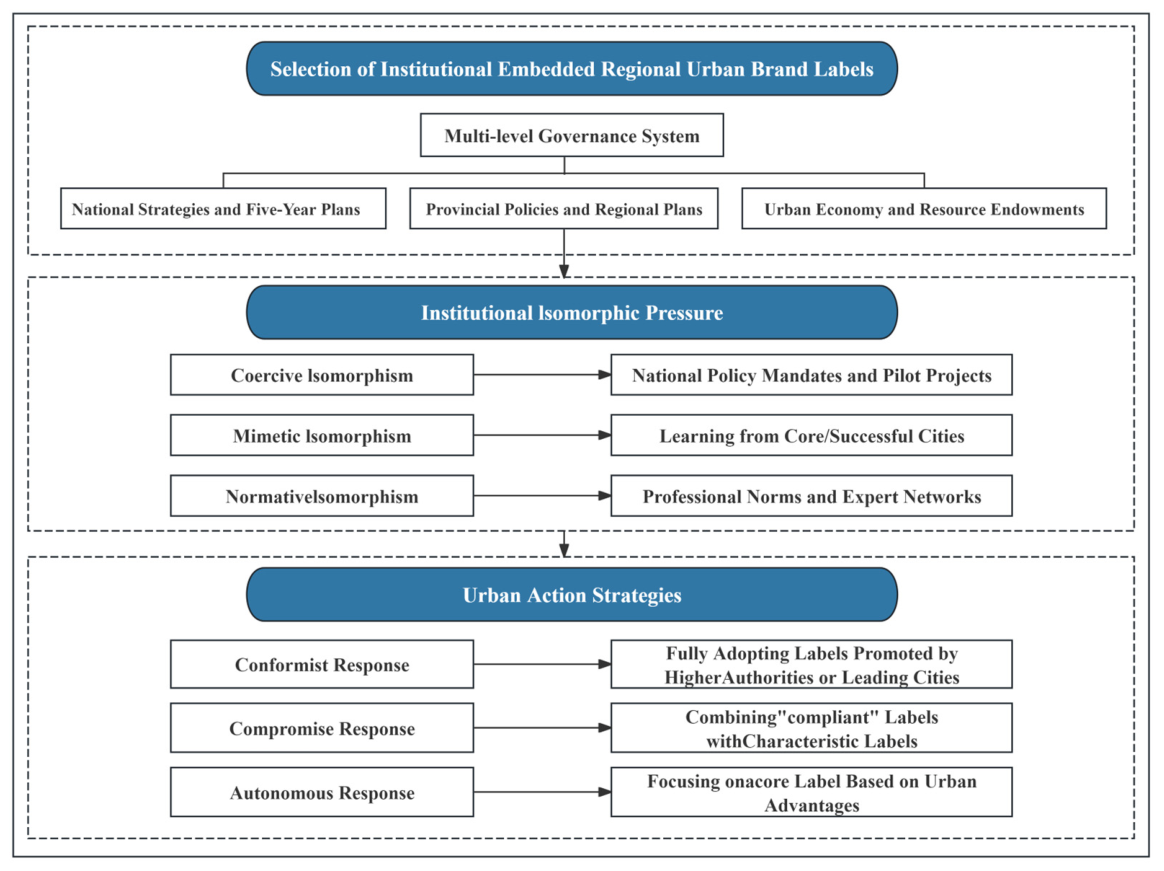
Figure 2.
The Study Area.
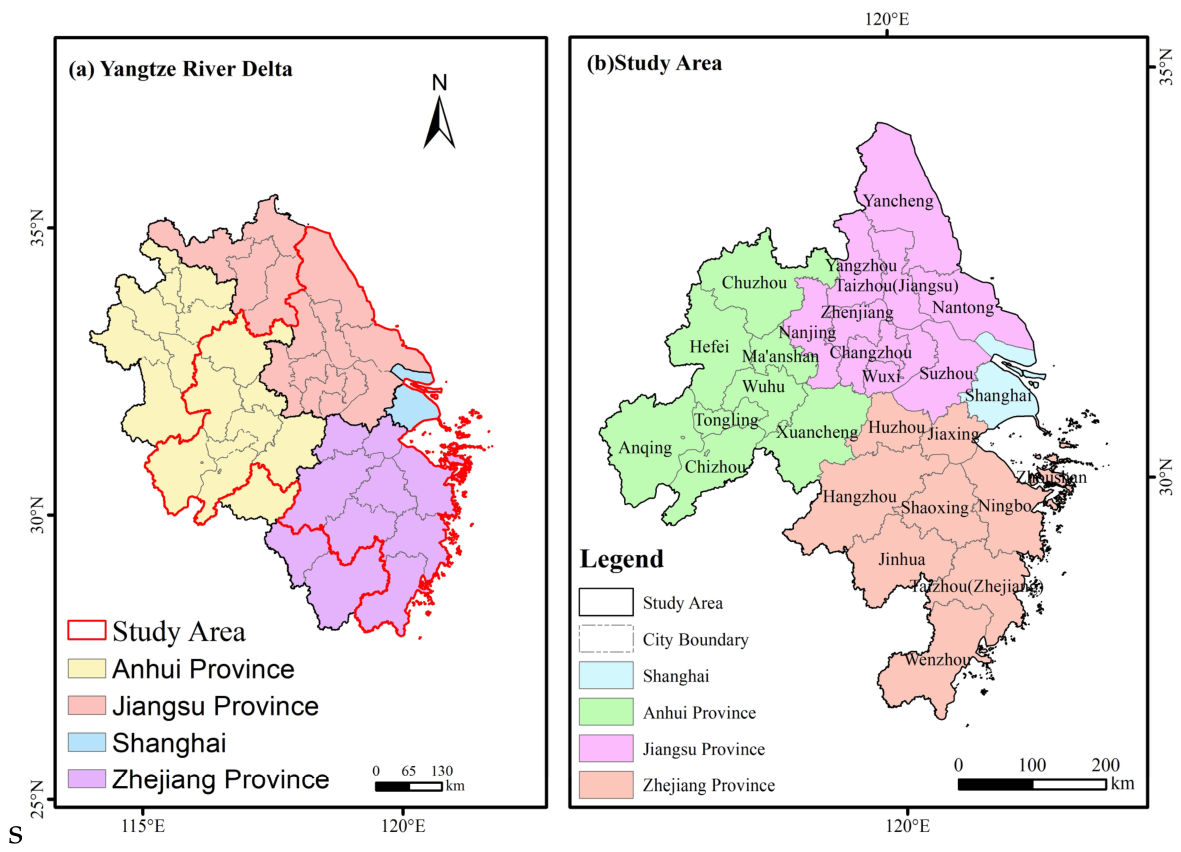
Figure 3.
Data Collection and Analysis Process.
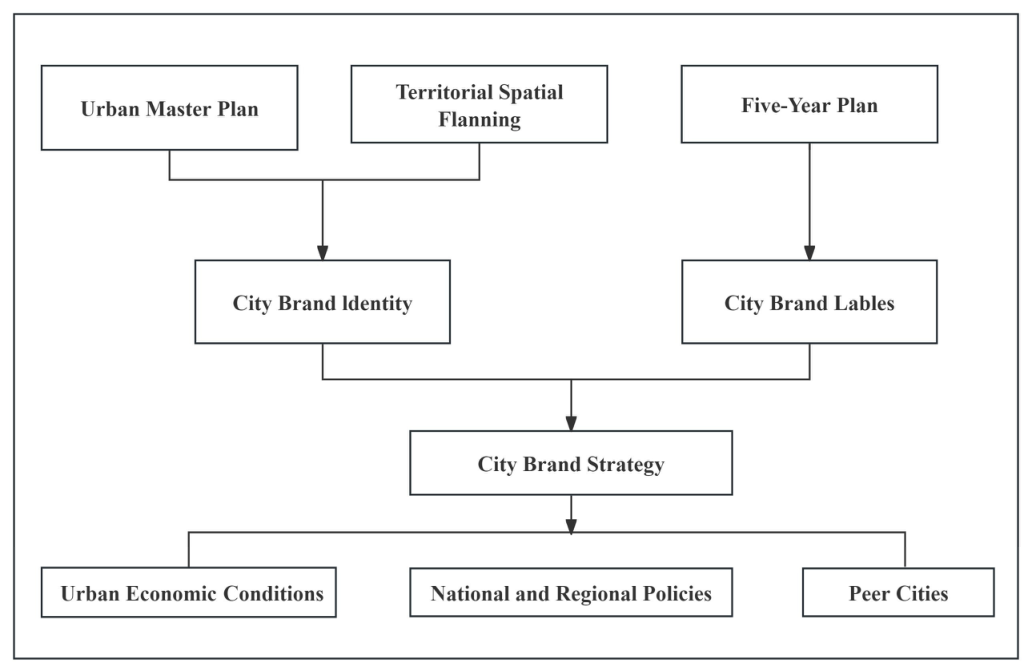
Figure 4.
The average frequency of City Labels From 2005 to 2020.
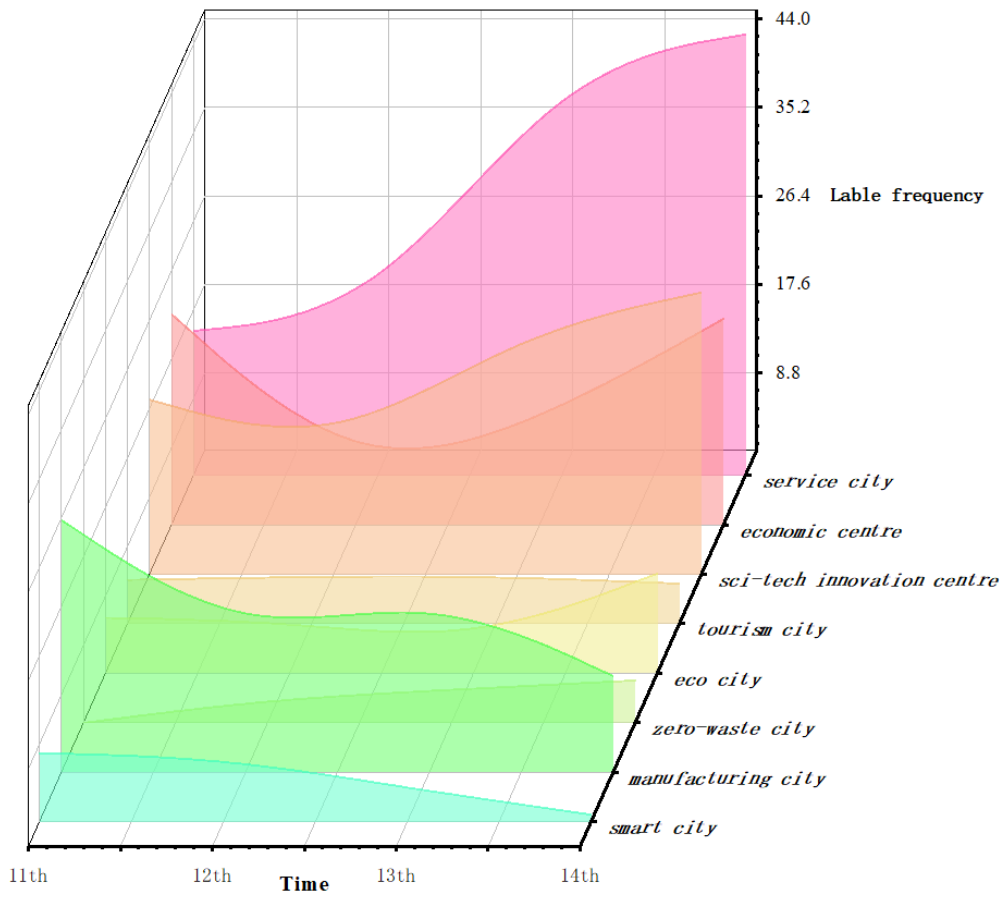
Figure 5.
City Brand Labels Transitions Across Five-Year Plans.
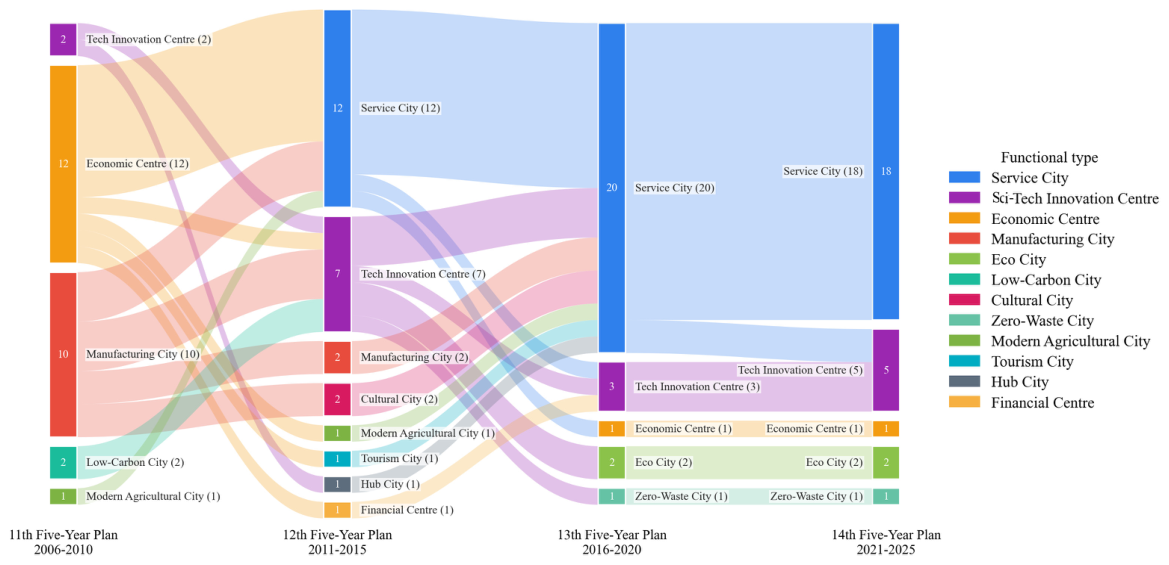
Figure 6.
The frequency of Each Label From 2005 to 2020.
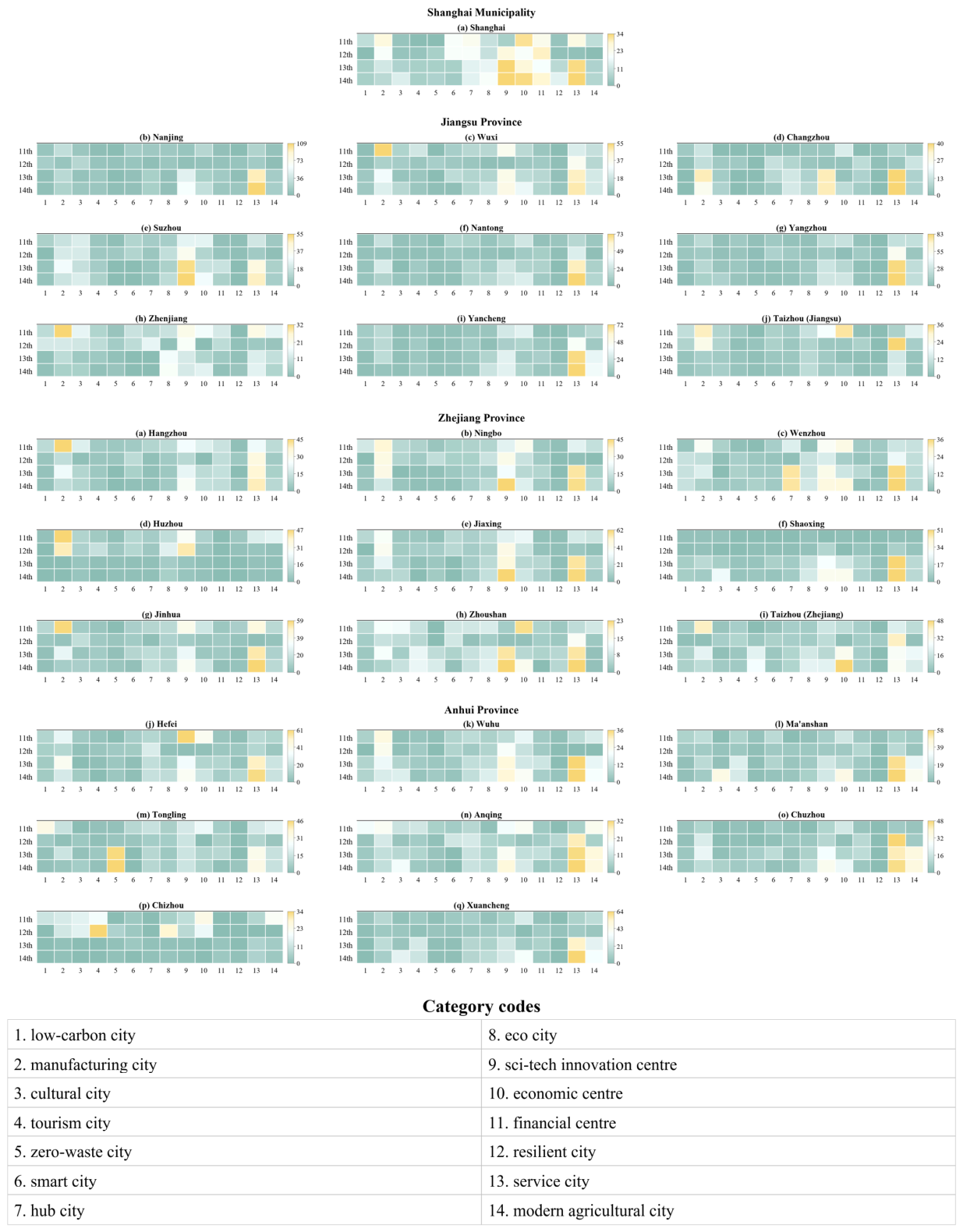
Table 1.
Urban developmental pathways.
| Stage of economic development/Position within the region | Primary sector dominates | Secondary sector dominates | Tertiary sector dominates |
| Regional orientation | PATHWAY 1: Eco-tourism (accommodating manufacturing) | PATHWAY 2: Advanced, low-carbon manufacturing | PATHWAY 4: Knowledge and culture-oriented services |
| National orientation | n.a. | PATHWAY 2: Advanced, low-carbon manufacturing | PATHWAY 4: Knowledge and culture-oriented services |
| International orientation | n.a. | PATHWAY 3: High-tech innovation | PATHWAY 5: Global advanced producer services |
Table 2.
Five developmental pathways.
| Development Pathway | Core Characteristics | Regional Orientation |
| Pathway 1 | Dominated by the primary sector (agriculture or resource extraction) | Regional orientation |
| Pathway 2 | Dominated by the secondary sector (manufacturing and production) | Regional to national orientation |
| Pathway 3 | Transition from manufacturing to high-tech innovation | International orientation |
| Pathway 4 | Dominated by the tertiary sector (service and knowledge economy) | Regional to national orientation |
| Pathway 5 | Dominated by advanced producer services | International orientation |
Table 3.
Trajectories of Developmental Paths Based on City Labels and Development in the Yangtze River Delta (2005–2025).
Table 3.
Trajectories of Developmental Paths Based on City Labels and Development in the Yangtze River Delta (2005–2025).
| City | Developmental Paths Indicated by City Labels in Five-Year Plans | Developmental Paths in Urban Master Plan & Territorial Spatial Plan | ||||
| 11th FYP | 12th FYP | 13th FYP | 14th FYP | Urban Master Plan | Territorial Spatial Plan | |
| Shanghai | 5 | 3/5 | 3/5 | 3/5 | 5 | 5 |
| Nanjing | 4 | 4 | 2/4 | 2/4 | 4 | 3/4 |
| Wuxi | 2 | 2/4 | 2/4 | 2/4 | 2/4 | 2/4 |
| Changzhou | 2 | 2/4 | 2/4 | 2/4 | 2/4 | 2/4 |
| Suzhou | 2 | 2 | 2/4 | 2/4 | 2/4 | 2/4 |
| Nantong | 2 | 4 | 2/4 | 2/4 | 4 | 2/4 |
| Yancheng | 2 | 2/4 | 2/4 | 2/4 | 1/4 | 1/2/4 |
| Yangzhou | 2 | 4 | 2/4 | 1/2/4 | 4 | 4 |
| Zhenjiang | 2 | 2/4 | 2/4 | 2/4 | 4 | 2/4 |
| Taizhou (Jiangsu) |
2 | 2/4 | 2/4 | 2/4 | 2/4 | 2/4 |
| Hangzhou | 4 | 4 | 4/5 | 4/5 | 4 | 5 |
| Ningbo | 2 | 2/4 | 2/4 | 2/4 | 2/4 | 2/4 |
| Wenzhou | 2 | 2/4 | 4 | 4 | 4 | 4 |
| Jiaxing | 2 | 4 | 4 | 4 | 1/4 | 2/4 |
| Huzhou | 1/2 | 1/2 | 1/4 | 1/4 | 1/4 | 4 |
| Shaoxing | 2 | 2/4 | 2/4 | 2/4 | 4 | 4 |
| Jinhua | 4 | 1/4 | 4 | 4 | 4 | 4 |
| Zhoushan | 4 | 1/4 | 1/2 | 1/2/4 | 1/4 | 2/4 |
| Taizhou (Zhejiang) |
2 | 4 | 2 | 2 | 2/4 | 2/4 |
| Hefei | 2/3 | 2/4 | 3/4 | 3/4 | 4 | 4 |
| Wuhu | 2 | 2 | 2/4 | 2/4 | 2/4 | 2/4 |
| Ma’anshan | 2 | 4 | 1/2 | 1/2 | 2/4 | 2/4 |
| Tongling | 2 | 4 | 1/2 | 1/2 | 2/4 | 2/4 |
| Anqing | 2 | 2/4 | 1/4 | 1/4 | 4 | 4 |
| Chuzhou | 1/2 | 2/4 | 2/4 | 2/4 | 1/4 | 2/4 |
| Chizhou | 1/4 | 1/4 | 1 | 1 | 1/4 | 1/4 |
| Xuancheng | 1/2 | 4 | 2/4 | 1/2/4 | 4 | 4 |
Table 4.
Pioneering Cities in Adopting City Labels in 11th Five-Year Plan Period.
| City Label | Pioneering Cities |
| Manufacturing City | Jinhua, Wuxi, Huzhou, Hangzhou, Taizhou (Zhejiang), Jiaxing, Ningbo, Zhenjiang, Taizhou (Jiangsu) |
| Economic Center | Hefei, Taizhou (Jiangsu), Shanghai, Yancheng, Jiaxing, Ningbo, Wenzhou, Suzhou, Nantong, Yangzhou, Xuancheng |
| Sci-Tech Innovation Center | Hefei, Jinhua, Wuxi, Huzhou, Jiaxing, Yancheng, Suzhou, Hangzhou, Wenzhou, Zhenjiang |
| Service City | Jinhua, Shanghai, Yangzhou, Hangzhou, Zhenjiang, Jiaxing, Wuxi, Ningbo, Nanjing, Taizhou (Zhejiang) |
| Modern Agricultural City | Yangzhou, Anqing, Chizhou, Huzhou, Tongling, Jiaxing, Xuancheng, Taizhou (Jiangsu), Yancheng, Wuxi |
| Low-Carbon City | Tongling, Anqing, Ningbo, Jiaxing, Jinhua, Hefei, Hangzhou, Chizhou, Taizhou (Jiangsu), Ma’anshan |
| Smart City | Shanghai, Nantong, Nanjing, Jiaxing, Ma’anshan, Suzhou, Huzhou, Tongling, Zhenjiang |
| Hub City | Shanghai, Wenzhou, Tongling, Hefei, Jinhua, Wuxi, Nantong, Nanjing, Jiaxing |
| Eco City | Jiaxing, Jinhua, Huzhou, Wuxi, Taizhou (Jiangsu), Hangzhou, Zhenjiang, Nanjing, Shanghai |
| Cultural City | Suzhou, Hangzhou, Zhenjiang, Chizhou, Zhoushan, Wuxi, Ningbo, Anqing, Huzhou |
| Tourist City | Wuxi, Chizhou, Anqing, Ma’anshan, Ningbo, Yangzhou, Taizhou (Zhejiang), Zhoushan, Xuancheng, Zhenjiang |
| Financial Center | Shanghai, Hangzhou, Zhenjiang, Taizhou (Zhejiang), Tongling, Ma’anshan, Jinhua, Ningbo, Hefei, Yangzhou, Nanjing, Zhoushan, Wuxi, Wenzhou, Wuhu |
| Resilient City | Jinhua, Nantong, Huzhou, Wenzhou, Zhoushan, Shanghai, Ma’anshan, Ningbo, Jiaxing, Changzhou, Hefei, Hangzhou, Wuhu, Suzhou |
| Zero-Waste City | Anqing, Hangzhou, Ningbo, Ma’anshan, Yangzhou, Jiaxing, Tongling, Zhenjiang, Xuancheng, Huzhou, Suzhou, Yancheng, Wuhu |
Disclaimer/Publisher’s Note: The statements, opinions and data contained in all publications are solely those of the individual author(s) and contributor(s) and not of MDPI and/or the editor(s). MDPI and/or the editor(s) disclaim responsibility for any injury to people or property resulting from any ideas, methods, instructions or products referred to in the content. |
© 2026 by the authors. Licensee MDPI, Basel, Switzerland. This article is an open access article distributed under the terms and conditions of the Creative Commons Attribution (CC BY) license (http://creativecommons.org/licenses/by/4.0/).
Copyright: This open access article is published under a Creative Commons CC BY 4.0 license, which permit the free download, distribution, and reuse, provided that the author and preprint are cited in any reuse.


