
Submitted:
06 July 2026
Posted:
08 July 2026
You are already at the latest version
Abstract
Sustainable public building procurement requires owners to select design-build (DB) teams that can deliver long-term performance rather than merely submit compliant proposals. This article develops a criteria-first SWOT-AHP-TOPSIS framework for sustainable DB contractor selection in public building procurement. The framework translates owner objectives, Request for Proposal requirements, and building-performance needs into source-linked criteria, assigns SWOT roles, derives AHP priorities, and ranks proposal archetypes with TOPSIS. A numerical proof of concept based on two California courthouse contexts examines sustainability delivery, lifecycle value, maintainability, commissioning readiness, risk control, and public-sector fit. In the primary context, the technical and sustainability-oriented archetype ranked first (C* = 0.6548); in the Fort Ord assessment, the risk-controlled management archetype became preferred. The reversal shows sensitivity to project-specific performance and risk conditions rather than a fixed preference for one profile. The study provides a transparent decision architecture and does not validate actual evaluators, proposals, awards, or contractor performance.
Keywords:
sustainable public building procurement
; design-build contractor selection
; building performance
; maintainability
; lifecycle value
; criteria-first decision-support framework
; AHP
; TOPSIS
; SWOT
1. Introduction
Public building procurement increasingly requires owners to justify best-value decisions across technical quality, sustainability, lifecycle value, delivery risk, and public accountability. Courthouses, schools, hospitals, civic centers, and other public buildings are long-lived public assets rather than short-term construction outputs. Their performance depends on design integration, construction quality, maintainability, operational continuity, and a contractor team's ability to convert proposal commitments into deliverable outcomes.
Request for Proposal (RFP)-based design-build procurement makes this evaluation problem demanding. Unlike low-bid tendering, an RFP asks the owner to compare alternative technical approaches, management systems, sustainability commitments, cost-value propositions, and risk controls before the design is complete. The selected DB team therefore becomes a delivery partner whose capabilities shape both the building solution and the credibility of the award rationale.
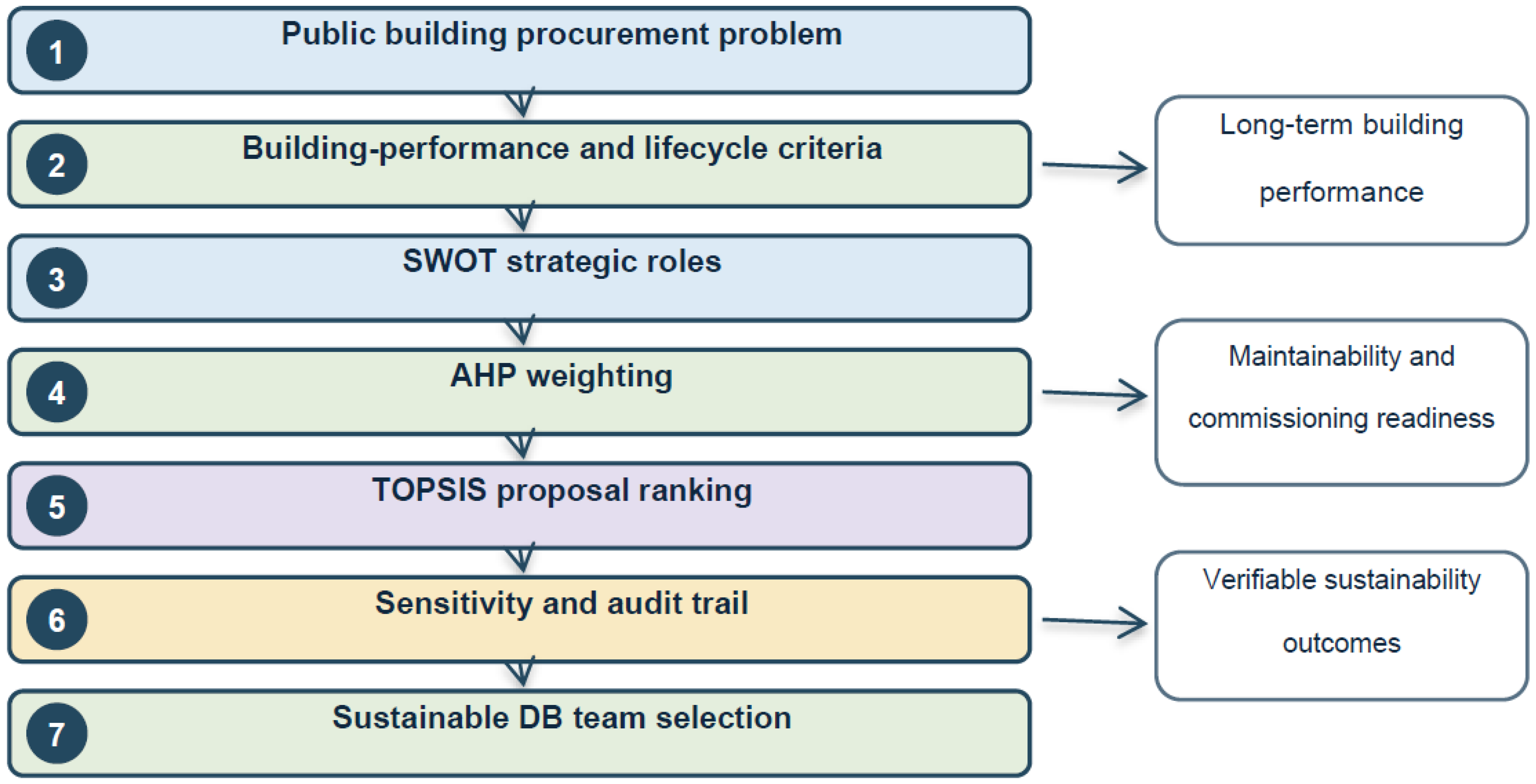
Sustainability therefore has to be evaluated as a delivery capability, not only as a certification target or policy label. Energy performance, lifecycle value, maintainability, commissioning readiness, responsible material practices, accessibility, resilience, and operational verification depend on implementation capacity. The framework therefore supports both proposal ranking and the selection of DB teams that can deliver long-term building performance, maintainability, commissioning readiness, and verifiable sustainability outcomes.
Existing contractor-selection studies identify many technical, financial, managerial, and sustainability criteria, but they provide less guidance on organizing those criteria into a transparent public building evaluation logic. The issue is not simply which multi-criteria decision-making (MCDM) method ranks alternatives. It is how criteria are derived, classified, weighted, scored, tested, and connected to a building's delivery and lifecycle requirements.
This article addresses the gap through a criteria-first, RFP-based decision sequence. The contribution is not the creation of a new MCDM algorithm; rather, SWOT, AHP, TOPSIS, and sensitivity analysis are used as established tools within a procurement-facing architecture. SWOT clarifies whether a criterion describes an internal proposer capability or an external project opportunity or threat. AHP makes the owner-side priority structure explicit, TOPSIS compares responsive proposal alternatives, and sensitivity analysis tests whether the preferred profile depends on narrow assumptions.
The study develops and demonstrates a criteria-first SWOT-AHP-TOPSIS framework for sustainable DB contractor selection in public building procurement. It is positioned as a framework development article with a numerical proof of concept, not as empirical validation of a completed procurement. The intended contribution is an RFP-based, reviewable decision architecture that links sustainability, lifecycle value, proposal evidence, building delivery capability, and operational verification within sustainable public building procurement.
Four questions guide the analysis. RQ1 asks which criteria capture the technical, managerial, sustainability, lifecycle, commercial, risk, and public-sector capabilities required for DB contractor selection. RQ2 examines how those criteria can be structured and weighted through a criteria-first SWOT-AHP hierarchy. RQ3 asks how TOPSIS can translate weighted proposal evidence into a transparent ranking and sensitivity record. RQ4 examines how the framework behaves in related courthouse contexts with different risk and delivery emphases.
The New Sixth Appellate District Courthouse provides the primary public building procurement context. The New Fort Ord Courthouse supports a within-domain applicability assessment [1,2]. World Bank and DBIA guidance [3,4] inform procurement logic, and the academic literature informs the criteria and MCDM structure. Because actual proposals and official evaluation records were unavailable, all numerical alternatives and scores are synthetic and case-informed.
The remainder of the article is organized as follows. Section 2 reviews sustainable public building procurement, DB contractor selection, and hybrid MCDM research. Section 3 explains the research design and evidence boundary. Section 4 develops the criteria-first evaluation structure, and Section 5 operationalizes the SWOT-AHP-TOPSIS framework. Section 6 and Section 7 interpret the courthouse demonstrations, Section 8 discusses implications for sustainable DB procurement, and Section 9 concludes.
2. Literature Review
The review is organized around the decision facing a public owner procuring a sustainable building through DB delivery. The central question is which proposal offers the most credible combination of design integration, sustainability delivery, lifecycle value, cost-value balance, risk control, and public-sector responsiveness. The literature is therefore synthesized around procurement and building performance logic rather than around MCDM technique alone.
2.1. Rfp-Based Sustainable Public Building Procurement
This subsection reviews policy and academic literature on RFP-based public procurement and sustainable contractor evaluation: World Bank procurement rules and DBIA best-practice guidance [3,4], contractor-selection and non-price evaluation studies [9,10], and green public procurement and sustainable-construction guidance [11,13,14].
RFP-based public building procurement reflects a shift from lowest price toward best value and public value. Price remains necessary, but the award rationale must also address technical merit, qualifications, performance commitments, lifecycle consequences, and delivery risk. For public buildings, these judgments must be understandable to evaluators, auditable by the owner, and defensible within applicable procurement rules [3,4,10,13,14].
The main difficulty is converting broad owner objectives into criteria that can guide proposal comparison. Financial, technical, and managerial criteria are well established, yet their importance varies with facility type, delivery method, and institutional priorities. In courthouse procurement, security, public access, service continuity, durability, and maintainability become part of the building performance problem rather than peripheral owner preferences [1,2,9,10,11,12,13,14].
2.2. Design-Build Delivery Method in Public Building Projects
Claims of DB superiority remain contingent. Konchar and Sanvido [5] reported favorable schedule and cost outcomes, whereas later work emphasized the influence of project complexity, owner capability, and procurement implementation [6]. Molenaar and Songer [7] and Songer and Molenaar [8] also showed that project suitability, clear requirements, and selection quality are part of the DB performance mechanism.
This dependence is amplified in public buildings because security, accessibility, durability, maintainability, regulation, and service continuity must be integrated before design completion. DBIA [4] emphasizes team integration and best value, while World Bank guidance [3] links procurement strategy to risk allocation, fit-for-purpose competition, and value for money. These sources support treating DB contractor selection as a building delivery-capability assessment.
2.3. Contractor Selection Criteria for Design-Build Projects
No universally accepted hierarchy of contractor-selection criteria exists. Hatush and Skitmore [9] emphasized financial soundness, technical capacity, managerial competence, and past performance. Waara and Brochner [10] documented the growing role of non-price criteria, and sustainability research added lifecycle and environmental performance [11,12]. These differences indicate contextual dependence rather than a settled ordering.
DB procurement requires evaluation of an integrated team rather than a constructor alone [4,7,8]. Design quality must be considered with constructability, digital coordination, project controls, risk management, sustainability implementation, and team organization. Criteria lists are therefore useful only when they are translated into an evaluation architecture that prevents double counting and preserves an audit trail from owner objective to proposal evidence [9,10,11,12].
2.4. Sustainable Public Building and Green Procurement Criteria
Green public procurement uses purchasing power to pursue environmental and lifecycle objectives [13,14]. Public-building criteria commonly include energy and water performance, waste and materials, indoor environmental quality, accessibility, resilience, operational cost, and maintainability. For DB procurement, these criteria need to be expressed as evidence of delivery capability rather than as aspirational sustainability language.
Certification and operational performance are not equivalent. Studies of certified buildings have produced mixed findings on measured energy outcomes. Occupant-based evidence also shows perceived strengths and weaknesses in certified buildings. These findings do not indicate uniformly superior performance [15,16,17,18,19]. This performance-gap literature supports evaluating whether the proposer can deliver and verify outcomes, rather than treating a label as sufficient evidence.
This distinction is particularly important in DB procurement. The selected team influences design development, materials, construction, commissioning, handover, and maintainability. Recent Buildings research on lifecycle performance prediction and service-life maintainability further supports linking digital coordination, material choices, durability, and operation-stage performance in building decisions [20,21]. Organizational capacity, coordination, and supply-chain practices can therefore determine whether sustainability commitments become verifiable building performance after award. This reinforces the need to connect procurement-stage evaluation with post-occupancy building performance and maintainability.
2.5. Swot Analysis in Construction Decision-Making
Proposal attributes acquire meaning through project context. An innovative energy strategy may create lifecycle value while increasing implementation uncertainty. Schedule acceleration may improve service availability while amplifying coordination risk. A low price may be attractive only if it does not weaken durability, commissioning, or maintainability. SWOT is useful because it separates these strategic roles before quantitative weighting begins [22].
Its value is interpretive rather than computational. Qualitative SWOT alone neither establishes relative importance nor ranks alternatives. Integrating it with AHP retains strategic diagnosis while adding explicit priorities, a logic demonstrated in quantitative SWOT applications [22].
2.6. Ahp for Criteria Weighting in Contractor Selection
Weighting in public procurement is an act of justification because price, design integration, sustainability, and risk do not share a natural unit. AHP structures pairwise comparisons, derives priorities, and tests internal consistency [23,24]. Its continued use in construction reflects its interpretability across heterogeneous criteria [25].
AHP does not remove judgment, and comparison burden increases with model size. Alternative MCDM methods may address compromise logic or specific selection tasks [28,29,30], but AHP's ratio scale and established consistency procedure remain useful where a committee must explain how priorities were formed [23,24,25]. Its role here is weighting, not alternative scoring.
2.7. Topsis for Proposal Ranking and Alternative Selection
TOPSIS addresses the final comparison by locating each alternative relative to positive and negative ideal solutions [26]. This is useful when no DB proposal dominates all criteria and the owner must evaluate trade-offs among technical strength, lifecycle value, price, and risk [27].
Rankings remain sensitive to criteria, weights, normalization, and scores; alternative MCDM procedures can also yield different orders [28]. Sensitivity analysis is therefore part of the decision argument rather than an optional technical appendix.
2.8. Hybrid Mcdm Approaches in Construction Procurement
Hybrid models respond to the fact that strategic interpretation, preference weighting, and alternative comparison are different analytical tasks [22,23,26,27]. Construction studies document extensive use of MCDM, but method availability does not ensure alignment with public building procurement logic [25,27,30]. A criteria-first framework must show how criteria are sourced, structured, weighted, scored, and tested before a ranking is treated as meaningful [22,25,27,29,30].
SWOT, AHP, and TOPSIS correspond to these tasks, respectively [22,25,27]. Other methods may be appropriate where uncertainty modeling, reduced comparison burden, or compromise logic dominates [29,30]. In public RFP evaluation, interpretability, source linkage, and robustness are treated as the primary requirements.
Figure 1.
Criteria-first procurement logic for sustainable design-build contractor selection in public building procurement.
Figure 1.
Criteria-first procurement logic for sustainable design-build contractor selection in public building procurement.
2.9. Research Gap and Conceptual Positioning
Contractor selection, sustainable construction, DB delivery, and MCDM have largely developed as parallel research streams. Contractor-selection studies emphasize organizational competence and non-price evaluation [9,10]; sustainability and green-procurement studies emphasize environmental and lifecycle outcomes [11,12,13,14]; DB studies emphasize integration and best-value delivery [5,6,7,8]; and MCDM studies emphasize weighting and ranking procedures [22,23,24,25,26,27,28,29,30]. Public building procurement requires these streams to be integrated into one reviewable decision process.
The gap is especially visible at proposal level. Generic contractor evaluation concentrates on qualifications and past performance [9,10], whereas DB RFPs must assess future-oriented design concepts, management approaches, sustainability strategies, schedule commitments, lifecycle consequences, and risk responses [3,4,7,8,13,14]. A sustainable public building framework must therefore evaluate both what is promised and whether the proposer has the capacity to deliver it.
The proposed model positions contractor suitability as project-proposer fit. Criteria are derived from sources, interpreted through SWOT, prioritized through AHP, applied to proposal evidence through TOPSIS, and challenged through sensitivity tests. This criteria-first, RFP-based integration is the article's main contribution; the novelty lies in the procurement decision architecture and evidence trail rather than in introducing a new MCDM technique.
3. Materials and Methods
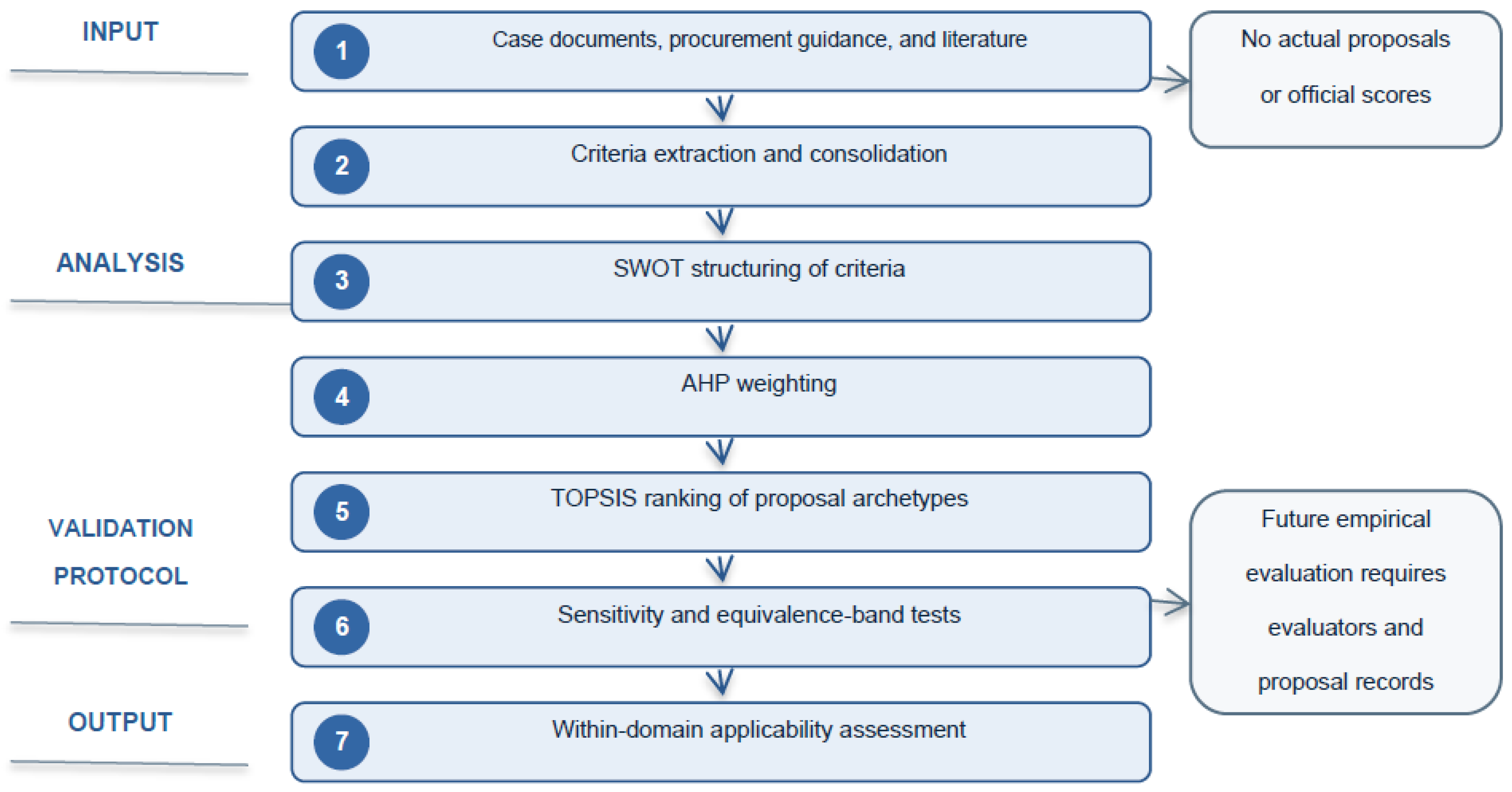
This article develops and numerically demonstrates a decision-support framework; it does not report a completed procurement evaluation. Case documents, procurement guidance, and academic literature inform criteria development. A proposed expert protocol specifies future empirical testing, and synthetic proposal archetypes demonstrate the calculations. The numerical proof of concept examines model behavior, transparency, and interpretability before application with actual evaluators and proposal records. The absence of an executed expert panel limits empirical validity and means that the results should not be read as validation of actual evaluators, proposals, award decisions, or contractor performance. Supplementary Tables S1–S32 provide the criteria-development trail, matrices, scores, sensitivity inputs, and Fort Ord mapping used in the demonstration.
Figure 2.
Research procedure and evidence boundary for framework development and numerical proof of concept.
Figure 2.
Research procedure and evidence boundary for framework development and numerical proof of concept.
3.1. Research Framework
The procedure follows the logic of sustainable public building procurement. Source-linked criteria are first screened for relevance and overlap, then assigned to SWOT roles. Strengths and weaknesses represent internal proposer capabilities; opportunities and threats represent context-dependent value and risk conditions. This ordering keeps criteria development upstream of mathematical ranking.
The four SWOT roles form the first AHP level, and the criteria nested within each role form the second. Treating SWOT roles as first-level categories recognizes distinct forms of strategic evaluation rather than using them as decorative labels [22]. Global weights are subsequently applied to proposal scores in TOPSIS, followed by sensitivity analysis. The framework contribution lies in aligning these established tasks with RFP evaluation and audit requirements, rather than in the method combination alone.
3.2. Case Selection Rationale
The two courthouse contexts were purposefully selected because judicial facilities are evaluation-intensive public buildings with publicly available project information [1,2]. They combine security, accessibility, durability, service continuity, stakeholder interfaces, lifecycle performance, and sustainability management [1,2,13,14,21]. These features make them suitable for demonstrating how a public owner could evaluate sustainable DB delivery capability [4,7,8].
The projects are procurement contexts, not complete case studies of observed awards. Public information from the two courthouse records supports requirement interpretation [1,2], but actual proposals, detailed evaluation records, and official scores were unavailable. The analysis can therefore demonstrate framework logic, transferability, and sensitivity behavior, but it cannot infer the owner's actual decision process [31,35].
3.3. Data Sources and Document Analysis
Document analysis treats formal procurement and project records as evidence of institutional priorities and evaluation requirements [31]. Candidate criteria are coded from public project information [1,2], World Bank procurement guidance [3], DBIA best-practice material [4], and academic literature on contractor selection [9,10,30], sustainable construction and building performance [11,12,15,16,17,18,19,20,21], public procurement [13,14], and MCDM [22,23,24,25,26,27,28,29,30]. The coding objective is to build criteria that can be traced to source logic and assessed through proposal evidence [31,32].
For empirical implementation, the protocol specifies two independent coding rounds by two researchers. Disagreements would be reconciled after calculation of Krippendorff's Alpha [32]. Alpha >= 0.80 would be accepted, 0.67 <= alpha < 0.80 treated as tentative, and alpha < 0.67 rejected for reliable coding [32]. The anticipated extraction range is approximately 30-35 initial items, 20-25 consolidated items, and 15-18 items submitted to expert validation [33,34]. These are design ranges, not reported empirical counts. Detailed consolidation and mapping records are provided in Supplementary Tables S1 and S4–S6.
3.4. Expert Panel and Evaluation Procedure
The framework includes a proposed expert-validation protocol; no completed expert panel is reported in this article. Implementation would use approximately 12 participants recruited purposively from public procurement, DB project management, architecture/engineering, sustainability, and facility operation. This panel would validate criteria and provide AHP and scoring judgments in a real application.

Table 3.1.
Proposed expert-validation panel composition.
| Expert group | Number | Required experience | Role in study |
| Public procurement specialists | 3 | >10 years | CVR, procurement relevance, RFP criteria review |
| DB project managers | 3 | >10 years | Criteria validation, AHP comparisons, proposal scoring |
| Architects/design consultants | 2 | >10 years | Design quality and integration criteria |
| Sustainability specialists | 2 | >10 years | Sustainability and lifecycle criteria |
| Academics/MCDM experts | 2 | >10 years or research expertise | Method validation and consistency review |
Note. The composition is an implementation specification, not a report of completed recruitment.
The proposed protocol has two rounds. Round 1 would assess criterion essentiality and agreement using the content validity ratio (CVR) and item content validity index (I-CVI), followed by revision or consolidation. For a 12-member panel, CVR > 0.56 and I-CVI > 0.78 are specified as retention benchmarks [33,34]. Round 2 would confirm the hierarchy and SWOT assignments. AHP comparisons would then establish weights, with CR < 0.10 required for each matrix [23,24].
Because actual proposals were inaccessible, three analytical archetypes are used: a technical and sustainability-oriented profile (A1), a cost-efficient profile (A2), and a risk-controlled management profile (A3). They represent plausible strategic proposal patterns in public building procurement, not real bidders or hidden evaluations of named firms.
Table 3.2.
Case-informed proposal archetypes used as TOPSIS alternatives.
| Alternative | Profile type | Description |
| A1 | Technical and sustainability-oriented proposer | Strong DB integration, mature sustainability capability, and high lifecycle-performance emphasis. |
| A2 | Cost-efficient proposer | Competitive cost strategy, conventional delivery approach, adequate technical capability, and moderate sustainability emphasis. |
| A3 | Risk-controlled management-oriented proposer | Strong project management, schedule control, stakeholder coordination, and risk mitigation capability. |
Note. The alternatives are synthetic proposal archetypes for numerical demonstration and do not represent any actual bidder, proposer, or award decision.
3.5. Research Quality Assurance
Quality controls are specified for credibility, dependability, confirmability, and transferability [35]. Proposed expert review and content-validity thresholds address credibility; independent coding and Krippendorff's Alpha address dependability; source-to-criterion mapping and disclosed matrices address confirmability; and the Fort Ord assessment examines limited within-domain transferability and applicability. These controls improve traceability and procedural transparency within the stated evidence boundary.
4. Criteria Development and Operationalization
This section converts the source review into an operational criteria set for sustainable public building procurement [3,9,10,11,12,13,14]. It draws on DBIA's Design-Build Done Right: Universal Best Practices [4] to translate design-build principles, including integrated team capability, design-construction coordination, constructability, and proposal responsiveness, into assessable criteria. Capability dimensions describe substantive areas of DB contractor competence, whereas criteria are assessable items used in TOPSIS [26,27,30]. Full definitions, indicator directions, and scoring evidence are reported in Supplementary Table S18. This criteria-first separation prevents the ranking method from defining the procurement problem [22,25,30].
4.1. Criteria Derivation From Literature and Rfp Sources
Contractor-selection research informed technical capacity, resources, management, and past performance [9,10,30]. DB sources added team integration, design-construction coordination, BIM, constructability, and proposal responsiveness [4,7,8]. Sustainable public building sources added energy performance, lifecycle value, maintainability, accessibility, resilience, commissioning, and responsible supply practices [11,12,13,14,20,21].
Courthouse information was used to contextualize security, accessibility, service continuity, long-term operation, and public-facing performance requirements [1,2]. The resulting 16-criterion set balances coverage with a manageable five-matrix AHP hierarchy [22,23,24,25]. It is not intended as a universal courthouse scorecard.
Table 4.1.
Proposed 16-criterion set and illustrative global weights for sustainable design-build contractor selection.
Table 4.1.
Proposed 16-criterion set and illustrative global weights for sustainable design-build contractor selection.
| Code | Criterion | SWOT role | Capability dimension | Global weight |
| S1 | Design-build experience | Strength | DB technical integration | 0.1191 |
| S2 | BIM/digital coordination capability | Strength | DB technical integration | 0.0640 |
| S3 | Sustainability expertise | Strength | Sust./lifecycle | 0.0409 |
| S4 | Integrated team capability | Strength | DB technical integration | 0.1076 |
| W1 | Resource and staffing adequacy | Weakness-oriented | Project management | 0.0505 |
| W2 | Courthouse/public building experience adequacy | Weakness-oriented | RFP/public fit | 0.0206 |
| W3 | Design-construction coordination capability | Weakness-oriented | DB technical integration | 0.0456 |
| W4 | Green implementation capability | Weakness-oriented | Sust./lifecycle | 0.0228 |
| O1 | Best-value and lifecycle value contribution | Opportunity | Cost/value/best value | 0.1210 |
| O2 | Energy efficiency enhancement | Opportunity | Sust./lifecycle | 0.0773 |
| O3 | Accessibility and public service improvement | Opportunity | RFP/public fit | 0.0415 |
| O4 | Maintainability and operational efficiency | Opportunity | Sust./lifecycle | 0.0919 |
| T1 | Regulatory compliance and uncertainty mitigation | Threat-oriented | Risk/resilience | 0.0460 |
| T2 | Schedule and site constraint management | Threat-oriented | Project management | 0.0546 |
| T3 | Cost escalation and supply-chain risk management | Threat-oriented | Cost/value/best value | 0.0719 |
| T4 | Security and stakeholder coordination capability | Threat-oriented | Risk/resilience | 0.0247 |
Note. Weakness- and threat-oriented criteria are phrased as adequacy or mitigation capabilities so that higher TOPSIS scores indicate better performance. Illustrative global weights are synthetic demonstration weights used in Section 5; they are not elicited owner preferences. Definitions, indicator directions, and scoring evidence are reported in Supplementary Table S18; source bases and detailed extraction records are reported in Supplementary Tables S1–S6.
Table 4.2.
Availability and analytical use of RFP-related evidence.
| Data type | Availability | Use in this study |
| Public project information | Available | Case context, facility requirements, scale, schedule, and public-sector setting. |
| Procurement guidance | Available | Evaluation logic, best-value principles, and design-build procurement practice. |
| Solicitation-related materials | Partially available | RFP context and publicly disclosed owner or performance requirements. |
| Actual proposal submissions | Not available | Not used; synthetic proposal archetypes support proof-of-concept testing. |
| Official evaluation scores | Not available | Not used; no claim is made about the owner's scoring or ranking. |
| Detailed award records | Not available | Not used; the analysis does not reconstruct an actual award decision. |
Note. Solicitation-related evidence was used only where publicly accessible. Confidential proposals, official scores, and detailed award records were not used.
4.2. Sustainable Design-Build Contractor Capability Dimensions
The criteria span six substantive dimensions: DB technical integration [4,7,8]; sustainability and lifecycle performance [11,12,15,16,17,18,19,20,21]; project-management reliability, risk and resilience, cost and best-value contribution, and RFP responsiveness and public-sector fit [3,9,10,13,14,30]. Together, these dimensions define sustainable DB delivery capability for public buildings rather than a generic contractor-quality profile [4,9,10,13,14].
The dimensions provide an audit trail to the literature and procurement problem [31,32], but they do not form a competing AHP level [23,24,25]. Each criterion is counted once in the quantitative model, avoiding double counting where one capability has implications for more than one dimension. This choice supports transparent evaluation and helps reviewers identify where a score enters the model [25,30].
4.3. Swot-Based Structuring of Criteria
SWOT supplies the strategic role used in the AHP hierarchy [22,23,24,25]. Strengths comprise DB experience, digital coordination, sustainability expertise, and integrated-team capability [4,7,8,11,12]. Weakness-oriented indicators measure resource adequacy, relevant public-building experience, design-construction coordination, and green implementation [4,9,10,13,14]. Opportunities capture best-value and lifecycle contribution, energy efficiency, accessibility, and maintainability [11,12,13,14,20,21]. Threat-oriented indicators measure regulatory, schedule/site, supply-chain, stakeholder, and public-accountability risk mitigation [3,4,13,14,21].
All indicators are benefit-oriented for TOPSIS comparison [26,27,30]. A high weakness-oriented score denotes low weakness exposure, and a high threat-oriented score denotes strong mitigation capability. This directional convention separates criterion importance from performance sign and produces one consistent input structure for AHP weighting and TOPSIS comparison [22,23,24,25,26,27,30].
5. Operationalization and Illustrative Demonstration of the Criteria-First Swot-Ahp-Topsis Framework
The analytical sequence assigns a distinct procurement and building-performance task to each method. SWOT interprets strategic relevance, AHP represents owner priorities, TOPSIS compares responsive proposal evidence, and sensitivity analysis tests preference stability. Mandatory legal, responsiveness, and sustainability floors remain outside the compensatory model. All numerical inputs in this section are synthetic and case-informed.
5.1. Overview of the Proposed Framework
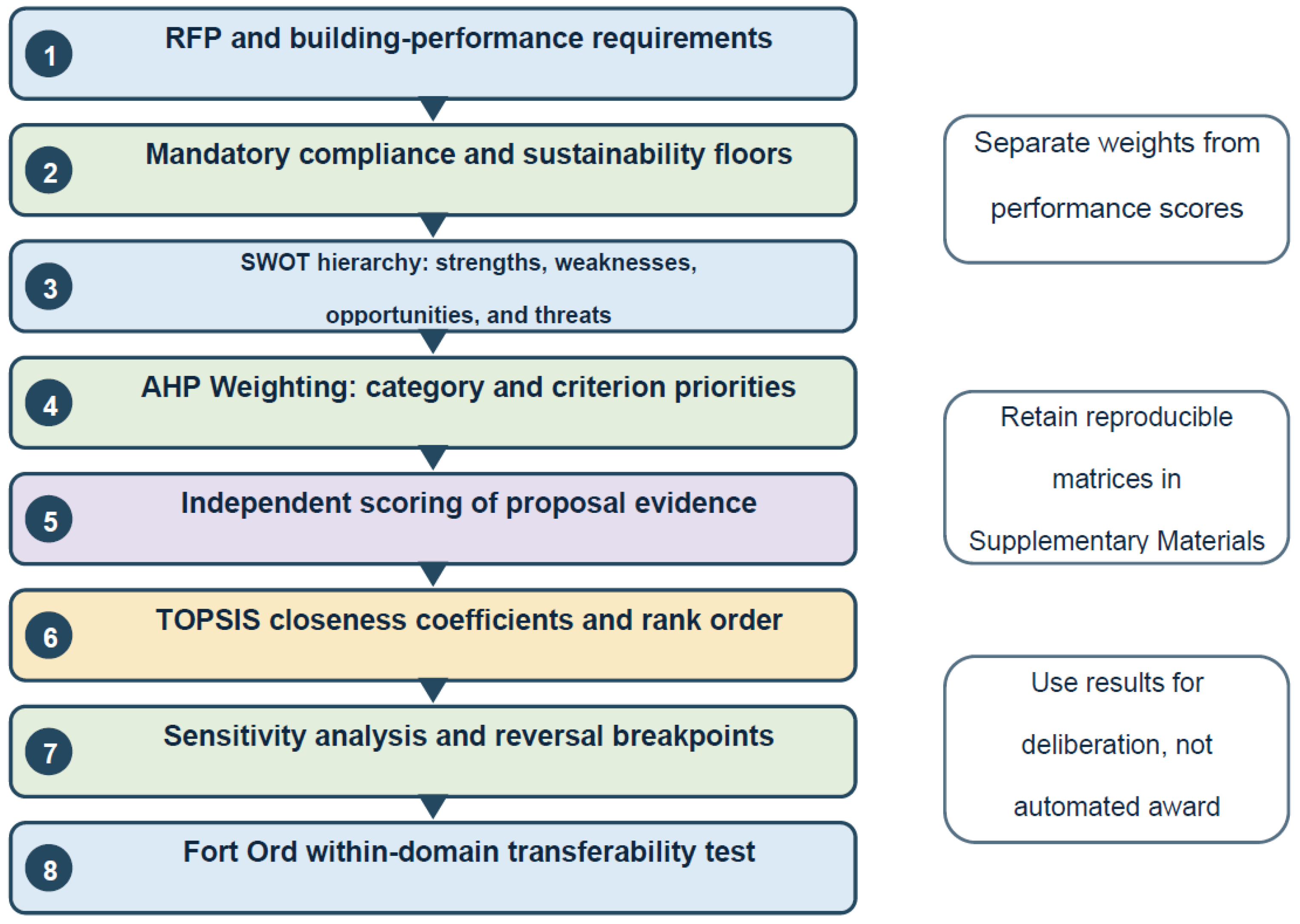
RFP and project requirements define the evaluation scope. After compliance screening, the four SWOT roles and 16 criteria form the weighting hierarchy. Proposal evidence is scored independently, global weights and scores enter TOPSIS, and perturbation tests identify unstable assumptions. Separating weights from performance scores prevents the same judgment from being used simultaneously as an owner preference and as evidence about a proposer.
Methodological assumptions and safeguards. The framework assumes that owner priorities can be expressed as a stable AHP hierarchy before proposal scoring, that criteria are preferentially independent enough for additive weighting, and that TOPSIS compensation is acceptable only after mandatory legal, responsiveness, and sustainability floors have been passed. Weakness- and threat-oriented criteria are phrased as adequacy or mitigation capabilities, so higher scores consistently indicate better performance. To reduce misuse, weights are approved before scoring, weighting and scoring are conducted in separate sessions, full matrices are disclosed, consistency ratios are checked, and sensitivity analysis is used to identify fragile or reversible rankings.
Figure 3.
Operational flow of the criteria-first SWOT-AHP-TOPSIS framework for sustainable design-build contractor selection in public building procurement.
Figure 3.
Operational flow of the criteria-first SWOT-AHP-TOPSIS framework for sustainable design-build contractor selection in public building procurement.
5.2. Ahp Weighting Procedure
The AHP hierarchy contains the contractor-selection goal, four SWOT categories, and four criteria nested under each category. Five 4 x 4 matrices require 30 independent pairwise judgments per expert. Judgments use Saaty's 1-9 scale and reciprocity, a_ji = 1/a_ij [23,24]. In an empirical implementation, individual matrices would be elicited from the proposed panel; the present demonstration uses the synthetic matrices in Supplementary Tables S20–S24.
When the panel includes E experts in total, reciprocal judgments would be aggregated element-wise using the geometric mean:
Local priorities are obtained from row geometric means and normalization:
Consistency is evaluated through the consistency index and ratio:
For the 4 x 4 matrices, RI = 0.90 and CR < 0.10 is required. A noncompliant matrix would be returned for reconsideration rather than silently adjusted. Global weight g_j equals the SWOT-category weight multiplied by the criterion's local weight:
Global weights are non-negative and sum to one. Weakness and threat are not assigned negative weights because direction is encoded in the benefit-oriented criterion definitions. Full synthetic matrices, local priorities, and consistency statistics are retained in Supplementary Tables S7 and S20–S24 so that the demonstration can be recalculated.
5.3. Topsis Ranking Procedure
TOPSIS compares only proposals that pass mandatory public procurement and project requirements. In empirical use, the panel would score each alternative independently on the 1-9 evidence scale, with weighting and scoring conducted in separate sessions. The synthetic demonstration assigns scores to embody the intended archetypes: A1 is stronger on technical integration and sustainability delivery, A2 on cost-value, and A3 on risk control and schedule management. The complete inputs are disclosed in Supplementary Tables S25–S30.
For expert e, xij(e) denotes the score of alternative i on criterion j. Empirical scores would be aggregated arithmetically, while median and interquartile range would be retained as disagreement diagnostics:
All criteria are benefit-oriented. Vector normalization and AHP weighting are calculated as:
The positive and negative ideal solution sets are constructed from the criterion-wise maxima and minima:
Euclidean distances from the two ideals and the relative closeness coefficient are then obtained:
Alternatives are ranked by descending C*. Coefficients are calculated at full precision and reported to four decimals. A difference below 0.01 is treated as an operational practical-equivalence band, not a statistical threshold; 0.005 and 0.02 bands are also examined. Because TOPSIS is compensatory and relative to the included alternatives, the output is decision support rather than an absolute measure of contractor quality or legal entitlement to award.
5.4. Sensitivity Analysis
Table 5.1.
Sensitivity-analysis protocol.
| Test type | Scope | Perturbation | Primary output |
| Criterion-level OFAT | 16 criteria | +/-10%, +/-20%, +/-30% | Rank change and coefficient gap |
| SWOT-level OFAT | 4 categories | +/-10%, +/-20%, +/-30% | Category-level sensitivity |
| Grouped scenario | 5 policy scenarios | +20% | Policy stress-test response |
| Score perturbation | All 48 alternative-criterion cells | +/-1 point in both directions | Score uncertainty and rank response |
| Breakpoint search | Reversal cases | 1% increments | Minimum reversal threshold |
Robustness is tested through one-factor-at-a-time changes to all 16 global weights and four SWOT-category weights at +/-10%, +/-20%, and +/-30%. When target weight g_h is perturbed by delta, the remaining weights are proportionally adjusted so that the total remains one:
Five grouped +20% scenarios stress technical integration, sustainability/lifecycle delivery, best-value/cost resilience, delivery assurance, and public-building fit. Scenario weights are renormalized as:
All 48 alternative-criterion cells are also perturbed by one scale point in both directions. This produces 96 score runs while respecting the 1-9 limits:
The top-rank retention rate is:
Each run recalculates normalization, ideal solutions, distances, and C*. Rank order, coefficient gaps, practical ties, and reversal breakpoints are recorded. Spearman correlation is treated as descriptive because n = 3. Breakpoints are searched in one-percentage-point increments after a reversal is detected. The protocol identifies influential assumptions and clarifies model behavior; it does not estimate a probability distribution of procurement outcomes.
5.5. Worked Numerical Example and Applicability Results
To make the numerical demonstration traceable while keeping the article self-contained, the calculation is presented as a compact worked example. The main text reports the global-weight structure, the proposal score logic, the final TOPSIS coefficients, and the key sensitivity thresholds. Full pairwise matrices, score matrices, normalized values, weighted matrices, and sensitivity runs are retained in the Supplementary Materials as an audit trail for recalculation.
Step 1: AHP-derived global weights. The synthetic AHP matrices first produce weights for the four SWOT categories and local weights for the criteria nested under each category. All consistency ratios were below 0.10. Multiplying each category weight by its criterion local weight gives the global weight used in TOPSIS. Table 4.1 reports the 16 illustrative global weights used in the demonstration; the largest weights are O1 best-value/lifecycle contribution (0.1210), S1 DB experience (0.1191), S4 integrated-team capability (0.1076), O4 maintainability (0.0919), O2 energy efficiency (0.0773), and T3 cost/supply-chain risk management (0.0719). Detailed matrices and weights are reported in Supplementary Tables S7 and S20-S24.
Step 2: Decision matrix construction. Three synthetic proposal archetypes are scored on the 1-9 benefit-oriented evidence scale. A1 represents a technical and sustainability-oriented profile, A2 a cost-efficient profile, and A3 a risk-controlled management profile. The baseline score logic is transparent: A1 is stronger on S1-S3, W4, O2, and O4; A2 is strongest on O1 and T3; and A3 is strongest or near strongest on S4, W1, T1, T2, and T4. This structure creates explicit trade-offs among sustainability delivery, cost-value, and risk control rather than embedding a preferred winner. The complete decision matrices are reported in Supplementary Tables S25–S30.
Step 3: Normalization and weighting. Each score xij is vector-normalized as shown in Equation (8), and the normalized value is multiplied by the corresponding global weight gj to obtain the weighted normalized value vij, as shown in Equation (9). This step converts heterogeneous criterion scores into comparable weighted performance values without changing the benefit-oriented direction of the criteria.
Step 4: Ideal solutions and distances. For each criterion, the positive ideal value is the maximum weighted normalized value among the three archetypes, and the negative ideal value is the minimum, following Equation (10). Euclidean distances from these two ideals are then calculated using Equations (11a) and (11b).
Step 5: Closeness coefficient and ranking. The relative closeness coefficient Ci* is calculated using Equation (12). In the primary courthouse context, A1 ranked first (C* = 0.6548), followed by A3 (0.5804) and A2 (0.3294). A1's advantage reflects stronger performance on highly weighted technical integration, sustainability delivery, maintainability, and lifecycle criteria, whereas A2's cost-value strength did not offset weaker integration, implementation, and risk evidence.
Table 5.2.
Illustrative TOPSIS results for the primary courthouse context.
| Alternative | d+ | d- | Closeness coefficient | Rank |
| A1 | 0.0232 | 0.0441 | 0.6548 | 1 |
| A2 | 0.0488 | 0.0240 | 0.3294 | 3 |
| A3 | 0.0274 | 0.0379 | 0.5804 | 2 |
Note. C* denotes the TOPSIS closeness coefficient. Values are synthetic demonstration outputs, not official evaluation scores.
Step 6: Sensitivity and interpretation. The baseline order survived all criterion-level and score perturbations and all five grouped +20% scenarios. Reversal occurred only when Opportunity was reduced at the tested -30% boundary or Threat was increased by 28% or more. This result indicates conditional robustness to substantial first-level preference changes, not statistical proof of an optimal award.
Table 5.3.
Illustrative sensitivity-analysis summary.
| Test | Runs | Rev. | Top retained | Interpretation |
| Criterion-level OFAT | 96 | 0 | 100.0% | No reversal |
| SWOT-level OFAT | 24 | 2 | 91.7% | Reversals only at O -30% and T +30% |
| Grouped scenarios | 5 | 0 | 100.0% | No reversal |
| Score perturbation | 96 | 0 | 100.0% | No reversal |
Note. Rev. denotes reversals. Detailed equivalence-band checks, breakpoint records, and input data are reported in Supplementary Tables S10 and S25-S31.
Within-domain transferability/applicability check. Under the Fort Ord context, A3 became preferred in both fixed-weight and category-reweighted runs. The shift from A1 to A3 shows that the framework does not mechanically favor the sustainability-oriented archetype; it responds to project-context performance and risk emphasis. The category-reweighted run changes only first-level SWOT weights and is a partial contextual reweighting rather than a complete AHP re-estimation.
Table 5.4.
Illustrative within-domain applicability results.
| Analytical run | A1 | A2 | A3 | Rank order |
| Sixth Appellate baseline | 0.6548 | 0.3294 | 0.5804 | A1 > A3 > A2 |
| Fort Ord, fixed weights | 0.5856 | 0.3757 | 0.6654 | A3 > A1 > A2 |
| Fort Ord, category-reweighted SWOT weights | 0.4665 | 0.4521 | 0.7149 | A3 > A1 > A2 |
Note. Fort Ord category weights are scenario assumptions, not elicited owner preferences. Full score matrices and reweighting inputs appear in Supplementary Tables S27-S31.
6. Primary-Case Demonstration and Interpretation
The New Sixth Appellate District Courthouse is used to interpret how the analytical outputs would inform public-owner deliberation in a sustainable DB building procurement. The case does not supply confidential proposals or an official scoring matrix. Public information establishes the facility and procurement context, while the numerical comparison remains synthetic.
6.1. Case Background
The project is a California Judicial Branch DB courthouse serving the Sixth Appellate District [1]. Judicial facilities combine architectural quality, secure circulation, accessibility, operational continuity, stakeholder interfaces, durability, and long-term public service. These conditions make the project suitable for examining whether sustainability and lifecycle value can be evaluated alongside delivery integration and risk.
Publicly available information does not establish that the owner used the 16 criteria or the priorities in this article. Detailed project facts and their analytical implications are reported in Supplementary Table S11. No claim is made about a specific environmental certification weight or an actual proposer.
6.2. Rfp-Based Evaluation Context
The analytical RFP context combines public project information with the best-value and integrated-team principles in DBIA [4] and World Bank [3]. Mandatory responsiveness would be screened before MCDM. Weighted comparison would then examine team integration, technical approach, sustainability delivery, lifecycle value, cost-value balance, schedule, and risk controls. Supplementary Table S12 documents the crosswalk; it is not a published Judicial Council scoring schedule.
6.3. Construction of Proposal Alternatives
A1, A2, and A3 were constructed as analytical archetypes rather than disguised firms. Their scores were assigned to create realistic trade-offs: A1 emphasizes integration and sustainability, A2 emphasizes cost-value, and A3 emphasizes delivery assurance. Supplementary Tables S13, S25 and S26 disclose the archetype logic and complete primary-case inputs.
6.4. Interpretation of Ahp Priorities
The synthetic priorities place DB experience, integrated-team capability, lifecycle contribution, maintainability, energy efficiency, and cost/supply-chain risk among the leading concerns. The pattern describes a plausible owner preference structure for demonstration, not an elicited Judicial Council preference. Its practical value lies in exposing which sustainability and delivery assumptions drive the comparison.
6.5. Interpretation of Topsis and Sensitivity Findings
Under the stated synthetic assumptions, A1 emerges as the preferred profile because its high scores align with the largest weights. A3 remains credible and overtakes A1 only when threat management is materially increased or opportunity-related value is substantially reduced. A2 demonstrates why price or cost-value strength alone may be insufficient in best-value DB procurement when integration, sustainability implementation, and coordination evidence are weaker.
6.6. Practical Implications and Evidence Boundary
The results support deliberation rather than automated award. A committee can use the weight and breakpoint record to examine whether its recommendation depends on a narrow or unstable assumption. The record can also show whether close alternatives require additional evidence and whether sustainability commitments are tied to delivery capability. This addresses the proposal-level gap identified in Section 2.9 by linking public building objectives, criteria, submitted evidence, weights, scores, sensitivity conditions, and post-award verification.
Sustainability is not reduced to a certification label. It enters through implementation expertise, green delivery, energy performance, maintainability, lifecycle value, commissioning readiness, and post-award verification. The evidence boundary remains strict: no complete scoring schedule, actual proposal, evaluator comment, or award record was available, so the analysis cannot assess the Judicial Council's actual procurement decision.
Table 6.1.
Illustrative practical implications for public design-build owners.
| Case finding | Procurement implication |
| A1 leads under baseline assumptions | Integrated design-build capability and lifecycle value can outweigh a narrower cost advantage when credible proposal evidence supports the claim. |
| A3 becomes competitive as Threat increases | Risk-control profiles should be reconsidered when security, schedule, site, or transition exposure dominates owner priorities. |
| A2 remains third despite commercial strengths | Cost competitiveness alone is insufficient where integrated delivery, sustainability implementation, and coordination evidence are weak. |
| Sensitivity analysis identifies reversal conditions | Evaluation committees can test whether the award logic depends on unstable or contested assumptions before final deliberation. |
| Mandatory requirements remain outside compensation | Compliance screening should protect security, statutory, eligibility, and minimum performance conditions from offset by high scores elsewhere. |
Note. Implications should be recalibrated using project-specific legal requirements, owner priorities, and verified proposal evidence.
7. Cross-Case Applicability Assessment: New Fort Ord Courthouse
The Fort Ord assessment asks whether the criteria definitions and analytical procedure remain interpretable in a related public courthouse building context. It is a within-domain transferability test grounded in public project information, document analysis, and transferability reasoning, not validation of an observed award outcome [2,31,35].
7.1. Case Contrast and Transferability Rationale
New Fort Ord shares the California judicial DB setting, while prior public-sector DB literature identifies project characteristics and procurement fit as conditions for comparing DB cases [7,8]. It differs in program scale, operational consolidation, site interfaces, parking and phasing conditions, schedule exposure, and risk emphasis [2]. This controlled contrast preserves procurement comparability while allowing contextual sensitivity to be observed through a bounded transferability comparison [31,35].
Table 7.1.
Cross-case contrast and analytical expectations.
| Comparison dimension | Controlled similarity | Fort Ord contrast | Expected analytical consequence |
| Owner and delivery | California judicial-facility context and design-build delivery | Different project and procurement-development stage | Supports a within-domain test without assuming identical owner priorities |
| Institutional function | Secure, accessible public judicial service | Trial courthouse replacement and consolidation of selected operations | Increases emphasis on transition planning, stakeholder coordination, and operational continuity |
| Program scale | Public courthouse design and construction | 83,201 gross square feet and seven courtrooms versus 49,798 square feet and one courtroom in the primary context | Expands design interfaces, staffing demands, commissioning effort, and schedule exposure |
| Site and access | Controlled public access and security requirements | Approximately 5.0 acres and 280 public and juror parking spaces | Raises site logistics, circulation, parking, access, and stakeholder-management demands |
| Sustainability and operations | Lifecycle performance remains relevant in both cases | Solar power generation capability is publicly identified | Makes energy integration and operational performance more visible in proposal interpretation |
| Cost and schedule exposure | Large public capital investment | USD 174.684 million authorized budget and April 2027-August 2029 construction window reported at retrieval | Heightens attention to escalation, supply-chain, schedule, and delivery-assurance evidence |
Note. Project facts are publicly reported; analytical expectations are case-informed interpretations, not published scoring rules.
7.2. Assessment Design and Analytical Controls
All 16 criteria were mapped to Fort Ord without changing construct definitions or benefit directions, following document-analysis and content-analysis logic for preserving construct traceability [31,32]. The same archetypes were rescored for the second context. A fixed-weight run isolates score changes, while a category-reweighted run applies scenario weights of S = 0.27, W = 0.14, O = 0.28, and T = 0.31 and retains local priorities, consistent with SWOT-AHP-TOPSIS procedures for separating strategic weighting from alternative scoring [22,23,24,25,26,27,30]. These weights represent greater threat-management emphasis associated with scale, consolidation, site interfaces, and schedule exposure; they are not elicited owner preferences [2,3,4].
Supplementary Table S32 provides the item-level 16/16 mapping so that structural compatibility is supported by an audit trail rather than assertion, consistent with transparent document coding and transferability practice [31,32,35]. The public identification of Hensel Phelps as the DB entity is contextual only; none of the synthetic alternatives represents or evaluates that firm [2].
7.3. Comparative Findings
A3 ranked first in both Fort Ord runs, while A1 and A2 occupied second and third place. In the category-reweighted run, A1 led A2 by only 0.0144, suggesting that an actual committee would need additional scrutiny before distinguishing those positions. The A1-A3 reversal is explained by stronger A3 scores on schedule, security, regulatory, stakeholder, and supply-chain risk management rather than by arbitrary method behavior, consistent with TOPSIS as a relative comparison method and with DB procurement guidance emphasizing integration, risk allocation, and best-value evidence [3,4,26,27].
Table 7.2.
Illustrative cross-case ranking results.
| Analytical run | A1 C* | A2 C* | A3 C* | Rank order | Within-run interpretation |
| Sixth Appellate baseline | 0.6548 | 0.3294 | 0.5804 | A1 > A3 > A2 | A1 leads A3 by 0.0744 under the primary value structure |
| Fort Ord, fixed weights | 0.5856 | 0.3757 | 0.6654 | A3 > A1 > A2 | A3 leads A1 by 0.0798 after case-specific rescoring |
| Fort Ord, category-reweighted SWOT weights | 0.4665 | 0.4521 | 0.7149 | A3 > A1 > A2 | A3 leads A1 by 0.2484; A1 leads A2 by only 0.0144 |
Note. C* values are synthetic. Category-reweighted weights are scenario assumptions, not elicited owner preferences.
7.4. Evidence Boundary and Future Empirical Testing Agenda
The assessment supports three limited claims. First, the criteria are structurally portable within the courthouse domain. Second, the model responds to contextual score and priority changes. Third, the source-to-ranking audit trail can be reproduced. These claims are consistent with document-analysis and transferability reasoning, but they do not establish predictive validity, superior award outcomes, or broad cross-sector generalizability [31,32,35]. With only three archetypes, Spearman rho is descriptive; the A1-A3 exchange and score-weight decomposition are more informative for interpreting the relative MCDM result [26,27].
Future empirical assessment requires actual RFP records, independent evaluators, interrater analysis, content-validity checks, and comparison with observed decisions and post-award outcomes [31,33,34,35]. Cross-jurisdiction and cross-sector studies are also needed to test transferability beyond California judicial facilities [35]. Supplementary Tables S16, S17 and S32 preserve the inferential controls, empirical testing agenda, and criterion-level mapping that support these boundaries.
8. Discussion
Three contributions emerge from the Buildings-oriented framing. First, the decision architecture reframes sustainable DB contractor selection as a building-performance and procurement decision, not a method-selection exercise. Second, it separates criteria development, strategic interpretation, preference weighting, proposal scoring, and robustness testing. Third, it connects sustainability assessment to delivery capability and post-award continuity.
8.1. Theoretical Implications
Contractor suitability is better understood as project-proposer fit than as a fixed organizational property. The same archetype can be preferred in one public building context and displaced in another without changing the underlying criteria. The cross-case reversal therefore illustrates a distinction between stable capability definitions and context-dependent decision outcomes.
This interpretation responds directly to the gap in Section 2.9. Prior studies often separate contractor capability, sustainability criteria, and MCDM ranking, whereas RFP-based DB procurement requires them to be integrated within a justifiable proposal-evaluation process. Best value is consequently treated as a documented relationship among owner objectives, proposal commitments, building performance needs, and project conditions.
8.2. Methodological Implications
The main framework contribution is criteria-first, RFP-based integration. SWOT defines strategic roles, AHP represents preferences, TOPSIS compares evidence, and sensitivity analysis identifies reversal conditions. The approach uses established MCDM procedures but makes their procurement role explicit: criteria sourcing, owner priorities, proposal scores, and sensitivity conditions remain distinguishable. Full synthetic matrices and TOPSIS inputs in the supplement allow each numerical result to be recalculated.
The approach also exposes limitations. AHP can burden participants and assumes reciprocal consistency; TOPSIS is compensatory and sensitive to the comparison set. Mandatory legal and sustainability floors should therefore precede ranking, and uncertainty diagnostics should accompany the result. Alternative weighting or ranking techniques remain testable extensions rather than presumed improvements.
8.3. Practical Implications for Public Owners
For public owners, the framework is most useful as a structured deliberation record. Criteria should be source-linked before solicitation, weights approved before proposal scoring, evidence anchors disclosed, disagreements documented, and sensitivity results reviewed before recommendation. The analysis can reveal whether a preferred proposal depends on a narrow assumption or whether two profiles are practically indistinguishable.
The model does not decide responsiveness, conflicts of interest, price legality, due diligence, protest rights, or approval authority. It should be embedded within the legally required procurement process rather than substituted for that process.
Table 8.1.
Proposed implementation controls for public design-build proposal evaluation.
| Stage | Owner action | Required record | Principal safeguard |
| RFP architecture | Separate mandatory gates from scored criteria; define evidence and direction | Evaluation matrix and criterion-source register | Prevents hidden criteria and compensation for noncompliance |
| Pre-evaluation governance | Approve panel, conflicts, weights, aggregation, and scoring guidance before proposal review | Declarations, pairwise matrices, CR results, approvals, and version record | Limits bidder-specific reweighting and inconsistent interpretation |
| Evidence-based evaluation | Score independently, cite evidence, then moderate material differences | Score sheets, evidence references, comments, and moderation log | Preserves judgment diversity and makes revisions auditable |
| Ranking and stress testing | Calculate rankings; examine gaps, near ties, scenarios, and reversal thresholds | Decision matrix, coefficients, sensitivity runs, and exception flags | Identifies fragile recommendations without retroactive tuning |
| Award integration | Combine results with explicit price treatment, legal review, due diligence, and approval | Reasoned recommendation and approval record | Keeps the model advisory and preserves statutory authority |
Note. Controls must be adapted to applicable law, disclosure and protest rules, and agency governance.
8.4. Implications for Sustainable Design-Build Procurement
Sustainability should combine non-compensable minimum requirements with weighted differentiation above the floor. Minimum conditions may include energy-code or performance targets, accessibility compliance, commissioning, measurement and verification, waste or materials requirements, and carbon-reporting thresholds. Proposals that fail mandatory conditions should not remain eligible merely because they score well elsewhere.
Above the floor, evaluation should follow an evidence chain from RFP requirement to proposal commitment, weighted score, contract obligation, commissioning record, and operational verification. The framework is intended to support not only procurement ranking but also the selection of DB teams capable of delivering long-term building performance, maintainability, commissioning readiness, and verifiable sustainability outcomes. This avoids reducing sustainability to certification and tests whether the DB team can convert intent into deliverable, maintainable, and measurable public building outcomes.
Table 8.2.
Proposed sustainability evidence chain for design-build procurement.
| Layer | Selection evidence | Evaluation treatment | Delivery or operational control |
| Minimum performance floor | Codes, accessibility, owner targets, and required certification where applicable | Pass-fail; failure is not offset by other strengths | Performance criteria, contract requirements, acceptance tests, and approvals |
| Integrated-team capability | Named leadership, relevant experience, roles, workflow, BIM, and specialist resources | Score project-specific credibility and delivery capacity | Bind key personnel and management plans; control substitutions |
| Performance and lifecycle value | Energy model, maintainability, lifecycle assumptions, commissioning, and predicted outcomes | Score O1, O2, O4, and related technical evidence; retain mandatory thresholds | Stage updates, change control, commissioning, training, asset information, and M&V |
| Supply chain and public value | Responsible sourcing, waste, suppliers, accessibility, service continuity, and stakeholder measures | Evaluate W4, O3, T3, T4, and project-specific requirements | Submittal and supplier records, audits, user review, and completion verification |
| Performance feedback | Data ownership, KPI plan, corrective action, and post-occupancy review | Evaluate credibility of verification and learning arrangements | Metering, seasonal testing, KPI reporting, post-occupancy evaluation, and lessons learned |
Note. Requirements should be calibrated to asset function, climate, policy, and owner capability.
8.5. Limitations and Future Research
The demonstration uses synthetic inputs and two cases within one judicial system, which limits external applicability. Future studies should apply the protocol to real RFP evaluations, compare weighting and ranking methods, test interrater behavior, and link procurement choices to post-award sustainability and asset performance.
9. Conclusions
This study developed and demonstrated a criteria-first hybrid SWOT-AHP-TOPSIS framework for sustainable DB contractor selection in public building procurement. The numerical demonstration evaluated model behavior, transparency, and interpretability under synthetic, case-informed inputs.
9.1. Summary of Findings
The 16-criterion structure connected technical integration, sustainability delivery, lifecycle value, best value, delivery reliability, and risk. In the primary demonstration, A1 ranked first (0.6548), ahead of A3 (0.5804) and A2 (0.3294), and remained preferred under all local weight and score perturbations. Reversal required substantial first-level changes. In the Fort Ord context, A3 became preferred, showing sensitivity to project-specific risk and coordination conditions.
9.2. Contributions
Theoretically, the analysis frames selection as project-proposer fit in public building procurement. Methodologically, it aligns criterion sourcing, SWOT interpretation, AHP weighting, TOPSIS ranking, and robustness testing. Practically, it provides a reviewable owner-side decision record while remaining subordinate to legal procurement authority. For sustainable procurement, it links environmental intent to implementation, maintainability, commissioning readiness, operational verification, and long-term building performance rather than relying on labels alone.
9.3. Limitations
The proposal profiles, pairwise matrices, and scores are synthetic; the proposed expert-validation protocol was not executed; and both contexts are California judicial facilities. The results do not validate an observed award, predict contractor performance, or establish cross-sector generalizability.
9.4. Future Research
Future research should implement the expert protocol with actual evaluators and proposals. It should also compare alternative weighting and ranking methods, extend testing across sectors and jurisdictions, and examine whether proposal commitments survive contract delivery, commissioning, and operation. The framework's ultimate value lies not in producing a more precise-looking rank. Its value lies in helping public owners make choices whose assumptions, trade-offs, and sustainability commitments can be examined before award and verified after delivery.
Author Contributions
Conceptualization, H.-T.W.; methodology, H.-T.W.; formal analysis, H.-T.W.; investigation, H.-T.W.; writing-original draft preparation, H.-T.W.; writing-review and editing, H.-T.W. The author has read and agreed to the published version of the manuscript.
Funding
This research received no external funding.
Institutional Review Board Statement
Not applicable. This article reports a framework development and numerical proof-of-concept demonstration; no human participants were recruited and no expert panel was executed.
Informed Consent Statement
Not applicable.
Data Availability Statement
The synthetic matrices, scores, sensitivity inputs, and mapping records used in the numerical demonstration are provided in the article and Supplementary Materials. Publicly available project information is cited in the References. Confidential proposal submissions, official evaluation records, and actual contractor-performance data were not used.
Acknowledgments
During the preparation of this manuscript, the author used AI-assisted tools, including OpenAI ChatGPT and OpenAI Codex (accessed in 2026; specific model versions were not retained), for language polishing, formatting support, and document preparation. The author reviewed and edited the outputs and takes full responsibility for the content of this publication.
Conflicts of Interest
The author declares no conflicts of interest.
Abbreviations
The following abbreviations are used in this manuscript:
| AHP: Analytic hierarchy process BIM: Building information modeling CR: Consistency ratio CVR: Content validity ratio DB: Design-build I-CVI: Item content validity index MCDM: Multi-criteria decision-making RFP: Request for Proposal SWOT: Strengths, weaknesses, opportunities, and threats TOPSIS: Technique for Order Preference by Similarity to Ideal Solution |
References
- Judicial Branch of California. Court of Appeal, New Sixth Appellate District Courthouse. Available online: https://courts.ca.gov/facilities/court-appeal-new-sixth-appellate-district-courthouse (accessed on 15 June 2026).
- Judicial Branch of California. Monterey County, New Fort Ord Courthouse. Available online: https://courts.ca.gov/facilities/monterey-county-new-fort-ord-courthouse (accessed on 15 June 2026).
- World Bank. Procurement Regulations for IPF Borrowers: Procurement in Investment Project Financing; World Bank: Washington, DC, USA, 2023; Available online: https://www.worldbank.org/en/projects-operations/products-and-services/brief/procurement-new-framework (accessed on 15 June 2026).
- Design-Build Institute of America. Design-Build Done Right: Universal Best Practices; Design-Build Institute of America: Washington, DC, USA, 2023; Available online: https://store.dbia.org/product/design-build-done-right-universal-best-practices-2023/ (accessed on 29 June 2026).
- Konchar, M.; Sanvido, V. Comparison of U.S. project delivery systems. J. Constr. Eng. Manag. 1998, 124, 435–444. [Google Scholar] [CrossRef]
- Hale, D.R.; Shrestha, P.P.; Gibson, G.E., Jr.; Migliaccio, G.C. Empirical comparison of design/build and design/bid/build project delivery methods. J. Constr. Eng. Manag. 2009, 135, 579–587. [Google Scholar] [CrossRef]
- Molenaar, K.R.; Songer, A.D. Model for public sector design-build project selection. J. Constr. Eng. Manag. 1998, 124, 467–479. [Google Scholar] [CrossRef]
- Songer, A.D.; Molenaar, K.R. Project characteristics for successful public-sector design-build. J. Constr. Eng. Manag. 1997, 123, 34–40. [Google Scholar] [CrossRef]
- Hatush, Z.; Skitmore, M. Criteria for contractor selection. Constr. Manag. Econ. 1997, 15, 19–38. [Google Scholar] [CrossRef]
- Waara, F.; Brochner, J. Price and nonprice criteria for contractor selection. J. Constr. Eng. Manag. 2006, 132, 797–804. [Google Scholar] [CrossRef]
- Ding, G.K.C. Sustainable construction: The role of environmental assessment tools. J. Environ. Manag. 2008, 86, 451–464. [Google Scholar] [CrossRef] [PubMed]
- Zuo, J.; Zhao, Z.-Y. Green building research-current status and future agenda: A review. Renew. Sustain. Energy Rev. 2014, 30, 271–281. [Google Scholar] [CrossRef]
- European Commission. Buying Green! A Handbook on Green Public Procurement, 3rd ed.; Publications Office of the European Union: Luxembourg, 2016. [Google Scholar]
- UNEP. Sustainable Public Procurement Implementation Guidelines: Introducing UNEP's Approach; United Nations Environment Programme: Paris, France, 2012. [Google Scholar]
- Amiri, A.; Ottelin, J.; Sorvari, J. Are LEED-certified buildings energy-efficient in practice? Sustainability 2019, 11, 1672. [Google Scholar] [CrossRef]
- Geraldi, M.S.; Ghisi, E. Building-level and stock-level in contrast: A literature review of the energy performance of buildings during the operational stage. Energy Build. 2020, 211, 109810. [Google Scholar] [CrossRef]
- Khoshbakht, M.; Rasheed, E.; Baird, G. Do green buildings have superior performance over non-certified buildings? Occupants' perceptions of strengths and weaknesses in office buildings. Buildings 2022, 12, 1302. [Google Scholar] [CrossRef]
- Newsham, G.R.; Mancini, S.; Birt, B.J. Do LEED-certified buildings save energy? Yes, but. Energy Build. 2009, 41, 897–905. [Google Scholar] [CrossRef]
- Scofield, J.H. Do LEED-certified buildings save energy? Not really. Energy Build. 2009, 41, 1386–1390. [Google Scholar] [CrossRef]
- Gan, J.; Li, K.; Li, X.; Mok, E.; Ho, P.; Law, J.; Lau, J.; Kwok, R.; Yau, R. Parametric BIM-based lifecycle performance prediction and optimisation for residential buildings using alternative materials and designs. Buildings 2023, 13, 904. [Google Scholar] [CrossRef]
- Lacasse, M.A.; Gaur, A.; Moore, T.V. Durability and climate change: Implications for service life prediction and the maintainability of buildings. Buildings 2020, 10, 53. [Google Scholar] [CrossRef]
- Kurttila, M.; Pesonen, M.; Kangas, J.; Kajanus, M. Utilizing the analytic hierarchy process AHP in SWOT analysis: A hybrid method and its application to a forest-certification case. For. Policy Econ. 2000, 1, 41–52. [Google Scholar] [CrossRef]
- Saaty, T.L. The Analytic Hierarchy Process: Planning, Priority Setting, Resource Allocation; McGraw-Hill: New York, NY, USA, 1980. [Google Scholar]
- Saaty, T.L. How to make a decision: The analytic hierarchy process. Eur. J. Oper. Res. 1990, 48, 9–26. [Google Scholar] [CrossRef]
- Vaidya, O.S.; Kumar, S. Analytic hierarchy process: An overview of applications. Eur. J. Oper. Res. 2006, 169, 1–29. [Google Scholar] [CrossRef]
- Hwang, C.L.; Yoon, K. Multiple Attribute Decision Making: Methods and Applications; Springer: Berlin/Heidelberg, Germany, 1981. [Google Scholar] [CrossRef]
- Behzadian, M.; Otaghsara, S.K.; Yazdani, M.; Ignatius, J. A state-of-the-art survey of TOPSIS applications. Expert Syst. With Appl. 2012, 39, 13051–13069. [Google Scholar] [CrossRef]
- Opricovic, S.; Tzeng, G.H. Compromise solution by MCDM methods: A comparative analysis of VIKOR and TOPSIS. Eur. J. Oper. Res. 2004, 156, 445–455. [Google Scholar] [CrossRef]
- Popovic, M. An MCDM approach for personnel selection using the CoCoSo method. J. Process Manag. New Technol. 2021, 9, 78–88. [Google Scholar] [CrossRef]
- Tran, V.H.; Yan, H. Construction contractor selection by using AHP combined with TOPSIS. In Proceedings of the 26th International Symposium on Advancement of Construction Management and Real Estate; Springer: Singapore, 2022; pp. 434–447. [Google Scholar] [CrossRef]
- Bowen, G.A. Document analysis as a qualitative research method. Qual. Res. J. 2009, 9, 27–40. [Google Scholar] [CrossRef]
- Krippendorff, K. Content Analysis: An Introduction to Its Methodology, 4th ed.; SAGE: Thousand Oaks, CA, USA, 2019. [Google Scholar] [CrossRef]
- Lawshe, C.H. A quantitative approach to content validity. Pers. Psychol. 1975, 28, 563–575. [Google Scholar] [CrossRef]
- Polit, D.F.; Beck, C.T.; Owen, S.V. Is the CVI an acceptable indicator of content validity? Appraisal and recommendations. Res. Nurs. Health 2007, 30, 459–467. [Google Scholar] [CrossRef] [PubMed]
- Lincoln, Y.S.; Guba, E.G. Naturalistic Inquiry; Sage: Beverly Hills, CA, USA, 1985. [Google Scholar]
Disclaimer/Publisher’s Note: The statements, opinions and data contained in all publications are solely those of the individual author(s) and contributor(s) and not of MDPI and/or the editor(s). MDPI and/or the editor(s) disclaim responsibility for any injury to people or property resulting from any ideas, methods, instructions or products referred to in the content. |
© 2026 by the authors. Licensee MDPI, Basel, Switzerland. This article is an open access article distributed under the terms and conditions of the Creative Commons Attribution (CC BY) license (http://creativecommons.org/licenses/by/4.0/).
Copyright: This open access article is published under a Creative Commons CC BY 4.0 license, which permit the free download, distribution, and reuse, provided that the author and preprint are cited in any reuse.


