

Submitted:
06 July 2026
Posted:
08 July 2026
You are already at the latest version
Abstract
Based on classical concepts of the chemistry and structure of polyimide compounds, a microscopic model of intramolecular mobility in technical Kapton has been proposed. This model provides a comprehensive explanation for the full set of observed low‑temperature physico‑mechanical characteristics of the material. The comprehensive analysis of experimental data and the derived geometric, energetic, and kinetic parameters confirm the robustness of the proposed model.
Keywords:
PMDA–ODA polyimide
; Kapton
Introduction
Poly-oxydiphenylene-pyromellithymide (Kapton, Apikal) - PMDA - ODA polyimide is a transparent polymer of golden color. Kapton is a typical representative of an extensive class of heat-resistant polymers - polyimides [1,2,3]. Kapton was first synthesized in the USA by the famous chemist, inventor of teflon Roy J. Plankett in 1964 [4].
Polyimides are widely used in the electronics [5], photonics [6], and aerospace [7] industries thanks to their outstanding thermal stability, relatively low dielectric constants, high chemical resistance, and robust mechanical performance [8,9,10]. These properties primarily stem from the molecular orientation of the polyimide backbone and the structural stability imparted by the rigid aromatic groups within the chains [11,12]. In addition, intermolecular interactions among these aromatic groups further influence the overall material characteristics.
The practical importance of PMDA–ODA polyimide, together with the relative ease of preparing samples with tailored and well-controlled properties (such as purity of the starting components, solvent composition, and the conditions of polycondensation and imidization), has made it one of the most extensively studied polymers. Its physical and mechanical characteristics are now well understood. However, at low temperatures only the basic structural and physico-mechanical properties have been investigated [13,14,15,16,17,18,19,20,21,22,23,24,25,26], while a comprehensive analysis has not yet been carried out. This gap provided the motivation for the present study.
Production Process of Kapton and Its Effect on Material Characteristics
Polyamide: Synthesis Approach and Fundamental Properties
I. polyamic acid production by pyromelite dianhydride polycondensation (dianhydride, PMDA) and 4, 4’ – oxydianine (diamine, ODA) in a strong dipolar aprotic solvent (N, N’ – dimethylacetamide – DMAc and / or methylpyrrolidone - NMP) at a temperature from -20 °C to +70 °С followed by pouring onto the forming surface [27];
At stage “I” a viscous liquid varnish is obtained - a solution of Poly(amic) acid (PAA). The macromolecule of polyamic acid is a linear chain containing alternating amide and carboxyl groups. The transition of the polymer into its final state (Kapton) occurs at stage “II” through intramolecular thermal cyclization (polycyclodehydration), during which a stable five-membered heterocycle (imidic ring) is formed and one molecule of water is released for each newly created imide unit.
Figure 1.
Synthesis of PMDA - ODA polyimide.
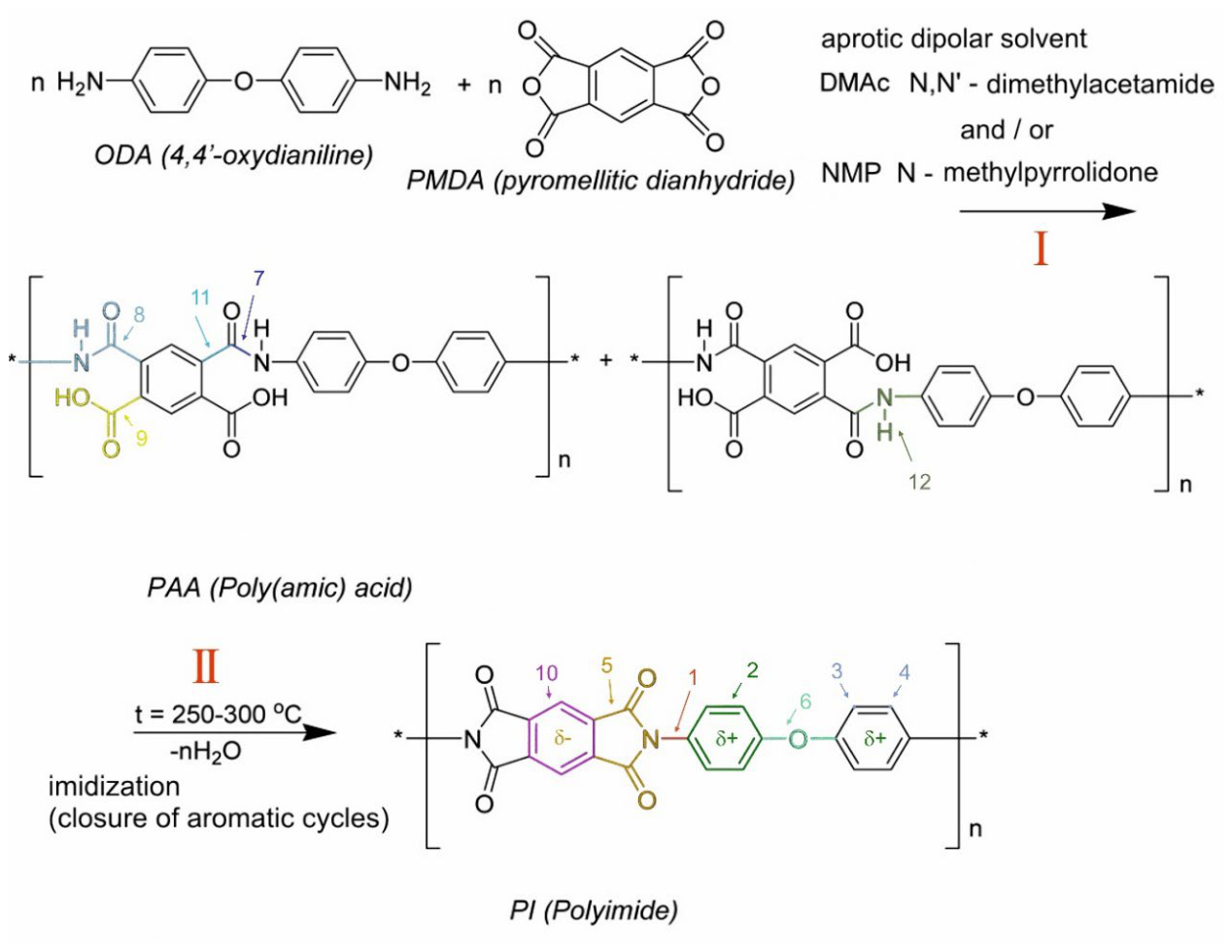
The physicochemical properties of the final product are largely determined by the molecular weight of the PAA (degree of polymerization n), the residual solvent content [28], and the degree of imidization ID (cyclization coefficient) [29,30], which defines the percentage of polyamic acid units converted into stable imide rings. In this context, the molecular weight of polyamic acid depends on the temperature at which the polycondensation is carried out [31].
The degree of polymerization of Kapton is governed by the reaction temperature, concentration, and purity of the initial components, and stands at around n ≃ 60 ÷ 160 for technical-grade samples [31].
As a rule, industrial polymers reach an imidization level ID of about 95–98% [1,32,33]. This limitation is associated with the increasing rigidity of PMDA-ODA polyimide (PI) macromolecules as the degree of cyclization grows. As a result, the conformational mobility of the chains drops nearly to zero (the so-called “kinetic hindrance” effect), and the remaining functional groups become spatially separated, preventing them from adopting the geometry required to close the cycle.
The Role of Residual Solvent
Residual solvent (NMP, DMAc) remains in the polymer structure - the same solvent used to dissolve PAA. This occurs because once the degree of imidization reaches 80–90%, the polymer structure contracts and densifies, forming a tight polymer “cage-like network” around the remaining solvent molecules. As a result, the solvent becomes literally trapped inside the film [34]. It is evident that the amount of residual solvent is directly proportional to the film thickness [1,35], both because of the increased diffusion path and due to the “skin effect” (the surface layers lose solvent more rapidly and densify as imidization proceeds, thereby hindering solvent escape from the bulk of the film).
As the fraction of residual solvent decreases, the amount of free volume is reduced. The polymer chains are no longer pushed apart by solvent molecules, the structure becomes denser, and the chains move closer together. In the process, the remaining unclosed rings are completed.
Residual solvent is not retained in the film merely in a mechanical way. The molecules of amide solvents (NMP, DMAc) are strong hydrogen-bond acceptors. They form stable charge-transfer complexes and hydrogen bonds with the unreacted carboxyl and amide groups of PAA. This interaction prevents the solvent from spontaneously escaping the polymer matrix, which is why 100% imidization can only be achieved through prolonged thermal post-curing in an inert atmosphere. Industrial films, however, are not subjected to this treatment.
Optical Properties and Methods for Determining the Degree of Imidization
The degree of imidization and the fraction of residual solvent have a profound effect on most polymer characteristics [1,33], including its optical and luminescent properties. The Kapton macromolecule consists of two fundamentally different components:
- PMDA (pyromellitic dianhydride) - a strong electron acceptor (it tends to attract the electron cloud).
- ODA (oxydianiline) - an electron-rich donor (particularly due to the lone pairs on nitrogen and oxygen).
When light with sufficient photon energy strikes the polymer, electrons from the donor fragments (ODA) attempt to jump to the acceptor fragments (PMDA). This excited state is known as a charge-transfer complex (CTC) [33]. Once an electron is trapped in the CTC state, it has two possible pathways:
- Path A: Non-radiative heat release (≈99.9% of the energy). Because the polyimide matrix is extremely dense, rigid, and vibration-prone, the overwhelming majority of electrons dissipate their energy through bond vibrations (phonons). This is why Kapton is widely recognized as an optically dark, absorbing film that hardly emits light, instead converting it into heat.
- Path B: Radiative return at 580 nm (≈0.1% of the energy) [36,37]. Only a tiny fraction of electrons escape the CTC trap by returning to the ground state with the emission of a photon. Since the energy level of the CTC trap is very low, the emitted photon has correspondingly low energy, producing a sharp luminescence peak around 580 nm (Figure 2 and Figure 3).
As the polymer densifies, interchain CTC becomes possible: an electron hops from an ODA fragment of one chain to a PMDA fragment of a neighboring, parallel chain (see Figure 4). In the compacted matrix, the orbitals of different molecules overlap, making this state energetically more favorable (requiring less energy). Consequently, the luminescence peak shifts into the longer-wavelength red region (590–610 nm).
Broken polyamic acid links (partial imidization) disrupt the strict alternation of donors and acceptors. Each unclosed ring represents a defect that destabilizes the charge-transfer complex (CTC). As a result, excitation energy is no longer efficiently quenched through intrachain charge transfer, and the luminescence peak at 580 nm fades away.
At the same time, the presence of unclosed polyamic acid groups (incomplete imidization) leads to a pronounced hypsochromic shift (a shift toward the blue/short-wavelength region of the spectrum) due to local emission from excited, isolated monomeric units that have not yet formed - or physically cannot form - a charge-transfer complex. Since polyamic acid segments exhibit much higher quantum fluorescence efficiency than rigid imide rings, even a small fraction of “unclosed” bonds (2–8%) causes a sharp increase in the overall photoluminescence intensity of the film: isolated polyamic acid fragments that have not yet cyclized fluoresce strongly under UV light in the blue-green region, producing a broad maximum around 420-460 nm.
Thus, the lower the degree of imidization, the brighter and “bluer” the luminescent response of the film. This effect opens the possibility for direct experimental measurement of the imidization degree.
Another method for determining the degree of imidization involves IR spectroscopy, monitoring bands at 7246 nm (C—N—C ring stretching), 5618 nm, and 5814 nm (asymmetric/symmetric C=O doublet) relative to the stable 6667 nm aromatic C=C reference band [39] (see Figure 3a and Figure 5). This approach, using the intensification of characteristic imide ring bands absent in PAA, is considered the standard for quantification [33].
Polymer Chain Flexibility and Stable Kapton Conformations
The fundamental mechanisms that enable polymer chains to remain flexible and to change their shape (conformation) arise from intramolecular rotation around single bonds and from the geometric architecture of the chain itself [40,41]:
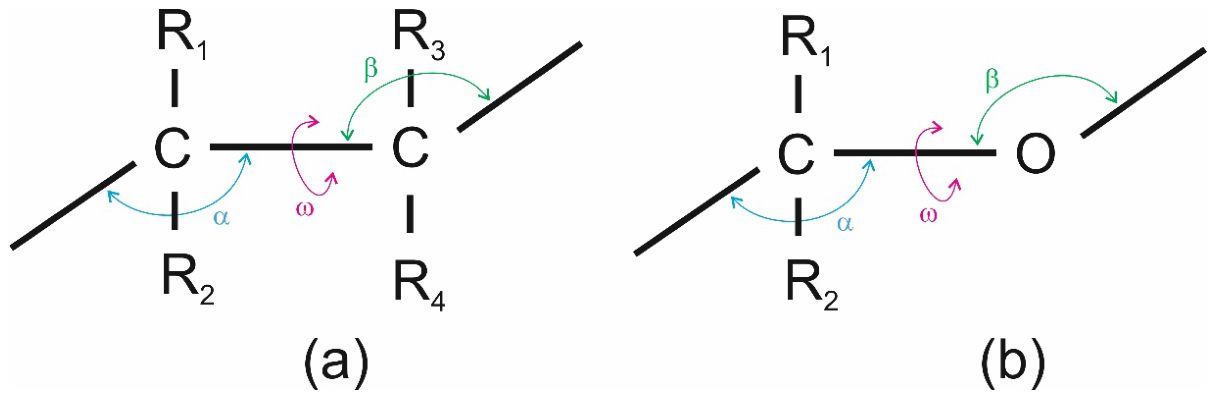
- Free rotation around single bonds is a fundamental mechanism based on the fact that atoms in the chain (for example, C—C or C—O) can rotate by an angle ω relative to one another while maintaining the valence angles α and β (see Figure 6a). The chemical bond itself remains intact, but the chain bends, adopting a wide range of conformations. If the side groups R1, R2, R3, R4 are not bulky (for example R1,…,R4 = H), rotation is essentially unrestricted (ω = 360°). However, when the polymer carries bulky substituents (for instance, R = an aromatic ring), steric interactions between neighboring groups hinder free rotation, reducing it to oscillations around discrete stable positions. This makes the polymer chain rigid. Conversely, the introduction of “molecular hinges” - divalent bridging atoms such as oxygen (—O—) or sulfur (—S—) - dramatically increases chain flexibility, since they lack side groups that would otherwise impede rotation (see Figure 6b).
- Geometric kinks: Valence angles, as well as the incorporation of aromatic rings through the meta-position, break the linearity of the molecular chain and prevent it from stretching into a rigid string.
Figure 6.
Mechanisms of polymer chain flexibility: rotation around single bonds.
The greater the effective flexibility of a polymer chain, the more readily it coils into what is known as a statistical coil. In this context, the concept of the Kuhn segment is introduced, defined as the smallest portion of the chain that exhibits flexibility [42]. Thus, a polymer macromolecule can be regarded as consisting of a certain number of segments, each behaving as an independent kinetic unit. In turn, each segment is composed of several repeating units of the polymer chain.
As shown above, two fundamentally different situations can occur in technical Kapton: closed versus unclosed imide rings - complete versus incomplete imidization. From the standpoint of molecular structure and the possibilities for intramolecular mobility, these cases differ dramatically, and therefore will be considered separately.
Closed imide cycle
In this case, two pathways for intramolecular mobility can be realized:
1. Mechanism 1: C—N bond (1 in Figure 1) between the carbon atom of the benzene ring (2 in Figure 1) and the nitrogen atom of the neighboring imide cycle (5 in Figure 1).
- Because of steric hindrance, the benzene ring and the imide cycle cannot lie in the same plane. On the benzene ring, the carbon atoms in the ortho (3 in Figure 1) and meta (4 in Figure 1) positions carry protruding hydrogen atoms, while the imide ring has a bulky carbonyl oxygen atom (C=O) located nearby. As a result, the benzene ring is forced to rotate around the C—N bond (1 in Figure 1) by a torsional angle of approximately ω ≈ 45°–60° relative to the plane of the imide cycle (see Figure 7). The imide ring acts as a strong electron acceptor (δ–), whereas the adjacent benzene ring - activated by nitrogen and oxygen - is a strong electron donor (δ+). Rotation about this C—N bond enables donor and acceptor regions of neighboring polymer chains to adhere closely in a face-to-face arrangement (π–π stacking effect) [43,44]. This interchain attraction is precisely what gives Kapton its characteristic amber-yellow color and prevents it from melting, even up to the temperature of chemical decomposition.
- Rotation around this C—N bond is restricted - functioning as a so-called limited hinge. At room temperature, the rotation is completely blocked: the hydrogen atoms of the benzene ring “catch” on the oxygen atoms of the imide groups, and the torsional angle ω remains fixed at about 45°. This constraint gives Kapton its high rigidity and dimensional stability. Under strong heating (in the glass-transition region, above 360–400 °C), oscillation around this bond becomes activated, the torsional angle can increase to about 60°, and the bond begins to act as an additional hinge.
2. Mechanism 2: Ether C–O–C bond (6 in Figure 1)
- The valence angle of this bond is θ ≈ 120° [45] (see Figure 7). Aromatic rings separated by an oxygen atom cannot lie in the same plane because of interactions between their “nearby” hydrogen atoms in the ortho positions relative to the oxygen. Consequently, the rings rotate with respect to one another, and in the stable state they are twisted by an angle of φ ≈ 60°–80°.
- Aromatic rings (2 in Figure 1) in an isolated molecule can rotate almost independently around C—O bonds (6 in Figure 1), since the energetic barrier to this rotation is negligibly small (4–8 kJ/mol). At room temperature, the thermal energy of the molecules (RT ≈ 2.5 kJ/mol) is sufficient to activate this hinge. However, in the bulk material, when neighboring polymer chains are stacked in a film, the rigid, planar imide ring of one chain is attracted to and lies flat against the electron-rich benzene ring of another chain. Between them, a strong electrostatic interaction arises - an interchain charge-transfer complex (CTC) [46]. Because of this interaction, aromatic rings cannot rotate freely around the oxygen hinge through a full 360°, but instead undergo only torsional oscillations (rocking back and forth). It is only when Kapton is heated above 360-400 °C (its glass-transition region) that this donor-acceptor interaction between chains weakens, allowing the C—O—C oxygen hinge to regain full rotational freedom. At that point, the polymer softens slightly without molecular degradation [46].
The proposed geometry of the monomer unit (4,4ʹ-oxydiphenylene-pyromellitimide) of the polymer chain, in accordance with these considerations, is shown in Figure 7 and agrees with the results of [21].
Figure 7.
Optimized geometries of the repeating units of (a) PMDA/ODA [47].
Figure 7.
Optimized geometries of the repeating units of (a) PMDA/ODA [47].
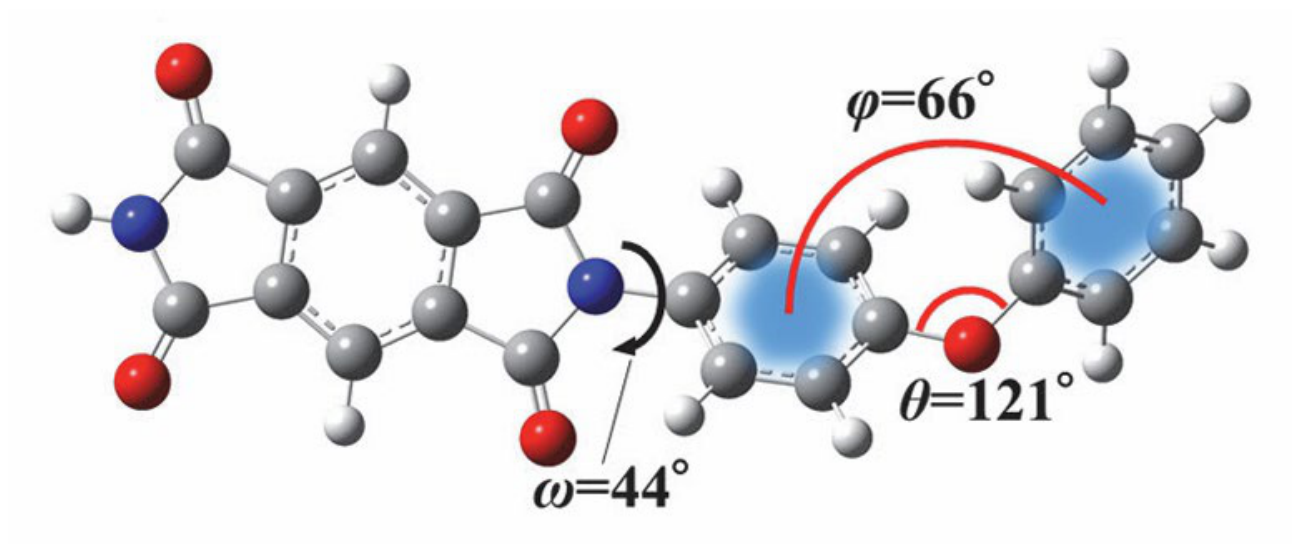
Figure 8 shows one of the probable crystal structures of PMDA–ODA polyimide, realized in accordance with these mechanisms [48]. Similar results were previously obtained in [46] when studying thin films free from residual solvent (see Figure 9). Intramolecular and intermolecular charge-transfer (CT) interactions (see Figure 4), which are characteristic of polyimides [49], contribute to Kapton’s mechanical and thermal stability as well as its distinctive color [11].
Figure 8.
(a) One of the probable crystal structures for PMDA-ODA. Projections of the lattice on the (b) ab plane, (c) ac plane, and (d) bc plane are shown on the right side [48].
Figure 8.
(a) One of the probable crystal structures for PMDA-ODA. Projections of the lattice on the (b) ab plane, (c) ac plane, and (d) bc plane are shown on the right side [48].
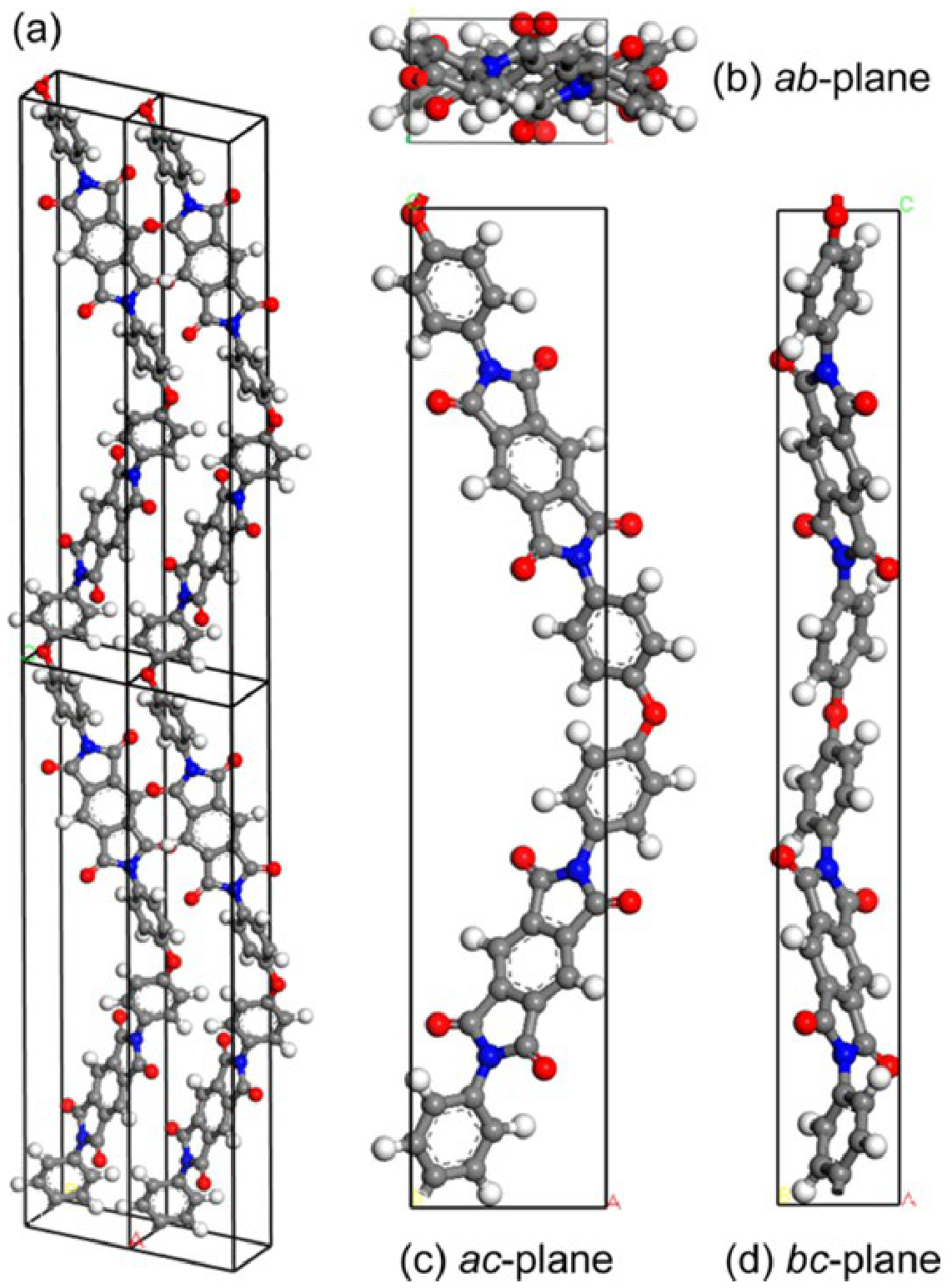
Figure 9.
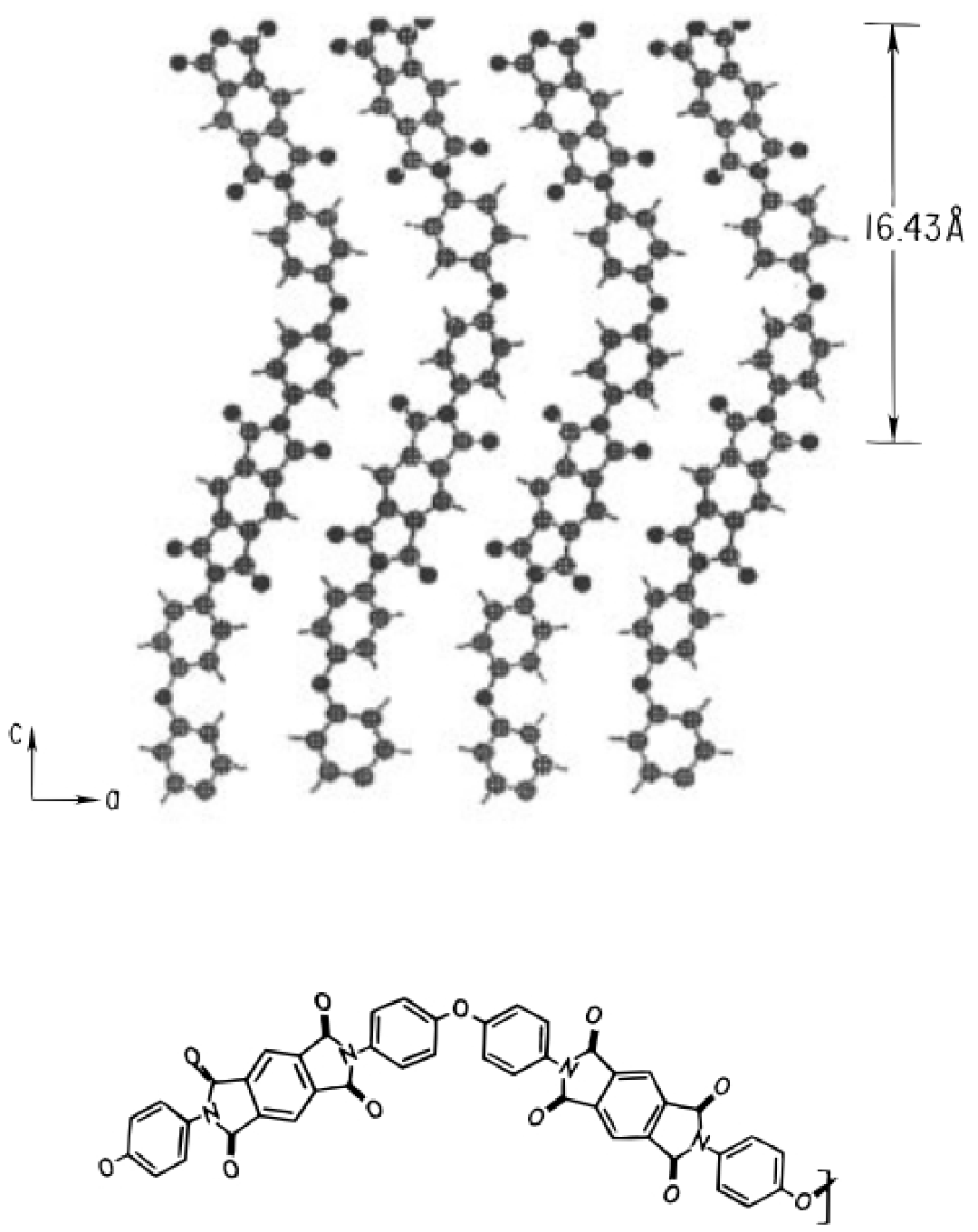
a-c projection of the PMDA-ODA crystal structure and the corresponding chemical structure, indicating the turn about the ether linkage and the planar nature of the conformation. The ODA part of the chain is composed of the two phenyl rings with the ether linkage. The theoretical length of the chain c ≈ 3.286 nm [46,50].
Figure 9.
a-c projection of the PMDA-ODA crystal structure and the corresponding chemical structure, indicating the turn about the ether linkage and the planar nature of the conformation. The ODA part of the chain is composed of the two phenyl rings with the ether linkage. The theoretical length of the chain c ≈ 3.286 nm [46,50].
Open imide ring (partial imidization)
In cases of incomplete imidization of the polymer (when part of the initial polyamic acid has not yet transformed into the rigid polyimide), chemical nodes remain in the chain that act as additional, highly effective hinges [45]. Incomplete imidization means that unclosed amic-acid units are preserved in the structure. Accordingly, the architecture of the partially imidized technical material may be described as rigid polycyclic rods interconnected by freely rotating diphenyl ether hinge groups. These hinge units introduce new degrees of freedom into the material:
In the unclosed unit, a classical amide bond —CO—NH— is present. Compared with the fully closed imide cycle, which forms a rigid planar structure, the single C–N bond (7 in Figure 1) within the amide group (8 in Figure 1) provides the chain with much greater spatial freedom. Although it possesses partial double-bond character, it still allows the chain to undergo torsional oscillations and bending over a much wider range than the monolithic imide.
2. Mechanism 4: Carboxyl hinge - free —COOH group (9 in Figure 1)
With incomplete ring closure, the carbon atom of the benzene ring (10 in Figure 1) retains a free carboxyl group (9 in Figure 1). This bulky group creates local asymmetry, disrupting the regularity of the chain and pushing neighboring segments apart, thereby reducing packing density.
3. Mechanism 5: Free-rotation hinge of benzene rings
This is the most important geometric factor:
4. Mechanism 6: Hydrogen-bond hinge (Dynamic hinge)
Unclosed —CONH— groups (12 in Figure 1) and —COOH groups (9 in Figure 1) actively form strong intermolecular hydrogen bonds with neighboring chains. Unlike rigid covalent bonds, hydrogen bonds are dynamic: upon heating they easily break and re-form in new locations (the “sticky-tape” effect). This enables chains to slide readily past one another under deformation, acting as a viscoelastic hinge.
Interchain interaction in Kaptone 3d structure
In Kapton polyimide, interchain donor-acceptor interactions refer to charge-transfer (CT) complexing between the electron-rich diamine segments (donors) and the electron-deficient pyromellitic dianhydride (PMDA) segments (acceptors) on adjacent, stacked polymer chains (see Figure 4). This unique 3D structure strongly dictates the material’s color, thermal stability, and mechanical strength. These interactions operate through a combination of several overlapping mechanisms [45,51]:
1. π - π Stacking and Orientation
Kapton chains adopt a layered, lamellar morphology. In this setup, the flat, conjugated aromatic rings of PMDA (the acceptor) and the diamine (the donor) stack face-to-face on top of one another between neighboring chains (see Figure 10). This preferential layer packing positions the π-orbitals of the donor and acceptor in close proximity [52,53,54].
2. Intermolecular Charge Transfer (CT)
Because of the alternating electron-rich and electron-poor regions, an electron from the Highest Occupied Molecular Orbital (HOMO) of the diamine donor can transfer to the Lowest Unoccupied Molecular Orbital (LUMO) of the PMDA acceptor. This creates an intermolecular charge-transfer complex that absorbs visible light, which is responsible for Kapton’s characteristic amber-to-brown color.
3. Dipolar Attractions and van der Waals Forces
Aside from electron transfer, the 3D structure is stabilized by strong dipole-dipole attractions between the highly polar imide carbonyl C=O groups and nearby aromatic rings. These forces, combined with the underlying π - π stacking, pull the chains together tightly, limiting molecular rotation and granting Kapton its exceptional dimensional stability and high glass transition temperature.
Thus, unlike an isolated molecule, in solid Kapton the mechanisms of cooperative rigidity come into play - specifically, stacking, i.e., the ideal face-to-face packing of flat imide and benzene rings from neighboring chains, which leads to the formation of an interchain charge-transfer complex [55]. As a result, what is known as subcrystalline or dense amorphous packing is established, and the effective Kuhn segment length ranges from 5 to 100 repeat units depending on the degree of imidization. In the case of complete imidization, the Kuhn segment length approaches that of the entire polymer macromolecule
Microscopic Model of Intramolecular Mobility in Technical Kapton
Thus, taking the above into account, the following can be proposed:
- Technical Kapton films are characterized by incomplete imidization.
- The degree of imidization decreases with increasing film thickness.
- A higher degree of imidization increases the rigidity of the polymer chain due to the activation of interchain donor–acceptor interactions.
- At room temperature, intramolecular mobility in fully imidized Kapton via Mechanisms 1 and 2 is almost completely blocked by interchain interactions, and the material exhibits behavior typical of a rigid-chain polymer.
- Material with the lowest degree of imidization (i.e., the thickest films) will, through the activation of the highly effective Mechanisms 3–6, display properties characteristic of flexible-chain polymers.
- Raising the temperature to about 360–400 °C activates Mechanisms 1 and 2 of intramolecular mobility, so that even fully imidized material begins to behave like a flexible-chain polymer.
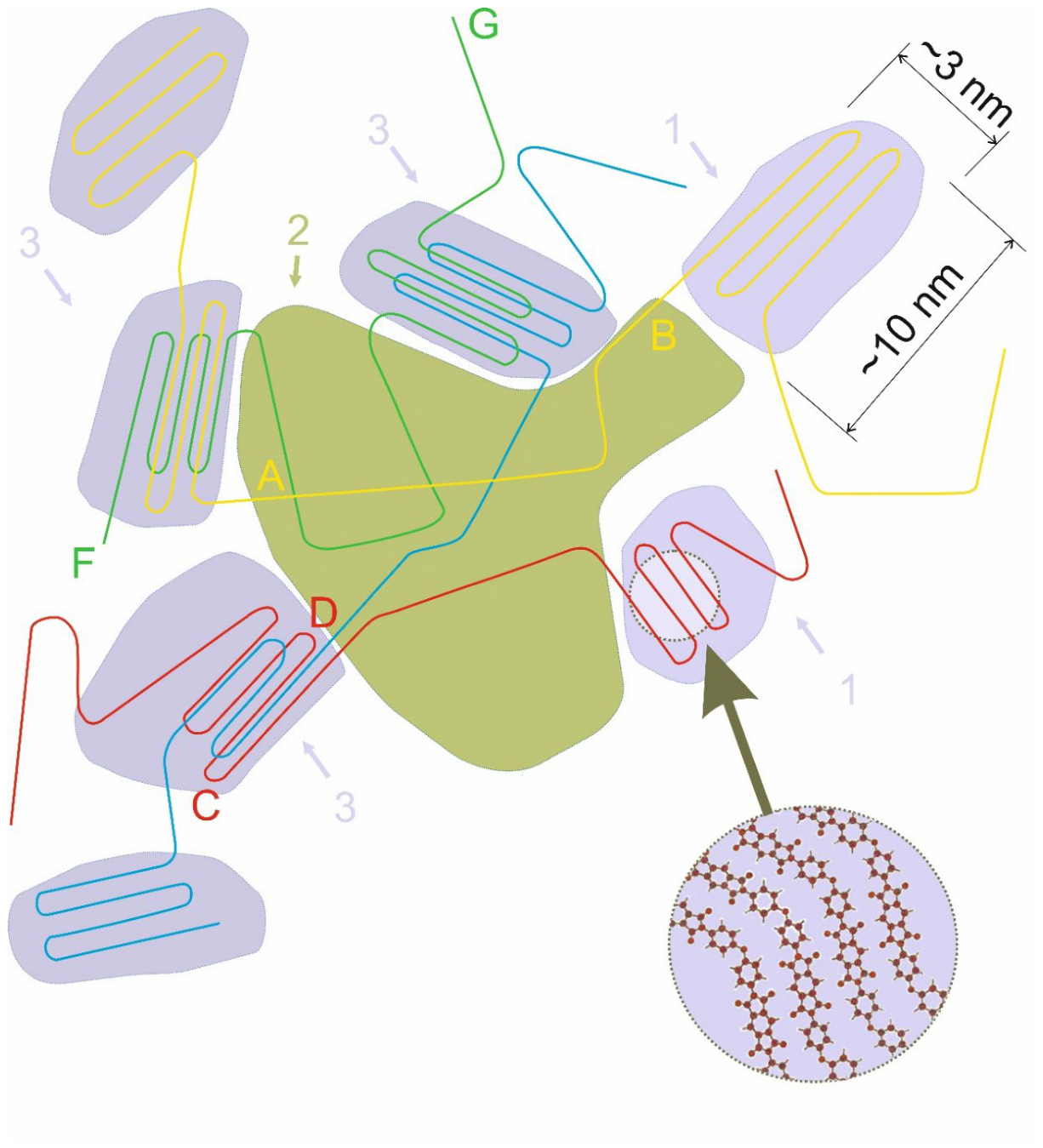
Thus, one can propose the following organization of the supramolecular structure of technical Kapton at normal and reduced temperatures (see Figure 11): sufficiently long polymer chains F—G consist of nearly rectilinear (zigzag-like, as shown in inset of Figure 11) rigid segments C—D connected by ultra-flexible hinges C and D formed by unclosed imide cycles in the partially imidized material. The lower the degree of imidization, the greater the number of such ultra-flexible hinges within a single macromolecule, and the shorter the rigid rectilinear segments that compose it. These rigid segments tend to pack densely and in parallel with neighboring chains through interchain donor–acceptor interactions, adjusting their mutual configuration (via Mechanisms 1–2), thereby forming ordered pack microblocks 1 (regions of short-range order) within the amorphous material 2. At the same time, such pack microblocks 1 belonging to different polymer chains can merge into microdomains 3 through the formation of interchain donor–acceptor bonds.
When sufficient external mechanical stress is applied, mutual reorientation and coalescence of these domains 3 is possible, since the structure between them is relatively “loose”: it is governed by comparatively weak hydrogen bonds (due to the presence of —COOH and —NH— groups in the under-imidized material), while the connection between domains 3 is mediated by disordered through-chains A—B of the amorphous matrix 2. In other words, part of a long polymer strand is tightly packed inside an ordered domain, then exits into the disordered amorphous matrix, traverses it in a chaotic fashion, and continues into another ordered domain. The portion of the polymer chain that passes through the disordered region while simultaneously belonging to two ordered domains is referred to as a through-chain A—B.
Figure 11.
The proposed supramolecular structure of technical Kapton: 1 - ordered pack microblocks, 2 - amorphous matrix, 3 - ordered microdomain, A—B - disordered through-chains. The inset illustrates the zigzag conformation of the linear rigid segments.
Figure 11.
The proposed supramolecular structure of technical Kapton: 1 - ordered pack microblocks, 2 - amorphous matrix, 3 - ordered microdomain, A—B - disordered through-chains. The inset illustrates the zigzag conformation of the linear rigid segments.
A similar organization of the supramolecular structure was previously discussed in [56] in connection with the influence of γ-rays on changes in the crystallinity of Kapton.
Geometric parameters of the model
In [57], an estimate of 4.45 Å was obtained for the mean interchain distance in the ordered domains. In [46], an estimate of 16.43 Å was also obtained for the linear dimension of the monomer unit.
Based on the assumption that the degree of polymerization n=150 has the typical value for technical Kapton, and the degree of imidization is ID=95% such that every twentieth imide cycle in the polymer macromolecule remains unclosed and forms an ultra-flexible hinge - and that each polymer macromolecule generates at least two pack microblocks - we obtain the following estimate: each polymer macromolecule, with a total length of about 250 nm in the fully extended state, is divided into roughly 20 shorter rigid rectilinear (zigzag-like) segments of about 10 nm in length, each consisting of 5–7 monomer (repeating) units; connected by flexible imide bridges/hinges of about 0.5 nm. The linear dimensions of such pack microblocks are approximately 3 × 10 nm (this estimate is consistent with the experimental results [33,58], where analysis of the profiles of X-ray reflections demonstrated that the longitudinal size of the ordered bundles in linear aromatic polyimides is 11–13 nm). Each pack microblock is formed from about five short rigid rectilinear (zigzag-like) segments belonging to a single macromolecule. Based on these assumptions, the effective Kuhn segment length does not exceed 5–7 repeating monomer units, or approximately 10 nm.
According to this model:
- During material deformation, the “loose” interdomain zones allow domains to reorient in the direction of the applied external force (orientation drawing). This mechanism provides high plasticity and enables large strains before fracture. At the same time, domains reoriented into more favorable positions form new interchain donor–acceptor bonds, resulting in orientational strengthening of the material.
- Under external mechanical stress, the first to be stretched and deformed are the through-chains in the “loose” zones. They act as shock absorbers or bridges, transmitting the load from one rigid domain to another. In doing so, they force the domains to reorient along the direction of stretching, while at the same time preventing the material from rupturing.
- The through-chains are part of the disordered matrix, and they limit domain growth. Since a single molecule is simultaneously trapped in two domains, it restricts their ability to grow indefinitely and merge into ideal large crystals. This is precisely why technical Kapton remains predominantly amorphous-ordered (X-ray amorphous) rather than fully crystalline.
- Upon cooling (at reduced temperatures), hydrogen bonds in the loose zones “freeze,” interdomain mobility decreases, and the material becomes stiffer. However, thanks to the ultra-effective hinges (in the unclosed cycles of under-imidized material), the polymer does not crack and still demonstrates relatively high - though lower than at room temperature -strain-to-failure values.
- The presence of pack microblocks in the supramolecular structure of the material should lead to the emergence of physical properties with characteristic relaxation times of 105 s or longer (at 293 K) [40].
Analysis of Experimental Data: Structural, Mechanical, and Acoustic Properties of Technical Kapton
Structural Properties
In [14] it was shown that a predominantly amorphous sample of technical Kapton contains a certain fraction of regions of short-range order while remaining overall amorphous (long-range ordering is absent). At the same time, uniaxial deformation at 290 K leads to the appearance of elongated ordered regions, which may indicate partial molecular alignment along the stretching axis. A similar effect was also observed in [15,16] under uniaxial deformation at 77 K.
Figure 12.
Scattering intensity profiles as a function of the scanning angle for the original Kapton film (a), deformed at room temperature (b), cooled to 77 K (c), and to 4.2 K (d) [14].
Figure 12.
Scattering intensity profiles as a function of the scanning angle for the original Kapton film (a), deformed at room temperature (b), cooled to 77 K (c), and to 4.2 K (d) [14].
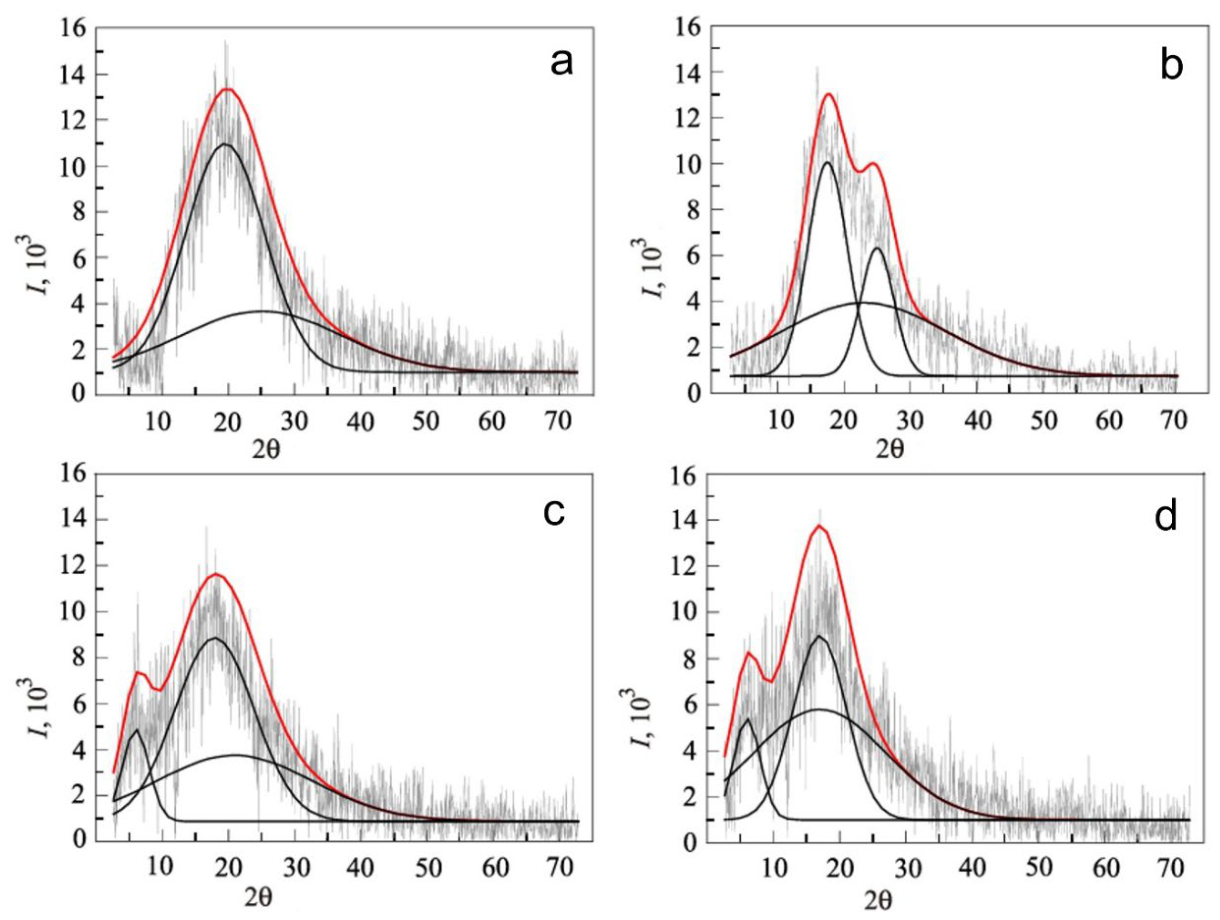
Such an effect has repeatedly been observed earlier in polyimide and a number of other polymers [1] and is known as orientational drawing. On this basis, the widely used industrial technique of orientational strengthening has been developed. In [14] it was also shown that cryo-quenching at 77 K and 4.2 K (as a result of isotropic compression due to thermal expansion/contraction) leads to the formation of additional non-oriented short-range order regions and compression domains. This behavior of the investigated material fully fits into the above-proposed model of intramolecular mobility: under applied external mechanical stress, through the implementation of Mechanisms 3–6, previously unfavorably oriented molecular chains relative to their neighbors adopt more favorable positions for donor–acceptor interactions, while adjacent planar fragments of polymer chains (imide and aromatic rings) adhere closely to each other face-to-face. During cryo-quenching, under the action of thermal compression, the material densifies and some additional chain segments gain the possibility of realizing intermolecular interactions, resulting in the appearance of extra short-range order regions and overall densification of the material.
These conclusions are consistent with the results of [21], where interpretation of X-ray diffraction patterns using the radial distribution function method led to the conclusion that isotropic compression induces mutual ordering of polymer chains. This fully agrees with our proposed concept of the formation of new intermolecular bonds via a donor–acceptor mechanism under compression, as a result of which additional polymer chain units can adopt more favorable positions for bond formation.
Moreover, the activity of Mechanisms 3-6 decreases as the temperature is lowered, and the resulting thermal stresses in the material can no longer be relaxed through them, which further promotes the formation of new intermolecular donor-acceptor bonds.
It is evident that subsequent heating to room temperature after cryo-quenching does not lead to noticeable relaxation of the formed structure, since the thermal energy of the molecules is insufficient to break the newly established intermolecular bonds.
Deactivation of Mechanisms 3–6 upon lowering the temperature to 4.2 K is also confirmed by the results of [15], where it was shown that mechanical deformation at 4.2 K does not lead to the formation of ordered regions. Clearly, this is related to the absence of effective mechanisms of intramolecular mobility at such temperatures (Mechanisms 1–6 are inactive due to the freezing of molecular thermal vibrations). As a consequence, the applied external mechanical stress does not result in reorientation of molecular segments, nor in the formation of new intermolecular bonds and short-range order regions. Moreover, the applied external stress is sufficient to destroy or hinder the formation of new bonds that could otherwise arise due to thermal compression.
In [17,18] it was shown that deformation of an amorphous Kapton film with a thickness of 75 µm at 290 K and 77 K does not lead to significant structural changes, whereas for a film of 125 µm thickness the same deformation results in the appearance of regions with long-range order in the sample. Clearly, these results are consistent with the earlier conclusion that increasing film thickness reduces the degree of imidization of the material, thereby enhancing the activity of Mechanisms 3-6 responsible for intramolecular flexibility. As a result, the molecular chains of such a material have greater opportunities to adopt more favorable orientations relative to their neighbors, enabling interchain donor–acceptor interactions and the formation of macroscopic ordered regions.
The appearance of structural inhomogeneities (recorded by X-ray diffraction as peak broadening, the emergence of additional reflections, or asymmetry of the diffuse halo) in the thickest partially imidized film is a direct consequence of the spatial gradient of the imidization rate and stress localization. The physical explanation of this effect is as follows: in a thick film (125 µm), due to the “skin effect,” a strong gradient in the degree of imidization and solvent content arises across the film cross-section. The surface layers are almost fully imidized, dense, and rigid, whereas the central core of the film contains the maximum number of unclosed amic acid bonds and trapped solvent. This zone is loose and plastically compliant. When the X-ray beam passes through such a thick film, it does not probe a homogeneous material but rather a sandwich of layers with fundamentally different structures and chain mobilities. During deformation of such an inhomogeneous material (especially under cryogenic conditions), strain is distributed unevenly, leading to the emergence of distinct structural inhomogeneities in the diffraction pattern: in the outer layers, rigid bundle-like microdomains orient under external mechanical stress and undergo “cryogenic jamming,” forming a clear, dense, and stable long-range order. On the X-ray pattern this produces sharp, intense orientation reflections. At the same time, in the plasticized (inner) layers, the presence of numerous unclosed bonds and residual solvent changes the situation. Solvent molecules screen the chains and prevent microdomains from approaching closely enough to form a well-defined long-range order. Instead of a monolithic texture, a softened, defective quasi-oriented phase is formed. On the X-ray pattern this appears as a broad, diffuse halo. Thus, the diffraction image of a deformed thick sample becomes a mixture (superposition) of two different signals: from highly ordered domains and from defective plasticized zones of the amorphous matrix. Physically, this is interpreted as the coexistence of structural inhomogeneities.
In [25], the influence of irradiation with electrons and protons of an average energy of 160 keV, as well as vacuum ultraviolet (VUV) and ultrasoft X-ray (USX) radiation in the range of 1.24–170 nm, on the mechanical properties of Kapton films of different thicknesses was studied. It was established that for all films, all types of irradiation reduce the ultimate tensile strength. At the same time, in the thin film an increase in the slope (the strain-hardening coefficient in the third stage of the stress–strain curve, Figure 13) was also observed. Within the framework of the proposed model, this behavior is most likely explained by the competition between radiation-induced cross-linking (completion of imidization of unclosed imide cycles) and main-chain scission [56].
Acoustic Properties
The results of numerous experimental studies performed at both low and high frequencies show that the speed of sound in polymers linearly depends on Temperature [59,60,61]. The temperature coefficient of sound velocity changes abruptly only at those points where the character of the molecular motion changes. Thus, the defrosting of one or another type of molecular motion is indicated by the peculiarities of the temperature dependence of the speed of sound or the corresponding elastic modulus.
In [20] two anomalies were observed at 45 K and 185 K when studying the acoustic properties of the Kaptone films of 75 µm (Figure 14). In polyimides, the relaxation process at 185 K is known to correspond to the so-called β-relaxation [62]. The β-process is generally attributed to the motion of chain segments containing imide groups that are not hydrogen-bonded to similar groups on neighboring macromolecules [63,64]. β-relaxation occurs exclusively in the amorphous regions of the polymer [65].
For linear polymers without pendant side groups, maxima of acoustic losses below 100 K (the so-called δ-peaks) can only be associated with the presence of ordered regions [59,62]. For example, in [66] an acoustic absorption peak was detected in polyethylene at 48 K. This peak disappears in annealed samples and appears under orientational stretching or thermoelastic stress. Temperature and mechanical effects can therefore induce structural changes in rigid-chain polymers [67,68].
The presence of an amorphous halo in X-ray patterns of amorphous PMDA/ODA polyimide indicates that the system is not completely disordered; it contains local regions where short-range order is preserved [13,15].
The δ-relaxation mechanism is linked to the interaction of conformational kink-like defects in the nearly parallel folding of molecular chains [66,69]. The hypothesis of such defects was first proposed in [70,71,72] and later confirmed both theoretically [73] and experimentally [74,75]. The formation of ordered regions in PMA polyimide under thermoelastic stress was experimentally observed in [13]. An analogous process is the Bordoni peak mechanism in fcc metals [76,77]. Analysis of the acoustic resonance experiment - specifically the shape and temperature localization - allowed estimation of activation energies for these processes: δ-relaxation ≈ 0.05 eV and β-relaxation ≈ 0.7 eV. These values are consistent with characteristic energies for relaxation phenomena of this type [59,65].
In thermally activated acoustic processes, the dependence of the relaxation time τ on temperature T follows the Arrhenius law:
Assuming τ0 ≈ 10−12 for δ-relaxation, equation (1) yields τδ ≃ 4 · 10−7 s. The relatively low activation energy suggests that the relaxation involves the smallest possible molecular volume, consistent with weak van der Waals interactions or minor angular rotations of short chain segments. Such kink defects represent conformational transitions (e.g., trans – gauche – trans), localized over 0.5–1.5 nm, corresponding to one or two repeating units of the polymer backbone
The trans – gauche – trans transition represents a conformational change of the molecule, arising from the rotation of specific atoms about a single covalent bond [59,72]. Importantly, no chemical bonds are broken; instead, the molecule flexes in space in a hinge-like manner:
- In the trans conformation, the chain segment adopts its most extended, planar, and elongated geometry. The atoms are aligned in a zigzag arrangement, directly opposite one another, which represents the optimal configuration for tight parallel packing of chains in ordered domains.
- In the gauche conformation, a chain unit undergoes rotation about its single bond axis by roughly 60° (or 120°). Consequently, the otherwise linear chain segment introduces a kink or bend into the molecular backbone.
A kink-defect arises when, within a long trans-chain, one unit rotates into the gauche conformation and the subsequent unit returns to trans, producing a local step in the backbone. While stable at rest, such defects can migrate under acoustic or mechanical excitation, as the gauche unit hops along neighboring atoms. The δ-relaxation observed at 45 K is attributed to the collective motion of these trans – gauche – trans kinks along parallel chains. Importantly, this migration requires no bond cleavage and is driven purely by subtle shifts in electron density between adjacent macromolecules.
δ-relaxation cannot arise in a completely disordered amorphous medium; it requires quasi-parallel chain segments that allow kink defects to migrate in a stable manner, analogous to dislocations in metals. The formation and relaxation jump of such a kink demands that the parallel chain bundle length exceed the kink’s critical dimension by several times. Consequently, the minimal linear size of locally ordered bundle-like microdomains (short- or long-range ordered regions responsible for the amorphous halo in X-ray scattering) is estimated to be 3-10 nm, in full agreement with our original evaluations.
Accordingly:
- The characteristic relaxation time of δ relaxation at 45 K is approximately τδ ≃ 4 · 10−7 s, underscoring its pronounced dynamic mobility even at low temperatures.
- Although the elementary defect itself is molecular in scale (0.5-1.5 nm), its occurrence serves as a direct topological marker of ordered microdomains in Kapton, sized 3-10 nm.
Assuming a relaxation time of τ0 ≈ 10−13 s for the β process (generally larger than for local kinks owing to steric constraints), this yields an estimate of τB ≃ 106 s (≈11 days) for β-relaxation. The activation energy of 0.7 eV is unusually high for a local defect, reflecting the cooperative disruption of strong intermolecular interactions and the collective motion of extended chain segments. In the β process, entire monomeric units of the PMDA-ODA backbone participate. Literature reports attribute this relaxation to local rotations and displacements of rigid imide rings (PMDA) and phenyl cores (ODA) about the ether oxygen bridge (Mechanism 2). Such large fragments require steric clearance from neighboring chains to rotate within the amorphous phase. The mobile segment spans 1.5-2.5 nm, equivalent to one or two repeating units of the polyimide. Because β-relaxation occurs only in amorphous regions between ordered microdomains, its extent is constrained by the geometry of these interlayers. For a segment of up to 2.5 nm to move freely, the amorphous zone must provide adequate free volume, implying that the thickness of amorphous interlayers in Kapton lies between 5 and 15 nm.
Mechanical Properties
The stress–strain curve of Kapton displays three distinct stages [22,26] (Figure 15). During the initial quasi-linear stage, the applied stress is not yet strong enough to induce microdomain reorientation; instead, deformation arises from the straightening of disordered through-chains within the amorphous matrix. Consequently, the slope of this stage is steep and remains essentially unaffected by film thickness or the degree of imidization [26].
At the yield point (second stage of the stress–strain curve), cooperative motion of ordered microdomains is initiated. These domains reorient by aligning the axes of their rigid chain microsegments with the tensile direction. Through donor–acceptor interchain interactions, separate microdomains coalesce into larger structures, establishing long-range order that persists even after unloading.
Following the cooperative reorientation and coalescence of microdomains, the deformation process advances to the large monolithic domains. At this point, the applied stress resumes a linear increase, marking the third stage of the stress–strain curve.
Experimental data show that the slope of the third stage of the stress–strain curve is reduced in the thickest Kapton films [19, 23 and 26] (Figure 17 and Figure 15). This behavior can be rationalized by their lower degree of imidization. Residual solvent trapped near unclosed amic acid cycles acts as a molecular lubricant, impeding the development of strong interchain bonds and promoting slippage. Moreover, unclosed imide cycles at domain boundaries bear bulky —COOH and —CONH— groups, which loosen the structure, generate free volume, and suppress interchain bonding (Mechanism 6). Such structural softening enhances the likelihood of interchain sliding, thereby reducing the slope of the deformation curve.
Based on the quasi-linear character of the deformation curve in the first and third stages, the corresponding values of the effective elastic moduli for each of them can be estimated (Table 1). The parameters in this table were calculated from the experimental data reported in [23,26] (for a “fresh” film immediately after preparation).
In the first stage, this effective elastic modulus EI has the meaning of an integral modulus of elasticity of a composite consisting of rigid microblocks with an elastic modulus Eb (Eb on the order of the theoretical limit, 3000-5000 MPa) and a relatively soft amorphous matrix with an elastic modulus Em:
where ϕb and ϕm are the corresponding specific volume fractions of the microblocks and the amorphous matrix.
In the third stage, the effective elastic modulus EIII has the meaning of a strain-hardening coefficient.
The significant excess of the slope in the first stage (initial elastic modulus) over the slope in the third stage (orientation-hardening coefficient) reflects the distribution of deformation energy. The initial elastic response in the first stage is governed by the high intramolecular stiffness of the covalent bonds and valence angles in the backbone of PMDA-ODA macromolecules. In contrast, in the third stage, after the elastic resource has been exhausted and the original structure destroyed, deformation proceeds via the mechanism of cooperative shear micro-sliding of the oriented microblocks. Resistance to this process is limited by much weaker intermolecular physical bonds and charge-transfer complexes, which accounts for the markedly lower stiffness of the material in the final stages of drawing. The numerical representation of this characteristic is the so-called deformation softening / flow index:
The empirical estimates of this parameter are presented in Table 1. The high values obtained indicate that, in the third stage of deformation, Kapton acts as a highly efficient dissipator (absorber) of mechanical energy. Almost all of the work of the external deforming force is not spent on elastic stretching of the chains, but is irreversibly dissipated as heat through overcoming internal friction during the sliding of oriented microblocks. Moreover, this indicator increases with film thickness, which - assuming a lower degree of imidization in the thick film - points to a weakening of interchain interactions due to the “loosening” role of the associated residual solvent.
The obtained values of EI and EIII make it possible to estimate the geometry of the molecular chain of the studied material. The relationship between the effective moduli and the number of Kuhn segments in a system with semi-rigid segments and rigid blocks is described by the following dependence [78]:
where θ is the misorientation (rotation) angle of the microblocks relative to the drawing axis. Since in the third stage the blocks are already nearly aligned along the stretching axis, θ is small, and the factor sin2(θ) acts as a geometric stress-amplification coefficient (typically, for rigid-chain textures it lies in the range of 6–8 [33]). Thus, relation (4) leads to an estimate of the length of the free interblock segment of ≈ 2.5 Kuhn segments. In other words, the length of the free amorphous region between two neighboring ordered blocks is very short - only about 2–3 Kuhn segments, or ≈ 15 monomer units, i.e., ≈ 25 nm.
According to our preliminary estimates, each polymer chain consists of about 20 rigid Kuhn segments; part of them are grouped into ordered microblocks, with the distance between these blocks being on the order of 2–3 Kuhn segments.
According to calculations of the free energy of a polymer chain during microblock formation within the framework of the Khokhlov & Semenov theory [79], the equilibrium block length for rigid-chain systems is ≈ 3–4 Kuhn segments. Enlargement of microblocks within a single polymer chain is energetically unfavorable, since at the exit from an ordered block the chain is forced to bend sharply (forming a loop or a conformational kink) in order to pass into the loose amorphous phase. This creates local overstressing of the chemical bonds.
Thus, we can finally describe the structure of the polymer chain in technical Kapton: each polymer chain contains about 150 monomer units, divided into roughly 20 rigid segments connected by flexible regions formed by non-closed imide cycles. Each of these 20 rigid segments consists of approximately 5-7 monomer units and forms an almost rectilinear Kuhn segment with a zigzag-like internal structure. These rectilinear segments tend to align in parallel, stabilized by the formation of interchain donor–acceptor bonds and charge-transfer complexes. As a result, ordered microblocks are formed, each comprising 3-4 segments, connected by disordered through-chains of 2-3 segments. In this scheme, 3-4 such microblocks are arranged along the entire length of the polymer macromolecule (Figure 16). This picture is consistent with our initial model, based on considerations of intramolecular mobility in Kapton (Figure 11), and agrees with the results of [80], which theoretically demonstrated that semi-rigid chains, due to steric constraints, tend to pack in parallel and their resistance to deformation follows energetic rather than purely entropic laws; with the conclusions of [81], which showed that in the “worm-like” or persistent chain model elasticity depends linearly on the bending of rigid segments rather than on entropic chain disentanglement; and with [82], where molecular dynamics simulations revealed that the elasticity and strengthening of polyimides are determined not by unraveling coils, but by torsional angle deformation of rigid rings and their parallel approach under load.
The proposed structure of the polymer molecule suggests that approximately two-thirds of its segments are concentrated within the microblocks. Assuming, as a first approximation, that the segments inside the microblocks and those in the amorphous matrix occupy the same volume (a rather crude assumption that does not account for the obvious presence of free volume due to suboptimal packing in the amorphous matrix), and based on equation (2) with Eb ≈ 4000 MPa, we obtain an estimate for the elastic modulus of the amorphous matrix of ≈ 700 MPa. This value supports the assumption that the amorphous interblock layers are in a partially softened (compliant) state. On the other hand, it is still sufficient to accumulate significant elastic energy under cryogenic deformation - enough that, upon heating and removal of the deforming load, intermolecular friction can be overcome and mechanical deformation can relax.
Figure 17.
Typical deformation diagrams of Kapton of different thicknesses [19]: 1 – 75 µm and 2 – 125 µm.
Figure 17.
Typical deformation diagrams of Kapton of different thicknesses [19]: 1 – 75 µm and 2 – 125 µm.
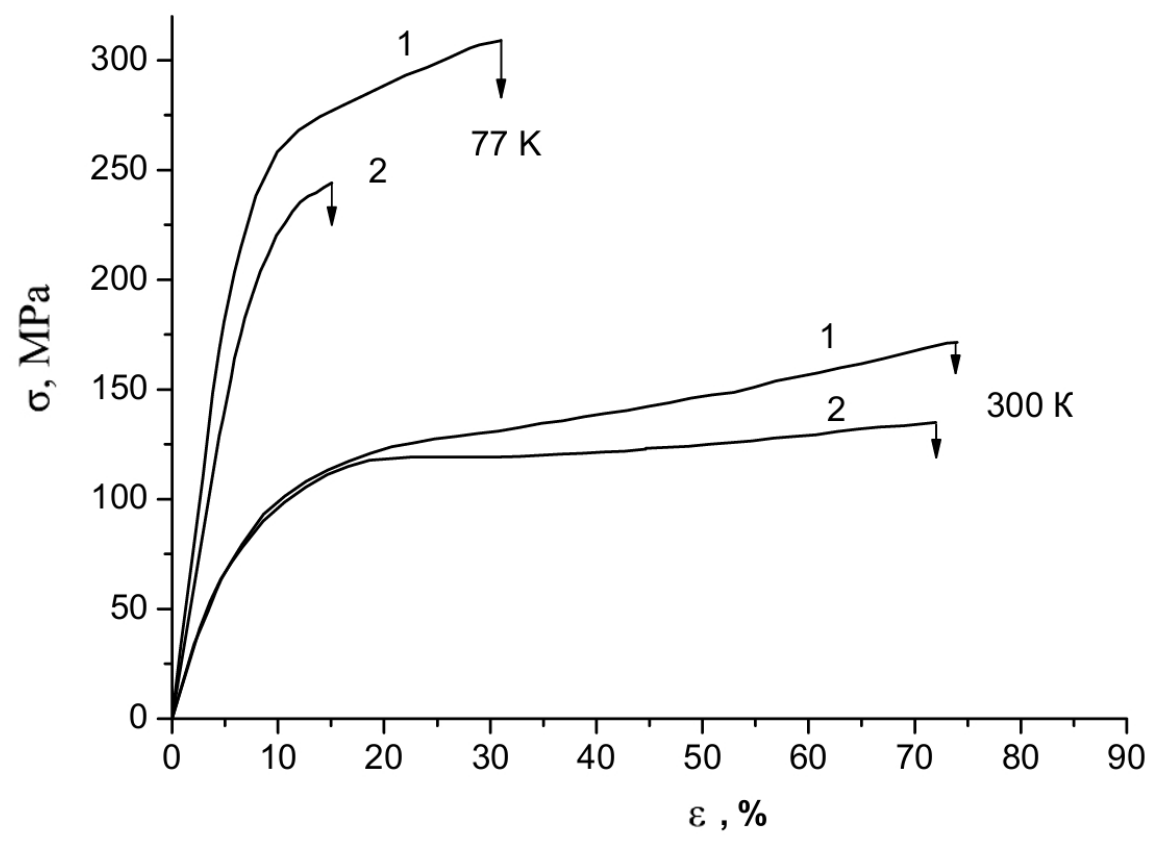
At room temperature (300 K), the fracture strain is essentially unaffected by the degree of imidization or film thickness [19] (see Figure 17), as it is governed primarily by the molecular chain length (degree of polymerization), fixed during the initial PAA synthesis and unchanged during subsequent imidization. Moreover, segmental mobility mechanisms active at 300 K enable relaxation of local stresses. In contrast, at cryogenic temperatures (77 K) these mechanisms are suppressed, preventing effective relaxation of stresses induced by imidization gradients and residual solvent in thicker films. This leads to stress concentration, microcrack initiation, and ultimately reduced mechanical strength in thicker films relative to thinner ones.
It has been established [23,26] (see Figure 18) that prolonged storage at room temperature increases the slope of the deformation curve in the third stage for thin films, while it practically does not change for the thickest (partially non-imidized) films. At the same time, the ultimate strength at break decreases for thin films during storage, whereas for the thickest films it increases slightly. A likely explanation within the proposed model is as follows: Kapton at room temperature is a thermodynamically nonequilibrium system, containing a large amount of “frozen” excess free volume [84]. Over time, this free volume relaxes, molecular chains gradually self-organize and pack more tightly. Thus, in aged material the bundle-like microdomains are already partially packed as closely as possible, which macroscopically manifests as an increased slope of the third stage of the deformation curve [85]. The reduction of free volume also lowers the fracture strength, since the material loses its ability to relax internal stresses: the chains lack space for conformational rearrangements, and the material becomes brittle. In contrast, in the thickest partially imidized films a large amount of residual solvent (NMP, DMAc) remains. Solvent molecules are trapped near unclosed amic acid cycles and act as permanent spatial spacers (plasticizers), physically preventing polymer chains from approaching and densifying even after years of storage. The large thickness creates high diffusion resistance to the release of free volume, while the high concentration of trapped residual solvent serves as a permanent plasticizing barrier, hindering spontaneous chain densification. This preserves the original structure of the thick film, ensuring that the slope of the third stage of deformation remains essentially unchanged even after long-term storage. Nevertheless, gradual post-imidization remains possible, since imidization (conversion of PAA to polyimide) is thermodynamically favorable. Over years of storage, solvent molecules trapped near PAA “tails” provide a local molecular environment that ensures minimal mobility, sufficient for amic acid groups to slowly overcome the energy barrier and close into strong imide rings. In thick films, the number of unclosed chemical defects (broken rings) slowly decreases, while the number of strong imide bonds increases. The matrix becomes chemically more homogeneous and monolithic, and therefore its ultimate strength is found to be slightly higher than that of a fresh sample.
Experimental results show that the slope of the third stage of the stress–strain curve (strain-hardening coefficient) decreases when the deformation temperature is reduced from 77 K to 4.2 K [22] (Figure 15). This phenomenon can be attributed to cryogenic immobilization: at such low temperatures, intramolecular mobility is essentially frozen, causing bundle-like microdomains to remain trapped in a geometrically imperfect, porous state with elevated free volume. Without thermal activation, these domains cannot coalesce into a more robust monolithic structure.
It has been established that deformation of Kapton films with thicknesses of 75 µm and 125 µm at 77 K and 290 K leads to the formation of long-range order [14,15,16] (Figure 12) and the appearance of residual strain [19] (Figure 19). When deformation is carried out at cryogenic temperature, this strain almost completely (fully in a film 125 microns thick) relaxes upon reheating the sample, whereas deformation at room temperature requires annealing at 350 °C for complete relaxation. The magnitude of residual strain is greater in the thinner film.
Which can be explained as follows:
- ✓
- Under external mechanical stress, rigid bundle-like microdomains are forced to reorient along the tensile axis. At cryogenic temperatures, the free volume in the amorphous matrix is compressed to a minimum, intramolecular mobility is suppressed (the amorphous matrix is stiffer compared to room temperature), and chain segments within the microdomains are brought into maximum proximity. As a result, at low temperatures they do not simply rotate but literally interlock, forming new interchain bonds via donor–acceptor mechanisms, making long-range ordering more efficient. Upon reheating and unloading, this mutual ordering of microdomains persists, which is clearly detected by X-ray analysis.
- ✓
- Nevertheless, the strain is distributed unevenly within the material, being localized mainly in the loose amorphous interlayers between microdomains. In these amorphous zones, through-chains are strongly stretched, accumulating large amounts of elastic energy (acting like compressed or stretched rigid springs). Such energy storage is more effective at cryogenic temperatures due to reduced intramolecular mobility and the inability to relax stresses through conformational rearrangements of the chains. Upon reheating the deformed material to room temperature, these “springs” in the amorphous matrix are reactivated (thermal motion resumes) and return the sample to its original length, resulting in relaxation of residual strain. The rigid oriented blocks (domains with long-range order) are not destroyed; they merely shift relative to one another as intact monoliths, preserving their internal oriented structure.
- ✓
- In contrast, when deformation is performed at room temperature, the amorphous interlayers do not store elastic energy (they are too mobile and simply relax plastically during stretching), so there are no “loaded springs” to restore the structure after unloading. Therefore, removal of residual strain requires heating the film to 350 °C to “melt” the long-range ordered domains themselves.
- ✓
- The larger residual strain observed in the thinner film can also be logically explained by its higher degree of imidization, which results in lower intramolecular mobility.
It was established [19] that part of the strain relaxes immediately after unloading, which reflects the fundamental division of the total strain ε imparted to the material before removal of the external deforming force into purely elastic εplastic (entropic–energetic) and plastic εplastic (structural–orientational) components:
εelastic - relaxes immediately; this strain is localized in the amorphous interlayers between microdomains. By its nature, it is purely elastic. Under the action of the external deforming force, the disordered through-chains in the amorphous regions were stretched and accumulated internal potential energy through distortion of valence angles and elongation of chemical bonds. Upon unloading, these chains encounter no kinetic or chemical barriers and therefore instantly return to their initial equilibrium state at the speed of sound in the polymer.
εplastic - corresponds to the deformation of the bundled microdomains, which have managed to reorient and “lock in” (forming long-range order). The interchain forces of the CT-complexes firmly hold them in the new oriented state, so they cannot instantly rotate back. As a result, conformational stress remains within the disordered through-chains in the amorphous regions: the chains are forcibly straightened, and kink defects (gauche states) are trapped in unfavorable positions.
After removal of the external load and completion of the elastic relaxation stage (milliseconds), thermoactivated migration of kink defects begins (the stage of fast relaxation). Kink defects undergo massive trans–gauche–trans transitions in the reverse direction, restoring the chains to their original bent state. The characteristic time of this process is 10-7-10-6 s, with an activation energy of 0.01-0.03 eV [59,83]. These theoretical estimates are consistent with the experimental results reported in [20] for the acoustic δ-relaxation associated with kink-defect motion: activation energy≈ 0.05 eV and characteristic relaxation time τδ = 4 · 10−7 s.
When this process is exhausted (all kinks in the through-chains of the amorphous interlayers have hopped), relaxation slows down sharply. A prolonged stage of creep and de-orientation of the large bundled microdomains begins (the stage of slow relaxation).
In the thick film, with a lower degree of imidization and a higher fraction of residual solvent, interchain interactions are weakened; therefore, the share of instantaneous recovery in the thick sample turns out to be significantly higher.
Using the data from [19] (Figure 16), we estimate the instantaneous recovery coefficient (Table 2). The physical meaning of this characteristic is as follows: if the fraction of instantaneous relaxation is high (large Rin), it indicates that a significant part of the deformation was due to elastic stretching of the amorphous matrix, which easily returned to its initial state after removal of the force. Conversely, if the fraction of instantaneous relaxation is low, this provides evidence of highly efficient coalescence of microdomains into larger, rigid regions of long-range order, thereby fixing the plastic deformation.
The obtained values Rin make it possible to estimate the energy stored in the amorphous matrix after the removal of the external deforming stress. As is well known, for linear-elastic deformation the volumetric density of stored energy W (the work of deformation per unit volume) is determined by the relation:
where σmax - is the macroscopic stress value at the moment just before unloading the sample (in [19], whose data we used for analysis, this corresponds to 90% of the ultimate tensile strength σmax = 0.9 · σU). After the instantaneous relaxation of deformation upon removal of the external load, only part of this energy Ws=Rin · W remains stored in the material. The estimates obtained from these considerations are presented in Table 2 (under the assumption that the elastic modulus of the amorphous matrix does not depend on film thickness). These estimates show that deformation at cryogenic temperatures leads to the accumulation of significantly greater elastic energy than deformation at room temperature, which explains the more effective relaxation of residual mechanical stress in cryo-deformed specimens. Taking into account the instantaneous recovery coefficient, it was established that in the thick film (125 µm) the actual density of elastic energy released upon unloading exceeds that of the thin specimen (75 µm).
Thus, a logical interpretation of the obtained experimental results is as follows: when deformation occurs at 77 K, segmental mobility in the material is switched off, and the strain accumulates in the amorphous matrix. In the thick film (125 µm), this process is enhanced due to its specific heterogeneity: in the center of the thick film, the maximum number of unclosed amic acid bonds and residual solvent molecules are trapped. These molecules act as additional “spacers” between neighboring chains, preventing them from shifting and forming stable interchain interactions. In other words, in the thin film (75 µm) the structure is more homogeneous, so the bundled microdomains more easily and strongly establish interchain interactions throughout the volume, coalescing into larger regions of long-range order and thereby fixing the plastic deformation (reducing the fraction of instantaneous recovery).
The values of the instantaneous recovery coefficient Rin from Table 2, obtained at two different temperatures, make it possible to estimate the activation energy U of the corresponding process. Based on the classical concepts of Eyring–Frenkel [86,87,88] for viscoelastic flow under load, the activation energy is determined by the relation:

In this case, the expression under the logarithm represents the ratio of the plastic component of strain to the elastic component at two different temperatures.
The obtained estimates of the activation energy for overcoming internal friction (Table 1) practically coincide with the theoretically calculated activation energy for kink-defect migration according to Pechhold and Blasenbrey [59,83] (0.01-0.03 eV). This corresponds to our initial understanding of elastic energy accumulation in the through-chains of the amorphous matrix during mechanical deformation via conformational rearrangements, and the reverse process during instantaneous relaxation upon removal of the external mechanical stress.
For a preliminary assessment of the kinetics of residual plastic strain relaxation, one may, in the first approximation, proceed from the assumption that in the simplest case it is governed by a single dominant Debye process. In this case:
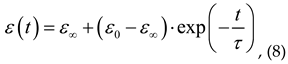
where ε0 - is the initial residual strain immediately after removal of the external deforming force ;ε∞ - is the final irreversible strain that will never disappear (t→∞); and τ - is the relaxation time. Relation (8) provides a simple experimental method for determining the relaxation time by plotting the experimental dependencies in semi-logarithmic coordinates:
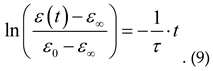
The tangent of the slope of the experimental dependence in these coordinates is equal to
Table 2 summarizes the empirical relaxation time estimates for all investigated samples and deformation temperatures.

Table 2.
Kinetic Parameters of Residual Strain Relaxation.
| Film Thickness, µm | 75 | 125 | ||
| Deformation Temperature, K | 77 | 293 | 77 | 293 |
| U, eV | 0.011 | 0.016 | ||
| Rin | 0.41 | 0.17 | 0.80 | 0.40 |
| τ, s | 2.5·104 | 7.7·105 | 1.5·103 | 1.3·104 |
| Ultimate tensile strength σU, MPa [19] | 309.6 | 171.9 | 244.2 | 134.2 |
| Ws, J/cm3 | 22.7 | 2.9 | 27.6 | 4.2 |
As evidence supporting the proposed concept, it was found that for the thin film (75 µm) the relaxation time coincides in scale with the β-relaxation characteristics reported in [20]. This confirms that in the homogeneous matrix of the thin film, strain recovery is limited solely by local mobility and by rotations of imide rings around ether bridges in the through-chains of the amorphous matrix. The reduction of relaxation time observed in the thicker film (125 µm), to values below those of the β-process, is a direct consequence of molecular plasticization. Residual solvent trapped in the center of the thick sample increases the free volume, lowers the barrier to interchain friction, and accelerates the rotational mobility of chain segments.
Conclusions
Based on classical concepts of polyimide chemistry and structure, a microscopic model of intramolecular mobility in technical Kapton has been proposed. Based on the analysis of previously published experimental results, the geometric, energetic, and kinetic parameters of the proposed model have been obtained. By comparing the results of studies of structural, acoustic, and mechanical properties, the internal consistency and self-consistency of the proposed model have been demonstrated.
Acoustic studies revealed two distinct relaxation processes: δ-relaxation and β-relaxation, associated with ordered and amorphous regions, respectively, in agreement with structural data.
Kapton’s stress–strain behavior proceeds in three stages: (1) initial deformation through straightening of disordered chains in the amorphous matrix, (2) cooperative reorientation and coalescence of bundle-like microdomains into long-range order, and (3) deformation of large monolithic domains, with the slope reflecting interchain interactions and sensitive to cryogenic conditions or incomplete imidization.
The discovery of long-range order formation and its persistence after cryogenic deformation and subsequent annealing highlights a specific “cryogenic jamming” effect of the rigid-chain matrix. Mechanical stress at low temperatures enforces orientation and microtexturing of bundle domains, while suppressed relaxation ensures fixation of long-range order even after unloading. Full macroscopic recovery upon annealing is enabled by the highly elastic response of amorphous interlayers, which act as reservoirs of stored strain energy.
Finally, pronounced structural heterogeneity observed in the thickest partially non-imidized Kapton films arises from a through-thickness gradient in structure. Due to kinetic limitations in solvent removal, a heterogeneous “core–shell” morphology develops: surface layers, fully imidized, undergo effective texturing and jamming, while central layers, rich in residual solvent and unclosed amic acid groups, remain plastified and weakly ordered. The coexistence of these spatially separated regions with differing degrees of crystalline texture perfection manifests in X-ray analysis as structural heterogeneity of the deformed material.
Thus, the comprehensive analysis of experimental data and the derived geometric, energetic, and kinetic parameters confirm the robustness of the proposed model. Its internal consistency and self-consistency across structural, acoustic, and mechanical properties demonstrate that the model provides a reliable framework for predicting the behavior of Kapton films under various external conditions, including mechanical loading, cryogenic treatment, and irradiation. This makes the model a valuable tool for understanding and forecasting the performance of polymeric materials in advanced technological applications.
References
- Adrova, N.A.; Bessonov, M.I.; Laius, L.A.; Rudakov, A.P. Polyimides: A New Class of Thermally Stable Polymers; Technomic Publishing Co., 1970. [Google Scholar]
- Available online: https://materials-today.com/what-is-polyimide-kapton-polyimide/.
- Ghosh, M.; Mittal, K.L. Polyimides Fundamentals and Applications; CRC Press: Milton, MA, USA, 1996. [Google Scholar]
- Mittal, K.L. Polyimides and Other High-Temperature Polymers: Synthesis, Characterization and Applications; Leiden: Boston, 2009. [Google Scholar]
- You, N.H.; Chueh, C.C.; Liu, C.L.; Ueda, M.; Chen, W.C. Synthesis and memory device characteristics of new sulfur donor containing polyimides. Macromolecules 2009, 42, 4456–4463. [Google Scholar] [CrossRef]
- Tomioka, M.; Suwa, M.; Yoshida, S.; Fujita, Y.; Okuda, R.; Ohbayashi, G. Novel positive-type photosensitive polyimide coatings “PW -1000” //. J. Photopolym. Sci. Technol. 2000, 13(2), 357–360. [Google Scholar] [CrossRef]
- Watson, K.A.; Palmieri, F.L.; Connell, J.W. Space environmentally stable polyimides and copolyimides derived from [2,4-bis(3-aminophenoxy)phenyl]diphenylphosphine oxide. Macromolecules 2002, 35, 4968–4974. [Google Scholar] [CrossRef]
- Ree, M. High performance polyimides for applications in microelectronics and flat panel displays. Macromol. Res. 2006, 14, 1–33. [Google Scholar] [CrossRef]
- Jang, W.; Seo, J.; Lee, C.; Paek, S.H.; Han, H. Residual stress and mechanical properties of polyimide thin films. J. Appl. Polym. Sci. 2009, 113(2), 976–983. [Google Scholar] [CrossRef]
- Sroog, C.E. Polyimides // Prog. Polym. Sci. 1991, 16(4), 561–694. [Google Scholar] [CrossRef]
- Hasegawa, T.; Horie, K. Photophysics, photochemistry, and optical properties of polyimides. Prog. Polym. Sci. 2001, 26(2), 259–335. [Google Scholar] [CrossRef]
- Wang, R.; Zhu, Y.; Fu, J.; et al. , Designing tailored combinations of structural units in polymer dielectrics for high-temperature capacitive energy storage. Nat. Commun. 2023, 14, 2406. [Google Scholar] [CrossRef] [PubMed]
- Soldatov, V.P.; Kirichenko, G.I.; Abraimov, V.V.; Braude, I.S.; Geidarov, V.G. The laws of deformation of an amorphous polyimide (PI) film when it is stretched in the temperature range 1.6–300 K // Low Temp. Phys. 2016, 42(9), 817. [Google Scholar] [CrossRef]
- Braude, I.S.; Gal’tsov, N.N.; Geidarov, V.G.; Kirichenko, G.I.; Abraimov, V.V. Effect of deformation and temperature on ordering of polyimide PM-A - molecules. X-Ray Data // Low. Temp. Phys. 2016, 42(3), 204–206. [Google Scholar] [CrossRef]
- Braude, I.S.; Galtsov, N.N.; Geidarov, V.G.; Kirichenko, G.I.; Lototskaya, V.A.; Plotnikova, Yu.M. Effect of deformation on the structure of polyimide PM-A at low temperatures. Low. Temp. Phys. 2017, 43(10), 1226–1229. [Google Scholar] [CrossRef]
- Geidarov, V.G.; Braude, I.S.; Gal’tsov, N.N.; Pohribnaya, Yu.M. Influence of low temperature on deformation changes in the structure of the polyimide film PMA. Mol. Cryst. Liq. Cryst. 2018, 661(1), 20–24. [Google Scholar] [CrossRef]
- Geidarov, V.G.; Braude, I.S.; Gal’tsov, N.N.; Pohribnaya, Y.M.; Lototskaya, V.A.; Aksenova, N.A. Struсtural Studies of Polyimide Films. Size Eff. // Nano Stud. 2019, 19, 11–14. [Google Scholar]
- Geidarov, V.G.; Braude, I.S.; Lototskaya, V.A.; Pohribna, Yu.M. Transformation of the structure of the polyimide film during deformation: The effect of thickness // Low Temp. Phys. 2023, 49(11), 1219–1221. [Google Scholar] [CrossRef]
- Lototskaya, V.A.; Yakovenko, L.F.; Aleksenko, E.N.; Abraimov, V.V.; Shao, Wen Zhu. Low temperature deformation and strength of polyimide films due to thickness and deformation speed. East Eur. J. Phys. 2017, 4(2), 44–52. [Google Scholar] [CrossRef]
- Semerenko, Yu.F. Low-temperature viscoelastic relaxation in PMA polyimide (Kapton). Funct. Mater. 2019, 26(2), 319–324. [Google Scholar] [CrossRef]
- Hurova, D.E.; Geidarov, V.G.; Braude, I.S.; Aksenova, N.A.; Stepanian, S.G.; Adamowicz, L.; Galtsov, N.N. Structural studies of amorphous polymer films: Experiment and calculation // Low Temp. Phys. 2024, 50(3), 272–278. [Google Scholar] [CrossRef]
- Natsik, V.D.; Rusakova, H.V.; Lubenets, S.V.; Lototskaya, V.A.; Yakovenko, L.F. Deformation diagrams of amorphous polyimide (kapton H) in the state of moderate and deep cooling: Experiment and theory. Low. Temp. Phys. 2023, 49(5), 521–530. [Google Scholar] [CrossRef]
- Lototskaya, V.A.; Yakovenko, L.F. Relaxation of the mechanical properties of polyimide films of the kapton H type during long-term exposure at ambient conditions // Low Temp. Phys. 2023, 49(11), 1222–1228. [Google Scholar] [CrossRef]
- Lototskaya, V.A.; Yakovenko, L.F.; Aleksenko, E.N.; Velichko, V.A.; Zaritskiy, I.P.; Abraimov, V.V.; Shao, Wen Zhu; Hai, Liu. Investigation of mechanical properties of polyimide films under the influence of laboratory-simulated space factors. East Eur. J. Phys. 2018, 5(3), 53–60. [Google Scholar] [CrossRef]
- Lototskaya, V.A.; Yakovenko, L.F.; Saltevskiy, G.I.; Zaritskiy, I.P.; Doronin, Yu.S.; Tkachenko, A.A. Radiation-induced effects on the mechanical properties of Kapton H type polyimide films of different thicknesses // Low Temp. Phys. 2025, 51(12), 1516–1521. [Google Scholar] [CrossRef]
- Lototskaya, Victory A. Particularity of relaxation of mechanical properties of the kapton h type polyimide films at different strain rates after long-term exposure to environmental conditions // Low Temp. Phys. 2026, 52(3), 342–349. [Google Scholar] [CrossRef]
- Vinogradova, S.V.; Vasnev, V.A. Polycondensation Processes and Polymers; in Russian; Nauka: Moscow, 2000. [Google Scholar]
- Krasovskii, A.N.; Antonov, N.P.; Koton, M.M.; Kalnin’sh, K.K.; Kudryavtsev, V.V. Methods of investigation determining the degree of imidization of polyamidoacids. Polym. Sci. 1979, 21(4), 1038–1043. [Google Scholar] [CrossRef]
- Kotera, M.; Nishino, T.; Nakamae, K. Imidization processes of aromatic polyimide by temperature modulated DSC. Polymer 2000, 41(10), 3615–3619. [Google Scholar] [CrossRef]
- Rudakov, A.P.; Bessonov, M.I.; Koton, M.M.; Pokrovskii, E.I.; Fedorova, E.F. Dokl. Akad. Nauk SSSR in Russian. 1965, 161, 617.
- Wallach, M.L. Poly(amic acid) solution properties. Polym. Prepr. 1965, 6(1), 53–54. [Google Scholar]
- Benfridja, a.; Diaham, S.; Laffir, F.; Brennan, G.; Liu, N.; Kennedy, T. A Universal Study on the Effect Thermal Imidization Has on the Physico-Chemical, Mechanical, Thermal and Electrical Properties of Polyimide for Integrated Electronics Applications. Polymers 2022, 14(9), 1713. [Google Scholar] [CrossRef] [PubMed]
- Bessonov, M.I.; Koton, M.M.; Kudryavtsev, V.V.; Laius, L.A. Polyimides: Thermally Stable Polymers; Consultants Bureau, 1987. [Google Scholar]
- Jo, Byoung Wook; Ahn, Kyung Hyun; Lee, Seung Jong. Effect of thermal history during drying and curing process on the chain orientation of rod-shaped polyimide. Polymer 2014, 55(22), 5829–5836. [Google Scholar] [CrossRef]
- Chen, Wenjuan; Chen, Wei; Zhang, Baoqing; Yang, Shiyong; Liu, Chen-Yang. Thermal imidization process of polyimide film: Interplay between solvent evaporation and imidization. Polymer 2017, 109, 205–215. [Google Scholar] [CrossRef]
- Arjavalingam, G.; G. Hougham, J.P. La Femina, Emission mechanism in polyimide. Polymer 1990, 31(5), 840–844. [Google Scholar] [CrossRef]
- Lin, Jiaqi; Zhang, Panpan; Yang, Wenlong. Fabrication and Fluorescence Characterization of the Polyimides with Different Molecular Weights. Adv. Mater. Res. 2013, 821-822, 957–960. [Google Scholar] [CrossRef]
- Zhongxu, Lan; Jia, Wei; Yanlei, Yu. Recent Progress in Colorless and Transparent Polyimide with High Thermal Stability. J. Funct. Polym. 2020, 33(4), 320–332. [Google Scholar] [CrossRef]
- Maeda, H.; Liang, Y.; Hosoya, R.; et al. Smectic liquid crystalline poly(ester imide)s with low dielectric dissipation factors for high-frequency applications. Polym. J. 2025, 57, 665–677. [Google Scholar] [CrossRef]
- Bartenev, G.M.; Zelenev, Yu.V. Fizika i mekhanika polymerov; in Russian; Vysshaya Shkola: Moscow, 1983. [Google Scholar]
- Okada, Tomohiro; Ando, Shinji. Conformational characterization of imide compounds and polyimides using far-infrared spectroscopy and DFT calculations. Polymer 2016, 86, 83–90. [Google Scholar] [CrossRef]
- Blyumshtein, A. (Ed.) Liquid-Crystalline Order in Polymers,; in Russian; Nauka: Moscow, 1981. [Google Scholar]
- Chang, Xin; Balooch Qarai, Mohammad; Spano, Frank C. HJ-aggregates of donor-acceptor-donor oligomers and polymers. J. Chem. Phys. 2021, 155(3), 034905. [Google Scholar] [CrossRef] [PubMed]
- Biswas, Prithwish; Kong, Lingcheng; Tian, Zhiting. Donor–acceptor conjugated polymers as high-mobility semiconductors: prospects for organic thermoelectrics // Nanoscale. In Donor–acceptor conjugated polymers as high-mobility semiconductors: prospects for organic thermoelectrics // Nanoscale; Kong, Lingcheng, Tian, Zhiting, Eds.; 2025; Volume 17, 23896. [Google Scholar] [CrossRef]
- Liesen, Nicholas T.; Maiti, Amitesh; Fox, Christy; Kosiba, Graham D.; Gee, Richard H.; Kroonblawd, Matthew P. Chain Flexibility and Structure of a Polyimide Copolymer: Revisiting the Freely Rotating Chain Model. Macromolecules 2025, 58(13), 6953–6970. [Google Scholar] [CrossRef]
- Saraf, Ravi F.; Dimitrakopoulos, Christos; Toney, Michael F.; Kowalczyk, Steven P. Near Surface Structure of Solvent-free Processed Polyimide Thin Film. Langmuir 1996, 12(11), 2802–2806. [Google Scholar] [CrossRef]
- Muto, Koichiro; Fujiwara, Eisuke; Ishige, Ryohei; Ando, Shinji. Analysis of Pressure-induced Variations in the Crystalline Structures of Polyimides Having Flexible Linkages by Wide-Angle X-ray Diffraction. J. Photopolym. Sci. Technol. 2020, 33(5), 583–590. [Google Scholar] [CrossRef]
- Ishige, R.; Masuda, T.; Kozaki, Y.; Fujiwara, E.; Okada, T.; Ando, S. Precise Analysis of Thermal Volume Expansion of Crystal Lattice for Fully Aromatic Crystalline Polyimides by X-ray Diffraction Method: Relationship between Molecular Structure and Linear / Volumetric Thermal Expansion. Macromol. 2017, 50(5), 2112–2123. [Google Scholar] [CrossRef]
- Watari, R.; Nishihara, M.; Tajiri, H.; et al. , Preparation of novel polyimide hybrid materials by multi-layered charge-transfer complex formation. Polym. J. 2013, 45, 839–844. [Google Scholar] [CrossRef]
- Poon, T.W.; Saraf, R.F.; Silverman, B.D. Structural characterization of an ordered aromatic polyimide: pyromellitic dianhydride-oxydianiline. Macromolecules 1993, 26(13), 3369. Available online: https://pubs.acs.org/doi/10.1021/ma00065a021. [CrossRef]
- Wan, Yuting; Luo, Hang; Yan, Zhongna; Shen, Shuyi; Peng, Jiajun; Li, Xiaona; He, Guanghu; Zhang, Dou; Zha, Jun-Wei. Decoupling thermal stability and insulation in dielectric polymers via donor-acceptor rearrangement. Nat. Commun. 2025, 16, 6242. [Google Scholar] [CrossRef] [PubMed]
- Sukalovic, V.; Zlatović, M.; Roglic, G.; Kostic-Rajacic, S.; Andrić, D. Application of Hybrid Density Functional Theory in Calculation of Edge-to-Face Interactions of Receptor-Ligand System. Acta Chim. Slov. 2009, 56, 270–277. [Google Scholar]
- Georgakilas, Vasilios; Tiwari, Jitendra N.; Kemp, K. Christian; Perman, Jason A.; Bourlinos, Athanasios B.; Kim, Kwang S.; Zboril, Radek. Noncovalent Functionalization of Graphene and Graphene Oxide for Energy Materials, Biosensing, Catalytic, and Biomedical Applications. Chem. Rev. 2016, 116(9), 5464–5519. [Google Scholar] [CrossRef] [PubMed]
- Schramm, Brandon; Gray, Montgomery; Herbert, John M. Substituent and Heteroatom Effects on π–π Interactions: Evidence That Parallel-Displaced π-Stacking is Not Driven by Quadrupolar Electrostatics. J. Am. Chem. Soc. 2025, 147(4), 3243–3260. [Google Scholar] [CrossRef] [PubMed]
- Ma, J.; Liu, X.; Wang, R.; Lu, C.; Wen, X.; Tu, G. Research Progress and Application of Polyimide-Based Nanocomposites. Nanomater. 2023, 13(4), 656. [Google Scholar] [CrossRef] [PubMed]
- Qin, Sichen; Tu, Youping; Tan, Tian; Wang, Shaohe; Yuan, Zhikang; Wang, Cong; Li, Laifeng; Wu, Zhixiong. The effects of γ-ray on charging behaviour using polyimide. J. Phys. D. Appl. Phys. 2018, 51, 245302. [Google Scholar] [CrossRef]
- Stern, S.A.; Mi, Y.; Yamamoto, H.; Clair, Anne K. St. Structure/permeability relationships of polyimide membranes. Applications to the separation of gas mixtures. J. Polym. Sci. B Polym. Phys. 1989, 27, 1887. [Google Scholar] [CrossRef]
- Bessonov, M.I.; Kuznetsov, N.P. Тhe structure and mechanical properties of polyimides. Polym. Sci. U.S.S.R. 1975, 17(1), 221–232. [Google Scholar] [CrossRef]
- Perepechko, I.I. Akusticheskiye metody issledovaniya polimerov [Acoustic Methods of Investigating Polymers]; in Russian; Khimiya: Moscow, 1973. [Google Scholar]
- Baccaredda, M. Crystallinity and Mechanical Dynamic Properties of High Polymers. Chim. Ind. 1962, 44, 1383–1389. [Google Scholar]
- Friedman, E.A.; Ritger, A.J.; Andrews, R.D. Brillouin Scattering Near the Glass Transition of Polymethyl Methacrylate. J. Appl. Phys. 1969, 40, 4243. [Google Scholar] [CrossRef]
- Perepechko, I.I. Low-Temperature Properties of Polymers. In Khimiya, Moscow; Svoistva polimerov pri nizkikh temperaturakh, Khimiya, Moscow, 1972 in Russian; 1977. [Google Scholar]
- F.P. Reding, The Glass Transition and Crystal Melting Temperatures of Poly(vinyl chloride). J. Polym. Sci. 1956, 21(99), 547–548. [CrossRef]
- Sauer, J.A.; Saba, R.G. Relaxation behavior of polymers at low temperatures. J. Macromol. Sci.-Chem. 1969, A3(7), 1217. [Google Scholar] [CrossRef]
- Golub’, P.D.; Perepechko, I.I. Sound velocity in polyamides near 4.2 K. Akust. Zhurnal in Russian. 1974, 20, 38–43. [Google Scholar]
- Papir, Y.S.; Baer, E. New Relaxation Phenomena in Linear Polyethylene at Cryogenic Temperatures. J. Appl. Phys. 1971, 42, 4667. [Google Scholar] [CrossRef]
- Smirnova, V.E.; Gofman, I.V.; Lavrent’ev, V.K.; Sklizkova, V.P. The effect of planar molecular orientation on the mechanical properties of rigid-chain polyimide films. Polym. Sci. 2007, А49, 1114–1119. [Google Scholar] [CrossRef]
- Papkov, S.P.; Kalashnik, A.T. The problem of liquid crystals in the physical chemistry of polymers. Polym. Sci. U.S.S.R. 1984, А26, 2505–2518. [Google Scholar] [CrossRef]
- Miki, K.; Yokokawa, Y.; Hikichi, K.; Furuichi, J. Dynamic Mechanical Properties of Polyoxymethylene I. Jpn. J. Appl. Phys. 1971, 5(9), 818. [Google Scholar] [CrossRef]
- Reneker, D.H. Point dislocations in crystals of high polymer molecules. J. Polym. Sci. 1962, 59, S39–S42. [Google Scholar] [CrossRef]
- Ciark, E.S. Cryogenic Properties of Polymers; Seratini, T.T., Koening, J.L., Eds.; Marcel Dekker: New York, 1967. [Google Scholar]
- Pechhold, W. Molekülbewegung in Polymeren. Kolloid-Z.u.Z.Polymere 1968, 228, 1–38. [Google Scholar] [CrossRef]
- de Santis, P. e.a., Stability of helical conformations of simple linear polymers. J. Polym. Sci. 1963, A1(4), 1383–1404. [Google Scholar] [CrossRef]
- Brown, R.G. Vibrational Spectra of Polytetrafluoroethylene: Effects of Temperature and Pressure. J. Chem. Phys. 1964, 40(10), 2900–2908. [Google Scholar] [CrossRef]
- Koenig, J.L.; Boerio, F.J. Raman Scattering and Thermal Defects in Polytetrafluoroethylene. J. Chem. Phys. 1970, 52(8), 4170–4171. [Google Scholar] [CrossRef]
- Nowick, А.S.; Berry, B.S. Anelastic relaxation in crystalline solids; Academic: New York, 1972. [Google Scholar]
- Postnikov, V.S. Internal Friction in Metals and Alloys; Springer, 1967. [Google Scholar]
- Northolt, M.G.; van der Hout, R. Elastic extension of oriented polymer fibres: A New Molecular Model. Polymer 1985, 26(2), 310–316. [Google Scholar] [CrossRef]
- Khokhlov, A.R.; Semenov, A.N. Liquid-crystalline ordering in the solution of long persistent chains. Phys. A 1981, 108(2-3), 546–556. [Google Scholar] [CrossRef]
- Flory, P.J. Statistical thermodynamics of semi-flexible chain molecules. Proc. R. Soc. Lond. A. 1956, 234(1196), 60–73. [Google Scholar] [CrossRef]
- Kratky, O.; Porod, G. Röntgenuntersuchung gelöster Fadenmoleküle. Recl. Des. Trav. Chim. Des. Pays-Bas 1949, 68(12), 1106–1122. [Google Scholar] [CrossRef]
- Valavala, P.K.; Clancy, T.C.; Odegard, G.M.; Gates, T.S. Nonlinear multiscale modeling of polymer materials. Int. J. Solids Struct. 2007, 44(3–4), 1161–1179. [Google Scholar] [CrossRef]
- Pechhold, W.; Blasenbrey, S. Molekülbewegung in Polymeren. Kolloid-Z.u.Z.Polymere 1970, 241, 955–976. [Google Scholar] [CrossRef]
- Clarizia, G.; Tasselli, F.; Bernardo, P. Effect of Physical Aging on Gas Transport in Asymmetric Polyimide Hollow Fibers Prepared by Triple-Orifice Spinneret. Polymers 2020, 12(2), 441. [Google Scholar] [CrossRef] [PubMed]
- Longo, Mariagiulia; De Santo, Maria Penelope; Esposito, Elisa; Fuoco, Alessio; Monteleone, Marcello; Giorno, Lidietta; Comesaña-Gándara, Bibiana; Chen, Jie; Bezzu, C. Grazia; Carta, Mariolino; Rose, Ian; McKeown, Neil B.; Jansen, Johannes C. Correlating Gas Permeability and Young’s Modulus during the Physical Aging of Polymers of Intrinsic Microporosity Using Atomic Force Microscopy. Ind. Eng. Chem. Res. 2020, 59(12), 5381–5391. [Google Scholar] [CrossRef]
- Eyring, H. Viscosity, Plasticity, and Diffusion as Examples of Absolute Reaction Rates. J. Chem. Phys. 1936, 4, 283–291. [Google Scholar] [CrossRef]
- Frenkel, J. Kinetic Theory of Liquids; Oxford University Press, 1946. [Google Scholar]
- Born, Max; Green, H.S. A General Kinetic Theory of Liquids. I. The Molecular Distribution Functions // Proc. R. Soc. Lond. A 1946, 188, 10–18. [CrossRef] [PubMed]
Figure 2.
Observed emission spectrum for the 12.5 μm thick film of Dupont Kapton. The spike at 580 nm is the scattered second-order incident radiation at 290 nm [36].
Figure 2.
Observed emission spectrum for the 12.5 μm thick film of Dupont Kapton. The spike at 580 nm is the scattered second-order incident radiation at 290 nm [36].
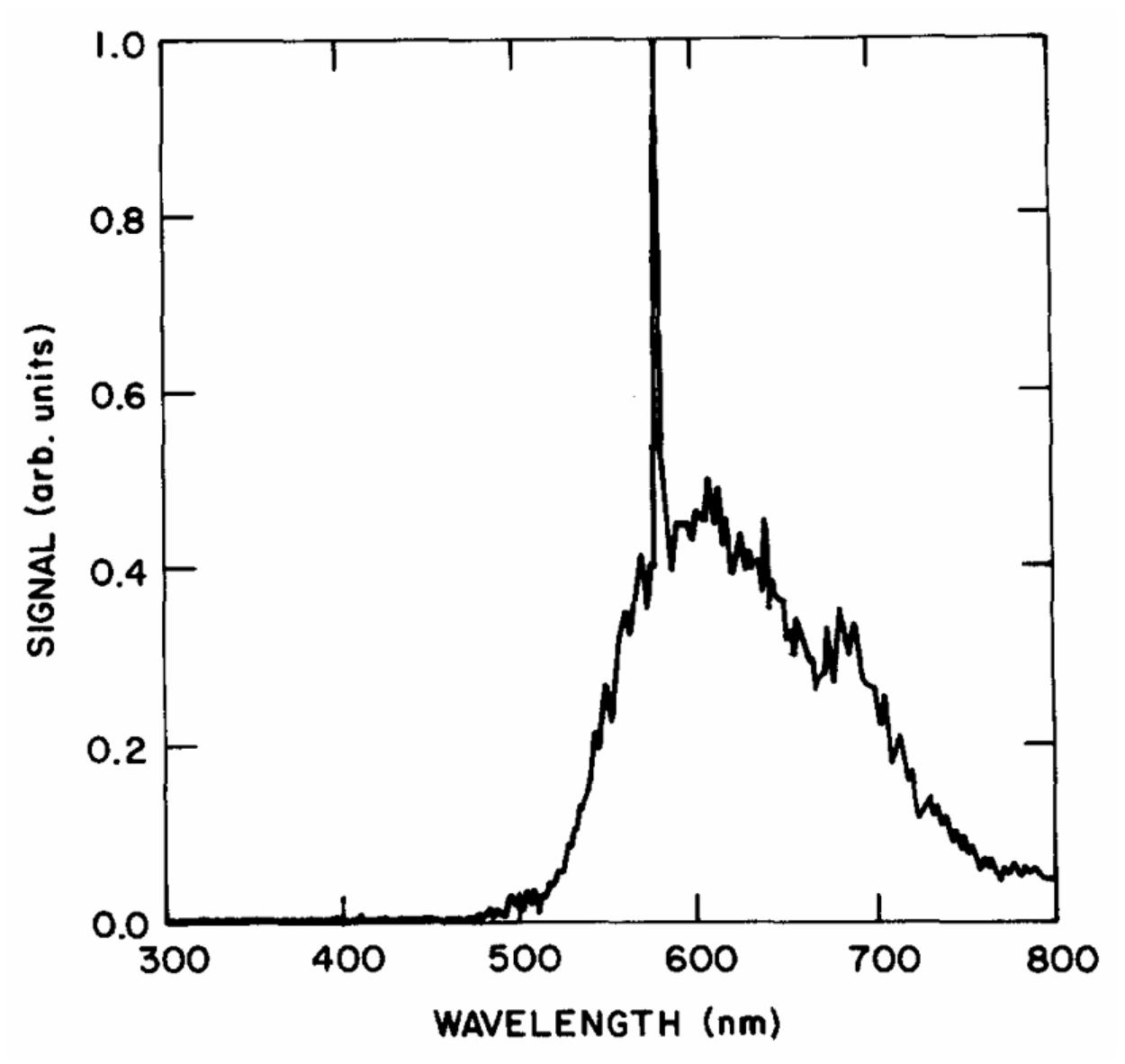
Figure 3.
Optic properties of the PI 30 μm thick film: a - FT-IR spectrum of PI film (for viscosity value 1.57 dL/g), characteristic imide groups are observed at the following peaks: the peaks at 726.99 cm-1 (showing C=O bending), 1375.37 cm-1 (representing C–N stretching) and 1777.80 cm-1 (indicating C=O asymmetric stretching), confirmed imide formation; b - the fluorescence spectra for the different viscosity values (molecular weight) excited at 380 nm [37].
Figure 3.
Optic properties of the PI 30 μm thick film: a - FT-IR spectrum of PI film (for viscosity value 1.57 dL/g), characteristic imide groups are observed at the following peaks: the peaks at 726.99 cm-1 (showing C=O bending), 1375.37 cm-1 (representing C–N stretching) and 1777.80 cm-1 (indicating C=O asymmetric stretching), confirmed imide formation; b - the fluorescence spectra for the different viscosity values (molecular weight) excited at 380 nm [37].
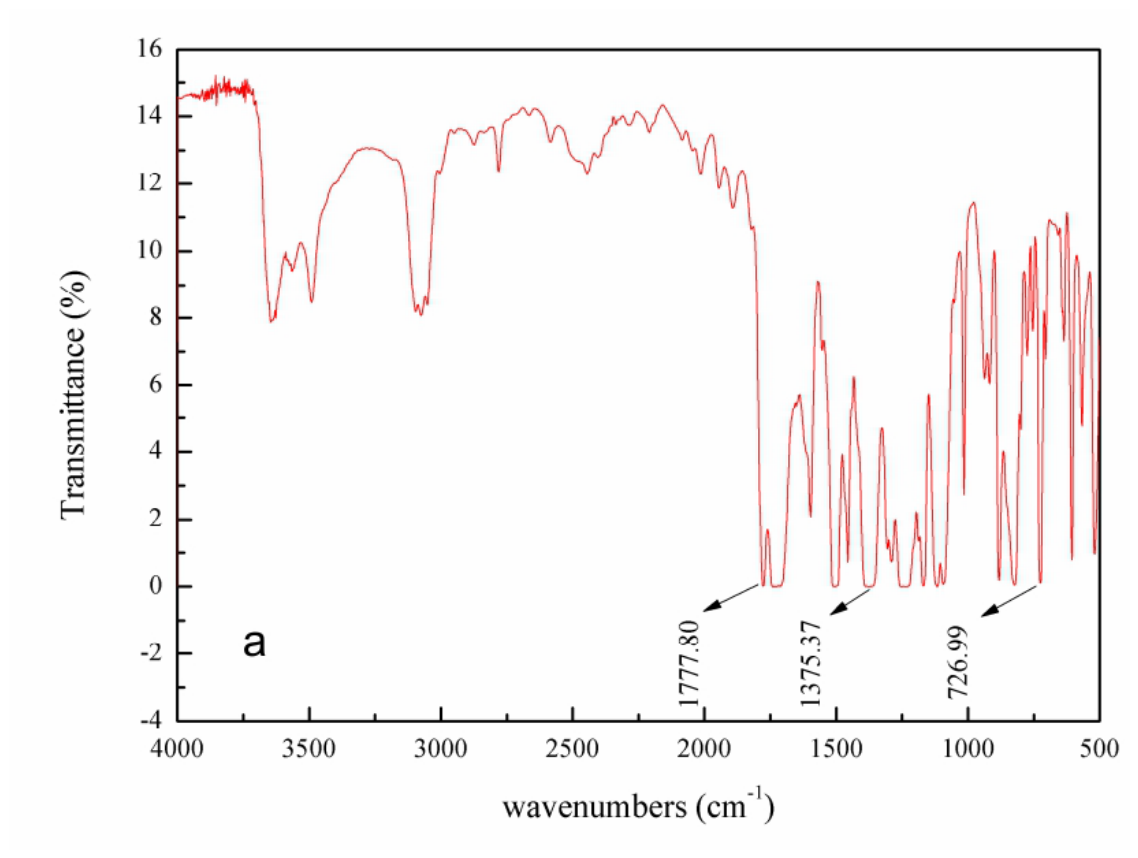
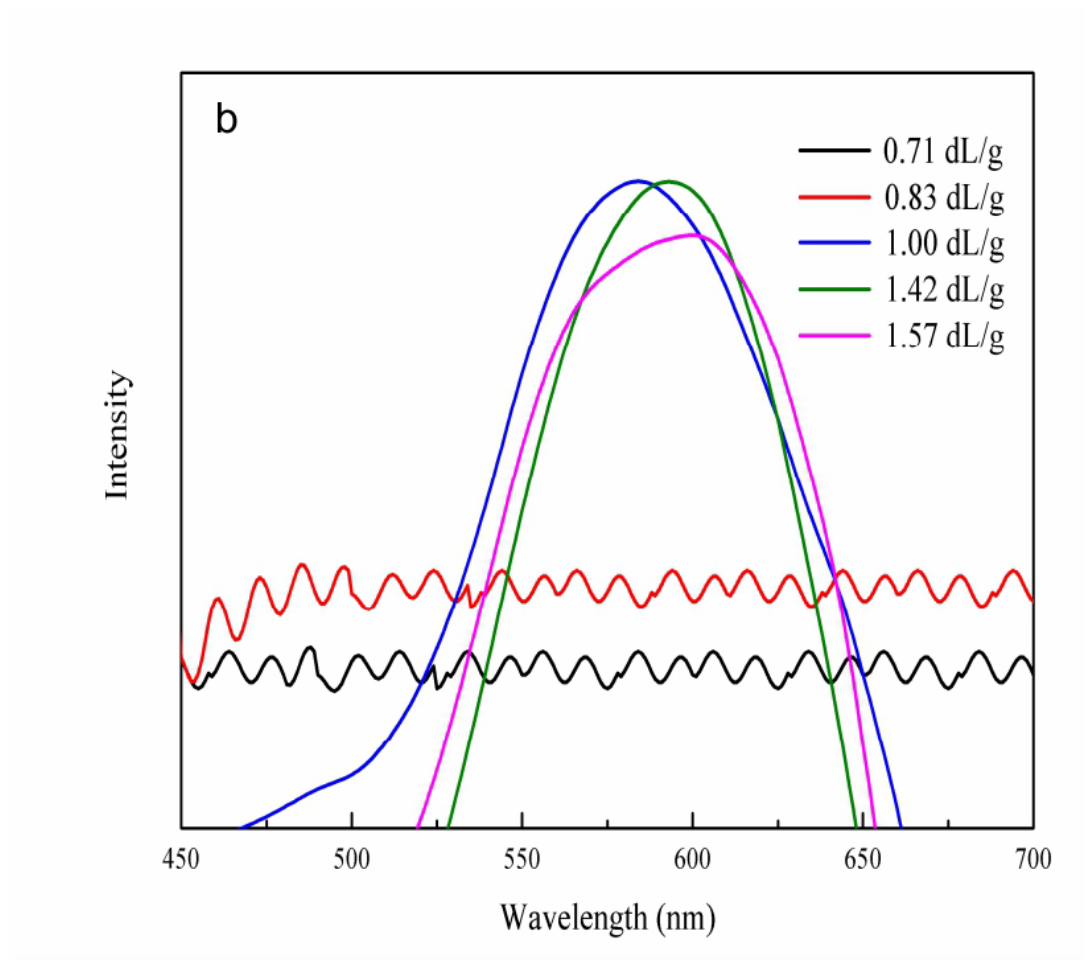
Figure 4.
Intra molecular and inter molecular charge-transfer complex in PMDA - ODA polyimide [38].
Figure 4.
Intra molecular and inter molecular charge-transfer complex in PMDA - ODA polyimide [38].
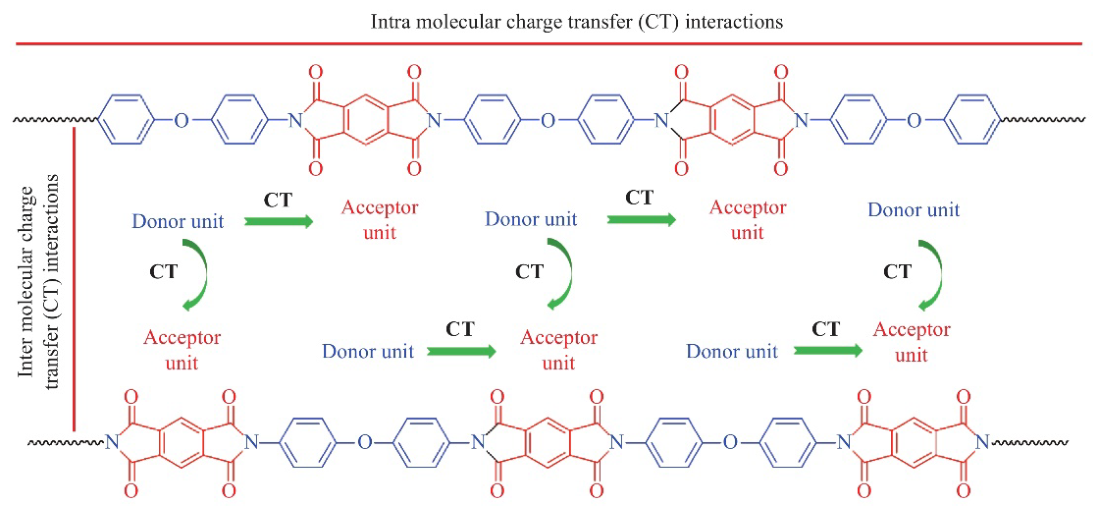
Figure 5.
FT-IR spectra of polyimide PI and PAA. The FT-IR spectrum of the representative PAA exhibited characteristic peaks at 1726 cm−1 (carboxyl C=O) and 1661 cm−1 (amide C=O stretching), as well as a peak at 1536 cm−1 corresponding to amide C‒N stretching. In the FT-IR spectrum of the PI, the peaks for the amic acid groups disappeared, and the characteristic imide peaks at 1775 cm−1 (imide C=O asymmetric stretching), 1722 cm−1 (imide C=O symmetric stretching), and 1372 cm−1 (imide C–N stretching) appeared, indicating complete imidization [39].
Figure 5.
FT-IR spectra of polyimide PI and PAA. The FT-IR spectrum of the representative PAA exhibited characteristic peaks at 1726 cm−1 (carboxyl C=O) and 1661 cm−1 (amide C=O stretching), as well as a peak at 1536 cm−1 corresponding to amide C‒N stretching. In the FT-IR spectrum of the PI, the peaks for the amic acid groups disappeared, and the characteristic imide peaks at 1775 cm−1 (imide C=O asymmetric stretching), 1722 cm−1 (imide C=O symmetric stretching), and 1372 cm−1 (imide C–N stretching) appeared, indicating complete imidization [39].
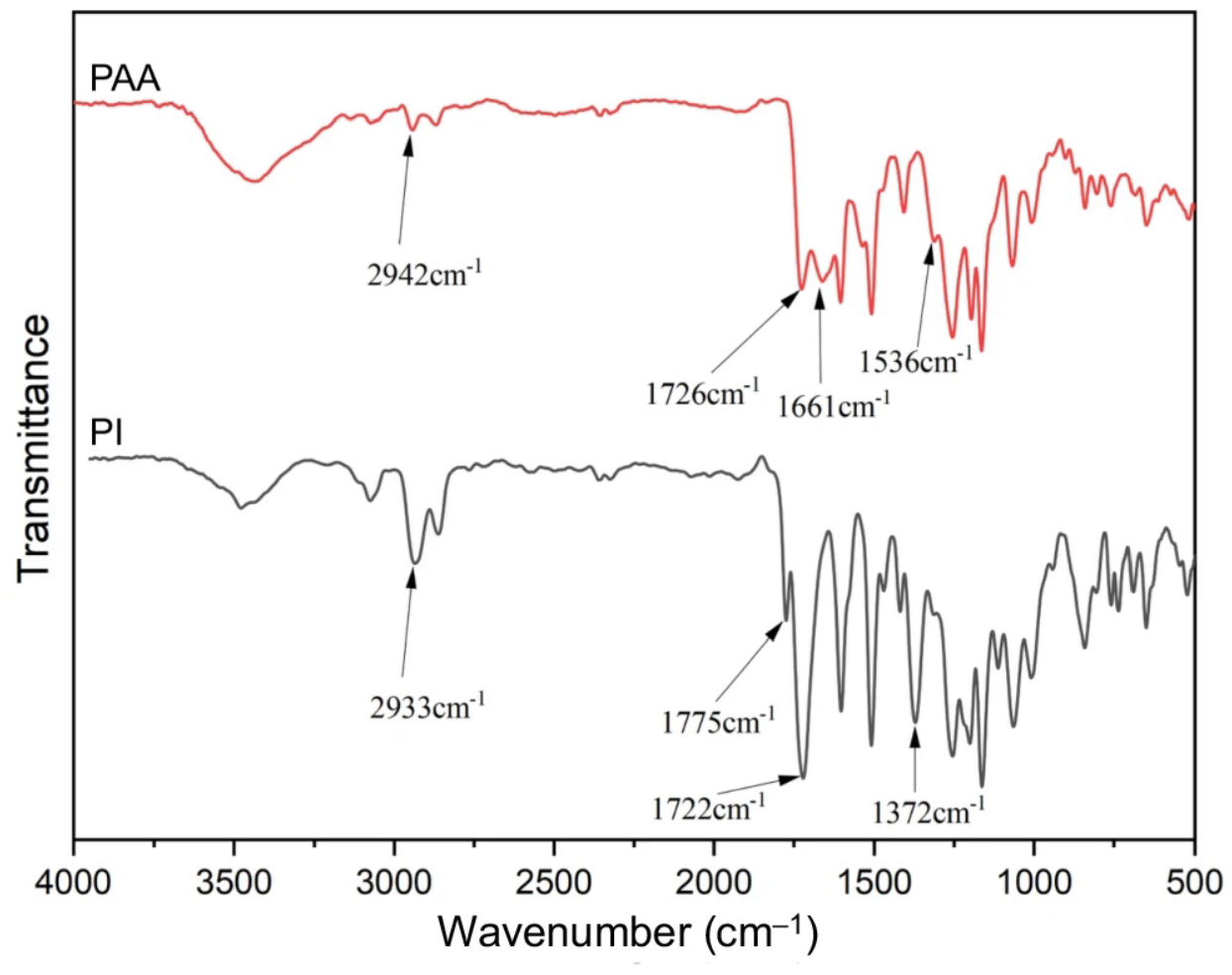
Figure 10.
π–π stacking interaction in Kaptone: face-to-face (a), slipped (b), and C–H···π (c) type from benzyl molecules where the gray atoms represent carbon and orange represents hydrogen.
Figure 10.
π–π stacking interaction in Kaptone: face-to-face (a), slipped (b), and C–H···π (c) type from benzyl molecules where the gray atoms represent carbon and orange represents hydrogen.
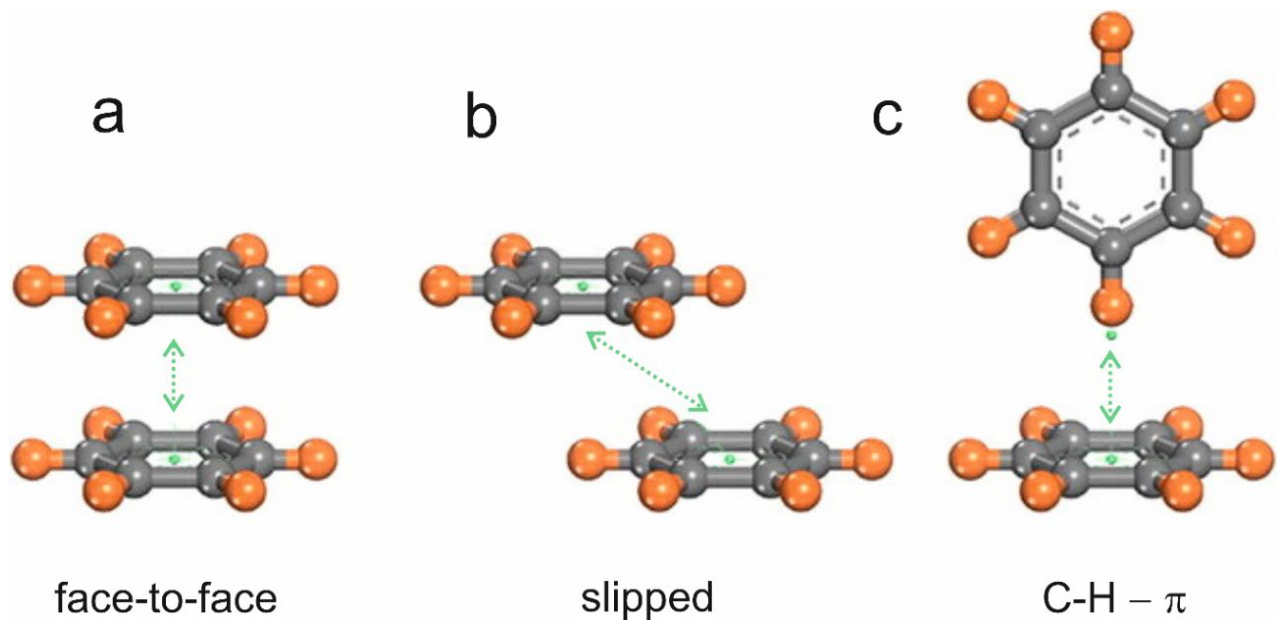
Figure 13.
Typical curves “stress – strain” of polyimide films with thickness of 25 μm (a), 75 μm (b), and 125 μm (c): initial state (1) and (1′); after irradiation with electrons (2) and protons (3) with an average energy of 160 keV, with vacuum ultraviolet (VUV) and ultrasoft X-ray (USX) radiation in the range of 1.24-170 nm at 293 K and strain rate of 7·10-4 s-1 (4) [25].
Figure 13.
Typical curves “stress – strain” of polyimide films with thickness of 25 μm (a), 75 μm (b), and 125 μm (c): initial state (1) and (1′); after irradiation with electrons (2) and protons (3) with an average energy of 160 keV, with vacuum ultraviolet (VUV) and ultrasoft X-ray (USX) radiation in the range of 1.24-170 nm at 293 K and strain rate of 7·10-4 s-1 (4) [25].
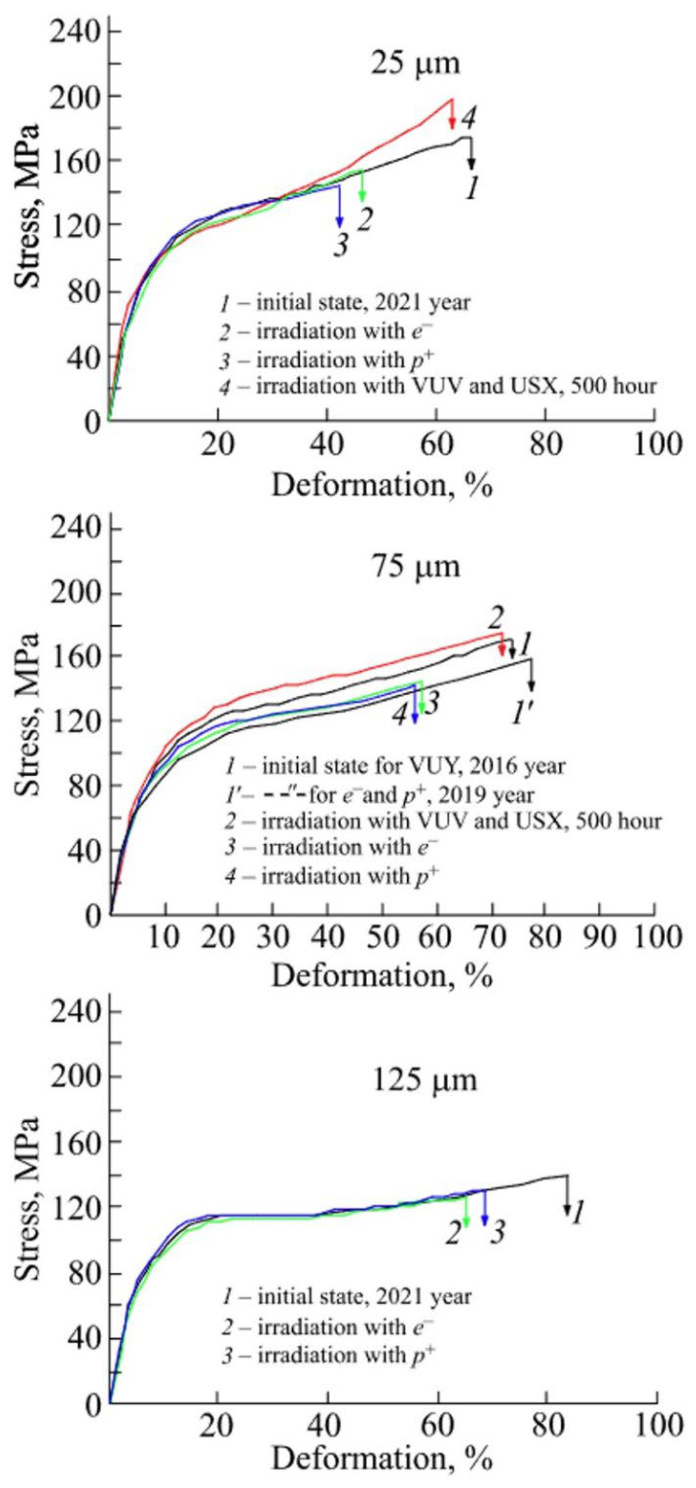
Figure 14.
Low-temperature viscoelastic relaxation in PMA polyimide (Kapton) [20]: the temperature dependences of the dynamic Young modulus ED(T) - (a) and logarithmic acoustic damping decrement δ(T) - (b).
Figure 14.
Low-temperature viscoelastic relaxation in PMA polyimide (Kapton) [20]: the temperature dependences of the dynamic Young modulus ED(T) - (a) and logarithmic acoustic damping decrement δ(T) - (b).
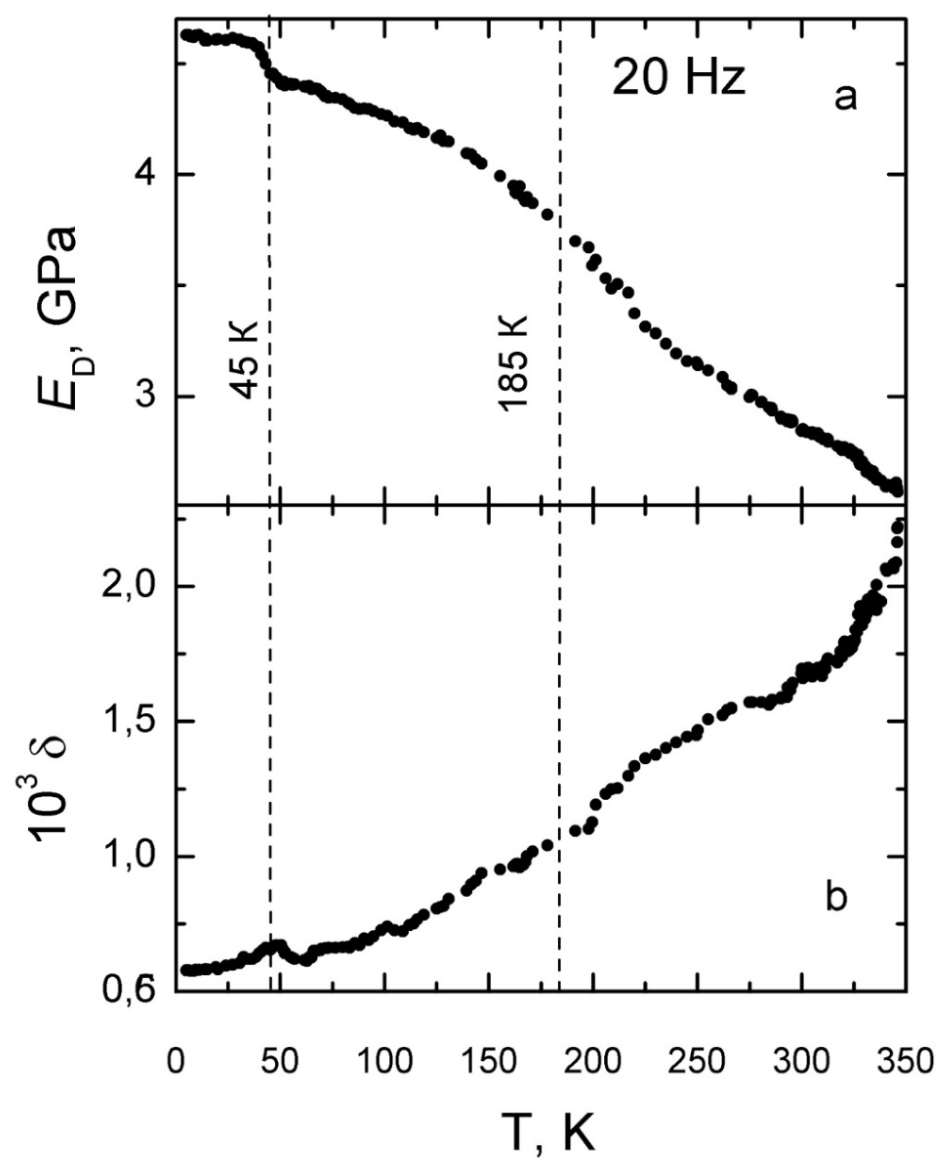
Figure 15.
Typical deformation diagrams of Kapton in the state of moderate (77 K) – (a) and deep (4.2 K) – (b) cooling [22].
Figure 15.
Typical deformation diagrams of Kapton in the state of moderate (77 K) – (a) and deep (4.2 K) – (b) cooling [22].
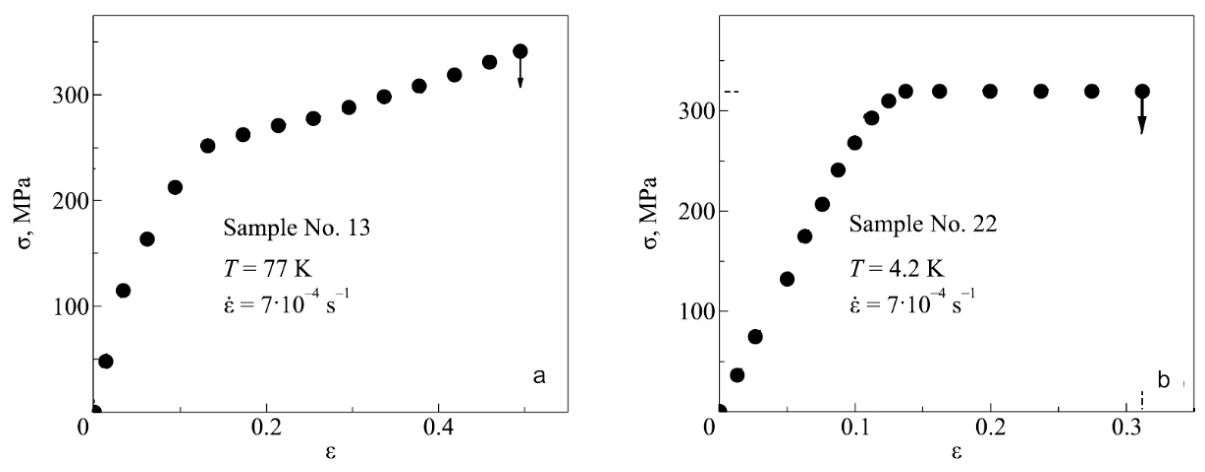
Figure 16.
Typical structure of the polymer chain in technical Kapton.
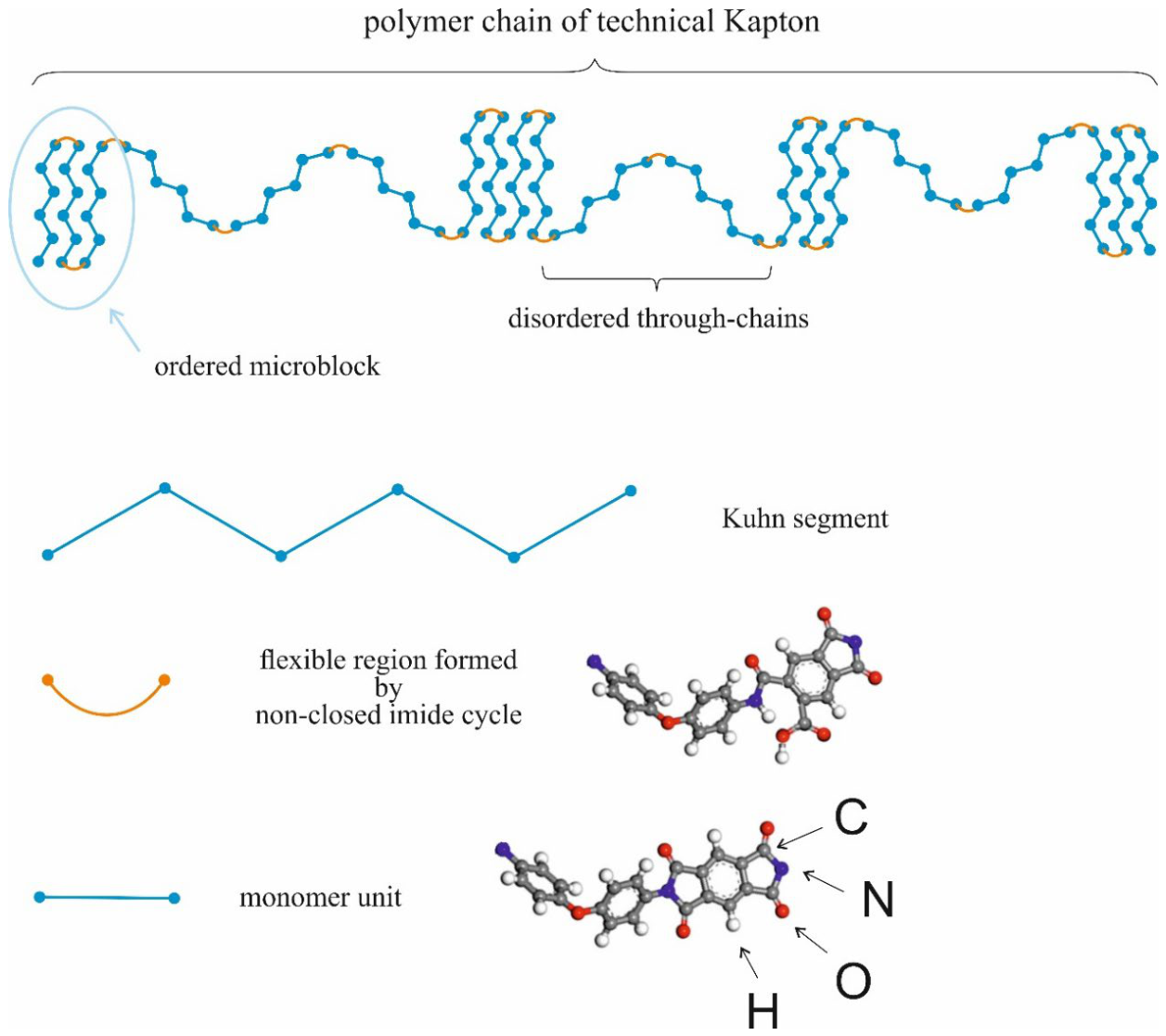
Figure 18.
Typical deformation curves (strain rate s-1) of films with a different thickness: (1) – 25 µm, (2) - 75 µm, and (3) – 125 µm. These curves were obtained immediately after the production of films and after exposure at room temperature (the testing year is indicated in the figure) [23,26].
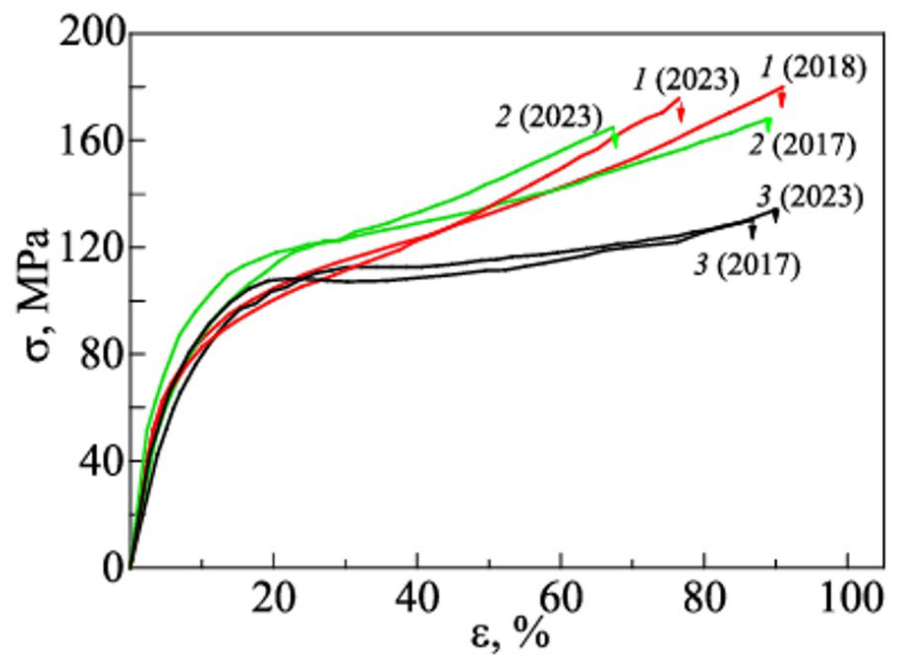
Figure 19.
Residual strain in Kapton films of 75 µm (a) and 125 µm (b) thickness, deformed at 293 K and 77 K, as a function of holding time at room temperature [19].
Figure 19.
Residual strain in Kapton films of 75 µm (a) and 125 µm (b) thickness, deformed at 293 K and 77 K, as a function of holding time at room temperature [19].
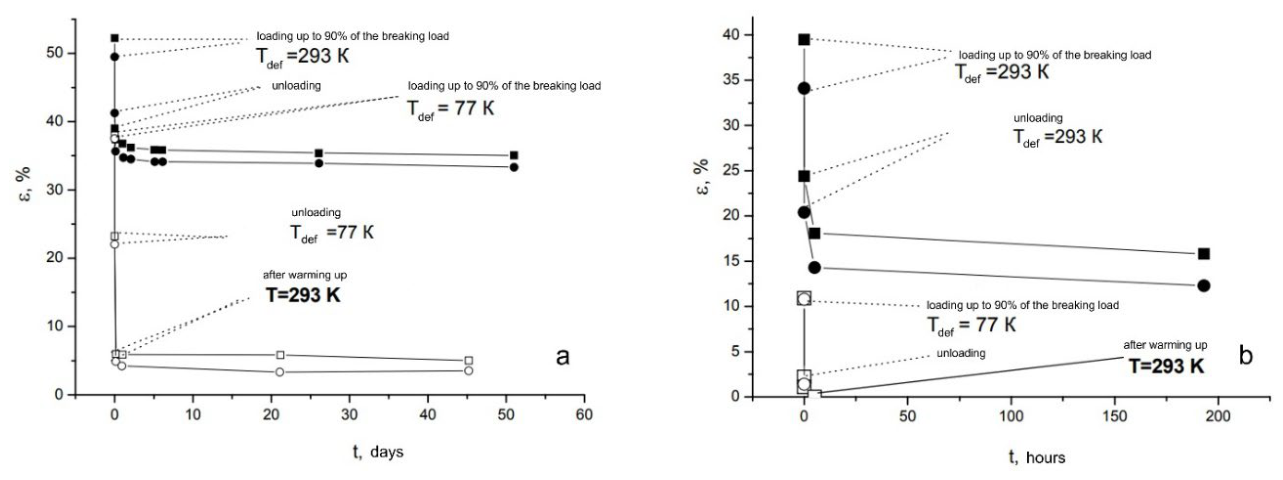
Table 1.
Mechanical properties of technical Kapton films.
| Film Thickness, µm | 25 | 75 | 125 |
| EI, MPa | 1578 | 1250 | 1050 |
| EIII, MPa | 103 | 75 | 37 |
| I | 0.935 | 0.939 | 0.965 |
Disclaimer/Publisher’s Note: The statements, opinions and data contained in all publications are solely those of the individual author(s) and contributor(s) and not of MDPI and/or the editor(s). MDPI and/or the editor(s) disclaim responsibility for any injury to people or property resulting from any ideas, methods, instructions or products referred to in the content. |
© 2026 by the authors. Licensee MDPI, Basel, Switzerland. This article is an open access article distributed under the terms and conditions of the Creative Commons Attribution (CC BY) license (http://creativecommons.org/licenses/by/4.0/).
Copyright: This open access article is published under a Creative Commons CC BY 4.0 license, which permit the free download, distribution, and reuse, provided that the author and preprint are cited in any reuse.


