

Submitted:
07 July 2026
Posted:
08 July 2026
You are already at the latest version
Abstract
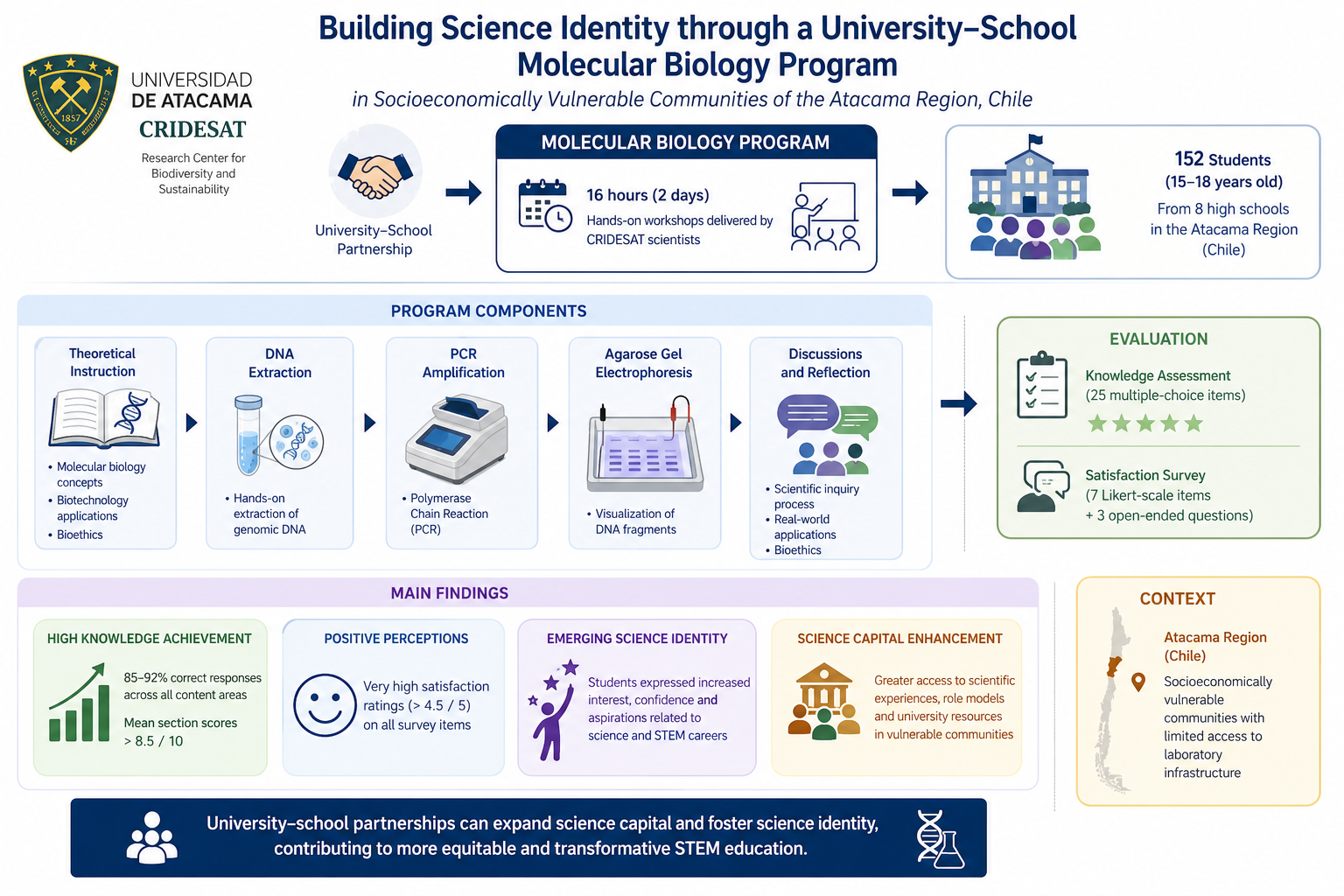
Hands-on laboratory experiences can strengthen science learning, motivation, and science identity, yet access to molecular biology infrastructure remains limited in socioeconomically vulnerable school contexts. This mixed-methods case study examined learning outcomes and student perceptions following a 16-hour Molecular Biology workshop delivered by CRIDESAT scientists from the University of Atacama to 152 secondary students from eight high schools in the Atacama Region, Chile. The intervention combined theoretical instruction, laboratory activities involving DNA extraction, polymerase chain reaction (PCR), and agarose gel electrophoresis, and discussions on biotechnology applications and bioethics. Students completed a 25-item knowledge assessment and a satisfaction survey comprising seven Likert-scale items and three open-ended questions. The survey demonstrated high internal consistency (Cronbach’s α = 0.88), and qualitative responses were analyzed using thematic analysis. Students achieved high knowledge scores across all content areas, with 85–92% correct responses and mean section scores above 8.5/10. Satisfaction ratings were consistently positive (>4.5/5). Qualitative findings highlighted positive attitudes, perceived learning, and experiences related to “doing science”, including statements suggestive of emerging science identity. These findings suggest that university–school partnerships can expand science capital and provide equitable access to authentic scientific experiences, supporting STEM education in socioeconomically vulnerable educational contexts.
Keywords:
science identity
; science capital
; STEM education
; university–school partnership
; molecular biology education
; socioeconomically vulnerable schools
1. Introduction
1.1. The Silent Crisis of Science Education in Latin America and Chile
Science education is a cornerstone of students’ holistic development, as it equips them with tools to understand the world, cultivate critical thinking, and make informed decisions in an increasingly complex and technology-driven society. Within this framework, laboratory experimentation stands out as an irreplaceable pedagogical strategy: it enables students to move from passive recipients of information to active builders of their own knowledge, integrating theoretical concepts with methodological practice. Thus, science education aims not only at the acquisition of specific content, but also at fostering a deep understanding of the nature of science, recognizing that scientific knowledge is constructed through an ongoing process of inquiry, debate, and consensus.
Despite its widely acknowledged importance, experimental science teaching faces significant obstacles worldwide, and these challenges are particularly acute in Latin America. International reports such as the Third Regional Comparative and Explanatory Study (TERCE) already showed that a large majority of students in the region (nearly 80%) clustered in the two lowest performance levels in science, suggesting that several decades would be needed to reach the educational standards of OECD countries. The most recent results from PISA 2022 confirm this profound learning crisis, revealing that most adolescents have not acquired the basic competencies required to participate fully in society (OECD, 2023). In Chile, although the country leads regional performance, science achievement has remained stagnant since 2006, showing neither meaningful improvement nor notable decline, and still falls below the OECD average. This pattern suggests that the Chilean education system may be caught in a “stagnation trap”, effective at maintaining a regional benchmark, yet insufficient to drive the progress needed to close the gap with developed nations. Adding to this concern is the post-pandemic widening of the gender gap in science, which poses an additional challenge for educational equity.
In Chile, these weaknesses are reflected in a persistent equity gap. The lack of well-equipped laboratories, shortages of instructional resources, and teacher preparation that does not always emphasize the pedagogy of experimental science severely limit opportunities for hands-on learning, especially in highly vulnerable schools, which often not only lack laboratories but also do not have the minimum resources required to operate effectively. This situation undermines conceptual learning and reinforces an image of science as abstract, difficult, and disconnected from everyday life, which in turn discourages scientific aspirations, particularly among girls and young women. Gender disparities tend to be even greater when vulnerability is taken into account, and they can deepen further when girls and adolescent students lack access to female role models in science, making it harder to overcome abstraction and, consequently, to sustain motivation and interest.
1.2. Didactic Challenges and Epistemological Obstacles in Molecular Biology
Within the science curriculum, molecular biology and genetics pose distinctive didactic challenges. By nature, these fields address highly complex concepts and processes that occur at an invisible, abstract scale (e.g., DNA replication, gene expression), making them difficult to comprehend and visualize. To analyze these difficulties, it is helpful to draw on Gaston Bachelard’s notion of “epistemological obstacles,” which are not mere gaps in knowledge but rather pre-existing, functional ways of thinking that actively resist the construction of rigorous scientific understanding (Gonzalez-Galli et al., 2022).
Learning the Central Dogma of Molecular Biology (DNA → RNA → Protein) requires overcoming several such obstacles. Students must navigate multiple levels of organization, the macroscopic (phenotype), the microscopic (gene), and the symbolic (representations), a task that demands a high degree of abstraction (Hernández, 2021). They often struggle to relate genotype to phenotype, to understand the influence of the environment on gene expression, and to connect Mendelian genetics with molecular biology concepts (Hernández, 2021). In addition, technical language, especially terms that sound similar but have different meanings (e.g., homologous, homozygous), can generate confusion and hinder the construction of a solid conceptual scaffold (Hernández, 2021). The specialized literature agrees that overcoming these barriers requires strategies that make molecular processes visible and tangible. While analogies and simulations are valuable, interactive laboratory practice is what enables students to “do” science, turning elusive concepts into concrete, memorable experiences.
1.3. University–School Collaboration as an Equity Strategy
Against this backdrop, a promising pathway to address both resource constraints and didactic challenges is strategic collaboration between universities and schools. When well designed, such partnerships can enrich the educational ecosystem in multiple ways. They offer a direct, targeted response to resource gaps by providing students with access to advanced equipment and to scientific expertise that schools cannot supply on their own. Beyond material resources, these collaborations demystify the figure of the scientist by fostering direct interaction and providing authentic learning experiences that can profoundly shape students’ motivation and aspirations. In the specific context of Chile’s Atacama Region, home to extraordinary natural scientific capital (e.g., astronomy, geology, mining), these alliances are crucial for connecting local students with the scientific potential of their own territory, transforming a regional resource into an educational opportunity.
1.4. Study Overview
This study focuses on one such initiative: the project “Teaching Molecular Biology”, developed by scientists from the University of Atacama for secondary school students in the region. Acknowledging the limitations of a design without a control group, this article does not aim to measure the causal impact of the intervention on learning gains. Instead, it is framed as an exploratory mixed-methods case study that examines students’ learning outcomes, perceptions of science, and indicators of emerging science identity following participation in an authentic molecular biology workshop. By documenting how students experience scientific practices within a university laboratory setting, the study seeks to contribute evidence on the role of university–school partnerships in expanding science capital and promoting equity-oriented STEM education in socioeconomically vulnerable contexts.
To interpret the outcomes of this intervention appropriately, it is necessary to articulate a theoretical framework that integrates three key dimensions: models of inter-institutional collaboration, learning theories that explain the power of authentic experiences, and the concept of science capital as a determinant of young people’s educational trajectories.
1.5. University–School Collaboration Models: Critiquing the Transfer Paradigm
The relationship between universities and schools has historically been complex, oscillating between “mismatch and mutual ignorance” and “collaboration for mutual benefit.” Often, it has been framed within a one-way transfer paradigm, where the university, positioned as the exclusive producer of knowledge, transfers theoretical expertise to the school, conceived merely as a field of application (Sayago, 2006). In addition to establishing a problematic hierarchy, this model devalues teachers’ pedagogical expertise and creates a gap between theory and practice that hinders genuine and sustainable innovation (Alonso-Sainz, 2021).
In contrast, collaborative models seek to close that gap. Marcelo and Estebaranz (1998) propose a useful typology distinguishing between knowledge-transfer approaches and a deeper model of collaborative resonance. The latter is characterized by genuinely shared planning, responsibility, and benefits, where academics and school teachers work as peers in “learning communities” (Sayago, 2006), recognizing and valuing each other’s expertise (Sayago, 2006). While the transfer of resources is an essential first step, especially in inequitable contexts, the sustainability and long-term impact of these alliances depend on their capacity to evolve toward collaborative resonance. The literature on success factors in inter-institutional collaboration highlights the importance of building trust and mutual respect, sharing common goals, and securing formal institutional support as crucial elements for overcoming the cultural and organizational barriers that often separate these two very different institutional worlds.
1.6. Situated Learning and Authentic Scientific Experiences in the Laboratory
To understand why an experience such as a hands-on workshop can be so meaningful, it is essential to draw on situated learning theory. Proposed by Lave and Wenger, this perspective holds that learning is not simply the acquisition of abstract knowledge, but a process of participation in “communities of practice” (Lave & Wenger, 1991). Knowledge is built and negotiated in the context of its use, through social interaction and engagement in authentic tasks (Pavletic, 2021).
From this viewpoint, a university laboratory is not merely a space filled with equipment, it is a community of practice with its own norms, language, and tools (Eitel et al., 2020). When students enter this space and work alongside scientists, they do not only learn techniques, they become “legitimate peripheral participants” in scientific practice. This immersion, even if temporary, in a real and functional context is what makes learning transformative, meaningful, and experiential (Eitel et al., 2020). Research on science education strongly supports this approach, showing that authentic laboratory experiences, where students face real problems and use genuine tools, promote critical thinking and problem solving and, crucially, spark interest and curiosity in ways that purely theoretical instruction rarely achieves. This form of learning moves away from the traditional laboratory model, often criticized as the mere execution of “recipes,” and toward a more open-ended inquiry that reflects the syntactic nature of science (Sayago, 2006).
1.7. The Concept of Science Capital and Its Role in Equity
Beyond immediate conceptual learning, authentic scientific experiences can shape students’ aspirations and identities. The concept of science capital, developed by Archer and colleagues, is a powerful analytical tool for understanding this phenomenon (Archer et al., 2015). Inspired by Bourdieu’s theory, science capital is defined as the sum of all science-related resources a person possesses, including what they know (scientific literacy), how they think (scientific attitudes), what they do (participation in science-related activities), and whom they know (social contacts in scientific roles).
Research shows that the greater a young person’s science capital, the more likely they are to see themselves as a “science person” and to aspire to educational or professional pathways in STEM fields. This concept is particularly relevant from an equity perspective (Muñoz-Rojas, 2021). Students from socioeconomically vulnerable contexts or from groups historically underrepresented in science, such as women, often have fewer opportunities to accumulate science capital in their families and communities. In Latin America, and in Peru as a case study, gender disparities are striking: in the 2022 national registry of researchers, only 31% were women (Muñoz-Rojas, 2021).
Interventions like the one analyzed in this study are crucial because they can function as a high-yield “injection” of science capital. By offering a high-quality experience, connecting students with real scientists, and demonstrating the relevance of science, these workshops directly address the four dimensions of science capital in a concentrated format. They do not only teach molecular biology, they also serve as a powerful equity mechanism, leveling the playing field and opening doors to futures that might otherwise seem out of reach.
2. Materials and Methods
2.1. Research Design: A Mixed-Methods Approach for a Complex Reality
To address the aims of this study, we employed a case study design using a mixed-methods approach. The choice of a case study is justified by the need to examine an educational intervention in depth within its real and specific context, enabling a rich and holistic understanding of participants’ experiences, as proposed by Stake (1995) and Yin (2018).
The mixed-methods approach, defined by Creswell as a research paradigm that integrates quantitative and qualitative data within a single study, was selected to achieve a more comprehensive understanding of the phenomenon. Given the complexity of educational problems, in which contextual and idiosyncratic dimensions are essential, this approach allows perspectives to be integrated in ways that enhance the quality and validity of the research (Bagur-Pons et al., 2021). The design enables triangulation: quantitative data (assessment results and satisfaction survey responses) provide an overall view of performance and perceptions, while qualitative data (analysis of open-ended responses) add interpretive depth by exploring the “why” behind the numbers, yielding a more robust and nuanced account.
This article presents the first implementation phase of the regional project Teaching Molecular Biology in High Schools of the Atacama Region, carried out in Huasco Province. Building on the experience gained during this initial phase, the project was subsequently expanded to the provinces of Copiapó and Chañaral, where a larger-scale implementation incorporating a pre-test/post-test design was conducted. The findings from this expanded phase are presented in a separate manuscript. Accordingly, the present article should be interpreted as an independent analysis of the project’s initial implementation.
2.2. Participants
The study sample comprised 152 students in the 11th and 12th grades of secondary education (aged 15–18) from eight high schools in Huasco Province, Atacama Region, Chile. Schools were selected through purposive sampling to ensure geographic and administrative representation across the province, including six public high schools and two government-subsidized private schools from four municipalities (Vallenar, Alto del Carmen, Freirina, and Huasco). In addition to the students, eight science teachers from the participating schools took part, collaborating in coordination and providing supervision during the activities.
Ethics considerations: Ethics Considerations. This study constitutes minimal-risk educational research conducted in school settings. The research component consisted of an anonymous post-workshop knowledge assessment and an anonymous satisfaction questionnaire. No direct identifiers (e.g., names, national identification numbers, email addresses) were collected, and no photographs, audio recordings, or videos were analyzed as research data. Data were analyzed and reported exclusively in aggregate form.
The educational activities were implemented within the framework of the regional project “Teaching Molecular Biology in High Schools of the Atacama Region” (FIC BIP 40057869), funded by the Regional Government of Atacama. The Government of Atacama officially certified that the activities were conducted as minimal-risk educational interventions, without clinical procedures or collection of sensitive personal information, and that appropriate confidentiality safeguards and parental authorizations were implemented where applicable.
All procedures were conducted in accordance with internationally recognized ethical principles for research involving human participants, including the principles of the Declaration of Helsinki where applicable.
Informed consent: Written consent was not collected for the anonymous evaluation instruments because the activity was implemented as a short, minimal-risk educational workshop delivered across multiple schools in a context of socioeconomic vulnerability, where requesting, collecting, and storing signed forms from all families would have created a substantial administrative barrier and could have reduced participation. To further protect privacy, the study did not collect any direct identifiers; therefore, linking signed consent forms to student responses was intentionally avoided. Parents/legal guardians were informed about the evaluation component and provided verbal consent, and students provided assent; participation was voluntary and students could opt out without any academic penalty.
Separate consent for images (outreach/reporting): Written authorization for the non-profit use of minors’ images for project reporting/outreach was obtained from parents/legal guardians; photographs/videos were not used as research data and are not included in this article.
2.3. The Pedagogical Intervention: A Journey Through Molecular Biology
The workshop, totaling 16 instructional hours, was designed and delivered by research scientists from the Center for Research on Sustainable Development of Atacama (CRIDESAT) at the University of Atacama. The intervention was structured into three sequential pedagogical phases:
- Phase 1: Theoretical Foundations (4 hours). Key theoretical concepts in molecular biology (DNA structure, the central dogma, etc.) were addressed through interactive lectures, group discussions, and the use of visual models.
- Phase 2: Hands-On Laboratory Immersion (8 hours). This phase formed the core of the intervention. Students, organized into small groups and guided directly by the scientists, carried out a complete experimental protocol. Techniques such as DNA extraction, the polymerase chain reaction (PCR), and agarose gel electrophoresis were deliberately selected due to their foundational relevance in modern biology and their ability to produce visually compelling and conceptually meaningful results. PCR, for example, amplifies a specific DNA segment through cycles of denaturation (96 °C), primer annealing (55–65 °C), and extension (72 °C), a process that elegantly illustrates in vitro DNA replication. Subsequent visualization of DNA bands on an electrophoresis gel provides powerful, tangible evidence of experimental success, linking the abstract concept of a “gene” to an observable outcome.
- Phase 3: Applications and Bioethics (4 hours). Applications of the learned techniques were discussed in fields such as forensic science, disease diagnosis, and biotechnology, encouraging reflection on the ethical and social implications of these advances.
2.4. Data Collection Instruments
Two main instruments were administered at the end of the final workshop session:
- Final Assessment. A 25-item instrument designed to evaluate acquired conceptual and technical knowledge. It included fill-in-the-blank, multiple-choice, and true/false questions.
- Satisfaction Survey. A questionnaire combining seven closed-ended items on a 5-point Likert scale (from “Strongly disagree” to “Strongly agree”) to measure overall appraisal of the experience, and three open-ended questions designed to explore students’ perceptions in depth, including the most valued aspects of the workshop and suggestions for improvement.
2.5. Instrument Validation and Analytical Reliability
To ensure methodological rigor, the following procedures were implemented:
- Content Validity. Draft versions of both instruments underwent an expert-judgment process in which three academics (two specializing in molecular biology and one in science education) evaluated the relevance, clarity, and adequacy of the items. Their feedback was incorporated into the final versions.
- Scale Reliability. Cronbach’s alpha was calculated for the Likert scale of the satisfaction survey, yielding a value of α = 0.88, indicating high internal consistency.
- Reliability of Qualitative Analysis. Open-ended responses were analyzed using a Thematic Analysis approach, rigorously following the six phases proposed by Braun and Clarke (2006): (1) familiarization with the data, (2) generation of initial codes, (3) searching for themes, (4) reviewing themes, (5) defining and naming themes, and (6) producing the report. To ensure reliability, two researchers independently coded a random sample of 25% of the responses. Inter-coder agreement was then calculated using Cohen’s kappa coefficient, yielding κ = 0.89 (p < .001), which indicates “almost perfect” agreement and supports the objectivity of the coding framework.
3. Results
3.1. Post-Intervention Conceptual and Technical Mastery
Table 1 summarizes the results of the final assessment. The data indicate that, by the end of the workshop, students demonstrated a high level of mastery of the assessed concepts and procedures. Mean scores were consistently above 8.5 out of 10 across all sections, with relatively low standard deviations, suggesting overall strong and fairly homogeneous performance within the group.
Notably, the area that posed slightly greater difficulty was the interpretation of DNA quantification (Question II.10), with 85% correct responses and greater variability in performance (SD = 1.8). This finding can be directly linked to the “epistemological obstacles” discussed earlier. Quantification requires mathematical abstraction and the interpretation of numerical data, which, unlike the qualitative visualization of a band on an electrophoresis gel, may be conceptually more demanding for students, even after an intensive hands-on experience.
3.2. The Student Voice: Thematic Analysis of Perceptions
The satisfaction survey revealed an overwhelmingly positive perception of the experience. All closed-ended items, rated on a 1 to 5 scale, received mean scores above 4.5, indicating high appreciation of the workshop’s organization, content, facilitator clarity, and overall usefulness. However, it is the thematic analysis of the open-ended responses that provides the richest evidence of students’ lived experience. Table 2 presents the frequency of the emergent themes, highlighting positive attitudes (185 mentions), perceived learning (182 mentions), and, notably, the experience of “doing science” (156 mentions).
To bring these figures to life, Table 3 presents representative quotes that illustrate the depth and meaning students attributed to their participation. These anonymous voices provide the most direct evidence of the intervention’s influence on how students perceive science, and how they perceive themselves.
4. Discussion
This case study offers a detailed view of the outcomes and perceptions of secondary students who participated in a molecular biology workshop. Although the study’s pre-experimental design prevents causal claims, triangulating quantitative and qualitative data enables a meaningful interpretation of the experience and its implications in light of the proposed theoretical framework.
4.1. “Feeling Like a Scientist”: The Convergence of Situated Learning and Identity Construction
The most powerful and recurrent qualitative finding is the importance students attributed to the experience of “doing science.” Statements such as “I felt like a scientist” (explicitly mentioned 32 times) go beyond simple enjoyment and connect directly with situated learning theory. By being immersed in an authentic community of practice, the university laboratory, and by using the tools and language of that community alongside expert members, students not only learned concepts, they also experienced a shift in their own identity. They moved from being mere spectators of knowledge to becoming “legitimate peripheral participants” in its construction. This authentic, hands-on experience appears to have been a key driver of motivation and engagement. It directly addressed the didactic challenges of an abstract subject such as molecular biology by making it concrete, tangible, and manipulable. Completing an entire experimental protocol, from DNA extraction to result visualization, helped students overcome epistemological obstacles associated with the invisibility of molecular process. Although science identity was not measured using a validated psychometric instrument, students’ spontaneous descriptions of themselves as “scientists” and their repeated references to performing authentic scientific tasks suggest the emergence of identity-related perceptions (Carlone & Johnson 2007; Avraamidou 2020) . Previous research has shown that science identity develops when learners are able to recognize themselves, and are recognized by others, as legitimate participants in scientific practices. In this regard, the workshop may have provided an important opportunity for students to envision themselves as potential members of the scientific community, particularly in educational contexts where direct contact with scientific laboratories and researchers is uncommon.ses.
4.2. Building Science Capital to Promote Equity in Atacama
The overwhelmingly positive responses and the interest expressed by students can also be interpreted through the lens of science capital. The workshop acted as a catalyst for building this capital across multiple dimensions. First, it strengthened scientific literacy (“what you know”), as reflected in the high assessment scores. Second, and perhaps more importantly, it shaped attitudes and values (“how you think”) by portraying science as accessible and relevant. Third, it provided participation in non-formal scientific learning contexts (“what you do”). Finally, and crucially, it enabled students to meet people in scientific roles (“who you know”), demystifying scientists and creating a human connection.
This last dimension is particularly critical from an equity perspective. In Chile, as in much of the region, substantial gaps in science participation and achievement persist, disproportionately affecting students from vulnerable contexts and women (Muñoz-Rojas, 2021). Government initiatives such as the Explora Program of the National Agency for Research and Development (ANID) aim precisely to address these gaps by promoting the socialization of knowledge and the development of scientific competencies with a focus on inclusion and gender equity. Our workshop aligns directly with Explora’s mission, functioning in practice as a local implementation of its objectives. For many students in Huasco Province, where access to scientific professionals is limited, this intervention may have been among their first and most meaningful additions to science capital. By providing “privileged access” to a scientific environment, the workshop not only teaches biology, it also conveys a powerful message of inclusion: “this space can be for you too.” Therefore, interventions of this kind should be viewed not only as outreach activities, but as strategic educational policy tools to foster equity and diversify the future of science in the country, in line with national initiatives promoting inclusion and gender equity in STEM.
4.3. Toward “Collaborative Resonance”: Sustainability and Teacher Professional Development
When examined through the framework of Marcelo and Estebaranz (1998), the collaboration analyzed here most closely resembles a model of knowledge and resource transfer. The university, as the holder of expertise and equipment, makes them available to schools. This model is highly valuable and effective for mitigating resource gaps and providing unique opportunities. However, to maximize long-term impact and sustainability, it would be desirable to evolve toward a model of collaborative resonance.
To support this transition, we propose the following concrete actions:
- Curricular Co-Design: Actively involve science teachers from participating schools in planning and designing future workshop iterations. Their pedagogical expertise and curricular knowledge are essential to ensure stronger relevance and closer alignment with classroom learning.
- Teacher Professional Development: Create ongoing training opportunities for teachers, such as parallel workshops in which they can learn and practice the techniques themselves. This would enrich their practice and position them as active partners and multipliers of the experience, a key factor for systemic improvement.
- Creation of a Regional Network: Formalize the alliance between the University of Atacama and provincial high schools by establishing a permanent collaboration network to facilitate resource sharing, joint activity planning, and the development of classroom-based action-research projects.
4.4. Study Limitations and Implications for Future Research
The main limitation of this study, as noted above, is its pre-experimental design. The absence of a pre-test and a control group prevents establishing a causal relationship between the workshop and the observed learning outcomes (Rieiro-Marin et al., 2019). Accordingly, the results should be interpreted as a detailed description of students’ knowledge and perceptions after the intervention, rather than as a measure of impact or learning gains (Rieiro-Marin et al., 2019). It is also necessary to consider the “novelty effect” of an activity outside the routine of school life, which may have positively influenced perceptions (Sánchez-Vera & Prendes-Espinosa, 2022).
Despite these limitations, the study offers clear implications and lays the groundwork for a future research agenda:
- For educational practice: The findings reinforce the urgent need to integrate more practical, authentic, inquiry-oriented experiences into science teaching. They show that even short, intensive interventions can spark notable interest and motivation. Educational authorities and universities are encouraged to formalize strategic partnerships to create sustainable science workshop programs designed explicitly not only to teach content, but also to build students’ science capital.
- For future research: This exploratory study opens the door to more rigorous research. A crucial next step is a quasi-experimental study with a pre-test/post-test design and a control group to robustly measure learning gains and changes in science capital attributable to the workshop (Chonillo-Sislema et al., 2025). In addition, a longitudinal study could examine whether the increased interest and motivation observed translate into future academic or career choices in science among participants.
5. Conclusions
This study has documented and analyzed a valuable university–school collaboration initiative in Chile’s Atacama Region. The results show that, by the end of the workshop, students not only achieved high scores on the knowledge assessment, but, more importantly, reported a deeply positive experience of themselves as scientists. The concrete laboratory application was perceived as motivating and relevant, bringing knowledge closer to their lived experiences and highlighting the value of authentic experimentation.
Interpreting these findings through the lenses of situated learning and science capital suggests that the value of this intervention extends beyond content acquisition. By immersing students in a scientific community of practice, the workshop offered them the opportunity to “do science” and, in the process, to begin to see themselves as potential participants in the scientific world. This identity shift, evidenced in students’ own words, represents the most profound and promising outcome of the experience.
Although the methodological design prevents causal claims about the workshop’s “impact,” the richness of the qualitative data and the rigor of instrument validation make this work a solid contribution. It provides clear evidence of the potential of such collaborations to enrich science education, demystify science, and, fundamentally, build young people’s science capital. For these initiatives to move beyond isolated experiences and become a pillar of educational equity, it is imperative to advance public policies that support them systematically, fostering models of “collaborative resonance” that ensure all students, regardless of context, have the opportunity to experience science first-hand.
Beyond the immediate learning outcomes reported here, university–school partnerships may represent a scalable strategy for expanding science capital and fostering science identity among students attending socioeconomically vulnerable schools. In regions where access to laboratory infrastructure remains limited, such initiatives have the potential to contribute not only to science learning, but also to broader goals of educational equity and participation in STEM pathways.
Ultimately, providing students with opportunities to experience authentic scientific practice may be one of the most effective ways to transform science from an abstract school subject into a realistic and attainable future pathway.
Supplementary Materials
The following supporting information can be downloaded at the website of this paper posted on Preprints.org. Assessment instruments and student worksheets used during the workshop; student satisfaction survey (blank instrument); anonymized dataset containing educational assessment and satisfaction survey responses from 152 secondary school students.
Author Contributions
Conceptualization, R.C.-D., J.P.C.-J., M.P.-U. and V.A.; methodology, R.C.-D., J.P.C.-J., M.P.-U. and V.A.; validation, R.C.-D., M.P.-U. and V.A.; formal analysis, R.C.-D. and J.P.C.-J.; investigation, R.C.-D. and J.P.C.-J.; resources, R.C.-D.; data curation, R.C.-D.; writing—original draft preparation, R.C.-D.; writing—review and editing, J.P.C.-J., M.P.-U. and V.A.; visualization, R.C.-D.; supervision, M.P.-U. and V.A.; project administration, R.C.-D.; funding acquisition, R.C.-D. All authors have read and agreed to the published version of the manuscript.
Funding
This research was funded by the Government of the Atacama Region (Gobierno Regional de Atacama), Innovation Fund for Competitiveness (FIC), project “Teaching Molecular Biology in High Schools of the Atacama Region” (BIP 40057869). The APC was funded by the authors and/or their affiliated institutions.
Institutional Review Board Statement
Ethical review and approval were waived for this study because it involved minimal-risk educational activities conducted in school settings, with anonymous educational assessments and satisfaction surveys, without collection of sensitive personal information or direct identifiers. The activities were implemented within the framework of the project “Teaching Molecular Biology in High Schools of the Atacama Region” (FIC BIP 40057869), funded by the Government of the Atacama Region, Chile, which certified that the activities were conducted under appropriate confidentiality safeguards and parental authorizations where applicable.
Informed Consent Statement
Formal written consent was waived because the study involved anonymous educational evaluations conducted as part of a minimal-risk educational intervention. Parents or legal guardians were informed about the evaluation component and provided verbal consent, while students provided assent and participated voluntarily.
Data Availability Statement
The assessment instruments, student worksheets, satisfaction survey, and anonymized datasets generated and analyzed during this study are publicly available in the Zenodo repository at https://doi.org/10.5281/zenodo.20516947.
Acknowledgments
The authors gratefully acknowledge the Government of the Atacama Region (Gobierno Regional de Atacama) and the University of Atacama for their institutional support. We thank the participating schools, science teachers, and students for their collaboration and enthusiasm throughout the project.
Conflicts of Interest
The authors declare no conflicts of interest. The funders had no role in the design of the study; in the collection, analyses, or interpretation of data; in the writing of the manuscript; or in the decision to publish the results.
References
- Alonso-Sainz, E. (2021). La transferencia de conocimiento en educación: un desafío estratégico. Tendencias Pedagógicas, 38, 179–181. [CrossRef]
- Arana-Cuenca, A., Romero-García, C., Andrés, S. P., & García, E. M. (2023). Emociones y adquisición de conocimiento sobre la luz y los colores mediante un aprendizaje basado en proyectos en educación primaria. Enseñanza de Las Ciencias. Revista de Investigación y Experiencias Didácticas, 41(1), 79–100. [CrossRef]
- Bagur-Pons, S., Rosselló-Ramon, M. R., Paz-Lourido, B., & Verger, S. (2021). El enfoque integrador de la metodología mixta en la investigación educativa. RELIEVE - Revista Electrónica de Investigación y Evaluación Educativa, 27(1), 1–21. [CrossRef]
- Basulto González, G., Jardinot Mustelier, L. R., & Hechavarría, R. J. (2024). Una mirada a la contextualización en la enseñanza de la disciplina Biología Molecular y Celular. Didasc@lia: Didáctica y Educación, 15(2). [CrossRef]
- Braun, V., & Clarke, V. (2006). Using thematic analysis in psychology. Qualitative Research in Psychology, 3(2), 77-101. [CrossRef]
- Chonillo-Sislema, L. O., Heredia Gavin, D. V., Uvidia Andrade, E. A., & Loja Suarez, K. A. (2025). Uso de los recursos didácticos en la enseñanza de las ciencias experimentales química y biología: una revisión de la literatura. Telos, 27(1), 255–278. [CrossRef]
- Cofré, H., Camacho, J., Galaz, A., Jiménez, J., Santibáñez, D., & Vergara, C. (2010). La educación científica en Chile: debilidades de la enseñanza y futuros desafíos de la educación de profesores de ciencia. Estudios Pedagógicos, 36(2), 289–303. [CrossRef]
- Creswell, J. W., & Plano Clark, V. L. (2018). Designing and conducting mixed methods research (3rd ed.). Sage publications.
- Eitel, S. A. T., Ferré, A. J., Aguadé, I. P., & Salgado, N. I. (2020). Intersección escuela-universidad: un espacio híbrido de colaboración para fortalecer la formación inicial y el desarrollo profesional docente. Perspectiva Educacional, Formación de Profesores, 59(2), 88–110. [CrossRef]
- Escobar, D. B., & Suárez-Ortega, M. (2022). Impacto educativo de la experimentación en ciencias naturales: estudio de caso en la Institución Educativa Distrital Andrés Bello en Colombia. MLS Inclusion and Society Journal, 2(1). [CrossRef]
- Flores, J., Caballero Sahelices, M. C., & Moreira, M. A. (2009). El laboratorio en la enseñanza de las ciencias: Una visión integral en este complejo ambiente de aprendizaje. Revista de Investigación, 33(68), 75–111. http://ve.scielo.org/scielo.php?script=sci_arttext&pid=S1010-29142009000300005.
- Galli, L. G. (2023). Analogías y enseñanza de la genética y la biología evolucionista. Enseñanza de Las Ciencias. Revista de Investigación y Experiencias Didácticas, 41(1), 63–78. [CrossRef]
- Gellón, G., Rosenvasser, E., Furman, M., & Golombek, D. (2019). La ciencia en el aula. Lo que nos dice la ciencia sobre cómo enseñarla. Siglo XXI Editores.
- Goldrine, T., Madrid Miranda, R., & Diaz de la Fuente, T. (2024). La indagación colaborativa como estrategia para fortalecer la vinculación universidad-escuela: Desafíos y oportunidades. Revista de Investigación Educacional, 37(1), 1-19.
- González-Galli, L. M., Pérez, G. M., Cupo, B. A., & Alegre, C. K. (2022). Revisión y revalorización del concepto de obstáculo epistemológico para la enseñanza de las Ciencias Naturales. Ciência & Educação (Bauru), 28, e22040. [CrossRef]
- Hamui-Sutton, A. (2013). Un acercamiento a los métodos mixtos de investigación en educación médica. Investigación En Educación Médica, 2(8), 211–216. [CrossRef]
- Hernández, L. (2021). Identificación de las dificultades conceptuales en la comprensión del concepto de gen y la expresión de rasgos heredables a partir de la aplicación de un instrumento estandarizado en estudiantes de primeros semestres de la Universidad Nacional de Colombia. Repositorio Institucional UPN. http://repository.pedagogica.edu.co/handle/20.500.12209/13566.
- Jerónimo-Arango, L. C., & Ayala-Zuluaga, J. E. (2011). Enseñanza de las ciencias naturales, la importancia de la relación pedagógica en la clase de biología molecular. Orinoquia, 15(2), 215–222. [CrossRef]
- Krichesky, G. J., & Murillo, F. J. (2018). La colaboración docente como factor de aprendizaje y promotor de mejora. Un estudio de casos. Educación XX1, 21(1), 135-156. [CrossRef]
- Maldonado-Suárez, N., & Santoyo-Telles, F. (2024). Validez de contenido por juicio de expertos: Integración cuantitativa y cualitativa en la construcción de instrumentos de medición. REIRE Revista d’Innovació i Recerca En Educació, 17(2). [CrossRef]
- Marcelo, C., & Estebaranz, A. (1998). Modelos de colaboración entre la universidad y la escuela. En A. Estebaranz (Coord.), Construyendo el cambio: la formación colaborativa del profesorado (pp. 23-56). Ediciones de la Universidad de Sevilla.
- Marzábal Blancafort, A., Merino, C., & Rocha Narváez, A. (2014). El obstáculo epistemológico como objeto de reflexión para la activación del cambio didáctico en docentes de ciencias en ejercicio. Revista Electrónica de Investigación En Educación En Ciencias, 9(1), 1-11. [CrossRef]
- McHugh, M. L. (2012). Interrater reliability: the kappa statistic. Biochemia Medica, 22(3), 276–282. [CrossRef]
- Muñoz-Rojas, C. (2021). Políticas públicas para la igualdad de género en ciencia, tecnología, ingeniería y matemáticas (CTIM): desafíos para la autonomía económica de las mujeres y la recuperación transformadora en América Latina (Serie Asuntos de Género, N° 161). Comisión Económica para América Latina y el Caribe (CEPAL).
- OREALC/UNESCO. (2015). Informe de resultados TERCE: Logros de aprendizaje. UNESCO.
- Pavletic Favi, F. A. (2021). Análisis de modelos y mecanismos de transferencia de conocimiento científico a las políticas públicas: el caso de la política nacional de niñez y adolescencia 2015 - 2025. Repositorio Académico de la Universidad de Chile. https://repositorio.uchile.cl/handle/2250/180648.
- Ramírez, G. E. R. (2023). El papel de la experimentación en la enseñanza de las ciencias naturales. Ciencia Latina Revista Científica Multidisciplinar, 7(3), 632–652. [CrossRef]
- Rieiro-Marín, I., García-Moya, M., Ocaña-Aranda, P., & Fernández-Cézar, R. (2019). Valoración de una intervención didáctica en medición mediante un diseño pre-experimental. Edma 0-6: Educación Matemática en la Infancia, 8(2), 1-16. [CrossRef]
- Sánchez-Vera, M. M., & Prendes-Espinosa, M. P. (2022). Investigar en tecnología educativa: un viaje desde los medios hasta las TIC. Hallazgos, 19(37), 1-25. [CrossRef]
- Sayago Quintana, Z. B. (2006). Modelos de colaboración entre universidad y escuelas básicas: implicaciones en las prácticas profesionales docentes. Educere, 10(33), 303–313. [CrossRef]
- Stake, R. (1995). The art of case study research. Sage Publications.
- Yin, R. K. (2018). Case Study Research and Applications: Design and Methods (6th ed.). Sage Publications.

Table 1.
Final Assessment Results (n = 152).
| Section | Item | Correct Responses (%) | Mean (out of 10) | SD |
| I. Fill-in-the-blank | 1. Micropipettes | 90 | 9.0 | 1.2 |
| 2. PCR stages | 90 | 9.0 | 1.3 | |
| 3. PCR components | 91 | 9.1 | 1.1 | |
| II. Multiple choice | 1. Solution used to disrupt membranes | 90 | 9.0 | 1.4 |
| 2. Removing RNA | 90 | 9.0 | 1.3 | |
| 3. Removing proteins | 90 | 9.0 | 1.3 | |
| 4. Equipment for cell disruption | 90 | 9.0 | 1.5 | |
| 5. Equipment for centrifugation | 90 | 9.0 | 1.4 | |
| 6. Washing/cleaning solution | 90 | 9.0 | 1.2 | |
| 7. Equipment used to quantify DNA | 90 | 9.0 | 1.6 | |
| 8. PCR reaction | 90 | 9.0 | 1.3 | |
| 9. PCR application | 90 | 9.0 | 1.2 | |
| 10. DNA quantification | 85 | 8.5 | 1.8 | |
| III. True/False | 1. Micropipette use | 90 | 9.0 | 1.5 |
| 2. Micropipette range | 87 | 8.7 | 1.7 | |
| 3. Isopropanol and the DNA pellet | 90 | 9.0 | 1.4 | |
| 4. Master mix preparation | 92 | 9.2 | 1.1 | |
| 5. Discovery of PCR | 90 | 9.0 | 1.3 | |
| 6. Use of PCR in medicine | 91 | 9.1 | 1.2 |
Table 2.
Frequency of Response Types in the Open-Ended Questions (n = 152).
| Response Type | Total Frequency of Mentions |
| Responses focused on “doing science” | 156 |
| Responses focused on values-based attitudes | 185 |
| Responses focused on learning | 182 |
| Responses focused on applying what was learned | 79 |
| Responses focused on working with university professors | 54 |
Table 3.
Illustrative Examples of Open-Ended Responses by Thematic Category.
| Thematic Category | Representative Student Quote (Anonymous) |
| Responses focused on “doing science” | “What I liked most was using the micropipettes and running the gel. I never thought I could do something like that, I felt like a real scientist.” |
| Responses focused on attitudinal and values-oriented aspects | “It was incredible. I realized that science isn’t only for geniuses, it’s for curious people who work as a team. It really motivated me.” |
| Responses focused on learning | “I understood DNA and PCR much better. Seeing it happen right in front of my eyes is very different from just reading about it in the textbook.” |
| Responses focused on applying what was learned | “Now I understand how you can identify criminals or find out whether someone has a disease. Science is really useful for real life.” |
| Responses focused on working with university professors | “The university instructors were really nice. They explained things very well and treated us like colleagues. We could ask them anything.” |
Disclaimer/Publisher’s Note: The statements, opinions and data contained in all publications are solely those of the individual author(s) and contributor(s) and not of MDPI and/or the editor(s). MDPI and/or the editor(s) disclaim responsibility for any injury to people or property resulting from any ideas, methods, instructions or products referred to in the content. |
© 2026 by the authors. Licensee MDPI, Basel, Switzerland. This article is an open access article distributed under the terms and conditions of the Creative Commons Attribution (CC BY) license (http://creativecommons.org/licenses/by/4.0/).
Copyright: This open access article is published under a Creative Commons CC BY 4.0 license, which permit the free download, distribution, and reuse, provided that the author and preprint are cited in any reuse.


