
Submitted:
07 July 2026
Posted:
08 July 2026
You are already at the latest version
Abstract
The ship recycling industry experiences frequent accidents with severe consequences
attributed to human and organizational factors. Existing human factors frameworks,
including the Human Factors Analysis and Classification System (HFACS), provide
comprehensive taxonomies for accident analysis, but their complexity and granularity
pose challenges in low-resource, high-risk contexts such as ship dismantling yards.
This paper presents the development of HFACS-SR (HFACS for Ship Recycling), a
simplified human factors taxonomy tailored to the ship recycling sector, retaining the
systemic insight of HFACS while enhancing usability for practitioners in shipbreaking
yards. A participatory card-sorting study with 14 industry experts (safety officers,
academics, regulators, supervisors, and an NGO representative) used 117 human
factor codes derived from the SHIELD taxonomy, developed under the EU
SAFEMODE project for aviation and maritime safety occurrences. Participants sorted
the codes via KardSort, rated their relevance to ship recycling, and suggested
modifications. Quantitative tiering identified 50 high-consensus codes. Qualitative
refinement merged overlapping codes, promoted practitioner-identified gaps, and
retained threshold-adjacent codes on evidential grounds, reducing the taxonomy from
117 to 53 codes across five levels. A new External Influences level captures regulatory,
economic, and political pressures unique to ship recycling and absent from
conventional HFACS. Inter-rater agreement was substantial (Fleiss' κ = 0.69). Plain language
renaming further enhanced frontline usability. HFACS-SR preserves the
multi-layered systemic perspective of HFACS while improving applicability in ship
recycling, offering practitioners a clearer, context-specific framework for accident
investigation and safety management.
Keywords:
human factors
; HFACS
; ship recycling
; accident analysis
; card sorting
1. Introduction
Human and organizational factors drive most accidents in high-risk industries. In maritime operations, studies attribute 80–85% of accidents to human error (Singh & Totakura, 2024), with some analyses citing even higher proportions. Despite this recognition, ensuring consistent identification of causal human factors remains difficult. Maritime accident databases often use disparate taxonomies and data collection methods, leading to inconsistent reporting of human factor information (Kececi & Arslan, 2017). This fragmentation hampers cross-industry learning and underlines the need for a unified yet practical human factors framework for domains like ship recycling.
1.1. Ship Recycling Safety Challenges
The ship recycling industry presents an extreme case of hazardous operations with a notorious safety record. Recycle yards, particularly in South Asia, have fatal accident rates far exceeding other sectors; for example, the annual fatality incidence in Indian shipbreaking yards has been reported at 2.0 per 1000 workers (1995–2005), roughly six times higher than India’s mining industry (Demaria, 2010). Common accidents include falls, explosions, and toxic exposure, often resulting in severe injuries or deaths (ILO, 2004; Mehtaj et al., 2024). Underlying these events are both direct human errors (unsafe acts on the job) and indirect organizational and regulatory deficiencies.
Ship recycling facilities operate with lower safety culture maturity and a less formally trained workforce compared to aviation or conventional maritime transport(Mannan et al., 2024). Workers may have limited literacy and safety education(Ahamad et al., 2021), and safety management systems are rudimentary(Gunbeyaz et al., 2019). These conditions demand a human factors taxonomy that is both comprehensive in capturing causation and simplified for practical use. Direct application of existing frameworks has proven problematic: legacy taxonomies often contain overly technical terms and nuanced categories that do not resonate with shipyard personnel(Gunbeyaz et al., 2019; IMO-SENSREC, 2016, 2020). Thus, a gap exists between sophisticated academic models of human error and the on-the-ground needs of ship recycling safety analysis.
1.2. HFACS, NASA-HFACS, and SHIELD: A Lineage of Adaptation
The Human Factors Analysis and Classification System (HFACS) is a widely adopted framework for analyzing human contributions to accidents, originally developed for U.S. military aviation (Shappell & Wiegmann, 2000; Wiegmann & Shappell, 2017). HFACS is structured around Reason's "Swiss cheese" model of accident causation, comprising four levels: Unsafe Acts, Preconditions for Unsafe Acts, Unsafe Supervision, and Organizational Influences (Reason, 1990). This hierarchy helps investigators identify not only operator errors but also latent organizational failures.
HFACS and its variants have since been applied across diverse domains like civil aviation, mining, healthcare, and notably the maritime sector (Chauvin et al., 2013; Diller et al., 2014; Kaptan et al., 2021; Li & Harris, 2006; Patterson & Shappell, 2010), generating a lineage of domain-specific derivatives that retain HFACS's core logic while adapting its content and, in some cases, its structure to local operational realities. Two prominent maritime adaptations include Chen et al.’s (2013) HFACS-MA for marine casualties and Uğurlu et al.’s (2021) HFACS-PV, which introduced a fifth level for passenger vessel operational conditions.
The first is NASA-HFACS, developed by NASA's Human Factors Task Force in 2016 to support mishap investigation across the agency's spaceflight programs (Dillinger et al., 2024). NASA-HFACS retained HFACS's original four-tier structure: Acts, Preconditions, Supervision, Organization, across all subsequent revisions, including its most recent 2022 update, which consolidated the framework's categories from 21 to 19 and "neutralized" punitive terminology (e.g., replacing "Violation" with "Compliance"). To accommodate the unique physiological and operational demands of spaceflight, NASA-HFACS added a "Space Environment" category nested within the existing Preconditions tier, rather than introducing a new top-level tier. The four-tier architecture of HFACS was thus preserved even as domain-specific content was added beneath it.
The second is the SHIELD human factors taxonomy, developed under the EU SAFEMODE project to support learning from safety occurrences in aviation and maritime operations (Stroeve et al., 2023). SHIELD inherited HFACS's basic structure and organized it into four primary layers, Acts, Preconditions, Supervision (Operational Leadership), and Organization, mirroring the tier architecture retained by NASA-HFACS and integrated elements of the Human Error Risk Management framework (HERA) to provide more granular cognitive detail within each layer (Farag et al., 2025; Isaac et al., 2002; Save et al., 2020). Within these four layers, SHIELD defines a substantial number of distinct human factor codes (subcategories) spanning individual errors to organizational deficiencies. For the present study, the authors added 4 supplementary codes addressing external influences relevant to ship recycling but absent from SHIELD's core taxonomy, bringing the total working code set to 117 (113 original SHIELD codes plus these 4 additions) prior to the card-sorting exercise described in Section 2. Similar domain-specific adaptations in maritime contexts, such as Hasanspahić et al.’s (2021) application of HFACS-MA to MAIB reports, further demonstrate the value of tailoring HFACS for practical accident analysis in shipping
This high level of detail enables deep, systematic analysis of accidents in well-regulated industries like aviation and conventional maritime operations, where trained analysts can leverage the granularity to uncover latent failures and systemic issues. However, SHIELD's complexity also makes it unwieldy in less structured contexts like ship recycling, particularly in South Asian yards, where many of its narrowly defined or highly specific factors may be irrelevant, overly technical, or difficult to apply consistently. Excessive detail can lead to inconsistent coding or interpretation by different analysts (Beaubien & Baker, 2002; Kirwan, 2022; Navas de Maya et al., 2021). This is especially likely when end-users lack extensive training or familiarity with human factors frameworks, as is common among shipyard personnel in developing-world settings who often have limited literacy, minimal formal safety education, and reliance on informal practices.
Table 1 situates HFACS-SR within this lineage. Where HFACS established the four-tier structure and NASA-HFACS accommodated its domain-specific concern (the space environment) by adding a category within an existing tier, HFACS-SR addresses ship recycling's distinct macro-level pressures: economic, regulatory, and political by introducing an entirely new fifth tier, External Influences. HFACS-SR is therefore best understood as a third-generation derivative of HFACS: HFACS established the core four-tier structure; SHIELD, organized after the same template retained by NASA-HFACS, added cognitive-level granularity for aviation and maritime contexts; and HFACS-SR simplifies and re-contextualizes SHIELD's 117 codes for ship recycling while extending the model's tier structure for the first time in this lineage.
1.3. Rationale for Simplifying SHIELD for Ship Recycling
To improve safety in ship recycling, there is a need to bridge the gap between the analytical power of frameworks like SHIELD and the practical constraints of the industry. A simplified human factors taxonomy, HFACS-SR, is proposed to serve this need. HFACS-SR aims to retain the core concept of multi-layered defense-in-depth established by HFACS and carried forward through NASA-HFACS and SHIELD, ensuring that latent organizational issues and immediate human errors are both captured, while streamlining the taxonomy for usability and, as detailed in Section 3, extending it with a fifth tier addressing pressures external to the yard itself. Simplification involves reducing the total number of codes, using plain language terminology, and incorporating sector-specific factors that are currently missing. By customizing the taxonomy through input from industry practitioners, we ensure that HFACS-SR reflects the reality of shipbreaking yards. This paper presents the development process of HFACS-SR, focusing on a card-sorting study used to systematically simplify and adapt the SHIELD taxonomy for ship recycling.
2. Methods
2.1. Study Design and Participants
We adopted a participatory design approach using a card-sorting methodology to simplify the SHIELD human factors taxonomy for ship recycling. Card sorting is a qualitative technique commonly used to understand how people categorize information (Jansen et al., 2023). It has been employed in diverse fields, from designing website information architectures to structuring management knowledge and is effective in revealing users’ mental models of a domain (Carminati et al., 2025; Eppler & Platts, 2007; Granato et al., 2026; Kuric et al., 2025). In safety science research, card sorting allows stakeholders to collaboratively refine complex frameworks by grouping and labeling concepts in ways that make sense to them (Sanders et al., 2005). This approach was deemed suitable for our goal of distilling a practitioner-friendly taxonomy from the highly detailed SHIELD framework.
Participants were purposefully selected to represent a cross-section of expertise in ship recycling, ensuring both managerial and frontline perspectives. The sample included safety officers, operational supervisors, engineers, regulators, academics, and a representative from a leading NGO. All participants had direct knowledge of shipbreaking operations and accident scenarios. Their practical expertise was crucial for evaluating which human factor codes are relevant and comprehensible in the ship recycling context. Prior to participation, individuals provided informed consent and were assured that all data would be anonymized.
The final group of 14 participants brought diverse disciplinary and regional experience, spanning South Asia, West Africa, Southeast Asia, the UK, and continental Europe. Academic contributors specialized in human factors, naval architecture, and ship recycling safety; practitioners included frontline safety officers and supervisors with hands-on experience in shipbreaking yards; regulators represented national maritime agencies; and the NGO representative provided policy and advocacy insight rooted in international safety campaigning.
Table 2 illustrates the composition of participant roles, showing a balance across academic, regulatory, frontline, and advocacy perspectives.
The distribution of experience levels (1–5 years: 7%; 6–10 years: 57%; >10 years: 36%) ensured both operational relevance and systemic insight. Participants with over a decade of experience (e.g., P3, P4, P7, P10, P14) offered critical reflections on long-term safety patterns and policy gaps, while those in the 6–10-year range brought focused expertise from daily yard-level practice and supervision.
2.2. Card Sort Method and Data Collection
2.2.1. Card Set Preparation
The original SHIELD taxonomy includes 117 detailed human factor codes across four levels: Acts, Preconditions, Supervision, and Organization. Each of these codes was placed on a card (physical or digital), labelled alphanumerically (e.g., AP1 to OR6) and accompanied by a plain-language definition. We added a potential fifth category, External Influences, to capture factors beyond organizational control. This inclusion was based on preliminary expert feedback and prior literature on accident causation in ship recycling. A complete list of the original 117 SHIELD codes is provided in Supplementary Material S1.
2.2.2. Hybrid Sorting Platform and Procedure
Sorting was completed on the KardSort platform using a hybrid (in-person and remote) format. Participants assigned each code to one of the four HFACS levels or a new category (e.g., “External Influences”) and rated its relevance on a 3-point scale: 3 = Relevant, 2 = Maybe, 1 = Not Relevant. Cards could also be flagged as “Too complex/unclear” or “Duplicate/Overlap,” with space for written notes. See Supplementary Material S2 for an example of the sorting card format used.
2.2.3. Collaborative Validation
Following the sorting phase, a facilitated group discussion was held to consolidate findings, clarify ambiguities, and gain consensus on merged categories and proposed new codes. This consensus-based refinement process ensured that individual biases did not dominate and that all changes were representative of collective expertise.
2.3. Data Analysis and Tiering Criteria
Analysis followed a mixed-methods approach. First, participant groupings and labels were aggregated and normalised to extract common themes. Codes that consistently clustered together across multiple participants were earmarked for potential merging. Codes were then sorted into three tiers based on quantitative thresholds:
Tier 1 (Core): Mean relevance ≥ 2.50 AND ≥ 64.3% of participants (≥ 9/14) rated it as "Relevant"
Tier 2 (Extended): Mean relevance between 2.00 and 2.49, or strong relevance for a specific stakeholder group
Tier 3 (Eliminated): Mean relevance ≤ 1.75 AND ≤ 21.4% marked as "Relevant"
A one-way ANOVA showed no significant differences in average relevance scores between pre-defined stakeholder roles (p = .73, η² = .0008). This result is substantively meaningful: it indicates that no single professional role group dominated or skewed the overall ratings, and that the taxonomy reflects a genuinely shared cross-stakeholder understanding rather than the perspective of any one group. It is important to note that this role-based ANOVA tests whether pre-assigned occupational categories produce different mean ratings across all codes. A separate cluster-based ANOVA reported in Section 3.3.4, by contrast, tests whether emergent groupings derived from the rating patterns themselves differ, which is an entirely different question, addressed through a different analytical lens.
Participant feedback was also thematically analysed following Braun and Clarke's (2006) methodology to identify latent themes such as "Practical vs. Theoretical Granularity" and "Beyond the Yard's Control." These insights informed a second-stage refinement, grounding final code selection in the lived realities of ship recycling professionals.
To explore rater patterns and mental models, we applied hierarchical clustering (Ward linkage, Euclidean distance) and principal component analysis (PCA) to the 14 × 117 relevance rating matrix. As described in Section 3.3.4, cluster analysis identified three emergent participant groups whose structure cuts across formal professional role boundaries. A finding that reinforces the validity of the participatory approach. PCA extracted two primary latent dimensions: (1) breadth of relevance judgement, which is how many codes a participant rated as Relevant overall; and (2) proactive versus reactive safety orientation, which showed whether a participant emphasised forward-looking risk management or direct causal factors. A third, less prominent axis (12.2% of variance) distinguished participants by perceived locus of control over safety outcomes.
These analyses informed the simplification of HFACS-SR: merging overlapping codes, eliminating low-relevance items, clarifying terminology, and introducing a new fifth level (External Influences). A final thematic analysis of participant comments validated these changes and emphasised key themes such as the need for simpler language and acknowledgement of external system-level pressures.
3. Results
3.1. Overview of Card-Sorting Outcomes
Of the original 117 SHIELD codes, 50 met the quantitative thresholds for the initial HFACS-SR core (Tier 1). A further 34 codes were designated Tier 2 (Extended Use), and 33 were excluded as Tier 3 (Eliminated), accounting for all 117 codes. Through subsequent qualitative refinement, a final framework of 53 codes was produced across five levels.
Participants (N = 14) rated each of the 117 codes on a 3-point relevance scale: 3 = Relevant, 2 = Maybe Relevant, 1 = Not Relevant. The resulting 14 × 117 matrix (1,638 entries) formed the basis for descriptive and inferential analyses. For each code, we calculated the mean relevance score, percentage of participants rating it “Relevant,” and standard deviation (as an indicator of consensus).
3.2. Code Reduction and Tiering
Codes were assigned to tiers based on relevance scores, consensus levels, and participant group agreement. Tiering criteria and results are described in detail in Section 3.3.5. The initial Tier 1 set (50 codes) formed the quantitative core, which was later refined through qualitative review and stakeholder feedback. Figure 1 illustrates the step-by-step reduction from 117 to 53 codes.
The original 117 SHIELD codes were reduced to 50 codes in Tier 1 (quantitative core) based on consensus thresholds. Qualitative refinement which involved merging eight code pairs, promoting four practitioner-identified codes from Tier 2, and retaining seven threshold-adjacent codes on qualitative grounds, produced the final core of 53 codes.
3.3. Quantitative Analysis of Card Sorting Results: Participants P1-P14
3.3.1. Inter-Rater Agreement
To assess overall agreement among the 14 experts, we computed Fleiss’ Kappa (κ) for the relevance ratings. Fleiss’ κ across all participants and codes was 0.69 (95% CI: 0.65–0.73), which falls in the range of “substantial” agreement by conventional benchmarks (κ > 0.61) (Landis & Koch, 1977). This statistically significant agreement (Z = 42.3, p < 0.001) indicates that participants had a strong shared understanding of which factors are relevant, despite their diverse backgrounds.
Within-group agreement was high across all role categories. The four Academics (P2, P3, P7, P8) achieved an internal κ of 0.71 (substantial agreement). The four Safety Officers (P1, P4, P5, P6) showed stronger internal alignment (κ = 0.85, almost perfect), the two Regulators (P9, P10) achieved κ = 0.77 (substantial), and the three Frontline Supervisors (P11, P12, P13) achieved κ = 0.82 (almost perfect). P14 (NGO) cannot yield an internal kappa as a singleton participant but contributed a distinct perspective quantified through cluster analysis. These high within-group κ values suggest that professionals sharing similar occupational roles converge strongly in their relevance judgements.
Between-group pairwise Cohen's kappa revealed moderate-to-substantial cross-role agreement. On average, agreement between an academic and a practitioner was moderate-to-substantial (mean κ ≈ 0.63), while agreement between a regulator and a frontline supervisor was somewhat lower (mean κ ≈ 0.58, moderate). The highest pairwise agreement was κ = 0.89 between P4 and P5, two Nigerian safety officers; the lowest was κ = 0.47 between P3 (academic) and P13 (yard foreman), reflecting genuine differences in cognitive framing despite moderate overall consensus. Notably, these role-level differences in pairwise agreement do not map cleanly onto the cluster structure identified through hierarchical clustering (Section 3.3.4), which demonstrates that emergent cognitive orientations, rather than formal job titles, are the primary organising dimension of participant variation.
Internal consistency of the relevance ratings across all participants was very high (Cronbach's α = 0.97), reflecting strong agreement in how participants ranked codes relative to one another across the 117-item set. This high α is expected in a card-sort context where codes span a wide range from universally endorsed to universally rejected. The variance is structured rather than noise. Guttman's λ₂ was 0.994, consistent with and marginally exceeding α as expected. Split-half reliability (Spearman-Brown corrected, odd/even split) was 0.996. The one-way intraclass correlation coefficient ICC(1,1), treating codes as the units rated across 14 raters, was 0.703 (bootstrapped 95% CI: [0.60, 0.78]), indicating moderate-to-good absolute rater agreement at the individual code level. The substantially higher average-measures ICC(1,k) = 0.971 confirms that the composite ratings used for tiering decisions are highly reproducible. Together these metrics support the reliability of the card-sorting methodology for this application.

Table 3.
Fleiss' Kappa by Stakeholder Group.
| Group | Participants | Internal κ | Interpretation |
|---|---|---|---|
| Academics | P2, P3, P7, P8 | 0.71 | Substantial |
| Safety Officers | P1, P4, P5, P6 | 0.85 | Almost Perfect |
| Regulators | P9, P10 | 0.77 | Substantial |
| Frontline Supervisors | P11, P12, P13 | 0.82 | Almost Perfect |
| NGO | P14 | N/A | Single participant |
Table 4.
Between-Group Agreement (Cohen's κ).
| Comparison | κ | Strength |
|---|---|---|
| Academic vs Practitioner | 0.63 | Moderate–Substantial |
| Regulator vs Frontline | 0.58 | Moderate |
| Highest pairwise (P4–P5; Safety Officers, Nigeria) | 0.89 | Almost Perfect |
| Lowest pairwise (P3–P13; Academic-Foreman) | 0.47 | Moderate |
The overall κ = 0.69 indicates robust consensus despite diverse roles and experience levels, validating the participatory sorting method for deriving a context-specific taxonomy.
3.3.2. Relevance and Consensus Patterns
Table 5 presents the top 20 most relevant codes (highest mean scores and % Relevant). Table 6 presents the bottom 20 least relevant codes.
Consensus levels varied across the 117 codes:
- Perfect consensus (SD = 0.00) was observed on 22 codes, both at the top and the bottom of the relevance spectrum. Thirteen codes received unanimous Relevant ratings from all 14 participants (mean = 3.00): AI1, AI2, AI3, LT2, LT5, OC1, OE3, OE4, OR1, OR2, OR3, OR4, and OS5. These span intentional violations, supervisory accountability, organisational resources, and operational pace which confirms a core of universally acknowledged ship recycling risk factors. Nine codes were unanimously rated Not Relevant (mean = 1.00): PER1, PER2, PPC4, PPC5, PAW5, PPF6, PPE7, PPE9, and PTG5, confirming these aviation- and maritime-specific factors have no meaningful application to shipbreaking operations.
- High consensus (SD ≤ 0.45) was observed on a further 52 codes (44.4%), covering most of the remaining Tier 1 and Tier 3 codes.
- Moderate consensus (SD 0.46–0.80) was seen on 34 codes (29.1%), often reflecting divergent stakeholder perspectives. For example, PPE4 (mental processing affected by environment), OS2 (proactive safety risk management), and OS3 (safety risk assurance), where academics and regulators weighted these differently from frontline supervisors.
- Lower consensus (SD > 0.80) was seen on 9 codes (7.7%), indicating genuine disagreement: OR5 (equipment design), OS2 (proactive risk management), OS3 (safety risk assurance), LT3 (enforcement), OC2 (multi-cultural factors), and several precondition codes where the SR context differs markedly from the aviation setting in which SHIELD was developed.
These patterns confirm strong agreement on core SR-relevant factors, with divergence mainly on abstract or system-level codes where practitioner and academic perspectives differ.
3.3.3. Cluster and PCA Analysis
Hierarchical clustering (Ward linkage, Euclidean distance on the 14 × 117 rating matrix) identified three participant groupings, depicted in Figure 3. Critically, these clusters do not align with pre-defined professional role categories, which is an important finding, which is addressed further in the Discussion.
Cluster 1 – Selective Safety Officers (P1, P5, P6)
This cluster comprises three Safety Officers (India, Nigeria, Indonesia). Participants in this group applied the most selective rating approach across the full code set, concentrating their "Relevant" votes on external and organisational codes (EX1–EX4, OE3–OE4, OC1, OR1–OR4) and the intentional violations codes (AI1–AI3), while rating most operator-level perceptual and action codes (AP, AR series) as "Maybe Relevant" rather than "Relevant." This pattern suggests a frontline operational perspective focused on structural and systemic drivers of safety failure, with greater uncertainty about the relevance of fine-grained cognitive error classifications to the ship recycling context.
Cluster 2 – Balanced Evaluators (P2, P3, P4)
This cluster groups two UK-based academics (P2: Naval Architecture/Human Factors; P3: Human Factors) with a senior Nigerian Safety Officer (P4, >10 years' experience). All three applied a balanced and discriminating approach, rating approximately 46 codes as Relevant with clear differentiation across levels. This group rated External Influence codes (EX1–EX4) as "Maybe Relevant" rather than fully Relevant, showing more scepticism about the generalisability of macro-level pressures than other groups, while endorsing operator-level and precondition codes at similar rates to Cluster 1. The co-clustering of an experienced practitioner (P4) with academic evaluators suggests that extensive operational experience can converge with an analytical, systems-level framing.
Cluster 3 – Broad/Systemic Raters (P7–P14)
This is the largest cluster, comprising eight participants spanning multiple roles: an Indian academic/technical advisor (P7), a UK academic in naval architecture (P8), two Nigerian regulators (P9, P10), three Nigerian frontline supervisors (P11, P12, P13), and the NGO representative from Belgium (P14). All rated substantially more codes as Relevant than Clusters 1 or 2, reflecting a broader conception of what factors are operationally significant. Within this cluster, P14 is a notable outlier rating 93 of 117 codes as Relevant, including team dynamics (PTG series), communication (AC1–AC2), and cognitive codes that other participants largely dismissed. This extreme breadth is consistent with P14's policy and advocacy role, which requires attention to the full spectrum of human and organisational failure modes rather than yard-specific operational priorities.
The presence of all three frontline supervisors (P11–P13) in this broad cluster alongside academics and regulators is substantively significant. It suggests that supervisors in this study, despite their operational backgrounds, applied an inclusive rather than selective evaluation framework possibly reflecting their cross-functional exposure to safety incidents and their role in overseeing rather than directly performing the work.
ANOVA confirmed significant differences in mean relevance scores between the three emergent clusters: F(2, 116) = 9.84, p < 0.001. Post-hoc Tukey HSD: Cluster 1 vs. Cluster 2: p < 0.001; Cluster 1 vs. Cluster 3: p < 0.001; Cluster 2 vs. Cluster 3: p = 0.012. These differences are independent of the non-significant role-based ANOVA (p = .73, Section 2.3), confirming that it is participants' underlying rating orientation and not their occupational title that drives systematic variation in the data.
Principal Component Analysis (PCA) of the 14 × 117 rating matrix revealed two primary latent dimensions, visualised in Figure 3. PC1 explained 43.9% of variance and represents breadth of relevance judgement: participants scoring high on PC1 (right side of Figure 4) rated more codes as Relevant overall; those scoring low (left side) were more selective. P14 sits at the extreme right, consistent with their 93/117 Relevant ratings. P5 and P6 anchor the left, having rated only 23–24 codes as Relevant. This selectivity dimension is the dominant axis of participant variation in the data.
PC2 explained 27.3% of variance and represents a proactive versus reactive safety orientation: participants positioned higher on PC2 emphasised forward-looking risk management codes (OS2 proactive safety risk management, OS5 procedures/guidance, LT3 enforcement, LT4 unwritten policies) relative to those positioned lower who emphasised direct causal codes (AI1–AI3 workarounds, PPE physical environment codes). P7 (Indian academic/technical advisor) and P8 (UK academic) cluster toward the proactive pole, while P11–P13 (Nigerian supervisors) sit toward the reactive end. This dispersion is consistent with the systems-versus-operational framing described in the Discussion.
PC3 (12.2% of variance) reflected a minor dimension related to perceived internal versus external locus of control and is not discussed further.
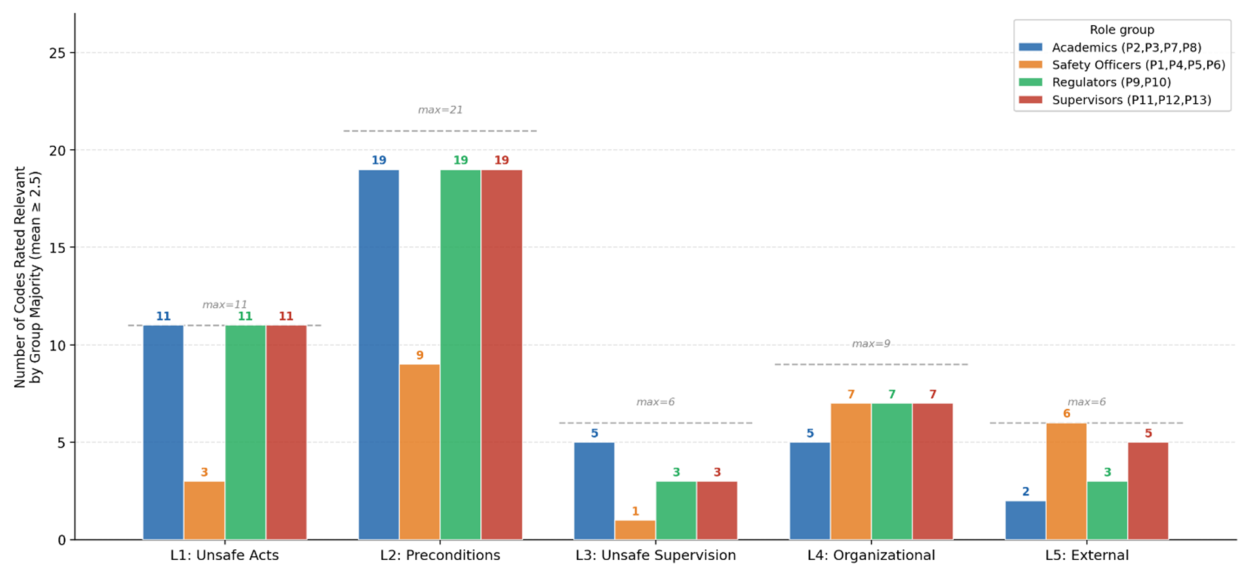
Figure 2 presents the hierarchical clustering dendrogram. Figure 3 presents the PCA biplot. The clustering and PCA results are mutually consistent and together validate the participatory card-sorting methodology: the primary dimension separating participants is not their job title but their evaluative approach, confirming that the methodology successfully elicited authentic individual judgements rather than role-scripted responses. Figure 4 illustrates codes emphasized per level by participant role group, computed from the final 53-code framework.
Figure 2.
Hierarchical Clustering of Participants.
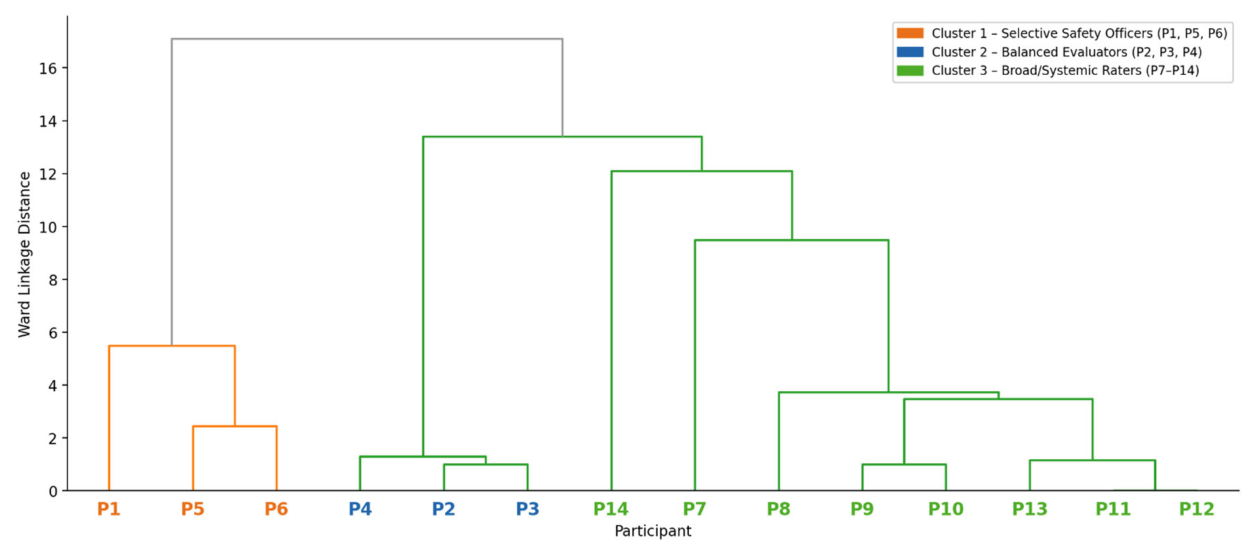
Figure 3.
PCA of Participant Rating Pattern.
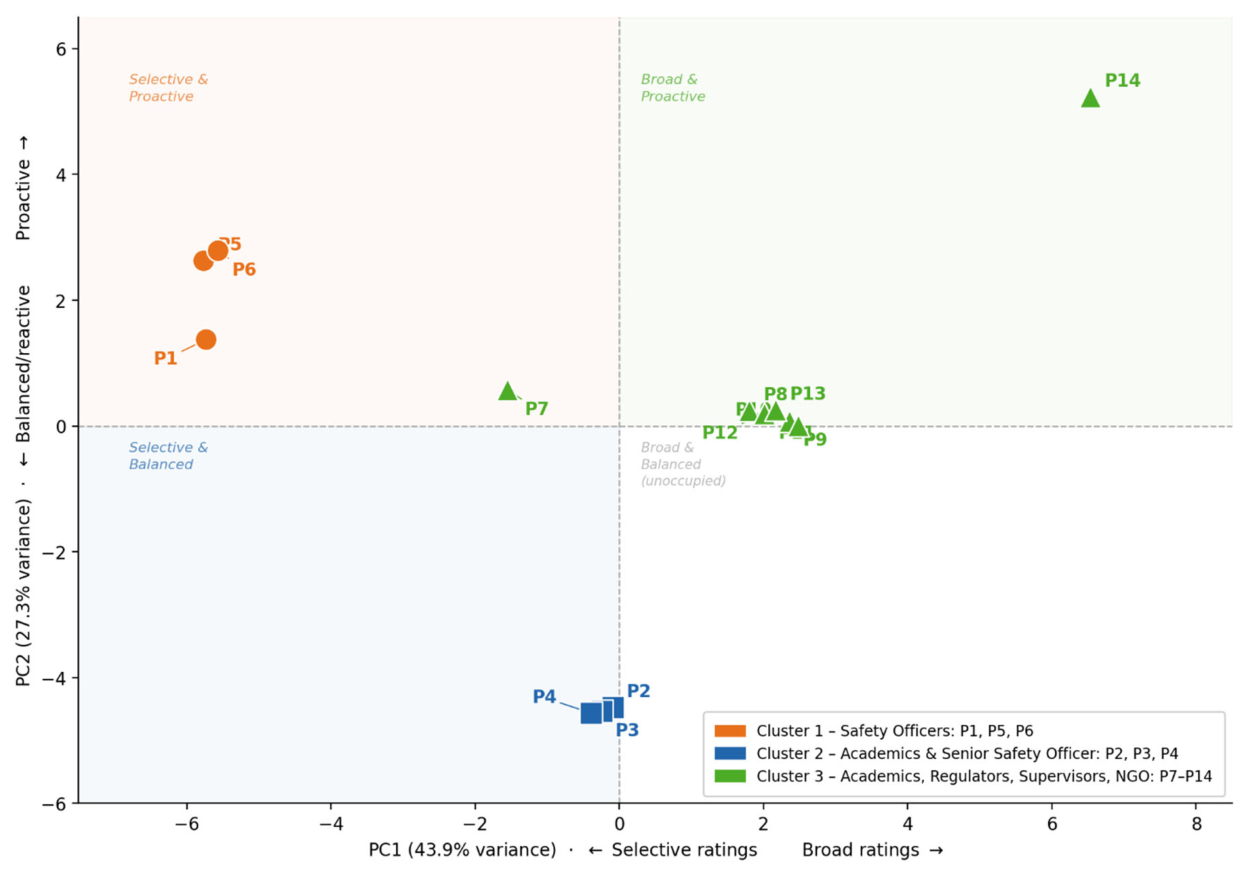
Figure 4.
Codes emphasized by per HFACS-SR level by participant role group. (Dashed line = total codes available at each level; computed from final 53-code framework).
Figure 4.
Codes emphasized by per HFACS-SR level by participant role group. (Dashed line = total codes available at each level; computed from final 53-code framework).
3.3.4. Tier Assignment
Codes were tiered using conservative quantitative criteria:
- Tier 1 (Core): Mean ≥ 2.50 AND % Relevant ≥ 64.3% (≥9 participants)
- Tier 2 (Extended): Mean 2.00–2.49, or mean ≥ 2.50 but % Relevant < 64.3%, or strong relevance in specific stakeholder clusters warranting qualitative review
- Tier 3 (Eliminated): Mean ≤ 1.75 AND % Relevant ≤ 21.4% (≤3 participants)
Results:
- Tier 1 (Core): 50 codes (42.7% of original 117)
- Tier 2 (Extended/Review): 34 codes (29.1%)
- Tier 3 (Eliminated): 33 codes (28.2%)
These 50 + 34 + 33 = 117 codes, accounting for the complete SHIELD code set. The 50 Tier 1 codes represent the quantitative core which are those endorsed by a clear majority of participants as relevant to ship recycling. Through subsequent qualitative refinement (Section 3.4), this quantitative baseline was shaped into the final 53-code HFACS-SR framework.
3.3.5. Initial Core Codes (Tier 1)
The initial Tier 1 core framework comprised 50 codes that met the quantitative thresholds (mean relevance ≥ 2.50 and ≥ 64.3% rated "Relevant"). These codes are listed below by HFACS level, using their original SHIELD identifiers and titles for traceability. The list reflects the high-consensus items from participant ratings and forms the baseline for qualitative refinement in section 3.4.
Level 1: Unsafe Acts (11 codes)
- AP1: No/wrong/late visual detection
- AP2: No/wrong/late auditory detection
- AP4: No/wrong/late detection with other senses (smell, temperature)
- AR1: Timing error
- AR2: Sequence error
- AR5: Lack of physical coordination
- AR6: No action executed
- AD1: Incorrect decision or plan
- AI1: Workaround in normal conditions
- AI2: Routine workaround
- AI3: Workaround in exceptional conditions
Level 2: Preconditions for Unsafe Acts (21 codes)
- PPE1: Vision affected by environment
- PPE2: Operator movement affected by environment
- PPE3: Hearing affected by environment
- PPE5: Heat or cold stress
- PPE6: Operation more difficult due to weather/environment
- PEW3: Workspace or working position incompatible with operation
- PEW4: Personal protective equipment interference
- PEW6: Fuels or materials
- PPF4: Performance/peer pressure
- PPF7: Risk underestimation
- PPC2: Fatigue
- PCS1: Inadequate experience
- PCS2: Lack of proficiency
- PCS3: Inadequate training or currency
- PCS4: Body size, strength or coordination limitations
- PCO1: Briefing or handover inadequate
- PCO3: Language difficulties
- PAW3: Distraction
- PAW4: Inattention
- PME3: Negative habit
- PMW1: High workload
Level 3: Unsafe Supervision (7 codes)
- LT1: Inadequate leadership or supervision
- LT2: No correction of unsafe practices
- LT5: Directed deviation
- LO1: Inadequate risk assessment
- LO4: Directed task with inadequate qualification or currency
- LO6: Directed task with inadequate equipment
- LP1: No personnel measures against regular risky behaviour
Level 4: Organizational Influences (9 codes)
- OC1: Safety culture
- OS3: Safety risk assurance (reactive)
- OS5: Publications/procedures/written guidance
- OR1: Personnel
- OR2: Budgets
- OR3: Equipment/parts/materials availability
- OR4: Inadequate training programs
- OR5: Design of equipment or procedures
- OR6: Operational information
Level 5: External Influences (5 codes)
- OE3: Economic pressure
- OE4: Tempo of operations
- EX1: Inconsistent Recycling Standards
- EX2: Ship Recycling Regulations and Standard Gaps
- EX3: Weak National Regulatory Framework and Enforcement
These 50 codes represent the high-consensus items from the quantitative analysis and serve as the baseline for qualitative refinement in section 3.4.
3.3.6. Key Insights
- Strong overall consensus (κ = 0.69) across diverse roles and experience levels validates the participatory method for SR-specific adaptation.
- Emergent clustering does not follow formal role boundaries: the three data-derived clusters group a senior safety officer with UK academics (Cluster 2) and all three Nigerian frontline supervisors with regulators, academics, and the NGO representative (Cluster 3). This cross-role clustering indicates that cognitive orientation toward safety (breadth versus selectivity of relevance judgement) is a more powerful organising dimension than occupational category.
- The one-way ANOVA showing no significant role-based differences in mean relevance scores (p = .73) and the cluster-based ANOVA showing significant differences between emergent groups (p < .001) are not contradictory. Rather, they jointly demonstrate that roles do not systematically bias average ratings, but latent evaluation styles do produce coherent subgroups which is a finding that strengthens rather than undermines the cross-stakeholder validity of HFACS-SR.
- The NGO representative (P14) is a clear outlier within Cluster 3, rating 93/117 codes as Relevant. This extreme breadth reflects the advocacy role's need to account for the full systemic landscape rather than prioritise yard-specific factors. P14's ratings amplified systemic and economic codes (OE3, EX3, OC1) in the overall mean, contributing to their high consensus rankings.
- Thirteen codes were rated Relevant by all 14 participants as reported in Section 3.3.2
- Strict tier criteria focused Tier 1 on 50 high-consensus codes. An additional 34 codes form the extended Tier 2 set and 33 codes were eliminated, accounting for all 117 original SHIELD codes.
3.4. Qualitative Refinement of the Core Framework
The initial Tier 1 core of 50 codes was established using strict quantitative criteria (mean relevance ≥ 2.50 and ≥ 64.3% of participants rating a code as "Relevant"). This selection captured the most broadly endorsed human factors within ship recycling contexts. However, qualitative feedback including open-ended card comments, post-sort discussions, and thematic analysis of participant explanations revealed four refinement needs: redundancy between closely related codes, abstract terminology that practitioners could not apply in the field, under-represented concerns that scored below threshold due to divergent stakeholder framing rather than genuine irrelevance, and structural gaps within specific HFACS levels. A secondary qualitative refinement stage addressed each of these.
Three types of adjustment were made, producing a final framework of 53 codes:
- Merging of eight overlapping or redundant code pairs, removing eight codes from the quantitative core (50 → 42)
- Promotion of four codes from Tier 2, addressing identified conceptual and structural gaps (42 → 46)
- Qualitative retention of seven threshold-adjacent codes supported by strong practitioner evidence (46 → 53)
3.4.1. Merged Codes (−8 codes: 50 → 42)
Eight codes from the quantitative Tier 1 were absorbed into existing codes where participants consistently described them as representing the same phenomenon in the ship recycling context. Each absorbing code retains its identifier and is given an expanded scope to cover the absorbed concept. Where absorbed codes carry widely understood meaning, particularly terminology that practitioners struggle with, the absorbing code's renamed title reflects the combined scope.
PAW3 (Distraction) absorbs PAW4 (Inattention) Participants, especially P11, P12, and P13 (frontline supervisors) described distraction and inattention as functionally indistinguishable during yard operations. Loud cutting noise, unexpected crew movement, and mental fatigue were cited as triggering both simultaneously. No participant distinguished meaningfully between the two when recounting incidents. PAW3 is retained as the merged code, renamed "Distraction", with scope extended to cover both active distraction by external stimuli and passive inattention or loss of focus. PAW4 is removed.
PPF4 (Performance/peer pressure) absorbs PPF7 (Risk underestimation) P12 and P13 described peer group normalisation of risk and direct peer pressure as two sides of the same phenomenon: crews routinely underestimate risk because peer endorsement of shortcuts has made that underestimation the group norm. P7 (technical advisor) and P9 (regulator) corroborated that risk underestimation in ship recycling is almost always socially conditioned rather than purely cognitive and cannot be meaningfully separated from the peer dynamic that sustains it. PPF4 is retained, renamed "Crew-Induced Work Pressure", covering both direct performance pressure and the normalisation of risk underestimation within work groups. PPF7 is removed.
OS3 (Safety risk assurance, reactive) absorbs OS5 (Publications/procedures/written guidance) P2 and P14 noted that formal safety documents in SR yards frequently exist on paper but fail to inform actual practice, making them incapable of supporting meaningful reactive safety checks. This circularity (procedures not followed → reactive assurance misses the gap → same failures recur) was treated by multiple participants as one integrated organisational failure rather than two distinct codes. OS3 is retained, renamed "Ineffective Safety Procedures and Checks", with scope extended to cover both the failure of written guidance to reflect practice and the failure of reactive auditing to detect that gap. OS5 is removed.
LT2 (No correction of unsafe practices) absorbs LT5 (Directed deviation) P12 and P13 described directed violations and tolerated violations as a continuum of the same supervisory failure. A supervisor who explicitly instructs workers to bypass a safety rule and one who silently allows the same bypass both reflect absent or inverted safety enforcement. The distinction was seen as unnecessary for investigators with limited training. LT2 is retained, renamed "No Correction or Enforcement of Safe Practices", covering passive tolerance of unsafe acts, failure to enforce existing rules, and active direction of unsafe work. LT5 is removed.
LT3 (No enforcement of existing rules) absorbs into LT2 LT3 was the highest-scoring Level 3 code not initially included in the framework (12/14 Relevant, mean = 2.79), and participant discussion confirmed it describes a supervisory failure pattern distinct enough to warrant capture: a supervisor who knows the rules exist but routinely fails to apply them, independently of whether a specific unsafe act is observed. However, following the absorption of LT5 into LT2, the expanded scope of LT2 ("No Correction or Enforcement of Safe Practices") already encompasses this failure mode: a supervisor who does not enforce existing rules is, by definition, not correcting or enforcing safe practices. LT2's scope note is therefore further expanded to make this explicit. LT3 is removed.
OS2 (Safety risk management, proactive) absorbs into OS3 OS2 was rated Relevant by 11/14 participants (mean = 2.57) and passed quantitative thresholds. However, following the absorption of OS5 into OS3, the combined scope of OS3 ("Ineffective Safety Procedures and Checks") already encompasses failure of the proactive safety planning system: when written guidance fails to reflect practice and reactive checks fail to detect this, the proactive risk management system has by definition also failed. Including OS2 as a separate code would create analytical duplication. OS3's scope note is extended to explicitly state that it covers both the absence of proactive safety management and the failure of reactive assurance. OS2 is removed.
PEW1 (Ergonomics and human machine interface issues) absorbs into PEW3 (Workspace incompatible with operation) PEW1 describes mismatches between tool or interface design and the human operator such as poor handle design, controls in unreachable positions, instruments unreadable in conditions. PEW3 describes the workspace or working position as incompatible with safe operation. In ship recycling yards, these phenomena are inseparable: tools are used in confined hull spaces, on sloping beaches, and in restricted postures where the workspace and the tool interact to create a single compound ergonomic hazard. Participant discussion confirmed that no investigator in an SR context would meaningfully separate "the tool was wrong" from "the space was wrong." Additionally, "ergonomics" was explicitly flagged by P5, P9, and P11 as terminology not understood by yard workers or low-literacy supervisors. PEW3 is retained, renamed "Confined Space / Poor Workspace Ergonomics", covering both workspace incompatibility and ergonomic or human-machine interface mismatches. PEW1 is removed.
PPE4 (Mental processing affected by environment) absorbs into PPE5 (Heat or cold stress) PPE4 describes cognitive degradation caused by environmental conditions such as heat, noise, dust, and fumes impairing attention, decision-making, and perception. PPE5 describes heat or cold stress as a physiological state. In the ship recycling context, the primary environmental stressor affecting cognitive processing is heat: participants described exposure to extreme sun, hot steel surfaces, and engine room environments as both the physical source of stress (PPE5) and the cause of confusion, slowed reactions, and missed signals (PPE4). P8 and P14 noted that mental impairment and heat stress in SR are typically co-occurring and co-caused rather than separable states. PPE5 is retained, renamed "Heat Stress and Cognitive Impairment", with scope extended to cover both physiological heat stress and its direct effects on mental processing and situational awareness. PPE4 is removed.
3.4.2. Promoted Codes (+4 codes: 42 → 46)
Four codes that fell below the quantitative Tier 1 threshold were promoted to the core framework based on consistent, specific, and convergent qualitative evidence across multiple stakeholder groups. Each promotion reflects a judgment that the code's low quantitative score resulted from divergent stakeholder framing, particularly from the selective rating approach of Cluster 1 participants rather than genuine participant dismissal of the concept's relevance.
PCO2 (Inadequate communication due to rank or position) → promoted to Level 2 Despite low quantitative ratings, most participants had initially placed this code as "Maybe Relevant". The post-sort discussion consistently surfaced hierarchy-driven communication failure as a critical SR-specific problem. P7, P13, and P14 cited examples of junior workers failing to report hazards or correct senior colleagues out of deference to authority, particularly in multi-generational and multi-cultural crews. P5 described a specific incident in which a junior worker observed a supervisor making an unsafe decision and remained silent. The abstract framing of "inadequate communication due to rank" in SHIELD caused participants to initially hesitate; once the concept was explained in plain terms, recognition was near-universal. Promoted to Level 2, renamed "Hierarchy or Rank Communication Barrier".
PDN3 (Inadequate nutrition, hydration or dietary practice) → promoted to Level 2 This code was frequently flagged "Maybe Relevant" in sorting but emerged prominently in written comments. P11 and P13 linked poor hydration and inadequate food directly to fatigue, dizziness, and lapses in attention during long shifts in tropical heat. P5 and P9 described specific yard conditions such as no scheduled breaks, no water provision, workers skipping meals to maximise shift earnings as routine rather than exceptional. P7 drew an explicit distinction between PDN3 and PPC2 (Fatigue): fatigue is a state, but hunger and dehydration are its discrete physical drivers that can be independently addressed through welfare provisions. This distinction has direct policy relevance for SR yards and justifies a separate code. Promoted to Level 2, renamed "Hunger/Thirst".
OC2 (Multi-cultural factors) → promoted to Level 4 P3 and P14 noted that SR yards in South Asia routinely employ workers from different linguistic and national backgrounds, creating communication gaps, differing safety norms, and mutual comprehension failures that contribute to accident causation. P9 and P10 noted that existing incident reports in their jurisdictions frequently cited cross-cultural crew misunderstandings as contributory factors. The low quantitative score reflects the fact that participants from single-nationality yards rated this as less applicable to their own context, not that the code lacks SR relevance globally. Promoted to Level 4, renamed "Multi-Cultural/Worker Diversity Conflicts".
EX4 (Political and NGO Pressure) → promoted to Level 5 This code received the strongest qualitative support of any promoted code. P7 and P14 cited government policies mandating employment of ex-military veterans in yard roles regardless of qualification, creating training gaps and supervisory failures. P14 described documented cases of NGO pressure campaigns forcing yards to accelerate dismantling schedules to avoid media exposure, directly increasing unsafe act rates. P9 and P10 described political interference in inspection scheduling. The quantitative score of 4/14 Relevant reflects genuine polarisation. Practitioners from yards not yet subject to these pressures rated it lower, rather than dismissal of the phenomenon. Its structural role as the macro-political driver at Level 5 justifies promotion. Promoted to Level 5, renamed "Political/NGO Pressure".
3.4.3. Qualitative Retention of Threshold-Adjacent Codes (+7 codes: 46 → 53)
Seven codes from Tier 2 were retained in the final framework on qualitative grounds. These codes did not reach the quantitative Tier 1 threshold, either narrowly missing the percentage-Relevant cut or falling below the mean cut but participant discussion produced convergent, specific evidence that each addresses a real and distinct ship recycling failure mode. Their low quantitative scores are explicable by the cluster structure identified in Section 3.3.4: Cluster 1 participants (P1, P5, P6: the three selective Safety Officers) applied a concentrated rating approach, placing most supervision and precondition codes as "Maybe Relevant" regardless of their operational importance. This created a systematic pull downward on codes that Clusters 2 and 3 (eleven participants) consistently identified as critical. In small samples, three abstaining participants is sufficient to pull codes below the 9/14 threshold even when eleven endorse them which is a sampling artefact rather than a substantive finding.
EX1 (Inconsistent Recycling Standards) — mean = 2.57, 8/14 Relevant Eight of fourteen participants rated this Relevant, missing the threshold by one. The six who rated it "Maybe Relevant" were primarily from contexts operating under a single national standard, reducing experienced inconsistency. Participants from India (P1, P7, P10) and Belgium (P14) which are jurisdictions with cross-flag operational exposure all rated it “Relevant” and cited specific examples of contradictory requirements between flag state, port state, and Hong Kong Convention provisions causing operational confusion. EX1 is structurally essential to Level 5: removing it would leave External Influences covering only regulatory weakness (EX3) and standard gaps (EX2) without addressing the distinct problem of contradictory standards as a specific driver of unsafe practice. Retained, renamed "Inconsistent/Conflicting Recycling Standards" in 3.5.
EX2 (Ship Recycling Regulations and Standard Gaps) — mean = 2.57, 8/14 Relevant Identical threshold profile to EX1. Participants who rated it "Maybe Relevant" described their own national regulatory environments as clear, if imperfectly enforced, making standard gaps less personally salient. For participants engaged with the Hong Kong Convention process or operating across multiple jurisdictions (P3, P8, P14), standard gaps are a primary structural driver of unsafe practice. EX1 and EX2 together define the regulatory landscape of Level 5: EX2 captures what is absent from the rules, EX1 captures what is contradictory between rules, and EX3 captures what is present but unenforced. Removing either would leave Level 5 analytically incomplete. Retained, renamed "Gaps in Regulations and Standards".
LT1 (Inadequate leadership or supervision) — mean = 2.36, 8/14 Relevant LT1 failed both quantitative thresholds. However, participant discussion produced strong convergent support for its retention. The split in ratings reflects a framing difference: participants who rated LT1 "Maybe Relevant" treated it as redundant given LT2 (No correction of unsafe practices). Those who rated it Relevant, including P6, P8, P9, P11, P13, and P14 identified it as capturing a categorically distinct phenomenon: the complete absence of supervisory presence, as opposed to the passive tolerance of unsafe acts (LT2 covers a supervisor who is present but does not act). P6 stated explicitly: "Nobody watching us …. that is different from watching and saying nothing." P11 and P13 echoed this distinction with specific incident examples. LT1 is retained as the entry point of Level 3, capturing the structural absence of supervision as a precondition for all downstream supervisory failures: no supervisor present (LT1) → present but does not correct (LT2) → present but directs violation (absorbed into LT2). Retained, renamed "Lack of Supervision".
LO1 (Inadequate risk assessment) — mean = 2.21, 3/14 Relevant Only three participants rated this Relevant in the card sort, placing it at the Tier 3 boundary by the quantitative rule. However, qualitative evidence strongly contradicts elimination. In post-sort discussion, P4, P7, P9, P10, P13, and P14 all cited inadequate pre-task risk assessment as a near-universal feature of SR accident causation. The absence of a hazard check before cutting, tank entry, or lifting operations was described not as an occasional lapse but as the routine operating condition in under-resourced yards. The low quantitative score reflects Cluster 1's selective rating pattern (P1, P5, P6 each rated this "Maybe Relevant" rather than Relevant, as they did for most Level 3 supervision codes). The eleven participants in Clusters 2 and 3 treated this as self-evident; the three in Cluster 1 hedged universally on supervision codes. Given the convergent qualitative evidence and the code's fundamental role in the causal chain, absent risk assessment enables all other supervisory failures, LO1 is retained. Renamed "No Risk Check Before Task".
LO4 (Directed task with inadequate qualification or currency) — mean = 2.21, 3/14 Relevant Same threshold profile as LO1, and same cluster-driven explanation for the low quantitative score. P3, P8, P9, and P14 identified unqualified worker assignment as structurally endemic in SR: yard operators assign whoever is available to hot work, confined space entry, and lifting operations regardless of competence because trained workers are scarce and expensive. P7 noted that this is one of the few SR failure modes directly documented in international incident databases. The renamed title "Unqualified Worker Assigned" was used spontaneously by P12 and P13 when describing this failure type in their own yards before the formal code was presented to them, confirming its operational salience. Retained, renamed "Unqualified Worker Assigned".
LO6 (Directed task with inadequate equipment) — mean = 2.21, 3/14 Relevant Same profile as LO1 and LO4. P9 and P13 described provision of worn, broken, or unsuitable tools as the normal operating condition in budget-constrained yards, not an exceptional event. P6 described a specific incident in which a worker was assigned to cut through a structural beam using a torch that was losing pressure, resulting in an uncontrolled fall of the section. P14 cited equipment inadequacy as a recurring finding in NGO yard assessments across South Asian dismantling facilities. Retained, renamed "Unsuitable Equipment Provided".
OR6 (Operational information) — mean = 2.21, 6/14 Relevant OR6 had the strongest quantitative score of the retained Tier 2 codes (6/14 Relevant, mean = 2.21) but still fell below threshold. Participant discussion identified this as capturing a failure type distinct from all other Level 4 codes: the systematic absence of ship-specific hazard information such as no inventory of residual hazardous materials, no structural drawings showing which sections are load-bearing, no record of prior cutting, at the point of operation. P2 and P6 both cited specific examples of crews beginning cutting operations without knowing a tank contained asbestos insulation or fuel residue. This is not a training failure (OR4), not a resource shortage (OR1–OR3), and not a design failure (OR5): it is a specific information management failure at the organisational level. OR6 is retained as the information management code within Level 4. Retained, renamed "Missing Information".
Table 7 below presents the 53 finalized codes, organized by the five HFACS-SR levels. Original code IDs are retained for traceability.
3.5. Renaming for Ship Recycling Context
The original SHIELD taxonomy codes were developed for aviation and space operations, resulting in some terminology that is overly technical, abstract, or irrelevant to the realities of ship recycling (e.g., beach-based manual dismantling, tidal constraints, diverse low-literacy crews, and limited safety culture). To enhance usability in this context, a systematic renaming process was applied to 53 HFACS-SR codes. This process was directly grounded in qualitative feedback from 14 experienced ship recycling practitioners. Participants took part in a structured card sorting and interpretive exercise, during which they rephrased or interpreted codes in their own terms. Common expressions such as “missed seeing it,” “cut too early,” “just skipped the step,” and “usual bad habit” were used as the basis for renaming. Approximately 60% of the original codes were retained verbatim or with only light edits. The remaining 40% were reworded to meet four criteria:
- Short (2–5 word) phrasing suitable for memory and repetition
- Clear link to observable hazards or actions in ship recycling
- Accessible language for frontline workers with low literacy
- Fidelity to the causal intent of the original HFACS-SR taxonomy
This approach mirrors contextual HFACS adaptations in other domains (Li et al., 2020; Chen et al., 2013; Navas de Maya et al., 2020) and is discussed further in Section 4.2.
These precedents affirm that HFACS variants benefit from contextual reshaping—particularly in high-risk, complex, or informal sectors like ship recycling. The renaming in this study therefore balances fidelity to HFACS-SR’s conceptual intent with practical utility in the shipbreaking field. Figure 5 shows the distribution of the 53 codes across HFACS-SR levels.
Table 8.
Final HFACS-SR Core Framework (53 Codes).
| Level | Serial | Original Code ID | Renamed Title | Brief Ship Recycling Example |
|---|---|---|---|---|
| L1 Unsafe Acts | ||||
| L1 | 1.1 | AP1 | Missed Visual Hazard | Crack or loose wire not seen on hull |
| L1 | 1.2 | AP2 | Missed Sound Alert | Did not hear gas hiss or crew shout |
| L1 | 1.3 | AP4 | Missed Gas Smell or Heat Warning | Ignored toxic smell or extreme heat |
| L1 | 1.4 | AR1 | Wrong Cut Timing | Removed support beam too early |
| L1 | 1.5 | AR2 | Wrong Work Sequence | Cut fuel line before draining tank |
| L1 | 1.6 | AR5 | Slipped or Lost balance | Tool slipped due to wet grip |
| L1 | 1.7 | AR6 | Required Action not taken | Did not clip harness properly |
| L1 | 1.8 | AD1 | Unsafe Work Plan/Decision | Chose unsafe entry into tank |
| L1 | 1.9 | AI1 | Normal-Everyday Shortcut | Gas test skipped on calm day |
| L1 | 1.10 | AI2 | Normalised Bad Habit | No helmet worn as yard routine |
| L1 | 1.11 | AI3 | High-Pressure Rule Break | Ignored rule due to tide deadline |
| L2 Preconditions | ||||
| L2 | 2.1 | PPE1 | Poor Visibility | Dust or dark hold blocked view |
| L2 | 2.2 | PPE2 | Restricted movement conditions | Waist-deep water, tight space, sloping beach, scrap debris |
| L2 | 2.3 | PPE3 | High Noise Level | Cutting noise drowned warnings |
| L2 | 2.4 | PPE5 | Heat Stress | Sun or hot steel caused fatigue |
| L2 | 2.5 | PPE6 | Bad Weather Difficulty | Rain, wind, or tide slowed work |
| L2 | 2.6 | PEW3 | Confined Space | Tight tank or beam restricted movement |
| L2 | 2.7 | PEW4 | PPE Interference | Ill-fitting or uncomfortable gear |
| L2 | 2.8 | PEW6 | Hazardous Materials | Asbestos dust or oil residue |
| L2 | 2.9 | PPF4 | Crew-Induced Work Pressure | Team rushes job despite risk |
| L2 | 2.10 | PPC2 | Fatigue | Long hours and heat exhaustion |
| L2 | 2.11 | PCS1 | Lack of Experience | New worker not familiar with torch |
| L2 | 2.12 | PCS2 | Lack of Skill | Poor cutting or welding technique |
| L2 | 2.13 | PCS3 | Poor Training | Outdated or missing safety training |
| L2 | 2.14 | PCS4 | Physical Limitation | Short reach or weak strength |
| L2 | 2.15 | PCO1 | Poor Shift Handover | Hazards not passed to next shift |
| L2 | 2.16 | PCO2 | Hierarchy or Rank Communication Barrier | Junior afraid to correct senior |
| L2 | 2.17 | PCO3 | Language Barrier | Mixed crew misunderstood/ misinterprets orders |
| L2 | 2.18 | PAW3 | Distraction | Distraction or inattention |
| L2 | 2.19 | PME3 | Unsafe Work Habit | Repeated bad practice normalized |
| L2 | 2.20 | PMW1 | High Workload | Too many tasks at once |
| L2 | 2.21 | PDN3 | Hunger/Thirst | No water or food caused weakness |
| L3 Unsafe Supervision | ||||
| L3 | 3.1 | LT1 | Lack of Supervision | No one watching the work |
| L3 | 3.2 | LT2 | No correction of unsafe practices | Saw unsafe act but allowed it |
| L3 | 3.3 | LO1 | Inadequate risk assessment | No risk check before task |
| L3 | 3.4 | LO4 | Unqualified Worker assigned | Rookie assigned to hot work |
| L3 | 3.5 | LO6 | Unsuitable equipment provided | Worn or broken tool used |
| L3 | 3.6 | LP1 | No Action on Repeat Risk | Same worker keeps taking risks |
| L4 Organizational Influences | ||||
| L4 | 4.1 | OC1 | Poor Safety Culture | Speed valued over safety |
| L4 | 4.2 | OC2 | Multi-Cultural/ worker Diversity Conflicts | Culture or language gaps |
| L4 | 4.3 | OS3 | Ineffective Safety Procedures & Checks. | Procedures not followed/ (paperwork not followed in practice) |
| L4 | 4.4 | OR1 | Not Enough Workers | Understaffed shifts |
| L4 | 4.5 | OR2 | Insufficient Budget | Cheap or missing PPE |
| L4 | 4.6 | OR3 | Equipment Shortage | No spare tools available |
| L4 | 4.7 | OR4 | Inadequate Safety Training programs | Short or rare safety sessions |
| L4 | 4.8 | OR5 | Wrong Equipment Design | Gear not suited for beach yard |
| L4 | 4.9 | OR6 | Missing Information | No ship hazard map |
| L5 External Influences | ||||
| L5 | 5.1 | OE3 | Economic pressure | Low scrap price forced rush |
| L5 | 5.2 | OE4 | Tight Deadlines | Client or tide deadline pressure |
| L5 | 5.3 | EX1 | Inconsistent/Conflicting Recycling Standards | Different rules caused confusion. Rules can differ by flag or port |
| L5 | 5.4 | EX2 | Gaps in Regulations and Standards | Missing hazmat rules |
| L5 | 5.5 | EX3 | Weak National Regulatory Enforcement | Rare or weak inspections |
| L5 | 5.6 | EX4 | Political/NGO Pressure | Veteran policy hazard / NGO campaign push |
The changes focus on clarity, brevity, and ship recycling relevance (e.g., tide, asbestos, heat, rush, crew diversity). All titles are now short enough for quick reference in accident reports or safety meetings. Figure 6 presents the complete HFACS-SR framework with renamed codes across all five levels.
4. Discussion
4.1. Interpretation of Results
This study successfully developed HFACS-SR, a streamlined human factors taxonomy tailored to ship recycling, by adapting the 117-code SHIELD framework through participatory card-sorting and qualitative refinement. The quantitative tiering retained 50 high-consensus codes in the initial Tier 1 core (mean ≥ 2.50, ≥ 64.3% "Relevant"), which was subsequently refined through qualitative feedback to produce a final framework of 53 codes across five levels. Substantial inter-rater agreement (Fleiss' κ = 0.69) confirms a shared understanding of relevant human and organisational factors despite the diversity of participant backgrounds.
A finding of methodological significance is that the emergent cluster structure does not reproduce the pre-defined professional role categories. Safety officers, academics, regulators, supervisors, and the NGO representative do not separate cleanly by occupation. Instead, participants grouped by their evaluative approach: how broadly or selectively they defined relevance across the 117-code space. This cross-role clustering validates the participatory design: because no occupational group dominated the rating patterns, the resulting taxonomy reflects a genuinely shared perspective on what matters in ship recycling safety rather than the viewpoint of any single stakeholder constituency.
The role-based ANOVA (p = .73) confirming no significant mean differences between occupational groups is consistent with this interpretation. It should not be read as evidence that all participants are interchangeable, but rather that the methodology successfully balanced the influence of different stakeholder types. The significant cluster-based ANOVA (p < .001) reveals that latent evaluative orientations like breadth of relevance judgement and proactive versus reactive safety framing do produce systematic variation, and that these orientations cut across formal role boundaries in substantively interesting ways.
The explicit addition of Level 5 (External Influences) emerged as a critical adaptation. While SHIELD embeds external factors implicitly within organisational influences, While SHIELD embeds external factors implicitly within organisational influences, the six External Influence codes (OE3, OE4, EX1–EX4) received consistently high ratings with OE3 (Economic Pressure) and OE4 (Tempo of Operations) achieving unanimous endorsement (mean = 3.00, 100% Relevant), and EX3 (Weak Enforcement) rated Relevant by 10/14 participants. All six survived into the final framework, four through the quantitative core (OE3, OE4, EX3 directly; EX4 through qualitative promotion) and two through qualitative retention on structural grounds (EX1, EX2). These findings extend existing HFACS models by explicitly naming macro-level pressures unique to ship recycling.
The selective renaming of approximately 40% of codes improved accessibility without altering causal structure. The resulting plain-language titles make the taxonomy usable for investigators with limited literacy or low safety culture maturity which is a key barrier in current frameworks.
4.2. Comparison with Existing Taxonomies
Compared to the original SHIELD taxonomy (117 codes, 4 levels), HFACS-SR achieves a ~55% reduction (117 → 53 codes) while preserving systemic depth. Eight code pairs were merged, including PAW3+PAW4 ('Distraction'), PPF4+PPF7 ('Crew-Induced Work Pressure'), LT2 absorbing both LT5 and LT3, OS3 absorbing both OS5 and OS2, PEW3 absorbing PEW1, and PPE5 absorbing PPE4 alongside four promotions (PCO2, PDN3, OC2, EX4) and seven qualitative retentions. All adjustments were driven by practitioner feedback that SHIELD's granularity is excessive for low-maturity yards.
The explicit Level 5 aligns closely with Ye et al. (2018), who added an "external factors" level to HFACS for Chinese construction, capturing upstream pressures that shape organisational and supervisory failures. Similarly, the high consensus on economic pressure (OE3) and weak enforcement (EX3) in our study parallels Ye et al.'s identification of regulatory and economic/political/social/legal environment as critical upstream drivers.
A distinctive feature of the present study's approach is that the participatory refinement process (quantitative tiering followed by qualitative comment-driven adjustments) inverts the typical expert-driven approach of SHIELD/HFACS development. Importantly, the emergent cluster analysis demonstrates that this participatory process genuinely integrated diverse cognitive orientations: the final taxonomy reflects convergence across participants who varied substantially in evaluative breadth, not simply the view of any dominant stakeholder group. Practitioners favoured broader categories and plain language over fine distinctions; academics and regulators emphasised systemic and latent factors; supervisors applied a broader evaluative scope than their operational role might predict. All perspectives are embedded in the final 53-code framework.
4.3. Implications for Ship Recycling Safety Practice and Policy
HFACS-SR provides a practical tool for incident reporting, risk assessment, and training in shipbreaking yards. Its simple, SR-grounded codes are accessible to workers with limited literacy, addressing a key barrier in existing frameworks. Integration into a structured digital incident reporting system will enable consistent tagging of causal factors, revealing patterns such as economic pressure co-occurring with unsafe workarounds, and informing targeted interventions including toolbox talks on hierarchy-driven communication failure and advocacy for stronger national inspections.
At the policy level, aggregated data could highlight systemic issues (e.g., weak enforcement, inconsistent standards) to support Hong Kong Convention implementation and regional safety standards. The explicit recognition of political/NGO pressure (EX4), including examples such as unqualified veteran recruitment policies and advocacy-driven corner-cutting strengthens the case for international and national action to address macro pressures beyond individual yards.
4.4. Limitations
The study is limited by its sample size (n=14), though diversity (roles, regions, experience) strengthens generalizability within ship recycling. The taxonomy is expert-derived; retrospective application to real incident reports is needed to confirm coverage and reliability. Reliance on self-reported relevance ratings may introduce bias, though triangulation with discussion notes mitigates this. Finally, the framework awaits field validation in actual yards to assess adoption, usability, and impact on accident rates or reporting quality.
4.5. Future Research Directions
Future work should apply HFACS-SR to a database of ship recycling incidents to evaluate classification reliability and identify dominant causal chains (e.g., economic pressure → supervisory violations → workarounds). Longitudinal studies could track whether adoption of HFACS-SR within incident reporting systems reduces accident rates or improves reporting quality over time. Comparative studies with other high-hazard industries (e.g., construction, offshore) could test generalizability. Participatory workshops in South Asian yards could further refine language and test usability among low-literacy workers. Finally, periodic review (e.g., every 3–5 years) through an industry safety forum is recommended to keep the framework current as standards, technology, and regulations evolve.
4.6. Positioning HFACS-SR Within a Wider Safety Learning Framework
HFACS-SR provides a structured classification of human, organisational, and external contributory factors relevant to ship recycling. It answers the question: what factors were present in an accident? However, classification alone does not reconstruct how those factors combined over time to produce an outcome, nor does it capture the successful frontline adaptations that prevent most similar situations from escalating. Two further analytical layers are needed to translate classification into comprehensive learning.
The first is sequence-based systemic analysis. Frameworks such as the Systemic Occurrence Analysis Methodology (SOAM), itself derived from the HFACS tradition, arrange coded contributory factors into causal pathways, showing how organisational conditions, supervisory failures, preconditions, and unsafe acts interacted, and identifying which barriers were absent, weak, or bypassed. Where HFACS-SR identifies what contributed to an accident, SOAM explains how those contributions combined into a sequence. This distinction is particularly important in ship recycling, where the same HFACS-SR codes, such as hazardous materials, wrong cut timing, and lack of supervision, can lead to explosions, toxic exposures, or falls depending entirely on the order and combination in which they occur.
The second layer is resilience-based learning, drawing on Safety-II principles (Hollnagel, 2014). Safety-II shifts attention from exclusively analysing failure to also understanding how work usually succeeds. In ship recycling, many hazardous situations are managed successfully every day through informal worker adaptations, including delaying cuts when gas is suspected, stopping lifting when rigging appears unstable, and repositioning workers away from falling steel. These adaptations are rarely captured in formal accident reports, but they represent practical safety knowledge that, if formalised and supported, could interrupt the accident pathways identified through HFACS-SR and SOAM.
HFACS-SR therefore functions as the first and foundational layer of an integrated continuous improvement approach: HFACS-SR classifies the contributory factors; SOAM sequences those factors into a systemic pathway and identifies failed or absent barriers; and Safety-II identifies successful adaptations and resilience practices that could strengthen future safety interventions. The present paper establishes the classification layer. Application to accident databases and integration with SOAM and Safety-II methods represent the logical next steps in translating HFACS-SR into a practical safety improvement tool for the ship recycling industry.
5. Conclusions
This study developed HFACS-SR, a simplified 53-code Human Factors Analysis and Classification System specifically tailored to the ship recycling industry. Starting from the 117-code SHIELD taxonomy, a participatory card-sorting approach with 14 diverse experts (academics, safety officers, regulators, frontline supervisors, NGO) distilled high-consensus factors (mean ≥ 2.50, ≥ 64.3% “Relevant”) into an initial core of 50 codes. Qualitative refinement involved merging eight overlapping code pairs, promoting four practitioner-identified gaps, and retaining seven threshold-adjacent codes on qualitative grounds. This resulted in a final framework of 53 codes across five levels, with selective renaming to ensure plain-language accessibility for low-literacy users in low-maturity yards.
HFACS-SR retains HFACS’s multi-layered systemic insight while eliminating excessive granularity that hinders use in resource-constrained settings. The explicit Level 5 (External Influences) addresses macro pressures unique to ship recycling such as economic squeeze, regulatory gaps, inconsistent standards, lax enforcement, and political/NGO influences, filling a gap in existing models. The framework’s development process demonstrated the value of bridging academic rigor with frontline insight: it eliminated unnecessary complexity and incorporated factors that make the taxonomy holistic and practical for the domain.
HFACS-SR is positioned for real-world impact. Integration into structured incident reporting systems would provide yards and regulators with a standardized, user-friendly tool for documenting and learning from accidents. Consistent causal tagging across cases would enable aggregation of data to reveal industry-wide patterns, support targeted interventions such as training on hierarchy-driven communication failures and advocacy for stronger national enforcement, and facilitate benchmarking of yard safety performance. In time, this can help foster a proactive safety culture that addresses latent organisational and external weaknesses before they escalate to incidents.
HFACS-SR represents a meaningful step forward in adapting human factors frameworks to challenging, high-hazard contexts. It shows that even in ship recycling which is marked by resource limits, high accident rates, and weak regulatory oversight, a structured, systemic lens is feasible when the tool is appropriately tailored. The framework contributes to global efforts to improve occupational safety in the maritime recycling sector, aligning with the Hong Kong Convention for Safe and Environmentally Sound Recycling of Ships. Future empirical application to incident databases, longitudinal evaluation of HFACS-SR adoption in yards, and field validation in operational ship recycling contexts will confirm its effectiveness. Early evidence, however, suggests HFACS-SR will be an asset for practitioners, regulators, and researchers, helping reduce the human cost of ship disposal in one of the world’s most dangerous industries.
Declaration of generative AI and AI-assisted technologies in the manuscript preparation process
During the preparation of this work, the author(s) used ChatGPT for proof reading and ideas approach. The author(s) reviewed and edited the output as needed and take full responsibility for the content of the published article.
References
- Ahamad, A. F.; Schneider, P.; Khanum, R.; Mozumder, M. M. H.; Mitu, S. J.; Shamsuzzaman, M. M. Livelihood Assessment and Occupational Health Hazard of the Ship-Breaking Industry Workers at Chattogram, Bangladesh. J. Mar. Sci. Eng. 2021, Vol. 9(Page 718, 9(7)), 718. [Google Scholar] [CrossRef]
- Beaubien, J. M.; Baker, D. P. A review of selected aviation human factors taxonomies, accident/incident reporting systems and data collection tools. Int. J. Appl. Aviat. Stud. 2002, 2(2), 11–36. [Google Scholar]
- Braun, V.; Clarke, V. Using thematic analysis in psychology. Qual. Res. Psychol. 2006, 3(2), 77–101. [Google Scholar] [CrossRef]
- Carminati, L.; Pluchino, P.; Jeanes, E.; Pietrantoni, L.; Morandini, S.; Fraboni, F.; Hall, M.; Quintana-Amate, S. User perspectives on AI explainability in aerospace manufacturing: a Card-Sorting study. Front. Organ. Psychol. 2025, 3, 1538438. [Google Scholar] [CrossRef]
- Chauvin, C.; Lardjane, S.; Morel, G.; Clostermann, J. P.; Langard, B. Human and organisational factors in maritime accidents: Analysis of collisions at sea using the HFACS. Accid. Anal. Prev. 2013, 59, 26–37. [Google Scholar] [CrossRef] [PubMed]
- Chen, S. T.; Wall, A.; Davies, P.; Yang, Z.; Wang, J.; Chou, Y. H. A Human and Organisational Factors (HOFs) analysis method for marine casualties using HFACS-Maritime Accidents (HFACS-MA). Saf. Sci. 2013, 60, 105–114. [Google Scholar] [CrossRef]
- Demaria, F. Shipbreaking at Alang–Sosiya (India): An ecological distribution conflict. Ecol. Econ. 2010, 70(2), 250–260. [Google Scholar] [CrossRef]
- Diller, T. W.; Helmrich, G.; Dunning, S.; Cox, S.; Buchanan, A.; Shappell, S. The Human Factors Analysis Classification System (HFACS) Applied to Health Care. Am. J. Med. Qual. 2014, 29(3), 181–190. [Google Scholar] [CrossRef] [PubMed]
- Dillinger, T.; Hernandez, I.; Zona, D.; Serafini, S.; Karpowich, A. NASAHFACS Red-Light/Green-Light to Build Safe, Secure, and Sustainable Space Operations. 13th IAASS Conference, 2024. [Google Scholar]
- Eppler, M. J.; Platts, K. An empirical classification of visual methods for management: Results of picture sorting experiments with managers and students. In Proceedings of the International Conference on Information Visualisation; 2007; pp. 335–341. [Google Scholar] [CrossRef]
- Farag, Y. B. A.; Kurt, R. E.; Turan, O. Integrating SHIELD and SOAM for systemic human factors analysis in maritime collisions : the Helge Ingstad case 2025. [CrossRef]
- Granato, G.; Mattera, A.; Cartoni, E.; Baldassarre, G. Modeling metacognition and executive functions in the metacognitive wisconsin card sorting test using the neuropsychological digital-twin method. Sci. Rep. 2026, 2026 16:1(16(1)), 7145. [Google Scholar] [CrossRef] [PubMed]
- Gunbeyaz, S. A.; Kurt, R. E.; Baumler, R. A study on evaluating the status of current occupational training in the ship recycling industry in Bangladesh. WMU J. Marit. Aff. 2019, 18:1(18(1)), 41–59. [Google Scholar] [CrossRef]
- Hasanspahić, N.; Vujičić, S.; Frančić, V.; Čampara, L. The Role of the Human Factor in Marine Accidents. J. Mar. Sci. Eng. 2021, Vol. 9(Page 261, 9(3)), 261. [Google Scholar] [CrossRef]
- ILO. Safety and health in shipbreaking: Guidelines for Asian countries and Turkey; ILO Geneva, 2004. [Google Scholar]
- IMO-SENSREC. Pilot training of trainers. Report from the pilot session conducted in Bangladesh 2016. . 2016. [Google Scholar]
- IMO-SENSREC. Phase II Project. Scaling up Strategy for Training for the Ship Recycling Industry 2020. [CrossRef]
- Isaac, A.; Shorrock, S. T.; Kirwan, B. Human error in European air traffic management: the HERA project. Reliab. Eng. Syst. Saf. 2002, 75(2), 257–272. [Google Scholar] [CrossRef]
- Jansen, L. Z. H.; Van Loo, E. J.; Bennin, K. E.; van Kleef, E. Exploring the role of decision support systems in promoting healthier and more sustainable online food shopping: A card sorting study. Appetite 2023, 188, 106638. [Google Scholar] [CrossRef] [PubMed]
- Kaptan, M.; Sarıali̇oğlu, S.; Uğurlu, Ö.; Wang, J. The evolution of the HFACS method used in analysis of marine accidents: A review. Int. J. Ind. Ergon. 2021, 86, 103225. [Google Scholar] [CrossRef]
- Kececi, T.; Arslan, O. SHARE technique: A novel approach to root cause analysis of ship accidents. Saf. Sci. 2017, 96, 1–21. [Google Scholar] [CrossRef]
- Kirwan, B. Towards an action-oriented safety culture maturity scale. Saf. Manag. Hum. Factors 2022, 64(64). [Google Scholar] [CrossRef]
- Kuric, E.; Demcak, P.; Krajcovic, M. Validation of information architecture: Cross-methodological comparison of tree testing variants and prototype user testing. Inf. Softw. Technol. 2025, 183, 107740. [Google Scholar] [CrossRef]
- Landis, J. R.; Koch, G. G. The Measurement of Observer Agreement for Categorical Data. Biometrics 1977, 33(1), 159. [Google Scholar] [CrossRef]
- Li, W.-C.; Harris, D. Pilot error and its relationship with higher organizational levels: HFACS analysis of 523 accidents. Aviat. Space Environ. Med. 2006, 77(10), 1056–1061. [Google Scholar] [PubMed]
- Mannan, B.; Rizvi, M. J.; Dai, Y. M. Ship recycling in developing economies of South Asia: Changing liability to a commodity. Green Technol. Sustain. 2024, 2(2), 100064. [Google Scholar] [CrossRef]
- Mehtaj, N.; Zakaria, N. M. G.; Awal, Z. I.; Dipto, S. S.; Hannan, M. A.; Dev, A. K.; Ali, M. T. Ship recycling process in Bangladesh and a survey-based risk assessment with mitigation proposal. Heliyon 2024, 10(20), e39344. [Google Scholar] [CrossRef] [PubMed]
- Navas de Maya, B.; Ramirez Marengo, C.; Giagloglou, E.; Kurt, R. E.; Turan, O.; Stroeve, S.; Pozzi, S. A comprehensive analysis of human factors in maritime accidents by applying SHIELD HF Taxonomy. 1st International Conference on the Stability and Safety of Ships and Ocean Vehicles, 2021. [Google Scholar]
- Patterson, J. M.; Shappell, S. A. Operator error and system deficiencies: Analysis of 508 mining incidents and accidents from Queensland, Australia using HFACS. Accid. Anal. Prev. 2010, 42(4), 1379–1385. [Google Scholar] [CrossRef] [PubMed]
- Reason, J. Human error; Cambridge university press, 1990. [Google Scholar]
- Sanders, K.; Fincher, S.; Bouvier, D.; Lewandowski, G.; Morrison, B.; Murphy, L.; Petre, M.; Richards, B.; Tenenberg, J.; Thomas, L.; Anderson, R.; Anderson, R.; Fitzgerald, S.; Gutschow, A.; Haller, S.; Lister, R.; McCauley, R.; McTaggart, J.; Prasad, C.; Zander, C. A multi-institutional, multinational study of programming concepts using card sort data. In Expert Systems; STRING:PUBLICATION: WGROUP, 2005; Volume 22, 3, pp. 121–128. [Google Scholar] [CrossRef]
- Save, L.; Pozzi, S.; De Bortoli Vizioli, B.; Kirwan, B.; Kilner, A.; Bettignies-Thiebaux, B.; Stroeve, S.; Gibson, H.; Waters, S.; Kurt, R. E. SHIELD human factors taxonomy for risk analysis; D2, 2020. [Google Scholar]
- Shappell, S. A.; Wiegmann, D. A. The Human Factors Analysis and Classification System--HFACS. In Publications; 2000; Available online: https://commons.erau.edu/publication/737.
- Singh, M. P.; Totakura, B. R. Container Vessel Accidents Analysis: A NASAHFACS Framework Study. Int. J. Transp. Dev. Integr. 2024, 8(2), 341–357. [Google Scholar] [CrossRef]
- Stroeve, S.; Kirwan, B.; Turan, O.; Kurt, R. E.; van Doorn, B.; Save, L.; Jonk, P.; Navas de Maya, B.; Kilner, A.; Verhoeven, R.; Farag, Y. B. A.; Demiral, A.; Bettignies-Thiebaux, B.; de Wolff, L.; de Vries, V.; Ahn, S. Il; Pozzi, S. SHIELD Human Factors Taxonomy and Database for Learning from Aviation and Maritime Safety Occurrences. Saf. 2023 2023, Vol. 9(Page 14, 9(1)), 14. [Google Scholar] [CrossRef]
- Wiegmann, D. A.; Shappell, S. A. A human error approach to aviation accident analysis: The human factors analysis and classification system; Routledge, 2017. [Google Scholar]
- Ye, G.; Tan, Q.; Gong, X.; Xiang, Q.; Wang, Y.; Liu, Q. Improved HFACS on Human Factors of Construction Accidents: A China Perspective. Adv. Civ. Eng. 2018, 2018(1), 4398345. [Google Scholar] [CrossRef]
- Yildiz, S.; Uğurlu, Ö.; Wang, J.; Loughney, S. Application of the HFACS-PV approach for identification of human and organizational factors (HOFs) influencing marine accidents. Reliab. Eng. Syst. Saf. 2021, 208, 107395. [Google Scholar] [CrossRef]
Figure 1.
HFACS-SR reduction process.
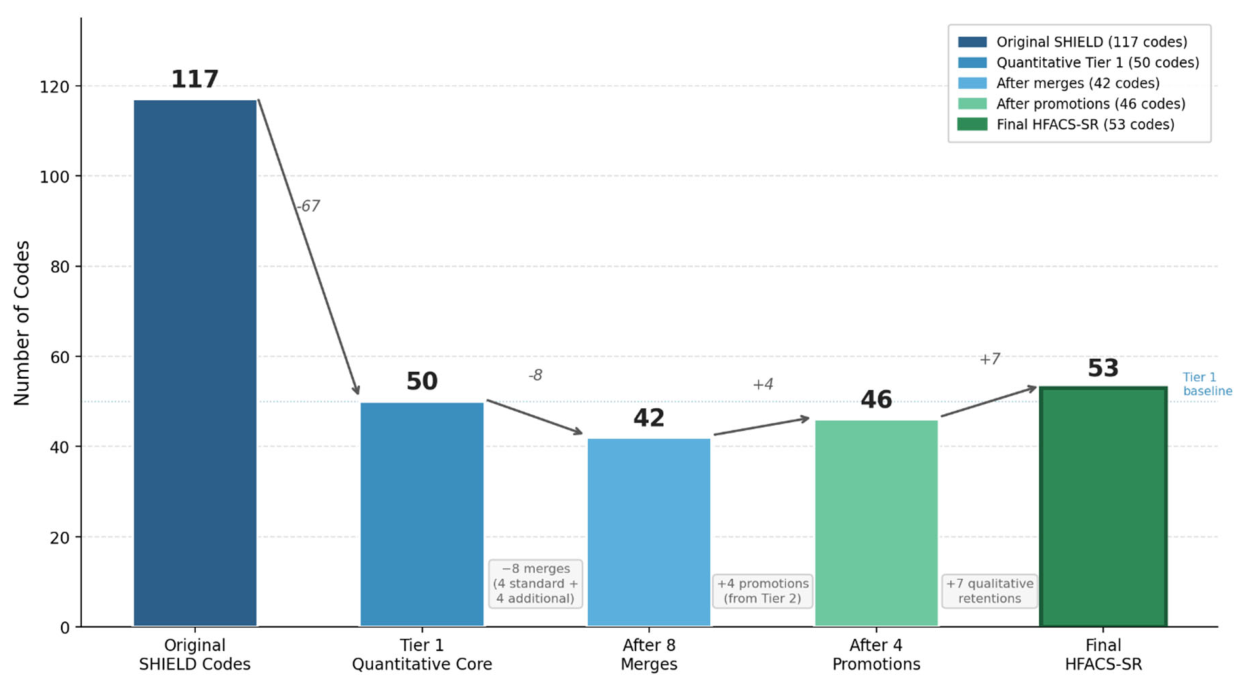
Figure 5.
Distribution of HFACS-SR Codes across Levels.
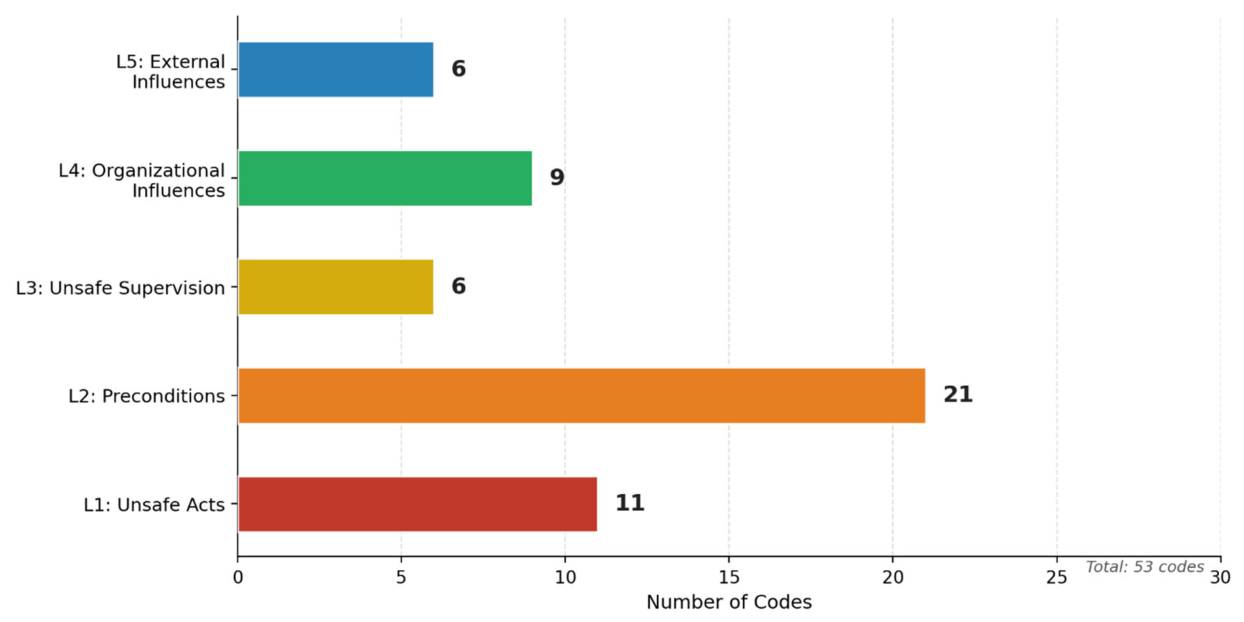
Figure 6.
Full HFACS-SR hierarchy diagram.
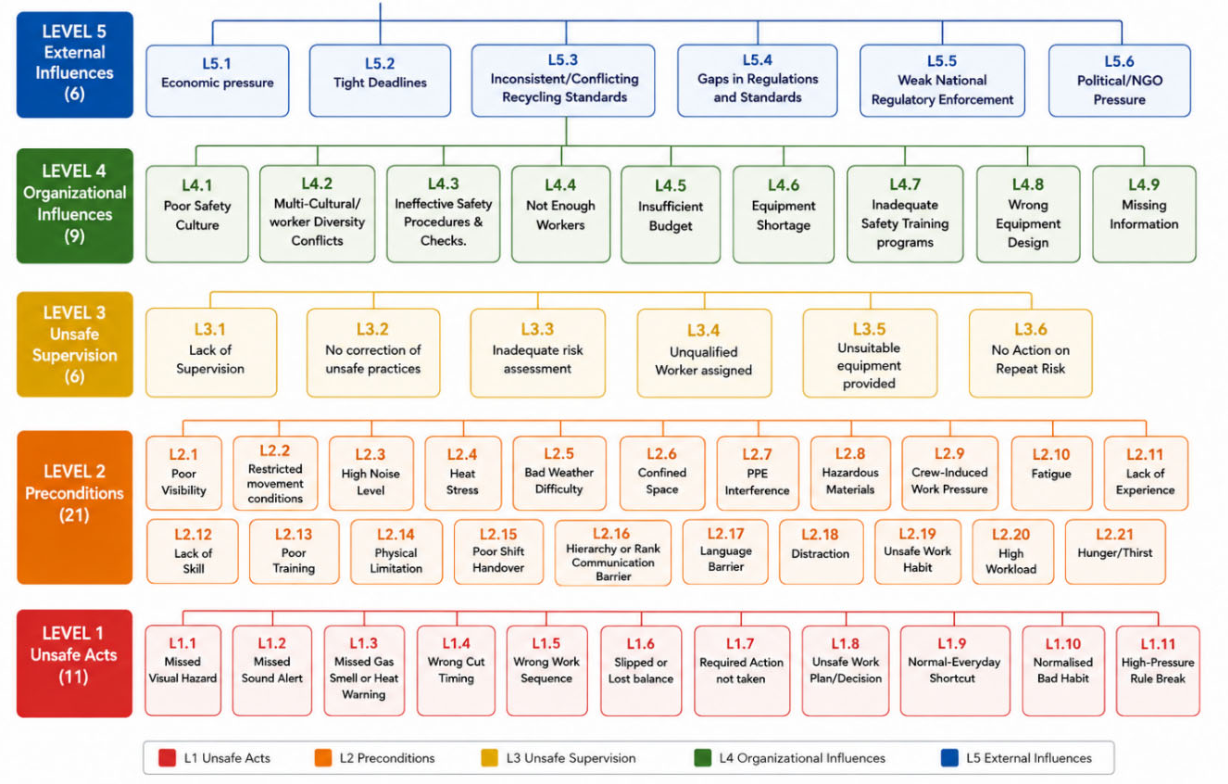
Table 1.
Lineage of HFACS-Derived Frameworks.
| Framework | Tiers | Categories/Codes | Domain | Key structural adaptation |
|---|---|---|---|---|
| HFACS (Shappell & Wiegmann, 2000) | 4 | ~19 categories | US military aviation | Original; operationalises Reason's Swiss cheese model |
| NASA-HFACS (NASA HFTF, 2016; Dillinger et al., 2024) | 4 (retained) | 21 → 19 (consolidated, 2022) | Aerospace/space operations | Adds "Space Environment" within the existing Preconditions tier; later neutralizes terminology |
| SHIELD (Stroeve et al., 2023, SAFEMODE) | 4 (mirrors NASA-HFACS) | 113 original + 4 added by present authors = 117 | Aviation & maritime safety occurrences | Integrates HERA cognitive granularity into the four tiers |
| HFACS-SR (this study) | 5 | 53 | Ship recycling | Adds a wholly new fifth tier (External Influences) |
Table 2.
Participant Background Summary.
| Participant | Years of Experience | Role Category | Country |
|---|---|---|---|
| P1 | 1–5 years | Safety Officer | India |
| P2 | 6–10 years | Academic (Naval Architecture/Human Factors) | UK |
| P3 | >10 years | Academic (Human Factors) | UK |
| P4 | >10 years | Safety Officer | Nigeria |
| P5 | 6–10 years | Safety Officer | Nigeria |
| P6 | 6–10 years | Safety Officer | Indonesia |
| P7 | >10 years | Academic/Technical Advisor (Ship Recycling) | India |
| P8 | 6–10 years | Academic (Naval Architecture/Ship Recycling) | UK |
| P9 | 6–10 years | Regulator | Nigeria |
| P10 | >10 years | Regulator | India |
| P11 | 6–10 years | Foreman (Supervisor) | Nigeria |
| P12 | 6–10 years | Foreman (Supervisor) | Nigeria |
| P13 | 6–10 years | Supervisor | Nigeria |
| P14 | >10 years | NGO Representative (Policy & Advocacy) | Belgium |
Table 5.
Top 20 Most Relevant Codes.
| Rank | Code | Mean | % Relevant | SD | Consensus |
|---|---|---|---|---|---|
| 1 | AI1 | 3.00 | 100% | 0.00 | Perfect |
| 1 | AI2 | 3.00 | 100% | 0.00 | Perfect |
| 1 | AI3 | 3.00 | 100% | 0.00 | Perfect |
| 1 | OR3 | 3.00 | 100% | 0.00 | Perfect |
| 1 | LT2 | 3.00 | 100% | 0.00 | Perfect |
| 1 | LT5 | 3.00 | 100% | 0.00 | Perfect |
| 1 | OC1 | 3.00 | 100% | 0.00 | Perfect |
| 1 | OE4 | 3.00 | 100% | 0.00 | Perfect |
| 1 | OE3 | 3.00 | 100% | 0.00 | Perfect |
| 1 | OR1 | 3.00 | 100% | 0.00 | Perfect |
| 1 | OR4 | 3.00 | 100% | 0.00 | Perfect |
| 1 | OR2 | 3.00 | 100% | 0.00 | Perfect |
| 1 | OS5 | 3.00 | 100% | 0.00 | Perfect |
| 14 | PPC2 | 2.86 | 85.7% | 0.36 | High |
| 14 | PEW3 | 2.86 | 85.7% | 0.36 | High |
| 14 | PCS4 | 2.86 | 85.7% | 0.36 | High |
| 14 | PCS1 | 2.86 | 85.7% | 0.36 | High |
| 14 | PCO1 | 2.86 | 85.7% | 0.36 | High |
| 14 | PCS3 | 2.86 | 85.7% | 0.36 | High |
| 14 | PCS2 | 2.86 | 85.7% | 0.36 | High |
Note: Thirteen codes achieved unanimous endorsement (100% Relevant, SD = 0.00), forming the incontestable core of HFACS-SR.
Table 6.
Bottom 20 Least Relevant Codes.
| Rank | Code | Mean | % Relevant | SD | Consensus |
|---|---|---|---|---|---|
| 117 | PER2 | 1.00 | 0% | 0.00 | Perfect |
| 116 | PER1 | 1.00 | 0% | 0.00 | Perfect |
| 115 | PPC5 | 1.00 | 0% | 0.00 | Perfect |
| 114 | PPC4 | 1.00 | 0% | 0.00 | Perfect |
| 113 | PAW5 | 1.00 | 0% | 0.00 | Perfect |
| 112 | PPF6 | 1.00 | 0% | 0.00 | Perfect |
| 111 | PPE9 | 1.00 | 0% | 0.00 | Perfect |
| 110 | PPE7 | 1.00 | 0% | 0.00 | Perfect |
| 109 | PTG5 | 1.00 | 0% | 0.00 | Perfect |
| 108 | LP2 | 1.07 | 0% | 0.27 | Very High |
| 107 | PDN2 | 1.07 | 0% | 0.27 | Very High |
| 106 | LP3 | 1.07 | 0% | 0.27 | Very High |
| 105 | PMW4 | 1.14 | 7.1% | 0.53 | Moderate |
| 104 | PMW3 | 1.14 | 7.1% | 0.53 | Moderate |
| 103 | PTG4 | 1.14 | 7.1% | 0.53 | Moderate |
| 102 | PTG6 | 1.14 | 7.1% | 0.53 | Moderate |
| 101 | PTG1 | 1.14 | 7.1% | 0.53 | Moderate |
| 100 | PTG3 | 1.14 | 7.1% | 0.53 | Moderate |
| 99 | PAW6 | 1.14 | 7.1% | 0.53 | Moderate |
| 98 | PER4 | 1.14 | 7.1% | 0.53 | Moderate |
Table 7.
Final HFACS-SR Core Framework (53 Codes).
| Level | Code ID | Original Code Title |
|---|---|---|
| L1: Unsafe Acts | AP1 | No/wrong/late visual detection |
| AP2 | No/wrong/late auditory detection | |
| AP4 | No/wrong/late detection with other senses | |
| AR1 | Timing error | |
| AR2 | Sequence error | |
| AR5 | Lack of physical coordination | |
| AR6 | No action executed | |
| AD1 | Incorrect decision or plan | |
| AI1 | Workaround in normal conditions | |
| AI2 | Routine workaround | |
| AI3 | Workaround in exceptional conditions | |
| L2: Preconditions | PPE1 | Vision affected by environment |
| PPE2 | Operator movement affected by environment | |
| PPE3 | Hearing affected by environment | |
| PPE5 | Heat or cold stress | |
| PPE6 | Operation more difficult due to weather/environment | |
| PEW3 | Workspace incompatible with operation | |
| PEW4 | PPE interference | |
| PEW6 | Fuels or materials | |
| PPF4 | Performance/peer pressure (merged with PPF7) | |
| PPC2 | Fatigue | |
| PCS1 | Inadequate experience | |
| PCS2 | Lack of proficiency | |
| PCS3 | Inadequate training or currency | |
| PCS4 | Physical coordination limitations | |
| PCO1 | Briefing or handover inadequate | |
| PCO2 | Inadequate communication due to rank (promoted) | |
| PCO3 | Language difficulties | |
| PAW3 | Distraction (merged with PAW4) | |
| PME3 | Negative habit | |
| PMW1 | High workload | |
| PDN3 | Inadequate nutrition/hydration (promoted) | |
| L3: Unsafe Supervision | LT1 | Inadequate leadership or supervision |
| LT2 | No correction of unsafe practices (absorbed LT5) | |
| LO1 | Inadequate risk assessment | |
| LO4 | Inadequate qualification for task | |
| LO6 | Inadequate equipment for task | |
| LP1 | No personnel measures against risky behaviour | |
| L4: Organizational Influences | OC1 | Safety culture |
| OC2 | Multi-cultural factors (promoted) | |
| OS3 | Safety risk assurance (merged with OS5) | |
| OR1 | Personnel | |
| OR2 | Budgets | |
| OR3 | Equipment/parts/material availability | |
| OR4 | Inadequate training programs | |
| OR5 | Poor design of equipment/procedures | |
| OR6 | Operational information | |
| L5: External Influences | OE3 | Economic pressure |
| OE4 | Tempo of operations | |
| EX1 | Inconsistent Recycling Standards | |
| EX2 | Regulatory and Standard Gaps | |
| EX3 | Weak National Regulatory Enforcement | |
| EX4 | Political and NGO Pressure (promoted) |
Disclaimer/Publisher’s Note: The statements, opinions and data contained in all publications are solely those of the individual author(s) and contributor(s) and not of MDPI and/or the editor(s). MDPI and/or the editor(s) disclaim responsibility for any injury to people or property resulting from any ideas, methods, instructions or products referred to in the content. |
© 2026 by the authors. Licensee MDPI, Basel, Switzerland. This article is an open access article distributed under the terms and conditions of the Creative Commons Attribution (CC BY) license (http://creativecommons.org/licenses/by/4.0/).
Copyright: This open access article is published under a Creative Commons CC BY 4.0 license, which permit the free download, distribution, and reuse, provided that the author and preprint are cited in any reuse.