

Submitted:
07 July 2026
Posted:
08 July 2026
You are already at the latest version
Abstract
Autism Spectrum Disorder (ASD) is a complex neurodevelopmental condition characterized by substantial etiological and clinical heterogeneity. MicroRNAs (miRNAs) are post-transcriptional regulators of gene expression that play critical roles in brain development. As such, a growing body of work suggests a role of miRNA dysregulation in several human pathologies of the brain, including ASD. However, existing evidence for ASD is dispersed across multiple tissues, heterogeneous study designs, and cohorts representing different geographic and ancestral backgrounds, limiting its utility for biomarker discovery and functional insights. Here, we present miR4ASD, a manually curated and open-access database of human miRNAs implicated in ASD, covering data from case-control studies of both gene expression and genetic variant analysis. This resource integrates structured data from peer-reviewed publications, including study methodology, tissue type, expression alteration (upregulated or downregulated), sample size, number of supporting studies and reported genetic variants within miRNA genes. To ensure objectivity and precision, only 59 studies meeting strict inclusion criteria were included. By providing a dynamic and accessible platform, miR4ASD enables systematic exploration of miRNA involvement in ASD and supports research in diagnostics, biomarker discovery, and systems biology. The database is publicly available on GitHub [https://github.com/miR4ASD].
Keywords:
ASD
; autism
; miRNA
; microRNA
; human
; open-source database
; miR4ASD
1. Introduction
Autism Spectrum Disorder (ASD) is a heritable neurodevelopmental disorder characterized by impairments in social communication and interactions, along with restrictive and repetitive behaviors [1,2]. Despite extensive genomic research data, the biological mechanisms underlying ASD remain incompletely understood, largely due to the disorder’s high phenotypic and genetic heterogeneity. While protein-coding mutations and structural variants have received considerable attention, non-coding RNAs, particularly microRNAs (miRNAs), are gaining recognition for their roles in neural development and neuropsychiatric conditions. MiRNAs are a class of small, non-coding RNAs that regulate gene expression by promoting mRNA degradation and/or translational repression [3]. They are estimated to regulate more than 60% of the human transcriptome, thereby contributing to fundamental biological processes, including neuronal differentiation, synapse formation, neurogenesis, and immune regulation [4,5].
Over the past decade, the interest in the role of miRNAs as potential biomarkers for ASD has intensified. Multiple studies have implicated specific miRNAs, reporting altered expression patterns in both central (e.g., post-mortem brain tissue) and peripheral (e.g., blood, saliva) biological samples [6,7]. However, these findings remain scattered across independent studies, differ in experimental design and methodology, highlighting the need for integration into a centralized resource with standardized miRNA nomenclature. Although narrative, scoping and systematic reviews have provided valuable syntheses of the field [8,9,10], they are inherently static and quickly become outdated, as they cannot be continuously updated with emerging evidence.
In contrast, existing databases on miRNA–disease associations, such as Human MicroRNA Disease Database (HMDD) [11], are very broad in scope and lack some ASD studies. Therefore, it is difficult to compare results across experiments or capture the full range of reported interconnections between a given miRNA and ASD. This limitation emphasizes the need for a specialized resource containing curated data from ASD–control studies, with standardized nomenclature based on the latest release of miRBase, the reference repository for miRNA sequences and annotation [12]. Such a resource can provide a dynamic and continuously evolving platform that integrates both expression studies and genetic variant data, offering a more comprehensive and up-to-date perspective of the contribution of miRNAs to ASD.
To address these gaps, we developed miR4ASD, a manually curated database based on the review of existing literature, which consolidates experimental evidence on human miRNAs associated with ASD. By compiling data from studies reporting miRNA expression and genetic variant analysis, miR4ASD offers a centralized resource to support future research in ASD diagnostics, biomarker discovery, therapeutics, and systems biology.
2. Materials and Methods
2.1. Strategy for Study Identification
The first step was to search for studies in PubMed, Scopus and Web of Science databases using keyword combinations related to “Autism Spectrum Disorder” and “MicroRNAs”. The literature search was conducted on March 12th, 2025, without date restriction. The complete database-specific search strategies and query strings are provided in Supplementary Table S1 to ensure transparency and reproducibility. We also cross-referenced relevant studies cited in previous reviews to ensure inclusion of all eligible publications.
2.2. Study Eligibility Criteria
To obtain a comprehensive compilation of miRNAs associated with ASD, specific criteria were defined to ensure the inclusion only of relevant, high-quality studies, as defined below. This strategy enabled the construction of a database that integrates gene expression and genetic variant data from case-control studies investigating human miRNAs in the context of ASD.
Eligible studies included peer-reviewed publications or dissertations published in English. The inclusion criteria were (a) children and adults with an ASD diagnosis according to the Diagnostic and Statistical Manual of Mental Disorders (DSM) or another validated instrument, including the Autism Diagnostic Observation Schedule (ADOS), the Autism Diagnostic Interview-Revised (ADI-R) and the Childhood Autism Rating Scale (CARS); (b) studies investigating miRNA profiling, gene expression, or genetic variants; (c) data generated using validated experimental methodologies; and (d) studies reporting statistically significant differences in miRNA expression or genetic variants between individuals with ASD and neurotypical controls. Participants with comorbidities were not excluded.
The following studies were excluded: (a) literature reviews; (b) book sections; (c) letters to the editor, (d) conference summaries, (e) hypothesis papers, (f) studies without case-control analysis, (g) duplicated data, and (h) non-human studies.
2.3. Data Extraction and Standardization
All eligible studies were manually reviewed for data extraction and categorized into two groups: ‘Expression studies’ and ‘Genetic and Other studies’.
For each publication included in the ‘Expression studies’ group, data were extracted into a standardized template including: first author, year of publication, tissue type(s), sample size(s), diagnostic criteria, assay methodology, country of origin, and lists of upregulated and downregulated miRNAs with statistically significant expression changes. Two publications used computational approaches based on expression data from case-control studies to identify ASD-associated miRNAs but did not report differential expression analyses. As these studies did not provide lists of differentially expressed miRNAs, they were curated separately and classified as ‘Bioinformatics’ within the ‘Genetic and Other Studies’ group.
Studies investigating genetic variants in miRNA genes were also included within the ‘Genetic and Other studies’ group. For each study, data were extracted into a separate standardized template including the study design, affected miRNA gene(s), sample size(s), country of origin, and type of genetic variant, namely single nucleotide variants (SNVs), copy number variants (CNVs), and single nucleotide polymorphisms (SNPs).
To ensure consistency and facilitate comparisons across studies published over nearly two decades, all reported miRNA identifiers, were manually harmonized to the current miRBase v22 [12] nomenclature, resolving historical naming inconsistencies across studies. Only statistically significant results reported in the original publications were included in the database. When inconsistencies in the direction of miRNA dysregulation were observed across studies, all reported findings were retained together with information on tissue type and experimental methodology, allowing users to assess reproducibility and potential sources of heterogeneity.
2.4. Database Implementation
The miR4ASD database is hosted on GitHub [https://mir4ASD.github.io/miR4ASD] under a Creative Commons Attribution-ShareAlike 4.0 International License. It was implemented as a static web application, developed using standard web technologies: HyperText Markup Language (HTML) for structure, Cascading Style Sheets (CSS) or styling, and JavaScript for interactive functionality. Data was stored in a JavaScript Object Notation (JSON) file that is dynamically loaded by the JavaScript table code. These technologies were chosen to enable efficient client-side rendering and interaction, while ensuring easy deployment and broad accessibility, as the application can be hosted on any static web server without backend infrastructure. Interactive tables with pagination and search functionalities were implemented using the DataTables.js library [https://datatables.net/].
All code is freely available on a GitHub repository [https://github.com/miR4ASD/miR4ASD/].
2.5. Database Structure: Filtering and Searching
The user interface displays data in three main categories: ‘About miR4ASD’, ‘Expression Studies’ and ‘Genetic & Other Studies’, organized in a tabbed layout.
The ‘About miR4ASD’ section provides an overview of the resource, including its objectives, curation methodology and general statistics summarizing the curated literature. The “Expression Studies” section contains publications reporting differential miRNA expression in ASD case-control studies, whereas the ‘Genetic & Other Studies’ section includes investigations reporting genetic variants in miRNA genes, as well as computational studies that identified ASD-associated miRNAs using expression-based approaches without performing conventional differential expression analyses. Both sections are presented as interactive tables, in which each entry represents a single miRNA, together with the curated evidence supporting its association with ASD. Expanding an entry reveals the manually curated detailed information extracted from the original studies, and includes direct links to the supporting publications. Hairpin and mature miRNA identifiers were cross-referenced with the human miRBase General Feature Format (GFF) annotation file and hyperlinked to their corresponding miRBase v22 entries (https://www.mirbase.org/download/hsa.gff3), providing access to standardized sequence and annotation information.
The platform allows users to search, filter, and download data to ensure accessibility and reproducibility. Multiple search functions are available, including a global search field that scans all entries for quick exploration, and column-specific filters that enable refined, targeted queries within individual datasets.
3. Results
3.1. Summary of Eligible Studies
After screening records identified across PubMed, Web of Science and Scopus databases, a total of 59 studies comparing individuals with ASD and neurotypical controls were included in miR4ASD (Supplementary Table S2). The studies were published between 2008 and 2025, and conducted across multiple countries, including Bulgaria, China, Egypt, France, Iran, Italy, Japan, Qatar, the United Kingdom (UK), and the United States of America (USA), with the USA contributing the highest number of publications.
Across all studies, ASD diagnoses were generally established using validated diagnostic instruments and/or criteria from the DSM, namely the 5th Edition (DSM-5), the 4th Edition Text Revision (DSM-IV-TR), or the 4th Edition (DSM-IV). Frequently used assessment tools included the ADI-R, the ADOS, and the CARS, either alone or in combination with DSM criteria. Three studies did not specify the diagnostic method, but ASD samples were obtained from brain tissue banks or publicly available ASD databases.
Of the 59 studies included, 50 were gene expression or miRNA profiling studies, 7 were genetic analyses, and 2 were bioinformatics studies (Supplementary Table S2). This distribution highlights that the current evidence on miRNAs in ASD is dominated by expression-based studies, whereas comparatively few investigations have explored genetic variation in miRNA genes.
Among expression studies, tissue sources were diverse, with the majority analyzing peripheral blood (n = 29), including serum, plasma, blood cells, exosomes, and whole blood. Other biospecimens included post-mortem brain tissue (n = 6), saliva (n = 6), lymphoblastoid cell lines (LCLs, n = 6), neural stem cells (NSC, n = 1), olfactory mucosal stem cells (OMSCs, n = 1), pineal glands (n = 1), and umbilical cord blood (n = 1), which reflects the methodological diversity of the field. In addition, two bioinformatics studies identified ASD-associated miRNAs using computational approaches based on expression data. These studies employed either a knowledge-guided bioinformatics framework for miRNA biomarker prioritization [13] or a saliva-based RNA classification algorithm for ASD diagnosis [14]. The genetic studies comprised analysis on CNVs (n = 3), SNVs (n = 2) and SNPs (n = 2).
3.2. Differentially Expressed miRNAs
In the 50 miRNA expression studies, a total of 384 mature miRNAs were reported as differentially expressed in individuals with ASD compared with neurotypical controls. Of these, 64 miRNAs were reported in three or more studies, and 134 miRNAs were identified in at least two independent studies. Table 1 presents the subset of mature miRNAs identified in at least three independent studies, organized by tissue type, to highlight both reproducible and tissue-specific patterns of dysregulation.
Several miRNAs demonstrated consistent dysregulation across multiple tissue types, whereas others displayed tissue-specific expression patterns. Among the most frequently replicated findings, hsa-miR-146a-5p stood out as the most consistently reported, identified as upregulated in nine independent studies across peripheral blood-derived samples, saliva, post-mortem brain tissue, LCLs, and OMSCs [15,16,17,18,19,20,21,22,23] (Figure 1). Other miRNAs consistently reported as upregulated in at least four independent studies spanning multiple tissue types included hsa-miR-107, hsa-miR-142-3p, hsa-miR-155-5p, hsa-miR-191-5p, and hsa-miR-223-3p (Table 1) [6,16,20,23,24,25,26,27,28,29,30]. In contrast, hsa-miR-92a-3p was the only miRNA consistently reported as downregulated in four independent studies, all of which analyzed peripheral blood-derived samples or LCLs [15,23,25,31].
In addition to these reproducible trends, 25 miRNAs exhibited inconsistent dysregulation, being reported as either upregulated or downregulated in four or more studies. Notably, hsa-miR-23a-3p and hsa-miR-7-5p were each reported as upregulated in five studies but downregulated in three studies across multiple tissue types [6,15,16,23,24,25,28,32,33,34,35,36] (Figure 1). Similarly, hsa-miR-106b-5p was reported as upregulated in six studies involving peripheral blood-derived samples, post-mortem brain tissue, and LCLs [21,26,32,33,37], but downregulated in a single study of LCLs [24]. Conversely, hsa-miR-320a-3p showed the opposite trend, being reported as downregulated in five studies involving peripheral blood-derived samples or LCLs [15,37,38,39,40], but upregulated in one study of post-mortem brain tissue [33] (Figure 1).
Overall, the curated studies revealed both reproducible and conflicting patterns of miRNA dysregulation across tissues and independent cohorts.
3.3. Genetic Variants and other Evidence for miRNA-ASD Associations
In addition to differential expression studies, miR4ASD also incorporates findings from nine studies that examined miRNA associations with ASD through either genetic or bioinformatics analyses [13,14,58,59,60,61,62,63,64]. Across these studies, 93 miRNA genes were associated with ASD in at least one publication. Of these, eight miRNA genes were independently identified in two genetic or bioinformatics studies (Table 2).
Overall, 29 unique miRNA genes were supported by evidence from at least two independent studies, either through multiple genetic or bioinformatics studies or through one such study together with replication in differential expression studies (Table 2). Of these, 24 miRNA genes were supported by differential expression in at least two independent expression studies, providing complementary evidence across different study designs (Table 2). Notably, twelve miRNA genes were independently identified in three or more studies spanning differential expression, genetic, and bioinformatics approaches, representing the strongest convergent evidence curated in miR4ASD (Figure 2, Table 2).
3.4. Data Visualization
The miR4ASD database is publicly available through a web interface designed to facilitate intuitive exploration of curated miRNA data. The homepage provides an overview of the resource, including its objectives, summary statistics, and access to the three main database sections: ‘About miR4ASD’, ‘Expression Studies’, and ‘Genetic & Other Studies’ (Figure 3).
The ‘Expression Studies’ section provides access to all curated miRNAs reported as differentially expressed in ASD case-control studies (Figure 4). Each row corresponds to a single mature miRNA and summarizes its overall expression profile, including the number of studies reporting increased or decreased expression, the overall evidence of dysregulation, and the corresponding precursor (hairpin) miRNA.
Users can search, filter, and sort the table according to individual columns, facilitating the identification of specific miRNAs or expression patterns. Expanding an entry displays the complete manually curated evidence, including tissue type, sample size, diagnostic criteria, country of origin, experimental methodology, expression direction, and direct links to the original publications. Hairpin and mature miRNA identifiers are hyperlinked to their corresponding miRBase entries, providing immediate access to standardized nomenclature and sequence annotation.
The ‘Genetic & Other Studies’ section provides access to miRNA genes associated with ASD through genetic analyses or expression-based bioinformatics approaches (Figure 5). Each row corresponds to a single miRNA gene and summarizes the available evidence, including the study type, the sample size and country of origin. Similar to the Expression Studies section, users can search, filter, and sort the table according to individual columns. Expanding an entry reveals the complete manually curated information extracted from the original publications, together with direct links to the corresponding articles.
This interface was designed to facilitate the identification and exploration of ASD-associated miRNAs across independent studies, enabling users to compare findings from different tissues, methodologies, populations, and study designs. By integrating these data into a standardized and searchable resource, miR4ASD supports transparency, reproducibility, and accessibility for the ASD research community.
4. Discussion
miR4ASD represents an important step toward integrating dispersed knowledge, concerning the involvement of miRNA in ASD etiology and pathophysiology, into a user-friendly and open-source format. By consolidating data from 59 studies, including expression profiling, genetic variants, and bioinformatics analyses, this resource provides an integrated platform that overcomes the fragmentation of the current literature. The database highlights both convergence and variability in reported findings. While hundreds of miRNAs have been associated to ASD, only a smaller subset shows reproducible associations across independent cohorts, biological tissues and study designs. By structuring these data and standardizing nomenclature, miR4ASD offers an accessible and evolving tool to guide biomarker discovery, mechanistic functional studies, and translational research in ASD.
The expression studies included in miR4ASD illustrate both the scope and limitations of current evidence on miRNA dysregulation in ASD. Several miRNAs emerged as reproducible candidates, with hsa-miR-146a-5p standing out as the most consistently upregulated across nine independent studies involving blood, saliva, post-mortem brain tissue, LCLs and OMSCs [15,16,17,18,19,20,21,22,23]. Notably, hsa-miR-146a-5p was identified as one of the informative RNA biomarkers incorporated into a quantitative salivary RNA-based classifier that accurately distinguished children with ASD from those with developmental delay or typical development [14]. Functional studies support a neurodevelopmental role for hsa-miR-146a-5p [18]. In human neural stem cells, miR-146a overexpression promoted neurite outgrowth and branching, and favored neuronal differentiation [18], while mouse studies showed that loss of miR-146a impairs neural progenitor differentiation, neurogenesis, neurite extension, and hippocampal-dependent memory [65]. Together, these findings strengthen the biological plausibility of hsa-miR-146a-5p as a recurrent ASD-associated miRNA, although direct ASD-specific functional validation remains limited.
At the same time, the database highlights miRNAs reported in multiple studies but with inconsistent directionality. For example, the hsa-miR-23a-3p and hsa-miR-7-5p were each described as upregulated in five different studies [6,15,16,23,24,25,28,32,35,36], yet they were found downregulated in three other studies, including the same tissue type [23,28,33,34,35]. Similarly, hsa-miR-106b-5p was consistently upregulated in blood, post-mortem brain tissue and LCLs in six studies [21,24,32,33,37,51], but reported as downregulated in only one older study [24]. Such inconsistencies may reflect true biological heterogeneity, such as tissue-specific regulation or biological diversity among cohorts. However, they may also arise from technical variability in experimental design and statistical analysis. This underlines the need for large-scale, standardized studies to clarify the direction and functional relevance of these candidate miRNAs.
Additionally, most studies identified hsa-miR-320a-3p as downregulated in peripheral blood-derived samples or LCLs [15,37,38,39,40], whereas one study reported increased expression in post-mortem brain tissue [33]. This apparent discrepancy likely reflects the influence of tissue-specific miRNA regulation, highlighting the importance of considering the biological source when interpreting expression data. Although the precise functional role of hsa-miR-320a-3p in ASD remains unclear, its recurrent identification across independent studies and biological specimens suggests that it represents a biologically relevant candidate. Indeed, recent systematic reviews have consistently recognized hsa-miR-320a-3p among the most frequently dysregulated miRNAs in ASD [10], supporting its potential as a biomarker while emphasizing the need for functional studies to clarify its role in neurodevelopment and disease pathogenesis.
Although some miRNAs displayed conflicting directions of dysregulation, their repeated identification across independent cohorts suggests that they are biologically relevant. Differences in tissue type, patient characteristics, analytical methods, and disease heterogeneity may influence the observed direction of expression, whereas recurrent identification across multiple studies highlights robust associations with ASD.
Beyond expression profiling, miR4ASD also integrates evidence from genetic studies and bioinformatics analyses, enabling complementary lines of evidence to be explored within a single resource. Notably, hsa-mir-1914 and hsa-mir-650 were independently implicated by both SNV [60] and CNV studies [58,59], suggesting that these miRNA genes may be affected through distinct classes of genetic variation. While functional evidence for these candidates is currently lacking, their recurrent identification across independent genetic approaches highlights them as promising targets for future experimental investigation. Despite these encouraging findings, the curated literature highlights that genetic studies focusing on miRNA genes in ASD remain scarce, generally involving relatively small cohorts and showing limited replication across independent datasets [60,64]. This gap limits our understanding of how genetic variation in miRNA genes contributes to ASD susceptibility and phenotypic heterogeneity. Expanding the analysis of miRNA genes in large sequencing cohorts will be essential to better connect genetic variation with altered miRNA expression and downstream molecular mechanisms.
Importantly, the integration of differential expression, genetic, and bioinformatics evidence enabled the identification of twelve miRNA genes consistently implicated across three or more independent studies. Among these, hsa-miR-195-5p is of particular interest because it directly regulates BDNF expression [66], a key mediator of neuronal development, synaptic plasticity, and cognitive function that has been extensively implicated in ASD [67]. Experimental evidence further supports an inverse relationship between miR-195 expression and BDNF protein levels, reinforcing the biological relevance of this regulatory interaction [68]. More broadly, the convergence of complementary evidence from independent study designs strengthens support for these high-confidence candidate miRNA genes and highlights the value of the miR4ASD database as a platform for prioritizing candidates for future functional characterization and biomarker research.
The current version of miR4ASD represents an initial step toward integrating diverse evidence on miRNAs in ASD. At this stage, the database primarily includes case-control studies, providing a solid foundation for comparative and exploratory analyses. Future updates will broaden its scope to incorporate studies comparing ASD with other neurodevelopmental disorders, associations between miRNA dysregulation and specific ASD phenotypes, and functional annotations linking miRNAs to their experimentally validated or predicted target genes, molecular pathways, and biological processes. These additions will enable a more comprehensive interpretation of the functional consequences of miRNA dysregulation and further strengthen miR4ASD as a resource for evidence integration, candidate prioritization, and ASD research.
Overall, this work highlights multiple lines of evidence supporting specific miRNAs as promising candidates for further investigation in ASD. Future efforts should focus on expanding genetic studies, incorporating larger and more diverse cohorts, and integrating miRNA data with complementary molecular layers, including transcriptomics, proteomics, and epigenomics, to better elucidate the role of miRNAs in ASD pathophysiology. By providing a standardized, curated, and continuously evolving resource, miR4ASD facilitates evidence integration, candidate prioritization, and reproducible research. Unlike narrative or systematic reviews, which become outdated as new studies emerge, miR4ASD can be continuously updated to incorporate new evidence, providing a dynamic platform to support future functional studies, biomarker research, and a deeper understanding of the molecular mechanisms underlying ASD.
Supplementary Materials
The following supporting information can be downloaded at: https://www.mdpi.com/article/doi/s1, Table S1: Specific query strings used to search in PubMed, Scopus and Web of Science databases, S2: List of the studies included in miR4ASD.
Author Contributions
For research articles with several authors, a short paragraph specifying their individual contributions must be provided. The following statements should be used “Conceptualization, A.R.M. and A.M.V.; methodology, A.R.M., H.M. and A.M.V.; investigation, A.R.M.; validation, A.R.M, H.M. and J.V.; data curation, A.R.M., H.M. and J.V.; software, H.M.; writing—original draft preparation, A.R.M.; writing—review and editing, A.M.V. and H.M.; supervision, A.M.V.; funding acquisition, A.M.V. All authors have read and agreed to the published version of the manuscript.”.
Funding
This research was supported by Fundação para a Ciência e a Tecnologia (FCT), Portugal: UID/04046/2025 - Biosystems and Integrative Sciences Institute Centre grants, PAC-POCI-01-0145-FEDER-016428 MEDPERSYST, and by National Institute of Health Doutor Ricardo Jorge. A.R.M. and J.V. were the recipients of BioSys PhD programme fellowship from FCT (Portugal) with references PD/BD/113773/2015, and PD/BD/131390/2017, respectively.
Institutional Review Board Statement
Not applicable.
Informed Consent Statement
Not applicable.
Data Availability Statement
The original contributions presented in this study are included in the article/supplementary material. Further inquiries can be directed to the corresponding author(s).
Conflicts of Interest
The authors declare no conflicts of interest. The funders had no role in the design of the study; in the collection, analyses, or interpretation of data; in the writing of the manuscript; or in the decision to publish the results.
References
- American Psychiatric Association. Diagnostic and Statistical Manual of Mental Disorders: DSM-5; DSM Library, 5th ed.; American Psychiatric Association Publishing, 2013; ISBN 978-0-89042-555-8. [Google Scholar]
- Lord, C.; Brugha, T.S.; Charman, T.; Cusack, J.; Dumas, G.; Frazier, T.; Jones, E.J.H.; Jones, R.M.; Pickles, A.; State, M.W.; et al. Autism Spectrum Disorder. Nat. Rev. Dis. Prim. 2020, 6, 5. [Google Scholar] [CrossRef]
- Bartel, D.P. Metazoan MicroRNAs. Cell 2018, 173, 20–51. [Google Scholar] [CrossRef] [PubMed]
- Friedman, R.C.; Farh, K.K.-H.; Burge, C.B.; Bartel, D.P. Most Mammalian mRNAs Are Conserved Targets of microRNAs. Genome Res. 2009, 19, 92–105. [Google Scholar] [CrossRef]
- Davis, G.M.; Haas, M.A.; Pocock, R. MicroRNAs: Not “Fine-Tuners” but Key Regulators of Neuronal Development and Function. Front Neurol. 2015, 6, 245. [Google Scholar] [CrossRef] [PubMed]
- Wu, Y.E.; Parikshak, N.N.; Belgard, T.G.; Geschwind, D.H. Genome-Wide, Integrative Analysis Implicates microRNA Dysregulation in Autism Spectrum Disorder. Nat. Neurosci. 2016, 19, 1463–1476. [Google Scholar] [CrossRef] [PubMed]
- Hicks, S.D.; Carpenter, R.L.; Wagner, K.E.; Pauley, R.; Barros, M.; Tierney-Aves, C.; Barns, S.; Greene, C.D.; Middleton, F.A. Saliva MicroRNA Differentiates Children With Autism From Peers With Typical and Atypical Development. J. Am. Acad. Child Adolesc. Psychiatry 2020, 59, 296–308. [Google Scholar] [CrossRef] [PubMed]
- Huang, Z.-X.; Chen, Y.; Guo, H.-R.; Chen, G.-F. Systematic Review and Bioinformatic Analysis of microRNA Expression in Autism Spectrum Disorder Identifies Pathways Associated with Cancer, Metabolism, Cell Signaling, and Cell Adhesion. Front. Psychiatry 2021, 12, 630876. [Google Scholar] [CrossRef] [PubMed]
- Stott, J.; Wright, T.; Holmes, J.; Wilson, J.; Griffiths-Jones, S.; Foster, D.; Wright, B. A Systematic Review of Non-Coding RNA Genes with Differential Expression Profiles Associated with Autism Spectrum Disorders. PLoS ONE 2023, 18, e0287131. [Google Scholar] [CrossRef] [PubMed]
- Garrido-Torres, N.; Guzmán-Torres, K.; García-Cerro, S.; Pinilla Bermúdez, G.; Cruz-Baquero, C.; Ochoa, H.; García-González, D.; Canal-Rivero, M.; Crespo-Facorro, B.; Ruiz-Veguilla, M. miRNAs as Biomarkers of Autism Spectrum Disorder: A Systematic Review and Meta-Analysis. Eur. Child Adolesc. Psychiatry 2024, 33, 2957–2990. [Google Scholar] [CrossRef] [PubMed]
- Cui, C.; Zhong, B.; Fan, R.; Cui, Q. HMDD v4.0: A Database for Experimentally Supported Human microRNA-Disease Associations. Nucleic Acids Res. 2024, 52, D1327–D1332. [Google Scholar] [CrossRef] [PubMed]
- Kozomara, A.; Birgaoanu, M.; Griffiths-Jones, S. miRBase: From microRNA Sequences to Function. Nucleic Acids Res. 2019, 47, D155–D162. [Google Scholar] [CrossRef] [PubMed]
- Shen, L.; Lin, Y.; Sun, Z.; Yuan, X.; Chen, L.; Shen, B. Knowledge-Guided Bioinformatics Model for Identifying Autism Spectrum Disorder Diagnostic MicroRNA Biomarkers. Sci. Rep. 2016, 6, 39663. [Google Scholar] [CrossRef] [PubMed]
- Hicks, S.D.; Rajan, A.T.; Wagner, K.E.; Barns, S.; Carpenter, R.L.; Middleton, F.A. Validation of a Salivary RNA Test for Childhood Autism Spectrum Disorder. Front Genet 2018, 9, 534. [Google Scholar] [CrossRef] [PubMed]
- Talebizadeh, Z.; Butler, M.G.; Theodoro, M.F. Feasibility and Relevance of Examining Lymphoblastoid Cell Lines to Study Role of microRNAs in Autism. Autism Res. 2008, 1, 240–250. [Google Scholar] [CrossRef] [PubMed]
- Mor, M.; Nardone, S.; Sams, D.S.; Elliott, E. Hypomethylation of miR-142 Promoter and Upregulation of microRNAs That Target the Oxytocin Receptor Gene in the Autism Prefrontal Cortex. Mol. Autism 2015, 6, 46. [Google Scholar] [CrossRef] [PubMed]
- Nguyen, L.S.; Lepleux, M.; Makhlouf, M.; Martin, C.; Fregeac, J.; Siquier-Pernet, K.; Philippe, A.; Feron, F.; Gepner, B.; Rougeulle, C.; et al. Profiling Olfactory Stem Cells from Living Patients Identifies miRNAs Relevant for Autism Pathophysiology. Mol. Autism 2016, 7, 1. [Google Scholar] [CrossRef] [PubMed]
- Nguyen, L.S.; Fregeac, J.; Bole-Feysot, C.; Cagnard, N.; Iyer, A.; Anink, J.; Aronica, E.; Alibeu, O.; Nitschke, P.; Colleaux, L. Role of miR-146a in Neural Stem Cell Differentiation and Neural Lineage Determination: Relevance for Neurodevelopmental Disorders. Mol. Autism 2018, 9, 38. [Google Scholar] [CrossRef] [PubMed]
- Ragusa, M.; Santagati, M.; Mirabella, F.; Lauretta, G.; Cirnigliaro, M.; Brex, D.; Barbagallo, C.; Domini, C.N.; Gulisano, M.; Barone, R.; et al. Potential Associations Among Alteration of Salivary miRNAs, Saliva Microbiome Structure, and Cognitive Impairments in Autistic Children. Int. J. Mol. Sci. 2020, 21, 6203. [Google Scholar] [CrossRef] [PubMed]
- Kalemaj, Z.; Marino, M.M.; Santini, A.C.; Tomaselli, G.; Auti, A.; Cagetti, M.G.; Borsello, T.; Costantino, A.; Inchingolo, F.; Boccellino, M.; et al. Salivary microRNA Profiling Dysregulation in Autism Spectrum Disorder: A Pilot Study. Front Neurosci. 2022, 16, 945278. [Google Scholar] [CrossRef] [PubMed]
- Abdelkarem, O.A.; Zaki, M.A.; Elwafa, R.A.; Elmaksoud, M.A.; El Banna, A. Evaluation of the Diagnostic Performance of Circulating microRNAs for the Diagnosis of Autism Spectrum Disorders. Alex. J. Pediatr. 2024, 37, 130–136. [Google Scholar] [CrossRef]
- Rahnama, M.; Abdul-Tehrani, H.; Mohammadi, M.R.; Mirzaie, M.; Jahandideh, P.; Memari, A. Expression Analysis of microRNAs as Candidate Biomarkers in Iranian Children with Autism Spectrum Disorder. J. Neurorestoratology 2024, 12, 100096. [Google Scholar] [CrossRef]
- Salloum-Asfar, S.; Ltaief, S.M.; Taha, R.Z.; Nour-Eldine, W.; Abdulla, S.A.; Al-Shammari, A.R. MicroRNA Profiling Identifies Age-Associated MicroRNAs and Potential Biomarkers for Early Diagnosis of Autism. Int. J. Mol. Sci. 2025, 26, 2044. [Google Scholar] [CrossRef] [PubMed]
- Sarachana, T.; Zhou, R.; Chen, G.; Manji, H.K.; Hu, V.W. Investigation of Post-Transcriptional Gene Regulatory Networks Associated with Autism Spectrum Disorders by microRNA Expression Profiling of Lymphoblastoid Cell Lines. Genome Med. 2010, 2, 23. [Google Scholar] [CrossRef] [PubMed]
- Gill, P.S.; Dweep, H.; Rose, S.; Wickramasinghe, P.J.; Vyas, K.K.; McCullough, S.; Porter-Gill, P.A.; Frye, R.E. Integrated microRNA–mRNA Expression Profiling Identifies Novel Targets and Networks Associated with Autism. J. Pers. Med. 2022, 12, 920. [Google Scholar] [CrossRef] [PubMed]
- Kichukova, T.M.; Popov, N.T.; Ivanov, I.S.; Vachev, T.I. Profiling of Circulating Serum MicroRNAs in Children with Autism Spectrum Disorder Using Stem-Loop qRT-PCR Assay. Folia Med. 2017, 59, 43–52. [Google Scholar] [CrossRef] [PubMed]
- Almehmadi, K.A.; Tsilioni, I.; Theoharides, T.C. Increased Expression of miR-155p5 in Amygdala of Children With Autism Spectrum Disorder. Autism Res. 2020, 13, 18–23. [Google Scholar] [CrossRef] [PubMed]
- Hicks, S.D.; Ignacio, C.; Gentile, K.; Middleton, F.A. Salivary miRNA Profiles Identify Children with Autism Spectrum Disorder, Correlate with Adaptive Behavior, and Implicate ASD Candidate Genes Involved in Neurodevelopment. BMC Pediatr. 2016, 16, 52. [Google Scholar] [CrossRef] [PubMed]
- Wang, Z.; Lu, T.; Li, X.; Jiang, M.; Jia, M.; Liu, J.; Zhang, D.; Li, J.; Wang, L. Altered Expression of Brain-Specific Autism-Associated miRNAs in the Han Chinese Population. Front Genet 2022, 13, 865881. [Google Scholar] [CrossRef] [PubMed]
- Bleazard, T. Investigating the Role of microRNAs in Autism. PhD Thesis, The University of Manchester, United Kingdom, 2018. [Google Scholar]
- Huang, F.; Long, Z.; Chen, Z.; Li, J.; Hu, Z.; Qiu, R.; Zhuang, W.; Tang, B.; Xia, K.; Jiang, H. Investigation of Gene Regulatory Networks Associated with Autism Spectrum Disorder Based on MiRNA Expression in China. PLoS ONE 2015, 10, e0129052. [Google Scholar] [CrossRef] [PubMed]
- Salloum-Asfar, S.; Elsayed, A.K.; Elhag, S.F.; Abdulla, S.A. Circulating Non-Coding RNAs as a Signature of Autism Spectrum Disorder Symptomatology. Int. J. Mol. Sci. 2021, 22, 6549. [Google Scholar] [CrossRef] [PubMed]
- Abu-Elneel, K.; Liu, T.; Gazzaniga, F.S.; Nishimura, Y.; Wall, D.P.; Geschwind, D.H.; Lao, K.; Kosik, K.S. Heterogeneous Dysregulation of microRNAs across the Autism Spectrum. Neurogenetics 2008, 9, 153–161. [Google Scholar] [CrossRef] [PubMed]
- Jyonouchi, H.; Geng, L.; Toruner, G.A.; Rose, S.; Bennuri, S.C.; Frye, R.E. Serum microRNAs in ASD: Association With Monocyte Cytokine Profiles and Mitochondrial Respiration. Front Psychiatry 2019, 10, 614. [Google Scholar] [CrossRef] [PubMed]
- Sehovic, E.; Spahic, L.; Smajlovic-Skenderagic, L.; Pistoljevic, N.; Dzanko, E.; Hajdarpasic, A. Identification of Developmental Disorders Including Autism Spectrum Disorder Using Salivary miRNAs in Children from Bosnia and Herzegovina. PLoS ONE 2020, 15, e0232351. [Google Scholar] [CrossRef] [PubMed]
- Zhang, Y.; Pang, Y.; Feng, W.; Jin, Y.; Chen, S.; Ding, S.; Wang, Z.; Zou, Y.; Li, Y.; Wang, T.; et al. miR-124 Regulates Early Isolation-Induced Social Abnormalities via Inhibiting Myelinogenesis in the Medial Prefrontal Cortex. Cell Mol. Life Sci. 2022, 79, 507. [Google Scholar] [CrossRef] [PubMed]
- Vasu, M.M.; Anitha, A.; Thanseem, I.; Suzuki, K.; Yamada, K.; Takahashi, T.; Wakuda, T.; Iwata, K.; Tsujii, M.; Sugiyama, T.; et al. Serum microRNA Profiles in Children with Autism. Mol. Autism 2014, 5, 40. [Google Scholar] [CrossRef] [PubMed]
- Frye, R.E.; Rose, S.; McCullough, S.; Bennuri, S.C.; Porter-Gill, P.A.; Dweep, H.; Gill, P.S. MicroRNA Expression Profiles in Autism Spectrum Disorder: Role for miR-181 in Immunomodulation. J. Pers. Med. 2021, 11, 922. [Google Scholar] [CrossRef] [PubMed]
- Cui, L.; Du, W.; Xu, N.; Dong, J.; Xia, B.; Ma, J.; Yan, R.; Wang, L.; Feng, F. Impact of microRNAs in Interaction with Environmental Factors on Autism Spectrum Disorder: An Exploratory Pilot Study. Front. Psychiatry 2021, 12, 715481. [Google Scholar] [CrossRef] [PubMed]
- Elsheikh, M.S.; Ashaat, E.A.; Ramadan, A.; Mohamed, N.H.; Elaraby, N.M.; El-Hariri, H.M.; Hashish, A.F.; Nashaat, N.H. Efficacy of Laser Acupuncture for Children With Autism Spectrum Disorder: Clinical, Molecular, and Biochemical Study. Pediatr. Neurol. 2023, 147, 44–51. [Google Scholar] [CrossRef] [PubMed]
- Seno, M.M.G.; Hu, P.; Gwadry, F.G.; Pinto, D.; Marshall, C.R.; Casallo, G.; Scherer, S.W. Gene and miRNA Expression Profiles in Autism Spectrum Disorders. Brain Res. 2011, 1380, 85–97. [Google Scholar] [CrossRef]
- Hosokawa, R.; Yoshino, Y.; Funahashi, Y.; Horiuchi, F.; Iga, J.; Ueno, S. MiR-15b-5p Expression in the Peripheral Blood: A Potential Diagnostic Biomarker of Autism Spectrum Disorder. Brain Sci. 2022, 13, 27. [Google Scholar] [CrossRef] [PubMed]
- Ozkul, Y.; Taheri, S.; Bayram, K.K.; Sener, E.F.; Mehmetbeyoglu, E.; Öztop, D.B.; Aybuga, F.; Tufan, E.; Bayram, A.; Dolu, N.; et al. A Heritable Profile of Six miRNAs in Autistic Patients and Mouse Models. Sci. Rep. 2020, 10, 9011. [Google Scholar] [CrossRef] [PubMed]
- Guiducci, L.; Cabiati, M.; Santocchi, E.; Prosperi, M.; Morales, M.A.; Muratori, F.; Randazzo, E.; Federico, G.; Calderoni, S.; Del Ry, S. Expression of miRNAs in Pre-Schoolers with Autism Spectrum Disorders Compared with Typically Developing Peers and Its Effects after Probiotic Supplementation. J. Clin. Med. 2023, 12, 7162. [Google Scholar] [CrossRef] [PubMed]
- Vaccaro, T. da S.; Sorrentino, J.M.; Salvador, S.; Veit, T.; Souza, D.O.; de Almeida, R.F. Alterations in the MicroRNA of the Blood of Autism Spectrum Disorder Patients: Effects on Epigenetic Regulation and Potential Biomarkers. Behav. Sci. 2018, 8. [Google Scholar] [CrossRef] [PubMed]
- Karagöz, H.; Akça, Ö.F.; Yıldırım, M.S.; Zamani, A.G.; Oflaz, M.B. Comparison of MicroRNA Levels of 18- 60-Month-Old Autistic Children with Those of Their Siblings and Controls. Clin. Psychopharmacol. Neurosci. 2024, 22, 322. [Google Scholar] [CrossRef] [PubMed]
- Zamil, B.M.; Ali-Labib, R.; Youssef, W.Y.; Khairy, E. Evaluation of miR-106a and ADARB1 in Autistic Children. Gene Rep. 2020, 18, 100586. [Google Scholar] [CrossRef]
- Cirnigliaro, M.; Barbagallo, C.; Gulisano, M.; Domini, C.N.; Barone, R.; Barbagallo, D.; Ragusa, M.; Di Pietro, C.; Rizzo, R.; Purrello, M. Expression and Regulatory Network Analysis of miR-140-3p, a New Potential Serum Biomarker for Autism Spectrum Disorder. Front. Mol. Neurosci. 2017, 10, 250. [Google Scholar] [CrossRef] [PubMed]
- Nakata, M.; Kimura, R.; Funabiki, Y.; Awaya, T.; Murai, T.; Hagiwara, M. MicroRNA Profiling in Adults with High-Functioning Autism Spectrum Disorder. Mol. Brain 2019, 12, 82. [Google Scholar] [CrossRef] [PubMed]
- Ali, S.J.T.; Khalaj-Kondori, M.; Feizi, M.A.H.; Haghi, M. Expression Levels of miR-124a, miR-545-3p and BDNF in the Peripheral Blood Mononuclear Cells Are Associated with the Severity of Autism. Rep. Biochem. Mol. Biol. 2024, 13, 1. [Google Scholar] [CrossRef]
- Kichukova, T.; Petrov, V.; Popov, N.; Minchev, D.; Naimov, S.; Minkov, I.; Vachev, T. Identification of Serum microRNA Signatures Associated with Autism Spectrum Disorder as Promising Candidate Biomarkers. Heliyon 2021, 7. [Google Scholar] [CrossRef] [PubMed]
- Popov, N.; Minchev, D.; Naydenov, M.; Minkov, I.; Vachev, T. Investigation of Circulating Serum MicroRNA-328-3p and MicroRNA-3135a Expression as Promising Novel Biomarkers for Autism Spectrum Disorder. Balk. J. Med. Genet 2018, 21, 5–12. [Google Scholar] [CrossRef] [PubMed]
- Pagan, C.; Goubran-Botros, H.; Delorme, R.; Benabou, M.; Lemière, N.; Murray, K.; Amsellem, F.; Callebert, J.; Chaste, P.; Jamain, S.; et al. Disruption of Melatonin Synthesis Is Associated with Impaired 14-3-3 and miR-451 Levels in Patients with Autism Spectrum Disorders. Sci. Rep. 2017, 7, 2096. [Google Scholar] [CrossRef] [PubMed]
- Li, Y.; Liu, C.; Jin, Q.; Yu, H.; Long, H. H19/miR-484 Axis Serves as a Candidate Biomarker Correlated with Autism Spectrum Disorder. Intl J. Devlp Neurosci. 2025, 85, e10403. [Google Scholar] [CrossRef] [PubMed]
- Popov, N.T.; Madjirova, N.P.; Minkov, I.N.; Vachev, T.I. Micro RNA HSA-486-3P Gene Expression Profiling in the Whole Blood of Patients with Autism. Biotechnol. Biotechnol. Equip. 2012, 26, 3385–3388. [Google Scholar] [CrossRef]
- Yu, D.; Jiao, X.; Cao, T.; Huang, F. Serum miRNA Expression Profiling Reveals miR-486-3p May Play a Significant Role in the Development of Autism by Targeting ARID1B. Neuroreport 2018, 29, 1431–1436. [Google Scholar] [CrossRef] [PubMed]
- Ander, B.P.; Barger, N.; Stamova, B.; Sharp, F.R.; Schumann, C.M. Atypical miRNA Expression in Temporal Cortex Associated with Dysregulation of Immune, Cell Cycle, and Other Pathways in Autism Spectrum Disorders. Mol. Autism 2015, 6, 37. [Google Scholar] [CrossRef] [PubMed]
- Vaishnavi, V.; Manikandan, M.; Tiwary, B.K.; Munirajan, A.K. Insights on the Functional Impact of microRNAs Present in Autism-Associated Copy Number Variants. PLoS ONE 2013, 8, e56781. [Google Scholar] [CrossRef] [PubMed]
- Marrale, M.; Albanese, N.N.; Calì, F.; Romano, V. Assessing the Impact of Copy Number Variants on miRNA Genes in Autism by Monte Carlo Simulation. PLoS ONE 2014, 9, e90947. [Google Scholar] [CrossRef] [PubMed]
- Toma, C.; Torrico, B.; Hervás, A.; Salgado, M.; Rueda, I.; Valdés-Mas, R.; Buitelaar, J.K.; Rommelse, N.; Franke, B.; Freitag, C.; et al. Common and Rare Variants of microRNA Genes in Autism Spectrum Disorders. World J. Biol. Psychiatry 2015, 16, 376–386. [Google Scholar] [CrossRef] [PubMed]
- 61. The AutismSpectrum Disorders Working Group of The Psychiatric Genomics Consortium Meta-Analysis of GWAS of over 16,000 Individuals with Autism Spectrum Disorder Highlights a Novel Locus at 10q24.32 and a Significant Overlap with Schizophrenia. Mol. Autism 2017, 8, 21. [CrossRef] [PubMed]
- Williams, S.M.; An, J.Y.; Edson, J.; Watts, M.; Murigneux, V.; Whitehouse, A.J.O.; Jackson, C.J.; Bellgrove, M.A.; Cristino, A.S.; Claudianos, C. An Integrative Analysis of Non-Coding Regulatory DNA Variations Associated with Autism Spectrum Disorder. Mol. Psychiatry 2019, 24, 1707–1719. [Google Scholar] [CrossRef] [PubMed]
- Wong, A.; Zhou, A.; Cao, X.; Mahaganapathy, V.; Azaro, M.; Gwin, C.; Wilson, S.; Buyske, S.; Bartlett, C.W.; Flax, J.F.; et al. MicroRNA and MicroRNA-Target Variants Associated with Autism Spectrum Disorder and Related Disorders. Genes 2022, 13, 1329. [Google Scholar] [CrossRef] [PubMed]
- Qiu, S.; Qiu, Y.; Li, Y.; Zhu, X.; Liu, Y.; Qiao, Y.; Cheng, Y.; Liu, Y. Nexus between Genome-Wide Copy Number Variations and Autism Spectrum Disorder in Northeast Han Chinese Population. BMC Psychiatry 2023, 23, 96. [Google Scholar] [CrossRef] [PubMed]
- Fregeac, J.; Moriceau, S.; Poli, A.; Nguyen, L.S.; Oury, F.; Colleaux, L. Loss of the Neurodevelopmental Disease-Associated Gene miR-146a Impairs Neural Progenitor Differentiation and Causes Learning and Memory Deficits. Mol. Autism 2020, 11, 22. [Google Scholar] [CrossRef] [PubMed]
- Mellios, N.; Huang, H.-S.; Grigorenko, A.; Rogaev, E.; Akbarian, S. A Set of Differentially Expressed miRNAs, Including miR-30a-5p, Act as Post-Transcriptional Inhibitors of BDNF in Prefrontal Cortex. Hum. Mol. Genet. 2008, 17, 3030–3042. [Google Scholar] [CrossRef] [PubMed]
- Saghazadeh, A.; Rezaei, N. Brain-Derived Neurotrophic Factor Levels in Autism: A Systematic Review and Meta-Analysis. J. Autism Dev. Disord. 2017, 47, 1018–1029. [Google Scholar] [CrossRef] [PubMed]
- Pan, S.; Feng, W.; Li, Y.; Huang, J.; Chen, S.; Cui, Y.; Tian, B.; Tan, S.; Wang, Z.; Yao, S.; et al. The microRNA-195 - BDNF Pathway and Cognitive Deficits in Schizophrenia Patients with Minimal Antipsychotic Medication Exposure. Transl. Psychiatry 2021, 11, 117. [Google Scholar] [CrossRef] [PubMed]
Figure 1.
Top 10 mature miRNAs most frequently reported in ASD expression studies. Mature miRNAs are ranked according to the number of independent publications reporting statistically significant differential expression in ASD case-control studies.
Figure 1.
Top 10 mature miRNAs most frequently reported in ASD expression studies. Mature miRNAs are ranked according to the number of independent publications reporting statistically significant differential expression in ASD case-control studies.
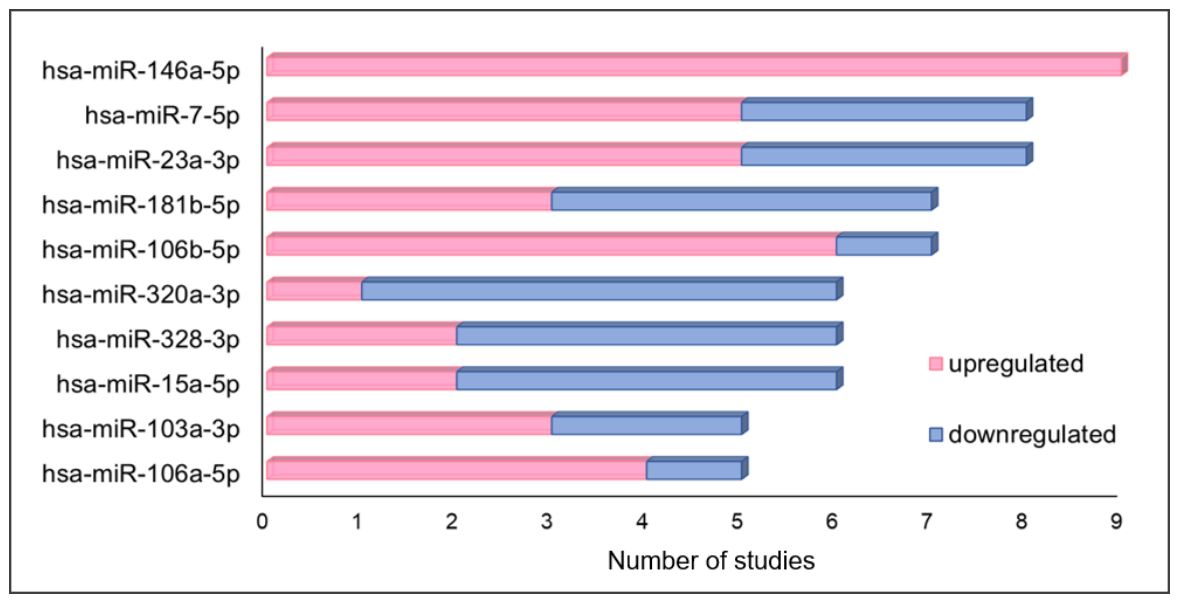
Figure 2.
miRNA genes curated in miR4ASD supported by complementary evidence from expression, genetic, and bioinformatics studies. The figure highlights the twelve miRNA genes identified across multiple study types, including differential expression studies, genetic analyses, and expression-based bioinformatics studies.
Figure 2.
miRNA genes curated in miR4ASD supported by complementary evidence from expression, genetic, and bioinformatics studies. The figure highlights the twelve miRNA genes identified across multiple study types, including differential expression studies, genetic analyses, and expression-based bioinformatics studies.
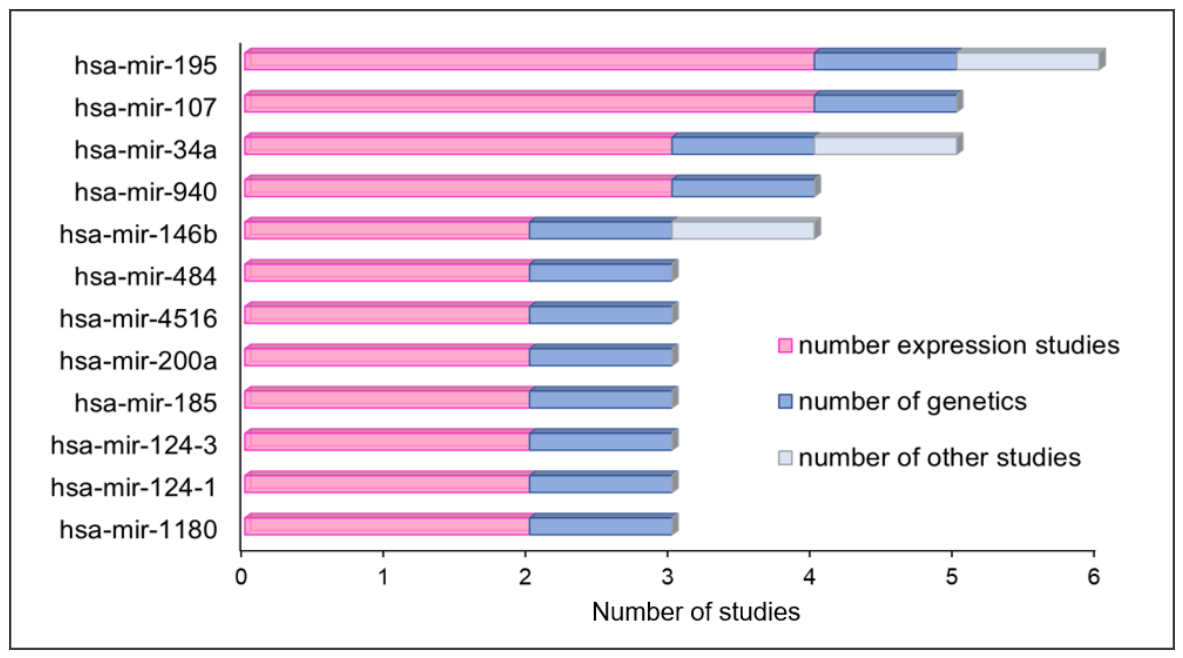
Figure 3.
miR4ASD homepage. Overview of the database, including its objectives, organization, and summary statistics. Navigation is organized into three main sections: ‘About miR4ASD’, ‘Expression Studies’, and ‘Genetic & Other Studies’.
Figure 3.
miR4ASD homepage. Overview of the database, including its objectives, organization, and summary statistics. Navigation is organized into three main sections: ‘About miR4ASD’, ‘Expression Studies’, and ‘Genetic & Other Studies’.
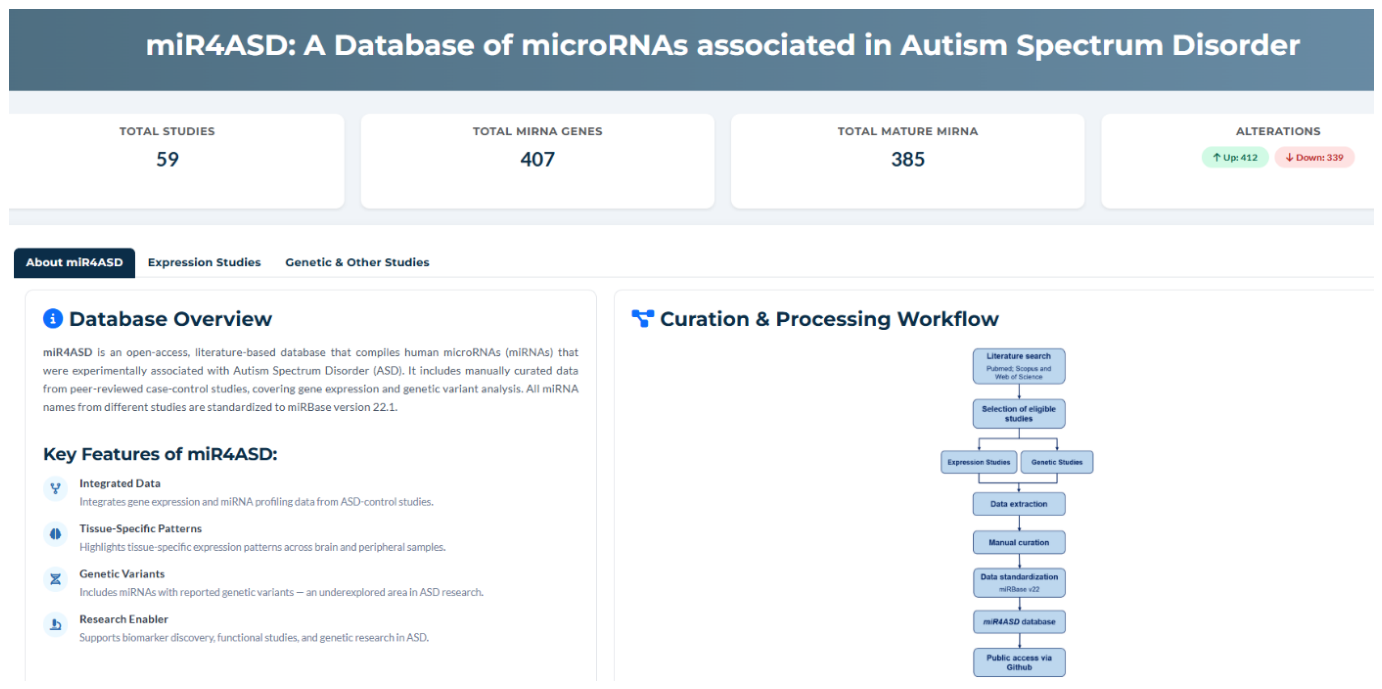
Figure 4.
Search and filtering functionalities of ‘Expression Studies’ section in miR4ASD. Each entry displays the precursor (hairpin) and mature miRNA identifiers (standardized according to miRBase v22), expression profile, and summary of the supporting evidence, allowing users to efficiently search, sort, and filter the curated dataset.
Figure 4.
Search and filtering functionalities of ‘Expression Studies’ section in miR4ASD. Each entry displays the precursor (hairpin) and mature miRNA identifiers (standardized according to miRBase v22), expression profile, and summary of the supporting evidence, allowing users to efficiently search, sort, and filter the curated dataset.
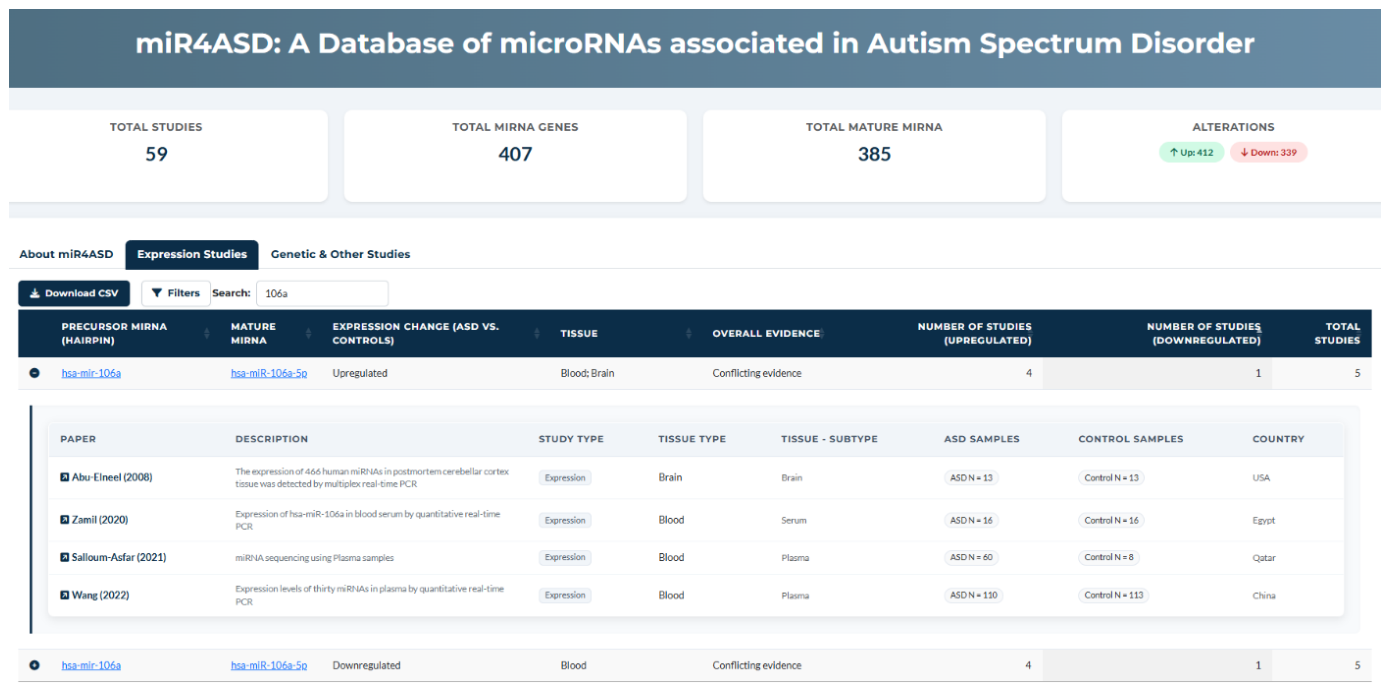
Figure 5.
Search and filtering functionalities of ‘Genetic & Other Studies’ section in miR4ASD. Each entry displays the precursor (hairpin) miRNA identifier, the type of variant reported, and the detailed information reporting the association with ASD. Users can search, sort, filter, and expand entries to access the complete manually curated information extracted from the original publications.
Figure 5.
Search and filtering functionalities of ‘Genetic & Other Studies’ section in miR4ASD. Each entry displays the precursor (hairpin) miRNA identifier, the type of variant reported, and the detailed information reporting the association with ASD. Users can search, sort, filter, and expand entries to access the complete manually curated information extracted from the original publications.
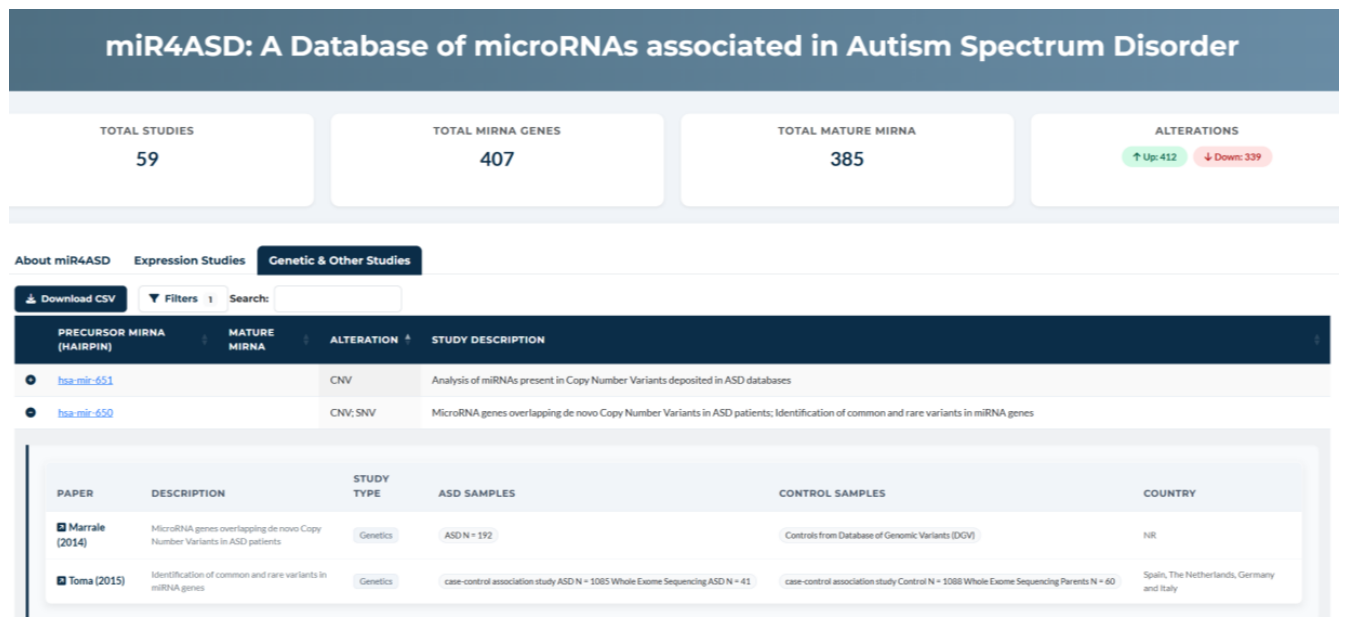

Table 1.
Mature miRNAs reported as differentially expressed in individuals with ASD in three or more independent studies, presented by tissue type. Each arrow represent one study trend. Legend: ↑ upregulated; ↓ downregulated; LCLs, Lymphoblastoid Cell Lines; OMSCs, Olfactory Mucosal Stem Cells. Mature miRNA name according miRBase v22.
Table 1.
Mature miRNAs reported as differentially expressed in individuals with ASD in three or more independent studies, presented by tissue type. Each arrow represent one study trend. Legend: ↑ upregulated; ↓ downregulated; LCLs, Lymphoblastoid Cell Lines; OMSCs, Olfactory Mucosal Stem Cells. Mature miRNA name according miRBase v22.
| Mature miRNA | Blood | Saliva | Brain | LCLs | OMSCs | Studies |
| hsa-let-7a-5p | ↓↓ | ↓ | ↑ | Mor (2015); Huang (2015); Gill (2022); Rahnama (2024) [16,22,25,31] | ||
| hsa-let-7b-5p | ↓↑ | ↓ | ↓ | Bleazard (2018); Ragusa (2020); Salloum-Asfar (2021); Salloum-Asfar (2025) [19,23,30,32] | ||
| hsa-miR-7-5p | ↑↓↓ | ↑↑ | ↑↓ | ↑ | Abu-Elneel (2008); Mor (2015); Hicks (2016); Jyonouchi (2019); Sehovic (2020); Gill (2022); Salloum-Asfar (2021); Salloum-Asfar (2025) [16,23,25,28,32,33,34,35] | |
| hsa-miR-10a-5p | ↓ | ↑ | ↑ | Seno (2011); Wu (2016); Salloum-Asfar (2025) [6,23,41] | ||
| hsa-miR-15a-5p | ↓↓↑↑ | ↓ | ↓ | Abu-Elneel (2008); Huang (2015); Kichukova (2017); Salloum-Asfar (2021); Gill (2022); Salloum-Asfar (2025) [23,25,26,31,32,33] |
||
| hsa-miR-15b-5p | ↑↑↓ | ↓ | ↓ | Abu-Elneel (2008); Huang (2015); Gill (2022); Hosokawa (2022); Salloum-Asfar (2025) [23,25,31,33,42] | ||
| hsa-miR-19a-3p | ↑↑↓ | ↑ | Mor (2015); Ozkul (2020); Salloum-Asfar (2021); Salloum-Asfar (2025) [16,23,32,43] | |||
| hsa-miR-19b-3p | ↑↑↑↓ | ↑ | Vasu (2014); Mor (2015); Huang (2015); Cui (2021); Salloum-Asfar (2025) [16,23,31,37,39] | |||
| hsa-miR-21-5p | ↓ | ↑ | ↑↓ | Abu-Elneel (2008); Mor (2015); Gill (2022); Guiducci (2023) [16,25,33,44] | ||
| hsa-miR-23b-3p | ↑ | ↑↑ | Talebizadeh (2008); Sarachana (2010); Salloum-Asfar (2025) [15,23,24] | |||
| hsa-miR-23a-3p | ↑↑ | ↓↓ | ↑↓ | ↑↑ | Abu-Elneel (2008); Talebizadeh (2008); Sarachana (2010); Wu (2016); Hicks (2016); Sehovic (2020); Zhang (2022); Salloum-Asfar (2025) [6,15,23,24,28,33,35,36] |
|
| hsa-miR-27a-3p | ↓↑ | ↓ | ↓ | Abu-Elneel (2008); Vasu (2014); Hicks (2016); Vaccaro (2018) [28,33,37,45] | ||
| hsa-miR-28-3p | ↓↓ | ↓ | Hicks (2020); Salloum-Asfar (2021); Karagoz (2024) [7,32,46] | |||
| hsa-miR-32-5p | ↓↓ | ↑ | Hicks (2016); Bleazard (2018); Sehovic (2020) [28,30,35] | |||
| hsa-miR-92a-3p | ↓↓ | ↓↓ | Talebizadeh (2008); Huang (2015); Gill (2022); Salloum-Asfar (2025) [15,23,25,31] | |||
| hsa-miR-96-5p | ↓↑ | ↓ | Kichukova (2017); Salloum-Asfar (2021); Kalemaj (2022) [20,26,32] | |||
| hsa-miR-99a-5p | ↓↓ | ↓ | Bleazard (2018); Salloum-Asfar (2021); Salloum-Asfar (2025) [23,30,32] | |||
| hsa-miR-103a-3p | ↓↓ | ↑ | ↑↑ | Sarachana (2010); Huang (2015); Wu (2016); Jyonouchi (2019); Gill (2022) [6,24,25,31,34] | ||
| hsa-miR-106a-5p | ↑↑↑↓ | ↑ | Abu-Elneel (2008); Zamil (2020); Salloum-Asfar (2021); Wang (2022); Karagoz (2024) [29,32,33,46,47] | |||
| hsa-miR-106b-5p | ↑↑↑↑ | ↑ | ↑↓ | Abu-Elneel (2008); Sarachana (2010); Vasu (2014); Kichukova (2017); Salloum-Asfar (2021); Abdelkarem (2024) [21,24,26,32,33,37] | ||
| hsa-miR-107 | ↑ | ↑ | ↑↑ | Sarachana (2010); Wu (2016); Gill (2022); Salloum-Asfar (2025) [6,23,24,25] |
||
| hsa-miR-125b-5p | ↑↑↓ | Seno (2011); Bleazard (2018); Gill (2022) [25,30,41] | ||||
| hsa-miR-127-3p | ↓↓ | ↑ | Hicks (2016); Salloum-Asfar (2021); Salloum-Asfar (2025) [23,28,32] | |||
| hsa-miR-132-3p | ↓ | ↓↑ | Abu-Elneel (2008); Talebizadeh (2008); Sarachana (2010) [15,24,33] |
|||
| hsa-miR-140-3p | ↑ | ↑↑↓ | Hicks (2016); Cirnigliaro (2017); Sehovic (2020); Kalemaj (2022) [20,28,35,48] | |||
| hsa-miR-142-3p | ↑↑ | ↑ | ↑ | Mor (2015); Kichukova (2017); Kalemaj (2022); Salloum-Asfar (2025) [16,20,23,26] | ||
| hsa-miR-142-5p | ↑ | ↑ | ↑ | Mor (2015); Kalemaj (2022); Salloum-Asfar (2025) [16,20,23] | ||
| hsa-miR-143-3p | ↓ | ↑ | ↑ | Wu (2016); Kalemaj (2022); Salloum-Asfar (2025) [6,20,23] | ||
| hsa-miR-144-3p | ↑↓ | ↑ | Mor (2015); Nakata (2019); Salloum-Asfar (2021) [16,32,49] | |||
| hsa-miR-145-5p | ↑↓ | ↑ | Kichukova (2017); Vaccaro (2018); Kalemaj (2022) [20,26,45] | |||
| hsa-miR-146a-5p | ↑↑↑ | ↑↑ | ↑↑ | ↑ | ↑ | Talebizadeh (2008); Mor (2015); Nguyen (2016); Nguyen (2018); Ragusa (2020); Kalemaj (2022); Abdelkarem (2024); Rahnama (2024); Salloum-Asfar (2025) [15,16,17,18,19,20,21,22,23] |
| hsa-miR-148b-3p | ↓ | ↓↑ | Abu-Elneel (2008); Sarachana (2010); Gill (2022) [24,25,33] | |||
| hsa-miR-150-5p | ↓ | ↑ | ↓ | Ozkul (2020); Gill (2022); Kalemaj (2022) [20,25,43] | ||
| hsa-miR-151a-3p | ↓↓↑ | ↓ | Vasu (2014); Hicks (2020); Wang (2022); Karagoz (2024) [7,29,37,46] |
|||
| hsa-miR-153-3p | ↓↑ | ↓ | Sarachana (2010); Zhang (2022); Ali (2024) [24,36,50] | |||
| hsa-miR-155-5p | ↑ | ↑↑↑ | Mor (2015); Wu (2016); Almehmadi (2020); Kalemaj (2022) [6,16,20,27] | |||
| hsa-miR-181a-5p | ↑↓ | ↑↓ | Seno (2011); Frye (2021); Wang (2022); Salloum-Asfar (2025) [23,29,38,41] | |||
| hsa-miR-181b-5p | ↓↓↓↑↑ | ↓↑ | Seno (2011); Vasu (2014); Frye (2021); Cui (2021); Wang (2022); Rahnama (2024); Salloum-Asfar (2025) [22,23,29,37,38,39,41] | |||
| hsa-miR-181d-5p | ↓ | ↑ | ↓ | Abu-Elneel (2008); Frye (2021); Salloum-Asfar (2025) [23,33,38] | ||
| hsa-miR-182-5p | ↓↑ | ↓ | Sarachana (2010); Salloum-Asfar (2021); Salloum-Asfar (2025) [23,24,32] |
|||
| hsa-miR-183-5p | ↓↓↑ | Kichukova (2017); Salloum-Asfar (2021); Salloum-Asfar (2025) [23,26,32] |
||||
| hsa-miR-191-5p | ↑ | ↑↑ | ↑ | Sarachana (2010); Hicks (2016); Wang (2022); Kalemaj (2022) [20,24,28,29] | ||
| hsa-miR-193a-5p | ↓↓ | ↓ | Vaccaro (2018); Jyonouchi (2019); Hicks (2020) [7,34,45] | |||
| hsa-miR-195-5p | ↑↑↓ | ↑ | Sarachana (2010); Vasu (2014); Huang (2015); Wang (2022) [24,29,31,37] | |||
| hsa-miR-197-5p | ↓↓↑ | Kichukova (2017); Kichukova (2021); Guiducci (2023) [26,44,51] | ||||
| hsa-miR-199a-5p | ↑↓ | ↑ | ↑ | Seno (2011); Wu (2016); Kichukova (2017); Vaccaro (2018) [6,26,41,45] |
||
| hsa-miR-199b-5p | ↑↓ | ↑ | ↑↓ | Sarachana (2010); Seno (2011); Salloum-Asfar (2021); Kalemaj (2022); Salloum-Asfar (2025) [20,23,24,32,41] | ||
| hsa-miR-221-3p | ↓ | ↑ | ↓ | Wu (2016); Nguyen (2016); Salloum-Asfar (2021) [6,17,32] | ||
| hsa-miR-223-3p | ↑ | ↑ | ↑ | ↑ | Wu (2016); Bleazard (2018); Kalemaj (2022); Salloum-Asfar (2025) [6,20,23,30] |
|
| hsa-miR-223-5p | ↑ | ↑ | ↑ | Bleazard (2018); Kalemaj (2022); Guiducci (2023) [20,30,44] | ||
| hsa-miR-320a-3p | ↓↓↓ | ↑ | ↓↓ | Abu-Elneel (2008); Talebizadeh (2008); Vasu (2014); Frye (2021); Cui (2021); Elsheikh (2023) [15,33,37,38,39,40] | ||
| hsa-miR-328-3p | ↑↑↓↓↓↓ | Vasu (2014); Kichukova (2017); Popov (2018); Nakata (2019); Salloum-Asfar (2021); Wang (2022) [26,29,32,37,49,52] | ||||
| hsa-miR-338-3p | ↑ | ↑ | ↑ | Seno (2011); Kalemaj (2022); Rahnama (2024) [20,22,41] | ||
| hsa-miR-424-5p | ↑↓ | ↑ | ↑ | Wu (2016); Kichukova (2017); Kichukova (2021); Kalemaj (2022) [6,20,26,51] | ||
| hsa-miR-451a | ↑↓ | ↓ | ↑ | ↑ | Sarachana (2010); Mor (2015); Huang (2015); Pagan (2017); Ragusa (2020) [16,19,24,31,53] |
|
| hsa-miR-484 | ↓↑ | ↓↑ | ↓ | Abu-Elneel (2008); Wu (2016); Gill (2022); Wang (2022); Li (2025) [6,25,29,33,54] | ||
| hsa-miR-486-3p | ↑↓↓ | ↑ | Seno (2011); Popov (2012); Kichukova (2017); Yu (2018) [26,41,55,56] | |||
| hsa-miR-500a-5p | ↓↓↓ | Kichukova (2017); Kichukova (2021); Guiducci (2023) [26,44,51] | ||||
| hsa-miR-628-5p | ↑↑↓ | Hicks (2016); Sehovic (2020); Kalemaj (2022) [20,28,35] | ||||
| hsa-miR-664a-3p | ↑↑ | ↑ | Ander (2015); Kichukova (2017); Kichukova (2021) [26,51,57] | |||
| hsa-miR-874-3p | ↑↓ | ↑ | Wu (2016); Nakata (2019); Salloum-Asfar (2021) [6,32,49] | |||
| hsa-miR-940 | ↓ | ↑ | ↓ | Huang (2015); Wu (2016); Gill (2022) [6,25,31] | ||
| hsa-miR-3613-5p | ↑↑ | ↑ | Bleazard (2018); Salloum-Asfar (2021); Salloum-Asfar (2025) [23,30,32] | |||
| hsa-miR-4742-3p | ↑↓ | ↓ | Ander (2015); Salloum-Asfar (2021); Salloum-Asfar (2025) [23,32,57] |
Table 2.
List of miRNA genes associated with ASD through genetic variant analyses or bioinformatics studies. This table includes miRNAs reported in at least two such studies, as well as miRNAs observed in one of these study types but also replicated in studies reporting differentially expressed miRNAs. Each entry specifies the miRNA gene, the study type: genetic variant (Genetics) or Bioinformatics and the supporting reference. Legend: ASDWGPGC, The Autism Spectrum Disorders Working Group of The Psychiatric Genomics Consortium; CNV, Copy Number Variant; SNV, Single Nucleotide Variant; SNP, Single Nucleotide Polymorphism; NR, Not Reported. Precursor (hairpin) and mature miRNA names according miRBase v22.
Table 2.
List of miRNA genes associated with ASD through genetic variant analyses or bioinformatics studies. This table includes miRNAs reported in at least two such studies, as well as miRNAs observed in one of these study types but also replicated in studies reporting differentially expressed miRNAs. Each entry specifies the miRNA gene, the study type: genetic variant (Genetics) or Bioinformatics and the supporting reference. Legend: ASDWGPGC, The Autism Spectrum Disorders Working Group of The Psychiatric Genomics Consortium; CNV, Copy Number Variant; SNV, Single Nucleotide Variant; SNP, Single Nucleotide Polymorphism; NR, Not Reported. Precursor (hairpin) and mature miRNA names according miRBase v22.
| Precursor miRNA | Mature miRNA | Study Type | Alteration | Study | Expression studies a |
| hsa-mir-34a | hsa-miR-34a-3p hsa-miR-34a-5p |
Genetics; Bioinformatics |
CNV; miRNA expression |
Vaishnavi (2013); Shen (2016) [13,58] |
3 studies |
| hsa-mir-96 | hsa-miR-96-5p | Bioinformatics | miRNA expression | Shen (2016) [13] | 3 studies |
| hsa-mir-106a | miR-106a-5p | Bioinformatics | miRNA expression | Hicks (2018) [14] | 5 studies |
| hsa-mir-106b | miR-106b-5p | Bioinformatics | miRNA expression | Shen (2016) [13] | 7 studies |
| hsa-mir-107 | Genetics | CNV | Qiu (2023) [64] | 4 studies | |
| hsa-mir-146a | hsa-miR-146a-3p hsa-miR-146a-5p |
Bioinformatics | miRNA expression | Hicks (2018) [14] | 9 studies |
| hsa-mir-146b | hsa-miR-146b-3p hsa-miR-146b-5p |
Genetics; Bioinformatics |
SNP; miRNA expression |
ASDWGPGC (2017); Hicks (2018) [14,61] |
2 studies |
| hsa-mir-185 | Genetics | CNV | Marrale (2014) [59] | 2 studies | |
| hsa-mir-186 | hsa-miR-186-5p | Bioinformatics | miRNA expression | Shen (2016) [13] | 2 studies |
| hsa-mir-195 | hsa-miR-195-5p | Genetics; Bioinformatics |
CNV; miRNA expression |
Vaishnavi (2013); Shen (2016) [13,58] |
4 studies |
| hsa-mir-200b | Genetics | CNV | Vaishnavi (2013); Marrale (2014) [58,59] |
NR | |
| hsa-mir-200a | Genetics | CNV | Marrale (2014) [59] | 2 studies | |
| hsa-mir-205 | hsa-miR-205-5p | Bioinformatics | miRNA expression | Shen (2016) [13] | 2 studies |
| hsa-mir-211 | hsa-miR-211-5p | Bioinformatics | miRNA expression | Shen (2016) [13] | 2 studies |
| hsa-mir-429 | Genetics | CNV | Vaishnavi (2013); Marrale (2014) [58,59] |
NR | |
| hsa-mir-484 | Genetics | CNV | Vaishnavi (2013) [58] | 2 studies | |
| hsa-mir-650 | Genetics | CNV; SNV | Marrale (2014); Toma (2015) [59,60] |
NR | |
| hsa-mir-940 | Genetics | CNV | Qiu (2023) [64] | 3 studies | |
| hsa-mir-1180 | Genetics | CNV | Vaishnavi (2013) [58] | 2 studies | |
| hsa-mir-1306 | Genetics | CNV | Vaishnavi (2013); Marrale (2014) [58,59] |
NR | |
| hsa-mir-1914 | Genetics | CNV; SNV | Vaishnavi (2013); Toma (2015) [58,60] |
NR | |
| hsa-mir-4516 | Genetics | CNV | Qiu (2023) [64] | 2 studies | |
| hsa-mir-124-1 | Genetics | CNV | Vaishnavi (2013) [58] | 2 studies | |
| hsa-mir-124-3 | Genetics | CNV | Vaishnavi (2013) [58] | 2 studies | |
| hsa-mir-181b-1 | hsa-miR-181b-5p | Bioinformatics | miRNA expression | Shen (2016) [13] | 7 studies |
| hsa-mir-181b-2 | hsa-miR-181b-5p | Bioinformatics | miRNA expression | Shen (2016) [13] | 7 studies |
| hsa-mir-193b | hsa-miR-193b-3p | Bioinformatics | miRNA expression | Shen (2016) [13] | 2 studies |
| hsa-mir-486-1 | hsa-miR-486-5p | Bioinformatics | miRNA expression | Shen (2016) [13] | 2 studies |
| hsa-mir-92a-2 | miR-92a-3p | Bioinformatics | miRNA expression | Hicks (2018) [14] | 4 studies |
a Number of expression studies reporting each miRNA as upregulated or downregulated.
Disclaimer/Publisher’s Note: The statements, opinions and data contained in all publications are solely those of the individual author(s) and contributor(s) and not of MDPI and/or the editor(s). MDPI and/or the editor(s) disclaim responsibility for any injury to people or property resulting from any ideas, methods, instructions or products referred to in the content. |
© 2026 by the authors. Licensee MDPI, Basel, Switzerland. This article is an open access article distributed under the terms and conditions of the Creative Commons Attribution (CC BY) license (http://creativecommons.org/licenses/by/4.0/).
Copyright: This open access article is published under a Creative Commons CC BY 4.0 license, which permit the free download, distribution, and reuse, provided that the author and preprint are cited in any reuse.


