
Submitted:
07 July 2026
Posted:
08 July 2026
You are already at the latest version
Abstract
Gibberellin (GA) signaling is central to plant growth and development, with DELLA proteins serving as key negative regulators of GA responses. In Arabidopsis thaliana, five DELLA proteins (GAI, RGA, RGL1, RGL2, RGL3) mediate growth restraint, stress adaptation, and developmental transitions through conserved DELLA and GRAS domains. Despite the agronomic importance of Persea americana (Hass avocado)—particularly its challenges of alternate bearing and slow development, both of which implicate GA signaling—DELLA genes in this species have not been characterized. Here, we report the identification of three DELLA genes in the Hass avocado genome (PaHa03g32170.1, PaHa02g42270.1, PaHa03g28350.1) through homology-based searches against the AvoBase reference genome. All three proteins contain the canonical DELLA_2 (SM01129) and GRAS (PS50985) conserved domains. Phylogenetic analysis places the avocado DELLA proteins as a monophyletic clade sister to Arabidopsis DELLA sequences, consistent with their orthologous origin. Reanalysis of published RNA-seq data from mesocarp tissue reveals that all three genes are highly expressed early in fruit development (150 days after set) and decline to less than half their initial expression by late maturation (390 days after set), suggesting a role for DELLA-mediated GA repression in early fruit growth. These findings provide a foundation for functional characterization of GA signaling in avocado and identify candidate genes for future transgenic and field studies.
Keywords:
Persea americana
; DELLA
; GRAS
; gibberellin signaling
; avocado fruit development
; transcription factors
1. Introduction
Gibberellins (GAs) are a class of diterpenoid phytohormones that regulate a broad spectrum of developmental processes, including seed germination, stem elongation, leaf expansion, flowering time, and fruit development (Davière & Achard, 2016). GA signaling operates through a derepression mechanism: in the absence of bioactive GA, DELLA proteins—named for a conserved N-terminal amino acid motif—accumulate in the nucleus and repress GA-responsive gene expression by interacting with transcriptional activators. Upon GA perception by the GID1 receptor, GID1–GA complexes bind DELLA proteins, promoting their ubiquitination via SCFSLY1/GID2 E3 ligase complexes and subsequent proteasomal degradation, thereby releasing transcriptional repression (Davière & Achard, 2016).
DELLA proteins belong to the GRAS family of plant-specific transcription factors, characterized by a conserved C-terminal GRAS domain and a variable N-terminal regulatory region. In Arabidopsis thaliana, five DELLA genes have been functionally characterized: GAI, RGA, RGL1, RGL2, and RGL3 (Zentella et al., 2007). Each performs partially redundant but distinct roles—RGA and GAI primarily regulate vegetative growth, while RGL1–RGL3 control floral development and seed germination (Zentella et al., 2007). GRAS domain proteins have since been identified across numerous plant species including rice, tomato, soybean, and multiple tree species, with genome-wide analyses consistently revealing conserved domain architecture alongside species-specific subfamily expansions (Jaiswal et al., 2022).
Persea americana (avocado), a member of the Lauraceae family, is among the world’s most economically significant fruit crops. Despite its importance, avocado production faces persistent challenges, including alternate bearing—a biennial pattern of high and low-yield years—and characteristically slow vegetative and reproductive development. GA signaling has been implicated in both phenomena: exogenous GA application influences avocado flowering, fruit set, and fruit size, and endogenous GA levels fluctuate during the fruit developmental cycle (Vergara-Pulgar et al., 2019). Given that DELLA proteins are the primary negative regulators of GA responses, characterizing avocado DELLA genes is a prerequisite for understanding the molecular basis of these agronomically relevant traits.
The recent publication of a haplotype-resolved, chromosomal-level Hass avocado genome assembly (Nath et al., 2022) now makes systematic genomic analysis of avocado gene families tractable. The AvoBase platform, which hosts this genome alongside curated gene annotations and expression data, provides an accessible resource for homology-based gene identification. However, no study has yet reported the identification or characterization of DELLA genes in P. americana. Here, we address this gap by identifying DELLA genes through BLASTP homology searches anchored to well-characterized Arabidopsis queries, confirming conserved domain architecture through multiple domain annotation platforms, constructing a phylogenetic framework, and profiling expression patterns during fruit development using published transcriptomic data.
2. Materials and Methods
2.1. Query Sequence Retrieval
Protein sequences for the five Arabidopsis thaliana DELLA genes (AtGAI, AT1G14920; AtRGA, AT2G01570; AtRGL1, AT1G66350; AtRGL2, AT3G03450; AtRGL3, AT5G17490) were retrieved from the NCBI Protein Database (https://www.ncbi.nlm.nih.gov/protein) using the accession numbers reported by Zentella et al. (2007). FASTA sequences were downloaded for use as BLASTP queries.
2.2. Candidate Gene Identification
Candidate DELLA genes in P. americana cv. Hass were identified by BLASTP search against the AvoBase genome database (https://www.avocado.uma.es; Nath et al., 2022) using the five Arabidopsis DELLA protein sequences as queries (Altschul et al., 1990). Default BLASTP parameters were applied with an E-value threshold of 1×10⁻⁵. BLASTP searches were also performed against the NCBI non-redundant protein database to verify coverage. Six NCBI hits (KAJ8637293.1, KAJ8646701.1, KAJ8637675.1, XXG56005.1, XXG55436.1, XXG51085.1) were retrieved and cross-referenced with AvoBase annotations. Three KAJ-prefixed sequences were confirmed to be identical (100% query identity) to AvoBase sequences PaHa03g28350.1, PaHa02g42270.1, and PaHa03g32170.1, respectively, as they derive from the same genome assembly (Nath et al., 2022). Three XXG-prefixed sequences shared >99% query identity with the corresponding AvoBase sequences and were treated as redundant gene model predictions. AvoBase identifiers were used for all subsequent analyses, as these represent the curated annotations from the primary genome study.
2.3. Conserved Domain and Motif Analysis
Conserved domain architecture was assessed using two complementary platforms. Protein sequences were submitted to InterProScan (https://www.ebi.ac.uk/interpro/; Jones et al., 2014) and the NCBI Conserved Domain Database (CDD; https://www.ncbi.nlm.nih.gov/Structure/cdd/wrpsb.cgi; Lu et al., 2020). De novo motif discovery was performed using MEME version 5 (http://meme-suite.org/; Bailey et al., 2015) with the following parameters: zero-or-one occurrence per sequence (ZOOPS) model, maximum of 10 motifs, minimum width of 6, maximum width of 50.
2.4. Multiple Sequence Alignment and Phylogenetic Analysis
Multiple sequence alignment of Arabidopsis and avocado DELLA protein sequences was performed using MUSCLE (Edgar, 2004) via the EMBL-EBI web interface (https://www.ebi.ac.uk/jdispatcher/msa/muscle). Phylogenetic reconstruction was carried out using the NGPhylogeny.fr platform (Lemoine et al., 2019) with the MAFFT (Katoh & Standley, 2013) alignment algorithm and PhyML (Guindon et al., 2010) maximum-likelihood tree inference. Bootstrap support was assessed with 1,000 replicates. The resulting tree was visualized and annotated using the Interactive Tree of Life (iTOL) v6 (Letunic & Bork, 2024).
2.5. Gene Expression Analysis
Expression profiles for PaHa03g28350.1, PaHa02g42270.1, and PaHa03g32170.1 were retrieved from AvoBase using the integrated gene expression viewer. Expression data were drawn from the RNA-seq time-series dataset of Vergara-Pulgar et al. (2019), which quantified transcript abundance (TPM) in biological replicates of avocado mesocarp tissue sampled at intervals from 150 to 390 days after fruit set.
2.6. Protein Interaction Network Analysis
Protein–protein interaction networks for Arabidopsis DELLA proteins were queried using STRING v12.0 (https://string-db.org/; Szklarczyk et al., 2023) with a minimum interaction confidence score of 0.7. Direct avocado DELLA protein interaction prediction was not feasible given the absence of P. americana proteome coverage in STRING v12.0. Interaction partners identified in Arabidopsis are reported as a reference framework for inferring candidate interactions in avocado based on conserved domain architecture.
3. Results
3.1. Identification of Three DELLA Genes in the Hass Avocado Genome
BLASTP searches against the AvoBase P. americana cv. Hass genome assembly identified three candidate DELLA sequences: PaHa03g32170.1, PaHa02g42270.1, and PaHa03g28350.1. All three returned significant hits to multiple Arabidopsis DELLA query sequences (E-value < 1×10−40), consistent with strong sequence conservation across the GRAS domain. Parallel BLASTP searches against the NCBI non-redundant protein database returned six sequences; cross-referencing confirmed these represent the same three gene loci with no additional unique candidates, supporting the completeness of the AvoBase-derived set for this search strategy.
3.2. Conserved Domain Architecture
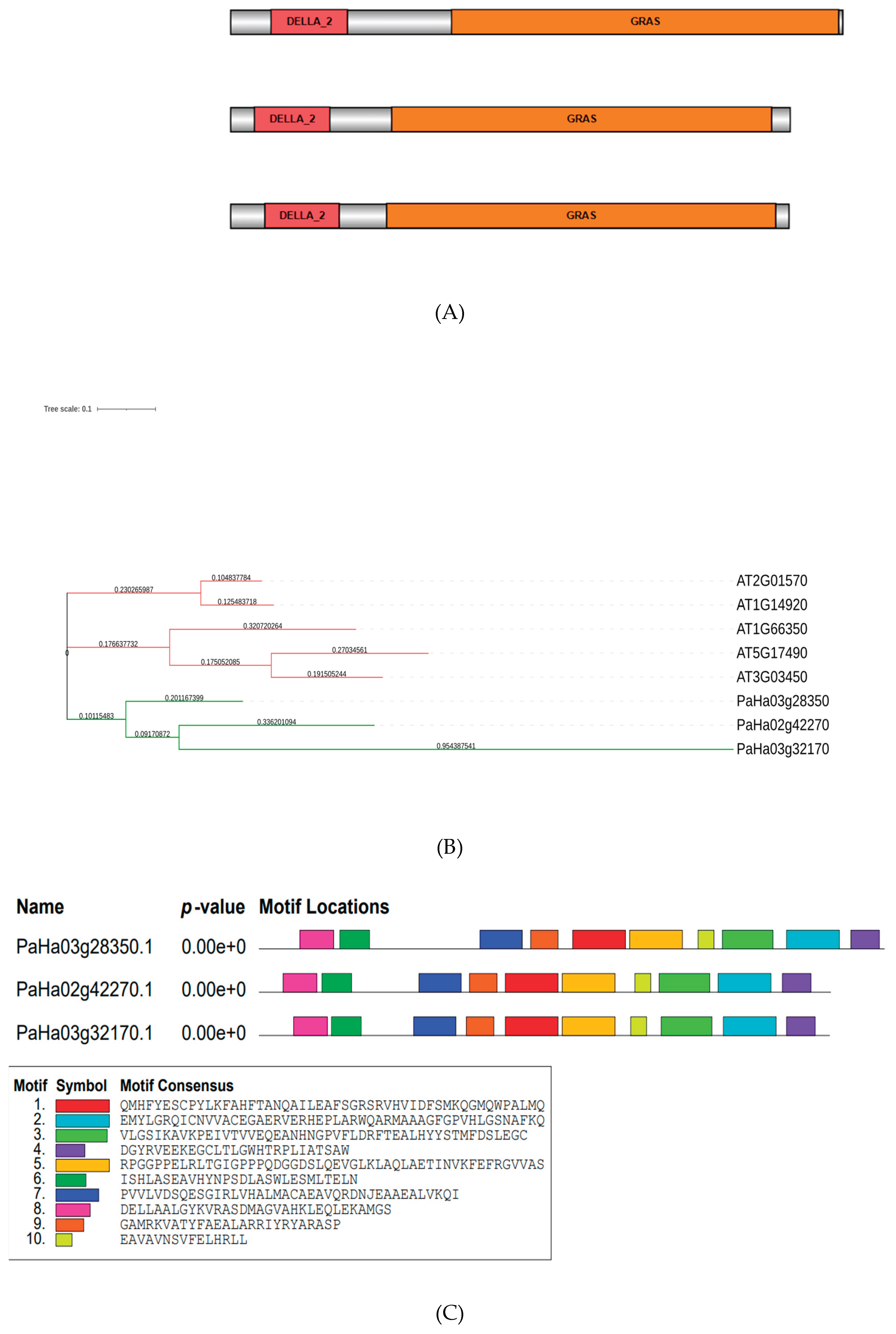
InterProScan and NCBI CDD analysis of all three avocado DELLA proteins identified the DELLA_2 domain (SM01129) and the GRAS superfamily domain (PS50985) in each sequence (Figure 1B). These two domains are the defining features of DELLA subfamily GRAS transcription factors: the N-terminal DELLA domain mediates GA-dependent interaction with GID1 receptors, while the C-terminal GRAS domain mediates transcriptional regulatory activity (Davière & Achard, 2016). The consistent presence of both domains across all three avocado sequences supports their classification as bona fide DELLA proteins. MEME motif analysis identified shared conserved motifs across the three avocado sequences and their Arabidopsis counterparts (Figure 1A), further confirming structural conservation within the family.
3.3. Phylogenetic Relationships
Maximum-likelihood phylogenetic reconstruction of the combined Arabidopsis and avocado DELLA sequences produced a well-supported topology (bootstrap values ≥ 70 at major nodes). The three avocado DELLA proteins formed a monophyletic clade with strong bootstrap support, distinct from the five Arabidopsis sequences (Figure 1D). This topology is consistent with the shared ancestry of DELLA genes prior to the divergence of Lauraceae and Brassicaceae lineages, and with the subsequent independent diversification of DELLA family members in each lineage. The avocado clade topology does not directly mirror the Arabidopsis subfamilies (GAI/RGA/RGL1/RGL2/RGL3), suggesting that avocado DELLA diversification followed a lineage-specific pattern rather than a one-to-one ortholog correspondence.
3.4. Expression Profiles During Fruit Development
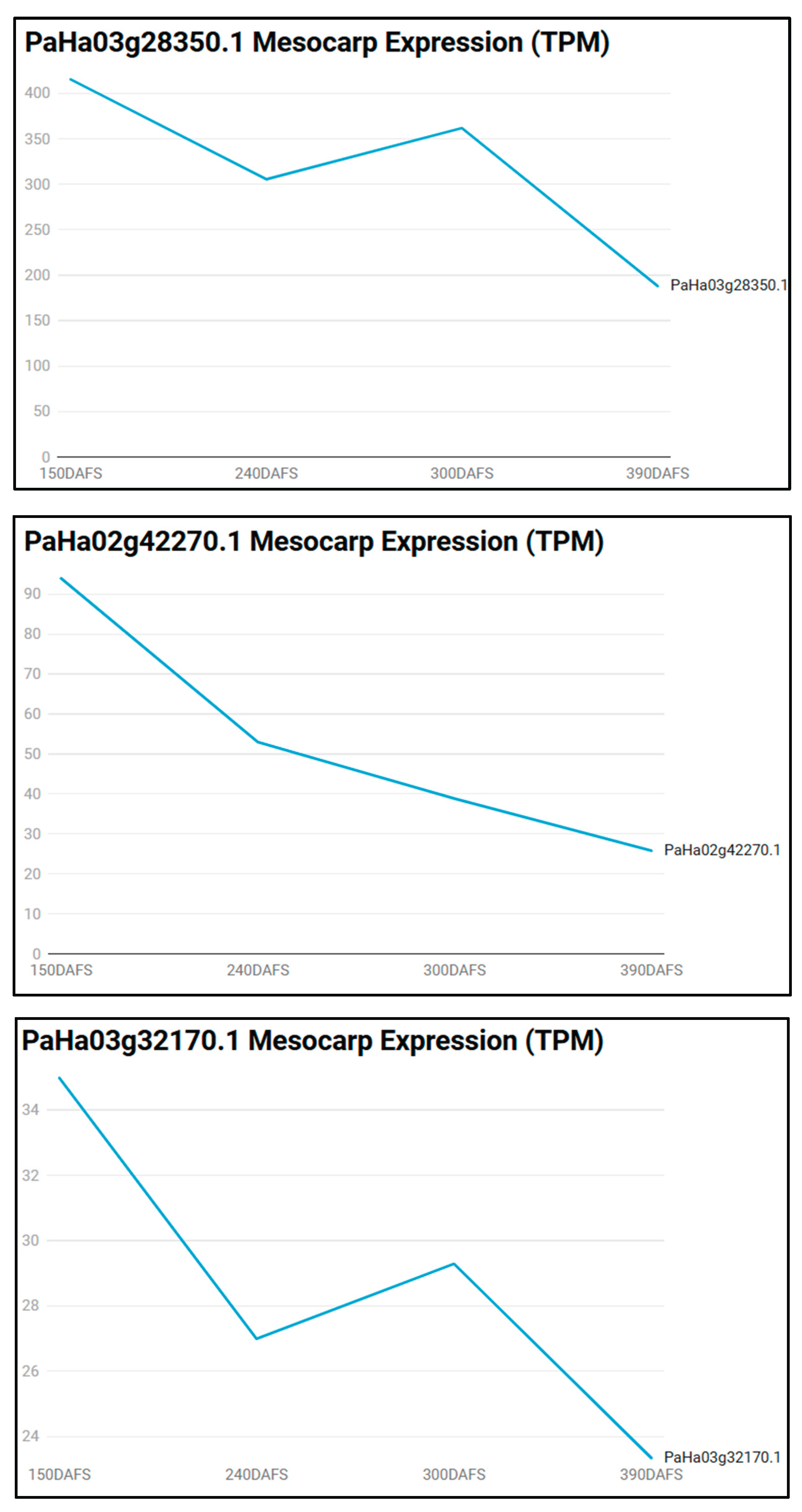
Reanalysis of published mesocarp RNA-seq data (Vergara-Pulgar et al., 2019) revealed that all three avocado DELLA genes are expressed throughout the fruit developmental time series, with a consistent temporal pattern (Figure 1C). Expression was highest at 150 days after set and declined progressively, reaching less than 50% of initial levels by 390 days after set. This pattern was concordant across all three genes, suggesting coordinate regulation. The decline in DELLA expression over the course of fruit maturation is consistent with a progressive increase in effective GA signaling during late fruit development, as GA-mediated DELLA degradation would reduce steady-state DELLA transcript accumulation through feedback mechanisms.
3.5. Predicted Protein Interactions Based on Arabidopsis Orthologs
STRING v12.0 interaction analysis of Arabidopsis DELLA proteins confirmed interactions with GA receptors GID1A, GID1B, and GID1C, the F-box protein SLY1 (GID2 ortholog), and the transcription factor PIF3 (Davière & Achard, 2016). Given the conservation of DELLA_2 and GRAS domains in the avocado sequences identified here, these interaction partners represent primary candidates for functional investigation in P. americana. Direct interaction prediction for avocado DELLA proteins was not possible, as P. americana is not currently covered in STRING v12.0.
4. Discussion
This study reports the first identification and preliminary characterization of DELLA genes in Persea americana cv. Hass, establishing a genomic foundation for investigating GA-mediated developmental regulation in avocado. The identification of three DELLA genes—compared to five in Arabidopsis, four in rice, and up to 20 in some polyploid species—is consistent with the relatively compact DELLA family sizes observed in other diploid species and is in line with the single-copy status of many GRAS subfamily members in Lauraceae (Jaiswal et al., 2022).
The expression dynamics we observe—high DELLA transcript levels at 150 days after set declining to less than half by 390 days—are biologically interpretable in the context of avocado fruit development. Early fruit development (roughly 100–200 days after set) is characterized by rapid cell division and initial cell expansion, phases in which GA signaling is typically suppressed by DELLA activity to allow coordinated growth control. The decline in DELLA expression in the mid-to-late developmental window (200–390 days) coincides with the onset of oil accumulation and ripening-associated processes in Hass avocado (Vergara-Pulgar et al., 2019), consistent with a progressive release of GA repression as the fruit matures. A similar pattern of decreasing DELLA expression during fruit maturation has been observed in tomato, where SlDELLA proteins modulate the GA-dependent transition from cell division to cell expansion during early fruit growth (Davière & Achard, 2016).
Several limitations of the current study should be noted. The gene identification strategy relies on BLASTP homology to Arabidopsis query sequences, which may fail to detect highly diverged DELLA family members. A complementary HMM-based genome-wide search using the GRAS Pfam domain (PF03514) would provide a more exhaustive inventory and should be pursued in future work. Additionally, the phylogenetic analysis presented here is limited to eight sequences; inclusion of DELLA sequences from additional Lauraceae species and other basal angiosperms would improve the resolution of ortholog relationships and support more robust conclusions about lineage-specific diversification. The expression data derive from a single published dataset and a single tissue type; broader expression profiling across tissues, developmental stages, and GA-treatment conditions would be needed to fully characterize the regulatory context of these genes.
Notwithstanding these limitations, the identification of three conserved DELLA genes in Hass avocado, combined with their expression dynamics during fruit development, provides actionable targets for functional studies. Candidate experiments include CRISPR-Cas9 knockout or overexpression of individual DELLA genes in avocado to assess effects on fruit size, alternate bearing behavior, and GA sensitivity. The coding sequences identified here—594, 543, and 542 amino acids for PaHa03g28350.1, PaHa02g42270.1, and PaHa03g32170.1, respectively—provide the sequence information required for construct design.
5. Conclusion
Three DELLA genes were identified in the Persea americana cv. Hass genome through homology-based searches anchored to Arabidopsis DELLA protein sequences. All three genes encode proteins with conserved DELLA_2 and GRAS domains and form a distinct monophyletic clade in phylogenetic analysis. Reanalysis of published mesocarp transcriptomic data reveals coordinately declining DELLA expression across fruit development, consistent with progressive GA derepression during avocado maturation. These results constitute the first genomic characterization of DELLA genes in avocado and provide a basis for future functional dissection of GA signaling in this agronomically important species.
Declaration of Generative AI in the Writing Process
During the preparation of this manuscript, the author utilized the artificial intelligence language model Claude (Anthropic) for the sole purpose of grammatical editing, structural formatting, and prose refinement to improve readability. All literature searches, data retrieval from AvoBase and NCBI, bioinformatics analyses, interpretation of results, and final scientific conclusions were performed and drafted independently by the author.
References
- Altschul, S. F., Gish, W., Miller, W., Myers, E. W., & Lipman, D. J. (1990). Basic local alignment search tool. Journal of Molecular Biology, 215(3), 403–410. [CrossRef]
- Bailey, T. L., Johnson, J., Grant, C. E., & Noble, W. S. (2015). The MEME Suite. Nucleic Acids Research, 43(W1), W39–W49. [CrossRef]
- Davière, J. M., & Achard, P. (2016). A pivotal role of DELLAs in regulating multiple hormone signals. Molecular Plant, 9(1), 10–20. [CrossRef]
- Edgar, R. C. (2004). MUSCLE: multiple sequence alignment with high accuracy and high throughput. Nucleic Acids Research, 32(5), 1792–1797. [CrossRef]
- Guindon, S., Dufayard, J. F., Lefort, V., Anisimova, M., Hordijk, W., & Gascuel, O. (2010). New algorithms and methods for estimating maximum-likelihood phylogenies: assessing the performance of PhyML 3.0. Systematic Biology, 59(3), 307–321. [CrossRef]
- IBS: an illustrator for the presentation and visualization of biological sequences. Wenzhong Liu, Yubin Xie, Jiyong Ma, Xiaotong Luo, Peng Nie, Zhixiang Zuo, Urs Lahrmann, Qi Zhao, Yueyuan Zheng, Yong Zhao, Yu Xue* and Jian Ren*. Bioinformatics (2015) 31(20):3359-3361.
- Jaiswal, V., Kakkar, M., Kumari, P., Zinta, G., Gahlaut, V., & Kumar, S. (2022). Multifaceted roles of GRAS transcription factors in growth and stress responses in plants. iScience, 25(9), 105026. [CrossRef]
- Jones, P., Binns, D., Chang, H. Y., Fraser, M., Li, W., McAnulla, C., McWilliam, H., Maslen, J., Mitchell, A., Nuka, G., Pesseat, S., Quinn, A. F., Sangrador-Vegas, A., Scheremetjew, M., Yong, S. Y., Lopez, R., & Hunter, S. (2014). InterProScan 5: genome-scale protein function classification. Bioinformatics, 30(9), 1236–1240. [CrossRef]
- Katoh, K., & Standley, D. M. (2013). MAFFT multiple sequence alignment software version 7: improvements in performance and usability. Molecular Biology and Evolution, 30(4), 772–780. [CrossRef]
- Lemoine, F., Correia, D., Lefort, V., Doppelt-Azeroual, O., Mareuil, F., Cohen-Boulakia, S., & Gascuel, O. (2019). NGPhylogeny.fr: new generation phylogenetic services for non-specialists. Nucleic Acids Research, 47(W1), W260–W265. [CrossRef]
- Letunic, I., & Bork, P. (2024). Interactive Tree of Life (iTOL) v6: recent updates to the phylogenetic tree display and annotation tool. Nucleic Acids Research, 52(W1), W78–W82. [CrossRef]
- Lu, S., Wang, J., Chitsaz, F., Derbyshire, M. K., Geer, R. C., Gonzales, N. R., Gwadz, M., Hurwitz, D. I., Marchler, G. H., Song, J. S., Thanki, N., Yamashita, R. A., Yang, M., Zhang, D., Zheng, C., Lanczycki, C. J., & Marchler-Bauer, A. (2020). CDD/SPARCLE: the conserved domain database in 2020. Nucleic Acids Research, 48(D1), D265–D268. [CrossRef]
- Nath, O., Fletcher, S. J., Hayward, A., Shaw, L. M., Masouleh, A. K., Furtado, A., Henry, R. J., & Mitter, N. (2022). A haplotype resolved chromosomal level avocado genome allows analysis of novel avocado genes. Horticulture Research, 9, uhac157. [CrossRef]
- Szklarczyk, D., Kirsch, R., Koutrouli, M., Nastou, K., Mehryary, F., Hachilif, R., Gable, A. L., Fang, T., Doncheva, N. T., Pyysalo, S., Bork, P., Jensen, L. J., & von Mering, C. (2023). The STRING database in 2023: protein–protein association networks and functional enrichment analyses for any of 14,000+ organisms. Nucleic Acids Research, 51(D1), D638–D646. [CrossRef]
- Vergara-Pulgar C, Rothkegel K, González-Agüero M, Pedreschi R, Campos-Vargas R, Defilippi BG, Meneses C. De novo assembly of Persea americana cv. ‘Hass’ transcriptome during fruit development. BMC Genomics. 2019 Feb 6;20(1):108. [CrossRef] [PubMed] [PubMed Central]
- Zentella, R., Zhang, Z. L., Park, M., Thomas, S. G., Endo, A., Murase, K., Fleet, C. M., Jikumaru, Y., Nambara, E., Kamiya, Y., & Sun, T. P. (2007). Global analysis of DELLA direct targets in early gibberellin signaling in Arabidopsis. The Plant Cell, 19(10), 3037–3057. [CrossRef]
Figure 1.
Characterization of DELLA proteins in Persea americana cv. Hass. (A) Domain architecture of the three avocado DELLA proteins as annotated by InterProScan and visualized using IBS 2.0. Red, DELLA_2 domain (SM01129); orange, GRAS superfamily domain (PS50985). Protein lengths are drawn to scale in amino acids. (B) Maximum-likelihood phylogenetic tree of avocado and Arabidopsis DELLA proteins inferred using MAFFT alignment and PhyML with 1,000 bootstrap replicates; support values ≥ 50 are shown at nodes. Green, P. americana sequences; red, A. thaliana sequences. Tree visualized using iTOL v6. Scale bar represents substitutions per site. (C) Conserved motif analysis of the three avocado DELLA protein sequences performed using MEME (v5.0.5). Colored blocks represent the 10 identified motifs; motif positions are shown relative to full-length protein sequence; motif consensus sequences are shown in the key below. (D) Expression profiles of the three avocado DELLA genes in mesocarp tissue across fruit development, derived from the RNA-seq dataset of Vergara-Pulgar et al. (2019). Y-axis shows transcript abundance in TPM (transcripts per million); x-axis shows timepoints in days after fruit set (DAFS). Y-axes are independently scaled across panels.
Figure 1.
Characterization of DELLA proteins in Persea americana cv. Hass. (A) Domain architecture of the three avocado DELLA proteins as annotated by InterProScan and visualized using IBS 2.0. Red, DELLA_2 domain (SM01129); orange, GRAS superfamily domain (PS50985). Protein lengths are drawn to scale in amino acids. (B) Maximum-likelihood phylogenetic tree of avocado and Arabidopsis DELLA proteins inferred using MAFFT alignment and PhyML with 1,000 bootstrap replicates; support values ≥ 50 are shown at nodes. Green, P. americana sequences; red, A. thaliana sequences. Tree visualized using iTOL v6. Scale bar represents substitutions per site. (C) Conserved motif analysis of the three avocado DELLA protein sequences performed using MEME (v5.0.5). Colored blocks represent the 10 identified motifs; motif positions are shown relative to full-length protein sequence; motif consensus sequences are shown in the key below. (D) Expression profiles of the three avocado DELLA genes in mesocarp tissue across fruit development, derived from the RNA-seq dataset of Vergara-Pulgar et al. (2019). Y-axis shows transcript abundance in TPM (transcripts per million); x-axis shows timepoints in days after fruit set (DAFS). Y-axes are independently scaled across panels.
Disclaimer/Publisher’s Note: The statements, opinions and data contained in all publications are solely those of the individual author(s) and contributor(s) and not of MDPI and/or the editor(s). MDPI and/or the editor(s) disclaim responsibility for any injury to people or property resulting from any ideas, methods, instructions or products referred to in the content. |
© 2026 by the authors. Licensee MDPI, Basel, Switzerland. This article is an open access article distributed under the terms and conditions of the Creative Commons Attribution (CC BY) license (http://creativecommons.org/licenses/by/4.0/).
Copyright: This open access article is published under a Creative Commons CC BY 4.0 license, which permit the free download, distribution, and reuse, provided that the author and preprint are cited in any reuse.


