

Submitted:
06 July 2026
Posted:
08 July 2026
You are already at the latest version
Abstract
The prevailing scientific consensus on the origin of primordial water on Earth identifies two main possibilities: the Interstellar Origin, where primordial water was sourced from external bodies, and the Common Origin, which suggests that water formed alongside the planet. This paper supports the idea that primordial water may have formed during Earth’s formation. Nevertheless, it proposes a scenario in which the interplay of the primordial multilayered atmosphere, the primordial planetesimal crust, and, most importantly, various chemical reactions contributed to the global cycles of chlorate and ammonia. Within these cycles, a series of thermodynamically favorable chemical reactions and the conditions under which they occur are examined and discussed to substantiate the development of Earth’s primordial saline ocean water and nitrogen-rich atmosphere.
Keywords:
origin of primordial water
; asteroid belt
; D/H ratio
; nitrogen-rich atmosphere
; ocean water salinity
1. Introduction
The literature provides an extensive account of the two prevailing hypotheses regarding the evolution of Earth’s primordial water. One of the most widely accepted hypotheses is the Interstellar Origin, which posits that water-rich C-type asteroids and comets collided with Earth, forming ocean worlds [1,2,3,4,5,6]. A key argument in the asteroid and comet collision hypothesis is the approximate match between the water D/H ratio and that of Earth’s oceans [2,4,5,6]. There is the giant-impact hypothesis, in which a Mars-sized planet (aka Theia) collided with Earth to form the Moon and brought water with it [6]. The second is the Common Origin hypothesis, which assumes that water was already present on Earth and incorporated during Earth's formation, then condensed into oceans [2,4,5,6,7], a view supported by the presence of water in primitive stable rocks such as basalt, zircons, and carbonaceous chondrites [8,9]. There are several serious points against the Interstellar Origin hypothesis. It is reasonable to assume that many asteroids have collided with Earth, but it isn't easy to estimate how many impacts are required to form the oceanic layer. Over the past 600 million years, approximately 1300 asteroids ranging in size from 1 to 5 km have struck Earth [10]. At this rate, over 4 billion years, Earth would have experienced fewer than 6000 impacts. Let’s assume an exponential drop in impacts; the overall number of asteroids hitting Earth would have reached ~ 1.5 million. Another exaggerated assumption is that all these celestial bodies are loaded with 5 km3 of ice. The water delivered to Earth would have been ~7.5 million km3. This is approximately twice the size of the Mediterranean Sea, but a tiny fraction of Earth’s water reservoir. The total volume of water on Earth is approximately 1.4 billion cubic km, according to the United States Geological Survey (USGS). The match in the D/H ratio between Earth’s oceans and asteroids is questionable because several factors enriched the oceans with heavy water [11]. Recent findings of crystallized water in primitive rocks have revealed that about 25% less heavy water was present in primordial water compared with normal water, challenging the D/H ratio hypothesis [11]. The constant salinity of the oceans, dominated by sodium chloride (NaCl), is hypothesized to be related to asteroid activity because asteroids such as Bennu (OSIRIS-REx), Ryugu (Hayabusa2), and Itokawa have yielded mixed sodium-salt deposits comprising chlorides, carbonates, sulfates, calcites, and phosphates [12,13]. However, there is no evidence in these papers pointing to the present salinity of Earth’s oceans. Finally, if the giant-impact hypothesis is correct, there must be an explanation of how water was initially formed on planet Theia, Jupiter’s Moon Europa, and Saturn’s Moon Enceladus. A recent article that used potassium-isotope evidence to support an asteroid or a giant impact raised more skepticism about such an occurrence. The chemical composition of the proto-earth is not that different from the present condition [14]. The Common Origin hypothesis posits that water was already present during the planet's formation. Whether floating icy rocks or water vapor [5], it poses many questions: How was this water formed? Is it a simple reaction of a vast amount of hydrogen and oxygen gases close to the terrestrial crust? How did it happen? Why did it happen on terrestrial planets like Earth and on moons like Europa and Enceladus?
2. Discussion
There are key points to consider for background analysis. First, Ocean water on planet Earth has a salt composition dominated by sodium Na+(0.469 mol/kg), chloride Cl-(0.546 mol/kg), Calcium Ca2+(0.0104 mol/kg), Magnesium Mg2+(0.0528 mol/kg), sulfates SO42-(0.0282 mol/kg) [15], and other salts at much lower concentrations. Second, Earth’s atmosphere is rich in Nitrogen gas (28%). Third, the widespread occurrence of chlorates and perchlorates on terrestrial planets [16,17]. Finally, the occurrence of icy crust on Jupiter’s and Saturn’s moons, Europa and Enceladus [12,13].
2.1. Thermodynamic Analysis
To work around the common-origin hypothesis, we will consider the proto-Earth state of the planetesimal disk, the early Hadean eon, before the assumed giant impact. Hence, chemical processes would have begun within the protoplanetary disk and in the evolving Hadean crust at temperatures ranging from 300 K to 500 K, as on cometary surfaces, according to published articles on the climate of Hadean Earth [18,19,20]. Authors describe the proto-Earth crust as a porous structure of cavities and vents, and the protoplanetary disk as a collection of loose terrestrial bodies [21,22]. Additionally, the proto-Earth magmatic plates and the protoplanetary disk would spew metals onto the surface in elemental form, ready to be oxidized by reactive gases such as oxygen, hydrogen, and chlorine [23]. Around the proto-Earth and its protoplanetary disk, the atmosphere at one point contained multiple corrugated gas layers that would have approached the proto-Earth’s surface under the influence of the proto-Earth’s gravity and gaseous kinetic motion, as shown in the schematic of Figure 1. Using first principles, by combining the Maxwell-Boltzmann molecular speed distribution function with Newtonian gravitational mechanics [24,25], we obtain the plots shown in Figure 2. With a peak maximum of chlorine at a scale of 10, the Pmax of Relative Population Distribution Rp(H2)max ~ 20% around 150 km, and decreases moving closer to proto-Earth's surface. The Rp(Cl2)max ~ 100%, Rp(O2)max ~ 70%, and Rp(NH3)max ~ 25% at distances less than 50 km [24,25].
From the plots, the heavier gases, such as oxygen (O2), chlorine (Cl2), nitrogen (N2), and ammonia (NH3), would have dominated layers ranging from 0 to 50 km, pushing lighter gases, mainly hydrogen (H2), into the outer sphere at distances ranging from 50 to 600 km. Initially, the concentration of heavier gases near the surface is significantly higher than that of H2 gas. When layers of oxygen O2, nitrogen N2, chlorine Cl2, and carbon dioxide CO2 gases started flowing close to the earth’s surface, molten and solidified metals of sodium Na and magnesium Mg were exposed to these gases to undergo multiple spontaneous reactions at a temperature range of 300 K to 500 K. In this analysis, we used the temperature-dependent Gibbs free energy change equation,
ΔG(T) = ΔH(T) – T.ΔS(T)
Eq. (1) was used to determine whether a chemical reaction is favorable over a wider temperature range (300-500 K) in the early Hadean environment [18,19]. A negative ΔG within the temperature range 300 K to 500 K indicates a favorable chemical reaction and that the process is spontaneous. Thermodynamic data, such as the standard free energy of formation ΔG°, enthalpy of formation ΔH°, entropy ΔS°, and heat capacity Cp for the chemicals involved in the chemical reactions discussed in this paper, can be found in chemistry book indices and reference books, such as the CRC Handbook of Chemistry and Physics [24].
Values of ΔG, ΔH, and ΔS at temperatures higher than the standard temperature T = 298 K were obtained from the thermodynamic equations:
ΔHm(MX,Th) = ΔHm(MX,Ts) + ΔCp,m(Th – Ts)
ΔSm(MX,Th) = ΔSm(MX,Ts) + Cp,m ln(Th / Ts)
ΔHm(MX,Th) is the molar enthalpy change at a higher temperature Th of the chemical MX, ΔCp,m is the molar heat capacity change, and Sm(MX,Th) is the molar entropy at a higher temperature Th of the chemical MX [24].
The approaching corrugated gas layers that impact the solid surfaces would enable multiple reactions. Chlorine gas (MW 71 g/mol) is much heavier and tends to form plumes instead of spreading quickly like lighter gases. A likely scenario is that the dominant O2, N2, and CO2 gases diluted the chlorine plumes. Consequently, the direct reaction of chlorine gas with alkali and alkaline earth metals is less likely in an environment rich in oxygen gas. This led to the formation of the dominant metallic oxides, followed by metal chlorides, and then the chlorates. The Gibbs’ free energy ΔG(kJ/mol) favors spontaneous reactions Table 1.
The above reactions would compete with another set of thermodynamically allowed reactions in which O2(g) and Cl2(g) react with sodium, magnesium, and calcium metals in a concerted process to form a family of metal chlorates MClOx, Table 2.
Moreover, alkali metal oxides would have reacted with O2(g) and Cl2(g) gases in thermodynamically favored reactions. The most dominant of these are reactions between the abundant sodium oxides and chlorine gas, as shown in Table 3. However, the reactions of alkaline earth metal oxides MgO and CaO are not spontaneous (i.e., ΔG > 0). The occurrence of these reactions at an early stage would have substantially depleted both oxygen and chlorine in the primordial atmosphere. The formation of all sodium chlorate forms is essential to the water-forming process [16,17].
It can be used in aqueous media to produce ammonium chlorate, chloramine, and recycled ammonia gas. It is noteworthy that multiple Martian rovers have already identified perchlorate salts on Mars [16,17,26,27]. The eventual decomposition of chloramines enriched Earth’s atmosphere with free nitrogen gas. When the hydrogen outer layer moved closer to the proto-Earth’s surface, the concentration of H2 gas became high enough to allow forward reactions governed by Le Chatelier’s principle [24,28]. In this regard, we need to visualize the primordial proto-Earth’s crust as a sponge that allowed gases to permeate temporary fluidic cavities and porous bodies [21,22]. The entrapment of nitrogen and hydrogen would have allowed catalytic spontaneous reactions to form ammonia (NH3):
Chemical Reaction ΔG, 300 K ΔG, 440 K
1/2N2(g) + 3/2H2(g) → NH3(g) -16.4 -1.0
The trapped NH3 gas can be vented by the collapse or rupture of these caves or cavities, as shown schematically in Figure 2.
Other spontaneous reactions to consider that occurred when hydrogen entered the reaction cycle would have either occurred in primordial crust cavities or in the primordial atmosphere. There are multiple chemical reaction pools that led to the formation of water and key salts. The hydroxide Lye pool, which is a solid, liquid, or gaseous body that supports a multitude of thermodynamically favorable reactions, Table 4.
The hydrogen layer induced more chemical reactions, directly or indirectly. The formation of hydrogen chloride gas and the hydrogen oxo-chlorides became thermodynamically favorable in the temperature range of 300 to 500 K (Table 5).
The formation of Chlorous acid HClO2 is restricted to a temperature range of -20 to 60 oC. The acid HClO2 is unstable and transforms to HClO and HClO3. At high temperatures, hypochlorous acid transforms to Chloric acid, HClO3, while chloric acid decomposes to the more stable perchloric acid, HClO4. Perchloric acid can be liberated from its salt by reacting with HCl[28], Table 6.
Direct route to produce perchloric acid HClO4 from chlorine Cl2, hydrogen H2, and oxygen O2 gases, by the oxidation of the lower chlorate members with oxygen O2 gas, or formation of oxo-chlorine gases is not thermodynamically favored in the temperature range 300 to 500 K (i.e., ΔG > 0 at T > 300 K).
1/2Cl2(g) + 1/2H2(g) + 2O2(g) ← HClO4(g)
HClO(g) + O2(g) ← HClO3(g)
HClO(g) + 3/2O2(g) ← HClO4(g)
yCl2(g) + xO2(g) ← OxCly(g)
Let’s refer to the HClO/HClO2/HClO3 forming reactions as the acidic chlorate-producing reactions, or for short, the HClOx pump. Gaseous clouds and liquid lakes formed due to the HClOx pump's activity would have led to the formation of the HClOx pool. A combination of seed primordial water sourced by the accidental collision of some asteroids with Earth’s crust and restricted amounts of hydrogen reacting with oxygen (i.e., 2H2(g) + O2(g) → 2H2O(g)), took the HClOx acids, NaOH, and NaCl into the aqueous phase. From a chemist's perspective, this restricted formation of water would have led to salt crystal hydrates, brine pools, and mineral aggregates (i.e., clay lumps) that coalesced under cohesive forces into giant rock structures.
HClOx(l,g) + H2O(l) → HClOx(aq-saturated)
NaOH(s) + H2O(l) → NaOH(aq-saturated)
NaCl(s) + H2O(l) → NaCl(aq-saturated) + NaCl(s) Brine pools
nR(-) + H2O(l) → [R-R]n Mineral aggregation
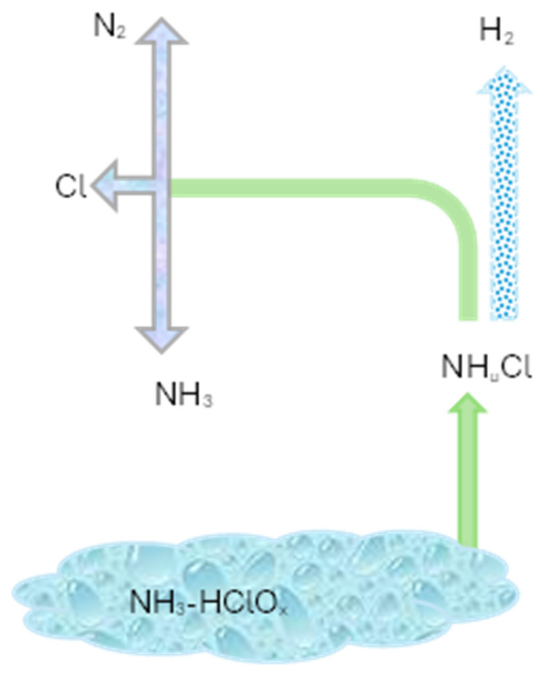
However, ammonia gas reactions with the HClOx pool would have been a major contributor to the formation of primordial water in vast quantities. Let’s refer to these reactions shown below as the NH3-HClOx reactions in the ammonia pool. That is, the vented ammonia gas would flow into the aqueous HClOx pool, initiating a series of reactions, as shown in Figure 3. The spontaneity of the NH3/HClOx gas reactions is shown in Table 7, except for HClO2, which is highly unstable. Assuming equal occurrence of the reactions in Table 7, water production in the ammonia pool follows the sequence of: 9 moles of NH3 → 48 moles of H2O
Figure 3.
Schematic showing the products from the NH3-HClOx reactions in the ammonium salt pool, with the release of chloramine (NHuClw) and water H2O. The unstable NHuClw decomposed to NH3, N2, and Cl2 gases. Gas Cl2 returns to the HClOx pump; any NH3 gas emitted re-enters the NH3-HClOx reactions gas pool. (u=0,1,2; w=1,2,3).
Figure 3.
Schematic showing the products from the NH3-HClOx reactions in the ammonium salt pool, with the release of chloramine (NHuClw) and water H2O. The unstable NHuClw decomposed to NH3, N2, and Cl2 gases. Gas Cl2 returns to the HClOx pump; any NH3 gas emitted re-enters the NH3-HClOx reactions gas pool. (u=0,1,2; w=1,2,3).
We can roughly estimate the total mass of water produced by combining the above reactions. For every 1 ton of ammonia consumed, around 5.6 tons of water were produced. The chemical reactions of ammonia in the HClOx gas pools would have made water lakes, but no ammonium or sodium salts were deposited. The chloramine products NH2Cl, NHCl2, and NCl3 are unstable and decomposed to NH3, N2, H2, and Cl2 gases.
2NH2Cl(g) → N2(g) + 2H2(g) + Cl2(g)
3NHCl2(g) → N2(g) + NH3(g) + 3Cl2(g)
2NCl3(g) → N2(g) + 3Cl2(g)
Mineralogical studies and historical accounts reveal the widespread occurrence of ammonium chloride deposits worldwide [29]. The next crucial precursor for completing a cyclic chemical process is ammonium chloride (NH4Cl). The thermodynamically favorable reactions that led to the formation of NH4Cl pools are in Table 8.
The chloride salts of NH4Cl and NaCl, and caustic soda NaOH, would have dissolved in the primordial water generated by the NH3-HClOx reactions pool. These salts formed highly alkaline, concentrated salt pools. In the caustic primordial pools, more reactions in aqueous media contributed to the formation of water and initiated the precipitation of NaCl under conditions of saturation. The NH4Cl discharged to the highly alkaline pools would have released ammonia NH3 gas and precipitated the salt NaCl. Moreover, NH4Cl can react with the chlorate salt family NaClOx in the NH4Cl/NaClOx ammonium pool to yield the same products depicted in the cyclic process of Figure 3. The following thermodynamically favorable reactions in the ammonium salts pool led to the formation of brine pools, precipitation of sodium chloride, the release of ammonia gas, and the production of primordial water.
Chemical Reaction ΔG, 300 K ΔG,500 K
NH4Cl + NaOH → NH3 + NaCl + H2O -16.4 -1.0
In aqueous solution, the following reactions can happen:
NH4Cl(aq) + NaClO(aq) → NH4ClO(aq) + NaCl(aq) double displacement reaction
NH4Cl(aq) + NaClO4(aq) → NH4ClO4(aq) + NaCl(aq) double displacement reaction
Consider the cyclic process for the strong chlorates,
NH4Cl + NaClO(3,4) → NH4ClO(3,4) + NaCl double displacement reaction
NH4ClO(3,4) + NaOH → NH3 + NaClO(3,4) + H2O (recycle NaClO(1,4) pool)
Net: NH4Cl + NaOH → NH3 + NaCl + H2O
The salts of weak chlorates NaClO(1,2) are basic. These react with aqueous NH4Cl salts to release ammonia and the weak acid:
NH4+(aq) + ClO-(1,2) → NH3(g) + HClO(1,2) (returned to the HClOx pool)
From the ammonium chloride pool, when 1 mole of ammonia is produced, 1 mole of water and 1 mole of salt NaCl are produced. For every one ton of NH4Cl consumption, ~0.34 tons of water and ~1.1 tons of salt are produced.
2.2. The Outcome
In many of the reactions presented, cyclic processes are involved. Ammonia gas must have been released in massive amounts to join all reactions listed under the ammonia gas pool. Ammonium chloride (NH4Cl) would cycle back to replenish the NH4Cl pool. Other by-products, such as chlorates, are consumed immediately upon formation to regenerate the NH4Cl pool. On the other hand, sodium hydroxide NaOH and the HClOx acids must be continually generated to keep the process going. The three products that do not need to be recycled are nitrogen (N2) gas, rock salt (NaCl), and water (H2O). The most obvious destination for the nitrogen N2 gas is to dominate the entire Earth’s troposphere and stratosphere, leading to Earth’s N2-rich atmosphere. Under the NH4Cl pool, we can identify two main reactions that produce NaCl and water. As a rough estimate, the net yield from chemical reactions in the ammonia and ammonium pools is that for every 1 ton of NH3 consumed, ~3.5 tons of NaCl and ~6.5 tons of water are produced. Water produced by these chemical reactions would have formed brine pools of approximately 36% concentration, with the remaining NaCl depositing as crystals. Any receding water would have formed salt caves and mines [30]. The big picture is to relate primordial chemical reactions to the constant composition of saltwater that would have led to the global salinity of 3.5% found in today's oceans and seas. The same argument applies to salts of Mg and Ca, which are the next most abundant after NaCl in ocean water. The sulfates could have formed similarly to acid rain, namely through the reaction of sulfur (S) with O2, producing large amounts of SO2 and SO3 gases. These gases would have reacted with primordial water to form the most stable of them: sulfate salts (SO42-). Moreover, the list of reactions discussed must have terminated at one point, yielding the eventual conversion of most of the available precursor chemicals to more stable products, such that:
(i)Hydrogen H2 gas was converted to water, while the remaining was lost to outer space, terminating the entire process.
(ii)Chlorine gas Cl2, hydrogen chloride, and other chlorine-based gases were converted to chloride salts before hydrogen was used up,
(iii)Ammonia NH3, other nitrogenous gases, and ammonium salts decomposed to nitrogen N2 gas that dominated our atmosphere.
(iv)Chlorates were converted to chlorides, and any remaining were embedded in the soil.
(v)Reactive metal oxides got converted to more stable sedimentary minerals.
Having argued that there is a concerted formation of salt NaCl and water, why did the primordial ocean salinity change from brine pools of ~36% to 3.5%? To justify a 3.5% salinity of ocean water, where the solubility of NaCl is at ~36%, we must separate the frequency of the reactions in the acidic chlorates/ammonia gas pools from the recurring reactions in the ammonium chloride NH4Cl pool. Statistically, for nine chemical reactions against one, the probability of occurrence of reactions in acidic chlorates/ammonia gas (HClOx/NH3) pools, which produced primordial water only, must have been multiple times higher than the reactions in the NH4Cl pool that deposited salts of NaCl with a concerted generation of water. We can justify the previous argument using the formula,
%sal = m(NaCl) x 100 ,
m(H2O/NH3) x Rn + m(H2O/NH4Cl) + m(NaCl)
%sal is the % salinity
m(NaCl) is the mass of NaCl
m(H2O/NH3) is the mass of water in the ammonia pool
m(H2O/NH4Cl) is the mass of water in the NH4Cl pool
The term Rn is a statistical factor representing the number of reactions that would have occurred in the acidic chlorates/ammonia gas pools against one chemical reaction in the NH4Cl ammonium pool. The term Rn must be greater than zero because ammonia gas was produced before any ammonium salts. According to the listed stoichiometric chemical equations, the ratio of chemical reactions depicting ammonia consumption to those depicting ammonium is 9:1. Therefore, for Rn = 9, the salinity of primordial ocean water would have dropped from the brine level of 36% to ~6.2%. At present, there are seas, lakes, and pools with salinities above 6%. Other factors would have contributed to the dilution of the saline oceans. The rising Earth's crust would have trapped salt mines due to heavy evaporation in a hotter environment. Some gas phase reactions, such as the combustion of ammonia, 2NH3(g) + 3/2O2(g) → N2(g) + 3H2O(l), yield 3 moles of water, thus, can increase the value of Rn by three, i.e., Rn = 12, decreasing salinity to 4.7%. The objective of this analysis is to emphasize that water was formed through a specific set of chemical reactions and conditions that resulted in its attaining a specific salinity. Since an ammonia channel governed these chemical reactions, our nitrogen-rich atmosphere resulted.
3. Conclusions
This paper presents a series of chemical reactions that occurred in primordial Earth’s hot, porous beds and layered gaseous atmosphere, leading to the formation of oceanic saltwater and the planet Earth's nitrogen-rich atmosphere. A reasonable explanation to justify the formation of the vast quantity of water (i.e., 1026 kg) is to have an enormous amount of gaseous chemicals spread around in a layered atmosphere and porous crust. This paper did not attempt to estimate the quantities of all gases and chemicals involved in the listed reactions. The main emphasis is on the sequence of events and on a thermodynamically allowed set of selected chemical reactions that enabled the formation of Earth’s saline oceans and the nitrogen-rich atmosphere that accompanied them.
Acknowledgments
The authors would like to thank the West Virginia University Institute of Technology and the Department of Physical Sciences for their continued support of scholarly activity. This research did not receive any specific grant from funding agencies in the public, commercial, or not-for-profit sectors.
References
- Martin, Rebecca G.; Livio, Mario. How much water was delivered from the asteroid belt to the Earth after its formation? R. Astron. Soc. Lett. 2021, Volume 506(Issue 1), L6–L10. [Google Scholar] [CrossRef]
- Nath, Biman. Water on Earth: Where Did it Come From? Reson. Journal Sci. Educ. General. Artic.> 2019, Volume 24, 575–582. [Google Scholar]
- O'Brien, David P.; Izidoro, Andre; Jacobson, Seth A.; Raymond, Sean N. The Delivery of Water During Terrestrial Planet Formation. Space Sci. Rev. 2018, 214, 47. [Google Scholar] [CrossRef]
- Cowen, Ron. Liquid Acquisition. Science News. 30 Dec 2010. Available online: https://www.sciencenews.org/article/liquid-acquisition (accessed on Dec. 2025).
- O’Brien, D.; Morbidelli, A.; Levison, H. Terrestrial planet formation with strong dynamical friction. ICARUS 2006, Vol. 184, 39. [Google Scholar] [CrossRef]
- Lis, D. C.; Bockelée-Morvan, D.; Güsten, R.; Biver, N.; Stutzki, J.; Delorme, Yan; Durán, C.; Wiesemeyer, H.; Okada, Y. Terrestrial deuterium-to-hydrogen ratio in water in hyperactive comets. Astron. Astrophys. 2019, 625, L5. [Google Scholar]
- Budde, Gerrit; Burkhardt, Christoph; Kleine, Thorsten. Molybdenum isotopic evidence for the late accretion of outer Solar System material to Earth. Nat. Astron. 2019, 3(8), 736–741. [Google Scholar] [CrossRef]
- Wilde, S.A.; Valley, J.W.; Peck, W.H.; Graham, C.M. Evidence from detrital zircons for the existence of continental crust and oceans on the Earth 4.4 nGyr ago. Nature 2001, 409(6817), 175. [Google Scholar] [PubMed]
- Borg, Lars E; Brennecka, Gregory A; Kruijer, Thomas S. The origin of volatile elements in the Earth–Moon system. Earth Atmos. Planet. Sci. 2022, 119(8), e2115726119. [Google Scholar] [CrossRef] [PubMed]
- Gallessich, Gail. Meteor Likely Caused Earth's Greatest Extinction Event, THE Current, UC SANTA BARBARA, 2003. Available online: https://news.ucsb.edu/2003/011790/meteor-likely-caused-earths-greatest-extinction-event# (accessed on Dec. 2025).
- Taylor Redd, Nola. "Where did Earth’s water come from?". Astronomy.com. 2019. Available online: https://www.astronomy.com/science/where-did-earths-water-come-from/ (accessed on Nov 2025).
- Matsumoto, Toru; Noguchi, Takaaki; Miyake, Akira; Igami, Yohei; Matsumoto, Megumi; Yada, Toru; Uesugi, Masayuki; Yasutake, Masahiro; Uesugi, Kentaro; Takeuchi, Akihisa; Yuzawa, Hayato; Ohigashi, Takuji; Araki, Tohru. Sodium carbonates on Ryugu as evidence of highly saline water in the outer Solar System”. Nat. Astron. 2024, 8, pages, 1536–1543. [Google Scholar] [CrossRef]
- Cowing, Keith. Sodium Chloride Crystals Discovered In S-type Asteroid Itokawa Samples, ASTROBIOLOGY, University of Arizona Lunar and Planetary Laboratory, 2023. Available online: https://astrobiology.com/2023/06/sodium-chloride-crystals-discovered-in-s-type-asteroid-itokawa-samples.html (accessed on Dec. 2025).
- Wang, Da; Nie, Nicole X.; Peters, Bradley J.; Day, James M. D.; Shirey, Steven B.; Carlson, Richard W. Potassium-40 isotopic evidence for an extent pre-giant-impact component of Earth’s mantle. Nature Geosci.>, Vol. Volume 18(2025), 1174–1179. [CrossRef]
- Dickson, A.G.; Goyet, C. (Eds.) Handbook of methods for the analysis of the various parameters of the carbon dioxide system in seawater. 2. ORNL/CDIAC-74; 2011; Available online: https://en.wikipedia.org/wiki/Seawater# (accessed on Oct 2025).
- Jackson, W. A.; Davila, A. F.; Sears, D. W. G.; Coates, J. D.; McKay, C. P.; Brundrett, M.; et al. Widespread occurrence of (per)chlorate in the Solar System. Earth Planet. Sci. Lett. 2015, 430, 470–476. [Google Scholar] [CrossRef]
- Lin, Mang. Chlorate Chemistry From Earth to Mars. Journal Geophys. Res.> JGR Atmos. 2025, Volume 130(Issue 18). [Google Scholar]
- Norman, H. Sleep, The Hadean-Archaean Environment, Cold Spring Harb Perspect. Biol 2010, 2(6), a002527. [Google Scholar] [CrossRef] [PubMed]
- Schwartzman, D. Life, temperature, and the Earth, p. 272; Columbia University Press: NY, 2002. [Google Scholar]
- Xing, Zexi; Oset, Shawn; Noonan, John; Bodewits, Dennis. Water Production Rates of the Interstellar Object 3I/ATLAS. Astrophys. J. Lett. 2025, Volume 991, Number 2. [Google Scholar] [CrossRef]
- Fink, J. H.; Griffiths, R. W. Morphology, eruption rates, and rheology of lava domes: Insights from laboratory models. J. Geophys. Res. Solid Earth 1998, 103(B1), 527-545, 1978–2012. [Google Scholar] [CrossRef]
- Bédard, Jean H. Stagnant lids and mantle overturns: Implications for Archaean tectonics, magma genesis, crustal growth, mantle evolution, and the start of plate tectonics. Geosci. Front. 2018, Volume 9(Issue 1), Pages 19–49. [Google Scholar]
- Fegley, Bruce, Jr. And John S. Lewis, Volatile Element Chemistry in the Solar Nebula: Na, K, F, Cl, Br, and P. ICARUS 1980, 41, 439–455. [Google Scholar]
- Atkins, P.; de Paula, J. Physical Chemistry, 10th Ed. ed; W.H. Freeman and Company: New York, NY, 2001; ISBN 9781429290197. [Google Scholar]
- University Physics. SAMUEL J. LING, JEFF SANNY, WILLIAM MOEBS, Web Version Last Updated: Jul 08, 2025, OpenStax is licensed under Creative Commons Attribution License v4.0 Digital PDF. Volume 1.
- Toner∗, J.D.; Catling, D.C. Chlorate brines on Mars: Implications for the occurrence of liquid water and deliquescence. Earth Planet. Sci. Lett. 2018, 497, 161–168. [Google Scholar] [CrossRef]
- Gough, R.V.; Chevrier, V.F.; Baustian, K.J.; Wise, M.E.; Tolbert, M.A. Laboratory studies of perchlorate phase transitions: support for metastable aqueous perchlorate solutions on Mars. Earth Planet. Sci. Lett. 2011, 312, 371–377. [Google Scholar] [CrossRef]
- Shriver, Durward; Weller, Mark; Overton, Tina; Armstrong, Fraser; Rourke, Jonathan. Inorganic Chemistry, 6th Ed. ed; W. H. Freeman, 2014; ISBN -10: 1429299061. [Google Scholar]
- Sutton, M. A.; Erisman, J. W.; Dentener, F.; Möller, D. Ammonia in the environment: From ancient times to the present. Environ. Pollut. 2008, 156(3), 583–604. [Google Scholar] [CrossRef] [PubMed]
- Hite, R. J. Distribution and geologic habitat of marine halite and associated potash deposits, Geologic Division, USGS. Open-File Report 67-113. Available online: https://pubs.usgs.gov/of/1967/0113/report.pdf (accessed on Dec. 2025). [CrossRef]
Figure 1.
A schematic of corrugated gas layers where the probability of having heavier gases near Earth’s primordial surface is higher.
Figure 1.
A schematic of corrugated gas layers where the probability of having heavier gases near Earth’s primordial surface is higher.
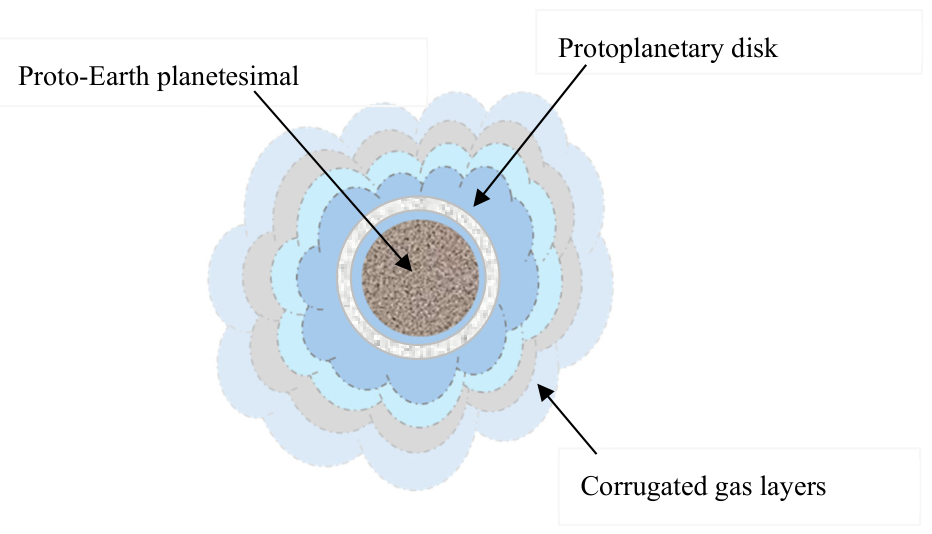
Figure 2.
A plot of the Relative Population Distribution of molecules (Rp) vs distance from Earth's surface in km, (a) the Rp(H2)max ~ 20% at maximum around 150 km and decreases moving closer to Earth's surface, (b) The Rp(Cl2)max ~ 100%, Rp(O2)max ~ 70%, and Rp(NH3)max ~ 25% at distances less than 50 km.
Figure 2.
A plot of the Relative Population Distribution of molecules (Rp) vs distance from Earth's surface in km, (a) the Rp(H2)max ~ 20% at maximum around 150 km and decreases moving closer to Earth's surface, (b) The Rp(Cl2)max ~ 100%, Rp(O2)max ~ 70%, and Rp(NH3)max ~ 25% at distances less than 50 km.
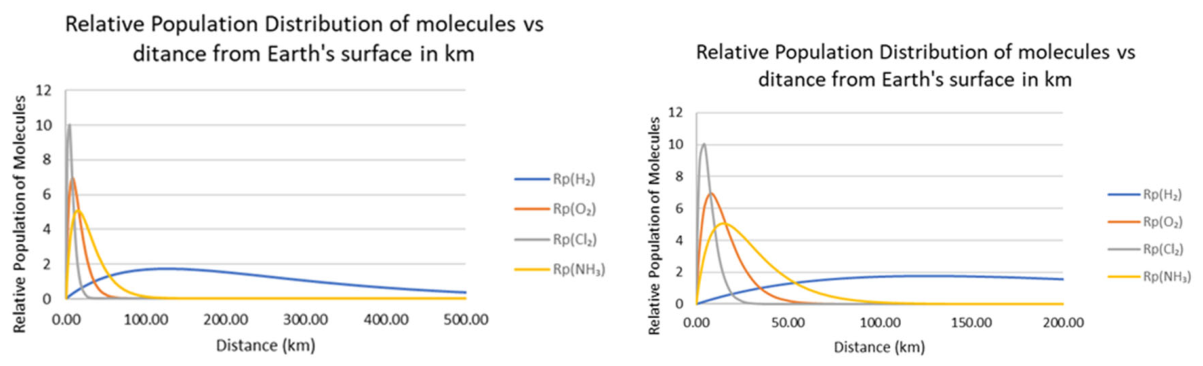
Figure 2.
Schematic of the porous Earth’s crust where gaseous reactions would have occurred inside cavities, then vented out the products, such as ammonia gas.
Figure 2.
Schematic of the porous Earth’s crust where gaseous reactions would have occurred inside cavities, then vented out the products, such as ammonia gas.
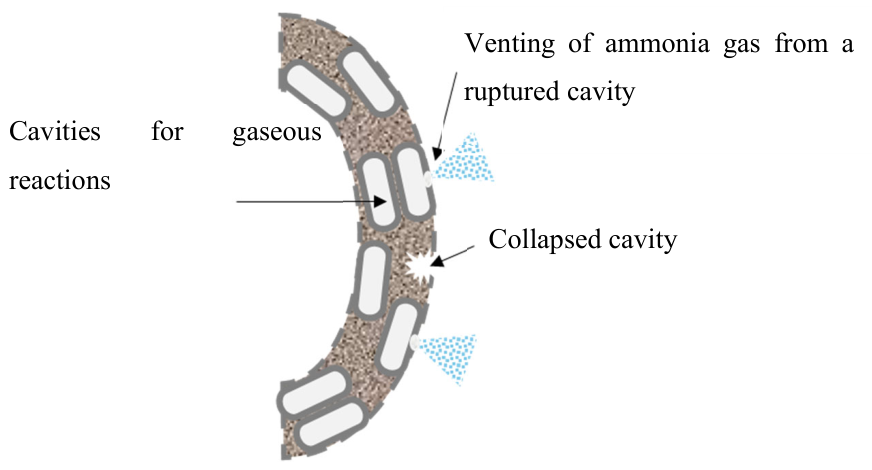

Table 1.
Gibbs’ free energy ΔG(kJ/mol) for the formation of metal oxides and chlorides at 300 K and 500 K.
Table 1.
Gibbs’ free energy ΔG(kJ/mol) for the formation of metal oxides and chlorides at 300 K and 500 K.
| Chemical Reaction | Gibbs’ free energy ΔG(kJ/mol) | |
|---|---|---|
| 300 K | 500 K | |
| 2Na + 1/2O2 → Na2O | - 376 | -349 |
| 2Na + 1/2CO2 → Na2O + 1/2C | - 178 | -141 |
| Mg + 1/2CO2 → MgO + 1/2C | - 568 | -339 |
| Mg + 1/2O2 → MgO | - 569 | - 547 |
| Na + 1/2Cl2 → NaCl | - 384 | - 365 |
Table 2.
Gibbs’ free energy ΔG(kJ/mol) for the formation of metal chlorates at 300 K and 500 K.
| Chemical Reaction | Gibbs’ free energy ΔG(kJ/mol) | |
|---|---|---|
| 300 K | 500 K | |
| Na + 1/2O2 + 1/2Cl2 → NaClO | -291 | -259 |
| Na + O2 + 1/2Cl2 → NaClO2 | -276 | -225 |
| Na + 3/2O2 + 1/2Cl2 → NaClO3 | -263 | -195 |
| Na + 2O2 + 1/2Cl2 → NaClO4 | -254 | -169 |
| Mg + 3O2 + Cl2 → Mg(ClO3)2 | -340 | -291 |
| Mg + 4O2 + Cl2 → Mg(ClO4)2 | -311 | -227 |
Table 3.
Gibbs’ free energy ΔG(kJ/mol) for the reaction of metal oxides with chlorine gas at 300 K and 500 K.
Table 3.
Gibbs’ free energy ΔG(kJ/mol) for the reaction of metal oxides with chlorine gas at 300 K and 500 K.
| Chemical Reaction | Gibbs’ free energy ΔG(kJ/mol) | |
|---|---|---|
| 300 K | 500 K | |
| Na2O + 1/2O2 + Cl2 → 2NaOCl | -206 | -251 |
| Na2O + 3/2O2 + Cl2 → 2NaClO2 | -132 | -178 |
| Na2O + 5/2O2 + Cl2 → 2NaClO3 | -174 | -112 |
| Na2O + 7/2O2 + Cl2 → 2NaClO4 | -146 | -62 |
Table 4.
Gibbs’ free energy ΔG(kJ/mol) for the formation of metal hydroxides (the Lye pool) at 300 K and 500 K.
Table 4.
Gibbs’ free energy ΔG(kJ/mol) for the formation of metal hydroxides (the Lye pool) at 300 K and 500 K.
| Chemical Reaction | Gibbs’ free energy ΔG(kJ/mol) | |
|---|---|---|
| 300 K | 500 K | |
| Na2O + H2 + 1/2O2 → 2NaOH | -385 | -319 |
| 2Na(s) + H2(g) → 2NaH(g) | -67 | -52 |
| 2NaH(s) + O2(g) → 2NaOH(s) | -693 | -673 |
| Mg(s) + H2(g) → MgH2(s) | -76 | -41 |
| MgH2(s) + O2(g) → Mg(OH)2(s) | -833 | -810 |
Table 5.
Gibbs’ free energy ΔG(kJ/mol) for the formation of HCl and HClO gases at 300 K and 500 K.
| Chemical Reaction | Gibbs’ free energy ΔG(kJ/mol) | |
|---|---|---|
| 300 K | 500 K | |
| 1/2H2(g) + 1/2Cl2(g) → HCl(g) | -95 | -84 |
| Cl2 + NaOH → HClO(g) + NaCl(s) | -69 | -67 |
Table 6.
Gibbs’ free energy ΔG(kJ/mol) for the formation of the oxo acids of chlorine at 300 K and 500 K.
Table 6.
Gibbs’ free energy ΔG(kJ/mol) for the formation of the oxo acids of chlorine at 300 K and 500 K.
| Chemical Reaction | Gibbs’ free energy ΔG(kJ/mol) | |
|---|---|---|
| 300 K | 500 K | |
| 1/2Cl2 + 1/2H2 + 1/2O2 → HClO | -66 | -100 |
| 1/2Cl2 + 1/2H2 + O2 → HClO2 | -43 | -59 |
| 1/2Cl2 + 1/2H2 + 3/2O2 → HClO3 | -21 | -20 |
| NaClO4(s) + HCl → HClO4 + NaCl | -74 | -96 |
| 3HClO → HClO3 + 2 HCl | conversion | |
| 4HClO3 → 2HClO4+ H2O + Cl2 + 3/2O2 | decomposition | |
Table 7.
Gibbs’ free energy ΔG(kJ/mol) for the formation of water from the NH3/HClOx gas reactions at 300 K and 500 K.
Table 7.
Gibbs’ free energy ΔG(kJ/mol) for the formation of water from the NH3/HClOx gas reactions at 300 K and 500 K.
| Chemical Reaction | Gibbs’ free energy ΔG(kJ/mol) | |
|---|---|---|
| 300 K | 500 K | |
| NH3 + HClO → NH2Cl + H2O | -64 | -130 |
| NH3 + 2HClO → NHCl2 + 2H2O | -199 | -343 |
| NH3 + 3HClO → NCl3 + 3H2O | -336 | -553 |
| NH3 + HClO3 + 2H2 → NH2Cl + 3H2O | -576 | -696 |
| NH3 + 2HClO3 + 4H2 → NHCl2 + 6H2O | -1167 | -1505 |
| NH3 + 3HClO3 + 6H2 → NCl3 + 9H2O | -1760 | -2311 |
| NH3 + HClO4 + 3H2 → NH2Cl + 4H2O | -814 | -976 |
| NH3 + 2HClO4 + 6H2 → NHCl2 + 8H2O | -1633 | -2084 |
| NH3 + 3HClO4 + 9H2 → NCl3 + 12H2O | -2454 | -3187 |
Table 8.
Gibbs’ free energy ΔG(kJ/mol) for the formation of ammonium chloride at 300 K and 500 K.
| Chemical Reaction | Gibbs’ free energy ΔG(kJ/mol) | |
|---|---|---|
| 300 K | 500 K | |
| NH3 + HCl → NH4Cl | -123 | -9 |
| 2NH3 + Cl2 → NH4Cl + NH2Cl | -145 | -267 |
| 3NH2Cl → N2 + NH4Cl + 2HCl | decomposition | |
Disclaimer/Publisher’s Note: The statements, opinions and data contained in all publications are solely those of the individual author(s) and contributor(s) and not of MDPI and/or the editor(s). MDPI and/or the editor(s) disclaim responsibility for any injury to people or property resulting from any ideas, methods, instructions or products referred to in the content. |
© 2026 by the authors. Licensee MDPI, Basel, Switzerland. This article is an open access article distributed under the terms and conditions of the Creative Commons Attribution (CC BY) license (http://creativecommons.org/licenses/by/4.0/).
Copyright: This open access article is published under a Creative Commons CC BY 4.0 license, which permit the free download, distribution, and reuse, provided that the author and preprint are cited in any reuse.


