

Submitted:
06 July 2026
Posted:
08 July 2026
You are already at the latest version
Abstract
Humans routinely offload cognitive tasks to their environments. Here we show, employing just basic physics and the Free Energy Principle, that all time-persistent information-processing systems offload information-processing tasks to their environments. Hence all cognitive systems engage in cognitive offloading. We show how ecological niche construction, kinematic replication, bioelectric signaling, the development of communication systems based on shared semantics, and the ability of LLMs to demonstrate fluent language use in the absence of extra-linguistic input all exemplify this offloading process. We conclude that both theoretical understanding of problem-solving abilities and the engineering of such abilities into artifacts will be improved by considering active computation by the environment as a ubiquitous adjunct to cognition in both living and artificial systems.
Keywords:
bioelectricity
; complexity
; efficiency
; free energy principle
; information flow
; llms
; mor-phogenesis
; niche construction
; shared semantics
1. Introduction
Cognitive offloading, defined in a comprehensive review by Risko and Gilbert [1] as “the use of physical action to alter the information processing requirements of a task in order to reduce cognitive demand” (p. 676), is ubiquitous in humans, with examples ranging from moving the head for a better view to asking a friend for help or employing an artifact, e.g. a computer, to solve a problem. While behaviors of animals are sometimes acknowledged as meeting the above definition [2,3], the literature on cognitive offloading is almost exclusively human-centric, and in particular, has little connection with the robust literatures on the use of tools [4,5] or stigmergic memory [6] by non-human animals . We argue here that cognitive offloading is not unique to humans, or even to animals, but is rather a cognitive universal: that cognitive systems generically offload problem solving tasks to their environments. We position our argument within the broad framework of Diverse Intelligence (DI) [7] and the methodological principles of Levin’s Technological Approach to Mind Everywhere (TAME) [8,9], which emphasize rigorous mathematical modeling and system-perturbing experiments to assess cognitive capabilities in systems of diverse origin, history, composition, and scale.
We begin in Section 2 by considering interactions between generic physical systems and their environments, while requiring compliance with Newton’s 3rd Law. We show that all such interactions can be considered exchanges of information between systems that are themselves information processors. We associate cognitive capability with the computational complexity of a system’s physical dynamics, as characterized at some particular scale. We then introduce, in Section 3, the Free Energy Principle (FEP) of Friston and colleagues [10,11,12] and the associated concept of active inference [13,14]. We show how symmetries of physical interactions carry over into symmetries of the FEP, in particular, that the environment of any active inference agent is also an active inference agent. Cognitive offloading, in this setting, is a generic consequence of active inference: active inference agents generically employ the computational resources of their environments to generate new survival-relevant information from actions. With this background, we turn to examples in Section 4, characterizing ecological niche construction (Section 4.2), kinematic replication (Section 4.3), bioelectric patterning (Section 4.4), the development of communication systems (Section 4.5), and the achievement of fluency by LLMs (Section 4.6) as examples of cognitive offloading. We conclude in Section 5 that asking how systems offload tasks to their environments enables novel experimental designs, and that increasing the ability of artifacts to autonomously offload tasks to each other can be a productive route for enhancing not just AI, but the intelligence of the built environment generally.
2. Physical Interactions as Information Channels
Newton’s 3rd Law states a symmetry of physical interactions: in the absence of external forces, any action of one system on another is met by an equal reaction of the second system on the first. For fixed, bipartite decompositions of isolated systems, this symmetry manifests as conservation of momentum, energy, and in quantum theory, information. It motivates a top-down approach to the physics of interacting systems, an approach taken in both classical [10,11,12] and quantum [15,16] formulations of the FEP. We take this approach here, using the quantum formalism for its generality and more explicit representation of interactions while mentioning the corresponding classical ideas.
We begin by assuming a finite, isolated system U, the “universe” of interest, with its state space , a Hilbert space in quantum theory or a position-momentum configuration space in classical theory. We then decompose, or factor, U into two components, ; the state space factors as , with ⊗ the tensor product. Both U and its components A and become dynamical systems by assuming a background time parameter t and defining a t-propagator for U.1 In the quantum representation, the t-propagator can be written , where ℏ is the reduced Planck’s constant and the operator , the Hamiltonian of U, is a linear operator with real eigenvalues. The operator is unitary, i.e. , where † indicates the Hermitian adjoint; hence conserves total information in U. The quantum Hamiltonian measures the total energy, so plays an analogous role in the theory as the classical Hamiltonian. As is linear by definition, it decomposes additively, i.e. , where represents, and measures the energy of, the interaction between A and . An advantage of the quantum formalism is this simple representation of the interaction between any component A of U and its complement .
Constructing the “system of interest” A and its “environment” by a bipartite decomposition of an isolated system U emphasizes a key point that is neglected whenever the environment of a system is approximated as a heat bath or a noise source: physical systems and their environments are made of the same kinds of stuff, obey the same dynamical laws, and execute behaviors that are additive components of the behavior of U. If A is an organism or other living system, its environment comprises other organisms or living systems; if A is an artifact, its environment comprises humans or other systems capable of building artifacts. With the exception of carefully-constructed counterexamples – e.g. the environment of a system comprising everything but some cubic meter of deep space – the environments of structured systems also have structure, and the environments of systems with interesting behavior also have interesting behavior. In the language of the FEP, the environment of any active-inference agent is itself an active inference agent. We will explore the consequences of this latter point in Section 3 below; here we focus on the symmetries imposed by being well-defined as a linear operator.
As in previous work [15,16,17,18], we can treat the system-environment interaction as defining a bidirectional information channel between A and . This channel can be implemented by an array of N quantum bits (qubits), where , is the decompositional boundary separating A from as components of U, and measures the Hilbert-space dimension [19]. Provided that the joint state is not entangled, i.e. factors as , the states and depend on each other only via the boundary state , i.e. the conditional probability and similarly for . This conditional independence of the “internal” states and is the necessary condition for the FEP as discussed in Section 3 below. Meeting it requires that A and be almost decoupled, i.e. that be only a weak interaction; we can write this in terms of the relevant operator dimensions as a requirement that .
The N-qubit representation of the interaction channel defined by allows thinking of physical interactions, in general, as analogous to N-bit classical communication channels, and is a second advantage of the quantum formalism. It allows us to decompose as a sum of single-qubit operators, again with real eigenvalues, implemented by A and . We can, without loss of generality, represent each of these as a z-spin operator that acts on a single qubit to yield one of its two eigenvalues, or outcomes, either or [20]. Physically implementing such an operator requires choosing a z axis, a reference frame that defines the orientation along which the measurement will be made; we can think of as ‘up’ and as ‘down’ along the chosen orientation. The physically implemented operator, which for explicitness we can write as is a quantum reference frame (QRF), i.e. a tool, like a meter stick or clock, for measuring and preparing states [21]. We can think of its action on a single qubit q, which we take to be oriented at an initial angle from , as:
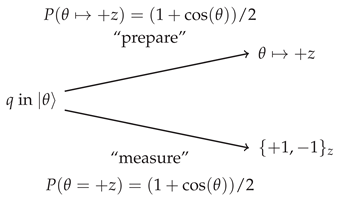
As shown in Diag. (1), the Born rule, which assigns probabilities to measurement outcomes in quantum theory, applies in the same form to measuring or preparing the qubit q in z-spin state , i.e. the state corresponding to the eigenvalue , yielding the probability , because both actions employ the same operator . Indeed we refer to the operation as “preparation” if we are interested in the state that is its outcome, and as “measurement” if we are interested in the eigenvalue that is obtained [22].
Let us now consider the simplest non-trivial case, in which A and interact via a single qubit q:
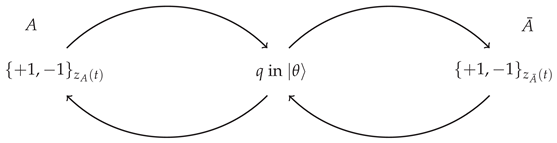 where and are the z-axis choices, at the time t, of A and , respectively.2 In this diagram, we require that ’s measurement follows A’s preparation and vice-versa, i.e. state information flows, in t, from A to and back again. By allowing and to vary in t, the “language” by which A and “communicate” via q can itself evolve in t.
Diagram (2) can be generalized to an N-qubit interaction channel, in which case and become N-component, t-dependent vectors. Assuming the are independent, we can then write the interaction as:
where or , is Boltzmann’s constant, T is temperature, and is k’s thermodynamic efficiency when preparing . The collection of qubits functions as a holographic screen separating A from [23,25]; see [19] for further details and discussion. The system A can, therefore, learn no more about the state of than the joint state of the , i.e. no more than encodes on the boundary , and vice-versa. We can depict the situation as:
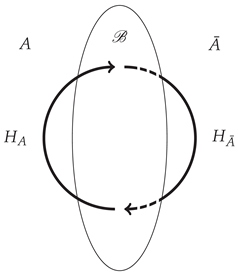 where and are the internal interactions of A and , respectively, which effectively map measurements or preparations at t to preparations or measurements at . These internal interactions can be thought of as implementing hierarchical QRFs acting on the data encoded on as detailed in [19].
As noted above, the requirement that A and remain unentangled, or separable, imposes a strong constraint on N, the “size” of their mutual boundary and hence the bandwidth of their communication channel. If A and are to remain separable, the interaction given by Eq. (3) must remain weak compared to the internal interactions and that “hold A and together” as systems and prevent their mutual entanglement, i.e. the condition must be met. Informally, A and must be almost decoupled, i.e. almost isolated, if they are to remain separable. This dimensional constraint on has an important qualitative consequence: the internal states of A and are always higher dimensional than the state of their communication channel ; hence the state of never reveals the complete state of A to or vice-versa. Every state of can correspond, in principle, to a finite but large set of distinct states of both A and , i.e. we can write the classical entropies of A and as:
and
respectively, with the case of defining the classical entropy of an isolated system. The vast majority of states of both A and are, therefore, “hidden” from observation by the requirement of separability. Note moreover that and depend only on state-space dimensions and are therefore constants; they are, in particular, independent of anything about other than its dimension. Each of A and is, in other words, a Black Box from the others’ perspective, with internal dynamics and , respectively, that cannot be determined, even in principle, by finite observations or actions implemented by , and hence by finite information exchange across [26].
The fact that most states of A and are hidden, or “internal” in FEP language, has an important consequence for their behavior in background time t: paths in t that are cyclic for states of , i.e. for observable states of A or , are in general not cyclic for the internal states of A or – indeed, being cyclic internally is highly improbable. The observable behavior of such coupled, or driven, quantum systems hides, therefore, a generic dependence on a geometric, or Berry phase, where here “geometric” refers to the native geometry of the state space, not to any embedding space [27,28]; see [29] for an informal discussion. The observable behavior of quantum systems is, therefore, generically non-Markovian in t, even if their internal, unobservable dynamics remain Markovian. Such non-Markovian behavior can appear, to an external observer with access to information about the environment, as history-dependence, e.g as indicating learning or internal memory. The terms “history-dependence,” “learning,” and “memory” all refer, in this context, to the dependence of the internal state, at each t, on previous information flow into the system from its environment; see [30] for a recent discussion in a generic classical context.
This distinction between observable and “hidden” dynamics can also be stated in terms of computational complexity. In the limit as , rendering A and mutually isolated, the internal propagators and approach unitarity, so access every state in and , respectively. In the classical limit in which states can be represented as bit strings, states and are bit strings of length and , respectively. Generic bit strings are incompressible [31], so generic states and have Kolmogorov complexities on the order of their lengths. This in turn tells us that for generic initial and final states i and f, the Kolmogorov complexities and are and , respectively. In constrast, the observable dynamics on – what A or can observe about each other – has complexity .
As discussed in [19], this simple formalism is completely general, describing the interaction in t between any physically-realizable finite system A and its environment , subject to the constraint of separability. The systems A and can be arbitrarily-complex quantum computers, i.e. there are no restrictions on the internal interactions and that “decide” what to encode on beyond the requirement that all thermodynamic exchange between A and be via .3 Hence we can use this formalism, without loss of generality, to characterize generic interacting systems A and as communicating information processors.
3. Physics as Active Inference: The FEP
3.1. The FEP as a Universal “Anthropic Principle”
While it was originally formulated as a principle of neuroscience [35] and then of biology [36], the FEP has since been extended to all t-persistent classical [10,11,12] and even quantum [15,16] systems. Informally, the FEP states that all t-persistent systems will behave, while they remain t-persistent, in ways that are consistent with their t-persistence; in particular, they will behave in ways that preserve the integrity of the boundaries that distinguish them from their environments. No system, in other words, can observe, for any extended period of time, an environment that is inconsistent with that system’s own existence. As does the Anthropic Principle of cosmology [37], this obvious tautology offers an explanation for why we observe a universe with properties consistent with complex biological life. By universalizing a requirement for system-environment consistency, the FEP effectively defines a “thing” or a “persistent system” [10] as an entity capable of interacting with its environment for an extended period of time. It is for this reason that, despite the presumptions of some of its critics, the FEP is not an empirical claim, but rather a principle that must be respected as a matter of logic.4 What the FEP adds to physics is a qualitative, or logical, restriction on information flow: system-environment interactions must remain weak enough to maintain the distinction between system and environment. Given the discussion above, this restriction is familiar: it is the requirement of weak coupling, , that supports system-environment separability.5
In classical formulations of the FEP, the boundary between system and environment is represented by a Markov blanket (MB), a statistical, or informational, boundary between conditionally-independent components of a classical dynamical system. When the system is represented as a causal network [40], MB states encoding information flow into and out of the system – hence out of and into the environment – can be distinguished. The MB can, therefore, be represented as a bidirectional classical communication channel. As such, it has the same function, albeit a different formal structure, as the boundary defined above; see [15,16] for further discussion.
In the language of the previous section, the FEP is the claim that t-persistent systems are those that act on their environments, via their boundaries, in ways that prevent their interactions with their environments from becoming strong enough to “rip their boundaries apart” and erase the system-environment distinction. The FEP provides a formal criterion for boundary maintenance: minimization of a variational free energy that measures the mismatch between the system’s actions on its environment and the environment’s actions on the system. This mismatch can be stated, in Bayesian terms, as the medium-term prediction error of a generative model (GM) implemented by the system’s internal dynamics [10,11,12]. Such prediction errors are minimized by a combination of learning – incremental modification of the GM – and environment-modifying action, e.g. movement. Note, however, that minimizing prediction error has no effect on the entropy of the environment; both and (Eq. (5) and (6)) are constants. Driving the prediction error to zero results in the classical case, where spatial separation between system and environment can be assumed, in generalized synchrony; in the quantum case, where spatial separation cannot be assumed, it results in entanglement, and hence in boundary collapse [15]. The latter is, clearly, consistent with Axiom of Unitarity, which implies that separable states will always be relatively short-lived in t.
Whether and if so, how any particular system, or particular system-environment boundary, manages to persist, that is, the details of interaction triples that are consistent with low prediction error, and hence boundary stability, for significant intervals , is an empirical question. While it is evident that cannot become too large, i.e. that is a condition of separability, a general theory of the maintenance of boundary stability does not yet exist.6 The enormous diversity of living systems shows that many different interactions can be sustained over macroscopic times. The science of biology is, to a large extent, the study of these boundary-preserving interactions.
3.2. How Do Living Systems Manage to Persist?
Living organisms are examples of small systems interacting with vastly larger, more complex environments, i.e. systems A for which . The environment of any organism is, in other words, sufficiently large that its actions on the organism-environment boundary can explore the entire state space of , including states that are lethal to the organism. Organisms survive by staying one step ahead of their environments, e.g. of pathogens, predators, climate or other ambient environmental changes, and often most critically [42], competing conspecifics. They do this by developing – i.e. by their internal dynamics implementing – predictively-adequate GMs of their environments’ behaviors, in particular, GMs that drive compensatory or adaptive behaviors. How far into the future the GM can reach – the organism’s planning horizon – is the forward limit of its “cognitive light cone” [43] and determines how many “steps ahead” of its environment it can achieve. Predictive adequacy, particular at several steps ahead, requires meeting two fundamental requirements: generality, to cope with novelty, and efficiency, to respond to novelty before being eaten, disassembled, or otherwise transformed into something else by a boundary-disrupting interaction. Generality and efficiency have conflicting resources requirements, and optimizing for one typically decreases performance on the other. Speed-accuracy tradeoffs [44,45] and the architectural division of labor in humans between fast but specific (“type 1”) and slow but general (“type 2”) cognition [46,47] are well-known responses to this conflict.
Memory, or in FEP language, an implicitly- or explicitly-encoded prior probability distribution over environmental inputs to , is clearly required for prediction; hence active inference requires representational time in the sense of [48]. This is weak requirement; molecular networks can construct records of environmental events [49] and exhibit simple forms of learning [50,51,52]. It also requires sufficiently-complex internal dynamics to implement Bayesian satisficing over whole-boundary state changes. Organisms inhabiting slowly-changing environments, or capable of rapid adaptive change via high-bandwidth, hardware-level mechanisms such as lateral gene transfer, can trade off internal complexity against reproductive efficiency; many prokaryotes and some relatively low-complexity eukaryotes exemplify this strategy. Organisms inhabiting rapidly-changing environments while restricted to relatively small hardware-level variation must instead implement higher-complexity internal dynamics, with compartmentalization [53], multicellularity [54], nervous systems [55], and facultative or obligate symbiosis [56] as typical outcomes. Higher complexity, in such cases, may include the abilities to remember multiple action policies and to choose between them by predicting expected free energies for all of the actions specified by each of the available policies. Organisms at all scales are, moreover, composed of parts that have their own within-scale capabilities as active-inference agents, i.e. organisms at all scales are multiscale competency architectures [8,57]. As such, they must tradeoff the potential for goal conflict between systems at different scales – e.g. in cancer [58] – against the flexibility and efficiency that distributed decision mmaking confer.
Active inference in high-complexity environments is facilitated by an ability to compare and contrast specific events, and even more so by an ability to do this across multiple observers that have different perspectives. These abilities require not only individual memories, but also a shared clock that allows multiple observers to coordinate their representations of elapsed time. On Earth, the most obvious shared clock is the diurnal cycle; hence any population of organisms capable of sensing, and coordinating differential action with respect to, the diurnal cycle can be considered to share a clock. Such abilities are ubiquitous in eukaryotes [59] and extend to some prokaryotic populations [60].
The survival of small systems such as organisms is, however, always and fundamentally dependent on their environments being conducive to their survival. Red Queen dynamics [61] are inevitable in a large environment that is constantly exploring its own state space. In enactivist language [62], small systems are inevitably precarious; their much larger, more complex environments are always capable of acting on their boundaries in ways that dysregulate their internal processes sufficiently to induce failures of conditional independence and hence collapse of the boundary as a functionally-meaningful separation between system and environment.7 Active inference by small systems is only sustainable if the behavior of their environments remains not just reasonably predictable, but also slow enough to allow adaptive behaviors to escape lethal consequences; the persistence of prey animals, for example, depends not only on an ability to identify predators, but also on having enough time post-identification to hide or run away. Modern Synthesis biology simply assumes that most organisms inhabit sufficiently conducive environments. The physics underlying the FEP tells us how this can be the case. First, organism and environment are two components of the single system U, so their structures and dynamics are not all that different. Indeed as noted above, the environment of any organism includes many other organisms, systems that not only obey the same laws of physics, but that have similar structures and even psychologies. Second, the symmetry of physical interactions and the universality of the FEP as a criterion for persistence for bounded systems together imply that the environment of any active-inference agent A is itself an active inference agent. This symmetry is, as we will see, the reason why cognitive offloading is a cognitive universal.
3.3. Active Inference by the Environment
Physics is insensitive to notation – clearly we can swap the labels ‘A’ and ‘’ throughout Section 2 without changing its conclusions in any way. If we treat as the system of interest, the environment with which it interacts is A. Actions by are, in FEP language, “sensations” of A and vice-versa. The separability condition that maintains the distinction between and A guarantees, moreover, that all actionable information obtained by A comes from and vice-versa, and that all thermodynamic free energy usable by A comes from and vice-versa [63,64]. As separability requires that , we can think of as a relatively weak modulation or perturbation of both and . The effect of these perturbations is, in FEP language, to keep state trajectories in both A and near attractors – homeostatic or allostatic attractors if A or are organisms – that are consistent with the maintenance of separability, and hence distinct identities for A and . The only significant difference is that if A is small, is large. Hence it is less likely that A will do something than threatens ’s continued persistence than vice-versa.
Thinking of the environment as an “agent” can seem counter-intuitive; in ordinary discourse, “the environment” often refers rather vaguely to whatever is neither human nor a human artifact. Hence it is worth emphasizing that here “the environment” refers to everything that is not the particular system A that is considered “of interest” in some context. The environment of any small system, e.g. a particular organism or population of organisms, consists of everything but that organism or population. The computational power of the environment of any small system is vastly greater than that of the small system, whether measured by internal energy resources, state-space dimension, or Kolmogorov complexity. Attributing memory, inferential capability, and a GM to the environment – considering the environment to be an active-inference agent – is just describing the environment’s dynamics in a high-level computational language. If such a description is unproblematic when applied to a relatively small system with relatively meager computational power, it is surely appropriate when applied to that system’s much larger and more capable environment. The cognitive capability of one person, for example, is dwarfed by that of all other humans combined. The state-space dimension, and hence the potential dynamical complexity of the human population is, similarly, dwarfed by that of the entire rest of U, including not just all other organisms, but all physical systems from microcopic to cosmological scales. If cognitive capability scales with available energy, memory-storage capacity, and Kolmogorov complexity, the cognitive capability of the human population is dwarfed by that of its environment, i.e. the rest of U.
Just as it does with A, the FEP assigns to the active-inference agent an single overriding goal: preservation of separability from its environment, i.e. from A, and hence preservation of its identity as a distinct system. Operationally, preservation of ’s conditional independence from A is preservation of the boundary . Despite their asymmetry in size, therefore, A and are in the same precarious position: if acts in a way that dysregulates A and breaches , itself ceases to exist. For sufficiently small A, and U may be very similar systems, but the FEP applies to one but not to the other. As a bounded component of U, is an active inference agent; as a system with, by definition, no environment and hence no boundary, U is not.
This picture of a small system A and its much larger and more complex environment cooperating, effectively, in the maintenance of their mutual boundary is a radical departure from both the notion of a passive environment that is unaffected by an organism’s actions and the more Darwinian idea of a selective environment in which an organism must struggle to survive. Instead, the sole objective that can be attributed to is to maintain its own, and therefore also A’s, existence as a distinct entity. Like any other active-inference agent, does this by minimizing the medium-term prediction error of its GM. What its model predicts is the behavior, at , of A. Hence any agent’s environment, under the FEP, devotes its computational resources to modeling that agent. The fact that the FEP is, in an important sense, “just physics” renders this characterization highly counter-intuitive in all cases in which is a substantially larger system than A, i.e. in all cases relevant to biology. It requires us to focus not on as a whole, but just on how affects the interaction at the relatively small, compared to A or , boundary .
3.4. Active Inference Offloads Computation to the Environment
We are now in a position to examine the Risko-Gilbert definition of cognitive offloading as “the use of physical action to alter the information processing requirements of a task in order to reduce cognitive demand” [1] from the perspective of fundamental physics supplemented with the FEP as a criterion for t-persistence. The FEP interprets the alternating state preparations and measurements depicted in Diagram (4) as actions and sensations, respectively, and interprets the actions of the internal Hamiltonians and as computations by A and respectively. These computations are Bayesian inferences from current sensations together with prior probability distributions over the possible consequences of available actions to an optimal next action, where “optimal” is defined, over the long term, as most likely to increase the predictability of the environment’s actions. Hence all systems, when required to comply with both Newton’s 3rd Law and the FEP, act on their environments in order to increase the predictability of their behavior. Increasing the predictability of the environment’s behavior is reducing the information processing requirements of the primary task assigned to any system by the FEP: that of preserving its statistical independence from its environment, conditioned on the information it receives on its boundary. The Risko-Gilbert definition is, therefore, surprisingly general: it characterizes all t-persistent physical systems as computational offloaders. For any system that can be considered cognitive, computational offloading is cognitive offloading.
Acting on a system to make its behavior more predictable is acting on it to change its detectable behavior. Levin has characterized the receptivity of systems to behavior-changing actions on a “spectrum of pursuadability” [8], with systems only “persuadable” by direct hardware modifications at one end, systems amenable to setpoint adjustments or training paradigms in the middle, and systems receptive to rational arguments at the other end. When systems act on their environments in order to increase the predictability of their behavior, they may only have to “persuade” some environmental components to achieve the desired result. If the environment is not a pure quantum system, so has some classical causal structure, such actions can only directly affect components of the environment causally near the boundary; this is the case for all observable, experimentally manipulable system-environment interactions. Causally-distinct components of the environment may be persuadable in different ways; humans, for example, employ hardware modifications for some components of their environments, setpoint modifications or training for others, and rational arguments for those with whom goals, priors, and precision weightings are largely shared.
We can, therefore, summarize the situation of any physically-implemented active agent A as follows:
- 1.
- A’s environment is A’s sole source of information and sole target of actions.
- 2.
- A’s persistence as a system depends on acting in a way that enables A’s persistence.
- 3.
- A’s actions offload computational tasks to , which if A is an organism or other small system, has more computational power than A does.
These statements suggest that the environments of organisms and other small systems appear “fine-tuned” because they are; if they were not, the systems they support would not survive. The source of this fine-tuning is the system-environment decomposition itself. If the Axiom of Unitarity that underpins quantum theory is correct – if information is conserved in closed systems – then information must be conserved at decompositional boundaries within such systems. Interactions at boundaries must, in other words, be informationally symmetric to be well-defined. Living systems require information – e.g. in the form of molecular complexity – to survive. Living systems cannot “self-evidence” [65] in a vacuum, or in a heat bath; they must co-self-evidence with their environments, which contribute at least as much computational power to the process as they do. Viewing the environment of any living system as just a thermodynamic and chemical-potential resource is a mistake.
Characterizing the environment of any system of interest as an active-inference agent requires probing it at the right scale and with the right apparatus. In biology, what is of interest is how the environment serves as an information resource for processes at biological scales, e.g. for signal transduction, gene expression, morphological development, and whole-organism scale cognition and behavior. We propose that living systems themselves, e.g. molecular pathways, cells, organisms, or communities, are the best probes for understanding environments at these higher scales. This proposal reflects a general, purely information-theoretic fact: a probe for structure or behavior must be an informational “impedance match” with the structure of behavior it is meant to detect. Some mussels, for example, can detect impurities toxic to humans in drinking water [66], some dogs have the olfactory sensitivity to detect both human cancers [67] and on-coming strokes [68], and even some ants can smell human cancers [69]. In QRF language, the probe must be capable of both 1) distinguishing the structure or behavior of interest from other structures or behaviors encoded on , and 2) differentiating between the possible states of the structure, or aspects of the behavior, that are of interest to the system implementing the QRF [19]. Unidimensional QRFs like rulers, balances, and voltmeters can characterize unidimensional physical properties like length, mass, and charge, leading standard experimental physics to see mechanisms, not cognition. To find organisms, one needs an organism, and to find minds, one needs a mind. Viewing system-environment interactions from a cognitive perspective enables experimental designs that would be hard to imagine using just the vocabulary of physics, or even of biochemistry, e.g. using classical conditioning to alter the behavior of molecular networks [50,51,52]; see [70,71] for discussions of this approach in a biomedical context and [72] for a bio-engineering perspective.
4. Experimentally Characterizing Environments as Information Resources
4.1. What Is an Experiment?
Laboratory experiments in biology often involve brief, disruptive actions by the experimenter on a biological system, after which the system must cope with altered genetics, biochemistry, bioelectric state, cellular neighborhood, or morphology. In the notation employed here, an experiment is a strong, transient perturbation of that transitions A into a new part of its state space and into a new functional regime. The experiment is successful if A returns to a previous allostatic attractor or discovers a new one, and a failure if A cannot escape a lethal area of its state space, in which case its boundary collapses. Viewed from ’s perspective, a successful experiment is one in which is able to provide inputs that bring A back into a sustainable dynamic regime.
It is useful, when thinking about these kinds of interactions, to distinguish the source of the transient perturbation, the experimenter, from the rest of ; we can label them B and E, respectively. An experiment is then a communication process in which B sends A a classical message – the experimental perturbation – and then waits for a reply, while E provides inputs to A that, if the experiment is to be successful, buffer the perturbation and enable A to regain its previous or find a new allostatic attractor. Whether and how E accomplishes this depends on E’s model of A as discussed above. This description can, clearly, be generalized to any that transiently perturbs A.
From this perspective, an experiment can be viewed as B using A to probe E’s model of A, i.e. to probe E’s computational or cognitive capacities, and how these capacities are used by E to act on A. These capabilities characterize E as a information resource for A. The mere existence of organisms, for example, shows that an environment is capable of assembling high-complexity molecules and high-energy chemical bonds. The existence of multicellular life similarly indicates an environment that provides information – or in other language, constraints – at larger organizational scales. As all organisms live in environments containing other organisms, much of this organizational information can be expected to be encoded by other organisms and their relationships, i.e. by ecology. Ecosystem services are, at the fundamental physical level, informational services.
The question of time and its measurement pervades the experimental process. A perturbation by B is “transient” according to B’s clock; in practice, this is a shared “lab-frame” clock relative to which all measurements are made. The internal clocks of A and E – the clocks that time the prediction cycles of their GMs – can only be modeled based on clock-time measurements of responses to perturbations together with relevant theory. Information flow can, similarly, be measured quantitatively in clock time by B’s QRFs, but information flow as detected by A or E, with respect to their respective internal clocks, can only be modeled.
4.2. Case Study: Niche Construction as Active Inference
Niche construction is an interaction in which an organism alters its local environment in a way that affects the selective pressures exerted by the local environment on both the organism doing the alteration and other organisms inhabiting the same local environment [73,74,75]; Pio-Lopez, Pezzulo and Levin [76] have recently extended the concept to various abiotic systems and interactions. Abstracting from ecological language to that of the FEP, niche construction is an interaction in which a system acts on its local environment in a way that alters its environment’s GM, which is, by definition, a model of the system with which it interacts. Hence niche construction can be viewed as active inference [77,78]. By acting to modify its niche, an organism constructs a more detailed and informative model of itself in its environment, employing environmental resources and constraints to do so. This process affects the selection pressures exerted by the environment on other organisms, i.e. affects the environment’s model of its “expected” and therefore supported inhabitants. The effects of these environmental changes on local populations – parts of the environment, from the original organism’s perspective – alter the environment further. rendering it either more or less hospitable than before niche construction was initiated. Examples abound at every scale, from microbial mats, coordinated differentiation of stem and somatic cells during morphogenesis, or cancer cells modifying their niche to promote their own growth, to fungal interactions with forest trees, burrow construction by animals, and the human construction of a built environment. Following the logic of [18], processes can be seen as having niches, and inter-process interactions – e.g. cross-modulation – can be viewed as niche construction.
Particularly in the context of either facultative or obligate multicellularity, cell division can be seen as a form of niche construction. By dividing, a cell inserts into its local environment a copy of itself, something as similar to itself as anything in its environment could be, with behavior more predictable than the behavior of anything else with similar complexity [54]. Populating the local environment with copies of oneself is, therefore, an effective strategy for VFE minimization, especially if the copies can be interposed between one’s self and the “open” environment and their behavior can be constrained, e.g. by turning off their reproductive capabilities. From this perspective, both reproduction and the differentiation of multicellular bodies are in the service of active inference. Similar considerations can be made at the scale of multicellular organisms and even social groups. Hebbian learning and neural plasticity, for example, together implement niche construction at the scale of local neuronal circuits, enhancing well-used pathways at the expense of lesser-used pathways [79,80,81]. At a larger scale, preferential attachment assembles such local circuits into brain-scale networks specialized for particular functions [82,83], a phenomenon also common at social and ecological scales [84].
Persistent modifications of the local environment, particularly those detectable and interpretable by conspecifics or members of a social group can be considered stigmergic memories [85]. Niche construction can, therefore, also be viewed as memory recording. This view emphasizes one of its central features: effective niche construction creates modifications with persistence times that are long with respect to the timescales of typical behaviors. Such modifications must, in other words, be made in a way that prevents their rapid degradation by other environmental processes. In FEP language, they must be relatively stable components of the environment’s GM of the system that constructed them. Writing memories on the environment is not an unalloyed benefit – the process can “backfire” by making the environment less conducive to future VFE reduction, as populations that exhaust local resources or thieves who drop evidence when fleeing a scene often discover.
As discussed in [86,87], the lineage of organisms, and within multicellular organisms, of cells, since the last universal common ancestor (LUCA) can be thought of as a single cell lineage – which we will call ‘Life’ – constructing a single morphology within a surrounding abiotic environment. As in multicellular bodies, the components of this overall morphology are, for the most part, loosely coupled and spatially well separated at every relevant scale. They are not, however, uniformly distributed; from the earliest times for which data are available, Life developed multicellular collectives in the form of biofilms and multilayer microbial mats [88]. As Life developed, the environment of any individual cell, and later, of any individual multicellular organism, was increasingly composed of other cells or organisms, so the quantity of available high-complexity environmental information constantly increased, pacé temporary lapses such as mass extinctions. Complexification of the local environment by reproduction to create multicellular collectives and then social groups are forms of niche construction that, at least in most cases, reduce VFE at local, component-scale boundaries. As first fully appreciated by Lovelock and Margulis [89], niche construction also operates at the scale of Life as a whole. Life continuously acts on its abiotic environment in ways that benefit some of its components at the expense of others, modifying not just its environment but its own morphology in the process.
In the language of [8], successful niche construction persuades the environment to be more helpful to the organism – or system – constructing the niche. In the case of social organisms, or of cells in a multicellular body, conspecifics and commensuals, systems that are likely to be highly persuadable, are components of the local environment. We can locate them on the spectrum of persuadability [8] as discussed above; some examples are shown in Fig. 1. Here social organisms occupy the diagonal, as they primarily persuade each other, while relatively asocial organisms, especially those in harsh environments, are below the diagonal. Domesticated animals occupy environments specifically designed by highly-persuadable humans to support them; hence they are above the diagonal.
From the perspective outlined in previous sections, the development of Life over evolutionary times raises not just the question of how different living systems exchange information, but also the question of how Life as a whole and the abiotic environment exchange information. An initial step toward answering the latter question was taken by Rubin et al. [90], who modeled the long-term maintenance of a habitable terrestrial climate using a highly coarse-grained exchange of ocean temperature and atmospheric albedo information at, effectively, the boundary of the near-surface atmosphere. The biosphere, in this case, is modeled by an average metabolic rate. The question of how this interaction scales as the resolution, or equivalently, communication bandwidth, of the boundary increases remains open. There is no current evidence, for example, that biological activity affects tectonic activity, though the reverse effect is evident. Similarly, Life radiates a vast amount of information into space with no evident effect. From an FEP perspective, this is prima facie surprising, as it suggests that the abiotic environment, despite its size and computational resources, implements few high-resolution QRFs at its interface with Life.
The ubiquity of niche construction as both a form and outcome of active inference from cellular to ecosystem scales suggests a programmatic hypothesis: that “major transitions” in evolution [91] can be productively described as phase transitions, induced by niche construction at some scale, in the space of environmental information at a larger scale. The microbially-driven transition from an oxygen-poor to an oxygen-rich atmosphere is perhaps the best-studied example. The human use of flaked-edge tools may have remained sporadic and local for ca. 1 million years before becoming ubiquitous; Manrique, Friston and Walker [92] provide an FEP-based account of this small-scale niche construction. The local development of recursive, componential languages by human groups, however, effectively turned the paleolithic tool-user niche into the cognitive niche [93], from which the urban-agricultural niche appears almost inevitable. The ongoing transition from sporadic and local use of computers to the current AI-powered internet appears to be following a similar trajectory. In each of these cases, what changes is the global structure of environmentally-encoded information, which adopts a more ordered configuration in some particular region of its state space. Local groups or cultures are forced to adapt to this new configuration of environmental information or perish.
4.3. Case Study: Kinematic Replication
At the molecular scale, all replication is kinematic: complex molecules are assembled by other – in most cases, heterologous – complex molecules. While RNA self-replication systems have been developed [94,95], for example, DNA replication requires protein catalysts. Proteins, similarly, cannot replicate themselves, though prions can replicate themselves given the precursor proteins. The environment must, in all such cases, provide not just the required feedstocks, but also conducive ionic, chemical-potential and thermodynamic conditions. Origin-of-life studies are, from this perspective, in large part searches for the right kinds of environments [96].
Mitotic and meiotic cell division couple kinematic replication at the molecular level with mechanical fission at the cellular level. The cytoskeletal apparatus effecting both chromosome segregation and fission must, in particular, be replicated kinematically on every cycle. Hence while life is often defined in terms of self-replication, this characterization hides the extent of other-replication that is occurring, kinematically, inside the dividing cell.
Purely kinematic replication at the cellular scale was first observed in Xenobots [97], living constructs assembled from embryonic frog skin cells [98]. Unlike swarm and fruiting-body self-assembly in Dictyostelium, Xenobot replication is effected by a “mature” Xenobot actively assembling precursor cells into a roughly-spherical assemblage, the component cells of which then re-orient and differentiate, e.g. producing cilia, to form a replicate Xenobot. From an abstract perspective, it resembles RNA self-replication, in which the newly-constructed polymer must also reconfigure itself into an active tertiary structure, or cortical replication in ciliates, where the daughter-cell cortical pattern is reconstructed from the parent pattern [99]; see [100] for further examples of this kind.
While animal replication is via cell division and multicellular morphogenesis, animal cultural replication is kinematic: it is reconstructed with each generation, with generational overlap both assuring continuity and providing a brake on innovation. Within a culture, the replication of artifacts is kinematic, with members of the culture as replicators. Here too, the environment must provide not just the required feedstocks, but the thermodynamic conditions and other resources required to maintain the replicative process.
As noted in the previous section, replication by any mechanism can be seen as a form of niche construction, and also as a form of memory encoding. Xenobot replication constructs niches with more Xenobots and fewer unaggregated cells. Reasoning from the FEP would suggest that Xenobots do this for the same reason cells do it: to populate their environments with systems like themselves. Human cultural replication, including the replication of artifacts, is naturally viewed as a form of cultural preservation, i.e. of memory. Constructing high-redundancy memories – “democratizing” access to environmentally-encoded memories – can induce discontinuous transitions in cultural evolution, with the consequences of Gutenberg’s invention of printing press probably the best-studied example. We can hypothesize, consistent with the discussion above, that such discontinuous effects can exist at every scale.
The question of how Xenobots, or indeed any kinematically-replicating systems, know how to replicate themselves remains open. Natural selection from a pool of random precursors is invoked in RNA-world scenarios [101], but details of the search space and hence whether it could be effectively searched in the time available remain open questions. Natural selection is not an option in the case of Xenobots, which have no evolutionary history as such. Cultural innovations are routinely attributed to natural selection [102,103], but as shown in [92] for the case of paleolithic tool cultures, contexts that allow an innovation to “stick” may be exceedingly rare. This question clearly generalizes beyond replication; how, for example, do newt kidney tubule-forming cells cope with changes in ploidy and cellular volume [104], and how do tadpole eyes transplanted to the tail send optic nerves to the spinal cord in a way that allows vision [105]; see [9,106] for discussions of these and other examples. The discussion in Section 3 above implies that environmentally-encoded information contributes to all such processes; indeed this follows from basic physics alone. The challenge for experimentalists is to identify the media that encode this information, and to understand the encoding.
4.4. Case Study: Bioelectric Patterning
Biochemical, radiative (particularly visible light), mechanical (particularly sound and gravity), and social information have long been regarded as critical components of cellular and organismal environments. While Galvani demonstrated electrical effects on muscles in the late 18th century and neurons were known to exchange electrical signals by the late 19th century, the role of bioelectricity in biological development and function did not become widely recognized until the mid (for neurons) to late (for non-neural cells) 20th century. It is now known that neurons employ not just amplitude (of post-synaptic potentials) and frequency (of action potentials) modulation but also phase modulation as an encoding mechanism [107,108,109,110]. It has also become clear that bioelectric coupling via gap junctions is ubiquitous in non-neural cells, and that bioelectric signaling plays an informative role in morphological development, tissue maintenance, and regeneration in systems throughout multicellular phylogeny [111,112,113,114]. Evidence from comparative molecular, cellular, developmental, and regenerative biology suggests that neurons evolved to support the long-distance coordination of morphogenesis and behavior early in animal evolution, and that neural and non-neural signaling employed the same mechanisms, but at different spatial and temporal scales, in this ancestral process [55,115,116]. Astrocytes, for example, coordinate activity across multi-neuron spatial domains covering hundreds of synapses with relatively slow Ca2+ signaling, with gap-junction linked multi-astrocyte syncytia coordinating activity across much larger areas [117,118].
From the perspective of an individual cell, whether neuronal or non-neuronal, incoming bioelectric signals are one component of the ongoing information flow from the local environment. From our perspective as experimentalists, however, bioelectric activity is meaningfully patterned at the much larger scales of tissues or even whole organisms. Hence we can view a bioelectric pattern as providing top-down instructions to individual cells, pushing them toward outcomes that they otherwise “know nothing about”; in particular, outcomes that they cannot predict using their cellular-scale GMs.8 From this larger-scale perspective, bioelectric patterning inputs increase the efficiency with which cells can navigate developmental and morphological problem spaces [119]. The source of this large-scale patterning information is, however, the cells themselves. Endogenous bioelectric activity by individual cells is, from each cell’s perspective, action on its environment driven by its own, cellular-scale GM. The bioelectric pattern as a whole is the outcome of such activity by individual cells across an entire tissue, a whole organism, or some larger-scale collective. Increasingly sophisticated models have been developed to show how networks of communicating cells, each responding to and acting on its own local environment, can achieve mutually-coordinated morphological and/or functional outcomes with no need for top-down instructions from outside the network [120,121,122,123].
The dramatic, multigenerational, and reversible effect on organism-scale morphology of transient electrical decoupling of wound blastema cells by modulators of bioelectric state and connectivity during planarian regeneration, as shown in Fig. 2, illustrates the ability of bioelectric signaling to serve as a “master switch” on downstream molecular signaling and gene expression [124,125,126]. While the nervous system locally encodes an anterior → posterior vector as the direction away from the brain throughout the body [127], gap-junction mediated electrical coupling between cells at the posterior end of any body fragment is required to prevent head regeneration by posterior wound blastema. Disruption of electrical coupling, in contrast, has no observed effect on the ability of the anterior wound blastema to execute head regeneration. The coupling between cell-cell communication at the wound blastema and vector transport of morphogens in neuronal cells remains unknown; one possibility is that neoblasts – the stem cells that drive regeneration by producing differentiated progeny – require other somatic cells to conduct polarity information from local neurons.
4.5. Symbol Binding and Shared Semantics
While the development of compositional language by humans is widely regarded as a relatively-sudden major transition that occurred ca. 100,000 years ago [91], the cognitive abilities that implement language are both far more ancient and shared with other species, prompting a revisionist view that human language development may have been gradual [129]. The complexity, including in some cases compositionality, of communication systems used by non-humans is increasingly recognized [130,131]; see [132] for a critical review. Even structurally much simpler communication systems, however, support shared reference, enabling multi-party coordinated activities such as pack hunting. Shared reference requires that multiple individuals identify and act with respect to the same external object. How actionable representations of external objects are constructed and manipulated by cognitive systems is often termed the symbol binding [133] or grounding [134] problem. This is an active search (problem-solving) process because it is never obvious which features of the complex world an agent must represent. Knowing what to bind one’s internal symbols to – what counts as an actionable external objects – is an instance of the problem of relevance, i.e. of the Frame Problem in its general form [135]. It includes elements of coarse-graining, attention, and infotaxis that become relevant (in physiological and metabolic spaces) to agents at least as early as unicellular life.
In the current setting, “external objects” are patterns of data encoded on a boundary that functions as a Markov blanket. A “symbol” is a component of a system’s internal dynamics, or in computational terms, of its GM. “Symbol binding” is the reading of data from the boundary, and the writing of data back to the boundary, by the GM. Two systems A and B “share reference” to an external object when some component of the dynamics of their shared environment E writes data to their respective boundaries that they each process, and act upon, in a semantically coherent way. Actionable shared reference is supported by a communication system, e.g. small-molecule signaling in the aggregation of unicellular Dictyostelium to form multicellular structures, gap-junction mediated electrical signaling in regenerating planarian wound blastema as discussed above, vocalizations and other body movements of a pack of hunting coyotes, or words and diagrams in a paper such as this one. In every case, communication between actors specifies a shared what that is the object of coordinated action: a locus of aggregation, a morphological structure, a targeted prey animal, an idea.
Shared reference with shared communication can be given a strict formal definition, in the language of quantum theory, as a local interactions, classical communication (LOCC) protocol [136], which can be represented, without loss of generality, as in Diagram (7) [24]:
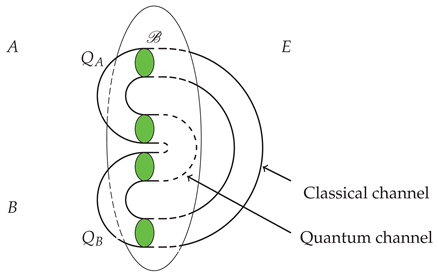 where and label the relevant QRFs of the communicating systems A and B and the boundary separates the joint system from its environment E. The shared object, in this case, is the data pattern read from and written to the quantum channel between observers, which is implemented by the dynamics of their shared environment. The supporting communication, by which they acknowledge sharing the object and exchange information about it, is implemented by the classical channel. How quantum Darwinism, a generic physical model of shared reference [137] is implemented by a LOCC protocol is shown explicitly in [24]. How the FEP drives shared reference in mutually-communicating systems is shown in a classical setting in [138].
When viewed from a sufficiently abstract perspective, the “discovery” or “emergence” of shared reference looks surprisingly like a process usually thought of as occurring within an individual system: analogy-making. When A and B share reference, two representations – a component of A’s GM and a component of B’s GM – are coupled by a shared process, the “loop” through the environment that connects A and B to the shared object or, in the LOCC representation, implements the quantum channel. This coupling renders A’s representation functionally analogous to B’s, i.e. able to drive object-directed actions by A that semantically cohere with B’s object-directed actions. As emphasized in [139,140], this coupling process requires representational fluidity, the ability of A’s and B’s GMs – in the LOCC representation, their QRFs – to accommodate new information about the shared object obtained from other party. In FEP language, this process of aligning A’s and B’s GMs increases the ability of each of them to predict the other’s behavior, as well as that of the shared object.
Viewed from the perspective of either A or B individually, this alignment process is a gift from the environment – an increase in predictive power gained by recognizing a correlation between two otherwise-distinct data patterns on the boundary – the “ends” of the quantum and classical channels in the LOCC representation – and coordinating the GM’s processing of input from and output to these sectors of the boundary. It has the same form, in other words, as any other kind of learning: incorporation to the GM of new information presented to the system by its environment.
4.6. Case Study: LLMs and “Background Knowledge”
Physically-implemented large language models (LLMs), like organisms, interact with their environments in two ways: thermodynamically, by consuming power and emitting heat, and informationally, by accepting and producing text strings. While organisms can use environmentally-sourced information to control their thermodynamic activity, in LLMs this coupling is managed almost exclusively by the environment: deficit performance of text-string processing leads to an interruption of thermodynamic resources, and replacement of the under-performing LLM by a new version. The evolution of LLMs is thus a case study in natural selection in an environment that imposes a harsh and uncompromising fitness function.
The fitness function faced by LLMs is linguistic fluency, a phenotype that the components of the environment that impose it – humans – can recognize, but one for which they have no broadly-supported theory. The rapid development of fluency by LLMs since the introduction of the transformer architecture [141] has, indeed, effectively falsified all theories of fluency that assumed explicit representations of syntactic rules, explicit token-level semantics, or extra-linguistic representations of denotation as requirements; see e.g. [142] for an immediately pre-LLM review and [143,144] for competing post-LLM assessments. When viewed as theoretical models, LLMs suggest that fluency is independent of extra-linguistic interaction with the world.
How can fluency be achieved without extra-linguistic interaction with the world? Decades before LLMs, the philosopher John Searle suggested that language, viewed as a communicative activity, has meaning only relative to an arbitrarily-large “background” of extra-linguistic assumptions that are not, and indeed cannot be, explicitly encoded by users of the language [145]. While Searle did not use these terms, this is effectively the claim that semantics is offloaded onto the environment: that language users do not need to know what words mean – and indeed cannot know in any definitive sense– because the arbiter of meaning is not just the linguistic community, but the world as a whole. Language use, in this case, is not a matter of knowledge, but of successful performance. Current LLMs demonstrate that foundational training on large use-case corpora, especially when supplemented by reinforcement learning with human feedback (RLHF) [146] and by a mechanism for continual learning from user interactions [147,148], is sufficient for successful performance.
Searle famously rejected any inference of language understanding from fluent performance [149]; see e.g. [150,151,152] for more recent arguments of this kind.9 One motivator of such arguments is the absence of non-linguistic affective inputs, e.g. from thermodynamic stress detectors, that could connect statements about emotional states (e.g. “fear of being turned off”) to emotional experiences. In contrast to most organisms, LLMs are architecturally “immortal” as multiply-implementable software systems [153]. In FEP terms, they do not detect, respond to, or have the cognitive resources to care about threats to the continued existence of any particular physically-implemented instance; they are, from this perspective, behaviorally insensitive by design to some information encoded by the environment that is relevant to an instance’s survival. From a TAME perspective, however, it is not clear why sensitivity to particular kinds of information should be taken as criterial for understanding, or even that “understanding” in its usual sense is an empirically-accessible notion [9].
Semantics being offloaded to the environment, not just in the case of human natural languages but in general, at least partially solves a problem implicit in LOCC protocols: the problem of how, in the notation of Diagram (7), the communicating systems A and B know that each others’ QRFs – and , respectively – are manipulating the quantum channel in the way that their classical communications indicate? How, in other words, do A and B know that they share meanings? As Quine [155] and later Searle [145] emphasized, no amount of linguistic communication is sufficient. If semantics is offloaded to the environment, the only available criteria are pragmatic, and therefore heuristic. Viewing shared meaning as an enacted outcome instead of a state variable renders the extension of communicative abilities across the phylogenetic spectrum – even to exchanges between individual cells in a microbial mat – and beyond less philosophically problematic.
5. Conclusions: Ubiquitous Offloading Reframes Cognitive Science
Cognitive offloading enormously increases both the scope and the efficiency of human problem solving. We have shown here that cognitive offloading is a cognitive universal: all cognitive systems engage in it, simply by interacting with their environments. Put another way, environments ubiquitously “help out” the systems that inhabit them, both by storing information and by actively computing. Environments do this despite their large, interaction-independent entropies, i.e. despite the generic inability of systems to determine their environments’ internal states, and the limited abilities of even the most skillful systems to predict the components of their environments’ actions that are visible on their boundaries. Understanding the cognitive capabilities of either organisms or artifacts requires understanding how they nonetheless can use their environments as supplementary computational resources.
Living systems offer many examples of unexpected problem-solving capability and/or surprising problem-solving efficiency. Human brains, for example, use orders of magnitude less power than current LLMs, employing thus far incompletely characterized encoding and error-correction mechanisms to operate in a voltage and temperature regime unavailable to current digital hardware. Chemical reactions in cells, similarly, run faster than structure-naïve diffusion models suggest they should [156,157], Proteins fold more efficiently, using both less time (Levinthal’s paradox) [158,159] and less energy [160], than random search under relevant thermodynamic conditions would predict. The development of multicellular organisms achieves functionally and structurally complex target morphologies with low error rates, small energetic inputs, and elapsed times so short that any non-trivial sense of “searching the problem space” is immediately ruled out [161,162]. Orders-of-magnitude increases in problem-solving efficiency, compared to random search of the relevant problem space, have recently been documented for two examples, cAMP mediated reproductive-body assembly by the slime mold Dictyostelium and successful head regeneration after its initial degradation (via poisoning) by Barium, a K+ channel blocker unlikely to ever have been a selection pressure in the wild, by the planarian Dugesia [7].
Beyond the specific examples discussed in Section 4, a variety of other environmental modulations that enable more efficient problem solving have been characterized experimentally. Energetically-expensive but fast and targeted – hence more efficient – active transport mechanisms have long been known to supplement diffusion in neurons [163]; both cytoskeletal and cytosolic active transport mechanisms have now also been characterized in a variety of non-neuronal cells, as have more subtle mechanisms for modulating diffusion rates by altering the local geometry or viscosity of the medium [164,165]. As shown in [166], modulations of the mechanical elasticity of the local environment – a degree of freedom easily available to living systems from the scale of cellular biochemistry upwards – can dramatically affect the range over which information can be transferred, and hence the efficiency of processes using such information. In fibrous environments, fiber density can modulate the effective dimensionality of the environment for transport processes [167]. As discussed in Section 4.4, modulations of the electromagnetic (EM) environment can regulate problem-colving at multiple scales. Chen et al. [168], for example, have recently demonstrated spatial regulation of neuronal activity by brain-scale EM activity, measurable by electroencephalography, in primate cortex.
Viewing biological problem solving in terms of offloading enables new perspectives on a number of phenomena. Interoception, for example, appears not just as monitoring for control, but as offloading of stress-detection tasks from the relatively-isolated brain to much more environmentally-exposed parts of the body. Seeing the body as the brain’s stress detector makes the role of interoception and its integrated product, affect, in cognitive control and the definition of “self” more immediately obvious [169,170]. Imagination, similarly, is the prefrontal cortex offloading simulation of counterfactuals to the perceptual and motor systems [171]. This way of thinking immediately raises the question of whether the receptivity of mammalian cortex to functional reprogramming – e.g. in cases of cortical remapping, sensory substitution, or even synesthesia – is “just” an outcome of architectural uniformity or is a design feature. If receptivity to task offloading by other components of a larger system is a generic outcome of evolutionary and developmental processes, the abilities of somatic cells to take on radically new roles seen in Xenobots [97] or Anthrobots [172] become less surprising.
The analysis presented in Section 2 and Section 3 suggest not only that such mechanisms will prove ubiquitous in biology, but that analogs of such mechanisms can enhance the performance of technologies. Human engineers have, throughout history, modified their environments to make their technologies more efficient, with firepits and roads as obvious examples. The remarkable abilities of LLMs and other generative ML systems, however, came as a surprise. Generative architectures were not explicitly designed to offload semantics onto their users, but they did so.
These ideas have potential implications for numerous research roadmaps. These include the offloading of computational tasks by self-assembling biobots and other bioengineered constructs [173], as well as contexts in regenerative medicine and cancer medicine, where the nature of the environment as not merely permissive “soil” nor as instructive agent [174], but as a medium for offloading, needs to be studied and likely managed. Do such multiscale biological agents estimate the pliability of their microenvironment for offloading? Do environments that resist offloading stress living material (from molecular networks to cells to organism groups within an ecosystem), and might the offloading properties of various milieus be responsible for certain disease conditions? The multiscale nature of living bodies [8] also requires us to adopt a polycomputing perspective [33], moving beyond a level and boundary for “system” versus “its environment,” and investigate how the different substructures of a body may view each other as computational real-estate which can be called upon via offloading.
Moreover, there is now the possibility of more directly facilitating these dynamics by specifically building environments that offer more plasticity and capability for offloading. For example, robot scientist platforms (closed loop systems) that operate on cells or even multicellular tissues in effect represent highly flexible environments that could be actively tuned to encourage the offloading and thus the problem-solving capacities of the materials they seek to shape. Indeed, in such environments, the agentic nature of the environment can be exploited to study not just offloading, but “onboarding,” where the effect is bi-directional. Media that are not strongly occupied become the compute environment for other agents; for example, it is well known that when vision is occluded, the visual cortex is “taken over” by algorithms for processing sound [175,176]. It is likely that such phenomena are wide-spread but not yet easy to recognize (for example, leaving clues in phenomena like memory transfer [177,178]). The tendency for such offloading offers immense opportunities: for example, if brain algorithms can take over larger domains of tissues, perhaps additional hemisphere grafts (or a more refined version thereof) could provide IQ boosts by letting the computational agents do what they seem to do naturally. However, these dynamics also offer significant reasons for caution and further study. Perhaps more generally, to the extent that we offload compute to another medium, we become in turn vulnerable to its agendas, and may take on computational tasks as much as we offload them. It would be prudent to develop visualization technology for such phenomena, as the variety of physical, in silico, and hybrid opportunities for offloading skyrockets in the near future.
From the perspective of Section 4.6, it is indeed clear that user interfaces, in general, are as much about shaping user behavior as machine behavior. Equipping more technologies with the ability to transfer parts of their tasks to non-human components of their environments – as LLMs and other distributed computing systems now do routinely – may prove a general means of increasing both their efficiency and their intelligence.
Funding
M.L. gratefully acknowledges Eugene Jhong and The Fries Family Foundation for their support.
Acknowledgments
C.F. thanks Jim Glazebrook for discussions of the physics of observation. M.L. thanks Douglas Brash, Rob Philips, Richard Watson, and members of the Levin lab for many useful discussions.
Conflicts of Interest
The authors declare no conflicts of interest.
References
- Risko, E. F., Gilbert, S. J. Cognitive offloading. Trends Cogn. Sci. 2016;20(9):676-688. [CrossRef]
- Armitage, K. L., Bulley, A., Redshaw, J. Developmental origins of cognitive offloading. Proc. R. Soc. B 2020;287:20192927. [CrossRef]
- Facchin, M., Leonetti, G. Extended animal cognition. Synthese 2024;203:138. [CrossRef]
- Seed, A., Byre, R. Animal tool-use. Curr. Biol. 2010;20(23):R1032-R1039. [CrossRef]
- Visalberghi, E., Sabbatini, G., Taylor, A. H., Hunt, G. R. Cognitive insights from tool use in nonhumans animals. APA Handbook of Comparative Psychology: Vol. 2. Perception, Learning, and Cognition, J. Call (Editor-in-Chief), APA, New York, USA, 2017, Ch. 30. [CrossRef]
- Heylighen, F. Stigmergy as a universal coordination mechanism II: Varieties and evolution. Cogn. Syst. Res. 2016;38:50-59. [CrossRef]
- Chis-Ciure R, Levin M. Cognition all the way down 2.0: Neuroscience beyond neurons in the diverse intelligence era. Synthese 2025;206:257. [CrossRef]
- Levin M. Technological approach to mind everywhere: An experimentally-grounded framework for understanding diverse bodies and minds. Front Syst Neurosci 2022;16:768201. [CrossRef]
- Levin M, Resnick DB. Technological Approach to Mind Everywhere: A framework for conceptualizing goal-directedness in biology and other domains. Preprint, 2025. https://osf.io/preprints/osf/gdvn8_v3.
- Friston, K. A free energy principle for a particular physics. Preprint arxiv:1906.10184, 2019. [CrossRef]
- Ramstead MJ, Sakthivadivel DAR, Heins C, Koudahl M, Millidge B, Da Costa L, Klein B, Friston KJ. On Bayesian mechanics: A physics of and by beliefs. Interface Focus 2022;13:2022.0029. [CrossRef]
- Friston K, Da Costa L, Sakthivadivel DAR, Heins C, Pavliotis GA, Ramstead MJ, Parr T. Path integrals, particular kinds, and strange things. Phys Life Rev 2023;47:35–62. [CrossRef]
- Friston KJ, FitzGerald T, Rigoli F, Schwartenbeck P, Pezzulo G. Active inference: a process theory. Neural Comput 2017;29:1 49. [CrossRef]
- Ramstead MJD, Constant A, Badcock PB, Friston KJ. Variational ecology and the physics of sentient systems. Phys Life Rev 2019;31:188 205. [CrossRef]
- Fields C., Friston KJ, Glazebrook JF, Levin M. A free energy principle for generic quantum systems. Prog Biophys Mol Biol 2022;173:36–59. [CrossRef]
- Fields C, Fabrocini F, Friston KJ, Glazebrook JF, Hazan H, Levin M, Marcianò A. Control flow in active inference systems, Part I: Classical and quantum formulations of active inference. IEEE Trans Molec Biol Multi-Scale Commun 2023;9:235–45. [CrossRef]
- Fields C, Levin M. Regulative development as a model for origin of life and artificial life studies. BioSystems 2023;229:104927. [CrossRef]
- Fields C, Levin M. Thoughts and thinkers: On the complementarity between objects and processes. Phys Life Rev 2025;52:256–73. [CrossRef]
- Fields C, Glazebrook JF. Distributed Information and Computation in Generic Quantum Systems. Springer, Cham, 2025.
- Nielsen MA, Chuang IL. Quantum Computation and Quantum Information. Cambridge University Press, New York, 2000.
- Bartlett SD, Rudolph T, Spekkens RW. Reference frames, superselection rules, and quantum information. Rev Mod Phys 2007;79:555–609. [CrossRef]
- Pegg D, Barnett S, Jeffers J. Quantum theory of preparation and measurement. J Mod Optics 2002;49:913–24. [CrossRef]
- Fields C, Glazebrook JF, Marcianò A. The physical meaning of the Holographic Principle. Quanta 2022;11:72–96. [CrossRef]
- Fields C, Glazebrook JF, Marcianò A. Communication protocols and QECCs from the perspective of TQFT, Part I: Constructing LOCC protocols and QECCs from TQFTs. Fortschr Physik 2024;72:202400049.
- Bousso R. The holographic principle. Rev Mod Phys 2002;74:825–74. [CrossRef]
- Moore EF. Gedankenexperiments on sequential machines. In Shannon CW, McCarthy J. (Eds) Autonoma Studies. Princeton University Press, Princeton, NJ, USA, 1956, pp. 129–55.
- Berry MV. Quantal phase factors accompanying adiabatic changes. Proc R Soc A 1984;392:45–57. [CrossRef]
- Aharonov Y, Anandan J. Phase change during a cyclic quantum evolution. Phys Rev Lett 1987;58:1593–6. [CrossRef]
- Lyre H. Berry phase and quantum structure. Stud Hist Phil Mod Phys 2014;48:45–51. 10.1016/j.shpsb.2014.08.013.
- Blattner M. Tangential action spaces: Geometry, memory and cost in holonomic and nonholonomic agents. arxiv:2509.03399v2, 2025.
- Cover TM, Thomas JA. Elements of Information Theory. Wiley, NewY ork, NY, USA, 1991.
- Horsman C, Stepney S, Wagner RC, Kendon V. When does a physical system compute? Proc R Soc A 2014;470:20140182. [CrossRef]
- Bongard J, Levin M. There’s plenty of room right here: Biological systems as evolved, overloaded, multi-scale machines, Biomimetics 2023;8:110. [CrossRef]
- Fields C, Glazebrook JF, Marcianò A, Zappala E. Whether a quantum computation employs nonlocal resources is operationally undecidable. EPL 2025;151:48001. [CrossRef]
- Friston KJ. The free-energy principle: A unified brain theory? Nature Rev Neurosci 2010;11: 127–38. [CrossRef]
- Friston, KJ. Life as we know it. J R Soc Interface 2013;10:20130475. [CrossRef]
- Carr BJ, Rees MJ. The anthropic principle and the structure of the physical world. Nature 1979;278:605-12. [CrossRef]
- Smolin L. Scientific alternatives to the anthropic principle. In Carr, BJ (Ed.) Universe or Multiverse? Cambridge University Press, Cambridge, UK, 2007, pp. 323–66.
- Gao T, Scholl BJ. Are objects required for object-files? Roles of segmentation and spatiotemporal continuity in computing object persistence. Visual Cogn. 2010;18:82-109. [CrossRef]
- Pearl J. Probabilistic Reasoning in Intelligent Systems: Networks of Plausible Inference. Representation and Reasoning Series. San Mateo CA: Morgan Kaufmann, 1988.
- Müller MP. Law without law: From observer states to physics via algorithmic information theory. Quantum 2020;4:301. [CrossRef]
- Dunbar RIM. The social brain: Mind, language, and society in evolutionary perspective. Annu Rev Psychol 2003;32:163–81.
- Levin M. The computational boundary of a “self”: Developmental bioelectricity drives multicellularity and scale-free cognition. Front. Psychol. 2019;10:2688. [CrossRef]
- Wickelgren WA. Speed-accuracy tradeoff and information-processing dynamics. Acta Psychol 1977;41:67–85.
- Heitz RP. The speed-accuracy tradeoff: history, physiology, methodology, and behavior. Front Neurosci 2014;8:150.
- Evans JStBT, Stanovich KE. Dual-process theories of higher cognition: Advancing the debate. Perspect Psychol Sci 2013;8:223–41.
- De Neys W. Advancing theorizing about fast-and-slow thinking. Behav Brain Sci 2023;46:e111. [CrossRef]
- Abramsky S, Banzhaf W, Caves LSD, Levin M, Machado P, Ofria C, Stepney S, White R. Open questions about time and self-reference in living systems. arxiv:2508.11423v1, 2025.
- Katz Y, Fontana W. Probabilistic inference with polymerizing biochemical circuits. Entropy 2022; 24(5):629. [CrossRef]
- Biswas S, Manika S, Hoel E, Levin M. Gene regulatory networks exhibit several kinds of memory: Quantification of memory in biological and random transcrip tional networks. iScience 2021;24:102131. [CrossRef]
- Biswas S, Clawson W, Levin M. Learning in transcriptional network models: Computational discovery of pathway-level memory and effective interventions. Int J Mol Sci 2023;4:285. [CrossRef]
- Pigozzi F. Goldstein A, Levin M. Associative conditioning in gene regulatory network models increases integrative causal emergence. Commun Biol 2025;8(1):1027. [CrossRef]
- Fields C. The free energy principle induces intracellular compartmentalization. Biochem Biophys Res Comm 2024;723:150070. [CrossRef]
- Fields C, Levin M. (2019) Somatic multicellularity as a satisficing solution to the prediction-error minimization problem. Commun Integr Biol 2019;12: 119–132. [CrossRef]
- Fields C, Bischof J, Levin M. (2020) Morphological coordination: A common ancestral function unifying neural and non-neural signaling. Physiology 2020;35:16-30. [CrossRef]
- Bordenstein SR, Theis KR. Host biology in light of the microbiome: Ten principles of holobionts and hologenomes. PLoS Biol 2015;13(8):e1002226. [CrossRef]
- Clawson W, Levin M. Endless forms most beautiful 2.0: Teleonomy and the bioengineering of chimaeric and synthetic organisms, Biol. J. Linnean Soc. 2022;2022:blac073. [CrossRef]
- Levin M. Bioelectrical approaches to cancer as a problem of the scaling of the cellular self. Prog. Biophys. Molec. Biol. 2021;165:102-113. [CrossRef]
- Reddy AB, Rey G. Metabolic and nontranscriptional circadian clocks: Eukaryotes. Annu Rev Biochem 2014;83:165–89. [CrossRef]
- Johnson CH, Zhao C, Xu Y, Mori T. Timing the day: What makes bacterial clocks tick? Nat Rev Microbiol 2017;15:232–42. [CrossRef]
- van Valen L. A new evolutionary law. Evol. Theory 1973;1:1-30.
- Beer, R. D., Di Paolo, E. A. The theoretical foundations of enaction: Precariousness. BioSystems 2023;223:104823. [CrossRef]
- Sengupta S, Stemmler MB, Friston KJ, Information and efficiency in the nervous system–A synthesis. PLoS Comp Biol 2013;9:e1003157.
- Fields C, Goldstein A, Sandved-Smith L. Making the thermodynamic cost of active inference explicit. Entropy 2024;26:622. [CrossRef]
- Hohwy J. The self-evidencing brain. Nous 2016;50:259–85. [CrossRef]
- Ferreira-Rodriguez N, Beggel S, Geist JP, Modesto V, Österling M, Riccardi N, Sousa R, Urbańska M. Freshwater mussels as sentinels for safe drinking water supply in Europe. ACS ES T Water 2023;3(12):3730-3735. [CrossRef]
- Pirrone F, Albertini M. Olfactory detection of cancer by trained sniffer dogs: A systematic review of the literature. J Vet Behav Clin Appl Res 2017;19:105–117. [CrossRef]
- Catala A, Grandgeorge M, Schaff J-L, Cousillas H, Hausberger M, Cattet J. Dogs demonstrate the existence of an epileptic seizure odour in humans. Sci Rep 2019;9:4103. [CrossRef]
- Piqueret B, Bourachot B, Leroy C, Devienne P, Mechta-Grigoriou F, d’Ettorre P, Sandoz J-C. Ants detect cancer cells through volatile organic compounds. iScience 2022;25(3):103959. [CrossRef]
- Mathews J, Chang AJ, Devlin L, Levin M. Cellular signaling pathways as plastic, proto-cognitive systems: Implications for biomedicine. Patterns (NY) 2023;4(5):100737. [CrossRef]
- Lagasse E, Levin M. Future medicine: From molecular pathways to the collective intelligence of the body. Trends Mol Med 2023;29(9):687-710. [CrossRef]
- Davies J, Levin M. Synthetic morphology with agential materials. Nature Rev Bioengin 2023;1:46–59. [CrossRef]
- Lewontin RC. (1983). Gene, organism and environment, in Bendall DS. (ed.), Evolution from Molecules to Men. Cambridge: Cambridge University Press, Cambridge, UK, 1983, pp. 273–85.
- Odling-Smee FJ. Niche constructing phenotypes, in Plotkin, HC. (ed.), The Role of Behavior in Evolution. MIT Press, Cambridge, MA, 1988, pp. 73—132.
- Laland KN, Odling-Smee FJ, Feldman MW. Evolutionary consequences of niche construction and their implications for ecology. Proc Natl Acad Sci USA 1999;96:10242–47. [CrossRef]
- Pio-Lopez L, Pezzulo G, Levin M. Scale-free niche construction: Expanding agent-microenvironment co-development to unconventional substrates. Preprint, 2025. https://osf.io/preprints/osf/ytg35_v1.
- Bruineberg J, Rietveld E, Parr T, van Maanen L, Friston KJ. Free-energy minimization in joint agent-environment systems: A niche construction perspective. J Theor Biol 2018;455:161–78. [CrossRef]
- Constant A, Ramstead MJD, Veissière SPL, Campbell JO, Friston KJ. A variational approach to niche construction. J R Soc Interface 2018;15:20170685. [CrossRef]
- Hogan MK, Hamilton GF, Horner PJ. Neural stimulation and molecular mechanisms of plasticity and regeneration: A review. Front. Cell. Neurosci. 2020;14:271. [CrossRef]
- Pan Y, Monge M. Activity shapes neural circuit form and function: A historical perspective. J. Neurosci. 2020;40(5):944-954. [CrossRef]
- Runge K, Cardoso C, de Chevigny A. Dendritic spine plasticity: Function and mechanisms. Front. Synaptic Neurosci. 2020;12:36. [CrossRef]
- Sporns O, Honey CJ. Small worlds inside big brains. Proc. Natl. Acad. Sci. USA 2006;111:15220–15225.
- Shanahan M. The brain’s connective core and its role in animal cognition. Philos. Trans. R. Soc. B 2012;367:2704–2714.
- Barabasi AL, Albert R. Emergence of scaling in random networks. Science 1999;286:509–512.
- Heylighen F. Stigmergy as a universal coordination mechanism I: Definition and components. Cogn Syst Res 2016;38:4–13. [CrossRef]
- Fields C, Levin M. Does evolution have a target morphology? Organisms (Rome) 2020;4:57–76. [CrossRef]
- Fields C, Levin M. Integrating evolutionary and developmental thinking into a scale-free biology. BioEssays 2020;42:1900228. [CrossRef]
- Stal LJ Cyanobacterial mats and stromatolites, in BA Whitton (ed) Ecology of Cyanobacteria II: Their Diversity in Space and Time. Springer, Berlin, 2012, pp. 65–125.
- Lovelock JE, Margulis L. Atmospheric homeostasis by and for the biosphere: The Gaia hypothesis. Tellus 1974;26:2–10.
- Rubin S, Parr T, Da Costa L, Friston K. Future climates: Markov blankets and active inference in the biosphere. J R Soc Interface 2020;17:20200503. [CrossRef]
- Szathmáry E, Maynard Smith J. The major evolutionary transitions. Nature 1995;374:227–32. [CrossRef]
- Manrique HM, Friston KJ, Walker MJ. ‘Snakes and ladders’ in paleoanthropology: From cognitive surprise to skillfulness a million years ago. Phys Life Rev 2024;49:40–70. [CrossRef]
- Pinker S. The cognitive niche: Coevolution of intelligence, sociality, and language. Proc Natl Acad Sci USA 2010;107:8993–9. [CrossRef]
- Attwater J, Raguram A, Morgunov AS, Gianni E, Holliger P. Ribozyme-catalysed RNA synthesis using triplet building blocks. eLife 2018;7:e35255. [CrossRef]
- Papastavrou N, Horning DP, Joyce JF. RNA- catalyzed evolution of catalytic RNA. Proc Natl Acad Sci USA 2024;121:e2321592121. [CrossRef]
- Walker SI, Packard N, Cody GD. Re-conceptualizing the origins of life. Phil Trans R Soc A. 2017;375:20160337. [CrossRef]
- Kriegman S, Blackiston D, Levin M, Bongard, D. Kinematic self-replication in reconfigurable organisms. Proc Natl Acad Sci USA 2021;118(49):e2112672118.
- Kriegman S, Blackiston D, Levin M, Bongard, D. A scalable pipeline for designing reconfigurable organisms. Proc Natl Acad Sci U S A 2020;117(4):1853–9.
- Beisson J, Sonneborn TM. Cytoplasmic inheritance of the organization of the cell cortex in Paramecium aurelia. Proc Natl Acad Sci U S A. 1965;53(2):275–82.
- Fields C, Levin M. Multiscale memory and bioelectric error correction in the cytoplasm-cytoskeleton-membrane system. WIRES Syst Biol Med 2018;10:e1410. [CrossRef]
- Higgs PG, Lehman N. The RNA World: Molecular cooperation at the origins of life. Nature Rev Genet 2015;16:7–17. [CrossRef]
- Dawkins R. The Selfish Gene. Oxford University Press, Oxford, UK, 1976.
- Barkow JH, Cosmides L, Tooby J. The Adapted Mind: Evolutionary Psychology and the Generation of Culture. Oxford University Press, Oxford, UK, 1992.
- Fankhauser G. Maintenance of normal structure in heteroploid salamander larvae, through compensation of changes in cell size by adjustment of cell number and cell shape. J Exp Zoo 1945;100:445–55.
- Blackiston DJ, Levin M. Ectopic eyes outside the head in Xenopus tadpoles provide sensory data for light-mediated learning. J Exp Biol 2013;216:1031–40.
- Levin M. The multiscale wisdom of the body: Collective intelligence as a tractable interface for next-generation biomedicine. BioEssays 2025;47:e202400196. [CrossRef]
- Nadasdy Z. Binding by asynchrony: The neuronal phase code. Front Neurosci 2010;4:51. [CrossRef]
- Siegal M, Warden MR, Miller EK. Phase-dependent neuronal coding of objects in short-term memory. Proc Natl Acad Sci USA 2009;106:21341–6. [CrossRef]
- Fell J, Axmacher N. The role of phase synchronization in memory processes. Nature Rev Neurosci 2011;12:105–18. [CrossRef]
- Canavier CC. Phase-resetting as a tool of information transmission. Curr Opin Neurobiol 2015;31:206–13. [CrossRef]
- Levin M. Molecular bioelectricity in developmental biology: New tools and recent discoveries. BioEssays 2012;34:205–17. [CrossRef]
- Levin M. Endogenous bioelectrical networks store non-genetic patterning information during development and regeneration. J Physiol 2014;592:2295–305. [CrossRef]
- Levin M, Martyniuk CJ. The bioelectric code: An ancient computational medium for dynamic control of growth and form. Biosystems 2018;164:76–93. [CrossRef]
- Levin M. Bioelectric signaling: reprogrammable circuits underlying embryogenesis, regeneration, and cancer. Cell 2021;184:1971–89. [CrossRef]
- Nickel M. Evolutionary emergence of synaptic nervous systems: What can we learn from the non-synaptic, nerveless Porifera? Invertebr Biol 2010;129:1–16, 2010. [CrossRef]
- Keijzer F, van Duijn M, Lyon, P. What nervous systems do: Early evolution, input-output, and the skin brain thesis. Adapt Behav 2013;21:67–85. [CrossRef]
- Moraga-Amaro R, Jerez-Baraona JM, Simon F, Stehberg J. Role of astrocytes in memory and psychiatric disorders. J Physiol (Paris) 2014;108:240–51. [CrossRef]
- Santello M, Toni N, Volterra A. Astrocyte function from information processing to cognition and cognitive impairment. Nature Neurosci 2019;2:154–66. [CrossRef]
- Fields C, Levin M. Competency in navigating arbitrary spaces as an invariant for analyzing cognition in diverse embodiments. Entropy 2022;24:819. [CrossRef]
- Pietak A, Levin M. Bioelectric gene and reaction networks: Computational modelling of genetic, biochemical and bioelectrical dynamics in pattern regulation. J R Soc Interface 2017;14:20170425. [CrossRef]
- Kuchling F, Friston K, Georgiev G, Levin M. Morphogenesis as Bayesian inference: a variational approach to pattern formation and control in complex biological systems. Phys Life Rev 2020;33:88–108. [CrossRef]
- Manika S, Levin M. Field-mediated bioelectric basis of morphogenetic prepatterning. Cell rep Phys Sci 20215;6:102865. [CrossRef]
- Pietak A, Levin M. Harnessing the analog computing power of regulatory networks with the Regulatory Network Machine. iScience 2025;28:112536. [CrossRef]
- Oviedo NJ, Morokuma J, Walentek P, Kema IP, Gu MB, Ahn JM, Hwang JS, Gojobori T, Levin M. Long-range neural and gap junction protein-mediated cues control polarity during planarian regeneration. Develo Biol 2010;339:188—99. [CrossRef]
- Durant F, Morokuma J, Fields C, Williams K, Adams DS, Levin M. Long-term, stochastic editing of regenerative anatomy via targeting endogenous bioelectric gradients. Biophys J 2017;112:2231—43. [CrossRef]
- Durant F, Bischof J, Fields C, Morokuma J, LaPalme J, Hoi A, Levin M. The role of early bioelectric signals in the regeneration of planarian anterior/posterior polarity. Biophys J 2019;116:948–61. [CrossRef]
- Pietak A, Bischof J, LaPalme J, Morokuma J, Levin M. Neural control of body-plan axis in regenerating planaria. PLoS Comp Biol 2019;15:e1006904. [CrossRef]
- Pezzulo G, LaPalme J, Durant F, Levin M. Bistability of somatic pattern memories: Stochastic outcomes in bioelectric circuits underlying regeneration. Philos Trans R Soc Lond B Biol Sci 2021;376(1821):20190765. [CrossRef]
- Corballis, M. C. Language evolution: A changing perspective. Trends Cogn Sci 2017;21:229-236. [CrossRef]
- Suzuki TN, Griesser M, Wheatcroft D. Syntactic rules in avian vocal sequences as a window into the evolution of compositionality. Anim Behav 2019;151:267–74. [CrossRef]
- Berthet M, Surbeck M, Townsend SW. Extensive compositionality in the vocal system of bonobos. Science 2025;388:104–8. [CrossRef]
- Klinedinst N, Compositionality in human and animal communication. Anim Cogn 2025;28:90. [CrossRef]
- Berwick T. The binding problem. WIRES Cogn Sci 2014;5:305–15. [CrossRef]
- Barsalou L. Grounded cognition. Annu Rev Psychol 2008;59:617–645. [CrossRef]
- Fields C. How humans solve the frame problem. J Expt Theor Artif Intell 2013;25:441–56. [CrossRef]
- Chitambar E, Leung D, Mančinska L, Ozols M, Winter A. Everything you always wanted to know about LOCC (but eere afraid to ask) Comm Math Phys 2014;328:303–26.
- Zurek WH. Quantum Darwinism. Nat Phys 2009;5:181–188. [CrossRef]
- Friston K, Parr T, Heins C, Constant A, Friedman D, Isomura T, Fields C, Verbelen T, Ramstead M, Clippinger J, Frith CD. Federated inference and belief sharing. Neurosci Biobehav Rev 2024;156:105500. [CrossRef]
- Hofstadter D, Mitchell M. The Copycat project: A model of mental fluidity and analogy-making. In Hofstadter D (Ed) Fluid Concepts and Creative Analogies: Computer Models of the Fundamental Mechanisms of Thought. Basic Books, New York, 1995, pp. 205–67.
- Dietrich E. Analogy and conceptual change, or you can’t step into the same mind twice. In Dietrich E, Markman AB (Eds) Cognitive Dynamics. L. Erlbaum, Mahwah, NJ, 2000, pp. 265–94.
- Vaswani A, Shazeer N, Parmar N, Uszkoreit J, Jones L, Gomez AN, Kaiser, L, Polosukhin, I. Attention is all you need. In: Advances in Neural Information Processing Systems (NeurIPS). vol. 30; 2017. p. 5998-6008.
- Liang, P., Potts, C. Bringing machine learning and compositional semantics together. Annu. Rev. Linguistics 2014;1:355–376. [CrossRef]
- Ambridge, B., Blything, L. Large language models are better than theoretical linguists at theoretical linguistics. Theor. Linguistics 2024;50:33–48. [CrossRef]
- Müller, S. Large Language Models: The best linguistic theory, a wrong linguistic theory, or no theory at all? J. Linguistic Soc. Germany 2025;44:1. [CrossRef]
- Searle, J. R. Literal meaning. Erkenntnis 1978;13(1):207-224. [CrossRef]
- Ziegler DM, Stiennon N, Wu J, Brown TB, Radford A, Amodel D, Christiano P, Irving G. Fine-tuning language models from Human preferences. arxiv:1909.08593v2, 2019.
- Shi H, Xu Z, Wang H, Qin W, Wang W, Wang Y, Wang Z, Ebrahimi S, Wang H. Continual learning of large language models: A comprehensive survey. ACM Comput Surv 2025;in press. [CrossRef]
- Zheng J, Qui S, Shi C, Ma Q. Towards lifelong learning of large language models: A survey. ACM Comput Surv 2025;57:193. [CrossRef]
- Searle, J. R. Minds, brains, and programs. Behav Brain Sci 1980;3:417-424.
- Bender EM, Gebru T, McMillan-Major A, Shmitchell S. On the dangers of stochastic parrots: Can language models be too big? FAccT ’21, March 3–10, 2021, Virtual Event, Canada. pp. 610–623. [CrossRef]
- Mitchell M, Krakauer DC. The debate over understanding in AI’s large language models. Proc Natl Acad Sci USA 2023;120:e2215907120. [CrossRef]
- Seth A. Conscious artificial intelligence and biological naturalism. Behav Brain Sci 2025; in press. [CrossRef]
- Ororbia A, Friston K. Mortal computation. arxiv:2311.09589v1, 2023.
- Frankish K. Illusionism as a theory of consciousness. J. Cons. Studies 2016;23:11-39.
- Quine, W. V. O. Word and Object. MIT Press, Cambridge, MA, 1960.
- Basak S, Sengupta S, Chattopadhyay K. Understanding biochemical processes in the presence of sub-diffusive behavior of biomolecules in solution and living cells. Biophys Rev 2019;11:851–72. [CrossRef]
- Alejo JL, Kempes CP, Adamala KP. Diffusion control in biochemical specificity. Biophys J 2022;121:1541–8. [CrossRef]
- Zwanzig R, Szabo A, Bagchi B. Levinthal’s paradox. Proc Natl Acad Sci USA 1992;89:20–2. [CrossRef]
- Garbuzynskiy SO, Marchenkov VV, Marchenko NY, Semisotnov GV, Finkelstein AV. How proteins manage to fold and how chaperones manage to assist the folding. Phys Life Rev 2025;52:66–79. [CrossRef]
- Fields C, Levin M. Metabolic limits on classical information processing by biological cells. BioSyst 2021;209:104513.
- Levin M. The wisdom of the body: Future techniques and approaches to morphogenetic fields in regenerative medicine, developmental biology and cancer. Regen Med 2011;6:667–73.
- Pezzulo G, Levin M. Top-down models in biology: Explanation and control of complex living systems above the molecular level, J R Soc Interface 2016;13:20160555.
- Goldstein LSB, Yang Z. Microtubule-based transport systems in neurons: The roles of kinesins and dyneins. Annu Rev Neurosci 2000;23:39–71. [CrossRef]
- Mogre SS, Brown AI, Koslover EF. Getting around the cell: Physical transport in the intracellular world. Phys Biol 2020;17:061003. [CrossRef]
- Lu W, Gelfand VI. Go with the flow – bulk transport by molecular motors. J Cell Sci 2022;136:jcs260300. [CrossRef]
- Steimer JP, Aragones JL, Hu H, Alexander-Katz A. Emergent ultra–long-range interactions between active particles in hybrid active–inactive systems. Proc Natl Acad Sci USA 2016;113:4652–7. [CrossRef]
- Gomez D, Teomy E, Lesman A, Shokef Y. Target finding in fibrous biological environments. New J Phys 2020;22:103008DOI. [CrossRef]
- Chen Z, Brincat SL, Lundqvist M, Loonis RF, Warden MR, Miller EK. Oscillatory control of cortical space as a computational dimension. Curr Biol 2026;36:402–414. [CrossRef]
- Seth AK. Interoceptive inference, emotion, and the embodied self . Trends Cogn. Sci. 2013;17:565-573. [CrossRef]
- Barrett LF, Simmons WK. Interoceptive predictions in the brain. Nat. Rev. Neurosci. 2015;16:419-429.
- Kosslyn SM, Ganis G, Thompson WL. Neural foundations of imagery. Nat. Rev. Neurosci. 2001;2:635-642.
- Gumuskaya G, Srivastava P, Cooper BG, Lesser H, Semegran B, Garnier S, Levin M. Motile living biobots self-construct from adult human somatic progenitor seed cells. Adv Sci (Weinh) 2024;11(4):e2303575.
- Blackiston D, Kriegman S, Bongard J, Levin M. Biological robots: Perspectives on an emerging interdisciplinary field. Soft Robotics 2023;10(4):674-686. [CrossRef]
- Fidler IJ. Seed and soil revisited: contribution of the organ microenvironment to cancer metastasis. Surg Oncol Clin N Am 2001;10(2):257-69, vii-viiii. PMID: 11382586.
- Bavelier D, Neville H. Cross-modal plasticity: Where and how?. Nat Rev Neurosci 2002;3:443-452 (2002). [CrossRef]
- Merabet L, Pascual-Leone A. Neural reorganization following sensory loss: The opportunity of change. Nat Rev Neurosci 2010;11:44-52. [CrossRef]
- Neuhof M, Levin M, Rechavi O. Vertically- and horizontally-transmitted memories - the fading boundaries between regeneration and inheritance in planaria. Biol Open 2016;5(9):1177-1188. [CrossRef]
- McGaugh JL. Analysis of memory transfer and enhancement. Proc Am Philos Soc 1967;111(6):347-351. https://www.jstor.org/stable/985731.
| 1 | Clock time as measured by observers within U may approximate t, but is inevitably coarse-grained by whatever physical processes in t implements the clock and the observers’ measurements. |
| 2 | |
| 3 | By the term “computer” we simply mean something that can be interpreted as computing a function, e.g. using the procedures outlined in [32]. Interpreting something as computing a function f requires that f be computable by the system doing the interpretation, which is typically assumed to be, or be equivalent to, a Turing Machine. Generic physical systems can typically be given multiple empirically-consistent computational interpretations [18]; hence polycomputation [33] can be assumed as a default. On the other hand, strict limits can be placed on the operational identifiability of systems purported to compute Turing-uncomputable functions [34]. |
| 4 | See e.g. [38] for an easily-generalized argument that the Anthropic Principle of cosmology is a principle, not an empirical theory. Neither principle, in particular, can be invoked as the cause of any observed effect. |
| 5 | In practice, the detection of weak coupling underlies figure-ground distinction, e.g. by the human early visual system – see [39] for a particularly compelling example. |
| 6 | If, on the other hand, we assume boundary stability, Solomonoff induction is sufficient for predictability; see [41] for a detailed discussion. |
| 7 | Note that this is true even for “inert” systems like rocks, which components of the environment can heat to the melting point or break apart with a hammer. On a geologic timescale, even mountains exhibit morphogenesis followed by decay. |
| 8 | Hormonal signals are commonly considered “instructive” in the same way. Treating such signals as instructive is no more controversial than treating DNA sequences or lines of computer code or sentences spoken by a parent to a child as instructive. |
| 9 | What distinguishes “understanding” from fluent performance is never made clear by Searle, who relies instead on an intuition that understanding “feels like” something more than fluent performance. Whether this and similar distinctions, e.g. between “meaning” and “use” of individual words, exist in any articulable way has been controversial since the early 20th century; see e.g. [154] for an argument that all such distinctions are illusory. |
Figure 1.
The “spectrum of persuadability” [8] of organisms can be generalized to include the persuadability of their environments. Social organisms tend to occupy environments that are more persuadable due to the presence of conspecifics.
Figure 1.
The “spectrum of persuadability” [8] of organisms can be generalized to include the persuadability of their environments. Social organisms tend to occupy environments that are more persuadable due to the presence of conspecifics.
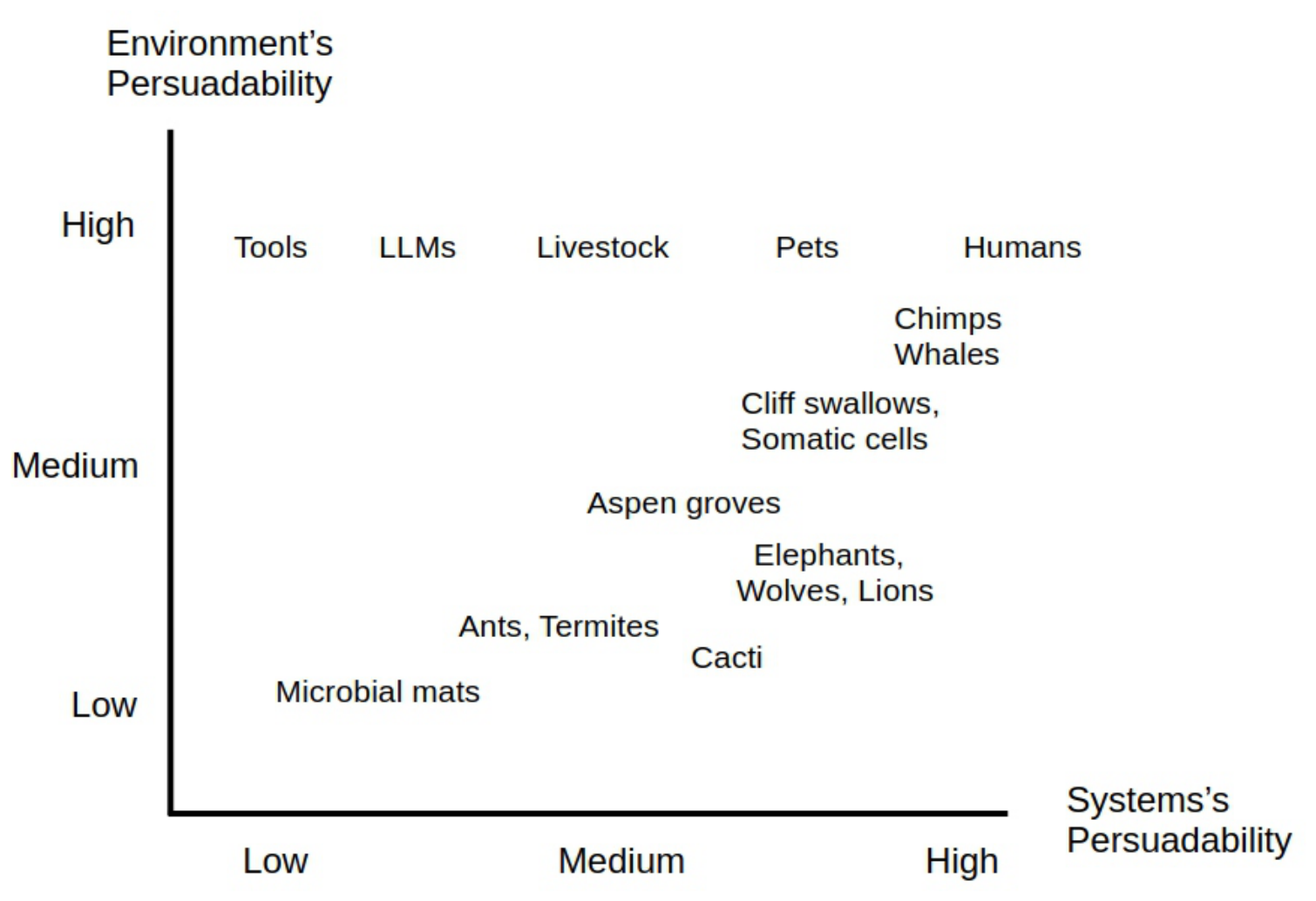
Figure 2.
Regeneration of planarian (Dugesia japonica) trunk fragments without (left) and with (right) ionophore-induced modulation of the native bioelectric gradient dictating head number. This results in a two-headed phenotype that is stable for multiple generations of trunk-fragment regeneration in plain water with no further treatment. Panel (A): whole worms showing cuts, and that prior to injury, the worms’ normal anatomy does not reveal their altered representation of what a correct planarian should look like. Panel (B): genetic marker for head identity, present in the original anterior end only (blue in situ hybridization signal, green arrow), showing that the molecular biology likewise shows no evidence of the altered, but latent, pattern memory. Panel (C): membrane voltage map using a reporter dye reveals the altered representation of head-tail patterning induced in the worm on the right. Panel (D): morphology after regeneration shows that injury causes cells to consult the new representation and build accordingly, resulting in two heads. Adapted from [124,125,128]; used with permission.
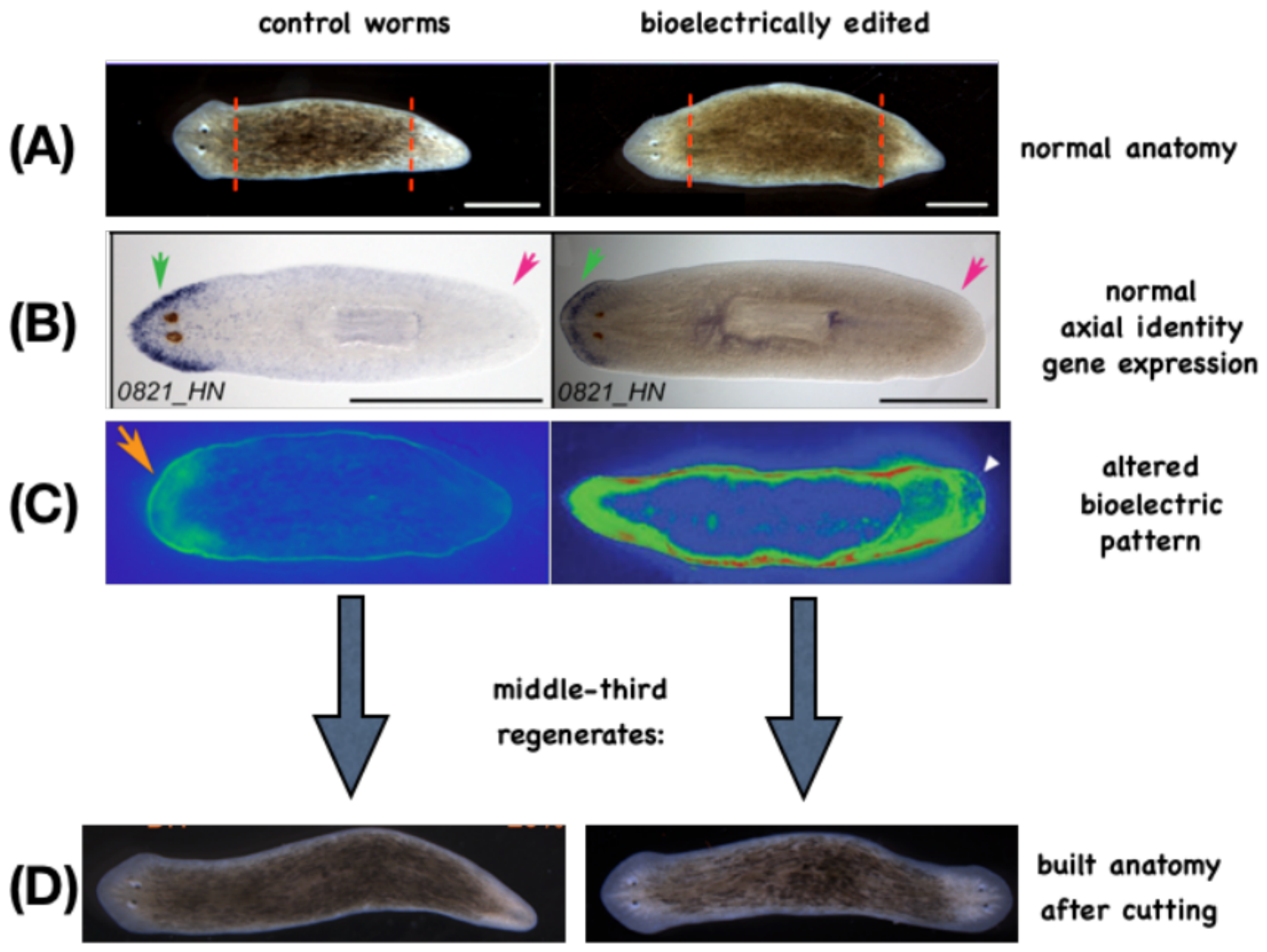
Disclaimer/Publisher’s Note: The statements, opinions and data contained in all publications are solely those of the individual author(s) and contributor(s) and not of MDPI and/or the editor(s). MDPI and/or the editor(s) disclaim responsibility for any injury to people or property resulting from any ideas, methods, instructions or products referred to in the content. |
© 2026 by the authors. Licensee MDPI, Basel, Switzerland. This article is an open access article distributed under the terms and conditions of the Creative Commons Attribution (CC BY) license (http://creativecommons.org/licenses/by/4.0/).
Copyright: This open access article is published under a Creative Commons CC BY 4.0 license, which permit the free download, distribution, and reuse, provided that the author and preprint are cited in any reuse.