
Submitted:
06 July 2026
Posted:
07 July 2026
You are already at the latest version
Abstract
Quantitative fluorescence analysis of aromatic pollutants in aquatic environments is frequently compromised by the primary inner filter effect (PIFE) induced by coexisting chromophoric species. In order to address this challenge, we propose a multi-component concentration quantification correction model that integrates transmittance absorbance and lateral (90°) fluorescence intensity. By establishing a coupled model of the excitation light decay dynamics and fluorescence emission, where styrene was used as the target analyte and anthracene/phenanthrene played the role of representative interferents, the inherently nonlinear PIFE was transformed into a tractable linear regression problem. The experiment shows that: under the coexistence of anthracene and phenanthrene, the model reduces the detection deviation of styrene from 40-63% to within 10%, and the correction accuracy of the three-component mixed system is increased by 3-5 times.The model in this work provides a theoretical framework for fluorescence quantitative analysis in complex systems, and also offers a new method for high-precision online monitoring of aromatic organic pollutants.
Keywords:
aromatic pollutants
; inner filter effect
; model correction
; fluorescence detection accuracy
1. Introduction
Owing to the proven carcinogenic, teratogenic and mutagenic properties, aromatic organic pollutants are becoming to the most significant persistent environmental pollutants of concern in water body management [1,2,3,4]. They have extremely low water solubility, ranging from 10−9 to 10−6 mg L−1. This imposes higher requirements for high detection sensitivity and poses significant challenges for analysis. It is well known that the traditional chromatography-mass spectrometry method has extremely high sensitivity. However, its sample pretreatment is cumbersome and the analysis time is long. The biggest challenge is that this method is difficult to achieve in-situ monitoring [5,6]. Relatively speaking, fluorescence spectroscopy technology, due to its ability to achieve nanomolar detection limits, rapid response time and non-destructive operation characteristics, has instead become a rapid screening method for aromatic pollutants and is widely applied [7]. However, this method also has its own scientific challenges. When multiple aromatic substances coexist, the high-concentration group will strongly absorb the excitation light, thereby generating the primary internal filter effect (PIFE). This will cause the fluorescence spectrum to be distorted and the original linear relationship between fluorescence intensity and the concentration of the analyte will be disrupted. Thus, the detection of the target analyte becomes inaccurate. Therefore, reducing the nonlinear interference caused by PIFE has become one of the core challenges and important approaches for achieving precise fluorescence quantification [7,8,9,10,11].
According to the previous literature researches, the strategies for addressing PIFE-induced quantification errors are as follows [12,13,14,15,16,17,18]:
(1) Physical dilution: By diluting the test samples, the PIFE was reduced to an insignificant level. However, aromatic pollutants in water are usually of low solubility, the dilution process may result in the fluorescence signal being below the detection limit of the instrument, severely reducing the sensitivity. Moreover, this method is operationally complex and dependent on laboratory conditions, making it unsuitable for in-situ online monitoring.
(2) Optical path optimization: The common approach is to use short-path colorimetric cells, frontal illumination geometries, or specialized optical components to physically shorten the propagation distance of light in the medium, thereby reducing PIFE. However, these improvements on the instruments merely involve a trade-off between reducing PIFE and sensitivity/generality, and cannot fundamentally solve the nonlinear correction problem in high-concentration multi-component systems.
(3) Chemometric and machine learning integration: This is a method that constructs a "virtual sensor array" through the excitation-emission matrix (EEM) fluorescence spectroscopy, combines chemometrics or deep learning models, and utilizes pattern recognition technology to distinguish structurally similar polycyclic aromatic hydrocarbons (PAHs) while retaining PIFE information. However, the deep learning method heavily relies on large-scale and representative training datasets.
(4) Spectroscopic–mathematical compensation: The principle is to conduct independent measurement of the full spectral absorption, and then estimate the excitation/emission attenuation along the optical path by reversing the Beer-Lambert law. This allows for subsequent correction of the fluorescence readings. Typically, this includes pure absorption correction, internal standardization based on Raman scattering, and additional absorption body linearization. The only drawback is that fluorescence and transmittance measurements usually require separate optical paths, resulting in higher implementation costs in the field.
Herein, we developed a novel PIFE correction strategy based on the synchronous "transmission-fluorescence dual detector" measurement. This method constructs a physically-based concentration regression model to solve the PIFE problem and has three key innovations:
(1) At the model level, through rigorous derivation and collaborative interpretation, we combined the total absorbance (from the transmission detector) along the path AC with the excitation signal at point B (from the 90° side fluorescence detector) to transform the nonlinear PIFE problem into a linearly solvable regression problem, without relying on empirical parameters.
(2) At the technical level, the dual detector can simultaneously capture complementary "macroscopic absorption" and "microscopic fluorescence" information, enabling in-situ PIFE correction for high-concentration samples.
(3) At the application level, this model can be extended to any n-component mixture, and only one measurement is required to accurately determine the concentration of each component. This paradigm provides theoretical rigor and practical reliability for the high-throughput in-situ monitoring of aromatic organic pollutants in complex aquatic environments, and can be extended to other fluorescence-based analysis fields (such as dissolved organic matter characterization, drug detection).
2. Principles of Fluorescence Detection for Aromatic Compounds
Aromatic organic pollutants, especially polycyclic aromatic hydrocarbons (PAHs), have unique molecular structures (as shown in Figure 1). When exposed to ultraviolet-visible light (UV-Vis), they exhibit characteristic fluorescence, which provides a fundamental basis for the rapid and highly sensitive detection of trace aromatic pollutants in water [19,20]. Aromatic and PAH molecules consist of one or more benzene rings linked by conjugated π-bonds, forming an extended delocalized π-electron system. When a sample is irradiated with UV light of an appropriate wavelength, the π-electrons of the aromatic pollutant absorb photon energy, and undergo an electron transition. Subsequently, the excited electrons undergo non-radiative relaxation processes—including vibrational relaxation and internal conversion—to dissipate a portion of their excess vibrational energy. They then return to the ground state, with the concomitant emission of fluorescence photons via radiative transitions. This entire photophysical sequence strictly follows the Stokes shift rule, whereby the emitted photons are of lower energy than the absorbed photons, resulting in emission wavelengths that are invariably longer than the excitation wavelength. Such a well-defined spectral fingerprint not only enables qualitative identification of aromatic pollutants but also provides a direct linear basis for quantitative concentration inversion based on fluorescence intensity measurements.
The fluorescence spectra (excitation-emission matrices, EEMs) of different aromatic compounds depend on the energy levels and transition probabilities of the π-electron system, which are determined by their molecular structures. Among these, three structural factors are particularly crucial:
(1) Number of benzene rings: Taking naphthalene, pyrene, and benzo[a]pyrene as examples, as the number of conjugated or parallel rings increases, the delocalized π-electron network expands, thereby reducing the HOMO–LUMO energy gap. This leads to a gradual increase in the red shift of the excitation and emission peaks, and in many cases, it enhances the molar absorptivity and quantum yield.
(2) Substituent effects: By modifying with functional groups such as methyl, hydroxyl, or carboxyl, the electronic density distribution of the aromatic nuclei can be disrupted through induction or resonance effects, which may potentially alter the fluorescence peak position, affect the vibrational fine structure, or, in some cases, cause fluorescence quenching. The specific outcome depends on the nature and location of the substituents.
(3) Isomeric discrimination: However, even in isomers with the same molecular formula, the stereoconfiguration of the ring significantly affects their photophysical properties. For instance, benzanthracene and anthracene - both have a molecular formula of C14H10, but they have different ring fusion patterns, which leads to significant differences in the positions and intensity distributions of their fluorescence peaks. Qualitative identification can be achieved simply by the spectral fingerprint.
Structure determines property, and the aforementioned structure-property relationship has been clearly demonstrated in this study. As shown in Figure 2, anthracene (ANT), phenanthrene (PHE), and styrene (St) exhibit distinct emission spectral peaks in the ultraviolet-visible light region due to their different ring systems and substitution patterns. Anthracene has a linearly conjugated tricyclic core, and its characteristic triplet structure shows the maximum absorption peaks at 381, 402, and 424 nm, reflecting its highly symmetrical π electron distribution. Phenanthrene is an isomer of anthracene, but its triplet mode is different, with peaks located at 347, 364, and 385 nm, which is caused by the change in energy level spacing and transition dipole moment due to its angular ring conjugation structure. In contrast, styrene, as a single-ring vinyl-substituted aromatic hydrocarbon, lacks the vibrational fine structure characteristic of polycyclic pollutants, so it only shows a strong single band at 308 nm. These unique and well-separated spectral bands can serve as reliable fingerprint features for rapid qualitative analysis of the corresponding pollutants in water samples, even in complex matrices, and have good applicability. In addition, the combined intensity of each characteristic peak is also positively correlated with the analyte concentration over a wide dynamic range (Figure 3), providing a simple and reliable basis for quantitative analysis without the need for complex sample pretreatment.
As common coexisting components, dissolved organic matter (DOM), heavy metals, and turbidity may interfere with fluorescence measurements through the internal filter effect (IFE). This internal filter effect stems from the coexisting conjugated pigments, which exhibit non-specific attenuation of the excitation and emission light. This attenuation reduces the fluorescence intensity reaching the detector, thereby affecting the accuracy of quantitative analysis. This problem is particularly severe when the target analyte is coexisting with high-concentration aromatic interfering substances (such as anthracene and phenanthrene).
Compared to physical dilution, instrument optimization, data algorithm integration and other correction strategies, the spectral-mathematical compensation method is conceptually the most attractive one, as it provides a deterministic and physically-based correction method that does not require sample dilution, and avoids the hardware trade-offs caused by optical modification as well as the data dependence of machine learning. However, in practical applications, it often requires an independent absorbance measurement channel and precise optical alignment, which significantly increases complexity and cost, especially for in-situ monitoring in the field. In our present work, we adopted the spectral-mathematical compensation strategy in a low-cost manner. Only an additional transmission detector was added beside the fluorescence channel, which does not rely on empirical parameters, iterative algorithms, or cumbersome calibration processes. By establishing a strict linear regression model that couples the total absorption along the optical path with the lateral collected fluorescence signal, it can quantitatively correct the main internal filter effect. This simple and physically-based method can effectively solve the PIFE (internal filter effect) distortion problem that has long plagued fluorescence quantitative analysis of multi-component systems, providing a potential feasible approach for accurate and real-time monitoring of aromatic pollutants in complex aquatic environments.
3. Mechanistic Model
3.1. Physical System Description
As shown in Figure 4, in our transmission-fluorescence synchronous detection system, a single-color excitation light (with wavelength λex and initial intensity I0) is incident vertically onto point A' of the sample chamber. The core of the detection device consists of an integrated dual-channel optical structure, which includes two spatially separated and functionally complementary units: the fluorescence detection channel is located at the 90° direction of the incident light beam (point B'), used to record the fluorescence signal emitted along the direction perpendicular to the excitation light at point B; the transmission detection channel is installed at the rear of the sample chamber and coaxial with the excitation path (point C'), used to measure the residual intensity It of the excitation light after passing through the entire sample. During the system modeling process, the lengths of the two optical paths are particularly important. Here, L1 = |AB|, which is the distance from the sample chamber entrance to the fluorescence excitation point B; L2 = |AC|, which is the total path length through the sample.
The specific measurement steps are as follows:
(1) Acquisition of initial intensity: The initial light intensity I0 is determined by measuring the signal using blank samples (such as ultrapure water or pure solvents), and this value can be used as the reference benchmark for all subsequent attenuation and emission..
(2) Excitation at point B: The excitation light propagates to point B in the sample chamber, where each fluorescent component absorbs the excitation light and emits fluorescence.
(3) Transmission measurement at point C: The excitation light continues to propagate to point C in the sample chamber, and the transmitted light intensity IC is measured at point C'.
(4) Fluorescence spectral acquisition at B: The fluorescence spectrum is obtained at point B, based on the light intensity of the incident light at point B and the fluorescence conversion rate.
(5) Correction of the fluorescence spectrum: Since the absorbance from point A to point B causes the excitation light to be attenuated by the time it reaches point B, the actual fluorescence emission intensity should be proportional to the number of photons absorbed at point B. Therefore, the absorbance information was used to correct the fluorescence spectrum.
(6) Model calibration: By collecting the spectral data of standard samples with known concentrations as the training set, the fluorescence response spectra of each substance are obtained, forming a fluorescence response matrix. Each column in this matrix corresponds to the corrected fluorescence spectral vector of a specific component. Eventually, the relationship between the fluorescence spectrum and the concentration can be obtained by correcting it.
(7) Concentration inversion for unknowns: For an unknown mixture, we simultaneously measure its fluorescence spectrum (at point B) and transmission spectrum (at point C, obtaining the absorbance AC under the excitation wavelength). By solving the relationship equation, the concentration vector is obtained.
The proposed model rests on the following fundamental assumptions:
- The solution contains n fluorescent components with concentration vectorc= [c1, c2, …, cn]ᵀ.
- Absorption of excitation light by each component obeys the Beer–Lambert law.
- No reabsorption of emitted fluorescence occurs during transmission (dilute solution condition, or negligible fluorescence optical path BB').
- Fluorescence emissions from different components are independent with no energy transfer.
- The system operates under steady-state optical response conditions.
3.2. Optical Propagation Model
3.2.1. Excitation Light Attenuation Kinetics
At the excitation wavelength λex, the intensity of the excitation beam at a distance x from the cell entrance follows the exponential attenuation law:
where α denotes the total absorption coefficient of the sample at λex, which is related to the molar absorptivities and concentrations of all absorbing species by α = Σ εi(λex)ci.
The intensity reaching the fluorescence excitation point B (located at distance L1 from the entrance) is therefore:
Meanwhile, the transmitted absorbance over the full path length L2 = |AC| is defined as:
where It is the transmitted intensity measured at point C. By virtue of the Beer–Lambert law, the transmitted intensity is related to the total absorption coefficient by:
AAC =−log10(It/I0)
Inverting this relationship yields the total absorption coefficient directly from the measured absorbance:
Combining Eqs. (2) and (5), we obtain the corrected excitation intensity at point B, now expressed in terms of experimentally accessible quantities:
3.2.2. Fluorescence Generation and Detection
Upon excitation at point B, the fluorescence intensity contributed by component i at emission wavelength λem is proportional to the number of photons absorbed by that component, which in turn depends on both the local excitation intensity and the concentration of the component:
Here, fi(λem) is the fluorescence emission efficiency function of component i, which encapsulates the quantum yield of the fluorophore, the spectral response of the detection system, and the geometric collection efficiency—all at the emission wavelength of interest.
Because the fluorescence contributions from different components are independent (i.e., no energy transfer occurs among them), the total detected fluorescence spectrum is simply the linear superposition of the individual component spectra:
It is important to note that in the absence of inner filter effects (i.e., when AAC = 0), Eq. (8) reduces to the familiar linear relationship between fluorescence intensity and concentration. However, when PIFE is present, the factor introduces a concentration-dependent attenuation that must be removed for accurate quantification.
To eliminate this excitation-dependent attenuation, we define a normalized fluorescence intensity that is independent of the total absorbance:
and similarly define the component-specific response coefficient:
With these definitions, the total normalized fluorescence spectrum takes the compact linear form:
This formulation is the cornerstone of our quantitative approach: it transforms the original nonlinear problem—where PIFE couples concentration and fluorescence intensity in a multiplicative manner—into a linear system that can be solved by standard regression techniques.
3.2.3. Concentration Inversion: A Linear Regression Formulation
We select m emission wavelengths (m ≥ n) and denote the normalized fluorescence intensities at these wavelengths as , with . Equation (11) then simplifies to:
where F̃= [F̃1, F̃2, ..., F̃m]ᵀ is the vector of normalized fluorescence intensities at the selected wavelengths, c = [c1, c2, ..., cn]ᵀ is the unknown concentration vector, and K is an m × n matrix whose elements are the response coefficients of component i at wavelength j.
Given that m ≥ n and the system is overdetermined, the optimal solution for the concentration vector is obtained by minimizing the residual sum of squares in the least-squares sense:
This solution requires only two inputs: the pre-calibrated response matrix K (obtained from standard solutions) and the measured normalized fluorescence vector F̃ (derived from the raw fluorescence spectrum and the simultaneously acquired absorbance AAC). The inversion is non-iterative, parameter-free, and computationally efficient, making it suitable for real-time implementation in online monitoring scenarios.
4. Experimental Verification
4.1. Experimental System
As shown in Fig. 5, on the customized transmission-fluorescence synchronous measurement system platform we developed, both orthogonal fluorescence and transmission absorption spectra can be simultaneously collected in the shared optical path. It can real-time compensate for the internal filtration effect in high-concentration samples and support wide dynamic range, single-point calibration quantitative analysis of multiple components in complex matrices. The lighting module is composed of an LED with a central wavelength of 255 nm. The emitted light passes through a band-pass filter and is then collimated by a lens assembly into a parallel beam with a diameter of 3 mm and a divergence angle of no more than 0.5 mrad. The fluorescence collection channel is at a 90° angle relative to the excitation axis and is located at point B in the sample chamber. A variable aperture (with an aperture range of 0.5–3 mm) is set in the collection path to suppress stray light and ensure that the fluorescence emitted by the sample enters the spectrometer with both spectral purity and spatial consistency. The excitation scattered light is then completely blocked by a long-pass filter and finally received by the fluorescence spectrometer. The transmission optical path continues along the original optical axis, extracts the target spectral band through a short-pass filter, and then reduces it to the PD linear region through an attenuator, and is finally received by the low-noise Si-PIN PD for calculating the total optical path absorbance AAC =−log10(It/I0).
Figure 5.
The schematic diagram of the experimental system.
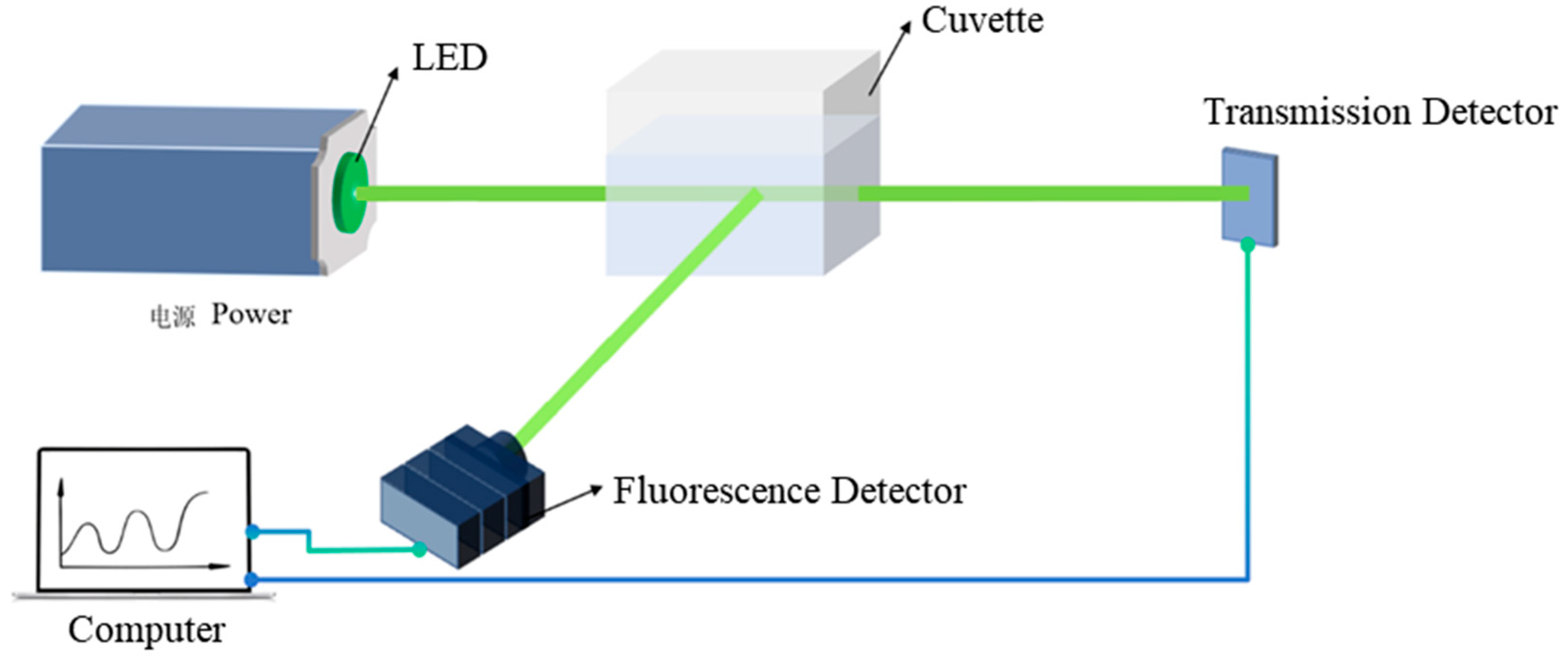
The transmission channel follows the same optical axis beyond the sample cell. After exiting the cuvette, the beam traverses a short-pass filter that isolates the spectral region of interest, followed by a neutral-density attenuator that brings the signal level within the linear dynamic range of the photodetector. The resulting signal is captured by a low-noise Si-PIN photodiode, whose output is used to compute the full-path absorbance according to AAC =−log10(It/I0).
4.2. Instruments and Reagents
The relevant experiments in this study were all conducted using a self-built transmission-fluorescence synchronous detection system, which included a high-speed CMOS fiber optic spectrometer (manufacturer: AVANTES; model: AvaSpec-ULS2048CL-EVO), a power meter (manufacturer: THORLABS; model: S120VC), and a self-built optical path. The experimental reagents used in this study (styrene, anthracene, and phenyl) were all of analytical purity or higher, purchased from Thermo Fisher Scientific.
4.3. Experimental Validation
4.3.1. Sample and Standard Solution Preparation
The standard stock solutions of styrene, anthracene, and phenanthrene (with a concentration of 500 mg/L each) were prepared using methanol as the solvent. The concentrations of styrene ranged from 0 to 4000 μg/L, the concentration of anthracene ranged from 0 to 600 μg/L, and the concentration of phenanthrene ranged from 0 to 2000 μg/L.
To systematically verify the internal filtration effect compensation model, a series of multi-component mixed standard solutions were prepared in this study. The concentrations were designed to cover different concentration gradients and interference combinations, as shown in Table 1.
4.3.2. Transmission–Fluorescence Dual-Mode Spectral Acquisition
The spectral data were collected using the self-built transmission-fluorescence synchronous detection system as described in 4.1. The specific parameter settings are as follows: The excitation light source at 255 nm is collimated with a constant intensity and incident on the sample. The spectral response range of the fluorescence spectrometer is 200 - 1100 nm. The integration time for data acquisition is optimized and adjustable within the range of 10 ms to 5 s based on the sample concentration to ensure that the signal intensity is within the linear response range of the detector. Three measurements are taken for each sample and the average value is calculated. The PD photodetector response range for the transmitted light signal is 200 - 1100 nm. The transmittance T and absorbance A are accurately calculated by using the photoelectric signal from the detector target surface. The samples were measured at room temperature (25 ± 1 ℃) in standard quartz cuvettes, with a transmission path length of 4 cm. The data processing was completed through a self-written MATLAB program.
4.3.3. Interference Analysis
Single-Interferent Systems
(1) Anthracene interference on styrene:
As shown in Figure 6a, the absorbance of anthracene exhibits excellent linearity with concentration over the range of 0–200 μg/L (R2 > 0.999), indicating that self-absorption is negligible in this interval. The corresponding fluorescence curves (Figure 7a) are also linear, with the most intense emission peak located at 401 nm. When anthracene coexists with styrene, however, the intrinsic linear range of styrene (0–1500 μg/L, Figure 7b) is disrupted, as illustrated in Figure 8. In the presence of 50 μg/L anthracene, deviation from linearity begins when styrene exceeds 500 μg/L; at 100 μg/L anthracene, the threshold drops to 300 μg/L; and at 200 μg/L anthracene, a negative deviation already emerges at 200 μg/L styrene, with the maximum measured value falling by 40% (Figure 8c). After correction with the proposed model, the deviation between the recovered fluorescence values and the true concentrations is reduced to within 10% at all concentration levels examined.
(2) Phenanthrene interference on styrene:
Figure 6b demonstrates that the absorbance of phenanthrene remains linear up to 2000 μg/L, and its fluorescence peak at 347 nm also shows a linear concentration dependence (Figure 7b). Figure 9 reveals that phenanthrene at 200 μg/L already induces a discernible inner filter effect when styrene exceeds 500 μg/L; at 500 and 1000 μg/L phenanthrene, the threshold is further compressed to 300 μg/L and 200 μg/L, respectively, with the maximum deviation reaching as high as 58% (Figure 9c). Following correction, the deviations are confined to within 10%, with the exception of extremely high concentration regimes.
Composite Interference Systems
Figure 10a-c correspond to the three composite systems of anthracene 50 μgL−1 and phenanthrene 200 μgL−1, anthracene 100 μgL−1 and phenanthrene 500 μgL−1, and anthracene 200 μgL−1 and phenanthrene 1000 μgL−1. As shown in the figure, the original linear relationship of styrene at concentrations ranging from 0 to 1500 μgL−1 was disrupted: at low concentration mixing, the critical value still remained at 500 μgL−1 (Figure 10a), at medium concentration mixing, it dropped to 200 μgL−1 (Figure 10b), and at high concentration mixing, it significantly deviated within 200 μgL−1, with the maximum deviation of 63% (Figure 10c). After model correction, the recovery deviations of the low and medium concentration composite systems were controlled at 5% and 10% respectively, while the high concentration system, due to the excessively low transmittance, the deviation after correction still reached 30%. Analyzing the 30% residual error is not a defect of the model, but the coupling result of PIFE and the physical optical limit at high concentrations.
The above results indicate that the dual-channel (transmission-fluorescence) collaborative correction system proposed by us can quantitatively eliminate the internal filtration effect of anthracene and phenanthracene on styrene. Under a single interference condition, regardless of the presence or absence of anthracene or phenanthracene, the maximum deviation after correction has continuously decreased from 40%–58% to within 10%. In the anthracene-phenanthracene composite system, at low to medium concentration levels (anthracene ≤ 100 μg/L, phenanthracene ≤ 500 μg/L), the quantitative accuracy still remains within 5%–10%. However, when the total absorbance exceeds 2.0, that is, when the transmittance is lower than 1% under the current optical configuration, the correction error rises to 30%, indicating that the existing path length has approached the actual limit of this measurement system.
Thus, the correction strategy we proposed is highly applicable within the conventional trace-to-medium concentration range, but has inherent limitations at extremely high concentration levels. Currently, efforts are being made to restore the correction accuracy under these complex conditions by optimizing experimental parameters, such as reducing the optical path length or using attenuated excitation intensity. This will also be our future public relations focus and will be covered in subsequent reports.
5. Conclusions and Outlook
This study is aimed at the high-sensitivity and fluorescence detection requirements of trace aromatic organic compounds in water environments. In response to the first-order internal filtration effect (PIFE) caused by the coexistence of high-concentration anthracene and phenanthrene in fluorescence detection, which interferes with the quantitative analysis of styrene, an innovative internal filtration effect compensation model based on the "transmission-fluorescence dual detector collaborative correction" strategy was proposed. By establishing the excitation light attenuation kinetics equation and the coupling model of fluorescence emission, this method effectively converts the nonlinear deviation caused by IPFE into a linear regression problem.
The experimental results show that our method demonstrates high efficiency and robustness in various scenarios. Under a single interference condition, this model can continuously reduce the maximum deviation of styrene detection from 40%–58% to within 10%. In low to medium concentration anthracene-phthalazine anthracene composite systems (anthracene ≤ 100 μg/L, phthalazine ≤ 500 μg/L), the corrected measurement accuracy reaches 5%–10%, which is 3 to 5 times higher than the uncorrected measurement results. This indicates that this method can effectively restore the linear relationship between fluorescence intensity and analyte concentration, which is usually disrupted by PIFE. Thus, even in the presence of strong absorbing coexisting species, reliable quantitative analysis can still be achieved. Furthermore, this model can be essentially extended to any n-component mixture. Currently, we are exploring its application in more complex environmental matrices containing dissolved organic matter, heavy metals, and suspended particles. The integration of the dual detector system with microfluidic devices and optical probes is also underway, aiming to achieve fully automatic, real-time, and in-situ monitoring of aromatic pollutants in natural water bodies, industrial wastewater, and drinking water sources. More broadly, the physical principle underlying our method - that is, correcting optical interference through the synergistic effect of absorbing spectral information and fluorescence information - is not only applicable to the analysis of aromatic pollutants but can also be extended to other fluorescence-based application fields.
In summary, this research provides a theoretically rigorous, experimentally verified, and practically feasible solution that effectively overcomes the long-standing problem of PIFE (photobleaching/fluorescence decay) that has hindered fluorescence quantitative analysis in multi-component systems. By bridging the gap between basic optical physics and application environmental monitoring, we believe that our transmission-fluorescence co-correction paradigm has taken a significant step forward in the pursuit of high-precision, real-time, and on-site deployable optical sensors for water quality assessment and their broader applications.
References
- Abdel-Shafy H I, Mansour M S M. A review on polycyclic aromatic hydrocarbons: source, environmental impact, effect on human health and remediation [J]. Egyptian Journal of Petroleum, 2016, 25(1): 107-123.
- Mojiri A, Zhou J L, Ohashi A, et al. Comprehensive review of polycyclic aromatic hydrocarbons in water sources, their effects and treatments [J]. Science of the Total Environment, 2019, 696: 133971.
- Vijayanand M, Ramakrishnan A, Subramanian R, et al. Polyaromatic hydrocarbons (PAHs) in the water environment: A review on toxicity, microbial biodegradation, systematic biological advancements, and environmental fate[J]. Environmental research, 2023, 227: 115716.
- Kumari A, Upadhyay V, Kumar S. A critical insight into occurrence and fate of polycyclic aromatic hydrocarbons and their green remediation approaches[J]. Chemosphere, 2023, 329: 138579.
- Revelsky I , Yashin Y S , Revelsky A ,et al.Fast Screening of Water and Organic Solution Samples for Polychlorinated Compounds: Microliquid Extraction and GC/MS[J].Environmental Aspects of Converting CW Facilities to Peaceful Purposes, 2002.
- Rankin-Turner S , Heaney L M .Deployable Mass Spectrometry for Rapid On-Site Bioanalysis[J].LCGC North America, 2022.
- Du M, Chen W, Qian C, et al. Using Rayleigh Scattering to Correct the Inner Filter Effect of the Fluorescence Excitation–Emission Matrix [J]. Analytical Chemistry, 2023, 95(33): 12273-12283.
- Weitner T, Friganovic T, Šakić D. Inner filter effect correction for fluorescence measurements in microplates using variable vertical axis focus[J]. Analytical chemistry, 2022, 94(19): 7107-7114.
- LI X, ZHOU Z, YANG T, et al. A Modified Inner-Filter Effect Model with Emission Angle in Fluorescence Spectra[J]. Measurement, 2025, 256.
- WANG T, ZENG L, LI D. A Review On The Methods For Correcting The Fluorescence Inner-Filter Effect Of Fluorescence Spectrum[J]. Applied Spectroscopy Reviews, 2017, 52(10): 883-908.
- Friganovic, Tomislav, Tin Weitner. Reducing the Inner Filter Effect in Microplates by Increasing Absorbance? Linear Fluorescence in Highly Concentrated Fluorophore Solutions in the Presence of an Added Absorber[J]. Analytical Chemistry 95, no. 35 (2023): 13036-13045.
- Larsson T, Wedborg M, Turner D. Correction of inner-filter effect in fluorescence excitation-emission matrix spectrometry using Raman scatter[J]. Analytica Chimica Acta, 2007,583(2): 357-363.
- Kothawala D N, Murphy K R, Stedmon C A, et al. Inner filter correction of dissolved organic matter fluorescence[J]. Limnology and Oceanography: Methods, 2013, 11(12): 616-630.
- Li W, Fu Y, Liu T, et al. High-throughput fluorescence quantification method based on inner filter effect and fluorescence imaging analysis[J]. Spectrochimica Acta Part A: Molecular and Biomolecular Spectroscopy, 2024, 318: 124422.
- Ceresa L, Kimball J, Chavez J, et al. On the origin and correction for inner filter effects in fluorescence. Part II: secondary inner filter effect-the proper use of front-face configuration for highly absorbing and scattering samples[J]. Methods and applications in fluorescence, 2021, 9(3): 035005.
- Bevilacqua M, Rinnan Å, Lund M N. Investigating challenges with scattering and inner filter effects in front-face fluorescence by PARAFAC[J]. Journal of Chemometrics, 2020, 34(9): e3286.
- Li W, Fu Y, Liu T, et al. Accurate correction method and algorithm of fluorescence secondary inner filter effect (sIEF) in fluorescence quantitative analysis[J]. Spectrochimica Acta Part A: Molecular and Biomolecular Spectroscopy, 2023, 288: 122147.
- Wamsley M C. Instrument and methodology development for expanding the capabilities of optical spectroscopic techniques[J]. 2024.
- Stedmon C A, Markager S, Bro R. Tracing dissolved organic matter in aquatic environments using a new approach to fluorescence spectroscopy[J]. Marine chemistry, 2003, 82(3-4): 239-254.
- Soursou V , Campo J ,Y. Picó.Revisiting the analytical determination of PAHs in environmental samples: An update on recent advances[J].Trends in Environmental Analytical Chemistry, 2023.
Figure 1.
Molecular structures of aromatic compounds. (a) Anthracene; (b) Phenanthrene; (c) Styrene.
Figure 1.
Molecular structures of aromatic compounds. (a) Anthracene; (b) Phenanthrene; (c) Styrene.
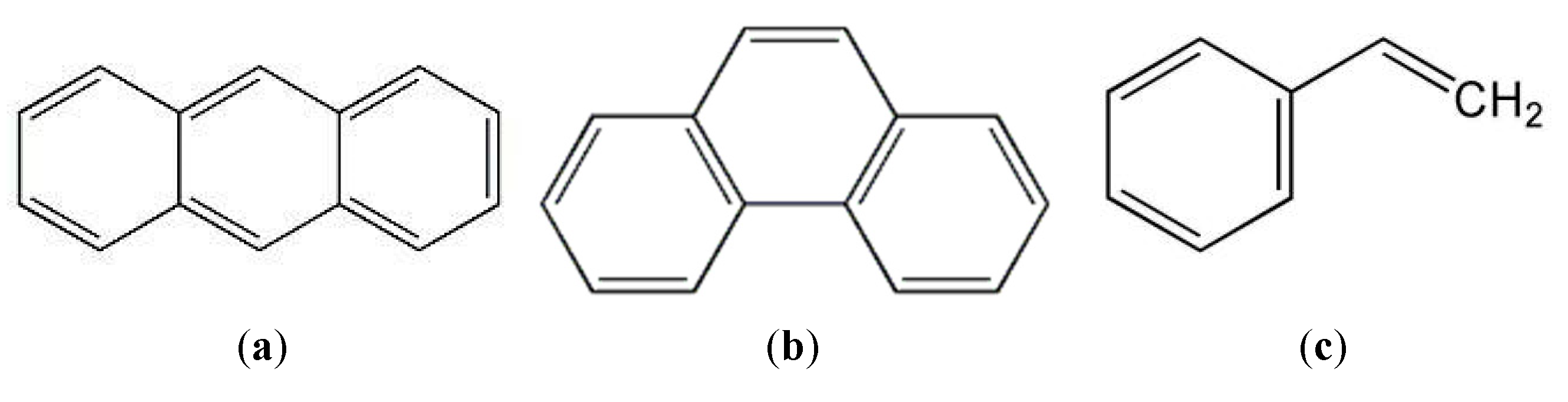
Figure 2.
Fluorescence spectra of aromatic compounds. (a) Anthracene; (b) Phenanthrene; (c) Styrene.
Figure 2.
Fluorescence spectra of aromatic compounds. (a) Anthracene; (b) Phenanthrene; (c) Styrene.
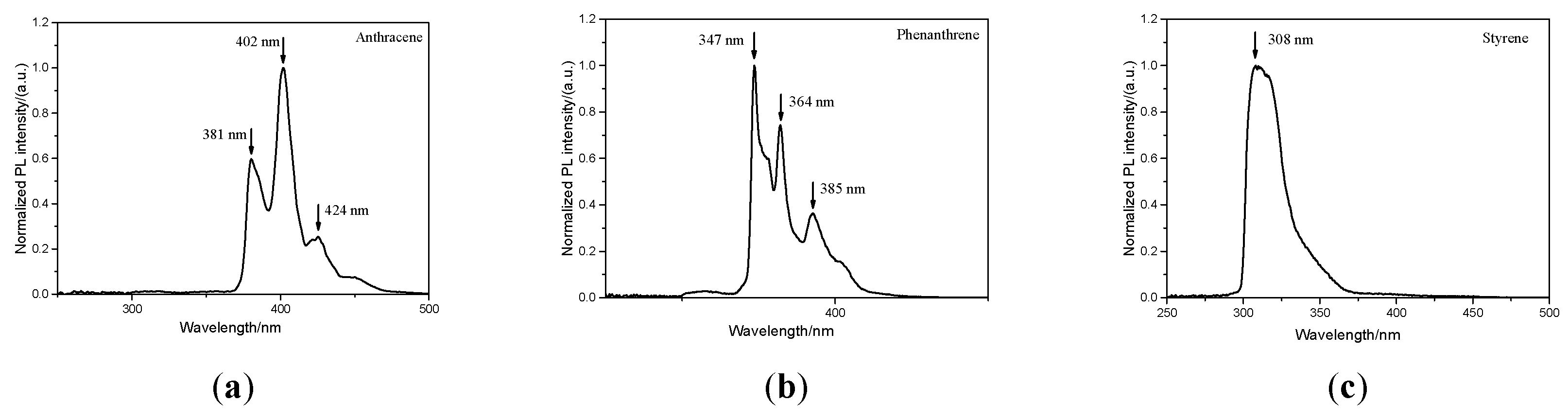
Figure 3.
Variation of fluorescence intensity with concentration for aromatic compounds. (a) Anthracene; (b) Phenanthrene; (c) Styrene.
Figure 3.
Variation of fluorescence intensity with concentration for aromatic compounds. (a) Anthracene; (b) Phenanthrene; (c) Styrene.
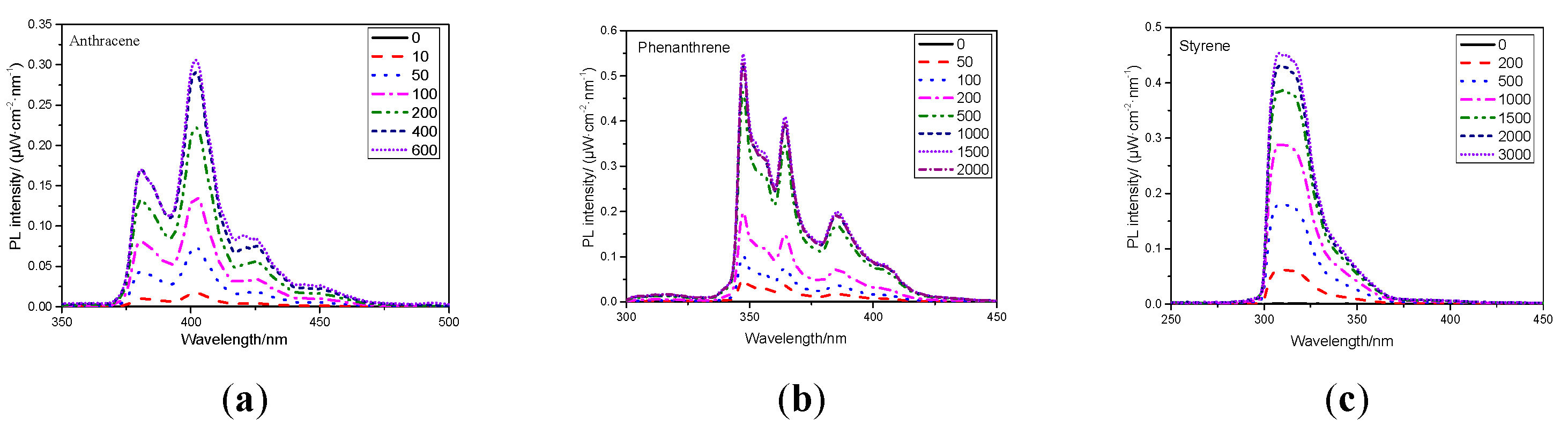
Figure 4.
The schematic diagram of the optical detection system.
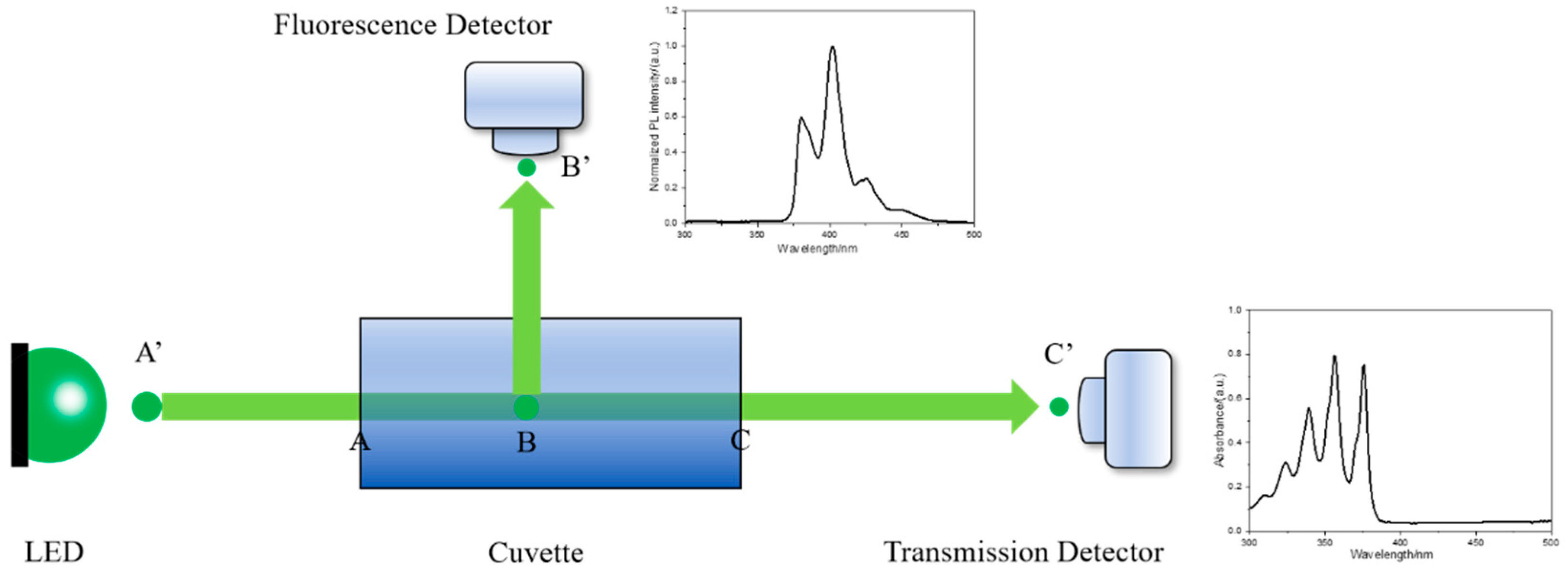
Figure 6.
Absorbance intensity curves of aromatic compounds at different concentrations. (a) Anthracene; (b) Styrene; (c) Phenanthrene.
Figure 6.
Absorbance intensity curves of aromatic compounds at different concentrations. (a) Anthracene; (b) Styrene; (c) Phenanthrene.
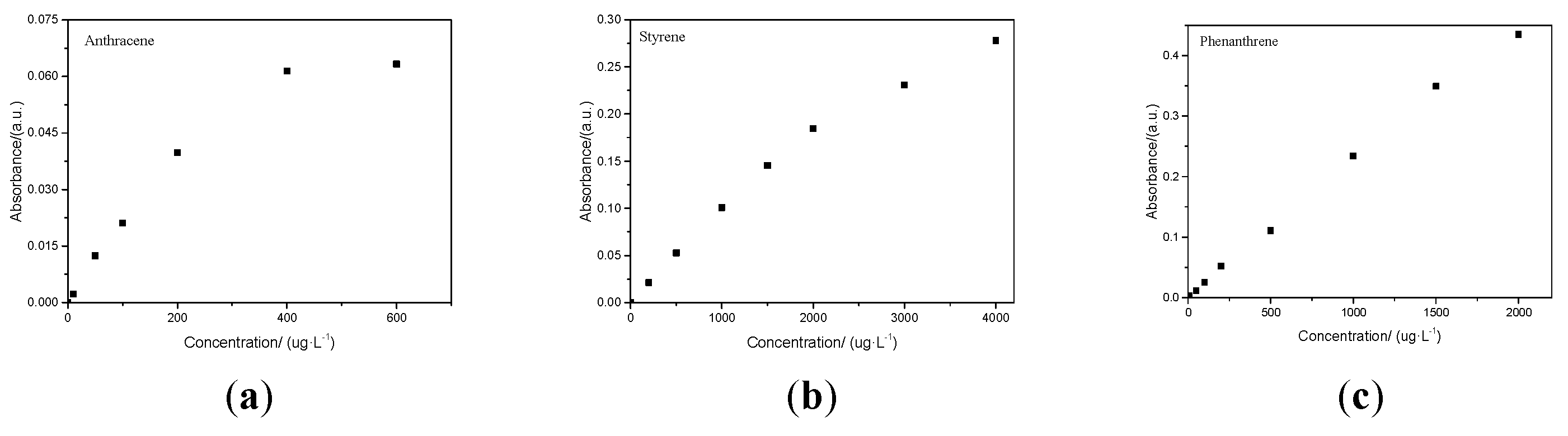
Figure 7.
Fluorescence intensity curves of aromatic compounds at different concentrations. (a) Anthracene; (b) Styrene; (c) Phenanthrene.
Figure 7.
Fluorescence intensity curves of aromatic compounds at different concentrations. (a) Anthracene; (b) Styrene; (c) Phenanthrene.
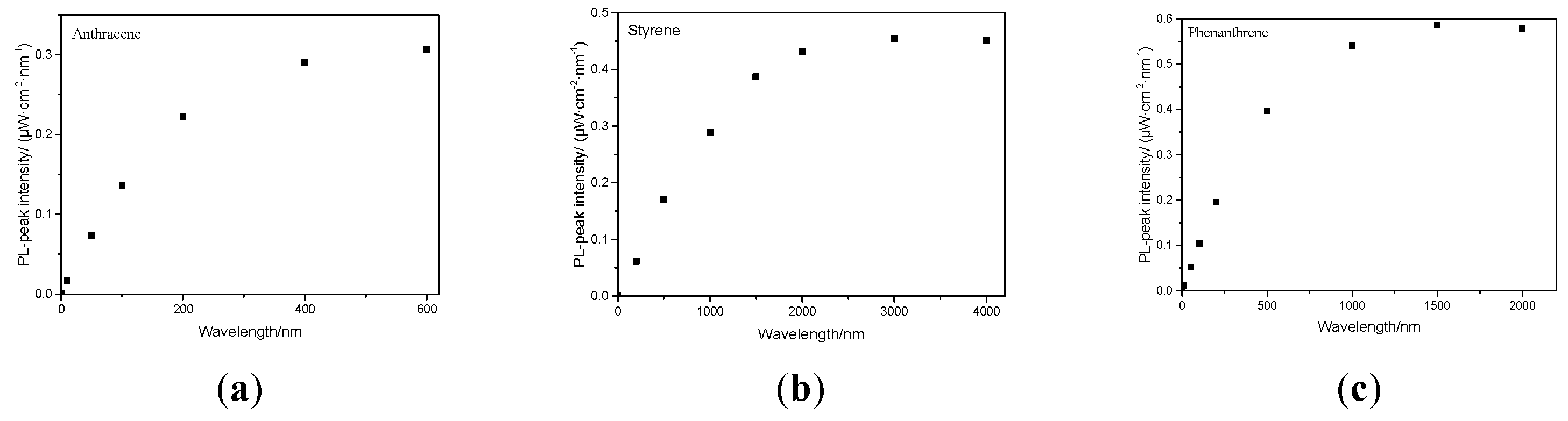
Figure 8.
Interference on fluorescence intensity of styrene by anthracene at different concentrations. (a) 50 μg/L; (b) 100 μg/L; (c) 200 μg/L.
Figure 8.
Interference on fluorescence intensity of styrene by anthracene at different concentrations. (a) 50 μg/L; (b) 100 μg/L; (c) 200 μg/L.
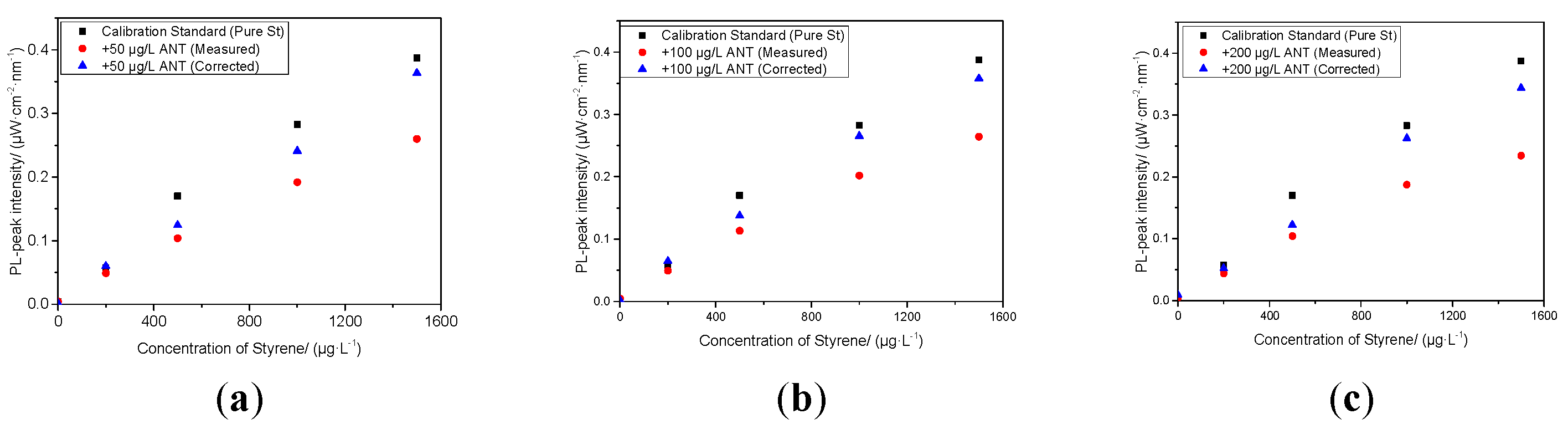
Figure 9.
Interference on fluorescence intensity of styrene by phenanthrene at different concentrations. (a) 200 μg/L; (b) 500 μg/L; (c) 1000 μg/L.
Figure 9.
Interference on fluorescence intensity of styrene by phenanthrene at different concentrations. (a) 200 μg/L; (b) 500 μg/L; (c) 1000 μg/L.
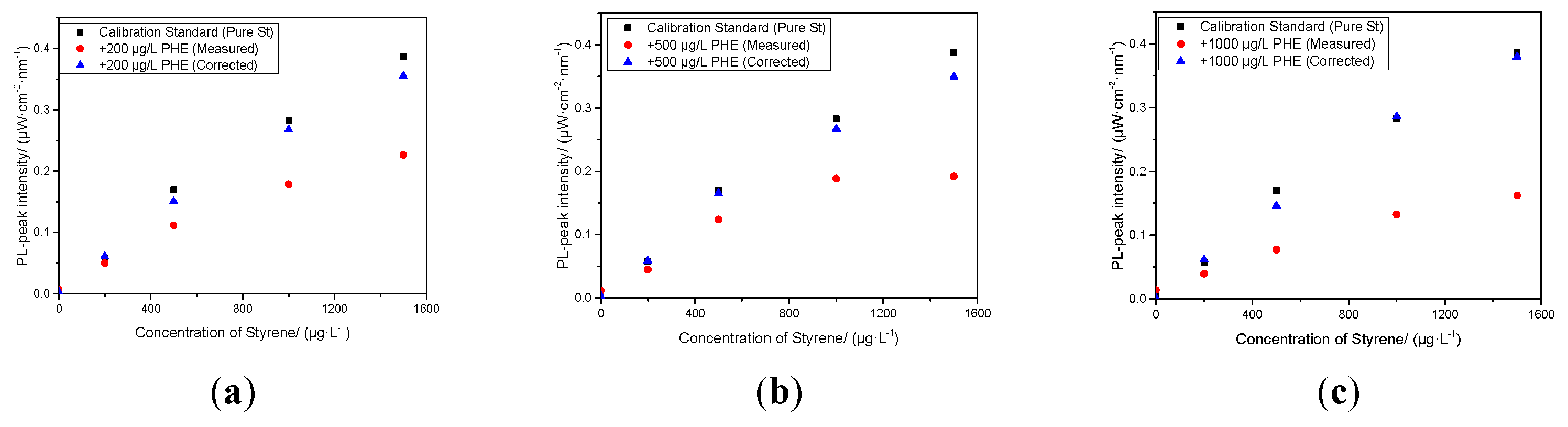
Figure 10.
Interference on fluorescence intensity of styrene by anthracene–phenanthrene mixtures at different concentrations.
Figure 10.
Interference on fluorescence intensity of styrene by anthracene–phenanthrene mixtures at different concentrations.
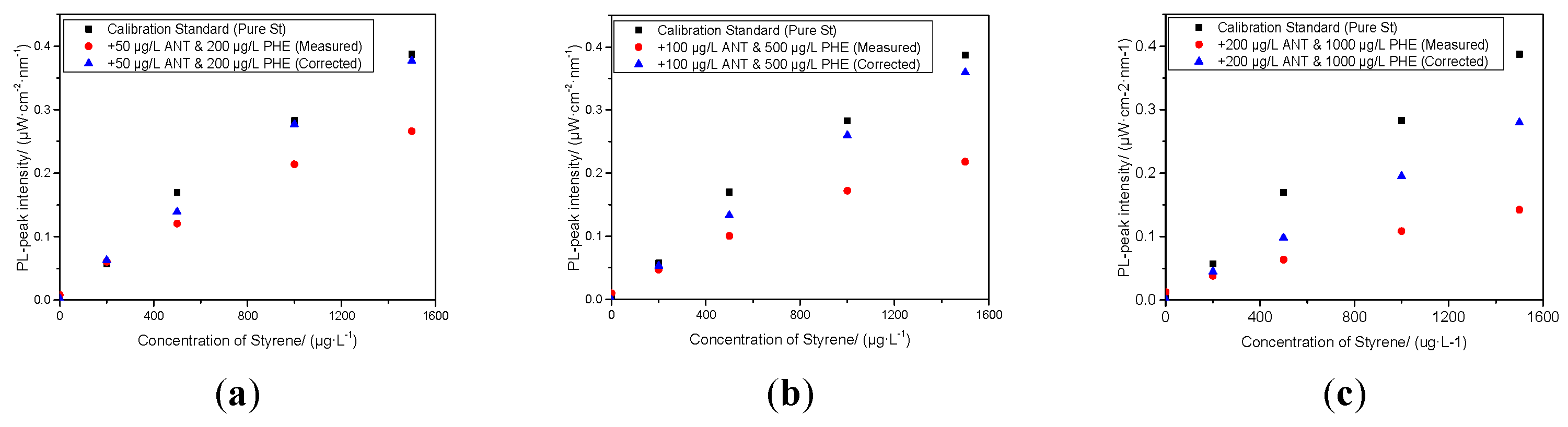

Table 1.
Concentration design of multi-component mixed solutions for model validation.
| Solution ID | Styrene | Anthracene | Phenanthrene | Design purpose |
| M1 | 0–1500 | 50 | – | Binary, low-level interferent |
| M2 | 0–1500 | 100 | – | Binary, medium-level interferent |
| M3 | 0–1500 | 200 | – | Binary, high-level interferent |
| M4 | 0–1500 | – | 200 | Binary, low-level interferent |
| M5 | 0–1500 | – | 500 | Binary, medium-level interferent |
| M6 | 0–1500 | – | 1000 | Binary, high-level interferent |
| M7 | 0–1500 | 50 | 200 | Ternary, low-level cross-interference |
| M8 | 0–1500 | 100 | 500 | Ternary, medium-level cross-interference |
| M9 | 0–1500 | 200 | 1000 | Ternary, high-level cross-interference |
Disclaimer/Publisher’s Note: The statements, opinions and data contained in all publications are solely those of the individual author(s) and contributor(s) and not of MDPI and/or the editor(s). MDPI and/or the editor(s) disclaim responsibility for any injury to people or property resulting from any ideas, methods, instructions or products referred to in the content. |
© 2026 by the authors. Licensee MDPI, Basel, Switzerland. This article is an open access article distributed under the terms and conditions of the Creative Commons Attribution (CC BY) license (http://creativecommons.org/licenses/by/4.0/).
Copyright: This open access article is published under a Creative Commons CC BY 4.0 license, which permit the free download, distribution, and reuse, provided that the author and preprint are cited in any reuse.