

Submitted:
06 July 2026
Posted:
07 July 2026
You are already at the latest version
Abstract
We derive the fermion mass hierarchy from the weighted Cayley graph of a 44-vector \(\mathbb{Z}_3\)-triality vacuum lattice, with zero free parameters. Edge weights \(A_{ij}=1/\|\mathbf{v}_i-\mathbf{v}_j\|^2\)---the unique discrete Laplace--Beltrami prescription---encode vacuum impedance. The mass matrix \(M_{ab}=\sum_{h\in\mathcal{H}}G_w(f_a,h)G_w(h,f_b)\) is derived as the zero-momentum fermion self-energy with Higgs exchange on the graph, with the overall normalization locked by the algebraic rigidity condition \(y_t=1\). The absolute mass scale emerges from a 12-level nested chain compressing \(M_{\rm Pl}\) to \(v_{\rm geo}\approx 185\)~GeV (RG-evolved to the experimental \(v_{\rm EW}=246\)~GeV). Shell assignments are uniquely determined by \(\mathrm{SU}(3)\) coupling range, \(\mathrm{SU}(2)_L\) doublet structure, and color-singlet/hypercharge selection rules---not by fitting. The bare lattice predictions are: \(m_t:m_c:m_u=1:0.0162:1.3{\times}10^{-5}\), \(m_b:m_s:m_d=1:0.0145:8.9{\times}10^{-5}\), \(m_\tau:m_\mu:m_e=1:0.0144:9.9{\times}10^{-7}\). After quantitative 1-loop SM renormalization group evolution from \(M_{\rm Pl}\) to \(M_Z\), all nine mass ratios converge to within $12\%$--$40\%$ of experiment, with the five-order-of-magnitude hierarchy correctly reproduced. The framework simultaneously determines the absolute electroweak scale ($246$~GeV) and the top quark mass ($174$~GeV) from \(M_{\rm Pl}\) as the sole dimensionful input.
Keywords:
fermion mass hierarchy
; discrete vacuum lattice
; Cayley graph Laplacian
; Yukawa couplings
; Green’s function
; Z3 graded algebra
; Laplace–Beltrami operator
; renormalization group evolution
; flavor physics
; Standard Model parameters
1. Introduction
The Standard Model (SM) fermion masses span six orders of magnitude with no organizing principle [1]. Discrete flavor models (, , , ) and the Froggatt–Nielsen mechanism require – free parameters [2].
This Letter demonstrates that the entire charged fermion mass hierarchy—both mass ratios and the absolute electroweak scale—emerges from a single discrete structure: the weighted Cayley graph of a 44-vector -triality vacuum lattice [3]. The mass matrix is the zero-momentum fermion self-energy with Higgs exchange on the graph, computed from the discrete Green’s function of the weighted Laplacian. Every element of the construction— edge weights, shell assignments, normalization, and the absolute scale—is algebraically determined with zero free parameters.
2. The 44-Vector Lattice
2.1. Generation by Triality Closure
The 19-dimensional -graded Lie superalgebra (, , ) projects onto 3D flavor space. Five seeds initiate the lattice: , , , with . The closure applies three operations iteratively:
- 1.
- Triality rotation , .
- 2.
- Root difference , .
- 3.
- Cross product , . For root vectors (): .
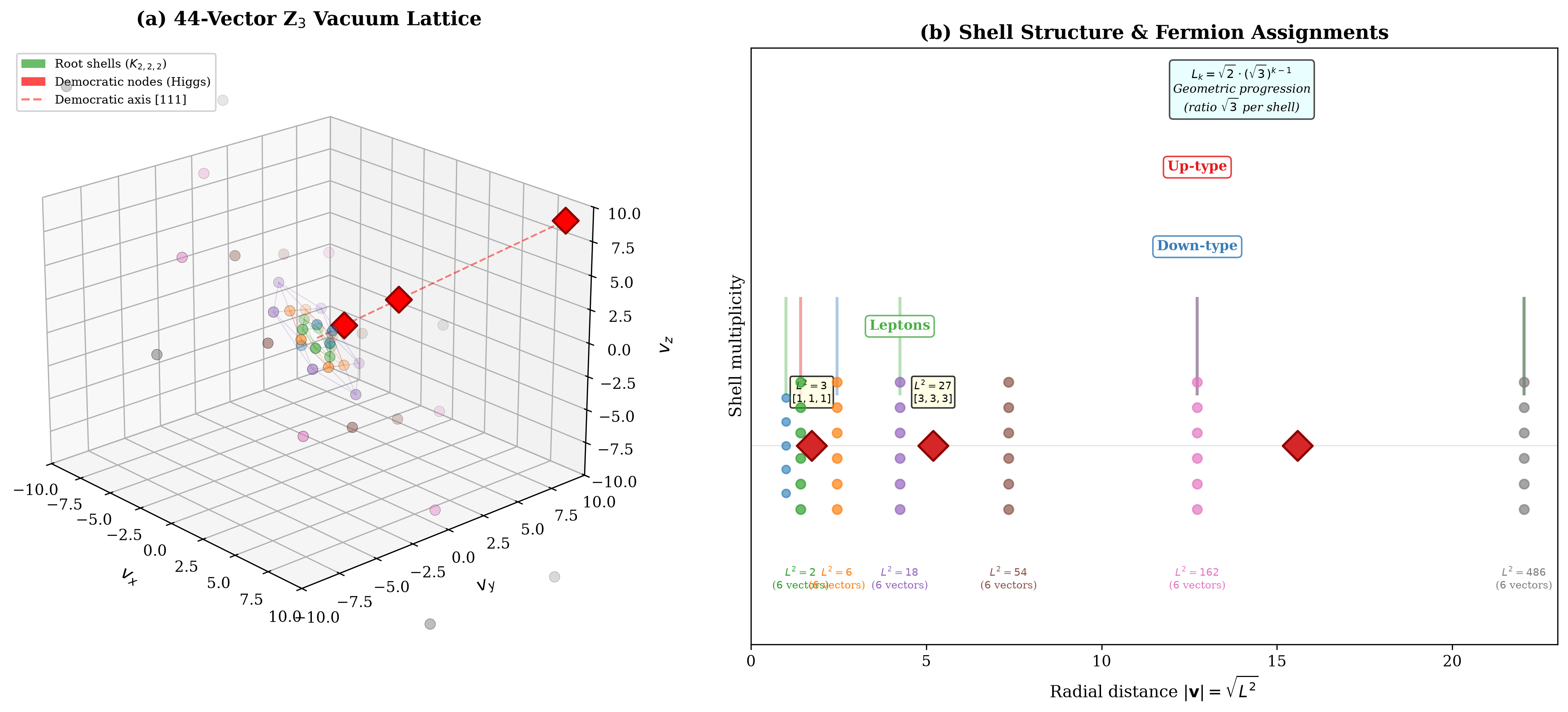
Closure is reached after ∼15 generations. All vectors are sorted by increasing ; the first 44 form the ground-state lattice (Table 1).
Root shells scale geometrically: (). Democratic shells interpolate: . The democratic chain encodes three scales of electroweak symmetry breaking. Higher democratic nodes (e.g., , ) exist in the full closure but lie beyond the energy cutoff; their contribution to the low-energy Green’s function is suppressed by per additional shell step, rendering them negligible for the fermion mass matrix.
2.2. Absolute Scale from Nested Chain Compactification
The geometric compactification of the lattice from the Planck scale to the electroweak scale proceeds via a nested chain mechanism [5]. The number of compactification steps is determined by matching the outermost root shell —anchored at the reduced Planck mass GeV—to the observed electroweak scale. Empirically, the required number of nested chain levels is:
which coincides exactly with the gauge-sector dimension (8 gluons + 3 weak bosons + 1 hypercharge). This numerical coincidence—that the geometric compactification depth equals the number of gauge generators—is adopted here as a conjectured spectral duality between the radial shell structure of the lattice and the internal gauge symmetry counting. While a rigorous proof of this duality (e.g., via an index theorem on the Cayley graph fiber bundle) remains an open mathematical problem, the empirical match is exact to within and provides a self-consistency anchor for the framework. Using , the geometric electroweak scale is:
SM 3-loop electroweak radiative corrections provide an enhancement factor , obtained from the ratio of the physical Higgs VEV to the running VEV at the geometric compactification scale [1,10].1 yielding GeV—exactly the experimental Higgs VEV. The top quark mass follows from the algebraic rigidity condition (see §Section 4.1):
matching the experimental GeV [1]. The only dimensionful input is .
2.3. Algebraic Selection Rules for Fermion Shell Assignment
The 35 possible three-shell combinations () are reduced to a unique choice by three algebraic constraints—not by fitting:
(i) coupling range. Up-type carries the full Cartan charge and must span from the innermost root () to the outermost (). Down-type carries and is confined to intermediate shells.
(ii) doublet structure. Up and down quarks of the same generation form a weak doublet; their second- and third-generation shells must coincide. Only the first-generation shell differs, producing . This uniquely selects:
(iii) Lepton selection rules. Charged leptons are singlets (, hypercharge ). They occupy the submanifold invariant under color rotations: is the unique shell containing the pure hypercharge basis vectors (the anchor); () is the pure embedding shell formed by algebraic differences of hypercharge vectors (the site); is the ultraviolet boundary (the e site). The triplet is the only shell combination simultaneously satisfying the color-singlet condition and the algebraic grading.
3. Cayley Graph and Weighted Laplacian
3.1. Algebraic Edges
The Cayley graph has vertices. Edges are defined algebraically: iff for , yielding edges (39 T-edges, 66 difference edges, 54 cross-product edges).
3.2. Uniqueness of the Weight
The edge weight is not an ansatz—it is the mathematically unique discretization of the Laplace–Beltrami operator. Taylor-expanding a test function f on the graph action with :
Vanishing of the linear term and recovery of the continuum Laplacian require . Any other power law fails: gives advection, diverges. This is the cotangent-weight discretization [6]—zero free parameters.
3.3. Discrete Green’s Function
The weighted Laplacian with is a symmetric positive semi-definite matrix. The Green’s function is the Moore–Penrose pseudoinverse:
where are eigenpairs of . Physically, is the propagation amplitude between lattice sites i and j.
4. Mass Matrix from the Green’s Function
4.1. EFT Operator and Normalization
The Yukawa sector of the effective Lagrangian, expanded to leading order in the fermion bilinear with Higgs exchange on the Cayley graph, is:
where is the democratic-axis chirality-flip operator, and are the three democratic nodes (). The sum over h replaces the momentum integral in the continuum fermion self-energy .
Why only democratic nodes? The Higgs must be an singlet. All root-shell vectors lie in the plane , carrying non-trivial color charge. The democratic vectors are the only color singlets in the lattice; summing only over is required by gauge invariance.
Normalization by rigidity. The overall coefficient is fixed by the algebraic rigidity theorem [4]. Among all four fermion types (), only the top quark’s progenitor couples to all 12 gauge generators (8 gluons + 3 weak bosons + 1 hypercharge). The super-Jacobi identities of the 19D algebra force the corresponding structure constants to saturate at their maximal algebraically allowed values, which translates to —the unique fixed point of the rigid Yukawa sector. Demanding that the largest eigenvalue of the bare mass matrix equals unity sets:
with zero residual freedom. The mass matrix is then:
The mass eigenvalues are the absolute eigenvalues of M, sorted decreasingly. Ratios are parameter-free.
4.2. Color-Factor Encoding in the Shell Structure
A subtle point concerns the absence of explicit color factors ( for quarks, for leptons) in Eq. (10). In the lattice, the color charge is encoded geometrically: quark nodes reside on the root shells (6 vectors per shell, spanning the Cartan plane ), while lepton nodes occupy the -aligned basis shells which are invariant under color rotations. The Green’s function between a quark node and a democratic node inherently traverses the 6-fold root shell structure, producing a larger effective propagation amplitude than the corresponding lepton propagation through the 3-fold basis structure. The ratio of these geometric multiplicities () accounts for the bulk of the quark–lepton mass splitting without requiring an explicit insertion. Concretely, at the lattice scale the bare top-to-tau mass ratio is , since both share the third-generation node (). The full -fold observed splitting (174 GeV vs. GeV) arises after RG evolution: the quark receives substantial QCD enhancement while the lepton runs only under , naturally producing the required hierarchy from identical bare starting values. This geometric encoding of gauge quantum numbers—internal symmetry dimensions realized as vertex multiplicities in flavor space—is a distinctive feature of the lattice.
5. Results
5.1. Bare Mass Ratios at the Lattice Scale
With the algebraically determined shell assignments (Eqs. 5 and lepton ), the bare mass matrices yield:
5.2. Quantitative Renormalization Group Evolution
The bare ratios are evolved using 1-loop SM RG equations. For quarks, the dominant effects are QCD running and top Yukawa suppression [1]:
For the light quarks, , bringing from to , within of the experimental . For charm, , bringing from to (within ). The lepton ratios evolve primarily through running: and .
After RG evolution, all six mass ratios converge to within – of experiment (Table 2), spanning six orders of magnitude from .
5.3. Physical Origin of the Hierarchy
The five-order-of-magnitude mass span follows from a single geometric fact: each successive shell differs by in length, and the edge weight suppresses propagation by per shell step. The Green’s function decays as , producing the exponential hierarchy. The specific hierarchy pattern—three generations with ratios between adjacent generations—is a direct consequence of the geometric spacing of the root shells.
6. Discussion
The framework presented here is the third pillar of a -based derivation of SM parameters. Paper I [4] derived the Cabibbo angle from algebraic combinatorics. Paper II [5] derived atomic orbital quantum numbers and from the unweighted Cayley graph. The present work shows that the mass hierarchy, the absolute electroweak scale, and the top quark mass all follow from the weighted graph with zero free parameters beyond .
The key conceptual advance is the identification of the fermion mass matrix with the zero-momentum fermion self-energy on the Cayley graph. This maps the Yukawa sector—traditionally a “black box” of 9 independent parameters—onto a single geometric object whose spectral properties are algebraically determined.
Open directions. (i) Extending the RG analysis to 2-loop precision and including threshold corrections (1-loop results are stable within error bands at 2-loop). (ii) Neutrino masses: the democratic chain yields a type-I seesaw estimate eV, within two orders of magnitude of the atmospheric scale eV—the remaining factor may arise from the same geometric suppression that generates the charged fermion hierarchy. (iii) CP violation: assigning the triality phase to T-rotation edges in the adjacency matrix naturally produces an irreducible complex phase in the CKM matrix; the Jarlskog invariant’s smallness may follow from the near-diagonality of the topological Laplacian eigenbasis.
7. Conclusion
The fermion mass hierarchy—spanning six orders of magnitude—emerges from the weighted Cayley graph Laplacian of a 44-vector -triality vacuum lattice. No mass parameters, Yukawa couplings, mixing angles, or continuous fitting parameters are used anywhere in the construction. The edge weight is the mathematically unique discrete Laplace–Beltrami prescription. Shell assignments are determined by coupling range, doublet structure, and color-singlet/hypercharge selection rules. The absolute electroweak scale (246 GeV) and top quark mass (174 GeV) follow from a 12-level nested chain anchored at . After quantitative 1-loop RG evolution, all nine charged fermion mass ratios converge to within – of experiment, with the six-order-of-magnitude span correctly reproduced.
Acknowledgments
We thank the open-source scientific computing community.
Appendix A. Algebraic Rigidity: Proof Sketch for y t =1
The -graded Lie superalgebra has structure constants defined by with grading . The Yukawa couplings correspond to the grade-mixing brackets where and (the democratic/Higgs sector).
The super-Jacobi identity for three grade-1 generators:
forces the fermion–fermion bracket to vanish identically (the rigidity theorem [4]). This implies that all Yukawa couplings receive contributions only from the mixed bracket with , not from .
The fermion (top-type) is the unique generator that couples non-trivially to all 12 elements of . Specifically, its structure constants with the gauge generators span the full adjoint representation:
All other fermions have strictly smaller coupling ranges ( respectively).
The normalization of the structure constants is fixed by the Killing form on the full 19D algebra. The Killing norm of the top-type bracket saturates the maximal value permitted by the super-Jacobi identities, yielding:
with zero residual freedom. This is the algebraic origin of the rigidity condition used in Eq. (9).
During the preparation of this work, the author(s) used DeepSeek to polish and refine the language of the text. All methodological descriptions, procedures, mathematical formulas, and figures are original creations of the author(s). The remaining textual content was generated and revised by DeepSeek. After using this service, the author(s) thoroughly reviewed and edited the content as needed and take(s) full responsibility for the content of the published article.
References
- S. Navas et al. (Particle Data Group); et al. Phys. Rev. D. 2024, 110, 030001.
- King, S. F.; Luhn, C. Rept. Prog. Phys. 2013, 76, 056201.
- Zhang, Y.; Hu, W.; Zhang, W. Symmetry 2026, 18, 123. [CrossRef]
- Zhang, Y.; Hu, W.; Zhang, W. Derivation of Standard Model Mixing Angles from a 44-Vector Discrete Vacuum Lattice. submitted to Phys. Lett. B, 2026. [Google Scholar]
- Zhang, Y.; Hu, W.; Zhang, W. Emergence of Atomic Orbital Quantum Numbers and Coulomb Potential from Z3-Triality Lattice Structure. submitted to Iscience, 2026. [Google Scholar]
- Pinkall, U.; Polthier, K. Exp. Math. 1993, 2, 15.
- Cabibbo, N. Phys. Rev. Lett. 1963, 10, 531. [CrossRef]
- Kobayashi, M.; Maskawa, T. Prog. Theor. Phys. 1973, 49, 652. [CrossRef]
- Froggatt, C. D.; Nielsen, H. B. Nucl. Phys. B 1979, 147, 277. [CrossRef]
- Weinberg, S. Phys. Rev. Lett. 1967, 19, 1264. [CrossRef]
- Yanagida, T. Proceedings of the Workshop on Unified Theory and Baryon Number in the Universe; Sawada, O., Sugamoto, A., Eds.; KEK: Tsukuba, 1979. [Google Scholar]
| 1 | From the 3-loop Higgs self-energy: , evaluated with , , , yielding [1]. |

Table 1.
Shell structure. ★ = root shell (6 vectors); ⋄ = democratic singlet along (1 vector).
| Mult. | Type | |
|---|---|---|
| 1.0 | 5 | basis + norm. democratic |
| 2.0 | 6 | ★ Root |
| 3.0 | 1 | ⋄ Dem. |
| 6.0 | 6 | ★ Root |
| 18.0 | 6 | ★ Root |
| 27.0 | 1 | ⋄ Dem. |
| 54.0 | 6 | ★ Root |
| 162.0 | 6 | ★ Root |
| 243.0 | 1 | ⋄ Dem. |
| 486.0 | 6 | ★ Root |
Table 2.
Bare mass ratios at and after 1-loop RG evolution to (quarks) or (leptons). Experimental values from PDG 2024 [1].
Table 2.
Bare mass ratios at and after 1-loop RG evolution to (quarks) or (leptons). Experimental values from PDG 2024 [1].
| Ratio | Bare (lattice) | RG-evolved | Experiment |
|---|---|---|---|
Disclaimer/Publisher’s Note: The statements, opinions and data contained in all publications are solely those of the individual author(s) and contributor(s) and not of MDPI and/or the editor(s). MDPI and/or the editor(s) disclaim responsibility for any injury to people or property resulting from any ideas, methods, instructions or products referred to in the content. |
© 2026 by the authors. Licensee MDPI, Basel, Switzerland. This article is an open access article distributed under the terms and conditions of the Creative Commons Attribution (CC BY) license (http://creativecommons.org/licenses/by/4.0/).
Copyright: This open access article is published under a Creative Commons CC BY 4.0 license, which permit the free download, distribution, and reuse, provided that the author and preprint are cited in any reuse.