

Submitted:
07 September 2026
Posted:
08 September 2026
You are already at the latest version
Abstract
Displaced persons in resource-constrained contexts experience a lack of access to energy, with consequences for health, safety, livelihoods and wellbeing. Existing research and implementation in displacement contexts continue to exhibit three recurring limitations: insufficient attention to lived needs and context, technology-centred intervention logics, and linear approaches to change. This article uses a structured critical and interpretive synthesis of academic and grey literature to examine these limitations and derive a synthesis-grounded integrative approach for transformations towards equitable and sustainable energy services. We frame improved energy access not as technology delivery but as a non-linear, locally grounded transformation process. Considerations of needs and context are addressed by whose knowledge and experiences inform priorities, how decisions are made and how competing interests and trade-offs assessed. The resulting approach combines four domains for shaping energy-services arrangements namely context, needs, capacities and sustainability with three cross-cutting dimensions namely inclusion, participation and normative orientation. It provides guidance and instructions for inquiry, research and implementation by identifying dimensions that need to be explored, questions they raise and methodological entry points through which locally grounded transformation can be actioned and shaped. The approach is intended to help researchers, humanitarian organisations, public authorities and energy providers structure problem definition, option development, implementation and learning. The underlying logic of the approach is applicable beyond displacement, to other resource-constrained contexts, however, its empirical validity and transferability should be tested across diverse contexts, including acute emergency, protracted, urban, rural and non-displacement contexts.
Keywords:
energy access
; displacement
; humanitarian energy
; inclusion
; energy justice
; sustainability
1. Energy in Displacement Contexts
1.1. Introduction to the Current State of Access to Energy
Displacement is a global subject matter. In 2024, a total of 180 countries hosted persons in need of humanitarian assistance [1] and more than 122 million persons were displaced within their countries of origin or across international borders [2]. This corresponds to an increase of 81percent in the total number of displaced persons over the past decade [3]. The local circumstances in which displaced persons are situated in are diverse and complex. In this article, displacement contexts refer to the social, institutional, environmental, spatial and material conditions through which displacement is experienced and everyday life is organised. The climatic conditions and its change, the state of social and economic development, the living conditions of the host population, the stance of the host country and host population towards the coexistence with displaced persons in the country, the available resources and the type of shelter are examples of contextual circumstances with direct implications for displaced persons’ everyday life [4].
Regardless of the local circumstances, the availability of energy is an essential requirement both in the daily lives of displaced persons and in enabling a humanitarian response [5]. Energy is either directly or indirectly a prerequisite for all areas of life and is deeply interwoven with most of the Sustainable Development Goals [6]. Energy is required for cooking, cooling, lighting, communication, transportation, the operation of electrical appliances, and for numerous other services that contribute to a person’s safety and wellbeing. Britton et al. [7] provide a comprehensive introduction to energy in displacement contexts based on current and available data. Rosenberg-Jansen [8] and Rafa et al. [9] outline ways in which energy is interwoven with everyday life of displaced persons showcasing the inherently multidimensional character. The diversity of displacement contexts translates into a variety of energy situations for displaced persons.
Available evidence makes clear that most displaced persons face critically low levels of energy access in many displacement contexts, with wide-ranging negative consequences for everyday life [10]. At the same time, available data are fragmented and in many cases of poor quality, preventing a robust understanding of the scale, forms and differentiated implications of limited energy access [7].
An indication of the implications of the lack of access to energy in displacement contexts can be inferred from non-displacement specific statistics. Globally, the lack of clean cooking contributes to 3.7 million premature deaths annually, making household air pollution a leading cause of premature death [11]. This is particularly relevant for displacement contexts, where dependence on polluting cooking fuels is widespread. It is estimated that among displaced persons living in camp-like settings, 81 percent rely on biomass for cooking [10], thereby facing considerable health risks.
1.2. Past Engagement with the Subject Matter
Research identifies multiple, interrelated causes of inadequate energy access, notably its limited prioritisation within humanitarian response and the persistent framing of displacement as temporary [12,15,16,17,18].
Energy is not a dedicated thematic area in the humanitarian cluster system [5]. As displacement becomes protracted, however, priorities shift from immediate protection towards socioeconomic capacity-building and self-reliance. A system designed for short-term crisis response is poorly equipped for longer-term sustainable energy infrastructure [19], linking energy access directly to the humanitarian-development nexus [20].
Many institutions maintain an understanding of displacement as a temporary condition, even though this assumption in many cases does not reflect reality [12]. National policies grounded in this framing create barriers to engagement. As a result, displaced persons may be prevented from formally engaging in the energy sector or accessing existing energy infrastructure [13], while private-sector providers and supporting organizations face additional constraints in delivering energy services [14]. In this article, and drawing on Fell’s conceptualisation [15], energy services are understood as the useful functions enabled by energy through which human needs can be satisfied and wellbeing supported. While energy technologies and energy access are often discussed in terms of availability of electricity or thermal energy, energy services refer to the concrete ways in which energy becomes relevant in everyday life, for example through the availability, quality and duration of lighting, cooking, phone charging, and television and radio use.
More recently, recognition of protracted and diverse settlement forms [25] has coincided with efforts to integrate displacement into national energy planning, illustrated by Uganda’s energy response plan for refugees and host communities [26]. Institutional, practitioner and academic engagement has also expanded [27], including UNHCR’s energy strategy [28], the GPA [10], larger programmes such as RE4R, EnDev, ESDS and SUNNY [29,30,31,32], and a growing research literature [12].
1.3. Shortcomings and Consequences
Despite growing engagement, substantial challenges persist [7]. Recent responses increasingly emphasise private-sector participation and financing mechanisms intended to address funding, delivery and long-term investment constraints [23,33,34,35,36].
Reviews and sector-wide assessments depict a rapidly expanding but fragmented field with weaknesses across evidence, inclusion, governance, finance, delivery and technical capacity [10,12,15]. Other syntheses identify barriers to scaling [33] and recurring failures across technological, economic, social, implementation and governance domains [17]. Together, these contributions show that the difficulties are systemic. We group them into three overarching shortcomings.
The first shortcoming is insufficient attention to displaced persons’ needs, preferences and lived circumstances [8,10,17]. Research and implementation often fail to capture everyday challenges, contextual dynamics and who defines or prioritises needs [15,18,35,37,38,39,40]. The second is a reduction of measures to energy technologies [8,10,15]. Treating technologies as straightforward solutions overestimates uptake and effects and leaves services insufficiently embedded in the social, economic and institutional conditions required for sustained use [17,23,35,37]. The third shortcoming is the framing of research and implementation as a one-directional, linear process [17,18,35]. Externally designed, ready-made interventions assume a static context, neglect local knowledge and capacities, and provide few opportunities for continued collaboration and adaptation [8,10,17,18,37,38,40]. Table A1 in the Appendix A summarises the three shortcomings and their consequences.The consequences of these shortcomings inform the dimensions of the integrative approach developed in Section 2 rather than mapping one-to-one onto individual dimensions.
These abovementioned limitations reflect an imbalance between delivering activities and solutions and developing contextual and conceptual understanding [12,17]. They are intertwined with limited conceptual clarity and weak evidence, particularly on context [12,15,38,40]. Conceptual development, evidence generation and implementation must therefore advance together [15,17,38]. This gap calls for an interdisciplinary, evidence-grounded framework that clarifies how energy is interwoven with displaced persons’ lives and supports context-sensitive, adaptive research and implementation.
We address this gap through a synthesis-grounded approach that integrates context, needs, capacities and sustainability with inclusion, participation and normative orientation. Its novelty lies in bringing these dimensions together to guide problem definition, option development, implementation and learning.
1.4. Structured Critical and Interpretive Synthesis
1.4.1. Purpose and Analytical Approach
This article develops its conceptual contribution through a structured critical and interpretive synthesis of academic and grey literature. Rather than seeking exhaustive coverage or aggregating intervention effects, it examines dominant conceptualisations, identifies recurring limitations, and integrates insights from adjacent fields into an approach for locally grounded energy-service transformation.
Conceptual reviews can generate knowledge by examining assumptions, connecting fragmented work and reorganising insights around a conceptual problem [41,42,43]. Our synthesis drew on critical interpretive principles, including iterative source selection, critique of dominant framings and development of abstracted constructs [44]. We do not claim a formal CIS because the literature base evolved between 2021 and 2026 and complete search and screening records were not retained for all stages.
The four questions that have guided the synthesis are as follows:
- Which recurring limitations are identified in research and implementation measures concerning energy access in displacement contexts?
- What conceptual requirements follow from these limitations?
- Which concepts and methodological approaches can help address these requirements?
- How can these contributions be integrated into a coherent approach for locally grounded energy-service transformation?
The literature base was developed iteratively between 2021 and 2026 through a programme of commissioned and academic research on energy access in displacement contexts. Between 2021 and 2025, the first and last author undertook three commissioned research assignments for UNHCR, combining multi-country desk research with interviews involving UNHCR staff and camp- and settlement-based personnel in 25 refugee-hosting countries. This work resulted in five publicly available UNHCR reports: a mapping of development-led energy programmes in 25 countries [16] and 16 refugee energy access case studies in Uganda [17], Rwanda [18], Kenya [19] and Ethiopia [20]. The literature base was further developed through the AWARE project [21], which examined wellbeing and experiences associated with access to energy services in displacement settings in Uganda and Rwanda, and through the SUNNY project [22,23,24], which addresses sustainable energy systems for refugee and host communities in the same countries. Within SUNNY, this experience was further consolidated through four publicly available context reports compiled under Deliverable D1.1 for Bidibidi Refugee Settlement and Mahama Refugee Camp and their surrounding host communities, combining desk research with quantitative and qualitative analysis of the social, gender, cultural, economic, institutional, market, regulatory and environmental conditions shaping energy access [25]. Together, these activities provided continued engagement with diverse national, institutional, settlement and implementation contexts and informed the sensitivity of the searches, the identification of relevant concepts and the assessment of their practical relevance.
We distinguished prior project experience from the evidence analysed here. Only publicly available, citable materials were treated as sources; unpublished interviews, project data, participant accounts and field observations were not analysed. Experience served as a reflexive resource for source identification, relevance assessment and interpretation, while substantive claims remained traceable to cited literature.
Sources were identified through scholarly search interfaces, publisher platforms, citation tracing, existing reviews and targeted searches of institutional repositories. Three interconnected streams were covered:
- Humanitarian-energy literature on energy access, services, technologies, markets, governance, finance and implementation,
- conceptual and methodological literature on energy services and wellbeing, energy justice, participatory research, co-design, systems thinking, participatory modelling, adaptive capacity, care and sustainability transformations, and,
- contextual literature on displacement trends, settlement policies, national energy planning, host-community relations, humanitarian mandates and funding arrangements.
Grey literature was included because relevant policy and implementation experience is often documented outside journals and was assessed for provenance, methodological transparency, contextual specificity and corroboration. English-language sources were considered without a fixed date limit. Domain sources required direct relevance to energy access in displacement settings. Adjacent-field sources had to contribute a distinct concept or method. Generic humanitarian literature, narrow technical studies without implementation relevance, duplicates and promotional materials without substantive content were excluded.
The selection remained iterative with additional sources sought where interpretations required clarification, evidence conflicted or a conceptual requirement remained underdeveloped. Searching ended at conceptual sufficiency, when further searches no longer materially changed the emerging constructs or relationships, rather than at exhaustive coverage.
1.4.2. Synthesis and Development of the Approach
The comparative, interpretive synthesis considered sources for their relevance to the review questions, transparency and contribution to understanding energy interventions in displacement contexts. It did not use formal coding or quantitative aggregation. Recurring concerns such as limited attention to lived needs and context, technology-centred logics and externally defined or linear change were translated into four substantive and three cross-cutting dimensions. The methodological entry points in Section 2.1 and Section 2.2 are therefore synthesis-derived suggestions for future investigation and operationalisation.
1.4.3. Reflexivity
Interpretation combined academic, implementation and community-based knowledge within the author team, including researchers with lived experience of displacement in Bidibidi and Mahama. Their contextual expertise supported reflection on assumptions, interpretations and overlooked perspectives, but it was not treated as independent empirical evidence. Throughout our study, no unpublished interviews, participant accounts or field observations were analysed in the synthesis.
The contribution of the community-based researchers to this study extends substantially beyond short-term consultation, facilitation of field access or data collection. Through full-time engagements and a continued collaboration over more than three years, they contributed lived experience, contextual and cultural knowledge, community-based research expertise and interpretation of the findings. This collaboration enabled the research team to examine assumptions, contextualize participants’ accounts and identify relevant elements of energy access and well-being. The perspectives of persons directly affected by the conditions examined in this article were therefore integrated rather than included merely via surveys, consultations, external testimony or stakeholder feedback.
TU Berlin’s 2023 “Verbundanschub” seed funding enabled a multi-week visit to Mahama camp and Bidibidi settlement. Ethnographic observations, community engagement and discussions with prospective partners informed the jointly developed proposal for the ongoing SUNNY project. The authors developed their collaborative foundation through joint work in two closely related research initiatives. The first was AWARE with the long-title Assessing Well-being and Experiences with Access to Energy Services in Displacement Settings, an 18-month project funded through the Sonnencent programme of EWS Schönau under its “International Energy Justice Work” funding area [21]. The authors also collaborate within SUNNY, a four-year project funded by the European Commission under the “Accelerating the Green Transition and Energy Access in Africa” programme [22,23,24]. Across these, the authors have worked together on research design, community engagement, evidence collection, contextual interpretation, and the discussion and validation of findings. This continuous collaboration created relationships of trust, shared working practices and a cumulative understanding of energy-related experiences in displacement contexts. Consequently, the interpretive process was informed by long-term collaborative knowledge production involving researchers who live in the communities addressed by the study. However, no unpublished participant data were treated as evidence in the review synthesis.
The synthesis does not claim exhaustive or systematic-review reproducibility. Its contribution is conceptual pattern identification and integration. Its wider applicability requires comparative, participatory testing across displacement and non-displacement contexts.
The remainder of the article develops the integrative approach and then discusses its implications, scope and limitations.
2. An Alternative Point of Departure and an Integrative Approach
The integrative approach presented below is the output of the structured critical and interpretive synthesis described in Section 1.4. The conceptual requirements identified in Section 1 provide the basis for formulating an integrative approach that is organised through dimensions, guiding questions and methodological entry points.
In response to the conceptual gap identified, and informed by literature [26,27,28], we develop an alternative point of departure for engaging with access to energy in displacement contexts. Our argument proceeds along two closely related streams of consideration. The first concerns what needs to be specified: the objectives, scope, and core elements of an effective approach to improving access to energy services in displacement contexts. The second concerns how such an approach integrates contextually: the processes and methods through which measures can be grounded in personal and contextual circumstances, shaped by the perspectives of displaced persons, and translated into context-embedded pathways of change. Together, these two streams structure the integrative approach. The two streams are guided by two overarching questions:
- What needs to be understood and transformed to meaningfully improve access to energy services?
- How can processes of change be grounded in the realities of displaced persons?
The approach is not a prescriptive sequence. It frames improved access to energy services as a locally grounded, non-linear transformation rather than the delivery of a technical solution to a predefined problem. Priorities, directions and forms of change are progressively shaped through engagement with local realities and the perspectives of the persons concerned.
First, we start from the understanding that access to energy is not a value in itself; rather, energy matters because it enables services that support human need satisfaction and contribute to wellbeing [29,30]. From this perspective, the key question is how to shape forms of energy service provision that are meaningful, equitable, sustainable, and relevant in the lives of displaced persons. This includes the configurations through which such services are made available, accessed, used and sustained. [31]. Drawing on the notion of service arrangements [32], these configurations are referred to as energy-service arrangements and include technologies, infrastructures, practices, organisational forms, financial and institutional conditions, capacities and local relations. On this basis, we frame improving access to energy services as a locally grounded transformation process through which pathways towards equitable and sustainable provision are progressively shaped. At the same time, framing engagement as a transformation process also raises the question of how priorities, perspectives, and pathways of change are shaped [33]. The specification of the transformation and the methodological facilitation are therefore intertwined and are presented separately in this article for analytical clarity.
Second, we investigate how the transformation process can be oriented around the concerned persons. Achieving more equitable and sustainable access to energy services requires the inclusion of affected communities throughout all phases of the process, and the recognition of displaced persons as active participants in processes of change [28]. This implies that the experiences, priorities, capacities and forms of agency of displaced persons shape the transformation process. Participatory approaches provide the methodological foundation through which such inclusion can be realised [34]. This stream therefore concerns the processes through which engagement can be grounded in lived realities, how displaced persons can be meaningfully involved in shaping priorities and pathways of change, and how insights into the ways energy is interwoven with daily life can be integrated into context-embedded measures.
Figure 1 links the approach’s substantive part of transforming access to energy services with its procedural part integrating diverse perspectives. The two are separated for analytical clarity but remain interdependent.
The following sections elaborate the dimensions, guiding questions and methodological entry points. Selected examples illustrate the proposal but do not constitute empirical validation. Outputs from the integrative approach are meant to be translated into service requirements and options that further need to be assessed against national energy plans, settlement policies, land and connection rights, humanitarian mandates, market conditions and financing possibilities. Where a preferred option is constrained, feasible alternatives need to be examined and returned into the process for assessing trade-offs.
2.1. Transforming Access to Energy Services
The four dimensions below are not presented as predefined categories. They result from grouping synthesis-derived requirements concerning what must be understood and transformed as well as from ensuring that each dimension performs a distinct analytical function.
Improving access to energy services in displacement contexts requires clarification of what needs to be understood and transformed. This orientation is structured around four interrelated dimensions: context, needs, capacities, and sustainability. Their conceptualization builds on and reflects current energy-access literature that integrates contextual conditions, prioritization, socio-technical design through participation, and long-term management and adaptation [31,35,36]. For each dimension, we present a leading question in Table 1. In the following, we examine the four dimensions, each of which constitutes a field of inquiry in itself and raises practical questions for implementation. We present the dimensions in a logical sequence, as they gradually illustrate the transformation pathway. They appear in the following as separate subsections and as boxes in Figure 1 even though they are intertwined and dependent, demonstrating the non-linearity of the process.
2.1.1. Context
This dimension refers to the specific environment and the set of circumstances in which displaced persons reside and in which access to energy services is shaped. It includes geographic, socio-cultural, economic, political, legal and infrastructural conditions, as well as the temporal character of the displacement setting. These contextual factors are not merely external background conditions into which displaced persons arrive. Rather, context is continuously shaped through the presence, practices, relations and adaptive strategies of the persons who live there [37]. Displaced persons are therefore not only situated within a context; they also contribute to what this context becomes over time.
Understanding context is a prerequisite for a transformation towards equitable and sustainable access to energy services. It helps identify the conditions under which energy-related challenges emerge, how they are experienced differently by different persons and groups, and which barriers and opportunities structure possible pathways of change. In this section, we capture context through three exploratory questions: what diverse realities exist, what dynamics are at work, and what challenges are faced. These questions might not be exhaustive, but they focus on how contextual conditions are encountered, interpreted and made relevant for transformation.
a) What diverse realities exist?
Within a displacement context, persons are affected by contextual conditions in different ways. The same contextual conditions may result in different lived realities and may be perceived, and navigated differently depending on experiences, individual circumstances, cultural backgrounds, social positions and responsibilities. Recognising this diversity is essential for understanding context at a personal level, rather than treating displaced persons as a homogeneous group.
For example, the location of a shelter in relation to communal facilities, such as water points, schools, and sanitation facilities may shape everyday life differently. The implications of the geographical location of the shelter may be further amplified by personal circumstances. A person with limited mobility due to disability or old age may experience distance, darkness or lack of transport as a more significant constraint than a person without such limitations.
b) What dynamics are at work?
Displacement contexts are organized and continuously shaped by social and institutional dynamics. These dynamics are expressed in how people relate to one another, how decisions are made, how resources are shared, and how information circulates. Understanding the ways persons interact, organise collective life, and respond to changing circumstances is essential, as this shapes the organisational foundation under which energy-related transformation becomes feasible.
Such dynamics may take shape, for example, in formal or semi-formal arrangements, such as community representatives and committees in Rwanda [38] or refugee-led organisations in Kenya, Uganda, Ethiopia and Tanzania [39], as well as informal arrangements through which information is shared, decisions are influenced and initiatives are organised.
c) What challenges are faced?
Persisting challenges are part of the context in which displaced persons live. They indicate where everyday life is constrained, where existing arrangements are insufficient, and where conditions are experienced as difficult or limiting. Understanding these challenges requires attention to their underlying causes, their effects in daily life, and the ways they are experienced and prioritised by different persons and groups. Such challenges may relate to basic needs, safety, health, livelihoods, mobility, education, communication or social interaction, and their relative significance depends on the specific circumstances of the displacement setting.
For example, meeting basic needs may be the most urgent challenge for persons with no access to critical resources. In such cases, access to food, water, safety or shelter may take priority over other concerns. For others, challenges linked to social interaction, care responsibilities or education may be more prominent. In protracted displacement contexts, there is an increased focus on self-reliance and livelihood-related challenges [40]. These may include access to transportation, communication, markets or agricultural production.
Exemplary methodological entry points
Displaced persons hold the situated knowledge and insights to describe the context in terms of diversity of realities, local dynamics, and persisting challenges. Capturing these insights requires methods that facilitate exchange, make relations visible and allow everyday experiences to be articulated. Relevant methods and tools can be drawn from related research fields and adapted. For example, Green and Kloos [41] use the research method photovoice with young people in an internal displacement camp in northern Uganda to document daily life, discuss community strengths and weaknesses, and reflect on issues affecting their communities. Structuring methods such as actor network analysis can help make relationships, cooperation patterns, information flows and power relations more explicit, as shown by Riggs et al. [42]. Relevant examples also exist within energy access research in displacement contexts. Miller and Ulfstjerne [43], for example, use an ethnographic case study to examine transactional practices around wood fuel in Rhino Camp, Uganda, showing how cooking energy is embedded in relations between refugees and host communities.
2.1.2. Needs
Energy service needs emerge from the specific context in which displaced persons live and from the persisting challenges they face in everyday life. They refer to energy services that are required, insufficiently available or entirely absent in relation to the local circumstances. In displacement contexts, such needs can be considered across household, community and livelihood levels (see [8]). Energy needs include cooking, lighting and phone charging within households; energy services for schools, health facilities, water systems or public lighting; and productive uses linked to income generation.
Understanding energy service needs requires examining not only which services are absent, but also how existing services are accessed, used and experienced by different persons and groups, and how they are embedded in everyday practices. Such an understanding is essential for clarifying the roles energy services play in a context and, by extension, for shaping change in energy access. In this section, we approach needs through three exploratory questions: what energy services are available, how relevant and effective are they, and which energy services are needed to address persisting challenges.
a) What energy services are available?
Understanding the state of available energy services functions as a starting point for understanding energy service needs. Availability, however, does not imply accessibility or adequacy. Energy services may exist in a context but differ in how they are provided, who can access them, under what conditions, and whether they are affordable, reliable, safe, sufficient, and of adequate quality for everyday use [44]. Formal and informal access arrangements can therefore produce highly unequal levels of access even where an energy service is nominally available [32].
For example, where electricity infrastructure is present, specific services may remain constrained by regulations, as in Rwanda where refugee households cannot connect to the national grid [13], or by the absence of appliances required to use electricity. Other services may exist but remain inaccessible to persons. Services, such as phone charging, internet services and printing may be available through shops, but access may be limited by cost or distance.
b) Are energy services relevant and effective?
The relevance and effectiveness of energy services depend on how they correspond to everyday activities, constraints and challenges in a specific context. A service may be available but remain only partly relevant or ineffective if it does not fit the ways people organise daily life, respond to constraints or prioritise competing needs. Understanding energy service needs therefore requires examining how services are embedded in everyday practices. This includes attention to how energy services are used, combined, substituted or avoided in practice [45,46].
Some energy services are readily identifiable, such as cooking, lighting or phone charging. Others are less apparent because they are mediated through wider systems of provision and use, including food preservation and processing, water provision, health and education services, communication, livelihood activities or mobility [5,8]. In spatially dispersed settlements, for example, transport-related energy needs may become relevant where access to schools, health facilities, markets or administrative services depends on mobility, especially for persons with disabilities, older persons or those with care responsibilities.
c) What energy services are priorities?
Determining energy service needs requires moving from the description of existing provision and remaining gaps to prioritisation. Prioritisation concerns the relation between existing energy service provision and the services required to address locally experienced challenges. Since different persons and groups may define needs differently, priorities cannot be assumed from the outside. They need to be developed through exchange, combining the situated knowledge of displaced persons with technical, social and academic expertise, so that converging and conflicting perspectives can be made visible and translated into priorities for action.
Firewood collection, for example, may be experienced as burdensome, unsafe or time-consuming, especially where access to firewood is contested [47], making clean cooking appear as an obvious priority. At the same time, firewood use or trade may provide income-generating opportunities for others in the same context that cannot easily be replaced [43]. Prioritising energy services therefore requires clarifying not only which challenges a service addresses, but also whose practices, and dependencies may be affected by change.
Exemplary methodological entry points
The identification of energy service needs requires tools that support different parts of the process: documenting available services, eliciting situated experiences, analysing interlinkages, and translating diverse perspectives into actionable requirements. Qualitative methods such as in-depth interviews, participant observation and informal discussions can reveal everyday energy practices, differentiated access conditions and unmet needs in displacement settings, as illustrated by research in the Rohingya camps in Cox’s Bazar [9]. Participatory and visual methods, such as photovoice, can make needs and barriers tangible, support collective interpretation and communicate priorities to stakeholders [48] . Systems-oriented tools, including causal loop diagrams and group model building, can further help to analyse links between energy services, livelihoods, health, education, affordability and other dimensions of wellbeing [49,50].
2.1.3. Capacities
Capacities refer to the local foundations that can be recognised, mobilised and strengthened to support change. Informed by adaptive-capacity literature, capacities can be understood as conditions that enable persons, communities and relevant actors to contribute to processes of change [51]. They are not limited to available resources or technical skills, but also include forms of knowledge, organisation, learning and agency that shape what can be done in practice. Because such capacities may be informal, unevenly visible or embedded in everyday practices [52], they need to be explored through both situated knowledge and analytical perspectives from relevant research fields [53].
Recognising and strengthening capacities can support local embeddedness, foster ownership, reduce dependence on external actors and systems, and contribute to the sustained provision of energy services. Capacities are not static; they change over time and can be strengthened within the transformation process. In this section, we focus on three dimensions of capacities that appear especially relevant for locally grounded transformation: resources, capabilities and enabling structures.
a) What resources are accessible?
Resources refer to means that can be drawn on to support locally grounded transformation. These may include, for example, material resources such as tools, equipment or locally available materials, financial resources such as income or savings, and available time for participation, exchange and collective processes. Since resources are not equally distributed or equally accessible, their relevance for transformation depends on how access is shaped, under what conditions they can be mobilised, and what implications may arise through their use.
For example, time is a resource shaped by existing energy practices. Where households rely on firewood, considerable time may be spent collecting fuel [54], especially where vegetation depletion increases collection distances, as documented around settlements in Ethiopia [55]. Time spent securing cooking fuel is then not available for care, livelihood activities, participation or training. Since locally grounded transformation itself requires time for exchange, learning and collective decision-making, the availability of time also shapes who can participate in transformation processes and how such processes can be organised.
b) What capabilities can contribute?
Capabilities refer to the knowledge, skills, experiences and forms of agency through which persons can contribute to shaping, operating and sustaining energy services. Recognising these capabilities shifts the framing of displaced persons from passive recipients of assistance to contributors to transformation. Often informal or only visible through close attention to everyday practices, capabilities also reflect how persons have adapted to local constraints and indicate what can be locally initiated, adapted and sustained. Understanding these capabilities is therefore essential for mobilising local foundations for sustained energy-service provision.
The relevance of capabilities for transformation becomes visible in Bidibidi settlement in Uganda, where local repair shops provide services for electronic devices. Alongside these repair practices, an IOM initiative provided formal training in the repair of solar lanterns [56,57]. Together, these existing practices and targeted training activities point to technical and entrepreneurial foundations for maintenance, product longevity, electronic waste management and local service provision.
c) What structures enable collective action?
Enabling structures refer to existing arrangements, such as support networks, savings groups, cooperatives and systems of representation, that can be mobilised, adapted or strengthened to support collective processes of energy-related change. As part of local capacities, they may provide foundations for collective action and help organise practical arrangements such as maintenance, financing or shared use. At the same time, they need to be approached critically, since existing arrangements may also reproduce exclusion, unequal access or unequal power relations [58].
Enabling structures may emerge through everyday interaction or local markets and can provide entry points for organising energy-related change. This is visible in energy-related exchanges between displaced persons and host communities, where services such as phone charging and technologies such as lamps or batteries may be shared or traded across community boundaries [9]. Other energy services, especially shared or productive-use services, may require more deliberate forms of organisation. In Mahama refugee camp in Rwanda, farming cooperatives have been linked to solar irrigation, illustrating how forming organisational structures can support the collective management of energy-enabled livelihood activities [59].
Exemplary methodological entry points
Building on this broader understanding of capacities, methodological tools from related fields can offer useful entry points for identifying capacities that may otherwise remain overlooked. Siders [60], for example, provides a comprehensive overview of concepts and methods in community-based adaptation, a field in which local resources, adaptive capacities and enabling conditions are central concerns and in which processes of change are understood as strongly context-dependent. A more specific example is offered by a care perspective informed by feminist research, which can help reveal capacities that are less visible because they are embedded in everyday practices and relations. Such a perspective directs attention to the work required to keep systems functioning, adapted and usable over time, including forms of maintenance, repair, coordination and practical improvisation that are often overlooked [52]. Recognising this work expands the understanding of capacities from identifiable resources, skills and structures to the ongoing practices through which systems are sustained and transformation pathways can be built.
2.1.4. Sustainability
Sustainability orients the transformation process towards forming energy-service arrangements that enable meaningful access and remain relevant as circumstances change. Drawing together the preceding insights into lived realities, energy-service priorities and local foundations for change, it concerns how such arrangements can be developed in locally embedded, equitable and responsive ways. It links their immediate shaping to their longer-term capacity for adaptation, and connects what is locally meaningful and possible with the formulation of transformation pathways.
Shaping such pathways requires attention to the economic, institutional, social, environmental and maintenance-related conditions through which energy services can be sustained in practice [61], while avoiding new burdens, exclusions or dependencies. This orientation resonates with leverage-points research, which highlights that the transformative potential of sustainability interventions depends partly on where interventions act within a system and how they relate to wider system dynamics [62]. We focus on three aspects: anchoring transformation, identifying the innovations required to support it, and exploring and shaping pathways of change.
a) What are focal elements for the transformation?
Transformation can be anchored in entry points through which efforts to improve access to energy services are organised and broader processes of change may be catalysed. Rather than being assumed externally, these entry points depend on how energy services are embedded in everyday life within a specific context. They may relate to different aspects of an energy-service arrangement: specific services and practices, technologies and infrastructures, organisational, financial or knowledge-related arrangements, or sites where multiple services, actors and practices come together.
The negative impacts of cooking in many displacement contexts, may appear to call for alternative stoves or fuels, yet the relevant entry point depends on context. Transformation may also need to start from cooking practices, user training, fuel supply arrangements, regulation or livelihood alternatives. In a clean-cooking case study in Nigeria, training proved more effective than the introduction of alternative cooking technologies, contrary to the researchers’ expectations [63]. Entry points may also lie in the care responsibilities and household decisions through which fuel collection, meal preparation and limited financial resources are allocated.
b) What innovations are required?
Considering possible entry points also raises the question of which innovations are required to support sustainable energy-service arrangements. Innovation is understood here in a broad sense, including technological, organisational, financial, institutional, social and environmental changes and adaptations. Because sustainable access depends on the interplay of multiple supporting arrangements, such innovations need to be considered in an integrated way, informed by interdisciplinary perspectives, and grounded in local capacities.
In Ugandan displacement contexts, behaviourally informed savings sessions have been shown to support access to high-quality solar products by addressing limited financing options and limited quality awareness [64]. Yet the required innovations are not limited to household savings or the solar product itself. In some Ugandan settlements, high-quality solar products are not consistently available, and solar products are commonly sold through temporary arrangements, such as sales from trucks. Sustainable access therefore also depends on innovations that strengthen market structures, trusted information, installation support, warranty arrangements, after-sales services, repair options and end-of-life handling.
c) Which transformation pathways can be pursued?
Transformation pathways describe possible ways of moving from the current situation toward more sustainable access to energy services. Exploring pathways involves comparing possible directions of change, including different combinations of entry points, innovations and supporting arrangements, and considering what they may imply for different persons and groups. This requires attention to adverse effects, trade-offs and uneven distributions of benefits and burdens. Pathways are therefore not fixed technical routes, but need to be formulated, negotiated and adapted through participatory processes that enable reflection, learning and adjustment [65].
Efforts to reduce firewood-based cooking may respond to safety, health or environmental concerns, particularly where access to firewood is contested or firewood use places pressure on scarce resources [47]. Yet the pathway through which this reduction is pursued matters. Participatory processes can help reveal how burdens may be redistributed, for example where alternatives remain unaffordable or where firewood-related practices support income-generating relations [43]. Clean-cooking pathways may therefore require incremental forms of change that remain grounded in lived realities and allow experimentation and adjustment over time [63].
Exemplary methodological entry points
Several methodological approaches are useful for making transformation pathways imaginable, assessable and negotiable. From displacement research, Parent [66] illustrates how futures can be made discussable through a utopian methodology. In a study with Congolese refugees at Mahama camp, Rwanda, free-listing and focus group methods were used to explore an imagined agrarian future beyond encampment, while the utopian methodology helped connect future visions with lived experience, identity and understandings of the good life. In the energy field, participatory modelling and planning approaches can complement such future-oriented methods by translating stakeholder perspectives into comparable representations of possible energy futures [67]. Such approaches can support the discussion of different energy-service arrangements, while also cautioning that meaningful participation requires more than one-off consultation. Related work on energy interventions in displacement settings has begun to systematise planning tools across sustainability dimensions, including inclusive design, impact assessment, energy system modelling, business model design and economic viability assessment [61]. Table A2 in the Appendix A presents the dimensions of energy-service transformation in condensed form. It summarises the focus of inquiry of each dimension and identifies selected methodological entry points from relevant bodies of literature.
This section has outlined what a locally grounded transformation of energy-service access needs to engage with: context, needs, capacities and sustainability. These dimensions specify the specification-oriented part of the integrative approach developed in this article. It is complemented by how such a transformation can be pursued in practice. The following section therefore turns to the integration of diverse perspectives.
2.2. Integrating Diverse Perspectives
The integration of diverse perspectives captures the local grounding of the transformation process. Diverse perspectives are relevant across the transformation process, as they shape how local circumstances are understood, how priorities and trade-offs are negotiated, and how pathways of change are formulated and adapted over time. This section examines how such integration can be facilitated and thereby resonates with growing calls for more inclusive approaches in displacement contexts [28,68]. It draws on methodological contributions from related research fields and connects in particular to community-based energy-access research [69]. The structured critical and interpretive synthesis grouped these cross-cutting requirements into three dimensions: Inclusion, Participation, and Normative Orientation. Table 2 summarises the guiding questions associated with the three dimensions.
2.2.1. Inclusion
Inclusion refers to identifying and recognising the diverse perspectives relevant to energy-service transformation and making them integral to how transformation is shaped [28]. Such diversity arises from different lived realities, responsibilities, experiences, social positions and relations to energy services in a displacement context. Inclusion therefore asks which perspectives jointly form a comprehensive understanding of the subject matter. It concerns whose perspectives are recognised as relevant, whose insights are taken into account, and which perspectives may otherwise remain overlooked in the transformation process [70].
The centrality of inclusion becomes apparent in how differentiated perspectives contribute to each dimension of locally grounded transformation. They help clarify how contextual conditions are experienced, how energy-service needs are prioritised, where capacities can be identified, and how benefits, burdens and responsibilities can be balanced over time. Inclusion therefore cannot be approached as the representation of a predefined list of social categories or stakeholder groups. Rather, it is a continuous task of considering which perspectives can contribute to the specific questions and stages of the transformation process.
a) What diversity of perspectives exist?
Diverse perspectives refer to the different ways in which persons and other actors understand, evaluate and shape the direction of a transformation process. They arise from lived experience, everyday responsibilities, local knowledge, social position, institutional roles, technical expertise, commercial interests, policy mandates or research-based analysis. Such perspectives influence how situations are interpreted, how problems are defined, which knowledge is considered relevant, which options appear desirable or feasible, and how benefits, burdens and risks are assessed.
For example, energy needs may be understood differently depending on responsibilities, resources and everyday roles. A person responsible for cooking may emphasise fuel availability, cooking time, stove design or smoke exposure, while another household member may prioritise lighting, phone charging or affordability. A teacher may foreground lighting in classrooms or study spaces, because the relevance of energy is understood through learning conditions. These differences do not simply reflect individual preferences; they show how different positions make different energy-related priorities visible.
b) Who is included in the transformation process?
Different stages in the transformation process raise different questions and therefore require different perspectives. In some stages, a wider range of perspectives may be needed to make lived experiences and priorities visible; in others, specific forms of expertise or representation may be required to clarify technical, institutional or organisational conditions. Inclusion therefore requires reflection on which perspectives are needed, which can realistically be reached, and which remain absent.
Some perspectives are easier to include because they are accessible through dominant languages, recognised roles or existing structures. Dedicated measures may therefore be required to reach linguistic minorities, persons with care responsibilities or limited mobility, informal livelihood actors and others whose knowledge is less visible in formal planning.
Methodological entry points
Different bodies of literature offer entry points for reflecting on inclusion. For example, intersectional feminist approaches in energy research draw attention to how power, identity and situated forms of knowledge shape whose perspectives are recognised and whose knowledge becomes visible [71]. Energy justice literature helps assess inclusion by linking distribution, procedure and recognition to the question of whose interests, needs and knowledge are taken into account [70]. Participatory research literature highlights the methodological decisions through which inclusion is shaped in practice. Vaughn and Jacquez [34], for example, conceptualise research design through choice points, which can support reflection on who should be included at different stages of the process and for what purpose.
2.2.2. Participation
Building on inclusion, participation concerns the processes through which diverse perspectives are brought into exchange and become consequential for shaping transformation. It refers to the ways in which perspectives are interpreted, related to one another, translated into priorities, connected to decisions and linked to action. Participation can therefore strengthen transformation processes by connecting different forms of knowledge, creating spaces for reflection and deliberation, and enabling understanding to inform practical change [72].
Participation is central to relating contextual understandings, energy-service priorities, local capacities and sustainability considerations to one another. At the same time, it requires reflexive attention to the objectives pursued, the forms of engagement selected, and the ways in which influence is distributed within the process. In this section, we therefore focus on two selected aspects: the objectives that shape participatory processes and the ways such processes can be facilitated in practice.
a) What objectives shape participation?
The objectives that shape participation vary across the transformation process. Participation may serve to develop understanding, integrate perspectives, formulate priorities, support learning, enable deliberation or connect insights to action. These objectives are not mutually exclusive; a single activity may generate knowledge, create reflection, reveal tensions and prepare decisions. At the same time, objectives are not necessarily shared by all actors involved, as researchers, implementing organisations, institutions and displaced persons may attach different expectations to participation that require reflexive consideration [73].
In Mahama, free-listing and focus groups used within a utopian methodology generated knowledge while enabling reflection, exchange and the shared articulation of possible futures [84]. The example illustrates how participation can serve research, deliberation and learning simultaneously.
b) How can participation be facilitated?
Facilitating participation requires different forms of engagement, degrees of involvement and methodological choices depending on the objectives pursued [34]. Processes aimed at developing understanding may require methods that elicit lived experience, while prioritisation, decision-making or action require formats that enable exchange, deliberation and influence. Facilitation must therefore account for contextual conditions, available resources and unequal opportunities to participate and influence, including practical, social and accessibility-related barriers. Participation should not be equated with presence: meaningful participation requires that diverse perspectives can substantively influence the priorities and decisions that affect them [74].
Participation is shaped by unequal authority and unequal ability to engage. Language, disability, gender, age, legal status, livelihood position, mobility, care responsibilities and relations with host communities affect who can attend, speak, be recognised and who can influence. Mere presence of persons should therefore not be treated as influence. Participatory processes should document missing perspectives, use accessible and multilingual formats, provide separate spaces where culturally appropriate, and show how contributions affected decisions [75]. Measures need to account for time, transport, communication, childcare, accessibility support, translation and compensation. Unpaid participation by persons facing severe resource constraints should not be assumed to be the usual case.
Methodological entry points
Methodological entry points for participation can be drawn from different bodies of literature, including participatory research, energy justice and participatory modelling. This literature is useful not as a catalogue of methods to be applied mechanically, but as a resource for aligning participatory processes with their objectives, context and intended contribution to transformation. For example, Keahey [72] provides a broad overview of participatory research methods in sustainable development, while Castro- Castro-Diaz et al. [76] offer an energy-specific perspective on participatory research methods and associated principles in energy justice. Voinov et al. [77] complement these perspectives by showing that the selection of participatory modelling tools depends on the purpose of engagement, the problem context, the participants involved and the resources available.
2.2.3. Normative Orientation
This dimension refers to the normative and procedural orientations that help interpret priorities, assess trade-offs and evaluate possible pathways of change in a locally grounded transformation process. They become increasingly important where diverse perspectives, needs and dependencies are more challenging to align. In this sense, a normative orientation complements inclusion and participation by navigating the transformation process while different perspectives are brought into relation.
Such navigation matters because engagement is inherently shaped by assumptions about what is desirable, legitimate and possible. These assumptions influence how problems are defined, whose perspectives gain relevance, how priorities are weighted and whose agency is strengthened or constrained. This dimension therefore contributes with provisional and revisable orientation for judging whether the process and its emerging pathways are equitable, responsible and sustainable.
a) What norms and principles guide the transformation process?
Norms and principles need to consider the specific context, the persons involved and the energy-service pathways under consideration. At the same time, local processes are not neutral; they may reflect power asymmetries and structural constraints. Broader conceptual and methodological frameworks can support the formulation of norms and principles by making aspects of equity, recognition, accountability and sustainability explicit. They offer resources for asking whose benefits and burdens are considered, whose knowledge is recognised, how power is addressed and how action remains accountable to the persons concerned.
Cooking energy illustrates the need for normative orientation. Reducing firewood dependence may address displaced persons’ energy constraints while threatening host-community livelihoods [67]. Situated knowledge and energy-justice principles can help assess the distribution of benefits and burdens, recognition and participation across alternative pathways [88].
b) How can normative orientation be realised and revised?
Normative orientations become relevant when they inform the practical shaping of the transformation process rather than remaining abstract principles. They facilitate the interpretation of tensions, the assessment of emerging pathways and the reflection of the consequences of decisions. Such orientations need to be revisited when exclusions, unintended consequences or unequal influence become visible. As transformation proceeds iteratively, they may need to be clarified and adjusted as new insights emerge and conditions change.
This can be illustrated by the design of participatory inquiries. An initial plan can rely on meetings with recognised community representatives to discuss energy-service priorities. During the process, however, this format may prove insufficient if it strengthens already visible perspectives while leaving others less able to shape the discussion. In this case, guiding ideas such as equity and recognition would require the process to be adjusted, for example by reconsidering which formats are used, how exchange is facilitated and how feedback is taken up.
Methodological entry points
Several bodies of literature can offer methodological entry points for working with normative orientation, while recognising that no single framework provides a ready-made approach for displacement contexts. Selected examples include energy justice, which can support reflection on benefits, burdens, recognition and participation in the assessment of possible pathways [70], and feminist energy research, which can help foreground power, situated knowledge and care in energy-related transformation [71]. Participatory Action Research is relevant because it links participation, reflection and action [78]. More practice-oriented work can help translate such orientations into research and practical engagement. One example is work on co-production in humanitarian settings, which raises practical questions around power relations and shared decision-making [79]. Further work is required to identify and develop displacement-specific approaches for formulating, working with and revising guiding ideas in energy-service transformation. Table A3 in the Appendix A provides a condensed overview of the dimensions for integrating diverse perspectives. It summarises the focus of inquiry of each dimension and identifies methodological entry points.
3. Discussion
3.1. Towards Equitable and Sustainable Access to Energy Services Through Locally Grounded Transformation
Building on prior reviews and frameworks [12,16,35], this article integrates personal and contextual circumstances with the participation of displaced persons across the transformation process. Rather than prescribing a universal sequence or guaranteeing outcomes, it makes explicit the evidence, actors, decisions and revision points that research and implementation should address.
The central reframing is from technology delivery to a locally grounded transformation in which energy-service arrangements respond to context and needs, build on local capacities and adapt over time. This aligns with calls for inclusive, context-sensitive energy access [40,86] and with the shift from emergency provision towards approaches that recognise displaced persons’ agency, self-reliance and livelihoods [39,96].
The dimensions of the integrative approach originate from and relate to the shortcomings from Section 1. Table 3 outlines how dimensions contribute to addressing shortcomings.
The matrix arrangement of dimensions and shortcomings illustrates the interlinkages and depicts that each shortcoming requires contributions from several dimensions. While the shortcomings can be distinguished analytically, responding to them requires the dimensions to operate and contribute in combination.
This reframing reconfigures engagement itself. A locally grounded transformation is an iterative process that cannot be mapped from beginning to end as a static plan. Process stages and their content form gradually over time and through participation, where local realities are understood, refinements take place and outcomes are iteratively tested and improved in practice. Engagement therefore goes beyond mere guidance of the implementation. It becomes a process through which conceptual clarification, evidence generation and implementation measures can inform one another.
By organising the integrative approach with dimensions and foci of inquiry, the article brings the inherently interdisciplinary character of the subject matter to light. The conceptual proposal brings together questions that cut across technical, social, economic, institutional, environmental and humanitarian domains. It points to adjacent bodies of research that offer concepts, methods and tools with relevance to shaping locally grounded transformation processes. In doing so, the article opens an interdisciplinary research space and paves a conceptual way for further research and development.
3.2. Intention and Scope of the Integrative Approach
The integrative approach is an orientation for future research and implementation, not a final or exhaustive framework. Its dimensions identify areas of inquiry through which locally grounded pathways can be specified, while the examples and adjacent-field methods connect conceptual orientation to practical engagement.
Given the limited and uneven evidence base, the examples illustrate rather than validate the proposal. Likewise, participatory research [56], care research [72], community-based adaptation [80], participatory modelling [85], energy justice [88] and feminist energy research [89] are relevant entry points rather than a comprehensive synthesis of adjacent fields.
Displacement contexts differ considerably in their spatial form, temporal character, institutional setting and everyday living conditions. The integrative approach is intended to support insights and reflection across various forms of displacement while it is substantiated by existing findings and literature which predominantly is available for camps, settlements, and rural settings where displacement is protracted.
Understanding the relevance of the proposal in acute emergency contexts, urban displacement or highly mobile settings requires further exploration. This question of applicability connects the proposal to wider debates on the relationship between short-term humanitarian assistance and longer-term development-oriented support [40].
The integrative approach centres around the perspectives of displaced persons and focuses on local processes of change, while recognising that these again are embedded in wider framing conditions. Settlement policies, institutional mandates, governance arrangements, regulatory stability, political priorities, national energy systems and the energy-access situation in the host country all influence what is possible and how transformation can unfold [13,80]. These wider framing conditions also remain insufficiently developed and require further inquiry. At the same time, their relevance is more prominently recognised in the discourse than the local perspectives and processes foregrounded in this article. The focus on lived realities and locally grounded transformation is therefore justified by the argument that displaced persons remain insufficiently central in existing engagement with energy access in displacement contexts. The relation between a local transformation and the broader framing conditions is not one-directional. Local processes of change may reshape expectations, forms of organisation and institutional relations over time. These wider conditions are acknowledged in this article as important enabling or constraining factors, but their systematic investigation lies beyond the scope.
3.3. Remaining Questions and Limitations
The orienting character of the conceptual proposal means that some questions are intentionally left open, while others remain unresolved and require further conceptual clarification. One example concerns the question of who is addressed when the article speaks of displaced persons, persons concerned or those affected by transformation. In many displacement contexts, energy-service transformation cannot be understood in relation to displaced persons alone, since host communities are often implicated through shared infrastructures, resources, markets, environmental systems and institutional relations. The inclusion of host communities has become embedded in refugee-response frameworks and is increasingly reflected in humanitarian practice [81]. Yet recognising their relevance does not resolve where the boundaries of affectedness should be drawn. Rather, it points to the broader question of how boundaries of affectedness, participation and responsibility can be understood and negotiated in ways that remain both conceptually coherent and responsive to the realities of a specific displacement context.
Beyond questions of conceptual clarification, tensions become visible when the practical implications of the proposal are considered. Participation is central to locally grounded transformation, yet it is not automatically equitable. It may privilege already visible perspectives, reproduce existing power relations or place additional demands on persons whose time and resources are constrained. Similar tensions arise in relation to local structures: working through existing representatives, organisations or informal networks may support embeddedness and continuity, but may also reinforce existing exclusion or gatekeeping. Local embeddedness does not automatically translate into inclusiveness, but it rather depends on how participation, representation and influence are organised. Normative orientations addressing equity, recognition and sustainability are required, although they bring additional challenges and must not be imposed unilaterally. These tensions and negotiations reinforce the need for reflexive and iterative processes. Questions that cannot be resolved conceptually must instead be examined and refined through practical experience.
A further limitation concerns the position from which the conceptual proposal has been developed. The proposal is shaped by the authors’ research and implementation experience in displacement contexts. While this provides practical grounding, it does not represent the full diversity of perspectives across displacement contexts.
4. Conclusions
This article uses a structured critical and interpretive synthesis of academic and grey literature to develop an integrative approach for transformations towards equitable and sustainable energy services in displacement contexts. It connects four domains that describe what must be understood and transformed, namely context, needs, capacities and sustainability, with three cross-cutting domains that guide the process and shape how decisions are made, namely inclusion, participation and normative orientation.
The approach shifts attention from delivering energy technologies to shaping context-embedded energy-service arrangements that are relevant, equitable and sustainable in everyday life. Its value lies in structuring the transformation process as well as decisions about problem boundaries, service priorities, implementation capacities, institutional and financial arrangements, participation, distributional trade-offs and mechanisms for learning and revision.
It can therefore inform research and implementation design and action, humanitarian programmes, public energy planning, market-development initiatives and investment design without prescribing a universal sequence or technology. Effective application will require interdisciplinary collaboration, participation by persons with lived experiences of displacement and institutional conditions that support adaptive planning and decision-making.
The underlying logic of the approach is applicable beyond displacement, to other resource-constrained contexts where access to energy services remains low, however, its empirical validity and transferability should be tested across diverse contexts, including acute emergency, protracted, urban, rural and non-displacement contexts. Further work should also examine how locally grounded processes interact with national energy systems, settlement policies, humanitarian mandates and host-community priorities.
Appendix A

Table A1.
Shortcomings, consequences and outcomes of current research and implementation, based on referenced sources, own compilation.
Table A1.
Shortcomings, consequences and outcomes of current research and implementation, based on referenced sources, own compilation.
| Shortcoming | Consequences | Outcomes |
| Neglect of displaced persons’ needs, preferences and circumstances [8,10,82] |
|
|
| Reduction of the measures to technological applications [8,10,27] |
|
|
| Conceptual oversimplification as a one-directional and linear process [61,82,85] |
|
Table A2.
Dimensions for analysing energy-service transformation, with exemplary methodological entry points and their possible functions.
Table A2.
Dimensions for analysing energy-service transformation, with exemplary methodological entry points and their possible functions.
| Focus of inquiry | Methodological entry points and their potential contributions | |
| Context | Local conditions, lived realities, dynamics and challenges shaping energy-service access | |
| Needs |
Energy-service gaps, priorities and everyday relevance in relation to local circumstances |
|
| Capacities | Resources, capabilities and enabling structures that can support locally grounded change | |
| Sustainability | Entry points, innovations and pathways for sustaining meaningful energy-service arrangements |
Table A3.
Dimensions for integrating diverse perspectives, with methodological entry points and their possible functions.
Table A3.
Dimensions for integrating diverse perspectives, with methodological entry points and their possible functions.
| Focus of inquiry | Methodological entry points and their potential contributions | |
| Inclusion | Relevant perspectives, situated knowledge, lived experiences, social positions and overlooked voices |
|
| Participation |
Exchange, interpretation, prioritisation and connection to action |
|
| Normative orientation | Guiding principles, priorities, tensions, trade-offs and responsible pathway assessment |
|
References
- ‘UNHCR Refugee Data Finder’. Accessed: Mar. 20, 2025. [Online]. Available: https://www.unhcr.org/refugee-statistics/download.
- ‘Mid-Year Trends 2024’, United Nations High Commissioner for Refugees, Copenhagen, Denmark, Oct. 2024. [Online]. Available: https://www.unhcr.org/mid-year-trends-report-2024.
- ‘Global Trends - Forced Displacement in 2023’, United Nations High Commissioner for Refugees.
- Idris, ‘Effectiveness of various refugee settlement approaches’.
- P. J. M. Thomas, S. Rosenberg-Jansen, and A. Jenks, ‘Moving beyond informal action: sustainable energy and the humanitarian response system’, J. Int. Humanit. Action, vol. 6, no. 1, p. 21, Dec. 2021. [CrossRef]
- N. Schöne, E. Timofeeva, and B. Heinz, ‘Sustainable Development Goal Indicators as the Foundation for a Holistic Impact Assessment of Access-to-Energy Projects’, J. Sustain. Dev. Energy Water Environ. Syst., vol. 10, no. 2, pp. 1–24, Jun. 2022. [CrossRef]
- T. R. Britton, P. Baslik, L. A. Schmid, and B. Heinz, ‘Enhancing Understanding through Data Visualization: What Can Available Data Reveal about Access to Energy in Displacement Contexts on the African Continent?’, Sustainability, vol. 16, no. 11, p. 4653, May 2024. [CrossRef]
- S. Rosenberg-Jansen, ‘The Secret Life of Energy in Refugee Camps: Invisible Objects, Technologies, and Energy Systems in Humanitarianism’, J. Refug. Stud., vol. 35, no. 3, pp. 1270–1291, Oct. 2022. [CrossRef]
- N. Rafa, R. Khalid, and S. M. N. Uddin, ‘Energy access and sustainable development for displaced populations: Achieving energy justice in the Rohingya refugee camps of Cox’s Bazar, Bangladesh’, Energy Res. Soc. Sci., vol. 114, p. 103621, Aug. 2024. [CrossRef]
- ‘The state of the humanitarian energy sector: Challenges, progress and issues in 2022, in: Global Platform for Action on Sustainable Energy in Displacement Settings’, GPA, Geneva, Switzerland, 2022.
- ‘A Vision for Clean Cooking Access for All - World Energy Outlook Special Report’, International Energy Agency, Jul. 2023.
- S. Opono and F. Ahimbisibwe, ‘Protracted refugee situations and the shrinking durable solutions: could there be a ray of hope in local solutions?’, Cogent Soc. Sci., vol. 10, no. 1, p. 2395346, Dec. 2024. [CrossRef]
- P. J. M. Thomas, P. Sandwell, S. J. Williamson, and P. W. Harper, ‘A PESTLE analysis of solar home systems in refugee camps in Rwanda’, Renew. Sustain. Energy Rev., vol. 143, p. 110872, Jun. 2021. [CrossRef]
- Bisaga and L. S. To, ‘Funding and Delivery Models for Modern Energy Cooking Services in Displacement Settings: A Review’, Energies, vol. 14, no. 14, p. 4176, Jul. 2021. [CrossRef]
- M. J. Fell, ‘Energy services: A conceptual review’, Energy Res. Soc. Sci., vol. 27, pp. 129–140, May 2017. [CrossRef]
- UNHCR, ‘Mapping of Development-led Energy Programmes: 25 Countries’, UNHCR, Mapping report, Nov. 2022. Accessed: Aug. 30, 2026. [Online]. Available: https://www.unhcr.org/media/mapping-development-led-energy-programmes-25-countries.
- United Nations High Commissioner for Refugees, ‘Access to Clean Energy for Refugees: Uganda Case Studies’, United Nations High Commissioner for Refugees, Case study, Nov. 2022. Accessed: Aug. 28, 2026. [Online]. Available: https://www.unhcr.org/media/access-clean-energy-refugees-uganda-case-studies.
- United Nations High Commissioner for Refugees, ‘Access to Clean Energy for Refugees: Rwanda Case Studies’, United Nations High Commissioner for Refugees, Case study, Nov. 2022. Accessed: Aug. 28, 2026. [Online]. Available: https://www.unhcr.org/media/access-clean-energy-refugees-rwanda-case-studies.
- United Nations High Commissioner for Refugees, ‘Access to Clean Energy in Displacement Settings: Case Study: Kenya’, United Nations High Commissioner for Refugees, Case study, Jun. 2023. Accessed: Aug. 28, 2026. [Online]. Available: https://www.unhcr.org/media/access-clean-energy-displacement-settings-case-study-kenya.
- United Nations High Commissioner for Refugees, ‘Access to Clean Energy in Displacement Settings: Case Study: Ethiopia’, United Nations High Commissioner for Refugees, 2023-06, Case study. Accessed: Aug. 28, 2026. [Online]. Available: https://data.unhcr.org/en/documents/details/104042?
- EWS Schönau, ‘Energiesicherheit für Geflüchtete schaffen: Wohlergehen, Sicherheit und Gesundheit durch Zugang zu Energie in Geflüchtetenlagern’, Förderprogramm «Sonnencent». Accessed: Sep. 01, 2026. [Online]. Available: https://www.sonnencent-report.de/projektfoerderung/energiesicherheit-fuer-gefluechtete-schaffen/.
- European Commission, ‘SUstaiNable eNergy sYstems for refugee and host communities in Africa (SUNNY)’, European Commission, CORDIS Fact Sheet, 2024. [CrossRef]
- SUNNY Project, ‘SUNNY: Powering Sustainable Energy Access in Africa’, SUNNY. Accessed: Sep. 01, 2026. [Online]. Available: https://sunny-project.eu/.
- Technische Universität Berlin, ‘Sustainable Energy for Refugee Camps’, Technische Universität Berlin. Accessed: Sep. 01, 2026. [Online]. Available: https://www.tu.berlin/en/about/profile/press-releases-news/sustainable-energy-for-refugee-camps.
- T. R. Britton et al., ‘Analysis of Local Contexts: Deliverable 1.1’, SUstaiNable eNergy sYstems for refugee and host communities in Africa (SUNNY), Horizon Europe project deliverable, Mar. 2026. [Online]. Available: https://www.sunny-project.eu/.
- S. Rosenberg-Jansen, ‘The emerging world of humanitarian energy: A conceptual research review’, Energy Res. Soc. Sci., vol. 92, p. 102779, Oct. 2022. [CrossRef]
- S. Rosenberg-Jansen and J. Haselip, ‘Critical Concepts and Research Needs in Humanitarian Energy’, Global Platform for Action on Sustainable Energy in Displacement Settings / UNITAR, Geneva, Switzerland, 2021.
- S. Rosenberg-Jansen, T. Tunge, and T. Kayumba, ‘Inclusive energy solutions in refugee camps’, Nat. Energy, vol. 4, 2019.
- L. I. Brand-Correa and J. K. Steinberger, ‘A Framework for Decoupling Human Need Satisfaction From Energy Use’, Ecol. Econ., vol. 141, pp. 43–52, Nov. 2017. [CrossRef]
- S. Samarakoon, ‘A justice and wellbeing centered framework for analysing energy poverty in the Global South’, Ecol. Econ., vol. 165, p. 106385, Nov. 2019. [CrossRef]
- K. Ulsrud, T. Winther, D. Palit, and H. Rohracher, ‘Village-level solar power in Africa: Accelerating access to electricity services through a socio-technical design in Kenya’, Energy Res. Soc. Sci., vol. 5, pp. 34–44, Jan. 2015. [CrossRef]
- J. Kersey et al., ‘Grid connections and inequitable access to electricity in African cities’, Nat. Cities, vol. 2, no. 5, pp. 413–421, Apr. 2025. [CrossRef]
- M. Parsons et al., ‘Participatory approaches to climate adaptation, resilience, and mitigation: A systematic review’, Ambio, vol. 54, no. 12, pp. 2005–2020, Dec. 2025. [CrossRef]
- L. M. Vaughn and F. Jacquez, ‘Participatory Research Methods – Choice Points in the Research Process’, J. Particip. Res. Methods, vol. 1, no. 1, Jul. 2020. [CrossRef]
- R. Lembi et al., ‘Towards energy justice and energy sovereignty: Participatory co-design of off-grid systems in the Brazilian Amazon’, Energy Res. Soc. Sci., vol. 119, p. 103858, Jan. 2025. [CrossRef]
- F. Longi, A. Siegert, E. Ahamada, L. A. Schmid, and B. Heinz, ‘Community-based initiatives for energy access: A qualitative assessment of the processes and outcomes of five implementations in mayotte’, Energy Sustain. Dev., vol. 93, p. 102045, Aug. 2026. [CrossRef]
- R. Aburamadan, ‘Refugee-led socio-spatial organization in Al Baqa’a camp, Jordan’, City Territ. Archit., vol. 9, no. 1, p. 2, Dec. 2022. [CrossRef]
- Practical Action, ‘Ensuring refugee camps in Rwanda have access to sustainable energy’, Practical Action Publishing, Rugby, UK, 2020.
- Getachew, M. Gitahi, A. Y. Kara, and U. Ramazani, ‘Refugee-Led Organisations in East Africa: Community Perceptions in Kenya, Uganda, Ethiopia and Tanzania’, Refugee Studies Centre, University of Oxford, Oxford, Sep. 2022. [Online]. Available: https://alnap.org/help-library/resources/refugee-led-organisations-in-east-africa-community-perceptions-in-kenya-uganda-ethiopia-and-tanzania/.
- J. H. S. Lie, ‘The humanitarian-development nexus: humanitarian principles, practice, and pragmatics’, J. Int. Humanit. Action, vol. 5, no. 1, p. 18, Dec. 2020. [CrossRef]
- E. Green and B. Kloos, ‘Facilitating Youth Participation in a Context of Forced Migration: A Photovoice Project in Northern Uganda’, J. Refug. Stud., vol. 22, no. 4, pp. 460–482, Dec. 2009. [CrossRef]
- R. A. Riggs, J. D. Langston, and S. Phann, ‘Actor network analysis to leverage improvements in conservation and development outcomes in Cambodia’, Ecol. Soc., vol. 25, no. 4, p. art28, 2020. [CrossRef]
- R. L. Miller and M. A. Ulfstjerne, ‘Trees, tensions, and transactional communities: Problematizing frameworks for energy poverty alleviation in the Rhino Camp refugee settlement, Uganda’, Energy Res. Soc. Sci., vol. 63, p. 101404, May 2020. [CrossRef]
- M. Bhatia and N. Angelou, ‘Beyond Connections: Energy Access Redefined’, World Bank, Washington DC, ESMAP Technical Report 008/15, 2015.
- J. Kersey, ‘A User-Centered Account of Urban Energy Transitions in Kampala, Uganda’, Consilience, no. 27, Jan. 2025. [CrossRef]
- J. Stephenson, B. Barton, G. Carrington, D. Gnoth, R. Lawson, and P. Thorsnes, ‘Energy cultures: A framework for understanding energy behaviours’, Energy Policy, vol. 38, no. 10, pp. 6120–6129, Oct. 2010. [CrossRef]
- M. Njenga et al., ‘”The Problem is a Lack of Firewood”: Charcoal briquettes for cooking energy in refugee and host communities’, Soc. Sci. Humanit. Open, vol. 9, p. 100852, 2024. [CrossRef]
- S. Ronzi et al., ‘Using photovoice methods as a community-based participatory research tool to advance uptake of clean cooking and improve health: The LPG adoption in Cameroon evaluation studies’, Soc. Sci. Med., vol. 228, pp. 30–40, May 2019. [CrossRef]
- Purwanto, J. Sušnik, F. X. Suryadi, and C. De Fraiture, ‘Using group model building to develop a causal loop mapping of the water-energy-food security nexus in Karawang Regency, Indonesia’, J. Clean. Prod., vol. 240, p. 118170, Dec. 2019. [CrossRef]
- F. Riva, H. Ahlborg, E. Hartvigsson, S. Pachauri, and E. Colombo, ‘Electricity access and rural development: Review of complex socio-economic dynamics and causal diagrams for more appropriate energy modelling’, Energy Sustain. Dev., vol. 43, pp. 203–223, Apr. 2018. [CrossRef]
- J. E. Cinner et al., ‘Building adaptive capacity to climate change in tropical coastal communities’, Nat. Clim. Change, vol. 8, no. 2, pp. 117–123, Feb. 2018. [CrossRef]
- C. Domínguez-Guzmán, A. Verzijl, M. Zwarteveen, and A. Mol, ‘Caring for water in Northern Peru: On fragile infrastructures and the diverse work involved in irrigation’, Environ. Plan. E Nat. Space, vol. 5, no. 4, pp. 2153–2171, Dec. 2022. [CrossRef]
- M. Rusca, M. Zwarteveen, A. Acharya, R. Alba, M. Haeffner, and T. Krueger, ‘Water justice needs careful interdisciplinary research’, Nat. Water, vol. 4, no. 3, pp. 277–286, Mar. 2026. [CrossRef]
- J. Barbieri, F. Leonforte, and E. Colombo, ‘Towards an holistic approach to energy access in humanitarian settings: the SET4food project from technology transfer to knowledge sharing’, J. Int. Humanit. Action, vol. 3, no. 1, p. 11, Dec. 2018. [CrossRef]
- ‘Renewables for Refugee Settlements: Sustainable Energy Access in Humanitarian Situations’, International Renewable Energy Agency, Abu Dhabi, 2019. [Online]. Available: https://www.irena.org/-/media/Files/IRENA/Agency/Publication/2019/Dec/IRENA_Refugee_settlements_2019.pdf.
- ‘IOM’s Electronic Waste Initiative Continues to Ease Access to | IOM Uganda’. Accessed: Apr. 17, 2025. [Online]. Available: https://uganda.iom.int/stories/ioms-electronic-waste-initiative-continues-ease-access-repair-solar-lanterns-bidibidi-refugee-and-host-communities.
- ‘Uganda’s Largest Refugee Settlement Adopts Electronic Waste Management | IOM Storyteller’. Accessed: Apr. 17, 2025. [Online]. Available: https://storyteller.iom.int/stories/ugandas-largest-refugee-settlement-adopts-electronic-waste-management.
- B. R. Regmi, C. Star, and W. Leal Filho, ‘An overview of the opportunities and challenges of promoting climate change adaptation at the local level: a case study from a community adaptation planning in Nepal’, Clim. Change, vol. 138, no. 3–4, pp. 537–550, Oct. 2016. [CrossRef]
- ‘Climate-resilient farming success for Rwandan refugees and farmers - Practical Action’. Accessed: Apr. 10, 2025. [Online]. Available: https://practicalaction.org/news-stories/climate-resilient-farming-success-for-rwandan-refugees-and-farmers/.
- R. Siders, ‘Adaptive capacity to climate change: A synthesis of concepts, methods, and findings in a fragmented field’, WIREs Clim. Change, vol. 10, no. 3, p. e573, May 2019. [CrossRef]
- Matthey-Junod, P. Sandwell, S. Makohliso, and K. Schönenberger, ‘Leaving no aspect of sustainability behind: A framework for designing sustainable energy interventions applied to refugee camps’, Energy Res. Soc. Sci., vol. 90, p. 102636, Aug. 2022. [CrossRef]
- D. J. Abson et al., ‘Leverage points for sustainability transformation’, Ambio, vol. 46, no. 1, pp. 30–39, Feb. 2017. [CrossRef]
- S. Abdelnour, C. Pemberton-Pigott, and D. Deichmann, ‘Clean cooking interventions: Towards user-centred contexts of use design’, Energy Res. Soc. Sci., vol. 70, p. 101758, Dec. 2020. [CrossRef]
- S. Elven, J. L. Castañeda Núñez, S. De Martino, M. Dugas, and S. Kundu, ‘Behavioral savings sessions increase the pursuit of solar products among refugees in Uganda’, Npj Clim. Action, vol. 4, no. 1, p. 32, Mar. 2025. [CrossRef]
- Scoones et al., ‘Transformations to sustainability: combining structural, systemic and enabling approaches’, Curr. Opin. Environ. Sustain., vol. 42, pp. 65–75, Feb. 2020. [CrossRef]
- N. Parent, ‘Imagining an agrarian future in rural Rwanda: Evidence from Congolese refugees at Mahama camp’, J. Rural Stud., vol. 100, p. 103014, May 2023. [CrossRef]
- McGookin, B. Ó Gallachóir, and E. Byrne, ‘Participatory methods in energy system modelling and planning – A review’, Renew. Sustain. Energy Rev., vol. 151, p. 111504, Nov. 2021. [CrossRef]
- L. Robinson, M. J. Clifford, and S. Jewitt, ‘TIME to Change: Rethinking Humanitarian Energy Access’, Energy Res. Soc. Sci., vol. 86, p. 102453, Apr. 2022. [CrossRef]
- L. A. Schmid, E.-E. Ahamada, and B. Heinz, ‘A community-based approach to implementing energy access initiatives in low-resource contexts’, 2025. [CrossRef]
- B. K. Sovacool, M. Burke, L. Baker, C. K. Kotikalapudi, and H. Wlokas, ‘New frontiers and conceptual frameworks for energy justice’, Energy Policy, vol. 105, pp. 677–691, Jun. 2017. [CrossRef]
- S. E. Bell, C. Daggett, and C. Labuski, ‘Toward feminist energy systems: Why adding women and solar panels is not enough✰’, Energy Res. Soc. Sci., vol. 68, p. 101557, Oct. 2020. [CrossRef]
- J. Keahey, ‘Sustainable Development and Participatory Action Research: A Systematic Review’, Syst. Pract. Action Res., vol. 34, no. 3, pp. 291–306, Jun. 2021. [CrossRef]
- L. Cordeiro, C. B. Soares, and L. Rittenmeyer, ‘Unscrambling method and methodology in action research traditions: theoretical conceptualization of praxis and emancipation’, Qual. Res., vol. 17, no. 4, pp. 395–407, Aug. 2017. [CrossRef]
- J. Milner, M. Alio, and R. Gardi, ‘Meaningful Refugee Participation: An Emerging Norm in the Global Refugee Regime’, Refug. Surv. Q., vol. 41, no. 4, pp. 565–593, Dec. 2022. [CrossRef]
- J. Mingee and A.-P. Witmer, ‘The reality of community engagement in humanitarian engineering projects: Contextualizing the problem definition phase through the lens of community organizing’, World Dev. Perspect., vol. 43, p. 100802, Sep. 2026. [CrossRef]
- L. Castro-Diaz, O. V. Nwadiaru, A. Roque, N. Caverly, A. Kenner, and K. Harper, ‘Participatory research in energy justice: guiding principles and practice’, Prog. Energy, vol. 6, no. 3, p. 033005, Jul. 2024. [CrossRef]
- Voinov et al., ‘Tools and methods in participatory modeling: Selecting the right tool for the job’, Environ. Model. Softw., vol. 109, pp. 232–255, Nov. 2018. [CrossRef]
- F. Cornish et al., ‘Participatory action research’, Nat. Rev. Methods Primer, vol. 3, no. 1, p. 34, Apr. 2023. [CrossRef]
- M. Lokot and C. Wake, ‘NGO–academia research co-production in humanitarian settings: opportunities and challenges’, Disasters, vol. 47, no. 2, pp. 464–481, Apr. 2023. [CrossRef]
- J. Elasu et al., ‘Sustainable humanitarian energy transitions: a review of interventions and challenges’, SN Soc. Sci., vol. 5, no. 5, p. 59, Apr. 2025. [CrossRef]
- UNHCR, ‘Report of the United Nations High Commissioner for Refugees. Part II: Global Compact on Refugees’, United Nations, New York, 2018. [Online]. Available: https://digitallibrary.un.org/record/1640526.
- N. Rafa, I. Bisaga, R. Ferguson, P. Quigley, A. Jenks, and T. Perros, ‘Skeletons in the closet: Why humanitarian energy projects fail and how we can learn from them’, Energy Res. Soc. Sci., vol. 137, p. 104781, Jul. 2026. [CrossRef]
- Grafham and P. Sandwell, ‘Harness better data to improve provision of humanitarian energy’, Nat. Energy, vol. 4, no. 12, pp. 993–996, Dec. 2019. [CrossRef]
- M. Kaika and C. Tsavdaroglou, ‘Energy as social relation: Refugees’ energy commons for infrastructuring beyond the grid’, Energy Res. Soc. Sci., vol. 130, p. 104448, Dec. 2025. [CrossRef]
- B. L. Robinson, A. Halford, and E. Gaura, ‘From Theory to Practice: A review of co-design methods for humanitarian energy ecosystems’, Energy Res. Soc. Sci., vol. 89, p. 102545, Jul. 2022. [CrossRef]
Figure 1.
Schematic of the integrative approach towards equitable and sustainable access to energy services, own compilation.
Figure 1.
Schematic of the integrative approach towards equitable and sustainable access to energy services, own compilation.
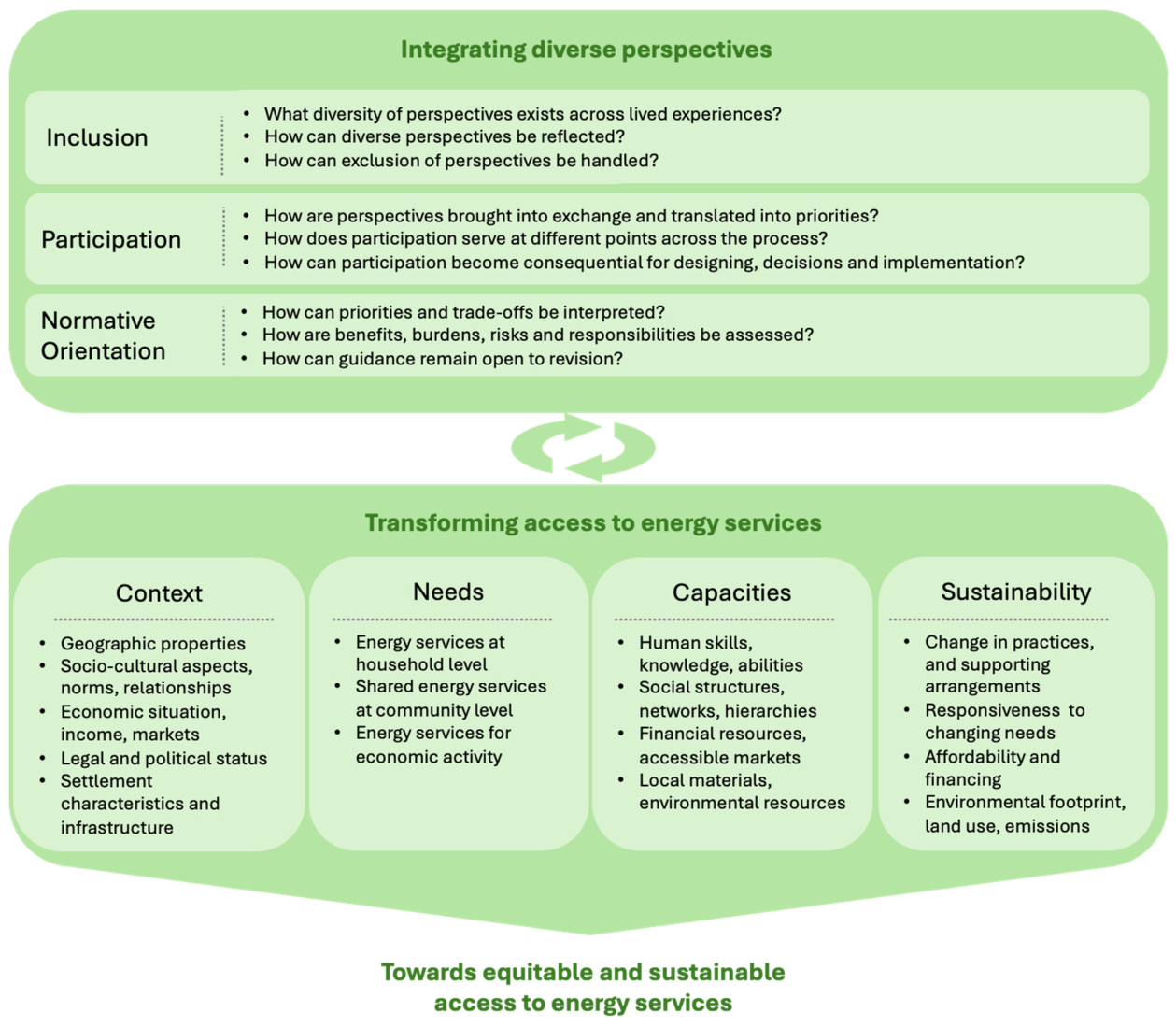
Table 1.
Guiding questions for the transformation towards access to energy services.
| Dimension | Guiding Question |
| Context: | What characterises the specific context in which displaced persons live and access energy services? |
| Needs: | Which energy services are required to address locally experienced challenges? |
| Capacities: | What local capacities can be mobilised and strengthened to support change? |
| Sustainability: | What transformation pathways and energy-service arrangements can enable meaningful and sustained access to energy services? |
Table 2.
Guiding questions for the integration of diverse perspectives into the transformation towards access to energy services.
Table 2.
Guiding questions for the integration of diverse perspectives into the transformation towards access to energy services.
| Dimension | Guiding question |
| Inclusion | How can diverse perspectives be recognised and included? |
| Participation | How can exchange, decision-making and action be facilitated and become consequential for shaping the transformation? |
| Normative Orientation | How can normative and procedural orientations guide the interpretation of priorities, trade-offs and possible pathways? |
Table 3.
Matrix arrangement of dimensions and shortcomings as per their origination and relation.
| Shortcomings | Neglect of needs, preferences and circumstances | Reduction to technological applications | One-directional and linear framing of change |
| Dimension | |||
| Context | Grounds understanding in diverse lived realities and contextual conditions | Situates technologies within the circumstances and practices through which services are used | Recognises contexts as dynamic and continuously shaped through changing circumstances |
| Needs | Clarifies energy-service requirements in relation to locally experienced challenges | Establishes required energy services rather than technologies as the point of departure | Allows service priorities to evolve as circumstances and understanding develop |
| Capacities | Recognises local foundations shaping access, use and sustained provision | Integrates local knowledge, skills and resources into shaping and sustaining provision | Treats capacities as foundations that can be strengthened throughout transformation |
| Sustainability | Embeds energy-service arrangements in relevant contextual conditions | Places technologies within wider arrangements required for sustained energy-service access | Frames pathways as adaptable and revisable rather than fixed routes |
| Inclusion | Ensures diverse and potentially overlooked perspectives inform understanding and priorities | Makes differentiated service requirements and experiences visible | Considers which perspectives are required and overlooked across stages of change |
| Participation | Enables lived experiences and priorities to influence problem definition and decisions | Enables different forms of knowledge to inform possible arrangements | Enables continued exchange, learning, deliberation and influence over transformation |
| Normative orientation | Supports reflection where needs, interests and responsibilities come into tension | Supports assessment of benefits, burdens and trade-offs between alternatives | Provides revisable orientation for priorities, trade-offs and emerging pathways |
| Resulting reorientation | From externally assumed needs and circumstances to locally grounded understanding and priorities | From technology-centred provision to locally embedded energy-service arrangements | From predefined intervention to iterative, participatory and locally grounded transformation |
Disclaimer/Publisher’s Note: The statements, opinions and data contained in all publications are solely those of the individual author(s) and contributor(s) and not of MDPI and/or the editor(s). MDPI and/or the editor(s) disclaim responsibility for any injury to people or property resulting from any ideas, methods, instructions or products referred to in the content. |
© 2026 by the authors. Licensee MDPI, Basel, Switzerland. This article is an open access article distributed under the terms and conditions of the Creative Commons Attribution (CC BY) license (http://creativecommons.org/licenses/by/4.0/).
Copyright: This open access article is published under a Creative Commons CC BY 4.0 license, which permit the free download, distribution, and reuse, provided that the author and preprint are cited in any reuse.