

Submitted:
21 June 2026
Posted:
07 July 2026
You are already at the latest version
Abstract
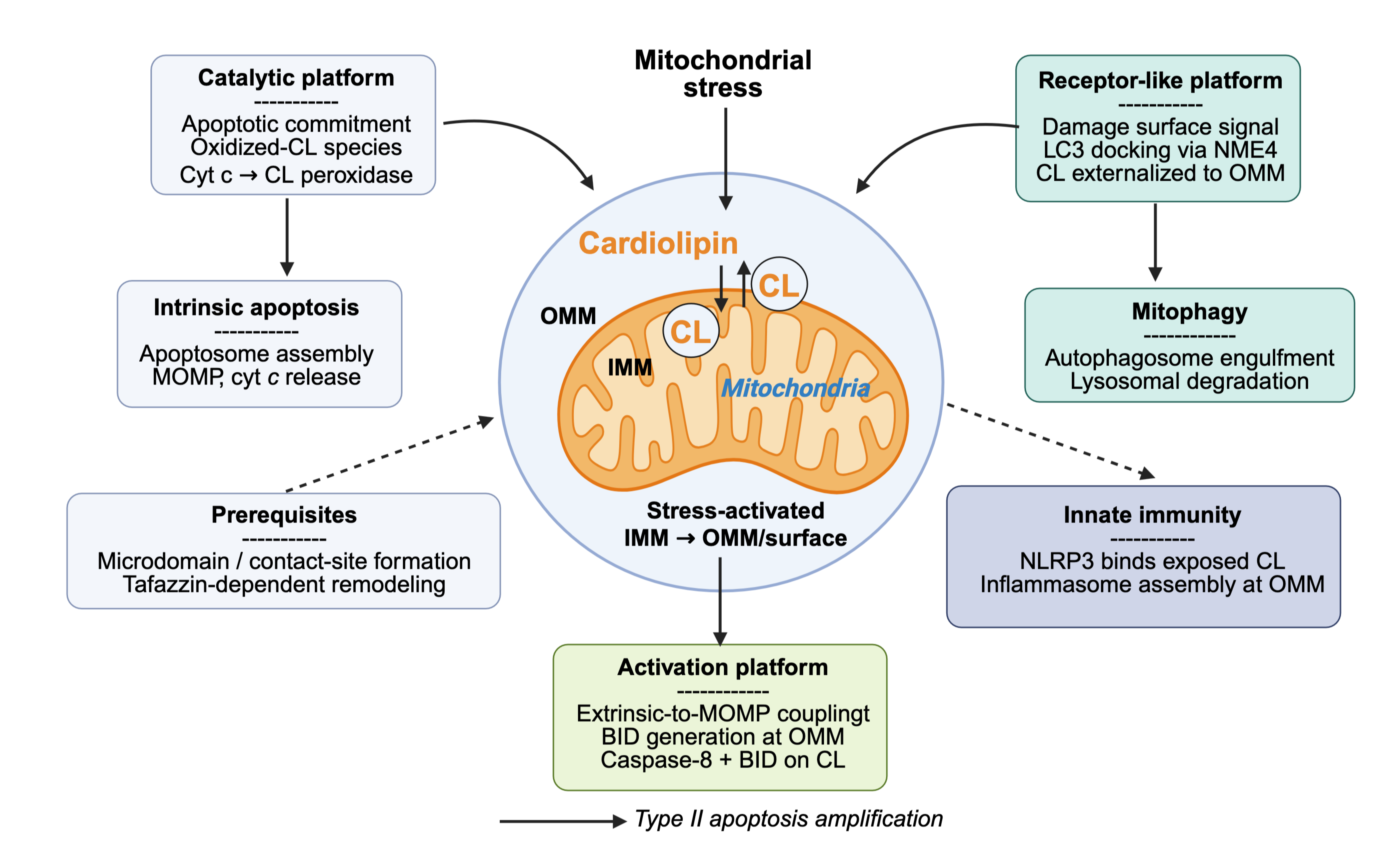
Cardiolipin (CL), a unique dimeric phospholipid with four acyl chains and a characteristically small polar head group, stands as one of the most compelling examples of evolutionary continuity in cell biology. Present in the plasma membrane of a-proteobacteria and conserved without fundamental modification in the inner mitochondrial membrane (IMM) of all eukaryotes examined, CL has been retained across approximately two billion years of evolution, a period over which the mitochondrion shed thousands of its original genes. This degree of conservation demands an explanation that transcends structural necessity alone. Here we propose, and document with biochemical and cell biological evidence, that CL functions as a programmable signaling hub: a lipid species whose physical chemistry and membrane address allow it to assemble distinct supramolecular platforms in response to discrete stress signals, each platform transducing a specific mitochondrial state into a defined cell fate outcome. Three core CL signaling platforms are described. Platform 1, the catalytic peroxidase platform, converts the constitutive CL–cytochrome c (cyt c) structural complex into an enzymatic reaction under oxidative stress, generating oxidized CL (oxCL) species that commit the cell to apoptosis by releasing cyt c from the IMM. Platform 2, the receptor-like mitophagy platform, exploits NME4-dependent CL scramblase activity to translocate CL from the IMM to the outer mitochondrial membrane (OMM) surface upon membrane potential dissipation, creating an externalized "eat-me" signal that LC3-II on autophagic membranes recognizes directly. Platform 3, the caspase-8/BID activation platform, assembles a CL microdomain scaffold at the OMM that recruits caspase-8 from death receptor complexes, accelerates Bid cleavage by three orders of magnitude, and couple extrinsic apoptotic signals to mitochondrial outer membrane permeabilization (MOMP). An emerging fourth axis links CL externalization to innate immune activation via NLRP3 inflammasome recruitment. We argue that the deep evolutionary conservation of CL reflects not its structural roles per se, but the irreplaceable nature of these signaling functions. Functions already present in ancestral bacteria and progressively elaborated as eukaryotic cell death, quality control, and immunity coevolved with the organelle itself.
Keywords:
cardiolipin
; mitochondria
; apoptosis
; mitophagy
; caspase-8
; Bid
; NLRP3
; signaling hub
; evolutionary conservation
; Barth syndrome
Copyright: This open access article is published under a Creative Commons CC BY 4.0 license, which permit the free download, distribution, and reuse, provided that the author and preprint are cited in any reuse.


