

Submitted:
03 July 2026
Posted:
07 July 2026
You are already at the latest version
Abstract
Background/Objectives: Proactive interference (PI) occurs when existing memories make it harder to retrieve newer information, and visual working memory in older adults may be impacted by increased vulnerability to PI. However, evidence supporting age-sensitive PI in the recent-probes task – a major technique for measuring PI – is mixed. Additionally, features of this procedure may have exaggerated or distorted the effect, so the current study reassessed the recent-probes task. Methods: Throughout trials in an online experiment, adults aged 18-29 and 64-80 memorized four images over a brief delay and then had to choose between a current target or a foil depicting an item from the previous trial (a recent negative probe) or a more distant trial (a non-recent negative probe). Participants were cued to respond either immediately or after a pause, and targets came from a small, extensively repeated set or a unique set. Results: PI was present, with slower and less accurate responding to RN than NRN foils, and errors notably increased when stimuli were unique and an immediate response was required. However, there was little evidence for age differences in PI. Conclusions: The present findings suggest that the ability to manage PI in visual working memory is not hindered in older age.
Keywords:
aging
; visual working memory
; proactive interference
; recent-probes task
1. Introduction
Visual working memory (VWM) is responsible for maintaining and manipulating visuospatial information over brief periods of time. It plays a critical role in daily tasks, yet it does appear to decline with age, as shown in Brockmole and Logie’s [1] major study of over 55,000 participants. This study revealed a linear decline in VWM performance from the ages of 20 to 75, with the worst VWM in those aged 56 and older.
One factor that may impair VWM in older age is proactive interference (PI), which occurs when existing memories interfere with processing and retrieving current information [2]. PI may be more difficult to manage in older age, contributing to VWM difficulties, and this possibility has been investigated using the long-established recent-probes task (e.g., [3,4]). This procedure, an adapted version of the Sternberg recognition task [5], requires participants to remember an array of target objects over a brief delay. They must then determine whether a single probe matches any of the current targets. PI is manifested on mismatching trials, as probes that match targets from the previous trial (a Recent Negative/RN probe) typically increase errors and slow responding compared to probes that have not appeared recently (a Non-Recent Negative/NRN probe) [6]. This provides a behavioral measure of PI.
Some studies introducing visual stimuli into this task have found that older adults are particularly vulnerable to PI in VWM. Loosli et al. [3], using images of animals as the target set, reported that adults aged 66-74 made more errors on RN than NRN trials in comparison to adults aged 19-31. The same trend was observed for RT, though this was only marginally significant. In a similar study, Loosli, Rahm, et al. [4] documented more pronounced PI in older than younger adults when assessing accuracy. Subsequent fMRI data revealed that a network responsible for resolving PI, including regions such as the inferior frontal gyrus, the insula and the medial prefrontal cortex, had lower activation in older than younger adults [4].
PI in older age may also be durable and difficult to manage. A modified recent-probes task was used by Loosli, Falquez, et al. [7], recruiting older adults only. PI was found on both accuracy and RT measures, but one group had daily training with the recent-probes task (and RN probes) over 10 days. Despite this, they could not entirely prevent PI, as the RT cost persisted for over a week without declining.
Heightened PI in older age is echoed in other paradigms assessing visual PI [8] and it has been shown in verbal memory procedures, such as the AB-AC paradigm [9], the N-back task [10] and the verbal recent-probes task [11].
There are different explanations for increased susceptibility to PI in older age, but within the recent-probes task, familiarity may play a key role. According to the familiarity-inhibition model, stimuli that are familiar are more likely to prompt a “match” response, but this is problematic on RN trials, as a match response here is erroneous [2]. Attempting to inhibit the familiarity signal from RN probes can slow down responses or lead to mistakes, resulting in PI, and older adults may particularly struggle with this. According to the inhibitory-deficit hypothesis [12], the processes that allow relevant information to be maintained and irrelevant information to be ignored/deleted is weakened in older age (and in other conditions that affect attention) [13]. Reduced inhibition means older adults hold more irrelevant data in working memory, and within the context of the recent-probes task, this may mean greater susceptibility to PI due to difficulties suppressing the familiarity signal from RN probes.
An alternative explanation comes from the dual mechanisms of control (DMC) framework, which hypothesizes that proactive and reactive processes contribute to cognitive control [14]. In relation to interference in working memory, proactive control would be used to anticipate and prevent interference in advance, whereas reactive control identifies and responds to interference when it happens [15]. Proactive control presents important advantages, but Xu et al. [16] have shown that older adults may be more likely to use a familiarity-driven reactive mode. This would be ineffective in the recent-probes task, as it would increase the number of errors and slow responding when familiar RN probes occur, resulting in stronger PI.
However, while the inhibitory-deficit hypothesis and DMC framework both predict increased PI in older adults, this has not always been found. For instance, Moore et al.’s [17] recent-probes task used emotionally neutral faces and scenes. On each trial, participants had to memorize three faces and three scenes over a brief delay. In different trial blocks, the probe was either consistently a face or consistently a scene, meaning one stimulus category had to be selectively memorized and the other category ignored. Responding was assessed in four ways (percent correct, d’, c and RT), and if older adults were more susceptible to PI, this would be manifested in an age group and probe type interaction. Such an interaction was not found on three of the four measures, but for RT, younger adults actually experienced higher PI than older adults.
Moore et al. [17] noted that task difficulty and cognitive load might have already slowed responding in older adults, increasing the challenge of discovering age-sensitive PI. Nonetheless, other doubts have been raised about PI in older adults. Archambeau et al. [18] applied a diffusion decision model to data from their (verbal) recent-probes task and found that the drift rate, which is linked to processing efficiency, could explain task performance. Older adults had a lower drift rate than younger adults, but there was no interaction between age and probe type, suggesting no increased vulnerability to PI in older adults. Contrary to past work, Archambeau et al. [18] concluded that the inhibitory processes used to resist PI continue to function in older age.
It is therefore uncertain if older adults really are more vulnerable to PI in VWM, but there are also important methodological issues in the recent-probes task that may influence the size of the PI effect. The recent-probes task reveals a form of item-specific PI, caused by the reoccurrence of a former target from the recent past as a current probe [19]. This represents a very selective and stimulus-specific form of PI, which differs from the broader, nonspecific PI caused by repeated exposure to a broader category of stimuli used over multiple trials [20]. However, studies using the visual recent-probes task with older adults have tended to use a small pool of stimuli that are repeated throughout the experiment – the work of Loosli and colleagues used 12 line drawings of animals, for example [3,4,7], ensuring that stimuli would be regularly repeated throughout the experiment. This might create a high level of “background” PI and introduce a form of nonspecific PI, caused by repeated exposure to stimuli over multiple trials. Indeed, in another procedure that measures PI – the Repeated-Unique Paradigm (RUP) [21]– regular exposure to a small pool of heavily repeated images impairs VWM performance in comparison to a set of unique stimuli [22,23,24].
Older adults may primarily struggle with PI when the interference context is increased. In a study using the verbal recent-probes task, Manard et al. [15] created different interference contexts by varying the proportion of RN probes, with these representing either 10% (low interference) or 40% (high interference) of trials. On the RT measure, older adults experienced greater PI in the high interference context (though this was also influenced by fluid intelligence and processing speed). Selecting stimuli from a smaller pool of items, ensuring repetition, might work in a similar manner, creating a high interference context. In a lower interference context, older adults may be better able to manage PI.
A second issue with the recent-probes task is the brief time available for responding. Typically, the probe must receive a decision within a few seconds, with prior response times including 1.5 s [7], 1.8 s [3,4] and 2 s [17]. There are two potential issues here. Firstly, RTs slow with age in both simple and complex tasks, and this may be due to difficulties processing stimuli and preparing motor movements in older age [25]. Given this, a limited response window and increased time pressure may particularly challenge older people to respond correctly. Secondly, PI may be increased when the response window is short. Öztekin and McElree [26] note that recognition memory involves a familiarity assessment, which happens at an early stage of retrieval, followed by the usage of more detailed episodic information at a later retrieval stage. The occurrence of RN items in the recent-probes task prevents reliable use of the fast-acting familiarity assessments, as it could lead to incorrect responses. Öztekin and McElree’s [26] results were consistent with this idea in a verbal memory paradigm, as accuracy was lower when participants had to respond quickly (as indicated by a tone) compared to when they had more time. In relation to the recent-probes task, if there is only a short period to react to the probe, participants may be forced to rely on a fast-acting but misleading familiarity assessment, heightening PI. This does seem plausible, as older adults are more likely to respond based on familiarity signals [16]. If more time were available to respond, however, additional episodic information could be used to resolve PI. In tentative support of this idea, Archambeau et al. [18] did not find substantial age-based PI in the recent-probes task when there was no time limit for responding (though this study used verbal stimuli).
Finally, a wider issue with the recent-probes task is its use of a single probe during testing. Brady et al. [27] have critiqued the use of yes/no testing (i.e., match or mismatch) as it is particularly difficult to assess accuracy while controlling response bias. While various methods that ostensibly tackle this problem do exist (e.g., d’, A’), Brady et al. [27] show that these measures have very different (potentially inaccurate) theoretical assumptions, and results that may be uncovered on one measure may be inconsistent with other measures. Instead, Brady et al. [27] recommends forced-choice testing, such as two-alternative forced-choice (2AFC), as it is theory neutral, unbiased and more accurate. Yet in the recent-probes task, 2AFC is rarely if ever utilized.
Overall, the VWM of older adults may be more vulnerable to PI, but this possibility has been challenged [17,18]. Methodological issues in the recent-probes task mean it is unclear whether PI represents a specific, limited effect, or a more global, nonspecific effect due to extensive stimulus repetition. It is also plausible that PI in older adults is influenced by the limited response window. Finally, the PI effect may have been skewed by a single probe recognition test, which has disadvantages [27].
The present study aimed to address these issues and reassess visual PI in younger and older adults using a modified version of the visual recent-probes task. The typical single probe recognition test was replaced with a 2AFC task, in which a target from the present trial was paired with either an untested target from the previous trial (RN foil) or from three previous trials (NRN foil). PI would be represented by less accurate and/or slower responses to RN than NRN foils, and PI was estimated through a derived difference score that compared RN against NRN performance.
In one condition, the stimuli were drawn from a small pool of just eight items, ensuring regular repetition throughout the task, whereas in another condition, all targets were unique. This was inspired by the RUP [21,22,23,24]. If regular repetition heightens the wider interference context, increasing the demands of the task and making it more difficult to rely on familiarity signals, older adults should be especially vulnerable to PI, compared with younger adults and the unique condition. This would be manifested in an age group x condition interaction.
To assess whether the respond window affected PI, a tone was used to indicate when a response was needed – a sound cue occurred either immediately as the 2AFC test started, or after a 3 s delay. This was inspired by Öztekin and McElree’s [26] approach. If PI in older adults is particularly affected by usage of a fast-acting familiarity signal, older adults should be more vulnerable to PI than younger adults when cued to respond immediately. However, a longer response window might permit additional episodic information to be used, allowing older adults to better manage PI. This would be manifested in an age group x response cue interaction.
2. Materials and Methods
2.1. Participants
The sample size was estimated based on the hypothesized two-way interactions in a mixed experimental design. According to Brysbaert [28], 200 participants would be needed to detect the smallest effect size of interest (d = 0.4) with 80% power at .05 significance (this sample size would also be capable of detecting main effects for factors with two levels). Effort was made to moderately over-recruit to account for any unusable data. In total, 208 participants based in the UK or USA were recruited via Prolific Academic (https://www.prolific.com/), but one requested data to be withdrawn and another had excessive missing data (over 30% of responses were missing).
The final sample included 102 younger adults (48 women and 54 men) aged between 18 and 29 (M = 22.36, SD = 2.16) and 104 older adults (64 women, 38 men, two undisclosed gender) aged between 64 and 80 (M = 69.90, SD = 3.83). Following Rhodes et al. [8], participants were not eligible to volunteer if they had a history of mental health issues, a diagnosis of dementia or mild cognitive impairment, or a history of head injuries. They were also required to have normal or corrected-to-normal vision. Prolific’s screening function only advertised the study to those meeting these eligibility criteria. Participants were paid £4.50 for completing the study.
2.2. Stimuli
Images used in the recent-probes task were sourced from Brady et al.’s [29] database, featuring photos of everyday objects and items (e.g., tools, appliances, food products, toys, etc.) and animals. They were shown on a white background and any images relating to familiar brands or common phobias were removed. Then, 520 images were randomly selected to form the target/probe set in the unique condition. To create the repeated condition stimuli, 64 images were randomly selected and allocated into eight different sets, where each set contained eight images. The use of eight images ensured extensive target repetition throughout the task [30], and the creation of different sets meant that different groups of participants experienced different repeated stimuli, reducing concerns that artefacts of specific images would affect the results. Throughout the experimental trials, each repeated image was used 78 times as targets and probes, on average (varying between 69 and 81 times). Lastly, Audacity (https://www.audacityteam.org/) was used to create the response cue, which was a 440 Hz pure tone lasting 500 ms.
2.3. Design and Procedure
The experiment was designed and built in Gorilla Experiment Builder (https://gorilla.sc) [31], with participants completing the study on a desktop computer or laptop. Each trial began with a black fixation cross presented in the center of a white background for 300 ms, followed by four to-be-remembered targets. Targets were displayed for 1.5 s in a 2x2 grid and were unique within a trial. After a 1 s unfilled delay, a 2AFC recognition task occurred. Here, a target presented on the current trial was paired with an untested foil item from an earlier trial. Foils were either a RN probe – an untested target from the previous trial – or a NRN probe – an untested target from Trial N-3. NRN probes were selected from Trial N-3 because 1) it has been shown that N-3 probes produce less PI than N-1 probes in the visual recent-probes task [19], and 2) it still allowed the repeated condition to feature regular occurrence of all eight stimuli. Targets and foils occupied the left and right positions in the 2AFC task an equal number of times, and each of the four target positions were equally tested too.
When the 2AFC task occurred, participants had to click the image forming part of the current target set. They were cued to respond by a tone that occurred immediately (i.e., as soon as the 2AFC task began) or after a delay of 3 s. This created two response time conditions – immediate vs. delayed – and was influenced by Öztekin and McElree’s [26] approach.
Once the tone sounded, participants had 3 s to respond, and a countdown timer at the bottom of the screen indicated the time available for the selection. Above the two images, the phrase “Which image did you just see? (Please click)” appeared. After participants responded or after 3 s had elapsed, the next trial began after a 1 s delay. See Figure 1 for a diagram of the procedure.
A mixed experimental design was used, with the between-groups factor being age group (young vs. old) and the within-groups factors including condition (repeated vs. unique), response cue (immediate vs. delayed) and foil type (RN vs. NRN). Several additional controls were put in place. True randomization of trials in the recent-probes task is not possible, as there is a critical relationship between successive trials. Instead, trials were organized into eight mini blocks, with each block containing 13 trials (12 experimental trials and a “warm-up” trial). Mini blocks had a fixed trial order but their order was randomized. The warm-up trials started each block and were designed to introduce a stimulus that would be used as a foil on the next trial.
The repeated and unique conditions were completed within separate blocks (containing all eight mini blocks), but the order of the two conditions was counterbalanced. Participants were also randomly allocated to receive one of the eight different stimulus sets comprising the repeated condition.
In total, participants completed 104 trials for each condition, including eight warm-up trials. The 96 experimental trials were divided equally between 48 immediate response and 48 delayed response trials (24 with a RN probe and 24 with a NRN probe).
Prior to the experimental task, participants viewed a short video providing task instructions and then completed eight practice trials (four requiring an immediate response and four requiring a delayed response). Stimuli used on the practice trials came from the repeated condition, providing early exposure to those images.
At the end of the procedure, participants had an option to submit or withdraw their data, after which they received a debriefing. Full information about the experimental trials can be accessed at https://doi.org/10.17605/OSF.IO/GPCRW and the tasks and study created in Gorilla Experiment Builder is available at https://app.gorilla.sc/openmaterials/1304088.
3. Results
3.1. Preliminary Analyses
Trials with missing responses were excluded, but these were rare (on average, 1.2% of trials did not receive a response within the 3 s period), and warm-up trials were removed. Analyses on RT were based on trials with a correct response only.
Initial analyses assessed the presence of PI. Performance on trials with RN and NRN foils were collapsed across condition/response cue variables and compared with paired-samples frequentist and Bayesian t-tests. For accuracy, there was a significant PI effect, t(205) = 10.15, p < .001, d = 0.71, with extreme support for the alternative hypothesis (BF10 = 6.28 x10¹⁶). This was caused by fewer correct responses when the foil matched an item from the previous trial (RN M = 0.86) than three prior trials (NRN M = 0.89). Likewise, there was a significant PI effect on the RT measure and extreme support for the alternative hypothesis, t(205) = -4.22, p < .001, d = -0.29, BF10 = 359.26, with slower responses on RN (M = 902.67 ms) than NRN trials (M = 886.35 ms).
As PI was present, new dependent variables were created to represent the PI score. For accuracy, this involved subtracting RN from NRN trials, and for RT, the opposite approach was used. Values above zero indicated PI.
3.2. PI Effects on Accuracy
Descriptive statistics are shown in Table 1. The PI effect, based on the NRN-RN contrast, was generally modest, except for the unique condition with an immediate response cue, where much more notable PI was observed.
The PI scores on accuracy were assessed for normality and homogeneity of variance. Skewness and kurtosis scores were within the acceptable range [32] and a histogram and a Q-Q plot did not highlight major deviations from normality, but Levene’s test suggested a potential issue with homogeneity of variance in the repeated condition with a delayed response cue (p = .026). However, the range of standard deviations was low (older adults SD = 0.094; younger adults SD = 0.076) and the variance ratio was only 1.53, well below the 1:4 ratio suggested as problematic [33]. A residual-versus-fitted plot did not suggest issues with heteroscedasticity either, so the significant Levene’s result may have been due to the large sample size. Given this, data were assumed to meet parametric assumptions, but a robust statistical test supported the main conclusions outlined below1.
Next, 2 (age group: younger vs. older adults x 2 (condition: repeated vs. unique) x 2 (response cue: immediate vs. delayed) mixed frequentist and Bayesian ANOVAs were conducted on the PI accuracy score. The Bayesian ANOVA used BFInclusion values and matched models, to assess whether data were more likely under models with one effect than without (e.g., whether a model with an interaction had more support than a model without that interaction [34]). BFInclusion values can be interpreted in the same way as BF10 values, where values of 3, 10 or >100 indicate moderate, strong, and extreme evidence for retaining a particular effect/interaction in the model [35].
There was a significant main effect of condition, F(1, 204) = 5.05, p = .026, ηp2 = 0.02, with more PI in the unique (M = 0.04) than repeated (M = 0.03) condition, though the Bayesian ANOVA showed little support for retaining this main effect in the model (BFInclusion = 0.69). There was also a significant and strongly supported main effect of response cue, F(1, 204) = 64.47, p < .001, ηp2 = 0.24, BFInclusion = 6.03 x 10⁹, with greater PI for immediate (M = 0.06) than delayed responses (M = 0.01). Importantly, age group did not affect the overall PI score, F(1, 204) = 0.82, p = .368, ηp2 = 0.004, BFInclusion = 0.14 (older adults: M = 0.04; younger adults: M = 0.03).
Two of the interactions were non-significant and unsupported, including condition x age group, F(1, 204) = 0.24, p = .627, ηp2 = 0.001, BFInclusion = 0.15, and the three-way interaction, F(1, 204) = 0.14, p = .709, ηp2 < 0.001, BFInclusion = 0.25.
For condition x response cue, there was a significant interaction and strong evidence for retaining it within the model, F(1, 204) = 36.46, p < .001, ηp2 = 0.15, BFInclusion = 2.92 x 10⁸. Bonferroni post-hoc tests and Bayesian paired-samples t-tests showed no difference in PI between immediate and delayed responses in the repeated condition, t(205) = -1.42, pBonferroni = .628, d = -0.10, BF10 = 0.21, but there was notably higher PI in the unique condition when the response cue was immediate rather than delayed, t(205) = -9.15, pBonferroni < .001, d = -0.64, BF10 = 9.04 x 10¹³. In the unique condition with a delayed response, PI was not present and so was lower than PI in the equivalent repeated condition, t(205) = 2.94, pBonferroni = .016, d = 0.21, BF10 = 5.06. In contrast, when the required response was immediate, PI in the unique condition exceeded that in the repeated condition, t(205) = -5.68, pBonferroni < .001, d = -0.40, BF10 = 201,483.42. See Figure 2.
For response cue x age group, there was a conventionally significant interaction, F(1, 204) = 6.05, p = .015, ηp2 = 0.03, though the Bayesian ANOVA suggested limited support for retaining the interaction in the model (BFInclusion = 1.73) and Bonferroni post-hoc tests did not find significant differences between younger and older adults in each condition.
3.3. PI Effects on RT
Descriptive statistics are shown in Table 2. PI was absent in the repeated condition with a delayed cue (and also in younger adults in the unique/delayed cue condition), but it was more notable when an immediate response was required.
The PI scores on RT were assessed for normality and homogeneity of variance. Levene’s test was consistently non-significant and all skewness/kurtosis scores were within acceptable ranges [32]. A histogram and Q-Q plot did not highlight major concerns about normality either, though there may have been some minor deviations from normality in the tails.
Three-way frequentist and Bayesian mixed ANOVA found only one main effect. There was greater PI when the response was immediately required (M = 32.57 ms) rather than delayed (M = 0.06 ms), F(1, 204) = 21.85, p < .001, ηp2 = 0.10, BFInclusion = 933.68.
There was a marginally significant effect of condition, F(1, 204) = 3.73, p = .055, ηp2 = 0.02, with greater PI in the unique (M = 23.57 ms) than repeated (M = 9.07 ms) conditions, but this was unsupported and insensitive in the Bayesian analysis (BFInclusion = 0.57).
The main effect of age group was non-significant and unsupported, F(1, 204) = 0.09, p = .763, ηp2 < 0.001, BFInclusion = 0.11, with a very similar PI effect in younger (M = 15.15 ms) and older (M = 17.49 ms) adults.
All interactions were also non-significant and unsupported: Age group x condition, F(1, 204) = 1.24, p = .268, ηp2 = 0.01, BFInclusion = 0.19; age group x response cue, F(1, 204) = 3.09, p = .080, ηp2 = 0.02, BFInclusion = 0.53; condition x response cue, F(1, 204) = 0.97, p = .325, ηp2 = 0.01, BFInclusion = 0.19; age group x condition x response cue, F(1, 204) = 0.01, p = .925, ηp2 < 0.001, BFInclusion = 0.13.
3.4. Overall VWM Performance
While there was little evidence for age differences in PI, a final analysis compared younger and older adults on overall task performance. New variables were created that averaged all proportion correct scores and RTs across conditions. Paired-samples frequentist and Bayesian t-tests showed no age difference in overall task accuracy, t(204) = 0.65, p = .514, d = 0.09, BF10 = 0.19, with younger (M = 0.87) and older (M = 0.88) adults achieving a very similar number of correct responses2. However, younger adults were quicker to respond (M = 812.74 ms) than older adults (M = 974.71 ms), t(204) = 5.84, p < .001, d = 0.81, BF10 = 530,231.96.
4. Discussion
The present study reassessed whether older adults are more vulnerable than younger adults to PI in VWM. A well-established method for assessing PI, the recent-probes task, was used. While some previous studies have found age-sensitive PI [3,4], there is inconsistent evidence [17,18] and potential features of the recent-probes task – especially the short response window, the use of a small pool of stimuli, and the yes/no recognition task – could plausibly exaggerate any PI effect in older adults.
PI was found on both accuracy and RT measures here, consistent with the familiarity-inhibition model [2]. Importantly, this showed that PI can affect VWM in a 2AFC recognition task and indicates that the effect generalizes beyond the yes/no (match/mismatch) arrangement typical in the recent-probes task. The PI effect was also more pronounced when responding was rushed via an immediate sound cue, supporting the view that PI arises from a rapid assessment of familiarity [26]. When more time was available to use additional episodic details via a delayed response cue, PI declined.
Crucially, however, there was little evidence that older adults experienced greater PI than younger adults. The PI effect on accuracy and RT measures was very similar in both age groups, representing very small effect sizes that were consistent with the null hypothesis. The one exception was a significant interaction between response cue and age group, but post-hoc analyses did not reveal differences between younger and older adults, and the Bayesian analysis found limited evidence for retaining this interaction.
The present results are therefore more consistent with studies that have not found substantial age-based differences in PI [17,18], and so PI may not play a major role in the age-related declines seen in VWM [1]. This finding is particularly important as some conditions were designed to enhance PI – namely regular repetition of stimuli and a short response window.
PI was enhanced when the response was immediately cued, requiring a rapid reaction, but primarily in the unique condition. Stimulus repetition throughout the experiment did not produce substantial PI as expected based on the RUP paradigm, in which VWM performance suffers when stimuli are drawn from a small set of items, rather than being unique [21,22,23,24]. However, the present study did not use the standard version of the RUP, in which foils in the unique condition have never been experienced before, and there is other work suggesting that repetition of stimuli within the recent-probes task can be beneficial [30] or have little impact, at least for meaningful stimuli [36]. Another study found that higher interference contexts can actually increase performance [37].
It is still notable that older adults were able to manage PI to the same degree as younger adults in the repeated condition. Extensive stimulus repetition was predicted to be harmful for older adults, due to additional familiarity from RN probes. As this did not happen, frequent exposure to repeated stimuli may have created robust long-term memories that aided VWM performance. In contrast, the single usage of unique targets may have reduced any involvement of long term-memory. Regular repetition may have also allowed the use of other strategies (e.g., verbal labelling) to assist in the task.
Critically, the ability of older adults to use repetition in a facilitatory way suggests engagement with proactive control. While older adults may be expected to rely more on reactive control, Xu et al. [16] used a double retro-cue paradigm and showed that older adults were able to manage PI when stimuli were regularly repeated through the experiment, eventually equaling the performance of younger adults. They interpreted this through the DMC framework, where frequent stimulus repetition can eventually permit proactive control. An equivalent effect may have happened in the repeated condition here, suggesting older adults can use proactive control in some circumstances.
Proactive control may have been harder to employ in the unique condition, especially when the response was rushed, which may have led to a familiarity-based reactive mode being employed. Again, however, this applied to both younger and older adults, and the pattern of results in this experiment indicate that older adults are not more sensitive to PI in VWM – at least the item-specific PI assessed in the recent-probes task. Such a discovery poses problems for the inhibitory-deficit hypothesis, which would predict older age to lead to greater difficulty managing interference.
In relation to the wider literature, other studies have found increased PI in older age, including in the visual recent-probes task [3,4]. A key difference between the present study and these prior experiments is the recognition task – the current study used a 2AFC task whereas the work of Loosli and colleagues used a single probe [3,4], which is more typical in the recent-probes task. Yet Moore et al. [17] also used a single probe and did not find age-dependent PI, and the present study revealed robust PI in the unique condition with an immediate response cue. As such, the retrieval test itself cannot fully explain the absence of age-sensitive PI.
A closer examination of the most similar previous studies indicates that the critical interaction between probe type and age group, which would demonstrate age-based differences in PI, is not overly robust. The interaction was significant on the accuracy measure for Loosli et al.’s [3] study (which also included children), but it was only marginally significant on the RT measure. In Loosli, Rahm, et al. [4], the interaction was marginal for accuracy and non-significant for RT, and it was consistently non-significant for Moore et al. [17], except for RT, where younger adults experienced a greater PI cost than older adults.
Even so, the broader literature generally suggests that older adults are more vulnerable to PI [9,10,11]. These studies have tended to use verbal stimuli and other paradigms, however, so they may be tapping into different forms of PI. For instance, the N-back task has found age-sensitive PI [10], but participants must actively update their working memory, holding and then discarding individually presented items. This differs from the recent-probes task, where events on a previous trial are no longer relevant. PI may behave differently according to the maintenance requirements of the task (see also [38,39] for a conception of active/ passive processes and links to PI).
Future work could address these possibilities by incorporating a range of different paradigms and stimuli into a single study. This would allow mechanisms underpinning different forms of PI to be directly compared. While Loosli et al. [3] used both N-back and the recent-probes tasks, there is scope to take this further, utilizing multiple PI procedures within one experiment.
Future work may also be able to address some of the limitations in the current study, including the use of online testing. This reduces environmental control compared to laboratory-based experiments, but overall performance was very good (87.4% of responses were correct, on average), and online testing allowed a much larger sample to be tested than is typically the case in the recent-probes task. Yet the older adults recruited here may have been more cognitively capable than some of their peers. All participants were recruited via Prolific, and the older adults engaged with this platform may be more technologically proficient than older adults not registered with this service. A meta-analysis suggests that usage of technology in older age is linked to reduce risk of problems in cognition [40], so future work could assess whether technological engagement links to PI. Ultimately though, treating older adults as a single, homogeneous group may itself be problematic, and there may only be greater sensitivity to PI within some older adults.
A second issue was that independent measures of cognitive ability were not obtained (selection was achieved via the in-built screening within the Prolific platform), and additional cognitive testing and recording of demographic factors would have been advantageous. Yet accuracy on the task was equivalent between younger and older adults (though the former participants were quicker at responding; see [25]). This may indicate that VWM ability itself may link to PI – Loosli and colleagues found age-sensitive PI in a sample where older adults had poorer overall performance than younger adults [3,4]. The degree to which overall VWM ability affects PI in older age therefore needs further testing.
5. Conclusions
In conclusion, PI was found to affect VWM, especially when unique stimuli were used and an immediate response was required. Yet there was little evidence that older adults were more vulnerable to PI than younger adults, suggesting that the ability to manage item-specific PI in VWM may not be hindered in older age.
Funding
Participant incentives were funded by the Centre for Psychological Research at the University of Wolverhampton.
Institutional Review Board Statement
The study was conducted in accordance with the Declaration of Helsinki and approved by the Ethics Committee of the Faculty of Education, Health, and Wellbeing at the University of Wolverhampton (protocol code: 0925TM2UOWPSY; date of approval: 8 October 2025).
Informed Consent Statement
Informed consent was obtained from all subjects involved in the study.
Data Availability Statement
The original data presented in the study are openly available in the Open Science Framework project “Age and Proactive Interference in Visual Working Memory: Reassessing the Recent-Probes Task” at https://doi.org/10.17605/OSF.IO/GPCRW.
Acknowledgments
During the preparation of this manuscript, the author used ChatGPT 5.5 to assist with R Studio programming code for data screening (normality, homogeneity of variance) and robust analyses, and for formatting the references list. The author has reviewed and edited the output and takes full responsibility for the content of this publication.
Conflicts of Interest
The author declares no conflicts of interest. The funders had no role in the design of the study; in the collection, analyses, or interpretation of data; in the writing of the manuscript; or in the decision to publish the results.
Abbreviations
The following abbreviations are used in this manuscript:
| 2AFC | Two-alternative forced-choice recognition test |
| BF | Bayes Factor |
| DMC | Dual Mechanisms of Control framework |
| NRN | Non-Recent Negative foil |
| PI | Proactive interference |
| RN | Recent Negative foil |
| RT | Response time |
| VWM | Visual working memory |
References
- Brockmole, J.R.; Logie, R.H. Age-related change in visual working memory: A study of 55,753 participants aged 8–75. Front. Psychol. 2013, 4, 12. [Google Scholar] [CrossRef] [PubMed]
- Badre, D.; Wagner, A.D. Frontal lobe mechanisms that resolve proactive interference. Cereb. Cortex 2005, 15, 2003–2012. [Google Scholar] [CrossRef] [PubMed]
- Loosli, S.V.; Rahm, B.; Unterrainer, J.M.; Weiller, C.; Kaller, C.P. Developmental change in proactive interference across the life span: Evidence from two working memory tasks. Dev. Psychol. 2014, 50, 1060–1072. [Google Scholar] [CrossRef] [PubMed]
- Loosli, S.V.; Rahm, B.; Unterrainer, J.M.; Mader, I.; Weiller, C.; Kaller, C.P. Age differences in behavioral and neural correlates of proactive interference: Disentangling the role of overall working memory performance. NeuroImage 2016, 127, 376–386. [Google Scholar] [CrossRef] [PubMed]
- Monsell, S. Recency, immediate recognition memory, and reaction time. Cogn. Psychol. 1978, 10, 465–501. [Google Scholar] [CrossRef]
- Jonides, J.; Nee, D.E. Brain mechanisms of proactive interference in working memory. Neuroscience 2006, 139, 181–193. [Google Scholar] [CrossRef] [PubMed]
- Loosli, S.V.; Falquez, R.; Unterrainer, J.M.; Weiller, C.; Rahm, B.; Kaller, C.P. Training of resistance to proactive interference and working memory in older adults: A randomized double-blind study. Int. Psychogeriatr. 2016, 28, 453–467. [Google Scholar] [CrossRef] [PubMed]
- Rhodes, S.; Buchsbaum, B.R.; Hasher, L. The influence of long-term memory on working memory: Age-differences in proactive facilitation and interference. Psychon. Bull. Rev. 2022, 29, 191–202. [Google Scholar] [CrossRef] [PubMed]
- Ebert, P.L.; Anderson, N.D. Proactive and retroactive interference in young adults, healthy older adults, and older adults with amnestic mild cognitive impairment. J. Int. Neuropsychol. Soc. 2009, 15, 83–93. [Google Scholar] [CrossRef] [PubMed]
- Samrani, G.; Bäckman, L.; Persson, J. Age-differences in the temporal properties of proactive interference in working memory. Psychol. Aging 2017, 32, 722–731. [Google Scholar] [CrossRef] [PubMed]
- Jonides, J.; Marshuetz, C.; Smith, E.E.; Reuter-Lorenz, P.A.; Koeppe, R.A.; Hartley, A. Age differences in behavior and PET activation reveal differences in interference resolution in verbal working memory. J. Cogn. Neurosci. 2000, 12, 188–196. [Google Scholar] [CrossRef] [PubMed]
- Hasher, L.; Zacks, R.T. Working memory, comprehension, and aging: A review and a new view. In Psychology of Learning and Motivation; Bower, G.H., Ed.; Academic Press: San Diego, CA, USA, 1988; Vol. 22, pp. 193–225. [Google Scholar] [CrossRef]
- Hasher, L. Inhibitory deficit hypothesis. In The Encyclopedia of Adulthood and Aging; Whitbourne, S.K., Ed.; Wiley: Hoboken, NJ, USA, 2015; pp. 1–5. [Google Scholar] [CrossRef]
- Braver, T.S.; Gray, J.R.; Burgess, G.C. Explaining the many varieties of working memory variation: Dual mechanisms of cognitive control. In Variation in Working Memory; Conway, A.R.A., Jarrold, C., Kane, M.J., Miyake, A., Towse, J.N., Eds.; Oxford University Press: Oxford, UK, 2007; pp. 76–106. [Google Scholar]
- Manard, M.; Carabin, D.; Jaspar, M.; Collette, F. Age-related decline in cognitive control: The role of fluid intelligence and processing speed. BMC Neurosci. 2014, 15, 7. [Google Scholar] [CrossRef] [PubMed]
- Xu, C.; Chao, C.-M.; Rose, N.S. A dual mechanisms of control account of age differences in working memory. Psychol. Aging 2024, 39, 436–455. [Google Scholar] [CrossRef] [PubMed]
- Moore, H.T.; Sampaio, A.; Pinal, D. Age differences in the principal temporo-spatial components of EEG activity during a proactive interference task. Biol. Psychol. 2024, 191, 108828. [Google Scholar] [CrossRef] [PubMed]
- Archambeau, K.; Forstmann, B.; Van Maanen, L.; Gevers, W. Proactive interference in aging: A model-based study. Psychon. Bull. Rev. 2020, 27, 130–138. [Google Scholar] [CrossRef] [PubMed]
- Mercer, T.; Fisher, L.P. Magnitude and sources of proactive interference in visual memory. Memory 2022, 30, 591–609. [Google Scholar] [CrossRef] [PubMed]
- Hartshorne, J.K. Visual working memory capacity and proactive interference. PLoS ONE 2008, 3, e2716. [Google Scholar] [CrossRef] [PubMed]
- Shoval, R.; Luria, R.; Makovski, T. Bridging the gap between visual temporary memory and working memory: The role of stimuli distinctiveness. J. Exp. Psychol. Learn. Mem. Cogn. 2020, 46, 1258–1269. [Google Scholar] [CrossRef] [PubMed]
- Endress, A.D. Memory and proactive interference for spatially distributed items. Mem. Cogn. 2022, 50, 782–816. [Google Scholar] [CrossRef] [PubMed]
- Endress, A.D.; Potter, M.C. Large capacity temporary visual memory. J. Exp. Psychol. Gen. 2014, 143, 548–565. [Google Scholar] [CrossRef] [PubMed]
- Endress, A.D.; Siddique, A. The cost of proactive interference is constant across presentation conditions. Acta Psychol. 2016, 170, 186–194. [Google Scholar] [CrossRef] [PubMed]
- Hardwick, R.M.; Forrence, A.D.; Costello, M.G.; Zackowski, K.; Haith, A.M. Age-related increases in reaction time result from slower preparation, not delayed initiation. J. Neurophysiol. 2022, 128, 582–592. [Google Scholar] [CrossRef] [PubMed]
- Öztekin, I.; McElree, B. Proactive interference slows recognition by eliminating fast assessments of familiarity. J. Mem. Lang. 2007, 57, 126–149. [Google Scholar] [CrossRef]
- Brady, T.F.; Robinson, M.M.; Williams, J.R.; Wixted, J.T. Measuring memory is harder than you think: How to avoid problematic measurement practices in memory research. Psychon. Bull. Rev. 2023, 30, 421–449. [Google Scholar] [CrossRef] [PubMed]
- Brysbaert, M. How many participants do we have to include in properly powered experiments? A tutorial of power analysis with reference tables. J. Cogn. 2019, 2, 16. [Google Scholar] [CrossRef] [PubMed]
- Brady, T.F.; Konkle, T.; Alvarez, G.A.; Oliva, A. Visual long-term memory has a massive storage capacity for object details. Proc. Natl. Acad. Sci. USA 2008, 105, 14325–14329. [Google Scholar] [CrossRef] [PubMed]
- Mercer, T. Slowing forgetting in visual working memory: Proactive facilitation in the repeated–unique paradigm. J. Exp. Psychol. Learn. Mem. Cogn. 2026, 52, 1024–1045. [Google Scholar] [CrossRef] [PubMed]
- Anwyl-Irvine, A.L.; Massonnié, J.; Flitton, A.; Kirkham, N.; Evershed, J.K. Gorilla in our midst: An online behavioral experiment builder. Behav. Res. Methods 2020, 52, 388–407. [Google Scholar] [CrossRef] [PubMed]
- Demir, S. Comparison of normality tests in terms of sample sizes under different skewness and kurtosis coefficients. Int. J. Assess. Tools Educ. 2022, 9, 397–409. [Google Scholar] [CrossRef]
- Howell, D.C. Statistical Methods for Psychology, 7th ed.; Wadsworth: Belmont, CA, USA, 2010. [Google Scholar]
- Hinne, M.; Gronau, Q.F.; van den Bergh, D.; Wagenmakers, E.-J. A conceptual introduction to Bayesian model averaging. Adv. Methods Pract. Psychol. Sci. 2020, 3, 200–215. [Google Scholar] [CrossRef]
- Wagenmakers, E.-J.; Love, J.; Marsman, M.; Jamil, T.; Ly, A.; Verhagen, J.; Selker, R.; Gronau, Q.F.; Dropmann, D.; Boutin, B.; Meerhoff, F.; Knight, P.; Raj, A.; van Kesteren, E.-J.; van Doorn, J.; Šmíra, M.; Epskamp, S.; Etz, A.; Matzke, D.; de Jong, T.; van den Bergh, D.; Sarafoglou, A.; Steingroever, H.; Derks, K.; Rouder, J.N.; Morey, R.D. Bayesian inference for psychology. Part II: Example applications with JASP. Psychon. Bull. Rev. 2018, 25, 58–76. [Google Scholar] [CrossRef] [PubMed]
- Mercer, T. Familiarity influences on proactive interference in verbal memory. Q. J. Exp. Psychol. 2025, 78, 2008–2021. [Google Scholar] [CrossRef] [PubMed]
- Samrani, G.; Marklund, P.; Engström, L.; Broman, D.; Persson, J. Behavioral facilitation and increased brain responses from a high interference working memory context. Sci. Rep. 2018, 8, 15308. [Google Scholar] [CrossRef] [PubMed]
- McKeown, D.; Holt, J.; Delvenne, J.F.; Smith, A.; Griffiths, B. Active versus passive maintenance of visual nonverbal memory. Psychon. Bull. Rev. 2014, 21, 1041–1047. [Google Scholar] [CrossRef] [PubMed]
- McKeown, D.; Mercer, T.; Bugajska, K.; Duffy, P.; Barker, E. The visual non-verbal memory trace is fragile when actively maintained but endures passively for tens of seconds. Mem. Cogn. 2020, 48, 212–225. [Google Scholar] [CrossRef] [PubMed]
- Benge, J.F.; Scullin, M.K. A meta-analysis of technology use and cognitive aging. Nat. Hum. Behav. 2025, 9, 1405–1419. [Google Scholar] [CrossRef] [PubMed]
Figure 1.
Example trials in the recent-probes task. Boxes in grey show Trial N-1 and boxes in black shown Trial N (the current trial). After a fixation cross, four to-be-remembered target images were shown for 1.5 s. After an unfilled 1 s delay, the 2AFC began, with participants needing to click on the image they believed was part of the Trial N target set. A tone indicated when they should respond, along with a written instruction presented at the same time as the cue. The top two rows show the unique condition. Trial N-1 shows a NRN foil and an immediate response cue, whereas the second row shows a RN foil and a delayed response cue. The bottom two rows show the repeated condition, with stimuli from Set A. Row 3 shows a NRN foil and a delayed response cue, whereas row 4 shows a RN foil and an immediate response cue.
Figure 1.
Example trials in the recent-probes task. Boxes in grey show Trial N-1 and boxes in black shown Trial N (the current trial). After a fixation cross, four to-be-remembered target images were shown for 1.5 s. After an unfilled 1 s delay, the 2AFC began, with participants needing to click on the image they believed was part of the Trial N target set. A tone indicated when they should respond, along with a written instruction presented at the same time as the cue. The top two rows show the unique condition. Trial N-1 shows a NRN foil and an immediate response cue, whereas the second row shows a RN foil and a delayed response cue. The bottom two rows show the repeated condition, with stimuli from Set A. Row 3 shows a NRN foil and a delayed response cue, whereas row 4 shows a RN foil and an immediate response cue.
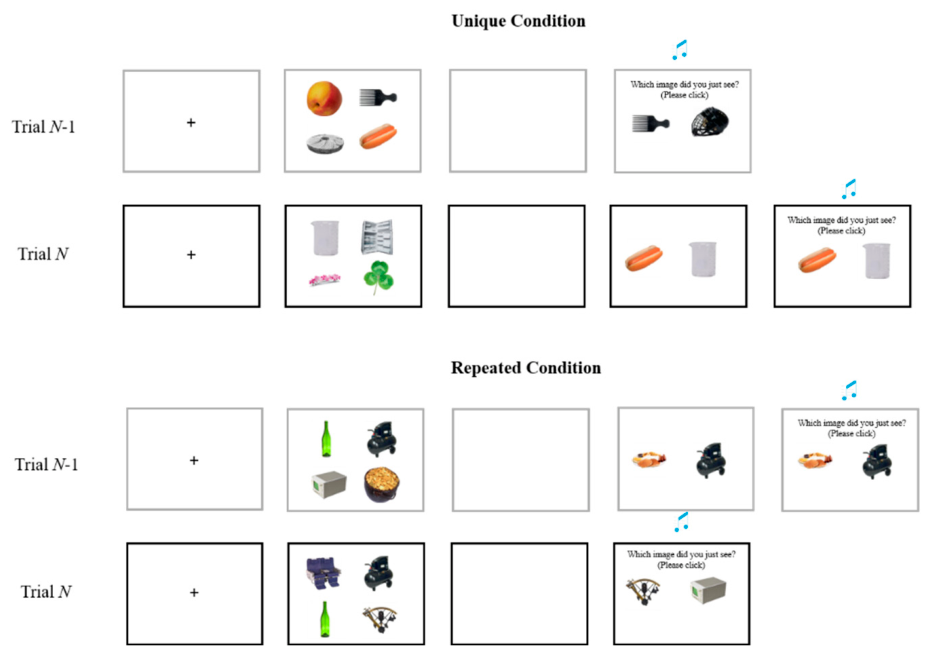
Figure 2.
Interaction between response cue and condition for the accuracy PI measure.
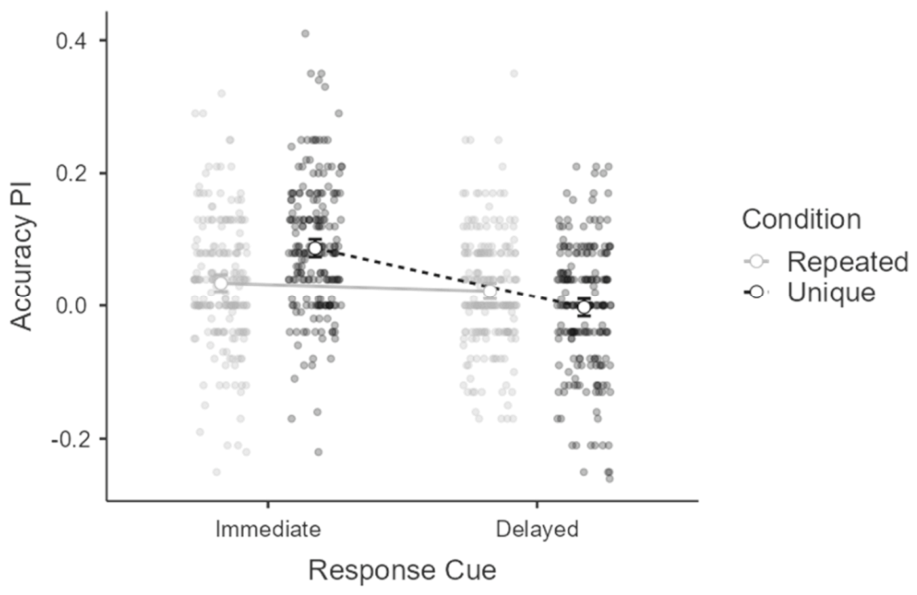

Table 1.
Mean (SD) NRN proportion correct, RN proportion correct and PI cost according to condition and response cue.
Table 1.
Mean (SD) NRN proportion correct, RN proportion correct and PI cost according to condition and response cue.
| Age Group | Repeated / Delayed | Repeated / Immediate | Unique / Delayed | Unique / Immediate | ||||||||
| NRN | RN | PI | NRN | RN | PI | NRN | RN | PI | NRN | RN | PI | |
| Older adults | .91 (.10) | .88 (.11) | .03 (.09) | .91 (.11) | .88 (.10) | .03 (.10) | .86 (.10) | .85 (.09) | .01 (.10) | .91 (.08) | .83 (.09) | .08 (.09) |
| Younger adults | .90 (.13) | .88 (.13) | .01 (.08) | .90 (.13) | .86 (.13) | .04 (.09) | .84 (.14) | .86 (.12) | -.02 (.10) | .91 (.11) | .82 (.13) | .09 (.10) |
Table 2.
Mean (SD) RT in ms for NRN, RN and PI cost according to condition and response cue.
| Age Group | Repeated / Delayed | Repeated / Immediate | Unique / Delayed | Unique / Immediate | ||||||||
| NRN | RN | PI | NRN | RN | PI | NRN | RN | PI | NRN | RN | PI | |
| Older adults | 551.25 (220.79) | 550.91 (227.21) | -.34 (88.14) | 1448.21 (275.57) | 1460.64 (274.04) | 12.44 (119.88) |
512.30 (156.80) | 527.31 (164.16) | 15.01 (76.40) | 1352.12 (252.95) | 1394.91 (246.27) | 42.79 (118.75) |
| Younger adults | 469.50 (222.23) | 462.28 (205.51) | -7.22 (97.06) | 1154.47 (277.04) | 1185.80 (285.11) | 31.33 (124.91) | 485.87 (226.53) | 478.21 (220.26) | -7.26 (92.25) | 1111.24 (264.20) | 1154.92 (272.59) | 43.69 (110.35) |
| 1 | Assessing the data using a robust linear mixed model revealed a significant interaction between condition and response cue. While the main effects of condition and response cue were non-significant, these were subsumed within the interaction. There were no effects of age group. |
| 2 | Levene’s test suggested a violation to homogeneity of variance for overall task accuracy (p = .001), with a variance ratio of 2.47. However, an equivalent Mann-Whitney test was also non-significant (p = .344) and more consistent with the null than alternative hypothesis (BF10 = 0.21). |
Disclaimer/Publisher’s Note: The statements, opinions and data contained in all publications are solely those of the individual author(s) and contributor(s) and not of MDPI and/or the editor(s). MDPI and/or the editor(s) disclaim responsibility for any injury to people or property resulting from any ideas, methods, instructions or products referred to in the content. |
© 2026 by the authors. Licensee MDPI, Basel, Switzerland. This article is an open access article distributed under the terms and conditions of the Creative Commons Attribution (CC BY) license (http://creativecommons.org/licenses/by/4.0/).
Copyright: This open access article is published under a Creative Commons CC BY 4.0 license, which permit the free download, distribution, and reuse, provided that the author and preprint are cited in any reuse.


