
Submitted:
06 July 2026
Posted:
07 July 2026
You are already at the latest version
Abstract
Enhancing the resilience of agricultural industry chains is essential for safeguarding food security and advancing agricultural modernization. Using panel data for 280 Chinese prefecture-level and above cities from 2011 to 2023, this study treats the staggered rollout of the “Broadband Village” Pilot Program and the Universal Telecommunications Service Pilot Program as quasi-natural experiments in rural digital infrastructure and estimates their effects with a staggered difference-in-differences design. The results show that rural digital infrastructure significantly strengthens agricultural industry-chain resilience. This finding is robust to parallel-trends tests, placebo tests, winsorization, alternative sample periods, and estimators that are robust to heterogeneous treatment effects. Dynamic estimates indicate that the effect is delayed and cumulative rather than immediate. Mechanism tests show that the policy significantly promotes agricultural agglomeration and has a weakly significant positive effect on industrial structure upgrading, providing supportive evidence for the agglomeration and structural-upgrading channels. Subsample estimates suggest that the effects are concentrated in eastern China, major grain-producing regions, and major grain-consuming regions. Overall, the resilience gains from digital infrastructure depend on the joint presence of an adequate industrial base, digital adoption capacity, and efficient circulation and logistics systems.
Keywords:
Broadband Village
; universal telecommunications service
; digital infrastructure
; agricultural industry-chain resilience
; staggered difference-in-differences
1. Introduction
An agricultural industry chain spans production, processing, distribution, and marketing. Its stable operation is directly linked to food security, farmers’ incomes, and agricultural modernization. In the face of extreme weather, market volatility, and external uncertainty, the chain must not only withstand risks before a shock, but also recover rapidly afterward and develop sustained adaptive capacity through technological, organizational, and business-model adjustments. Meanwhile, China has continued to implement the “Broadband Village” Pilot Program and the Universal Telecommunications Service Pilot Program, substantially improving rural network coverage and information and communications infrastructure. This raises three central questions: Can rural digital infrastructure be translated into the capacity of agricultural industry chains to resist, recover from, and adapt to shocks? Through which channels does this occur? And how do the effects vary across regions?
Conceptually, digital infrastructure can first improve access to price, supply-and-demand, and disaster-warning information, thereby reducing information asymmetries in agricultural production and operation. Second, it can strengthen connections among producers, processors, logistics providers, and sales platforms, facilitating resource reallocation and the restoration of production and marketing after shocks. Third, it can lower the costs of technology diffusion and entry into new business models, encouraging adjustments in agricultural operations and industrial structure. Network access, however, does not automatically translate into effective use. Differences in regional industrial foundations, the digital capabilities of market participants, logistics conditions, and complementary services may affect the extent to which digital infrastructure policies generate real economic outcomes. Policy-induced variation is therefore needed for credible empirical identification.
The literature on this issue has developed along two main lines. The first focuses on measuring agricultural industry-chain resilience and identifying its determinants. Scholars commonly construct multidimensional indices covering resistance, post-shock recovery, and dynamic adaptation (Martin, 2012), and have documented positive effects of policy-based finance (Ping and Zhang, 2024), the integration of digital technology and agriculture (Sun et al., 2024), and new quality productive forces (Yun and Jia, 2025). The second line examines the macroeconomic effects of digital infrastructure. Existing studies generally find that digital infrastructure can strengthen industry-chain recovery by reducing transaction costs and facilitating technology diffusion (Chao et al., 2024), or promote common prosperity (Wang et al., 2025). A growing literature also identifies positive spillovers to agriculture, showing that digital applications can accelerate the upgrading of the agricultural industrial structure (Guo et al., 2024) and modernize agricultural supply chains (Chen and Lin, 2024; Fei and Yu, 2025). Despite these contributions, several gaps remain. First, most studies examine broad, application-oriented concepts such as the “digital economy” or “digital finance,” and provide limited policy-level causal evidence on national investments in hard digital infrastructure. Second, much of the research on agricultural resilience relies on correlational analysis and does not adequately address endogeneity arising from omitted variables or reverse causality. Third, the mechanisms and spatially differentiated effects through which digital infrastructure enhances agricultural industry-chain resilience remain insufficiently documented.
To address these gaps, this study compiles city-level participation lists and implementation years for the “Broadband Village” and Universal Telecommunications Service pilot programs and constructs a staggered difference-in-differences model using panel data for 280 Chinese prefecture-level and above cities from 2011 to 2023. The baseline results show that rural digital infrastructure policies significantly improve agricultural industry-chain resilience. Both a conventional event-study specification and an estimator robust to heterogeneous treatment effects indicate delayed and cumulative policy effects. Mechanism tests show that the policy significantly promotes agricultural agglomeration and has a weakly significant positive effect on industrial structure upgrading. Subsample regressions further indicate that the effect is more pronounced in eastern China, major grain-producing regions, and major grain-consuming regions.
This study makes three contributions. First, in terms of research focus, it differs from studies based on composite indices of the digital economy, digital finance, or new infrastructure by exploiting the staggered implementation of rural information and communications policies and directly examining the effects of improved network coverage and infrastructure supply. Second, in terms of identification, it supplements the conventional two-way fixed-effects model with the multiple-period difference-in-differences estimator of Callaway and Sant’Anna (2021), thereby estimating average and dynamic effects under staggered adoption and heterogeneous treatment effects. Third, in terms of mechanisms and boundary conditions, it examines agricultural agglomeration, industrial structure upgrading, regional differences, and grain-function regions, providing evidence on how the effects of digital infrastructure are conditioned by industrial foundations and application capacity.
2. Theoretical Analysis and Research Hypotheses
2.1. Effect of Digital Infrastructure on Agricultural Industry-Chain Resilience
Agricultural industry-chain resilience refers to the capacity of the chain to maintain basic operations under external shocks, restore critical functions, and make adaptive adjustments. By improving information access, connectivity among participants, and conditions for technology diffusion, rural digital infrastructure may strengthen the chain’s resistance, recovery, and innovative-adaptive capacities.
First, improved information identification strengthens resistance to risk. Broadband networks reduce the search costs associated with market prices, changes in supply and demand, meteorological disasters, and agricultural technologies, enabling farmers and other agricultural operators to identify risks earlier and adjust production plans. Greater information transparency also reduces asymmetries between producers and buyers, mitigates uninformed production decisions and supply-demand mismatches, and thereby limits the effects of market volatility and natural disasters on upstream segments of the chain.
Second, stronger coordination and connectivity improve post-shock recovery. Digital infrastructure intensifies links among producers, processors, storage facilities, logistics providers, and sellers, reducing communication and transaction costs across regions. After an external shock, industry-chain participants can obtain substitute inputs more quickly, reroute transportation, and connect with alternative sales channels, accelerating resource reallocation and the restoration of production and marketing relationships. Improved network conditions can also attract capital, technology, and service providers to rural areas, supplying factors needed to repair disrupted chains.
Third, technology diffusion and business-model innovation enhance adaptive capacity. Network access provides the foundation for smart agricultural machinery, precision farming, rural e-commerce, and digital supply-chain management, encouraging changes in production methods, organizational forms, and sales models. As agriculture becomes more closely integrated with processing, logistics, and e-commerce, the chain develops more substitute channels and value-realization pathways, improving its ability to adapt to long-term environmental change.
Overall, rural digital infrastructure reduces operational frictions in agricultural industry chains by improving information transmission, cross-actor coordination, and technology adoption. It therefore enhances the chain’s capacity to respond before, during, and after shocks. Accordingly, the following hypothesis is proposed:
H1. Rural digital infrastructure significantly strengthens agricultural industry-chain resilience.
2.2. Mechanisms Linking Digital Infrastructure to Agricultural Industry-Chain Resilience
2.2.1. Agricultural Agglomeration
Rural digital infrastructure can reduce information-search costs and spatial transaction barriers, directing capital, technology, labor, and business entities toward agricultural regions with comparative advantages. According to the theory of Marshallian externalities, moderate agglomeration facilitates specialized labor markets, shared intermediate inputs and public services, and knowledge spillovers that improve coordination among participants. When market volatility or natural disasters occur, relatively complete production, processing, and distribution networks within an agglomeration can accelerate resource allocation and production recovery, reducing the chain-wide consequences of disruption at any single link. Excessive agglomeration may nevertheless produce industrial monoculture and risk concentration. Because most agricultural regions still have considerable scope to improve industrial organization and complementary services, this study expects the coordination and sharing benefits of agglomeration to dominate at the current stage.
H2. Rural digital infrastructure strengthens agricultural industry-chain resilience by promoting agricultural agglomeration.
2.2.2. Industrial Structure Upgrading
Rural digital infrastructure may also enhance resilience by promoting the upgrading of the agricultural industrial structure. Better network conditions enable operators to identify demand changes promptly, adopt digital production and management tools, improve factor-allocation efficiency, and shift agriculture from low-value-added and homogeneous production toward more diversified and efficient activities. A more advanced industrial structure extends processing, storage, logistics, and service segments and increases the number of value-creation nodes, while greater structural rationalization improves factor allocation across sectors and reduces supply-demand imbalances caused by localized shocks.
More specifically, broadband networks support diversified activities such as specialty farming, protected agriculture, and ecological agriculture, while facilitating the integration of agriculture with food processing, cold-chain logistics, rural e-commerce, and rural tourism. Diversified chain segments and income sources spread the risks associated with a single product or channel and create room for functional substitution and business adjustment after shocks. Related research also suggests that digital infrastructure may affect agricultural industry-chain resilience through production efficiency and industrial structure optimization (Mayila Mijiti and Sun, 2026). Accordingly, the following hypothesis is proposed:
H3. Rural digital infrastructure strengthens agricultural industry-chain resilience by promoting industrial structure upgrading.
2.3. Heterogeneous Effects of Digital Infrastructure on Agricultural Industry-Chain Resilience
The policy effect of digital infrastructure depends on whether network access can be combined with an adequate industrial base, capable business entities, and complementary services. Because regions differ in economic development, digital adoption, agricultural organization, and their functional role in the national grain system, policy effects may vary across regions and grain-function categories.
2.3.1. Regional Heterogeneity
Eastern China generally has stronger network foundations, logistics systems, and conditions for digital-technology adoption. Business entities can therefore convert network access into production management, coordination between production and marketing, and business-model innovation more readily, allowing policy effects to emerge more quickly. Although central and western China have greater room for infrastructure improvement, limited digital skills, industrial support, and market services may constrain the conversion of infrastructure into resilience. Regional economic and application conditions may therefore constitute important boundaries on the effectiveness of digital infrastructure.
2.3.2. Heterogeneity across Grain-Function Regions
Major grain-producing regions, major grain-consuming regions, and balanced production-consumption regions differ in production scale, circulation requirements, and industry-chain organization. Producing regions have strong demand for production monitoring, disaster warning, processing and storage, and large-scale services; consuming regions depend more heavily on interregional circulation, supply-demand matching, and logistics coordination; and balanced regions tend to have more dispersed industrial scales and market connections. Because the use cases and complementary conditions for digital infrastructure differ across these functional regions, the policy effects may also differ.
H4. The effect of rural digital infrastructure on agricultural industry-chain resilience varies across geographic regions and grain-function regions.
3. Research Design
3.1. Model Specification
Between 2011 and 2023, the “Broadband Village” Pilot Program and the Universal Telecommunications Service Pilot Program were introduced in different cities at different times. To identify the average effect of rural digital infrastructure policy, this study estimates the following staggered difference-in-differences model:
where AIR_it denotes agricultural industry-chain resilience in city i and year t. BV_it is the rural digital infrastructure policy indicator, which equals 1 in the year a city first enters either the “Broadband Village” or Universal Telecommunications Service pilot list and in all subsequent years, and 0 otherwise. The coefficient β_1 captures the average policy effect of entering either pilot program. X_it is a vector of control variables. City fixed effects absorb time-invariant city characteristics, year fixed effects control for common temporal shocks, and ε_it is the error term. A significantly positive β_1 indicates that rural digital infrastructure policy is associated with stronger agricultural industry-chain resilience.
3.2. Variable Definitions
3.2.1. Dependent Variable
Agricultural industry-chain resilience is defined as the ability of the agricultural production, processing, distribution, and marketing system to maintain basic functions under external shocks, restore operations, and make adaptive adjustments. Following related studies, this paper constructs a composite index across three dimensions: resistance, which reflects risk-bearing capacity and stable operation before a shock; recovery, which captures resource reallocation and functional restoration after a shock; and innovation, which reflects the capacity to create substitute pathways through technological, organizational, and business-model adjustments. The specific indicators are reported in Table 1.
3.2.2. Core Explanatory Variable
This study jointly treats the “Broadband Village” Pilot Program and the Universal Telecommunications Service Pilot Program as a quasi-natural experiment in national rural digital infrastructure development. Although the two programs differ in implementation timing, funding arrangements, and construction modes, their objectives are highly consistent: both seek to expand broadband coverage in rural and remote areas, improve network access, and narrow the urban-rural digital divide. Together, they capture exogenous national policy support for rural digital infrastructure. Previous studies have likewise incorporated the two programs into a unified policy-evaluation framework.
Accordingly, the rural digital infrastructure policy variable BV_it is constructed as follows. If city i enters the list of either pilot program in year t, the variable equals 1 in that year and thereafter, and 0 otherwise. For cities that entered both programs at different times, the first year of exposure to either rural digital infrastructure policy is defined as the treatment year. The variable therefore measures the combined effect of national rural digital infrastructure policies rather than the independent effect of either program.
3.2.3. Control Variables
The control variables include economic development (lngdp), measured as the natural logarithm of gross regional product per unit of administrative area; transportation infrastructure (traffic), measured as highway mileage per unit of administrative area; openness (open), measured as total imports and exports as a share of gross regional product; urbanization (urban), measured as the share of the nonagricultural population in the registered population; government intervention (gov), measured as local general public budget expenditure as a share of gross regional product; and the urban-rural income gap (inc), measured using the income-gap indicator specified in the study.
3.3. Data Sources, Sample Construction, and Descriptive Statistics
The sample consists of 280 Chinese prefecture-level and above cities observed from 2011 to 2023, excluding Hong Kong, Macao, and Taiwan. During the study period, the two pilot programs were implemented in batches across cities, generating treated and untreated groups with different treatment dates.
City lists and implementation dates for the “Broadband Village” and Universal Telecommunications Service pilot programs were manually compiled from publicly available materials issued by local governments and communications administrations. Indicators of agricultural industry-chain resilience and other socioeconomic variables were obtained mainly from the China City Statistical Yearbook, the Urban Construction Statistical Yearbook, and prefecture-level statistical yearbooks. A small number of missing observations were filled by linear interpolation. Descriptive statistics for the main variables are presented in Table 2.
4. Empirical Results
4.1. Baseline Results
Table 3 reports the baseline estimates. Column (1), which excludes control variables, yields an estimated coefficient of 0.749 for BV, significant at the 1% level. After city and year fixed effects are included in column (2), the coefficient is 0.314 and significant at the 5% level. Column (3) adds the full set of control variables; the coefficient rises to 0.456 and is significant at the 1% level. The core coefficient remains positive across specifications, indicating that agricultural industry-chain resilience increases after a city enters either the “Broadband Village” or Universal Telecommunications Service pilot program.
Among the control variables, economic development and transportation infrastructure have significantly positive coefficients, suggesting that stronger economic foundations and transportation conditions support stable chain operations and resource allocation. Government intervention is positively associated with resilience at the 10% level, whereas the urban-rural income gap is negatively associated with resilience at the 10% level. The coefficients on openness and urbanization do not meet conventional significance thresholds, so no directional inference is made for these variables.
Overall, the baseline estimates provide initial evidence that rural digital infrastructure policy strengthens agricultural industry-chain resilience and thus support H1. This conclusion is evaluated further using parallel-trends tests, estimators robust to heterogeneous treatment effects, and other robustness checks.
4.2. Parallel-Trends Test
An event-study specification is used to examine whether the treated and control groups followed similar trends before policy implementation, with the year immediately preceding treatment (distance = -1) serving as the reference period. As Figure 1 shows, the 95% confidence intervals for all pre-treatment coefficients include zero. There is therefore no evidence of significantly different pre-policy trends between the treated and control groups, supporting the parallel-trends assumption.
The dynamic estimates show that the coefficients are not statistically significant in the treatment year or during the first two post-treatment years. Beginning in the third post-treatment year, the conventional event-study coefficients become significantly positive and generally increase over time. This pattern suggests that policy effects are released gradually as network construction, user adoption, and complementary industrial conditions develop.
It should be noted that the Callaway and Sant’Anna (2021) estimator used below, which accounts for staggered treatment and heterogeneous treatment effects, identifies significant effects mainly from the fifth post-treatment year onward. Although the two approaches differ in the precise timing of statistical significance, both indicate delayed and cumulative policy effects. The heterogeneous-treatment-effect-robust estimator provides a more conservative assessment of early effects.
4.3. Robustness Checks
4.3.1. Placebo Test
To assess whether the baseline result could be driven by random policy assignment, pseudo-treatment groups are generated and the model is re-estimated 500 times. Figure 2 shows that the coefficients from random assignments are concentrated around zero, whereas the actual estimate lies in the tail of the placebo distribution. The random estimates also generally fail to satisfy the observed coefficient magnitude and significance conditions simultaneously. These results suggest that the baseline effect is unlikely to be an artifact of random grouping.
4.3.2. Winsorization
To reduce the influence of extreme values, the dependent variable AIR_it is winsorized at the 1st and 99th percentiles and the model is re-estimated. Column (1) of Table 4 shows that the coefficient on BV remains significantly positive, indicating that the baseline conclusion is not driven by a small number of extreme observations.
4.3.3. Alternative Sample Period
Because the major public-health shock in 2020-2021 may have produced unusual disruptions to agricultural production, logistics, and supply-chain operations, these two years are excluded and the model is re-estimated. Column (2) of Table 4 shows that the BV coefficient remains significantly positive, indicating that the baseline result is not primarily driven by these exceptional years.
4.3.4. Additional Control Variable
To mitigate omitted-variable bias, the model adds industrialization (il), measured as industrial value added as a share of gross regional product, to the original control set. Column (3) of Table 4 shows that the sign and significance of the BV coefficient remain essentially unchanged.
4.4. Robust Estimation Under Heterogeneous Treatment Effects
Because the two pilot programs were adopted at different times across cities, a conventional two-way fixed-effects model may generate inappropriate comparisons when treatment effects vary across cohorts or over time. This study therefore applies the multiple-period difference-in-differences method proposed by Callaway and Sant’Anna (2021) to estimate group-time average treatment effects and their dynamic evolution.
The estimated average treatment effect on the treated (ATT) is 0.592 and significant at the 5% level. Thus, after accounting for heterogeneous treatment effects, rural digital infrastructure policy remains significantly associated with stronger agricultural industry-chain resilience. The dynamic estimates indicate no significant effect in the early treatment period, with positive effects gradually emerging from the fifth post-treatment year onward. This pattern is consistent with construction, adoption, and cumulative diffusion phases and also suggests that conventional two-way fixed-effects estimates may identify significant effects too early.
Figure 3.
Dynamic Effects from the Callaway-Sant’Anna Multiple-Period DID Estimator.
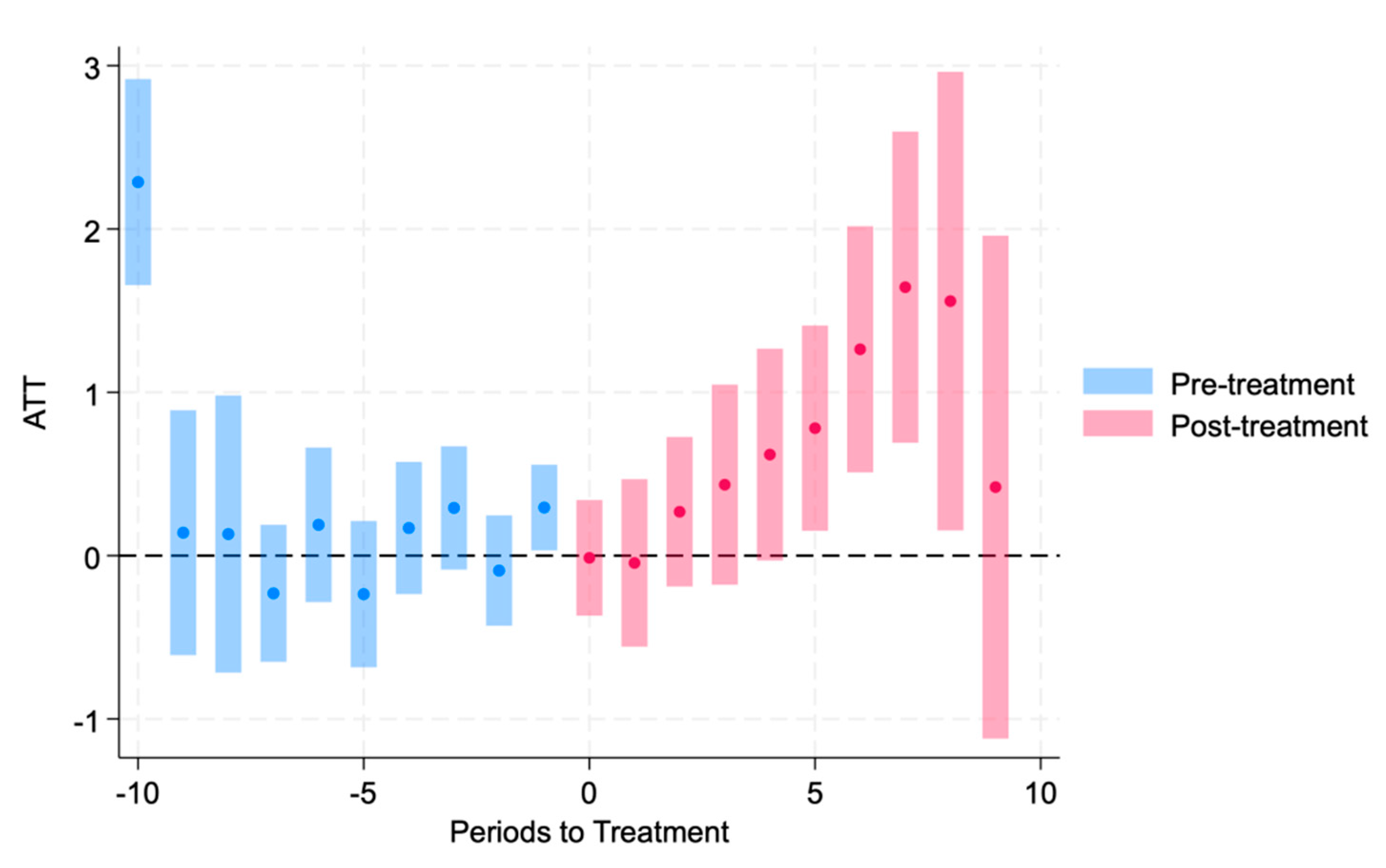

Table 5.
Estimates Robust to Heterogeneous Treatment Effects.
| (1) | |
|---|---|
| Variable | AIR_it |
| BV | 0.592** |
| (0.259) | |
| Controls | Yes |
| City fixed effects | Yes |
| Year fixed effects | Yes |
| Observations | 3,640 |
5. Mechanism and Heterogeneity Analyses
5.1. Mechanism Analysis
The theoretical analysis suggests that rural digital infrastructure may influence industry-chain resilience through agricultural agglomeration and industrial structure upgrading. Following Jiang (2022), this study does not mechanically apply the conventional three-step mediation procedure. Instead, it tests whether the policy variable significantly affects the proposed mechanism variables. Because this approach cannot by itself identify the full indirect effect, the following estimates should be interpreted as supportive evidence for the proposed channels rather than definitive proof of a complete causal transmission chain. The model is specified as follows:
where Mid_it denotes a mechanism variable: agricultural agglomeration (Agglo) or industrial structure upgrading (IS). Agricultural agglomeration is measured by a location quotient, defined as the ratio of the regional share of agricultural output to the corresponding national share. Industrial structure upgrading is a composite index that combines structural advancement and rationalization using entropy weights. The model includes the same city fixed effects, year fixed effects, and control variables as the baseline specification. A significantly positive policy coefficient indicates that digital infrastructure promotes the corresponding mechanism variable.
5.1.1. Agricultural Agglomeration Channel
Column (1) of Table 6 shows that the estimated effect of BV on agricultural agglomeration is 0.051 and significant at the 5% level. Thus, entry into a rural digital infrastructure pilot program increases the spatial concentration of agricultural production and related business activities.
One possible explanation is that improved network conditions lower information-search and interregional transaction costs, encouraging leading enterprises, cooperatives, family farms, and supporting services to concentrate in areas with agricultural advantages. Moderate agglomeration facilitates the sharing of inputs, labor, and public services and strengthens coordination and resource allocation between upstream and downstream participants. The result therefore provides supportive evidence for the “digital infrastructure-agricultural agglomeration-industry-chain resilience” channel and offers preliminary support for H2.
5.1.2. Industrial Structure Upgrading Channel
Column (2) of Table 6 shows that the estimated effect of BV on industrial structure upgrading is 0.009 and weakly significant at the 10% level. The result suggests that rural digital infrastructure policy may promote a more efficient and coordinated structure in agriculture and related industries, although the evidence is weaker than that for the agglomeration channel.
The underlying mechanism may operate as follows. Broadband networks and other digital technologies provide a foundational platform that accelerates the movement of high-quality capital, modern technologies, and skilled factors into agriculture and rural areas, weakening the long-standing boundaries of traditional, single-sector agriculture. On the one hand, digital applications such as smart agriculture and precision farming diversify the internal structure of agriculture and promote a shift toward higher-value activities, including specialty farming and ecological agriculture, thereby increasing the system’s capacity to buffer resource shocks. On the other hand, digitalization deepens the integration of primary, secondary, and tertiary industries in rural areas, extending traditional agriculture into processing, cold-chain storage, rural tourism, and rural e-commerce and generating diversified business models. From a factor-allocation perspective, structural rationalization and advancement reallocate factors from less productive to more productive activities, reducing mismatches between production and demand and providing a structural basis for greater industry-chain resilience. The estimates therefore provide preliminary support for the industrial structure upgrading channel and limited empirical support for H3. Because the coefficient is significant only at the 10% level, the conclusion should be interpreted cautiously.
5.2. Regional Heterogeneity[1]
As shown in columns (1) and (2) of Table 7, the effect of rural digital infrastructure on agricultural industry-chain resilience varies markedly across regions. The policy effect is significantly positive in eastern China but statistically insignificant in central and western China.
Several factors may explain this pattern. Eastern coastal cities have higher levels of economic development, earlier and broader digital infrastructure deployment, and more mature support systems for agricultural digital transformation. The pilot programs further strengthen the concentration of advanced agricultural talent, technology, and capital and promote the deep integration of digital technologies across production and marketing, thereby significantly increasing industry-chain resilience. By contrast, central and western regions face constraints such as incomplete digital coverage, shortages of digitally skilled agricultural workers, and persistent outflows of talent and capital. Agricultural production is also more heavily dominated by smallholders and traditional operating models, and weak digital capabilities make it difficult to convert infrastructure improvements into effective industry-chain resilience.
5.3. Heterogeneity Across Grain-Function Regions[2]
Food security is a central objective of agricultural and rural modernization. Because grain-function regions differ substantially in agricultural orientation, resource allocation, and industrial foundations, it is necessary to examine whether the effect of rural broadband policy varies across these regions. Digitalization capacity and agricultural structure also differ considerably across China. Following the classification standards of the Ministry of Agriculture and Rural Affairs and accounting for differences in resource endowments, industrial structure, and economic foundations, the sample is divided into major grain-producing regions, major grain-consuming regions, and balanced production-consumption regions. Policy effects are estimated separately for the three subsamples.
Columns (3)-(5) of Table 7 show that the BV coefficient is significantly positive in major grain-producing and major grain-consuming regions, but does not reach conventional significance levels in balanced production-consumption regions. The results indicate differentiated effects across functional regions, although formal interaction terms or cross-group coefficient tests are still required to establish whether the estimated differences are statistically significant.
In major grain-producing regions, which constitute the core supply base for national food security, agriculture has a stronger foundation, receives greater policy support, and places greater emphasis on digital transformation. Broadband development introduces smart-agriculture technologies and digital production-marketing platforms, improving production efficiency and risk resistance and reinforcing the stability of grain production. Major grain-consuming regions, by contrast, have industrial and service-oriented economies, relatively limited agricultural investment and production scale, and greater dependence on external grain supplies. Rural broadband improves interregional grain circulation and supply-demand matching, partly offsetting limited local agricultural investment and strengthening the stability and risk resistance of regional grain supply chains. Balanced production-consumption regions are closer to a self-sufficient and stable operating model. They have neither the scale advantages of producing regions nor the circulation and market-demand advantages of consuming regions, leaving less scope for digital infrastructure to generate marginal resilience gains. The results imply that regional heterogeneity should be incorporated into rural infrastructure policy in order to accelerate agricultural and rural modernization.
6. Conclusions and Policy Implications
6.1. Main Findings
Using panel data for 280 Chinese prefecture-level and above cities from 2011 to 2023, this study treats the staggered implementation of the “Broadband Village” and Universal Telecommunications Service pilot programs as policy shocks to rural digital infrastructure and applies a staggered difference-in-differences model to estimate their effects on agricultural industry-chain resilience. The main findings are as follows.
First, rural digital infrastructure policy significantly strengthens agricultural industry-chain resilience. The result is supported by the baseline regressions, parallel-trends test, placebo test, winsorization, alternative sample period, and heterogeneous-treatment-effect-robust estimates. Dynamic estimates further show that the policy effect is not immediate; it emerges after network construction, user adoption, and complementary industrial conditions have developed, and is therefore distinctly delayed and cumulative.
Second, the mechanism tests provide evidence consistent with agricultural agglomeration and industrial structure upgrading. The policy significantly increases agricultural agglomeration, suggesting that improved network conditions may strengthen coordination by reducing transaction costs, concentrating business entities, and facilitating resource sharing. The policy has a weakly significant positive effect on industrial structure upgrading, indicating that digital infrastructure may increase adaptive capacity by extending the chain, diversifying business activities, and improving factor allocation. Because the mechanism regressions do not directly identify complete indirect effects, these findings should be interpreted as channel evidence.
Third, the subsample regressions reveal regional and grain-function heterogeneity. The estimated effects are concentrated in eastern China, major grain-producing regions, and major grain-consuming regions, while the coefficients for central and western China and balanced production-consumption regions do not reach conventional significance levels. This pattern suggests that the realization of digital infrastructure benefits may depend on industrial foundations, digital application capacity, logistics systems, and functional positioning. Formal tests are still needed to determine whether cross-group differences are statistically significant.
This study has several limitations. First, the composite policy indicator identifies exposure to the combined policy environment created by the two pilot programs and does not distinguish their independent or interactive effects. Second, the city-level resilience index is constrained by data availability, and some indicators could be refined further. Third, subsample regressions cannot substitute for formal tests of coefficient differences across groups. Future research could separately identify the two policy shocks, improve resilience measurement, control for concurrent policies, and examine spatial spillovers.
6.2. Policy Implications
6.2.1. Sustain Investment in Rural Digital Infrastructure and Improve Performance Evaluation
First, policy should continue to address gaps in network coverage and service stability in remote villages, agricultural production bases, and storage and logistics nodes, thereby improving the usability and continuity of rural network services. Second, performance-evaluation systems should reflect the delayed nature of policy effects. Because the transition from completed infrastructure to industry-chain outcomes requires user adoption and the accumulation of complementary services, project performance should not be assessed solely through short-term usage or immediate output. Third, network construction should be coordinated with digital-skills training, agricultural extension, platform access, and equipment maintenance to reduce the conversion barriers associated with “network access without user capability” and “connectivity without applications.”
6.2.2. Coordinate Digital Infrastructure with Agricultural Industrial Organization
First, digital platforms should be used to improve information sharing and order coordination among leading enterprises, cooperatives, family farms, and smallholders and to connect production, processing, storage, logistics, and marketing. Second, public services in agricultural socialized services, quality inspection, finance and insurance, and market information should be improved to leverage the resource-sharing and specialization benefits of moderate agglomeration. Third, policymakers should avoid pursuing spatial concentration through administrative mandates. The risks of industrial monoculture, concentrated exposure, and homogeneous competition should be monitored, while collaboration among multiple actors and diversified sales channels should be used to strengthen risk diversification within agglomerations.
6.2.3. Use Application Scenarios to Promote Agricultural Structural Optimization
First, digital applications should be developed around concrete needs such as production monitoring, disaster warning, quality traceability, cold-chain scheduling, and production-marketing matching, thereby preventing a disconnect between network construction and agricultural demand. Second, the integration of agriculture with processing, logistics, e-commerce, and rural services should be supported to increase chain nodes and substitute channels and expand the scope for post-shock adjustment. Third, because the evidence for the industrial structure upgrading channel is relatively weak, application-side evaluation should be strengthened to identify which digital tools and operating models genuinely improve factor allocation and industry-chain resilience.
6.2.4. Adopt Differentiated Strategies Based on Regional Conditions
In light of the heterogeneous estimates, eastern China should prioritize deeper applications of digital technology in production, processing, circulation, and risk management while avoiding redundant construction. Central and western China should combine efforts to close network gaps with improvements in digital skills, logistics facilities, socialized services, and the cultivation of capable business entities, thereby raising the conversion efficiency of infrastructure. Major grain-producing regions should emphasize production monitoring, disaster warning, large-scale services, and the digitalization of processing and storage. Major grain-consuming regions should strengthen interregional supply-demand matching, logistics coordination, and quality traceability. Balanced production-consumption regions should select application scenarios suited to local specialty industries and market demand rather than mechanically copying models used elsewhere.
Author Contributions
Xueyan Liu (born 1990) is an associate professor at the School of Economics and Management, Yantai University, and holds a PhD in Economics. Her research interests include environmental regulation and industrial economics. Email: lesleyxue@162.com. Hongmei Li (born 2000), the corresponding author, is a master’s student at the School of Economics and Management, Yantai University. Her research focuses on rural development. Email: lee5336@163.com. Can Sun (born 2000) is a PhD candidate at the Center for Economic Research, Shandong University. His research interests include rural development and the digital economy. Email: suncan0108@163.com. Correspondence address: School of Economics and Management, Yantai University, 30 Qingquan Road, Laishan District, Yantai, Shandong 264005, China.
Funding
This study was supported by the Shandong Provincial Social Science Planning Research Program, “Mechanisms for Coordinated Carbon and Pollution Reduction and High-Quality Development Strategies in the Yellow River Basin” (24DJJJ22), and “Environmental Effects of High-Quality Development in the China (Shandong) Pilot Free Trade Zone” (ZMQYJY).
| 1 | Eastern China comprises Beijing, Shanghai, Tianjin, Hebei, Liaoning, Jiangsu, Zhejiang, Fujian, Shandong, Guangdong, and Hainan. Central and western China comprises Shanxi, Jilin, Heilongjiang, Anhui, Jiangxi, Henan, Hubei, Hunan, Inner Mongolia, Guangxi, Chongqing, Sichuan, Guizhou, Yunnan, Shaanxi, Gansu, Qinghai, Ningxia, and Xinjiang. |
| 2 | Major grain-producing regions comprise Hebei, Inner Mongolia, Jilin, Heilongjiang, Liaoning, Jiangsu, Anhui, Jiangxi, Shandong, Henan, Hubei, Hunan, and Sichuan. Major grain-consuming regions comprise Beijing, Shanghai, Hainan, Tianjin, Zhejiang, Fujian, and Guangdong. Balanced production-consumption regions comprise Shanxi, Guangxi, Guizhou, Yunnan, Chongqing, Shaanxi, Gansu, Qinghai, Ningxia, and Xinjiang. |
References
- MARTIN, R. Regional economic resilience, hysteresis and recessionary shocks[J]. J. Econ. Geogr. 2012, 12(1), 1–32. [Google Scholar] [CrossRef]
- DI TOMMASO, M. R.; PRODI, E.; POLLIO, C.; et al. Conceptualizing and measuring “industry resilience”: Composite indicators for postshock industrial policy decision-making[J]. Socio-Econ. Plan. Sci. 2023, 85, 101448. [Google Scholar] [CrossRef]
- PING, W. Y.; ZHANG, Y. R. Mechanisms and effects of policy-based finance in strengthening agricultural industry-chain resilience[J]. Rural Econ. (in Chinese). 2024, 10, 100–111. [Google Scholar]
- SUN, C.; XIA, E. J.; HUANG, J. P.; et al. The effect of digital-agriculture integration on agricultural resilience[J]. Res. Econ. Manag. (in Chinese). 2024, 45(6), 76–94. [Google Scholar]
- ZHAO, W.; XU, X. W. Effects and mechanisms of the digital economy on agricultural economic resilience[J]. J. South China Agric. Univ. (Social Science Edition) (in Chinese). 2023, 22(2), 87–96. [Google Scholar]
- LUO, H. H.; DAI, Q. Z.; XU, C. Y. Mechanisms and spatial effects of digital finance on agricultural industry-chain resilience[J]. Stat. Decis. (in Chinese). 2026, 42(3), 149–154. [Google Scholar]
- YUN, D.; JIA, Z. Q. New quality productive forces, agricultural industry-chain resilience, and urban-rural common prosperity[J]. Stat. Decis. (in Chinese). 2025, 41(23), 17–22. [Google Scholar]
- LI, H. Y.; ZHANG, J.; ZHOU, X. X. An empirical test of the effect of new quality productive forces on agricultural industry-chain resilience[J]. Stat. Decis. (in Chinese). 2025, 41(21), 17–23. [Google Scholar]
- JIANG, J.; WU, H. T. Rural labor aging and agricultural industry-chain resilience: Evidence from digital technology and digital financial inclusion[J]. J. Nanjing Agric. Univ. (Social Sciences Edition) (in Chinese). 2025, 25(1), 168–181. [Google Scholar]
- WANG, J. T.; FU, X. D. Digital economy, industrial structure, and urban economic resilience[J]. Reg. Econ. Rev. (in Chinese). 2023, 2, 70–78. [Google Scholar]
- CHAO, X. J.; LIAN, Y. M.; YUAN, R. J.; et al. Digital infrastructure and industry-chain resilience: Empirical evidence based on industry-chain recovery data[J]. J. Quant. Tech. Econ. (in Chinese). 2024, 41(11), 112–131. [Google Scholar]
- WANG, Z. H.; JIA, C.; ZHAO, W. Rural digital infrastructure and common prosperity: Evidence from the “Broadband Village” and Universal Telecommunications Service pilot programs[J]. World Agric. (in Chinese). 2025, 1, 103–115. [Google Scholar] [CrossRef]
- ZHAO, W.; WANG, Z. H. Rural digital technology and the urban-rural consumption gap: Evidence from the “Broadband Village” and Universal Telecommunications Service pilot programs[J]. Consum. Econ. (in Chinese). 2024, 40(6), 61–72. [Google Scholar]
- LIU, H.; JIN, X. H. Digital economy and rural household consumption: Enjoy now or consume conservatively? Evidence from the “Broadband Village” pilot policy[J]. J. Agric. Libr. Inf. Sci. (in Chinese). 2025, 37(7), 73–90. [Google Scholar]
- MA, W.; GRAFTON, R. Q.; RENWICK, A. Smartphone use and income growth in rural China: Empirical results and policy implications[J]. Electron. Commer. Res. 2020, 20(4), 713–736. [Google Scholar]
- RAJKHOWA, P.; QAIM, M. Mobile phones, off-farm employment and household income in rural India[J]. J. Agric. Econ. 2022, 73(3), 789–805. [Google Scholar] [CrossRef]
- LIU, X. X.; CHEN, C. L. Pathways through which digital technology promotes the transformation and upgrading of the agricultural industrial structure[J]. Adm. Reform (in Chinese). 2022, 12, 57–65. [Google Scholar] [CrossRef]
- GUO, Y. Y.; ZHENG, Y.; CHENG, D. J.; et al. Mechanisms and effects of the digital economy on the upgrading of urban agricultural industrial structure[J]. Stat. Decis. (in Chinese). 2024, 40(22), 29–34. [Google Scholar]
- CHEN, J. M.; LIN, Z. The effect of digital infrastructure on the modernization of agricultural industrial and supply chains[J]. China Bus. Mark. (in Chinese). 2023, 37(11), 47–60. [Google Scholar]
- CHEN, J. M.; LIN, Z. Digital infrastructure and the modernization of agricultural industrial and supply chains: Theoretical mechanisms and empirical evidence[J]. J. Yunnan Univ. Financ. Econ. (in Chinese). 2024, 40(4), 52–68. [Google Scholar]
- FEI, W.; YU, Z. W. Effects and mechanisms of digital infrastructure on agricultural industry-chain resilience[J]. J. Hebei Univ. Sci. Technol. (Social Sciences) (in Chinese). 2025, 25(5), 28–36. [Google Scholar]
- WANG, L.; WU, M. Y.; CHE, Y. Theoretical mechanisms through which new infrastructure strengthens agricultural industry-chain resilience[J]. Res. Agric. Mod. (in Chinese). 2025, 46(4), 649–659. [Google Scholar]
- MING, H.; ZHU, Z. Q.; LI, X. K. Can rural e-commerce strengthen agricultural economic resilience? Evidence from the Comprehensive Demonstration Policy for E-commerce in Rural Areas[J]. World Agric. (in Chinese). 2024, 2, 85–98. [Google Scholar]
- CAI, X. L.; PANG, Z. Q. Mechanisms and effects of the digital economy on rural resilience[J]. Reform Econ. Syst. (in Chinese). 2024, 3, 61–68. [Google Scholar] [CrossRef]
- YUAN, H.; ZHU, C. L. Do national high-tech zones promote industrial structure transformation and upgrading in China?[J]. China Ind. Econ. (in Chinese). 2018, 8, 60–77. [Google Scholar]
- BAI, J. H.; ZHANG, Y. X.; BIAN, Y. C. Do innovation-driven policies increase urban entrepreneurial activity? Evidence from the National Innovative City Pilot Program[J]. China Ind. Econ. (in Chinese). 2022, 6, 61–78. [Google Scholar]
- CALLAWAY, B.; SANT’ANNA, P. H. C. Difference-in-differences with multiple time periods[J]. J. Econom. 2021, 225(2), 200–230. [Google Scholar] [CrossRef]
- ZHAO, L. Z. Industrial digitalization and agricultural industry-chain resilience[J]. Rural Sci. Technol. (in Chinese). 2024, 15(24), 48–53. [Google Scholar]
- CHEN, M.; WANG, Z. F.; CHEN, F. Rural transportation infrastructure and rural labor migration: Evidence from the China Family Panel Studies[J]. J. Nanjing Univ. Financ. Econ. (in Chinese). 2023, 4, 1–12. [Google Scholar]
- LIU, Y. T. Effects and mechanisms of digital-village development on agricultural and rural modernization[J]. J. Shanxi Univ. (Philosophy and Social Science Edition) (in Chinese). 2024, 47(2), 152–160. [Google Scholar]
- CHEN, W.; FU, H. Y. The digital economy and high-quality agricultural development: Evidence from panel data for Fujian Province[J]. J. Fujian Agric. For. Univ. (Philosophy and Social Sciences) (in Chinese). 2024, 27(2), 52–61. [Google Scholar] [CrossRef]
- JIANG, T. Mediation and moderation effects in empirical research on causal inference[J]. China Ind. Econ. (in Chinese). 2022, 5, 100–120. [Google Scholar]
- MAYILA, M.; SUN, W. J. The effect of digital infrastructure on agricultural industry-chain resilience: Perspectives from agricultural production efficiency and industrial structure optimization[J/OL]. Chin. J. Agric. Resour. Reg. Plan. accessed. 2026, 1–15. (accessed on 2026-06-23). (in Chinese). [Google Scholar]
Figure 1.
Parallel-Trends Test.
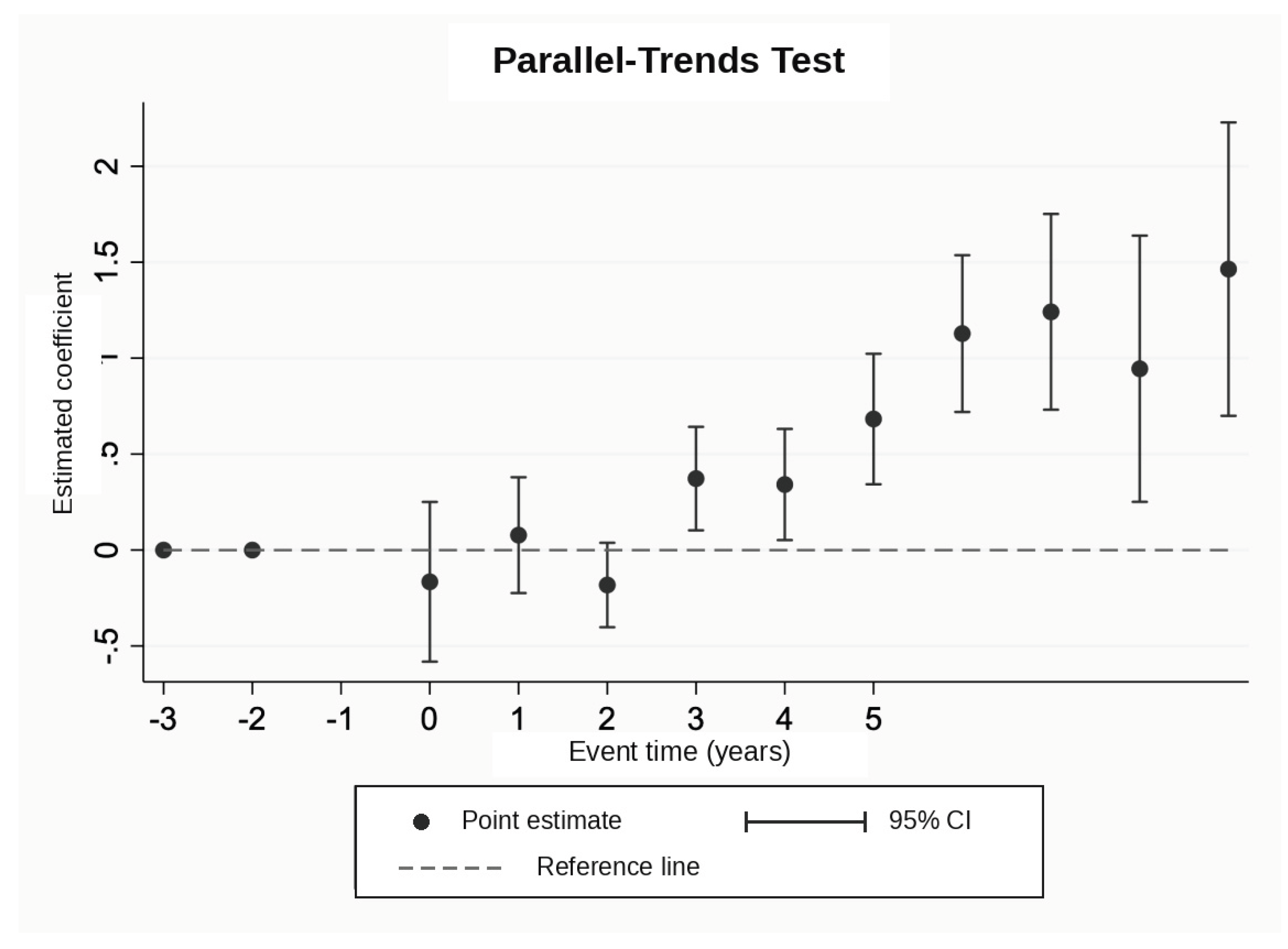
Figure 2.
Placebo Test.
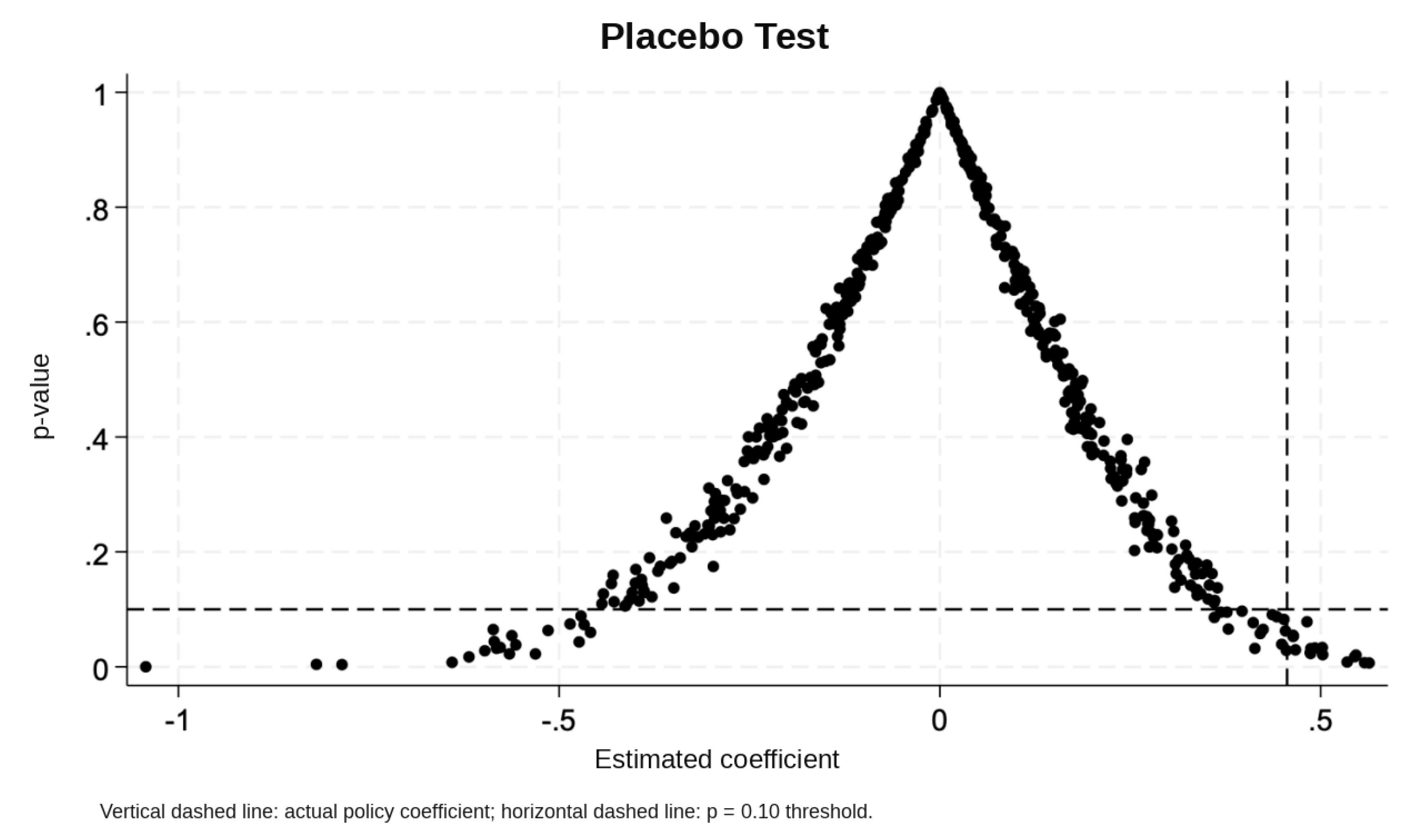
Table 1.
Indicator System for Agricultural Industry-Chain Resilience.
| Resistance | Agricultural mechanization | Total power of agricultural machinery per capita | + |
| Engel coefficient | Rural household food expenditure / total household consumption expenditure | - | |
| Pesticide and fertilizer use | Intensity of pesticide and fertilizer application | - | |
| Rural income | Per capita net income of rural residents | + | |
| Employment structure | Employment in secondary and tertiary industries / total employment | + | |
| Recovery | Agricultural insurance premiums | Agricultural insurance premium income | + |
| Agriculture-related fiscal expenditure | Expenditure on agriculture, forestry, and water affairs / general public budget expenditure | + | |
| Processing capacity | Operating revenue of agricultural product processing enterprises | + | |
| Agricultural value added | Value added of the primary industry | + | |
| Innovation | Educational attainment | Average years of schooling among rural residents | + |
| Digital financial inclusion | Digital Financial Inclusion Index | + | |
| Environmental regulation | Share of administrative villages with domestic sewage treatment | + |
Table 2.
Descriptive Statistics.
| Variable | Symbol | Observations | Mean | Std. dev. | Minimum | Maximum |
|---|---|---|---|---|---|---|
| Rural digital infrastructure policy | BV | 3,640 | 0.483 | 0.499 | 0 | 1 |
| Agricultural industry-chain resilience | AIR_it | 3,640 | 26.888 | 6.956 | 9.477 | 57.149 |
| Agricultural agglomeration | Agglo | 3,640 | 1.551 | 1.009 | 0.003 | 6.728 |
| Industrial structure upgrading | IS | 3,640 | 0.221 | 0.096 | 0.004 | 0.895 |
| Economic development | lngdp | 3,640 | 7.305 | 1.255 | 3.212 | 12.062 |
| Openness | open | 3,640 | 0.002 | 0.003 | 0 | 0.029 |
| Urbanization | urban | 3,640 | 0.395 | 0.212 | 0.075 | 1 |
| Government intervention | gov | 3,640 | 6.075 | 4.419 | 0.010 | 41.677 |
| Urban-rural income gap | inc | 3,640 | 0.734 | 0.208 | 0.0049 | 0.995 |
| Transportation infrastructure | traffic | 3,640 | 290.764 | 99.110 | 51.561 | 697.033 |
Table 3.
Baseline Regression Results.
| (1) | (2) | (3) | |
|---|---|---|---|
| AIR_it | AIR_it | AIR_it | |
| BV | 0.749*** | 0.314** | 0.456*** |
| (0.140) | (0.144) | (0.129) | |
| open | 32.566 | ||
| (36.392) | |||
| lngdp | 1.054*** | ||
| (0.331) | |||
| urban | 0.039 | ||
| (1.168) | |||
| gov | 0.041* | ||
| (0.024) | |||
| inc | -0.879* | ||
| (0.518) | |||
| traffic | 0.030*** | ||
| (0.002) | |||
| Constant | 23.270*** | 19.355*** | 5.155** |
| (0.068) | (0.107) | (2.532) | |
| Observations | 3,640 | 3,640 | 3,640 |
| Controls | No | No | Yes |
| City fixed effects | No | Yes | Yes |
| Year fixed effects | No | Yes | Yes |
| R² | 0.492 | 0.889 | 0.911 |
| F-statistic | 2864.626 | 545.777 | 552.263 |
Table 4.
Robustness Checks.
| (1) | (2) | (3) | |
|---|---|---|---|
| Winsorized | Excluding 2020-2021 | Additional control | |
| AIR_it | AIR_it | AIR_it | |
| BV | 0.434*** | 0.402*** | 0.464*** |
| (0.131) | (0.120) | (0.129) | |
| Constant | 4.765* | 6.493** | 5.379** |
| (2.575) | (2.617) | (2.676) | |
| Controls | Yes | Yes | Yes |
| City fixed effects | Yes | Yes | Yes |
| Year fixed effects | Yes | Yes | Yes |
| Observations | 3,640 | 3,080 | 3,640 |
| R² | 0.913 | 0.908 | 0.911 |
Table 6.
Mechanism-Channel Tests.
| (1) | (2) | |
|---|---|---|
| Agricultural agglomeration | Industrial structure upgrading | |
| BV | 0.051** | 0.009* |
| (0.021) | (0.005) | |
| Constant | 7.945*** | 0.651*** |
| (0.621) | (0.103) | |
| Controls | Yes | Yes |
| City fixed effects | Yes | Yes |
| Year fixed effects | Yes | Yes |
| Observations | 3,640 | 3,640 |
| R² | 0.394 | 0.183 |
Table 7.
Subsample Regression Results.
| (1) | (2) | (3) | (4) | (5) | |
|---|---|---|---|---|---|
| Eastern | Central and western | Major grain-producing | Major grain-consuming | Balanced | |
| AIR_it | AIR_it | AIR_it | AIR_it | AIR_it | |
| BV | 1.084*** | 0.140 | 0.407** | 1.104* | 0.047 |
| (0.267) | (0.132) | (0.160) | (0.552) | (0.175) | |
| open | 65.074 | 10.238 | 14.031 | -56.932 | 147.052* |
| (55.131) | (52.628) | (40.904) | (78.091) | (77.704) | |
| lngdp | 1.438** | 0.899** | 1.658*** | -1.140 | 1.203 |
| (0.586) | (0.399) | (0.390) | (1.769) | (0.806) | |
| urban | 2.049 | -2.539 | -0.437 | 1.748 | -1.199 |
| (1.484) | (1.900) | (1.334) | (3.391) | (3.244) | |
| gov | 0.063 | 0.018 | 0.043 | 0.006 | 0.041 |
| (0.043) | (0.029) | (0.033) | (0.047) | (0.047) | |
| inc | -0.643 | -1.580** | -0.793 | -0.238 | -1.544 |
| (0.759) | (0.776) | (0.583) | (2.018) | (1.630) | |
| traffic | 0.025*** | 0.033*** | 0.029*** | 0.022*** | 0.036*** |
| (0.002) | (0.002) | (0.002) | (0.003) | (0.003) | |
| Constant | 2.388 | 7.167** | 1.661 | 23.074 | 3.088 |
| (4.702) | (3.011) | (2.989) | (14.200) | (5.755) | |
| Controls | Yes | Yes | Yes | Yes | Yes |
| City fixed effects | Yes | Yes | Yes | Yes | Yes |
| Year fixed effects | Yes | Yes | Yes | Yes | Yes |
| Observations | 1,261 | 2,379 | 2,210 | 559 | 871 |
| R² | 0.900 | 0.921 | 0.913 | 0.903 | 0.926 |
Disclaimer/Publisher’s Note: The statements, opinions and data contained in all publications are solely those of the individual author(s) and contributor(s) and not of MDPI and/or the editor(s). MDPI and/or the editor(s) disclaim responsibility for any injury to people or property resulting from any ideas, methods, instructions or products referred to in the content. |
© 2026 by the authors. Licensee MDPI, Basel, Switzerland. This article is an open access article distributed under the terms and conditions of the Creative Commons Attribution (CC BY) license (http://creativecommons.org/licenses/by/4.0/).
Copyright: This open access article is published under a Creative Commons CC BY 4.0 license, which permit the free download, distribution, and reuse, provided that the author and preprint are cited in any reuse.


