

Submitted:
06 July 2026
Posted:
07 July 2026
You are already at the latest version
Abstract
Bio-derived functional materials are key platforms for long-term sustainable environmental remediation. Pine wood fibres (WF) is an abundant and renewable material with functional properties suited to specialized applications, including a high density of hydroxyl groups at its surface and mechanical toughness imparted by the lignin fraction. In the present work, monometallic and bimetallic nanoparticles (NPs) of first series transition metals, Fe, Co, Cu and Fe/Cu were immobilized onto original WF and WF treated with NaOH (WF_N). The prepared WF-supported NPs were characterized by SEM/EDS, XPS, XRD and FTIR-ATR and evaluated in the catalytic reduction of 4-nitrophenol (4-NP) to 4-aminophenol in aqueous solution, at room temperature, by NaBH4. Copper-based materials exhibited superior catalytic efficiency, with the NaOH pre-treatment yielding shorter induction times and enhanced stability. For material WF_NCu, 97 % of 4-NP reduction was achieved in 3 minutes with a rate constant of k1 = 2.209 min-1. This material was used for five successive cycles with no decrease in 4-NP reduction efficiency, being easily recovered from reaction media.
Keywords:
lignocellulosic materials
; heterogeneous catalysis
; reduction reaction
; copper nanoparticles
; pollutant recycling
; water
1. Introduction
The contamination of aquatic systems caused by the presence of toxic organic substances released from industrial and agricultural wastewater has become an environmental issue with growing concern to human health and ecosystem equilibrium. 4-Nitrophenol (4-NP) is found in wastewaters from its widespread use as precursor for pesticides, dyes and pharmaceuticals [1], rising environmental concern owing to its toxicity and persistence in water. For that reason, different 4-NP removal methods from waters have been developed, such as adsorption [2], electrochemical reduction [3], (photo)catalytic degradation [4], and reduction [5]. Among described methodologies, catalytic reduction of 4-NP with NaBH4 is one of the most efficient and used approaches to transform this harmful pollutant into 4-aminophenol (4-AP), a less toxic compound used as an intermediate in pharmaceutical industries [3,6]. In addition, using NaBH4 as a reducing agent offers advantages when compared to H2, as it promotes fast reactions, but with easier and safer storage. Furthermore, recent studies show the possibility of NaBH4 regeneration [7].
Metal nanoparticles (NPs) have gained growing interest in a variety of applications due to its more interesting properties in comparison to bulk materials such as high surface area, which increase their catalytic performance and chemical reactivity [8]. These nanomaterials are studied in a wide array of applications including energy storage [9], biomedical applications [10], (electro)catalysis [11], and environmental remediation [12]. In addition, first series transition metals denote a lower cost and resource depletion pressure if compared to late transition metals.
First series transition metal NPs showed efficient 4-NP reduction in aqueous solution using sodium borohydride as reducing agent [13], namely for manganese oxide [14], iron [15], cobalt [16], zinc oxide [17], nickel, and copper [18,19]. Nonetheless, self-aggregation of NPs is one of the main problems encountered when using free NPs, resulting in hampering of superficial area and diminishing their catalytic performance [19]. To address this problem, the immobilization of NPs onto an adequate support is used as one of different methods to prevent self-aggregation [20,21]. Adequate supports should also have high surface area, be stable, and have functional groups that can interact with metals. Support materials that have been studied for the immobilization of metal NPs include silicas [22], carbon materials [23], and polymers [24].
Lignocellulosic biomass is an alternative to more expensive or toxic materials, in addition to being renewable and biodegradable. More recently, lignocellulosic biomass and other biopolymers have been reported in literature as first series transition metal NPs support for environmental applications and 4-NP reduction, such as cellulose [25], chitosan [26], and biochar [27], but the use of these biopolymers present drawbacks as it requires extraction or carbonization processes which increase production costs.
The functionalization of wood for specialized applications has been receiving attention as it is one of the most abundant renewable biomasses in nature; furthermore, its intrinsic properties such as ubiquitous hydroxyl groups, hydrophilicity and high porosity makes it attractive for catalytic robustness [28]. Palladium nanoparticles immobilized onto wood blocks were reported for 4-NP reduction with good results [29]. Furthermore, pine wood fibres (WF) are a cheap material that show high mechanical and thermal strength, uniform chemical composition, low density and abundant functional groups for metal immobilization. Our previous works show that an iron complex could be immobilized onto WF surface and perform 4-NP reduction with high catalytic performance and stability throughout five cycles [30,31].
In the present work, WF were used as a biomass-based support for the immobilization of first transition series NPs of iron, cobalt and copper. Bimetallic iron-copper catalysts are effective for Fenton reactions and showed good results for 4-NP reduction [32] and for that reason a bimetallic material Fe/Cu was also studied. The NPs-immobilized materials were then characterized and the catalytic performance was evaluated in 4-NP reduction, used as a model reaction that offers comparison with results from NPs found in literature [5].
2. Materials and Methods
2.1. Materials and Instruments
The pine wood fibres used in this work were supplied by Valbopan S.A. Cobalt(II) nitrate hexahydrate (≥98%) and iron(II) chloride tetrahydrate (≥99%) were purchased from Fluka. Copper(II) chloride dihydrate (≥99%), sodium borohydride (98%) and 4-nitrophenol (≥99.5%) were purchased from Sigma-Aldrich. Ethanol p.a. and sodium hydroxide were purchased from Fisher Chemical. All aqueous solutions were prepared with ultrapure water (18.2 MΩ⋅cm at 20 °C).
Scanning Electron Microscopy/Energy Dispersive X-ray Spectroscopy (SEM/EDS) analyses were obtained at CEMUP using a high-resolution environmental scanning electron microscope (Schottky) with X-ray microanalysis and electron backscattered diffraction analysis (Quanta 400 FEG ESEM/EDAX Genesis X4M) typically operated at 15 kV, with around a 10 mm working distance. All SEM data shown are secondary electron images obtained at high vacuum. Prior to analysis, the fibres were spray-coated with a thin conductive layer of Au/Pd alloy.
X-ray photoelectron spectroscopy (XPS) analyses were performed in a Thermo Fisher Scientific NEXSA using monochromatic Al Kα radiation (1486.6 eV). Binding energies were calibrated relative to the C1s peak at 284.75 eV. The raw XPS spectra were deconvoluted by curve fitting peak components using the software CasaXPS with no preliminary smoothing. Asymmetric functions were considered for M(0) bands and Lorentzian/Gaussian functions for metal ions.
Attenuated Total Reflectance-Fourier Transform Infrared (FTIR-ATR) spectroscopy analyses were performed in a PerkinElmer Spectrum Two FTIR spectrometer.
The X-ray diffraction (XRD) measurements, in a Bragg-Brentano configuration, were performed on a SmartLab Rigaku diffractometer, at room temperature, with Cu Kα radiation (λ = 1.5406 Å, with a 200 mA, 45 kV), from 2θ = 5º to 40º.
Microwave-assisted heating was performed using a CEM Discover SP microwave.
Ultraviolet-visible (UV–vis) spectra were obtained on a UV–vis Agilent 8453 Spectrophotometer with a diode array detector, using a quartz cell with 1 cm path length.
2.2. Preparation of Catalysts
The wood fibres (WF) were washed with deionized water to remove any residual dirt. To prepare WF_N, WF went through sodium hydroxide pre-treatment: 100 mg of WF were immersed in 10 mL NaOH 0.1 M solution and heated in a microwave at 90 °C for 1 h. Then, they were washed three times with 10 mL of deionized water and once with 10 mL of ethanol, filtered by vacuum and left to dry for 1 h at 85 °C.
The immobilization of metal nanoparticles was performed on original WF and WF_N. To start, 100 mg of each material were immersed in 10 mL of 0.1 M metal solution [copper(II), cobalt(II), iron(II) or a mixture of copper(II) and iron(II)] at room temperature for 24 h. Afterwards, the resulting materials were filtered and immersed in 5 mL NaBH4 solution (0.5% w/v) for 30 minutes to reduce the metal ions, thereby forming the nanoparticles. Finally, all the materials were thoroughly washed three times by sonication (sonic clean) in 10 mL of deionized water and once with 10 mL of ethanol, filtered by vacuum and left to dry for 2 h at 85 °C.
The prepared materials (WF, WF_N, WF_Cu, WF_NCu, WF_Co, WF_NCo, WF_NFe, WF_NCuFe) were characterized by SEM/EDS, XPS, FTIR-ATR and XRD.
2.3. 4-Nitrophenol Reduction
From a 5.0⋅10−3 mol⋅dm−3 stock solution of 4-NP, 3 mL of a 5.0⋅10−5 mol⋅dm−3 4-NP aqueous solution were transferred to a UV–vis cell used as a reaction vessel. To this solution, NaBH4 (6 mg, 0.05 mol⋅dm−3) was added, and the yellow colour of the solution was darkened due to the formation of phenolate ions (pH~10). The reaction was started by the addition of 6 mg of the different wood fibre materials: WF, WF_N, WF_Cu (2.32% Cu), WF_NCu (7.97% Cu), WF_Co (15.05% Co), WF_NCo (2.85% Co), WF_NFe (9.08% Fe) or WF_NFeCu (7.54% Cu and 7.32% Fe) (metal loadings stated in wt%, when available). The reaction was monitored by UV–vis and the conversion could be tracked by the decrease of the 4-nitrophenolate band (λ = 400 nm) and the development of a new band from 4-aminophenol (λ = 300 nm). The 4-NP concentration was calculated using the standard curve for the 4-NP/NaBH4 solution expressed as: A = 17447c (R2 = 0.9996), where A is the absorbance at 400 nm and c is the 4-NP concentration in mol⋅dm−3. The catalytic efficiency of the different wood fibre materials was measured by C/C0, where C0 and C are the 4-NP concentrations at time t = 0 min and at any reaction time t (min), respectively. Control experiments were performed in the absence of catalyst.
For reuse studies, the fibres were recovered by filtration, washed thoroughly with ethanol, and left to dry for 30 minutes at 85 °C before being used in the following cycles. Post-catalysis characterization studies were performed by SEM/EDS.
For WF_NCu, reactions with more volume and with different batches were also performed. For this, 10 mL of a 5.0⋅10−5 mol⋅dm−3 4-NP aqueous solution was prepared and transferred to a 30 mL flask. To this solution, NaBH4 (20 mg, 0.05 mol⋅dm−3) was added and the reaction was started by the addition of 20 mg WF_NCu.
3. Results and Discussion
3.1. Preparation and Characterization of WF-Supported Metal NPs
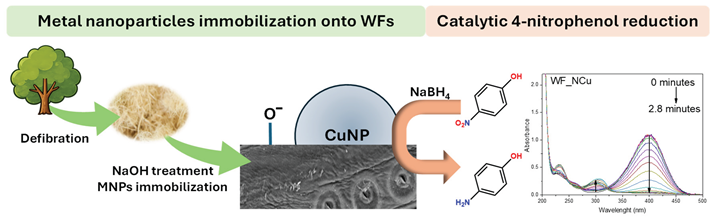
Metal nanoparticles immobilization on wood fibres was held, first by wet impregnation of metal ions onto WF surface, followed by their reduction with NaBH4. The immobilization process was carried out both on pristine WF and on WF treated with sodium hydroxide (material WF_N). This treatment, analogous to mercerization of cellulose fabrics, was carried out to examine its effect on NPs anchoring and stability. The procedure for washing the materials, with and without sonication (sonic clean), was then tested.
SEM images of the WF materials are shown in Figure 1 and Supplementary Information, Figure S1. The microscopic appearance of the WF structure is not altered by the sodium hydroxide treatment (Figure 1A,and 1B) or the subsequent nanoparticles immobilization procedure.
A comparison between WF or WF_N materials as nanoparticles supports is shown for materials WF_Cu and WF_NCu (Figure 1C and 1E). The sodium hydroxide treatment promotes the formation of well-dispersed nanoparticles over WF surface (Figure 1E). The effect of sonic clean during the washing procedure is shown for material WF_NCu in Figure 1D and 1E. A significant reduction in nanoparticle loading for the sonicated material is observed, which ensured the removal of loosely attached nanoparticles and the use of low catalyst loads. For WF_NCu, the average nanoparticle size observed was approximately 100 nm (Figure 1E).
Successful immobilization was also observed for the monometallic WF_Co, WF_NCo, WF_NFe and the bimetallic WF_NCuFe materials (Supplementary Information, Figure S1).
The semi-quantitative EDS analysis results, presented in atomic percentages (at%), are summarized in Table 1 and confirm the immobilization of metal nanoparticles on WF and a representative EDS spectrum is shown in Figure 1F.
The effect of sonic clean during the washing procedure can be observed from the decrease of copper at% from 1.82% for WF_NCu (no sonic clean) to 1.48% for WF_NCu (after sonic clean), as well as, from the high cobalt at% of WF_Co in the absence of sonic clean of 3.97%. As shown in Figure 1E, EDS analysis was performed in two different zones, Zone 1 (Z1) in which the area with one nanoparticle was analysed and Zone 2 (Z2) for a broader analysis of WF_NCu. An increase in copper at% to 5.80% at the bright spots confirm the identification of Cu nanoparticles (WF_NCu – Z1).
The copper at% increased from 0.50% for WF_Cu to 1.48% for WF_NCu at Z2, highlighting the effectiveness of sodium hydroxide treatment in enhancing copper immobilization. For WF_NCo, a cobalt atomic percentage of 0.68% was detected. WF_NFe showed 2.40 iron at%, while WF_NCuFe showed copper at% and iron at% of 1.78% and 2.08%, respectively, thus indicating an approximately 1:1 metal immobilization ratio.
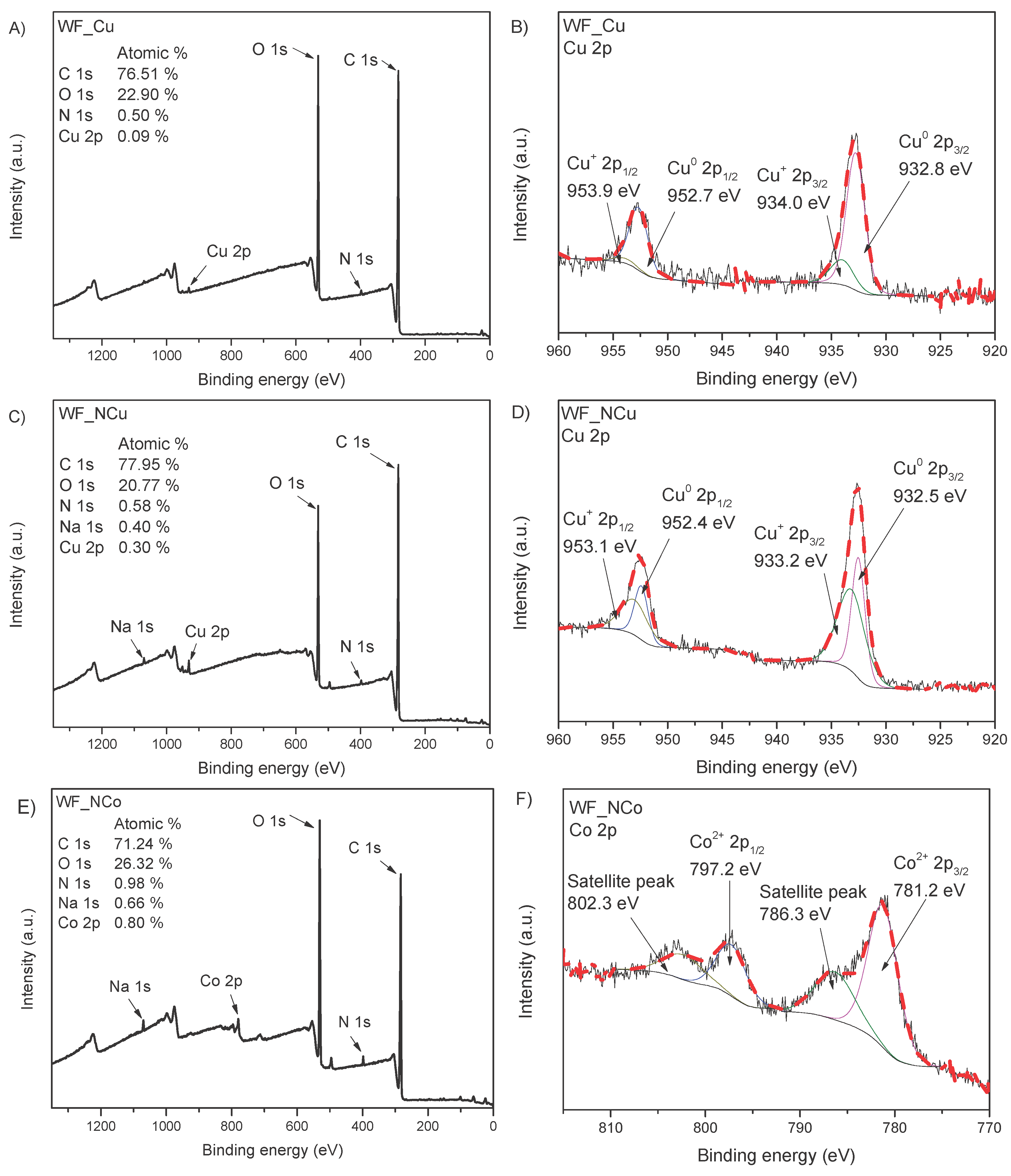
The XPS spectra of WF_Cu, WF_NCu and WF_NCo materials are presented in Figure 2, while atomic percentages resulting from deconvolution analysis and the obtained assignment of bands is presented on Table 2. The survey spectrum of pristine WF is presented on Supporting Information, Figure S2 [30]. On WF_Cu and WF_NCu, the presence of copper could be observed with 0.09 at% and 0.30 at%, respectively. The presence of Cu0 and Cu+ in both samples is evidenced by the 2p3/2 spectrum that shows peaks centred at 932.5 eV and 933.2 eV, respectively, indicating the presence of reduced copper [33], although the peak for zero-valent copper is more abundant. The Cu(II) bands are not detected, once its typical satellite peak, relatively intense, at ~940-5 eV is not present.
WF_NCo showed 0.80% of cobalt by XPS. The high-resolution spectrum in the Co2p region shows, in addition to 2p3/2 and 2p1/2 peaks, a relatively intense, broad, single-state pattern, satellite “shake-up” peak, typical of Co2+ [34]. This evidence a higher tendency of CoNPs for surface oxidation relatively to CuNPs.
In the N1s spectra of WF_N materials, a decrease in the relative percentage of the peak ascribed to -NH3+ at 402.3 eV is observed relatively to non-treated materials. This can be assigned to the more alkaline surface and deprotonation of the cationic groups into -NH2. Moreover, the O1s spectra of WF_N materials show a noticeable increase in the C=O peak relatively to the C-O assigned peak, which can be ascribed to the presence of deprotonated groups (-C-O‾) at the WF surface and presence of reduced metal states inducing side-chain cellulose oxidation with formation of carbonyl groups (-C=O).
The crystallographic structure of wood fibre materials was investigated by X-ray diffraction (XRD). Figure 3 shows the diffraction patterns of WF, WF_N, WF_NCu and WF_NCo. For the original WF sample, the diffraction peaks located at approximately 2θ = 11.5°, 15.5°, 23° and 35° were assigned to the (101), (10), (002) and (040) crystallographic plane reflections of cellulose I, respectively [35,36].
The crystallinity index () was estimated using the Segal method, according to the following equation:
where I002 corresponds to the maximum intensity of the (002) reflection (~23°) and Iam corresponds to the minimum intensity associated with the amorphous fraction (~19°).
After NaOH treatment (WF_N), a decrease in the intensity of the diffraction peaks at 15.5°, 23° and 35° was observed, accompanied by a reduction in the crystallinity index from 89% to 82%. This behaviour suggests a partial reduction in the structural ordering of the lignocellulosic matrix, which is consistent with the alkaline treatment of wood fibres.
Following nanoparticle immobilization, slight changes in the diffraction peak intensities were observed. In the case of WF_NCu, the intensity reduction of the reflections at 23° and 35° was partially attenuated, resulting in a CrI value of 85%. For WF_NCo, the diffraction pattern exhibited a more pronounced recovery of the crystalline reflections, yielding a value of 93%, the highest among the analysed samples.
These variations suggest that the interaction between metal species and the hydroxyl-rich fibre surface may influence the degree of structural ordering and the relative crystalline/amorphous balance of the lignocellulosic matrix. No diffraction peaks associated with crystalline Cu-, Co- or Fe-containing phases were detected within the detection limits of XRD, likely due to the low metal loading, small nanoparticle size and the dominant diffraction contribution from the lignocellulosic matrix.
FTIR-ATR characterization of WF materials shows typical peaks of lignocellulosic materials (Figure 4A and 4B). After sodium hydroxide treatment (WF_N) a decrease in the signal at 1740 cm-1 is observed, assigned to carboxylic (C=O) bonds [37]. No noticeable changes are observed after immobilization of metal nanoparticles.
3.2. 4-Nitrophenol Reduction
The catalytic reduction of 4-NP to 4-AP in the presence of the prepared WF materials using NaBH4 was carried out in a UV–vis cell (3 mL), and the spectra were acquired at chosen time intervals. The reactions were followed by the decrease of the band at ≈ 400 nm from 4-nitrophenolate ion and the concomitant appearance of the band at ≈ 300 nm due to 4-aminophenolate ion. The presence of NaBH4 results in a reaction media with pH ~10. Figure 5A shows the UV–vis spectra of the catalytic reduction of 4-NP to 4-AP by WF_NCu. The reactions follow pseudo-first-order kinetics, due to concentration of NaBH4 in large excess relatively to the 4-NP concentration at the start of reaction. The rate law is expressed by ln(C/C0) = -k1t, where k1 is the rate constant, calculated from the slope of the linear correlation of ln(C/C0) versus time [38]. The first-order kinetic plot for the catalytic reaction by WF_NCu is presented in Figure 5B, with k1 = 2.209 min-1.
4-NP reduction was performed with all the prepared materials, and the results are presented in Figure 5C and Table 3. Faster reactions are observed for WF_NCu and WF_Cu. WF_NCu reaches 97.4% conversion under 2.8 minutes, whilst WF_Cu reaches 98.9% conversion in 5 minutes (Table 3, Entry 1 and 2). The reduction reaction with WF_NCo and WF_Co showed ~ 90% conversion after 30 minutes and 20 minutes, respectively (Table 3, Entry 3 and 4). Similar results are obtained for WF_NFe, with an induction time of around 20 minutes, reaching ~ 90% conversion after 35 minutes (Table 3, Entry 5). WF_NCuFe had its catalytic activity evaluated, reaching ~ 99.2% conversion after 8 minutes (Table 3, Entry 6). Materials based on metal NPs immobilized in NaOH treated WF showed shorter induction times.
Reactions with pristine WF and WF_N show minor reduction rates for 4-NP (Table 3, Entry 7 and 8), while in the absence of wood fibres material, no significant 4-NP conversion is observed.
3.3. Catalysts Reuse and Stability
Reuse experiments were performed using WF_NCu (reaction time: 3 minutes), as well as WF_Co and WF_NCo (reaction time: 35 minutes), presented in Figure 5D. After each catalytic run, the materials were recovered by filtration, washed with ethanol, left to dry and used on the following cycles. WF_NCu showed a constant 4-NP conversion throughout five consecutive cycles, maintaining 4-NP conversion of at least 97.4%, even if after the catalytic reactions nanoparticles loosely attached to wood fibres are lost and after five reaction cycles copper atomic percentage decreases to 0.22% (Table 1 and Supporting Information, Figure S3). In contrast, WF_NCo showed lower stability upon reuse, with 4-NP conversion decreasing to 85.8% on the fourth cycle. Comparison with the corresponding not treated material with sodium hydroxide highlights again the effect of the treatment on nanoparticles immobilization, as 4-NP conversion reaches only 61.8% on the fifth cycle for the untreated material WF_Co if compared to 87.2% reached with WF_NCo. This comparison further highlights the positive effect of NaOH treatment of the material for 4-NP conversion, as even with higher cobalt loading WF_Co (3.97 at%) shows lower catalytic activity in reuse studies than WF_NCo (0.68 at%). The XRD of WF_N immobilized metals exhibited an increase in the crystallinity index after NP immobilization, resulting in a material with a higher degree of structural ordering than the original material (WF_N), which can be related to the improved stability in aqueous media upon consecutive reaction cycles.
3.4. Remarks on the Mechanism
in Scheme 1 (A) is depicted the commonly accepted stepwise reduction of nitro to amine groups mediated by M(0) particles, with successive, formal transfer of H‾/H+ [32]. The phenylhydroxylamine is a stable intermediate and its reduction is widely considered as the slowest rate determining step in the catalytic cycle [39].
The catalytic performance of WF_NPs materials demonstrates the high efficiency of the copper nanoparticles immobilised on the WFs, with an induction time of 0.5-2 min (Table 3). Identical materials based on cobalt or iron present longer induction times, 5.5 min for WF_Co and 20 min for WF_NFe, which can be explained by the reduction potentials (E0) of the respective M(II)/M(0) couples, namely 0.34 V for Cu(II)/Cu(0), -0.28 V for Co(II)/Co(0), and -0.44 V for Fe(II)/Fe(0). Once for Co and Fe, the reduction potentials are negative, following the formation of the zero-valent nanoparticles, exposure to air renders highly probable their re-oxidation to Co(II) and Fe(II), respectively. This forms a thin surface layer on the nanoparticles (hydroxides, oxides), as observed in the XPS Co2p spectrum relatively to the Cu2p spectrum (Figure 2D and 2F). For this reaction, the induction time has been associated with surface activation via reduction of the metal ions into M(0) and this explains the long induction time observed for the reaction catalysed by WF_NFe.
Comparing WF and WF_N based materials with the same metal NPs, slightly shorter induction times are observed for NaOH-treated fibres (Table 3, Cu and Co materials and for copper materials that show similar k1 values (WF_NCu 2.209 min-1 and WF_Cu 2.102 min-1, kinetic curves in Figure 5B and Supporting Information, Figure S4). This positive effect can arise from deprotonated hydroxyl groups at the WF surface and a more negative surface charge on the fibres during the reduction process.
In the reduction of nitro group it is considered that the NPs might act as an uncharged mediator that accepts electrons from BH4‾, forming active and transient metal–hydrogen (M–H) species on the NP surface [39], which are transferred to the substrate (nitro groups) (Scheme 1B). The -OH groups at the WF surface can alter water structure, allowing the formation of a structured hydrogen bonding network that assist H+ transfer [39], they can also assist adsorption and borohydride hydrolysis. These processes can be boosted in the deprotonated lignocellulosic surface (NaOH-treated materials), contributing to a bifunctional catalytic environment.
In the present case, the bimetallic material WF_NCuFe exhibits significantly superior kinetics if compared to WF_NFe, with k1 = 0.717 min-1 versus k1 = 0.161 min-1, but it is inferior to WF_NCu with k1 = 2.209 min-1. These results indicate that the catalytic action is centred on Cu(0), with no evidence of bimetal synergy.
3.6. Comparison of Results with the Literature
Comparison with other lignocellulosic supported first transition series NPs reported in literature (Table 4) displays the good catalytic performance of WF_NCu for the reduction of 4-NP with NaBH4.
4. Conclusions
In the current study, first-row transition metal nanoparticles supported on WF were synthesized via a straightforward method, yielding cost-effective, bio-derived catalysts for the reduction of 4-NP in water. Highly dispersed nanoparticles were obtained on the WF surface, exhibiting high catalytic activity even at low metal loadings (< 2.5 at%). The rate constants (k1) observed for the prepared materials followed the order: WF_NCu > WF_Cu >> WF_NCuFe >> WF_NFe > WF_NCo, after an induction period that was more significant for the Fe-based material. In contrast, WF and WF_N exhibited negligible activity toward 4-NP reduction. The superior performance of WF_NCu stems from the exclusive presence of reduced copper states [Cu(0) and Cu(I)] in the material, as confirmed by XPS. Furthermore, the XRD of WF_NCu exhibited an increase in the crystallinity index after NP immobilization relatively to the NaOH treated support (WF_N) and showed excellent stability in aqueous media, maintaining high catalytic performance over five consecutive reaction cycles. These findings demonstrate the potential of WF as a robust and stable support material for heterogeneous catalysis in environmental applications.
Supplementary Materials
The following supporting information can be downloaded at the website of this paper posted on Preprints.org.
Author Contributions
Gabriela A. Corrêa: Writing – original draft, Methodology, Investigation. Mário M.Q. Simões: Writing – review & editing, Validation, Supervision. Ana L. Pires: Resources, Validation. Susana L.H. Rebelo: Writing – review & editing, Supervision, Resources, Project administration, Conceptualization.
Funding
This work received financial support from the PT national funds (FCT/MECI, Fundação para a Ciência e a Tecnologia and Ministério da Educação, Ciência e Inovação) through the project UID/50006/2025 DOI: 10.54499/UID/50006/2025- Laboratório Associado para a Química Verde - Tecnologias e Processos Limpos and from project “Wood fibers-based active membranes for microplastic capture and conversion” funded by FEDER (COMPETE 2030) and national funds by FCT/MECI, operation no. 16799, COMPETE2030-FEDER-00798300, DOI: 10.54499/2023.17901.ICDT.
Data Availability Statement
No data was used for the research described in the article.
Acknowledgments
The authors thank Fundação para a Ciência e a Tecnologia and Ministério da Educação, Ciência e Inovação (FCT/MECI) and FEDER (COMPETE2030) for funding through projects DOI: 10.54499/UID/50006/2025 and DOI: 10.54499/2023.17901.ICDT. Gabriela A. Corrêa thanks FCT for her PhD grant (UI/BD/154487/2022 DOI: 10.54499/UI/BD/154487/2022). ALP further acknowledges individual funding from FCT under the TENURE Programme (1st Edition), Ref: 2023.14889.TENURE.015.
Conflicts of Interest
The authors declare that they have no known competing financial interests or personal relationships that could have appeared to influence the work reported in this paper.
References
- Wang, J.; Yin, J.; Peng, D.; Zhang, X.; Shi, Z.; Li, W.; Shi, Y.; Sun, M.; Jiang, N.; Cheng, B.; et al. 4-Nitrophenol at environmentally relevant concentrations mediates reproductive toxicity in Caenorhabditis elegans via metabolic disorders-induced estrogen signaling pathway. J. Environ. Sci. 2025, 147, 244–258. [Google Scholar] [CrossRef] [PubMed]
- Kumar, A.; Kumar, S.; Kumar, S.; Gupta, D.V. Adsorption of phenol and 4-nitrophenol on granular activated carbon in basal salt medium: Equilibrium and kinetics. J. Hazard. Mater. 2007, 147, 155–166. [Google Scholar] [CrossRef] [PubMed]
- Serrà, A.; Artal, R.; Pozo, M.; Garcia-Amorós, J.; Gómez, E. Simple Environmentally-Friendly Reduction of 4-Nitrophenol. Catalysts 2020, 10, 458. [Google Scholar] [CrossRef]
- Nezamzadeh-Ejhieh, A.; Khorsandi, S. Photocatalytic degradation of 4-nitrophenol with ZnO supported nano-clinoptilolite zeolite. J. Ind. Eng. Chem. 2014, 20, 937–946. [Google Scholar] [CrossRef]
- Wunder, S.; Polzer, F.; Lu, Y.; Mei, Y.; Ballauff, M. Kinetic Analysis of Catalytic Reduction of 4-Nitrophenol by Metallic Nanoparticles Immobilized in Spherical Polyelectrolyte Brushes. J. Phys. Chem. C 2010, 114, 8814–8820. [Google Scholar] [CrossRef]
- Saha, S.; Pal, A.; Kundu, S.; Basu, S.; Pal, T. Photochemical Green Synthesis of Calcium-Alginate-Stabilized Ag and Au Nanoparticles and Their Catalytic Application to 4-Nitrophenol Reduction. Langmuir 2010, 26, 2885–2893. [Google Scholar] [CrossRef] [PubMed]
- Ouyang, L.; Zhong, H.; Li, H.-W.; Zhu, M. A Recycling Hydrogen Supply System of NaBH4 Based on a Facile Regeneration Process: A Review. Inorganics 2018, 6, 10. [Google Scholar] [CrossRef]
- Ndolomingo, M.J.; Bingwa, N.; Meijboom, R. Review of supported metal nanoparticles: synthesis methodologies, advantages and application as catalysts. J. Mater. Sci. 2020, 55, 6195–6241. [Google Scholar] [CrossRef]
- Pandey, R.K.; Chen, L.; Teraji, S.; Nakanishi, H.; Soh, S. Eco-Friendly, Direct Deposition of Metal Nanoparticles on Graphite for Electrochemical Energy Conversion and Storage. ACS Appl. Mater. Interfaces 2019, 11, 36525–36534. [Google Scholar] [CrossRef] [PubMed]
- Chandrakala, V.; Aruna, V.; Angajala, G. Review on metal nanoparticles as nanocarriers: current challenges and perspectives in drug delivery systems. Emergent Mater. 2022, 5, 1593–1615. [Google Scholar] [CrossRef] [PubMed]
- Zhu, C.; Du, D.; Eychmüller, A.; Lin, Y. Engineering Ordered and Nonordered Porous Noble Metal Nanostructures: Synthesis, Assembly, and Their Applications in Electrochemistry. Chem. Rev. 2015, 115, 8896–8943. [Google Scholar] [CrossRef] [PubMed]
- Kaur, M.; Gautam, A.; Guleria, P.; Singh, K.; Kumar, V. Green synthesis of metal nanoparticles and their environmental applications. Curr. Opin. Environ. Sci. Health 2022, 29, 100390. [Google Scholar] [CrossRef]
- Deka, P.; Deka, R.C.; Bharali, P. In situ generated copper nanoparticle catalyzed reduction of 4-nitrophenol. New J. Chem. 2014, 38, 1789–1793. [Google Scholar] [CrossRef]
- Da’na, E.; Taha, A.; El-Aassar, M.R. Catalytic Reduction of p-Nitrophenol on MnO2/Zeolite -13X Prepared with Lawsonia inermis Extract as a Stabilizing and Capping Agent. Nanomaterials 2023, 13, 785. [Google Scholar] [CrossRef] [PubMed]
- Ali, F.; Khan, S.B.; Kamal, T.; Alamry, K.A.; Asiri, A.M.; Sobahi, T.R.A. Chitosan coated cotton cloth supported zero-valent nanoparticles: Simple but economically viable, efficient and easily retrievable catalysts. Sci. Rep. 2017, 7, 16957. [Google Scholar] [CrossRef] [PubMed]
- Li, X.; Zeng, C.; Jiang, J.; Ai, L. Magnetic cobalt nanoparticles embedded in hierarchically porous nitrogen-doped carbon frameworks for highly efficient and well-recyclable catalysis. J. Mater. Chem. A 2016, 4, 7476–7482. [Google Scholar] [CrossRef]
- Palanivel, D.; Venugopal, A.; Ranganathan, S.; Cingaram, R.; Natesan Sundramurthy, K. Biogenic synthesis and characterization of zinc oxide nanoparticles for effective and rapid catalytic reduction of 4-nitrophenol. J. Indian Chem. Soc. 2024, 101, 101337. [Google Scholar] [CrossRef]
- Lourens, A.; Falch, A.; Malgas-Enus, R. Nano-Ni/Cu decorated iron oxide for catalytic reduction of 4-nitrophenol. Mater. Chem. Phys. 2024, 315, 129022. [Google Scholar] [CrossRef]
- Kamal, T.; Asiri, A.M.; Ali, N. Catalytic reduction of 4-nitrophenol and methylene blue pollutants in water by copper and nickel nanoparticles decorated polymer sponges. Spectrochim. Acta Part A Mol. Biomol. Spectrosc. 2021, 261, 120019. [Google Scholar] [CrossRef] [PubMed]
- Arora, N.; Mehta, A.; Mishra, A.; Basu, S. 4-Nitrophenol reduction catalysed by Au-Ag bimetallic nanoparticles supported on LDH: Homogeneous vs. heterogeneous catalysis. Appl. Clay Sci. 2018, 151, 1–9. [Google Scholar] [CrossRef]
- Gao, C.; Lyu, F.; Yin, Y. Encapsulated Metal Nanoparticles for Catalysis. Chem. Rev. 2021, 121, 834–881. [Google Scholar] [CrossRef] [PubMed]
- Jiang, Z.-J.; Liu, C.-Y.; Sun, L.-W. Catalytic Properties of Silver Nanoparticles Supported on Silica Spheres. J. Phys. Chem. B 2005, 109, 1730–1735. [Google Scholar] [CrossRef] [PubMed]
- Guo, D.J.; Li, H.L. Highly dispersed Ag nanoparticles on functional MWNT surfaces for methanol oxidation in alkaline solution. Carbon 2005, 43, 1259–1264. [Google Scholar] [CrossRef]
- Rastogi, P.K.; Ganesan, V.; Krishnamoorthi, S. Microwave assisted polymer stabilized synthesis of silver nanoparticles and its application in the degradation of environmental pollutants. Mater. Sci. Eng. B 2012, 177, 456–461. [Google Scholar] [CrossRef]
- Aitbella, H.; Belachemi, L.; Merle, N.; Zinck, P.; Kaddami, H. Schiff Base Functionalized Cellulose: Towards Strong Support-Cobalt Nanoparticles Interactions for High Catalytic Performances. Molecules 2024, 29, 1734. [Google Scholar] [CrossRef] [PubMed]
- Vanti, G.L.; Masaphy, S.; Kurjogi, M.; Chakrasali, S.; Nargund, V.B. Synthesis and application of chitosan-copper nanoparticles on damping off causing plant pathogenic fungi. Int. J. Biol. Macromol. 2020, 156, 1387–1395. [Google Scholar] [CrossRef] [PubMed]
- Zarei, M.; Mohammadzadeh, I.; Saidi, K.; Sheibani, H. Fabrication of biochar@Cu-Ni nanocatalyst for reduction of aryl aldehyde and nitroarene compounds. Biomass Convers. Biorefinery 2024, 14, 2761–2776. [Google Scholar] [CrossRef]
- Liu, K.-K.; Jiang, Q.; Tadepalli, S.; Raliya, R.; Biswas, P.; Naik, R.R.; Singamaneni, S. Wood–Graphene Oxide Composite for Highly Efficient Solar Steam Generation and Desalination. ACS Appl. Mater. Interfaces 2017, 9, 7675–7681. [Google Scholar] [CrossRef] [PubMed]
- Zhang, Z.; Besserer, A.; Rose, C.; Brosse, N.; Terrasson, V.; Guénin, E. Microwave-Assisted Synthesis of Pd Nanoparticles into Wood Block (Pd@wood) as Efficient Catalyst for 4-Nitrophenol and Cr(VI) Reduction. Nanomaterials 2023, 13, 2491. [Google Scholar] [CrossRef] [PubMed]
- Corrêa, G.A.; Simões, M.M.Q.; Rebelo, S.L.H. Wood fiber-iron salicylate/anthranilate composite in sustainable catalytic reduction of 4-nitrophenol. Ind. Crops Prod. 2025, 224, 120255. [Google Scholar] [CrossRef]
- Corrêa, G.A.; Simões, M.M.Q.; Rebelo, S.L.H. Wood fiber/iron salicylate composite for organic dyes removal in water purification: adsorption and visible light assisted degradation. ACS Sustain. Resour. Manag. doi:In revision requested.
- Corrêa, G.A.; Kuźniarska-Biernacka, I.; Fernandes, D.M.; Rebelo, S.L.H. Polarized Bimetallic Site Synergy in Ionic Structures of Cu(II), Fe(III), and Mn(III) Porphyrins: Electrochemistry and Catalytic Hydrogenation of Nitroaromatics. Inorg. Chem. 2024, 63, 22865–22879. [Google Scholar] [CrossRef] [PubMed]
- Luz, I.; Loiudice, A.; Sun, D.T.; Queen, W.L.; Buonsanti, R. Understanding the Formation Mechanism of Metal Nanocrystal@MOF-74 Hybrids. Chem. Mater. 2016, 28, 3839–3849. [Google Scholar] [CrossRef]
- Khan, S.A.; Sohni, S.; Akhtar, K.; Bakhsh, E.M.; Nawaz, T.; Khan, S.B. Lignocellulose biomatrix zero-valent cobalt nanoparticles: a dip-catalyst for organic pollutants degradation. Ind. Crops Prod. 2023, 198, 116694. [Google Scholar] [CrossRef]
- Mu, B.; Wang, H.; Hao, X.; Wang, Q. Morphology, Mechanical Properties and Dimensional Stability of Biomass Particles/High Density Polyethylene Composites: Effect of Species and Composition. Polymers 2018, 10, 308. [Google Scholar] [CrossRef] [PubMed]
- Oudiani, A.E.; Chaabouni, Y.; Msahli, S.; Sakli, F. Crystal transition from cellulose I to cellulose II in NaOH treated Agave americana L. fibre. Carbohydr. Polym. 2011, 86, 1221–1229. [Google Scholar] [CrossRef]
- Barman, D.N.; Haque, M.A.; Hossain, M.M.; Paul, S.K.; Yun, H.D. Deconstruction of Pine Wood (Pinus sylvestris) Recalcitrant Structure Using Alkali Treatment for Enhancing Enzymatic Saccharification Evaluated by Congo Red. Waste Biomass Valorization 2020, 11, 1755–1764. [Google Scholar] [CrossRef]
- Corrêa, G.A.; Loureiro, M.P.; Kuźniarska-Biernacka, I.; Freire, C.; Rebelo, S.L.H. Self-assembled binary structures of Fe(III) and metal-free porphyrins for solar light-assisted catalytic hydrogenation of 4-nitrophenol. Mater. Today Sustain. 2022, 19, 100195. [Google Scholar] [CrossRef]
- Ding, M.; Peng, B.; Zhou, J.-F.; Chen, H.; Zhu, Y.-S.; Yuan, E.-H.; Albela, B.; Bonneviot, L.; Wu, P.; Zhang, K. Molecular manipulation of the microenvironment of Au active sites on mesoporous silica for the enhanced catalytic reduction of 4-nitrophenol. Catal. Sci. Technol. 2023, 13, 2001–2009. [Google Scholar] [CrossRef]
- Ding, T.; Shu, S.; Gong, Y.; Xu, Z.; Xu, W.; Zhang, J.; Shi, L.; Sun, H.; Chen, Y.; Guo, B.; et al. Biomass-Derived Atomically Dispersed Cu Catalysts: Synergetic Roles of Cu–Nx Centers and Hierarchically Porous Carbon Structures in Hydrogenation Reduction of Nitroarenes. ACS Sustain. Chem. Eng. 2026, 14, 1652–1664. [Google Scholar] [CrossRef]
- Zheng, A.L.T.; Sabidi, S.; Maran, M.A.; Ban, T.K.; Seng, K.W.K.; Chung, E.L.T.; Andou, Y. Synthesis of CuO nanoparticles using waste-derived bamboo cellulose for enhanced catalytic and antibacterial applications. BioResources 2025, 20(4), 9148–9166. [Google Scholar] [CrossRef]
- Shah, S.A.; Ahmad, Z.; Khan, S.A.; Al-Ghamdi, Y.O.; Bakhsh, E.M.; Khan, N.; ur Rehman, M.; Jabli, M.; Khan, S.B. Biomass impregnated zero-valent Ag and Cu supported-catalyst: Evaluation in the reduction of nitrophenol and discoloration of dyes in aqueous medium. J. Organomet. Chem. 2021, 938, 121756. [Google Scholar] [CrossRef]
- Akhtar, K.; Ali, F.; Sohni, S.; Kamal, T.; Asiri, A.M.; Bakhsh, E.M.; Khan, S.B. Lignocellulosic biomass supported metal nanoparticles for the catalytic reduction of organic pollutants. Environ. Sci. Pollut. Res. 2020, 27, 823–836. [Google Scholar] [CrossRef] [PubMed]
- Shi, J.; Ye, R.; Yue, Y.; Liu, J. Insights into interfacial catalysis for aqueous reduction of 4-Nitrophenol catalyzed by Ni metal nanoparticles encapsulated within biomass-derived N-doped carbon matrix. Chem. Eng. Sci. 2024, 294, 120122. [Google Scholar] [CrossRef]
- Zayed, M.F.; Eisa, W.H.; Anis, B. Garlic peel as promising low-cost support for the cobalt nanocatalyst; synthesis and catalytic studies. J. Environ. Manag. 2022, 312, 114919. [Google Scholar] [CrossRef] [PubMed]
- Sohni, S.; Khan, S.A.; Akhtar, K.; Khan, S.B.; Asiri, A.M.; Hashim, R.; Omar, A.K.M. Room temperature preparation of lignocellulosic biomass supported heterostructure (Cu+Co@OPF) as highly efficient multifunctional nanocatalyst using wetness co-impregnation. Colloids Surf. A Physicochem. Eng. Asp. 2018, 549, 184–195. [Google Scholar] [CrossRef]
Figure 1.
SEM images with backscattered electron detector of A) WF; B) WF_N; C) WF_Cu; D) WF_NCu before sonic clean; E) WF_NCu after sonic clean (Zone 1 [Z1] targeted at a copper nanoparticle and Zone 2 [Z2] for a broader region) and F) EDS spectrum of WF_NCu (Z2 and Z1) after sonic clean.
Figure 1.
SEM images with backscattered electron detector of A) WF; B) WF_N; C) WF_Cu; D) WF_NCu before sonic clean; E) WF_NCu after sonic clean (Zone 1 [Z1] targeted at a copper nanoparticle and Zone 2 [Z2] for a broader region) and F) EDS spectrum of WF_NCu (Z2 and Z1) after sonic clean.
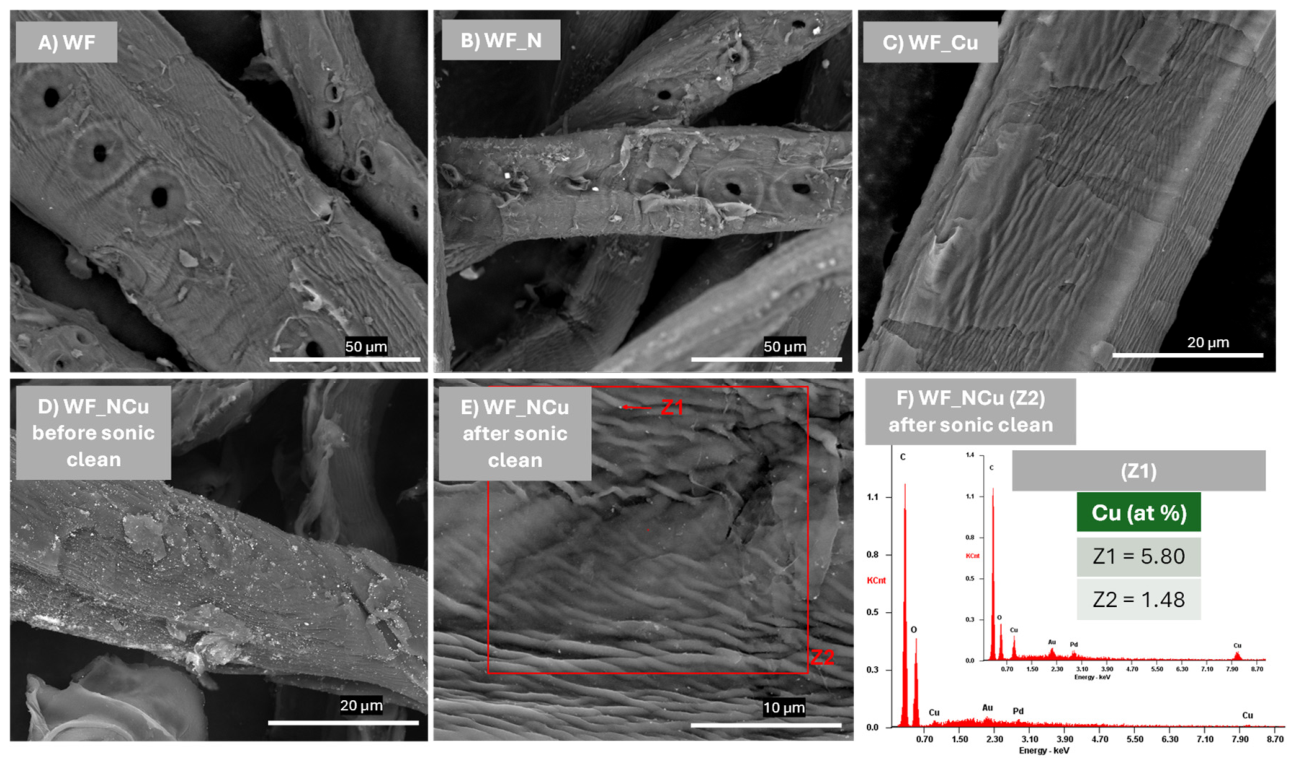
Figure 2.
A) Survey XPS and B) high-resolution metal spectra for WF_Cu; C) Survey XPS and E) high-resolution metal spectra for WF_NCu; E) Survey XPS and F) high-resolution metal spectra for WF_NCo.
Figure 2.
A) Survey XPS and B) high-resolution metal spectra for WF_Cu; C) Survey XPS and E) high-resolution metal spectra for WF_NCu; E) Survey XPS and F) high-resolution metal spectra for WF_NCo.
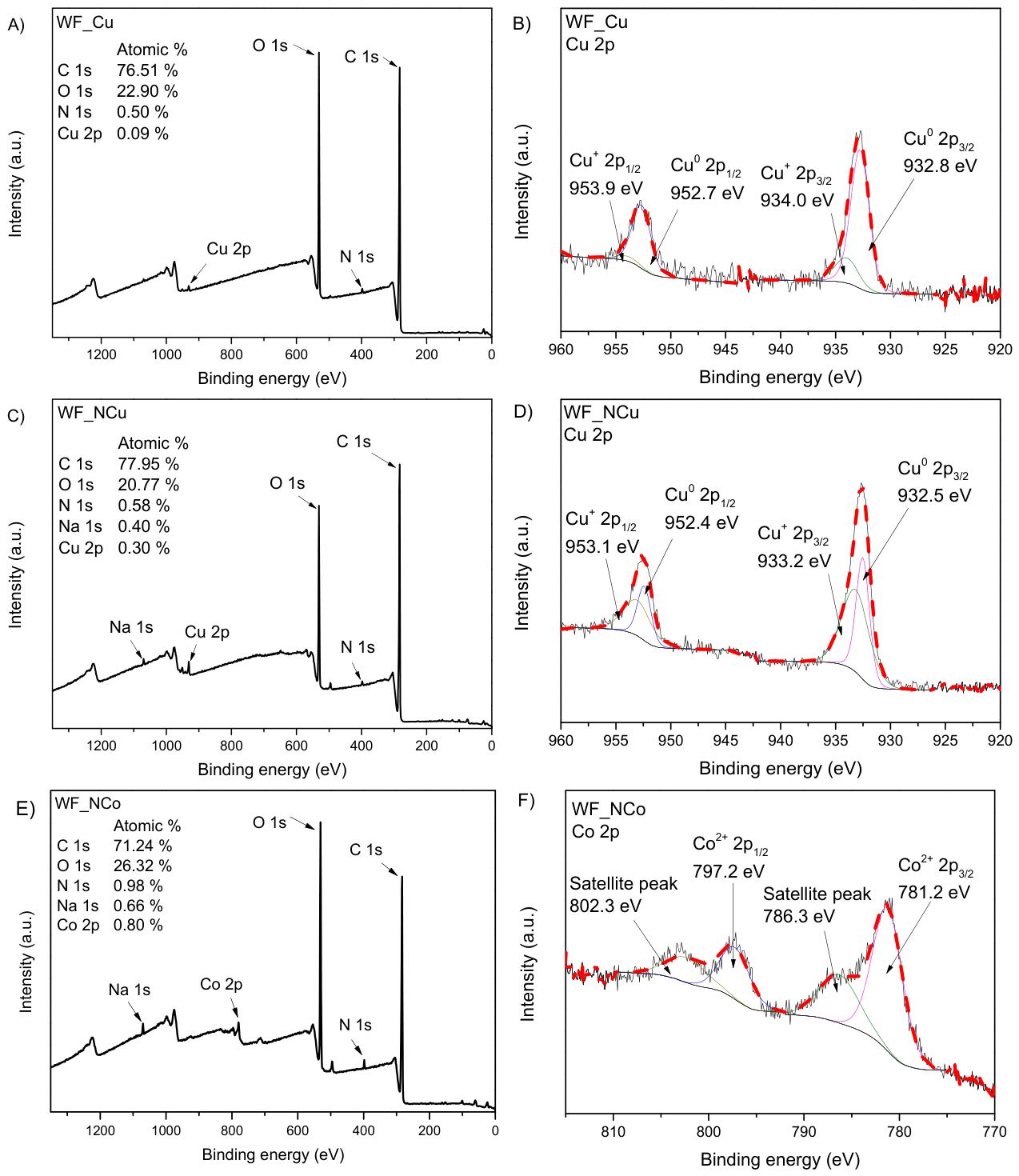
Figure 3.
X-ray diffraction patterns of WF, WF_N, WF_NCu and WF_NCo samples. The reflections associated with cellulose I are indicated. Crystallinity index () values were calculated using the Segal method.
Figure 3.
X-ray diffraction patterns of WF, WF_N, WF_NCu and WF_NCo samples. The reflections associated with cellulose I are indicated. Crystallinity index () values were calculated using the Segal method.
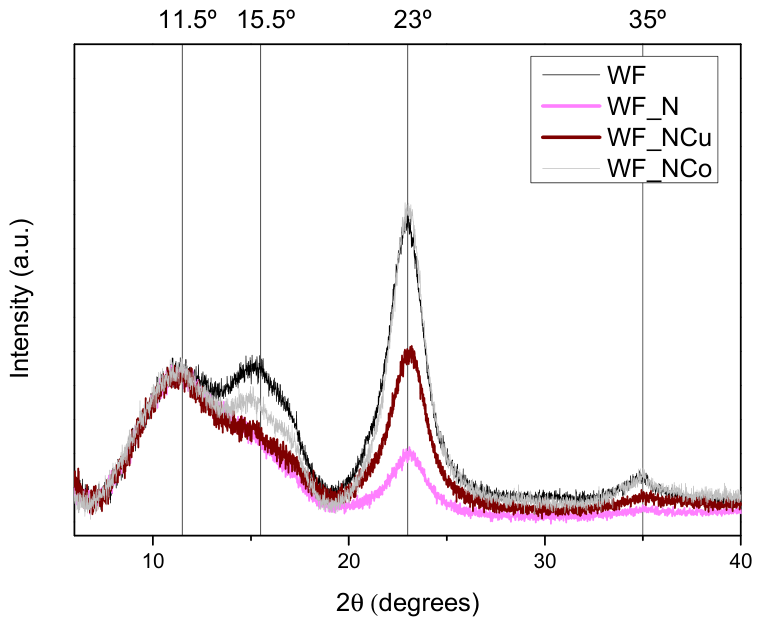
Figure 4.
A) FTIR-ATR spectra and B) expansion for original WF, WF_N, WF_NCu and WF_Cu.
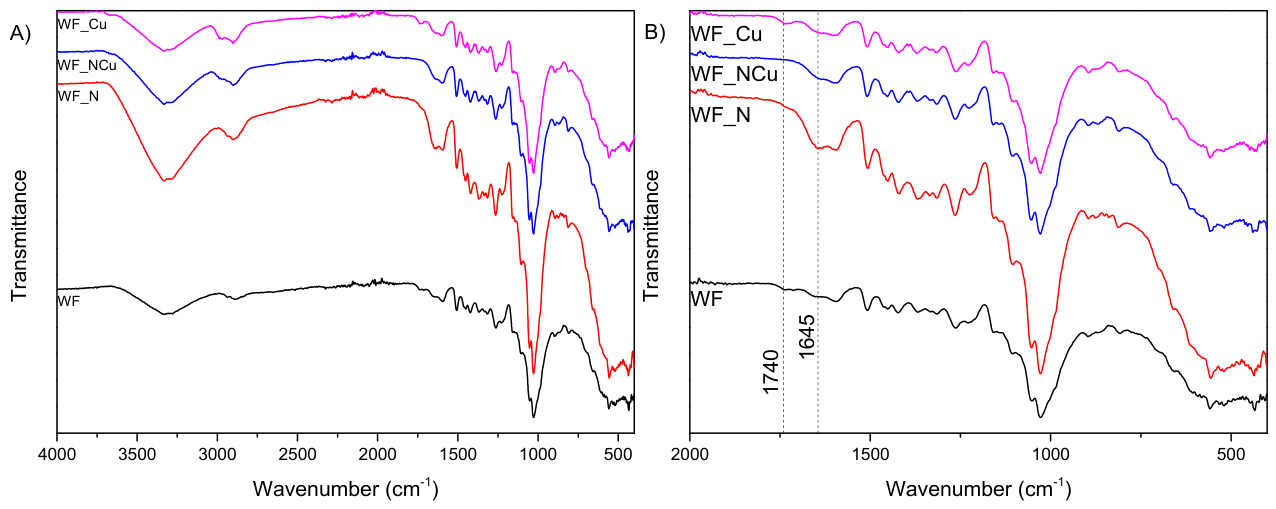
Figure 5.
A) Time-dependence UV–vis spectra for 4-NP reduction with WF_NCu; B) Kinetic curve for 4-NP reduction with WF_NCu; C) Comparison of kinetic behaviour of different wood fibres materials; D) Recyclability of WF_NCu, WF_Co and WF_NCo catalysts for the reduction of 4-NP (reuse reactions for WF_NCu with 3 min of reaction time; for WF_Co and WF_NCo with 35 min of reaction time). Conditions: 2 g/L wood fibres material, 0.05 mM (4-NP), 0.05 M (NaBH4); room temperature.
Figure 5.
A) Time-dependence UV–vis spectra for 4-NP reduction with WF_NCu; B) Kinetic curve for 4-NP reduction with WF_NCu; C) Comparison of kinetic behaviour of different wood fibres materials; D) Recyclability of WF_NCu, WF_Co and WF_NCo catalysts for the reduction of 4-NP (reuse reactions for WF_NCu with 3 min of reaction time; for WF_Co and WF_NCo with 35 min of reaction time). Conditions: 2 g/L wood fibres material, 0.05 mM (4-NP), 0.05 M (NaBH4); room temperature.
Scheme 1.
A) Successive H‾/H+ transfer for the reduction of the nitro to amine group and B) Proposed mechanism for the hydrogenation of 4-NP in the presence of NaBH4 in aqueous solution catalysed by CuNPs immobilized onto WF. The schemes are representations and do not show the actual geometry of the catalytic sites.
Scheme 1.
A) Successive H‾/H+ transfer for the reduction of the nitro to amine group and B) Proposed mechanism for the hydrogenation of 4-NP in the presence of NaBH4 in aqueous solution catalysed by CuNPs immobilized onto WF. The schemes are representations and do not show the actual geometry of the catalytic sites.
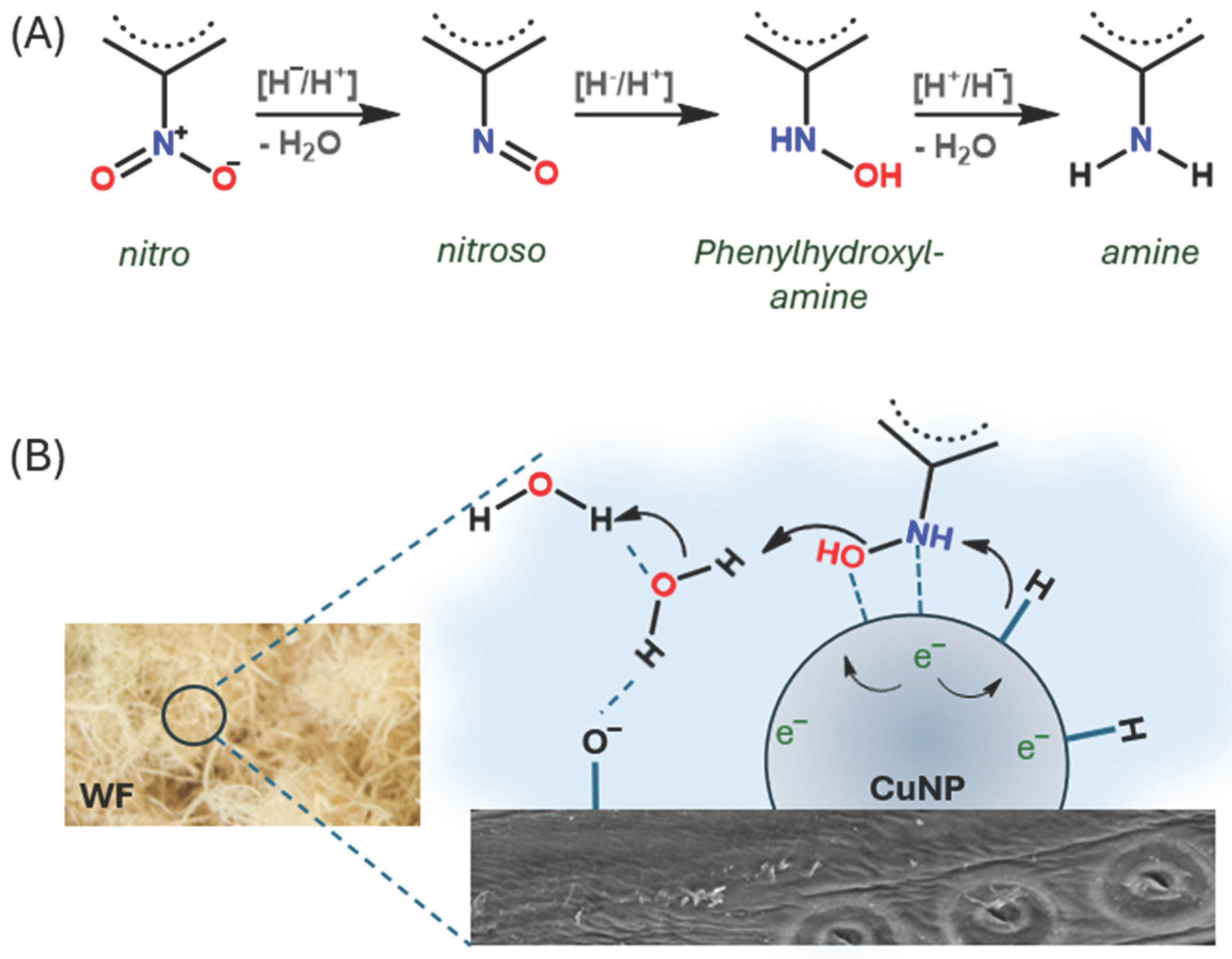

Table 1.
Atomic percentages for original and nanoparticles-immobilized wood fibres (obtained by EDS, before and after catalysis).a.
Table 1.
Atomic percentages for original and nanoparticles-immobilized wood fibres (obtained by EDS, before and after catalysis).a.
| Atomic percentage (%) | ||||||
|---|---|---|---|---|---|---|
| C | O | Na | Cu | Co | Fe | |
| WF | 66.06 | 33.81 | ||||
| WF_N | 60.85 | 37.44 | 1.3 | |||
| WF_Cu | 67.55 | 31.57 | 0.38 | 0.50 | ||
| WF_NCu (no sonic clean) | 61.53 | 35.02 | 1.36 | 1.82 | ||
| WF_NCu | 63.10 | 34.60 | 0.68 | 1.48 | ||
| WF_Co (no sonic clean) | 54.55 | 41.49 | 3.97 | |||
| WF_NCo | 59.11 | 38.59 | 1.26 | 0.68 | ||
| WF_NFe | 57.76 | 38.94 | 0.47 | 2.40 | ||
| WF_NCuFe | 59.48 | 34.86 | 1.81 | 1.78 | 2.08 | |
| After 5 catalytic cycles | ||||||
| WF_NCu | 63.16 | 35.95 | 0.67 | 0.22 | ||
aResidual amounts of other elements were occasionally detected (e.g., Ca and Si were detected in the original WF).
Table 2.
Assignment of the bands observed in the XPS high-resolution spectra in the region of the elements present in WF_Cu, WF_NCu, WF_NCo and WF.
Table 2.
Assignment of the bands observed in the XPS high-resolution spectra in the region of the elements present in WF_Cu, WF_NCu, WF_NCo and WF.
| Orbital | BE (eV) | Assignment | Atomic percentage (%) | |||
|---|---|---|---|---|---|---|
| WF_Cu | WF_NCu | WF_NCo | WF | |||
| C 1s | 282.6 | C-Si | 0.7 | 1.0 | 1.1 | 0.2 |
| 284.8 | C=C | 53.8 | 67.2 | 59.3 | 27.2 | |
| 285.3 | C-C | 32.6 | ||||
| 286.5 | C-O | 26.2 | 19.7 | 25.8 | 22.8 | |
| 287.0 | C-N | 6.1 | 5.4 | 7.5 | 7.2 | |
| 288.1 | C=O | 6.4 | 6.9 | 6.4 | 7.4 | |
| 289.1 | O=C-O | 2.7 | ||||
| O 1s | 531.6 | O=C | 4.0 | 20.5 | 18.4 | 12.3 |
| 533.0 | O-C | 94.6 | 78.8 | 77.9 | 83.8 | |
| 534.7 | H2O | 1.4 | 0.7 | 3.7 | 3.9 | |
| N 1s | 400.2 | -NH2 | 64.8 | 95.4 | 100 | 93.3 |
| 402.3 | -NH3+ | 35.3 | 4.6 | 6.7 | ||
| Cu 2p | 932.5 | Cu0 2p3/2 | 57.8 | 29.5 | ||
| 952.4 | Cu0 2p1/2 | 26.6 | 13.3 | |||
| 933.2 | Cu+ 2p3/2 | 13.1 | 39.9 | |||
| 953.1 | Cu+ 2p1/2 | 2.5 | 17.3 | |||
| Co 2p | 781.2 | Co2+ 2p3/2 | 49.2 | |||
| 797.2 | Co2+ 2p1/2 | 17.8 | ||||
| 786.3 | Satellite peak | 21.7 | ||||
| 802.3 | Satellite peak | 11.3 | ||||
Table 3.
Kinetic data for 4-NP reduction catalysed by WF or WF_N supported NPs materials.a.
| Entry | Catalyst | Total reaction time (min) | Induction time (min) | C (%)b | k1 (min-1)c | R2 |
|---|---|---|---|---|---|---|
| 1 | WF_NCu | 2.8 | 0.5 | 97.4 | 2.209 | 0.9653 |
| 2 | WF_Cu | 5 | 2 | 98.9 | 2.102 | 0.9811 |
| 3 | WF_NCo | 35 | 0 | 96.1 | 0.085 | 0.9693 |
| 4 | WF_Co | 20 | 5.5 | 95.4 | 0.188 | 0.9644 |
| 5 | WF_NFe | 35 | 20 | 96.7 | 0.161 | 0.9532 |
| 6 | WF_NCuFe | 8 | 0 | 99.2 | 0.717 | 0.9659 |
| 7 | WF_N | 35 | - | 4.1 | - | |
| 8 | WF | 35 | - | 9.5 | - |
aExperimental conditions: initial 4-NP concentration (5.0⋅10−5 mol⋅dm−3), NaBH4 (6 mg, 0.05 mol⋅dm−3) and catalyst loading (2 g/L) at room temperature. bConversion of 4-NP (%) calculated from: %C = 100[(Cf/C0)×100%], where C0 and Cf (mol⋅dm−3) are the concentrations of 4-NP at t = 0 and at the end of the reaction (min). ck1 is apparent first-order kinetic rate constant, calculated from ln(C/C0) = k1t, where C0 and C (mol⋅dm−3) are the concentrations of 4-NP at t = 0 and time t (min), respectively.
Table 4.
Comparison of the kinetic rate constant (k1) of first transition series metal NPs supported onto different lignocellulosic materials for the reduction of 4-NP.
Table 4.
Comparison of the kinetic rate constant (k1) of first transition series metal NPs supported onto different lignocellulosic materials for the reduction of 4-NP.
| Catalyst | Metal | Support | Catalyst loading | 4-NP | NaBH4 (conc.) | Time (min) | k1 | Reference |
|---|---|---|---|---|---|---|---|---|
| WF_NCu | Cu | WF | 2 g/L | 5.0⋅10−5 M | 0.05 M | 2.8 | 2.209 min-1 | This work |
| Cu NPs/uFC | Cu | Fiberboard waste | 0.025 g/L | 0.1 mM | 40 mM | 6 | 0.63 min-1 | [40] |
| CuO-C | Cu | Bamboo cellulose | 0.2 g/L | 10 ppm | 1000 ppm | 15 | 0.153 min−1 | [41] |
| MA@Cu | Cu | Melia Azadarach | 6.7 g/L | 0.1 mM | 1 M | 12 | 0.225 min−11 | [42] |
| Cu/EFB | Cu | Oil palm empty fruit bunch | 6.7 g/L | 0.1 mM | 0.1 M | 10 | 0.00394 sec−1 | [43] |
| NNC-2 | Ni | Daikon powder | 0.1 g/L | 0.1 mM | 0.05 M | 12 | 0.336 min−1 | [44] |
| Co@DAC-OAP | Co | Palm biomass waste | 5 mol% | 0.5 g/L | 5 g/L | 7 | 0.0087 s−1 | [25] |
| Co@ GaP | Co | Garlic peel | 8.3 g/L | 0.07 mM | 7 M | 20 | 0.00456 sec−1 | [45] |
| RH@Co | Co | Rice husk | 3.75 g/L | 13.91 ppm | 189.15 ppm | 34 | 0.0416 min−1 | [34] |
| Cu+Co@OPF | Cu, Co | Oil palm biomass | 15 mg | 0.1 mmol | 7.5 mM | 25 | 0.0129 sec−1 | [46] |
| Biochar@Cu-Ni | Cu, Ni | Pistachio shell | 1 g/L | 30 ppm | 250 mM | 6 | 0.4086 min-1 | [27] |
Disclaimer/Publisher’s Note: The statements, opinions and data contained in all publications are solely those of the individual author(s) and contributor(s) and not of MDPI and/or the editor(s). MDPI and/or the editor(s) disclaim responsibility for any injury to people or property resulting from any ideas, methods, instructions or products referred to in the content. |
© 2026 by the authors. Licensee MDPI, Basel, Switzerland. This article is an open access article distributed under the terms and conditions of the Creative Commons Attribution (CC BY) license (http://creativecommons.org/licenses/by/4.0/).
Copyright: This open access article is published under a Creative Commons CC BY 4.0 license, which permit the free download, distribution, and reuse, provided that the author and preprint are cited in any reuse.


