
Submitted:
06 July 2026
Posted:
07 July 2026
You are already at the latest version
Abstract
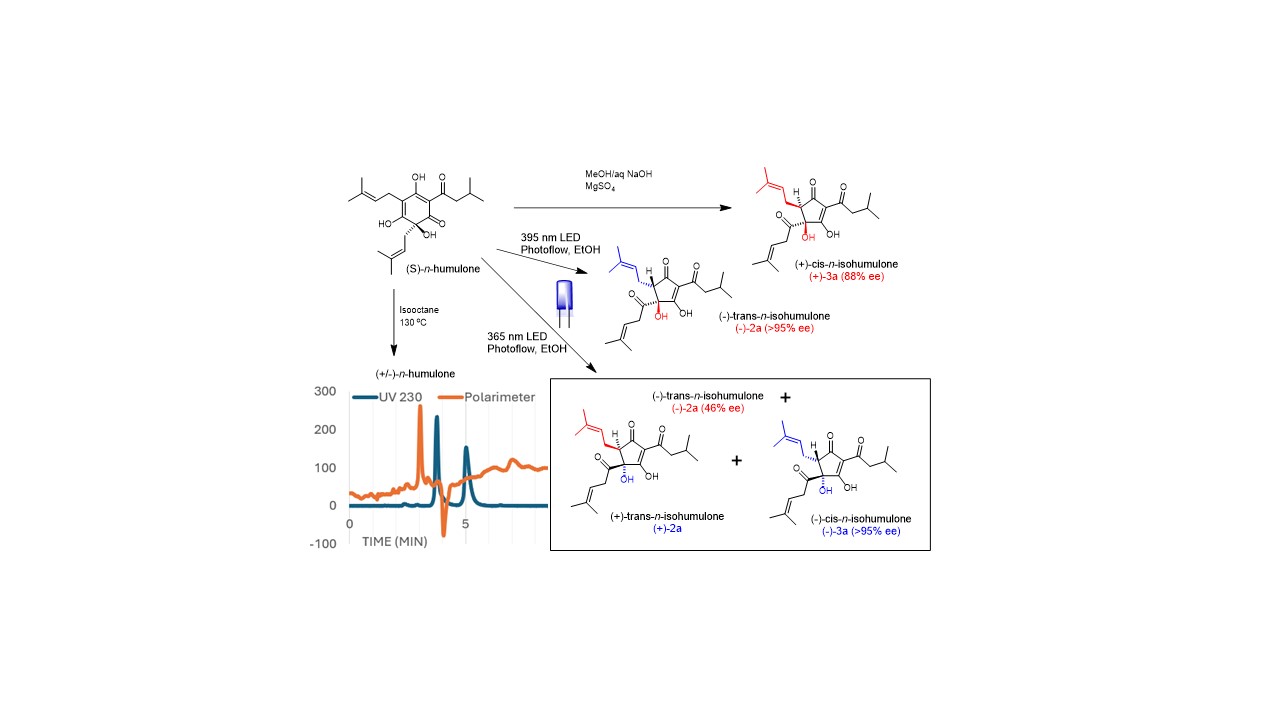
The enantiomeric composition of products obtained from isomerization of n-humulone 1a to trans- and cis-n-isohumulones 2a and 3a, respectively, was determined by chiral HPLC analysis of the isolated trans and cis isomers. Enantiomers of humulones 1 were readily resolved on a Whelk-O1 chiral stationary phase (CSP), whereas the isomeric isohumulones 2 and 3 were separated on a carbohydrate based IC-3 CSP. Magnesium catalyzed isomerization of n-humulone under basic conditions gave mixtures or trans- and cis-n-isohumulones exhibiting an increasing preference for the cis isomer at lower temperatures. At either 10 oC in CH2Cl2/H2O or reflux in methanol-water, the trans-(-) (4S,5S)-2a isomer was obtained in greater than 95% ee, while cis-3a exhibited 88% ee of the (+)-(4S,5R) enantiomer. Precision continuous flow photochemical isomerization using 395 nm LEDs provided trans-(-)-2a in greater than 95% ee in an isolated yield of 93%. However, photochemical isomerization with 365 nm LEDs gave a mixture of isomers consisting of 46% ee for the trans-(-)-2a and greater than 95% ee for the cis-(-)-(4R,5S)-3a enantiomer. The photochemically obtained (-)-3a isomer has the opposite absolute configuration compared to thermal isomerization. An oxadi-π-methane rearrangement is proposed to account for the formation of isohumulone isomers under photochemical conditions.
Keywords:
humulone
; isohumulone
; photochemistry
; continuous flow synthesis
; chiral HPLC
; precision photochemistry
; oxadi-π-methane rearrangement
; ODPM
Copyright: This open access article is published under a Creative Commons CC BY 4.0 license, which permit the free download, distribution, and reuse, provided that the author and preprint are cited in any reuse.


