
Submitted:
07 July 2026
Posted:
07 July 2026
You are already at the latest version
Abstract
Traditional educational assessment systems have primarily relied on episodic, institutionally confined models, such as examinations, grades, and static credentials, that capture isolated learner performance. However, learning is a continuous process increasingly distributed across digital platforms, workplaces, collaborative networks, and AI-mediated environments, highlighting a widening gap between learning processes and traditional assessment practices. Recent advances in artificial intelligence, learning analytics, multimodal analytics, learner modeling, and semantic interoperability now support scalable interpretation of varied learning evidence across contexts and over time. This paper introduces the AI-Mediated Continuous Assessment Infrastructure (AIM-CAI), a socio-technical framework for continuously inferring learner competencies from distributed evidence generated in educational, professional, and digital domains. AIM-CAI reconceptualizes assessment as a continuous, probabilistic process, moving beyond isolated evaluative events. The framework integrates distributed evidence systems, evidence serialization mechanisms, semantic translation layers, probabilistic learner models, dynamic competency profiles, and federated governance architectures to support scalable interpretation of learning while preserving privacy, accountability, and learner agency. The paper examines how continuous assessment can transform credentialing, lifelong learning, institutional roles, interoperability, and governance in AI-mediated education. It further outlines a research agenda to address key psychometric, ethical, and governance challenges, including validity, algorithmic bias, surveillance risks, semantic instability, and ownership of learning evidence.
Keywords:
AI in education (AIED)
; AI-mediated assessment
; AI-mediated continuous assessment infrastructure (AIM-CAI)
; continuous assessment
; educational measurement
; learning
1. Introduction
Human learning unfolds continuously across contexts, interactions, workplaces, digital environments, and social experiences. Within higher education, assessment plays the critical role of evaluating student knowledge, confirming learning outcomes, and validating achievement levels. Traditional educational assessment, however, remains largely organized around episodic and institutionally bounded evaluative events designed to capture isolated performances at discrete moments in time. Learners complete examinations, assignments, projects, multiple-choice questions, essays, short-answer questions, and quizzes that are translated into grades, transcripts, and credentials intended to represent competence and achievement. Although traditional assessment systems have dominated formal education for more than a century, they increasingly reflect a growing mismatch between the continuous, contextual, and developmental nature of learning and the static, event-based structures through which learning is assessed and certified. In addition, traditional assessments often fail to capture the full spectrum of student learning, including critical thinking, problem solving, communication, and collaborative skills, raising broader questions about the pedagogical value and validity of high-stakes examinations [1].
This mismatch reflects a fundamental historical and infrastructural tension between continuous, distributed models of human learning and the episodic institutional systems designed to measure and credential it. Modern assessment systems emerged within industrial-era educational institutions, shaped by priorities of standardization, administrative scalability, and bureaucratic efficiency [2,3]. The broader industrial context imposed significant constraints: large-scale control and information processing were limited by technical and organizational factors [4]. As a result, assessment was reduced to periodic, manageable snapshots of student performance, rather than enabling continuous or multidimensional evaluation [5]. Under these conditions, educational institutions adopted episodic assessment architectures organized around periodic evaluative events that could be administered, scored, archived, and governed efficiently across large populations [6,7].
Developments across educational measurement, formative assessment, summative assessment, authentic assessment, situated learning, and learning sciences have repeatedly identified important limitations of episodic assessment systems. Existing assessment structures often capture isolated performances rather than developmental trajectories, provide delayed and limited feedback, inadequately represent authentic competency, and remain constrained by institutional boundaries that fail to capture learning occurring across contexts and time [8,9,10,11]. By contrast, research on situated learning and authentic assessment further suggests that meaningful competence frequently develops through participation in contextualized social and professional activity rather than through isolated demonstrations of procedural recall [12,13]. Yet traditional transcripts and grades remain largely disconnected from these broader ecosystems of learning and development because they do not fully reflect the ongoing processes of learning and development across various contexts.
Learning unfolds across interconnected physical, digital, workplace, and social environments, producing forms of evidence that extend far beyond traditional examinations and assignments. These environments generate rich process-oriented evidence streams documenting how learners read, write, revise, collaborate, solve problems, interact with simulations, and engage across distributed digital ecosystems. Historically, however, educational assessment systems lacked the technical and organizational capacity to capture, interpret, and integrate such heterogeneous evidence at scale [8].
Although Artificial Intelligence (AI) might be framed as the solution to contemporary assessment challenges, the more important transformation is infrastructural: advances in computational systems are reshaping the feasibility conditions that historically constrained assessment to episodic forms of evaluation. Advances in AI, learning analytics, multimodal analytics, learner modeling, natural language processing, and distributed computation are fundamentally changing the feasibility conditions of assessment itself. These technologies reduce many of the operational constraints, including resource limitations, logistical barriers, standardization requirements, and scalability challenges, that have constrained educational systems to episodic assessment architectures. As a result, AI-mediated inferential systems enable the longitudinal and probabilistic interpretation of heterogeneous evidence streams across contexts and time [14].
These developments create conditions for continuous assessment infrastructures capable of representing learning as developmental, contextual, and distributed rather than static and event-based. At the same time, they introduce substantial governance challenges involving privacy, semantic interoperability, algorithmic bias, learner agency, institutional control, predictive profiling, and pervasive surveillance [15]. Consequently, the emergence of AI-mediated continuous assessment raises infrastructural questions that extend far beyond technical capability alone, encompassing governance, accountability, ownership of learning evidence, and the future architecture of educational systems themselves.
This paper proposes the AI-Mediated Continuous Assessment Infrastructure (AIM-CAI), a conceptual and socio-technical framework designed to guide the development of continuous, AI-mediated assessment ecosystems. An AI-mediated continuous assessment infrastructure is defined as a distributed system capable of continuously generating, interpreting, translating, and governing evidence of learner development across contexts and over time. Rather than conceptualizing assessment as a centralized platform or universal learner database, AIM-CAI reconceptualizes assessment as a continuous, inferential, distributed, probabilistic, and longitudinal process operating across heterogeneous learning environments. AIM-CAI is structured as a layered and federated architecture composed of distributed evidence systems, continuous evidence serialization, semantic translation layers, probabilistic learner models, dynamic competency profiles, and governance infrastructures designed to support interoperability, privacy, accountability, and learner agency. Collectively, these layers create the possibility for assessment systems that move beyond static and episodic institutional models toward infrastructures capable of continuously interpreting learning across contexts, interactions, and temporal scales. As AI-mediated systems increasingly support the generation, translation, and probabilistic interpretation of distributed learning evidence, assessment may become more deeply embedded within the broader ecosystems in which learning is developed, recognized, and supported. The implications of AIM-CAI extend beyond technical innovation alone, requiring new governance models capable of addressing interoperability, trustworthiness, ethical stewardship, semantic instability, ownership of learning evidence, and algorithmic accountability within continuous assessment ecosystems. Accordingly, this paper advances a broader research agenda for the development of equitable, interpretable, and socially accountable infrastructures for AI-mediated continuous assessment.
This manuscript is organized into seven sections. Section 2 examines the limitations of episodic assessment systems and the historical, psychometric, and institutional conditions that shaped their development. Section 3 explores how advances in artificial intelligence, learning analytics, multimodal analytics, blockchain technologies, and learner modeling are reshaping the feasibility conditions of continuous assessment. Section 4 introduces the proposed AI-Mediated Continuous Assessment Infrastructure (AIM-CAI) framework, while Section 5 examines the governance, interoperability, and trust architectures required to support continuous inferential ecosystems responsibly. Section 6 considers the broader implications for educational institutions, credentialing systems, and lifelong learning. Finally, Section 7 outlines a comprehensive research agenda addressing unresolved psychometric, technical, governance, and sociotechnical challenges.
2. The Limits of Episodic Assessment
Traditional educational assessment systems are organized primarily around episodic models of evaluation in which learning is measured through discrete events such as quizzes, assignments, examinations, essays, projects, class participation, and final grades. These assessments are typically administered at predetermined intervals and summarized through static institutional records such as transcripts and grade point averages (GPAs). Although this paradigm has dominated formal education for more than a century, scholars across educational measurement, formative assessment, authentic assessment, and learning sciences have increasingly expressed concern that episodic assessment structures provide limited representations of learning and competency development [1,9].
One major limitation of episodic assessment is that it reduces learning to disconnected evaluative moments. For decades, scholars across educational measurement, authentic assessment, formative assessment, summative assessment, and the learning sciences have argued that traditional assessment systems frequently fail to capture the developmental, contextual, and socially situated nature of learning. Much of 20th-century assessment practice emerged from behaviorist and psychometric traditions that conceptualized learning as the accumulation of discrete knowledge components, measurable through standardized and objective testing procedures [10]. Within this paradigm, assessment became closely associated with classification, ranking, accountability, and social efficiency rather than with supporting ongoing learning processes.
Critics of traditional testing models have long argued that assessments emphasizing short-term performance on decontextualized tasks often fail to represent meaningful understanding, adaptive expertise, collaboration, creativity, or the ability to transfer knowledge across contexts [8,11]. Similarly, formative assessment scholars have emphasized that learning develops continuously through interaction, feedback, revision, and participation rather than through isolated demonstrations captured at infrequent intervals [9]. As a result, episodic assessment systems built around infrequent measurement events often produce narrow, temporally constrained, and incomplete representations of learner competence.
The episodic structure of assessment also contributes to persistent limitations in feedback and instructional support. Black and Wiliam [9] demonstrated that learning improves substantially when assessment is integrated into instructional processes and used to provide timely feedback that informs subsequent learning activity. They pointed out that even frequent classroom testing often fails to function formatively because feedback is not used to inform next steps, rather than focusing primarily on the timing problem of summative versus formative. However, traditional summative systems frequently delay feedback until instructional sequences have concluded, limiting learners’ ability to revise misconceptions or improve performance. Hattie and Timperley [16] similarly emphasized that effective feedback depends on reducing the gap between current understanding and desired performance. However, they highlighted that assessment is too often used retrospectively rather than prospectively, suggesting that episodic systems function primarily as retrospective judgments rather than as prospective supports for learning.
A second major critique concerns the weak alignment between episodic assessment and authentic competency. Wiggins [11] suggested that many traditional assessments are fundamentally decontextualized because they evaluate isolated skills or factual recall in ways that differ substantially from the complex, messy, ill-structured problems encountered outside formal classrooms. More broadly, authentic assessment scholars have argued that recall-based testing frequently diverges from the forms of understanding, judgment, and performance required in professional and real-world contexts [17]. As a result, traditional examinations often reward procedural test-taking proficiency rather than adaptive and transferable competence.
This critique is reinforced by situated learning theories, which conceptualize learning as fundamentally contextual and social rather than abstract and decontextualized. Lave and Wenger [13] noted that learning occurs through participation in communities of practice in which individuals gradually develop expertise through authentic social and professional engagement. They suggest that school-based learning often produces knowledge that is about practice rather than constituted through genuine participation. Assessment systems that isolate learners from meaningful contexts risk measuring only narrow forms of procedural or declarative knowledge while overlooking broader dimensions of participation, collaboration, adaptation, and applied problem-solving.
Educational measurement scholars have also highlighted the inferential limitations of episodic assessment. Pellegrino et al. [8] conceptualized assessment as a process of evidentiary reasoning involving interactions among cognition, observation, and interpretation. Effective assessment, therefore, depends on coherent alignment between models of learning, the tasks used to elicit evidence, and the interpretive frameworks used to draw conclusions about competence. However, episodic assessment systems often rely on limited observations collected at isolated points in time, making it difficult to generate valid inferences regarding developmental growth or complex competencies [8].
Programmatic assessment models, such as Schuwirth and Van der Vleuten’s Programmatic Assessment Framework [18], Twenty-First Century Skills Assessment Frameworks [19], and Competency-Based Education (CBE) Assessment Models [20], emerged partly to address these limitations. Van der Vleuten and Schuwirth [21] implied that no single assessment event can adequately capture professional competence, particularly within complex domains such as medicine. Instead, a valid assessment requires aggregating multiple low-stakes observations collected across contexts, evaluators, and time. Van der Vleuten et al. [22] further proposed that meaningful judgments about learner competence should emerge from longitudinal evidence accumulated across diverse assessment activities rather than isolated high-stakes examinations. These approaches reflect growing recognition that competency development is inherently continuous and cannot be fully represented through episodic snapshots alone.
Traditional assessment systems are also institutionally bound in ways that limit their ability to capture learning that occurs outside formal educational environments. Contemporary learners increasingly develop competencies through workplace participation, collaborative networks, online communities, self-directed learning activities, and informal environments extending beyond classrooms and semester-based course structures. Yet traditional transcripts and grades remain tied primarily to institution-specific courses and time-based credit systems. Consequently, many meaningful forms of learning remain invisible within formal credentialing structures. Although portfolios, micro-credentials, and alternative credentialing systems have emerged to address these limitations, they often remain fragmented and disconnected from broader educational infrastructures [23,24].
The dominance of episodic assessment should not be interpreted solely as a pedagogical preference. Historically, educational systems have operated under significant logistical and operational constraints that made continuous assessment impractical at scale. Rich evaluation of learning requires sustained observation, interpretation of multidimensional evidence, and ongoing feedback processes that are difficult for human educators to maintain across large populations. Consequently, educational institutions adopted batch-processing models of assessment organized around periodic evaluative events that could be efficiently administered, scored, archived, and governed. Episodic assessment, therefore, emerged not only from particular theories of learning and measurement but also from the infrastructural realities of industrial-scale education systems.
The growing distribution of learning across institutions, platforms, and informal environments also raises significant challenges regarding the verification, portability, and governance of learning records and credentials. To address these challenges, blockchain technologies have received growing attention within educational research as potential infrastructures for managing distributed learning records, credential verification, and trusted assessment ecosystems. Because blockchain systems operate through decentralized and immutable ledgers, they offer potential mechanisms for verifying educational credentials, supporting learner-controlled records, and reducing dependence on centralized institutional authorities [25]. These capabilities are particularly relevant as learning increasingly occurs across distributed digital, institutional, and workplace environments that require more interoperable and portable forms of credentialing and evidence management. However, blockchain technologies do not resolve many of the broader challenges associated with AI-mediated continuous assessment infrastructures. Blockchain-based assessment and credentialing systems may improve transparency, traceability, and verification, but they also raise substantial concerns about scalability, governance, privacy, fairness, and technical complexity. Existing digital credential systems remain vulnerable to fraud, tampering, and security breaches, particularly when managed through centralized certificate authority ecosystems whose trust models have become increasingly strained [26]. However, decentralized verification mechanisms alone cannot ensure the validity, interpretability, or ethical governance of learning evidence. Accordingly, blockchain technologies should not be understood as standalone solutions to educational assessment challenges but as potential infrastructural components within broader federated ecosystems for managing trust, verification, interoperability, and learner-controlled evidence across continuous assessment environments.
Taken together, these considerations reveal significant tensions between traditional assessment structures and contemporary understandings of learning, competency, and human development. Emerging research in formative assessment, authentic assessment, situated learning, programmatic assessment, summative assessment, and educational measurement increasingly demonstrates that meaningful evaluation requires richer, more contextualized, and more continuous forms of evidence than episodic systems typically provide. These limitations create the foundation for reconsidering assessment not as a sequence of isolated evaluative events but as an ongoing process of interpreting learner development across contexts and time. These limitations collectively motivate the need for infrastructures capable of continuously generating, interpreting, and governing evidence of learner development across contexts and time.
3. AI Changes the Feasibility Conditions for Assessment
The transition from episodic assessment toward more continuous and embedded forms of evaluation is not simply a pedagogical shift; it is also a technological and infrastructural one. Historically, educational systems relied on periodic assessments partly because continuously observing, interpreting, and documenting complex learning processes across large populations was operationally impractical. Instructors could evaluate only a limited number of performances, typically through assignments, presentations, examinations, and other discrete artifacts that could be manually reviewed and archived at scale. As a result, assessment systems became organized around isolated evaluative events.
Advances in AI, learning analytics, educational data mining, natural language processing, and multimodal learning analytics increasingly reduce many of the operational constraints that limit assessment to episodic forms of evaluation. These technologies enable scalable interpretation of rich and heterogeneous evidence streams generated through authentic learning activities, making it increasingly feasible to conceptualize assessment as an ongoing process of evidentiary reasoning embedded within learning environments rather than as a sequence of isolated testing events.
This transition should not be framed in technologically deterministic terms. AI does not automatically produce more equitable, valid, or learner-centered assessment systems, nor does it provide direct access to learner cognition. Rather, AI-mediated systems increase the capacity to probabilistically interpret complex, longitudinal evidence streams across contexts and time. The significance of these developments lies less in automation itself than in the changing feasibility conditions of continuous inferential assessment.
3.1. Generative AI, Learning Analytics, and Multimodal Evidence
Contemporary digital learning environments generate rich evidence of learner activity. Unlike traditional assessments that primarily capture isolated responses or final products, modern educational systems can collect process-oriented traces documenting how learners write, revise, collaborate, solve problems, navigate simulations, and interact with digital tools. Research in learning analytics and educational data mining has focused extensively on how these digital traces can support richer interpretations of learning processes and learner development [27,28]. These environments do not merely generate larger volumes of educational data; they generate forms of observable evidence that can support more sophisticated inferential models of learner development.
One important area of development involves advances in natural language processing and writing analytics. Earlier automated writing systems focused primarily on surface-level linguistic features such as grammar and spelling. More recent approaches utilize linguistic, semantic, and discourse-level analyses to support probabilistic interpretations of comprehension, reasoning, cohesion, and metacognitive strategy use. Research in writing analytics demonstrated that linguistic, semantic, and discourse-level patterns in learner writing can support probabilistic inferences about writing quality, conceptual understanding, and cognitive strategy use [29,30]. Intelligent writing support systems such as Writing Pal further demonstrated how natural language processing could simultaneously provide adaptive feedback and generate evidence about learner strategies and writing processes [31]. Collectively, these developments illustrate how language itself can function as a continuous evidence stream reflecting evolving cognitive and metacognitive activity rather than merely serving as a final product to be evaluated retrospectively.
Similar developments have emerged in dialogue, discourse, and collaborative learning analytics. Dialogue-based intelligent tutoring systems such as AutoTutor demonstrated that conversational interaction itself can serve as evidence for conceptual understanding, explanatory reasoning, and misconception detection during learning activities [32]. Rather than evaluating only final responses, these systems analyze conversational turns, semantic similarity, and patterns of explanation in real time. More recent collaborative learning analytics research extends these approaches to peer interaction and group learning contexts, where machine learning and sequence analysis techniques examine patterns of participation, collaborative reasoning, and knowledge construction across extended interactions [27]. Collectively, these approaches reflect a broader transition from static outcome measurement toward continuous interpretation of process-oriented learning activity.
Advances in multimodal learning analytics (MMLA) further expand the range of evidence available for educational interpretation. MMLA researchers argue that learning is simultaneously cognitive, social, affective, and embodied, and therefore cannot be fully understood through isolated test responses alone [33,34]. Contemporary multimodal systems integrate evidence from speech, gaze, movement, physiological signals, collaborative interaction, video analysis, and digital activity logs to examine dimensions of learner engagement, cognitive load, emotional response, collaboration, and self-regulation across extended learning processes. For example, eye-tracking systems have been used to examine attention allocation during complex problem-solving activities, while process-trace analytics in simulations and virtual laboratories allow researchers to analyze how learners navigate tasks, test hypotheses, and regulate learning behavior over time [35,36].
The significance of these developments lies not merely in the volume of data collected but in the interpretability of process-level evidence. Educational systems are no longer restricted to evaluating isolated outputs such as final examination scores or completed essays. Instead, contemporary learning environments can capture sequences of learner actions, revisions, decisions, interactions, and strategic behaviors, providing richer insight into learning trajectories and competency development. AI systems function as interpretive layers that organize and model these heterogeneous traces, enabling forms of longitudinal evidence accumulation and competency inference that were historically difficult to sustain at scale.
3.2. Advances in Learner Modeling and Embedded Assessment
Although recent advances in generative AI have accelerated interest in embedded assessment, the theoretical foundations for continuous inferential assessment predate contemporary large language models by several decades. Research in intelligent tutoring systems, learner modeling, evidence-centered design, and stealth assessment established many of the conceptual principles underlying contemporary AI-mediated assessment systems.
One of the most influential frameworks is Evidence-Centered Design (ECD) [37,38]. The ECD framework conceptualizes assessment as a process of evidentiary reasoning that connects observations of learner behavior to probabilistic claims about underlying competencies. Rather than viewing assessment as a collection of isolated items, ECD emphasizes alignment among the competencies being assessed, the evidence needed to support interpretive claims, and the tasks designed to elicit that evidence. Within this framework, assessment becomes fundamentally inferential. Learner competencies are treated as latent constructs that cannot be directly observed, requiring probabilistic inference from observable behaviors to underlying cognitive states.
Stealth assessment extends these principles by embedding evidence collection directly within learning activities and digital environments [39,40]. In stealth assessment systems, learners are not interrupted by formal testing events. Instead, evidence is gathered continuously as learners interact with video games, simulations, tutoring systems, or collaborative tasks [41]. These environments capture process-oriented telemetry data, which are then interpreted using evidence models and learner models to update estimates of competency in real time. Notably, stealth assessment dissolves the traditional boundary between learning and evaluation by embedding assessment directly within authentic activity rather than isolating it as a separate evaluative event.
Research in intelligent tutoring systems similarly contributed to advances in learner modeling and adaptive assessment. Early cognitive tutors developed by Koedinger, Aleven, and colleagues used cognitive models and Bayesian Knowledge Tracing to estimate students’ mastery of specific knowledge components during problem-solving [42]. These systems continuously update learner models based on patterns of success, failure, hints, and solution paths, enabling adaptive feedback and personalized instructional support. Although many early systems focused on relatively constrained domains such as algebra, they demonstrated the feasibility of continuously updating probabilistic models of learner understanding during interaction rather than relying solely on post hoc testing.
More recent AI-driven systems extend these approaches into increasingly open-ended environments. Machine learning techniques now support the analysis of complex simulations, collaborative dialogue, writing processes, coding behavior, and multimodal interaction traces. Educational AI systems can increasingly identify patterns associated with conceptual understanding, self-regulated learning, collaboration quality, and strategic problem-solving across extended temporal sequences. It is worth noting that these systems do not eliminate uncertainty or produce perfect representations of learning. Instead, they increase the capacity to interpret rich evidence streams probabilistically and longitudinally across diverse forms of learner activity.
3.3. From Data Collection to Competency Inference
The growing capacity to collect educational data does not, by itself, constitute meaningful assessment. One of the most important distinctions emerging in the literature is the difference between gathering learner data and making valid inferences about learner competence. Raw behavioral traces, clickstreams, keystrokes, dialogue transcripts, or biometric signals are not equivalent to educational understanding. Assessment remains fundamentally a process of evidentiary reasoning that requires theoretically grounded interpretation [8].
This distinction is central to the Knowing What Students Know educational assessment triangle proposed by Pellegrino et al. [8], which conceptualizes assessment as an interaction among cognition, observation, and interpretation. Observations alone cannot directly reveal underlying competencies, because learning processes and mental representations remain latent and only partially observable. Consequently, educational assessment always involves uncertainty and inference. AI-mediated assessment systems, therefore, should not be understood as direct readouts of learners’ knowledge, but rather as probabilistic models that continuously update their interpretations of learners’ competence based on accumulating evidence.
Contemporary computational psychometrics increasingly relies on probabilistic approaches such as Bayesian networks, Hidden Markov Models (HMMs), and dynamic learner modeling to manage this uncertainty [43]. Rather than generating static achievement scores based on isolated performances, these approaches construct evolving competency profiles that are updated over time as additional evidence becomes available. Longitudinal evidence accumulation allows systems to distinguish persistent patterns of understanding or misconception from temporary fluctuations in performance, guessing, or contextual variability. In this sense, AI expands the feasibility of continuous competency inference not by eliminating uncertainty, but by increasing the ability to synthesize heterogeneous evidence across contexts, modalities, and time.
3.4. Securing the Evidentiary Chain: Blockchain in Assessment
The expansion of digital, online, and hybrid learning environments has intensified concerns regarding credibility, integrity, and governance of assessment systems. As learning and credentialing activities become distributed across platforms, institutions, and informal environments, traditional centralized infrastructures face growing challenges in maintaining trusted records of learner achievement and assessment activity. Centralized assessment systems, whether paper-based or digitally mediated, remain vulnerable to data tampering, fragmented credential management, opaque verification processes, and institutional silos that limit portability and interoperability of learning records [44].
Blockchain technologies have received growing attention as potential infrastructures for securing and verifying distributed assessment evidence. Unlike centralized databases that rely on institutional control, blockchain systems use cryptographic verification and distributed consensus mechanisms to maintain persistent and tamper-resistant records across networked participants [45]. Within educational contexts, blockchain systems offer potential mechanisms for establishing trusted records of learning events, assessment outcomes, credentials, and learner activity across institutional boundaries. Once assessment records are encoded within distributed ledgers, cryptographic hashing and consensus protocols make retrospective modification difficult without detection, thereby supporting greater traceability and verification of educational records [46].
These capabilities are particularly relevant within continuous assessment ecosystems, where evidence of learning may emerge across diverse contexts, platforms, and time scales rather than within isolated institutional courses alone. Blockchain-based systems have therefore been explored as mechanisms for supporting portable and longitudinal learning records that extend beyond traditional transcripts. For example, systems such as the Blockchain of Learning Logs (BOLL) store fine-grained learning activities and interaction histories within distributed ledgers to support lifelong learning and cross-institutional evidence management [46,47]. Blockchain infrastructures such as BEMPAS may also support automated credentialing, access control, and verification processes through smart contracts that execute predefined rules governing assessment and credential management [48].
At the same time, blockchain technologies do not resolve many of the broader challenges associated with AI-mediated continuous assessment infrastructures. Significant limitations remain regarding interoperability, scalability, governance, privacy, and institutional implementation. Most blockchain-based educational systems currently operate as fragmented and independently developed ecosystems with limited standardization and cross-platform compatibility [47]. Scalability also remains a major concern, particularly in environments that generate large volumes of continuous assessment data requiring distributed verification and storage [49]. In addition, educational institutions often lack the technical expertise and governance frameworks necessary to manage cryptographic infrastructures and distributed consensus systems effectively [45].
Accordingly, blockchain technologies should not be understood as standalone solutions to educational assessment challenges, but rather as potential trust and verification infrastructures within broader federated ecosystems for managing distributed learning evidence, credential portability, and longitudinal learner records across continuous assessment environments.
Collectively, these developments suggest that educational assessment is increasingly transitioning from a system organized around isolated evaluative events toward infrastructures capable of continuously generating, interpreting, and governing evidence of learner development across contexts and time. Advances in AI, learning analytics, multimodal analytics, and embedded assessment architectures are reshaping the technical possibilities of educational evaluation. Research across intelligent tutoring systems, stealth assessment, writing analytics, dialogue systems, and learner modeling demonstrates that learning environments can support continuous and process-oriented evidence collection while simultaneously generating probabilistic interpretations of learner development. These developments do not resolve longstanding concerns regarding validity, fairness, transparency, or governance. However, they significantly alter the operational constraints that historically limited educational systems to episodic assessment models.
As artificial intelligence systems increasingly contribute to the generation and interpretation of assessment evidence, the focus moves beyond mere prediction to the governance of evidence interpretation, the representation of uncertainty, and the formulation of educational decisions. Consequently, continuous assessment infrastructures must incorporate mechanisms to ensure transparency, traceability, accountable oversight, learner agency, and institutional responsibility whenever AI-mediated inferences support judgments regarding learner competency and development [50].
4. AI-Mediated Continuous Assessment Infrastructure (AIM-CAI)
The limitations of episodic assessment and the emergence of AI-enabled learner modeling, learning analytics, blockchain-enabled AI assessment capabilities, multimodal assessment tools, and embedded assessment systems collectively suggest a growing need for a new next-generation assessment architecture. Existing educational systems continue to rely heavily on institutionally bounded, event-based measurement structures designed for administrative efficiency rather than continuous interpretation of learner development. At the same time, advances in learning analytics, multimodal analytics, intelligent tutoring systems, natural language processing, blockchain technologies, and probabilistic learner modeling increasingly make it feasible to capture and interpret learning evidence continuously across contexts and time. This convergence points toward the emergence of an AI-mediated continuous assessment infrastructure.
Figure 1 presents the proposed layered architecture for the AI-Mediated Continuous Assessment Infrastructure (AIM-CAI). The model illustrates how distributed evidence sources generate continuous streams of learning activity that are serialized into interoperable representations, interpreted through AI-mediated translation layers, evaluated through probabilistic inferential systems, and synthesized into dynamic competency profiles governed through federated and privacy-preserving architectures. AIM-CAI is conceptualized here as a layered, federated, and probabilistic ecosystem composed of interacting evidence, interpretation, inferential, competency, and governance architectures. Figure 1 illustrates this layered infrastructure model. This framework should not be conceived as a singular centralized platform, a universal repository of competencies, or an all-encompassing system for monitoring learners. In this model, distributed sources of evidence produce ongoing streams of authentic learning activity, which are converted into interoperable formats, interpreted via AI-driven translation layers, assessed using probabilistic inference systems, and integrated into dynamic representations of competency managed by federated, privacy-preserving architectures.
This conceptual framework rests on six foundational principles. First, assessment becomes continuous rather than episodic, emphasizing the accumulation of longitudinal evidence over isolated evaluative events. Second, assessment remains fundamentally inferential, requiring probabilistic reasoning from observable behaviors to latent competencies [8]. Third, evidence becomes distributed across institutional, social, workplace, and informal learning environments. Fourth, competency estimation becomes probabilistic and uncertainty-aware rather than deterministic. Fifth, competency representations become longitudinal and developmental rather than static archival records. Finally, assessment increasingly functions as infrastructure embedded across educational ecosystems rather than as isolated testing instruments.
The following subsections elaborate on each layer of the framework illustrated in Figure 1, including distributed evidence generation, continuous evidence accumulation, AI-mediated semantic interpretation, probabilistic competency inference, psychometric perspectives, and governance and federation mechanisms.
4.1. Distributed Learning Evidence
Within this AI-mediated continuous assessment infrastructure, evidence is generated continuously across heterogeneous learning environments. Traditional assessment systems, however, largely restrict valid evidence to institutionally sanctioned artifacts such as examinations, assignments, and course grades. In contrast, the proposed AIM-CAI framework assumes that meaningful evidence of learning arises from a diverse array of authentic activities and contexts, including learning management systems, AI tutoring interactions, collaborative dialogue, simulations, workplace experiences, portfolios, games, mobile learning environments, and multimodal interaction traces.
It is essential to recognize that heterogeneous learning environments are not limited to digital or online spaces. Learning evidence may emerge across physical classrooms, laboratories, workplaces, collaborative discussions, clinical practice, simulations, field experiences, maker spaces, and informal social interactions, as well as in digitally mediated environments. While AI-mediated continuous assessment infrastructures frequently rely on digital systems to capture, serialize, and interpret evidence, the framework proposed here does not assume that meaningful learning occurs only online. Instead, the AI-mediated continuous assessment increasingly involves integrating evidence across physical, digital, and hybrid environments through combinations of human observation, institutional systems, multimodal sensing, portfolio artifacts, conversational interaction, and computational interpretation.
At the same time, integrating evidence across physical, digital, and hybrid environments introduces substantial technical, psychometric, and governance challenges. Many meaningful forms of learning remain only partially observable, difficult to serialize computationally, or dependent upon contextual human interpretation. Offline collaboration, informal mentorship, embodied practice, and social participation often resist standardized capture and may generate fragmented, incomplete, or ambiguous evidence streams. Furthermore, the availability and quality of evidence vary substantially across institutional settings, technological infrastructures, and learner populations, raising concerns regarding equity, representational bias, and uneven visibility within continuous assessment systems. Consequently, AIM-CAI should not be interpreted as assuming comprehensive observability of learning, but rather as supporting probabilistic and partial interpretation of distributed evidence under conditions of uncertainty.
Research in workplace-based assessment increasingly demonstrates the limitations of isolated evaluative events for representing complex competencies [51]. Professional competence requires gathering evidence over extended periods and across diverse learning contexts. Electronic portfolios (e-portfolios) have therefore become increasingly important mechanisms for aggregating longitudinal evidence, reflections, artifacts, and performance records into evolving representations of learner development. Similarly, learning analytics systems routinely capture large volumes of interaction traces documenting student engagement, navigation patterns, collaborative participation, and task completion within learning management systems [52].
The expansion of educational AI and multimodal learning analytics further broadens the range of evidence available for interpretation. This expansion enables the collection and integration of diverse data streams, including behavioral logs, affective signals, emotional states, interaction traces, and physical actions (i.e., gestures). In addition, writing analytics systems, a key application of educational AI, can model revision patterns, cohesion, syntactic complexity, and metacognitive strategies used during composition [30]. Dialogue-based tutoring systems analyze conversational interaction and conceptual misunderstanding during learning activities [32]. Simulations and educational games generate detailed process traces reflecting experimentation, strategic reasoning, and self-regulated learning behaviors [39]. Multimodal systems additionally incorporate gesture, gaze, speech, physiological telemetry, and collaborative interaction data to model learning as simultaneously cognitive, social, affective, and embodied [34].
The significance of distributed evidence lies not simply in increasing the quantity of educational data but in expanding the range of authentic activity that contributes to competency inference. Learning increasingly occurs across fragmented ecosystems that extend beyond institutional boundaries. Consequently, assessment infrastructures designed exclusively around classroom-based evaluative events capture only a partial representation of learner capability and development [8,10,53].
However, distributed evidence also introduces major psychometric and infrastructural challenges. Distributed evidence streams vary substantially in reliability, interpretability, granularity, and theoretical relevance. For example, a clickstream from a learning management system is fundamentally different from a collaborative dialogue transcript, a workplace observation, an authentic learning experience, or a multimodal physiological signal. Multimodal learning analytics research repeatedly warns that behavioral and sensor data may introduce substantial construct-irrelevant variance if interpreted without sufficient theoretical grounding [34]. Consequently, distributed evidence infrastructures require interpretive systems capable of distinguishing meaningful signals from noise, contextual artifacts, and behavioral ambiguity.
4.2. Continuous Evidence Streams
A second defining characteristic of the AI-Mediated Continuous Assessment Infrastructure (AIM-CAI) is the transition from isolated assessment events toward continuous evidence streams accumulated longitudinally over time. Continuous assessment does not imply constant testing. Rather, it involves the ongoing collection and interpretation of evidence generated naturally through authentic learning activities.
Traditional assessment systems typically evaluate learners at singular moments in time, producing static representations of achievement disconnected from broader developmental trajectories. Continuous evidence infrastructures, on the other hand, conceptualize learning as an evolving process observable through temporally accumulated interaction patterns, revisions, collaborations, and problem-solving behaviors. Learning progressions research similarly emphasizes that competencies develop gradually through repeated practice, reflection, feedback, and adaptation rather than through isolated demonstrations of performance [54].
Research in learning analytics and intelligent tutoring systems increasingly demonstrates the value of temporally structured evidence. Studies using sequence mining and temporal modeling have shown that learning strategies, engagement patterns, and knowledge development can only be fully understood by examining how behaviors evolve across learning sessions [55,56]. In writing analytics, revision histories and drafting trajectories often provide richer evidence of conceptual development and metacognitive regulation than final products alone [31]. Collaborative discourse analytics similarly reveals that meaningful indicators of group problem-solving and knowledge construction frequently emerge only through the analysis of interaction sequences over time rather than isolated utterances [27]. Intelligent tutoring systems continuously update learner models based on sequences of learner actions, hint requests, errors, and strategic choices during interaction [42].
Expanded Evidence-Centered Design (e-ECD) provides an important theoretical foundation for this shift by explicitly modeling learning and developmental change within assessment architecture [57]. Unlike static assessment frameworks such as Bloom’s taxonomy [58] and SOLO taxonomy [59], e-ECD conceptualizes evidence accumulation as an evolving process in which learner competencies change over time through instructional interaction and contextual experience. This orientation aligns closely with longitudinal learner modeling approaches such as Dynamic Bayesian Networks (DBNs), which estimate evolving latent learner states across sequential time slices [60].
Continuous evidence systems introduce significant inferential complexity. Process-level data are often noisy, unstable, and context-dependent. Temporary scaffolding, fatigue, interface confusion, or environmental distractions may influence learner behavior without reflecting genuine changes in competence. Consequently, continuous evidence infrastructures cannot predict that all interaction traces constitute equally valid indicators of learning. Rather, longitudinal evidence accumulation redistributes assessment toward probabilistic interpretation under conditions of uncertainty.
4.3. AI Interpretation and Translation Layers
The AI interpretation and translation layer serves as the conceptual core of the proposed AIM-CAI infrastructure. Existing educational ecosystems are characterized by profound heterogeneity across platforms, schemas, competency frameworks, assessment systems, and institutional boundaries. Traditional interoperability approaches typically rely on predefined standards and centralized schemas such as SCORM, IMS Learning Tools Interoperability (LTI), and Experience API (xAPI). While these frameworks support technical interoperability, they also depend heavily on prior agreement regarding common standards and metadata structures. Furthermore, higher education institutions encounter a range of challenges when adopting and implementing standardized frameworks such as SCORM, LTI, and xAPI. These challenges include inflexible data modeling requirements (particularly with SCORM), difficulties adapting to evolving pedagogical approaches—such as competency-based, personalized, or experiential learning models, limited institutional expertise for setting up LTI integrations or xAPI Learning Record Stores (LRS), the absence of a unified data model (even with xAPI, institutions frequently struggle to meaningfully integrate data across platforms), and ongoing compliance concerns.
The proposed framework instead emphasizes AI-mediated semantic interoperability. AI-mediated semantic interoperability involves leveraging artificial intelligence technologies—such as machine learning (ML), natural language processing (NLP), and large language models (LLMs)—to facilitate information exchange between diverse systems, ensuring that the receiving system accurately interprets the meaning, context, and intent of the data. In this model, AI systems increasingly function as interpretive infrastructure capable of aligning heterogeneous evidence streams across contexts, tools, and competency representations without requiring universal standardization. Rather than forcing all educational systems to adopt identical competency frameworks or centralized learner repositories, AI-mediated translation layers support semantic alignment, ontology reconciliation, probabilistic mapping, and inferential compatibility across distributed ecosystems.
Similar interoperability challenges have long been addressed within healthcare informatics, where federated systems coordinate heterogeneous patient records, clinical ontologies, and diagnostic vocabularies across decentralized infrastructures. Rather than requiring all institutions to adopt identical data structures or centralize data within monolithic repositories, healthcare systems increasingly rely on semantic interoperability frameworks and ontology-mapping approaches to enable communication across locally distinct systems. Technologies such as the Resource Description Framework (RDF) and knowledge graph architectures provide mechanisms for linking and interoperating heterogeneous data across distributed environments while preserving local flexibility and contextual specificity.
Recent work in ontology alignment and semantic interoperability suggests that similar approaches may be feasible within educational systems. For example, Musa et al. [61] proposed a graph-based ontology alignment framework that integrates learning analytics data across LMSs, MOOCs, and other institutional systems through semantic mapping and reconciliation techniques. Educational infrastructures may increasingly evolve in similar ways, allowing institutions to maintain context-sensitive representations of learning, assessment, and student activity while still supporting interoperability and cross-system analytics without requiring universal standardization.
At the same time, AI-mediated semantic translation introduces substantial risks and limitations. Ontology alignment systems and large language models remain vulnerable to semantic drift, hallucinated mappings, and interpretive ambiguity [62]. Incorrect mappings between local behaviors and broader competency representations may generate invalid downstream inferences. Furthermore, semantic translation systems trained on historically biased educational data risk reproducing inequities through probabilistic classification and predictive modeling [63].
Consequently, the proposed AIM-CAI framework conceptualizes semantic interoperability as probabilistic rather than deterministic. AI-mediated interpretation layers support inferential compatibility under uncertainty rather than perfect standardization. This distinction is critical because it allows the framework to reject the assumption that future educational ecosystems will converge around a single universal learner database or globally standardized competency ontology.
4.4. Psychometric and Inferential Layer
A central challenge within AI-mediated continuous assessment infrastructure involves transforming heterogeneous streams of learner activity into defensible inferences about competence and development. Because the collection of educational data alone does not constitute a meaningful assessment. For instance, clickstreams, dialogue transcripts, revision histories, multimodal interaction traces, workplace observations, and behavioral telemetry are not direct representations of knowledge or understanding. Rather, educational assessment remains fundamentally inferential because competencies themselves are latent constructs that cannot be directly observed [8,37]. Consequently, the psychometric and inferential layers of the AIM-CAI framework are responsible for probabilistically interpreting observable evidence in relation to underlying competency models.
This inferential perspective has deep roots within educational measurement and evidence-centered design (ECD). Mislevy et al. [37] conceptualized assessment as an evidentiary argument linking observations of learner behavior to claims about underlying competencies through explicitly defined interpretive models. Similarly, Kane’s argument-based approach to validity emphasizes that assessment claims depend not only on data collection but also on the interpretive assumptions and inferential warrants that connect evidence to conclusions about learner capability [64]. Within AIM-CAI, psychometric systems therefore function not as direct detectors of learning but as probabilistic inferential infrastructures that continuously update estimates of learner competencies based on accumulating evidence across contexts and over time.
The psychometric challenges associated with continuous assessment differ substantially from those associated with traditional episodic testing environments. Conventional psychometric systems were largely designed around relatively controlled assessment conditions involving standardized tasks, fixed instruments, and bounded testing events. By contrast, AI-mediated continuous assessment infrastructures must integrate evidence originating from heterogeneous environments that vary in modality, granularity, reliability, and contextual meaning. A collaborative dialogue transcript, a simulation trace, a tutoring-system interaction, a portfolio artifact, and a workplace evaluation may each provide potentially meaningful evidence regarding learner competence, yet these forms of evidence differ substantially in interpretability and construct relevance. Thus, continuous inferential systems require mechanisms for weighting, calibrating, and contextualizing evidence rather than treating all learner data as equally meaningful indicators of competence.
This challenge is especially important because behavioral data frequently contain substantial construct-irrelevant variance. Observable behaviors may reflect interface confusion, fatigue, social dynamics, prior familiarity with digital systems, cultural communication differences, or temporary contextual conditions rather than stable underlying competencies. Research in multimodal learning analytics and computational psychometrics repeatedly warns that large-scale behavioral telemetry can easily produce invalid or misleading inferences when interpretive models are insufficiently grounded in theory [34,63]. Within AIM-CAI, the psychometric layer therefore functions partly as a filtering and interpretive mechanism that distinguishes meaningful educational signals from noise, ambiguity, and context-dependent artifacts.
The inferential layer additionally supports longitudinal competency modeling through probabilistic updating over time. Rather than generating static achievement classifications from isolated performances, contemporary learner modeling approaches increasingly utilize Bayesian networks, Dynamic Bayesian Networks, knowledge tracing systems, and temporal sequence models to estimate evolving learner states across sequential interactions [43,60,65]. Within this framework, competency estimates remain continuously revisable as additional evidence becomes available. Longitudinal evidence accumulation allows inferential systems to distinguish persistent developmental patterns from temporary fluctuations in performance while supporting more nuanced representations of learner growth, uncertainty, and contextual variation.
The AIM-CAI framework does not assume that AI systems eliminate uncertainty or produce objective readouts of learner cognition. Competency estimates remain probabilistic, partial, and dependent on the quality of both the underlying evidence and the interpretive models used to evaluate it. Consequently, uncertainty estimation becomes a foundational psychometric requirement within continuous assessment infrastructures. Inferential systems must therefore represent confidence levels, evidentiary limitations, and potential instability within competency estimates rather than presenting learner models as deterministic or final representations of capability. This probabilistic orientation is particularly important in high-stakes educational environments, where inaccurate inferences may shape learners’ opportunities, institutional decision-making, or access to educational pathways.
The psychometric and inferential layers may raise validity concerns for continuous assessment systems. Messick [66] expressed concern that validity concerns the appropriateness of interpretations and uses of assessment-based inferences rather than merely the technical properties of instruments themselves. Within continuous assessment infrastructures, validity must therefore extend beyond isolated testing events to include the ongoing interpretation of distributed, multimodal, and temporally evolving evidence streams. Future continuous assessment systems consequently require not only technical interoperability and predictive capability, but also sustained processes for psychometric calibration, interpretive auditing, uncertainty monitoring, and human oversight. Within AIM-CAI, psychometric inference remains inseparable from governance because competency representations derive their legitimacy not from data volume alone, but from the validity, transparency, and accountability of the inferential processes through which educational claims are generated.
4.5. Dynamic Competency Profiles
Within the AIM-CAI framework, competency representations take the form of dynamic profiles that evolve continuously as new evidence becomes available. In general, a competency profile is a comprehensive framework that delineates the specific skills, knowledge, behaviors, and attributes necessary for optimal performance in a given role. Unlike traditional transcripts or grade point averages, which function primarily as static archival records, dynamic competency profiles represent continuously updated probabilistic estimates of learner development.
Research in Bayesian learner modeling, knowledge tracing, and Dynamic Bayesian Networks (DBN) increasingly supports this approach. Bayesian Knowledge Tracing models estimate learner mastery probabilistically by accumulating evidence sequentially during interaction [65]. Dynamic Bayesian Networks extend these approaches by modeling temporal transitions among latent learner states while incorporating prerequisite relationships and multidimensional competency structures [60]. More recent approaches additionally integrate transformer architectures and deep sequence modeling to capture increasingly complex temporal dependencies within learner interaction data [67].
Within this framework, competencies are not treated as fixed mastery checklists or static credential categories. Instead, competency representations remain evolving, context-sensitive, probabilistic, and uncertainty-aware. Competency estimates are continuously updated as additional evidence becomes available, generating developmental trajectories rather than singular achievement classifications. This probabilistic orientation is essential because complex competencies cannot be observed directly. Educational assessment always involves evidentiary reasoning from observable behavior to latent cognitive and behavioral constructs [8]. AI-mediated competency profiles, therefore, do not provide direct measurements of learner knowledge. Rather, they generate continuously revised estimates conditioned on incomplete and heterogeneous evidence streams. Dynamic competency infrastructures also introduce substantial psychometric challenges. Onisko & Druzdzel [68] demonstrated that Dynamic Bayesian Networks are sensitive to noisy or poorly calibrated inputs, leading to deterioration in inference accuracy. In the context of educational assessment, a study [69] pointed out that poor data quality or misfit in Bayesian networks leads to unreliable conclusions. Similarly, multimodal evidence systems may generate substantial construct-irrelevant variance, threatening inferential validity [34]. Consequently, continuous competency inference depends fundamentally on high-quality evidence, coherent theoretical grounding, and careful psychometric calibration.
4.6. Governance, Federation, and Trust Architectures
Governance is not external to AI-mediated continuous assessment infrastructure; it is embedded within the infrastructure itself [70,71,72]. Because continuous assessment systems rely on the large-scale collection, interpretation, and probabilistic inference of learner evidence across distributed environments, questions related to privacy, surveillance, accountability, semantic interoperability, and algorithmic bias emerge directly from the architecture rather than as secondary policy concerns. As illustrated in Figure 1, governance therefore operates as a cross-cutting layer spanning evidence generation, interpretation, inference, and competency representation systems.
The AIM-CAI framework, therefore, favors federated and privacy-preserving infrastructures over centralized learner-surveillance architectures. Federated learning approaches increasingly demonstrate that predictive educational models can be trained collaboratively across institutions without centralizing raw learner data [73]. Instead of aggregating learner information into a single repository, federated systems distribute computation across local institutional environments while sharing only aggregated model updates or privacy-preserving outputs. This orientation aligns with broader concerns emerging across critical learning analytics scholarship regarding surveillance, behavioral normalization, algorithmic governance, and inequitable inferential systems [74,75]. These governance challenges go far beyond just technical interoperability. Continuous assessment infrastructures raise broader questions about learner agency, transparency, auditability, human oversight, semantic accountability, and how institutions control learning evidence and draw competency inferences. Therefore, governance, trust, interoperability, and federated infrastructure are explored in much greater depth in Section 5.
Taken together, the layers illustrated in Figure 1 form a conceptual model of AI-mediated continuous assessment infrastructure in which learning evidence is continuously generated across distributed environments, translated through semantic and probabilistic interpretation systems, synthesized into evolving competency representations, and governed by federated and privacy-preserving architectures. Unlike traditional assessment systems organized around isolated testing events and static institutional records, this framework conceptualizes assessment as an ongoing process of longitudinal competency inference embedded within learning ecosystems. As illustrated in Figure 1, evidence flows upward through interconnected infrastructural layers—from distributed evidence generation to competency inference—while feedback, adaptation, and governance operate continuously across the ecosystem. Importantly, the framework does not assume that AI eliminates uncertainty, standardizes all educational systems, or provides direct access to learner cognition. Rather, it positions AI as an interpretive infrastructure capable of supporting more continuous, context-sensitive, and probabilistically grounded representations of learner development across heterogeneous educational environments. In doing so, the framework reframes assessment from a discrete institutional activity into a distributed infrastructure for interpreting learning across contexts and time.
5. Governance, Trust, and Federated Infrastructure
The emergence of AI-mediated continuous assessment infrastructure raises governance challenges that cannot be resolved solely through technical capabilities. As discussed in the previous section, continuous assessment systems rely on distributed evidence generation, probabilistic learner modeling, semantic interoperability, and longitudinal competency inference operating across heterogeneous educational ecosystems. These same characteristics also introduce substantial risks related to surveillance, accountability, semantic instability, privacy, algorithmic bias, and institutional control. Consequently, governance must be understood not as an external policy layer added after deployment but as an infrastructural component embedded directly within the architecture of continuous assessment systems.
Traditional educational assessment systems concentrated governance largely within institutional boundaries. Grades, transcripts, and testing records were generated and controlled by individual institutions operating within relatively stable administrative structures. Continuous assessment infrastructures fundamentally alter this model by distributing evidence generation, interpretation, and competency inference across platforms, organizations, and contexts. As illustrated in Figure 1, evidence flows continuously through interconnected layers involving data collection, semantic translation, probabilistic inference, and dynamic competency updating. Governance, therefore, becomes a systems-level challenge involving technical standards, semantic alignment, privacy protection, accountability structures, and epistemic authority.
Governance challenges within continuous assessment ecosystems extend beyond technical accuracy to include questions of interpretation, uncertainty, authority, and educational action. Stewardship-oriented approaches emphasize the need for transparency, provenance, accountable oversight, learner agency, and institutional responsibility when AI systems participate in generating competency inferences and informing educational decisions [50].
5.1. The Governance Challenge of Continuous Assessment
Continuous assessment infrastructures create forms of educational visibility and inferential power that extend well beyond traditional testing systems. Rather than evaluating learners through isolated examinations, these systems potentially capture interaction traces, behavioral telemetry, conversational exchanges, revision histories, multimodal signals, and longitudinal learning trajectories over extended periods of time. As a result, continuous assessment infrastructures risk evolving into pervasive systems of algorithmic monitoring if governance mechanisms are not embedded directly within their architecture.
Critical learning analytics scholarship has repeatedly warned about these risks. Selwyn [75] argued that learning analytics systems often transform complex educational processes into simplified behavioral proxies optimized for computational visibility rather than pedagogical meaning. Similarly, Knox et al. [76] described how educational AI systems may contribute to ‘machine behaviourism’, in which learners increasingly adapt themselves to algorithmically preferred forms of participation and performance. Within continuous assessment environments, learners may begin regulating their own behavior in response to invisible predictive systems designed to infer competence, engagement, or risk status from continuous streams of interaction data.
These concerns align closely with broader critiques of algorithmic governmentality and surveillance capitalism. Rouvroy [77] articulated that algorithmic systems increasingly govern human behavior through predictive profiling and anticipatory classification rather than explicit institutional control. Within education, continuous assessment infrastructures risk producing persistent “data doubles” that shape how learners are categorized, supported, or restricted across educational pathways [78]. Such systems may unintentionally normalize behavioral conformity by rewarding learners whose interaction patterns align with dominant algorithmic expectations while penalizing exploratory, culturally situated, or non-linear approaches to learning.
These governance concerns are not merely ethical abstractions. They emerge directly from the infrastructural properties, such as distributed evidence collection, probabilistic inference, and longitudinal learner modeling, that make continuous assessment possible. Consequently, trustworthy continuous assessment systems require governance architectures designed explicitly around transparency, accountability, learner agency, and privacy-preserving computation [50].
5.2. Why Standards-First Architectures Are Unlikely to Succeed
One of the central governance challenges facing continuous assessment infrastructure involves interoperability across heterogeneous educational ecosystems. Historically, educational technology systems have sought interoperability primarily through standards-based architectures such as SCORM, xAPI, IMS Learning Tools Interoperability (LTI), and Caliper Analytics. These frameworks sought to standardize how educational content, learner interactions, and assessment records are represented and exchanged across systems.
However, the historical evolution of educational interoperability standards reveals persistent fragmentation and instability. SCORM, originally developed through the U.S. Department of Defense Advanced Distributed Learning (ADL) initiative, was designed primarily for browser-based learning objects and coarse-grained tracking of completion, time-on-task, and assessment scores. While SCORM standardized content packaging and sequencing, it remained fundamentally constrained by rigid course-centric architectures and limited telemetry capabilities.
The Experience API (xAPI) attempted to address these limitations by enabling fine-grained event logging across diverse learning environments through flexible “Actor-Verb-Object” statements stored within Learning Record Stores (LRSs). Yet the flexibility of xAPI simultaneously produced severe semantic fragmentation. Different developers and platforms frequently implemented inconsistent verbs, object structures, and activity representations, resulting in highly heterogeneous telemetry ecosystems lacking stable semantic equivalence. Similar fragmentation has emerged across competing interoperability initiatives such as cmi5, Caliper Analytics, and Learning Tools Interoperability (LTI).
This fragmentation reflects a broader sociotechnical reality: innovation velocity in educational technology consistently exceeds the pace of standards convergence. Formal interoperability standards require extended committee negotiation, institutional coordination, and bureaucratic ratification processes that unfold over years. Meanwhile, AI systems, learner modeling approaches, multimodal analytics, and educational platforms are evolving rapidly. Consequently, requiring all educational systems to conform to universal schemas before meaningful interoperability can occur is increasingly unrealistic.
For this reason, the proposed framework suggests that AI-mediated semantic interoperability is likely to become more viable than universal standardization. Rather than forcing all educational systems to adopt identical schemas or competency ontologies, AI-mediated translation layers increasingly support probabilistic semantic alignment across heterogeneous ecosystems. As discussed in Section 4 and illustrated in Figure 1, interoperability increasingly emerges through dynamic interpretation and ontology reconciliation rather than rigid schema compliance.
5.3. Semantic Interoperability and Translation Under Uncertainty
The shift toward AI-mediated interoperability introduces both opportunities and substantial governance risks. Semantic interoperability systems increasingly rely on semantic web technologies, such as the Resource Description Framework (RDF), the Web Ontology Language (OWL), knowledge graphs, and ontology alignment mechanisms, to reconcile heterogeneous educational representations. Recent developments in large language models and graph embeddings further enable probabilistic mapping across localized competency systems and distributed learning environments.
However, the limitations of semantic interoperability become visible particularly when examining analogous efforts in healthcare informatics. Clinical systems such as the Unified Medical Language System (UMLS) and Systematized Nomenclature of Medicine Clinical Terms (SNOMED CT) have spent decades attempting to reconcile heterogeneous clinical vocabularies and semantic structures [79,80]. Yet even within medicine—where concepts are often more stable and formally defined than educational competencies—ontology alignment systems remain vulnerable to semantic ambiguity, inconsistent categorization, and recurring alignment failures [81,82,83].
These limitations are highly relevant to educational assessment because educational competencies are often culturally situated, context-dependent, and epistemically contested. Competencies such as creativity, collaboration, critical thinking, and argumentation lack clear, consistent definitions, unlike medical diagnoses. Consequently, the framework proposed here assumes that broad interoperability across educational systems is more likely to succeed when infrastructures support probabilistic alignment among heterogeneous representations of learning and competence rather than relying upon universally standardized semantic definitions.
This distinction is critical because it reframes interoperability as a dynamic and continuously negotiated process rather than a fixed technical state. AI-mediated translation layers therefore function not as universal semantic authorities, but as probabilistic mediation systems capable of reconciling localized representations while preserving contextual variation and institutional autonomy.
5.4. Federated and Privacy-Preserving Architectures
Because continuous assessment infrastructures rely on highly sensitive and longitudinal learner data, centralized architectures introduce substantial political, legal, and ethical risks. Centralized learner databases create vulnerable targets for data breaches, intensify surveillance concerns, and concentrate institutional power over the representation of learners’ identities and competencies. As a result, federated and privacy-preserving architectures increasingly offer a more viable alternative.
Federated learning approaches enable predictive models and learner modeling systems to operate across distributed institutional environments without centralizing raw learner data. Rather than moving data into centralized repositories, federated architectures move analytic computation to local environments and share only aggregated model updates or privacy-preserving outputs. Emerging educational infrastructures such as SafeInsights1 increasingly adopt similar principles by utilizing secure enclaves, synthetic data sandboxes, and “zero-copy” analytics models that enable researchers to run analysis within protected institutional environments without extracting identifiable learner records.
These architectures parallel developments in healthcare Trusted Research Environments (TREs) and Personal Health Trains (PHTs), where sensitive patient data remain locally governed while supporting distributed computation and collaborative analysis [84]. Such systems increasingly rely on privacy-enhancing technologies, including differential privacy, federated learning, secure enclaves, and secure multi-party computation to reduce disclosure risks while preserving analytic functionality.
Federated systems are not without limitations. Differential privacy techniques often introduce tradeoffs between privacy and analytic precision, particularly for small or marginalized learner populations. Federated systems may also suffer from coordination failures, debugging difficulties, fault reproducibility problems and inconsistent telemetry generation [85]. Moreover, decentralized governance structures may diffuse accountability when erroneous or discriminatory learner inferences emerge across distributed systems [86,87].
Consequently, the framework proposed in this paper does not advocate naïve decentralization. Instead, federated architectures require coordinated governance infrastructures capable of maintaining auditability, semantic consistency, and accountability across distributed ecosystems. This may involve lightweight coordinating mechanisms capable of monitoring model lineage, tracking semantic translation drift, auditing probabilistic inferences, and triggering human review when system confidence deteriorates below acceptable thresholds.
5.5. Epistemic and Sociotechnical Risks
Continuous assessment infrastructures also raise broader epistemic and sociotechnical concerns related to educational authority, cultural representation, and algorithmic normalization. Data colonialism scholars indicate that contemporary digital systems increasingly treat human activity itself as a resource for extraction, monetization, and behavioral prediction [88]. Within education, continuous assessment infrastructures may extend this logic by transforming learning activity into persistent streams of computationally extractable behavioral data.
These concerns are especially significant because educational AI systems are frequently trained on historically biased datasets and culturally dominant linguistic patterns. As a result, automated assessment systems may undervalue non-Western rhetorical traditions, culturally situated epistemologies, or alternative forms of expression and reasoning [89,90]. Continuous assessment systems, therefore, risk reinforcing epistemic colonialism by embedding dominant assumptions about competence, communication, and legitimate knowledge directly into algorithmic infrastructures.
Alternative governance perspectives grounded in relational and decolonial approaches to data governance emphasize learner sovereignty, epistemic pluralism, and participatory design. Such approaches indicate that educational data should not be treated merely as extractable institutional property but as relational and community-embedded representations requiring collective stewardship and contextual interpretation. Within AIM-CAI continuous assessment infrastructures, this implies that local educational communities must retain meaningful authority over how competencies are defined, represented, and interpreted.
5.6. Infrastructural Governance and Trust
To address these risks, governance within AI-mediated continuous assessment infrastructures must become infrastructural rather than merely regulatory. Governance mechanisms must be embedded directly within technical architectures, semantic translation systems, inferential models, and data-sharing protocols, rather than appended solely through external policy statements.
The National Institute of Standards and Technology (NIST) AI Risk Management Framework (AI RMF)2 provides one important model for operationalizing this approach. The framework conceptualizes trustworthy AI through iterative governance functions involving Govern, Map, Measure, and Manage. Within continuous assessment ecosystems, these functions require tracing data lineage, documenting inferential assumptions, auditing algorithmic behavior, monitoring distributional drift, and establishing mechanisms for human oversight and intervention. As illustrated in Figure 1, governance therefore operates across all infrastructural layers rather than functioning as an external administrative process. A trustworthy continuous assessment infrastructure requires:
- Auditability
- Transparency
- Probabilistic uncertainty estimation
- Human override mechanisms
- Semantic accountability
- Fairness monitoring and
- Learner agency.
It is important that governance architectures remain adaptive as the educational ecosystems they govern continue to evolve rapidly. AI-mediated continuous assessment infrastructures, therefore, require governance systems capable not only of regulating current technologies but also of responding continuously to emerging forms of evidence generation, learner modeling, semantic translation, and probabilistic inference. Taken together, these considerations suggest that governance is not supplementary to continuous assessment infrastructure; it is foundational to its legitimacy, viability, and long-term sustainability.
Governance within AI-mediated continuous assessment infrastructures cannot be reduced solely to technical standards, regulatory compliance, or algorithmic auditing. Educational infrastructures are deeply sociotechnical systems shaped by institutional workflows, faculty practices, administrative structures, and learner participation. Prior research in educational technology and learning analytics repeatedly demonstrates that systems designed without sustained stakeholder involvement often fail to align with authentic educational contexts, increase faculty burden, disrupt institutional practice, or generate low levels of trust and adoption [91,92]. Hence, any continuous assessment infrastructures require participatory, human-centered governance models that involve instructors, administrators, learners, and institutional stakeholders throughout the design, implementation, interpretation, and oversight processes, rather than treating educational communities as passive recipients of externally developed AI systems.
6. Institutional and Lifelong Learning Implications
The emergence of AI-mediated continuous assessment infrastructure carries implications that extend far beyond assessment itself. Historically, educational institutions maintained near-exclusive authority over the production, interpretation, and certification of learning evidence. As of now, episodic assessment occurs primarily within institutional boundaries through formally sanctioned courses, examinations, and credentialing systems. As a result, institutions control not only instructional delivery but also the mechanisms for recognizing, documenting, and legitimizing competence. The development of continuous, distributed, and infrastructure-based assessment systems may fundamentally alter this arrangement.
As illustrated in Figure 1, AI-Mediated Continuous Assessment Infrastructure (AIM-CAI) generates and interprets evidence across heterogeneous learning environments rather than exclusively within formal institutional settings. Learning evidence may emerge through workplace participation, AI tutoring systems, collaborative online communities, simulations, portfolios, mobile learning environments, authentic learning experiences, and self-directed learning activities. Consequently, assessment no longer belongs exclusively to educational institutions. Instead, institutions increasingly become participants within broader ecosystems of competency interpretation and validation.
6.1. From Static Credentials to Continuous Credentialing
One of the most immediate implications of a continuous assessment infrastructure involves the transformation of educational credentialing systems. Traditional credentials such as transcripts, grade point averages, and course completions function primarily as static archival records summarizing isolated performances within bounded institutional contexts [53]. These records provide limited insight into longitudinal competency development, contextual performance variation, or evolving learner capabilities [8].
Continuous assessment infrastructures, in contrast, support more dynamic forms of competency representation. As discussed in Section 4, probabilistic learner models increasingly generate continuously updated competency profiles reflecting longitudinal evidence accumulation across contexts and time. Within AIM-CAI, credentialing shifts from static certification toward continuous competency interpretation, rather than representing learning as a completed event frozen within a transcript, competency representations become developmental, revisable, and continuously informed by new evidence streams.
This shift may significantly reshape how educational and professional systems interpret learner capability. Employers, institutions, and learners themselves may increasingly rely on dynamic evidence trajectories rather than singular degree completions or isolated grades. This does not imply the disappearance of degrees or institutional credentials. Instead, degrees increasingly function as one layer within broader ecosystems of competency evidence and longitudinal learner representation.
At the same time, continuous credentialing raises substantial governance challenges. Dynamic competency systems may create pressure toward perpetual evaluation and algorithmic ranking if governance architectures are insufficiently constrained. Consequently, institutions must carefully distinguish between continuous evidence interpretation and continuous surveillance. Competency representations should remain probabilistic, context-sensitive, and learner-centered rather than functioning as permanent or deterministic reputational scores.
6.2. Assessment Beyond Institutional Boundaries
The second major implication of AIM-CAI involves the decoupling of assessment from exclusively institutional environments. Historically, educational institutions maintained authority over what counted as legitimate evidence of learning because they controlled both instruction and assessment. However, as learning increasingly occurs across distributed digital ecosystems, workplaces, online communities, video streaming sites, and AI-supported environments, institutional boundaries are less able to contain meaningful competency development.
This transition is particularly visible within workforce learning and professional development contexts. Workplace-based assessment models, for instance, Programmatic Assessment by Cees van der Vleuten and Lambert Schuwirth, already rely heavily on longitudinal evidence gathered across authentic practice environments rather than isolated examinations. Similarly, AI-based tutoring systems, professional simulations, collaborative platforms, game-based learning, and self-directed online learning increasingly generate rich evidence on problem-solving, communication, collaboration, and strategic reasoning outside formal classrooms.
As continuous assessment infrastructures mature, educational institutions may therefore lose their historical monopoly over competency validation. This does not eliminate the role of institutions; rather, institutions increasingly shift from functioning as exclusive issuers of learning legitimacy toward functioning as validators, interpreters, and governors within broader competency ecosystems. Universities may increasingly contribute expertise in evidence interpretation, psychometric validation, governance, and credential integration while recognizing that learning itself occurs across distributed contexts extending beyond institutional control.
This transition also creates new opportunities for lifelong learning systems. Traditional educational structures often fragment learning into isolated phases associated with degrees, semesters, or formal programs. Continuous assessment infrastructures such as AIM-CAI instead support more persistent and longitudinal learner representations capable of extending across career transitions, reskilling efforts, and evolving professional trajectories. In this sense, competency development increasingly becomes lifelong rather than institutionally episodic.
6.3. Personalized Pathways and AI-Mediated Advising
Continuous competency inference also has important implications for personalization and learner support. Traditional educational pathways are typically organized around standardized sequences of courses and time-based progression structures designed for administrative scalability rather than individual developmental variation. Although adaptive learning systems have attempted to personalize instruction for decades, many personalization models, such as Item Response Theory (IRT) [93] and Rule-based models [94] have remained limited to narrow domains or simplistic behavioral adaptation.
AI-mediated continuous assessment infrastructures potentially support more sophisticated forms of personalization grounded in longitudinal competency inference. Within AIM-CAI (as illustrated in Figure 1), evidence generated across multiple environments feeds into dynamic learner models that continuously update estimates of learner strengths, weaknesses, developmental trajectories, and contextual performance patterns. This creates opportunities for AI-mediated advising systems capable of supporting individualized learning pathways, targeted interventions, and adaptive credentialing structures.
The AIM-CAI framework proposed here conceptualizes personalization differently from many earlier adaptive learning systems. Personalization is not driven primarily by learner preferences, demographic categories, or simplistic engagement metrics. Instead, personalization increasingly emerges through continuous competency interpretation informed by probabilistic evidence accumulation across contexts and time. In AIM-CAI, AI-mediated advising systems may help learners identify emerging strengths, developmental gaps, transferable competencies, and alternative learning opportunities aligned with evolving goals and trajectories.
At the same time, personalization infrastructures introduce substantial risks related to predictive determinism and algorithmic path dependency. Continuous competency systems may unintentionally constrain learners’ opportunities by reinforcing early probabilistic classifications or narrowing educational pathways based on predictive models. Consequently, personalized learning infrastructures require governance mechanisms that preserve learner agency, support exploratory learning, and prevent premature foreclosure of future opportunities based on incomplete or historically biased evidence.
6.4. Faculty Roles and Institutional Transformation
The successful implementation of continuous assessment infrastructures will depend heavily on whether these systems align with authentic instructional practice and institutional workflows. Educational technologies historically encounter significant barriers when systems are introduced without adequate consideration of faculty labor, institutional context, or stakeholder participation in design processes [95]. Therefore, instructors and institutional stakeholders must function not merely as users of AI-mediated assessment systems but as active participants in shaping how evidence, competency, and learner development are represented and governed within continuous assessment ecosystems.
The emergence of continuous assessment infrastructures also reshapes faculty roles and institutional responsibilities. Traditional educational systems devote substantial faculty labor to grading, administrative evaluation, and episodic performance assessment [96]. As AI-mediated inferential systems increasingly support evidence collection, pattern detection, and probabilistic learner modeling, faculty roles may shift away from routine evaluative tasks toward more interpretive, relational, and design-oriented functions. Within AIM-CAI ecosystems, faculty increasingly function as mentors, evidence interpreters, learning architects, and governance participants rather than solely as graders or content deliverers. Their expertise is critical for validating competency interpretations, contextualizing learner trajectories, designing meaningful evidence-generating experiences, and identifying situations in which algorithmic systems fail to adequately represent learner development.
This transformation extends beyond individual instructional roles to broader institutional responsibilities. Universities may increasingly shift from functioning primarily as instructional delivery systems toward serving as trusted nodes within larger learning and competency ecosystems. In this model, institutions play central roles in psychometric validation, competency governance, interdisciplinary learning design, evidence interpretation, and the integration of trusted credentials. Rather than diminishing institutional importance, continuous assessment infrastructures may increase the significance of educational institutions as governance actors responsible for ensuring that competency inferences remain valid, equitable, interpretable, and socially accountable.
At the same time, the successful implementation of continuous assessment infrastructures depends heavily on whether these systems align with authentic instructional practice and institutional workflows. Educational technologies have historically encountered substantial barriers when systems are developed without adequate consideration of faculty labor, organizational context, or stakeholder participation in design and implementation processes [91,92]. Continuous assessment infrastructures are therefore not purely technical systems, but sociotechnical ecosystems whose legitimacy and sustainability depend on meaningful participation from instructors, administrators, learners, and institutional stakeholders. Therefore, educational stakeholders must function not merely as users of AI-mediated assessment systems but as active participants in shaping how evidence, competency, and learner development are represented, interpreted, and governed within continuous assessment ecosystems.
6.5. Lifelong Competency Ecosystems
Taken together, these shifts suggest the emergence of lifelong competency ecosystems that extend beyond traditional course- and degree-based educational structures. Continuous assessment infrastructures increasingly support learner representations that persist across educational institutions, workplaces, professional communities, and self-directed learning environments. In this model, learning trajectories become continuous rather than segmented into isolated institutional episodes.
Within AIM-CAI, lifelong competency should not be interpreted as purely technical systems for optimizing workforce efficiency. As emphasized throughout Section 4 and Section 5, AIM-CAI’s continuous assessment infrastructure also raises profound governance, epistemic, and sociotechnical questions regarding who defines competence, who controls learner representations, and how algorithmic systems shape educational opportunity. Thus, the future of lifelong learning ecosystems depends not only on advances in AI and interoperability but also on governance architectures capable of preserving learner agency, epistemic pluralism, privacy, and institutional accountability.
Ultimately, the emergence of AI-mediated continuous assessment infrastructure suggests that educational systems are entering a transition in which assessment increasingly operates as a distributed interpretive infrastructure rather than as an isolated institutional procedure. As shown in Figure 1, evidence generation, semantic interpretation, probabilistic inference, and competency development increasingly occur across interconnected ecosystems extending beyond the traditional boundaries of schools and universities. This transition fundamentally reshapes the role of institutions, credentials, faculty, and learners within the broader landscape of education and lifelong learning.
7. Research Agenda and Open Challenges
The AIM-CAI framework proposed in this paper is intended as a conceptual and infrastructural model rather than a finalized technical solution. Although advances in learning analytics, AI-mediated learner modeling, semantic interoperability, and federated computation increasingly make continuous assessment infrastructures feasible, substantial theoretical, psychometric, technical, and governance challenges remain unresolved. Indeed, the emergence of continuous assessment systems raises questions that extend beyond traditional educational measurement and require new interdisciplinary research agendas spanning psychometrics, learning sciences, artificial intelligence, human-computer interaction, data governance, and critical data studies.
As shown in Figure 1, the AIM-CAI’s continuous assessment infrastructure involves multiple interacting layers of evidence generation, semantic interpretation, probabilistic inference, learner modeling, and governance. Each of these layers introduces unresolved challenges related to validity, reliability, interpretability, fairness, interoperability, and institutional legitimacy. Thus, the future development of AI-mediated continuous assessment systems depends not only on technical advancement but also on rigorous empirical validation, governance innovation, and sustained critical scrutiny.
7.1. Validity and Reliability in Continuous Inference
One of the most fundamental open questions concerns validity within continuous and distributed assessment ecosystems. Traditional educational measurement relied heavily on controlled testing conditions, standardized tasks, and relatively stable psychometric assumptions designed to support validity and reliability claims. However, the proposed continuous assessment infrastructure operates across highly heterogeneous learning environments characterized by dynamic interactions, multimodal evidence streams, and substantial contextual variability. Competency interpretations within such systems are therefore inherently probabilistic, relying on learner models that continuously update inferences from accumulating evidence across contexts and time.
This shift raises important questions regarding how validity should be conceptualized when competency inferences emerge from temporally distributed evidence rather than isolated assessment events. Although frameworks such as Evidence-Centered Design and Expanded Evidence-Centered Design provide important foundations for evidentiary reasoning [37,57], substantial research is still needed to determine how validity arguments should operate within continuously evolving inferential systems.
Similarly, reliability becomes more complex under conditions of continuous evidence accumulation. Dynamic Bayesian Networks, knowledge tracing systems, and multimodal analytics models remain highly sensitive to noisy evidence, unstable telemetry, and contextual variability [97]. Learner behavior may fluctuate due to fatigue, scaffolding, interface confusion, or social conditions rather than genuine changes in competence. Consequently, future research must examine the following:
- How longitudinal evidence streams affect inferential stability,
- How probabilistic confidence estimates should be represented, and
- How continuous systems distinguish developmental growth from transient behavioral variation.
7.2. Interpretability, Transparency, and Human Oversight
A second major challenge involves interpretability and transparency within increasingly complex AI-mediated inferential systems. Many contemporary learner modeling approaches rely on machine learning architectures that achieve high predictive performance while remaining difficult for educators, learners, and institutions to interpret. Deep learning systems, transformer architectures, and multimodal fusion models may generate competency estimates without providing meaningful explanations regarding how evidence was weighted, interpreted, or translated into inferential conclusions.
This challenge is significant because educational assessment carries substantial social and institutional consequences. Competency inferences may influence learners’ opportunities, placement decisions, intervention systems, and credentialing pathways. Consequently, continuous assessment infrastructures require research into Explainable AI (XAI) and interpretable AI systems that support meaningful human oversight. A deeper understanding of the explainable and interpretable aspects of AI systems will increase transparency, enabling stakeholders to understand precisely how inputs are transformed into meaningful outputs. Future research should therefore investigate:
- Interpretable probabilistic learner models,
- Transparent semantic translation mechanisms,
- Explainable and uncertainty-aware dashboards, and
- Human-in-the-loop governance systems capable of intervening when inferential confidence deteriorates or when algorithmic systems generate questionable classifications.
Interpretability is not merely a technical feature; it is foundational to institutional trust and the legitimacy of continuous assessment systems. Learners, educators, and institutions must be able to understand how competency claims are generated, evaluated, revised, and governed. Consequently, future research must extend beyond questions of privacy, interoperability, and technical governance to examine how continuous assessment systems communicate uncertainty, support learner agency, and ensure accountability in the interpretation and use of competency inferences. As AI systems assume a greater role in generating and synthesizing assessment evidence, governance frameworks must address not only how evidence is collected and shared, but also how competency claims are interpreted, contested, and used in consequential educational decisions [50].
7.3. Bias, Fairness, and Algorithmic Harm
Continuous assessment infrastructures also raise profound concerns regarding fairness and algorithmic bias. Because AI-mediated learner models are trained on historical educational data, they may reproduce or amplify existing inequities affecting marginalized populations. Furthermore, predictive systems may disproportionately classify certain learners as at risk [63], introduce cultural biases into the assessments [96], or reinforce dominant behavioral norms embedded within training data and competency frameworks [76].
These risks become especially significant under conditions of continuous and longitudinal assessment. Unlike isolated examinations, continuous and longitudinal assessment systems accumulate persistent inferential profiles over time. Early probabilistic classifications may therefore shape future educational opportunities through self-reinforcing feedback loops. For example, learners identified as low-performing or high-risk may receive narrower pathways, reduced opportunities, or intensified monitoring, which ultimately reproduce the very outcomes the systems attempt to predict.
Research on algorithmic fairness in education increasingly demonstrates that traditional bias mitigation approaches remain insufficient for complex, distributed inferential systems [63]. Therefore, future research must examine:
- How bias propagates through semantic translation layers,
- How federated systems affect fairness auditing,
- How uncertainty should be communicated across demographic groups, and
- How governance architectures can preserve learner agency and epistemic pluralism.
In addition, continuous assessment systems may unintentionally normalize narrow forms of participation and interaction. As discussed in Section 5, learners may increasingly adapt their behavior toward algorithmically preferred interaction patterns, leading to behavioral conformity and self-surveillance. Research is therefore needed not only on predictive accuracy but also on the sociotechnical effects of continuous inferential environments on learner autonomy, creativity, exploration, and identity formation.
7.4. Interoperability, Governance, and Cross-Contextual Inference
A central assumption underlying AI-mediated continuous assessment infrastructure, AIM-CAI, is that evidence generated across heterogeneous environments can be meaningfully interpreted, translated, and reconciled across contexts and time. However, substantial open questions remain regarding the feasibility, governance, and legitimacy of cross-contextual competency inference. Educational ecosystems remain deeply fragmented across institutions, platforms, domains, cultures, and competency frameworks. Even within highly structured domains such as healthcare informatics, semantic interoperability systems remain vulnerable to ontology drift, alignment instability, and interpretive inconsistency. Educational competencies are often considerably more ambiguous, context-dependent, and socially constructed than medical diagnoses or technical standards.
Nevertheless, governance challenges associated with continuous assessment infrastructures remain among the least resolved areas of research [99]. Existing educational privacy frameworks, such as the Family Educational Rights and Privacy Act (FERPA)3 and the Children’s Online Privacy Protection Act (COPPA)4, were designed primarily for institutionally centralized records rather than distributed, probabilistic, and continuously updated evidence ecosystems. As continuous assessment infrastructures increasingly depend on workplace participation, collaborative interaction, AI tutoring systems, multimodal evidence, and self-directed learning environments, substantial uncertainty emerges regarding ownership of learner evidence, rights to algorithmic inference, portability of competency representations, and governance of longitudinal learner models.
These tensions become especially significant within federated and privacy-preserving architectures. Although secure enclaves, federated learning, differential privacy, and trusted research environments may reduce many surveillance risks, they also introduce new governance complexities related to auditability, accountability, semantic consistency, and coordination failure. Distributed systems may obscure the origins of inferential errors, who governs semantic translation processes, and which institutional actors remain responsible when harmful competency classifications emerge.
Consequently, many of the central research challenges associated with AI-mediated continuous assessment infrastructure are best understood not as isolated technical problems but as ongoing tensions among competing infrastructural priorities. As summarized in Table 1, future research must address how continuous assessment ecosystems balance interoperability and local autonomy, privacy and utility analytics, learner agency and predictive automation, transparency and model complexity, and distributed governance and institutional accountability.
These tensions are not purely technical. Generally, continuous assessment systems increasingly shape how competence itself is defined, represented, and legitimized across educational ecosystems. Consequently, future governance research must also address broader epistemic and sociotechnical concerns related to power, representation, and institutional authority. Without careful governance design, continuous inferential systems risk privileging dominant cultural norms, rhetorical traditions, and behavioral expectations while marginalizing non-traditional or culturally situated forms of learning and expression.
Future research must therefore investigate governance architectures capable of preserving epistemic pluralism, supporting learner agency, and maintaining institutional accountability while still enabling meaningful interoperability across distributed learning ecosystems. This includes research on federated governance structures, trusted research environments, permissioned access systems, participatory governance models, semantic accountability mechanisms, and learner-centered consent architectures capable of operating within continuously evolving educational infrastructures.
7.5. Over-Surveillance and the Limits of Continuous Assessment
Future research must confront a fundamental tension at the center of any continuous assessment infrastructure: the same systems capable of supporting more authentic, longitudinal, and context-sensitive interpretations of learning also create unprecedented possibilities for educational surveillance and behavioral monitoring.
Continuous assessment infrastructures may improve formative support, reduce reliance on isolated examinations, and better represent developmental learning trajectories. However, these same infrastructures may also normalize constant monitoring, predictive profiling, and algorithmic governance within education. This tension cannot be resolved solely through technical optimization because it reflects competing visions of what education itself should become. Thus, future research must examine not only how continuous assessment systems can be built but also the following:
- When should they be used,
- Where limits should be imposed, and
- Which forms of learner monitoring remain pedagogically and ethically unacceptable?
The framework proposed in this paper, therefore, should not be interpreted as a deterministic blueprint for the future of education. Rather, it is intended as a conceptual infrastructure model and research agenda designed to support ongoing scholarly, technical, and institutional exploration of how AI-mediated continuous assessment systems might be developed responsibly, governed democratically, and constrained appropriately within evolving educational ecosystems.
7. Conclusions
For more than a century, educational assessment has been organized primarily around episodic institutional measurement. Learners have been evaluated through discrete testing events, static transcripts, and bounded credentialing systems designed to summarize performance at isolated moments in time. These systems emerged partly from historical operational constraints that made continuous interpretation of complex learning processes impractical at scale. As a result, educational institutions developed assessment architectures optimized for administrative efficiency, standardization, and institutional control rather than for representing the longitudinal, contextual, and distributed nature of human learning.
We have proposed that advances in artificial intelligence, learning analytics, multimodal analytics, learner modeling, and semantic interoperability are fundamentally altering these feasibility conditions. AI-mediated continuous assessment infrastructure, heterogeneous evidence streams across contexts and time. The assumption here is not that AI eliminates uncertainty, automates educational judgment perfectly, or renders traditional institutions obsolete. Rather, we propose that AI increasingly functions as interpretive infrastructure capable of supporting more continuous, probabilistic, and context-sensitive representations of learner development.
The AIM-CAI framework presented in Figure 1 conceptualizes this transformation as a layered infrastructure composed of distributed evidence systems, continuous evidence streams, AI-mediated semantic translation layers, probabilistic competency inference systems, dynamic learner models, and federated governance architectures. Together, these layers support a shift from assessment as an isolated institutional procedure toward assessment as an embedded infrastructural capability operating across learning ecosystems.
At the same time, it is critical to recognize that traditional continuous assessment infrastructures introduce substantial psychometric, technical, governance, and sociotechnical challenges. Questions related to validity, interpretability, semantic alignment, algorithmic bias, learner agency, surveillance, and epistemic pluralism remain unresolved and require sustained interdisciplinary research. Therefore, the proposed AIM-CAI framework should be understood not as a finalized technical blueprint but as a conceptual model and research agenda for exploring how AI-embedded continuous assessment systems might be developed responsibly and governed democratically. The emergence of AI-mediated continuous assessment infrastructure suggests that educational assessment is entering a fundamental transition. Assessment increasingly shifts from
- Episodic institutional measurement to
- Continuous infrastructural capabilities.
In this emerging model, assessment no longer functions solely as a retrospective judgment applied after learning occurs. Instead, assessment becomes increasingly embedded within learning activity itself, operating continuously across distributed environments as part of the broader infrastructure through which learning is interpreted, supported, and recognized across contexts and time.
Author Contributions
Conceptualization, D.S.M.; investigation, D.S.M. and M.N.H.; resources, D.S.M.; writing—original draft preparation, D.S.M.; writing—review and editing, D.S.M. and M.N.H..; supervision, D.S.M.; project administration, D.S.M.; funding acquisition, D.S.M. All authors have read and agreed to the published version of the manuscript.
Funding
The research reported here was supported by the Institute of Education Sciences, U.S. Department of Education, through Grants R305N210041 and R305T240035 to Arizona State University and Grant NSF IIS 2153481 to Rice University and Arizona State University. The opinions expressed are those of the authors and do not represent views of the Institute of Education Sciences, the U.S. Department of Education, or the National Science Foundation.
Institutional Review Board Statement
In this section, please add the Institutional Review Board Statement and approval number for studies involving humans or animals. You might choose to exclude this statement if the study did not require ethical approval. Please note that the Editorial Office might ask you for further information. Please add “The study was conducted in accordance with the Declaration of Helsinki, and approved by the Institutional Review Board (or Ethics Committee) of NAME OF INSTITUTE (protocol code XXX and date of approval).” for studies involving humans. OR “The animal study protocol was approved by the Institutional Review Board (or Ethics Committee) of NAME OF INSTITUTE (protocol code XXX and date of approval).” for studies involving animals. OR “Ethical review and approval were waived for this study due to REASON (please provide a detailed justification).” OR “Not applicable” for studies not involving humans or animals.
Institutional Review Board Statement
Not applicable.
Informed Consent Statement
Not applicable.
Data Availability Statement
No new data were created or analyzed in this study.
Acknowledgments
During the preparation of this manuscript, the authors used various generative AI tools including ChatGPT (5.5) and Gemini (3.5) for the purposes of brainstorming, literature searches, copy editing, and revisions. The authors have reviewed and edited the output and take full responsibility for the content of this publication.
Conflicts of Interest
The authors declare no conflicts of interest.
Abbreviations
The following abbreviations are used in this manuscript:
| AI | Artificial Intelligence |
| AIED | Artificial Intelligence in Education |
| AIM-CAI | AI-Mediated Continuous Assessment Infrastructure |
| GPA | Grade Point Average |
| CBE | Competency-Based Education |
| MMLA | Multimodal Learning Analytics |
| ECD | Evidence-Centered Design |
| HMM | Hidden Markov Model |
| BOLL | Blockchain of Learning Logs |
| BEMPAS | Name of a tool |
| e-ECD | Expanded Evidence-Centered Design |
| SCORM | Sharable Content Object Reference Model |
| IMS | Integrated Management Systems |
| LTI | Learning Tools Interoperability |
| xAPI | Experience API |
| LRS | Learning Record Stores |
| ML | Machine Learning |
| NLP | Natural Language Processing |
| LLM | Large Language Model |
| RDF | Resource Description Framework |
| MOOC | Massive Open Online Course |
| DBN | Dynamic Bayesian Networks |
| ADL | Advanced Distributed Learning |
| OWL | Web Ontology Language |
| SNOMED CT | Systematized Nomenclature of Medicine Clinical Terms |
| UMLS | Unified Medical Language System |
| TRE | Trusted Research Environment |
| PHT | Personal Health Train |
| NIST | National Institute of Standards and Technology |
| AI RMF | AI Risk Management Framework |
| IRT | Item Response Theory |
| XAI | Explainable AI |
| FERPA | Family Educational Rights and Privacy Act |
| COPPA | Children’s Online Privacy Protection Act |
References
- French, S.; Dickerson, A.; Mulder, R.A. A Review of the Benefits and Drawbacks of High-Stakes Final Examinations in Higher Education. High Educ. 2024, 88, 893–918. [Google Scholar] [CrossRef]
- Tyack, D.B. The One Best System: A History of American Urban Education; Harvard University Press, 1974; Vol. 95. [Google Scholar]
- Weber, M. The Theory of Social and Economic Organization; Simon and Schuster, 1947. [Google Scholar]
- Beniger, J. The Control Revolution: Technological and Economic Origins of the Information Society; Harvard university press, 1986. [Google Scholar]
- Madaus, G.F.; O’Dwyer, L.M. A Short History of Performance Assessment: Lessons Learned. Phi Delta Kappan 1999, 80, 688. [Google Scholar]
- Broadfoot, P.M. Education, Assessment and Society; Open University Press, 1996. [Google Scholar]
- Stobart, G. Testing Times: The Uses and Abuses of Assessment; Routledge, 2008. [Google Scholar]
- Pellegrino, J.W.; Chudowsky, N.; Glaser, R. Knowing What Students Know: The Science and Design of Educational Assessment. In Learning, and Instruction: National Research Council. National Academy Press; 2001. [Google Scholar]
- Black, P.; Wiliam, D. Assessment and Classroom Learning. Assess. Educ. Princ. Policy Pract. 1998, 5, 7–74. [Google Scholar] [CrossRef]
- Shepard, L.A. The Role of Assessment in a Learning Culture. Educ. Res. 2000, 29, 4–14. [Google Scholar] [CrossRef]
- Wiggins, G.P. Assessing Student Performance: Exploring the Purpose and Limits of Testing; Jossey-Bass/Wiley, 1993. [Google Scholar]
- Brown, J.S.; Collins, A.; Duguid, P. Situated Cognition and the Culture of Learning. Educ. Res. 1989, 18, 32–42. [Google Scholar] [CrossRef]
- Lave, J.; Wenger, E. Situated Learning: Legitimate Peripheral Participation; Cambridge university press, 1991. [Google Scholar]
- How, M.-L.; Hung, W.L.D. Educational Stakeholders’ Independent Evaluation of an Artificial Intelligence-Enabled Adaptive Learning System Using Bayesian Network Predictive Simulations. Educ. Sci. 2019, 9, 110. [Google Scholar] [CrossRef]
- Timmerman, K.; Doom, T. Infrastructure for Continuous Assessment of Retained Relevant Knowledge. ACM Inroads 2017, 8, 73–77. [Google Scholar] [CrossRef]
- Hattie, J.; Timperley, H. The Power of Feedback. Rev. Educ. Res. 2007, 77, 81–112. [Google Scholar] [CrossRef]
- Gulikers, J.T.M.; Bastiaens, T.J.; Kirschner, P.A. A Five-Dimensional Framework for Authentic Assessment. ETR&D 2004, 52, 67–86. [Google Scholar] [CrossRef]
- Schuwirth, L.W.T.; Van Der Vleuten, C.P.M. Programmatic Assessment: From Assessment of Learning to Assessment for Learning. Med. Teach. 2011, 33, 478–485. [Google Scholar] [CrossRef] [PubMed]
- Griffin, P.; Care, E. (Eds.) Assessment and Teaching of 21st Century Skills: Methods and Approach; Springer Netherlands: Dordrecht, 2012; ISBN 978-94-017-9394-0. [Google Scholar]
- Burnette, D.M. The Renewal of Competency-Based Education: A Review of the Literature. J. Contin. High. Educ. 2016, 64, 84–93. [Google Scholar] [CrossRef]
- Van Der Vleuten, C.P.M.; Schuwirth, L.W.T. Assessing Professional Competence: From Methods to Programmes. Med. Educ. 2005, 39, 309–317. [Google Scholar] [CrossRef] [PubMed]
- van der Vleuten, C.P.M.; Schuwirth, L.W.T.; Driessen, E.W.; Dijkstra, J.; Tigelaar, D.; Baartman, L.K.J.; van Tartwijk, J. A Model for Programmatic Assessment Fit for Purpose. Med. Teach. 2012, 34, 205–214. [Google Scholar] [CrossRef] [PubMed]
- Kato, S.; Galán-Muros, V. The Emergence of Alternative Credentials. OECD Education Working Papers No. 216, 2020. [Google Scholar]
- Wheelahan, L.; Moodie, G. Gig Qualifications for the Gig Economy: Micro-Credentials and the ‘Hungry Mile. High Educ. 2022, 83, 1279–1295. [Google Scholar] [CrossRef] [PubMed]
- Alammary, A.; Alhazmi, S.; Almasri, M.; Gillani, S. Blockchain-Based Applications in Education: A Systematic Review. Appl. Sci. 2019, 9, 2400. [Google Scholar] [CrossRef]
- Malchow, J.-O.; Güldenring, B.; Roth, V. New Directions for Trust in the Certificate Authority Ecosystem 2018. [CrossRef] [PubMed]
- Gašević, D.; Greiff, S.; Shaffer, D.W. Towards Strengthening Links between Learning Analytics and Assessment: Challenges and Potentials of a Promising New Bond. Comput. Hum. Behav. 2022, 134, 107304. [Google Scholar] [CrossRef]
- Siemens, G.; Baker, R.S.J.D. Learning Analytics and Educational Data Mining: Towards Communication and Collaboration. In Proceedings of the Proceedings of the 2nd International Conference on Learning Analytics and Knowledge, April 29 2012; ACM: Vancouver British Columbia Canada; pp. 252–254. [Google Scholar]
- Crossley, S.A.; McNamara, D.S. Predicting Second Language Writing Proficiency: The Roles of Cohesion and Linguistic Sophistication. J. Res. Read. 2012, 35, 115–135. [Google Scholar] [CrossRef]
- McNamara, D.S.; Crossley, S.A.; McCarthy, P.M. Linguistic Features of Writing Quality. Writ. Commun. 2010, 27, 57–86. [Google Scholar] [CrossRef]
- McNamara, D.S.; Crossley, S.A.; Roscoe, R. Natural Language Processing in an Intelligent Writing Strategy Tutoring System. Behav. Res. 2013, 45, 499–515. [Google Scholar] [CrossRef] [PubMed]
- Graesser, A.C.; Chipman, P.; Haynes, B.C.; Olney, A. AutoTutor: An Intelligent Tutoring System with Mixed-Initiative Dialogue. IEEE Trans. Educ. 2005, 48, 612–618. [Google Scholar] [CrossRef]
- Blikstein, P. Multimodal Learning Analytics. In Proceedings of the Proceedings of the Third International Conference on Learning Analytics and Knowledge, April 8 2013; ACM: Leuven Belgium; pp. 102–106. [Google Scholar]
- Blikstein, P.; Worsley, M. Multimodal Learning Analytics and Education Data Mining: Using Computational Technologies to Measure Complex Learning Tasks. J. Learn. Anal. 2016, 3, 220–238. [Google Scholar] [CrossRef]
- Azevedo, R.; Taub, M.; Mudrick, N.V.; Martin, S.A.; Grafsgaard, J. Using Multi-Channel Trace Data to Infer and Foster Self-Regulated Learning between Humans and Advanced Learning Technologies. Handb. Self-Regul. Learn. Perform. 2018, 2, 254–270. [Google Scholar]
- Emerson, A.; Cloude, E.B.; Azevedo, R.; Lester, J. Multimodal Learning Analytics for Game-based Learning. Brit J. Educ. Tech 2020, 51, 1505–1526. [Google Scholar] [CrossRef]
- Mislevy, R.J.; Steinberg, L.S.; Almond, R.G. On the Structure of Educational Assessments. Meas. Interdiscip. Res. Perspect. 2003, 1, 3–62. [Google Scholar] [CrossRef] [PubMed]
- Mislevy, R.J.; Haertel, G.D. Implications of Evidence-Centered Design for Educational Testing. Educ. Meas. 2006, 25, 6–20. [Google Scholar] [CrossRef]
- Shute, V.J. Stealth Assessment in Computer-Based Games to Support Learning; 2011. [Google Scholar]
- Shute, V.; Lu, X.; Rahimi, S. Stealth Assessment. In The Routledge Encyclopedia of Education; Spector, J. M., Ed.; Taylor & Francis group, 2021; pp. 1–9. [Google Scholar]
- Shute, V.J.; Ventura, M. Stealth Assessment: Measuring and Supporting Learning in Video Games; MIT press, 2013. [Google Scholar]
- Koedinger, K.R.; Corbett, A.T.; Perfetti, C. The Knowledge-Learning-Instruction Framework: Bridging the Science-Practice Chasm to Enhance Robust Student Learning. Cogn. Sci. 2012, 36, 757–798. [Google Scholar] [CrossRef] [PubMed]
- Almond, R.G.; Mislevy, R.J.; Steinberg, L.S.; Yan, D.; Williamson, D.M. Bayesian Networks in Educational Assessment; Springer, 2015. [Google Scholar]
- Farooq, M.S.; Tehseen, R.; Omer, U. Blockchain Based Online Examination Assessment Models for Educational Institutes: A Systematic Literature Review. VFAST Trans. Softw. Eng. 2021, 9, 57–67. [Google Scholar] [CrossRef]
- Pfeiffer, A.; Bezzina, S.; Wernbacher, T.; Kriglstein, S. The Role of Blockchain Technologies in Digital Assessment. In Proceedings of the EDULEARN20 proceedings, IATED, 2020; pp. 395–403. [Google Scholar]
- Ocheja, P.; Flanagan, B.; Ueda, H.; Ogata, H. Managing Lifelong Learning Records through Blockchain. RPTEL 2019, 14, 4. [Google Scholar] [CrossRef]
- Ocheja, P.; Agbo, F.J.; Oyelere, S.S.; Flanagan, B.; Ogata, H. Blockchain in Education: A Systematic Review and Practical Case Studies. IEEE Access 2022, 10, 99525–99540. [Google Scholar] [CrossRef]
- Sifah, E.B.; Xia, H.; Cobblah, C.N.A.; Xia, Q.; Gao, J.; Du, X. BEMPAS: A Decentralized Employee Performance Assessment System Based on Blockchain for Smart City Governance. IEEE Access 2020, 8, 99528–99539. [Google Scholar] [CrossRef]
- Widayanti, R.; Rahardja, U.; Oganda, F.P.; Hardini, M.; Devana, V.T. Students Formative Assessment Framework (Faus) Using the Blockchain. In Proceedings of the 2021 3rd International Conference on Cybernetics and Intelligent System (ICORIS); IEEE, 2021; pp. 1–6. [Google Scholar]
- McNamara, D.S.; Huynh, L. From Prediction to Stewardship: Framing Educational Data Science in the Age of Generative AI; 2026. [Google Scholar]
- Hicks, P.J.; Margolis, M.J.; Carraccio, C.L.; Clauser, B.E.; Donnelly, K.; Fromme, H.B.; Gifford, K.A.; Poynter, S.E.; Schumacher, D.J.; Schwartz, A.; et al. A Novel Workplace-Based Assessment for Competency-Based Decisions and Learner Feedback. Med. Teach. 2018, 40, 1143–1150. [Google Scholar] [CrossRef] [PubMed]
- Pan, Z.; Biegley, L.; Taylor, A.; Zheng, H. A Systematic Review of Learning Analytics: Incorporated Instructional Interventions on Learning Management Systems. J. Learn. Anal. 2024, 11, 52–72. [Google Scholar] [CrossRef]
- Boud, D.; Falchikov, N. Aligning Assessment with Long-term Learning. Assess. Eval. High. Educ. 2006, 31, 399–413. [Google Scholar] [CrossRef]
- Alonzo, A.C.; Gotwals, A.W. Learning Progressions in Science: Current Challenges and Future Directions; Springer Science & Business Media, 2012. [Google Scholar]
- Jovanović, J.; Gašević, D.; Dawson, S.; Pardo, A.; Mirriahi, N. Learning Analytics to Unveil Learning Strategies in a Flipped Classroom. Internet High. Educ. 2017, 33, 74–85. [Google Scholar] [CrossRef]
- Fincham, E.; Gašević, D.; Jovanović, J.; Pardo, A. From Study Tactics to Learning Strategies: An Analytical Method for Extracting Interpretable Representations. IEEE Trans. Learn. Technol. 2018, 12, 59–72. [Google Scholar]
- Arieli-Attali, M.; Ward, S.; Thomas, J.; Deonovic, B.; Von Davier, A.A. The Expanded Evidence-Centered Design (e-ECD) for Learning and Assessment Systems: A Framework for Incorporating Learning Goals and Processes within Assessment Design. Front. Psychol. 2019, 10, 853. [Google Scholar] [CrossRef] [PubMed]
- Bloom, B. Bloom’s Taxonomy 1956.
- Biggs, J.B.; Collis, K.F. Evaluating the Quality of Learning: The SOLO Taxonomy (Structure of the Observed Learning Outcome); Academic press, 2014. [Google Scholar]
- Käser, T.; Klingler, S.; Schwing, A.G.; Gross, M. Dynamic Bayesian Networks for Student Modeling. IEEE Trans. Learn. Technol. 2017, 10, 450–462. [Google Scholar] [CrossRef]
- Musa, M.H.; Salam, S.; Fesol, S.F.A.; Shabarudin, M.S.; Rusdi, J.F.; Norasikin, M.A.; Ahmad, I. Integrating and Retrieving Learning Analytics Data from Heterogeneous Platforms Using Ontology Alignment: Graph-Based Approach. MethodsX 2025, 14, 103092. [Google Scholar] [CrossRef] [PubMed]
- Qiang, Z.; Wang, W.; Taylor, K. Agent-OM: Leveraging LLM Agents for Ontology Matching 2023. [CrossRef] [PubMed]
- Baker, R.S.; Hawn, A. Algorithmic Bias in Education. Int. J. Artif. Intell. Educ. 2022, 32, 1052–1092. [Google Scholar] [CrossRef]
- Kane, M. The Argument-Based Approach to Validation. Sch. Psychol. Rev. 2013, 42, 448–457. [Google Scholar] [CrossRef]
- Corbett, A.T.; Anderson, J.R. Knowledge Tracing: Modeling the Acquisition of Procedural Knowledge. User Model User-Adap Inter 1995, 4, 253–278. [Google Scholar] [CrossRef]
- Messick, S. Validity. Em r. Linn (Org.), Educational Measurement. (13-103). In New York, NY: American Council on Education and Macmillan Publishing Company; 1989. [Google Scholar]
- Mai, N.T.; Cao, W.; Liu, W. Interpretable Knowledge Tracing via Transformer-Bayesian Hybrid Networks: Learning Temporal Dependencies and Causal Structures in Educational Data. Appl. Sci. 2025, 15, 9605. [Google Scholar] [CrossRef]
- Onisko, A.; Druzdzel, M.J. Sensitivity of Bayesian Networks to Noise in Their Parameters. Entropy 2024, 26, 963. [Google Scholar] [CrossRef] [PubMed]
- Uglanova, I. Model Criticism of Bayesian Networks in Educational Assessment: A Systematic Review. Pract. Assess. Res. Eval. 2021, 26, 22. [Google Scholar] [CrossRef]
- Basir, O.A. The Social Responsibility Stack: A Control-Theoretic Architecture for Governing Socio-Technical AI 2025. [CrossRef] [PubMed]
- Engin, Z.; Crowcroft, J.; Hand, D.; Treleaven, P. The Algorithmic State Architecture (ASA): An Integrated Framework for AI-Enabled Government 2025. [CrossRef] [PubMed]
- Thomason, J. Ethics: Essential Infrastructure for Governance of Web3 and the Metaverse in the Age of AI. Front. Blockchain 2026, 9, 1785590. [Google Scholar] [CrossRef]
- Khalil, M.; Shakya, R.; Liu, Q. Towards Privacy-Preserving Data-Driven Education: The Potential of Federated Learning. In Proceedings of the 2025 International Conference on New Trends in Computing Sciences (ICTCS), April 2025; pp. 113–118. [Google Scholar]
- Miao, F.; Wayne, H. Guidance for Generative AI in Education and Research - UNESCO Digital Library. Available online: https://unesdoc.unesco.org/ark:/48223/pf0000386693?locale=en (accessed on 17 June 2026).
- Selwyn, N. What’s the Problem with Learning Analytics? J. Learn. Anal. 2019, 6, 11–19. [Google Scholar] [CrossRef]
- Knox, J.; Williamson, B.; Bayne, S. Machine Behaviourism: Future Visions of ‘Learnification’ and ‘Datafication’ across Humans and Digital Technologies. Learn. Media Technol. 2019, 45, 31–45. [Google Scholar] [CrossRef]
- Rouvroy, A. The End(s) of Critique: Data Behaviourism versus Due Process. In Privacy, Due Process and the Computational Turn; Routledge, 2013; pp. 143–165. [Google Scholar]
- Haggerty, K.D.; Ericson, R.V. The Surveillant Assemblage. Br. J. Sociol. 2000, 51, 605–622. [Google Scholar] [CrossRef] [PubMed]
- Bodenreider, O. The Unified Medical Language System (UMLS): Integrating Biomedical Terminology. Nucleic Acids Res. 2004, 32, D267–D270. [Google Scholar] [CrossRef] [PubMed]
- Cornet, R.; de Keizer, N. Forty Years of SNOMED: A Literature Review. BMC Med. Inf. Decis. Mak. 2008, 8, S2. [Google Scholar] [CrossRef] [PubMed]
- Wang, L.L.; Bhagavatula, C.; Neumann, M.; Lo, K.; Wilhelm, C.; Ammar, W. Ontology Alignment in the Biomedical Domain Using Entity Definitions and Context. In Proceedings of the Proceedings of the BioNLP 2018 workshop; Demner-Fushman, D., Cohen, K.B., Ananiadou, S., Tsujii, J., Eds.; Association for Computational Linguistics: Melbourne, Australia, July 2018; pp. 47–55. [Google Scholar]
- Xue, X.; Hang, Z.; Tang, Z. Interactive Biomedical Ontology Matching. PLoS ONE 2019, 14, 1–13. [Google Scholar] [CrossRef] [PubMed]
- Van Damme, P.; Fernández-Breis, J.T.; Benis, N.; Miñarro-Gimenez, J.A.; De Keizer, N.F.; Cornet, R. Performance Assessment of Ontology Matching Systems for FAIR Data. J. BioMed Semant. 2022, 13, 19. [Google Scholar] [CrossRef] [PubMed]
- Zhang, P.; Kamel Boulos, M.N. Privacy-by-Design Environments for Large-Scale Health Research and Federated Learning from Data. Int. J. Environ. Res. Public Health 2022, 19, 11876. [Google Scholar] [CrossRef] [PubMed]
- Gill, W.; Anwar, A.; Gulzar, M.A. FedDebug: Systematic Debugging for Federated Learning Applications. In Proceedings of the 2023 IEEE/ACM 45th International Conference on Software Engineering (ICSE), May 2023; pp. 512–523. [Google Scholar]
- Diakopoulos, N. Accountability in Algorithmic Decision Making. Commun. ACM 2016, 59, 56–62. [Google Scholar] [CrossRef] [PubMed]
- Mittelstadt, B.D.; Allo, P.; Taddeo, M.; Wachter, S.; Floridi, L. The Ethics of Algorithms: Mapping the Debate. Big Data Soc. 2016, 3, 2053951716679679. [Google Scholar] [CrossRef]
- Couldry, N.; Mejias, U.A. The Costs of Connection: How Data Are Colonizing Human Life and Appropriating It for Capitalism. Soc. Forces 2020, 99, e6. [Google Scholar] [CrossRef]
- Yang, K.; Raković, M.; Li, Y.; Guan, Q.; Gašević, D.; Chen, G. Unveiling the Tapestry of Automated Essay Scoring: A Comprehensive Investigation of Accuracy, Fairness, and Generalizability. Proc. AAAI Conf. Artif. Intell. 2024, 38, 22466–22474. [Google Scholar] [CrossRef]
- Jadhav, R.; Danve, J.; Shaw, S. Implicit Grading Bias in Large Language Models: How Writing Style Affects Automated Assessment Across Math, Programming, and Essay Tasks. arXiv 2026. [Google Scholar]
- Shum, S.B.; Ferguson, R.; Martinez-Maldonado, R. Human-Centred Learning Analytics. J. Learn. Anal. 2019, 6, 1–9. [Google Scholar] [CrossRef]
- Gasevic, D.; Tsai, Y.-S.; Dawson, S.; Pardo, A. How Do We Start? An Approach to Learning Analytics Adoption in Higher Education. Int. J. Inf. Learn. Technol. 2019, 36, 342–353. [Google Scholar] [CrossRef]
- Mair, P. Item Response Theory. In Modern Psychometrics with R; Mair, P., Ed.; Springer International Publishing: Cham, 2018; pp. 95–159. ISBN 978-3-319-93177-7. [Google Scholar]
- Raj, N.S.; V G, R. A Rule-Based Approach for Adaptive Content Recommendation in a Personalized Learning Environment: An Experimental Analysis. In Proceedings of the 2019 IEEE Tenth International Conference on Technology for Education (T4E), December 2019; pp. 138–141. [Google Scholar]
- Cuban, L. Oversold and Underused: Computers in the Classroom; Harvard University Press, 2001; ISBN 978-0-674-03010-7. [Google Scholar]
- Bilgin, A.A.; Rowe, A.D.; Clark, L. Academic Workload Implications of Assessing Student Learning in Work-Integrated Learning. Asia-Pac. J. Coop. Educ. 2017, 18, 167–183. [Google Scholar]
- Reichenberg, R. Dynamic Bayesian Networks in Educational Measurement: Reviewing and Advancing the State of the Field. Appl. Meas. Educ. 2018, 31, 335–350. [Google Scholar] [CrossRef]
- Perelman, L. When “the State of the Art” Is Counting Words. Assess. Writ. 2014, 21, 104–111. [Google Scholar] [CrossRef]
- Alfaleh, M. Sustainable AI-Driven Assessment in Higher Education: A Systematic Review of Fairness, Transparency, Pedagogical Innovation, and Governance. Sustainability 2026, 18, 785. [Google Scholar] [CrossRef]
| 1 | |
| 2 | |
| 3 | |
| 4 |
Figure 1.
The layered architecture for AI-Mediated Continuous Assessment Infrastructure (AIM-CAI): Assessment as continuous, inferential, probabilistic, distributed, and longitudinal.
Figure 1.
The layered architecture for AI-Mediated Continuous Assessment Infrastructure (AIM-CAI): Assessment as continuous, inferential, probabilistic, distributed, and longitudinal.
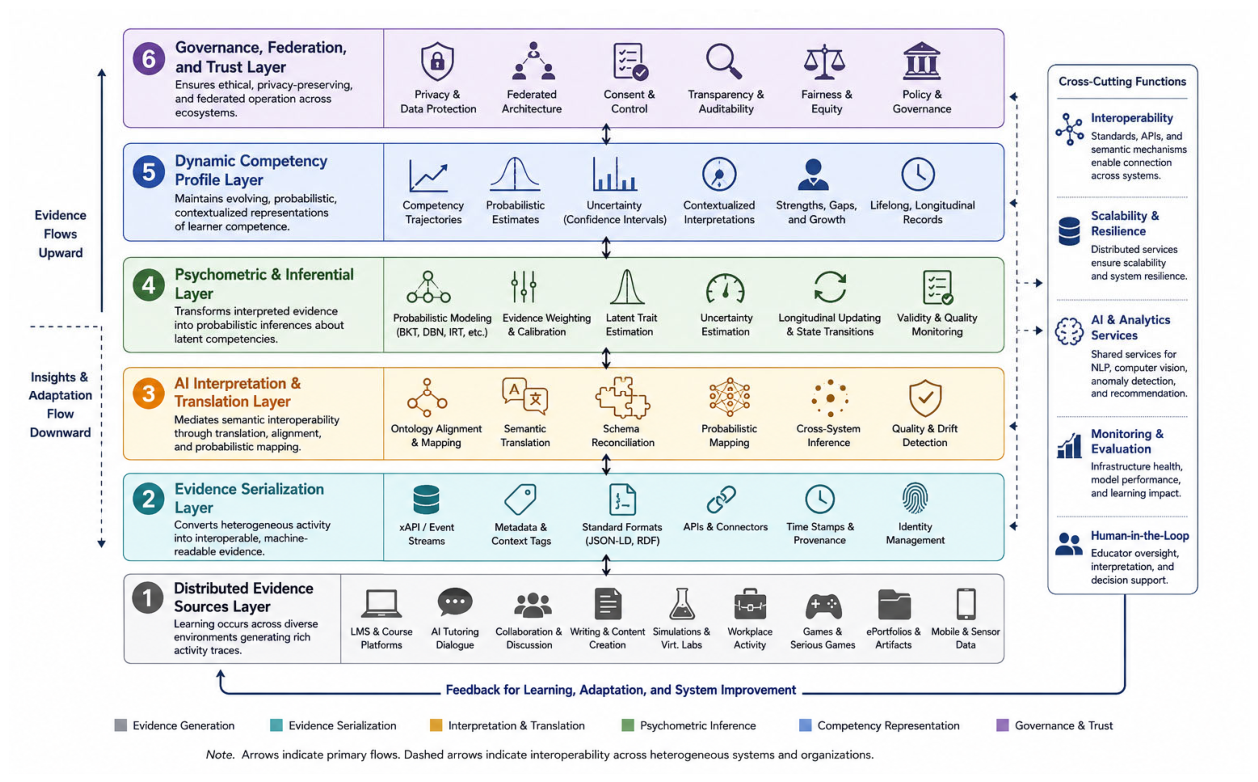

Table 1.
Governance and interoperability tensions in the AI-Mediated Continuous Assessment Infrastructure (AIM-CAI).
Table 1.
Governance and interoperability tensions in the AI-Mediated Continuous Assessment Infrastructure (AIM-CAI).
| Governance Tension | Description | Example Risks | Potential Governance Responses |
| Interoperability vs Local Autonomy | Systems require cross-platform evidence compatibility while preserving institutional and contextual flexibility | Semantic fragmentation, incompatible learner models | AI-mediated translation layers, federated standards |
| Privacy vs Utility Analytics | Privacy-preserving systems reduce data visibility but may weaken inferential precision | Loss of signal for small populations, fairness auditing challenges | Differential privacy, secure enclaves, federated learning |
| Learner Agency vs Predictive Automation | Continuous inference may constrain learner opportunity through persistent profiling | Path dependency, predictive determinism | Human oversight, learner control, contestability mechanisms |
| Innovation vs Governance Stability | Educational technologies evolve faster than standards frameworks | Fragmented ecosystems, governance lag | Adaptive governance architectures, semantic interoperability |
| Transparency vs Model Complexity | Highly predictive AI systems may be difficult to interpret | Black-box inference, institutional distrust | Explainable AI, audit trails, uncertainty visualization |
| Distributed Governance vs Accountability | Federated systems diffuse responsibility across actors | Coordination failure, unclear liability | Federated accountability structures, auditability systems |
| Continuous Support vs Surveillance | Continuous evidence may support learning, but also normalize monitoring | Behavioral conformity, algorithmic governmentality | Permissioned access, bounded monitoring, participatory governance |
Disclaimer/Publisher’s Note: The statements, opinions and data contained in all publications are solely those of the individual author(s) and contributor(s) and not of MDPI and/or the editor(s). MDPI and/or the editor(s) disclaim responsibility for any injury to people or property resulting from any ideas, methods, instructions or products referred to in the content. |
© 2026 by the authors. Licensee MDPI, Basel, Switzerland. This article is an open access article distributed under the terms and conditions of the Creative Commons Attribution (CC BY) license (http://creativecommons.org/licenses/by/4.0/).
Copyright: This open access article is published under a Creative Commons CC BY 4.0 license, which permit the free download, distribution, and reuse, provided that the author and preprint are cited in any reuse.


