
Submitted:
07 July 2026
Posted:
07 July 2026
You are already at the latest version
Abstract
Banana peels constitute a major agro-food residue that is frequently discarded despite their potential as a valuable substrate for the production of value-added products. This study evaluated the feasibility of producing artisanal vinegar from discarded banana peels collected at the Cerâmica Wholesale Market in Beira, Mozambique, and characterized the physicochemical and sensory properties of the resulting product within a circular economy framework. Banana peels underwent spontaneous alcoholic and acetic fermentation over 60 days under ambient conditions, followed by physicochemical analyses and sensory evaluation. The raw material exhibited high moisture content (78.6%) and adequate reducing sugar concentration (9.8 g/100 g), confirming its suitability for fermentation. The process achieved a vinegar yield of 92.4%, while pH decreased from 5.82 to 3.92 and total acidity increased to 4.30% acetic acid. The final product complied with reference quality standards for food-grade vinegar regarding acidity, pH, density, dry extract, and ash content, and obtained sensory scores above 7.0 for all evaluated attributes, indicating good consumer acceptance. These findings demonstrate that discarded banana peels can be successfully transformed into high-quality artisanal vinegar through a simple and low-cost process, supporting waste valorization, circular economy principles, sustainable waste management, and income-generation opportunities in developing countries.
Keywords:
banana peels
; artisanal vinegar
; waste valorization
; circular economy
; physicochemical characterization
; spontaneous fermentation
; sustainable waste management
; food waste
; bioeconomy
; Mozambique
1. Introduction
Banana (Musa spp.) is one of the most widely cultivated fruit crops worldwide, with an annual production exceeding 135 million tonnes. In tropical and subtropical regions, including Mozambique, bananas play a crucial role in food security, household income generation, and rural livelihoods. However, banana production, commercialization, processing, and consumption generate substantial quantities of organic residues, particularly peels, which account for approximately 30–40% of the total fruit mass [10,18,27,39,47]. These residues are often discarded in open dumping sites, municipal landfills, and informal markets, contributing to environmental pollution, unpleasant odors, vector proliferation, and greenhouse gas emissions [8,21,43,44,48].
Food loss and food waste have emerged as major global sustainability challenges [12,17,31,43]. The Food and Agriculture Organization (FAO) estimates that nearly one-third of all food produced for human consumption is lost or wasted annually, corresponding to approximately 1.3 billion tonnes [12,17]. Organic residues from fruits and vegetables represent a significant fraction of municipal solid waste, particularly in developing countries where waste segregation and resource recovery systems remain limited [30, 31. 43]. When disposed of in landfills or unmanaged dumping areas, biodegradable waste undergoes anaerobic decomposition, producing methane (CH₄), a greenhouse gas with a substantially higher global warming potential than carbon dioxide [12,21,43,44]. Consequently, the recovery and valorization of organic waste have become essential strategies for reducing environmental impacts, mitigating climate change, and promoting sustainable resource use [13,23,26,44,46].
Urban wholesale markets constitute important hotspots for the generation of biodegradable waste because they handle large volumes of fresh produce and generate considerable quantities of discarded fruits, peels, leaves, and stalks [21,30,43]. In many African cities, including those in Mozambique, such residues are commonly disposed of without treatment, creating environmental and public health concerns [21,43,44]. At the same time, these waste streams represent an underutilized source of biomass that can be converted into value-added products through appropriate waste valorization technologies [13,23,26,30].
In recent years, increasing attention has been directed towards the transition from a linear economic model based on the “take–make–dispose” paradigm to a circular economy approach that promotes resource efficiency, waste minimization, and material recirculation [7,9,15,16,22,36,46]. Within this framework, organic residues are no longer regarded as waste but rather as secondary resources capable of generating economic, environmental, and social benefits [15,16,22,36]. The concept of circular bioeconomy further strengthens this perspective by encouraging the conversion of biological resources and agro-industrial by-products into high-value products through sustainable biotechnological processes [4,7,11,15,22,40].
Banana peels are particularly attractive for circular bioeconomy applications due to their rich biochemical composition [10,18,27,39,47,48]. Previous studies have reported significant concentrations of fermentable carbohydrates, dietary fibers, pectin, cellulose, hemicellulose, phenolic compounds, and essential minerals such as potassium, calcium, and magnesium [10,18,39,47,48]. These components make banana peels suitable substrates for microbial growth and fermentation processes while also contributing to the nutritional and functional characteristics of derived products [14,18,27,39,47,48]. Consequently, banana peel residues have been successfully explored for the production of bioethanol, biogas, biofertilizers, activated carbon, pectin, animal feed, and other value-added products within integrated waste biorefinery systems [8,23,32,34,41,48].
Among the various waste valorization pathways, vinegar production has emerged as a particularly promising alternative due to its relatively simple technology, low investment requirements, and suitability for decentralized and small-scale production systems [5,19,24,29,38,42]. Vinegar is traditionally produced through a two-stage fermentation process involving the conversion of sugars into ethanol by yeasts, followed by the oxidation of ethanol into acetic acid by acetic acid bacteria [. Besides its widespread culinary applications, vinegar is recognized for its antimicrobial properties, antioxidant activity, and potential health-promoting effects [24]. From a waste management perspective, converting banana peel residues into vinegar represents a higher-value recovery pathway than simple disposal or conventional composting because it simultaneously reduces waste generation and creates a commercially valuable food product.
Several studies conducted in Asia, Europe, and North Africa have demonstrated the feasibility of producing vinegar from fruit-processing residues. Prisacaru et al. [33] reported that vinegar produced from banana peels exhibited physicochemical characteristics comparable to commercial fruit vinegars while maintaining desirable sensory attributes. Similarly, Iskandar et al. [20] demonstrated that the quality of banana peel vinegar can be improved through process optimization involving different starter concentrations. El Barnossi et al. [8] further highlighted the potential of fruit peels, including banana peels, for sustainable vinegar production as part of integrated waste valorization strategies. Collectively, these studies confirm the technical feasibility of converting fruit-processing residues into value-added fermented products.
Despite these advances, research on banana peel valorization remains limited in Sub-Saharan Africa, particularly in Southern African countries. Rapid urbanization in the region has intensified challenges associated with municipal solid waste management, while organic waste frequently accounts for more than half of total waste generation [21,31,43,44]. Nevertheless, practical examples of resource recovery technologies adapted to local socio-economic conditions remain scarce [13,23,26,32,43]. Most published studies have been conducted under controlled laboratory conditions and frequently rely on commercial starter cultures, specialized equipment, and technical infrastructure that may not be readily available in developing countries [20,24,33]. Consequently, there remains a need for scientifically validated, low-cost, and easily replicable approaches capable of transforming locally available organic residues into marketable products while simultaneously reducing environmental burdens.
Furthermore, limited information is available regarding the valorization of banana peel residues generated directly in urban wholesale markets, despite their significant contribution to municipal organic waste streams [21,30,43]. Evaluating such residues under real operational conditions is particularly important for assessing the practical feasibility of circular economy interventions and community-based waste valorization initiatives [15,16,22,36].
The valorization of banana peels through vinegar production is closely aligned with the principles of the waste hierarchy, circular economy, and sustainable resource management [15,16,22,30,36,46]. By diverting biodegradable residues from uncontrolled disposal pathways and converting them into a value-added food product, this approach contributes directly to Sustainable Development Goal (SDG) 11 (Sustainable Cities and Communities), SDG 12 (Responsible Consumption and Production), and SDG 13 (Climate Action), while simultaneously creating opportunities for local entrepreneurship and income generation [7,15,16,35,36,45,46].
Research Gap and Novelty
Although substantial progress has been made in the valorization of banana peel waste worldwide, important scientific and practical gaps remain. Existing studies have predominantly focused on laboratory-scale fermentations conducted in Asia, Europe, and North Africa, whereas evidence from Southern Africa remains extremely limited [8,20,24,29,33]. Moreover, few investigations have evaluated banana peel residues generated in urban wholesale markets under real-world operational conditions, and little attention has been given to simplified artisanal production systems that can be implemented by local communities, informal entrepreneurs, and small-scale producers [13,23,26,32].
To the best of our knowledge, this is the first study conducted in Mozambique evaluating the artisanal production of vinegar from discarded banana peels collected from an urban wholesale market under real operational conditions. The novelty of this work lies in integrating waste valorization, circular economy principles, sustainable waste management, and local income-generation opportunities through a simple, low-cost, and replicable fermentation process [7,15,16,22,36,46]. Therefore, this study aimed to evaluate the feasibility of producing artisanal vinegar from discarded banana peels collected at the Cerâmica Wholesale Market in Beira, Mozambique, and to characterize the physicochemical and sensory properties of the resulting product. The findings provide scientific evidence supporting the sustainable conversion of urban organic waste into value-added products and contribute to the advancement of circular bioeconomy strategies in developing countries [4,11,15,22,40,46].
2. Materials and Methods
2.1. Study Area and Raw Material Collection
This study was conducted in Beira City (19°50′ S, 34°51′ E), Sofala Province, central Mozambique. Beira is the second-largest urban center in the country and generates significant quantities of biodegradable municipal waste, particularly from fruit and vegetable wholesale markets. The Cerâmica Wholesale Market was selected as the sampling site because it is one of the principal distribution hubs for fresh agricultural produce in the region and generates substantial amounts of discarded banana residues.
Discarded banana peels (Musa spp.) were collected during three consecutive sampling campaigns conducted in August 2024. To minimize sampling bias and improve representativeness, residues were obtained from three independent vendors operating within different sections of the market. Approximately 9 kg of fresh banana peels were collected and homogenized before being subdivided into three independent experimental replicates (3 kg each).
Only mature peels free from visible fungal contamination and excessive deterioration were selected. Foreign materials such as soil particles, plastic fragments, and plant debris were manually removed before processing. The collected samples were placed in sterile polyethylene containers, transported under ambient conditions to the Environmental and Food Analysis Laboratory, and processed within 24 h of collection to minimize physicochemical and microbiological changes.
2.2. Initial Physicochemical Characterization of Banana Peels
The physicochemical characterization of banana peels was performed to evaluate their suitability as a substrate for alcoholic and acetic fermentation processes. The analyses focused on parameters directly associated with fermentation performance and product quality.
Moisture content was determined gravimetrically according to AOAC Official Method 934.01 by drying approximately 5 g of homogenized sample in a forced-air oven at 105 °C until constant weight [1]. Moisture content was expressed as percentage of fresh weight.
Reducing sugars were quantified using the 3,5-dinitrosalicylic acid (DNS) colorimetric method described by Miller [25]. Absorbance was measured at 540 nm using a UV–Vis spectrophotometer, and glucose was used as the calibration standard. Results were expressed as grams of reducing sugars per 100 g of fresh sample.
Total phenolic compounds were determined according to the Folin–Ciocalteu method as described by Singleton et al. [37]. Briefly, aliquots of the sample extract were reacted with Folin–Ciocalteu reagent and sodium carbonate solution, and absorbance was measured at 765 nm after incubation. Quantification was performed using a gallic acid calibration curve, and results were expressed as mg gallic acid equivalents (GAE) per 100 g dry matter.
Ash content was determined following AOAC Official Method 942.05 by incinerating dried samples in a muffle furnace at 550 °C for 4 h. Results were expressed as percentage dry weight.
All physicochemical analyses were performed in triplicate and reported as mean ± standard deviation.
2.3. Experimental Procedure for Vinegar Production
Overall experimental workflow adopted for artisanal vinegar production is presented in Figure 1.
Banana peels were washed thoroughly with potable water to remove adhering impurities and subsequently rinsed with previously boiled and cooled water. The cleaned peels were cut into pieces measuring approximately 1–2 cm to increase the surface area available for microbial activity and facilitate substrate hydrolysis.
For each experimental replicate, 200 g of fresh banana peels were mixed with 250 g of refined sucrose and 5 L of mineral water. The sucrose was completely dissolved before addition to ensure homogeneous distribution within the fermentation medium. The resulting mixture was transferred into sterilized 6 L glass fermentation vessels.
The containers were covered with sterile organza cloth secured with elastic bands. This configuration allowed gas exchange while preventing contamination by insects and airborne particles. No commercial microbial inoculum was added, allowing spontaneous fermentation driven by the indigenous microbiota naturally associated with the banana peels and surrounding environment.
The fermentation process consisted of two sequential stages. The first stage corresponded to alcoholic fermentation, during which fermentable sugars were converted into ethanol by naturally occurring yeasts. This phase lasted 14 days, and the substrate was manually stirred every 48 h to improve homogenization and oxygen distribution.
The second stage consisted of acetic fermentation, during which ethanol was oxidized into acetic acid by acetic acid bacteria. This phase was conducted under natural aeration conditions for an additional 45 days. The entire fermentation process lasted 60 days and was carried out at ambient temperature (25 ± 3 °C).
At the end of fermentation, the vinegar was separated from the solid residues by filtration through sterile cotton cloth followed by filtration using Whatman No. 1 filter paper. The clarified product was transferred to sterilized glass bottles and stored at 4 °C until further analyses.
The process yield (%) was calculated as the ratio between the final volume of clarified vinegar obtained and the initial fermentation volume.
2.4. Monitoring of Fermentation Dynamics
The progression of the fermentation process was monitored through periodic determination of pH and total titratable acidity, two key indicators of microbial activity and acetic acid production.
Samples were collected aseptically at seven-day intervals throughout the 60-day fermentation period. The pH was measured using a previously calibrated digital pH meter equipped with a combined glass electrode.
Total titratable acidity was determined according to AOAC Method 942.15 by titration with standardized 0.1 mol L⁻¹ sodium hydroxide (NaOH) solution using phenolphthalein as an endpoint indicator. Acidity values were expressed as percentage acetic acid equivalent.
The temporal evolution of pH and acidity was used to assess fermentation kinetics, substrate conversion, and stabilization of the final product.
2.5. Physicochemical Characterization of Banana Peel Vinegar
The physicochemical quality of the final vinegar was evaluated using internationally recognized analytical procedures and compared with quality specifications established for food-grade vinegars.
Total acidity was determined according to AOAC Method 920.57 by titration with 0.1 mol L⁻¹ NaOH and expressed as percentage acetic acid.
The pH was measured directly using a calibrated digital pH meter at room temperature.
Density was determined at 20 °C using a pycnometer and expressed in g mL⁻¹.
Dry extract content was determined by evaporating a known volume of vinegar in a drying oven at 100 °C until constant weight.
Ash content was determined by incineration of the dried residue at 550 °C for 2 h in a muffle furnace.
All analyses were carried out in triplicate and results were expressed as mean ± standard deviation.
2.6. Sensory Evaluation
The sensory acceptability of the banana peel vinegar was evaluated by a panel of 30 semi-trained volunteer assessors recruited from the university community. The panel comprised male and female participants aged between 20 and 55 years who reported previous experience with vinegar consumption.
Prior to participation, all assessors received information regarding the objectives and procedures of the study and voluntarily agreed to participate. The sensory evaluation involved only the assessment of a food product and did not include any invasive procedures or collection of personal health information.
Samples were coded with random three-digit numbers and presented individually under standardized sensory evaluation conditions, including controlled illumination and room temperature.
A nine-point hedonic scale ranging from 1 (“dislike extremely”) to 9 (“like extremely”) was used to evaluate appearance, color, aroma, taste, acidity, and overall acceptability. Water was provided between evaluations to minimize sensory carryover effects.
The mean score obtained for each attribute was used as an indicator of consumer acceptance.
2.7. Statistical Analysis
All experimental determinations were performed in triplicate and results were expressed as mean ± standard deviation (SD).
Because only one vinegar formulation was evaluated, inferential statistical comparisons among treatments were not applicable. Therefore, analysis of variance (ANOVA) and post hoc multiple comparison tests were not performed.
Descriptive statistical analyses were conducted using Microsoft Excel 365 (Microsoft Corp., Redmond, WA, USA).
3. Results
3.1. Initial Characterization of Banana Peels
The physicochemical characterization of banana peels is presented in Table 1. The results indicate that the discarded banana peels possessed high moisture content and appreciable concentrations of fermentable sugars, confirming their suitability as a substrate for vinegar production.
The high moisture content facilitates microbial activity during fermentation, while the concentration of reducing sugars indicates adequate availability of fermentable substrates for ethanol and acetic acid production. The presence of phenolic compounds suggests potential antioxidant properties that may contribute to the quality of the final vinegar product.
3.2. Fermentation Dynamics and Process Performance
The evolution of pH and titratable acidity throughout the fermentation process is presented in Figure 2.
During fermentation, a progressive decrease in pH was observed, accompanied by a gradual increase in titratable acidity. The pH decreased from 5.82 ± 0.04 at the beginning of fermentation to 3.92 ± 0.02 at the end of the process. Simultaneously, total acidity increased from 0.21 ± 0.01% to 4.30 ± 0.06% acetic acid equivalent.
The fermentation process yielded 4.62 ± 0.08 L of clarified vinegar from an initial fermentation volume of 5.0 L, corresponding to a process yield of 92.4 ± 1.6%.
A simplified mass balance of the artisanal vinegar production process is presented in Table 2.
The average acidity productivity, calculated as the ratio between final acidity and fermentation time, was 0.072% acetic acid day⁻¹.
3.3. Physicochemical Characteristics of Banana Peel Vinegar
The physicochemical properties of the vinegar produced from discarded banana peels are presented in Table 3.
The vinegar produced met the minimum acidity requirements commonly established for commercial vinegars and exhibited physicochemical characteristics consistent with fermented fruit vinegars.
3.4. Sensory Evaluation
The sensory evaluation results are presented in Table 4.
All evaluated attributes obtained average scores above 7.0, indicating good consumer acceptance of the artisanal vinegar produced from banana peel residues.
3.5. Comparison with Previous Studies
A comparison between the vinegar produced in the present study and selected studies reported in the literature is presented in Table 5.
The physicochemical characteristics obtained in this study were comparable to those reported in previous investigations, confirming the feasibility of converting discarded banana peels into vinegar with quality attributes similar to those reported internationally.
4. Discussion
4.1. Influence of Banana Peel Composition on Fermentation Performance
The successful production of vinegar from discarded banana peels can be attributed to the physicochemical characteristics of the substrate. The relatively high moisture content (78.6%) favored microbial activity by providing adequate water availability for enzymatic reactions and microbial metabolism. Similarly, the reducing sugar concentration (9.8 g/100 g) supplied the fermentable carbon source required for yeast-mediated ethanol production during alcoholic fermentation.
Banana peels are known to contain significant quantities of glucose, fructose, sucrose, pectin, cellulose, hemicellulose, and bioactive compounds that can support microbial growth and fermentation processes. Previous studies have reported that the carbohydrate-rich composition of banana peels makes them particularly suitable for biotechnological valorization routes, including bioethanol, vinegar, organic acids, and other fermentation-derived products [14,48].
The total phenolic content observed in the present study may also have contributed to the quality of the final vinegar. Phenolic compounds are known to possess antioxidant properties and can influence flavor development, color stability, and functional characteristics of fermented products. Similar observations were reported by Prisacaru [33], who found that banana peel vinegar retained considerable levels of bioactive compounds after fermentation.
4.2. Fermentation Dynamics and Physicochemical Quality of Vinegar
The progressive reduction in pH observed during fermentation reflects the metabolic activity of microorganisms involved in both alcoholic and acetic fermentation stages. During the initial phase, naturally occurring yeasts converted fermentable sugars into ethanol. Subsequently, acetic acid bacteria oxidized ethanol into acetic acid under aerobic conditions, resulting in acid accumulation and a corresponding decrease in pH.
The final acidity value of 4.30% demonstrates the successful conversion of ethanol into acetic acid and complies with minimum acidity requirements generally established for commercial vinegars. The acidity obtained was slightly higher than that reported by Prisacaru [33] for banana peel vinegar (4.10%), which may be attributed to differences in substrate composition, fermentation duration, sugar supplementation, and microbial populations.
Natural fermentation may also explain part of the variability observed. Unlike controlled fermentations using selected starter cultures, spontaneous fermentation relies on indigenous microbial communities naturally present on the fruit residues and in the surrounding environment. Such microbial diversity can influence ethanol production efficiency, acetic acid conversion rates, and final product composition [24].
The density, ash content, and dry extract values obtained indicate that the vinegar retained dissolved solids and mineral constituents originating from the banana peels. Banana residues are recognized as an important source of potassium, calcium, magnesium, and other minerals that may remain partially preserved throughout fermentation [27] The retention of these components contributes to the nutritional value and authenticity of fruit-based vinegars.
The acidity productivity obtained (0.072% acetic acid day⁻¹) confirms the effectiveness of the fermentation process under low-technology artisanal conditions. Although lower than values reported for industrial submerged fermentations, it is consistent with traditional vinegar production systems that operate without forced aeration or inoculation with selected acetic acid bacteria.
4.3. Comparison with International Studies
The physicochemical characteristics obtained in the present study are generally consistent with values reported in the international literature (Table 6).
The acidity achieved in this study falls within the range commonly reported for fruit vinegars worldwide, confirming the suitability of banana peel residues as a fermentation substrate. The slightly higher pH observed compared with studies from Romania and Indonesia may be related to differences in raw material composition, spontaneous fermentation conditions, climatic factors, and microbial ecology.
The results therefore demonstrate that artisanal vinegar produced from discarded banana peels in Mozambique can achieve physicochemical characteristics comparable to those obtained in more technologically advanced production systems.
4.4. Environmental Implications and Waste Valorization Potential
The environmental relevance of the proposed process lies in its ability to transform an underutilized organic residue into a value-added food product. Banana peels typically represent approximately 30–40% of total fruit weight and are frequently discarded as waste.
Considering a conservative estimate that one tonne of bananas generates approximately 350 kg of peels, the valorization of this residue through vinegar production could substantially reduce the amount of biodegradable waste disposed of in open dumps and landfills. Such diversion contributes directly to waste minimization strategies and supports the principles of sustainable waste management.
Organic residues disposed of under anaerobic conditions generate methane, a greenhouse gas with a global warming potential approximately 28 times greater than carbon dioxide over a 100-year time horizon. Consequently, diverting banana peel waste towards productive uses may contribute indirectly to greenhouse gas mitigation and climate change adaptation efforts.
At the scale of the Cerâmica Wholesale Market, where substantial quantities of fruit residues are generated daily, the implementation of decentralized vinegar production systems could represent a practical waste valorization strategy while simultaneously generating marketable products.
4.5. Economic Feasibility Assessment
The proposed process also presents potential economic advantages due to its reliance on low-cost raw materials. Banana peels are generated as waste and therefore represent a virtually cost-free feedstock. The principal production costs are associated with sugar, water, containers, filtration materials, and packaging.

Table 7.
Estimated production costs for artisanal banana peel vinegar.
| Item | Estimated Cost (USD/batch) |
| Banana peels | 0.00 |
| Sugar | 2.50 |
| Water | 0.30 |
| Bottles and packaging | 2.20 |
| Miscellaneous materials | 0.50 |
| Total | 5.50 |
Based on a production volume of approximately 4.62 L per batch, the estimated production cost is approximately USD 1.19 L⁻¹. Considering local retail prices for artisanal fruit vinegars, the process may offer opportunities for small-scale entrepreneurship, income generation, and community-based circular economy initiatives.
4.6. Sustainability and Circular Economy Implications
The proposed valorization pathway aligns closely with the principles of the circular economy by transforming a low-value organic residue into a commercially useful product. Rather than following a linear disposal pathway, banana peel waste is reintegrated into the economic cycle through biological conversion processes.
The approach also contributes directly to several Sustainable Development Goals (SDGs). It supports SDG 2 (Zero Hunger) through improved food resource utilization, SDG 8 (Decent Work and Economic Growth) through potential income generation, SDG 12 (Responsible Consumption and Production) through waste valorization, and SDG 13 (Climate Action) through the reduction of organic waste disposal and associated greenhouse gas emissions.
The conceptual framework presented in Figure 3 illustrates the circular economy pathway associated with banana peel valorization.
The findings demonstrate that artisanal vinegar production can serve as a practical example of waste-to-value conversion, supporting both environmental sustainability and local socio-economic development in developing countries.
5. Conclusions
This study demonstrated the technical feasibility of producing artisanal vinegar from discarded banana peels (Musa spp.), an abundant organic residue generated in urban fruit markets. The physicochemical characterization of the raw material confirmed its suitability for fermentation, while the resulting vinegar met quality standards for acidity, pH, density, dry extract, and ash content, in addition to showing satisfactory sensory acceptance.
From a scientific perspective, the study contributes to the growing field of agro-food waste valorization by demonstrating the potential of banana peels as a low-cost substrate for vinegar production under artisanal conditions in Mozambique. The findings confirm that this residue can be successfully converted into a value-added product through simple fermentation processes.
Environmentally, the proposed approach contributes to reducing the disposal of organic waste and supports sustainable waste management practices. By transforming discarded banana peels into a marketable product, the process promotes resource recovery and circular economy principles, reducing the environmental burden associated with unmanaged organic residues.
The technology also presents socioeconomic benefits, as it relies on inexpensive raw materials and simple production methods, creating opportunities for income generation among small-scale producers and community-based enterprises.
Furthermore, the study contributes to the achievement of several Sustainable Development Goals, particularly SDG 8 (Decent Work and Economic Growth), SDG 11 (Sustainable Cities and Communities), SDG 12 (Responsible Consumption and Production), and SDG 13 (Climate Action).
Despite its promising results, the study was limited to spontaneous fermentation and did not include microbiological characterization, antioxidant analysis, or detailed economic and life-cycle assessments. Future research should focus on process optimization, pilot-scale production, microbiological evaluation, antioxidant properties, and comprehensive environmental and economic analyses.
Overall, the results demonstrate that discarded banana peels can be effectively transformed into a value-added product, providing a practical and sustainable strategy for waste valorization, circular economy implementation, and local socioeconomic development in Mozambique and similar
Supplementary Materials
The following supporting information can be downloaded at the website of this paper posted on Preprints.org, Figure S1: title; Table S1: title; Video S1: title.
Author Contributions
Conceptualization, Candida da C. A. Samussone, Edison D. Sabe and Alegre de NS Cadeado; methodology, Candida da C. A. Samussone, Edison D. Sabe, Alegre de NS Cadeado, and Jackson C. Momade ; investigation, Candida da C. A. Samussone, Edison D. Sabe, Alegre de NS Cadeado, and Jackson C. Momade ; data curation , Alegre de NS Cadeado and Jackson C. Momade; resources, Alegre de NS Cadeado and Jackson C. Momade; project administration, Jackson C. Momade ; funding acquisition, Alegre de NS Cadeado and Jackson C. Momade ; writing—original draft preparation, Candida da C. A. Samussone, Edison D. Sabe, Alegre de NS Cadeado, and Jackson C. Momade ; writing—review and editing, Alegre de NS Cadeado and Jackson C. Momade . All authors have read and agreed to the published version of the manuscript.
Institutional Review Board Statement
The study did not involve human participants , animals , human biological materials , or personal data. Therefore , ethical review and approval by an Institutional Review Board (IRB) or Ethics Committee were not required for this research .
Informed Consent Statement
Not applicable.
Data Availability Statement
The data presented in this studies are available within the article . Additional data supporting the findings of this studies are available from the corresponding author upon reasonable request .
Acknowledgments
The authors would like to thank the Universidade Licungo for the institutional support provided during this research. The authors also acknowledge the Mercado Grossista da Cerâmica, Beira, Mozambique, for facilitating access to the sugarcane bagasse used as raw material in this study. Special thanks are extended to all colleagues and collaborators who contributed to the experimental activities and technical discussions that supported the development of this work.
Conflicts of Interest
The authors declare no conflicts of Interest . The funders. had no role in the design of the study ; in the collection , analyses , or interpretation of data; in the writing of the manuscript ; or in the decision to publish the results .
Abbreviations
The following abbreviations are used in this manuscript :
| SDGs | Sustainable Development Goals |
| FAO | Food and Agriculture Organization |
| DNS | 3,5-Dinitrosalicylic Acid |
| UV–Vis | Visible Ultraviolet |
| GAE | Gallic Acid Equivalents |
| AOAC | Association of Official Analytical Chemists |
References
- AOAC International. Official Methods of Analysis of AOAC International, 21st ed.; AOAC International: Rockville, MD, USA, 2019. [Google Scholar]
- Baiano, A. Recovery of biomolecules from food wastes—A review. Molecules 2014, 19, 14821–14842. [Google Scholar] [CrossRef] [PubMed]
- Budak, N.H.; Aykin, E.; Seydim, A.C.; Greene, A.K.; Guzel-Seydim, Z.B. Functional properties of vinegar. J. Food Sci. 2014, 79, R757–R764. [Google Scholar] [CrossRef] [PubMed]
- Carus, M.; Dammer, L. The circular bioeconomy—Concepts, opportunities and limitations. Ind. Biotechnol. 2018, 14, 83–91. [Google Scholar] [CrossRef]
- Chen, H.; Chen, T.; Giudici, P.; Chen, F. Vinegar functions on health: Constituents, sources and formation mechanisms. Compr. Rev. Food Sci. Food Saf. 2016, 15, 1124–1138. [Google Scholar] [CrossRef] [PubMed]
- Cinardi, G.; D’Urso, P.R.; Cascone, G.; Arcidiacono, C. Citrus waste valorisation processes from an environmental sustainability perspective: A scoping literature review of life cycle assessment studies. AgriEngineering 2025, 7, 335. [Google Scholar] [CrossRef]
- D’Amato, D.; Korhonen, J.; Toppinen, A. Circular, green, and bio economy: How do companies in land-use intensive sectors align with sustainability concepts? Ecol. Econ. 2019, 163, 174–178. [Google Scholar] [CrossRef]
- El Barnossi, A.; Moussaid, F.; Iraqi Housseini, A. Tangerine, banana and pomegranate peels valorisation for sustainable environment: A review. Biotechnol. Rep. 2021, 29, e00574. [Google Scholar] [CrossRef] [PubMed]
- Foundation, Ellen MacArthur. Towards the Circular Economy; Ellen MacArthur Foundation: Cowes, UK, 2013. [Google Scholar]
- Emaga, T.H.; Andrianaivo, R.H.; Wathelet, B.; Tchango, J.T.; Paquot, M. Effects of the stage of maturation and varieties on the chemical composition of banana and plantain peels. Food Chem. 2007, 103, 590–600. [Google Scholar] [CrossRef]
- European Commission. A Sustainable Bioeconomy for Europe: Strengthening the Connection between Economy, Society and the Environment; European Commission: Brussels, Belgium, 2018. [Google Scholar]
- FAO. Food Wastage Footprint: Impacts on Natural Resources; Food and Agriculture Organization of the United Nations: Rome, Italy, 2013. [Google Scholar]
- Galanakis, C.M. Recovery of high added-value components from food wastes: Conventional, emerging technologies and commercialized applications. Food Res. Int. 2012, 48, 27–38. [Google Scholar] [CrossRef]
- Ganesan, A.R. Valorization of horticultural food waste: Significance and future perspectives. Future Postharvest Food 2024, 1, 158–160. [Google Scholar] [CrossRef]
- Geissdoerfer, M.; Savaget, P.; Bocken, N.M.P.; Hultink, E.J. The circular economy—A new sustainability paradigm? J. Clean. Prod. 2017, 143, 757–768. [Google Scholar] [CrossRef]
- Ghisellini, P.; Cialani, C.; Ulgiati, S. A review on circular economy: The expected transition to a balanced interplay of environmental and economic systems. J. Clean. Prod. 2016, 114, 11–32. [Google Scholar] [CrossRef]
- Gustavsson, J.; Cederberg, C.; Sonesson, U.; Van Otterdijk, R.; Meybeck, A. Global Food Losses and Food Waste; FAO: Rome, Italy, 2011. [Google Scholar]
- Happi Emaga, T.; Robert, C.; Ronkart, S.N.; Wathelet, B.; Paquot, M. Dietary fibre components and pectin chemical features of peels during ripening in banana and plantain varieties. Bioresour. Technol. 2008, 99, 4346–4354. [Google Scholar] [CrossRef] [PubMed]
- Ho, C.W.; Lazim, A.M.; Fazry, S.; Zaki, U.K.; Lim, S.J. Varieties, production, composition and health benefits of vinegars: A review. Food Chem. 2017, 221, 1621–1630. [Google Scholar] [CrossRef] [PubMed]
- Iskandar, K.G.; Safrida, S.; Muhibbuddin, M.; Iswadi, I.; Hamid, Y.H. Optimization of banana peel vinegar production: Effect of vinegar starter concentration on organoleptic properties. Indones. Food Sci. Technol. J. 2024, 8, 117–125. [Google Scholar] [CrossRef]
- Kaza, S.; Yao, L.; Bhada-Tata, P.; Van Woerden, F. What a Waste 2.0: A Global Snapshot of Solid Waste Management to 2050; World Bank: Washington, DC, USA, 2018. [Google Scholar]
- Kirchherr, J.; Reike, D.; Hekkert, M. Conceptualizing the circular economy: An analysis of 114 definitions. Resour. Conserv. Recycl. 2017, 127, 221–232. [Google Scholar] [CrossRef]
- Lin, C.S.K.; Pfaltzgraff, L.A.; Herrero-Davila, L.; Mubofu, E.B.; Solhy, A.; Clark, J.H. Food waste as a valuable resource for the production of chemicals, materials and fuels. Energy Environ. Sci. 2013, 6, 426–464. [Google Scholar] [CrossRef]
- Luzón-Quintana, L.M.; Castro, R.; Durán-Guerrero, E. Biotechnological processes in fruit vinegar production. Foods 2021, 10, 945. [Google Scholar] [CrossRef] [PubMed]
- Miller, G.L. Use of dinitrosalicylic acid reagent for determination of reducing sugar. Anal. Chem. 1959, 31, 426–428. [Google Scholar] [CrossRef]
- Mirabella, N.; Castellani, V.; Sala, S. Current options for the valorization of food manufacturing waste. J. Clean. Prod. 2014, 65, 28–41. [Google Scholar] [CrossRef]
- Mohapatra, D.; Mishra, S.; Sutar, N. Banana and its by-product utilisation: An overview. J. Sci. Ind. Res. 2010, 69, 323–329. [Google Scholar]
- OIV. Compendium of International Methods of Analysis of Vinegars; International Organisation of Vine and Wine: Paris, France, 2021. [Google Scholar]
- Ousaaid, D.; Mechchate, H.; Laaroussi, H.; Hano, C.; Bakour, M.; El Ghouizi, A.; Conte, R.; Lyoussi, B.; El Arabi, I. Fruits vinegar: Quality characteristics, phytochemistry, and functionality. Molecules 2022, 27, 222. [Google Scholar] [CrossRef] [PubMed]
- Papargyropoulou, E.; Lozano, R.; Steinberger, J.K.; Wright, N.; Ujang, Z.B. The food waste hierarchy as a framework for the management of food surplus and food waste. J. Clean. Prod. 2014, 76, 106–115. [Google Scholar] [CrossRef]
- Parfitt, J.; Barthel, M.; Macnaughton, S. Food waste within food supply chains: Quantification and potential for change to 2050. Philos. Trans. R. Soc. B 2010, 365, 3065–3081. [Google Scholar] [CrossRef] [PubMed]
- Perwez, M.; Al Asheh, S. Valorization of agro-industrial waste through solid-state fermentation: Mini review. Biotechnol. Rep. 2025, 45, e00873. [Google Scholar] [CrossRef] [PubMed]
- Prisacaru, A.E.; Boișteanu, P.C.; Vasile, A.M.; Stănciuc, N.; Râpeanu, G. Physicochemical characteristics of vinegar from banana peels and commercial vinegars before and after in vitro digestion. Processes 2021, 9, 1193. [Google Scholar] [CrossRef]
- Redondo-Gómez, C.; Rodríguez-Quesada, M.; Vallejo-Astúa, S.; Murillo-Zamora, J.P.; Lopretti, M.; Vega-Baudrit, J.R. Biorefinery of biomass of agro-industrial banana waste to obtain high-value biopolymers. Molecules 2020, 25, 3829. [Google Scholar] [CrossRef] [PubMed]
- Sachs, J.D.; Schmidt-Traub, G.; Mazzucato, M.; Messner, D.; Nakicenovic, N.; Rockström, J. Six transformations to achieve the Sustainable Development Goals. Nat. Sustain. 2019, 2, 805–814. [Google Scholar] [CrossRef]
- Schroeder, P.; Anggraeni, K.; Weber, U. The relevance of circular economy practices to the Sustainable Development Goals. Circ. Econ. Sustain. 2021, 1, 77–95. [Google Scholar] [CrossRef]
- Singleton, V.L.; Orthofer, R.; Lamuela-Raventós, R.M. Analysis of total phenols and other oxidation substrates by means of Folin–Ciocalteu reagent. Methods Enzymol. 1999, 299, 152–178. [Google Scholar] [CrossRef]
- Solieri, L.; Giudici, P. Vinegars of the World; Springer: Milan, Italy, 2009. [Google Scholar]
- Someya, S.; Yoshiki, Y.; Okubo, K. Antioxidant compounds from banana peel. Food Chem. 2002, 79, 351–354. [Google Scholar] [CrossRef]
- Stegmann, P.; Londo, M.; Junginger, M. The circular bioeconomy: Its elements and role in European bioeconomy clusters. Biomass Bioenergy 2020, 139, 105593. [Google Scholar] [CrossRef]
- Suri, S.; Singh, A.; Nema, P.K. Recent advances in valorization of citrus fruits processing waste: A way forward towards environmental sustainability. Food Sci. Biotechnol. 2021, 30, 1601–1626. [Google Scholar] [CrossRef] [PubMed]
- Tesfaye, W.; Morales, M.L.; García-Parrilla, M.C.; Troncoso, A.M. Wine vinegar: Technology, authenticity and quality evaluation. Trends Food Sci. Technol. 2002, 13, 12–21. [Google Scholar] [CrossRef]
- Thi, N.B.D.; Kumar, G.; Lin, C.Y. An overview of food waste management in developing countries: Current status and future perspective. Bioresour. Technol. 2015, 169, 612–620. [Google Scholar] [CrossRef] [PubMed]
- United Nations Environment Programme. Food Waste Index Report 2024; UNEP: Nairobi, Kenya, 2024. [Google Scholar]
- United Nations. Transforming Our World: The 2030 Agenda for Sustainable Development; United Nations: New York, NY, USA, 2015. [Google Scholar]
- Velenturf, A.P.M.; Purnell, P. Principles for a sustainable circular economy. Sustain. Prod. Consum. 2021, 27, 1437–1457. [Google Scholar] [CrossRef]
- Vu, H.T.; Scarlett, C.J.; Vuong, Q.V. Phenolic compounds within banana peel and their potential uses: A review. Food Rev. Int. 2018, 34, 651–667. [Google Scholar] [CrossRef]
- Yasin, M.; Gangan, S.; Panchal, S.K. Banana peels: A genuine waste or a wonderful opportunity? Appl. Sci. 2025, 15, 3195. [Google Scholar] [CrossRef]
Figure 1.
Experimental workflow for artisanal vinegar production from discarded banana peels.
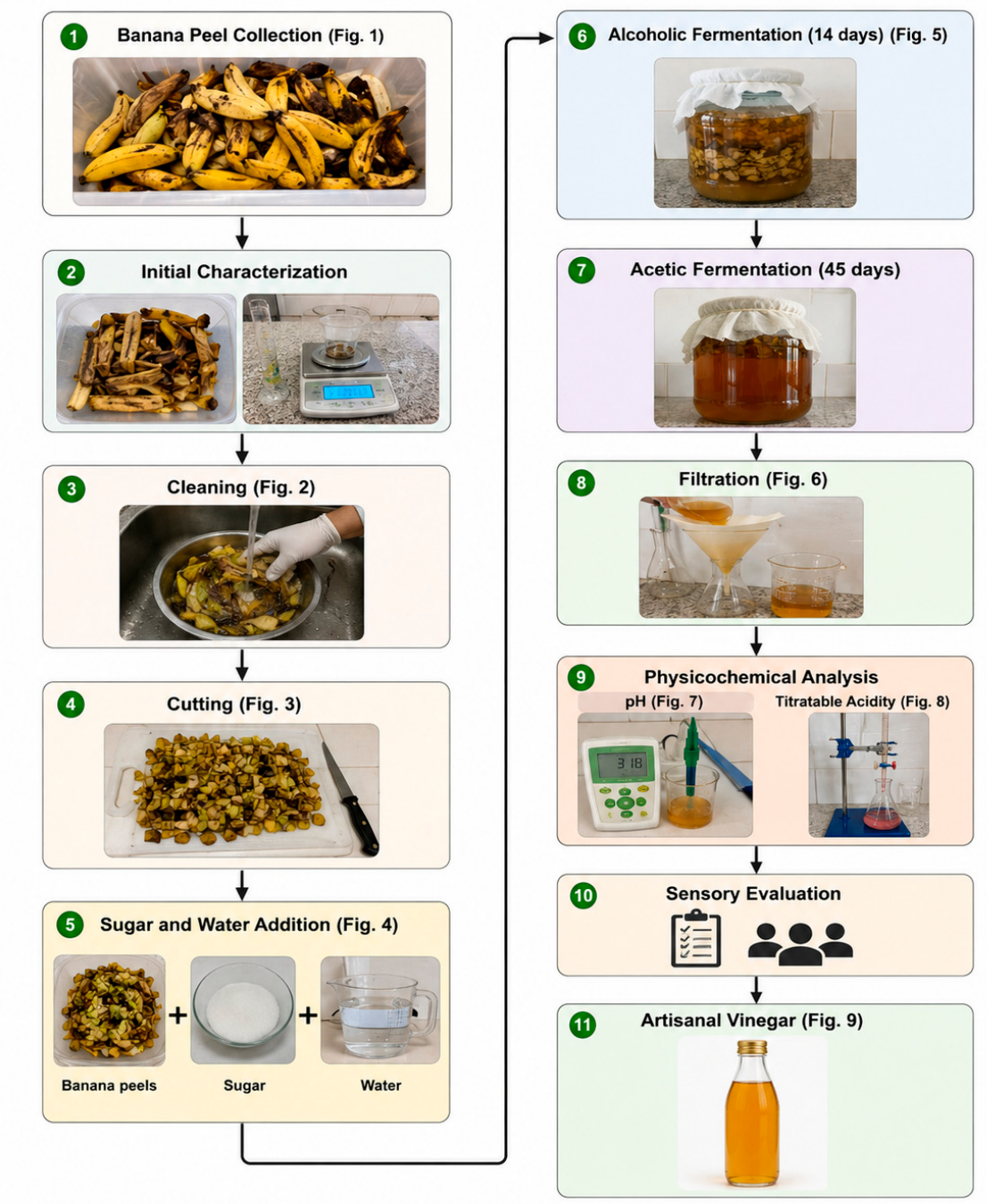
Figure 2.
Evolution of pH and titratable acidity during artisanal vinegar fermentation.
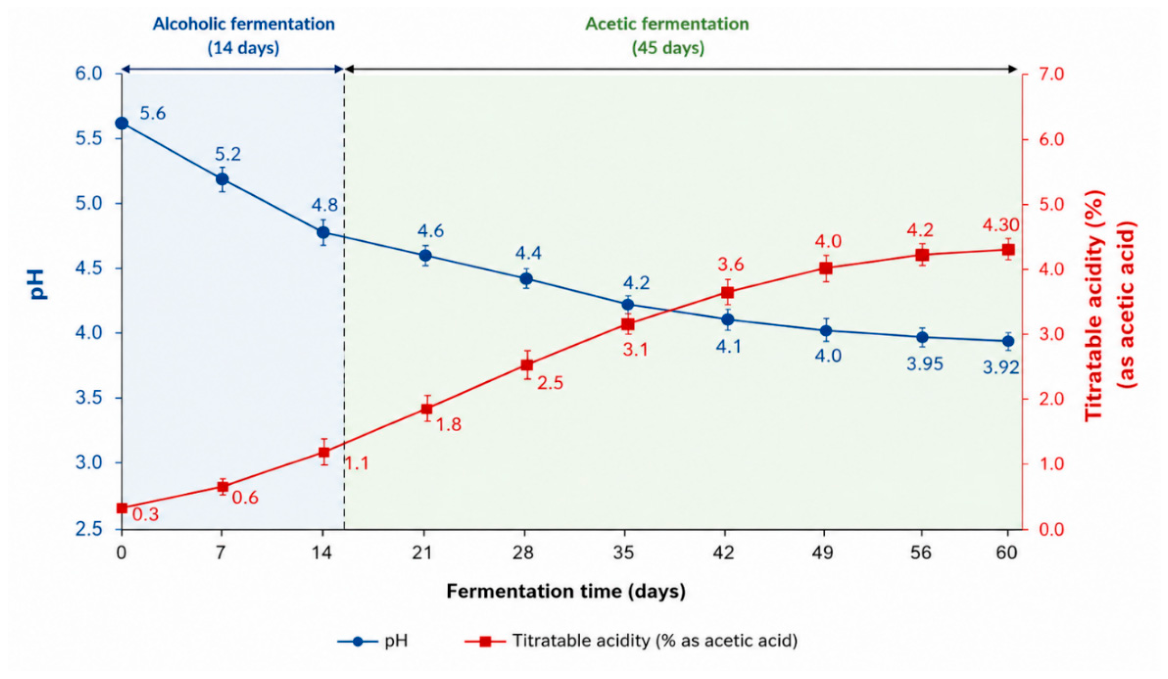
Figure 3.
Circular economy framework for banana peel valorization through artisanal vinegar production.
Figure 3.
Circular economy framework for banana peel valorization through artisanal vinegar production.
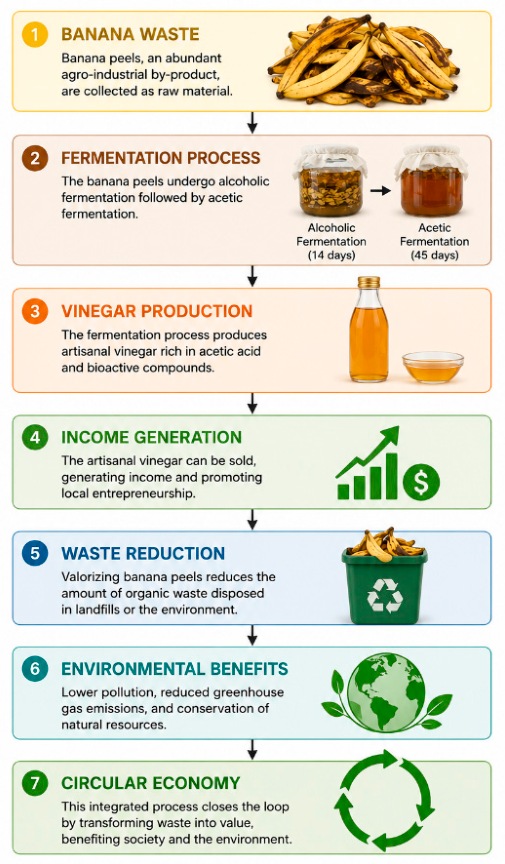
Table 1.
Initial physicochemical characterization of banana peels used as fermentation substrate (mean ± SD, n = 3).
Table 1.
Initial physicochemical characterization of banana peels used as fermentation substrate (mean ± SD, n = 3).
| Parameter | Value |
| Moisture (%) | 78.6 ± 1.4 |
| Reducing sugars (g/100 g fresh weight) | 9.8 ± 0.5 |
| Total phenolics (mg GAE/100 g dry weight) | 512 ± 18 |
| Ash (%) | 8.4 ± 0.3 |
Table 2.
Simplified mass balance and process performance indicators.
| Parameter | Value |
| Fresh banana peels (g) | 200 |
| Added sugar (g) | 250 |
| Initial liquid volume (L) | 5.0 |
| Final vinegar volume (L) | 4.62 ± 0.08 |
| Process yield (%) | 92.4 ± 1.6 |
| Acidity productivity (% day⁻¹) | 0.072 |
| Total fermentation period (days) | 60 |
Table 3.
Physicochemical characteristics of banana peel vinegar (mean ± SD, n = 3).
| Parameter | Obtained Value | Reference Standard |
| Total acidity (% acetic acid) | 4.30 ± 0.06 | ≥ 4.0 |
| pH | 3.92 ± 0.02 | 2.8–4.0 |
| Density (g mL⁻¹) | 1.004 ± 0.001 | 1.000–1.020 |
| Dry extract (g L⁻¹) | 2.62 ± 0.02 | ≥ 2.0 |
| Ash (g L⁻¹) | 1.65 ± 0.02 | 1.3–3.5 |
Table 4.
Sensory evaluation scores of banana peel vinegar using a nine-point hedonic scale (mean ± SD).
Table 4.
Sensory evaluation scores of banana peel vinegar using a nine-point hedonic scale (mean ± SD).
| Attribute | Score |
| Appearance | 7.4 ± 0.8 |
| Color | 7.6 ± 0.7 |
| Aroma | 7.1 ± 0.9 |
| Taste | 7.0 ± 0.8 |
| Acidity | 7.3 ± 0.8 |
| Overall acceptability | 7.2 ± 0.8 |
Table 5.
Comparison of physicochemical characteristics of banana peel vinegar reported in different studies.
Table 5.
Comparison of physicochemical characteristics of banana peel vinegar reported in different studies.
| Study | Raw Material | Acidity (%) | pH |
| Present study | Banana peels | 4.30 | 3.92 |
| Prisacaru et al. (2021) | Banana peels | 4.10 | 3.60 |
| Iskandar et al. (2024) | Banana peels | 4.40 | 3.50 |
| El Barnossi et al. (2021) | Fruit peel residues | 3.80–4.50 | 3.20–3.90 |
Table 6.
Comparison of banana peel vinegar characteristics reported in different studies.
| Study | Country | Acidity (%) | pH |
| Present study | Mozambique | 4.30 | 3.92 |
| Prisacaru et al. (2021) | Romania | 4.10 | 3.60 |
| Iskandar et al. (2024) | Indonesia | 4.40 | 3.50 |
| El Barnossi et al. (2021) | Morocco | 3.80–4.50 | 3.20–3.90 |
Disclaimer/Publisher’s Note: The statements, opinions and data contained in all publications are solely those of the individual author(s) and contributor(s) and not of MDPI and/or the editor(s). MDPI and/or the editor(s) disclaim responsibility for any injury to people or property resulting from any ideas, methods, instructions or products referred to in the content. |
© 2026 by the authors. Licensee MDPI, Basel, Switzerland. This article is an open access article distributed under the terms and conditions of the Creative Commons Attribution (CC BY) license (http://creativecommons.org/licenses/by/4.0/).
Copyright: This open access article is published under a Creative Commons CC BY 4.0 license, which permit the free download, distribution, and reuse, provided that the author and preprint are cited in any reuse.


