

Submitted:
05 July 2026
Posted:
06 July 2026
You are already at the latest version
Abstract
This study examines correlates of preferred future work arrangements among adult residents of the Roanoke Metropolitan Statistical Area, Virginia, a mid-sized U.S. metropolitan region. It focuses on whether remote-work preference varies by sociodemographic characteristics, pandemic-era work-from-home experience, occupational perceptions, and attitudes toward physical interaction. Data were collected through a cross-sectional online survey administered in 2023, during the post-acute pandemic period. After excluding incomplete responses, duplicates, respondents younger than 18 years, cases without verifiable adult eligibility, and cases without verified residence in the study area, the final analytical sample included 636 respondents. Analyses included chi-square tests, Spearman rank correlations, a Stuart–Maxwell test of marginal homogeneity, and an adjusted multinomial logistic regression model. Among respondents with valid preference data, 63.8% preferred fully remote work. Among paired current-preferred cases, preferred arrangements differed significantly from current arrangements, with 87.0% of respondents reporting a directional change preferring movement toward a more remote arrangement. Preferred future work arrangement was significantly associated with age, education, earnings, marital status, housing tenure, perceived work-from-home efficiency, occupational remote-work perceptions, and physical-interaction importance; gender was not significant. Findings indicate substantial but socially differentiated remote-work preference, with implications for workforce planning in mid-sized metropolitan regions.
Keywords:
remote work
; work-from-home
; work-arrangement preference
; mid-sized metropolitan area
; Roanoke MSA
; workforce planning
; post-pandemic work
; housing tenure
; flexible work arrangements
1. Introduction
The COVID-19 pandemic accelerated a major transformation in work arrangements, requiring millions of employees to shift abruptly from conventional workplaces to remote or hybrid forms of work. Although this transition initially emerged as an emergency response, it also exposed workers and employers to new possibilities regarding where work can be performed. Evidence suggests that interest in working from home persisted beyond the acute phase of the pandemic. Survey data from more than 30,000 Americans estimated that approximately 20% of full workdays would be supplied from home after the pandemic, compared with approximately 5% before it [1]. Systematic reviews similarly report substantial employee demand for work-from-home arrangements, while identifying continuing tensions between employee preferences and employer expectations regarding workplace attendance [2]. In addition, pandemic-era exposure to working from home appears to have influenced subsequent preferences for remote work arrangements [3].
Despite the expansion of research on remote and hybrid work, important gaps remain in understanding how preferences for future work arrangements vary across sociodemographic groups and personal experiences. Much of the existing evidence is based on national samples or large metropolitan regions, while mid-sized U.S. metropolitan areas remain comparatively less examined. These regions may face distinctive implications from changing work preferences because they often differ from major metropolitan areas in commuting patterns, employment distribution, housing conditions, and transportation infrastructure. Examining work-style preferences in such contexts can therefore contribute to a more geographically differentiated understanding of post-acute pandemic work arrangements.
This issue is particularly relevant to regional planning and economic development. Preferences for remote or hybrid work may influence commuting frequency, peak-period travel demand, and the use of transportation infrastructure [4]. They may also relate to residential location priorities, housing demand, and the spatial organization of employment activity [5]. This aligns with recent urban mobility research emphasizing the importance of understanding user preferences and spatial movement patterns when evaluating transportation demand and planning interventions; for example, studies in Amman have examined user preferences for integrated public-transport and on-demand mobility services and used GIS-based approaches to identify urban mobility hotspots [6,7].
For employers and workforce policymakers, understanding which groups express stronger preferences for remote work may inform flexible-work policies, recruitment strategies, and employee retention efforts. However, because preferences do not necessarily translate directly into actual relocation, commuting, or employment decisions, their planning implications should be interpreted as potential considerations rather than confirmed behavioral outcomes [8].
This study examines preferred future work arrangements in the Roanoke Metropolitan Area, Virginia, a mid-sized U.S. metropolitan region with a population of approximately 315,000. The study uses data from a cross-sectional online survey administered between April and August 2023, during a period in which emergency pandemic restrictions had largely subsided but workers and organizations were continuing to negotiate longer-term work arrangements. After excluding incomplete responses, duplicate responses, respondents younger than 18 years, cases without verifiable adult eligibility, and cases without verified residence in the Roanoke MSA, the primary analytical sample comprised 636 verified adult residents of the study area. This context provides an opportunity to examine work preferences after widespread exposure to remote-work practices, while focusing on a metropolitan setting that has received limited attention in the existing literature.
The study addresses four interrelated analytical themes. First, it examines associations between preferred future work style and sociodemographic characteristics, including age, gender, educational attainment, monthly income, marital status, and housing tenure. Second, it evaluates whether respondents’ preferred future work arrangements differ significantly from their reported current work arrangements. Third, it investigates experiential and occupational-perception factors, including self-reported work-from-home efficiency during COVID-19, perceived practicality or prevalence of remote work within respondents’ professions, and perceived likelihood of future professional shift toward remote work. Fourth, it examines whether the perceived importance of physical interaction with colleagues is associated with preferred future work style. Because the study is cross-sectional and based on a nonprobability survey sample, these relationships are treated as associations rather than causal effects or behavioral predictions.
Accordingly, this study contributes to the remote-work and urban-regional planning literature in three ways. First, it provides empirical evidence from a mid-sized U.S. metropolitan region, a context that remains less represented than national samples and large metropolitan areas in studies of post-pandemic work arrangements. Second, it examines preferred future work arrangements as a socially differentiated outcome by jointly considering sociodemographic, experiential, occupational-perception, and attitudinal correlates. Third, it situates remote-work preference within a regional planning context by clarifying how stated work-arrangement preferences may inform, but should not be equated with, potential changes in commuting demand, housing pressures, workforce retention, or employment geography. The remainder of the manuscript is structured as follows. The literature review synthesizes previous research on remote-work preferences, sociodemographic differences, experiential influences, and geographic context. The methods section describes the study setting, survey design, sample construction, variables, and statistical procedures. The results section presents the empirical findings, followed by a discussion of their interpretation, practical relevance, and limitations. The conclusion summarizes the principal contributions and identifies directions for future research.
2. Literature Review
The COVID-19 pandemic substantially expanded the scale and visibility of remote work, generating sustained interest in how workers evaluate future work arrangements. Although working from home was initially adopted in response to public health restrictions, evidence indicates that remote and hybrid work continued to attract employee interest after the most disruptive phase of the pandemic [9]. Previous research has examined the persistence of remote-work preferences, the demographic and experiential factors associated with these preferences, and their potential spatial implications. This review synthesizes the literature most relevant to the present study, with particular attention to preferred future work arrangements in a mid-sized metropolitan context.
2.1. Persistence of Remote-Work Preferences After COVID-19
Research conducted during and after the COVID-19 pandemic suggests that remote work became a more prominent component of expected future work arrangements. Based on survey data from more than 30,000 Americans, Barrero et al. [1] estimated that approximately 20% of full workdays would be supplied from home after the pandemic, compared with approximately 5% before it. The authors associated this increase with improved perceptions of working from home, investments in remote-work capability, reduced stigma, and technological adaptation. Similarly, a systematic review identified substantial employee demand for work-from-home arrangements, while also noting differences between employee preferences and employer expectations regarding workplace attendance [2].
Studies further suggest that pandemic-era exposure to remote work influenced later work preferences [10]. Workers who experienced working from home during the pandemic often reported greater interest in continuing remote arrangements, particularly when that experience was perceived as productive or satisfactory [11]. Expected post-pandemic teleworking frequency has also been reported to remain substantially higher than pre-pandemic frequency, although some studies caution that stated expectations may exceed eventual practice [12]. In the United States, employees who first experienced telecommuting during the pandemic frequently expressed interest in continuing it when permitted by employers [13].
Together, these findings indicate that remote work preferences persisted beyond emergency conditions. However, preferences should not be equated automatically with actual work arrangements, because implementation remains dependent on occupation, employer policy, organizational culture, and household circumstances [3].
2.2. Sociodemographic Differences in Remote-Work Preference and Access
Existing studies identify important sociodemographic differences in both the feasibility of remote work and preferences for future work arrangements. Education and income are among the most frequently examined factors. Remote-work adoption during the pandemic was more common among workers with higher educational attainment and higher earnings, in part because their occupations were more likely to be compatible with remote work [14]. Other studies similarly report that higher-income, highly educated, professional, technical, and government-sector workers were more likely to adopt remote or hybrid working arrangements [15].
However, access to remote work and preference for remote work are conceptually distinct. Individuals whose jobs are more compatible with remote work may be more likely to practice it, whereas individuals with fewer opportunities for remote work may still express strong preferences for such arrangements. This distinction is important when interpreting associations involving education, income, and work-style preference, particularly in studies that measure desired future arrangements rather than actual remote-work participation.
Age has also been associated with remote-work preferences, although findings vary across settings. Some studies report that younger workers are more likely to prefer continuing remote work or increasing the frequency of teleworking after the pandemic [1]. Other findings suggest that age differences may depend on occupational conditions, commuting experience, technological familiarity, or stage of life. Thus, age may be associated with preferred work arrangements, but the direction and strength of the relationship remain context dependent.
Gender-related findings are likewise mixed. Some research has reported lower preference for working from home among women, potentially reflecting difficulties associated with work–family boundaries and caregiving responsibilities [16]. Other studies have found greater interest in working from home among women in certain contexts or periods [16,17]. Research on motherhood and household responsibilities further suggests that remote work may create both opportunities and burdens, depending on the availability of childcare, workspace, and household support [18]. These mixed findings support examining gender empirically rather than assuming a consistent directional association.
Household and housing conditions may also matter. The presence of children, household composition, dwelling size, and access to adequate workspace can influence the experience and desirability of remote work [19]. Housing tenure may additionally relate to work-style preferences because owners and renters may differ in residential stability, space availability, affordability pressures, or flexibility in future location decisions. Nevertheless, housing tenure has received less attention than income and education in much of the remote-work preference literature.
2.3. Experiential Factors and Perceived Work-From-Home Effectiveness
Beyond sociodemographic characteristics, previous experience with remote work appears to be closely associated with preferences for future arrangements. Studies conducted during the pandemic indicate that employees who evaluated their work-from-home experiences positively were more likely to express interest in continuing remote or hybrid work [11]. In particular, perceived productivity, satisfaction, work privacy, autonomy, and reduced work–life conflict have been associated with stronger preferences for future teleworking [10].
Perceived efficiency is especially relevant. Employees who believed that they were productive while working from home were more likely to view remote work positively and to prefer its continuation after the pandemic [11]. Conversely, difficulties such as limited access to information, inability to concentrate, inadequate workspace, or increased work–family conflict were associated with less favorable evaluations of remote work [20].
Previous exposure to remote work and information about remote-working opportunities may also shape how respondents consider future work arrangements [12]. Individuals already familiar with remote work, teleconferencing, or occupations compatible with remote working may be more aware of available options and abler to assess their desirability. However, because awareness and preference can influence one another, associations between exposure to remote-work information and stated preferences should be interpreted carefully. Greater awareness may contribute to preference formation, but individuals already interested in remote work may also be more likely to notice or seek relevant information [21].
2.4. Social Interaction and Attitudes Toward Work Arrangements
Remote-work preference is not shaped solely by practical considerations such as commuting time or perceived productivity. Social and psychological dimensions of work also influence how individuals evaluate remote, hybrid, and in-person arrangements. Previous studies identify autonomy, competence, relatedness, perceived usefulness, satisfaction, and work–life balance as relevant factors in preferences for future teleworking [22].
Physical interaction with colleagues is particularly important because remote work may reduce opportunities for informal communication, workplace socialization, mentoring, and face-to-face collaboration [23]. Some studies suggest that workers who value workplace interaction or experience difficulty sustaining motivation away from the office may be less likely to prefer fully remote work [24]. At the same time, valuing social interaction does not necessarily imply a preference for daily in-person attendance. Individuals may value interaction while still preferring remote or flexible working arrangements that provide selected opportunities for face-to-face contact .
The pandemic also appears to have affected broader perceptions of remote work. Barrero et al. [1] reported improved perceptions of working from home among many respondents during the pandemic, suggesting reduced stigma surrounding remote arrangements. Other studies have connected remote-work evaluations to environmental considerations, workplace satisfaction, and personal attitudes toward flexibility [25]. Accordingly, attitudes toward physical interaction should be examined empirically rather than interpreted as an automatic barrier to remote-work preference.
2.5. Geographic Context and Regional Planning Relevance
The geographic context of remote-work preference is significant because changes in work arrangements may relate to commuting behavior, residential preferences, and the spatial distribution of employment activity. Much of the existing research has focused on national samples or large metropolitan areas, where long commutes, high residential costs, dense employment centers, and extensive transportation systems may shape both the feasibility and attractiveness of remote work.
Prior studies have identified associations between teleworking and residential density, distance from central business districts, suburban living preferences, and commuting conditions [26,27]. Individuals with longer or less satisfactory commutes may be more interested in remote work, while people expecting to work remotely more frequently may also express greater interest in larger dwellings or lower-density residential environments [28,29]. Remote work has additionally been discussed in relation to reduced central-city spending and possible shifts in office-space demand [1].
Nevertheless, these relationships should not be assumed to operate identically in all regions. Mid-sized metropolitan areas often differ from major urban centers in transit availability, automobile dependence, housing affordability, employment concentration, and residential density. Studying remote-work preferences in such regions can therefore broaden the geographic scope of the literature and provide evidence relevant to local workforce and planning discussions. Because the present study measures preferences rather than confirmed relocation or commuting behavior, its regional planning implications concern potential pressures and policy considerations rather than demonstrated spatial outcomes.
2.6. Research Gap and Study Contribution
Although the literature on remote and hybrid work has expanded rapidly, several gaps remain relevant to the present study. First, much research has examined national samples or large metropolitan settings, leaving mid-sized U.S. metropolitan regions comparatively underrepresented. Second, while education, income, occupation, and gender have received substantial attention, less emphasis has been placed on factors such as housing tenure and marital status in relation to preferred future work arrangements. Third, many studies focus on actual telework adoption or employer policy, whereas employee preferences constitute a related but distinct outcome that may reveal unmet demand for flexible-work arrangements. Fourth, the relationship between remote-work preference and experiential, occupational-perception, or attitudinal variables, such as perceived work-from-home efficiency, perceived remote-work possibilities within respondents’ professions, perceived future professional shift toward remote work, and the importance of physical interaction, requires continued examination in different metropolitan contexts.
The present study addresses these gaps by examining preferred future work arrangements among verified adult respondents in the Roanoke Metropolitan Area, Virginia. Using cross-sectional survey data collected between April and August 2023, the study analyzes associations between work-style preference and sociodemographic, experiential, and attitudinal factors in a mid-sized U.S. metropolitan setting. Rather than treating these relationships as causal predictors of future behavior, the study identifies correlates of stated preference that may inform subsequent research and regional workforce and planning discussions.
3. Materials and Methods
3.1. Study Design and Setting
This study employed a cross-sectional online survey design to examine associations between preferred future work arrangements and sociodemographic, experiential, occupational-perception, and attitudinal characteristics among adult respondents residing in the Roanoke Metropolitan Statistical Area (MSA), Virginia. The study was conducted after the acute disruption of the COVID-19 pandemic, during a period in which remote and hybrid work arrangements remained relevant to longer-term workforce decisions.
The Roanoke MSA is located in southwestern Virginia and comprises the independent cities of Roanoke and Salem and the counties of Botetourt, Craig, Franklin, and Roanoke, according to the metropolitan statistical area delineation issued by the U.S. Office of Management and Budget [30]. The region had a population of approximately 315,000 residents according to the 2020 U.S. Census [31]. As a mid-sized metropolitan region, Roanoke provides a relevant setting for examining preferred future work arrangements outside the major urban centers that have received greater attention in the remote-work literature. The location and constituent jurisdictions of the Roanoke Metropolitan Statistical Area are shown in Figure 1.
The regional context is relevant to workforce and planning discussions because mid-sized metropolitan areas may differ from larger metropolitan regions in employment distribution, transportation infrastructure, commuting conditions, and housing characteristics. However, the present study examines stated preferences for future work arrangements rather than observed changes in commuting behavior, residential relocation, land use, or employment location.
3.2. Survey Administration and Sample Construction
Data were collected through an online survey administered using the QuestionPro platform between 15 April and 6 August 2023. The survey targeted respondents residing in the Roanoke MSA and collected information on demographic characteristics, current and preferred work arrangements, pandemic-era work-from-home experience, perceptions of remote-work possibilities within respondents’ professions, attitudes toward physical interaction in work settings, and selected residential location considerations.
The original QuestionPro export contained 1,122 response records. A sequential data-screening procedure was applied to construct the primary analytical sample. First, records not identified as completed surveys were excluded, removing 214 incomplete responses and leaving 908 completed responses. Second, 176 completed responses identified as duplicates in the QuestionPro export were removed, leaving 732 completed, nonduplicate responses. Third, because the study focuses on adult work-style preferences, 53 responses from individuals reporting an age below 18 years and 26 responses with missing age information were excluded, leaving 653 verified adult respondents. Finally, because the study is specifically situated in the Roanoke MSA, 17 adult responses without verified residence in one of the six constituent MSA jurisdictions were excluded. The final primary analytical sample therefore comprised 636 completed, nonduplicate responses from verified adult residents of the Roanoke MSA. The sequential construction of the primary analytical sample is summarized in Table 1.
The final sample included respondents from all six jurisdictions constituting the Roanoke MSA: Roanoke City, Roanoke County, Salem City, Craig County, Franklin County, and Botetourt County.
The study employed a nonprobability online survey sample. Consequently, the findings are interpreted as associations within the analytical sample rather than as population estimates for all adults or workers in the Roanoke MSA. Participation may have been influenced by access to the online survey, willingness to complete the questionnaire, interest in work-arrangement issues, and availability during the survey period.
Item-level missing responses were retained as missing and were not imputed. Accordingly, valid sample sizes vary across analyses. Each statistical test is reported using the number of respondents with valid responses for all variables involved in that analysis.
3.3. Survey Instrument
The survey instrument collected information across five primary analytical domains: sociodemographic characteristics, current and preferred work arrangements, pandemic-era work-from-home experience, perceptions of remote-work possibilities within respondents’ professions, and attitudes toward physical interaction in work settings. The survey also included residential location-preference items, which were retained in the cleaned dataset but excluded from the primary analyses in the present manuscript.
- Sociodemographic Characteristics
Respondents reported gender, age group, marital status, highest educational attainment, monthly earnings, housing tenure, household size, and desired family size. Following exclusion of responses from individuals younger than 18 years, age was represented using six categories: 18–24, 25–34, 35–44, 45–54, 55–64, and above 64 years.
Educational attainment was recorded using eight categories: high school, trade/vocational/technical education, some college, associate degree, bachelor’s degree, master’s degree, professional degree, and doctorate. Monthly earnings were reported as $1,250 or less, $1,251–$3,333, greater than $3,333, or prefer not to say. Marital status was recorded as married, single, separated, divorced, widowed, or prefer not to say. Housing tenure was categorized as owner or renter.
Reported residential location was used to determine geographic eligibility for the primary analytical sample. Respondents were retained only when they reported residence in Roanoke City, Salem City, Botetourt County, Craig County, Franklin County, or Roanoke County.
- Current and Preferred Work Arrangements
Respondents identified both their current work arrangement and their preferred future work arrangement using the same four response categories:
- Fully in-person, working at a physical office or location;
- Hybrid, dominated by in-person work, with the majority of work time spent at a physical office or location and some remote work;
- Hybrid, dominated by remote work, with the majority of work time spent working from home or another location and some in-person work; and
- Fully remote, working from home or another location.
Preferred future work arrangement constituted the primary outcome variable. Current work arrangement was used only for paired analysis examining whether preferred future arrangements differed from respondents’ reported current arrangements.
- Pandemic-Era Work-From-Home Experience
Perceived efficiency while working from home during the COVID-19 period was measured using the statement: “I was efficient working from home during COVID-19.” Responses were recorded on a five-point Likert scale ranging from strongly disagree to strongly agree. This item was treated as an ordinal measure of respondents’ self-reported work-from-home effectiveness during the pandemic period.
- Perceptions of Remote-Work Possibilities Within the Profession
Two items assessed respondents’ perceptions of remote-work possibilities in relation to their professions. The first asked respondents to characterize the prevalence or practicality of remote work within their profession, with response options indicating that remote work was not practical, applicable to very few activities, applicable to approximately half of activities, prevalent, applicable to almost all activities, or unknown.
The second item asked respondents whether they believed their profession was likely to shift, either partially or completely, toward remote work in the future. Response options distinguished between professions perceived as highly unlikely to shift, possibly shifting, or most likely shifting toward remote work.
These items represent respondents’ perceptions of occupational remote-work feasibility and future occupational change. They do not constitute independently verified measures of whether respondents’ occupations can in fact be performed remotely.
- Importance of Physical Interaction
Respondents rated the importance of physical interaction with colleagues on a five-point scale ranging from not at all important to extremely important. This item was included to examine whether perceived importance of face-to-face interaction was associated with preferred future work arrangement. The measure was treated as attitudinal rather than as a direct indicator of preference for in-person work, because respondents may value physical interaction while still preferring remote or hybrid arrangements.
- Residential Location-Preference Items
The survey additionally collected ratings concerning residential location considerations, including proximity to the workplace, proximity to the central business district, access to amenities, proximity to quality schools, access to major roads, access to public transportation, sense of community, safety, housing affordability, preference for urban or rural lifestyles, spacious living environments, and career-growth opportunities.
These residential location-preference items were excluded from the primary analyses reported in the present manuscript. This decision was made to maintain a focused analytical scope centered on preferred future work arrangements and their sociodemographic, experiential, occupational-perception, and attitudinal correlates. The residential location-preference variables may be examined separately in future research focused specifically on spatial or housing implications of remote-work preferences.
3.4. Variables and Analytical Coding
The primary outcome variable was preferred future work arrangement, measured using four ordered response categories: (1) fully in-person; (2) hybrid, dominated by in-person work; (3) hybrid, dominated by remote work; and (4) fully remote. For analyses assessing monotonic relationships, the variable was coded from 1 to 4, with higher values representing preference for increasingly remote work arrangements. For contingency-table analyses, the four categories were treated as categorical response levels without assuming equal intervals between categories.
The principal explanatory variables were organized into three domains: sociodemographic characteristics, experiential and occupational-perception variables, and an attitudinal variable.
- Sociodemographic Variables
The sociodemographic variables included gender, age group, educational attainment, monthly earnings, marital status, and housing tenure. Age group was treated as an ordered categorical variable using the six adult age categories recorded in the final dataset. Educational attainment was retained using the eight reported educational categories. Monthly earnings were retained using three substantive categories: $1,250 or less, $1,251–$3,333, and greater than $3,333. Housing tenure was represented as owner or renter.
For descriptive reporting, responses such as prefer not to say were retained and reported where present. For inferential analyses, such responses were treated as missing because they do not represent a substantive level of the associated explanatory variable. Missing values were not imputed.
- Experiential and Occupational-Perception Variables
Perceived work-from-home efficiency during COVID-19 was analyzed as an ordinal variable using its five-point Likert response structure, with higher values indicating greater self-reported efficiency while working from home.
Perceived prevalence or practicality of remote work within the respondent’s profession was treated as a categorical occupational-perception variable. Perceived likelihood that the respondent’s profession would shift toward remote work in the future was also treated as a categorical occupational-perception variable. These variables were interpreted as perceived professional context rather than objectively verified occupational characteristics.
- Attitudinal Variable
Importance of physical interaction with colleagues was analyzed as an ordinal variable using its five-point response structure. Higher values indicate greater stated importance of physical interaction. No directional assumption was imposed in advance regarding whether higher importance of physical interaction would correspond to more in-person or more remote preferences.
- Paired Work-Arrangement Variable
Current work arrangement was measured using the same four categories as preferred future work arrangement. It was used only for paired comparison between current and preferred work arrangements among respondents who provided valid responses to both items. Because current work arrangement contained substantial item-level missing data, the paired analysis was conducted on a complete-case subset rather than on the full primary analytical sample.
- Excluded Secondary Variables
Household size, desired family size, and residential location-preference items were retained in the cleaned dataset but excluded from the primary analyses reported in this manuscript. Their exclusion prevents expansion of the paper beyond its central purpose and reduces the risk of introducing multiple exploratory analyses not directly aligned with the primary study aims.
3.5. Statistical Analysis
Statistical analyses were conducted in Python. All statistical tests were two-sided, and statistical significance was evaluated at an alpha level of 0.05. Because the study uses cross-sectional data from a nonprobability survey sample, the results are interpreted as associations within the analytical sample rather than as causal effects or population-level predictions.
- Descriptive Analysis
Frequency distributions and percentages were calculated for the demographic characteristics, current work arrangements, preferred future work arrangements, pandemic-era work-from-home efficiency, occupational-perception items, and importance of physical interaction. Because missing responses were not imputed, percentages for each item were calculated using valid responses to that item as the denominator. Missing responses were reported separately.
- Sociodemographic Associations with Preferred Future Work Arrangement
Chi-square tests of independence were used to examine associations between preferred future work arrangement and each of the following categorical sociodemographic variables: gender, age group, educational attainment, monthly earnings, marital status, and housing tenure.
Cramér’s V was calculated for each chi-square test as a measure of association strength. Effect-size values were interpreted cautiously and were not described as predictive or causal effects. Expected cell frequencies were inspected for all chi-square analyses. Where sparse response categories produced inadequate expected frequencies, category consolidation or sensitivity analysis was undertaken only where theoretically defensible and was reported transparently.
For inferential analyses involving monthly earnings and marital status, prefer not to say responses were treated as missing and excluded from the corresponding analysis.
- Current Versus Preferred Work Arrangement
Current and preferred work arrangements were measured using the same four ordered response categories. Because these paired outcomes comprise more than two categories, the standard McNemar test was not used.
The Stuart–Maxwell test of marginal homogeneity was used as the primary paired analysis to assess whether the distribution of preferred future work arrangements differed significantly from the distribution of current work arrangements among respondents with valid responses to both items. The Bowker test of symmetry was used as a supplementary paired analysis to examine whether movement between work-arrangement categories was directionally symmetric.
For interpretive purposes, respondent transitions were additionally summarized descriptively as:
- movement toward a more remote arrangement;
- movement toward a more in-person arrangement; or
- no directional change.
These descriptive transition categories were used to clarify the direction of observed differences and were interpreted in conjunction with the paired categorical test results.
- Experiential, Occupational-Perception, and Attitudinal Associations
Spearman rank correlations were used to examine monotonic associations between preferred future work arrangement and two ordinal measures: perceived work-from-home efficiency during COVID-19 and importance of physical interaction with colleagues. Because preferred future work arrangement was coded from fully in-person to fully remote, a positive Spearman coefficient indicates that higher values on the explanatory variable are associated with preference for increasingly remote work arrangements. The direction of each association was checked against group-level descriptive statistics before interpretation.
Kruskal–Wallis H tests were used as supplementary analyses to examine whether distributions of perceived work-from-home efficiency and importance of physical interaction differed across the four preferred future work-arrangement groups. When a supplementary omnibus comparison was statistically significant and pairwise interpretation was needed, post-hoc comparisons were conducted with correction for multiple comparisons within that exploratory comparison family.
Chi-square tests of independence were used to examine associations between preferred future work arrangement and the two categorical occupational-perception variables: perceived prevalence or practicality of remote work within the respondent’s profession and perceived likelihood that the respondent’s profession would shift toward remote work in the future. Cramér’s V was reported for these associations.
- Adjusted Multivariable Analysis
An adjusted multivariable analysis was conducted to examine whether differences in preferred future work arrangement remained evident when theoretically relevant sociodemographic, experiential, occupational-perception, and attitudinal variables were considered jointly. Because preferred future work arrangement was measured using four ordered categories ranging from fully in-person to fully remote, an ordinal logistic regression model was initially evaluated.
The adjusted analysis included gender, age group, educational attainment, monthly earnings, housing tenure, marital-status grouping, perceived work-from-home efficiency during COVID-19, perceived practicality or prevalence of remote work within the respondent’s profession, perceived likelihood of future professional shift toward remote work, and importance of physical interaction with colleagues. Variables were included on theoretical grounds rather than selected solely according to significance in the bivariate analyses.
The proportional-odds assumption required for interpretation of the ordinal logistic regression model was evaluated using a global parallel-lines diagnostic. The assumption was not supported, LR χ² = 49.950, df = 20, p < 0.001. Consequently, a multinomial logistic regression model was estimated as the final adjusted robustness analysis, with fully in-person work specified as the reference outcome category.
The adjusted model was estimated using complete cases for all included variables (n = 431). For the adjusted model only, marital status was consolidated into married versus not married because modelling the original marital-status categories separately resulted in sparse-cell instability across the work-arrangement outcome categories. The original marital-status categories were retained in the primary descriptive and chi-square analyses. Responses of prefer not to say for monthly earnings and marital status, as well as I do not know responses for perceived professional remote-work practicality, were treated as missing in the adjusted model because they do not represent substantive ordered or categorical levels for model interpretation.
For ordered explanatory variables, relative risk ratios were interpreted per one-category increase in the corresponding measure. Model reporting includes the complete-case analytical sample size, outcome reference category, relative risk ratios, 95% confidence intervals, p-values, overall likelihood-ratio model test, and McFadden pseudo-R². Because this model was conducted as an adjusted robustness analysis, it was not included in the Benjamini–Hochberg correction applied to the predefined primary bivariate test family.
- Multiple Comparisons and Reporting Strategy
The predefined primary inferential family comprised eleven tests aligned with the study aims: six sociodemographic chi-square tests, one Stuart–Maxwell paired test, one Spearman correlation for perceived work-from-home efficiency, two occupational-perception chi-square tests, and one Spearman correlation for physical-interaction importance.
Because these primary analyses evaluate multiple related hypotheses concerning preferred future work arrangement, the Benjamini–Hochberg false discovery rate procedure was applied to the eleven-test primary family at q = 0.05 [32]. For each primary analysis, the Results section reports the valid sample size, test statistic, degrees of freedom where applicable, unadjusted p-value, Benjamini–Hochberg adjusted p-value, and relevant effect-size measure.
Cramér’s V was reported as the effect-size measure for chi-square tests of independence. Spearman’s ρ was reported for monotonic associations involving ordinal variables. For the paired current-versus-preferred work-arrangement analysis, the Stuart–Maxwell statistic was reported as the primary test of marginal homogeneity.
The Bowker test of symmetry, Kruskal–Wallis H tests, and any subsequent pairwise comparisons were treated as supplementary analyses rather than as additional primary hypothesis tests. Their purpose was to support interpretation of the primary results rather than to expand the primary test family. When pairwise post-hoc comparisons were undertaken following a supplementary omnibus test, their p-values were adjusted within the corresponding comparison family.
The adjusted multivariable model was treated as a robustness analysis and was not included in the Benjamini–Hochberg correction applied to the primary bivariate test family. Its purpose was to assess whether the observed associations remained evident after relevant variables were considered jointly.
For all analyses, item-level missing responses were excluded only from analyses requiring the corresponding variable, and no missing values were imputed. Consequently, valid sample sizes vary between analyses and are reported explicitly in the Results section.
3.6. Ethical Considerations
This study used de-identified survey data collected as part of the first author’s doctoral research at Virginia Tech. The study protocol was reviewed by the Virginia Tech Institutional Review Board and was determined to be exempt under IRB protocol #22-120. Participation in the survey was voluntary, and respondents were informed that they could withdraw from the survey at any time. Survey responses were treated confidentially and reported only in aggregate form. No personally identifiable information was included in the analysis. Responses from individuals younger than 18 years, cases without verifiable adult eligibility, and cases without verified residence in the Roanoke Metropolitan Statistical Area were excluded from the final analytical sample.
4. Results
4.1. Sample Characteristics
The final primary analytical sample comprised 636 completed, nonduplicate responses from verified adult residents of the Roanoke Metropolitan Statistical Area. Respondents were distributed across all six constituent jurisdictions of the study area: Roanoke City (n = 166, 26.1%), Roanoke County (n = 134, 21.1%), Salem City (n = 104, 16.4%), Craig County (n = 103, 16.2%), Franklin County (n = 78, 12.3%), and Botetourt County (n = 51, 8.0%).
Among respondents providing gender information, 54.9% identified as male and 45.1% as female. The largest age group was 25–34 years (38.5%), followed by 35–44 years (20.4%). Educational attainment was relatively high, with 62.8% of respondents holding a bachelor’s degree or higher. Among respondents reporting substantive monthly earnings categories, 40.5% reported earnings greater than $3,333 per month, 39.9% reported earnings between $1,251 and $3,333, and 19.7% reported earnings of $1,250 or less. Most respondents were homeowners (77.8%), and 47.8% reported being married. The descriptive profile of the final primary analytical sample is presented in Table 2.
4.2. Preferred Future Work Arrangements
Valid responses to the preferred future work-arrangement question were available for 633 respondents. Fully remote work was the most frequently preferred arrangement, selected by 404 respondents (63.8%). Hybrid arrangements were preferred by 162 respondents in total: 86 respondents (13.6%) selected hybrid work dominated by in-person attendance and 76 respondents (12.0%) selected hybrid work dominated by remote work. Fully in-person work was preferred by 67 respondents (10.6%). The distributions of current and preferred future work arrangements are presented in Table 3.
Valid current work-arrangement responses were available for 491 respondents. Among these respondents, 256 (52.1%) reported currently working fully in-person, while 73 (14.9%) reported currently working fully remotely.
4.3. Difference Between Current and Preferred Work Arrangements
Paired current and preferred work-arrangement responses were available for 489 respondents. The transition matrix showed substantial movement toward more remote preferred arrangements. Of the 256 respondents currently working fully in-person, 196 preferred fully remote work and an additional 31 preferred one of the hybrid arrangements. Among respondents currently working fully remotely, 40 preferred to remain fully remote.
Across the paired cases, 294 respondents indicated preference for movement toward a more remote arrangement, 44 indicated preference for movement toward a more in-person arrangement, and 151 reported no directional change. Among the 338 respondents whose preferred arrangement differed directionally from their current arrangement, 87.0% preferred a movement toward a more remote arrangement. Figure 2 visualizes the direction and magnitude of transitions between current and preferred future work arrangements.
The Stuart–Maxwell test indicated a statistically significant difference between the marginal distributions of current and preferred work arrangements, χ² = 186.043, df = 3, p < 0.001, BH-adjusted p < 0.001. The supplementary Bowker test similarly indicated that transitions between work-arrangement categories were not symmetric, χ² = 192.350, df = 6, p < 0.001.
4.4. Sociodemographic Associations with Preferred Future Work Arrangement
Chi-square tests examined associations between preferred future work arrangement and six sociodemographic characteristics. Following Benjamini–Hochberg false discovery rate correction, significant associations were identified for age group, educational attainment, monthly earnings, marital status, and housing tenure. Gender was not significantly associated with preferred future work arrangement.
Age group was significantly associated with preferred future work arrangement, χ² = 85.475, df = 15, BH-adjusted p < 0.001, V = 0.212. The percentage preferring fully remote work varied across age groups, ranging from 46.9% among respondents aged 25–34 years to 91.8% among respondents above 64 years. Fully remote preference was also high among respondents aged 45–54 years (82.9%), 18–24 years (78.2%), and 55–64 years (76.6%). The distribution was therefore not characterized by a simple linear decrease or increase across age categories.
Educational attainment was significantly associated with preferred future work arrangement, χ² = 55.199, df = 21, BH-adjusted p < 0.001, V = 0.171. Fully remote work was preferred by 89.2% of respondents reporting high-school education, 80.5% of respondents with an associate degree, and 76.4% of respondents with trade, vocational, or technical education. The corresponding proportions were 52.7% among respondents with a bachelor’s degree, 58.8% among respondents with a master’s degree, and 61.3% among respondents with a doctorate.
Monthly earnings were significantly associated with preferred future work arrangement, χ² = 37.199, df = 6, BH-adjusted p < 0.001, V = 0.185. Fully remote work was preferred by 74.5% of respondents reporting monthly earnings of $1,250 or less, 61.6% of respondents earning $1,251–$3,333, and 54.1% of respondents earning more than $3,333 per month.
Marital status was significantly associated with preferred future work arrangement, χ² = 103.238, df = 12, BH-adjusted p < 0.001, V = 0.244. Fully remote work was preferred by 43.4% of married respondents, compared with 64.2% of single respondents, 84.1% of separated respondents, 89.3% of divorced respondents, and 96.0% of widowed respondents.
Housing tenure showed the largest sociodemographic association with preferred future work arrangement, χ² = 74.645, df = 3, BH-adjusted p < 0.001, V = 0.344. Fully remote work was preferred by 72.7% of homeowners, compared with 33.3% of renters.
Gender was not significantly associated with preferred future work arrangement, χ² = 4.251, df = 3, BH-adjusted p = 0.236, V = 0.082.
4.5. Perceived Work-From-Home Efficiency During COVID-19
Valid responses for both preferred future work arrangement and perceived work-from-home efficiency during COVID-19 were available for 595 respondents. Spearman rank correlation indicated a statistically significant but weak positive association between perceived work-from-home efficiency and preference for increasingly remote future work arrangements, ρ = 0.111, unadjusted p = 0.0068, BH-adjusted p = 0.0075.
Mean perceived work-from-home efficiency increased across the work-arrangement preference categories, from 3.40 among respondents preferring fully in-person work to 3.95 among respondents preferring fully remote work.
A supplementary Kruskal–Wallis test also indicated differences in perceived work-from-home efficiency across the four preference groups, H = 10.898, p = 0.0123.
4.6. Occupational Perceptions of Remote Work
Perceived remote-work practicality or prevalence within the respondent’s profession was significantly associated with preferred future work arrangement, χ² = 88.681, df = 15, BH-adjusted p < 0.001, V = 0.223. Respondents reporting that remote work was possible for almost all activities within their profession had a high fully remote preference rate (81.7%). However, the pattern was not strictly linear across all response categories, and respondents answering that they did not know also reported a high fully remote preference rate (89.1%).
Perceived likelihood that the respondent’s profession would shift toward remote work in the future showed the strongest primary association with preferred future work arrangement, χ² = 190.095, df = 6, BH-adjusted p < 0.001, V = 0.399. Among respondents who believed their profession was most likely to shift partially or completely toward remote work, 86.1% preferred fully remote work. In comparison, 26.7% of respondents who believed their profession might shift toward remote work preferred fully remote work, while 62.3% of respondents who believed such a shift was highly unlikely preferred fully remote work. This distribution indicates a strong but non-monotonic association across the stated response categories.
4.7. Importance of Physical Interaction with Colleagues
Valid responses for preferred future work arrangement and importance of physical interaction were available for 597 respondents. Contrary to a simple expectation that greater physical-interaction importance would correspond to more in-person preference, importance of physical interaction showed a statistically significant positive association with preference for increasingly remote work arrangements, ρ = 0.205, unadjusted p < 0.001, BH-adjusted p < 0.001.
Respondents preferring fully remote work reported a mean physical-interaction importance rating of 3.57, compared with 2.99 among respondents preferring fully in-person work. Respondents preferring hybrid work dominated by in-person attendance reported a mean of 3.40, while respondents preferring hybrid work dominated by remote work reported a mean of 2.79.
A supplementary Kruskal–Wallis test indicated statistically significant differences in physical-interaction ratings across preferred work-arrangement groups, H = 43.803, p < 0.001. The observed pattern indicates that valuing physical interaction did not correspond straightforwardly to preference for in-person work within this sample. Descriptive statistics for perceived work-from-home efficiency and physical-interaction importance across preferred future work-arrangement groups are shown in Table 4.
4.8. Summary of Primary Tests Following Multiple-Comparison Correction
Of the eleven predefined primary tests, ten remained statistically significant after Benjamini–Hochberg false discovery rate correction at q = 0.05. Gender was the only primary variable not significantly associated with preferred future work arrangement. The full set of predefined primary inferential tests after Benjamini–Hochberg correction is summarized in Table 5.
4.9. Adjusted Multivariable Robustness Analysis
An adjusted model was estimated to examine associations with preferred future work arrangement while considering relevant sociodemographic, experiential, occupational-perception, and attitudinal variables jointly. An ordinal logistic regression model was initially evaluated because the outcome categories represent increasing degrees of remote-work preference. However, a global parallel-lines diagnostic indicated that the proportional-odds assumption was not supported, LR χ² = 49.950, df = 20, p < 0.001. Consequently, a multinomial logistic regression model was estimated as the final adjusted robustness analysis.
The adjusted model was estimated using complete cases for all included variables (n = 431). To avoid instability resulting from sparse cells across outcome categories, marital status was represented as married versus not married in the adjusted model only; the original marital-status categories were retained in the descriptive and primary bivariate analyses. Fully in-person work was specified as the reference outcome category.
The overall multinomial model was statistically significant, LR χ² = 209.364, df = 30, p < 0.001, with a McFadden pseudo-R² of 0.203. Overall likelihood-ratio tests for the contribution of each explanatory variable indicated statistically significant adjusted contributions from marital-status grouping, housing tenure, monthly earnings, importance of physical interaction, perceived COVID-19 work-from-home efficiency, educational attainment, age group, and perceived professional remote-work practicality. Gender and perceived future professional shift toward remote work did not demonstrate statistically significant overall adjusted contributions in this model. Overall likelihood-ratio contributions from the adjusted multinomial logistic regression model are reported in Table 6.
For the fully remote versus fully in-person contrast, higher perceived COVID-19 work-from-home efficiency was associated with a greater relative likelihood of preferring fully remote work rather than fully in-person work (RRR = 2.322, 95% CI: 1.493–3.613, p < 0.001). Higher importance of physical interaction was also associated with greater relative likelihood of preferring fully remote rather than fully in-person work (RRR = 1.467, 95% CI: 1.034–2.082, p = 0.032). Respondents classified as not married had substantially greater relative likelihood of preferring fully remote rather than fully in-person work compared with married respondents (RRR = 7.352, 95% CI: 3.292–16.419, p < 0.001). In contrast, renters had lower relative likelihood of preferring fully remote rather than fully in-person work compared with homeowners (RRR = 0.181, 95% CI: 0.085–0.383, p < 0.001).
Adjusted relative risk ratios and 95% confidence intervals for the fully remote versus fully in-person contrast are visualized in Figure 3. Complete numerical results for this contrast are reported in Supplementary Table S1.
Because the proportional-odds assumption for ordinal logistic regression was not supported, multinomial logistic regression was reported. For the fully remote versus fully in-person contrast, marital-status grouping, housing tenure, perceived work-from-home efficiency, and importance of physical interaction were statistically significant distinguishing factors. These findings should be interpreted as adjusted associations within the analytical sample rather than as causal effects or population-level predictions.
5. Discussion
This study examined preferred future work arrangements among verified adult residents of the Roanoke Metropolitan Statistical Area, with attention to sociodemographic characteristics, pandemic-era work-from-home experience, perceived remote-work possibilities within respondents’ professions, and the perceived importance of physical interaction with colleagues. The findings indicate substantial interest in remote work within this sample: among respondents with valid preference data, 63.8% preferred fully remote work. In addition, the paired comparison between current and preferred arrangements showed that, among respondents indicating a directional change, 87.0% preferred movement toward a more remote arrangement. These findings suggest a considerable discrepancy between reported current arrangements and preferred future arrangements within the analytical sample.
The study also demonstrates that work-arrangement preferences are not distributed uniformly across respondents. Preferred future work arrangement was significantly associated with age, educational attainment, monthly earnings, marital status, housing tenure, perceived work-from-home efficiency during COVID-19, perceived professional remote-work practicality, perceived future professional shift toward remote work, and importance of physical interaction. Gender was the only primary variable that did not remain significantly associated with preferred future work arrangement after adjustment for multiple comparisons. However, several observed patterns require careful interpretation rather than simple confirmation of expected relationships.
5.1. Substantial Preference for Remote Work and the Current–Preferred Gap
The finding that nearly two-thirds of respondents with valid preference data selected fully remote work is consistent with the broader literature showing sustained employee interest in remote work after the acute phase of the COVID-19 pandemic [2]. Previous research has reported that expected post-pandemic work-from-home frequency substantially exceeds pre-pandemic levels and that many workers who experienced remote work during the pandemic expressed interest in continuing flexible work arrangements [1,12]. The present study extends this discussion to a mid-sized metropolitan setting rather than a national sample or a major metropolitan region.
The paired analysis provides additional evidence that the preference for remote work is not merely a reflection of respondents already working remotely. Among respondents with valid current and preferred work-arrangement data, the distribution of preferred arrangements differed significantly from the distribution of current arrangements. In particular, 294 respondents indicated a preference for movement toward a more remote arrangement, compared with 44 respondents indicating movement toward a more in-person arrangement. This result suggests unmet preference for greater flexibility among a substantial portion of the paired-response subset.
Nevertheless, these findings should not be interpreted as evidence that all preferred remote arrangements are occupationally feasible or likely to be implemented. A stated preference for fully remote work does not necessarily imply that an employer can provide it, that the respondent’s occupation is compatible with it [14], or that the respondent would ultimately choose it under specific salary, promotion, collaboration, or job-security conditions [2]. The findings therefore identify expressed demand for remote arrangements rather than confirmed future adoption.
The magnitude of fully remote preference in this sample should also not be directly compared with national estimates of actual remote-work days without caution. A preference for fully remote work and an estimate of the proportion of workdays supplied from home [1] represent different outcomes. The contribution of the present finding is therefore not that Roanoke necessarily exceeds national remote-work behavior, but that a high level of stated remote-work preference is observable in a mid-sized metropolitan context.
5.2. Sociodemographic Differences in Preferred Work Arrangement
- Age: Significant but Nonlinear Differences
Age group was significantly associated with preferred future work arrangement, but the results do not support a simple monotonic decrease in remote preference with age. Fully remote work was preferred by 78.2% of respondents aged 18–24 years and by 91.8% of respondents above 64 years, while the lowest fully remote preference occurred among respondents aged 25–34 years at 46.9%. Respondents aged 45–54 and 55–64 years also reported relatively high levels of fully remote preference.
This nonlinear distribution is important because it challenges a simple generational explanation in which younger workers uniformly favor remote work and older workers uniformly prefer in-person arrangements [33]. The finding may reflect several different circumstances across age groups. Younger respondents may value flexibility and reduced commuting burdens, while older respondents may value reduced travel requirements, flexibility associated with later-career work, or continued professional participation without daily attendance. Conversely, respondents aged 25–34 years may place greater importance on early-career networking, workplace visibility, training, or social interaction [34,35]. These interpretations remain hypotheses rather than demonstrated mechanisms because the present analysis did not directly test them.
In the adjusted model, age retained a significant overall contribution to distinguishing work-arrangement categories, but a one-category increase in age was not significantly associated with the specific contrast between fully remote and fully in-person preference. This further reinforces the conclusion that age differences are present but cannot be summarized as a single linear age gradient. Future research should examine age alongside employment status, occupational role, career stage, and caregiving or retirement conditions to clarify the mechanisms underlying this pattern.
- Education and Earnings: Preference Does Not Equal Access
Educational attainment and monthly earnings were each significantly associated with preferred future work arrangement. Respondents with high-school, trade/vocational/technical, and associate-degree backgrounds reported particularly high fully remote preference, while respondents with bachelor’s and master’s degrees showed lower proportions of fully remote preference. Similarly, fully remote preference was highest among respondents in the lowest substantive monthly earnings category and lowest among those in the highest category.
These results differ from much of the existing literature on actual remote-work participation, which frequently shows greater remote-work access among highly educated and higher-income workers because they are more likely to occupy remote-compatible professional roles [14,15]. The apparent difference is not necessarily contradictory. The present study measures what respondents prefer, whereas prior studies often measure who currently works remotely or has employer-provided access to remote work. Individuals in lower-income or less formally credentialed groups may express strong demand for remote work even when they have fewer opportunities to perform their jobs remotely.
At the same time, these associations require cautious interpretation. The study does not provide an externally validated measure of occupational remote-work feasibility, and preferences may be affected by work conditions, commuting costs, schedule flexibility, physical job demands, or perceived opportunities for occupational change. In the adjusted analysis, educational attainment and monthly earnings retained significant overall contributions to the multinomial model; however, neither produced a statistically significant one-category fully remote versus fully in-person contrast when other factors were considered simultaneously. Accordingly, these findings should be discussed as evidence of socioeconomic variation in work-arrangement preferences, not as a definitive “education paradox” or “income paradox.”
- Marital Status and Housing Tenure
Marital status and housing tenure produced some of the strongest sociodemographic associations with preferred future work arrangement. Fully remote work was preferred by 43.4% of married respondents, compared with substantially higher proportions among the non-married categories. In the adjusted model, respondents classified as not married had substantially greater relative likelihood of preferring fully remote rather than fully in-person work compared with married respondents.
This association may reflect differences in household routines, workplace-social needs, residential circumstances, caregiving arrangements, or work–life preferences [36]. However, because the adjusted model combined non-married categories to avoid sparse-cell instability, the results should not be used to claim that single, divorced, widowed, and separated respondents share the same motivations. The finding establishes a meaningful difference between married and non-married respondents within this dataset, while leaving the explanation for that difference to future research.
Housing tenure also shows a pattern that differs from a simple renter-driven remote-work interpretation. In the final analysis, homeowners displayed markedly greater fully remote preference than renters: 72.7% of homeowners preferred fully remote work, compared with 33.3% of renters. Housing tenure was the strongest sociodemographic association in the bivariate analysis, and renters remained substantially less likely than homeowners to prefer fully remote rather than fully in-person work in the adjusted model.
This pattern may be consistent with the practical importance of the residential environment for remote work. Homeowners may be more likely to have stable living arrangements, additional interior space, private work areas, or greater control over the home environment. Renters may face space limitations, shared housing arrangements, reduced privacy, or stronger motivation to access workplace facilities [37]. However, none of these mechanisms were measured directly in the present analysis. The finding should therefore be interpreted as a strong association between housing tenure and preferred work arrangement, not as evidence that homeownership causes preference for remote work or that remote work will necessarily lead to homeownership or residential decentralization [27,28].
5.3. Pandemic-Era Work-From-Home Efficiency
Perceived efficiency while working from home during COVID-19 was significantly associated with preference for more remote future work arrangements. Respondents preferring fully remote work reported higher average efficiency ratings than respondents preferring fully in-person work. This result is consistent with prior studies indicating that positive work-from-home experience, perceived productivity, and satisfaction with remote working conditions are associated with stronger interest in continuing remote or hybrid work after the pandemic [10,11].
The relationship remained relevant in the adjusted model. For the fully remote versus fully in-person contrast, each one-category increase in perceived COVID-19 work-from-home efficiency was associated with more than twice the relative likelihood of preferring fully remote rather than fully in-person work. This finding suggests that direct experience with remote work may be an important component of how individuals evaluate future work arrangements.
However, the causal direction cannot be established from this study. Respondents who already preferred remote work may have evaluated their pandemic-era efficiency more positively, while individuals who experienced more supportive remote-work conditions may have become more favorable toward continuing remote arrangements. Future longitudinal research would be needed to determine whether positive remote-work experiences lead to preference changes over time.
5.4. Perceived Professional Remote-Work Possibilities
Both occupational-perception variables were significantly associated with preferred future work arrangement in the primary bivariate analyses. Perceived future professional shift toward remote work showed the strongest unadjusted categorical association among the primary variables, while perceived practicality or prevalence of remote work within the respondent’s profession also showed a significant association.
These findings indicate that preferred work arrangements are related to how respondents understand the remote-work possibilities available within their professional fields. Individuals who view remote work as realistic or widespread within their occupation may be more likely to consider fully remote arrangements desirable or attainable. Conversely, respondents who perceive little occupational opportunity for remote work may evaluate future arrangements differently.
Yet these variables should not be treated as objective measures of occupational feasibility. They are respondents’ perceptions and may be shaped by personal preference, awareness, occupational knowledge, or expectations about future labor-market change. This distinction is particularly important because perceived future professional shift was strongly associated with preference in the bivariate analysis but did not retain a statistically significant overall adjusted contribution once other variables were considered jointly. Its bivariate association may therefore overlap with perceived work-from-home efficiency, professional practicality, household circumstances, or other characteristics included in the adjusted model.
The findings support the inclusion of occupational context in future remote-work preference research, but future studies should use more direct indicators of remote-work feasibility, such as occupation codes linked to task-based remote-work classifications, employer policies, or actual work-location flexibility [14,38].
5.5. Physical Interaction and the Meaning of Remote Preference
One of the most important findings concerns the importance of physical interaction with colleagues. A simple expectation would be that respondents who valued physical interaction more strongly would prefer more in-person arrangements. The final analysis does not support that interpretation. Instead, higher physical-interaction importance was positively associated with preference for increasingly remote work arrangements, and respondents preferring fully remote work reported higher mean physical-interaction importance than respondents preferring fully in-person work. This relationship remained statistically significant in the adjusted fully remote versus fully in-person comparison.
This result should not be interpreted as meaning that remote workers prefer less social connection or that physical interaction becomes irrelevant in remote arrangements. Rather, it suggests that respondents may distinguish between valuing interaction and requiring daily in-person attendance . A person may prefer remote work because of flexibility, reduced commuting, or control over the work environment while still valuing scheduled meetings, collaborative events, professional networking, or periodic face-to-face contact [39].
This interpretation supports a more nuanced understanding of future work arrangements. Fully remote preference does not necessarily imply preference for social isolation or for the removal of all physical workplace contact. For employers, the result suggests that remote-work policies may be more effective when combined with intentional opportunities for interaction, mentorship, collaboration, and organizational connection [20]. For future research, a single physical-interaction importance item may be insufficient to distinguish between the value of occasional face-to-face contact, the need for daily workplace presence, social belonging, collaboration requirements, and mentoring needs.
5.6. Implications for Mid-Sized Metropolitan and Workforce Planning
The results have practical relevance for workforce and regional planning discussions in mid-sized metropolitan areas, but the implications must be interpreted cautiously. The high level of fully remote preference and the significant current–preferred gap indicate that flexible work arrangements may matter to a substantial portion of respondents in the Roanoke MSA. Employers considering workforce recruitment and retention strategies may therefore benefit from examining whether selected roles can accommodate remote or hybrid options while maintaining necessary collaboration and service requirements [1].
The housing-tenure finding also qualifies planning interpretations related to remote work and residential change. Because homeowners, rather than renters, reported substantially stronger fully remote preference, the present results do not support an argument that renter demand for remote work will necessarily drive residential relocation or suburban expansion. The findings are more consistent with the possibility that the suitability and stability of the home environment matter for remote-work preference. Planning and housing research should therefore examine housing quality, dwelling size, access to private workspace, broadband reliability, and tenure conditions before making claims about remote work and residential decentralization [28,37].
Similarly, this study does not directly measure commuting reduction, residential relocation, downtown spending, office demand, or land-use change. It would therefore be premature to conclude that the reported preferences will result in reduced transportation demand, suburbanization, or commercial decline in the Roanoke region. Instead, the findings suggest that regional agencies and employers should monitor how work-arrangement preferences translate into actual behavior over time. Relevant future indicators may include commute frequency, office occupancy, telework adoption by industry, residential mobility, broadband demand, and changes in peak-hour travel patterns.
An equity perspective is also important. Although respondents in lower earning categories showed stronger fully remote preference in the bivariate analysis, preference alone does not ensure access to remote-capable employment. Workforce-development strategies should therefore distinguish between the desire for remote work and the ability to obtain it [14]. Policies that improve digital skills, broadband access, occupational mobility, and flexible-work opportunities may be relevant, but the present study does not establish which interventions would be most effective [38].
5.7. Study Limitations
Several limitations should be considered when interpreting the findings. First, the study used a nonprobability online survey sample. Respondents may differ from the broader adult or working population of the Roanoke MSA in their access to technology, interest in remote-work topics, willingness to participate in online surveys, occupational composition, or strength of opinion regarding work arrangements. Consequently, the results should not be treated as population estimates.
Second, the final primary analytical sample was constructed after removing incomplete responses, duplicate responses, respondents younger than 18 years, respondents with unverifiable adult eligibility, and respondents without verified residence in the Roanoke MSA. Although this procedure improved the alignment between the study population and the stated research setting, it reduced the analytical sample and may have altered the composition of respondents included in the final analysis.
Third, item-level missingness affected several analyses. In particular, current work arrangement contained substantial missing data, meaning that the current–preferred comparison was limited to respondents with valid responses to both items. The observed directional shift toward remote preference therefore applies only to the paired-response subset and may not represent the full analytical sample.
Fourth, the study measures stated preferred future work arrangement rather than actual remote-work adoption, employer-provided flexibility, job-task suitability, commuting behavior, or residential mobility. Preferences may differ from feasible or realized work arrangements. The lack of an externally validated occupational remote-work feasibility measure is particularly important when interpreting associations involving education, earnings, and occupational perceptions.
Fifth, the study is cross-sectional. Associations between work-from-home efficiency, occupational perceptions, physical-interaction importance, and work-arrangement preference cannot establish temporal ordering or causality. For example, positive perceptions of remote work may lead to preference for remote arrangements, but preference for remote work may also influence how respondents evaluate their prior experience or professional possibilities.
Sixth, some categorical variables generated sparse cells in the adjusted model. To obtain stable estimates, marital status was consolidated as married versus not married in the multinomial robustness analysis. While statistically defensible, this consolidation limits interpretation of differences among specific non-married categories.
Finally, the adjusted model did not satisfy the proportional-odds assumption required for ordinal logistic regression, requiring the use of multinomial logistic regression. This indicates that associations vary across work-arrangement contrasts and should not be summarized as a single ordered movement from in-person to remote preference.
5.8. Directions for Future Research
Future research should extend this study in several directions. Probability-based or weighted surveys would improve the ability to assess how representative these preferences are of the wider Roanoke MSA population and of other mid-sized metropolitan regions. Longitudinal data would help determine whether stated preferences are later reflected in actual work arrangements, occupational transitions, commute patterns, or residential decisions.
Future analyses should also incorporate direct measures of occupational remote-work feasibility, employer policy, job sector, work tasks, housing conditions, private workspace availability, and broadband quality. Such measures are necessary to determine why homeowners in this sample reported stronger remote preference than renters and why lower-earning respondents expressed substantial remote-work interest despite potentially different access to remote-capable work.
The unexpected positive association between physical-interaction importance and remote preference also warrants closer investigation. Future surveys should distinguish between daily workplace presence, periodic face-to-face collaboration, informal social connection, mentoring, team coordination, and organizational belonging. This would provide a more complete understanding of how workers combine the desire for flexibility with the continuing value of interpersonal contact.
Finally, comparative studies across metropolitan contexts are needed. Mid-sized metropolitan areas may not experience remote-work preferences in the same manner as large metropolitan regions, suburban labor markets, or rural communities. Comparative evidence would help establish whether the Roanoke findings reflect distinctive local conditions or broader patterns in post-pandemic work preference.
6. Conclusions
This study examined preferred future work arrangements among verified adult residents of the Roanoke Metropolitan Statistical Area, Virginia, using a final primary analytical sample of 636 respondents. The findings document substantial interest in remote work within this mid-sized metropolitan context. Among respondents with valid preference data, 63.8% preferred fully remote work. In addition, the paired comparison of current and preferred arrangements indicated a significant shift toward more remote preferences, with 87.0% of respondents showing a directional change preferring movement toward a more remote arrangement.
Preferred future work arrangement was significantly associated with age, educational attainment, monthly earnings, marital status, housing tenure, perceived efficiency while working from home during COVID-19, perceived remote-work possibilities within respondents’ professions, perceived future professional shift toward remote work, and the importance of physical interaction with colleagues. Gender was not significantly associated with preferred future work arrangement. The findings also reveal that several relationships are more complex than initially expected. Age differences were significant but nonlinear; homeowners reported substantially stronger preference for fully remote work than renters; and respondents who placed greater importance on physical interaction were not necessarily more likely to prefer in-person work. These findings indicate that preference for remote work should not be understood as a simple rejection of workplace interaction or as a uniform demographic trend.
The adjusted analysis further showed that the relationships between respondent characteristics and work-style preference vary across specific work-arrangement categories. Because the proportional-odds assumption was not satisfied, a multinomial logistic regression model was used as the final adjusted robustness analysis. The model confirmed that household and experiential circumstances, particularly marital-status grouping, housing tenure, perceived work-from-home efficiency, and physical-interaction importance, remain relevant to understanding differences in preferred work arrangements.
The study contributes to the remote-work literature by providing evidence from a mid-sized U.S. metropolitan region, a context that has received less attention than national samples and large urban centers. At the same time, the findings should be interpreted cautiously. The study is based on a nonprobability cross-sectional survey and measures stated preferences rather than actual remote-work adoption, employer flexibility, occupational feasibility, commuting change, or residential relocation. Accordingly, the results identify patterns of preference within the sample rather than causal effects or population-level forecasts.
For employers and regional policymakers, the findings suggest that flexible-work preferences may be relevant to workforce planning in mid-sized metropolitan areas. However, future policy and planning decisions should be informed by additional evidence on occupational remote-work feasibility, housing conditions, employer practices, commute behavior, and the extent to which stated preferences translate into actual work arrangements. Future longitudinal and comparative research is needed to determine whether the patterns observed in the Roanoke MSA persist over time and occur in other mid-sized metropolitan regions.
Supplementary Materials
The following supporting information can be downloaded at the website of this paper posted on Preprints.org: Table S1: Complete numerical results for the fully remote versus fully in-person contrast in the adjusted multinomial logistic regression model.
Author Contributions
Conceptualization, H.N. and M.K.; methodology, H.N.; software, H.N.; validation, H.N.; formal analysis, H.N.; investigation, H.N.; resources, H.N.; data curation, H.N.; writing—original draft preparation, H.N.; writing—review and editing, H.N. and M.K.; visualization, H.N.; supervision, M.K.; project administration, H.N.; funding acquisition, not applicable. All authors have read and agreed to the published version of the manuscript.
Funding
This research received no external funding.
Data Availability Statement
The data presented in this study are available on request from the corresponding author.
Acknowledgments
During the preparation of this manuscript, the author used ChatGPT (OpenAI; GPT-5.5 Thinking) for assistance with manuscript restructuring, language revision, and analytical workflow checking. The author reviewed, verified, and edited the generated outputs and takes full responsibility for the content of this publication.
Conflicts of Interest
The authors declare no conflicts of interest.
Abbreviations
The following abbreviations are used in this manuscript:
| BH-FDR | Benjamini–Hochberg false discovery rate |
| CI | Confidence interval |
| COVID-19 | Coronavirus disease 2019 |
| df | Degrees of freedom |
| LR | Likelihood ratio |
| MSA | Metropolitan Statistical Area |
| RRR | Relative risk ratio |
| WFH | Work from home |
| χ² | Chi-square statistic |
| ρ | Spearman rank correlation coefficient |
References
- Barrero, J.M.; Bloom, N.; Davis, S.J. Why working from home will stick; National Bureau of Economic Research, 2021. [Google Scholar]
- Delbosc, A.; Kent, J. Employee intentions and employer expectations: A mixed-methods systematic review of "post-COVID" intentions to work from home. Transp. Rev. 2023, 43(6), 1101–1125. [Google Scholar]
- Waldrep, C.E.; Fritz, M.; Glass, J. Preferences for remote and hybrid work: Evidence from the COVID-19 pandemic. Soc. Sci. 2024, 13(6), 303. [Google Scholar] [CrossRef]
- Hensher, D.A.; Beck, M.J.; Wei, E. Working from home and its implications for strategic transport modelling based on the early days of the COVID-19 pandemic. Transp. Res. Part A Policy Pract. 2021, 148, 64–78. [Google Scholar] [CrossRef] [PubMed]
- Schwartz, A.E.; Wachter, S. COVID-19's impacts on housing markets: Introduction. J. Hous. Econ. 2023, 59(101911), 101911. [Google Scholar] [PubMed]
- Altarifi, F.; et al. User preference analysis for an integrated system of Bus Rapid Transit and on-demand shared mobility services in Amman, Jordan. Urban Sci. 2023, 7(4), p. 111. [Google Scholar] [CrossRef]
- Albustanji, A.O.; et al. A GIS approach for revealing urban mobility hotspots: A case study of Amman city in Jordan. Civ. Eng. Arch. 2022, 10(7), 3173–3184. [Google Scholar] [CrossRef]
- Nayak, S.; Pandit, D. Potential of telecommuting for different employees in the Indian context beyond COVID-19 lockdown. Transp. Policy (Oxf.) 2021, 111, 98–110. [Google Scholar] [CrossRef] [PubMed]
- Almeida, F.; Rodrigues, H.; Freitas, P. “no need to dress to impress” evidence on teleworking during and after the pandemic: A systematic review. Adm. Sci. 2024, 14(4), p. 76. [Google Scholar] [CrossRef]
- Asgari, H.; Gupta, R.; Jin, X. Impacts of COVID-19 on future preferences toward telework. Transp. Res. Rec. 2022, 2676((12)). [Google Scholar]
- Weber, C.; et al. Future Teleworking Inclinations Post-COVID-19: Examining the Role of Teleworking Conditions and Perceived Productivity. In Frontie; rs in Psychology, 2022; pp. 13–2022. [Google Scholar]
- Salon, D.; et al. The COVID-19 pandemic and the future of telecommuting in the United States; 2022. 2022. [Google Scholar]
- Younes, H.; et al. Working from home during COVID-19: flash in the pan or wave of the future? J. Policy Stud. 2024, 39(4), 55–75. [Google Scholar] [CrossRef]
- Dingel, J.I.; Neiman, B. How many jobs can be done at home? J. Public Econ. 2020, 189(104235), 104235. [Google Scholar] [CrossRef] [PubMed]
- Bick, A.; Blandin, A.; Mertens, K. Work from home before and after the COVID-19 outbreak; Federal Reserve Bank of Dallas, 2021. [Google Scholar]
- Wielgoszewska, B.; et al. Do women pay for working from home? Gender gaps in pay and wellbeing during Covid-19 in the British Birth Cohorts. In Researc; h Square, 2026. [Google Scholar]
- Bluedorn, J.; et al. Gender and employment in the COVID-19 recession: Cross-Country evidence on “She-Cessions”. Labour Econ. 2023, 81, 102308. [Google Scholar] [CrossRef]
- Sevilla, A.; et al. How are mothers and fathers balancing work and family under lockdown? In The IFS; 2020. [Google Scholar]
- Crawford, J. Working from Home, Telework, and Psychological Wellbeing? A Systematic Review. Sustainability 2022, 14(19), 11874. [Google Scholar] [CrossRef]
- Wang, B.; et al. Achieving effective remote working during the COVID-19 pandemic: A work design perspective. Appl. Psychol. 2021, 70(1), 16–59. [Google Scholar] [PubMed]
- Mokhtarian, P.L.; Salomon, I. Modeling the choice of telecommuting: Setting the context. Environ. Plan. A 1994, 26(5), 749–766. [Google Scholar] [CrossRef]
- Brunelle, E.; Fortin, J.-A. Distance makes the heart grow fonder: An examination of teleworkers’ and office workers’ job satisfaction through the lens of self-determination theory. SAGE Open 2021, 11(1), 215824402098551. [Google Scholar] [CrossRef]
- Yang, L.; et al. The effects of remote work on collaboration among information workers. Nat. Hum. Behav. 2022, 6(1), 43–54. [Google Scholar] [PubMed]
- Wright, S.; Silard, A. Unravelling the antecedents of loneliness in the workplace. Hum. Relat. 2021, 74(7), 1060–1081. [Google Scholar]
- Moens, E.; et al. The COVID-19 crisis and telework: a research survey on experiences, expectations and hopes. Eur. J. Health Econ. 2022, 23(4), 729–753. [Google Scholar] [PubMed]
- Liu, S.; Su, Y. The impact of the COVID-19 pandemic on the demand for density: Evidence from the U.S. housing market. Econ. Lett. 2021, 207(110010), 110010. [Google Scholar] [CrossRef] [PubMed]
- Ramani, A.; Bloom, N. The donut effect of covid-19 on cities; National Bureau of Economic Research: Cambridge, MA, 2021. [Google Scholar]
- Mouratidis, K. How COVID-19 reshaped quality of life in cities: A synthesis and implications for urban planning. Land Use Policy 2021, 111, 105772. [Google Scholar] [CrossRef] [PubMed]
- Stanton, C.; Tiwari, P. Housing consumption and the cost of remote work; National Bureau of Economic Research: Cambridge, MA, 2021. [Google Scholar]
- Office of, M. and Budget, OMB Bulletin No. 20-01: Revised Delineations of Metropolitan Statistical Areas, Micropolitan Statistical Areas, and Combined Statistical Areas, and Guidance on Uses of the Delineations of These Areas; Executive Office of the President, 2020.
- Bureau, U.S.C., 2020 Decennial Census of Population and Housing; U.S. Department of Commerce, 2020.
- Benjamini, Y.; Hochberg, Y. Controlling the false discovery rate: A practical and powerful approach to multiple testing. J. R. Stat. Soc. Ser. B Stat. Methodol. 1995, 57(1), 289–300. [Google Scholar] [CrossRef]
- Aksoy, C.G.; et al. Working from home around the world. Brook. Pap. Econ. Act. 2022, 2022(2), 293–361. [Google Scholar] [CrossRef]
- Emanuel, N.; Harrington, E.; Pallais, A. The power of proximity to coworkers; National Bureau of Economic Research: Cambridge, MA, 2023. [Google Scholar]
- Kniffin, K.M.; et al. COVID-19 and the workplace: Implications, issues, and insights for future research and action. Am. Psychol. 2021, 76(1), 63–77. [Google Scholar] [CrossRef]
- Shirmohammadi, M.; Au, W.C.; Beigi, M. Remote work and work-life balance: Lessons learned from the covid-19 pandemic and suggestions for HRD practitioners. Hum. Resour. Dev. Int. 2022, 25(2), 163–181. [Google Scholar] [CrossRef]
- Cuerdo-Vilches, T.; Navas-Martín, M.Á.; Oteiza, I. Working from home: Is our housing ready? Int. J. Environ. Res. Public Health 2021, 18(14), p. 7329. [Google Scholar] [CrossRef]
- Sostero, M.; et al. Teleworkability and the COVID-19 crisis: a new digital divide; European Commission, 2020. [Google Scholar]
- Blanchard, A.L. The effects of COVID-19 on virtual working within online groups. Group Process. Intergroup Relat. 2021, 24(2), 290–296. [Google Scholar] [CrossRef]
Figure 1.
Location and constituent jurisdictions of the Roanoke Metropolitan Statistical Area, Virginia. The study area comprises Roanoke City, Salem City, Botetourt County, Craig County, Franklin County, and Roanoke County.
Figure 1.
Location and constituent jurisdictions of the Roanoke Metropolitan Statistical Area, Virginia. The study area comprises Roanoke City, Salem City, Botetourt County, Craig County, Franklin County, and Roanoke County.
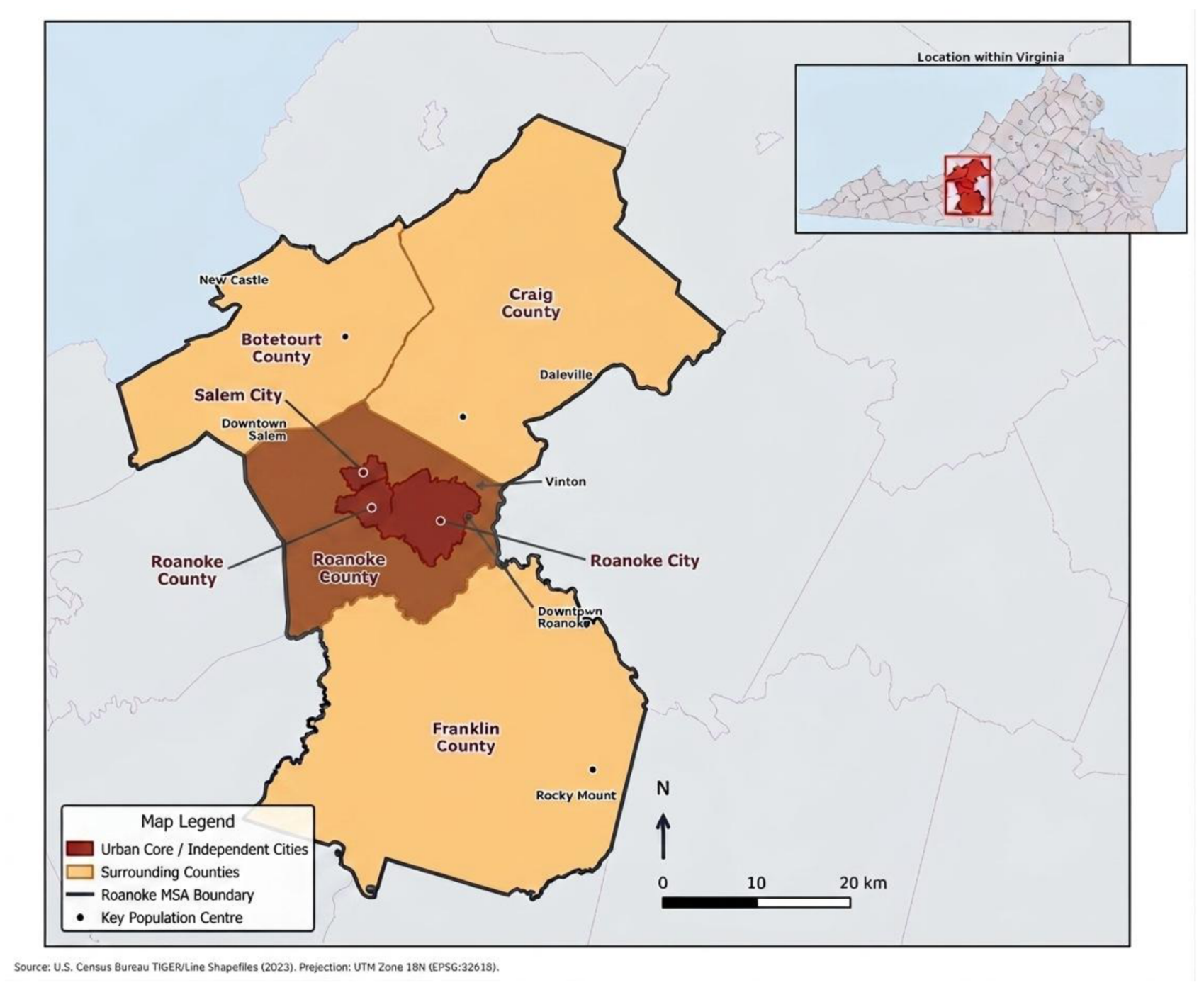
Figure 2.
Transitions between current and preferred future work arrangements among respondents with valid paired responses (n = 489). Of the 338 respondents indicating a directional change, 294 (87.0%) preferred movement toward a more remote arrangement. The marginal distributions differed significantly according to the Stuart–Maxwell test (χ² = 186.043, df = 3, BH-adjusted p < 0.001).
Figure 2.
Transitions between current and preferred future work arrangements among respondents with valid paired responses (n = 489). Of the 338 respondents indicating a directional change, 294 (87.0%) preferred movement toward a more remote arrangement. The marginal distributions differed significantly according to the Stuart–Maxwell test (χ² = 186.043, df = 3, BH-adjusted p < 0.001).
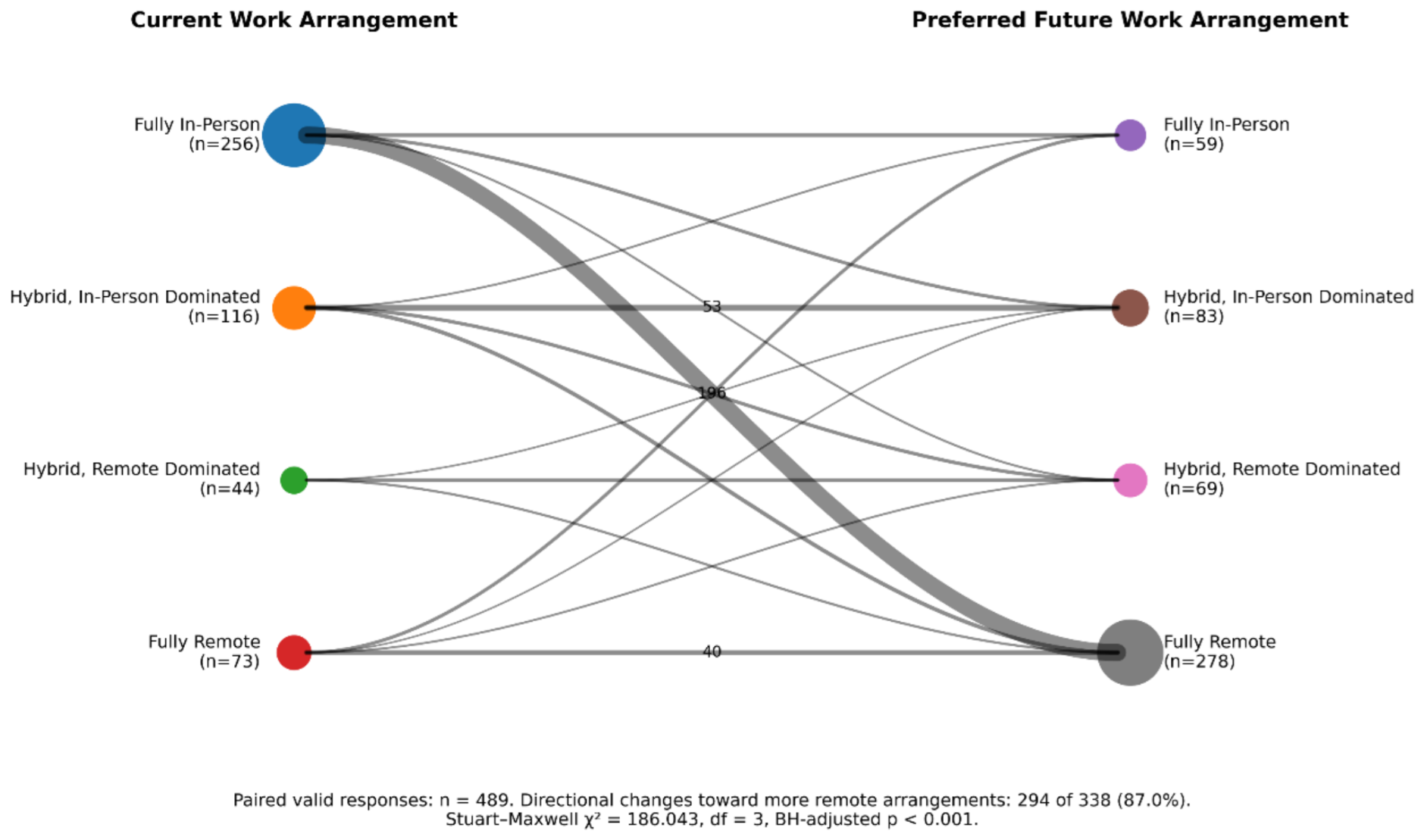
Figure 3.
Adjusted relative risk ratios and 95% confidence intervals for preferring fully remote rather than fully in-person work in the multinomial logistic regression model (complete-case n = 431). Fully in-person work was the reference outcome category. For the adjusted model only, marital status was represented as married versus not married to address sparse-cell instability.
Figure 3.
Adjusted relative risk ratios and 95% confidence intervals for preferring fully remote rather than fully in-person work in the multinomial logistic regression model (complete-case n = 431). Fully in-person work was the reference outcome category. For the adjusted model only, marital status was represented as married versus not married to address sparse-cell instability.
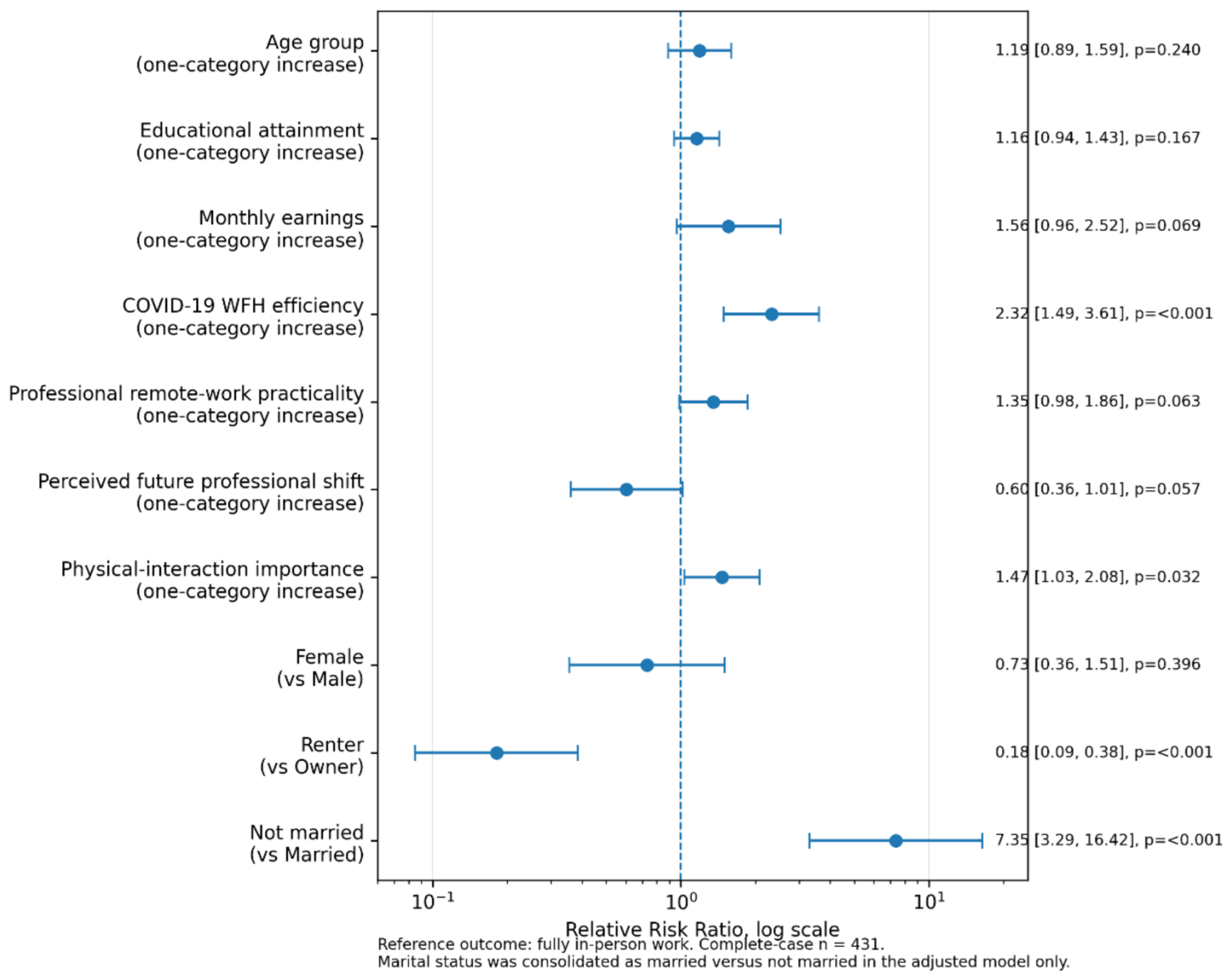

Table 1.
Construction of the Primary Analytical Sample.
| Sample Construction Step | Records Retained | Records Excluded at Step |
|---|---|---|
| Original QuestionPro export | 1,122 | — |
| Completed survey responses only | 908 | 214 |
| Completed, nonduplicate responses | 732 | 176 |
| Verified adult respondents aged 18 years or older | 653 | 79 |
| Verified adult residents of the Roanoke MSA | 636 | 17 |
Table 2.
Descriptive Profile of the Final Primary Analytical Sample.
| Variable | Category | n | % of Valid Responses |
|---|---|---|---|
| Gender | Male | 347 | 54.9 |
| Female | 285 | 45.1 | |
| Age Group | 18–24 | 78 | 12.3 |
| 25–34 | 245 | 38.5 | |
| 35–44 | 130 | 20.4 | |
| 45–54 | 70 | 11.0 | |
| 55–64 | 64 | 10.1 | |
| Above 64 | 49 | 7.7 | |
| Educational Attainment | High school | 37 | 5.8 |
| Trade/vocational/technical | 56 | 8.8 | |
| Some college | 101 | 15.9 | |
| Associate degree | 42 | 6.6 | |
| Bachelor’s degree | 187 | 29.5 | |
| Master’s degree | 102 | 16.1 | |
| Professional degree | 47 | 7.4 | |
| Doctorate | 62 | 9.8 | |
| Monthly Earnings | $1,250 or less | 107 | 16.9 |
| $1,251–$3,333 | 217 | 34.2 | |
| Greater than $3,333 | 220 | 34.6 | |
| Prefer not to say | 91 | 14.3 | |
| Marital Status | Married | 304 | 47.8 |
| Single | 110 | 17.3 | |
| Separated | 63 | 9.9 | |
| Divorced | 56 | 8.8 | |
| Widowed | 50 | 7.9 | |
| Prefer not to say | 53 | 8.3 | |
| Housing Tenure | Owner | 493 | 77.8 |
| Renter | 141 | 22.2 |
Note: Missing responses were excluded from percentage denominators for the corresponding variable. Responses of prefer not to say are reported descriptively but excluded from the corresponding inferential analyses.
Table 3.
Distribution of Current and Preferred Work Arrangements.
| Work Arrangement | Current Arrangement, n (%) | Preferred Future Arrangement, n (%) |
|---|---|---|
| Fully In-Person | 256 (52.1) | 67 (10.6) |
| Hybrid, In-Person Dominated | 118 (24.0) | 86 (13.6) |
| Hybrid, Remote Dominated | 44 (9.0) | 76 (12.0) |
| Fully Remote | 73 (14.9) | 404 (63.8) |
| Valid Total | 491 (100.0) | 633 (100.0) |
| Missing | 145 | 3 |
Note: Percentages are calculated using valid responses for each corresponding item.
Table 4.
Perceived Work-From-Home Efficiency and Physical-Interaction Importance by Preferred Future Work Arrangement.
Table 4.
Perceived Work-From-Home Efficiency and Physical-Interaction Importance by Preferred Future Work Arrangement.
| Preferred Future Work Arrangement | COVID-19 WFH Efficiency, n | Mean | Median | Physical-Interaction Importance, n | Mean | Median |
|---|---|---|---|---|---|---|
| Fully In-Person | 67 | 3.40 | 4.00 | 67 | 2.99 | 3.00 |
| Hybrid, In-Person Dominated | 84 | 3.79 | 4.00 | 86 | 3.40 | 4.00 |
| Hybrid, Remote Dominated | 76 | 3.89 | 4.00 | 76 | 2.79 | 3.00 |
| Fully Remote | 368 | 3.95 | 4.00 | 368 | 3.57 | 4.00 |
Note: COVID-19 work-from-home efficiency was measured on a five-point Likert scale, with higher values indicating greater perceived efficiency. Physical-interaction importance was measured on a five-point Likert scale, with higher values indicating greater importance.
Table 5.
Summary of Primary Inferential Tests After BH-FDR Correction.
| Primary Analysis | Valid n | Statistic | Effect Size | BH-Adjusted p | Result |
|---|---|---|---|---|---|
| Gender | 629 | χ² = 4.251 | V = 0.082 | 0.236 | Not significant |
| Age Group | 633 | χ² = 85.475 | V = 0.212 | < 0.001 | Significant |
| Educational Attainment | 631 | χ² = 55.199 | V = 0.171 | < 0.001 | Significant |
| Monthly Earnings | 542 | χ² = 37.199 | V = 0.185 | < 0.001 | Significant |
| Marital Status | 580 | χ² = 103.238 | V = 0.244 | < 0.001 | Significant |
| Housing Tenure | 631 | χ² = 74.645 | V = 0.344 | < 0.001 | Significant |
| Current Versus Preferred Arrangement | 489 | χ² = 186.043 | — | < 0.001 | Significant |
| COVID-19 WFH Efficiency | 595 | ρ = 0.111 | ρ = 0.111 | 0.0075 | Significant |
| Professional Remote-Work Practicality/Prevalence | 597 | χ² = 88.681 | V = 0.223 | < 0.001 | Significant |
| Future Professional Shift Toward Remote Work | 596 | χ² = 190.095 | V = 0.399 | < 0.001 | Significant |
| Importance of Physical Interaction | 597 | ρ = 0.205 | ρ = 0.205 | < 0.001 | Significant |
Table 6.
Overall Adjusted Contributions in the Multinomial Logistic Regression Model.
| Variable | LR χ² | df | p-value | Result |
|---|---|---|---|---|
| Not Married versus Married | 57.173 | 3 | < 0.001 | Significant |
| Renter versus Owner | 25.952 | 3 | < 0.001 | Significant |
| Monthly Earnings | 25.673 | 3 | < 0.001 | Significant |
| Physical-Interaction Importance | 24.457 | 3 | < 0.001 | Significant |
| COVID-19 Work-From-Home Efficiency | 18.324 | 3 | < 0.001 | Significant |
| Educational Attainment | 16.667 | 3 | < 0.001 | Significant |
| Age Group | 15.713 | 3 | 0.001 | Significant |
| Professional Remote-Work Practicality | 9.050 | 3 | 0.029 | Significant |
| Perceived Future Professional Shift | 7.487 | 3 | 0.058 | Not significant |
| Gender | 5.636 | 3 | 0.131 | Not significant |
Disclaimer/Publisher’s Note: The statements, opinions and data contained in all publications are solely those of the individual author(s) and contributor(s) and not of MDPI and/or the editor(s). MDPI and/or the editor(s) disclaim responsibility for any injury to people or property resulting from any ideas, methods, instructions or products referred to in the content. |
© 2026 by the authors. Licensee MDPI, Basel, Switzerland. This article is an open access article distributed under the terms and conditions of the Creative Commons Attribution (CC BY) license (http://creativecommons.org/licenses/by/4.0/).
Copyright: This open access article is published under a Creative Commons CC BY 4.0 license, which permit the free download, distribution, and reuse, provided that the author and preprint are cited in any reuse.


