

Submitted:
05 July 2026
Posted:
06 July 2026
You are already at the latest version
Abstract
In femtosecond-laser processing of titania in water, light can induce reduction and oxidation simultane-ously. We follow this duality, in this perspective, from colloidal titania synthesis to hot-electron devices. Femtosecond ablation/fragmentation of an aqueous anatase suspension (515 nm, 230 fs, 5 µJ, fluence F ≈ 25.5 J cm−2/pulse at clamped intensity ∼1013 W cm−2) yields surface-reduced, Ti3+-rich bluish TiO2 – x, while the same optical breakdown generates reactive oxygen species (ROS), among them H2O2 and HO• radicals, which compete by re-oxidising Ti3+. When the reduced titania is decorated with plasmonic nanoparticles (e.g., Au), an n-type plasmonic photo-electrode is realised: sp hot electrons are injected over the Schottky barrier, while the deep d-band supplies oxidising holes. Water oxidation proceeds in stages at potentials well above the formal 1.23 V via the two-electron peroxide route (∼1.77 V) or, for sufficiently energetic holes, via the one-electron HO• route (∼2.7 V). In a biased cell, H2 evolves on Pt through the adsorbed (H2+)ad intermediate. The same Au/semiconductor physics on silicon enables sub-band-gap hot-electron photo-detection. Energy-level diagrams (flat-band and in-contact) and the sp- vs. d-band origin of the injected carriers are discussed.
Keywords:
laser reduction of titania
; water splitting
; femtosecond laser ablation
; hot electron injection
; reactive oxygen species
1. Motivation: Solar Fuel
Photocatalytic and photoelectrochemical water splitting store sunlight in the bond, but the efficiency of any such device is set by the fate of the electrons and holes created on light absorption. The time-resolved spectroscopy was used to benchmark oxides and to show that performance is governed by three coupled processes on very different timescales: i) ultrafast band-edge and bulk recombination that destroys e-h carriers, ii) the slower spatial separation of electrons and holes, often driven by the space-charge field of a junction or by an applied bias, and iii) trapping at surface states where holes in contact with water either drive oxidation or are lost [1,2,3,4]. A recurring lesson is that water oxidation needs long-lived holes for slow O2-evolving chemistry and that buying lifetime costs voltage [5]. The intrinsic lifetime is in turn tied to the metal centre, where a sub-picosecond relaxation through metal-centred ligand-field states quenches carriers and explains why high-dielectric -materials such as SrTiO3 hold charges far longer than hematite and perform so well [6,7,8]. It was shown what those design rules yield in practice having extended light harvesting into the visible with (oxy)nitrides and oxysulfides [9,10,11,12,13] and pushed SrTiO3 to near-unity quantum efficiency by suppressing recombination [14]. The powder photocatalysis was taken out of the laboratory and were made into sheets for above 1% solar-to-hydrogen conversion [15]. The 1 m2 panel under natural sunlight [16] and a 100 m2 outdoor panel array run safely for months with membrane gas recovery [17,18]. Solar water splitting on metal oxides and nitrides directly advances UN Sustainable Development Goal 7 (Affordable and Clean Energy) by offering a route to renewable green hydrogen, while also supporting SDG 13 (Climate Action) through carbon-neutral fuel production [19].
2. Light as a Trigger for Reduction and Oxidation
Since the discovery of photoelectrochemical water splitting on TiO2 [20], titania has been the archetypal photocatalyst, and a major route to extending its activity into the visible has been reduction: introducing oxygen vacancies and Ti3+ (Ti(III)) centres to make “black” or colored TiO2-x [21,22]. The central theme of this perspective paper is that, in the processes used to make and to use such materials, light simultaneously induces reduction and oxidation: the absorbed photon energy is partitioned into reducing and oxidising species or carriers. This duality recurs from colloid synthesis to hot-carrier devices.
Pulsed-laser processing of materials in liquids is a versatile, surfactant-free route to colloidal metal-oxide nanomaterials [23,24]. In pulsed laser ablation in liquid (PLAL), a solid Ti or TiO2 target is ablated. In laser melting/fragmentation in liquid (LML/LFL) an existing suspension is irradiated so that each particle is transiently melted and re-solidified. In both, the reactive aqueous environment and the non-equilibrium quench imprint oxygen vacancies and Ti3+, producing reduced TiO2-x with a blue-to-black coloration [22,25,26,27]. The pulse duration sets the physics: nanosecond pulses act thermally with a large heat-affected zone, whereas femtosecond pulses drive non-linear (multiphoton/avalanche) absorption and optical breakdown before heat diffuses, favoring small, defect-rich particles and reduction of commercial anatase without chemical reductants [25,26]. The color tracks the degree of reduction [22].
The same femtosecond pulses also fragment colloids. It was shown that fs-ablation of gold in water gives bare colloids in two regimes: (i) small (3–10 nm), nearly monodisperse colloids at low fluence and (ii) large particles with a broad size distribution, formed via plasma heating at high fluence [28]. Size is then controlled with the white-light supercontinuum that an intense fs-pulse self-generates in the liquid: spread along a self-focused filament and overlapping the colloid plasmon, it fragments particles in a 3D volume so that they re-coalesce smaller and more stable, tunable by fluence [29]. This method was used to make ultra-pure water-dispersed gold [30], and oxidative fragmentation pushes gold below 3 nm [31]. Comparable down-sizing is reachable by ns-laser fragmentation [32] or by non-laser routes (cavitation, discharge, milling).
The oxidising face of light is equally important. Optical breakdown of water is radiolytic: it produces reducing species (short-lived , H.-radical (an atom) as well as H2) but also strong oxidisers (HO., H2O2), so the very pulse that reduces titania can also re-oxidise it. The same duality appears in plasmonics: decay of a localized surface plasmon yields hot electrons (from the gold band) that can reduce, and hot holes from the deep d-band that can oxidise [33,34,35,36].
Building on these ideas, the remainder of the paper follows one thread through three settings: (i) femtosecond laser reduction of anatase and the plasmonic enhancement of its activity; (ii) reduced titania decorated with gold as a photoanode for water splitting; and (iii) the same Au/semiconductor plasmonics enabling sub-band-gap (sub-wavelength) detection on silicon.
3. Results and Discussion from the Electron Transport View
3.1. Laser Reduction of Anatase and Plasmonic Enhancement of Its Activity
Synthesis. Following [37], an aqueous suspension of commercial anatase microparticles (m) at 15 mg mL−1 was irradiated at the liquid surface with a 515 nm, 230 fs laser (Pharos, Light Conversion) at 200 kHz, using J pulses focused to a m spot, with periodic agitation (Figure 1); the product settled into color-graded layers.
Fluence, intensity and clamping. For a focal disk of diameter m the area is cm2, so J gives a fluence J cm−2 and, at fs, a geometric average intensity W cm−2 (111 TW cm−2; for a Gaussian pulse the peak intensity is twice larger); the average power is W and the photon energy eV. This is deep in the optical-breakdown regime (water breakdown W cm−2, titania ablation J cm−2). However, the peak power (∼22 MW) far exceeds the critical power for self-focusing in water (–4 MW), so the beam filaments, and Kerr self-focusing balanced by plasma defocusing clamps the in-filament intensity to of order W cm−2, largely independent of pulse energy [38,39]. The same self-focusing also generates the white-light supercontinuum. The geometric value is thus an upper bound, with the dose spread along the filament. The superheated, oxygen-deficient plasma and reaction with water (Ti−OH, Ti−H) create the lattice disorder, oxygen vacancies and Ti3+ of the bluish product [26,27,37].
Competing oxidative chemistry (ROS). Radiolysis in the fs-laser filament in water also makes oxidisers: HO. radicals and, by 2 HO· → H2O2, hydrogen peroxide, ( V), which re-oxidise Ti3+ to Ti4+· (here Ti3+ denotes Ti(III) in the reduced surface oxide rather than an ion in the solution phase, i.e., Ti2O3 + H2O2 → 2 TiO2 + H2O). Because the Ti(III)-Ti(IV) red-ox couple resides at the surface, reduction is fast and local in the hot bubble, while surface-bound H2O2 oxidises. Oxidation and reduction proceed on the same surface, so H2O2 is formed at the interface, however could be transported to the surface from the solution. This plausibly explains why the product plateaus at blue rather than black and why reduced titania ages in aerated water, where TiO2-x can also be oxidised to TiO2 by dissolved oxygen. Peroxide is useful for oxidative fragmentation [31], and the oxidising channel can be suppressed (inert atmosphere, HO./H2O2 scavengers, lower fluence) to favour deeper reduction. The energetics of the radical channel sets the scale of the oxidising power available: one-electron oxidation of water to the HO. radical requires potentials as high as V [40], which makes HO. the strongest oxidiser generated in the filament. This is the synthesis-stage face of the light-as-oxidiser theme.
Characterisation. The product separated by density/color into light-blue, dark-blue (laser-ablated “LA-mid”) and dark-blue/black (“LA-top”) fractions (Figure 1), the darkest staying suspended longest [37]. X-ray photoelectron spectroscopy showed the signatures of reduction in every fraction: the O 1s lattice-oxygen peak shifted up by – eV with a new ∼532 eV oxygen-vacancy component, and the Ti 2p doublet broadened and shifted to lower binding energy, indicating Ti3+ alongside Ti4+; the darker LA-top fraction carried the higher defect density. X-ray absorption at the Ti K-edge (XANES/EXAFS) was, by contrast, indistinguishable from anatase, so the reduction is surface-confined while the bulk remains crystalline anatase, as expected from a commercial-anatase feedstock. The visible-to-IR absorption responsible for the blue color (Figure 2(a)) is the optical fingerprint of the Ti3+/vacancy states, and a CIE-1931 evaluation of it returns a blue transmitted chromaticity (similar color as in Figure 1). Under visible light the colloid degraded ∼ of methylene blue in h (pseudo-first-order min−1) with enhanced dark adsorption relative to the parent anatase; the low yield of the darkest fraction (∼5–6 mg) was, however, insufficient for N2-adsorption (BET) surface-area analysis [37].
Plasmonic enhancement. Reduction of titania broadens its absorption, but the trapped carriers recombine readily. Decorating the reduced oxide with gold nanoparticles adds a route to harvest visible light and to separate charge. Gold nanorods on titania show transverse/longitudinal plasmon extinction bands (∼680 and ∼1000 nm, Figure 2(b)) that can be tuned to overlap the substrate absorption. Plasmon decay then injects carriers across the metal-oxide interface, the mechanism of plasmon-induced charge separation first demonstrated for Au/TiO2 [33] and now central to plasmonic photocatalysis [34,35,36].
3.2. Reduced Titania with Gold as a Photoanode for Water Splitting
The Ti(III)-rich titania becomes the n-type substrate of a plasmonic photoanode (Figure 3). Stoichiometric anatase is a semiconductor with an empty conduction band eV up; the Ti3+/vacancy donors make it n-type and conductive, set up the depletion field/Schottky barrier, and add sub-band states that receive the injected electron, all prerequisites for a working electrode [20,41,42]. Gold (20–50 nm) adds a plasmon at ∼520-550 nm and a Schottky junction (- eV): hot electrons above inject into the conduction band while Au serves as a low overpotential cathode [34,42]. A eV (1100 nm) photon just lifts an electron over , but the hole it leaves near cannot oxidise water. Only an interband excitation ( eV) leaves a deep, oxidising d-band hole (Figure 3(b))—again the electron/hole (reduce/oxidise) duality.
Plasmonic photocatalysis and the surface-normal field. Decorating titania with plasmonic Au (or Ag) turns it into a visible-light photocatalyst, and action-spectrum analysis established that the photo-catalytic rate tracks the localized-plasmon absorption band of the metal—direct evidence that the chemistry is driven by plasmon-induced charge transfer into the oxide rather than by heating [33,43]. Which part of the plasmonic near-field does the injecting is not arbitrary. For a metal nanoparticle sitting on a substrate it is the depolarised field component normal to the interface (the component) that couples charge across the metal-semiconductor junction. For asymmetric spheroidal gold or silver nanoparticles on a dielectric substrate we showed that the frequency- and polarization-dependent optical response is governed by this perpendicular component, and that it is the surface-normal field, not the in-plane field, that is active in the measured action spectra [44]. Physically, is concentrated in the few-nanometer presurface region of the oxide where the band bending is strongest, so an oscillation perpendicular to the interface most efficiently drives hot electrons over the Schottky barrier into the conduction band [41].
A practical corollary, relevant both to the photoanode here and to the silicon detector below, is that the geometry should be chosen to maximise the surface-normal field: nanoparticles or nanorods with their long axis (or asymmetry) out of the surface plane, oblique or unpolarised illumination, and arrays engineered to concentrate at the contact all enhance the injecting channel, whereas purely in-plane (transverse) polarization couples poorly to across-barrier transfer even when strongly absorbed. The match between the photo-response action spectrum and the plasmon resonance is therefore a signature that the normal-field charge-transfer channel, not mere plasmonic heating, dominates the activity.
Importantly, the practical voltage of water oxidation is not the formal V. Being a four-electron reaction, oxygen evolution on real surfaces cascades through intermediates, each with its own potential: the two-electron peroxide stage (2 H2O → H2O2 + 2 H+ + 2 e-, V) sets the realistic onset [45,46]—H2O2 reappearing, now as the oxidation intermediate. Noteworthy, the one-electron route is steeper still: formation of the HO. radical requires a potential as high as V [40]. The fewer electrons transferred per step, the higher the price per electron: ( V, HO.) > ( V, H2O2) > ( V, O2). On the energy ledger of Figure 3(b), only the deep d-band holes (∼ V vs. NHE) are energetic enough to open the radical channel, whereas holes near of gold cannot drive even the four-electron reaction. A single eV photon therefore cannot split water unaided. In the biased cell of Nishijima et al. [42] (Figure 3(c)) an anodic bias ( V, SCE) and a Pt cathode supply the deficit: injected electrons exit through the circuit, biased holes oxidise water at the TiO2/Au anode, and H2 evolves at Pt. Following Juodkazytė et al. [47], the cathodic step runs through the adsorbed dihydrogen cation, H3O+OH- then H2, the H-H+ bond paid for by H+ hydration so that the discharge is depolarised to ∼0 V (RHE). This mechanism of water splitting is consistent with the simultaneously occurring mass and charge changes upon HER [47]. Fully plasmon-driven (unbiased) water splitting has been demonstrated when charge separation is engineered, e.g., in the autonomous device of Mubeen et al. [48].
3.3. Plasmonic Detection on Silicon Below the Band Gap
The same EBL-defined plasmonic antennas used to read out wavelength and polarisation on glass (Figure 4) can be placed on silicon to build detectors. Here the metal-semiconductor physics turns from chemistry to photocurrent.
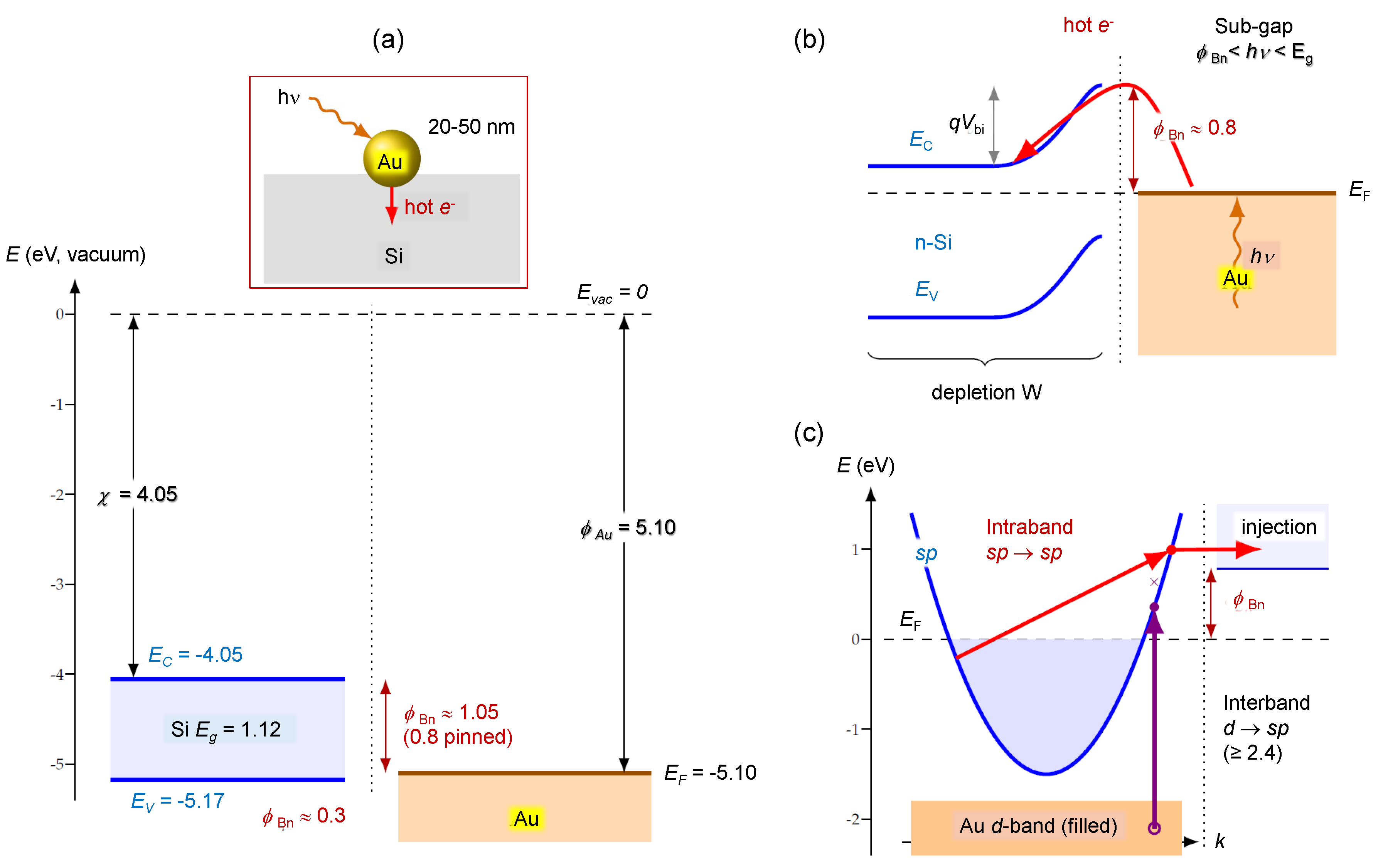
The relevant levels (vacuum-referenced) are Si eV, eV (, eV) and Au eV ( eV), giving an electron Schottky barrier eV (Schottky-Mott; ∼ eV with Fermi-level pinning) and a small hole barrier eV (Figure 5). After contact the Fermi levels equilibrate and the n-Si bands bend over a depletion width W, leaving unchanged. Plasmon decay in 20–50 nm Au gives hot electrons up to above ; those exceeding are emitted over the barrier into Si and collected by the built-in field. Crucially, this works for (∼– eV, -m), i.e., below the silicon gap, internal photoemission, the basis of Au/Si Schottky hot-electron detectors for the near-infrared [35,36,49]. The injected carriers are -band electrons: the filled d-band (∼- eV below ) supplies energetic electrons only via interband (, eV) excitation, which places the electron just above (below the barrier) while leaving a deep d-band hole (Figure 5(d)). In the sub-band-gap window only the channel operates, the mirror image of the titania case, where the d-band holes did the oxidation chemistry.
Polarization and wavelength sensitivity. Because a nanorod’s longitudinal plasmon scales with its aspect ratio, an array of rods is intrinsically wavelength- and polarization-selective, and this selectivity is carried directly into the photocurrent. In the titania photoanode of Figure 2 the Au-nanorod pattern shows distinct transverse and longitudinal extinction bands (here near 680 and 1000 nm) whose relative weight follows the incident polarization; the plasmon-assisted photocurrent measured by Nishijima et al. accordingly peaks at the wavelength and polarization that maximise the longitudinal resonance, so the same electrode effectively reports both the colour and the polarization of the sub-band-gap light it converts [41,42]. Transplanting the identical lithographic patterns onto silicon turns this into a hot-electron photodetector with built-in spectral and polarization discrimination: rods of different length resonate and therefore inject over the Schottky barrier at different wavelengths, while rods of a given length respond only to light polarized along their long axis, the orientation that also maximises the surface-normal injecting field discussed above for the photoanode. An array interleaving several rod lengths and orientations thus provides a set of photocurrent channels, each tuned to a particular wavelength-polarization combination, realising on a single chip the filterless wavelength-polarization read-out sketched in Figure 4. The price is the familiar one of internal photoemission, a modest quantum efficiency traded for operation below the silicon band gap and for intrinsic spectral and polarization selectivity.
4. Conclusions
The thread running through these three settings is that light simultaneously drives reduction and oxidation. In femtosecond processing of an aqueous anatase suspension the breakdown plasma reduces the surface to Ti3+/TiO2-x while the radiolytic ROS (HO., H2O2) re-oxidise it; intensity clamping (∼ W cm−2) together with this red-ox competition caps the reduction at “blue,” leaving the bulk anatase intact and the Ti3+ confined to the surface. Decorating the reduced oxide with gold tunes its visible–near-IR absorption and, through the surface-normal () plasmonic field, injects carriers across the interface, so that the photoactivity exceeds what reduction alone provides. The same Ti3+ donors make the oxide a conductive n-type photoanode on which hot electrons drive reduction and d-band holes drive water oxidation.
A small applied bias completes the cell, with hydrogen evolving at the platinum cathode through the adsorbed (H2+)ad intermediate. Finally, the identical Au/semiconductor physics transferred to silicon yields a hot-electron photo-detector that responds below the silicon band gap (∼–m): electrons are emitted over a ∼ eV Schottky barrier while the d-band again supplies the oxidising holes, and patterning the gold as nanorods of chosen length and orientation renders the photocurrent wavelength- and polarization-selective without filters. In every case it is the partition of the absorbed plasmonic energy into electrons and d holes - into reductants and oxidants - that determines what the device can do.
Funding
This research was funded by ARC DP240103231 grant.
Data Availability Statement
All data are presented in this perspective paper.
Acknowledgments
Authors are grateful for the hydrogen sensor program of the Victorian Hydrogen Hub (VH2) at Swinburne University of Technology.
Conflicts of Interest
The authors declare no conflicts of interest.
References
- Tang, J.; Durrant, J.R.; Klug, D.R. Mechanism of photocatalytic water splitting in TiO2: reaction of water with photoholes, importance of charge carrier dynamics, and evidence for four-hole chemistry. J. Am. Chem. Soc. 2008, 130, 13885–13891. [Google Scholar] [CrossRef]
- Barroso, M.; Pendlebury, S.R.; Cowan, A.J.; Durrant, J.R. Charge carrier trapping, recombination and transfer in hematite (α-Fe2O3) water splitting photoanodes. Chem. Sci. 2013, 4, 2724–2734. [Google Scholar] [CrossRef]
- Pendlebury, S.R.; Cowan, A.J.; Barroso, M.; Sivula, K.; Ye, J.; Grätzel, M.; Klug, D.R.; Tang, J.; Durrant, J.R. Ultrafast charge carrier recombination and trapping in hematite photoanodes under applied bias. J. Am. Chem. Soc. 2014, 136, 9854–9857. [Google Scholar] [CrossRef] [PubMed]
- Cowan, A.J.; Durrant, J.R. Long-lived charge separated states in nanostructured semiconductor photoelectrodes for the production of solar fuels. Chem. Soc. Rev. 2013, 42, 2281–2293. [Google Scholar] [CrossRef] [PubMed]
- Godin, R.; Durrant, J.R. Dynamics of photoconversion processes: the energetic cost of lifetime gain in photosynthetic and photovoltaic systems. Chem. Soc. Rev. 2021, 50, 13372–13409. [Google Scholar] [CrossRef] [PubMed]
- Sachs, M.; Pastor, E.; Walsh, A.; Durrant, J.R.; et al. Metal-centred states control carrier lifetimes in transition metal oxide photocatalysts. Nat. Chem. 2025, 17, 1348–1355. [Google Scholar] [CrossRef] [PubMed]
- Wilson, A.A.; Hart, L.; Shalvey, T.; Sachs, M.; Moss, B.; Durrant, J.R.; et al. Transient absorption spectroscopy reveals that slow bimolecular recombination in SrTiO3 underpins its efficient photocatalytic performance. Chem. Commun. 2023, 59, 13579–13582. [Google Scholar] [CrossRef] [PubMed]
- Selim, S.; Pastor, E.; García-Tecedor, M.; et al. Impact of oxygen vacancy occupancy on charge carrier dynamics in BiVO4 photoanodes. J. Am. Chem. Soc. 2019, 141, 18791–18798. [Google Scholar] [CrossRef] [PubMed]
- Pan, C.; Takata, T.; Nakabayashi, M.; Matsumoto, T.; Shibata, N.; Ikuhara, Y.; Domen, K. A complex perovskite-type oxynitride: the first photocatalyst for water splitting operable at up to 600 nm. Angew. Chem. Int. Ed. 2015, 54, 2955–2959. [Google Scholar] [CrossRef] [PubMed]
- Wang, Z.; Inoue, Y.; Hisatomi, T.; Domen, K. Overall water splitting by Ta3N5 nanorod single crystals grown on the edges of KTaO3 particles. Nat. Catal. 2018, 1, 756–763. [Google Scholar] [CrossRef]
- Wang, Q.; Nakabayashi, M.; Hisatomi, T.; others; Domen, K. Oxysulfide photocatalyst for visible-light-driven overall water splitting. Nat. Mater. 2019, 18, 827–832. [Google Scholar] [CrossRef] [PubMed]
- Chen, K.; Xiao, J.; Hisatomi, T.; Domen, K. Transition-metal (oxy)nitride photocatalysts for water splitting. Chem. Sci. 2023, 14, 9248–9257. [Google Scholar] [CrossRef] [PubMed]
- Xiao, J.; Hisatomi, T.; Domen, K. Narrow-band-gap particulate photocatalysts for one-step-excitation overall water splitting. Acc. Chem. Res. 2023, 56, 878–888. [Google Scholar] [CrossRef]
- Takata, T.; Jiang, J.; Sakata, Y.; Nakabayashi, M.; Shibata, N.; Nandal, V.; Seki, K.; Hisatomi, T.; Domen, K. Photocatalytic water splitting with a quantum efficiency of almost unity. Nature 2020, 581, 411–414. [Google Scholar] [CrossRef] [PubMed]
- Wang, Q.; Hisatomi, T.; Jia, Q.; Tokudome, H.; Domen, K. Scalable water splitting on particulate photocatalyst sheets with a solar-to-hydrogen energy conversion efficiency exceeding 1%. Nat. Mater. 2016, 15, 611–615. [Google Scholar] [CrossRef] [PubMed]
- Goto, Y.; Hisatomi, T.; Wang, Q.; others; Domen, K. A particulate photocatalyst water-splitting panel for large-scale solar hydrogen generation. Joule 2018, 2, 509–520. [Google Scholar] [CrossRef]
- Nishiyama, H.; Yamada, T.; Nakabayashi, M.; Maehara, Y.; Hisatomi, T.; Domen, K. Photocatalytic solar hydrogen production from water on a 100 m2 scale. Nature 2021, 598, 304–307. [Google Scholar] [CrossRef] [PubMed]
- Hisatomi, T.; Domen, K. Reaction systems for solar hydrogen production via water splitting with particulate semiconductor photocatalysts. Nat. Catal. 2019, 2, 387–399. [Google Scholar] [CrossRef]
- United Nations General Assembly. Transforming our World: The 2030 Agenda for Sustainable Development. 25 September 2015. Available online: https://sdgs.un.org/2030agenda.
- Fujishima, A.; Honda, K. Electrochemical photolysis of water at a semiconductor electrode. Nature 1972, 238, 37–38. [Google Scholar] [CrossRef] [PubMed]
- Chen, X.; Liu, L.; Yu, P.Y.; Mao, S.S. Increasing solar absorption for photocatalysis with black hydrogenated titanium dioxide nanocrystals. Science 2011, 331, 746–750. [Google Scholar] [CrossRef] [PubMed]
- Rajaraman, T.; Parikh, S.P.; Gandhi, V.G. Black TiO2: A review of its properties and conflicting trends. Chem. Eng. J. 2020, 389, 123918. [Google Scholar] [CrossRef]
- Amendola, V.; Meneghetti, M. What controls the composition and the structure of nanomaterials generated by laser ablation in liquid solution? Phys. Chem. Chem. Phys. 2013, 15, 3027–3046. [Google Scholar] [CrossRef] [PubMed]
- Zhang, D.; Gökce, B.; Barcikowski, S. Laser synthesis and processing of colloids: fundamentals and applications. Chem. Rev. 2017, 117, 3990–4103. [Google Scholar] [CrossRef] [PubMed]
- Zuñiga-Ibarra, V.A.; Shaji, S.; Krishnan, B.; Johny, J.; Kanakkillam, S.S.; Avellaneda, D.; Martinez, J.A.; Roy, T.D.; Ramos-Delgado, N. Synthesis and characterization of black TiO2 nanoparticles by pulsed laser irradiation in liquid. Appl. Surf. Sci. 2019, 483, 156–164. [Google Scholar] [CrossRef]
- Chen, X.; Zhao, D.; Liu, K.; Wang, C.; Liu, L.; Li, B.; Zhang, Z.; Shen, D. Laser-modified black titanium oxide nanospheres and their photocatalytic activities under visible light. ACS Appl. Mater. Interfaces 2015, 7, 16070–16077. [Google Scholar] [CrossRef] [PubMed]
- Zhang, X.L.; Zhu, J.; Fan, L.; Chen, H.T.; Wang, W.; He, H.; Wang, Q. Pulsed laser ablation in water synthesis of black TiO2-graphene oxide nanocomposites. J. Nanosci. Nanotechnol. 2020, 20, 2622–2627. [Google Scholar] [PubMed]
- Kabashin, A.V.; Meunier, M. Synthesis of colloidal nanoparticles during femtosecond laser ablation of gold in water. J. Appl. Phys. 2003, 94, 7941–7943. [Google Scholar] [CrossRef]
- Besner, S.; Kabashin, A.V.; Meunier, M. Fragmentation of colloidal nanoparticles by femtosecond laser-induced supercontinuum generation. Appl. Phys. Lett. 2006, 89, 233122. [Google Scholar] [CrossRef]
- Kubiliūtė, R.; Maximova, K.A.; Lajevardipour, A.; Yong, J.; Hartley, J.S.; Mohsin, A.S.M.; Blandin, P.; Chon, J.W.M.; Sentis, M.; Stoddart, P.R.; et al. Ultra-pure, water-dispersed Au nanoparticles produced by femtosecond laser ablation and fragmentation. Int. J. Nanomed. 2013, 8, 2601–2611. [Google Scholar]
- Maximova, K.; Aristov, A.; Sentis, M.; Kabashin, A.V. Size-controllable synthesis of bare gold nanoparticles by femtosecond laser fragmentation in water. Nanotechnology 2015, 26, 065601. [Google Scholar] [CrossRef] [PubMed]
- Mafuné, F.; Kohno, J.; Takeda, Y.; Kondow, T. Formation of gold nanonetworks and small gold nanoparticles by irradiation of intense pulsed laser onto gold nanoparticles. J. Phys. Chem. B 2003, 107, 12589–12596. [Google Scholar] [CrossRef]
- Tian, Y.; Tatsuma, T. Mechanisms and applications of plasmon-induced charge separation at TiO2 films loaded with gold nanoparticles. J. Am. Chem. Soc. 2005, 127, 7632–7637. [Google Scholar] [PubMed]
- Linic, S.; Christopher, P.; Ingram, D.B. Plasmonic-metal nanostructures for efficient conversion of solar to chemical energy. Nat. Mater. 2011, 10, 911–921. [Google Scholar] [CrossRef] [PubMed]
- Clavero, C. Plasmon-induced hot-electron generation at nanoparticle/metal-oxide interfaces for photovoltaic and photocatalytic devices. Nat. Photonics 2014, 8, 95–103. [Google Scholar] [CrossRef]
- Brongersma, M.L.; Halas, N.J.; Nordlander, P. Plasmon-induced hot carrier science and technology. Nat. Nanotechnol. 2015, 10, 25–34. [Google Scholar] [CrossRef] [PubMed]
- Campbell, L. Black TiO2-x for Visible-Light Activated Photocatalysis: Structure, Performance and Antimicrobial Applications. PhD thesis, 2025. [Google Scholar]
- Couairon, A.; Mysyrowicz, A. Femtosecond filamentation in transparent media. Phys. Rep. 2007, 441, 47–189. [Google Scholar] [CrossRef]
- Liu, W.; Petit, S.; Becker, A.; Aközbek, N.; Bowden, C.M.; Chin, S.L. Intensity clamping of a femtosecond laser pulse in condensed media. Opt. Commun. 2002, 202, 189–197. [Google Scholar]
- Armstrong, D.A.; Huie, R.E.; Koppenol, W.H.; Lymar, S.V.; Merényi, G.; Neta, P.; Ruscic, B.; Stanbury, D.M.; Steenken, S.; Wardman, P. Standard electrode potentials involving radicals in aqueous solution: inorganic radicals (IUPAC Technical Report). Pure Appl. Chem. 2015, 87, 1139–1150. [Google Scholar] [CrossRef]
- Juodkazis, S.; Rosa, L.; Nishijima, Y. Plasmonic Solutions for Light Harvesting in Solar and Sensing Applications. In Nanoplasmonics: Advanced Device Applications; Chon, J.W.M., Iniewski, K., Eds.; CRC Press, 2013; Volume chapter 3, pp. 55–110. [Google Scholar]
- Nishijima, Y.; Ueno, K.; Yokota, Y.; Murakoshi, K.; Misawa, H. Plasmon-assisted photocurrent generation from visible to near-IR wavelength using a Au-nanorods/TiO2 electrode. J. Phys. Chem. Lett. 2010, 1, 2031–2036. [Google Scholar]
- Kowalska, E.; Mahaney, O.O.P.; Abe, R.; Ohtani, B. Visible-light-induced photocatalysis through surface plasmon excitation of gold on titania surfaces. Phys. Chem. Chem. Phys. 2010, 12, 2344–2355. [Google Scholar] [PubMed]
- Mizeikis, V.; Kowalska, E.; Ohtani, B.; Juodkazis, S. Frequency- and polarization-dependent optical response of asymmetric spheroidal silver nanoparticles on dielectric substrate. Phys. Status Solidi RRL 2010, 4, 328–330. [Google Scholar] [CrossRef]
- Juodkazytė, J.; Šebeka, B.; Savickaja, I.; et al. Solar water splitting: Efficiency discussion. Int. J. Hydrogen Energy 2016, 41, 11941–11948. [Google Scholar] [CrossRef]
- Juodkazis, K.; Juodkazytė, J.; Grigucevičienė, A.; Juodkazis, S. Photoelectrolysis of water: Solar hydrogen—achievements and perspectives. Opt. Express 2010, 18, A147–A160. [Google Scholar] [PubMed]
- Juodkazytė, J.; Juodkazis, K.; Juodkazis, S. Atoms vs. Ions: Intermediates in Reversible Electrochemical Hydrogen Evolution Reaction. Catalysts 2021, 11, 1135. [Google Scholar] [CrossRef]
- Mubeen, S.; Lee, J.; Singh, N.; Krämer, S.; Stucky, G.D.; Moskovits, M. An autonomous photosynthetic device in which all charge carriers derive from surface plasmons. Nat. Nanotechnol. 2013, 8, 247–251. [Google Scholar] [CrossRef] [PubMed]
- Knight, M.W.; Sobhani, H.; Nordlander, P.; Halas, N.J. Photodetection with active optical antennas. Science 2011, 332, 702–704. [Google Scholar] [CrossRef] [PubMed]
Figure 1.
Femtosecond-laser processing of the titania suspension. mL of 15 mg mL−1 titania suspension in a 5 mL beaker covered with a mm thick cover glass was irradiated with 515 nm, 230 fs laser (Pharos, Light Conversion) pulses (J/pulse) at 200 kHz repetition rate using a Mitutoyo NA IR objective focused at or just below the liquid surface. The irradiation was interrupted every 2 minutes to agitate the suspension by moving the beaker rapidly in a circular motion 30 times. Two irradiation sessions were performed: the first took 2 hours ( min irradiation + whirl iterations), the second hours (75 iterations), with a ∼ hour window between the two sessions.
Figure 1.
Femtosecond-laser processing of the titania suspension. mL of 15 mg mL−1 titania suspension in a 5 mL beaker covered with a mm thick cover glass was irradiated with 515 nm, 230 fs laser (Pharos, Light Conversion) pulses (J/pulse) at 200 kHz repetition rate using a Mitutoyo NA IR objective focused at or just below the liquid surface. The irradiation was interrupted every 2 minutes to agitate the suspension by moving the beaker rapidly in a circular motion 30 times. Two irradiation sessions were performed: the first took 2 hours ( min irradiation + whirl iterations), the second hours (75 iterations), with a ∼ hour window between the two sessions.
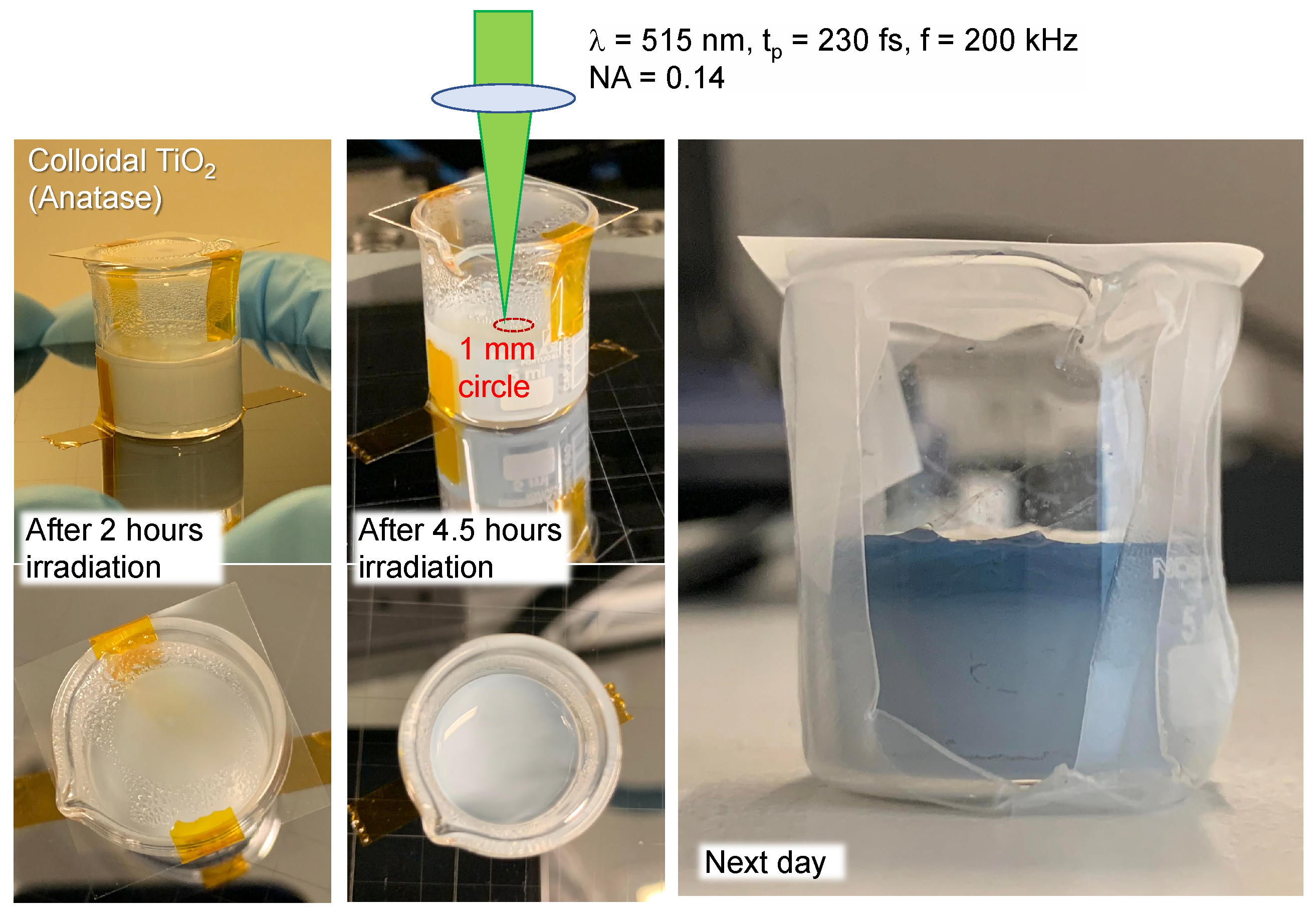
Figure 2.
Plasmonic solar cell. (a) Absorption spectrum of different titania substrates: n-type Nb-doped TiO2 (Furuuchi Chemical Co., Japan), reduced TiO2:Ti3+ (Shinkosha Ltd., Japan), and undoped TiO2; thickness of samples was mm. The top-inset shows color equivalence (sample’s appearance) and RGB coefficients of the chromaticity diagram. (b) The extinction spectrum of an Au nano-rod pattern fabricated on the untreated TiO2 single crystal measured under unpolarized and polarized illumination in water; polarization is marked by arrows. The inset shows an SEM image of the pattern of gold nanorods of a nm2 footprint. (Adapted from Ref. [41].)
Figure 2.
Plasmonic solar cell. (a) Absorption spectrum of different titania substrates: n-type Nb-doped TiO2 (Furuuchi Chemical Co., Japan), reduced TiO2:Ti3+ (Shinkosha Ltd., Japan), and undoped TiO2; thickness of samples was mm. The top-inset shows color equivalence (sample’s appearance) and RGB coefficients of the chromaticity diagram. (b) The extinction spectrum of an Au nano-rod pattern fabricated on the untreated TiO2 single crystal measured under unpolarized and polarized illumination in water; polarization is marked by arrows. The inset shows an SEM image of the pattern of gold nanorods of a nm2 footprint. (Adapted from Ref. [41].)
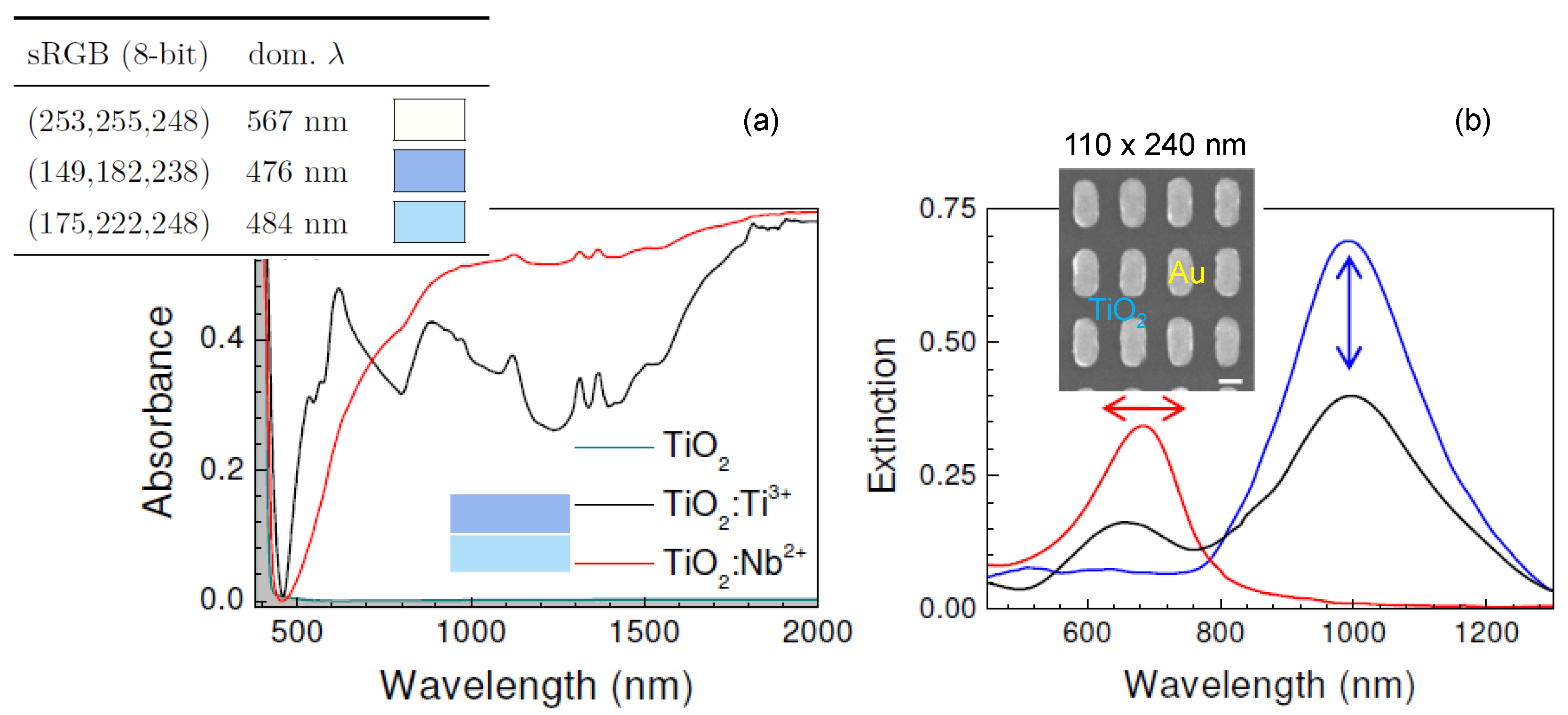
Figure 3.
Au-decorated titania. (a) Real-space arrangement and reactions. (b) Interface energetics with the water red-ox levels on the same scale ( at 0 V just below ; at V mid-gap). Two plasmonic channels are contrasted: an IR intraband excitation ( eV) lifts an electron enough to clear and inject into the conduction band, but the hole left near is not positive enough to oxidise water (×); only an interband excitation ( eV) creates a deep d-band hole ( V) that can oxidise water (√). (c) Biased cell: an anodic bias ( V vs. SCE) plus a separate Pt cathode let eV (1100 nm) photons drive photocurrent. Injected electrons exit through the circuit to the Pt cathode, where evolution proceeds through the adsorbed molecular ion (+; ), while biased holes oxidise water at the /Au anode. The right diagram shows the two-electron cathodic ladder via near 0 V (RHE).
Figure 3.
Au-decorated titania. (a) Real-space arrangement and reactions. (b) Interface energetics with the water red-ox levels on the same scale ( at 0 V just below ; at V mid-gap). Two plasmonic channels are contrasted: an IR intraband excitation ( eV) lifts an electron enough to clear and inject into the conduction band, but the hole left near is not positive enough to oxidise water (×); only an interband excitation ( eV) creates a deep d-band hole ( V) that can oxidise water (√). (c) Biased cell: an anodic bias ( V vs. SCE) plus a separate Pt cathode let eV (1100 nm) photons drive photocurrent. Injected electrons exit through the circuit to the Pt cathode, where evolution proceeds through the adsorbed molecular ion (+; ), while biased holes oxidise water at the /Au anode. The right diagram shows the two-electron cathodic ladder via near 0 V (RHE).
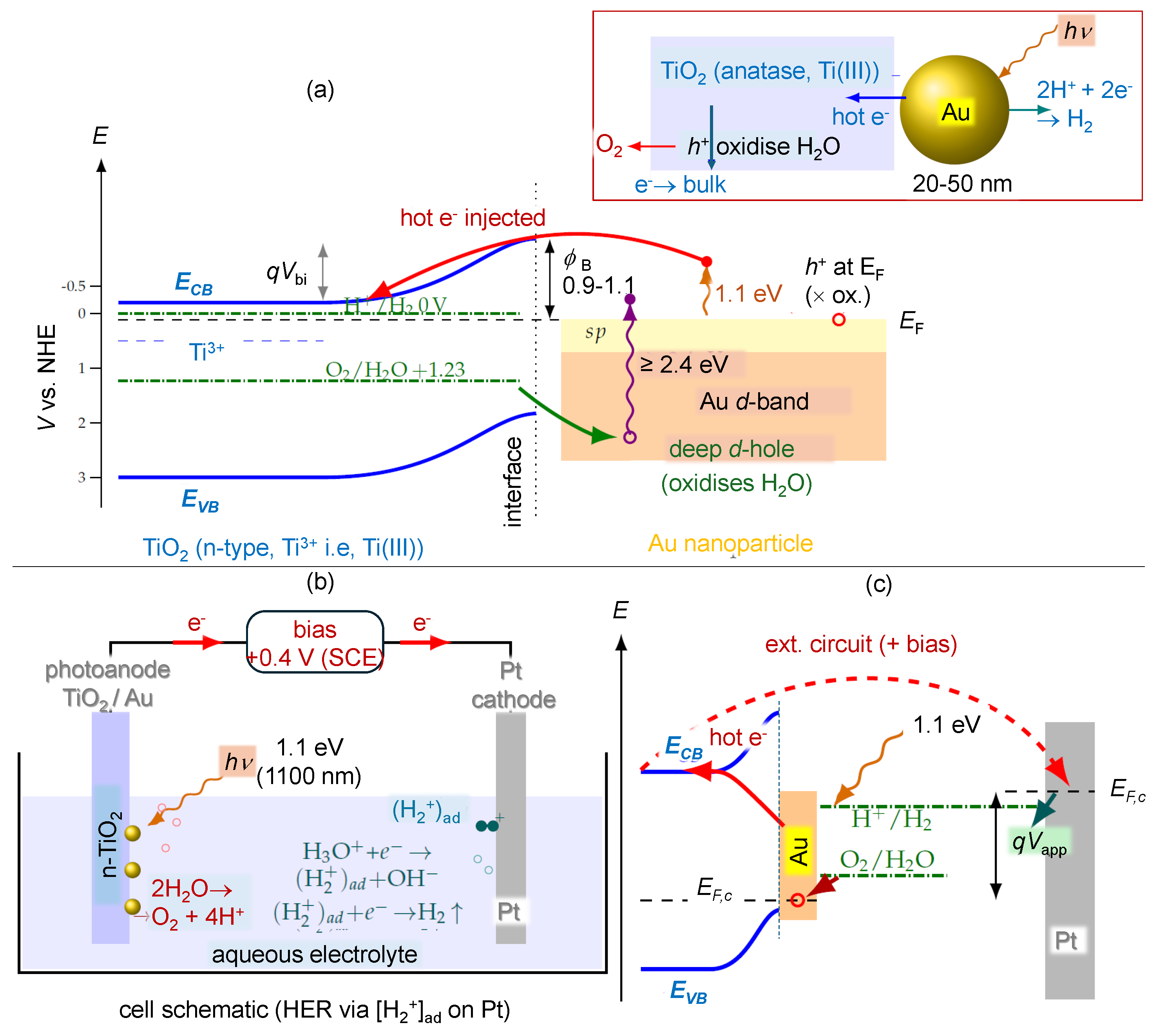
Figure 4.
Electron-beam-lithography-defined structures for read-out of wavelength–polarisation by scattering/reflectance/transmittance. The thickness of Au was ∼40 nm, made by a lift-off process on glass. Note that the same structures can be made on Si substrates for detectors (discussed next, below). Such patterns were proposed as optical memory bits for multi-wavelength and polarisation multiplexing [41].
Figure 4.
Electron-beam-lithography-defined structures for read-out of wavelength–polarisation by scattering/reflectance/transmittance. The thickness of Au was ∼40 nm, made by a lift-off process on glass. Note that the same structures can be made on Si substrates for detectors (discussed next, below). Such patterns were proposed as optical memory bits for multi-wavelength and polarisation multiplexing [41].
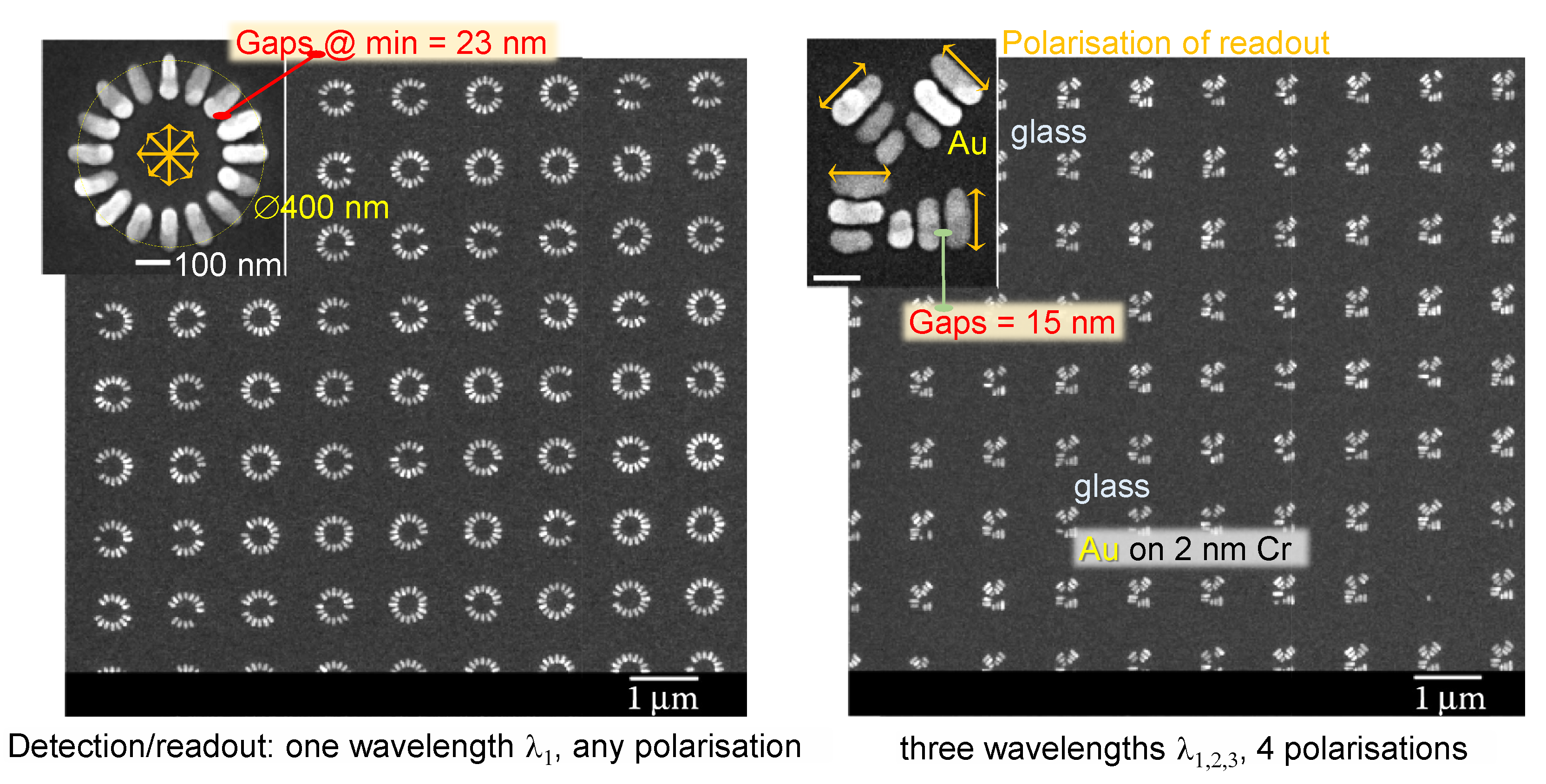
Figure 5.
Au/Si hot carriers. (a) Real space: Au nanoparticle on Si. (b) Flat-band alignment (vacuum-referenced). (c) Equilibrium with upward band bending (depletion W, ); a sub-band-gap photon makes a hot electron in Au that is emitted over into Si. (d) Gold : the band crosses and the filled d-band lies ∼2 eV below. An intraband (, plasmon-assisted) excitation lifts an electron above and above , so it injects into the Si conduction band (red); an interband (, eV) excitation puts the electron only just above (below the barrier, ×) while leaving a deep d-band hole (violet). Hence the injected electrons are in character; the d-band supplies energetic holes, and in the sub-band-gap window only the channel operates.
Figure 5.
Au/Si hot carriers. (a) Real space: Au nanoparticle on Si. (b) Flat-band alignment (vacuum-referenced). (c) Equilibrium with upward band bending (depletion W, ); a sub-band-gap photon makes a hot electron in Au that is emitted over into Si. (d) Gold : the band crosses and the filled d-band lies ∼2 eV below. An intraband (, plasmon-assisted) excitation lifts an electron above and above , so it injects into the Si conduction band (red); an interband (, eV) excitation puts the electron only just above (below the barrier, ×) while leaving a deep d-band hole (violet). Hence the injected electrons are in character; the d-band supplies energetic holes, and in the sub-band-gap window only the channel operates.
Disclaimer/Publisher’s Note: The statements, opinions and data contained in all publications are solely those of the individual author(s) and contributor(s) and not of MDPI and/or the editor(s). MDPI and/or the editor(s) disclaim responsibility for any injury to people or property resulting from any ideas, methods, instructions or products referred to in the content. |
© 2026 by the authors. Licensee MDPI, Basel, Switzerland. This article is an open access article distributed under the terms and conditions of the Creative Commons Attribution (CC BY) license (http://creativecommons.org/licenses/by/4.0/).
Copyright: This open access article is published under a Creative Commons CC BY 4.0 license, which permit the free download, distribution, and reuse, provided that the author and preprint are cited in any reuse.


