

Submitted:
05 July 2026
Posted:
06 July 2026
You are already at the latest version
Abstract
This study evaluates the quality and usability of disclosed environmental, social and governance (ESG) information in Bulgaria and Moldova through data gaps, multiview Life Cycle Sustainability Assessment (LCSA) and environmental-security relevance. A purposive corpus of 36 organisations (18 per country), spanning corporate, financial and public-sector entities, was assessed using a Data Gap Matrix with 15 ESG indicators and five dimensions: availability, granularity, auditability, LCSA relevance and environmental-security materiality, the latter treated as diagnostic rather than observed. The matrix generated 540 indicator-level coding units. Medians, interquartile ranges and score frequencies were used descriptively, while country and sector differences were tested using organisation-level non-parametric procedures with Holm adjustment. Availability and granularity recorded medians of 2.00, whereas auditability was weakest, with a median of 1.00. Scope 3 greenhouse gas emissions represented the most critical indicator-level gap. Environmental-security materiality was higher in Bulgaria (U = 247.5; adjusted p = 0.034; rank-biserial correlation = 0.528), though not reproduced in the median-based sensitivity analysis. No sector-level difference remained significant in the primary mean-based analysis; a difference emerged only under the median-based sensitivity check, driven by the public-financial comparison. Findings are exploratory and aggregation-sensitive, highlighting insufficient disaggregation, evidential quality and assurance readiness in emerging CSRD/ESRS-aligned reporting environments.
Keywords:
ESG reporting
; data gaps
; CSRD
; ESRS
; Life Cycle Sustainability Assessment
; environmental security
; sustainability reporting
; auditability
; Bulgaria
; Moldova
1. Introduction
1.1. Regulatory and Research Context
Sustainability reporting in Europe is undergoing a structural transformation. The Corporate Sustainability Reporting Directive (CSRD) has expanded the scope and reg-ulatory significance of sustainability disclosure, while the European Sustainability Re-porting Standards (ESRS) have introduced a more detailed architecture for reporting material impacts, risks and opportunities across environmental, social and governance dimensions [1,2]. Under this framework, sustainability reporting is no longer limited to voluntary corporate communication. It is becoming a regulated information system expected to support comparability, assurance, capital-market transparency, risk assessment and strategic decision-making.
The ESRS framework substantially increases the informational demands placed on organisations. Undertakings are expected to disclose sustainability matters in relation to governance, strategy, impact, risk and opportunity management, and metrics and targets. Environmental standards cover climate change, pollution, water and marine resources, biodiversity and ecosystems, and resource use and circular economy. Social standards cover the undertaking’s own workforce, workers in the value chain, affected communities, consumers and end-users, while governance disclosures address business conduct. This architecture shifts the analytical focus from the mere existence of sustainability reports toward the quality, completeness, traceability and usability of the underlying ESG information.
A central feature of this transformation is double materiality. Organisations must consider both impact materiality, relating to their actual or potential effects on people and the environment, and financial materiality, relating to how sustainability matters affect their development, performance, position, cash flows, access to finance or cost of capital [2]. Double materiality makes ESG data quality particularly important because sustainability disclosures must be connected to evidence-based assessment, documented methodologies, value-chain information and risk-management processes. In this context, missing, aggregated or weakly supported ESG data may undermine not only reporting quality, but also assurance, regulatory confidence and decision useful-ness.
The emergence of sustainability assurance further strengthens the importance of auditability. The CSRD introduces assurance requirements for sustainability information, while the International Standard on Sustainability Assurance 5000 (ISSA 5000) provides a global framework for assurance engagements over sustainability in-formation across different topics and reporting frameworks [3]. These developments imply that ESG information must be supported by identifiable sources, documented calculation methods, internal controls, audit trails and verifiable evidence. Previous research has also shown that sustainability assurance is constrained when the under-lying data are incomplete, poorly documented or insufficiently standardised [4].
The quality of ESG information is also directly relevant to Life Cycle Sustainability Assessment (LCSA). LCSA integrates environmental Life Cycle Assessment (LCA), Life Cycle Costing (LCC) and Social Life Cycle Assessment (SLCA) to support sustain-ability assessment across products, processes, organisations and value chains [5,6]. Many ESRS disclosure areas, including greenhouse gas emissions, energy use, resource efficiency, circular economy, workforce impacts and value-chain risks, have clear life-cycle implications. However, LCSA requires structured, granular, comparable and methodologically transparent data rather than general sustainability narratives.
This article therefore examines ESG data gaps in Bulgaria and Moldova from a multiview LCSA and environmental-security perspective. Bulgaria represents an EU member-state context directly embedded in the CSRD/ESRS framework, while Moldova represents an EU-aligned transition economy progressing through regulatory convergence, institutional modernisation and sustainability-governance reform. The comparison is relevant because both countries face increasing expectations for structured sustainability reporting, but their institutional contexts, reporting traditions and data infrastructures differ.
1.2. Problem Statement
The central problem addressed in this study is the mismatch between the increasing regulatory and methodological expectations placed on ESG reporting and the actual quality of publicly disclosed ESG data. Under the CSRD and ESRS, sustainability information should be material, comparable, specific, verifiable and useful for decision-making. In practice, however, many organisations still disclose ESG information in narrative, fragmented, aggregated or partially quantitative form. Such disclosures may demonstrate awareness of sustainability issues, but they do not necessarily pro-vide data that are suitable for assurance, life-cycle analysis, environmental-risk assessment or regulatory monitoring.
Three dimensions of the problem are particularly important. First, ESG disclosures often suffer from limited granularity. Even when information is present, it may be re-ported at group level, without breakdowns by entity, geography, activity, facility, emission scope, value-chain stage or time period. This limits the capacity of users to interpret sustainability performance, assess material risks or compare organisations. Granularity is especially important for indicators such as Scope 3 greenhouse gas emissions, renewable energy, energy consumption, occupational health and safety, workforce composition and ESG risk management.
Second, auditability remains weak. Sustainability information is auditable only when it can be traced back to identifiable sources, documented methods, internal controls, approvals, calculations and, ideally, external assurance. If disclosed data are un-supported, estimated without methodological explanation or presented only as general statements, their credibility and usefulness are reduced. Weak auditability is particularly problematic in the context of ISSA 5000 and the broader movement toward sustainability assurance.
Third, ESG information is increasingly expected to support broader analytical purposes, including multiview LCSA and environmental-security analysis. Missing or weakly documented information on emissions, energy use, resource efficiency, pollution, infrastructure resilience, climate-risk governance or value-chain impacts may reduce the capacity of organisations and public institutions to anticipate and manage environmental risks. In this sense, ESG data gaps are not only technical reporting weaknesses; they may also constrain climate resilience, energy security, pollution prevention, resource-efficiency assessment and risk-informed sustainability governance.
1.3. Research Gap and Contribution
Although sustainability reporting quality has been widely studied, important gaps remain regarding the indicator-level usability of ESG disclosures for LCSA-compatible and environmental-security-oriented analysis. Previous research has examined the quality of corporate social responsibility reports, the effects of mandatory and voluntary reporting regimes, and the transition from non-financial to sustainability reporting under frameworks such as the Non-Financial Reporting Directive (NFRD) and its successor, the Corporate Sustainability Reporting Directive (CSRD) [7,8]. However, much of this literature focuses on disclosure presence, report quality, or compliance patterns rather than on the deeper data conditions—particularly availability, granularity, and auditability—required for life-cycle interpretation and credible environ-mental governance.
A first research gap concerns the limited empirical connection between ESG re-porting and multiview Life Cycle Sustainability Assessment (LCSA). LCSA literature has developed robust principles for integrating environmental, economic and social life-cycle dimensions into a unified analytical framework [6,9]. Yet ESG reporting studies rarely test whether publicly disclosed indicators are sufficiently available, granular and auditable to support such integration in practice. This gap is analytically significant: organisations increasingly produce sustainability reports aligned with GRI, TCFD or ESRS standards, yet the data contained in these reports may lack the methodological depth, boundary clarity and quantitative precision necessary for life-cycle-based assessment and decision-making.
A second gap concerns environmental security. Environmental security scholar-ship has evolved considerably, emphasising climate risk, energy disruption, resource scarcity, critical infrastructure vulnerability, transboundary pollution and socio-environmental resilience as core dimensions of state and societal security [10,11]. Governance-oriented approaches further link environmental information quality to the capacity of public institutions to anticipate, prevent and respond to environmental threats [10,11]. However, ESG reporting research has rarely interpreted data gaps as structural constraints on environmental-security governance. This article addresses that limitation directly, treating environmental-security materiality—defined across climate, energy, resource, infrastructure and pollution dimensions—as an analytical overlay within the Data Gap Matrix. In doing so, it bridges two largely parallel literatures: corporate sustainability disclosure and environmental-security governance.
A third gap is geographical and institutional. Comparative evidence on smaller EU member states and EU candidate countries remains limited, particularly for set-tings navigating simultaneous pressures of regulatory alignment, institutional reform and uneven reporting capacity. Bulgaria and Moldova offer a particularly relevant comparative setting. As an EU member state, Bulgaria is subject to binding CSRD obligations and increasing regulatory pressure for structured, third-party-assured sustainability reporting. Moldova, as an EU candidate country, faces growing alignment expectations without yet having equivalent enforcement mechanisms. This asymmetry makes the two countries a productive comparative pair for examining how different institutional positions shape ESG data quality and its governance implications.
Recent regional research has also begun to connect environmental auditing, public finance and sustainability-related risk in Bulgaria and Moldova, demonstrating the importance of reliable environmental information for institutional accountability and risk-informed governance [12]. Evidence from Bulgarian companies further indicates that the transition toward CSRD-aligned reporting creates substantial accounting and implementation challenges concerning impact identification, measurement and disclosure [13].
The contribution of this study is threefold. First, it develops and applies a Data Gap Matrix—an original indicator-level diagnostic tool—for assessing ESG disclosures across availability, granularity, auditability, LCSA relevance and environmental-security materiality. Second, it connects ESG data quality with multiview LCSA requirements by evaluating the analytical potential of disclosed indicators for environmental, economic and social life-cycle interpretation. Third, it introduces an environmental-security governance lens that identifies where missing or weak ESG information may limit the evidence available for assessing climate, energy, resource, infra-structure and pollution-related risks. This third contribution is diagnostic: it does not measure actual environmental-security outcomes or institutional governance capacity.
1.4. Aim and Research Questions
The aim of this study is to assess publicly disclosed ESG information in Bulgaria and Moldova across five dimensions: availability, granularity, auditability, multiview LCSA relevance and environmental-security materiality. ESG disclosure is treated as a potential information input for environmental governance. The study examines whether disclosed information is sufficiently specific, traceable and analytically relevant to inform, rather than directly determine, the monitoring and interpretation of environmental risks.
The study is positioned at the intersection of three analytical fields: sustainability reporting quality assessment, life-cycle sustainability methodology, and environmental security governance. This interdisciplinary framing reflects a growing recognition that ESG data deficiencies are not only a corporate transparency problem, but a structural governance challenge — particularly in transition economies and EU candidate countries where institutional capacity, enforcement mechanisms, and reporting cultures are still developing. Bulgaria and Moldova are examined as contrasting yet complementary cases: one an EU member state subject to CSRD obligations, the other an EU candidate country undergoing regulatory alignment under the Association Agreement framework. This comparative design allows for the identification of both country-specific and cross-cutting patterns in ESG data quality and its governance implications.
The study addresses the following research questions:
RQ1: What ESG data gaps limit the use of sustainability disclosures for multiview LCSA in Bulgaria and Moldova?
This question targets the structural misalignment between what ESG frameworks require companies to disclose and what LCSA methodology needs to function as an integrative assessment tool. It examines whether disclosed indicators meet the availability, boundary clarity, and quantitative precision thresholds necessary for environ-mental life-cycle assessment (E-LCA), life-cycle costing (LCC), and social life-cycle assessment (S-LCA). The answer is expected to reveal systematic gaps rather than isolated omissions, reflecting the broader incompatibility between compliance-oriented reporting logics and analytically rigorous sustainability assessment.
RQ2: Which ESG indicators show the weakest availability, granularity and auditability?
This question operationalises the Data Gap Matrix at indicator level by examining the fifteen ESG indicators included in the empirical analysis. The environmental indicators comprise Scope 1, Scope 2 and Scope 3 greenhouse gas emissions, total energy use and renewable energy share. The social indicators include employee turnover, training and development, health and safety, diversity and inclusion, and community engagement. The governance indicators cover ESG governance, board independence, risk management, ethics and compliance, and transparency and disclosure. The analysis identifies which of these indicators are most frequently absent, insufficiently dis-aggregated or weakly supported by verifiable evidence. The findings provide a basis for identifying priority areas for regulatory intervention, organisational capacity-building and further development of sustainability-reporting practices in Bulgaria and Moldova.
RQ3: How do ESG data gaps relate to environmental-security relevance across countries, sectors and indicator groups?
This question introduces environmental-security materiality as a diagnostic analytical overlay. It examines whether indicators with stronger potential relevance to climate resilience, energy security, resource efficiency, infrastructure vulnerability and pollution prevention are also affected by disclosure gaps. Cross-country and cross-sector comparisons identify sample-specific patterns; they do not test causal effects of institutional capacity, regulatory status or reporting culture.
Together, these research questions constitute a coherent analytical programme that moves from diagnosis (what is missing and why) to governance implication (what the missing data means for environmental security), with the Data Gap Matrix serving as the methodological bridge between the two.
2. Theoretical Background and Conceptual Framework
2.1. ESG Reporting Quality Under CSRD and ESRS
The CSRD and ESRS represent a decisive shift from non-financial reporting to-ward regulated sustainability reporting. Directive (EU) 2022/2464 expands sustainability reporting obligations and strengthens the link between sustainability information, corporate governance, assurance and transparency [1]. Commission Delegated Regulation (EU) 2023/2772 introduces the first set of ESRS, which define the structure and content of sustainability disclosures [2].
From a data-quality perspective, the ESRS are important because they require in-formation to be material, specific, comparable and decision-useful. Reporting entities are expected to disclose policies, actions, targets, metrics and governance arrangements in relation to sustainability matters. This requirement implies that high-quality ESG reporting cannot be reduced to general narrative statements. Instead, it requires reliable indicators, clearly defined reporting boundaries, documented methodologies and evidence capable of supporting assurance and stakeholder analysis.
The datapoint logic of the ESRS further increases the importance of disclosure granularity. EFRAG’s implementation guidance and XBRL taxonomy demonstrate the movement toward structured and machine-readable sustainability information [14]. Even though the present article does not analyse digital tagging as an empirical out-come, the regulatory direction is relevant because it confirms that ESG data are expected to become more standardised, comparable and electronically processable. This strengthens the need to assess whether current disclosures already provide sufficiently structured and auditable information.
Digitalisation can facilitate the standardisation, integration and electronic processing of ESG information, but it also creates new organisational, competency, data-governance and professional-accounting challenges for the entities responsible for generating, controlling and assuring sustainability data, particularly in smaller enterprises seeking to connect sustainability reporting with circular-economy information [15,16].
2.2. Data Gaps and ESG Information Quality
Data gaps are multidimensional deficiencies in sustainability information. They may arise from missing indicators, excessive aggregation, weak methodological ex-planation, unsupported estimates, unclear boundaries, lack of comparability or absence of audit evidence. In the context of ESG reporting, a data gap does not necessarily mean that no information is disclosed. An indicator may be present in a sustainability report but still suffer from low usefulness if it is purely narrative, aggregated at group level, not supported by calculations or not comparable across time.
Availability is the first dimension of data quality. ESG information is available when the relevant indicator can be identified and linked to a sustainability matter or reporting area. However, availability should not be equated with meaningful usability. A narrative mention of climate policy or diversity commitment provides a lower level of evidence than a quantified, disaggregated and methodologically explained metric.
Granularity is the second dimension. Granular ESG information is sufficiently disaggregated to support interpretation across scopes, facilities, business units, geo-graphical areas, time periods, value-chain stages or stakeholder categories. Granularity is essential for LCSA because life-cycle interpretation depends on boundaries, flows and contextual detail.
Auditability is the third dimension. ESG information is auditable when it is sup-ported by identifiable sources, calculation methods, internal controls, approvals, third-party verification or assurance. Auditability is becoming increasingly important under the CSRD and ISSA 5000 because sustainability information is expected to be-come subject to assurance procedures [3].
2.3. Multiview LCSA and the Usability of ESG Data
Life Cycle Sustainability Assessment provides an integrative framework for evaluating sustainability impacts across environmental, economic and social dimensions. The established formulation of LCSA combines environmental LCA, Life Cycle Costing and Social LCA [5,6,17]. This tripartite structure enables the identification of trade-offs, synergies, hotspots and burden-shifting across the life cycle of products, services, organisations and value chains.
For ESG reporting, the relevance of LCSA lies in its ability to transform sustainability information from isolated disclosure items into analytically connected evidence. Environmental indicators such as Scope 1, Scope 2 and Scope 3 emissions, energy use and renewable energy share are directly relevant to environmental LCA and cli-mate-risk assessment. Social indicators such as employee turnover, training, health and safety, diversity and community engagement are relevant to Social LCA, although they often remain less standardised. Governance indicators such as ESG governance, risk management, ethics and transparency influence the reliability of the da-ta-generation process and the capacity to manage sustainability risks.
The integration of ESG reporting and LCSA is methodologically demanding. LCSA-compatible ESG data must be sufficiently structured, disaggregated and documented. If ESG disclosures remain fragmented, narrative or weakly auditable, they cannot reliably support life-cycle-based analysis. Therefore, the present study uses LCSA relevance as one of the dimensions in the Data Gap Matrix.
2.4. Environmental Security as an Analytical Extension
Environmental security refers to the capacity of societies, institutions, and organisations to anticipate, manage, and reduce risks arising from climate change, resource scarcity, environmental degradation, energy disruption, critical infrastructure vulnerability, and pollution. As a concept, environmental security has evolved considerably since its early formulations in the 1980s and 1990s, moving from a narrow state-centric framing — in which environmental degradation was treated primarily as a source of interstate conflict — toward a broader governance-oriented understanding that encompasses institutional resilience, ecological integrity, and the conditions for sustainable human development [10]. This evolution reflects a recognition that environmental threats do not respect administrative or political boundaries, and that the capacity to govern them depends fundamentally on the quality, availability, and credibility of environmental information.
The concept is deeply linked to broader human security thinking, in which environmental conditions are understood as constitutive dimensions of livelihood security, public health, food sovereignty, and long-term development capacity [10]. The UNDP’s foundational human security framework identified environmental security as one of seven core security dimensions, recognising that ecological degradation — whether through soil erosion, water scarcity, toxic pollution, or biodiversity loss — directly undermines the physical and social conditions necessary for human well-being. More recent scholarship has extended this framing toward ecological security, which places greater emphasis on the integrity of ecological systems as a prerequisite for both human security and institutional governance capacity [10,11]. From this perspective, environmental security is not merely reactive — a matter of crisis response — but proactive: a function of the quality of the governance systems through which environmental risks are identified, measured, disclosed, and acted upon.
At the European level, this governance dimension has acquired particular urgency. Recent European climate-risk analysis demonstrates that climate-related hazards increasingly affect energy and food security, freshwater resources, terrestrial and marine ecosystems, critical infrastructure, financial stability, and public health simultaneously and in interconnected ways [11]. The European Climate Risk Assessment (EUCRA) identifies cascading risks as a defining feature of the current climate security landscape, in which the failure to govern one dimension — such as energy dependency or water stress — can rapidly propagate across sectors and borders. This systemic character of environmental risk makes data quality not merely a technical reporting concern, but a foundational governance requirement: without reliable, granular, and auditable environmental data, institutions cannot detect risk accumulation, design proportionate responses, or ensure accountability across the public-private interface.
In the context of ESG reporting, environmental security is analytically relevant because weak or missing sustainability disclosures may systematically obscure material environmental risks at precisely the moments when governance actors most need them. Missing or inadequately supported emissions data — particularly Scope 2 and Scope 3 — may limit the capacity of regulators, investors, and civil society to assess climate transition exposure and physical climate risk. Weak or aggregated energy-use information may reduce institutional understanding of sectoral energy dependency, import vulnerability, and resilience to supply disruption — dimensions of particular salience in Eastern European contexts marked by legacy fossil-fuel dependencies and geopolitically sensitive energy infrastructure. Insufficient disclosure on pollution sources, environmental management systems, or infrastructure risk controls may weaken public accountability mechanisms and reduce preparedness for environmental incidents with cross-border implications. Governance indicators — covering risk management structures, ESG oversight responsibilities, anti-corruption mechanisms, and stakeholder engagement processes — are equally relevant, because the quality of corporate environmental governance determines whether environmental risks are identified, internalised, and disclosed through processes that are systematic, verifiable, and institutionally credible.
The relationship between ESG data gaps and environmental security governance is particularly pronounced in transition economies and EU candidate countries. In contexts where national environmental monitoring infrastructure is still developing, where regulatory enforcement capacity is uneven, and where corporate reporting cultures are shaped by compliance minimalism rather than transparency norms, ESG dis-closures may represent one of the few systematically available sources of environmental risk information at firm and sector level. When these disclosures are incomplete, unverified, or methodologically inconsistent, the governance deficit extends beyond the reporting firm to the broader institutional ecosystem that depends on such information for risk assessment, policy design, and international accountability.
This study therefore treats environmental-security materiality as a structured analytical overlay applied to the Data Gap Matrix. It does not purport to measure environmental security as an independent outcome variable, nor does it claim that ESG data gaps directly cause environmental insecurity. Rather, it assesses whether the pat-tern of weak or missing ESG indicators systematically coincides with the dimensions of environmental risk — climate resilience, energy security, resource efficiency, infra-structure vulnerability, and pollution prevention — that are most consequential for governance. This overlay serves a diagnostic function: it allows the study to move be-yond generic assessments of reporting quality toward a governance-sensitive evaluation of where data deficiencies matter most, for whom, and under what institutional conditions.
2.5. Conceptual Framework
The conceptual framework of this study integrates four interrelated analytical dimensions: ESG data gaps, LCSA integration capacity, ESG reporting quality, and environmental-security relevance. It is grounded in the premise that sustainability dis-closures can meaningfully support advanced sustainability assessment — whether for life-cycle methodology, investor decision-making, or environmental governance — only when they satisfy three foundational data conditions: availability (the indicator is disclosed at all), granularity (the indicator is sufficiently disaggregated and precise for analytical use), and auditability (the indicator is supported by verifiable evidence and third-party assurance). When any of these conditions is absent or weakly met, the dis-closure may satisfy formal reporting requirements while remaining analytically inert — present in form but absent in substance.
The framework draws on three distinct but complementary theoretical traditions. The first is sustainability reporting quality theory, which distinguishes between dis-closure presence and disclosure usefulness, and recognises that compliance-oriented reporting systems can generate significant volumes of information that nonetheless fail to meet the data quality thresholds required for rigorous analysis [7,8]. The second is Life Cycle Sustainability Assessment methodology, which requires that environ-mental, economic, and social dimensions of sustainability be assessed in an integrated, boundary-explicit, and quantitatively grounded manner — conditions that place specific and demanding requirements on the ESG data that feeds into such assessments [6,9,17]. The third is environmental security governance theory, which frames the availability of reliable environmental information as a prerequisite for institutional capacity to identify, monitor, and respond to ecological risks at firm, sector, and national levels [10,11].
These three traditions converge on a shared analytical problem: the gap between what ESG reporting systems produce and what governance, assessment, and account-ability actors actually need. This gap is not merely technical — a matter of missing fields or inconsistent units — but structural, reflecting the tension between the compliance logic that drives most corporate sustainability reporting and the analytical logic that would make such reporting genuinely useful for life-cycle assessment and environmental security governance.
The resulting conceptual framework is presented in Figure 1. It depicts the analytical pathway linking ESG data gaps, LCSA integration capacity, ESG reporting quality, and environmental-security relevance, while also incorporating the comparative institutional contexts of Bulgaria and Moldova.
As illustrated in Figure 1, this sequence functions as an analytical pathway rather than a statistically tested causal model. Each arrow represents a conditional relationship: ESG data gaps constrain the capacity of disclosed indicators to support LCSA integration; the degree of LCSA integration capacity shapes the overall quality of ESG reporting as an analytical resource; and the quality of ESG reporting, in turn, determines whether disclosed information can support environmental-security governance by making climate, energy, resource, infrastructure, and pollution risks visible, interpretable, and actionable.
Each node in this framework carries a specific analytical meaning. ESG data gaps are operationalised along three dimensions — availability, granularity, and auditability — assessed at indicator level using the Data Gap Matrix developed in this study. LCSA integration capacity captures the analytical usefulness of each ESG indicator for environmental life-cycle assessment (E-LCA), life-cycle costing (LCC), and social life-cycle assessment (S-LCA), evaluated against the methodological requirements of multiview LCSA. ESG reporting quality is treated as an emergent property of indicator-level data conditions rather than as a self-reported or perception-based measure, distinguishing this framework from survey-based approaches to reporting quality assessment. Environmental-security materiality captures the broader risk-governance significance of each indicator, assessed against a five-dimensional environmental security typology covering climate resilience, energy security, resource efficiency, infra-structure vulnerability, and pollution prevention.
The framework also incorporates a comparative institutional dimension. Bulgaria and Moldova are positioned within the framework not merely as geographical cases but as institutional environments that shape the conditions under which ESG disclosures are produced, verified, and used. Bulgaria, as an EU member state subject to CSRD obligations and increasingly demanding assurance requirements, represents a context of formal regulatory pressure without yet fully developed reporting culture. Moldova, as an EU candidate country under Association Agreement alignment commitments, represents a context of normative convergence without equivalent enforcement infrastructure. This institutional asymmetry is analytically significant: it al-lows the framework to test whether data gap patterns are primarily driven by firm-level reporting choices or by country-level institutional conditions — a distinction with direct implications for policy design.
3. Materials and Methods
3.1. Research Design
The study applies a comparative document-based research design combining quali-tative content analysis with structured semi-quantitative scoring. ESG disclosures are documentary artefacts produced within specific organisational and institutional contexts, and their assessment requires both interpretive attention to content and systematic com-parability across cases. The design preserves documentary context while generating structured and cross-comparable evidence on indicator-level disclosure quality. Reproducibility in this article refers to the statistical calculations performed on the released scores, not to complete elimination of judgement from the original coding process.
The qualitative component consists of a structured review of publicly available sus-tainability-related documents, including standalone sustainability and ESG reports, inte-grated annual reports with sustainability sections, non-financial statements, car-bon-footprint reports and public-sector environmental-governance documents. Documents were obtained from organisational websites, regulatory repositories and other pub-licly accessible sources. The protocol covered document identification, scope delimitation, indicator extraction and evidence recording. All reviewed documents relate to 2023–2025, with 2024 dominant. The study is cross-sectional rather than longitudinal, and reporting-year differences are considered when interpreting the results.
The semi-quantitative component translates documentary evidence into ordinal scores using the Data Gap Matrix — an original analytical instrument developed for this study. Rather than measuring sustainability performance in absolute or benchmarked terms, the scoring procedure evaluates the analytical quality and governance usability of disclosed ESG information across five dimensions: availability (whether the indicator is disclosed at all), granularity (whether the disclosed information is sufficiently disaggre-gated, precise, and boundary-explicit for analytical use), auditability (whether the indica-tor is supported by third-party assurance, verifiable methodology, or traceable evidence), LCSA relevance (whether the indicator satisfies the data requirements of environmental, economic, or social life-cycle assessment), and environmental-security materiality (whether weak or missing disclosure on this indicator could obscure climate, energy, re-source, infrastructure, or pollution-related governance risks).
This five-dimensional scoring structure reflects a deliberate analytical choice: it dis-aggregates reporting quality into distinct, operationally meaningful components rather than collapsing them into a single composite index. This disaggregation is analytically important because an indicator may score well on availability — it is disclosed — while scoring poorly on granularity or auditability, yielding a disclosure that is formally present but analytically insufficient. Conversely, an indicator may be highly relevant for LCSA or environmental-security governance while being systematically absent from disclosed re-ports, representing a structural data gap with direct governance implications. The matrix design makes these distinctions visible and tractable.
The comparative design positions Bulgaria and Moldova as theoretically motivated institutional cases rather than as representative national populations. Bulgaria is exam-ined as an EU member-state context directly exposed to the European sustainability-reporting architecture, while Moldova is examined as a candidate-country context un-dergoing regulatory convergence. These differences provide interpretive context, but the design cannot determine whether regulatory status, institutional capacity or reporting culture caused the observed score patterns.
The research design is non-experimental, comparative and exploratory. It does not seek to establish causal relationships or to generate population-level estimates for all re-porting organisations in Bulgaria and Moldova. Limited non-parametric statistical com-parisons are used to examine whether the distributions of organisation-level Data Gap Matrix scores differ within the purposively selected sample. Accordingly, statistical sig-nificance is interpreted together with effect sizes and descriptive distributions and is not treated as evidence of causal effects or national representativeness.
3.2. Empirical Sample and Document Corpus
The empirical sample consists of 36 organisations from Bulgaria and Moldova and is balanced equally by country, with 18 organisations from each national context. It comprises three organisational categories: 20 corporate entities, 8 financial institutions and 8 public-sector bodies. Corporate entities were included because they represent the primary field of sustainability reporting. Financial institutions were selected because they are increasingly exposed to ESG- and climate-risk disclosure expectations, while public-sector bodies were included because environmental governance, climate policy, infrastructure resilience and public accountability are directly relevant to environmental security. As shown in Table 1, the same purposive structure was applied in both countries: 10 corporate entities, 4 financial institutions and 4 public-sector bodies.
Organisations were eligible when they had identifiable operations or a public mandate in the relevant country, a stable publicly accessible sustainability-related document covering the period 2023–2025, and sufficient documentary scope to assess all 15 indicators, including the assignment of a zero score where an item was absent. When more than one document was available, the most recent sufficiently comprehensive primary source was preferred. Duplicates, superseded reports, purely financial documents without relevant ESG content, unstable webpages and documents without clear country or entity relevance were excluded. The target structure presented in Table 1 was imposed purposively; therefore, the sample is not exhaustive, and other eligible organisations may exist.
The document corpus includes sustainability reports, integrated reports, non-financial reports or statements, ESG disclosure documents, annual reports containing sustainability sections, carbon-footprint reports, public-sector climate reports and environmental-governance documents. The reporting years represented are 2023, 2024 and 2025. As summarised in Table 2, 2024 is the dominant reporting year, accounting for 29 of the 36 documents, compared with 6 reports from 2023 and 1 report from 2025.
The corpus is also diverse in terms of document type. Table 3 shows that sustainability reports constitute the largest category, with 17 documents, followed by 9 integrated reports, 5 non-financial reports or statements and 5 ESG disclosure documents.
All documents were publicly available. No confidential, survey-based, interview-based or internal organisational data were used. Where standalone entity-level sustainability reports were unavailable, group-level reports, integrated annual reports or public-sector institutional reports were used as proxy sources, provided that they contained relevant ESG information. In such cases, scoring was conservative: high scores were assigned only when the evidence was sufficiently specific, traceable and methodologically supported.
Document composition was not identical across countries. The Bulgarian corpus comprised 11 sustainability reports, 5 non-financial reports or statements, 1 integrated report and 1 ESG disclosure document. The Moldovan corpus comprised 6 sustainability reports, 8 integrated reports and 4 ESG disclosure documents. Although the aggregate distribution by report type is presented in Table 3, these country-level differences are important because report format, consolidation level and reporting year may influence granularity and auditability independently of national institutional conditions. The detailed composition is therefore documented in Supplementary Material S1 and considered when interpreting the comparative results.
3.3. Data Gap Matrix
The Data Gap Matrix evaluates 15 ESG indicators across five analytical dimensions. The indicators are organised into environmental, social and governance categories. As presented in Table 4, the environmental group comprises five indicators related to greenhouse gas emissions, energy use and renewable energy; the social group includes five indicators concerning employees, occupational health and safety, diversity and community engagement; and the governance group covers five indicators relating to governance structures, board independence, risk management, ethics and disclosure transparency.
Each indicator was assessed for every organisation, producing 540 indicator-level coding units nested within 36 organisations (36 organisations × 15 indicators).
The five scoring dimensions are availability, granularity, auditability, LCSA relevance and environmental-security materiality. Availability, granularity and auditability represent properties of the disclosed information, whereas LCSA relevance and environmental-security materiality constitute analytical overlays assessing the potential usefulness and risk-governance significance of each indicator. They should therefore not be interpreted as direct measures of disclosure quality.
Availability captures whether an indicator is disclosed and whether the disclosure is narrative, partial, quantitative or complete. Granularity assesses whether the information is qualitative, aggregated or disaggregated by relevant categories, scopes, entities, geographical areas or reporting periods. Auditability evaluates whether the information is supported by identifiable sources, methodologies, documentary evidence, internal controls, verification or external assurance. LCSA relevance reflects the potential contribution of an indicator to environmental LCA, Life Cycle Costing, Social LCA or integrated life-cycle interpretation. Environmental-security materiality captures its potential relevance to climate resilience, energy security, resource efficiency, infrastructure vulnerability or pollution prevention. This dimension does not measure actual environmental-security conditions.
Indicator-specific anchors were applied to both analytical overlays, as documented in Supplementary Material S1, sheet “Indicator_Anchors”. LCSA relevance was anchored to E-LCA, LCC, S-LCA and cross-cutting data-governance functions, while environmental-security materiality was anchored to climate-, energy-, resource-, infrastructure- and pollution-related domains. Organisation-specific variation was allowed only where sectoral exposure or explicit documentary evidence justified an adjustment. Availability, granularity and auditability were not used as inputs to either analytical overlay, thereby avoiding a mechanically circular relationship between disclosure quality and analytical relevance.
The complete scoring logic is summarised in Table 5. Availability, granularity and auditability were scored from 0 to 3 according to the completeness, analytical detail and evidential support of the disclosure. Environmental-security materiality was also assessed on a 0–3 scale, whereas LCSA relevance was classified as low, moderate or high using scores from 1 to 3.
Scores were summarised for the full sample and by country, sector, organisation, indicator group and individual indicator. Indicator-level frequencies and rankings were used to identify the most frequent and analytically consequential ESG data gaps. For country and sector comparisons, scores were first aggregated at the organisation level. Medians and interquartile ranges constitute the primary descriptive statistics, while arithmetic means are reported only as supplementary diagnostic measures. Given their ordinal nature, the scores should not be interpreted as precise interval measurements, absolute performance rankings or direct measures of organisational sustainability performance.
The scoring procedure followed a conservative logic. General, group-level, estimated or weakly documented disclosures received lower availability, granularity or auditability scores unless the underlying evidence was sufficiently specific and traceable. Higher scores were assigned only where the disclosure met the corresponding anchors presented in Table 5. LCSA relevance and environmental-security materiality were scored independently of disclosure quality; consequently, an indicator could be weakly disclosed but remain highly relevant to life-cycle assessment or environmental-risk governance.
After coding, the complete dataset underwent a secondary computational consistency audit. All 540 organisation–indicator records were checked for duplicate keys, missing evidence quotations, page references, source URLs or notes, out-of-range scores and predefined logical constraints linking availability, granularity and auditability. No duplicate, missing-field, range or logical-coherence violations were detected. This procedure confirms data integrity and computational consistency but does not substitute for independent human double coding.
3.4. Data Aggregation and Statistical Analysis
The 540 indicator-level ratings generated by the Data Gap Matrix represent coding units nested within 36 organisations and should not be treated as 540 statistically inde-pendent observations. Each organisation contributes 15 indicator-level ratings to each an-alytical dimension. The indicator-level data were therefore used for descriptive purposes, including frequency distributions, indicator rankings and the identification of disclosure gaps.
For country- and sector-level statistical comparisons, the ratings were first aggregated at the organisation level. For each organisation and each Data Gap Matrix dimension, an organisation-level summary score was calculated across the 15 ESG indicators. The summary score was obtained by summing the corresponding indicator ratings and di-viding the total by the number of indicators assessed. This procedure preserves the original interpretative range of the scale while avoiding the treatment of the 540 nested ratings as independent cases.
Because the underlying scores are ordinal, medians and interquartile ranges are re-ported as the primary descriptive statistics. Arithmetic means are retained only as sup-plementary descriptive measures to facilitate comparison among analytical dimensions and with previous ESG scoring studies. Mean scores should therefore not be interpreted as precise interval measurements or as direct measures of organisational sustainability performance.
Differences between Bulgaria and Moldova were examined using the two-sided Mann–Whitney U test, applied to the 36 organisation-level summary scores, with 18 or-ganisations in each country. Differences among corporate entities, financial institutions and public-sector bodies were examined using the Kruskal–Wallis H test. Where a Krus-kal–Wallis test remained statistically significant after adjustment for multiple testing, pairwise comparisons were planned using Dunn’s test with Holm adjustment.
Statistical significance was assessed at α = 0.05. Because five Data Gap Matrix di-mensions were examined, Holm-adjusted p-values were reported to reduce the risk of in-flated Type I error. Statistical significance was interpreted together with effect sizes. Rank-biserial correlation was reported for Mann–Whitney comparisons, while epsilon-squared was used for Kruskal–Wallis comparisons.
As a sensitivity analysis, the country- and sector-level comparisons were repeated using organisation-level median scores instead of organisation-level mean summary scores. Differences between the primary and sensitivity analyses were used to assess the dependence of the inferential results on the selected aggregation method.
Statistical analyses were performed in Python 3.13.5 using NumPy 2.3.5, SciPy 1.17.0 and statsmodels 0.14.6. Supplementary Material S2 reads the submitted CSV file directly, validates its structure, reproduces Table 6, Table 7 and Table 8 and the median-based sensitivity analyses, performs Dunn–Holm pairwise comparisons where required, and exports ma-chine-readable result tables.
4. Results
The Data Gap Matrix generated 540 indicator-level coding units nested within 36 organisations. These observations were used to describe the overall distribution and indicator-level patterns of ESG data quality, whereas country and sector comparisons were conducted using organisation-level summary scores. Given the ordinal nature of the scoring scales, medians, interquartile ranges and category frequencies are reported as the primary descriptive measures. Arithmetic means are retained only as supplementary diagnostic statistics.
As shown in Table 6, availability and granularity both recorded a median score of 2.00, although granularity displayed a narrower upper range. Auditability was the weakest dimension, with a median of 1.00 and only 1.3% of observations receiving the maximum score of 3. By contrast, LCSA relevance and environmental-security materiality both had median scores of 2.00, indicating that many ESG indicators were analytically relevant despite limitations in the quality of their disclosure.
The score frequencies reported in Table 6 further demonstrate that the principal weakness was not the complete absence of ESG information. Instead, disclosed information frequently lacked sufficient detail, disaggregation and evidential support. ESG indicators were often relevant to life-cycle assessment and environmental-security analysis, but their practical analytical usefulness was constrained by weak auditability and limited granularity.
Country-level comparisons were based on organisation-level mean summaries. Table 7 presents the descriptive and inferential results for Bulgaria and Moldova. Bulgaria recorded higher median scores for availability, auditability, LCSA relevance and environmental-security materiality, whereas Moldova displayed a slightly higher median granularity score. However, after Holm adjustment, only environmental-security materiality differed statistically between the two country subsamples.
As reported in Table 7, the median environmental-security materiality score was 2.40 for Bulgaria and 2.10 for Moldova (U = 247.5; Holm-adjusted p = 0.034; rank-biserial correlation = 0.528). The remaining dimensions showed no statistically significant country-level differences. Moreover, the environmental-security result was not reproduced when organisation-level medians were used instead of means. It should therefore be interpreted as an aggregation-sensitive pattern within the analysed sample rather than as evidence of a stable national effect.
The corresponding sector-level analysis is summarised in Table 8. Corporate entities recorded descriptively higher availability scores, financial institutions displayed the highest median auditability score, and public-sector bodies showed the lowest median availability and auditability. Nevertheless, none of the five omnibus sector comparisons remained statistically significant after Holm correction.
As indicated in Table 8, the unadjusted Kruskal–Wallis test for auditability yielded p = 0.044; however, the result did not remain statistically significant after Holm correction (adjusted p = 0.222; ε² = 0.128). Consequently, the sector-level findings are interpreted as descriptive rather than statistically confirmed differences. Because none of the omnibus tests remained significant after adjustment, no Dunn post hoc comparisons were performed for the primary mean-based analysis.
The sensitivity analysis based on organisation-level medians did not reproduce the primary country-level difference in environmental-security materiality (Holm-adjusted p = 0.435). Instead, it produced a sector-level omnibus difference for this dimension (H = 9.369; Holm-adjusted p = 0.046; ε² = 0.223). Holm-adjusted Dunn tests identified only the public-versus-financial comparison as significant (adjusted p = 0.0067). The corporate-versus-financial and corporate-versus-public comparisons were not significant. These results confirm that the inferential pattern is sensitive to aggregation choices, tied scores and sample composition and should therefore be treated as exploratory.
Supplementary descriptive results by ESG indicator group are presented in Table 9. These arithmetic means are used only to illustrate broad patterns and are not interpreted as interval-scale measurements or independent inferential observations.
As shown in Table 9, environmental indicators displayed the highest LCSA relevance and high environmental-security materiality but comparatively low availability, granularity and auditability. This reveals the strongest mismatch between analytical relevance and disclosure quality. Environmental indicators are highly important for life-cycle assessment, climate-risk interpretation and environmental-security governance, yet their disclosure remains incomplete, aggregated and weakly supported. This pattern is particularly evident for Scope 3 greenhouse gas emissions and renewable energy share.
Social indicators exhibited moderate availability but lower auditability and limited standardisation. Although many organisations disclosed information on training, diversity, health and safety or community engagement, such disclosures were frequently narrative or only partially quantified. This reduced their usefulness for Social LCA and cross-organisational comparison.
Governance indicators achieved the strongest overall disclosure-quality results. Table 9 shows that the governance group recorded the highest mean availability, granularity and auditability scores, together with the highest environmental-security materiality score. Risk management, ESG governance and transparency practices were more frequently disclosed and better documented than many environmental and social indicators. Nevertheless, even governance disclosures often lacked external assurance and sufficiently detailed supporting evidence.
4.1. Indicator-Level Results
Indicator-level results provide a more detailed picture of the specific ESG data gaps underlying the aggregate patterns. Table 10 presents selected supplementary mean scores for the indicators that are particularly important for interpreting the relationship between disclosure quality, LCSA relevance and environmental-security materiality. These means are used descriptively and should not be interpreted as precise interval-scale measurements.
As shown in Table 10, Scope 3 greenhouse gas emissions represent the weakest indicator across the selected dimensions of disclosure quality, with mean scores of 1.06 for availability, 0.81 for granularity and 0.44 for auditability. At the same time, Scope 3 emissions display high LCSA relevance and environmental-security materiality, with respective scores of 2.56 and 2.58. This combination reveals a pronounced mismatch between the analytical importance of the indicator and the quality of the information disclosed.
The Scope 3 result confirms that value-chain emissions remain a major weakness in ESG reporting. The GHG Protocol Scope 3 Standard adopts a value-chain approach and requires organisations to account for indirect emissions arising from upstream and downstream activities [18]. However, the findings reported in Table 10 show that Scope 3 disclosure in the analysed sample is generally incomplete, insufficiently disaggregated and weakly supported by verifiable evidence. These limitations reduce its usefulness for environmental LCA, supply-chain risk assessment and climate-transition analysis.
Energy use performs more strongly than the other environmental indicators included in Table 10, particularly in terms of availability. Nevertheless, its granularity remains moderate, indicating that energy data are often disclosed only at an aggregated level. Renewable energy share performs less strongly, suggesting that organisations do not consistently report the proportion of renewable energy in total consumption in a structured, comparable and auditable form. Scope 1 and Scope 2 emissions occupy an intermediate position: they are disclosed more frequently than Scope 3 emissions but still show limitations in disaggregation and evidential support.
The governance indicators included in Table 10 record the strongest overall disclosure-quality scores. Transparency/disclosure, risk management and ESG governance show comparatively high availability and granularity, although their auditability remains below the maximum level. Within the analytical framework, these indicators also receive high environmental-security materiality scores. Risk management records the highest value, followed by transparency/disclosure and ESG governance. These scores indicate that governance information may contribute to making environmental risks visible, interpretable and manageable; they do not demonstrate that environmental security has itself been measured or achieved.
4.2. Ranking of the Weakest Data Gaps and Environmental-Security Materiality
To identify the most critical disclosure deficiencies, the indicators were ranked separately by availability and auditability. The five lowest-ranked indicators for each dimension are presented in Table 11.
As shown in Table 11, Scope 3 greenhouse gas emissions constitute the weakest indicator in both rankings. Employee turnover and renewable energy share also appear among the three weakest indicators for both availability and auditability. Scope 2 emissions and board independence complete the availability ranking, whereas diversity and inclusion and health and safety are included among the least auditable indicators.
The results in Table 11 demonstrate that ESG data gaps are not confined to environmental indicators. The low auditability of employee turnover, diversity and inclusion, and occupational health and safety confirms the methodological difficulties associated with social ESG data. Such information is often presented narratively or through isolated quantitative values without consistent definitions, reporting boundaries, calculation methods or independent verification. Consequently, its usefulness for Social LCA and cross-organisational comparison remains limited.
The indicators with the greatest potential relevance to environmental-security governance were also ranked separately. Table 12 presents the seven indicators with the highest environmental-security materiality scores.
As reported in Table 12, risk management has the highest environmental-security materiality score, followed by transparency/disclosure and ESG governance. Scope 3 emissions, energy use, Scope 1 emissions and Scope 2 emissions complete the ranking. The prominence of governance indicators indicates that the informational requirements of environmental security extend beyond direct environmental performance measures. Governance disclosures can be important because they describe the organisational processes through which environmental risks are identified, assessed, monitored and communicated.
The ranking in Table 12 should be interpreted as a measure of potential information relevance rather than as evidence of actual environmental-security performance or institutional capacity. In particular, the high materiality of Scope 3 emissions confirms their strategic importance for understanding supply-chain emissions, value-chain dependencies, transport-related impacts, purchased goods and services, product use and downstream effects. Their weak disclosure can therefore obscure major sources of climate exposure and reduce the effectiveness of transition-risk assessment, life-cycle analysis and environmental governance.
5. Discussion
The findings confirm that ESG reporting in Bulgaria and Moldova is moving toward greater disclosure presence, while its analytical usability remains uneven. Availability recorded a median of 2.00 (IQR: 1.00–3.00; supplementary mean = 2.04), indicating that ESG indicators were generally disclosed but with considerable variation in completeness. Granularity also recorded a median of 2.00, although its distribution (IQR: 1.00–2.00; mean = 1.57) shows that disclosure was frequently aggregated rather than fully disaggregated. Auditability remained the weakest dimension, with a median of 1.00 (IQR: 0.00–2.00; mean = 1.12). This divergence between disclosure presence, analytical detail and evidential support constitutes the central empirical finding of the study and has direct implications for assurance, life-cycle interpretation and environmental-security governance.
This distinction carries important theoretical significance for sustainability reporting research. The presence of ESG information in a corporate document does not, in itself, render that information suitable for third-party assurance, multiview LCSA, environmen-tal-security governance, or regulatory monitoring. Disclosure presence is a necessary but insufficient condition for data usability. The results therefore provide empirical support for the argument, advanced in the theoretical framework of this study, that ESG reporting quality must be evaluated not only through the lens of disclosure compliance but through the analytical and governance usability of the underlying data — a distinction that exist-ing regulatory frameworks, including the CSRD and ESRS, are only beginning to opera-tionalise in practice.
5.1. Auditability as the Principal Structural Bottleneck
Auditability emerges as the weakest dimension across the full sample, a finding that is both analytically significant and practically consequential. This result is consistent with the broader challenge facing the sustainability assurance field. The CSRD, in conjunction with ISSA 5000, mandates that sustainability information must progressively become more traceable, methodologically documented, and independently verifiable [1,3]. Yet the Data Gap Matrix findings demonstrate that a substantial proportion of ESG indicators across both country contexts are not currently supported by sufficient methodological ev-idence, audit trails, or external assurance engagement. Many disclosures satisfy the for-mal expectation of reporting without meeting the evidentiary standards required for cred-ible third-party verification. The finding is also consistent with European regulatory analysis identifying persistent data-availability and methodological constraints in ESG assessment [19].
The governance implications of weak auditability are multidimensional. It reduces the institutional credibility of ESG disclosures by creating uncertainty about whether re-ported values reflect actual organisational conditions or selective and unverified claims. It constrains the feasibility of external assurance, undermining the regulatory architecture that both the CSRD and emerging international sustainability assurance standards are designed to establish. It weakens the capacity of regulators, investors, and civil society ac-tors to use ESG information for accountability, risk assessment, and decision-making. And it imposes a fundamental constraint on LCSA, which requires that data be traceable to reliable sources, consistent methodological boundaries, and reproducible calculation procedures — conditions that narrative or unverified disclosures structurally cannot sat-isfy.
The auditability deficit is most acute for Scope 3 emissions, an expected finding given the structural complexity of value-chain data collection. Scope 3 reporting depends on in-formation from suppliers, customers, logistics providers, waste treatment operators, and other actors across extended value chains — actors who themselves may operate under different reporting standards, jurisdictions, and capacity constraints. Nevertheless, the severity of the Scope 3 auditability gap represents a critical weakness in the current re-porting architecture of both countries. Without methodologically grounded and inde-pendently verifiable Scope 3 data, organisations cannot provide a complete or credible account of their climate impacts, value-chain dependencies, or transition risk exposure — rendering climate-related ESG disclosures analytically incomplete at precisely the point where they are most consequential for governance.
5.2. The Relevance–Quality Mismatch in Environmental Indicators
Environmental indicators exhibit the highest LCSA relevance scores across the full indicator set, yet simultaneously record relatively low availability, granularity, and au-ditability. This inverse relationship between analytical importance and data quality con-stitutes one of the most significant findings of the study. The environmental indicators examined in this study—Scope 1, Scope 2 and Scope 3 greenhouse gas emissions, total energy use and renewable energy share—are directly relevant to environmental life-cycle assessment, climate-transition analysis, energy-security evaluation and re-source-efficiency governance. Sector-specific evidence from European agriculture further illustrates that meaningful interpretation of emission patterns requires sufficiently disaggregated information capable of connecting environmental pressures with the scale and dynamics of economic activity [20]. Yet the disclosed information associated with these indicators is frequently incomplete, presented at an aggregated level that limits boundary-explicit interpretation, or supported only by general narrative statements that cannot substitute for structured and verifiable quantitative data.
This finding challenges a frequently implicit assumption in sustainability reporting research and practice — that environmental reporting is, by virtue of its established methodological traditions and relatively standardised metrics, more analytically robust than social or governance reporting. The results suggest otherwise: environmental reporting may be more standardised in aspiration than in practice, particularly in transitional reporting environments. LCSA does not require a general acknowledgement that emissions or energy use are monitored; it requires structured activity data, explicit system boundaries, defined time periods, documented calculation methodologies, and value-chain disaggregation. The gap between what ESG environmental disclosures currently provide and what LCSA methodology requires is therefore not merely quantitative — a matter of more data — but methodological, reflecting a deeper misalignment between the compliance logic driving most environmental reporting and the analytical logic that would make such reporting genuinely useful for life-cycle sustainability assessment.
5.3. Governance Indicators and the Institutional Foundations of Environmental Security
Governance indicators perform more consistently than environmental and social in-dicators across the scoring dimensions, particularly in relation to risk management structures, ESG governance mechanisms, and transparency and disclosure practices. Critically, governance indicators also record the highest environmental-security materiality scores of any indicator group — a finding that carries significant theoretical and policy implications. It suggests that environmental security in the two country contexts depends not only on the availability of environmental performance metrics, but on the quality and credibility of the institutional governance systems through which environmental risks are identified, assessed, managed, and communicated.
Risk management emerges as the highest-ranking individual indicator for environ-mental-security materiality within the Data Gap Matrix. This reflects the framework’s judgement that climate, energy, infrastructure, resource and pollution risks require identi-fiable processes for assessment, control and disclosure. The score should not be interpret-ed as evidence that the assessed organisations possess effective risk-management capaci-ty.
The results support a governance-sensitive interpretation of ESG data quality: envi-ronmental metrics and the processes used to generate, control and disclose them may both matter for risk analysis. However, the study evaluates public disclosures and assigned relevance scores, not substantive environmental performance, institutional resilience or the effectiveness of governance arrangements.
5.4. Social Indicators and the Standardisation Challenge for S-LCA
Social indicators record moderate availability but relatively weak auditability and lower LCSA relevance compared to environmental indicators. This pattern does not di-minish the substantive importance of the social dimensions examined in the study. Em-ployee turnover, training and development, health and safety, diversity and inclusion, and community engagement are matters of considerable ethical, legal and governance significance. Rather, the findings reflect the structural difficulty of translating these con-text-dependent social phenomena into standardised, comparable and auditable metrics that meet the requirements of systematic analysis. The analysed indicators are frequently disclosed through narrative policy statements, selected quantitative values without suffi-cient methodological explanation, or aggregated figures that obscure the organisational, temporal and stakeholder boundaries required for Social Life Cycle Assessment.
This finding has direct methodological implications for Social Life Cycle Assessment. S-LCA requires systematic information about workers, local communities, consumers, value-chain participants, and broader societal stakeholders — information that must be categorised, bounded, and evidenced with sufficient rigour to support cross-organisational and cross-sectoral comparison. The results indicate that social ESG reporting in both Bulgaria and Moldova currently falls substantially short of these requirements, not primarily because of organisational unwillingness to disclose, but be-cause of the absence of standardised definitions, consistent measurement boundaries, and verifiable evidence conventions for social indicators. Strengthening social ESG reporting for S-LCA compatibility will require regulatory guidance that goes beyond disclosure mandates to specify methodological requirements — a challenge that the ESRS social standards are beginning to address but have not yet fully resolved.
5.5. Bulgaria and Moldova as Transitional Reporting Environments
The comparative analysis reveals descriptive differences within the selected corpus, but it does not establish national or institutional effects. The mean-based specification produced a higher environmental-security materiality distribution in the Bulgarian sub-sample, whereas the median-based specification did not reproduce that result. Consequently, EU membership, regulatory exposure and institutional convergence are dis-cussed only as plausible contextual interpretations, not as demonstrated explanations. Weak auditability is the more stable cross-cutting finding in both country subsamples.
These findings should be interpreted as evidence from a transitional and rapidly evolving reporting period rather than as a stable characterisation of either country's ESG disclosure landscape. The CSRD, the ESRS, the ESRS XBRL digital taxonomy, and the emerging framework of sustainability assurance under ISSA 5000 are still being opera-tionalised by companies, auditors, and regulators across Europe. Organisations in both Bulgaria and Moldova are adapting, at different rates and under different institutional pressures, to new expectations regarding double materiality assessment, value-chain in-formation disclosure, data traceability, and independent assurance engagement. In this context, the Data Gap Matrix findings provide a methodologically grounded baseline against which future longitudinal studies can track the evolution of ESG data quality as regulatory requirements are progressively embedded in reporting practice — a contribu-tion that is as valuable for its prospective utility as for its current diagnostic findings.
6. Policy and Governance Implications
The findings of this study have implications that extend beyond organisational sus-tainability reporting. The identified deficiencies in ESG data availability, granularity and, above all, auditability affect the capacity of companies, public institutions, regulators and international partners to assess sustainability-related risks and to design credible policy responses. The results suggest that the transition toward CSRD/ESRS-aligned reporting should not be approached solely as a formal compliance exercise. It requires the develop-ment of integrated data infrastructures, clearly assigned institutional responsibilities, documented methodologies, internal-control mechanisms and interoperable reporting systems capable of supporting both assurance and environmental-security governance.
The policy implications differ between Bulgaria and Moldova because the two coun-tries occupy distinct positions within the European regulatory architecture. Bulgaria is directly subject to EU sustainability-reporting requirements, whereas Moldova is pro-gressing through regulatory approximation and institutional alignment as an EU candi-date country. Nevertheless, both contexts demonstrate that the quality of sustainability governance depends not only on the adoption of reporting rules, but also on the adminis-trative, technological and professional capacity to implement them consistently.
6.1. Implications for CSRD and ESRS Implementation in Bulgaria
For the Bulgarian subsample, the clearest practical issue is the transition from dis-closure presence toward structured, assurance-ready information. Availability and au-ditability were descriptively higher than in the Moldovan subsample, but these differences were not statistically significant after Holm adjustment. The aggregation-sensitive environmental-security materiality result is not used as evidence of superior national governance. The low auditability distribution instead supports recommendations concerning data sources, calculation procedures, reporting boundaries, approvals and internal con-trols.
CSRD and ESRS implementation should be accompanied by clear ownership of sus-tainability indicators, traceability to operational evidence and coordination among ac-counting, risk, environmental, human-resources, procurement and internal-audit func-tions. Scope 3 information requires additional supplier protocols, standardised templates and proportionate support for smaller value-chain partners. Professional bodies and uni-versities can assist through practical guidance, training and simplified digital tools.
Particular attention should also be given to public-sector reporting. The analysed public institutions demonstrate high environmental-security relevance but comparatively weak availability and auditability of ESG information. Although public-sector bodies do not always follow the same reporting formats as corporate entities, their data are essential for climate policy, infrastructure resilience, environmental monitoring, energy planning and public accountability. National authorities should therefore promote greater consistency between corporate sustainability reporting, national environmental information systems and public-sector performance reporting. Stronger interoperability would allow corporate and institutional data to contribute to a more comprehensive assessment of na-tional sustainability risks.
6.2. Institutional Capacity and Regulatory Convergence in Moldova
For the Moldovan subsample, sustainability disclosure is visible but heterogeneous. Some organisations provide granular information, while availability and auditability are descriptively lower in parts of the corpus. Because these country differences were not sig-nificant after Holm adjustment, the results do not demonstrate weaker national capacity; they identify areas in which regulatory convergence, professional guidance, data docu-mentation and assurance readiness may be useful policy priorities.
Regulatory convergence should extend beyond formal transposition to professional capability, documented methodologies, internal controls and assurance readiness. A phased approach could prioritise emissions, energy, risk management, transparency and ESG governance among larger companies, banks, state-owned enterprises and public in-stitutions, while developing interoperable data platforms and domestic institutional ownership.
6.3. The Role of the European Union and International Cooperation
The comparison highlights the potential value of EU-level and international coopera-tion in methodological guidance, professional training and interoperable data infrastruc-ture. Assistance should focus on Scope 3 emissions, value-chain information, renewable-energy data, social indicators and assurance, while supporting the full reporting chain from data collection and validation to disclosure and verification.
Bulgaria could play a constructive intermediary role in this process. As an EU mem-ber state with institutional, geographical and historical proximity to Moldova, it can con-tribute experience relating to the transposition and practical implementation of European reporting requirements. Bilateral cooperation could include joint professional training, university partnerships, exchange of regulatory expertise, pilot ESG-reporting projects and comparative research. Such cooperation would also allow Bulgaria to learn from more detailed Moldovan practices in selected public-sector and environmental disclosures identified in the present study.
6.4. Cross-Border Governance of Climate, Energy and Environmental Risks
The policy relevance of ESG data is especially visible where climate, energy, pollu-tion, supply-chain and infrastructure risks cross borders. Compatible definitions, bound-aries and digital classifications could improve regional risk analysis, but the present re-sults do not demonstrate that any particular cross-border governance mechanism is effec-tive.
Indicators assigned high environmental-security materiality—risk management, transparency, ESG governance, greenhouse gas emissions and energy use—have potential value for cross-border risk analysis. Their scores express relevance within the framework; they do not directly reveal exposure, resilience or institutional capacity. Their practical usefulness depends on consistent definitions, comparable boundaries and verifiable methodologies.
Energy security represents a particularly important area. Reliable disclosure of ener-gy consumption, energy sources, renewable-energy shares, transition plans and related risks can strengthen policy assessment of energy dependence and resilience. Comparable corporate and public-sector data would allow policymakers to identify structural vulner-abilities and evaluate the effects of decarbonisation strategies. In the context of geopolitical uncertainty and changing energy systems, ESG transparency can support a more inte-grated understanding of the relationship between climate policy, economic stability and security of supply.
Scope 3 emissions and value-chain information also require international coordina-tion. Upstream and downstream activities frequently cross multiple jurisdictions, mean-ing that no single organisation or national regulator can independently obtain complete information. The development of common value-chain reporting protocols, supplier-data standards and verification mechanisms would improve both LCSA compatibility and climate-transition governance. Such cooperation is especially important for smaller transition economies, whose companies may depend on international supply chains but lack the resources to develop proprietary reporting systems.
Overall, reliable ESG information can contribute to governance capacity, but the pre-sent study does not measure that capacity directly. The evidence supports practical priori-ties—stronger controls, greater granularity, assurance readiness, compatible methodolo-gies and interoperable information systems—while country-specific prescriptions remain provisional because the sample is purposive and the comparative inferential results are aggregation-sensitive.
7. Limitations and Future Research
This study makes an original methodological and empirical contribution to the as-sessment of ESG data quality in transitional reporting environments, but it is subject to a number of limitations that should be acknowledged transparently and that collectively define a productive agenda for future research.
The first and most fundamental limitation concerns the documentary scope of the analysis. The study relies exclusively on publicly available sustainability-related docu-ments — standalone ESG and sustainability reports, integrated annual reports, non-financial disclosure sections, and publicly accessible institutional filings. The Data Gap Matrix therefore assesses the quality and usability of disclosed ESG information as it appears in the public domain, not the state of internal organisational data systems, man-agement information infrastructure, or operational performance. This distinction is analytically important: some organisations may possess substantially stronger internal environmental data, more granular energy and emissions tracking systems, or more rigorous internal assurance processes than their public disclosures suggest, with the gap between internal capacity and external disclosure reflecting strategic communication choices, materiality judgements, or legal caution rather than genuine data absence. Conversely, other organisations may disclose information that is not fully supported by underlying internal controls, creating a form of disclosure inflation in which reported values exceed the evidentiary basis on which they rest. Both possibilities are invisible to document-based analysis and represent an inherent boundary of any methodology grounded exclusively in public disclosure review. Future research combining document analysis with organisational surveys, expert interviews, or regulator access could triangulate public disclosure quality against internal data capacity, producing a more complete picture of the ESG data landscape in both country contexts.
The second limitation concerns the semi-quantitative scoring procedure. Translating documentary evidence into ordinal scores involves interpretative judgement, especially for adjacent categories and for the context-dependent LCSA and environmental-security overlays. A full-sample secondary computational audit verified completeness, unique or-ganisation–indicator keys, permissible score ranges and prespecified logical constraints; it found no structural or logical violations. This audit strengthens data integrity but is not independent human double coding and cannot estimate inter-coder reliability. No weighted Cohen’s kappa or Krippendorff’s alpha is therefore reported. Claims of repro-ducibility in this article refer to statistical calculations from the released dataset, not to ob-jectivity of the original interpretive coding. Future research should apply multiple inde-pendent coders and formal agreement statistics.
A related limitation concerns the sensitivity of the inferential results to the organisa-tion-level aggregation procedure. The primary comparisons were based on mean sum-mary scores across the 15 indicators, whereas the sensitivity analysis used organisation-level medians. The two approaches did not produce an identical significance pattern: the statistically significant country difference in environmental-security materiality observed in the primary analysis was not reproduced under median aggregation, while a sector-level difference emerged in the sensitivity analysis. The inferential findings should therefore be interpreted as exploratory and aggregation-sensitive rather than as stable population-level effects.
The third limitation concerns sample scope and document comparability. The study analyses 36 purposively selected organisations and is not statistically generalisable to ei-ther national population. Organisations without public sustainability-related documenta-tion are absent, which may upwardly bias availability relative to the wider organisational population. Report-type composition also differs: the Bulgarian corpus contains 11 sus-tainability reports, 5 non-financial reports/statements, 1 integrated report and 1 ESG dis-closure document, whereas the Moldovan corpus contains 6 sustainability reports, 8 inte-grated reports and 4 ESG disclosure documents. Reporting form, consolidation level and year may therefore contribute to the observed score patterns independently of national context. Future studies should use larger, sector-controlled and longitudinal samples.
The fourth limitation concerns the scope of the life-cycle sustainability assessment component. The study uses LCSA as an analytical reference framework for evaluating the usability of ESG indicators — assessing whether disclosed data meets the methodological requirements of environmental life-cycle assessment, life-cycle costing, and social life-cycle assessment — rather than performing full, sector-specific LCSA calculations. This is a deliberate and methodologically justified choice given the study's focus on dis-closure quality rather than performance measurement, but it means that the LCSA relevance scores reflect analytical potential rather than demonstrated integration. Future re-search could build directly on the indicator-level assessments developed here by applying full multiview LCSA models to selected organisations or industries in Bulgaria and Moldova, testing empirically whether the data gaps identified in this study translate into specific assessment failures, parameter uncertainties, or boundary incompleteness in life-cycle calculations. Such studies would provide a direct empirical connection between ESG disclosure quality and LCSA analytical outcomes, strengthening the evidential basis for the governance and regulatory implications drawn in this article.
The fifth limitation concerns temporal scope. The study captures ESG disclosure practices during a period of significant regulatory transition — one in which the CSRD, ESRS, sustainability assurance standards, and digital reporting requirements are being introduced, transposed, and operationalised simultaneously across EU member states and candidate countries. The Data Gap Matrix findings therefore represent a baseline assessment of ESG data quality at a particular moment in an ongoing regulatory evolution rather than a stable characterisation of either country's reporting landscape. This transi-tional character is both a limitation and an opportunity: it constrains the generalisability of current findings to future reporting periods, but it simultaneously establishes a meth-odologically grounded reference point against which longitudinal change can be tracked. Future longitudinal research should examine whether ESG data availability, granularity, and auditability improve systematically as CSRD and ESRS implementation matures, as ESRS XBRL digital tagging becomes operationally embedded, and as sustainability as-surance under ISSA 5000 transitions from limited to reasonable assurance engagement — changes that are expected to occur progressively across the current decade and that will fundamentally reshape the ESG data landscape in both EU member states and candidate countries.
Finally, this article focuses specifically on indicator-level ESG data gaps as assessed through the Data Gap Matrix. It does not evaluate organisation-level ESG digital readiness — the degree to which individual organisations possess the data management systems, internal controls, digital infrastructure, and human capacity required to produce, verify, and report machine-readable ESG data at the standard that emerging regulatory require-ments demand. Digital readiness is a distinct analytical construct that requires a separate assessment instrument, combining elements of IT infrastructure review, governance ca-pacity evaluation, and human resource analysis, and it remains outside the empirical scope of the present study. Future research should develop and apply a complementary ESG digital readiness assessment framework for transitional reporting environments, recognising that indicator-level data quality and organisational digital readiness are related but non-identical dimensions of the broader ESG data governance challenge — and that regulatory and capacity-building interventions may need to target both simultaneously to produce durable improvements in ESG disclosure quality.
8. Conclusions
This article examined ESG data gaps and environmental-security relevance in Bul-garia and Moldova using a Data Gap Matrix applied to 540 indicator-level coding units nested within 36 organisations. The analysis distinguished indicator-level descriptive patterns from organisation-level country and sector comparisons and treated the ordinal scoring scales through medians, interquartile ranges, score frequencies and non-parametric tests.
The results show that ESG disclosure is generally present but remains insufficiently granular and weakly auditable. Availability recorded a median of 2.00 (IQR: 1.00–3.00; mean = 2.04), while granularity also recorded a median of 2.00 but with a distribution concentrated at lower levels (IQR: 1.00–2.00; mean = 1.57). Auditability was the weakest dimension, with a median of 1.00 (IQR: 0.00–2.00; mean = 1.12). LCSA relevance and en-vironmental-security materiality showed comparatively higher distributions, confirming that many assessed indicators are analytically important even when their disclosed evi-dence remains incomplete or weakly verifiable.
In the primary mean-aggregation specification, environmental-security materiality was the only dimension that differed between country subsamples after Holm adjustment. The median-based sensitivity analysis did not reproduce that country result and instead identified a sector-level difference driven by the public-versus-financial comparison. The comparative findings are therefore exploratory and aggregation-sensitive; they should not be presented as stable institutional or national effects.
Scope 3 greenhouse gas emissions constitute the most critical indicator-level data gap, combining weak availability, granularity and auditability with high LCSA relevance and environmental-security materiality. Environmental indicators show the strongest mismatch between analytical importance and disclosure quality. Social indicators remain less standardised and weakly auditable, whereas governance indicators—particularly risk management, ESG governance and transparency—display comparatively stronger disclosure quality and high relevance for environmental-security governance.
The study indicates that the principal challenge in ESG reporting is not merely whether sustainability information is disclosed, but whether it is sufficiently specific, disaggregated, traceable and verifiable to support assurance and life-cycle or environ-mental-risk analysis. For the analysed organisations, the transition toward ESRS-aligned, assurance-ready and LCSA-compatible information remains incomplete. Strengthening data infrastructures, value-chain reporting, internal controls and methodological docu-mentation may improve the information available for accountability and risk governance, but the study does not directly measure governance effectiveness or environmental-security outcomes.
Supplementary Materials
The following supporting information can be downloaded at the website of this paper posted on Preprints.org, Supplementary Material S1, a structured Data Gap Matrix workbook containing the revised codebook, indicator-specific LCSA and environmental-security anchors, sample-selection protocol, dataset, organisation-level summaries, validation audit and statistical results; Supplementary Material S2, a directly executable Python script reproducing all principal and sensitivity analyses and exporting result tables; Supplementary Material S3, the cleaned indicator-level dataset in CSV format.
Author Contributions
Conceptualization, R.K.-H. and L.D.; methodology, R.K.-H.; software, R.K.-H.; validation, R.K.-H. and L.D.; formal analysis, L.D.; investigation, L.D.; resources, L.D.; data curation, R.K.-H.; writing—original draft preparation, R.K.-H. and L.D.; writing—review and editing, R.K.-H. and L.D.; visualization, R.K.-H.; supervision, L.D.; project administration, R.K.-H. and L.D.; funding acquisition, R.K.-H. All authors have read and agreed to the published version of the manu-script.
Funding
This research received no external funding.
Institutional Review Board Statement
Not applicable.
Informed Consent Statement
Not applicable.
Data Availability Statement
The study is based on publicly available sustainability reports, integrated reports, non-financial statements, ESG disclosures and public-sector documents. Supplementary Material S1 contains the structured workbook, scoring anchors, sample-selection documentation, validation audit and results. Supplementary Material S2 reproduces all reported analyses directly from the cleaned CSV dataset in Supplementary Material S3 and exports machine-readable outputs.
Acknowledgments
This article is based upon work from COST Action CA23157, European Network for Multiple View Life Cycle Sustainability Assessment (MultiViewLCSA), supported by COST (European Co-operation in Science and Technology). Also, during preparation of this manuscript, the authors used ChatGPT (OpenAI, GPT-5.5 Thinking, accessed 3 July 2026) to assist with statistical programming, language editing and a secondary computational consistency audit of the released dataset. The audit checked completeness, uniqueness, permissible score ranges and prespecified logical constraints; it was not treated as independent human coding or as an estimate of inter-coder reliability. The authors reviewed all outputs and take full responsibility for the content, coding decisions and reported results.
Conflicts of Interest
The authors declare no conflict of interest.
References
- European Union. Directive (EU) 2022/2464 of the European Parliament and of the Council of 14 December 2022 Amending Regulation (EU) No 537/2014, Directive 2004/109/EC, Directive 2006/43/EC and Directive 2013/34/EU, as Regards Corporate Sustainability Reporting. Off. J. Eur. Union 2022, L 322, 15–80. [Google Scholar]
- European Commission. Commission Delegated Regulation (EU) 2023/2772 of 31 July 2023 Supplementing Directive 2013/34/EU as Regards Sustainability Reporting Standards. Off. J. Eur. Union 2023, L. [Google Scholar]
- International Auditing and Assurance Standards Board (IAASB). International Standard on Sustainability Assurance 5000: General Requirements for Sustainability Assurance Engagements; IAASB: New York, NY, USA, 2024. [Google Scholar]
- Boiral, O.; Heras-Saizarbitoria, I.; Brotherton, M.-C. Professionalizing the Assurance of Sustainability Reports: The Auditors’ Perspective. Account. Audit. Account. J. 2020, 33, 309–334. [Google Scholar] [CrossRef]
- Kloepffer, W. Life Cycle Sustainability Assessment of Products. Int. J. Life Cycle Assess. 2008, 13, 89–95. [Google Scholar] [CrossRef]
- Finkbeiner, M.; Schau, E.M.; Lehmann, A.; Traverso, M. Towards Life Cycle Sustainability Assessment. Sustainability 2010, 2, 3309–3322. [Google Scholar] [CrossRef]
- Hąbek, P.; Wolniak, R. Assessing the Quality of Corporate Social Responsibility Reports: The Case of Reporting Practices in Selected European Union Member States. Qual. Quant. 2016, 50, 399–420. [Google Scholar] [CrossRef] [PubMed]
- Baumüller, J.; Grbenic, S.O. Moving from Non-Financial to Sustainability Reporting: Analyzing the EU Commission’s Proposal for a Corporate Sustainability Reporting Directive (CSRD). Facta Univ. Ser. Econ. Organ. 2021, 18, 369–381. [Google Scholar] [CrossRef]
- Valdivia, S.; Backes, J.G.; Traverso, M.; Sonnemann, G.; Cucurachi, S.; Guinée, J.B.; Schaubroeck, T.; Finkbeiner, M.; Leroy-Parmentier, N.; Ugaya, C.; et al. Principles for the Application of Life Cycle Sustainability Assessment. Int. J. Life Cycle Assess. 2021, 26, 1900–1905. [Google Scholar] [CrossRef]
- United Nations Development Programme (UNDP). Human Development Report 1994: New Dimensions of Human Security; Oxford University Press: New York, NY, USA, 1994. [Google Scholar]
- European Environment Agency (EEA). EEA Report No. 01/2024; European Climate Risk Assessment. European Environment Agency: Copenhagen, Denmark, 2024.
- Diaconu, L.; Krastev, B.; Georgieva, E.; Krasteva-Hristova, R. Environmental Auditing, Public Finance, and Risk: Evidence from Moldova and Bulgaria. J. Risk Financ. Manag. 2025, 18, 683. [Google Scholar] [CrossRef]
- Petrova, P. Accounting for Impacts: Exploring Sustainability Reporting in Bulgarian Companies under the CSRD. Proc. Int. Conf. Bus. Excell. 2024, 18, 2172–2182. [Google Scholar] [CrossRef]
- European Financial Reporting Advisory Group (EFRAG). ESRS Set 1 XBRL Taxonomy; EFRAG: Brussels, Belgium, 2024. [Google Scholar]
- Krasteva-Hristova, R.; Moneva, I. Digitalization, ESG Reporting, and Circular Economy: Accounting Challenges for Women-Led SMEs. World 2026, 7, 91. [Google Scholar] [CrossRef]
- Pavlova, M.; Petrova, R. The Emerging Changes in the Accounting Profession and the Accounting Practice under the Influence of Technology. Econ. Arch. 2023, 1, 24–40. [Google Scholar] [CrossRef]
- UNEP/SETAC Life Cycle Initiative. Towards a Life Cycle Sustainability Assessment: Making Informed Choices on Products; United Nations Environment Programme: Paris, France, 2011. [Google Scholar]
- World Resources Institute; World Business Council for Sustainable Development. Corporate Value Chain (Scope 3) Accounting and Reporting Standard; Greenhouse Gas Protocol: Washington, DC, USA, 2011. [Google Scholar]
- European Banking Authority (EBA). Report on Data Availability and Feasibility of Common Methodology for ESG Exposures; European Banking Authority: Paris, France, 2025. [Google Scholar]
- Georgieva, V. Analysis of Agricultural Emissions and Economic Growth in Europe in Search of Ecological Balance. Open Agric. 2024, 9, 1–16. [Google Scholar] [CrossRef]
Figure 1.
ESG–LCSA conceptual framework.
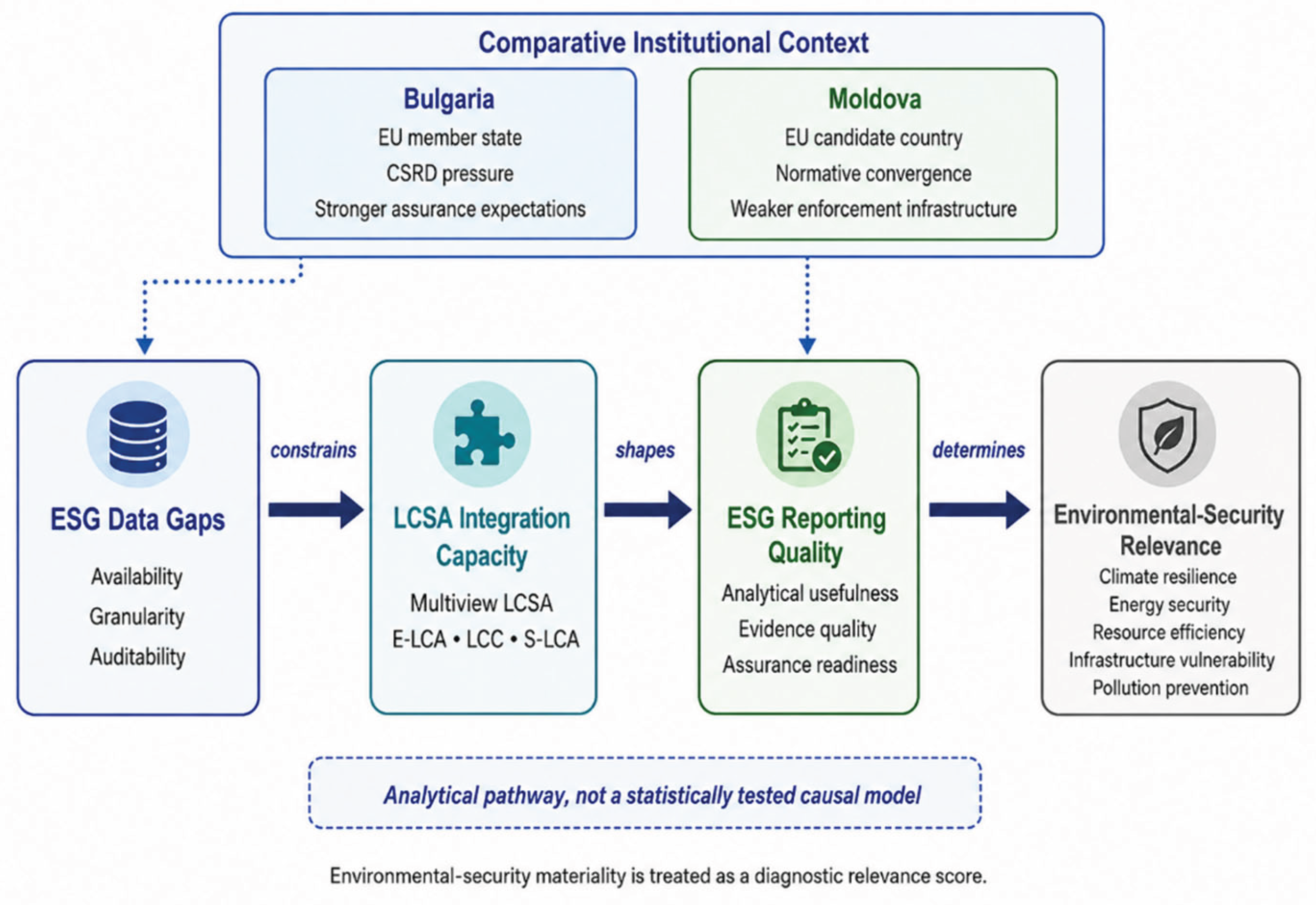

Table 1.
Structure of the empirical sample.
| Country | Corporate entities | Financial institutions | Public-sector bodies | Total |
|---|---|---|---|---|
| Bulgaria | 10 | 4 | 4 | 18 |
| Moldova | 10 | 4 | 4 | 18 |
| Total | 20 | 8 | 8 | 36 |
Table 2.
Reporting years represented in the corpus.
| Reporting year | Number of reports |
|---|---|
| 2023 | 6 |
| 2024 | 29 |
| 2025 | 1 |
| Total | 36 |
Table 3.
Types of reports included in the corpus.
| Report type | Number of reports |
|---|---|
| Sustainability report | 17 |
| Integrated report | 9 |
| Non-financial report/statement | 5 |
| ESG disclosure document | 5 |
| Total | 36 |
Table 4.
Indicators included in the Data Gap Matrix.
| Indicator group | Indicator code | Indicator name |
|---|---|---|
| Environmental | GHG_Scope1 | Scope 1 greenhouse gas emissions |
| Environmental | GHG_Scope2 | Scope 2 greenhouse gas emissions |
| Environmental | GHG_Scope3 | Scope 3 greenhouse gas emissions |
| Environmental | Energy_Use | Total energy consumption |
| Environmental | Renewable_Energy_Share | Share of renewable energy in total consumption |
| Social | Employee_Turnover | Employee turnover rate |
| Social | Training_Development | Training hours / employee development |
| Social | Health_Safety | Workplace health and safety |
| Social | Diversity_Inclusion | Gender diversity / inclusion policies |
| Social | Community_Engagement | Community involvement / CSR activities |
| Governance | ESG_Governance | ESG governance structure |
| Governance | Board_Independence | Board structure and independence |
| Governance | Risk_Management | Risk management, including ESG risks |
| Governance | Ethics_Compliance | Code of ethics / anti-corruption policies |
| Governance | Transparency_Disclosure | Transparency and reporting practices |
Table 5.
Scoring logic of the Data Gap Matrix.
| Dimension | Score interpretation |
|---|---|
| Availability | 0 = absent; 1 = narrative/partial; 2 = quantitative but incomplete; 3 = complete/structured |
| Granularity | 0 = absent/not usable; 1 = qualitative only; 2 = aggregated quantitative; 3 = disaggregated quantitative |
| Auditability | 0 = unsupported narrative; 1 = partially supported; 2 = evi-dence-backed; 3 = externally assured |
| LCSA relevance | 1 = low; 2 = moderate; 3 = high |
| Environmental-security materiality | 0 = not relevant; 1 = low; 2 = medium; 3 = high |
Table 6.
Descriptive distribution of Data Gap Matrix scores.
| Dimension | N | Median | Q1 | Q3 | Mean1 | Score 0 n (%) |
Score 1 n (%) |
Score 2 n (%) |
Score 3 n (%) |
|---|---|---|---|---|---|---|---|---|---|
| Availability | 540 | 2.00 | 1.00 | 3.00 | 2.04 | 61 (11.3%) | 90 (16.7%) | 153 (28.3%) | 236 (43.7%) |
| Granularity | 540 | 2.00 | 1.00 | 2.00 | 1.57 | 76 (14.1%) | 179 (33.1%) | 184 (34.1%) | 101 (18.7%) |
| Auditability | 540 | 1.00 | 0.00 | 2.00 | 1.12 | 146 (27.0%) | 191 (35.4%) | 196 (36.3%) | 7 (1.3%) |
| LCSA relevance | 540 | 2.00 | 2.00 | 3.00 | 2.06 | n.a. | 132 (24.4%) | 246 (45.6%) | 162 (30.0%) |
| Environmental-security materiality | 540 | 2.00 | 2.00 | 3.00 | 2.24 | 0 (0.0%) | 97 (18.0%) | 217 (40.2%) | 226 (41.9%) |
1 Means are reported as supplementary descriptive measures. Medians, interquartile ranges and score frequencies are the primary summaries because the Data Gap Matrix uses ordinal scales. LCSA relevance uses a 1–3 scale; therefore, Score 0 is not applicable to this dimension. Indicator-level coding units are not treated as statistically independent observations.
Table 7.
Organisation-level comparison between Bulgaria and Moldova.
| Dimension | Bulgaria, median (IQR) n = 18 |
Moldova, median (IQR) n = 18 |
Mann–Whitney U | Holm-adjusted p | Rank-biserial r |
|---|---|---|---|---|---|
| Availability | 2.23 (1.68–2.57) | 1.80 (1.68–2.67) | 177.0 | 1.000 | 0.093 |
| Granularity | 1.40 (1.20–1.62) | 1.53 (1.27–2.40) | 123.0 | 0.889 | −0.241 |
| Auditability | 1.27 (0.77–1.57) | 0.90 (0.60–1.52) | 185.0 | 1.000 | 0.142 |
| LCSA relevance | 2.23 (2.08–2.27) | 2.10 (1.68–2.27) | 191.5 | 1.000 | 0.182 |
| Environmental-security materiality | 2.40 (2.28–2.73) | 2.10 (1.87–2.38) | 247.5 | 0.034 | 0.528 |
Table 8.
Organisation-level comparison by sector.
| Dimension | Corporate, median (IQR) n = 20 |
Financial, median (IQR) n = 8 |
Public, median (IQR) n = 8 |
Kruskal–Wallis H | Holm-adjusted p | ε² 1 |
|---|---|---|---|---|---|---|
| Availability | 2.37 (1.73–2.72) | 2.37 (1.78–2.47) | 1.67 (1.43–1.80) | 5.872 | 0.222 | 0.117 |
| Granularity | 1.47 (1.20–2.40) | 1.43 (1.38–1.47) | 1.43 (1.03–1.67) | 0.465 | 0.978 | 0.000 |
| Auditability | 1.33 (0.65–1.72) | 1.37 (0.85–1.47) | 0.70 (0.48–0.95) | 6.225 | 0.222 | 0.128 |
| LCSA relevance | 2.27 (2.07–2.27) | 2.07 (1.73–2.13) | 2.10 (1.85–2.40) | 2.963 | 0.682 | 0.029 |
| Environmental-security materiality | 2.33 (2.17–2.73) | 2.17 (1.87–2.40) | 2.33 (2.18–2.50) | 1.431 | 0.978 | 0.000 |
1 ε² denotes epsilon-squared. Holm-adjusted p-values account for multiple testing across the five Data Gap Matrix dimensions.
Table 9.
Supplementary mean Data Gap Matrix scores by indicator group.
| Indicator group | Availability | Granularity | Auditability | LCSA relevance | Environmental-security materiality |
|---|---|---|---|---|---|
| Environmental | 1.73 | 1.33 | 0.96 | 2.48 | 2.45 |
| Social | 1.97 | 1.42 | 0.96 | 1.68 | 1.76 |
| Governance | 2.43 | 1.97 | 1.44 | 2.01 | 2.51 |
Table 10.
Selected indicator-level supplementary mean scores.
| Indicator | Availability | Granularity | Auditability | LCSA relevance | Environmental-security materiality |
|---|---|---|---|---|---|
| GHG Scope 3 emissions | 1.06 | 0.81 | 0.44 | 2.56 | 2.58 |
| Renewable energy share | 1.58 | 1.25 | 0.89 | 2.14 | 2.31 |
| GHG Scope 2 emissions | 1.81 | 1.39 | 1.03 | 2.56 | 2.44 |
| GHG Scope 1 emissions | 1.92 | 1.44 | 1.08 | 2.58 | 2.44 |
| Energy use | 2.31 | 1.78 | 1.33 | 2.58 | 2.47 |
| ESG governance | 2.58 | 2.14 | 1.58 | 2.31 | 2.64 |
| Risk management | 2.69 | 2.11 | 1.61 | 2.83 | 2.86 |
| Transparency/disclosure | 2.72 | 2.39 | 1.67 | 2.36 | 2.75 |
Table 11.
Weakest indicators by availability and auditability.
| Weakest by availability | Availability | Weakest by auditability | Auditability |
|---|---|---|---|
| GHG Scope 3 emissions | 1.06 | GHG Scope 3 emissions | 0.44 |
| Employee turnover | 1.31 | Employee turnover | 0.64 |
| Renewable energy share | 1.58 | Renewable energy share | 0.89 |
| GHG Scope 2 emissions | 1.81 | Diversity and inclusion | 0.97 |
| Board independence | 1.83 | Health and safety | 1.00 |
Table 12.
Highest environmental-security materiality scores.
| Indicator | Environmental-Security Materiality |
|---|---|
| Risk management | 2.86 |
| Transparency/disclosure | 2.75 |
| ESG governance | 2.64 |
| GHG Scope 3 emissions | 2.58 |
| Energy use | 2.47 |
| GHG Scope 1 emissions | 2.44 |
| GHG Scope 2 emissions | 2.44 |
Disclaimer/Publisher’s Note: The statements, opinions and data contained in all publications are solely those of the individual author(s) and contributor(s) and not of MDPI and/or the editor(s). MDPI and/or the editor(s) disclaim responsibility for any injury to people or property resulting from any ideas, methods, instructions or products referred to in the content. |
© 2026 by the authors. Licensee MDPI, Basel, Switzerland. This article is an open access article distributed under the terms and conditions of the Creative Commons Attribution (CC BY) license (http://creativecommons.org/licenses/by/4.0/).
Copyright: This open access article is published under a Creative Commons CC BY 4.0 license, which permit the free download, distribution, and reuse, provided that the author and preprint are cited in any reuse.


