

Submitted:
04 July 2026
Posted:
06 July 2026
You are already at the latest version
Abstract
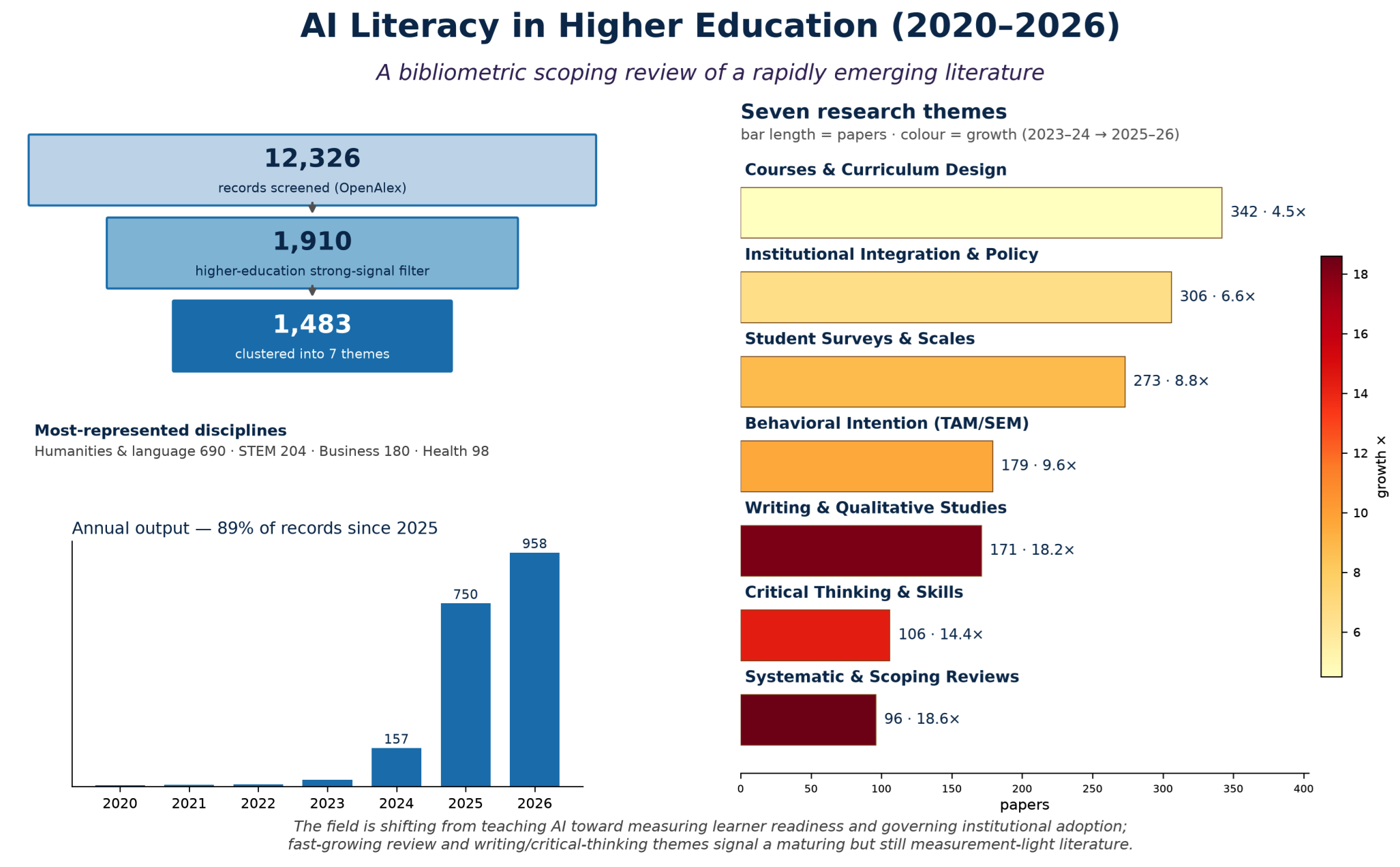
Background. Artificial intelligence (AI) literacy has become a rapidly expanding concern in higher education, accelerated by the public release of generative AI tools. The volume and thematic structure of this literature remain systematically unmapped. Objective. To map the scope, growth, thematic structure, disciplinary distribution, and geographic distribution of research on AI literacy in higher education from 2020 to mid-2026. Methods. We queried OpenAlex for works matching an AI-literacy phrase family in the title or abstract (2020–2026) and applied a strong-signal higher-education filter (a higher-education term in the title or ≥2 distinct such terms across the title and abstract). Records were deduplicated, and those with a usable English abstract were embedded using TF-IDF and reduced via truncated SVD, then grouped by k-means (k = 8; one language-artifact cluster excluded, leaving seven substantive themes). Cluster stability was quantified via seed resampling. The review was conducted per PRISMA-ScR. Results. The strong-signal corpus comprised 1,910 works; 89.4% appeared in 2025–2026. Annual output rose from single digits through 2022 to 750 in 2025, with 958 already recorded in the first half of 2026. Clustering of 1,483 abstracted works yielded seven themes, the largest of which were AI-literacy courses and curriculum design (n=342) and institutional integration, policy, and academic integrity. The fastest-growing themes were systematic/scoping reviews and qualitative studies of writing and AI-literacy components (both >18× 2025–26 vs 2023–24). Research was concentrated in the humanities/languages and STEM disciplines and led by the United States, China, and Indonesia. Conclusions. AI literacy research in higher education is expanding rapidly and is organizing around curriculum design, institutional policy, and instrument development. The evidence base is young, survey-heavy, and geographically concentrated, indicating a need for longitudinal and intervention studies.
Keywords:
AI literacy
; higher education
; generative AI
; bibliometric analysis
; scoping review
1. Introduction
Artificial intelligence literacy, the competencies needed to understand, use, evaluate, and critically engage with AI systems, has shifted from a specialist interest to a central concern across higher education. The release of widely accessible generative AI tools in late 2022 sharply intensified this attention, raising questions about curriculum, assessment, academic integrity, and graduate preparedness. As the literature has grown, its scope has become difficult to survey by narrative means alone.
This review quantitatively maps the higher-education AI-literacy literature. Rather than appraising individual studies, we characterize the field’s size, growth trajectory, thematic composition, disciplinary spread, and geographic distribution using reproducible, automated methods applied to a large bibliographic corpus. We frame the work as a bibliometric scoping review, following PRISMA-ScR reporting guidance [16].
2. Methods
2.1. Protocol and Registration
The review followed a bibliometric scoping-review design and is reported in accordance with PRISMA-ScR [16]; a completed checklist is provided (S2 File). This higher-education review was not separately registered; it uses the same protocol and methods as a companion medical/health-professions review, whose protocol was archived retrospectively on the Open Science Framework. This is a descriptive mapping review; formal risk-of-bias appraisal was not conducted, consistent with scoping-review methodology.
2.2. Data Source and Search
We used OpenAlex as the sole bibliographic source. Works were retrieved if their title or abstract matched an exact-phrase AI-literacy family (“AI literacy”, “artificial intelligence literacy”, “generative AI literacy”, “GenAI literacy”, “algorithmic literacy”, “AI competency/competencies”) and were published on or after 1 January 2020. Retrieval used cursor pagination; the parent corpus comprised 12,326 deduplicated works. Verbatim query strings and the full filter rule are provided in the supplementary methods (S1 File).
2.3. Higher-Education Eligibility (Strong-Signal Filter)
From the parent corpus, we selected higher-education works using a strong-signal rule: a higher-education term (e.g., “higher education”, “university student”, “undergraduate”, “postgraduate”, “faculty member”) in the title, or at least two distinct such terms in the title and abstract. This yielded 1,910 works. The rule was designed to exclude papers that mention a higher-education term only incidentally.
2.4. De-Duplication, Screening, and Text Preparation
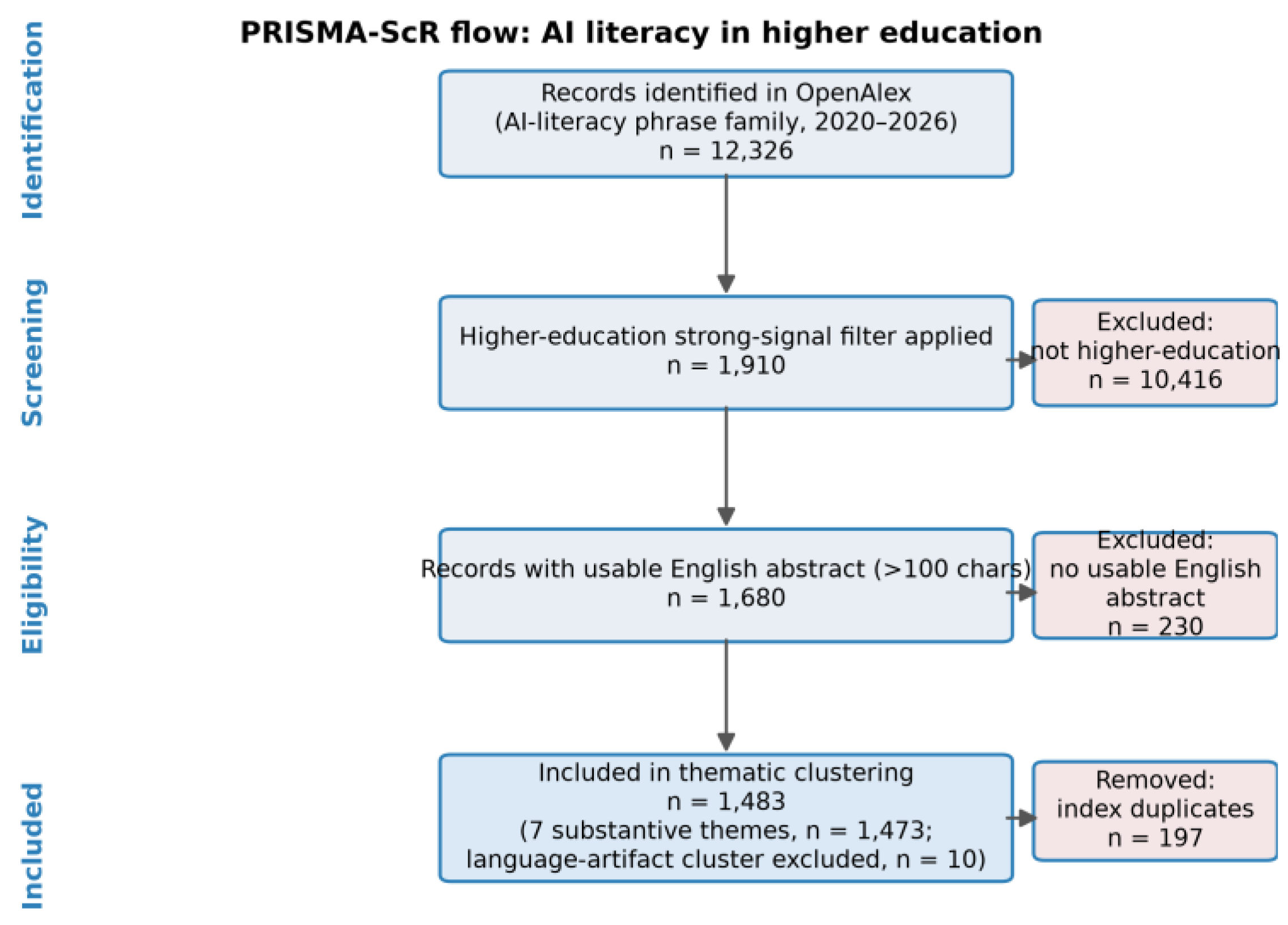
Records indexed across multiple sources were deduplicated using a normalized title key (removing index-source parentheticals), removing 197 near-duplicate records. Works with a usable English abstract (>100 characters) were retained for clustering (n = 1,483); records without were described but not clustered (Figure 5). Screening was automated and rule-based rather than conducted by independent human reviewers, a limitation discussed in Section 4.
2.5. Thematic Clustering
Titles (up-weighted) and abstracts were vectorized with sublinear TF-IDF (unigrams + bigrams, domain stop-words removed, ≤8,000 features) and then reduced by truncated SVD to 80 components (variance retained ≈0.201). k-means (k = 8) grouped the documents. Silhouette values were uniformly low across k = 6–12 (≈0.03–0.05), as expected for short, topically overlapping text; k was chosen for interpretability rather than for the silhouette maximum. One cluster consisted of Korean-language records grouped by language rather than by topic and was excluded, leaving seven substantive themes. Two reviewers labeled each theme based on its top terms and representative works. Full clustering parameters and stability diagnostics are reported in the supplementary methods (S1 File).
2.6. Cluster Stability
Stability was quantified by re-running k-means with 10 random initializations and computing the adjusted Rand index (ARI) between partitions. The mean ARI (seed-0 reference) was 0.534 (min 0.446, max 0.628); averaged over all 45 initializations pairs, it was 0.552 (range 0.332–0.813). Both values indicate that the broad thematic structure is reproducible, whereas per-paper assignments are borderline. Themes are therefore presented as an interpretive lens, not a definitive taxonomy.
2.7. Ethics
The review relied solely on aggregated published bibliographic metadata and did not involve human participants; therefore, ethical approval was not required.
3. Results
3.1. Growth
Annual output remained in single digits through 2022, then rose steeply: 27 works in 2023, 157 in 2024, and 750 in 2025; the first half of 2026 already contains 958 records (Figure 1). Overall, 89.4% of the corpus appeared in 2025–2026.
3.2. Thematic Structure
Clustering yielded seven themes (Table 1; Figure 2 and Figure 4). The two largest concerns are AI-literacy courses and curriculum design (n=342), exemplified by early curriculum-integration models [1,5] and course evaluations [12], and institutional integration, policy, and academic integrity (n=306), which includes the most-cited works on the implications of generative AI for higher-education practice [2,3,4,9]. Student surveys of usage, attitudes, and scale development [7,10,14], and behavioral intention/acceptance modeling [6], form a substantial methodological block, alongside faculty-focused studies of AI use and self-efficacy [13]. The fastest-growing themes are systematic/scoping reviews and qualitative studies of writing and AI-literacy components (both >18× 2025–26 vs 2023–24), signaling a field beginning to consolidate and probe mechanisms qualitatively. Classroom-embedded studies, for example, generative AI as a virtual tutor [8], and pedagogically framed analyses [15] recur across themes, and cross-disciplinary contributions extend into the health professions [11].
3.3. Disciplinary Spread
Disciplinary tags (non-exclusive; Figure 3) show concentrations in the humanities/languages and STEM/computing, with smaller but distinct contributions from business/economics and health professions. This distribution reflects both writing-focused concerns and technical-curriculum efforts.
Figure 3.
Disciplinary distribution (non-exclusive tags).
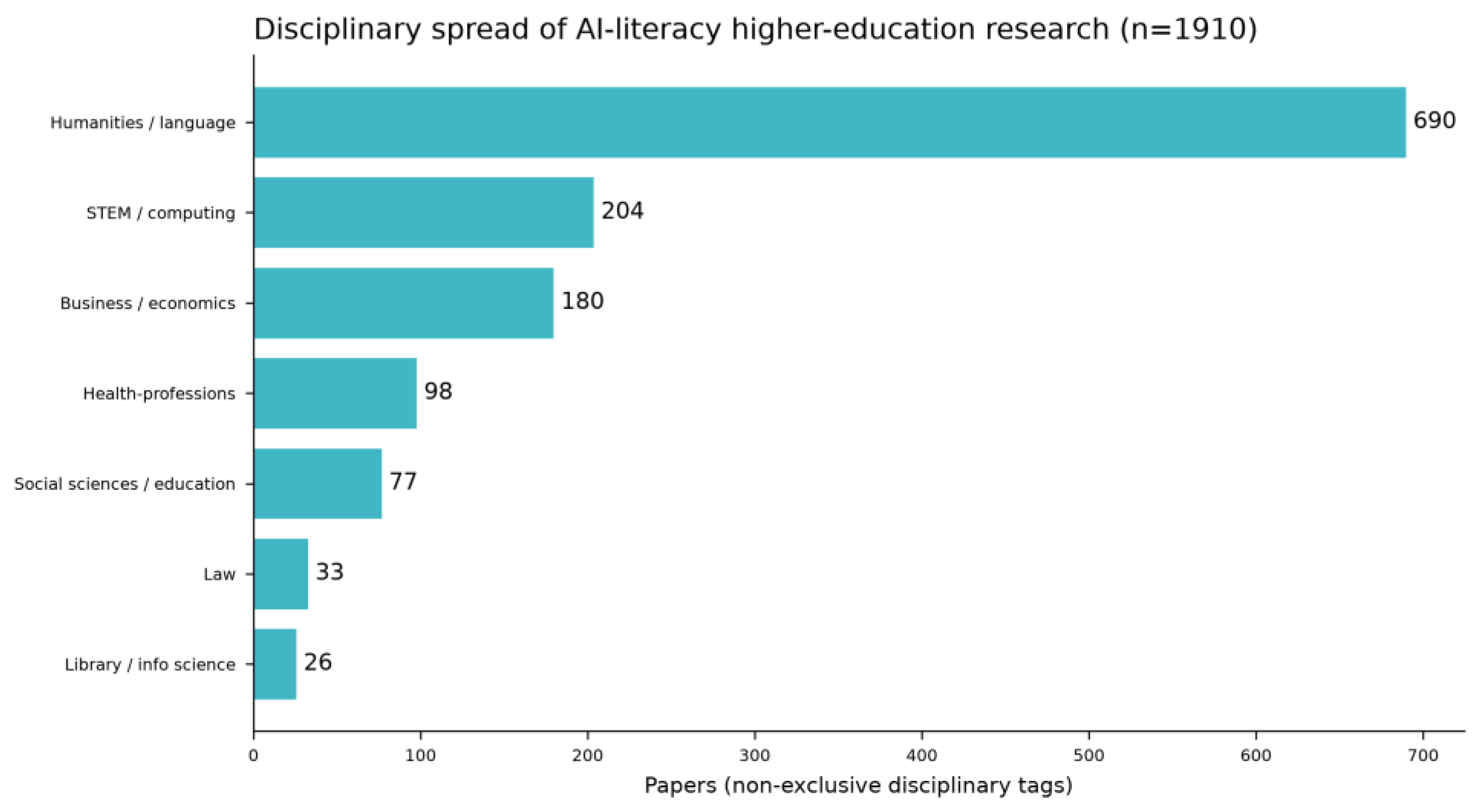
Figure 4.
Theme sizes for the seven substantive themes.
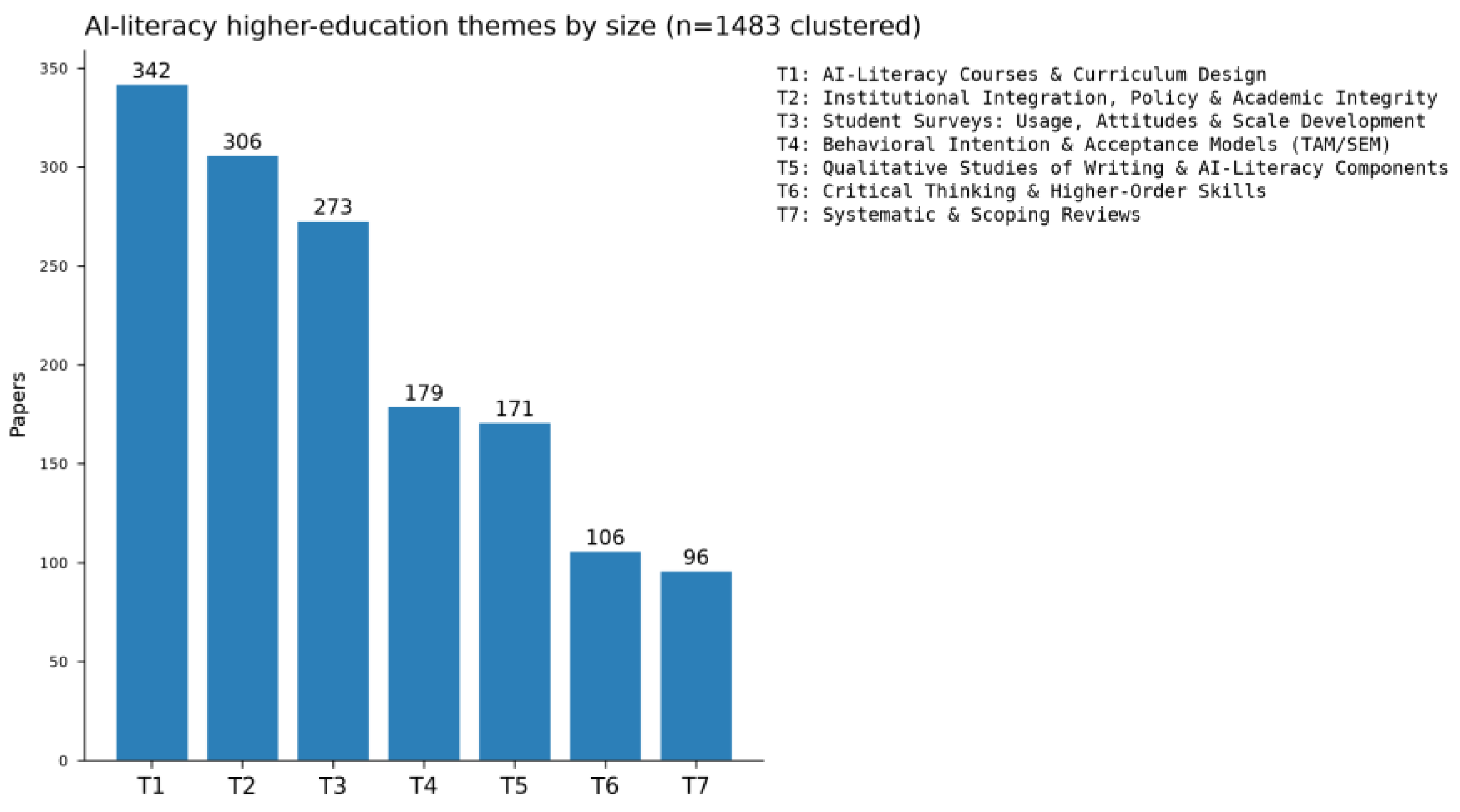
Figure 5.
PRISMA-ScR flow of record identification, screening, eligibility, and inclusion.
3.4. Geographic Distribution
Author affiliations were led by the United States, China, and Indonesia, followed by India, the United Kingdom, and Malaysia (Table 3), indicating a globally distributed yet unevenly concentrated literature.

Table 2.
Disciplinary tags (non-exclusive, n = 1,910).
| Discipline | Papers |
|---|---|
| Humanities / language | 690 |
| STEM / computing | 204 |
| Business / economics | 180 |
| Health-professions | 98 |
| Social sciences / education | 77 |
| Law | 33 |
| Library / info science | 26 |
Table 3.
Leading countries by author affiliation (non-exclusive).
| Country | Papers |
|---|---|
| US | 237 |
| CN | 182 |
| ID | 105 |
| IN | 79 |
| GB | 71 |
| MY | 60 |
| TR | 55 |
| AU | 49 |
4. Discussion
4.1. Principal Findings
AI literacy research in higher education has expanded from a marginal topic to a substantial, fast-growing literature, 89.4% of which has been published since 2025. Its center of gravity lies in curriculum design and institutional policy, with a large methodological investment in surveys and acceptance models, and an emerging qualitative and review literature.
4.2. Interpretation
The dominance of curriculum design and policy themes suggests the field is oriented toward practical implementation. The rapid rise in reviews indicates early consolidation, while the growth of qualitative, writing-focused work reflects concern with academic integrity and the effects of generative tools on student writing.
4.3. Limitations
Three limitations warrant emphasis. First, the corpus derives from a single database (OpenAlex); although its coverage is broad and includes gray literature, single-source retrieval may underrepresent some venues. Second, screening and extraction were automated and rule-based, without independent human dual-screening. Third, clusters are moderately stable (ARI ≈0.534); themes serve as an interpretive lens rather than a definitive taxonomy. Growth ratios use add-one smoothing and a partial 2026 year, and citation-based prominence is subject to citation lag.
4.4. Conclusions
The higher-education AI-literacy literature is young, rapidly expanding, and organized around curriculum, policy, and measurement. Priorities for the field include longitudinal and intervention studies, validated cross-context instruments, and broader geographic representation.
Supplementary Materials
The following supporting information can be downloaded at website of this paperp posted on Preprints.org, S1 File. Supplementary methods: verbatim OpenAlex search strings, the strong-signal higher-education filter rule, clustering parameters, and cluster-stability diagnostics (silhouette scan and adjusted Rand index). S2 File. Completed PRISMA-ScR checklist with the location of each item in the manuscript. The complete corpus, subset, clustered data, and analysis code are also provided as an accompanying data and code package.
Author Contributions
N.Z. designed the study and performed the analysis; N.Z. and L.A. interpreted the results and wrote the manuscript. All authors have read and agreed to the published version of the manuscript.
Funding
None declared.
Data Availability Statement
The parent corpus, the higher-education subset (S1 Dataset), the clustered dataset with theme assignments, along with the theme-summary table (S2 Dataset), and the analysis code are provided as an accompanying data and code package. Bibliographic metadata are derived from OpenAlex; the deposit license is to be confirmed by the authors at deposit.
Conflicts of Interest
None declared.
References
- Southworth J, Migliaccio KW, Glover J, et al. Developing a model for AI Across the curriculum: Transforming the higher education landscape via innovation in AI literacy. Computers and Education Artificial Intelligence. 2023. [CrossRef]
- Rasul T, Nair S, Kalendra DR, et al. The role of ChatGPT in higher education: Benefits, challenges, and future research directions. Journal of Applied Learning & Teaching. 2023. [CrossRef]
- Chiu TKF. Future research recommendations for transforming higher education with generative AI. Computers and Education Artificial Intelligence. 2023. [CrossRef]
- Farrelly T, Baker N. Generative Artificial Intelligence: Implications and Considerations for Higher Education Practice. Education Sciences. 2023. [CrossRef]
- Kong SC, Cheung WM, Zhang G. Evaluation of an artificial intelligence literacy course for university students with diverse study backgrounds. Computers and Education Artificial Intelligence. 2021. [CrossRef]
- Wang C, Wang H, Li Y, et al. Factors Influencing University Students’ Behavioral Intention to Use Generative Artificial Intelligence: Integrating the Theory of Planned Behavior and AI Literacy. International Journal of Human-Computer Interaction. 2024. [CrossRef]
- Hornberger M, Bewersdorff A, Nerdel C. What do university students know about Artificial Intelligence? Development and validation of an AI literacy test. Computers and Education Artificial Intelligence. 2023. [CrossRef]
- Ding L, Li T, Jiang S, et al. Students’ perceptions of using ChatGPT in a physics class as a virtual tutor. International Journal of Educational Technology in Higher Education. 2023. [CrossRef]
- Francis N, Jones S, Smith DP. Generative AI in Higher Education: Balancing Innovation and Integrity. British Journal of Biomedical Science. 2025. [CrossRef]
- Ravšelj D, Keržič D, Tomaževič N, et al. Higher education students’ perceptions of ChatGPT: A global study of early reactions. PLoS ONE. 2025. [CrossRef]
- Jha N, Shankar PR, Al-Betar MA, et al. Undergraduate Medical Students’ and Interns’ Knowledge and Perception of Artificial Intelligence in Medicine. Advances in Medical Education and Practice. 2022. [CrossRef]
- Tzirides AO, Zapata GC, Kastania NP, et al. Combining human and artificial intelligence for enhanced AI literacy in higher education. Computers and Education Open. 2024. [CrossRef]
- Mah D, Groß N. Artificial intelligence in higher education: exploring faculty use, self-efficacy, distinct profiles, and professional development needs. International Journal of Educational Technology in Higher Education. 2024. [CrossRef]
- Enríquez BGA, Ballesteros MAA, Jordan OH, et al. Analysis of college students’ attitudes toward the use of ChatGPT in their academic activities: effect of intent to use, verification of information and responsible use. BMC Psychology. 2024. [CrossRef]
- Nikolopoulou K. Generative Artificial Intelligence in Higher Education: Exploring Ways of Harnessing Pedagogical Practices with the Assistance of ChatGPT. International Journal of Changes in Education. 2024. [CrossRef]
- Tricco AC, Lillie E, Zarin W, et al. PRISMA Extension for Scoping Reviews (PRISMA-ScR): Checklist and Explanation. Annals of Internal Medicine. 2018;169(7):467–473. [CrossRef]
Figure 1.
Annual publication counts for AI-literacy higher-education research, 2020–2026 (2026 partial).
Figure 1.
Annual publication counts for AI-literacy higher-education research, 2020–2026 (2026 partial).
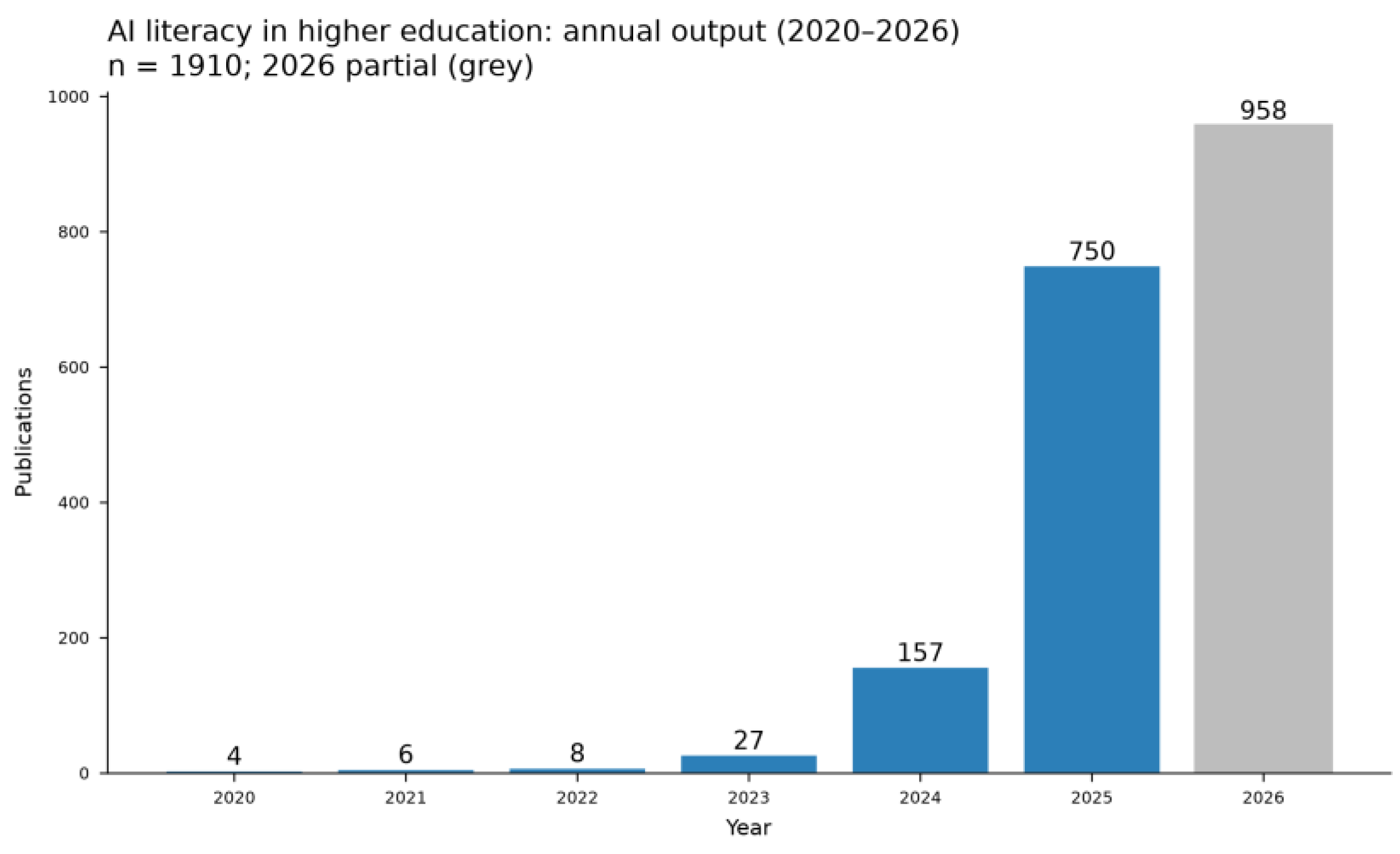
Figure 2.
Growth ranking of the seven themes (2025–26 vs 2023–24, add-one smoothed).
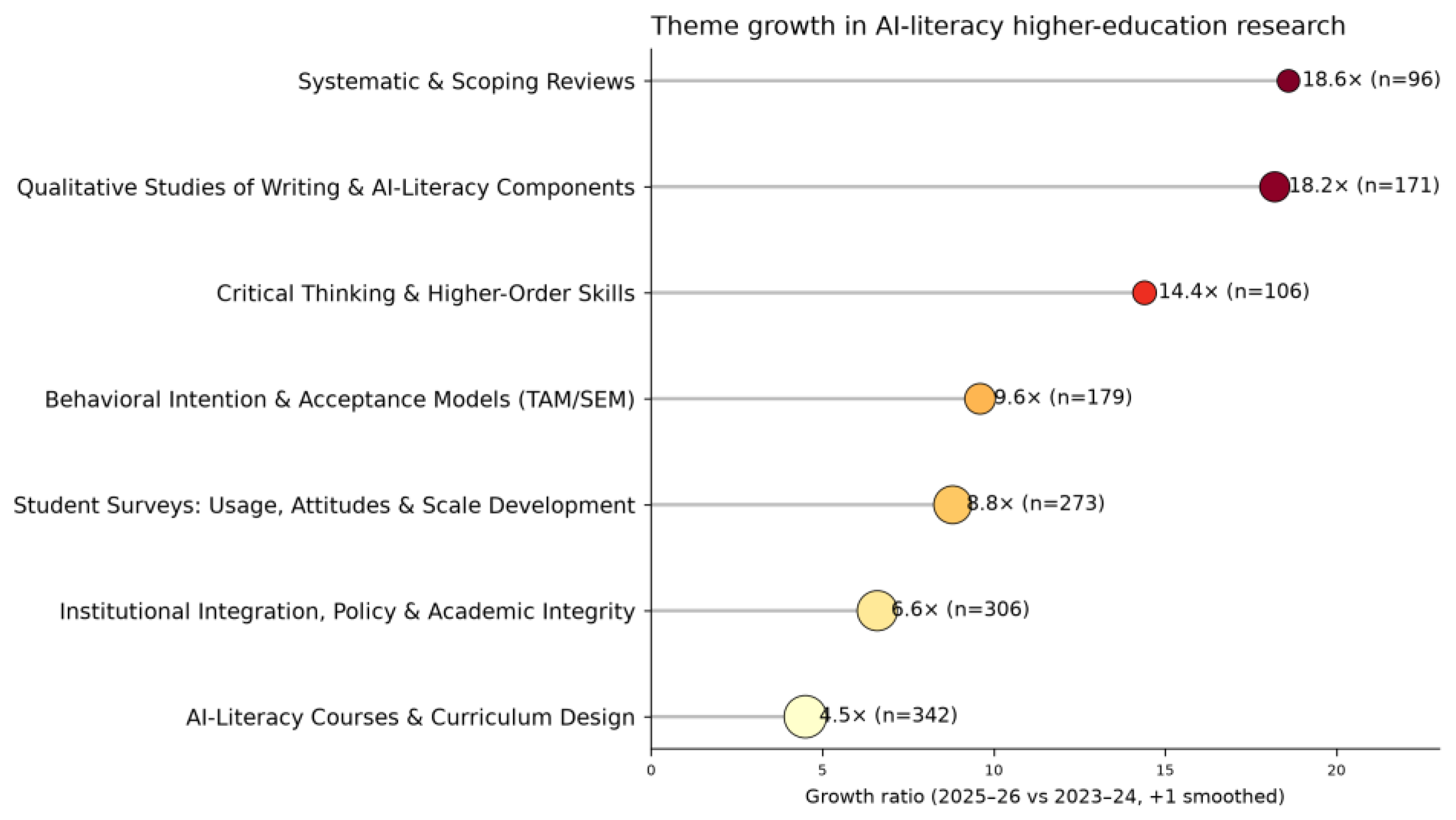
Table 1.
Seven substantive themes (n = 1,483 clustered works).
| Theme | n | % | Growth (2025–26 vs 2023–24) |
|---|---|---|---|
| AI-Literacy Courses & Curriculum Design | 342 | 23.1 | 4.5× |
| Institutional Integration, Policy & Academic Integrity | 306 | 20.6 | 6.6× |
| Student Surveys: Usage, Attitudes & Scale Development | 273 | 18.4 | 8.8× |
| Behavioral Intention & Acceptance Models (TAM/SEM) | 179 | 12.1 | 9.6× |
| Qualitative Studies of Writing & AI-Literacy Components | 171 | 11.5 | 18.2× |
| Critical Thinking & Higher-Order Skills | 106 | 7.1 | 14.4× |
| Systematic & Scoping Reviews | 96 | 6.5 | 18.6× |
Disclaimer/Publisher’s Note: The statements, opinions and data contained in all publications are solely those of the individual author(s) and contributor(s) and not of MDPI and/or the editor(s). MDPI and/or the editor(s) disclaim responsibility for any injury to people or property resulting from any ideas, methods, instructions or products referred to in the content. |
© 2026 by the authors. Licensee MDPI, Basel, Switzerland. This article is an open access article distributed under the terms and conditions of the Creative Commons Attribution (CC BY) license (http://creativecommons.org/licenses/by/4.0/).
Copyright: This open access article is published under a Creative Commons CC BY 4.0 license, which permit the free download, distribution, and reuse, provided that the author and preprint are cited in any reuse.


