

Submitted:
03 July 2026
Posted:
06 July 2026
You are already at the latest version
Abstract
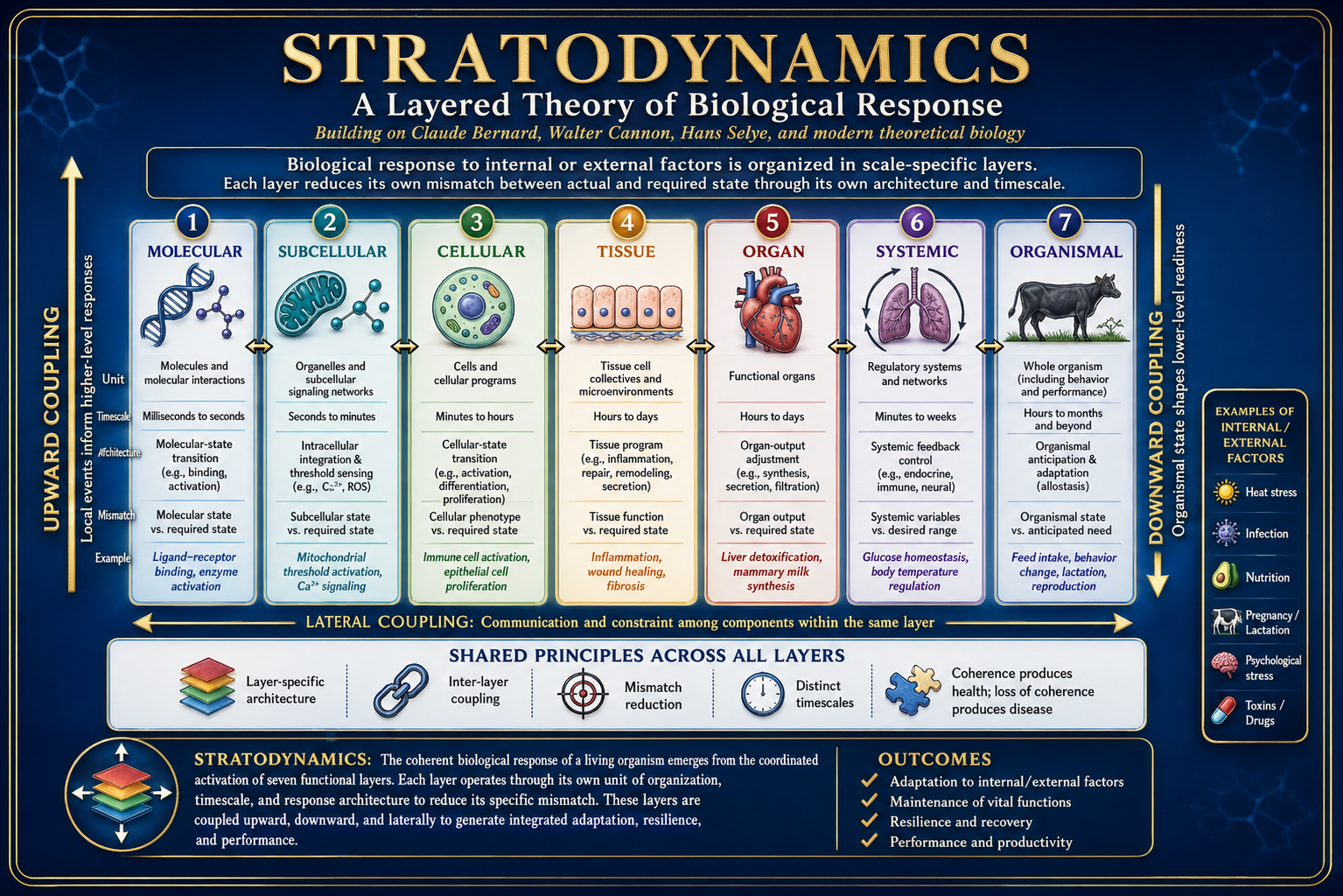
Physiology has long explained organismal stability through homeostasis, allostasis, feedback regulation, and related systems concepts. These frameworks remain essential, but each is most precise at a particular scale or mode of response. This manuscript proposes stratodynamics as a layered theory of biological response in vertebrate physiology. The framework holds that biological response is organized through seven functional layers: molecular, subcellular, cellular, tissue, organ, systemic, and organismal. Each layer reduces its own form of mismatch between actual and required state through a scale-appropriate architecture: molecular-state transition, intracellular integration, cellular-state transition, tissue program, organ output, systemic feedback, or organismal anticipation. The layers are coupled upward, downward, and laterally, allowing local events to become systemic responses and allowing organismal state to shape lower-layer readiness. Stratodynamics therefore locates rather than replaces previous theories: homeostasis is preserved as the canonical systemic architecture, allostasis as organismal predictive regulation, and tissue repair, resolution biology, bioelectricity, and thermodynamic self-organization as complementary layer-specific contributors. The framework is presented as a theoretical synthesis and research program for veterinary and medical sciences.
Keywords:
stratodynamics
; homeostasis
; allostasis
; biological response
; milieu intérieur
; mismatch reduction
; layered architecture
; inter-layer coupling
; resolution biology
; bioelectric morphogenesis
; non-equilibrium thermodynamics
; systems physiology
; chronic disease
1. Introduction: The Constancy Bernard Saw
The central question of modern physiology begins with Claude Bernard. In Introduction à l’étude de la médecine expérimentale [An Introduction to the Study of Experimental Medicine] (1865) [1], Bernard established the concept of the milieu intérieur, the internal environment within which the cells of a complex organism actually live, as one of the foundational objects of experimental medicine. Thirteen years later, in the lectures collected as Leçons sur les phénomènes de la vie communs aux animaux et aux végétaux [Lectures on the Phenomena of Life Common to Animals and Plants] (1878), he gave this recognition its most famous formulation:
- La fixité du milieu intérieur est la condition de la vie libre et indépendante. [2]
- The fixity of the internal environment is the condition of free and independent life.
The observation is simple, but its implications are profound. A complex animal does not expose its cells directly to the external world. Between the organism and the environment lies an internal medium composed of extracellular fluids, electrolytes, gases, nutrients, temperature, pH, osmotic forces, hormones, immune mediators, and metabolic substrates. The freedom of the animal in the external world depends on the relative constancy of this internal world. A bird may move through changing altitude and temperature; its cells experience oxygen tension, pH, electrolytes, and temperature held within viable limits. A mammal may encounter heat, cold, fasting, exercise, infection, pregnancy, lactation, injury, or psychological stress; its cells remain alive because the organism continuously regulates the internal conditions under which cellular life is possible.
Bernard’s insight founded modern physiology, but it also left a question unanswered. If the constancy of the milieu intérieur is the condition of free life, how is that constancy achieved? By what mechanisms? At what scales? Through what architectures? The 160 years since Bernard can be read as a long sequence of partial answers to that question.
The first systematic answer came from Walter B. Cannon. In 1929, Cannon introduced the term homeostasis [3,4,5], and in The Wisdom of the Body (1932) he developed it into a comprehensive framework for physiological regulation [6,7]. Cannon’s contribution was decisive: regulated variables are not left to drift, nor are they fixed immovably. They are defended within tolerable ranges by regulatory architectures composed of sensors, integrators, effectors, and negative feedback. Body temperature, blood glucose, plasma osmolarity, arterial pressure, blood pH, blood gases, and plasma calcium each became intelligible as variables defended by specific physiological control systems. Cannon transformed Bernard’s recognition of internal constancy into a mechanistic architecture.
Homeostasis remains one of the most successful concepts in biology. It is the framework through which medical students first learn physiology. It underlies the diagnostic logic of endocrine, metabolic, cardiovascular, renal, respiratory, and electrolyte medicine. It explains why deviations in glucose, pH, pressure, oxygenation, osmolarity, temperature, and calcium are clinically meaningful. Yet its success has also encouraged overextension. Many biological responses do not consist of returning a variable to a defended range.
An immune response does not simply return cells to baseline; it produces clonal expansion, effector differentiation, antibody production, memory, and sometimes tolerance. A wound does not defend a setpoint; it initiates hemostasis, inflammation, proliferation, remodeling, and, in some organisms, regeneration. An embryo does not maintain a pre-existing condition; it constructs tissues and organs that did not previously exist. A learning nervous system does not preserve its synaptic architecture; it modifies it and retains the modification. A lactating mammary gland does not merely restore an earlier state; it reorganizes metabolism, epithelial secretion, vascular supply, endocrine sensitivity, and immune defense to meet a new physiological demand. These processes are not failures of homeostasis. They are biological responses of a different kind.
During the twentieth and early twenty-first centuries, physiology and theoretical biology gradually recognized these other modes of response. Hans Selye described the general adaptation syndrome, showing that stress evokes programmed temporal sequences rather than simple corrective restoration [8,9,10]. Wiener and Ashby gave regulation a mathematical language through cybernetics, feedback, control, stability, and requisite variety [11,12]. Schrödinger and Prigogine grounded living order in non-equilibrium thermodynamics, showing that biological organization is sustained by continuous energy throughput and entropy export [13,14]. Sterling and Eyer, followed by McEwen, introduced allostasis and allostatic load, demonstrating that many variables are adjusted predictively in anticipation of demand rather than corrected only after deviation [15,16]. Serhan and colleagues showed that inflammation ends through active resolution, mediated by specialized pro-resolving pathways, rather than by passive decay [17,18]. Levin and colleagues established that tissues are organized not only by genes and molecular signaling, but also by bioelectric patterns that instruct cell behavior, morphogenesis, and regeneration [19,20]. Friston proposed the free energy principle as a formal account of self-maintenance and organism–environment coupling [21,22,23]. Tononi and Hoel provided mathematical support for the causal reality of higher organizational levels [24,25,26].
Each of these frameworks captures something true. Each identifies a real mode of biological response. But each is incomplete when taken as universal. Homeostasis describes defended systemic variables; it does not explain cell-fate commitment or tissue regeneration. Allostasis describes organismal prediction; it does not explain molecular conformation or inflammatory resolution. Thermodynamic self-organization explains why living order requires energy dissipation; it does not specify how organs, tissues, cells, and molecules each regulate themselves. Bioelectric morphogenesis reveals a tissue-level organizational substrate; it does not replace systemic feedback or organismal anticipation. The free energy principle offers a high-level formal account of organismal self-maintenance; it does not provide the concrete mechanisms by which every biological layer responds.
The recognition that organizes the present paper is that these frameworks are not competitors. They are partial descriptions of a larger architecture. Each is most precise at a particular scale or mode of response. Biological response is not one process repeated at different sizes. It is layered. Molecular events, subcellular signaling, cellular-state transitions, tissue programs, organ outputs, systemic feedback, and organismal anticipation each operate through distinct architectures and timescales. The organism responds coherently because these layers are coupled into one living response.
This paper proposes the term stratodynamics for this layered architecture. The combining form strato- denotes layer or stratum; dynamics, from Greek dynamis, denotes force, power, or capacity to act. Stratodynamics therefore names not a static layered condition, but a layered dynamics of response. The term is constructed in deliberate continuity with homeostasis and allostasis. Homeostasis names stability through defended similarity; allostasis names stability through predictive change; stratodynamics names the layered coherence through which multiple forms of biological response are coordinated across scales.
The central claim is that biological response is constituted by seven functional layers: molecular, subcellular, cellular, tissue, organ, systemic, and organismal. Each layer addresses its own form of mismatch between actual and required state, and each does so through an architecture appropriate to its scale. At the molecular layer, mismatch is reduced through molecular-state transition. At the subcellular layer, through intracellular signaling and organelle-state integration. At the cellular layer, through cellular-state transition. At the tissue layer, through multicellular structural, inflammatory, repair, and regenerative programs. At the organ layer, through integrated functional output. At the systemic layer, through feedback regulation of defended variables. At the organismal layer, through anticipatory adjustment and history-dependent prediction.
The unifying principle is this: life persists not by maintaining constancy at one scale, but by actively reducing mismatch at every scale through layer-appropriate architectures. The term “required” does not imply conscious purpose or fixed design. It means the state compatible with continued function at a given layer under prevailing conditions. What is required at the molecular layer is not the same as what is required at the tissue layer, the organ layer, or the organismal layer. The architecture of response differs because the meaning of “required” differs across scales.
The layers are coupled in three directions. Upward coupling allows local molecular and cellular events to propagate toward tissue, organ, systemic, and organismal response. Downward coupling allows organismal state, systemic context, and predictive anticipation to shape organs, tissues, cells, intracellular signaling, and molecular readiness. Lateral coupling coordinates components within a layer, allowing each level to function as an integrated unit rather than as a collection of independent parts. The response of a living organism is therefore not merely vertical, from molecule to organism. It is three-dimensional: vertical across scales, horizontal within scales, and temporal across the different rates at which the layers act.
This framework locates rather than displaces the theories that preceded it. Cannon’s homeostasis is preserved as the canonical architecture of systemic setpoint regulation [6]. Sterling and McEwen’s allostasis is preserved as the canonical architecture of organismal predictive adjustment [15,16]. Serhan’s resolution biology is located at the tissue layer, where biological programs must terminate properly [17,18]. Levin’s bioelectricity is located at the tissue layer, where collective voltage patterns carry organizational information [19,20]. Schrödinger and Prigogine provide the thermodynamic ground on which all layers depend [13,14]. Cybernetics supplies the formal language of regulation [11,12]. Tononi and Hoel justify the causal reality of higher organizational levels [24,25,26]. Friston’s framework is acknowledged as a powerful formal account of organismal prediction and self-maintenance [21,22,23], while stratodynamics describes the internal layered architecture through which such self-maintenance is biologically implemented.
The paper develops this framework as follows. Section 2 traces the lineage of partial answers from Bernard to the present, identifying the scale at which each framework is most precise. Section 3 defines stratodynamics formally and states its three central claims: layer-specific architecture, inter-layer coupling, and coupling vulnerability in disease. Section 4 develops the unifying principle of mismatch reduction with scale-specific definitions of “required.” Section 5 describes the seven layers in mechanistic detail. Section 6 examines upward, downward, and lateral coupling among the layers. Section 7 states the limitations of the framework and the work required for formalization, validation, and domain-specific extension. Section 8 returns to Bernard and reframes the constancy of the milieu intérieur as layered coherence.
This article is a theoretical synthesis rather than a systematic review. The frameworks discussed were selected because they have historically shaped the theory of biological regulation or because they provide mechanistic examples of scale-specific response architecture. No claim is made to exhaustive coverage of the specialized literatures from which these examples are drawn. The aim is to state a principle, define an architecture, and provide a framework that can be tested, refined, and, where necessary, corrected by future work.
The need for such a framework is especially clear in vertebrate physiology. Vertebrates do not respond to challenge through one level of organization alone. A dairy cow entering lactation, a calf facing infection, a patient developing sepsis, an athlete beginning exertion, or a mammal healing a wound each recruits molecules, organelles, cells, tissues, organs, systemic variables, and organismal behavior at the same time. The same stimulus can therefore be read differently at different biological scales: as receptor occupancy, intracellular signaling, cell activation, tissue remodeling, organ reprogramming, systemic deviation, or organismal anticipation. Stratodynamics is proposed to keep these readings together rather than forcing one to replace the others.
This point is important for veterinary and medical sciences because many clinically important disorders are not single-scale events. Mastitis is not only a bacterial problem in the mammary gland; it includes epithelial injury, immune-cell recruitment, milk synthesis, vascular and lymphatic function, pain, fever, behavior, and systemic metabolism. Lameness is not only a hoof lesion; it may include vascular fragility, inflammation, endocrine-metabolic state, pain behavior, locomotor adaptation, and tissue repair. Transition-cow disease is not only hypocalcemia, ketosis, inflammation, or immune dysfunction in isolation; it is a period in which multiple layers of regulation are challenged simultaneously. Human chronic inflammatory, metabolic, degenerative, and autoimmune diseases show the same multi-layer character.
The present paper therefore focuses on complex multicellular animals, especially vertebrates. The framework may later be adapted to plants, microbes, embryos, colonies, ecosystems, or supraorganismal systems, but those applications require domain-specific changes. Plants, for example, have distributed regulation without a nervous system; microbes have population-level and ecological forms of response without organs; colonies and ecosystems have organizational scales beyond the individual organism. These domains are important, but they are not the main burden of the present article. The aim here is to state a vertebrate-centered theory clearly enough that it can be tested, criticized, and extended.
This historical progression is summarized in Figure 1.
2. The Lineage: A Genealogy of Partial Answers
The 160 years since Bernard’s formulation of the milieu intérieur can be read as a sustained effort to answer one question: how is the internal constancy required for free and independent life actually achieved? The effort has unfolded across physiology, cybernetics, thermodynamics, immunology, developmental biology, systems theory, and theoretical biology. Each tradition has contributed concepts that the others did not. Each has clarified one aspect of biological regulation. Yet none, taken alone, has provided a complete account of biological response.
The present section traces this lineage chronologically and conceptually. Its purpose is not to diminish any predecessor framework, but to locate each at the scale where it is most precise. Bernard identified the problem. Cannon specified one major architecture of solution. Selye recognized programmed adaptive sequence. Cybernetics formalized regulation. Thermodynamics grounded living order in energy dissipation. Allostasis introduced prediction. Resolution biology showed that inflammatory programs actively terminate. Bioelectricity revealed tissue-level organization above molecular signaling. The free energy principle formalized organism–environment coupling. Integrated information and causal emergence justified higher-level causality. Adaptive homeostasis clarified the dynamic modulation of protective capacity. The pattern that emerges is the central recognition motivating stratodynamics: biological response is not governed by one universal architecture, but by multiple layer-specific architectures coupled into one coherent living response.
2.1. Bernard: The Recognition of the Internal Environment
Bernard’s contribution was not a complete theory of regulation. It was a foundational recognition: complex life is not lived directly in the external world. Between the cells of a complex organism and the environment through which the organism moves lies an internal environment whose physical and chemical properties are protected from external variation. The cells of a vertebrate experience a medium whose temperature, osmolarity, ionic composition, oxygen tension, glucose concentration, and pH are maintained within viable limits even while the organism encounters heat, cold, fasting, exertion, infection, injury, and environmental change.
The phrase milieu intérieur gave physiology its central object [1,27,28]. Every later framework of biological regulation, homeostasis, allostasis, cybernetic control, thermodynamic self-organization, active inference, and stratodynamics, can be understood as an attempt to answer the question Bernard left open: how is the constancy of the internal environment achieved?
What Bernard did not address, and what the concept of milieu intérieur alone cannot address, is the scale-dependence of biological regulation. Bernard wrote at the scale of the organism and its fluids: blood, lymph, and tissue fluid. He did not distinguish the constancy of a systemic variable such as blood pH from the stability of a cellular state, the organization of a tissue, the output of an organ, or the predictive adjustment of the organism as a whole. His framework is foundational because it operates above these distinctions. It is limited for the same reason.
2.2. Cannon: The Architecture of Homeostasis
If Bernard recognized the fact of internal regulation, Cannon specified one of its major architectures. Writing two generations after Bernard, with a mature experimental physiology available to him, Cannon proposed that regulated variables of the internal environment are maintained within ranges by specific control systems. He introduced the term homeostasis in 1926 and elaborated the framework in his 1929 paper in Physiological Reviews and in The Wisdom of the Body (1932) [4,5,6].
The architecture is the familiar sensor–integrator–effector triad. Sensors detect the value of a regulated variable, and effectors are engaged as that value crosses thresholds built into the sensing machinery, so that the variable settles within a defended range. Negative feedback closes the loop. This architecture recurs throughout physiology: baroreceptors defend arterial pressure; chemoreceptors contribute to regulation of blood gases and pH; thermoregulatory circuits defend body temperature; pancreatic islets regulate blood glucose; the parathyroid axis defends plasma calcium; renal and hypothalamic systems defend osmolarity and volume.
Yet Cannon’s framework is not universal. It describes the regulation of systemic variables most precisely. It does not describe molecular-state transitions, where no setpoint is defended; intracellular signaling cascades, where signals are integrated through thresholds, oscillations, and network dynamics; cellular-state transitions, where cells may adopt new phenotypes rather than return to baseline; tissue programs, where wounds heal through temporal phases rather than simple correction; or organismal anticipation, where the target of regulation shifts before deviation occurs. Cannon’s framework is correct at the scale for which it was designed. It becomes incomplete only when treated as the general architecture of all biological response.
2.3. Selye: Programmed Adaptive Sequence
Selye’s contribution introduced a mode of response that Cannon’s framework cannot fully describe. In his 1936 letter to Nature, and later in The Stress of Life (1956) and related work, Selye observed that diverse stressors, cold, trauma, infection, toxins, and psychological strain, elicit a common sequence of physiological changes in the organism [8,9]. He named this sequence the general adaptation syndrome and described three phases: alarm reaction, resistance, and exhaustion.
The conceptual importance of Selye’s framework is that it identifies biological response as temporal and programmed rather than merely corrective. The general adaptation syndrome is not a feedback loop defending one variable around a setpoint. It is a trajectory through physiological state space. It has phases. It has duration. It has possible outcomes: adaptation, recovery, exhaustion, or death. Selye therefore introduced the idea that the body has response programs as well as defended variables.
Selye also came closer to a layered view than is often appreciated. He distinguished systemic general adaptation from local adaptation around injured tissues. The Local Adaptation Syndrome recognized that a local tissue injury generates a programmed inflammatory response, while systemic stress alters local tissue reactivity and local injury feeds back onto the systemic organism. In retrospect, this was an early recognition of tissue–system coupling. What Selye did not do was generalize programmed sequence into a multi-layer architecture of biological response. His contribution was the recognition of adaptive sequence and local–systemic coupling; the layered synthesis came later [10].
2.4. Cybernetics: Mathematical Language for Regulation
Cybernetics gave Cannon’s homeostasis a mathematical language. In Cybernetics: Or Control and Communication in the Animal and the Machine (1948), Wiener showed that problems of control, communication, and feedback could be described with a common formal vocabulary in machines and living systems [11]. Ashby extended this in An Introduction to Cybernetics (1956), especially through the Law of Requisite Variety [12].
The key realization of cybernetics was not that organisms and machines are the same, but that both face a common regulatory problem: how a system maintains organized behavior in the face of disturbance. Negative feedback, state-space description, stability analysis, information flow, and the measurement of a system’s possible states or “variety” gave physiology a more precise language for regulation.
What cybernetics did not provide was a scale-specific biology of regulation. Wiener and Ashby treated regulation as a general problem approachable through a common mathematical toolkit. They did not specify how molecules, organelles, cells, tissues, organs, systemic variables, and whole organisms generate regulatory variety in different ways. Cybernetics supplied the vocabulary of regulation; stratodynamics adds that this vocabulary is spoken differently at each biological layer.
2.5. Schrödinger and Prigogine: The Thermodynamic Ground
In this broad thermodynamic sense, living organisms belong to the class of far-from-equilibrium systems. Their order is not an equilibrium structure but a continuously maintained process. Yet an organism is not merely a whirlpool with chemistry added. It is a regulated dissipative structure in which metabolism, signaling, development, repair, prediction, and multi-scale control are built upon the thermodynamic substrate. Prigogine’s work, developed with Nicolis and others and synthesized in Self-Organization in Nonequilibrium Systems (1977), established the physical ground of biological self-organization.
Stratodynamics therefore builds directly on the thermodynamic tradition while extending it. It accepts that every layer of biological regulation must be paid for by energy throughput and entropy export. But it adds that each scale uses a distinct biological architecture to build, regulate, repair, and coordinate its order. Thermodynamics explains why biological order is possible. Stratodynamics asks how that order is organized across layers.
In the present article, these physical concepts are used in a simple biological sense. A living organism is not a static object; it is a maintained process. Its order persists because nutrients, oxygen, water, ions, heat, waste products, and information continuously move through it. The physical language of energy flow and entropy export reminds us that biological organization has a cost. However, it does not replace physiology. It tells us why living order must be continuously maintained; it does not tell us how hemoglobin changes state, how mitochondria signal stress, how macrophages polarize, how tissues resolve inflammation, how organs alter output, or how animals anticipate future demand.
The same simplifying approach is taken for mathematical concepts. Feedback is used here in the physiological sense of sensors, effectors, and regulated variables. Requisite variety means only that a regulatory system must have enough response options to deal with the disturbances it encounters. Causal emergence means that higher levels, such as fever, tissue repair, organ output, locomotor behavior, or lactational state, can have real biological consequences and are not merely decorative names for molecules. These concepts are valuable because they clarify biological reasoning; they are not presented as equations that must be solved before physiology can be understood.
2.6. Sterling, Eyer, and McEwen: Predictive Regulation and Allostatic Load
Sterling and Eyer, in their 1988 chapter “Allostasis: A New Paradigm to Explain Arousal Pathology,” introduced one of the most important revisions to Cannon’s framework, and McEwen later developed the central role of the brain in stress adaptation and allostatic load [16,29]. Their observation was empirical and decisive: many important regulated variables are not defended near constant values. Arterial pressure, cortisol, glucose, body temperature, immune tone, and metabolic state vary systematically with circadian phase, anticipated demand, life stage, and environmental context [15]. Cortisol rises before waking. Blood pressure rises before exertion. Insulin secretion can begin at the sight, smell, or expectation of food, before absorbed glucose enters the circulation. In these cases, the organism is not merely correcting deviation after it occurs. It is anticipating demand and pre-adjusting physiology in advance.
The contribution of allostasis is profound. It establishes that whole-organism regulation is not only reactive but predictive. The target of regulation is not always a fixed value; it can be a context-dependent target generated by the organism’s anticipation of future demand. This recognition changes how Bernard’s milieu intérieur should be understood. Its constancy is not maintained only by correcting deviations. It is also maintained by predicting which internal states will soon be required and moving toward them in advance.
2.7. Serhan: Active Resolution of Inflammation
The recognition that biological response includes programmed termination, not merely corrective return, found decisive empirical support in the resolution biology developed by Serhan and colleagues. In the classical textbook account, inflammation was often treated as a homeostatic deviation: tissue is perturbed, inflammatory mediators rise, the insult is cleared, and inflammation passively declines as mediator production ceases.
Serhan’s work showed that this account is incomplete. Resolution of inflammation is not the mere disappearance of pro-inflammatory signals. It is an active, programmed phase with its own mediator classes, receptors, timing, and effector functions. Specialized pro-resolving mediators, resolvins, protectins, maresins, and lipoxins, are generated through regulated lipid-mediator class switching during the inflammatory time course [17,18,30]. These mediators limit neutrophil recruitment, promote efferocytosis of apoptotic cells, support macrophage phenotype transitions, enhance lymphatic clearance, and permit restoration of tissue function.
The conceptual importance of resolution biology is substantial. It demonstrates that a biological response must not only begin properly; it must end properly. Failure of resolution is not simply excess inflammation. It is failure of a tissue-level program to complete its sequence. Chronic inflammatory diseases, including atherosclerosis, inflammatory bowel disease, periodontitis, and non-healing wounds, may therefore reflect not only persistent inflammatory activation but impaired transition into resolution and repair.
2.8. Levin: Bioelectric Organization of Tissues
A second contemporary development concerns a regulatory dimension that Cannon, Selye, and allostasis did not fully address: the bioelectric organization of tissues. Levin and colleagues have shown that cell collectives generate and respond to bioelectric patterns, gradients of membrane voltage, ionic currents through gap junctions, and transepithelial electric fields, that function as an organizational layer above molecular signaling [19,20].
Levin’s contribution is the recognition that tissue organization includes a measurable, causally active bioelectric dimension. Its currency is not simply protein concentration or gene expression, but voltage, ionic flow, and electrical coupling across cell collectives. This is one of the strongest reasons to distinguish the tissue layer from the cellular layer. Individual cells possess membrane potentials, but tissues generate collective bioelectric patterns that no single cell contains alone. The tissue scale therefore has organizational properties that cannot be reduced completely to the cellular scale beneath it. Experimental bioelectric studies in planarian regeneration show that endogenous voltage patterns can influence regenerative anatomy [31], and wound electric fields help guide cellular migration during tissue repair [32,33].
2.9. Friston: Free Energy, Prediction, and the Limits of Universal Formalism
The free energy principle deserves attention because it is one of the most explicit recent attempts to state a general formal law of self-maintenance, including recent efforts to make the framework simpler and more accessible [34]. However, stratodynamics does not rest on it. Its generality has been contested [35,36], and its language can import cognitive terms into processes that are not cognitive. A cell does not literally infer in the way a nervous system infers; a tissue does not literally predict in the way a brain predicts; and variational free energy is a statistical quantity, not the Gibbs free energy or metabolic energy directly measured by physiology.
For this reason, the free energy principle is located in stratodynamics where it is strongest: at the organismal level and in organism–environment coupling. It is a contributor to the layered answer, not the layered answer itself. Its rendering of self-maintenance as inference is a powerful formal redescription; stratodynamics seeks the mechanisms by which self-maintenance is implemented across layers.
2.10. Tononi and Hoel: Integration and Causal Emergence
The final contribution to this lineage comes from a tradition that began in consciousness research but has broader relevance to complex systems: integrated information and causal emergence. Tononi’s Integrated Information Theory defines a quantity, Φ, intended to measure how much a system, considered as a whole, exceeds the informational contribution of its parts considered separately [24,25]. Φ is high when a system is strongly integrated and low when the system decomposes into components that act independently.
Integrated information and causal emergence therefore provide permission for layered explanation, but not the biological architecture itself. Stratodynamics is offered as that missing architecture: a specification of the biological layers and the mechanisms through which each layer sustains, modifies, and couples its own order.
2.11. Davies: Adaptive Homeostasis and the Modulation of Regulatory Capacity
A more recent contribution also warrants explicit engagement. Davies identified a class of phenomena that classical homeostasis and allostasis do not fully capture: the transient, signal-transduction-driven modulation of homeostatic capacity in response to sub-toxic, non-damaging signals [37]. His clearest example is the Keap1–Nrf2 pathway. Very low levels of hydrogen peroxide, below damaging concentrations, can signal through Keap1 to transiently expand cellular protective capacity by inducing antioxidant enzymes, proteasomal components, and related cytoprotective systems. When the signal is metabolized, the expanded capacity contracts toward baseline [38]. Davies termed these directions Positive and Negative Adaptive Homeostasis. This differs from hormesis, which describes biphasic dose-response relationships in which low-dose exposure can induce adaptive effects while higher-dose exposure is harmful [39]. Clinically, this distinction matters because apparent remission may not equal cure when underlying disease mechanisms remain active, as emphasized in chronic immune-mediated disease [40].
2.12. Synthesis of the Lineage
Stratodynamics names this layered architecture. It is offered not as a rejection of the lineage, but as one synthesis of it: a framework that gives each predecessor its proper scale and shows how the scales fit together. The remainder of the paper develops this framework formally. For readers approaching Bernard through English, the later translation of his lectures remains a useful bridge between the original French formulation and modern physiological language [41].
3. The Concept of Stratodynamics
The term stratodynamics is constructed from two roots that together name the principle it designates. The combining form strato- denotes a layer or stratum, as in stratosphere, stratify, and stratum (from Latin). In the present framework, it refers to the major biological strata through which living organisms respond: molecular, subcellular, cellular, tissue, organ, systemic, and organismal. Dynamics, from Greek dynamis, meaning power, force, or capacity to act, names the active counterpart to stasis. Where homeostasis and allostasis close on a condition that is maintained or predictively adjusted, stratodynamics emphasizes active response, interaction, propagation, and coordination across scales.
The choice of term is deliberate. A living organism does not merely hold an internal condition. It continuously senses, interprets, integrates, and responds to stimuli arising both within and outside itself. These responses do not occur at one level alone. A ligand binding to a receptor, a mitochondrion crossing an activation threshold, a cell changing phenotype, a tissue initiating repair, an organ altering output, a systemic variable returning to its defended range, and an organism anticipating future demand are not the same event viewed at different magnifications. They are distinct biological response architectures operating at distinct scales. Stratodynamics names this layered organization of biological response.
The term is defined formally as follows:
Stratodynamics is the principle that biological response to a stimulus is organized in scale-specific layers, each operating through its own architecture, timescale, and regulatory logic. The coherent response of a living organism is the integrated activity of these layers, each addressing its own form of mismatch between actual and required state. No single architecture, neither homeostatic feedback, nor allostatic prediction, nor developmental construction, nor tissue repair, nor thermodynamic self-organization, describes biological response in general. Each is correct at its proper scale. Together they constitute stratodynamics: the layered coherence of the living response.
Box 1. Plain-language definitions used in stratodynamics.
Homeostasis refers to feedback defense of systemic variables, such as pH, osmolarity, glucose, arterial pressure, oxygenation, calcium, or temperature, within viable ranges.
Allostasis refers to predictive adjustment before or during expected demand.
Mismatch refers to the difference between the present state of a biological layer and the state required for continued function under current or anticipated conditions.
Coupling refers to communication and constraint among layers: upward from molecular and cellular events toward organismal response, downward from organismal and systemic state toward molecular readiness, and laterally among components within the same layer.
Layered coherence refers to the coordinated activation of biological layers with appropriate timing, magnitude, localization, and termination. Disease may begin at one layer, but it often persists when layered coherence is not restored.
The seven-layer scheme should be understood as a functional architecture for the response biology of complex multicellular animals, not as a rigid universal law imposed on all living systems. The seven layers correspond to major organizational breakpoints in vertebrate physiology: molecule, subcellular compartment or organelle, cell, tissue, organ, systemic regulatory network, and whole organism. Their application to plants, unicellular organisms, microbial collectives, developing embryos, and supraorganismal systems will require domain-specific modification. The framework’s value lies not in insisting that every living system partitions into exactly seven levels, but in showing that biological response is scale-specific, coupled, and irreducibly layered.
The term is constructed in deliberate continuity with homeostasis and allostasis. Homeostasis, from homeo- meaning similar and stasis meaning condition, names the maintenance of regulated variables within defended ranges around setpoints. Cannon’s choice of homeo- rather than homo- was crucial: homeostasis does not mean that a variable remains identical across time, but that it remains sufficiently similar within physiologically tolerated limits. Allostasis, from allos meaning different, names the maintenance of stability through predictive change. In allostasis, the defended range itself can shift according to anticipated demand. Stratodynamics extends this sequence. It does not replace homeostasis or allostasis; it locates them. Homeostasis is the dominant architecture of systemic setpoint regulation. Allostasis is the dominant architecture of organismal anticipation. Stratodynamics names the broader layered architecture within which both are embedded.
The seven functional layers of stratodynamics are summarized in Figure 2.
Stratodynamics makes three central claims:
Claim 1. Layer-Specific Architecture
The first claim is that each layer of biological organization has its own characteristic architecture of response, and that no single regulatory architecture applies across all biological scales.
Cannon’s sensor–integrator–effector triad is the architecture of classical systemic homeostasis. It is correct for systemic variables such as blood pH, plasma osmolarity, arterial pressure, blood glucose, body temperature, blood gases, and plasma calcium. It is not, however, the architecture of molecular ligand binding, mitochondrial threshold activation, cellular-state transition, tissue repair, organ output, or whole-organism anticipation. These processes do not simply repeat the same regulatory design at different sizes. They operate through different mechanisms because they address different kinds of biological mismatch.
Claim 2. Inter-Layer Coupling
The second claim is that the layers are not independent. They are coupled upward, downward, and laterally through specific biological mechanisms. The integrated response of the organism is the joint activity of these coupled layers.
Upward coupling occurs when events at lower layers propagate to higher levels of organization. A molecular event, such as a hormone binding its receptor, can activate intracellular signaling, alter cellular state, change tissue behavior, modify organ output, influence systemic variables, and contribute to whole-organism state. A microbial ligand binding an innate immune receptor can become nuclear factor κB (NF-κB) activation, macrophage cytokine production, tissue inflammation, hepatic acute-phase response, fever, sickness behavior, and immune memory. The event begins locally, but the response becomes layered.
Downward coupling occurs when higher layers constrain or modulate lower layers. An organism anticipating stress can alter autonomic tone, endocrine output, immune readiness, metabolic state, organ function, tissue responsiveness, cellular gene expression, signaling thresholds, and receptor abundance. Circadian state changes molecular expression in peripheral tissues. Pregnancy and lactation reshape endocrine setpoints, organ outputs, tissue states, cellular metabolism, and molecular sensitivity. Inflammation alters endocrine axes and nutrient partitioning, which then shape cellular and molecular responses throughout the body. The lower layers do not operate in isolation; they operate within a downwardly shaped organismal context.
Lateral coupling occurs within a layer. Cells communicate with neighboring cells; tissues coordinate with adjacent tissues; organs interact within organ systems; systemic variables influence one another; and organismal predictive systems are integrated into coherent behavior. Lateral coupling allows each layer to function as a coordinated level rather than as a collection of independent elements.
Claim 3. Coupling Vulnerability in Disease
The third claim is that many diseases of complex multicellular organisms, especially chronic, multifactorial, relapsing, and poorly resolving diseases, preferentially involve failures of coupling among layers. This claim is proposed as a testable hypothesis generated by the framework, not as an established universal law.
Some diseases clearly originate primarily within one layer. Monogenic enzymopathies, ion-channel disorders, mitochondrial DNA mutations, protein misfolding diseases, chromosomal abnormalities, acute toxic injury, traumatic damage, nutritional deficiencies, and certain infectious lesions may begin as relatively localized failures at the molecular, subcellular, cellular, or tissue scale. Stratodynamics does not deny such origins. Rather, it asks how such local failures propagate upward and downward, and why some become stabilized as systemic or organismal disease.
The more distinctive claim is that chronic multifactorial diseases often persist because inter-layer coupling fails to restore coherence. Chronic inflammation may reflect not only excessive inflammatory activation, but failure of tissue-level resolution to communicate effectively with cellular, vascular, organ, systemic, and organismal regulation. Metabolic syndrome may reflect persistent mismatch among organismal prediction, systemic setpoint regulation, pancreatic islet output, hepatic glucose production, adipose signaling, muscle glucose uptake, cellular nutrient sensing, and molecular insulin signaling. Autoimmunity may begin with altered cellular selection, tolerance, or memory, but becomes disease through coupling to tissue injury, organ dysfunction, systemic inflammation, and organismal state. Fibrosis may begin as tissue repair, but becomes chronic pathology when cellular activation, matrix mechanics, inflammatory signaling, organ function, and systemic context reinforce one another.
The clinical consequence, if this claim holds, is a new diagnostic logic. The question is not only which molecule, cell type, organ, or systemic variable is abnormal. The question is also where the originating mismatch occurred, how it propagated across layers, and which coupling now sustains the pathological state. The therapeutic consequence is equally important: durable treatment may require restoring inter-layer coherence rather than suppressing only the most visible downstream marker. In chronic disease, the target may be a failed transition, a mistimed signal, a distorted scaling relationship, or an unresolved coupling between layers.
This claim must be tested. Its validation would require layer-resolved longitudinal studies, multi-scale measurements, causal modeling, and interventions directed at proposed originating layers or failed couplings. The framework’s present contribution is to make these questions precise enough to be investigated.
The contribution of stratodynamics is architectural and synthetic. It is not simply a new mechanism added to an existing list, nor is it yet a completed mathematical formalism. It is a new organization of the field: biological response is layered; each layer has its own architecture; the layers are coupled; and many diseases may persist when coupling fails to restore coherence. In this sense, stratodynamics does not diminish its predecessors. It preserves them by locating each at the scale where it is most powerful.
This recognition has three immediate consequences.
First, it provides a unifying principle for biological response: at every layer, response can be understood as the reduction of mismatch between actual and required state, with “required” defined differently at each scale. Section 4 develops this principle in detail.
Second, it provides a diagnostic and therapeutic research framework: disease can be analyzed not only as molecular defect, cellular dysfunction, organ failure, or systemic deviation, but also as failure of layered coherence. Therapy can then be conceived as restoration of coherence across relevant layers, not merely suppression of downstream manifestations. The clinical and empirical consequences of this claim are reserved for separate treatment.
Third, it provides a pedagogical and conceptual framework for organizing physiology across scales. Instead of teaching or studying molecules, cells, tissues, organs, systemic variables, and organismal behavior as disconnected topics, stratodynamics places them within one layered architecture of response. This may help students, researchers, veterinarians, and clinicians understand why complex biological responses cannot be reduced to one level alone.
4. The Unifying Principle: Biological Response as Mismatch Reduction
Section 3 defined stratodynamics as the principle that biological response is organized in scale-specific layers, each with its own architecture, timescale, and regulatory logic. This definition raises a necessary question. If biological response is plural, operating through different architectures at different scales, what gives the theory unity? Is stratodynamics a theory, or only a classification of biological levels?
A taxonomy classifies. A theory explains. A framework that names seven layers without identifying their common logic would be useful, but incomplete. To function as a theory of biological response, stratodynamics must specify what all seven layers are doing in common, despite the fact that they do it through different mechanisms.
The proposed unifying principle is this:
Biological response, at every scale, is the reduction of mismatch between actual and required state, where the meaning of “required” varies systematically with scale and the architecture of response varies accordingly.
The term “required” does not imply conscious purpose, design, or teleology. It refers to the state compatible with continued function at that layer under prevailing conditions. At one layer, “required” may mean the thermodynamically appropriate molecular configuration. At another, it may mean an intracellular signaling state below or above a defined activation threshold. At another, it may mean the cellular phenotype appropriate to context. At another, it may mean restoration of tissue integrity. At the systemic layer, it may mean return of a variable to its defended range. At the organismal layer, it may mean preparedness for anticipated future demand.
A mismatch is therefore any deviation between the current state of a layer and the state required for continued function at that layer under prevailing conditions. The mismatch may be the presence of something, the absence of something, a structural disruption, an insufficient output, an excessive output, a variable outside its defended range, or a failure to prepare for a predicted demand. The central claim is not that all mismatches are identical. The central claim is that each layer detects and reduces its own form of mismatch through its own architecture.
The seven layer-specific forms are as follows: molecular-state mismatch, subcellular signaling mismatch, cellular-state mismatch, tissue-structural mismatch, organ-functional mismatch, systemic setpoint mismatch, and organismal predictive mismatch.
The framework can be stated in one sentence:
Life persists not by maintaining constancy at one scale, but by actively reducing mismatch at every scale through layer-appropriate architectures.
This shared mismatch-reduction logic is summarized in Figure 3.
5. The Seven Layers: Architecture and Exemplary Mechanisms
The previous section established that each layer of stratodynamics responds to its own form of mismatch and reduces that mismatch through its own architecture. The present section develops the seven layers in mechanistic detail. For each layer, the following are specified: the organizational scale at which the layer operates, the characteristic response architecture, the timescale over which response unfolds, exemplary mechanisms across biological systems, and the theoretical framework most precisely applicable to that layer.
Table 1 summarizes the seven layers, mismatch types, response architectures, timescales, and theoretical frameworks.
The purpose of this section is to show that stratodynamics is not an abstract taxonomy of biological levels. Each layer corresponds to real biological structures, real mechanisms, and measurable processes operating on characteristic timescales. The seven layers are not separate compartments. They are functional strata of response. Each layer has its own architecture, but each is coupled to the others. Together they constitute the layered architecture through which living organisms detect, interpret, and respond to stimuli.
5.1. Layer 1: Molecular
Scale. Layer 1 operates at the scale of single molecules and small molecular complexes: receptors, enzymes, transcription factors, ion channels, structural proteins, RNA species, lipid mediators, and oligomeric assemblies. The unit of organization is the macromolecule or molecular complex in its native biochemical context.
Architecture. The architecture of Layer 1 is molecular-state transition. A molecule changes its configuration, occupancy, folding state, catalytic activity, localization, or interaction state in response to ligand binding, covalent modification, voltage, mechanical force, light, redox change, or another physicochemical perturbation. In this layer, the response architecture is compressed into the molecule itself. The molecule does not require a separate sensor, integrator, and effector in Cannon’s sense. Its binding surface, energy landscape, and conformational transition together constitute the response.
This distinction is important. A generic sense-and-response logic can be drawn at every layer, but Cannon’s homeostatic triad is a specific systemic architecture: physically distinguishable sensors, integrators, and effectors defending a regulated variable around a setpoint through negative feedback. Layer 1 does not operate this way. A receptor does not compare ligand concentration to a setpoint. A hemoglobin molecule does not defend oxygen saturation through an integrator. A channel does not infer the state of the organism. Molecular response follows mass action, binding affinity, free-energy landscapes, allostery, and kinetics. The response is not feedback correction but molecular transition.
Theoretical framework. Layer 1 is most precisely described by molecular thermodynamics, statistical mechanics, chemical kinetics, structural biology, and allosteric theory. Conformational state distributions are governed by free-energy landscapes; ligand binding follows mass-action principles; transitions follow kinetic rules; and cooperative behavior is captured by allosteric models such as Monod–Wyman–Changeux and related modern extensions [42]. No homeostatic setpoint, allostatic prediction, or tissue program exists at this scale. Layer 1 is biological response at its thermodynamic and molecular ground.
In vertebrate medicine, Layer 1 is often where molecular specificity is easiest to measure but hardest to interpret alone. Hormone receptors, cytokine receptors, pattern-recognition receptors, ion channels, enzymes, transporters, and structural proteins all respond through changes in binding, conformation, activity, localization, or modification. Insulin binding to its receptor, calcium binding to calmodulin, oxygen binding to hemoglobin, glucocorticoid binding to its nuclear receptor, or microbial ligand binding to TLR4 are not systemic responses by themselves. They are molecular-state transitions that can become systemic only if they propagate through higher layers.
This distinction prevents an important interpretive error. A molecule may be necessary for a response without being sufficient to explain the response. A cytokine molecule can initiate signaling, but inflammation is not a molecule; it is a tissue program. Insulin can bind its receptor, but glucose regulation is not only receptor binding; it includes cellular uptake, liver output, pancreatic secretion, endocrine counter-regulation, feeding behavior, and organismal state. Layer 1 therefore provides causal entry points, but stratodynamics asks how those molecular events are translated upward and constrained downward.
5.2. Layer 2: Subcellular
Scale. Layer 2 operates at the scale of intracellular signaling networks, organelles, and regulatory modules within a single cell. The unit of organization is no longer a single molecule, but a coordinated intracellular system: kinase cascades, second-messenger systems, metabolic sensors, redox systems, organelle stress pathways, inflammasomes, proteostasis networks, mitochondrial networks, and transcriptional signaling modules.
Architecture. The architecture of Layer 2 is intracellular integration. Multiple Layer 1 events converge into signaling modules that amplify, filter, spatially organize, and temporally encode information. These modules may behave as thresholds, switches, oscillators, gradients, pulses, adaptive circuits, or spatially restricted signaling domains. Threshold crossing is a major feature of Layer 2, but not its only logic. Calcium signals, for example, often encode information through amplitude, duration, frequency, and localization; NF-κB signaling can encode information through nuclear translocation dynamics and oscillations; mitogen-activated protein kinase (MAPK) signaling may behave as graded or switch-like depending on cellular context.
Exemplary mechanisms across species. MAPK cascades, conserved from yeast to mammals, illustrate canonical Layer 2 architecture [43]. Receptor activation engages small GTPases and kinase cascades that amplify and transmit signals through MAP kinase kinase kinases, MAP kinase kinases, and MAP kinases. Depending on context, MAPK output may regulate proliferation, differentiation, stress response, survival, or apoptosis.
NF-κB signaling, central to inflammatory and immune responses across metazoans, illustrates Layer 2 integration of multiple upstream signals [44]. Toll-like receptor engagement, tumor necrosis factor α (TNF-α), IL-1β, reactive oxygen species, hypoxia, and cellular stress can converge on IκB kinase activation. IκB degradation permits NF-κB nuclear translocation and transcriptional activation. The response is not simply “on” or “off”; its amplitude, duration, oscillatory behavior, and crosstalk with other pathways shape cellular outcome.
Layer 2 is particularly important because it is where many molecular signals are sorted into meaningful cellular instructions. NF-kappaB activation, MAPK signaling, AMPK activation, mTORC1 nutrient sensing [45], calcium oscillations, mitochondrial stress signals, the unfolded protein response [46], and inflammasome assembly [47] each integrate multiple inputs. These systems do not simply transmit information like passive wires. They filter noise, amplify weak signals, create thresholds, generate pulses or oscillations, and decide whether a cell should secrete, migrate, proliferate, die, repair, or remain quiescent.
Theoretical framework. Layer 2 is described by systems biology of signaling networks, nonlinear dynamics, network motifs, control theory, ultrasensitivity, bistability, stochastic signaling, and spatial cell biology. Its recurring motifs include feedback loops, feed-forward loops, threshold modules, oscillators, pulse generators, adaptation circuits, and noise filters [48,49,50]. Layer 2 performs genuine intracellular computation, not in a cognitive sense, but in the biological sense of integrating multiple molecular inputs into coordinated cellular instructions.
In clinical and veterinary physiology, subcellular integration often explains why the same stimulus produces different outcomes in different conditions. A macrophage exposed to microbial products during energy deficit, hypoxia, glucocorticoid elevation, or tissue damage does not have the same signaling landscape as a macrophage in a resolving tissue. A mammary epithelial cell during early lactation does not have the same intracellular operating regime as the same cell during the dry period. The stimulus may be similar, but Layer 2 decides how that stimulus is interpreted inside the cell.
5.3. Layer 3: Cellular
Scale. Layer 3 operates at the scale of individual cells as integrated phenotypic units. The unit of organization is the cell itself, including its gene-regulatory networks, epigenetic state, metabolic program, cytoskeleton, membrane phenotype, secretory profile, motility, and capacity for division, death, or differentiation.
Architecture. The architecture of Layer 3 is cellular-state transition. A cell integrates intracellular signals, tissue context, developmental history, mechanical cues, metabolic state, and systemic signals, and responds by changing its phenotype or behavior. This may include activation, secretion, migration, proliferation, metabolic switching, polarization, apoptosis, senescence, or differentiation. In its most durable form, Layer 3 response is cell-fate commitment.
The gene-regulatory architecture of Layer 3 often involves multistable networks. Mutually reinforcing and mutually inhibiting transcriptional circuits create attractor states corresponding to distinct cellular phenotypes. A cell transitions from one state to another when integrated signals push it across a boundary in gene-expression state space. The Waddington landscape remains a useful conceptual image, but modern systems biology now describes such transitions through measurable changes in gene expression, chromatin accessibility, transcription-factor activity, and epigenetic memory.
Exemplary mechanisms across species. T-helper cell differentiation provides a clear example of Layer 3 architecture [51]. A naive CD4+ T cell receiving antigen and costimulation integrates the cytokine context of its environment. IL-12 favors Th1 differentiation through T-bet and IFN-γ; IL-4 favors Th2 differentiation through GATA3 and IL-4/IL-5/IL-13; TGF-β with IL-6 favors Th17 differentiation through RORγt and IL-17; TGF-β alone can favor regulatory T-cell development through FoxP3. These fates are not simple outputs of one signal. They are cellular-state transitions generated by integrated context.
Layer 3 is central to immune, inflammatory, regenerative, endocrine, and degenerative biology because cells are not passive containers of molecular pathways. They are integrated living units capable of changing phenotype. A neutrophil can become activated and migrate; hematopoietic cells can commit to different lineages [52]; a macrophage can adopt inflammatory, reparative, regulatory, or tissue-resident states [53]; a T cell can differentiate into effector or regulatory phenotypes; a fibroblast can become a myofibroblast [54]; and an epithelial cell can proliferate, migrate, secrete, or enter stress-associated states. These transitions are not merely biochemical changes. They are changes in cellular identity and function.
Theoretical framework. Layer 3 is most precisely described by multistable gene-regulatory networks, attractor dynamics, quantitative epigenetic landscapes, cell-state transition theory, and single-cell systems biology [55,56,57]. The key theoretical principle is that cells do not merely execute molecular signals; they integrate context and move among phenotypic states.
This cellular-state logic is highly relevant to chronic disease. Chronic inflammation may persist not only because inflammatory mediators remain elevated, but because cells become stabilized in states that continuously reinforce injury, fibrosis, vascular activation, or immune recruitment. In the mammary gland, epithelial, stromal, endothelial, and immune-cell states determine whether a response remains defensive, becomes damaging, or resolves. In the hoof, vascular, immune, fibroblast, keratinocyte, and pain-related cell states may determine whether a tissue returns to integrity or progresses toward chronic lesion formation. Layer 3 therefore links molecular triggers to durable biological memory.
5.4. Layer 4: Tissue
Scale. Layer 4 operates at the scale of multicellular tissues. The unit of organization is the tissue as a spatially organized collective of multiple cell types embedded in extracellular matrix, vascular networks, nerves, immune surveillance, mechanical forces, and bioelectric fields.
Architecture. The architecture of Layer 4 is the distributed multicellular program. Tissue responses are not reducible to the behavior of any single cell type. They require coordinated interactions among epithelial, mesenchymal, endothelial, immune, neural, stromal, and extracellular-matrix components. Communication occurs through soluble mediators, morphogen gradients, cytokines, growth factors, contact-dependent signaling, mechanical forces, matrix stiffness, oxygen gradients, metabolic gradients, and bioelectric coupling.
Exemplary mechanisms across species. Wound healing is a canonical Layer 4 process [58]. Hemostasis, inflammation, proliferation, and remodeling coordinate platelets, neutrophils, monocytes, macrophages, lymphocytes, fibroblasts, keratinocytes, endothelial cells, nerves, extracellular matrix, and local biochemical and bioelectric gradients. No single cell “heals” a wound. Healing is a tissue-level program.
Inflammation is likewise a Layer 4 program. Pathogen-associated and damage-associated signals initiate cytokine production, vascular activation, leukocyte recruitment, phagocyte activation, antimicrobial defense, and tissue remodeling. Resolution is not passive decay but active termination involving specialized pro-resolving mediators such as resolvins, protectins, maresins, and lipoxins [17,18]. These mediators limit neutrophil recruitment, promote efferocytosis, support macrophage phenotype transitions, enhance clearance, and permit restoration of tissue function. Failure of resolution is therefore a Layer 4 program-completion failure.
Theoretical framework. Layer 4 is described by developmental biology, tissue mechanics, reaction–diffusion theory, morphogen-gradient theory, bioelectric morphogenesis, wound-healing biology, inflammation and resolution biology, and regenerative biology [59,60,61]. No single theory yet integrates all these components. Stratodynamics locates them within one layer because they share the same scale: the tissue as a multicellular organized field.
Layer 4 is one of the most important layers for veterinary and medical pathology because disease is often recognized first as a tissue lesion. However, a lesion is rarely the beginning of the response. It is usually the visible result of molecular, subcellular, and cellular events that have been organized into a tissue program. Inflammation, edema, vascular leakage, epithelial disruption, extracellular-matrix remodeling, fibrosis, ulceration, necrosis, and repair are all tissue-level patterns. They involve many cell types and physical structures at once.
Resolution biology is especially important at this layer. A tissue response must not only start; it must also stop in the correct way. Neutrophil recruitment, macrophage efferocytosis, lymphatic clearance, matrix remodeling, epithelial closure, vascular stabilization, and restoration of bioelectric and mechanical organization must be timed. When initiation occurs without resolution, repair becomes chronic inflammation, fibrosis, non-healing wounds, or recurrent tissue injury. In stratodynamic language, the tissue layer fails to complete mismatch reduction even if some molecular or cellular markers appear improved.
5.5. Layer 5: Organ
Scale. Layer 5 operates at the scale of organs as integrated functional units composed of multiple tissues. The unit of organization is the organ: a coherent anatomical and physiological structure delivering a defined function to the organism.
Architecture. The architecture of Layer 5 is integrated organ output. Organs contain multiple tissue compartments and functional units operating together. Nephrons, hepatic lobules, alveoli, pancreatic islets, lymphoid follicles, mammary alveoli, cardiac muscle units, and endocrine cell clusters are not isolated tissue programs. They are organized into organ-level outputs: filtration, secretion, metabolism, contraction, absorption, transduction, immune activation, reproduction, or nutrient delivery.
Exemplary mechanisms across species. The kidney is a canonical Layer 5 organ [62]. Nephrons operate in parallel to integrate glomerular filtration, tubular reabsorption, secretion, acid-base regulation, water handling, and electrolyte balance. The juxtaglomerular apparatus senses perfusion and sodium delivery, the macula densa participates in tubuloglomerular feedback, and endocrine inputs such as aldosterone, vasopressin, atrial natriuretic peptide, and angiotensin II calibrate renal output to systemic demand. The liver acute-phase response provides another organ-level output in which inflammation changes circulating proteins and systemic physiology [63].
The bone marrow illustrates Layer 5 hematopoietic output. During infection, inflammatory mediators and granulocyte colony-stimulating factor (G-CSF) drive emergency granulopoiesis, increasing neutrophil production and release into the circulation [64]. The response integrates stem-cell niches, stromal support, lineage commitment, cytokine gradients, vascular release, and systemic immune demand.
Theoretical framework. Layer 5 is described by classical organ physiology, integrative physiology, systems physiology, quantitative systems pharmacology, and organ-level control models [65]. Its theoretical language is functional integration: how tissues are coordinated into organ output and how that output is matched to systemic need.
The organ layer is where tissue programs become functional output. This is essential for clinical reasoning because many diseases are named by organ failure even when the initiating mismatch occurs elsewhere. The liver may increase acute-phase protein synthesis during inflammation [63]; the kidney may alter filtration, acid-base balance, electrolyte handling, and water conservation; the heart may change output and vascular distribution; the lung may adjust ventilation and gas exchange; the mammary gland may shift milk secretion, epithelial defense, vascular supply, and immune protection during lactation or mastitis.
The mammary gland illustrates why organ-level thinking cannot be replaced by either cellular or systemic thinking alone. Milk synthesis depends on epithelial cell metabolism, endocrine signals, nutrient supply, blood flow, immune surveillance, ductal integrity, stromal support, and animal-level energy balance. During mastitis, the same organ must simultaneously defend against microbes, protect tissue integrity, preserve or reduce secretion, manage pain, and communicate with systemic immunity. The disease cannot be understood fully as a bacterium, a cytokine, a somatic-cell count, or a milk-yield change alone. It is an organ-level disturbance embedded in layered response.
5.6. Layer 6: Systemic
Scale. Layer 6 operates at the scale of systemic regulated variables: temperature, arterial pressure, glucose, osmolarity, pH, oxygen tension, carbon dioxide tension, calcium, sodium, potassium, and other whole-body variables. The unit of organization is the regulated variable together with the sensors, integrators, and effectors that defend it.
Architecture. Layer 6 is the canonical site of Cannon’s homeostasis [4,5,6]. Its architecture consists of sensors that detect a regulated variable and effectors that are engaged as the variable crosses thresholds built into the sensing machinery, so that it settles within a defended range maintained by negative feedback. The variable is not fixed at a single value but held within a tolerated range. The nature of this ‘reference’ or setpoint, whether a stored value or an emergent property of distributed effector thresholds, is taken up in future work.
The setpoint and defended range are not always fixed. They may be shifted by inter-layer signals arising from immune activity, circadian rhythms, reproductive state, stress, development, aging, pregnancy, lactation, or organismal anticipation. Fever illustrates this principle. During infection, pyrogenic cytokines such as IL-1β, IL-6, and TNF-α induce prostaglandin E2 signaling in the hypothalamic preoptic area, shifting the defended temperature range upward. The same Layer 6 thermoregulatory machinery then defends the new range through shivering, vasoconstriction, heat-seeking behavior, and metabolic heat production. When pyrogenic signaling falls, the defended range returns toward baseline, and the same architecture now promotes heat loss through vasodilation, sweating, and cooling behavior.
Theoretical framework. Layer 6 is described most precisely by Cannon’s homeostasis, cybernetics, feedback control, and classical systems physiology. This is the scale at which the homeostatic concept is strongest. Stratodynamics does not replace Cannon at Layer 6. It preserves Cannon’s framework and places it within a larger layered architecture.
Layer 6 remains the classical homeostatic layer and should be protected from conceptual dilution. Blood pH, osmolarity, temperature, oxygenation, carbon dioxide, calcium, sodium, potassium, glucose, blood pressure, and blood volume are not vague metaphors; they are measurable systemic variables with viable ranges. Vertebrate physiology depends on their defense. A cow, calf, dog, human patient, bird, or laboratory animal can tolerate many molecular or cellular variations, but cannot tolerate uncontrolled systemic collapse of oxygenation, pH, perfusion, temperature, or electrolyte balance. Major Layer 6 examples include central thermoregulatory control [66], pancreatic beta-cell electrical activity and insulin secretion in glucose regulation [67], and central osmosensation with systemic osmoregulation [68].
At the same time, Layer 6 is not independent. Fever shows that a defended systemic variable can be reset by tissue and immune signals. Lactation shows that calcium, glucose, lipids, amino acids, and water balance can be reorganized by reproductive and endocrine state. Exercise shows that blood pressure, ventilation, perfusion, and glucose use change before or during demand. Transition physiology in dairy cows shows that systemic regulation is challenged by simultaneous endocrine, inflammatory, metabolic, immune, and organ-output demands. Homeostasis is therefore preserved in stratodynamics, but it is placed inside a larger layered architecture.
5.7. Layer 7: Organismal
Scale. Layer 7 operates at the scale of the whole organism as an integrated, anticipatory, history-dependent unit. The unit of organization is the organism in relation to its internal state, external environment, prior experience, developmental history, circadian and seasonal cycles, immune memory, reproductive state, and behavioral possibilities.
Architecture. The defining architecture of Layer 7 is anticipatory pre-adjustment. The organism modifies lower layers in advance of expected demand. This requires a mapping between present cues and likely future conditions. In animals with complex nervous systems, the brain is the dominant integrator of this mapping. However, the principle is broader than the brain. Anticipatory regulation may also be encoded in circadian clocks, endocrine rhythms, immune memory, developmental programming, seasonal physiology, reproductive cycles, peripheral clocks, and evolutionary adaptation.
Allostasis is the canonical Layer 7 framework. Cortisol rises before waking in relation to circadian timing mechanisms, including suprachiasmatic nucleus rhythms [69]. Blood pressure rises before physical activity. Cephalic-phase insulin secretion begins before absorbed glucose enters the circulation. Immune responses are modified by prior infection, vaccination, trained immunity, and tissue-resident memory. Reproductive physiology anticipates breeding season in many vertebrate species through photoperiodic regulation [70]. Hibernating mammals pre-adjust metabolism, behavior, adipose stores, tissue function, and endocrine state before winter. Although outside the main vertebrate focus of this article, plant photoperiodic flowering illustrates why future domain-specific extensions of stratodynamics will require non-neural forms of anticipation [71].
Theoretical framework. Layer 7 is described by allostasis, allostatic load, predictive regulation, behavioral physiology, chronobiology, ecological physiology, and, in nervous systems, predictive-processing and free-energy frameworks [15,16,21,22,23]. Friston’s free energy principle may provide one mathematical description of neural organism-environment coupling, but it should not define the layer as a whole. The biological core of Layer 7 is anticipatory regulation: the capacity of the organism to prepare lower layers before the predicted demand arrives.
Layer 7 is where the organism acts as a whole. In vertebrates, this layer includes the brain, behavior, autonomic output, endocrine rhythms, immune memory, circadian timing, reproductive state, stress history, learning, and environmental expectation. The animal does not merely wait for disturbances to occur. It prepares. Cortisol rises before waking, cardiovascular tone changes before exertion, insulin secretion may begin before absorbed glucose rises, immune memory changes future responses, and seasonal physiology prepares many species for reproduction, migration, dormancy, or environmental stress.
For veterinary sciences, this organismal layer is especially important because animals express disease not only through laboratory values but also through behavior, appetite, locomotion, social interaction, posture, pain avoidance, milk production, reproduction, and resilience. A lame cow, febrile calf, stressed sow, recovering horse, or chronically inflamed dog displays a whole-organism state. That state feeds downward into endocrine tone, immune readiness, organ output, tissue repair, cellular state, and molecular sensitivity. Layer 7 therefore gives stratodynamics its strongest bridge from physiology to animal welfare and clinical observation.
Summary of the Seven Layers
The seven layers of stratodynamics describe biological response across the major organizational scales of complex living systems. Each layer has a characteristic unit of organization, response architecture, timescale, and theoretical framework.
Layer 1 responds through molecular-state transitions. Layer 2 responds through intracellular signaling and organelle-state integration. Layer 3 responds through cellular-state transition. Layer 4 responds through multicellular tissue programs. Layer 5 responds through integrated organ output. Layer 6 responds through systemic feedback regulation of defended variables. Layer 7 responds through organismal anticipation and pre-adjustment.
The architectures differ because the biological problems differ. A molecule does not regulate like a tissue. A tissue does not regulate like a brain. A systemic setpoint is not a cell fate. A wound-healing program is not a ligand-binding event. Biological response is therefore not one architecture repeated at different sizes; it is a hierarchy of different architectures coupled into one living response.
What unifies these different architectures is the principle developed in Section 4: biological response, at every layer, is the reduction of mismatch between actual and required state, where “required” is defined differently at each scale. What distinguishes the layers is how each detects mismatch, what each treats as required, and what architecture each uses to restore coherence.
Together, the seven layers constitute stratodynamics as it operates in living organisms: a layered, coupled, temporally organized architecture of biological response. The next section examines how these layers interact upward, downward, and laterally to produce the coherent organism-level responses observed in physiology, adaptation, disease, and repair.
The three-directional coupling architecture is summarized in Figure 4.
6. Inter-Layer Coupling: How Seven Layers Become One Response
The previous section described the seven layers of stratodynamics as architecturally distinct. Each layer has its own scale, components, timescale, and mode of mismatch reduction. This distinction is necessary, but it creates an immediate question: if the layers are different, how do they produce one coherent biological response?
The answer is coupling. The layers are not stacked as independent compartments. They are coupled upward, downward, and laterally through specific biological mechanisms. Upward coupling carries signals from molecular events toward organismal integration. Downward coupling carries organismal state, anticipation, and systemic context back toward organs, tissues, cells, and molecules. Lateral coupling coordinates parallel elements within each layer. The coherent response of the organism is produced not by any one layer alone, but by the dynamic interaction among all three forms of coupling.
This section develops the architecture of inter-layer coupling. Its central claim is that biological response is generated at the interfaces among layers as much as within the layers themselves. The couplings are where local events become systemic, where systemic states reshape local events, where timing across scales is coordinated, and where many chronic diseases may become self-sustaining.
6.1. Upward Coupling: From Molecular Event to Organismal Response
Bacterial infection illustrates upward coupling clearly. Lipopolysaccharide binding to the Toll-like receptor 4 (TLR4)–MD-2 receptor complex is a molecular event. That event activates intracellular signaling through MyD88- and TRIF-dependent pathways. These pathways induce cellular inflammatory programs in macrophages, dendritic cells, epithelial cells, and endothelial cells. Those cellular responses coordinate tissue inflammation, vascular activation, leukocyte recruitment, and antimicrobial defense. Tissue-derived cytokines alter organ function, including hepatic acute-phase synthesis and bone marrow granulopoiesis. Organ outputs change systemic variables, producing fever, altered glucose metabolism, leukocytosis, and endocrine responses. Finally, systemic signals alter organismal behavior, producing sickness behavior, rest, anorexia, pain sensitivity, and immune memory [72]. A microbial molecule has become a whole-organism response.
6.2. Downward Coupling: From Organismal State to Molecular Readiness
Downward coupling is the influence of higher layers on lower layers. This direction is often underemphasized because biomedical explanation tends to begin with molecules and move upward. Yet the molecular state of a cell is always embedded in a larger biological context. Circadian phase changes gene expression and receptor sensitivity in peripheral tissues. Stress history alters glucocorticoid tone, autonomic output, immune readiness, and inflammatory thresholds. Pregnancy and lactation reshape metabolism, endocrine sensitivity, vascular supply, mammary epithelial activity, bone-mineral dynamics, and immune responses. Infection shifts organ function and systemic variables, which then alter the behavior of cells throughout the body.
In veterinary physiology, downward coupling is visible whenever the same local insult produces different outcomes in different animals or at different physiological stages. The same microbial challenge to the mammary gland may be mild in a resilient cow, severe in a metabolically stressed cow, or recurrent in a cow whose tissue resolution is impaired. The same mechanical load on the hoof may be tolerated under one systemic state and become damaging under another. The same inflammatory mediator may produce different cellular responses in early lactation, late lactation, pregnancy, growth, aging, or chronic stress. The lower layers do not simply receive stimuli; they receive stimuli within a downwardly shaped organismal condition.
Downward coupling also explains why treatment directed at one local target may fail when the systemic or organismal context remains unfavorable. Blocking one mediator, killing one pathogen, or correcting one blood variable may be necessary, but durable recovery may require restoring the higher-level conditions that allow tissues to resolve, organs to normalize output, and cells to leave pathological states. This is not an argument against targeted therapy. It is an argument for locating targeted therapy within the layered context that determines whether the target can return to coherence.
6.3. Lateral Coupling: Coordination Within a Layer
In addition to upward and downward coupling between layers, biological response also requires lateral coupling within layers. Lateral coupling is the coordination of parallel components operating at the same biological scale. Without lateral coupling, a layer would remain a collection of independent events rather than an integrated biological level.
At the molecular layer, lateral coupling occurs through cooperative binding, enzyme complexes, receptor clustering, and reaction networks.
At the subcellular layer, signaling pathways such as NF-κB, MAPK, AMPK, mTOR, calcium, redox, and mitochondrial pathways interact rather than acting as isolated linear chains.
At the cellular layer, immune cells, epithelial cells, fibroblasts, endothelial cells, neurons, and stromal cells communicate through contact, soluble mediators, extracellular vesicles, and metabolic exchange.
At the tissue layer, lateral coupling coordinates inflammation, vascular change, extracellular-matrix remodeling, bioelectric patterning, innervation, and repair.
At the organ layer, multiple tissue compartments are integrated into one functional output, such as filtration by the kidney, acute-phase synthesis by the liver, secretion by the mammary gland, or contraction by the heart.
At the systemic layer, blood pressure, pH, oxygenation, glucose, osmolarity, temperature, and calcium are regulated together rather than independently.
At the organismal layer, behavior, appetite, locomotion, stress response, sleep, reproduction, immune memory, and environmental anticipation must be coordinated into one adaptive state.
Lateral coupling therefore gives each layer coherence from within, while upward and downward coupling connect that coherent layer to the rest of the organism.
6.4. The Three-Dimensional Architecture of Biological Response
Combining upward, downward, and lateral coupling gives biological response a three-dimensional architecture. The first dimension is vertical: the scale dimension from molecular to organismal. The second is horizontal: the lateral integration of components within each layer. The third is temporal: the different rates at which each layer responds, adapts, resolves, or remembers.
A complete description of a biological response must therefore specify three things: which layers are engaged, how components within each layer are laterally coordinated, and how the timing of events unfolds across the layers. A receptor, cell type, cytokine, organ, or systemic variable represents only one point in this architecture. It may be important, even essential, but it cannot by itself explain the whole response.
6.5. Temporal Coupling: Correct Response, Correct Time
A fourth practical feature of coupling is timing. A biological response may be appropriate at one moment and pathological at another. Neutrophil recruitment is useful early in infection but damaging if it continues after microbial control. Fibroblast activation is necessary for repair but pathological if myofibroblasts persist. Fever can support host defense but becomes harmful if excessive or prolonged. Reduced appetite can conserve energy during acute sickness but becomes maladaptive when it contributes to prolonged negative energy balance. Stratodynamics therefore treats timing as part of coherence, not as a secondary detail.
Temporal coupling is especially important in chronic disease. Many chronic disorders can be interpreted as responses that start correctly but fail to transition. Inflammation fails to resolve; repair fails to remodel; cellular activation fails to return to quiescence; organ adaptation becomes maladaptation; systemic compensation becomes burden; organismal vigilance becomes chronic stress. The problem is not always that biology responded incorrectly at the beginning. The problem may be that the response did not change layer by layer as the biological situation changed.
6.6. Coupling Failure and Disease
The third central claim of stratodynamics is that many diseases, especially chronic, multifactorial, relapsing, and poorly resolving diseases, preferentially involve failures of inter-layer coupling. This claim should be understood as a testable hypothesis, not as an established universal law.
Single-layer origins clearly exist. Monogenic enzyme defects, channelopathies, mitochondrial DNA mutations, protein misfolding diseases, toxin-induced injury, trauma, nutritional deficiency, and certain infections may begin primarily within one layer. Once initiated, however, even these disorders propagate across layers. A molecular enzyme defect can become cellular stress, tissue injury, organ dysfunction, systemic disease, and organismal disability. Stratodynamics therefore does not deny single-layer disease origins; it asks how such origins propagate and how they become stabilized across layers.
The more distinctive claim is that chronic multifactorial diseases often persist because couplings fail to restore coherence. Each layer is evolutionarily robust within its ordinary operating range, but coupling requires translation across scales. Molecular signals must become cellular decisions. Cellular decisions must become tissue programs. Tissue programs must become organ outputs. Organ outputs must be integrated into systemic variables. Systemic variables must update organismal state. Each translation can fail by being too weak, too strong, too slow, too prolonged, mistimed, mislocalized, or improperly resolved.
Chronic inflammation can be framed as failure of tissue-level resolution coupling: inflammatory initiation occurs, but the transition to resolution, repair, and restoration is incomplete [17,18]. Type 2 diabetes can be framed as persistent mismatch among organismal prediction, systemic glucose regulation, pancreatic islet output, hepatic glucose production, adipose tissue signaling, skeletal muscle uptake, cellular nutrient sensing, and molecular insulin signaling. Autoimmunity can be framed as a failure that begins in cellular selection, tolerance, or immune memory, but becomes disease through coupling to tissue injury, organ dysfunction, systemic inflammation, and organismal state. Sepsis can be framed as catastrophic dyscoupling between tissue-level inflammatory amplification and systemic regulation. Chronic non-healing wounds can be framed as failure of the tissue program to transition properly through inflammation, proliferation, remodeling, vascularization, innervation, matrix organization, and bioelectric restoration.
These examples are not offered as proven localizations. They are hypotheses generated by the framework. Their value lies in making disease origins and disease persistence experimentally tractable. A layer-resolved approach would ask: where did the mismatch originate, how did it propagate, which coupling failed to resolve it, and which layer now maintains the pathological state?
If this view is borne out, the clinical implication is significant. Diagnosis would not ask only which molecule, cell type, organ, or systemic variable is abnormal. It would also ask which coupling among layers has failed. Therapy would not aim only to suppress the most visible downstream marker. It would aim to restore coherence across the relevant layers. In chronic disease, durable recovery may require correcting timing, scaling, communication, and resolution across layers, not merely blocking one mediator.
This clinical logic remains a research program. It requires layer-resolved diagnostics, longitudinal sampling, multi-omics integrated with physiology, tissue-level imaging, organ function measures, systemic variables, behavioral data, and computational models capable of mapping causality across scales. Stratodynamics provides the conceptual architecture for that program; the empirical work remains to be done.
Major modes of failed layered coherence are summarized in Figure 5.
6.7. Layer Boundaries Are Real but Permeable
A final implication of the coupling architecture is that layer boundaries are real but permeable. Each layer has a characteristic scale, architecture, and timescale, but biological entities often participate in more than one layer depending on the question being asked.
The same molecule can therefore carry different meanings at different layers. The layer is not defined by the object alone, but by the role the object plays in an organized response. This is why stratodynamics is not a simple anatomical hierarchy. It is a functional hierarchy of response.
6.8. Worked Example: Wound Healing Across All Seven Layers
A cutaneous wound illustrates the full stratodynamic architecture in compressed form. Molecular clotting, fibrin formation, receptor binding, cytokines, and growth factors initiate the response. Intracellular signaling pathways translate these cues into platelet activation, leukocyte recruitment, macrophage transition, fibroblast activation, Notch-coordinated angiogenesis [73], and keratinocyte migration. At the tissue layer, hemostasis, inflammation, proliferation, remodeling, bioelectric guidance, matrix organization, and resolution are coordinated. At the organ layer, the skin progressively restores barrier function, microbial defense, sensation, thermoregulation, and mechanical protection. Systemic metabolism, endocrine adjustment, immune mobilization, and organismal behavior then support and protect the repair process.
The wound-healing example is summarized in Figure 6.
A cutaneous wound recruits the full stratodynamic architecture in a single coordinated response.
No single layer explains wound healing. Molecular events are necessary but insufficient. Cellular activation is necessary but insufficient. Tissue programs are necessary but insufficient. Organ function, systemic support, and organismal behavior are all required. Healing is the coupled activity of all seven layers.
6.9. Summary
The seven layers of stratodynamics are coupled upward, downward, and laterally. Upward coupling allows local molecular and cellular events to become tissue, organ, systemic, and organismal responses. Downward coupling allows organismal state, prediction, and systemic context to shape organs, tissues, cells, signaling pathways, and molecules. Lateral coupling allows each layer to function as an integrated level rather than as a collection of isolated parts.
Together, these couplings produce a three-dimensional architecture of biological response: vertical across scale, horizontal within scale, and temporal across rates of action. This architecture explains why living responses cannot be fully understood through one mechanism, one level, or one timescale alone.
The couplings are also likely sites of disease vulnerability. Not all disease begins at couplings, and some diseases clearly originate within single layers. But chronic, multifactorial, relapsing, and poorly resolving diseases often persist because communication, timing, scaling, or resolution among layers fails. Disease, in this view, is not only molecular defect, cellular dysfunction, organ failure, or systemic deviation. It may also be failure of layered coherence.
The same coupling architecture can be traced through immune response, wound healing, lactation, development, aging, metabolic disease, inflammation, and repair. The present paper establishes the principle and architecture. Detailed demonstrations across specific biological processes and clinical implications are reserved for separate work.
7. Stratodynamics in Veterinary and Medical Sciences
The primary value of stratodynamics is not that it adds another term to physiology, but that it gives veterinary and medical sciences a practical way to organize complex biological responses. Clinicians and biomedical researchers often encounter conditions in which one marker, one cell type, one organ, or one pathway cannot explain the whole disease. The animal or patient presents as an integrated living system. Stratodynamics provides a language for asking how molecular events, cellular states, tissue programs, organ outputs, systemic variables, and organismal behavior are connected in that case.
This is particularly important for diseases of resilience. Some animals experience major physiological challenge and recover. Others experience similar challenge but develop chronic inflammation, metabolic instability, organ dysfunction, poor production, impaired fertility, recurrent infection, pain, or poor welfare. The difference may not lie in the presence or absence of one stimulus, but in whether the layers remain coordinated under challenge. In this sense, stratodynamics is a theory not only of disease, but also of resilience.
7.1. Transition Physiology and the Dairy Cow as a Model
The transition dairy cow is an especially powerful model for stratodynamics because it undergoes a natural, predictable, high-demand physiological transition. Around calving, the cow must coordinate endocrine change, immune modulation, calcium dynamics, glucose and lipid metabolism, liver function, mammary growth and secretion, uterine involution, microbial exposure, feeding behavior, and social and environmental stress. No single layer can explain this state. Molecular hormone sensitivity, mitochondrial and metabolic signaling, immune-cell function, uterine and mammary tissue repair, liver and mammary organ output, systemic calcium and energy balance, and whole-animal behavior are all engaged simultaneously.
Under a classical single-variable view, transition disease may be divided into hypocalcemia, ketosis, metritis, mastitis, retained placenta, displaced abomasum, or lameness. These categories are clinically useful, but they may obscure shared layered mechanisms. A stratodynamic view asks whether the animal failed to synchronize tissue repair with immune resolution, organ output with systemic nutrient supply, systemic mineral regulation with inflammatory state, or organismal behavior with metabolic demand. The disease name remains useful, but the explanatory unit becomes the failed coupling that allowed the disorder to persist or amplify.
7.2. Mastitis, Lameness, and Chronic Tissue Disease
Mastitis can be interpreted as a stratodynamic event because the visible disease is a mammary-gland disorder, but the response includes all seven layers. Microbial ligands and host mediators act at the molecular layer; epithelial and immune cells integrate danger signals intracellularly; leukocytes, epithelial cells, endothelial cells, fibroblasts, and stromal cells change state; the mammary tissue coordinates inflammation, barrier defense, edema, pain, and resolution; the gland alters milk secretion and composition; systemic variables and acute-phase responses are engaged; and the cow changes behavior, appetite, and production. Persistent or recurrent mastitis may therefore reflect not only pathogen exposure, but failure of coupling among tissue resolution, organ function, systemic metabolism, and organismal resilience.
Lameness and hoof lesions can be read in the same way. A hoof lesion is often the last visible event in a longer chain. Metabolic stress, inflammatory tone, vascular function, tissue perfusion, epithelial integrity, mechanical loading, pain behavior, locomotion, immune readiness, and repair capacity may all contribute. Stratodynamics does not deny local anatomy or mechanics. Rather, it places the hoof within the whole animal. The question becomes whether the hoof tissue remained coherent with systemic inflammatory-metabolic state, vascular supply, organ-level nutrient allocation, and organismal movement behavior.
7.3. Medical Translation: Chronic Inflammation, Metabolism, and Repair
The same reasoning can be extended to human and comparative medicine. Chronic inflammatory disease may persist because tissue-level resolution does not properly communicate with cellular phenotype, vascular remodeling, organ function, systemic inflammatory tone, and organismal stress state. Metabolic syndrome may reflect persistent mismatch among organismal prediction, feeding behavior, systemic glucose regulation, liver output, adipose tissue signaling, skeletal muscle uptake, cellular nutrient sensing, and molecular insulin signaling. Non-healing wounds may reflect failure of temporal coupling among inflammation, vascularization, epithelial migration, matrix remodeling, innervation, microbial control, and systemic metabolic support.
This approach does not replace molecular diagnosis, imaging, pathology, or clinical biomarkers. It organizes them. A biomarker becomes more informative when its layer is known. A cytokine measured in blood may indicate systemic inflammation, but the clinically relevant failure may lie in tissue resolution. A blood metabolite may indicate systemic energy status, but the disease may be maintained by organ output or cellular nutrient sensing. A histological lesion may show tissue damage, but the originating mismatch may lie in organismal stress, systemic endocrine state, or organ-level vascular supply. Stratodynamics therefore encourages multi-layer diagnosis rather than single-marker interpretation.
7.4. Translational Questions Generated by Stratodynamics
A stratodynamic analysis of disease or adaptive challenge should move beyond asking which molecule, cell type, organ, or systemic marker is abnormal. It should ask how the response began, how it propagated across layers, where coupling failed, and what evidence would show that coherence has been restored. This distinction is important because the visible lesion or clinical sign may not represent the origin of disease; it may instead be the final expression of a longer systemic chain. For example, a hoof lesion, mammary inflammation, non-healing wound, metabolic disorder, or reproductive failure may appear local, but its persistence may depend on systemic inflammation, organ output, endocrine state, cellular phenotype, tissue repair capacity, and organismal behavior. The same logic applies in human medicine, where chronic inflammatory, metabolic, degenerative, infectious, stress-related, and repair-associated diseases often resist explanation by one marker or one anatomical site alone. A stratodynamic approach therefore encourages investigators to trace the response across layers and across time, distinguishing initiating mismatch from propagating mechanisms and from failed resolution. It also shifts therapeutic thinking from temporary suppression of a downstream sign toward restoration of coordinated response among layers. The practical questions listed in Box 2 translate this logic into a research and clinical checklist that can be applied to infection, inflammation, metabolic disease, reproductive disease, wound healing, degenerative disease, pain, stress biology, and production disorders.
Box 2. Practical translational questions for stratodynamic research.
For any disease or adaptive challenge, the investigator can ask:
(1) Which layer first shows measurable mismatch?
(2) Which higher and lower layers are recruited?
(3) Is the response excessive, insufficient, delayed, prolonged, mislocalized, or unresolved?
(4) Does the visible lesion represent the origin of disease or the final expression of a systemic chain?
(5) Which intervention would restore coordination among layers?
(6) Which outcomes would demonstrate restored coherence rather than temporary suppression of one marker?
This translational workflow is summarized in Figure 7.
8. Limitations and Future Work
Stratodynamics is presented here as a first formal articulation of a layered theory of biological response. It is an architectural framework intended to organize a research program, not a completed mathematical theory. Several limitations should therefore be stated plainly.
A further limitation is that page length and conceptual breadth can make the framework appear more complete than it is. The purpose of the present article is to define an architecture, not to close the field. Each layer contains a large literature, and many mechanisms are represented only by examples. This is unavoidable in a first synthesis. The framework should therefore be judged by whether it generates clearer questions, better experiments, and more coherent explanations, not by whether it exhausts every specialized literature.
First, the framework is qualitative. The seven layers, their mismatch types, and their couplings are defined as biological and architectural relationships rather than as unified mathematical quantities. This is appropriate for a first synthesis, because each layer already has its own native formalism: molecular thermodynamics at Layer 1; nonlinear signaling and systems biology at Layer 2; attractor dynamics and gene-regulatory networks at Layer 3; tissue mechanics, morphogen theory, bioelectricity, and resolution biology at Layer 4; organ physiology at Layer 5; cybernetic feedback and homeostasis at Layer 6; and allostasis, prediction, and active-inference frameworks at Layer 7. The mathematical challenge is not the absence of formalisms, but their integration across scales. A complete formal theory of stratodynamics would require connecting these layer-specific formalisms into a multi-scale model capable of describing upward, downward, and lateral coupling. That work lies beyond the scope of the present paper.
Second, the empirical and clinical implications of stratodynamics are hypotheses generated by the framework, not established clinical rules. The framework predicts that chronic, multifactorial, relapsing, and poorly resolving diseases often persist because inter-layer coupling fails to restore coherence. This prediction is consistent with many observations from inflammation, metabolic disease, autoimmunity, wound healing, stress biology, and chronic organ dysfunction, but it has not yet been tested prospectively as a stratodynamic prediction. Clinical use would require layer-resolved diagnostic methods, longitudinal sampling, causal modeling, and interventional studies able to determine whether correcting a proposed originating layer or failed coupling outperforms downstream symptom suppression. Until such evidence exists, stratodynamics should be understood as a research framework, not as guidance for clinical practice.
Box 3. Falsifiable predictions of stratodynamics.
The framework is testable. Several observations would weaken or refute it.
First, stratodynamics would be weakened if complex biological responses could be fully explained at one layer without measurable coupling to layers above or below it.
Second, it would be weakened if response architectures at different biological scales did not differ meaningfully, for example, if setpoint-defending negative feedback described molecular, subcellular, cellular, tissue, organ, systemic, and organismal responses equally well.
Third, it would be weakened if the proposed inter-layer couplings could not be detected, measured, or causally perturbed.
Fourth, it would be weakened if chronic multifactorial diseases did not show reproducible patterns of coupling failure when examined longitudinally across molecular, cellular, tissue, organ, systemic, and organismal data.
Fifth, it would be weakened if interventions directed at the proposed originating layer or failed coupling did not o utperform interventions directed only at downstream manifestations.
Each of these predictions is, in principle, empirically testable. The framework therefore succeeds or fails not by rhetorical force, but by whether layer-resolved biology confirms that biological response is organized, coupled, and vulnerable in the manner proposed here.
Third, the precise number of layers should be held provisionally. The central claim is not that nature is divided into exactly seven compartments. The claim is that biological response is scale-specific and that distinct response architectures become experimentally visible at different levels of organization. The seven-layer scheme proposed here, molecular, subcellular, cellular, tissue, organ, systemic, and organismal, is a best current articulation for complex multicellular animals, especially vertebrates. Other domains may require modification. Plants, unicellular organisms, microbial collectives, embryos, colonies, and ecosystems may require six-layer, eight-layer, or supraorganismal extensions [74,75]. The number seven should therefore be read as a functional architecture, not as a rigid ontology.
These limitations define the future program. Stratodynamics requires formalization, empirical validation, clinical testing, and domain-specific extension. It must be translated from an architectural theory into measurable variables, causal models, experimental designs, and therapeutic hypotheses. The present paper states the principle. The work that follows must determine how far the principle reaches.
9. Conclusion: From Constancy to Layered Coherence
Claude Bernard recognized that higher organisms live not directly in the external world, but through an internal environment whose relative constancy makes free and independent life possible [1,27]. That recognition has organized physiology for more than a century and a half. It identified the central problem of biological regulation: how can a living organism preserve internal viability while moving through an external world that changes continuously?
Stratodynamics offers a synthesis of this lineage. It does not displace the predecessor frameworks. It locates them. Each framework is preserved at the scale where it is most precise and placed within a broader layered architecture of biological response.
The central claim of stratodynamics is that biological response is organized through seven functional layers: molecular, subcellular, cellular, tissue, organ, systemic, and organismal. Each layer addresses its own form of mismatch between actual and required state. At the molecular layer, response occurs through molecular-state transition. At the subcellular layer, response occurs through intracellular signaling and organelle-state integration. At the cellular layer, response occurs through cellular-state transition. At the tissue layer, response occurs through multicellular structural and repair programs. At the organ layer, response occurs through integrated organ output. At the systemic layer, response occurs through feedback regulation of defended variables. At the organismal layer, response occurs through anticipation, prediction, behavior, and history-dependent pre-adjustment.
The unifying principle is mismatch reduction. Biological response, at every scale, is the reduction of mismatch between actual and required state, but “required” means something different at each layer. It may mean an appropriate molecular configuration, a viable intracellular operating regime, a context-appropriate cellular phenotype, restored tissue integrity, organ output matched to demand, a systemic variable returned to its defended range, or preparedness for anticipated future demand. The architecture of response differs because the meaning of “required” differs across scales.
The layers are not independent. They are coupled upward, downward, and laterally. Upward coupling allows molecular and cellular events to become tissue, organ, systemic, and organismal responses. Downward coupling allows organismal state, systemic context, and prediction to shape organs, tissues, cells, signaling pathways, and molecules. Lateral coupling allows each layer to function as an integrated level rather than as a collection of isolated parts. The living response is therefore three-dimensional: vertical across scales, horizontal within scales, and temporal across rates of action.
Bernard’s milieu intérieur, in this framework, is not maintained by one mechanism. It is maintained by layered coherence. What appears at the systemic level as internal constancy is the integrated result of molecular transitions, intracellular signaling, cellular-state decisions, tissue programs, organ outputs, systemic feedback, and organismal anticipation operating together. The constancy Bernard observed is real, but it is not simple. It is the emergent outcome of a layered architecture.
For veterinary medicine, the central implication is that the animal should be interpreted as a coordinated biological hierarchy. Production, reproduction, immunity, locomotion, pain, behavior, metabolism, and tissue repair are not separate compartments. They are linked expressions of layered response. This is why disorders such as mastitis, lameness, metritis, ketosis, hypocalcemia, chronic inflammation, and impaired fertility often cluster or follow one another. They may represent different visible outcomes of disturbed layered coherence.
For human medicine, the same principle supports a more integrated interpretation of chronic disease. The patient with metabolic syndrome, chronic inflammatory disease, autoimmune disease, neurodegeneration, sepsis recovery, or impaired wound healing is not only a collection of abnormal markers. The patient is a living system in which molecular, cellular, tissue, organ, systemic, and organismal responses may have lost synchrony. Stratodynamics does not claim to solve these diseases, but it provides a way to ask where synchrony failed and how it might be restored.
The framework can be summarized in one sentence:
Life persists not by maintaining constancy at one scale, but by actively reducing mismatch at every scale through layer-appropriate architectures coupled into one coherent response.
The paper closes where it began, with Bernard’s recognition that the fixity of the internal environment is the condition of free and independent life. Stratodynamics proposes that this fixity is better understood as layered coherence: not the immobility of a single internal condition, but the coordinated activity of seven response architectures, acting across scales, integrated through coupling, and sustained through time. The organism lives because its layers do not merely coexist. They respond together.
Author Contributions
Conceptualization, B.N.A.; writing-original draft preparation, B.N.A.; writing-review and editing, B.N.A. The author has read and agreed to the published version of the manuscript.
Funding
This research received no external funding.
Institutional Review Board Statement
Not applicable.
Informed Consent Statement
Not applicable.
Data Availability Statement
No new data were created or analyzed in this theoretical manuscript. Data sharing is not applicable to this article.
Acknowledgments
Not applicable.
Use of Generative AI and AI-Assisted Technologies in the Writing Process
During preparation of this manuscript, the author used AI-assisted tools to support figure development. The author reviewed and edited all content and takes full responsibility for the final manuscript.
Conflicts of Interest
The author declares no conflicts of interest.
References
- Bernard, C. Introduction à l’Étude de la Médecine Expérimentale; J.B. Baillière et Fils: Paris, France, 1865. [Google Scholar]
- Bernard, C. Leçons sur les Phénomènes de la Vie Communs aux Animaux et aux Végétaux; Dastre, A., Ed.; J.B. Baillière et Fils: Paris, France; 2 volumes. (Tome I, p. 1878–1879 pp. 111–113.
- Cooper, S.J. From Claude Bernard to Walter Cannon. Emergence of the concept of homeostasis. Appetite 2008, 51, 419–427. [Google Scholar] [CrossRef] [PubMed]
- Cannon, W.B. Physiological regulation of normal states: Some tentative postulates concerning biological homeostatics. In À Charles Richet: ses amis, ses collègues, ses élèves; Pettit, A., Ed.; Les Éditions Médicales: Paris, France, 1926; p. 91. [Google Scholar]
- Cannon, W.B. Organization for physiological homeostasis. Physiol. Rev. 1929, 9, 399–431. [Google Scholar] [CrossRef]
- Cannon, W.B. The Wisdom of the Body; W.W. Norton: New York, NY, USA, 1932. [Google Scholar]
- Cannon, W.B. Conférences sur les émotions et l’homéostasie, Paris, 1930; Arminjon, M., Ed.; BHMS, Institut des humanités en médecine: Lausanne, Switzerland, 2021. [Google Scholar]
- Selye, H. The Stress of Life; McGraw-Hill: New York, NY, USA, 1956. [Google Scholar]
- Selye, H. A syndrome produced by diverse nocuous agents. Nature 1936, 138, 32. [Google Scholar] [CrossRef]
- Selye, H. Stress and Disease. Laryngoscope 1955, 65, 500–514. [Google Scholar] [CrossRef] [PubMed]
- Wiener, N. Cybernetics: Or Control and Communication in the Animal and the Machine; MIT Press: Cambridge, MA, USA, 1948. [Google Scholar]
- Ashby, W.R. An Introduction to Cybernetics; Chapman & Hall: London, UK, 1956. [Google Scholar]
- Schrödinger, E. What Is Life? The Physical Aspect of the Living Cell; Cambridge University Press: Cambridge, UK, 1944. [Google Scholar]
- Nicolis, G.; Prigogine, I. Self-Organization in Nonequilibrium Systems: From Dissipative Structures to Order through Fluctuations; Wiley: New York, NY, USA, 1977. [Google Scholar]
- Sterling, P.; Eyer, J. Allostasis: A new paradigm to explain arousal pathology. In Handbook of Life Stress, Cognition and Health; Fisher, S., Reason, J., Eds.; John Wiley & Sons: Chichester, UK, 1988; pp. 629–649. [Google Scholar]
- McEwen, B.S. Stress, adaptation, and disease: Allostasis and allostatic load. Ann. N. Y. Acad. Sci. 1998, 840, 33–44. [Google Scholar] [CrossRef] [PubMed]
- Serhan, C.N. Pro-resolving lipid mediators are leads for resolution physiology. Nature 2014, 510, 92–101. [Google Scholar] [CrossRef] [PubMed]
- Serhan, C.N.; Levy, B.D. Resolvins in inflammation: Emergence of the pro-resolving superfamily of mediators. J. Clin. Invest. 2018, 128, 2657–2669. [Google Scholar] [CrossRef] [PubMed]
- Levin, M. Molecular bioelectricity: How endogenous voltage potentials control cell behavior and instruct pattern regulation in vivo. Mol. Biol. Cell 2014, 25, 3835–3850. [Google Scholar] [CrossRef] [PubMed]
- Levin, M.; Martyniuk, C.J. The bioelectric code: An ancient computational medium for dynamic control of growth and form. Biosystems 2018, 164, 76–93. [Google Scholar] [CrossRef] [PubMed]
- Friston, K. The free-energy principle: A unified brain theory? Nat. Rev. Neurosci. 2010, 11, 127–138. [Google Scholar] [CrossRef] [PubMed]
- Friston, K. Life as we know it. J. R. Soc. Interface 2013, 10, 20130475. [Google Scholar] [CrossRef] [PubMed]
- Friston, K. A free energy principle for a particular physics. arXiv 2019, arXiv:1906.10184. [Google Scholar] [CrossRef]
- Tononi, G. An information integration theory of consciousness. BMC Neurosci. 2004, 5, 42. [Google Scholar] [CrossRef] [PubMed]
- Oizumi, M.; Albantakis, L.; Tononi, G. From the phenomenology to the mechanisms of consciousness: Integrated Information Theory 3.0. PLoS Comput. Biol. 2014, 10, e1003588. [Google Scholar] [CrossRef] [PubMed]
- Hoel, E.P.; Albantakis, L.; Tononi, G. Quantifying causal emergence shows that macro can beat micro. Proc. Natl. Acad. Sci. USA 2013, 110, 19790–19795. [Google Scholar] [CrossRef] [PubMed]
- Gross, C.G. Claude Bernard and the constancy of the internal environment. Neuroscientist 1998, 4, 380–385. [Google Scholar] [CrossRef]
- Pépin, F. Le milieu intérieur et le déterminisme. In Claude Bernard: La Méthode de la Physiologie; Duchesneau, F., Morange, M., Kupiec, J.-J., Eds.; Éditions Rue d’Ulm: Paris, France, 2013; pp. 11–32. [Google Scholar]
- McEwen, B.S. Physiology and neurobiology of stress and adaptation: Central role of the brain. Physiol. Rev. 2007, 87, 873–904. [Google Scholar] [CrossRef] [PubMed]
- Sugimoto, M.A.; Vago, J.P.; Perretti, M.; Teixeira, M.M. Mediators of the resolution of the inflammatory response. Trends Immunol. 2019, 40, 212–227. [Google Scholar] [CrossRef] [PubMed]
- Durant, F.; Morokuma, J.; Fields, C.; Williams, K.; Adams, D.S.; Levin, M. Long-term, stochastic editing of regenerative anatomy via targeting endogenous bioelectric gradients. Biophys. J. 2017, 112, 2231–2243. [Google Scholar] [CrossRef] [PubMed]
- Reid, B.; Zhao, M. The electrical response to injury: Molecular mechanisms and wound healing. Adv. Wound Care 2014, 3, 184–201. [Google Scholar] [CrossRef] [PubMed]
- Zhao, M.; Song, B.; Pu, J.; Wada, T.; Reid, B.; Tai, G.; Wang, F.; Guo, A.; Walczysko, P.; Gu, Y.; et al. Electrical signals control wound healing through phosphatidylinositol-3-OH kinase-γ and PTEN. Nature 2006, 442, 457–460. [Google Scholar] [CrossRef] [PubMed]
- Friston, K.; Da Costa, L.; Sajid, N.; Heins, C.; Ueltzhöffer, K.; Pavliotis, G.A.; Parr, T. The free energy principle made simpler but not too simple. Phys. Rep. 2023, 1024, 1–29. [Google Scholar] [CrossRef]
- Raja, V.; Valluri, D.; Baggs, E.; Chemero, A.; Anderson, M.L. The Markov blanket trick: On the scope of the free energy principle and active inference. Phys. Life Rev. 2021, 39, 49–72. [Google Scholar] [CrossRef] [PubMed]
- Aguilera, M.; Millidge, B.; Tschantz, A.; Buckley, C.L. A Phys. Life Rev. 2022, 40, 24–50. [Google Scholar] [CrossRef] [PubMed]
- Davies, K.J.A. Adaptive Homeostasis. Mol. Asp. Med. 2016, 49, 1–7. [Google Scholar] [CrossRef] [PubMed]
- Holmström, K.M.; Finkel, T. Cellular mechanisms and physiological consequences of redox-dependent signalling. Nat. Rev. Mol. Cell Biol. 2014, 15, 411–421. [Google Scholar] [CrossRef] [PubMed]
- Calabrese, E.J.; Baldwin, L.A. Hormesis: The dose–response revolution. Annu. Rev. Pharmacol. Toxicol. 2003, 43, 175–197. [Google Scholar] [CrossRef] [PubMed]
- Schett, G.; Tanaka, Y.; Isaacs, J.D. Why remission is not enough: Underlying disease mechanisms in RA that prevent cure. Nat. Rev. Rheumatol. 2021, 17, 135–144. [Google Scholar] [CrossRef] [PubMed]
- Bernard, C. Lectures on the Phenomena of Life Common to Animals and Plants; (English translation of Bernard’s 1878 Leçons; the fixité passage is at p. 84.); Hoff, H.E.; Guillemin, R.; Guillemin, L., Translators; Charles C Thomas: Springfield, IL, USA, 1974. [Google Scholar]
- Monod, J.; Wyman, J.; Changeux, J.P. On the nature of allosteric transitions: A plausible model. J. Mol. Biol. 1965, 12, 88–118. [Google Scholar] [CrossRef] [PubMed]
- Widmann, C.; Gibson, S.; Jarpe, M.B.; Johnson, G.L. Mitogen-activated protein kinase: Conservation of a three-kinase module from yeast to human. Physiol. Rev. 1999, 79, 143–180. [Google Scholar] [CrossRef] [PubMed]
- Hayden, M.S.; Ghosh, S. Shared principles in NF-κB signaling. Cell 2008, 132, 344–362. [Google Scholar] [CrossRef] [PubMed]
- Saxton, R.A.; Sabatini, D.M. mTOR signaling in growth, metabolism, and disease. Cell 2017, 168, 960–976. [Google Scholar] [CrossRef] [PubMed]
- Pakos-Zebrucka, K.; Koryga, I.; Mnich, K.; Ljujic, M.; Samali, A.; Gorman, A.M. The integrated stress response. EMBO Rep. 2016, 17, 1374–1395. [Google Scholar] [CrossRef] [PubMed]
- Schroder, K.; Tschopp, J. The inflammasomes. Cell 2010, 140, 821–832. [Google Scholar] [CrossRef] [PubMed]
- Alon, U. Network motifs: Theory and experimental approaches. Nat. Rev. Genet. 2007, 8, 450–461. [Google Scholar] [CrossRef] [PubMed]
- Ferrell, J.E., Jr. Tripping the switch fantastic: How a protein kinase cascade can convert graded inputs into switch-like outputs. Trends Biochem. Sci. 1996, 21, 460–466. [Google Scholar] [CrossRef] [PubMed]
- Goldbeter, A.; Koshland, D.E., Jr. An amplified sensitivity arising from covalent modification in biological systems. Proc. Natl. Acad. Sci. USA 1981, 78, 6840–6844. [Google Scholar] [CrossRef] [PubMed]
- Zhu, J.; Yamane, H.; Paul, W.E. Differentiation of effector CD4 T cell populations. Annu. Rev. Immunol. 2010, 28, 445–489. [Google Scholar] [CrossRef] [PubMed]
- Orkin, S.H.; Zon, L.I. Hematopoiesis: An evolving paradigm for stem cell biology. Cell 2008, 132, 631–644. [Google Scholar] [CrossRef] [PubMed]
- Mosser, D.M.; Edwards, J.P. Exploring the full spectrum of macrophage activation. Nat. Rev. Immunol. 2008, 8, 958–969. [Google Scholar] [CrossRef] [PubMed]
- Hinz, B.; Phan, S.H.; Thannickal, V.J.; Galli, A.; Bochaton-Piallat, M.L.; Gabbiani, G. The myofibroblast: One function, multiple origins. Am. J. Pathol. 2007, 170, 1807–1816. [Google Scholar] [CrossRef] [PubMed]
- Waddington, C.H. The Strategy of the Genes; Allen & Unwin: London, UK, 1957. [Google Scholar]
- Wang, J.; Zhang, K.; Xu, L.; Wang, E. Quantifying the Waddington landscape and biological paths for development and differentiation. Proc. Natl. Acad. Sci. USA 2011, 108, 8257–8262. [Google Scholar] [CrossRef] [PubMed]
- Brackston, R.D.; Lakatos, E.; Stumpf, M.P.H. Transition state characteristics during cell differentiation. PLoS Comput. Biol. 2018, 14, e1006405. [Google Scholar] [CrossRef] [PubMed]
- Gurtner, G.C.; Werner, S.; Barrandon, Y.; Longaker, M.T. Wound repair and regeneration. Nature 2008, 453, 314–321. [Google Scholar] [CrossRef] [PubMed]
- Turing, A.M. The chemical basis of morphogenesis. Philos. Trans. R. Soc. Lond. B 1952, 237, 37–72. [Google Scholar] [CrossRef]
- Wolpert, L. Positional information and the spatial pattern of cellular differentiation. J. Theor. Biol. 1969, 25, 1–47. [Google Scholar] [CrossRef] [PubMed]
- Heisenberg, C.P.; Bellaïche, Y. Forces in tissue morphogenesis and patterning. Cell 2013, 153, 948–962. [Google Scholar] [CrossRef] [PubMed]
- Carlström, M.; Wilcox, C.S.; Arendshorst, W.J. Renal autoregulation in health and disease. Physiol. Rev. 2015, 95, 405–511. [Google Scholar] [CrossRef] [PubMed]
- Gabay, C.; Kushner, I. Acute-phase proteins and other systemic responses to inflammation. N. Engl. J. Med. 1999, 340, 448–454. [Google Scholar] [CrossRef] [PubMed]
- Manz, M.G.; Boettcher, S. Emergency granulopoiesis. Nat. Rev. Immunol. 2014, 14, 302–314. [Google Scholar] [CrossRef] [PubMed]
- Hester, R.L.; Brown, A.J.; Husband, L.; Iliescu, R.; Pruett, D.; Summers, R.; Coleman, T.G. HumMod: A modeling environment for the simulation of integrative human physiology. Front. Physiol. 2011, 2, 12. [Google Scholar] [CrossRef] [PubMed]
- Morrison, S.F.; Nakamura, K. Central mechanisms for thermoregulation. Annu. Rev. Physiol. 2019, 81, 285–308. [Google Scholar] [CrossRef] [PubMed]
- Rorsman, P.; Ashcroft, F.M. Pancreatic β-cell electrical activity and insulin secretion: Of mice and men. Physiol. Rev. 2018, 98, 117–214. [Google Scholar] [CrossRef] [PubMed]
- Bourque, C.W. Central mechanisms of osmosensation and systemic osmoregulation. Nat. Rev. Neurosci. 2008, 9, 519–531. [Google Scholar] [CrossRef] [PubMed]
- Hastings, M.H.; Maywood, E.S.; Brancaccio, M. Generation of circadian rhythms in the suprachiasmatic nucleus. Nat. Rev. Neurosci. 2018, 19, 453–469. [Google Scholar] [CrossRef] [PubMed]
- Nakane, Y.; Yoshimura, T. Photoperiodic regulation of reproduction in vertebrates. Annu. Rev. Anim. Biosci. 2019, 7, 173–194. [Google Scholar] [CrossRef] [PubMed]
- Andrés, F.; Coupland, G. The genetic basis of flowering responses to seasonal cues. Nat. Rev. Genet. 2012, 13, 627–639. [Google Scholar] [CrossRef] [PubMed]
- Dantzer, R.; O’Connor, J.C.; Freund, G.G.; Johnson, R.W.; Kelley, K.W. From inflammation to sickness and depression: When the immune system subjugates the brain. Nat. Rev. Neurosci. 2008, 9, 46–56. [Google Scholar] [CrossRef] [PubMed]
- Phng, L.K.; Gerhardt, H. Angiogenesis: A team effort coordinated by notch. Dev. Cell 2009, 16, 196–208. [Google Scholar] [CrossRef] [PubMed]
- Holling, C.S.; Gunderson, L.H. Panarchy: Understanding Transformations in Human and Natural Systems; Island Press: Washington, DC, USA, 2002. [Google Scholar]
- Lovelock, J.E.; Margulis, L. Atmospheric homeostasis by and for the biosphere: The Gaia hypothesis. Tellus 1974, 26, 2–10. [Google Scholar] [CrossRef]
Figure 1.
From internal constancy to layered biological response. Claude Bernard identified the problem of the internal environment; Cannon formalized systemic feedback as homeostasis; Selye emphasized adaptive sequences; cybernetics and thermodynamics supplied general principles of regulation and living order; allostasis introduced predictive adjustment; and modern work on resolution biology and bioelectricity revealed tissue-level regulatory programs. Stratodynamics integrates these partial frameworks into a layered theory of biological response.
Figure 1.
From internal constancy to layered biological response. Claude Bernard identified the problem of the internal environment; Cannon formalized systemic feedback as homeostasis; Selye emphasized adaptive sequences; cybernetics and thermodynamics supplied general principles of regulation and living order; allostasis introduced predictive adjustment; and modern work on resolution biology and bioelectricity revealed tissue-level regulatory programs. Stratodynamics integrates these partial frameworks into a layered theory of biological response.
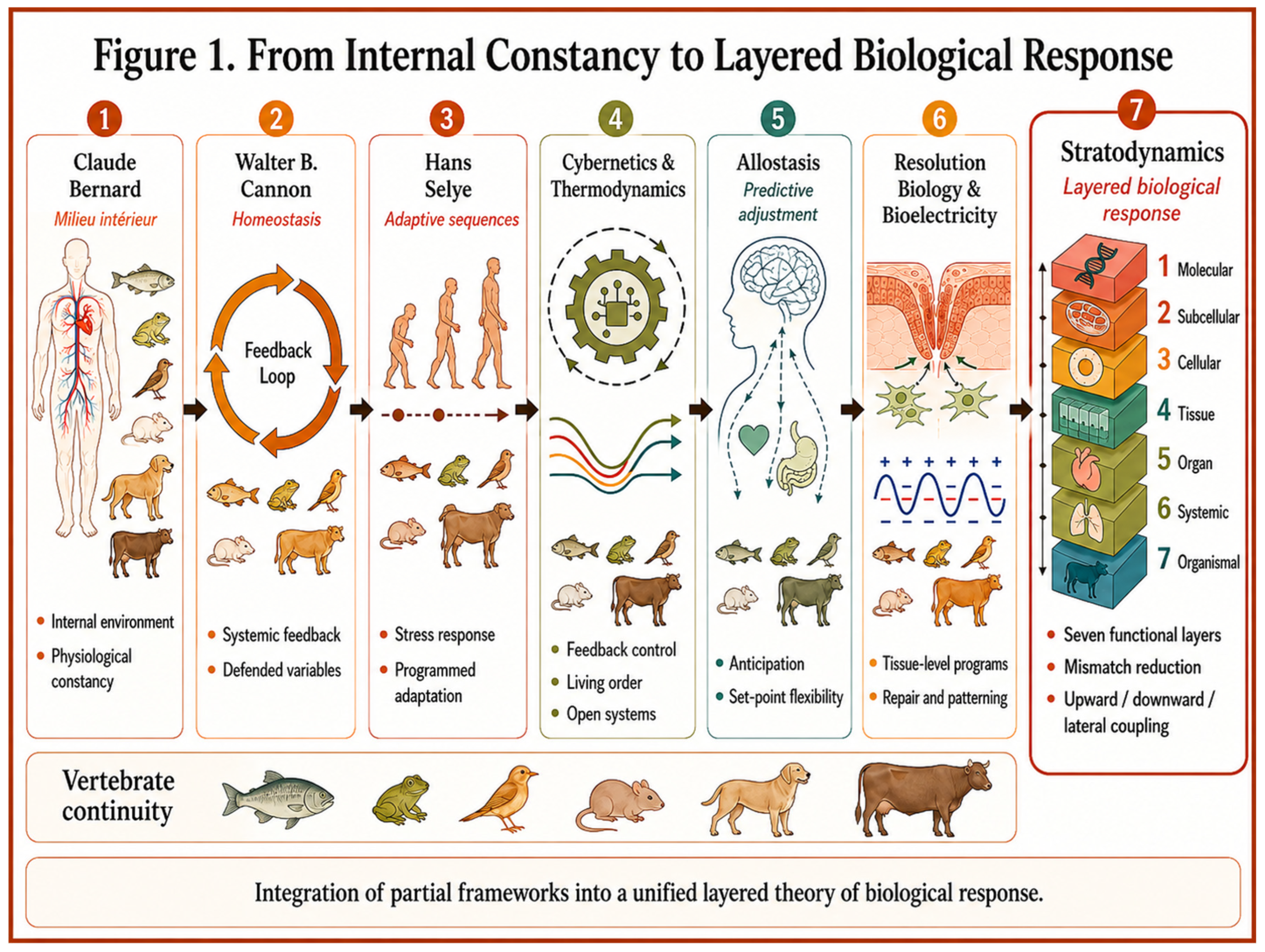
Figure 2.
The seven functional layers of stratodynamics. Biological response in vertebrates is organized across molecular, subcellular, cellular, tissue, organ, systemic, and organismal layers. Each layer has its own unit of organization, characteristic timescale, response architecture, and form of mismatch between actual and required state. The layers are distinct but coupled into one coherent biological response.
Figure 2.
The seven functional layers of stratodynamics. Biological response in vertebrates is organized across molecular, subcellular, cellular, tissue, organ, systemic, and organismal layers. Each layer has its own unit of organization, characteristic timescale, response architecture, and form of mismatch between actual and required state. The layers are distinct but coupled into one coherent biological response.
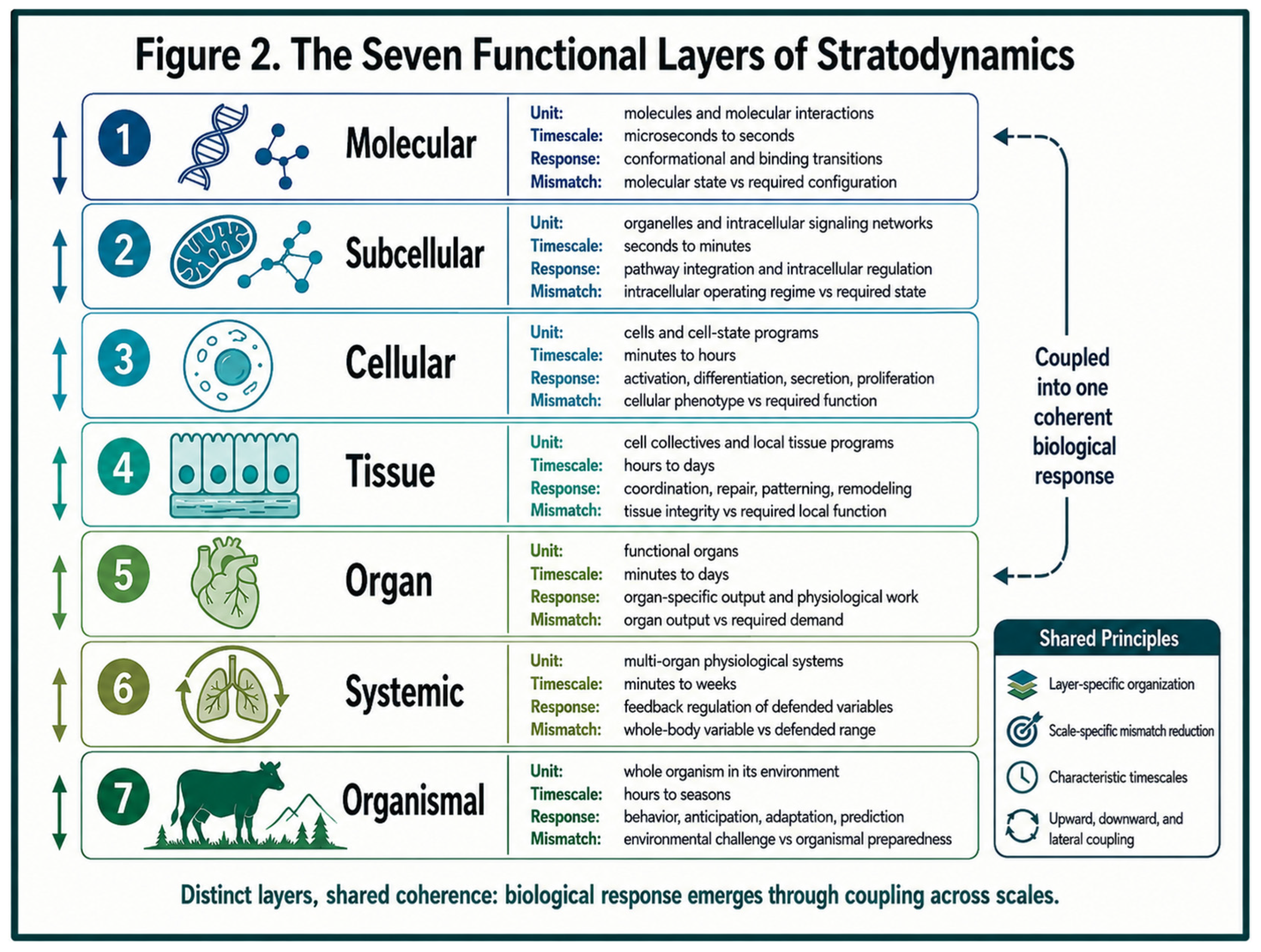
Figure 3.
Mismatch reduction as the unifying principle of stratodynamics. At every biological layer, response can be understood as reduction of mismatch between the current state and the state required for continued function under prevailing conditions. The meaning of required differs by scale: molecular configuration, intracellular operating regime, cellular phenotype, tissue integrity, organ output, systemic defended range, or organismal preparedness.
Figure 3.
Mismatch reduction as the unifying principle of stratodynamics. At every biological layer, response can be understood as reduction of mismatch between the current state and the state required for continued function under prevailing conditions. The meaning of required differs by scale: molecular configuration, intracellular operating regime, cellular phenotype, tissue integrity, organ output, systemic defended range, or organismal preparedness.
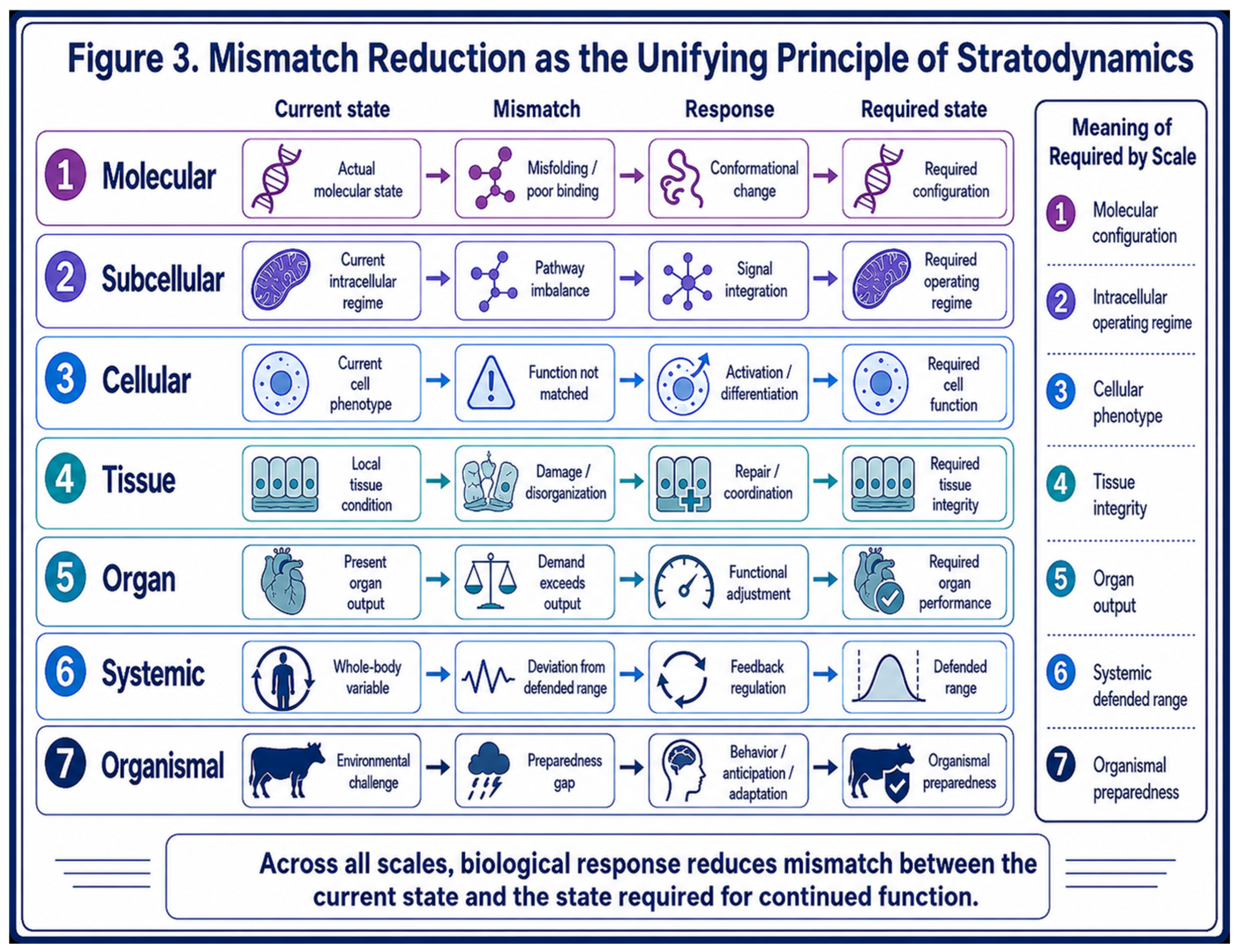
Figure 4.
Three-directional coupling among stratodynamic layers. Upward coupling allows molecular and cellular events to propagate toward tissue, organ, systemic, and organismal responses. Downward coupling allows organismal state, systemic context, and prediction to shape organs, tissues, cells, signaling pathways, and molecular readiness. Lateral coupling coordinates components within each layer.
Figure 4.
Three-directional coupling among stratodynamic layers. Upward coupling allows molecular and cellular events to propagate toward tissue, organ, systemic, and organismal responses. Downward coupling allows organismal state, systemic context, and prediction to shape organs, tissues, cells, signaling pathways, and molecular readiness. Lateral coupling coordinates components within each layer.
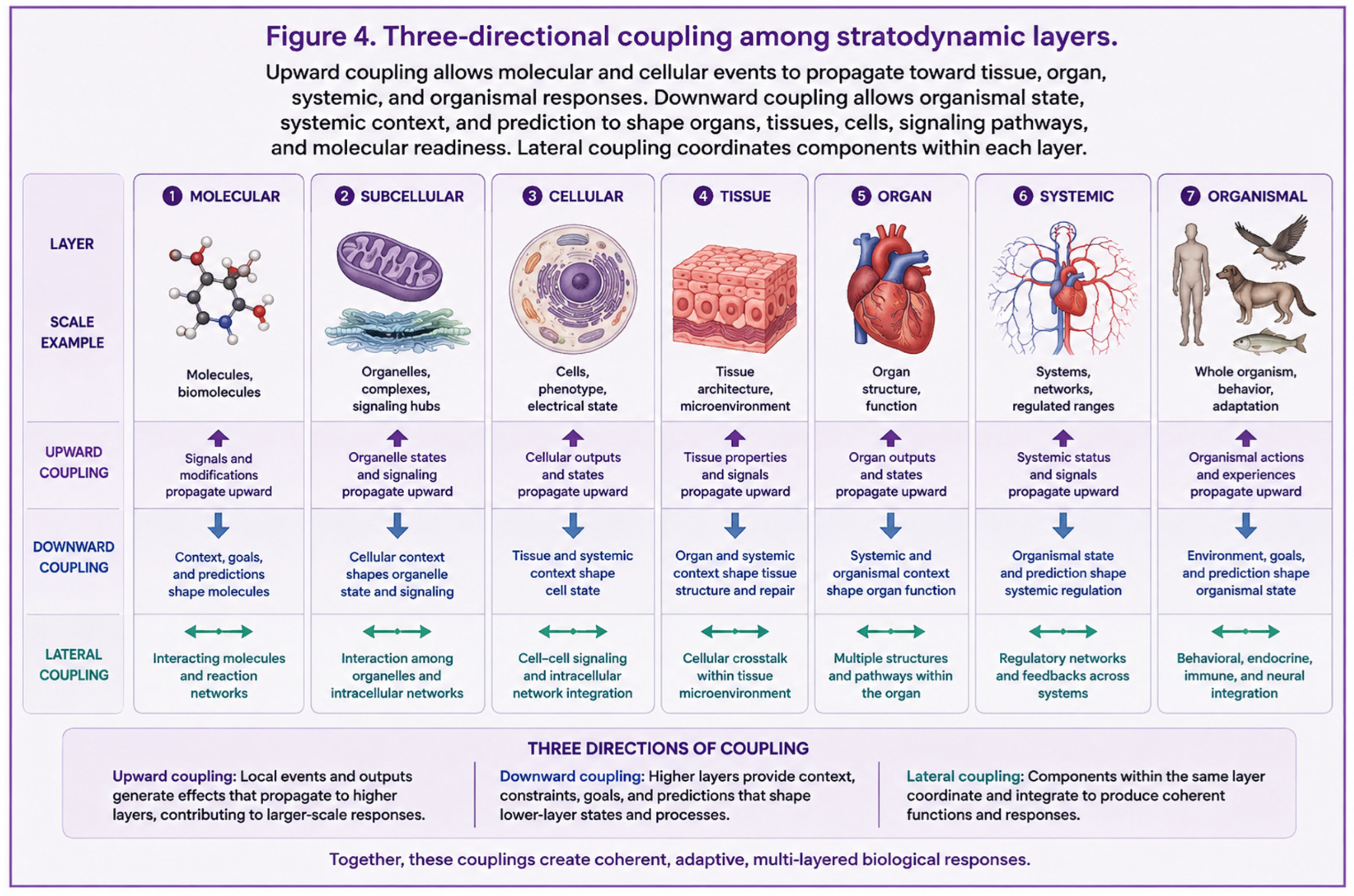
Figure 5.
Disease as failure of layered coherence. Stratodynamics proposes that many chronic, multifactorial, relapsing, and poorly resolving diseases persist not only because one molecule, cell, organ, or systemic variable is abnormal, but because coupling among layers fails to restore coherence. Pathology may be sustained by mistimed signaling, incomplete resolution, excessive amplification, distorted downward regulation, or failure of organ and systemic responses to re-integrate tissue and cellular states.
Figure 5.
Disease as failure of layered coherence. Stratodynamics proposes that many chronic, multifactorial, relapsing, and poorly resolving diseases persist not only because one molecule, cell, organ, or systemic variable is abnormal, but because coupling among layers fails to restore coherence. Pathology may be sustained by mistimed signaling, incomplete resolution, excessive amplification, distorted downward regulation, or failure of organ and systemic responses to re-integrate tissue and cellular states.
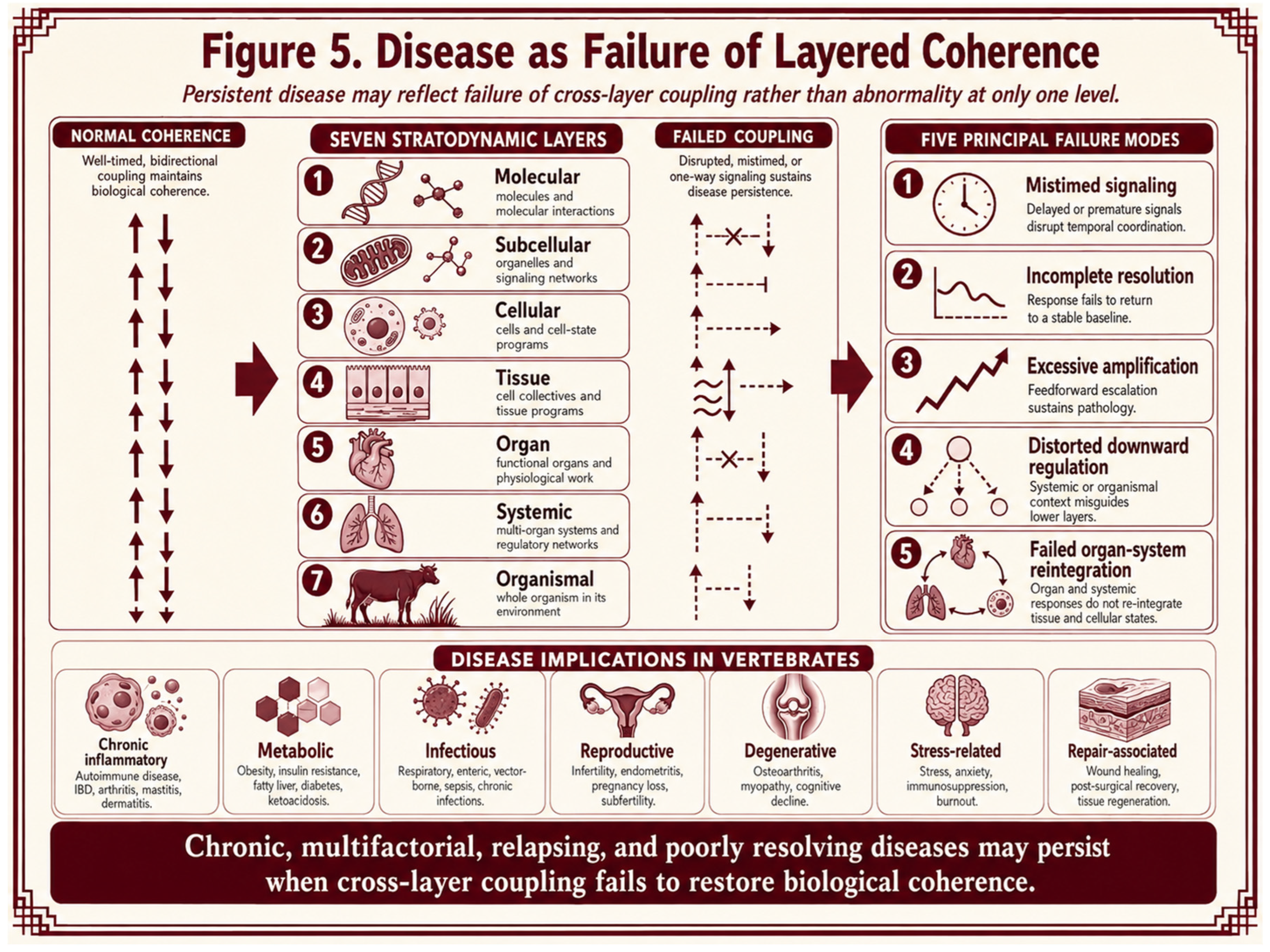
Figure 6.
Wound healing as a stratodynamic response. A cutaneous wound recruits all seven layers of biological response. Molecular clotting and mediator signals activate intracellular pathways; cells migrate, proliferate, and change phenotype; tissues coordinate inflammation, repair, bioelectric guidance, and remodeling; the skin restores barrier function; systemic metabolism and immunity support repair; and organismal behavior protects the damaged site.
Figure 6.
Wound healing as a stratodynamic response. A cutaneous wound recruits all seven layers of biological response. Molecular clotting and mediator signals activate intracellular pathways; cells migrate, proliferate, and change phenotype; tissues coordinate inflammation, repair, bioelectric guidance, and remodeling; the skin restores barrier function; systemic metabolism and immunity support repair; and organismal behavior protects the damaged site.
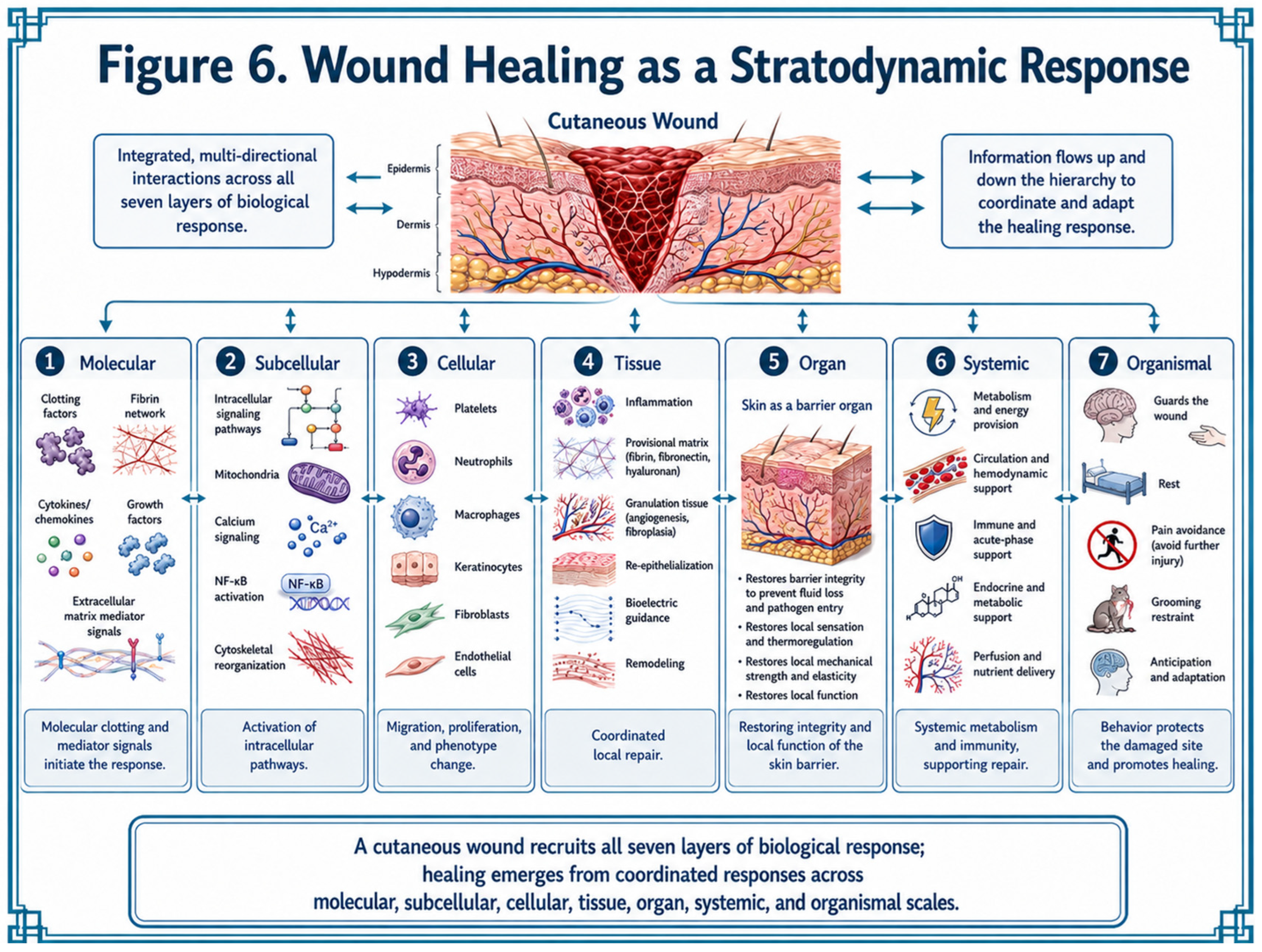
Figure 7.
Translational logic of stratodynamics for veterinary and medical sciences. A stratodynamic approach asks where the mismatch originated, how it propagated across layers, which coupling failed to restore coherence, and which intervention can re-establish coordinated response. The framework may be especially useful for chronic inflammatory, metabolic, infectious, reproductive, degenerative, stress-related, and repair-associated diseases in vertebrates.
Figure 7.
Translational logic of stratodynamics for veterinary and medical sciences. A stratodynamic approach asks where the mismatch originated, how it propagated across layers, which coupling failed to restore coherence, and which intervention can re-establish coordinated response. The framework may be especially useful for chronic inflammatory, metabolic, infectious, reproductive, degenerative, stress-related, and repair-associated diseases in vertebrates.
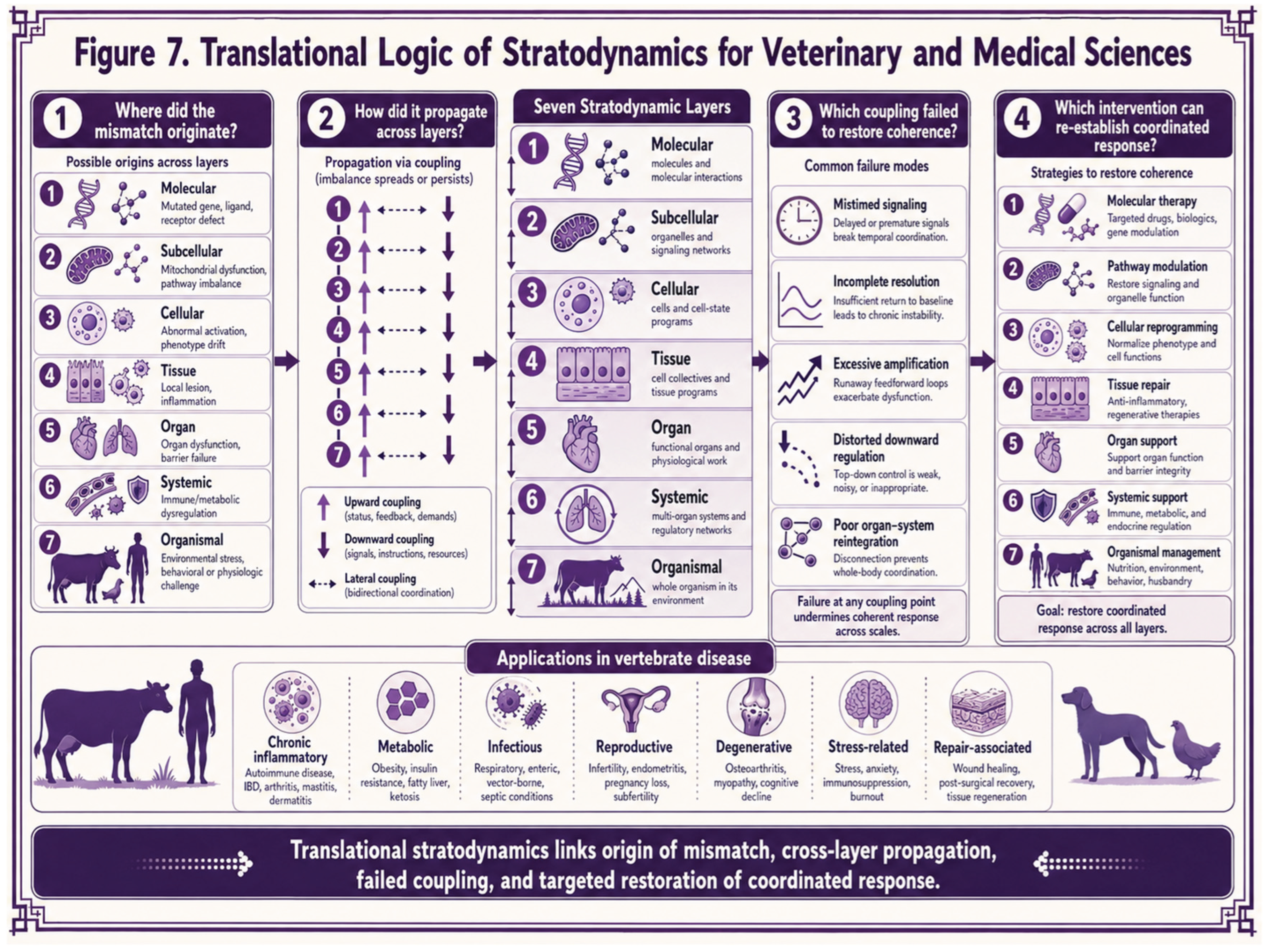

Table 1.
The seven layers of stratodynamics. Each layer reduces its own form of mismatch through its own response architecture, on its characteristic timescale; the theoretical framework that describes each layer most precisely is indicated. Timescales are characteristic orders of magnitude, not sharp boundaries.
Table 1.
The seven layers of stratodynamics. Each layer reduces its own form of mismatch through its own response architecture, on its characteristic timescale; the theoretical framework that describes each layer most precisely is indicated. Timescales are characteristic orders of magnitude, not sharp boundaries.
| Layer | Scale & unit | Mismatch type | Response architecture | Timescale | Theoretical framework |
| 1. Molecular | single molecules & complexes | molecular-state mismatch | molecular-state transition | ps–ms | thermodynamics, kinetics, allostery |
| 2. Subcellular | intracellular signaling networks | subcellular signaling mismatch | intracellular integration | ms–hours | systems biology of signaling, nonlinear dynamics |
| 3. Cellular | individual cells | cellular-state mismatch | cellular-state transition | min–weeks | multistable gene-regulatory networks, attractor dynamics |
| 4. Tissue | multicellular tissues | tissue-structural mismatch | distributed multicellular program | hours–weeks | morphogenesis, reaction–diffusion, resolution & bioelectric biology |
| 5. Organ | organs (multiple tissues) | organ-functional mismatch | integrated organ output | min–months | integrative & systems physiology |
| 6. Systemic | systemic regulated variables | systemic setpoint mismatch | sensor–integrator–effector feedback | s–hours | homeostasis (Cannon), cybernetics |
| 7. Organismal | whole organism | organismal predictive mismatch | anticipatory pre-adjustment | min–lifetime | allostasis, predictive regulation |
Note: Timescales are characteristic orders of magnitude, not sharp boundaries. The table summarizes the vertebrate-focused architecture proposed in this manuscript; extensions to plants, microbes, embryos, and ecological systems require domain-specific adaptation.
Disclaimer/Publisher’s Note: The statements, opinions and data contained in all publications are solely those of the individual author(s) and contributor(s) and not of MDPI and/or the editor(s). MDPI and/or the editor(s) disclaim responsibility for any injury to people or property resulting from any ideas, methods, instructions or products referred to in the content. |
© 2026 by the author. Licensee MDPI, Basel, Switzerland. This article is an open access article distributed under the terms and conditions of the Creative Commons Attribution (CC BY) license.
Copyright: This open access article is published under a Creative Commons CC BY 4.0 license, which permit the free download, distribution, and reuse, provided that the author and preprint are cited in any reuse.


