
Submitted:
04 July 2026
Posted:
06 July 2026
You are already at the latest version
Abstract
This study investigates the development and evaluation of Debina white wine products with varying levels of sulfur dioxide, enriched with saffron, mastic, and mountain tea, aiming to enhance their functional properties and to assess the impact of these plant-derived additives on physicochemical, antioxidant, bioactive, and sensory characteristics. Analyses were performed, including sulfur dioxide determination, absorbance at 420 nm, total phenolic content, and free sulfhydryl groups, antioxidant activity assays, bioactivity evaluation, volatile compound profiling, and sensory analysis. The results demonstrated improved preservation of sulfur dioxide, phenolic compounds, antioxidant capacity, and anti-inflammatory activity in the enriched wine samples compared to controls throughout storage. Additionally, the wines were enriched with volatile compounds characteristic of the added plant materials. Sensory evaluation indicated that the products were organoleptically acceptable, while oxidation sensory perception during storage was lower than in the control samples. Overall, the findings suggest that saffron, mastic, and mountain tea can be effectively utilized in wines with reduced sulfur dioxide levels, as they enhance oxidative stability and contribute to the preservation and functional quality of the final product.
Keywords:
wine products
; sulfur dioxide
; antioxidant activity
; volatiles
1. Introduction
Sulfur dioxide is a common preservative in winemaking, widely used since the 19th century [1]. It acts as antiseptic, antioxidant, antioxidase, solubilizing, binding and fining agent. Although sulfur dioxide is the main wine preservative, it can cause health problems in high concentrations. For this reason, there are very strict legal limits on the amount of sulfur dioxide used in wine, as well as an obligation to state on the label that wine contains sulfur dioxide. Nowadays, several tests have been done to replace sulfur dioxide with other antimicrobials and antioxidants.
So many studies have been done, and have shown that crocus has antioxidant [2] and antitumor activity [3], protects against cardiovascular diseases [4] and has also anti-depressant activity [5]. Furthermore, mastic has antioxidant [6] and antimicrobial [7] activity, activates the detoxifying activity in human body and improves digestive system [8]. Mountain tea has also been studied and attributed to have anti-inflammatory [9] and antioxidant activity [10]. Mountain tea drinks have been used in treatment of gastrointestinal ailments, common colds (including bronchitis, sore throat, and flu) and as a diuretic [11].
Wine is a very popular product around the world that has been consumed since ancient times, and it has a nutritional, social, and religious role in human evolution. It is rich in phenolic components and studies have shown that polyphenols especially in red wine offer a great antioxidant effect [12]. Its antioxidant action is thought to protect against a multitude of diseases such as cardiovascular disease, oxidative stress, bad cholesterol, as well as some symptoms of Alzheimer's disease. In addition, its anticancer and anti-inflammatory effects have been studied with positive results [13].
In this study, crocus, mastic, and mountain tea are added to white wine with different levels of sulfur dioxide, and the antioxidant activity of the resulting wines is investigated by comparing each product wine with its corresponding control wine containing the same level of sulfur dioxide.
2. Materials and methods
2.1. Materials
2.1.1. Wines and Herbs
Greek red Crocus Powder used was Krokos Kozanis PDO brand and was an organic product packaged at 0.25 g bags. Chios mastic used was from the association of Chios mastic producers and was medium size tears at a 10 g packaging. Mastic was pulverized to form a powder in a porcelain mortar and pestle. Mountain tea used was from Myrtali organics and was from arid organic cultivation from the mountains of Epirus, and it belongs to sideritis scardica species.
All wines used were from local wineries. A: Miss Debina, Debina of Epirus from the Jimas winery with a lower level of sulfur dioxide. B: Debina wine from the Glinavos winery with a lower level of sulfur dioxide. C: Debina, Debina of Epirus from the Jimas winery with a higher level of sulfur dioxide. D: Debina wine from the Glinavos winery with a higher level of sulfur dioxide.
2.1.2. Reagents
Sodium hydroxide for Analysis, Potassium Hydroxide for Analysis (Mallinckrodt, Dublin, Ireland); Phenolphthalein, Bromothymol blue, Copper Sulphate pentahydrate (Ferak, Berlin, Germany); Iodine Ampule 0.05 mol, Acetaldehyde > 99,5% (Fixual Honeycell Fluka, North Carolina, USA); Starch (Riedel de Haen, North Carolina, USA); Methanol absolute, Hydrogen peroxide 30%, Boric acid 99,8%, Sodium carbonate anhydrous, 2,4,6-Tris(2-pyridil)-1,3,5-triazine (TPTZ), Dipotassium hydrogen phosphate trihydrate, Tartaric acid, Gallic acid anhydrous, Caffeic acid anhydrous (Μerck, New Jersey, USA); Ethanol absolute ≥98%, Sulfuric acid 96% (Panreac AppliChem, Barcelona, Spain); Folin-Ciocalteu, DPPH, Catechin (s) > 98%, Citric acid (Sigma Chemicals, St. Luis, USA); Hydrochloric acid ≥37%, Phosphoric acid ≥85%, Ferric chloride 97%, Potassium iodide ≥99,5%, Lipoxygenase from glycine (soybean) Lyophilised powder >50000 units/mg, Linoleic acid > 99%, 1,10-Phenanthroline, 4-methyl-2-pentanol 99% (Sigma–Aldrich, St. Luis, USA); Formaldehyde 36%-38% (Lanchner); P-Dimethylaminocinnamaldehyde, Sodium bisulfite (s); Sodium Molybdites (s) 98% (Alfa Aesar, Massachusetts, USA); Potassium dihydrogen phosphate (AnalaR); Iron (II) sulfate heptahydrate (polskie odczynniki chemiczne, Gliwice Poland).
2.1.3. Apparatus/Instruments
Waterbath (Memmert, Schwabach, Germany); Analytical scale Kern ABS, Analytical scale Kern 770 (Kern, Belingen Germany); Ultrasonic bath cleaner (Trade Raypa, Barcelona, Spain; pH meter C831 (Consort, Turnhout Belgium); Refrigerated centrifuge Mikro 22R (Hettich, Swabia, Germany); UV/VIS Spectrophotometer (Jenway 6505, ESSEX, UK); UV/VIS Spectrophotometer (Shimadzu UV-1280, Duisburg, F.R Germany); Vortex genie-2 (Scientific industries, New York, USA) SPME system (Supelco, Pennsylvania, USA); column Rxi-5MS (30 x 0,25 x 0,25) (Restek, Bad Homburg, Germany); column Rxi-17MS (2 x 0,25 x 0,25) (Restek, Bad Homburg, Germany); column Stabilwax-MS (30 x 0,25 x 0,25) (Restek, Bad Homburg, Germany); column-1 HT Fast (1,19 x 0,1 x 01) (Mega, Legnano, Italy); GCxGC gas chromatograph Agilent 8890 N (Agilent, Santa Clara, USA); BT Pegasus 4D GCxGC-TOFMS (Leco, Dubai, UAE).
2.2. Preparation of Wine Products
2.2.1. Wines Which Produced were:
C: White wine without added herbals.
CM: Wine with the addition of 10 mg/L crocus, 0.15 g/L mastic.
MT: Wine with the addition of 0.5 g/L mountain tea.
All wines prepared with the same procedure. Using a stainless metal spatula, the required quantities of herbals were weighed into tea filters in a four decimal analytical scale ABS Kern. The filters were placed in 200 ml bottles with the help of a cotton twine, then 150 ml of wine were added to the bottles, Figure S1. Bottles were closed and placed in the cold room at 4 °C for 24 hours to extract the herbals in wine. For Control, an empty filter was placed in the bottle to have the same conditions as MS and MT. After 24 hours the filters were removed from the bottles and each wine was divided at 50 ml bottles, the bottles are closed and placed at 15 °C until the analysis, Figure S2.
2.3. Methods of Analysis
2.3.1. Gross Composition
Gross composition was determined using the following official methods of the International Organization of Vine and Wine (OIV) [14].
Alcohol was measured after distillation as described at OIV and was expressed as % vol [15], reducing sugars by titration and the result was expressed as g/L of reducing sugars, given by: RS (g/L)= a / Vwine [16], total acidity by titration and was expressed as g/L tartaric acid, given by: Acidity (g/L) = (7.5 x V) / 10 and volatile acidity after steam distillation and titration as described at OIV 2015 [17] and was expressed as g/L acetic acid, given by: Volatile acidity (g/L) = 0.3 x (V1-V2 x 0.1) [18].
Total and free sulfur dioxide were determined following the iodometric method described by OIV [19] including the ethanal treatment and was expressed as mg/L SO2, given by: SO2 (mg/L) = V x N x 32 x 2 x 1000/ U= 25.6.
Color and browning index of wines was assessed by measuring the absorbance of samples at 420 nm using glass cells of 1 cm path and deionized water as reference liquid [20].
2.3.2. Model Wine
For the determination of total free sulphydryls (TFS), antioxidant and anti-inflammatory activities, a wine model was used. Model wine medium was a 12 % v/v ethanol mixture containing 5 g/L with the pH adjusted to 3.5 using 1 N sodium hydroxide [21].
2.3.3. Phenolics and Total Free Sulfhydryls
Total Phenolic Index (TPI) was determined by measuring the absorbance at 280 nm using quartz cells of 1 cm path. The spectrophotometer was zeroed with H2O. TPI corresponds to A (280 nm) times the dilution factor [20,22].
The method used for the determination of total o-diphenolic content of wine samples is based on the formation of o-diphenols-molybdate complexes [23], according to the procedure described by [24]. 1 mL of suitable diluted wine with model wine reacted with 1 mL 1 % MoNa solution for 15 min and the absorbance was measured at 370 nm with a quartz cuvette. The spectrophotometer was zeroed with the blank for each sample, which had EtOH:diH2O (1 :1) instead of MoNa solution. A calibration curve was prepared using 0, 10, 20, 30, 40, 50, mg/L of caffeic acid in model wine and the result was expressed as mg caffeic acid/L of wine. The equation resulting from the calibration curve is C = (A – 0.0808) / 0.0177, R2=0.9957.
Total flavanol content of wine samples was determined using the 4-dimethylaminocinnamaldehyde (DMACA) assay which employs the absorbance of the adducts formed between the aldehyde and monomeric and polymeric flavanols [25,26] as referred previously [27]. 0,2 mL of suitable diluted wine with model wine reacted with 1 ml of 0,1 M DMACA solution for 10 min and then the absorbance was measured at 640 nm with glass cuvette of 1,5 cm. The spectrophotometer was zeroed with the blank for each sample which had 1 mL HCl in MeOH instead of DMACA solution. A calibration curve was prepared using 0, 4, 8, 12, 16, 20 mg/L of catechin in model wine and the result was expressed as mg catechin/L of wine. The equation resulting from the calibration curve is C = (A – 0.004) / 0.0378, R2= 0.9996.
Hydroxycinnamates were determined by taking the absorbance at 320 nm using quartz cells of 1 cm path. 2 mL of suitable diluted wine was measured at 320 nm with a glass cuvette, while the spectrophotometer was zeroed with 12 % EtOH solution [27,28]. A calibration curve was prepared using 0, 2.5, 5, 10, 15 mg/L of caffeic acid in 12% EtOH and the result was expressed as mg caffeic acid/L of wine. The equation resulting from the calibration curve is C = (A + 0.0154) / 0.0645, R2= 0.0993.
Total free sulfhydryls (TFS) were determined spectrophotometrically by measuring absorbance at 412 nm, according to the Ellman method [29,30]. Briefly, 1.6 mL of 200 mM phosphate buffer, 0.4 mL of diluted wine sample, and 0.2 mL of 1 mM DTNB solution were mixed in test tubes. Samples were incubated at 20 °C for 1 h, and absorbance was measured at 412 nm using a glass cuvette. The spectrophotometer zeroed against the sample blank. A calibration curve was prepared using 0, 10, 20, 40, 80 and 120 mg/L of glutathione in model wine and the result was expressed as mg glutathione/L of wine. The equation resulting from the calibration curve is C = (A-0,1806)/0,007, R²= 0,998.
2.3.4. Determination of the Antioxidant Activity by the Folin and FRAP Assays
The assessment of antioxidant activity by Folin-Ciocalteu assay was based on the method developed by Folin and Ciocalteu for proteins and adopted for (total) phenolics and other antioxidants [31,32,33]. In a test tube were added 3.950 μL H2O, 50 μL of wine, and 250 μL of Folin-Ciocalteu reagent. After 1 minute, 750 μL of 20 % w/v Na2CO3 were added, and the solution was stirred vigorously in vortex. The sample also had its corresponding blank, which instead of sample contained 50 μL model wine. After remaining for 2 hours in a dark place at room temperature, the absorption was measured at 750 nm [33]. A calibration curve was prepared using 0, 150, 300, 450, 600, 750 mg/L of gallic acid in model wine and the result was expressed as mg GA/L of wine. The equation resulting from the calibration curve is C = (A – 0.0029) / 0.001, R2 = 0.9982.
The assessment of reducing (antioxidant) power by the FRAP assay was based on the method developed [34] and adopted on food samples [33,35]. A working FRAP reagent should be freshly prepared by mixing 300 mM acetate buffer (pH=3.6), 9 mM TPTZ reagent in 0.05 M HCl and 20 mM FeCl3 reagent in 0.05 M HCl at a ratio of 10:1:1 (v/v/v) respectively. 1.5 ml of Frap reagent were added to 0.25 ml suitable diluted wine with model wine and the mixture was kept at 37 °C for 10 min. Absorbance was then measured with a spectrophotometer in a glass cuvette of 1 cm at 593 nm against diH2O as blank. A calibration curve was prepared using 0, 2, 4, 6, 8, 10 mg/L of gallic acid on model wine, and the result was expressed as mg GA/L of wine. The equation resulting from the calibration curve is C = (A – 0.0145) / 0.0908), R2 = 0.9966.
The assessment of scavenging (antioxidant) activity is based on the method developed by Blois [36] and adopted on food samples [33,35]. In a glass cuvette of 1,5 mL were added 1 mL of 40 mg/L DPPH solution in MeOH and 100 μL of suitable diluted wine and the absorbance was measured for 20 min at 515 nm. A blank sample was also measured instead of wine. The spectrophotometer zeroed with a solution of 1 mL MeOH and 100 μL model wine [37]. The result was expressed as % initial DPPH inhibition for the results of 1 min and as % total DPPH inhibition for the results of 20 min. DPPH scavenging is given by: Scavenging % = (B – S) / B x 100 %.
The hydroxyl radical scavenging assay is based on the ability of 1,10-phenanthroline in chelating Fe (II) ions, thus preventing them from taking part in the Fenton reaction and limiting hydroxyl radical formation, in a pattern described previously [38]. In a 2 mL eppendorf were added 0.25 mL 2 mM 1,10-phenanthroline, 0.5 mL Phosphate Buffer 0.15 Μ (pH 7,4), 0.25 mL of suitable diluted wine, 0.25 mL FeSO4 0.75 mM, and the mixture was vortexed. Then, 0.25 mL H2O2 100 mg/L were added and after 1 h incubation at a waterbath of 37 °C the absorbance at 536 nm was measured with a glass cuvette of 1 cm [39]. The spectrophotometer zeroed with diH2O. Furthermore, a Control sample was measured which has model wine instead of wine and a blank sample which has diH2O instead of H2O2. The hydroxyl radical scavenging is given by: % Scavenging= (AS – AC) / (AB – AC) x 100 %. A calibration curve was prepared using 0, 50, 100, 150, 200, 250 mg/L of caffeic acid in model wine, and the result was expressed as mg caffeic acid/L of wine. The equation resulting from the calibration curve is C= (A + 5.1528)/ 0.3188, R2= 0.9859.
The estimation of anti-inflammatory activity (AIA) was based on the ability of compounds or mixtures to inhibit lipoxygenase (LOX), since it metabolizes/oxidizes arachidonic acid to leukotrienes significantly enhancing inflammatory reactions [40,41]. LOX assay applied as in a pattern described previously [42]. In an 1,5 ml eppendorf were added 900 μL borate buffer C 0.2 M (pH=9), 100 μL suitable diluted wine and 100 μL LOX 100 U in buffer. The mixture was vortexed, stood for 5 min in a dark place and 100 μL of 4,18 mΜ linoleic acid in EtOH were added. Then the absorbance at 234 nm was measured with a quartz cuvette of 1 cm for 20 min. The spectrophotometer was zeroed with a blank sample which has EtOH instead of linoleic acid. Furthermore, a control sample was measured which has model wine instead of wine. LOX inhibition is given by: Inhibition % = (C – S) / C x 100 %[42]. A calibration curve is prepared using 0, 0.3, 0.6, 0.9, 1.2 και 1.5 mg/L of catechin in model wine, and the result was expressed as mg caffeic acid/L of wine. The equation resulting from the calibration curve is C= (A - 12)/ 17.2, R2= 0.9728.
2.3.5. Analysis Using HS-SPME Coupled with GC x GC-TOF-MS
Solid Phase Microextraction (Solid Phase Microextraction) is based on the adsorption of volatile and semi-volatile compounds onto coated fiber without the use of solvents [43]. Samples were pre-treated as follows: 0.980 ml of each wine sample was transferred into a 4-mL screw-capped glass vial with a Teflon-rubber septum. Vials were kept in the freezer at -30 °C until the analysis, and before they were used were left at room temperature to defrost. Then, 30 μl of 1000 mg/l 4-methyl-2-Pentanol was added as an internal standard to have 30 mg/l final concentration. The content of each sample was stirred for 20 min at 40 °C. Then, a constant length of the fiber was exposed to the headspace for another 20 min, under the same conditions (14). The fiber used for the absorption of volatiles was a divinylbenzene/Carboxen/PDMS 50/30 µm (Supelco, Bellefonte, PA, USA).
Comprehensive two-dimensional gas chromatography (Comprehensive Two-Dimensional Gas Chromatography) coupled with Time-of-Flight Mass Spectrometry is based on the sequential separation of compounds on two columns of different polarity, enhancing resolution and peak capacity [44]. The separated analytes are then detected by TOF-MS, where ions are accelerated and separated according to their mass-to-charge ratio, allowing rapid and sensitive identification. For GCxGC/TOF-MS, after extraction, the fiber was introduced into the injector at 250 °C in splitless mode and kept for 15 min for thermal desorption and fiber cleaning. Helium was used as the carrier gas at a flow rate of 1.2 mL min⁻¹. Τhe column installed in the first oven was a polar Stabilwax column (30 m × 0.25 mm × 0.25 μm), while a non-polar Mega-1-HT fast column (1.19 m × 0.10 mm × 0.10 μm) was used in the second oven. The oven temperature program started at 40 °C and was held for 2 min, followed by an increase of 3 °C min⁻¹ to 115 °C and 5 °C min-1 to 250 °C, where it was held for 5 min. The total run time was 59 min, and a solvent delay of 360–408 s was applied. The second column was operated with a temperature program set 5 °C higher than that of the first column, while the modulator temperature was set 15 °C higher than the second column. The modulation period (MP) was set to 5 s (1.5 s hot pulse and 1 s cold pulse). For mass spectrometric detection, the ion source and transfer line temperatures were set at 250 °C. Mass spectra were acquired in the range of 35–350 m/z at a scan rate of 200 spectra s⁻¹ [45]. Data processing was performed using ChromaTOF software (version 4.32). The signal-to-noise ratio (S/N) threshold was set to 100, with a minimum peak integration criterion of min. stick count = 3. Compound identification was carried out using the NIST_ri, Replib, and Mainlib libraries, with a minimum similarity score of 800. During GC×GC–TOF-MS analysis, background and artefact compounds originating from the analytical system were identified and removed during data processing. Typical examples included siloxanes, which originated from column stationary phases, septa, and SPME fiber coatings, as well as phthalates, plasticizers, and column bleed compounds [46]. The exclusion of these features was considered essential to avoid misinterpretation of the results and to ensure reliable compound identification, particularly in complex matrices. Data cleaning was performed based on the evaluation of blank samples, comparison with mass spectral libraries, and retention behavior criteria. The concentration of each volatile is calculated by: C (mg/L) = (30xAreav)/Areais.
2.3.6. Statistical Analysis
Results are expressed as the mean value ± standard deviation of the three repetitions. The parameters studied were analyzed by SPSS Statistics version 25 program of the company IBM. A check of extreme values was conducted through boxplots, as well as a normality check using the Shapiro-Wilk test to determine if a parametric test could be applied. Averages’ comparison between samples were analyzed by ANOVA method with Duncan test at significance level p < 0.05.
3. Results and Discussion
3.1. Gross Composition of Wine Products
Composition of wines before the extraction are presented in table S1. All four white wines were dry with residual sugar values measured at 2.1, 2.2, 2.1, and 2.0 g/L, respectively [16]. They exhibited various SO2 levels ranged 86.2 ± 9 to 199.7 ± 2.6 mg/L. All wines were within the legal limit for total sulfur dioxide [47]. pH of A and C wine was lower than pH of B and D and total acidity of A and C was higher than B and D. Furthermore, there is no noticeable difference according to the SO2 levels of wines for pH and total acidity. Volatile acidity of wines, on the other hand, was almost the same for A and B wines which differed from C and D wines that had also almost the same volatile acidity. Alcoholic strength was in all 4 wines about 13%. All these factors are dependent on the variety of grapes, Debina, and on the production procedure that winemakers follow.

Table 1.
Phenolic composition and antioxidant capacity of initial wines.
| A | B | C | D | |
| Free Sulfur dioxide | 10.24 ± 0.12 | 29 ± 4 | 93.9 ± 1.5 | 85 ± 8 |
| Absorption 420 nm | 0.145 ± 0.004 | 0.064 ± 0.001 | 0.103 ± 0.009 | 0.042 ± 0.003 |
| Phenolic index | 12.30 ± 0.50 | 11.18 ± 0.62 | 13.17 ± 1.10 | 21.00 ± 0.48 |
| o-diphenols (mg/L caffeic acid) | 205 ± 16 | 199 ± 4 | 247.8 ± 2.0 | 202 ± 3 |
| flavanols (mg/L catechin) | 97 ± 4 | 45.8 ± 2.3 | 103 ± 7 | 38 ± 10 |
| Hydroxycinnamic acids (mg/L caffeic acid) | 123.1 ± 2.5 | 93.8 ± 1.7 | 134 ± 4 | 93 ± 3 |
| Sulfhydryl groups (mg/L glutathione) | 204.1 ± 0.9 | 374.0 ± 2.1 | 527.9 ± 2.1 | 501.9 ± 2.1 |
| Folin (mg/L gallic acid) | 503 ± 13 | 332 ± 13 | 542 ± 28 | 302 ± 7 |
| FRAP (mg/L gallic acid) | 111.2 ± 1.4 | 88 ± 7 | 169.3 ± 1.2 | 101 ± 5 |
| initial % DPPH inhibition | 27 ± 5 | 28.6 ± 1.3 | 36 ± 5 | 35.2 ± 2.8 |
| total % DPPH inhibition | 71.9 ± 0.6 | 72.7 ± 1.1 | 76 ± 4 | 74.1 ± 0.6 |
| -OH radical scavenging (mg/L caffeic acid) | 381 ± 29 | 106 ± 22 | 383 ± 5 | 71 ± 6 |
| Anti-inflammatory activity (mg/L catechin) | 0.30 ± 0.03 | 0.54 ± 0.11 | 0.41 ± 0.05 | 0.192 ± 0.011 |
Values are the means of three trials along with standard deviations. a, b: They were used in the comparison of volatiles of initial wines and control wines. Means that do not bear a common superscript differ significantly.
3.2. Wine and Wine Products Analysis
Antioxidant potential of control wines and wine products were estimated during their storage for up to 7 weeks. Free sulphur dioxide, phenolics, total free sulphydryls, antioxidant activity, and also AIF activity were evaluated/determined. It is noticed that during storage control wine exhibited progressively higher absorbances at 420 nm, indicating the evolution of browning-oxidation. The A 420 nm of C-A, C-B, C-C, C-D at 1 day were 0.139, 0.058, 0.042, 0.098, at 14 days 0.145, 0.065, 0.047, 0.095 and at 49 days 0.148, 0.066, 0.049, 0.100.
3.2.1. Free Sulfur Dioxide, Phenolics and Total Free Sulphydryls
On the first day of storage, free sulfur dioxide is found at the same levels in wines and wine products. On days 14 and 49, wine products show a higher concentration of free sulfur dioxide anhydride compared to the controls. This applies to all wines regardless of their initial free sulfur dioxide content as presented at Figure 1.
The phenolic index of wine products is at the same or higher levels on day 1, and at higher levels during storage in all wines A, B, C, D, Figure 2.
The wine products showed higher levels of o-diphenols compared to the control from the first day and during storage. This applies to wines A and B, but also to wines C and D, Figure 3.
Figure 3.
o-diphenols levels in control wines and wine products over 49 days. a, b: They were used in the comparison of volatiles of wine and wine products of each wine. Means that do not bear a common superscript differ significantly. C-A: White wine control A, CM-A: wine A fortified with crocus and mastic, MT-A: wine A fortified with mountain tea, C-B: White wine control B, CM-B: wine B fortified with crocus and mastic, MT-B: wine B fortified with mountain tea, C-C: White wine control C, CM-C: wine C fortified with crocus and mastic, MT-C: wine C fortified with mountain tea, C-D: White wine control D, CM-D: wine D fortified with crocus and mastic, MT-D: wine D fortified with mountain tea.
Figure 3.
o-diphenols levels in control wines and wine products over 49 days. a, b: They were used in the comparison of volatiles of wine and wine products of each wine. Means that do not bear a common superscript differ significantly. C-A: White wine control A, CM-A: wine A fortified with crocus and mastic, MT-A: wine A fortified with mountain tea, C-B: White wine control B, CM-B: wine B fortified with crocus and mastic, MT-B: wine B fortified with mountain tea, C-C: White wine control C, CM-C: wine C fortified with crocus and mastic, MT-C: wine C fortified with mountain tea, C-D: White wine control D, CM-D: wine D fortified with crocus and mastic, MT-D: wine D fortified with mountain tea.
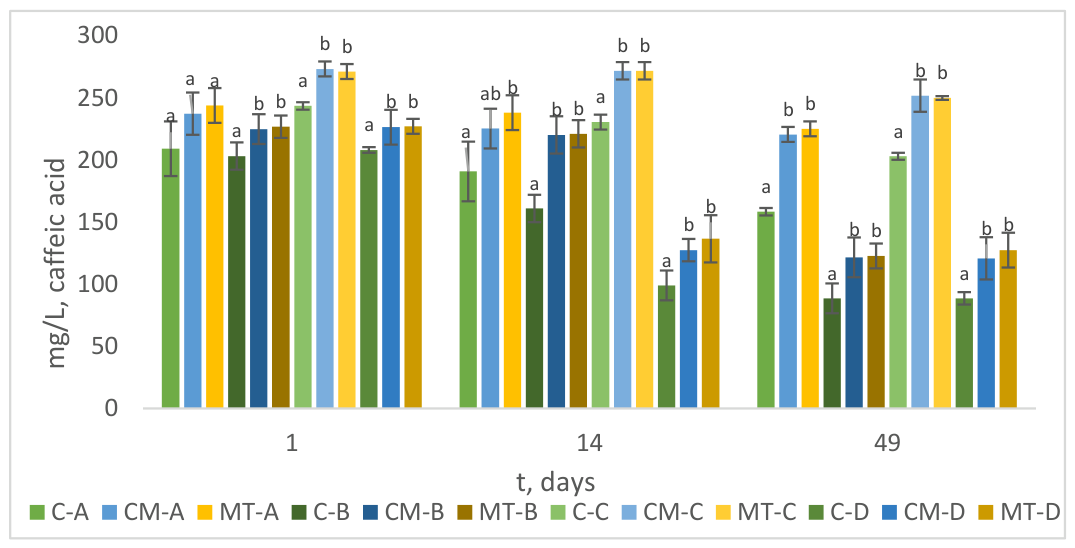
Figure 4.
Flavanols levels in control wines and wine products over 49 days. a, b: They were used in the comparison of volatiles of wine and wine products of each wine. Means that do not bear a common superscript differ significantly. C-A: White wine control A, CM-A: wine A fortified with crocus and mastic, MT-A: wine A fortified with mountain tea, C-B: White wine control B, CM-B: wine B fortified with crocus and mastic, MT-B: wine B fortified with mountain tea, C-C: White wine control C, CM-C: wine C fortified with crocus and mastic, MT-C: wine C fortified with mountain tea, C-D: White wine control D, CM-D: wine D fortified with crocus and mastic, MT-D: wine D fortified with mountain tea.
Figure 4.
Flavanols levels in control wines and wine products over 49 days. a, b: They were used in the comparison of volatiles of wine and wine products of each wine. Means that do not bear a common superscript differ significantly. C-A: White wine control A, CM-A: wine A fortified with crocus and mastic, MT-A: wine A fortified with mountain tea, C-B: White wine control B, CM-B: wine B fortified with crocus and mastic, MT-B: wine B fortified with mountain tea, C-C: White wine control C, CM-C: wine C fortified with crocus and mastic, MT-C: wine C fortified with mountain tea, C-D: White wine control D, CM-D: wine D fortified with crocus and mastic, MT-D: wine D fortified with mountain tea.
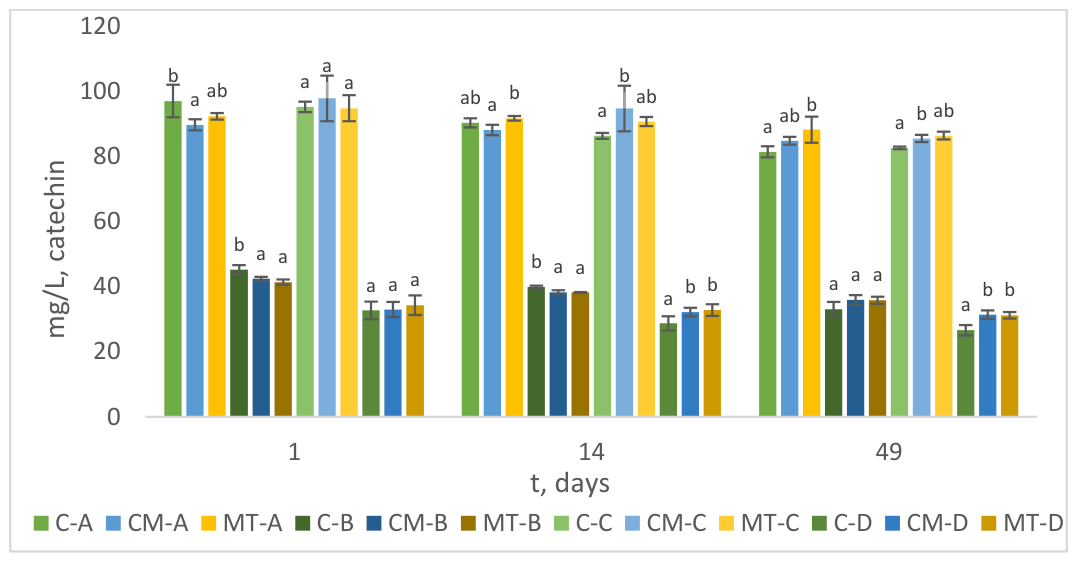
Figure 5.
Hydroxycinnamic acids levels in control wines and wine products over 49 days. a, b, c: They were used in the comparison of volatiles of wine and wine products of each wine. Means that do not bear a common superscript differ significantly. C-A: White wine control A, CM-A: wine A fortified with crocus and mastic, MT-A: wine A fortified with mountain tea, C-B: White wine control B, CM-B: wine B fortified with crocus and mastic, MT-B: wine B fortified with mountain tea, C-C: White wine control C, CM-C: wine C fortified with crocus and mastic, MT-C: wine C fortified with mountain tea, C-D: White wine control D, CM-D: wine D fortified with crocus and mastic, MT-D: wine D fortified with mountain tea.
Figure 5.
Hydroxycinnamic acids levels in control wines and wine products over 49 days. a, b, c: They were used in the comparison of volatiles of wine and wine products of each wine. Means that do not bear a common superscript differ significantly. C-A: White wine control A, CM-A: wine A fortified with crocus and mastic, MT-A: wine A fortified with mountain tea, C-B: White wine control B, CM-B: wine B fortified with crocus and mastic, MT-B: wine B fortified with mountain tea, C-C: White wine control C, CM-C: wine C fortified with crocus and mastic, MT-C: wine C fortified with mountain tea, C-D: White wine control D, CM-D: wine D fortified with crocus and mastic, MT-D: wine D fortified with mountain tea.
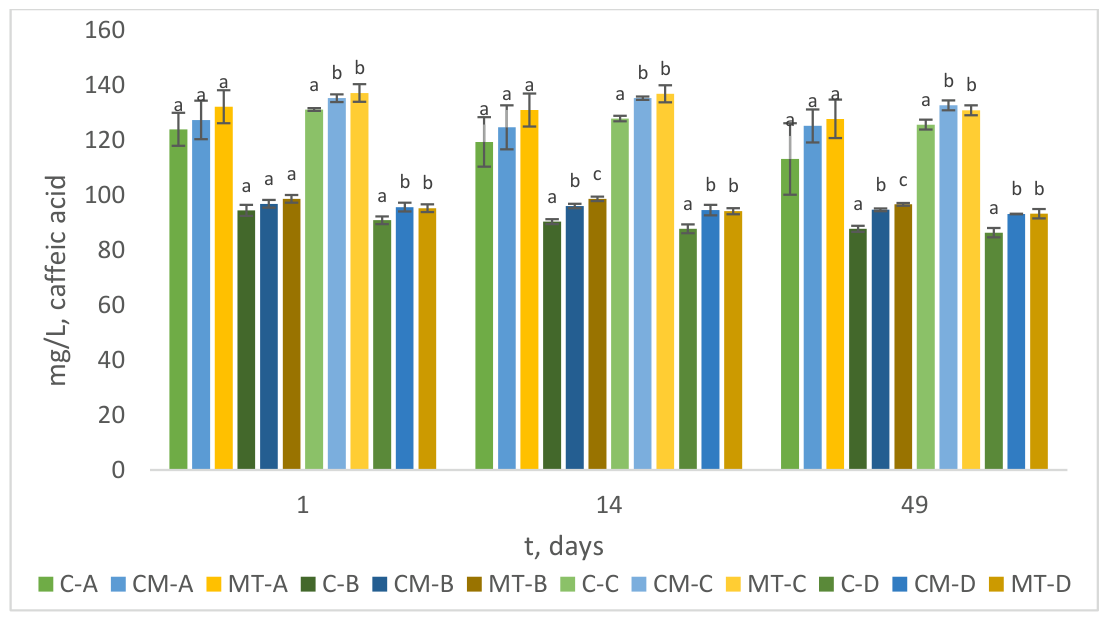
Figure 6 presents sulfhydryl groups levels of wine and wines products during storage. In wines A and B, the control showed higher levels of sulfhydryl groups than the wine products on day 1, while during storage, the wine products showed higher levels than the control. The same was true for wines C and D, where, while on day 1 the control showed higher levels of sulfhydryl groups, during storage the wine products showed higher levels than the control.
3.2.2. Antioxidant Potential of Wines and Wine Products
The antioxidant activity of wine products, as determined by all three methods, was equal or higher on day 1 compared to the control.
During storage, the antioxidant activity of wine products determined using the Folin method was higher than that of the control. This applies to wines A, B, and wines C and D, Figure 7.
A similar effect was also determined using the FRAP method. During storage, the antioxidant activity of wine products was higher than that of the control. This applies to wines A, B, and wines C and D, Figure 8.
The kinetics of the DPPH radical scavenging by wine and wine products are given in Figure S3. Figure S4 presents the initial DPPH Inhibition of the DPPH of wine and wine products during storage. The initial inhibition of the DPPH radical was at the same levels for control and the two wine products throughout the storage period for wine A. A vertical comparison shows a significant reduction in the initial inhibition of the DPPH radical in the control from 14 to 49 days. About wine B, the initial inhibition of the DPPH radical was found to be at the same levels in control and in both wine products on the first day. This trend was maintained throughout the storage period. The initial inhibition of the DPPH radical was at the same levels for control and the two wine products throughout the storage period, for wine C. A vertical comparison shows a significant reduction in the initial inhibition of the DPPH radical in the control for all storage times. There was also a significant reduction in the wine product with crocus and mastic from 14 to 49 days, and a significant reduction in the wine product with mountain tea from the first day to 14 days. The initial inhibition of the DPPH radical for wine D was at the same levels for control and the two wine products on the first day of storage. At 14 and 49 days, the two wine products showed higher inhibition of the DPPH radical than the control. A vertical comparison shows a significant reduction in the initial DPPH radical inhibition in the control from the first to the 14th day of storage. There is also a significant overall reduction from the first to the 49th day of storage for the two wine products.
Figure S5 presents the total DPPH Inhibition of the DPPH of wine and wine products during storage. The total DPPH radical inhibition of wine A was at the same levels in the control and wine products on the first day of storage and at 49 days. At 14 days, the wine product with crocus and mastic showed higher levels of DPPH radical inhibition than the control. A vertical comparison shows a significant decrease in the total DPPH radical inhibition activity of the control from 14 to 49 days. The results for the total DPPH radical inhibition of wine B do not differ greatly from those for the initial DPPH radical inhibition activity. On the first day of storage and at 49 days, there was no difference in DPPH radical inhibition between the control and the wine products. On day 14, both wine products showed higher levels of DPPH radical inhibition than the control. Regarding the total DPPH radical inhibition of wine C, the control and wine products showed the same levels of inhibition activity on the first day of storage. The wine product with mastic gum showed the same levels of total DPPH radical inhibition as the control at 14 days, and higher levels than the control at 49 days. The wine product with mountain tea showed higher levels of DPPH radical inhibition than the control at 14 and 49 days. In addition, the two wine products showed the same levels of DPPH radical binding at all storage times. A vertical comparison shows a significant decrease in the binding of the control radical from 14 to 49 days. Regarding the total DPPH radical inhibition activity of wine D, the control and wine products showed the same levels of inhibition activity on the first day of storage. The wine product with mastic resin showed the same levels of total DPPH radical inhibition as the control at 14 days and 49 days. The wine product with mountain tea showed higher levels of DPPH radical inhibition than the control at 14 and 49 days. In addition, the two wine products showed the same levels of DPPH radical inhibition at all storage times. A vertical comparison shows a significant reduction in the inhibition of the control radical overall from the first day to 49 days.
The control and wine products had similar hydroxyl radical scavenging on the first day. During storage, the wine products showed higher hydroxyl radical scavenging than the control. This was true for wines A, B, and wines C and D, Figure 9.
Corresponding to the scavenging of hydroxyl radicals, the control and wine products had similar anti-inflammatory effects on the first day. During storage, the wine products exhibited higher anti-inflammatory activity than the control. This was true for both wines A and B as well as wines C and D, Figure 10.
3.3.3. Sensory Characteristics of Wine and Wine Products
Initial wines: Before processing, the wines had a pleasant aroma of Debina and a satisfactory taste with roughness and bitterness in the aftertaste.
C – Controls: After 14 days, the aroma was not unpleasant with wine notes, and the bitter aftertaste remained. The overall sensation in the mouth was satisfactory. At 49 days, signs of oxidation were evident. Although some wine notes remained, they were largely masked by the oxidized nature of the wine. The sensation in the mouth was acceptable, but the bitterness on the finish remained.
CM – Wine products with Kozani Crocus and Chios mastic: On the first day, the aroma of the wine products came mainly from the added ingredients and was satisfactory. The taste had characteristics of wine and the added products, with bitterness in the aftertaste. At 14 days, the wine products had a more neutral and penetrating aroma and a limited initial aromatic identity compared to the control. The taste was more pleasant than the control. The aftertaste was pleasant overall. At 49 days, the aroma of the added substances dominated. The mouthfeel was satisfactory, while swallowing left a spicy sensation with a distinct bitter aftertaste. No obvious signs of oxidation were observed.
MT - Wine products with mountain tea from Epirus: On the first day, the wine products had a pleasant aroma, with a clear tea influence. The taste was influenced by the tea, with a milder bitterness in the aftertaste compared to the control. On 14 days, the wine products had a milder tea aroma than on day 1 and some of the wine characteristics were masked. The taste of the wine products was like that of the controls. Overall, the difference with the controls was small. At 49 days, there was a mild tea aroma with hints of wine aroma, accompanied by slight oxidation, less intense than that of the control. The mouthfeel was softer, while bitterness and astringency were noticeable upon swallowing.
3.3.4. Volatiles of Wine and Wine Products
Figure 11.
a. GC×GC–TOF-MS chromatogram of crocus- and mastic-fortified white wine A "CM-A".
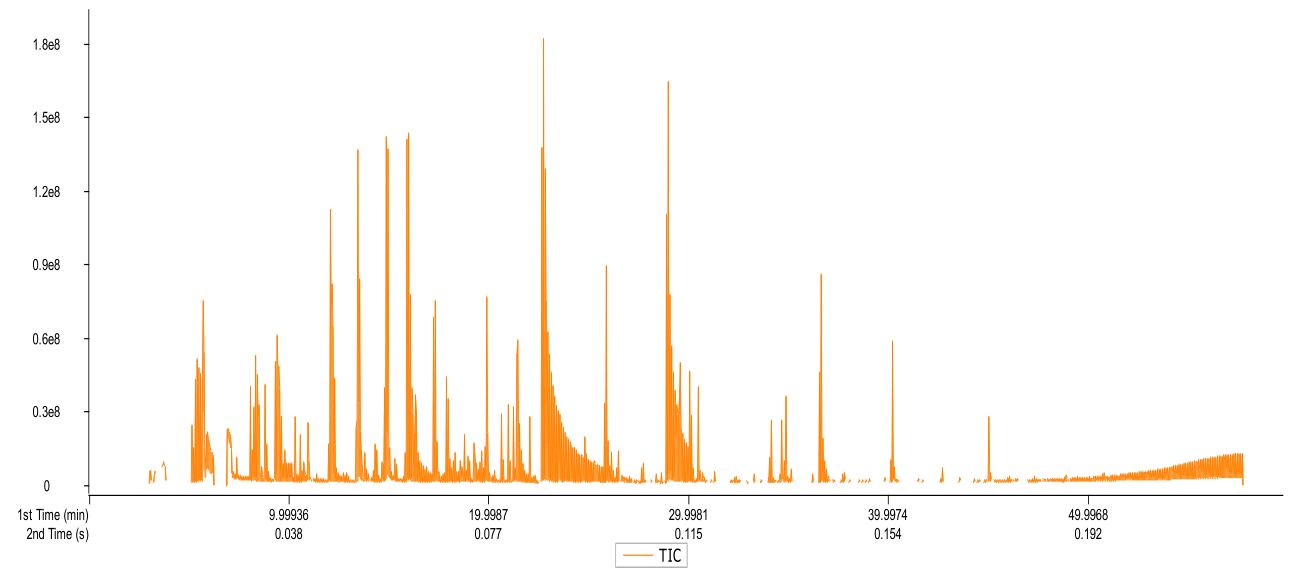
Figure 11.
b. Two-dimensional GC×GC–TOF-MS chromatogram of crocus- and mastic-fortified white wine A "CM-A".
Figure 11.
b. Two-dimensional GC×GC–TOF-MS chromatogram of crocus- and mastic-fortified white wine A "CM-A".
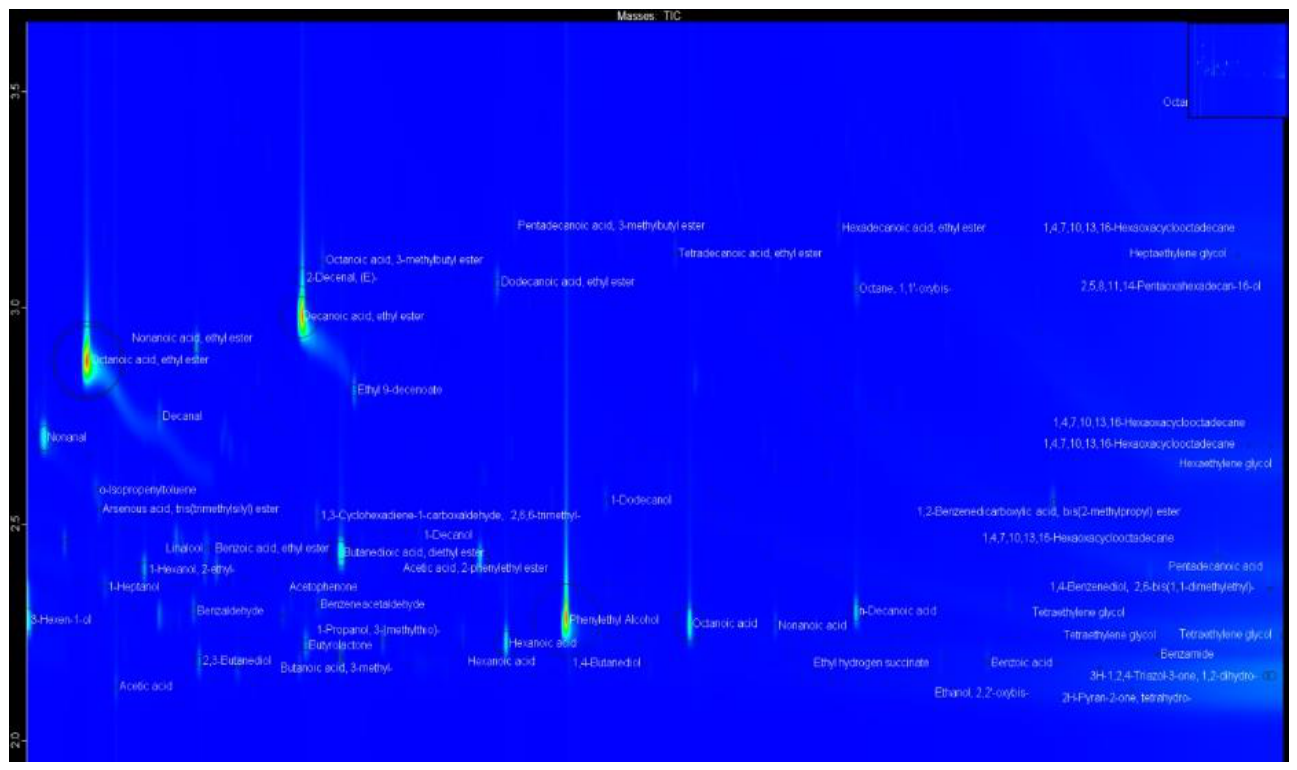
Figure 12.
a. GC×GC–TOF-MS chromatogram of mountain tea-fortified white wine A "MT-A".
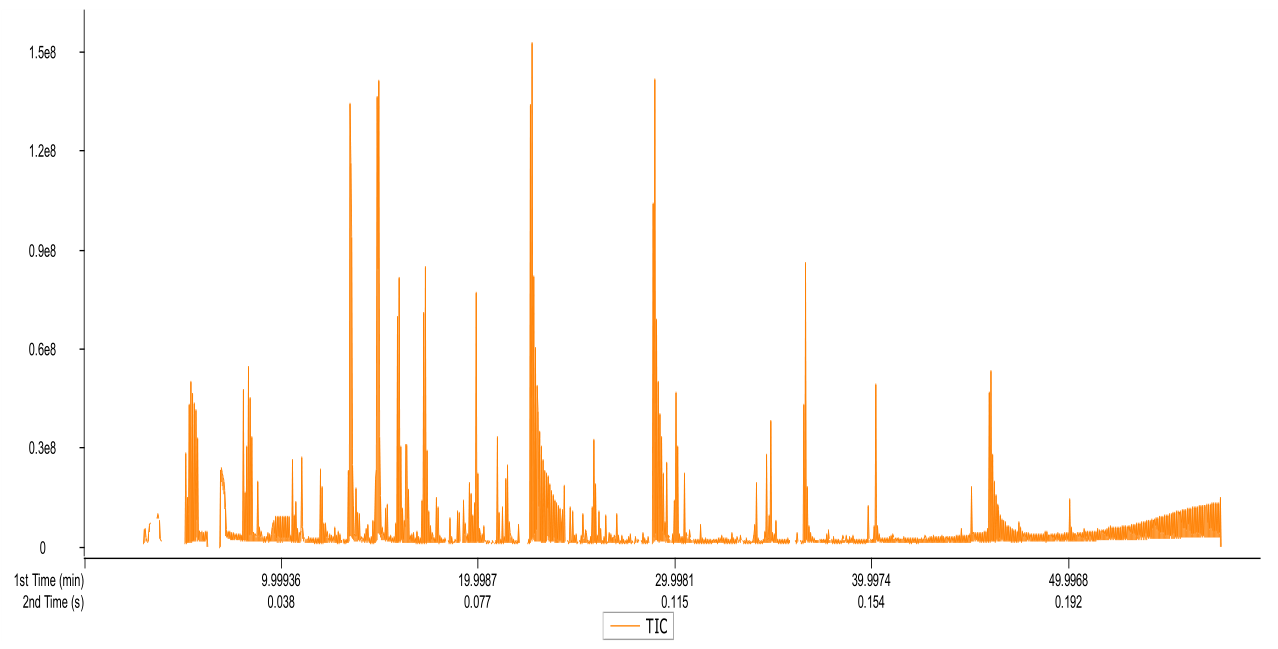
Figure 12.
b. Two-dimensional GC×GC–TOF-MS chromatogram of mountain tea-fortified white wine A "MT-A".
Figure 12.
b. Two-dimensional GC×GC–TOF-MS chromatogram of mountain tea-fortified white wine A "MT-A".
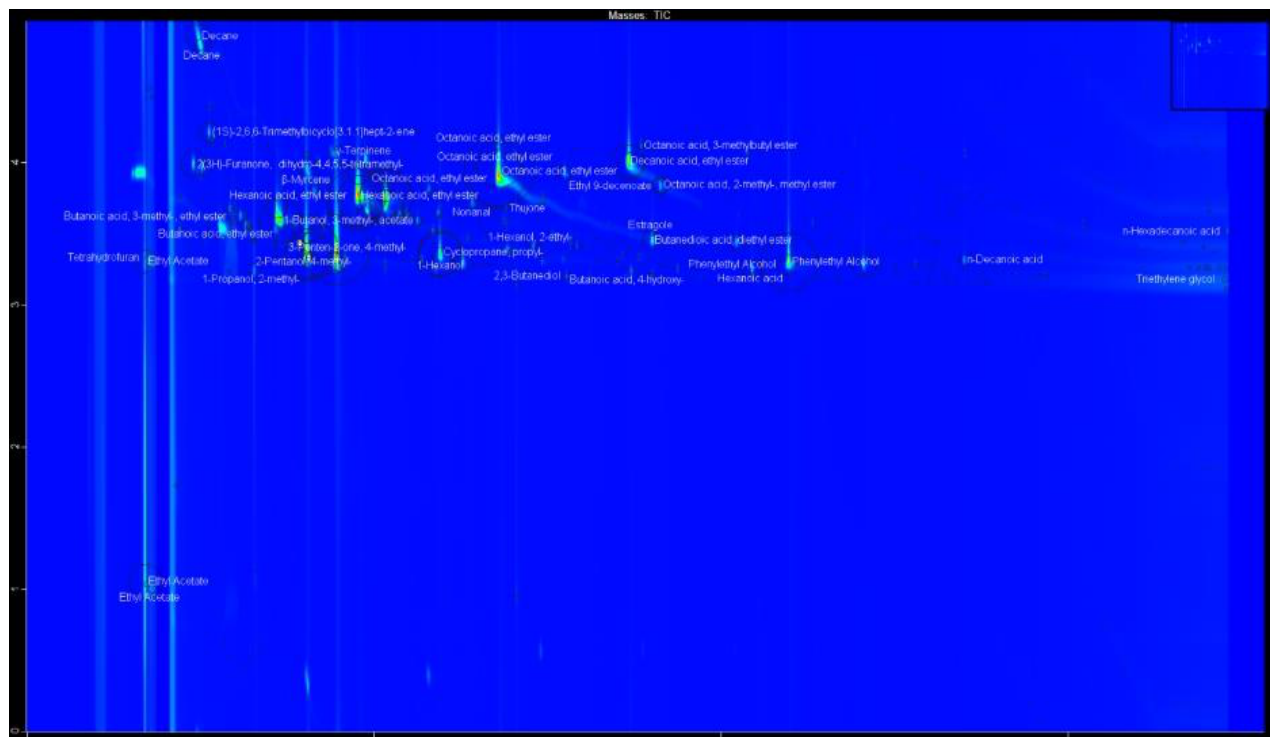
Volatile compounds of significant importance in wines were identified using comprehensive two-dimensional gas chromatography, as presented in Table S2. cis-Geraniol, a naturally occurring, colorless, oily monoterpene, is characterized by a sweet aroma reminiscent of rose and lemon. It is predominantly detected in young wines, where it contributes to their aromatic profile and enhances freshness [48]. Glycerol, although non-volatile and therefore not directly contributing to wine aroma, was detected at relatively high concentrations, consistent with its role as a major compound of alcoholic fermentation [49]. Its presence is mainly associated with modulation of mouthfeel, contributing slightly to perceived smoothness and balance. Among the identified volatile compounds, pentanoic acid, 2,2,4-trimethyl-3-carboxyisopropyl isobutyl ester was associated with heavy, musty odor notes, suggesting a potential contribution to less desirable aromatic nuances. Isoamyl laurate exhibited a very low odor intensity and is therefore considered to have a negligible impact on the overall aroma profile. Ethyl cinnamate (2-propenoic acid, 3-phenyl-, ethyl ester) was identified as a key aroma-active compound, contributing sweet, balsamic, and fruity notes, enhancing aromatic complexity. 1,2-Cyclopentanedione was linked to caramel-like, roasted, and nutty descriptors, indicating its contribution to toasted and sweet sensory characteristics. 2,5-Furandicarboxaldehyde contributed to roasted and earthy notes, supporting the development of more complex aroma profiles. Benzene, 1,4-dimethoxy-2-methyl- has been reported as a natural constituent in fungi such as Tuber and may be associated with subtle earthy nuances. In contrast, benzene, 1-ethyl-4-methyl- is not considered to significantly contribute to wine aroma and is more commonly linked to non-fermentative, petrochemical origins. Benzene, 1-ethyl-3,5-dimethyl- presented a mild sweet aromatic character, likely contributing marginally to overall aroma complexity. Finally, theaspirane was identified as a potent contributor to aroma, imparting woody, herbal, and tea-like notes, thus enhancing the depth and complexity of the aromatic profile.
Table 2 and table 3 present the volatile compounds of wine and wine products A and wine and wine products B, respectively, on the 1st day of storage. The volatile profile of the wine product enriched with saffron and mastic was significantly influenced by the addition of these botanicals, as reflected by the presence and increased concentration of characteristic terpenoids. Mastic contribution was evident through the abundance of monoterpenes and sesquiterpenes such as α-pinene, β-myrcene, γ-terpinene, p-cymene, eucalyptol, verbenone, and caryophyllene, which are typical constituents of mastic [50,51] and are associated with resinous, balsamic, and pine-like aromatic notes.
In parallel, saffron-derived compounds were identified, including safranal, hexanal, heptanal, 3-octen-1-ol, and several terpenes , β-myrcene, γ-terpinene, p-cymene, eucalyptol, 3-carene, along with furanic derivatives such as 2,5-furandicarboxaldehyde [52,53]. Among them, safranal is considered the key aroma-active compound of saffron, responsible for its characteristic warm, and slightly metallic aroma. It is formed through the degradation of picrocrocin during the drying process of Crocus sativus stigmas and is widely used as a marker of saffron quality and authenticity. Its presence in the wine matrix indicates not only the successful transfer of saffron volatiles but also a significant contribution to the overall aromatic complexity of the product.
Furthermore, the significant rise of compounds such as β-thujene, α-pinene, camphene, β-myrcene, eucalyptol, β-ocimene isomers, trans-γ-caryophyllene, cis-linalool oxide, 1,3-octadiene, and carvone [54,55] reflects the direct transfer of characteristic phytochemical constituents from Sideritis scardica into the wine. These compounds are typically associated with fresh, herbal, minty, and woody aromatic notes, substantially altering the wine’s sensory profile toward a more complex herbal and resinous character.
Comparable changes were detected in both wine samples, wine A and wine B, supporting the hypothesis that the observed modifications in volatile composition are mainly associated with the incorporation of herbs-derived compounds.
Table 2.
Effect of crocus–mastic and mountain tea on the relative concentrations of volatile compound in Debina wine A (day 1), determined by GC×GC–TOF-MS”.
Table 2.
Effect of crocus–mastic and mountain tea on the relative concentrations of volatile compound in Debina wine A (day 1), determined by GC×GC–TOF-MS”.
| Alcohols | |||||
| RT | MP | Name | C-A | CM-A | MT-A |
| 14.9157 | 3.002 | 1-Butanol, 3-methyl- | 11.9 a ± 1.4 | 24.7 b ± 2.2 | 40 c ± 3 |
| 21.1653 | 3.123 | 3-Octanol | 0.022 b ± 0.008 | 0.016 a ± 0.004 | 0.092 c ± 0.009 |
| 23.0819 | 3.043 | 1-Octen-3-ol | 0.24 a ± 0.04 | 0.160 a ± 0.008 | 1.02 b ± 0.10 |
| 31.0813 | 3.424 | 2-Undecanol | 0.062 b ± 0.007 | 0.092 c ± 0.003 | 0.054 a ± 0.010 |
| 37.7476 | 3.233 | 1-Dodecanol | 0.20 a ± 0.03 | 0.31 b ± 0.04 | 0.48 c ± 0.03 |
| 45.9971 | 3.1 | Glycerol | ND | 13.4 b ± 1.4 | 7.7 a ± 1.6 |
| Totals | 12.4 ± 1.5 | 39 ± 4 | 49 ± 5 | ||
| Esters | |||||
| RT | MP | Name | C-A | CM-A | MT-A |
| 7.33286 | 3.19 | Propanoic acid, 2-methyl-, ethyl ester | 0.371 a ± 0.022 | 1.28 c ± 0.19 | 0.67 b ± 0.04 |
| 9.74938 | 3.347 | Butanoic acid, 2-methyl-, ethyl ester | 0.341 a ± 0.022 | 1.64 b ± 0.19 | 1.72 b ± 0.19 |
| 10.2493 | 3.288 | Butanoic acid, 3-methyl-, ethyl ester | 0.34 a ± 0.03 | 1.88 b ± 0.17 | 1.62 b ± 0.22 |
| 14.3324 | 3.279 | Hexanoic acid, methyl ester | 0.344 b ± 0.018 | 0.5 c ± 0.07 | 0.232 a ± 0.008 |
| 25.8317 | 3.588 | Nonanoic acid, ethyl ester | 1.72a ± 0.17 | 2.14b ± 0.17 | 2.07b ± 0.14 |
| 26.7483 | 3.584 | ortho tert-Butyl cyclohexyl acetate | 0.012 a ± 0.003 | 0.166b ± 0.009 | 0.032a ± 0.008 |
| 35.4977 | 3.69 | Pentanoic acid, 2,2,4-trimethyl-3-carboxyisopropyl, isobutyl ester | ND | 0.47 ± 0.14 | ND |
| 39.4141 | 4.133 | Isopropyl myristate | ND | 0.014 a ± 0.003 | 0.0135 a ± 0.0009 |
| 39.7475 | 2.973 | Butanedioic acid, hydroxy-, diethyl ester, (±)- | 0.021 a ± 0.008 | 0.042 b ± 0.008 | 0.051 c ± 0.012 |
| 40.1641 | 4.274 | Isoamyl laurate | ND | 0.032 ± 0.008 | ND |
| 41.414 | 4.01 | Pentadecanoic acid, ethyl ester | 0.022 a ± 0.009 | 0.144 c ± 0.022 | 0.052 b ± 0.015 |
| 41.9973 | 3.287 | 2-Propenoic acid, 3-phenyl-, ethyl ester | ND | 0.025 b ± 0.012 | 0.013 a ± 0.009 |
| 44.4972 | 3.859 | Hexadecanoic acid, ethyl ester | 0.151 a ± 0.005 | 0.191 b ± 0.014 | 0.144 a ± 0.020 |
| 45.3304 | 3.36 | Ethyl 2-hydroxy-3-phenylpropanoate | ND | 0.027 b ± 0.015 | 0.015 a ± 0.005 |
| 45.9137 | 3.09 | Propanoic acid, 2-hydroxy-, methyl ester, (±)- | ND | ND | 7.4 ± 0.6 |
| Totals | 3.32 ± 0.29 | 8.6 ± 1.0 | 14.0 0 1.3 | ||
| Carbonyl compounds | |||||
| RT | MP | Name | C-A | CM-A | MT-A |
| 10.7493 | 3.111 | Hexanal | 0.51 a ± 0.08 | 2.6 c ± 0.6 | 1.51 b ± 0.17 |
| 10.8326 | 3.1 | 2-Hexanone | 0.34 b ± 0.05 | 0.45 c ± 0.04 | 0.15 a ± 0.04 |
| 14.1658 | 3.371 | 2-Heptanone | 0.09 a ± 0.03 | 0.33 b ± 0.06 | 0.31 b ± 0.06 |
| 14.3324 | 3.218 | Heptanal | 0.29 a ± 0.03 | 0.61 b ± 0.13 | 0.67 b ± 0.15 |
| 16.0823 | 3.271 | 2-Heptanone, 6-methyl- | ND | 0.072 b ± 0.011 | 0.052 a ± 0.008 |
| 17.8322 | 3.3 | Octanal | 0.69 a ± 0.09 | 0.78 a ± 0.14 | 1.05 b ± 0.03 |
| 19.4988 | 3.177 | 5-Hepten-2-one, 6-methyl- | 0.64 a ± 0.09 | 0.87 b ± 0.11 | 1.43 c ± 0.07 |
| 28.7482 | 3.034 | Benzaldehyde, 3-methyl- | 0.042a ± 0.005 | 0.102b ± 0.005 | 0.05a ± 0.01 |
| 29.4981 | 3.03 | Benzaldehyde, 2-methyl- | 0.042a ± 0.011 | 0.061b ± 0.012 | 0.055ab ± 0.012 |
| 32.4979 | 3.23 | Ethanone, 1-(4-methylphenyl)- | ND | 0.013 ± 0.010 | ND |
| 32.8312 | 3.051 | 1,2-Cyclopentanedione | ND | 0.04 ± 0.01 | ND |
| 38.4975 | 3.072 | 2,5-Furandicarboxaldehyde | ND | 0.021 a ± 0.003 | 0.151 b ± 0.012 |
| 38.6642 | 3.094 | Levoglucosenone | ND | 0.024 ± 0.011 | ND |
| Totals | 2.6 ± 0.4 | 6.0 ± 1.1 | 5.4 ± 0.6 | ||
| Terpenes | |||||
| RT | MP | Name | C-A | CM-A | MT-A |
| 8.74944 | 3.815 | Hashishene | ND | 0.081 ± 0.015 | ND |
| 8.9161 | 3.807 | β-Thujene | 0.172 a ± 0.011 | 2.18 c ± 0.29 | 1.32 b ± 0.15 |
| 8.99942 | 4.042 | α-Pinene | 1.91 a ± 0.12 | 4.79 c ± 0.33 | 2.8 b ± 0.17 |
| 9.99936 | 3.805 | Camphene | 0.061 a ± 0.012 | 0.13 b ± 0.03 | 0.14 b ± 0.03 |
| 11.9992 | 3.581 | 2,4(10)-Thujadiene | 0.044 a ± 0.012 | 0.23 b ± 0.03 | 0.27 b ± 0.05 |
| 12.8325 | 3.231 | p-Xylene | 0.54 a ± 0.03 | 1.02 b ± 0.15 | 1.31 c ± 0.17 |
| 12.9992 | 3.851 | 3-Carene | 0.21 a ± 0.03 | 0.29 b ± 0.04 | 0.160 a ± 0.021 |
| 13.4991 | 3.701 | α-Phellandrene | 0.13 a ± 0.04 | 0.49 b ± 0.05 | 0.54 b ± 0.07 |
| 13.4991 | 3.605 | β-Myrcene | 0.172 a ± 0.013 | 9.5 c ± 0.5 | 4.6 b ± 0.8 |
| 14.9157 | 3.762 | Eucalyptol | 0.023 a ± 0.011 | 0.117 b ± 0.013 | 0.190 c ± 0.011 |
| 15.8323 | 3.408 | trans-β-Ocimene | ND | ND | 0.025 ± 0.004 |
| 16.249 | 3.675 | γ-Terpinene | 3.33 a ± 0.29 | 8.75 c ± 0.28 | 4.9 b ± 0.7 |
| 16.4989 | 3.59 | cis-β-Ocimene | 0.025 a ± 0.003 | 0.141 c ± 0.014 | 0.052 b ± 0.011 |
| 20.6653 | 3.48 | Neo-allo-ocimene | 0.014 a ± 0.003 | 0.031 b ± 0.005 | 0.031 b ± 0.005 |
| 20.9153 | 3.198 | p-Cymene | 6.1 a ± 0.7 | 20 c ± 4 | 13.03 b ± 0.15 |
| 23.9151 | 3.437 | 1,3,8-p-Menthatriene | ND | 0.052 b ± 0.011 | 0.021 a ± 0.007 |
| 23.9985 | 3.848 | cis-Geraniol | ND | 0.022 ± 0.010 | ND |
| 25.1651 | 3.626 | α-Terpinene | 0.020 a ± 0.012 | 0.056 b ± 0.007 | 0.073 b ± 0.021 |
| 25.5817 | 2.785 | 2-Bornene | ND | 0.018 ± 0.005 | ND |
| 27.0816 | 3.582 | Pinocarvone | ND | 0.021 ± 0.008 | ND |
| 27.8316 | 3.838 | Caryophyllene | ND | 0.027 ± 0.015 | ND |
| 28.0815 | 3.072 | trans-γ-Caryophyllene | 0.021a ± 0.008 | 0.042b ± 0.008 | 0.05c ± 0.01 |
| 28.9148 | 2.535 | Myrtenal | ND | 0.022 ± 0.008 | ND |
| 29.3315 | 2.518 | Safranal | ND | 1.46 ± 0.18 | ND |
| 31.9146 | 3.512 | Carvone | ND | 0.01 a ± 0.01 | 0.044 b ± 0.012 |
| Totals | 12.8 1.3 | 49.4 ± 6.0 | 29.6 ± 2.4 | ||
| Other volatiles | |||||
| RT | MP | Name | C-A | CM-A | MT-A |
| 7.41619 | 3.418 | 1,3-Octadiene | 0.024 a ± 0.011 | 0.014 a ± 0.003 | 0.44 b ± 0.05 |
| 11.0826 | 3.956 | 2,6-Dimethyl-2-trans-6-octadiene | ND | 0.013 ± 0.010 | ND |
| 13.9991 | 3.468 | 1,3,5-Cycloheptatriene, 3,7,7-trimethyl- | ND | 0.050 b ± 0.011 | 0.022 a ± 0.003 |
| 15.1657 | 3.346 | Benzene, propyl- | 0.090 a ± 0.021 | 0.119 ab ± 0.026 | 0.144 b ± 0.022 |
| 16.9156 | 3.32 | Benzene, 1-ethyl-4-methyl- | 0.083 a ± 0.012 | 0.185 b ± 0.007 | 0.108 a ± 0.022 |
| 18.3322 | 3.457 | Benzene, 1-methyl-4-propyl- | ND | 0.120 b ± 0.018 | 0.042 a ± 0.022 |
| 18.7488 | 3.597 | Benzene, n-butyl- | 0.015 a ± 0.003 | 0.066 c ± 0.014 | 0.034 b ± 0.005 |
| 19.0821 | 3.383 | Benzene, 1-ethyl-3,5-dimethyl- | ND | 0.022 a ± 0.013 | 0.052 b ± 0.013 |
| 22.9152 | 3.394 | cis-Linaloloxide | ND | 0.011 a ± 0.008 | 0.023 b ± 0.003 |
| 26.0817 | 3.895 | Theaspirane | ND | 0.013 ± 0.010 | ND |
| 27.9982 | 3.39 | Benzene, 1-methoxy-4-methyl-2-(1-methylethyl)- | ND | 0.033 a ± 0.014 | 0.04 b ± 0.01 |
| 33.5812 | 2.427 | Benzene, 1,4-dimethoxy-2-methyl- | ND | 0.052 ± 0.012 | ND |
| Totals | 0.21 ± 0.05 | 0.67 ± 0.15 | 0.91 ± 0.15 | ||
Values, mg/L as 4-methyl-2-pentanol, are the means of three trials. a, b, c: They were used in the comparison of volatiles of control wine and those containing crocus and mastic or mountain tea at the same sampling time. Means that do not bear a common superscript differ significantly. RT: Retention time, MP: Modulation period, C-A: White wine control A, CM-A: wine A fortified with crocus and mastic, MT-A: wine A fortified with mountain tea.
Table 3.
Effect of crocus–mastic and mountain tea on the relative concentrations of volatile compound in Debina wine B (day 1), determined by GC×GC–TOF-MS”.
Table 3.
Effect of crocus–mastic and mountain tea on the relative concentrations of volatile compound in Debina wine B (day 1), determined by GC×GC–TOF-MS”.
| Alcohols | |||||
| RT | MP | Name | C-B | CM-B | MT-B |
| 14.9157 | 3.002 | 1-Butanol, 3-methyl- | 47 a ± 15 | 91 b ± 6 | 34 a ± 5 |
| 21.1653 | 3.123 | 3-Octanol | 0.033 a ± 0.008 | 0.086 b ± 0.012 | 0.087 b ± 0.017 |
| 23.0819 | 3.043 | 1-Octen-3-ol | 0.296 a ± 0.013 | 1.07 b ± 0.08 | 0.99 b ± 0.14 |
| 31.0813 | 3.424 | 2-Undecanol | 0.055 b ± 0.005 | 0.167 c ± 0.013 | 0.033 a ± 0.008 |
| 37.7476 | 3.233 | 1-Dodecanol | 0.42 a ± 0.08 | 1.40 c ± 0.18 | 0.96 b ± 0.09 |
| 45.9971 | 3.1 | Glycerol | 3.22 a ± 0.04 | 1.37 a ± 0.10 | 22.9 b ± 1.7 |
| totals | 51 ± 15 | 95 ± 6 | 59 ± 7 | ||
| Esters | |||||
| RT | MP | Name | C-A | CM-A | MT-A |
| 7.33286 | 3.19 | Propanoic acid, 2-methyl-, ethyl ester | 1.75 b ± 0.09 | 4.6 c ± 0.5 | 0.94 a ± 0.12 |
| 9.74938 | 3.347 | Butanoic acid, 2-methyl-, ethyl ester | 1.39 a ± 0.18 | 3.615 b ± 0.08 | ND |
| 10.2493 | 3.288 | Butanoic acid, 3-methyl-, ethyl ester | 1.86 b ± 0.28 | 6.2 c ± 0.7 | 0.23 a ± 0.03 |
| 14.3324 | 3.279 | Hexanoic acid, methyl ester | 1.49 b ± 0.15 | 4.02 c ± 0.33 | 0.212 a ± 0.029 |
| 25.8317 | 3.588 | Nonanoic acid, ethyl ester | 7.4 b ± 0.3 | 18.9 c ± 1.6 | 4.9 a ± 0.5 |
| 26.7483 | 3.584 | ortho tert-Butyl cyclohexyl acetate | 0.010 a ± 0.003 | 0.058 b ± 0.004 | 0.013 a ± 0.003 |
| 35.4977 | 3.69 | Pentanoic acid, 2,2,4-trimethyl-3-carboxyisopropyl, isobutyl ester | 0.135 a ± 0.005 | 0.24 b ± 0.11 | ND |
| 39.4141 | 4.133 | Isopropyl myristate | 0.015 a ± 0.003 | 0.037 b ± 0.003 | 0.009 a ± 0.003 |
| 39.7475 | 2.973 | Butanedioic acid, hydroxy-, diethyl ester, (±)- | 0.093 a ± 0.017 | 0.49 b ± 0.04 | ND |
| 40.1641 | 4.274 | Isoamyl laurate | 0.101 b ± 0.022 | 0.204 c ± 0.016 | 0.054 a ± 0.007 |
| 41.414 | 4.01 | Pentadecanoic acid, ethyl ester | 0.078 b ± 0.007 | 0.062 a ± 0.004 | 0.093 c ± 0.008 |
| 41.9973 | 3.287 | 2-Propenoic acid, 3-phenyl-, ethyl ester | 0.016 a ± 0.004 | 0.033 b ± 0.003 | 0.015 a ± 0.004 |
| 44.4972 | 3.859 | Hexadecanoic acid, ethyl ester | 0.221 a ± 0.026 | 1.01 b ± 0.19 | 0.248 a ± 0.017 |
| 45.3304 | 3.36 | Ethyl 2-hydroxy-3-phenylpropanoate | 0.034 a ± 0.007 | 0.084 b ± 0.016 | 0.021 a ± 0.005 |
| 45.9137 | 3.09 | Propanoic acid, 2-hydroxy-, methyl ester, (±)- | ND | ND | 4.5 ± 0.7 |
| totals | 14.6 ± 1.1 | 40 ± 4 | 11.2 ± 1.4 | ||
| Carbonyl compunds | |||||
| RT | MP | Name | C-A | CM-A | MT-A |
| 10.7493 | 3.111 | Hexanal | 0.212 a ± 0.017 | 2.281 b ± 0.189 | 0.297 a ± 0.017 |
| 10.8326 | 3.1 | 2-Hexanone | 0.16 a ± 0.04 | 0.76 b ± 0.09 | 0.158 a ± 0.023 |
| 14.1658 | 3.371 | 2-Heptanone | 0.332 b ± 0.028 | 0.98 c ± 0.12 | 0.164 a ± 0.022 |
| 14.3324 | 3.218 | Heptanal | 0.258 b ± 0.024 | 1.45 c ± 0.08 | 0.116 a ± 0.015 |
| 16.0823 | 3.271 | 2-Heptanone, 6-methyl- | ND | ND | 0.028 ± 0.004 |
| 17.8322 | 3.3 | Octanal | 0.76 a ± 0.04 | 4.58 a ± 0.28 | 0.57 b ± 0.20 |
| 19.4988 | 3.177 | 5-Hepten-2-one, 6-methyl- | 0.62 a ± 0.17 | 1.6 b ± 0.3 | 0.88 a ± 0.06 |
| 28.7482 | 3.034 | Benzaldehyde, 3-methyl- | 0.054 b ± 0.008 | 0.135 c ± 0.011 | 0.034 a ± 0.006 |
| 29.4981 | 3.03 | Benzaldehyde, 2-methyl- | 0.059 a ± 0.003 | 0.153 b ± 0.007 | 0.051 a ± 0.013 |
| 32.4979 | 3.23 | Ethanone, 1-(4-methylphenyl)- | ND | 0.051 b ± 0.006 | 0.014 a ± 0.005 |
| 32.8312 | 3.051 | 1,2-Cyclopentanedione | 0.035 a ± 0.002 | 0.61 b ± 0.06 | 0.58 b ± 0.07 |
| 38.4975 | 3.072 | 2,5-Furandicarboxaldehyde | 0.191 a ± 0.011 | 0.64 b ± 0.07 | 0.243 a ± 0.042 |
| 38.6642 | 3.094 | Levoglucosenone | ND | 0.19 b ± 0.04 | 0.055 a ± 0.011 |
| totals | 2.7 ± 0.3 | 13.4 ± 1.3 | 3.1 ± 0.5 | ||
| Terpenes | |||||
| RT | MP | Name | C-A | CM-A | MT-A |
| 8.74944 | 3.815 | Hashishene | ND | 0.218 ± 0.028 | ND |
| 8.9161 | 3.807 | β-Thujene | 0.021 a ± 0.004 | 1.41 c ± 0.08 | 0.62 b ± 0.03 |
| 8.99942 | 4.042 | α-Pinene | 4.5 a ± 1.1 | 27.9 c ± 1.1 | 8.0 b ± 0.9 |
| 9.99936 | 3.805 | Camphene | 0.112 a ± 0.007 | 0.43 c ± 0.04 | 0.325 b ± 0.031 |
| 11.9992 | 3.581 | 2,4(10)-Thujadiene | 0.048 a ± 0.011 | 6.2 c ± 0.6 | 1.39 b ± 0.24 |
| 12.8325 | 3.231 | p-Xylene | 0.71 a ± 0.08 | 1.944 b ± 0.377 | 1.096 a ± 0.093 |
| 12.9992 | 3.851 | 3-Carene | 0.186 a ± 0.003 | 0.641 b ± 0.102 | 0.159 a ± 0.03 |
| 13.4991 | 3.701 | α-Phellandrene | 0.39 b ± 0.08 | 0.88 c ± 0.08 | 0.116 a ± 0.008 |
| 13.4991 | 3.605 | β-Myrcene | 2.9 a ± 0.4 | 8.9 c ± 1.1 | 4.5 b ± 0.4 |
| 14.9157 | 3.762 | Eucalyptol | 0.011 a ± 0.005 | 0.115 b ± 0.011 | 0.102 b ± 0.016 |
| 15.8323 | 3.408 | trans-β-Ocimene | ND | ND | 0.019 ± 0.003 |
| 16.249 | 3.675 | γ-Terpinene | 3.6 a ± 0.3 | 9.3 b ± 0.8 | 2.6 a ± 0.4 |
| 16.4989 | 3.59 | cis-β-Ocimene | 0.063 a ± 0.004 | 0.143 b ± 0.008 | 0.218 c ± 0.019 |
| 20.6653 | 3.48 | Neo-allo-ocimene | 0.014 a ± 0.006 | 0.043 b ± 0.013 | ND |
| 20.9153 | 3.198 | p-Cymene | 22 b ± 3 | 52.5 c ± 2.4 | 13.4 a ± 2.6 |
| 23.9151 | 3.437 | 1,3,8-p-Menthatriene | ND | 0.223 ± 0.018 | ND |
| 23.9985 | 3.848 | cis-Geraniol | 0.0253 a ± 0.0021 | 0.055 b ± 0.007 | ND |
| 25.1651 | 3.626 | α-Terpinene | 0.065 b ± 0.009 | 0.150 c ± 0.019 | 0.0212 a ± 0.0019 |
| 25.5817 | 2.785 | 2-Bornene | ND | 0.046 a ± 0.004 | 0.0070 a ± 0.0011 |
| 27.0816 | 3.582 | Pinocarvone | ND | 0.173 ± 0.017 | ND |
| 27.8316 | 3.838 | Caryophyllene | ND | 0.026 ± 0.003 | ND |
| 28.0815 | 3.072 | trans-γ-Caryophyllene | 0.106 a ± 0.032 | 0.233 b ± 0.054 | 0.460 c ± 0.009 |
| 28.9148 | 2.535 | Myrtenal | ND | 0.212 ± 0.021 | ND |
| 29.3315 | 2.518 | Safranal | ND | 3.243 ± 0.18 | ND |
| 31.9146 | 3.512 | Carvone | ND | ND | 0.010 ± 0.003 |
| totals | 35 ± 5 | 115 ± 7 | 33 ± 5 | ||
| Other volatiles | |||||
| RT | MP | Name | C-B | CM-B | MT-B |
| 7.41619 | 3.418 | 1,3-Octadiene | 0.0082a ± 0.0012 | ND | 0.091 b ± 0.003 |
| 11.0826 | 3.956 | 2,6-Dimethyl-2-trans-6-octadiene | ND | ND | 0.019 ± 0.005 |
| 13.9991 | 3.468 | 1,3,5-Cycloheptatriene, 3,7,7-trimethyl- | ND | 0.080 ± 0.009 | ND |
| 15.1657 | 3.346 | Benzene, propyl- | 0.110 a ± 0.009 | 0.215 b ± 0.026 | 0.080 a ± 0.014 |
| 16.9156 | 3.32 | Benzene, 1-ethyl-4-methyl- | ND | 0.226 ± 0.023 | 0.091 b ± 0.005 |
| 18.3322 | 3.457 | Benzene, 1-methyl-4-propyl- | ND | 0.046 a± 0.003 | 0.045 a ± 0.009 |
| 18.7488 | 3.597 | Benzene, n-butyl- | 0.031 b ± 0.006 | 0.061 c ± 0.003 | 0.009 a ± 0.001 |
| 19.0821 | 3.383 | Benzene, 1-ethyl-3,5-dimethyl- | ND | ND | 0.022 ± 0.003 |
| 22.9152 | 3.394 | cis-Linaloloxide | ND | 0.031 b ± 0.002 | 0.009 a ± 0.003 |
| 26.0817 | 3.895 | Theaspirane | 0.0080 a ± 0.0022 | 0.035 b ± 0.004 | ND |
| 27.9982 | 3.39 | Benzene, 1-methoxy-4-methyl-2-(1-methylethyl)- | 0.017 a ± 0.005 | 0.050 b ± 0.011 | ND |
| 33.5812 | 2.427 | Benzene, 1,4-dimethoxy-2-methyl- | ND | 0.099 ± 0.005 | ND |
| totals | 0.17 ± 0.02 | 0.85 ± 0.09 | 0.37 ± 0.043 | ||
Values, mg/L as 4-methyl-2-pentanol, are the means of three trials. a, b, c: They were used in the comparison of volatiles of control wine and those containing crocus and mastic or mountain tea at the same sampling time. Means that do not bear a common superscript differ significantly. RT: Retention time, MP: Modulation period, C-B: White wine control B, CM-B: wine B fortified with crocus and mastic, MT-B: wine B fortified with mountain tea.
4. Conclusion
The addition of Kozani crocus, Chios mastic, and Epirus Mountain tea to white Debina wine does not affect the levels of sulfur dioxide on the initial day, while during storage, the wine products maintain sulfite anhydride at higher levels than the controls.
Wine products with plant products show higher levels of total phenolic and phenolic groups during storage compared to the control. Total free sulfhydryl groups during storage are also at higher levels in wine products with plant products than in control.
Wine products with plant products showed greater antioxidant activity than the controls from the initial day and during their storage. The clearance of wine products with plant products was greater than that of the controls from the initial day and during their storage. The wine products also exhibited anti-inflammatory activity that was greater than that of the controls from the first day and during their storage.
A white wine product called Debina can be made by adding Kozani Crocus and Chios mastic, with a dominant aroma and taste of crocus and mastic, without any clear signs of oxidation. A white wine product called Debina can be produced by adding mountain tea from Epirus, with a combination of mountain tea and wine aroma and flavor, without clear signs of oxidation.
Supplementary Materials
The following supporting information can be downloaded at: Preprints.org, Figure S1, Wine bottles containing infusion bags of crocus–mastic and mountain tea prior to extraction., Figure S2. Wine C and its corresponding products: crocus–mastic wine (CM) and mountain tea wine (MT)., Table S1. Physicochemical and oenological parameters of initial wines., Figure S3. Kinetics of DPPH radical scavenging activity of wine and wine products., Figure S4, Initial DPPH radical scavenging activity (% inhibition) of wines and wine products over 49 days., Figure S5. Total DPPH radical scavenging activity (% inhibition) of wines and wine products over 49 days., Figure S6-a. GC×GC–TOF-MS chromatogram of crocus- and mastic-fortified white wine B "CM-B"., Figure S6-b. Two-dimensional GC×GC–TOF-MS chromatogram of crocus- and mastic-fortified white wine B "CM-B"., Figure S7-a. GC×GC–TOF-MS chromatogram of mountain tea-fortified white wine B "MT-B"., Figure S7-b. Two-dimensional GC×GC–TOF-MS chromatogram of mountain tea-fortified white wine B "MT-B"., Table S2. Volatile compounds of wines A and B on day 1 of storage.
Author Contributions
Conceptualization, I.G.R.; methodology, I.G.R. and A.N.S.; software, A.N.S.; validation, I.G.R. and A.N.S.; formal analysis, A.N.S.; investigation, I.G.R. and A.N.S.; resources, I.G.R.; data curation, A.N.S.; writing—original draft preparation A.N.S.; writing—review and editing, I.G.R.; visualization, A.N.S.; supervision, I.G.R.; project administration, I.G.R.; funding acquisition, I.G.R. All authors have read and agreed to the published version of the manuscript.
Funding
We acknowledge support of this work by the project “Development of research infrastructures for the design, production and promotion of the quality and safety characteristics of agri-food and bio-functional products “(EV-AGRO-NUTRITION)” (MIS 5047235) which is implemented under the Action “Reinforcement of the Research and Innovation Infrastructure”, funded by the Operational Program “Competitiveness, Entrepreneurship and Innovation” (NSRF 2014-2020) and co-financed by Greece and the European Union (European Regional Development Fund).
Institutional Review Board Statement
Informed Consent Statement
Data Availability Statement
Acknowledgments
We wanted to express our gratitude to Glinavos and Jimas wineries for the kind supply of wine samples, the association of Chios mastic producers for the Chios mastic gum and Myrtali organics for the mountain tea.
Conflicts of Interest
Abbreviations
The following abbreviations are used in this manuscript:
| TFS | Total free sulphydryls |
| TPI | Total phenolic index |
| FRAP | Ferric reducing antioxidant power |
| TOF | Time of flight |
| MS | Mass spectrometry |
| AIF | Anti-inflammatory inducing factor |
| RT | Retention time |
| MP | Modulation period |
| ND | Not Detected |
References
- Cagnasso, E.; Caudana, A.; Giacosa, S.; Rı, S.; Rolle, L.; et al. SO2 in Wines: Rational Use and Possible Alternatives; 2019. [Google Scholar] [CrossRef]
- Akhondzadeh Basti, A.; Choreishi, S.A.; Noorbala, A.A.; Akhondzadeh, S.H.; Rezazadeh, S. Petal and stigma of Crocus sativus L. in the treatment of depression: A pilot double - blind randomized trial. J. Med. Plants 2008, 7, 29–36. [Google Scholar]
- Salomi, M.; Nair, S.C.; Panikkar, K. Inhibitory effects of Nigellaï¿¿sativa and saffron (crocusï¿¿sativus) on chemical carcinogenesis in mice. 1991, 16, 67–72. [Google Scholar] [PubMed]
- Teixeira da Silva, J.A. Disinfection of explants for saffron (Crocus sativus) tissue culture. Env. Exp. Biol. 2016, 14, 183–198. [Google Scholar] [CrossRef]
- Moghaddasi, M.S. Saffron chemicals and medicine usage. J. Med. Plants Res. 2010, 4, 427–430. [Google Scholar]
- Brieudes, V.; Kallergis, E.; Papada, E.; Gioxari, A.; Kaliora, A.; et al. Bioavailability study and impact of Chios mastic supplementation on oxidative stress in healthy humans. 65th International Congress and Annual Meeting of the Society for Medicinal Plant and Natural Product Research (GA 2017), georg thieme verlag kg, 2017; pp. 1–202. [Google Scholar]
- Koutsoudaki, C.; Krsek, M.; Rodger, A. Chemical composition and antibacterial activity of the essential oil and the gum of Pistacia lentiscus Var. chia. J. Agric. Food Chem. 2005, 53, 7681–7685. [Google Scholar] [CrossRef] [PubMed]
- Triantafyllou, A.; Chaviaras, N.; Sergentanis, T.N.; Protopapa, E.; Tsaknis, J. Chios mastic gum modulates serum biochemical parameters in a human population. J. Ethnopharmacol. 2007, 111, 43–49. [Google Scholar] [CrossRef] [PubMed]
- Hoult, R.S. Novel anti-inflammatory plant labdanes: Comparison of in vitro properties with aspirin and indomethacin 1Beatriz de las Heras, 2Angel Villar, 2Jos6 M. Vivas, and 1j. 1994. [Google Scholar] [PubMed]
- Koleva, I.I.; Linssen, J.P.H.; Van Beek, T.A.; Evstatieva, L.N.; Kortenska, V.; et al. Antioxidant activity screening of extracts from Sideritis species (Labiatae) grown in Bulgaria. J. Sci. Food Agric. 2003, 83, 809–819. [Google Scholar] [CrossRef]
- Aneva, I.; Zhelev, P.; Kozuharova, E.; Danova, K.; Fazel Nabavi, S.; et al. Genus Sideritis, section Empedoclia in southeastern Europe and Turkey – studies in ethnopharmacology and recent progress of biological activities. Published Online First. 2019. [CrossRef]
- Soleas, G.J.; Diamandis, E.P.; Goldberg, D.M. Wine as a biological fluid: History, production, and role in disease prevention. J. Clin. Lab Anal. 1997, 11, 287–313. [Google Scholar] [CrossRef] [PubMed]
- Wurz, D.A. Wine and health: A review of its benefits to human health. BIO Web Conf. 2019, 12, 04001. [Google Scholar] [CrossRef]
- International Organization of Vine and Wine (Edition 2021). Compendium of international methods of wine and must analysis. 2021. Available online: https://www.oiv.int/public/medias/7713/en-oiv-code-2021.pdf.
- International Organization of Vine and Wine. Alcoholic strength by volume-Type 1 methods (OIV-MA-AS312-01A: R2009). Compendium of international methods of wine and must analysis (Edition 2021). 2021; pp. 1–42. [Google Scholar]
- International Organization of Vine and Wine. Reducing substances (OIV-MA-AS311-01A: R2009). Compendium of international methods of wine and must analysis (Edition 2021). 2021; pp. 1–5. [Google Scholar]
- International Organization of Vine and Wine. Compend. Int. Methods Anal.-OIV Volatile Acidity 2015, 436–440.
- International Organization of Vine and Wine. Total acidity (OIV-MA-AS313-01 : R2015). In: Compendium of international methods of wine and must analysis (Edition 2021). 1. 2021; pp. 1–3. [Google Scholar]
- O.I.V. Sulfur dioxide (Iodometry) (Type-IV: OIV-MA-AS323-04B). Compendium of international methods of wine and must analysis. pp. 1–3.
- Aleixandre-Tudo, J.L.; Buica, A.; Nieuwoudt, H.; Aleixandre, J.L.; Du Toit, W. Spectrophotometric Analysis of Phenolic Compounds in Grapes and Wines. J. Agric. Food Chem. 2017, 65, 4009–4026. [Google Scholar] [CrossRef] [PubMed]
- Roussis, I.; Sergianitis, S. Protection of some aroma volatiles in a model wine medium by sulphur dioxide and mixtures of glutathione with caffeic acid or gallic acid. Flavour Fragr. J. 2008, 35–39. [Google Scholar] [CrossRef]
- Ribereau-Gayon, P. Determination of total phenols in red wines. Chim. Anal. 1970, 52, 627–631. [Google Scholar]
- Soni, R.N.; Bartušek, M. Molybdate complexes with o-diphenols. J. Inorg. Nucl. Chem. 1971, 33, 2557–2563. [Google Scholar] [CrossRef]
- Fotakis, C.; Christodouleas, D.; Zervou, M.; Papadopoulos, K.; Calokerinos, A.C. Classification of Wines Based on Different Antioxidant Responses to Spectrophotometric Analytical Methods. Anal. Lett. 2012, 45, 581–591. [Google Scholar] [CrossRef]
- McMurrough, I.; McDowell, J. Chromatographic separation and automated analysis of flavanols. Anal. Biochem 1978, 91, 92–100. [Google Scholar] [CrossRef] [PubMed]
- Treutter, D. Chemical reaction detection of catechins and proanthocyanidins with 4-dimethylaminocinnamaldehyde. J. Chromatogr. A 1989, 467, 185–193. [Google Scholar] [CrossRef]
- Roussis, I.G.; Lambropoulos, I.; Tzimas, P.; Gkoulioti, A.; Marinos, V.; et al. Antioxidant activities of some Greek wines and wine phenolic extracts. J. Food Compos Anal. 2008, 21, 614–621. [Google Scholar] [CrossRef]
- Somers, T.C.; Ziemelis, G. Spectral Evaluation of Total Phenolic Components in Vitis vinifera: Grapes and Wines. J. Sci. Food Agric. 1985, 36, 1275–1284. [Google Scholar] [CrossRef]
- Kontogeorgos, N.; Roussis, I.G. Total Free Sulphydryls of Several White and Red Wines. South Afr. J. Enol. Vitic. 2014, 35, 125–127. [Google Scholar]
- Ellman, G.L. Tissue sulfhydryl groups. Arch. Biochem Biophys. 1959, 82, 70–77. [Google Scholar] [CrossRef] [PubMed]
- Folin, O.; Ciocalteu, V. Tyrosine and Tryptophane in Proteins. J. Biol. Chem. 1927, 73, 627–648. [Google Scholar] [CrossRef]
- Singleton, V.L.; Orthofer, R.; Lamuela-Raventos, R.M. Analysis of Total Phenols and Other Oxidation Substrates and Antioxidants by Means of Folin-Ciocalteu Reagent. Methods Enzymol. 1999, 299, 152–178. [Google Scholar] [CrossRef]
- Prior, R.L.; Wu, X.; Schaich, K. Standardized methods for the determination of antioxidant capacity and phenolics in foods and dietary supplements. J. Agric. Food Chem. 2005, 53, 4290–4302. [Google Scholar] [CrossRef] [PubMed]
- Benzie, I.F.F.; Strain, J.J. The Ferric Reducing Ability of Plasma (FRAP) as a Measure of ‘“Antioxidant Power”’:The FRAP Assay. Anal. Biochem 1996, 239, 70–76. [Google Scholar] [CrossRef] [PubMed]
- Munteanu, I.G.; Apetrei, C. Analytical methods used in determining antioxidant activity: A review. Int. J. Mol. Sci. 2021, 22, 3380. [Google Scholar] [CrossRef] [PubMed]
- Blois, M.S. Antioxidant determinations by the use of a stable free radical. Nature 1958, 181, 1199–1200. [Google Scholar] [CrossRef]
- Roussis, I.G.; Lambropoulos, I.; Soulti, K. Scavenging capacities of some wines and wine phenolic extracts. Food Technol. Biotechnol. 2005, 43, 351–358. [Google Scholar]
- De Avellar, I.G.J.; Magalhães, M.M.M.; Silva, A.B.; Souza, L.L.; Leitão, A.C.; et al. Reevaluating the role of 1,10-phenanthroline in oxidative reactions involving ferrous ions and DNA damage. Biochim Biophys. Acta-Gen. Subj. 2004, 1675, 46–53. [Google Scholar] [CrossRef]
- Zhang, K.Z.; Deng, K.; Luo, H.B.; Zhou, J.; Wu, Z.Y.; et al. Antioxidant properties and phenolic profiles of four Chinese Za wines produced from hull-less barley or maize. J. Inst. Brew. 2013, 119, 182–190. [Google Scholar]
- Axelrod, B.; Cheesbrough, T.M.; Laakso, S. Lipoxygenase from Soybeans: EC 1.13.11.12 Linoleate: Oxygen Oxidoreductase. Methods Enzymol. 1981, 71, 441–451. [Google Scholar] [CrossRef]
- Huang, X.; Li, Y.; Sabier, M.; Si, J.; Wang, P.; et al. Guidelines for the in vitro determination of anti-inflammatory activity. eFood 2024, 5, 1–14. [Google Scholar] [CrossRef]
- Xanthopoulou, M.N.; Fragopoulou, E.; Kalathara, K.; Nomikos, T.; Karantonis, H.C.; et al. Antioxidant and anti-inflammatory activity of red and white wine extracts. Food Chem. 2010, 120, 665–672. [Google Scholar] [CrossRef]
- Kataoka, H.; Lord, H.L.; Pawliszyn, J. Applications of solid-phase microextraction in food analysis. 2000, 880, 35–62. [Google Scholar] [CrossRef] [PubMed]
- Pegasus B-4D. GCxGC Chromatography. 2018.
- Šuklje, K.; Carlin, S.; Stanstrup, J.; Antalick, G.; Blackman, J.W.; et al. Unravelling wine volatile evolution during Shiraz grape ripening by untargeted HS-SPME-GC × GC-TOFMS. Food Chem. 2019, 277, 753–765. [Google Scholar] [CrossRef] [PubMed]
- Hübschmann, H.-J. Handb. GC-MS Fundam. Appl. 2015. [CrossRef]
- European Commission. Comission delegated Regulation (EU) 2019/934. Off. J. Eur. Union L 2019, 149, 1–52. [Google Scholar] [CrossRef]
- Pedersen, D.S.; Capone, D.L.; Skouroumounis, G.K.; Pollnitz, A.P.; Sefton, M.A. Quantitative analysis of geraniol, nerol, linalool, and α-terpineol in wine. Anal. Bioanal. Chem. 2003, 375, 517–522. [Google Scholar] [CrossRef] [PubMed]
- Lubbers, S.; Verret, C.; Voilley, A. The Effect of Glycerol on the Perceived Aroma of a Model Wine and a White Wine. LWT 2001, 34, 262–265. [Google Scholar] [CrossRef]
- D’Auria, M.; Racioppi, R. Characterization of the volatile fraction of mastic oil and mastic gum. Nat. Prod. Res. 2020. [Google Scholar] [CrossRef] [PubMed]
- Paraschos, S.; Magiatis, P.; Gousia, P.; Economou, V.; Sakkas, H.; et al. Chemical investigation and antimicrobial properties of mastic water and its major constituents. Food Chem. 2011, 129, 907–911. [Google Scholar] [CrossRef] [PubMed]
- Cozzolino, R.; Stocchero, M.; Perestrelo, R. Comprehensive Evaluation of the Volatomic Fingerprint of Saffron from Campania towards Its Authenticity and Quality. 2022. [Google Scholar] [CrossRef] [PubMed]
- Lu, Y.; Zhang, C.; Feng, K.; Luan, J.; Cao, Y.; et al. Characterization of saffron from different origins by HS-GC-IMS and authenticity identification combined with deep learning. Food Chem. X 2024, 24, 101981. [Google Scholar] [PubMed]
- Mitropoulou, G.; Sidira, M.; Skitsa, M.; Tsochantaridis, I.; Pappa, A.; et al. Assessment of the antimicrobial, antioxidant, and antiproliferative potential of sideritis raeseri subps. raeseri essential oil. Foods 2020, 9, 1–13. [Google Scholar] [CrossRef]
- Marić, T.; Friščić, M.; Marijanović, Z.; Maleš, Ž.; Jerković, I. Comparison of volatile organic compounds of sideritis romana l. And sideritis montana l. from croatia. Molecules 2021, 26. [Google Scholar] [CrossRef] [PubMed]
Figure 1.
Free sulfur dioxide levels in control wines and wine products over 49 days. a, b: They were used in the comparison of volatiles of wine and wine products of each wine. Means that do not bear a common superscript differ significantly. C-A: White wine control A, CM-A: wine A fortified with crocus and mastic, MT-A: wine A fortified with mountain tea, C-B: White wine control B, CM-B: wine B fortified with crocus and mastic, MT-B: wine B fortified with mountain tea, C-C: White wine control C, CM-C: wine C fortified with crocus and mastic, MT-C: wine C fortified with mountain tea, C-D: White wine control D, CM-D: wine D fortified with crocus and mastic, MT-D: wine D fortified with mountain tea.
Figure 1.
Free sulfur dioxide levels in control wines and wine products over 49 days. a, b: They were used in the comparison of volatiles of wine and wine products of each wine. Means that do not bear a common superscript differ significantly. C-A: White wine control A, CM-A: wine A fortified with crocus and mastic, MT-A: wine A fortified with mountain tea, C-B: White wine control B, CM-B: wine B fortified with crocus and mastic, MT-B: wine B fortified with mountain tea, C-C: White wine control C, CM-C: wine C fortified with crocus and mastic, MT-C: wine C fortified with mountain tea, C-D: White wine control D, CM-D: wine D fortified with crocus and mastic, MT-D: wine D fortified with mountain tea.
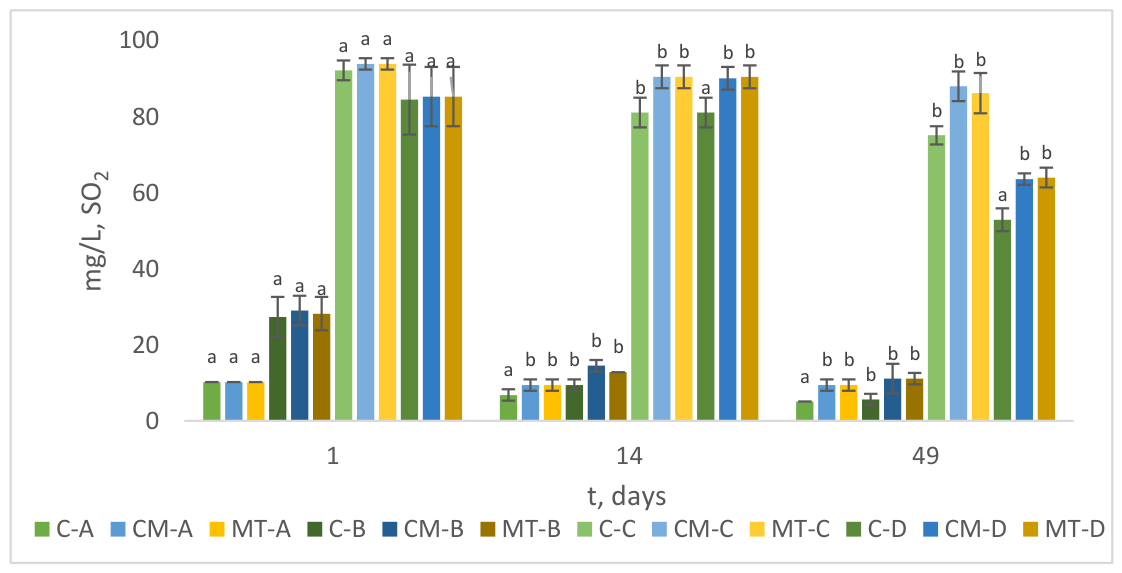
Figure 2.
Phenolic index levels in control wines and wine products over 49 days. a, b, c: They were used in the comparison of volatiles of wine and wine products of each wine. Means that do not bear a common superscript differ significantly. C-A: White wine control A, CM-A: wine A fortified with crocus and mastic, MT-A: wine A fortified with mountain tea, C-B: White wine control B, CM-B: wine B fortified with crocus and mastic, MT-B: wine B fortified with mountain tea, C-C: White wine control C, CM-C: wine C fortified with crocus and mastic, MT-C: wine C fortified with mountain tea, C-D: White wine control D, CM-D: wine D fortified with crocus and mastic, MT-D: wine D fortified with mountain tea.
Figure 2.
Phenolic index levels in control wines and wine products over 49 days. a, b, c: They were used in the comparison of volatiles of wine and wine products of each wine. Means that do not bear a common superscript differ significantly. C-A: White wine control A, CM-A: wine A fortified with crocus and mastic, MT-A: wine A fortified with mountain tea, C-B: White wine control B, CM-B: wine B fortified with crocus and mastic, MT-B: wine B fortified with mountain tea, C-C: White wine control C, CM-C: wine C fortified with crocus and mastic, MT-C: wine C fortified with mountain tea, C-D: White wine control D, CM-D: wine D fortified with crocus and mastic, MT-D: wine D fortified with mountain tea.
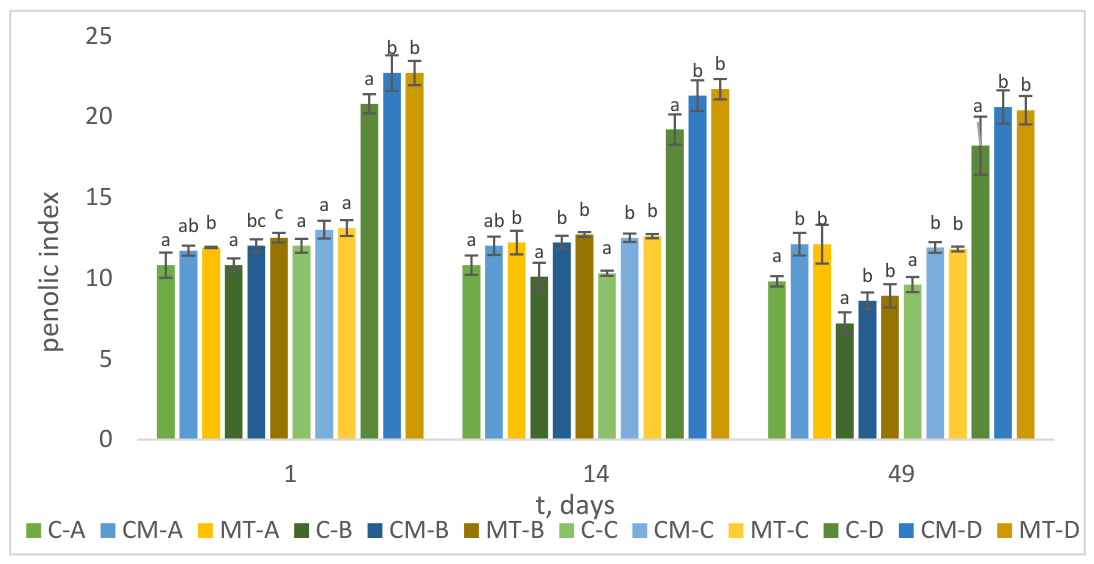
Figure 6.
Total free sulfhydryl groups levels in control wines and wine products over 49 days. a, b, c: They were used in the comparison of volatiles of wine and wine products of each wine. Means that do not bear a common superscript differ significantly. C-A: White wine control A, CM-A: wine A fortified with crocus and mastic, MT-A: wine A fortified with mountain tea, C-B: White wine control B, CM-B: wine B fortified with crocus and mastic, MT-B: wine B fortified with mountain tea, C-C: White wine control C, CM-C: wine C fortified with crocus and mastic, MT-C: wine C fortified with mountain tea, C-D: White wine control D, CM-D: wine D fortified with crocus and mastic, MT-D: wine D fortified with mountain tea.
Figure 6.
Total free sulfhydryl groups levels in control wines and wine products over 49 days. a, b, c: They were used in the comparison of volatiles of wine and wine products of each wine. Means that do not bear a common superscript differ significantly. C-A: White wine control A, CM-A: wine A fortified with crocus and mastic, MT-A: wine A fortified with mountain tea, C-B: White wine control B, CM-B: wine B fortified with crocus and mastic, MT-B: wine B fortified with mountain tea, C-C: White wine control C, CM-C: wine C fortified with crocus and mastic, MT-C: wine C fortified with mountain tea, C-D: White wine control D, CM-D: wine D fortified with crocus and mastic, MT-D: wine D fortified with mountain tea.
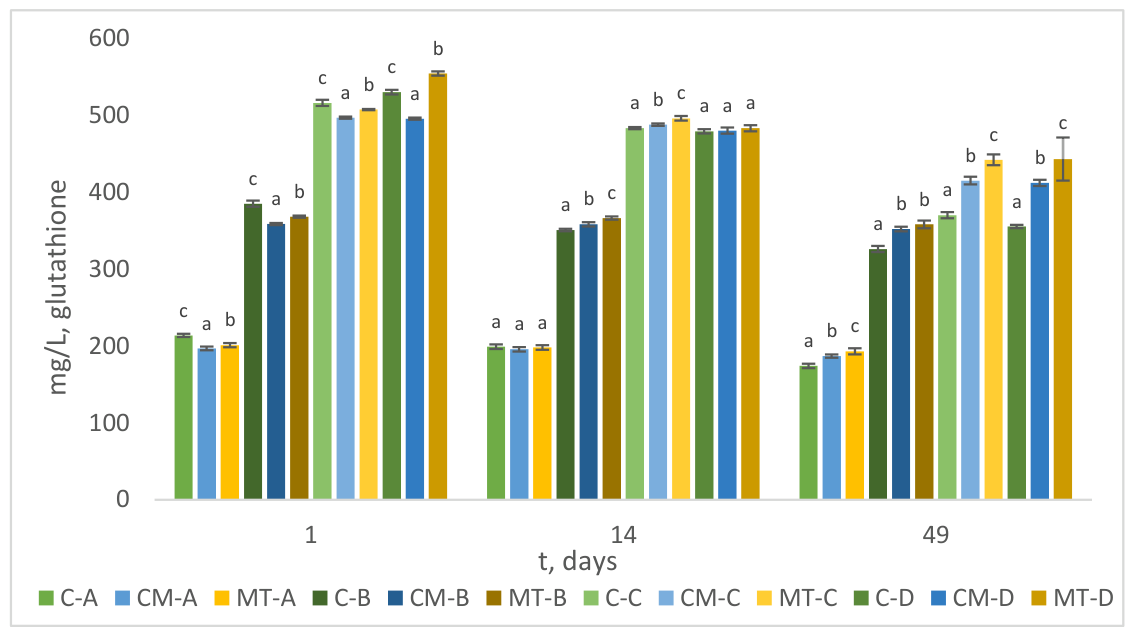
Figure 7.
Antioxidant activity of wines and wine products determined by the Folin–Ciocalteu method over 49 days. a, b: They were used in the comparison of volatiles of wine and wine products of each wine. Means that do not bear a common superscript differ significantly. C-A: White wine control A, CM-A: wine A fortified with crocus and mastic, MT-A: wine A fortified with mountain tea, C-B: White wine control B, CM-B: wine B fortified with crocus and mastic, MT-B: wine B fortified with mountain tea, C-C: White wine control C, CM-C: wine C fortified with crocus and mastic, MT-C: wine C fortified with mountain tea, C-D: White wine control D, CM-D: wine D fortified with crocus and mastic, MT-D: wine D fortified with mountain tea.
Figure 7.
Antioxidant activity of wines and wine products determined by the Folin–Ciocalteu method over 49 days. a, b: They were used in the comparison of volatiles of wine and wine products of each wine. Means that do not bear a common superscript differ significantly. C-A: White wine control A, CM-A: wine A fortified with crocus and mastic, MT-A: wine A fortified with mountain tea, C-B: White wine control B, CM-B: wine B fortified with crocus and mastic, MT-B: wine B fortified with mountain tea, C-C: White wine control C, CM-C: wine C fortified with crocus and mastic, MT-C: wine C fortified with mountain tea, C-D: White wine control D, CM-D: wine D fortified with crocus and mastic, MT-D: wine D fortified with mountain tea.
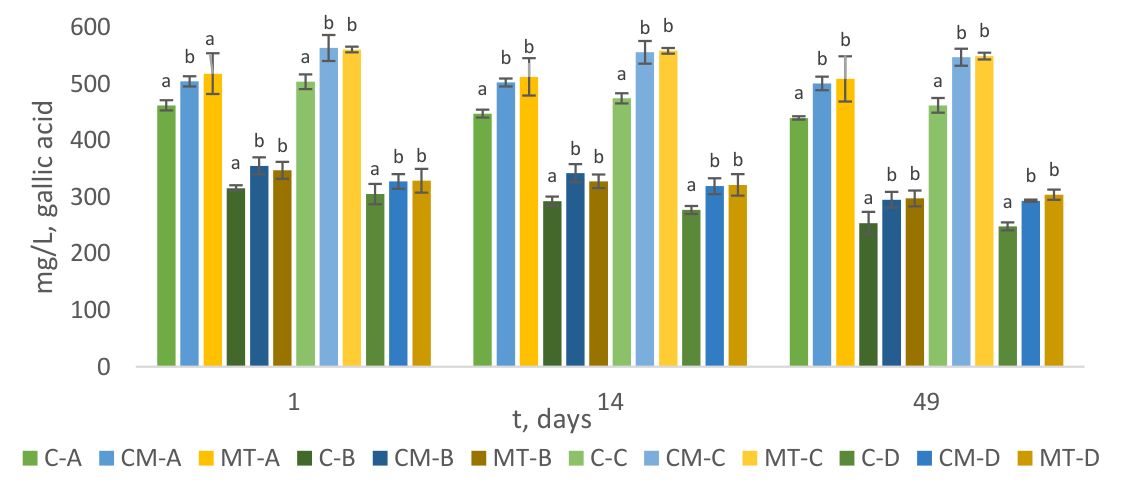
Figure 8.
Antioxidant activity of wines and wine products determined by the FRAP method over 49 days. a, b, c: They were used in the comparison of volatiles of wine and wine products of each wine. Means that do not bear a common superscript differ significantly. C-A: White wine control A, CM-A: wine A fortified with crocus and mastic, MT-A: wine A fortified with mountain tea, C-B: White wine control B, CM-B: wine B fortified with crocus and mastic, MT-B: wine B fortified with mountain tea, C-C: White wine control C, CM-C: wine C fortified with crocus and mastic, MT-C: wine C fortified with mountain tea, C-D: White wine control D, CM-D: wine D fortified with crocus and mastic, MT-D: wine D fortified with mountain tea.
Figure 8.
Antioxidant activity of wines and wine products determined by the FRAP method over 49 days. a, b, c: They were used in the comparison of volatiles of wine and wine products of each wine. Means that do not bear a common superscript differ significantly. C-A: White wine control A, CM-A: wine A fortified with crocus and mastic, MT-A: wine A fortified with mountain tea, C-B: White wine control B, CM-B: wine B fortified with crocus and mastic, MT-B: wine B fortified with mountain tea, C-C: White wine control C, CM-C: wine C fortified with crocus and mastic, MT-C: wine C fortified with mountain tea, C-D: White wine control D, CM-D: wine D fortified with crocus and mastic, MT-D: wine D fortified with mountain tea.
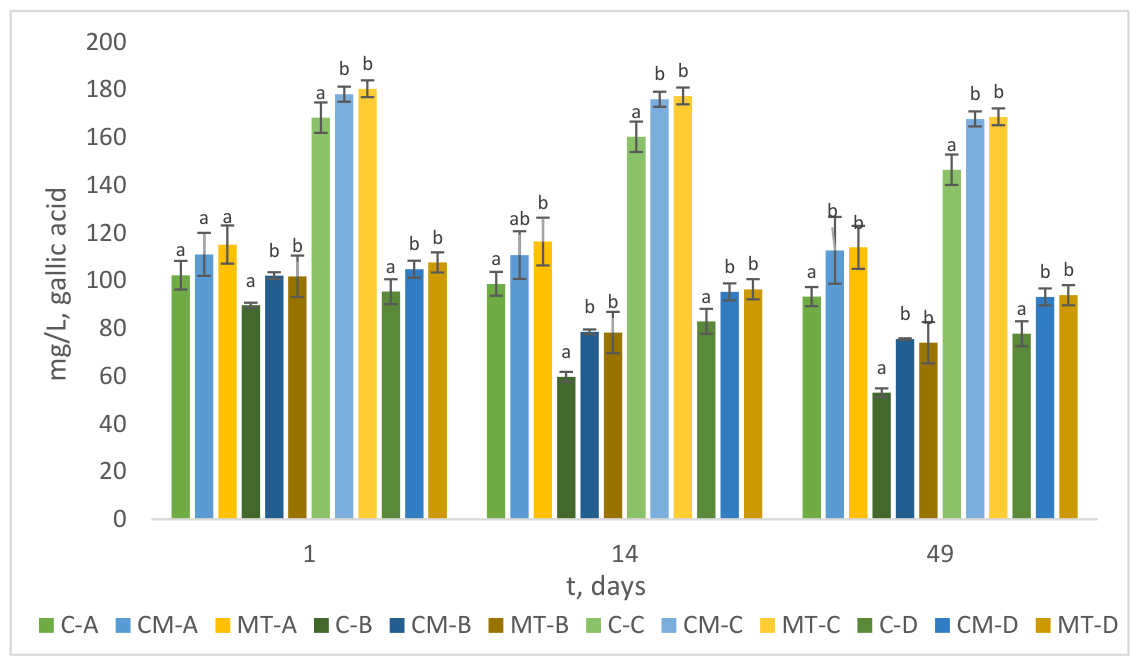
Figure 9.
Hydroxyl radical scavenging activity of wines and wine products over 49 days. a, b: They were used in the comparison of volatiles of wine and wine products of each wine. Means that do not bear a common superscript differ significantly. C-A: White wine control A, CM-A: wine A fortified with crocus and mastic, MT-A: wine A fortified with mountain tea, C-B: White wine control B, CM-B: wine B fortified with crocus and mastic, MT-B: wine B fortified with mountain tea, C-C: White wine control C, CM-C: wine C fortified with crocus and mastic, MT-C: wine C fortified with mountain tea, C-D: White wine control D, CM-D: wine D fortified with crocus and mastic, MT-D: wine D fortified with mountain tea.
Figure 9.
Hydroxyl radical scavenging activity of wines and wine products over 49 days. a, b: They were used in the comparison of volatiles of wine and wine products of each wine. Means that do not bear a common superscript differ significantly. C-A: White wine control A, CM-A: wine A fortified with crocus and mastic, MT-A: wine A fortified with mountain tea, C-B: White wine control B, CM-B: wine B fortified with crocus and mastic, MT-B: wine B fortified with mountain tea, C-C: White wine control C, CM-C: wine C fortified with crocus and mastic, MT-C: wine C fortified with mountain tea, C-D: White wine control D, CM-D: wine D fortified with crocus and mastic, MT-D: wine D fortified with mountain tea.
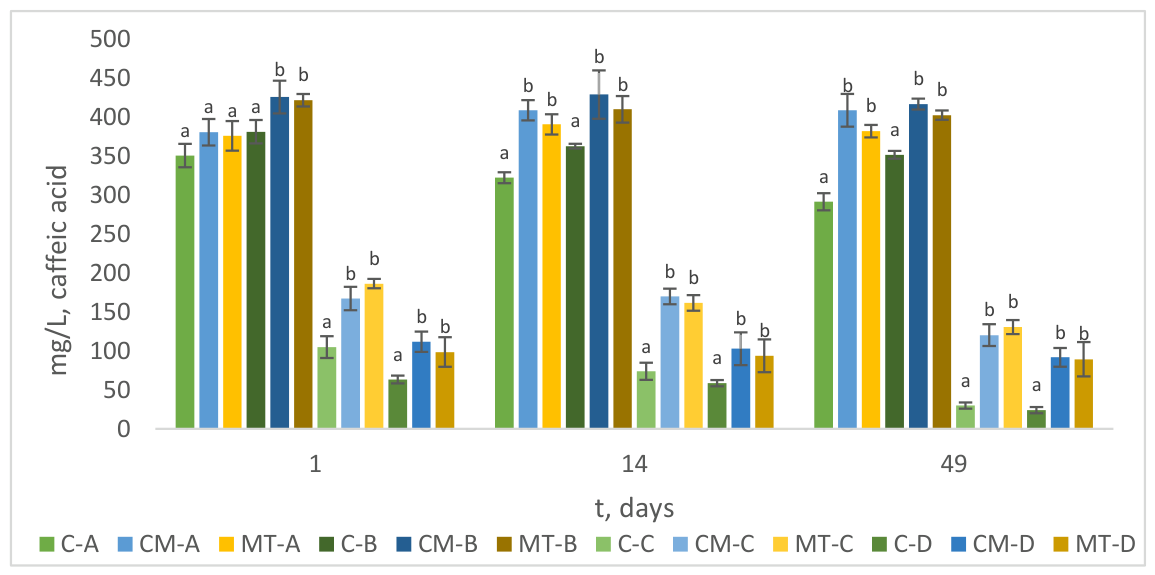
Figure 10.
Anti-inflammatory activity of wines and wine products determined by the lipoxygenase assay, over 49 days. a, b, c: They were used in the comparison of volatiles of wine and wine products of each wine. Means that do not bear a common superscript differ significantly. C-A: White wine control A, CM-A: wine A fortified with crocus and mastic, MT-A: wine A fortified with mountain tea, C-B: White wine control B, CM-B: wine B fortified with crocus and mastic, MT-B: wine B fortified with mountain tea, C-C: White wine control C, CM-C: wine C fortified with crocus and mastic, MT-C: wine C fortified with mountain tea, C-D: White wine control D, CM-D: wine D fortified with crocus and mastic, MT-D: wine D fortified with mountain tea.
Figure 10.
Anti-inflammatory activity of wines and wine products determined by the lipoxygenase assay, over 49 days. a, b, c: They were used in the comparison of volatiles of wine and wine products of each wine. Means that do not bear a common superscript differ significantly. C-A: White wine control A, CM-A: wine A fortified with crocus and mastic, MT-A: wine A fortified with mountain tea, C-B: White wine control B, CM-B: wine B fortified with crocus and mastic, MT-B: wine B fortified with mountain tea, C-C: White wine control C, CM-C: wine C fortified with crocus and mastic, MT-C: wine C fortified with mountain tea, C-D: White wine control D, CM-D: wine D fortified with crocus and mastic, MT-D: wine D fortified with mountain tea.
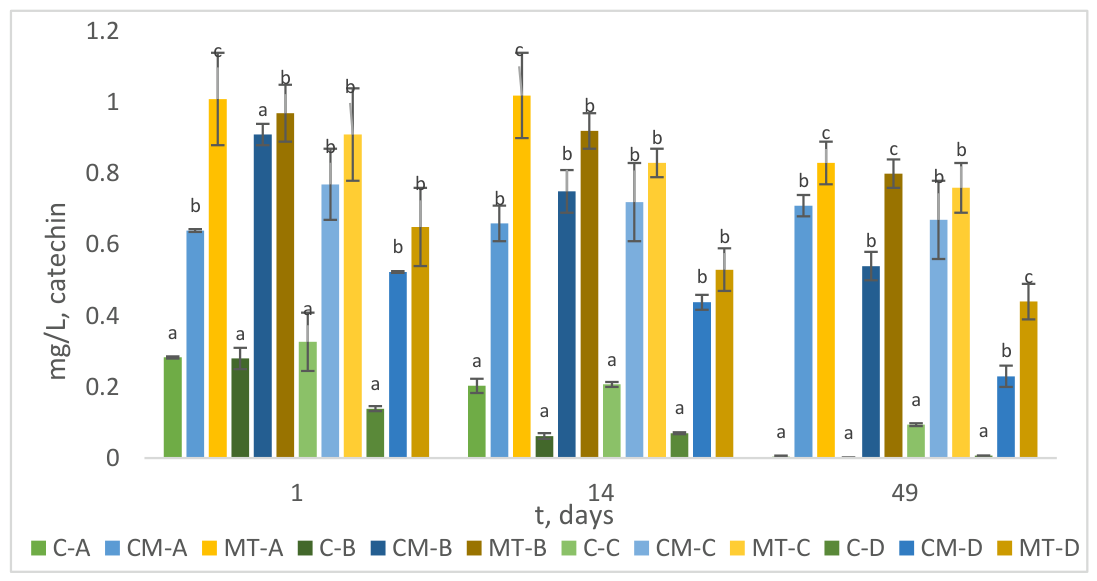
Disclaimer/Publisher’s Note: The statements, opinions and data contained in all publications are solely those of the individual author(s) and contributor(s) and not of MDPI and/or the editor(s). MDPI and/or the editor(s) disclaim responsibility for any injury to people or property resulting from any ideas, methods, instructions or products referred to in the content. |
© 2026 by the authors. Licensee MDPI, Basel, Switzerland. This article is an open access article distributed under the terms and conditions of the Creative Commons Attribution (CC BY) license (http://creativecommons.org/licenses/by/4.0/).
Copyright: This open access article is published under a Creative Commons CC BY 4.0 license, which permit the free download, distribution, and reuse, provided that the author and preprint are cited in any reuse.


