

Submitted:
02 July 2026
Posted:
06 July 2026
You are already at the latest version
Abstract
General relativity and quantum mechanics have nominally incompatible perspectives on the nature of spacetime, which has been problematic for a “theory of everything” that would unite gravity with the other three forces. We introduce the concept of spacetime duality – that the fabric of spacetime is a separate entity from the material world (matter and energy) that exists upon that fabric. Objects in the material world as well as the spacetime coordinate system of the material world obey quantum mechanics and have wave particle duality. The fabric of spacetime is not a quantum entity. Points in the material coordinate system have both a particle and wave nature by virtue of having both a labeled spacetime position and a wave function for that position that extends over the fabric of spacetime. Physical and mathematical considerations from quantum mechanics and cosmology lead to spacetime duality. The concept is shown to explain some infinities in quantum calculations; provide insight into collapse of the wave function; provide a mechanism for compactification in string theory; leads to a framework for coupling gravity with quantum field theory that provides a simple physical explanation for why gravity is weak relative to the other three forces; resolves the black hole information paradox; and avoids singularities in black holes.
Keywords:
quantum mechanics
; cosmology
; general relativity
; collapse of the wave function
; string theory
; black holes
; unification theories
1.0. Introduction
The nature of space and time is an area of ongoing research, partly driven by the differing perspectives of quantum mechanics and general relativity. There are considerations from quantum mechanics and cosmology that lead to the conclusion that the fabric of spacetime is a separate entity from the material world of physical objects and energy. Here we introduce the concept of spacetime (ST) duality, which explicitly makes this distinction and allows separate development of the properties of the fabric of spacetime, the STF (formally, the spacetime metric for free space), and of the spacetime of the material world, the STM (the spacetime metric for configurations of matter). Relativity applies to both, but quantum mechanics applies only to the STM with the STF being a non-quantum entity. That difference is key to developing a framework that unites gravity with the other three forces without the historical difficulties of merging quantum mechanics with general relativity. While unification theories typically focus on developing mathematical models to connect the equations of quantum mechanics (e.g., quantum field theory) with those of general relativity, the focus here is on investigating the physical implications of two or more spacetime metrics to describe the physical world. Those physical implications provide new avenues to test those theories and potentially provide new insights into the physical world.
In general relativity, the rubber sheet analogy to explain how mass warps spacetime explicitly has the rubber sheet (the STF) as a separate entity from the mass on the rubber sheet (the STM). The work here formalizes that idea and demonstrates its explanatory utility with examples from quantum mechanics, cosmology, and force unification.
Physicists generally consider the presence of a singularity in their models to be an indication that the model does not accurately describe reality. This is the case in quantum mechanics where the Dirac delta function of infinite amplitude and unit area is used in some calculations, renormalization in quantum field theory, and the singularities of conventional modeling of a black hole. ST duality appears to be able to eliminate those infinities.
Section 2 presents the quantum mechanical argument for ST duality. The key finding is that the wave function of a material entity has a wave function for its STM properties, with the wave function itself extending over the STF. The existence of a non-quantum STF removes the need for infinities (the Dirac delta function in particular) from at least some quantum mechanical calculations, and potentially eliminates the infinities that require renormalization to get finite values for physical quantities in other calculations.
Section 3 uses considerations from general relativity and cosmology to show that the fabric of spacetime and the material world that exists upon that fabric can be seen as separate entities. In particular, the solutions for the equations of general relativity (the Einstein field equations) lead to different metrics for the geometry of spacetime in open space (the STF without matter) compared to space where there are gravitationally bound objects (the STM with matter). Modifications to the standard cosmological model using ST duality have been shown to explain the apparent expansion of the universe without postulating dark energy, resolve the Hubble and S8 tensions [1], and explain the properties of dark matter and the anisotropy of a preferred direction of galaxy rotation that varies over time [2].
There is a body of theoretical work which either explicitly or implicitly includes the existence of two or more distinct spacetime metrics from considerations of a theory of gravity, black holes, or entropy. Section 4 summarizes some of the relevant papers to show the concept of ST duality can also be derived from considerations in quantum mechanics and the equations of general relativity, and is implicit in lattice QCD.
The utility of ST duality in providing a physical basis for the theoretical results in Section 4 is further demonstrated in Section 5 where it provides a physical interpretation some infinities in quantum mechanical calculations, and insight into collapse of the wave function. String theory is an example of a unified theory, but has a number of concerns, including providing a physical mechanism for why some of the dimensions in string theory are “rolled up” in the physical world, and how to reconcile those extra dimensions with theoretical and observational constraints. Section 5 shows how ST duality provides a physical explanation for what the additional dimensions are, and why they are not observable in our world of three spatial dimensions and one temporal dimension.
Theories of quantum gravity, which would unite the force of gravity with the other three forces described by quantum field theory, have not met with acceptance despite decades of effort. ST duality offers a new concept for developing a theory of quantum gravity. Section 6 outlines a framework for a physical mechanism for gravity that is consistent with the equations of general relativity and the quantum mechanics of the material world. Additionally, this theory explains why the STF is flat without requiring any fine tuning of the values for dark energy or dark matter as in the current cosmological model.
Section 7 discusses the implications of this model for black holes, resolving the black hole information paradox and removing the singularities typically associated with black holes.
Section 8 summarizes the utility of ST duality in quantum mechanics, in interpreting string theory, and potential utility in developing a theory that unifies gravity with the other three forces. The utility of ST duality in cosmology is particularly noteworthy as the challenge for modifying the current main cosmological model is to add enough new physics to resolve the small discrepancies between observation and the model, and maintain the current tremendous predictive and descriptive value of the model.
2.0. The Quantum Nature of Space and Time: Spacetime Duality
The standard model of particle physics is a quantum field theory (QFT) that provides a unified theory for electromagnetism, the weak nuclear force, and the strong nuclear force in a form compliant with quantum mechanics and special relativity. Gravity is described by general relativity. Despite decades of work, there is no quantum theory of gravity that unifies gravity with the standard model. String theory is one QFT that has been proposed to integrate the standard model with general relativity, but none of the theories beyond the standard model has met with wide acceptance.
One approach to integrating gravity with the other forces is to assume that space and time are quantized with sizes of the Planck length and the Planck time, both of which would be extremely hard to probe. Experimental measurements [3,4] observing gamma ray bursts failed to find any variation of arrival time with gamma ray energy, implying there was no measurable quantization of space at the Planck scale. It is therefore unlikely that spacetime itself (here the STF) is quantized.
We know from the Heisenberg uncertainty principle that it is impossible to precisely know the location of a particle, which could be a property of the particle itself, the ability to label (i.e., measure) its position in space, or both. Treating a measurable position in spacetime as a physical entity instead of a mathematical label, one concludes that a quantum mechanical description of that point in space would have a wave function spread over space. There are then two sets of coordinates: an underlying set of coordinates to which quantum mechanics and the Heisenberg uncertainty principle do not apply, and the labeled coordinates of the material world for which quantum mechanics does apply.
A similar argument can be made for a moment in time. In this case, the argument is even more compelling because of the philosophical difficulties in interpreting the mathematics of quantum events such as entanglement and the collapse of the wave function when measuring a quantum system. If each moment in time has a wave function that extends over adjacent moments in time in the material world, one now has a physical model for how a wave function can smoothly change from one moment in time to the next.
Here we make the assumption that a point in material spacetime has a wave function extending across all three spatial dimensions and across time, typically being sharply peaked at its nominal location. This raises the question of what that wave function is extended over, leading to the conclusion that there must be a fabric of spacetime separate from the spacetime of the material world described by quantum mechanics. We now have two overlapping coordinate systems, one for the fabric of spacetime, the STF, and one for the collection of measurable points of the material world on that fabric, the STM. Mathematically, the wave function for a point in the spacetime of the STM is a function of the coordinates in the STF. Physically, a particle or object in the STM has a wavefunction that extends over the STF, although historically that wavefunction has been given as a function of STM coordinates. A coordinate in the STM can now be seen as any other quantum entity, such as a photon or electron, that can be described with a wave function and has both particle (a point on STM) and wave (a wave function spread over STF) properties.
For illustrative purposes, we assume the wave function Ψ(X,T) for a point (x,t) in STM is such that the probability of finding (x,t) at some point (X,T) on the STF has a normal distribution and is given by
where σx is the spread in the spatial dimensions (assumed to be the same in each dimension for simplicity), and σt is the spread in the temporal dimension.
p(X,T) = (1/4π2σx3σt) * exp { - ½ [ ((X-x)/σx)2 + ((T-t)/σt)2 ] }
A more formal consideration of time in the context of the Heisenberg uncertainty principle [5] supports the conclusion that the current implementation of time in quantum mechanics leads to inconsistency in the theory. Specifically, they looked at arrival times for particle trajectories. Taking the initial time as t = 0, the question is “What is the arrival time for a particle trajectory when the particle has a known (within uncertainty limits) momentum?” They conclude that there is not internally consistent means to calculate arrival times in the standard interpretation of quantum mechanics. They also conclude that other theories where particles have a definite position and momentum (e.g., Broglie-Bohm theory [6,7] as a specific example of pilot wave theories) do not have that problem. Here, the STF provides a perspective where a particle does have a definite position and momentum [8], but without the causal problems of pilot wave theories.
3.0. Cosmological Support for Spacetime Duality
The concept of ST duality was derived in Section 2 from considerations in quantum mechanics. We now test the concept by seeing if it is relevant in general relativity at cosmological scales as a first test of the validity and utility of ST duality.
We note that the idea of the fabric of spacetime being distinct from material points in spacetime is implicit in two important related ideas in physics and cosmology. In general relativity, time and space are linked as a single 4-dimensional spacetime, which has a flat geometry in the absence of any significant mass. In the presence of a massive object, spacetime gets distorted. John Wheeler summarized general relativity as “Matter tells spacetime how to curve, and curved spacetime tells matter how to move” [9]. This is often shown or described as a rubber sheet upon which the matter object rests, its mass distorting the sheet which represents the fabric of spacetime. Implicit in these descriptions is that the material world and the fabric of spacetime are separate entities.
The second cosmological result supporting ST duality is from the mathematics modeling the expansion of the universe due to dark energy. That expansion is thought to only occur outside of a gravitationally bound system [10] because of the nature of solutions to general relativity. The equations of general relativity are difficult to solve. In the presence of sufficient (spherically symmetric) mass to distort the fabric of spacetime, the fabric of spacetime is described by the Schwarzschild metric [11], which has a value of zero for Einstein’s cosmological constant, Λ, meaning space is not expanding where there is a gravitational field. The Schwarzschild metric is commonly used in the vicinity of a non-rotating black hole, but it also applies to a generic spherically symmetric mass distribution and is used here as an approximation for a gravitationally bound system. Outside of a gravitationally bound system, the geometry of the fabric of spacetime is described by the FLRW metric [11], which can have a non-zero value for Λ. The cosmological constant was added by Einstein to ensure a stable cosmos by having an expansive force to counteract gravitational contraction. It now provides a term modeling the accelerating expansion of the universe attributed to dark energy. The fact that there are two separate solutions to the equations for general relativity describing two separate regimes for how spacetime is warped is consistent with there being two separate spacetimes – one for the expanse of free space, and one for the realm of matter. With two solutions to Einstein’s field equations, one would expect an arbitrary point in space to exhibit some linear combination of the two solutions. This is not observed. The expansion of space is only observed to occur in the space between gravitationally bound systems [10], not within them (e.g., the solar system, galaxies, galactic clusters), as would be expected from a linear combination of the two solutions. We conclude that the two solutions apply to separate spacetime metrics.
In physical terms, the apparent expansion of space requires that the fabric of space be distinct from the objects that exist upon that space. In the dark energy model describing that expansion, the space between but not within galaxies or galactic clusters is expanding. Hence the expansion only applies to the space itself and not the objects that exist upon that space. The dark energy model can be described as the universe expanding like an inflating balloon, with objects behaving like buttons glued to the balloon that do not increase in size as the balloon expands. Similar to the rubber sheet analogy for general relativity, the fabric of space is explicitly separate from objects existing on that fabric.
The current cosmological model based on the FLRW metric with a non-zero cosmological constant results in the distance between separate gravitationally bound systems increasing exponentially with time. Ignoring local motion, that means the separation velocity between two galaxies increases with their separation, eventually leading to a superluminal separation velocity and a cosmological horizon where light from sufficiently distance objects will never reach us because of the recession velocity. The arguments for superluminal velocities being consistent with general relativity are largely mathematical and not universally accepted [12]. A cosmological model including ST duality explains the apparent expansion of space as due to scale contraction of the STM with respect to the STF, and reproduces the measured expansion results without superluminal motion, as well as a cosmological horizon consistent with observation [1]. That model also resolves the Hubble tension and the S8 tension in the standard cosmological model, ΛCDM, providing further support for the utility of ST duality in describing the material world.
A model of the Big Bang partly based on ST duality [2] provides a physical model for other cosmological phenomena. Generalizing the nature of time to include experimental results [13,14] and including charge, parity, time (CPT) symmetry, the model explains the preponderance of matter over antimatter in our universe, shows how cosmic inflation could occur without superluminal velocities, and provides an explanation for the observed time-varying anisotropy in the rotation of galaxies [15,16]. Standard models of the Big Bang are isotropic, hence have no mechanism to explain this anisotropy. Assuming a dimensional symmetry between time and space results in a model that explains the 5-to-1 preponderance of dark matter over matter, dark matter halos, why dark matter only interacts gravitationally with matter, and other properties of dark matter. While not as compelling as the dark energy model, these results are further evidence for the utility of including ST duality in cosmological models.
4.0. Theoretical Work Supporting Multiple Spacetime Metrics
Theoretical work on quantum gravity has derived results that explicitly or implicitly support multiple ST metrics, and ST duality in particular. Some of those results are summarized here. The theoretical derivations typically include the equations for general relativity and provide a mathematical underpinning for the arguments for ST duality in Section 3. Lattice quantum chromodynamics (aka, lattice QCD, or lattice gauge theory) explicitly shows the conceptual and analytical value of ST duality. The value added here is to have a physical model to go along with the mathematical model. While a mathematical formula may be relevant to many physical models, a given physical model will generate only one mathematical description. For example, one of the current challenges of string theory is that there are at least 10500 Calabi-Yau manifolds [17] that might describe the geometry of the extra dimensions in the theory. Having a physical model for the geometry of the extra dimensions makes it tractable to test whether string theory applies to our universe (see Section 5.3).
Chapline has proposed a two-fluid model for spacetime, with one component consisting of ordinary matter and the second component as a zero-entropy condensate which corresponds to the background (empty) spacetime [18]. The matter component obeys quantum mechanics, and the second component has zero entropy, so cannot have even the minimal quantum variations allowed by the Heisenberg uncertainty principle. These two components match the properties of the STM and the STF, respectively. Chapline’s two-fluid model results in a flat spacetime, for reasons similar to those given here in Section 6.1. He argues that the presence of the condensate fluid offers a mechanism for information to be retained as matter falls into a black hole, as we argue here in Section 6.3. This idea has been further developed in later papers (e.g., [19]). The model is based on the supersymmetry version of string theory.
Fuzzballs [20] are an idea in string theory to explain the properties of black holes and avoid the singularity at the center of a black hole that arises from general relativity in the Schwarzschild metric. Instead of the extremely curved spacetime inside a black hole, there is a fuzzball. A fuzzball is the black hole. It forms when gravity compresses matter to a density where it decomposes into its component strings, per string theory. The resulting collection of strings can have structure, and thus encode information, bypassing the black hole information paradox where quantum mechanics says information cannot be destroyed but the standard black hole description has no means to preserve that information. The fuzzball structure is a distinct state from the matter and energy that fall into it at the event horizon. The fuzzball properties are largely the same as conventionally modeled for a black hole. Fuzzball theory has primarily been developed by Samir Mathur [21,22,23]. Section 6.3 outlines a framework using ST duality in a model that potentially unifies gravity with QFT. The fuzzball concept has many of the properties of what one expects to see in a black hole where the STF is separate from the STM. The fuzzball concept and string theory in general may thus represent a mathematical description of ST duality inside a black hole.
Lombriser recasts Einstein’s field equation for general relativity to separate the metric (STF) and matter (STM) sectors, and then solves those equations in Minkowski space to obtain a reformulation of the standard cosmological model [24]. One advantage of this approach is that the Minkowski metric is the spacetime metric used in QFT, so it facilitates a connection between QFT and gravity. In this approach, the STF is flat, in accord with Section 6.1 here. The formalism allows for the scale of length, mass, and time to vary over the time of the universe to model and thus represents a theoretical formulation of the application of ST duality to the expansion of the universe as in [1].
Using entropy arguments, Bianconi has taken a quantum/statistical mechanics approach to unifying gravity with QFT [25]. In that approach, each point in spacetime is treated as a local quantum operator. The interplay between matter and the geometry of spacetime is captured in the metric that describes how spacetime is curved by the matter field. These metric tensors are treated as quantum operators, and the force of gravity results from the relative entropy between the metric of the fabric of spacetime and the metric of the matter fields. The fabric of spacetime and the fabric of the material world are treated as two separate entities. There are two additional results from that paper that support the model of gravity that results from ST duality described here in Section 6. In the regime of negligible matter, the equations reduce to the Einstein equations with a cosmological constant of zero. Section 6.1 gives a physical basis for this. The spacetime metric of the matter field affects the metric for the fabric of spacetime, and vice versa with the metric of the fabric of spacetime affecting the metric of the matter field (e.g., Fig.1 in [25]). This is a mathematical description of the two-graviton description for gravity in Section 6.3.
Quantum chromodynamics (QCD) had a breakthrough in 1974 [26] when Ken Wilson published his paper on lattice gauge theory [27]. QCD calculations were incredibly difficult. Wilson’s insight was to replace the continuous spacetime of general relativity with a discrete set of points, the lattice. In the context here, Wilson replaced the non-quantum continuous STF with a particle (discrete-valued) implementation of the STM. This is consistent with the model here where measurements on the STM will be quantized, hence the natural form in which to do those calculations will involve a discrete lattice corresponding to that quantization. Lattice QCD made QCD calculations much more tractable, suggesting a deeper connection to the physical world, namely that the spatial metric of the material world is quantized.
5.0. Implications of Spacetime Duality for Quantum Mechanics and String Theory
ST duality provides interpretive value beyond the examples in Section 4. Here we provide examples where it shows the use of the Dirac delta function in some quantum mechanics calculations to be an artifact of not accounting for the spread of a wavefunction over the STF, argues that “collapse” of a wave function is not a sudden event, provides a physical interpretation of the strings in string theory, and explains why some of the dimensions in string theory are “rolled up.”
5.1. Infinities in Quantum Calculations
The Dirac delta function, δ(x-x′), can be used in quantum mechanics to select those parts of a complex system which are relevant to a subsystem of the larger system, e.g., what one observer can measure in an entangled system. The Dirac delta function is defined to be zero everywhere except at the value of interest, x′, where it is an infinity of such amplitude as to integrate to one. From the perspective here, use of the Dirac delta function can be seen as a mathematical simplification of the more physical process of calculating the overlap between a wave function spread over the STF and a particular location on the STM.
For a simplified example, consider the Lagrangian operator Q, which generates the expectation value for the position x from the wave function:
Qψ(x) = x ψ(x) .
However, the values of x are continuous and so lack proper eigenfunctions, making the operation in Equation 2 ill-posed. The conventional approach to resolve this is to introduce a set of “generalized eigenfunctions,”
for Q that select for the desired points x′ in the set of x. This construction is explicitly a way to integrate over one variable, x, to select a point x′ that lies upon the continuous structure of x. In the context of ST duality, this can be seen as a mathematical approximation for the more physically realistic process of integrating the wave function of ψ(X) with the position operator Q over X to find the expectation value, x. Equation 3 can be seen as the result of letting σx in Equation 1 go asymptotically to zero.
ϕx′(x) = δ(x - x′),
The non-physical infinity of the Dirac delta function is seen to be the result of letting the width of the wave function of x go to zero in its spread over the STF because one has overconstrained the mathematics by ignoring the separate STF X coordinate system that is the natural system in which to do the integration. The integration of the wave function over X has been reduced to the Dirac delta function applied over x to single out the centroid x’ of the wave function.
Similarly, we expect that other infinities that arise in quantum mechanics may be resolvable by using a wave function for points in the STM and integrating over coordinates in the STF. This may remove the need for regularization or renormalization to deal with infinities that arise in some quantum calculations.
5.2. Collapse of the Wave Function
The idea of the “collapse of the wave function” is that making a measurement on a quantum system forces the system into one state from an initial superposition of multiple states. The wave function can be used to calculate the relative probability of a given state being the one detected in the measurement of the system. The Schrödinger’s cat thought experiment, where the cat is both alive and dead at the same time until the box is opened and its fate determined, is the standard example of a system in a superposition of states. There is currently no widely accepted physical explanation for how collapse of the wave function occurs, other than to say it is a result of the quantum system interacting with its environment via the measurement. The term “collapse” has been used because it appears as if the state of the quantum system transitions from its initial superposition of states into a single state at the moment of measurement. With points in time having a wave function spread over the fabric of spacetime, there is no sense in which one can say there is a “moment” or “instant” in which the wave function of the system collapses to its final state. Instead, the spread of the wave function of a point in time means that there can be tendrils of the wave function that are forward in time and affect the state of the system at the “point” in time where we are characterizing the system. From a more mathematical perspective, the relative amplitude of each state in the superposition is changing on the scale of the Planck time, which means the wave function is changing over time on the scale of Planck time until only the final, measured, state has any significant probability amplitude. Rather than time being propagated backwards as in some explanations for this, collapse of the wave function can now be seen as occurring within the temporal width of the wave function of the quantum state.
Additionally, experiments have shown that there is a flow of time in a quantum system that is not measurable by a clock outside the quantum system [13,14]. From the abstract of [14]: “The internal observer that measures the position [of the photon] can track the flow of time, while the external observer sees a delocalized photon that has no time evolution in the experiment time-scale.” This provides a more complete perspective on the apparent collapse of the wave function and other quantum phenomena [4e].
5.3. Dimensions and Compactification in String Theory
String theory is a theory of particle physics that has generated interest as a possible theory that would unify gravity with the other forces and provide a quantum theory of gravity. It predicts a graviton as a force mediating particle for gravity, but that particle has not been observed. While string theory research has had a positive impact on a variety of fields, its underlying physical validity remains to be determined. The basic idea of string theory is that particles, instead of being point-like, are one-dimensional strings, whose vibration properties determine their physical properties, such as mass and charge. String theories require more than the usual 3+1 dimensions for mathematical consistency, and have to posit a mechanism for “compactification” to reduce the number of dimensions to our familiar 3+1 of space and time. Simultaneous gravity wave and electromagnetic measurements confirm a 3+1 dimensional reality [28], meaning there must be a physical mechanism for those extra dimensions to have no observable impact on our universe. Typically these extra dimensions are treated as being curled up upon themselves at a scale too small to observe experimentally. M11 string theories have 11 dimensions and have been shown to be equivalent to other string theories, including 10-dimensional (M10) string theories. Eleven spacetime dimensions is the maximum for a consistent supersymmetric theory [29], and 11 dimensions is also thought to be the optimum number for supergravity theories [30,31]. ST duality and a description of time generalized [8] to include the non-classical flow of time in quantum systems [13,14] provide a physical interpretation of the 11 dimensions and their apparent compactification. Generalized time has been shown to include the flow of time in relativistic systems, such as in special relativity and the “rotation” of the flow of time orthogonal to its original direction as one approaches a black hole [8]. Generalized time is still one-dimensional, despite being able to flow in two orthogonal directions, and can be thought of as a one-dimensional geodesic path through a multi-directional temporal space.
Mathematically it is preferable to work in an orthogonal basis to describe a system. Here that system is spacetime, but because the STM and the STF can have overlapping axes, there will be a mathematical degeneracy if one does not distinguish between the two overlapping coordinate systems. Since the STM is a quantum entity, its overlap with the axes of the STF will have a quantum uncertainty. For example, the x axis of the STM will be mostly aligned with the X axis of the STF, but there will be a slight, quantum-sized offset, resulting in the x axis pointing in a slightly different direction than the X axis. That offset will appear mathematically as a direction perpendicular to the X axis when one orthogonalizes the basis set. This is shown in Figure 1. One also gets small terms from the quantum component of generalized time overlapping with the spatial dimensions.
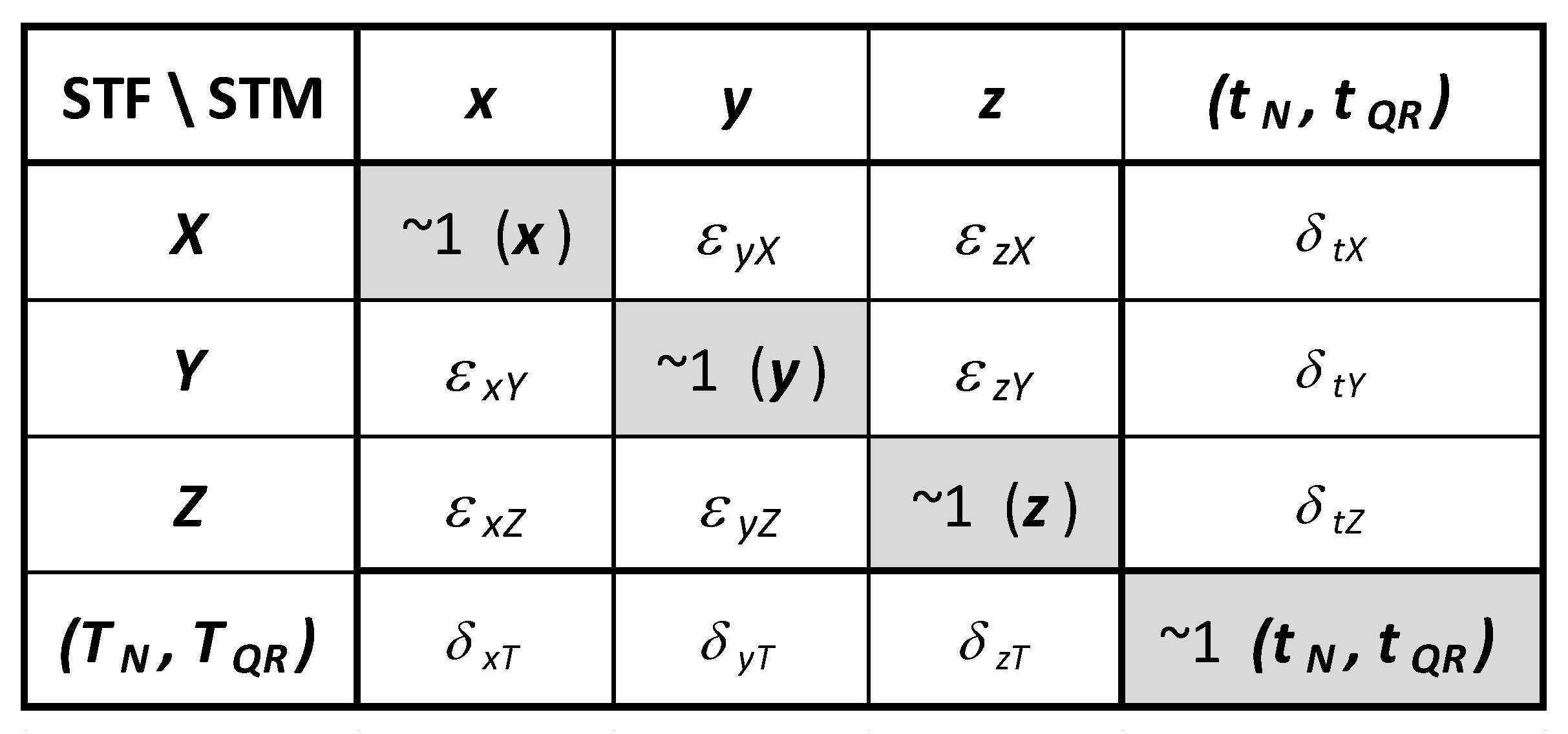
In detail, the directions of the dimensions of material points in spacetime (STM) align with those of the fabric of spacetime (STF), but are independent entities. The x direction in the STM will align with the X direction in STF, with some small offset in the Y and Z directions due to the fact the x direction is a quantum variable. That uncertainty will be of order the Planck length, and is shown as ε in Table 1. Similarly, the difference between x and X in the Y direction is proportional to εxY, and so on for the other combinations of axes. In this light, the off-diagonal elements in the upper left 3x3 region of Table 1 are the vector offsets between the (x, y, z) and (X, Y, Z) coordinate systems. The upper left 3x3 region thus represents the orthogonal set of (x, y, z) directions, as well as a second set of orthogonal vectors of very small amplitude that are left to represent the (X, Y, Z) directions after one has removed their (x, y, z) components. Physically (X, Y, Z) and (x, y, z) represent the set of basis directions, but mathematically one ends up with (x, y, z) and (εxY, εxZ, εyX, εyZ, εzX, εzY). Since there is no uncertainty to the STF coordinate system (only the STM has a quantum nature), by symmetry and the orthogonality of the STM coordinate system, εxY = εyX to first order. The upper left 3x3 box has three full dimensions and three “rolled up” spatial dimensions.
The δ here represent the overlap between generalized time and a spatial dimension. Similar to the argument above, δ is of order the Planck length or Planck time, where for this discussion we are assuming units where time and space are on an equal footing, or c = 1. The δ are 2-component numbers to reflect the normal (tN) and quantum/relativistic (tQR) flows of time, but to first order have only one significant component except where time transitions from quantum/relativistic time flow to normal time flow. The same arguments of symmetry and orthogonality apply so there are only three unique δ terms to lowest order. In general, the δ represent the overlap between the spatial coordinates and the flow of time.
One needs to keep both normal time and quantum/relativistic time, which is reflected in the bottom right box. This is because tN and tQR are orthogonal to each other, so a theory that includes black holes or relativistic motion must include both as time is considered to “rotate” into flowing in a direction orthogonal to the normal flow of time in the vicinity of a black hole [32]. With the exception of a transitional state where both tN and tQR have significant amplitudes, one or the other of the time coordinates will be very small and could be interpreted as a rolled-up dimension. In a state where time has a significant flow in both the normal and quantum/relativistic directions, those spatio-temporal terms will be two-component numbers.
Table 1 shows a physical interpretation of the 11 dimensions of M11 string theory: the 4 dimensions of standard spacetime (x, y, z, tN), an additional time “dimension” for quantum/relativistic time (tQR), 3 rolled up spatial overlap dimensions, and 3 rolled up spatio-temporal overlap dimensions. The additional quantum/relativistic direction for time would appear mathematically as an additional dimension since there has not previously been any need to make the distinction between directions and dimensions. Table 1 shows that ST duality provides a description of the physical world that reproduces the 11 dimensions of string theory, along with a physical rationale for why the 10-dimensional and 11-dimensional version would be equivalent. The extra dimensions can be seen as mathematical artifacts of the choice of an orthogonal mathematical basis for the spacetime metric. The only additional dimensions are those of the STF.
This also resolves the theoretical constraint that there be on 3+1 dimensions. It has been shown that our universe must have 3+1 dimensions for atoms and other physical structures to form, and to have predictability in our theories [33]. Since all measurements in the STM occur in the STM, only the 3+1 dimensions of the STM are relevant in that theoretical analysis. The ST duality model for the extra dimensions in string theory resolves the theoretical discrepancy between the number of dimensions allowed to describe the observable universe, and those in string theory.
For string theory to be consistent with particle physics, the geometry of the extra dimensions must be shaped like a Calabi-Yau manifold [34]. Another concern is that the number of such possible manifolds is at least 10500 [17]. This raises the technical problem of how one finds the right manifold to describe our universe, and allows the further criticism of string theory that, with so many manifolds to choose from, the theory may not have much fundamental value since one can almost surely find one of those 10500 manifolds that describes our universe [17]. The ST duality provides a physical model that constrains the geometry of the Calabi-Yau manifold (now seen as a mathematical artifact of the overlapping STF and STM spacetime metrics), and thus provides a physical model that can be used to constrain which Calabi-Yau manifold to use in string theory.
6.0. A Framework for Unifying Gravity with the Standard Model
Despite decades of effort and many different approaches, there is no accepted theory of quantum gravity. ST duality offers a new approach with a simple physical model. Since the STM is inherently quantum, and the STF is not, the model has promise to connect the quantum world of QFT and the standard model of particle physics with the non-quantum world of general relativity. This section develops some of the physical concepts needed for such a model. The resulting model has a flat spacetime, explains why gravity is so much weaker than the other forces, and explains why gravitons have not been found. The essence of the model is that quantum mechanics applies to the STM, but does not apply to the STF, and that gravity is a result of the interaction via gravitons between the quantum STM and the non-quantum STF. At the level described here, there are no tunable parameters.
6.1. The Geometry of the Universe
ST duality provides an interesting perspective regarding the geometry of the universe, which appears to be flat within the uncertainty of measurement. The total density parameter for the universe has a value of Ω = 0.9993±0.0019 [35], where a value of 1 corresponds to a flat spatial geometry for the universe, Ω > 1 corresponds to positive curvature and a (hyper) spherical geometry, and Ω < 1 corresponds to negative curvature and a hyperbolic spatial geometry. The observed flatness of the universe constrains the standard ΛCDM cosmological model. There is no accepted theory for why the amounts of matter, dark matter, and dark energy in ΛCDM should be the exact right amounts for a flat universe, nor how all those densities can vary over time in such a way as to maintain a flat universe.
ST duality is the basis for a physical model where the STM is effectively “draped” over the STF. The flatness of space is then a property of the STF and not inherent to the STM.
Section 3 noted that the FLRW metric solution to Einstein’s field equations corresponds to the STF, and the Schwarzschild metric to the STM. Physically, the lack of matter in the majority of the universe means the flat geometry is the lowest energy state for the STF, as any warping would require additional energy. For reference, ΛCDM includes a term for the energy due to warped spacetime, which is typically set to zero by assuming spacetime is flat. With the STF as distinct from the STM, there is no longer any constraint on the densities of matter, dark matter, or dark energy, which means there is no longer a need to hypothesize a mechanism to have those densities finely correlated over time.
Some supersymmetric theories of gravity require a cosmological constant (dark energy term) that is exactly zero [36], which is the predicted value from the cosmological model here based on ST duality [1]. ST duality thus allows consideration of theories of gravity that would otherwise be rejected for not being consistent with a flat geometry for the universe, e.g., those with no dark energy.
6.2. General Considerations for Unification Theories
The standard model provides a single theory for the electromagnetic, weak, and strong nuclear forces, but does not include gravity. Gravity is notably weaker than the other forces – the electromagnetic force between two electrons is about 1043 time larger than the gravitational force between them. Despite decades of work to unify gravity with the other forces, there is no widely accepted unified theory.
Galley recently summarized the state of efforts to merge gravity with the other forces [37]. Gravity is described by general relativity, which has continuous motion of bodies due to the curvature of spacetime. Quantum mechanics describes entities in terms of wave functions and quantized parameters. The difficulty is the differing notions of spacetime, which Galley summarizes as “quantum wave equations are defined on a fixed space-time, but general relativity says that space-time is dynamic – curving in response to the distribution of matter.” Based on a 1957 argument by Feynman [38], efforts have focused on quantizing gravity, since it was felt that having some stochastic mechanism to couple a classical theory of gravity to quantum mechanics would lead to inconsistencies, such as violation of the Heisenberg uncertainty principle. Oppenheim [39] has shown that Feynman’s and other arguments requiring the quantization of spacetime and gravity implicitly assume the underlying theory is deterministic. However, measurements [3,4] have failed to find evidence for space quantization. Oppenheim has proposed a theory where gravity is coupled to quantum mechanics through a probabilistic mechanism. ST duality achieves the same effect since the quantum nature of the STM means that it is not possible to exactly correlate a position in the STM with one in the STF. Both Oppenheim’s theory and one based on ST duality also meet the requirement that they be irreversible [40], the former by virtue of its probabilistic nature and the latter because specifying a position in the STM to map it onto gravity from the STF necessarily collapses the wave function for the position in the STM. For a summary of the history and current alternatives to quantum gravity, see [41].
Feynman’s argument is a variant of the two-slit experiment. We revisit that argument from the perspective of ST duality. If a particle is projected against two slits and we only detect the particle on the other side of the slits, then we will get an interference pattern from self-interference of the particle’s wave function. If we now imagine a very sensitive gravity wave detector, it can tell which slit the particle went through by the strength of the gravity wave as the particle passes by, getting a larger signal from the near slit and a smaller one from the far slit. Conventionally, we would say that the mass measurement collapses the wave function of the particle since we know what slit it went through (and the interference pattern on the far side of the slits would disappear), but that means that the mass detector is quantum mechanically entangled with the rest of the system, and the fabric of spacetime must have quantum properties for gravity to have such an effect. Hence the historical focus on quantizing gravity to unify the forces.
We consider several possibilities for the thought experiment. If the gravity wave detector is sufficiently insensitive, then it will not be able to detect which slit the particle went through, there is no impact on the two-slit interference pattern, and there is no constraint on the STF. If the gravity wave detector is sufficiently sensitive to tell which slit the particle went through, that measurement will collapse the wave function of the particle. Feynman’s question now becomes “how does a non-quantum fabric of spacetime warp in the presence of a particle wave function, before that wave function is collapsed by a measurement?”
One response to that question is that the question itself is meaningless since there is no way to measure the geometry of the STF without collapsing the wave function.
A more detailed response requires use of the concept of generalized time, summarized here in Section 5.2 and Section 5.3. With the STF as the fabric upon which interactions in the STM occur, including quantum interactions, the STF will be warped by the particle wave function (i.e., the probability density of the test particle mass across the STF) during the passing of quantum time, and then will have the warp corresponding to the final measured state once the measurement is made and time is running in the normal, non-quantum, direction.
The intermediate case is slightly different. If the gravity wave detector gets a particle signal comparable to its measurement uncertainty from the Heisenberg uncertainty principle, the gravity wave detector is now partially entangled with the particle and the rest of the system. The intermediate steps are the same, but the gravity wave detector will output a stochastic signal that depends on its inherent noise and the sensitivity to the particle’s position.
In summary, the STF is warped by the wave function of the particle, and responds correspondingly to collapse of that wave function. This model predicts that gravitational warping of the STF will be sensitive to the particle wave function, rather than a nominal position for the particle.
It has been experimentally confirmed that gravity interacts with a particle’s wave function [42]. In the experiment, a matter interferometer measured changes in the interference pattern due to time dilation caused by a test mass near one arm of the interferometer. Gravitational deflection of the flight path was corrected for. They also show their results are consistent with the Heisenberg uncertainty principle, in accord with the analysis in the preceding paragraphs. Other experiments [43] have shown that gravitational curvature affects the particle wave function in an atom interferometer with separations up to 16 cm.
Between the failure to find quantization of space, the theoretical arguments of Oppenheim, the rebuttal of Feynman’s argument, and the observed impact of gravity on wave functions, it is clear that unification theories that allow for a non-quantum fabric of spacetime warrant consideration.
The other three forces are known to be mediated by a particle (e.g., photons for the electromagnetic force), but there are theoretical difficulties with models for the equivalent particle for gravity, the graviton, and no experimental evidence for its detection [44].
One difficulty for a unified theory is to be consistent with geodesic completeness. A geodesic in cosmology is the “straight” path an object or a point in spacetime makes traveling through a warped spacetime. Geodesic completeness is the requirement that a point in spacetime can be traced back to earlier and later times without violating quantum mechanics. The difficulty is that two points in space now separated by a Planck length would be indistinguishable when traced back to the Big Bang, or any significantly earlier time. Similarly, two points just barely distinguishable now would be separated by many Planck lengths in the future of an expanding universe, violating quantum mechanics because general relativity implies one can trace back in time distinguishable points in spacetime intermediate between those two. A non-quantum STF permits geodesic completeness since the quantum uncertainty lies in correlating a position on the STM with one on the STF, and is therefore a measurement problem rather than a problem with the underlying physics. There is no uncertainty in the position of something when measured in STF coordinates.
6.3. Spacetime Duality: A Framework for Unifying Gravity with the Other Forces
The framework for a model unifying gravity with the other forces is simple. The STM exists upon the STF and matter in the STM warps the STF through the exchange of gravitons. In the absence of quantum effects, the STM exactly overlaps the STF. Because of the Heisenberg uncertainty principle, the STM is draped over the STF with a separation distance of about one Planck length. Geodesic completeness is satisfied since all points have a location upon the non-quantum STF and one can distinguish between arbitrarily close points in the STF at all times. Sufficiently close points would be indistinguishable in the quantum STM because the Heisenberg uncertainty principle prevents making an exact correspondence from their location in the STF to their location in the STM.
Matter exchanges gravitons with the STF, the force between them being attractive, and the STF is warped as in general relativity. It takes energy to warp the STF, and the higher energy in regions of greater STF curvature result in a higher density of gravitons (either more gravitons, or gravitons of higher energy, or both). That higher density of gravitons can then interact with a second mass, which will feel an attractive force to the STF, which will appear as gravitational attraction to the first object.
Consider the motion of a planet around a sun. To simplify the example, we take the conventional approach of assuming the mass of the planet is sufficiently small that we can ignore its effect on the local geometry of spacetime. The sun exerts a force on the STF via graviton exchange, warping the STF. The warped portion of the STF is highly localized around the mass of the sun. The greater the amount of warping of the STF, the more gravitons are emitted due to the higher energy state of the STF from the warping. These gravitons interact with the local matter, inducing black hole collapse if the matter density is high enough, and result in classical gravitational interactions, such as with the orbiting planet.
Note that the gravitational force between the sun and the planet is mediated by the STF, and consequently is a two-graviton interaction. This accounts for the relative weakness of gravity compared to the other forces, which are mediated by a single interaction of the force-carrying particle (e.g., photons, bosons, and gluons for the electromagnetic, weak nuclear, and strong nuclear forces respectively).
Conventionally, a two-particle mechanism would have a 1/r4 dependence (1/r2 for the first interaction and 1/r2 for the second interaction, as in a Lidar system). Here, the STM overlaps the STF within about a Planck length and the STF geometry conforms locally to the mass distribution that is warping the STF. Within a Planck length the force would have a 1/r4 dependence, but at greater distances the warping of the STF looks like the mass distribution of the STM, so there is a 1/r2 dependence. Experimentally, the most sensitive probe of the inverse square law for gravity used a pulsed neutron beam to probe the inverse square law down to a scale of ~0.1 nm (~10-10 m), finding no deviation within experimental uncertainty [45]. Given the heroic effort for those neutron beam measurements, it is unlikely that future experiments will be able to probe deviations from 1/r2 at lengths approaching the Planck length of 10-35 m, but there may be other experimental means to probe this model.
This model also removes the possibility of a black hole being a singularity. Since the STM is a quantum entity with a wave function and subject to Heisenberg uncertainty, the STM can be no closer to the STF than the Planck length. With the STM and the STF separated by the Planck length, the exchange of gravitons is similar to that of two parallel plates in electromagnetics, and the graviton density does not change with separation, meaning there is no 1/r2 field dependence in the gap, hence no singularity. The Planck length separation of the STM and the STF limits the extent to which a gravitational mass can collapse, thereby avoiding infinite mass density and infinite energy density from spacetime curvature at the singular point since there is no longer a singular point.
This model resolves the relative weakness of gravity since gravity is not a force directly between two masses, but rather it is a result of the attraction between matter and the STF, and conventional gravitational force is the result of a 2-gravition exchange: graviton exchange between mass 1 and the STF, and then another graviton exchange between the STF and mass 2. Without the STF, there would be no gravitational attraction between masses. This is fundamentally different than the other three forces, which act directly between two objects, and accounts for the relative weakness of gravity as well as the decades-long failure to unify gravity with the other forces using a single interaction between objects with mass.
In this model, gravitons would not be directly detectable since they only interact between the STF and matter on the STM. The measuring apparatus necessarily constitutes matter on the STM, so what one measures there is just the standard gravitational interactions with other masses, as mediated by the STF.
An experiment has been proposed to use a clock entangled at points separated in elevation by approximately a kilometer to probe whether proper time (from general relativity) or absolute time (from quantum mechanics) applies to that system [46]. That experiment will test the model here, which predicts the results of that experiment should follow general relativity.
This two-graviton model provides a physical basis for other theories where gravity is weaker because it “leaks” into other dimensions, like the Randall-Sundrum model in string theory [47], or the ADD model [48]. In all of these models, gravity acts in a higher dimensional space than the 3+1 dimensions of our universe. Rather than the energy of gravity “leaking” into other dimensions per se, the two-graviton model means the strength of gravity is reduced because gravitational attraction is now a 3-body interaction instead of a two-body interaction.
A number of experiments are proposed to test quantum gravity (see [49] for a summary). Tests of Bell’s inequality have shown that quantum mechanics describes physical reality, and that there are no “hidden variables.” While the coordinates of the STF may seem like hidden variables, and the extra dimensions of string theory also seem to indicate potentially hidden variables, the measurements in Bell inequality tests all involve measurements solely of STM properties. Testing the model here might rely on a subtle difference between the STM and the STF. For two particles sufficiently close to each other, measuring their positions in the STM would not indicate which particle is, for example, to the left of the other, due to the Heisenberg uncertainty principle. If one could measure those positions in the STF, there would be no ambiguity. However, if one measures which particle is to the left of the other, that is a qualitative measurement, and subject to the mathematics of the overlap of the quantum wave functions of the two particles. This is now in the realm of Bell inequalities and subject to statistical testing to see whether one particle is definitely (probabilistically speaking) to the left of the other or not. Experiments to perform Bell inequality tests on these more subtle properties of a system have recently been proposed [50], offering a potential avenue to directly test for the spatial portion of the STF. Experimental tests relevant to the temporal sequence of events, here resolving whether there is a definite order of events in the STF that might not be discernable in the STM, have also been proposed [51].
7.0. Spacetime Duality and Black Holes
The black hole information paradox, whereby quantum mechanics says information cannot be destroyed and general relativity says information is lost when matter falls into a black hole, is resolved by the model here. The STF inside a black hole is connected to the STF outside the black hole, so gravity waves can convey information out of the black hole. The canonical properties of a black hole are its mass, charge, and angular momentum. Conventionally, all information about the material that fell into the black hole during its creation is lost. Section 6.3 showed there is no singularity inside a black hole in this model because the Heisenberg uncertainty principle ensures the STM is always about one Planck length away from the STF, resulting in a non-singular geometry and a finite energy state. Gravity waves on the STF will record the mass distribution and motion of mass within the black hole, so the information about the structure of the material forming the black hole is not lost – it is radiated outward as gravity waves from the black hole. Given that gravity wave detection sensitivity is only approaching that needed to detect primordial black holes [52] it is unlikely that the gravity waves from the much smaller mass movements involved in the information paradox will be detectable in the near future. In accord with theory and experimental measurement [53], we assume that gravity waves travel at the speed of light over the STF.
Since it takes energy to warp the STF, a region of the STF that is highly warped will require a larger amount of mass movement to generate a gravity wave of given size. When this gravity wave propagates to a less-warped region, the amplitude of the gravity wave should increase. This raises the theoretical possibility that gravity waves can be used to probe the internal structure of a black hole. At a minimum, this model makes the testable prediction that the gravity wave signatures of black holes will reflect the structure of the black hole and not just its mass.
8.0. Concluding Remarks
The scope of this paper is to introduce the concept of points in space and time having a quantum wave function that extends over a separate fabric of spacetime, leading to the concept of spacetime duality. We have shown that ST duality provides a simple physical model of the structure of spacetime with explanatory and predictive power in quantum mechanics and cosmology. One indication of the value here is in eliminating mathematical infinities, such as the use of the Dirac delta function in quantum mechanics and black hole singularities. This provides the foundation for unifying gravity with QFT that resolves several concerns with the current models including the black hole information paradox and mass and energy density singularities inside a black hole. ST duality also provides a physical interpretation for a variety of theoretical results, including string theory and lattice QCD.
The value here is fourfold. First is to derive ST duality from quantum mechanics directly, which puts it on the same quantum mechanical basis as QFT, hence provides a philosophically consistent basis to unify the four forces. Second is to provide a simple physical model for spacetime that provides a framework to unify the disparate theoretical approaches currently proposed, some of which were summarized in Section 4. Third is to provide a physical basis to interpret results from string theory and other theoretical results, as noted throughout this paper. The overlap with string theory and the physical insights here suggest that string theory potentially provides the mathematical structure to apply ST duality more widely and more quantitatively than was possible here. Fourth is that ST duality provides the foundation for updating the cosmological model to better account for features of the universe.
Modifying the current cosmological model has been a challenge since the modifications must preserve the main features of the current model, while making modifications that simultaneously correct for the small differences between the model and observation for multiple phenomena. For example, changing the age of the universe can reduce the Hubble tension, but makes the S8 tension worse. The applicability of ST duality to cosmological models is a stringent test of whether the physics in ST duality is valid. A model for the expansion of the universe based on ST duality simultaneously resolves both of those [1], and a different model for the Big Bang explains the preponderance of matter over antimatter, dark matter, and why galaxies have a preferred rotation direction [2].
The work here makes the testable prediction that gravity waves can show features of the internal structure of black holes. Experiments probing whether general relativity or quantum mechanics describes the flow of time (e.g., [46]) will also test this model. The cosmology papers [1,2] make testable predictions for observations in cosmology.
The basic idea of the STF and STM as separate entities is implicit in cosmology, general relativity, some versions of string theory, lattice QCD, and other theoretical approaches. The novelty here is to make that distinction explicit, and to attribute quantum behavior only to the STM. The non-quantum STF readily satisfies general relativity, allowing for a simple model to unify gravity with the other three forces, with gravitons coupling the STF and the STM. The STF as an intermediary between masses explains the relative weakness of gravity, and has a 1/r2 force dependence in the limit of distances much greater than the Planck length.
Acknowledgments
This work is entirely self-funded by the author. The author would like to thank Amanda Clark and Jim Conger for being sounding boards as the ideas here evolved and matured.
Conflicts of Interest
The author declares no conflicts of interest.
References
- Henderson, John. Scale Corrections to the ΛCDM Model to Explain a Time-Dependent Dark Energy Density, and the Hubble and S8 Tensions. Appl. Phys. Res. accepted for publication. 2026. [Google Scholar] [CrossRef]
- Henderson, John. The Nature of Dark Matter and Cosmological Structure Derived from Generalized Time and Spacetime Duality. [CrossRef]
- V. A. Acciari et al. (MAGIC Collaboration), “Bounds on Lorentz Invariance Violation from MAGIC Observation of GRB 190114C,” Phys. Rev. Lett. 125, 021301 (2020). [CrossRef] [PubMed]
- Zhen Cao et al. (The LHAASO Collaboration), “Stringent Tests of Lorentz Invariance Violation from LHAASO Observations of GRB 221009A,” Phys. Rev. Lett. 133, 071501 (2024). [CrossRef] [PubMed]
- Aristarhov, Serj. Heisenberg’s uncertainty principle and particle trajectories. Found Phys. 2023, 53, 7. [Google Scholar] [CrossRef]
- Bohm, David. A Suggested Interpretation of the Quantum Theory in Terms of 'Hidden Variables' I. Phys. Rev. 1952, 85(2), 166. [Google Scholar] [CrossRef]
- Bohm, David. A Suggested Interpretation of the Quantum Theory in Terms of 'Hidden Variables' II. Phys. Rev. 1952, 85(2), 180. [Google Scholar] [CrossRef]
- John Henderson, “Generalized Time Flow in Quantum and Relativistic Systems and Cosmology,” submitted to Cosmology (May 2026). [CrossRef]
- Ford, Kenneth W.; Wheeler, John Archibald. Geons, Black Holes and Quantum Foam: A Life in Physics; Norton and Company, 2000. [Google Scholar]
- Mack, Katie. The End of Everything (Astrophysically Speaking); Scribner, 2020; pp. 107–108. [Google Scholar]
- Ellis, G. F. R.; van Elst, H. Cosmological models (Cargèse lectures 1998). In Theoretical and Observational Cosmology; Lachièze-Rey, Marc, Ed.; NATO Science Series C., 1999; Vol. 541, pp. 1–116, arXiv:gr-qc/9812046. Bibcode:1999ASIC..541....1E; ISBN 978-0792359463. [Google Scholar]
- Davis, T. M.; Lineweaver, C. H. Expanding Confusion: Common Misconceptions of Cosmological Horizons and the Superluminal Expansion of the Universe. Publ. Astron. Soc. Aust. 2004, 21(1), 97–109, arXiv:astro-ph/0310808v2. Bibcode:2004PASA...21...97D. S2CID 13068122. [Google Scholar] [CrossRef]
- Moreva, Ekaterina; et al. Time from quantum entanglement: an experimental illustration. Phys. Rev. A 2014, 89, 052122, arXiv:1310.4691v1. [Google Scholar] [CrossRef]
- Moreva, Ekaterina; et al. Quantum Time: experimental multi-time correlations. Phys. Rev. D. 2017, 96, 102005. Available online: https://arxiv.org/abs/1710.00707. [CrossRef]
- Shamir, Lior. Patterns of galaxy spin directions in SDSS and Pan-STARSS show parity violation and multipoles. Astrophys. Space Sci. 2020, 365, 136. [Google Scholar] [CrossRef]
- Shamir, Lior. The distribution of galaxy rotation in JWST Advanced Deep Extragalactic Survey. MNRAS 2025, 538, 76–91. [Google Scholar] [CrossRef]
- Peter Woit, Not Even Wrong: The Failure of String Theory and the Search for Unity in Physical Law. (Basic Books, 2006), p. 105.
- Chapline, George. The Black Hole Information Puzzle and Evidence for a Cosmological Constant. 1998. Available online: https://arxiv.org/abs/hep-th/9807175.
- Chapline, G.; Hohlfeld, E.; Laughlin, R. B.; Santiago, D. I. Quantum Phase Transitions and the Breakdown of Classical General Relativity. Int. J. Mod. Phys. A 2003, 18(21). Available online: https://arxiv.org/abs/gr-qc/0012094. [CrossRef]
- See https://en.wikipedia.org/wiki/Fuzzball_(string_theory) for a summary of fuzzball theory and a more extensive list of references. Accessed 31 January 2025.
- Mathur, Samir D. The Fuzzball proposal for black holes: An Elementary review. Fortschr. Phys. 2005, 53(7–8), 793–827, arXiv:hep-th/0502050. [Google Scholar] [CrossRef]
- Mathur, Samir D. Black Holes and Beyond. Ann. Phys. 2012, 327(11), 2760, arXiv:1205.0776. [Google Scholar] [CrossRef]
- Mathur, Samir D. The Information paradox: A Pedagogical introduction. Class. Quantum Grav. 2009, 26(22), 224001, arXiv:0909.1038. [Google Scholar] [CrossRef]
- Lombriser, Lucas. “Cosmology in Minkowski space,” . Class. Quantum Grav. 2023, 40, 155005, arxiv:2306.16868v1. [Google Scholar] [CrossRef]
- Bianconi, Ginestra. Gravity from Entropy. Phys. Rev. D. 2025, 111, 066001. [Google Scholar] [CrossRef]
- Michael Dine, This Way to the Universe, Dutton, 2022, p 114.
- Wilson, Kenneth G. Confinement of Quarks. Phys. Rev. D. 1974, 10, 2445. [Google Scholar] [CrossRef]
- Pardo, Kris; et al. Limits on the number of spacetime dimensions from GW170817. J. Cosmol. Astropart. Phys. 2018. arxiv:1801.08160. [Google Scholar] [CrossRef]
- Nahm, W. Supersymmetries and their representations. Nucl. Phys. B 1978, 135(1), 149–166, [Bibcode:1978NuPhB.135..149N]. [Google Scholar] [CrossRef]
- Cremmer, E.; Julia, B.; Scherk, J. Supergravity theory in eleven dimensions. Phys. Lett. B 1978, 76(4), 409–412, [Bibcode:1978PhLB...76..409C]. [Google Scholar] [CrossRef]
- Duff, Michael J. The theory formerly known as strings. Sci. Am. 1998, 278(2), 64–9, [Bibcode:1998SciAm.278b..64D] . [Google Scholar] [CrossRef]
- Hertog, Thomas. On the Origin of Time: Stephen Hawking’s Final Theory; (Bantam Books, 2023). e.g., Figure 23b; 2023. [Google Scholar]
- Tegmark, Max. On the dimensionality of spacetime. Class. Quantum Gravity 1997, 14(4), L69–L75, arXiv:gr-qc/9702052. [Google Scholar] [CrossRef]
- Yau, Shing-Tung; Nadis, Steve. The Shape of Inner Space: String Theory and the Geometry of the Universe's Hidden Dimensions; Basic Books, 2010. [Google Scholar]
- N. Aghanim, et al, (Planck Collaboration), “Planck 2018 results. VI. Cosmological parameters,” A&A 641, A6 (2020). [arXiv:1807.06209]. [CrossRef]
- Julius Wess and Jonathan Bagger, Supersymmetry and Supergravity. Princeton University Press (1992). ISBN 978-0691025308.
- Galley, Thomas. Might There Be No Quantum Gravity After All? Physics 2023, 16, 203. [Google Scholar] [CrossRef]
- C’ecile M. DeWitt and Dean Rickles (editors), The Role of Gravitation in Physics: Report from the 1957 Chapel Hill Conference (Max-Planck-Gesellschaft zur Förderung der Wissenschaften, Berlin, 2011), Vol. 5, Chapter 22,. Available online: https://edition-open-sources.org/sources/5/.
- Oppenheim, Jonathan. A Postquantum Theory of Classical Gravity? Phys. Rev. X 2023, 13, 041040. [Google Scholar] [CrossRef]
- Galley, T. D.; et al. Any consistent coupling between classical gravity and quantum matter is fundamentally irreversible. Quantum 2023, 7, 1142. [Google Scholar] [CrossRef]
- Oppenheim, Jonathan. Is it time to rethink quantum gravity? Int. J. Mod. Phys. D. 2023, 32, 2342024. Available online: https://arxiv.org/pdf/2310.12221. [CrossRef]
- Overstreet; et al. Observation of a gravitational Aharonov-Bohm effect. Science 2022, 375, 226–229. [Google Scholar] [CrossRef] [PubMed]
- Asenbaum, Peter; et al. Phase shift in atom interferometry due to spacetime curvature. Phys. Rev. Lett. 2017, 118, 183602, arxiv:1610.03832. [Google Scholar] [CrossRef] [PubMed]
- See en.wikipedia.org/wiki/Graviton for a summary of theoretical and experimental papers on the graviton. Accessed. (accessed on 22 April 2025).
- Haddock, Christopher C.; et al. A Search for deviations from the inverse square law of gravity at nm range using a pulsed neutron beam. Phys. Rev. D. 2018, 97, 062002, arxiv:1712.02984. [Google Scholar] [CrossRef]
- Covey, Jacob P.; Pikovski, Igor; Borregaard, Johannes. Probing Curved Spacetime with a Distributed Atomic Processor Clock. PRX Quantum 2025, 6, 030310. [Google Scholar] [CrossRef]
- Randall, Lisa; Sundrum, Raman. Large Mass Hierarchy from a Small Extra Dimension. Phys. Rev. Lett. 1999, 83(17), 3370–3373, arXiv:hep-ph/9905221. [Google Scholar] [CrossRef]
- Arkani-Hamed, Nima; Dimopoulos, Savas; Dvali, Gia. The Hierarchy Problem and New Dimensions at a Millimeter. Phys. Lett. B 1998, 429, 263–272. Available online: https://arxiv.org/abs/hep-ph/9803315. [CrossRef]
- Ball, Phillip. Quantum Gravity Tests Coming Soon. Physics 2026, 19, 18. [Google Scholar] [CrossRef]
- Athreya, Y.S.; Kannan, S.; Yan, X.T.; et al. Bell correlations between momentum-entangled pairs of 4He* atoms. Nat. Commun. 2026, 17, 2357. [Google Scholar] [CrossRef] [PubMed]
- Richter, Carla M.D.; et al. Toward an Experimental Device-Independent Verification of Indefinite Causal Order. PRX Quantum 2026, 7, 010354. [Google Scholar] [CrossRef]
- Quill, Elizabeth. How we might finally find black holes from the cosmic dawn. Science News. 13 January 2025. Available online: https://www.sciencenews.org/article/primordial-black-holes-cosmic-dawn.
- The LIGO Scientific Collaboration; et al. Gravitational waves and gamma-rays from a binary neutron star merger: GW170817 and GRB 170817A. Astrophys. J. Lett. 2017, 848(2), L13, arxiv:1710.05834. [Google Scholar] [CrossRef]
Figure 1.
Relative spatial coordinates of the STF frame (X, Y, Z), and the STM (x, y, z). Due to the Heisenberg uncertainty principle, the STM coordinates will not exactly overlap the STF coordinates, and the offset will be on the order of the Planck length. The direction of the y axis in the STM in terms of STF coordinates is shown. Table 1 provides the complete set of relative overlaps between the spacetime metrics for the STF and the STM.
Figure 1.
Relative spatial coordinates of the STF frame (X, Y, Z), and the STM (x, y, z). Due to the Heisenberg uncertainty principle, the STM coordinates will not exactly overlap the STF coordinates, and the offset will be on the order of the Planck length. The direction of the y axis in the STM in terms of STF coordinates is shown. Table 1 provides the complete set of relative overlaps between the spacetime metrics for the STF and the STM.
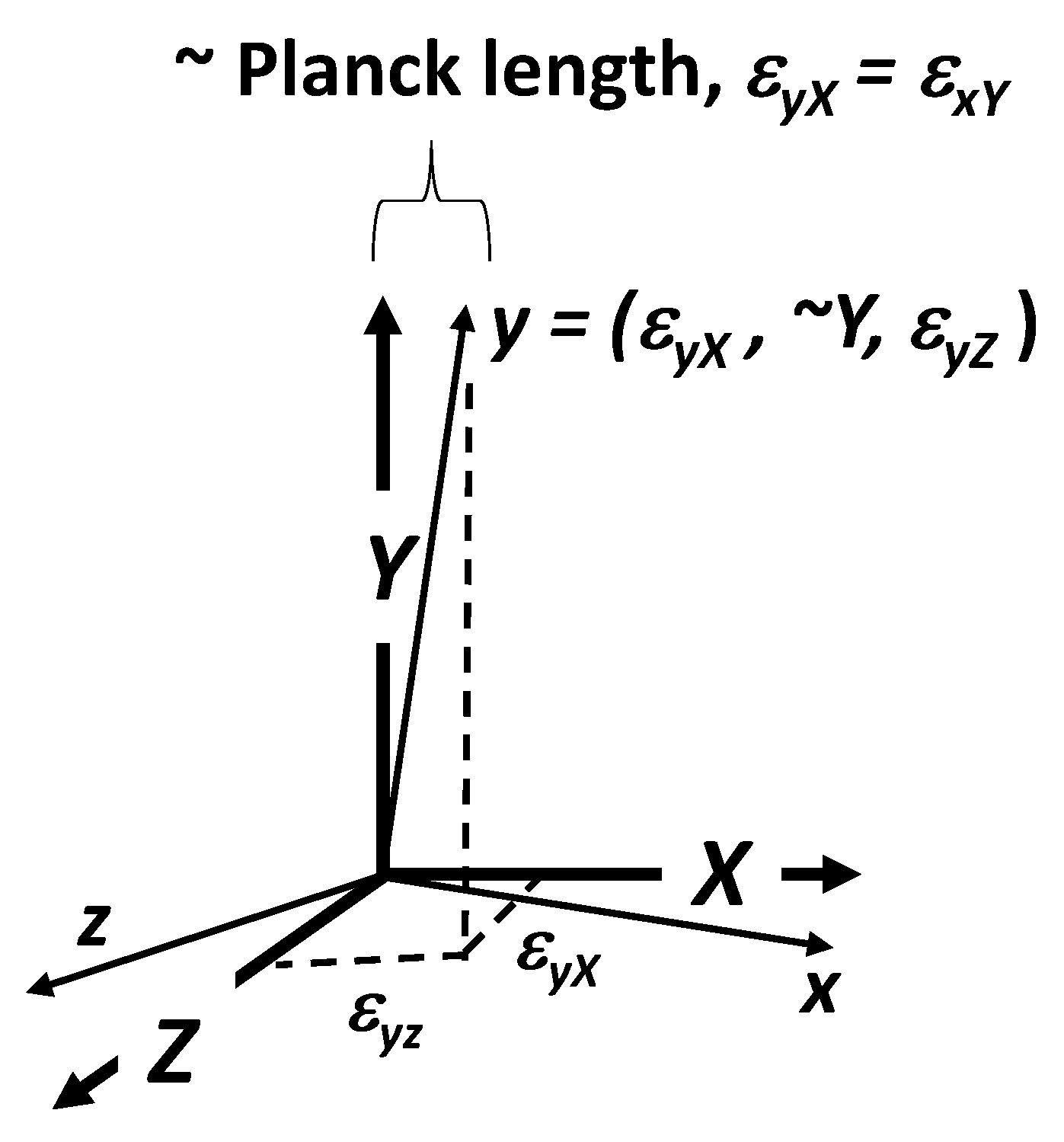

Table 1.
Correlation table showing how much of each dimension of the material world (STM, horizontal axis) aligns with the dimensions in the fabric of spacetime (STF, vertical axis). The two components of time are explained in the text. The 11 dimensions of M11 string theories map to the 3 spatial dimensions (x,y,z), the two components of time (tN, tQR), half of the 6 very small cross-spatial values labeled ε, and half of the very small spatio-temporal overlaps labeled δ.
Table 1.
Correlation table showing how much of each dimension of the material world (STM, horizontal axis) aligns with the dimensions in the fabric of spacetime (STF, vertical axis). The two components of time are explained in the text. The 11 dimensions of M11 string theories map to the 3 spatial dimensions (x,y,z), the two components of time (tN, tQR), half of the 6 very small cross-spatial values labeled ε, and half of the very small spatio-temporal overlaps labeled δ.
 |
Disclaimer/Publisher’s Note: The statements, opinions and data contained in all publications are solely those of the individual author(s) and contributor(s) and not of MDPI and/or the editor(s). MDPI and/or the editor(s) disclaim responsibility for any injury to people or property resulting from any ideas, methods, instructions or products referred to in the content. |
© 2026 by the authors. Licensee MDPI, Basel, Switzerland. This article is an open access article distributed under the terms and conditions of the Creative Commons Attribution (CC BY) license (http://creativecommons.org/licenses/by/4.0/).
Copyright: This open access article is published under a Creative Commons CC BY 4.0 license, which permit the free download, distribution, and reuse, provided that the author and preprint are cited in any reuse.


