

Submitted:
03 July 2026
Posted:
06 July 2026
You are already at the latest version
Abstract
Research on Intimate Partner Violence (IPV) has traditionally examined perpetrators and victims separately, limiting understanding of the relational processes that sustain violence. The present review builds on the dyadic model of partner violence by synthesizing findings from 12 meta-analytic studies investigating risk markers for physical IPV. Peer-reviewed meta-analyses published between 2000 and 2024 were identified through searches using combinations of terms related to IPV, risk factors, and meta-analysis. Studies were included if they reported quantitative effect sizes for variables associated with physical IPV perpetration or victimization. Extracted results were organized into three hierarchical levels: (a) background and dispositional factors, (b) relationship context, and (c) situational context. Across reviews, the strongest and most consistent predictors of IPV clustered within the relationship level, particularly prior partner aggression, emotional abuse, and relationship dissatisfaction. Protective factors such as communication skills and empathy were inversely related to IPV risk. Few studies examined same-sex couples, men as victims, or culturally diverse samples, highlighting major gaps in current evidence. This review provides an updated synthesis and conceptual organization of IPV risk markers and emphasizes the importance of dyadic frameworks for guiding future theory, prevention, and policy.
Keywords:
intimate partner violence
; dyadic model of partner violence
; perpetration
; victimization
; physical IPV
; risk markers
1. Introduction
Intimate Partner Violence (IPV) is defined by the Centers for Disease Control and Prevention (for Disease Control and Prevention, 2015) as “physical violence, sexual violence, stalking, and psychological aggression (including coercive acts) by a current or former intimate partner (e.g., current or former spouses, boyfriends, girlfriends, and dating or sexual partners).” Similarly, the World Health Organization (Organization, 2012) defines IPV as encompassing physical and sexual violence, emotional and psychological abuse, and controlling behaviors between partners. These definitions highlight the multifaceted nature of IPV, which often manifests in overlapping forms, such as sexual, psychological, and physical violence. Physical IPV includes actions such as slapping, pushing, hitting, kicking, suffocation, or using a weapon against an intimate partner (Devries et al., 2013). This form of violence is particularly devastating due to its potential to cause severe injuries or even result in death. Moreover, physical IPV is often more observable to third parties compared to sexual or psychological abuse.
A substantial body of literature has identified risk markers and factors associated with physical IPV, aiding in the assessment, prevention, and intervention of such violence. However, partner violence is fundamentally an interpersonal phenomenon, shaped by the individual characteristics of each partner and the relational dynamics within couples (Conroy, 2014; Ghuman et al., 2006; Rodriguez et al., 2017). Although these dynamics operate at the couple level, much of the existing research has primarily focused on individuals as the unit of analysis (Behrman & Frye, 2021). Consequently, a couple-based approach offers a more comprehensive understanding of the underlying risk markers contributing to IPV. These approaches acknowledge that each partner brings distinct lived experiences and perspectives to the relationship, which interact dynamically and evolve over the course of the relationship (Behrman & Frye, 2021).
This review builds on the dyadic model of partner violence proposed by Bartholomew and Cobb (2011), aiming to update the model in two key aspects. First, it organizes risk markers associated with both IPV perpetration and victimization. Second, it incorporates considerations of gender differences. With a focus on physical IPV in heterosexual relationships, this study selectively reviews the existing literature, emphasizing findings from meta-analyses.
2. Theoretical Framework
2.1. The Dyadic Model of Partner Violence
Bartholomew and Cobb (2011) conceptualized relationship violence as an interpersonal process between two intimate partners. These authors recognized that IPV is fundamentally a relational phenomenon that emerges from the complex interplay of both partners’ characteristics and behaviors within a specific situational context. Their model is a multi-layered framework that explains IPV by integrating various individual, relational, and situational factors. It argues that both partners contribute to the escalation of violence in a relationship, emphasizing the dynamic interplay of risk factors across its levels that drive the occurrence or persistence of IPV episodes (Bartholomew & Cobb, 2011).
The first level focuses on individual background and dispositional characteristics, recognizing how personal traits and lived experiences shape each partner’s propensity for violence. The second level examines the relationship context, focusing on how partners’ predispositions interact to shape their relationship dynamics. This level emphasizes the quality of the relationship arising from the interaction between the two partners and their enduring characteristics. The third level addresses the situational context, examining the specific circumstances and triggers that may lead to episodes of IPV.
Together, the interplay of these three levels culminates in a distinct pattern of partner violence, which constitutes the fourth level. This level considers the severity of violence, whether it is mutual or one-sided, how partners respond to it, and the resulting consequences (Bartholomew & Cobb, 2011). According to Bartholomew and Cobb (2011), couple members reciprocally influence each other at each level of this model. As interpersonal interactions progress through the model, subsequent levels can feed back into earlier ones. Risk factors from earlier levels are generally expected to impact IPV primarily through their mediation by subsequent stages.
In sum, the occurrence and persistence of violence within a dyad is not solely determined by the individual dispositions or backgrounds of each partner. Rather, it results from a complex interplay among these factors, the relationship context, and the situational setting (see Figure 1).
2.2. Two Different Frameworks
Theoretical perspectives on IPV have shifted from singular explanations to more comprehensive, multifactor frameworks. These frameworks propose that partner violence is not solely caused by an individual’s distorted belief system or psychological dysfunction but rather arises from the interaction of various individual characteristics and their environment (Stith et al., 2004).
One notable example is Dutton’s nested ecological theory (Dutton, 1995). This framework identifies four levels of factors associated with offenders and their environment. At the macrosystem level, which represents the broadest scope, the focus is on overarching cultural values and societal beliefs. The exosystem level includes the offender’s formal and informal social structures, such as friendships, workplace dynamics, support networks, and legal systems, which link the individual and their family to broader societal contexts. The microsystem level focuses on the immediate environment where abusive behaviors occur, encompassing elements such as the family unit, precursors and consequences of abuse, and relational dynamics. Finally, the ontogenetic level emphasizes the offender’s developmental history, highlighting the impact of past experiences on current relationships.
The dyadic model of partner violence (Bartholomew & Cobb, 2011) and Dutton’s nested ecological theory (Dutton, 1995) differ in several respects. While the dyadic model considers both romantic partners within the relationship, Dutton’s framework primarily focuses on the offender. This distinction is one of the primary differences between the two models. The dyadic model emphasizes the importance of conceptualizing the contributions of both partners to the emergence, escalation, and maintenance of violence. Moving away from the traditional offender–victim dichotomy, it highlights the dynamic nature of violent relationships, asserting that both partners contribute to interactions without assigning blame to one party.
The two models also differ in structure. Dutton’s nested ecological theory organizes risk factors for partner violence into concentric layers, reflecting a nested systems approach in which broader levels encompass and influence inner levels. This framework focuses on the offender’s environment, categorizing risk markers as either proximal or distal to violence. In contrast, the dyadic model of partner violence emphasizes both linear and bidirectional connections, highlighting the reciprocal influence of risk factors, their mediating effects across levels, and cross-partner effects.
The dyadic model does not explicitly address or incorporate the broader societal and cultural frameworks that shape and influence individual behaviors, relationship dynamics, and specific situations (Bartholomew & Cobb, 2011). In contrast, Dutton’s model includes the macrosystem, which encompasses the societal context, including cultural attitudes, beliefs, and laws that influence individuals’ lives (Spencer et al., 2022).
The dyadic model prioritizes individual, relational, and situational factors directly relevant to IPV, aligning with the primary focus of psychological inquiry. Bartholomew and Cobb (2011) acknowledged this exclusion as a limitation of their framework (see below for further details). In sum, the dyadic model is a more recent framework and offers a suitable approach for conceptualizing IPV because of its interpersonal, interactive, and dynamic focus. However, much of the existing literature continues to rely heavily on Dutton’s nested ecological theory as its primary framework.
2.3. Areas for Improvement
The dyadic model has several limitations. In their review of the literature, Bartholomew and Cobb (2011) primarily focused on the perpetration of IPV. They argued that, due to the notable prevalence of reciprocal abuse in relationships, the predictors of IPV perpetration and victimization largely overlap. While this perspective aligns with the bidirectional nature of IPV, where violence inflicted by one partner results in victimization of the other, it reflects a broader trend in the empirical literature, which has historically placed greater emphasis on perpetration.
Evidence suggests that predictors of IPV are often more similar than different across roles (Costa et al., 2015; Curtis et al., 2023). However, this assumption can be critiqued, as equating the predictors of IPV perpetration and victimization may overlook unique risk markers specific to each role. While bidirectional violence is evident in many relationships (Machado et al., 2024), it does not necessarily imply that the risk markers for perpetration and victimization are identical.
Bartholomew and Cobb (2011) primarily focused on physical rather than psychological abuse, reflecting the emphasis of the empirical literature at the time. These authors anticipated that their proposed model could also be applied to psychological abuse.
While this framework can certainly be applied to different types of IPV, each form of violence may have its own unique risk markers. Much of the existing literature on IPV has examined these forms simultaneously or failed to distinguish among them. Although overlap exists, this approach may fail to capture the subtle characteristics that differentiate forms of IPV. For instance, some prior meta-analyses on risk markers for IPV aggregated effect sizes for physical IPV with those of other forms of IPV. This aggregation may introduce confounding influences, potentially compromising the accuracy of mean effect sizes associated with specific risk markers (Spencer et al., 2019a).
Lastly, Bartholomew and Cobb (2011) categorized the literature on risk markers for physical IPV perpetration by men against women in heterosexual relationships within their framework. Gender was considered only when theoretical or empirical evidence suggested that it might moderate associations with IPV. They noted that observed patterns of findings tended to be consistent across genders and various relationship types, including same-sex relationships as well as dating, married, and cohabiting couples (Bartholomew & Cobb, 2011). While some commonalities exist, this generalization may obscure important differences.
2.4. Aims of the Current Review
This review builds upon and extends the work of Bartholomew and Cobb (2011), using the dyadic model of partner violence as its conceptual framework. It aims to address two limitations of the original model through the inclusion of risk markers for both IPV perpetration and victimization, as well as through consideration of gender differences. Consistent with the original model, the present review focuses specifically on physical IPV within heterosexual relationships.
This paper selectively reviews the literature on physical IPV, with particular emphasis on findings from meta-analyses. The review seeks to categorize risk markers associated with physical IPV by aligning them with the first three levels of the dyadic model. In doing so, it provides an updated organization of risk markers for physical IPV while incorporating more recent research findings to refine and extend the model.
Finally, some levels of the model may lack sufficient empirical evidence or systematic reviews regarding risk markers for physical IPV perpetration and victimization in heterosexual relationships. This review aims to highlight these gaps, identify areas for future research, and encourage greater scholarly attention to aspects of the model and their associated risk markers that warrant further scientific investigation.
3. Methodology
The present review was based on findings from meta-analyses, which aggregate and synthesize data from multiple studies to provide a comprehensive and evidence-based assessment of a research topic. Database searches were conducted, and additional studies were identified through hand-searching procedures, including examination of reference lists.
Meta-analyses were eligible for inclusion if they: (1) specifically examined physical IPV perpetration and/or victimization; (2) did not combine physical IPV with other forms of IPV; (3) analyzed multiple risk markers associated with physical IPV; (4) focused on heterosexual romantic relationships, including married or cohabiting couples; and (5) examined physical IPV among adults, excluding studies on dating violence in young adults or studies that combined childhood and/or adolescent risk factors with adult samples.
Studies were excluded if they: (1) were systematic reviews rather than meta-analyses; (2) examined multiple forms of IPV simultaneously; (3) included both adult and adolescent samples; (4) included same-sex couples or combined heterosexual and same-sex couples; (5) focused exclusively on women aged 15 years and older; (6) focused exclusively on low- and middle-income countries; (7) combined effect sizes for perpetration and victimization; (8) focused on a specific population, such as individuals with traumatic brain injuries, pregnant women, or military populations; or (9) examined only a single risk marker.
Table 1 provides an overview of the included meta-analyses.
4. Background and Dispositional Risk Markers
The first level encompasses the individual background and dispositional characteristics of partners. It considers the influence of relatively stable characteristics, lived experiences, and enduring individual traits on each partner’s propensity for violence (Bartholomew & Cobb, 2011). This level is comparable to the ontogenetic level in Dutton’s model (Dutton, 1995), which emphasizes individual factors relevant to the perpetrator. However, the dyadic model extends beyond this perspective by explicitly incorporating cross-partner effects.
Factors at this level may include personal beliefs and attitudes, cognitive attributions, personality vulnerabilities, negative emotionality, mental health concerns, substance use, and other characteristics directly associated with the individual. The present review reorganizes previously identified risk markers for physical IPV perpetration and victimization and categorizes them according to the structure of the dyadic model. The selection and recategorization of risk markers at each level draw on theoretical definitions, examples provided by Bartholomew and Cobb (2011), and the authors’ professional judgment.
4.1. Perpetration Risk Markers
Earlier meta-analyses often focused on a single risk marker for IPV or a limited set of markers. For example, Sugarman and Frankel (1996) examined the relationship between attitudes toward violence, attitudes toward women, gender role beliefs, and both IPV perpetration and victimization. They identified positive attitudes toward violence () and traditional gender-role beliefs about women () as significant risk markers for committing violence. It has long been debated that, due to the cross-sectional nature of the data and the consistency of evidence observed among males, these attitudes may serve as post hoc justifications for violence rather than causal antecedents.
Stith et al. (2000) investigated the relationship between experiencing or witnessing violence in one’s family of origin and subsequent involvement in IPV. Their analysis identified effect sizes ranging from to , indicating varying levels of association between childhood exposure to family violence and later engagement in domestic violence.
Stith et al. (2004) conducted a meta-analysis to identify risk markers for both perpetration and victimization of physical IPV. They incorporated data from 85 studies, yielding 308 distinct effect sizes, which were synthesized into composite effect sizes for 16 perpetration risk markers (see Table 1). In our review of these risk markers, several notable markers were recategorized within the background and dispositional level of the dyadic model. Moderate risk markers for men perpetrating physical violence against female partners included illicit drug use (), attitudes condoning violence (), traditional sex-role ideology (), anger/hostility (), alcohol abuse (), and depression () (Stith et al., 2004).
It is crucial to emphasize how each partner’s predispositions may interact with those of the other partner rather than viewing these characteristics as static or one-sided. When both partners bring their unique backgrounds to the relationship, findings related to family-of-origin violence, substance use, attitudinal factors, and mental health concerns can be understood within a dyadic framework. For instance, when one partner’s high levels of anger and hostility intersect with the other’s poor conflict-resolution skills, the probability of a negative reciprocal cycle increases. Similarly, a male partner’s endorsement of attitudes condoning violence may interact with a female partner’s history of family-of-origin violence, influencing how each interprets and responds to conflict and thereby escalating aggression.
Oram et al. (2014) conducted a systematic review and meta-analysis to assess the risk of partner violence among individuals diagnosed with psychiatric disorders. Their pooled estimates indicated an elevated risk of physical violence toward a partner among men with depression (OR = 2.8, 95% CI [2.5, 3.3]), generalized anxiety disorder (OR = 3.2, 95% CI [2.3, 4.4]), and panic disorder (OR = 2.5, 95% CI [1.7, 3.6]). An increased risk was also observed among women with depression (OR = 2.4, 95% CI [2.1, 2.8]), generalized anxiety disorder (OR = 2.4, 95% CI [1.9, 3.0]), and panic disorder (OR = 1.9, 95% CI [1.4, 2.5]). They concluded that individuals with psychiatric disorders, regardless of gender, faced a heightened risk of engaging in physical violence toward a partner. The authors also highlighted a history of violence as a significant predictor of future violent behavior (Oram et al., 2014).
These findings demonstrate how an individual’s psychiatric status can serve as a significant distal vulnerability for both partners. Mental health conditions shape the baseline emotion-regulation capacities, stress tolerance, and conflict-management strategies that individuals bring into intimate relationships. From a dyadic perspective, when one or both partners exhibit these background vulnerabilities, the risk of physical violence increases. Mental health concerns not only predispose individuals to aggression but may also amplify existing patterns of conflict through subsequent relationship-level processes (e.g., communication patterns) and situational-level processes (e.g., acute stressors).
Spencer et al. (2019a) conducted a meta-analysis examining the relationship between depression, anxiety, posttraumatic stress disorder (PTSD), antisocial personality disorder (APD), borderline personality disorder (BPD), and physical IPV among men and women. The authors investigated gender as a moderating factor, recognizing that mental health disorders often manifest differently in men and women, particularly with respect to externalizing and internalizing symptoms (Tolin & Foa, 2006). They found that depression (), anxiety (), PTSD (), antisocial personality disorder (), and borderline personality disorder () were significant risk markers for IPV perpetration when male and female effect sizes were combined (Spencer et al., 2019a).
These mental health disorders operate as relatively stable, individual-level vulnerabilities. Emotional dysregulation, impulsivity, chronic hostility, and entrenched negative self-perceptions can influence how individuals interpret and respond to everyday relationship stressors. One partner’s anxious or depressive symptoms may elicit impatience or defensiveness from the other partner, potentially escalating conflict. Likewise, antisocial or borderline personality traits may intensify hostile interactions, thereby increasing the likelihood of perpetration.
Spencer et al. (2022) conducted a meta-analysis to identify risk markers for physical IPV perpetration among men and women in adult opposite-sex relationships. They synthesized evidence from studies published between 1980 and 2018 and compared the relative strength of 44 risk markers. The analysis identified 63 shared risk markers for physical IPV perpetration across genders, as well as 60 risk markers unique to male perpetrators and 45 unique to female perpetrators.
The present review reorganized the risk markers identified by Spencer et al. (2022) within the framework of the dyadic model. At the background and dispositional level, key risk markers included anger (), antisocial personality disorder (), general mental health problems (), narcissism (), external locus of control (), prior arrest (), drug use (), access to weapons (), and substance use, including both drug and alcohol use ().
Additional risk markers included childhood abuse (), witnessing parental IPV (), depression (), alcohol use (), PTSD (), impulsivity (), adherence to traditional gender roles (), trauma (), anxiety (), stress (), and physical health problems (). Insecure attachment styles were also significant, including anxious attachment (), avoidant attachment (), and disorganized attachment ().
For instance, one partner’s external locus of control may exacerbate the other’s anxious attachment, fueling a cycle of blame and conflict escalation. Similarly, drug use and access to weapons can be conceptualized as enduring vulnerabilities that increase a couple’s predisposition toward violent conflict.
Based on combined male and female effect sizes, significant protective factors against physical IPV perpetration included higher income (), higher self-esteem (), higher education (), secure attachment (), older age (), employment (), and religiosity () (Spencer et al., 2022). These factors represent personal and socioeconomic resources that may buffer individuals and couples from escalating conflict into physical violence. For example, securely attached individuals may respond to disagreement with empathy and constructive communication, thereby reducing the likelihood of aggression.
Summary. A broad range of risk markers for physical IPV can be categorized within the background and dispositional level of the dyadic model. From a dyadic perspective, these factors do not operate in isolation; rather, they interact with the other partner’s vulnerabilities and strengths, shaping the couple’s relational dynamics. Psychological predispositions influence how individuals manage relational conflict, whereas experiences such as childhood abuse and exposure to parental IPV may establish enduring norms, expectations, and coping strategies that persist into adulthood. By situating these risk and protective markers within the dyadic model, it becomes clear how the vulnerabilities and strengths of both partners converge to shape the relationship environment. This convergence may either amplify or mitigate the influence of relationship-level and situational-level processes, ultimately affecting the likelihood of physical IPV.
4.2. Victimization Risk Markers
Stith et al. (2004) identified depression () and fear of partner violence () as moderate risk markers for female victimization. Alcohol abuse () was identified as a minor risk marker for women’s victimization. These findings indicate that existing mental health challenges and persistent fears of violence may function as enduring vulnerabilities, influencing how women perceive and respond to potentially hostile behaviors from their partners.
Spencer et al. (2019b) conducted a meta-analysis investigating risk markers associated with physical IPV victimization. Utilizing data from 391 studies that produced 1,731 effect sizes, their analysis evaluated 50 risk markers in women and 28 risk markers in men. The overall strength of each marker was assessed to identify those most strongly associated with victimization across genders. Gender was examined as a moderating factor for 28 risk markers.
We reorganized the identified risk markers for physical IPV victimization in both men and women within the framework of the dyadic model of partner violence. When male and female data were combined, PTSD (), depression (), anxiety (), antisocial personality disorder (), and borderline personality disorder () emerged as significant risk markers for IPV victimization (Spencer et al., 2019a). These disorders represent enduring emotional and cognitive patterns that may predispose individuals to remain in or re-enter abusive relationships. From a dyadic perspective, the psychiatric vulnerabilities of each partner can interact and compound one another, fostering maladaptive conflict cycles.
For men, risk markers included a history of abuse in past relationships (), PTSD (), borderline personality disorder (), stress (), anger (), antisocial personality disorder (), drug use (), depression (), witnessing IPV in the family of origin (), and anxiety (). Additional risk markers included experiencing childhood abuse within the family (), alcohol use (), and impulsivity () (Spencer et al., 2019b). Prior trauma, personality disorders, and chronic stress responses reflect relatively stable aspects of psychological and relational functioning. These dispositions may increase susceptibility to patterns of reciprocated hostility or coercive control, particularly when the partner exhibits similar or complementary vulnerabilities.
For men, older age () demonstrated a negative relationship with IPV victimization, suggesting that greater life experience may modestly reduce vulnerability to victimization. Factors such as educational attainment, employment status, and general mental health problems were not identified as significant risk markers (Spencer et al., 2019b).
Spencer et al. (2019b) also identified several risk markers for IPV victimization among women, including PTSD (), fear (), depression (), a history of abuse in past relationships (), drug use (), antisocial personality disorder (), and childhood abuse within the family of origin ().
Additional significant risk markers among women included substance use (), alcohol use (), anger (), witnessing IPV in the family of origin (), borderline personality disorder (), anxious attachment (), approval of violence (), stress (), mental health problems (), adherence to traditional gender roles (), and impulsivity (). These factors may erode an individual’s capacity for self-protection, conflict de-escalation, or exiting dangerous situations. Persistent fears of abandonment or tendencies to seek partner approval may further hinder efforts to disengage from abusive relationships or establish effective interpersonal boundaries.
Higher education () and older age () were negatively associated with IPV victimization among women, although these effects were relatively small. Several theoretically relevant variables were not significantly associated with IPV victimization, including secure attachment, avoidant attachment, physical health, self-blame, self-esteem, trauma, prior arrest, religiosity, and employment (Spencer et al., 2019b). These findings highlight the complexity of victimization processes and demonstrate that not all theoretically relevant factors emerge as meaningful correlates across meta-analytic studies.
Summary. Chronic mental health issues and personality disorders consistently correlate with an elevated risk of victimization across genders. Histories of past abuse, whether in childhood or prior intimate relationships, further exacerbate this risk by reinforcing maladaptive schemas and distorted beliefs. Insecure attachment styles, anger, and impulsivity may impair an individual’s ability to avoid or de-escalate conflict. Collectively, these risk markers highlight the influence of stable background factors in predisposing couples to violent dynamics. As we transition to the next level of the model, relationship context, these enduring vulnerabilities manifest themselves in how partners communicate, perceive threats/betrayal, and manage conflict, determining whether conflicts escalate into IPV.
4.3. Gender Differences
Whether IPV patterns significantly differ between men and women, or whether both genders share similar risk markers for IPV perpetration and victimization, remains a subject of ongoing debate (Spencer et al., 2016). This section examines gender differences in risk markers for IPV perpetration and victimization, with particular attention to factors classified within the background and dispositional level of the dyadic model.
Cafferky et al. (2018) conducted a meta-analysis examining the association between substance use, specifically alcohol and drug use, and IPV. The study compared the effects of overall substance use, alcohol use, and drug use on IPV perpetration and victimization across genders. Overall substance use was more strongly associated with IPV perpetration among men () than among women (), suggesting that substance use is a more important correlate of perpetration for men. Similarly, alcohol use demonstrated a stronger association among men () than among women (). However, no gender differences were observed in the association between drug use and IPV perpetration. Interestingly, substance use was more strongly associated with IPV victimization among women () than among men (). No gender differences were identified in the independent associations between alcohol use or drug use and IPV victimization (Cafferky et al., 2018).
Spencer et al. (2016) conducted a meta-analysis examining gender differences in risk markers for physical IPV perpetration. They compared 60 distinct risk markers associated with IPV perpetration in men and women. Risk markers classified within the background and dispositional level included age, education, income, employment status, depression, anxiety, anger, stress, trauma, self-esteem, PTSD, antisocial personality disorder, borderline personality disorder, general mental health problems, drug use, alcohol-related difficulties, physical health, history of spousal abuse, locus of control, approval of violence, religiosity, coping skills, impulsivity, beliefs in male privilege, prior arrest, attachment styles, and attributional tendencies such as self-blame and blaming others.
The analysis also included family-of-origin variables, such as witnessing parental IPV, observing violence perpetrated by either parent, and experiencing childhood physical abuse. Of the 60 risk markers examined, only three demonstrated significant gender differences. These included witnessing IPV, experiencing childhood abuse, and alcohol-related difficulties. When witnessing parental IPV and experiencing childhood abuse were analyzed separately, gender did not significantly moderate the associations. However, when combined into a single indicator of family-of-origin violence, gender significantly moderated the relationship. This combined effect was stronger for men () than for women (), suggesting that men who grow up in violent households may be somewhat more likely to perpetrate IPV than women with similar childhood experiences (Spencer et al., 2016).
Gender also moderated the association between alcohol use and IPV perpetration. The effect size for alcohol-related difficulties among men () was significantly larger than among women (), indicating a stronger association between alcohol use and violent behavior in men (Spencer et al., 2016).
A subsequent meta-analysis found no significant gender differences in the association between mental health disorders and IPV perpetration. However, depression emerged as a stronger correlate of IPV victimization among women () than among men () (Spencer et al., 2019a). Similarly, Oram et al. (2014) found that both men and women with psychiatric disorders were at elevated risk of perpetrating partner violence relative to individuals without psychiatric disorders, although the increase in risk was greater for men. Conversely, both men and women with psychiatric disorders experienced elevated risk of IPV victimization, with the increase being greater among women (Khalifeh & Dean, 2010; Oram et al., 2014; Teplin et al., 2005).
These findings suggest that gender differences in risk markers for IPV are generally subtle rather than dramatic. Differences are often reflected in the relative strength of associations rather than the presence or absence of specific risk markers. The present section focuses on such differences in risk profiles, whereas gender differences in the pattern and direction of violence are discussed in subsequent sections.
Spencer et al. (2022) examined 44 risk markers for IPV perpetration and compared associations across genders. When effect sizes were analyzed separately, nine risk markers differed significantly between male and female perpetrators. Alcohol use (), combined substance use (), childhood abuse (), and witnessing parental IPV () emerged as stronger risk markers for IPV perpetration among men.
An internal locus of control, defined as the belief that individuals are responsible for their own actions, emerged as the strongest protective factor against IPV perpetration among men (). Religiosity () and higher educational attainment () also served as stronger protective factors for men than for women. In contrast, mental health problems () and approval of violence () were not significant risk markers for physical IPV perpetration among women. Likewise, higher self-esteem (), employment (), and religiosity () did not function as protective factors for women (Spencer et al., 2022).
In their meta-analysis of physical IPV victimization, Spencer et al. (2019b) examined 28 risk markers and identified five that significantly differed by gender. Depression (), alcohol use (), and childhood abuse within the family of origin () emerged as stronger risk markers for victimization among women. Conversely, older age () emerged as a stronger protective factor against victimization among men.
Summary. Gender differences in background and dispositional risk markers for IPV tend to be modest but meaningful, particularly with respect to substance use, mental health correlates, and family-of-origin violence. Men’s perpetration risk appears more sensitive to alcohol use and childhood adversity, whereas women’s victimization risk is more strongly associated with internalizing symptoms and prior trauma. These findings underscore the importance of considering both shared and gender-specific vulnerabilities within the background and dispositional level of the dyadic model. As the discussion shifts to the relationship context, it becomes evident that these individual-level predispositions interact with the couple’s ongoing interpersonal dynamics, shaping how conflicts unfold and whether they ultimately escalate into physical violence.
4.4. Differences between Perpetration and Victimization
Studies suggest that individuals with psychiatric disorders are more likely to perpetrate partner violence compared to the general population, yet their risk of victimization is even greater (Jonas et al., 2014; Trevillion et al., 2012). Spencer et al. (2019a) identified notable differences in the strength of mental health correlations with these two IPV roles. Their findings indicated that PTSD () and anxiety () were more strongly associated with IPV victimization. In contrast, borderline personality disorder () and antisocial personality disorder () showed stronger associations with IPV perpetration. No significant differences were observed in the association between depression and either IPV roles (Spencer et al., 2019a).
Spencer et al. (2019a) examined whether the relationship between mental health disorders and IPV roles, perpetration versus victimization, differed by gender with a specific focus on male participants. Their analysis explored whether the strength of associations between mental health disorders and IPV roles varied for men and women. Their results showed no significant differences for men, indicating the relationship between mental health disorders and IPV involvement is comparable for male perpetrators and victims. Among women, they found that PTSD was more strongly associated with IPV victimization () than perpetration (). In contrast, borderline personality disorder (BPD) was more strongly associated IPV perpetration () than victimization () (Spencer et al., 2019a).
These findings underscore distinct patterns of associations between mental health risk markers and IPV roles among women, suggesting potential gender-specific relationships. Cafferky et al. (2018) found associations between overall substance use, alcohol use, and drug use with both IPV roles, with average effect sizes ranging from () to (). The study revealed no significant differences in the associations between alcohol use () and drug use () with IPV perpetration. However, when examining victimization, drug use () demonstrated a stronger effect size compared to alcohol use (). These findings suggest that while alcohol and drug use are similarly associated with perpetration, drug use has a stronger relationship with victimization. Problematic alcohol use measures were identified as stronger risk markers for victimization compared to general alcohol consumption measures, while both constructs exhibited similar associations with perpetration. In contrast, problematic drug use measures were found to have stronger associations with perpetration than drug consumption measures. These researchers identified no significant differences in the effects of different drug types on IPV involvement or between stimulants and non-stimulants in their associations with perpetration versus victimization (Cafferky et al., 2018). These findings highlight the distinct roles that substance use patterns may play in the direction of violence and the importance of addressing specific patterns of substance use in emergence and maintenance of IPV episodes.
Summary. Table 2 provides a detailed categorization of risk markers placed at the background and dispositional characteristics level. Overall, these findings indicate that mental health and substance-related vulnerabilities exhibit distinct patterns of association with IPV perpetration versus victimization. For instance, PTSD and anxiety tend to elevate victimization risk, whereas maladaptive personality traits (e.g., borderline, antisocial) more strongly predict perpetration. Notably, these patterns appear somewhat consistent across gender. Drug use displays a stronger association to victimization than alcohol use, whereas problematic alcohol/drug use measures (e.g., dependence, frequent heavy use) appear more predictive of perpetration than general consumption patterns. The specific patterns of substance misuse, whether tied to impaired judgment or decreased inhibitory capacity, may further intersect with dispositional traits (e.g., anxiety, impulsivity) to influence one’s role in violent dynamics. Substance misuse further complicates these risks, although the direction (perpetration vs. victimization) may vary based on the nature of use (alcohol vs. drugs or consumption vs. dependence).
5. Relationship Context
The relationship context represents the second level of the dyadic model, highlighting how partners’ individual characteristics and background intersect to shape their relationship dynamic. This level emphasizes the quality and dynamics of the dyad, which emerge from the interplay between the partners and their enduring traits (Bartholomew & Cobb, 2011). This approach enables an analysis of relationship dynamics, shifting the focus from individual characteristics to the complex interpersonal processes that fundamentally shape intimate relationships. In the subsequent sections, we will review findings from the previously introduced meta-analytic reviews, with a specific emphasis on variables that are relevant to this level. Our review indicates that several key risk markers primarily operate at the relationship context level within the dyadic model. Previous research highlights that critical indicators of potential physical violence are closely associated with the presence of other instances and/or forms of violence within the relationship and its overall interpersonal dynamic. This pattern is observed in both cases where individuals have been either perpetrators or victims (Spencer et al., 2022). The strongest predictors of physical violence toward partners are predominantly embedded within the immediate interpersonal context of the romantic relationship (Spencer et al., 2016).
5.1. Perpetration Risk Markers
Within the relationship context, not only each partner’s traits matter, but also how partners negotiate power, intimacy, and conflict in their daily interactions. Chronic patterns of emotional aggression or coercion can create a context in which violence becomes a persistent relational feature. Stith et al. (2004) identified emotional abuse as the strongest risk marker for males’ current physical violence against their romantic partners, showing the highest composite effect size (). Notably, among male perpetrators, a history of physical abuse toward their partner emerged as a moderate predictor of current physical abuse (). These researchers also identified marital satisfaction as a risk marker for physical violence perpetration, with a moderate effect size for men () and a slightly lower effect for women (). These results suggest that emotional abuse and marital dissatisfaction represent ongoing relational processes that progressively erode trust and safety. When emotional abuse becomes a normalized mode of interaction, it may lower the threshold for physical aggression, particularly in relationships already characterized by dissatisfaction.
Stith et al. (2008) conducted a subsequent meta-analysis examining the relationship between marital satisfaction/discord and physical IPV in heterosexual relationships. Their findings revealed a moderate effect size (), indicating an inverse relationship between marital satisfaction and IPV perpetration. Both marital discord and marital satisfaction demonstrated equally moderate associations with perpetration (), with no notable differences in the strength of the association. Put differently, couples with lower marital satisfaction and higher levels of marital conflict were more likely to experience instances of physical IPV. By highlighting the comparable predictive power of marital discord and lack of satisfaction, this meta-analysis suggests that a negative emotional climate serves as a determinant of physical aggression. Several factors moderated this association, including the perpetrator’s gender, the victim’s gender, and the direction of violence (Stith et al., 2008). Gender-specific findings of this study will be further discussed in the gender differences section.
According to Spencer et al. (2022), the strongest associations with perpetration were observed in relational patterns involving concurrent or prior instances of other forms of violence. Specifically, strong effect sizes were found in cases where partners had previously caused injuries to their partner (), engaged in emotional abuse (), or experienced physical victimization themselves (). Additional risk markers included perpetration of stalking behavior (examined in male populations; ), experiencing emotional abuse (), being subjected to sexual abuse (), and prior physical IPV perpetration (). These results emphasize the cumulative impact of physical, emotional, and sexual aggression within a relationship. Rather than isolated events, repeated violence appears to create a persistent violent setting, wherein each episode reinforces an ongoing pattern of aggression.
Within the context of relationship dynamics, several behavioral patterns emerged as risk indicators. These included demand/withdraw interaction patterns (), behaviors aimed at exerting control over the partner (), and power imbalances in which the perpetrator held greater influence within the relationship (). Patterns such as demand/withdraw intensify tension and may precipitate violence if other means of conflict resolution are absent. This meta-analysis also identified several factors with inverse relationships to physical IPV perpetration, indicating their potential protective roles. Higher levels of relationship satisfaction () and better communication skills () demonstrated the strongest effect sizes. Additional protective factors included effective coping skills (), conflict resolution abilities (), cohabitation length (), and relationship duration (). Empathy also emerged as a protective factor, investigated only in male samples (). Notably, contrary to expectations, marital status did not function as a protective factor against physical IPV perpetration (Spencer et al., 2022).
Summary. These findings suggest that relationship-level interactions, particularly those marked by emotional abuse, persistent conflict, or power imbalances, heighten the probability of physical IPV perpetration. Once violence emerges within the couple, its recurrence is strongly predicted by concurrent or prior abuse, indicating a self-reinforcing cycle. In contrast, constructive relational qualities, such as effective communication, empathy, and higher relationship satisfaction, appear to buffer against aggression by offering more adaptive strategies for managing stress and disagreements.
5.2. Victimization Risk Markers
In the relationship context level, partner’s ongoing interpersonal exchanges and conflict patterns can either intensify or attenuate victimization risk. In contrast to relatively fixed background factors, these relational processes are dynamic, differ across couples, and shape how each partner experiences or becomes vulnerable to episodes of physical aggression. Spencer et al. (2019b) examined 50 potential risk markers for female and 28 for male victims, evaluating the relative strength of each indicator across genders. Additionally, the researchers conducted moderation analyses on 28 of these risk markers to assess whether their predictive strength differed between men and women. This review categorizes the risk markers for physical IPV victimization identified by these authors, aligning them with the theoretical structure of the dyadic model.
The results indicate that the strongest predictors of victimization, regardless of gender, were predominantly situated at the relationship context level. Victimization does not emerge as an isolated event but rather because of entrenched interactional patterns. Particularly noteworthy was the role of prior violence within the relationship as a risk marker for both male and female victims. Among male victims, the strongest risk markers of IPV victimization included having previously sustained injuries from the perpetrator (), experiencing emotional abuse (), a history of perpetrating IPV (), engaging in emotional abuse toward a partner (), and relationship dissatisfaction (). Neither sexual IPV victimization nor perpetrator power dynamics emerged as risk markers for male physical victimization. Relationship characteristics such as marital status and relationship length showed no association with men’s risk of victimization (Spencer et al., 2019b).
A dynamic of reciprocal or cyclical aggression is inferred, wherein men’s vulnerability to victimization increases if they have previously perpetrated IPV or sustained injuries. For women, the relationship context contained the most robust risk markers for IPV victimization, with these markers demonstrating effect sizes ranging from substantial to modest. The strongest risk markers for female physical victimization included previous perpetration (), previous injury caused by the perpetrator (), emotional victimization (), sexual victimization (), emotional perpetration (), and stalking victimization (). These heightened effect sizes indicate a salient interplay of psychological and physical aggression, wherein delineations between perpetrator and victim may become blurred. From a dyadic perspective, this role overlap cultivates a relational climate in which one act of aggression can trigger another, perpetuating an escalation of violence. Medium-strength risk markers included demand/withdraw patterns (), perpetrator’s controlling behaviors (), perpetrator’s power (), and relationship dissatisfaction (). For women, higher levels of communication skills demonstrated a protective effect against victimization (). However, neither relationship duration () nor conflict resolution abilities () were associated with IPV victimization in this gender group (Spencer et al., 2019b).
Summary. These findings highlight the relational interplay of aggression, wherein prior violence, emotional abuse, and relationship dissatisfaction shape victimization trajectories for both men and women. When mutual hostility or repeated harm becomes normalized, negative interaction cycles can overshadow protective factors, such as formal relationship status or duration. Interactive dynamics, rather than static personal attributes, often dictate whether tensions intensify into repeated victimization.
5.3. Gender Differences
Within the relationship context, gender often shapes how risk and protective factors manifest in day-to-day relational dynamics. This section reviews gender differences in IPV risk markers, focusing specifically on those classified within the relationship context level. Stith et al. (2008) conducted a gender-specific analysis of effect size estimates for male and female perpetrators to examine the association between relationship satisfaction and IPV perpetration. They identified significant composite effect sizes, indicating a negative relationship between marital satisfaction and IPV perpetration. This relationship was observed for both genders (), with male perpetrators demonstrating a slightly stronger association () compared to females (). This finding suggests that, while relationship dissatisfaction raises the likelihood of IPV perpetration for both men and women, men appear slightly more reactive to fluctuations in marital satisfaction, potentially reflecting the interplay between their background dispositions and relational stressors. Male offenders reported lower marital satisfaction compared to their female counterparts. Interestingly, the relationship between marital satisfaction and IPV was stronger for victims () than perpetrators (), with female victims () reporting lower marital satisfaction levels than males () (Stith et al., 2008). These findings indicate that IPV victims experience lower marital satisfaction/greater marital discord compared to perpetrators. This pattern was consistent across both genders.
Individuals who sustain aggression from their partners may experience a profound erosion of relationship quality. This outcome resonates with the dyadic model’s premise that severe or repeated negative interactions reinforce a cycle of discord. Spencer et al. (2016) identified several risk markers that appear particularly relevant to the relationship context level within the dyadic framework. These risk markers include the couple’s marital status (married vs. divorced) and the duration of the relationship. They also encompass aspects of relationship quality, such as satisfaction levels, presence of distress, communication patterns, and conflict resolution abilities. The study also examined specific communication dynamics, including demand/withdrawal patterns, various forms of abuse and/or violence within the relationship, such as psychological abuse, approval of violence, past violent behavior toward the partner, and prior experiences of victimization by the partner. The risk markers also encompassed more severe indicators, including weapon use in previous violent incidents, property destruction during violent episodes, and instances where injuries were inflicted during prior interactions with the current partner. These researchers focused on reporting risk markers that demonstrated significant differences between male and female perpetrators.
When analyzing relationship-specific risk markers, they found that gender did not moderate most of them. For instance, a history of emotional abuse emerged as a moderate-to-large risk marker for both male () and female () perpetrators. Similarly, relationship satisfaction showed a small negative correlation with perpetration, with identical effect sizes for both males and females ().
These findings suggest that these risk markers operate comparably for both genders. While some moderate gender differences exist, the similarities far outweigh the differences. In dynamic terms, hostile relational scripts and negative interaction cycles can manifest similarly for men and women, even if triggered by distinct individual vulnerabilities. An interesting gender-based difference in the relationship between demand/withdraw communication patterns and IPV perpetration was revealed. The effect was stronger when males assumed the demanding role and females the withdrawing role (). In contrast, when the roles were reversed, with females demanding and males withdrawing, the association was notably weaker () (Spencer et al., 2016). This pattern may align with socially ingrained conflict strategies, where men’s demand role escalates tensions more readily possibly due to perceived threats to autonomy, sense of control, self-esteem, or a need to belong. Women’s withdrawal may further fuel frustration.
Within a dyadic model, these communication patterns may suggest how gendered expectations can intensify maladaptive relational patterns. Spencer et al. (2019b) identified significant gender differences in 5 out of 28 examined risk markers for IPV victimization. In our review, one of these risk markers is categorized within the relationship context level. Sexual IPV victimization emerged as a substantially strong risk marker for subsequent physical IPV victimization among women but not men (Spencer et al., 2019b). This outcome suggests that women who experience sexual IPV may be particularly vulnerable to further physical victimization, perhaps reflecting a higher likelihood of ongoing coercive control or escalating forms of violence within the relationship. Spencer et al. (2022) found that controlling behaviors by male partners did not predict women perpetrating IPV. Additionally, for women, neither relationship duration nor marital status functioned as significant protective factors against committing physical IPV. Conversely, conflict resolution skills emerged as a stronger protective factor against IPV perpetration for women than men. Again, the demand-withdraw relationship pattern was identified as a stronger risk marker for men perpetrating physical IPV compared to women (Spencer et al., 2022).
Summary. Table 3 displays risk markers categorized at the relationship context level. These findings suggest that gender can moderate several relationship-level risk markers (e.g., marital satisfaction, demand/withdraw cycles). However, many factors, such as emotional abuse and low relationship satisfaction, appear similarly influential for both genders. In instances where gender differences do emerge, they often concern communication patterns (e.g., men as the “demander”) or escalation from sexual IPV to further physical harm (predominantly in women). These findings reinforce the dyadic model’s proposition that relational interactions, ranging from communication styles to conflict resolution strategies, are central to understanding and intervening in IPV. Tailoring interventions to specific conflict dynamics may enhance their effectiveness.
6. Situational Context
In the dyadic model, the situational context represents the immediate, short-term context-specific factors that trigger or escalate violent behavior within an intimate relationship. Building on earlier levels, this third layer examines how acute stressors, emotional states, or contextual triggers precipitate an episode of physical aggression. After accounting for individual risk factors and the relational context collaboratively shaped by romantic partners, Bartholomew and Cobb (2011) advanced the discussion by questioning which specific situational determinants influence the emergence of IPV. While individual risk markers and chronic relational patterns lay the ground for physical violence, situational catalysts might ultimately determine whether a tense interaction turns physically abusive. These authors describe how arguments, perceived threats, and misaligned perceptions of partner motives can set the stage for physical aggression. Key situational factors may involve negative emotions triggered by specific circumstances, such as frustration, jealousy, or reactions to rejection or infidelity by a partner. The escalation of violence may arise from reciprocal hostile interactions, attempts to retaliate against perceived abuse, efforts to force engagement, or inappropriate strategies to escape conflict. Tensions stemming from competing needs for closeness versus autonomy can contribute to the likelihood of violent interactions within intimate partnerships (Bartholomew & Cobb, 2011). These processes can evolve rapidly, with partners’ escalating hostility.
6.1. Perpetration Risk Markers
Regarding situational risk markers, the following categorizes those identified through our literature review. This categorization highlights the acute and immediate circumstances that contribute to IPV, aligning with the dyadic model of partner violence. Stith et al. (2004) revealed that jealousy had a small effect size () for men’s physical violence against female partners, whereas career and life stress exhibited a moderate effect size (). Notably, one of the most substantial effect sizes was associated with sexual coercion, with forcing a partner to engage in sexual activity showing a significant effect size () for current physical abuse within intimate relationships (Stith et al., 2004). These findings imply that certain contexts, such as perceived sexual betrayal or dynamic struggles around intimacy, can acutely heighten the likelihood of physical violence.
In the meta-analysis by Spencer et al. (2022), additional risk markers were identified, and their classification within the situational context level appears justified. Across both genders, this study reported robust effect sizes for several risk markers, including threatening to harm one’s partner (), verbal arguments (), and violent behavior toward non-family members (). Interestingly, jealousy () reappeared, underscoring its recurrent role in precipitating violent outbursts. Small to negligible effect sizes were observed for perpetrators’ physical abuse of their children (), financial stress (), and number of children (). Notably, male-specific risk markers for physical violence perpetration included infidelity () and self-directed threats (), both of which were exclusively examined and reported for male perpetrators (Spencer et al., 2022). Situational contexts involving extramarital relationships or threats to self-harm may be particularly relevant triggers for men.
Summary. Overall, situational triggers such as jealousy, life stress, threatening behavior, or verbal arguments substantially increase the likelihood of IPV perpetration. Although certain markers (e.g., sexual coercion, infidelity) appear more potent for specific subgroups (often men), many situational stressors cut across gender. From a dyadic perspective, these findings illustrate how acute conditions in the couple’s environment can transform background predispositions and chronic relational strains into overt physical violence.
6.2. Victimization Risk Markers
It is important to acknowledge how acute contextual triggers can rapidly shift social interactions toward victimization, above and beyond any chronic individual vulnerabilities or relationship patterns. In their review, Stith et al. (2004) identified a single, yet significant, risk marker for IPV victimization. This meta-analysis revealed that violence directed at male partners predicted subsequent victimization for females (). From a situational perspective, these results suggest that immediate retaliatory behaviors or escalatory cycles between partners heighten the risk of women experiencing violence. Spencer et al. (2019b) found no risk markers for physical IPV victimization for males that could be classified within the situational context level. The existing literature appears to demonstrate a significant lack of research exploring risk markers for IPV victimization among males.
Incorporating these observations into the model, calls for the need to more focused inquiry into acute precipitants of violence against men. Understanding whether men experience unique or mutual situational triggers with women remains crucial for tailoring effective interventions. The meta-analysis revealed several risk markers positively associated with IPV victimization among women that can be classified within this level. These factors, ranging from moderate to small effect sizes, included self-harm threats (), perpetrator’s jealousy (), separation (), financial stress (), accusations of infidelity (), and number of children (). Notably, social support did not emerge as a significant protective factor against IPV victimization for either gender (Spencer et al., 2019b). The presence or absence of social support does not seem to have an impact on the likelihood of experiencing IPV as a victim.
Summary. These findings illustrate that situational risk markers for IPV victimization vary in both their immediacy and their potency. For women, reciprocal violence and self-harm threats stand out as relatively robust situational predictors, suggesting that real-time escalatory dynamics, particularly those involving high emotional arousal, can increase the likelihood of victimization. Factors such as jealousy, separation, and financial stress also elevate risk, albeit with moderate to smaller effects, proposing that acute emotional or economic pressures can catalyze previous risk-markers already available within the relationship dynamic.
6.3. Gender Differences
When examining situational-level risk markers for IPV, a notable gender-specific pattern emerges regarding infidelity. For males, infidelity is associated with IPV perpetration (Spencer et al., 2022), while for females, being accused of infidelity correlates with an increased risk of victimization (Spencer et al., 2019b). This finding suggests a complex dynamic in which infidelity functions as a distinct risk marker for men and women. A male partner’s infidelity may heighten the likelihood of him perpetrating physical abuse, whereas being accused of infidelity may increase the likelihood of a female partner being victimized.
In the previously discussed meta-analysis by Spencer et al. (2016), researchers identified three risk markers with significant gender differences. However, none of these gender-specific risk markers could be classified within the situational level. This finding might suggest that observed gender variations in partner violence are not primarily rooted in immediate contextual interactions. Yet, research focusing on situational risk markers remain limited. Spencer et al. (2016) examined several risk markers for IPV perpetration that can be classified within the situational level. These contextual risk markers, which showed no significant different gender differences, included social support, physical violence toward one’s children, financial stress, violence toward others outside one’s immediate family, verbal arguments, forced sex, and number of children. Despite examining these factors, the authors did not report the corresponding effect sizes for them due to a lack of significant gender differences (Spencer et al., 2016). In another gender-specific analysis of risk markers, number of children did not emerge as a predictor of physical IPV perpetration for women. Additionally, physical abuse of one’s children was a stronger risk marker for male perpetrators against female partners (Spencer et al., 2022).
Summary. Table 4 displays the placement of risk markers identified within the situational context level. Considering these findings, the situational context can be viewed as a “convergence point” where personal and relational vulnerabilities crystallize into acute conditions that provoke violent behavior. These situational markers serve as the immediate context through which background vulnerabilities and relational tensions translate into actual instances of physical violence. For instance, a romantic partner who already has a heightened propensity toward aggression (due to background traits) and harbors relational insecurities (from the couple’s ongoing dynamics) may be especially prone to physical violence if faced with a situational trigger such as infidelity, ascending financial stress, or a heated argument about children.
7. Discussion
This review classified the most salient risk markers of physical IPV identified in previous meta-analyses within the framework of the dyadic model of partner violence (Bartholomew & Cobb, 2011). It updated the model using recent literature, emphasized between-gender and between-role differences in violence, and identified gaps requiring further scholarly investigation. While the dyadic model of partner violence states that binary roles in violence may overlap and that the concept of distinct roles may be redundant, findings from meta-analyses indicate subtle differences in perpetration versus victimization risk markers. The dyadic model offers a robust framework with significant potential for advancing IPV research. Yet, our review of the literature reveals it has been underutilized and not been explored to its fullest potential.
Notably, none of the meta-analyses reviewed employed the dyadic model or acknowledged its relevance to the literature. In these studies, Dutton’s (1995) nested ecological model was consistently utilized for categorization purposes. This overreliance introduces a potential limitation in IPV literature, particularly when considering partner violence as a relational and deeply interpersonal phenomenon. Given this context, it is reasonable to argue that a dynamic interpersonal model may provide a more suitable lens for examining a phenomenon as intimate and contextually dependent as IPV. Dutton’s model, while valuable, primarily focuses on one individual at a time, most often the perpetrator, overlooking the relational dynamics between romantic partners. It does not account for the interactions between levels or the associations among risk markers present at each level.
One of the core premises of the dyadic model is that risk markers do not simply accumulate in isolation; instead, they trigger or amplify one another within the context of a relationship. It could be argued that meta-analyses tend to examine each risk marker in isolation, aggregating substantial data over the years, but failing to consider the interplay between risk markers or their broader context. While ambitious, it may prove highly beneficial to employ the dyadic model as a central theoretical and mathematical framework for simultaneously examining the identified risk markers.
The dyadic model can be conceptualized as a flexible framework capable of accommodating unique variables that inevitably vary across individuals, couples, relationships, and situations. Indeed, no two couples share identical dynamics, and the trajectories that escalate from mild verbal conflict to severe physical violence differ across relationships. Interestingly, one individual’s responses also differ across romantic partners and intimate relationships. Ultimately, the only sure criterion is that it takes two to tango. Domestic violence often manifests as a reactionary process, where one partner’s actions provoke reactions that perpetuate the cycle. Addressing bidirectional violence necessitates approaches that account for the contributions of both partners and the dynamics of the relationship, rather than relying solely on a perpetrator–victim dichotomy. This conceptualization does not justify physical violence as a legitimate response to the interpersonal situation or preceding actions of the receipt of violence. It is an invitation to look at the whole picture and acknowledge that a romantic relationship is a living dynamic at times independent of each of its two ends.
From a dyadic perspective, individual risk markers filter into the relationship context. Consider these scenarios: if both romantic partners were exposed to varying levels of early adverse experiences in their families of origin, they might respond to interpersonal conflict with emotional dysregulation, hypervigilance, impaired stress response, impulsivity, or maladaptive coping strategies. One partner’s unmanageable anger or desperate need to address relationship issues may meet the other partner’s tendencies toward denial, avoidance, or defensive communication, resulting in an immediate escalation of tension. A partner who is prone to jealousy, potentially rooted in an insecure attachment style, may consistently misinterpret benign interactions of their romantic partner with other people as threats leading to controlling behaviours or unreasonable expectations. Their partner may, in turn, struggle with deep-seated issues with being controlled. The couple may become trapped in a cycle of mutual antagonism, where over time, physical violence is normalized as an acceptable response to verbal conflict or perceived minor disrespect within the relationship. An individual with a history marked by trauma, exposure to diverse types of recurring abuse, and acceptance of violence toward themselves is at a heightened risk. Not only of perpetrating physical violence, but also of remaining in or re-entering abusive relationships. This push–pull dynamic highlights that neither partner is entirely passive; instead, each can catalyze and sustain a cycle of negative reciprocity that can gradually culminate in a physical violent event. Ultimately, the dyadic model conceptualizes physical violence as a shared pattern.
7.1. Future Directions
Future studies should adopt the dyadic model more extensively to examine risk markers associated with IPV. This model offers a versatile framework that can be applied across diverse types of violence, relationships, and contexts. IPV research suffers from a lack of sufficient examination of same-sex couples, 2SLGBTQ+ relationships, and women’s perpetration of violence against male partners. Many of the meta-analyses reviewed were unable to identify enough effect sizes to analyze risk markers of interest within these populations. Future IPV research benefits from studies that incorporate a broader range of potential risk markers, with data collected from both partners across multiple levels of the model, utilizing advanced analytical techniques. Single-case studies could be designed using case conceptualization tailored to the unique dynamics of couples. Finally, there may not be a single definitive answer as to why some romantic relationships reach a point of emotional, sexual, or physical abuse, or worse, why it develops into a recurring pattern. While general patterns derived from scientific research are often efficient, the “one-size-fits-all” approach seems inadequate for fully capturing the dyadic nature of domestic violence.
Further theoretical integration would also be helpful. Concepts from traditional interpersonal theory (Horowitz & Strack, 2011; Kiesler, 1983) could be adapted and applied to the many IPV risk markers that emerged as important in the present review. The focus could be on detailing how the risk markers result in particular problematic cognitions and behaviors in unfolding IPV situations.
For example, a central concept in traditional interpersonal theory is “parataxic distortions” (Andersen & Miranda, 2006; Carson, 1982). Past experiences and current beliefs presumably always shape our constructions of persons and situations. But easily-primed, beyond-the-information-given distortions are magnified in persons with interpersonal or psychological problems, resulting in rigid and extreme reactions that have only minimal grounding in present reality. Minimally-suggestive stimulus cues from an interaction partner can trigger serious perceptual distortions and corresponding problematic reactions. Following general interpersonal theory, differing IPV risk markers likely involve distinctive kinds of parataxic distortions. Further research could examine if this is the case, how the distortion process unfolds for different IPV risk markers, and whether combinations of IPV risk markers accelerate or exponentiate the process.
Also relevant from traditional interpersonal theory are notions of how interaction partner behaviors repetitively follow each other in presumably predictable sequences (Kiesler, 1983). The traditional view is that hostility leads to (“pulls” or provokes) hostility, affectionate behaviors elicit warm or friendly responses, dominance pulls for submissiveness, and submissiveness pulls for dominance. The evidence for these specific rules is mixed, especially with regards to dominance and submissiveness. But the more general claim that order can be found in sequences of dyadic behaviors, and that behaviors by one person tend to pull for particular kinds of responses from the other person, seems credible. The order, or grammar, in IPV behavior sequences may also not be clearly evident in immediate A–B–A–B–A exchanges. Pivotal events, as in behaviors triggered by parataxic distortions, may induce qualitative shifts that render the unfolding sequences more elaborate and complicated than what is predicted by simple, pairwise, stimulus–response principles. IPV relationships may involve combinations of differing interaction patterns. Order in IPV behavior sequences nevertheless surely exists. Further research could focus on how known IPV risk markers are involved in repetitive and perhaps complex behavioral sequences in hostile but enduring relationships.
7.2. Conclusions
Taken together, while these interconnected interpersonal processes highlight the potential for agency within dyadic relationships, it is critical to recognize that individuals experiencing domestic violence often face substantial systemic and structural barriers that constrain their ability to alter the relational dynamics or exit the relationship. Understanding the interaction of risk factors across multiple levels allows for the development of tailored interventions to effectively disrupt these feedback loops. Such interventions might prioritize enhancing empathic communication, reducing hostile attribution biases, and fostering healthier conflict resolution strategies. In conclusion, the importance of tailored, targeted, and relationship-focused interventions cannot be overstated.
7.3. Diversity and Generalizability Considerations
Although this review incorporated diverse studies, most available research on IPV continues to focus on heterosexual, western samples, leaving significant gaps in understanding the experiences of same-sex couples, gender-diverse individuals, and men as victims. Consequently, the applicability of current models to non-western or collectivist cultural contexts, as well as to low-income or marginalized populations, remains uncertain. These limitations suggest that the strongest predictors identified here may reflect patterns most characteristic of western, industrialized settings. Future research should systematically include underrepresented groups, collect standardized diversity data, and examine how cultural norms, gender roles, and structural inequities shape dyadic and situational mechanisms of IPV.
Author Contributions
Conceptualization, Bahare Mazinani and Brian P. O’ Connor; methodology, Brian P. O’ Connor; validation, Brian P. O’ Connor; investigation, Bahare Mazinani; resources, Bahare Mazinani; writing—original draft preparation, Bahare Mazinani; writing—review and editing, Bahare Mazinani and Brian P. O’ Connor; supervision, Brian P. O’ Connor; project administration, Bahare Mazinani. All authors have read and agreed to the published version of the manuscript.
Funding
This research received no external funding.
Institutional Review Board Statement
Not applicable.
Informed Consent Statement
Not applicable.
Acknowledgments
During the preparation of this manuscript, the authors used ChatGPT (OpenAI, GPT-5.5) to assist with language editing, improving clarity and readability, formatting text, checking consistency of citations and tables, and identifying typographical and formatting errors. The authors critically reviewed, verified, and edited all AI-generated output and take full responsibility for the content of this publication.
Conflicts of Interest
The authors declare no conflicts of interest.
Abbreviations
The following abbreviations are used in this manuscript:
| IPV | Intimate Partner Violence |
| CDC | Centers for Disease Control and Prevention |
| WHO | World Health Organization |
| BPD | Borderline Personality Disorder |
| APD | Antisocial Personality Disorder |
| PTSD | Posttraumatic Stress Disorder |
| GAD | Generalized Anxiety Disorder |
| OR | Odds Ratio |
References
- Andersen, S. M., and R. Miranda. 2006. Through the Lens of the Relational Self: Triggering Emotional Suffering in the Social-Cognitive Process of Transference. In Personality and Psychopathology. Edited by R.F. Krueger and J.L. Tackett. New York, NY: The Guilford Press, pp. 292–334. [Google Scholar]
- Bartholomew, K., and R. J. Cobb. 2011. Conceptualizing relationship violence as a dyadic process. In Handbook of interpersonal psychology: Theory, research, assessment, and therapeutic interventions. Edited by L.M. Horowitz and S. Strack. John Wiley & Sons: pp. 233–248. [Google Scholar]
- Behrman, J., and M. Frye. 2021. Attitudes Toward Intimate Partner Violence in Dyadic Perspective: Evidence from Sub-Saharan Africa. Demography 58, 3: 1143–1170. [Google Scholar] [CrossRef]
- Cafferky, B. M., M. Mendez, J. R. Anderson, and S. M. Stith. 2018. Substance use and intimate partner violence: A meta-analytic review. Psychology of Violence 8, 1: 110–131. [Google Scholar] [CrossRef]
- Carson, R. C. 1982. Self-fulfilling Prophecy, Maladaptive Behavior, and Psychotherapy. In Handbook of Interpersonal Psychotherapy. Edited by J. C. Anchin and D. J. Kiesler. New York: Pergamon. [Google Scholar]
- Conroy, A. A. 2014. Gender, Power, and Intimate Partner Violence: A Study on Couples from Rural Malawi. J. Interpers. Violence 29, 5: 866–888. [Google Scholar] [PubMed]
- Costa, B. M., C. E. Kaestle, A. Walker, A. Curtis, A. Day, J. W. Toumbourou, and P. Miller. 2015. Longitudinal predictors of domestic violence perpetration and victimization: A systematic review. Aggression and Violent Behavior 24: 261–272. Available online: https://linkinghub.elsevier.com/retrieve/pii/S1359178915000828 (accessed on 5 November 2024). [CrossRef]
- Curtis, A., T. Harries, B. Pizzirani, S. Hyder, R. Baldwin, R. Mayshak, A. Walker, J. W. Toumbourou, and P. Miller. 2023. Childhood Predictors of Adult Intimate Partner Violence Perpetration and Victimization: A Systematic Review. J. Fam. Violence 38, 8: 1591–1606. [Google Scholar]
- Devries, K. M., J. Y. Mak, L. J. Bacchus, J. C. Child, G. Falder, M. Petzold, J. Astbury, and C. H. Watts. 2013. Intimate Partner Violence and Incident Depressive Symptoms and Suicide Attempts: A Systematic Review of Longitudinal Studies. PLoS Med. 10, 5: e1001439. [Google Scholar] [CrossRef] [PubMed]
- Dutton, D. G. 1995. The domestic assault of women: Psychological and criminal justice perspectives. UBC Press. [Google Scholar]
- for Disease Control and Prevention, C. 2015. Intimate Partner Violence Surveillance: Uniform Definitions and Recommended Data Elements (Tech. Rep. No. Version 2.0). National Center for Injury Prevention and Control, Centers for Disease Control and Prevention. (Type: Government Document). Available online: https://www.cdc.gov/violenceprevention/pdf/intimatepartnerviolence.pdf.
- Ghuman, S. J., H. J. Lee, and H. L. Smith. 2006. Measurement of Women’s Autonomy According to Women and Their Husbands: Results from Five Asian Countries. Soc. Sci. Res. 35, 1: 1–28. [Google Scholar] [CrossRef]
- Horowitz, L. M., and S. Strack, eds. 2011. Handbook of interpersonal psychology: Theory, research, assessment, and therapeutic interventions. John Wiley & Sons, Inc.: Vol. 48, Available online: http://choicereviews.org/review/10.5860/CHOICE.48-5976 (accessed on 6 December 2025).
- Jonas, S., H. Khalifeh, P. E. Bebbington, S. McManus, T. Brugha, H. Meltzer, and L. M. Howard. 2014. Gender differences in intimate partner violence and psychiatric disorders in England: results from the 2007 adult psychiatric morbidity survey. Epidemiol. Psychiatr. Sci. 23, 2: 189–199. [Google Scholar] [CrossRef]
- Khalifeh, H., and K. Dean. 2010. Gender and violence against people with severe mental illness. Int. Rev. Psychiatry 22: 535–546. [Google Scholar] [CrossRef] [PubMed]
- Kiesler, D. J. 1983. The 1982 Interpersonal Circle: A taxonomy for complementarity in human transactions. Psychol. Review 90, 3: 185–214. Available online: https://doi.apa.org/doi/10.1037/0033-295X.90.3.185 (accessed on 6 December 2025). [CrossRef]
- Machado, A., C. Sousa, and O. Cunha. 2024. Bidirectional Violence in Intimate Relationships: A Systematic Review. Trauma, Violence & Abuse 25, 2: 1680–1694. [Google Scholar] [CrossRef] [PubMed]
- Oram, S., K. Trevillion, H. Khalifeh, G. Feder, and L. Howard. 2014. Systematic review and meta-analysis of psychiatric disorder and the perpetration of partner violence. Epidemiol. Psychiatr. Sci. 23, 4: 361–376. Available online: https://www.cambridge.org/core/product/identifier/S2045796013000450/type/journal_article (accessed on 5 November 2024). [CrossRef] [PubMed]
- Organization, W. H. 2012. Understanding and Addressing Violence Against Women. Geneva: Author. Available online: http://apps.who.int/iris/bitstream/10665/77432/1/WHO_RHR_12.36_eng.pdf(Tech. Rep.).
- Rodriguez, L. M., M. A. Straus, and P. Sturmey. 2017. Dyadic Conceptualization, Measurement, and Analysis of Family Violence. In The Wiley Handbook of Violence and Aggression. John Wiley & Sons. [Google Scholar]
- Spencer, C. M., B. Cafferky, and S. M. Stith. 2016. Gender Differences in Risk Markers for Perpetration of Physical Partner Violence: Results from a Meta-Analytic Review. Journal of Family Violence 31, 8: 981–984. Available online: http://link.springer.com/10.1007/s10896-016-9860-9 (accessed on 5 November 2024). [CrossRef]
- Spencer, C. M., A. B. Mallory, B. M. Cafferky, J. G. Kimmes, A. R. Beck, and S. M. Stith. 2019. Mental Health Factors and Intimate Partner Violence Perpetration and Victimization: A Meta-Analysis. Psychology of Violence 9, 1: 1–17. [Google Scholar] [CrossRef]
- Spencer, C. M., A. B. Mallory, B. M. Cafferky, J. G. Kimmes, A. R. Beck, and S. M. Stith. 2019. Mental health factors and intimate partner violence perpetration and victimization: A meta-analysis. Psychology of Violence 9, 1: 1–17. [Google Scholar] [CrossRef]
- Spencer, C. M., S. M. Stith, and B. Cafferky. 2022. What Puts Individuals at Risk for Physical Intimate Partner Violence Perpetration? A Meta-Analysis Examining Risk Markers for Men and Women. Trauma, Violence, & Abuse 23, 1: 36–51. Available online: https://journals.sagepub.com/doi/10.1177/1524838020925776 (accessed on 5 November 2024). [CrossRef] [PubMed]
- Stith, S. M., N. M. Green, D. B. Smith, and D. B. Ward. 2008. Marital satisfaction and discord as risk markers for intimate partner violence: A meta-analytical review. J. Fam. Violence 23: 149–160. [Google Scholar] [CrossRef]
- Stith, S. M., K. H. Rosen, A. L. Busch, K. Lundeberg, and R. P. Carlton. 2000. The intergenerational transmission of spouse abuse: A meta-analysis. J. Marriage Fam. 62: 640–654. [Google Scholar]
- Stith, S. M., D. B. Smith, C. E. Penn, D. B. Ward, and D. Tritt. 2004. Intimate partner physical abuse perpetration and victimization risk factors: A meta-analytic review. Aggression and Violent Behavior 10, 1: 65–98. [Google Scholar] [CrossRef]
- Sugarman, D. B., and S. L. Frankel. 1996. Patriarchal ideology and wife assault: A meta-analytic review. J. Fam. Violence 11: 13–40. [Google Scholar] [CrossRef]
- Teplin, L. A., G. M. McClelland, K. M. Abram, and D. A. Weiner. 2005. Crime victimization in adults with severe mental illness: Comparison with the national crime victimization survey. Arch. General. Psychiatry 62: 911–921. [Google Scholar]
- Tolin, D. F., and E. B. Foa. 2006. Sex differences in trauma and posttraumatic stress disorder: A quantitative review of 25 years of research. Psychol. Bull. 132: 959–992. [Google Scholar] [CrossRef] [PubMed]
- Trevillion, K., S. Oram, G. Feder, and L. M. Howard. 2012. Experiences of domestic violence and mental disorders: a systematic review and meta-analysis. PLoS ONE 7: e51740. [Google Scholar] [CrossRef]
Figure 1.
A Dyadic Model of Partner Violence. Adapted from Conceptualizing Relationship Violence as a Dyadic Process by K. Bartholomew and R. J. Cobb, in Handbook of Interpersonal Psychology: Theory, Research, Assessment, and Therapeutic Interventions (p. 234), edited by L. M. Horowitz and S. Strack, 2011, John Wiley & Sons, Inc. Copyright 2011 by John Wiley & Sons, Inc. Reprinted with permission.
Figure 1.
A Dyadic Model of Partner Violence. Adapted from Conceptualizing Relationship Violence as a Dyadic Process by K. Bartholomew and R. J. Cobb, in Handbook of Interpersonal Psychology: Theory, Research, Assessment, and Therapeutic Interventions (p. 234), edited by L. M. Horowitz and S. Strack, 2011, John Wiley & Sons, Inc. Copyright 2011 by John Wiley & Sons, Inc. Reprinted with permission.
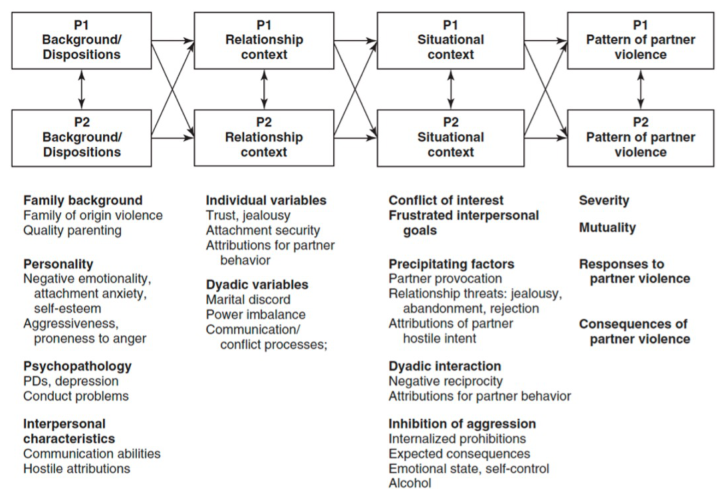

Table 1.
Information of the Total Studies Included.
| First Author, Year | Type of IPV | Focus of Study | Sample Characteristics | Number of Studies Included | Total Effect Sizes | Risk Markers Examined | Effect Size Measure | Gender Differences | Time Frame |
|---|---|---|---|---|---|---|---|---|---|
| Stith et al. (2004) | Physical abuse | Perpetration & Victimization | Heterosexual married and/or cohabiting couples | 85 | 308 effect sizes | 16 perpetration and 9 victimization risk markers | Correlation coefficient (r) | Reported only for perpetration of marital satisfaction due to lack of data on female perpetrators and male victims | 1980–2000 |
| Stith et al. (2008) | Physical aggression/violence | Perpetration & Victimization | Heterosexual married and/or cohabiting couples | 32 | 49 effect sizes | Marital satisfaction and marital discord | Correlation coefficient (r) | Found gender differences in perpetration vs. victimization | 1981–2005 |
| Oram et al. (2014) | Physical violenceb | Perpetration | Men and women aged ≥16 years with diagnosed psychiatric disorders | 17 | 11 effect sizes for lifetime physical violence against a partner | Psychiatric disorders, including schizophrenia, bipolar disorder, depression, PTSD, GAD, panic disorder, dysthymia, and social phobia | Odds ratio (OR) | Found higher risk in men than women | 1994–2012 |
| Spencer et al. (2016) | Physical IPV | Perpetration | Adult heterosexual married or cohabiting couples | 580 | 520 effect sizesa | 60 different risk markers | Correlation coefficient (r) | Found in 3 out of 60 risk markers | 1980–2012 |
| Cafferky et al. (2018) | Physical aggression/violence | Perpetration & Victimization | Adults in heterosexual relationships | 285 | 983 effect sizes | Substance use (overall), alcohol use, and drug use (various types) | Correlation coefficient (r) | Found in 3 out of 6 risk markers | 1980–2013 |
| Spencer et al. (2019a) | Physical IPV | Perpetration & Victimization | Ongoing adult romantic relationships | 207 | 511 effect sizes | Depression, anxiety, PTSD, BPD, and APD | Correlation coefficient (r) | Found in 1 out of 5 risk markers | 1980–2014 |
| Spencer et al. (2019b) | Physical IPV | Victimization | Adult heterosexual men and women in married or cohabiting relationships | 391 | 1,731 effect sizes | 50 risk markers for women, 28 risk markers for men | Correlation coefficient (r) | Found in 5 out of 28 risk markers | 1980–2016 |
| Spencer et al. (2022) | Physical IPV | Perpetration | Adults in opposite-sex relationships | 503 | 2,972 effect sizes | 63 different risk markers | Correlation coefficient (r) | Found in 9 out of 44 risk markers | 1980–2018 |
Note. BPD = Borderline Personality Disorder; APD = Antisocial Personality Disorder; PTSD = Posttraumatic Stress Disorder; GAD = Generalized Anxiety Disorder. a The number of effect sizes includes only those for the three risk markers that significantly differed between males and females. b Although this study examined various forms of IPV, the results focus on physical IPV due to a lack of data for other IPV types.
Table 2.
Background and Dispositional Characteristics Risk Markers.
| Risk Marker | Effect Size | Role in Violence | Gender | First Author, Year |
|---|---|---|---|---|
| Generalized anxiety disorder | .53 | Perpetrator | Malesa | Oram et al. (2014) c |
| Depression | .49 | Perpetrator | Males | Oram et al. (2014)c |
| History of abuse in past relationships | .49 | Victim | Males | Spencer et al. (2019b) |
| Panic disorder | .45 | Perpetrator | Males | Oram et al. (2014)c |
| Depression | .43 | Perpetrator | Females | Oram et al. (2014)c |
| Generalized anxiety disorder | .43 | Perpetrator | Females | Oram et al. (2014)c |
| Borderline personality disorder | .34 | Perpetrator | Bothb | Spencer et al. (2019a) |
| Posttraumatic stress disorder | .34 | Victim | Both | Spencer et al. (2019a) |
| Posttraumatic stress disorder | .34 | Victim | Females | Spencer et al. (2019b) |
| Panic disorder | .33 | Perpetrator | Females | Oram et al. (2014)c |
| Anger | .32 | Perpetrator | Both | Spencer et al. (2022) |
| Illicit drug use | .31 | Perpetrator | Males | Stith et al. (2004) |
| Traditional sex-role ideology | .29 | Perpetrator | Males | Stith et al. (2004) |
| Depression | .29 | Victim | Females | Spencer et al. (2019b) |
| Posttraumatic stress disorder | .29 | Victim | Males | Spencer et al. (2019b) |
| Fear | .29 | Victim | Females | Spencer et al. (2019b) |
| Depression | .28 | Victim | Females | Stith et al. (2004) |
| Antisocial personality disorder | .27 | Perpetrator | Both | Spencer et al. (2019a) |
| Antisocial personality disorder | .27 | Perpetrator | Both | Spencer et al. (2022) |
| General mental health problems | .27 | Perpetrator | Both | Spencer et al. (2022) |
| Fear of partner violence | .27 | Victim | Females | Stith et al. (2004) |
| Borderline personality disorder | .27 | Victim | Males | Spencer et al. (2019b) |
| History of abuse in past relationships | .27 | Victim | Females | Spencer et al. (2019b) |
| Anger/hostility | .26 | Perpetrator | Males | Stith et al. (2004) |
| Narcissism | .26 | Perpetrator | Both | Spencer et al. (2022) |
| External locus of control | .26 | Perpetrator | Both | Spencer et al. (2022) |
| Prior arrest | .26 | Perpetrator | Both | Spencer et al. (2022) |
| Drug use | .25 | Perpetrator | Both | Spencer et al. (2022) |
| Witnessing parental IPV | .25 | Perpetrator | Males | Spencer et al. (2022) |
| Depression | .25 | Victim | Both | Spencer et al. (2019a) |
| Drug use | .25 | Victim | Females | Spencer et al. (2019b) |
| Witnessing IPV and experiencing child physical abuse | .25 | Perpetrator | Males | Spencer et al. (2016) |
| Alcohol abuse | .24 | Perpetrator | Males | Stith et al. (2004) |
| Access to weapons | .24 | Perpetrator | Both | Spencer et al. (2022) |
| History of being abused as a child | .24 | Perpetrator | Males | Spencer et al. (2022) |
| Stress | .24 | Victim | Males | Spencer et al. (2019b) |
| Depression | .23 | Perpetrator | Males | Stith et al. (2004) |
| Substance use (alcohol and drug use) | .23 | Perpetrator | Males | Spencer et al. (2022) |
| Antisocial personality disorder | .23 | Victim | Females | Spencer et al. (2019b) |
| Childhood abuse in the family of origin | .23 | Victim | Females | Spencer et al. (2019b) |
| Substance use (alcohol + drug) | .23 | Perpetrator | Males | Cafferky et al. (2018) |
| Substance use (alcohol and drug use) | .22 | Perpetrator | Both | Spencer et al. (2022) |
| History of being abused as a child | .22 | Perpetrator | Both | Spencer et al. (2022) |
| Witnessing parental IPV | .22 | Perpetrator | Both | Spencer et al. (2022) |
| Depression | .22 | Perpetrator | Both | Spencer et al. (2022) |
| Alcohol use | .22 | Perpetrator | Males | Spencer et al. (2022) |
| Anger | .22 | Victim | Males | Spencer et al. (2019b) |
| Antisocial personality disorder | .22 | Victim | Males | Spencer et al. (2019b) |
| Substance use | .22 | Victim | Females | Spencer et al. (2019b) |
| Alcohol use | .22 | Perpetrator | Males | Cafferky et al. (2018) |
| Alcohol use | .22 | Perpetrator | Males | Spencer et al. (2016) |
| Posttraumatic stress disorder | .21 | Perpetrator | Both | Spencer et al. (2019a) |
| Depression | .21 | Perpetrator | Both | Spencer et al. (2019a) |
| Alcohol use | .21 | Perpetrator | Both | Spencer et al. (2022) |
| Posttraumatic stress disorder | .21 | Perpetrator | Both | Spencer et al. (2022) |
| Impulsivity | .21 | Perpetrator | Both | Spencer et al. (2022) |
| Drug use | .21 | Victim | Males | Spencer et al. (2019b) |
| Alcohol use | .21 | Victim | Females | Spencer et al. (2019b) |
| Anger | .21 | Victim | Females | Spencer et al. (2019b) |
| Substance use (alcohol + drug) | .21 | Victim | Females | Cafferky et al. (2018) |
| Adherence to traditional gender roles | .20 | Perpetrator | Both | Spencer et al. (2022) |
| Witnessing IPV in the family of origin | .20 | Victim | Females | Spencer et al. (2019b) |
| Borderline personality disorder | .20 | Victim | Females | Spencer et al. (2019b) |
| Anxious attachment style | .20 | Victim | Females | Spencer et al. (2019b) |
| Anxiety | .19 | Victim | Both | Spencer et al. (2019a) |
| Borderline personality disorder | .19 | Victim | Both | Spencer et al. (2019a) |
| Witnessing IPV and experiencing child physical abuse | .19 | Perpetrator | Females | Spencer et al. (2016) |
| Trauma | .18 | Perpetrator | Both | Spencer et al. (2022) |
| Antisocial personality disorder | .18 | Victim | Both | Spencer et al. (2019a) |
| Depression | .18 | Victim | Males | Spencer et al. (2019b) |
| Substance use (alcohol and drug use) | .17 | Perpetrator | Females | Spencer et al. (2022) |
| Witnessing parental IPV | .17 | Perpetrator | Females | Spencer et al. (2022) |
| Witnessing IPV in the family of origin | .17 | Victim | Males | Spencer et al. (2019b) |
| Approval of violence | .17 | Victim | Females | Spencer et al. (2019b) |
| Substance use (alcohol + drug) | .17 | Perpetrator | Females | Cafferky et al. (2018) |
| Substance use (alcohol + drug) | .17 | Victim | Males | Cafferky et al. (2018) |
| Alcohol use | .16 | Perpetrator | Females | Spencer et al. (2022) |
| Anxiety | .16 | Perpetrator | Both | Spencer et al. (2022) |
| Stress | .16 | Perpetrator | Both | Spencer et al. (2022) |
| Anxious attachment | .16 | Perpetrator | Both | Spencer et al. (2022) |
| Anxiety | .16 | Victim | Males | Spencer et al. (2019b) |
| Stress | .16 | Victim | Females | Spencer et al. (2019b) |
| Experiencing childhood abuse within the family | .15 | Victim | Males | Spencer et al. (2019b) |
| Alcohol use | .15 | Perpetrator | Females | Cafferky et al. (2018) |
| Alcohol use | .15 | Perpetrator | Females | Spencer et al. (2016) |
| History of being abused as a child | .14 | Perpetrator | Females | Spencer et al. (2022) |
| Alcohol use | .14 | Victim | Males | Spencer et al. (2019b) |
| Mental health problems | .14 | Victim | Females | Spencer et al. (2019b) |
| Anxiety | .13 | Perpetrator | Both | Spencer et al. (2019a) |
| Avoidant attachment | .13 | Perpetrator | Both | Spencer et al. (2022) |
| Alcohol abuse | .13 | Victim | Females | Stith et al. (2004) |
| Impulsivity | .13 | Victim | Males | Spencer et al. (2019b) |
| Disorganized attachment | .11 | Perpetrator | Both | Spencer et al. (2022) |
| Physical health problems | .11 | Perpetrator | Both | Spencer et al. (2022) |
| Traditional gender roles | .08 | Victim | Females | Spencer et al. (2019b) |
| Impulsivity | .07 | Victim | Females | Spencer et al. (2019b) |
| Internal locus of control | -.30 | Perpetrator | Males | Spencer et al. (2022) |
| Higher income | -.17 | Perpetrator | Both | Spencer et al. (2022) |
| Higher education | -.15 | Perpetrator | Males | Spencer et al. (2022) |
| Higher education | -.14 | Perpetrator | Both | Spencer et al. (2022) |
| Higher levels of self-esteem | -.14 | Perpetrator | Both | Spencer et al. (2022) |
| Older age | -.13 | Victim | Males | Spencer et al. (2019b) |
| Secure attachment | -.11 | Perpetrator | Both | Spencer et al. (2022) |
| Older age | -.10 | Perpetrator | Both | Spencer et al. (2022) |
| Religiosity | -.09 | Perpetrator | Males | Spencer et al. (2022) |
| Higher levels of education | -.09 | Victim | Females | Spencer et al. (2019b) |
| Employment | -.07 | Perpetrator | Both | Spencer et al. (2022) |
| Religiosity | -.07 | Perpetrator | Both | Spencer et al. (2022) |
| Older age | -.02 | Victim | Females | Spencer et al. (2019b) |
| General mental health problems | Nonsignificant | Perpetrator | Females | Spencer et al. (2022) |
| Approval of violence | Nonsignificant | Perpetrator | Females | Spencer et al. (2022) |
| Higher levels of self-esteem | Nonsignificant | Perpetrator | Females | Spencer et al. (2022) |
| Employment | Nonsignificant | Perpetrator | Females | Spencer et al. (2022) |
| Religiosity | Nonsignificant | Perpetrator | Females | Spencer et al. (2022) |
| Level of education | Nonsignificant | Victim | Males | Spencer et al. (2019b) |
| Employment status | Nonsignificant | Victim | Males | Spencer et al. (2019b) |
| Mental health problems | Nonsignificant | Victim | Males | Spencer et al. (2019b) |
| Secure attachment | Nonsignificant | Victim | Females | Spencer et al. (2019b) |
| Avoidant attachment | Nonsignificant | Victim | Females | Spencer et al. (2019b) |
| Physical health | Nonsignificant | Victim | Females | Spencer et al. (2019b) |
| Self-blame | Nonsignificant | Victim | Females | Spencer et al. (2019b) |
| Self-esteem | Nonsignificant | Victim | Females | Spencer et al. (2019b) |
| Trauma | Nonsignificant | Victim | Females | Spencer et al. (2019b) |
| Prior arrest | Nonsignificant | Victim | Females | Spencer et al. (2019b) |
| Religiosity | Nonsignificant | Victim | Females | Spencer et al. (2019b) |
| Employment | Nonsignificant | Victim | Females | Spencer et al. (2019b) |
| Drug use | Not Available | Victim | Males/Females | Cafferky et al. (2018) |
| Age | Not Available | Perpetrator | Males/Females | Spencer et al. (2016) |
| Education | Not Available | Perpetrator | Males/Females | Spencer et al. (2016) |
| Income | Not Available | Perpetrator | Males/Females | Spencer et al. (2016) |
| Employment status | Not Available | Perpetrator | Males/Females | Spencer et al. (2016) |
| Depression | Not Available | Perpetrator | Males/Females | Spencer et al. (2016) |
| Anxiety | Not Available | Perpetrator | Males/Females | Spencer et al. (2016) |
| Anger | Not Available | Perpetrator | Males/Females | Spencer et al. (2016) |
| Stress | Not Available | Perpetrator | Males/Females | Spencer et al. (2016) |
| Trauma | Not Available | Perpetrator | Males/Females | Spencer et al. (2016) |
| Self-esteem | Not Available | Perpetrator | Males/Females | Spencer et al. (2016) |
| Posttraumatic stress disorder | Not Available | Perpetrator | Males/Females | Spencer et al. (2016) |
| Antisocial personality disorder | Not Available | Perpetrator | Males/Females | Spencer et al. (2016) |
| Borderline personality disorder | Not Available | Perpetrator | Males/Females | Spencer et al. (2016) |
| General mental health | Not Available | Perpetrator | Males/Females | Spencer et al. (2016) |
| Drug use | Not Available | Perpetrator | Males/Females | Spencer et al. (2016) |
| Alcohol difficulties | Not Available | Perpetrator | Males/Females | Spencer et al. (2016) |
| Physical health status | Not Available | Perpetrator | Males/Females | Spencer et al. (2016) |
| History of spousal abuse | Not Available | Perpetrator | Males/Females | Spencer et al. (2016) |
| Internal locus of control | Not Available | Perpetrator | Males/Females | Spencer et al. (2016) |
| Approval of violence | Not Available | Perpetrator | Males/Females | Spencer et al. (2016) |
| Religiosity | Not Available | Perpetrator | Males/Females | Spencer et al. (2016) |
| Coping skills | Not Available | Perpetrator | Males/Females | Spencer et al. (2016) |
| Impulsivity | Not Available | Perpetrator | Males/Females | Spencer et al. (2016) |
| Belief in male privilege | Not Available | Perpetrator | Males/Females | Spencer et al. (2016) |
| Prior arrest | Not Available | Perpetrator | Males/Females | Spencer et al. (2016) |
| Attachment styles | Not Available | Perpetrator | Males/Females | Spencer et al. (2016) |
| Self-blame | Not Available | Perpetrator | Males/Females | Spencer et al. (2016) |
| Blaming others for IPV | Not Available | Perpetrator | Males/Females | Spencer et al. (2016) |
| Witnessing parental domestic violence | Not Available | Perpetrator | Males/Females | Spencer et al. (2016) |
| Observing mother hitting father | Not Available | Perpetrator | Males/Females | Spencer et al. (2016) |
| Observing father hitting mother | Not Available | Perpetrator | Males/Females | Spencer et al. (2016) |
| Experiencing physical abuse during childhood | Not Available | Perpetrator | Males/Females | Spencer et al. (2016) |
| Paternal child abuse | Not Available | Perpetrator | Males/Females | Spencer et al. (2016) |
| Maternal child abuse | Not Available | Perpetrator | Males/Females | Spencer et al. (2016) |
Note. a Effect sizes were considered separately for males and females. b Effect sizes were aggregated for males and females. c In this review, effect sizes originally reported as odds ratios were transformed into correlation coefficients for consistency and comparability. However, the results are approximate and should be interpreted with caution.
Table 3.
Relational Context Risk Markers for Physical IPV.
| Risk Marker | Effect Size | Role in Violence | Gender | First Author, Year |
|---|---|---|---|---|
| Previous injury | .64 | Victim | Malesa | Spencer et al. (2019b) |
| Caused previous injuries to partner | .58 | Perpetrator | Bothb | Spencer et al. (2022) |
| Previous physical IPV perpetration | .56 | Victim | Females | Spencer et al. (2019b) |
| Previous injury | .54 | Victim | Females | Spencer et al. (2019b) |
| Emotional IPV perpetration | .53 | Perpetrator | Both | Spencer et al. (2022) |
| Emotional abuse victimization | .53 | Victim | Males | Spencer et al. (2019b) |
| Physical IPV victimization | .52 | Perpetrator | Both | Spencer et al. (2022) |
| Emotional abuse victimization | .51 | Victim | Females | Spencer et al. (2019b) |
| Emotional/verbal abuse | .49 | Perpetrator | Males | Stith et al. (2004) |
| Previous physical IPV perpetration | .49 | Victim | Males | Spencer et al. (2019b) |
| Stalking perpetration | .47 | Perpetrator | Males | Spencer et al. (2022) |
| Emotional IPV victimization | .44 | Perpetrator | Both | Spencer et al. (2022) |
| Sexual abuse victimization | .44 | Perpetrator | Both | Spencer et al. (2022) |
| Victim of forced sex/sexual IPV victimization | .44 | Victim | Females | Spencer et al. (2019b) |
| Emotional abuse perpetration | .42 | Victim | Males | Spencer et al. (2019b) |
| Previous physical IPV perpetration | .42 | Perpetrator | Both | Spencer et al. (2022) |
| Demand/withdraw communication patterns | .42 | Perpetrator | Males | Spencer et al. (2022) |
| Demand/withdraw communication patterns | .41 | Perpetrator | Males | Spencer et al. (2016) |
| Emotional abuse perpetration | .41 | Victim | Females | Spencer et al. (2019b) |
| Victim of stalkingc | .40 | Victim | Females | Spencer et al. (2019b) |
| Threatens to harm selfc | .39 | Victim | Females | Spencer et al. (2019b) |
| Demand/withdraw communication patterns | .37 | Perpetrator | Both | Spencer et al. (2022) |
| Demand/withdrawc | .32 | Victim | Females | Spencer et al. (2019b) |
| Perpetrator’s controlling behaviorsc | .31 | Victim | Females | Spencer et al. (2019b) |
| Controlling behaviors | .30 | Perpetrator | Both | Spencer et al. (2022) |
| Relationship dissatisfaction | .27 | Victim | Females | Spencer et al. (2019b) |
| Perpetrator’s power in relationship | .25 | Victim | Females | Spencer et al. (2019b) |
| History of partner abuse | .24 | Perpetrator | Males | Stith et al. (2004) |
| Relationship dissatisfaction | .23 | Victim | Males | Spencer et al. (2019b) |
| Power in relationship | .18 | Perpetrator | Both | Spencer et al. (2022) |
| Demand/withdraw communication patterns | .16 | Perpetrator | Females | Spencer et al. (2022) |
| Demand/withdraw communication patterns | .16 | Perpetrator | Females | Spencer et al. (2016) |
| Marital satisfaction | Victim | Females | Stith et al. (2008) | |
| Marital satisfaction | Victim | Both | Stith et al. (2008) | |
| Marital satisfaction | Perpetrator | Males | Stith et al. (2004) | |
| Marital satisfaction | Victim | Males | Stith et al. (2008) | |
| Marital satisfaction | Perpetrator | Males | Stith et al. (2008) | |
| Marital satisfaction | Perpetrator | Both | Stith et al. (2008) | |
| Marital discord | Perpetrator | Both | Stith et al. (2008) | |
| Marital satisfaction | Perpetrator | Both | Stith et al. (2008) | |
| Marital satisfaction | Perpetrator | Females | Stith et al. (2004) | |
| Relationship satisfaction | Perpetrator | Both | Spencer et al. (2022) | |
| Communication skills | Perpetrator | Both | Spencer et al. (2022) | |
| Marital satisfaction | Perpetrator | Females | Stith et al. (2008) | |
| Coping skills | Perpetrator | Both | Spencer et al. (2022) | |
| Conflict resolution skills | Perpetrator | Both | Spencer et al. (2022) | |
| Relationship communication skills | Victim | Females | Spencer et al. (2019b) | |
| Length of time living together | Perpetrator | Both | Spencer et al. (2022) | |
| Empathy | Perpetrator | Males | Spencer et al. (2022) | |
| Length of relationship | Perpetrator | Both | Spencer et al. (2022) | |
| Marital status | Nonsignificant | Perpetrator | Both | Spencer et al. (2022) |
| Victim of forced sex/sexual IPV victimization | Nonsignificant | Victim | Males | Spencer et al. (2019b) |
| Perpetrator’s power in relationship | Nonsignificant | Victim | Males | Spencer et al. (2019b) |
| Marital status | Nonsignificant | Victim | Males | Spencer et al. (2019b) |
| Length of relationship | Nonsignificant | Victim | Males | Spencer et al. (2019b) |
| Conflict resolution skills | Nonsignificant | Victim | Females | Spencer et al. (2019b) |
| Length of relationship | Nonsignificant | Victim | Females | Spencer et al. (2019b) |
| Marital status (married or divorced) | Not Available | Perpetrator | Males/Females | Spencer et al. (2016) |
| Relationship length | Not Available | Perpetrator | Males/Females | Spencer et al. (2016) |
| Relational satisfaction | Not Available | Perpetrator | Males/Females | Spencer et al. (2016) |
| Relational distress | Not Available | Perpetrator | Males/Females | Spencer et al. (2016) |
| Communication patterns | Not Available | Perpetrator | Males/Females | Spencer et al. (2016) |
| Conflict resolution skills | Not Available | Perpetrator | Males/Females | Spencer et al. (2016) |
| Psychological/emotional abuse | Not Available | Perpetrator | Males/Females | Spencer et al. (2016) |
| Approval of violence in the relationship | Not Available | Perpetrator | Males/Females | Spencer et al. (2016) |
| Previous violence towards this partner | Not Available | Perpetrator | Males/Females | Spencer et al. (2016) |
| Previous victimization by this partner | Not Available | Perpetrator | Males/Females | Spencer et al. (2016) |
| Caused injury | Not Available | Perpetrator | Males/Females | Spencer et al. (2016) |
| Weapon use in previous violent incidents with the partner | Not Available | Perpetrator | Males/Females | Spencer et al. (2016) |
| Property destruction in previous violent incidents with the partner | Not Available | Perpetrator | Males/Females | Spencer et al. (2016) |
Note. a Effect sizes were considered separately for males and females. b Effect sizes were aggregated for males and females. c Risk marker only found for female victimization (not found for male victimization).
Table 4.
Situational Context Risk Markers.
| Risk Marker | Effect Size | Role in Violence | Gender | First Author, Year |
|---|---|---|---|---|
| Threatens to harm partner | .49 | Perpetrator | Botha | Spencer et al. (2022) |
| Forced sex | .45 | Perpetrator | Malesb | Stith et al. (2004) |
| Verbal arguments | .43 | Perpetrator | Both | Spencer et al. (2022) |
| Violence toward partner | .41 | Victim | Females | Stith et al. (2004) |
| Threatens to harm self | .39 | Victim | Females | Spencer et al. (2019b) |
| Violence toward non-family members | .28 | Perpetrator | Both | Spencer et al. (2022) |
| Career/Life stress | .26 | Perpetrator | Males | Stith et al. (2004) |
| Jealousy | .24 | Perpetrator | Both | Spencer et al. (2022) |
| Perpetrator’s jealousy | .23 | Victim | Females | Spencer et al. (2019b) |
| Infidelity | .22 | Perpetrator | Males | Spencer et al. (2022) |
| Separation | .21 | Victim | Females | Spencer et al. (2019b) |
| Jealousy | .17 | Perpetrator | Males | Stith et al. (2004) |
| Physically abusing own children | .17 | Perpetrator | Both | Spencer et al. (2022) |
| Being accused of infidelity | .14 | Victim | Females | Spencer et al. (2019b) |
| Financial stress | .11 | Perpetrator | Both | Spencer et al. (2022) |
| Threatens to harm self | .10 | Perpetrator | Males | Spencer et al. (2022) |
| Number of children | .08 | Perpetrator | Both | Spencer et al. (2022) |
| Number of children | .07 | Victim | Females | Spencer et al. (2019b) |
| Social support | Not available | Perpetrator | Males/Females | Spencer et al. (2016) |
| Physically abusing own children | Not available | Perpetrator | Males/Females | Spencer et al. (2016) |
| Financial stress | Not available | Perpetrator | Males/Females | Spencer et al. (2016) |
| Violence toward non-family members | Not available | Perpetrator | Males/Females | Spencer et al. (2016) |
| Number of children | Not available | Perpetrator | Males/Females | Spencer et al. (2016) |
| Verbal arguments | Not available | Perpetrator | Males/Females | Spencer et al. (2016) |
| Forced sex | Not available | Perpetrator | Males/Females | Spencer et al. (2016) |
| Number of children | Not available | Perpetrator | Males/Females | Spencer et al. (2016) |
| Separation | Not available | Perpetrator | Males/Females | Spencer et al. (2016) |
Note. a Effect sizes were aggregated for males and females. b Effect sizes were considered separately for males and females.
Disclaimer/Publisher’s Note: The statements, opinions and data contained in all publications are solely those of the individual author(s) and contributor(s) and not of MDPI and/or the editor(s). MDPI and/or the editor(s) disclaim responsibility for any injury to people or property resulting from any ideas, methods, instructions or products referred to in the content. |
© 2026 by the authors. Licensee MDPI, Basel, Switzerland. This article is an open access article distributed under the terms and conditions of the Creative Commons Attribution (CC BY) license (http://creativecommons.org/licenses/by/4.0/).
Copyright: This open access article is published under a Creative Commons CC BY 4.0 license, which permit the free download, distribution, and reuse, provided that the author and preprint are cited in any reuse.


