

Submitted:
03 July 2026
Posted:
06 July 2026
You are already at the latest version
Abstract
Norway spruce (Picea abies L.) growing in mountain forests is a sensitive indicator of environmental variability, but its growth response may be strongly modified by local site conditions, which is important for sustainable forest management under climate change. This study examined two spruce populations in the upper montane zone of the Śnieżnik Massif, Eastern Sudetes, southwestern Poland: one growing on a raised bog (Sadzonki—TS) and the other on mineral soil (Owczarnia—OW). Tree-ring width (TRW) chronologies were developed from 59 sampled trees and discs, covering 1781–2023 for TS and 1800–2023 for OW. Annual δ¹³C analysis was performed for a selected TS tree, and decadal wood geochemistry was analyzed for a selected disc. Spruces growing on the raised bog showed TRW less half in comparison to trees on mineral soil. TRW was mainly controlled by summer or spring–summer temperature, while precipitation had a stronger positive effect at the mineral-soil site. δ¹³C showed weak relationships with TRW but negative correlations with mean annual and summer temperature. Elevated concentrations of Na, K, Ca, Mg, Fe, Mn, Cu, Zn, and Pb occurred mainly in 1941–1950 and 1971–1980, indicating the influence of historical air pollution. The contrasting growth trends and health status of the two populations demonstrate that local habitat conditions strongly shape spruce responses to environmental change and should be considered in sustainable mountain forest conservation and adaptation strategies.
Keywords:
Norway spruce (Picea abies L.)
; tree‐ring width
; age of the tree
; peat bog geochemistry
; wood geochemistry
; carbon isotopes
; mountain peat bog
; Sudetes Mountains
; Śnieżnik Massif
1. Introduction
Mountain ecosystems, including forest stands developing in the upper climatic and vegetation belts and near the upper treeline, are among the most sensitive components of the natural environment. Their importance, however, extends beyond biological and landscape functions, as they play a key role in maintaining ecosystem services that are essential for the sustainable development of mountain areas. High-mountain forests contribute to water retention, slope stabilization, erosion control, carbon sequestration, regulation of the local microclimate, and the preservation of biodiversity [1,2]. At the same time, they provide a basis for the functioning of local communities, forest management, and tourism. Therefore, their degradation has not only environmental but also economic and social consequences, and is thus directly related to the broader issue of sustainable environmental management.
In recent centuries, these ecosystems have been subjected to strong anthropogenic pressure [3]. In many regions, forest stands were cleared, their species composition was altered, and non-native species or species not fully adapted to local site conditions were introduced into cultivation. Increasing air pollution, climate change, and growing pressure from emerging pathogens and pests have further weakened their resilience [4]. Another important factor that may affect the functioning of mountain forests is the development of tourist infrastructure [5], including hiking trails, mountain roads, ski lifts, and recreational facilities. Under conditions of intensive, and often mass, tourism, this may lead to habitat fragmentation, degradation of the soil cover, mechanical damage to vegetation, and a reduced regenerative capacity of forest stands [6,7,8]. This issue is particularly important from the perspective of sustainable development, as it requires reconciling the protection of vulnerable ecosystems with the economic and social needs of mountain regions.
Contemporary climate change overlaps with long-term human impacts and is particularly evident in mountain areas, where it is manifested by rising temperatures, changes in the length of the growing season, shifts in climatic and vegetation belts, and an increased frequency and intensity of extreme weather events. Droughts, heat waves, heavy rainfall, strong winds, and disturbances in snow cover may lead to reduced tree growth, weakened physiological condition, increased susceptibility to insect outbreaks and diseases, and, in extreme cases, the dieback of entire forest stands [9,10]. Examples of the large-scale decline of spruce forests, including those in the Harz Mountains in Germany, show that the consequences of such processes may persist for decades, leading to lasting ecosystem restructuring, economic losses, and deterioration of landscape quality and human well-being [11,12]. In this context, research on tree responses to climatic and environmental stress is of considerable practical importance, as it can support adaptation strategies, the protection of forest resources, and the planning of sustainable land use in mountain areas.
Trees, as organisms sensitive to changes in environmental conditions, record their course in annual increments formed in trunks, branches, and roots, thereby creating a precise archive of environmental change. This record is preserved not only in tree-ring width and anatomical features, such as cell size and number, cell wall thickness, the presence of deformations, or the degree of tissue lignification, but also in the chemical and isotopic composition of wood. Dendrochemistry, which includes the analysis of the chemical composition of tree rings, makes it possible to reveal long-term environmental changes, particularly events related to various types of anthropogenic pollution [13,14,15,16,17,18]. The results of such studies are often used in shaping sustainable environmental protection policies, especially those aimed at protecting forest ecosystems with low resilience, such as mountain spruce forest communities occurring near the upper tree line.
The analysis of stable carbon isotopes, particularly δ¹³C values in organic matter, is one of the key tools for reconstructing environmental conditions and assessing the physiological response of trees to climatic and site-related stress [19,20]. In research focused on sustainable development, it is particularly important that the isotopic record enables not only the reconstruction of past climate changes, but also the identification of sensitivity thresholds in forest ecosystems, which may be of considerable importance for their future management. The δ¹³C values in the annual increments of spruce and pine reflect the relationship between stomatal conductance and photosynthetic rate, expressed as the ratio of CO₂ concentration in the leaf intercellular spaces to atmospheric CO₂ concentration. During dry periods or under high vapor pressure deficit, trees reduce water loss by partially closing their stomata. This leads to an enrichment of organic matter in the ¹³C isotope and, consequently, to higher δ¹³C values. Under cooler or wetter conditions, when gas exchange is less restricted, δ¹³C values are generally lower. Thus, δ¹³C can be interpreted as an indicator of water stress, changes in water availability, and the intrinsic water-use efficiency of trees [21,22].
Combining isotopic analyses with dendrochronological studies substantially enhances the potential for reconstructing climatic and environmental changes. Assigning δ¹³C values to specific annual increments enables the isotopic record to be directly compared with tree-growth parameters [19,20,23]. High δ¹³C values co-occurring with narrow tree rings may indicate years of severe water stress, reduced stomatal conductance, and decreased productivity [19,21,22]. Conversely, low δ¹³C values accompanied by wide annual increments suggest periods more favorable for growth, associated with better water availability, suitable thermal conditions, and less restricted photosynthesis [20,22,24,25]. This approach makes it possible not only to reconstruct the history of climatic impacts on trees, but also to determine the extent to which the studied forest stands were resistant or susceptible to environmental stress [19,20,26].
From the perspective of sustainable development, it is particularly important that the results of dendroisotopic studies may have practical significance. They make it possible to identify periods critical for forest functioning, assess the effects of drought and climate warming on the condition of forest stands, and indicate the species, habitats, or sites most vulnerable to degradation. Such information can support adaptive forest management, the protection of mountain ecosystems, tourism planning, and measures aimed at mitigating the effects of climate change. In this context, studies of stable isotopes in annual tree increments are not merely a tool for reconstructing the past, but also an element of the knowledge system needed to forecast future changes and make decisions consistent with the principles of sustainable environmental management.
However, the number of studies that integrate dendrochronological, isotopic, and geochemical records in the analysis of trees growing under mountain conditions still appears to be limited. In this respect, areas located in the Śnieżnik Massif, Eastern Sudetes, south-western Poland, are particularly interesting, as the functioning of forest stands there may be shaped by the simultaneous influence of climatic, site-related, and anthropogenic factors. Such an integrated approach enables a better understanding of the mechanisms underlying tree responses to environmental variability and allows their usefulness as indicators of the condition of mountain ecosystems to be assessed.
The aim of this study is to: (i) determine the age structure of the studied forest stands and analyze their growth dynamics and growth–climate relationships; (ii) assess changes in the carbon isotopic record in the annual increments of trees growing under mountain conditions and interpret these changes in the context of climatic and environmental factors affecting forest stand condition; and (iii) determine the concentrations of Na, K, Ca, Mg, Fe, Cu, and Zn in 10-year increments of spruce growing on a peatland and relate the obtained results to the contribution of these elements in the peat substrate.
2. Materials and Methods
2.1. Study Area
The study area is located in the southern part of Poland, close to the Czech border, within the mesoregion of the Śnieżnik Massif, which represents the westernmost part of the Eastern Sudetes macroregion [27] (Figure 1, Table 1). The highest elevation is Mt Śnieżnik, reaching 1426 m a.s.l.
The study plots, Torfowisko Sadzonki, hereafter abbreviated as TS, and Owczarnia, hereafter abbreviated as OW, are located within the Lądek Zdrój Forest District, in the Stronie Śląskie forest division and Kamienica forest range, in forest subcompartments 288f and 287b, respectively. They are situated within the Natura 2000 site PLH020016 Góry Bialskie and Śnieżnik within the Śnieżnik Landscape Park, and also within the Śnieżnik Kłodzki Nature Reserve, which was enlarged in 2023 pursuant to the Regulation of the Regional Director for Environmental Protection in Wrocław of 30 December 2022 concerning the “Śnieżnik Kłodzki” Nature Reserve.
At the TS site (50.2018433°N, 16.8610533°E, 1231 m a.s.l.), high-mountain coniferous forest occurs, dominated by Picea abies. According to forest management documentation, the stand is 95 years old, with a diameter at breast height (DBH) of 17 cm and a height of 14 m, and is characterized by very poor technical quality, being damaged as a result of industrial impact. Peat-muck soils occur at this site. The peatland itself is located on a flat terrain surface [28].
The OW plot (50.2073508°N, 16.8617694°E, 1171 m a.s.l.) is located in the northern part of forest subcompartment 287b, which covers an area of 9.37 ha. It represents a high-mountain coniferous forest with a natural habitat character and soil- and water-protection functions. The stand is situated on a steep slope (13–17°) with an eastern exposure. The site is characterized by proper podzolic soil developed on sandy-gravelly loam and sandy-gravelly deposits. The soil surface is densely covered with vegetation, including blueberry (Vaccinium myrtillus), reed grass (Calamagrostis sp.), and haircap (Polytrichum sp.). According to forest management documentation, the stand has been damaged by 50% as a result of climatic factors and industrial activity. The young generation of trees originates from both natural and artificial regeneration. The plot is occupied by a spruce stand aged 210 years, with younger spruce trees also occurring locally, aged 115 and 85 years. The mean diameter at breast height (DBH) of the stand reaches 44 cm, and the mean tree height is 21 m [28].
2.2. Climate Data
The climate of this part of the Sudetes is highly diverse, ranging from conditions typical of intramontane basins (the moderately warm climatic zone below approximately 550 m a.s.l.) to those characteristic of the very cool climatic zone (950–1280 m a.s.l.), with long, cold winters and cool summers [29].
The Śnieżnik Massif forms an important orographic barrier to air masses approaching from the west and southwest. Incoming solar radiation is controlled primarily by elevation, slope aspect, slope gradient and valley morphology. The summit areas are characterised by a typical alpine climate, as documented by meteorological observations from the Śnieżka station (1603 m a.s.l.), whereas the climatic conditions of the intramontane basins are well represented by measurements from Kłodzko (228 m a.s.l.) (Figure 1).
At present, no meteorological station operates in the vicinity of the TS site. Continuous meteorological observations were carried out between 1881 and 1930 at Hala pod Śnieżnikiem (1220 m a.s.l.), situated approximately 1 km east of the study site and at a comparable elevation (1230 m a.s.l.). In subsequent years, meteorological records from this locality have been limited to periodic observations [29,30].
Past air temperature variability in the Śnieżnik Massif was reconstructed by Opała and Owczarek [31] using annual tree-ring widths of Norway spruce (Picea abies) collected within the Śnieżnik Landscape Park. The authors also examined the altitudinal air-temperature gradient between Kłodzko and the Śnieżnik Massif using instrumental observations from 1881–1930, including records from Kłodzko (228 m a.s.l.), Śnieżnik (1215 m a.s.l.) and Śnieżka (1603 m a.s.l.). Mean annual air temperature ranged from 0.1°C at Śnieżka to 7.4°C at Kłodzko, with an intermediate value of 2.4°C at Śnieżnik. These values were only slightly lower than those observed under present-day climatic conditions (Figure 2). Mean January temperatures were −7.1°C, −5.4°C and −2.4°C at Śnieżka, Śnieżnik and Kłodzko, respectively, whereas the corresponding July temperatures were 8.3°C, 11.2°C and 16.9°C [31]. The reconstructed temperature series indicates relatively cool conditions during the 1970s and 1980s, followed by the pronounced warming observed since the early 1990s [31].
The long-term mean annual precipitation total in the Śnieżnik region is estimated at 1182–1312 mm [29,31] (Figure 2). According to Piasecki [29], annual precipitation totals in the Śnieżnik Massif are more than 200 mm lower than those recorded at Śnieżka, while the mean precipitation gradient with elevation is approximately 62 mm per 100 m. Most annual precipitation falls between May and October [29] (Fig. 2). Notably, the vicinity of Hala pod Śnieżnikiem has experienced some of the highest precipitation totals ever recorded in Poland [32]. For example, in July 1997 the monthly precipitation total reached a record 950 mm. During only two days (6–7 July 1997), 428 mm of precipitation was recorded, while the cumulative total over three days (5–7 July 1997) reached 557 mm [32].
Accordingly, the present-day climatic conditions at TS and Hala pod Śnieżnikiem may be regarded as intermediate between those observed at Śnieżka and Kłodzko (Figure 2). Nevertheless, frequent temperature inversions and cold-air pooling in the intramontane basins, particularly during the cold half of the year, should also be considered, as they contribute to lower air temperatures and increased atmospheric humidity. Furthermore, numerous studies have documented a pronounced increase in air temperature associated with contemporary climate warming, which is also evident in mountainous regions [33,34,35,36,37]. Consequently, present-day mean annual air temperature and precipitation totals may differ from those recorded at the turn of the twentieth century by approximately 1°C and ±100–200 mm, respectively.
2.3. Peat Bog Sadzonki (TS)
Both 14C dating and pollen succession indicate that the sediments deposited in the TS are approximately 1800 cal BP. At that time, Picea dominated the upper forest reaches of the Śnieżnik Massif. In the lower parts it was accompanied by the most frequent Fagus, Abies and, to a lesser extent, Carpinus. This situation changed in the late 18th century, when most of the Fagus and Abies populations were cleared, likely for building and industrial purposes, and replaced by mass plantings of Picea [39]. Today, it is the dominant tree in the landscape, although its needles and seeds appear in peat with varying frequency throughout the paleobotanical record. Indicators of human activity appear with the greatest intensity from the late 18th to the early 20th century. The TS has been in good moisture condition for the last 1800 years, as indicated by the remains of peat-forming plants: Sphagnum medium/divinum and Warnstorfia fluitans, with the wettest phase from the 7th to the 17th century. In turn, from the 19th century to the present, a dry phase has continued, with dominant Sphagnum sect. Acutifolia, Vaccinium oxycoccos, Eriophorum vaginatum, and Andromeda polifolia. These moisture dependencies are further confirmed by analyses of Cladocera and Testae amoebae [40].
Regarding geomorphology of mire and shallow basin on rather flat terrain, the TS mire is non-raised bog with non-domed surface [41]. The truly ombrotrophic character of this mire is reflected in the characteristics of the mire: the dominant species of the Sphagnion magellanici alliance and the very low pH (<4.2) and water conductivity (<20.0 µS) of surface water [42,43]. These species are Eriophorum vaginatum and Vaccinium uliginosum, reached the high abundance, with admixture of Oxycoccus palustris, Vaccinium myrtillus, Andromeda polifolia and Calluna vulgaris, in the field layer. In the bottom layer Sphagnum russowii, S. angustifolium, S. capillifolium var. capillifolium and S. fallax are prominent and accompanied by S. magellanicum (currently probably as S. divinum). Above mentioned species form the community of the Eriophoro vaginati-Sphagnetum recurvi, which definitely dominates in the vegetation the mire, forming lawn habitats. The peaty spruce forest of the upper montane belt, the Calamagrostio villosae-Piceetum Schlüter 1969 sphagnetosum, adjoins in a narrow strip to the western side of the mire. The herb layer of this community is characterised by domination of Vaccinium myrtillus, V. vitis-idaea, Eriophorum vaginatum, Molinia coerulea, Anthoxanthum odoratum and Deschampsia flexuosa, while the moss layer is dominated by Sphagnum russowii and S. fallax [44].
2.4. Environmental Changes Driven by Human Activity
The area of the Śnieżnik Massif was intensively used as early as the Middle Ages, and probably even earlier. In addition to agriculture and animal husbandry, metal ores were mined and metallurgy developed, which led to changes in the structure of forest stands, including the removal of beech and fir and the planting of spruce [45,46,47,48,49,50,51,52]. Numerous adits and metal smelting works existed in the nearby surroundings, where various metal ores, including copper, iron, silver, and gold ores, were extracted. Settlements and towns, such as Bolesławów, also developed in this area [45,46]. Agriculture and pastoralism expanded strongly around them [53].
This settlement developed intermittently, with interruptions caused by the Hussite Wars and the Thirty Years’ War (1618–1648). Economic revival began in 1838, when the Śnieżnik Massif came under the rule of Princess Marianne of Orange. Her activity contributed to the intensive economic development of the area. Mining, mainly of metal ores, developed again, marble quarries were established, and numerous smelting works operated. Agriculture and forestry expanded very intensively, and towns and villages developed together with a road network covering the entire Śnieżnik Massif. Tourism also began to develop, which resulted in the construction of mountain shelters [54,55,56].
Intensive forest management was introduced, and spruce was planted on a large scale at the expense of beech and other species, leading to the transformation of existing forest stands. Deforestation caused by cultivation and pastoralism, including the creation of meadows, reached elevations above 800 m a.s.l. in the Śnieżnik Massif and the Bialskie Mountains, as documented by old photographs [57]. Numerous structures associated with pastoral activity also existed in this area, and their remains have survived to the present day; the Owczarnia site is located near one such ruin.
2.5. Tree-Ring Data Analysis
Cores were collected from trees using Pressler borers, at 1.5 m above ground level. In total, 53 trees were sampled, 32 trees from TS and 21 from OW (Table 1). In the laboratory, samples were glued onto boards, dried, and sliced with a knife in order to obtain a clear view of the tree-rings. In order to enhance tree–ring boundaries, the sample surfaces were smeared with chalk. Tree–ring width (TRW) was measured under a stereoscopic microscope down to 0.01 mm, using LBD_Measure software [61]. A total of 87 measuring radii and 10 066 tree–rings were measured.
Local chronologies were subsequently compiled using classic cross-dating methods. Based on the high visual similarity among dendrochronological sequences, and high values of statistical indices (Student’s t–test and correlation coefficient), dendrochronological sequences were selected for inclusion in the chronology. Sequences that were the least visually and statistically correlated were rejected. Chronology robustness was tested using COFECHA, part of the DPL software package [62,63,64]. The expressed population signal (EPS) coefficient was also computed [65]. Age trend and autocorrelation were subsequently removed from the dendrochronological sequences selected for the chronologies by means of an indexing process (a two-phase detrending technique, by fitting either a modified negative exponential curve or a regression line with a negative or zero slope) [62,63,66,67].
To study the growth–climate relationship, correlation and response function analysis were used [63,68,69]. Average monthly air temperature (T) from the meteorological station in Śnieżka and monthly total precipitation (P) from station in Kłodzko were used, from June of the year preceding growth (pVI) to September of the growth year (IX). The analysis was performed separately for temperature and precipitation, yielding r2 values (regression coefficients of determination) for each climate parameter for 75–year–long period (1948–2022).
2.6. Chemical Analyses
Chemical analyses included determining the Na, K, Ca, Mg, Fe, Cu, and Zn content in peat sediment samples and wood samples collected from a felled spruce tree growing in the Sadzonki peat bog until 2020. Peat was collected using an "INSTORF" probe 50 cm long and 10 cm in diameter, and the resulting undisturbed sediment core was divided into 25 samples representing 2 cm core segments. A disc (S4) was selected for chemical wood analysis (from six samples collected from dead and previously felled trees). The TRW sequence of sample S4 (1882-2020) correlates statistically and graphically with the local TS chronology (t = 4.685, r = 0.376). The wood samples contained 10 tree-rings, starting with the youngest one from 2020. In total, 8 samples representing a period of 80 years (1941-2020) were taken from the analyzed spruce wood. The mass of individual peat sediment and spruce wood samples was determined after freeze-drying using a Beta 1-8 LDplus laboratory freeze-dryer (Martin Christ). Dry matter samples were pre-mineralized by calcination at 550°C, and the resulting calcined ash was wet-mineralized in Teflon bombs after the addition of 8 ml of concentrated nitric acid, 2 ml of 10% hydrochloric acid, and 2 ml of hydrogen peroxide. The mineralization process was carried out in a Seedwave microwave mineralizer (Berghof). According to Ślęzak et al. [70], this is a highly effective technique, less time-consuming than conventional open-system digestion and guaranteeing high accuracy and repeatability of results.
Atomic absorption spectrometry assays of the solutions obtained to reveal their content of Na, K, Ca, Mg, Fe, Mn, Cu, Zn and Pb were conducted using an AAS SOLAAR 969 spectrometer (Unicam). To avoid interactions between the selected elements, a lanthanum solution was used in the concentrations specified by Pinta [71]. The concentrations of particular elements were expressed in mg/g d.w. (dry weight). The universality of the adopted laboratory procedure results from the possibility of its application to sediments with both low and high concentrations of individual elements [72]. W celu określenia wielkości bioakumulacji poszczególnych elementów chemicznych przez świerk rosnący na torfowisku obliczono stosunek mediany każdego z elementów w drewnie do ich mediany w 50 cm warstwie torfu (Mw/Mp). Chemical data were processed using Microsoft Office Excel, PAST software [73]; the latter was used to identify local geochemical zones.
2.7. Isotope Analyses
For isotopic analyses, a tree from the TS site, designated TS31 and diameter at breast height of 42 cm, was selected. A total of four cores were collected from this tree at a height of approximately 1.3–1.5 m above ground level, one above another, from the same side of the stem. One core was used for tree-ring width (TRW) measurements, whereas three cores, after cross-dating of annual rings, were cut into samples assigned to individual calendar years, covering the period from 1906 to 2023. The TRW sequence of sample TS31 shows a strong statistical and graphic correlation with the local TS chronology (t = 10.074, r = 0.696).
The δ¹³C values and carbon contents were determined using continuous-flow EA–IRMS with a Thermo Finnigan Elemental Analyzer coupled via a ConFlo IV interface to a Finnigan Delta V Advantage mass spectrometer. Approximately 1200–1500 µg of each sample was weighed into tin capsules and combusted at 1020°C. The resulting gases were carried by He through a reduction column at 650°C, water trap, and Porapak Q GC column, where N₂ and CO₂ were separated [74,75]. Isotopic data were processed using ISODAT NT 3.0 and expressed in δ notation relative to the V-PDB scale. The δ¹³C values were normalized using international and laboratory standards, including USGS24 and USGS40, with an analytical precision of ±0.2‰ [76,77,78]. Tree-ring δ¹³C values were corrected for the Suess effect using annual atmospheric δ¹³CO₂ data from Belmecheri and Lavergne [79] and a pre-industrial reference value of −6.71‰. This correction removes the atmospheric trend caused by anthropogenic emissions and improves the interpretation of the climatic and physiological signal recorded in wood [80,81,82,83,84]. Statistical analyses were conducted in Statistica 13 using Pearson correlation and simple linear regression after testing data normality. Significance was accepted at p < 0.05.
3. Results
3.1. Tree-Ring Width, Chronologies and Dendroclimatology
The largest number of tree-rings was measured for tree TS32 (on a peat bog), with 243 rings at a height of 1.5 m above ground level. In the TS plot, the age of the trees varies greatly: from 40 - 50 to over 200 years, indicating a natural succession process. In the OW plot, where the tree ages varied in the surveys (from 85 to 210 years) and samples were taken from the largest and oldest trees, the largest number of rings was obtained for tree OW17 – 224 rings, and most trees have over 150 tree-rings. However, due to the large size of the trunks (DBH often exceeding 70 cm), pith sections were not always sampled. The age structure of the oldest trees in the OW plot is less diverse than in the TS plot, which may indicate planting or natural regeneration after previous tree felling.
For each plot, a local chronology was compiled: the TS chronology is 243 years long (1781-2023) and is based on 22 individual increment sequences, with an average TRW of 0.70 mm (from 0.44 to 1.48), while the OW chronology is 224 years long (1800-2023) and is composed of 19 increment sequences, with an average TRW of 1.49 mm (from 0.75 to 1.86) (Table 2). Trees growing on the mineral surface (OW) exhibit wider TRW compared to trees growing on the peat bog (TS) throughout most of the period; only in the period from the 1960s to the 1990s was a larger TRW noted for trees on the peatland (Figure 3). The last 40 years of the OW chronology show an upward trend in growth, while for trees from the peatland (TS) there have been successive reductions in TRW. Cumulative radial growth of Norway spruce shows higher values for the OW chronology compared to the TS chronology throughout the trees' life: after the first 50 years of life, the OW reached 97 mm and the TS 44 mm, after 100 years, 143 and 85 mm, respectively, after 150 years, 181 and 124 mm, and after 200 years, 225 and 155 mm (Figure 4). Frost rings were observed, 5 in trees with TS and 10 in trees with OW. They mostly occurred in juvenile wood, only in the OW area also in mature wood (Figure 5).
Table 2. Basic statistics of measured and index (residual) Norway spruce local chronologies: TS and OW. Abbreviations: TRW - tree-ring width, SD - standard deviation, 1AC - first-order autocorrelation, MS - mean sensitivity, EPS - expressed population signal.
Spruce trees growing on mineral soil (OW) and peat bog (TS) are most sensitive to the temperature in the months of May-July (the higher the temperatures during this period, the wider the annual growth) (Figure 6). Additionally, for the TS site, positive correlation values for temperature also occur in September of the current and previous growing year, and negative ones in August of the previous year. For the OW site, statistically significant TRW-temperature relationships are observed in June and September of the previous year. For both sites, r2 for temperature is higher compared to that for precipitation: TS – 39% for temperature and 8% for precipitation, and for OW – 22% and 20% (respectively). The effect of precipitation on TRW for TS is small: only slight correlations are observed in October of the previous year, March, and June of the growing year. However, for the OW area the precipitation-TRW dependencies are higher: mainly positive correlation and regression values occur in November of the previous year, January and February and in August of the current year, only in June of the previous year a negative correlation value is recorded.
3.2. Chemistry
The concentration of individual geochemical elements in samples of peat and spruce wood growing in the peat bog is presented in Figure 7A and 7B and Table 3.
Ten-year spruce growth rings growing in an ombrogenous peat bog had a relatively uniform but low mineral matter content. The lowest mineral matter content (0.29%) was found in the rings from the decade 1961-1970, which also had the lowest concentrations of the identified elements. The highest mineral matter content was found in the rings from the decade 1941-1950 (0.39%), which also had the highest content of heavy metals (Fe, Cu, and Zn) and Na (Figure 1A). However, the highest concentrations of most elements were found in the wood rings from the decade 1971-1980, which had an average mineral matter content (0.32%). In this decade, the maximum content of K (209 μg/g), Ca (2394 μg/g), Mg (299 μg/g) and Mn (54 μg/g) was recorded, as well as above-average shares of Fe (16 μg/g) and Zn (31 μg/g).
Comparing the contents of individual chemical elements in spruce wood relative to the peat substrate (Table 3) reveals that, under the conditions of a poor, ombrogenic peat bog, significant bioaccumulation of Ca and Mn (Mw/Mp ratio > 1) occurred in spruce wood. The weakest bioaccumulation was observed for Fe, despite the fact that this element is very mobile under the reducing conditions of the peat bog. However, it is minimally incorporated into wood tissue. Significant bioaccumulation of Na, K, and Mg was also observed, while Cu and Zn were weakly bioaccumulated (Table 3).
Table 3. Ranges, mean values and medians of determined chemical elements in peat and spruce wood (Mw – median for wood, Mp – median for peat).
3.3. Stable Carbon Isotopes, Temperature and Precipitation Data
The analysis of carbon isotope composition (δ¹³C) in tree-ring organic matter revealed pronounced interannual variability as well as long-term changes (Figure 8). The figure presents two isotopic series: measured δ¹³C values without correction for the Suess effect and δ¹³C values corrected for the Suess effect. The uncorrected series documents the direct isotopic signal recorded in wood, whereas the corrected series reduces the influence of changes in the isotopic composition of atmospheric CO₂ resulting from fossil fuel combustion and more accurately reflects the potential physiological and environmental signal preserved in annual tree rings.
After correction for the Suess effect, δ¹³C values are shifted toward less negative values and range from approximately −22.6‰ to approximately −25.9‰. Several stages of variability can be distinguished in the corrected series. In the first decades of the twentieth century, δ¹³C values were relatively high, ranging from −23‰ to −24.5‰, whereas a decrease is evident during the 1930s. From the 1940s to the end of the 1950s, the values remained relatively stable. After approximately 1960, a distinct increase in δ¹³C values occurred, reaching a maximum in the 1970s. The highest values, up to approximately −22.6‰, were recorded in the first half of the 1970s. After 1980, δ¹³C values show a decreasing tendency, with the lowest values observed in the second decade of the twenty-first century. After 2018, a partial increase in δ¹³C values is visible; however, they still remain lower than those recorded during the maximum values of the 1970s.
Meteorological data from the Śnieżka station indicate clear long-term changes in climatic conditions during the analyzed period of 1950–2025. The most distinct signal is observed in mean annual air temperature, which shows a pronounced increasing trend (Figure 9). In the first decades of the analyzed period, mean annual temperature values were low and often oscillated around 0°C, reaching negative values in some years. Particularly low annual temperatures occurred in the 1950s and around 1980, when mean annual temperature fell below 0°C. Since the 1980s, a gradual shift of mean annual temperatures toward positive values has been observed. After 1990, cold years became increasingly rare, whereas values exceeding 1.0°C were recorded more frequently. Particularly pronounced warming is evident after 2000, with the highest mean annual temperature values occurring in the second decade of the twenty-first century. During this period, mean annual temperature at Śnieżka exceeded 2.0°C several times, locally reaching values close to 2.5–2.7°C. The course of the series and the trend line therefore indicate systematic warming of the high-mountain climate in the Śnieżka region.
Annual precipitation totals show considerably greater interannual variability than temperature (Figure 10). Over the entire analyzed period, precipitation values ranged from approximately 500–600 mm in the driest years to nearly 1900 mm in the wettest years. In the 1950s, 1960s and 1970s, years with very high precipitation totals, exceeding 1500 mm and locally even 1800 mm, occurred more frequently. Particularly high values were recorded in the second half of the 1950s, in the mid-1960s and in the second half of the 1970s. Since the 1980s, a gradual decrease in annual precipitation totals has been observed. In subsequent decades, years with precipitation totals in the range of approximately 900–1200 mm became increasingly frequent, whereas very high values, typical of the earlier part of the series, occurred less often. A marked decline is especially evident in the final years of the analyzed period, when annual precipitation totals reached some of the lowest values in the entire record. The trend line indicates an overall decreasing tendency.
4. Discussion
Spruces growing on mineral soil exhibit wider TRW compared to trees growing on peat bog. Only in the period from the 1960s to the 1990s was greater TRW observed in trees growing on peat bog. The last 40-year period in the chronological sequence saw an increase in tree-ring width for trees growing on mineral soil, while for trees growing on peat bog, there was a successive reduction in TRW. The width of the annual ring width of spruce in the Śnieżnik Massif growing on both mineral soil and peat bog depends on the temperature from May to July – the higher the temperature during this period, the wider the ring width. The strength of the relationship is weaker for trees growing on organic soil, and spruces growing on mineral soil are also sensitive to precipitation.
Modeling the ranges and areas of occurrence of 20 tree species forming European forests, including Picea abies, for the periods 2041-2060 and 2061-2080 for two climate change scenarios (SSP245 and SSP585) shows this species in a very unfavorable situation [85]. The SSP245 scenario corresponds to an increase in the greenhouse effect by 4.5 W/m² – RCP4.5, which represents a moderate human impact on the climate, while the SSP585 scenario is the worst-case scenario construct on fossil-fuel-based development, assuming an increase of as much as 8.5 W/m² of human impact on the greenhouse effect [86]. Unfortunately, for spruce, both scenarios predict very large area losses (>50% of the current distribution) and fragmentation of the distribution area over the next 40-60 years. Only areas of Western Europe and mountain ranges will not be subject to such strong climate change pressures [85].
Spruce tree-ring width in mountain settings is strongly site-dependent: elevation, moisture (rainfall and water availability in the soil), and temperature repeatedly shift the climate signal. High-elevation spruce is usually more temperature limited or more responsive to warm-season temperature changes than drought or moisture limited [31,87,88,89]. However, most available publications concern trees growing on mineral soil, on bedrock.
In the Śnieżnik Massif, Opała and Owczarek [31] conducted research on upper montane spruce forests. Based on a chronology constructed from samples collected from 55 trees growing at altitudes of 1200-1280 m above sea level and historical timber from the remains of wooden buildings, they found a correlation between TRW and temperature in the May-July period and a lack of correlation for precipitation. Using these correlations, they reconstructed temperature for the last 150 years, demonstrating, among other things, cooling at the end of the Little Ice Age and in the 1970s and 1980s, as well as the recent warming, which has been reflected in increases since the early 1990s [31].
Spruce trees from the Czech Republic (Karkonosze Mts., Jeseniky Mts. of the Sudetes, and Babia Góra Mts. of the Western Carpathians, 12 chronologies representing montane forests and the local timberline) were the subject of dendroclimatic studies [89]. These trees are sensitive to temperatures in June and July, as well as in October of the previous year (all positive correlations). They are less sensitive to precipitation in July (positive correlation coefficients). Due to the close proximity of the study areas to the Śnieżnik Massif (especially the Jeseniky Mts.), similar growth trends are observed in these trees: reductions in TRW in the 1970s and early 1980s, and since then, an increase in ring width [89].
In the Tatra Mountains, studies were conducted on spruce trees at 11 locations growing at elevations ranging from 839 to 1,468 m above sea level (10 chronologies were submitted for which dendroclimatic analyses were performed) [87]. A positive correlation was found between TRW and average monthly temperatures in March, April, June, and July in the current year. However, with increasing altitude, the strength of this correlation decreased in the March-April period and increased in the June-July period. Monthly temperature in October of the previous year also positively influenced TRW in all locations [87]. In the Alps, spruce has also been the subject of dendroclimatic studies. For example, in the Bavarian and Austrian Limestone Alps, 50 local chronologies were compiled based on over 500 trees growing at altitudes ranging from 527 to 1,670 m above sea level [88]. The higher the analyzed spruce stand, the stronger the effect of air temperature on TRW, the smaller the correlation for total precipitation, and the lower sensitivity to drought. Trees growing in the lowest location differences were strongly affected by rainfall deficiencies during the growing season. It was found that altitude was the main factor differentiating the dendroclimatic responses. However, contemporary climate change, manifested in the mountains primarily by rising temperatures, did not significantly affect either growth inhibition at lower altitudes or growth acceleration at higher altitudes [88].
The analysis of changes in the contribution of individual elements in the wood of spruce growing on a raised bog shows that the highest concentrations of most elements were recorded in the decade 1970–1980. This period is also regarded as the most unfavourable, particularly for spruce ecosystems in the Western Sudetes, due to exceptionally high air pollution and acid rain [90,91]. Acid rain, associated with industrial air pollution, leads to increased soil acidity and, consequently, to the leaching of base nutrients, as well as to the transformation of toxic substances into forms more readily available to plants [91].
Although air pollution was particularly detrimental to spruce trees growing on mineral substrates, in oligotrophic raised bogs it paradoxically contributed to their enrichment not only in toxic substances, but also in elements important for plant development. Geochemical data from the Sadzonki peat bog show a clear enrichment in potassium, calcium, and magnesium in the upper part of the peat profile (Figure 78), which may have created more favorable growth conditions for spruce. This may explain the distinctly wider annual tree-ring increments recorded from the 1960s to the 1980s in spruce growing on the peat bog, compared with the spruce stand growing on mineral substrate, where the leaching of base nutrients was the dominant process.
The carbon isotope composition recorded in annual tree rings of Norway spruce from the Śnieżnik Massif over the period 1907–2023 indicates that δ¹³C in wood organic matter represents a complex physiological and environmental signal rather than a simple proxy for a single climatic parameter. This is emphasized by numerous studies on stable isotopes in tree rings, which indicate that the carbon isotope composition of wood depends on the balance between CO₂ assimilation, stomatal conductance, water availability, radiation, temperature, the length of the growing season, and subsequent processes of assimilate transport and allocation within the tree [19,20,21,22,25]. In the analyzed δ¹³C profile corrected for the Suess effect, several phases of variability can be distinguished: relatively high δ¹³C values at the beginning of the twentieth century, a decrease in δ¹³C during the 1930s, a period of moderate stability in the mid-twentieth century, a distinct increase in δ¹³C values during the 1960s and 1970s, and a decline after approximately 1980. Such a pattern suggests that tree functioning was influenced by both climatic changes and non-climatic factors, including air pollution, changes in atmospheric composition, local water availability, and the physiological memory of previous growing seasons.
The basic mechanism for interpreting δ¹³C in wood is based on the relationship between isotopic fractionation during photosynthesis and the ratio of CO₂ concentration in the intercellular spaces of the leaf to that in the atmosphere, i.e., Cᵢ/Cₐ [21,22]. Under conditions of limited water availability or high vapor pressure deficit, trees partially close their stomata, thereby reducing transpiration but simultaneously limiting the supply of CO₂ to the leaf. This results in a decrease in Cᵢ/Cₐ and reduced discrimination against the ¹³C isotope, leading to less negative δ¹³C values in the newly formed organic matter [19,24]. In the case of optimal water availability and relatively open stomata, isotopic fractionation is greater, and δ¹³C values become more negative [e.g. 22,25]. Therefore, δ¹³C in annual tree rings can be regarded as an indicator of changes in stomatal conductance, photosynthesis, and intrinsic water-use efficiency, although such interpretation requires consideration of multiple factors that may influence the resulting carbon isotopic composition of plant tissue [19,20].
An important element of the analysis was the application of the Suess effect correction. The uncorrected δ¹³C values show a shift towards more negative values in the second half of the twentieth century and at the beginning of the twenty-first century. This is largely a consequence of the global decrease in δ¹³C values of atmospheric CO₂, caused by emissions of CO₂ from fossil fuel combustion, which is isotopically depleted in ¹³C [19,81,92,93].
Contemporary climate data from Śnieżka indicate a clear increase in mean annual air temperature and a decrease in annual precipitation totals during the period 1951–2023. This pattern suggests a shift in climatic conditions towards warmer and potentially drier conditions. Rising temperature may enhance evapotranspiration, intensify vapor pressure deficit, and extend the growing season, whereas declining precipitation may limit soil water recharge [94,95]. For trees, however, it is not the annual precipitation total itself that is of primary importance, but rather the seasonal availability of water during wood formation, particularly in the spring and summer months [19,96]. Therefore, correlations based solely on mean annual temperature and annual precipitation totals should be treated as an indication of the general climatic background rather than as a complete explanation of the mechanism controlling δ¹³C.
A moderate negative correlation between δ¹³C and mean annual air temperature (r = −0.438; p = 0.0001; n = 73) indicates that warmer years were statistically associated with more negative δ¹³C values. This result does not correspond to the simple water-stress model, according to which an increase in temperature should lead to enhanced evaporation, stomatal closure, and less negative δ¹³C values [19,22]. This suggests that annual temperature was probably not the direct and sole factor controlling the carbon isotopic composition of wood. It is likely that warmer years favoured a longer photosynthetic season, earlier cambial activation, or a greater contribution of assimilates formed under relatively open stomata, which may have resulted in more negative δ¹³C values [20,97].
A weaker positive correlation between δ¹³C and annual precipitation totals (r = 0.265; p = 0.0235; n = 73) also requires a complex interpretation. According to the classical isotopic model, greater water availability should lead to higher stomatal conductance and more negative δ¹³C values. In the present case, however, a positive relationship was obtained, which may indicate that annual precipitation totals do not reflect actual water availability during the wood-formation season. In mountain environments, the temporal distribution of precipitation, soil water retention, duration of snow cover, slope exposure, soil depth, and the frequency of short-term drought episodes during the growing season are of particular importance [19,96,98]. High annual precipitation totals may result from autumn–winter precipitation or from events occurring outside the period of active cambial growth and therefore do not necessarily translate directly into the isotopic composition of a given annual ring. Vaganov et al. [97] demonstrated that relationships between δ¹³C, tree-ring anatomy, and climate are multifactorial, and that temperature and precipitation are not always the most important factors shaping the carbon isotopic composition.
Of particular interest is the increase in δ¹³C values during the 1960s and 1970s. Less negative δ¹³C values may indicate periods of increased limitation of stomatal conductance, enhanced water-use efficiency, or a greater role of water stress [19,22,99]. In Central Europe, the 1960s and 1970s were a period of strong pressure from industrial pollution, especially emissions of SO₂, NOₓ, particulate matter, and acid deposition, which adversely affected the condition of mountain forests [100,101]. Air pollution can damage photosynthetic tissues, reduce the assimilatory surface area, disturb stomatal functioning, alter mineral nutrition, and increase the susceptibility of trees to drought and frost stress [26,100,101]. Therefore, the increase in δ¹³C during this period may be interpreted as a possible record of the combined effects of climatic stress and atmospheric pollution.
The potential influence of pollution is particularly important in the context of mountain forests in the Sudetes, which in the second half of the twentieth century were exposed to transboundary industrial emissions and acid deposition. The literature indicates that stable isotopes in tree rings may record not only climate but also changes in environmental conditions associated with atmospheric pollution [23,101]. The effects of SO₂ and acid deposition may lead to changes in the photosynthetic apparatus and in tree water relations, which can influence the relationship between CO₂ assimilation and stomatal conductance and, consequently, δ¹³C values [26,101].
The decrease in δ¹³C values after approximately 1980, also visible after correction for the Suess effect, may have resulted from several overlapping processes. The increase in atmospheric CO₂ concentration may alter the relationship between photosynthesis and stomatal conductance and lead to changes in intrinsic water-use efficiency [20,22,25,102]. Changes in stand structure, light availability, and competition among trees may influence photosynthesis and the isotopic record [19,20]. In addition, the reduction in atmospheric pollution pressure after the period of peak emissions may have contributed to partial recovery of the assimilatory apparatus and to a shift in the balance between assimilation and stomatal conductance [26,101].
Remobilisation of stored assimilates may also play an important role in the interpretation of δ¹³C. In conifers, earlywood may be partly formed from carbohydrates stored during the previous growing season, which means that the isotopic composition of a given annual increment may contain not only the signal of the current season but also that of conditions in the preceding year [20,103,104,105]. Vaganov et al. [97] demonstrated significant links between the δ¹³C of latewood in one year and the δ¹³C of earlywood in the following year, interpreting them as an effect of signal transfer associated with stored assimilates. Such a mechanism may influence correlations between the δ¹³C of the whole ring and annual climatic parameters, because part of the isotopic signal does not necessarily originate from the year to which a given annual increment is assigned.
The importance of carry-over effects from the previous season is particularly relevant in the case of spruce, which under mountain conditions may begin vegetative activity when current photosynthesis is still limited by temperature, light availability, or the condition of the assimilatory apparatus after winter. Under such conditions, the contribution of stored carbohydrates to earlywood formation may be relatively high [20,103,104]. For this reason, δ¹³C values in the whole annual increment may represent a mixture of earlywood and latewood signals, and thus signals from different phases of the growing season.
High-resolution studies show that intra-annual δ¹³C variability within a single tree ring may be considerable and may reflect changes in cambial activity, water availability, radiation, and the contribution of stored assimilates [20,97,106]. δ¹³C variability may also have been influenced by local site conditions. Trees growing on shallow, skeletal, or rapidly drying soils may experience water stress even in years with high precipitation totals, whereas trees growing in sites with greater soil water retention may be less sensitive to short-term precipitation deficits [19,96,98].
5. Conclusions
Spruce stands are a key element in maintaining a resilient and diverse high-mountain forest ecosystem, an integral component of mountain environments. These forests provide a range of ecosystem services (including oxygen production, carbon sequestration, water runoff retention and slowing, soil protection, air pollution reduction, and providing habitat for many other organisms). Norway spruce should remain the primary forest-forming species in the study areas. All actions undertaken here should lead to maintaining continuous forest cover (especially on slopes), which promotes soil protection and increases water resources. Natural regeneration processes should be supported and protected. The health of these stands should be constantly monitored (e.g., measuring TRW, defoliation, fruiting volume and seed condition, and regeneration status). Protection of high-mountain spruce stands from the negative effects of climate change and anthropogenic influences should involve maintaining the forests in their current state and preserving their ability to survive, regenerate, and adapt to ongoing changes.
Analyses conducted have shown that the response of Norway spruce in the Śnieżnik Massif to environmental changes is strongly modified by local site conditions. Trees growing on mineral substrate achieved wider TRW and, in recent decades, exhibited a positive growth trend than spruces growing on peat bogs, where growth limitation and greater susceptibility to stress are observed. The main climatic factor influencing tree-ring width was late spring and summer temperature, while precipitation was more significant at the mineral site. The geochemical record of wood indicates a clear influence of atmospheric pollution, particularly in the 1970s. In turn, carbon isotope composition documents the complex physiological response of trees resulting from the interaction of climate, water availability, changes in atmospheric CO₂, pollutants, and assimilate allocation processes. The results confirm that the integration of dendrochronological, isotopic, and geochemical analyses is an effective tool for assessing the condition of high-mountain forest ecosystems and can support their monitoring and adaptive management under conditions of ongoing climate change.
Funding
This study was co-financed by the Minister of Science under the “Regional Excellence Initiative” Program for 2024–2027 (RID/SP/0045/2024/01).
Institutional Review Board Statement
Not applicable.
Informed Consent Statement
Not applicable.
Data Availability Statement
The research data has been opened in the repository: Cedro, Anna; Borówka Ryszard, K.; Drzewicki Wojciech; 2026, Tree-ring width, dC13 and chemistry of wood of the Norway spruce (Picea abies L.) and peat from Sadzonki raised bog and Owczarnia plot (Śnieżnik Massif, S Poland). https://doi.org/10.18150/CTZRFV, RepOD. The research data will be opened after the article is accepted and a DOI number is obtained (embargo pending article acceptance).
Conflicts of Interest
The authors declare no conflicts of interest.
References
- Martín-López, B.; Leister, I.; Lorenzo Cruz, P.; Palomo, I.; Grêt-Regamey, A.; Harrison, P. A.; Walz, A. Nature’s contributions to people in mountains: A review. PLoS ONE 2019, 14(6), e0217847. [Google Scholar] [CrossRef] [PubMed]
- Mina, M.; Bugmann, H.; Cordonnier, T.; Irauschek, F.; Klopcic, M.; Pardos, M.; Cailleret, M. Future ecosystem services from European mountain forests under climate change. J. Appl. Ecol. 2017, 54(2), 389–401. [Google Scholar]
- McGrath, M.J.; Luyssaert, S.; Meyfroidt, P.; Kaplan, J.O.; Bürgi, M.; Chen, Y.; Valade, A. Reconstructing European forest management from 1600 to 2010. Biogeosciences 2015, 12(14), 4291–4316. [Google Scholar] [CrossRef]
- Trumbore, S.; Brando, P.; Hartmann, H. Forest health and global change. Science 2015, 349(6250), 814–818. [Google Scholar] [CrossRef] [PubMed]
- Ballantyne, M.; Pickering, C.M. The impacts of trail infrastructure on vegetation and soils: Current literature and future directions. J. Environ. Manag. 2015, 164, 53–64. [Google Scholar] [CrossRef]
- Holmes, M.A.; Whitacre, J.V.; Bennion, L.D.; Poteet, J.; Kuebbing, S.E. Land-use history and abiotic gradients drive abundance of non-native shrubs in Appalachian second-growth forests with histories of mining, agriculture, and logging. For. Ecol. Manag. 2021, 494, 119296. [Google Scholar] [CrossRef]
- He, X.; Ziegler, A.D.; Elsen, P.R.; Feng, Y.; Baker, J.C.A.; Liang, S.; Holden, J.; Spracklen, D.V.; Zeng, Z. Accelerating global mountain forest loss threatens biodiversity hotspots. One Earth 2023, 6/3, 2590–3322. [Google Scholar] [CrossRef]
- Zhou, Z.; Sun, Y.; Fang, M.; Sun, J.; Yang, P.; Kong, J.; Ding, S. Ecological Disturbance Caused by Land Use Change in the Karst Area, China: A Combined Structural and Functional Perspective. Chin. Geogr. Sci. 2025, 35, 755–768. [Google Scholar] [CrossRef]
- Jolly, W.M.M.; Dobbertin, N.E.; Zimmermann; Reichstein, M. Divergent vegetation growth responses to the 2003 heat wave in the Swiss Alps. Geophys. Res. Lett. 2005, 32, L18409. [Google Scholar] [CrossRef]
- Schickhoff, U.; Bobrowski, M.; Mal, S.; Schwab, N.; Singh, R. The World’s Mountains in the Anthropocene. In Mountain Landscapes in Transition;Sustainable Development Goals Series; Schickhoff, U., Singh, R., Mal, S., Eds.; Springer: Cham, 2022. [Google Scholar] [CrossRef]
- Thonfeld, F.; Gessner, U.; Holzwarth, S.; Kriese, J.; da Ponte, E.; Huth, J.; Kuenzer, C.A. First Assessment of Canopy Cover Loss in Germany’s Forests after the 2018–2020 Drought Years. Remote Sens. 2022, 14, 562. [Google Scholar] [CrossRef]
- Trautwein, J.F.; Rohde, L.R.; Militz, H.; et al. Outer appearance of bark-beetle-infested stands of Norway spruce after different standing storage durations: a case study in the Harz Mountains, Germany. J. For. Res. 2025, 36, 94. [Google Scholar] [CrossRef]
- Baes, C.F.; Mclaughlin, S.B. Trace elements in tree rings: Evidence of recent and historical air pollution. Science 1984, 224(4648), 494–497. [Google Scholar] [CrossRef] [PubMed]
- Padilla, K.L.; Anderson, K.A. Trace element concentration in tree-rings biomonitoring centuries of environmental change. Chemosphere 2002, 49, 575–585. [Google Scholar] [CrossRef] [PubMed]
- Bindler, R.; Renberg, I.; Klaminder, J.; Emteryd, O. Tree rings as Pb pollution archives? A comparison of 206Pb/207Pb isotope ratios in pine and other environmental media. Sci. Total Environ. 2004, 319(1), 173–183. [Google Scholar] [CrossRef] [PubMed]
- Scanlon, T.M.; Riscassi, A.L.; Demers, J.D.; Camper, T.D.; Lee, T.R.; Druckenbrod, D.L. Mercury Accumulation in Tree Rings: Observed Trends in Quantity and Isotopic Composition in Shenandoah National Park, Virgini. J. Geophys. Res. Biogeosciences 2020, 125, e2019JG005445. [Google Scholar] [CrossRef]
- Chen, S.; Yao, Q.; Chen, X.; Liu, J.; Chen, D.; Ou, T.; Liu, J.; Dong, Z.; Zheng, Z.; Fang, K. Tree-ring recorded variations of 10 heavy metal elements over the past 168 years in southeastern China. Elem. Sci. Anthr. 2021, 9, 1. [Google Scholar] [CrossRef]
- Kvasniak, J.; Ješkovský, M.; Kaizer, J.; Zeman, J.; Kontul, I.; Sučák, K.; Povinec, P.P. PIXE analysis of contaminants in tree rings in proximity of the aluminum processing factory in Ladomerská Vieska (Slovakia). J. Radioanal. Nucl. Chem. 2024, 333, 3335–3349. [Google Scholar] [CrossRef]
- McCarroll, D.; Loader, N.J. Stable isotopes in tree rings. Quat. Sci. Rev. 2004, 23, 771–801. [Google Scholar] [CrossRef]
- Gessler, A.; Ferrio, J.P.; Hommel, R.; Treydte, K.; Werner, R.A.; Monson, R.K. Stable isotopes in tree rings: towards a mechanistic understanding of isotope fractionation and mixing processes from the leaves to the wood. Tree Physiol. 2014, 34(8), 796–818. [Google Scholar] [CrossRef] [PubMed]
- Farquhar, G.D.; O’Leary, M.H.; Berry, J.A. On the relationship between carbon isotope discrimination and the intercellular CO₂ concentration in leaves. Aust. J. Plant Physiol. 1982, 9, 121–137. [Google Scholar]
- Farquhar, G.D.; Ehleringer, J.R.; Hubick, K.T. Carbon Isotope Discrimination and Photosynthesis. Annu. Rev. Plant Physiol. Plant Mol. Biol. 1989, 40, 503–537. [Google Scholar] [CrossRef]
- Siegwolf, R.T.W.; Saurer, M.; Schleser, G.H.; Gessler, A.; Cernusak, L.A. Stable isotopes in tree rings: fundamentals and applications. In Stable Isotopes in Tree Rings: Inferring Physiological, Climatic and Environmental Responses; Siegwolf, R.T.W., Brooks, J.R., Roden, J., Saurer, M., Eds.; Springer: Cham, Switzerland, 2022; pp. 3–20. [Google Scholar] [CrossRef]
- Brugnoli, E.; Farquhar, G.D. Photosynthetic fractionation of carbon isotopes. In Photosynthesis: Physiology and Metabolism; Leegood, R.C., Sharkey, T.D., von Caemmerer, S., Eds.; Springer: Dordrecht, The Netherlands, 2000; pp. 399–434. [Google Scholar] [CrossRef] [PubMed]
- Cernusak, L.A.; Ubierna, N.; Winter, K.; Holtum, J.A.M.; Marshall, J.D.; Farquhar, G.D. Environmental and physiological determinants of carbon isotope discrimination in terrestrial plants. New Phytol. 2013, 200, 950–965. [Google Scholar] [CrossRef] [PubMed]
- Cherubini, P.; Battipaglia, G.; Innes, J.L. Tree vitality and forest health: can tree-ring stable isotopes be used as indicators? Curr. For. Rep. 2021, 7, 69–80. [Google Scholar] [CrossRef]
- Richling, A.; Solon, J.; Macias, A.; Balon, J.; Borzyszkowski, J.; Kistrowski, M. (Eds.) Regionalna geografia fizyczna Polski [Regional Physical Geography of Poland]; Bogucki Wydawnictwo Naukowe: Poznań, 2021; pp. 1–608. [Google Scholar]
- Plan urządzenia lasu dla Nadleśnictwa Lądek Zdrój na lata 2020-2029 [Forest management plan for the Lądek Zdrój Forest District for 2020-2029]. Opracowanie: Biuro Urządzania Lasu i Geodezji Leśnej Oddział w Brzegu. Biuro Urządzania Lasu i Geodezji Leśnej Oddział w Brzegu, 2020.
- Piasecki, J. Wybrane cechy klimatu Masywu Śnieżnika [Selected Characteristics of the Climate of the Śnieżnik Massif]. In Masyw Śnieżnika. Zmiany w środowisku przyrodniczym [The Śnieżnik Massif: Changes in the Natural Environment].; Jahn, A., Kozłowski, S., Pulina, M., Eds.; Wyd. PAE: Warszawa, 1996; pp. 189–203. [Google Scholar]
- Baranowski, S.; Szczepankiewicz-Szmyrka, A.; Młostek, E. Zróżnicowanie topoklimatyczne w obrębie Masywu Śnieżnika Kłodzkiego [Topoclimatic differentiation of the Śnieżnik Kłodzki Mountain]. Dok. Geogr. 1980, 3, 96–104. [Google Scholar]
- Opała, M.; Owczarek, P. Zmienność warunków termicznych Masywu Śnieżnika odtworzona na podstawie słojów rocznych świerka pospolitego Picea abies Karst. i pozostałości zabudowy drewnianej [Variation of thermal conditions of the Śnieżnik Massif reconstructed based on annual growth rings of Norway spruce Picea abies Karst. and remains of wooden buildings]. Przyr. Sudet. 2016, 19, 211–222. [Google Scholar]
- Prokop, P. Maksymalne opady oraz czas ich trwania na świecie i w Polsce [Maximum precipitaions and their duration in the world and in Poland]. Przegląd Geofiz. 2006, 51(2), 147–160. [Google Scholar]
- Dubicka, M.; Głowicki, B. Air temperature and cloudiness at Śnieżka between 1901 and 1998. Pr. Geogr. UJ 2000, 107, 205–212. [Google Scholar]
- Głowicki, B. Symptoms of contemporary warming in the 100-year series of temperature measurements on the Śnieżka Mountains. Acta Univ. Wratisl. Stud. Geogr. 2003, 75(25), 142–150. [Google Scholar]
- Migała, K. Piętra klimatyczne w górach Europy a problemy zmian globalnych [Climatic belts in the European mountains and the issue of global changes]. Acta Univ. Wratislav. Stud. Geogr. 2005, 2718(78), 1–149. [Google Scholar]
- Migała, K.; Urban, G.; Tomczyński, K. Long-term air temperature variation in the Karkonosze mountains according to atmospheric circulation. Theor. Appl. Climatol. 2016, 125, 337–351. [Google Scholar] [CrossRef]
- Urban, G.; Tomczyński, K. Air temperature trends at Mount Śnieżka (Polish Sudetes) and solar activity, 1881–2012. Acta Geogr. Slov. 2017, 57(2), 33–44. [Google Scholar] [CrossRef]
- IMGW-PIB. Available online: https://danepubliczne.imgw.pl/ (accessed on 20 May 2025).
- Jansen, S.; Konrad, H.; Geburek, T. The extent of historic translocation of Norway spruce forest reproductive material in Europe. Ann. For. Sci. 2017, 74, 56. [Google Scholar] [CrossRef]
- Hrynowiecka, A.; Stachowicz-Rybka, R.; Niska, M.; Drzewicki, W.; Malkiewicz, M.; Sobczyk, A.; Kasprzak, M.; Borówka, R.K.; Okupny, D.; Cedro, A.; Cedro, B.; Zawadzki, D.; Sławińska, J.; Maciąg, Ł.; Ceglarek, W.; Skoczylas-Śniaz, S.; Stachowicz, K.; Wojtuń, B.; Meserszmit, M.; Jiroušek, M.; Plášek, V.; Michczyński, A.; Sikorski, J.; Łuców, D.; Jakubiak, M.; Ratajczak-Skrzatek, U.; Jędrysek, M.; Pleśniak, Ł.; Stefaniak, K.; Hájková, P. How did climate and human impact influence a high-mountain ombrotrophic bog over the last 1.8 ky? 2026, In press. [Google Scholar]
- Rydin, H.; Jeglum, J.K. The Biology of Peatlands. Biology of Habitas; Oxford University Press, 2006; p. 343. [Google Scholar]
- Wojtuń, B. Peat mosses (Sphagnaceae) in mires of the Sudetes Mountains (SW Poland): a floristic and ecological study. Wyd. Akademii Rolniczej 2006, 225. [Google Scholar]
- Wojtuń, B.; Sendyk, A.; Martyniak, D. Sphagnum species along environmental gradients in mires of the Sudety Mountains (SW Poland). Boreal Environ. Res. 2013, 18, 74–88. [Google Scholar]
- Tomaszewska, K.; Grzymkowska, B.; Mastalska, B. Szata roślinna torfowiska wysokiego w Masywie Śnieżnika i zmiany na przestrzeni 60 lat z uwzględnieniem aktualnej zawartości metali ciężkich w torfowcach [Vegetation cover of the raised bog in the Śnieżnik Massif and changes over 60 years, taking into account the current content of heavy metals in peat mosses]. Zesz. Nauk. Akad. Rol. We Wrocławiu Rol. 1996, LXVII 300, 171–184. [Google Scholar]
- Ciężkowski, W. Surowce mineralne doliny Kleśnicy oraz ich eksploatacja [Mineral resources of the Kleśnica valley and their exploitation]. In Jaskinia Niedźwiedzia w Kletnie. badania i udostępnienie; Jahn., A., Kozłowski, S., Wiszniowska, T., Eds.; Ossolineum: Wrocław, 1989; pp. 137–146. [Google Scholar]
- Ciężkowski, W.; Irmiński, W.; Kozłowski, S.; Mikulski, S.Z.; Przeniosło, S.; Sylwestrzak, H. Zmiany w litosferze wywołane eksploatacją surowców mineralnych [Changes in the lithosphere caused by the exploitation of mineral resources]. In Masyw Śnieżnika. Zmiany w środowisku przyrodniczym; Jahn, A., Kozłowski, S., Pulina, M., Eds.; Polska Agencja Ekologiczna: Warszawa, 1996; pp. 85–120. [Google Scholar]
- Madeyska, T. Type Region P-f: Sudetes Mts.-Bystrzyckie Mts. Acta Palaeobot. 1989, 29(2), 37–41. [Google Scholar]
- Madeyska, T. The history of the Zieleniec Mire and the surrounding areas based on the palynological research. Monogr. Bot. 2005, 94, 146–157. [Google Scholar]
- Speranza, A.; Hanke, J.; van Geel, B.; Fanta, J. Late-Holocene human impact and peat development in the Černá Hora bog, Krkonoše Mountains, Czech Republic. The Holocene 2000, 10(5), 575–585. [Google Scholar] [CrossRef]
- Błażejewski, A. Pre-roman iron age, Roman period and early migrations period in northern Sudety Mountains. State of materials and research. Acta Archaeol. Carpathica 2006, 41, 85–100. [Google Scholar]
- Novák, J.; Petr, L.; Treml, V. Late-Holocene human-induced changes to the extent of alpine areas in the East Sudetes, Central Europe. The Holocene 2010, 20(6), 895–905. [Google Scholar]
- Dudová, L.; Hájková, P.; Buchtova, H.; Opravilová, V. Formation, succession and landscape history of Central-European summit raised bogs: A multiproxy study from the Hruby Jesenik Mountains. The Holocene 2012, 23(2), 230–242. [Google Scholar] [CrossRef]
- Ciężkowski, W.; Szwarc, J. Śnieżnik – dzieje zagospodarowania szczytu [Śnieżnik – the history of the development of the peak]. Wierchy 1980, 49, 328–334. [Google Scholar]
- Fogger, J. Beiträge zur Wirtschaftkunde der Grafschaft Glatz [Contributions to the economics of the County of Glatz]; Kierspe-Banhof: Weil am Rhein, Germany, 1952. [Google Scholar]
- Mazurski, K.R. Miłość i dramaty Królewny Marianny [The Love and Dramas of Princess Marianna]; Wydawnictwo PRESSforum: Polanica-Zdrój, Poland, 2023; p. 217. [Google Scholar]
- Cedro, A.; Cedro, B.; Borówka, R.K.; Okupny, D.; Osóch, P.; Stefaniak, K.; Wojtuń, B.; Kasprzak, M.; Ratajczak-Skrzatek, U.; Kmiecik, P.; Rusinek, K.; Jiroušek, M.; Plášek, V.; Hrynowiecka, A.; Michczyński, A. Witness of the Little Ice Age – One of the Oldest Spruces in Poland (Śnieżnik Massif, Sudetes, SW Poland). Forests 2024, 15, 986. [Google Scholar] [CrossRef]
- Franczukowski, Z. Gmina Stronie Śląskie – kraina królewny Marianny Orańskiej na dawnej fotografii [Stronie Śląskie Commune – the land of Princess Marianna of Orange in an old photograph]; Gmina Wydawnictwo PRESSforum Polanica-Zdrój, na zlecenie Gminy Stronie Śląskie, 2023; p. 175 pp. [Google Scholar]
- Ludwig, O. Die pontische und aquilonare Elements in der Flora Schlesiens [The Pontic and Aquilonian elements in the flora of Silesia]. Bot. Jahrbücher 1923, 58(Beiblatt 130), 11–38. [Google Scholar]
- Fabiszewski, J. Wstępna charakterystyka geobotaniczna Jaskini Niedźwiedziej w Masywie Śnieżnika [Preliminary geobotanical characterization of the Niedźwiedzia Cave in the Śnieżnik Massif]. Acta Univ. Wratislav. Stud. Geogr. 1970, 14, 85–117. [Google Scholar]
- Matuszkiewicz, A.; Matuszkiewicz, W. Przegląd fitosocjologiczny zbiorowisk leśnych Polski. Cz. 1. Lasy bukowe [Phytosociological review of forest communities in Poland. Part 1. Beech forests]. Phytocenosis 1973, 2((2)), 142–202. [Google Scholar]
- LBD_Measure; Version 1.0; Laboratorium Datowań Bezwzględnych: Kraków, Poland, 2020.
- Holmes, R.J. Computer-assisted quality control in tree-ring dating and measurement. Tree-Ring Bull. 1983, 43, 69–78. [Google Scholar]
- Holmes, R.J. Dendrochronology Program Library; User’s Manual; University of Arizona: Tucson, AZ, USA, 1994; Available online: https://www.ltrr.arizona.edu/software.html (accessed on 20 May 2021).
- Grissino-Mayer, H.D. Evaluating crossdating accuracy: a manual and tutorial for the computer program COFECHA. Tree-Ring Res. 2001, 57(2), 205−221. [Google Scholar]
- Wigley, T.M.L.; Briffa, K.R.; Jones, P.D. On the average value of correlated time series, with applications in dendroclimatology and hydrometeorology. J. Clim. Appl. Meteorol. 1984, 23, 201–213. [Google Scholar] [CrossRef]
- Cook, E.R.; Holmes, R.L. Guide for computer program ARSTAN. In The International Tree-Ring Data Bank Program Library Version 2.0 User’s Manual; Grissino-Mayer, H.D., Holmes, R.L., Fritts, H.C., Eds.; Laboratory of Tree-Ring Research: Tuscon, AZ, USA, 1996; pp. 75–87. [Google Scholar]
- Cook, E.R.; Kairiukstis, A. Methods of Dendrochronology; Kluwer Academic Publishers: Dordrecht, The Netherlands; Boston, MA, USA; London, UK, 1992; p. 394. [Google Scholar]
- Garcia-Suarez, A.M.; Butler, C.J.; Baillie, M.G.L. Climate signal in tree-ring chronologies in a temperate climate: A multi-species approach. Dendrochronologia 2009, 27, 183–198. [Google Scholar]
- Selvamuthu, D.; Das, D. Analysis of correlation and regression. In Introduction to Statistical Methods, Design of Experiments and Statistical Quality Control; Singapore, 2018. [Google Scholar]
- Ślęzak, E.; Poluszyńska, J.; Wieczorek, P.P.; Sławińska, I. Mineralizacja mikrofalowa jako efektywna metoda roztwarzania stałych próbek środowiskowych [The microwave mineralization as efficient digestion method for solid environmental matrices]. Pr. Inst. Ceram. I Mater. Bud. 2016, 26, 151–159. [Google Scholar]
- Pinta, W. Absorpcyjna spektrometria atomowa. Zastosowania w analizie chemicznej [Atomic Absorption Spectrometry. Applications in Chemical Analysis]; Państwowe Wydawnictwo Naukowe: Warszawa, 1977; p. 658. [Google Scholar]
- Minczewski, J.; Marczenko, Z. Chemia analityczna. Tom II. Analiza ilościowa [Analytical Chemistry. Volume II. Quantitative Analysis]; Państwowe Wydawnictwo Naukowe: Warszawa, 1978; p. 396. [Google Scholar]
- Hammer, Ø.; Harper, D.A.T.; Rayan, P.D. PAST: Paleontological Statistics software package for education and data analysis. Palaeontol. Electron. 2001, 4(1), 1–9. [Google Scholar]
- Ogawa, N.O.; Nagata, T.; Kitazato, H.; Ohkouchi, N. Ultrasensitive elemental analyzer/isotope ratio mass spectrometer for stable nitrogen and carbon isotope analyses. Earth Life Isot. 2010, 21, 339–353. [Google Scholar]
- Habfast, K. Advanced Isotope Ratio Mass Spectrometry I: Magnetic Isotope Ratio Mass Spectrometers. In Modern Isotope Ratio Mass Spectrometry; Platzner, I.T., Ed.; Wiley: New York, 2015; pp. 11–82. [Google Scholar]
- Hoefs, J. Stable Isotope Geochemistry, 6th ed.; Springer: Berlin Heidelberg, 2009. [Google Scholar]
- Paul, D.; Skrzypek, G.; Forizs, I. Normalization of measured stable isotope composition to isotope reference scale-a review. Rapid Commun. Mass Spectrom. 2007, 21, 3006–3014. [Google Scholar] [PubMed]
- Skrzypek, G.; Sadler, R.; Paul, D. Error propagation in normalization of stable isotope data: a Monte Carlo analysis. Rapid Commun. Mass Spectrom. 2010, 24, 2697–2705. [Google Scholar] [CrossRef] [PubMed]
- Belmecheri, S.; Lavergne, A. Compiled records of atmospheric CO₂ concentrations and stable carbon isotopes to reconstruct climate and derive plant ecophysiological indices from tree rings. Dendrochronologia 2020, 63, 125748. [Google Scholar] [CrossRef]
- Pazdur, A.; Nakamura, T.; Pawełczyk, S.; Pawlyta, J.; Piotrowska, N.; Rakowski, A.; Sensuła, B.; Szczepanek, M. Carbon isotopes in tree rings: Climate and the Suess effect interferences in the last 400 years. Radiocarbon 2007, 49(2), 775–788. [Google Scholar] [CrossRef]
- Graven, H.; Keeling, R.F.; Rogelj, J.; Werner, R.A.; Meinshausen, M.; Gruber, N. Changes to carbon isotopes in atmospheric CO₂ over the industrial era and into the future. Glob. Biogeochem. Cycles 2020, 34(11), e2019GB006170. [Google Scholar] [CrossRef] [PubMed]
- Cernusak, L.A.; Ubierna, N. Carbon Isotope Effects in Relation to CO₂ Assimilation by Tree Canopies. In Stable Isotopes in Tree Rings: Inferring Physiological, Climatic and Environmental Responses. Tree Physiology; Siegwolf, R.T.W., Brooks, J.R., Roden, J., Saurer, M., Eds.; Springer: Cham, 2022; p. 8. [Google Scholar] [CrossRef]
- NOAA Global Monitoring Laboratory. Trends in atmospheric carbon dioxide. In NOAA Global Monitoring Laboratory; 2026. [Google Scholar] [CrossRef]
- Scripps Institution of Oceanography. The Keeling Curve: Atmospheric CO₂ concentrations measured at Mauna Loa Observatory. Scripps CO₂ Program, University of California San Diego. 2026. Available online: https://keelingcurve.ucsd.edu/.
- Dyderski, M.K.; Paź-Dyderska, S.; Jagodziński, A.M.; Puchałka, R. Shifts in native tree species distributions in Europe under climate change. J. Environ. Manag. 2025, 373, 123504. [Google Scholar]
- Lee, H.; Romero, J. (Eds.) IPCC: Climate Change 2023: Synthesis Report. Contribution of Working Groups I, II and III to the Sixth Assessment Report of the Intergovernmental Panel on Climate Change [Core Writing Team; IPCC: Geneva, Switzerland, 2023; pp. 35–115. [Google Scholar] [CrossRef]
- Savva, Y.; Oleksyn, J.; Reich, P.B.; Vaganov, E.A.; Modrzyński, J. Interannual growth response of Norway spruce to climate along an altitudinal gradient in the Tatra Mountains, Poland. Trees 2006, 20, 735–746. [Google Scholar] [CrossRef]
- Hartl-Meier, C.; Zang, C.; Dittmar, C.; Esper, J.; Göttlein, A.; Rothe, A. Vulnerability of Norway spruce to climate change in mountain forests of the European Alps. Clim. Res. 2014, 60, 119–132. [Google Scholar] [CrossRef]
- Ponocná, T.; Spyt, B.; Kaczka, R.; Buntgen, U.; Treml, V. Growth trends and climate responses of Norway spruce along elevational gradients in East-Central Europe. Trees 2016, 30, 1633–1646. [Google Scholar] [CrossRef]
- Grodzińska, K. Skażenie parków narodowych metalami ciężkimi [Contamination of national parks with heavy metals]. Aura 1978, 4, 5–6. [Google Scholar]
- Jadczyk, P. Przyczyny zniszczenia lasów w Górach Izerskich i Karkonoszach I. Warunki Środowiska i czynniki antropogeniczne [The causes of forest destruction in the Izera Mountains and the Karkonosze Mountains. I. Environmental conditions and anthropogenic factors]. Sylwan 1994, 138(12), 39–47. [Google Scholar]
- Keeling, C.D. The Suess effect: 13Carbon–14Carbon interrelations. Environ. Int. 1979, 2(4–6), 229–300. [Google Scholar]
- Francey, R.J.; Allison, C.E.; Etheridge, D.M.; Trudinger, C.M.; Enting, I.G.; Leuenberger, M.; Langenfelds, R.L.; Michel, E.; Steele, L.P. A 1000-year high precision record of δ13C in atmospheric CO₂. Tellus B Chem. Phys. Meteorol. 1999, 51, 170–193. [Google Scholar] [CrossRef]
- Allen, C.D.; Macalady, A.K.; Chenchouni, H.; Bachelet, D.; McDowell, N.; Vennetier, M.; Kitzberger, T.; Rigling, A.; Breshears, D.D.; Hogg, E.H.; et al. A global overview of drought and heat-induced tree mortality reveals emerging climate change risks for forests. For. Ecol. Manag. 2010, 259, 660–684. [Google Scholar] [CrossRef]
- Williams, A.P.; Allen, C.D.; Macalady, A.K.; Griffin, D.; Woodhouse, C.A.; Meko, D.M.; Swetnam, T.W.; Rauscher, S.A.; Seager, R.; Grissino-Mayer, H.D.; et al. Temperature as a potent driver of regional forest drought stress and tree mortality. Nat. Clim. Change 2013, 3, 292–297. [Google Scholar] [CrossRef]
- Vaganov, E.A.; Hughes, M.K.; Shashkin, A.V. Growth Dynamics of Conifer Tree Rings: Images of Past and Future Environments; Springer: Berlin/Heidelberg, Germany, 2006. [Google Scholar] [CrossRef]
- Vaganov, E.A.; Schulze, E.-D.; Skomarkova, M.V.; Knohl, A.; Brand, W.A.; Roscher, C. Intra-annual variability of anatomical structure and δ13C values within tree rings of spruce and pine in alpine, temperate and boreal Europe. Oecologia 2009, 161, 729–745. [Google Scholar] [CrossRef] [PubMed]
- Fritts, H.C. Tree Rings and Climate; Academic Press: London–New York–San Francisco, 1976; p. 567 pp. [Google Scholar]
- Saurer, M.; Borella, S.; Schweingruber, F.; Siegwolf, R. Stable carbon isotopes in tree rings of beech: climatic versus site-related influences. Trees 1997, 11, 291–297. [Google Scholar] [CrossRef]
- Kandler, O.; Innes, J.L. Air pollution and forest decline in Central Europe. Environ. Pollut. 1995, 90, 171–180. [Google Scholar] [CrossRef] [PubMed]
- Savard, M.M. Tree-ring stable isotopes and historical perspectives on pollution—an overview. Environ. Pollut. 2010, 158(6), 2007–2013. [Google Scholar] [CrossRef] [PubMed]
- Saurer, M.; Siegwolf, R.T.W.; Schweingruber, F.H. Carbon isotope discrimination indicates improving water-use efficiency of trees in northern Eurasia over the last 100 years. Glob. Change Biol. 2004, 10, 2109–2120. [Google Scholar] [CrossRef]
- Helle, G.; Schleser, G.H. Beyond CO₂-fixation by Rubisco—an interpretation of 13C/12C variations in tree rings from novel intra-seasonal studies on broad-leaf trees. Plant Cell Environ. 2004, 27, 367–380. [Google Scholar] [CrossRef]
- Kagawa, A.; Sugimoto, A.; Maximov, T.C. 13CO₂ pulse-labelling of photoassimilates reveals carbon allocation within and between tree rings. Plant Cell Environ. 2006, 29, 1571–1584. [Google Scholar] [CrossRef] [PubMed]
- Kimak, A.; Leuenberger, M. Are carbohydrate storage strategies of trees traceable by early–latewood carbon isotope differences? Trees 2015, 29, 859–870. [Google Scholar] [CrossRef]
- Schulze, B.; Wirth, C.; Linke, P.; Brand, W.A.; Kuhlmann, I.; Horna, V.; Schulze, E.D. Laser ablation-combustion-GC-IRMS — a new method for online analysis of intra-annual variation of δ¹³C in tree rings. Tree Physiol. 2004, 24(11), 1193–1201. [Google Scholar] [PubMed]
Figure 1.
Location of research plots (TS and OW) and meteorological stations (Śnieżka and Kłodzko).
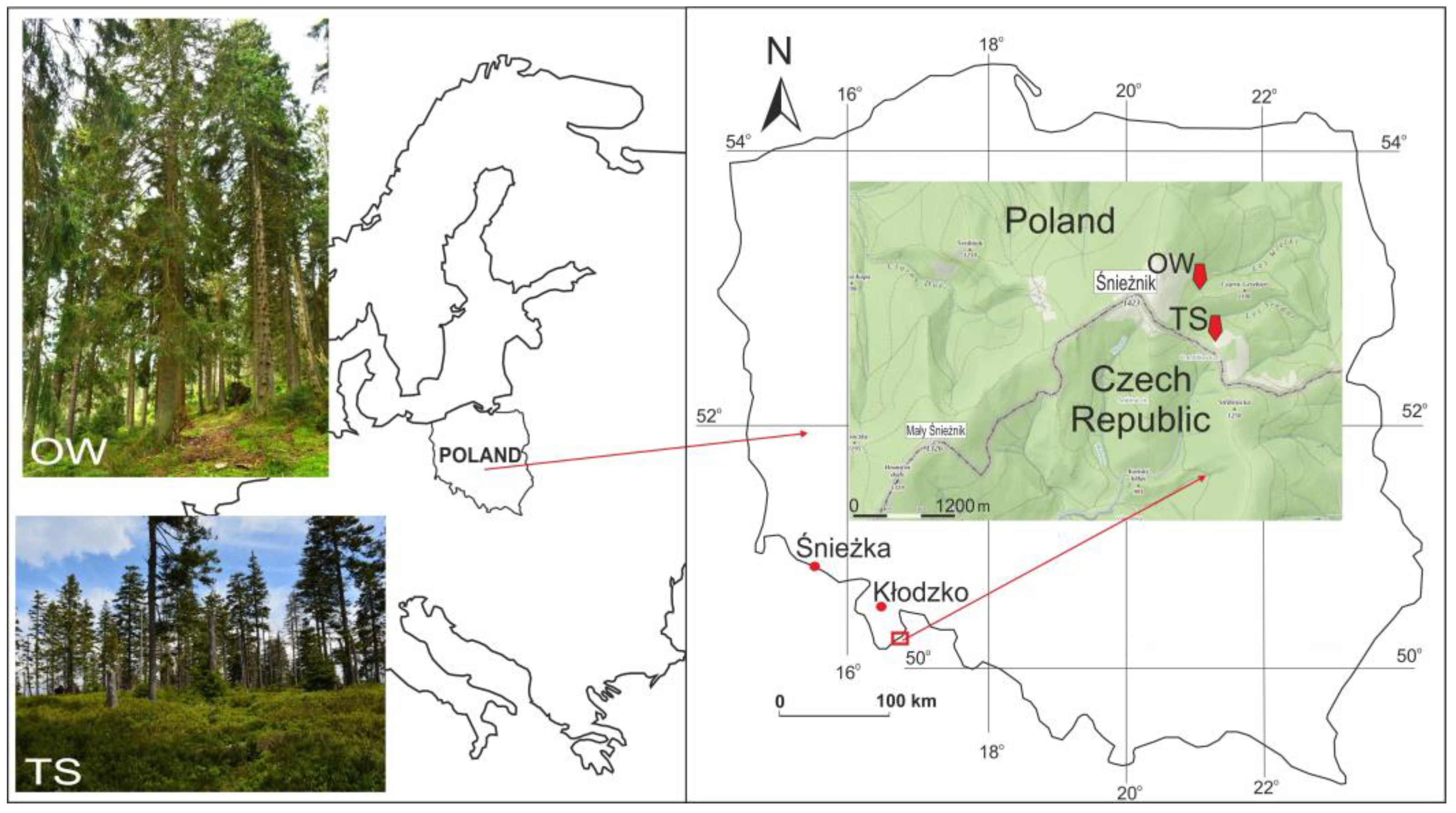
Figure 2.
Mean monthly air temperature and precipitation totals recorded at Kłodzko and Śnieżka (1951–2020) and at Śnieżnik (1891–1930) [29,38].
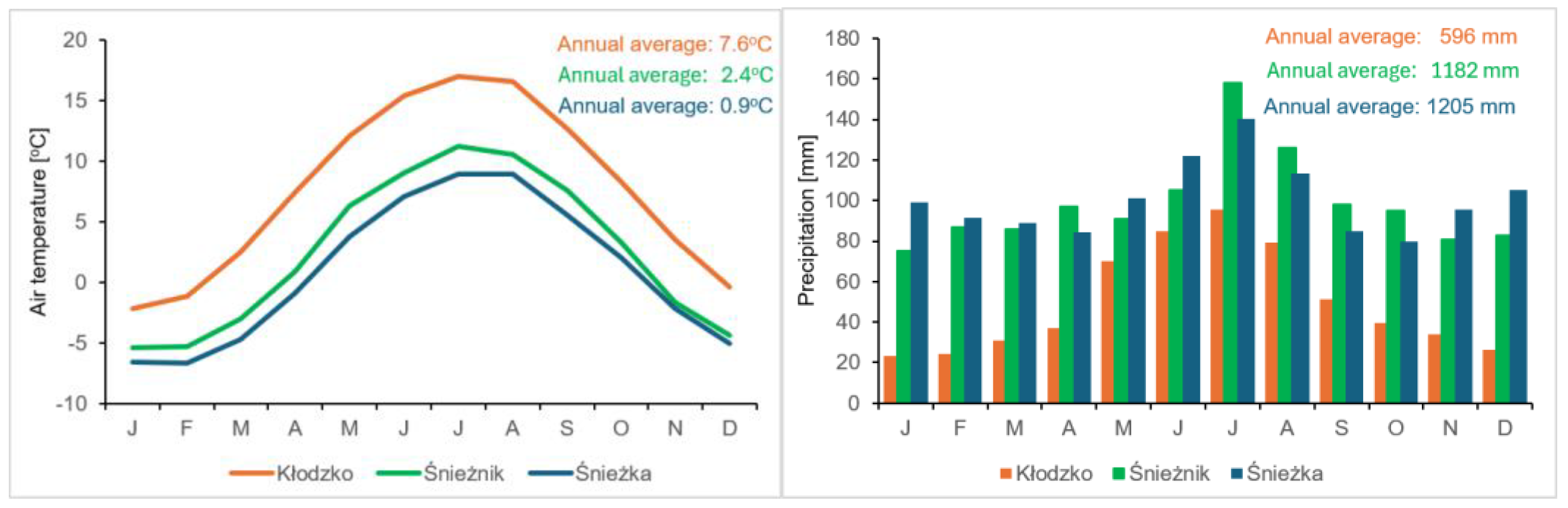
Figure 3.
Local chronologies of Norway spruce from Sadzonki peat bog (TS) and Owczarnia (OW).
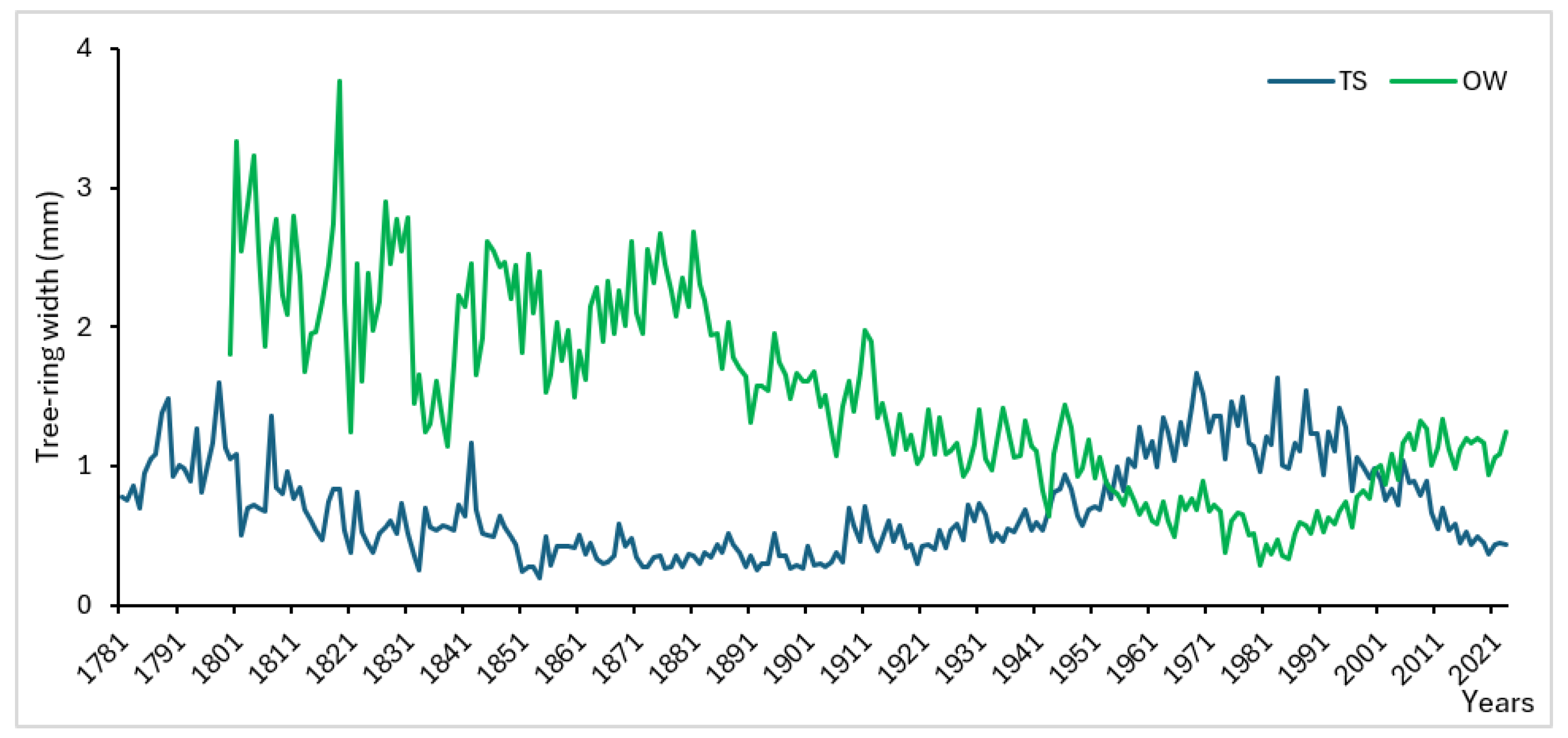
Figure 4.
Cumulative radial growth of Norway spruce from Sadzonki peat bog (TS) and Owczarnia (OW), expressed in mm.
Figure 4.
Cumulative radial growth of Norway spruce from Sadzonki peat bog (TS) and Owczarnia (OW), expressed in mm.
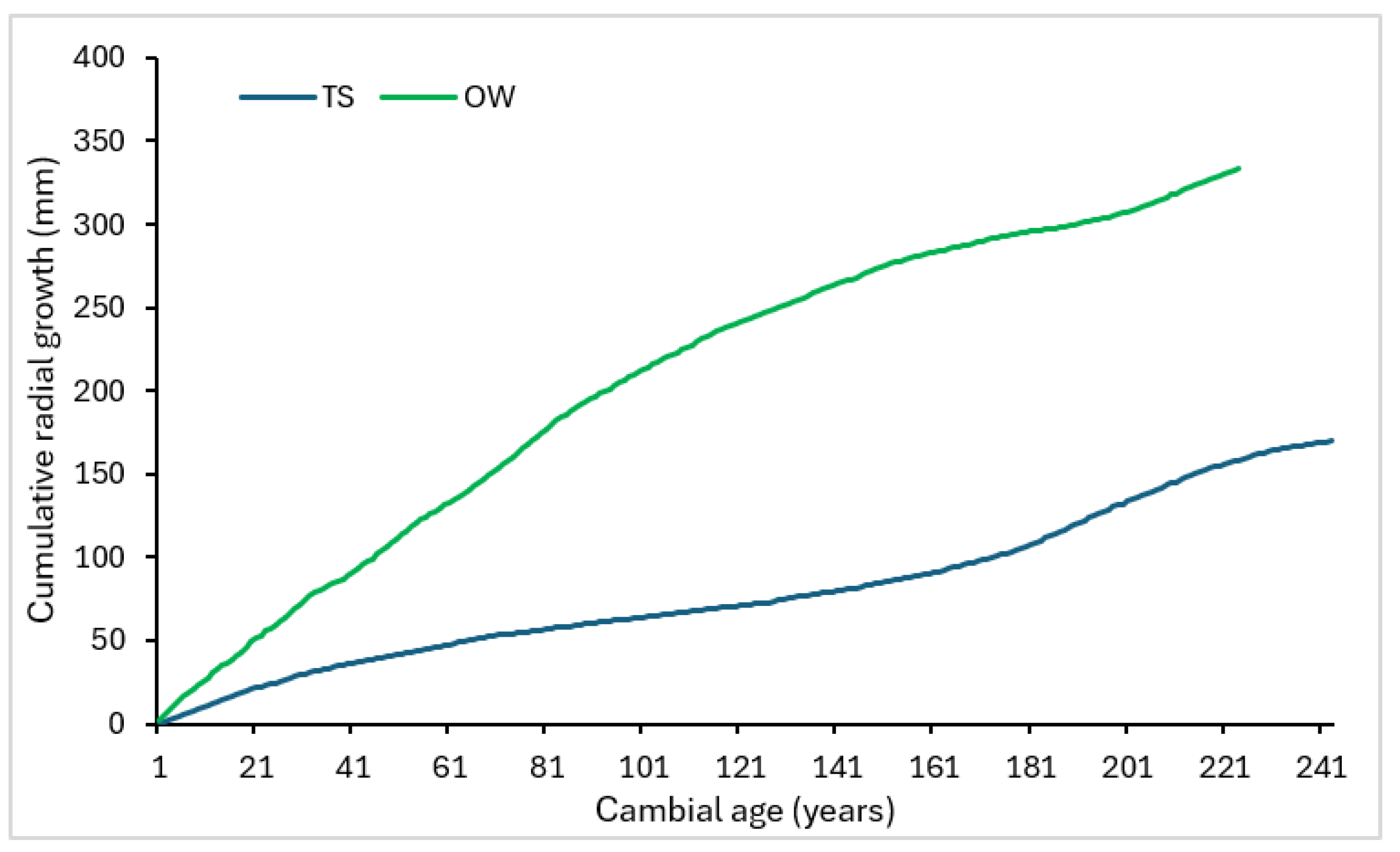
Figure 5.
A – Very thin tree-rings in spruce from Owczarnia (tree no. OW4) in 1980s, cross-section; B – A frost ring in 1980 in spruce from Owczarnia (tree no. OW7), cross-section; EHT - cathode accelerating voltage, WD – working distance. .
Figure 5.
A – Very thin tree-rings in spruce from Owczarnia (tree no. OW4) in 1980s, cross-section; B – A frost ring in 1980 in spruce from Owczarnia (tree no. OW7), cross-section; EHT - cathode accelerating voltage, WD – working distance. .
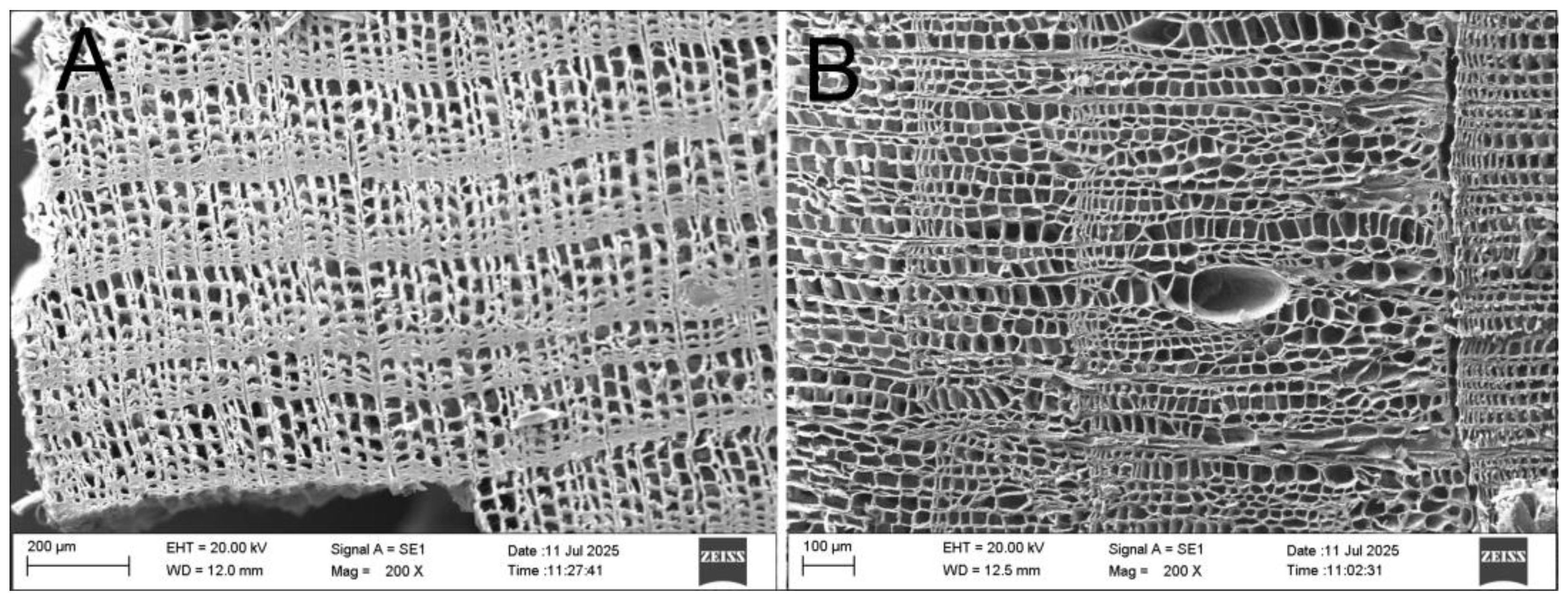
Figure 6.
Results of correlation (CC) and response function (RF) analyses for ST and OW chronologies for temperature (T) and precipitation (P) in the period of 75 years (1948–2022). Bars denote significant values (p ≤ 0.05); p, previous year; r2, multiple regression determination coefficients.
Figure 6.
Results of correlation (CC) and response function (RF) analyses for ST and OW chronologies for temperature (T) and precipitation (P) in the period of 75 years (1948–2022). Bars denote significant values (p ≤ 0.05); p, previous year; r2, multiple regression determination coefficients.
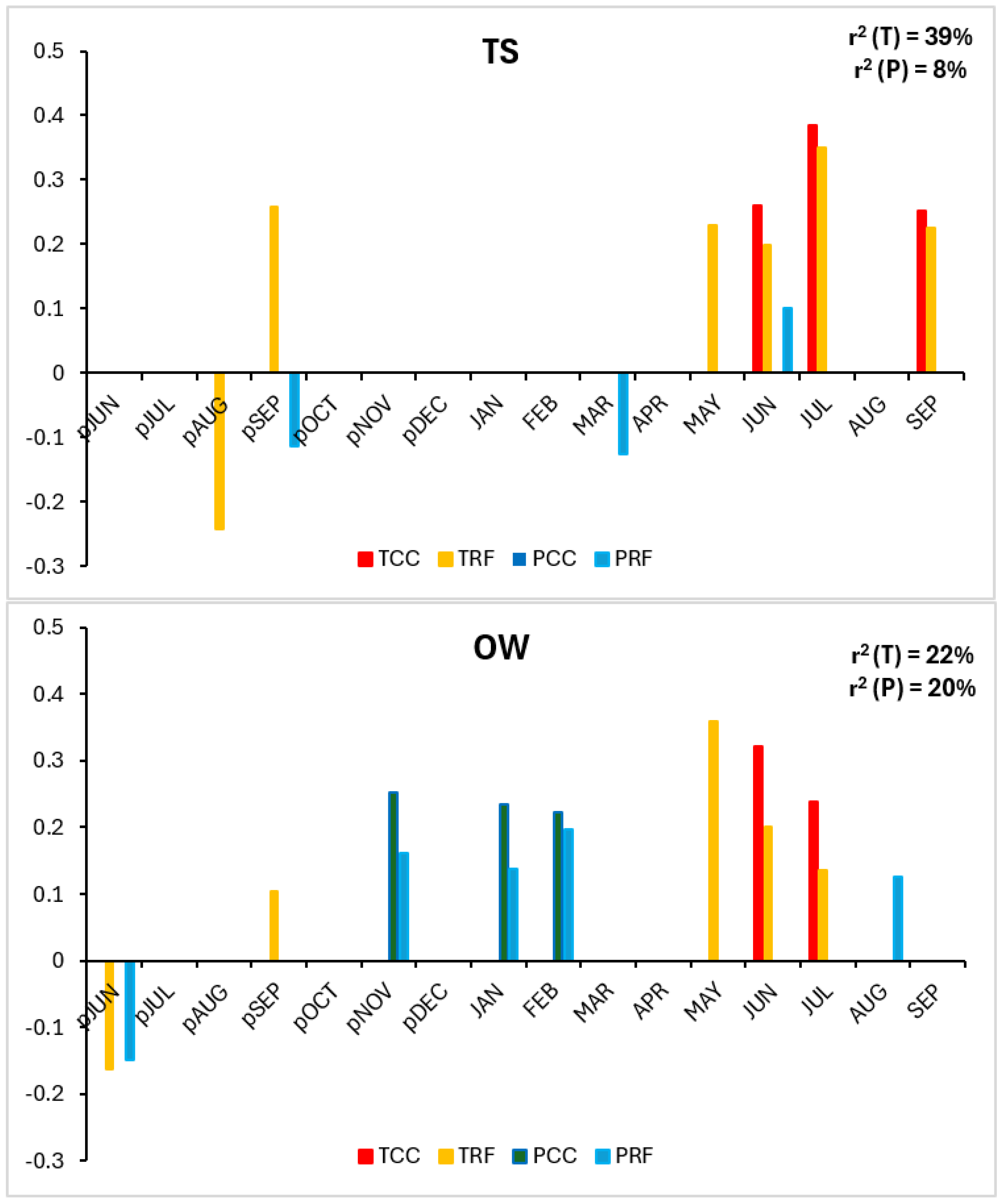
Figure 7.
Changes in the content of selected chemical elements in 10-year spruce growth rings (A) and in the vertical profile of the surface peat layer (B).
Figure 7.
Changes in the content of selected chemical elements in 10-year spruce growth rings (A) and in the vertical profile of the surface peat layer (B).
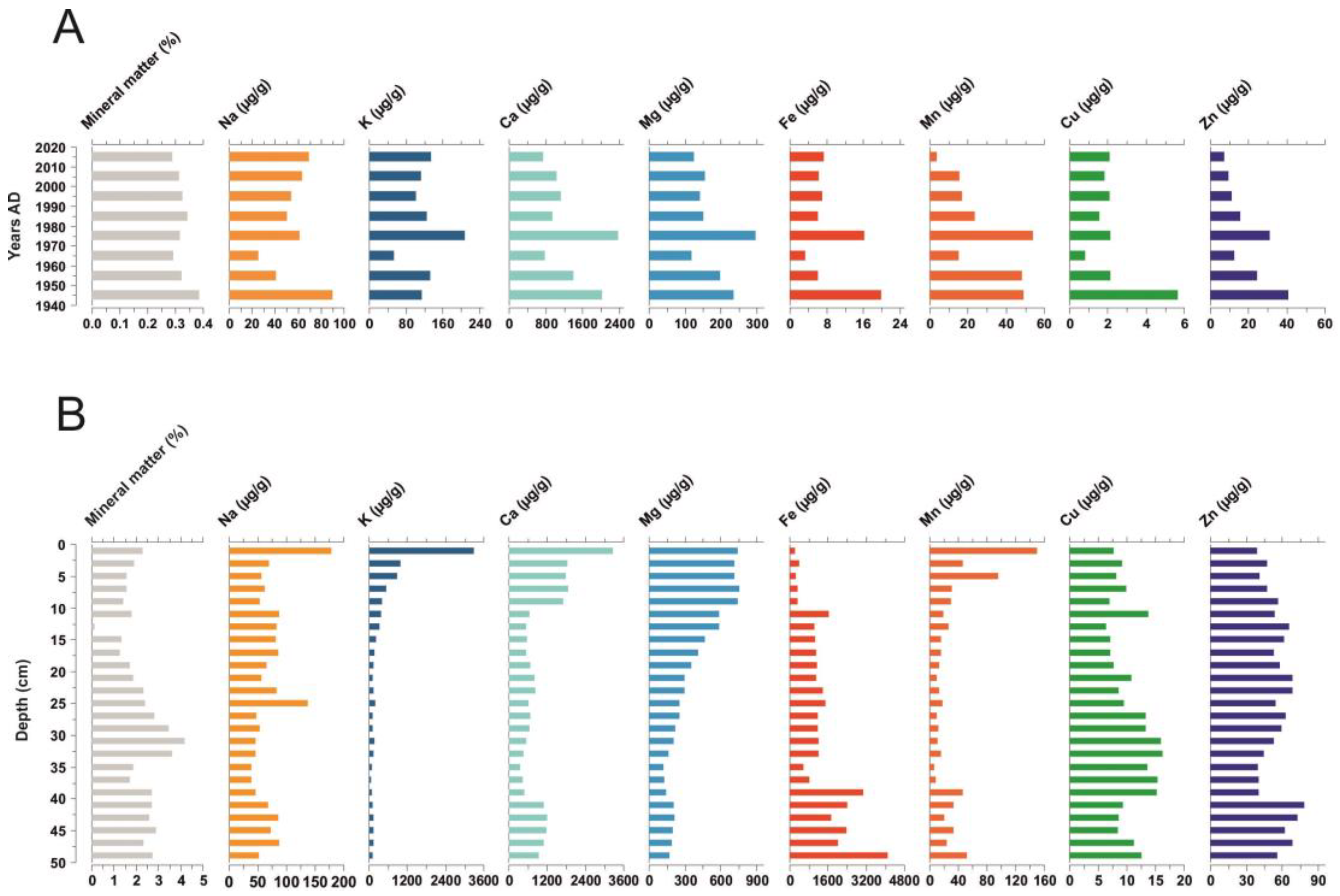
Figure 8.
Variability in the carbon isotope composition (δ¹³C) of the organic matter in annual wood growth rings between 1907 and 2023. The blue line shows the measured δ¹³C values, without correction for the Suess effect; the black dotted line shows the δ¹³C values corrected for the Suess effect.
Figure 8.
Variability in the carbon isotope composition (δ¹³C) of the organic matter in annual wood growth rings between 1907 and 2023. The blue line shows the measured δ¹³C values, without correction for the Suess effect; the black dotted line shows the δ¹³C values corrected for the Suess effect.
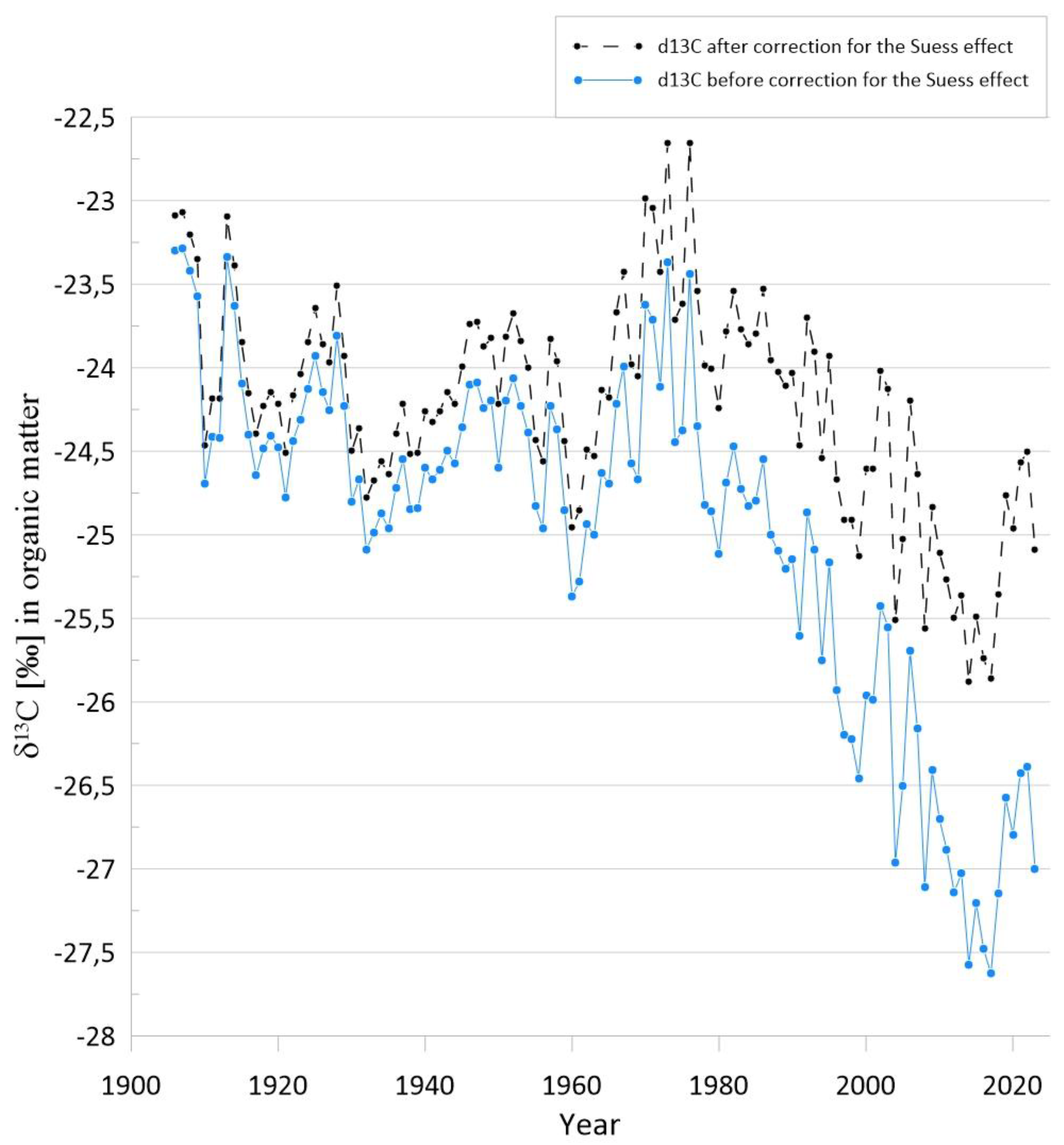
Figure 9.
Changes in mean annual air temperature at the Śnieżka meteorological station in 1950–2023 [38].
Figure 9.
Changes in mean annual air temperature at the Śnieżka meteorological station in 1950–2023 [38].
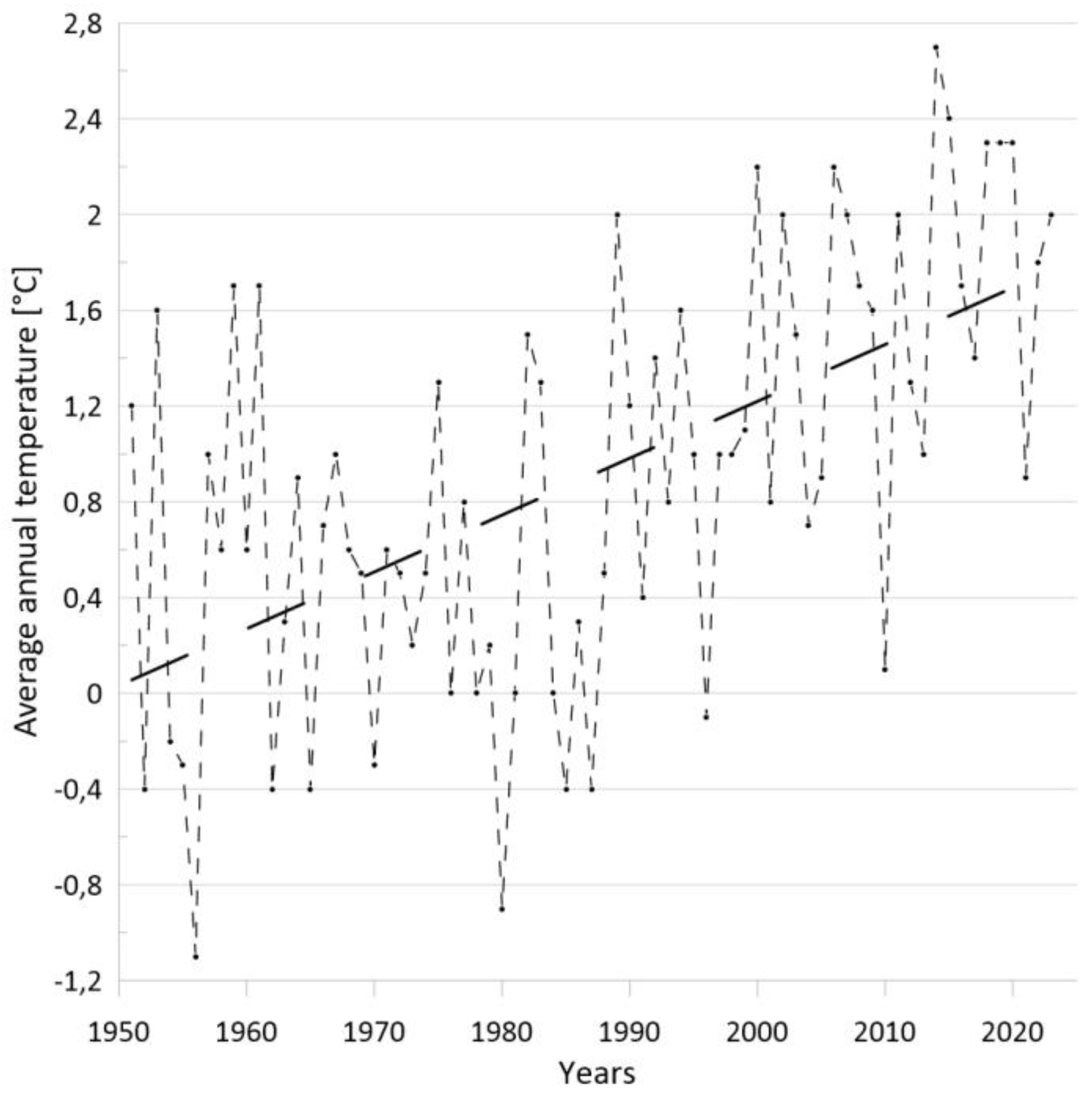
Figure 10.
Changes in annual precipitation totals at the Śnieżka meteorological station in 1950–2023 [38].
Figure 10.
Changes in annual precipitation totals at the Śnieżka meteorological station in 1950–2023 [38].
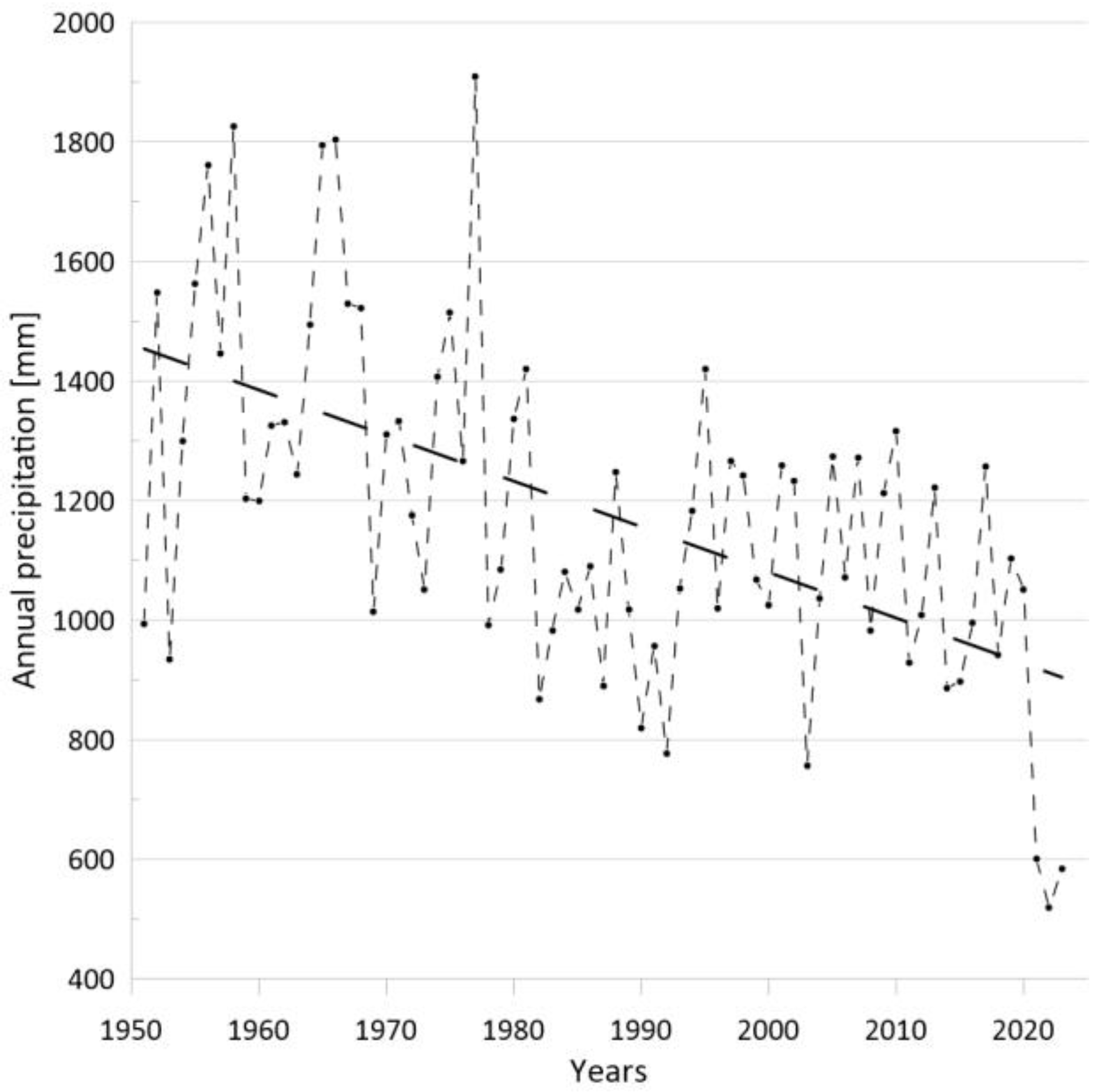

Table 1.
Basic information of the study plots; DBH - Diameter at Breast Height.
| Lab. code | Name | Geographic coordinates | Altitude a.s.l. (m) | Height (m) | DBH (cm) | No. of Trees | No. of Samples | No. of Tree-Rings |
|---|---|---|---|---|---|---|---|---|
| TS | Sadzonki peat bog | 50.2018433N 16.8610533E | 1231 | 14 | 17 | 32 | 64 | 6 247 |
| OW | Owczarnia | 50.2073508N 16.8617694E | 1171 | 21 | 44 | 21 | 23 | 3 819 |
| Σ | 53 | 87 | 10 066 |
Disclaimer/Publisher’s Note: The statements, opinions and data contained in all publications are solely those of the individual author(s) and contributor(s) and not of MDPI and/or the editor(s). MDPI and/or the editor(s) disclaim responsibility for any injury to people or property resulting from any ideas, methods, instructions or products referred to in the content. |
© 2026 by the authors. Licensee MDPI, Basel, Switzerland. This article is an open access article distributed under the terms and conditions of the Creative Commons Attribution (CC BY) license (http://creativecommons.org/licenses/by/4.0/).
Copyright: This open access article is published under a Creative Commons CC BY 4.0 license, which permit the free download, distribution, and reuse, provided that the author and preprint are cited in any reuse.


