
Submitted:
03 July 2026
Posted:
06 July 2026
You are already at the latest version
Abstract
Sintering diagram for copper fibers is established based on a two joint-fiber geometric model and intrinsic material constants, with comprehensive consideration of four neck-growth mechanisms: volume diffusion, grain-boundary diffusion, surface diffusion and Nabarro-Herring microcreep. The sintering diagram reveals that grain-boundary diffusion dominates neck growth at relatively low temperatures, surface diffusion prevails at high temperatures for short holding time, and Nabarro-Herring microcreep acts as the primary mechanism at high temperatures for long holding time, respectively. In addition, synchrotron radiation X-ray computed tomography (SR-CT) characterization is adopted to validate the established sintering diagram via the measured neck size of sintered fiber joints. The experimental results show that most measured neck-size data points lie close to the theoretical curve predicted by the Nabarro-Herring microcreep mechanism when sintered at 1030 oC for 30 min, 60 min and 180 min. This result confirms that Nabarro-Herring microcreep is the predominant neck-growth mechanism at high temperatures for long holding time, which is consistent with the theoretical result derived from the sintering diagram. Meanwhile, the results also prove the existence of Nabarro-Herring microcreep during the high-temperature sintering of copper fibers without externally applied pressure.
Keywords:
copper fiber
; sintering diagram
; sintered joints
; neck size
1. Introduction
Porous copper fiber sintered sheet, which belongs to a kind of porous metal fiber sintered sheet (PMFSS), has found extensive applications in the fields of heat transfer [1], catalyst support for hydrogen production [2], eletrocatalysis [3], and acoustical absorption [4]. The fabrication process of PMFSS consists of two main procedures. First, metal fibers with diameters ranging from 1 to 100 µm are fabricated by bundle-drawing or cutting techniques, which are then air-formed or uniformly packed to form metal fiber felts. Subsequent sintering is carried out under vacuum or protective atmosphere. During sintering, inter-fiber sintering necks form and grow, grain coarsening occurs within individual fibers, and the porosity evolves simultaneously. These microstructural evolutions make sintering the core process determining the practical service performance of the material. Extensive investigations on the sintering mechansims of stainless steel fibers have been reported in existing literature [5,6,7]. However, recent research concerning porous copper fiber materials predominantly focus on macroscopic sintering parameters and corresponding mechanical properties, which resolve many practical engineering challenges [8,9,10]. In contrast, the sintering mechanisms of porous copper fiber materials have not been received adequate attention, which limits the fundamental understanding of their sintering evolution behavior.
M.F. Ashby [11,12] proposed a sintering diagram method to delineate dominant mass transport mechanism. Capable of incorporating numerous sintering mechanisms and sintering variables, this approach effectively overcomes the limitations inherent to the conventional kinetic exponent method. Sintering diagrams are established based on six distinct material transport modes summarized in Table 1, plotting the relative neck size (x/a) as a function of homologous temperature (T/Tm), where x represents the radius of the sintered neck formed between two contacting particles and a represents the initial particle radius. These sintering diagram can show the contours of relative neck size corresponding to a given sintering time, with boundary lines separating regions governed by distinct predominant mechanisms. Such sintering diagrams enable the prediction of sintering parameters required to achieve target material properties. Sintering diagrams have been extensively investigated for powders and wires, including Co, Ni, Fe, Ag, Cu, UO2 and NaCl powders, as well as Ag, Cu, Ni and Fe wires [11,12]. The established diagrams can characterize the sintering behavior of target materials and serve as a guideline for experimental design and result interpretation. In the previous research, sintering-diagram approach was adopted to reveal the sintering mechanism of 316L stainless steel fibers [6]. Experimental validation demonstrates that the constructed sintering diagram can predict the practical neck size well when sintering is performed at the temperature far from the inter-mechanism boundary lines.
In 1949, F.R.N. Nabarro [13] has pointed out that self-diffusion within the grains of a polycrystalline solid can cause the solid to yield to an applied shearing stress. The yielding is caused by a diffusional flow of matter within each crystal grain away from boundaries where there is a normal pressure and toward those where there is a normal tension. This phenomenon is the main cause of creep at very high temperature under very low stress. After that, C. Herring [14] quantitatively calculated the creep rate and the effective viscosity. This creep rate rule was observed experimentally in silver, gold and copper at high temperature and low stress.
F.V. Lenel [15] has concluded that the geometrical changes including the growth of sintering neck between particles and the shrinkage of powder aggregate which occur during sintering are considered as a type of high-temperature creep. Creep mechanism is important in sintering process, including slip controlled by dislocation climb and creep due to movement of vacancies from boundaries under tensile to those under compressive stress (Nabarro-Herring micorcreep). The type of creep mechanism depends primarily on the temperature and the level of stress. Creep takes place by vacancies diffusion under low stress and high temperatures, while creep occurs by dislocation climb under high stress. The results of most model experiments in sintering reported in the literature for both metals and nonmetals are in good agreement with the predictions made for material transport by vacancy diffusion. This can be explained by the fact that the stress due to surface tension for the geometry of the model experiments is very low.
The present work aims to reveal the sintering mechanism of copper fibers via the sintering diagram method. Besides volume diffusion, grain-boundary diffusion and surface diffusion based on the former research, Nabarro-Herring microcreep mechanism is additionally incorporated to analyze the sintering behavior of porous copper fiber materials without externally applied pressure. The sintering diagram is established based on a two joint-fiber geometric model and intrinsic material constants, and further validated through the experimental results, in which the neck size is acquired through synchrotron radiation X-ray computed tomography (SR-CT) characterization.
2. Materials and Methods
2.1. Simplified Geometric Model and Rate-Equations for Neck Growth
Figure 1 presents the SEM micrograph of porous copper fiber sintered felt with fiber radius of 45 µm, where sintering necks form between adjacent fibers intersecting at random angles. Unlike the two-sphere geometric model widely used for powder sintering, a new geometric parameter, the joint-fiber angle, should be considered and involved in the new geometric sintering model for fibrous materials, which has been established in our previous work [6]. Based on this model, the neck growth-rate equations for two joint-fibers have been derived as follows [6]:
where x represents the radius of the sintering neck formed at the intersection of two-fiber joint; a represents the radius of single fiber; θ represents the intersection angle between two joint-fibers; γ represents the surface free energy; Ω represents the atomic or molecular volume; δs represents the effective surface diffusion layer thickness, and Ds represents the surface diffusion coefficient; δb represents the effective grain-boundary thickness, and Db represents the grain-boundary diffusion coefficient; Dv represents the lattice diffusion coefficient; t represents the sintering holding time; T represents the absolute temperature; k represents the Boltzmann’s constant.
x7 = 56a3γΩδsDst / kTcos6 (θ/2) (surface diffusion)
x6 = 96a2γΩδbDbt / kTcos4 (θ/2) (grain-boundary diffusion)
x5 = 20a2γΩDvt / kTcos4 (θ/2) (volume diffusion without densification)
x5 = 80a2γΩDvt / kTcos4 (θ/2) (volume diffusion with densification)
The neck growth-rate equation for Nabarro-Herring microcreep mechanism will be described in details in the next section. For the equal quasi-spherical grains, C. Herring gives the creep rate as the following equation [14]:
where dε/dt denotes the creep rate, σ refers to the shear stress, and G represents the grain size.
dε / dt = 8DvΩσ / kTG2
The shear strain originating from microcreep within the neck region can be defined as:
where h represents the certer-to-center displacement distance between adjacent fibers.
ε = h / a
In the absence of externally applied pressure, surface tension serves as the sole driving force for Nabarro-Herring microcreep in the neck region, which can be expressed as the following relation:
where ρ corresponds to the curvature radius of the sintered neck.
σ = − γ / ρ
Given that the curvature radius ρ and the half center-to-center displacement distance h share the same order of magnitude, Eq. (7) becomes:
σ = − γ / h
For the case of volume densification, the curvature radius of the sintered neck can be expressed as follows:
ρ = x2cos2 (θ/2) / 4a
By substituting Eqs. (6), (8) and (9) into Eq. (5), the neck growth-rate equation controlled by Nabarro-Herring microcreep mechanism is derived as follows:
x4 = 256a3γΩDvt / kTG2cos4 (θ/2)
2.2. Verification Procedure
To validate the established sintering diagram of copper fibers, SR-CT technique combined with the segmentation method was adopted to characterize the neck size of sintered fiber joints.
Copper fiber felts with a fiber radius of 45 μm were sintered at 1030 oC for 30 min, 60 min, and 180 min, respectively, under a vacuum pressure of 10-2 Pa with a heating rate of 10 oC/min. The sintered felts were compacted to a target porosity of 83%, and then cut into cylindrical specimens with dimensions of Φ1.2 mm × 2 mm. Afterwards, the three cylindrical samples were scanned via SR-CT at the BL13W1 beamline at Shanghai Synchrotron Radiation Facility (SSRF, China) to quantify the neck size of sintered joints. The spatial resolution was 0.74 µm, which was sufficient for measuring the sintering neck size. During CT scanning, each sample was rotated 180o, and 900 projection images were captured at an angular step of 0.2o. Each projection was acquired with an exposure time of 6 s and a beam energy of 35 KeV. The 900 projection images were used to reconstruct the three-dimensional structure model of each sample, from which the neck radius of sintered joints and joint-fiber angle were measured. The detailed measurement procedure has been described elsewhere [6].
3. Results
3.1. Sintering Diagram
The sintering diagram of copper fibers is calculated based on Eqs. (1), (2), (4), (10) and the intrinsic material constants listed in Table 2 [16,17,18,19], under the assumption that sintering proceeds without externally applied pressure. Four typical joint-fiber angles (0o, 30o, 60o, 90o) are selected to establish the sintering diagram of copper fibers with a radius of 45 µm, as presented in Figure 2. The horizontal and vertical axes correspond to homologous temperature, T/Tm (where Tm is the melting point) and normalized neck radius, x/a, respectively. The whole diagram is partitioned into three domains by thick black lines. With each domain, a single sintering mechanism predominates the neck growth. At the boundary lines separating different domains, two diffusion mechanisms contribute equally to the sintering rate. Contours of constant sintering time (thin black lines) are superimposed on all domains, which show the neck size after a given time. It is observed that the sintering diagram obtained at the four joint-fiber angles exhibit negligible discrepancies. This indicates that the dominant neck-growth mechanism remains identical under the same sintering process, and the joint-fiber angle only exerts an influence on the final neck size of sintered joints.
It can be seen from Figure 2 that grain-boundary diffusion is predominant at relatively low temperatures; at relatively high temperatures for short holding time, surface diffusion becomes the main mechanism; while for a longer holding time, Nabarro-Herring microcreep is found to play a major role. The neck growth-rate equation for Nabarro-Herring microcreep is inversely proportional to the square of the grain size of copper fibers according to Eq. (10). Since Nabarro-Herring microcreep is predominant at the relatively high temperatures for long holding time, the average grain size G of 20 µm was adopted. Different with the sintering diagram for 316L stainless steel fiber, in which volume diffusion does not become the dominant mechanism during the entire sintering process due to its high activation energy (280 kJ/mol) compared with that of surface diffusion (220 kJ/mol) or grain-boundary diffusion (177 kJ/mol), Nabarro-Herring microcreep plays a predominant role at relatively high temperatures for long holding time because of the comparative activation energy of volume diffusion (207 kJ/mol) with that of surface diffusion (205 kJ/mol).
Table 3 lists the predicted sintering durations required to reach a relative neck size of 0.4 for fibers with a radius of 45 µm and a joint-fiber angle of 0o, covering a sintering temperature range of 950 to 1030 oC. The calculations are performed separately for four sintering mechanisms: Nabarro-Herring microcreep, surface diffusion, volume diffusion and grain-boundary diffusion. It can be found that at a given temperature, grain-boundary diffusion demands the longest sintering time to achieve the target relative neck size, while Nabarro-Herring microcreep requires the shortest duration. More specifically, the sintering time governed by Nabarro-Herring microcreep is two orders of magnitude less than that by grain-boundary diffusion. This result demonstrates that Nabarro-Herring microcreep acts as the dominant mass transport mechanism in the temperature range of 950 to 1030 oC when the relative neck size reaches 0.4, surpassing all diffusion-based mechanisms.
3.2. Experimental Verification
To validate the established sintering diagram, the neck size of sintered joints was characterized through the SR-CT technique. Figure 3 diaplays reconstructed 3D morphologies of sintering necks for copper fibers with a radius of 45 µm. The samples were sintered at 1030 oC for 30 min, 60 min and 180 min, with joint-fiber angles of 0o and 60o, respectively. Three-dimensional coordinate data at both terminals of each sintering neck were extracted from the reconstructed tomography images, and the corresponding neck size was further calculated from these coordinate datasets. All sintering necks distributed throughout the bulk samples were fully identified and measured. Statistical analysis of neck radii under identical joint-fiber angles was performed, and the results are plotted in Figure 4. Four theoretical neck-size curves derived from the sintering diagram are overlaid on the graph, corresponding to the Nabarro-Herring microcreep, surface diffusion, grain-boundary diffusion and volume diffusion mechanisms, respectively. As illustrated in Figure 4, measured neck sizes scatter within a certain range even for identical sintering parameters and joint-fiber angles, which originates from variable initial contact geometries between fibers. Despite such date dispersion, the majority of experimental data points closely lie around the theoretical curve predicted by the Nabarro-Herring microcreep mechanism. This observation confirms that Nabarro-Herring microcreep dominates neck growth at 1030 oC with holding time of 30 min, 60 min and 180 min, which is consistent with the prediction derived from the sintering diagram. Meanwhile, this work experimentally verified the existence of the Nabarro-Herring microcreep during the high-temperature sintering of porous copper fiber materials without externally applied pressure.
4. Discussion
In this work, a sintering diagram of copper fibers is established on the basis of a two joint-fibers geometric model and intrinsic material constants, where four mass transport mechanisms including volume diffusion, grain-boundary diffusion, surface diffusion and Nabarro-Herring microcreep are comprehensively incorporated. The established diagram is divided into three distinct domains separated by boundary lines, with each domain governed by a single predominant sintering mechanism. It is found that grain-boundary diffusion dominates neck growth at relatively low temperatures, surface diffusion prevails at elevated temperatures for short holding time, and Nabarro-Herring microcreep becomes the primary neck-growth mechanism under high temperatures and prolonged holding time. Furthermore, the joint-fiber angel could only affect the geometric size of sintering neck rather than change the predominant neck-growth mechanism. The SR-CT characterization is adopted to validate the reliability of the constructed sintering diagram via measured sintering neck size. For specimens sintered at 1030 oC with holding time of 30 min, 60 min and 180 min, most measured neck size data points fall close to the theoretical curve predicted by the Nabarro-Herring microcreep mechanism. This evidence confirms that Nabarro-Herring microcreep acts as the predominant neck-growth mechanism during the pressure-free sintering of copper fibers at high temperatures for long holding time, which is consistent with the theoretical inference derived from the sintering diagram.
In the previous work, sintering-diagram approach was used to study the sintering mechanism of 316L stainless steel fibers. It was found that grain-boundary diffusion is the dominant neck-growth mechanism at the relatively low temperatures for a long holding time, while surface diffusion predominates at the relatively high temperatures for a short holding time. Volume diffusion cannot be the dominant mechanism during the entire sintering process due to its relatively high activation energy. It is found in the two successive studies that the same sintering mechanism predominates at relatively low temperatures or at relatively high temperatures for short holding time. The only difference is that the sintering mechanism of copper fibers at relatively high temperatures for long holding time is dominated by Nabarro-Herring microcreep, which is mainly attributed to the fact that copper is prone to high-temperature creep than 316 stainless steel at elevated temperatures.
It should be explicitly clarified that the established sintering diagram of copper fibers originates from a highly simplified geometric model. In reality, the practical sintering behavior of porous copper fiber performs is far more complex. The diagram proposed in this work only considers a relatively simple class of problem, i.e., pressure-free sintering without external applied load.
Author Contributions
Conceptualization, A.L. and J.W.; methodology, A.L. and J.M.; formal analysis, A.L.; investigation, A.L. and J.M; resources, A.L.; data curation, A.L. and J.M; writing—original draft preparation, A.L.; writing—review and editing, J.W.; visualization, A.L.; supervision, J.W.; project administration, W.J.; funding acquisition, W.J. All authors have read and agreed to the published version of the manuscript.
Funding
This research was funded by Advanced Materials-National Science and Technology Major Project, grant number 2025ZD0611800 and the National Natural Science Foundation of China, grant number 51134003.
Data Availability Statement
The original contribution presented in this study are included in the article. Further inquiries can be directed to the corresponding author.
Conflicts of Interest
The authors declare no conflicts of interest.
References
- Pan, M.Q.; Hu, H.Z.; Dong, G.P. Experimental study of the performance of cutting copper fiber oriented sintered heat sinks for the water cooling of LEDs. Appl. Therm. Eng. 2020, 179, 115738. [Google Scholar] [CrossRef]
- Liu, Z.Y.; Zhang, Y.Q.; Luo, M.S.; Xu, Z.J. Topology optimization of porous copper fiber sintered felt for methanol steam reforming micro-reactor based on the uniformity of flow distribution. Inter. J. Hydrog. Energy 2025, 99, 340–351. [Google Scholar]
- Zhang, L.; Lian, K.; Cheng, M.L.; Liu, W.; Wang, Q.; Liu, X.J.; Shen, S.B. Template-thermal reduction preparation of copper fiber felt with rich nanowrinkled surfaces. Mater. Lett. 2025, 389, 138341. [Google Scholar] [CrossRef]
- Zhang, J.Y.; Zhang, T.Y.; Li, H.; Xu, Y.; Chen, K.A. Influence of parameters of film on acoustical absorption performance of copper film-copper fiber composite structure. Appl. Acoust. 2024, 221, 110002. [Google Scholar] [CrossRef]
- Ma, J.; Li, A.J.; Tang, H.P. Study on sintering mechanism of stainless steel fiber felts by X-ray computed tomography. Metals 2016, 6, 18–25. [Google Scholar] [CrossRef]
- Li, A.J.; Ma, J.; Wang, J.Z.; Xu, Z.G.; Li, C.L.; Tang, H.P. Sintering diagram for 316L stainless steel fibers. Powder Technol. 2016, 288, 109–116. [Google Scholar] [CrossRef]
- Dai, H.P.; Chen, D.D.; Zheng, Z.S. Modelling the sintering neck growth process of metal fibers under the surface diffusion mechansium using the lattice Boltzmann method. Metals 2019, 9, 614–623. [Google Scholar] [CrossRef]
- Zhou, W.; Tang, Y.; Pan, M.Q.; Wei, X.L.; Xiang, J.H. Experimental investigation on uniaxial tensile properties of high-porosity metal fiber sintered sheet. Mater. Sci. Eng. A 2009, 525, 133–137. [Google Scholar] [CrossRef]
- Wang, Z.P.; Liu, B.; Liu, W.; Tong, Y.; Hui, K.S.; Hui, K.N. Experimental study on shear properties of porous metal fiber sintered sheet. Mater. Sci. Eng. A 2012, 544, 33–37. [Google Scholar] [CrossRef]
- Zhou, W.; Tong, Y.; Liu, B.; Song, R.; Jiang, L.L.; Hui, K.S.; Hui, K.N.; Yao, H.M. Compressive properties of porous metal fiber sintered sheet produced by solid-state sintering process. Mater. Des. 2012, 35, 414–418. [Google Scholar] [CrossRef]
- Ashby, M.F. A first report on sintering diagrams. Acta Metall. 1974, 22, 275–289. [Google Scholar] [CrossRef]
- Swinkels, F.B.; Ashby, M.F. A second report on sintering diagrams. Acta Metall. 1980, 29, 259–281. [Google Scholar]
- Nabarro, F.R.N. Creep and plastic flow. In Report of a conference on the strength of solids; Gurney, C., Ed.; Physics Society: London, UK, 1948; pp. 75–85. [Google Scholar]
- Herring, C. Diffusional viscosity of a polycrystalline solid. J. Appl. Phys. 1950, 21, 437–445. [Google Scholar] [CrossRef]
- Lenel, F.V.; Ansell, G.S. Creep mechanisms and their role in the sintering of metal powders. In Modern Development in Powder Metallurgy; Hausner, H.H., Ed.; Plenum Press: New York, USA, 1966; Volume 1, pp. 281–296. [Google Scholar]
- Jones, H. The surface energy of solids metals. Met. Sci. J. 1971, 5, 15–18. [Google Scholar] [CrossRef]
- Peterson, N.L. Diffusion in metals. Solid St. Phys. 1969, 22, 509–512. [Google Scholar] [CrossRef]
- Austin, A.E.; Richards, N.A.; Wood, V.E. Surface and grain-boundary diffusion of gold-copper. J. Appl. Phys. 1966, 37, 3650–3658. [Google Scholar] [CrossRef]
- Choi, J.Y.; Shewmon, P.G. Effect of orientation on the surface self-diffusion of copper. Trans. Metall. Soc. AIME. 1962, 224, 589–599. [Google Scholar]
Figure 1.
SEM micrograph of porous copper fiber sintered felt with fiber radius of 45 µm.
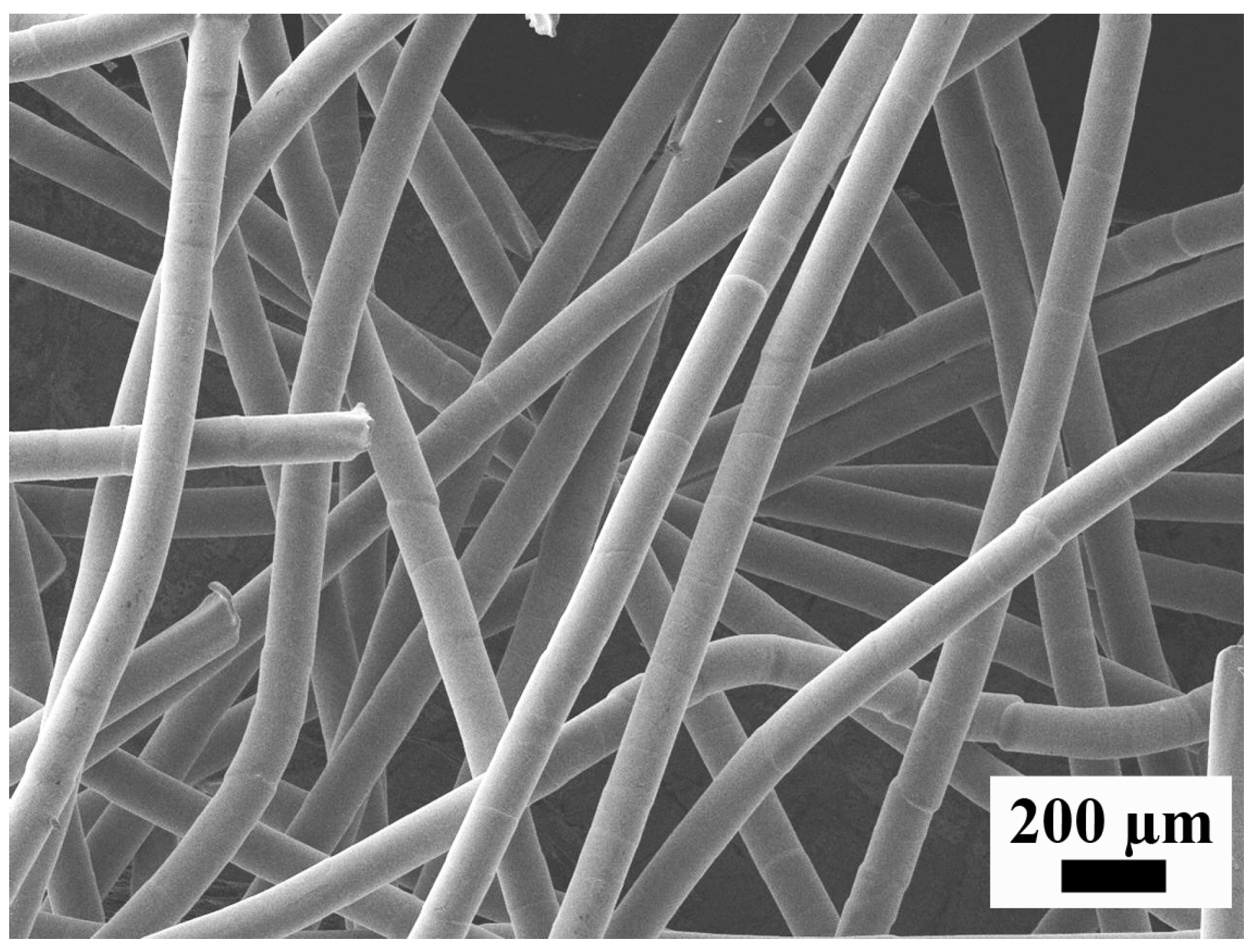
Figure 2.
Sintering diagram for copper fiber with a fiber radius of 45 µm under four typical joint-fiber angles: 0o (a), 30o (b), 60o (c) and 90o (d).
Figure 2.
Sintering diagram for copper fiber with a fiber radius of 45 µm under four typical joint-fiber angles: 0o (a), 30o (b), 60o (c) and 90o (d).
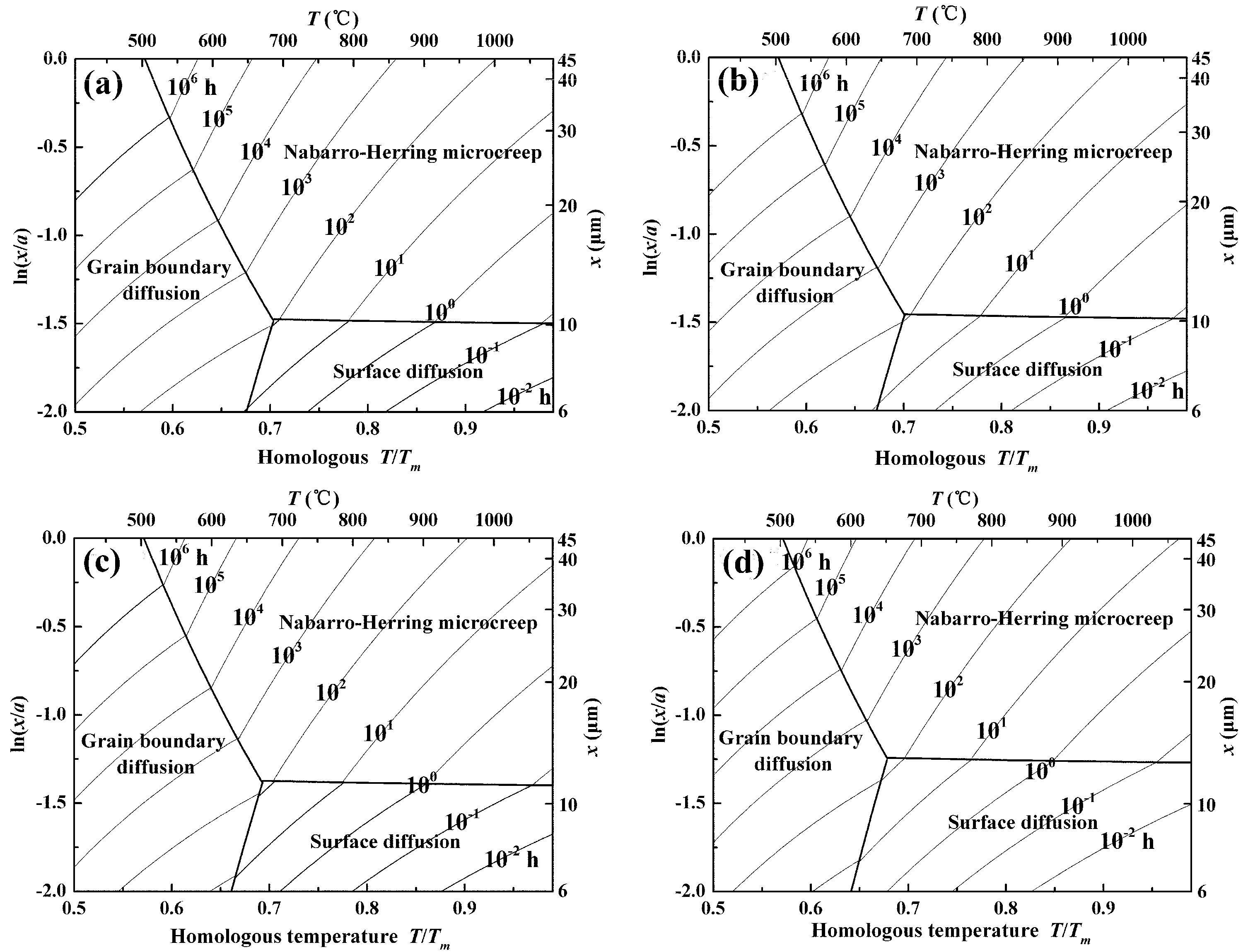
Figure 3.
SR-CT reconstructed morphologies of sintering neck for copper fiber joints with joint-fiber angles of 0o (a, c, e) and 60o (b, d, f) sintered at 1030 oC/30 min (a, b), 1030 oC/60 min (c, d) and 1030 oC/180 min (e, f), respectively. (The region between the two white arrows denotes the sintering neck).
Figure 3.
SR-CT reconstructed morphologies of sintering neck for copper fiber joints with joint-fiber angles of 0o (a, c, e) and 60o (b, d, f) sintered at 1030 oC/30 min (a, b), 1030 oC/60 min (c, d) and 1030 oC/180 min (e, f), respectively. (The region between the two white arrows denotes the sintering neck).
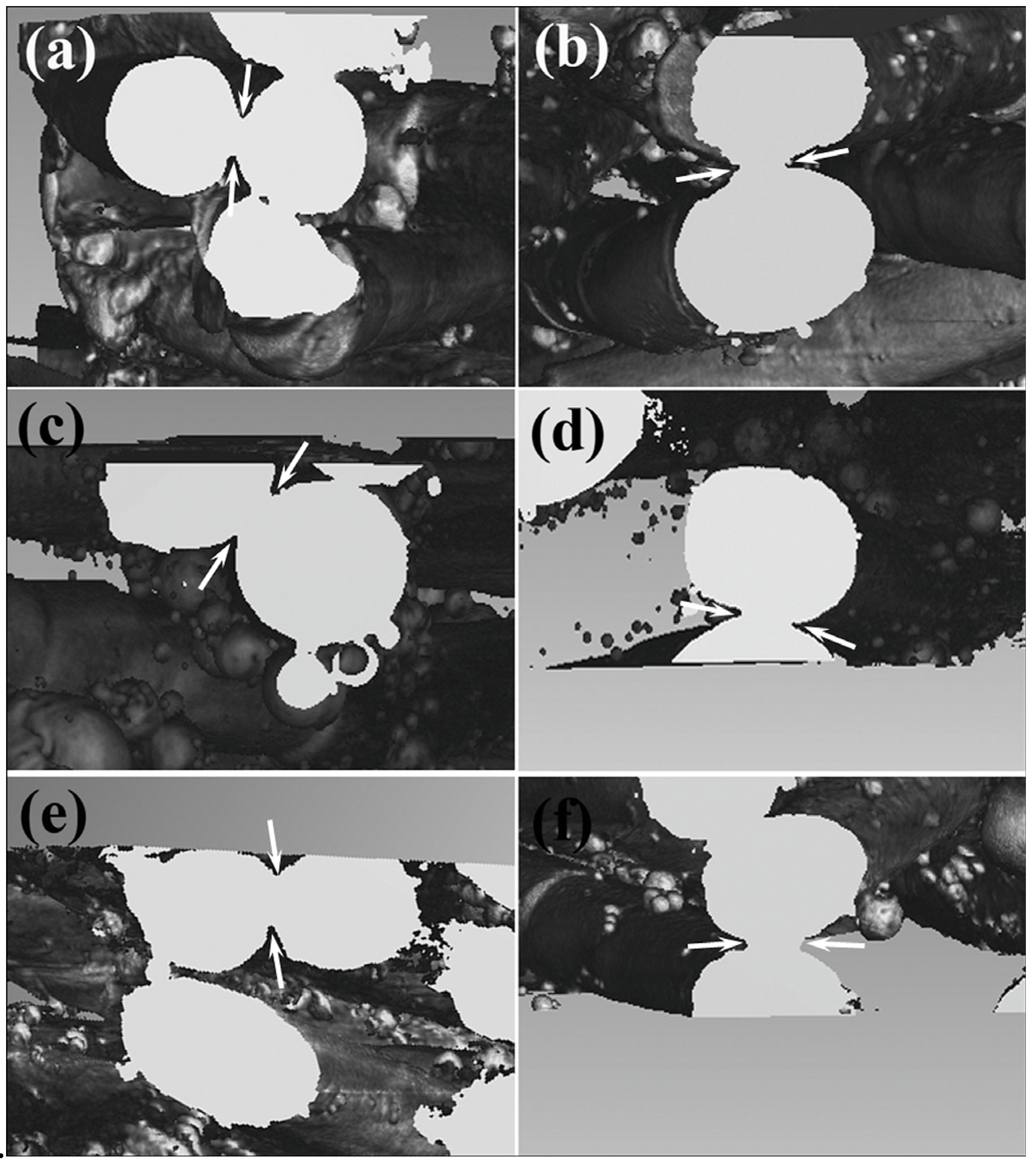
Figure 4.
Figure 4. Variation of relative sintering neck size against joint-fiber angles of copper fiber with a fiber radius of 45 µm, which are acquired via SR-CT characterization under sintering conditions of 1030 oC/30 min (a), 1030 oC/60 min (b) and 1030 oC/180 min (c), respectively.
Figure 4.
Figure 4. Variation of relative sintering neck size against joint-fiber angles of copper fiber with a fiber radius of 45 µm, which are acquired via SR-CT characterization under sintering conditions of 1030 oC/30 min (a), 1030 oC/60 min (b) and 1030 oC/180 min (c), respectively.
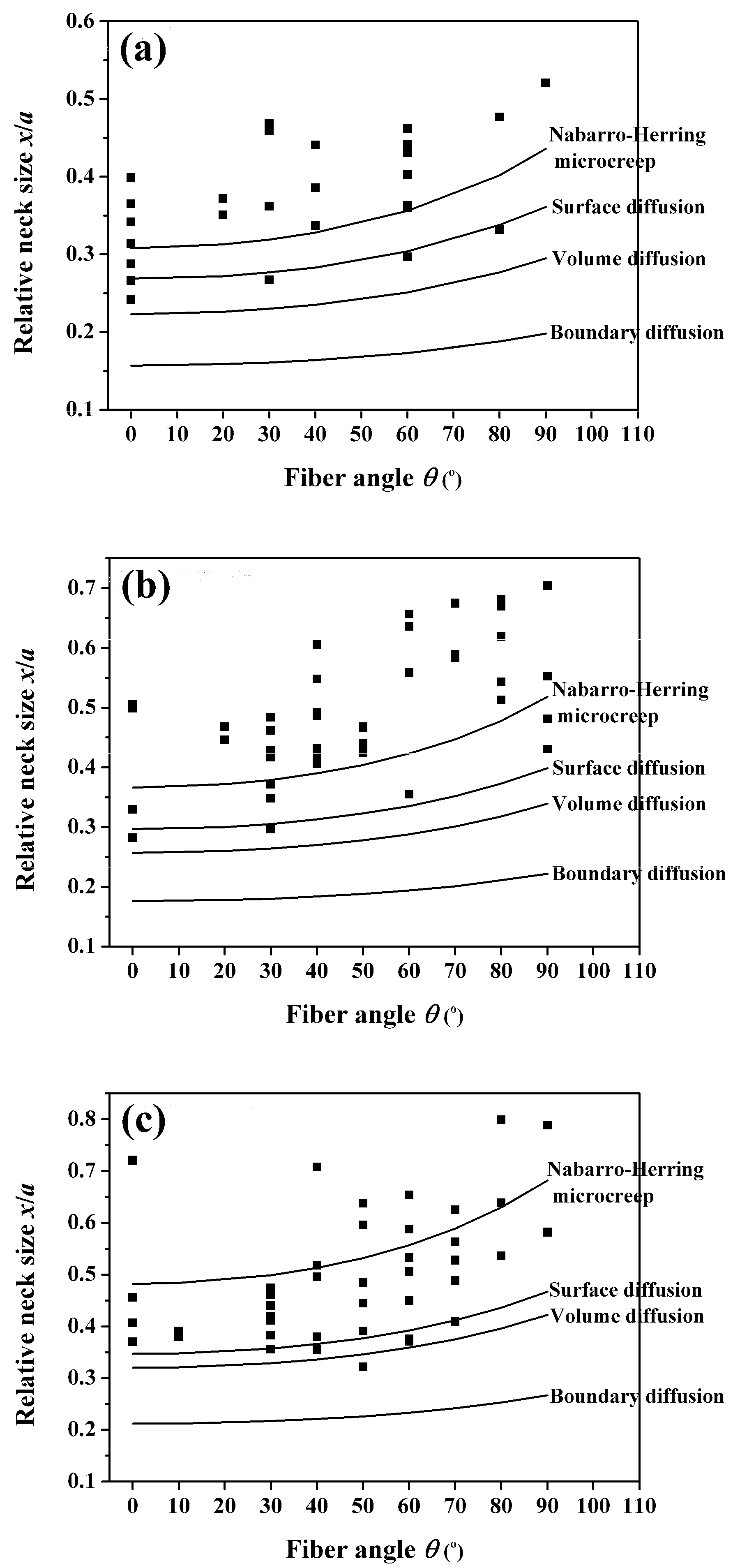

Table 1.
Mechanisms of sintering.
| Mechanism | Source of matter | Sink of matter | Densification |
| Surface diffusion | Surface | Neck | Without |
| Lattice diffusion | Surface | Neck | Without |
| Vapor transport | Surface | Neck | Without |
| Boundary diffusion | Grain boundary | Neck | With |
| Lattice diffusion | Grain boundary | Neck | With |
| Lattice diffusion | Dislocations | Neck | With |
Table 2.
Intrinsic material constants for copper.
| Property | Material constants |
| Atomic volume Ω (m3) | 1.18 × 10⁻²⁹ |
| Melting point Tm (K) | 1356 |
| Surface energy γ (/J/m2) | 1.72 |
| Pre-exponent for lattice diffusion D0v (m2/s) |
6.20 × 10⁻⁵ |
| Activation energy for lattice diffusion Qv (kJ/mol) |
207 |
| Pre-exponent for grain boundary diffusion δbD0b (m3/s) |
5.12 × 10⁻¹⁵ |
| Activation energy for boundary diffusion Qb (kJ/mol) |
105 |
| Pre-exponent for surface diffusion δsD0s (m3/s) |
6.0 × 10⁻¹⁰ |
| Activation energy for surface diffusion Qs (kJ/mol) |
205 |
Table 3.
Predicted sintering durations required to achieve a relative neck size of 0.4 for copper fibers with a radius of 45 µm and a joint-fibers angle of 0o, under the control of Nabarro-Herring microcreep, surface diffusion, volume diffusion and grain-boundary diffusion, respectively.
Table 3.
Predicted sintering durations required to achieve a relative neck size of 0.4 for copper fibers with a radius of 45 µm and a joint-fibers angle of 0o, under the control of Nabarro-Herring microcreep, surface diffusion, volume diffusion and grain-boundary diffusion, respectively.
| Temperature (oC) | Mechanisms of sintering | |||
| Nabarro-Herring mircocreep | Surface diffusion | Volume diffusion | Grain-boundary diffusion | |
| 950 | 4.65 h | 26.30 h | 30.12 h | 240.84 h |
| 1000 1030 |
2.17 h | 12.40 h 8.13 h |
14.09 h 9.20 h |
167.11 h 136.12 h |
| 1.42 h | ||||
Disclaimer/Publisher’s Note: The statements, opinions and data contained in all publications are solely those of the individual author(s) and contributor(s) and not of MDPI and/or the editor(s). MDPI and/or the editor(s) disclaim responsibility for any injury to people or property resulting from any ideas, methods, instructions or products referred to in the content. |
© 2026 by the authors. Licensee MDPI, Basel, Switzerland. This article is an open access article distributed under the terms and conditions of the Creative Commons Attribution (CC BY) license (http://creativecommons.org/licenses/by/4.0/).
Copyright: This open access article is published under a Creative Commons CC BY 4.0 license, which permit the free download, distribution, and reuse, provided that the author and preprint are cited in any reuse.


