
Submitted:
02 July 2026
Posted:
03 July 2026
You are already at the latest version
Abstract
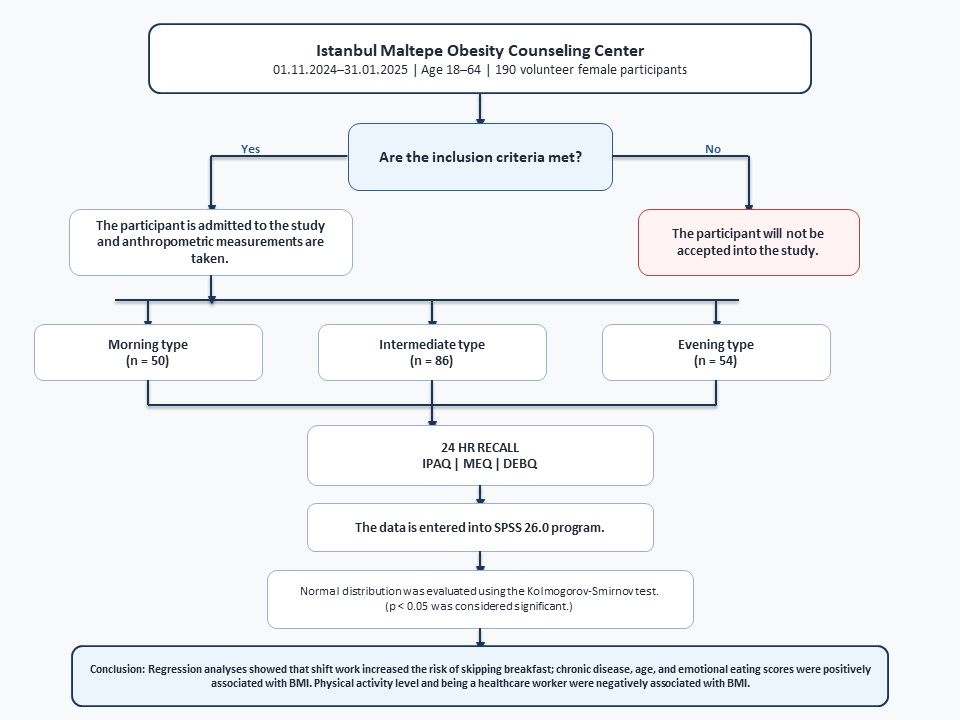
Objectives: The present study was conducted with the objective of examining the relationships between lifestyles, dietary habits, chronotype characteristics, physical activity levels, and eating behaviours of women with shift and fixed work schedules. Methods: A cross-sectional study was conducted with 190 women aged 18–64 years who were attending an obesity counselling centre in Istanbul. Data were collected via questionnaires assessing demographic information, dietary habits, work schedules and lifestyle factors. Chronotype was assessed using the Morningness-Eveningness Questionnaire (MEQ); physical activity was assessed using the International Physical Activity Questionnaire (IPAQ); and eating behaviours were assessed using the Dutch Eating Behaviour Questionnaire (DEBQ). Statistical analyses included chi-square tests, parametric and non-parametric group comparisons, and correlation analyses. Results: Compared to fixed-schedule workers, shift workers exhibited significantly higher rates of meal skipping, particularly breakfast (p=0.015). Lower levels of physical activity were associated with increased body weight, BMI, and waist-hip circumference (p < 0.05). Participants who were obese had higher emotional eating and total eating behaviour scores than those of normal weight (p < 0.05). Chronotype scores varied according to age, marital status, smoking, alcohol consumption and occupational factors, but were not directly correlated with anthropometric measurements. Conclusions: Shift work schedules are linked to irregular eating patterns, lower physical activity levels and altered eating behaviours that may contribute to obesity in women. These findings highlight the importance of considering chronotype and lifestyle factors in multidisciplinary interventions aimed at addressing obesity risk among shift workers.
Keywords:
obesity
; emotional eating
; shift work
; chronotype
; physical activity
; dietary habits
; women
Copyright: This open access article is published under a Creative Commons CC BY 4.0 license, which permit the free download, distribution, and reuse, provided that the author and preprint are cited in any reuse.


