

Submitted:
03 July 2026
Posted:
03 July 2026
You are already at the latest version
Abstract
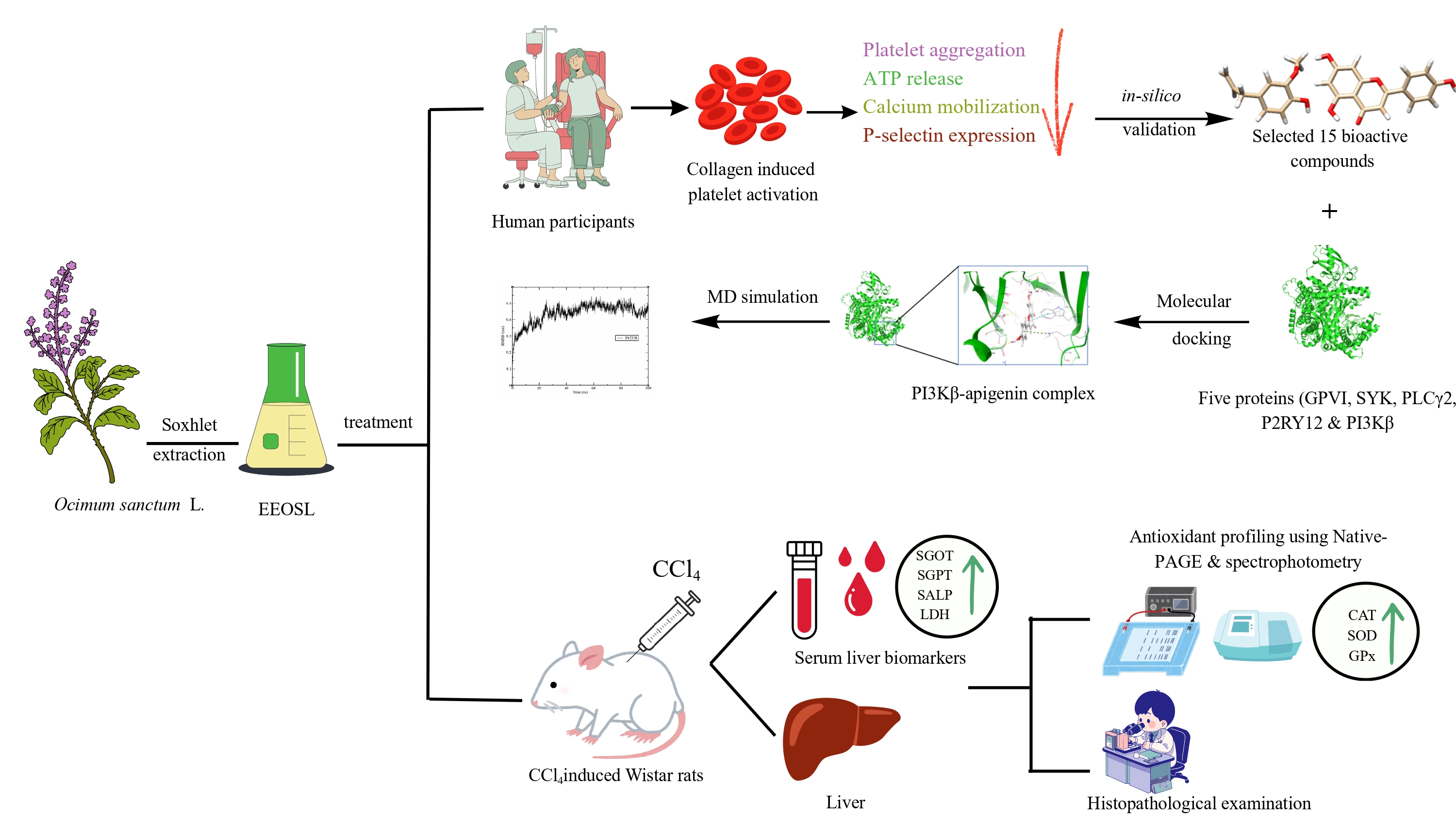
Natural products represent an important source of bioactive compounds with therapeutic potential in the fields of thrombotic and oxidative stress related disorders. The antiplatelet and hepatoprotective activity of ethanolic leaf extract of Ocimum sanctum L. was studied. Collagen-induced human platelet activation (CIHPA) and CCl4-induced hepatotoxicity were used in rats as models to assess the (EEOSL) activity. EEOSL (1-10 mg/mL) showed to significantly and dose-dependently inhibit collagen-induced platelet aggregation. The extract also inhibited P-selectin expression, ATP release and intracellular Ca2+ mobilization, suggesting inhibition of major pathways in platelet activation. To understand the mechanisms, molecular docking was carried out with signaling molecules of platelets such as GPVI, SYK, PLCγ2, P2RY12, and PI3Kβ. Some phytoconstituents have good binding affinities, apigenin having the highest binding affinity to PI3Kβ (−8.01 kcal/mol), and binding was further validated by molecular dynamics simulations showing the formation of stable complexes. Intravenous injection of CCl4 significantly increased the serum hepatic markers (SGOT, SGPT, LDH and SALP); the EEOSL treatment significantly reduced these increases in vivo. The extract normalized antioxidant enzyme activities (catalase, SOD and glutathione peroxidase) and antioxidant isozyme patterns. Histopathological results revealed a significant level of protection against liver damage. Overall, the results showed that EEOSL has strong antiplatelet and hepatoprotective properties, likely due to its ability to modulate platelet signaling pathways and increase antioxidant defense mechanisms.
Keywords:
Ocimum sanctum L.
; antiplatelet activity
; CCl4-induced hepatotoxicity
; oxidative stress
; molecular docking
; histopathology
; native PAGE
Copyright: This open access article is published under a Creative Commons CC BY 4.0 license, which permit the free download, distribution, and reuse, provided that the author and preprint are cited in any reuse.


