

Submitted:
02 July 2026
Posted:
03 July 2026
You are already at the latest version
Abstract
The coexistence of analogue drawing, digital software rendering and image generation using artificial intelligence (AI) has intensified a disciplinary debate on which mode of representation is most relevant in each phase of the project process, without there being a systematic comparative framework that integrates its technical, pedagogical and ethical dimensions, particularly in Latin American architectural training contexts. The objective is to comparatively analyze the strengths, limitations, and implications of analog drawing, digital rendering, and AI generation in architectural presentation, in order to identify hybridization patterns and gaps in educational policy. A qualitative documentary analysis of narrative-thematic scope was developed, informed by the PRISMA guidelines, on sources indexed in Scopus, Web of Science, ScienceDirect and Latin American regional databases, mostly published between 2021 and 2026, processed through thematic and categorical coding with triangulation of sources. A five-phase periodization was identified in the evolution of architectural representation; the comparative advantage of each mode is concentrated at different points in the design process (analogue drawing in conceptual ideation, digital rendering in technical documentation, and generative AI in rapid exploration and communication with non-specialist audiences); Likewise, unresolved gaps persist in terms of authorship, intellectual property and displacement of project competencies. Therefore, a triangular synthesis model between the three modes of representation and a set of curricular recommendations aimed at hybrid literacy and the ethical governance of generative AI in architecture programs is proposed, which constitutes a contribution to the formulation of educational policies in the region.
Keywords:
architectural representation
; analog drawing
; digital rendering
; generative artificial intelligence
; architecture education
1. Introduction
Graphic representation constitutes the language through which architectural thought is materialized, discussed and transmitted before becoming a building. For much of the twentieth century, this language was based almost exclusively on manual tracing; however, in the last four decades it has been successively transformed by the incorporation of computer-aided design (CAD), parametric modelling and Building Information Modelling (BIM), and, more recently, by generative artificial intelligence (AI) models capable of producing credible architectural images from sketches, photographs or textual instructions (Jang et al., 2025; Li et al., 2025). This succession of technological ruptures has not meant the linear substitution of one mode of representation for another, but rather the superimposition of technical repertoires that coexist (and compete) within the contemporary design studio (Carpo, 2017; Ceylan et al., 2024).
On a global scale, the adoption of generative AI in the design process has accelerated significantly since 2021: the systematic review by Jang et al. (2025), based on 161 indexed articles published between 2014 and 2024, documents that the gap between the theoretical formulation of a generative model and its effective application in architectural practice was reduced by about 96%, going from 62 to 2.5 years on average, with a progressive shift from generative adversarial networks (GANs) to diffusion models and transformers. In parallel, the review by Li et al. (2025) published in Frontiers of Architectural Research, states that these tools are mostly concentrated in the schematic phases of the project, while their application in stages of technical development and documentation remains comparatively underexplored. This imbalance suggests that generative AI has not displaced, but reconfigured, the division of tasks between different modes of representation.
In the face of this reconfiguration, an influential sector of literature defends the persistence of the handwritten sketch as an irreplaceable cognitive tool. Yıldızoğlu (2024) argues that, unlike digital tools, the sketch operates as a deliberately imprecise and open medium that favors intuitive exploration in conceptual stages, while Ceylan et al. (2024), in a case study on the architectural design workshop, document that the introduction of digital tools without adequate pedagogical scaffolding can weaken students' early spatial understanding. This line of argument recovers classic findings of design cognition, such as those of Suwa and Tversky (1997), who demonstrated through protocol analysis that architects «read» unplanned information in their own sketches, generating reinterpretations that feed the original idea. The persistence of this body of evidence makes it necessary to nuance the discourses that present generative AI as a functional replacement for drawing, and to examine, instead, in which phases and under what conditions each mode of representation provides differentiated value.
At the Latin American level, the evidence is more fragmentary. Quedas Campoy (2025), in a study published in the journal Limaq of the University of Lima, documents that the Brazilian project field has traditionally been peripheral with respect to foreign technological developments in generative AI applied to architectural design, and warns about the cultural and financial barriers that condition its effective adoption beyond the exploratory stage. This finding can be extended, with nuances, to other university systems in the region, including Peru, where the curricular incorporation of BIM and generative AI tools tends to occur in a reactive and uneven manner between institutions, without an articulated hybrid literacy policy that combines manual drawing, digital modeling, and generative AI as complementary rather than exclusive competencies.
Despite the growing volume of literature on generative AI in architecture, a specific research gap remains: most of the studies reviewed address analogue drawing, digital rendering and AI generation as isolated categories or as a sequential substitution narrative, without offering a comparative framework that simultaneously integrates their technical dimensions (precision, speed, editability), cognitive-pedagogical (tactile involvement, development of competencies) and ethical-normative (authorship, intellectual property, professional travel), and without situating this framework in the formative reality of Latin American schools of architecture. This article responds to this gap through a qualitative documentary analysis aimed at answering the following research question: how are analogue drawing, digital software rendering and AI generation differentiated, complemented and hybridised throughout the architectural presentation process, and what implications does this hybridisation have for the training of architects? The general objective is to comparatively analyze the strengths, limitations, and implications of these three modes of representation, in order to identify hybridization patterns and formulate recommendations for educational policy in architecture.
2. Method
2.1. Design and Approach
A qualitative approach was adopted through a design of documentary analysis of narrative-thematic scope, informed by the PRISMA (Preferred Reporting Items for Systematic Reviews and Meta-Analyses) guidelines for the identification, selection and synthesis of sources, without constituting an exhaustive systematic review in the strict sense. This design is pertinent to an object of study of a conceptual and comparative nature (the modes of architectural representation) in which the available evidence comes from empirical studies, literature reviews and theoretical essays of different methodological nature, which need to be synthesized thematically rather than statistically aggregated.
2.2. Sources of Information and Search Strategy
The documentary search was carried out in the Scopus, Web of Science, ScienceDirect, SpringerLink and Frontiers databases, complemented with repositories of high query factor preprints (arXiv) and with Latin American regional indexing databases (Latindex, DOAJ, Dialnet) to incorporate production in Spanish and Portuguese. The search strings combined the terms "analog drawing" OR "hand sketching", "digital rendering" OR "software rendering" OR BIM, and "generative artificial intelligence" OR "generative AI" AND "architectural design" OR "architecture education", in addition to their Spanish equivalents ("dibujo analógico", "renderizado digital", "inteligencia artificial generativa", "diseño arquitectura"). The search period was established between 1997 and 2026, allowing the inclusion of a limited number of seminal referents of design cognition prior to 2021, in order to theoretically anchor the discussion, although the analytical corpus was mostly concentrated on production published between 2021 and 2026.
2.3. Inclusion and Exclusion Criteria
Included were peer-reviewed articles published in journals indexed in Scopus or Web of Science, academic book chapters, and high-citation factor refereed conference proceedings in the domain of computation applied to design (e.g., ACM Creativity and Cognition), which explicitly addressed analog drawing, digital rendering, or AI generation in the context of architectural rendering or teaching. Corporate blog posts, promotional content from software vendors, publications without a verifiable arbitration process, and sources whose metadata (authorship, institutional affiliation, DOI) could not be independently confirmed were excluded. From the initial corpus identified, eighteen primary academic sources were selected that fully met the inclusion criteria, complemented with supporting theoretical references.
2.4. Thematic and Categorical Analysis Procedure
The analysis was developed in two rounds of coding. In the first round, each source was inductively coded according to the emerging topics related to the three modes of representation. In the second round, the codes were deductively organized into four predefined analytical categories based on the conceptual framework of the study: (a) analog drawing, (b) digital rendering by software, (c) generation by AI and (d) synthesis and hybridization between modes. Within each category, subcodes related to the technical, cognitive-pedagogical and ethical-normative dimensions were identified, which structure the presentation of results.
2.5. Reliability and Triangulation
The reliability of the analysis was reinforced by the triangulation of sources from independent databases (international and regional indexing), the contrast of recent empirical findings with consolidated theoretical frameworks of reference in the discipline (Carpo, 2017; Suwa & Tversky, 1997) and a second verification reading of the entire corpus, aimed at checking the consistency between the coded content and the assigned categories. As an explicit methodological limitation, the analysis focuses on published literature and does not incorporate direct observation of case studies in professional firms or design workshops in real time, an aspect that is taken up in the limitations section.
3. Results
3.1. Historical Periodization of Architectural Representation
The documentary analysis allows us to reconstruct a five-phase periodization in the evolution of the modes of architectural representation from 1980 to the present day (Figure 1). The first phase, prior to 1980, corresponds to a predominantly analogue era based on the hand-sketch and the physical model. The second phase (1980-2000) (the "first digital turn") is marked by the spread of CAD and the first rendering engines, which introduced geometric precision as the central value of representation. The third phase (2000-2015) (the "second digital turn", following the name of Carpo, 2017) is characterized by the consolidation of parametric BIM and collaborative photorealistic rendering flows. The fourth phase (2015-2021), described in the professional practice literature as the "post-digital era", registers a vindicative return of the sketch and of hybrid analogue-digital techniques within architecture firms. The fifth phase (2021 to the present) corresponds to the generative era, characterized by the maturation of GANs, variational selfencoders (VAEs) and, above all, diffusion models and transformers capable of generating architectural images from textual instructions or sketches (Jang et al., 2025).
Table 1 synthesizes this periodization by incorporating, for each phase, the representative tools, the epistemic role attributed to the architect in the reviewed literature, and the key references that document each moment.
3.2. Analogue Drawing: Sketch and Physical Model
Analogue drawing groups freehand sketching and the elaboration of physical models as primary tools for conceptual exploration. The protocol analysis developed by Suwa and Tversky (1997) (one of the most cited studies in the design cognition literature) shows that architects do not limit themselves to recording pre-existing ideas in the sketch, but perceptually reinterpret their own strokes, generating emergent information that feeds back into the design process; This finding supports the thesis that the sketch constitutes an active cognitive tool and not a mere support of passive representation. In the same vein, Yıldızoğlu (2024) characterizes the sketch as a deliberately "poorly structured" medium, without exact solutions and open to intuition, whose ambiguity is functional in the early phases of design. For his part, Corazzo (2019) documents, through a systematic review focused on design teaching, that the material space of the workshop (including the physical elaboration of models) fulfills a pedagogical function that transcends representation, by operating as a scenario for situated learning and disciplinary socialization among students.
The limitations of analog drawing identified in the literature are concentrated in three aspects: the time cost of production and iteration, the difficulty of remote or simultaneous collaboration between geographically distributed design teams, and the limited scalability for projects of great geometric or documentary complexity. However, these same sources agree that these limitations do not invalidate its specific cognitive value, but rather delimit its scope of relevance to the phases of conceptual ideation and informal communication within the design team.
3.3. Digital Rendering by Software
Digital rendering comprises three-dimensional modeling using specialized software (SketchUp, Rhino, 3ds Max, Revit) and its subsequent processing in photorealistic or stylized render engines. Ceylan et al. (2024), in a case study on the architectural design workshop, document that the incorporation of digital tools improves geometric precision and iteration speed, but they also identify a pedagogical risk: when these tools are introduced without a curricular sequence that prioritizes spatial understanding first and then digital instrumentalization, Students tend to prematurely delegate project judgment to software capabilities. This finding is consistent with the observation, already documented by Carpo (2017) from a historiographical perspective, that each digital turn has progressively displaced the centrality of the manual stroke without eliminating it completely, generating a recurrent pedagogical tension between instrumental efficiency and the development of fundamental project competencies.
A relevant finding in this category is the emerging role of AI as an auxiliary component within the digital rendering flows themselves: before constituting an autonomous mode of representation, the first uses of AI in architecture were integrated as optimization functions within traditional rendering engines (e.g., noise reduction and lighting calculation acceleration), suggesting an early hybridization between the two modes that precedes the current generation of end-to-end AI imaging (Jang et al., 2025).
3.4. Generation Using Artificial Intelligence
AI generation is the most recent and fastest-growing mode of representation in the literature reviewed. The review by Li et al. (2025), published in Frontiers of Architectural Research, organizes its applications into six steps of the design process —from the generation of conceptual images to the generation of structural systems—, finding that the greatest concentration of studies is located in the generation of conceptual images from text or sketches. while the stages of technical development remain comparatively underexplored. Zhang et al. (2023), in an experimental study presented at the ACM Creativity and Cognition conference, show that the use of design sketches as input (rather than just text) for generative image models improves the conceptual fidelity of the results, although they also identify interaction frictions when designers try to precisely control the generated attributes. In a pedagogical experiment with first-year students, Tong et al. (2023) document that the use of AI as a "new mode of sketching" expands the exploratory repertoire of novice students, although they warn of the risk of premature dependence that could limit the development of their own graphic language.
Baudoux (2024) specifically examines AI imagers as architectural ideation tools based on sketch recognition, and documents that these tools function best as "co-creation" interlocutors that expand the space for formal exploration, rather than as autonomous substitutes for the architect's design criteria. In the same empirical line, Zeytin et al. (2024) evaluated the assistance of AI throughout the design process in a sample of new designers, and found that the contribution of the tool is uneven according to the stage: more valued in the divergent generation of initial alternatives than in the final synthesis decision-making, which reinforces the need to precisely delimit the relevant scope of application of AI within the design process. On the emotional and communicative level, Zhang et al. (2024), in a study published in Frontiers in Psychology with 789 university students, found that AI-generated architectural images are particularly effective in conveying positive emotions such as joy, especially in interior scenes, but have limited performance in conveying negative emotions in a nuanced way. and that architecture students show greater discriminative sensitivity to these emotional nuances than students from other disciplines, which suggests that disciplinary training continues to be relevant for the critical interpretation of the images generated.
3.5. Multidimensional Comparative Analysis
Table 2 summarizes the comparative analysis between the three modes of representation based on the dimensions encoded in the documentary corpus: temporal cost, geometric precision, cognitive-tactile involvement, ease of iteration, accessibility for non-specialized audiences, dependence on technical skills, authorship issues, representative tools, and the most pertinent design phase.
3.6. Human-AI Synthesis and Hybridization
The documentary corpus converges in identifying hybridization (rather than substitution) as the dominant trend in contemporary architectural visualization equipment. Karadağ and Ozar (2025), in a study on the design workshop, describe human-AI collaboration as a pedagogical "new frontier" in which the student's role shifts towards the critical curation of generated results, without eliminating the need for one's own project criteria. However, this hybridization is not without risks: Zhang et al. (2021), in an experimental study published in Design Studies, warn through what they call a "cautionary warning" that the incorporation of AI into human design teams can, under certain conditions, reduce the diversity of solutions explored and generate a premature convergence towards dominant aesthetic patterns in training data. instead of expanding the creative space as is usually assumed. This finding qualifies the instrumental optimism of much of the literature and suggests that the quality of hybridization depends critically on the pedagogical and organizational design of the workflow, and not only on technological availability (Figure 2).
4. Discussion
4.1. Theoretical Implications
The results obtained allow us to refine the available theoretical framework on architectural representation in at least two senses. First, the evidence analyzed supports a non-linear reading of the history of representation, along the lines of what Carpo (2017) proposes: each technological turn does not cancel out the previous one, but rather reconfigures its scope of relevance within the project process. Second, the findings of Zhang et al. (2021) and Karadağ and Ozar (2025) suggest the need for a theory of distributed creativity that explicitly incorporates the risk of aesthetic convergence induced by generative models, a phenomenon insufficiently theorized in previous literature focused almost exclusively on efficiency gains. This finding contributes to the field of architectural information management education by suggesting that AI-generated "information" is not neutral with respect to formal diversity, but rather reproduces distributional biases in its training corpus, which has direct consequences on how it is taught to critically evaluate such information in the design workshop.
4.2. Practical Implications for Education Policy-Making
For architecture programs, and in particular for Latin American institutions that—as Quedas Campoy (2025) documents for the Brazilian case—face historically peripheral technological adoption, the findings suggest three practical implications. First, curricular sequence matters: studies by Ceylan et al. (2024) and Tong et al. (2023) agree that the premature introduction of digital tools or generative AI, without a prior foundation of conceptual drawing and modelling skills, can weaken rather than strengthen the development of project criteria. Second, generative AI literacy should explicitly incorporate a critical dimension aimed at recognizing aesthetic biases and emotional limitations of the images generated (Zhang et al., 2024), and not be limited to the technical competence of instruction engineering. Third, the absence of clear regulatory frameworks on the authorship of AI-generated images (Mazzi, 2024) requires architecture schools to incorporate explicit content on professional ethics and intellectual property applied to these tools, which are currently absent in much of the regional curricula.
4.3. Ethical Issues: Authorship and Displacement of Competences
The ethical discussion documented in the corpus is organized in two axes. The first concerns authorship and intellectual property: Mazzi (2024) analyzes, from the perspective of intellectual property law, how current regulatory frameworks require a minimum degree of verifiable human creativity in textual instructions for a work generated by AI to be susceptible to protection, which introduces an area of legal uncertainty for architects who use these tools in the presentation of proposals to clients or competitions. The second axis concerns the displacement of skills and the impact on human creators: Jiang et al. (2023), in a study presented at the AAAI/ACM conference on AI, ethics and society, document that many visual artists perceive AI generation as an economic and symbolic threat to their creative work, particularly when models have been trained on repositories of their own works without explicit consent. Transferred to the architectural field, this evidence suggests that the discussion on AI image generation cannot be reduced to its instrumental utility, but must incorporate the question of working conditions and professional recognition of those who have traditionally produced architectural representation in an analogue or digital way.
4.4. Limitations of the Study
The present study has limitations that must be made explicit. First, the analysis focuses on published literature and normative documents, without incorporating direct observation or interviews with practicing architects or students in the training process, which limits the possibility of empirically verifying, in the specific Peruvian context, the magnitude of the hybridization patterns identified in the international literature. Second, the accelerated nature of generative AI development means that some of the evidence analysed may become outdated in short timeframes, a risk that the peer-reviewed studies themselves acknowledge by documenting a sustained narrowing of the theory-practice gap (Jang et al., 2025). Third, although source triangulation was applied, the relative weighting of each comparative dimension in Table 2 reflects a qualitative synthesis of the revised corpus and not a standardized quantitative measurement, so future research should complement this framework with validated measurement instruments.
4.5. Originality and Contribution
The originality of this analysis lies in the construction of a comparative framework that simultaneously integrates the technical, cognitive-pedagogical and ethical-normative dimensions of the three modes of architectural representation, avoiding the narrative of sequential substitution predominant in the literature of professional practice, and situating this synthesis in the formative reality of Latin American architecture, a context comparatively underrepresented in the indexed literature on generative AI in architecture.
5. Conclusions
First. The evolution of architectural representation between 1980 and 2026 does not describe a linear replacement of analogue drawing by digital tools and, subsequently, by generative AI, but a progressive superposition of technical repertoires whose relevance varies according to the phase of the design process.
Second. Analogue drawing retains a specific and empirically documented comparative advantage in early conceptual ideation, associated with its active cognitive function (Suwa and Tversky, 1997), while digital rendering concentrates its value on technical documentation and geometric precision, and AI generation excels in the rapid exploration of alternatives and in communicating with non-specialist audiences.
Third. Hybridization between modes of representation is the dominant trend identified in the corpus, but its quality depends on the pedagogical and organizational design of the workflow, given that the available evidence warns of risks of aesthetic convergence and reduction of exploratory diversity when the incorporation of AI is not mediated by deliberate human judgment (Zhang et al., 2021; Karadağ & Ozar, 2025).
Fourth. Unresolved regulatory gaps persist in the authorship and intellectual property of AI-generated images (Mazzi, 2024), as well as unresolved tensions regarding the professional and economic recognition of human creators whose work feeds, directly or indirectly, generative models (Jiang et al., 2023).
Fifth. Latin American architectural training faces a specific educational policy gap in terms of hybrid literacy and ethical governance of generative AI, which the revised international evidence does not solve on its own and which requires empirical research situated in the institutional contexts of the region.
6. Recommendations
Architecture schools in the region are recommended to: (a) preserve a curricular sequence that prioritizes the development of conceptual drawing and modeling competencies before digital instrumentalization and generative AI, in line with the evidence of Ceylan et al. (2024) and Tong et al. (2023); (b) incorporate explicit critical literacy modules in generative AI that address aesthetic biases, emotional limitations, and authorship issues, and not just technical instructional engineering competencies; (c) develop institutional guidelines on the use, attribution, and dissemination of AI-generated content in the presentation of academic and professional projects, anticipating the legal uncertainty documented by Mazzi (2024).
The research community is recommended: (a) to develop longitudinal studies that evaluate the effect of different curricular sequences for the introduction of digital tools and generative AI on the development of students' project competencies throughout the career; (b) perform comparative efficiency analyses between purely analog, digital, generative and hybrid workflows, using standardized indicators of accuracy, uptime and end-user perception; (c) to propose and validate a set of ethical governance indicators for generative AI in the practice and teaching of architecture, applicable to Latin American institutional contexts, which allow monitoring its adoption in a systematic and comparable manner among countries in the region.
References
- Baudoux, G. The benefits and challenges of artificial intelligence image generators for architectural ideation: Study of an alternative human-machine co-creation exchange based on sketch recognition. Int. J. Archit. Comput. 2024, 22(2), 201–215. [Google Scholar] [CrossRef]
- Carpo, M. The second digital turn: Design beyond intelligence; MIT Press, 2017. [Google Scholar]
- Ceylan, S.; Şahin, P.; Seçmen, S.; Somer, M. E.; Süher, H. K. The contribution of digital tools to architectural design studio: A case study. Ain Shams Eng. J. 2024, 15(6), 102795. [Google Scholar] [CrossRef]
- Corazzo, J. Materialising the studio: A systematic review of the role of the material space of the studio in art, design and architecture education. Des. J. 2019, 22(sup1), 1249–1265. [Google Scholar] [CrossRef]
- Jang, S.; Roh, H.; Lee, G. Generative AI in architectural design: Application, data, and evaluation methods. Autom. Constr. 2025, 174, 106174. [Google Scholar] [CrossRef]
- Jiang, H. H.; Brown, L.; Cheng, J.; Khan, M.; Gupta, A.; Workman, D.; Hanna, A.; Flowers, J.; Gebru, T. AI art and its impact on artists. In Proceedings of the 2023 AAAI/ACM Conference on AI, Ethics, and Society, 2023; pp. 363–374. [Google Scholar] [CrossRef]
- Karadağ, D.; Ozar, B. A new frontier in design studio: AI and human collaboration in conceptual design. Front. Archit. Res. 2025, 14(6), 1536–1550. [Google Scholar] [CrossRef]
- Li, C.; Zhang, T.; Du, X.; Zhang, Y.; Xie, H. Generative AI models for different steps in architectural design: A literature review. Front. Archit. Res. 2025, 14(4), 759–783. [Google Scholar] [CrossRef]
- Mazzi, F. Authorship in artificial intelligence-generated works: Exploring originality in text prompts and artificial intelligence outputs through philosophical foundations of copyright and collage protection. J. World Intellect. Prop. 2024, 27(3), 410–427. [Google Scholar] [CrossRef]
- Quedas Campoy, C. Artificial intelligence, collaboration and BIM in the methodological process of architectural design: use of the Architechtures tool. Limaq 2025, (15), 105–124. [Google Scholar] [CrossRef]
- Suwa, M.; Tversky, B. What do architects and students perceive in their design sketches? A protocol analysis. Des. Stud. 1997, 18(4), 385–403. [Google Scholar] [CrossRef]
- Tong, H.; Türel, A.; Şenkal, H.; Ergun, S.; Güzelci, O. Z.; Alaçam, S. Can AI function as a new mode of sketching? A teaching experiment with freshman. Int. J. Emerg. Technol. Learn. 2023, 18(18), 4–22. [Google Scholar] [CrossRef]
- Yıldızoğlu, N. Sketching versus digital design tools in architectural design. J. Comput. Des. 2024, 5(2), 1–15. [Google Scholar] [CrossRef]
- Zeytin, E.; Öztürk Kösenciğ, K.; Öner, D. The role of AI design assistance on the architectural design process: An empirical research with novice designers. J. Comput. Des. 2024, 5(1), 1–30. [Google Scholar] [CrossRef]
- Zhang, C.; Wang, W.; Pangaro, P.; Martelaro, N.; Byrne, D. Generative image AI using design sketches as input: Opportunities and challenges. Proc. 15th Conf. Creat. Cogn. 2023, 254–261. [Google Scholar] [CrossRef]
- Zhang, G.; Raina, A.; Cagan, J.; McComb, C. A cautionary tale about the impact of AI on human design teams. Des. Stud. 2021, 72, 100990. [Google Scholar] [CrossRef]
- Zhang, Z.; Fort, J. M.; Giménez Mateu, L. Decoding emotional responses to AI-generated architectural imagery. Front. Psychol. 2024, 15, 1348083. [Google Scholar] [CrossRef] [PubMed]
Figure 1.
Periodization of the modes of architectural representation (1980-present). Prepared by the author based on the corpus analysed.
Figure 1.
Periodization of the modes of architectural representation (1980-present). Prepared by the author based on the corpus analysed.
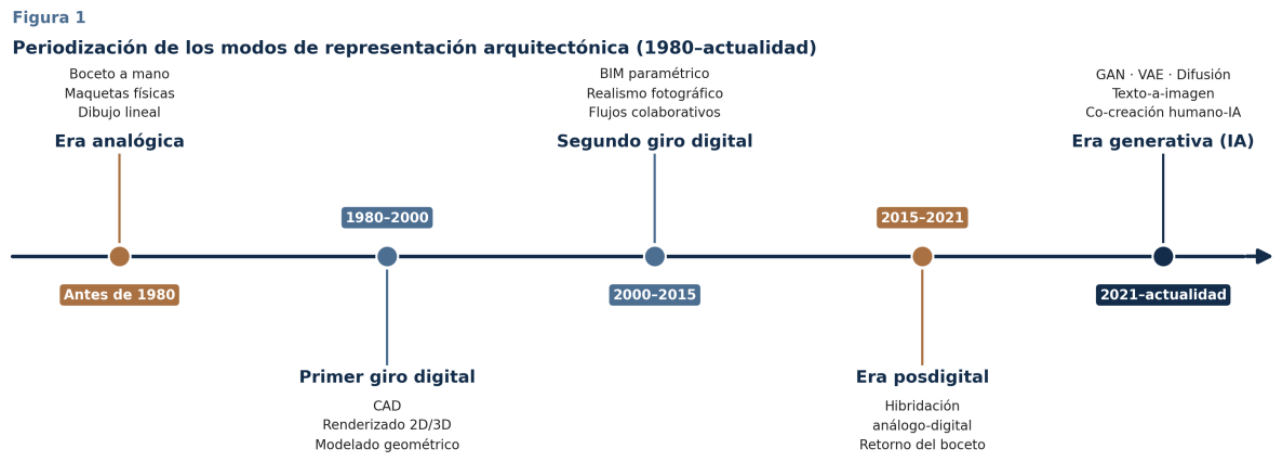
Figure 2.
Triangular synthesis model between architectural representation methods. Prepared by the author based on the corpus analysed.
Figure 2.
Triangular synthesis model between architectural representation methods. Prepared by the author based on the corpus analysed.
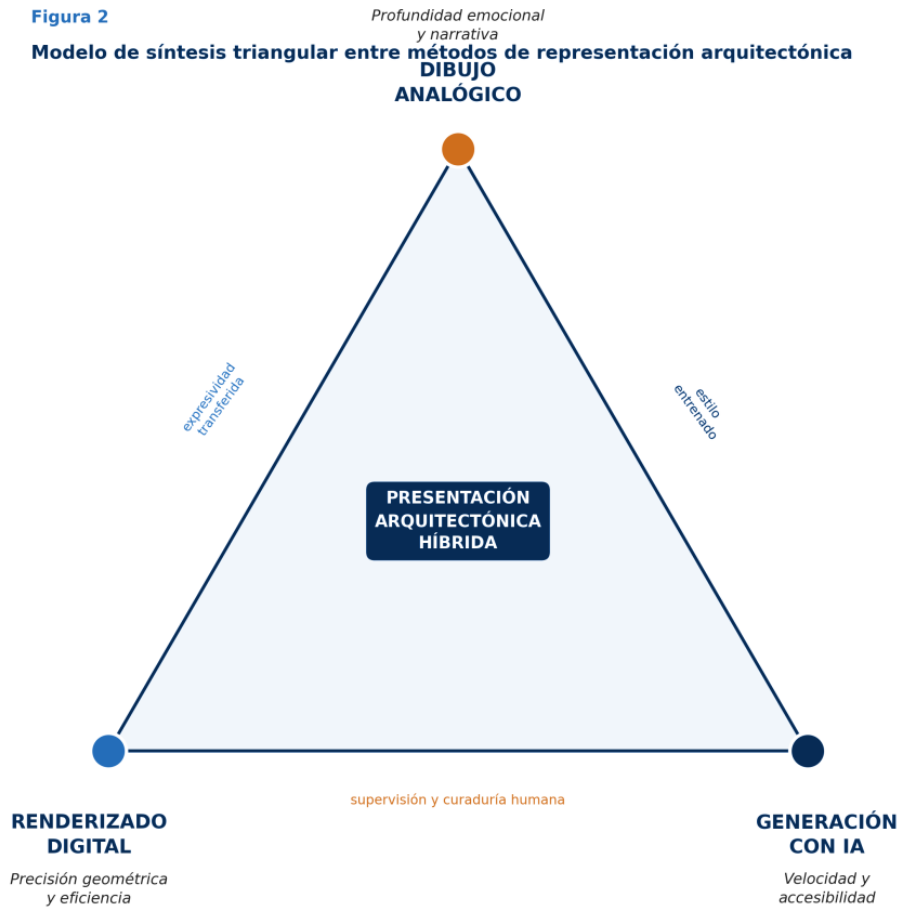

Table 1.
Historical periodization of the modes of architectural representation.
| Phase | Period | Representative tools | Epistemic role of the architect | Key literature |
|---|---|---|---|---|
| It was analogue | Before 1980 | Hand sketch, physical mockup, technical drawing instruments | Author-craftsman; Thinking through the hand | Suwa y Tversky (1997); Corazzo (2019) |
| First digital turn | 1980-2000 | 2D/3D CAD, the first render engines | Geometric Precision Operator | Carpus (2017) |
| Second digital spin | 2000-2015 | Parametric BIM, V-Ray, photorealistic engines | Integrated information manager | Carpo (2017); Ceylon et al. (2024) |
| Post-digital era | 2015-2021 | Hybrid tools, graphics tablets, sketch return | Multi-Language Curator | Yıldızoğlu (2024) |
| Generative era (AI) | 2021-present | GAN, VAE, broadcast models, text-to-image | Prompt-designer and curator of results | Jang et al. (2025); Li et al. (2025) |
Table 2.
Multi-dimensional comparison between analog drawing, digital rendering, and AI generation.
| Dimension | Analog drawing | Digital Rendering | AI Generation |
|---|---|---|---|
| Temporary cost of production | High | Medium | Low to very low |
| Geometric precision | Low to medium | High | Variable / not guaranteed |
| Cognitive-tactile involvement | Alto (Suwa y Tversky, 1997) | Medium | Low to medium |
| Ease of iteration and editing | Low | Medium-high | High (limited control) |
| Accessibility for non-technical audiences | Media | Low-medium | High (Zhang et al., 2024) |
| Reliance on specialized technical skills | Low (manual dexterity) | Registration (software mastery) | Media (Instruction Engineering) |
| Authorship/Intellectual Property Issues | Resolved | Resolved | Unresolved (Mazzi, 2024) |
| Representative tools | Pencil, physical mockup | Rhino, Revit, V-Ray | Diffusion models, GAN, VAE |
| Most relevant design phase | Conceptual ideation | Documentation and technical development | Quick Exploration and Communication with Customers |
Disclaimer/Publisher’s Note: The statements, opinions and data contained in all publications are solely those of the individual author(s) and contributor(s) and not of MDPI and/or the editor(s). MDPI and/or the editor(s) disclaim responsibility for any injury to people or property resulting from any ideas, methods, instructions or products referred to in the content. |
© 2026 by the authors. Licensee MDPI, Basel, Switzerland. This article is an open access article distributed under the terms and conditions of the Creative Commons Attribution (CC BY) license (http://creativecommons.org/licenses/by/4.0/).
Copyright: This open access article is published under a Creative Commons CC BY 4.0 license, which permit the free download, distribution, and reuse, provided that the author and preprint are cited in any reuse.


