

Submitted:
02 July 2026
Posted:
03 July 2026
You are already at the latest version
Abstract
Per- and polyfluoroalkyl substances (PFAS) are synthetic fluorinated compounds widely recognized for their stability and persistence in the environment. These characteristics make PFAS valuable in many applications but also pose serious health risks because they do not break down easily. These chemicals can accumulate in living organisms and persist in water systems. PFAS typically transfer from water to other media rather than being completely degraded by conventional treatment technologies such as adsorption and membrane filtration. Chemical degradation techniques, i.e., advanced oxidation processes or electrochemical conversions, require harsh reaction conditions, which make them unsustainable. Microbial degradation offers a green, sustainable alternative for PFAS remediation in water. This review critically analyzes advances in the use of bacterial, fungal, and microbial consortia for PFAS transformation via reductive and oxidative defluorination and/or metabolic reactions. Later, the influence of PFAS structural attributes, i.e., chain length and functional head groups, on microbial activities has been discussed. In the following section, the current progress toward the complete mineralization of PFAS is evaluated. Considering the critical evaluation of microbial degradation processes, several research gaps have been identified, including the lack of detailed mechanistic studies of enzymatic degradation pathways, the need to optimize microbial systems for the sustainable degradation of PFAS, and the integration of biological approaches with other technologies to achieve complete PFAS mineralization.
Keywords:
PFAS
; defluorination
; bacteria
; enzymes
; chain length
; functional groups
1. Introduction
Man-made compounds known as per- and polyfluoroalkyl substances (PFAS) have been widely employed in consumer goods for more than 60 years. These chemicals contaminate water, endangering aquatic life and humans [1]. Because of their stable C-F bonds, PFASs are often referred to as "the forever chemicals" when compared with other emerging pollutants, such as antibiotics and microplastics [2]. Fluorine's high electronegativity makes the C-F bond the strongest in chemistry, giving PFASs physicochemical characteristics like hydrophobicity, lipophobicity, and chemical and thermal durability [3]. Due to these properties, PFASs have wide applications in food packaging, firefighting foams, electronics, and non-stick coatings. [1,4].
The PFAS molecular structure comprises a head and tail. The tail can vary in length and degree of fluorination. The head consists of functional groups (R), i.e., carboxylates, sulfonates, sulfonamides, phosphonates, while polyfluorinated chains may consist of combinations of these groups and other small chains of hydrocarbons [5]. The molecular structure of PFAS is amphiphilic, with functional head groups that are hydrophilic and carbon chains, which are either fully or partially fluorinated, that generally exhibit hydrophobic behavior [6]. In addition to general structures, based on the type of PFAS, these molecules can have tails consisting of both ether moieties and fluoroalkyl, and these PFAS are often referred to as per- and polyfluoroalkyl ether acids, such as GenX [7]. Legacy PFAS compounds include perfluorooctanoic acid (PFOA) and perfluorooctane sulfonate (PFOS) [8]. The Stockholm Convention on Persistent Organic Pollutants' Annex B lists PFOS as a persistent organic pollutant (POP) made up of hydrophilic functional head groups and fluorinated hydrophobic tails [5,9,10]. In May 2019, PFOA was added to this list. Moreover, the high solubility and chemical stability of PFASs in water hinder their degradation. As a result, PFASs bioaccumulate in humans, plants, and animals to varying degrees, with concentrations ranging from ng/L to mg/L in various contexts [11].
According to the NHANES (National Health and Nutrition Examination Survey) conducted by the Centre for Disease Control and Prevention, 98% of people in the United States of America (USA) have PFAS contamination in their blood serum [13,14]. That’s why the US Environmental Protection Agency (EPA) has strict PFAS regulations. For PFOS and PFOA, the maximum contamination limit (MCL) is 4.0 ng/L, while for short-chain PFAS (e.g., PFHxS and GenX) and long-chain PFAS (e.g., PFNA), the MCL is 10 ng/L [15]. The Ministry of Ecology and Environment of the People's Republic of China has completely prohibited the production of PFAS-like compounds [16]. The European Union’s Drinking Water Directive (DWD) set the limit for all PFAS at 500 ng/L and termed as “PFAS total”, and for 20 specific types of PFAS compounds, including PFOS and PFOA, named as “Sum of PFAS”, the limit was set at 100 ng/L [17,18]. As illustrated in Figure 1, mean PFAS concentrations in human blood serum have been compared globally and by continent. Seven PFAS in total were considered, including short- and long-chain compounds and perfluorinated ethers. The top five countries were Belgium > Greenland > China > France > Finland, with average Σ7PFAS concentrations of 64.5, 40.8, 40.3, 27.9, and 20.6 ppb, respectively. Among continents, Asia topped all with the average concentration of 38.597 ppt [12].
Despite strict regulation and a decline in PFAS production in recent years, PFASs are frequently detected in the natural environment, including surface water, soil, and groundwater [19]. So, PFAS remediation from water is becoming increasingly crucial, as traditional wastewater treatment plants are not designed to remove them [20]. To remove PFAS contamination from water and meet regulatory requirements, significant research has been carried out over the last five years. Adsorption, ion exchange, membrane filtration, thermal destruction, and advanced oxidation are examples of current remediation techniques that are still expensive, energy-intensive, and produce concentrated waste streams that lead to partial mineralization [21,22], which means the carbon-fluorine backbone often remains intact or is only partially broken down, forming shorter chain PFAS that may be more mobile and highly persistent [23]. One important method for reducing waste is microbial transformation, which turns waste into innocuous materials and promotes resource recovery. It is essential to develop techniques with strong degradation performance, low cost, scalability, and no secondary contamination to efficiently reduce PFAS pollution in the environment and achieve efficient waste conversion [16].
The majority of PFAS are extremely resistant to microbial breakdown due to the exceptional stability of the carbon-fluorine (C-F) bond. This stability resulted in minimal microbial mineralization of PFAS, leading to the underutilization of microbes to mitigate the risk posed by emerging contaminants. Currently, microbes are getting attention as a green and sustainable option to degrade PFAS into aqueous systems [10,24]. However, recent investigations indicated that certain PFAS classes, especially polyfluorinated precursors and some short-chain compounds, can undergo microbial transformation under environmental conditions. These findings challenge the long-standing assumption that all PFAS are completely resistant to biodegradation [25].
The cleavage of relatively weak carbon-heteroatom (C-X) bonds, such as C-H and C=O, adjacent to fluorinated carbon atoms, has been linked to enzymes, including reductive dehalogenases and monooxygenases. Additionally, bacterial and fungal species mediating partial defluorination and structural modification of certain PFAS have been observed in recent investigations [26]. These findings suggest that microbial consortia may aid in PFAS transformation in situ and offer pathways for long-term PFAS degradation approaches [27]. PFAS biodegradation capability is closely linked to molecular structure, which includes the type of functional (or "head") group and the length of the fluorinated carbon chain [28]. Compared to their short-chain counterparts, long-chain PFAS, such as PFCAs with eight or more carbon atoms and PFSAs with six or more carbon atoms, are more hydrophobic, have a stronger attraction for organic matter, and have a larger potential for bioaccumulation [5], thereby becoming more environmentally persistent and susceptible to biodegradation [29]. Particularly for carboxylate and sulfonate forms, the head group significantly influences PFAS ionization, reactivity, and aqueous speciation, all of which in turn affect enzymatic accessibility and environmental transport. Additionally, functional groups can control the metabolic pathways of microorganisms and determine whether transformation starts at the head group or moves along the fluorinated carbon chain [30,31,32]. The bioconversion of different PFAS compounds in wastewater systems is severely hampered by their toxicity to microorganisms [33,34,35], especially when co-contaminants are present and interact with PFAS [36,37,38]. Effective methods are also needed to improve overall PFAS removal efficacy and bioconversion efficiency [39,40].
This review focuses on microbial transformation of PFAS by bacteria and fungi. It primarily examines how the PFAS chemical structure (either chain length or attached functional group) significantly impacts microbial uptake and enzymatic transformations. Initially, the literature search methodology to write this review is discussed, followed by the classification of PFAS, which is the key determinant of their susceptibility to microbial biodegradation. In the following section, the sorption capacity of PFAS by microbial biomass and biofilm extracellular polymeric substances is discussed in detail. The behavior of short and long-chain PFAS in such matrices is also evaluated. Subsequently, the PFAS degradation capabilities of aerobic and anaerobic bacteria, as well as fungi, are also compared. The main objective of the review is to understand the mechanism of defluorination/degradation by microbial consortia, and the underlying details of enzymatic activity, which is necessary to design a microbial pool for efficient removal of PFAS from aqueous systems. In contrast to the previous methods and evaluations that provide general summaries of PFAS biodegradation, this will elaborate a thorough structure and function analysis. By analyzing key microbial mechanisms, controlling factors, and ways to increase transformation efficiencies, this review critically identifies research gaps that should be addressed through a targeted framework.
2. Literature Search Methodology
This study aims to evaluate the microbial efficiency for degrading and mineralizing the PFAS in water. To collect data, databases such as CAS SciFinder, Scopus, and Web of Science were used. The search strategy was restricted to papers from 2015 to 2026 to keep focus on the recent developments in the field. To increase specificity, a preliminary keyword search using phrases such as "PFAS degradation" and "microbial PFAS degradation" was narrowed to "microbial PFAS degradation in water." To ensure data quality and reliability, conference proceedings, duplicate entries, and preprints were removed from the retrieved records after relevance was assessed. Only peer-reviewed journal articles were considered for detailed analysis. In addition, regulatory information on PFAS in water was retrieved from major international regulatory bodies, including the US Environmental Protection Agency (EPA), the Centers for Disease Control and Prevention (CDC), the Ministry of Ecology and Environment of the People’s Republic of China (MEE), and the European Union Drinking Water Directive (DWD).
3. PFAS Classification and Biodegradability Determinant
A systematic attempt to harmonize the terminology used by the global scientific, regulatory, and industrial community dates back to 2011, when Buck et al. recommended using the acronym PFAS for all aliphatic substances containing a perfluoroalkyl moiety -CnF2n+1 (Figure 2) [5]. PFASs were further categorized into long-chain and short-chain derivatives as shown in Figure 2, according to the number of perfluorinated carbon atoms (n) in their -CnF2n+1 moiety. The former group encompassed all perfluoroalkyl carboxylic acids with n≥7 and perfluoroalkyl sulfonates with n≥6. The authors pointed out that substances derived from hydrocarbons by replacing all H atoms with F atoms, but devoid of any functional group, should be termed perfluorocarbons (PFCs) rather than PFAS. Similarly, fluorinated polymers (i.e., polymers for which at least one of the monomers contains fluorine, either in the backbone and/or inside chains) should be labeled as PFAS only when containing a perfluoroalkyl moiety [41].
Figure 3.
PFAS classification [4].
Figure 3.
PFAS classification [4].
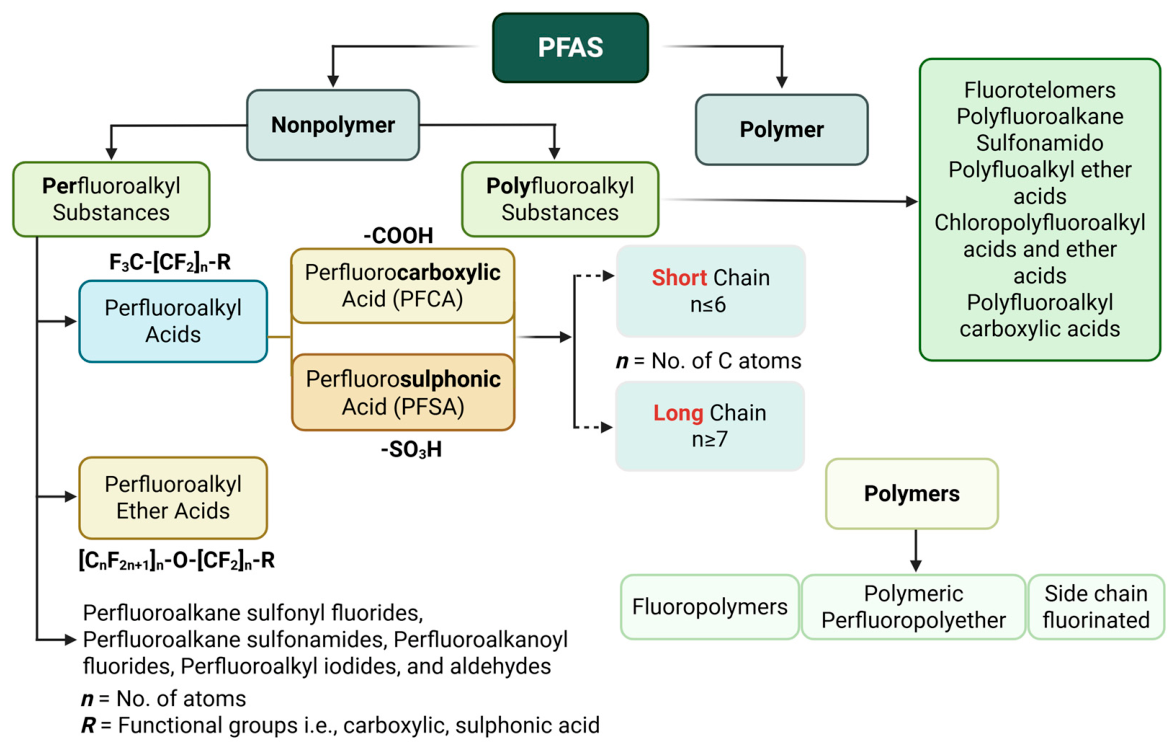
In 2018, in collaboration with the United Nations Environment Program (UNEP), the Organization of Co-operation and Development (OECD) updated its previous list of PFAS. Taking inspiration from Buck's paper, it classified as PFAS all substances - including perfluorocarbons - that contained a perfluoroalkyl moiety with three or more carbons (-CnF2n-, n≥3) or a perfluoroalkylether moiety with two or more carbons (-CnF2nOCmF2m-, n and m≥1) [42]. Overall, 4730 substances identified by different Chemical Abstracts Service (CAS) numbers were included in this list. A further revised OECD report was released in 2021, defining PFAS as ‘fluorinated substances that contain at least one fully fluorinated methyl (-CF3) or methylene (-CF2-) carbon atom, without any H/Cl/Br/I atom attached to it’ [43].
The OECD definition of PFAS has been accepted by the European Chemicals Agency (ECHA), which is currently evaluating a proposal for "universal PFAS restriction." Certain chemicals with structural motifs like CF₃-X or X-CF₂-X′, where X stands for functional groups like -OR and/or -NRR′ and X′ encompasses methyl, methylene, aromatic, or carbonyl groups, are not included in this proposal [43,44]. Similarly, PFAS are defined by the US Environmental Protection Agency (US EPA) as fluorinated compounds with at least one fully fluorinated carbon unit (such as -CF₂- or -CF-), where all substituents (R, R′, and R²) are non-hydrogen groups, highlighting the lack of C-H bonds in the fluorinated backbone [45]. When combined, these definitions emphasize how crucial molecular structure is to the classification of PFAS, which is necessary to understand their environmental behavior and susceptibility to microbial transformation.
According to the most recent OECD categorization criteria, PubChem, one of the biggest open-access chemical databases, presently classifies about 7 million chemicals as PFAS [46]. These compounds vary significantly in water solubility, structure, molecular size, vapor pressure, functional group, and perfluorinated chain length [5,47]. Through changes in environmental partitioning, bioavailability, and membrane interaction potential, this diversity governs microbial accessibility and susceptibility to transformation. [26,48]. For example, high-molecular-weight fluoropolymers are often regarded as physiologically inert due to their poor cellular absorption and restricted bioavailability [5]. Therefore, a structure-informed categorization approach that groups PFAS by their physicochemical characteristics and toxicological behavior is crucial for understanding their environmental fate and potential for microbial transformation [49]. The assessment of PFAS biodegradation routes in connection to functional head-group chemistry and chain length is made possible by this structural perspective [50].
4. Microbial-PFAS Interactions in Sedimentary and Aquatic Ecosystems
In aquatic and sedimentary settings, interactions with microbial communities may also influence the environmental fate of PFAS, despite their intrinsic chemical structure dictating their inert nature and environmental mobility [51]. These interactions have an impact on the potential for microbial transformation, bioavailability, and sorption behavior [52]. Soils and aquifers typically contain dense bacterial communities, with abundances ranging from 104 to 108 cells per cubic centimeter of sedimentary material [53,54]. Microbial cells and biofilms in aquatic and sedimentary environments increase PFAS adsorption by interacting with cell surface components and extracellular polymeric substances (EPS), reducing their concentrations in the dissolved phase [55].
4.1. Sorption to Microbial Biomass
The capacity of natural biofilms to adsorb and accumulate PFAS emphasizes biosorption's importance in controlling the environmental distribution and fate of these contaminants in aquatic systems [55]. Long-chain PFAS are more hydrophobic and interact more strongly with microbial surfaces. The degree of sorption to microbial biomass is influenced by physicochemical features, namely functional head-group chemistry and alkyl chain length (e.g., carboxylate groups versus sulfonates), as well as current environmental factors [25]. Both Gram-positive and Gram-negative bacterial cell surfaces have been shown to adsorb PFAS, demonstrating that microbial biomass significantly affects PFAS retention and retardation during transport in porous aquatic environments. These interactions are governed not only by cell surface properties but also by environmental conditions and biomass accumulation. Consistent with this, a comparative summary of adsorption and transport behavior in bacterial systems encompassing both batch sorption variability and biomass-driven retardation in porous media is presented in Table 1.
In summary, Gram-negative bacteria have more adsorption potential than Gram-positive bacteria because Gram-negative bacteria have a complex outer membrane, mainly composed of lipopolysaccharides and phospholipids, in addition to a peptidoglycan layer, in comparison to Gram-positive bacteria, in which the outer membrane is absent [59]. So, the outer lipid layer is hydrophobic, which prefers hydrophobic interactions. So, long-chain PFAS have higher adsorption with gram-negative strains because of enhanced hydrophobic interactions, but the hydrophobic characters of PFAS molecules increase/decrease by the addition or subtraction of each CF2 unit [4]. That’s why PFCA shows relatively lower adsorption potential with microbial biomass in comparison to PFSA. When PFAS binding capacity is compared with that of engineered adsorbents such as activated carbon, microbial biomass generally exhibits lower sorption capacities because uptake is strongly influenced by biomass availability and matrix interference [25].
4.2. Biofilms and Extracellular Polymeric Substances
PFAS have also been observed to trigger stress responses in cells, such as the production of extracellular polymeric substances (EPS) [60]. EPS production is the key component in the development of biofilms and is thought to protect the cells from harmful conditions including exposure to toxic contaminants such as PFAS, oxidative stress, pH and salinity fluctuations, and hydrodynamic shear forces in porous aquatic systems [61,62]. Weathers et al. noted stress-induced changes in Rhodococcus RHA1 when exposed to a mixture of eleven PFAAs, including a doubling of cell length, likely due to either EPS production causing cells to remain together after division, as well as enhanced biofilm production [60]. Studies show that biofilm layers can accumulate PFAS at higher concentrations than planktonic (free-living) cells, partly due to the functional groups in EPS that facilitate PFAS adsorption [55,63]. By mediating electrostatic and hydrophobic interactions with PFAS, EPS's variable charge distribution, diverse functional groups, and rough surface morphology may enhance contaminant retention within the biofilm matrix. As illustrated in Figure 4, these mechanisms are inherent to biofilm systems and relevant to both natural (in situ) and engineered (ex situ) environments [64,65].
As shown in Figure 4, biofilms act as dynamic sorption phases that significantly influence the environmental fate and transport of PFAS in situ. PFAS can alter mobility and bioavailability by adsorbing onto biofilm matrices and redistributing within aquatic systems. Furthermore, natural biofilms have been proposed as potential microbial reservoirs that may facilitate PFAS transformation processes as well as ecological indicators of PFAS contamination [63]. The complex and multilayered biostructure in biofilm gives it the versatility to capture resources from water, while the rough surface structure and rich functional groups of EPS provide sorption sites for PFASs [55,66]. It is observed that 18.1 %-30.8 % of PFASs can be adsorbed by natural microbiota, and the microbial community in biofilm is less affected by PFASs than that of planktonic organisms in the water [67]. The main sorption mechanism, especially for long-chain PFAS, is hydrophobic partitioning, in which the fluorinated carbon chains (-CF₂-, -CF₃) preferentially associate with hydrophobic domains within extracellular polymeric substances (EPS) and microbial cell membranes [68]. As anionic PFAS (such as PFOA and PFOS) can bind to positively charged functional groups (e.g., protonated amines) in EPS, electrostatic interactions contribute to function. Though these interactions are strongly influenced by environmental factors such as pH, ionic strength, and competing ions [66].
4.3. Uptake Limitations
Because of the exceptional chemical stability of the carbon-fluorine (C-F) bond and the scarcity of enzymatic pathways capable of cleaving it, microorganisms generally exhibit very limited uptake and biotransformation capacities for most of the PFAS compounds, despite their ability to sorb PFAS. As a result, PFAS are highly persistent in microbial systems. Only a few precursor compounds, such as fluorotelomer alcohols, fluorotelomer sulfonates, and a few derivatives of perfluoroalkyl sulfonamide that may transform into perfluoroalkyl carboxylic acids under microbial or environmental conditions, have been demonstrated to metabolize [47,66,69]. Microbial absorption of PFAS varies greatly across bacterial taxa and is mostly species dependent. Many bacteria exhibit low removal capability, whereas others indicate substantial intracellular accumulation or adsorption. Furthermore, low biomass densities and competition with dominant sorption phases, such as sediments, natural organic matter, and manufactured sorbents, generally constrain the influence of microbial biomass on PFAS attenuation in natural systems [70,71]. By restricting interactions with microbial cells and EPS, this partitioning reduces the proportion of dissolved per- and polyfluoroalkyl compounds, thereby reducing the likelihood of microbial biotransformation and absorption [72]. These parameters influence how PFAS interact with environmental matrices and indirectly impact microbial uptake and bioavailability. Variations in these traits impact partitioning behavior and electrostatic interactions, making it more difficult to predict microbial exposure and ultimately restricting intracellular accumulation and biotransformation. These characteristics together influence how PFAS interact with environmental matrices and, as a result, indirectly alter microbial uptake and bioavailability. Variations in these traits impact partitioning behavior and electrostatic interactions, making it more difficult to predict microbial exposure and finally restricting intracellular accumulation and biotransformation [55,72].
4.4. Role of Microbial Community Structure
PFAS contamination may promote variations in the diversity and structure of microbial communities in aquatic and sedimentary environments, lowering complex species under stressful circumstances while selectively boosting tolerant taxa [51]. It has been shown that exposure to PFAS reshapes the composition of microbial communities, typically increasing the abundance of Proteobacteria while reducing the abundance of sensitive taxa such as Actinobacteria. This may affect biogeochemical cycles and the general functioning of ecosystems [73,74,75]. Proteobacteria, especially Gammaproteobacteria, which are involved in sulfur cycling processes, including the possible desulfonation of fluorotelomer sulfonates, including 6:2 fluorotelomer sulfonic acid (6:2 FTS) and similar precursor chemicals, can proliferate when exposed to PFAS [76]. On the other hand, it has been demonstrated that exposure to PFAS suppresses nitrogen-cycling microorganisms, such as nitrifiers and selected Actinobacteria [77], lowering nitrification activity in sedimentary settings and activated sludge. These microbial changes as a whole indicate a potential shift under PFAS stress toward sulfur-associated activities, accompanied by suppression of nitrogen turnover, and ensuing effects on ecosystem nutrient cycling [76].
Recent field-based and pilot studies in aquatic settings have demonstrated that PFAS pollution significantly affects native microbial populations, with consequences for important biogeochemical cycles downstream [78]. PFAS concentration gradients in the Pearl River Estuary have been associated with changes in the microbial assemblage structure of the water column and concomitant shifts in the potential for nitrogen, carbon, and phosphorus cycles. These results imply that by modifying the relative abundance of functionally important microbial species, PFAS may indirectly influence nutrient metabolism [79]. Microbial community analyses in riverine systems adjacent to PFAS emission sources have shown clear fluctuations in bacterial, fungal, and microeukaryotic taxa associated with PFAS concentrations. This change in aquatic microbial communities could affect ecosystem functioning thereafter. [80]. It has been confirmed that exposure of microbial plankton communities to perfluoroalkyl acids and their substitutes induces significant changes in the composition of bacterial and eukaryotic communities in freshwater experimental systems, showing that PFAS contamination influences microbial dynamics even at environmentally relevant concentrations [81]. PFAS in biofilm could affect pollutant deposition and microbial resilience by modifying the EPS composition and remodeling of intracellular microbial communities [63,82]. Beyond PFAS exposure, several environmental factors, such as nutrient availability, organic carbon, and redox gradients, shape the structure of microbial assemblages, including fungi, algae, and bacteria, in biofilms and sedimentary systems. All these factors work simultaneously to manage how communities respond to long-term environmental pollutants [83,84].
5. Functional Guilds and Microbial Communities Involved in PFAS Transformation
The interaction between PFAS and biofilms and microbial biomass depends on the composition and metabolic efficiency of the surrounding microbial communities. The most important step is to identify the microbial taxa and functional guilds associated with PFAS transformation to interpret the biotransformation methods and pathways.
5.1. Aerobic Bacterial Communities and Putative PFAS Degraders
PFOA, PFOS, and other perfluorinated chemicals are commonly considered resistant to microbial degradation because of their fully fluorinated carbon backbones, which lack reactive C-H bonds. This property makes them thermodynamically stable and long-term persistent in the environment [85]. Even though Pseudomonas species are used in the aerobic transformation of PFOA and PFOS, regardless of their resistance to microbial breakdown [86,87,88]. A metabolically active strain, HJ4 of Pseudomonas aeruginosa, reduced PFOS by ~67% in 48 hours, highlighting its transformational potential and the pathways to biodegradation under particular conditions [86]. This suggests that PFOS, being a persistent chemical, can be partially transformed by bacterial cells under ideal experimental conditions. In another study, the YAB-1 strain reduced PFOA by 48.1% over four days under aerobic conditions [87,89]. A 58.6% degradation efficiency was attained by the genetically modified Pseudomonas YAB-1 mutant F3-52, indicating that genetic engineering techniques may improve microbial capacity for PFAS degradation [90]. However, the demand for glucose or other co-substrates limits applicability in nutrient-poor conditions and increases operating expenses. In just four days, Pseudomonas plecoglossicida strain DD4 completely degraded PFOA (1000 mg L-1), generating fluoride and perfluoroheptanoic acid as byproducts [91]. Such degradation is attributed to oxygenase-mediated alpha oxidation supported by haloacid dehalogenases from Delftia acidovorans, which catalyze stepwise C-F substitution in carboxylated PFAS. Using Stenotrophomonas, Bacillus, Pseudomonas, and Brevundimonas in activated sludge, synergistic systems removed 46.6-49% of PFOA; under photocatalysis-assisted conditions, increased degradation was observed [91]. Nevertheless, despite these developments, the aerobic degradation pathway remains severely limited for large-scale or nutrient-limited field applications due to its dependence on external carbon sources, high energy requirements, and limited enzyme stability [89].
5.2. Anaerobic Bacterial Communities and Reductive PFAS Transformation
The majority of fully perfluorinated PFAS are nevertheless very resistant to microbial degradation, even in highly reducing environments, despite the common belief that anaerobic conditions are favorable for reductive transformation. Early research demonstrated that abiotic reductive dehalogenation, rather than biological metabolism, can partially defluorinate PFOS. Ochoa-Herrera et al. (2008) achieved about 18% defluorination of technical PFOS, and up to 71% for branched isomers using Ti (III) citrate as a bulk reductant and vitamin B₂₂ as a biocatalyst. Furthermore, even after extended incubation, numerous studies have shown that PFOS, shorter-chain perfluoroalkyl sulfonates and carboxylates, and related polyfluorinated compounds show no detectable microbial biodegradation under aerobic or anaerobic conditions, supporting their well-established environmental persistence [92]. Among unsaturated or partly fluorinated PFAS, recent research has found a small number of mechanistically instructive exceptions. According to Yu et al. (2020), anaerobic microbial communities enriched with lactate can reductively defluorinate perfluoro-4-methylpent-2-enoic acid (PFMeUPA), where the molecule acts as an electron acceptor. Fluoride release and the identification of transformation products were used to confirm defluorination; depending on the molecule, efficiency ranged from 20 to 30%. Crucially, the absence of well-known dechlorinating bacteria like Dehalococcoides suggests that less well-known microbial groups were responsible for C-F bond cleavage. The findings indicate that, despite the limited transformation, anaerobic microbial communities can mediate PFAS decrease through reductive pathways [93]. Such a function can also be associated with Acetobacterium sp., where caffeoyl-CoA reductase (CarABCDE) takes part in defluorination through a flavin-based electron-bifurcating caffeate reduction pathway [94]. Intriguingly, the fully perfluorinated substance PFOA didn’t undergo reductive defluorination, indicating that molecular structure has a significant impact on anaerobic biodegradation.
Anaerobic habitats, including wastewater, anaerobic digesters, and sediments, support microbial communities capable of performing co-metabolic functions and electron transport. But their effects on PFAS transformation are, to some extent, limited. Significant modifications in the composition of microbes, including Synergistetes, Methanomassillicoccus, and Firmicutes, cut methane synthesis, leading to the concept that selecting a PFAS-tolerant population is beneficial over a PFAS-degrading microbial population [95]. Even after prolonged incubation times, mixed-culture experiments comparing anaerobic and aerobic consortia show that PFAS removal under anaerobic conditions is primarily governed by adsorption, with little evidence of biotransformation for compounds such as PFOS, 5:3-fluorotelomer carboxylic acid (5:3 FTCA), and 6:2-fluorotelomer sulfonic acid (6:2 FTS). Significant compound-specific diversity in apparent biodegradability is observed, with decreases (~90% PFOS, 58% 5:3 FTCA, and ~21% 6:2 FTS) [96]. Acidimicrobium sp. strain A6 is one prominent but controversial exception. It has been reported to perform reductive defluorination of PFOA and PFOS coupled to iron-dependent anaerobic ammonium oxidation (Feammox), with an estimated degradation efficiency of around 60% after 100 days [97]. Although intriguing, these findings are still difficult to replicate and appear to be quite strain- and condition-specific. All available data point to adsorption, stress-induced community reorganization, and the gradual transformation of some non-fully fluorinated PFAS as the main mechanisms by which anaerobic microbial communities affect the fate of PFAS. On the other hand, as Figure 5 illustrates, definitive microbial cleavage of the perfluorinated carbon backbone is still uncommon and poorly controlled [26,32,93]. Table 2 summarizes exceptional research that emphasizes microbial systems, dominating mechanisms, and the extent of PFAS transformation under anaerobic and aerobic environments.
5.3. Co-Metabolic Bacterial Processes
Compared to strict anaerobic conditions, bacterial populations often exhibit greater transformation efficiency for fluorotelomer precursors and long-chain PFAS under aerobic conditions. Significant transformation of legacy PFAS compounds has been demonstrated by aerobic microbial communities enriched from activated sludge and nitrification processes. Within 21 days, up to 47-48% of PFOA, PFOS, and 6:2 FTS were transformed, along with the formation of shorter-chain products and limited defluorination. A variety of heterotrophic and co-metabolic bacterial guilds were implicated in PFAS modification pathways via these transformations, which were linked to increases in the abundance of taxa like Methylophilus, Acidomonas, Pseudomonas, Clostridium, Klebsiella, and Acinetobacter [99]. These co-metabolic processes are believed to occur when bacterial enzymes unintentionally interact with PFAS compounds during the metabolism of other substrates, resulting in partial transformations such as chain shortening, functional group modification, or limited C-F bond cleavage, without providing the organism with energy. Long-chain PFAS (such as PFOA, PFOS, and 6:2 FTS) have been shown to undergo partial transformation and chain shortening within complex wastewater microbial consortia in the presence of abundant co-substrates (such as organic carbon), although complete defluorination remains limited [100]. Due to low enzymatic efficiency and limited substrate specificity, many observed transformations lead to persistent intermediates rather than complete mineralization, according to reviews of microbial enzyme mechanisms [101]. Complete mineralization of terminal PFAS by co-metabolic bacterial processes remains rare and kinetically limited, but these processes are often enhanced in complex consortia, where various species contribute complementary enzymatic capabilities [99]. LaFond et al. presented a comprehensive review of the numerous reports of microbial co-metabolism of PFAS in the literature [76].
5.4. Role of Fungi in PFAS Transformation
Fungi are a unique and metabolically adaptable group in PFAS-impacted habitats because they can use a variety of processes to change pollutants. Both enzymatic and non-enzymatic processes, such as biosorption, bioaccumulation, and enzymatic biotransformation, are used by filamentous fungi to remove pollutants [102]. As shown in Figure 5, their extracellular enzyme systems, especially laccases, lignin peroxidases, and manganese peroxidases, have low substrate specificity and can catalyze a variety of oxidative reactions, including hydroxylation, ether bond cleavage, and aromatic ring transformation [103]. Numerous fungi, especially ligninolytic species like Phanerochaete chrysosporium, produce oxidative enzymes that generate reactive radicals capable of initiating the transformation of very stable molecules, including those with C-F and C-S bonds. Fluorotelomer alcohols (such as 6:2 and 8:2 FTOH) have been shown to partially convert under aerobic co-metabolic conditions, producing shorter-chain and intermediates such as fluorotelomer carboxylic acids and unsaturated derivatives [104]. But not all PFAS are susceptible to fungal transformation; for instance, substances such as PFOA show strong resistance and negligible degradation under comparable circumstances [104].
PFAS transformation is influenced by both intracellular metabolism and extracellular oxidation. It has been shown that fluorotelomer alcohols can be metabolized by fungi, including Cunninghamella elegans, via cytochrome P450-dependent pathways, producing partially oxidized intermediates after brief incubation time periods [105]. The findings indicate that under the enzyme-mediated mechanisms, the ability of fungi to transform PFAS is greatly impacted by redox conditions and the accessibility of the mediator [104,105,106]. Previous studies provide evidence of site-adapted fungal strains/isolates that emerged from PFAS-contaminated places. A study presented a site-adapted fungal isolate that, compared with the control, converted wood-decaying 6:2 FTOH (6:2 fluorotelomer alcohol) into short-chain fluorinated acids. This also highlights the importance of PFAS-contaminated sites in the ecosystem [107]. Further research showed a tremendous improvement in PFAS transformation when fungal enzymatic systems were combined with advanced technologies such as electrochemical and photocatalytic methods, rather than relying solely on biological treatments. For example, a combination of manganese peroxidase and photocatalytic treatment increased fluoride recovery during prolonged incubation. The laccase-mediator system removed PFAS by up to 60%. In such cases, high-resolution mass spectrometry is required to observe true defluorination either from mediator-induced oxidation or adsorption for the validation of PFAS biodegradation [108]. Still, there are some challenges and gaps in selecting enzyme-substrates, understanding the impacts of co-metabolic substrates, and conducting cross-system assessments under environmental conditions, rather than focusing solely on PFAS transformation by fungi. Filling these gaps can increase transformation ability and experimental stability [109].
5.5. Microbial Consortia and Synergistic Strategies
The performance of microbial strains, including bacteria and fungi, in PFAS transformation greatly improved when they worked together rather than separately. This type of consortia creates better metabolic interactions among them, mimicking the natural environment and the target complex pollutants compared to single microbial groups [89]. A study presents a good example in which a chemoheterotrophic bacterial consortium isolated from PFOA- and PFOS-contaminated river sediment was able to transform 16-36% of PFAS. However, the transformation efficiency increased to 46-69% when used with yeast and fungal communities. In the same way, 46.4% of PFOS was removed by the anaerobic consortium WBC-2, contaminated with chlorinated volatile organic compounds, over 45 days. During the process, PFHxS, PFBA, and PFFeS explain the transformation pathways starting from desulfonation to sequential defluorination [104].
Microbial consortia employ complementary metabolic pathways to enhance their PFAS-transformation capacity. Aerobic Pseudomonas species encourage oxidation of the head-group, whereas anaerobic Acidimicrobium-like organisms do reductive defluorination. Fungal extracellular enzymes like peroxidases and laccases produce intermediate products when they transform long-chain PFAS. Interestingly, when both fungal and bacterial metabolic mechanisms operate simultaneously, they avoid partially oxidized intermediates, thereby increasing defluorination. Additionally, PFAS degradation was assessed at up to 77% by Acidimicrobium sp. A6 strain works in combination with electrolysis, signifying the ability of electro-bioremediation to ease redox constraints [110]. Recent studies show that combining different microbial systems, rather than single-strain systems, with electrochemical techniques enhances transformation and fluoride release, and effectively removes PFAS. Optimizing such setups is challenging when applying microbial consortia that operate under different conditions, including temperature, pH, and electron donor availability, which can reduce their productivity. Future studies should work on microbial genetics, defluorination pathways using labeled isotopes for PFAS tracing under changing conditions to promote scalable bioremediation [89]. The data show that aerobic microbial systems use oxygenase-mediated pathways for improving the transformation of PFAS precursors by allowing them to make fluorotelomer carboxylic acids, like oxidized intermediates [91]. Regardless of such ability, these mechanisms need a co-substrate to continue their activity and are rarely able to do full mineralization [87]. In contrast, under certain circumstances, especially in iron-reducing environments, anaerobic microbial systems exhibited reductive defluorination; nonetheless, these transformations remain limited, compound-dependent, and highly system-specific [97,110]. Complementary and sequential transformation pathways can be promoted by mixed microbial communities that combine anaerobic and aerobic metabolisms, leading to a more thorough biotransformation of PFAS [104]. Redox variability, nutritional constraints, and competing substrates may limit microbial activity under environmentally relevant conditions, ultimately lowering treatment efficiency [89]. These disadvantages show that specific bioremediation methods, such as biostimulation and system-scale validation, are needed to enhance PFAS treatment in complex environmental scenarios.
6. Enzymatic and Metabolic Mechanisms of Microbial PFAS Transformation
Despite that, PFAS transformation is linked to several microbial species; little is known about the metabolic mechanisms underlying these processes. Understanding the enzyme systems and metabolic pathways involved in PFAS transformation is therefore essential to understanding how bacteria interact with these extremely persistent chemicals.
6.1. Biochemical Mechanisms of PFAS Defluorination
The main processes by which PFAS are bio-transformed are oxidative and reductive defluorination; direct C-F bond cleavage may or may not be involved. Because of its high stability and dissociation energy of up to 130 kcal mol-1, the C-F bond is difficult to split under typical environmental circumstances [32]. Microbial activities may offer a potentially practical way to remove PFAS, even though complete mineralization of PFAS remains mostly inefficient [76,101]. Because PFAS structures are complex and resistant to microbial metabolism, improved oxidation or reduction techniques and microbial degradation must be coupled in integrated procedures.
6.1.1. Reductive Defluorination
Currently, the most well-established biological process for PFAS transformation is thought to be reductive defluorination. Fluorine atoms are gradually replaced by hydrogen atoms in this purely anaerobic process, which is mediated by obligatory or facultative anaerobes. Reductive dehalogenases use electron donors such as H₂, lactate, acetate, or reduced ferredoxins to catalyze the process; these enzymes are usually dependent on flavin or vitamin B12 [111]. Hydrogen fluoride (HF) or fluoride ions (F⁻) are released because of C-F bond breaking, which is facilitated by nucleophilic attack at the carbon center. The remarkable stability of the C-F bond, regarded as one of the strongest single bonds in nature, has long limited understanding of microbial reductive defluorination, compared to other organohalides. Reproducible microbial reductive defluorination of perfluorinated chemicals has not been shown for many years, except for a contradictory result involving trifluoroacetate. However, Yu et al. directly demonstrated that the C-F bonds in two C6 per- and polyfluorinated compounds were cleaved by an organohalide-respiring microbial population under anaerobic conditions. Reductive defluorination was verified by measurable fluoride release and the production of corresponding hydrogenated transformation products, serving lactate as the electron donor and fluorinated compounds as the only electron acceptors [93]. It's interesting to note that neither microbial growth nor the production of reductive dehalogenases associated with Dehalococcoides was observed, indicating that defluorination was not caused by the predominant dechlorinating genus Dehalococcoides in seed culture. This finding suggested that less abundant phylogenetic groups within the microbial consortium were likely responsible for reductive defluorination, highlighting the need for further enrichment and identification of the functional microorganisms and enzymes involved.
As non-or partially fluorinated carbon atoms create biochemical "weak points" that enable microbial attack, polyfluorinated PFAS, such as fluorotelomer alcohols (FTOHs), fluorotelomer sulfonates (FTSs), and chlorinated polyfluorinated compounds, are significantly more susceptible to microbial reductive defluorination than fully perfluorinated analogs, such as PFOA and PFOS [112,113]. Further research revealed that hybrid bio-electrochemical systems with electroactive materials and anaerobic consortia enriched in Desulfovibrio and Sporomusa can significantly increase defluorination efficiencies, extending the relevance of reductive pathways beyond simplified model compounds toward more complex and environmentally important PFAS [93,114,115]. For aliphatic fluorinated compounds with terminal fluorine or other electron-withdrawing groups, this route works especially well. Without bioaugmentation techniques or specially designed bioreactor systems, the process remains kinetically slow, necessitates strict anaerobiosis, and is constrained by the limited substrate specificity of native enzymes. Figure 6 shows a schematic illustration of the suggested microbial reductive defluorination mechanism.
6.1.2. Oxidative Defluorination
Oxidative defluorination typically targets partially fluorinated molecules, such as fluorotelomer alcohols and a few side-chain-fluorinated structures, whereas reductive defluorination targets fully fluorinated molecules. Oxidative enzymes attack molecules with available hydrogen atoms or functional groups, thereby weakening neighboring C-F bonds. Examples of such metalloenzymes include peroxidases, oxidases, and oxygenases involved in partial PFAS transformation. White-rot fungi, including Trametes and Phanerochaete, and extracellular enzymes and oxygenases from Pseudomonas catalyze oxidative reactions that release short-chain acids and fluoride. But fully fluorinated chemicals like PFOS and PFOA are very stable and resistant to such metabolic mechanisms because of their stable trifluoromethyl (-CF3) groups and the unavailability of hydrogen atoms [116]. It is clear here that, despite making intermediates and precursors, oxidative pathways are still less efficient in dealing with several stubborn perfluoroalkyl acids.
Oxidative systems are affected by similar mechanistic barriers. Although fully fluorinated PFAS lack such reactive sites, oxygenases and peroxidases usually initiate catalysis by hydrogen abstraction or electron-rich intermediates. Furthermore, the strong negative inductive effect of fluorine's high electronegativity deactivates adjacent carbons and inhibits radical propagation. As a result, instead of doing complete mineralization, oxidative pathways produce thermodynamically stable but short-chain PFAS intermediates [108]. As shown in Figure 7 (a), biotransformation of 6:2 FTSA was carried out by P. chrysosporium through an oxidative defluorination reaction mechanism aided by manganese peroxidases and cytochrome P450, which involves the formation of many short-chain stable intermediates. The second pathway was the dominant one, which started with the dehydrogenation of 6:2 FTSA, followed by desulfonation to form 6:2 FTOH. Oxidation of 6:2 FTOH resulted in an acrylate intermediate 6:2 FTAL (6:2 fluorotelomer acrylate), which, upon further oxidation, forms 6:2 FTCA followed by -HF removal. Upon further reaction, the substrate was converted to short-chain PFHxA, PFPeA, and 4:3 or 5:3 FTCA products via one- or two-carbon removal pathways, respectively [117]. PFOA degradation was carried out by the methoxy radical, which was generated by heme-containing peroxidases (HRP) in the presence of hydrogen peroxide and 4-methoxyphenol mediator. HRP was reduced to a cationic catalytic intermediate in the presence of hydrogen peroxide, followed by the conversion of 4-methoxyphenol into a methoxy radical by a highly reactive HRP radical. This highly reactive methoxy radical initiated the PFOA degradation. Perfluoroalkyl substances are harder to degrade by oxidative defluorination than polyfluoroalkyl substances because they are fully saturated with fluorine atoms, leaving no sites for oxidant attack. Long-chain PFAS with attached carboxyl groups are more vulnerable to oxidant attack than short-chain and sulfonates.
6.1.3. Co-Metabolic Pathways
In previous studies, co-metabolic degradation pathways have mostly been suggested for PFAS transformation. Promiscuous enzymes catalyze such reactions because they possess binding sites with broader substrate specificity. In that way, growth and non-growth-linked reactions are performed [118]. Previously, several xenobiotic compounds were co-metabolized by various oxygenase enzymes, including ammonia monooxygenase, methane monooxygenase, and toluene dioxygenase. Microbial growth during the co-metabolic transformation of a pollutant is primarily driven by methane- or propane-like growth substrates rather than by the contaminant. That’s why such methods are used as bioremediation approaches to remove contaminants at low concentrations but above regulatory standards (e.g., mg L-1). For this reason, microbial biotransformation has been most widely explored and reported for fluorotelomer alcohols (particularly 4:2, 6:2, and 8:2 FTOH). In many cases, observed transformation mechanisms of FTOHs are likely to be co-metabolic in nature, but there remains a lack of understanding of the enzymes involved [26,119,120,121,122]. For example, many of the FTOH studies have observed that communities and cultures could not grow solely on FTOHs, suggesting the process should be co-metabolic [120,121]. However, Lewis et al. observed that polyfluoroalkyl phosphates (PAPs), a class of FTOH precursors, were used as primary substrates for the initial degradation step and therefore concluded that the degradation of PAPs was not purely co-metabolic [119].
Comparative evaluation of PFAS biotransformation studies reveals three consistent trends: (i) microbial defluorination has only been observed under co-metabolic conditions, with no convincing evidence for growth-linked defluorination; (ii) larger PFAS precursors bearing complex functional head groups may undergo an initial metabolically mediated transformation step, followed predominantly by co-metabolic processing; and (iii) desulfonation represents a key metabolic pathway for sulfur-containing PFAS under sulfur-limited conditions. To date, defluorination has been observed only in the presence of primary growth substrates, including in Dehalobacter-enriched systems and feammox-driven processes, indicating co-metabolic dependence [97]. Similarly, defluorination during the FTOH one-carbon-removal pathway in activated sludge and aerobic soils requires auxiliary substrates, further supporting co-metabolism [122,123]. In contrast, metabolic transformation appears limited to PFAS with large functional head groups such as 6:2 polyfluoroalkyl phosphates, where initial degradation is growth-linked, but subsequent steps revert to co-metabolic or sulfur-driven pathways [119,121,124,125]. Desulfonation of sulfonated precursors, including 6:2 FTSA, occurs preferentially under sulfur-limiting conditions, indicating utilization as a sole sulfur source and highlighting the role of sulfur cycling in PFAS transformation [126].
6.2. Enzymatic PFAS Transformation
There have been several reviews on the enzymes potentially responsible for PFAS biotransformation reactions and, more generally, cleavage of the carbon-fluorine bond [127,128,129]. Owing to the toxicity of F- ions to organisms, very few microbes could achieve complete PFAS mineralization. Nonetheless, PFAS-degrading enzymes do exist. Gaining a deeper understanding of the mechanisms behind these enzymes supports the design of more effective PFAS degradation systems. PFAS-degrading enzymes can be broadly classified into four mechanistic groups: hydrolytic dehalogenases, reductive dehalogenases, oxidative enzymes, and dioxygenases, as summarized in reviews by Berhanu et al. and Hu et al. Each group offers a variety of strategies for PFAS transformation and defluorination via distinct chemical routes and cofactor needs [130,131].
6.2.1. Dehalogenases
Fluoroacetate dehalogenase (FAcD) is the most researched hydrolytic dehalogenase and is now used as the model system for enzymatic defluorination [130]. The bacterial enzyme FAcD has been identified in Pseudomonas sp. strain A, P. fluorescens, Deftia acidovorans, Burkholderia sp. FA1, Rhodopseudomonas palustris CGA009, Synergistetes strain MFA1, and Moraxella [132,133,134,135,136]. The C-F bond in fluoroacetate, a monofluorinated molecule, can be broken by FAcD [103]. Gram-positive bacteria and some plants naturally produce the toxin fluoroacetate as a chemical defense against mammals [133]. Glycolic acid is produced when FAcD breaks down fluoroacetate enzymatically. Even though the direct breakage of the C-F bond requires a lot of energy, the following metabolic processing of glycolic acid supplies sufficient energy to support the growth of microorganisms that express FAcD [137]. The carboxylate side chain of an active site aspartate residue functions as the nucleophile in the SN2 nucleophilic substitution process that drives the defluorination [138]. Tryptophan, tyrosine, and histidine are the three amino acids in the enzyme's halide binding pocket that enable fluoride release through H-bonding and electrostatic stabilization, even though fluorine is a particularly poor leaving group due to the high bond dissociation energy of the C-F bond [139]. As shown in Figure 8, the ester-enzyme intermediate that remains after fluoride removal is hydrolyzed by water to produce glycolic acid [139]. Nevertheless, the fundamental limitations of the SN2 reaction pathway restrict the application of FAcDs in PFAS degradation. In particular, the presence of several F atoms at the reactive site sterically hinders nucleophilic attack by the carboxylate group. Furthermore, the targeted C-F bond is strengthened by the adjacent C-F bonds, increasing its resistance to cleavage [103].
The aim of reductive defluorination, which is usually carried out by reductive dehalogenases, is to break the strong C-F bonds through electron transfer reactions [140]. Organohalide-respiring bacteria such as Dehalococcoides were the focus of early research, although their activity toward PFAS substrates has been limited. Key enzymatic pathways involved in PFCA biotransformation have been revealed by genomic studies of Pseudomonas mosselii, with genes producing laccases and dehalogenases found in almost half of the bacterial isolates [141]. Haloalkane dehalogenase (dhaA) and haloacetate dehalogenase H-gene (dehH1), which facilitate C-F bond cleavage at the α-carbon position, are two important genes associated with enzymatic PFAS degradation [91].
Additional microbial species and abiotic reducing systems capable of partial defluorination have been identified in more recent research; full mineralization remains uncommon, and intermediate products often accumulate. Abiotic systems, including UV/sulfate-based processes, hydrated electron-driven reactions, and metal-catalyzed systems such as zero-valent iron combined with ferrate, often achieve higher but laboratory-constrained defluorination efficiencies. However, these methods usually rely on variables irrelevant to the environment, such as high temperatures, strong reducing agents, or other challenging reaction conditions [101,103]. According to Huang et al., Acidimicrobium sp. A6 biodegraded PFOA in the presence of ferrihydrite under iron-reducing conditions. The observed defluorination was associated with the Feammox process, in which ammonium acts as an electron donor for iron reduction [97]. After 150 days under optimum conditions, PFOA concentrations decreased by 37-68%, accompanied by the release of fluoride and the formation of shorter-chain intermediates. The study also emphasized the important roles of microbial electron-transfer efficiency and Fe(III) availability in increasing defluorination rates. They investigated soil sediments, but no effects on water were reported [101,142].
6.2.2. Oxygenases
The ability of oxygenase enzymes to transform PFAS by catalyzing reactions with PFAS functional groups has drawn increasing attention [125]. Oxygenases are important primarily because of their high promiscuity index, which indicates that they can catalyze reactions with compounds other than their primary substrates [118]. Heme-thiolate monooxygenases known as cytochrome P450 enzymes (CYPs or P450S) can catalyze several reactions, including the oxidation of aliphatic and aromatic C-H bonds [143,144,145]. P450S are present in all domains of life, including bacteria, eukaryotes, and archaea, as members of a large and evolutionarily conserved superfamily [131]. Studies have shown that P450S from different biological sources can help in the biotransformation of certain PFAS compounds, primarily through oxidative or reductive processes. Unlike FAcDs, which directly cleave C-F bonds via SN2 nucleophilic substitution, P450S function mostly by oxidative monooxygenation and, on occasion, reductive dehalogenation. As seen in Figure 9, monooxygenation occurs when one molecular oxygen atom is reduced to water, and the other is integrated into the substrate. The catalytic cycle involves two protons and two electrons [146].
Monooxygenase-mediated transformation is the primary mechanism for the initial biodegradation of fluorotelomer-based PFAS chemicals. Rhodococcus jostii RHA1 and Gordonia sp. NB4-1Y research. demonstrated that exposure to fluorotelomer sulfonates and fluorotelomer sulfonamidoalkyl betaine causes the development of oxygenase enzyme systems, including alkane monooxygenases and cytochrome P450-dependent monooxygenases, which catalyze the addition of molecular oxygen to the substrate [125,147,148,149]. When these enzymes oxidize the non-fluorinated or partially fluorinated carbon moieties, usually at terminal or subterminal locations, they generate alcohol and aldehyde intermediates. In later enzymatic stages, these intermediates undergo a series of oxidation processes that produce unsaturated derivatives and fluorotelomer carboxylic acids. Monooxygenase activity is concurrently linked to desulfonation processes, where the cleavage of the sulfonate group permits further carbon chain rearrangement. Afterward exposure to PFAS, genes associated with increased hydrocarbon breakdown pathways. These chemicals are metabolized by co-opted alkane-degradation systems rather than distinct PFAS-specific pathways, according to transcriptomic and proteomic studies [148]. Although oxidative transformations can lead to partial defluorination, particularly through downstream reactions involving unstable intermediates, stable perfluorinated end products often persist [125]. These findings show that monooxygenase-driven pathways are insufficient to achieve full mineralization, although they play a key role in initiating the PFAS transformation [150].
6.2.3. Hydrolytic Enzymes
The capacity of hydrolytic enzymes, such as lipases and esterases, to break ester bonds in PFAS precursors, particularly polyfluoroalkyl phosphate esters, has been investigated since the 2010s [108]. These reactions, observed in Pseudomonas, Candida, and mixed environmental consortia, were frequently influenced by the structural and surface properties of precursor molecules. Although hydrolysis is a crucial initial pathway of transformation, its effectiveness for complete PFAS degradation is limited because it generates more persistent perfluoroalkyl acids (PFAAs). Oxidative methods for PFAS transformation have also been investigated; there remains limited experimental evidence of complete defluorination. Emerging chemoenzymatic techniques are in the early stages of research to integrate oxidative and hydrolytic processes to increase efficiency [103,151].
6.2.4. Oxidoreductases
Previous data show the role of oxidoreductases, such as laccases, in PFAS transformation. Laccases degraded PFOA by 24% in 36 days and by 40% around 140 days during oxidative humification reactions in a soil-slurry system [152]. Laccases, derived from soybeans, produced highly reactive free radicals that attacked the carbon backbone of PFAS. These free radicals helped initiate the oxidation reaction, leading to larger perfluorinated compounds and shorter fluorinated derivatives [153]. In addition to laccases, peroxidases, including lignin peroxidase (LiP) and manganese peroxidase (MnP), have also been studied for their involvement in PFAS degradation. Hydrogen peroxide (H2O2) activated heme-containing oxidoreductases are usually involved in lignin breakdown. Their robust oxidative potential enables them to catalyze electron-transfer processes, which help break down fluorinated organic molecules [154]. Fungal-derived LiP and MnP peroxidases can break down persistent organic contaminants with the help of their strong electron-deficient characteristics. This suggests that peroxidase-based oxidation systems may facilitate PFAS transformation, although their effectiveness remains dependent on reaction parameters, including pH, redox potential, and enzyme-substrate affinity [103].
6.3. Evidence from Microbial Consortia vs Pure Cultures
PFAS structures can be altered by microbial species. Wijayahena et al. isolated Labrys portucalensis F11 from contaminated soil and reported that it can bio transform 21% of 6:2 FTS, 58% of 5:3 FTCA, and 90% of PFOS into short-chain intermediates within 100 days [96]. Anaerobic bacteria (Acetobacterium) can deflourinate unsaturated PFAS via reduction. These microbes secrete enzymes that facilitate defluorination via fluoride efflux, thereby reducing overall intracellular toxicity [94]. Acidimicrobium sp. strain A6 can also degrade short and long-chain linear and branched PFAAs (C4-C6). However, the reduction in these PFAS was low to moderate over 120 days [155]. Long-chain fluorotelomer compounds, such as 6:2 fluorotelomer sulfonate (6:2 FTSA) and similar sulfonamides, can be transformed by members of the genus Gordonia. However, these changes often result in the permanence of perfluorinated carboxylic acids, highlighting incomplete biodegradation of fluorotelomer [147]. The genus Pseudomonas plays a significant role in the microbial biotransformation of fluorinated pollutants, as evidenced by significant PFAS transformation shown by Pseudomonas plecoglossicida and Pseudomonas aeruginosa [100].
The suggested microbial transformation pathways of PFOA and PFOS, the two main fluorinated xenobiotics, are summarized in Figure 10. In addition to the sequential reaction pathways and intermediate metabolites generated during PFAS biotransformation, the schematic illustrates the bacterial species and microbial consortia related to these transformations. PFOA is a completely fluorinated eight-carbon carboxylic acid that gradually transforms into shorter-chain perfluorinated carboxylic acids (PFCAs), such as PFHpA (C7), PFHxA (C6), PFPeA (C5), PFBA (C4), and PFPrA (C3). Successful defluorination is demonstrated by the production of inorganic fluoride ions and trifluoroacetic acid (TFA) as terminal transition products. Numerous bacterial species, such as Pseudomonas plecoglossicida strain DD4 [156], Delftia acidovorans [157], Pseudomonas mosselii [158], Ensifer adhaerens M1 [159], and Acidimicrobium sp. strain A6 [160]have been reported to participate in the transformation of PFOA and its intermediates. The variety of microbial mechanisms involved in PFOA biotransformation is highlighted by the many metabolic pathways employed by these bacteria. It has been shown that mixed anaerobic consortia comprising several microbial taxa can degrade PFOA and its metabolites [161]. These changes often occur by oxidative, hydrolytic, or reductive defluorination pathways, depending on the microbial species and environmental factors. Degradation occurs within microbial communities through metabolic cooperation among microorganisms; one species may initiate the breakdown, while others further degrade the intermediates (Figure 10A).
Similarly, microorganisms break down PFOS, a perfluorinated compound with a sulfonic acid functional group rather than a carboxyl group, often more slowly due to the sulfonic moiety's greater stability. The intermediate compounds produced during the microbial degradation of PFOS include fluorinated alcohols such as perfluorooctanol, shorter chain perfluorinated sulfonic acids (PFHpS, PFHxS, and PFBS), and PFCAs (PFHpA, PFHxA, PFPeA, and PFBA), which are likely formed by oxidative cleavage of the sulfonic group. Trifluoropropanoic acid (TFPrA) and fluoride ions are indicators of defluorination, which may involve partial or complete breakdown of PFOS. Numerous microbial species are known to be involved in the breakdown of PFOS.
A wide variety of bacterial isolates, such as Ensifer adhaerens M1 [159], Ensifer moralensis H16 [162], Acidimicrobium sp. strain A6 [160], and many Pseudomonas species, such as Pseudomonas aeruginosa [100], Pseudomonas plecoglossicida 2.4-D [88], and Pseudomonas putida [100], have been linked to PFOS transformation. PFOS transformation has also been linked to complex microbial consortia that include Paracoccus, Hyphomicrobium, Roseobacter, members of the class Flavobacteriia, the family Micromonosporaceae, and other Gammaproteobacteria [163]. Sequential PFOS transformation through several biochemical pathways is anticipated to be facilitated by the complementing enzymatic activities and metabolic interactions within these consortia (Figure 10B).
6.3.1. Syntrophic Interactions
One of the strongest single bonds in organic chemistry, the C–F bond's remarkable stability is a significant biochemical barrier to microbial PFAS transformation. However, a growing body of research indicates that complex microbial communities, rather than individual species may have the complementing enzyme repertoire needed to promote the breaking of C-F bonds and the subsequent defluorination of PFAS [164]. Syntrophic interactions between metabolically complementary microorganisms play a key role in the transformation and defluorination of persistent PFAS, including PFOS, in microbial consortia, which have emerged as promising biological systems [161]. Even though PFOS and its short-chain counterparts are known to be resistant to microbial breakdown under both aerobic and anaerobic environments, a recent study documented a rare instance of partial PFOS transformation [165]. A methanol-supplemented microbial population enriched from PFOS-contaminated soils decreased 56.7% PFOS concentration after 20 days, accounting for adsorption effects. Hyphomicrobium (~47%) and uncultured microorganisms (~53%) dominated the consortium, suggesting possible synergistic interactions in C-F bond transformation. Significant metabolic contributions between the consortium (MC1) and Hyphomicrobium sp. were observed in comparative KEGG pathway analysis, indicating the possible functional contribution of poorly described or uncultured species to PFOS transformation [166].
Microbial consortia are a promising strategy for PFAS biodegradation, largely due to syntrophic interactions that promote cooperative metabolism among numerous taxa [167,168]. Overcoming the high-energy barriers related to defluorination depends on these interactions, including the exchange of metabolic intermediates [127]. One microbial species, for instance, may initiate PFOS transformation by producing less-fluorinated intermediates, subsequently metabolized by other community members. This is a crucial syntrophic mechanism in PFOS biotransformation when no single organism possesses the complete enzymatic machinery required for full transformation [169]. By providing electron donors and additional carbon sources, co-metabolic substrates such as acetate or methanol can boost microbial activity and increase the rate and extent of defluorination. However, PFAS toxicity, inadequate microbial characterization, and the inherent unpredictability of environmental matrices make it difficult to optimize these microbial consortia for scale treatment [127]. Fernandes et al. examined the biodegradation capability of communities produced from activated sludge and estuarine sediment to show the effectiveness of microbial consortia. These groups were assembled to remove fluorinated medications, such as paroxetine and bezafibrate, demonstrating their ability to address structurally diverse fluorinated pollutants [170]. Removal efficiencies of 97% were attained by three of the five assessed consortia. Fluoride-ion release, measured with a fluoride-ion-selective electrode, was used to confirm C-F bond cleavage. Pseudomonas spp. predominated in all consortia, whereas Acinetobacter spp. was always found in static culture conditions. These findings highlight the potential for transformation and defluorination of native microbial consortia from several environmental backgrounds, as well as the taxonomic variety supporting these processes. Taken as a whole, these microbial assemblages show promises for developing new bioremediation techniques to restore the environment.
7. Impact of Alkyl Chain Length on Microbial PFAS Degradation
The chemical structure of PFAS, especially the length of their alkyl chains, strongly influences environmental behavior and susceptibility to microbial transformation in aquatic environments. Chain length influences physicochemical properties that govern partitioning, bioavailability, and ultimately biodegradation potential, including molecular size, hydrophobicity, and interfacial activity.
7.1. Bioavailability and Sorption
Because PFASs are amphiphilic, with a hydrophobic fluorinated tail and a polar functional head group, PFAS adsorption is very complex [171]. This is particularly true in actual water matrices where interference from competing pollutants may occur. The length of the chain and the type of acid head group (such as carboxylate versus sulfonate) are crucial elements in the adsorption process [172]. Compared to their short-chain counterparts, long-chain PFAS often show greater hydrophobicity and stronger adsorption to organic phases and biomass. Their freely dissolved concentrations in water are reduced by this improved sorption, thereby limiting their direct bioavailability to microorganisms [76,173]. Short-chain PFAS, on the other hand, are more mobile in the aqueous phase because they are often more soluble in water and have a lower sorption affinity. However, because of the strength of the C-F bond, perfluoroalkyl acids remain extremely resistant to microbial transformation, and greater mobility does not always translate into improved biodegradation. Defluorination has been observed only in specific anaerobic environments, even for longer-chain compounds such as PFOA. [72,97,173].
PFAS precursors with partially fluorinated carbon chains, such as fluorotelomer alcohols and sulfonates, have been the primary targets of microbial degradation in aquatic environments. Through oxidative pathways, these compounds can undergo aerobic biotransformation to produce shorter-chain perfluoroalkyl acids and fluorotelomer carboxylic acids [125,174]. These experiments, which show that PFAS transformation proceeds through stepwise oxidation and functional-group elimination, offer mechanistic insights relevant to aquatic environments and are often conducted in controlled settings. PFAS behavior affects sorption, partitioning, and bioavailability primarily through chain length, which in turn can have an indirect impact on the observed rates of biodegradation [76]. Labrys portucalensis F11, a bacterial strain reported by Wijayahena et al., provides direct evidence that molecular structure and alkyl chain length control microbial PFAS transformation in aquatic settings [96]. Both fully and partially fluorinated PFAS could be transformed by this strain, although with noticeably varying efficiencies. Significant degradation of the long-chain compound PFOS was seen after overly long incubation periods, and shorter-chain perfluoroalkyl sulfonates and carboxylates were formed, suggesting incremental chain shortening (Figure 11A). A range of oxidized and chain-shortened metabolites is produced by fluorotelomer-based compounds, such as 6:2 fluorotelomer sulfonate, and intermediates, such as 5:3 fluorotelomer carboxylic acid, which show relatively reduced but detectable transformation rates (Figure 11B). Fluoride leakage and the existence of partly defluorinated intermediates are signs that microbial activities can promote C-F bond cleavage under certain environmental conditions. These results show that the degree of fluorination and the presence of functional groups vulnerable to enzymatic attack significantly affect microbial activity beyond chain length. Long-chain PFAS undergo slow, stepwise chain shortening, but shorter-chain derivatives tend to accumulate due to their enhanced chemical stability and resistance to further transformation [96]. While full mineralization remains rare, PFAS biotransformation generally appears to follow successive pathways, including chain-length reduction.
Alkyl chain length has a major impact on the environmental behavior and potential for microbiological transformation of PFAS in aquatic environments. Increased chain length improves hydrophobicity and intermolecular interactions, leading to stronger adsorption onto organic materials, suspended particles, and microbial biomass [175,176]. When their freely dissolved quantities are reduced in water because of their higher adsorption, long-chain PFASs' mobility and bioavailability to microorganisms are limited [72]. Conversely, short-chain PFAS are more mobile and widely dispersed in aqueous systems due to lower sorption affinity and predominantly stay in the dissolved phase [175,176]. Higher mobility does not always correspond to better transformation, either, because short-chain perfluoroalkyl acids are highly resistant to microbial transformation due to their strong C-F linkages and non-reactive functional groups [76,97]. Although both highly mobile short-chain PFAS and firmly sorbed long-chain PFAS present unique biodegradation limitations, microbial degradation of PFAS precursors or partly fluorinated compounds is more successful because functional groups allow enzymatic attack [96,125]. By controlling the ratio of aqueous-phase bioavailability to adsorption-driven sequestration, which in turn influences the pathways and degree of PFAS transformation, these relationships demonstrate how chain length indirectly regulates microbial activity [76].
7.2. Kinetic and Thermodynamic Constraints
A recurring motif in microbial exploitation of weak sites is that, in aerobic environments, oxygenases and hydrolases usually target non-fluorinated ester or C-H bonds (which have lower bond dissociation energy) to facilitate precursor transformation. However, direct C-F bond cleavage requires overcoming a substantial thermodynamic barrier (approximately 110-130 kcal/mol), which is primarily overcome in anaerobic settings by specialized reductive dehalogenases. Reductive pathways achieve true defluorination, even though they proceed much more slowly than oxidation reactions, which often stall at stable perfluorinated intermediates due to this energy limitation. Unsaturated PFAS equivalents like PFMeUPA and PFUPA were defluorinated successfully by Dehalococcoides consortia under anoxic conditions, but saturated types remained resistant [125]. It is noteworthy to differentiate the breakdown of terminal PFAAs, including PFOS and PFOA, from the precursor transformation, such as polyfluoroalkyl phosphates and fluorotelomer sulfonates. Precursors' non-fluorinated moieties (C-S, C-O, or C-H bonds) are readily susceptible to common oxidases or hydrolases, which frequently results in quick biotransformation. However, this process generally yields persistent perfluorinated products (terminal PFAAs) rather than true defluorination. On the contrary, terminal PFAAs lack these metabolic "handles" and require direct cleavage of the exceptionally stable C-F backbone, a thermodynamically challenging process that can only be carried out by specialized enzymes such as reductive dehalogenases. Their biodegradation is therefore significantly slower and less useful in normal conditions.
7.3. PFAS Behavior: Long-Chain vs. Short-Chain
In the transformation of PFAS chemicals, basic structural features, such as chain length and functional groups, play a significant role in this mechanism. Generally, short chain perfluoroalkyl carboxylic acids (PFCAs) are water-soluble and more mobile, making them more resistant to subsequent transformation. This property causes their widespread persistence in the environment [4,91]. Such increased stability poses problems in remediation operations. These short-chain, new-generation PFASs are designed to minimize toxicity and are harder for biological systems to remove. Though longer PFSAs can incorporate into bacterial membranes, such as phospholipids. This integration improves permeability, increases membrane fluidity, and interferes with molecular interactions at the membrane. These two effects are closely related: membrane disruption is likely a consequence of altered membrane fluidity. The hydrophobic tail of PFASs interacts with the phospholipid bilayer, destabilizing intermolecular forces and altering the local membrane structure, resulting in areas of increased or decreased fluidity [56].
Beyond membrane damage, PFASs can also accumulate in the cytoplasm and intracellular compartments. A recent study demonstrated that PFNA disrupts cytoplasmic content, induces condensation, and promotes intracellular aggregation. Phase separation mechanisms or direct interactions with cytosolic components may cause these aggregates. It’s interesting that this aggregation appears to mitigate PFNA toxicity, enabling cells to survive despite its internal accumulation [177]. In another study by Shaw et al., Shorter-chained fluorinated surfactants, usually C < 6, are reported as degraded products under conditions favorable to the microbial degradation of other PFAS present in AFFFs [150].
8. Role of Functional Head Groups in Microbial PFAS Degradation
In addition to chain length, the chemical nature of the terminal functional head group (e.g., carboxylate vs sulfonate) strongly governs the redox behavior, enzymatic accessibility, and microbial transformation pathways of perfluoroalkyl acids (PFAAs). Differences in electronic effects, bond energies, and reaction intermediates explain why PFCAs and PFSAs follow distinct degradation mechanisms under both chemical and biological systems [178].
8.1. PFCA vs PFSA Comparison
Perfluoro carboxylic acids (PFCAs) contain a hydrophilic carboxylic acid (-COOH) headgroup. The carboxylic acid headgroup of PFCAs deprotonates to generate anionic -COO- at weakly acidic pH, which affects the molecules' amphiphilicity, intermolecular interactions, solubility, and surface behavior. Furthermore, it has been shown that PFAA headgroups are essential for their chemical reduction of hydrated electrons [179]. The hydrated electron-induced reduction kinetic routes of PFAAs with a carboxylate headgroup (PFCAs) and a sulfonic headgroup (PFSAs) differ, according to one study [180]. The primary target for the binding of hydrated electrons in PFCAs is the α-position carbon atom next to the carboxyl group [181]. This is explained by the anionic head group’s inductive action. However, in vitro research on PFSAs breakdown has revealed that the degradation pathways are distinct from those of PFCAs and can involve chain shortening by C-C cleavage, desulfonation, and H/F exchange [181]. Reduction of the fluoroalkyl chain in desulfonation doesn't occur until the sulfonic headgroup is converted to carboxylic acid. Because the C-S bond has a lower bond energy (272 kJ mol-1) than the C-C bond (346 kJ mol-1) in the fluoroalkyl chain, the C-S bond cleaves easily [181]. The desulfonation of PFSAs is possible in natural environments because of microbial activity [127,130]. However, because microorganisms in sulfur-rich environments prefer alternative compounds such as sulfate and sulfur-containing minerals, microbial desulfonation of PFSAs is restricted to low-sulfur environments [125].
8.2. Steric and Electronic Effects
The electrical properties of functional headgroups significantly influence reaction selectivity during PFAS reduction. The strong electron-withdrawing inductive effect of the negatively charged carboxylate group increases polarization at the α-carbon next to the headgroup. In PFCAs, this electronic redistribution promotes the binding of a hydrated electron at the α-carbon site, thereby increasing its vulnerability to nucleophilic attack [26,178]. Similarly, sulfonate groups strongly withdraw electrons; however, their structural geometry and bonding properties change the degradation pathways. Initially, PFSAs often undergo desulfonation rather than preferential reduction at the α-carbon. Mechanistic studies have shown that the C-S bond is preferentially cleaved by attack of a hydrated electron, yielding PFCA intermediates prior to further transformation [26,178]. The relatively lower bond dissociation energy of the C-S bond (~272 kJ mol-1) compared to the C-C backbone (~346 kJ mol-1) makes desulfonation thermodynamically favorable as compared to the direct backbone cleavage mechanism [181,182]. Steric hindrance also affects reactivity. The larger sulfonate headgroup and its hydration shell may impose steric constraints in biological systems, affecting reactive species availability and substrate-enzyme interactions [183]. Because hydrated electrons preferentially target weaker or electronically active bonds, transformation often begins at the headgroup-linking bond rather than along the perfluorinated backbone in chemical reduction systems [26,178,182]. Electronic polarization and bond-energy hierarchy often determine whether reduction occurs via α-carbon targeting in PFCAs or desulfonation in PFSAs. This determines subsequent transformation pathways and impacts the viability of microbial degradation.
9. Environmental Conditions Regulating Microbial PFAS Degradation
Environmental factors, such as oxygen, temperature, pH, co-contaminants, electron donors, and oxidation-reduction potential, are important factors in the biodegradation of PFAS, even though molecular structure has a significant impact on microbial PFAS transformation [178].
9.1. Oxygen
By controlling the dominance of oxidative vs reductive pathways, oxygen availability plays a critical role in regulating microbial PFAS transformation in aquatic systems. Oxygenase-mediated reactions that initiate the degradation of functional groups and encourage stepwise oxidation are the primary drivers of microbial transformation of fluorotelomer-based PFAS in aqueous environments under aerobic settings. The formation of intermediates through oxygen incorporation into partially fluorinated substrates is facilitated by oxygen-dependent enzymes, such as monooxygenases, which catalyze hydroxylation and oxidation reactions [129]. This method is consistent with experimental findings showing that microorganisms may oxidize compounds such as 6:2 fluorotelomer sulfonate, leading to desulfonation and the formation of intermediates via successive oxidative pathways [125]. Likewise, liquid-phase studies employing Labrys portucalensis F11 have shown aerobic PFAS transformation, characterized by the accumulation of shorter-chain transformation products and progressive chain shortening [96]. In contrast, under oxygen-limited or anaerobic conditions, microbial transformation occurs via essentially different pathways dominated by reductive processes. Mechanistic investigations of fluorinated compounds show that reductive defluorination is thermodynamically limited due to the high bond dissociation energy of the C–F bond, making such processes uncommon and highly organism-specific [129]. The ability of Acidimicrobium sp. strain A6 to release fluoride from perfluorooctanoic acid under iron-reducing conditions provides experimental evidence from aqueous systems that defluorination can occur in anaerobic environments [97]. Despite these encouraging results, microbial degradation of PFAS is inefficient due to slow reaction rates, insufficient mineralization, and the accumulation of persistent short-chain intermediates [184].
9.2. Temperature and pH
Temperature and pH are significant environmental parameters that regulate microbial PFAS transformation by influencing both enzymatic activity and physicochemical behavior. Temperature has a direct effect on microbial metabolism and reaction kinetics. For instance, half-lives of around 44 days at 25 °C and 160 days at 4 °C have been observed for the biodegradation of N-ethyl perfluorooctane sulfonamidoethanol (EtFOSE) in aquatic sediments, demonstrating a significant drop in microbial activity at lower temperatures [130]. Additionally, environmental temperature and the physiological flexibility of PFAS-degrading bacteria are significant. Labrys portucalensis F11, for instance, has been shown to grow between 16 and 37 °C and between 4.0 and 8.0 pH [96], suggesting a broad range of environmental tolerance and potential application in a variety of aquatic environments [185]. This adaptation improves the activity and persistence of microbial populations involved in PFAS processing under changing environmental conditions. Research conducted at the system level has demonstrated that pH significantly controls PFAS-associated microbial processes by affecting metabolic activity, community structure, and microbial physiological tolerance. For instance, Silva et al. discovered that in anaerobic digestion systems, pH has a major impact on the performance of different trophic groups (hydrolytic, acidogenic, and methanogenic populations), which in turn impacts microbial functional stability and total methane output. These changes in microbial consortia and metabolic efficiency indirectly affect PFAS behavior by altering redox conditions, electron-transfer mechanisms, and substrate bioavailability. Higher microbial activity and improved system efficiency are typically supported by near-neutral pH levels, particularly when conductive carbon materials are added to further enhance microbial interactions [186].
9.3. Co-Contaminants
Co-contaminants in aquatic settings can affect PFAS degradation in a variety of ways:
9.3.1. Co-Metabolic Stimulation
Considerable progress has been made in improving PFAS biodegradation in addition to previously discovered bacteria. Researchers have used co-metabolic techniques to enhance defluorination, although microbes capable of degrading PFAS are still uncommon. For instance, Liang and colleagues used a microbial consortium (WH4) supplemented with methanol co-substrate and enriched with Hyphomicrobium sp. to remove approximately 57% of PFOS within 20 days. [169]. These developments highlight the potential of electrical stimulation and artificial microbial systems to overcome current constraints in PFAS bioremediation.
9.3.2. Competition and Inhibition
By competing with PFAS for electron donors or microbial metabolic pathways, co-contaminants may potentially affect transformation efficiency. After 100 days, Acidimicrobium sp. A6 under anaerobic Fe (III)-reducing conditions, removed 63% of PFOS and PFOA. In contrast, more than 90% of PFOS was metabolized by Labrys portucalensis F11 under an aerobic environment [97]. Microbial and mixed fungal systems are most active at 25 to 30 °C and pH 6-8, and they lose over 70% of their effectiveness outside these ranges [85].
9.3.3. Redox Conditions
By controlling electron transport and microbial metabolic activity, environmental redox conditions and electron donor availability have a significant impact on microbial PFAS transformation pathways. Iron-reducing environments have been demonstrated to promote PFAS transformation under anaerobic conditions through microbially driven redox mechanisms and active iron cycling [32]. For instance, Kang et al. showed that promoting microbial activity and electron-transfer mechanisms, coupled with Fe(III)/Fe(II) cycling in constructed wetlands, improves the removal of perfluorooctanoic acid (PFOA) and perfluorooctane sulfonate (PFOS). In these systems, electron shuttles and redox-active components increase extracellular electron transport between microbial cells and electron acceptors (such as iron oxides), thereby indirectly improving PFAS transformation [187].
Activated carbon, ammonium (NH₄⁺), and simple organic substrates such as sucrose are suitable electron donors that enhance microbial Fe(III) reduction and complete metabolic activity in wetland sediments [188]. Here, "activated carbon" refers to a highly porous, carbon-rich material with a large specific surface area that serves multiple purposes: (i) as an adsorbent that can concentrate PFAS near microbial cells, hence increasing the availability of local substrate [189]; ii) as a matrix that facilitates biofilm formation; and, crucially, (iii) as a conductive medium that enhances syntrophic metabolism in anaerobic settings by encouraging direct electron transfer between species in microbial communities [190,191]. Overall, environmental parameters, including oxygen availability, pH, temperature, co-contaminants, and redox conditions, collectively regulate microbial PFAS transformation through complex biochemical and physicochemical interactions. A comparative summary of these factors, their mechanisms, and reported impacts on PFAS degradation is provided in Table 3.
10. Conclusion and Future Outlook
PFAS contamination in aqueous systems poses a risk to humans and animals due to bioaccumulation potential. Various degradation strategies are used in different studies to remove or degrade PFAS from the aqueous environment, including biological, physical, and chemical methods. Biological treatment for the degradation of PFAS is preferred due to its sustainability, low cost, and environmental friendliness [192,193]. Even though several biologically based treatment strategies have demonstrated potential for PFAS remediation, their actual use needs to be assessed within a more comprehensive sustainability framework.
10.1. Energy and Resource Requirements of Biological PFAS Degradation
Bioremediation, because of its environmentally friendly nature and low cost, is frequently used to remediate containment sites. While biodegradation is quite effective at breaking down contaminants, it has not advanced much recently due to limitations related to time requirements, slower decomposition rates, and significant differences in mass balance under environmental conditions, which may affect its feasibility. They require a massive amount of organic content for effective PFAS degradation [194]. Moreover, researchers observed 60% degradation of PFOA and PFAS after 100 days of incubation under aerobic conditions [97]. Despite these limitations, each PFAS degradation strategy has distinct energy and resource requirements. In bioremediation, the major requirements of the processor lie in managing operational and maintenance costs. In addition, bioelectrochemical systems require energy along with microbial organisms to enhance the defluorination mechanism [193]. Biodegradation strategies demand scaled-up adsorption systems, hybrid bio-electrochemical and photo-bio-catalytic systems. Enzymatic degradation requires precise control of temperature and pH for different microbial strains and radical species. Fungal degradation of PFAS requires a controlled environment in which sufficient organic content is available as an effective substrate to stimulate the production of extracellular enzymes that degrade PFAS. The availability of organic and inorganic ions, along with slight fluctuations in pH, must be carefully regulated to ensure maximum microbial activity. Moreover, this approach does not require specific chemical inputs, minimizing additional chemical impacts; however, site-specific factors can still influence fungal performance [195].
10.2. Long-Term Stability and Reliability of Microbial Processes
PFAS biodegradation by microbial and enzymatic pathways in laboratories is still not characterized, so it remains in an early stage of development. For this, we should have all the scalable bioprocesses to degrade PFAS by combining transformation and low environmental impact with high selectivity and cost-effectiveness [89]. Microbial consortia can tolerate, transform, and adapt to recalcitrant PFAS because their persistent presence in aqueous systems exerts selective pressure on microbial communities. Diverse native microbial assemblies interact synergistically by enhancing functional stability rather than individually isolated microbes [77]. Biological transformation processes are stable when enriched microbial cultures are used, improving the reliability of PFAS degradation in long-term microbial reactors. Microbial processes integrated with electrochemical systems, such as microbial fuel cells, could provide consortia and help explore long-term operational stability, thereby increasing reliability and degradation efficiency. In addition, advances in enzyme engineering and metagenomics could provide promising avenues for overcoming these limitations and further understanding the PFAS biotransformation mechanism.
10.3. Scalability and Applicability in Natural and Engineered Systems
Microbial degradation of PFAS has been studied at the lab scale, but the scalability of such systems still has been challenging and needs further studies to explore their applications in both natural and engineered systems. Biodegradation methods are generally slower but highly effective for remediating natural environments. Microbial and enzymatic biodegradation are scalable by monitoring microbial stability in a complex environment, but challenges lie when there is incomplete mineralization. Their applications include utilizing specific bacteria, e.g., Acidimicrobium sp., to cleave strong C-F bonds, which require complex systems. Therefore, a thorough critical analysis is necessary to determine the scalability of such systems [196].
10.4. Sustainability of Enzyme-Based and Engineered Biological Approaches
Since they are sustainable and environmentally friendly, enzyme-based bioengineered techniques often compete with other strategies. One major challenge in degradation studies is the sorption of PFAS onto enzymes such as laccases and peroxidases, often causing false-positive results in which apparent PFAS decreases are mistaken for true biodegradation. This effect happens when PFAS attaches itself to the protein structure of the enzymes, lowering the analyte's aqueous concentration without cleaving the carbon-fluorine (C-F) bond [103]. Despite this drawback, their sustainability is widely accepted because they can be used repeatedly for the same catalytic breakdown of PFAS. Their requirements for energy and chemical inputs are generally low, which makes them highly sustainable [197]. Biological approaches use microbes and engineer them to express modified enzymes. These enzymes, i.e., dehalogenases and oxygenases, are used to cleave C-F bonds in long-chain PFAS. Engineered microbial consortia involve using different species of aerobic and anaerobic microbes to break down complex PFAS mixtures, which makes them highly sustainable [196].
10.5. Research Gaps and Recommendations
- Although microbial and enzymatic technologies have been proven to be successful, C-F bond cleavage mechanisms are barely understood by researchers, and the most proposed enzymatic techniques are somewhat hypothetical. It is because of the substrate specificity, optimal conditions availability, and their poor binding affinity that limit their ability to attack a vast diversity of PFAS compounds [193].
- Degradation of PFAS releases fluoride ions during degradation, which can inhibit microbial growth and the viability of microbes in consortia in high concentrations of PFAS. Microbial consortia till studied were conducted and performed under controlled laboratory settings, so their activity in complex environmental matrices lacks data on the effective elimination of PFAS [104].
- In addition, microorganisms cannot mineralize PFAS completely and often produce very stable short and ultra-short chain intermediates, so instead of solving critical PFAS pollution, they are spreading secondary pollutants (highly toxic and persistent). More research is needed to explore this underdeveloped domain.
- To better understand the degradation mechanism, metabolomics and transcriptomics studies would help in identifying specific genes and enzymes that are responsible for the defluorination of the PFAS compounds.
- Engineered microbial consortia of pure cultures complementary to metabolic ones will be effective against degrading recalcitrant compounds. Biodegradation technologies integrated with physical or chemical technologies, as a hybrid treatment, can enhance overall biodegradation of PFAS.
Author Contributions
Conceptualization, M.H., N.T., and A.A; Review methodology, M.H; writing-original draft preparation, N.T and M.H; writing-review and editing, A.A and E.H; visualization, M.H and A.A; supervision, and funding acquisition, E.H.
Funding
This publication is based upon work supported by the McIntire-Stennis project under accession number 70011735.
Institutional Review Board Statement
Not applicable.
Informed Consent Statement
“Not applicable.
Data Availability Statement
Data is contained within the article.
Acknowledgments
This manuscript is publication #SBxxxx of the Sustainable Bioproducts, Mississippi State University. This publication is a contribution of the Forest and Wildlife Research Center, Mississippi State University.
Conflicts of Interest
The authors declare no conflicts of interest.
Abbreviations
The following abbreviations are used in this manuscript
| PFAS | Per- and polyfluoroalkyl substances |
| CAS | Chemical Abstract Service |
| CDC | Centers for Disease Control and Prevention |
| AFF | Aqueous film-forming foams |
| PFAAs | Perfluoroalkyl Acids |
| PFOS | Perfluorooctanesulphonic acid |
| PFOA | Perfluorooctanoic acid |
| GenX | Hexafluoropropylene oxide dimer acid |
| POP | Persistent Organic Pollutants |
| NHANES | National Health and Nutrition Examination Survey |
| EPA | Environmental Protection Agency |
| MCL | maximum contamination limit |
| PFNA | Perfluoronanoic acid |
| DWD | European Union’s Drinking Water Directive |
| PFCA | Perfluorocarboxylic acid |
| PFSA | Perfluorosulfonic acid |
| MEE | Ministry of Ecology and Environment of the People’s Republic of China |
| PFCs | Perfluorocarbons |
| UNEP | United Nations Environment Program |
| OECD | Organization of Co-operation and Development |
| ECHA | European Chemicals Agency |
| PFHxS | Perfluorohexane sulphonic acid |
| PFHxA | Perflourohexanoic acid |
| PFPeS | Perfluoropentane sulphonic acid |
| PFPeA | Perflouropentanoic acid |
| PFHpA | Perflouroheptanoic acid |
| PFHpS | Perflouroheptane sulphonic acid |
| PFDA | Perflourodecanoic acid |
| C-F | Carbon-fluorine |
| F-F | Flourine-flourine |
| Kd | Adsorption Coefficient |
| EPS | Extracellular Polymeric Substances |
| 6 | 2 FTS |
| 6 | 2 Fluorotelomer sulfonic acid |
| PFMeUPA | perfluoro-4-methylpent-2-enoic acid |
| 5 | 3 FTCA |
| 5 | 3-fluorotelomer carboxylic acid |
| FTOHs | fluorotelomer alcohols |
| FTSs | fluorotelomer sulfonates |
| FTMeUPA | 4,5,5,5-tetrafluoro-4-(trifluoromethyl)-2-pentenoic acid |
| MnP | Manganese peroxidase |
| 6 | 2 FTAL |
| 6 | 2 fluorotelomer acrylate |
| HRP | heme-containing peroxidases |
| PAPs | polyfluoroalkyl phosphates |
| FAcD | Fluoroacetate dehalogenase |
| dhaA | Haloalkane dehalogenase |
| LiP | Lignin Peroxidases |
| TFPrA | Trifluoropropanoic acid |
| PFUPA | E-perfluoro-4-methylpent-2-enoic acid |
| EtFOSE | N-ethyl perfluorooctane sulfonamidoethanol |
References
- Hu, N.; Zhang, Z.; Wang, Q.; Li, Y.; Pei, Y.; Zhang, Z. Enhanced foam fractionation of perfluorooctane sulfonate (PFOS) from water using amphiphilic Janus SiO2 nanoparticles. Chem. Eng. J. 2024, 499, 155829. [Google Scholar] [CrossRef]
- Wu, C.; Goodrow, S.; Chen, H.; Li, M. Distinctive biotransformation and biodefluorination of 6: 2 versus 5: 3 fluorotelomer carboxylic acids by municipal activated sludge. Water Res. 2024, 254, 121431. [Google Scholar] [CrossRef] [PubMed]
- Hamza, M.; Elsayed, I.; Schueneman, G.; Hassan, E.B. Rapid Removal of Perfluoroalkyl Substances from Water by Quaternized Amine-Functionalized Nanocellulose/Deacetylated Chitin Composite Aerogel. ACS ES&T Water 2025, 5, 7421–7436. [Google Scholar] [CrossRef]
- Hamza, M.; Ayinla, R.T.; Elsayed, I.; Hassan, E.B. Understanding PFAS adsorption: how molecular structure affects sustainable water treatment. Environments 2025, 12, 330. [Google Scholar] [CrossRef]
- Buck, R.C.; Franklin, J.; Berger, U.; Conder, J.M.; Cousins, I.T.; De Voogt, P.; Jensen, A.A.; Kannan, K.; Mabury, S.A.; Van Leeuwen, S.P. Perfluoroalkyl and polyfluoroalkyl substances in the environment: terminology, classification, and origins. Integr. Environ. Assess. Manag. 2011, 7, 513–541. [Google Scholar] [CrossRef] [PubMed]
- Leung, S.C.E.; Wanninayake, D.; Chen, D.; Nguyen, N.-T.; Li, Q. Physicochemical properties and interactions of perfluoroalkyl substances (PFAS)-Challenges and opportunities in sensing and remediation. Sci. Total Environ. 2023, 905, 166764. [Google Scholar] [CrossRef] [PubMed]
- Hopkins, Z.R.; Sun, M.; DeWitt, J.C.; Knappe, D.R. Recently detected drinking water contaminants: GenX and other per-and polyfluoroalkyl ether acids. J.-Am. Water Work. Assoc. 2018, 110, 13–28. [Google Scholar] [CrossRef]
- Chang, C.-J.; Young, A.S.; Keil, A.; Mullins, C.E.; Liang, D.; Zhao, S.; Jones, D.P.; Hu, X.; Walker, D.I.; White, A.J. Novel and legacy per-and polyfluoroalkyl substances in humans: Long-term temporal variability and metabolic perturbations. Environ. Int. 2025, 201, 109590. [Google Scholar] [CrossRef] [PubMed]
- Fiedler, H.; Vega-Bustillos, L.; Arias-Pastrano, J.; Pérez-Aldás, L.V.; Castro-Díaz, J. Snapshot survey of the presence of perfluoroalkyl substances in products, articles, and the environment in Ecuador. Engineering 2024, 37, 49–61. [Google Scholar] [CrossRef]
- Kissa, E. Fluorinated surfactants and repellents; CRC Press, 2001; Volume 123. [Google Scholar]
- Chirikona, F.; Quinete, N.; Gonzalez, J.; Mutua, G.; Kimosop, S.; Orata, F. Occurrence and distribution of per-and polyfluoroalkyl substances from multi-industry sources to water, sediments and plants along Nairobi River basin, Kenya. Int. J. Environ. Res. Public Health 2022, 19, 8980. [Google Scholar] [CrossRef] [PubMed]
- Gao, C.; Quan, F.; Qiu, W.; Zheng, Y. Assessing the impact of serum per-and polyfluoroalkyl substance concentrations on immune function in an industrialized Region of China. Environ. Health 2025, 3, 352–362. [Google Scholar] [CrossRef] [PubMed]
- Pomazal, R.; Malecki, K.; Stanton, N.; Shelton, B.; Lange, M.; Irving, R.; Meiman, J.; Remucal, C.K.; Cochran, A.; Schultz, A.A. Determinants of per-and polyfluoroalkyl substances (PFAS) exposure among Wisconsin residents. Environ. Res. 2024, 254, 119131. [Google Scholar] [CrossRef] [PubMed]
- Kato, K.; Wong, L.-Y.; Jia, L.T.; Kuklenyik, Z.; Calafat, A.M. Trends in Exposure to Polyfluoroalkyl Chemicals in the U.S. Population: 1999−2008. Environ. Sci. Technol. 2011, 45, 8037–8045. [Google Scholar] [CrossRef] [PubMed]
- Biden, J. Final PFAS National Primary Drinking Water Regulation. U. S. Environ. Prot. Agency 2024, 89, 1–28. [Google Scholar]
- Huang, Y.; Hu, J.; Zheng, J.; Bai, Z.; Chen, H.; Ge, X.; Tang, T.; Zhang, Y.; Ma, Y.; Luo, H. A review of microbial degradation of perfluorinated and polyfluoroalkyl substances (PFAS) during waste biotransformation processes: influencing factors and alleviation measures. Environ. Res. 2025, 279, 121795. [Google Scholar] [CrossRef] [PubMed]
- EU. Directive (EU) 2020/2184 of the European Parliament and of the Council of 16 December 2020 on the quality of water intended for human consumption. 2020, 435, 1–62. [Google Scholar] [PubMed]
- Cimpean, I.-A.; Paun, I.; Pirvu, F.; Iancu, V.I.; Chiriac, F.L. Unregulated and Regulated PFASs in Bottled and Tap Water: Occurrence, Co-Occurrence Patterns, and Implications for Human Health and Regulatory Frameworks. J. Xenobiotics 2025, 15, 81. [Google Scholar] [CrossRef] [PubMed]
- Alsadik, A.; Akintunde, O.O.; Habibi, H.R.; Achari, G. PFAS in water environments: recent progress and challenges in monitoring, toxicity, treatment technologies, and post-treatment toxicity. Environ. Syst. Res. 2025, 14, 18. [Google Scholar] [CrossRef] [PubMed]
- Thakur, A.; Khusnutdinova, A.N.; Navarro-Márquez, M.; Kumar, V.; Ma, H.; Golyshin, P.N.; Lyu, T.; Yakunin, A.F.; Kumar, G.; Nithya, K. Comprehensive strategies for the remediation of per-and polyfluoroalkyl substances (PFAS): Mechanisms, technologies, and future perspectives. Ecotoxicol. Environ. Saf. 2025, 306, 119374. [Google Scholar] [CrossRef] [PubMed]
- Mišľanová, C.; Valachovičová, M. Health impacts of per-and polyfluoroalkyl substances (PFASs): A comprehensive review. Life 2025, 15, 573. [Google Scholar] [CrossRef] [PubMed]
- Chen, Z.; Zhao, Y.; Wei, T.; Shen, C. Leading techniques for per-and polyfluoroalkyl substances (PFASs) remediating in water and wastewater. Water 2025, 17, 1319. [Google Scholar] [CrossRef]
- Liu, J.; Charbonnet, J.A. A Critical Review of PFAS Analysis, Occurrence, and Fate in Wastewater Treatment Plants. Environ. Sci. Technol. 2025, 59, 25492–25517. [Google Scholar] [CrossRef] [PubMed]
- Schultz, M.M.; Barofsky, D.F.; Field, J.A. Fluorinated alkyl surfactants. Environ. Eng. Sci. 2003, 20, 487–501. [Google Scholar] [CrossRef]
- Chowdhury, M.R.; Islam, A.; Yurina, V.; Shimosato, T. Probiotic and Microbial Enzymatic Mechanisms for PFAS Detoxification. Probiotics Antimicrob. Proteins 2026, 1–14. [Google Scholar] [CrossRef] [PubMed]
- Liu, J.; Avendaño, S.M. Microbial degradation of polyfluoroalkyl chemicals in the environment: A review. Environ. Int. 2013, 61, 98–114. [Google Scholar] [CrossRef] [PubMed]
- Sun, H.-W.; Fang, B.; Chen, H.; Zhao, M.-S.; Zhang, Y.-Z.; Qiao, B.-T.; Yu, H. Advances in microbial degradation and transformation of per-and polyfluoroalkyl substances (PFASs). Huan Jing Ke Xue 2023, 44, 1214–1227. [Google Scholar] [CrossRef] [PubMed]
- Wei, Z.; Xu, T.; Zhao, D. Treatment of per-and polyfluoroalkyl substances in landfill leachate: status, chemistry and prospects. Environ. Sci. Water Res. Technol. 2019, 5, 1814–1835. [Google Scholar] [CrossRef]
- Gomis, M.I.; Wang, Z.; Scheringer, M.; Cousins, I.T. A modeling assessment of the physicochemical properties and environmental fate of emerging and novel per-and polyfluoroalkyl substances. Sci. Total Environ. 2015, 505, 981–991. [Google Scholar] [CrossRef] [PubMed]
- Barzen-Hanson, K.A.; Davis, S.E.; Kleber, M.; Field, J.A. Sorption of fluorotelomer sulfonates, fluorotelomer sulfonamido betaines, and a fluorotelomer sulfonamido amine in national foam aqueous film-forming foam to soil. Environ. Sci. Technol. 2017, 51, 12394–12404. [Google Scholar] [CrossRef] [PubMed]
- Butt, C.M.; Muir, D.C.; Mabury, S.A. Biotransformation pathways of fluorotelomer-based polyfluoroalkyl substances: A review. Environ. Toxicol. Chem. 2014, 33, 243–267. [Google Scholar] [CrossRef] [PubMed]
- Zhang, Z.; Sarkar, D.; Biswas, J.K.; Datta, R. Biodegradation of per-and polyfluoroalkyl substances (PFAS): A review. Bioresour. Technol. 2022, 344, 126223. [Google Scholar] [CrossRef] [PubMed]
- Malaviya, P.; Singh, A.; Sharma, A. The interplay of per-and polyfluoroalkyl substances (PFAS) uptake, translocation, and toxicity in plants: A critical review. Environ. Rev. 2025, 33, 1–18. [Google Scholar] [CrossRef]
- Li, L.; Li, W.; Xue, Y.; Wang, Z.; Wang, Y.; Li, R.; Deng, M.; Xu, Y.; Peng, L.; Song, K. Perfluorooctanoic acid effect and microbial mechanism to methane production in anaerobic digestion. J. Environ. Manag. 2024, 369, 122412. [Google Scholar] [CrossRef] [PubMed]
- Xie, Z.; Zhang, N.; Yang, G.; Xu, Q.; Wang, D.; Tang, L.; Xia, J.; Li, P.; Li, X. Environmentally relevant level of perfluorooctanoic acid affect the formation of aerobic granular sludge. J. Environ. Manag. 2023, 336, 117659. [Google Scholar] [CrossRef] [PubMed]
- Glüge, J.; Scheringer, M.; Cousins, I.T.; DeWitt, J.C.; Goldenman, G.; Herzke, D.; Lohmann, R.; Ng, C.A.; Trier, X.; Wang, Z. An overview of the uses of per-and polyfluoroalkyl substances (PFAS). Environ. Sci. Process. Impacts 2020, 22, 2345–2373. [Google Scholar] [CrossRef] [PubMed]
- Li, J.; Zheng, T.; Yuan, D.; Gao, C.; Liu, C. Probing the single and combined toxicity of PFOS and Cr (VI) to soil bacteria and the interaction mechanisms. Chemosphere 2020, 249, 126039. [Google Scholar] [CrossRef] [PubMed]
- Bhagwat, G.; Tran, T.K.A.; Lamb, D.; Senathirajah, K.; Grainge, I.; O’Connor, W.; Juhasz, A.; Palanisami, T. Biofilms enhance the adsorption of toxic contaminants on plastic microfibers under environmentally relevant conditions. Environ. Sci. Technol. 2021, 55, 8877–8887. [Google Scholar] [CrossRef] [PubMed]
- Wang, Y.; Li, X.; You, L.; Hu, S.; Fang, J.; Hu, B.; Chen, Z. Enhancement of PFAS stress tolerance and wastewater treatment efficiency by arbuscular mycorrhizal fungi in constructed wetlands. Environ. Res. 2024, 263, 120148. [Google Scholar] [CrossRef] [PubMed]
- Kong, X.; Chen, J.; Wang, S.; Li, B.; Zou, R.; Zhang, Y. When polyethylene terephthalate microplastics meet Perfluorooctane sulfonate in thermophilic biogas upgrading system: Their effect on methanogenesis. J. Hazard. Mater. 2024, 466, 133626. [Google Scholar] [CrossRef] [PubMed]
- Secundo, L.; Metrangolo, P.; Dichiarante, V. Current approaches in the classification of PFAS: an overview. Chemistry–An Asian J. 2025, 20, e202500127. [Google Scholar] [CrossRef] [PubMed]
- OECD. Toward a New Comprehensive Global Database of Per- and Polyfluoroalkyl Substances (PFASs); Paris, 2018; p. 39. [Google Scholar]
- OECD. Reconciling terminology of the universe of per-and polyfluoroalkyl substances: Recommendations and practical guidance; Paris, France, 2021; p. 61. [Google Scholar]
- ECHA. ANNEX XV Restriction Report: Proposal for a Restriction—Per- and Polyfluoroalkyl Substances (PFASs); Helsinki, Finland, 2023. [Google Scholar]
- Williams, A.J.; Gaines, L.G.; Grulke, C.M.; Lowe, C.N.; Sinclair, G.F.; Samano, V.; Thillainadarajah, I.; Meyer, B.; Patlewicz, G.; Richard, A.M. Assembly and curation of lists of per-and polyfluoroalkyl substances (PFAS) to support environmental science research. Front. Environ. Sci. 2022, 5, 1–13. [Google Scholar] [CrossRef] [PubMed]
- Schymanski, E.L.; Zhang, J.; Thiessen, P.A.; Chirsir, P.; Kondic, T.; Bolton, E.E. Per- and Polyfluoroalkyl Substances (PFAS) in PubChem: 7 Million and Growing. Environ. Sci. Technol. 2023, 57, 16918–16928. [Google Scholar] [CrossRef] [PubMed]
- Wang, Z.; DeWitt, J.C.; Higgins, C.P.; Cousins, I.T. A never-ending story of per-and polyfluoroalkyl substances (PFASs)? Environ. Sci. Technol. 2017, 51, 2508–2518. [Google Scholar] [CrossRef] [PubMed]
- Conder, J.M.; Hoke, R.A.; Wolf, W.d.; Russell, M.H.; Buck, R.C. Are PFCAs bioaccumulative? A critical review and comparison with regulatory criteria and persistent lipophilic compounds. Environ. Sci. Technol. 2008, 42, 995–1003. [Google Scholar] [CrossRef] [PubMed]
- Al-Maqtari, Q.A.; Mahdi, A.A.; Othman, N.; Noman, A.E.; Alsubhi, L.M.; AlAnsi, W.; Asharuddin, S.M.; khairuddin Talib, M.; Supramanium, S.; Al-Gheethi, A. Comprehensive review of per-and polyfluoroalkyl substances in drinking water: physiochemical properties, sources, health impacts, regulatory limits, and future perspectives. Results Eng. 2025, 107169. [Google Scholar] [CrossRef]
- Skinner, J.P.; Raderstorf, A.; Rittmann, B.E.; Delgado, A.G. Biotransforming the “forever chemicals”: trends and insights from microbiological studies on PFAS. Environ. Sci. Technol. 2025, 59, 5417–5430. [Google Scholar] [CrossRef] [PubMed]
- Shittu, A.R.; Iwaloye, O.F.; Ojewole, A.E.; Rabiu, A.G.; Amechi, M.O.; Herve, O.F. The effects of per-and polyfluoroalkyl substances on environmental and human microorganisms and their potential for bioremediation. Arch. Ind. Hyg. Toxicol. 2023, 74, 167–178. [Google Scholar] [CrossRef] [PubMed]
- Ma, D.; Olivares, C.I. Perfluoroalkane sulfonamides and derivatives, a different class of PFAS: Sorption and microbial biotransformation insights. Environ. Sci. Technol. 2025, 59, 10734–10749. [Google Scholar] [CrossRef] [PubMed]
- Griebler, C.; Lueders, T. Microbial biodiversity in groundwater ecosystems. Freshw. Biol. 2009, 54, 649–677. [Google Scholar] [CrossRef]
- Jägevall, S.; Rabe, L.; Pedersen, K. Abundance and diversity of biofilms in natural and artificial aquifers of the Äspö Hard Rock Laboratory, Sweden. Microb. Ecol. 2011, 61, 410–422. [Google Scholar] [CrossRef] [PubMed]
- Ji, B.; Zhao, Y. Interactions between biofilms and PFASs in aquatic ecosystems: literature exploration. Sci. Total Environ. 2024, 906, 167469. [Google Scholar] [CrossRef] [PubMed]
- Fitzgerald, N.J.; Wargenau, A.; Sorenson, C.; Pedersen, J.; Tufenkji, N.; Novak, P.J.; Simcik, M.F. Partitioning and accumulation of perfluoroalkyl substances in model lipid bilayers and bacteria. Environ. Sci. Technol. 2018, 52, 10433–10440. [Google Scholar] [CrossRef] [PubMed]
- Dai, M.; Yan, N.; Brusseau, M.L. Potential impact of bacteria on the transport of PFAS in porous media. Water Res. 2023, 243, 120350. [Google Scholar] [CrossRef] [PubMed]
- Butzen, M.L.; Wilkinson, J.T.; McGuinness, S.R.; Amezquita, S.; Peaslee, G.F.; Fein, J.B. Sorption and desorption behavior of PFOS and PFOA onto a Gram-positive and a Gram-negative bacterial species measured using particle-induced gamma-ray emission (PIGE) spectroscopy. Chem. Geol. 2020, 552, 119778. [Google Scholar] [CrossRef]
- Zhang, G.; Meredith, T.C.; Kahne, D. On the essentiality of lipopolysaccharide to Gram-negative bacteria. Curr. Opin. Microbiol. 2013, 16, 779–785. [Google Scholar] [CrossRef] [PubMed]
- Weathers, T.S.; Higgins, C.P.; Sharp, J.O. Enhanced biofilm production by a toluene-degrading Rhodococcus observed after exposure to perfluoroalkyl acids. Environ. Sci. Technol. 2015, 49, 5458–5466. [Google Scholar] [CrossRef] [PubMed]
- Jefferson, K.K. What drives bacteria to produce a biofilm? FEMS Microbiol. Lett. 2004, 236, 163–173. [Google Scholar] [CrossRef] [PubMed]
- Wingender, J.; Neu, T.R.; Flemming, H.-C. What are bacterial extracellular polymeric substances? In Microbial extracellular polymeric substances: characterization, structure and function; Springer, 1999; pp. 1–19. [Google Scholar]
- Zhang, Y.; Qv, Z.; Wang, J.; Yang, Y.; Chen, X.; Wang, J.; Zhang, Y.; Zhu, L. Natural biofilm as a potential integrative sample for evaluating the contamination and impacts of PFAS on aquatic ecosystems. Water Res. 2022, 215, 118233. [Google Scholar] [CrossRef] [PubMed]
- Flemming, H.-C.; Wingender, J. The biofilm matrix. Nat. Rev. Microbiol. 2010, 8, 623–633. [Google Scholar] [CrossRef] [PubMed]
- Liu, Y.; Fang, H.H. Influences of extracellular polymeric substances (EPS) on flocculation, settling, and dewatering of activated sludge. Crit. Rev. Environ. Sci. Technol. 2003, 33, 237–273. [Google Scholar] [CrossRef]
- Yan, W.; Qian, T.; Zhang, L.; Wang, L.; Zhou, Y. Interaction of perfluorooctanoic acid with extracellular polymeric substances-Role of protein. J. Hazard. Mater. 2021, 401, 123381. [Google Scholar] [CrossRef] [PubMed]
- Hua, Z.-l.; Li, X.-q.; Zhang, J.-y.; Gu, L. Removal potential of multiple perfluoroalkyl acids (PFAAs) by submerged macrophytes in aquatic environments: Tolerance of Vallisneria natans and PFAA removal in submerged macrophyte-microbiota systems. J. Hazard. Mater. 2022, 424, 127695. [Google Scholar] [CrossRef] [PubMed]
- Mohona, T.M.; Ye, Z.; Dai, N.; Nalam, P.C. Adsorption behavior of long-chain perfluoroalkyl substances on hydrophobic surface: A combined molecular characterization and simulation study. Water Res. 2023, 239, 120074. [Google Scholar] [CrossRef] [PubMed]
- Bruton, T.A.; Sedlak, D.L. Treatment of aqueous film-forming foam by heat-activated persulfate under conditions representative of in situ chemical oxidation. Environ. Sci. Technol. 2017, 51, 13878–13885. [Google Scholar] [CrossRef] [PubMed]
- Schultz, M.M.; Higgins, C.P.; Huset, C.A.; Luthy, R.G.; Barofsky, D.F.; Field, J.A. Fluorochemical mass flows in a municipal wastewater treatment facility. Environ. Sci. Technol. 2006, 40, 7350–7357. [Google Scholar] [CrossRef] [PubMed]
- Ji, B.; Zhao, Y.; Yang, Y.; Li, Q.; Man, Y.; Dai, Y.; Fu, J.; Wei, T.; Tai, Y.; Zhang, X. Curbing per-and polyfluoroalkyl substances (PFASs): first investigation in a constructed wetland-microbial fuel cell system. Water Res. 2023, 230, 119530. [Google Scholar] [CrossRef] [PubMed]
- Higgins, C.P.; Luthy, R.G. Sorption of perfluorinated surfactants on sediments. Environ. Sci. Technol. 2006, 40, 7251–7256. [Google Scholar] [CrossRef] [PubMed]
- Zhang, D.Q.; Wang, M.; He, Q.; Niu, X.; Liang, Y. Distribution of perfluoroalkyl substances (PFASs) in aquatic plant-based systems: From soil adsorption and plant uptake to effects on microbial community. Environ. Pollut. 2020, 257, 113575. [Google Scholar] [CrossRef] [PubMed]
- Zilles, J.L.; Peccia, J.; Kim, M.-W.; Hung, C.-H.; Noguera, D.R. Involvement of Rhodocyclus-related organisms in phosphorus removal in full-scale wastewater treatment plants. Appl. Environ. Microbiol. 2002, 68, 2763–2769. [Google Scholar] [CrossRef] [PubMed]
- Wu, J.-y.; Gu, L.; Hua, Z.-l.; Liang, Z.-y.; Chu, K.-j.; He, X.-x. Per-, poly-fluoroalkyl substances (PFASs) pollution in benthic riverine ecosystem: Integrating microbial community coalescence and biogeochemistry with sediment distribution. Chemosphere 2021, 281, 130977. [Google Scholar] [CrossRef] [PubMed]
- LaFond, J.A.; Hatzinger, P.B.; Guelfo, J.L.; Millerick, K.; Jackson, W.A. Bacterial transformation of per-and poly-fluoroalkyl substances: a review for the field of bioremediation. Environ. Sci. Adv. 2023, 2, 1019–1041. [Google Scholar] [CrossRef]
- Kareem, H.A.; Khan, M.F. Current Research Advances and Future Prospects on Microbial Consortia for Sustainable PFAS Remediation. Int. J. Mol. Sci. 2026, 27, 2084. [Google Scholar] [CrossRef] [PubMed]
- Hou, Y.; Ren, B.; Xue, Z.; Li, P.; Song, J.; Zhao, Y. Constructed Wetlands for Emerging Contaminants Removal: Current Status of Antibiotics, Microplastics, and their Effects on Nutrient Transformation Processes. Emerg. Contam. 2026, 100673. [Google Scholar] [CrossRef]
- Lin, W.; Zhao, J.; Wu, X.; Jiang, J.; Zhou, C.; Zheng, J.; Zhang, C.; Guo, Y.; Wang, L.; Ng, H.Y. The effects of perfluoroalkyl substance pollution on microbial community and key metabolic pathways in the Pearl River Estuary. Ecotoxicol. Environ. Saf. 2025, 298, 118293. [Google Scholar] [CrossRef] [PubMed]
- Guo, C.; Ahrens, L.; Bertilsson, S.; Coolen, M.J.; Tang, J. Riverine microbial communities impacted by per-and polyfluoroalkyl substances (PFAS) emissions from a fluoropolymer-manufacturing plant. J. Hazard. Mater. 2023, 457, 131803. [Google Scholar] [CrossRef] [PubMed]
- Wang, S.; Liu, T.; Qian, X.; Wang, H.; Li, M.; Wang, X.; Wei, S.; Chen, H. Microbial plankton responses to perfluoroalkyl acids and their alternatives in the aquatic environment. J. Hazard. Mater. 2023, 441, 129980. [Google Scholar] [CrossRef]
- Gomes, I.B. The overlooked interaction of emerging contaminants and microbial communities: a threat to ecosystems and public health. J. Appl. Microbiol. 2025, 136, lxaf064. [Google Scholar] [CrossRef] [PubMed]
- Battin, T.J.; Sloan, W.T.; Kjelleberg, S.; Daims, H.; Head, I.M.; Curtis, T.P.; Eberl, L. Microbial landscapes: new paths to biofilm research. Nat. Rev. Microbiol. 2007, 5, 76–81. [Google Scholar] [CrossRef] [PubMed]
- Besemer, K. Biodiversity, community structure and function of biofilms in stream ecosystems. Res. Microbiol. 2015, 166, 774–781. [Google Scholar] [CrossRef] [PubMed]
- Khan, M.F. Recent progress and challenges in microbial defluorination and degradation for sustainable remediation of fluorinated xenobiotics. Processes 2025, 13, 2017. [Google Scholar] [CrossRef]
- Kwon, B.G.; Lim, H.-J.; Na, S.-H.; Choi, B.-I.; Shin, D.-S.; Chung, S.-Y. Biodegradation of perfluorooctanesulfonate (PFOS) as an emerging contaminant. Chemosphere 2014, 109, 221–225. [Google Scholar] [CrossRef] [PubMed]
- Yi, L.; Chai, L.; Xie, Y.; Peng, Q.; Peng, Q. Isolation, identification, and degradation performance of a PFOA-degrading strain. Genet. Mol. Res. 2016, 6, 1–12. [Google Scholar] [CrossRef] [PubMed]
- Chetverikov, S.P.; Sharipov, D.A.; Korshunova, T.Y.; Loginov, O. Degradation of perfluorooctanyl sulfonate by strain Pseudomonas plecoglossicida 2.4-D. Appl. Biochem. Microbiol. 2017, 53, 533–538. [Google Scholar] [CrossRef]
- Nasrollahpour, S.; Purewal, S.; Brar, S.K.; Das, R.K. Biodegradation of per-and polyfluoroalkyl substances: mechanisms, challenges, and emerging strategies for sustainable remediation. Environ. Sci. Water Res. Technol. 2026, 12, 397–420. [Google Scholar] [CrossRef]
- Yi, L.; Peng, Q.; Liu, D.; Zhou, L.; Tang, C.; Zhou, Y.; Chai, L. Enhanced degradation of perfluorooctanoic acid by a genome shuffling-modified Pseudomonas parafulva YAB-1. Environ. Technol. 2019, 40, 3153–3161. [Google Scholar] [CrossRef] [PubMed]
- Chetverikov, S.; Hkudaygulov, G.; Sharipov, D.; Starikov, S.; Chetverikova, D. Biodegradation potential of C7-C10 perfluorocarboxylic acids and data from the genome of a new strain of Pseudomonas mosselii 5 (3). Toxics 2023, 11, 1001. [Google Scholar] [CrossRef] [PubMed]
- Ochoa-Herrera, V.; Sierra-Alvarez, R.; Somogyi, A.; Jacobsen, N.E.; Wysocki, V.H.; Field, J.A. Reductive defluorination of perfluorooctane sulfonate. Environ. Sci. Technol. 2008, 42, 3260–3264. [Google Scholar] [CrossRef] [PubMed]
- Yu, Y.; Zhang, K.; Li, Z.; Ren, C.; Chen, J.; Lin, Y.-H.; Liu, J.; Men, Y. Microbial cleavage of C–F bonds in two C6 per-and polyfluorinated compounds via reductive defluorination. Environ. Sci. Technol. 2020, 54, 14393–14402. [Google Scholar] [CrossRef] [PubMed]
- Yu, Y.; Xu, F.; Zhao, W.; Thoma, C.; Che, S.; Richman, J.E.; Jin, B.; Zhu, Y.; Xing, Y.; Wackett, L. Electron bifurcation and fluoride efflux systems implicated in defluorination of perfluorinated unsaturated carboxylic acids by Acetobacterium spp. Sci. Adv. 2024, 10, eado2957. [Google Scholar] [CrossRef] [PubMed]
- Costa, B.F.; Sawaya, C.; Van Buren, J.; Smith, A.L. Investigating anaerobic digestion microbiome resilience to high PFOA and PFOS mixtures during cometabolism. Bioresour. Technol. 2025, 435, 132877. [Google Scholar] [CrossRef] [PubMed]
- Wijayahena, M.K.; Moreira, I.S.; Castro, P.M.; Dowd, S.; Marciesky, M.I.; Ng, C.; Aga, D.S. PFAS biodegradation by Labrys portucalensis F11: Evidence of chain shortening and identification of metabolites of PFOS, 6: 2 FTS, and 5: 3 FTCA. Sci. Total Environ. 2025, 959, 178348. [Google Scholar] [CrossRef] [PubMed]
- Huang, S.; Jaffé, P.R. Defluorination of perfluorooctanoic acid (PFOA) and perfluorooctane sulfonate (PFOS) by Acidimicrobium sp. strain A6. Environ. Sci. Technol. 2019, 53, 11410–11419. [Google Scholar] [CrossRef] [PubMed]
- Davis, S.N.; Klumker, S.M.; Mitchell, A.A.; Coppage, M.A.; Labonté, J.M.; Quigg, A. Life in the PFAS lane: The impact of perfluoroalkyl substances on photosynthesis, cellular exudates, nutrient cycling, and composition of a marine microbial community. Sci. Total Environ. 2024, 927, 171977. [Google Scholar] [CrossRef] [PubMed]
- Saifur, S.; Vyverberg, N.; Aguilar, J.M.; Antle, J.; Aich, N.; Aga, D.S.; Bradley, I.M. Biotransformation and partitioning of structurally different PFAS by wastewater microbial consortia. Environ. Sci. Water Res. Technol. 2026, 12, 227–241. [Google Scholar] [CrossRef] [PubMed]
- Chiriac, F.L.; Stoica, C.; Iftode, C.; Pirvu, F.; Petre, V.A.; Paun, I.; Pascu, L.F.; Vasile, G.G.; Nita-Lazar, M. Bacterial biodegradation of perfluorooctanoic acid (PFOA) and perfluorosulfonic acid (PFOS) using pure Pseudomonas strains. Sustainability 2023, 15, 14000. [Google Scholar] [CrossRef]
- Shahid, M.; Shafi, Z. Microbial and molecular approaches for PFAS transformation in soils: prospects and limitations. RSC Adv. 2026, 16, 4184–4203. [Google Scholar] [CrossRef] [PubMed]
- Ghosh, S.; Rusyn, I.; Dmytruk, O.V.; Dmytruk, K.V.; Onyeaka, H.; Gryzenhout, M.; Gafforov, Y. Filamentous fungi for sustainable remediation of pharmaceutical compounds, heavy metal and oil hydrocarbons. Front. Bioeng. Biotechnol. 2023, 11, 1106973. [Google Scholar] [CrossRef] [PubMed]
- Harris, B.A.; Zhou, J.; Clarke, B.O.; Leung, I.K. Enzymatic degradation of PFAS: current status and ongoing challenges. ChemSusChem 2025, 18, e202401122. [Google Scholar] [CrossRef] [PubMed]
- Shahsavari, E.; Rouch, D.; Khudur, L.S.; Thomas, D.; Aburto-Medina, A.; Ball, A.S. Challenges and current status of the biological treatment of PFAS-contaminated soils. Front. Bioeng. Biotechnol. 2021, 8, 602040. [Google Scholar] [CrossRef] [PubMed]
- Khan, M.F.; Murphy, C.D. Fluorotelomer alcohols are efficiently biotransformed by Cunninghamella elegans. Environ. Sci. Pollut. Res. 2023, 30, 23613–23623. [Google Scholar] [CrossRef] [PubMed]
- Syed, K.; Porollo, A.; Lam, Y.W.; Grimmett, P.E.; Yadav, J.S. CYP63A2, a catalytically versatile fungal P450 monooxygenase capable of oxidizing higher-molecular-weight polycyclic aromatic hydrocarbons, alkylphenols, and alkanes. Appl. Environ. Microbiol. 2013, 79, 2692–2702. [Google Scholar] [CrossRef] [PubMed]
- Merino, N.; Wang, M.; Ambrocio, R.; Mak, K.; O'Connor, E.; Gao, A.; Hawley, E.L.; Deeb, R.A.; Tseng, L.Y.; Mahendra, S. Fungal biotransformation of 6: 2 fluorotelomer alcohol. Remediat. J. 2018, 28, 59–70. [Google Scholar] [CrossRef]
- Grgas, D.; Petrina, A.; Štefanac, T.; Bešlo, D.; Landeka Dragičević, T. A review: per-and polyfluoroalkyl substances—biological degradation. Toxics 2023, 11, 446. [Google Scholar] [CrossRef] [PubMed]
- Khan, M.F.; Paul Guin, J.; Thampi, R.K.; Sullivan, J.A.; Murphy, C.D. Enhanced removal of perfluorooctanoic acid with sequential photocatalysis and fungal treatment. Environ. Sci. Pollut. Res. 2023, 30, 91478–91486. [Google Scholar] [CrossRef] [PubMed]
- Ruiz-Urigüen, M.; Shuai, W.; Huang, S.; Jaffé, P.R. Biodegradation of PFOA in microbial electrolysis cells by Acidimicrobiaceae sp. strain A6. Chemosphere 2022, 292, 133506. [Google Scholar] [CrossRef] [PubMed]
- Fincker, M.; Spormann, A.M. Biochemistry of catabolic reductive dehalogenation. Annu. Rev. Biochem. 2017, 86, 357–386. [Google Scholar] [CrossRef] [PubMed]
- Key, B.D.; Howell, R.D.; Criddle, C.S. Defluorination of organofluorine sulfur compounds by Pseudomonas sp. strain D2. Environ. Sci. Technol. 1998, 32, 2283–2287. [Google Scholar] [CrossRef]
- Avendaño, S.M.; Liu, J. Production of PFOS from aerobic soil biotransformation of two perfluoroalkyl sulfonamide derivatives. Chemosphere 2015, 119, 1084–1090. [Google Scholar] [CrossRef] [PubMed]
- Jin, B.; Liu, H.; Che, S.; Gao, J.; Yu, Y.; Liu, J.; Men, Y. Substantial defluorination of polychlorofluorocarboxylic acids triggered by anaerobic microbial hydrolytic dechlorination. Nat. Water 2023, 1, 451–461. [Google Scholar] [CrossRef] [PubMed]
- Che, S.; Guan, X.; Rodrigues, R.; Yu, Y.; Xie, Y.; Liu, C.; Men, Y. Synergistic material–microbe interface toward deeper anaerobic defluorination. Proc. Natl. Acad. Sci. 2024, 121, e2400525121. [Google Scholar] [CrossRef] [PubMed]
- Sun, M.; Cui, J.n.; Guo, J.; Zhai, Z.; Zuo, P.; Zhang, J. Fluorochemicals biodegradation as a potential source of trifluoroacetic acid (TFA) to the environment. Chemosphere 2020, 254, 126894. [Google Scholar] [CrossRef] [PubMed]
- Wu, B.; Yu, H.; Huang, H.; Jiang, T.; Zou, H.; Wang, H.; Chen, R.; Yang, Q.; Zeng, G.; Chen, J. Efficient biodegradation and detoxification of 6: 2 fluorotelomer sulfonic acid by Phanerochaete chrysosporium: Insights into enzymatic mechanisms and reduced ecotoxicity. Chem. Eng. J. 2026, 529, 172664. [Google Scholar] [CrossRef]
- Wackett, L.P. Questioning our perceptions about evolution of biodegradative enzymes. Curr. Opin. Microbiol. 2009, 12, 244–251. [Google Scholar] [CrossRef] [PubMed]
- Lewis, M.; Kim, M.H.; Liu, E.J.; Wang, N.; Chu, K.-H. Biotransformation of 6: 2 polyfluoroalkyl phosphates (6: 2 PAPs): Effects of degradative bacteria and co-substrates. J. Hazard. Mater. 2016, 320, 479–486. [Google Scholar] [CrossRef] [PubMed]
- Liu, J.; Lee, L.S.; Nies, L.F.; Nakatsu, C.H.; Turco, R.F. Biotransformation of 8: 2 fluorotelomer alcohol in soil and by soil bacteria isolates. Environ. Sci. Technol. 2007, 41, 8024–8030. [Google Scholar] [CrossRef] [PubMed]
- Kim, M.H.; Wang, N.; Chu, K.H. 6: 2 Fluorotelomer alcohol (6: 2 FTOH) biodegradation by multiple microbial species under different physiological conditions. Appl. Microbiol. Biotechnol. 2014, 98, 1831–1840. [Google Scholar] [CrossRef] [PubMed]
- Kim, M.H.; Wang, N.; McDonald, T.; Chu, K.H. Biodefluorination and biotransformation of fluorotelomer alcohols by two alkane-degrading Pseudomonas strains. Biotechnol. Bioeng. 2012, 109, 3041–3048. [Google Scholar] [CrossRef] [PubMed]
- Wang, N.; Szostek, B.; Buck, R.C.; Folsom, P.W.; Sulecki, L.M.; Gannon, J.T. 8-2 Fluorotelomer alcohol aerobic soil biodegradation: Pathways, metabolites, and metabolite yields. Chemosphere 2009, 75, 1089–1096. [Google Scholar] [CrossRef] [PubMed]
- Olivares, C.I.; Yi, S.; Cook, E.K.; Choi, Y.J.; Montagnolli, R.; Byrne, A.; Higgins, C.P.; Sedlak, D.L.; Alvarez-Cohen, L. Aerobic BTEX biodegradation increases yield of perfluoroalkyl carboxylic acids from biotransformation of a polyfluoroalkyl surfactant, 6: 2 FtTAoS. Environ. Sci. Process. Impacts 2022, 24, 439–446. [Google Scholar] [CrossRef] [PubMed]
- Yang, S.-H.; Shi, Y.; Strynar, M.; Chu, K.-H. Desulfonation and defluorination of 6: 2 fluorotelomer sulfonic acid (6: 2 FTSA) by Rhodococcus jostii RHA1: Carbon and sulfur sources, enzymes, and pathways. J. Hazard. Mater. 2022, Volume 423, Part A, 127052. [Google Scholar] [CrossRef] [PubMed]
- Cerro-Gálvez, E.; Sala, M.M.; Marrasé, C.; Gasol, J.M.; Dachs, J.; Vila-Costa, M. Modulation of microbial growth and enzymatic activities in the marine environment due to exposure to organic contaminants of emerging concern and hydrocarbons. Sci. Total Environ. 2019, 678, 486–498. [Google Scholar] [CrossRef] [PubMed]
- Wackett, L.P. Nothing lasts forever: understanding microbial biodegradation of polyfluorinated compounds and perfluorinated alkyl substances. Microb. Biotechnol. 2022, 15, 773–792. [Google Scholar] [CrossRef] [PubMed]
- Wang, Y.; Liu, A. Carbon–fluorine bond cleavage mediated by metalloenzymes. Chem. Soc. Rev. 2020, 49, 4906–4925. [Google Scholar] [CrossRef] [PubMed]
- Kiel, M.; Engesser, K.-H. The biodegradation vs. biotransformation of fluorosubstituted aromatics. Appl. Microbiol. Biotechnol. 2015, 99, 7433–7464. [Google Scholar] [CrossRef] [PubMed]
- Berhanu, A.; Mutanda, I.; Taolin, J.; Qaria, M.A.; Yang, B.; Zhu, D. A review of microbial degradation of per-and polyfluoroalkyl substances (PFAS): Biotransformation routes and enzymes. Sci. Total Environ. 2023, 859, 160010. [Google Scholar] [CrossRef] [PubMed]
- Hu, M.; Scott, C. Toward the development of a molecular toolkit for the microbial remediation of per-and polyfluoroalkyl substances. Appl. Environ. Microbiol. 2024, 90, e00157-00124. [Google Scholar] [CrossRef] [PubMed]
- Goldman, P. The enzymatic cleavage of the carbon-fluorine bond in fluoroacetate. J. Biol. Chem. 1965, 240, 3434–3438. [Google Scholar] [CrossRef]
- Leong, L.E.; Denman, S.E.; Hugenholtz, P.; McSweeney, C.S. Amino acid and peptide utilization profiles of the fluoroacetate-degrading bacterium synergistetes strain MFA1 under varying conditions. Microb. Ecol. 2016, 71, 494–504. [Google Scholar] [CrossRef] [PubMed]
- Leong, L.E.X.; Khan, S.; Davis, C.K.; Denman, S.E.; McSweeney, C.S. Fluoroacetate in plants-a review of its distribution, toxicity to livestock and microbial detoxification. J. Anim. Sci. Biotechnol. 2017, 8, 55. [Google Scholar] [CrossRef] [PubMed]
- Murphy, C.D. Biodegradation and biotransformation of organofluorine compounds. Biotechnol. Lett. 2010, 32, 351–359. [Google Scholar] [CrossRef] [PubMed]
- Seong, H.J.; Kwon, S.W.; Seo, D.-C.; Kim, J.-H.; Jang, Y.-S. Enzymatic defluorination of fluorinated compounds. Appl. Biol. Chem. 2019, 62, 62. [Google Scholar] [CrossRef]
- Wackett, L.P. Strategies for the biodegradation of polyfluorinated compounds. Microorganisms 2022, 10, 1664. [Google Scholar] [CrossRef] [PubMed]
- Marciesky, M.; Aga, D.S.; Bradley, I.M.; Aich, N.; Ng, C. Mechanisms and opportunities for rational in silico design of enzymes to degrade per-and polyfluoroalkyl substances (PFAS). J. Chem. Inf. Model. 2023, 63, 7299–7319. [Google Scholar] [CrossRef] [PubMed]
- Chan, P.W.; Yakunin, A.F.; Edwards, E.A.; Pai, E.F. Mapping the reaction coordinates of enzymatic defluorination. J. Am. Chem. Soc. 2011, 133, 7461–7468. [Google Scholar] [CrossRef] [PubMed]
- Zhu, Q.; Wei, K.; Pan, K.; Li, Q.; Zhu, W.; Zhang, M.; Hong, Q. Comamonas trifloxystrobinivorans sp. nov., encoding a novel esterase responsible for the degradation of trifloxystrobin. Int. J. Syst. Evol. Microbiol. 2025, 75, 006796. [Google Scholar] [CrossRef] [PubMed]
- Chetverikov, S.; Hkudaygulov, G.; Sharipov, D.; Starikov, S.; Chetverikova, D. Biodegradation Potential of C7-C10 Perfluorocarboxylic Acids and Data from the Genome of a New Strain of Pseudomonas mosselii 5(3). Toxics 2023, 11, 1001. [Google Scholar] [CrossRef] [PubMed]
- Huang, S.; Smorada, C.; Schaefer, C.E.; Jaffé, P.R. Stimulating Acidimicrobium sp. Strain A6 in iron-rich, acidic sediments from AFFF-impacted sites for PFAS defluorination. Sci. Total Environ. 2024, 955, 176801. [Google Scholar] [CrossRef] [PubMed]
- Ortiz de Montellano, P.R. Substrate oxidation by cytochrome P450 enzymes. In Cytochrome P450: structure, mechanism, and biochemistry; Springer, 2015; pp. 111–176. [Google Scholar]
- Dawson, J.H.; Sono, M. Cytochrome P-450 and chloroperoxidase: thiolate-ligated heme enzymes. Spectroscopic determination of their active-site structures and mechanistic implications of thiolate ligation. Chem. Rev. 1987, 87, 1255–1276. [Google Scholar] [CrossRef]
- Lewis, D.F.; Sheridan, G. Cytochromes P450, oxygen, and evolution. Sci. World J. 2001, 1, 151–167. [Google Scholar] [CrossRef] [PubMed]
- Coleman, T.; Podgorski, M.N.; Doyle, M.L.; Scaffidi-Muta, J.M.; Campbell, E.C.; Bruning, J.B.; De Voss, J.J.; Bell, S.G. Cytochrome P450-catalyzed oxidation of halogen-containing substrates. J. Inorg. Biochem. 2023, 244, 112234. [Google Scholar] [CrossRef] [PubMed]
- Van Hamme, J.D.; Bottos, E.M.; Bilbey, N.J.; Brewer, S.E. Genomic and proteomic characterization of Gordonia sp. NB4-1Y in relation to 6: 2 fluorotelomer sulfonate biodegradation. Microbiology 2013, 159, 1618–1628. [Google Scholar] [CrossRef] [PubMed]
- Bottos, E.M.; Al-Shabib, E.Y.; Shaw, D.M.; McAmmond, B.M.; Sharma, A.; Suchan, D.M.; Cameron, A.D.; Van Hamme, J.D. Transcriptomic response of Gordonia sp. strain NB4-1Y when provided with 6: 2 fluorotelomer sulfonamidoalkyl betaine or 6: 2 fluorotelomer sulfonate as sole sulfur source. Biodegradation 2020, 31, 407–422. [Google Scholar] [CrossRef] [PubMed]
- O'Carroll, D.M.; Jeffries, T.C.; Lee, M.J.; Le, S.T.; Yeung, A.; Wallace, S.; Battye, N.; Patch, D.J.; Manefield, M.J.; Weber, K.P. Developing a roadmap to determine per-and polyfluoroalkyl substances-microbial population interactions. Sci. Total Environ. 2020, 712, 135994. [Google Scholar] [CrossRef] [PubMed]
- Shaw, D.M.; Munoz, G.; Bottos, E.M.; Duy, S.V.; Sauvé, S.; Liu, J.; Van Hamme, J.D. Degradation and defluorination of 6: 2 fluorotelomer sulfonamidoalkyl betaine and 6: 2 fluorotelomer sulfonate by Gordonia sp. strain NB4-1Y under sulfur-limiting conditions. Sci. Total Environ. 2019, 647, 690–698. [Google Scholar] [CrossRef] [PubMed]
- Smorada, C.M.; Sima, M.W.; Jaffé, P.R. Bacterial degradation of perfluoroalkyl acids. Curr. Opin. Biotechnol. 2024, 88, 103170. [Google Scholar] [CrossRef] [PubMed]
- Dickman, R.A.; Aga, D.S. A review of recent studies on toxicity, sequestration, and degradation of per-and polyfluoroalkyl substances (PFAS). J. Hazard. Mater. 2022, 436, 129120. [Google Scholar] [CrossRef] [PubMed]
- Mekureyaw, M.F.; Junker, A.L.; Bai, L.; Zhang, Y.; Wei, Z.; Guo, Z. Laccase based per-and polyfluoroalkyl substances degradation: Status and future perspectives. Water Res. 2025, 271, 122888. [Google Scholar] [CrossRef] [PubMed]
- Harris, B.A.; Zhou, J.; Clarke, B.O.; Leung, I.K.H. Enzymatic Degradation of PFAS: Current Status and Ongoing Challenges. ChemSusChem 2025, 18, e202401122. [Google Scholar] [CrossRef] [PubMed]
- Huang, S.; Pilloni, G.; Key, T.A.; Jaffé, P.R. Defluorination of various perfluoro alkyl acids and selected PFOA and PFOS monomers by Acidimicrobium sp. Strain A6 enrichment cultures. J. Hazard. Mater. 2024, 480, 136426. [Google Scholar] [CrossRef] [PubMed]
- Chetverikov, S.P.; Sharipov, D.A. Biodegradation of perfluorooctanoic acid by Pseudomonas plecoglossicida strain DD4. Baghdad Sci. J. 2022, 19, 29. [Google Scholar] [CrossRef]
- Harris, J.D.; Coon, C.M.; Doherty, M.E.; McHugh, E.A.; Warner, M.C.; Walters, C.L.; Orahood, O.M.; Loesch, A.E.; Hatfield, D.C.; Sitko, J.C. Engineering and characterization of dehalogenase enzymes from Delftia acidovorans in bioremediation of perfluorinated compounds. Synth. Syst. Biotechnol. 2022, 7, 671–676. [Google Scholar] [CrossRef] [PubMed]
- Chetverikov, S.; Hkudaigulov, G.; Sharipov, D.; Starikov, S. Probable New Species of Bacteria of the Genus Pseudomonas Accelerates and Enhances the Destruction of Perfluorocarboxylic Acids. Toxics 2024, 12, 930. [Google Scholar] [CrossRef] [PubMed]
- Chetverikov, S.; Loginov, O. A new Ensifer adhaerens strain M1 is capable of transformation of perfluorocarboxylic acids. Microbiology 2019, 88, 115–117. [Google Scholar] [CrossRef]
- Jaffé, P.R.; Huang, S.; Park, J.; Ruiz-Urigüen, M.; Shuai, W.; Sima, M. Defluorination of PFAS by Acidimicrobium sp. strain A6 and potential applications for remediation. In Methods in enzymology; Elsevier, 2024; Volume 696, pp. 287–320. [Google Scholar]
- Kognou, A.L.M.; Ngane, R.A.N.; Jiang, Z.-H.; Xu, C.C.; Qin, W.; Inui, H. Harnessing the power of microbial consortia for the biodegradation of per-and polyfluoroalkyl substances: Challenges and opportunities. Chemosphere 2025, 374, 144221. [Google Scholar] [CrossRef] [PubMed]
- Chetverikov, S.; Hkudaigulov, G. New Ensifer Moralensis h16 strain for perfluorooctane sulphonate destruction. Fluoride 2021, 54, 309–320. [Google Scholar]
- Sorn, S.; Hara-Yamamura, H.; Vet, S.; Xiao, M.; Hoek, E.M.; Honda, R. Biological treatment of perfluorooctanesulfonic acid (PFOS) using microbial capsules of a polysulfone membrane. Chemosphere 2023, 329, 138585. [Google Scholar] [CrossRef] [PubMed]
- Blair, E.M.; Dickson, K.L.; O’Malley, M.A. Microbial communities and their enzymes facilitate degradation of recalcitrant polymers in anaerobic digestion. Curr. Opin. Microbiol. 2021, 64, 100–108. [Google Scholar] [CrossRef] [PubMed]
- Niu, Q.; Lin, X.; Zheng, X.; Wu, Y.; Long, M.; Chen, Y. Aerobic or anaerobic? Microbial degradation of per-and polyfluoroalkyl substances: A review. J. Hazard. Mater. 2024, 480, 136173. [Google Scholar] [CrossRef] [PubMed]
- Ochoa-Herrera, V.; Field, J.A.; Luna-Velasco, A.; Sierra-Alvarez, R. Microbial toxicity and biodegradability of perfluorooctane sulfonate (PFOS) and shorter chain perfluoroalkyl and polyfluoroalkyl substances (PFASs). Environ. Sci. Process. Impacts 2016, 18, 1236–1246. [Google Scholar] [CrossRef] [PubMed]
- Khan, M.F.; Murphy, C.D. Application of microbial biofilms in biocatalysis and biodegradation. In Enzymes for Pollutant Degradation; Springer, 2022; pp. 93–118. [Google Scholar]
- Kouzuma, A.; Kato, S.; Watanabe, K. Microbial interspecies interactions: recent findings in syntrophic consortia. Front. Microbiol. 2015, 6, 477. [Google Scholar] [CrossRef] [PubMed]
- Liang, Y.; Ma, A. Investigating the degradation potential of microbial consortia for perfluorooctane sulfonate through a functional" top-down" screening approach. PLoS ONE 2024, 19, e0303904. [Google Scholar] [CrossRef] [PubMed]
- Fernandes, J.P.; Duarte, P.; Almeida, C.M.R.; Carvalho, M.F.; Mucha, A.P. Potential of bacterial consortia obtained from different environments for bioremediation of paroxetine and bezafibrate. J. Environ. Chem. Eng. 2020, 8, 103881. [Google Scholar] [CrossRef]
- Pulster, E.L.; Bowman, S.R.; Keele, L.; Steevens, J.A. Guide to per-and polyfluoroalkyl substances (PFAS) sampling within Natural Resource Damage Assessment and Restoration; 2331-1258; US Geological Survey: 2024–1001.
- Sleep, J.A.; Miklavcic, S.J.; Juhasz, A.L. Modelling of PFAS-surface interactions: Effect of surface charge and solution ions. Chemosphere 2023, 319, 137910. [Google Scholar] [CrossRef] [PubMed]
- Ahrens, L.; Bundschuh, M. Fate and effects of poly-and perfluoroalkyl substances in the aquatic environment: A review. Environ. Toxicol. Chem. 2014, 33, 1921–1929. [Google Scholar] [CrossRef] [PubMed]
- Liu, J.; Wang, N.; Buck, R.C.; Wolstenholme, B.W.; Folsom, P.W.; Sulecki, L.M.; Bellin, C.A. Aerobic biodegradation of [14C] 6:2 fluorotelomer alcohol in a flow-through soil incubation system. Chemosphere 2010, 80, 716–723. [Google Scholar] [CrossRef] [PubMed]
- Brendel, S.; Fetter, É.; Staude, C.; Vierke, L.; Biegel-Engler, A. Short-chain perfluoroalkyl acids: environmental concerns and a regulatory strategy under REACH. Environ. Sci. Eur. 2018, 30, 9. [Google Scholar] [CrossRef] [PubMed]
- Wang, Z.; Cousins, I.T.; Scheringer, M.; Hungerbuehler, K. Hazard assessment of fluorinated alternatives to long-chain perfluoroalkyl acids (PFAAs) and their precursors: status quo, ongoing challenges and possible solutions. Environ. Int. 2015, 75, 172–179. [Google Scholar] [CrossRef] [PubMed]
- Lindell, A.E.; Grießhammer, A.; Michaelis, L.; Papagiannidis, D.; Ochner, H.; Kamrad, S.; Guan, R.; Blasche, S.; Ventimiglia, L.N.; Ramachandran, B.; et al. Human gut bacteria bioaccumulate per- and polyfluoroalkyl substances. Nat. Microbiol. 2025, 10, 1630–1647. [Google Scholar] [CrossRef] [PubMed]
- Brahana, P.J.; Patel, R.; Bharti, B. Surface science view of perfluoroalkyl acids (PFAAs) in the environment. ACS Environ. Au 2024, 4, 173–185. [Google Scholar] [CrossRef] [PubMed]
- Burns, D.C.; Ellis, D.A.; Li, H.; McMurdo, C.J.; Webster, E. Experimental p K a determination for perfluorooctanoic acid (PFOA) and the potential impact of p K a concentration dependence on laboratory-measured partitioning phenomena and environmental modeling. Environ. Sci. Technol. 2008, 42, 9283–9288. [Google Scholar] [CrossRef] [PubMed]
- Park, H.; Vecitis, C.D.; Cheng, J.; Choi, W.; Mader, B.T.; Hoffmann, M.R. Reductive defluorination of aqueous perfluorinated alkyl surfactants: effects of ionic headgroup and chain length. J. Phys. Chem. A 2009, 113, 690–696. [Google Scholar] [CrossRef] [PubMed]
- Cui, J.; Gao, P.; Deng, Y. Destruction of per-and polyfluoroalkyl substances (PFAS) with advanced reduction processes (ARPs): A critical review. Environ. Sci. Technol. 2020, 54, 3752–3766. [Google Scholar] [CrossRef] [PubMed]
- Wang, Z.; Cousins, I.T.; Scheringer, M.; Hungerbühler, K. Fluorinated alternatives to long-chain perfluoroalkyl carboxylic acids (PFCAs), perfluoroalkane sulfonic acids (PFSAs) and their potential precursors. Environ. Int. 2013, 60, 242–248. [Google Scholar] [CrossRef] [PubMed]
- Durham, J. Elucidating The Adverse Effects of Chronic PFOS Exposure on Gastrointestinal Pathology and Colorectal Cancer; University of Kentucky, 2025. [Google Scholar]
- Liang, G.; Zhao, H. PFAS properties and destruction methods: A focus on enzymatic degradation. J. Chem. Technol. Biotechnol. 2026, 101, 1126–1152. [Google Scholar] [CrossRef]
- Carvalho, M.F.; De Marco, P.; Duque, A.F.; Pacheco, C.C.; Janssen, D.B.; Castro, P.M. Labrys portucalensis sp. nov., a fluorobenzene-degrading bacterium isolated from an industrially contaminated sediment in northern Portugal. Int. J. Syst. Evol. Microbiol. 2008, 58, 692–698. [Google Scholar] [CrossRef] [PubMed]
- Silva, A.R.; Duarte, M.S.; Alves, M.M.; Pereira, L. Bioremediation of perfluoroalkyl substances (PFAS) by anaerobic digestion: effect of PFAS on different trophic groups and methane production accelerated by carbon materials. Molecules 2022, 27, 1895. [Google Scholar] [CrossRef] [PubMed]
- Kang, Y.; Guo, Z.; Ma, H.; Wu, H.; Zhang, J. Enhanced removal of perfluorooctanoic acid (PFOA) and perfluorooctane sulfonate (PFOS) in constructed wetlands: iron cycling and microbial mechanisms. ACS ES&T Water 2023, 3, 287–297. [Google Scholar] [CrossRef]
- Kang, Y.; Li, M.; Guo, Z.; Zhang, Y.; Li, W.; Wu, H.; Zhang, J. Effect of electron shuttles on typical perfluoroalkyl substance removal via iron oxide reduction in wetland sediment. J. Clean. Prod. 2022, 365, 132821. [Google Scholar] [CrossRef]
- Yu, Q.; Zhang, R.; Deng, S.; Huang, J.; Yu, G. Sorption of perfluorooctane sulfonate and perfluorooctanoate on activated carbons and resin: Kinetic and isotherm study. Water Res. 2009, 43, 1150–1158. [Google Scholar] [CrossRef] [PubMed]
- Liu, F.; Rotaru, A.-E.; Shrestha, P.M.; Malvankar, N.S.; Nevin, K.P.; Lovley, D.R. Promoting direct interspecies electron transfer with activated carbon. Energy Environ. Sci. 2012, 5, 8982–8989. [Google Scholar] [CrossRef]
- Kong, T.; Zhang, W. Enhanced anaerobic digestion using conductive materials through mediation of direct microbial interspecies electron transfer: a review. Fermentation 2023, 9, 884. [Google Scholar] [CrossRef]
- Behbudi, G.; Yousefi, K.; Sadeghipour, Y. Microbial enzymes based technologies for bioremediation of pollutions. J. Environ. Treat. Tech. 2021, 9, 463–469. [Google Scholar] [CrossRef]
- Bhattacharya, A.; Fathima, J.; Varghese, S.; Chatterjee, P.; Gadhamshetty, V. Advances in bioremediation strategies for PFAS-contaminated water and soil. Soil Environ. Health 2025, 3, 100126. [Google Scholar] [CrossRef]
- Garg, S.; Wang, J.; Kumar, P.; Mishra, V.; Arafat, H.; Sharma, R.S.; Dumée, L.F. Remediation of water from per-/poly-fluoroalkyl substances (PFAS)–Challenges and perspectives. J. Environ. Chem. Eng. 2021, 9, 105784. [Google Scholar] [CrossRef]
- Das, A.; B, S.; Mishra, S.; Italiya, G.; JK, N.; Subramanian, S.; S, R. Physical, chemical, and biological techniques for the removal of emerging contaminant PFAS: a comprehensive study. Water Pract. Technol. 2025, 20, 2202–2224. [Google Scholar] [CrossRef]
- Olawade, D.B.; Oladipo, P.; Ajisafe, O.; Egbon, E.; Fapohunda, O.; Kade, A. Genetically engineered microorganisms: A promising frontier for PFAS bioremediation. Process Saf. Environ. Prot. 2025, Volume 202, Part A, 107699. [Google Scholar] [CrossRef]
- Amin, K.A.; Ahmad, A.; Al Ali, S.; Alkaabi, A.; Alazem, G.; Amreen, H.; Al Safar, H.; Ashraf, S.S. Enzyme-mediated biodegradation of per-and polyfluoroalkyl substances (PFAS): challenges, opportunities, and future directions. Chem. Eng. J. Adv. 2025, 100910. [Google Scholar] [CrossRef]
Figure 1.
Comparison of mean PFAS concentrations in human blood serum (a) across the world (b) across continents [12].
Figure 1.
Comparison of mean PFAS concentrations in human blood serum (a) across the world (b) across continents [12].
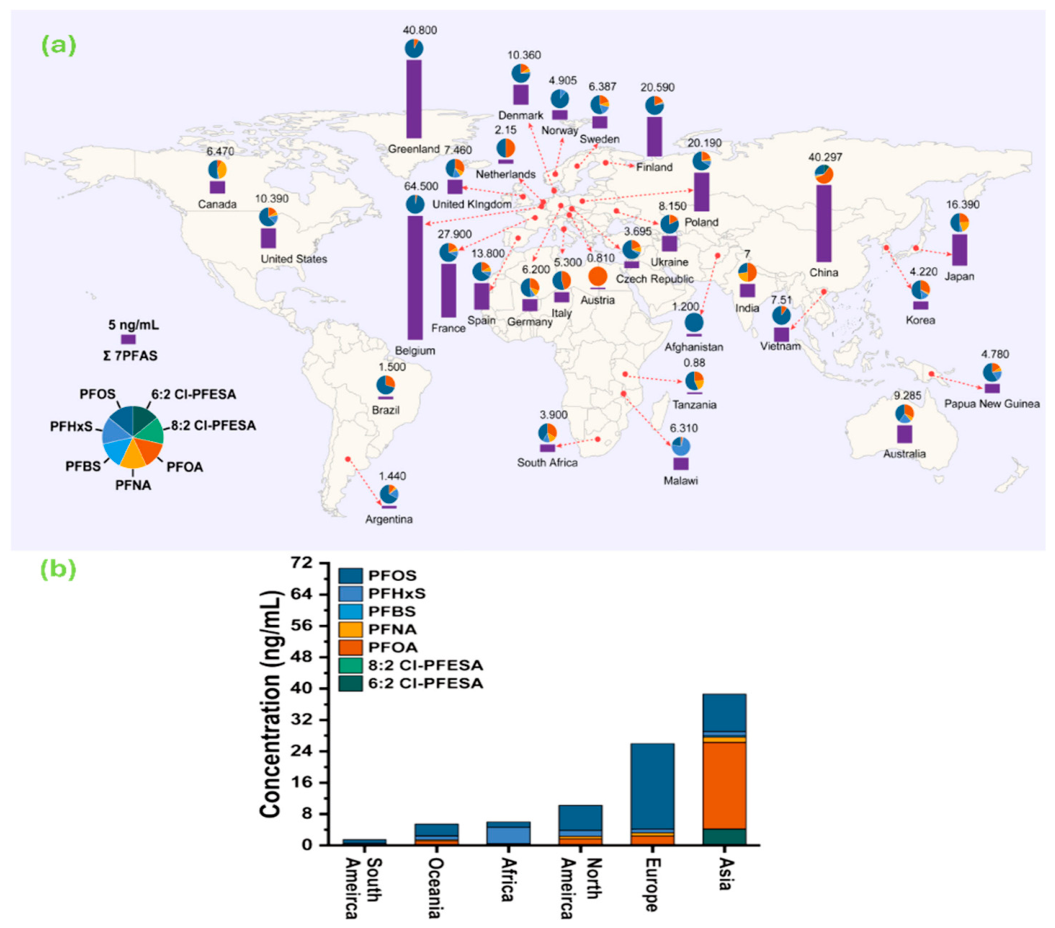
Figure 2.
Data retrieved from CAS SciFinder, Scopus, and Web of Science repositories by searching "PFAS in water", "Microbial", and "Degradation" published between 2015 and the present were analyzed. A significant increase in research on PFAS removal and degradation from water, published in peer-reviewed journals, has been observed over the last 5 years due to strict PFAS regulations. A total of 1795 research articles and 369 reviews have been published since 2015, and 136 new patents have been filed for PFAS degradation and removal technologies. Conference proceedings and preprints were excluded from the search later. The research was narrowed to microbial degradation of PFAS in water, yielding 87 results, including articles, reviews, and book chapters. Based on these results, regulatory authorities' evaluations of regulations, data, and technologies were also considered to develop this review.
Figure 2.
Data retrieved from CAS SciFinder, Scopus, and Web of Science repositories by searching "PFAS in water", "Microbial", and "Degradation" published between 2015 and the present were analyzed. A significant increase in research on PFAS removal and degradation from water, published in peer-reviewed journals, has been observed over the last 5 years due to strict PFAS regulations. A total of 1795 research articles and 369 reviews have been published since 2015, and 136 new patents have been filed for PFAS degradation and removal technologies. Conference proceedings and preprints were excluded from the search later. The research was narrowed to microbial degradation of PFAS in water, yielding 87 results, including articles, reviews, and book chapters. Based on these results, regulatory authorities' evaluations of regulations, data, and technologies were also considered to develop this review.
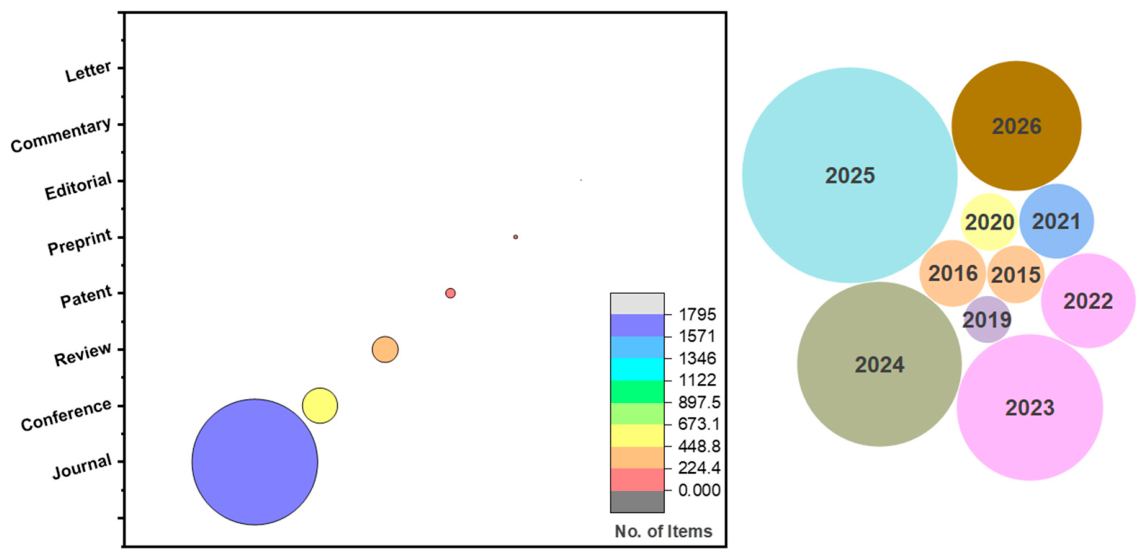
Figure 4.
An illustration of the extracellular polymeric substance (EPS) matrix in biofilms and its interactions with PFAS.
Figure 4.
An illustration of the extracellular polymeric substance (EPS) matrix in biofilms and its interactions with PFAS.
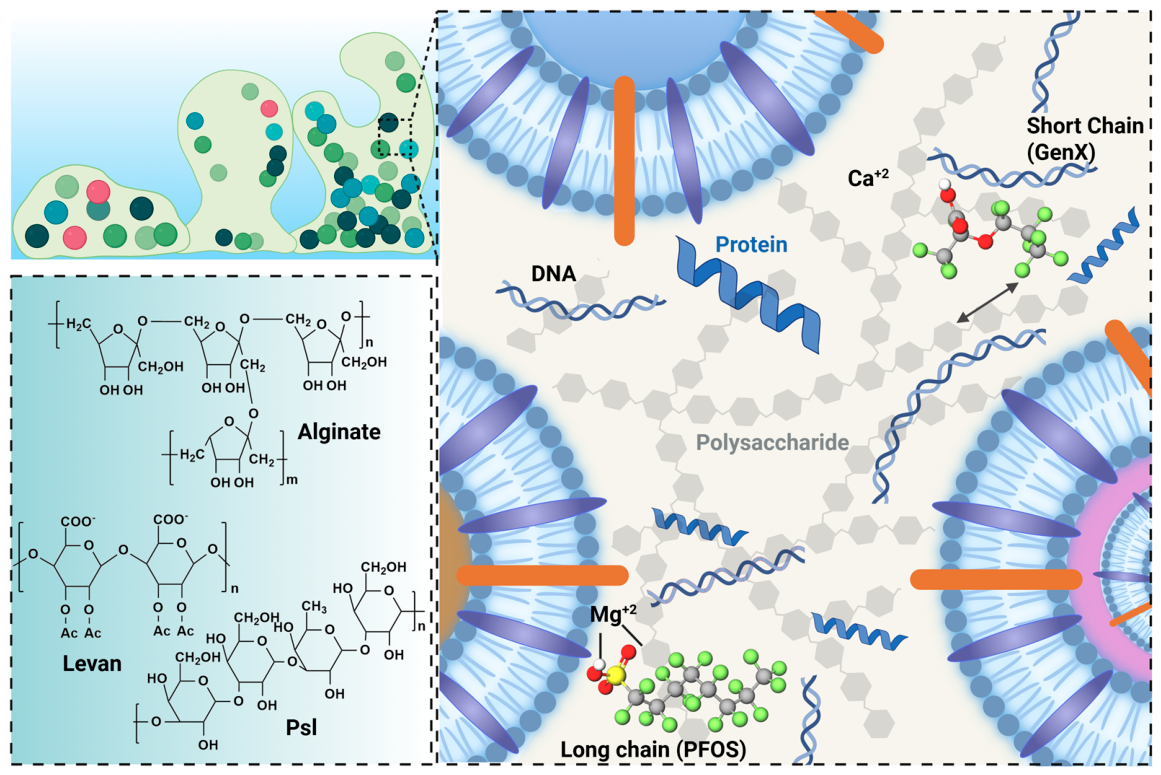
Figure 5.
Microorganisms' biotransformation pathways for PFAS.
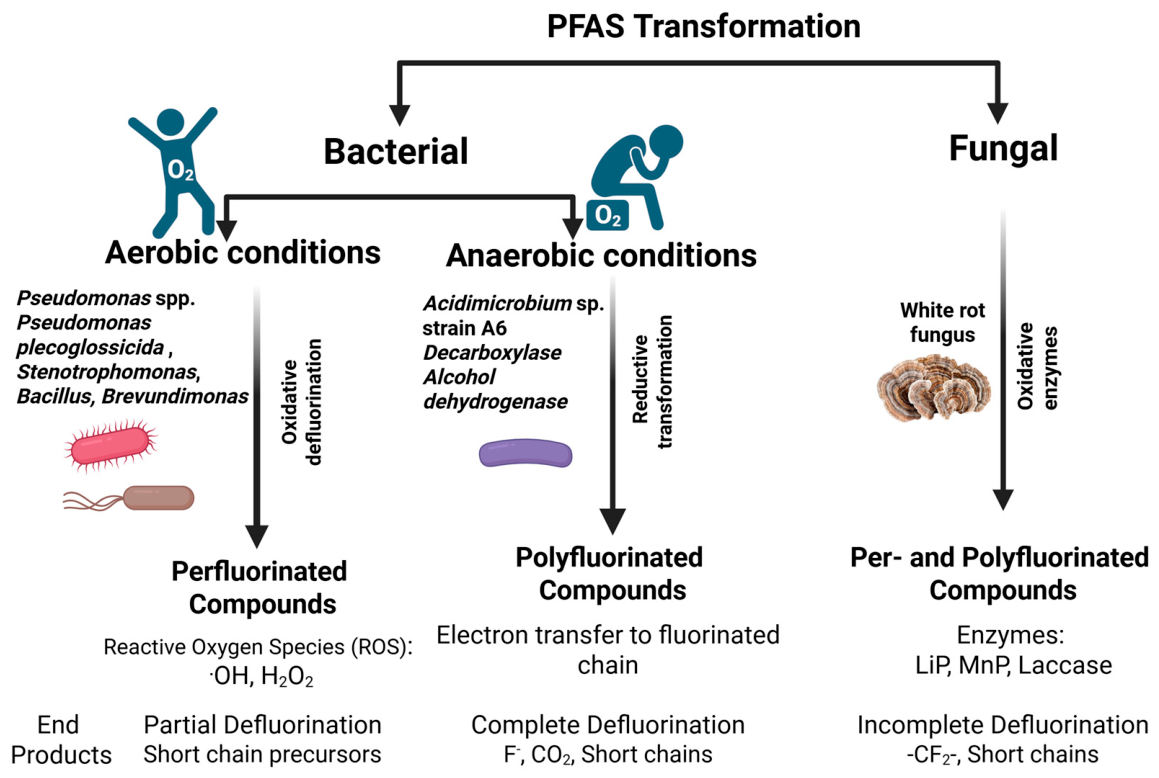
Figure 6.
Diagrammatic representation of the anaerobic microbial reductive defluorination of polyfluorinated PFAS. Polyfluorinated PFAS compounds having partially fluorinated carbon centers, such as PFMeUPA and FTMeUPA, are more susceptible to microbial attack than their fully perfluorinated counterparts. Reductive dehalogenases, mostly vitamin B12-dependent enzymes, enable reductive defluorination under strictly anaerobic conditions in organohalide-respiring microbial communities rich in genera such as Desulfovibrio, Sporomusa, and Dehalococcoides. The strong C-F bond is broken by reduced equivalents (2H+ + 2e-) from electron donors, such as H2, lactate, acetate, and reduced ferredoxin. This releases fluoride ions (F-) and eventually replaces fluorine atoms with hydrogen atoms. Less-fluorinated products, hydrogenated intermediates (such as TP256 and TP221), and ultimately partially altered molecules with improved biodegradability are produced by this sequential process. The lower panel illustrates the progressive transformation pathway from fully fluorinated PFAS to hydrogenated molecules via successive reductive defluorination phases, highlighting fluoride release and increased vulnerability to further biodegradation.
Figure 6.
Diagrammatic representation of the anaerobic microbial reductive defluorination of polyfluorinated PFAS. Polyfluorinated PFAS compounds having partially fluorinated carbon centers, such as PFMeUPA and FTMeUPA, are more susceptible to microbial attack than their fully perfluorinated counterparts. Reductive dehalogenases, mostly vitamin B12-dependent enzymes, enable reductive defluorination under strictly anaerobic conditions in organohalide-respiring microbial communities rich in genera such as Desulfovibrio, Sporomusa, and Dehalococcoides. The strong C-F bond is broken by reduced equivalents (2H+ + 2e-) from electron donors, such as H2, lactate, acetate, and reduced ferredoxin. This releases fluoride ions (F-) and eventually replaces fluorine atoms with hydrogen atoms. Less-fluorinated products, hydrogenated intermediates (such as TP256 and TP221), and ultimately partially altered molecules with improved biodegradability are produced by this sequential process. The lower panel illustrates the progressive transformation pathway from fully fluorinated PFAS to hydrogenated molecules via successive reductive defluorination phases, highlighting fluoride release and increased vulnerability to further biodegradation.
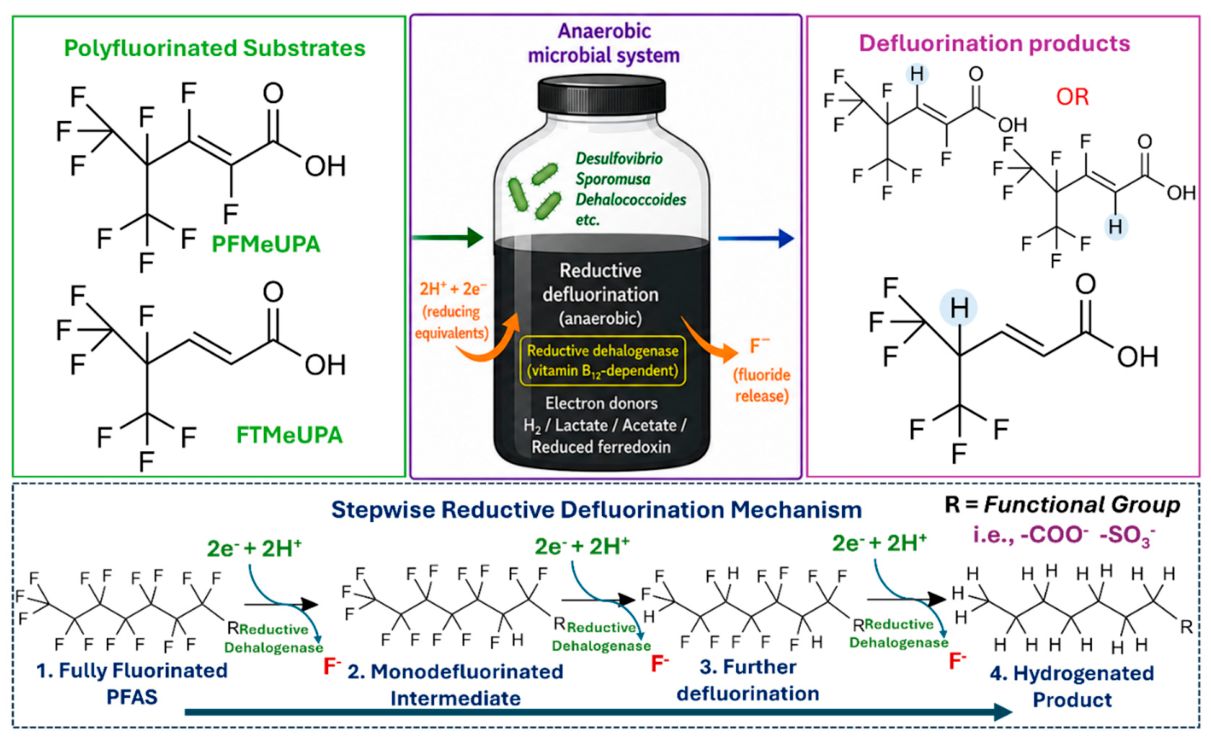
Figure 7.
(a) Manganese peroxidase (MnP) and cytochrome P450-mediated oxidative defluorination is the suggested mechanism for the biotransformation of 6:2 FTSA. (b) The heme-containing peroxidase-mediated catalytic generation of a radical cation in the presence of the 4-methoxyphenol mediator is part of the suggested breakdown pathway of PFOA [103].
Figure 7.
(a) Manganese peroxidase (MnP) and cytochrome P450-mediated oxidative defluorination is the suggested mechanism for the biotransformation of 6:2 FTSA. (b) The heme-containing peroxidase-mediated catalytic generation of a radical cation in the presence of the 4-methoxyphenol mediator is part of the suggested breakdown pathway of PFOA [103].
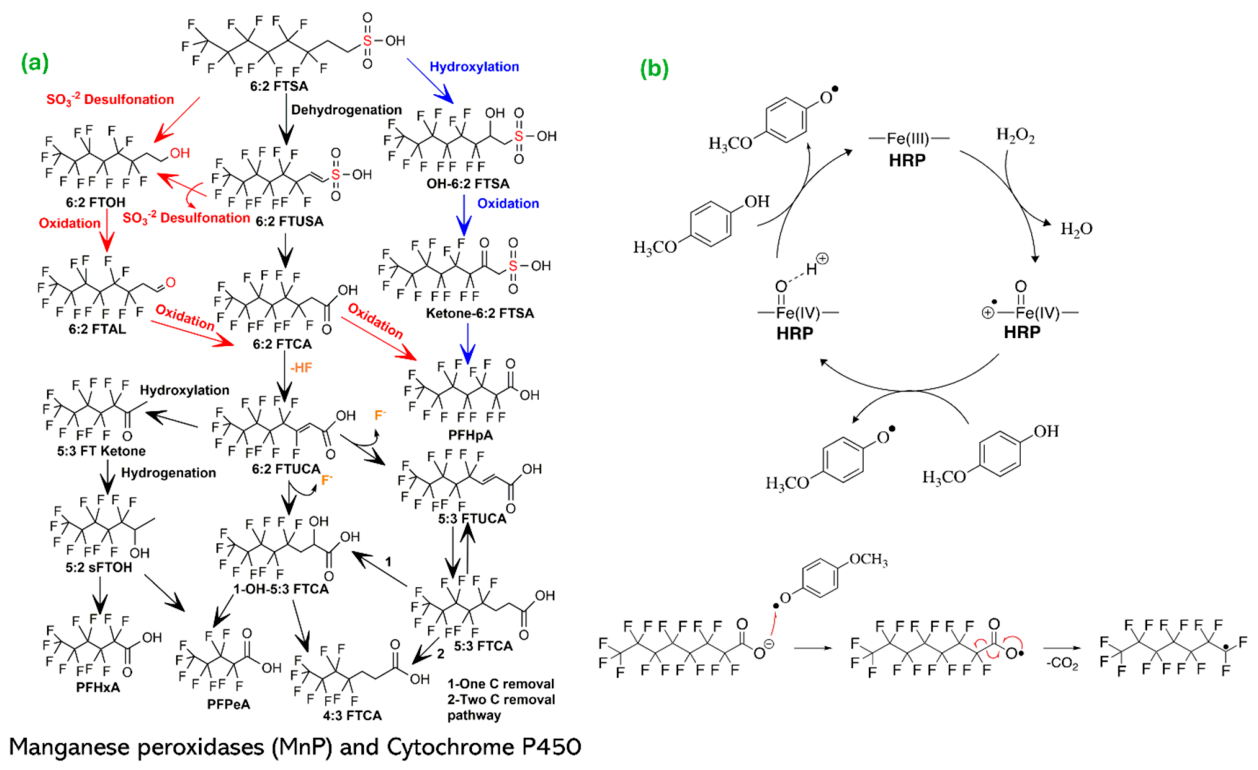
Figure 8.
Fluoroacetate compound degradation mechanism by FAcD [103].
Figure 8.
Fluoroacetate compound degradation mechanism by FAcD [103].
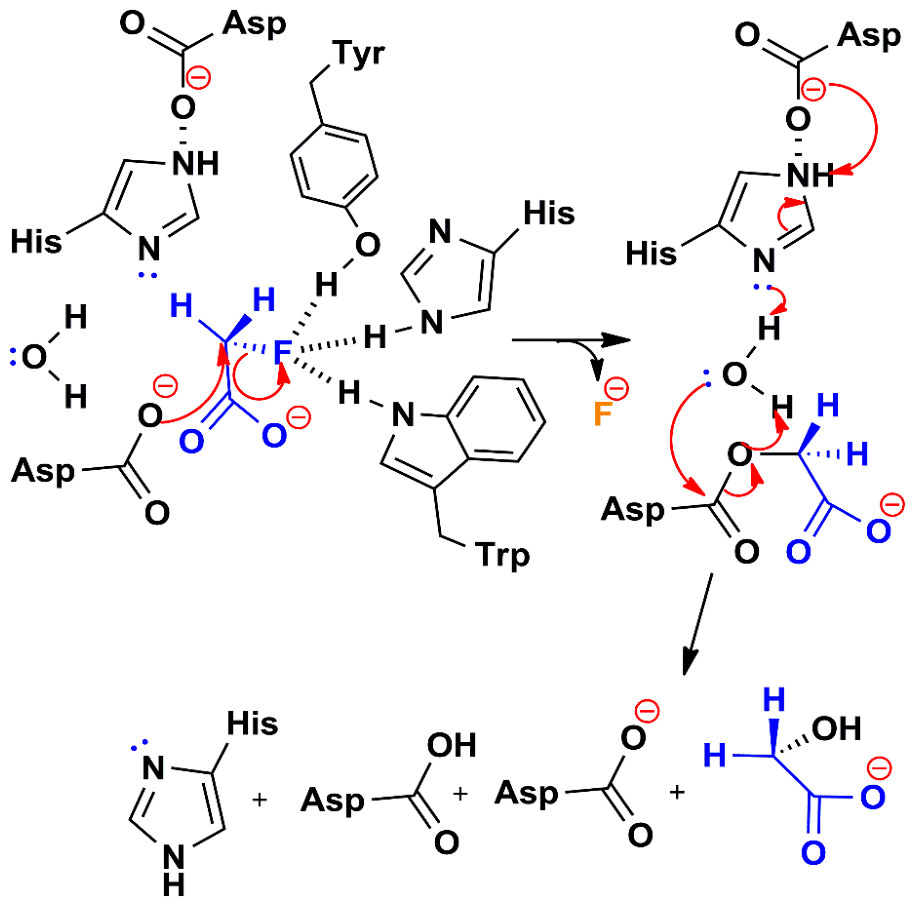
Figure 9.
P450S' catalytic cycles [146].
Figure 9.
P450S' catalytic cycles [146].
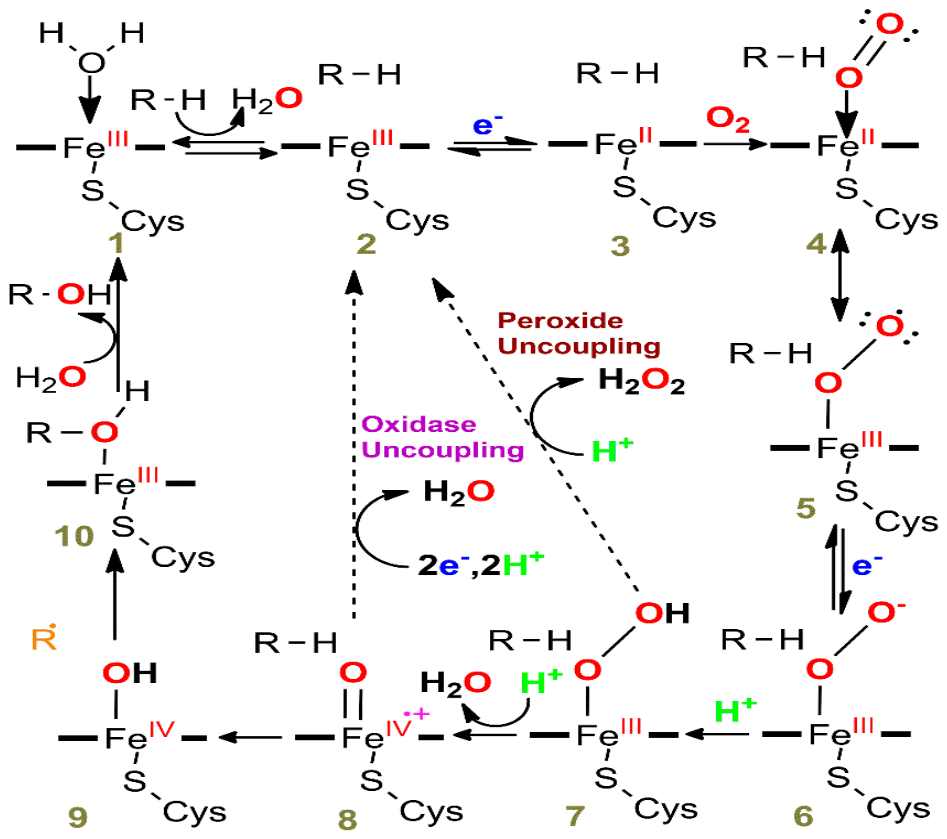
Figure 10.
Legacy PFAS compounds, such as PFOS and PFOA, and their metabolites are degraded by bacteria [85].
Figure 10.
Legacy PFAS compounds, such as PFOS and PFOA, and their metabolites are degraded by bacteria [85].
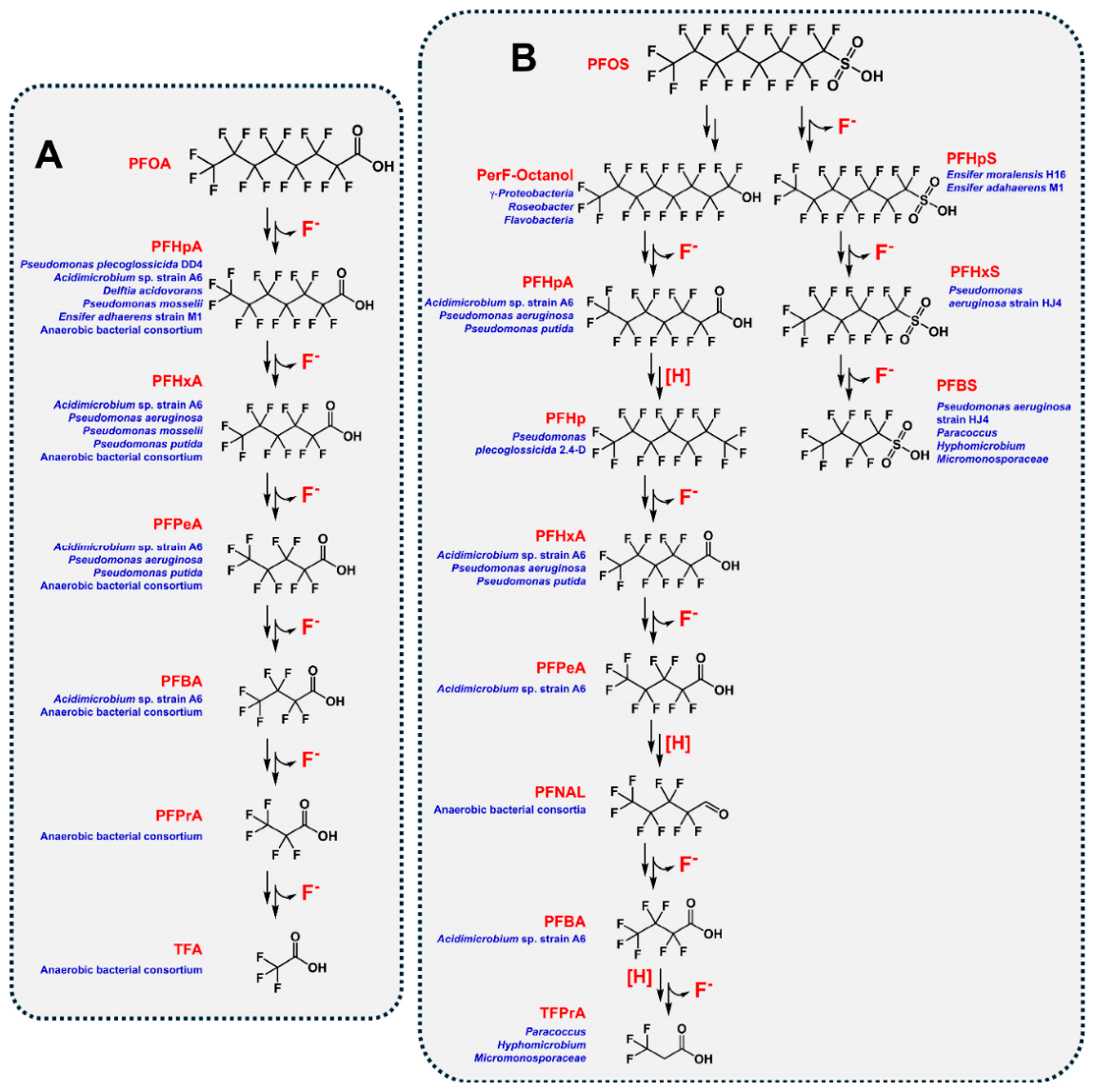
Figure 11.
The proposed biotransformation pathway for PFOS (A) and 6:2 FTSA (B) in L. portucalensis F11.
Figure 11.
The proposed biotransformation pathway for PFOS (A) and 6:2 FTSA (B) in L. portucalensis F11.
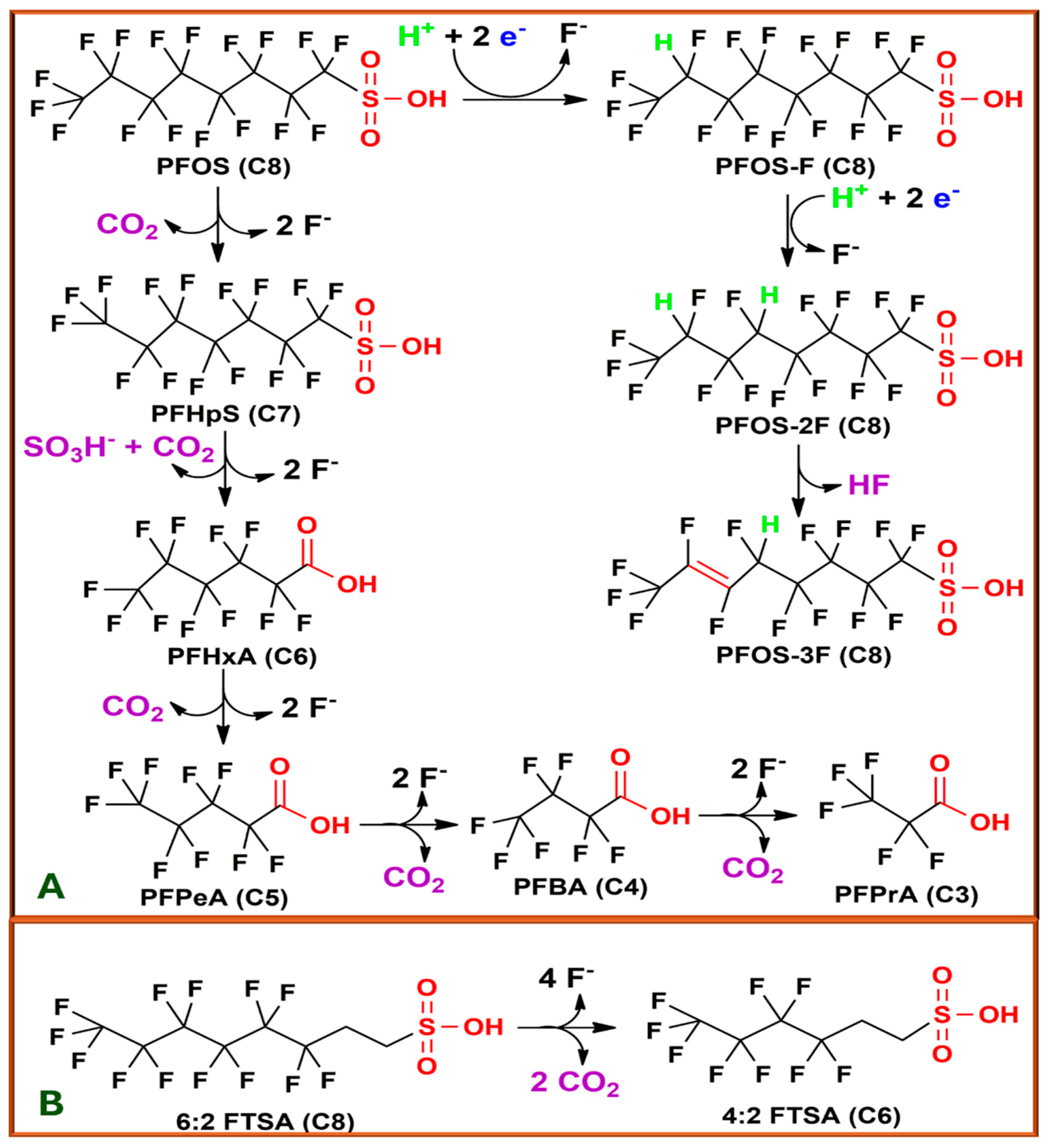

Table 1.
Adsorption and transport behavior of PFAS in bacterial systems: comparison of batch sorption and porous media experiments.
Table 1.
Adsorption and transport behavior of PFAS in bacterial systems: comparison of batch sorption and porous media experiments.
| System Type | Bacterial Type | Strain | Condition | PFAS | Kda Range (L/kg) | Key Observations | References |
| Batch adsorption | Gram-positive | Staphylococcus epidermidis | Live |
PFBSb PFHxSc PFOSd PFOAe PFNAf |
41±5 95±16 - 120±11 130±21 |
Moderate adsorption | [56,57] |
| Dead | PFBSb PFHxSc PFOSd PFOAe PFNAf |
45±3 90±9.5 520±70 150±19 170±32 |
Enhanced adsorption | ||||
| Batch adsorption | Gram-negative | Aliivibrio fischeri | Live |
PFBSb PFHxSc PFOSd PFOAe PFNAf |
56±17 160±14 2400±670 300±14 840±130 |
High adsorption | [56,57] |
| Dead | PFBSb PFHxSc PFOSd PFOAe PFNAf |
43±5 130±19 2100±219 220±35 570±42 |
High Adsorption | ||||
| Batch adsorption | Gram-positive | Bacillus subtilis | pH 4 | PFOSd PFOAe |
505±386 105±61 |
Higher adsorption | [57,58] |
| pH 6 | PFOSd PFOAe |
100±75 133±27 |
Lower adsorption | ||||
| Batch adsorption | Gram-negative | Pseudomonas putida | pH 4 | PFOSd PFOAe |
218±150 25±23 |
Higher adsorption | [57,58] |
| pH 6 | PFOSd PFOAe |
19±22 11±19 |
Lower adsorption | ||||
| Transport (porous media) | None (control) | - | No biomass | PFOSd | 0.27 | Baseline sorption in sand | [57] |
| Transport (porous media) | Gram-negative | Pseudomonas aeruginosa | 1-day inoculation | PFOSd | 0.32-0.34 | Slight increase due to initial biomass | [57] |
| Transport (porous media) | Gram-negative | Pseudomonas aeruginosa | 3-day inoculation | PFOSd | 0.57-0.59 | Strong retention due to biomass growth | [57] |
| Transport (porous media) | Gram-positive | Bacillus subtilis | 1-day inoculation | PFOSd | ~0.33 | Moderate sorption enhancement | [57] |
| Transport (porous media) | Gram-positive | Bacillus subtilis | 3-day inoculation | PFOSd | 0.59-0.62 | Highest retention; biomass-driven effect | [57] |
aDistribution Coefficient (Kd ∝ adsorption), bPerfluorobutane sulphonic acid, cPerfluorohexane sulphonic acid, dPerfluorooctane sulphonic acid, ePerfluorooctanoic acid, fPerfluorononanoic acid.
Table 2.
Mechanisms, microbial systems, and transformation efficiencies in aerobic and anaerobic microbial interactions with PFAS.
Table 2.
Mechanisms, microbial systems, and transformation efficiencies in aerobic and anaerobic microbial interactions with PFAS.
| Research / System | PFAS Type | Microbial System | Key Mechanism | Main Observation | References |
| Enriched anaerobic community (lactate-fed) | PFMeUPA, C6 PFAS | Organohalide-respiring consortium | Reductive defluorination | Partial C-F cleavage (~20-30% defluorination); fluoride release observed | [93] |
| Aerobic isolate (Pseudomonas species) | PFOS | Pure culture | Biotransformation | ~67% PFOS removal under controlled environments | [86] |
| Aerobic strain (Labrys portucalensis F11) | PFOS, 5:3 FTCA, 6:2 FTS | Pure culture | Chain-shortening + transformation | 90% PFOS, 58% 5:3 FTCA, ~21% 6:2 FTS degraded | [96] |
| Environmental microbial communities | PFOS 6:2 FTS |
Natural aquatic/sediment microbiota | Community restructuring | Shift in microbial composition; functional impacts on nutrient cycling | [98] |
| General PFAS biological degradation studies | PFAS (several) | Mixed microbial systems | Limited transformation | Strong condition dependency; limited reproducibility | [63] |
Table 3.
Environmental factors influencing microbial PFAS degradation in aquatic systems.
|
Environmental Factors |
Conditions | Effect on PFAS Degradation | Mechanism/Process | References |
| Oxygen | Aerobic | Enhance the transformation of fluorotelomer PFAS | Oxygenase-mediated oxidation (monooxygenases, hydroxylation, chain shortening) | [96,125,129] |
| Anaerobic | Limited but possible transformation | Reductive pathways; rare defluorination due to the strong C-F bond | [97,129,184] | |
| Temperature | Higher (≈ 25°C) | Increases degradation | Enhanced enzymatic activity and microbial metabolism | [130] |
| Lower (≈ 4°C) | Slows degradation | Reduced metabolic activity and reaction kinetics | ||
| pH | Neutral (≈ 6-8) | Optimal microbial activity and PFAS transformation | Maintains enzyme stability, microbial growth, and bioavailability | [96,186] |
| Extreme pH (Highly acidic/basic) |
Reduces efficiency | Disrupts microbial metabolism and enzyme activity | [85] | |
| Co-contaminants | Presence of co-substrates (e.g., methanol) | Enhance degradation (co-metabolism) | Provides auxiliary carbon/energy sources to drive transformation | [169] |
| Competing contaminants | Inhibits or alters degradation | Competition for enzymes and electron donors | [97] | |
| Electron Donors (NH₄⁺, sucrose, organic substrates) | Enhances PFAS transformation | Stimulates microbial metabolism and Fe(III) reduction | [188] | |
| Redox Conditions- Iron-reducing (anaerobic) |
Improves PFAS removal | Fe(III)/Fe(II) cycling, extracellular electron transfer | [32,187] | |
| Activated Carbon (Presence of conductive carbon) | Enhances degradation efficiency | Adsorption of PFAS, biofilm support, and DIET-mediated electron transfer | [189,190,191] |
Disclaimer/Publisher’s Note: The statements, opinions and data contained in all publications are solely those of the individual author(s) and contributor(s) and not of MDPI and/or the editor(s). MDPI and/or the editor(s) disclaim responsibility for any injury to people or property resulting from any ideas, methods, instructions or products referred to in the content. |
© 2026 by the authors. Licensee MDPI, Basel, Switzerland. This article is an open access article distributed under the terms and conditions of the Creative Commons Attribution (CC BY) license (http://creativecommons.org/licenses/by/4.0/).
Copyright: This open access article is published under a Creative Commons CC BY 4.0 license, which permit the free download, distribution, and reuse, provided that the author and preprint are cited in any reuse.


