

Submitted:
03 July 2026
Posted:
03 July 2026
You are already at the latest version
Abstract
Diabetes mellitus is a major global public health challenge, with prevalence rising due to aging populations, urbanization, sedentary lifestyles, and dietary changes. Effective glucose monitoring is essential for diagnosis, treatment, and long-term disease management, driving significant research into improved sensing technologies. Conventional invasive and minimally invasive glucose monitoring methods often cause discomfort and reduce patient compliance, motivating the development of non-invasive alternatives. Recent advances in photonics, biomedical engineering, nanotechnology, wearable devices, and artificial intelligence have accelerated the emergence of innovative glucose sensing approaches capable of improving comfort, safety, and monitoring frequency. This review presents a comprehensive overview of recent non-invasive glucose monitoring technologies reported in the literature, including optical, electromagnetic, nanotechnology-based, and physiological sensing methods evaluated through human studies, biological samples, or tissue-equivalent models. The underlying sensing principles, measurement sites, performance characteristics, and practical implementation challenges of these technologies are discussed. Particular attention is given to the integration of machine learning algorithms, which have demonstrated significant potential for enhancing glucose prediction accuracy and supporting real-time monitoring applications. The review also critically examines the advantages, limitations, clinical feasibility, and commercialization prospects of existing technologies, highlighting the key barriers that continue to impede widespread adoption. By consolidating recent developments across multiple scientific and engineering disciplines, this work provides researchers, clinicians, and technology developers with a concise assessment of the current state of non-invasive glucose sensing and identifies future research directions necessary for advancing reliable, accurate, and user-friendly next-generation diabetes management systems.
Keywords:
non-invasive glucose sensing
; optical coherence tomography (OCT)
; optical polarimetry (OP)
; diabetes mellitus
; machine learning
; optical biosensors
; continuous glucose monitoring
I. Introduction
Diabetes mellitus (DM) is a chronic metabolic disorder characterized by elevated blood glucose levels resulting from abnormalities in insulin production, insulin action, or both. The prevalence of DM has increased substantially worldwide and continues to pose a significant public health challenge [1]. According to recent global estimates, hundreds of millions of individuals are currently affected by diabetes, making it one of the leading causes of morbidity and mortality worldwide [2,3]. Furthermore, the global diabetic population is projected to rise considerably in the coming decades, driven by factors such as population aging, urbanization, sedentary lifestyles, obesity, and dietary changes [4]. Despite advances in medical care, effective diabetes diagnosis and management remain challenging due to limitations associated with existing glucose monitoring techniques, including patient discomfort, limited compliance, and measurement inaccuracies [5,6,7].
The diagnosis and monitoring of diabetes currently rely primarily on invasive glucose sensing technologies. The specific diagnostic approach varies depending on the type of diabetes and patient characteristics. Type 1 diabetes mellitus, which is more frequently diagnosed during childhood and adolescence, is commonly identified through random blood glucose (RBG) testing and glycated hemoglobin (HbA1c) measurements. Additional confirmation may be obtained through the detection of autoimmune biomarkers, including islet-cell antibodies (ICA), insulinoma-associated protein-2 (IA-2), glutamic acid decarboxylase 65 (GAD65), and zinc transporter 8 (ZnT8). Long-term management of Type 1 diabetes typically involves self-blood glucose monitoring (SBGM), continuous glucose monitoring (CGM) systems, and insulin administration through injections, pens, or insulin pumps to maintain blood glucose levels within the recommended range.
Gestational diabetes mellitus (GDM) is generally diagnosed using a 75-g oral glucose tolerance test (OGTT) according to established clinical guidelines. Following diagnosis, glucose levels are monitored regularly through self-monitoring practices while patients are encouraged to adopt dietary modifications and increased physical activity. Pharmacological interventions, including insulin therapy or metformin, may be introduced when lifestyle-based approaches alone are insufficient to achieve adequate glycemic control.
Figure 1.
Overview of diabetes mellitus types, diagnostic methods, and management strategies. Type 1, gestational, and Type 2 diabetes are shown with their corresponding diagnostic criteria and treatment approaches. ICA Islet Cell Autoantibodies; IA-2 Insulinoma-Associated Protein 2; GAD65Glutamic Acid Decarboxylase 65; ZnT8 Zinc Transporter 8; CGM Continuous Glucose Monitoring; SBGM Self-Blood Glucose Monitoring; FBG Fasting Blood Glucose; RBG Random Blood Glucose; HbA1cGlycated Hemoglobin; OGTT Oral Glucose Tolerance Test.
Figure 1.
Overview of diabetes mellitus types, diagnostic methods, and management strategies. Type 1, gestational, and Type 2 diabetes are shown with their corresponding diagnostic criteria and treatment approaches. ICA Islet Cell Autoantibodies; IA-2 Insulinoma-Associated Protein 2; GAD65Glutamic Acid Decarboxylase 65; ZnT8 Zinc Transporter 8; CGM Continuous Glucose Monitoring; SBGM Self-Blood Glucose Monitoring; FBG Fasting Blood Glucose; RBG Random Blood Glucose; HbA1cGlycated Hemoglobin; OGTT Oral Glucose Tolerance Test.
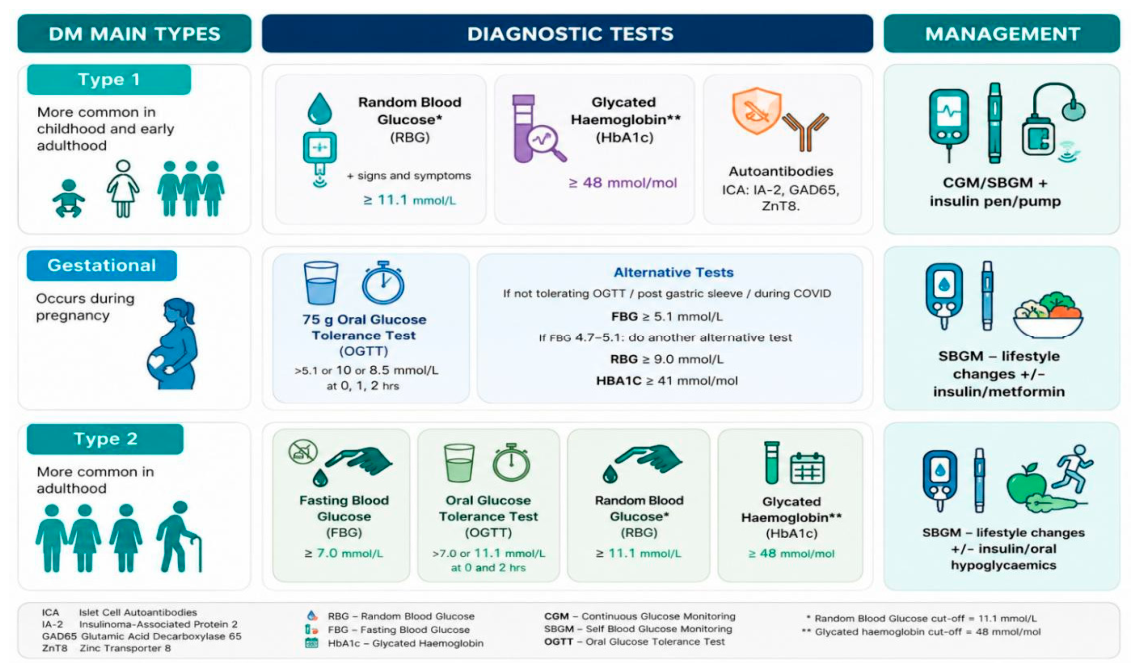
Type 2 diabetes mellitus, the most prevalent form of diabetes worldwide, is commonly diagnosed using fasting blood glucose (FBG), random blood glucose (RBG), glycated hemoglobin (HbA1c), or oral glucose tolerance testing [8]. Management strategies generally begin with lifestyle interventions such as dietary modification, weight reduction, and regular physical activity. When these measures fail to maintain target glucose levels, oral antihyperglycemic medications and, in some cases, insulin therapy are prescribed. Although these approaches have significantly improved diabetes management, their invasive nature and dependence on repeated blood sampling continue to motivate the development of accurate, convenient, and patient-friendly non-invasive glucose monitoring technologies.
Despite significant advances in diabetes management, currently available glucose monitoring approaches remain limited in terms of sensitivity, specificity, patient comfort, and long-term usability. Although Continuous Glucose Monitoring (CGM) systems have improved glycemic assessment, particularly for individuals with Type 1 diabetes, many conventional diagnostic and monitoring methods still rely on intermittent measurements that provide only a limited representation of an individual's glucose fluctuations throughout the day [9]. Several studies have highlighted the shortcomings of single-point glucose measurements, including fasting blood glucose, random blood glucose, and oral glucose tolerance tests, for accurately capturing dynamic glycemic variations [10]. Similar concerns have been reported for self-blood glucose monitoring (SBGM), which depends on a limited number of daily measurements and may fail to detect significant glucose excursions occurring between testing intervals [3,4,5,6,7,11].
To address these limitations, considerable research efforts have focused on the development of non-invasive glucose sensing technologies (NIGSTs) capable of providing accurate, convenient, and continuous glucose monitoring. This review presents a comprehensive assessment of recently developed and emerging NIGSTs, examining their underlying sensing principles, operational mechanisms, advantages, limitations, and clinical applicability. In addition, the review discusses the design methodologies, technological developments, and translational challenges associated with the development of next-generation glucose sensing systems.
Previous reviews have broadly classified glucose sensing approaches into invasive, minimally invasive, and non-invasive categories [12,13,14,15]. While minimally invasive technologies often employ enzyme-based sensing mechanisms, their performance can be affected by environmental conditions such as temperature, humidity, and pH variations, which may compromise stability and long-term monitoring performance [16,17,18]. Therefore, this review focuses specifically on non-invasive glucose sensing technologies and categorizes them into four major groups: optical, nanotechnology-based, electrical/electromagnetic, and physiological sensing approaches (Figure 2). Furthermore, commercially available devices, emerging prototypes, and technologies currently undergoing clinical evaluation are critically discussed to provide a comprehensive overview of the current state and prospects of non-invasive glucose monitoring.
II. Methods
A comprehensive literature survey was conducted to identify and evaluate recent advances in non-invasive glucose sensing technologies (NIGSTs), including optical, nanotechnology-based, electrical/electromagnetic, and physiological sensing approaches. Relevant publications were retrieved from major scientific databases using combinations of keywords related to non-invasive glucose monitoring, optical sensing, electromagnetic sensing, nanotechnology, physiological sensing, and machine learning-assisted glucose detection. The search focused primarily on studies published between 2018 and 2023.
To ensure comprehensive coverage, backward and forward citation tracking was performed by examining the reference lists of selected articles as well as subsequently published studies that cited these works. All identified publications were screened for relevance based on their contribution to non-invasive glucose monitoring, sensing methodology, experimental validation, and potential clinical applicability. Only studies directly related to glucose sensing technologies were included in the final review.
The selected literature was categorized into four major groups: optical sensing technologies, nanotechnology-based sensing approaches, electrical/electromagnetic techniques, and physiological sensing methods. Although nanotechnology is often treated as an independent category, considerable overlap exists between nanotechnology and optical sensing platforms. Therefore, nanoplasmonic approaches, including Surface-Enhanced Raman Scattering (SERS), Surface Plasmon Resonance (SPR), Plasmon-Enhanced Fluorescence (PEF), and Carbon Quantum Dot (CQD)-based fluorescence sensing, are discussed within the broader context of advanced optical sensing technologies.
Each technology was critically evaluated based on its sensing principle, operating mechanism, performance characteristics, advantages, limitations, clinical feasibility, and commercialization potential. In addition, emerging applications of machine learning and artificial intelligence for signal processing, feature extraction, calibration, and glucose prediction were examined. Commercial products, prototype devices, and technologies currently undergoing clinical validation were also reviewed to provide a comprehensive overview of the current state of non-invasive glucose monitoring.
III. Skin Layers with Properties
The effectiveness of non-invasive glucose sensing technologies (NIGSTs) largely depends on their interaction with biological tissues, particularly the skin. Human skin consists of three primary tissue layers the epidermis, dermis, and hypodermis, which exhibit distinct optical, electrical, and electromagnetic characteristics that influence the propagation, penetration depth, and absorption of incident signals [19,20]. These tissue-specific properties govern how different sensing modalities interact with biological media and determine their ability to detect physiological biomarkers, including glucose, water, proteins, lipids, and electrolytes. A schematic representation of the skin layers and their corresponding thickness is presented in Figure 3.
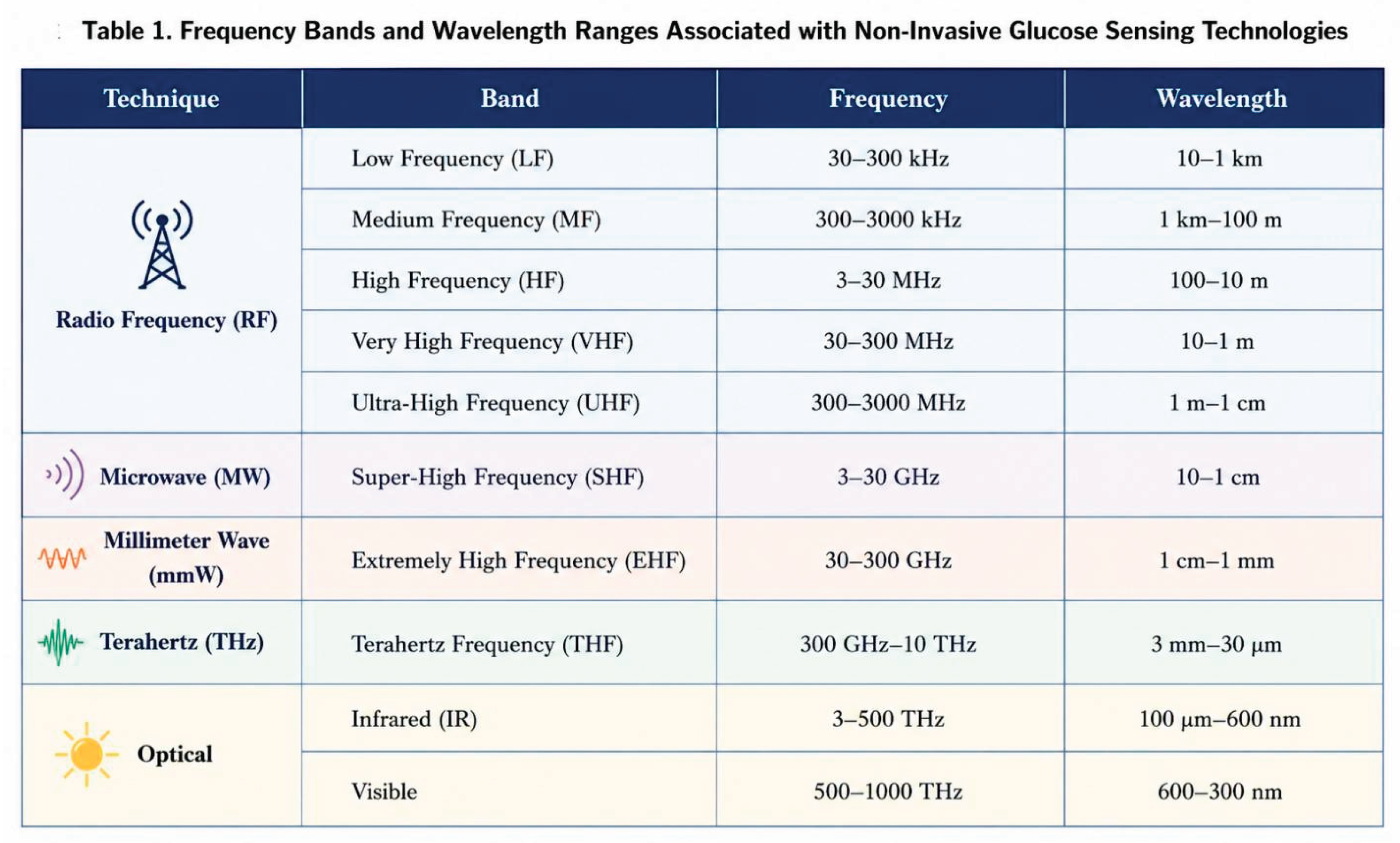
Most non-invasive glucose sensing approaches estimate blood glucose concentration indirectly by analyzing changes in optical or electromagnetic signals. Consequently, the selection of operating frequency, wavelength, and spectral band plays a critical role in determining sensing performance. The frequency ranges and wavelength bands associated with various sensing techniques are summarized in Table 1.
Both optical and electromagnetic sensing methods employ non-ionizing radiation; however, their interaction mechanisms and penetration depths differ significantly. Optical techniques operating in the terahertz (THz) region primarily interact with superficial skin layers, particularly the epidermis, where signal penetration is influenced by factors such as wavelength, polarization state, tissue composition, and optical power density [21]. In contrast, lower-frequency electromagnetic techniques, including radio-frequency (RF), microwave (MW), and millimeter-wave (mmW) sensing, can penetrate deeper into subcutaneous tissues. This enhanced penetration enables the collection of information related to glucose distribution and tissue composition, although measurement accuracy may be affected by the presence of other biological constituents and the heterogeneous nature of skin tissues.
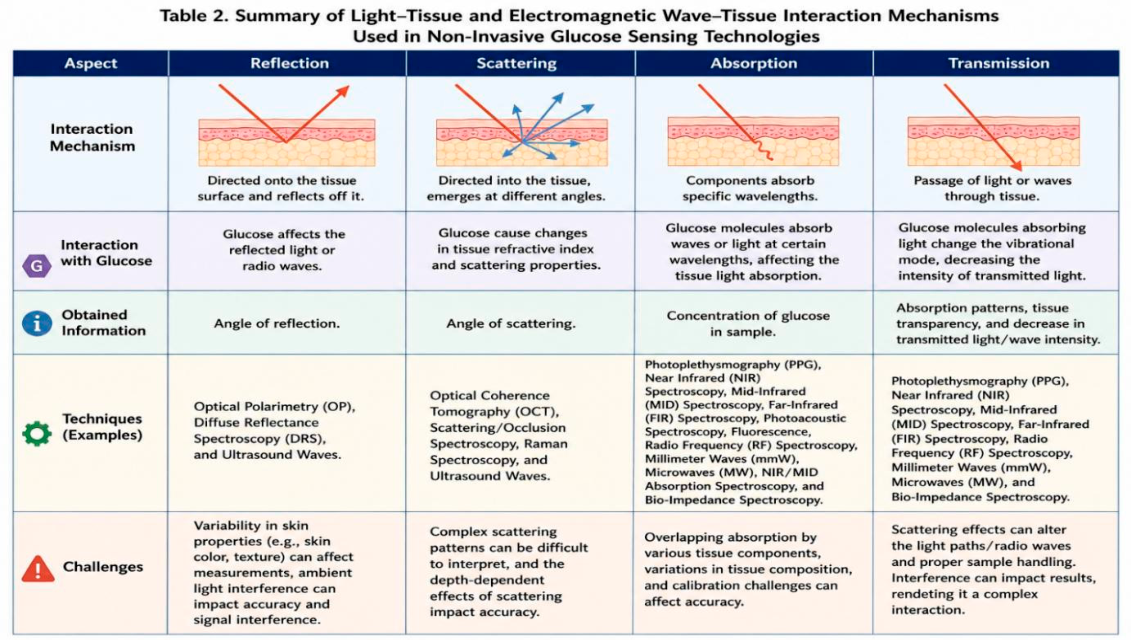
When optical or electromagnetic waves propagate through biological tissues, four fundamental interaction mechanisms may occur: reflection, scattering, absorption, and transmission [22]. These interactions form the basis of most non-invasive glucose sensing technologies and determine how physiological information can be extracted from biological media.
In reflection-based sensing, incident light or electromagnetic waves are directed toward the tissue surface and the reflected signal is analyzed. Variations in the reflected intensity, phase, or spectral characteristics can provide information about tissue composition and physiological parameters. Scattering-based techniques rely on the interaction of incident waves with cellular structures and tissue components, causing the waves to deviate from their original propagation paths. The resulting scattered signals contain valuable information regarding tissue morphology and biochemical composition.
Absorption-based methods exploit the wavelength-dependent absorption characteristics of biological molecules. When light or electromagnetic radiation passes through tissue, specific constituents absorb energy at characteristic wavelengths. By quantifying the absorbed energy, the concentration of target analytes, including glucose, can be estimated. In transmission-based approaches, light or electromagnetic waves traverse the tissue and the transmitted signal is measured. During propagation, interactions with biological molecules modify the signal through absorption and scattering processes, enabling the extraction of physiological information from the transmitted spectrum [20].
The analysis of these interaction mechanisms enables the assessment of tissue properties and the estimation of glucose concentration within biological systems. The dominant interaction depends on several factors, including the operating wavelength, tissue characteristics, penetration depth, and sensing modality employed. Table 2 summarizes the four primary wave–tissue interaction mechanisms, the information obtained from each interaction, representative glucose sensing techniques, and their associated challenges.
IV. Techniques
Optical and Nanotechnology-Based Glucose Sensing Techniques
Optical sensing technologies represent one of the most extensively investigated approaches for non-invasive glucose monitoring due to their high sensitivity, rapid response, and potential for continuous measurement. These techniques rely on the interaction of light with biological tissues, particles, and molecular constituents, where incident optical signals may undergo reflection, scattering, absorption, or transmission. The resulting changes in optical properties can be analyzed to directly or indirectly estimate glucose concentration. The underlying principles of optical glucose sensing are governed by several fundamental physical laws. Reflection-based techniques are derived from the law of reflection, whereby the angle of reflected light is related to the angle of incidence. Scattering phenomena are commonly described by Rayleigh scattering theory, which states that shorter wavelengths experience greater scattering than longer wavelengths, resulting in wavelength-dependent variations in signal intensity. Absorption and transmission mechanisms are primarily governed by the Beer–Lambert law, which relates the attenuation of light passing through a medium to the concentration of absorbing molecules, including glucose [23]. A major advantage of optical sensing methods is their capability to support real-time and continuous glucose monitoring without the need for repeated blood sampling [18]. Consequently, considerable research efforts have been devoted to the development of advanced optical sensing platforms. The principal optical techniques discussed in this review include Optical Coherence Tomography (OCT), Optical Polarimetry (OP), Photoplethysmography (PPG), and various spectroscopic approaches. The spectroscopic methods encompass Near-Infrared (NIR), Mid-Infrared (MIR), Far-Infrared (FIR), combined NIR/MIR spectroscopy, diffuse reflectance spectroscopy, scattering and occlusion spectroscopy, and photoacoustic spectroscopy. Furthermore, recent advances in nanotechnology have enabled the integration of plasmonic nanostructures, nanomaterials, and nanoscale optical components, leading to enhanced sensing performance, improved sensitivity, and greater selectivity for non-invasive glucose detection.
NIR/MIR Absorption Spectroscopy
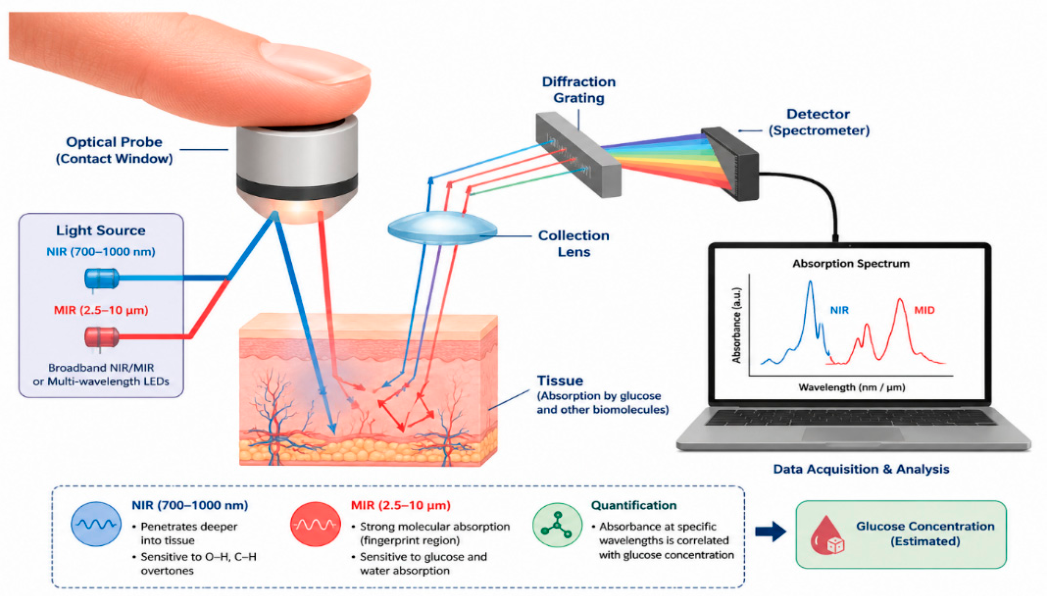
Near-Infrared (NIR) and Mid-Infrared (MIR) absorption spectroscopy are among the most extensively investigated optical techniques for non-invasive glucose monitoring. These approaches exploit the characteristic absorption behavior of glucose molecules at specific wavelengths within the infrared spectrum. By combining NIR and MIR spectral regions, a broader range of glucose-related absorption features can be captured, enabling more comprehensive analysis of glucose concentration in biological tissues while accounting for the influence of other tissue constituents, particularly water, which is the dominant absorber in biological media [40]. The operating principle of NIR/MIR absorption spectroscopy is illustrated in Figure 4. Recent studies have demonstrated that the integration of multiple wavelengths and advanced data-processing techniques can significantly enhance sensing performance. Shokrekhodaei et al. [29] employed a multiwavelength sensing strategy incorporating visible (VIS) and NIR wavelengths at 485, 645, 860, and 940 nm. By combining these optical measurements with machine-learning algorithms, the authors improved both sensitivity and selectivity for glucose detection in albumin-phosphate-buffered saline (PBS) solutions, demonstrating enhanced prediction accuracy compared with conventional single-wavelength approaches.
Similarly, Mandal and Manasreh [41] investigated glucose estimation using dual-wavelength absorption measurements at 535 nm and 593 nm. Their system utilized light-emitting sources, a photodiode for measuring transmitted optical intensity, and a microcontroller-based processing unit to quantify absorbance variations associated with glucose concentration. The proposed approach achieved improved measurement accuracy by exploiting wavelength-dependent molar absorption characteristics and demonstrated potential for estimating glycated hemoglobin (HbA1c) levels through absorbance-based analysis. NIR/MIR absorption spectroscopy offers several advantages, including non-invasive operation, relatively simple instrumentation, rapid measurement capability, and compatibility with wearable sensing platforms. However, the technique remains susceptible to interference from water absorption, tissue heterogeneity, temperature variations, motion artifacts, and overlapping spectral signatures from other biological molecules. Consequently, future research should focus on advanced signal-processing methods, machine-learning-assisted spectral analysis, and optimized wavelength selection strategies to improve measurement accuracy and clinical reliability.
Surface Plasmon Resonance (SPR)
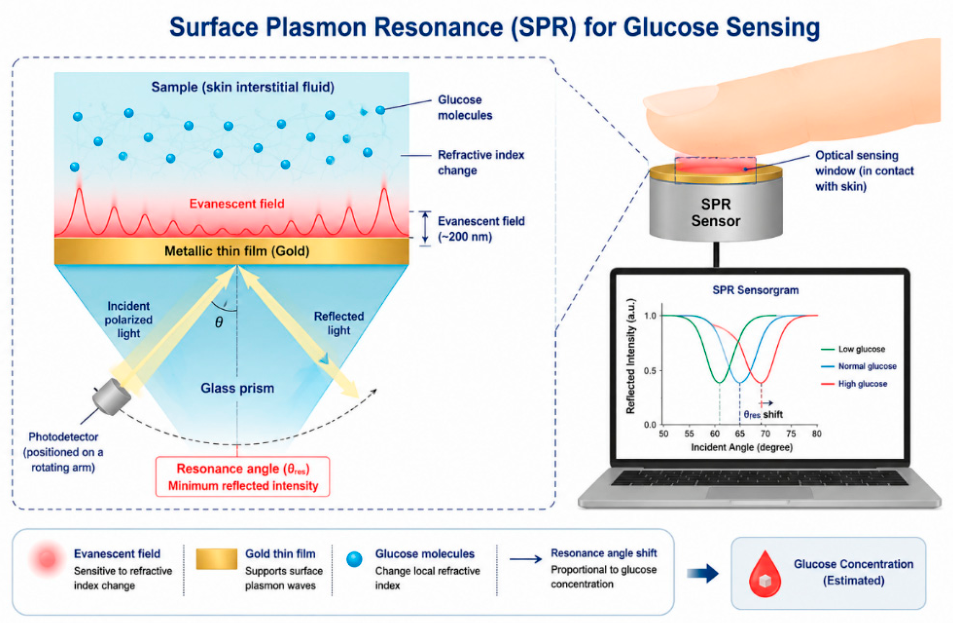
Surface Plasmon Resonance (SPR) is a highly sensitive optical sensing technique based on the excitation of surface plasmons at the interface between a thin metallic film and a dielectric medium. Like Surface-Enhanced Raman Scattering (SERS), SPR exploits plasmonic phenomena arising from the collective oscillation of free electrons in metallic nanostructures. In a typical SPR configuration, polarized light is directed through a prism onto a thin metal layer, commonly gold or silver, at a specific incident angle. Under resonance conditions, energy from the incident light is transferred to surface plasmons, resulting in a reduction in the intensity of the reflected light. The corresponding resonance angle or wavelength is highly sensitive to changes in the refractive index of the surrounding medium, enabling the detection of biomolecular interactions and glucose-induced optical variations [17]. The sensing mechanism of SPR relies on monitoring shifts in resonance angle, resonance wavelength, or reflected intensity caused by changes in the local refractive index near the metal surface. Since glucose concentration influences the refractive index of biological samples, variations in glucose levels can be quantified by analyzing the displacement of SPR resonance peaks. The resonance characteristics are strongly dependent on several factors, including the wavelength of the incident light, the dielectric properties of the surrounding medium, and the size, shape, and composition of the metallic nanostructures employed [42]. Owing to its label-free operation, rapid response, and exceptional refractive-index sensitivity, SPR has attracted significant attention for biosensing applications. Most glucose-sensing studies based on SPR have focused on minimally invasive approaches utilizing external biological fluids such as urine, saliva, sweat, or interstitial fluid [43]. Nevertheless, recent advances in nano plasmonic materials, optical fiber-based SPR sensors, and wearable photonic platforms have expanded the potential of SPR as a promising non-invasive glucose monitoring technology [17]. Despite its high sensitivity, challenges related to environmental stability, temperature dependence, biofouling, and large-scale clinical validation must be addressed before SPR-based glucose sensing systems can achieve widespread practical deployment.
Figure 5.
SPR sensing configuration showing incident light excitation of surface plasmons on a gold thin film, generation of an evanescent field, and glucose-dependent resonance angle shifts used for concentration estimation.
Figure 5.
SPR sensing configuration showing incident light excitation of surface plasmons on a gold thin film, generation of an evanescent field, and glucose-dependent resonance angle shifts used for concentration estimation.
VI. Research Gaps and Future Directions
Despite substantial advances in non-invasive glucose sensing technologies, significant scientific and engineering challenges remain before these systems can achieve widespread clinical adoption. Existing approaches, including Optical Coherence Tomography (OCT), Optical Polarimetry (OP), Photoplethysmography (PPG), Near-Infrared (NIR) spectroscopy, electromagnetic sensing, and nanotechnology-assisted platforms, have demonstrated promising results under controlled conditions; however, their accuracy and robustness remain insufficient for routine clinical implementation in many real-world scenarios [18,25]. One of the primary research gaps is the influence of physiological variability on sensing performance. Factors such as skin thickness, tissue hydration, blood perfusion, temperature, pigmentation, and body composition can significantly affect optical and electromagnetic signals, leading to variations in glucose prediction accuracy [20,25]. Furthermore, physiological delays between blood glucose and interstitial glucose concentrations introduce additional uncertainties that complicate continuous monitoring. Future research should focus on adaptive calibration methods and personalized sensing models capable of compensating for individual-specific physiological differences.
Signal interference from biological constituents remains another critical challenge. Water, proteins, lipids, electrolytes, and albumin often produce optical and electromagnetic responses that overlap with glucose signatures, reducing sensor selectivity and measurement accuracy [25,33]. This limitation is particularly evident in optical polarimetry and spectroscopy-based approaches. The development of advanced signal-processing techniques, selective sensing materials, and multimodal sensing architectures may help overcome these challenges and improve glucose-specific detection. Although optical sensing techniques have emerged as some of the most promising candidates for non-invasive glucose monitoring, each technology possesses distinct limitations. OCT provides high spatial resolution and excellent signal-to-noise characteristics but suffers from relatively low glucose sensitivity and susceptibility to motion artifacts and temperature variations [25,28]. Optical polarimetry benefits from the intrinsic optical activity of glucose molecules; however, weak polarization signals, interference from other optically active compounds, and alignment challenges continue to limit performance [25,32]. Similarly, PPG and NIR spectroscopy have demonstrated encouraging results and favorable user acceptability, yet their accuracy remains highly dependent on physiological conditions and environmental factors [18]. Machine learning has recently emerged as a powerful tool for improving non-invasive glucose sensing performance. Several studies have demonstrated that algorithms such as Partial Least Squares (PLS) regression, Boosted Trees Regression, Random Forests, and other artificial intelligence approaches can improve glucose prediction by extracting complex patterns from multidimensional sensing data [31,33,36]. Nevertheless, most current models are trained using relatively small datasets collected under controlled laboratory conditions. Future investigations should prioritize large-scale clinical datasets, explainable artificial intelligence (XAI), transfer learning, and personalized machine learning frameworks capable of maintaining robust performance across diverse populations. Another important gap concerns the development of wearable and continuous monitoring systems. While several prototype devices have been reported, including ear-based, fingertip-based, and wrist-worn sensing platforms, few technologies have demonstrated the long-term stability, reliability, and accuracy required for commercial deployment [35,39]. Future research should focus on miniaturization, low-power operation, wireless communication, flexible electronics, and user-centered design to improve device usability and adoption. From a translational perspective, a major limitation of current research is the lack of large-scale clinical validation. Many sensing technologies have been evaluated using small participant groups, animal models, tissue phantoms, or laboratory environments, limiting their generalizability [18]. Comprehensive clinical studies involving diverse populations and extended monitoring periods are required to establish clinical reliability and facilitate regulatory approval. Additionally, challenges related to manufacturing scalability, cybersecurity, data privacy, and healthcare integration must be addressed before widespread commercialization can be achieved. Looking forward, the convergence of advanced photonic sensing technologies, nanomaterials, wearable electronics, and artificial intelligence is expected to drive the next generation of non-invasive glucose monitoring systems. Emerging approaches based on photonic crystal fibers, surface plasmon resonance sensors, nanoplasmonic structures, and multimodal sensing platforms may significantly improve sensitivity and selectivity while reducing the influence of physiological and environmental interference. The integration of these technologies with intelligent data analytics and personalized healthcare platforms has the potential to transform diabetes management and enable truly continuous, accurate, and non-invasive glucose monitoring.
VII. Conclusion
Non-invasive glucose sensing technologies have emerged as a promising alternative to conventional invasive and minimally invasive glucose monitoring methods, offering the potential to improve patient comfort, compliance, and long-term disease management. This review presented a comprehensive assessment of the principal non-invasive glucose sensing approaches, including optical, nanotechnology-based, electrical/electromagnetic, and physiological techniques. The fundamental operating principles, advantages, limitations, and clinical applicability of each sensing modality were critically discussed, together with recent advances in machine learning-assisted glucose prediction and wearable healthcare technologies. Among the reviewed approaches, optical sensing technologies, particularly Optical Coherence Tomography (OCT), Optical Polarimetry (OP), Photoplethysmography (PPG), and spectroscopic techniques, have demonstrated considerable potential due to their non-invasive nature, high sensitivity, and compatibility with continuous monitoring applications. Emerging nanotechnology-assisted sensing platforms further enhance detection capabilities through improved signal amplification, selectivity, and miniaturization. In parallel, advances in artificial intelligence and machine learning have enabled more accurate interpretation of complex sensing data, reducing the impact of physiological variability and environmental interference. Despite these achievements, significant challenges remain. Sensor accuracy is still affected by individual physiological differences, motion artifacts, environmental conditions, and interference from biological constituents such as water, proteins, and electrolytes. Furthermore, many proposed sensing systems remain at the laboratory or prototype stage, with limited large-scale clinical validation and commercialization. Addressing these limitations will require interdisciplinary efforts involving sensor engineering, materials science, biomedical research, data analytics, and clinical medicine. Overall, although no single technology has yet achieved the performance necessary to completely replace conventional glucose monitoring methods, ongoing advances in sensing materials, photonic devices, wearable systems, and machine learning algorithms continue to accelerate progress toward clinically viable solutions. With continued research, technological innovation, and rigorous clinical validation, non-invasive glucose sensing technologies have the potential to transform diabetes management and improve healthcare outcomes for millions of individuals worldwide.
References
- Aghaei, Mojtaba; et al. "Evaluation of complete blood count parameters in patients with diabetes mellitus: a systematic review. Health Sci. Rep. 2025, 8.2, e70488. [Google Scholar] [CrossRef]
- Biswas; Kumar, Saovasis; al Noman, Abdullah; Islam, SM Rakibul. Nonlinear coupling of whispering gallery mode silica microcavity for sensing application. In 2017 3rd International Conference on Electrical Information and Communication Technology (EICT); IEEE, 2017. [Google Scholar]
- Sami, A.; Javed, A.; Ozsahin, D. U.; Ozsahin, I.; Muhammad, K.; Waheed, Y. Genetics of diabetes and its complications: a comprehensive review. Diabetol. Metab. Syndr. 2025, 17(1), 185. [Google Scholar] [CrossRef] [PubMed]
- Gong, J. Y.; Sajjadi, S. F.; Motala, A. A.; Shaw, J. E.; Magliano, D. J. Variation in type 2 diabetes prevalence across different populations: the key drivers. Diabetologia 2025, 68(11), 2327–2339. [Google Scholar] [CrossRef] [PubMed]
- Barchiesi, M. A.; Calabrese, A.; Costa, R.; Di Pillo, F.; D’Uffizi, A.; Tiburzi, L.; Zahid, E. Continuous glucose monitoring in type 2 diabetes: a systematic review of barriers and opportunities for care improvement. Int. J. Qual. Health Care 2025, 37(3), mzaf046. [Google Scholar] [CrossRef] [PubMed]
- Biswas; Kumar, Shovasis; et al. Design of an ultrahigh birefringence photonic crystal fiber with large nonlinearity using all circular air holes for a fiber-optic transmission system. In Photonics; MDPI, 2018; Vol. 5. No. 3. [Google Scholar]
- Shi, J.; Fernández-García, R.; Gil, I. Sensor technologies for non-invasive blood glucose monitoring. Sensors 2025, 25(12), 3591. [Google Scholar] [CrossRef] [PubMed]
- Davies, M. J.; Lim, S.; Slater, T.; Goldney, J.; Philis-Tsimikas, A.; Franco, D. R.; Lingvay, I. Type 2 diabetes mellitus. Nat. Rev. Dis. Prim. 2026, 12(1), 13. [Google Scholar] [CrossRef] [PubMed]
- Akash, Md Mahbubur; Rahman; et al. Cardiotoxicity prediction models in cancer patients using artificial intelligence and genomics. Int. J. Drug Deliv. Technol. 2026, 16.23s, 60–73. [Google Scholar]
- Islam, M. R.; Akther, P.; Al Maimun, A.; Akash, M. M. R.; Munira, S.; Miah, M. S. A review of PCF-based biosensors for cancer detection and biomedical applications. 2026. [Google Scholar] [CrossRef] [PubMed]
- Haque, Emranul; et al. Numerical investigation of PCF-based biosensor for pathologies detection in blood. Sens. Bio-Sens. Res. 2026, 100961. [Google Scholar] [CrossRef]
- Alsultani, A. B.; Kovács, K.; Chase, J. G.; Benyo, B. Advances in invasive and non-invasive glucose monitoring: A review of microwave-based sensors. Sens. Actuators Rep. 2025, 9, 100332. [Google Scholar] [CrossRef]
- Islam; Rakibul, S.M.; et al. Advances in Photonic Crystal Fiber Biosensors for Multi-Organ Cancer Diagnostics: A Systematic Review. In 2026 22nd IEEE International Colloquium on Signal Processing & Its Applications (CSPA); IEEE, 2026. [Google Scholar]
- Khatun, M.; Islam, M. R. Design optimization of high-sensitivity PCF-SPR biosensor using machine. [CrossRef] [PubMed]
- learning and explainable AI. 2025/2026.
- Wang, M.; Zheng, J.; Zhang, G.; Lu, S.; Zhou, J. Wearable Electrochemical Glucose Sensors for Fluid Monitoring: Advances and Challenges in Non-Invasive and Minimally Invasive Technologies. Biosensors 2025, 15(5), 309. [Google Scholar] [CrossRef] [PubMed]
- Al Maimun, Abdullah; et al. A Numerical Simulation for the Diagnosis of Cancer Cells Using a Gold-Coated SPR-Boosted PCF Biosensor. In 2026 22nd IEEE International Colloquium on Signal Processing & Its Applications (CSPA); IEEE, 2026. [Google Scholar]
- Haque, Emranul; et al. Numerical Analysis of a PCF-SPR Sensor for Adulterant Detection in Milk." 2025 Photonics Global Conference (PGC); IEEE, 2025. [Google Scholar]
- Khani, S.; Hayati, M. Optical biosensors using plasmonic and photonic crystal band-gap structures for. [CrossRef] [PubMed]
- the detection of basal cell cancer. Sci. Rep. 2022, vol. 12(no. 1), 5246.
- Islam; Rakibul, S.M.; et al. Design of hexagonal photonic crystal fiber with ultra-high birefringent and large negative dispersion coefficient for the application of broadband fiber. Int. J. Eng. Sci. Tech 2017, 2.1, 9–16. [Google Scholar] [CrossRef]
- Xavier, C.; Eugenio, F. A.; Malbert, C. H.; Ollagnier, C.; Brajon, S.; Gondret, F. A pilot study testing a continuous glucose monitoring sensor in lean growing pigs fed contrasting diets, to document nocturnal and diurnal glycemic excursions as well as their relationships. Vet. Anim. Sci. 2026, 100612. [Google Scholar] [CrossRef] [PubMed]
- Islam, Md Rubayet; et al. Ultra high birefringent hexagonal photonic crystal fibers with ultra low confinement loss employing different sizes of elliptical air holes in the core. Asia Pac. J. Eng. Sci. Technol. 2017, 3.4, 141–150. [Google Scholar]
- JASIM, L. H.; POLVONOV, B. P.; NAILEVICH, I. R. NONLINEAR PROPAGATION AND SCATTERING OF ELECTROMAGNETIC WAVES IN BIOLOGICAL TISSUES AT THZ. 2025. [Google Scholar] [PubMed]
- FREQUENCIES. TPM–Testing. Psychom. Methodol. Appl. Psychol. Posted 15 September. 32(S6 (2025), 114–122.
- Faruk, Md Mostafa; et al. Ultra-high Negative Dispersion Compensating Index Guiding Single Mode Octagonal Photonic Crystal Fiber: Design and Analysis. 2019 Innovations in Power and Advanced Computing Technologies (i-PACT), 2019; Vol. 1. IEEE. [Google Scholar]
- Biswas, Shovasis Kumar; et al. Analytical model for coupling whisperring gallery mode spherical microresonator for sensing application. In 2017 IEEE International Conference on Telecommunications and Photonics (ICTP); IEEE, 2017. [Google Scholar]
- Islam, S. R.; Islam, M. R.; Akther, P.; Al Maimun, A. Photonic Crystal Fiber-Based Sensor for Real-Time Power System Monitoring: Design and Applications; 2026. [Google Scholar]
- Mahmud, M.; Motakabber, S. M. A.; Alam, A. Z.; Nordin, A. N. Utilizing of flower pollination algorithm for brushless DC motor speed controller. In 2020 Emerging Technology in Computing, Communication and Electronics (ETCCE); IEEE, December 2020; pp. 1–5. [Google Scholar]
- Biswas, Shovasis Kumar; et al. Highly Nonlinear Dispersion Compensating Octagonal Photonic Crystal Fiber: Design and Analysis. In 2019 International Conference on Electrical, Computer and Communication Engineering (ECCE); IEEE, 2019. [Google Scholar]
- Dey, K.; Santra, T. S.; Tseng, F. G. Advancements in Glucose Monitoring: From Traditional Methods to Wearable Sensors. Appl. Sci. 2025, 15(5), 2523. [Google Scholar] [CrossRef]
- Islam, M. S.; Ferdous, A. H. M. I.; Al Mamun, A.; Anower, M. S.; Hossen, M. J.; Ahmed, S. U. Ultra-sensitive terahertz photonic crystal fiber sensor for detection of tuberculosis. Sens. Bio-Sens. Res. vol. 48, 100814, 2025.
- Islam, M. S.; et al. Urinary glucose detection with spiral shape hollow core photonic crystal fiber: towards improved diabetes management. Sens. Bio-Sens. Res. vol. 47, 100748, 2025.
- Ferdous, H. M. I.; et al. Octagonal PCF with square-core for surface-enhanced spectroscopic properties. [CrossRef] [PubMed]
- a new frontier in terahertz chemical sensing. Plasmonics 2024, vol. 19(no. 3), 1257–1268.
- Hasan, W. M.; Ahmed, H. M.; Ahmed, A. M.; Rezk, H. M.; Rabie, W. B. Exploring highly dispersive optical solitons and modulation instability in nonlinear Schrödinger equations with nonlocal self phase modulation and polarization dispersion. Sci. Rep. 2025, 15(1), 27070. [Google Scholar] [CrossRef] [PubMed]
- Akther, Priasa. Photonic Crystal Fiber SPR Sensors for Power and Biomedical Applications: A Review; 2026. [Google Scholar]
- Paul, J.; Jacob, J.; Mahmud, M.; Vaka, M.; Krishnan, S. G.; Arifutzzaman, A.; Selvaraj, J. A data mining approach to analyze the role of biomacromolecules-based nanocomposites in sustainable packaging. Int. J. Biol. Macromol. 2024, 265, 130850. [Google Scholar] [CrossRef] [PubMed]
- Islam, Md Rubayet; et al. Analysis of Dispersion and Nonlinear Property in Defected Core Square Photonic Crystal Fiber. In 2018 9th International Conference on Computing, Communication and Networking Technologies (ICCCNT); IEEE, 2018. [Google Scholar]
- Biswas, Shovasis Kumar; et al. Analytical model for coupling Whispering gallery mode silica microcavity for sensing application. 2017 2nd International Conference on Electrical & Electronic Engineering (ICEEE), 2017. [Google Scholar]
- Pal; Trabelsi, Y.; et al. Plasmonic SPR biosensor with Bayesian regression for non-invasive protein. [CrossRef] [PubMed]
- biomarker detection. In Scientific Reports; 2025. [CrossRef] [PubMed]
- Hoque, M. T.; et al. U-grooved selectively coated and highly sensitive PCF-SPR sensor for broad-. [CrossRef] [PubMed]
- range analyte RI detection. IEEE Access vol. 11, 74486–74499, 20. [CrossRef]
- Wu, H.; Li, B.; Lu, X.; Qiao, Y.; Zhou, Y.; Wang, X. Real-Time Anxiety Monitoring and Mitigation for eVTOL Passengers Based on In-Ear Wearable Sensors. Appl. Sci. 2026, 16(11), 5532. [Google Scholar] [CrossRef]
- Tang, L.; Chang, S.J.; Chen, C.-J.; Liu, J.-T. Non-Invasive Blood Glucose Monitoring Technology: A Review. Sensors 2020, 20, 6925. [Google Scholar] [CrossRef] [PubMed]
- Mandal, S.; Manasreh, M.O. An In-Vitro Optical Sensor Designed to Estimate Glycated Hemoglobin Levels. Sensors 2018, 18, 1084. [Google Scholar] [CrossRef] [PubMed]
- Daher, M.G.; Jaroszewicz, Z.; Zyoud, S.H.; Panda, A.; Ahammad, S.H.; Abd-Elnaby, M.; Eid, M.M.A.; Rashed, A.N.Z. Design of a novel detector based on photonic crystal nanostructure for ultra-high performance detection of cells with diabetes. Opt. Quantum Electron. 2022, 54, 701. [Google Scholar] [CrossRef]
- Santavanond, K.; Viphavakit, C.; Patchoo, W.; El-Khozondar, H.; Mohammed, W. Numerical Investigation of Localized Surface Plasmon Resonance (LSPR) based Sensor for Glucose Level Monitoring. In Proceedings of the 2021 Second International Symposium on Instrumentation, Control, Artificial Intelligence, and Robotics (ICA-SYMP), Bangkok, Thailand, 20–22 January 2021; pp. 1–4. [Google Scholar]
Figure 2.
Hierarchical Classification of Non-Invasive Glucose Monitoring Techniques.
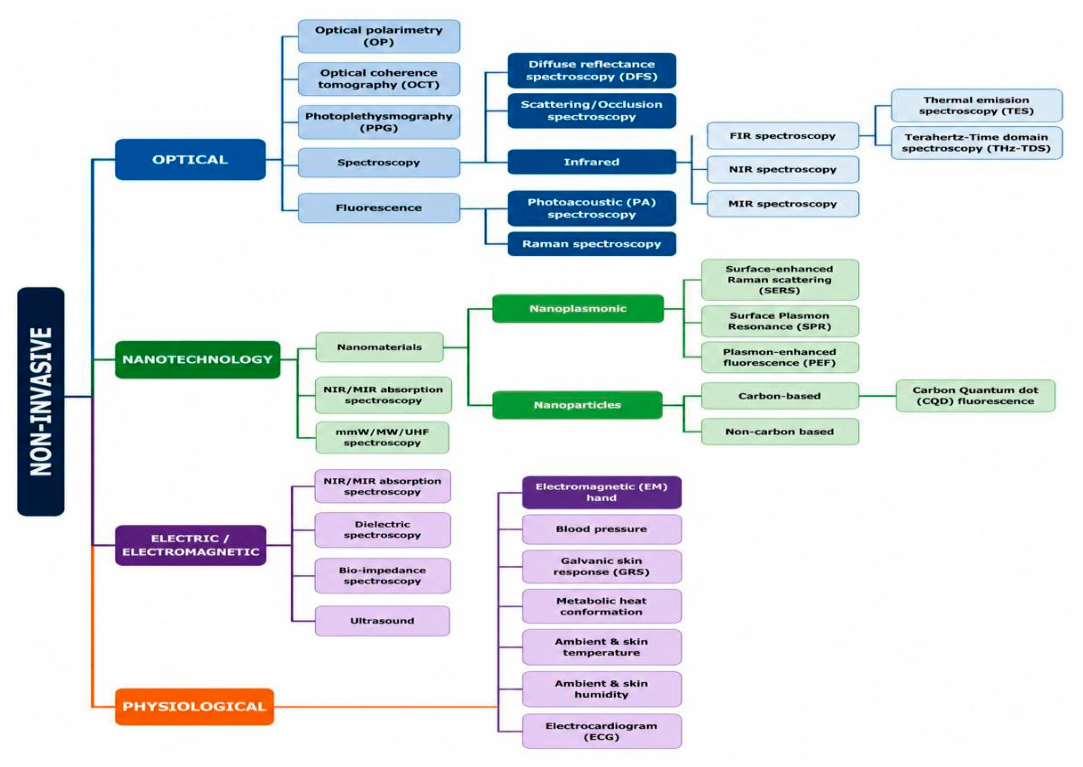
Figure 3.
Interaction and Penetration of Optical Wavelengths within Human Skin Tissues.
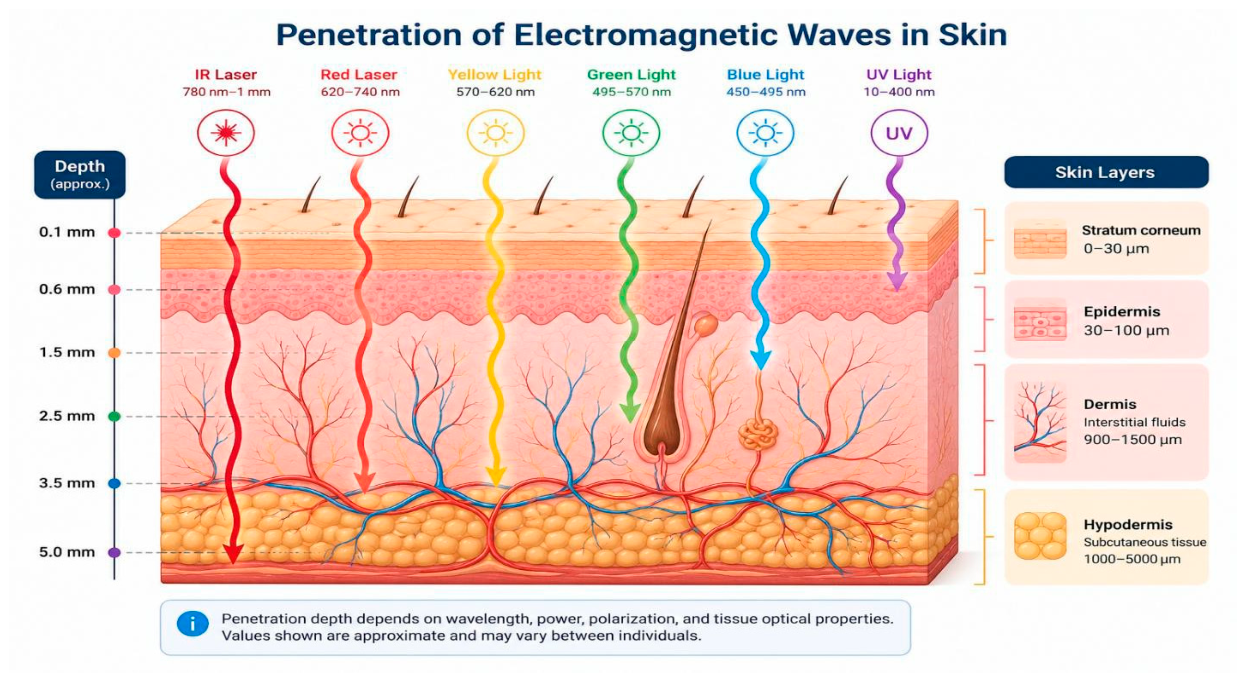
Figure 4.
Operating principle of NIR/MIR absorption spectroscopy for non-invasive glucose sensing.
Disclaimer/Publisher’s Note: The statements, opinions and data contained in all publications are solely those of the individual author(s) and contributor(s) and not of MDPI and/or the editor(s). MDPI and/or the editor(s) disclaim responsibility for any injury to people or property resulting from any ideas, methods, instructions or products referred to in the content. |
© 2026 by the authors. Licensee MDPI, Basel, Switzerland. This article is an open access article distributed under the terms and conditions of the Creative Commons Attribution (CC BY) license (http://creativecommons.org/licenses/by/4.0/).
Copyright: This open access article is published under a Creative Commons CC BY 4.0 license, which permit the free download, distribution, and reuse, provided that the author and preprint are cited in any reuse.