

Submitted:
02 July 2026
Posted:
03 July 2026
You are already at the latest version
Abstract
The genus Begomovirus constitute a group of devastating plant viruses causing significant economic losses in the production of agricultural crops. In the present study, a novel monopartite begomovirus was identified from Bidens Pilosa, Crassocephalum crepidioides, tomato, pepper and common bean showing severe disease symptoms in the Yunnan province of China. The complete genome of the virus shows the typical organization of monopartite reoviruses and shares the highest nucleotide sequence identity (88.73-88.95%) with crassocephalum yellow vein virus (CraYVV). According to the species criteria of the genus Begomovirus, this virus is a novel Begomovirus specie which was then named as “bidens pilosa leaf crumple virus (BpLCrV)”. Recombination analysis revealed that the novel species is a potential recombinant begomovirus derived from CraYVV and ageratum leaf curl virus (ALCuV), and phylogenetic analysis showed that BpLCrV was clustered with tomato yellow leaf curl Thailand virus (TYLCTHV) from China. We successfully developed the BpLCrV infectious clone. Agrobacterium-mediated inoculation of the BpLCrV infectious clone could effectively infect Nicotiana benthamiana, Nicotiana glutinosa and Datura stramonium and caused disease symptoms. Thus, in this study BpLCrV was firstly identified and characterized as a novel begomovirus, it infects not only weeds but also different important crops, with potential threat to agricultural production.
Keywords:
Begomovirus
; novel
; weed
; crop
; recombination
1. Introduction
Begomovirus, a class of plant viruses with circular, single-stranded DNA genomes, cause significant economic losses in the production of vegetable, root, and fiber crops worldwide [1]. Up to now, this genus is the largest genus in the virus kingdom, composed of 445 virus species recognized by the International Committee on Taxonomy of Viruses (ICTV) [2]. Based on their genome components, begomoviruses can be divided into bipartite (consisted DNA-A and DNA-B components) or monopartite (consisted only one component similar to DNA-A of bipartite viruses). The monopartite genome DNA-A is about 2.5-3.0 kb and encompasses 7 ORFs, including V1 and V2 in sense sequence and C1, C2, C3, C4 and C5 in complementary sense sequence [3]. These ORFs encodes proteins functioning in viral replication (C1 and C3), transcription (C2), virion assembly (V1), and suppression gene silencing (V2, C2, C4, C5) [4].
Weeds play an important role in the epidemiology of begomoviruses. Many weed plants have been reported as natural hosts of begomoviruses, and the majority of these weed plants belong to the families Asteraceae, Malvaceae, Amaranthaceae, Euphorbiaceae, Solanaceae, and Leguminosae [4,5,6,7,8,9]. Meanwhile, weeds also serve as “melting pots” for evolving new species and strains [10], such as novel begomoviruses of sida yellow mosaic Gujarat virus [11], chenopodium leaf distortion virus [12], and macroptilium bright yellow interveinal virus [13].
Nevertheless, most of weed-begomoviruses often failed to infect crop in filed (field?) conditions, though it is supposed that the weed-begomoviruses can be spilled over from original hosts (wild plant) to new hosts (crops) and transmitted back from crops to wild plant hosts [14]. Interestingly, it is known that Tomato yellow leaf curl virus (TYLCV), a global geminivirus, has a very diverse host range, not only including 49 plant species under experimental condition [15], but also 25 plant species in filed conditions [4]. Here, we identified and characterized a novel pathogenic monopartite begomovirus which can infect weed species of Bidens Pilosan and Crassocephalum crepidioide, as well as crop species of tomato, common bean and pepper in filed conditions, showing potential threat to the production of important agriculture crops.
2. Materials and Methods
2.1. Sample Collection and Virus Detection
During 2017 to 2018, a field survey of begomovirus diversity has been conducted in Yunnan Province and about a thousand samples were collected from difference growth fields. Total DNA was extracted from these samples by the CTAB method [16]. Initially, PCR with the degenerated primers PA and PB was conducted to detect begomovirus infection, as described by Xie [17]. The PCR products were analyzed on 1% agarose gel and then sequenced at commercial facilities of Life Technologies, Shanghai, China.
2.2. Cloning, sequencing and Sequence Analysis
Based on nucleotide sequence of the obtained fragments, specific primer pairs (F: CCACTCCCGCATCCAAGGTG, R: GGAAATGACTATATCGGCGG) were designed for amplification of the full-length begomovirus DNA from the total DNA. The PCR products were analyzed on 1% agarose gel and the desired band was purified using gel extraction Kit (Axygen, USA), subsequently ligated into the pGEM-T easy vector (Promega, Madison, WI, USA). The ligation mixture was used to transform Escherichia coli strain DH5α. Positive clones were sequenced at commercial facilities of Life Technologies, Shanghai, China. Open reading frames (ORFs) of the nucleotide sequences were identified by DNAMAN Version 7 (Lynnon Biosoft, Quebec, Canada). Similarity alignment was performed by the program SDT version 1.3 [18] or using BLASTn in NCBI nucleotide database.
2.3. Phylogenetic and Recombination Analysis
A phylogenetic tree was built using the maximum likelihood method with 1000 bootstrap replicates in Molecular Evolutionary Genetics Analysis X (MEGA-X). Recombination was analyzed by Recombination Detection Program 4, using RDP, GENECONV, BootScan, MaxChi, Chimaera, SiScan and 3Seq methods.
2.4. Construction of the Infectious Clone and Agrobacterium-Mediated Inoculation
The full-length genome of YN6330-2 was amplified using specific primer pairs YN6330FL-BF/BR (BF: CGGGATCCATTATTAAATGAGTTTCCTG, BR: CGGGATCCCACATAGTGCGGAGTGCA), and cloned into pGEM-T Easy Vector to obtain pGEM-T-YN6330-2-1A. Meanwhile, the PCR fragment (1.37 kb) of YN6330-2, including the IR of the virus, was amplified using specific primer pairs YN6330FL-BF and YN6330PL-SalI-R (YN6330PL-SalI-R: GCGTCGACGTTTGTGACGAGGACAGTGGG), and cloned into pGEM-T Easy Vector to obtain pGEM-T-YN6330-2-0.5A. After sequencing, the pGEM-T-YN6330-2-0.5A digested with EcoRI and SalI restriction enzymes (Fermentas, USA) and cloned into the binary vector pBinPLUS to obtain pBinPLUS-YN6330-2-0.5A. The full-length YN6330-2 was digested with EcoRI from the pGEM-T-YN6330-2-1A and cloned into the pBinPLUS-YN6330-2-0.5A to produce pBinPLUS-YN6330-2-1.5A, containing a head-to-tail 1.5 dimer of BpLCrV genome. Subsequently, the pBinPLUS-YN6330-2-1.5A was transformed into A. tumefaciens strain EHA105 to produce an infectious clone of YN6330-2. Agroinfiltration of Nicotiana benthamiana (N. bethamiana), Nicotiana glutinosa (N. glutinosa) and Datura stramonium (D. stramonium) plants was performed as previously described [19].
3. Results
3.1. Symptoms and Virus Detection
During the field survey in Yunnan, we obtained over 200 samples from plants with typical symptoms induced by begomovirus, such as leaf curling, stunted growth, vein yellowing and enation. Among them, leaf curl disease was first observed in Bidens Pilosa with about 5% disease incidence in Honghe, Yunnan (Figure 1c). Meanwhile, seven leaf samples were also collected from tomato, common bean, Bidens Pilosa, pepper and Crassocephalum crepidioides plants exhibiting the typical begomovirus-induced symptoms (Figure 1, Table S1). An approximately 500 bp DNA fragment was amplified from these seven leaf samples and a total of 14 samples were subjected to sequence. Sequence comparison showed that all these 14 sequences shared 91.5% identity with the CP gene of tomato yellow leaf curl Vietnam virus (TYLCVV).
3.2. Cloning, Sequencing and Sequencing Analysis
DNA-A fragment of the begomvirus was amplified through PCR and a total of 12 sequences were obtained. These 12 sequences of DNA-A composing of 2,735 nucleotides, have been submitted to Genbank under accestion numbers given in Table S2. All sequences showed a genome organization typical of monopartite begomovirus reported from Old World: two virus-sense genes encoding the capsid protein (CP/V1) and V2 protein (V2) and four complementary-sense genes encoding the replication-associated protein (Rep/C1), a transcriptional activator protein (TrAP/C2), a replication enhancer protein (REn/C3), and the C4 protein (C4) (Table S2). Additionally, an unknown gene (103 amino acids) in virus-sense and C5 protein (99 amino acids) were also found for all of these DNA-A (Table S2). All these sequences also have an intergenic region (IR), which includes the stem loop-structured non-nucleotide sequence TAATATT↓AC, TATA box, and iteron sequences (GGTGT).
Both the results of BLAST and SDT (Figure 2a) showed these sequences share the highest nucleotide identity (88.73-88.95%) with the known isolate of CraYVVYN-5958 (MK626676). Based on the recommended criteria, a 91% identity as a demarcation threshold for defining new begomovirus species [20], these isolates were therefore classified as a new begomovirus, and it was named as bidens pilosa leaf crumple virus (BpLCrV).
The results of pairwise sequence comparisons showed sequences of BpLCrV revealed 99.63 to 100.00% identity with each other (Table S3). Based on a sequence identity threshold of 94% for strain demarcation [20], these twelve clones are a same strain of BpLCrV. Thus, the sequence of BpLCrV-6330-2 (MT364270) isolate was selected for further multiple alignments. The result showed that BpLCrV-6330-2 sequence can be divided into two parts (Table S4). Part 1 includes the IR, V1 (CP), C1 (Rep) and C4 genes. The predicted amino acid sequences of the CP, Rep and C4 proteins show the highest amino acid sequence identity with CraYVV-YN5958 (93.8%, 96.1% and 94.9%, respectively). Part 2 includes the V2, C2 (TrAp) and C3 (REn) genes. The predicted amino acid sequences of the V2, TrAp and REn proteins show the highest amino acid sequence identity with ToLCHaV or TYLCHniV (94.0%, 88.1% and 88.1%, respectively). Consistently, the sequence from 1386 to 57 nt of BpLCrV-6330-2 shares 95.5% sequence identity with CraYVV-YN5958, but the sequence from 1083 to 1371 nt of BpLCrV-6330-2 shows only 68.9% sequence identity with CraYVV-YN5958, aligning with the highest amino acid sequence identity between the Rep and C4 proteins of BpLCrV-6330-2 and CraYVV-YN5958, but low amino acid sequence identity (72.6%) between the REn protein (Table S4). Thus, it is very likely that BpLCrV-6330-2 is originated by recombination between CraYVV-YN5958 and other begomoviruses.
3.3. Phylogenetic and Recombination Analysis
The phylogenetic analysis showed that BpLCrV is clustered with TYLCTHV and TYLCCNV from China (Figure 2b), indicating the BpLCrV closely related to the species of TYLCTHV and TYLCCNV. RDP analysis revealed strong evidences of a recombination event in the sequence of BpLCrV-6330-2 isolate, with putative recombination breakpoints located in the V2 regions (Figure 2c). It is predicted that BpLCrV-6330-2 is generated by recombination between CraYVV-YN5958 (MK626676) and ALCuV-G52 (NC_006384) by six different methods available in RDP with a high degree of confidence (Figure 2c). The results are also supported by previous results of multiple alignments (Table S4).
3.4. Infectivity and Symptoms Induced by YN6330-2
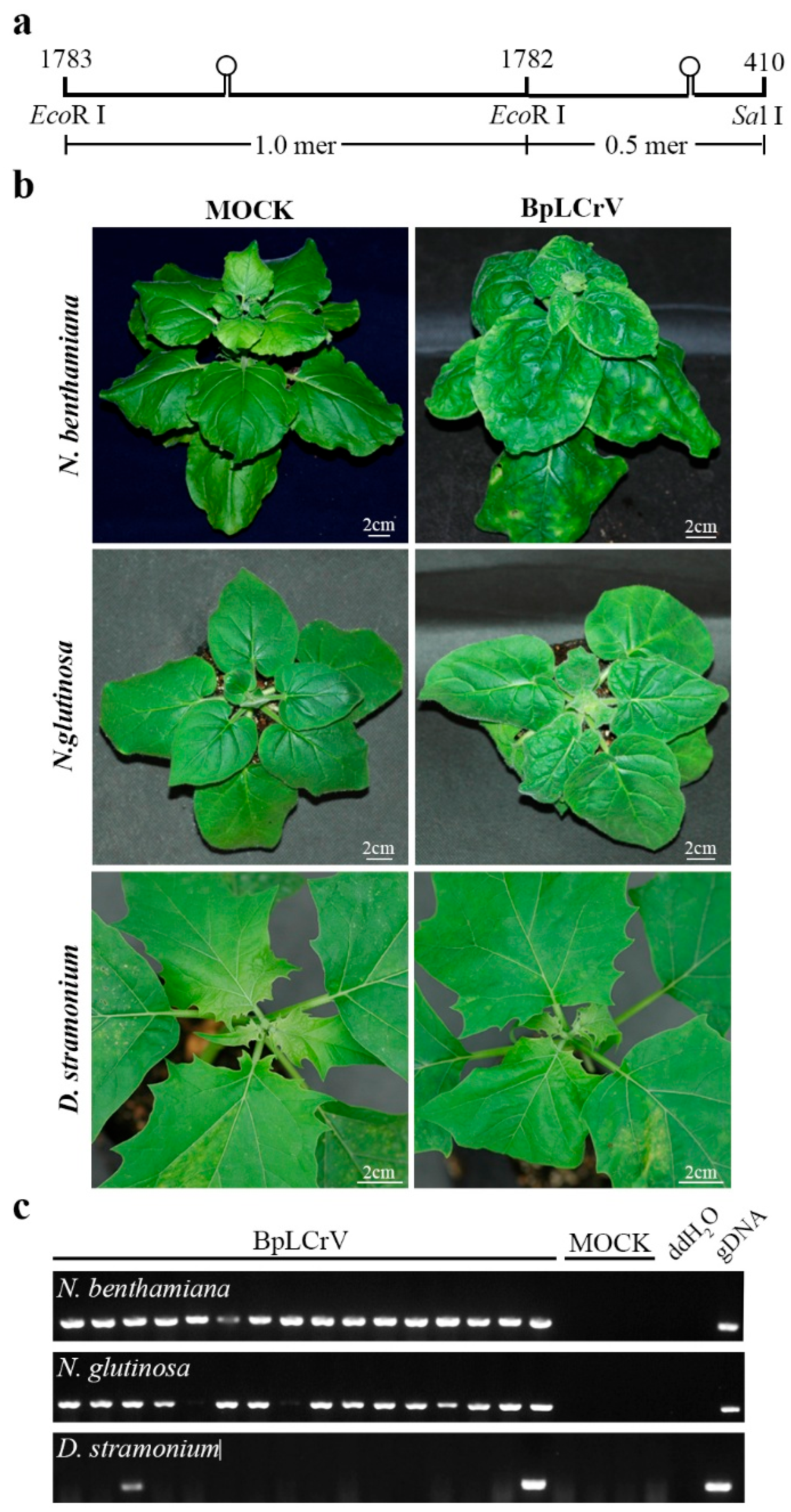
To investigate the infectivity of this novel begomovirus, an infectious clone of BpLCrV-6330-2 was constructed (Figure 3a) and agroinfiltrated to 16 plants of N. bethamiana, N. glutinosa and D. stramonium, respectively (Figure 3). In N.benthamiana, all infiltrated plants exhibited obvious downward leaf curling at 21 days post infiltration (dpi) (Figure 3). In N. glutinosa, severe downward leaf curling symptoms was also observed at 21 dpi in 14 plants infected with BpLCrV (Figure 3b,c). In D. stramonium, mild downward leaf curling developed at 23 dpi, but only 2 plants were successfully infected by BpLCrV and exhibited the clear symptoms (Figure 3b,c). Therefore, a BpLCrV infectious clone was developed to infect and cause disease symptom in different host plants, which also validated the virulence of the new begomovirus to plants.
4. Discussion
Bidens Pilosan is a widely distributed weed specie and used for treating diseases associated with immune response disorders in the world [21]. Weeds play an important role in the epidemiology of begomoviruses, serving both as alternative hosts and as ’melting pots’ for recombination and satellites exchange [10]. In this study, a novel monopartite begomovirus was firstly identified from leaf crumple disease of Bidens Pilosan and found to cause severe symptoms in N. benthamiana, N. glutinosa and D. stramonium. Previously report showed that Bidens Pilosan cannot be infected by begomovirus tomato yellow leaf curl virus (TYLCV)TYLCV [22]. Our results indicate that weed Bidens Pilosan also serves as an alternative host. To the best of our knowledge, this is the first report of the Bidens Pilosan as the host of begomovirus. This study also showed that tomato, common bean, pepper and Crassocephalum crepidioides are hosts of BpLCrV. These findings provided convincing evidences that the BpLCrV, a novel begomoviruse identified, not only infected weeds of Bidens Pilosan and Crassocephalum crepidioides, but also crops of tomato, pepper and common bean.
It is well known that Geminiviridae shows the highest evolutionary success among plant virus largely due to inter-and intra-species recombination [2]. Yunnan (south of China) is one of a reservoir of geminiviruses with the greatest diversity of geminiviruses and their satellites [23]. Based on recently published reports, the emergence of new begomovirus species by recombination are increasing in the Yunnan, such as tomato leaf curl Yunnan virus (TLCYnV) [24], pepper yellow leaf curl virus (PepYLCV) [25], tomato yellow leaf curl Shuangbai virus (TYLCSbV) [26] and tomato yellow leaf curl Chuxiong virus (TYLCCxV) [27]. In this study, we also founf that probably BpLCrV was originated from the recombination of CraYVV and ALCuV. These findings also further hint that more diverse of begomoviruses more possibilly evolves new species through recombination. Previous study showed that a new specie emerged by recombination usually possessed high pathogenicity, a broader host range, or higher transmission efficiency compared with parental viruses [4,24,26]. Further research should be conducted to explore pathogenicity, host range and transmission efficiency of BpLCrV.
5. Conclusions
In summary, a novel monopartite begomovirus (BpLCrV), probably originated from the recombination between CraYVV-YN5958 and ALCuV-G52, was identified from tomato, common bean, Bidens Pilosa, pepper and Crassocephalum crepidioides plants in Yunnan. A BpLCrV infectious clone was further developed to effectively infect N. bethamiana, N. glutinosa and D. stramonium, and validated the pathogenicity of the new begomovirus. Our findings provide further support that weed could play an important role in the epidemiology and evolution of begomoviruses, and recombination might be a dominant force to evolve new geminiviruses.
Supplementary Materials
The following supporting information can be downloaded at the website of this paper posted on Preprints.org, Table S1: Origins of field collected leaf samples with typical symptoms of begomovirus infection; Table S2: BpLCrV genomic features identified from multiple host; Table S3: Percent identities between the complete DNA-A of BpLCrV isolates; Table S4: Nucleotide and amino acid identities of isolate BpLCrV-6330-2 (MT364270) with other begomoviruses; Table S5: Begomoviruse sequences used for phylogenetic trees construction and recombination analysis.
Author Contributions
Conceptualization, L.Z., and M.D.; methodology, J.Z. and Y.Y.; software, S.Z., J.Z.; validation, T.L., R.D.; formal analysis, L.Z., and J.Z.; investigation, L.Z., M.D.; resources, M.D.; data curation, J.Z.; writing—original draft preparation, L.Z., and J.Z.; review and editing, M.D.; visualization, J.Z.; project administration, L.Z., and M.D. All authors have read and agreed to the published version of the manuscript.
Funding
This research was funded by Yunnan Fundamental Research Projects (202301AS070004 and 202401BD070001-020), and Yunnan Seed Industry Joint Laboratory (202205AR070001-2).
Institutional Review Board Statement
Not applicable.
Informed Consent Statement
Not applicable.
Conflicts of Interest
The authors declare no conflicts of interest.
References
- Rojas, M.R.; Macedo, M.A.; Maliano, M.R.; Soto-Aguilar, M.; Souza, J.O.; Briddon, R.W.; Kenyon, L.; Rivera Bustamante, R.F.; Zerbini, F.M.; Adkins, S.; Legg, J.P.; Kvarnheden, A.; Wintermantel, W.M.; Sudarshana, M.R.; Peterschmitt, M.; Lapidot, M.; Martin, D.P.; Moriones, E.; Inoue-Nagata, A.K.; Gilbertson, R.L. World management of Geminiviruses. Annual review of phytopathology. 2018, 56, 637-677. [CrossRef] [PubMed]
- Fiallo-Olivé, E.; Navas-Castillo, J. The Role of Extensive Recombination in the Evolution of Geminiviruses. Current topics in microbiology and immunology. 2023, 439, 139-166. [CrossRef] [PubMed]
- Devendran, R.; Namgial, T.; Reddy, K.K.; Kumar, M.; Zarreen, F.; Chakraborty, S. Insights into the multifunctional roles of geminivirus-encoded proteins in pathogenesis. Arch. Virol. 2022, 167, 307–326. [CrossRef] [PubMed]
- Li, F.; Qiao, R.; Yang, X.; Gong, P.; Zhou, X. Occurrence, distribution, and management of tomato yellow leaf curl virus in China. Phytopathol. Res. 2022, 4, 1–12. [CrossRef]
- Jiao, X.; Gong, H.; Liu, X.; Xie, Y.; Zhou, X. Etiology of Ageratum Yellow Vein Diseases in South China. Plant Dis. 2013, 97, 1497–1503. [CrossRef] [PubMed]
- Pramesh, D.; Mandal, B.; Phaneendra, C.; Muniyappa, V. Host range and genetic diversity of croton yellow vein mosaic virus, a weed-infecting monopartite begomovirus causing leaf curl disease in tomato. Arch. Virol. 2012, 158, 531–542. [CrossRef] [PubMed]
- Rocha, C.S.; Castillo-Urquiza, G.P.; Lima, A.T.M.; Silva, F.N.; Xavier, C.A.D.; Hora-Júnior, B.T.; Beserra-Júnior, J.E.A.; Malta, A.W.O.; Martin, D.P.; Varsani, A.; et al. Brazilian Begomovirus Populations Are Highly Recombinant, Rapidly Evolving, and Segregated Based on Geographical Location. J. Virol. 2013, 87, 5784–5799. [CrossRef] [PubMed]
- Zhao, L.; Zhong, J.; Zhang, X.; Yin, Y.; Li, T.; Ding, M. Two distinct begomoviruses associated with an alphasatellite coinfecting Emilia sonchifolia in Thailand. Arch. Virol. 2018, 163, 1695–1699. [CrossRef] [PubMed]
- Tang, Y.; Li, Z.; She, X.; Yu, L.; Lan, G.; Lv, L.; Brown, J.K.; He, Z. Complete genome sequence of a previously undescribed monopartite begomovirus and betasatellite infecting Malvastrum coromandelianum in Cambodia. Arch. Virol. 2021, 166, 1789–1793. [CrossRef] [PubMed]
- Mubin, M.; Akhtar, S.; Amin, I.; Briddon, R.W.; Mansoor, S. Xanthium strumarium: a weed host of components of begomovirus–betasatellite complexes affecting crops. Virus Genes 2011, 44, 112–119. [CrossRef] [PubMed]
- Chahwala, F.D.; Singh, D.; Kumar, R.V.; Rathore, S.; Yadav, B.K.; Singh, B.; Singh, A.K. A novel monopartite begomovirus and satellites associated with yellow mosaic disease of Sida spp. in India. Arch. Virol. 2020, 166, 299–302. [CrossRef] [PubMed]
- Lal, A.; Kil, E.-J.; Vo, T.T.B.; Sanjaya, I.G.N.P.W.; Qureshi, M.A.; Nattanong, B.; Ali, M.; Shuja, M.N.; Lee, S. Interspecies Recombination-Led Speciation of a Novel Geminivirus in Pakistan. Viruses 2022, 14, 2166. [CrossRef] [PubMed]
- Batista, J.G.; Nery, F.M.B.; Melo, F.F.S.; Malheiros, M.F.; Rezende, D.V.; Boiteux, L.S.; Fonseca, M.E.N.; de Miranda, B.E.C.; Pereira-Carvalho, R.C. Complete genome sequence of a novel bipartite begomovirus infecting the legume weed Macroptilium erythroloma. Arch. Virol. 2022, 167, 1597–1602. [CrossRef] [PubMed]
- García-Arenal, F.; Zerbini, F.M. Life on the Edge: Geminiviruses at the Interface Between Crops and Wild Plant Hosts. Annu. Rev. Virol. 2019, 6, 411–433. [CrossRef] [PubMed]
- Papayiannis, L.C.; Katis, N.I.; Idris, A.M.; Brown, J.K. Identification of Weed Hosts of Tomato yellow leaf curl virus in Cyprus. Plant Dis. 2011, 95, 120–125. [CrossRef] [PubMed]
- Zhong, X.; Wang, Z.Q.; Xiao, R.; Wang, Y.; Xie, Y.; Zhou, X. iTRAQ analysis of the tobacco leaf proteome reveals that RNA-directed DNA methylation (RdDM) has important roles in defense against geminivirus-betasatellite infection. J. Proteom. 2017, 152, 88–101. [CrossRef] [PubMed]
- Xie, Y.; Zhou, X.P.; Zhang, Z.K.; Qi, Y.J. Tobacco curly shoot virus isolated in Yunnan is distinct species of Begomovirus. Chinese Sci Bull. 2002, 47, 197-200. [CrossRef]
- Muhire, B.M.; Varsani, A.; Martin, D.P. SDT: A Virus Classification Tool Based on Pairwise Sequence Alignment and Identity Calculation. PLoS ONE 2014, 9, e108277. [CrossRef] [PubMed]
- Xie, Y.; Liu, X.; Luo, C.; Hu, Q.; Che, X.; Zhao, L.; Zhao, M.; Wu, L.; Ding, M. Distinct tomato yellow leaf curl Chuxiong virus isolated from whiteflies and plants in China and its symptom determinant and suppressor of post-transcriptional gene silencing. Virology 2024, 594, 110040. [CrossRef] [PubMed]
- Brown, J.K.; Zerbini, F.M.; Navas-Castillo, J.; Moriones, E.; Ramos-Sobrinho, R.; Silva, J.C.F.; Fiallo-Olivé, E.; Briddon, R.W.; Hernández-Zepeda, C.; Idris, A.; et al. Revision of Begomovirus taxonomy based on pairwise sequence comparisons. Arch. Virol. 2015, 160, 1593–1619. [CrossRef] [PubMed]
- Rodríguez-Mesa, X.M.; Bolaños, L.A.C.; Mejía, A.; Pombo, L.M.; Costa, G.M.; González, S.P.S. Immunomodulatory Properties of Natural Extracts and Compounds Derived from Bidens pilosa L.: Literature Review. Pharmaceutics 2023, 15, 1491. [CrossRef] [PubMed]
- Smith, H.A.; Seijo, T.E.; Vallad, G.E.; Peres, N.A.; Druffel, K.L. Evaluating Weeds as Hosts ofTomato yellow leaf curl virus: Table 1.. Environ. Èntomol. 2015, 44, 1101–1107. [CrossRef] [PubMed]
- Nawaz-Ul-Rehman, M.S.; Fauquet, C.M. Evolution of geminiviruses and their satellites. FEBS Lett. 2009, 583, 1825–1832. [CrossRef] [PubMed]
- Xie, Y.; Zhao, L.; Jiao, X.; Jiang, T.; Gong, H.; Wang, B.; Briddon, R.W.; Zhou, X. A recombinant begomovirus resulting from exchange of the C4 gene. J. Gen. Virol. 2013, 94, 1896–1907. [CrossRef] [PubMed]
- Li, P.; Ruan, T.; Meng, Q.; Li, K.; Qing, L. Identification of a novel pepper-infecting monopartite begomovirus in China. Arch. Virol. 2021, 166, 1751–1754. [CrossRef] [PubMed]
- Fan, Y.; Zhong, Y.; Pan, L.; Wang, X.; Ding, M.; Liu, S. A shift of vector specificity acquired by a begomovirus through natural homologous recombination. Mol. Plant Pathol. 2023, 24, 882–895. [CrossRef] [PubMed]
- Xie, Y.; Liu, X.; Luo, C.; Hu, Q.; Che, X.; Zhao, L.; Zhao, M.; Wu, L.; Ding, M. Distinct tomato yellow leaf curl Chuxiong virus isolated from whiteflies and plants in China and its symptom determinant and suppressor of post-transcriptional gene silencing. Virology 2024, 594, 110040. [CrossRef] [PubMed]
Figure 1.
Symptoms displayed by collected tomato, common bean, Bidens Pilosa, pepper and Crassocephalum crepidioides plants. Shown are tomato (a), common bean (b), Bidens Pilosa (c) and pepper (d) and Crassocephalum crepidioides (e), which showed leaf curling, stunted growth, vein yellowing and enation symptoms.
Figure 1.
Symptoms displayed by collected tomato, common bean, Bidens Pilosa, pepper and Crassocephalum crepidioides plants. Shown are tomato (a), common bean (b), Bidens Pilosa (c) and pepper (d) and Crassocephalum crepidioides (e), which showed leaf curling, stunted growth, vein yellowing and enation symptoms.
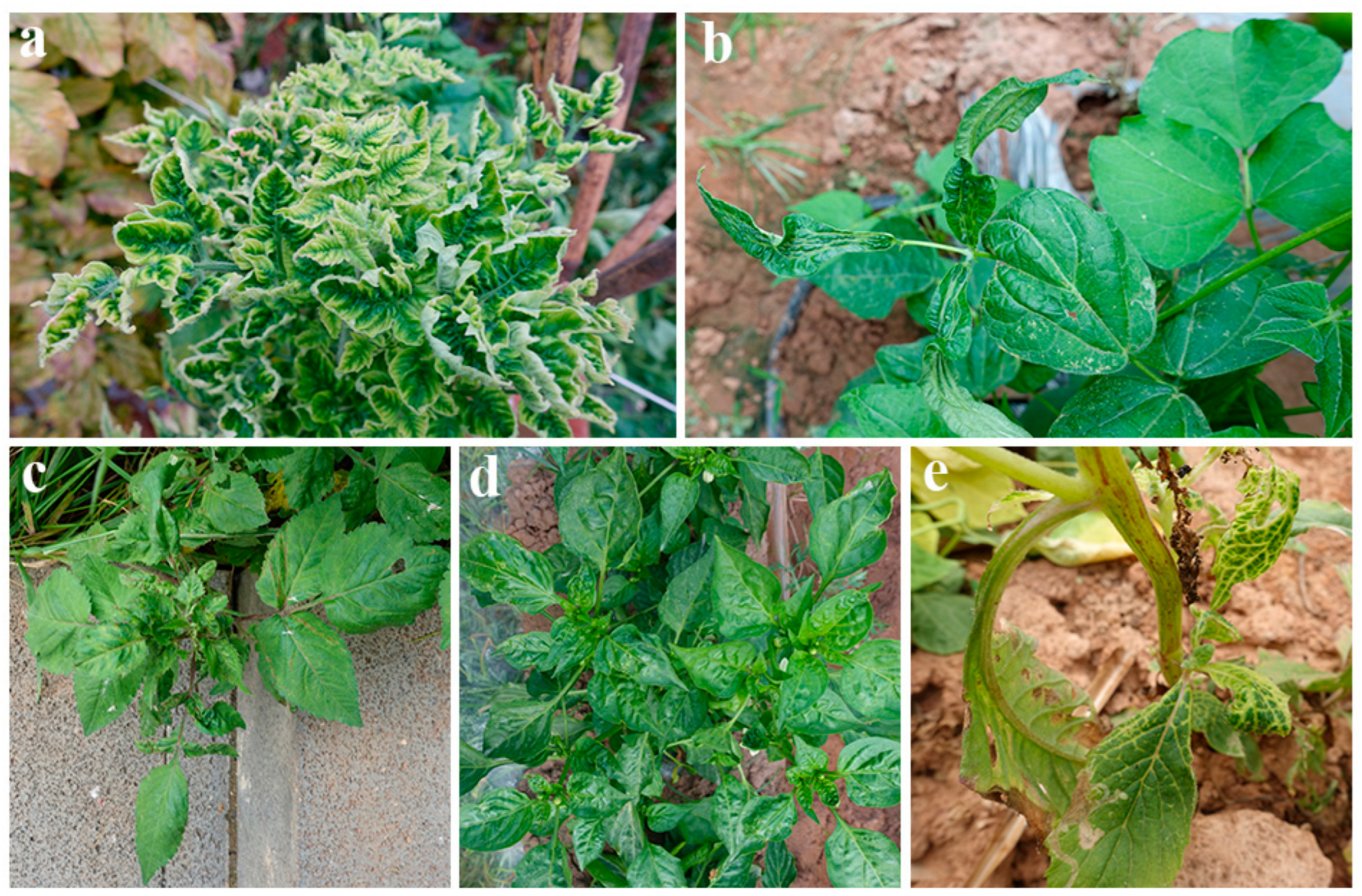
Figure 2.
Identification of a novel begomovirus infecting Bidens Pilosa, Crassocephalum crepidioides, tomato, common bean and pepper plants in Yunnan, China. (a) Sequence Demarcation Tool based pairwise sequence comparisons. (b) Phylogenetic dendrograms based upon alignments of the begomovirus DNA-A identified in this study with other selected species. The present isolates of BpLCrV-6330-2 was marked with red circles. The phylogenetic tree was constructed using the neighbor-joining method with MEGA-X, of which bootstrap analysis had 1,000 replicates. (c) Analysis for recombination of BpLCrV-6330-2. A liner genome map of ToLCChV-YN6271-16 is shown to indicate the positions of possible recombination breakpoints (1,740-2,691 nt). The intergenic region (IR; grey bar) and genes (with the position and their orientation indicated with arrows; blue for virion-sense and red for complementary-sense) are shown. Putative parental viruses for this recombinant and the algorithms supporting these data, with their average P-values are also listed.
Figure 2.
Identification of a novel begomovirus infecting Bidens Pilosa, Crassocephalum crepidioides, tomato, common bean and pepper plants in Yunnan, China. (a) Sequence Demarcation Tool based pairwise sequence comparisons. (b) Phylogenetic dendrograms based upon alignments of the begomovirus DNA-A identified in this study with other selected species. The present isolates of BpLCrV-6330-2 was marked with red circles. The phylogenetic tree was constructed using the neighbor-joining method with MEGA-X, of which bootstrap analysis had 1,000 replicates. (c) Analysis for recombination of BpLCrV-6330-2. A liner genome map of ToLCChV-YN6271-16 is shown to indicate the positions of possible recombination breakpoints (1,740-2,691 nt). The intergenic region (IR; grey bar) and genes (with the position and their orientation indicated with arrows; blue for virion-sense and red for complementary-sense) are shown. Putative parental viruses for this recombinant and the algorithms supporting these data, with their average P-values are also listed.
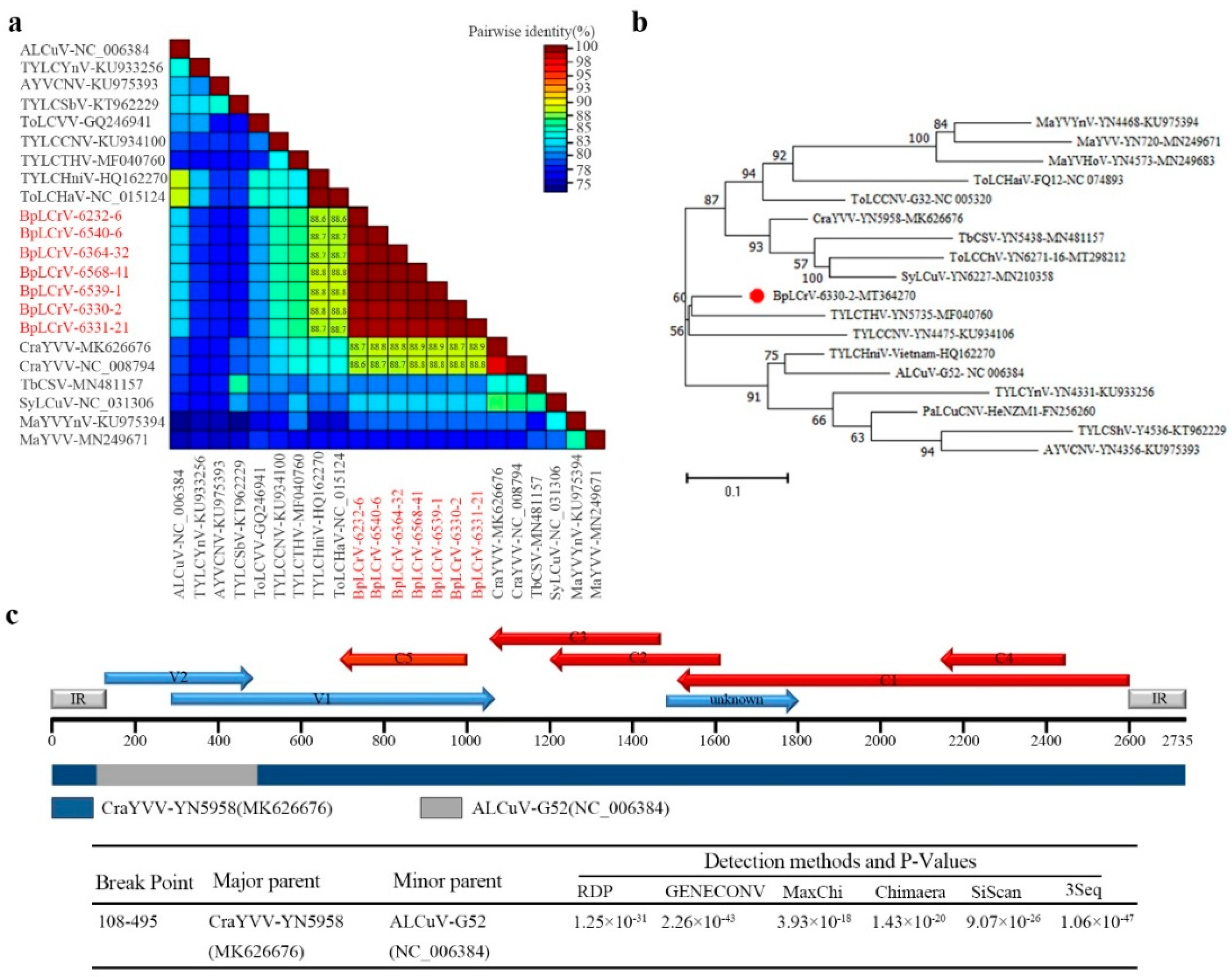
Figure 3.
Infectivity and pathogenicity of the infectious clone of BpLCrV. a Strategies for construction of the infectious clones of BpLCrV, 1.5-mer tandem repeats of BpLCrV DNA A were constructed to the plant binary vector pBinPLUS. The EcoR Ⅰ and Sal Ⅰ used for the construction of the infectious clone of BpLCrV were shown as indicated. b Analysis of the infectivity and pathogenicity of BpLCrV infectious clone. Symptoms induced by BpLCrV in N. benthamiana at 21 dpi, N. glutinosa at 21 dpi and D.stramonium at 23 dpi. Bar = 2 cm. c PCR detection of BpLCrV viral DNA from plants infected with BpLCrV or buffer (MOCK). ddH2O was used as PCR negative control and gDNA of BpLCrV as positive control.
Figure 3.
Infectivity and pathogenicity of the infectious clone of BpLCrV. a Strategies for construction of the infectious clones of BpLCrV, 1.5-mer tandem repeats of BpLCrV DNA A were constructed to the plant binary vector pBinPLUS. The EcoR Ⅰ and Sal Ⅰ used for the construction of the infectious clone of BpLCrV were shown as indicated. b Analysis of the infectivity and pathogenicity of BpLCrV infectious clone. Symptoms induced by BpLCrV in N. benthamiana at 21 dpi, N. glutinosa at 21 dpi and D.stramonium at 23 dpi. Bar = 2 cm. c PCR detection of BpLCrV viral DNA from plants infected with BpLCrV or buffer (MOCK). ddH2O was used as PCR negative control and gDNA of BpLCrV as positive control.
Disclaimer/Publisher’s Note: The statements, opinions and data contained in all publications are solely those of the individual author(s) and contributor(s) and not of MDPI and/or the editor(s). MDPI and/or the editor(s) disclaim responsibility for any injury to people or property resulting from any ideas, methods, instructions or products referred to in the content. |
© 2026 by the authors. Licensee MDPI, Basel, Switzerland. This article is an open access article distributed under the terms and conditions of the Creative Commons Attribution (CC BY) license (http://creativecommons.org/licenses/by/4.0/).
Copyright: This open access article is published under a Creative Commons CC BY 4.0 license, which permit the free download, distribution, and reuse, provided that the author and preprint are cited in any reuse.


