

Submitted:
02 July 2026
Posted:
03 July 2026
You are already at the latest version
Abstract
This conceptual paper examines how territorial capabilities shape the globalisation readiness of micro, small and medium-sized enterprises (MSMEs) in an intermediate city of an emerging economy. Using Valledupar, Colombia, as a documentary case, the study synthesises international SME policy evidence, Colombian institutional sources and peer-reviewed research through a systematised review logic. The analysis identifies six interdependent fragility clusters: atomised enterprise structure, partial formalisation, weak managerial systems, finance-readiness gaps, limited productive digitalisation and scarce market linkages. The paper contributes a capability-based framework that explains why local firms may remain active yet insufficiently prepared for wider-market competition. The proposed agenda reframes formalisation, finance, digitalisation and market access as sequenced territorial capabilities rather than isolated policy instruments.
Keywords:
small business
; micro
; small and medium-sized enterprises
; globalisation readiness
; competitive fragility
; territorial capabilities
; intermediate cities
; Colombia
; Latin America
; formalisation
; digitalisation
; SME finance
; public policy
1. Introduction
Micro, small and medium-sized enterprises (MSMEs) are central to employment, entrepreneurship and local development, but their ability to benefit from globalisation remains uneven. International policy sources describe small and medium-sized enterprises as essential to economic diversification, productivity and poverty reduction, while Latin American policy assessments stress that SMEs represent the majority of enterprises and a substantial share of formal employment in the region (World Bank, n.d.; OECD/CAF/SELA, 2024). The same literature also shows persistent constraints in finance, productivity, digitalisation and policy coordination, which makes small-business upgrading a globalisation issue rather than only a domestic development issue (OECD/CAF/SELA, 2024; OECD, 2026).
This paper uses globalisation readiness to describe the organisational and territorial conditions that allow smaller firms to respond to competition, access wider markets, use digital channels productively and connect to institutional support. The concept is broader than export readiness because globalised competition reaches local businesses through imported products, digital platforms, tourism, standards, supplier requirements, payment systems and consumer expectations (Cardoza et al., 2016; Knight and Cavusgil, 2004; Johanson and Vahlne, 2009). For this reason, a microbusiness may be affected by globalisation even when it has no immediate intention to export (Oviatt and McDougall, 1994; OECD/CAF/SELA, 2024).
Colombia illustrates the tension between entrepreneurial dynamism and productive fragility. Confecamaras reported that 297,475 new enterprises were created in 2024, of which 72.3% were registered by natural persons and 27.7% by companies, yet business survival evidence shows that only about one third of the firms created in 2017 remained active after five years (Confecamaras, 2023; Confecamaras, 2025). This gap between business creation and firm consolidation suggests that policy attention should move beyond registration counts towards capability accumulation, market learning, financial preparation and institutional access (Confecamaras, 2023; OECD, 2026).
Valledupar, the capital of the Department of Cesar in northern Colombia, provides a relevant intermediate-city case. The 2019 Micronegocios survey reported 53,236 microbusinesses in Valledupar, with 82.7% run by own-account workers and 17.3% by employers, as well as concentration in trade and services and gaps in formal registration (Departamento Administrativo Nacional de Estadistica, 2020). These features make the city useful for examining how small-business competitiveness is shaped by the interaction between firm-level routines, institutional access and territorial support systems (Departamento Administrativo Nacional de Estadistica, 2020; Camara de Comercio de Valledupar para el Valle del Rio Cesar, 2023).
The research question is: how do firm-level capabilities, institutional conditions and territorial support systems interact to shape small business globalisation readiness in Valledupar? Table 1 states the population-concept-context logic, eligibility boundary and synthesis rules used to answer this question, while Figure 3 anticipates the staged capability ladder proposed by the paper (Page et al., 2021; Tricco et al., 2018; Snyder, 2019). The objective is to develop a cited conceptual synthesis that identifies the main fragility clusters affecting MSMEs and translates them into a territorial capability-building roadmap (Baethge et al., 2019; OECD/CAF/SELA, 2024).

Table 1.
Research question, eligibility logic and synthesis boundary.
| Element | Definition used in this article | Decision for synthesis |
| Population | Micro, small and medium-sized enterprises, with emphasis on micro and small businesses. | Include evidence on SMEs/MSMEs, microbusinesses and small enterprises when relevant to firm capabilities or territorial support. |
| Concept | Globalisation readiness and competitive fragility. | Include sources addressing formalisation, finance, digitalisation, managerial capacity, market access, institutions or competitiveness. |
| Context | Valledupar, Colombia, interpreted as an intermediate-city case in Latin America. | Use local evidence for case description and national/regional evidence for contextual interpretation. |
| Comparator | Not applicable as a conceptual documentary review. | Do not force intervention-comparator logic where the source is descriptive or policy-oriented. |
| Synthesis boundary | Narrative and conceptual synthesis. | No PRISMA counts, effect sizes, forest plots or meta-analysis unless real comparable extracted data are available. |
Note: The table adapts population-concept-context logic to a systematised documentary review.
The paper contributes to business and globalisation research in three ways. First, it reframes an intermediate-city MSME problem as a globalisation-readiness problem. Second, it links competitive fragility to firm resources, dynamic capabilities, institutional legibility, finance and digital commercialisation. Third, it proposes a policy-oriented framework that can be adapted to other intermediate cities in emerging economies (Barney, 1991; Teece, 2007; North, 1990; Cardoza et al., 2016; OECD/CAF/SELA, 2024).
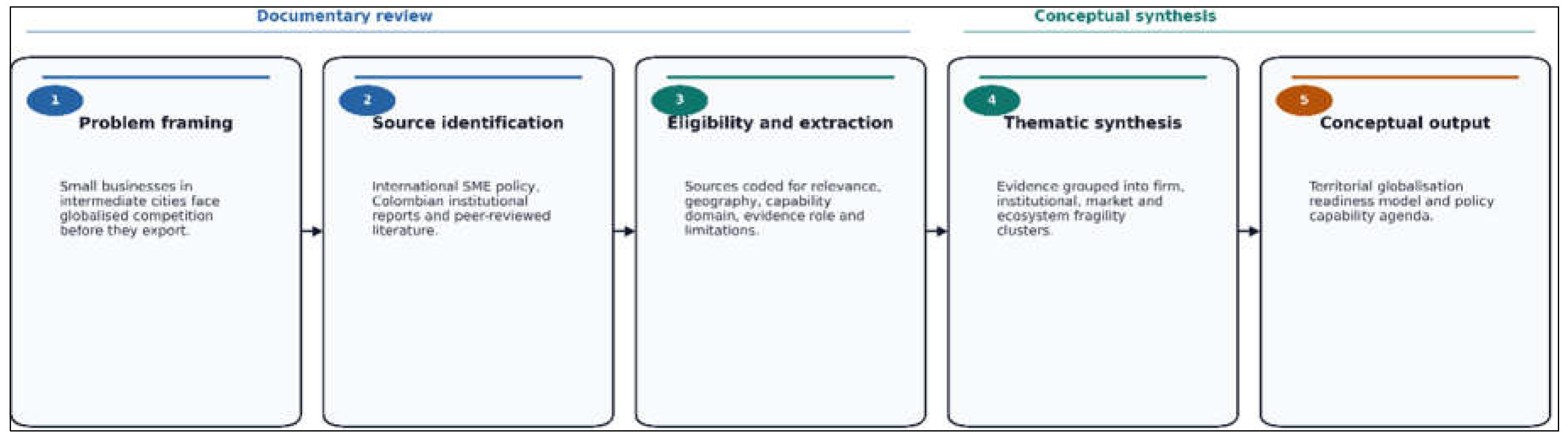
The article is therefore positioned as a transferable intermediate-city argument rather than as a purely municipal diagnosis. Valledupar is treated as an analytically useful setting because its microbusiness structure, business-support institutions and sectoral profile make visible a wider problem in Latin American small-business development: the gap between entrepreneurial activity and capability accumulation (Departamento Administrativo Nacional de Estadistica, 2020; Confecamaras, 2023; OECD/CAF/SELA, 2024). Figure 1 summarises the documentary-to-conceptual route used to avoid overextending local evidence into unsupported causal claims.
Figure 1.
Systematised documentary review and conceptual synthesis workflow. The diagram shows how the article moves from problem framing to source identification, eligibility, extraction, thematic synthesis and conceptual output while preserving an explicit integrity boundary. Source: authors’ own elaboration.
Figure 1.
Systematised documentary review and conceptual synthesis workflow. The diagram shows how the article moves from problem framing to source identification, eligibility, extraction, thematic synthesis and conceptual output while preserving an explicit integrity boundary. Source: authors’ own elaboration.
The contribution also depends on a strict evidence boundary. The paper does not claim that the observed clusters statistically predict firm survival, export activity or productivity; it argues that they are theoretically plausible and policy-relevant constraints on readiness, supported by triangulated institutional, policy and scholarly sources (Snyder, 2019; Page et al., 2021; Baethge et al., 2019). Table 3 operationalises this boundary by linking each claim type to the source evidence required for its inclusion in the manuscript.
2. Theoretical Background and Propositions
2.1. Firm Resources, Dynamic Capabilities and Small-Firm Competitiveness
The resource-based view argues that sustained advantage depends on resources that are valuable, rare, difficult to imitate and organisationally embedded (Barney, 1991). In large firms, such resources may include brands, technological platforms, specialised assets and professional management systems. In MSMEs, the same logic often appears through simpler but decisive capabilities: cost control, quality consistency, reliable records, purchasing discipline, cash-flow management and customer learning (Barney, 1991; Tobon Perilla et al., 2022).
Dynamic capability theory extends this view by emphasising how firms sense opportunities, seize them and reconfigure resources as environments change (Teece, 2007). The perspective is particularly relevant for globalisation readiness because small businesses exposed to platform competition, supplier standards and changing consumer behaviour cannot rely only on survival routines. They need routines for learning, digital adoption, financial planning, product adaptation and relationship building (Teece, 2007; Morales-Rubiano et al., 2019; Philbin et al., 2022).
In intermediate cities, firm capabilities are not built in isolation. Small businesses may lack access to specialised labour, finance, logistics infrastructure, consulting services and market intelligence, which means that firm-level weaknesses are amplified or reduced by the local ecosystem (OECD/CAF/SELA, 2024; Camara de Comercio de Valledupar para el Valle del Rio Cesar, 2023). Table 5 later shows how this interaction appears in Valledupar through atomised ownership, formalisation gaps, finance-readiness deficits and weak market linkages (Departamento Administrativo Nacional de Estadistica, 2020; Confecamaras, 2023).
Proposition 1.
Small business globalisation readiness increases when managerial, financial, digital and formalisation routines become embedded in everyday enterprise practice rather than treated as occasional administrative tasks (Barney, 1991; Teece, 2007; Tobon Perilla et al., 2022).
2.2. Internationalisation, Globalisation Readiness and the Limits of Export-Centred Thinking
Classic internationalisation theory explains how firms gradually increase foreign market commitment as they accumulate knowledge and reduce uncertainty (Johanson and Vahlne, 2009). Research on international new ventures and born globals shows that some firms internationalise early when they possess strong knowledge, networks and entrepreneurial orientation (Oviatt and McDougall, 1994; Knight and Cavusgil, 2004). These perspectives are valuable, but they are often distant from the conditions of micro and small enterprises in intermediate cities, where the first challenge is not exporting but building the organisational foundations required to compete in more demanding markets (Cardoza et al., 2016; OECD/CAF/SELA, 2024).
For this paper, globalisation readiness is therefore conceptualised as a pre-internationalisation capability condition. It includes the capacity to comply with formal requirements, maintain records, access finance, use digital tools strategically, understand customers, differentiate products and connect with buyers or suppliers beyond a narrow local circle (Porter, 1985; Teece, 2007; Philbin et al., 2022). Figure 3 represents this sequence as a capability ladder that moves from institutional legibility to managerial control, productive digitalisation, market linkages and readiness for wider-market competition (Porter, 1985; OECD, 2026).
This framing creates four analytical thresholds. First, the firm must become institutionally legible through registration, records and basic compliance. Second, it must develop internal control through costing, cash-flow monitoring and operational routines. Third, it must use digital tools productively rather than symbolically. Fourth, it must connect to buyers, suppliers or support programmes beyond a narrow personal network (Porter, 1985; Teece, 2007; Philbin et al., 2022). These thresholds are reflected in Figure 3 and are later translated into policy indicators in Table 6.
The thresholds are sequential but not mechanically linear. A firm may adopt digital payments before formalising completely, or may access a training programme before establishing full accounting routines. Nevertheless, the synthesis suggests that durable readiness depends on the accumulation and reinforcement of these capabilities rather than on isolated interventions (Barney, 1991; Teece, 2007; OECD/CAF/SELA, 2024). Table 4 clarifies which sources support this conceptual interpretation and which limitations prevent stronger causal inference.
This broader view is important for territories such as Valledupar. Local firms may experience globalisation through retail competition, imported inputs, digital advertising, tourism-related services, online payments, platform-mediated customer acquisition and the requirements of larger buyers, even when they do not export directly (Cardoza et al., 2016; Sanchez-Torres et al., 2021; Uribe Beltran and Sabogal Neira, 2021). The readiness question is therefore not whether every firm should internationalise, but whether the enterprise and its ecosystem can accumulate capabilities that make wider participation possible (Johanson and Vahlne, 2009; OECD/CAF/SELA, 2024).
Proposition 2.
For micro and small enterprises in intermediate cities, globalisation readiness begins before exporting and depends on formal, financial, managerial, digital and relational capabilities that make wider-market participation credible (Oviatt and McDougall, 1994; Knight and Cavusgil, 2004; OECD/CAF/SELA, 2024).
2.3. Institutions, Formalisation and Territorial Embeddedness
Institutions shape the incentives, constraints and expectations under which firms operate. North (1990) defines institutions as the rules of the game that structure economic interaction, while institutional theory explains how organisations adapt to the expectations of their environments (DiMaggio and Powell, 1983). For MSMEs, formal institutions include registration, taxation, labour regulation, financial reporting and contractual rules; informal institutions include trust, family decision-making, local norms and expectations about state support (North, 1990; DiMaggio and Powell, 1983).
Formalisation is not simply a legal status. A firm can be registered and still lack accounting discipline, financial statements, tax planning, standard contracts or credit history; conversely, an informal business may be locally trusted but excluded from formal finance, procurement and institutional programmes (Vera-Colina et al., 2014; Confecamaras, 2023). The implication is that formalisation becomes productive only when it operates as a capability ladder linking registration, banking, accounting, market access and support services (OECD/CAF/SELA, 2024; OECD, 2026).
For this reason, the paper uses the term institutional legibility to capture whether a small firm can be recognised, evaluated and supported by external actors. Legibility includes legal registration, financial information, tax records, bankability, contractability and programme eligibility; these dimensions convert formal existence into practical access to resources (North, 1990; Vera-Colina et al., 2014; OECD, 2026). Table 6 uses this interpretation to link smart formalisation with finance readiness and market participation.
Territorial embeddedness matters because the benefits of formalisation depend on the local ecosystem. If business support, training, banking, municipal policy and market opportunities are fragmented, firms may perceive formalisation as a cost rather than a pathway to growth (North, 1990; OECD/CAF/SELA, 2024). Table 6 translates this argument into a territorial capability agenda that connects smart formalisation with finance readiness, digitalisation, managerial strengthening, market linkages and ecosystem governance (OECD/CAF/SELA, 2024; Camara de Comercio de Valledupar para el Valle del Rio Cesar, 2023).
Proposition 3.
Formalisation improves globalisation readiness when it is connected to visible business value, including finance access, accounting routines, procurement opportunities, digital records and market relationships (North, 1990; Vera-Colina et al., 2014; OECD, 2026).
2.4. Finance, Digitalisation and Market Access
Finance remains one of the most persistent constraints on small business development. The World Bank highlights the role of SMEs in economic diversification and poverty reduction, while also emphasising that access to finance is a core obstacle for smaller firms; the OECD Scoreboard similarly tracks finance conditions, debt, equity and framework conditions for SMEs and entrepreneurs across countries (World Bank, n.d.; OECD, 2026). In Colombia, access to finance has been linked to the availability and quality of financial information, which makes accounting capability part of the finance problem (Vera-Colina et al., 2014).
The finance constraint is not only a supply-side problem. Lenders may be cautious, but many micro and small firms also lack traceable sales, documented costs, collateral, credit history, credible projections and consistent banking behaviour (Vera-Colina et al., 2014; OECD, 2026). This means that financial inclusion must include financial readiness: the ability to produce information that reduces uncertainty for lenders and improves internal decision-making (World Bank, n.d.; OECD, 2026).
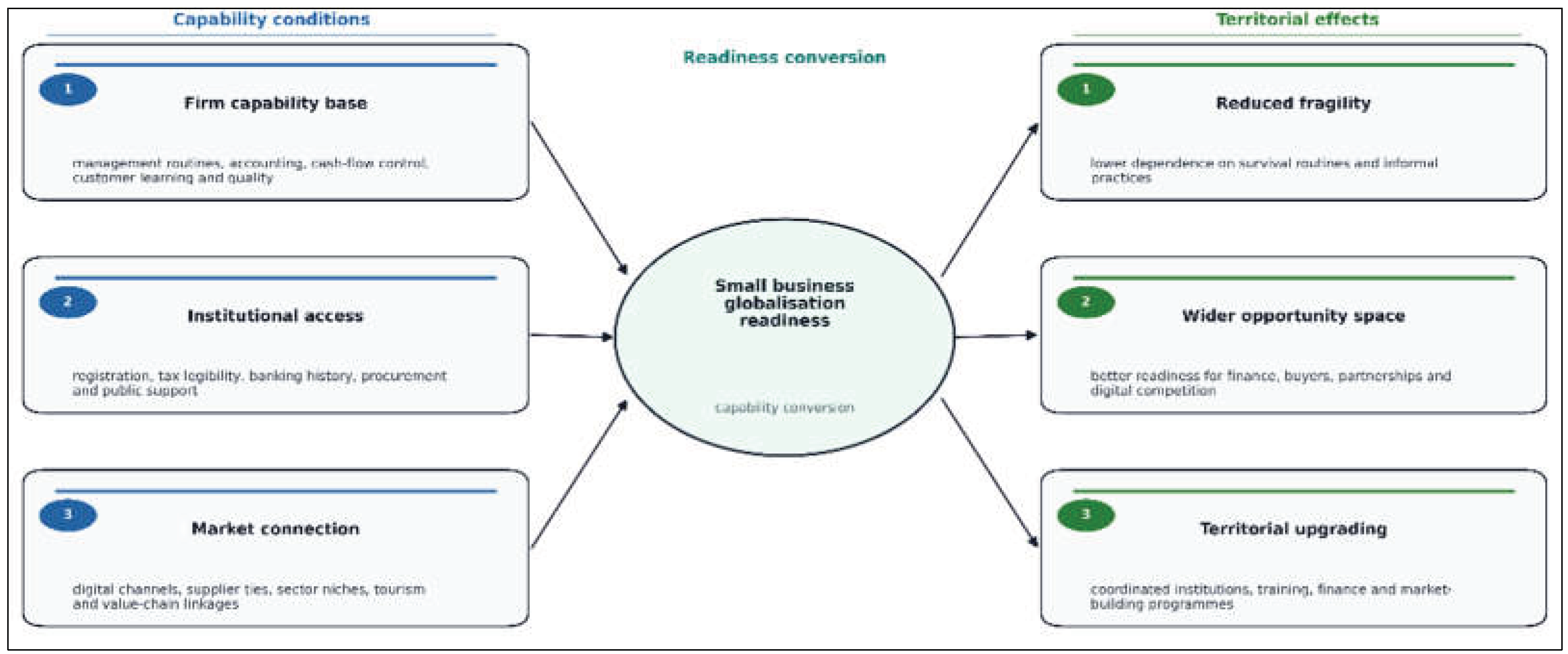
The finance-digitalisation link is important because digital traces can become part of an enterprise credibility infrastructure. Electronic payments, inventory systems, customer databases and digital invoices can improve internal decision-making while also producing information that lenders, suppliers and public programmes can evaluate (Vera-Colina et al., 2014; World Bank, n.d.; OECD, 2026). Figure 2 incorporates this point by placing financial readiness and productive digitalisation inside the same capability system rather than in separate policy silos.
Figure 2.
Territorial globalisation readiness framework for small businesses. The framework explains how firm-level capabilities, institutional access and market connection interact to reduce or reproduce competitive fragility in intermediate cities. Source: authors’ own elaboration.
Figure 2.
Territorial globalisation readiness framework for small businesses. The framework explains how firm-level capabilities, institutional access and market connection interact to reduce or reproduce competitive fragility in intermediate cities. Source: authors’ own elaboration.
Digitalisation is a second cross-cutting capability. Research on SMEs shows that digital transformation can support sustainable development when digital tools are connected to strategy, operations and customer value rather than limited to superficial online presence (Philbin et al., 2022). Colombian and Latin American evidence on e-commerce and digital marketing shows that small firms can use digital channels to improve sales and visibility, but adoption depends on managerial capacity, perceived usefulness, resources and learning (Jones et al., 2016; Sanabria Diaz et al., 2016; Sanchez-Torres et al., 2021; Uribe Beltran and Sabogal Neira, 2021).
Market access connects finance and digitalisation with globalisation readiness. For a small business, wider-market participation may start through local supply chains, tourism circuits, digital platforms, institutional procurement or relationships with larger buyers rather than direct exporting (Porter, 1985; Cardoza et al., 2016). Figure 2 integrates these elements by showing how firm capabilities, institutional access and market connection jointly reduce competitive fragility (Porter, 1985; Teece, 2007; Cardoza et al., 2016).
Proposition 4.
Finance and digitalisation strengthen globalisation readiness when they are integrated into commercial routines, accounting systems, customer learning and market-linkage strategies rather than treated as isolated tools (Vera-Colina et al., 2014; Philbin et al., 2022; OECD, 2026).
3. Methodology
3.1. Design and Reporting Logic
The study uses a systematised documentary review and conceptual synthesis. This design is appropriate when the objective is to organise heterogeneous evidence, clarify a problem, integrate official and scholarly sources, and propose a conceptual framework rather than estimate a pooled effect size (Snyder, 2019; Baethge et al., 2019). The review logic was informed by PRISMA 2020, the PRISMA extension for scoping reviews and SANRA principles, while recognising that the article is not a full systematic review with meta-analysis (Page et al., 2021; Tricco et al., 2018; Baethge et al., 2019).
The review logic follows a conservative reporting stance. PRISMA and PRISMA-ScR were used as transparency guides for documenting sources, eligibility boundaries and synthesis decisions, while SANRA was used as a quality reference for the narrative and conceptual components of the article (Page et al., 2021; Tricco et al., 2018; Baethge et al., 2019). The manuscript therefore reports a systematised documentary review, not a completed systematic review with a numeric PRISMA flow or a meta-analysis.
No numeric PRISMA counts are reported because the available materials did not constitute a fully re-executable database export with deduplication logs, reviewer decisions and full-text exclusion reasons. Reporting such counts without traceable records would weaken rather than strengthen the article (Page et al., 2021; Tricco et al., 2018). Table 1 states the eligibility boundary, and Figure 1 shows how the review moves from documentary evidence to conceptual synthesis without inventing selection numbers.
Figure 1 summarises the workflow from problem framing to source identification, eligibility, extraction, thematic synthesis and conceptual output. The figure also states the integrity boundary: the review does not invent PRISMA counts, included-study totals, effect sizes, forest plots, funnel plots or statistical claims when comparable quantitative data are absent (Page et al., 2021; Tricco et al., 2018). This boundary is important because the corpus includes policy reports, institutional statistics and conceptual or empirical literature that cannot be pooled as homogeneous study effects (Baethge et al., 2019; Snyder, 2019).
Table 1 defines the population-concept-context structure, inclusion logic and synthesis boundary. The population is micro, small and medium-sized enterprises, with emphasis on micro and small enterprises; the concept is globalisation readiness and competitive fragility; and the context is Valledupar as an intermediate-city case within Colombia and Latin America (Departamento Administrativo Nacional de Estadistica, 2020; OECD/CAF/SELA, 2024). This structure allows the paper to preserve local specificity while maintaining an international business-and-globalisation framing (Cardoza et al., 2016; OECD/CAF/SELA, 2024).
3.2. Information Sources and Search Logic
The documentary corpus included four source groups: international policy evidence on SMEs and globalisation; Colombian institutional reports on firm creation, survival and microbusiness structure; peer-reviewed literature on firm capabilities, institutions, finance, digitalisation and SME internationalisation; and local territorial information relevant to Valledupar and Cesar (World Bank, n.d.; OECD/CAF/SELA, 2024; Confecamaras, 2023; Departamento Administrativo Nacional de Estadistica, 2020). Table 2 presents these source groups, their analytical roles and their limitations in the synthesis (Page et al., 2021; Snyder, 2019).
Table 2.
Information sources and analytical role.
| Source group | Examples of sources | Analytical role | Main limitation |
| International SME policy | World Bank; OECD; OECD/CAF/SELA. | Frame SME finance, policy coherence, digital transformation and globalisation relevance. | High policy relevance but not case-specific to Valledupar. |
| Colombian institutional evidence | DANE; Confecamaras; Chamber of Commerce of Valledupar. | Describe microbusiness structure, business creation, survival and local territorial evidence. | Descriptive rather than causal evidence. |
| Peer-reviewed theory | Barney; Teece; North; DiMaggio and Powell; Porter. | Support interpretation through resources, capabilities, institutions and competitiveness. | Theories require contextual adaptation to microbusiness settings. |
| Peer-reviewed SME evidence | Philbin et al.; Cardoza et al.; Vera-Colina et al.; Sanchez-Torres et al.; Colombian SME studies. | Explain finance, digitalisation, internationalisation and managerial capability mechanisms. | Different designs and contexts prevent statistical pooling. |
Note: Source groups were combined for conceptual synthesis, not for quantitative meta-analysis.
The search logic combined three source families: international policy and development evidence, Colombian institutional evidence and peer-reviewed literature on small-firm capabilities, finance, formalisation, digitalisation and internationalisation. Search terms were combined around expressions such as small business, SME, MSME, globalisation readiness, internationalisation, digital transformation, formalisation, finance access, competitiveness, Colombia, Latin America and intermediate cities (Snyder, 2019; OECD/CAF/SELA, 2024). Table 2 specifies the role and limitations of each source group.
The use of institutional evidence was necessary because peer-reviewed articles rarely provide the local microbusiness statistics needed to describe Valledupar. However, institutional statistics were used only for descriptive case framing, while theoretical and interpretative claims were anchored in peer-reviewed and policy literature (Departamento Administrativo Nacional de Estadistica, 2020; Confecamaras, 2023; Confecamaras, 2025; Snyder, 2019). Table 3 records how the manuscript separates descriptive evidence from conceptual interpretation.
Table 3.
Data-extraction and citation-traceability fields.
| Field | Purpose | Example of use |
| Source identity | Identify author, year, title, publisher or journal, DOI/URL and access date. | Ensures that every cited source appears in the references. |
| Evidence type | Classify source as institutional, policy, theoretical, empirical or review. | Separates descriptive statistics from interpretation. |
| Geographical scope | Identify whether evidence is local, national, regional or international. | Prevents local claims from being overgeneralised. |
| Construct coded | Map evidence to formalisation, finance, digitalisation, management, market access or territorial support. | Links each source to a fragility cluster. |
| Manuscript location | Record where the source supports a paragraph, table or figure. | Ensures that paragraphs, tables and figures are cited in the manuscript. |
| Limitations | Record comparability, design or measurement limits. | Supports cautious narrative synthesis and avoids unsupported meta-analysis. |
Note: The table operationalises citation discipline for a conceptual manuscript.
Search terms were used in English and Spanish to increase sensitivity across academic and institutional sources. The terms included combinations of small business, SME, MSME, microenterprise, MiPyME, Colombia, Latin America, Valledupar, intermediate cities, globalisation readiness, export readiness, formalisation, finance, digitalisation, competitiveness and territorial capabilities (Snyder, 2019; Tricco et al., 2018). The search was not restricted to peer-reviewed databases because the local case requires official statistics and business registry evidence that are not always published in journal form (Departamento Administrativo Nacional de Estadistica, 2020; Confecamaras, 2023).
The review prioritised sources with verifiable institutional origin, DOI, recognised publisher, journal publication or official data provenance. This decision improves traceability but also creates a limitation: institutional sources provide strong descriptive evidence but do not always contain comparable measures for causal inference or meta-analysis (Page et al., 2021; Baethge et al., 2019). Table 3 therefore specifies the extraction fields used to track each source, including evidence role, geography, construct, cited paragraph, table or figure linkage, and limitation (Snyder, 2019; Baethge et al., 2019).
3.3. Extraction, Coding and Synthesis
Extraction was organised around the analytical role of each source rather than around statistical effect sizes. Fields included source type, country or territory, population or unit of analysis, construct addressed, key evidence, limitation, role in the argument and location where the source was used in the manuscript (Snyder, 2019; Page et al., 2021). This approach supports a transparent conceptual synthesis without forcing heterogeneous policy documents and academic studies into a numerical matrix that would not be methodologically defensible (Baethge et al., 2019; Tricco et al., 2018).
The extraction procedure was designed around claim discipline. Each source was coded for bibliographic identity, source type, geographic scope, relevance to readiness, claim supported, limitation and synthesis use. This procedure makes the review auditable even though the source set is documentary and heterogeneous rather than statistically comparable (Snyder, 2019; Baethge et al., 2019). Table 3 lists the extraction and citation-traceability fields used to control the relationship between evidence and interpretation.
A meta-analysis was not conducted because the evidence base did not provide comparable intervention groups, common outcomes, standard errors, means, standard deviations or convertible effect estimates. Combining firm survival, digital adoption, finance access, management routines and formalisation into a single effect size would violate methodological comparability (Page et al., 2021; Tricco et al., 2018). Table 4 therefore classifies the synthesis as descriptive and interpretative, while Table 7 sets out the data required for future empirical testing.
Table 4.
Evidence profile by source group.
| Evidence group | Strength for this paper | Limitation | Use in synthesis |
| Local microbusiness statistics | Directly describes Valledupar microbusiness structure. | Does not directly measure globalisation readiness. | Used to define case conditions and fragility clusters. |
| National business registry evidence | Shows business creation and survival patterns in Colombia. | Survival evidence is national, not specific to Valledupar. | Used to contextualise firm consolidation challenges. |
| International policy evidence | Provides comparative SME policy and finance frame. | Broad scope limits local causal interpretation. | Used to connect Valledupar to globalisation and emerging-economy debates. |
| Peer-reviewed SME research | Supports mechanisms for finance, digitalisation, competitiveness and internationalisation. | Context and design heterogeneity prevent pooling. | Used to interpret why observed constraints affect readiness. |
Note: Claims derived from this evidence profile are descriptive or interpretative, not causal estimates.
Table 5.
Competitive fragility clusters identified in the synthesis.
| Cluster | Observed or inferred weakness | Why it reduces globalisation readiness | Capability response |
| Atomised firm structure | Dominance of very small own-account operations. | Limits delegation, scale, records and managerial depth. | Build basic routines, records and owner-to-enterprise transition pathways. |
| Partial formalisation | Gaps in tax and chamber registration. | Reduces institutional legibility for finance, procurement and partnerships. | Connect registration to accounting, banking and market access. |
| Weak managerial systems | Limited planning, cost control, customer records and performance indicators. | Weakens decision-making, credit preparation and operational reliability. | Implement practical dashboards, cost control, inventory and customer routines. |
| Finance-readiness gaps | Insufficient records, collateral, credit history or cash-flow evidence. | Restricts investment and reduces ability to respond to market opportunities. | Prepare credit files, cash-flow records and formal financial statements. |
| Limited productive digitalisation | Use of digital tools without integration into sales, records or operations. | Limits digital competitiveness and data-based learning. | Embed digital payments, catalogues, customer databases and sales analytics. |
| Scarce market linkages | Narrow local markets, low differentiation and fragmented networks. | Constrains learning from demanding buyers and value-chain participation. | Develop supplier networks, tourism circuits, quality standards and procurement readiness. |
Note: The clusters are conceptual categories derived from the cited documentary synthesis.
Table 6.
Territorial capability agenda for small business globalisation readiness.
| Axis | Problem addressed | Priority action | Observable indicator |
| Smart formalisation | Registration is disconnected from business value. | Progressive route linking registration, accounting, banking and procurement opportunities. | Share of participating firms with complete formalisation and basic accounting records. |
| Financial readiness | Credit demand is weakened by poor records and informality. | Credit-file preparation, cash-flow training and links with banks or financial technology providers. | Share of firms with formal credit applications supported by financial statements or digital payment records. |
| Productive digitalisation | Digital tools are not embedded in business routines. | Sector-specific digital sales, electronic payments, customer databases and inventory control. | Share of firms with digital sales, electronic payment records or active customer databases. |
| Managerial capabilities | Owner dependency and weak planning reduce scalability. | Mentoring in pricing, costs, inventory, customer management and performance dashboards. | Share of firms using monthly management indicators. |
| Market linkages | Firms operate in narrow local markets with low differentiation. | Supplier networks, quality standards, branding, tourism circuits and public procurement preparation. | Number of firms entering new buyer relationships or formal supply agreements. |
| Ecosystem governance | Support services are fragmented. | Joint action between chamber, municipality, universities, lenders, training institutions and entrepreneurs. | Number of coordinated programmes with shared indicators and follow-up. |
Note: Indicators are proposed for programme monitoring and should be adapted by local stakeholders.
Table 7.
Future empirical testing agenda.
| Research path | Data needed | Possible method | Expected contribution |
| Firm-level survey | Formalisation stage, accounting, digitalisation, finance readiness and market linkages. | Structured survey with MSMEs in Valledupar and comparable cities. | Tests whether capability clusters predict readiness and survival expectations. |
| Entrepreneur interviews | Experiences with formalisation, credit, digital tools, training and buyers. | Semi-structured interviews and thematic analysis. | Explains how firms perceive barriers and support programmes. |
| Institutional mapping | Programmes, actors, overlaps and gaps in the local support ecosystem. | Document review and stakeholder interviews. | Identifies coordination failures and opportunities for ecosystem governance. |
| Comparative intermediate-city study | Comparable indicators across Colombian or Latin American cities. | Multi-case analysis. | Distinguishes local specificity from regional patterns. |
| Programme evaluation | Baseline and follow-up indicators for firms receiving support. | Quasi-experimental or longitudinal design if feasible. | Measures whether the capability agenda improves readiness outcomes. |
Note: The agenda converts conceptual findings into testable empirical pathways.
The synthesis followed a framework approach. First, local and national sources were used to characterise the Valledupar and Colombian business structure. Second, international SME policy sources were used to locate the case within broader development, finance and globalisation debates. Third, peer-reviewed literature was used to interpret firm resources, dynamic capabilities, institutions, digitalisation and market access (Barney, 1991; Teece, 2007; North, 1990; OECD/CAF/SELA, 2024).
No meta-analysis was performed because the evidence base does not provide comparable study-level observations with harmonised populations, exposures, comparators and outcomes. Sources differ in design, geography, purpose and measurement, and the corpus includes official descriptive statistics and conceptual-policy documents alongside empirical studies (Page et al., 2021; Tricco et al., 2018). The appropriate synthesis mode is therefore narrative and conceptual, with explicit separation between empirical evidence, institutional description, theoretical interpretation and policy inference (Baethge et al., 2019; Snyder, 2019).
4. Results and Conceptual Synthesis
4.1. Evidence Profile
The reviewed evidence is best interpreted as a mixed documentary corpus. International sources provide the globalisation and SME policy frame; Colombian institutional sources describe firm creation, survival and microbusiness characteristics; peer-reviewed studies contribute theoretical and empirical support for capabilities, finance, digitalisation and competitiveness; and local sources contextualise Valledupar as an intermediate-city case (World Bank, n.d.; OECD/CAF/SELA, 2024; Confecamaras, 2023; Departamento Administrativo Nacional de Estadistica, 2020). Table 4 summarises the evidentiary profile, strengths and limitations of each source group (Snyder, 2019; Baethge et al., 2019).
The evidence profile shows that the strongest claims are descriptive and interpretative rather than causal. Descriptive claims about Valledupar rely mainly on official microbusiness statistics and local institutional evidence, while national survival and business creation claims rely on Confecamaras reports (Departamento Administrativo Nacional de Estadistica, 2020; Camara de Comercio de Valledupar para el Valle del Rio Cesar, 2023; Confecamaras, 2023; Confecamaras, 2025). Interpretative claims about readiness and fragility rely on theory and prior research on resources, dynamic capabilities, institutions, finance and digitalisation (Barney, 1991; Teece, 2007; North, 1990; Philbin et al., 2022).
The synthesis is strongest where official statistics and policy evidence converge with theory. For example, DANE supports the claim that Valledupar has a large microbusiness base, Confecamaras supports the claim that Colombian enterprise creation exceeds enterprise consolidation, and OECD/CAF/SELA supports the claim that Latin American SME policy must integrate digitalisation, finance, market access and institutional coordination (Departamento Administrativo Nacional de Estadistica, 2020; Confecamaras, 2023; Confecamaras, 2025; OECD/CAF/SELA, 2024). Table 4 summarises this evidence profile by source group.
The synthesis is weaker where direct local outcome measures are unavailable. The paper cannot quantify how much each fragility cluster reduces sales, productivity, employment, survival or internationalisation in Valledupar. It can, however, identify a theoretically grounded readiness mechanism that future surveys, interviews and administrative-data studies can test (Barney, 1991; Teece, 2007; Snyder, 2019). Table 7 converts these limitations into an empirical research agenda.
4.2. Fragility Cluster 1: Atomised Firm Structure and Survival Routines
The first fragility cluster is atomised firm structure. DANE reported that most microbusinesses in Valledupar were operated by own-account workers rather than employers, indicating a productive base dominated by very small economic units (Departamento Administrativo Nacional de Estadistica, 2020). This structure matters because owner dependency can limit delegation, record keeping, planning, innovation and scale economies, all of which are relevant to globalisation readiness (Barney, 1991; Teece, 2007; Tobon Perilla et al., 2022).
Atomisation does not imply lack of entrepreneurship. It means that many firms may remain trapped in survival routines even when they are active and socially important. Business survival evidence in Colombia reinforces this point because firm creation has not translated into high five-year survival, particularly among microenterprises (Confecamaras, 2023; Confecamaras, 2025). Table 5 links atomisation to readiness constraints and identifies managerial routines, records and delegation as capability responses (Barney, 1991; Confecamaras, 2023).
4.3. Fragility Cluster 2: Partial Formalisation and Institutional Legibility
The second fragility cluster is partial formalisation. Valledupar microbusiness evidence shows gaps in tax and chamber-of-commerce registration, which suggests that many economic units remain weakly integrated into institutional circuits (Departamento Administrativo Nacional de Estadistica, 2020). This matters because institutional legibility is often required for finance, procurement, partnerships, formal contracts and access to public or private support programmes (North, 1990; OECD/CAF/SELA, 2024).
The synthesis indicates that formalisation should be interpreted as a staged capability process rather than a one-step registration event. A registered business that lacks accounting records, tax discipline, banking history or standardised contracts may remain only partially ready for wider-market opportunities (Vera-Colina et al., 2014; OECD, 2026). Table 6 therefore proposes smart formalisation as the first axis of the territorial capability agenda, connecting registration with accounting, banking, procurement and support services (North, 1990; OECD/CAF/SELA, 2024).
4.4. Fragility Cluster 3: Weak Managerial Systems
The third fragility cluster is weak managerial systems. Prior Colombian and Latin American SME research highlights the importance of internal management factors, human-resource formalisation, innovation capabilities and organisational integration for competitiveness (Maturana and Andrade, 2019; Morales-Rubiano et al., 2019; Romero-Suarez et al., 2020; Benavides Pupiales and Bolanos Delgado, 2020; Tobon Perilla et al., 2022). In small firms, these capabilities often appear through practical routines such as pricing, inventory control, cash-flow monitoring, customer records and quality management (Barney, 1991; Teece, 2007).
Weak managerial systems reduce globalisation readiness because they make it difficult to evaluate costs, negotiate with buyers, meet standards, apply for credit, adopt technology strategically or learn from performance indicators. This problem is not solved by isolated training if training is disconnected from finance, digitalisation and market opportunities (Teece, 2007; OECD/CAF/SELA, 2024). Figure 2 represents this interaction by positioning managerial capability as part of the firm capability base needed to convert institutional and market support into reduced fragility (Teece, 2007; Philbin et al., 2022).
4.5. Fragility Cluster 4: Finance-Readiness Gaps
The fourth fragility cluster is finance-readiness gaps. International evidence shows that SME finance remains a major policy concern, while Colombian evidence links access to finance with the quality and availability of financial information (World Bank, n.d.; OECD, 2026; Vera-Colina et al., 2014). The implication is that access to finance depends not only on credit supply but also on the capacity of firms to produce reliable accounting information and demonstrate repayment capacity (Vera-Colina et al., 2014; OECD, 2026).
Finance-readiness gaps are especially relevant in a microbusiness environment where many firms have limited records, informal transactions and low separation between household and business finances. These conditions can weaken credit applications, limit investment in technology or productive assets, and reinforce survival operations (World Bank, n.d.; Confecamaras, 2023). Table 5 identifies this gap as a readiness constraint, and Table 6 proposes credit-file preparation, cash-flow training and links with banks or financial technology providers as capability responses (OECD, 2026; Vera-Colina et al., 2014).
4.6. Fragility Cluster 5: Limited Productive Digitalisation
The fifth fragility cluster is limited productive digitalisation. Research on SMEs indicates that digital transformation supports performance and sustainability when digital tools are integrated into strategy, operations and customer value, rather than treated as isolated technology adoption (Philbin et al., 2022). Evidence on e-commerce and digital marketing in Colombian and Latin American MSMEs also suggests that adoption depends on managerial capacity, perceived benefits, resources, customer interaction and organisational learning (Jones et al., 2016; Sanabria Diaz et al., 2016; Sanchez-Torres et al., 2021; Uribe Beltran and Sabogal Neira, 2021).
The Valledupar case should therefore distinguish digital access from productive digitalisation. A firm may use a smartphone or social media while lacking electronic payment records, customer databases, inventory systems, analytics, product catalogues or digital sales routines (Philbin et al., 2022; Sanchez-Torres et al., 2021). Figure 3 places productive digitalisation after institutional legibility and managerial control, because digital tools generate stronger business value when they are connected to records, finance readiness and customer learning (Philbin et al., 2022; OECD, 2026).
Figure 3.
Capability ladder from local survival to globalisation readiness. The ladder sequences legibility, managerial control, productive digitalisation, market linkage and readiness for wider-market competition. Source: authors’ own elaboration.
Figure 3.
Capability ladder from local survival to globalisation readiness. The ladder sequences legibility, managerial control, productive digitalisation, market linkage and readiness for wider-market competition. Source: authors’ own elaboration.

4.7. Fragility Cluster 6: Scarce Market Linkages and Sectoral Concentration
The sixth fragility cluster is scarce market linkages. DANE evidence shows that Valledupar microbusinesses are concentrated in trade and services, which can expose firms to crowded local markets, limited differentiation and demand volatility (Departamento Administrativo Nacional de Estadistica, 2020). Competitiveness theory suggests that firms need value creation, cost advantage or differentiation to escape purely price-based competition (Porter, 1985).
Market linkages are especially important for globalisation readiness because firms often learn by interacting with more demanding buyers, suppliers, tourism circuits, public procurement channels or digital customers. Latin American evidence on SME internationalisation indicates that public policies, networks and institutional support can influence firms ability to expand beyond domestic markets (Cardoza et al., 2016). Table 6 therefore treats supplier networks, quality standards, branding, tourism circuits and procurement preparation as policy actions rather than optional add-ons (Porter, 1985; Cardoza et al., 2016).
5. Discussion
5.1. Principal Interpretation
The main interpretation is that Valledupar small-business fragility is systemic rather than isolated. Atomised ownership, partial formalisation, weak managerial systems, finance-readiness gaps, limited productive digitalisation and scarce market linkages reinforce one another, producing firms that may remain active but poorly prepared for wider-market competition (Departamento Administrativo Nacional de Estadistica, 2020; Confecamaras, 2023; OECD/CAF/SELA, 2024). Figure 2 synthesises this interpretation by showing that globalisation readiness emerges from the conversion of firm-level capabilities and territorial support into reduced competitive fragility (Barney, 1991; Teece, 2007; North, 1990).
This systemic interpretation is the central value added of the article. A finance programme may fail if firms do not have records; digital training may have limited effects if firms lack managerial routines; formalisation may be perceived as a cost if it is not linked to procurement, finance or market opportunities; and market-linkage programmes may exclude firms that are not institutionally legible (North, 1990; Vera-Colina et al., 2014; Philbin et al., 2022; OECD/CAF/SELA, 2024). Figure 2 visualises these reinforcing relationships.
The implication for business and globalisation research is that readiness should be treated as a system of minimum viable capabilities. The relevant question is not only whether a firm exports, uses technology or registers formally, but whether these practices combine into a credible capability platform for wider-market participation (Johanson and Vahlne, 2009; Knight and Cavusgil, 2004; Teece, 2007). Figure 3 represents this progression from local survival to globalisation readiness.
The interpretation also suggests that business creation is not enough. The Colombian evidence of high firm creation and low survival indicates that entrepreneurship policy should focus on consolidation, learning and capability accumulation, not only on registration or start-up promotion (Confecamaras, 2023; Confecamaras, 2025). This aligns with the OECD/CAF/SELA emphasis on policy coherence, SME finance, digital transformation and monitoring in Latin America and the Caribbean (OECD/CAF/SELA, 2024; OECD, 2026).
5.2. Theoretical Implications for Business and Globalisation Research
The paper contributes to globalisation research by showing that small-business globalisation readiness can be conceptualised before export activity. Internationalisation theory emphasises learning, networks, uncertainty reduction and entrepreneurial capabilities, but the Valledupar case shows that many firms need pre-internationalisation strengthening before those mechanisms can operate effectively (Johanson and Vahlne, 2009; Oviatt and McDougall, 1994; Knight and Cavusgil, 2004). The readiness concept therefore bridges international business theory with local enterprise development and territorial policy (Cardoza et al., 2016; OECD/CAF/SELA, 2024).
The paper also extends resource-based and dynamic capability perspectives by placing firm capabilities inside a territorial support system. A firm may need accounting routines, digital channels or customer learning, but its ability to acquire those capabilities depends partly on the availability and coordination of chambers of commerce, training institutions, lenders, universities, municipal agencies and buyer networks (Barney, 1991; Teece, 2007; OECD/CAF/SELA, 2024). Table 7 identifies empirical testing paths that could examine whether these territorial mechanisms actually improve readiness and survival outcomes (Snyder, 2019; Page et al., 2021).
5.3. Policy and Managerial Implications
The policy implication is that support programmes should be sequenced and connected. If formalisation is promoted without finance readiness, firms may register but remain unable to access credit; if digitalisation is promoted without managerial systems, firms may adopt tools without improving sales or decision-making; and if training is not linked to market opportunities, knowledge may not translate into upgrading (Vera-Colina et al., 2014; Philbin et al., 2022; OECD/CAF/SELA, 2024). Table 6 provides a practical agenda for aligning smart formalisation, financial readiness, productive digitalisation, managerial capability, market linkages and ecosystem governance (OECD/CAF/SELA, 2024; OECD, 2026).
A practical programme architecture would therefore begin with diagnostic segmentation. Survival-oriented microbusinesses may need records, costing and basic formalisation; opportunity-oriented small firms may need finance readiness, customer analytics and supplier standards; and growth-oriented firms may need branding, quality certification, digital sales systems and cross-regional market links (Porter, 1985; Cardoza et al., 2016; OECD/CAF/SELA, 2024). Table 6 translates this segmentation into a territorial capability agenda with observable indicators.
For chambers of commerce, universities, financial institutions and local governments, the agenda implies coordinated delivery rather than fragmented projects. Chambers can support institutional legibility, universities can provide managerial and digital capability clinics, lenders can convert records into credit pathways, and public agencies can connect firms to procurement, tourism, agribusiness or supplier-development opportunities (World Bank, n.d.; Camara de Comercio de Valledupar para el Valle del Rio Cesar, 2023; OECD, 2026). Table 6 identifies the indicators that could be monitored by a local coalition.
For entrepreneurs, the message is that globalisation readiness begins with basic routines. A small firm does not need to become an exporter immediately, but it does need clearer records, cost control, customer information, digital payment evidence, reliable delivery practices and a credible business story for banks, buyers and partners (Porter, 1985; Vera-Colina et al., 2014; Sanchez-Torres et al., 2021). Figure 3 converts this message into a staged ladder that can be used by training institutions and support programmes to organise interventions from legibility to wider-market readiness (Philbin et al., 2022; OECD, 2026).
For territorial actors, the framework implies that isolated programmes should be replaced by coordinated capability pathways. Chambers of commerce, municipalities, universities, lenders, training institutions and business associations can use shared indicators to monitor whether firms are moving from registration to records, from records to finance readiness, from digital presence to digital sales, and from local survival to market linkages (Camara de Comercio de Valledupar para el Valle del Rio Cesar, 2023; OECD/CAF/SELA, 2024). Table 6 includes observable indicators that can be adapted for programme monitoring in Valledupar or comparable intermediate cities (OECD/CAF/SELA, 2024; Confecamaras, 2023).
5.4. Limitations and Future Research
The study has limitations. First, it is a conceptual and documentary synthesis rather than a survey, experiment or econometric study, so it does not estimate causal effects. Second, the evidence base is heterogeneous because it combines official statistics, business registry reports, policy documents and peer-reviewed literature. Third, local evidence is stronger for microbusiness structure than for direct measurement of globalisation readiness. Fourth, the review does not conduct meta-analysis because comparable quantitative data are not available (Page et al., 2021; Tricco et al., 2018; Baethge et al., 2019).
The first limitation is evidence heterogeneity. The manuscript combines institutional reports, policy documents and peer-reviewed research, which strengthens conceptual triangulation but prevents statistical pooling. The second limitation is local specificity: Valledupar is analytically useful but cannot represent all Colombian or Latin American intermediate cities without comparative empirical testing (Snyder, 2019; Page et al., 2021; OECD/CAF/SELA, 2024). Table 7 identifies the comparative designs needed to strengthen external validity.
The third limitation is that globalisation readiness is proposed as a conceptual construct rather than measured as an index. Future research should operationalise the construct through indicators of institutional legibility, managerial control, finance readiness, productive digitalisation and market linkage, then test whether these indicators predict survival, growth, innovation, sales diversification or early internationalisation (Barney, 1991; Teece, 2007; Knight and Cavusgil, 2004). Figure 3 provides the starting structure for this measurement agenda.
Future research should test the framework empirically. A survey could measure formalisation stage, accounting routines, digital commercialisation, finance readiness, productive linkages, innovation behaviour and survival expectations; interviews could examine how entrepreneurs and institutions experience formalisation, credit, digitalisation and market access; comparative studies could analyse other Colombian or Latin American intermediate cities to determine whether the identified fragility clusters are common or context-specific (Snyder, 2019; OECD/CAF/SELA, 2024). Table 7 provides a structured agenda for this future research programme (Page et al., 2021; Tricco et al., 2018).
6. Conclusions
This paper reframed MSME fragility in Valledupar as a globalisation-readiness problem. The synthesis shows that small-business competitiveness in intermediate cities cannot be explained by isolated barriers: firm-level weaknesses, institutional access gaps and territorial market constraints reinforce one another, producing competitive fragility even where entrepreneurial activity is visible (Departamento Administrativo Nacional de Estadistica, 2020; Confecamaras, 2023; OECD/CAF/SELA, 2024).
The strongest conclusion is methodological as well as substantive: the evidence is sufficient to justify a capability-based framework, but not sufficient to claim causal effects or produce meta-analytic estimates. This distinction matters because policy recommendations for MSMEs often overstate what descriptive evidence can prove (Page et al., 2021; Baethge et al., 2019). Table 3 and Table 4 preserve the boundary between evidence, interpretation and future empirical testing.
The article ultimately reframes Valledupar as a case for studying how intermediate cities can move from entrepreneurship promotion to enterprise capability-building. The proposed framework is transferable because the same fragility clusters may appear in other emerging-economy territories, but its empirical weight must be tested with local data, comparative cases and longitudinal indicators (Cardoza et al., 2016; OECD/CAF/SELA, 2024; OECD, 2026). Table 7 sets out the next research steps.
The proposed territorial globalisation readiness framework argues that small-business upgrading requires sequenced capability building. Formalisation should be connected to finance and markets; finance should be linked to productive investment and records; digitalisation should be embedded in commercial routines; and training should be coordinated with networks, procurement and support institutions (World Bank, n.d.; OECD, 2026; Philbin et al., 2022). The main conclusion is that globalisation readiness begins before exporting: it starts with making small firms institutionally legible, financially prepared, digitally visible, managerially capable and territorially connected (Cardoza et al., 2016; Johanson and Vahlne, 2009; OECD/CAF/SELA, 2024).
Data Availability Statement
All documentary sources used in this article are cited in the reference list. A source-extraction and citation-traceability log can be provided as supplementary material after final author verification.
References
- Baethge, C.; Goldbeck-Wood, S.; Mertens, S. ‘SANRA - a scale for the quality assessment of narrative review articles’. Res. Integr. Peer Rev. 2019, Vol. 4, Article 5. [Google Scholar] [CrossRef] [PubMed]
- Barney, J. ‘Firm resources and sustained competitive advantage’. J. Manag. 1991, Vol. 17(No. 1), 99–120. [Google Scholar] [CrossRef]
- Benavides Pupiales, L.E.; Bolanos Delgado, S.L. ‘Innovation barriers in SMEs: an approach through a systematic literature review’. Tendencias 2020, Vol. 21(No. 1), 221–237. [Google Scholar] [CrossRef]
- Camara de Comercio de Valledupar para el Valle del Rio Cesar (2023) Estimation of the potential of merchants 2023, Chamber of Commerce of Valledupar for the Cesar River Valley, Valledupar. Available online: https://ccvalledupar.org.co/ (accessed on 1 July 2026).
- Cardoza, G.; Fornes, G.; Farber, V.; Gonzalez Duarte, R.; Ruiz Gutierrez, J. ‘Barriers and public policies affecting the international expansion of Latin American SMEs: evidence from Brazil, Colombia, and Peru’. J. Bus. Res. 2016, Vol. 69(No. 6), 2030–2039. [Google Scholar] [CrossRef]
- Confecamaras (2023) Business survival in Colombia, Confederation of Colombian Chambers of Commerce, Bogota. Available online: https://confecamaras.org.co/ (accessed on 1 July 2026).
- Confecamaras (2025) Dynamics of enterprise creation in Colombia 2024, Confederation of Colombian Chambers of Commerce, Bogota. Available online: https://confecamaras.org.co/ (accessed on 1 July 2026).
- Departamento Administrativo Nacional de Estadistica. Executive report: Microbusinesses - Valledupar 2019, National Administrative Department of Statistics, Bogota. 2020. Available online: https://www.dane.gov.co/ (accessed on 1 July 2026).
- DiMaggio, P.J.; Powell, W.W. ‘The iron cage revisited: institutional isomorphism and collective rationality in organizational fields’. Am. Sociol. Rev. 1983, Vol. 48(No. 2), 147–160. [Google Scholar] [CrossRef]
- Johanson, J.; Vahlne, J.-E. ‘The Uppsala internationalization process model revisited: from liability of foreignness to liability of outsidership’. J. Int. Bus. Stud. 2009, Vol. 40(No. 9), 1411–1431. [Google Scholar] [CrossRef]
- Jones, C.; Motta, J.; Alderete, M.V. ‘Strategic management of information and communication technologies and adoption of e-commerce in MSMEs in Cordoba, Argentina’. Estud. Gerenciales 2016, Vol. 32(No. 138), 4–13. [Google Scholar] [CrossRef]
- Knight, G.A.; Cavusgil, S.T. ‘Innovation, organizational capabilities, and the born-global firm’. J. Int. Bus. Stud. 2004, Vol. 35(No. 2), 124–141. [Google Scholar] [CrossRef]
- Maturana, D.; Andrade, V. ‘The relationship between formalisation of human management practices and productivity of MSMEs: a review article’. Innovar 2019, Vol. 29(No. 74), 101–114. [Google Scholar] [CrossRef]
- Morales-Rubiano, M.E.; Duque-Orozco, Y.V.; Ortiz-Riaga, C. ‘Methodological model for strengthening dynamic innovation capabilities in MSMEs’. Rev. EAN 2019, No. 86, 13–33. [Google Scholar] [CrossRef]
- North, D.C. Institutions, Institutional Change and Economic Performance; Cambridge University Press: Cambridge, 1990. [Google Scholar]
- OECD. Financing SMEs and Entrepreneurs 2026: An OECD Scoreboard; OECD Publishing: Paris, 2026. [Google Scholar] [CrossRef]
- OECD/CAF/SELA. SME Policy Index: Latin America and the Caribbean 2024 - Towards an Inclusive, Resilient and Sustainable Recovery; OECD Publishing: Paris, 2024. [Google Scholar] [CrossRef]
- Oviatt, B.M.; McDougall, P.P. ‘Toward a theory of international new ventures’. J. Int. Bus. Stud. 1994, Vol. 25(No. 1), 45–64. [Google Scholar] [CrossRef]
- Page, M.J.; McKenzie, J.E.; Bossuyt, P.M.; Boutron, I.; Hoffmann, T.C.; Mulrow, C.D.; Shamseer, L.; Tetzlaff, J.M.; Akl, E.A.; Brennan, S.E.; et al. ‘The PRISMA 2020 statement: an updated guideline for reporting systematic reviews’. BMJ 2021, Vol. 372, n71. [Google Scholar] [CrossRef] [PubMed]
- Philbin, S.; Viswanathan, R.; Telukdarie, A. ‘Understanding how digital transformation can enable SMEs to achieve sustainable development: a systematic literature review’. Small Bus. Int. Rev. 2022, Vol. 6(No. 1), e473. [Google Scholar] [CrossRef]
- Porter, M.E. Competitive Advantage: Creating and Sustaining Superior Performance; Free Press: New York, 1985. [Google Scholar]
- Romero-Suarez, D.; Pertuz, V.; Orozco-Acosta, E. ‘Determining factors of competitiveness and organisational integration: exploratory systematic review’. Inf. Tecnol. 2020, Vol. 31(No. 5), 21–32. [Google Scholar] [CrossRef]
- Sanabria Diaz, V.L.; Torres Ramirez, L.A.; Lopez Posada, L.M. ‘E-commerce and sales levels in MSMEs in the trade, industry and services sectors of Ibague’. Rev. EAN 2016, No. 80, 132–154. [Google Scholar]
- Sanchez-Torres, J.A.; Rojas Berrio, S.P.; Ortiz Rendon, P.A. ‘The adoption of e-commerce in SMEs: the Colombian case’. J. Telecommun. Digit. Econ. 2021, Vol. 9(No. 3), 110–135. [Google Scholar] [CrossRef]
- Snyder, H. ‘Literature review as a research methodology: an overview and guidelines’. J. Bus. Res. 2019, Vol. 104, 333–339. [Google Scholar] [CrossRef]
- Teece, D.J. ‘Explicating dynamic capabilities: the nature and microfoundations of sustainable enterprise performance’. Strateg. Manag. J. 2007, Vol. 28(No. 13), 1319–1350. [Google Scholar] [CrossRef]
- Tobon Perilla, L.N.; Urquia Grande, E.; Cano Montero, E.I. ‘Which internal management factors favour SME competitiveness? Evidence from Colombia’. Rev. Univ. Empresa 2022, Vol. 24(No. 42), 1–29. [Google Scholar] [CrossRef]
- Tricco, A.C.; Lillie, E.; Zarin, W.; O’Brien, K.K.; Colquhoun, H.; Levac, D.; Moher, D.; Peters, M.D.J.; Horsley, T.; Weeks, L.; et al. ‘PRISMA extension for scoping reviews (PRISMA-ScR): checklist and explanation’. Ann. Intern. Med. 2018, Vol. 169(No. 7), 467–473. [Google Scholar] [CrossRef] [PubMed]
- Uribe Beltran, C.I.; Sabogal Neira, D.F. ‘Digital marketing in micro and small advertising companies in Bogota’. Rev. Univ. Empresa 2021, Vol. 23(No. 40), 1–22. [Google Scholar] [CrossRef]
- Vera-Colina, M.A.; Melgarejo-Molina, Z.A.; Mora-Riapira, E.I. ‘Access to finance in Colombian SMEs: a view from financial indicators’. Innovar 2014, Vol. 24(No. 53), 149–160. [Google Scholar] [CrossRef]
- World Bank. SME Finance, World Bank, Washington, DC. n.d. Available online: https://www.worldbank.org/ (accessed on 1 July 2026).
Disclaimer/Publisher’s Note: The statements, opinions and data contained in all publications are solely those of the individual author(s) and contributor(s) and not of MDPI and/or the editor(s). MDPI and/or the editor(s) disclaim responsibility for any injury to people or property resulting from any ideas, methods, instructions or products referred to in the content. |
© 2026 by the authors. Licensee MDPI, Basel, Switzerland. This article is an open access article distributed under the terms and conditions of the Creative Commons Attribution (CC BY) license (http://creativecommons.org/licenses/by/4.0/).
Copyright: This open access article is published under a Creative Commons CC BY 4.0 license, which permit the free download, distribution, and reuse, provided that the author and preprint are cited in any reuse.