
Submitted:
02 July 2026
Posted:
02 July 2026
You are already at the latest version
Abstract
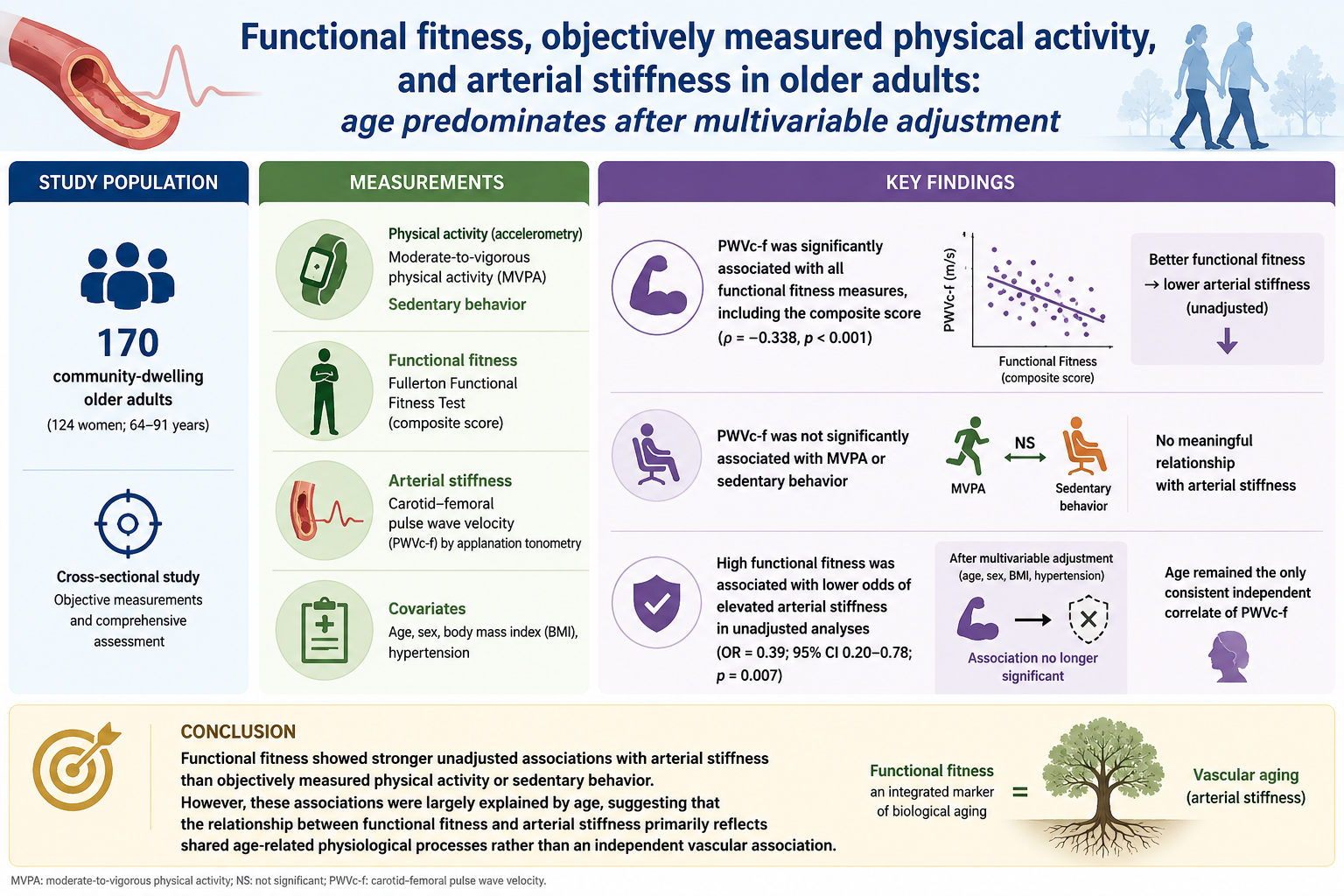
Background: Central arterial stiffness assessed by carotid-femoral pulse wave velocity (PWVc-f) strongly predicts cardiovascular risk. We examined associations of objec-tively measured physical activity, sedentary behavior, and functional fitness with PWVc-f in community-dwelling older adults. Methods: The study included 170 older adults (124 women; 64–91 years). Moderate-to-vigorous physical activity (MVPA) and sedentary behavior were assessed by accelerometry, functional fitness by the Fullerton Functional Fitness Test (composite score), and PWVc-f by applanation tonometry. As-sociations were examined using correlation, hierarchical linear regression, and logistic regression analyses. Results: Elevated arterial stiffness (PWVc-f >10 m/s) was present in 62.3% of participants. PWVc-f associated with all functional fitness measures, in-cluding the composite score (ρ=−0.338, p< 0.001), but not with MVPA or sedentary be-havior. High functional fitness associated with lower odds of elevated PWVc-f in un-adjusted analyses (OR=0.39, 95% CI 0.20–0.78; p=0.007), but this was no longer signifi-cant after adjustment for age, sex, and anthropometric/clinical characteristics. Neither MVPA nor sedentary behavior predicted PWVc-f. Age remained the only independent correlate across all models. Conclusions: Functional fitness showed stronger unad-justed associations with PWVc-f than MVPA or sedentary behavior. However, these associations were largely explained by age, indicating that functional fitness and PWVc-f primarily reflect shared age-related physiological processes.
Keywords:
aging
; arterial stiffness
; carotid-femoral pulse wave velocity
; functional fitness
; physical activity
; sedentary behavior
Copyright: This open access article is published under a Creative Commons CC BY 4.0 license, which permit the free download, distribution, and reuse, provided that the author and preprint are cited in any reuse.


