Preprint
Article

This version is not peer-reviewed.

Insights into the Antimicrobial Mechanisms of Cinnamon (Cinnamomum verum) and Oregano (Origanum vulgare) Essential Oils Against Foodborne Pathogens

Submitted:

01 July 2026

Posted:

02 July 2026

You are already at the latest version

Abstract

Essential oils (EOs) are promising natural antimicrobial agents, although their mechanisms of action are not yet fully understood. This study investigated the antimicrobial mechanisms of cinnamon (Cinnamomum verum) and oregano (Origanum vulgare) EOs against Listeria monocytogenes Scott A and Staphylococcus aureus DSM 20231t by combining conventional plate counting with flow cytometric analysis of bacterial physiological status. Bacterial cells were exposed to different sub-lethal or lethal EO concentrations, and changes in culturability, viability, membrane permeability and depolarization were monitored during treatment and following stress removal. Oregano EO, rich in carvacrol, rapidly reduced bacterial culturability and induced extensive membrane damage and cell death in both species. In contrast, cinnamon EO, characterized by trans-cinnamaldehyde as its main constituent, produced a slower antimicrobial response, with more limited membrane permeabilization and a greater ability of bacterial cells to recover after stress removal. Flow cytometry revealed discrepancies between viability and culturability, highlighting the occurrence of physiologically injured cells that were not detectable by conventional culture-based methods alone. Overall, the results demonstrate that the tested EOs trigger distinct physiological responses and antimicrobial mechanisms, providing useful insights for their rational application as natural food preservatives.

Keywords: 
;  ;  ;  ;  ;  

1. Introduction

Growing interest in the antimicrobial and antioxidant properties of plant-derived compounds has stimulated extensive research on essential oils (EOs) in recent decades. More than 1,300 plant species, comprising over 30,000 bioactive components, have been investigated for their antimicrobial potential [1]. Among plant-derived antimicrobials, polyphenols and EOs are particularly relevant. EOs are complex mixtures of poorly water-soluble compounds, mainly terpenes, terpenoids, and phenylpropanoids [2,3,4]. Their marked lipophilicity facilitates interaction with microbial cell membranes, which are considered the primary target of their antimicrobial activity [1,5].
Numerous EOs from officinal plants and spices have been evaluated in food systems as potential alternatives to synthetic preservatives. However, despite promising results, several limitations hinder their industrial application, including: i) compositional variability affecting antimicrobial efficacy; ii) organoleptic impact; iii) lack of standardized assessment methods; iv) limited knowledge of interactions with food matrices and processing conditions; v) incomplete understanding of mechanisms of action; and vi) scarce characterization of synergistic or antagonistic interactions among EO constituents [1,2,3,6,7].
Several species of the genus Cinnamomum (Lauraceae) are recognized for their production of EOs, which can be extracted from leaves, bark, and seeds. The most used species include Cinnamomum verum (syn. C. zeylanicum), C. cassia (syn. C. aromaticum), C. camphora, and C. burmanni. Cinnamon spice is obtained from the bark of these species [8,9], and their EOs (cassia oil and cinnamon oil) are widely applied in traditional medicine [10]. Trans-cinnamaldehyde, a phenylpropanoid synthesized from phenylalanine, is generally the predominant constituent of these EOs. This α,β-unsaturated aldehyde exhibits significant antimicrobial activity, mainly attributed to its reactive carbonyl moiety [9]. Other phenylalanine derivatives, such as cinnamic acid, cinnamyl acetate, and eugenol, may also be present, along with minor amounts of terpenes and terpenoids including borneol, camphor, β-caryophyllene, nerolidol, and α-terpineol. Typically, trans-cinnamaldehyde predominates in bark EOs, whereas eugenol is more abundant in leaf EOs [11,12,13]. The cytoplasmic membrane represents the first target of cinnamaldehyde’s antimicrobial activity. Owing to its lipophilic aromatic ring, trans-cinnamaldehyde can partition into the phospholipid bilayer. However, unlike many terpenes and terpenoids, it also exhibits moderate water solubility, enabling diffusion into the cytoplasm, where its reactive aldehyde group interacts with cellular components, leading to intracellular damage and potentially cell death [7,9].
The term “oregano” broadly refers to botanically distinct species depending on the geographical region, including plants primarily from the Lamiaceae (e.g., Origanum, Calamintha, Hedeoma) and Verbenaceae (Lippia, Lantana) families, as well as species from Asteraceae and Fabaceae [14]. Within the genus Origanum, several species, such as O. vulgare, O. onites, O. compactum, O. majorana, O. bilgeri and O. syriacum, have been investigated for antimicrobial activity. As with most EOs, the chemical composition of Origanum spp. varies considerably according to species, chemotype, agronomic and environmental conditions, harvest time, and extraction method [15,16]. Despite this variability, oregano EOs are typically dominated by terpenes and terpenoids, particularly carvacrol, thymol, and p-cymene. Other frequently detected compounds include γ-terpinene, linalool, terpinen-4-ol, β-myrcene, and β-caryophyllene [14,15]. The relative abundance of these constituents strongly influences antimicrobial efficacy in food systems. In O. vulgare EOs produced in Italy, carvacrol is frequently the predominant molecule, often exceeding 60% of the total composition [17,18,19,20]. The antimicrobial efficacy of carvacrol-rich EOs has been widely documented [14] and, as well as for its isomer thymol, is primarily related to its hydrophobic nature and the presence of a hydroxyl group on the aromatic ring. Following incorporation into the cytoplasmic membrane, carvacrol disrupts membrane-associated functions and acts as a proton exchanger, leading to dissipation of the proton motive force [21,22]. Thus, its antimicrobial effect is mainly associated with membrane permeabilization and depolarization [23].
Recent evidence has demonstrated significant antimicrobial activity of C. verum and O. vulgare EOs against Listeria monocytogenes and Staphylococcus aureus. For C. verum EO, Minimum Inhibiting Concentration (MIC) and Minimum Bactericidal Concentration (MBC) values of 250 and 500 mg/L, respectively, were reported for both strains, whereas O. vulgare EO exhibited MIC and MBC values of 250 and 300 mg/L, respectively. The main constituent of C. verum EO was trans-cinnamaldehyde (62%), followed by cinnamyl acetate (14.1%) and eugenol (4.5%). In O. vulgare EO, carvacrol (75.9%) predominated, with p-cymene (7.4%) and γ-terpinene (5.1%) as secondary components [24]. Both these EOs and their principal constituents had been previously investigated for antimicrobial activity against L. monocytogenes [8,23,25,26,27] and S. aureus [23,27,28,29].
This study aimed to gain deeper insight into the antimicrobial mechanisms of action of cinnamon and oregano EOs against S. aureus DSM 20231t and L. monocytogenes Scott A, and to evaluate the effects of increasing EO concentrations and exposure time on bacterial culturability and viability. Particular attention was given to the occurrence of potential recovery of treated cells after stress removal. To this end, microbial responses were assessed using conventional culture-dependent methods in combination with flow cytometry (FCM), evaluating the impact of EO exposure on cell viability as well as membrane permeabilization and depolarization.

2. Results

2.1. Effect of EOs on Listeria monocytogenes Viability and Culturability

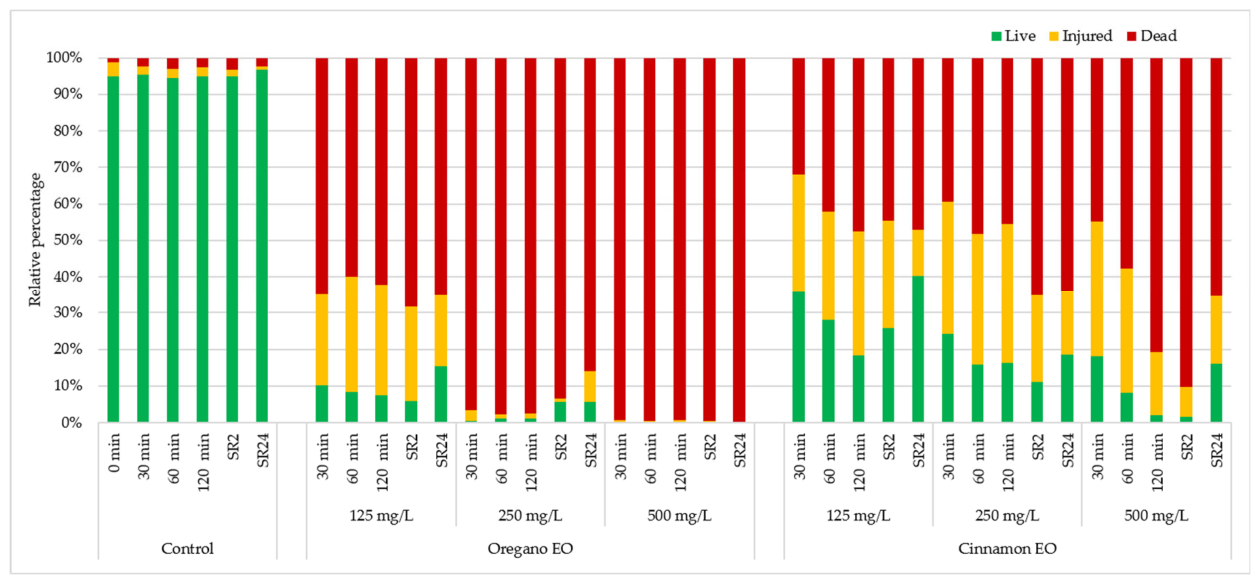
The effects of the different EOs on Listeria monocytogenes are shown in Figure 1, which compares total cell counts determined by flow cytometry (FCM), using SYBR Green I stain, with culturability values obtained by plate counting under the different experimental conditions. FCM detects the total number of cells present in the sample, regardless of their physiological state (live, injured or dead), whereas plate counts quantify only cells capable of forming colonies under the applied culture conditions, thus excluding the possible presence of viable but non-culturable (VBNC) cells. In control samples (i.e., absence of EO), no differences were observed in the different conditions. At all sampling times, cell loads exceeded 8 log CFU/mL. Similarly, no differences were detected in the control samples used as references for stress removal tests (SR2 and SR24), although microbial concentrations were lower due to the 100-fold dilution applied to remove the stress conditions (see section 4.3). The cell exposure to oregano EO at a sub-inhibitory concentration corresponding to half the MIC (125 mg/L) produced consistent results across exposure times (30–120 min). Total cell counts determined by FCM were comparable to those of the untreated control, whereas culturability decreased by approximately 1 log unit (≈90%). This discrepancy persisted after 2 h from stress removal, indicating the presence of cells with impaired culturability. After 24 h (SR24), however, FCM and plate count values converged, suggesting restoration of culturability and repair of cellular damage. A different trend was observed at the MIC concentration (250 mg/L). Compared with FCM counts, culturability decreased by approximately 3 log CFU/mL after 30 min of exposure and continued to decline with increasing contact time. After 120 min, the difference exceeded 4 log units. Following stress removal, a further reduction was observed after 2 h (SR2) because of sample dilution, whereas after 24 h (SR24) the values obtained by the two methods converged. At a concentration twice the MIC (500 mg/L), the number of events detected by FCM remained constant, whereas culturability fell below the detection limit (<1 log CFU/mL) both in exposed samples and during the subsequent stress removal tests.
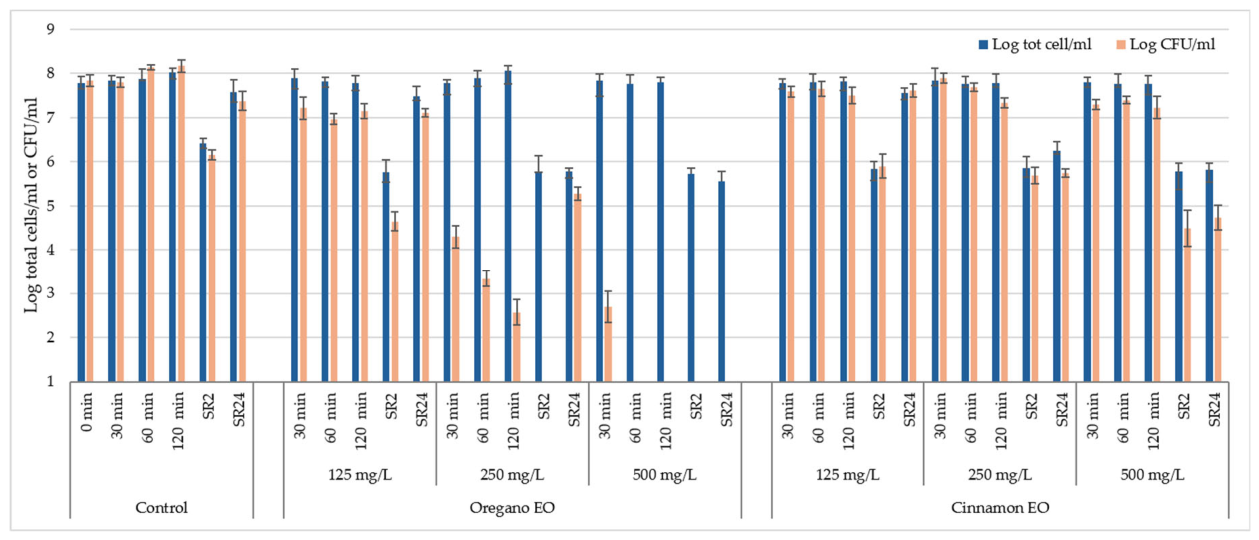
The physiological state of cells exposed to different EOs was further investigated by dual-staining FCM analysis, to identify subpopulations of live, injured, and dead cells based on cell membrane permeability to propidium iodide. The results are summarized in Figure 2. In the control (i.e., absence of EOs), more than 95% of cells were live at all sampling times, whereas damaged and dead cells together accounted for less than 5% of the total population. At half MIC (125 mg/L) of oregano, dead cells accounted for approximately 62% of the total population only after 2 h of exposure. Conversely, live cells represented only 10% of the population after 2 h and further decreased as the EO contact time increased. A slight increase in live cells (about 15%) was observed only after 24 h of the stress-removal phase. Treatment at the MIC (250 mg/L) resulted in a marked increase in dead cells, which represented more than 95% of the population. After 24 h from the stress removal, the percentage of live/injured cells slightly increased; however, dead cells still accounted for more than 85% of the population. Exposure to 500 mg/L oregano EO was lethal to L. monocytogenes, and only dead cells were detected under all tested conditions, consistent with the plate count results.
When L. monocytogenes Scott A was exposed to cinnamon EO, the comparison of the data of cell culturability (log CFU/ml) and the total cells detected by FCM analysis (Figure 1) showed that the presence of 125 mg/L of this EO resulted in an approximately 1 log reduction in culturability after 2 h of treatment. However, after 24 h from stress removal, live counts returned to levels comparable to those of the control. A similar trend was observed at the MIC values (250 mg/L). Treatment with 500 mg/L EO (corresponding to MBC) caused a more pronounced reduction in culturability after 2 h of exposure (greater than 2 log units), while FCM counts remained unchanged, indicating the absence of cell lysis. No significant changes were observed after 2 h from stress removal, whereas after 24 h the counts returned to levels comparable to the control, suggesting a restored culturability, rather than cell duplication.
Concerning the viabilty of L. monocytogenes cells in the presence of cinnamon EO (Figure 2), the concentration corresponding to half MIC (125 mg/L) resulted in cell mortality ranging from 30% to 50%, increasing with exposure time and accompanied by a decrease in live cells, while the proportion of damaged cells remained relatively constant. After removal of stress, no substantial differences were observed after 2 h, while, after 24 h, the proportion of live cells increased, reaching approximately 40% of the total population. At the MIC concentration (250 mg/L), a further reduction in live cells was observed, whereas the proportion of dead cells remained relatively stable. After 24 h from stress removal, the percentage of live cells was significantly lower than that observed at the lower EO concentration, accounting for about 18% of the total bacterial population. Treatment with 500 mg/L EO caused a marked increase in cell mortality and a drastic reduction in live cells with increasing exposure time; dead cells exceeded 80% after 2 h of exposure. After 24 h from stress removal, partial restoration of viability was observed (approximately 16% of the total population).

2.2. Effect of EOs on Staphylococcus aureus Viability and Culturability

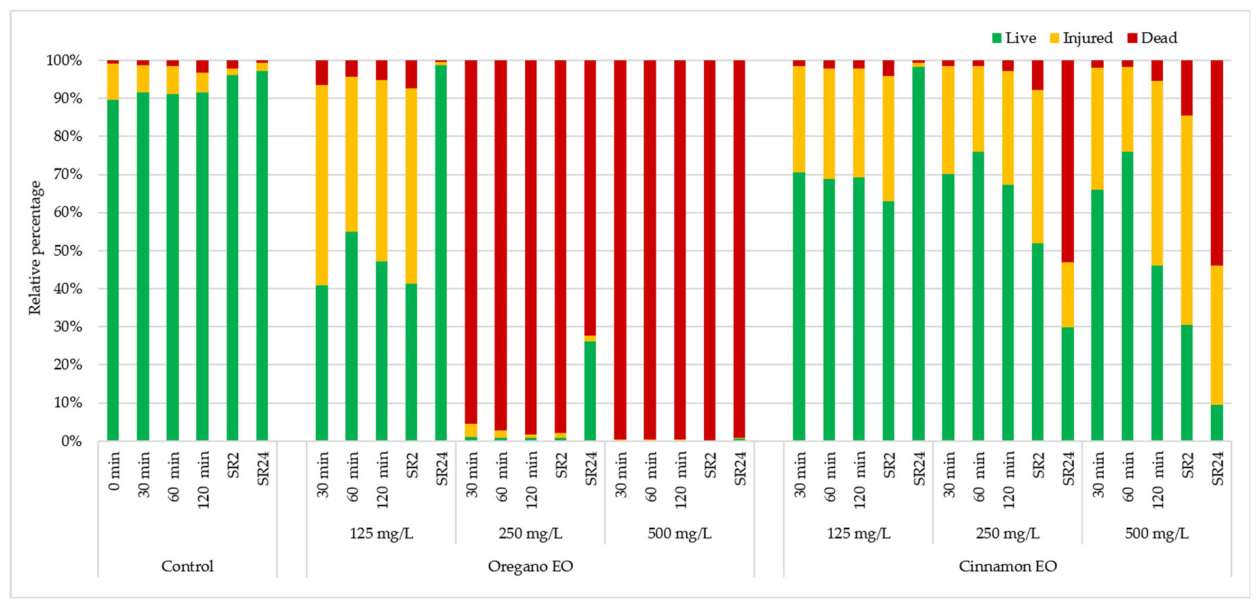
Comparative data between plate counts and FCM events for S. aureus after exposure to the different EOs are shown in Figure 3. As observed for L. monocytogenes, microbial populations determined by the two methods were comparable in all control samples, and no substantial differences were detected. In addition, cells were able to grow by approximately 1 log cycle in the medium used (PBS+ peptone 0.1% w/w) within 24 hours. Exposure to oregano EO at 125 mg/L resulted in an approximately 1 log CFU/mL reduction in culturability, regardless of treatment time. This discrepancy between plate counts and FCM data persisted after 2 h from stress removal. However, after 24 h, the number of total cells increased by about 1.5 log cycles, and culturability was restored, as indicated by the convergence of the two measurements. At the MIC value (250 mg/L), a marked reduction in culturability was observed, increasing with exposure time. Indeed, reductions exceeded 4 log cycle units already after 30 min, and reached approximately 5.5 log cycles after 120 min. After 2 h from stress removal, culturability remained below the detection limit, whereas after 24 h an almost complete restoration of colony-forming ability was observed. In contrast, exposure to oregano EO at twice the MIC (500 mg/L) produced a rapid antimicrobial effect. After 30 min, plate counts decreased to below 3 log CFU/mL, and no culturable cells were detected at later sampling times or after stress removal, indicating irreversible loss of culturability under these conditions.
The physiological state of S. aureus treated with oregano or cinnamon EOs was further evaluated by dual-staining FCM analysis to identify subpopulations corresponding to different cellular states (Figure 4). In the control samples (absence of EO), more than 90% of cells were live at all sampling times, whereas damaged or dead cells accounted for less than 10% of the population. When oregano EO was added at half MIC (125 mg/L), 40–60% of cells were injured or dead, while the remaining population was considered live. After 24 h from stress removal, the proportion of live cells increased to more than 98% of the total population, consistent with plate count results. Treatment with oregano EO at the MIC value (250 mg/L) resulted in more than 95% dead cells during the exposure phase. After stress removal, the proportion of live cells was constant after 2 h and then increased, reaching more than 26% of the total population after 24 h. Finally, at 500 mg/L, under all tested conditions (thus including also the monitoring after stress removal), almost all cells (>99% of the total population) resulted dead.
The data obtained for S. aureus following exposure to cinnamon EO differed from those observed for L. monocytogenes. Cell counts determined by FCM and plate counting (Figure 3) were comparable at EO concentrations up to 250 mg/L (MIC). After 2 h of exposure at the MIC, a slight reduction in culturability (<1 log unit) was observed, and this difference persisted also after stress removal. At 500 mg/L (MBC), plate counts were lower (less than 1 log cycle) and, after stress removal (2 or 24 h), a more pronounced decline in culturability (about 1.5 log cycle) was observed.
Concerning the effect of cinnamon EO on the physiological state of S. aureus (Figure 4), in samples treated with 125 mg/L, the proportion of live cells remained high (60–70%) across all exposure times and after 2 h from stress removal. Moreover, after 24 h, almost all cells (about 98%) showed restored viability. At the MIC (250 mg/L), the percentage of live cells was initially around 70%, with a very low proportion of dead cells (less than 3%). However, after EO stress removal, the proportion of live cells progressively decreased to approximately 30% after 24 h, accompanied by a marked increase in dead cells (about 53%). Similar trends were observed at 500 mg/L EO (MBC), even if live cells after 24h from stress removal accounted for about 10% of the total population, with a higher occurrence of injured cells. Overall, the ability of the species to restore cell functionality after stress removal decreased at EO concentrations of 250 mg/L or higher.

2.3. Effect of EOs Exposure on Membrane Depolarization

To better understand the action mechanism of the two EOs against the target pathogens, the modifications of cell membrane potential during exposure to EOs were monitored through DiBAC4 staining of treated cells. An increase in green fluorescence indicated cell depolarization, i.e., a reduction of the proton motive force (PMF) across the plasma membrane. Gramicidin A, an antimicrobial peptide known to induce dissipation of the electrochemical gradient across the cell membrane [30] was used as a positive control. The data are summarized in Table 1, together with information about membrane permeability (PI fluorescence) and percentage of dead cells (obtained with dual staining SYBR Green I and PI). Since membrane depolarization is a rapid and dynamic reaction that can precede harsher damages, concentrations up to MIC values (250 mg/L) were only tested, and cells were monitored for 120 min.
Concerning L. monocytogenes, DiBAC4 uptake was low and constant in control cells, while the presence of oregano EO induced an increase in fluorescence, thus a depolarization effect related to the EOs concentration. These reactions occurred in the first 30 minutes of exposure and then values remained almost stable during the following sampling times. As far as membrane permeability, a notable increase in PI uptake, occurring within the first 30 minutes of exposure, suggested concomitant membrane damage, even if the percentage of dead cells differed in relation to the amount of the EOs. The presence of cinnamon EO determined higher cell membrane depolarization, with values doubled with respect to oregano EO, while PI uptake was lower, suggesting that membrane integrity was less affected. Indeed, the mortality rate reached approximately 45% after 120 min of cinnamon EO exposure at 250 mg/L.
S. aureus was found to be more sensitive to membrane depolarization in the presence of oregano, with values almost doubled with respect to L. monocytogenes, independently of EO amount. Data on PI uptake showed that membrane integrity was strongly affected by 250 mg/L of oregano EO, with almost the entire population (>95%) recognized as dead. Cinnamon EO determined similar values of DiBAC4 uptake, but lower PI fluorescence, corresponding also to mortality rates less than 3%. Interestingly, for both EOs at half MIC values (125 mg/L), a decrease in DiBAC4 fluorescence, corresponding to a reduction in membrane depolarization, was observed throughout 120 min of exposure, suggesting an active response from S. aureus in counteracting EOs effects when present at sublethal concentrations.

3. Discussion

The two EOs investigated in this study exhibited distinct antimicrobial effects against the tested bacteria. Although both showed the same MIC (250 mg/L), the physiological responses of the cells differed. After 2 h of exposure to 250 mg/L EOs, cells treated with oregano EO showed greater damage, both in terms of culturability and physiological state, compared with those treated with cinnamon EO. At 500 mg/L, oregano EO exerted a rapid bactericidal effect against both species, while this condition was not completely verified with cinnamon EO after the same time.
Differences between species were also observed, with S. aureus showing greater resistance to EO-induced stress than L. monocytogenes. The discrepancies between live cells quantified by FCM dual staining (SYBR Green I and PI) and culturability (assessed by plate count) evidenced the possible occurrence of VBNC cells. FCM analysis indicates that these differences cannot always be explained simply by the presence of live or dead cells. The fate of injured cells remains difficult to predict, as shown by stress removal tests, and in particular the viability recovery observed after 24 h in L. monocytogenes previously exposed to 500 mg/L of cinnamon EO. Similar responses have been reported for L. monocytogenes subjected to mild thermal or terpene stresses [31]. Therefore, improved detection methods that account for VBNC cells are required to ensure adequate sensitivity in monitoring this pathogen [32]. The results also suggest that cinnamon EO requires longer exposure times to exert its antimicrobial and especially bactericidal effect. After 2 h of exposure, only a small proportion of cells exhibited severe damage at MIC (250 mg/L), whereas oregano EO caused marked reductions in both culturability and viability. Consistently, previous studies reported that more than 90% of L. monocytogenes cells showed membrane damage after 24 h exposure to carvacrol in buffer at pH 7 and 4 [23]. Moreover, carvacrol and other terpene molecules often exert a marked bactericidal effect at concentrations very close to the MIC, as indicated by the absence of colony formation and by the small difference generally observed between MIC and MBC values [21,24].
The antimicrobial activity of carvacrol, the principal component of oregano EO, is mainly associated with the presence of a free hydroxyl group and a phenolic ring enabling electron delocalization [21,22]. Due to its lipophilic nature (water solubility 0.11 g/L), carvacrol partitions into cell membranes, rather than penetrating the aqueous cytoplasmic environment, increasing membrane fluidity and permeability [5,33]. These alterations disrupt membrane-associated proteins, inhibit respiration, and impair ion transport [34]. In L. monocytogenes, an increase in the proportion of unsaturated fatty acids and a decrease of branched fatty acids were observed as a response to membrane fluidity perturbation [33]. Concerning S. aureus, the presence of carvacrol increased the ratio between unbranched and branched fatty acids [35]. In addition, the hydroxyl group acts as a proton exchanger, reducing the transmembrane gradient and collapsing the PMF [21,22].
Regarding cinnamon EO, previous studies have reported that trans-cinnamaldehyde exerts its antimicrobial activity mainly through intracellular targets [36,37]. Indeed, the main effects observed in S. aureus include potassium ion leakage, reduced metabolic activity, and impaired replication. Membrane integrity does not appear to be the primary target, since exposure of S. aureus to cinnamon EO at the MIC did not markedly affect membrane permeability [28], with no substantial PI uptake, as also observed in the present study. This behavior may be related to the physicochemical properties of trans-cinnamaldehyde, which, after partitioning into the bacterial membrane, may diffuse into the aqueous cytoplasmic environment more readily than highly hydrophobic EO components. Owing to the high reactivity of its aldehyde group and conjugated double bond [38], trans-cinnamaldehyde can interact with and inactivate enzymes or other essential cellular molecules [25,39]. This mechanism may also explain why only limited damage was observed after 2 h of exposure at the MIC, as indicated by both FCM-based viability assessment and plate-count culturability data.
In L. monocytogenes, the antimicrobial action of trans-cinnamaldehyde appears to involve multiple physiological targets. Some Authors reported that trans-cinnamaldehyde rapidly interferes with energy metabolism, causing a decrease in cellular ATP levels and suggesting dissipation of the PMF through membrane perturbation and leakage of small ions, without extensive leakage of larger intracellular constituents such as ATP [40]. More recently, trans-cinnamaldehyde was shown to interfere with UDP-N-acetylglucosamine biosynthesis, a key pathway for peptidoglycan precursor production, thereby impairing cell wall homeostasis in L. monocytogenes [41].
The results concerning membrane depolarization and permeabilization confirmed differences in the action mechanism of the two EOs, as well as in the response of the two target strains. While PI uptake is possible only in the presence of significant membrane damage, DiBAC4 uptake may occur even in less-damaged cells [42], and a strong disruption of membrane integrity can even hinder its binding to the cell target [43]. In addition, recent studies reported that changes in bacterial membrane potential should be interpreted as dynamic and stress-dependent responses rather than as univocal indicators of cell death. Depolarization generally reflects the dissipation of ion gradients and PMF, often associated with membrane malfunctioning or impaired energy metabolism. Bacterial membrane potential is increasingly recognized as a dynamic physiological parameter involved not only in energy conservation, but also in stress responses (e.g. antibiotic resistance), cellular adaptation, and electrochemical signaling [44]. By contrast, an irreversibly dead cell is not expected to maintain a functional membrane potential for long. If the cytoplasmic membrane remains structurally intact, transient charge separation or residual ion gradients may still be detectable, but these signals should be interpreted cautiously, as membrane potential-sensitive probes report a specific bioenergetic parameter rather than reproductive viability per se [45,46].
The findings of the present study are consistent with previous evidence indicating that, for several monoterpenoids and phenylpropanoids occurring in EOs, membrane depolarization can precede the increase in membrane permeability that reflects more severe loss of cell integrity. For example, some Authors showed that carvacrol at MIC induced a rapid depolarization of S. aureus cells within 5 min of exposure, while membrane permeabilization remained comparatively limited during the same period [47]. Conversely, and in contrast with the observations reported here, Bouhdid et al. [28] found no or only negligible changes in S. aureus membrane potential after 60 min of exposure to cinnamon EO at the MIC. Thus, depolarization and permeabilization can be not necessarily correlated, and depolarization does not necessarily coincide with cell damage. Indeed, damaged bacterial cells may, under some conditions, retain a measurable membrane potential; for example, Novo et al. [48] reported subpopulations with increased membrane permeability but normal membrane potential, highlighting that membrane integrity and membrane potential are not necessarily equivalent readouts.
In the present study, L. monocytogenes was less prone to staining with DiBAC4, showing lower fluorescence values than S. aureus. Although this could be explained with an ability to maintain membrane potential, the data on membrane permeability, especially for oregano EO, seem to indicate severe damage to membrane integrity, which can affect the ability of DiBAC4 to bind the cell. Indeed, previous studies obtained with the same strain in the presence of terpenoids had shown a decrease in DiBAC4 fluorescence in the harder stress conditions [49]. Conversely, S. aureus exhibited higher DiBAC4 uptake and, in general, lower PI fluorescence. This can be due to less severe damage induced by the two EOs, with the exception of oregano at MIC level (the only case in which high PI fluorescence and mortality rates were recorded). In addition, the decrease of DiBAC4 values during exposure at half MIC concentration of EOs suggested an active response of the cells in restoring the membrane potential.

4. Materials and Methods

4.1. Bacterial Strains and Growth Conditions

The strains used in this study were Listeria monocytogenes Scott A and Staphylococcus aureus DSM20231t belonging to the collection of the Department of Agricultural and Food Sciences (University of Bologna). The strains were maintained in BHI medium (Oxoid, Basingstoke, UK) with 30% (w/v) glycerol at −80 °C and, before the experiments, pre-cultivated twice (37 °C for 24 h) in BHI medium.

4.2. Essential Oils

Oregano (Origanum vulgare L.) EO obtained from flower parts and cinnamon (Cinnamomum verum) EO obtained from bark were purchased from Flora srl (Pisa, Italy) and were previously characterized for their composition and antimicrobial activity [24]. EOs were dissolved in absolute ethanol (Sigma-Aldrich, Milan, Italy) to prepare proper solutions, that were added to the different samples without exceeding 0.5% v/v as final concentration of ethanol, to avoid possible antimicrobial activity due to its presence.

4.3. Effect of Oregano and Cinnamon EOs on Listeria monocytogenes and Staphylococcus aureus

To assess the effect of sub-lethal or lethal concentrations of the two EOs, the target strains were inoculated in sodium phosphate buffer (PBS, pH 7.4, Dulbecco A Oxoid, Thermo Fisher Diagnostics, Milan, Italy), added with 0.1% (w/w) of bacteriological peptone (Oxoid, Thermo Fisher Diagnostics, Milan, Italy), at a cell load of approx. 8 log cell/ml in the presence of different concentrations EOs: 0 (control), 125 (half of MIC value), 250 (MIC value) and 500 (double of MIC value) mg/l. These amounts were chosen based on previous trials carried out to assess the antimicrobial activity of several commercial EOs [24]. Since EOs were dissolved in ethanol, a control without EOs was added with the same amounts of ethanol (0.5% v/v in the final medium). Samples were incubated at 37 ± 0.5 °C and collected after 30, 60 and 120 minutes to be analysed both by culture-dependent method (plate counting) and culture-independent (flow cytometry) methods. Then, to remove stress conditions due to EO exposure and to assess a potential recovery of treated cells, the samples were diluted 1:100 in PBS added with peptone 0.1% and re-incubated at 37°C, to be analysed after 2 (SR2) and 24 (SR24) hours. The analyses were performed in triplicate.

4.4. Plate Counting

To assess culturability, samples were collected at each sampling time, and appropriate decimal dilutions were plated onto BHI agar medium (Oxoid, Thermo Fisher Diagnostics, Milan, Italy). Plates were incubated at 37 °C for 48 h.

4.5. Flow Cytometry (FCM) Analysis

At each sampling time, cell suspensions derived from the different conditions were analysed through flow cytometry to assess viability, membrane permeabilization and membrane depolarization. A flow cytometer Accuri C6 (BD Biosciences, Milan, Italy) was used with the following threshold settings: FSC 3000 and SSC 1000, 30000 total events collected, medium flow rate. Before analyses, samples were diluted (if needed) in filtered PBS and the cells were stained in the dark at 37°C for 15 min with different fluorochrome, all purchased from Sigma-Aldrich (Milan, Italy): SYBR-Green I (1×) for the total cell count, SYBR-Green I (1×) and propidium iodide (PI) 7.5 μM in combination, to discriminate three sub-populations corresponding to live, injured, dead cells and to monitor membrane permeability, and Bis-(1,3-Dibutylbarbituric Acid) Trimethine Oxonol (DiBAC4) 3.0 μM to assess membrane depolarization [49]. The SYBR-Green I and DiBAC4 fluorescence intensities of stained cells were recovered in the FL1 channel (excitation 488 nm, emission filter 530/30 nm). The PI fluorescence (excitation 488 nm, emission filter 630/30 nm) intensity of stained cells was recovered in the FL3 channel. The data obtained were analysed using the BD ACCURITM C6 software version 1.0 (BD Biosciences, Milan, Italy).

5. Conclusions

The data presented in this study showed that the two tested EOs exert antimicrobial activity through different multitarget mechanisms. Oregano EO, mainly due to its high carvacrol content, acts rapidly by partitioning into the target cell membrane, affecting integrity and viability. By contrast, cinnamon EO, characterized by high trans-cinnamaldehyde content, induced lower cell damage within the exposure times considered.
FCM allowed investigation of the effects of these EOs on the physiological state of target pathogens by monitoring cell viability and changes in membrane potential and permeability. L. monocytogenes showed more severe damage, with increased membrane permeability and higher mortality, especially with oregano EO. Conversely, S. aureus showed greater resistance to the applied stresses: it was less affected in terms of membrane integrity, although membrane potential decreased to different extents depending on EO concentration and exposure time.
These findings suggest that simultaneous monitoring of multiple physiological traits by multiparameter FCM, combined with traditional plate counting, can better clarify the different mechanisms of action of antimicrobial agents. This information may help optimize the use of oregano and cinnamon EOs for food preservation depending on the desired antimicrobial mechanism and target microorganism, particularly considering risks associated with VBNC cells, which can affect food safety.

Author Contributions

Conceptualization, G.T. and F.G.; methodology, C.M.; formal analysis, F.B., M.F.; investigation, F.B. and C.M.; writing—original draft preparation, F.G. and C.M.; writing—review and editing, G.T., S.A and V.Š.; supervision, F.G.; funding acquisition, F.G. and V.Š. All authors have read and agreed to the published version of the manuscript.

Funding

This paper is supported by the PRIMA program under project InnoSol4Med (Project ID 1836). The PRIMA program is supported by the European Union. This project received funding from the Ministero dell'Università e della Ricerca – MU and Ministry of Science and Education (MSE).

Institutional Review Board Statement

Not applicable.

Data Availability Statement

The data presented in this study are available on request from the corresponding author.

Conflicts of Interest

The authors declare no conflicts of interest

References

  1. Reyes-Jurado, F.; Navarro-Cruz, A.R.; Ochoa-Velasco, C.E.; Palou, E.; López-Malo, A.; Ávila-Sosa, R. Essential Oils in Vapor Phase as Alternative Antimicrobials: A Review. Crit. Rev. Food Sci. Nutr. 2020, 60, 1641–1650. [Google Scholar] [CrossRef] [PubMed]
  2. Calo, J.R.; Crandall, P.G.; O’Bryan, C.A.; Ricke, S.C. Essential Oils as Antimicrobials in Food Systems–A Review. Food Control 2015, 54, 111–119. [Google Scholar] [CrossRef]
  3. da Silva, B.D.; Bernardes, P.C.; Pinheiro, P.F.; Fantuzzi, E.; Roberto, C.D. Chemical Composition, Extraction Sources and Action Mechanisms of Essential Oils: Natural Preservative and Limitations of Use in Meat Products. Meat Sci. 2021, 176, 108463. [Google Scholar] [CrossRef] [PubMed]
  4. Ribeiro-Santos, R.; Andrade, M.; de Melo, N.R.; Sanches-Silva, A. Use of Essential Oils in Active Food Packaging: Recent Advances and Future Trends. Trends Food Sci. Technol. 2017, 61, 132–140. [Google Scholar] [CrossRef]
  5. Lanciotti, R.; Gianotti, A.; Patrignani, F.; Belletti, N.; Guerzoni, M.E.; Gardini, F. Use of Natural Aroma Compounds to Improve Shelf-Life and Safety of Minimally Processed Fruits. Trends Food Sci. Technol. 2004, 15, 201–208. [Google Scholar] [CrossRef]
  6. Falleh, H.; Ben Jemaa, M.; Saada, M.; Ksouri, R. Essential Oils: A Promising Eco-Friendly Food Preservative. Food Chem. 2020, 330, 127268. [Google Scholar] [CrossRef] [PubMed]
  7. Hyldgaard, M.; Mygind, T.; Meyer, R.L. Essential Oils in Food Preservation: Mode of Action, Synergies, and Interactions with Food Matrix Components. Front. Microbiol. 2012, 3. [Google Scholar] [CrossRef] [PubMed]
  8. Trinh, N.-T.-T.; Dumas, E.; Thanh, M.L.; Degraeve, P.; Amara, C.B.; Gharsallaoui, A.; Oulahal, N. Effect of a Vietnamese Cinnamomum Cassia Essential Oil and Its Major Component Trans-Cinnamaldehyde on the Cell Viability, Membrane Integrity, Membrane Fluidity, and Proton Motive Force of Listeria Innocua. Can. J. Microbiol. 2015, 61, 263–271. [Google Scholar] [CrossRef] [PubMed]
  9. Vasconcelos, N.G.; Croda, J.; Simionatto, S. Antibacterial Mechanisms of Cinnamon and Its Constituents: A Review. Microb. Pathog. 2018, 120, 198–203. [Google Scholar] [CrossRef] [PubMed]
  10. Nabavi, S.F.; Di Lorenzo, A.; Izadi, M.; Sobarzo-Sánchez, E.; Daglia, M.; Nabavi, S.M. Antibacterial Effects of Cinnamon: From Farm to Food, Cosmetic and Pharmaceutical Industries. Nutrients 2015, 7, 7729–7748. [Google Scholar] [CrossRef] [PubMed]
  11. Jayaprakasha, G.K.; Rao, L.J.M. Chemistry, Biogenesis, and Biological Activities of Cinnamomum Zeylanicum. Crit. Rev. Food Sci. Nutr. 2011, 51(6), 547–62. [Google Scholar] [CrossRef] [PubMed]
  12. Lucas-González, R.; Yilmaz, B.; Mousavi Khaneghah, A.; Hano, C.; Shariati, M.A.; Bangar, S.P.; Goksen, G.; Dhama, K.; Lorenzo, J.M. Cinnamon: An Antimicrobial Ingredient for Active Packaging. Food Packag. Shelf Life 2023, 35, 101026. [Google Scholar] [CrossRef]
  13. Ribeiro-Santos, R.; Andrade, M.; de Melo, N.R.; Sanches-Silva, A. Use of Essential Oils in Active Food Packaging: Recent Advances and Future Trends. Trends Food Sci. Technol. 2017, 61, 132–140. [Google Scholar] [CrossRef]
  14. Rodriguez-Garcia, I.; Silva-Espinoza, B.A.; Ortega-Ramirez, L.A.; Leyva, J.M.; Siddiqui, M.W.; Cruz-Valenzuela, M.R.; Gonzalez-Aguilar, G.A.; Ayala-Zavala, J.F. Oregano Essential Oil as an Antimicrobial and Antioxidant Additive in Food Products. Crit. Rev. Food Sci. Nutr. 2016, 56, 1717–1727. [Google Scholar] [CrossRef] [PubMed]
  15. Leyva-López, N.; Gutiérrez-Grijalva, E.P.; Vazquez-Olivo, G.; Heredia, J.B. Essential Oils of Oregano: Biological Activity beyond Their Antimicrobial Properties. Molecules 2017, 22, 989. [Google Scholar] [CrossRef] [PubMed]
  16. Nurzyńska-Wierdak; Walasek-Janusz. Chemical Composition, Biological Activity, and Potential Uses of Oregano (Origanum Vulgare L.) and Oregano Essential Oil. Pharmaceuticals 2025, 18, 267. [Google Scholar] [CrossRef] [PubMed]
  17. Bonfanti, C.; Iannì, R.; Mazzaglia, A.; Lanza, C.M.; Napoli, E.M.; Ruberto, G. Emerging Cultivation of Oregano in Sicily: Sensory Evaluation of Plants and Chemical Composition of Essential Oils. Ind. Crops Prod. 2012, 35, 160–165. [Google Scholar] [CrossRef]
  18. De Mastro, G.; Tarraf, W.; Verdini, L.; Brunetti, G.; Ruta, C. Essential Oil Diversity of Origanum Vulgare L. Populations from Southern Italy. Food Chem. 2017, 235, 1–6. [Google Scholar] [CrossRef] [PubMed]
  19. Pesavento, G.; Calonico, C.; Bilia, A.R.; Barnabei, M.; Calesini, F.; Addona, R.; Mencarelli, L.; Carmagnini, L.; Di Martino, M.C.; Lo Nostro, A. Antibacterial Activity of Oregano, Rosmarinus and Thymus Essential Oils against Staphylococcus Aureus and Listeria Monocytogenes in Beef Meatballs. Food Control 2015, 54, 188–199. [Google Scholar] [CrossRef]
  20. Tibaldi, G.; Fontana, E.; Nicola, S. Growing Conditions and Postharvest Management Can Affect the Essential Oil of Origanum Vulgare L. Ssp. Hirtum (Link) Ietswaart. Ind. Crops Prod. 2011, 34, 1516–1522. [Google Scholar] [CrossRef]
  21. Ben Arfa, A.; Combes, S.; Preziosi-Belloy, L.; Gontard, N.; Chalier, P. Antimicrobial Activity of Carvacrol Related to Its Chemical Structure. Lett. Appl. Microbiol. 2006, 43, 149–154. [Google Scholar] [CrossRef] [PubMed]
  22. Ultee, A.; Bennik, M. H. J.; Moezelaar, R. The Phenolic Hydroxyl Group of Carvacrol Is Essential for Action against the Food-Borne Pathogen Bacillus Cereus. Appl. Environ. Microbiol. 2002, 68, 1561–1568. [Google Scholar] [CrossRef] [PubMed]
  23. Ait-Ouazzou, A.; Cherrat, L.; Espina, L.; Lorán, S.; Rota, C.; Pagán, R. The Antimicrobial Activity of Hydrophobic Essential Oil Constituents Acting Alone or in Combined Processes of Food Preservation. Innov. Food Sci. Emerg. Technol. 2011, 12, 320–329. [Google Scholar] [CrossRef]
  24. Barbieri, F.; Tabanelli, G.; Braschi, G.; Bassi, D.; Morandi, S.; Šimat, V.; Čagalj, M.; Gardini, F.; Montanari, C. Mediterranean Plants and Spices as a Source of Bioactive Essential Oils for Food Applications: Chemical Characterisation and In Vitro Activity. Int. J. Mol. Sci. 2025, 26, 3875. [Google Scholar] [CrossRef] [PubMed]
  25. Gill, A.O.; Holley, R.A. Disruption of Escherichia Coli, Listeria Monocytogenes and Lactobacillus Sakei Cellular Membranes by Plant Oil Aromatics. Int. J. Food Microbiol. 2006, 108, 1–9. [Google Scholar] [CrossRef] [PubMed]
  26. Mith, H.; Duré, R.; Delcenserie, V.; Zhiri, A.; Daube, G.; Clinquart, A. Antimicrobial Activities of Commercial Essential Oils and Their Components against Food-Borne Pathogens and Food Spoilage Bacteria. Food Sci. Nutr. 2014, 2, 403–416. [Google Scholar] [CrossRef] [PubMed]
  27. Nostro, A.; Papalia, T. Antimicrobial Activity of Carvacrol: Current Progress and Future Prospectives. Recent Pat. Anti-Infect. Drug Disc. 2012, 7, 28–35. [Google Scholar] [CrossRef] [PubMed]
  28. Bouhdid, S.; Abrini, J.; Amensour, M.; Zhiri, A.; Espuny, M.J.; Manresa, A. Functional and Ultrastructural Changes in Pseudomonas Aeruginosa and Staphylococcus Aureus Cells Induced by Cinnamomum Verum Essential Oil. J. Appl. Microbiol. 2010, 109, 1139–1149. [Google Scholar] [CrossRef] [PubMed]
  29. Ghabraie, M.; Vu, K.D.; Tata, L.; Salmieri, S.; Lacroix, M. Antimicrobial Effect of Essential Oils in Combinations against Five Bacteria and Their Effect on Sensorial Quality of Ground Meat. LWT-Food Sci. Technol. 2016, 66, 332–339. [Google Scholar] [CrossRef]
  30. Mattio, L.M.; Dallavalle, S.; Musso, L.; Filardi, R.; Franzetti, L.; Pellegrino, L.; D’Incecco, P.; Mora, D.; Pinto, A.; Arioli, S. Antimicrobial Activity of Resveratrol-Derived Monomers and Dimers against Foodborne Pathogens. Sci. Rep. 2019, 9, 19525. [Google Scholar] [CrossRef] [PubMed]
  31. Montanari, C.; Tabanelli, G.; Barbieri, F.; Mora, D.; Duncan, R.; Gardini, F.; Arioli, S. Listeria Monocytogenes Sensitivity to Antimicrobial Treatments Depends on Cell Origin. Sci. Rep. 2021, 11, 21263. [Google Scholar] [CrossRef] [PubMed]
  32. Donnelly, C.; Diez-Gonzalez, F.; Labbé, R.I.; Garcìa, S. Guide to Foodborne Pathogens. In List. Monocytogenes, 2nd Ed; Labbé RG Garcìa, Ed.; 2001; pp. 45–74. [Google Scholar]
  33. Siroli, L.; Patrignani, F.; Gardini, F.; Lanciotti, R. Effects of Sub-Lethal Concentrations of Thyme and Oregano Essential Oils, Carvacrol, Thymol, Citral and Trans-2-Hexenal on Membrane Fatty Acid Composition and Volatile Molecule Profile of Listeria Monocytogenes, Escherichia Coli and Salmonella Enteritidis. Food Chem. 2015, 182, 185–192. [Google Scholar] [CrossRef] [PubMed]
  34. Cristani, M.; D'Arrigo, M.; Mandalari, G.; Castelli, F.; Sarpietro, M.G.; Micieli, D.; Venuti, V.; Bisignano, G.; Saija, A.; Trombetta, D. Interaction of four monoterpenes contained in essential oils with model membranes: implications for their antibacterial activity. J. Agric. Food Chem. 2007, 55, 6300–6308. [Google Scholar] [CrossRef] [PubMed]
  35. Wang, L.-H.; Wang, M.-S.; Zeng, X.-A.; Zhang, Z.-H.; Gong, D.-M.; Huang, Y.-B. Membrane Destruction and DNA Binding of Staphylococcus Aureus Cells Induced by Carvacrol and Its Combined Effect with a Pulsed Electric Field. J. Agric. Food Chem. 2016, 64, 6355–6363. [Google Scholar] [CrossRef] [PubMed]
  36. Clemente, I.; Aznar, M.; Silva, F.; Nerín, C. Antimicrobial Properties and Mode of Action of Mustard and Cinnamon Essential Oils and Their Combination against Foodborne Bacteria. Innov. Food Sci. Emerg. Technol. 2016, 36, 26–33. [Google Scholar] [CrossRef]
  37. Pang, D.; Huang, Z.; Li, Q.; Wang, E.; Liao, S.; Li, E.; Zou, Y.; Wang, W. Antibacterial Mechanism of Cinnamaldehyde: Modulation of Biosynthesis of Phosphatidylethanolamine and Phosphatidylglycerol in Staphylococcus Aureus and Escherichia Coli. J. Agric. Food Chem. 2021, 69(45), 13628–13636. [Google Scholar] [CrossRef] [PubMed]
  38. Friedman, M. Chemistry, Antimicrobial Mechanisms, and Antibiotic Activities of Cinnamaldehyde against Pathogenic Bacteria in Animal Feeds and Human Foods. J. Agric. Food Chem. 2017, 65(48), 10406–10423. [Google Scholar] [CrossRef] [PubMed]
  39. Mousavi, F.; Bojko, B.; Bessonneau, V.; Pawliszyn, J. Cinnamaldehyde Characterization as an Antibacterial Agent toward E. Coli Metabolic Profile Using 96-Blade Solid-Phase Microextraction Coupled to Liquid Chromatography–Mass Spectrometry. J. Proteome Res. 2016, 15(3), 963–975. [Google Scholar] [CrossRef] [PubMed]
  40. Gill, A.O.; Holley, R.A. Mechanisms of Bactericidal Action of Cinnamaldehyde against Listeria Monocytogenes and of Eugenol against L. Monocytogenes and Lactobacillus Sakei. Appl. Environ. Microbiol. 2004, 70, 5750–5755. [Google Scholar] [CrossRef] [PubMed]
  41. Sun, L.; Rogiers, G.; Michiels, C.W. The Natural Antimicrobial Trans-Cinnamaldehyde Interferes with UDP-N-Acetylglucosamine Biosynthesis and Cell Wall Homeostasis in Listeria Monocytogenes. Foods 2021, 10, 1666. [Google Scholar] [CrossRef] [PubMed]
  42. Guyot, S.; Gervais, P.; Young, M.; Winckler, P.; Dumont, J.; Davey, H.M. Surviving the Heat: Heterogeneity of Response in Saccharomyces Cerevisiae Provides Insight into Thermal Damage to the Membrane. Environ. Microbiol. 2015, 17, 2982–2992. [Google Scholar] [CrossRef] [PubMed]
  43. Kramer, B.; Thielmann, J. Monitoring the Live to Dead Transition of Bacteria during Thermal Stress by a Multi-Method Approach. J. Microbiol. Methods 2016, 123, 24–30. [Google Scholar] [CrossRef] [PubMed]
  44. Benarroch, J.M.; Asally, M. The Microbiologist’s Guide to Membrane Potential Dynamics. Trends Microbiol. 2020, 28, 304–314. [Google Scholar] [CrossRef] [PubMed]
  45. Berney, M.; Hammes, F.; Bosshard, F.; Weilenmann, H.-U.; Egli, T. Assessment and Interpretation of Bacterial Viability by Using the LIVE/DEAD BacLight Kit in Combination with Flow Cytometry. Appl. Environ. Microbiol. 2007, 73(10), 3283–3290. [Google Scholar] [CrossRef] [PubMed]
  46. Krasnopeeva, E.; Lo, C.J.; Pilizota, T. Single-Cell Bacterial Electrophysiology Reveals Mechanisms of Stress-Induced Damage. Biophys. J. 2019, 116(12), 2390–2399. [Google Scholar] [CrossRef] [PubMed]
  47. Hammer, K.A.; Heel, K.A. Use of Multiparameter Flow Cytometry to Determine the Effects of Monoterpenoids and Phenylpropanoids on Membrane Polarity and Permeability in Staphylococci and Enterococci. Int. J. Antimicrob. Agents 2012, 40, 239–245. [Google Scholar] [CrossRef] [PubMed]
  48. Novo, D.J.; Perlmutter, N.G.; Hunt, R.H.; Shapiro, H.M. Multiparameter Flow Cytometric Analysis of Antibiotic Effects on Membrane Potential, Membrane Permeability, and Bacterial Counts of Staphylococcus Aureus and Micrococcus Luteus. Antimicrob. Agents Chemother. 2000, 44, 827–834. [Google Scholar] [CrossRef] [PubMed]
  49. Arioli, S.; Montanari, C.; Magnani, M.; Tabanelli, G.; Patrignani, F.; Lanciotti, R.; Mora, D.; Gardini, F. Modelling of Listeria Monocytogenes Scott A after a Mild Heat Treatment in the Presence of Thymol and Carvacrol: Effects on Culturability and Viability. J. Food Eng. 2019, 240, 73–82. [Google Scholar] [CrossRef]
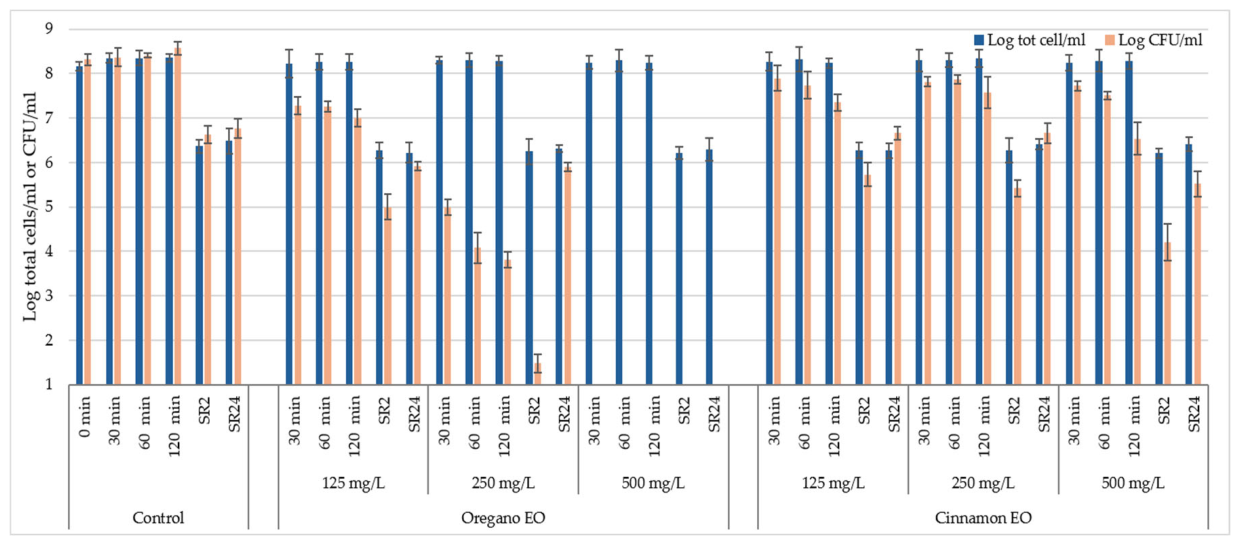
Figure 1. Comparison between the data of cell culturability (expressed as log CFU/ml) and the total cells detected by FCM analysis (log tot cells/ml) of L. monocytogenes Scott A during exposure (30, 60 and 120 min) to oregano or cinnamon EOs and after 2 (SR2) and 24 (SR24) hours from stress removal.
Preprints 221147 g001
Figure 2. Distribution of live, injured and dead cells of L. monocytogenes Scott A during exposure (30, 60 and 120 min) to oregano or cinnamon EOs and after 2 (SR2) and 24 (SR24) hours from stress removal. The data are reported as the relative frequency of the total population obtained by FCM analysis with dual staining (SYBR-Green I and PI).
Preprints 221147 g002
Figure 3. Comparison between the data of cell culturability (expressed as log CFU/ml) and the total cells detected by FCM analysis (log total cells/ml) of S. aureus DSM 20231t during exposure (30, 60 and 120 min) to oregano or cinnamon EOs and after 2 (SR2) and 24 (SR24) hours from stress removal.
Preprints 221147 g003
Figure 4. Distribution of live, injured and dead cells of S. aureus DSM 20231t during exposure (30, 60 and 120 min) to oregano or cinnamon EOs and after 2 (SR2) and 24 (SR24) hours from stress removal. The data are reported as the relative frequency of the total population obtained by FCM analysis with dual staining (SYBR-Green I and PI).
Preprints 221147 g004
Table 1. FCM analysis of L. monocytogenes Scott A and S. aureus DSM 20231t during exposure to oregano or cinnamon EOs. DiBAC4 fluorescence and PI fluorescence values are reported as arbitrary units (AU), while the percentage of dead cells was obtained with dual staining (SYBR-Green I and PI). Data are the means of three replicates (standard deviation are reported in brackets).
Condition Time L. monocytogenes S. aureus
DiBAC4 fluorescence PI fluorescence % dead cells DiBAC4 fluorescence PI fluorescence % dead cells
Control 0 min 2798 (± 140) 6763 (± 318) 1.24 (± 0.06) 11515 (± 553) 14304 (± 730) 0.82 (± 0.02)
30 min 2038 (± 122) 6780 (± 353) 2.32 (± 0.10) 9652 (± 396) 16428 (± 789) 1.22 (± 0.04)
60 min 1549 (± 60) 6527 (± 255) 3.12 (± 0.12) 9012 (± 424) 11317 (± 475) 1.42 (± 0.06)
120 min 1478 (± 61) 6489 (± 370) 2.56 (± 0.14) 3468 (± 173) 13459 (± 713) 3.33 (± 0.15)
Oregano EO 125 mg/L 0 min 6176 (± 303) 35467 (± 2483) 65.05 (± 3.77) 32979 (± 2078) 35412 (± 2160) 6.49 (± 0.15)
30 min 6558 (± 308) 35350 (±2192) 59.96 (± 2.22) 20013 (± 861) 25404 (± 1067) 4.28 (± 0.10)
60 min 7063 (± 431) 23880 (± 1242) 62.31 (± 2.55) 13387 (± 669) 27432 (± 1399) 5.14 (± 0.14)
250 mg/L 0 min 11649 (± 559) 38557 (± 2121) 96.64 (± 2.90) 27847 (± 1420) 69728 (± 3905) 95.45 (± 2.96)
30 min 9616 (± 529) 36337 (± 1526) 97.72 (± 1.95) 27811 (± 1530) 63742 (± 2677) 97.22 (± 2.92)
60 min 10763 (± 495) 30831 (± 1696) 97.61 (± 2.73) 22410 (± 1143) 51302 (± 2770) 98.32 (± 2.75)
Cinnamon EO 125 mg/L 0 min 21903 (± 1314) 28902 (± 1474) 32.00 (± 0.77) 36692 (± 1908) 25208 (± 1336) 1.42 (± 0.07)
30 min 22255 (± 1424) 22619 (± 1040) 42.07 (± 1.68) 20801 (± 1061) 24277 (± 1068) 2.15 (± 0.09)
60 min 20882 (± 1169) 24542 (± 1473) 47.62 (± 2.29) 8471 (± 390) 24710 (± 1384) 2.10 (± 0.07)
250 mg/L 0 min 16089 (± 949) 29681 (± 1247) 39.49 (± 1.86) 30210 (± 1722) 23777 (± 1308) 1.58 (± 0.05)
30 min 19217 (± 999) 23594 (± 1203) 48.22 (± 2.46) 31801 (± 1749) 18670 (± 915) 1.47 (± 0.04)
60 min 16733 (± 887) 36003 (± 1728) 45.44 (± 1.77) 28232 (± 1637) 19418 (± 990) 2.72 (± 0.07)
Disclaimer/Publisher’s Note: The statements, opinions and data contained in all publications are solely those of the individual author(s) and contributor(s) and not of MDPI and/or the editor(s). MDPI and/or the editor(s) disclaim responsibility for any injury to people or property resulting from any ideas, methods, instructions or products referred to in the content.
Copyright: This open access article is published under a Creative Commons CC BY 4.0 license, which permit the free download, distribution, and reuse, provided that the author and preprint are cited in any reuse.
Prerpints.org logo

Preprints.org is a free preprint server supported by MDPI in Basel, Switzerland.

Subscribe

© 2026 MDPI (Basel, Switzerland) unless otherwise stated

Accessibility

Disclaimer

Terms of Use

Privacy Policy

Privacy Settings