

Submitted:
01 July 2026
Posted:
02 July 2026
You are already at the latest version
Abstract
Energy consumption in polymer extrusion is a critical determinant of process efficiency and environmental performance, particularly in mechanical recycling applications. However, most extrusion-energy studies rely on steady-state or averaged energy values without experimentally resolving the relative contributions of startup and runtime-dependent operation. This simplification introduces uncertainty in specific energy consumption (SEC), especially in laboratory-scale extrusion where short runs are commonly used for material development and process assessment. In the present work, startup and steady-state energy consumption were experimentally quantified during lab-scale co-rotating twin-screw extrusion of virgin and waste polyolefins, namely high-density polyethylene (HDPE) and polypropylene (PP). Energy demand was evaluated under controlled processing conditions across 1, 3, 8, and 24 h runtime scenarios and linked with throughput, processing temperature, and melt flow index (MFI)-based rheological behavior. The measured MFI values showed clear differences in material flowability, with virgin PP exhibiting the highest MFI of 8.50 g 10 min⁻¹ and waste HDPE the lowest MFI of 0.37 g 10 min⁻¹. Total energy consumption increased with runtime from 13.9–14.1 kWh at 1 h to 197.9–221.1 kWh at 24 h, whereas SEC decreased from 0.869–1.282 to 0.515–0.838 kWh kg⁻¹ because the fixed startup energy contribution was distributed over a larger processed mass. Despite lower processing temperatures, HDPE required higher average running power than PP, indicating the dominant influence of melt viscosity and flow resistance on mechanical energy demand. Gate-to-gate greenhouse gas emissions from extrusion electricity use ranged from 0.267 to 0.665 kg CO₂-eq kg⁻¹ and followed the same trend as SEC. The results demonstrate that runtime, throughput, and material rheology are the primary determinants of extrusion energy efficiency and electricity-related climate impact, while startup energy governs short-duration performance. This study provides an experimentally resolved framework for interpreting laboratory extrusion energy data and supports process optimization and future life-cycle assessment of polyolefin reprocessing.
Keywords:
mechanical recycling
; plastic waste
; specific energy consumption
; extrusion
; greenhouse gas emissions
; polyolefin
1. Introduction
Polyethylene (PE) and polypropylene (PP) are among the most widely used commodity polyolefin thermoplastics because of their low cost, chemical resistance, ease of processing, and broad applicability in packaging, consumer products, pipes, films, and engineering components [1,2]. Their large production volumes, however, also make them major contributors to post-consumer plastic waste [3,4]. Mechanical recycling remains one of the most practical routes for recovering these polyolefins, particularly when the recycled material can be reprocessed through established melt-processing technologies [5,6,7]. Among these technologies, extrusion is central because it is used for melting, homogenization, compounding, pelletization, and preparation of recycled polymer feedstocks for subsequent manufacturing [8].
Twin-screw extrusion is especially important in polymer recycling because it provides efficient mixing, controlled residence time, and flexibility in processing heterogeneous feedstocks. Co-rotating twin-screw extruders are widely used at both laboratory and industrial scales to evaluate processability, develop recycled formulations, optimize operating conditions, and simulate continuous processing before scale-up [9,10,11]. In laboratory-scale studies, however, extrusion is often performed in short experimental runs. Under these conditions, the energy required for heating the extruder from ambient temperature to the processing temperature may represent a substantial fraction of the total energy consumed. This fixed startup energy is often distributed over a relatively small amount of processed polymer, which can lead to an overestimation of specific energy consumption when short runs are used to represent continuous operation [12,13].
Energy consumption during extrusion arises from both thermal and mechanical contributions [12,14,15]. Thermal energy is required to heat the barrel, screws, die, and polymer to the selected processing temperature, whereas mechanical energy is consumed by screw rotation, conveying, melting, mixing, and overcoming flow resistance. The balance between these contributions depends on machine design, operating temperature, screw speed, throughput, die resistance, and polymer rheology [10,12,13,14]. Specific energy consumption (SEC), commonly expressed in kWh kg⁻¹, is therefore strongly influenced by the relationship between total energy input and the mass of polymer processed. Increasing runtime and throughput can reduce SEC by distributing fixed energy contributions over a larger output, but this effect depends strongly on the flow behavior of the processed material [12,14,15,16].
Material rheology is a key factor controlling extrusion energy demand. Melt flow index (MFI), which is inversely related to melt viscosity, provides a practical indicator of polymer processability [17,18,19]. Materials with low MFI generally exhibit higher melt viscosity, greater resistance to screw conveying and die flow, and consequently higher mechanical energy demand [12,14,15]. This issue is particularly relevant for recycled polymers because post-consumer materials may contain contaminants, additives, oxidized fractions, degraded chains, crosslinked structures, or mixed polymer residues [5,6,7,20,21]. These factors can alter molecular weight distribution, reduce flow stability, and decrease throughput compared with virgin polymers [18,19,20,21,22]. Therefore, energy consumption during extrusion cannot be evaluated only from processing temperature or machine power; it must also be interpreted in relation to polymer type, material origin, rheological behavior, and runtime.
Previous studies on extrusion energy have demonstrated the importance of process parameters, screw configuration, throughput, melt temperature, and material properties in determining energy efficiency [12,14,15,23,24]. However, these studies primarily report energy demand under continuous or steady operating conditions, or as averaged SEC values, rather than explicitly separating fixed startup energy from runtime-dependent extrusion energy. This difference is particularly important for laboratory-scale extrusion, where short experimental runs are commonly used for material development, process comparison, and scale-up assessment [9,10,11], and where energy data may subsequently be used in recycling and life-cycle assessment studies [22]. If startup energy is not separated from steady-state extrusion energy, SEC values obtained from short-duration experiments may not accurately represent longer or continuous operation. This can distort comparisons between virgin and waste polymers and may lead to misleading conclusions regarding the energy efficiency and environmental performance of mechanical recycling.
The present study experimentally quantifies the startup and runtime contributions to energy consumption during lab-scale co-rotating twin-screw extrusion of virgin and waste HDPE and PP. The work links measured energy demand with runtime, throughput, processing temperature, and MFI-based flow behavior to explain differences in SEC among virgin and waste polyolefins. In addition, gate-to-gate greenhouse gas emissions, expressed as kg CO₂-eq, are estimated from extrusion electricity use to assess the climate implications of runtime-dependent energy consumption. By separating fixed startup energy from steady-state processing energy, this study provides a more realistic framework for interpreting laboratory extrusion energy data and for supporting process optimization, recycling assessment, and future life-cycle studies of polyolefin reprocessing.
2. Materials and Methods
2.1. Virgin and Waste Polymers
Virgin and waste polyolefins were selected to evaluate the effect of material origin on extrusion energy consumption and processing behavior. Virgin high-density polyethylene (HDPE) and virgin polypropylene (PP) were used as reference materials because of their consistent feedstock quality. Both virgin polymers were received in pellet form and processed as received without further modification.
Waste HDPE and waste PP were obtained from post-consumer plastic streams. Before extrusion, the waste polymers were washed to remove surface contamination, dried to reduce residual moisture, and shredded into particles suitable for feeding into the twin-screw extruder. These preprocessing steps were performed to improve feeding stability and minimize process disturbances during extrusion.
Unlike virgin polymers, post-consumer polyolefins may exhibit greater variability in composition, particle morphology, thermal history, and contamination level. These differences can affect melt flow behavior, feeding stability, throughput, and the energy required during extrusion.
2.2. Melt Flow Index and Material Characteristics
The melt flow index (MFI) of each polymer was experimentally determined according to ASTM D1238 and used as an indicator of melt flow behavior [25]. MFI is defined as the mass of polymer extruded through a standard die under specified temperature and load conditions within 10 min. The measurements were performed in triplicate, and the results are reported as mean ± standard deviation.
The measured MFI values of the virgin and waste polyolefins are presented in Table 1. These values were used to support the interpretation of extrusion behavior, particularly the relationship between material flowability, throughput, and energy demand. Since MFI is inversely related to melt viscosity, lower MFI values indicate greater resistance to flow during extrusion. Therefore, differences in MFI among the virgin and waste polymers were considered when analyzing specific energy consumption and mechanical energy demand.
2.1.3. Additional Material Properties
In addition to MFI, material density, moisture content, and particle size were considered as supporting parameters for interpreting extrusion behavior. The virgin HDPE and PP were supplied in pellet form and were assumed to have consistent feed characteristics. In contrast, the waste HDPE and waste PP were shredded before extrusion, and their particle morphology and possible residual moisture were considered important for feeding stability and process consistency.
Material density values for HDPE and PP were taken from standard literature ranges where direct measurements were not available. These values were used only to support the qualitative interpretation of material behavior and were not used as primary variables in the energy calculations. The energy analysis was primarily based on experimentally measured MFI, throughput, runtime, and electrical energy consumption.
2.2. Extruder Description
2.2.1. Machine Specifications
All extrusion experiments were performed using a Brabender Lab-Compounder KETSE 20/40 D co-rotating twin-screw extruder. The extruder was used as a laboratory-scale system for processing virgin and waste polyolefins under controlled operating conditions.
The extruder was equipped with screws of 20 mm diameter and a length-to-diameter ratio (L/D) of 40. The system was driven by an 11 kW motor and included four independently controlled heating zones along the barrel. The maximum operating temperature of the extruder was 400 °C, although the present experiments were conducted at lower temperature ranges suitable for HDPE and PP processing.
The nominal output capacity of the extruder was 0.5–20 kg h⁻¹, allowing the throughput to be adjusted according to material characteristics and processing conditions.
2.2.2. Processing Conditions
During extrusion, each polymer was fed into the heated barrel, melted, mixed, conveyed by the co-rotating screws, and discharged through the die. Barrel heating supplied the thermal energy required for melting and temperature control, while screw rotation provided the mechanical energy required for conveying, melting, mixing, and overcoming flow resistance.
The processing temperature ranges were selected according to the melting and processing characteristics of the polymers. HDPE was processed at 180–220 °C, while PP was processed at 210–250 °C. These temperature ranges were below the maximum operating temperature of the extruder and were selected to provide stable melt flow while avoiding unnecessary thermal loading.
The extrusion throughput was maintained at 14 kg h⁻¹ for virgin HDPE, 11 kg h⁻¹ for waste HDPE, 16 kg h⁻¹ for virgin PP, and 13 kg h⁻¹ for waste PP. The average running power used for the energy analysis was 9 kW for HDPE and 8 kW for PP, based on the recorded operating behavior under the selected processing conditions.
2.3. Experimental Design
Experiments were conducted under controlled operating conditions to evaluate the influence of runtime on total energy consumption and specific energy consumption. Extrusion runs were performed for 1, 3, 8, and 24 h to represent short-duration and extended operating scenarios.
Each experiment was initiated from a cold-start condition. The extruder was heated from ambient temperature to the selected processing temperature, and the energy consumed during this ramp-up phase was recorded separately from the steady-state extrusion phase. This separation allowed the fixed startup contribution to be distinguished from runtime-dependent energy consumption.
The throughput was monitored during extrusion, and the total mass of processed polymer was recorded for each runtime condition to calculate specific energy consumption. The operating conditions used for the virgin and waste polyolefins are summarized in Table 2. Representative average running power values were used for the energy analysis: 9 kW for HDPE and 8 kW for PP. These values were based on the recorded operating behavior of the extruder under the selected processing conditions. Although minor variations in power draw may occur between virgin and waste materials because of differences in melt flow behavior, the adopted average values enabled consistent comparison of the effects of throughput, runtime, and material characteristics on specific energy consumption.
2.4. Energy Measurement and Segmentation
2.4.1. Measurement Approach
The total electrical energy consumption of the extrusion system was measured using an energy monitoring system connected to the extruder. The recorded energy included the combined electricity demand of the barrel heaters, motor drive, and auxiliary components.
Energy consumption was monitored continuously throughout each experiment, allowing the main operational phases to be distinguished: ramp-up, steady-state extrusion, and post-operation auxiliary consumption. For the energy calculations, representative average running power values of 9 kW for HDPE and 8 kW for PP were used, based on the recorded operating behavior of the extruder under the selected temperature, throughput, and screw-speed conditions. These values represent average process loads during steady-state operation and may vary slightly with material heterogeneity, die resistance, and flow fluctuations, particularly for waste polymers.
The ramp-up energy was determined as 4.8 kWh for HDPE and 5.5 kWh for PP. The post-operation auxiliary energy was 0.3 kWh for HDPE and 0.4 kWh for PP. Therefore, the fixed energy contribution per extrusion cycle was 5.1 kWh for HDPE and 5.9 kWh for PP.
2.4.2. Energy Segmentation
To quantify the contribution of each operational phase, the total electrical energy consumption was divided into fixed and runtime-dependent components. The fixed component included ramp-up energy and post-operation auxiliary energy, whereas the runtime-dependent component corresponded to steady-state extrusion energy.
Ramp-up energy refers to the electricity consumed to heat the extruder from ambient temperature to the selected processing temperature. Steady-state extrusion energy refers to the electricity consumed during continuous polymer feeding, melting, conveying, mixing, and discharge through the die. Post-operation auxiliary energy accounts for the electricity consumed after extrusion, including shutdown-related auxiliary operation where applicable.
This segmentation allowed the effect of startup energy on total energy consumption and specific energy consumption to be evaluated as a function of runtime.
2.5. Theoretical Framework and Calculations
2.5.1. Total Energy Consumption
The total electrical energy consumption of the extrusion process was calculated by summing the energy consumed during ramp-up, steady-state extrusion, idle or holding operation, and post-operation auxiliary operation:
where is the total energy consumption (kWh), is the ramp-up energy required to heat the extruder to the selected processing temperature (kWh), is the energy consumed during steady-state extrusion (kWh), is the energy consumed during idle or holding operation where applicable (kWh), and is the post-operation auxiliary energy (kWh).
For the present experiments, idle energy was not treated as a separate contribution. Therefore, the total energy consumption was expressed as:
where is the fixed energy contribution per extrusion cycle, is the average running power during steady-state extrusion, and is the extrusion runtime. Based on the measured ramp-up and post-operation auxiliary energies, the following material-specific relationships were used:
where energy is expressed in kWh and time is expressed in hours.
2.5.2. Energy-Time Relation
The energy consumed during a given operational stage was calculated from the corresponding average power and duration:
where is energy consumption (kWh), is power (kW), and is time (h).
2.5.3. Specific Energy Consumption
Specific energy consumption (SEC) was calculated by normalizing the total energy consumption by the mass of polymer processed:
where is the specific energy consumption (kWh kg⁻¹), is the total energy consumption (kWh), and is the mass of processed polymer (kg).
2.5.4. Throughput Relation
The mass of processed polymer was calculated from the extrusion throughput and runtime:
where is the mass of processed polymer (kg), is the extrusion throughput (kg h⁻¹), and is the processing time (h).
Substituting Eq. (7) into Eq. (6) gives:
This relationship shows that SEC decreases when the fixed energy contribution is distributed over longer runtimes and higher throughput.
2.5.5. Emission Estimation
Greenhouse gas emissions associated with electricity consumption during extrusion were estimated using:
where represents greenhouse gas emissions (kg CO₂-eq), is the total electrical energy consumption (kWh), and is the electricity emission factor (kg CO₂-eq kWh⁻¹).
In this study, the emission factor was selected to represent electricity generated from natural gas using the ecoinvent database. This approach is consistent with gate-to-gate life-cycle inventory calculations, where direct process electricity consumption is converted into associated greenhouse gas emissions.
2.6. Mechanical Property Evaluation
The mechanical properties of the extruded materials were evaluated to assess whether material origin and extrusion processing affected polymer performance. After extrusion, the collected materials were processed into standard test specimens for tensile testing.
Tensile properties were measured in accordance with ASTM D638 or ISO 527. Tensile strength and Young’s modulus were determined and used to compare the mechanical performance of virgin and waste HDPE and PP after extrusion. These properties were selected to evaluate whether differences in extrusion energy demand were associated with changes in material stiffness and strength.
2.7. Data Analysis Approach
The collected data were analyzed in terms of total energy consumption, specific energy consumption, throughput, and runtime. Total energy consumption was separated into fixed startup-related energy and runtime-dependent steady-state extrusion energy. Specific energy consumption was calculated by normalizing total energy consumption to the mass of polymer processed.
Comparative analysis was performed across polymer type and material origin, including virgin HDPE, waste HDPE, virgin PP, and waste PP. The influence of runtime was evaluated using 1, 3, 8, and 24 h operating scenarios. Differences in SEC were interpreted in relation to measured MFI, throughput, average running power, and fixed startup energy. Where supporting material properties were not directly measured, literature-based values were used only for qualitative interpretation and were not treated as primary variables in the energy calculations.
3. Results and Discussion
3.1. Material Characteristics and Expected Flow Behavior
The processing behavior of thermoplastic polymers during extrusion is strongly governed by their melt flow characteristics, which are directly related to viscosity and molecular structure [17,18]. In this study, the melt flow index (MFI) was used as a primary indicator of material flowability for both virgin and waste polyethylene (HDPE) and polypropylene (PP).
The experimentally measured MFI values reveal clear distinctions between the four materials. Virgin PP exhibited the highest MFI (8.4967 g/10 min), followed by waste PP (2.0443 g/10 min), virgin HDPE (0.7475 g/10 min), and waste HDPE (0.3653 g/10 min). The relatively low standard deviations observed for all materials indicate good repeatability and consistency in the measurements. The MFI values show that PP has approximately 10–12 times higher flowability than HDPE, while waste materials show a 40–70% reduction in MFI compared to virgin polymers.
These results confirm that PP, particularly in its virgin form, exhibits significantly higher flowability than HDPE. This behavior is consistent with established polyolefin rheology, where PP exhibits lower melt viscosity under comparable conditions [20,21]. The inverse relationship between melt flow index (MFI) and viscosity is well established in polymer rheology—the science of deformation and flow—indicating that materials with higher MFI values require lower shear stress to achieve flow [19].
The comparison between virgin and waste materials provides additional insight. Waste HDPE shows a lower MFI than virgin HDPE, suggesting increased resistance to flow, which may be attributed to factors such as contamination, oxidation, crosslinking, or the presence of higher molecular weight fractions. This implies that higher mechanical energy may be required during extrusion to overcome increased melt resistance. Similarly, waste PP exhibits a substantial reduction in MFI compared to virgin PP, indicating altered flow behavior likely due to degradation, intertangling of chains, or the presence of impurities.
These differences directly influence extrusion performance. Materials with lower MFI (higher viscosity) typically require higher torque and greater mechanical energy input to maintain flow through the screw and die system. This can lead to increased motor load and potentially higher total energy consumption, even if thermal energy demand remains similar. Conversely, materials with higher MFI flow more easily, reducing mechanical resistance and potentially lowering energy consumption during steady-state operation.
In addition to energy considerations, melt flow behavior also affects throughput and process stability. High-viscosity materials may exhibit reduced throughput under the same operating conditions due to increased resistance to flow, while low-viscosity materials may allow higher output rates. This directly impacts the specific energy consumption (kWh/kg), as lower throughput at similar power levels results in higher energy per unit mass.
The observed variations in MFI among virgin and waste PE and PP provide a strong basis for interpreting subsequent differences in energy consumption, throughput, and material performance. These material characteristics are therefore critical for understanding the interaction between polymer properties and extrusion process efficiency.
3.2. Ramp-Up Energy and Thermal Behavior
The ramp-up phase corresponds to heating the extruder from ambient to operating temperature [26,27]. Although no material is processed, significant energy is consumed.
In the present study, all extrusion experiments were initiated from a cold start condition, with the system heated from approximately 25 °C to the target processing temperatures of 180–220 °C for HDPE and 210–250 °C for PP. The time required to reach the set temperature and the corresponding energy consumption were recorded as part of the energy monitoring protocol. The fixed energy contribution per run for HDPE was calculated to be 5.1 kWh i.e., 4.8 kWh for ramp up energy and 0.3 kWh for shutdown energy, and the fixed energy contribution per run for PP was calculated to be 5.9 kWh, i.e., 5.5 kWh for ramp up energy and 0.4 kWh for shutdown energy.
The energy required during ramp-up can be conceptually described by the heat balance:
where Q represents the total heat input, m is the effective mass of the heated components (barrel, screws, and die), Cp is the specific heat capacity, and ΔT is the temperature rise. The term Qloss accounts for heat losses to the surrounding environment through convection and radiation. As the target temperature increases, both ΔT and heat losses increase, resulting in higher energy demand.
Since the experiments were conducted at temperatures significantly lower than the maximum capacity of the extruder (400 °C), the ramp-up energy requirement is inherently reduced. However, the heating phase still represents a non-negligible fraction of total energy consumption, particularly in short-duration runs where production time is limited.
The results indicate that the ramp-up energy remains relatively constant for a given target temperature, regardless of the material being processed, as it primarily depends on the thermal mass of the system rather than the polymer itself. However, slight variations may occur due to differences in set temperatures between HDPE and PP, with PP generally requiring higher processing temperatures and therefore slightly higher ramp-up energy.
An important observation from the experimental data is that the contribution of ramp-up energy to total energy consumption decreases significantly with increasing runtime. For short runs (e.g., 1 hour), the ramp-up phase can account for a substantial proportion of total energy, leading to higher specific energy consumption (kWh/kg). In contrast, for longer runs (e.g., 8 or 24 hours), the ramp-up energy is distributed over a larger quantity of processed material, resulting in improved energy efficiency.
This behavior highlights the importance of continuous operation for energy efficiency. Frequent shutdown and restart cycles can significantly increase overall energy consumption, particularly in laboratory-scale studies where batch durations are often short. From an operational perspective, minimizing the number of cold starts and maintaining steady-state processing can lead to substantial energy savings.
In addition to ramp-up, the thermal behavior during steady-state operation is also influenced by heat losses from the barrel. Heat loss is proportional to the temperature difference between the barrel surface and the ambient environment:
As a result, operating at higher temperatures increases the rate of heat loss, requiring additional energy input from the heaters to maintain thermal stability. This further reinforces the importance of selecting an optimal processing temperature that balances sufficient polymer melting with minimized thermal losses.
The ramp-up phase represents a fixed energy cost associated with each extrusion cycle. Its relative importance decreases with increasing runtime but remains a key factor in determining the overall energy efficiency of the process. These findings provide a foundation for understanding the influence of operating duration on total and specific energy consumption, which is discussed in the following section.
3.3. Effect of Runtime on Energy Consumption
Runtime strongly governs both total and specific energy consumption [9,10,11]. The effect is illustrated in Figure 1, where total energy increases linearly with processing time for both HDPE and PP. This trend reflects the constant power demand during steady-state extrusion, as described by the relationship between energy and time. Although total energy increases with runtime, this does not directly translate to reduced efficiency, as the total processed mass increases proportionally.
In contrast, SEC decreases sharply with increasing runtime (Figure 2). A sharp decrease in SEC is observed as runtime increases from 1 to 24 h. For all materials, the highest SEC values occur at 1 h, while the lowest values are achieved at 24 h. For example, virgin PP decreases from 0.869 to 0.515 kWh/kg, while waste HDPE decreases from 1.282 to 0.838 kWh/kg. This behavior indicates that energy efficiency improves significantly with extended operation.
This behavior is driven by startup energy, which acts as a fixed energy input per cycle. Its relative contribution to total energy consumption is shown in Figure 3, where the startup energy percentage decreases rapidly with increasing runtime. At short durations (1 h), startup energy accounts for approximately 35–40% of the total energy consumption, whereas at longer runtimes (24 h), its contribution falls below 3%.
The startup contribution shown in Figure 3 is derived by combining experimentally measured total energy values (Table 3) with the fixed startup energy quantified in the methodology (5.1 kWh for HDPE and 5.9 kWh for PP). The percentage contribution of startup energy was calculated as the ratio of ramp-up energy to total energy consumption for each runtime condition.
The total energy consumption for each run can be expressed as:
where Eramp represents the energy consumed during the heating phase, Prun is the average power during steady-state extrusion, and t is the runtime.
Substituting into the definition of specific energy consumption:
This relationship clearly shows that the contribution of ramp-up energy to specific energy consumption decreases inversely with runtime. As t increases, the term becomes smaller, and the specific energy approaches a steady-state value governed primarily by the ratio .
Startup energy behaves as a fixed energy cost, whose relative impact decreases with runtime. Consequently, the high SEC observed at short runtimes (Figure 2) is primarily governed by the dominance of startup energy (Figure 3), whereas at longer runtimes, the process approaches steady-state conditions where energy efficiency is controlled mainly by material properties and throughput.
3.4. Effect of Temperature on Energy and Throughput
Processing temperature directly influences both thermal and mechanical energy demand. In this study, HDPE was processed within the range of 180–220 °C, while PP was processed between 210–250 °C. These temperatures are significantly lower than the maximum capability of the extruder (400 °C), and their selection plays an important role in determining overall energy consumption.
PE was assigned a higher average running power (9 kW) than PP (8 kW) despite its lower processing temperature, because the lower MFI of HDPE indicates higher melt viscosity and therefore higher mechanical resistance during extrusion. PP required a slightly higher fixed heating energy (5.5 kWh) than PE (4.8 kWh) due to its higher processing temperature window, but its lower running power and higher throughput reduced the final specific energy consumption.
Thus, for PE, lower thermal demand is offset by higher mechanical energy requirements, whereas for PP, slightly higher thermal demand is compensated by lower mechanical resistance.
From a thermal perspective, increasing the processing temperature results in higher energy demand during both the ramp-up and steady-state phases. The energy required to heat the system is proportional to the temperature rise, as described by:
where ΔT represents the difference between the processing temperature and ambient conditions. In addition, heat losses from the barrel increase with temperature. As a result, higher operating temperatures lead to increased heater duty cycles and greater thermal energy consumption.
However, temperature also has a strong influence on the rheological behavior of polymers. As temperature increases, melt viscosity decreases, leading to improved flowability. This reduces the resistance encountered by the rotating screws, thereby lowering the mechanical energy required for conveying and mixing. The temperature dependence of viscosity is commonly described by an Arrhenius-type relationship:
where η is the melt viscosity, Ea is the activation energy for flow, R is the gas constant, and T is the absolute temperature. This relationship indicates that even moderate increases in temperature can significantly reduce viscosity.
These competing effects create a trade-off between thermal and mechanical energy. At lower temperatures, reduced heating demand is offset by increased viscosity, which raises the torque requirement and motor energy consumption. Conversely, at higher temperatures, improved flow reduces mechanical energy but increases thermal energy input and heat losses.
For HDPE, which inherently exhibits higher viscosity than PP, the influence of temperature on flow behavior is particularly pronounced. Increasing the temperature within the processing range can significantly improve melt flow and throughput, potentially reducing specific energy consumption despite higher thermal input. In contrast, PP generally exhibits lower viscosity and higher MFI, and therefore the reduction in mechanical energy with increasing temperature may be less significant compared to HDPE.
Throughput is also strongly affected by temperature. At higher temperatures, improved melt flow facilitates easier conveying through the screw and die, leading to higher output rates. Since specific energy consumption is inversely related to throughput, an increase in throughput can lead to a reduction in energy per unit mass, even if total power consumption increases slightly.
The experimental results are expected to reflect the existence of an optimal processing temperature range, where the combined thermal and mechanical energy requirements are minimized. Operating below this optimal range may lead to unstable flow, reduced throughput, and higher specific energy consumption, while operating above it may result in excessive heating losses without significant gains in process efficiency.
In addition to energy considerations, temperature must also be selected carefully to avoid thermal degradation, particularly for waste polymers. Excessively high temperatures can lead to chain scission, oxidation, and deterioration of mechanical properties, which may offset any gains in process efficiency.
3.5. Virgin Vs Waste Polymer Comparison
A key objective of this study was to quantify differences between virgin and waste polymers. The experimental MFI results presented earlier provide a strong basis for understanding these differences, particularly in terms of melt flow behavior and viscosity.
The measured MFI values show a clear reduction in flowability for waste materials compared to their virgin counterparts. For HDPE, the MFI decreases from 0.7475 g/10 min (virgin) to 0.3653 g/10 min (waste), indicating a significant increase in melt viscosity. A similar trend is observed for PP, where the MFI decreases from 8.4967 g/10 min (virgin) to 2.0443 g/10 min (waste). These reductions suggest that waste polymers exhibit higher resistance to flow during processing.
For both HDPE and PP, the waste materials showed higher specific energy consumption than the virgin materials because of lower throughput. Under the adopted calculation conditions, waste HDPE showed the highest specific energy, ranging from 1.282 kWh/kg at 1 h to 0.838 kWh/kg at 24 h, while waste PP ranged from 1.069 to 0.634 kWh/kg. In comparison, virgin HDPE ranged from 1.007 to 0.658 kWh/kg, and virgin PP ranged from 0.869 to 0.515 kWh/kg.
This behavior arises from degradation, contamination, and structural changes in waste polymers. Waste polymers often undergo thermal and mechanical stresses during their service life, which can lead to structural changes such as chain scission, oxidation, and the formation of crosslinked structures. In some cases, contamination with other materials or additives may also alter rheological behavior. These changes affect the molecular weight distribution and, consequently, the melt viscosity of the material.
The increase in viscosity observed for waste materials has direct implications for energy consumption during extrusion. Higher viscosity requires greater shear stress to maintain flow, which increases the torque demand on the screws. As a result, the mechanical energy component of the extrusion process is expected to be higher for waste polymers compared to virgin materials under similar operating conditions.
In addition to increased mechanical energy, higher viscosity may also influence throughput. Under fixed operating conditions, waste materials with lower MFI may exhibit reduced flow rates, leading to lower output (kg/h). Since specific energy consumption is inversely proportional to throughput, a decrease in output can further increase the energy required per unit mass of processed material.
Process stability is another important factor affected by material type. Virgin polymers typically exhibit consistent and predictable flow behavior, resulting in stable extrusion conditions. In contrast, waste polymers may show fluctuations in flow due to heterogeneity in composition, particle size, and contamination levels. This can lead to variations in pressure, torque, and output, potentially affecting both energy consumption and product quality.
Despite these challenges, waste polymers remain highly relevant for sustainable processing and recycling applications. Understanding their behavior in extrusion processes is essential for optimizing operating conditions and minimizing energy consumption. The results of this study provide valuable insights into how material origin influences both process efficiency and energy demand.
3.6. Pe Vs Pp Comparison
In addition to the comparison between virgin and waste materials, it is important to evaluate the differences in extrusion behavior between polyethylene (HDPE) and polypropylene (PP). These two polymers, although both classified as polyolefins, exhibit distinct rheological and thermal characteristics that influence their processability and energy consumption during extrusion.
The experimentally measured melt flow index values clearly indicate that PP exhibits significantly higher flowability compared to HDPE. Virgin PP shows an MFI of 8.4967 g/10 min, while virgin HDPE has a much lower value of 0.7475 g/10 min. A similar trend is observed for waste materials, where waste PP (2.0443 g/10 min) still maintains higher flowability than waste HDPE (0.3653 g/10 min). These differences confirm that, under comparable conditions, PP has a lower melt viscosity than HDPE.
At every runtime, PP exhibited lower specific energy consumption than HDPE. For example, at 1 h, virgin PP showed SEC of 0.869 kWh/kg and virgin HDPE showed SEC of 1.007 kWh/kg, and at 24 h, virgin PP showed SEC of 0.515 kWh/kg and virgin HDPE showed SEC of 0.658 kWh/kg.
Similarly for waste materials, at 1 h, waste PP showed SEC of 1.069 kWh/kg, and waste HDPE showed SEC of 1.282 kWh/kg, at 24 h, waste PP showed SEC of 0.634 kWh/kg, and waste HDPE showed SEC of 0.838 kWh/kg.
This distinction in viscosity plays a central role in determining the mechanical energy required during extrusion. Materials with higher viscosity, such as HDPE, require greater shear forces to achieve flow through the screw and die system. This results in higher torque demand and increased motor energy consumption. In contrast, PP, with its lower viscosity, flows more easily and therefore requires less mechanical energy to maintain steady extrusion.
Temperature requirements further differentiate the two polymers. HDPE can typically be processed at lower temperatures (180–220 °C), while PP requires higher temperatures (210–250 °C) to achieve sufficient melt flow. This implies that, although PP may require lower mechanical energy due to its lower viscosity, it may simultaneously require higher thermal energy input to reach and maintain its processing temperature.
The combined effect of these factors results in a balance between thermal and mechanical energy contributions. For HDPE, lower processing temperatures reduce heating energy demand; however, higher viscosity increases mechanical energy consumption. For PP, the opposite trend is observed, where higher processing temperatures increase thermal energy demand, but lower viscosity reduces mechanical resistance.
Throughput is also influenced by these material differences. Under similar operating conditions, PP is expected to achieve higher throughput due to its superior flowability. Since specific energy consumption is inversely proportional to throughput, higher output rates for PP can lead to lower energy consumption per unit mass, even if total power consumption is comparable or slightly higher.
In the case of waste materials, the differences between PE and PP remain consistent, although the gap in flowability may be reduced due to the overall decrease in MFI. Waste HDPE, with the lowest MFI among all materials, is expected to present the highest resistance to flow, potentially resulting in higher energy consumption and lower throughput. Waste PP, while still more flowable than HDPE, exhibits a noticeable reduction in MFI compared to virgin PP, which may increase its energy demand relative to the virgin material. These findings highlight the importance of considering both thermal and rheological properties when evaluating energy consumption in extrusion processes. The balance between these factors ultimately determines the efficiency of processing different polymers under given operating conditions.
3.7. Specific Energy Consumption Analysis
Specific energy consumption (SEC) is a key metric for evaluating extrusion efficiency, as it directly relates the total electrical energy input to the amount of polymer processed. In this study, SEC was calculated by normalizing total energy consumption to the processed mass. Since the processed mass depends on throughput and runtime, SEC can be expressed as:
where represents the fixed energy contribution per extrusion cycle, is the throughput, is the runtime, and is the average running power during steady-state extrusion. This formulation shows that SEC is governed by two components: a fixed startup-related contribution and a runtime-independent steady-state contribution. As runtime increases, the fixed contribution becomes progressively smaller, and SEC approaches a steady-state value governed mainly by the ratio of running power to throughput.
Consistent with the trends shown in Figure 2, SEC decreases with increasing runtime due to the diminishing influence of startup energy. For short-duration runs, such as 1 hour, the ramp-up energy constitutes a significant fraction of the total energy consumption. Since the amount of material processed during this period is relatively low, the SEC values are correspondingly high. As runtime increases to 3, 8, and 24 hours, the influence of ramp-up energy diminishes, and SEC decreases progressively, approaching a steady-state value determined primarily by the ratio of power consumption to throughput.
A comparison across materials reveals distinct trends. Virgin PP consistently exhibits the lowest SEC among the studied materials, which can be attributed to its high MFI and low melt viscosity. These properties facilitate easier flow through the extruder, reducing mechanical energy requirements and enabling higher throughput. In contrast, waste HDPE shows the highest SEC, primarily due to its low MFI and high viscosity, which increase resistance to flow and reduce output rates.
Virgin HDPE occupies an intermediate position, with moderate SEC values reflecting a balance between lower processing temperature and higher viscosity. Waste PP, while more flowable than HDPE, exhibits higher SEC than its virgin counterpart due to reduced MFI and altered rheological behavior. These observations confirm that both polymer type and material condition (virgin versus waste) play significant roles in determining energy efficiency. Overall, SEC increased in the order virgin PP, virgin HDPE, waste PP, and waste HDPE, indicating that waste HDPE was the most energy-intensive material to process.
Throughput plays a dominant role in determining SEC, as it is inversely proportional to the mass flow rate. Consequently, any reduction in throughput—whether due to increased viscosity or process instability—results in higher energy consumption per unit mass. This effect is particularly pronounced for waste materials, where variability in composition can lead to inconsistent flow behavior and reduced output.
Temperature also indirectly affects SEC through its influence on both power consumption and throughput. Higher temperatures reduce viscosity and can improve throughput, potentially lowering SEC. However, this benefit may be offset by increased thermal energy input and heat losses. As a result, the lowest SEC values are expected to occur within an optimal temperature range rather than at the highest or lowest operating temperatures.
The combined effects of runtime, material properties, and temperature highlight the complex interplay between thermal and mechanical energy in extrusion processes. The results suggest that achieving low SEC requires not only appropriate material selection but also careful optimization of operating conditions, particularly runtime and temperature.
3.8. Emissions Associated with Electricity Use
Extrusion-related emissions are directly linked to electricity consumption. Since the extrusion system operates entirely on electricity, the associated greenhouse gas (GHG) emissions can be directly estimated based on the total energy consumed and the emission factor of the electricity source.
In this study, GHG emissions were calculated using:
where (GHG) represents the emissions in kg CO₂-equivalent, Etotal is the total electrical energy consumption (kWh), and EF is the emission factor of electricity (kg CO₂-eq/kWh). The emission factor depends on the regional electricity mix and is commonly applied in Life Cycle Assessment studies to convert energy use into environmental impact.
Greenhouse gas emissions were estimated using an emission factor of 0.144 kg CO₂-eq per MJ, corresponding to electricity generation from natural gas, which is equivalent to 0.5184 kg CO₂-eq per kWh. Based on this factor, total emissions increased with runtime, ranging from 7.21–7.31 kg CO₂-eq for 1-hour runs to 102.58–114.57 kg CO₂-eq for 24-hour continuous operation.
When normalized per unit mass, emissions varied from 0.267 kg CO₂-eq/kg for virgin PP at 24 hours to 0.665 kg CO₂-eq/kg for waste HDPE at 1 hour. This trend closely follows the variation in specific energy consumption, indicating that materials with higher viscosity and lower throughput result in greater emissions per unit mass.
A clear distinction between best- and worst-case scenarios is observed. For PP, emissions range from 0.267 to 0.451 kg CO₂-eq/kg, corresponding to a variation of approximately 1.68 times. Similarly, for HDPE, emissions vary from 0.341 to 0.522 kg CO₂-eq/kg, representing a 1.53-fold increase. These differences highlight the strong influence of material flow properties and operating duration on environmental performance. The emissions per unit mass of polymer are summarized in Table 4.
Since emissions scale linearly with energy consumption, the trends observed in GHG emissions closely follow those of total and specific energy consumption. Short-duration runs, which exhibit higher specific energy consumption due to the dominance of ramp-up energy, also result in higher emissions per unit mass of processed material. Conversely, longer continuous runs distribute the fixed startup energy over a larger output, leading to lower emissions per kilogram.
Material type also influences emissions through its effect on energy demand. Waste polymers, particularly waste HDPE with its low MFI and high viscosity, are expected to exhibit higher emissions per kilogram due to increased mechanical energy requirements and potentially lower throughput. In contrast, virgin PP, which demonstrates higher flowability and improved process efficiency, is expected to result in lower emissions per unit mass.
Temperature effects on emissions reflect the balance between thermal and mechanical energy contributions. Higher processing temperatures increase thermal energy demand and heat losses, leading to higher emissions. However, improved melt flow at elevated temperatures may enhance throughput and reduce mechanical energy requirements, partially offsetting the increase in thermal energy. As a result, emissions per unit mass are expected to exhibit a minimum within an optimal temperature range.
These results demonstrate that process efficiency directly translates into environmental performance. Any operational strategy that reduces energy consumption, such as increasing runtime, improving material flow, or optimizing temperature, will also reduce GHG emissions. This highlights the importance of integrating energy analysis with environmental considerations in polymer processing.
It is important to note that the emission estimates presented in this study are based solely on electricity consumption during extrusion and do not include upstream or downstream processes such as raw material production, transportation, or preprocessing. Therefore, the results represent a gate-to-gate assessment of the extrusion stage. A more comprehensive environmental evaluation will be addressed in subsequent life cycle assessment studies.
3.9. Mechanical Properties Vs Energy Input
In addition to energy consumption, the quality of the extruded material is a critical factor in evaluating the overall efficiency of the extrusion process. Mechanical properties such as tensile strength and Young’s modulus provide insight into the structural integrity of the processed polymers and their suitability for subsequent applications.
To further evaluate the practical implications of the observed energy consumption trends, mechanical properties of the extruded materials were analyzed. This enables a combined assessment of process energy efficiency and material performance, which is critical for determining the feasibility of recycling-based extrusion processes.
The mechanical performance of the extrudates is influenced by both material characteristics and processing conditions, particularly temperature and shear history. During extrusion, the polymer undergoes thermal and mechanical stresses that can alter its molecular structure. While appropriate processing conditions facilitate uniform melting and homogenization, excessive temperature or prolonged residence time may lead to degradation, resulting in a deterioration of mechanical properties.
The mechanical properties of the extruded polymers were evaluated to assess the influence of material origin and processing conditions on performance. The measured tensile strength and Young’s modulus values are presented in Table 5.
Virgin PP exhibited the highest tensile strength (32.864 MPa) and Young’s modulus (1401.11 MPa), followed by waste PP (28.334 MPa, 1043.21 MPa), virgin HDPE (26.651 MPa, 921.23 MPa), and waste HDPE (22.341 MPa, 801.22 MPa). The results indicate that waste materials show a reduction in both tensile strength and stiffness compared to their virgin counterparts.
For HDPE, tensile strength decreased by approximately 16.2%, while Young’s modulus decreased by approximately 13.0% when comparing waste to virgin material. Similarly, for PP, tensile strength decreased by approximately 13.8%, and Young’s modulus decreased by approximately 25.5%. This reduction can be attributed to degradation mechanisms such as chain scission, oxidation, and contamination during the previous lifecycle of the waste polymers.
These changes in mechanical properties are consistent with the observed reduction in melt flow index for waste materials, indicating altered molecular structure and flow behavior. Lower MFI values correspond to higher viscosity and potential changes in molecular weight distribution, which can negatively affect chain entanglement and mechanical performance.
Despite the reduction in mechanical properties, the waste polymers retained a significant portion of their structural integrity, indicating their suitability for reuse in applications where slightly reduced performance is acceptable. This is an important finding, as it demonstrates that increased energy consumption during processing of waste polymers does not necessarily result in unacceptable material performance.
When correlated with energy consumption, it is observed that materials requiring higher specific energy, such as waste HDPE, also exhibit lower mechanical properties. This highlights a trade-off between process energy demand and material quality. However, the differences are not prohibitive, suggesting that optimized processing conditions can balance energy efficiency with acceptable performance.
Processing temperature plays a dual role in determining mechanical performance. At lower temperatures, incomplete melting or insufficient mixing may result in defects, poor interfacial bonding, and reduced mechanical strength. At higher temperatures, improved melt flow enhances homogenization, which can improve mechanical properties. However, excessively high temperatures may cause thermal degradation, leading to chain scission and a reduction in molecular weight, ultimately compromising material strength.
4. Conclusion
This study provides a quantitative evaluation of energy consumption during lab-scale twin-screw extrusion of virgin and waste HDPE and PP. Total energy consumption increased with runtime, ranging from approximately 13.9–14.1 kWh for 1 h runs to 197.9–221.1 kWh for 24 h runs, depending on the polymer processed. In contrast, specific energy consumption (SEC) decreased markedly with increasing runtime, from 0.869–1.282 kWh kg⁻¹ at 1 h to 0.515–0.838 kWh kg⁻¹ at 24 h. This reduction was primarily due to the decreasing influence of fixed startup energy, which was quantified as 5.1 kWh for HDPE and 5.9 kWh for PP per run.
Material rheology was a key factor governing extrusion energy efficiency. Based on the measured melt flow index values, virgin PP exhibited the highest flowability (8.50 g 10 min⁻¹) and achieved the lowest SEC (0.515 kWh kg⁻¹), whereas waste HDPE showed the lowest flowability (0.37 g 10 min⁻¹) and the highest energy demand (1.282 kWh kg⁻¹). Despite operating at lower processing temperatures, HDPE required a higher average running power than PP (9 kW vs. 8 kW), reflecting its higher melt viscosity and greater resistance to flow. Waste polymers consistently showed higher SEC than their virgin counterparts because of reduced throughput and altered rheological behavior.
Gate-to-gate greenhouse gas emissions from extrusion electricity use, calculated using an emission factor of 0.144 kg CO₂-eq MJ⁻¹, ranged from 0.267 kg CO₂-eq kg⁻¹ for virgin PP at 24 h to 0.665 kg CO₂-eq kg⁻¹ for waste HDPE at 1 h, following trends similar to SEC. These results confirm that runtime, throughput, and melt flow properties control both energy consumption and electricity-related climate burden during extrusion. Mechanical property evaluation showed that waste polymers retained a substantial fraction of tensile strength and stiffness, indicating practical usability despite higher processing energy demand.
Overall, continuous operation, higher throughput, and favorable rheological properties substantially improve extrusion energy efficiency. The findings provide an experimentally resolved basis for interpreting laboratory-scale extrusion energy data, optimizing polyolefin reprocessing, and supporting future life-cycle assessment of mechanical recycling systems.
Author Contributions
Junaid Saleem: conceptualization, investigation, formal analysis, supervision, writing—review & editing, Writing – original draft. Zubair Khalid Baig Moghal: conceptualization, investigation, formal analysis, writing—review & editing, Writing – original draft. Gordon McKay: investigation, formal analysis
Data Availability Statement
The original contributions presented in the study are included in the article; further inquiries can be directed to the corresponding authors.
Declaration of generative AI and AI-assisted technologies in the manuscript preparation
During the preparation of this manuscript, the authors used AI-assisted language-editing tools solely to improve grammar, readability, coherence, and language clarity. The authors reviewed, edited, and verified all AI-assisted content as necessary and take full responsibility for the accuracy, integrity, and content of the published work.
Conflicts of interest
There are no conflicts to declare.
References
- J. Saleem, Z.K.B. Moghal, L. Sun, G. McKay, Valorization of mixed plastics waste for the synthesis of flexible superhydrophobic films, Adv. Compos. Hybrid Mater. 7 (2024) 11. [CrossRef]
- J. Saleem, M.Z. Khalid Baig, U. Bin Shahid, R. Luque, G. McKay, Mixed plastics waste valorization to high-added value products via thermally induced phase separation and spin-casting, Green Energy Environ. (2023). [CrossRef]
- Global market volume of polyethylene 2015-2030 by Statista Research Department, Jul 11, 2023, https://www.statista.com/statistics/1245162/polyethylene-market-volume-worldwide/, (n.d.).
- Global polypropylene market volume 2015-2030 by Statista Research Department, Jul 11, 2023, https://www.statista.com/statistics/1245169/polypropylene-market-volume-worldwide/, (n.d.).
- K. Ragaert, L. Delva, K. Van Geem, Mechanical and chemical recycling of solid plastic waste, Waste Manag. 69 (2017) 24–58. [CrossRef]
- P. Kulkarni, V. Ravekar, P. Rama Rao, S. Waigokar, S. Hingankar, Recycling of waste HDPE and PP plastic in preparation of plastic brick and its mechanical properties, Clean. Mater. 5 (2022) 100113. [CrossRef]
- Z.O.G. Schyns, M.P. Shaver, Mechanical Recycling of Packaging Plastics: A Review, Macromol. Rapid Commun. 42 (2021). [CrossRef]
- N. Singh, D. Hui, R. Singh, I.P.S.P.S. Ahuja, L. Feo, F. Fraternali, Recycling of plastic solid waste: A state of art review and future applications, Compos. Part B Eng. 115 (2017) 409–422. [CrossRef]
- M. Hyvärinen, R. Jabeen, T. Kärki, The Modelling of Extrusion Processes for Polymers—A Review, Polymers (Basel). 12 (2020) 1306. [CrossRef]
- A. Gaspar-Cunha, J.A. Covas, J. Sikora, Optimization of Polymer Processing: A Review (Part I—Extrusion), Materials (Basel). 15 (2022) 384. [CrossRef]
- A. Nastaj, K. Wilczyński, Optimization and Scale-Up for Polymer Extrusion, Polymers (Basel). 13 (2021) 1547. [CrossRef]
- C. Abeykoon, A. McMillan, B.K. Nguyen, Energy efficiency in extrusion-related polymer processing: A review of state of the art and potential efficiency improvements, Renew. Sustain. Energy Rev. 147 (2021) 111219. [CrossRef]
- N. Baghel, A.S. Sikarwar, A. Kumar, Quality improvement and productivity enhancement of a single screw HDPE pipe extrusion machine: A case study, Mater. Today Proc. 57 (2022) 2106–2110. [CrossRef]
- C. Abeykoon, A.L. Kelly, E.C. Brown, P.D. Coates, The effect of materials, process settings and screw geometry on energy consumption and melt temperature in single screw extrusion, Appl. Energy 180 (2016) 880–894. [CrossRef]
- C. Abeykoon, A.L. Kelly, E.C. Brown, J. Vera-Sorroche, P.D. Coates, E. Harkin-Jones, K.B. Howell, J. Deng, K. Li, M. Price, Investigation of the process energy demand in polymer extrusion: A brief review and an experimental study, Appl. Energy 136 (2014) 726–737. [CrossRef]
- Y. Béreaux, J.-Y. Charmeau, M. Moguedet, A simple model of throughput and pressure development for single screw, J. Mater. Process. Technol. 209 (2009) 611–618. [CrossRef]
- P. Joseph, S. Tretsiakova-McNally, Melt-Flow Behaviours of Thermoplastic Materials under Fire Conditions: Recent Experimental Studies and Some Theoretical Approaches, Materials (Basel). 8 (2015) 8793–8803. [CrossRef]
- T. Bremner, A. Rudin, D.G. Cook, Melt flow index values and molecular weight distributions of commercial thermoplastics, J. Appl. Polym. Sci. 41 (1990) 1617–1627. [CrossRef]
- P. Sunthar, Polymer Rheology, in: Rheol. Complex Fluids, Springer New York, New York, NY, 2010: pp. 171–191. [CrossRef]
- J.Z. Liang, J.N. Ness, Investigation on the melt flow properties of polyethylene and polypropylene blends, Polym. Test. 16 (1997) 379–389. [CrossRef]
- A. Graziano, S. Jaffer, M. Sain, Review on modification strategies of polyethylene/polypropylene immiscible thermoplastic polymer blends for enhancing their mechanical behavior, J. Elastomers Plast. 51 (2019) 291–336. [CrossRef]
- F. Gu, J. Guo, W. Zhang, P.A. Summers, P. Hall, From waste plastics to industrial raw materials: A life cycle assessment of mechanical plastic recycling practice based on a real-world case study, Sci. Total Environ. 601–602 (2017) 1192–1207. [CrossRef]
- E. Bovo, A. Pieressa, M. Sorgato, G. Lucchetta, The influence of material properties and process parameters on energy consumption during extrusion of flexible PVC, Sustain. Mater. Technol. 39 (2024) e00782. [CrossRef]
- A. Pieressa, The influence of material properties and process parameters on energy consumption in the single-screw extrusion of PVC tubes, in: 2023: pp. 295–301. [CrossRef]
- A.M. Mertz, A.W. Mix, H.M. Baek, A.J. Giacomin, Understanding Melt Index and ASTM D1238, J. Test. Eval. 41 (2013) 1–13. [CrossRef]
- S. Costa, P.F. Teixeira, J.A. Covas, L. Hilliou, Assessment of Piezoelectric Sensors for the Acquisition of Steady Melt Pressures in Polymer Extrusion, Fluids 4 (2019) 66. [CrossRef]
- M. Strano, K. Rane, F. Briatico Vangosa, L. Di Landro, Extrusion of metal powder-polymer mixtures: Melt rheology and process stability, J. Mater. Process. Technol. 273 (2019) 116250. [CrossRef]
Figure 1.
Total energy consumption as a function of runtime for HDPE and PP.
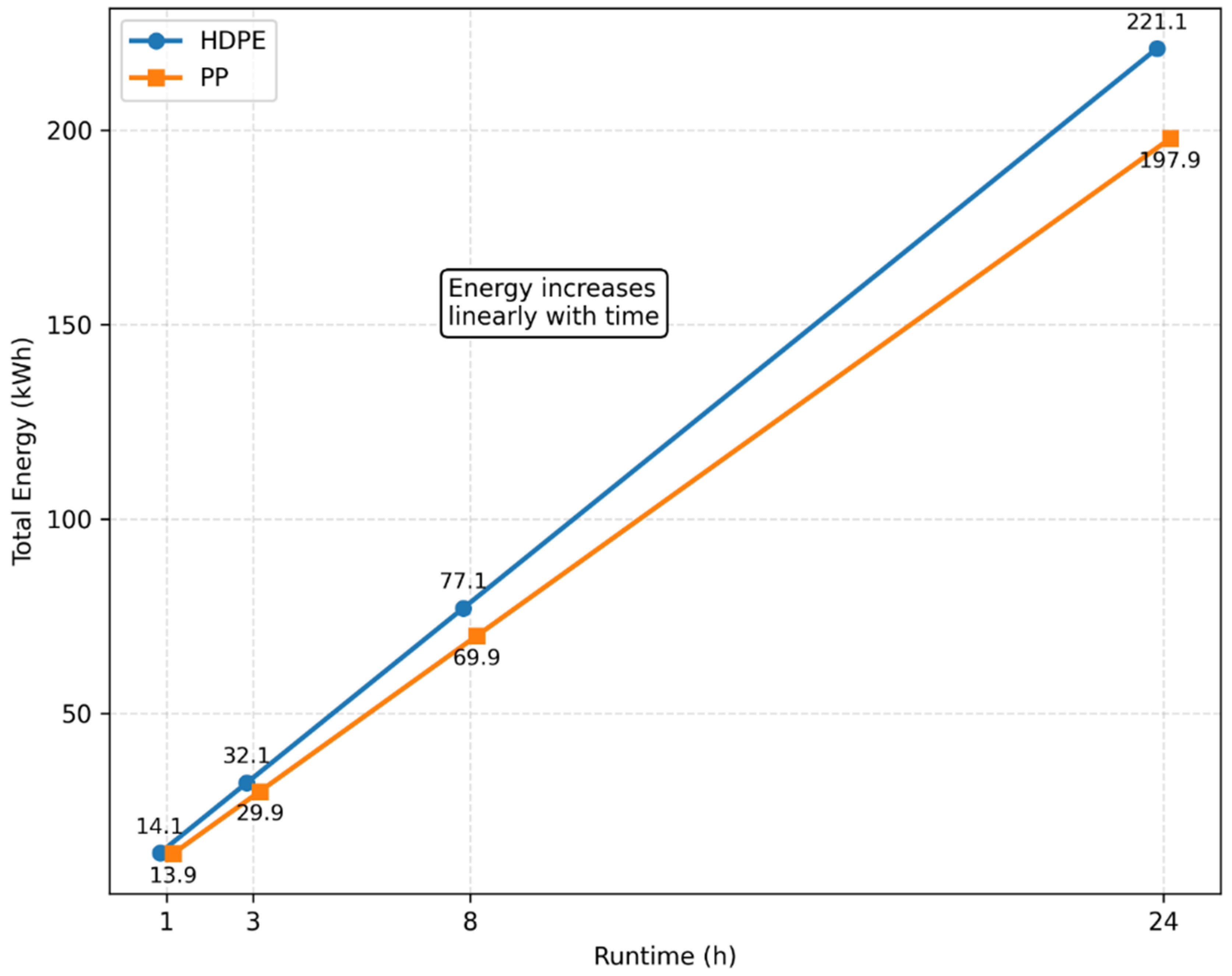
Figure 2.
Specific energy consumption (SEC) as a function of runtime for virgin and waste HDPE and PP.
Figure 2.
Specific energy consumption (SEC) as a function of runtime for virgin and waste HDPE and PP.
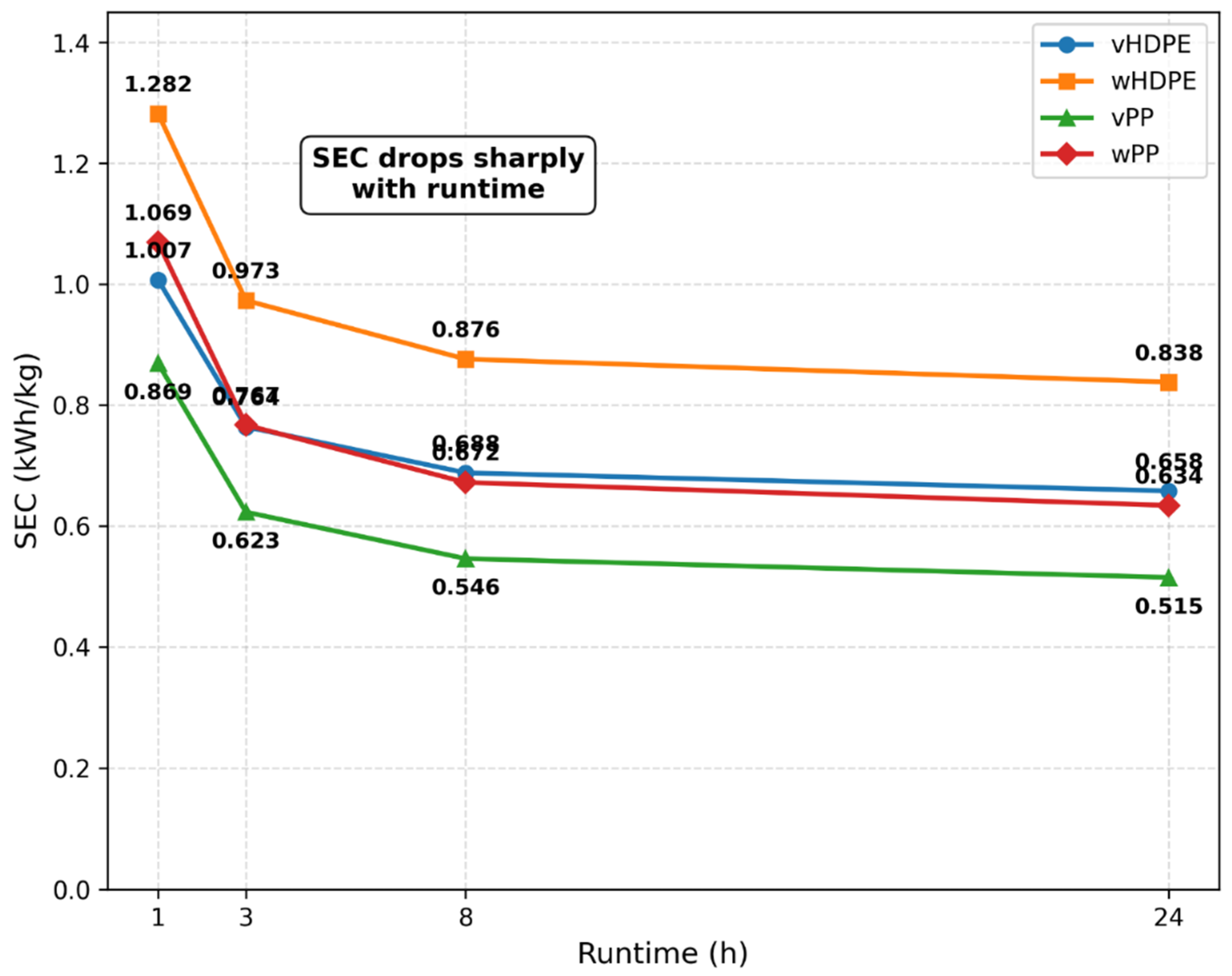
Figure 3.
Contribution of startup energy to total energy consumption as a function of runtime.
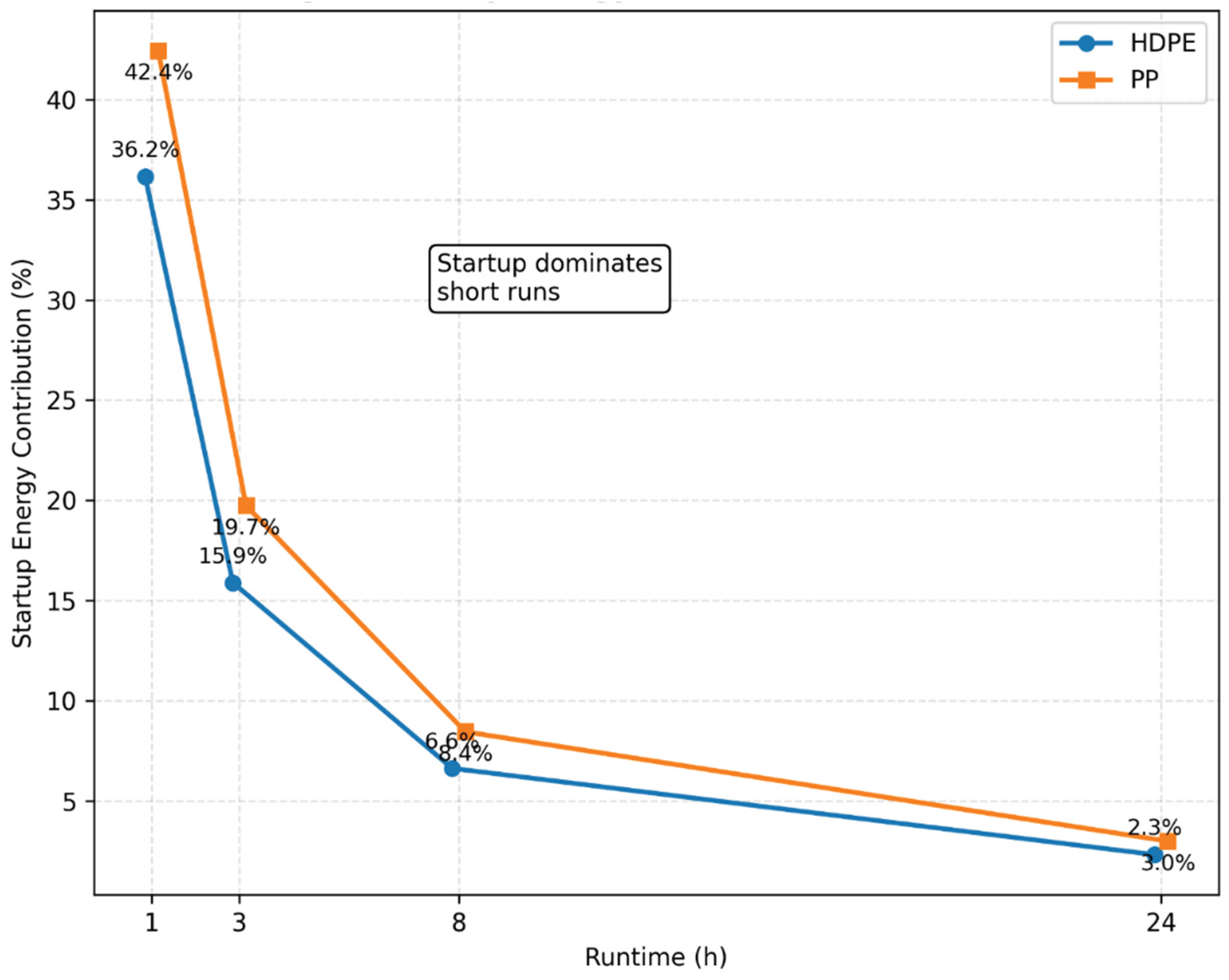

Table 1.
Melt flow index of virgin and waste polyolefins.
| Material | MFI (g/10 min) |
|---|---|
| Virgin HDPE | 0.7475 ± 0.0118 |
| Virgin PP | 8.4967 ± 0.1297 |
| Waste HDPE | 0.3653 ± 0.0045 |
| Waste PP | 2.0443 ± 0.0422 |
Table 2.
Operating conditions used for extrusion of virgin and waste polyolefins.
| Material | Temp (°C) |
Throughput (kg h⁻¹) |
Power (kW) |
|---|---|---|---|
| Virgin HDPE | 180–220 | 14 | 9 |
| Waste HDPE | 180–220 | 11 | 9 |
| Virgin PP | 210–250 | 16 | 8 |
| Waste PP | 210–250 | 13 | 8 |
Table 3.
Runtime effect on energy consumption and SEC for virgin and waste polyolefins.
| Material | Runtime (h) | Ramp-up energy (kWh) | Running energy (kWh) | Post-operation auxiliary energy (kWh) | Total energy (kWh) | Output (kg) | SEC (kWh kg⁻¹) |
|---|---|---|---|---|---|---|---|
| Virgin HDPE | 1 | 4.8 | 9.0 | 0.3 | 14.1 | 14 | 1.007 |
| Virgin HDPE | 3 | 4.8 | 27.0 | 0.3 | 32.1 | 42 | 0.764 |
| Virgin HDPE | 8 | 4.8 | 72.0 | 0.3 | 77.1 | 112 | 0.688 |
| Virgin HDPE | 24 | 4.8 | 216.0 | 0.3 | 221.1 | 336 | 0.658 |
| Waste HDPE | 1 | 4.8 | 9.0 | 0.3 | 14.1 | 11 | 1.282 |
| Waste HDPE | 3 | 4.8 | 27.0 | 0.3 | 32.1 | 33 | 0.973 |
| Waste HDPE | 8 | 4.8 | 72.0 | 0.3 | 77.1 | 88 | 0.876 |
| Waste HDPE | 24 | 4.8 | 216.0 | 0.3 | 221.1 | 264 | 0.838 |
| Virgin PP | 1 | 5.5 | 8.0 | 0.4 | 13.9 | 16 | 0.869 |
| Virgin PP | 3 | 5.5 | 24.0 | 0.4 | 29.9 | 48 | 0.623 |
| Virgin PP | 8 | 5.5 | 64.0 | 0.4 | 69.9 | 128 | 0.546 |
| Virgin PP | 24 | 5.5 | 192.0 | 0.4 | 197.9 | 384 | 0.515 |
| Waste PP | 1 | 5.5 | 8.0 | 0.4 | 13.9 | 13 | 1.069 |
| Waste PP | 3 | 5.5 | 24.0 | 0.4 | 29.9 | 39 | 0.767 |
| Waste PP | 8 | 5.5 | 64.0 | 0.4 | 69.9 | 104 | 0.672 |
| Waste PP | 24 | 5.5 | 192.0 | 0.4 | 197.9 | 312 | 0.634 |
Table 4.
Gate-to-gate GHG emissions per kg of polymer processed (kg CO₂-eq kg⁻¹).
| Material | 1 h | 3 h | 8 h | 24 h |
|---|---|---|---|---|
| Virgin HDPE | 0.522 | 0.396 | 0.357 | 0.341 |
| Waste HDPE | 0.665 | 0.504 | 0.454 | 0.434 |
| Virgin PP | 0.451 | 0.323 | 0.283 | 0.267 |
| Waste PP | 0.554 | 0.397 | 0.348 | 0.329 |
Table 5.
Mechanical properties of extruded polymers.
| Material | Tensile Strength (MPa) | Young’s Modulus (MPa) |
|---|---|---|
| Virgin HDPE | 26.651 | 921.23 |
| Virgin PP | 32.864 | 1401.11 |
| Waste HDPE | 22.341 | 801.22 |
| Waste PP | 28.334 | 1043.21 |
Disclaimer/Publisher’s Note: The statements, opinions and data contained in all publications are solely those of the individual author(s) and contributor(s) and not of MDPI and/or the editor(s). MDPI and/or the editor(s) disclaim responsibility for any injury to people or property resulting from any ideas, methods, instructions or products referred to in the content. |
© 2026 by the authors. Licensee MDPI, Basel, Switzerland. This article is an open access article distributed under the terms and conditions of the Creative Commons Attribution (CC BY) license (http://creativecommons.org/licenses/by/4.0/).
Copyright: This open access article is published under a Creative Commons CC BY 4.0 license, which permit the free download, distribution, and reuse, provided that the author and preprint are cited in any reuse.


