

Submitted:
09 June 2026
Posted:
02 July 2026
You are already at the latest version
Abstract
Neutron stars observed as pulsars are among the most versatile natural laboratories in physics. Their clock- like rotational stability, strong surface gravity, supranuclear interior densities, broadband pulsed emission, and distribution across the sky allow a single class of object to probe questions that range from the behaviour of matter at extreme density, through the strong-field and radiative regimes of general relativity (GR), to the most ambitious target of all—residual, Planck-scale imprints of a quantum theory of gravity. This survey reviews, at the level of a working researcher, the principal ways in which pulsars test physics beyond the established classical-GR+quantum-field-theory description, organized into five complementary pillars: (i) tests of Lorentz invariance through energy-dependent photon time-of-flight; (ii) the nanohertz gravitational-wave background detected by pulsar timing arrays, with its astrophysical and cosmological interpretations; (iii) strong-field tests of GR with relativistic binary pulsars; (iv) the dense-matter equation of state inferred from neutron-star masses and radii; and (v) searches for stochastic spacetime “foam” through the decoherence and blurring of astrophysical signals. For each pillar we give the governing relations, summarize current best constraints, and state plainly what the method can and cannot deliver. The resulting picture is asymmetric but coherent: pulsars now furnish some of the most precise tests of strong-field gravity and the tightest astrophysical handles on the dense-matter equation of state, whereas in the quantum-gravity sector they chiefly bound and falsify candidate theories—frequently as a complement to gamma-ray and cosmological probes—rather than isolating a unique microscopic completion.
Keywords:
pulsars
; neutron stars
; strong-field gravity
; pulsar timing arrays
; gravitational waves
; dense-matter equation of state
; Lorentz invariance violation
; quantum-gravity phenomenology
1. Introduction
Pulsars—rapidly rotating, strongly magnetized neutron stars—are among the most productive natural laboratories in physics. A single class of object simultaneously realizes extreme density, strong spacetime curvature, and clock-like timing precision, and as a result pulsars bear on a remarkable range of fundamental questions: the equation of state of cold matter above nuclear density, the strong-field and radiative behaviour of general relativity (GR), and—most ambitiously—the search for low-energy imprints of physics at the Planck scale. General relativity and quantum field theory (QFT) are, individually, the most precisely tested theories in the history of physics, yet they are mutually incompatible at high energies: a naïve quantization of the gravitational field is non-renormalizable, and the two frameworks make incompatible assumptions about the nature of spacetime and measurement. A consistent theory of quantum gravity (QG) must reconcile them, and candidate frameworks—string theory, loop quantum gravity (LQG), causal-set theory, asymptotic safety, and others—typically predict new physics at the Planck scale, set by the fundamental constants ℏ, G and c:
The defining difficulty of the field is that exceeds the centre-of-mass energy of the Large Hadron Collider by some fifteen orders of magnitude. Direct production of Planck-scale quanta is therefore impossible, and QG remained for decades a purely theoretical enterprise. The modern response is quantum-gravity phenomenology: rather than reaching the Planck energy directly, one searches for residual low-energy imprints of Planck-scale structure that accumulate to observable magnitude through an amplifier—a long baseline, a very high energy, an extreme field, or a very stable clock [5,6,7,8]. The central task lies in finding effects for which such amplifiers exist, and in disentangling genuine QG signals from astrophysical and instrumental systematics.
Pulsars are exceptional probes across all of these fronts. Discovered in 1967 as sources of strikingly regular radio pulses [1], they combine several properties that make them simultaneously useful across many channels of fundamental physics:
- They are dense. Their interiors reach several times nuclear saturation density, probing the equation of state (EOS) of cold, ultra-dense matter.
- They emit across the spectrum and at cosmological lever arms. Pulsed emission from radio through TeV -rays, combined with known distances, enables photon time-of-flight tests of Lorentz invariance.
- They are distributed across the sky. An ensemble of MSPs forms a Galactic-scale detector—a pulsar timing array (PTA)—sensitive to nanohertz gravitational waves.
This survey reviews these channels and the constraints they place on physics beyond classical GR and standard QFT. Section 2 establishes pulsar timing as a precision instrument. Section 3, Section 4, Section 5, Section 6 and Section 7 treat the five pillars in turn: Lorentz-invariance violation (LIV), pulsar timing arrays, strong-field GR tests, the dense-matter EOS, and spacetime foam. Section 8 surveys near-future prospects with the next generation of radio telescopes, and Section 9 sets out the limitations and the epistemic position of the programme. Table 1 summarizes the five pillars, their amplifiers, and the broad classes of new physics each constrains.
2. Pulsars as Precision Instruments
A pulsar’s scientific power flows almost entirely from the regularity of its pulses. In pulsar timing, one records the times of arrival (TOAs) of pulses at the telescope and compares them with a deterministic timing model—a parametrized description of the pulsar’s rotation, astrometry, and (where relevant) binary motion and propagation effects. The model predicts the rotational phase via a Taylor expansion about a reference epoch ,
with spin frequency and spin-down rate . After transforming TOAs to the Solar System barycentre and accounting for the dispersive delay of the interstellar medium (ISM), , the differences between observed and predicted arrival times—the timing residuals—encode every effect not captured by the model. Unmodelled physics, from a binary companion to a passing gravitational wave to a Planck-scale dispersion, appears as a structured residual.
For the best MSPs the residual root-mean-square is at the level of tens to hundreds of nanoseconds over many years [4]. This extraordinary fractional timing precision is what converts pulsars into amplifiers: a fractional frequency perturbation as small as becomes measurable when integrated over a decade. The same stability underlies all five pillars below—whether the perturbing agent is a modified photon dispersion relation, a stochastic gravitational-wave background, the back-reaction of gravitational radiation on a binary orbit, or fluctuations of spacetime itself.
3. Lorentz-Invariance Violation and Modified Dispersion
3.1. Theoretical Motivation
Many approaches to QG suggest that exact Lorentz invariance is an emergent, low-energy symmetry rather than a fundamental one. If spacetime has discrete or non-commutative short-distance structure, the smooth Lorentz group may be deformed or broken near . Three broad scenarios are commonly considered: explicit LIV, conveniently catalogued by the Standard-Model Extension (SME) effective field theory [12]; deformed or “doubly special” relativity (DSR), in which is an observer-independent scale alongside c; and stochastic violations sourced by spacetime foam. A model-independent way to encode the leading effect is a modified photon dispersion relation,
with sign parameter and a phenomenological QG scale that one hopes is of order . The associated energy-dependent group velocity is
Linear () deformations are the most stringently testable because they are least suppressed; quadratic () effects are far smaller but arise naturally in CPT-symmetric models.
3.2. Photon Time-of-Flight with Pulsars
Equation (4) implies that two photons emitted simultaneously but at different energies from a source at distance D accumulate an arrival-time difference. For a Galactic source, where cosmological expansion is negligible,
The signal grows with photon energy and distance, so the ideal source is distant, highly variable, and bright at the highest energies. Pulsars contribute a uniquely clean version of this test: their pulse profiles provide an intrinsic, repeating time stamp, so one can search for an energy dependence of the pulse peak position rather than relying on a single transient. The MAGIC Collaboration carried out such an analysis on the Crab pulsar, whose pulsed emission extends to TeV energies, finding no significant energy-dependent shift above and thereby bounding [15]; comparable limits were obtained from Crab data by VERITAS. Gamma-ray pulsars have more recently been added as a source class for time-of-flight LIV: using the H.E.S.S. detection of pulsed Vela emission reaching [16], Li, Zhu, and Ma derived linear- and quadratic-order bounds and [17], establishing very-high-energy pulsars as a complementary handle alongside transients.
3.3. Context and Current State
Pulsar bounds are best understood alongside the most constraining time-of-flight limits, which come from cosmological transients. The seminal proposal to use gamma-ray bursts (GRBs) for this purpose [13] was realized by the Fermi Large Area Telescope, whose observation of GRB 090510 excluded a linear vacuum dispersion below the Planck scale—i.e. for [14]. Subsequent multi-TeV detections, notably GRB 221009A observed by LHAASO, have extended the lever arm to still higher energies [6]. Figure 1 places representative pulsar and GRB bounds on a common scale. The implication is direct: for linear LIV the data already reach and exceed , so any surviving Lorentz violation must be sub-leading. This is itself a strong constraint on the model space—several string-inspired and DSR scenarios that predicted effects are disfavoured—though birefringent and quadratic channels remain comparatively open and are an active target for the next generation of TeV observatories.
4. Pulsar Timing Arrays and the Nanohertz Sky
4.1. Principle
A gravitational wave (GW) crossing the line of sight to a pulsar perturbs the proper distance and hence the measured TOAs, leaving a characteristic imprint in the timing residuals. A single pulsar cannot distinguish such a perturbation from intrinsic spin noise. The decisive idea, due originally to Sazhin [18] and Detweiler [19] and developed into the modern array concept by Foster & Backer [20], is to monitor many MSPs and exploit the angular correlation of their residuals. For an isotropic, unpolarized stochastic GW background, the expected correlation between two pulsars separated on the sky by an angle follows the Hellings–Downs curve [21],
plus a self-correlation term for each pulsar. This quadrupolar signature (Figure 2) is the signature that distinguishes a GW background from monopolar clock errors or dipolar Solar-System ephemeris errors, both of which produce different angular patterns.
The background is usually characterized by its dimensionless characteristic strain spectrum, modelled as a power law,
with . A population of inspiralling supermassive black-hole binaries (SMBHBs) predicts , equivalent to a timing-residual power spectral index .
4.2. The 2023 Detections
In June 2023 four PTA collaborations announced concordant evidence for a stochastic signal consistent with Eq. (6). NANOGrav reported, from 67 pulsars in its 15-year data set, Hellings–Downs–correlated power favoured over uncorrelated noise at a significance of 3– (method-dependent), with a Bayes factor in excess of relative to a noise-only model [22]. The European, Parkes, and Chinese PTAs reported consistent results [23,24,25], and independent evidence has since been added by the Indian and MeerKAT arrays, so that six timing arrays now report the signal. The recovered amplitude and spectral slope are broadly compatible with an inspiralling supermassive-black-hole-binary population [27], although the data neither require nor exclude a cosmological component; dedicated searches for spatial anisotropy and for individual continuous-wave sources are under way to settle the origin [28].
4.3. Quantum-Gravity and Cosmological Windows
The nanohertz band is a new window on the early Universe, and several of its candidate sources bear directly on QG and beyond-Standard-Model physics. The NANOGrav collaboration’s own new-physics analysis [26] considered a range of such interpretations:
- Primordial / inflationary GWs. A background of relic gravitational waves from inflation would be a direct relic of quantum fluctuations of the spacetime metric in the very early Universe. Fitting the PTA signal with an inflationary tensor spectrum constrains the tensor tilt and the energy scale of inflation.
- Cosmic strings. Networks of cosmic strings—predicted by many grand-unified and string-theory compactifications—radiate gravitationally and produce a stochastic background with a characteristic spectral shape, providing a target signature for stringy physics.
- First-order phase transitions. A strongly first-order transition in the early Universe (e.g. associated with new high-scale symmetry breaking) generates GWs through bubble collisions and turbulence, with peaking in the PTA band for transition temperatures around the MeV–GeV scale.
- Massive gravity / graviton mass. If the graviton is massive, the dispersion and amplitude of the background are modified. Interpreting the NANOGrav signal within massive gravity yields regions of graviton-mass parameter space consistent with the data, subject to big-bang-nucleosynthesis bounds [29], complementing the bound from LIGO–Virgo binary mergers.
The central caveat is foreground confusion: the astrophysical SMBHB population and the cosmological sources produce overlapping spectra, and disentangling them will require the improved spectral and anisotropy measurements expected from the combined International PTA data set.
5. Strong-Field Tests of General Relativity
5.1. The Post-Keplerian Framework
Relativistic binary pulsars test GR in the strong-field, radiative regime that the Solar System cannot reach. The orbit is described by five Keplerian parameters plus a set of post-Keplerian (PK) parameters, each of which is, in a given theory of gravity, a known function of the two (a priori unknown) stellar masses. Measuring three or more PK parameters therefore over-determines the masses; any inconsistency would signal a failure of the theory. In GR the leading PK parameters are the relativistic periastron advance , the time-dilation/redshift amplitude , the orbital-period decay from GW emission, and the Shapiro-delay “range” r and “shape” s. The orbital decay is the quadrupole-formula prediction,
where is a known function of eccentricity. The Shapiro shape probes the propagation of the pulsar’s own signal through the curved spacetime of its companion.
5.2. Hulse–Taylor and the Double Pulsar
The first binary pulsar, PSR B1913+16 [2], provided the first evidence for gravitational radiation: its measured orbital decay matches Eq. (8) to better than a percent [34], a result recognized by the 1993 Nobel Prize. The most stringent laboratory of this kind is the Double Pulsar PSR J0737−3039A/B [30,31], the only known system in which both neutron stars are visible as radio pulsars. Its short , mildly eccentric orbit makes it highly relativistic. From an early -year span, Kramer et al. [32] obtained four independent strong-field tests of GR; with a 16-year span, Kramer et al. [33] measured seven PK parameters—more than for any other binary—and confirmed the GW-driven orbital decay at the level, roughly 25 times more precisely than the Hulse–Taylor system. At this precision, higher-order effects such as relativistic deformation of the orbit, the contribution of the pulsar’s spin-down mass loss to , and aberrational light-bending must be included; signal-propagation effects in the companion’s strong field were measured for the first time, and are not currently accessible by any other method.
5.3. Constraining Alternatives and QG Corrections
These measurements bound deviations from GR predicted by candidate theories. Scalar–tensor theories generically predict the emission of dipolar gravitational radiation by asymmetric binaries, which would alter ; its absence places tight limits on such theories [11,36], and a pulsar in a stellar triple has furnished the most precise test of the strong-field universality of free fall [35]. More relevant to QG, effective-field-theory completions of gravity add higher-curvature terms to the Einstein–Hilbert action,
whose coefficients encode short-distance (potentially Planck-scale) physics. The exquisite agreement of binary-pulsar dynamics with pure-R GR constrains the magnitude of such terms in the strong-field regime. As with the time-of-flight bounds of Section 3, leading-order departures from the standard theory are already excluded wherever an amplifier exists, which pushes any new physics into the sub-leading terms.
6. Neutron-Star Interiors and Dense Matter
6.1. The Equation-of-State Problem
A neutron star compresses matter to densities of several times the nuclear saturation density —conditions that cannot be reproduced terrestrially and lie beyond the reliable reach of perturbative quantum chromodynamics (QCD). The relation between pressure and density, the EOS, is therefore genuinely unknown in this regime, and its determination is a central goal of nuclear astrophysics. The stellar structure follows from the relativistic Tolman–Oppenheimer–Volkoff (TOV) equation,
so a measured mass–radius relation maps directly onto the EOS.
6.2. Masses, Radii, and the Maximum Mass
Two classes of measurement now constrain the EOS sharply. First, precise masses from relativistic Shapiro delay and binary timing establish a high lower bound on the maximum neutron-star mass: PSR J1614−2230 [37] and PSR J0348+0432 [38] demonstrated stars, and the black-widow pulsar PSR J0952−0607 may reach [39]. Such high masses exclude the softest EOSs, which cannot support them against collapse. Second, NASA’s NICER X-ray timing mission infers both mass and radius by modelling the rotating hot-spot pulse profile. For the pulsar PSR J0030+0451, NICER found [40,41]; for the massive PSR J0740+6620 (), joint NICER+XMM-Newton analyses give – [42,43,44]; and the nearby PSR J0437−4715 yields , [45], favouring a comparatively soft EOS.
6.3. Connection to Fundamental Physics
These data are complementary to the tidal-deformability constraints from the binary-neutron-star merger GW170817 [46], and together they pin the radius of a canonical star to roughly 12–. The fundamental-physics payoff is the behaviour of cold QCD matter at supranuclear density: whether the core contains hyperons, deconfined quark matter, or a first-order hadron–quark phase transition, and whether “twin-star” configurations exist. This pillar constrains dense-matter QCD far more directly than it constrains quantum gravity. Its relevance to the QG programme is indirect—it fixes the matter sector that any complete strong-gravity description must incorporate, and it provides a setting in which exotic, potentially QG-modified, equations of state can be tested against data.
7. Spacetime Foam and Signal Decoherence
If spacetime is subject to Planck-scale quantum fluctuations—Wheeler’s “quantum foam”—then the metric, and hence the optical path length to a distant source, fluctuates stochastically. A photon traversing a path of length L accumulates a random phase wander that grows with the number of Planck-scale steps along the path. Phenomenological foam models parametrize the fractional uncertainty in a measured length as
with a model-dependent exponent (the values corresponding to “random-walk,” “holographic,” and minimal models, respectively) [5,47]. The accumulated phase error can, for sufficiently distant sources, exceed unity, which would blur or destroy the diffraction-limited images of cosmologically distant point sources.
Searches for this effect use the sharpest available images of the most distant objects. Observations of distant quasars and supernovae show no loss of phase coherence at the level predicted by the more aggressive foam models, excluding the random-walk scenario and constraining others [48,49]. A complementary, time-domain approach treats spacetime fluctuations as a source of stochastic Lorentz violation, broadening the arrival-time distribution of high-energy photons; analysis of Fermi GRB data in this framework placed a Planck-scale limit on spacetime “fuzziness” [50]. Pulsars enter this pillar more indirectly: as ultra-stable clocks and coherent sources at known distances, they bound any anomalous, distance-dependent phase noise that smooth-spacetime QFT forbids, and the same idea motivated early proposals to use gravitational-wave interferometers as quantum-gravity detectors [51]. To date, foam searches have yielded null results, which is itself informative: viable models of discrete spacetime must not blur the distant Universe.
8. Future Prospects
The coming decade will sharpen every pillar above. In the radio, the Square Kilometre Array (SKA), the Five-hundred-metre Aperture Spherical Telescope (FAST), and the next-generation Very Large Array (ngVLA) will increase both the number of timed MSPs and the per-pulsar timing precision, directly improving PTA sensitivity and the angular characterization of the nanohertz background [54]. Two qualitatively new tests are within reach. First, the discovery of a pulsar in a tight orbit around a stellar-mass or—most spectacularly—a supermassive black hole would open black-hole spacetime to precision timing: simulations indicate that timing a pulsar orbiting Sgr A* could measure the black-hole spin to and test the no-hair theorem at the level within a few years of observation [52,53]. Such measurements would probe the strong-field structure of gravity in a regime intermediate between binary pulsars and event-horizon-scale imaging. Second, in the high-energy domain, the Cherenkov Telescope Array and continued operation of LHAASO will extend pulsed and transient TeV–PeV spectra, tightening time-of-flight LIV bounds—especially in the quadratic and birefringent channels that remain comparatively unconstrained. Across messengers, the combination of PTA, ground-based and space-based GW detectors, and high-energy photon and neutrino observatories defines the multi-messenger era of QG phenomenology [6].
9. Limitations and the Epistemic Picture
The five pillars differ sharply in how directly they bear on physics beyond established theory. The strong-field-GR and dense-matter results are robust, precise, and broadly model-independent; it is chiefly the quantum-gravity ambitions of the programme whose reach is limited, and it is worth stating plainly where those ambitions can and cannot deliver. Table 2 summarizes the position. Several structural limitations recur.
First, and most fundamentally, no pulsar observation reaches the Planck energy directly; even the highest-energy pulsed photons (GeV–TeV) lie far below , and the constraints derive entirely from the amplification of tiny effects. For some QG effects no amplifier exists: discretizations that predict geometric quanta of fixed Planck-scale magnitude, independent of the size of the observable, do not accumulate with baseline and are therefore essentially unobservable by these methods [5].
Second, pulsars constrain but do not uniquely select a theory. A given LIV bound or GW spectrum is compatible with many microscopic frameworks; the data carve away regions of an enormous parameter space rather than pointing to a single completion. This is nonetheless valuable: in a field where the theoretical landscape is vast and largely unconstrained, empirical exclusion is real progress, and several specific predictions—most notably linear LIV—are already excluded.
Third, astrophysical and instrumental systematics can mimic QG signals. Interstellar dispersion and scattering, intrinsic pulse-shape variability, ephemeris and clock errors, and the astrophysical SMBHB foreground in the PTA band all produce structured residuals that must be modelled and subtracted before a Planck-scale interpretation is admissible. The history of the field counsels caution: claimed foam-induced blurring and several early LIV “hints” did not survive scrutiny.
Finally, the dense-matter pillar, though observationally powerful, primarily constrains QCD rather than gravity, and should be presented as such. Its role in the QG programme is to fix the matter content of strong-gravity systems, not to test the quantization of gravity itself.
10. Conclusions
Pulsars occupy a singular place in experimental fundamental physics. Through a small number of remarkable properties—clock-like stability, strong-field compactness, supranuclear density, broadband emission, and sky-wide distribution—a single class of object reaches from the equation of state of dense matter, through precision strong-field tests of general relativity, to the longest available lever arms for Planck-scale phenomenology. The five pillars surveyed here have produced concrete results: strong-field GR has been confirmed to the level in the Double Pulsar; neutron-star mass and radius measurements now pin the dense-matter equation of state to a narrow band; a nanohertz gravitational-wave background has been detected and opens a new window on supermassive black-hole binaries and the early Universe; and linear Lorentz violation is excluded at and beyond the Planck scale. None of this derives a theory of quantum gravity, and it cannot: the deepest regimes remain inaccessible, and no single observation selects a unique microscopic completion. But falsification and constraint are the engine of physical science, and on that score pulsars have few peers. As the SKA-era instruments come online and the multi-messenger network matures, the pulsar sky will remain one of our most informative laboratories for the structure of spacetime and the matter within it.
References
- Hewish, A.; Bell, S. J.; Pilkington, J. D. H.; Scott, P. F.; Collins, R. A. Observation of a Rapidly Pulsating Radio Source. Nature 1968, 217, 709. [Google Scholar] [CrossRef]
- Hulse, R. A.; Taylor, J. H. Discovery of a pulsar in a binary system. Astrophys. J. 1975, 195, L51. [Google Scholar] [CrossRef]
- Backer, D. C.; Kulkarni, S. R.; Heiles, C.; Davis, M. M.; Goss, W. M. A millisecond pulsar. Nature 1982, 300, 615. [Google Scholar] [CrossRef]
- Lorimer, D. R.; Kramer, M. Handbook of Pulsar Astronomy; Cambridge University Press, 2012. [Google Scholar]
- Amelino-Camelia, G. Quantum-Spacetime Phenomenology. Living Rev. Relativ. 2013, arXiv:0806.033916, 5. [Google Scholar] [CrossRef] [PubMed]
- Addazi, A.; et al. Quantum gravity phenomenology at the dawn of the multi-messenger era—A review. Prog. Part. Nucl. Phys. 2022, arXiv:2111.05659125, 103948. [Google Scholar]
- Mattingly, D. Modern Tests of Lorentz Invariance. Living Rev. Relativ. 2005, arXiv:gr8, 5. [Google Scholar] [CrossRef] [PubMed]
- Liberati, S. Tests of Lorentz invariance: a 2013 update. Class. Quantum Grav. 2013, arXiv:1304.579530, 133001. [Google Scholar] [CrossRef]
- Will, C. M. The Confrontation between General Relativity and Experiment. Living Rev. Relativ. 2014, arXiv:1403.737717, 4. [Google Scholar] [CrossRef] [PubMed]
- Wex, N. “Testing Relativistic Gravity with Radio Pulsars,” in Frontiers in Relativistic Celestial Mechanics, Vol. 2 (de Gruyter, 2014). arXiv:1402.5594.
- Freire, P. C. C.; Wex, N. Gravity experiments with radio pulsars. Living Rev. Relativ. 2024, arXiv:2407.1654027, 5. [Google Scholar]
- Kostelecký, V. A.; Russell, N. Data tables for Lorentz and CPT violation. Rev. Mod. Phys. 2011, arXiv:0801.028783, 11. [Google Scholar]
- Amelino-Camelia, G.; Ellis, J.; Mavromatos, N. E.; Nanopoulos, D. V.; Sarkar, S. Tests of quantum gravity from observations of γ-ray bursts. Nature 1998, 393, 763. [Google Scholar] [CrossRef]
- A. A. Abdo et al. (Fermi LAT/GBM Collaborations), A limit on the variation of the speed of light arising from quantum gravity effects. Nature 2009, 462, 331. [CrossRef] [PubMed]
- M. L. Ahnen et al. (MAGIC Collaboration), Constraining Lorentz Invariance Violation Using the Crab Pulsar Emission Observed up to TeV Energies by MAGIC. Astrophys. J. Suppl. 2017, arXiv:1709.00346232, 9.
- F. Aharonian et al. (H.E.S.S. Collaboration), Discovery of a radiation component from the Vela pulsar reaching 20 teraelectronvolts. Nat. Astron. 2023, 7, 1341. [CrossRef]
- Li, H.; Zhu, J.; Ma, B.-Q. Constraint on Lorentz invariance violation from the Vela pulsar. EPL (Europhys. Lett.) 2024, arXiv:2310.06052145, 69001. [Google Scholar] [CrossRef]
- Sazhin, M. V. Opportunities for detecting ultralong gravitational waves. Sov. Astron. 1978, 22, 36. [Google Scholar]
- Detweiler, S. Pulsar timing measurements and the search for gravitational waves. Astrophys. J. 1979, 234, 1100. [Google Scholar] [CrossRef]
- Foster, R. S.; Backer, D. C. Constructing a pulsar timing array. Astrophys. J. 1990, 361, 300. [Google Scholar] [CrossRef]
- Hellings, R. W.; Downs, G. S. Upper limits on the isotropic gravitational radiation background from pulsar timing analysis. Astrophys. J. 1983, 265, L39. [Google Scholar] [CrossRef]
- G. Agazie et al. (NANOGrav Collaboration), The NANOGrav 15 yr Data Set: Evidence for a Gravitational-wave Background. Astrophys. J. Lett. 2023, arXiv:2306.16213951, L8.
- J. Antoniadis et al. (EPTA Collaboration), The second data release from the European Pulsar Timing Array: Search for a stochastic gravitational-wave background. Astron. Astrophys. 2023, arXiv:2306.16214678, A50.
- Reardon, D. J.; et al. Search for an Isotropic Gravitational-wave Background with the Parkes Pulsar Timing Array. Astrophys. J. Lett. 2023, arXiv:2306.16215951, L6. [Google Scholar]
- Xu, H.; et al. Searching for the Nano-Hertz Stochastic Gravitational Wave Background with the Chinese Pulsar Timing Array Data Release I. Res. Astron. Astrophys. 2023, arXiv:2306.1621623, 075024. [Google Scholar]
- A. Afzal et al. (NANOGrav Collaboration), The NANOGrav 15 yr Data Set: Search for Signals from New Physics. Astrophys. J. Lett. 2023, arXiv:2306.16219951, L11. [CrossRef]
- G. Agazie et al. (NANOGrav Collaboration), The NANOGrav 15 yr Data Set: Constraints on Supermassive Black Hole Binaries from the Gravitational-wave Background. Astrophys. J. Lett. 2023, arXiv:2306.16220952, L37. [CrossRef]
- G. Agazie et al. (NANOGrav Collaboration), The NANOGrav 15 yr Data Set: Search for Anisotropy in the Gravitational-wave Background. Astrophys. J. Lett. 2023, arXiv:2306.16221956, L3. [CrossRef]
- Choi, C.; Magallanes, J.; Gurgenidze, M.; Kahniashvili, T. Stochastic gravitational wave background detection using NANOGrav 15-year data set in the context of massive gravity. Phys. Rev. D. 2024, arXiv:2312.03932110, 063525. [Google Scholar] [CrossRef]
- Burgay, M.; et al. An increased estimate of the merger rate of double neutron stars from observations of a highly relativistic system. Nature 2003, 426, 531. [Google Scholar] [CrossRef] [PubMed]
- Lyne, A. G.; et al. A Double-Pulsar System: A Rare Laboratory for Relativistic Gravity and Plasma Physics. Science 2004, 303, 1153. [Google Scholar] [PubMed]
- Kramer, M.; et al. Tests of General Relativity from Timing the Double Pulsar. Science 2006, 314, 97. [Google Scholar] [CrossRef] [PubMed]
- Kramer, M.; et al. Strong-Field Gravity Tests with the Double Pulsar. Phys. Rev. X 2021, arXiv:2112.0679511, 041050. [Google Scholar]
- Weisberg, J. M.; Nice, D. J.; Taylor, J. H. Timing Measurements of the Relativistic Binary Pulsar PSR B1913+16. Astrophys. J. 2010, 722, 1030. [Google Scholar] [CrossRef]
- Archibald, A. M.; et al. Universality of free fall from the orbital motion of a pulsar in a stellar triple system. Nature 2018, 559, 73. [Google Scholar] [CrossRef] [PubMed]
- Damour, T.; Esposito-Farèse, G. Tensor–scalar gravity and binary-pulsar experiments. Phys. Rev. D. 1996, 54, 1474. [Google Scholar]
- Demorest, P. B.; Pennucci, T.; Ransom, S. M.; Roberts, M. S. E.; Hessels, J. W. T. A two-solar-mass neutron star measured using Shapiro delay. Nature 2010, 467, 1081. [Google Scholar] [CrossRef] [PubMed]
- Antoniadis, J.; et al. A Massive Pulsar in a Compact Relativistic Binary. Science 2013, 340, 448. [Google Scholar] [CrossRef] [PubMed]
- Romani, R. W.; et al. PSR J0952-0607: The Fastest and Heaviest Known Galactic Neutron Star. Astrophys. J. Lett. 2022, 934, L17. [Google Scholar]
- Riley, T. E.; et al. A NICER View of PSR J0030+0451: Millisecond Pulsar Parameter Estimation. Astrophys. J. Lett. 2019, 887, L21. [Google Scholar] [CrossRef]
- Miller, M. C.; et al. PSR J0030+0451 Mass and Radius from NICER Data and Implications for the Properties of Neutron Star Matter. Astrophys. J. Lett. 2019, 887, L24. [Google Scholar] [CrossRef]
- Miller, M. C.; et al. The Radius of PSR J0740+6620 from NICER and XMM-Newton Data. Astrophys. J. Lett. 2021, arXiv:2105.06979918, L28. [Google Scholar]
- Riley, T. E.; et al. A NICER View of the Massive Pulsar PSR J0740+6620 Informed by Radio Timing and XMM-Newton Spectroscopy. Astrophys. J. Lett. 2021, 918, L27. [Google Scholar] [CrossRef]
- Salmi, T.; et al. The Radius of the High-mass Pulsar PSR J0740+6620 with 3.6 yr of NICER Data. Astrophys. J. 2024, arXiv:2406.14467. [Google Scholar]
- Choudhury, D.; et al. A NICER View of the Nearest and Brightest Millisecond Pulsar: PSR J0437-4715. Astrophys. J. Lett. 2024, 971, L20. [Google Scholar]
- B. P. Abbott et al. (LIGO Scientific and Virgo Collaborations), GW170817: Observation of Gravitational Waves from a Binary Neutron Star Inspiral. Phys. Rev. Lett. 2017, 119, 161101. [CrossRef] [PubMed]
- Ng, Y. J.; van Dam, H. Limit to space-time measurement. Mod. Phys. Lett. A 1994, 9, 335. [Google Scholar] [CrossRef]
- Christiansen, W. A.; Ng, Y. J.; van Dam, H. Probing spacetime foam with extragalactic sources. Phys. Rev. Lett. 2006, 96, 051301. [Google Scholar] [CrossRef] [PubMed]
- Tamburini, F.; Cuofano, C.; Della Valle, M.; Gilmozzi, R. No quantum gravity signature from the farthest quasars. Astron. Astrophys. 2011, 533, A71. [Google Scholar] [CrossRef]
- Vasileiou, V.; Granot, J.; Piran, T.; Amelino-Camelia, G. A Planck-scale limit on spacetime fuzziness and stochastic Lorentz invariance violation. Nat. Phys. 2015, 11, 344. [Google Scholar] [CrossRef]
- Amelino-Camelia, G. Gravity-wave interferometers as quantum-gravity detectors. Nature 1999, 398, 216. [Google Scholar]
- Liu, K.; Wex, N.; Kramer, M.; Cordes, J. M.; Lazio, T. J. W. Prospects for Probing the Spacetime of Sgr A* with Pulsars. Astrophys. J. 2012, 747, 1. [Google Scholar] [CrossRef]
- Liu, K.; et al. Pulsar–black hole binaries: prospects for new gravity tests with future radio telescopes. Mon. Not. R. Astron. Soc. 2014, 445, 3115. [Google Scholar] [CrossRef]
- Weltman, A.; et al. Fundamental physics with the Square Kilometre Array. Publ. Astron. Soc. Aust. 2020, arXiv:1810.0268037, e002. [Google Scholar] [CrossRef]
Figure 1.
Schematic comparison of representative lower bounds on the linear () Lorentz-violation scale from photon time-of-flight, spanning Galactic pulsars (Vela, Crab) and cosmological GRBs (Fermi-LAT GRB 090510; LHAASO multi-TeV emission from GRB 221009A). The dashed line marks the Planck energy. Bar positions are order-of-magnitude and method-dependent and are intended to convey the relative lever arm of each source class rather than to reproduce exact published limits. See Refs. [6,14,15,17].
Figure 1.
Schematic comparison of representative lower bounds on the linear () Lorentz-violation scale from photon time-of-flight, spanning Galactic pulsars (Vela, Crab) and cosmological GRBs (Fermi-LAT GRB 090510; LHAASO multi-TeV emission from GRB 221009A). The dashed line marks the Planck energy. Bar positions are order-of-magnitude and method-dependent and are intended to convey the relative lever arm of each source class rather than to reproduce exact published limits. See Refs. [6,14,15,17].
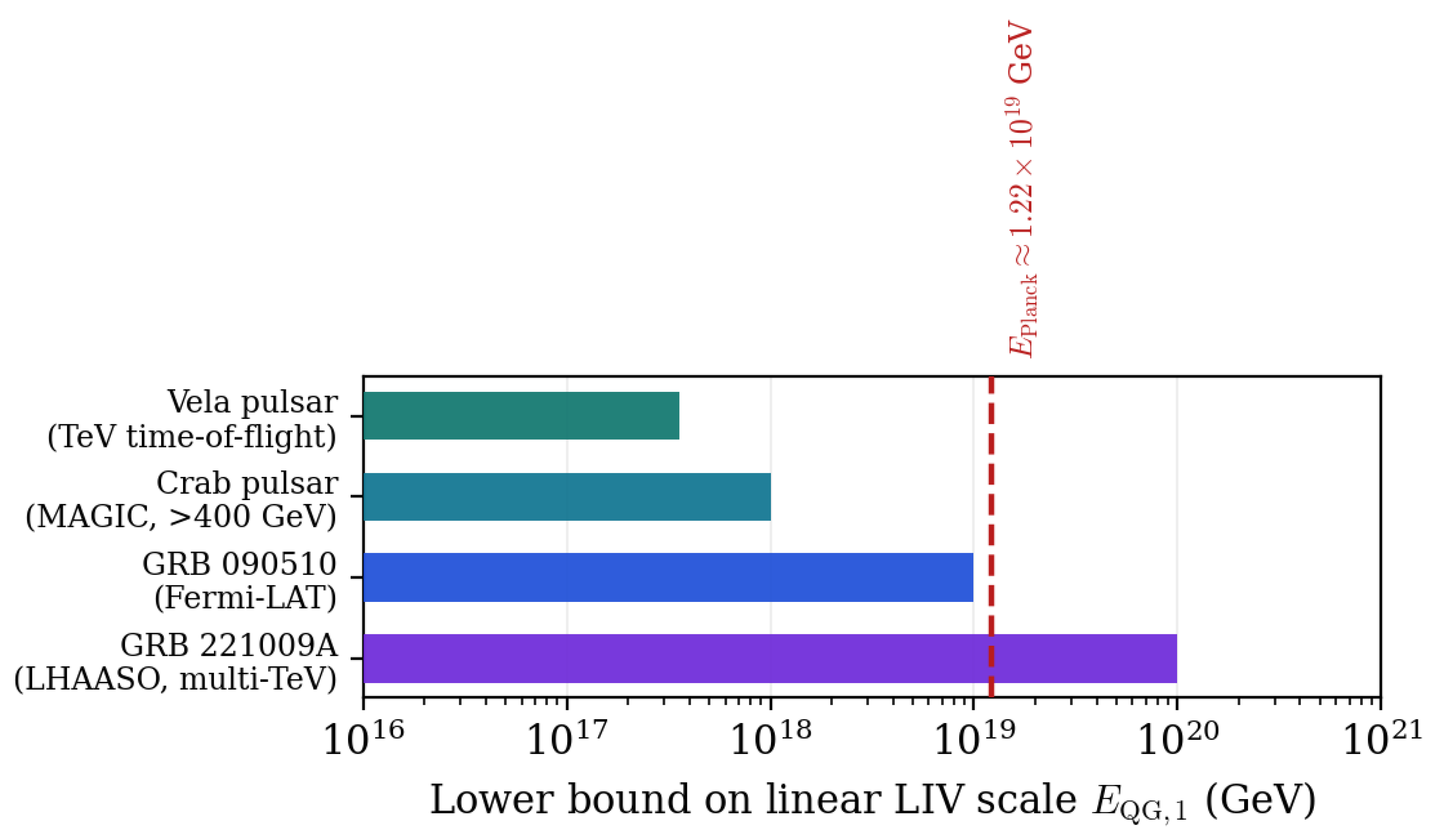
Figure 2.
The Hellings–Downs expected correlation of timing residuals between a pair of pulsars as a function of their angular separation, Eq. (6). The distinctive quadrupolar shape, with a minimum near , is the fingerprint of an isotropic stochastic gravitational-wave background and is what PTAs measure to confirm a GW origin.
Figure 2.
The Hellings–Downs expected correlation of timing residuals between a pair of pulsars as a function of their angular separation, Eq. (6). The distinctive quadrupolar shape, with a minimum near , is the fingerprint of an isotropic stochastic gravitational-wave background and is what PTAs measure to confirm a GW origin.
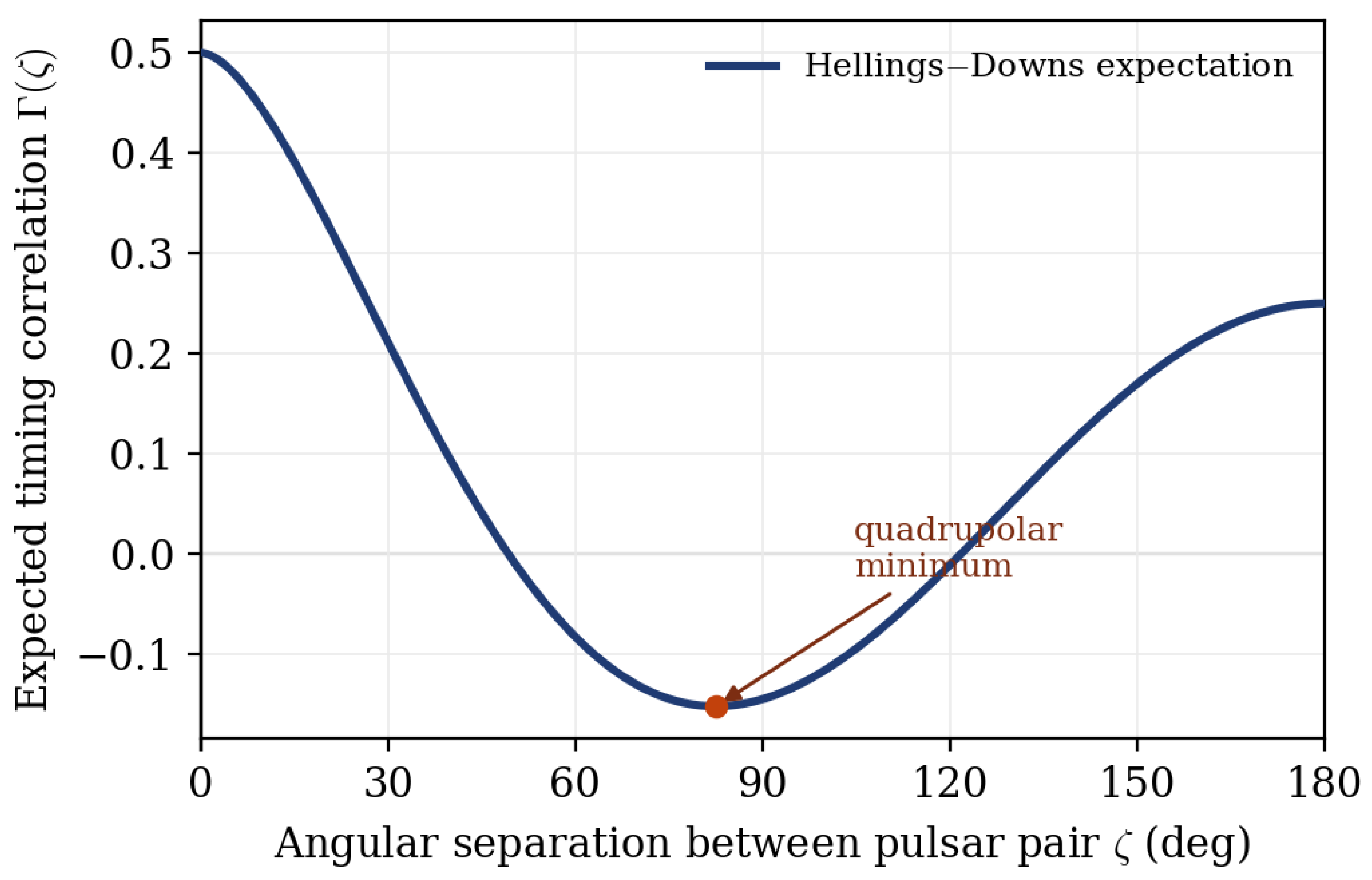

Table 1.
The five pillars of pulsar-based fundamental-physics tests, the physical amplifier exploited in each, and the principal classes of new physics they constrain.
Table 1.
The five pillars of pulsar-based fundamental-physics tests, the physical amplifier exploited in each, and the principal classes of new physics they constrain.
| Pillar | Observable | Amplifier | Constrains |
|---|---|---|---|
| Lorentz-invariance violation (§3) | Energy-dependent photon arrival times | High photon energy × propagation distance | Modified dispersion; DSR; SME coefficients |
| Pulsar timing arrays (§4) | Correlated nanohertz timing residuals | Decade baselines × many stable MSPs | Graviton mass; primordial GWs; cosmic strings |
| Strong-field GR (§5) | Post-Keplerian orbital parameters | Compact, relativistic binary orbits | Scalar–tensor gravity; higher-curvature terms |
| Dense-matter EOS (§6) | Neutron-star mass and radius | Gravitational compression to | QCD phase structure; exotic/quark matter |
| Spacetime foam (§7) | Phase decoherence / image blurring | Cosmological path length / wavelength | Planck-scale metric fluctuations |
Table 2.
What pulsar-based methods can and cannot establish about physics beyond classical GR, with emphasis on the quantum-gravity sector.
Table 2.
What pulsar-based methods can and cannot establish about physics beyond classical GR, with emphasis on the quantum-gravity sector.
| Capability | Status |
|---|---|
| Falsify / bound candidate QG theories | Yes — the core strength |
| Exclude leading-order () Lorentz violation | Yes — |
| Detect nanohertz GW background | Yes — , 2023 |
| Constrain strong-field GR deviations | Yes — to |
| Reach the Planck energy directly | No — relies on amplifiers |
| Uniquely identify the QG theory | No — many models survive |
| Probe quantum superposition of gravity | No — not accessible |
| Cleanly separate QG from astrophysics | Partial — systematics-limited |
Disclaimer/Publisher’s Note: The statements, opinions and data contained in all publications are solely those of the individual author(s) and contributor(s) and not of MDPI and/or the editor(s). MDPI and/or the editor(s) disclaim responsibility for any injury to people or property resulting from any ideas, methods, instructions or products referred to in the content. |
© 2026 by the author. Licensee MDPI, Basel, Switzerland. This article is an open access article distributed under the terms and conditions of the Creative Commons Attribution (CC BY) license.
Copyright: This open access article is published under a Creative Commons CC BY 4.0 license, which permit the free download, distribution, and reuse, provided that the author and preprint are cited in any reuse.